Cambridge A Level Design and Technology 9705 — 2009 Oct/Nov Paper 3 · Variant 1
9705/31/O/N/09 · 120 marks · ≈135 min
The question paper and its mark scheme, free to read here and free to download. This is Cambridge’s own paper, exactly as it was sat.
Question paper12 pages
Mark scheme7 pages
Answers below. Sit the paper first if you are practising.
Paper as text
Question paper, page 1
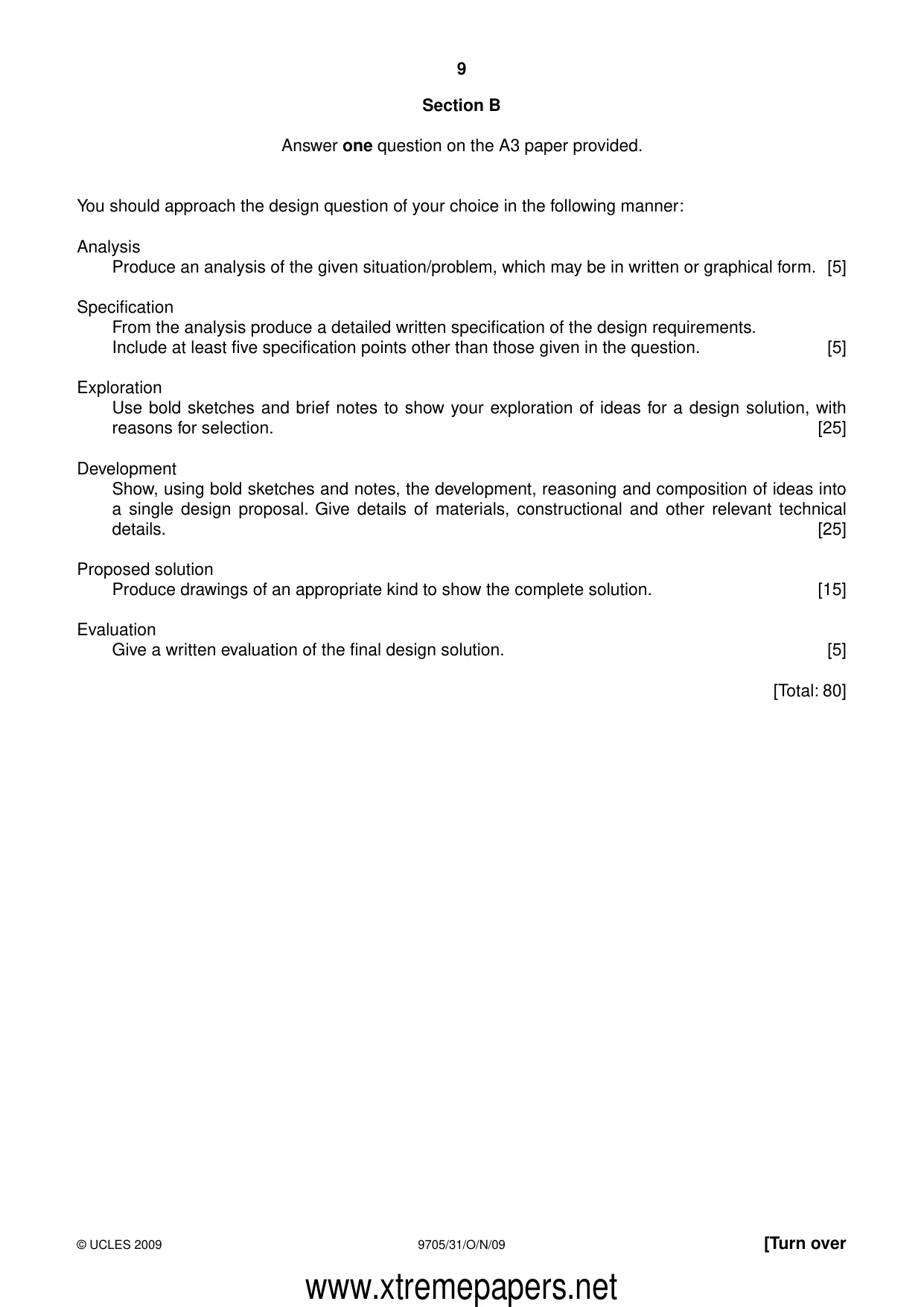
This document consists of 11 printed pages and 1 blank page. DCA (CW/SW) 17649/3 © UCLES 2009 [Turn over UNIVERSITY OF CAMBRIDGE INTERNATIONAL EXAMINATIONS General Certificate of Education Advanced Subsidiary Level and Advanced Level READ THESE INSTRUCTIONS FIRST Write your Centre number, candidate number and name on all the work you hand in. Write in dark blue or black pen. You may use a soft pencil for any diagrams, graphs or rough working. Do not use staples, paper clips, highlighters, glue or correction fluid. Section A Answer any two questions from one of the Parts A, B or C. Section B Answer one question. All dimensions are in millimetres. The instruction ‘discuss’ denotes that you should: • examine critically the issues raised by the question; • explain and interpret these issues as appropriate; • introduce evidence wherever possible to support conclusions of arguments. At the end of the examination, fasten all your work securely together. The number of marks is given in brackets [ ] at the end of each question or part question. * 7 5 5 3 1 8 3 0 0 4 * DESIGN AND TECHNOLOGY 9705/31 Paper 3 October/November 2009 3 hours Additional Materials: Answer Booklet/Paper A range of design drawing equipment A3 Drawing paper (5 sheets) www.xtremepapers.net
Question paper, page 2
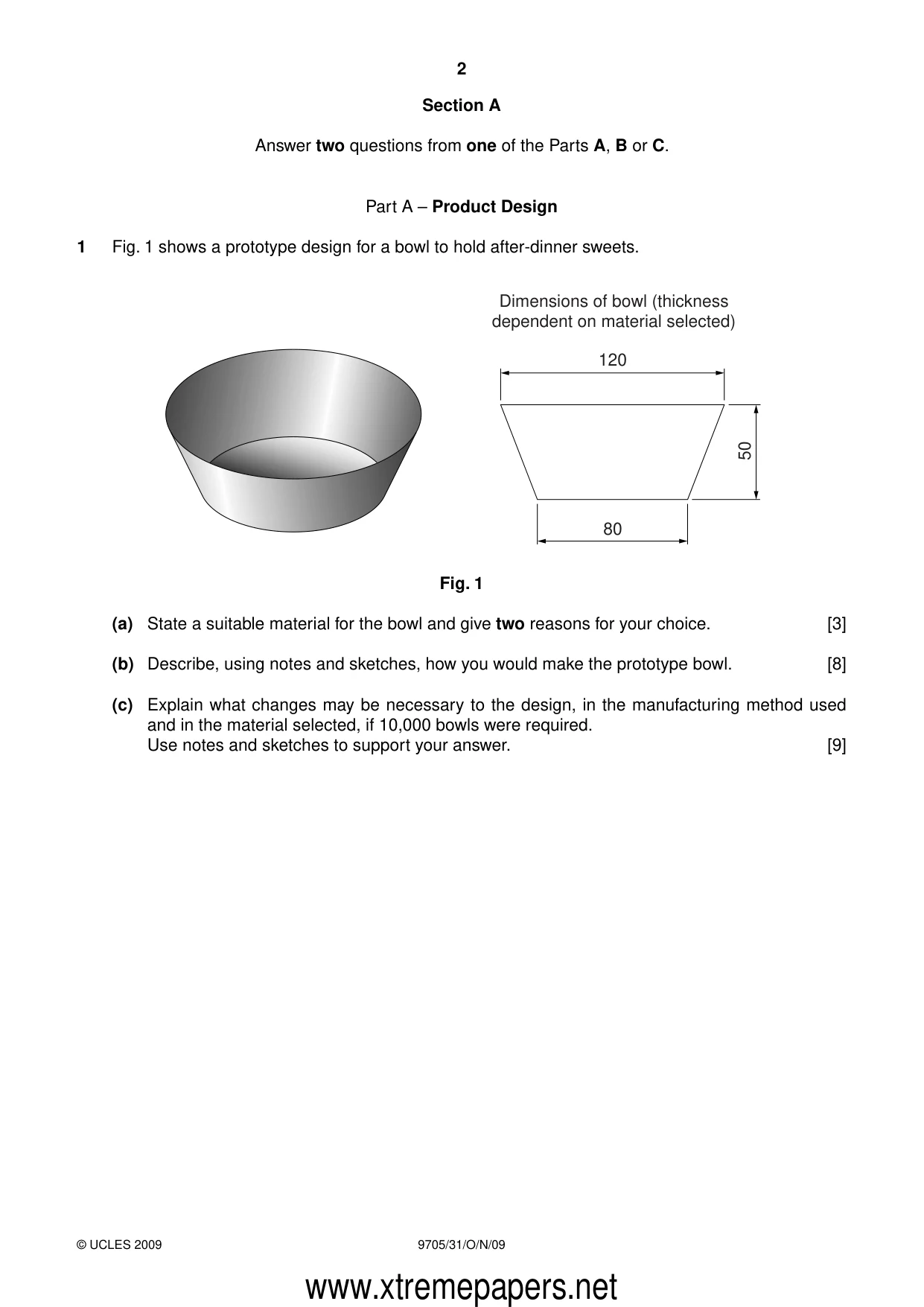
2 9705/31/O/N/09 © UCLES 2009 Section A Answer two questions from one of the Parts A, B or C. Part A – Product Design 1 Fig. 1 shows a prototype design for a bowl to hold after-dinner sweets. 120 Dimensions of bowl (thickness dependent on material selected) 80 50 Fig. 1 (a) State a suitable material for the bowl and give two reasons for your choice. [3] (b) Describe, using notes and sketches, how you would make the prototype bowl. [8] (c) Explain what changes may be necessary to the design, in the manufacturing method used and in the material selected, if 10,000 bowls were required. Use notes and sketches to support your answer. [9] www.xtremepapers.net
Question paper, page 3
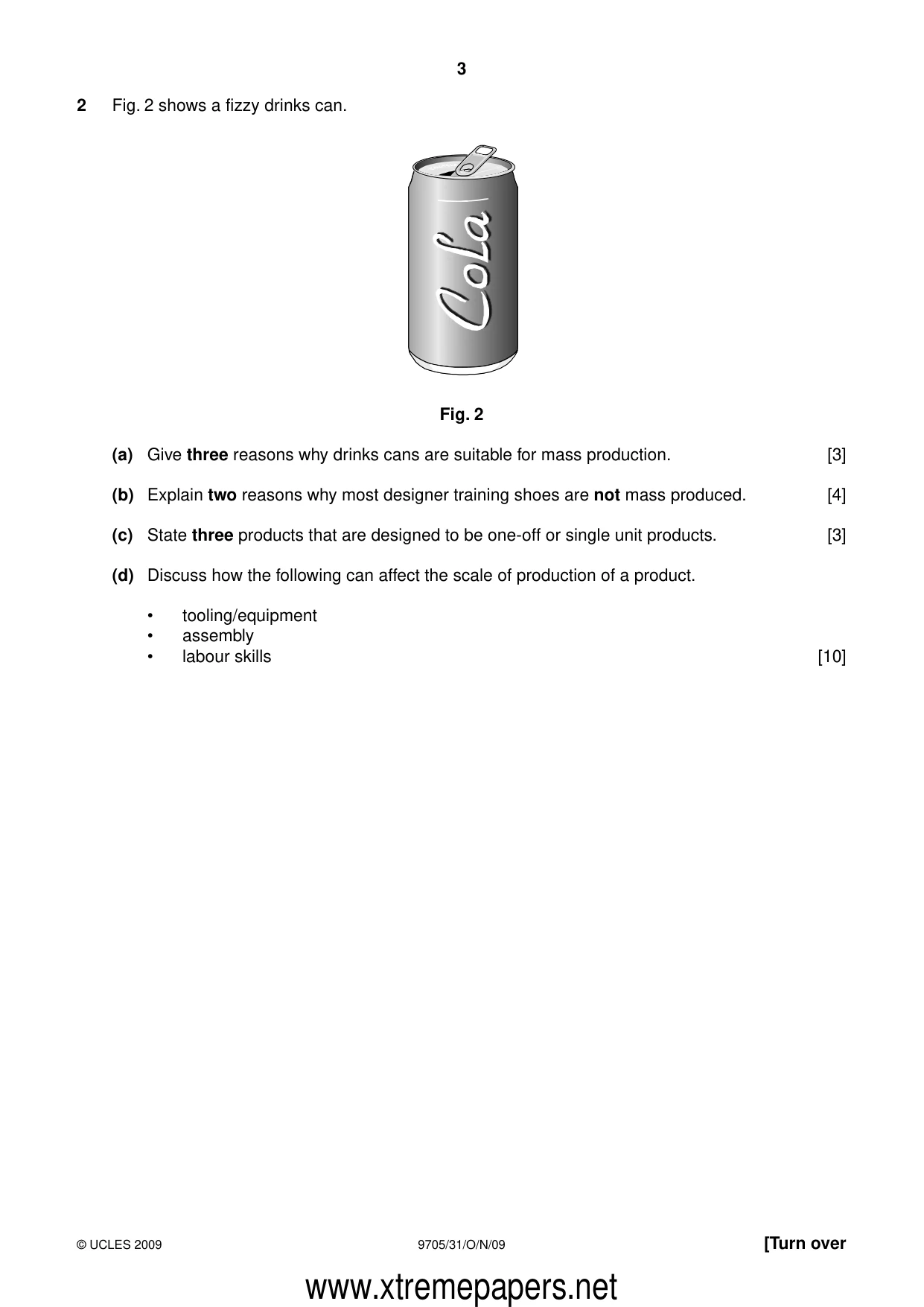
3 9705/31/O/N/09 © UCLES 2009 [Turn over 2 Fig. 2 shows a fizzy drinks can. Fig. 2 (a) Give three reasons why drinks cans are suitable for mass production. [3] (b) Explain two reasons why most designer training shoes are not mass produced. [4] (c) State three products that are designed to be one-off or single unit products. [3] (d) Discuss how the following can affect the scale of production of a product. • tooling/equipment • assembly • labour skills [10] www.xtremepapers.net
Question paper, page 4
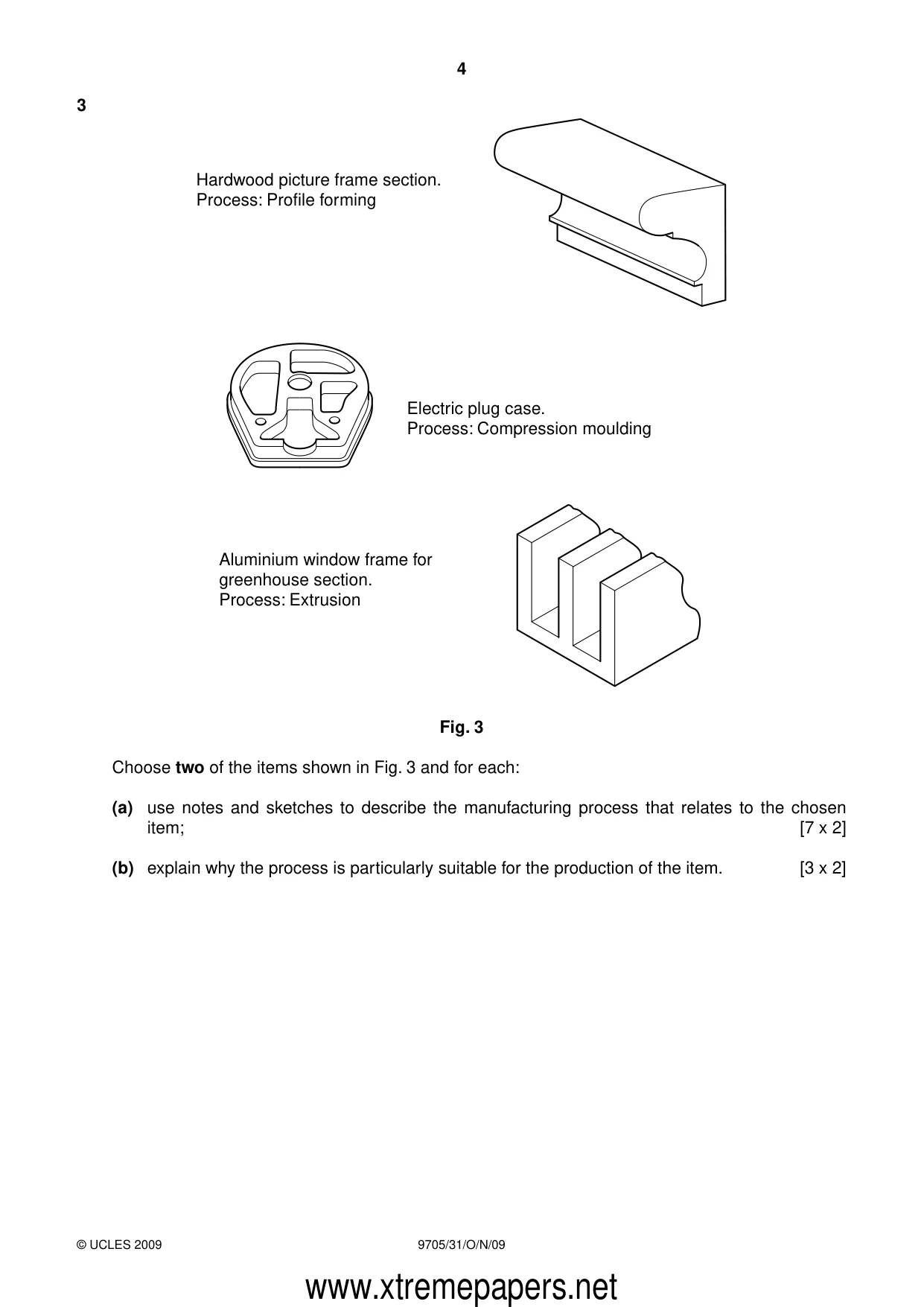
4 9705/31/O/N/09 © UCLES 2009 3 Hardwood picture frame section. Process: Profile forming Electric plug case. Process: Compression moulding Aluminium window frame for greenhouse section. Process: Extrusion Fig. 3 Choose two of the items shown in Fig. 3 and for each: (a) use notes and sketches to describe the manufacturing process that relates to the chosen item; [7 x 2] (b) explain why the process is particularly suitable for the production of the item. [3 x 2] www.xtremepapers.net
Question paper, page 5
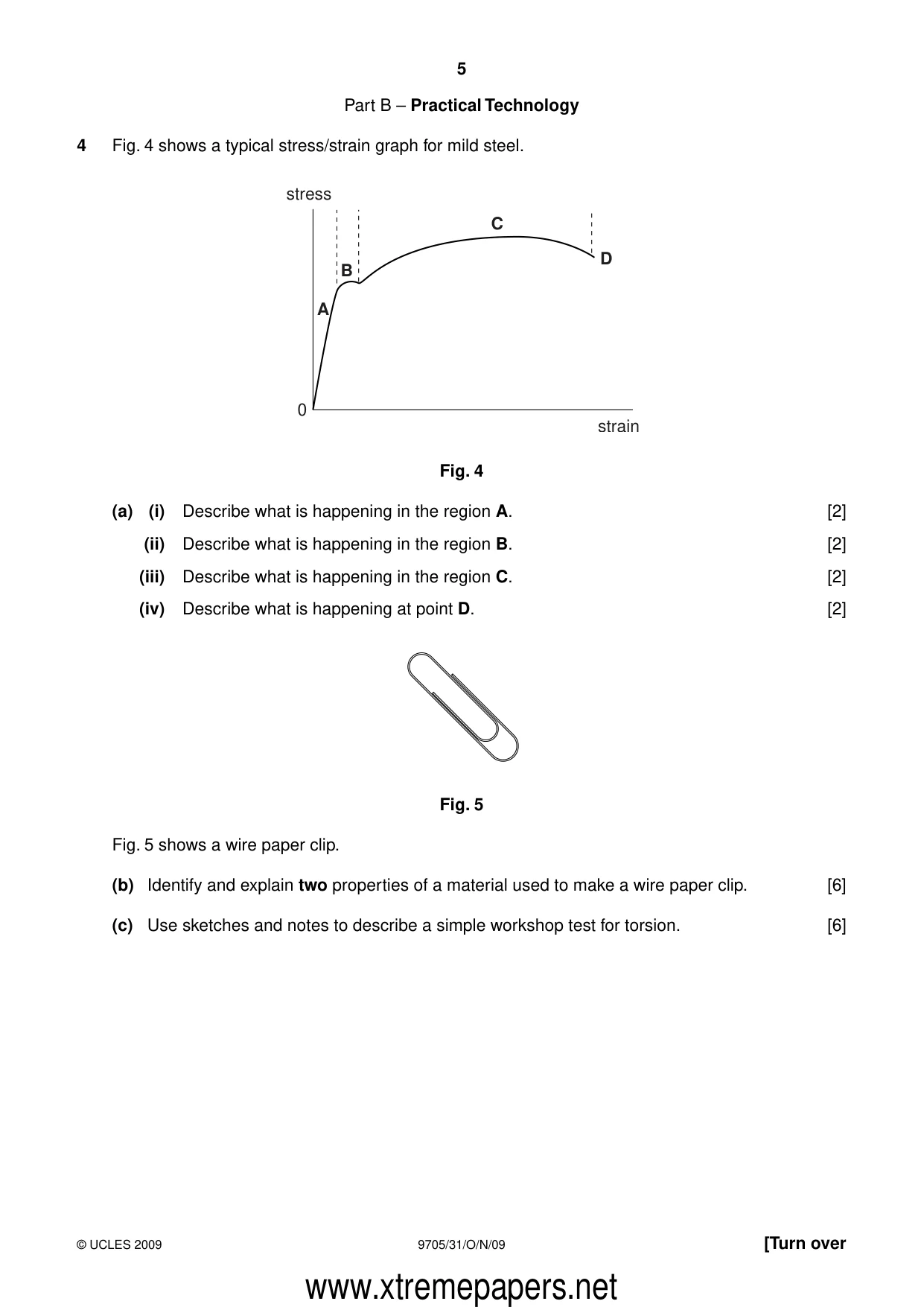
5 9705/31/O/N/09 © UCLES 2009 [Turn over Part B – Practical Technology 4 Fig. 4 shows a typical stress/strain graph for mild steel. A 0 strain stress B C D Fig. 4 (a) (i) Describe what is happening in the region A. [2] (ii) Describe what is happening in the region B. [2] (iii) Describe what is happening in the region C. [2] (iv) Describe what is happening at point D. [2] Fig. 5 Fig. 5 shows a wire paper clip. (b) Identify and explain two properties of a material used to make a wire paper clip. [6] (c) Use sketches and notes to describe a simple workshop test for torsion. [6] www.xtremepapers.net
Question paper, page 6
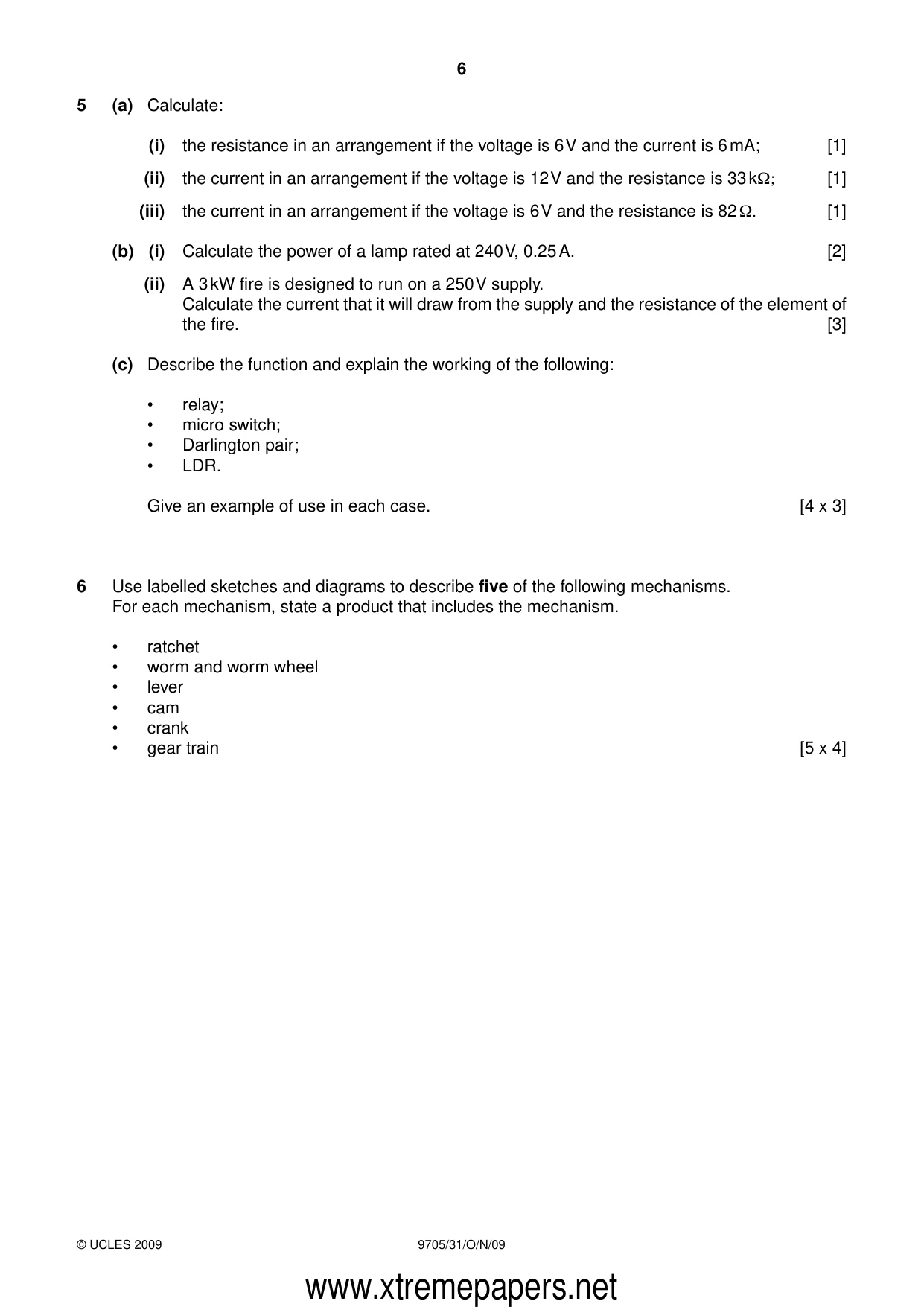
6 9705/31/O/N/09 © UCLES 2009 5 (a) Calculate: (i) the resistance in an arrangement if the voltage is 6 V and the current is 6 mA; [1] (ii) the current in an arrangement if the voltage is 12 V and the resistance is 33 kΩ; [1] (iii) the current in an arrangement if the voltage is 6 V and the resistance is 82 Ω. [1] (b) (i) Calculate the power of a lamp rated at 240 V, 0.25 A. [2] (ii) A 3 kW fire is designed to run on a 250 V supply. Calculate the current that it will draw from the supply and the resistance of the element of the fire. [3] (c) Describe the function and explain the working of the following: • relay; • micro switch; • Darlington pair; • LDR. Give an example of use in each case. [4 x 3] 6 Use labelled sketches and diagrams to describe five of the following mechanisms. For each mechanism, state a product that includes the mechanism. • ratchet • worm and worm wheel • lever • cam • crank • gear train [5 x 4] www.xtremepapers.net
Question paper, page 7
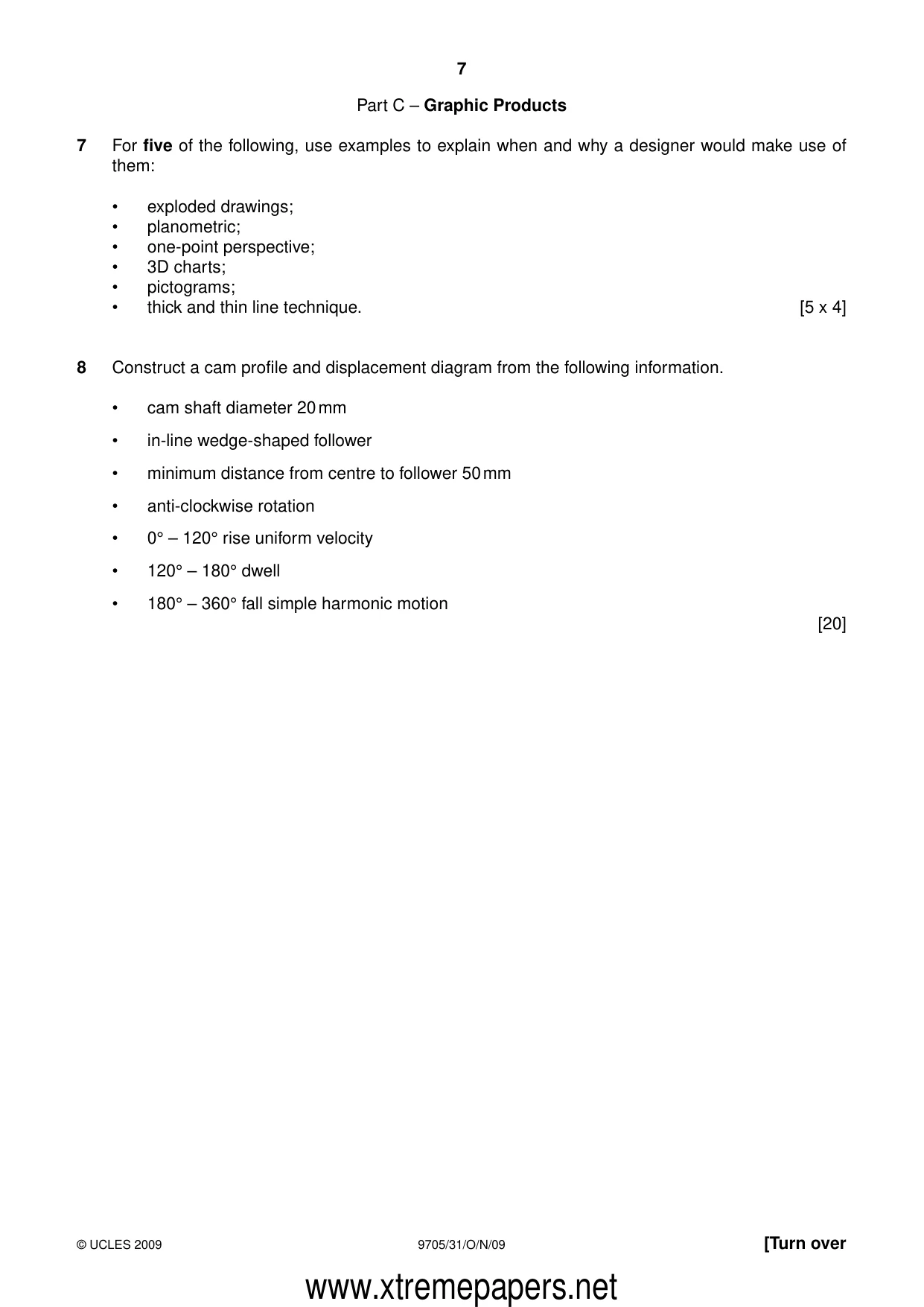
7 9705/31/O/N/09 © UCLES 2009 [Turn over Part C – Graphic Products 7 For five of the following, use examples to explain when and why a designer would make use of them: • exploded drawings; • planometric; • one-point perspective; • 3D charts; • pictograms; • thick and thin line technique. [5 x 4] 8 Construct a cam profile and displacement diagram from the following information. • cam shaft diameter 20 mm • in-line wedge-shaped follower • minimum distance from centre to follower 50 mm • anti-clockwise rotation • 0° – 120° rise uniform velocity • 120° – 180° dwell • 180° – 360° fall simple harmonic motion [20] www.xtremepapers.net
Question paper, page 8
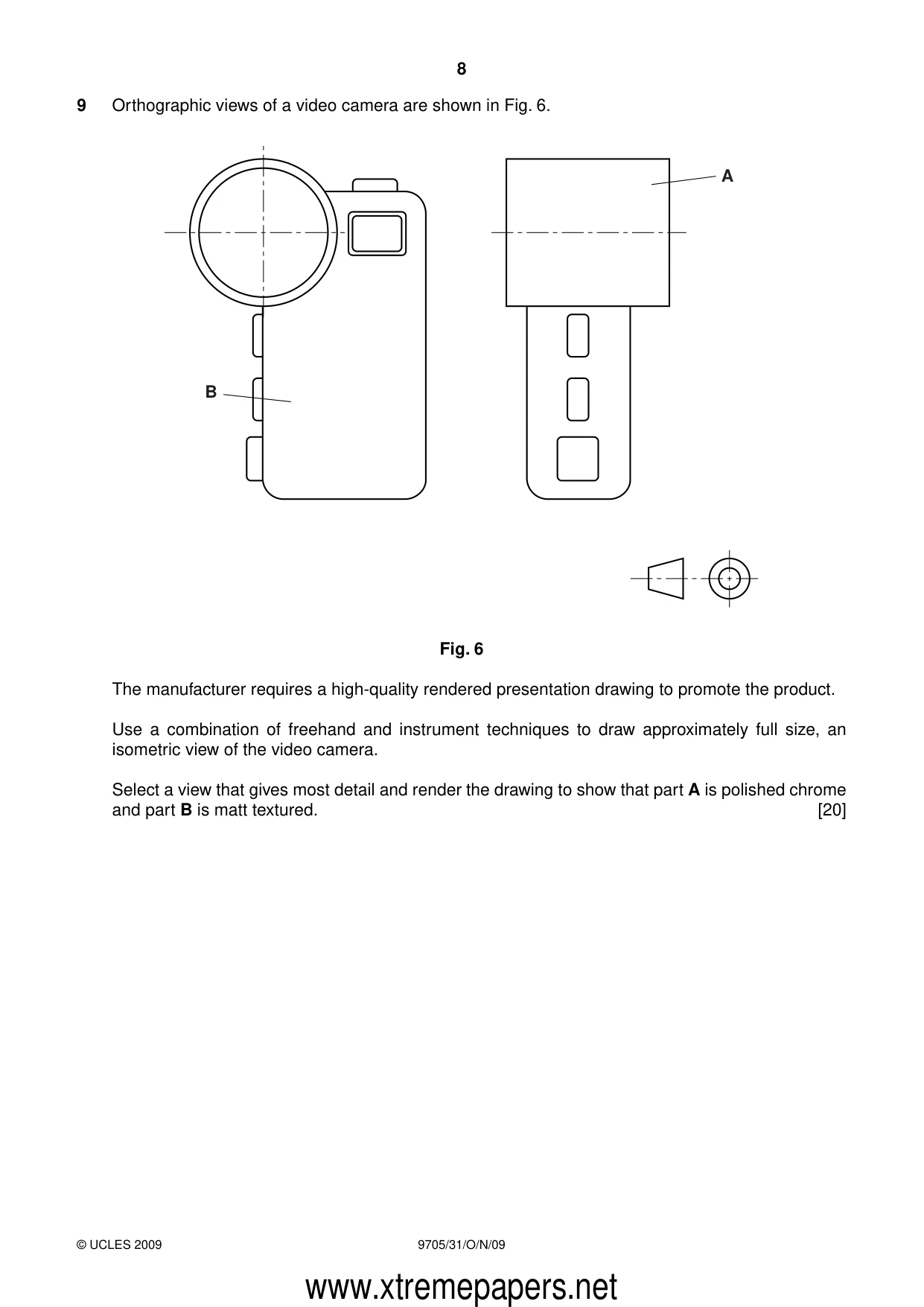
8 9705/31/O/N/09 © UCLES 2009 9 Orthographic views of a video camera are shown in Fig. 6. A B Fig. 6 The manufacturer requires a high-quality rendered presentation drawing to promote the product. Use a combination of freehand and instrument techniques to draw approximately full size, an isometric view of the video camera. Select a view that gives most detail and render the drawing to show that part A is polished chrome and part B is matt textured. [20] www.xtremepapers.net
Question paper, page 9
9 9705/31/O/N/09 © UCLES 2009 [Turn over Section B Answer one question on the A3 paper provided. You should approach the design question of your choice in the following manner: Analysis Produce an analysis of the given situation/problem, which may be in written or graphical form. [5] Specification From the analysis produce a detailed written specification of the design requirements. Include at least five specification points other than those given in the question. [5] Exploration Use bold sketches and brief notes to show your exploration of ideas for a design solution, with reasons for selection. [25] Development Show, using bold sketches and notes, the development, reasoning and composition of ideas into a single design proposal. Give details of materials, constructional and other relevant technical details. [25] Proposed solution Produce drawings of an appropriate kind to show the complete solution. [15] Evaluation Give a written evaluation of the final design solution. [5] [Total: 80] www.xtremepapers.net
Question paper, page 10
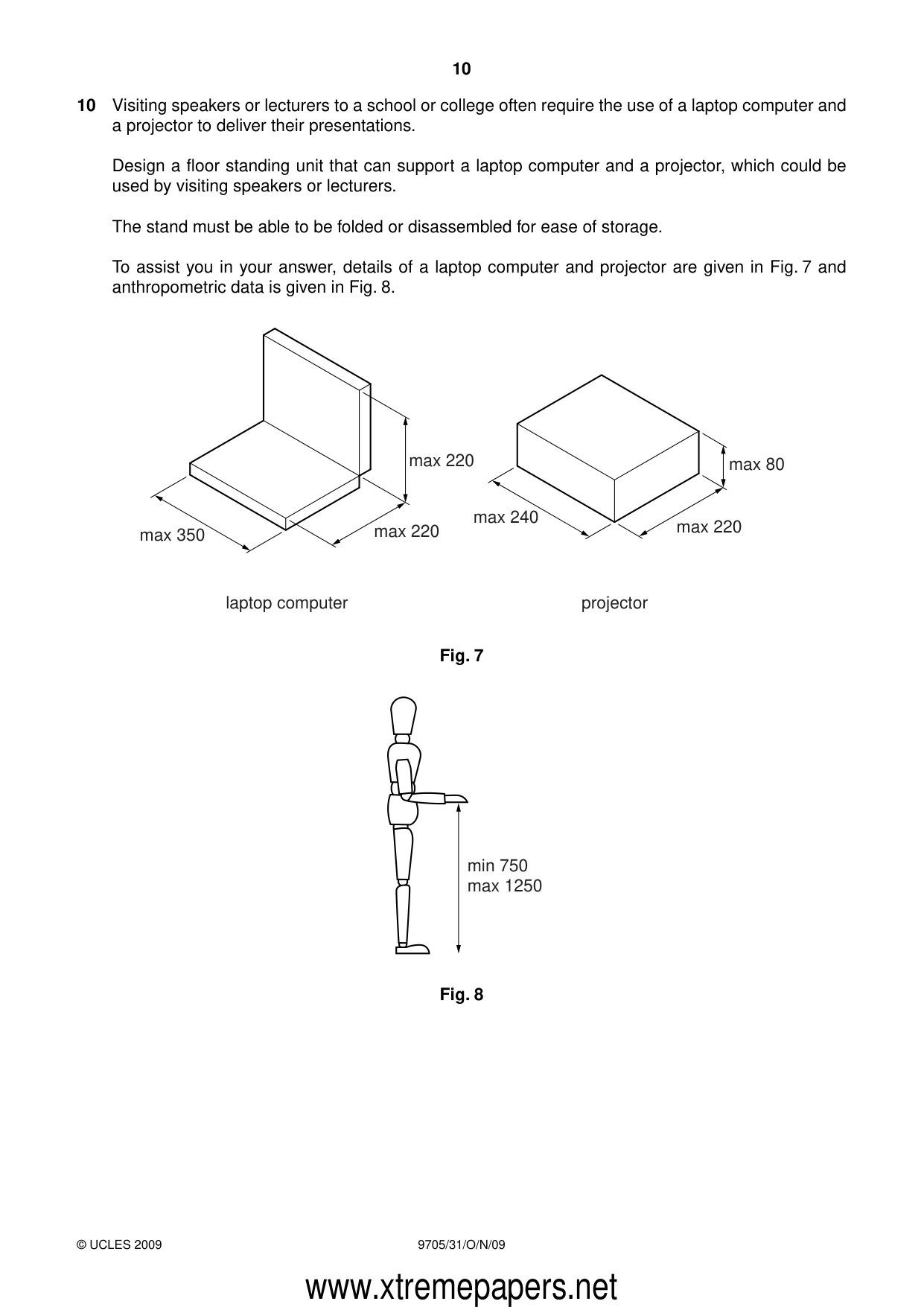
10 9705/31/O/N/09 © UCLES 2009 10 Visiting speakers or lecturers to a school or college often require the use of a laptop computer and a projector to deliver their presentations. Design a floor standing unit that can support a laptop computer and a projector, which could be used by visiting speakers or lecturers. The stand must be able to be folded or disassembled for ease of storage. To assist you in your answer, details of a laptop computer and projector are given in Fig. 7 and anthropometric data is given in Fig. 8. max 220 max 350 max 220 laptop computer projector max 240 max 220 max 80 Fig. 7 min 750 max 1250 Fig. 8 www.xtremepapers.net
Question paper, page 11
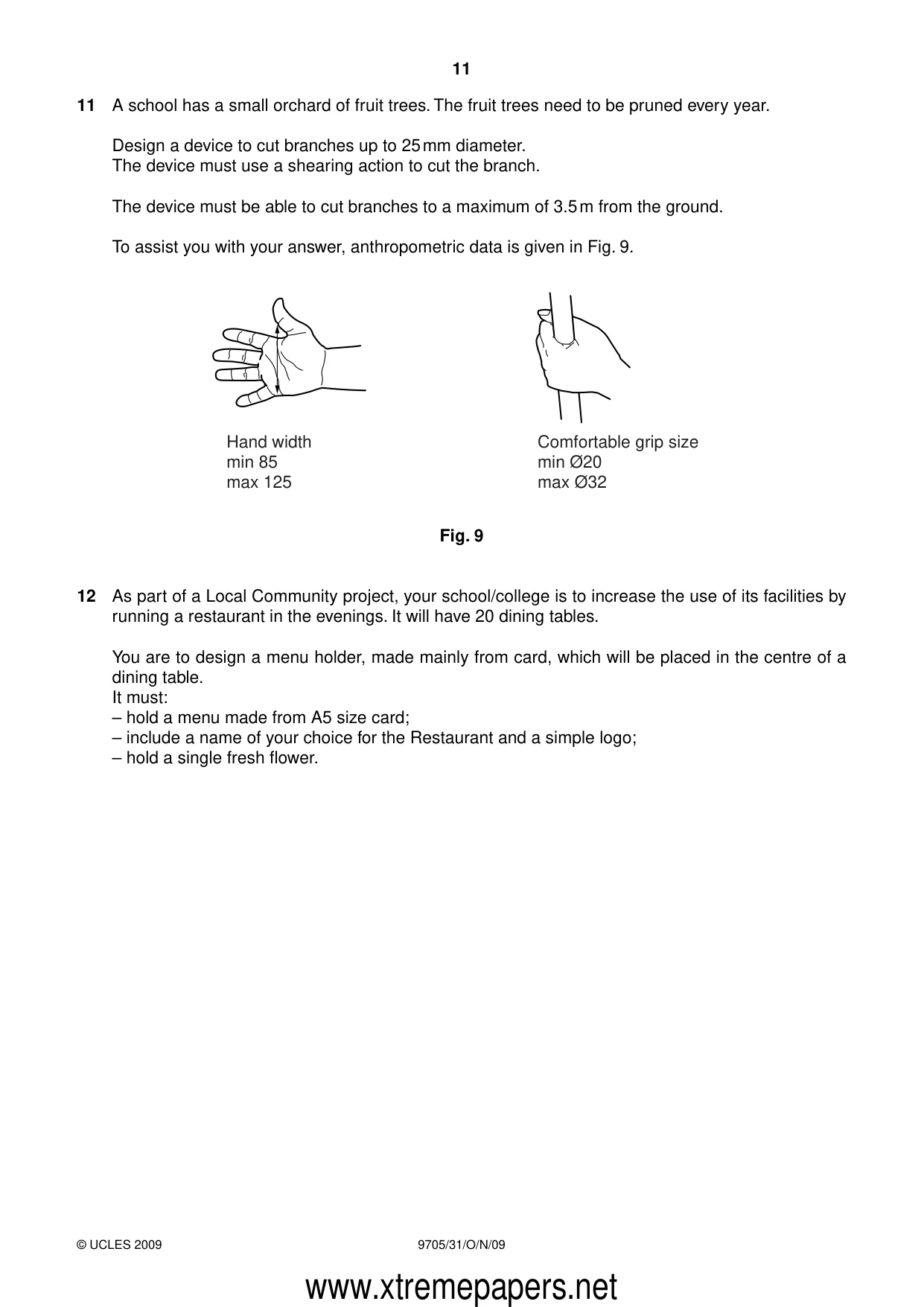
11 9705/31/O/N/09 © UCLES 2009 11 A school has a small orchard of fruit trees. The fruit trees need to be pruned every year. Design a device to cut branches up to 25 mm diameter. The device must use a shearing action to cut the branch. The device must be able to cut branches to a maximum of 3.5 m from the ground. To assist you with your answer, anthropometric data is given in Fig. 9. Hand width min 85 max 125 Comfortable grip size min Ø20 max Ø32 Fig. 9 12 As part of a Local Community project, your school/college is to increase the use of its facilities by running a restaurant in the evenings. It will have 20 dining tables. You are to design a menu holder, made mainly from card, which will be placed in the centre of a dining table. It must: – hold a menu made from A5 size card; – include a name of your choice for the Restaurant and a simple logo; – hold a single fresh flower. www.xtremepapers.net
Question paper, page 12
12 9705/31/O/N/09 BLANK PAGE Permission to reproduce items where third-party owned material protected by copyright is included has been sought and cleared where possible. Every reasonable effort has been made by the publisher (UCLES) to trace copyright holders, but if any items requiring clearance have unwittingly been included, the publisher will be pleased to make amends at the earliest possible opportunity. University of Cambridge International Examinations is part of the Cambridge Assessment Group. Cambridge Assessment is the brand name of University of Cambridge Local Examinations Syndicate (UCLES), which is itself a department of the University of Cambridge. www.xtremepapers.net
Mark scheme, page 1
UNIVERSITY OF CAMBRIDGE INTERNATIONAL EXAMINATIONS GCE Advanced Subsidiary Level and GCE Advanced Level MARK SCHEME for the October/November 2009 question paper for the guidance of teachers 9705 DESIGN AND TECHNOLOGY 9705/31 Paper 31 (Written 2), maximum raw mark 120 This mark scheme is published as an aid to teachers and candidates, to indicate the requirements of the examination. It shows the basis on which Examiners were instructed to award marks. It does not indicate the details of the discussions that took place at an Examiners’ meeting before marking began, which would have considered the acceptability of alternative answers. Mark schemes must be read in conjunction with the question papers and the report on the examination. • CIE will not enter into discussions or correspondence in connection with these mark schemes. CIE is publishing the mark schemes for the October/November 2009 question papers for most IGCSE, GCE Advanced Level and Advanced Subsidiary Level syllabuses and some Ordinary Level syllabuses. www.xtremepapers.net
Mark scheme, page 2
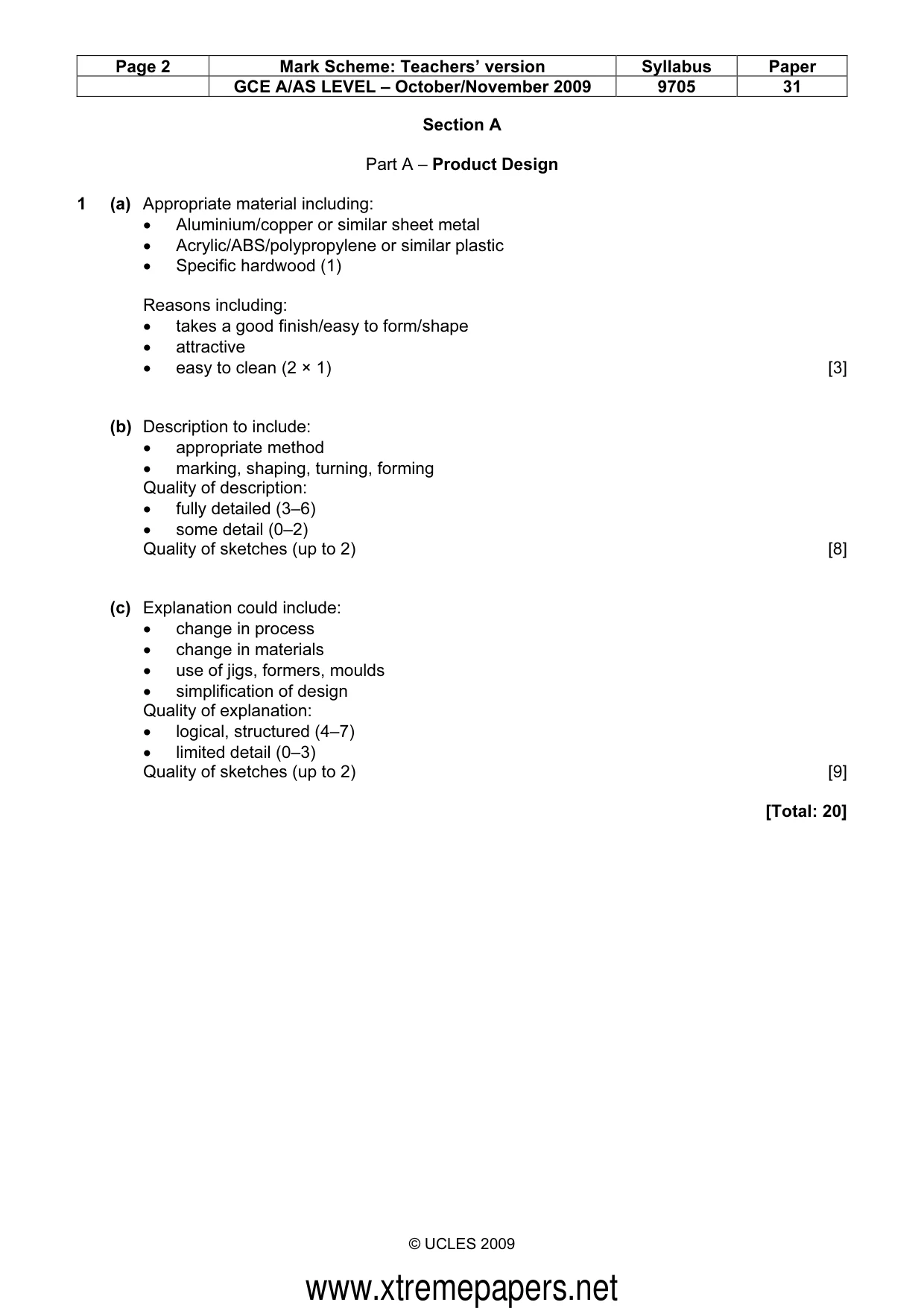
Page 2 Mark Scheme: Teachers’ version Syllabus Paper GCE A/AS LEVEL – October/November 2009 9705 31 © UCLES 2009 Section A Part A – Product Design 1 (a) Appropriate material including: • Aluminium/copper or similar sheet metal • Acrylic/ABS/polypropylene or similar plastic • Specific hardwood (1) Reasons including: • takes a good finish/easy to form/shape • attractive • easy to clean (2 × 1) [3] (b) Description to include: • appropriate method • marking, shaping, turning, forming Quality of description: • fully detailed (3–6) • some detail (0–2) Quality of sketches (up to 2) [8] (c) Explanation could include: • change in process • change in materials • use of jigs, formers, moulds • simplification of design Quality of explanation: • logical, structured (4–7) • limited detail (0–3) Quality of sketches (up to 2) [9] [Total: 20] www.xtremepapers.net
Mark scheme, page 3
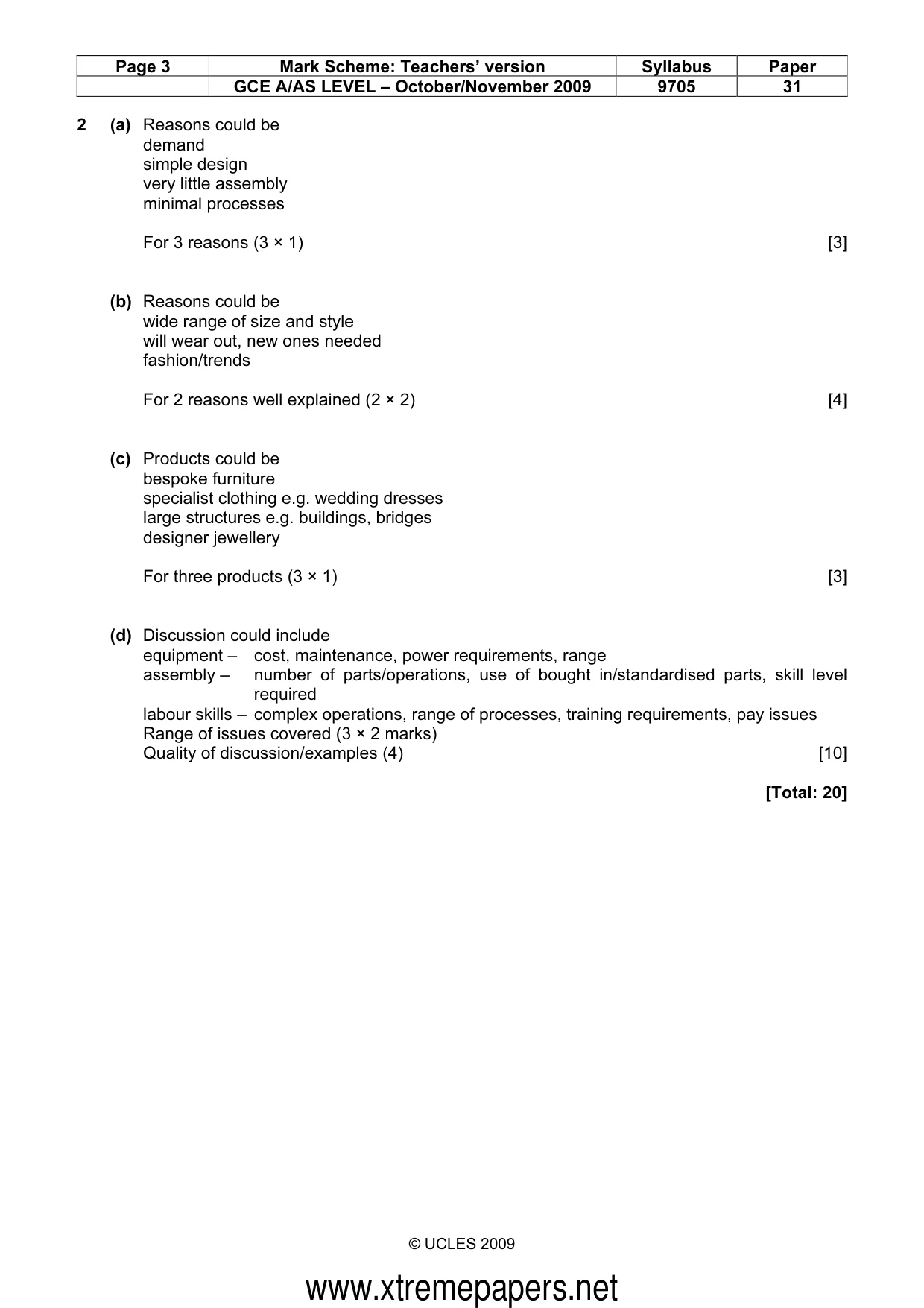
Page 3 Mark Scheme: Teachers’ version Syllabus Paper GCE A/AS LEVEL – October/November 2009 9705 31 © UCLES 2009 2 (a) Reasons could be demand simple design very little assembly minimal processes For 3 reasons (3 × 1) [3] (b) Reasons could be wide range of size and style will wear out, new ones needed fashion/trends For 2 reasons well explained (2 × 2) [4] (c) Products could be bespoke furniture specialist clothing e.g. wedding dresses large structures e.g. buildings, bridges designer jewellery For three products (3 × 1) [3] (d) Discussion could include equipment – cost, maintenance, power requirements, range assembly – number of parts/operations, use of bought in/standardised parts, skill level required labour skills – complex operations, range of processes, training requirements, pay issues Range of issues covered (3 × 2 marks) Quality of discussion/examples (4) [10] [Total: 20] www.xtremepapers.net
Mark scheme, page 4
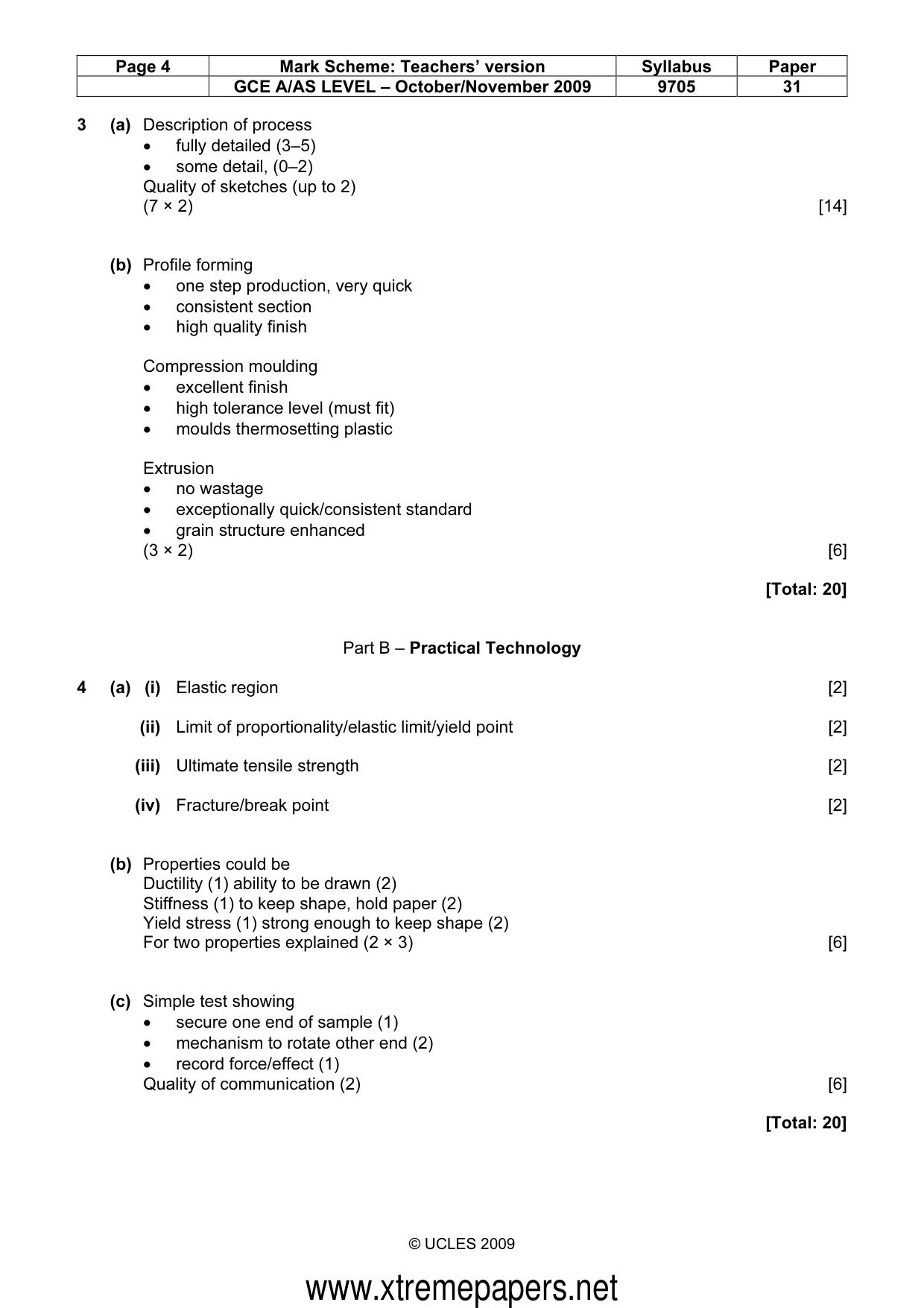
Page 4 Mark Scheme: Teachers’ version Syllabus Paper GCE A/AS LEVEL – October/November 2009 9705 31 © UCLES 2009 3 (a) Description of process • fully detailed (3–5) • some detail, (0–2) Quality of sketches (up to 2) (7 × 2) [14] (b) Profile forming • one step production, very quick • consistent section • high quality finish Compression moulding • excellent finish • high tolerance level (must fit) • moulds thermosetting plastic Extrusion • no wastage • exceptionally quick/consistent standard • grain structure enhanced (3 × 2) [6] [Total: 20] Part B – Practical Technology 4 (a) (i) Elastic region [2] (ii) Limit of proportionality/elastic limit/yield point [2] (iii) Ultimate tensile strength [2] (iv) Fracture/break point [2] (b) Properties could be Ductility (1) ability to be drawn (2) Stiffness (1) to keep shape, hold paper (2) Yield stress (1) strong enough to keep shape (2) For two properties explained (2 × 3) [6] (c) Simple test showing • secure one end of sample (1) • mechanism to rotate other end (2) • record force/effect (1) Quality of communication (2) [6] [Total: 20] www.xtremepapers.net
Mark scheme, page 5
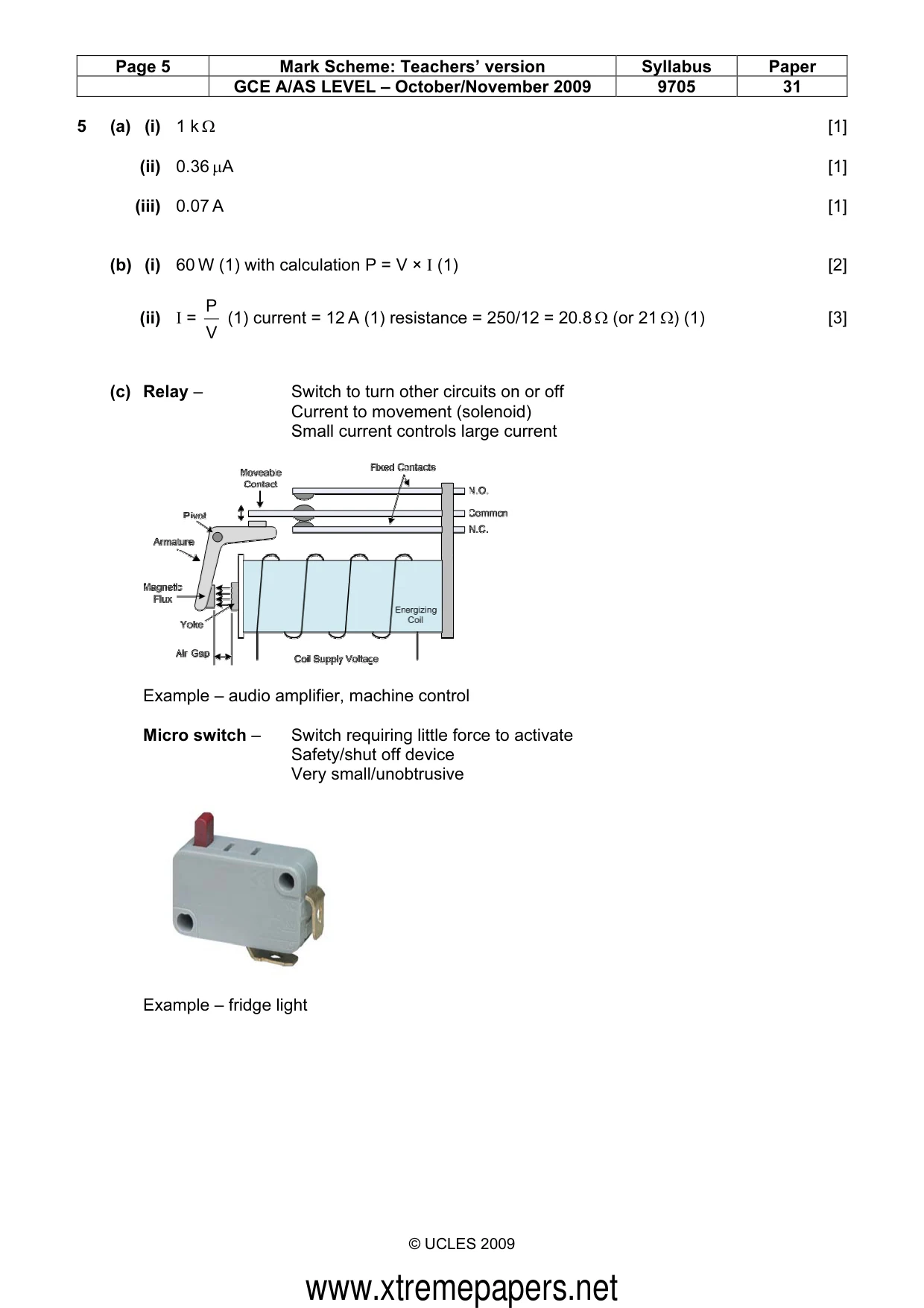
Page 5 Mark Scheme: Teachers’ version Syllabus Paper GCE A/AS LEVEL – October/November 2009 9705 31 © UCLES 2009 5 (a) (i) 1 k Ω [1] (ii) 0.36 µA [1] (iii) 0.07 A [1] (b) (i) 60 W (1) with calculation P = V × I (1) [2] (ii) I = V P (1) current = 12 A (1) resistance = 250/12 = 20.8 Ω (or 21 Ω) (1) [3] (c) Relay – Switch to turn other circuits on or off Current to movement (solenoid) Small current controls large current Example – audio amplifier, machine control Micro switch – Switch requiring little force to activate Safety/shut off device Very small/unobtrusive Example – fridge light www.xtremepapers.net
Mark scheme, page 6
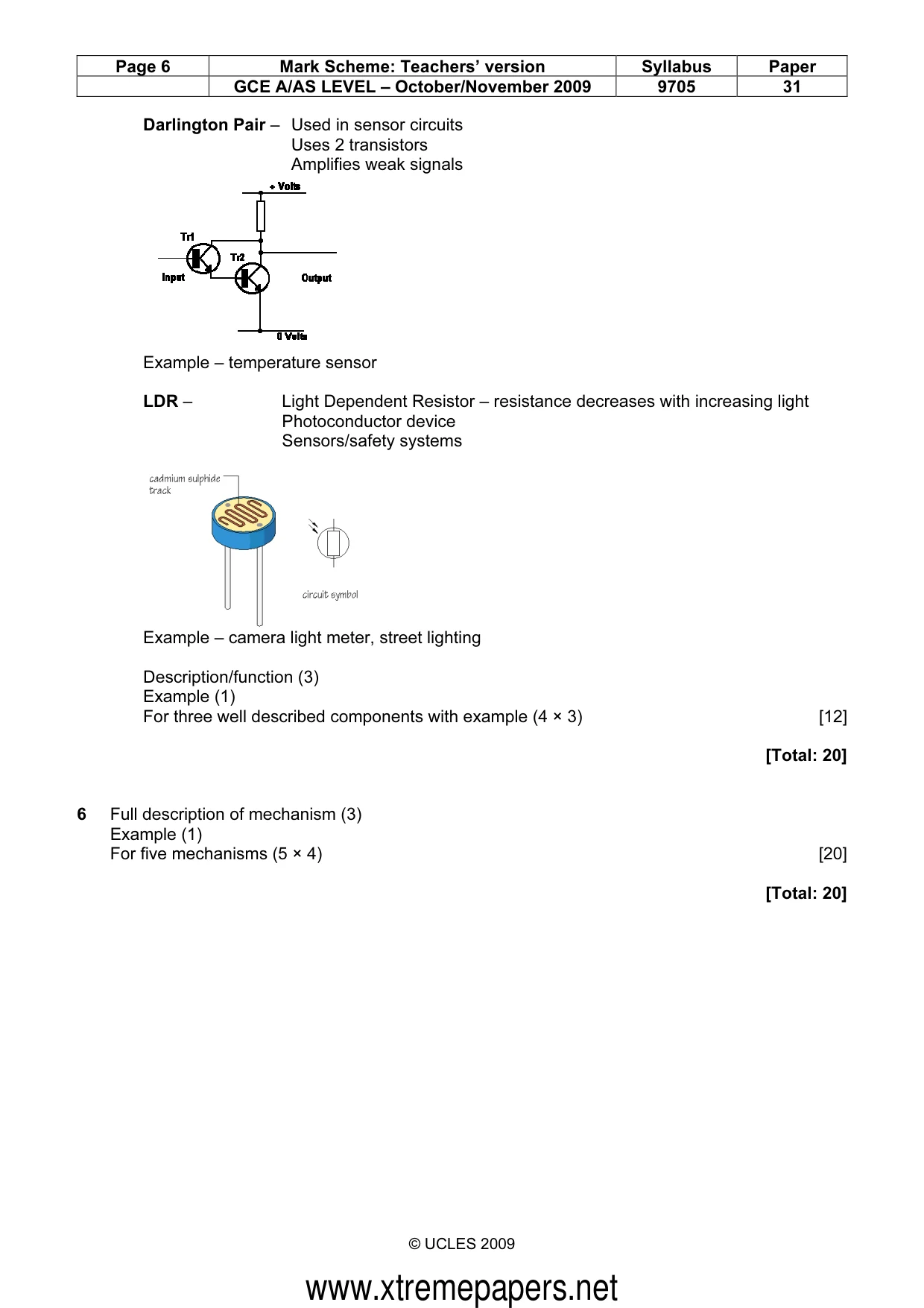
Page 6 Mark Scheme: Teachers’ version Syllabus Paper GCE A/AS LEVEL – October/November 2009 9705 31 © UCLES 2009 Darlington Pair – Used in sensor circuits Uses 2 transistors Amplifies weak signals Example – temperature sensor LDR – Light Dependent Resistor – resistance decreases with increasing light Photoconductor device Sensors/safety systems Example – camera light meter, street lighting Description/function (3) Example (1) For three well described components with example (4 × 3) [12] [Total: 20] 6 Full description of mechanism (3) Example (1) For five mechanisms (5 × 4) [20] [Total: 20] www.xtremepapers.net
Mark scheme, page 7
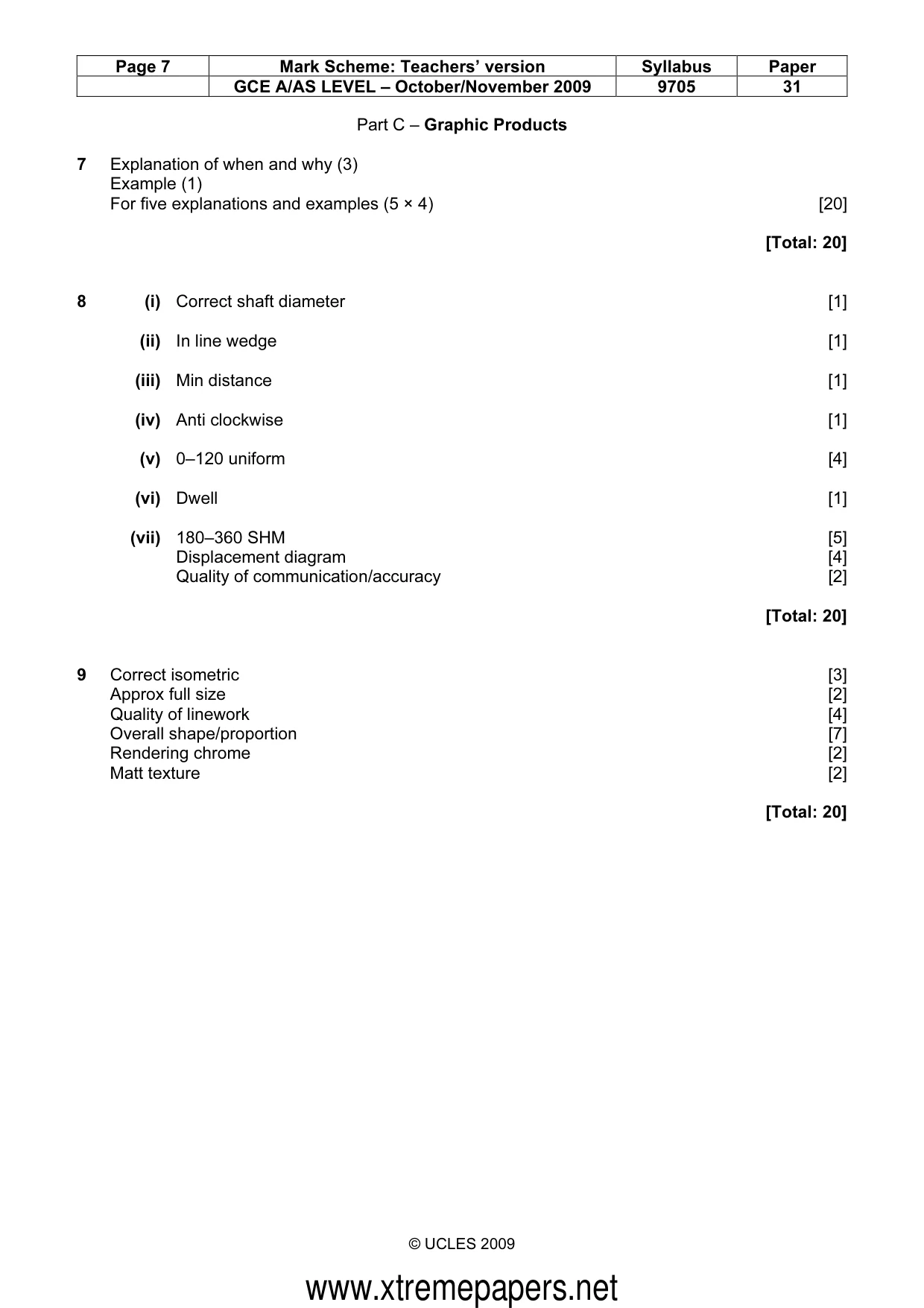
Page 7 Mark Scheme: Teachers’ version Syllabus Paper GCE A/AS LEVEL – October/November 2009 9705 31 © UCLES 2009 Part C – Graphic Products 7 Explanation of when and why (3) Example (1) For five explanations and examples (5 × 4) [20] [Total: 20] 8 (i) Correct shaft diameter [1] (ii) In line wedge [1] (iii) Min distance [1] (iv) Anti clockwise [1] (v) 0–120 uniform [4] (vi) Dwell [1] (vii) 180–360 SHM [5] Displacement diagram [4] Quality of communication/accuracy [2] [Total: 20] 9 Correct isometric [3] Approx full size [2] Quality of linework [4] Overall shape/proportion [7] Rendering chrome [2] Matt texture [2] [Total: 20] www.xtremepapers.net
What you needed in this session
Cambridge’s own grade thresholds for 2009 Oct/Nov, Paper 3 · Variant 1. A higher threshold means an easier paper — the bar moves with how the cohort did.