Cambridge A Level Computer Science 9618 — 2023 May/June Paper 1 · Variant 2
9618/12/M/J/23 · 75 marks · ≈84 min
The question paper and its mark scheme, free to read here and free to download. This is Cambridge’s own paper, exactly as it was sat.
Question paper16 pages





Mark scheme10 pages
Answers below. Sit the paper first if you are practising.
Paper as text
Question paper, page 1
This document has 16 pages. Any blank pages are indicated. [Turn over Cambridge International AS & A Level * 3 3 5 5 7 4 6 9 4 3 * COMPUTER SCIENCE 9618/12 Paper 1 Theory Fundamentals May/June 2023 1 hour 30 minutes You must answer on the question paper. No additional materials are needed. INSTRUCTIONS ● Answer all questions. ● Use a black or dark blue pen. ● Write your name, centre number and candidate number in the boxes at the top of the page. ● Write your answer to each question in the space provided. ● Do not use an erasable pen or correction fluid. ● Do not write on any bar codes. ● You may use an HB pencil for any diagrams, graphs or rough working. ● Calculators must not be used in this paper. INFORMATION ● The total mark for this paper is 75. ● The number of marks for each question or part question is shown in brackets [ ]. ● No marks will be awarded for using brand names of software packages or hardware. DC (RW/SG) 313483/1 © UCLES 2023
Question paper, page 2
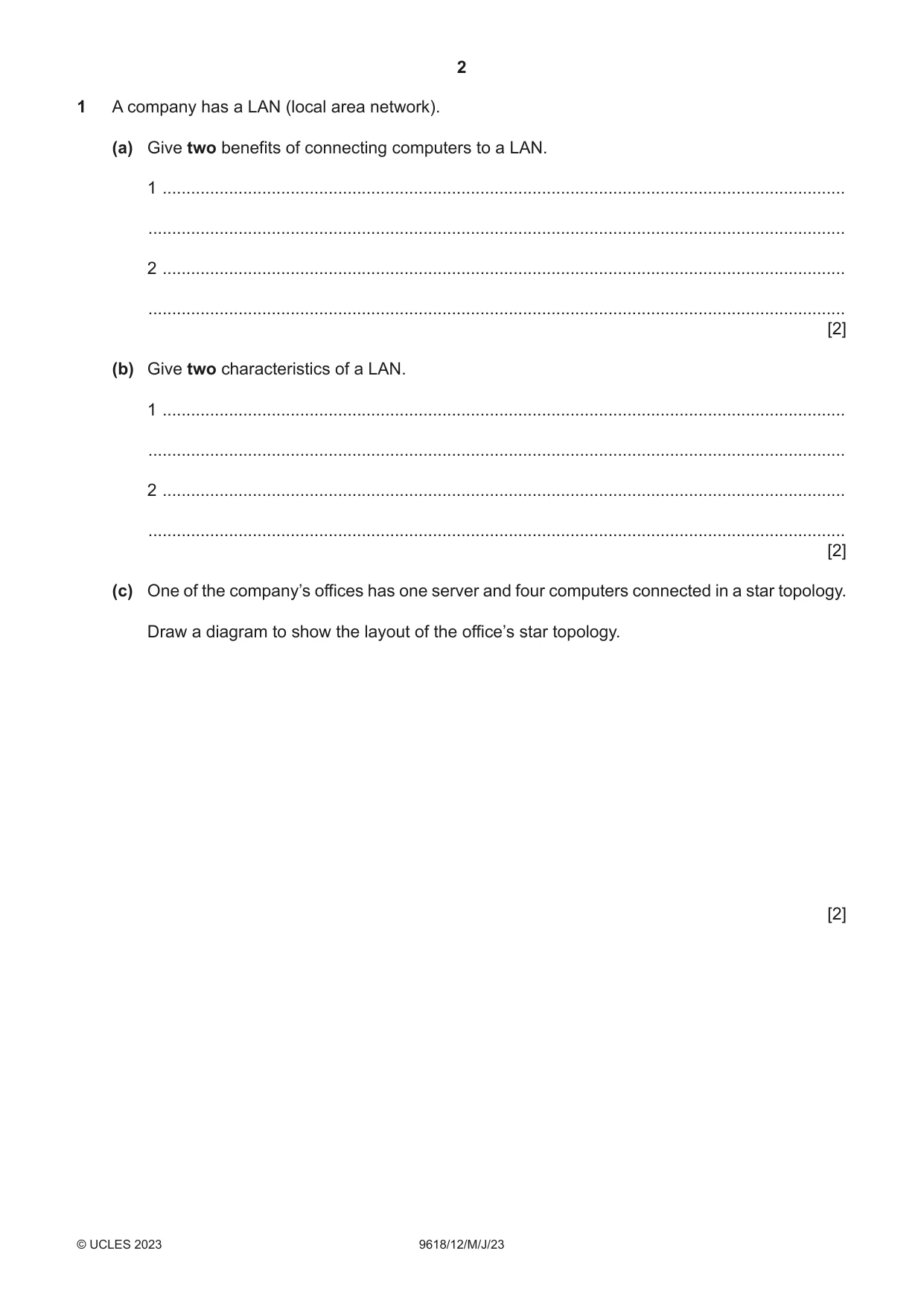
2 9618/12/M/J/23 © UCLES 2023 1 A company has a LAN (local area network). (a) Give two benefits of connecting computers to a LAN. 1 … … 2 … … [2] (b) Give two characteristics of a LAN. 1 … … 2 … … [2] (c) One of the company’s offices has one server and four computers connected in a star topology. Draw a diagram to show the layout of the office’s star topology. [2]
Question paper, page 3
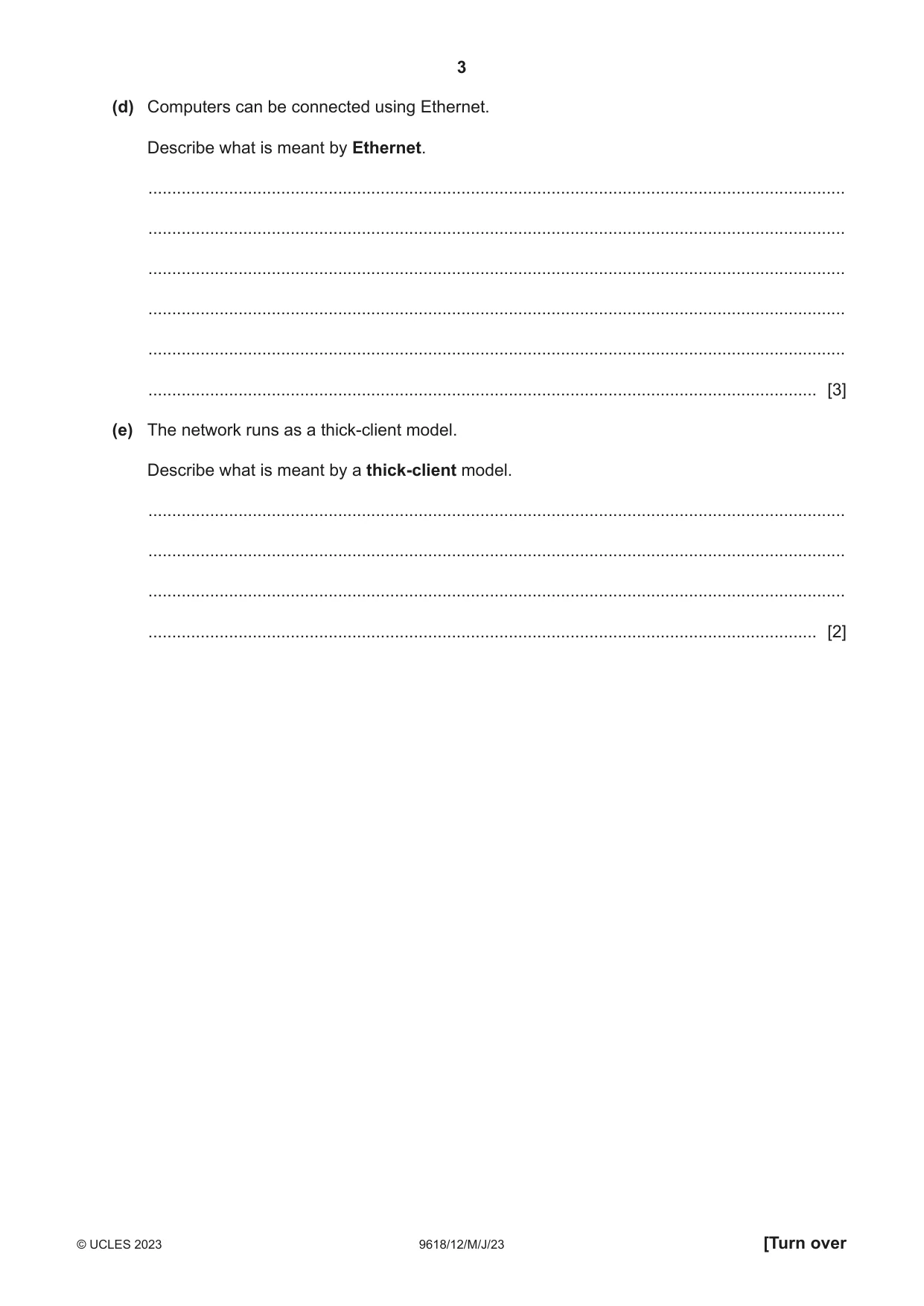
3 9618/12/M/J/23 © UCLES 2023 [Turn over (d) Computers can be connected using Ethernet. Describe what is meant by Ethernet. … … … … … … [3] (e) The network runs as a thick‑client model. Describe what is meant by a thick‑client model. … … … … [2]
Question paper, page 4
4 9618/12/M/J/23 © UCLES 2023 BLANK PAGE
Question paper, page 5
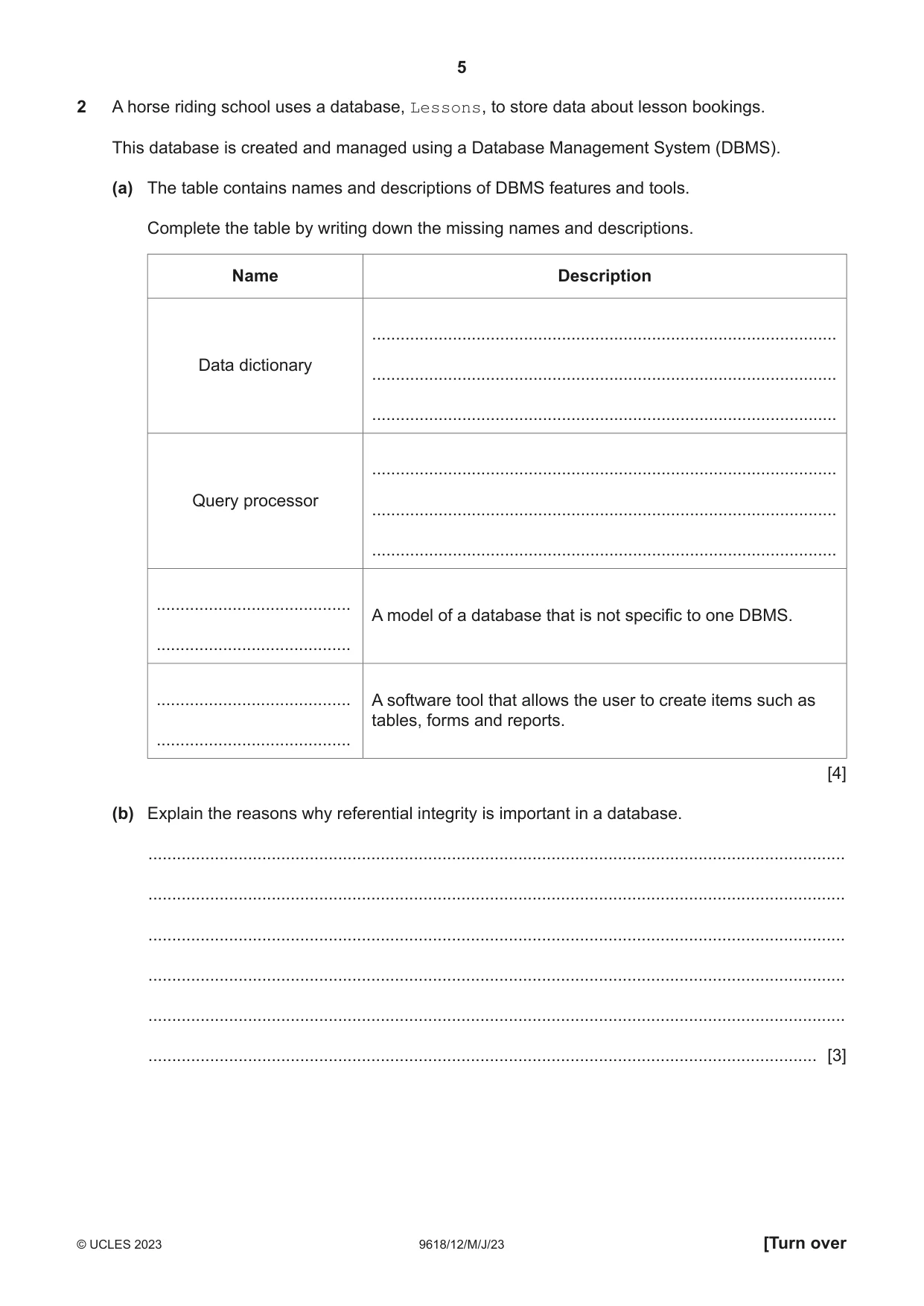
5 9618/12/M/J/23 © UCLES 2023 [Turn over 2 A horse riding school uses a database, Lessons, to store data about lesson bookings. This database is created and managed using a Database Management System (DBMS). (a) The table contains names and descriptions of DBMS features and tools. Complete the table by writing down the missing names and descriptions. Name Description Data dictionary … … … Query processor … … … … … A model of a database that is not specific to one DBMS. … … A software tool that allows the user to create items such as tables, forms and reports. [4] (b) Explain the reasons why referential integrity is important in a database. … … … … … … [3]
Question paper, page 6
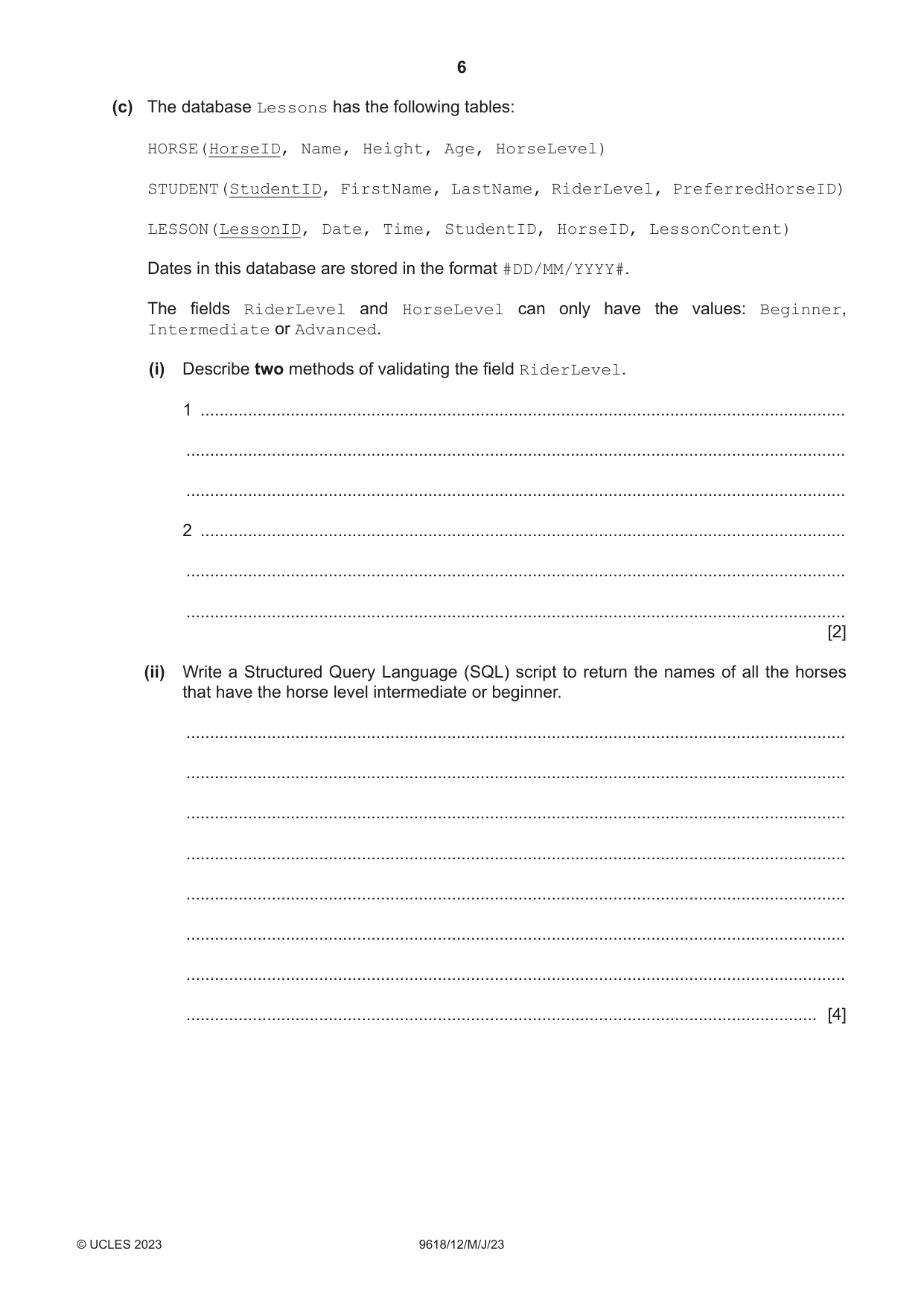
6 9618/12/M/J/23 © UCLES 2023 (c) The database Lessons has the following tables: HORSE(HorseID, Name, Height, Age, HorseLevel) STUDENT(StudentID, FirstName, LastName, RiderLevel, PreferredHorseID) LESSON(LessonID, Date, Time, StudentID, HorseID, LessonContent) Dates in this database are stored in the format #DD/MM/YYYY#. The fields RiderLevel and HorseLevel can only have the values: Beginner, Intermediate or Advanced. (i) Describe two methods of validating the field RiderLevel. 1 … … … 2 … … … [2] (ii) Write a Structured Query Language (SQL) script to return the names of all the horses that have the horse level intermediate or beginner. … … … … … … … … [4]
Question paper, page 7
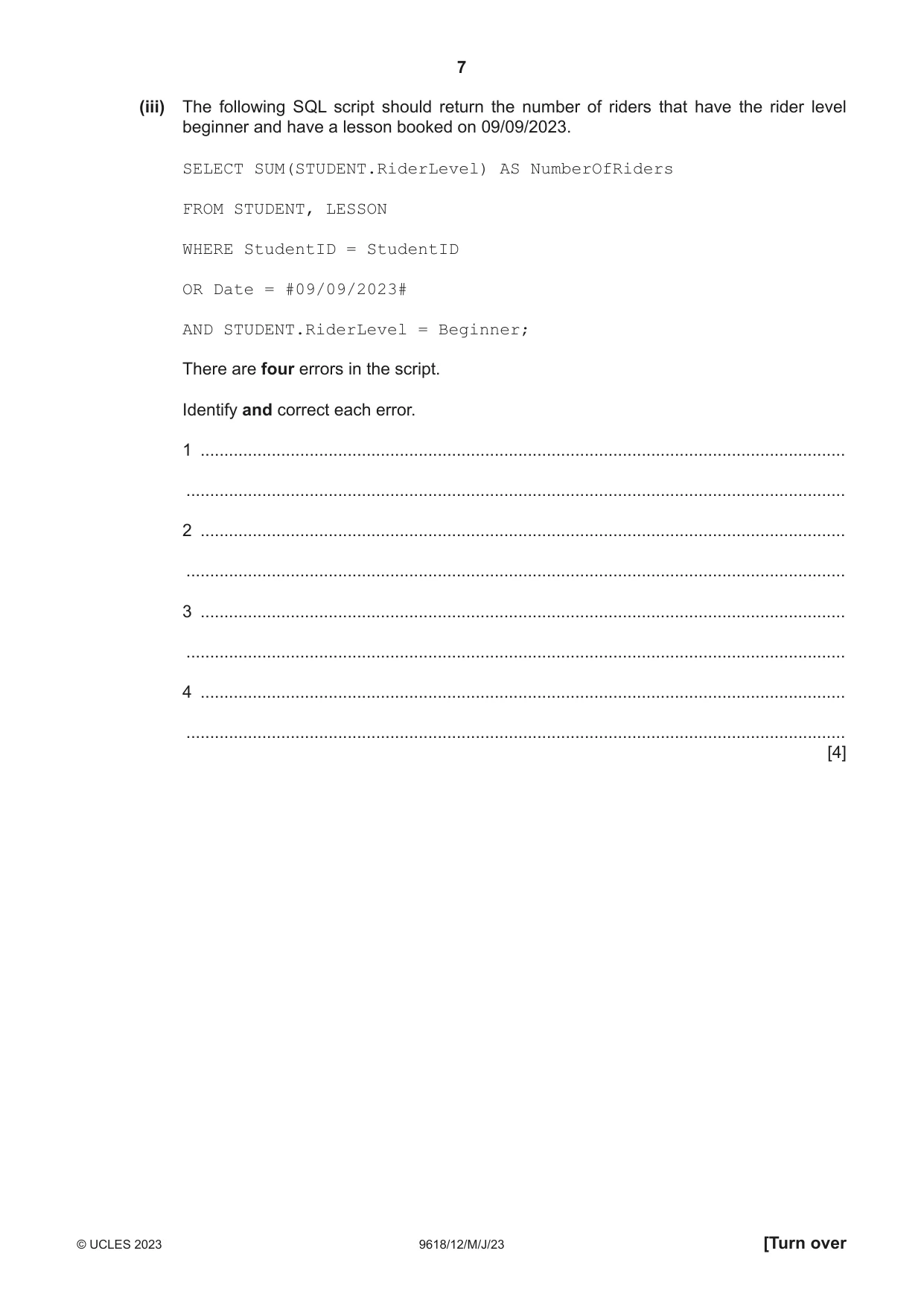
7 9618/12/M/J/23 © UCLES 2023 [Turn over (iii) The following SQL script should return the number of riders that have the rider level beginner and have a lesson booked on 09/09/2023. SELECT SUM(STUDENT.RiderLevel) AS NumberOfRiders FROM STUDENT, LESSON WHERE StudentID = StudentID OR Date = #09/09/2023# AND STUDENT.RiderLevel = Beginner; There are four errors in the script. Identify and correct each error. 1 … … 2 … … 3 … … 4 … … [4]
Question paper, page 8
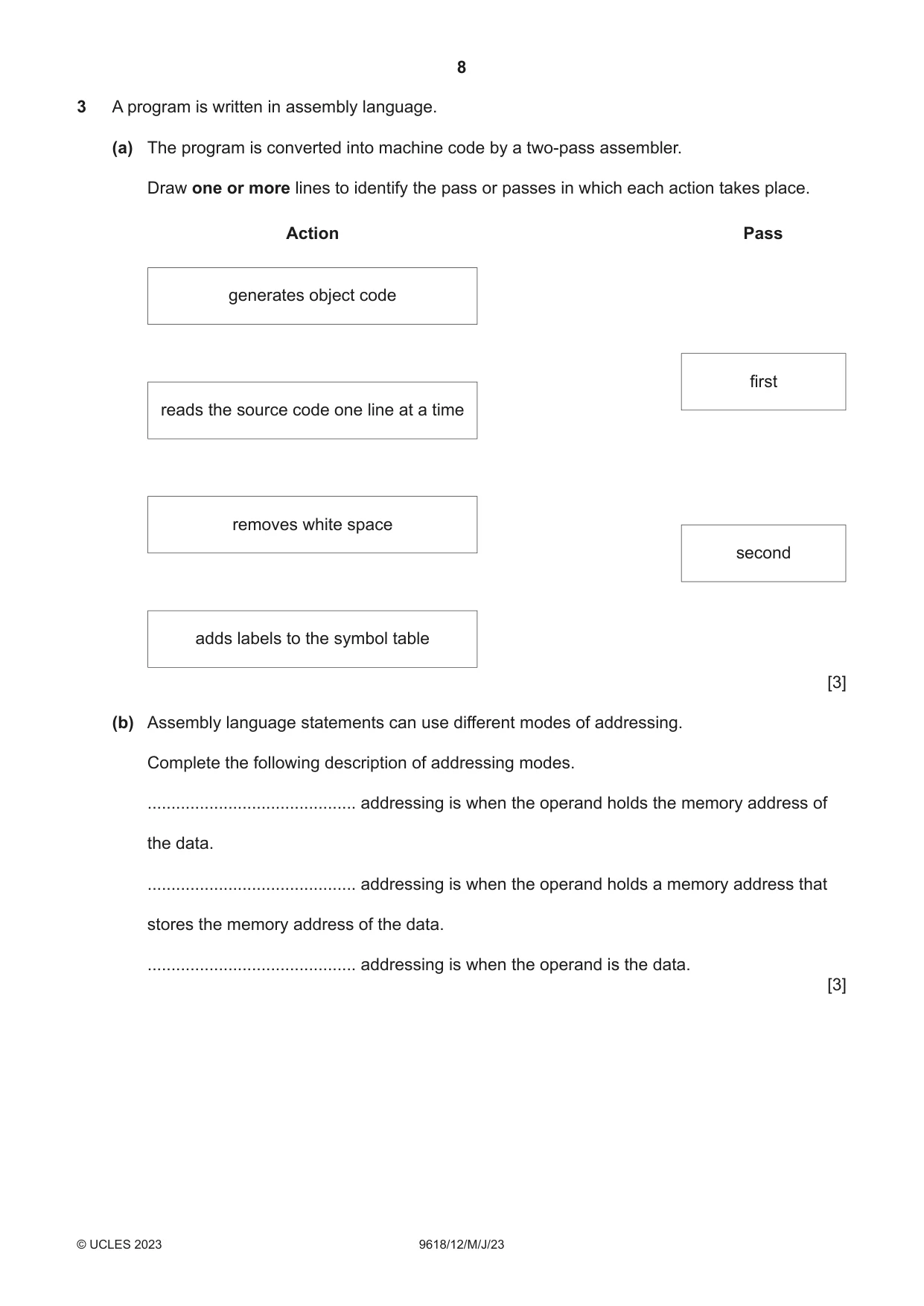
8 9618/12/M/J/23 © UCLES 2023 3 A program is written in assembly language. (a) The program is converted into machine code by a two‑pass assembler. Draw one or more lines to identify the pass or passes in which each action takes place. first second Pass reads the source code one line at a time generates object code removes white space adds labels to the symbol table Action [3] (b) Assembly language statements can use different modes of addressing. Complete the following description of addressing modes. … addressing is when the operand holds the memory address of the data. … addressing is when the operand holds a memory address that stores the memory address of the data. … addressing is when the operand is the data. [3]
Question paper, page 9
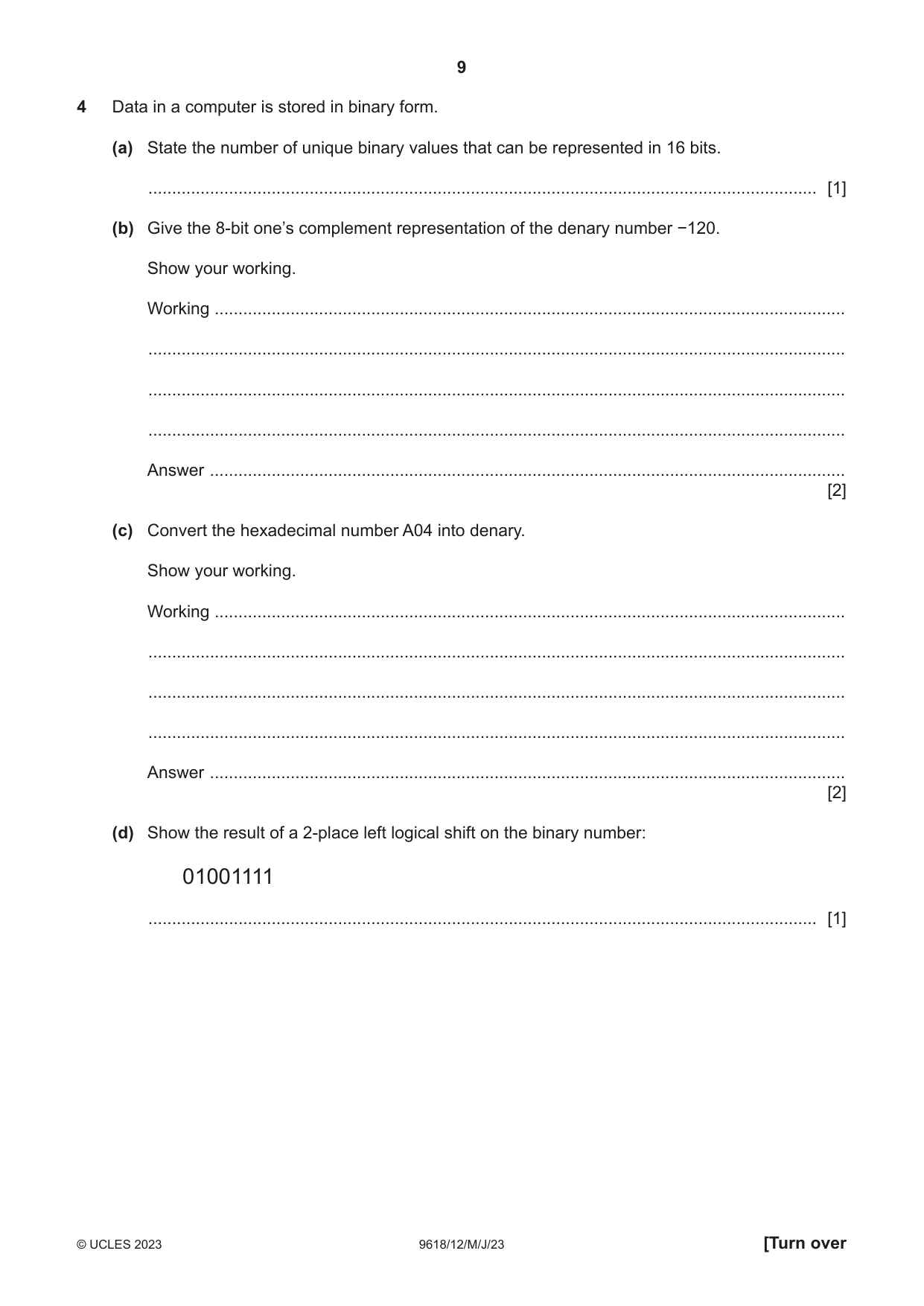
9 9618/12/M/J/23 © UCLES 2023 [Turn over 4 Data in a computer is stored in binary form. (a) State the number of unique binary values that can be represented in 16 bits. … [1] (b) Give the 8‑bit one’s complement representation of the denary number −120. Show your working. Working … … … … Answer … [2] (c) Convert the hexadecimal number A04 into denary. Show your working. Working … … … … Answer … [2] (d) Show the result of a 2‑place left logical shift on the binary number: 01001111 … [1]
Question paper, page 10
10 9618/12/M/J/23 © UCLES 2023 5 A student has purchased a new laptop. (a) The laptop is designed using the Von Neumann model for a computer system. Identify two types of signal that a control bus can transfer. 1 … 2 … [2] (b) Describe two ways the hardware of a laptop can be upgraded to improve the performance and explain how each upgrade improves the performance. 1 … … … … … … 2 … … … … … … [4]
Question paper, page 11
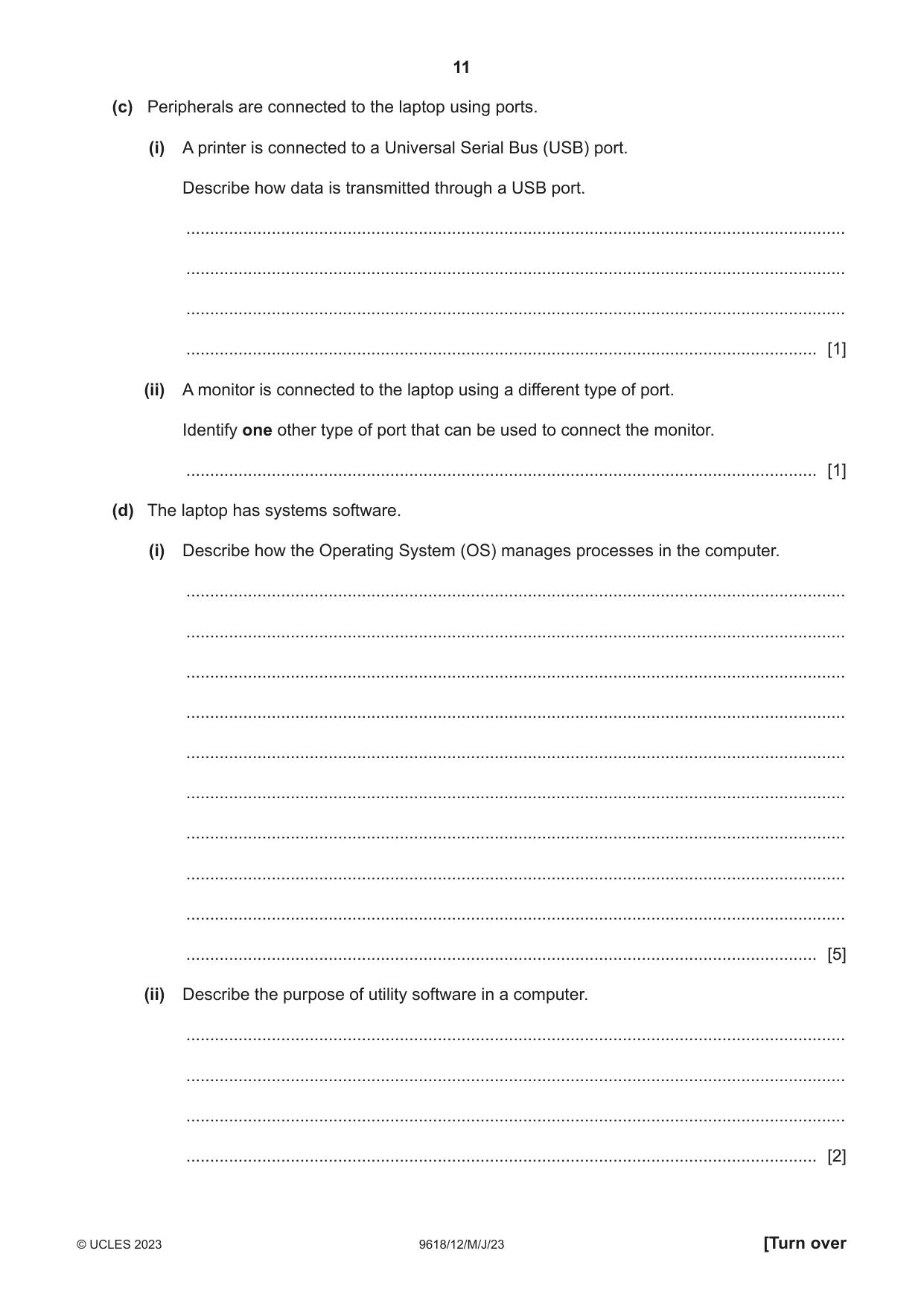
11 9618/12/M/J/23 © UCLES 2023 [Turn over (c) Peripherals are connected to the laptop using ports. (i) A printer is connected to a Universal Serial Bus (USB) port. Describe how data is transmitted through a USB port. … … … … [1] (ii) A monitor is connected to the laptop using a different type of port. Identify one other type of port that can be used to connect the monitor. … [1] (d) The laptop has systems software. (i) Describe how the Operating System (OS) manages processes in the computer. … … … … … … … … … … [5] (ii) Describe the purpose of utility software in a computer. … … … … [2]
Question paper, page 12
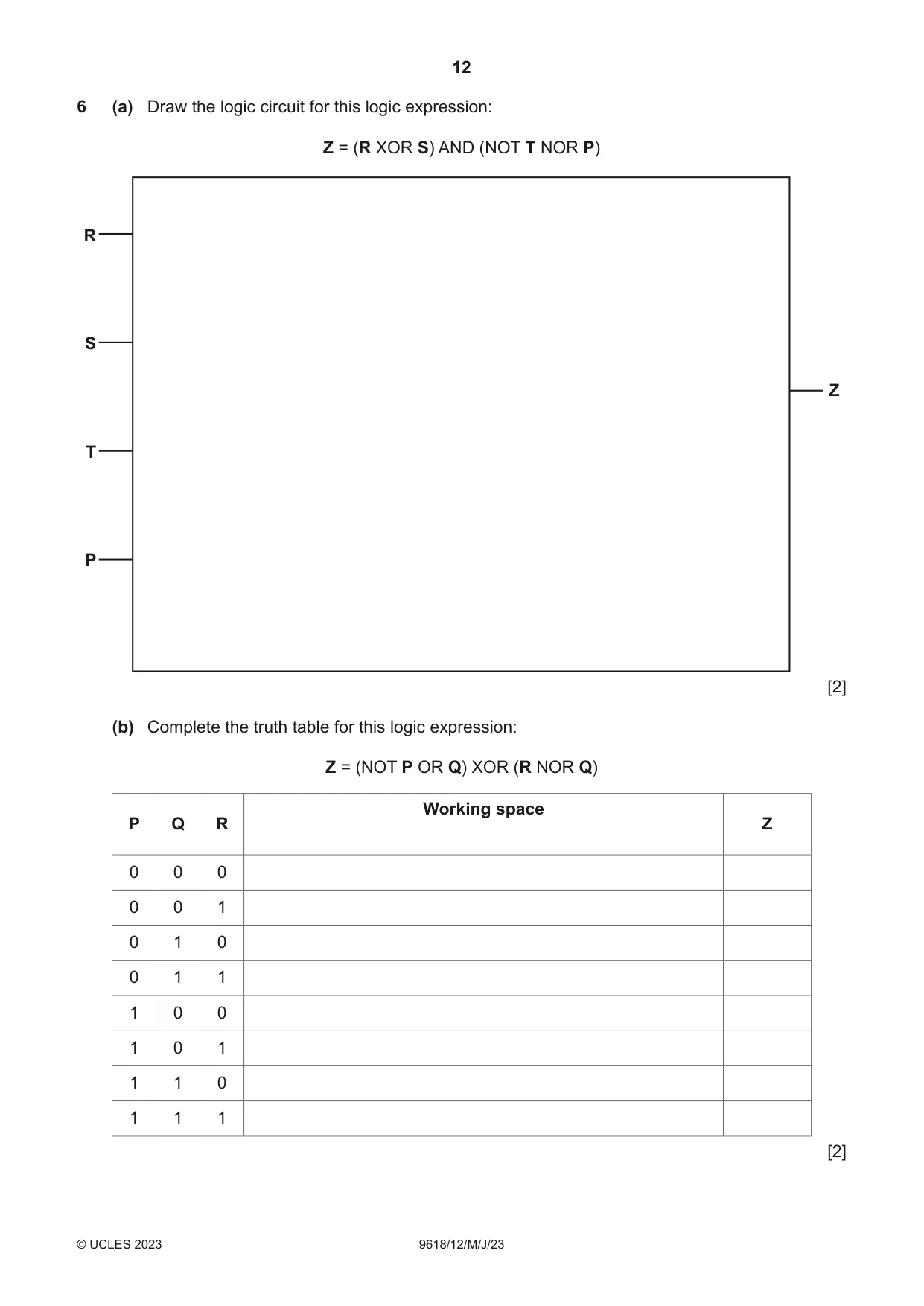
12 9618/12/M/J/23 © UCLES 2023 6 (a) Draw the logic circuit for this logic expression: Z = (R XOR S) AND (NOT T NOR P) R Z S T P [2] (b) Complete the truth table for this logic expression: Z = (NOT P OR Q) XOR (R NOR Q) P Q R Working space Z 0 0 0 0 0 1 0 1 0 0 1 1 1 0 0 1 0 1 1 1 0 1 1 1 [2]
Question paper, page 13
13 9618/12/M/J/23 © UCLES 2023 [Turn over 7 A software developer is working in a team writing a program for a client. (a) The developer is writing a new program library to be used by the other team members. (i) Define the term program library. … … … … [2] (ii) Explain two benefits to the developer of choosing to create a Dynamic Link Library (DLL). 1 … … … … 2 … … … … [4] (b) The development team needs to use a translator whilst writing the program for the client. Identify whether an interpreter or a compiler would be more appropriate at this stage of the program development. Justify your choice. Translator … Justification … … … … … … [3]
Question paper, page 14
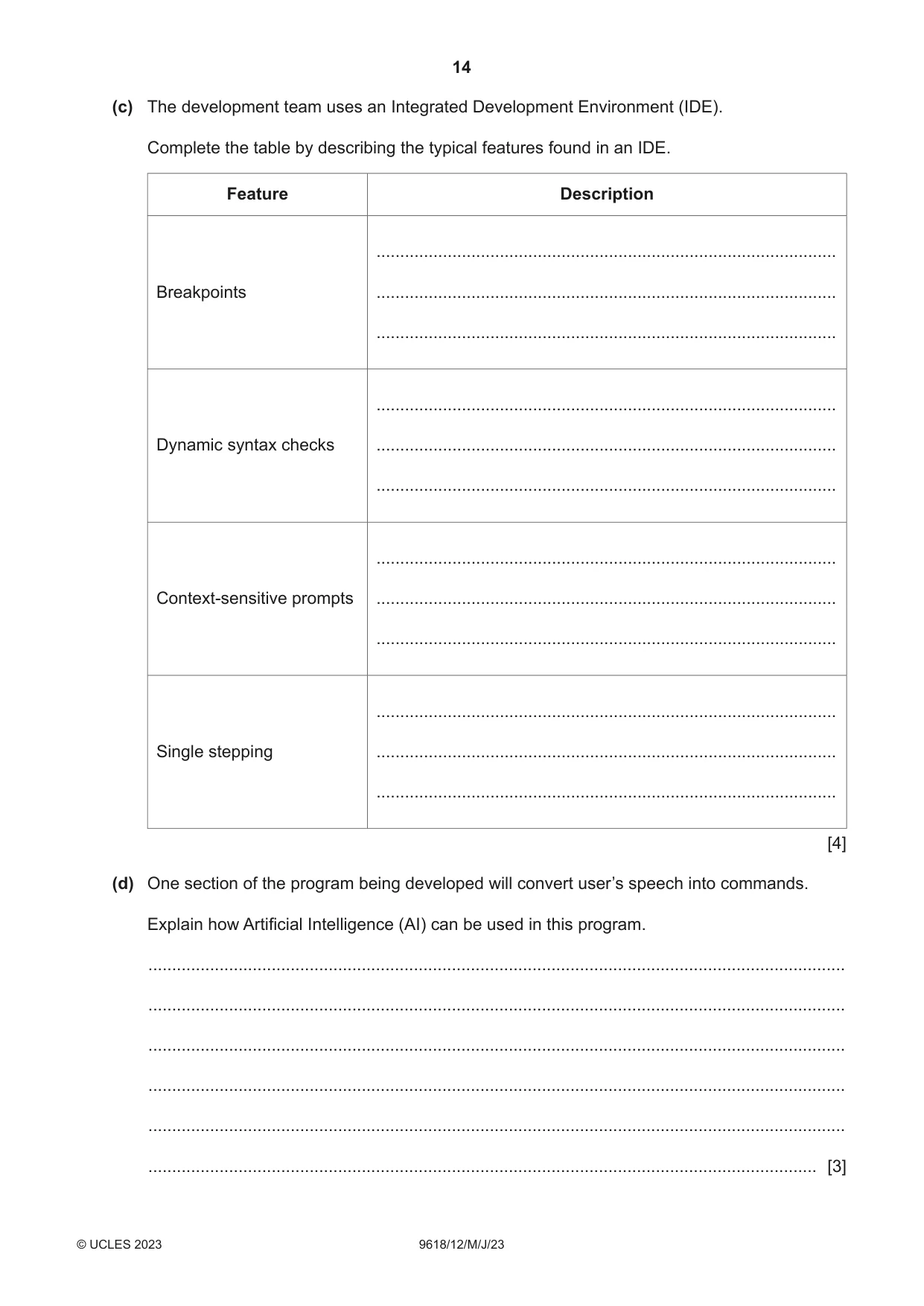
14 9618/12/M/J/23 © UCLES 2023 (c) The development team uses an Integrated Development Environment (IDE). Complete the table by describing the typical features found in an IDE. Feature Description Breakpoints … … … Dynamic syntax checks … … … Context‑sensitive prompts … … … Single stepping … … … [4] (d) One section of the program being developed will convert user’s speech into commands. Explain how Artificial Intelligence (AI) can be used in this program. … … … … … … [3]
Question paper, page 15
15 9618/12/M/J/23 © UCLES 2023 BLANK PAGE
Question paper, page 16
16 9618/12/M/J/23 © UCLES 2023 Permission to reproduce items where third‑party owned material protected by copyright is included has been sought and cleared where possible. Every reasonable effort has been made by the publisher (UCLES) to trace copyright holders, but if any items requiring clearance have unwittingly been included, the publisher will be pleased to make amends at the earliest possible opportunity. To avoid the issue of disclosure of answer‑related information to candidates, all copyright acknowledgements are reproduced online in the Cambridge Assessment International Education Copyright Acknowledgements Booklet. This is produced for each series of examinations and is freely available to download at www.cambridgeinternational.org after the live examination series. Cambridge Assessment International Education is part of Cambridge Assessment. Cambridge Assessment is the brand name of the University of Cambridge Local Examinations Syndicate (UCLES), which is a department of the University of Cambridge. BLANK PAGE
Mark scheme, page 1
This document consists of 10 printed pages. © UCLES 2023 [Turn over Cambridge International AS & A Level COMPUTER SCIENCE 9618/12 Paper 1 Theory Fundamentals May/June 2023 MARK SCHEME Maximum Mark: 75 Published This mark scheme is published as an aid to teachers and candidates, to indicate the requirements of the examination. It shows the basis on which Examiners were instructed to award marks. It does not indicate the details of the discussions that took place at an Examiners’ meeting before marking began, which would have considered the acceptability of alternative answers. Mark schemes should be read in conjunction with the question paper and the Principal Examiner Report for Teachers. Cambridge International will not enter into discussions about these mark schemes. Cambridge International is publishing the mark schemes for the May/June 2023 series for most Cambridge IGCSE, Cambridge International A and AS Level and Cambridge Pre-U components, and some Cambridge O Level components.
Mark scheme, page 2
9618/12 Cambridge International AS & A Level – Mark Scheme PUBLISHED May/June 2023 © UCLES 2023 Page 2 of 10 Generic Marking Principles These general marking principles must be applied by all examiners when marking candidate answers. They should be applied alongside the specific content of the mark scheme or generic level descriptors for a question. Each question paper and mark scheme will also comply with these marking principles. GENERIC MARKING PRINCIPLE 1: Marks must be awarded in line with: the specific content of the mark scheme or the generic level descriptors for the question the specific skills defined in the mark scheme or in the generic level descriptors for the question the standard of response required by a candidate as exemplified by the standardisation scripts. GENERIC MARKING PRINCIPLE 2: Marks awarded are always whole marks (not half marks, or other fractions). GENERIC MARKING PRINCIPLE 3: Marks must be awarded positively: marks are awarded for correct / valid answers, as defined in the mark scheme. However, credit is given for valid answers which go beyond the scope of the syllabus and mark scheme, referring to your Team Leader as appropriate marks are awarded when candidates clearly demonstrate what they know and can do marks are not deducted for errors marks are not deducted for omissions answers should only be judged on the quality of spelling, punctuation and grammar when these features are specifically assessed by the question as indicated by the mark scheme. The meaning, however, should be unambiguous. GENERIC MARKING PRINCIPLE 4: Rules must be applied consistently, e.g. in situations where candidates have not followed instructions or in the application of generic level descriptors. GENERIC MARKING PRINCIPLE 5: Marks should be awarded using the full range of marks defined in the mark scheme for the question (however; the use of the full mark range may be limited according to the quality of the candidate responses seen). GENERIC MARKING PRINCIPLE 6: Marks awarded are based solely on the requirements as defined in the mark scheme. Marks should not be awarded with grade thresholds or grade descriptors in mind.
Mark scheme, page 3
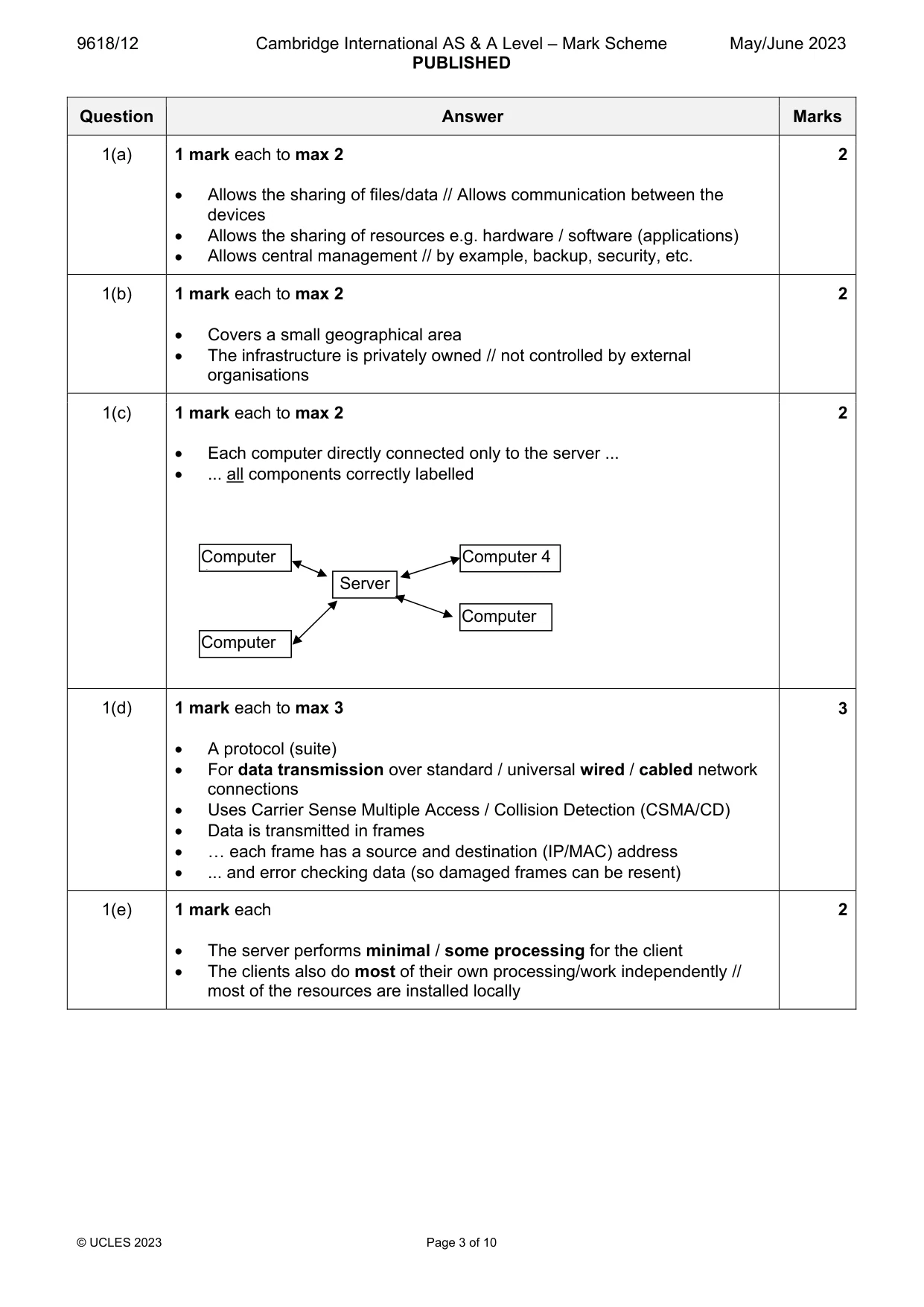
9618/12 Cambridge International AS & A Level – Mark Scheme PUBLISHED May/June 2023 © UCLES 2023 Page 3 of 10 Question Answer Marks 1(a) 1 mark each to max 2 Allows the sharing of files/data // Allows communication between the devices Allows the sharing of resources e.g. hardware / software (applications) Allows central management // by example, backup, security, etc. 2 1(b) 1 mark each to max 2 Covers a small geographical area The infrastructure is privately owned // not controlled by external organisations 2 1(c) 1 mark each to max 2 Each computer directly connected only to the server ... ... all components correctly labelled 2 1(d) 1 mark each to max 3 A protocol (suite) For data transmission over standard / universal wired / cabled network connections Uses Carrier Sense Multiple Access / Collision Detection (CSMA/CD) Data is transmitted in frames … each frame has a source and destination (IP/MAC) address ... and error checking data (so damaged frames can be resent) 3 1(e) 1 mark each The server performs minimal / some processing for the client The clients also do most of their own processing/work independently // most of the resources are installed locally 2 Computer 1 Computer Computer Computer 4 Server
Mark scheme, page 4
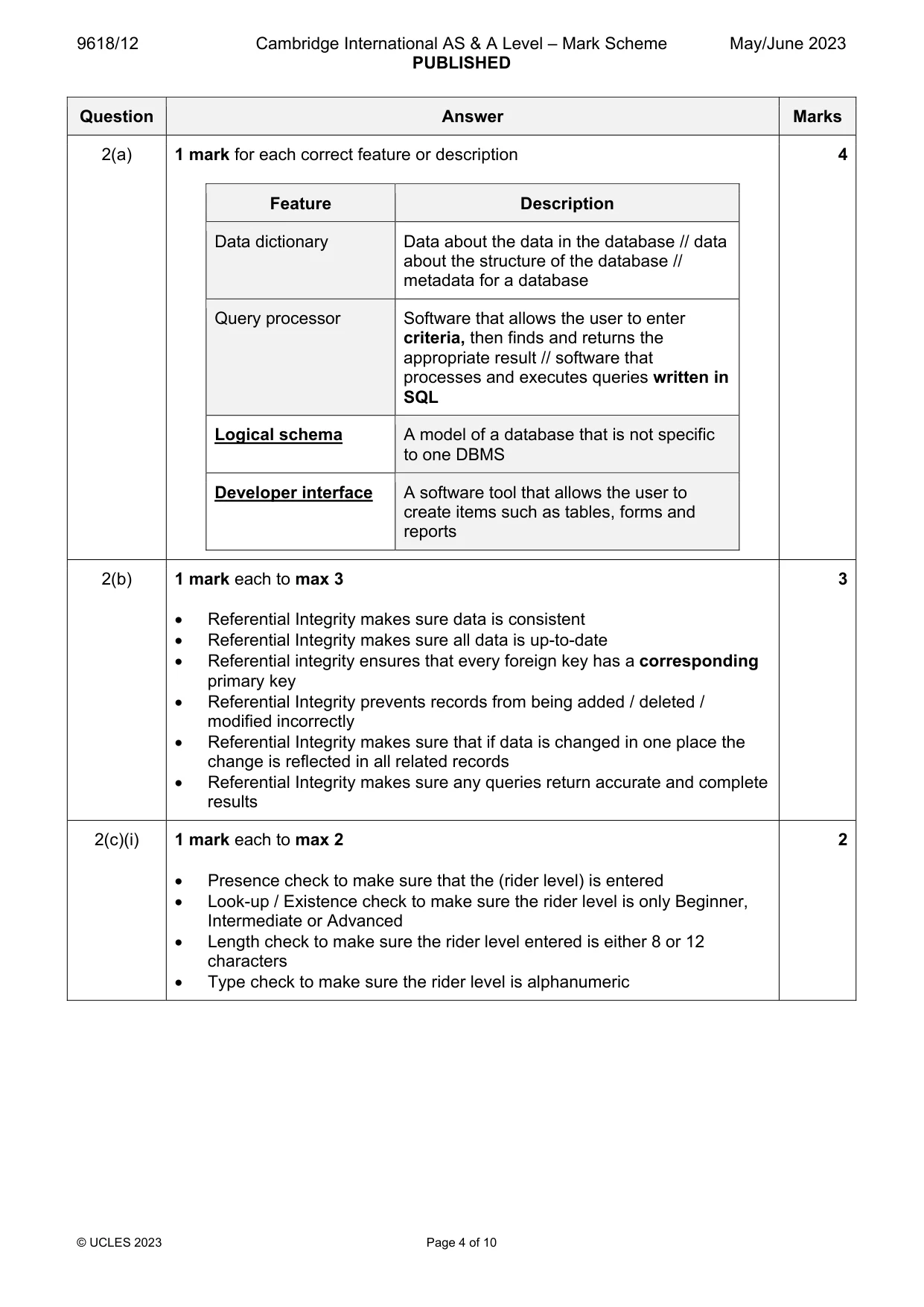
9618/12 Cambridge International AS & A Level – Mark Scheme PUBLISHED May/June 2023 © UCLES 2023 Page 4 of 10 Question Answer Marks 2(a) 1 mark for each correct feature or description Feature Description Data dictionary Data about the data in the database // data about the structure of the database // metadata for a database Query processor Software that allows the user to enter criteria, then finds and returns the appropriate result // software that processes and executes queries written in SQL Logical schema A model of a database that is not specific to one DBMS Developer interface A software tool that allows the user to create items such as tables, forms and reports 4 2(b) 1 mark each to max 3 Referential Integrity makes sure data is consistent Referential Integrity makes sure all data is up-to-date Referential integrity ensures that every foreign key has a corresponding primary key Referential Integrity prevents records from being added / deleted / modified incorrectly Referential Integrity makes sure that if data is changed in one place the change is reflected in all related records Referential Integrity makes sure any queries return accurate and complete results 3 2(c)(i) 1 mark each to max 2 Presence check to make sure that the (rider level) is entered Look-up / Existence check to make sure the rider level is only Beginner, Intermediate or Advanced Length check to make sure the rider level entered is either 8 or 12 characters Type check to make sure the rider level is alphanumeric 2
Mark scheme, page 5
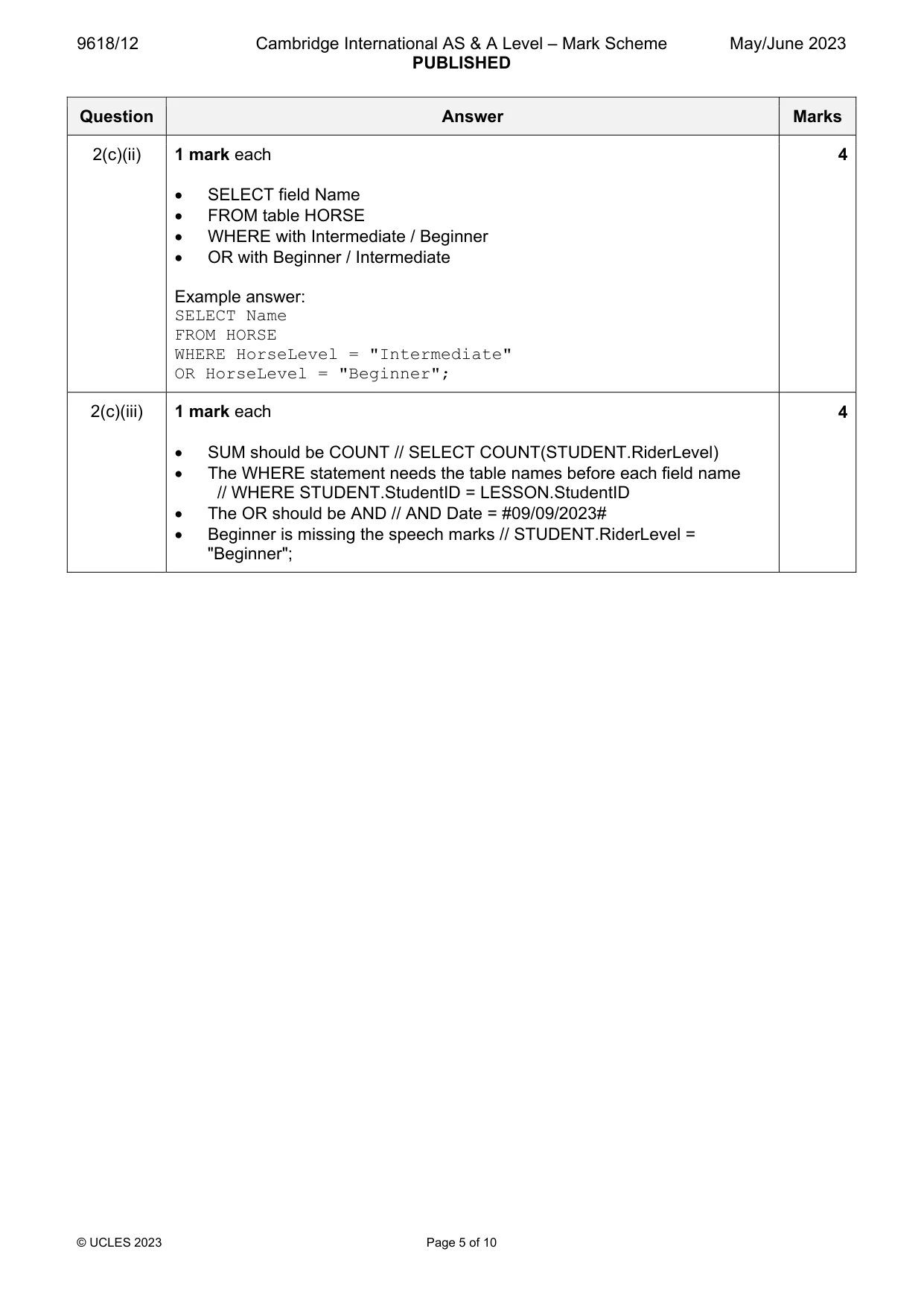
9618/12 Cambridge International AS & A Level – Mark Scheme PUBLISHED May/June 2023 © UCLES 2023 Page 5 of 10 Question Answer Marks 2(c)(ii) 1 mark each SELECT field Name FROM table HORSE WHERE with Intermediate / Beginner OR with Beginner / Intermediate Example answer: SELECT Name FROM HORSE WHERE HorseLevel = "Intermediate" OR HorseLevel = "Beginner"; 4 2(c)(iii) 1 mark each SUM should be COUNT // SELECT COUNT(STUDENT.RiderLevel) The WHERE statement needs the table names before each field name // WHERE STUDENT.StudentID = LESSON.StudentID The OR should be AND // AND Date = #09/09/2023# Beginner is missing the speech marks // STUDENT.RiderLevel = "Beginner"; 4
Mark scheme, page 6
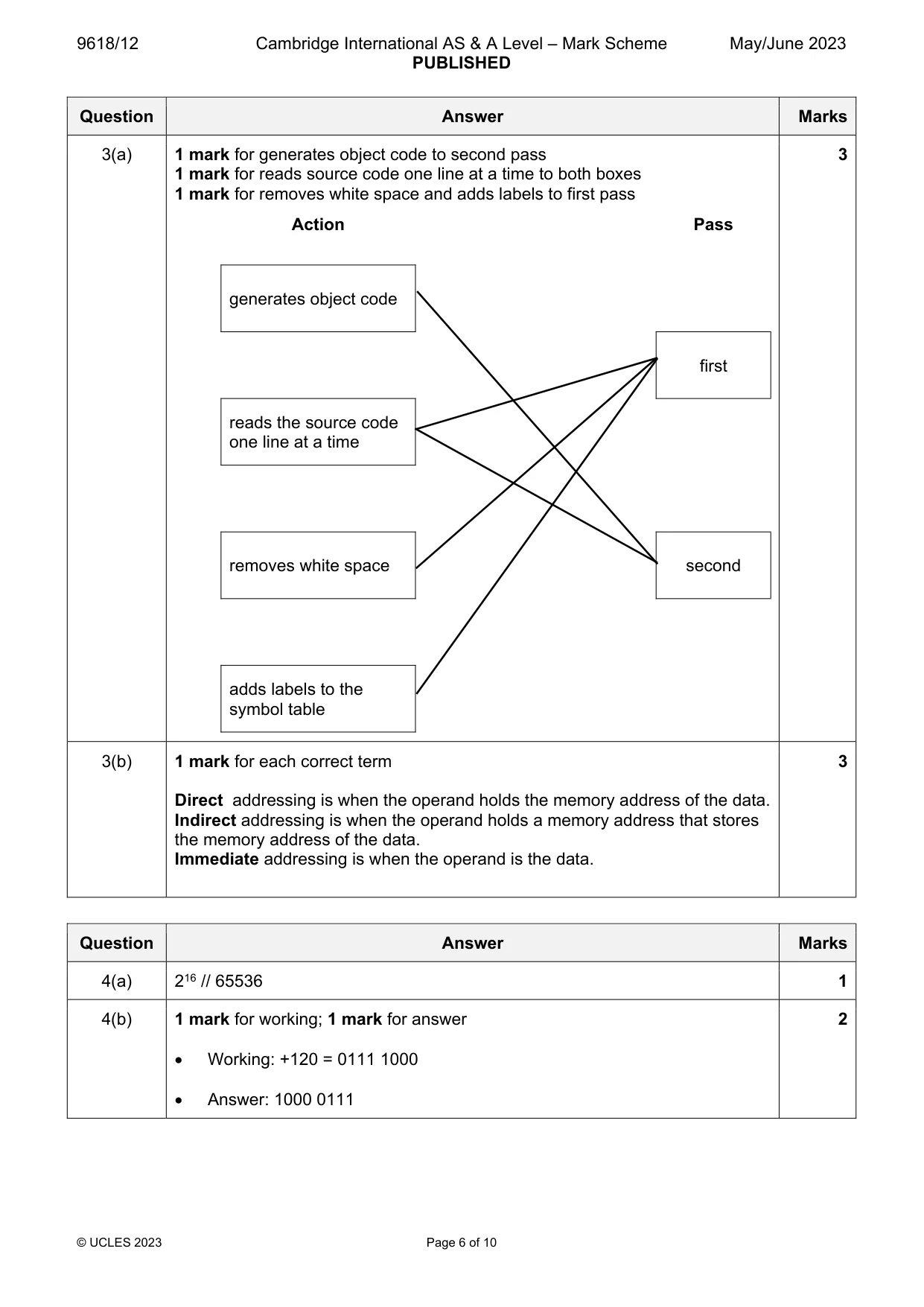
9618/12 Cambridge International AS & A Level – Mark Scheme PUBLISHED May/June 2023 © UCLES 2023 Page 6 of 10 Question Answer Marks 3(a) 1 mark for generates object code to second pass 1 mark for reads source code one line at a time to both boxes 1 mark for removes white space and adds labels to first pass Action Pass generates object code first reads the source code one line at a time removes white space second adds labels to the symbol table 3 3(b) 1 mark for each correct term Direct addressing is when the operand holds the memory address of the data. Indirect addressing is when the operand holds a memory address that stores the memory address of the data. Immediate addressing is when the operand is the data. 3 Question Answer Marks 4(a) 216 // 65536 1 4(b) 1 mark for working; 1 mark for answer Working: +120 = 0111 1000 Answer: 1000 0111 2
Mark scheme, page 7
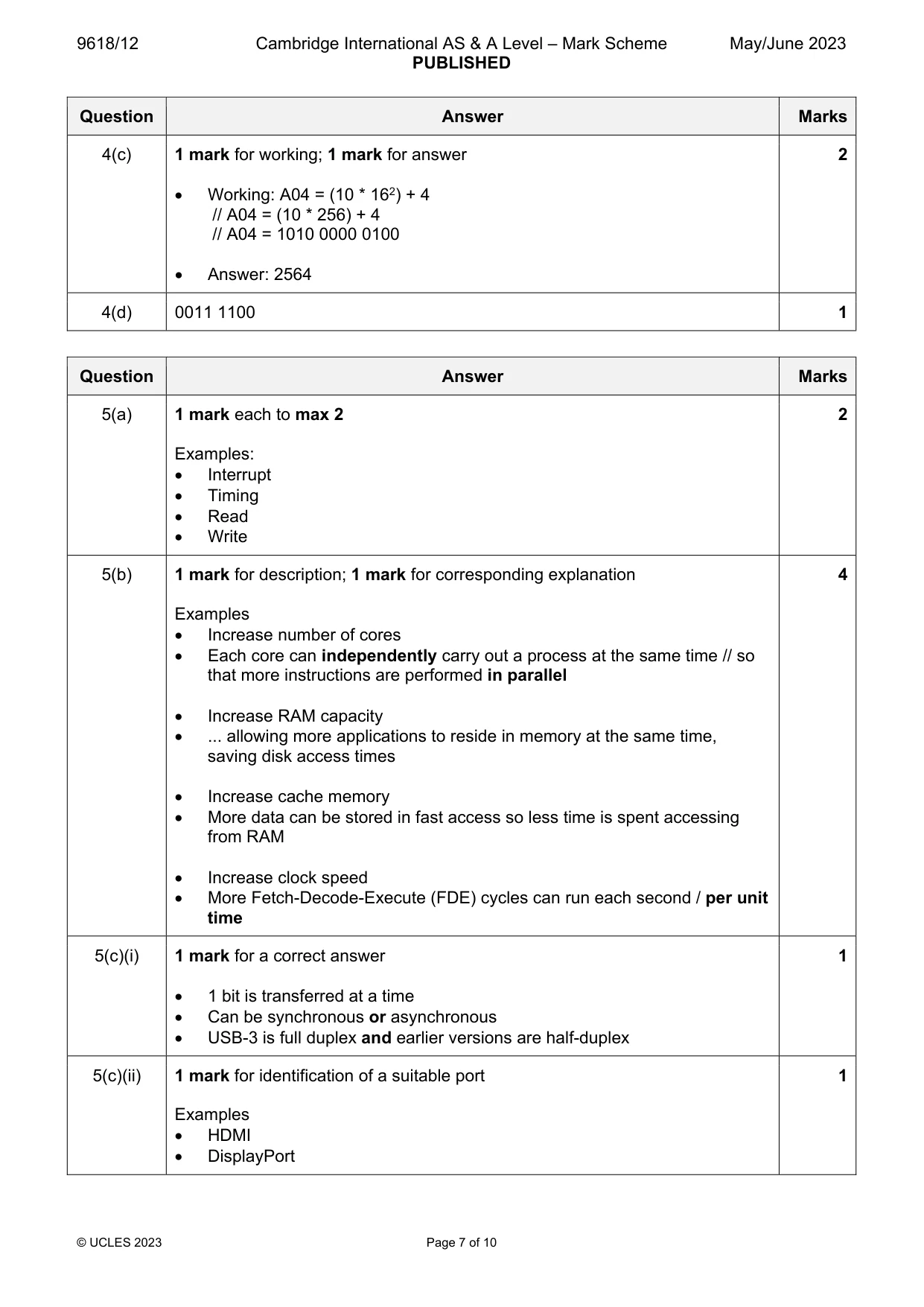
9618/12 Cambridge International AS & A Level – Mark Scheme PUBLISHED May/June 2023 © UCLES 2023 Page 7 of 10 Question Answer Marks 4(c) 1 mark for working; 1 mark for answer Working: A04 = (10 * 162) + 4 // A04 = (10 * 256) + 4 // A04 = 1010 0000 0100 Answer: 2564 2 4(d) 0011 1100 1 Question Answer Marks 5(a) 1 mark each to max 2 Examples: Interrupt Timing Read Write 2 5(b) 1 mark for description; 1 mark for corresponding explanation Examples Increase number of cores Each core can independently carry out a process at the same time // so that more instructions are performed in parallel Increase RAM capacity ... allowing more applications to reside in memory at the same time, saving disk access times Increase cache memory More data can be stored in fast access so less time is spent accessing from RAM Increase clock speed More Fetch-Decode-Execute (FDE) cycles can run each second / per unit time 4 5(c)(i) 1 mark for a correct answer 1 bit is transferred at a time Can be synchronous or asynchronous USB-3 is full duplex and earlier versions are half-duplex 1 5(c)(ii) 1 mark for identification of a suitable port Examples HDMI DisplayPort 1
Mark scheme, page 8
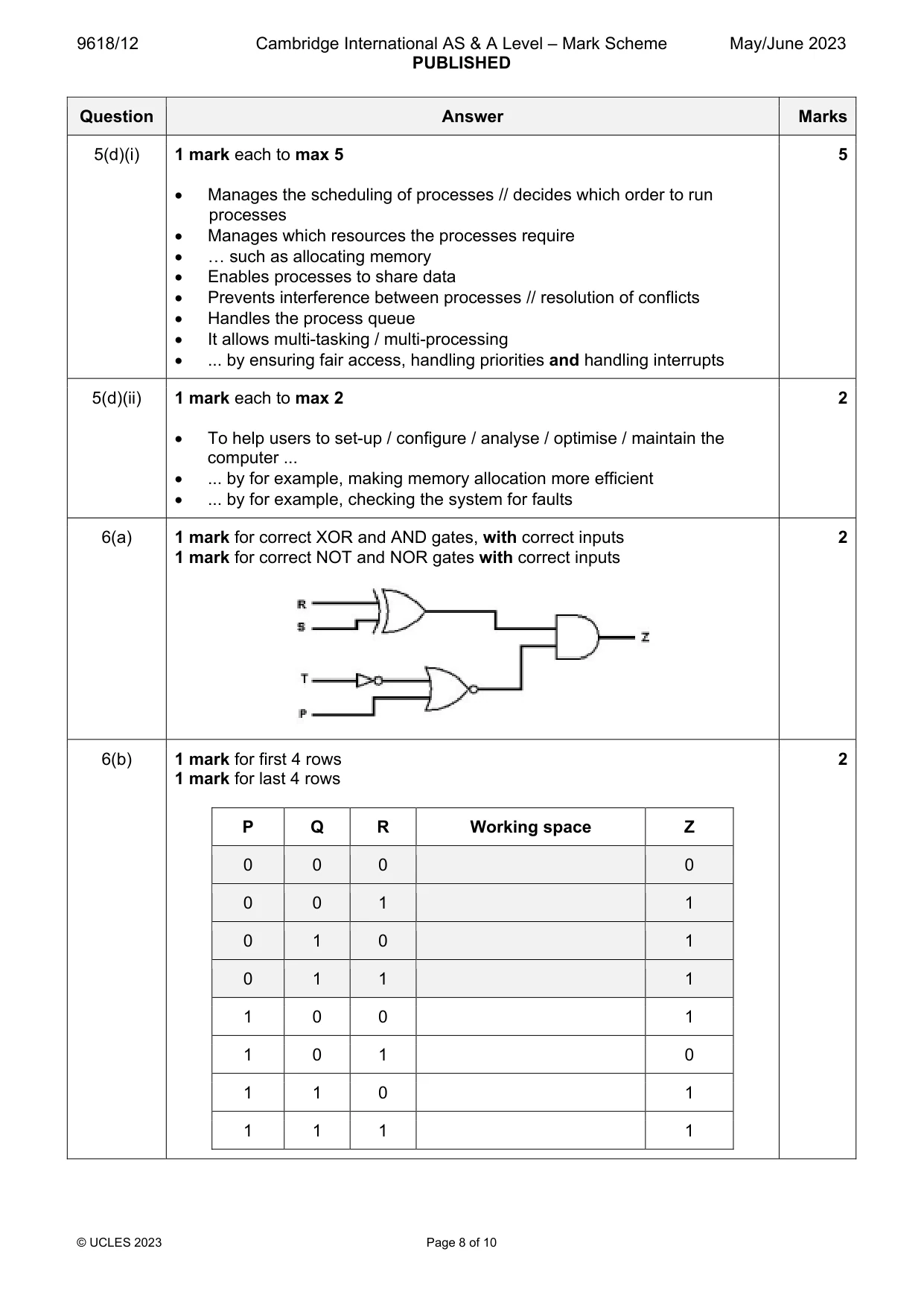
9618/12 Cambridge International AS & A Level – Mark Scheme PUBLISHED May/June 2023 © UCLES 2023 Page 8 of 10 Question Answer Marks 5(d)(i) 1 mark each to max 5 Manages the scheduling of processes // decides which order to run processes Manages which resources the processes require … such as allocating memory Enables processes to share data Prevents interference between processes // resolution of conflicts Handles the process queue It allows multi-tasking / multi-processing ... by ensuring fair access, handling priorities and handling interrupts 5 5(d)(ii) 1 mark each to max 2 To help users to set-up / configure / analyse / optimise / maintain the computer ... ... by for example, making memory allocation more efficient ... by for example, checking the system for faults 2 6(a) 1 mark for correct XOR and AND gates, with correct inputs 1 mark for correct NOT and NOR gates with correct inputs 2 6(b) 1 mark for first 4 rows 1 mark for last 4 rows P Q R Working space Z 0 0 0 0 0 0 1 1 0 1 0 1 0 1 1 1 1 0 0 1 1 0 1 0 1 1 0 1 1 1 1 1 2
Mark scheme, page 9
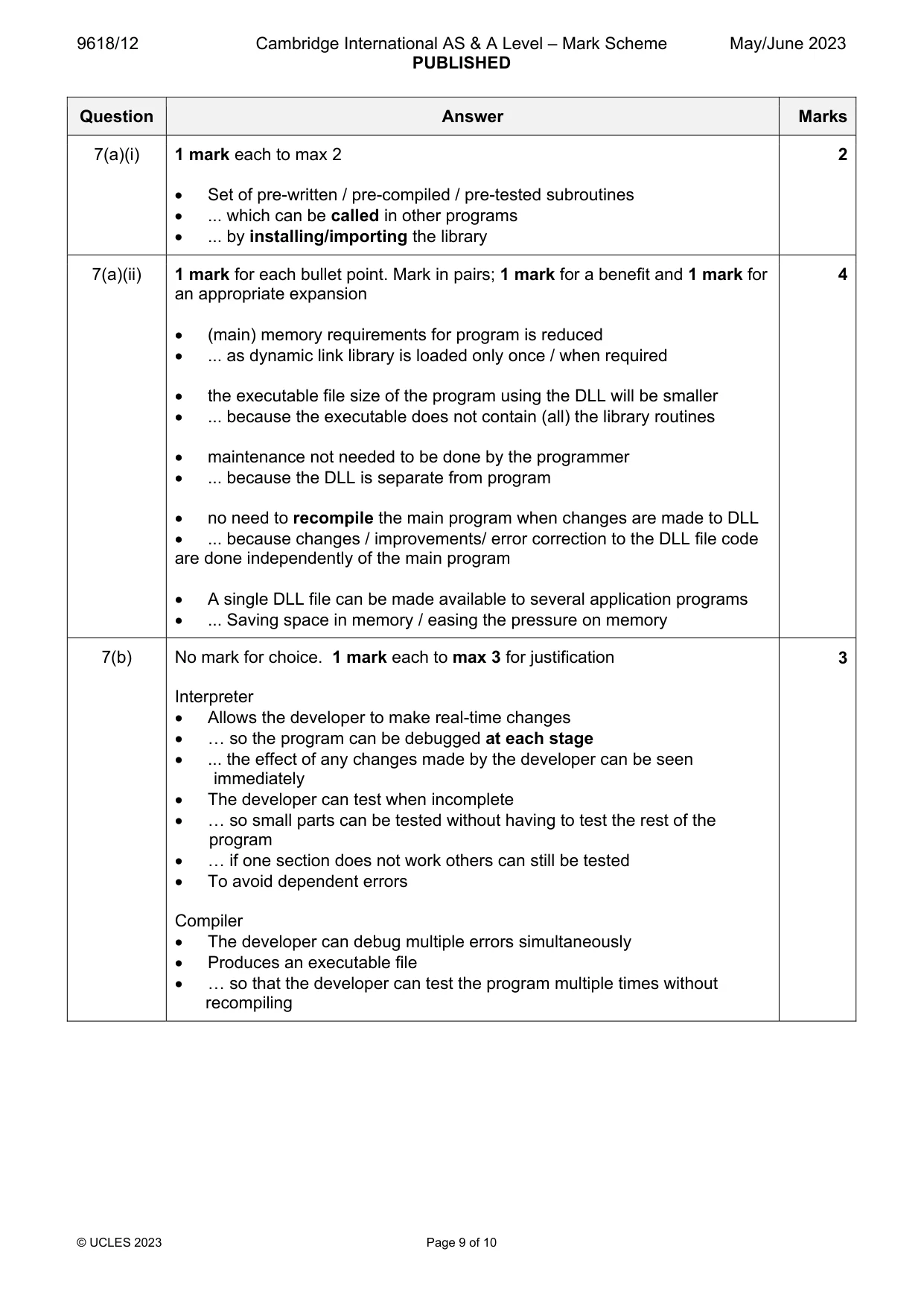
9618/12 Cambridge International AS & A Level – Mark Scheme PUBLISHED May/June 2023 © UCLES 2023 Page 9 of 10 Question Answer Marks 7(a)(i) 1 mark each to max 2 Set of pre-written / pre-compiled / pre-tested subroutines ... which can be called in other programs ... by installing/importing the library 2 7(a)(ii) 1 mark for each bullet point. Mark in pairs; 1 mark for a benefit and 1 mark for an appropriate expansion (main) memory requirements for program is reduced ... as dynamic link library is loaded only once / when required the executable file size of the program using the DLL will be smaller ... because the executable does not contain (all) the library routines maintenance not needed to be done by the programmer ... because the DLL is separate from program no need to recompile the main program when changes are made to DLL ... because changes / improvements/ error correction to the DLL file code are done independently of the main program A single DLL file can be made available to several application programs ... Saving space in memory / easing the pressure on memory 4 7(b) No mark for choice. 1 mark each to max 3 for justification Interpreter Allows the developer to make real-time changes … so the program can be debugged at each stage ... the effect of any changes made by the developer can be seen immediately The developer can test when incomplete … so small parts can be tested without having to test the rest of the program … if one section does not work others can still be tested To avoid dependent errors Compiler The developer can debug multiple errors simultaneously Produces an executable file … so that the developer can test the program multiple times without recompiling 3
Mark scheme, page 10
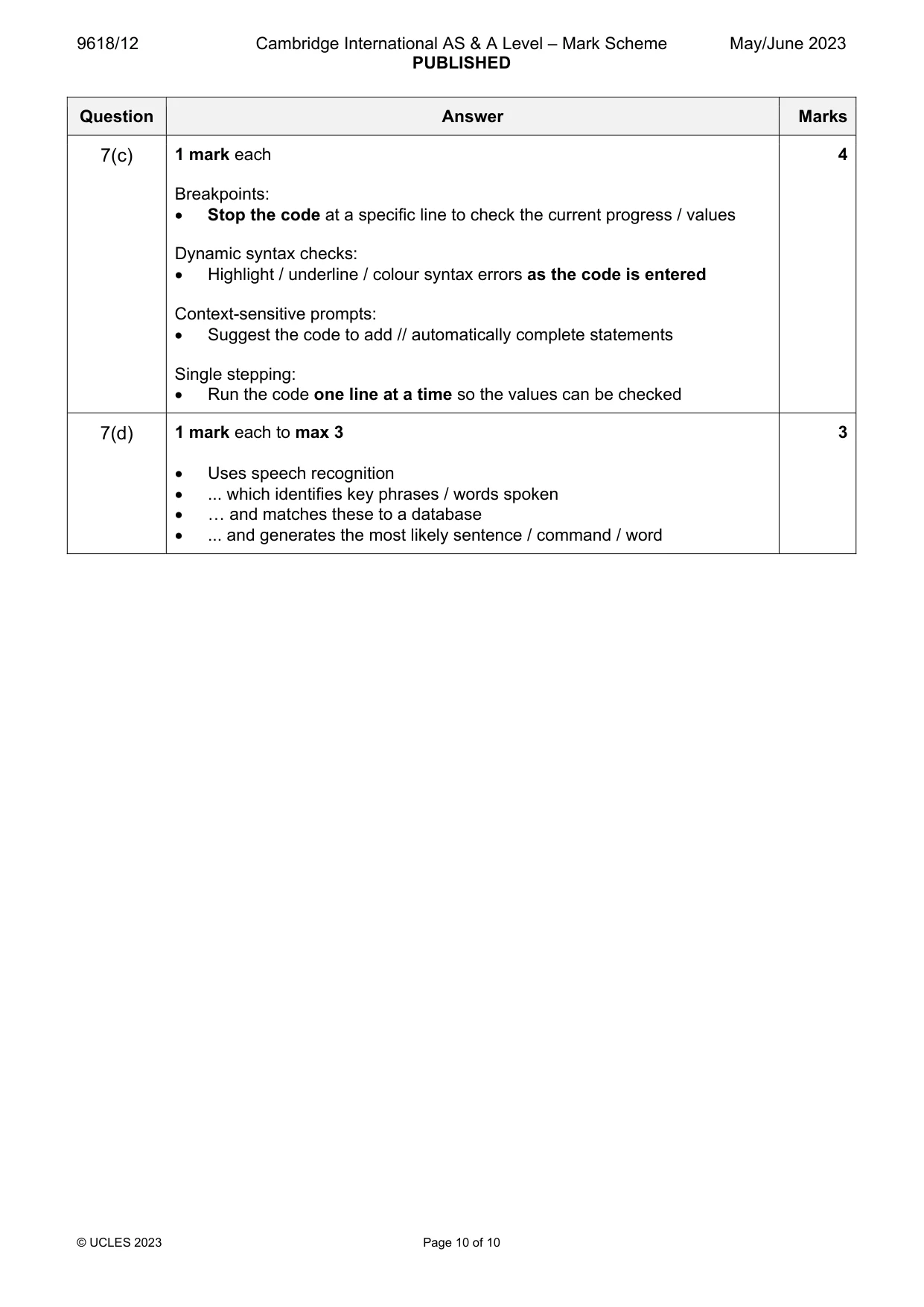
9618/12 Cambridge International AS & A Level – Mark Scheme PUBLISHED May/June 2023 © UCLES 2023 Page 10 of 10 Question Answer Marks 7(c) 1 mark each Breakpoints: Stop the code at a specific line to check the current progress / values Dynamic syntax checks: Highlight / underline / colour syntax errors as the code is entered Context-sensitive prompts: Suggest the code to add // automatically complete statements Single stepping: Run the code one line at a time so the values can be checked 4 7(d) 1 mark each to max 3 Uses speech recognition ... which identifies key phrases / words spoken … and matches these to a database ... and generates the most likely sentence / command / word 3
What you needed in this session
Cambridge’s own grade thresholds for 2023 May/June, Paper 1 · Variant 2. A higher threshold means an easier paper — the bar moves with how the cohort did.