Cambridge A Level Computer Science 9618 — 2022 Oct/Nov Paper 1 · Variant 1
9618/11/O/N/22 · 75 marks · ≈84 min
The question paper and its mark scheme, free to read here and free to download. This is Cambridge’s own paper, exactly as it was sat.
Question paper20 pages





Mark scheme11 pages
Answers below. Sit the paper first if you are practising.

Paper as text
Question paper, page 1
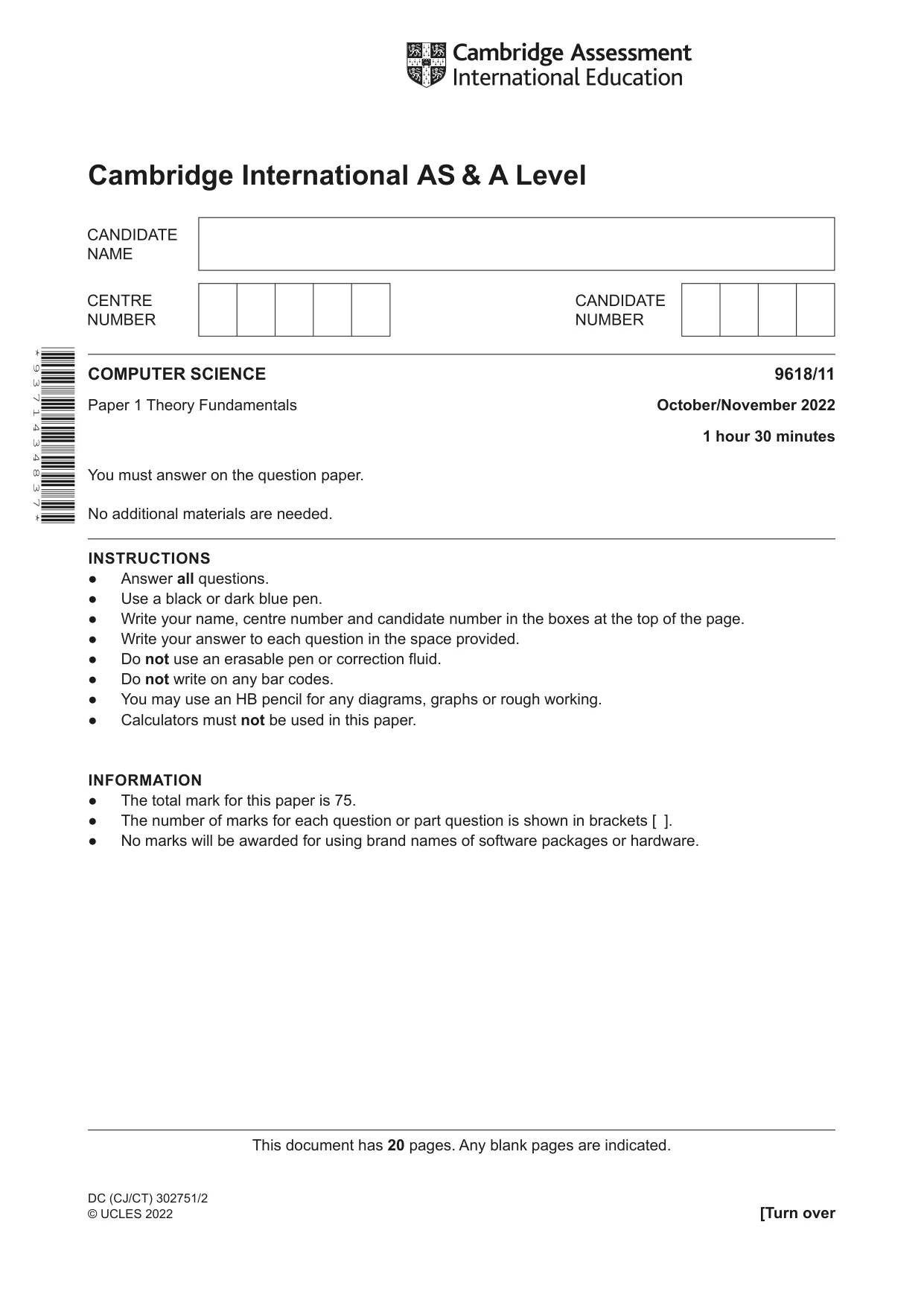
This document has 20 pages. Any blank pages are indicated. [Turn over Cambridge International AS & A Level COMPUTER SCIENCE 9618/11 Paper 1 Theory Fundamentals October/November 2022 1 hour 30 minutes You must answer on the question paper. No additional materials are needed. INSTRUCTIONS ● Answer all questions. ● Use a black or dark blue pen. ● Write your name, centre number and candidate number in the boxes at the top of the page. ● Write your answer to each question in the space provided. ● Do not use an erasable pen or correction fluid. ● Do not write on any bar codes. ● You may use an HB pencil for any diagrams, graphs or rough working. ● Calculators must not be used in this paper. INFORMATION ● The total mark for this paper is 75. ● The number of marks for each question or part question is shown in brackets [ ]. ● No marks will be awarded for using brand names of software packages or hardware. * 9 3 7 1 4 3 4 8 3 7 * DC (CJ/CT) 302751/2 © UCLES 2022
Question paper, page 2
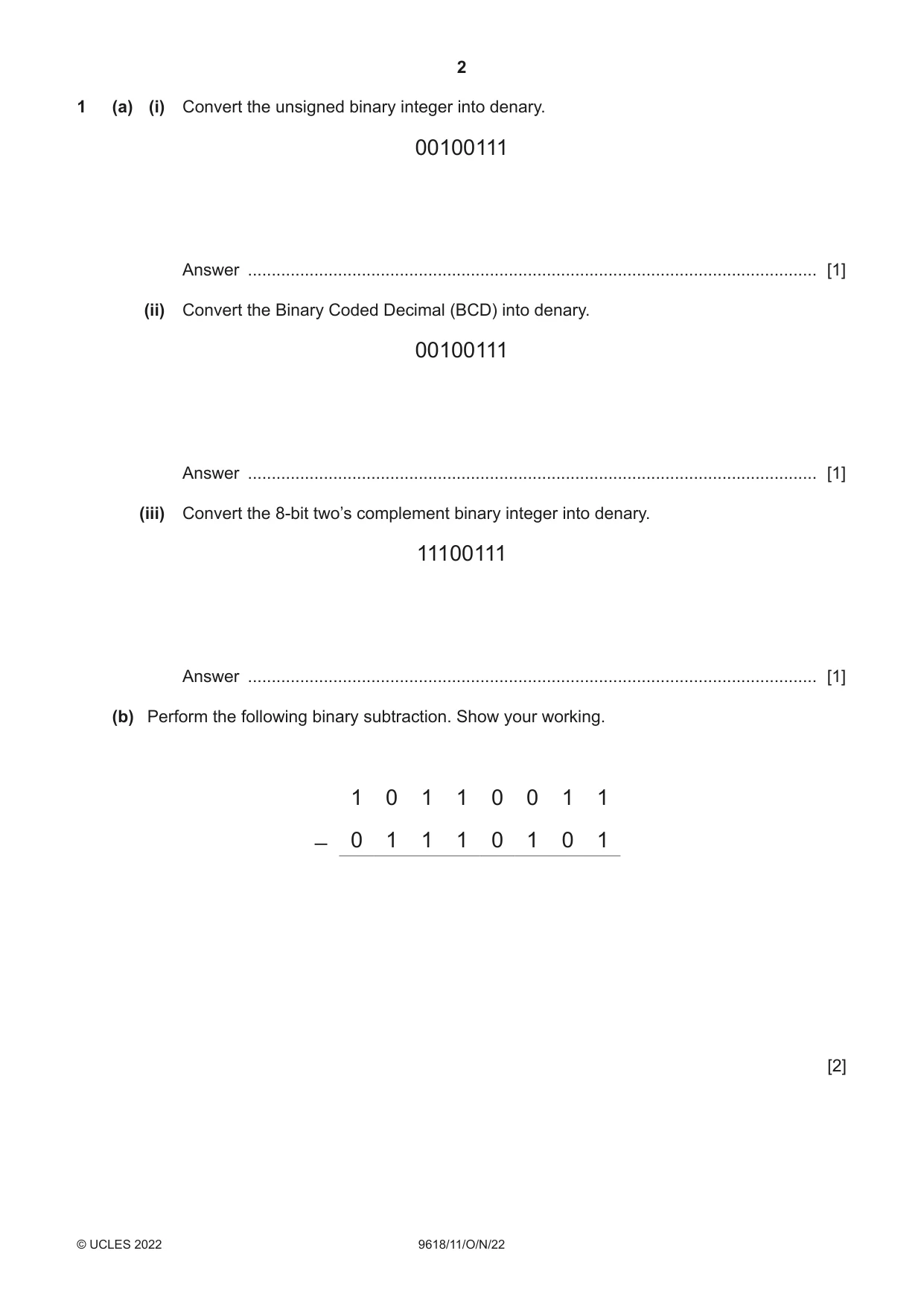
2 9618/11/O/N/22 © UCLES 2022 1 (a) (i) Convert the unsigned binary integer into denary. 00100111 Answer … [1] (ii) Convert the Binary Coded Decimal (BCD) into denary. 00100111 Answer … [1] (iii) Convert the 8-bit two’s complement binary integer into denary. 11100111 Answer … [1] (b) Perform the following binary subtraction. Show your working. 1 0 1 1 0 0 1 1 _ 0 1 1 1 0 1 0 1 [2]
Question paper, page 3
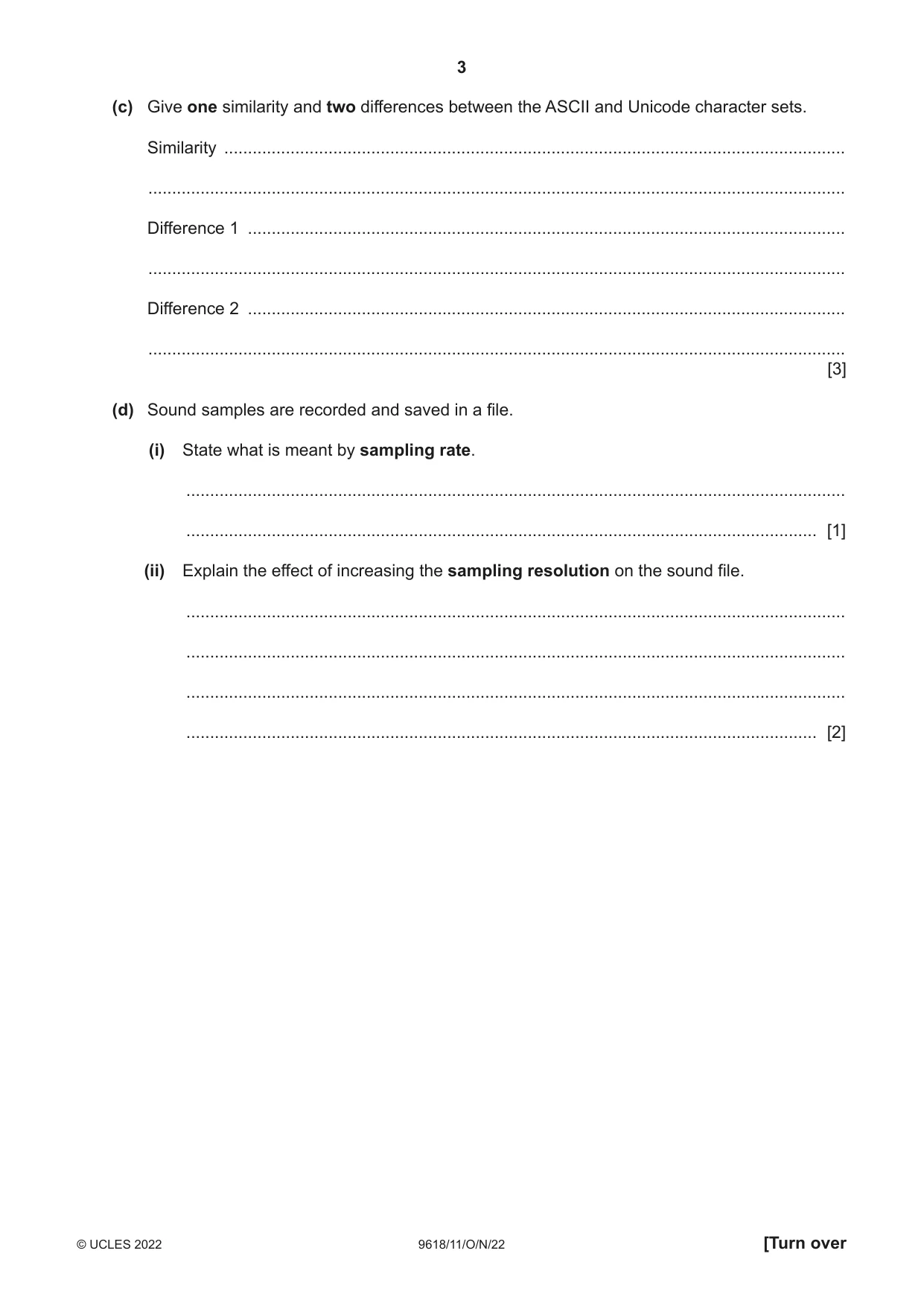
3 9618/11/O/N/22 © UCLES 2022 [Turn over (c) Give one similarity and two differences between the ASCII and Unicode character sets. Similarity … … Difference 1 … … Difference 2 … … [3] (d) Sound samples are recorded and saved in a file. (i) State what is meant by sampling rate. … … [1] (ii) Explain the effect of increasing the sampling resolution on the sound file. … … … … [2]
Question paper, page 4
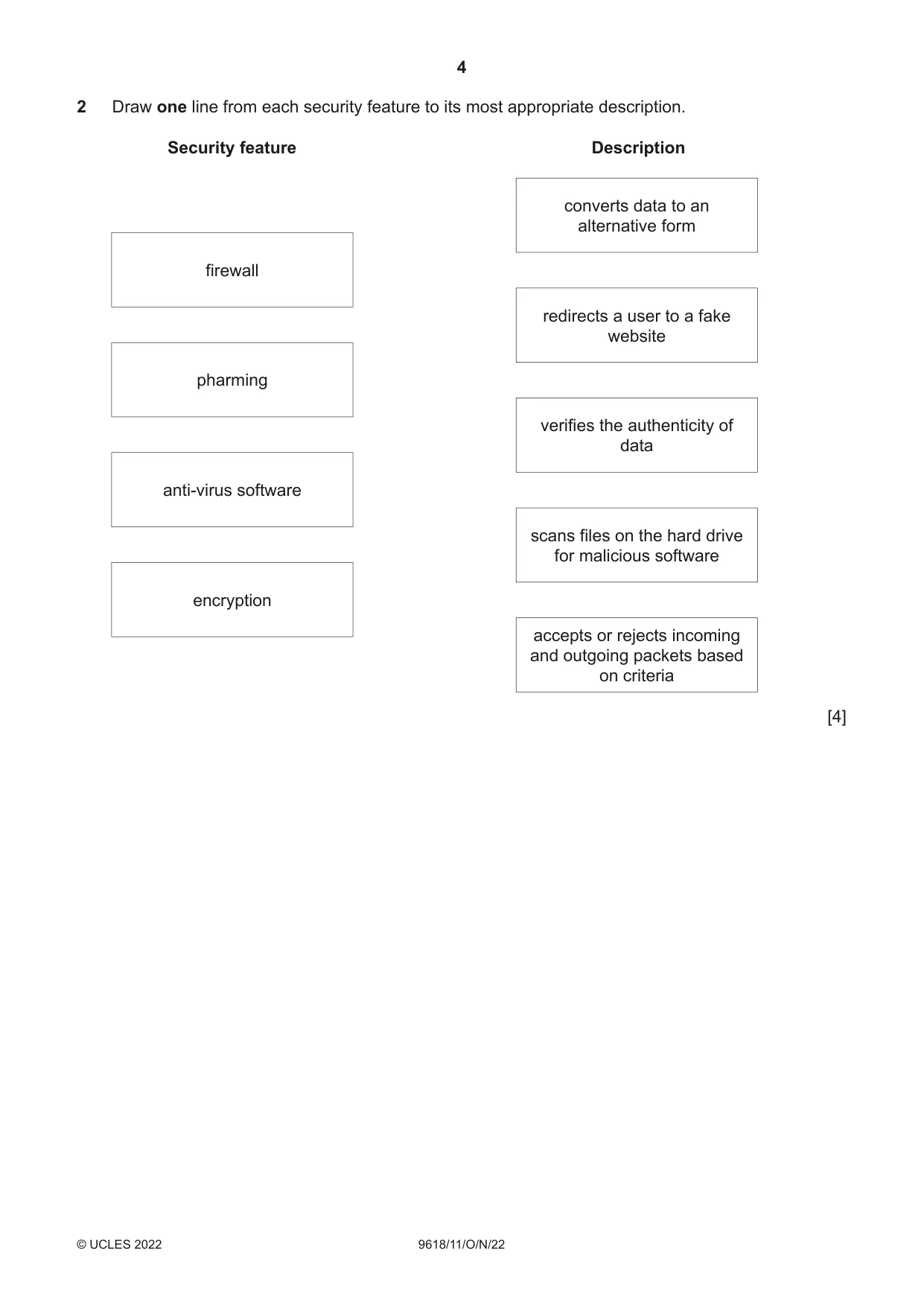
4 9618/11/O/N/22 © UCLES 2022 2 Draw one line from each security feature to its most appropriate description. Security feature Description [4] firewall converts data to an alternative form pharming redirects a user to a fake website anti-virus software verifies the authenticity of data encryption scans files on the hard drive for malicious software accepts or rejects incoming and outgoing packets based on criteria
Question paper, page 5
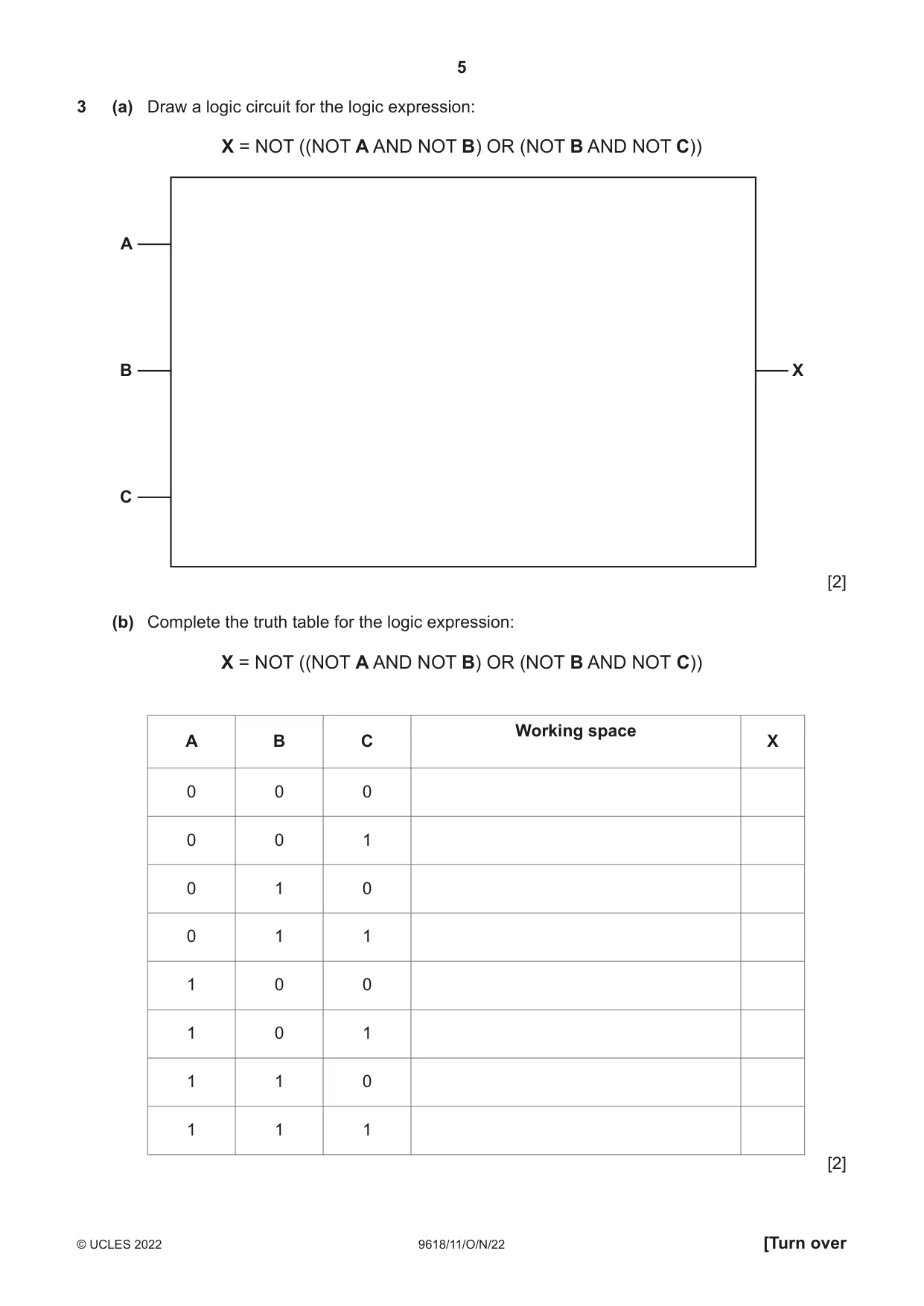
5 9618/11/O/N/22 © UCLES 2022 [Turn over 3 (a) Draw a logic circuit for the logic expression: X = NOT ((NOT A AND NOT B) OR (NOT B AND NOT C)) A B X C [2] (b) Complete the truth table for the logic expression: X = NOT ((NOT A AND NOT B) OR (NOT B AND NOT C)) A B C Working space X 0 0 0 0 0 1 0 1 0 0 1 1 1 0 0 1 0 1 1 1 0 1 1 1 [2]
Question paper, page 6
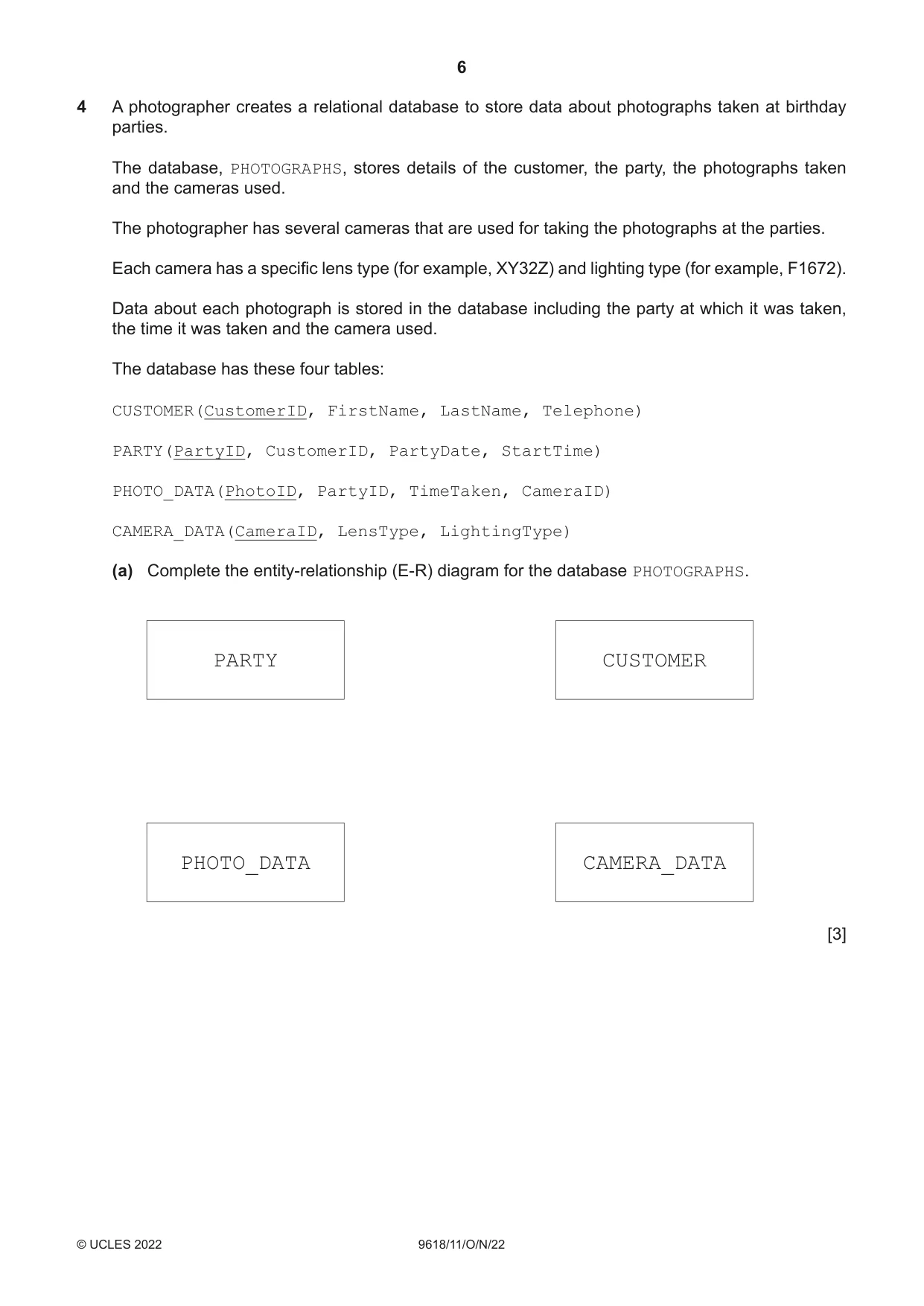
6 9618/11/O/N/22 © UCLES 2022 4 A photographer creates a relational database to store data about photographs taken at birthday parties. The database, PHOTOGRAPHS, stores details of the customer, the party, the photographs taken and the cameras used. The photographer has several cameras that are used for taking the photographs at the parties. Each camera has a specific lens type (for example, XY32Z) and lighting type (for example, F1672). Data about each photograph is stored in the database including the party at which it was taken, the time it was taken and the camera used. The database has these four tables: CUSTOMER(CustomerID, FirstName, LastName, Telephone) PARTY(PartyID, CustomerID, PartyDate, StartTime) PHOTO_DATA(PhotoID, PartyID, TimeTaken, CameraID) CAMERA_DATA(CameraID, LensType, LightingType) (a) Complete the entity-relationship (E-R) diagram for the database PHOTOGRAPHS. [3] PARTY CUSTOMER PHOTO_DATA CAMERA_DATA
Question paper, page 7
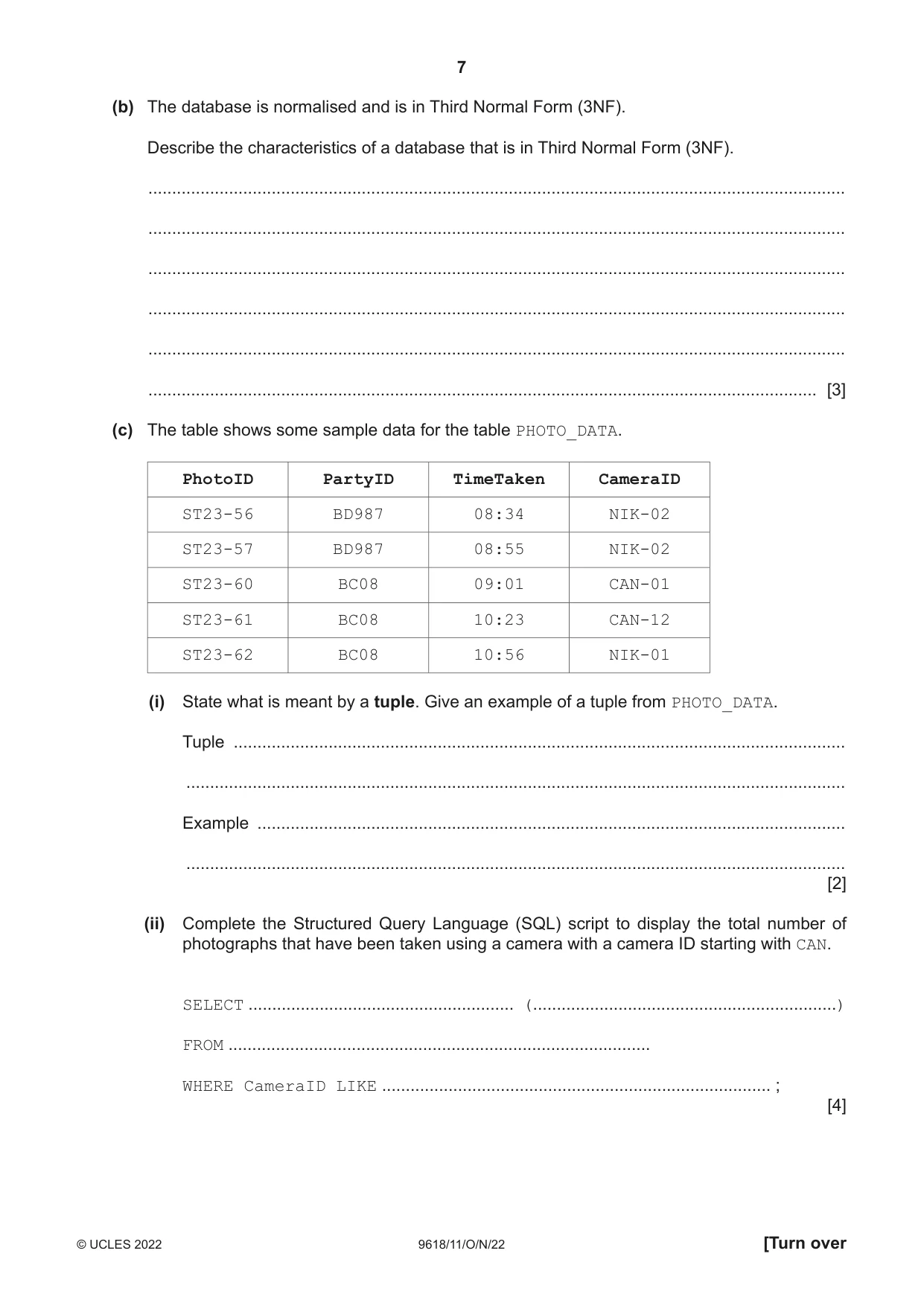
7 9618/11/O/N/22 © UCLES 2022 [Turn over (b) The database is normalised and is in Third Normal Form (3NF). Describe the characteristics of a database that is in Third Normal Form (3NF). … … … … … … [3] (c) The table shows some sample data for the table PHOTO_DATA. PhotoID PartyID TimeTaken CameraID ST23-56 BD987 08:34 NIK-02 ST23-57 BD987 08:55 NIK-02 ST23-60 BC08 09:01 CAN-01 ST23-61 BC08 10:23 CAN-12 ST23-62 BC08 10:56 NIK-01 (i) State what is meant by a tuple. Give an example of a tuple from PHOTO_DATA. Tuple … … Example … … [2] (ii) Complete the Structured Query Language (SQL) script to display the total number of photographs that have been taken using a camera with a camera ID starting with CAN. SELECT … (…) FROM … WHERE CameraID LIKE … ; [4]
Question paper, page 8
8 9618/11/O/N/22 © UCLES 2022 (d) Write an SQL script to include two new fields in CAMERA_DATA to store the number of photographs currently on the camera and the date the camera was last used. … … … … … … [3]
Question paper, page 9
9 9618/11/O/N/22 © UCLES 2022 [Turn over Question 5 begins on page 10.
Question paper, page 10
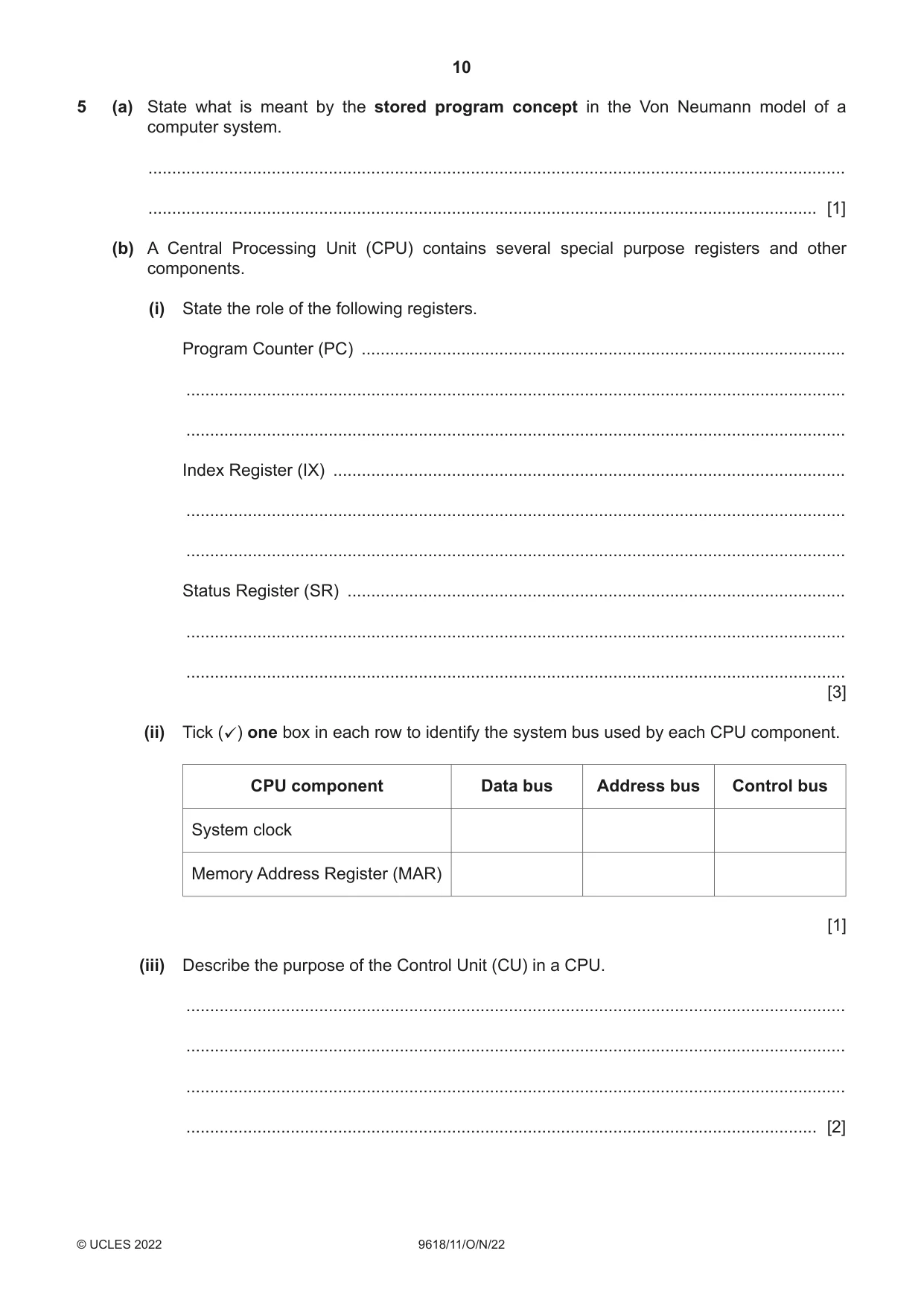
10 9618/11/O/N/22 © UCLES 2022 5 (a) State what is meant by the stored program concept in the Von Neumann model of a computer system. … … [1] (b) A Central Processing Unit (CPU) contains several special purpose registers and other components. (i) State the role of the following registers. Program Counter (PC) … … … Index Register (IX) … … … Status Register (SR) … … … [3] (ii) Tick () one box in each row to identify the system bus used by each CPU component. CPU component Data bus Address bus Control bus System clock Memory Address Register (MAR) [1] (iii) Describe the purpose of the Control Unit (CU) in a CPU. … … … … [2]
Question paper, page 11
11 9618/11/O/N/22 © UCLES 2022 [Turn over (c) Describe the purpose of an interrupt in a computer system. … … … … [2] (d) Identify two causes of a software interrupt. 1 … … 2 … … [2]
Question paper, page 12
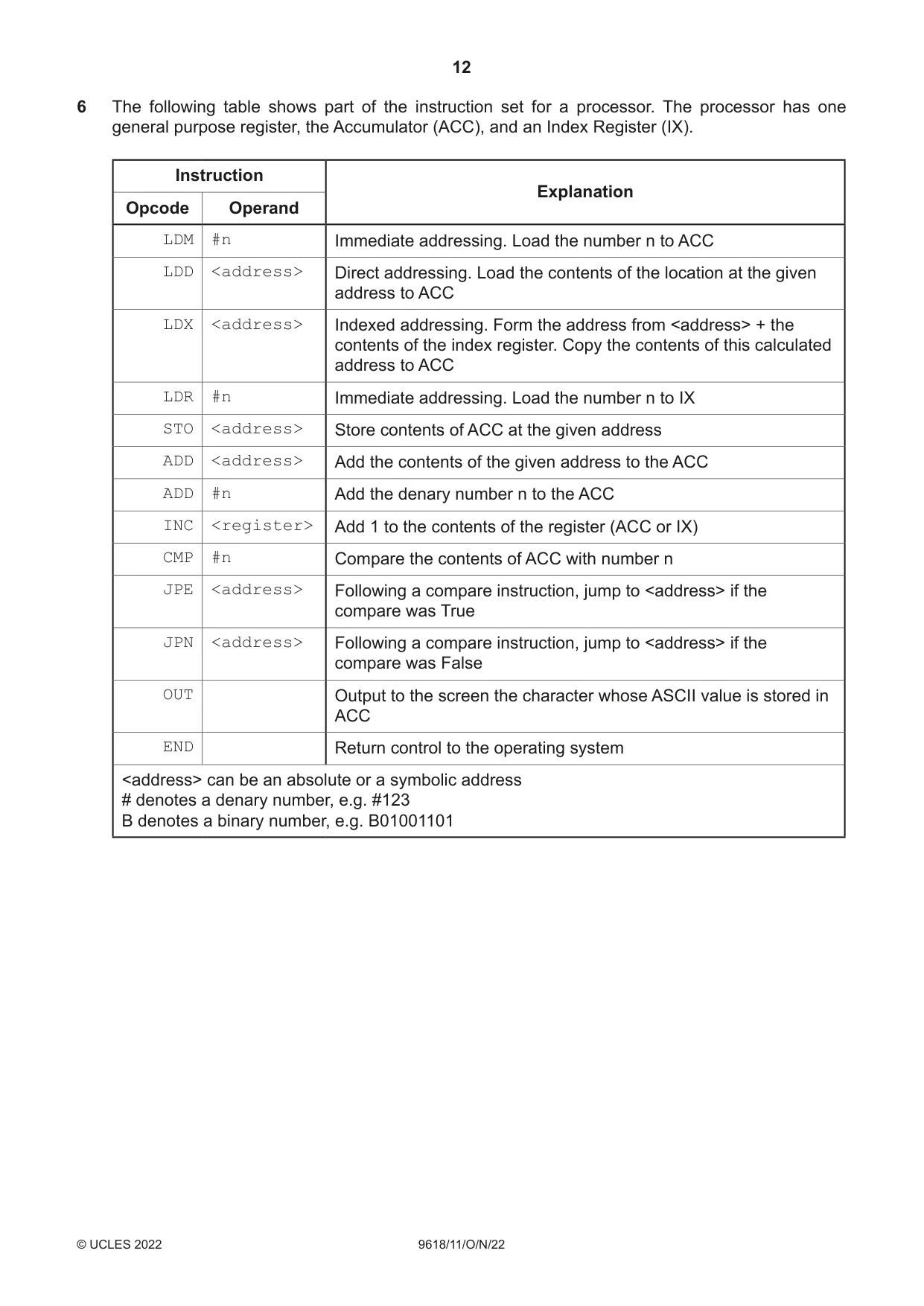
12 9618/11/O/N/22 © UCLES 2022 6 The following table shows part of the instruction set for a processor. The processor has one general purpose register, the Accumulator (ACC), and an Index Register (IX). Instruction Explanation Opcode Operand LDM #n Immediate addressing. Load the number n to ACC LDD <address> Direct addressing. Load the contents of the location at the given address to ACC LDX <address> Indexed addressing. Form the address from <address> + the contents of the index register. Copy the contents of this calculated address to ACC LDR #n Immediate addressing. Load the number n to IX STO <address> Store contents of ACC at the given address ADD <address> Add the contents of the given address to the ACC ADD #n Add the denary number n to the ACC INC <register> Add 1 to the contents of the register (ACC or IX) CMP #n Compare the contents of ACC with number n JPE <address> Following a compare instruction, jump to <address> if the compare was True JPN <address> Following a compare instruction, jump to <address> if the compare was False OUT Output to the screen the character whose ASCII value is stored in ACC END Return control to the operating system <address> can be an absolute or a symbolic address # denotes a denary number, e.g. #123 B denotes a binary number, e.g. B01001101
Question paper, page 13
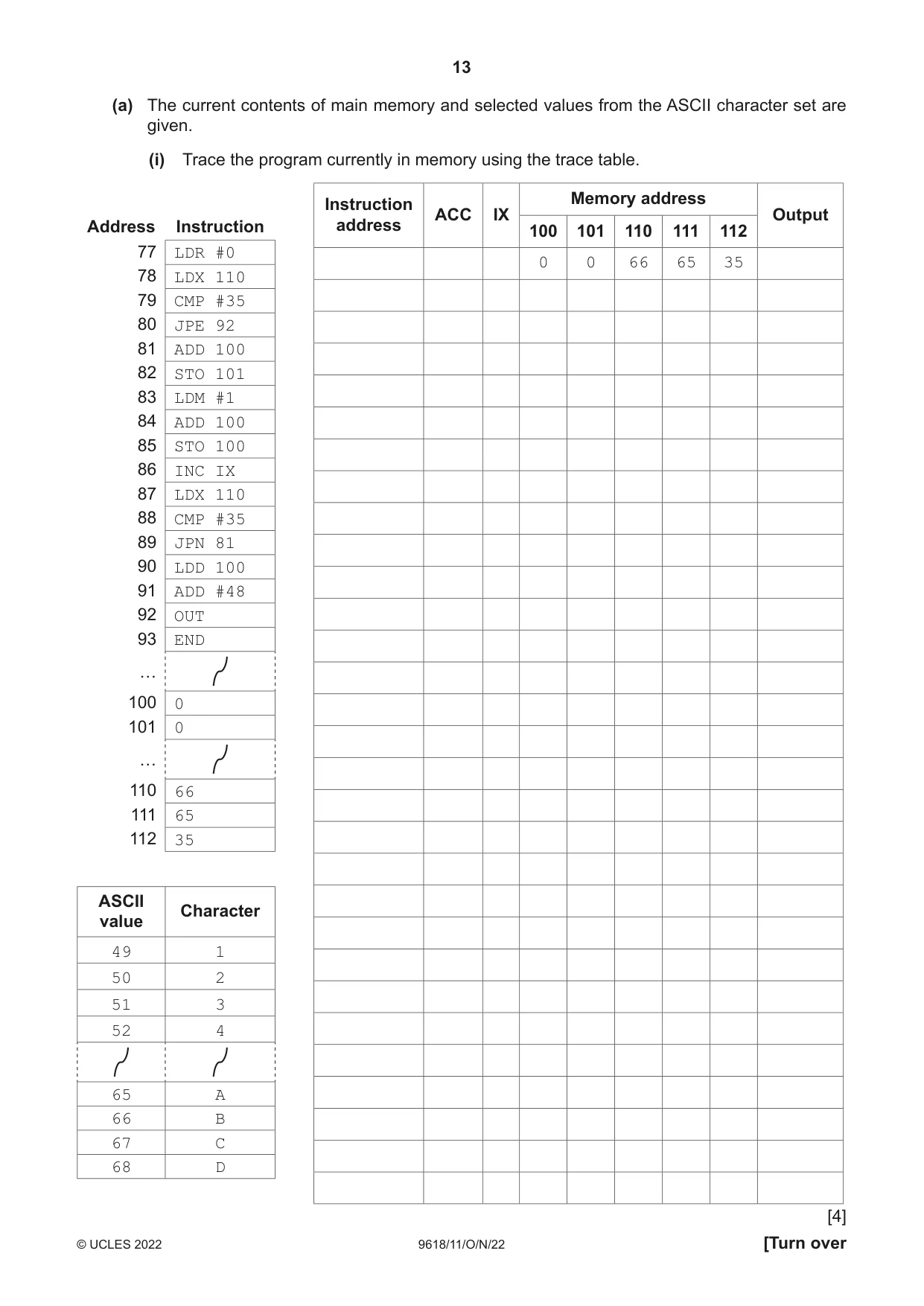
13 9618/11/O/N/22 © UCLES 2022 [Turn over (a) The current contents of main memory and selected values from the ASCII character set are given. (i) Trace the program currently in memory using the trace table. Address Instruction 77 LDR #0 78 LDX 110 79 CMP #35 80 JPE 92 81 ADD 100 82 STO 101 83 LDM #1 84 ADD 100 85 STO 100 86 INC IX 87 LDX 110 88 CMP #35 89 JPN 81 90 LDD 100 91 ADD #48 92 OUT 93 END … 100 0 101 0 … 110 66 111 65 112 35 ASCII value Character 49 1 50 2 51 3 52 4 65 A 66 B 67 C 68 D [4] Instruction address ACC IX Memory address Output 100 101 110 111 112 0 0 66 65 35
Question paper, page 14
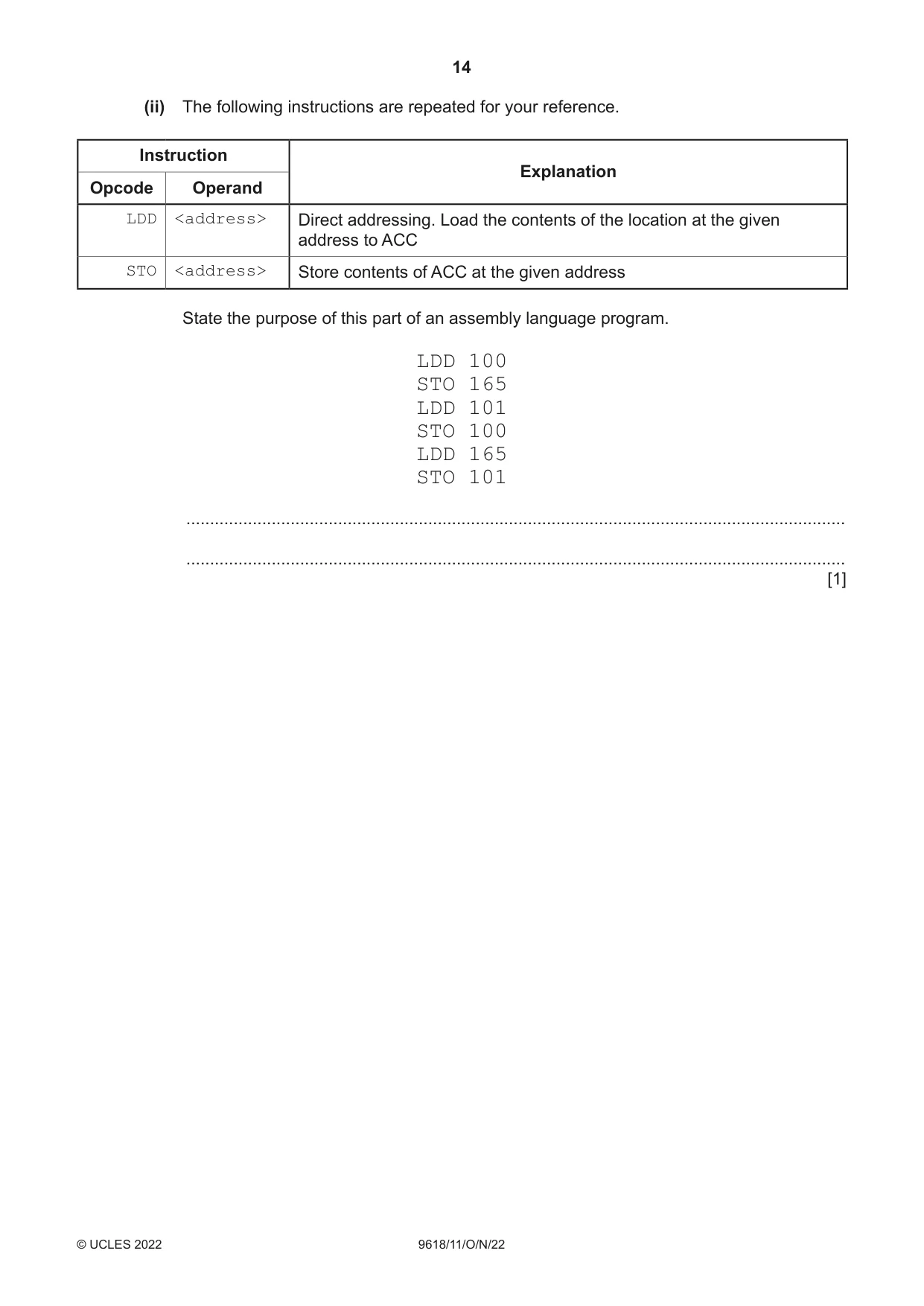
14 9618/11/O/N/22 © UCLES 2022 (ii) The following instructions are repeated for your reference. Instruction Explanation Opcode Operand LDD <address> Direct addressing. Load the contents of the location at the given address to ACC STO <address> Store contents of ACC at the given address State the purpose of this part of an assembly language program. LDD 100 STO 165 LDD 101 STO 100 LDD 165 STO 101 … … [1]
Question paper, page 15
15 9618/11/O/N/22 © UCLES 2022 [Turn over Question 6(b) begins on page 16.
Question paper, page 16
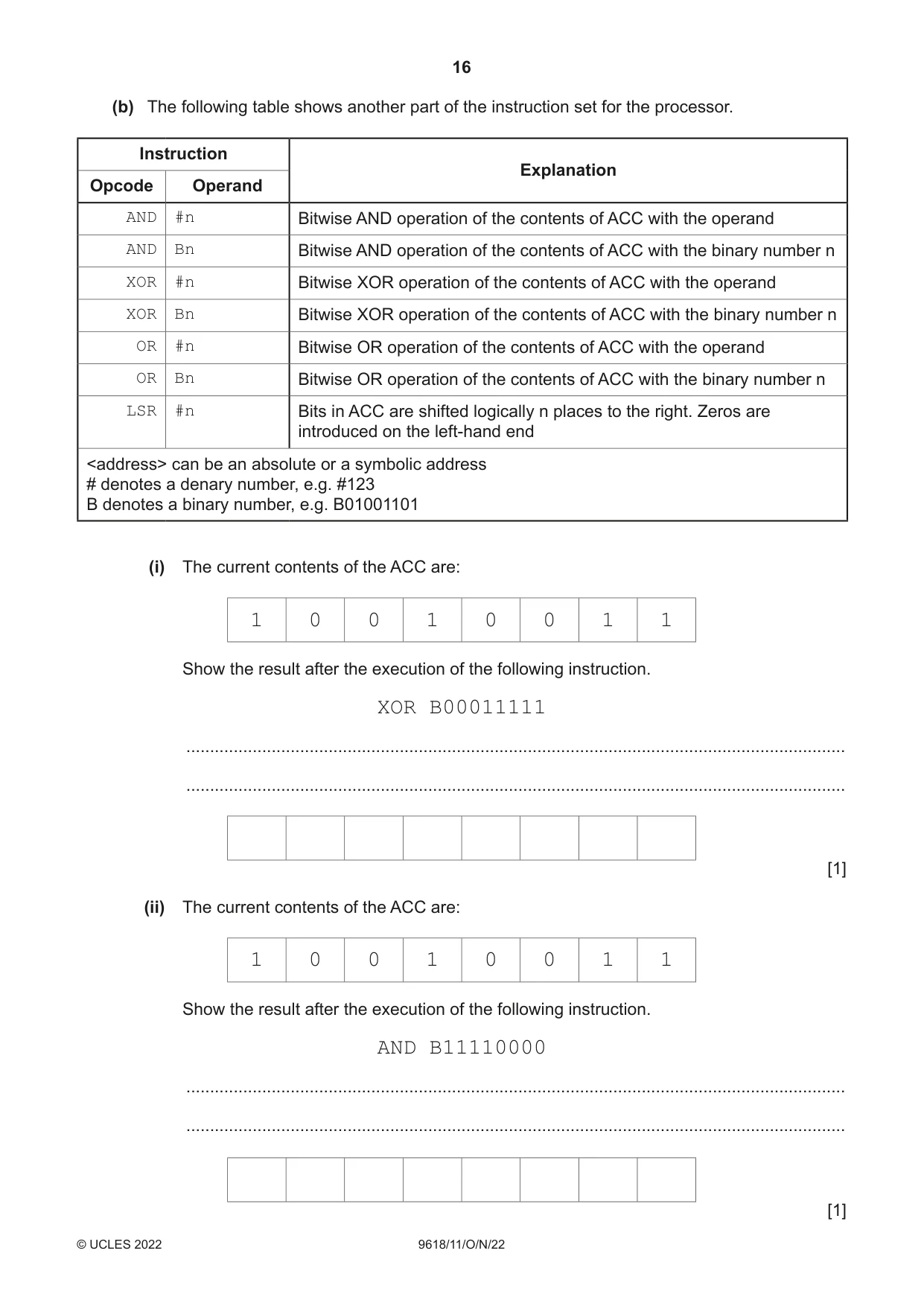
16 9618/11/O/N/22 © UCLES 2022 (b) The following table shows another part of the instruction set for the processor. Instruction Explanation Opcode Operand AND #n Bitwise AND operation of the contents of ACC with the operand AND Bn Bitwise AND operation of the contents of ACC with the binary number n XOR #n Bitwise XOR operation of the contents of ACC with the operand XOR Bn Bitwise XOR operation of the contents of ACC with the binary number n OR #n Bitwise OR operation of the contents of ACC with the operand OR Bn Bitwise OR operation of the contents of ACC with the binary number n LSR #n Bits in ACC are shifted logically n places to the right. Zeros are introduced on the left-hand end <address> can be an absolute or a symbolic address # denotes a denary number, e.g. #123 B denotes a binary number, e.g. B01001101 (i) The current contents of the ACC are: 1 0 0 1 0 0 1 1 Show the result after the execution of the following instruction. XOR B00011111 … … [1] (ii) The current contents of the ACC are: 1 0 0 1 0 0 1 1 Show the result after the execution of the following instruction. AND B11110000 … … [1]
Question paper, page 17
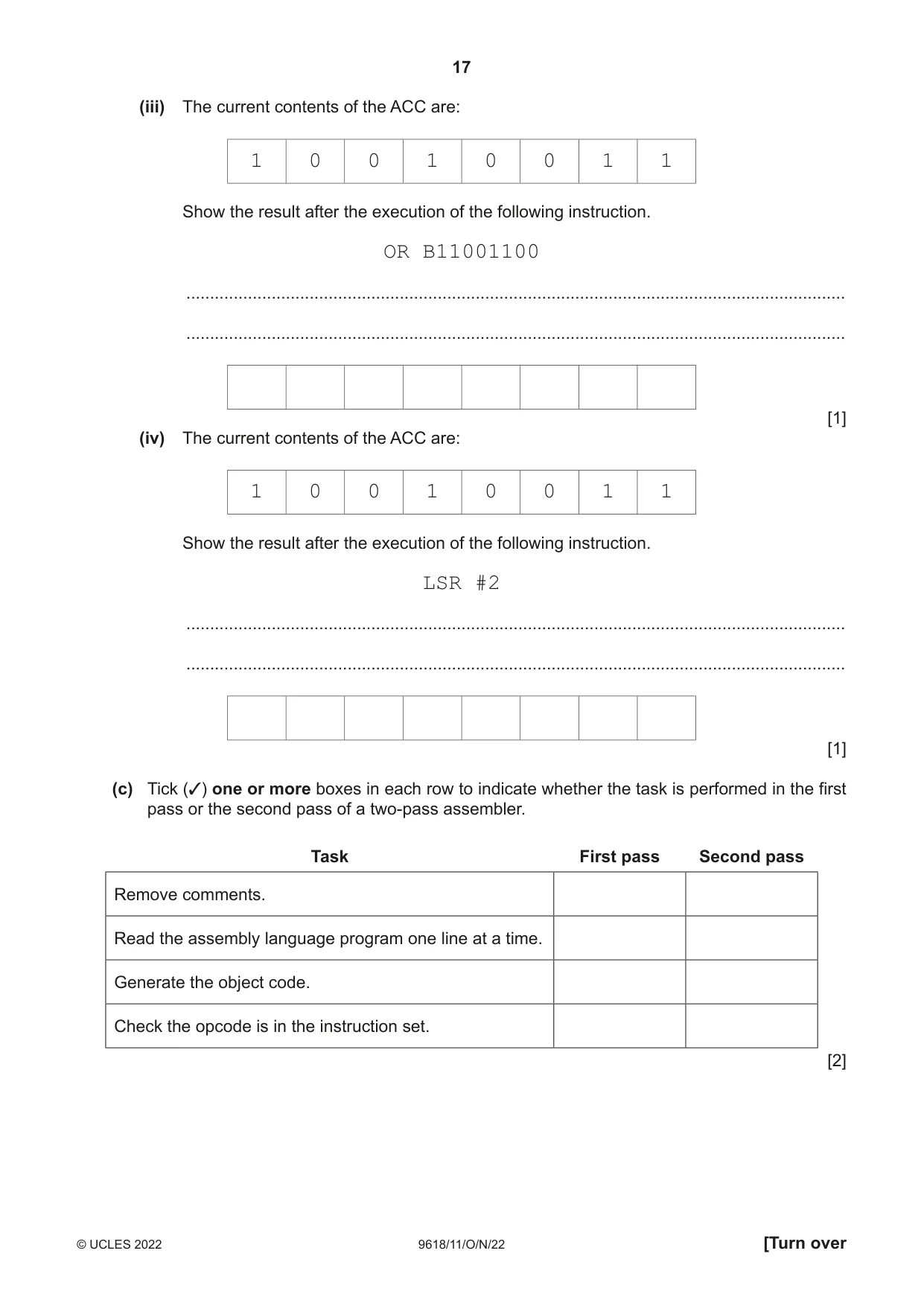
17 9618/11/O/N/22 © UCLES 2022 [Turn over (iii) The current contents of the ACC are: 1 0 0 1 0 0 1 1 Show the result after the execution of the following instruction. OR B11001100 … … [1] (iv) The current contents of the ACC are: 1 0 0 1 0 0 1 1 Show the result after the execution of the following instruction. LSR #2 … … [1] (c) Tick (3) one or more boxes in each row to indicate whether the task is performed in the first pass or the second pass of a two-pass assembler. Task First pass Second pass Remove comments. Read the assembly language program one line at a time. Generate the object code. Check the opcode is in the instruction set. [2]
Question paper, page 18
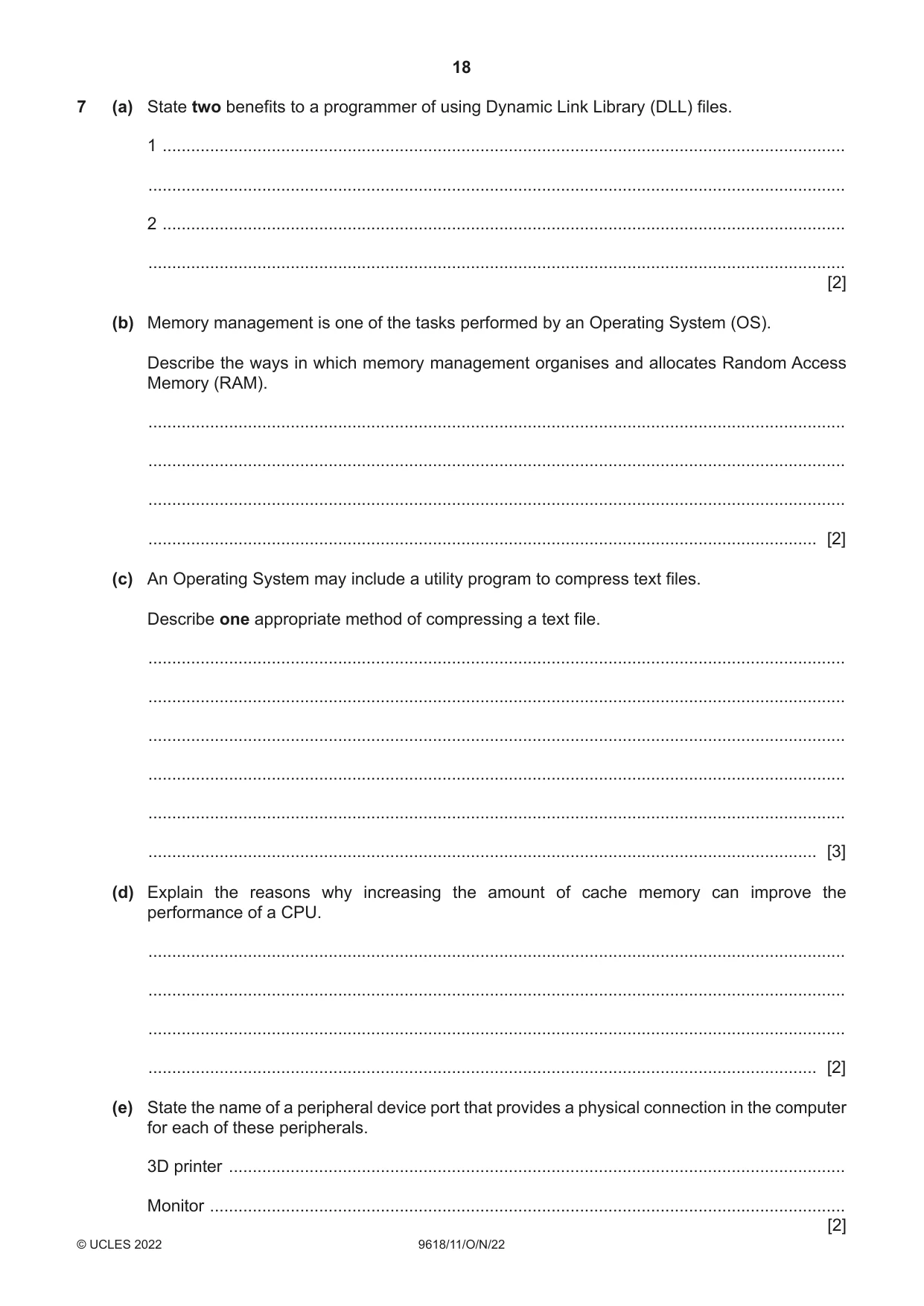
18 9618/11/O/N/22 © UCLES 2022 7 (a) State two benefits to a programmer of using Dynamic Link Library (DLL) files. 1 … … 2 … … [2] (b) Memory management is one of the tasks performed by an Operating System (OS). Describe the ways in which memory management organises and allocates Random Access Memory (RAM). … … … … [2] (c) An Operating System may include a utility program to compress text files. Describe one appropriate method of compressing a text file. … … … … … … [3] (d) Explain the reasons why increasing the amount of cache memory can improve the performance of a CPU. … … … … [2] (e) State the name of a peripheral device port that provides a physical connection in the computer for each of these peripherals. 3D printer … Monitor … [2]
Question paper, page 19
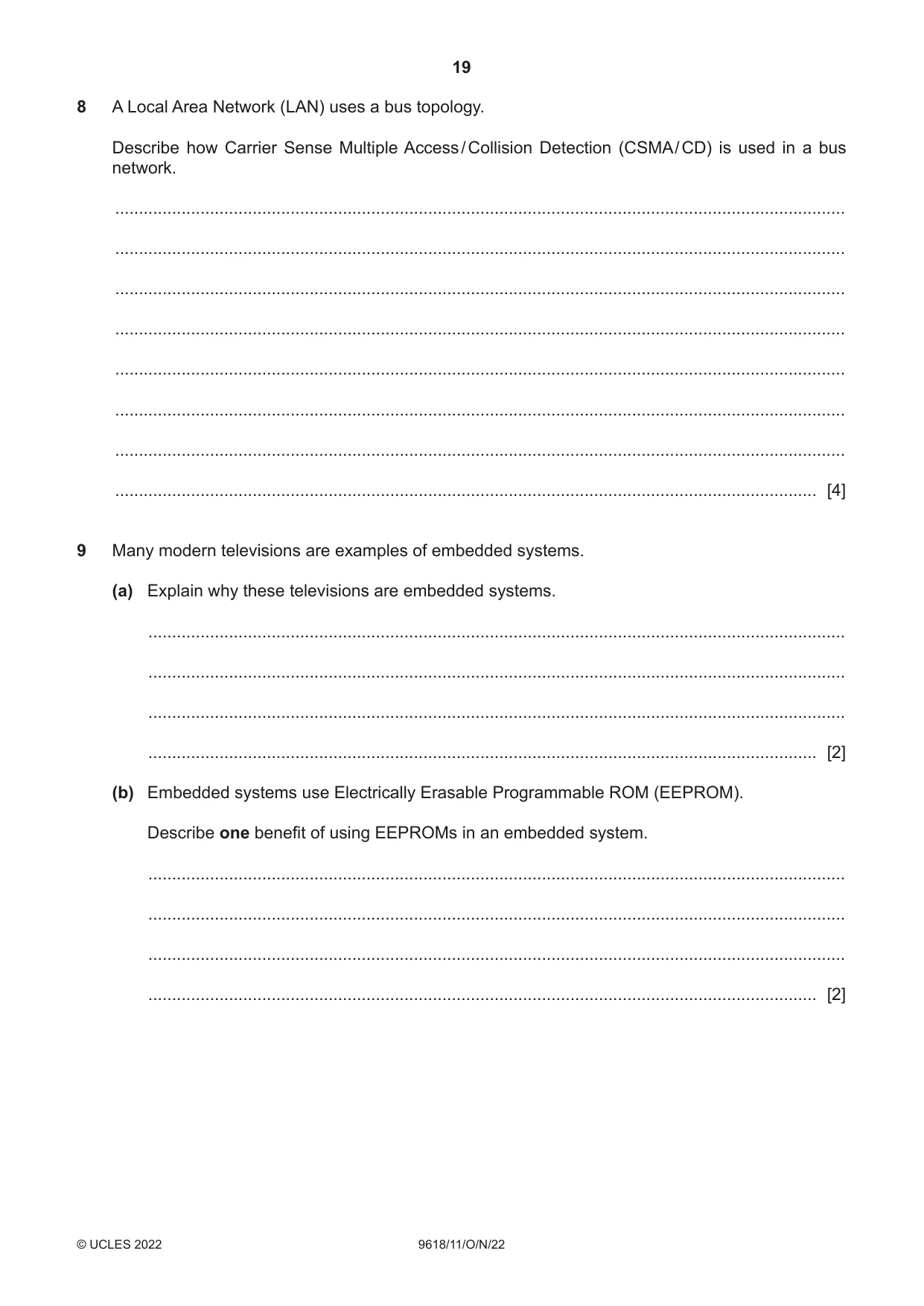
19 9618/11/O/N/22 © UCLES 2022 8 A Local Area Network (LAN) uses a bus topology. Describe how Carrier Sense Multiple Access / Collision Detection (CSMA / CD) is used in a bus network. … … … … … … … … [4] 9 Many modern televisions are examples of embedded systems. (a) Explain why these televisions are embedded systems. … … … … [2] (b) Embedded systems use Electrically Erasable Programmable ROM (EEPROM). Describe one benefit of using EEPROMs in an embedded system. … … … … [2]
Question paper, page 20
20 9618/11/O/N/22 © UCLES 2022 Permission to reproduce items where third-party owned material protected by copyright is included has been sought and cleared where possible. Every reasonable effort has been made by the publisher (UCLES) to trace copyright holders, but if any items requiring clearance have unwittingly been included, the publisher will be pleased to make amends at the earliest possible opportunity. To avoid the issue of disclosure of answer-related information to candidates, all copyright acknowledgements are reproduced online in the Cambridge Assessment International Education Copyright Acknowledgements Booklet. This is produced for each series of examinations and is freely available to download at www.cambridgeinternational.org after the live examination series. Cambridge Assessment International Education is part of Cambridge Assessment. Cambridge Assessment is the brand name of the University of Cambridge Local Examinations Syndicate (UCLES), which is a department of the University of Cambridge. BLANK PAGE
Mark scheme, page 1
This document consists of 11 printed pages. © UCLES 2022 [Turn over Cambridge International AS & A Level COMPUTER SCIENCE 9618/11 Paper 1 Theory Fundamentals October/November 2022 MARK SCHEME Maximum Mark: 75 Published This mark scheme is published as an aid to teachers and candidates, to indicate the requirements of the examination. It shows the basis on which Examiners were instructed to award marks. It does not indicate the details of the discussions that took place at an Examiners’ meeting before marking began, which would have considered the acceptability of alternative answers. Mark schemes should be read in conjunction with the question paper and the Principal Examiner Report for Teachers. Cambridge International will not enter into discussions about these mark schemes. Cambridge International is publishing the mark schemes for the October/November 2022 series for most Cambridge IGCSE™, Cambridge International A and AS Level components and some Cambridge O Level components.
Mark scheme, page 2
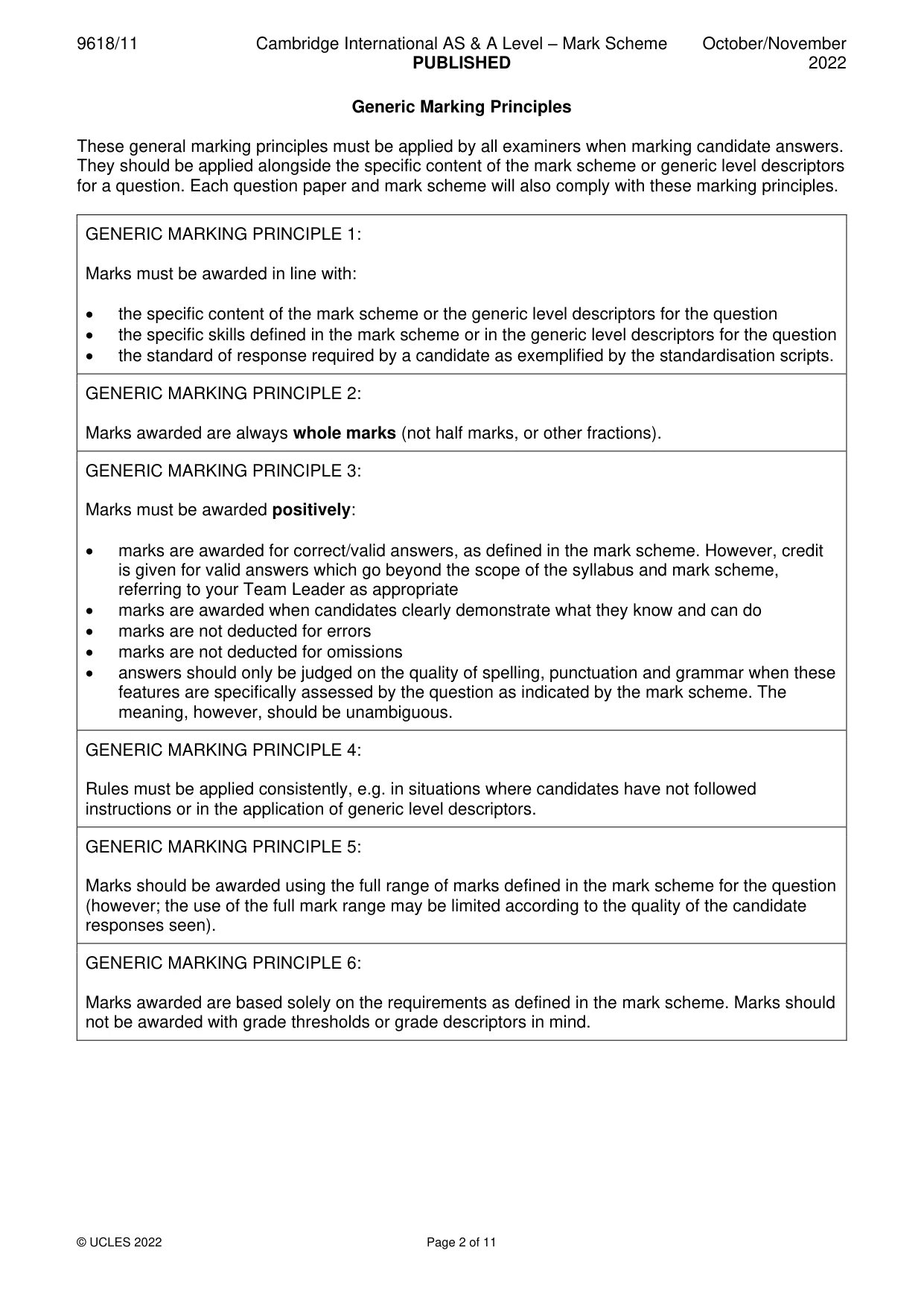
9618/11 Cambridge International AS & A Level – Mark Scheme PUBLISHED October/November 2022 © UCLES 2022 Page 2 of 11 Generic Marking Principles These general marking principles must be applied by all examiners when marking candidate answers. They should be applied alongside the specific content of the mark scheme or generic level descriptors for a question. Each question paper and mark scheme will also comply with these marking principles. GENERIC MARKING PRINCIPLE 1: Marks must be awarded in line with: • the specific content of the mark scheme or the generic level descriptors for the question • the specific skills defined in the mark scheme or in the generic level descriptors for the question • the standard of response required by a candidate as exemplified by the standardisation scripts. GENERIC MARKING PRINCIPLE 2: Marks awarded are always whole marks (not half marks, or other fractions). GENERIC MARKING PRINCIPLE 3: Marks must be awarded positively: • marks are awarded for correct/valid answers, as defined in the mark scheme. However, credit is given for valid answers which go beyond the scope of the syllabus and mark scheme, referring to your Team Leader as appropriate • marks are awarded when candidates clearly demonstrate what they know and can do • marks are not deducted for errors • marks are not deducted for omissions • answers should only be judged on the quality of spelling, punctuation and grammar when these features are specifically assessed by the question as indicated by the mark scheme. The meaning, however, should be unambiguous. GENERIC MARKING PRINCIPLE 4: Rules must be applied consistently, e.g. in situations where candidates have not followed instructions or in the application of generic level descriptors. GENERIC MARKING PRINCIPLE 5: Marks should be awarded using the full range of marks defined in the mark scheme for the question (however; the use of the full mark range may be limited according to the quality of the candidate responses seen). GENERIC MARKING PRINCIPLE 6: Marks awarded are based solely on the requirements as defined in the mark scheme. Marks should not be awarded with grade thresholds or grade descriptors in mind.
Mark scheme, page 3
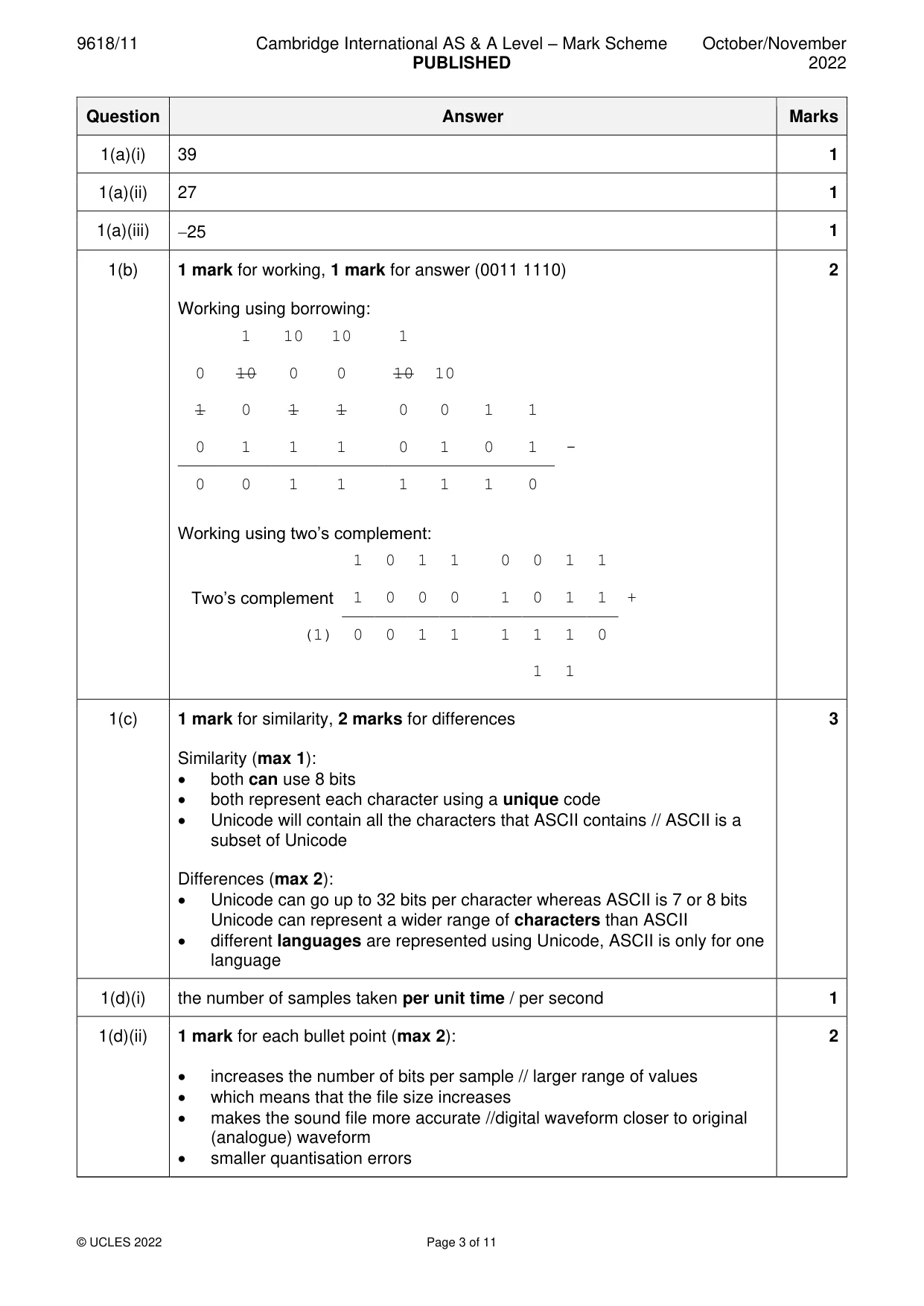
9618/11 Cambridge International AS & A Level – Mark Scheme PUBLISHED October/November 2022 © UCLES 2022 Page 3 of 11 Question Answer Marks 1(a)(i) 39 1 1(a)(ii) 27 1 1(a)(iii) −25 1 1(b) 1 mark for working, 1 mark for answer (0011 1110) Working using borrowing: 1 10 10 1 0 10 0 0 10 10 1 0 1 1 0 0 1 1 0 1 1 1 0 1 0 1 - 0 0 1 1 1 1 1 0 Working using two’s complement: 1 0 1 1 0 0 1 1 Two’s complement 1 0 0 0 1 0 1 1 + (1) 0 0 1 1 1 1 1 0 1 1 2 1(c) 1 mark for similarity, 2 marks for differences Similarity (max 1): • both can use 8 bits • both represent each character using a unique code • Unicode will contain all the characters that ASCII contains // ASCII is a subset of Unicode Differences (max 2): • Unicode can go up to 32 bits per character whereas ASCII is 7 or 8 bits Unicode can represent a wider range of characters than ASCII • different languages are represented using Unicode, ASCII is only for one language 3 1(d)(i) the number of samples taken per unit time / per second 1 1(d)(ii) 1 mark for each bullet point (max 2): • increases the number of bits per sample // larger range of values • which means that the file size increases • makes the sound file more accurate //digital waveform closer to original (analogue) waveform • smaller quantisation errors 2
Mark scheme, page 4
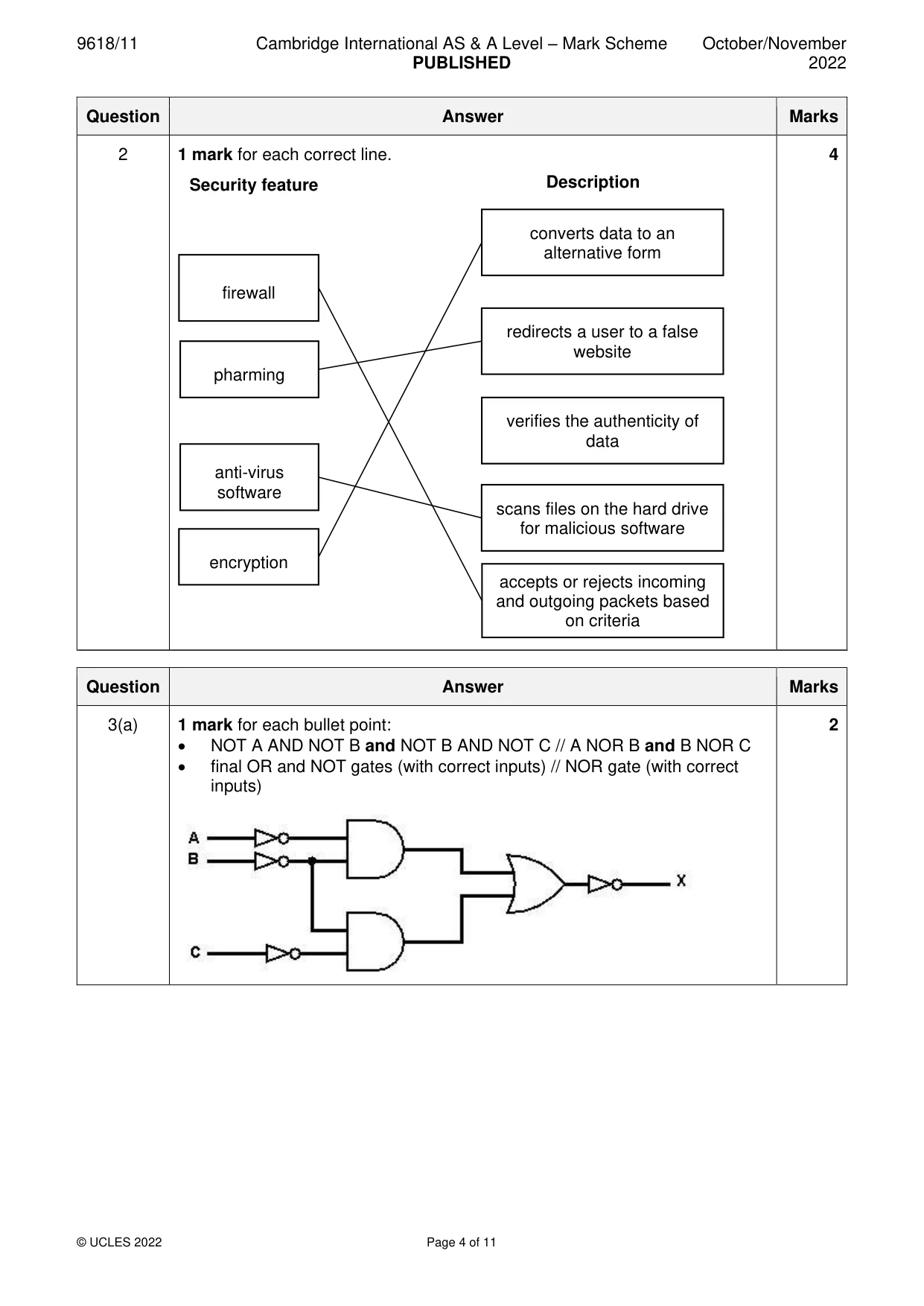
9618/11 Cambridge International AS & A Level – Mark Scheme PUBLISHED October/November 2022 © UCLES 2022 Page 4 of 11 Question Answer Marks 2 1 mark for each correct line. 4 Question Answer Marks 3(a) 1 mark for each bullet point: • NOT A AND NOT B and NOT B AND NOT C // A NOR B and B NOR C • final OR and NOT gates (with correct inputs) // NOR gate (with correct inputs) 2 firewall pharming anti-virus software verifies the authenticity of data scans files on the hard drive for malicious software encryption redirects a user to a false website converts data to an alternative form accepts or rejects incoming and outgoing packets based on criteria Security feature Description
Mark scheme, page 5
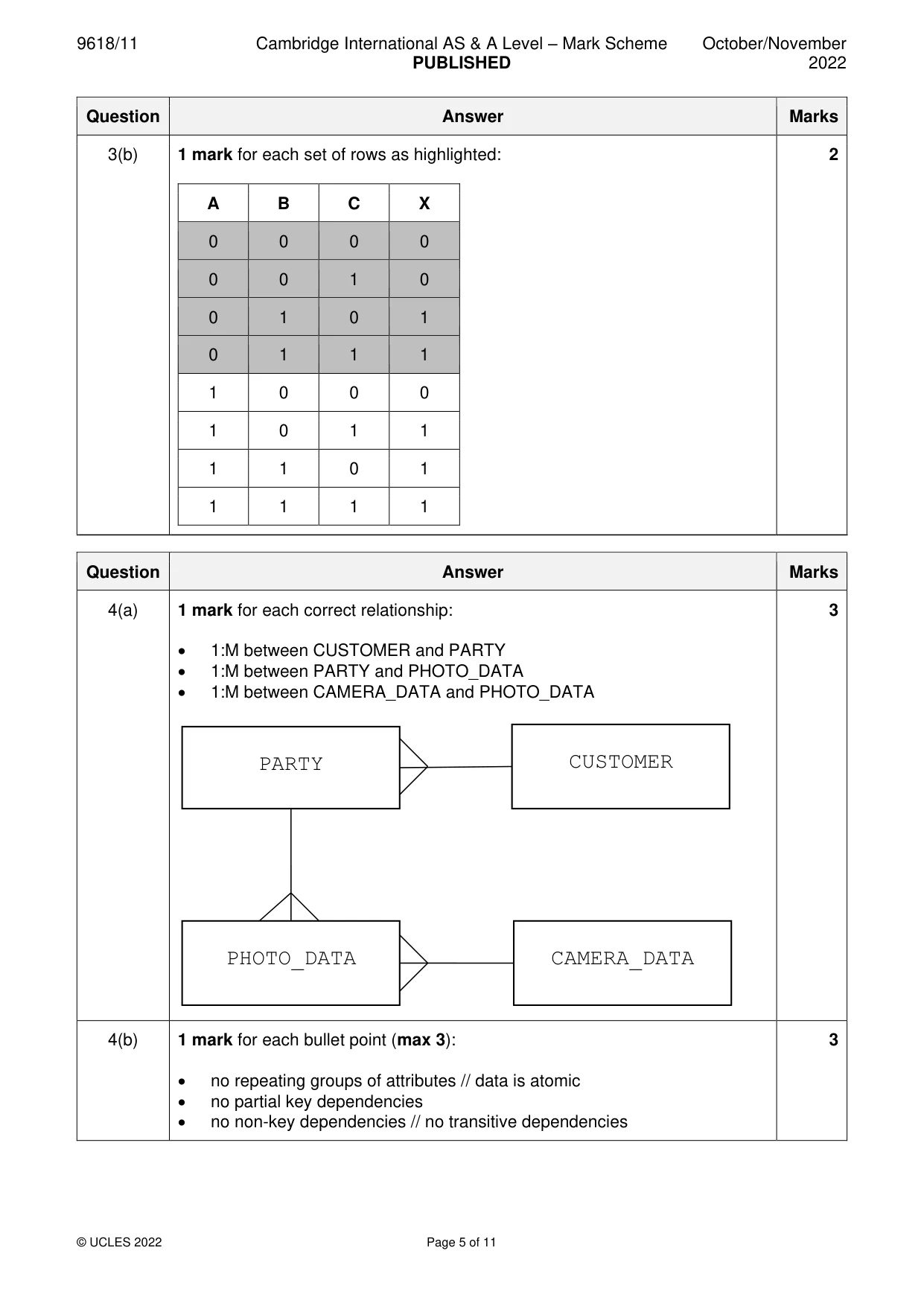
9618/11 Cambridge International AS & A Level – Mark Scheme PUBLISHED October/November 2022 © UCLES 2022 Page 5 of 11 Question Answer Marks 3(b) 1 mark for each set of rows as highlighted: A B C X 0 0 0 0 0 0 1 0 0 1 0 1 0 1 1 1 1 0 0 0 1 0 1 1 1 1 0 1 1 1 1 1 2 Question Answer Marks 4(a) 1 mark for each correct relationship: • 1:M between CUSTOMER and PARTY • 1:M between PARTY and PHOTO_DATA • 1:M between CAMERA_DATA and PHOTO_DATA 3 4(b) 1 mark for each bullet point (max 3): • no repeating groups of attributes // data is atomic • no partial key dependencies • no non-key dependencies // no transitive dependencies 3 PARTY PHOTO_DATA CUSTOMER CAMERA_DATA
Mark scheme, page 6
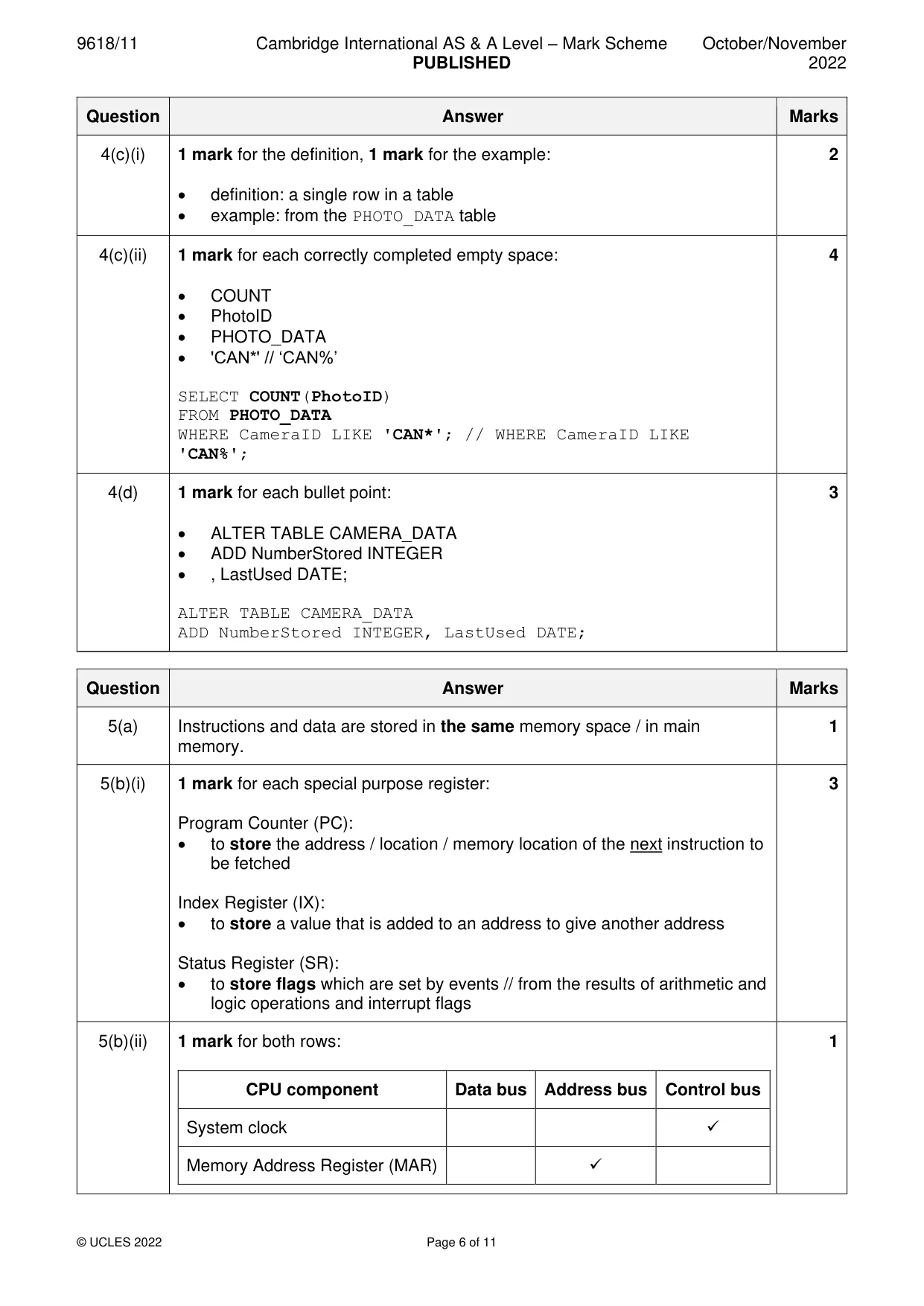
9618/11 Cambridge International AS & A Level – Mark Scheme PUBLISHED October/November 2022 © UCLES 2022 Page 6 of 11 Question Answer Marks 4(c)(i) 1 mark for the definition, 1 mark for the example: • definition: a single row in a table • example: from the PHOTO_DATA table 2 4(c)(ii) 1 mark for each correctly completed empty space: • COUNT • PhotoID • PHOTO_DATA • 'CAN*' // ‘CAN%’ SELECT COUNT(PhotoID) FROM PHOTO_DATA WHERE CameraID LIKE 'CAN*'; // WHERE CameraID LIKE 'CAN%'; 4 4(d) 1 mark for each bullet point: • ALTER TABLE CAMERA_DATA • ADD NumberStored INTEGER • , LastUsed DATE; ALTER TABLE CAMERA_DATA ADD NumberStored INTEGER, LastUsed DATE; 3 Question Answer Marks 5(a) Instructions and data are stored in the same memory space / in main memory. 1 5(b)(i) 1 mark for each special purpose register: Program Counter (PC): • to store the address / location / memory location of the next instruction to be fetched Index Register (IX): • to store a value that is added to an address to give another address Status Register (SR): • to store flags which are set by events // from the results of arithmetic and logic operations and interrupt flags 3 5(b)(ii) 1 mark for both rows: CPU component Data bus Address bus Control bus System clock ✓ Memory Address Register (MAR) ✓ 1
Mark scheme, page 7
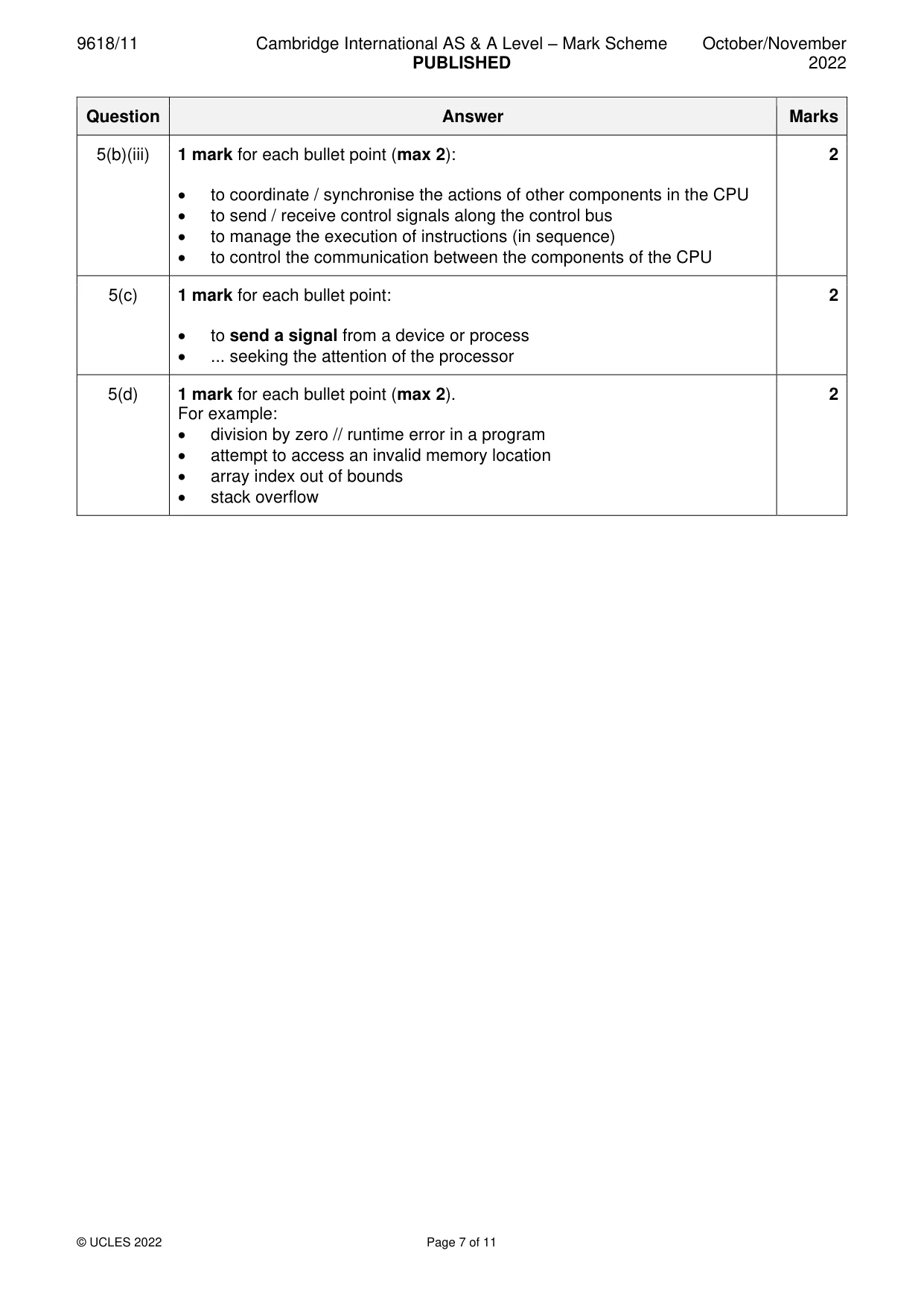
9618/11 Cambridge International AS & A Level – Mark Scheme PUBLISHED October/November 2022 © UCLES 2022 Page 7 of 11 Question Answer Marks 5(b)(iii) 1 mark for each bullet point (max 2): • to coordinate / synchronise the actions of other components in the CPU • to send / receive control signals along the control bus • to manage the execution of instructions (in sequence) • to control the communication between the components of the CPU 2 5(c) 1 mark for each bullet point: • to send a signal from a device or process • ... seeking the attention of the processor 2 5(d) 1 mark for each bullet point (max 2). For example: • division by zero // runtime error in a program • attempt to access an invalid memory location • array index out of bounds • stack overflow 2
Mark scheme, page 8
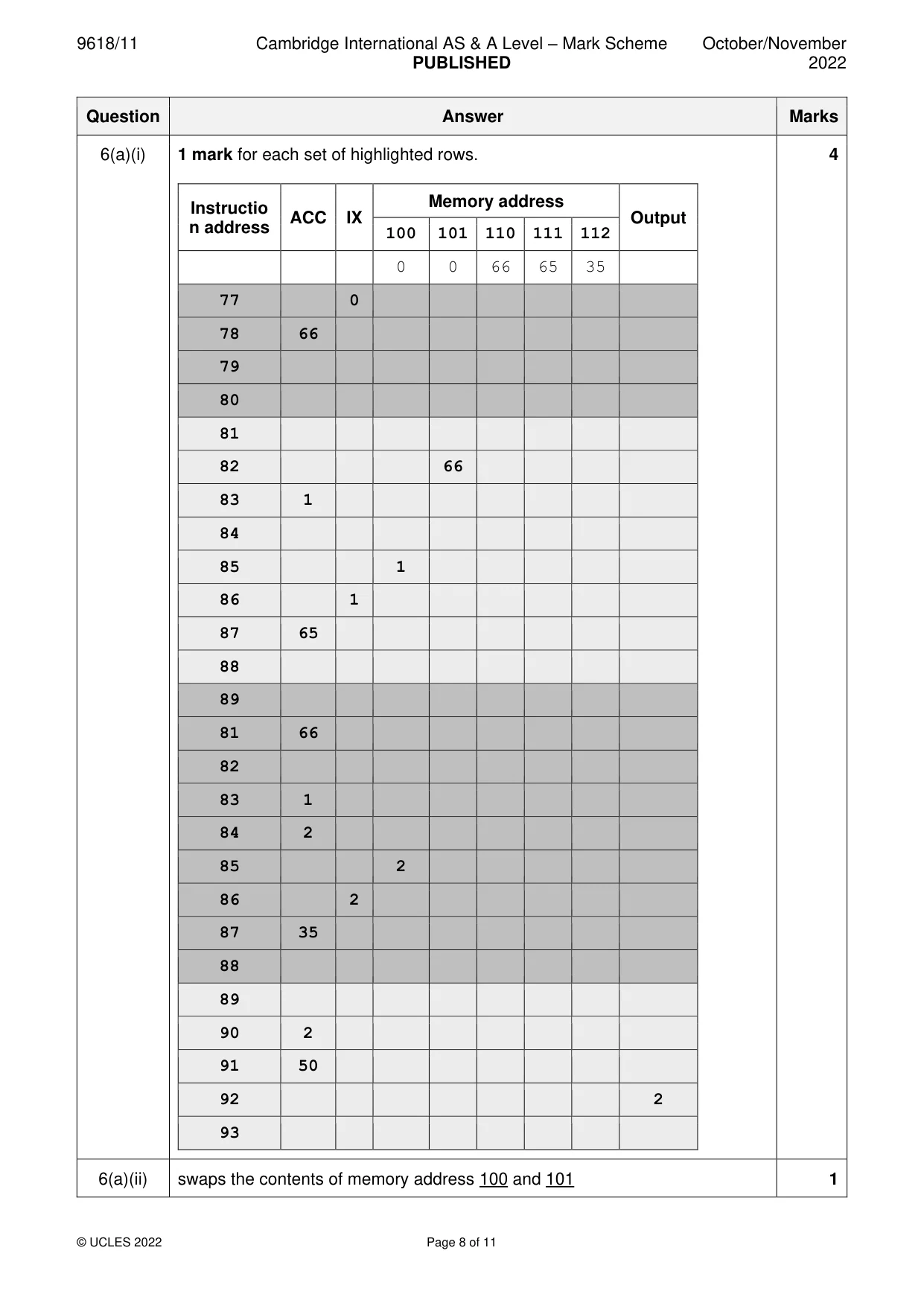
9618/11 Cambridge International AS & A Level – Mark Scheme PUBLISHED October/November 2022 © UCLES 2022 Page 8 of 11 Question Answer Marks 6(a)(i) 1 mark for each set of highlighted rows. Instructio n address ACC IX Memory address Output 100 101 110 111 112 0 0 66 65 35 77 0 78 66 79 80 81 82 66 83 1 84 85 1 86 1 87 65 88 89 81 66 82 83 1 84 2 85 2 86 2 87 35 88 89 90 2 91 50 92 2 93 4 6(a)(ii) swaps the contents of memory address 100 and 101 1
Mark scheme, page 9
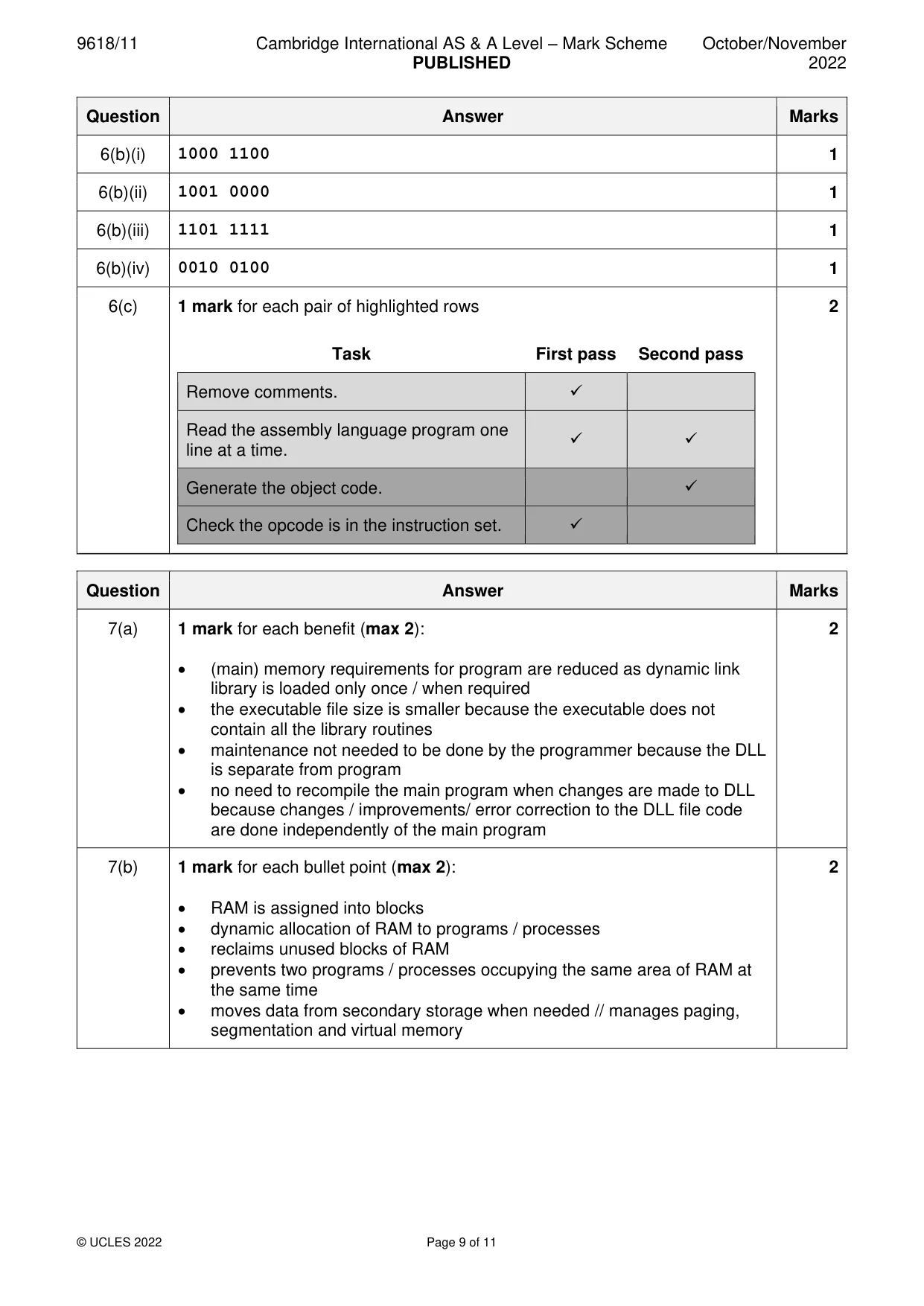
9618/11 Cambridge International AS & A Level – Mark Scheme PUBLISHED October/November 2022 © UCLES 2022 Page 9 of 11 Question Answer Marks 6(b)(i) 1000 1100 1 6(b)(ii) 1001 0000 1 6(b)(iii) 1101 1111 1 6(b)(iv) 0010 0100 1 6(c) 1 mark for each pair of highlighted rows Task First pass Second pass Remove comments. ✓ Read the assembly language program one line at a time. ✓ ✓ Generate the object code. ✓ Check the opcode is in the instruction set. ✓ 2 Question Answer Marks 7(a) 1 mark for each benefit (max 2): • (main) memory requirements for program are reduced as dynamic link library is loaded only once / when required • the executable file size is smaller because the executable does not contain all the library routines • maintenance not needed to be done by the programmer because the DLL is separate from program • no need to recompile the main program when changes are made to DLL because changes / improvements/ error correction to the DLL file code are done independently of the main program 2 7(b) 1 mark for each bullet point (max 2): • RAM is assigned into blocks • dynamic allocation of RAM to programs / processes • reclaims unused blocks of RAM • prevents two programs / processes occupying the same area of RAM at the same time • moves data from secondary storage when needed // manages paging, segmentation and virtual memory 2
Mark scheme, page 10
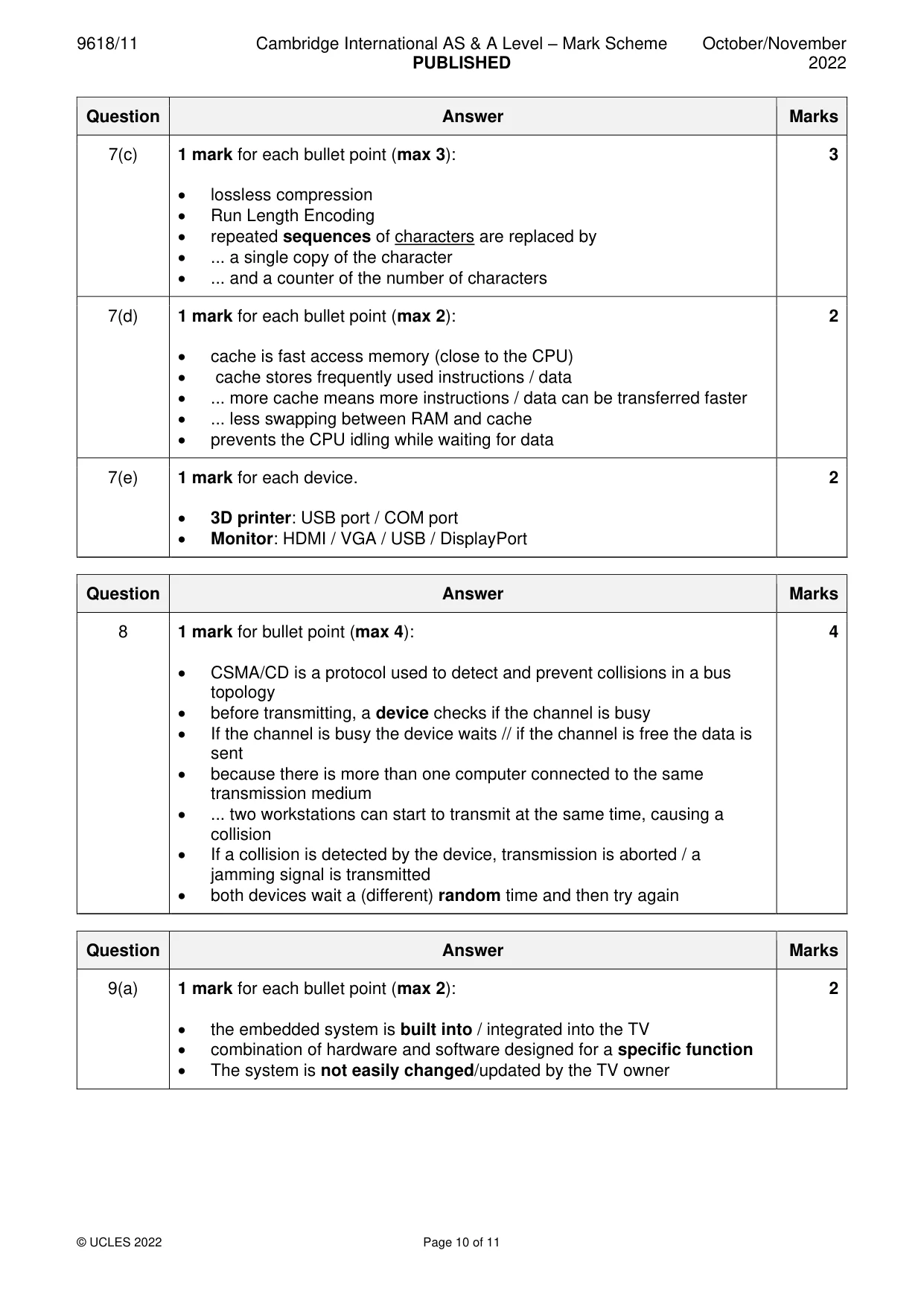
9618/11 Cambridge International AS & A Level – Mark Scheme PUBLISHED October/November 2022 © UCLES 2022 Page 10 of 11 Question Answer Marks 7(c) 1 mark for each bullet point (max 3): • lossless compression • Run Length Encoding • repeated sequences of characters are replaced by • ... a single copy of the character • ... and a counter of the number of characters 3 7(d) 1 mark for each bullet point (max 2): • cache is fast access memory (close to the CPU) • cache stores frequently used instructions / data • ... more cache means more instructions / data can be transferred faster • ... less swapping between RAM and cache • prevents the CPU idling while waiting for data 2 7(e) 1 mark for each device. • 3D printer: USB port / COM port • Monitor: HDMI / VGA / USB / DisplayPort 2 Question Answer Marks 8 1 mark for bullet point (max 4): • CSMA/CD is a protocol used to detect and prevent collisions in a bus topology • before transmitting, a device checks if the channel is busy • If the channel is busy the device waits // if the channel is free the data is sent • because there is more than one computer connected to the same transmission medium • ... two workstations can start to transmit at the same time, causing a collision • If a collision is detected by the device, transmission is aborted / a jamming signal is transmitted • both devices wait a (different) random time and then try again 4 Question Answer Marks 9(a) 1 mark for each bullet point (max 2): • the embedded system is built into / integrated into the TV • combination of hardware and software designed for a specific function • The system is not easily changed/updated by the TV owner 2
Mark scheme, page 11
9618/11 Cambridge International AS & A Level – Mark Scheme PUBLISHED October/November 2022 © UCLES 2022 Page 11 of 11 Question Answer Marks 9(b) 1 mark for each benefit and 1 mark for corresponding expansion (max 2). For example: • no additional equipment is needed to change • ... enables firmware updates by non-technical users • can be erased and reprogrammed several times • ... so firmware can be updated • ... can erase a particular byte or the whole EEPROM • possible to reprogram / update • ... without removing it from the device 2
What you needed in this session
Cambridge’s own grade thresholds for 2022 Oct/Nov, Paper 1 · Variant 1. A higher threshold means an easier paper — the bar moves with how the cohort did.