Cambridge A Level Computer Science 9618 — 2022 Oct/Nov Paper 1 · Variant 2
9618/12/O/N/22 · 75 marks · ≈84 min
The question paper and its mark scheme, free to read here and free to download. This is Cambridge’s own paper, exactly as it was sat.
Question paper20 pages





Mark scheme10 pages
Answers below. Sit the paper first if you are practising.
Paper as text
Question paper, page 1
This document has 20 pages. Any blank pages are indicated. [Turn over Cambridge International AS & A Level DC (PQ/CT) 302752/1 © UCLES 2022 COMPUTER SCIENCE 9618/12 Paper 1 Theory Fundamentals October/November 2022 1 hour 30 minutes You must answer on the question paper. No additional materials are needed. INSTRUCTIONS ● Answer all questions. ● Use a black or dark blue pen. ● Write your name, centre number and candidate number in the boxes at the top of the page. ● Write your answer to each question in the space provided. ● Do not use an erasable pen or correction fluid. ● Do not write on any bar codes. ● You may use an HB pencil for any diagrams, graphs or rough working. ● Calculators must not be used in this paper. INFORMATION ● The total mark for this paper is 75. ● The number of marks for each question or part question is shown in brackets [ ]. ● No marks will be awarded for using brand names of software packages or hardware. * 9 8 0 9 7 6 1 1 9 7 *
Question paper, page 2
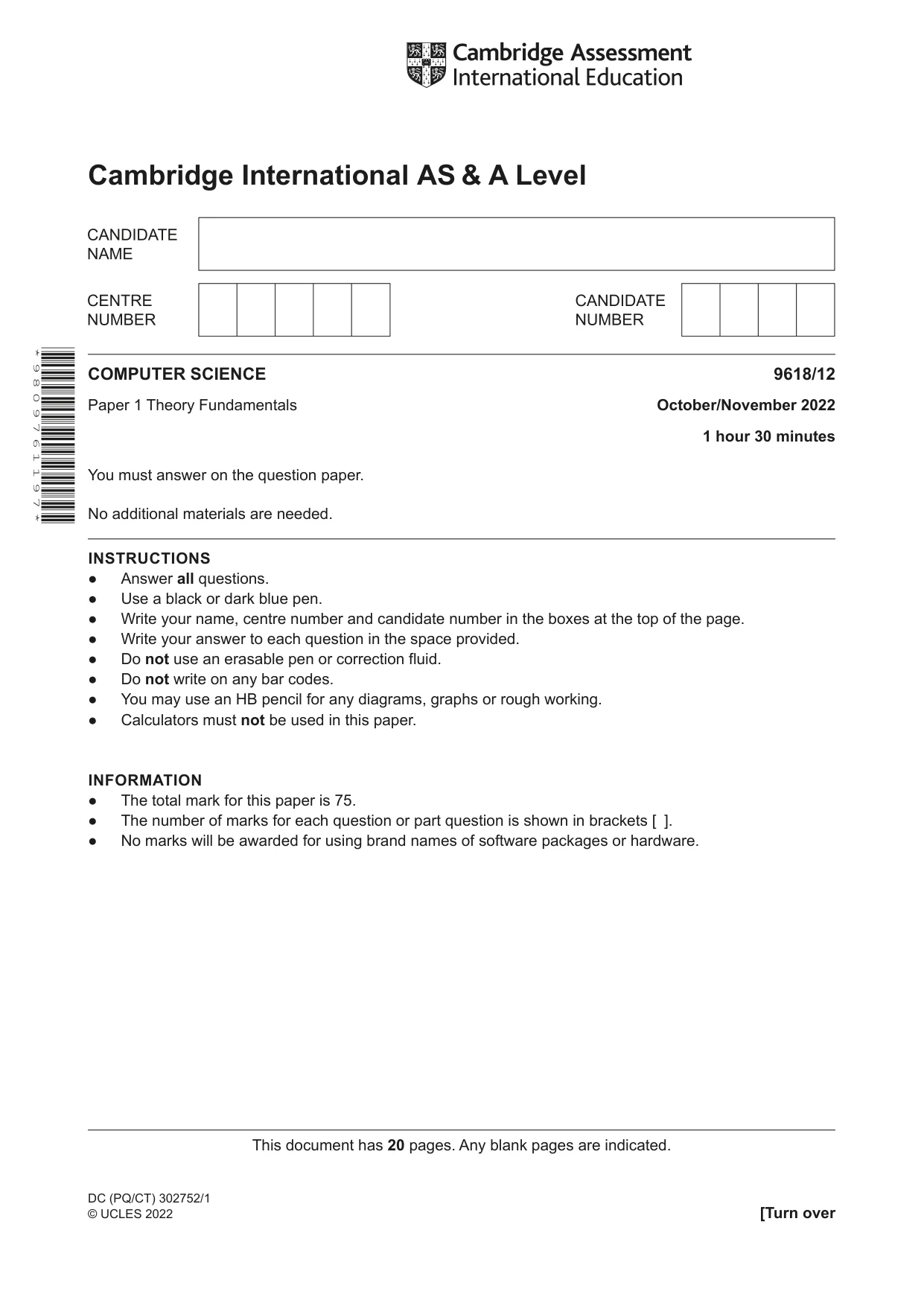
2 9618/12/O/N/22 © UCLES 2022 1 (a) Draw one line from each utility software to its most appropriate purpose. Utility software virus checker disk formatter backup defragmentation disk repair Purpose to reorganise files so they are contiguous to scan for malicious program code to decrease the file size to create copies of files in case the original is lost to initialise a disk to check for and fix inconsistencies on a disk [5] (b) Compilers and interpreters translate programs written in a high-level language into a low-level language. (i) State two drawbacks of using a compiler compared to an interpreter during program development. 1 … … … 2 … … … [2] (ii) Explain why high-level language programs might be partially compiled and partially interpreted. … … … … [2]
Question paper, page 3
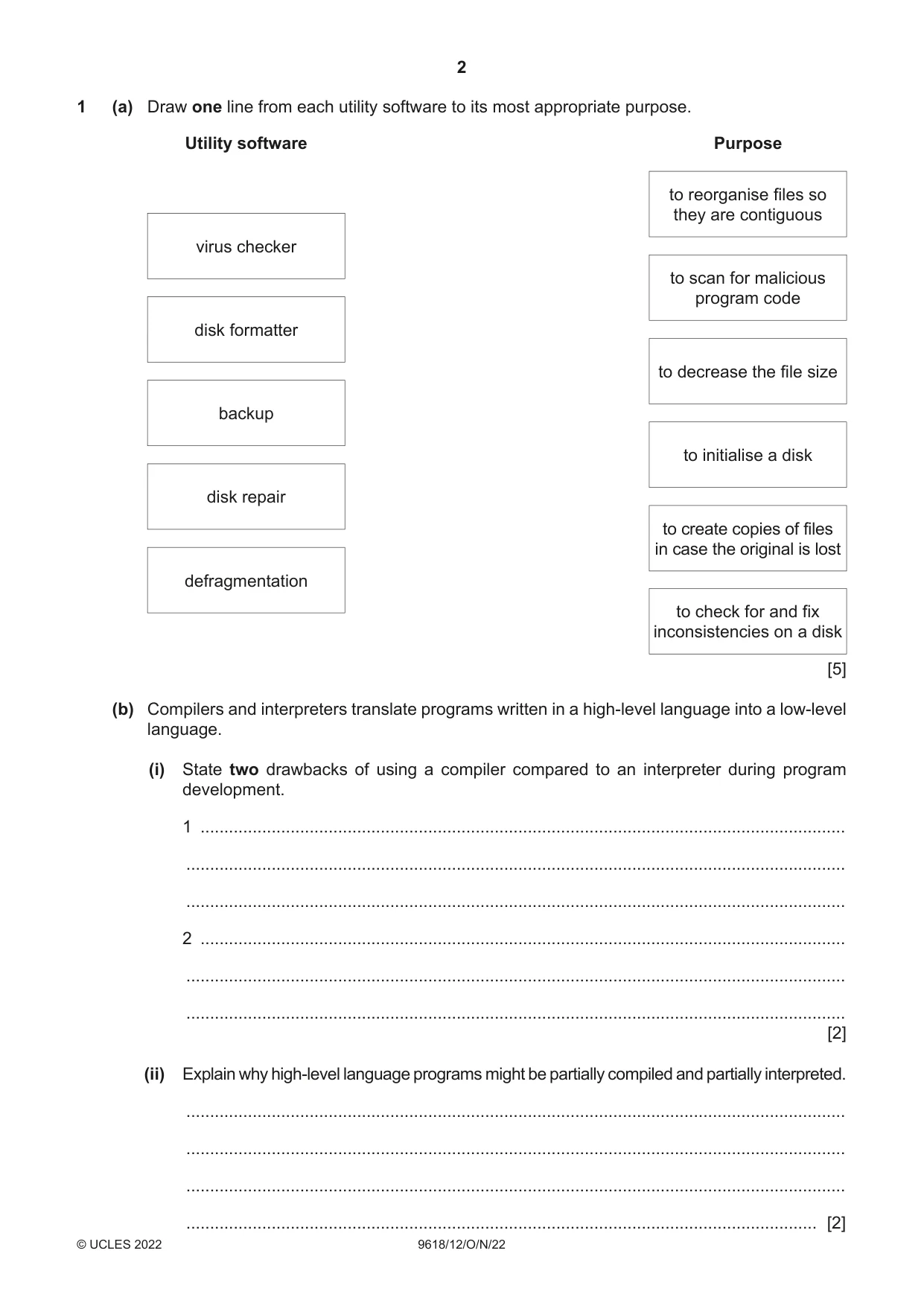
3 9618/12/O/N/22 © UCLES 2022 [Turn over 2 (a) (i) Convert the two’s complement binary integer into denary. 10010110 Answer … [1] (ii) Convert the unsigned binary integer into hexadecimal. 10010110 Answer … [1] (iii) Convert the unsigned binary integer into Binary Coded Decimal (BCD). Show your working. 10010101 Working … … … Answer … [2] (b) Perform the following binary addition. 1 0 0 0 1 1 0 0 + 0 1 0 0 0 1 1 0 [1]
Question paper, page 4
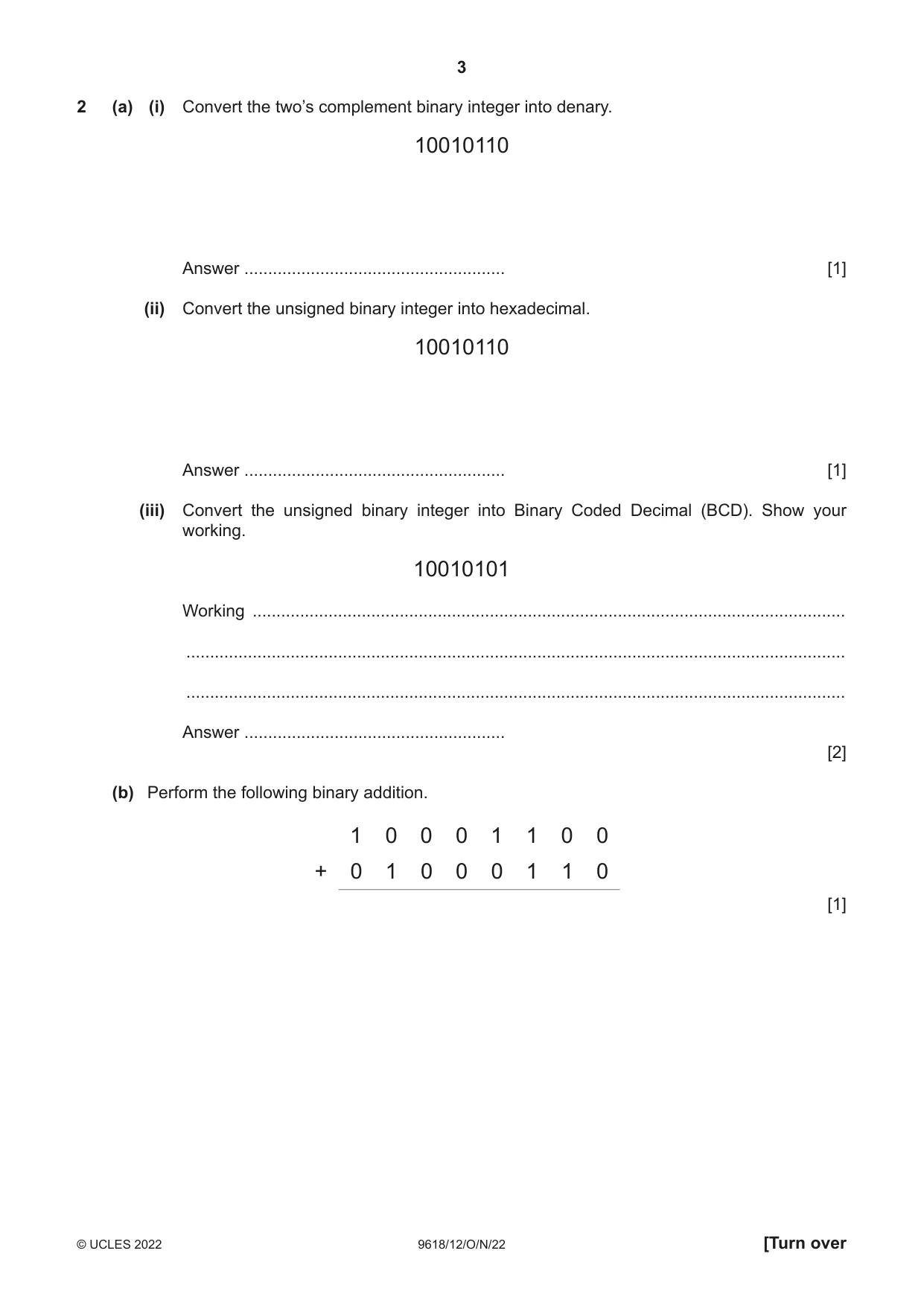
4 9618/12/O/N/22 © UCLES 2022 3 (a) A greenhouse has an automatic window. The window (X) operates according to the following criteria: Parameter Description of parameter Binary value Condition T Temperature 1 Too high 0 Acceptable W Wind speed 1 Too high 0 Acceptable R Rain 1 Detected 0 Not detected M Manual override 1 On 0 Off The window opens (X = 1) if: • the temperature is too high and the wind speed is acceptable • and • rain is not detected, or the manual override is off. Draw a logic circuit to represent the operation of the window. X T W R M [3]
Question paper, page 5
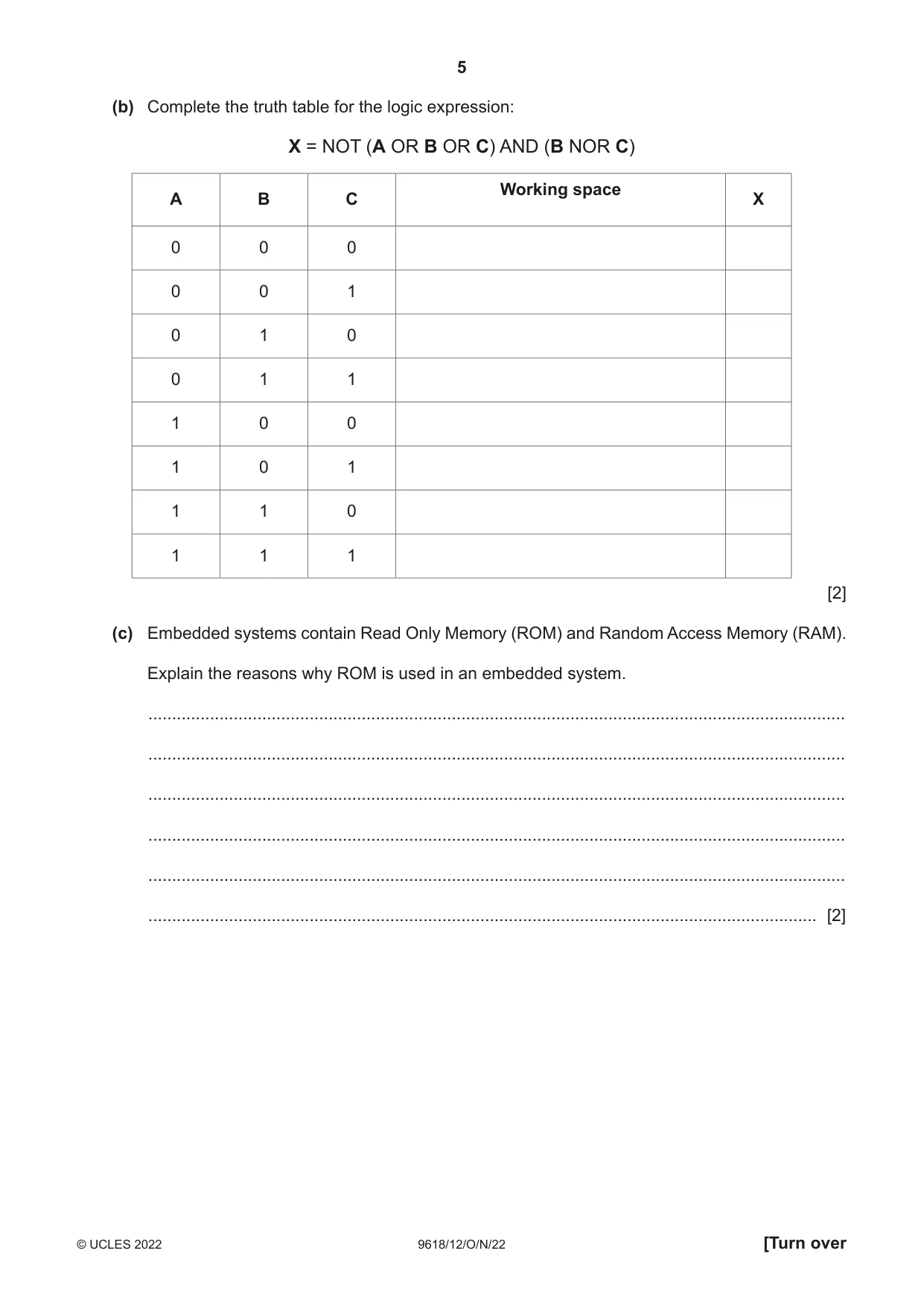
5 9618/12/O/N/22 © UCLES 2022 [Turn over (b) Complete the truth table for the logic expression: X = NOT (A OR B OR C) AND (B NOR C) A B C Working space X 0 0 0 0 0 1 0 1 0 0 1 1 1 0 0 1 0 1 1 1 0 1 1 1 [2] (c) Embedded systems contain Read Only Memory (ROM) and Random Access Memory (RAM). Explain the reasons why ROM is used in an embedded system. … … … … … … [2]
Question paper, page 6
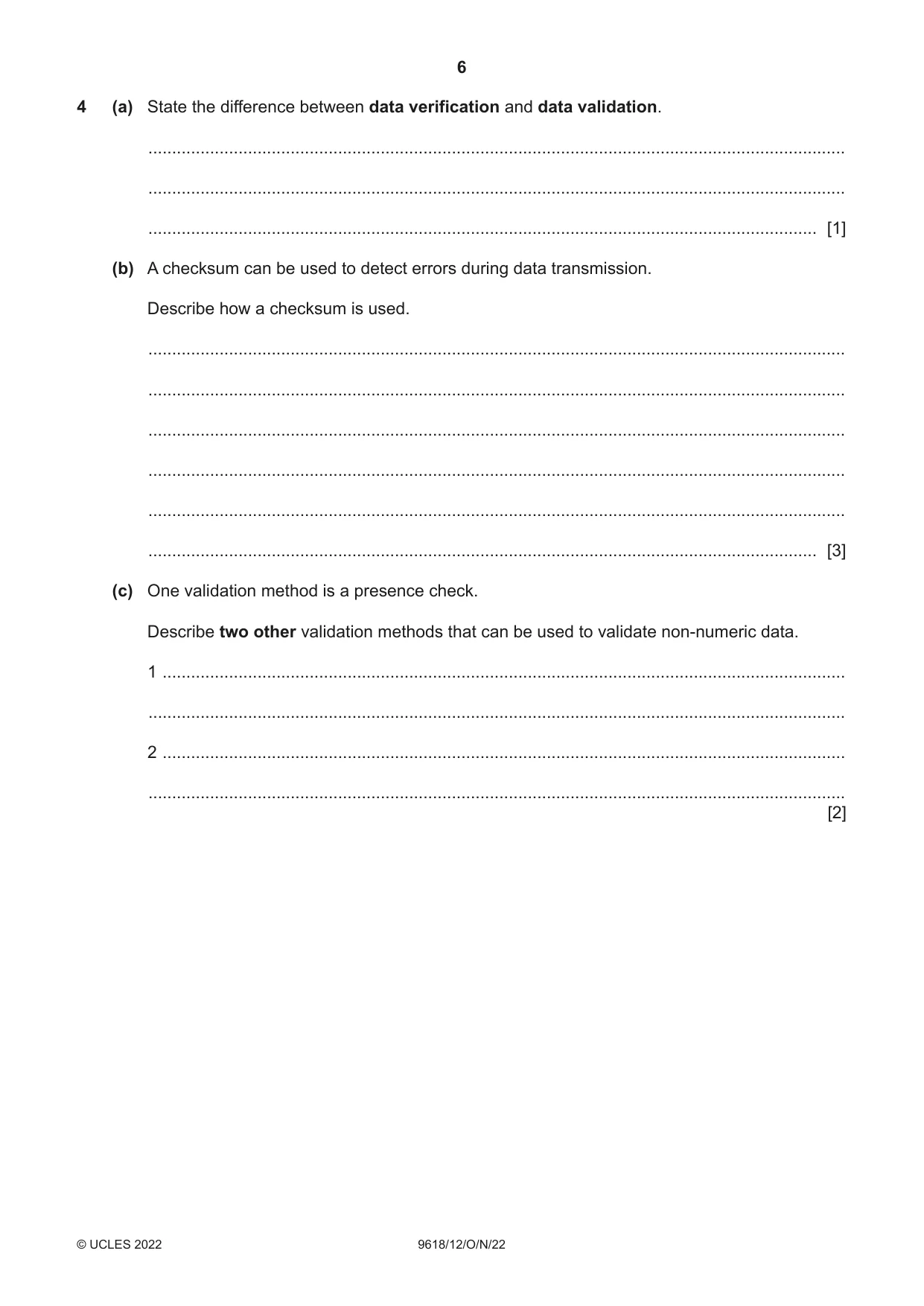
6 9618/12/O/N/22 © UCLES 2022 4 (a) State the difference between data verification and data validation. … … … [1] (b) A checksum can be used to detect errors during data transmission. Describe how a checksum is used. … … … … … … [3] (c) One validation method is a presence check. Describe two other validation methods that can be used to validate non-numeric data. 1 … … 2 … … [2]
Question paper, page 7
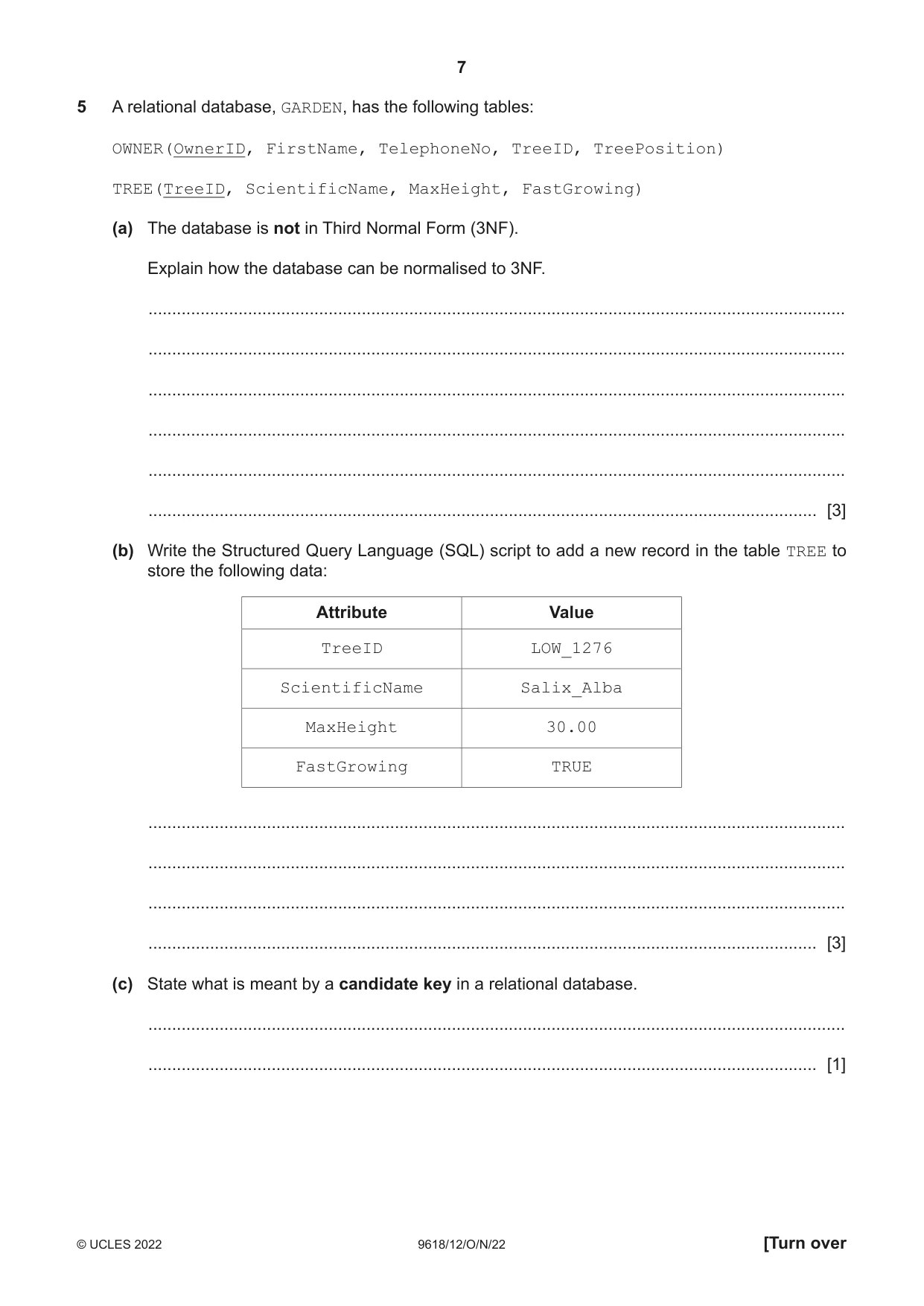
7 9618/12/O/N/22 © UCLES 2022 [Turn over 5 A relational database, GARDEN, has the following tables: OWNER(OwnerID, FirstName, TelephoneNo, TreeID, TreePosition) TREE(TreeID, ScientificName, MaxHeight, FastGrowing) (a) The database is not in Third Normal Form (3NF). Explain how the database can be normalised to 3NF. … … … … … … [3] (b) Write the Structured Query Language (SQL) script to add a new record in the table TREE to store the following data: Attribute Value TreeID LOW_1276 ScientificName Salix_Alba MaxHeight 30.00 FastGrowing TRUE … … … … [3] (c) State what is meant by a candidate key in a relational database. … … [1]
Question paper, page 8
8 9618/12/O/N/22 © UCLES 2022 (d) (i) Describe, using an example, what is meant by a data dictionary. … … … … [2] (ii) Describe what is meant by a logical schema. … … … … [2]
Question paper, page 9
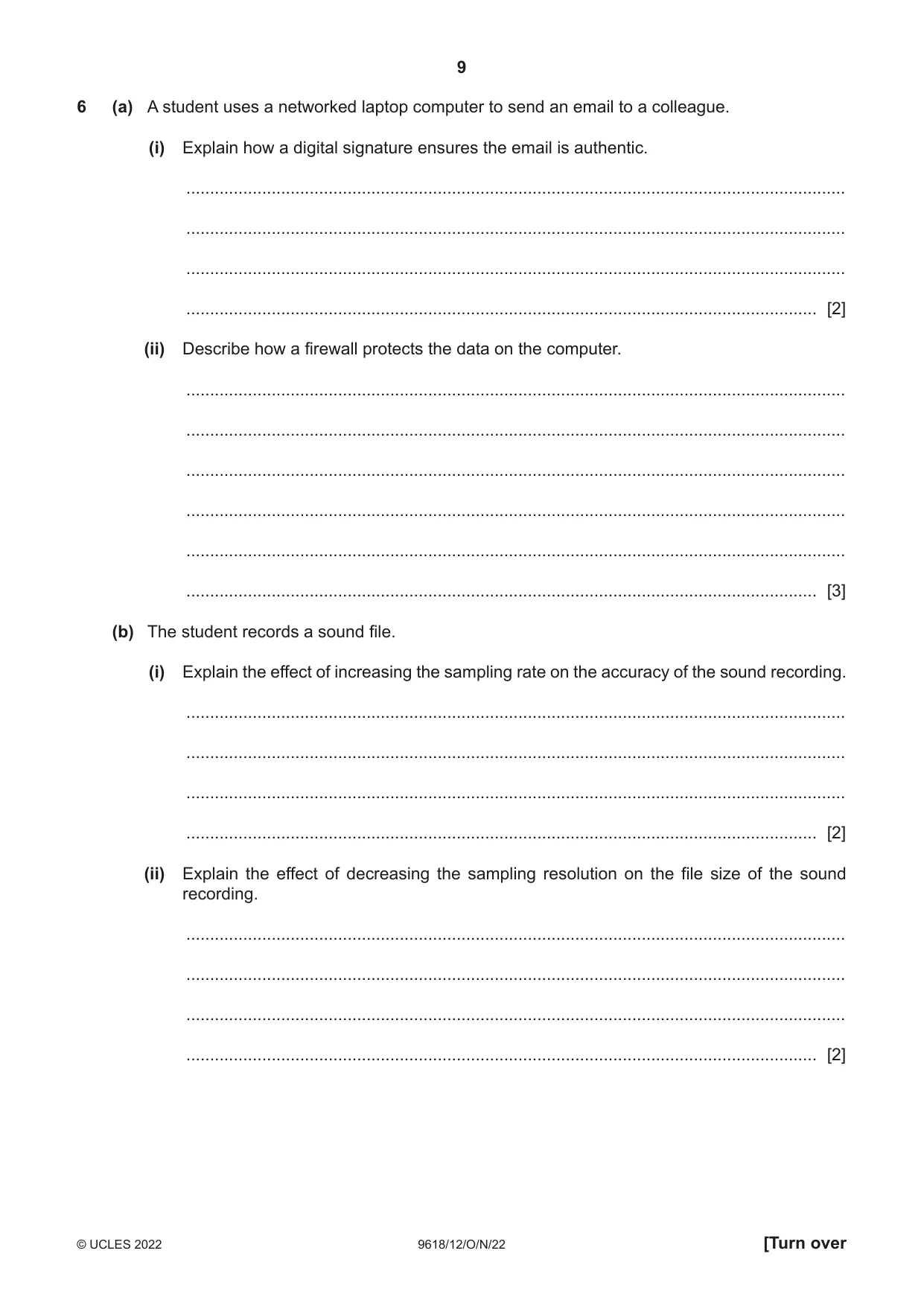
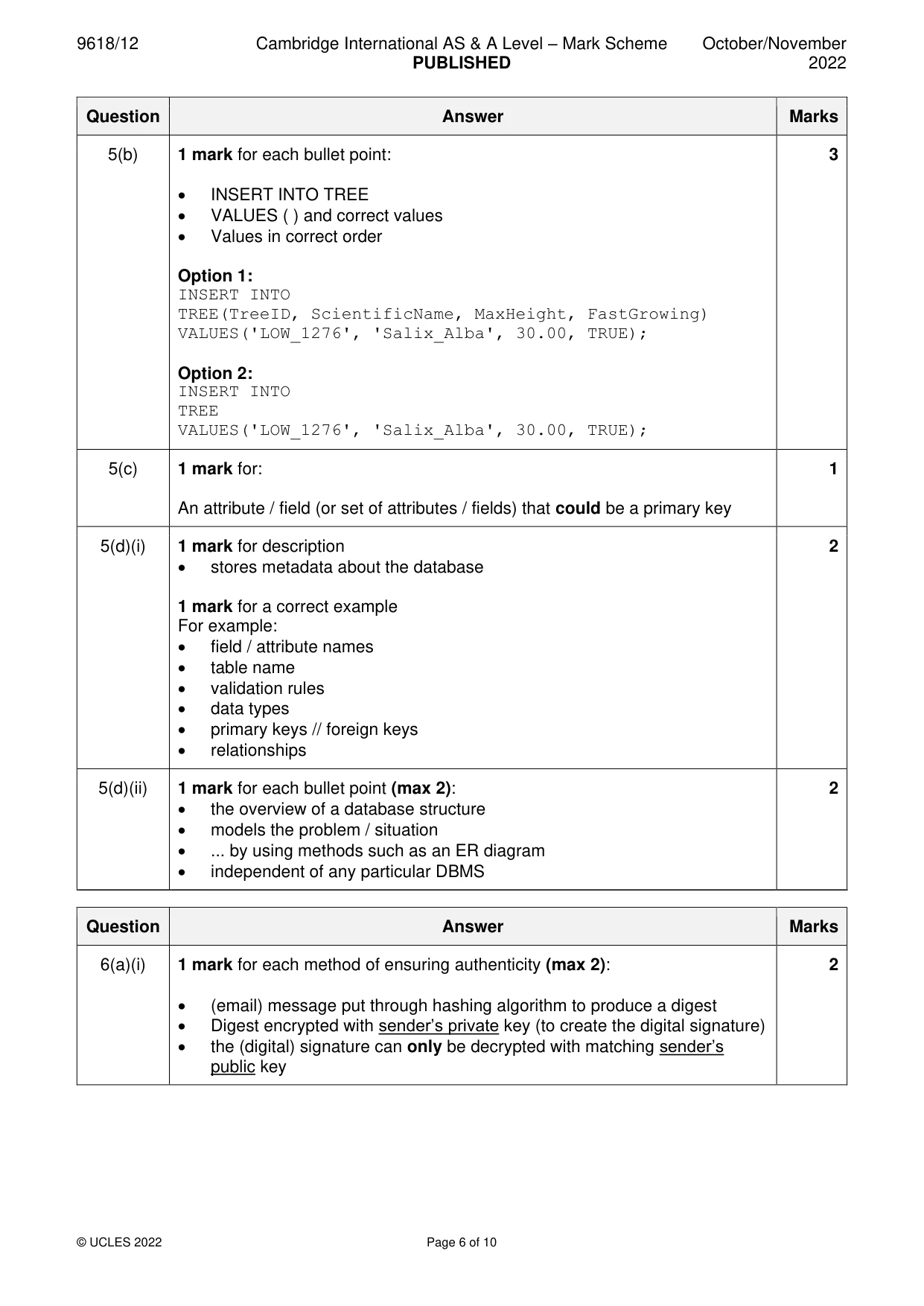
9 9618/12/O/N/22 © UCLES 2022 [Turn over 6 (a) A student uses a networked laptop computer to send an email to a colleague. (i) Explain how a digital signature ensures the email is authentic. … … … … [2] (ii) Describe how a firewall protects the data on the computer. … … … … … … [3] (b) The student records a sound file. (i) Explain the effect of increasing the sampling rate on the accuracy of the sound recording. … … … … [2] (ii) Explain the effect of decreasing the sampling resolution on the file size of the sound recording. … … … … [2]
Question paper, page 10
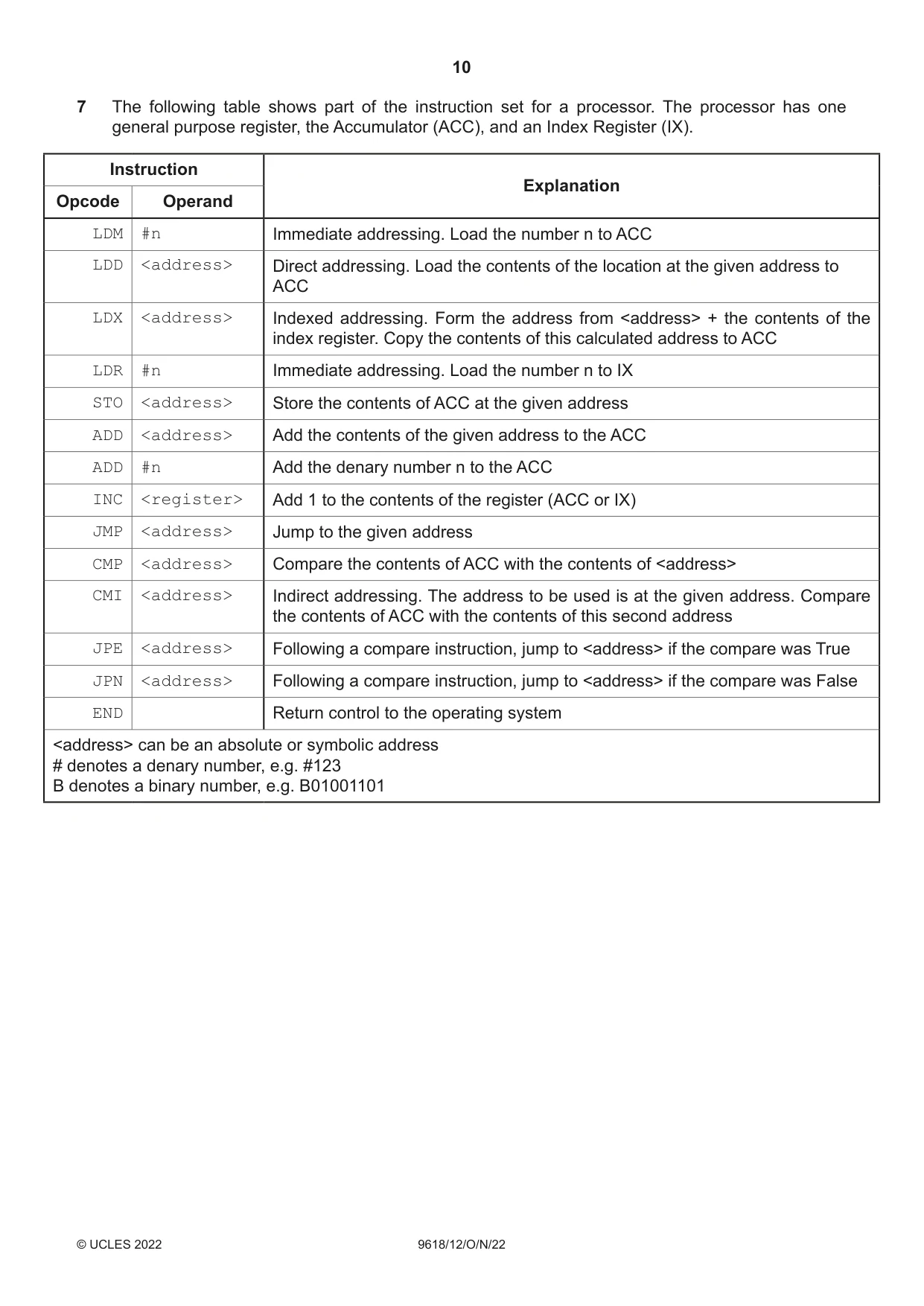
10 9618/12/O/N/22 © UCLES 2022 7 The following table shows part of the instruction set for a processor. The processor has one general purpose register, the Accumulator (ACC), and an Index Register (IX). Instruction Explanation Opcode Operand LDM #n Immediate addressing. Load the number n to ACC LDD <address> Direct addressing. Load the contents of the location at the given address to ACC LDX <address> Indexed addressing. Form the address from <address> + the contents of the index register. Copy the contents of this calculated address to ACC LDR #n Immediate addressing. Load the number n to IX STO <address> Store the contents of ACC at the given address ADD <address> Add the contents of the given address to the ACC ADD #n Add the denary number n to the ACC INC <register> Add 1 to the contents of the register (ACC or IX) JMP <address> Jump to the given address CMP <address> Compare the contents of ACC with the contents of <address> CMI <address> Indirect addressing. The address to be used is at the given address. Compare the contents of ACC with the contents of this second address JPE <address> Following a compare instruction, jump to <address> if the compare was True JPN <address> Following a compare instruction, jump to <address> if the compare was False END Return control to the operating system <address> can be an absolute or symbolic address # denotes a denary number, e.g. #123 B denotes a binary number, e.g. B01001101
Question paper, page 11
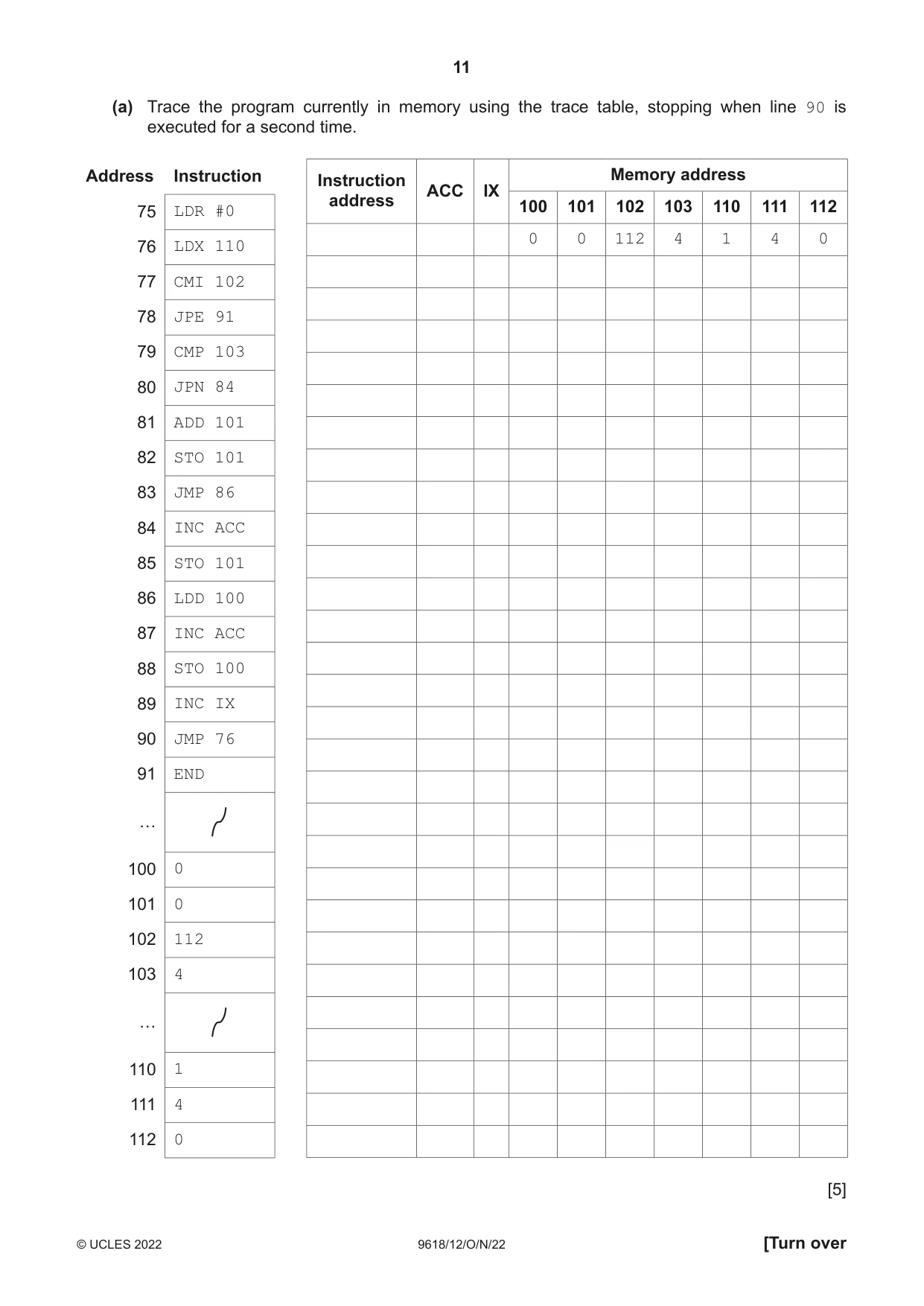
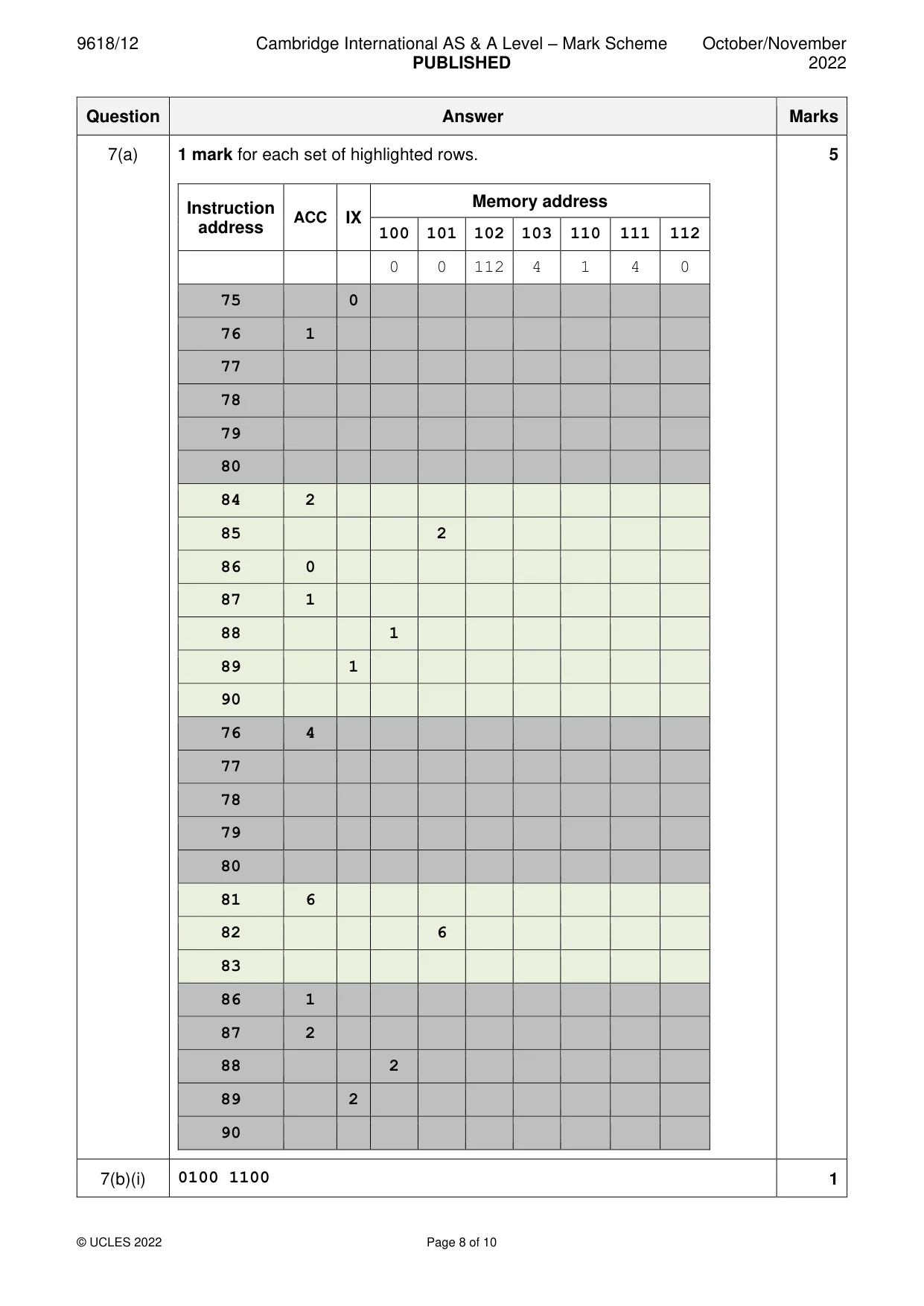
11 9618/12/O/N/22 © UCLES 2022 [Turn over (a) Trace the program currently in memory using the trace table, stopping when line 90 is executed for a second time. Address Instruction 75 LDR #0 76 LDX 110 77 CMI 102 78 JPE 91 79 CMP 103 80 JPN 84 81 ADD 101 82 STO 101 83 JMP 86 84 INC ACC 85 STO 101 86 LDD 100 87 INC ACC 88 STO 100 89 INC IX 90 JMP 76 91 END … 100 0 101 0 102 112 103 4 … 110 1 111 4 112 0 Instruction address ACC IX Memory address 100 101 102 103 110 111 112 0 0 112 4 1 4 0 [5]
Question paper, page 12
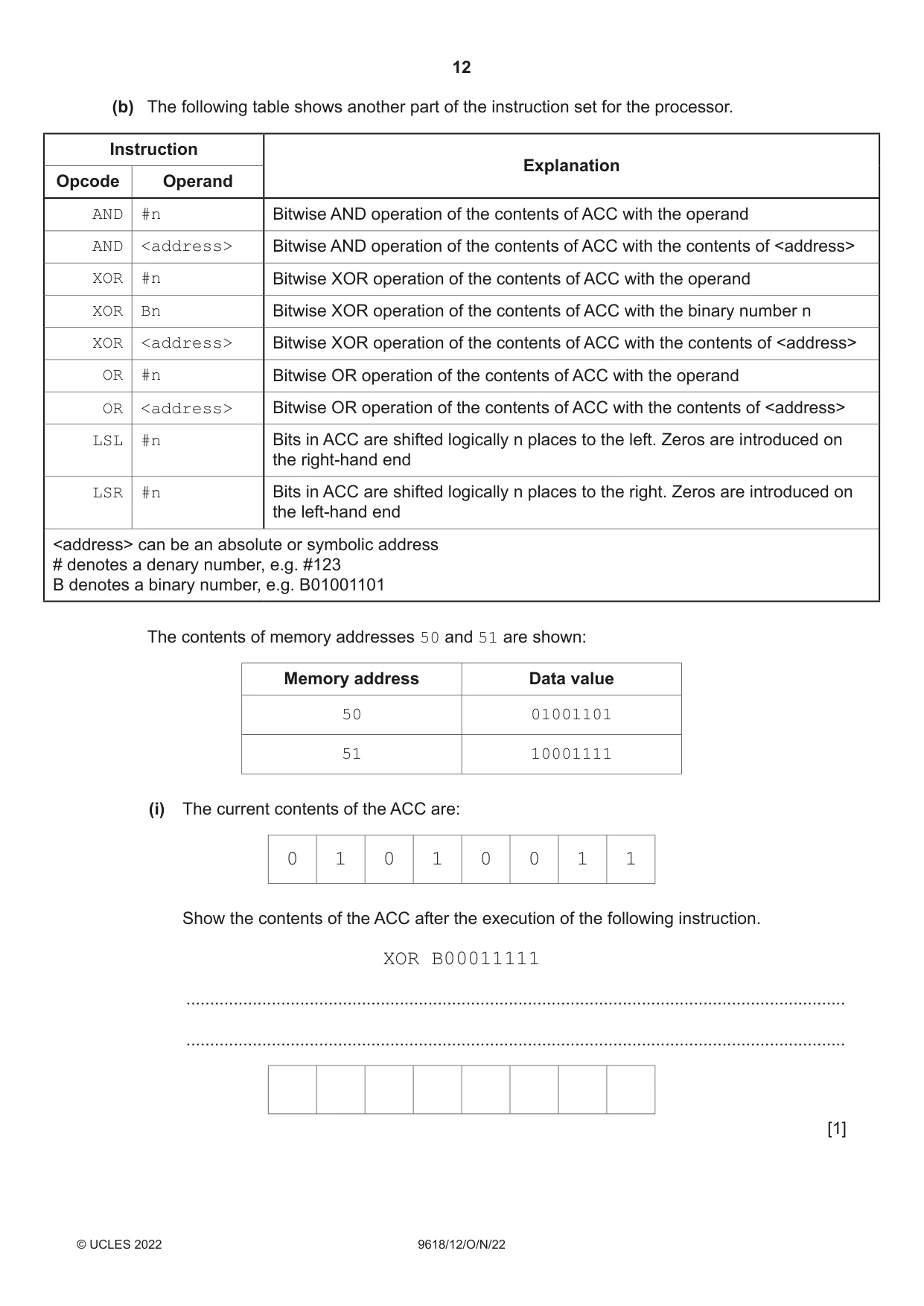
12 9618/12/O/N/22 © UCLES 2022 (b) The following table shows another part of the instruction set for the processor. Instruction Explanation Opcode Operand AND #n Bitwise AND operation of the contents of ACC with the operand AND <address> Bitwise AND operation of the contents of ACC with the contents of <address> XOR #n Bitwise XOR operation of the contents of ACC with the operand XOR Bn Bitwise XOR operation of the contents of ACC with the binary number n XOR <address> Bitwise XOR operation of the contents of ACC with the contents of <address> OR #n Bitwise OR operation of the contents of ACC with the operand OR <address> Bitwise OR operation of the contents of ACC with the contents of <address> LSL #n Bits in ACC are shifted logically n places to the left. Zeros are introduced on the right-hand end LSR #n Bits in ACC are shifted logically n places to the right. Zeros are introduced on the left-hand end <address> can be an absolute or symbolic address # denotes a denary number, e.g. #123 B denotes a binary number, e.g. B01001101 The contents of memory addresses 50 and 51 are shown: Memory address Data value 50 01001101 51 10001111 (i) The current contents of the ACC are: 0 1 0 1 0 0 1 1 Show the contents of the ACC after the execution of the following instruction. XOR B00011111 … … [1]
Question paper, page 13
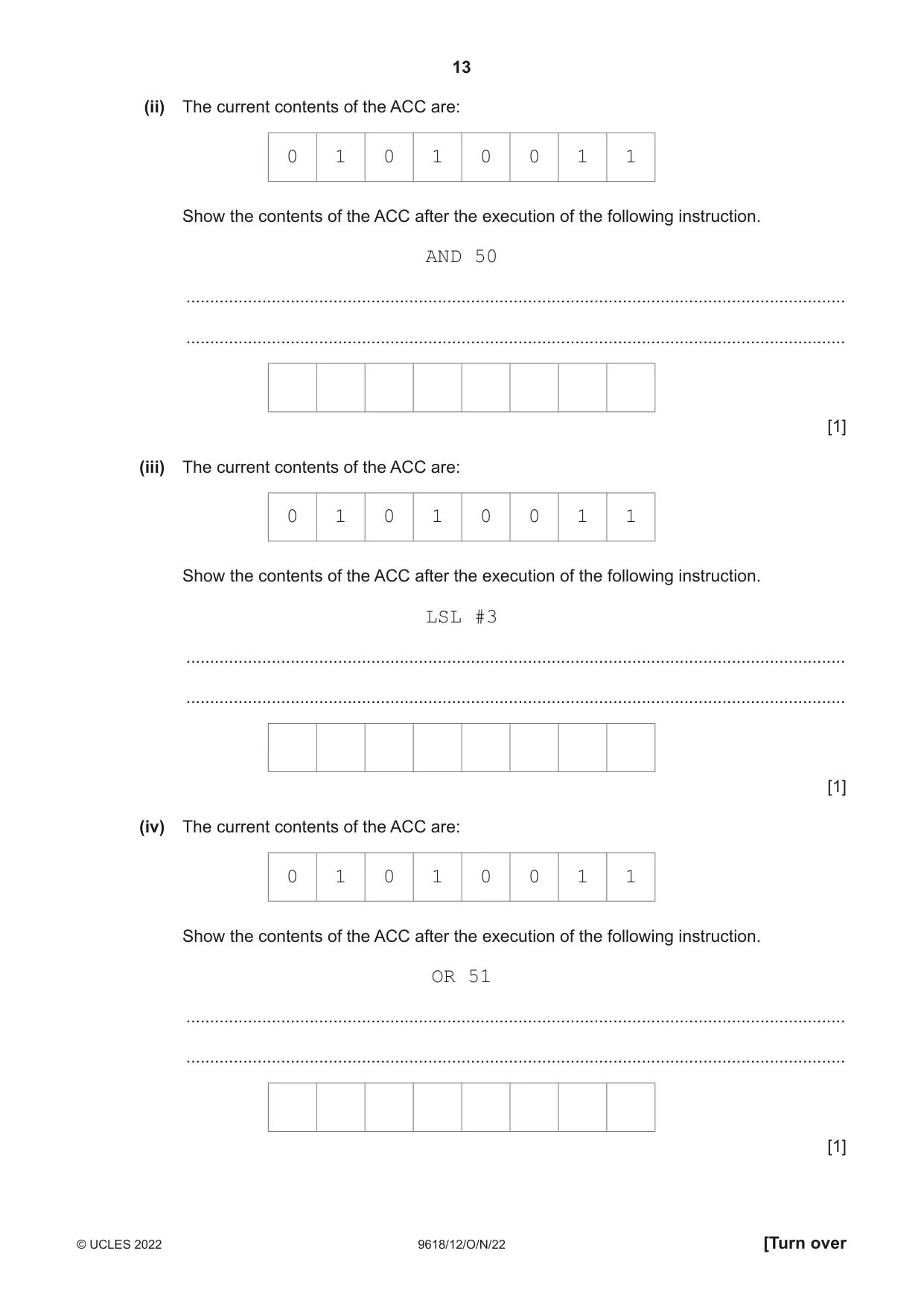
13 9618/12/O/N/22 © UCLES 2022 [Turn over (ii) The current contents of the ACC are: 0 1 0 1 0 0 1 1 Show the contents of the ACC after the execution of the following instruction. AND 50 … … [1] (iii) The current contents of the ACC are: 0 1 0 1 0 0 1 1 Show the contents of the ACC after the execution of the following instruction. LSL #3 … … [1] (iv) The current contents of the ACC are: 0 1 0 1 0 0 1 1 Show the contents of the ACC after the execution of the following instruction. OR 51 … … [1]
Question paper, page 14
14 9618/12/O/N/22 © UCLES 2022 (c) Write the register transfer notation for each of the stages in the fetch-execute cycle described in the table. Description Register transfer notation Copy the address of the next instruction into the Memory Address Register. Increment the Program Counter. Copy the contents of the Memory Data Register into the Current Instruction Register. [3]
Question paper, page 15
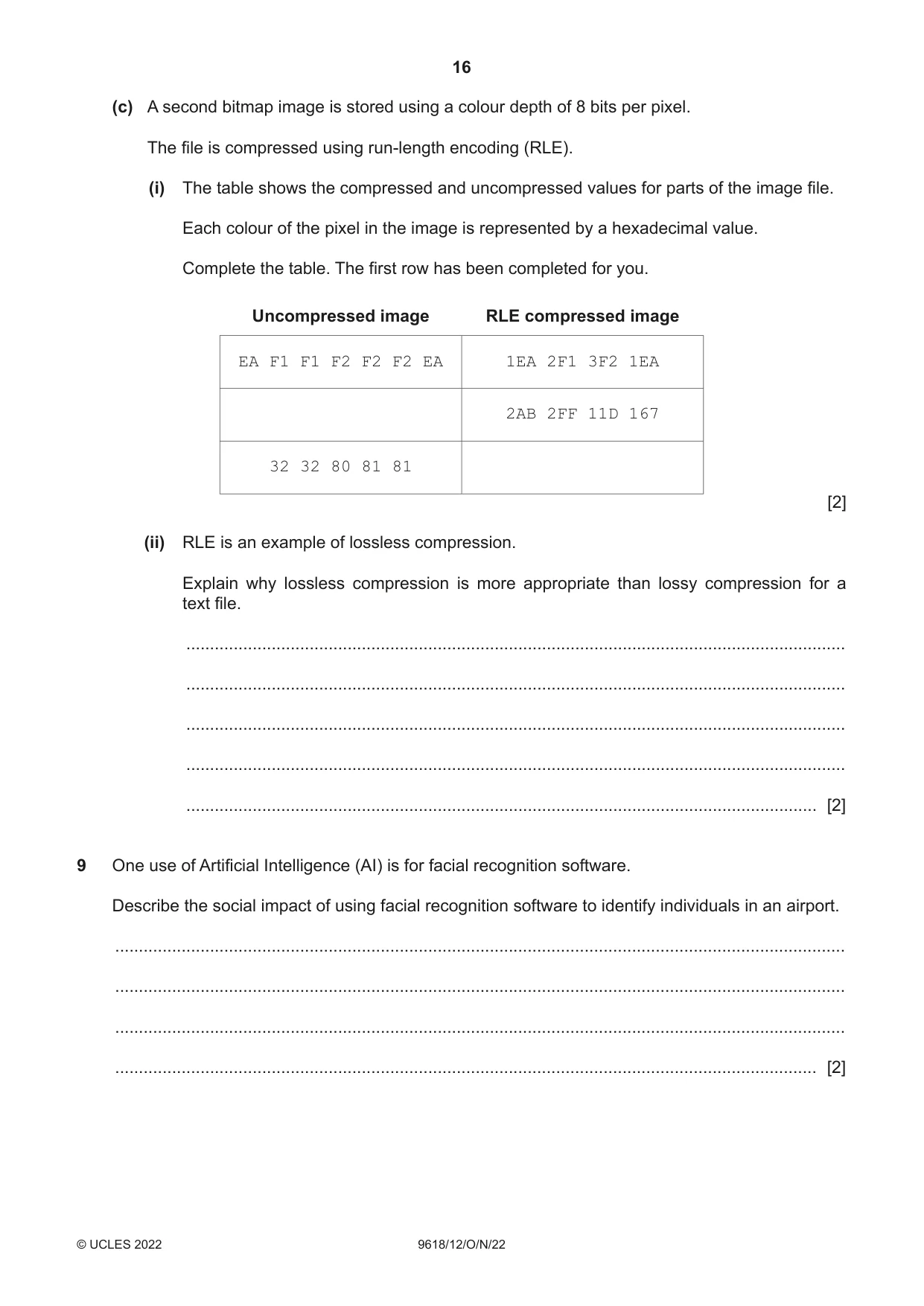
15 9618/12/O/N/22 © UCLES 2022 [Turn over 8 The following bitmap image has a resolution of 4096 × 4096 pixels and a colour depth of 24 bits per pixel. The image is displayed on a monitor that has a screen resolution of 1920 × 1080 pixels. (a) Tick (3) one box in each row to identify the effect of each action on the image file size. Action Increases the file size Decreases the file size No change to the file size Change the colour depth of the image file to 16 bits per pixel. Change the screen resolution to 1366 × 768 pixels. Change the colour of the rectangle from black to red. [2] (b) State two benefits of creating a vector graphic instead of a bitmap image. 1 … … 2 … … [2]
Question paper, page 16
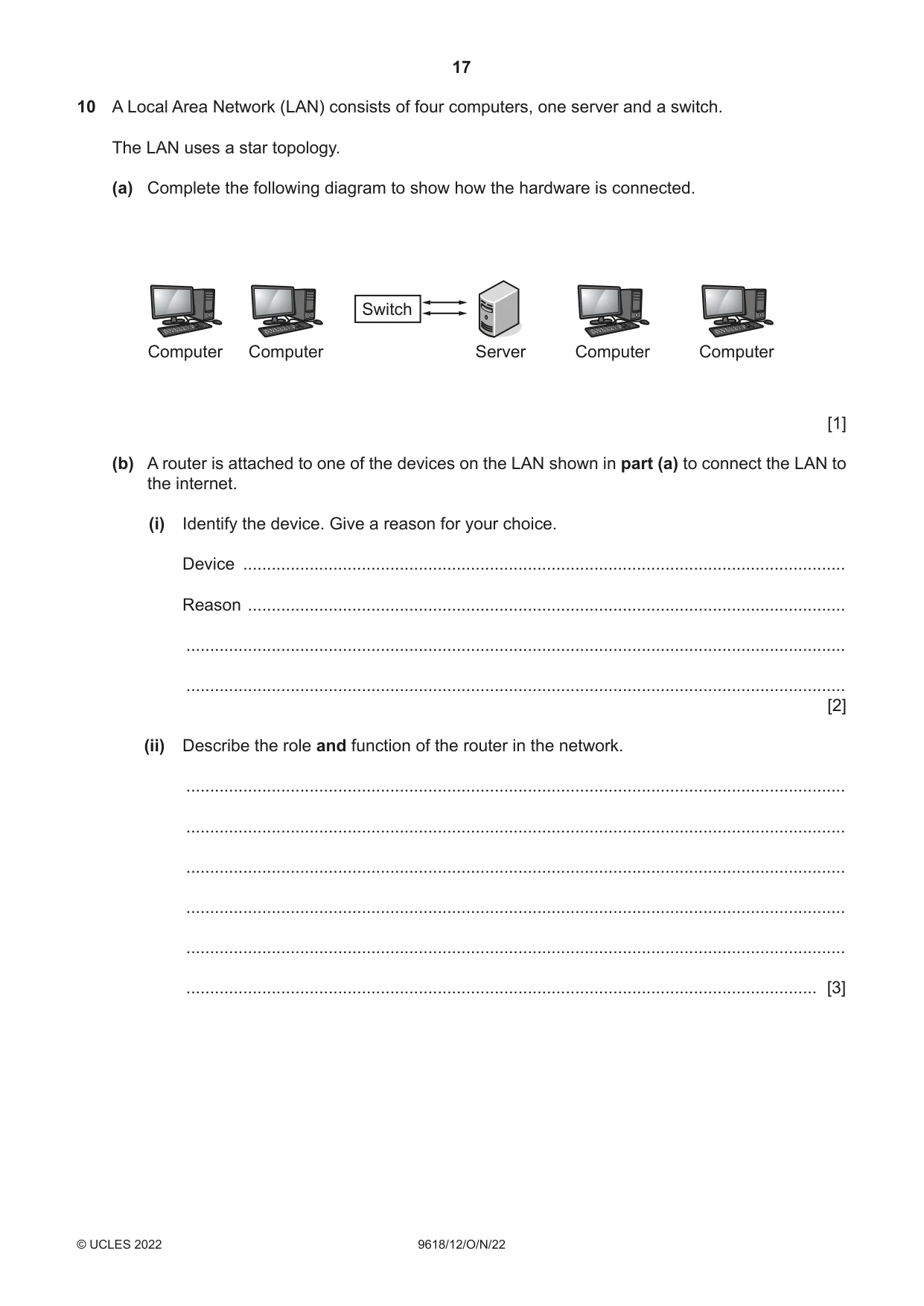
16 9618/12/O/N/22 © UCLES 2022 (c) A second bitmap image is stored using a colour depth of 8 bits per pixel. The file is compressed using run-length encoding (RLE). (i) The table shows the compressed and uncompressed values for parts of the image file. Each colour of the pixel in the image is represented by a hexadecimal value. Complete the table. The first row has been completed for you. Uncompressed image RLE compressed image EA F1 F1 F2 F2 F2 EA 1EA 2F1 3F2 1EA 2AB 2FF 11D 167 32 32 80 81 81 [2] (ii) RLE is an example of lossless compression. Explain why lossless compression is more appropriate than lossy compression for a text file. … … … … … [2] 9 One use of Artificial Intelligence (AI) is for facial recognition software. Describe the social impact of using facial recognition software to identify individuals in an airport. … … … … [2]
Question paper, page 17
17 9618/12/O/N/22 © UCLES 2022 10 A Local Area Network (LAN) consists of four computers, one server and a switch. The LAN uses a star topology. (a) Complete the following diagram to show how the hardware is connected. Server Computer Computer Computer Computer Switch [1] (b) A router is attached to one of the devices on the LAN shown in part (a) to connect the LAN to the internet. (i) Identify the device. Give a reason for your choice. Device … Reason … … … [2] (ii) Describe the role and function of the router in the network. … … … … … … [3]
Question paper, page 18
18 9618/12/O/N/22 © UCLES 2022 BLANK PAGE
Question paper, page 19
19 9618/12/O/N/22 © UCLES 2022 BLANK PAGE
Question paper, page 20
20 9618/12/O/N/22 © UCLES 2022 Permission to reproduce items where third-party owned material protected by copyright is included has been sought and cleared where possible. Every reasonable effort has been made by the publisher (UCLES) to trace copyright holders, but if any items requiring clearance have unwittingly been included, the publisher will be pleased to make amends at the earliest possible opportunity. To avoid the issue of disclosure of answer-related information to candidates, all copyright acknowledgements are reproduced online in the Cambridge Assessment International Education Copyright Acknowledgements Booklet. This is produced for each series of examinations and is freely available to download at www.cambridgeinternational.org after the live examination series. Cambridge Assessment International Education is part of Cambridge Assessment. Cambridge Assessment is the brand name of the University of Cambridge Local Examinations Syndicate (UCLES), which is a department of the University of Cambridge. BLANK PAGE
Mark scheme, page 1
This document consists of 10 printed pages. © UCLES 2022 [Turn over Cambridge International AS & A Level COMPUTER SCIENCE 9618/12 Paper 1 Theory Fundamentals October/November 2022 MARK SCHEME Maximum Mark: 75 Published This mark scheme is published as an aid to teachers and candidates, to indicate the requirements of the examination. It shows the basis on which Examiners were instructed to award marks. It does not indicate the details of the discussions that took place at an Examiners’ meeting before marking began, which would have considered the acceptability of alternative answers. Mark schemes should be read in conjunction with the question paper and the Principal Examiner Report for Teachers. Cambridge International will not enter into discussions about these mark schemes. Cambridge International is publishing the mark schemes for the October/November 2022 series for most Cambridge IGCSE™, Cambridge International A and AS Level components and some Cambridge O Level components.
Mark scheme, page 2
9618/12 Cambridge International AS & A Level – Mark Scheme PUBLISHED October/November 2022 © UCLES 2022 Page 2 of 10 Generic Marking Principles These general marking principles must be applied by all examiners when marking candidate answers. They should be applied alongside the specific content of the mark scheme or generic level descriptors for a question. Each question paper and mark scheme will also comply with these marking principles. GENERIC MARKING PRINCIPLE 1: Marks must be awarded in line with: • the specific content of the mark scheme or the generic level descriptors for the question • the specific skills defined in the mark scheme or in the generic level descriptors for the question • the standard of response required by a candidate as exemplified by the standardisation scripts. GENERIC MARKING PRINCIPLE 2: Marks awarded are always whole marks (not half marks, or other fractions). GENERIC MARKING PRINCIPLE 3: Marks must be awarded positively: • marks are awarded for correct/valid answers, as defined in the mark scheme. However, credit is given for valid answers which go beyond the scope of the syllabus and mark scheme, referring to your Team Leader as appropriate • marks are awarded when candidates clearly demonstrate what they know and can do • marks are not deducted for errors • marks are not deducted for omissions • answers should only be judged on the quality of spelling, punctuation and grammar when these features are specifically assessed by the question as indicated by the mark scheme. The meaning, however, should be unambiguous. GENERIC MARKING PRINCIPLE 4: Rules must be applied consistently, e.g. in situations where candidates have not followed instructions or in the application of generic level descriptors. GENERIC MARKING PRINCIPLE 5: Marks should be awarded using the full range of marks defined in the mark scheme for the question (however; the use of the full mark range may be limited according to the quality of the candidate responses seen). GENERIC MARKING PRINCIPLE 6: Marks awarded are based solely on the requirements as defined in the mark scheme. Marks should not be awarded with grade thresholds or grade descriptors in mind.
Mark scheme, page 3
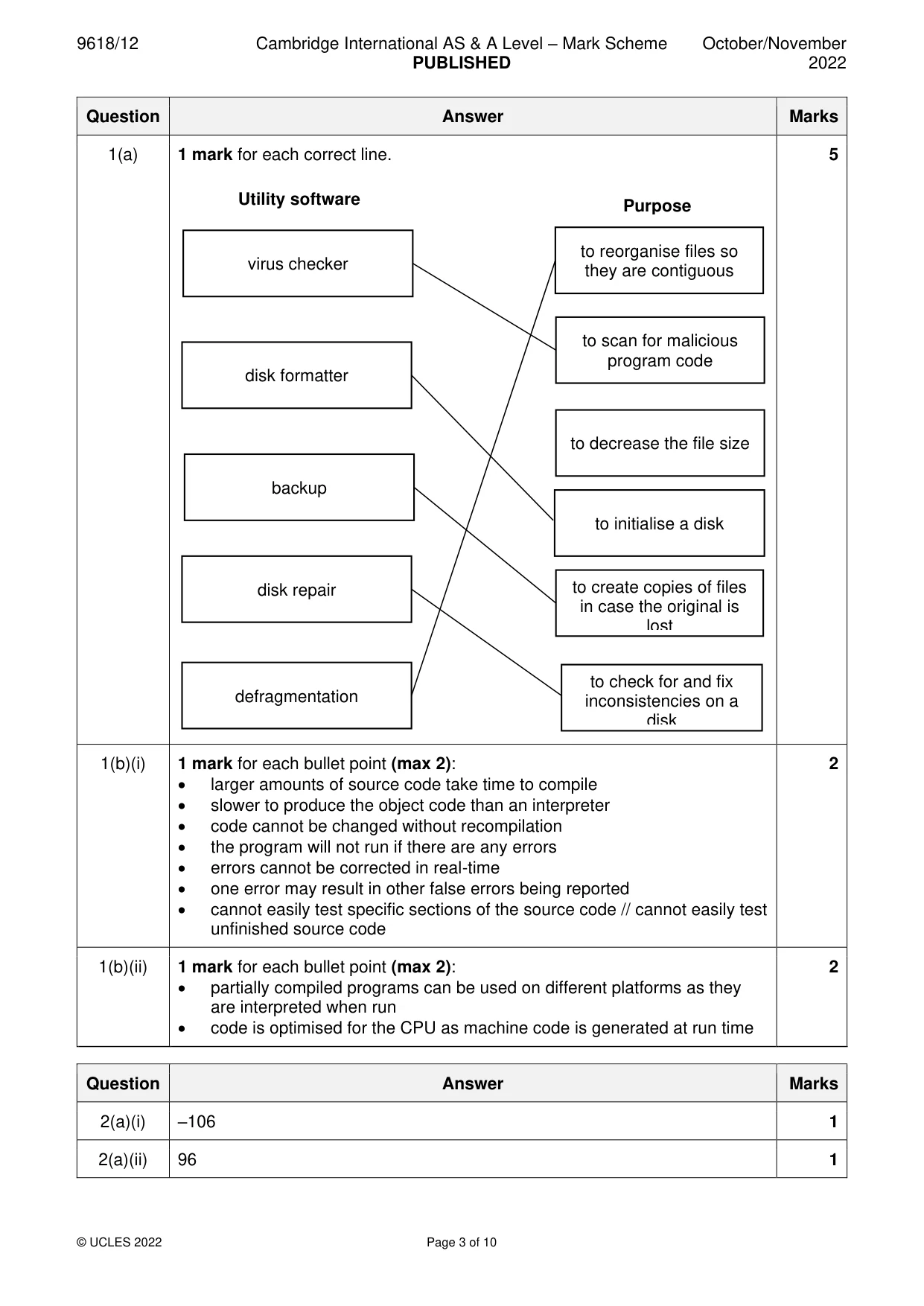
9618/12 Cambridge International AS & A Level – Mark Scheme PUBLISHED October/November 2022 © UCLES 2022 Page 3 of 10 Question Answer Marks 1(a) 1 mark for each correct line. 5 1(b)(i) 1 mark for each bullet point (max 2): • larger amounts of source code take time to compile • slower to produce the object code than an interpreter • code cannot be changed without recompilation • the program will not run if there are any errors • errors cannot be corrected in real-time • one error may result in other false errors being reported • cannot easily test specific sections of the source code // cannot easily test unfinished source code 2 1(b)(ii) 1 mark for each bullet point (max 2): • partially compiled programs can be used on different platforms as they are interpreted when run • code is optimised for the CPU as machine code is generated at run time 2 Question Answer Marks 2(a)(i) –106 1 2(a)(ii) 96 1 virus checker disk formatter backup disk repair to reorganise files so they are contiguous to check for and fix inconsistencies on a disk defragmentation to decrease the file size to initialise a disk to scan for malicious program code Utility software Purpose to create copies of files in case the original is lost
Mark scheme, page 4
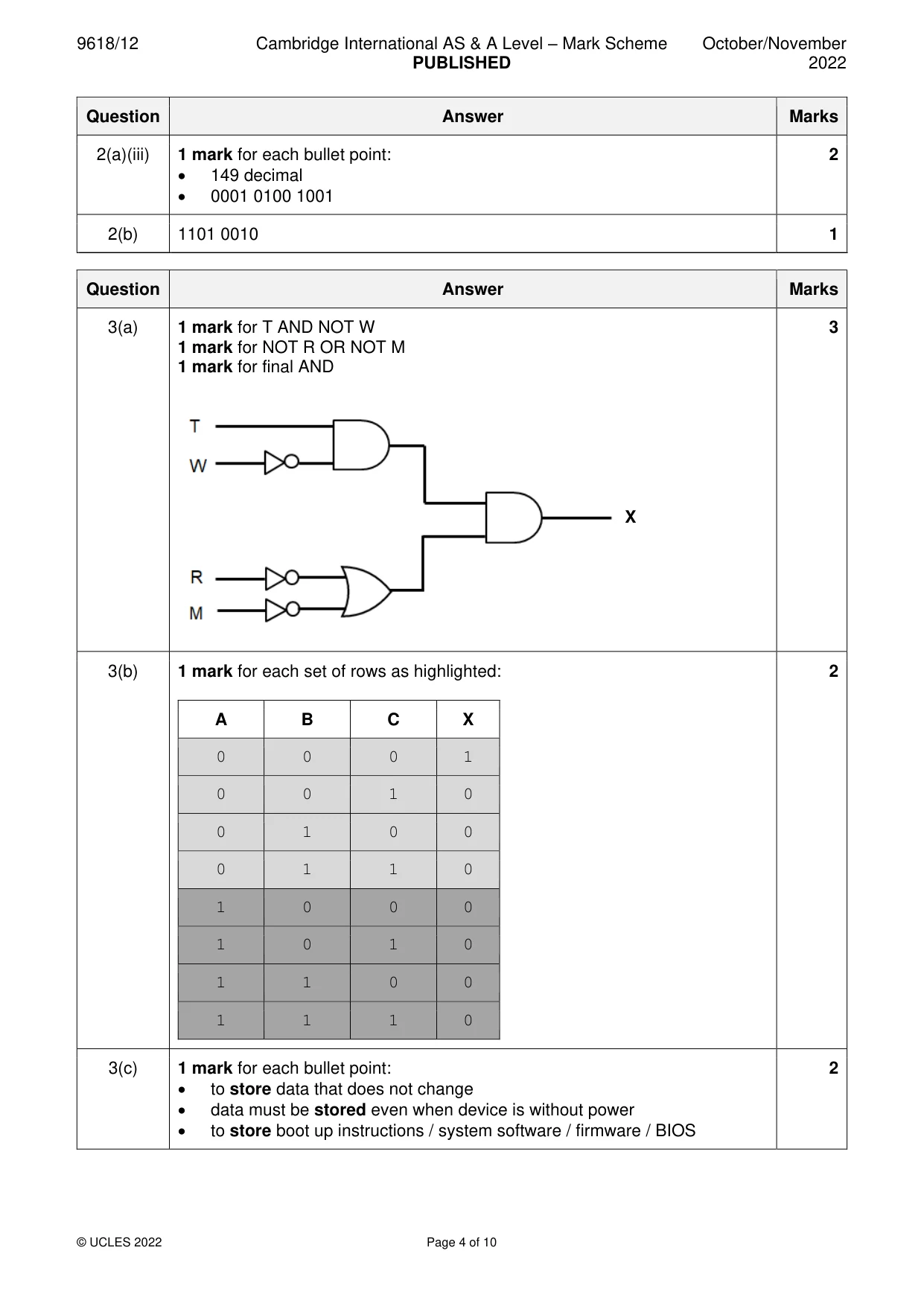
9618/12 Cambridge International AS & A Level – Mark Scheme PUBLISHED October/November 2022 © UCLES 2022 Page 4 of 10 Question Answer Marks 2(a)(iii) 1 mark for each bullet point: • 149 decimal • 0001 0100 1001 2 2(b) 1101 0010 1 Question Answer Marks 3(a) 1 mark for T AND NOT W 1 mark for NOT R OR NOT M 1 mark for final AND 3 3(b) 1 mark for each set of rows as highlighted: A B C X 0 0 0 1 0 0 1 0 0 1 0 0 0 1 1 0 1 0 0 0 1 0 1 0 1 1 0 0 1 1 1 0 2 3(c) 1 mark for each bullet point: • to store data that does not change • data must be stored even when device is without power • to store boot up instructions / system software / firmware / BIOS 2 X
Mark scheme, page 5
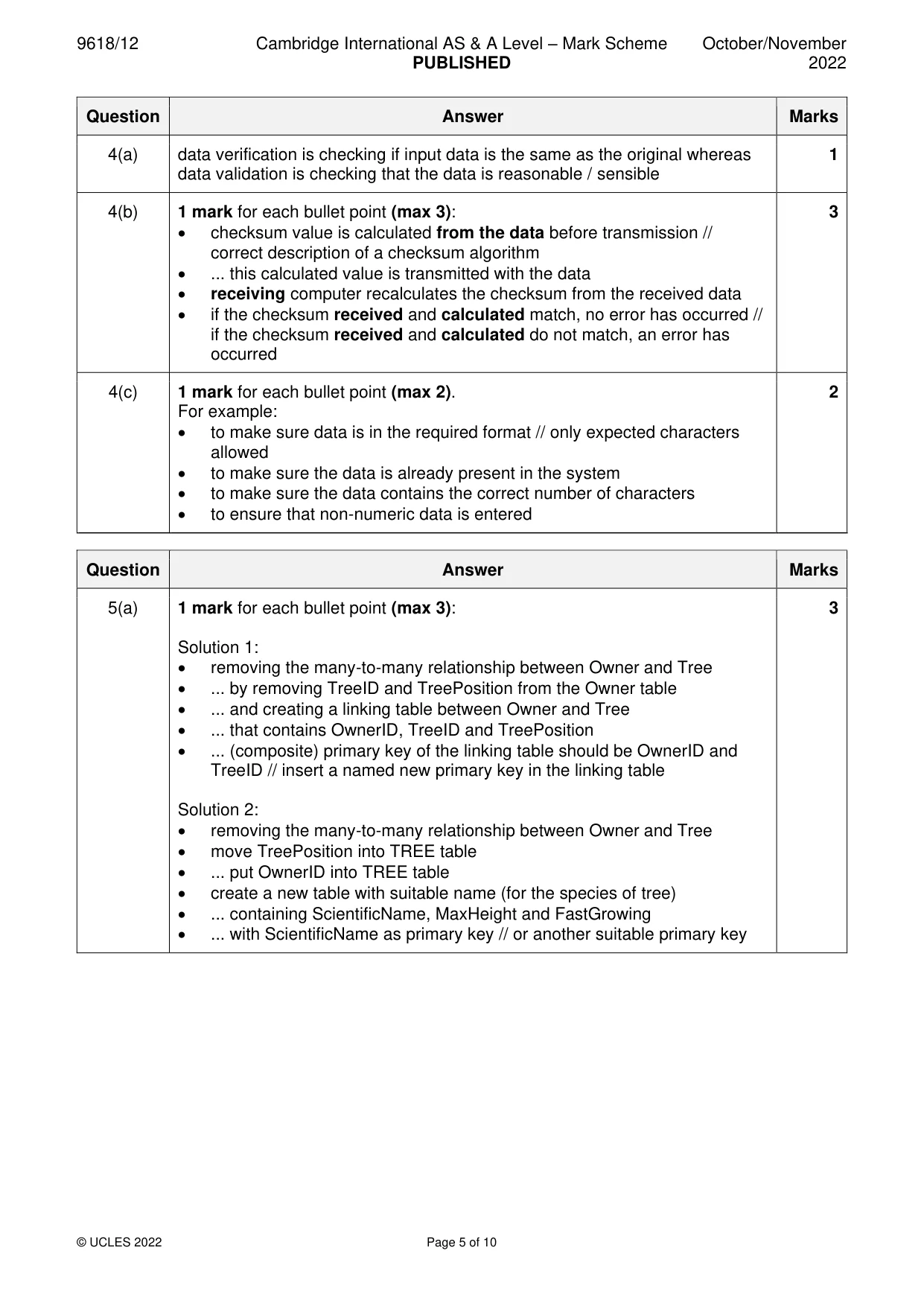
9618/12 Cambridge International AS & A Level – Mark Scheme PUBLISHED October/November 2022 © UCLES 2022 Page 5 of 10 Question Answer Marks 4(a) data verification is checking if input data is the same as the original whereas data validation is checking that the data is reasonable / sensible 1 4(b) 1 mark for each bullet point (max 3): • checksum value is calculated from the data before transmission // correct description of a checksum algorithm • ... this calculated value is transmitted with the data • receiving computer recalculates the checksum from the received data • if the checksum received and calculated match, no error has occurred // if the checksum received and calculated do not match, an error has occurred 3 4(c) 1 mark for each bullet point (max 2). For example: • to make sure data is in the required format // only expected characters allowed • to make sure the data is already present in the system • to make sure the data contains the correct number of characters • to ensure that non-numeric data is entered 2 Question Answer Marks 5(a) 1 mark for each bullet point (max 3): Solution 1: • removing the many-to-many relationship between Owner and Tree • ... by removing TreeID and TreePosition from the Owner table • ... and creating a linking table between Owner and Tree • ... that contains OwnerID, TreeID and TreePosition • ... (composite) primary key of the linking table should be OwnerID and TreeID // insert a named new primary key in the linking table Solution 2: • removing the many-to-many relationship between Owner and Tree • move TreePosition into TREE table • ... put OwnerID into TREE table • create a new table with suitable name (for the species of tree) • ... containing ScientificName, MaxHeight and FastGrowing • ... with ScientificName as primary key // or another suitable primary key 3
Mark scheme, page 6
9618/12 Cambridge International AS & A Level – Mark Scheme PUBLISHED October/November 2022 © UCLES 2022 Page 6 of 10 Question Answer Marks 5(b) 1 mark for each bullet point: • INSERT INTO TREE • VALUES ( ) and correct values • Values in correct order Option 1: INSERT INTO TREE(TreeID, ScientificName, MaxHeight, FastGrowing) VALUES('LOW_1276', 'Salix_Alba', 30.00, TRUE); Option 2: INSERT INTO TREE VALUES('LOW_1276', 'Salix_Alba', 30.00, TRUE); 3 5(c) 1 mark for: An attribute / field (or set of attributes / fields) that could be a primary key 1 5(d)(i) 1 mark for description • stores metadata about the database 1 mark for a correct example For example: • field / attribute names • table name • validation rules • data types • primary keys // foreign keys • relationships 2 5(d)(ii) 1 mark for each bullet point (max 2): • the overview of a database structure • models the problem / situation • ... by using methods such as an ER diagram • independent of any particular DBMS 2 Question Answer Marks 6(a)(i) 1 mark for each method of ensuring authenticity (max 2): • (email) message put through hashing algorithm to produce a digest • Digest encrypted with sender’s private key (to create the digital signature) • the (digital) signature can only be decrypted with matching sender’s public key 2
Mark scheme, page 7
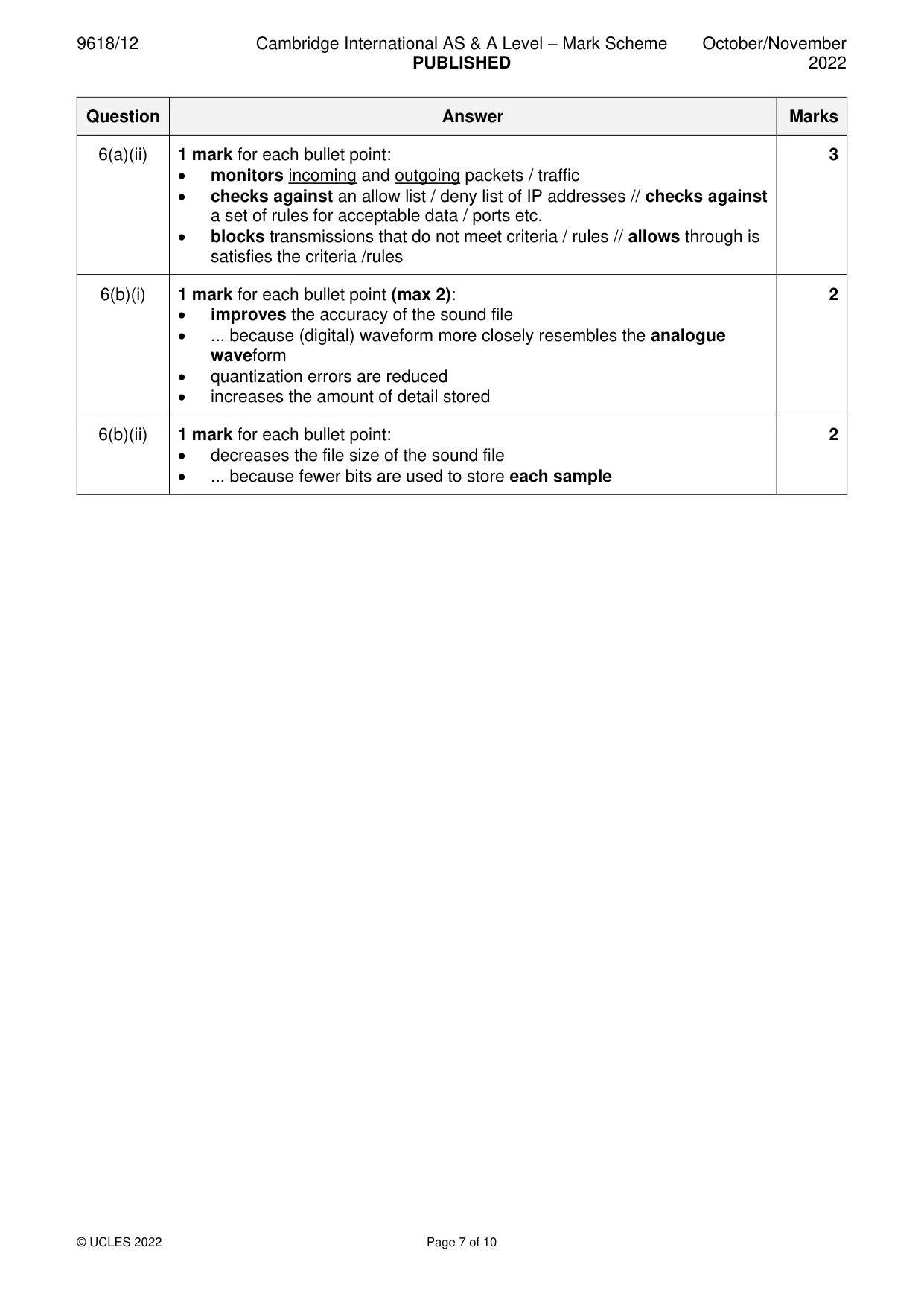
9618/12 Cambridge International AS & A Level – Mark Scheme PUBLISHED October/November 2022 © UCLES 2022 Page 7 of 10 Question Answer Marks 6(a)(ii) 1 mark for each bullet point: • monitors incoming and outgoing packets / traffic • checks against an allow list / deny list of IP addresses // checks against a set of rules for acceptable data / ports etc. • blocks transmissions that do not meet criteria / rules // allows through is satisfies the criteria /rules 3 6(b)(i) 1 mark for each bullet point (max 2): • improves the accuracy of the sound file • ... because (digital) waveform more closely resembles the analogue waveform • quantization errors are reduced • increases the amount of detail stored 2 6(b)(ii) 1 mark for each bullet point: • decreases the file size of the sound file • ... because fewer bits are used to store each sample 2
Mark scheme, page 8
9618/12 Cambridge International AS & A Level – Mark Scheme PUBLISHED October/November 2022 © UCLES 2022 Page 8 of 10 Question Answer Marks 7(a) 1 mark for each set of highlighted rows. Instruction address ACC IX Memory address 100 101 102 103 110 111 112 0 0 112 4 1 4 0 75 0 76 1 77 78 79 80 84 2 85 2 86 0 87 1 88 1 89 1 90 76 4 77 78 79 80 81 6 82 6 83 86 1 87 2 88 2 89 2 90 5 7(b)(i) 0100 1100 1
Mark scheme, page 9
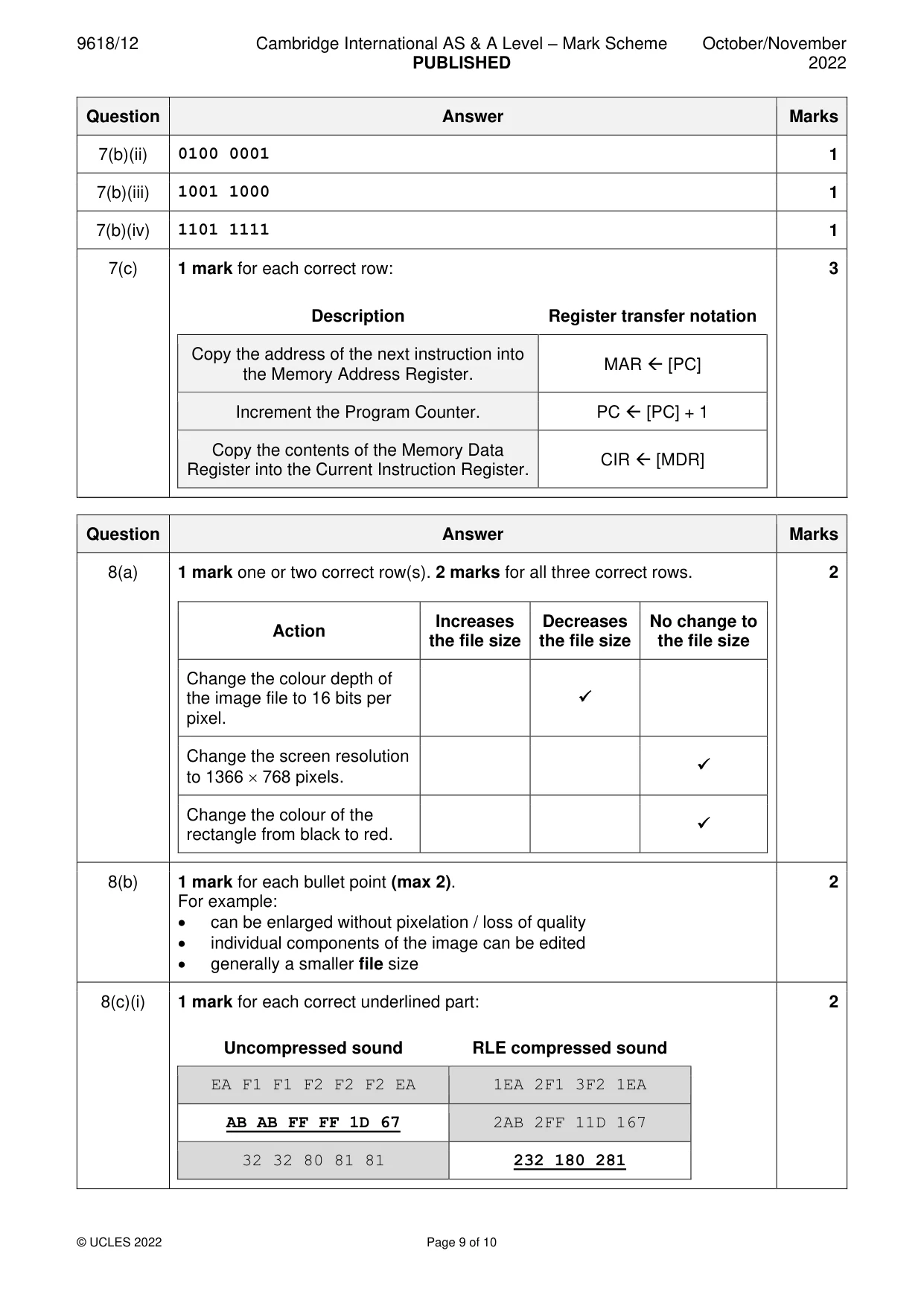
9618/12 Cambridge International AS & A Level – Mark Scheme PUBLISHED October/November 2022 © UCLES 2022 Page 9 of 10 Question Answer Marks 7(b)(ii) 0100 0001 1 7(b)(iii) 1001 1000 1 7(b)(iv) 1101 1111 1 7(c) 1 mark for each correct row: Description Register transfer notation Copy the address of the next instruction into the Memory Address Register. MAR [PC] Increment the Program Counter. PC [PC] + 1 Copy the contents of the Memory Data Register into the Current Instruction Register. CIR [MDR] 3 Question Answer Marks 8(a) 1 mark one or two correct row(s). 2 marks for all three correct rows. Action Increases the file size Decreases the file size No change to the file size Change the colour depth of the image file to 16 bits per pixel. ✓ Change the screen resolution to 1366 768 pixels. ✓ Change the colour of the rectangle from black to red. ✓ 2 8(b) 1 mark for each bullet point (max 2). For example: • can be enlarged without pixelation / loss of quality • individual components of the image can be edited • generally a smaller file size 2 8(c)(i) 1 mark for each correct underlined part: Uncompressed sound RLE compressed sound EA F1 F1 F2 F2 F2 EA 1EA 2F1 3F2 1EA AB AB FF FF 1D 67 2AB 2FF 11D 167 32 32 80 81 81 232 180 281 2
Mark scheme, page 10
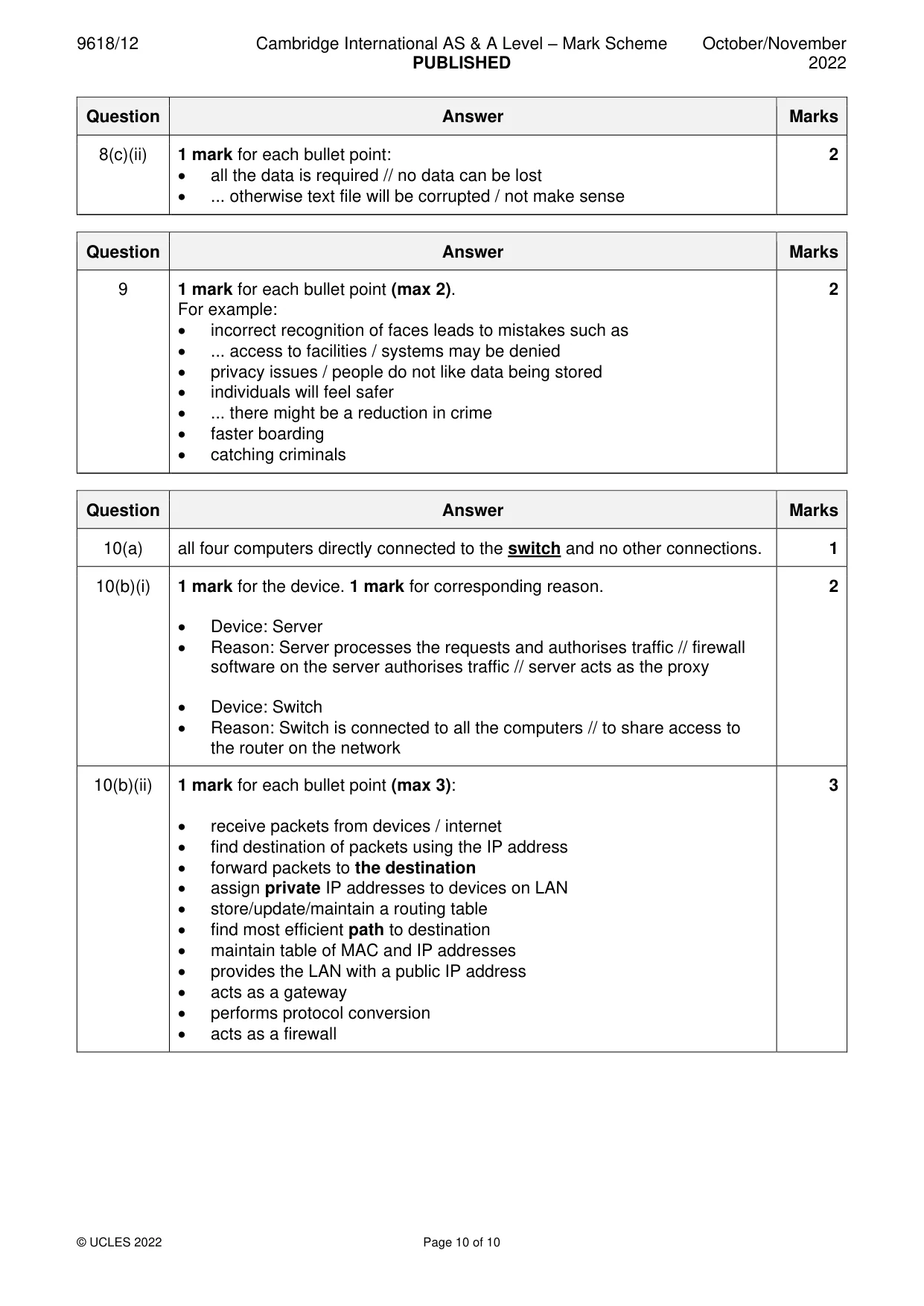
9618/12 Cambridge International AS & A Level – Mark Scheme PUBLISHED October/November 2022 © UCLES 2022 Page 10 of 10 Question Answer Marks 8(c)(ii) 1 mark for each bullet point: • all the data is required // no data can be lost • ... otherwise text file will be corrupted / not make sense 2 Question Answer Marks 9 1 mark for each bullet point (max 2). For example: • incorrect recognition of faces leads to mistakes such as • ... access to facilities / systems may be denied • privacy issues / people do not like data being stored • individuals will feel safer • ... there might be a reduction in crime • faster boarding • catching criminals 2 Question Answer Marks 10(a) all four computers directly connected to the switch and no other connections. 1 10(b)(i) 1 mark for the device. 1 mark for corresponding reason. • Device: Server • Reason: Server processes the requests and authorises traffic // firewall software on the server authorises traffic // server acts as the proxy • Device: Switch • Reason: Switch is connected to all the computers // to share access to the router on the network 2 10(b)(ii) 1 mark for each bullet point (max 3): • receive packets from devices / internet • find destination of packets using the IP address • forward packets to the destination • assign private IP addresses to devices on LAN • store/update/maintain a routing table • find most efficient path to destination • maintain table of MAC and IP addresses • provides the LAN with a public IP address • acts as a gateway • performs protocol conversion • acts as a firewall 3
What you needed in this session
Cambridge’s own grade thresholds for 2022 Oct/Nov, Paper 1 · Variant 2. A higher threshold means an easier paper — the bar moves with how the cohort did.