Cambridge A Level Classical Studies 9274 — 2022 Oct/Nov Paper 3 · Variant 3
9274/33/O/N/22 · 50 marks · ≈56 min
The question paper and its mark scheme, free to read here and free to download. This is Cambridge’s own paper, exactly as it was sat.
Question paper4 pages
Mark scheme11 pages
Answers below. Sit the paper first if you are practising.
Paper as text
Question paper, page 1
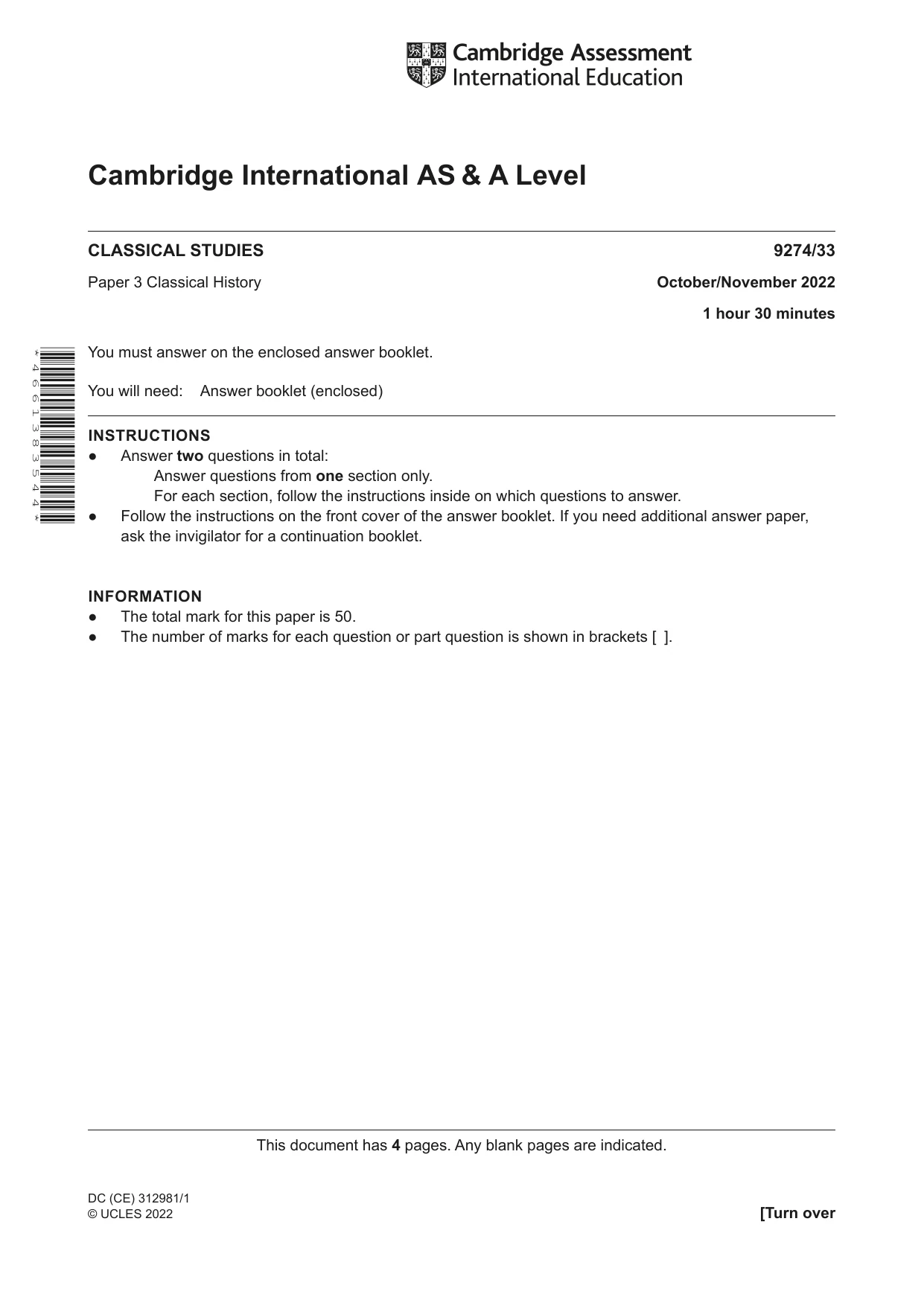
This document has 4 pages. Any blank pages are indicated. [Turn over Cambridge International AS & A Level DC (CE) 312981/1 © UCLES 2022 * 4 6 6 1 3 8 3 5 4 4 * CLASSICAL STUDIES 9274/33 Paper 3 Classical History October/November 2022 1 hour 30 minutes You must answer on the enclosed answer booklet. You will need: Answer booklet (enclosed) INSTRUCTIONS ● Answer two questions in total: Answer questions from one section only. For each section, follow the instructions inside on which questions to answer. ● Follow the instructions on the front cover of the answer booklet. If you need additional answer paper, ask the invigilator for a continuation booklet. INFORMATION ● The total mark for this paper is 50. ● The number of marks for each question or part question is shown in brackets [ ].
Question paper, page 2
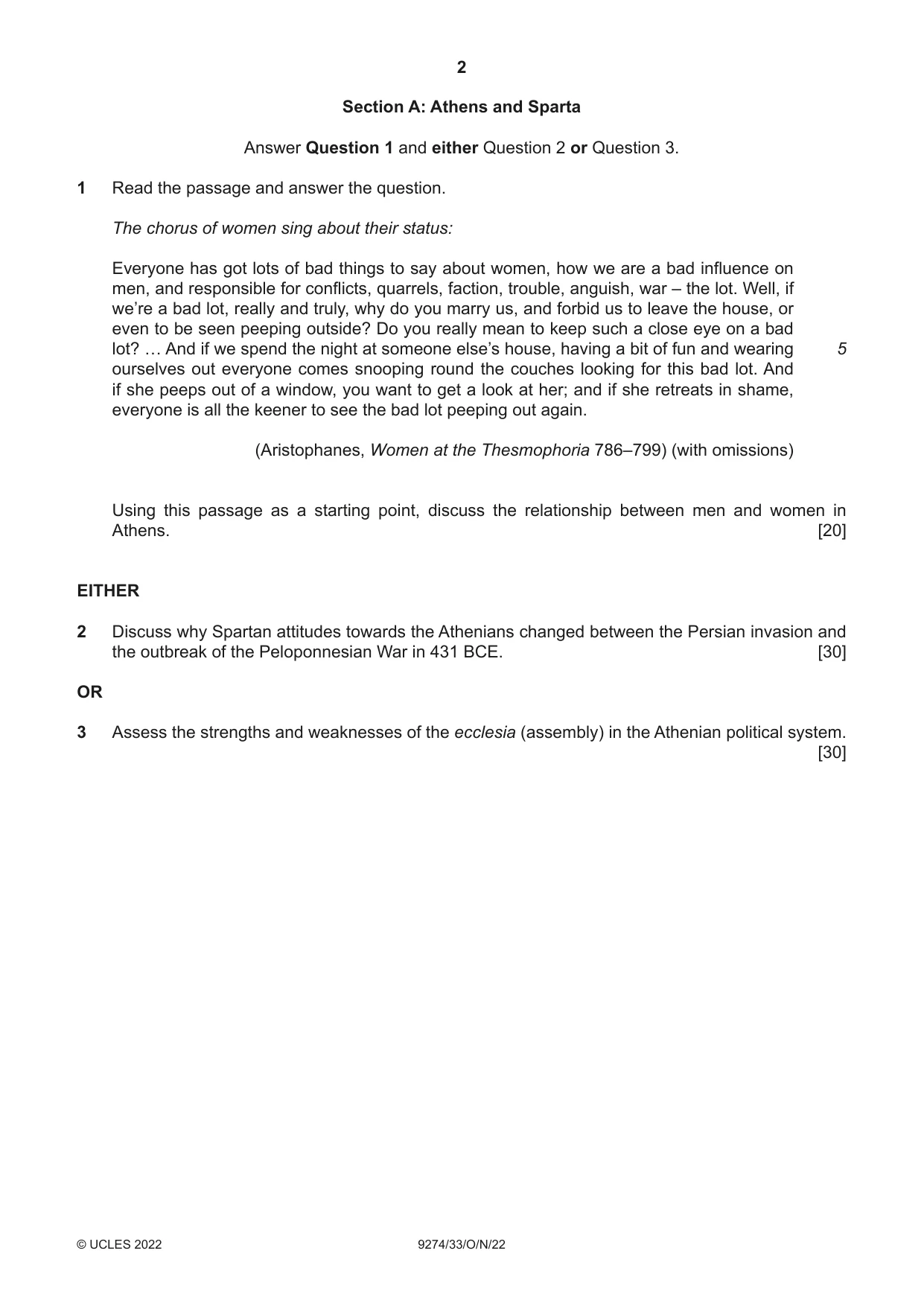
2 9274/33/O/N/22 © UCLES 2022 Section A: Athens and Sparta Answer Question 1 and either Question 2 or Question 3. 1 Read the passage and answer the question. The chorus of women sing about their status: Everyone has got lots of bad things to say about women, how we are a bad influence on men, and responsible for conflicts, quarrels, faction, trouble, anguish, war – the lot. Well, if we’re a bad lot, really and truly, why do you marry us, and forbid us to leave the house, or even to be seen peeping outside? Do you really mean to keep such a close eye on a bad lot? … And if we spend the night at someone else’s house, having a bit of fun and wearing ourselves out everyone comes snooping round the couches looking for this bad lot. And if she peeps out of a window, you want to get a look at her; and if she retreats in shame, everyone is all the keener to see the bad lot peeping out again. (Aristophanes, Women at the Thesmophoria 786–799) (with omissions) Using this passage as a starting point, discuss the relationship between men and women in Athens. [20] EITHER 2 Discuss why Spartan attitudes towards the Athenians changed between the Persian invasion and the outbreak of the Peloponnesian War in 431 BCE. [30] OR 3 Assess the strengths and weaknesses of the ecclesia (assembly) in the Athenian political system. [30] 5
Question paper, page 3
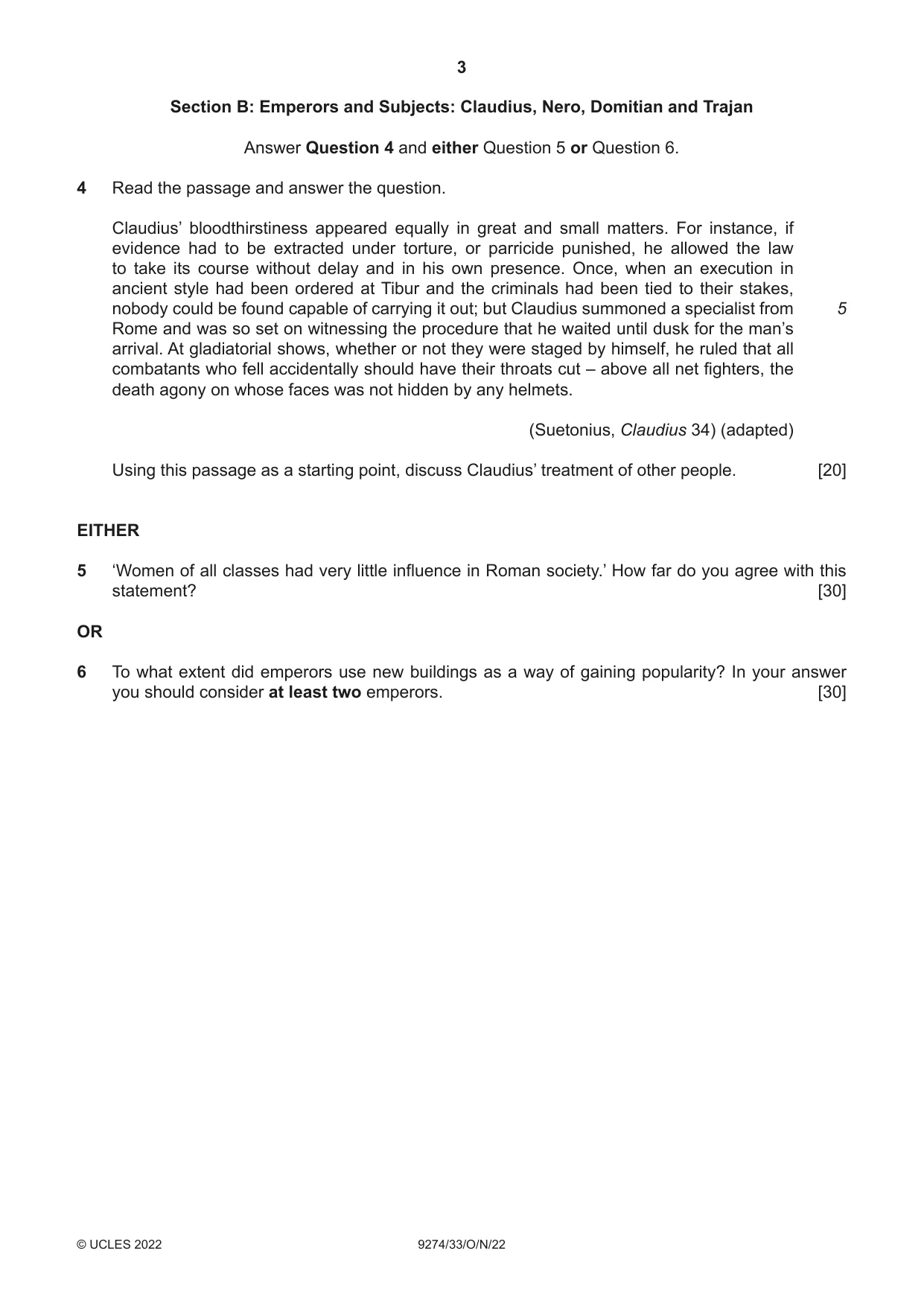
3 9274/33/O/N/22 © UCLES 2022 Section B: Emperors and Subjects: Claudius, Nero, Domitian and Trajan Answer Question 4 and either Question 5 or Question 6. 4 Read the passage and answer the question. Claudius’ bloodthirstiness appeared equally in great and small matters. For instance, if evidence had to be extracted under torture, or parricide punished, he allowed the law to take its course without delay and in his own presence. Once, when an execution in ancient style had been ordered at Tibur and the criminals had been tied to their stakes, nobody could be found capable of carrying it out; but Claudius summoned a specialist from Rome and was so set on witnessing the procedure that he waited until dusk for the man’s arrival. At gladiatorial shows, whether or not they were staged by himself, he ruled that all combatants who fell accidentally should have their throats cut – above all net fighters, the death agony on whose faces was not hidden by any helmets. (Suetonius, Claudius 34) (adapted) Using this passage as a starting point, discuss Claudius’ treatment of other people. [20] EITHER 5 ‘Women of all classes had very little influence in Roman society.’ How far do you agree with this statement? [30] OR 6 To what extent did emperors use new buildings as a way of gaining popularity? In your answer you should consider at least two emperors. [30] 5
Question paper, page 4
4 9274/33/O/N/22 © UCLES 2022 Permission to reproduce items where third-party owned material protected by copyright is included has been sought and cleared where possible. Every reasonable effort has been made by the publisher (UCLES) to trace copyright holders, but if any items requiring clearance have unwittingly been included, the publisher will be pleased to make amends at the earliest possible opportunity. To avoid the issue of disclosure of answer-related information to candidates, all copyright acknowledgements are reproduced online in the Cambridge Assessment International Education Copyright Acknowledgements Booklet. This is produced for each series of examinations and is freely available to download at www.cambridgeinternational.org after the live examination series. Cambridge Assessment International Education is part of Cambridge Assessment. Cambridge Assessment is the brand name of the University of Cambridge Local Examinations Syndicate (UCLES), which is a department of the University of Cambridge. BLANK PAGE
Mark scheme, page 1
This document consists of 11 printed pages. © UCLES 2022 [Turn over Cambridge International AS & A Level CLASSICAL STUDIES 9274/33 Paper 3 Classical History October/November 2022 MARK SCHEME Maximum Mark: 50 Published This mark scheme is published as an aid to teachers and candidates, to indicate the requirements of the examination. It shows the basis on which Examiners were instructed to award marks. It does not indicate the details of the discussions that took place at an Examiners’ meeting before marking began, which would have considered the acceptability of alternative answers. Mark schemes should be read in conjunction with the question paper and the Principal Examiner Report for Teachers. Cambridge International will not enter into discussions about these mark schemes. Cambridge International is publishing the mark schemes for the October/November 2022 series for most Cambridge IGCSE™, Cambridge International A and AS Level components and some Cambridge O Level components.
Mark scheme, page 2
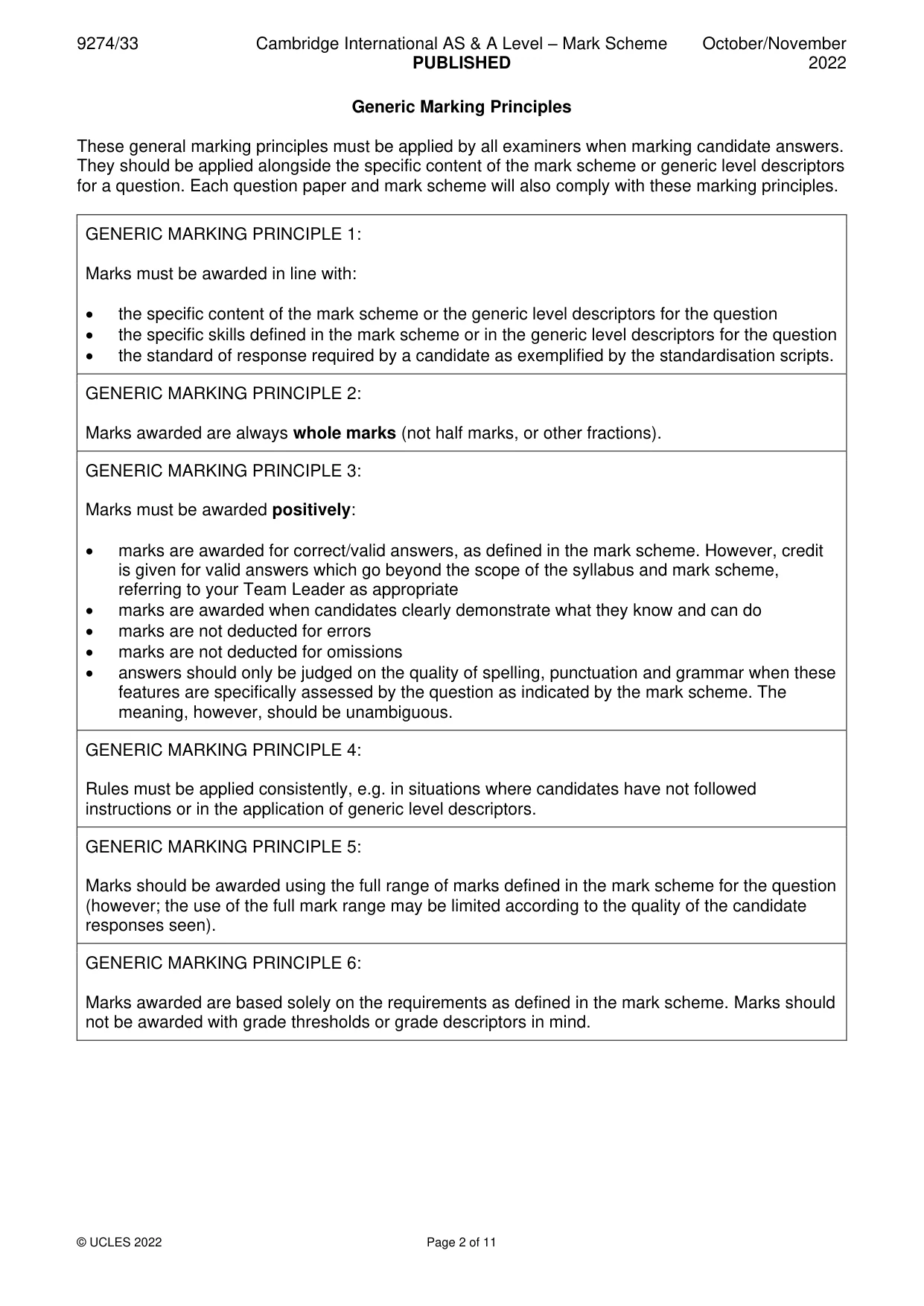
9274/33 Cambridge International AS & A Level – Mark Scheme PUBLISHED October/November 2022 © UCLES 2022 Page 2 of 11 Generic Marking Principles These general marking principles must be applied by all examiners when marking candidate answers. They should be applied alongside the specific content of the mark scheme or generic level descriptors for a question. Each question paper and mark scheme will also comply with these marking principles. GENERIC MARKING PRINCIPLE 1: Marks must be awarded in line with: • the specific content of the mark scheme or the generic level descriptors for the question • the specific skills defined in the mark scheme or in the generic level descriptors for the question • the standard of response required by a candidate as exemplified by the standardisation scripts. GENERIC MARKING PRINCIPLE 2: Marks awarded are always whole marks (not half marks, or other fractions). GENERIC MARKING PRINCIPLE 3: Marks must be awarded positively: • marks are awarded for correct/valid answers, as defined in the mark scheme. However, credit is given for valid answers which go beyond the scope of the syllabus and mark scheme, referring to your Team Leader as appropriate • marks are awarded when candidates clearly demonstrate what they know and can do • marks are not deducted for errors • marks are not deducted for omissions • answers should only be judged on the quality of spelling, punctuation and grammar when these features are specifically assessed by the question as indicated by the mark scheme. The meaning, however, should be unambiguous. GENERIC MARKING PRINCIPLE 4: Rules must be applied consistently, e.g. in situations where candidates have not followed instructions or in the application of generic level descriptors. GENERIC MARKING PRINCIPLE 5: Marks should be awarded using the full range of marks defined in the mark scheme for the question (however; the use of the full mark range may be limited according to the quality of the candidate responses seen). GENERIC MARKING PRINCIPLE 6: Marks awarded are based solely on the requirements as defined in the mark scheme. Marks should not be awarded with grade thresholds or grade descriptors in mind.
Mark scheme, page 3
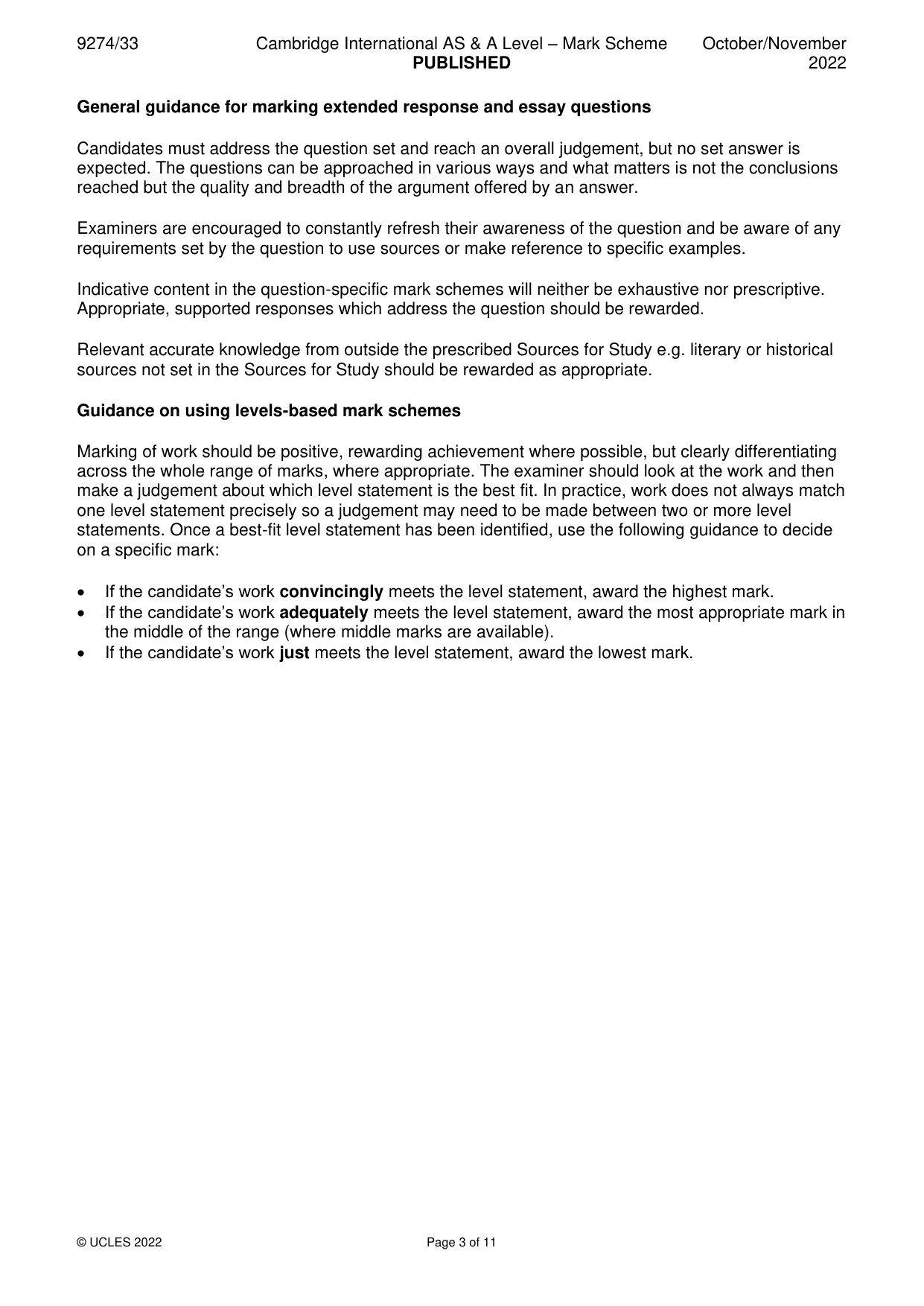
9274/33 Cambridge International AS & A Level – Mark Scheme PUBLISHED October/November 2022 © UCLES 2022 Page 3 of 11 General guidance for marking extended response and essay questions Candidates must address the question set and reach an overall judgement, but no set answer is expected. The questions can be approached in various ways and what matters is not the conclusions reached but the quality and breadth of the argument offered by an answer. Examiners are encouraged to constantly refresh their awareness of the question and be aware of any requirements set by the question to use sources or make reference to specific examples. Indicative content in the question-specific mark schemes will neither be exhaustive nor prescriptive. Appropriate, supported responses which address the question should be rewarded. Relevant accurate knowledge from outside the prescribed Sources for Study e.g. literary or historical sources not set in the Sources for Study should be rewarded as appropriate. Guidance on using levels-based mark schemes Marking of work should be positive, rewarding achievement where possible, but clearly differentiating across the whole range of marks, where appropriate. The examiner should look at the work and then make a judgement about which level statement is the best fit. In practice, work does not always match one level statement precisely so a judgement may need to be made between two or more level statements. Once a best-fit level statement has been identified, use the following guidance to decide on a specific mark: • If the candidate’s work convincingly meets the level statement, award the highest mark. • If the candidate’s work adequately meets the level statement, award the most appropriate mark in the middle of the range (where middle marks are available). • If the candidate’s work just meets the level statement, award the lowest mark.
Mark scheme, page 4
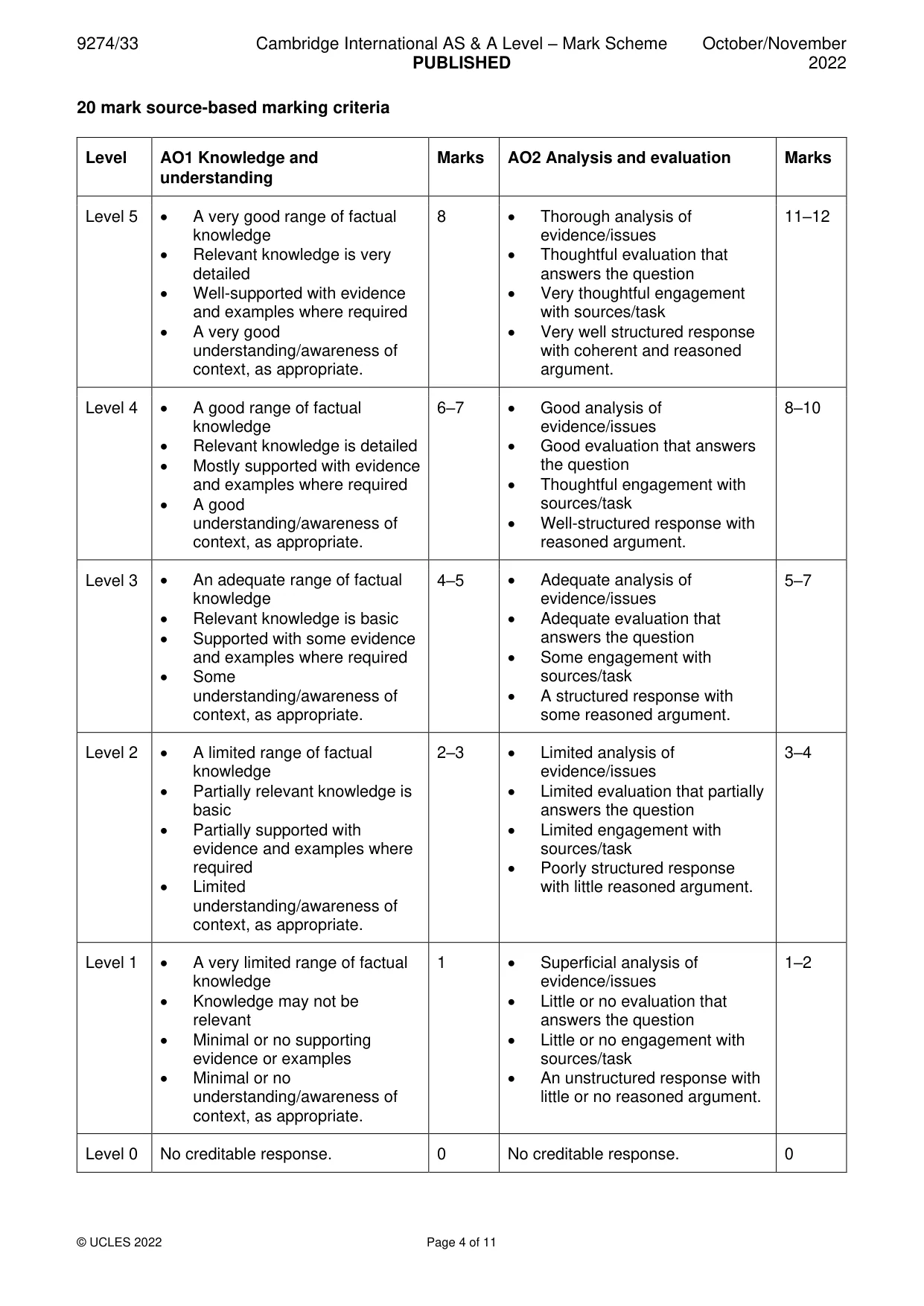
9274/33 Cambridge International AS & A Level – Mark Scheme PUBLISHED October/November 2022 © UCLES 2022 Page 4 of 11 20 mark source-based marking criteria Level AO1 Knowledge and understanding Marks AO2 Analysis and evaluation Marks Level 5 • A very good range of factual knowledge • Relevant knowledge is very detailed • Well-supported with evidence and examples where required • A very good understanding/awareness of context, as appropriate. 8 • Thorough analysis of evidence/issues • Thoughtful evaluation that answers the question • Very thoughtful engagement with sources/task • Very well structured response with coherent and reasoned argument. 11–12 Level 4 • A good range of factual knowledge • Relevant knowledge is detailed • Mostly supported with evidence and examples where required • A good understanding/awareness of context, as appropriate. 6–7 • Good analysis of evidence/issues • Good evaluation that answers the question • Thoughtful engagement with sources/task • Well-structured response with reasoned argument. 8–10 Level 3 • An adequate range of factual knowledge • Relevant knowledge is basic • Supported with some evidence and examples where required • Some understanding/awareness of context, as appropriate. 4–5 • Adequate analysis of evidence/issues • Adequate evaluation that answers the question • Some engagement with sources/task • A structured response with some reasoned argument. 5–7 Level 2 • A limited range of factual knowledge • Partially relevant knowledge is basic • Partially supported with evidence and examples where required • Limited understanding/awareness of context, as appropriate. 2–3 • Limited analysis of evidence/issues • Limited evaluation that partially answers the question • Limited engagement with sources/task • Poorly structured response with little reasoned argument. 3–4 Level 1 • A very limited range of factual knowledge • Knowledge may not be relevant • Minimal or no supporting evidence or examples • Minimal or no understanding/awareness of context, as appropriate. 1 • Superficial analysis of evidence/issues • Little or no evaluation that answers the question • Little or no engagement with sources/task • An unstructured response with little or no reasoned argument. 1–2 Level 0 No creditable response. 0 No creditable response. 0
Mark scheme, page 5
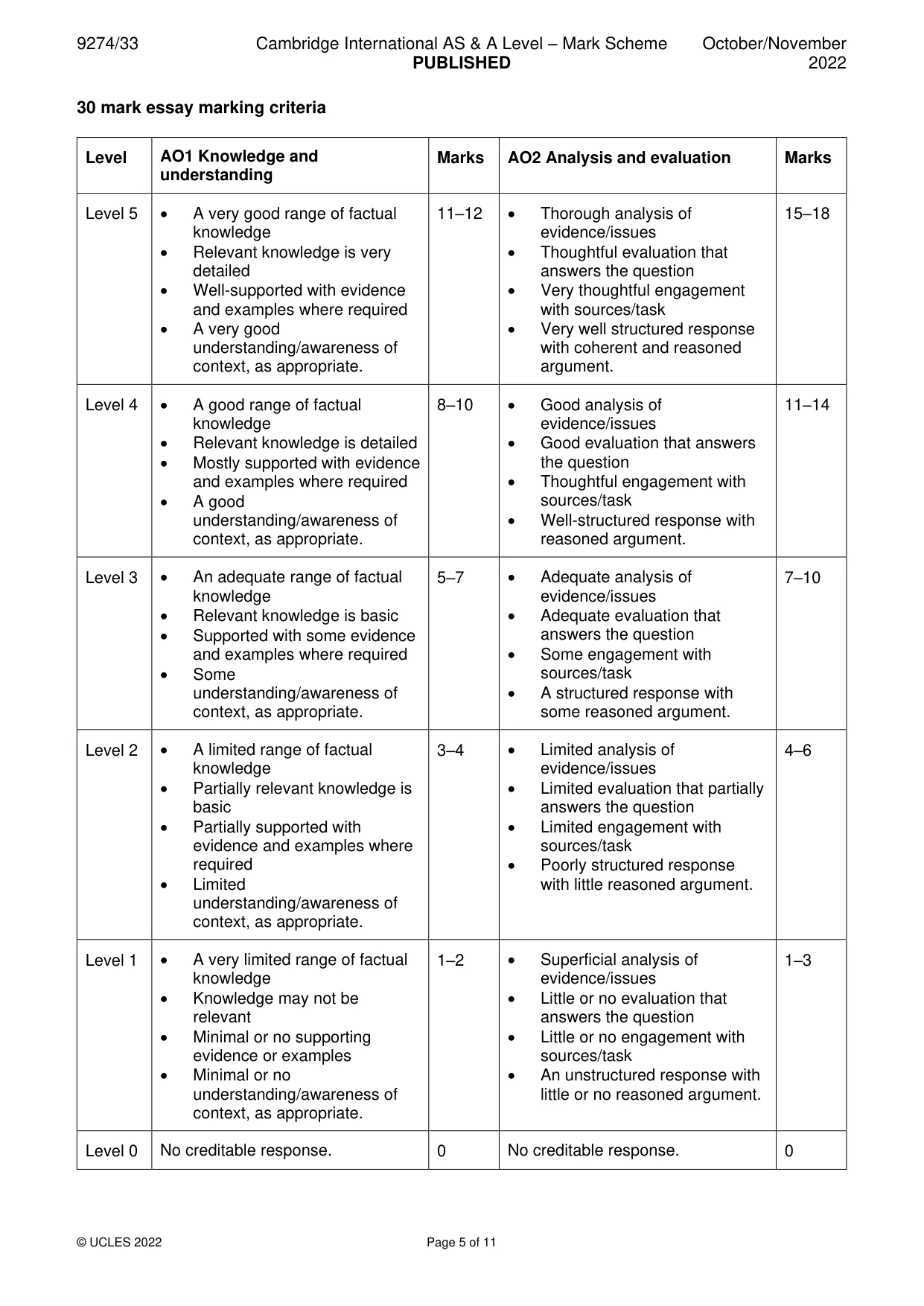
9274/33 Cambridge International AS & A Level – Mark Scheme PUBLISHED October/November 2022 © UCLES 2022 Page 5 of 11 30 mark essay marking criteria Level AO1 Knowledge and understanding Marks AO2 Analysis and evaluation Marks Level 5 • A very good range of factual knowledge • Relevant knowledge is very detailed • Well-supported with evidence and examples where required • A very good understanding/awareness of context, as appropriate. 11–12 • Thorough analysis of evidence/issues • Thoughtful evaluation that answers the question • Very thoughtful engagement with sources/task • Very well structured response with coherent and reasoned argument. 15–18 Level 4 • A good range of factual knowledge • Relevant knowledge is detailed • Mostly supported with evidence and examples where required • A good understanding/awareness of context, as appropriate. 8–10 • Good analysis of evidence/issues • Good evaluation that answers the question • Thoughtful engagement with sources/task • Well-structured response with reasoned argument. 11–14 Level 3 • An adequate range of factual knowledge • Relevant knowledge is basic • Supported with some evidence and examples where required • Some understanding/awareness of context, as appropriate. 5–7 • Adequate analysis of evidence/issues • Adequate evaluation that answers the question • Some engagement with sources/task • A structured response with some reasoned argument. 7–10 Level 2 • A limited range of factual knowledge • Partially relevant knowledge is basic • Partially supported with evidence and examples where required • Limited understanding/awareness of context, as appropriate. 3–4 • Limited analysis of evidence/issues • Limited evaluation that partially answers the question • Limited engagement with sources/task • Poorly structured response with little reasoned argument. 4–6 Level 1 • A very limited range of factual knowledge • Knowledge may not be relevant • Minimal or no supporting evidence or examples • Minimal or no understanding/awareness of context, as appropriate. 1–2 • Superficial analysis of evidence/issues • Little or no evaluation that answers the question • Little or no engagement with sources/task • An unstructured response with little or no reasoned argument. 1–3 Level 0 No creditable response. 0 No creditable response. 0
Mark scheme, page 6
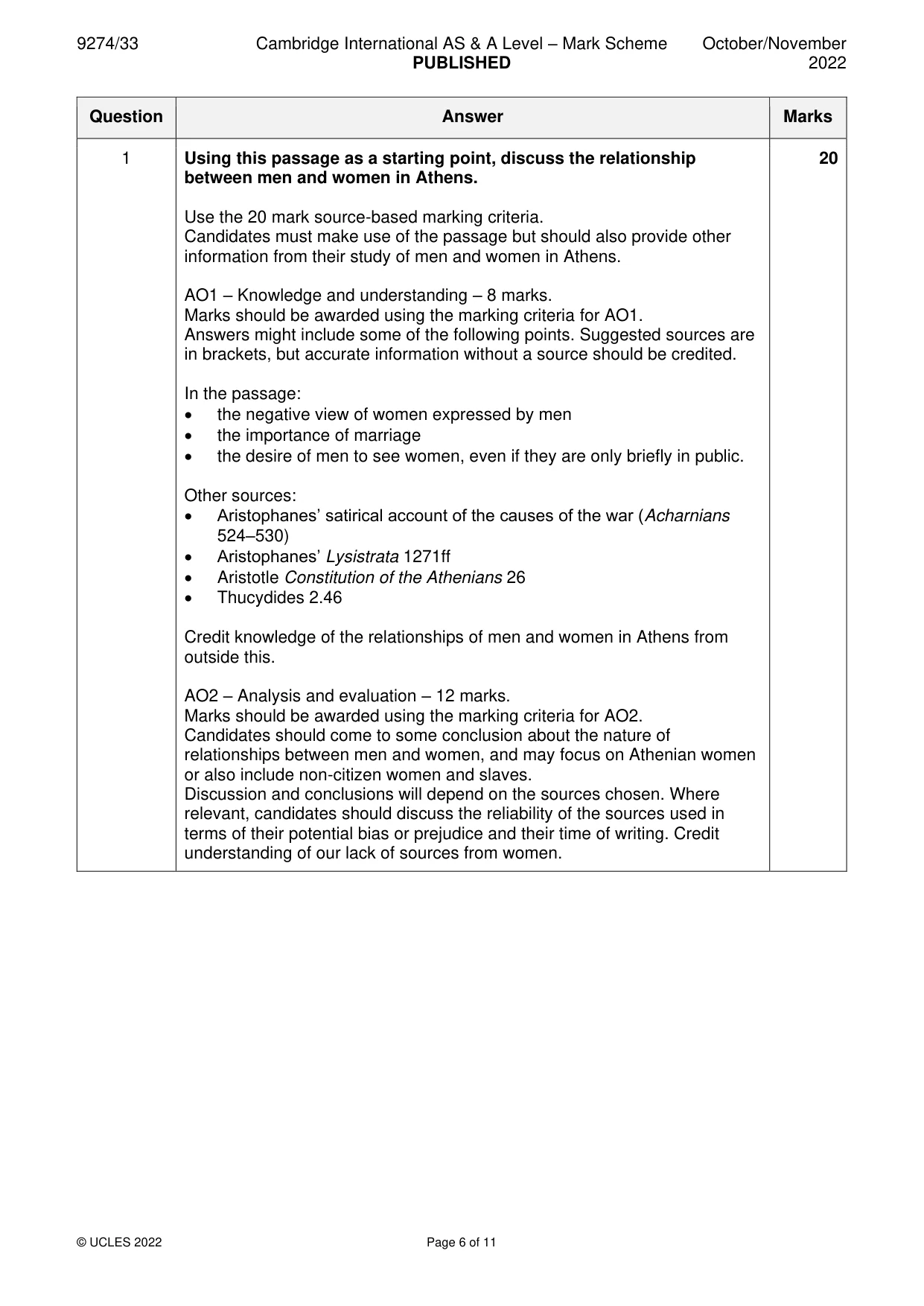
9274/33 Cambridge International AS & A Level – Mark Scheme PUBLISHED October/November 2022 © UCLES 2022 Page 6 of 11 Question Answer Marks 1 Using this passage as a starting point, discuss the relationship between men and women in Athens. Use the 20 mark source-based marking criteria. Candidates must make use of the passage but should also provide other information from their study of men and women in Athens. AO1 – Knowledge and understanding – 8 marks. Marks should be awarded using the marking criteria for AO1. Answers might include some of the following points. Suggested sources are in brackets, but accurate information without a source should be credited. In the passage: • the negative view of women expressed by men • the importance of marriage • the desire of men to see women, even if they are only briefly in public. Other sources: • Aristophanes’ satirical account of the causes of the war (Acharnians 524–530) • Aristophanes’ Lysistrata 1271ff • Aristotle Constitution of the Athenians 26 • Thucydides 2.46 Credit knowledge of the relationships of men and women in Athens from outside this. AO2 – Analysis and evaluation – 12 marks. Marks should be awarded using the marking criteria for AO2. Candidates should come to some conclusion about the nature of relationships between men and women, and may focus on Athenian women or also include non-citizen women and slaves. Discussion and conclusions will depend on the sources chosen. Where relevant, candidates should discuss the reliability of the sources used in terms of their potential bias or prejudice and their time of writing. Credit understanding of our lack of sources from women. 20
Mark scheme, page 7
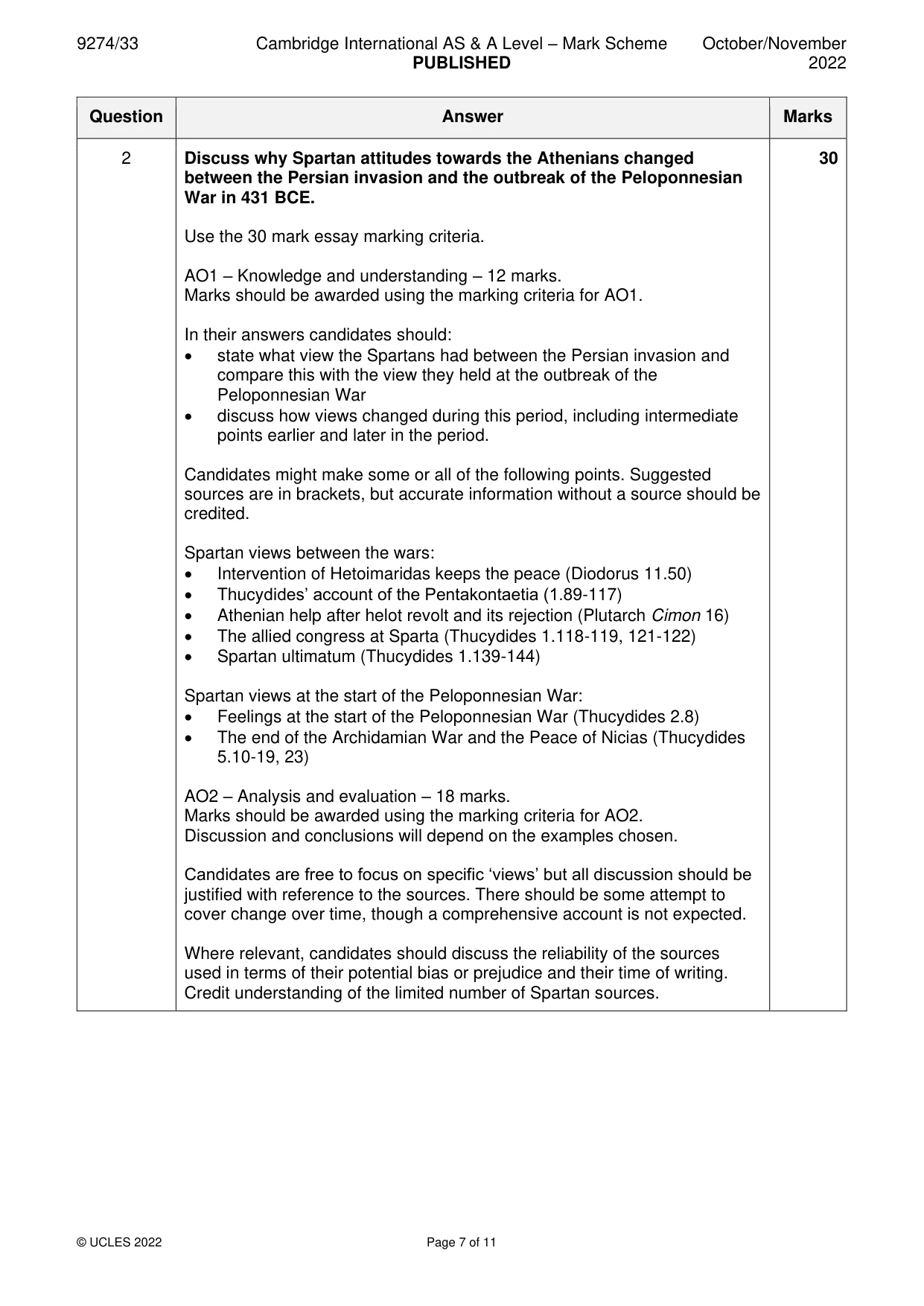
9274/33 Cambridge International AS & A Level – Mark Scheme PUBLISHED October/November 2022 © UCLES 2022 Page 7 of 11 Question Answer Marks 2 Discuss why Spartan attitudes towards the Athenians changed between the Persian invasion and the outbreak of the Peloponnesian War in 431 BCE. Use the 30 mark essay marking criteria. AO1 – Knowledge and understanding – 12 marks. Marks should be awarded using the marking criteria for AO1. In their answers candidates should: • state what view the Spartans had between the Persian invasion and compare this with the view they held at the outbreak of the Peloponnesian War • discuss how views changed during this period, including intermediate points earlier and later in the period. Candidates might make some or all of the following points. Suggested sources are in brackets, but accurate information without a source should be credited. Spartan views between the wars: • Intervention of Hetoimaridas keeps the peace (Diodorus 11.50) • Thucydides’ account of the Pentakontaetia (1.89-117) • Athenian help after helot revolt and its rejection (Plutarch Cimon 16) • The allied congress at Sparta (Thucydides 1.118-119, 121-122) • Spartan ultimatum (Thucydides 1.139-144) Spartan views at the start of the Peloponnesian War: • Feelings at the start of the Peloponnesian War (Thucydides 2.8) • The end of the Archidamian War and the Peace of Nicias (Thucydides 5.10-19, 23) AO2 – Analysis and evaluation – 18 marks. Marks should be awarded using the marking criteria for AO2. Discussion and conclusions will depend on the examples chosen. Candidates are free to focus on specific ‘views’ but all discussion should be justified with reference to the sources. There should be some attempt to cover change over time, though a comprehensive account is not expected. Where relevant, candidates should discuss the reliability of the sources used in terms of their potential bias or prejudice and their time of writing. Credit understanding of the limited number of Spartan sources. 30
Mark scheme, page 8
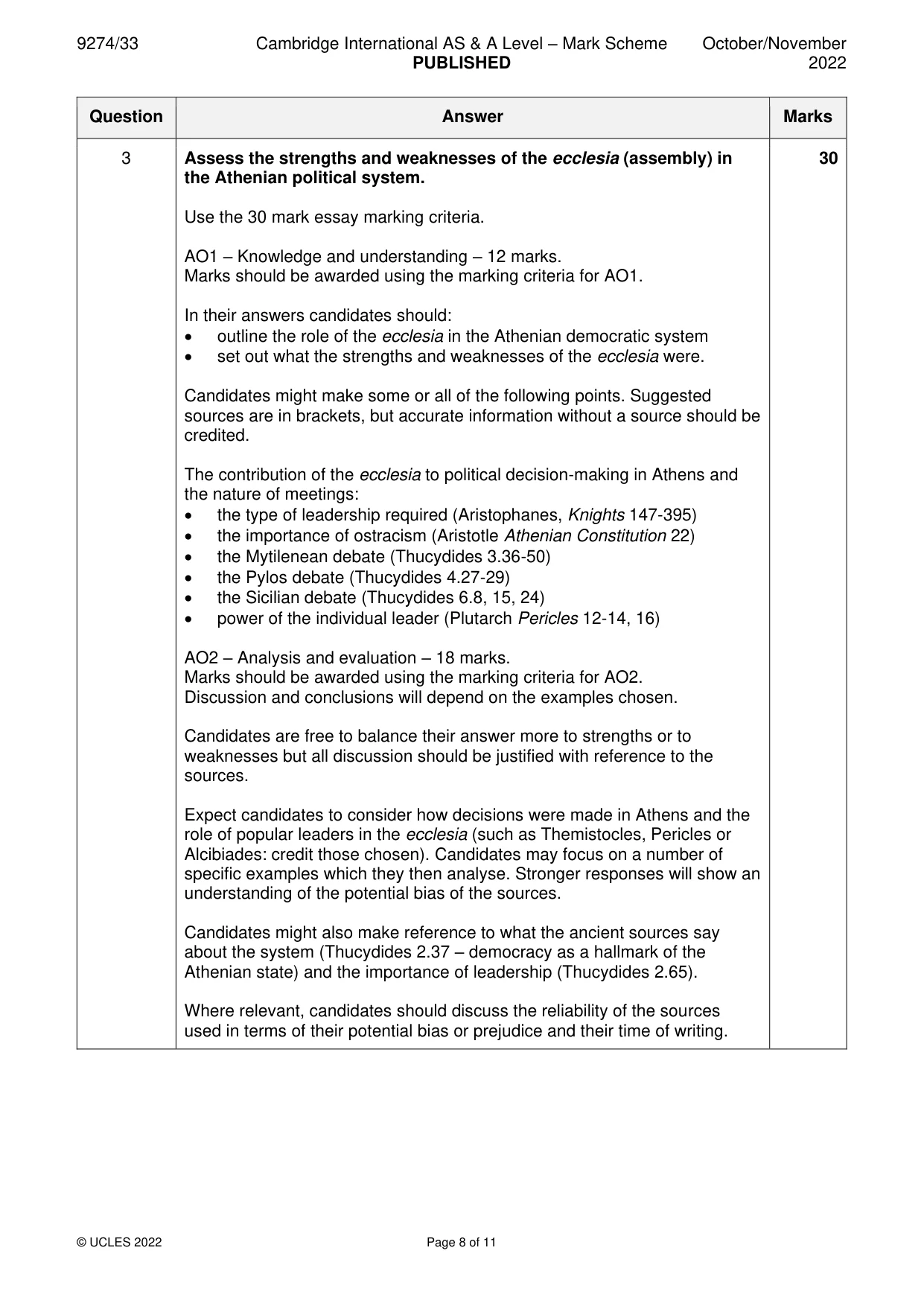
9274/33 Cambridge International AS & A Level – Mark Scheme PUBLISHED October/November 2022 © UCLES 2022 Page 8 of 11 Question Answer Marks 3 Assess the strengths and weaknesses of the ecclesia (assembly) in the Athenian political system. Use the 30 mark essay marking criteria. AO1 – Knowledge and understanding – 12 marks. Marks should be awarded using the marking criteria for AO1. In their answers candidates should: • outline the role of the ecclesia in the Athenian democratic system • set out what the strengths and weaknesses of the ecclesia were. Candidates might make some or all of the following points. Suggested sources are in brackets, but accurate information without a source should be credited. The contribution of the ecclesia to political decision-making in Athens and the nature of meetings: • the type of leadership required (Aristophanes, Knights 147-395) • the importance of ostracism (Aristotle Athenian Constitution 22) • the Mytilenean debate (Thucydides 3.36-50) • the Pylos debate (Thucydides 4.27-29) • the Sicilian debate (Thucydides 6.8, 15, 24) • power of the individual leader (Plutarch Pericles 12-14, 16) AO2 – Analysis and evaluation – 18 marks. Marks should be awarded using the marking criteria for AO2. Discussion and conclusions will depend on the examples chosen. Candidates are free to balance their answer more to strengths or to weaknesses but all discussion should be justified with reference to the sources. Expect candidates to consider how decisions were made in Athens and the role of popular leaders in the ecclesia (such as Themistocles, Pericles or Alcibiades: credit those chosen). Candidates may focus on a number of specific examples which they then analyse. Stronger responses will show an understanding of the potential bias of the sources. Candidates might also make reference to what the ancient sources say about the system (Thucydides 2.37 – democracy as a hallmark of the Athenian state) and the importance of leadership (Thucydides 2.65). Where relevant, candidates should discuss the reliability of the sources used in terms of their potential bias or prejudice and their time of writing. 30
Mark scheme, page 9
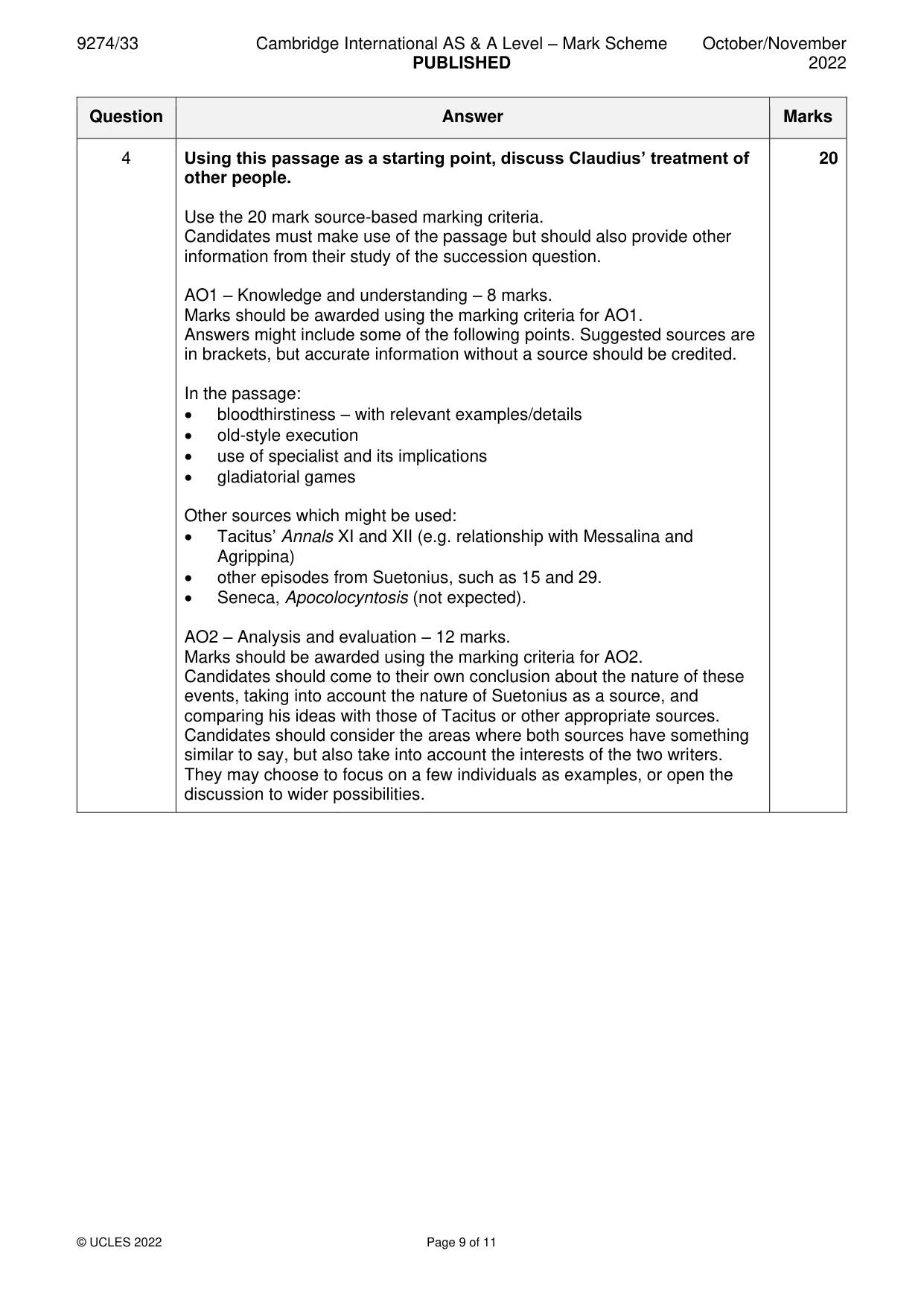
9274/33 Cambridge International AS & A Level – Mark Scheme PUBLISHED October/November 2022 © UCLES 2022 Page 9 of 11 Question Answer Marks 4 Using this passage as a starting point, discuss Claudius’ treatment of other people. Use the 20 mark source-based marking criteria. Candidates must make use of the passage but should also provide other information from their study of the succession question. AO1 – Knowledge and understanding – 8 marks. Marks should be awarded using the marking criteria for AO1. Answers might include some of the following points. Suggested sources are in brackets, but accurate information without a source should be credited. In the passage: • bloodthirstiness – with relevant examples/details • old-style execution • use of specialist and its implications • gladiatorial games Other sources which might be used: • Tacitus’ Annals XI and XII (e.g. relationship with Messalina and Agrippina) • other episodes from Suetonius, such as 15 and 29. • Seneca, Apocolocyntosis (not expected). AO2 – Analysis and evaluation – 12 marks. Marks should be awarded using the marking criteria for AO2. Candidates should come to their own conclusion about the nature of these events, taking into account the nature of Suetonius as a source, and comparing his ideas with those of Tacitus or other appropriate sources. Candidates should consider the areas where both sources have something similar to say, but also take into account the interests of the two writers. They may choose to focus on a few individuals as examples, or open the discussion to wider possibilities. 20
Mark scheme, page 10
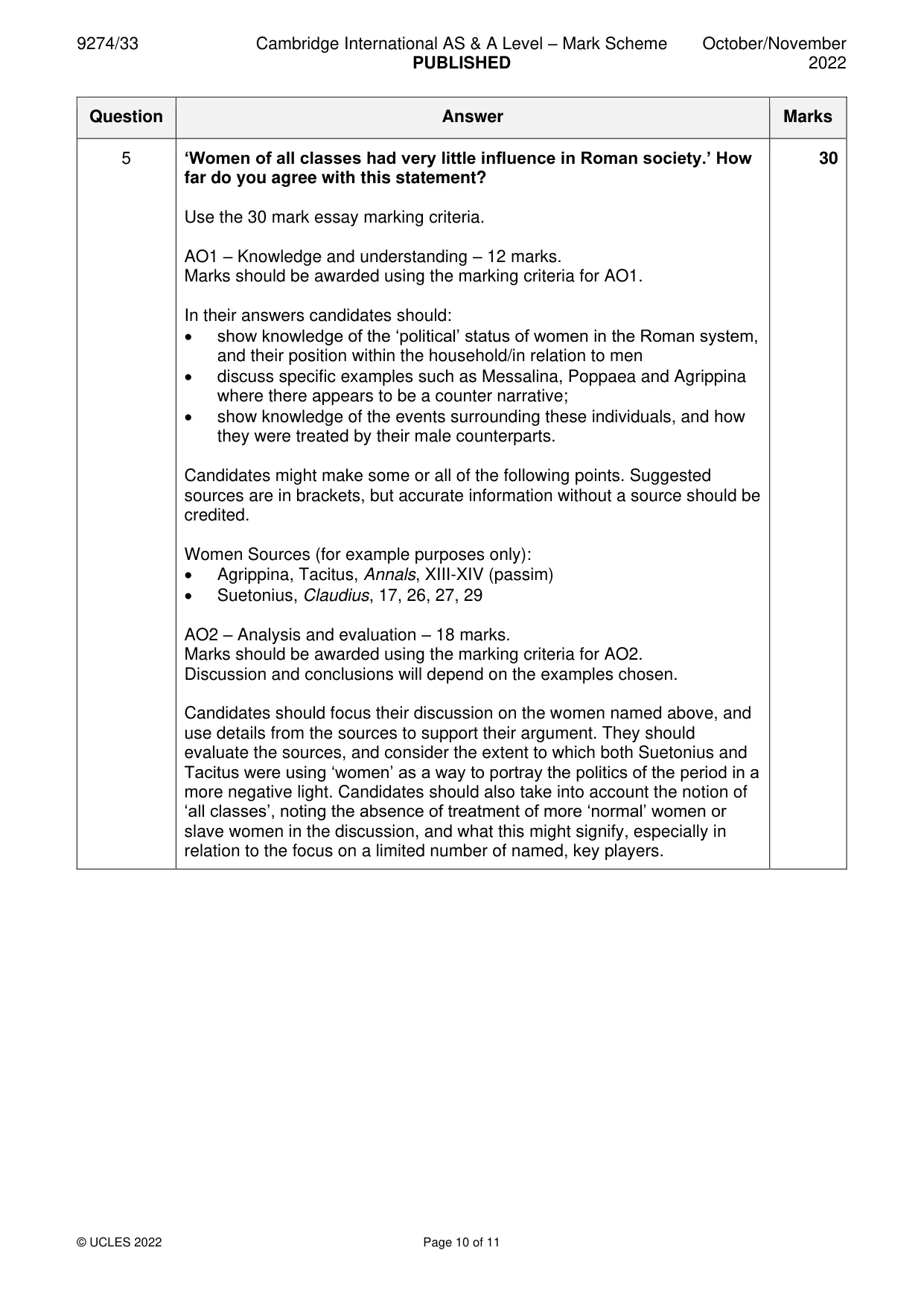
9274/33 Cambridge International AS & A Level – Mark Scheme PUBLISHED October/November 2022 © UCLES 2022 Page 10 of 11 Question Answer Marks 5 ‘Women of all classes had very little influence in Roman society.’ How far do you agree with this statement? Use the 30 mark essay marking criteria. AO1 – Knowledge and understanding – 12 marks. Marks should be awarded using the marking criteria for AO1. In their answers candidates should: • show knowledge of the ‘political’ status of women in the Roman system, and their position within the household/in relation to men • discuss specific examples such as Messalina, Poppaea and Agrippina where there appears to be a counter narrative; • show knowledge of the events surrounding these individuals, and how they were treated by their male counterparts. Candidates might make some or all of the following points. Suggested sources are in brackets, but accurate information without a source should be credited. Women Sources (for example purposes only): • Agrippina, Tacitus, Annals, XIII-XIV (passim) • Suetonius, Claudius, 17, 26, 27, 29 AO2 – Analysis and evaluation – 18 marks. Marks should be awarded using the marking criteria for AO2. Discussion and conclusions will depend on the examples chosen. Candidates should focus their discussion on the women named above, and use details from the sources to support their argument. They should evaluate the sources, and consider the extent to which both Suetonius and Tacitus were using ‘women’ as a way to portray the politics of the period in a more negative light. Candidates should also take into account the notion of ‘all classes’, noting the absence of treatment of more ‘normal’ women or slave women in the discussion, and what this might signify, especially in relation to the focus on a limited number of named, key players. 30
Mark scheme, page 11
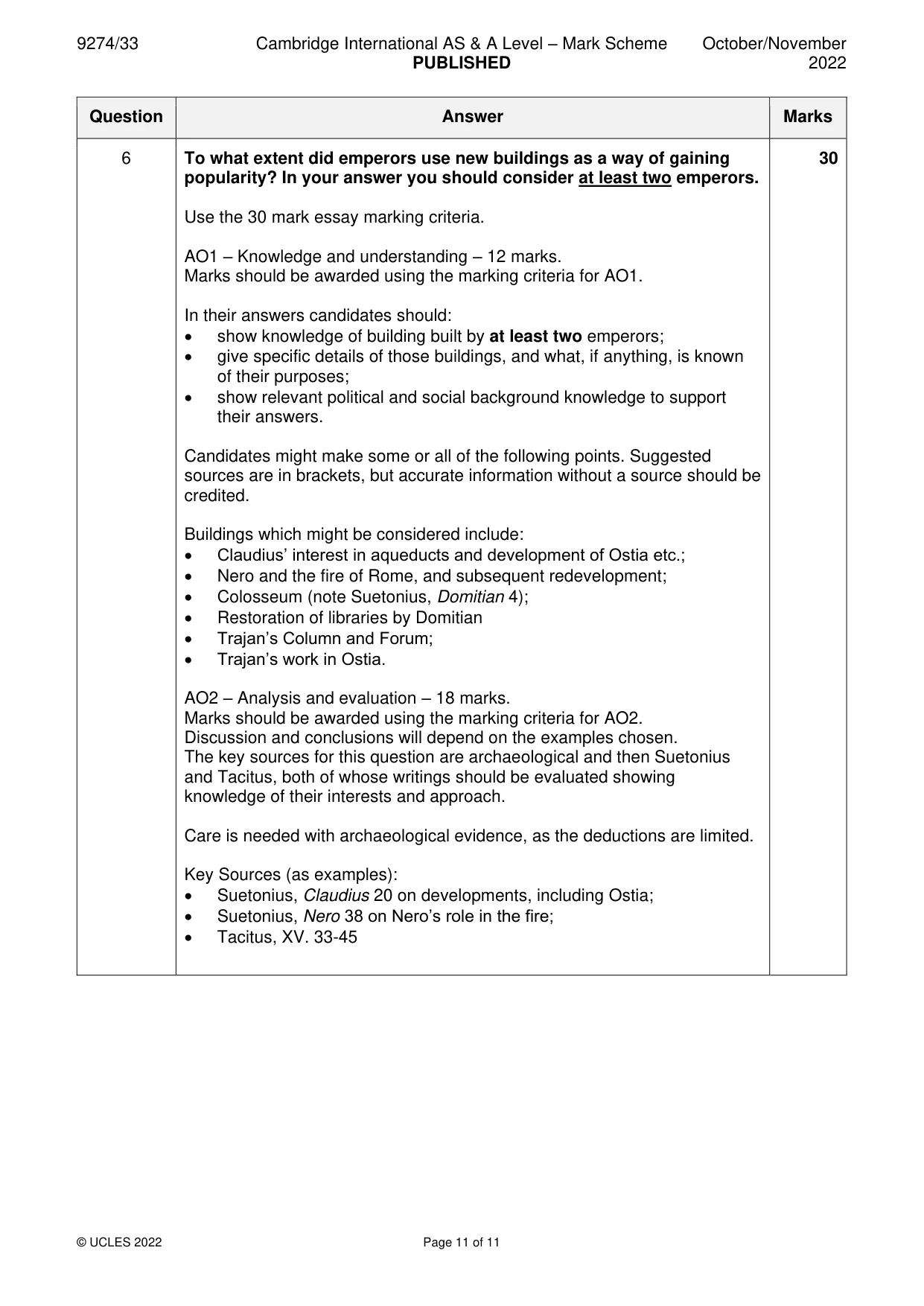
9274/33 Cambridge International AS & A Level – Mark Scheme PUBLISHED October/November 2022 © UCLES 2022 Page 11 of 11 Question Answer Marks 6 To what extent did emperors use new buildings as a way of gaining popularity? In your answer you should consider at least two emperors. Use the 30 mark essay marking criteria. AO1 – Knowledge and understanding – 12 marks. Marks should be awarded using the marking criteria for AO1. In their answers candidates should: • show knowledge of building built by at least two emperors; • give specific details of those buildings, and what, if anything, is known of their purposes; • show relevant political and social background knowledge to support their answers. Candidates might make some or all of the following points. Suggested sources are in brackets, but accurate information without a source should be credited. Buildings which might be considered include: • Claudius’ interest in aqueducts and development of Ostia etc.; • Nero and the fire of Rome, and subsequent redevelopment; • Colosseum (note Suetonius, Domitian 4); • Restoration of libraries by Domitian • Trajan’s Column and Forum; • Trajan’s work in Ostia. AO2 – Analysis and evaluation – 18 marks. Marks should be awarded using the marking criteria for AO2. Discussion and conclusions will depend on the examples chosen. The key sources for this question are archaeological and then Suetonius and Tacitus, both of whose writings should be evaluated showing knowledge of their interests and approach. Care is needed with archaeological evidence, as the deductions are limited. Key Sources (as examples): • Suetonius, Claudius 20 on developments, including Ostia; • Suetonius, Nero 38 on Nero’s role in the fire; • Tacitus, XV. 33-45 30
What you needed in this session
Cambridge’s own grade thresholds for 2022 Oct/Nov, Paper 3 · Variant 3. A higher threshold means an easier paper — the bar moves with how the cohort did.