Cambridge A Level Classical Studies 9274 — 2021 Oct/Nov Paper 3 · Variant 3
9274/33/O/N/21 · 50 marks · ≈56 min
The question paper and its mark scheme, free to read here and free to download. This is Cambridge’s own paper, exactly as it was sat.
Question paper4 pages
Mark scheme7 pages
Answers below. Sit the paper first if you are practising.
Paper as text
Question paper, page 1
This document has 4 pages. Any blank pages are indicated. Cambridge International AS & A Level DC (PQ) 205234/4 © UCLES 2021 [Turn over * 5 6 8 5 5 9 5 4 5 0 * CLASSICAL STUDIES 9274/33 Paper 3 Classical History: Sources and Evidence October/November 2021 1 hour 30 minutes You must answer on the enclosed answer booklet. You will need: Answer booklet (enclosed) INSTRUCTIONS ● Answer one question. ● Follow the instructions on the front cover of the answer booklet. If you need additional answer paper, ask the invigilator for a continuation booklet. INFORMATION ● The total mark for this paper is 50. ● Each question is worth 50 marks.
Question paper, page 2
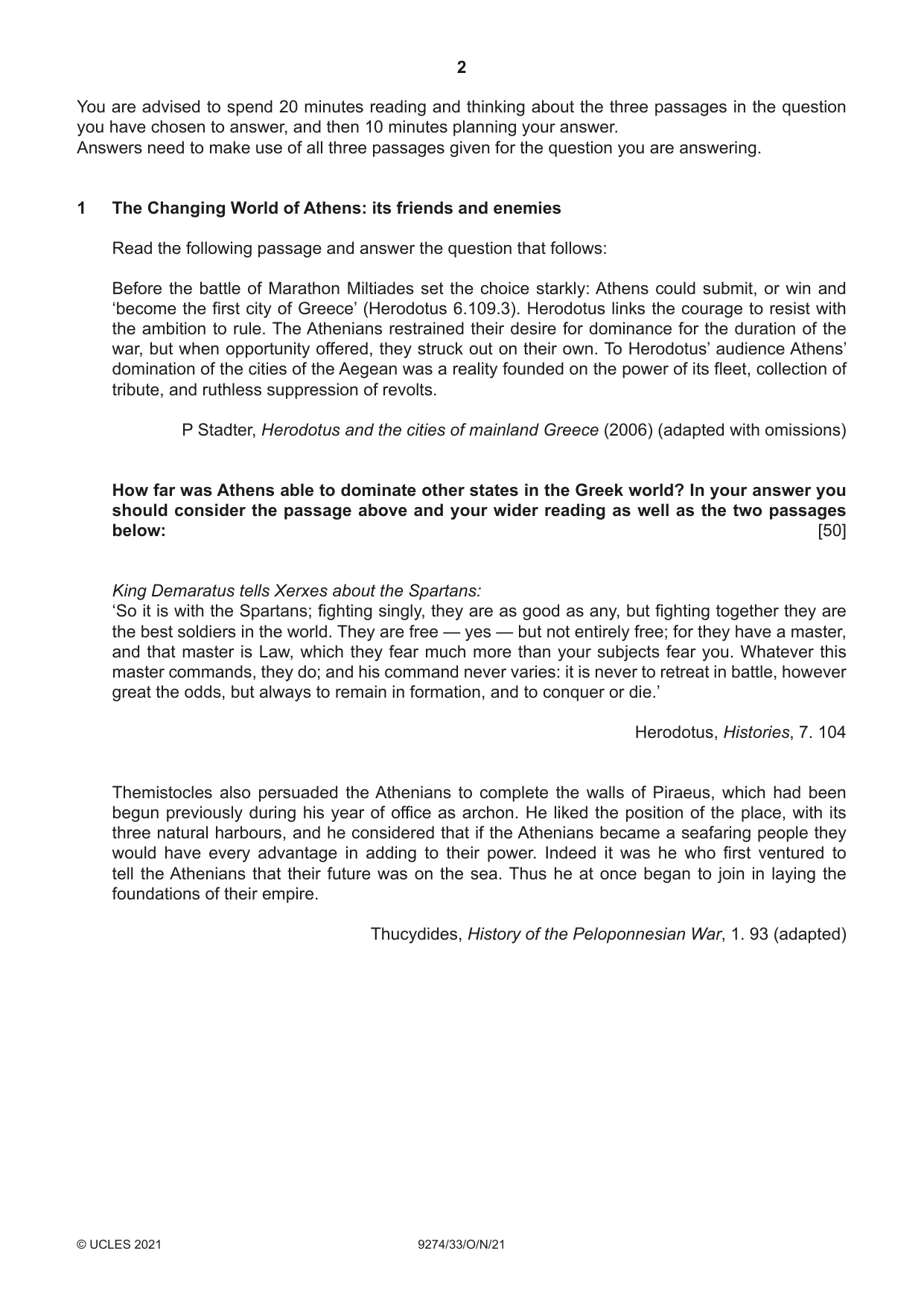
2 9274/33/O/N/21 © UCLES 2021 You are advised to spend 20 minutes reading and thinking about the three passages in the question you have chosen to answer, and then 10 minutes planning your answer. Answers need to make use of all three passages given for the question you are answering. 1 The Changing World of Athens: its friends and enemies Read the following passage and answer the question that follows: Before the battle of Marathon Miltiades set the choice starkly: Athens could submit, or win and ‘become the first city of Greece’ (Herodotus 6.109.3). Herodotus links the courage to resist with the ambition to rule. The Athenians restrained their desire for dominance for the duration of the war, but when opportunity offered, they struck out on their own. To Herodotus’ audience Athens’ domination of the cities of the Aegean was a reality founded on the power of its fleet, collection of tribute, and ruthless suppression of revolts. P Stadter, Herodotus and the cities of mainland Greece (2006) (adapted with omissions) How far was Athens able to dominate other states in the Greek world? In your answer you should consider the passage above and your wider reading as well as the two passages below: [50] King Demaratus tells Xerxes about the Spartans: ‘So it is with the Spartans; fighting singly, they are as good as any, but fighting together they are the best soldiers in the world. They are free — yes — but not entirely free; for they have a master, and that master is Law, which they fear much more than your subjects fear you. Whatever this master commands, they do; and his command never varies: it is never to retreat in battle, however great the odds, but always to remain in formation, and to conquer or die.’ Herodotus, Histories, 7. 104 Themistocles also persuaded the Athenians to complete the walls of Piraeus, which had been begun previously during his year of office as archon. He liked the position of the place, with its three natural harbours, and he considered that if the Athenians became a seafaring people they would have every advantage in adding to their power. Indeed it was he who first ventured to tell the Athenians that their future was on the sea. Thus he at once began to join in laying the foundations of their empire. Thucydides, History of the Peloponnesian War, 1. 93 (adapted)
Question paper, page 3
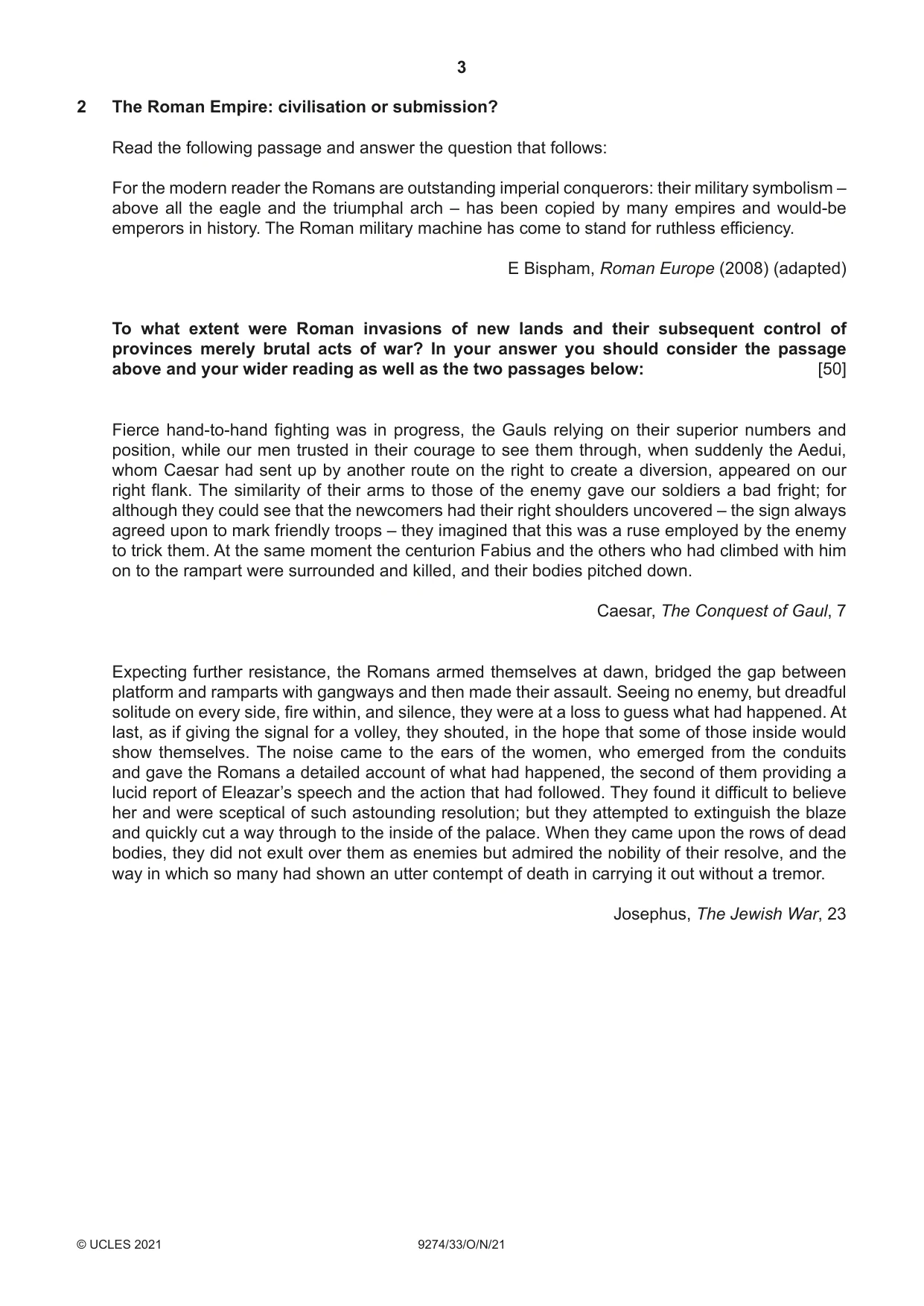
3 9274/33/O/N/21 © UCLES 2021 2 The Roman Empire: civilisation or submission? Read the following passage and answer the question that follows: For the modern reader the Romans are outstanding imperial conquerors: their military symbolism – above all the eagle and the triumphal arch – has been copied by many empires and would-be emperors in history. The Roman military machine has come to stand for ruthless efficiency. E Bispham, Roman Europe (2008) (adapted) To what extent were Roman invasions of new lands and their subsequent control of provinces merely brutal acts of war? In your answer you should consider the passage above and your wider reading as well as the two passages below: [50] Fierce hand-to-hand fighting was in progress, the Gauls relying on their superior numbers and position, while our men trusted in their courage to see them through, when suddenly the Aedui, whom Caesar had sent up by another route on the right to create a diversion, appeared on our right flank. The similarity of their arms to those of the enemy gave our soldiers a bad fright; for although they could see that the newcomers had their right shoulders uncovered – the sign always agreed upon to mark friendly troops – they imagined that this was a ruse employed by the enemy to trick them. At the same moment the centurion Fabius and the others who had climbed with him on to the rampart were surrounded and killed, and their bodies pitched down. Caesar, The Conquest of Gaul, 7 Expecting further resistance, the Romans armed themselves at dawn, bridged the gap between platform and ramparts with gangways and then made their assault. Seeing no enemy, but dreadful solitude on every side, fire within, and silence, they were at a loss to guess what had happened. At last, as if giving the signal for a volley, they shouted, in the hope that some of those inside would show themselves. The noise came to the ears of the women, who emerged from the conduits and gave the Romans a detailed account of what had happened, the second of them providing a lucid report of Eleazar’s speech and the action that had followed. They found it difficult to believe her and were sceptical of such astounding resolution; but they attempted to extinguish the blaze and quickly cut a way through to the inside of the palace. When they came upon the rows of dead bodies, they did not exult over them as enemies but admired the nobility of their resolve, and the way in which so many had shown an utter contempt of death in carrying it out without a tremor. Josephus, The Jewish War, 23
Question paper, page 4
4 9274/33/O/N/21 © UCLES 2021 BLANK PAGE Permission to reproduce items where third-party owned material protected by copyright is included has been sought and cleared where possible. Every reasonable effort has been made by the publisher (UCLES) to trace copyright holders, but if any items requiring clearance have unwittingly been included, the publisher will be pleased to make amends at the earliest possible opportunity. To avoid the issue of disclosure of answer-related information to candidates, all copyright acknowledgements are reproduced online in the Cambridge Assessment International Education Copyright Acknowledgements Booklet. This is produced for each series of examinations and is freely available to download at www.cambridgeinternational.org after the live examination series. Cambridge Assessment International Education is part of the Cambridge Assessment Group. Cambridge Assessment is the brand name of the University of Cambridge Local Examinations Syndicate (UCLES), which itself is a department of the University of Cambridge.
Mark scheme, page 1
This document consists of 7 printed pages. © UCLES 2021 [Turn over Cambridge International AS & A Level CLASSICAL STUDIES 9274/33 Paper 3 Classical History Sources and Evidence October/November 2021 MARK SCHEME Maximum Mark: 50 Published This mark scheme is published as an aid to teachers and candidates, to indicate the requirements of the examination. It shows the basis on which Examiners were instructed to award marks. It does not indicate the details of the discussions that took place at an Examiners’ meeting before marking began, which would have considered the acceptability of alternative answers. Mark schemes should be read in conjunction with the question paper and the Principal Examiner Report for Teachers. Cambridge International will not enter into discussions about these mark schemes. Cambridge International is publishing the mark schemes for the October/November 2021 series for most Cambridge IGCSE™, Cambridge International A and AS Level components and some Cambridge O Level components.
Mark scheme, page 2
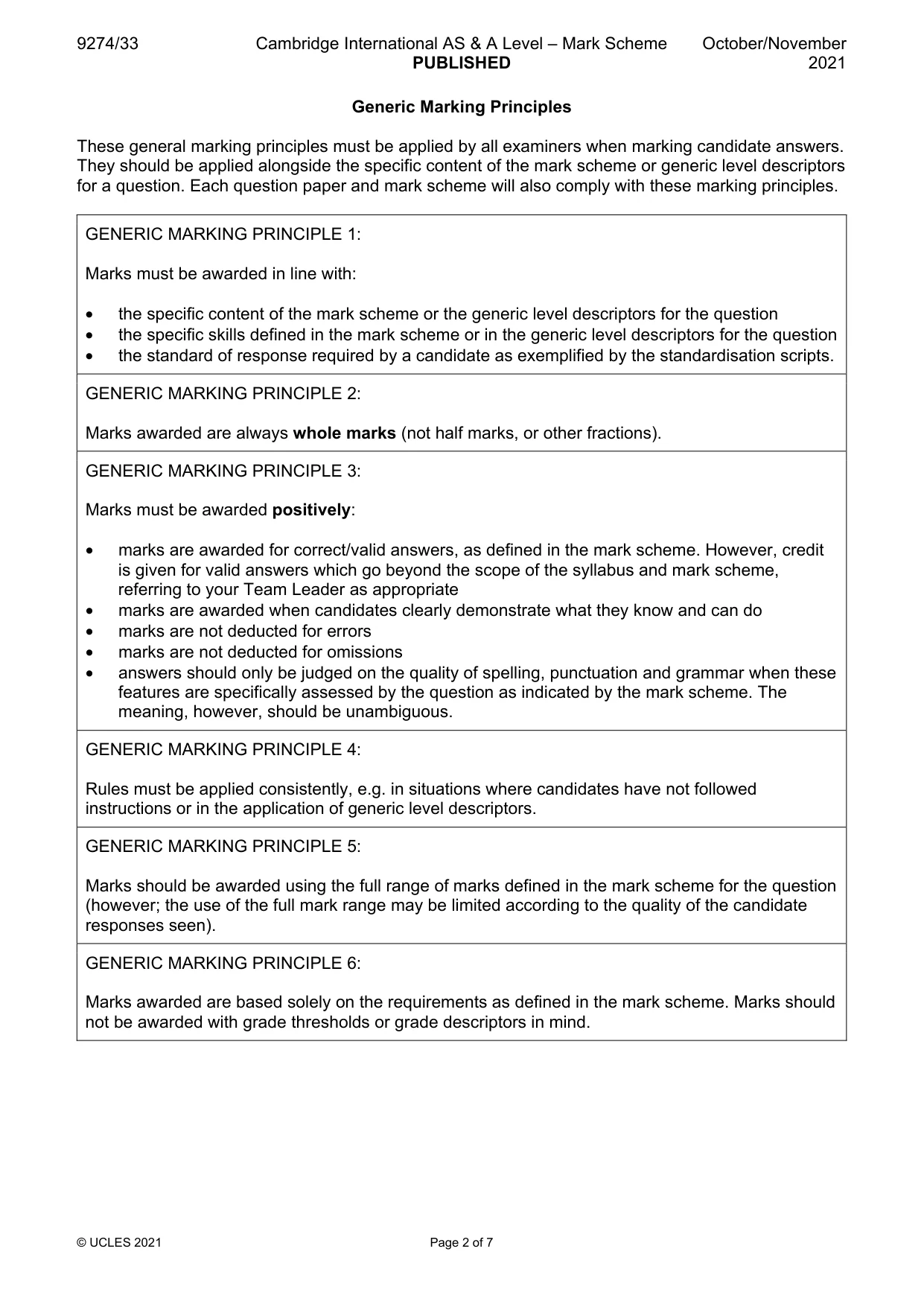
9274/33 Cambridge International AS & A Level – Mark Scheme PUBLISHED October/November 2021 © UCLES 2021 Page 2 of 7 Generic Marking Principles These general marking principles must be applied by all examiners when marking candidate answers. They should be applied alongside the specific content of the mark scheme or generic level descriptors for a question. Each question paper and mark scheme will also comply with these marking principles. GENERIC MARKING PRINCIPLE 1: Marks must be awarded in line with: • the specific content of the mark scheme or the generic level descriptors for the question • the specific skills defined in the mark scheme or in the generic level descriptors for the question • the standard of response required by a candidate as exemplified by the standardisation scripts. GENERIC MARKING PRINCIPLE 2: Marks awarded are always whole marks (not half marks, or other fractions). GENERIC MARKING PRINCIPLE 3: Marks must be awarded positively: • marks are awarded for correct/valid answers, as defined in the mark scheme. However, credit is given for valid answers which go beyond the scope of the syllabus and mark scheme, referring to your Team Leader as appropriate • marks are awarded when candidates clearly demonstrate what they know and can do • marks are not deducted for errors • marks are not deducted for omissions • answers should only be judged on the quality of spelling, punctuation and grammar when these features are specifically assessed by the question as indicated by the mark scheme. The meaning, however, should be unambiguous. GENERIC MARKING PRINCIPLE 4: Rules must be applied consistently, e.g. in situations where candidates have not followed instructions or in the application of generic level descriptors. GENERIC MARKING PRINCIPLE 5: Marks should be awarded using the full range of marks defined in the mark scheme for the question (however; the use of the full mark range may be limited according to the quality of the candidate responses seen). GENERIC MARKING PRINCIPLE 6: Marks awarded are based solely on the requirements as defined in the mark scheme. Marks should not be awarded with grade thresholds or grade descriptors in mind.
Mark scheme, page 3
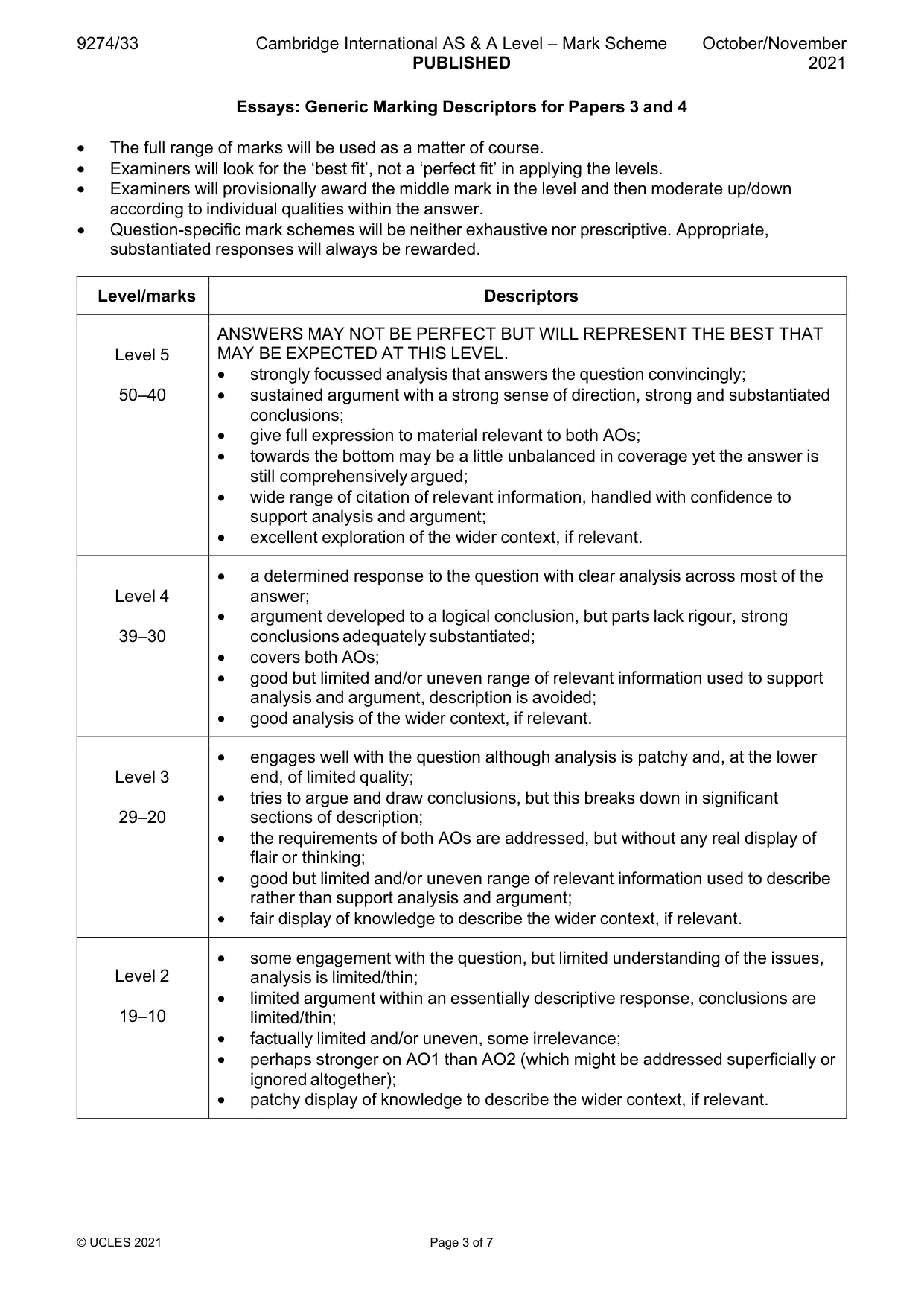
9274/33 Cambridge International AS & A Level – Mark Scheme PUBLISHED October/November 2021 © UCLES 2021 Page 3 of 7 Essays: Generic Marking Descriptors for Papers 3 and 4 • The full range of marks will be used as a matter of course. • Examiners will look for the ‘best fit’, not a ‘perfect fit’ in applying the levels. • Examiners will provisionally award the middle mark in the level and then moderate up/down according to individual qualities within the answer. • Question-specific mark schemes will be neither exhaustive nor prescriptive. Appropriate, substantiated responses will always be rewarded. Level/marks Descriptors Level 5 50–40 ANSWERS MAY NOT BE PERFECT BUT WILL REPRESENT THE BEST THAT MAY BE EXPECTED AT THIS LEVEL. • strongly focussed analysis that answers the question convincingly; • sustained argument with a strong sense of direction, strong and substantiated conclusions; • give full expression to material relevant to both AOs; • towards the bottom may be a little unbalanced in coverage yet the answer is still comprehensively argued; • wide range of citation of relevant information, handled with confidence to support analysis and argument; • excellent exploration of the wider context, if relevant. Level 4 39–30 • a determined response to the question with clear analysis across most of the answer; • argument developed to a logical conclusion, but parts lack rigour, strong conclusions adequately substantiated; • covers both AOs; • good but limited and/or uneven range of relevant information used to support analysis and argument, description is avoided; • good analysis of the wider context, if relevant. Level 3 29–20 • engages well with the question although analysis is patchy and, at the lower end, of limited quality; • tries to argue and draw conclusions, but this breaks down in significant sections of description; • the requirements of both AOs are addressed, but without any real display of flair or thinking; • good but limited and/or uneven range of relevant information used to describe rather than support analysis and argument; • fair display of knowledge to describe the wider context, if relevant. Level 2 19–10 • some engagement with the question, but limited understanding of the issues, analysis is limited/thin; • limited argument within an essentially descriptive response, conclusions are limited/thin; • factually limited and/or uneven, some irrelevance; • perhaps stronger on AO1 than AO2 (which might be addressed superficially or ignored altogether); • patchy display of knowledge to describe the wider context, if relevant.
Mark scheme, page 4
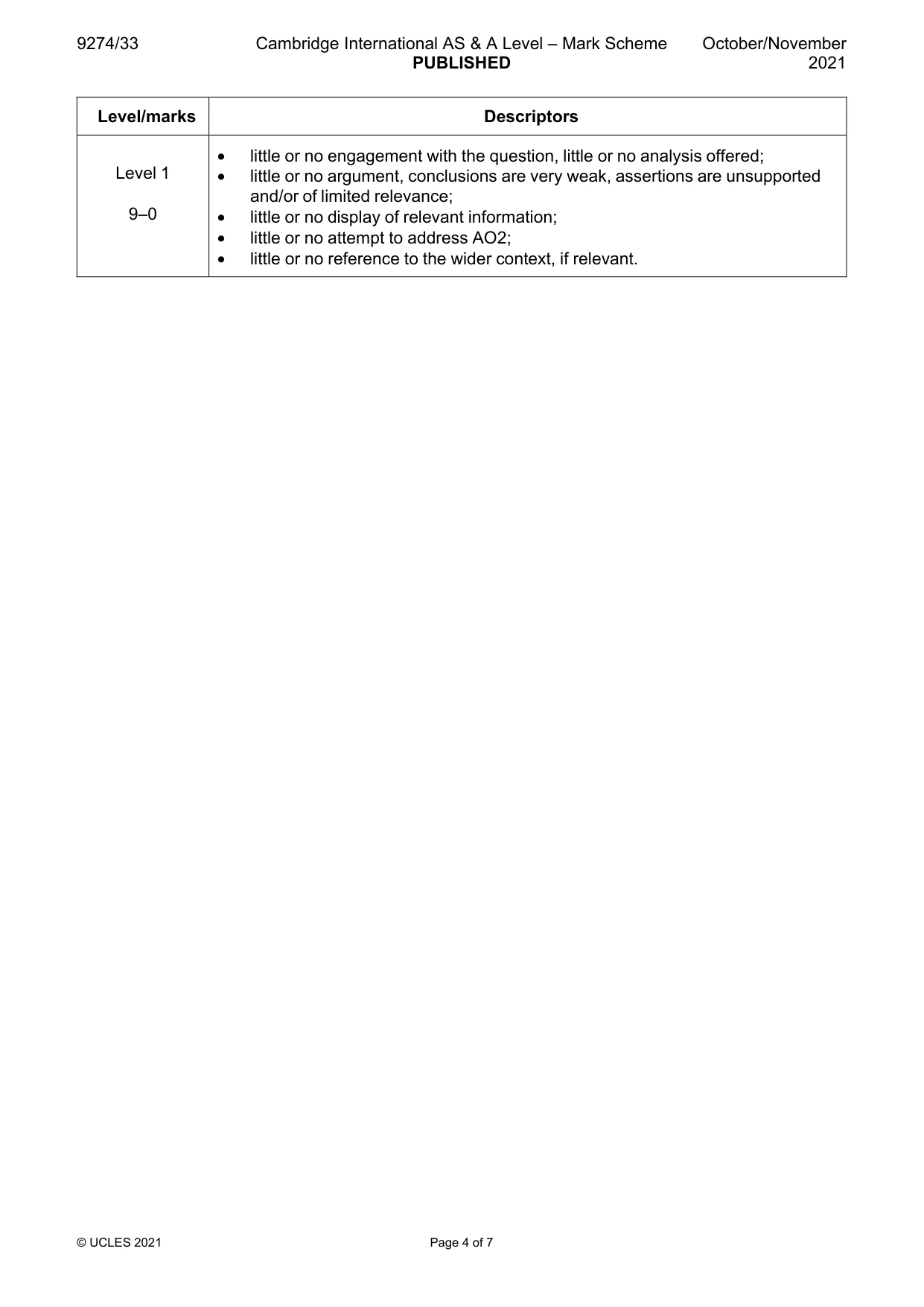
9274/33 Cambridge International AS & A Level – Mark Scheme PUBLISHED October/November 2021 © UCLES 2021 Page 4 of 7 Level/marks Descriptors Level 1 9–0 • little or no engagement with the question, little or no analysis offered; • little or no argument, conclusions are very weak, assertions are unsupported and/or of limited relevance; • little or no display of relevant information; • little or no attempt to address AO2; • little or no reference to the wider context, if relevant.
Mark scheme, page 5
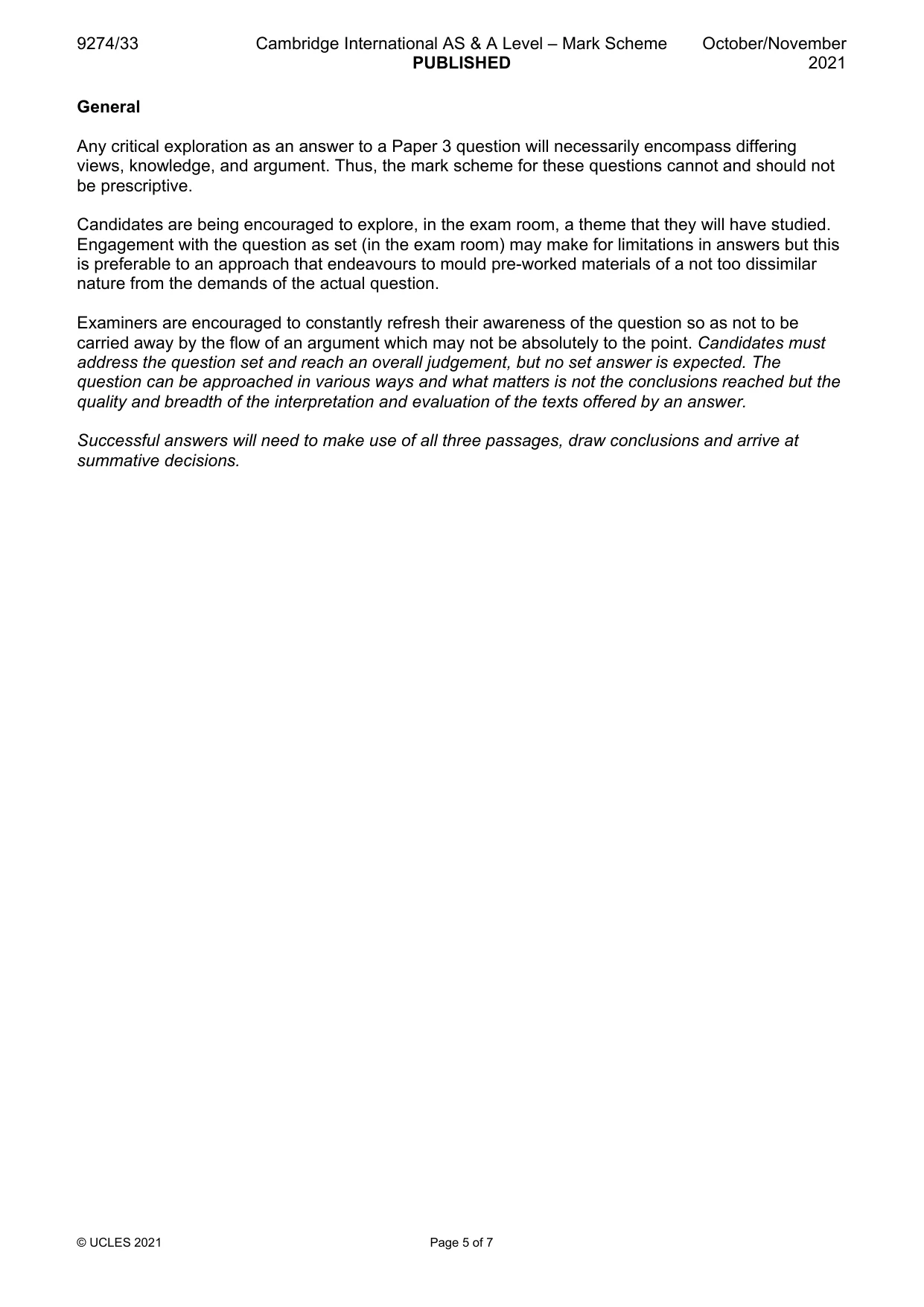
9274/33 Cambridge International AS & A Level – Mark Scheme PUBLISHED October/November 2021 © UCLES 2021 Page 5 of 7 General Any critical exploration as an answer to a Paper 3 question will necessarily encompass differing views, knowledge, and argument. Thus, the mark scheme for these questions cannot and should not be prescriptive. Candidates are being encouraged to explore, in the exam room, a theme that they will have studied. Engagement with the question as set (in the exam room) may make for limitations in answers but this is preferable to an approach that endeavours to mould pre-worked materials of a not too dissimilar nature from the demands of the actual question. Examiners are encouraged to constantly refresh their awareness of the question so as not to be carried away by the flow of an argument which may not be absolutely to the point. Candidates must address the question set and reach an overall judgement, but no set answer is expected. The question can be approached in various ways and what matters is not the conclusions reached but the quality and breadth of the interpretation and evaluation of the texts offered by an answer. Successful answers will need to make use of all three passages, draw conclusions and arrive at summative decisions.
Mark scheme, page 6
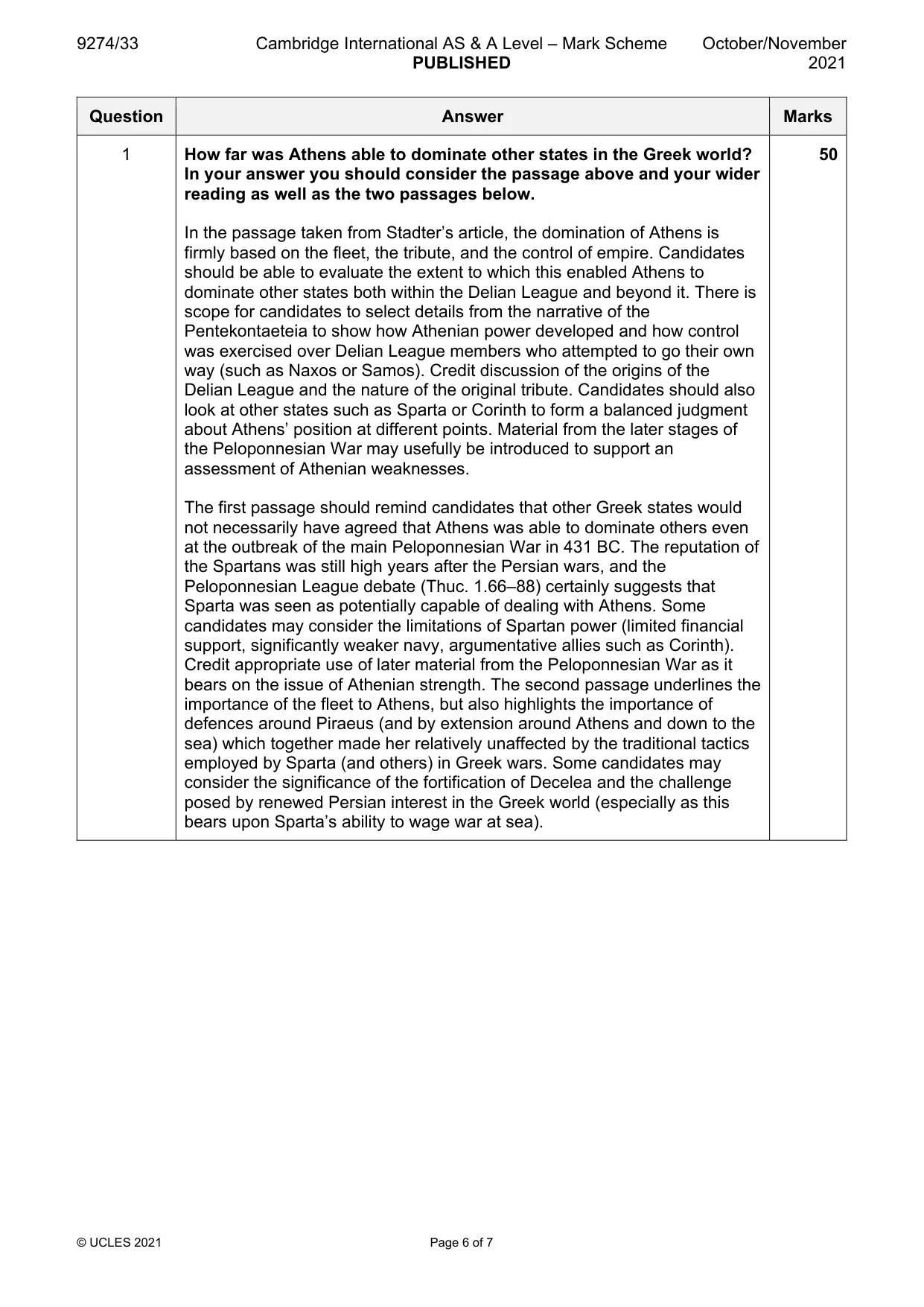
9274/33 Cambridge International AS & A Level – Mark Scheme PUBLISHED October/November 2021 © UCLES 2021 Page 6 of 7 Question Answer Marks 1 How far was Athens able to dominate other states in the Greek world? In your answer you should consider the passage above and your wider reading as well as the two passages below. In the passage taken from Stadter’s article, the domination of Athens is firmly based on the fleet, the tribute, and the control of empire. Candidates should be able to evaluate the extent to which this enabled Athens to dominate other states both within the Delian League and beyond it. There is scope for candidates to select details from the narrative of the Pentekontaeteia to show how Athenian power developed and how control was exercised over Delian League members who attempted to go their own way (such as Naxos or Samos). Credit discussion of the origins of the Delian League and the nature of the original tribute. Candidates should also look at other states such as Sparta or Corinth to form a balanced judgment about Athens’ position at different points. Material from the later stages of the Peloponnesian War may usefully be introduced to support an assessment of Athenian weaknesses. The first passage should remind candidates that other Greek states would not necessarily have agreed that Athens was able to dominate others even at the outbreak of the main Peloponnesian War in 431 BC. The reputation of the Spartans was still high years after the Persian wars, and the Peloponnesian League debate (Thuc. 1.66–88) certainly suggests that Sparta was seen as potentially capable of dealing with Athens. Some candidates may consider the limitations of Spartan power (limited financial support, significantly weaker navy, argumentative allies such as Corinth). Credit appropriate use of later material from the Peloponnesian War as it bears on the issue of Athenian strength. The second passage underlines the importance of the fleet to Athens, but also highlights the importance of defences around Piraeus (and by extension around Athens and down to the sea) which together made her relatively unaffected by the traditional tactics employed by Sparta (and others) in Greek wars. Some candidates may consider the significance of the fortification of Decelea and the challenge posed by renewed Persian interest in the Greek world (especially as this bears upon Sparta’s ability to wage war at sea). 50
Mark scheme, page 7
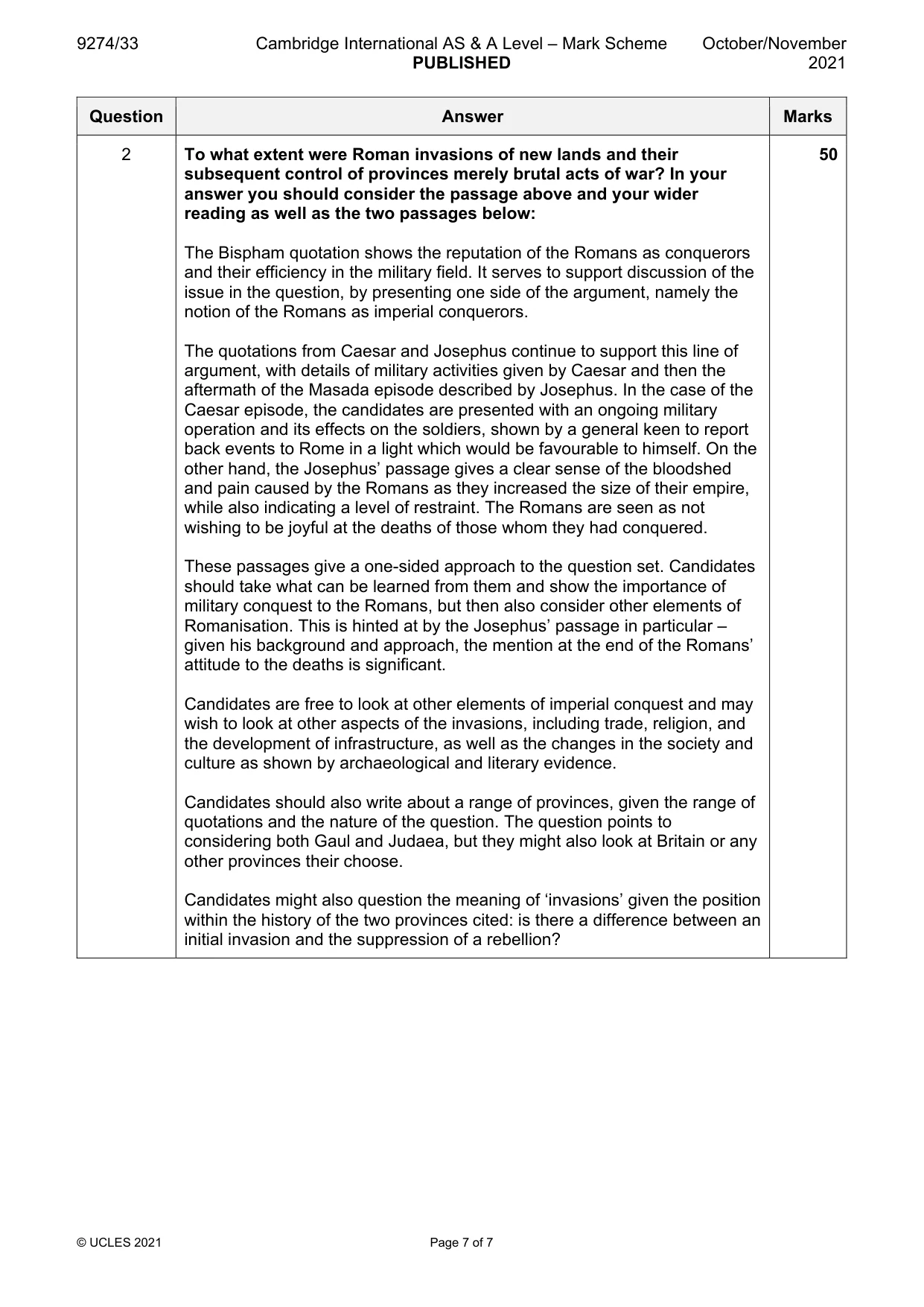
9274/33 Cambridge International AS & A Level – Mark Scheme PUBLISHED October/November 2021 © UCLES 2021 Page 7 of 7 Question Answer Marks 2 To what extent were Roman invasions of new lands and their subsequent control of provinces merely brutal acts of war? In your answer you should consider the passage above and your wider reading as well as the two passages below: The Bispham quotation shows the reputation of the Romans as conquerors and their efficiency in the military field. It serves to support discussion of the issue in the question, by presenting one side of the argument, namely the notion of the Romans as imperial conquerors. The quotations from Caesar and Josephus continue to support this line of argument, with details of military activities given by Caesar and then the aftermath of the Masada episode described by Josephus. In the case of the Caesar episode, the candidates are presented with an ongoing military operation and its effects on the soldiers, shown by a general keen to report back events to Rome in a light which would be favourable to himself. On the other hand, the Josephus’ passage gives a clear sense of the bloodshed and pain caused by the Romans as they increased the size of their empire, while also indicating a level of restraint. The Romans are seen as not wishing to be joyful at the deaths of those whom they had conquered. These passages give a one-sided approach to the question set. Candidates should take what can be learned from them and show the importance of military conquest to the Romans, but then also consider other elements of Romanisation. This is hinted at by the Josephus’ passage in particular – given his background and approach, the mention at the end of the Romans’ attitude to the deaths is significant. Candidates are free to look at other elements of imperial conquest and may wish to look at other aspects of the invasions, including trade, religion, and the development of infrastructure, as well as the changes in the society and culture as shown by archaeological and literary evidence. Candidates should also write about a range of provinces, given the range of quotations and the nature of the question. The question points to considering both Gaul and Judaea, but they might also look at Britain or any other provinces their choose. Candidates might also question the meaning of ‘invasions’ given the position within the history of the two provinces cited: is there a difference between an initial invasion and the suppression of a rebellion? 50
What you needed in this session
Cambridge’s own grade thresholds for 2021 Oct/Nov, Paper 3 · Variant 3. A higher threshold means an easier paper — the bar moves with how the cohort did.