Cambridge A Level Classical Studies 9274 — 2023 Oct/Nov Paper 3 · Variant 3
9274/33/O/N/23 · 50 marks · ≈56 min
The question paper and its mark scheme, free to read here and free to download. This is Cambridge’s own paper, exactly as it was sat.
Question paper4 pages

Mark scheme11 pages
Answers below. Sit the paper first if you are practising.
Paper as text
Question paper, page 1
This document has 4 pages. Any blank pages are indicated. [Turn over * 6 8 8 4 9 4 8 4 6 2 * Cambridge International AS & A Level DC (DE) 325190/1 © UCLES 2023 CLASSICAL STUDIES 9274/33 Paper 3 Classical History October/November 2023 1 hour 30 minutes You must answer on the enclosed answer booklet. You will need: Answer booklet (enclosed) INSTRUCTIONS ● Answer two questions in total: Answer questions from one section only. For each section, follow the instructions inside on which questions to answer. ● Follow the instructions on the front cover of the answer booklet. If you need additional answer paper, ask the invigilator for a continuation booklet. INFORMATION ● The total mark for this paper is 50. ● The number of marks for each question or part question is shown in brackets [ ].
Question paper, page 2
2 9274/33/O/N/23 © UCLES 2023 Section A: Athens and Sparta Answer Question 1 and either Question 2 or Question 3. 1 Read the passage and answer the question. They [the kings] are responsible for the safe-keeping of all oracles (the ‘Pythians’ also have knowledge of them), and certain definite legal matters are left to their sole decision. These are as follows: first, if a girl inherits her father’s estate and has not been betrothed by him to anybody, the kings decide who has the right to marry her; secondly, all matters connected with the public roads are in their hands; and, thirdly, anyone who wishes to adopt a child must do it in the king’s presence. They sit with the twenty-eight Elders in the Council chamber [gerousia], and, in the event of their absence from a meeting, those of the Elders who are nearest of kin to them take over their privilege and cast two votes … . (Herodotus, The Histories 6.57) Using this passage as a starting point, discuss the importance of the kings in Sparta. [20] EITHER 2 How far had Sparta’s relationship with the Peloponnesian League changed by the end of the Peloponnesian War? [30] OR 3 To what extent were slaves necessary for Athenians to maintain both their democracy and their empire? [30] 5
Question paper, page 3
3 9274/33/O/N/23 © UCLES 2023 Section B: Emperors and Subjects: Claudius, Nero, Domitian and Trajan Answer Question 4 and either Question 5 or Question 6. 4 Read the passage and answer the question. The news of these events, although reported by Agricola in his dispatches in the most exact and modest terms, was received by Domitian, as was his way, with a smile on his face and unease in his heart. He was aware that his sham triumph over Germania had been treated as a joke – slaves had been bought in the markets whose dress and hair were contrived to make them look like prisoners of war. But here was a genuine victory on a grand scale: the enemy dead were reckoned by thousands, the popular enthusiasm immense. There was nothing Domitian feared so much as to have the name of a subject raised above that of the emperor. In vain he silenced the eloquence of the courts and the distinctions of civil careers, if another man was to seize his military glory. (Tacitus, Agricola 39 [adapted]) Using this passage as a starting point, discuss the importance of military achievements for any two Roman emperors. [20] EITHER 5 To what extent did the emperor pay attention to each of the different groups of people in Rome? In your answer you should discuss at least one emperor. [30] OR 6 ‘Patronage was at the heart of Roman society.’ Using evidence from the sources you have studied, assess this view. [30] 5
Question paper, page 4
4 9274/33/O/N/23 © UCLES 2023 Permission to reproduce items where third-party owned material protected by copyright is included has been sought and cleared where possible. Every reasonable effort has been made by the publisher (UCLES) to trace copyright holders, but if any items requiring clearance have unwittingly been included, the publisher will be pleased to make amends at the earliest possible opportunity. To avoid the issue of disclosure of answer-related information to candidates, all copyright acknowledgements are reproduced online in the Cambridge Assessment International Education Copyright Acknowledgements Booklet. This is produced for each series of examinations and is freely available to download at www.cambridgeinternational.org after the live examination series. Cambridge Assessment International Education is part of Cambridge Assessment. Cambridge Assessment is the brand name of the University of Cambridge Local Examinations Syndicate (UCLES), which is a department of the University of Cambridge. BLANK PAGE
Mark scheme, page 1
This document consists of 11 printed pages. © UCLES 2023 [Turn over Cambridge International AS & A Level CLASSICAL STUDIES 9274/33 Paper 3 Classical History October/November 2023 MARK SCHEME Maximum Mark: 50 Published This mark scheme is published as an aid to teachers and candidates, to indicate the requirements of the examination. It shows the basis on which Examiners were instructed to award marks. It does not indicate the details of the discussions that took place at an Examiners’ meeting before marking began, which would have considered the acceptability of alternative answers. Mark schemes should be read in conjunction with the question paper and the Principal Examiner Report for Teachers. Cambridge International will not enter into discussions about these mark schemes. Cambridge International is publishing the mark schemes for the October/November 2023 series for most Cambridge IGCSE, Cambridge International A and AS Level components, and some Cambridge O Level components.
Mark scheme, page 2
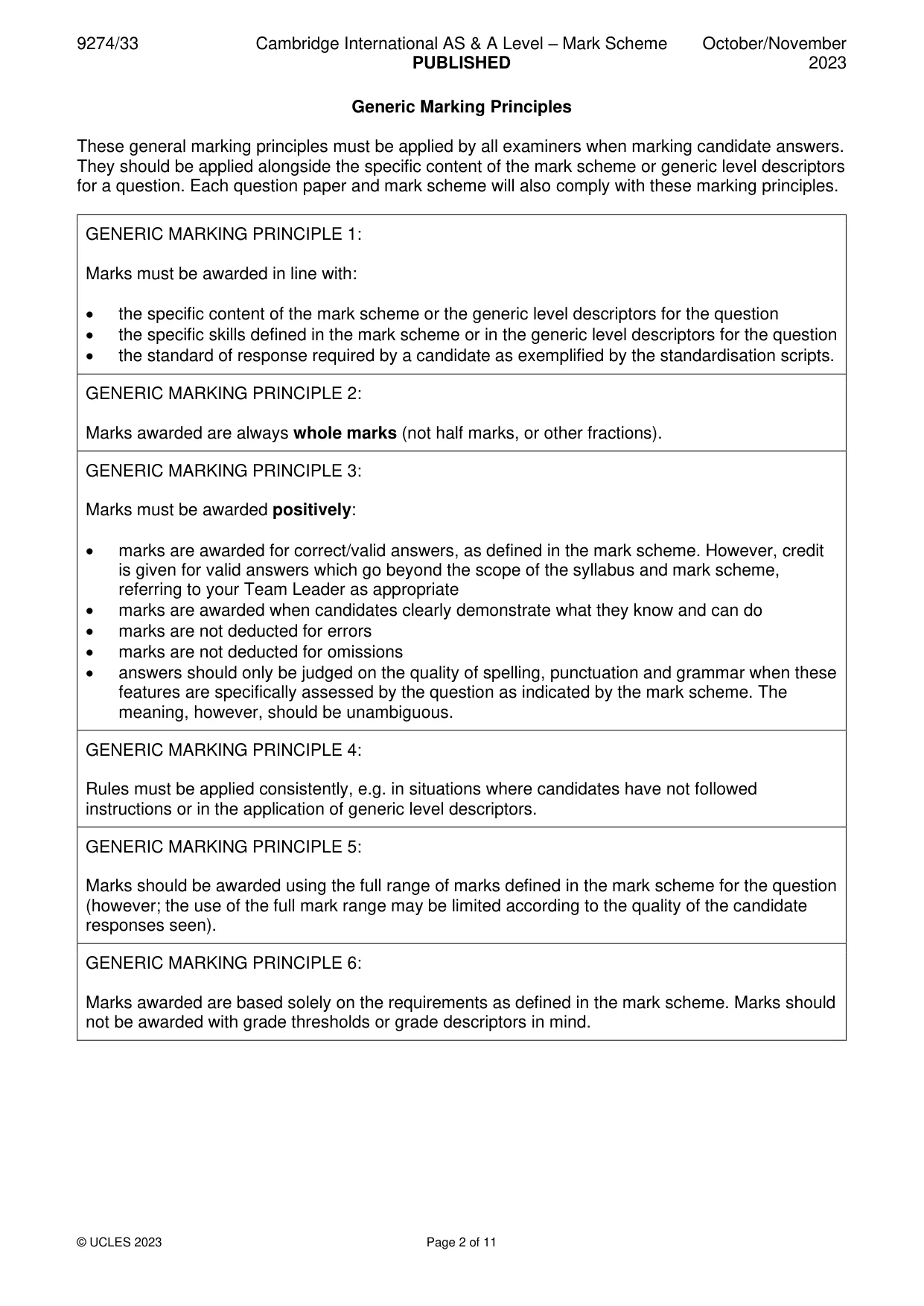
9274/33 Cambridge International AS & A Level – Mark Scheme PUBLISHED October/November 2023 © UCLES 2023 Page 2 of 11 Generic Marking Principles These general marking principles must be applied by all examiners when marking candidate answers. They should be applied alongside the specific content of the mark scheme or generic level descriptors for a question. Each question paper and mark scheme will also comply with these marking principles. GENERIC MARKING PRINCIPLE 1: Marks must be awarded in line with: • the specific content of the mark scheme or the generic level descriptors for the question • the specific skills defined in the mark scheme or in the generic level descriptors for the question • the standard of response required by a candidate as exemplified by the standardisation scripts. GENERIC MARKING PRINCIPLE 2: Marks awarded are always whole marks (not half marks, or other fractions). GENERIC MARKING PRINCIPLE 3: Marks must be awarded positively: • marks are awarded for correct/valid answers, as defined in the mark scheme. However, credit is given for valid answers which go beyond the scope of the syllabus and mark scheme, referring to your Team Leader as appropriate • marks are awarded when candidates clearly demonstrate what they know and can do • marks are not deducted for errors • marks are not deducted for omissions • answers should only be judged on the quality of spelling, punctuation and grammar when these features are specifically assessed by the question as indicated by the mark scheme. The meaning, however, should be unambiguous. GENERIC MARKING PRINCIPLE 4: Rules must be applied consistently, e.g. in situations where candidates have not followed instructions or in the application of generic level descriptors. GENERIC MARKING PRINCIPLE 5: Marks should be awarded using the full range of marks defined in the mark scheme for the question (however; the use of the full mark range may be limited according to the quality of the candidate responses seen). GENERIC MARKING PRINCIPLE 6: Marks awarded are based solely on the requirements as defined in the mark scheme. Marks should not be awarded with grade thresholds or grade descriptors in mind.
Mark scheme, page 3
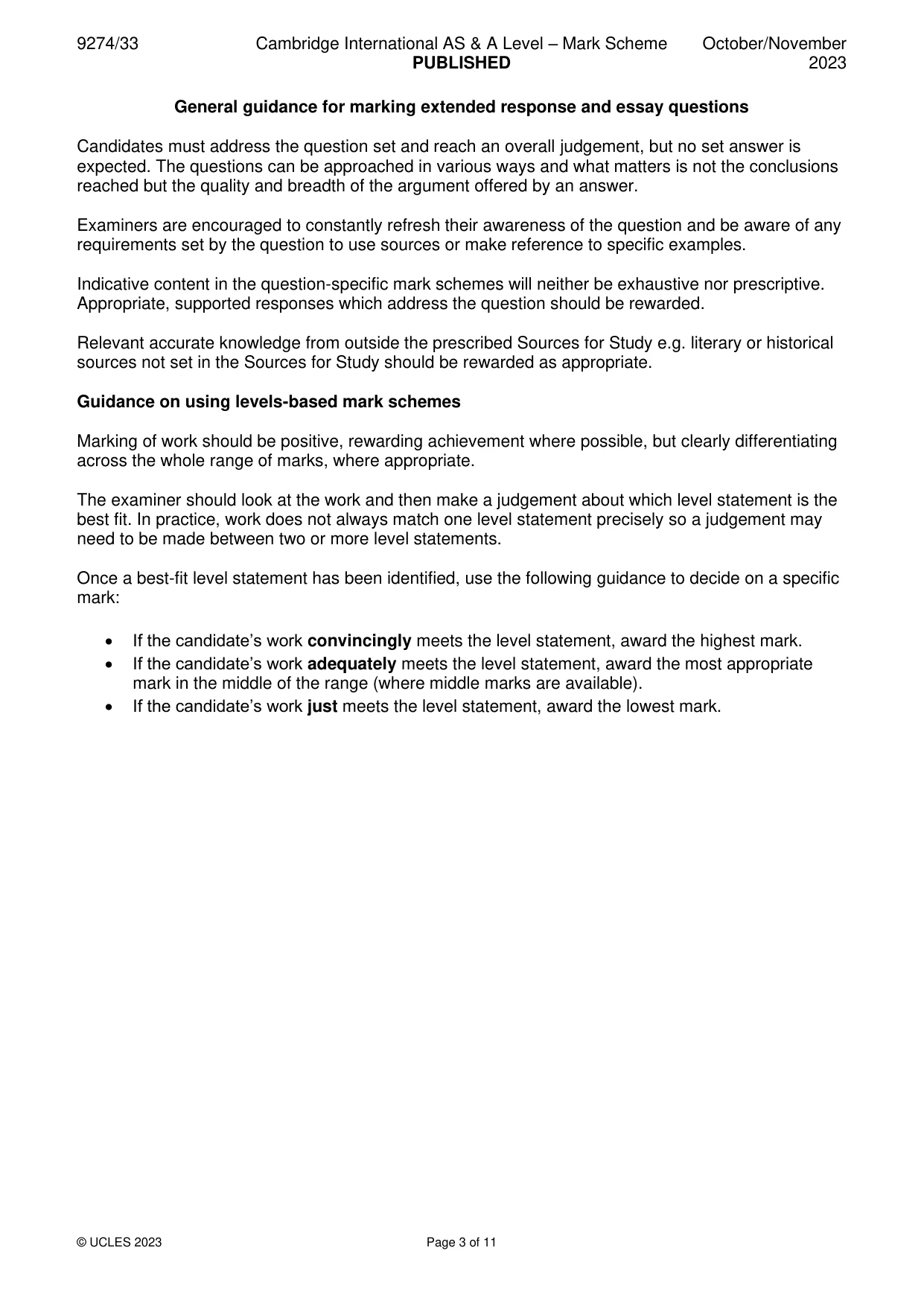
9274/33 Cambridge International AS & A Level – Mark Scheme PUBLISHED October/November 2023 © UCLES 2023 Page 3 of 11 General guidance for marking extended response and essay questions Candidates must address the question set and reach an overall judgement, but no set answer is expected. The questions can be approached in various ways and what matters is not the conclusions reached but the quality and breadth of the argument offered by an answer. Examiners are encouraged to constantly refresh their awareness of the question and be aware of any requirements set by the question to use sources or make reference to specific examples. Indicative content in the question-specific mark schemes will neither be exhaustive nor prescriptive. Appropriate, supported responses which address the question should be rewarded. Relevant accurate knowledge from outside the prescribed Sources for Study e.g. literary or historical sources not set in the Sources for Study should be rewarded as appropriate. Guidance on using levels-based mark schemes Marking of work should be positive, rewarding achievement where possible, but clearly differentiating across the whole range of marks, where appropriate. The examiner should look at the work and then make a judgement about which level statement is the best fit. In practice, work does not always match one level statement precisely so a judgement may need to be made between two or more level statements. Once a best-fit level statement has been identified, use the following guidance to decide on a specific mark: • If the candidate’s work convincingly meets the level statement, award the highest mark. • If the candidate’s work adequately meets the level statement, award the most appropriate mark in the middle of the range (where middle marks are available). • If the candidate’s work just meets the level statement, award the lowest mark.
Mark scheme, page 4
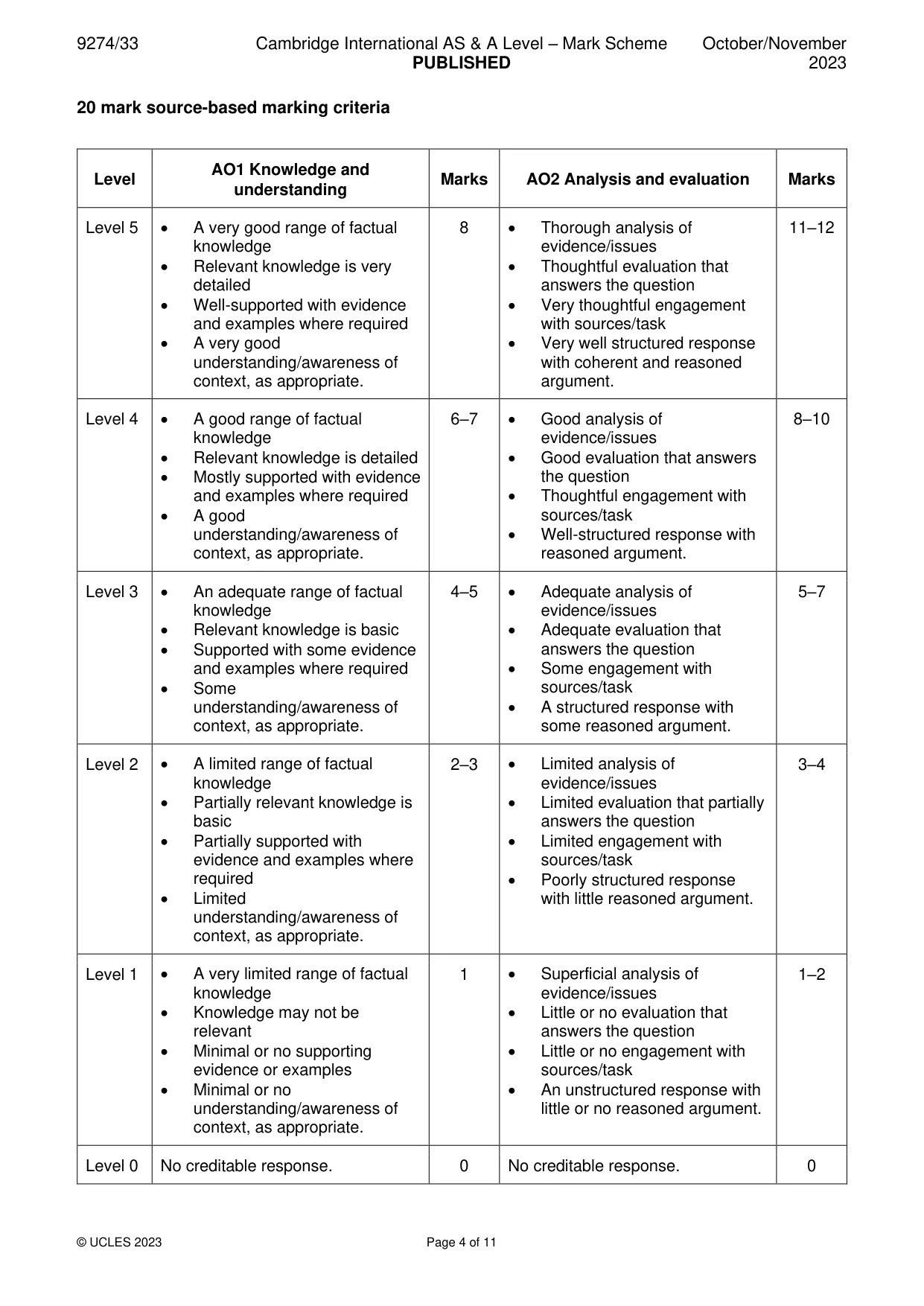
9274/33 Cambridge International AS & A Level – Mark Scheme PUBLISHED October/November 2023 © UCLES 2023 Page 4 of 11 20 mark source-based marking criteria Level AO1 Knowledge and understanding Marks AO2 Analysis and evaluation Marks Level 5 • A very good range of factual knowledge • Relevant knowledge is very detailed • Well-supported with evidence and examples where required • A very good understanding/awareness of context, as appropriate. 8 • Thorough analysis of evidence/issues • Thoughtful evaluation that answers the question • Very thoughtful engagement with sources/task • Very well structured response with coherent and reasoned argument. 11–12 Level 4 • A good range of factual knowledge • Relevant knowledge is detailed • Mostly supported with evidence and examples where required • A good understanding/awareness of context, as appropriate. 6–7 • Good analysis of evidence/issues • Good evaluation that answers the question • Thoughtful engagement with sources/task • Well-structured response with reasoned argument. 8–10 Level 3 • An adequate range of factual knowledge • Relevant knowledge is basic • Supported with some evidence and examples where required • Some understanding/awareness of context, as appropriate. 4–5 • Adequate analysis of evidence/issues • Adequate evaluation that answers the question • Some engagement with sources/task • A structured response with some reasoned argument. 5–7 Level 2 • A limited range of factual knowledge • Partially relevant knowledge is basic • Partially supported with evidence and examples where required • Limited understanding/awareness of context, as appropriate. 2–3 • Limited analysis of evidence/issues • Limited evaluation that partially answers the question • Limited engagement with sources/task • Poorly structured response with little reasoned argument. 3–4 Level 1 • A very limited range of factual knowledge • Knowledge may not be relevant • Minimal or no supporting evidence or examples • Minimal or no understanding/awareness of context, as appropriate. 1 • Superficial analysis of evidence/issues • Little or no evaluation that answers the question • Little or no engagement with sources/task • An unstructured response with little or no reasoned argument. 1–2 Level 0 No creditable response. 0 No creditable response. 0
Mark scheme, page 5
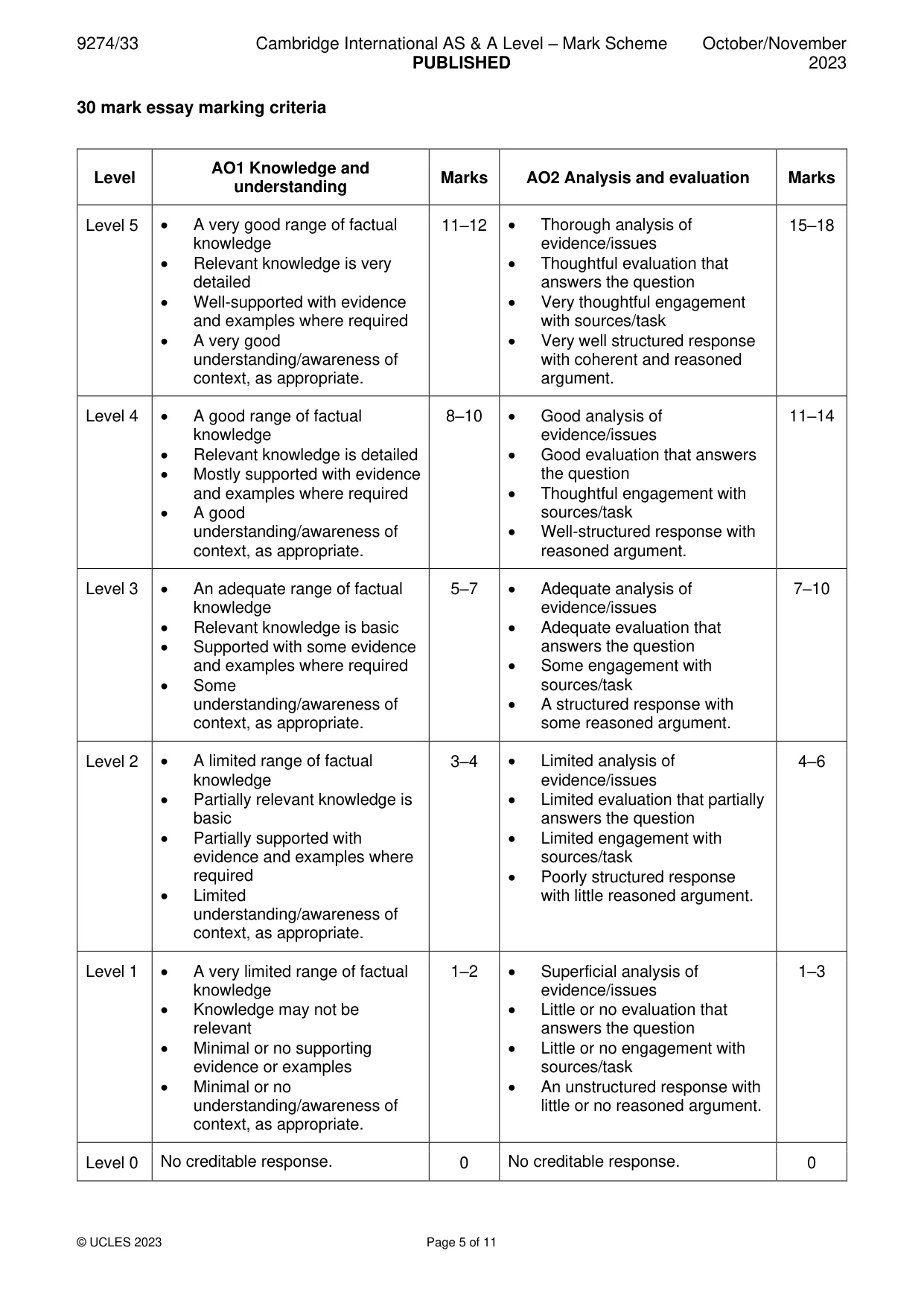
9274/33 Cambridge International AS & A Level – Mark Scheme PUBLISHED October/November 2023 © UCLES 2023 Page 5 of 11 30 mark essay marking criteria Level AO1 Knowledge and understanding Marks AO2 Analysis and evaluation Marks Level 5 • A very good range of factual knowledge • Relevant knowledge is very detailed • Well-supported with evidence and examples where required • A very good understanding/awareness of context, as appropriate. 11–12 • Thorough analysis of evidence/issues • Thoughtful evaluation that answers the question • Very thoughtful engagement with sources/task • Very well structured response with coherent and reasoned argument. 15–18 Level 4 • A good range of factual knowledge • Relevant knowledge is detailed • Mostly supported with evidence and examples where required • A good understanding/awareness of context, as appropriate. 8–10 • Good analysis of evidence/issues • Good evaluation that answers the question • Thoughtful engagement with sources/task • Well-structured response with reasoned argument. 11–14 Level 3 • An adequate range of factual knowledge • Relevant knowledge is basic • Supported with some evidence and examples where required • Some understanding/awareness of context, as appropriate. 5–7 • Adequate analysis of evidence/issues • Adequate evaluation that answers the question • Some engagement with sources/task • A structured response with some reasoned argument. 7–10 Level 2 • A limited range of factual knowledge • Partially relevant knowledge is basic • Partially supported with evidence and examples where required • Limited understanding/awareness of context, as appropriate. 3–4 • Limited analysis of evidence/issues • Limited evaluation that partially answers the question • Limited engagement with sources/task • Poorly structured response with little reasoned argument. 4–6 Level 1 • A very limited range of factual knowledge • Knowledge may not be relevant • Minimal or no supporting evidence or examples • Minimal or no understanding/awareness of context, as appropriate. 1–2 • Superficial analysis of evidence/issues • Little or no evaluation that answers the question • Little or no engagement with sources/task • An unstructured response with little or no reasoned argument. 1–3 Level 0 No creditable response. 0 No creditable response. 0
Mark scheme, page 6
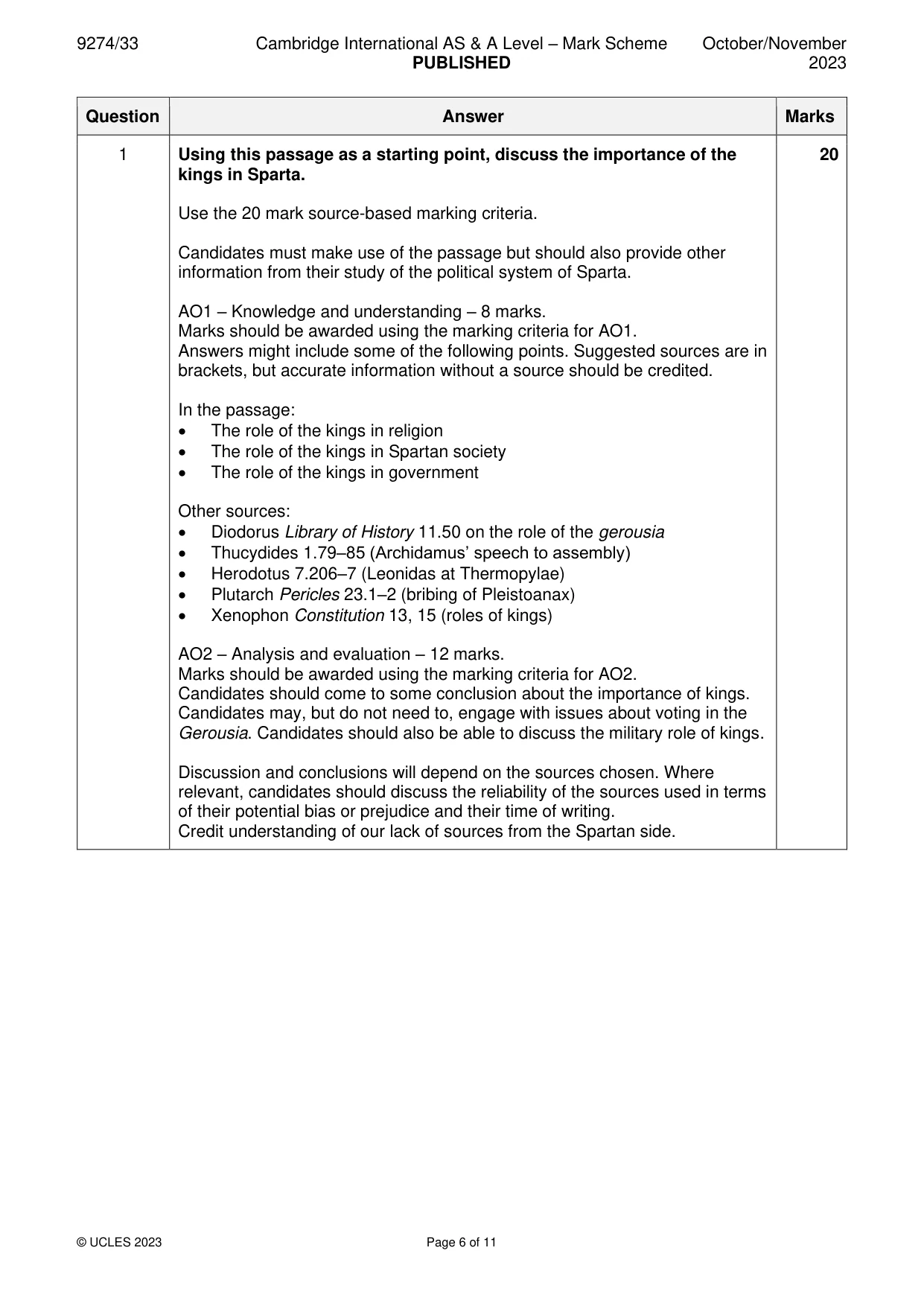
9274/33 Cambridge International AS & A Level – Mark Scheme PUBLISHED October/November 2023 © UCLES 2023 Page 6 of 11 Question Answer Marks 1 Using this passage as a starting point, discuss the importance of the kings in Sparta. Use the 20 mark source-based marking criteria. Candidates must make use of the passage but should also provide other information from their study of the political system of Sparta. AO1 – Knowledge and understanding – 8 marks. Marks should be awarded using the marking criteria for AO1. Answers might include some of the following points. Suggested sources are in brackets, but accurate information without a source should be credited. In the passage: • The role of the kings in religion • The role of the kings in Spartan society • The role of the kings in government Other sources: • Diodorus Library of History 11.50 on the role of the gerousia • Thucydides 1.79–85 (Archidamus’ speech to assembly) • Herodotus 7.206–7 (Leonidas at Thermopylae) • Plutarch Pericles 23.1–2 (bribing of Pleistoanax) • Xenophon Constitution 13, 15 (roles of kings) AO2 – Analysis and evaluation – 12 marks. Marks should be awarded using the marking criteria for AO2. Candidates should come to some conclusion about the importance of kings. Candidates may, but do not need to, engage with issues about voting in the Gerousia. Candidates should also be able to discuss the military role of kings. Discussion and conclusions will depend on the sources chosen. Where relevant, candidates should discuss the reliability of the sources used in terms of their potential bias or prejudice and their time of writing. Credit understanding of our lack of sources from the Spartan side. 20
Mark scheme, page 7
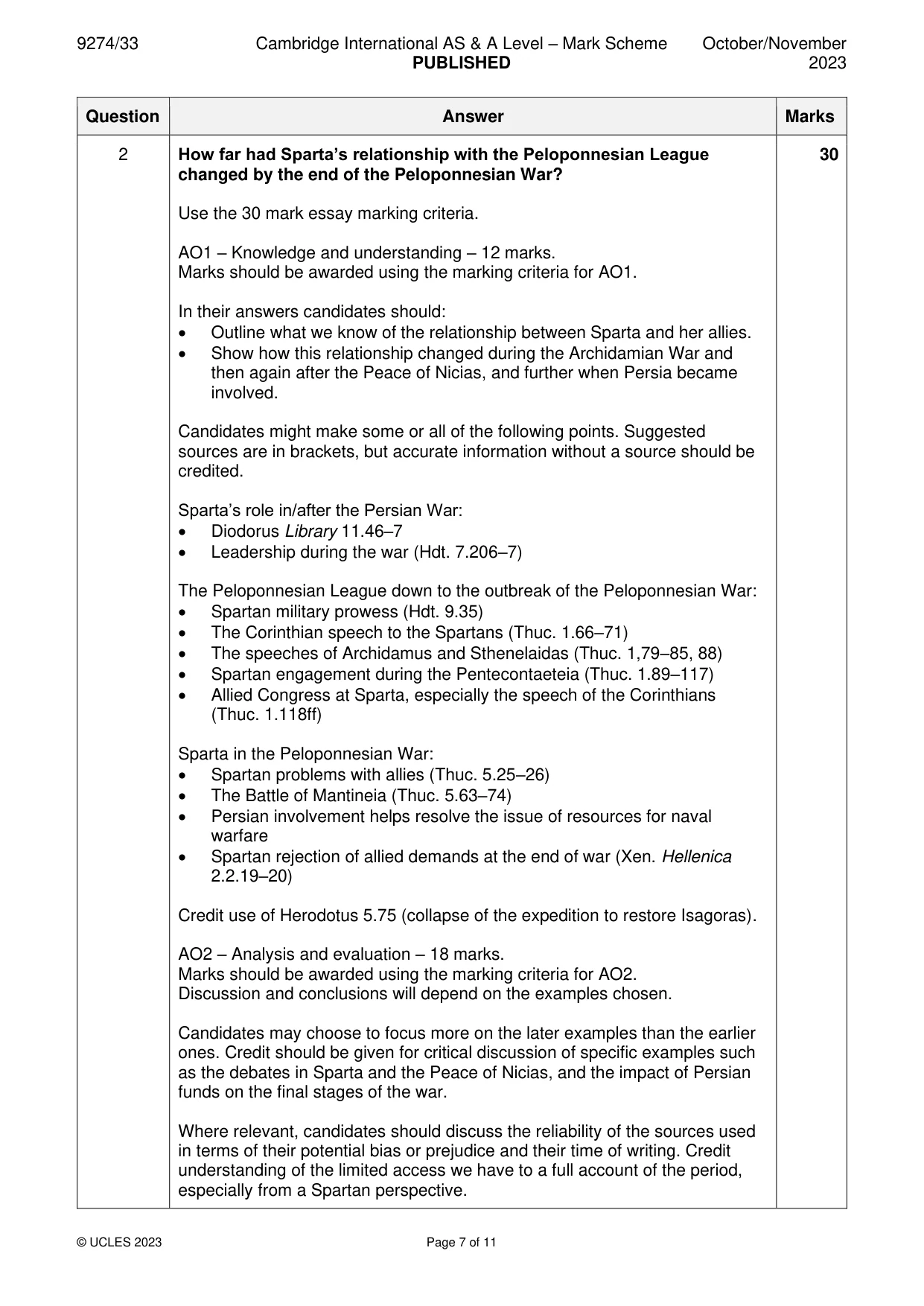
9274/33 Cambridge International AS & A Level – Mark Scheme PUBLISHED October/November 2023 © UCLES 2023 Page 7 of 11 Question Answer Marks 2 How far had Sparta’s relationship with the Peloponnesian League changed by the end of the Peloponnesian War? Use the 30 mark essay marking criteria. AO1 – Knowledge and understanding – 12 marks. Marks should be awarded using the marking criteria for AO1. In their answers candidates should: • Outline what we know of the relationship between Sparta and her allies. • Show how this relationship changed during the Archidamian War and then again after the Peace of Nicias, and further when Persia became involved. Candidates might make some or all of the following points. Suggested sources are in brackets, but accurate information without a source should be credited. Sparta’s role in/after the Persian War: • Diodorus Library 11.46–7 • Leadership during the war (Hdt. 7.206–7) The Peloponnesian League down to the outbreak of the Peloponnesian War: • Spartan military prowess (Hdt. 9.35) • The Corinthian speech to the Spartans (Thuc. 1.66–71) • The speeches of Archidamus and Sthenelaidas (Thuc. 1,79–85, 88) • Spartan engagement during the Pentecontaeteia (Thuc. 1.89–117) • Allied Congress at Sparta, especially the speech of the Corinthians (Thuc. 1.118ff) Sparta in the Peloponnesian War: • Spartan problems with allies (Thuc. 5.25–26) • The Battle of Mantineia (Thuc. 5.63–74) • Persian involvement helps resolve the issue of resources for naval warfare • Spartan rejection of allied demands at the end of war (Xen. Hellenica 2.2.19–20) Credit use of Herodotus 5.75 (collapse of the expedition to restore Isagoras). AO2 – Analysis and evaluation – 18 marks. Marks should be awarded using the marking criteria for AO2. Discussion and conclusions will depend on the examples chosen. Candidates may choose to focus more on the later examples than the earlier ones. Credit should be given for critical discussion of specific examples such as the debates in Sparta and the Peace of Nicias, and the impact of Persian funds on the final stages of the war. Where relevant, candidates should discuss the reliability of the sources used in terms of their potential bias or prejudice and their time of writing. Credit understanding of the limited access we have to a full account of the period, especially from a Spartan perspective. 30
Mark scheme, page 8
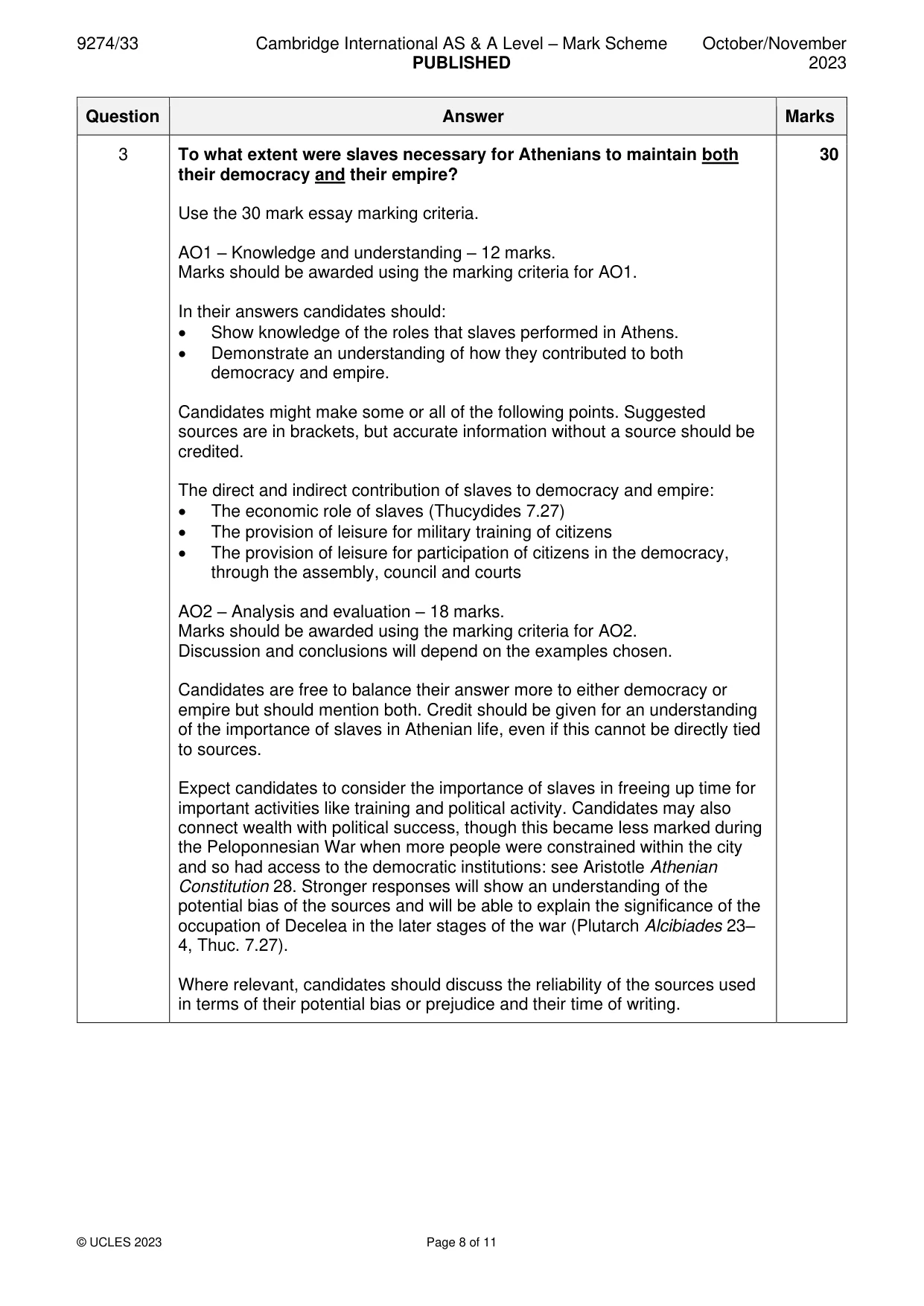
9274/33 Cambridge International AS & A Level – Mark Scheme PUBLISHED October/November 2023 © UCLES 2023 Page 8 of 11 Question Answer Marks 3 To what extent were slaves necessary for Athenians to maintain both their democracy and their empire? Use the 30 mark essay marking criteria. AO1 – Knowledge and understanding – 12 marks. Marks should be awarded using the marking criteria for AO1. In their answers candidates should: • Show knowledge of the roles that slaves performed in Athens. • Demonstrate an understanding of how they contributed to both democracy and empire. Candidates might make some or all of the following points. Suggested sources are in brackets, but accurate information without a source should be credited. The direct and indirect contribution of slaves to democracy and empire: • The economic role of slaves (Thucydides 7.27) • The provision of leisure for military training of citizens • The provision of leisure for participation of citizens in the democracy, through the assembly, council and courts AO2 – Analysis and evaluation – 18 marks. Marks should be awarded using the marking criteria for AO2. Discussion and conclusions will depend on the examples chosen. Candidates are free to balance their answer more to either democracy or empire but should mention both. Credit should be given for an understanding of the importance of slaves in Athenian life, even if this cannot be directly tied to sources. Expect candidates to consider the importance of slaves in freeing up time for important activities like training and political activity. Candidates may also connect wealth with political success, though this became less marked during the Peloponnesian War when more people were constrained within the city and so had access to the democratic institutions: see Aristotle Athenian Constitution 28. Stronger responses will show an understanding of the potential bias of the sources and will be able to explain the significance of the occupation of Decelea in the later stages of the war (Plutarch Alcibiades 23– 4, Thuc. 7.27). Where relevant, candidates should discuss the reliability of the sources used in terms of their potential bias or prejudice and their time of writing. 30
Mark scheme, page 9
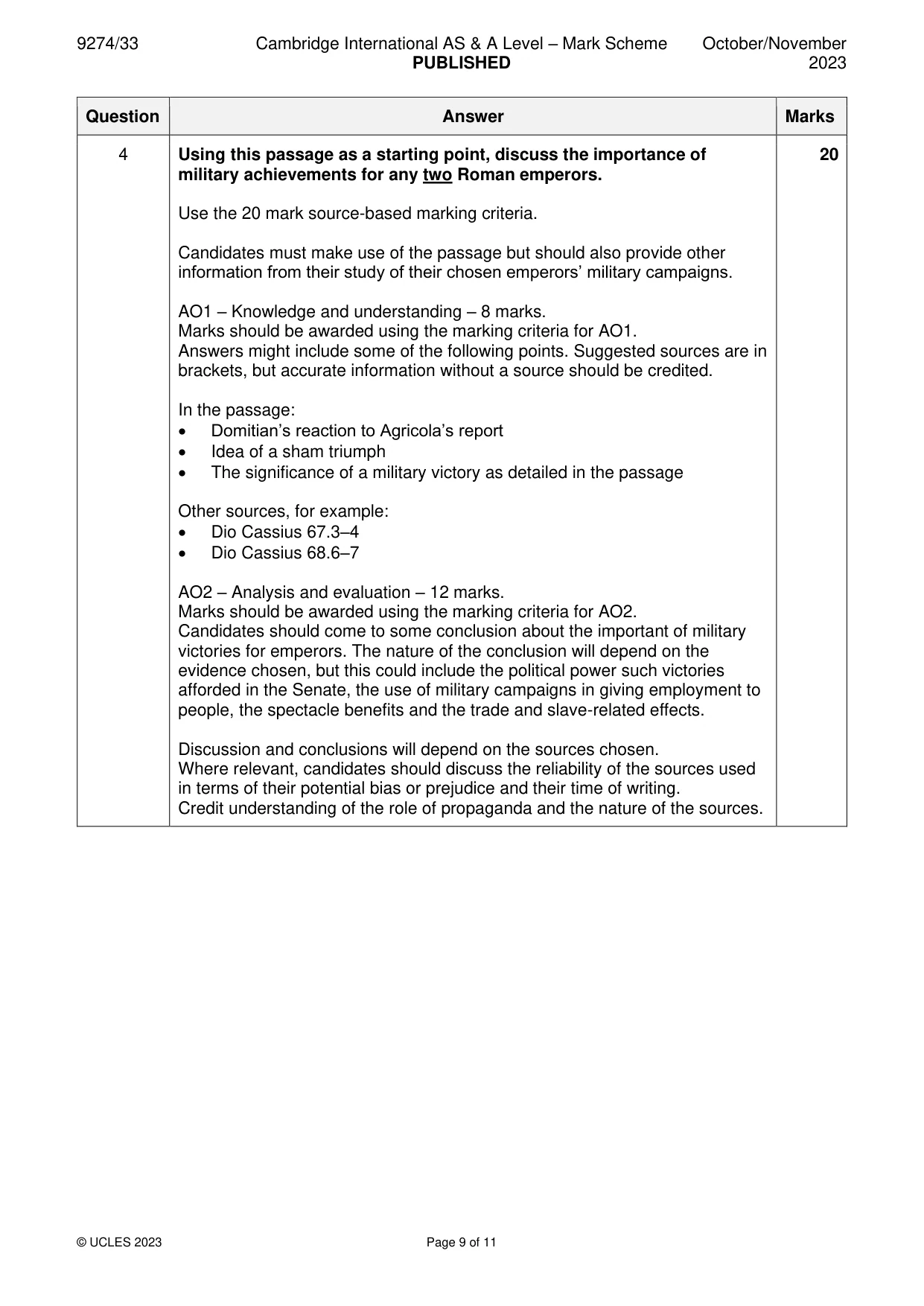
9274/33 Cambridge International AS & A Level – Mark Scheme PUBLISHED October/November 2023 © UCLES 2023 Page 9 of 11 Question Answer Marks 4 Using this passage as a starting point, discuss the importance of military achievements for any two Roman emperors. Use the 20 mark source-based marking criteria. Candidates must make use of the passage but should also provide other information from their study of their chosen emperors’ military campaigns. AO1 – Knowledge and understanding – 8 marks. Marks should be awarded using the marking criteria for AO1. Answers might include some of the following points. Suggested sources are in brackets, but accurate information without a source should be credited. In the passage: • Domitian’s reaction to Agricola’s report • Idea of a sham triumph • The significance of a military victory as detailed in the passage Other sources, for example: • Dio Cassius 67.3–4 • Dio Cassius 68.6–7 AO2 – Analysis and evaluation – 12 marks. Marks should be awarded using the marking criteria for AO2. Candidates should come to some conclusion about the important of military victories for emperors. The nature of the conclusion will depend on the evidence chosen, but this could include the political power such victories afforded in the Senate, the use of military campaigns in giving employment to people, the spectacle benefits and the trade and slave-related effects. Discussion and conclusions will depend on the sources chosen. Where relevant, candidates should discuss the reliability of the sources used in terms of their potential bias or prejudice and their time of writing. Credit understanding of the role of propaganda and the nature of the sources. 20
Mark scheme, page 10
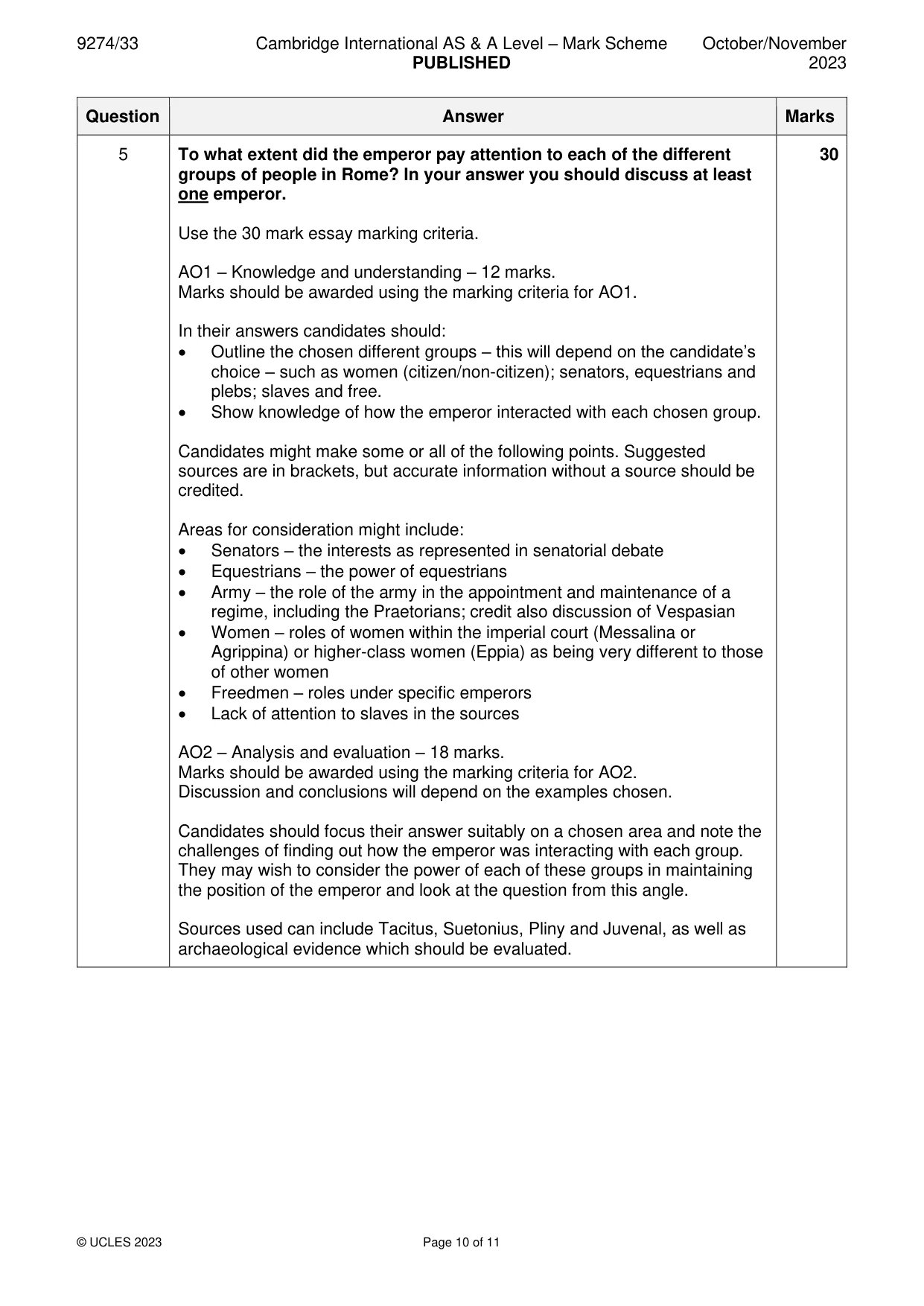
9274/33 Cambridge International AS & A Level – Mark Scheme PUBLISHED October/November 2023 © UCLES 2023 Page 10 of 11 Question Answer Marks 5 To what extent did the emperor pay attention to each of the different groups of people in Rome? In your answer you should discuss at least one emperor. Use the 30 mark essay marking criteria. AO1 – Knowledge and understanding – 12 marks. Marks should be awarded using the marking criteria for AO1. In their answers candidates should: • Outline the chosen different groups – this will depend on the candidate’s choice – such as women (citizen/non-citizen); senators, equestrians and plebs; slaves and free. • Show knowledge of how the emperor interacted with each chosen group. Candidates might make some or all of the following points. Suggested sources are in brackets, but accurate information without a source should be credited. Areas for consideration might include: • Senators – the interests as represented in senatorial debate • Equestrians – the power of equestrians • Army – the role of the army in the appointment and maintenance of a regime, including the Praetorians; credit also discussion of Vespasian • Women – roles of women within the imperial court (Messalina or Agrippina) or higher-class women (Eppia) as being very different to those of other women • Freedmen – roles under specific emperors • Lack of attention to slaves in the sources AO2 – Analysis and evaluation – 18 marks. Marks should be awarded using the marking criteria for AO2. Discussion and conclusions will depend on the examples chosen. Candidates should focus their answer suitably on a chosen area and note the challenges of finding out how the emperor was interacting with each group. They may wish to consider the power of each of these groups in maintaining the position of the emperor and look at the question from this angle. Sources used can include Tacitus, Suetonius, Pliny and Juvenal, as well as archaeological evidence which should be evaluated. 30
Mark scheme, page 11
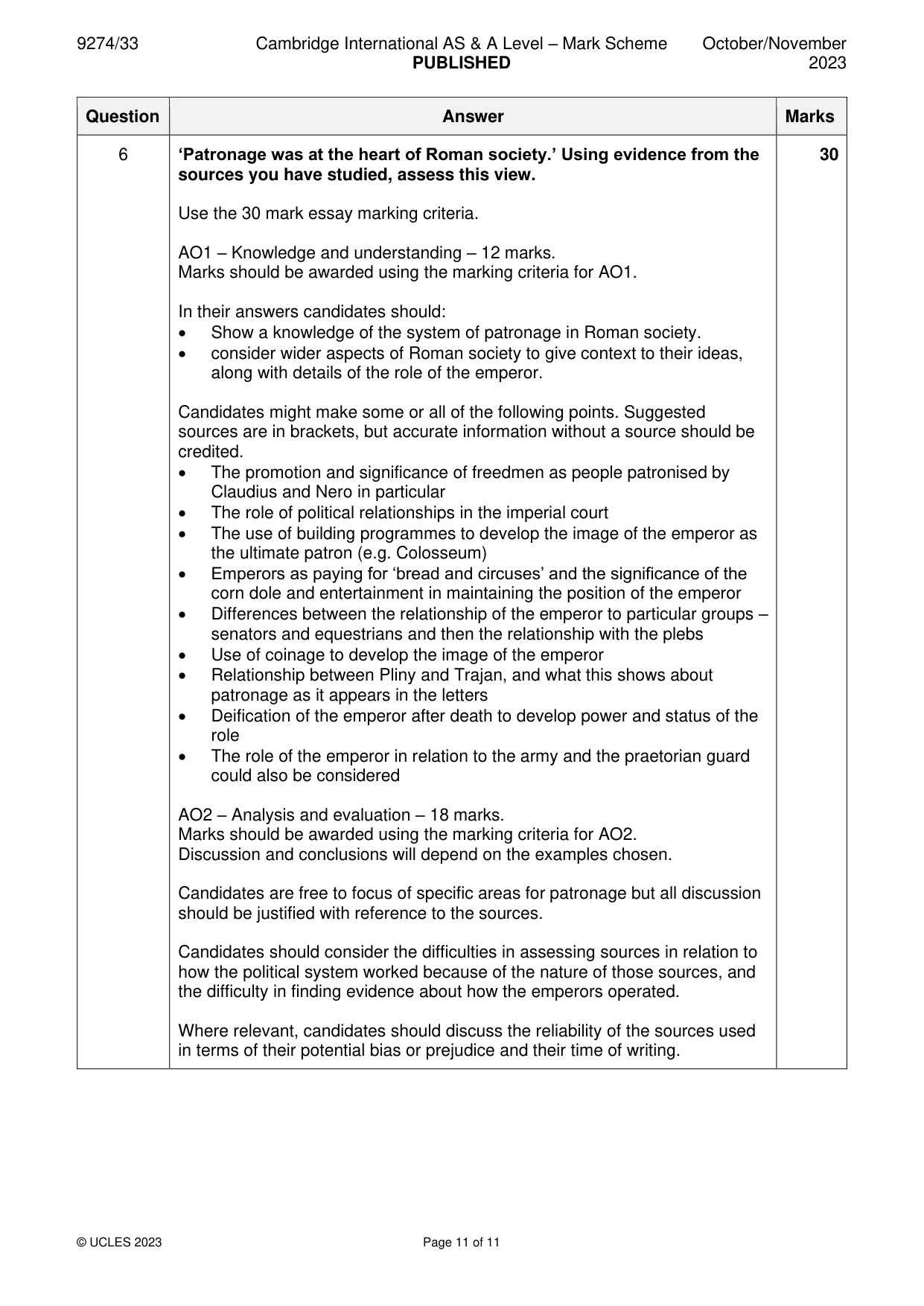
9274/33 Cambridge International AS & A Level – Mark Scheme PUBLISHED October/November 2023 © UCLES 2023 Page 11 of 11 Question Answer Marks 6 ‘Patronage was at the heart of Roman society.’ Using evidence from the sources you have studied, assess this view. Use the 30 mark essay marking criteria. AO1 – Knowledge and understanding – 12 marks. Marks should be awarded using the marking criteria for AO1. In their answers candidates should: • Show a knowledge of the system of patronage in Roman society. • consider wider aspects of Roman society to give context to their ideas, along with details of the role of the emperor. Candidates might make some or all of the following points. Suggested sources are in brackets, but accurate information without a source should be credited. • The promotion and significance of freedmen as people patronised by Claudius and Nero in particular • The role of political relationships in the imperial court • The use of building programmes to develop the image of the emperor as the ultimate patron (e.g. Colosseum) • Emperors as paying for ‘bread and circuses’ and the significance of the corn dole and entertainment in maintaining the position of the emperor • Differences between the relationship of the emperor to particular groups – senators and equestrians and then the relationship with the plebs • Use of coinage to develop the image of the emperor • Relationship between Pliny and Trajan, and what this shows about patronage as it appears in the letters • Deification of the emperor after death to develop power and status of the role • The role of the emperor in relation to the army and the praetorian guard could also be considered AO2 – Analysis and evaluation – 18 marks. Marks should be awarded using the marking criteria for AO2. Discussion and conclusions will depend on the examples chosen. Candidates are free to focus of specific areas for patronage but all discussion should be justified with reference to the sources. Candidates should consider the difficulties in assessing sources in relation to how the political system worked because of the nature of those sources, and the difficulty in finding evidence about how the emperors operated. Where relevant, candidates should discuss the reliability of the sources used in terms of their potential bias or prejudice and their time of writing. 30
What you needed in this session
Cambridge’s own grade thresholds for 2023 Oct/Nov, Paper 3 · Variant 3. A higher threshold means an easier paper — the bar moves with how the cohort did.