Cambridge A Level Classical Studies 9274 — 2022 Oct/Nov Paper 3 · Variant 1
9274/31/O/N/22 · 50 marks · ≈56 min
The question paper and its mark scheme, free to read here and free to download. This is Cambridge’s own paper, exactly as it was sat.
Question paper4 pages
Mark scheme11 pages
Answers below. Sit the paper first if you are practising.
Paper as text
Question paper, page 1
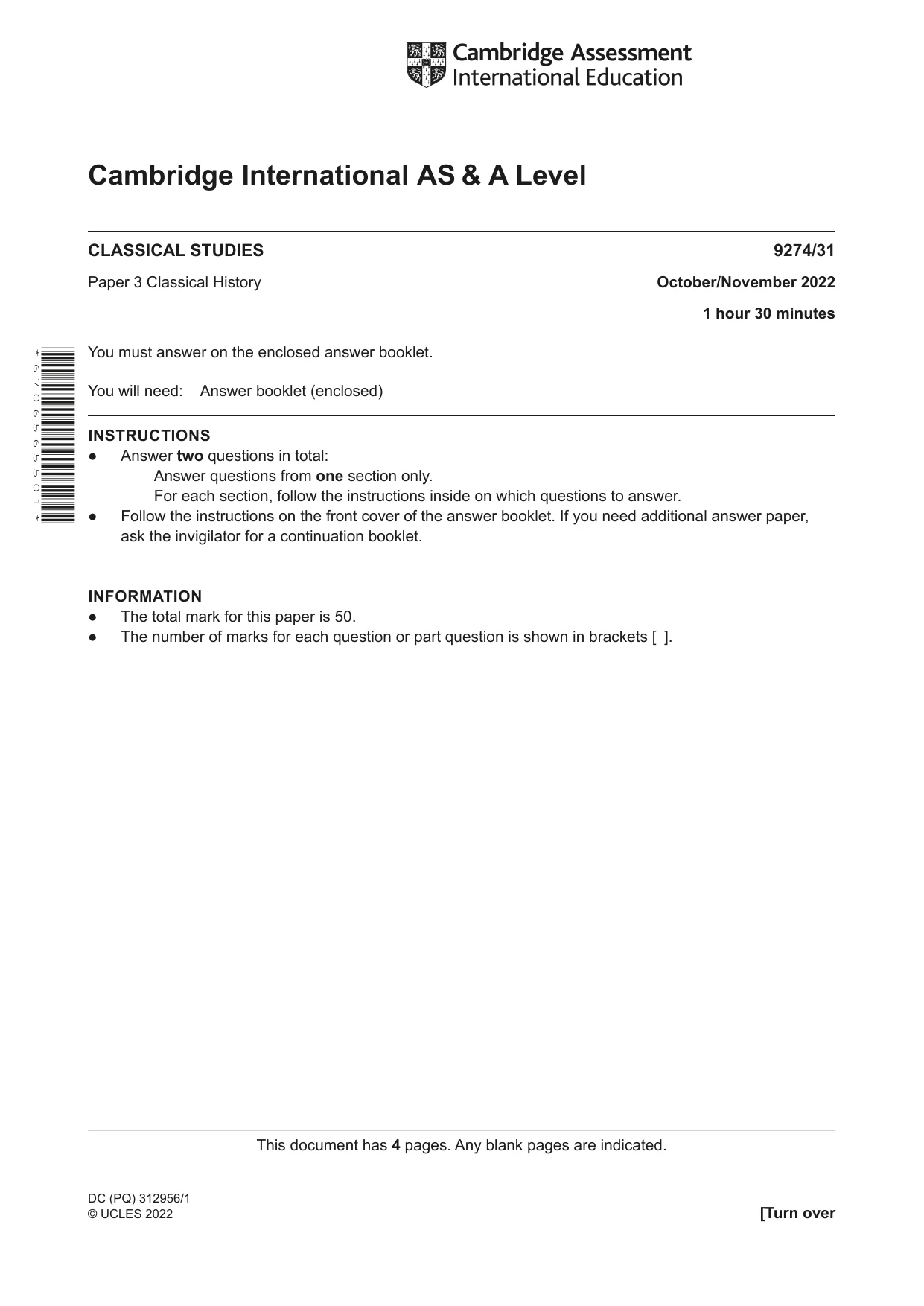
This document has 4 pages. Any blank pages are indicated. [Turn over Cambridge International AS & A Level CLASSICAL STUDIES 9274/31 Paper 3 Classical History October/November 2022 1 hour 30 minutes You must answer on the enclosed answer booklet. You will need: Answer booklet (enclosed) INSTRUCTIONS ● Answer two questions in total: Answer questions from one section only. For each section, follow the instructions inside on which questions to answer. ● Follow the instructions on the front cover of the answer booklet. If you need additional answer paper, ask the invigilator for a continuation booklet. INFORMATION ● The total mark for this paper is 50. ● The number of marks for each question or part question is shown in brackets [ ]. * 6 7 0 6 5 6 5 5 0 1 * DC (PQ) 312956/1 © UCLES 2022
Question paper, page 2
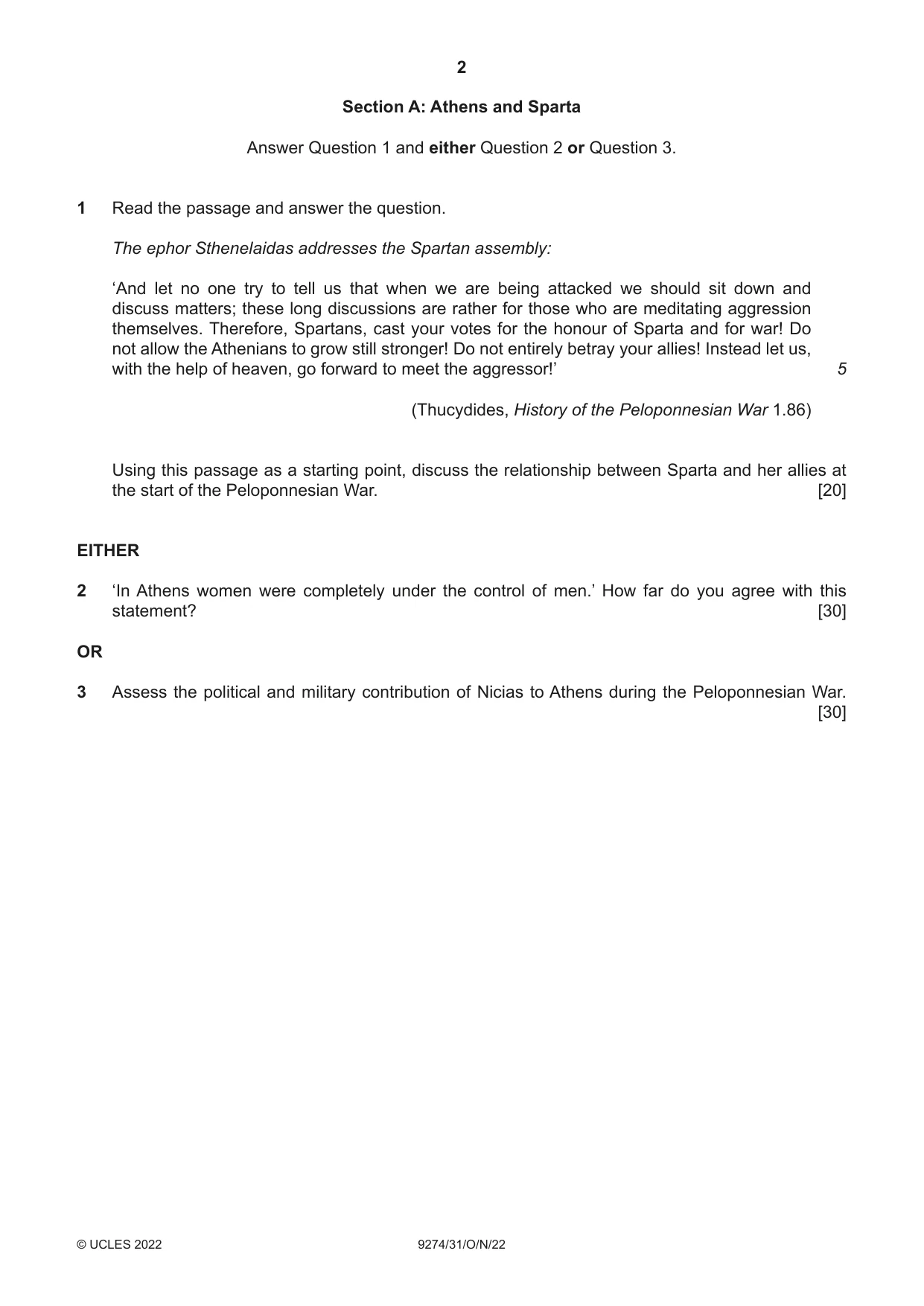
2 9274/31/O/N/22 © UCLES 2022 Section A: Athens and Sparta Answer Question 1 and either Question 2 or Question 3. 1 Read the passage and answer the question. The ephor Sthenelaidas addresses the Spartan assembly: ‘And let no one try to tell us that when we are being attacked we should sit down and discuss matters; these long discussions are rather for those who are meditating aggression themselves. Therefore, Spartans, cast your votes for the honour of Sparta and for war! Do not allow the Athenians to grow still stronger! Do not entirely betray your allies! Instead let us, with the help of heaven, go forward to meet the aggressor!’ 5 (Thucydides, History of the Peloponnesian War 1.86) Using this passage as a starting point, discuss the relationship between Sparta and her allies at the start of the Peloponnesian War. [20] EITHER 2 ‘In Athens women were completely under the control of men.’ How far do you agree with this statement? [30] OR 3 Assess the political and military contribution of Nicias to Athens during the Peloponnesian War. [30]
Question paper, page 3
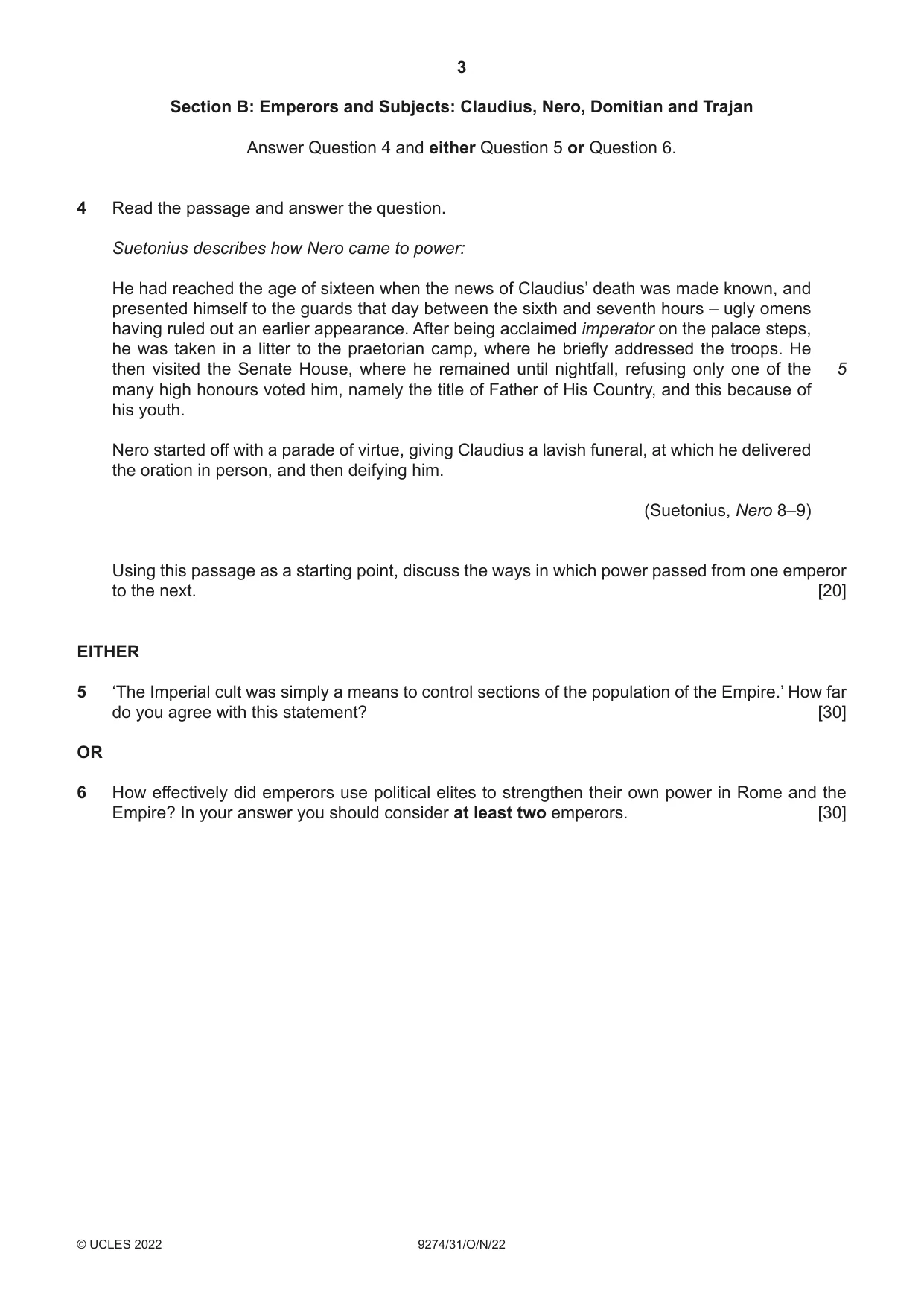
3 9274/31/O/N/22 © UCLES 2022 Section B: Emperors and Subjects: Claudius, Nero, Domitian and Trajan Answer Question 4 and either Question 5 or Question 6. 4 Read the passage and answer the question. Suetonius describes how Nero came to power: He had reached the age of sixteen when the news of Claudius’ death was made known, and presented himself to the guards that day between the sixth and seventh hours – ugly omens having ruled out an earlier appearance. After being acclaimed imperator on the palace steps, he was taken in a litter to the praetorian camp, where he briefly addressed the troops. He then visited the Senate House, where he remained until nightfall, refusing only one of the many high honours voted him, namely the title of Father of His Country, and this because of his youth. Nero started off with a parade of virtue, giving Claudius a lavish funeral, at which he delivered the oration in person, and then deifying him. (Suetonius, Nero 8–9) Using this passage as a starting point, discuss the ways in which power passed from one emperor to the next. [20] EITHER 5 ‘The Imperial cult was simply a means to control sections of the population of the Empire.’ How far do you agree with this statement? [30] OR 6 How effectively did emperors use political elites to strengthen their own power in Rome and the Empire? In your answer you should consider at least two emperors. [30] 5
Question paper, page 4
4 9274/31/O/N/22 © UCLES 2022 Permission to reproduce items where third-party owned material protected by copyright is included has been sought and cleared where possible. Every reasonable effort has been made by the publisher (UCLES) to trace copyright holders, but if any items requiring clearance have unwittingly been included, the publisher will be pleased to make amends at the earliest possible opportunity. To avoid the issue of disclosure of answer-related information to candidates, all copyright acknowledgements are reproduced online in the Cambridge Assessment International Education Copyright Acknowledgements Booklet. This is produced for each series of examinations and is freely available to download at www.cambridgeinternational.org after the live examination series. Cambridge Assessment International Education is part of Cambridge Assessment. Cambridge Assessment is the brand name of the University of Cambridge Local Examinations Syndicate (UCLES), which is a department of the University of Cambridge. BLANK PAGE
Mark scheme, page 1
This document consists of 11 printed pages. © UCLES 2022 [Turn over Cambridge International AS & A Level CLASSICAL STUDIES 9274/31 Paper 3 Classical History October/November 2022 MARK SCHEME Maximum Mark: 50 Published This mark scheme is published as an aid to teachers and candidates, to indicate the requirements of the examination. It shows the basis on which Examiners were instructed to award marks. It does not indicate the details of the discussions that took place at an Examiners’ meeting before marking began, which would have considered the acceptability of alternative answers. Mark schemes should be read in conjunction with the question paper and the Principal Examiner Report for Teachers. Cambridge International will not enter into discussions about these mark schemes. Cambridge International is publishing the mark schemes for the October/November 2022 series for most Cambridge IGCSE™, Cambridge International A and AS Level components and some Cambridge O Level components.
Mark scheme, page 2
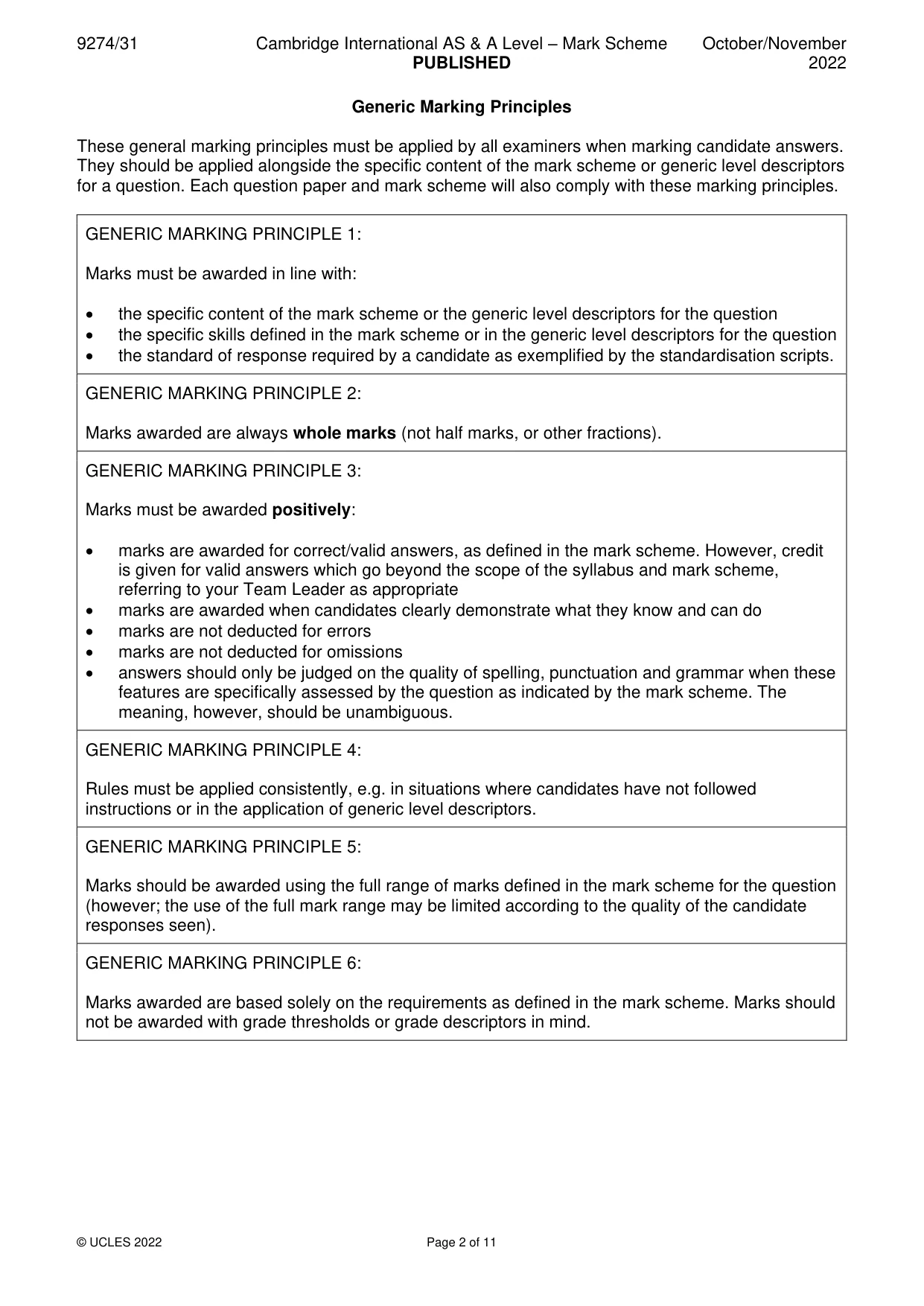
9274/31 Cambridge International AS & A Level – Mark Scheme PUBLISHED October/November 2022 © UCLES 2022 Page 2 of 11 Generic Marking Principles These general marking principles must be applied by all examiners when marking candidate answers. They should be applied alongside the specific content of the mark scheme or generic level descriptors for a question. Each question paper and mark scheme will also comply with these marking principles. GENERIC MARKING PRINCIPLE 1: Marks must be awarded in line with: • the specific content of the mark scheme or the generic level descriptors for the question • the specific skills defined in the mark scheme or in the generic level descriptors for the question • the standard of response required by a candidate as exemplified by the standardisation scripts. GENERIC MARKING PRINCIPLE 2: Marks awarded are always whole marks (not half marks, or other fractions). GENERIC MARKING PRINCIPLE 3: Marks must be awarded positively: • marks are awarded for correct/valid answers, as defined in the mark scheme. However, credit is given for valid answers which go beyond the scope of the syllabus and mark scheme, referring to your Team Leader as appropriate • marks are awarded when candidates clearly demonstrate what they know and can do • marks are not deducted for errors • marks are not deducted for omissions • answers should only be judged on the quality of spelling, punctuation and grammar when these features are specifically assessed by the question as indicated by the mark scheme. The meaning, however, should be unambiguous. GENERIC MARKING PRINCIPLE 4: Rules must be applied consistently, e.g. in situations where candidates have not followed instructions or in the application of generic level descriptors. GENERIC MARKING PRINCIPLE 5: Marks should be awarded using the full range of marks defined in the mark scheme for the question (however; the use of the full mark range may be limited according to the quality of the candidate responses seen). GENERIC MARKING PRINCIPLE 6: Marks awarded are based solely on the requirements as defined in the mark scheme. Marks should not be awarded with grade thresholds or grade descriptors in mind.
Mark scheme, page 3
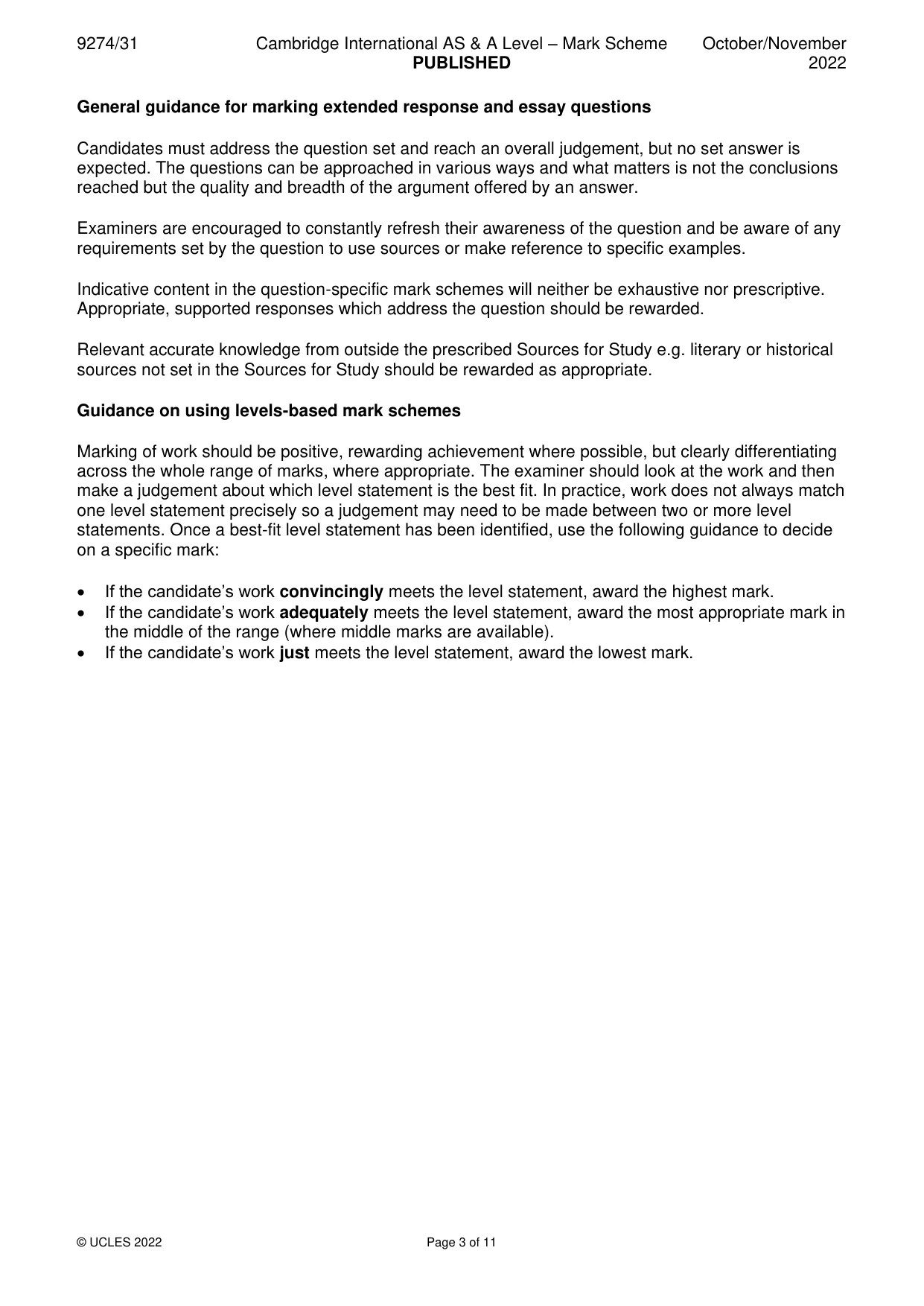
9274/31 Cambridge International AS & A Level – Mark Scheme PUBLISHED October/November 2022 © UCLES 2022 Page 3 of 11 General guidance for marking extended response and essay questions Candidates must address the question set and reach an overall judgement, but no set answer is expected. The questions can be approached in various ways and what matters is not the conclusions reached but the quality and breadth of the argument offered by an answer. Examiners are encouraged to constantly refresh their awareness of the question and be aware of any requirements set by the question to use sources or make reference to specific examples. Indicative content in the question-specific mark schemes will neither be exhaustive nor prescriptive. Appropriate, supported responses which address the question should be rewarded. Relevant accurate knowledge from outside the prescribed Sources for Study e.g. literary or historical sources not set in the Sources for Study should be rewarded as appropriate. Guidance on using levels-based mark schemes Marking of work should be positive, rewarding achievement where possible, but clearly differentiating across the whole range of marks, where appropriate. The examiner should look at the work and then make a judgement about which level statement is the best fit. In practice, work does not always match one level statement precisely so a judgement may need to be made between two or more level statements. Once a best-fit level statement has been identified, use the following guidance to decide on a specific mark: • If the candidate’s work convincingly meets the level statement, award the highest mark. • If the candidate’s work adequately meets the level statement, award the most appropriate mark in the middle of the range (where middle marks are available). • If the candidate’s work just meets the level statement, award the lowest mark.
Mark scheme, page 4
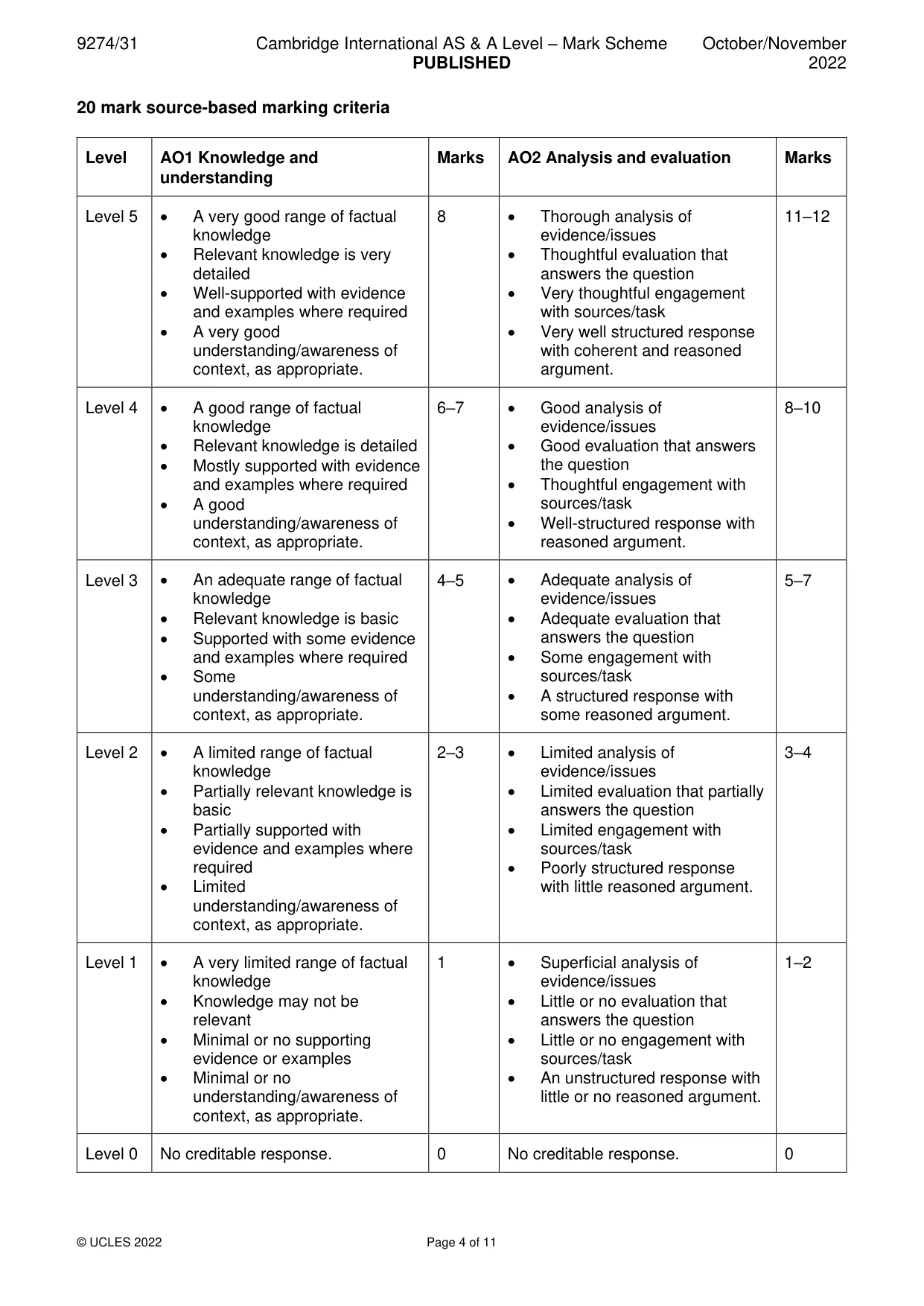
9274/31 Cambridge International AS & A Level – Mark Scheme PUBLISHED October/November 2022 © UCLES 2022 Page 4 of 11 20 mark source-based marking criteria Level AO1 Knowledge and understanding Marks AO2 Analysis and evaluation Marks Level 5 • A very good range of factual knowledge • Relevant knowledge is very detailed • Well-supported with evidence and examples where required • A very good understanding/awareness of context, as appropriate. 8 • Thorough analysis of evidence/issues • Thoughtful evaluation that answers the question • Very thoughtful engagement with sources/task • Very well structured response with coherent and reasoned argument. 11–12 Level 4 • A good range of factual knowledge • Relevant knowledge is detailed • Mostly supported with evidence and examples where required • A good understanding/awareness of context, as appropriate. 6–7 • Good analysis of evidence/issues • Good evaluation that answers the question • Thoughtful engagement with sources/task • Well-structured response with reasoned argument. 8–10 Level 3 • An adequate range of factual knowledge • Relevant knowledge is basic • Supported with some evidence and examples where required • Some understanding/awareness of context, as appropriate. 4–5 • Adequate analysis of evidence/issues • Adequate evaluation that answers the question • Some engagement with sources/task • A structured response with some reasoned argument. 5–7 Level 2 • A limited range of factual knowledge • Partially relevant knowledge is basic • Partially supported with evidence and examples where required • Limited understanding/awareness of context, as appropriate. 2–3 • Limited analysis of evidence/issues • Limited evaluation that partially answers the question • Limited engagement with sources/task • Poorly structured response with little reasoned argument. 3–4 Level 1 • A very limited range of factual knowledge • Knowledge may not be relevant • Minimal or no supporting evidence or examples • Minimal or no understanding/awareness of context, as appropriate. 1 • Superficial analysis of evidence/issues • Little or no evaluation that answers the question • Little or no engagement with sources/task • An unstructured response with little or no reasoned argument. 1–2 Level 0 No creditable response. 0 No creditable response. 0
Mark scheme, page 5
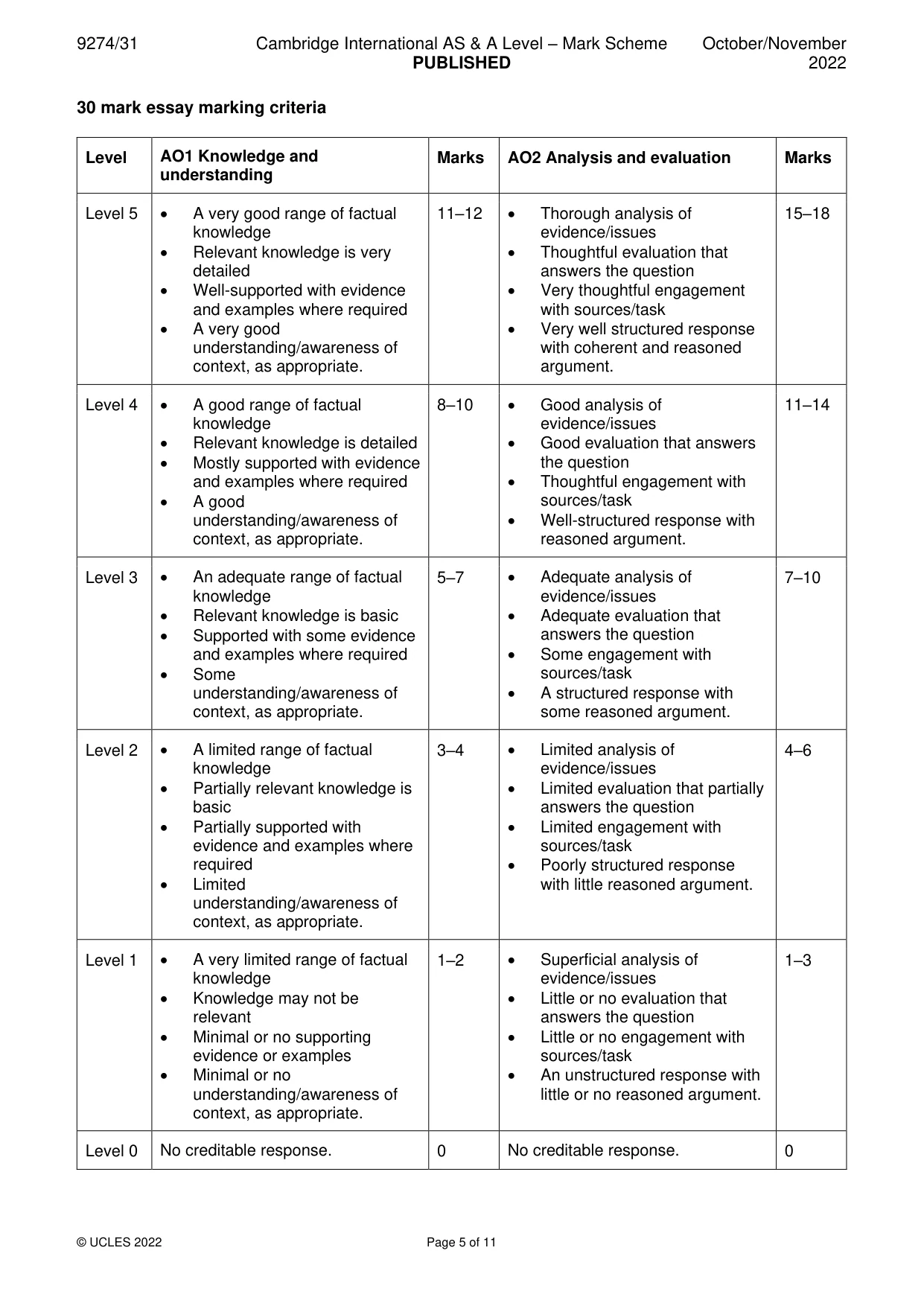
9274/31 Cambridge International AS & A Level – Mark Scheme PUBLISHED October/November 2022 © UCLES 2022 Page 5 of 11 30 mark essay marking criteria Level AO1 Knowledge and understanding Marks AO2 Analysis and evaluation Marks Level 5 • A very good range of factual knowledge • Relevant knowledge is very detailed • Well-supported with evidence and examples where required • A very good understanding/awareness of context, as appropriate. 11–12 • Thorough analysis of evidence/issues • Thoughtful evaluation that answers the question • Very thoughtful engagement with sources/task • Very well structured response with coherent and reasoned argument. 15–18 Level 4 • A good range of factual knowledge • Relevant knowledge is detailed • Mostly supported with evidence and examples where required • A good understanding/awareness of context, as appropriate. 8–10 • Good analysis of evidence/issues • Good evaluation that answers the question • Thoughtful engagement with sources/task • Well-structured response with reasoned argument. 11–14 Level 3 • An adequate range of factual knowledge • Relevant knowledge is basic • Supported with some evidence and examples where required • Some understanding/awareness of context, as appropriate. 5–7 • Adequate analysis of evidence/issues • Adequate evaluation that answers the question • Some engagement with sources/task • A structured response with some reasoned argument. 7–10 Level 2 • A limited range of factual knowledge • Partially relevant knowledge is basic • Partially supported with evidence and examples where required • Limited understanding/awareness of context, as appropriate. 3–4 • Limited analysis of evidence/issues • Limited evaluation that partially answers the question • Limited engagement with sources/task • Poorly structured response with little reasoned argument. 4–6 Level 1 • A very limited range of factual knowledge • Knowledge may not be relevant • Minimal or no supporting evidence or examples • Minimal or no understanding/awareness of context, as appropriate. 1–2 • Superficial analysis of evidence/issues • Little or no evaluation that answers the question • Little or no engagement with sources/task • An unstructured response with little or no reasoned argument. 1–3 Level 0 No creditable response. 0 No creditable response. 0
Mark scheme, page 6
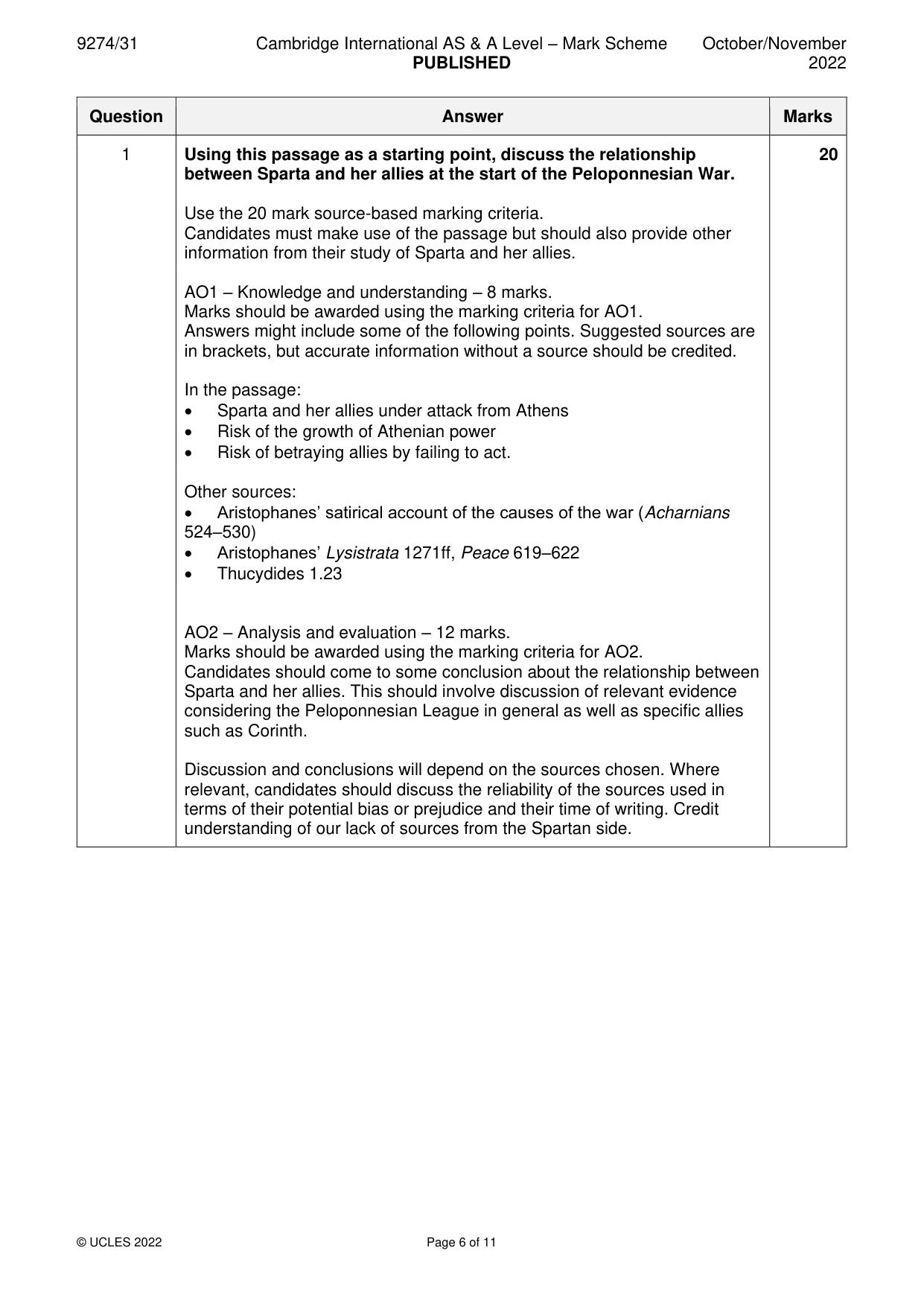
9274/31 Cambridge International AS & A Level – Mark Scheme PUBLISHED October/November 2022 © UCLES 2022 Page 6 of 11 Question Answer Marks 1 Using this passage as a starting point, discuss the relationship between Sparta and her allies at the start of the Peloponnesian War. Use the 20 mark source-based marking criteria. Candidates must make use of the passage but should also provide other information from their study of Sparta and her allies. AO1 – Knowledge and understanding – 8 marks. Marks should be awarded using the marking criteria for AO1. Answers might include some of the following points. Suggested sources are in brackets, but accurate information without a source should be credited. In the passage: • Sparta and her allies under attack from Athens • Risk of the growth of Athenian power • Risk of betraying allies by failing to act. Other sources: • Aristophanes’ satirical account of the causes of the war (Acharnians 524–530) • Aristophanes’ Lysistrata 1271ff, Peace 619–622 • Thucydides 1.23 AO2 – Analysis and evaluation – 12 marks. Marks should be awarded using the marking criteria for AO2. Candidates should come to some conclusion about the relationship between Sparta and her allies. This should involve discussion of relevant evidence considering the Peloponnesian League in general as well as specific allies such as Corinth. Discussion and conclusions will depend on the sources chosen. Where relevant, candidates should discuss the reliability of the sources used in terms of their potential bias or prejudice and their time of writing. Credit understanding of our lack of sources from the Spartan side. 20
Mark scheme, page 7
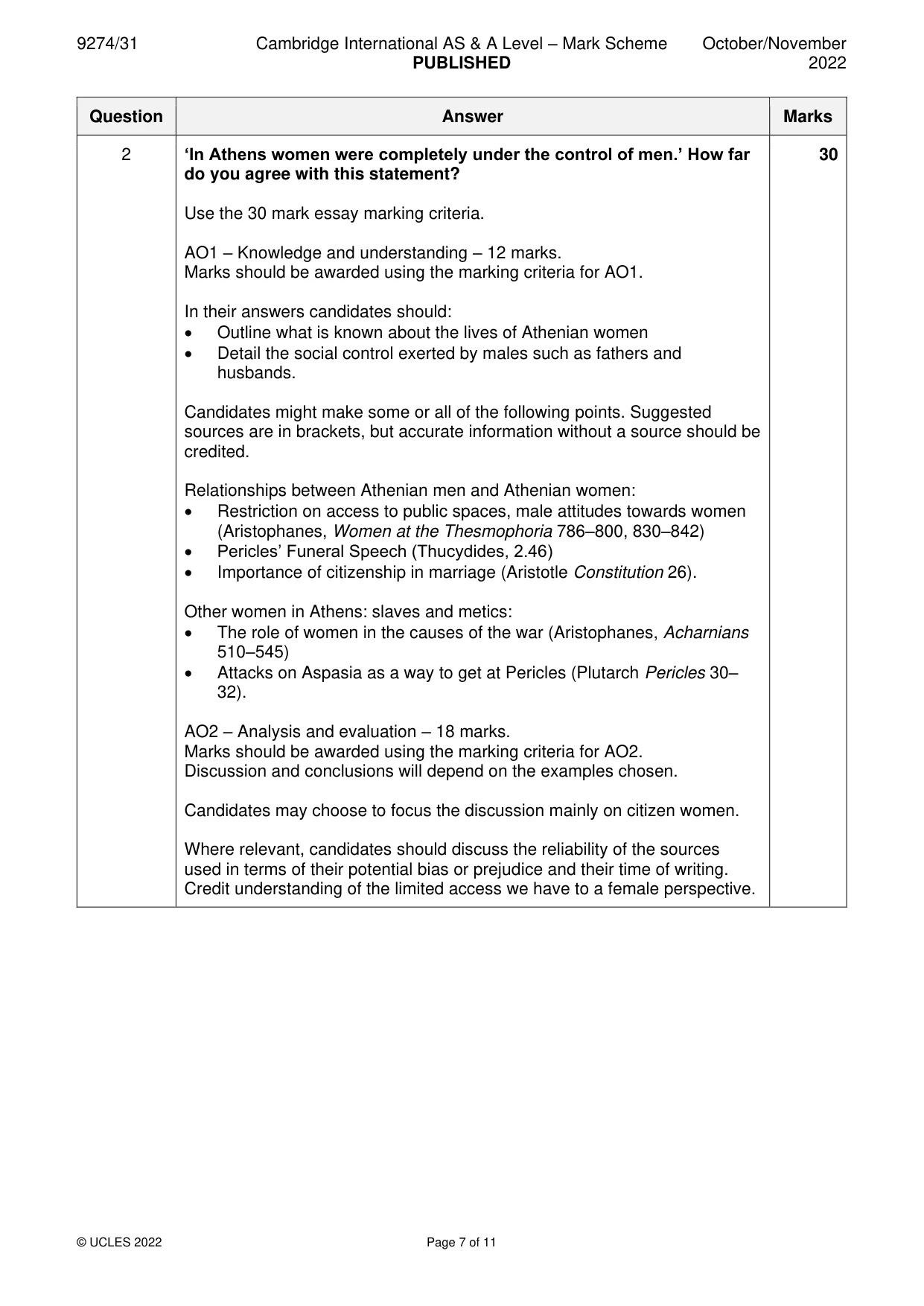
9274/31 Cambridge International AS & A Level – Mark Scheme PUBLISHED October/November 2022 © UCLES 2022 Page 7 of 11 Question Answer Marks 2 ‘In Athens women were completely under the control of men.’ How far do you agree with this statement? Use the 30 mark essay marking criteria. AO1 – Knowledge and understanding – 12 marks. Marks should be awarded using the marking criteria for AO1. In their answers candidates should: • Outline what is known about the lives of Athenian women • Detail the social control exerted by males such as fathers and husbands. Candidates might make some or all of the following points. Suggested sources are in brackets, but accurate information without a source should be credited. Relationships between Athenian men and Athenian women: • Restriction on access to public spaces, male attitudes towards women (Aristophanes, Women at the Thesmophoria 786–800, 830–842) • Pericles’ Funeral Speech (Thucydides, 2.46) • Importance of citizenship in marriage (Aristotle Constitution 26). Other women in Athens: slaves and metics: • The role of women in the causes of the war (Aristophanes, Acharnians 510–545) • Attacks on Aspasia as a way to get at Pericles (Plutarch Pericles 30– 32). AO2 – Analysis and evaluation – 18 marks. Marks should be awarded using the marking criteria for AO2. Discussion and conclusions will depend on the examples chosen. Candidates may choose to focus the discussion mainly on citizen women. Where relevant, candidates should discuss the reliability of the sources used in terms of their potential bias or prejudice and their time of writing. Credit understanding of the limited access we have to a female perspective. 30
Mark scheme, page 8
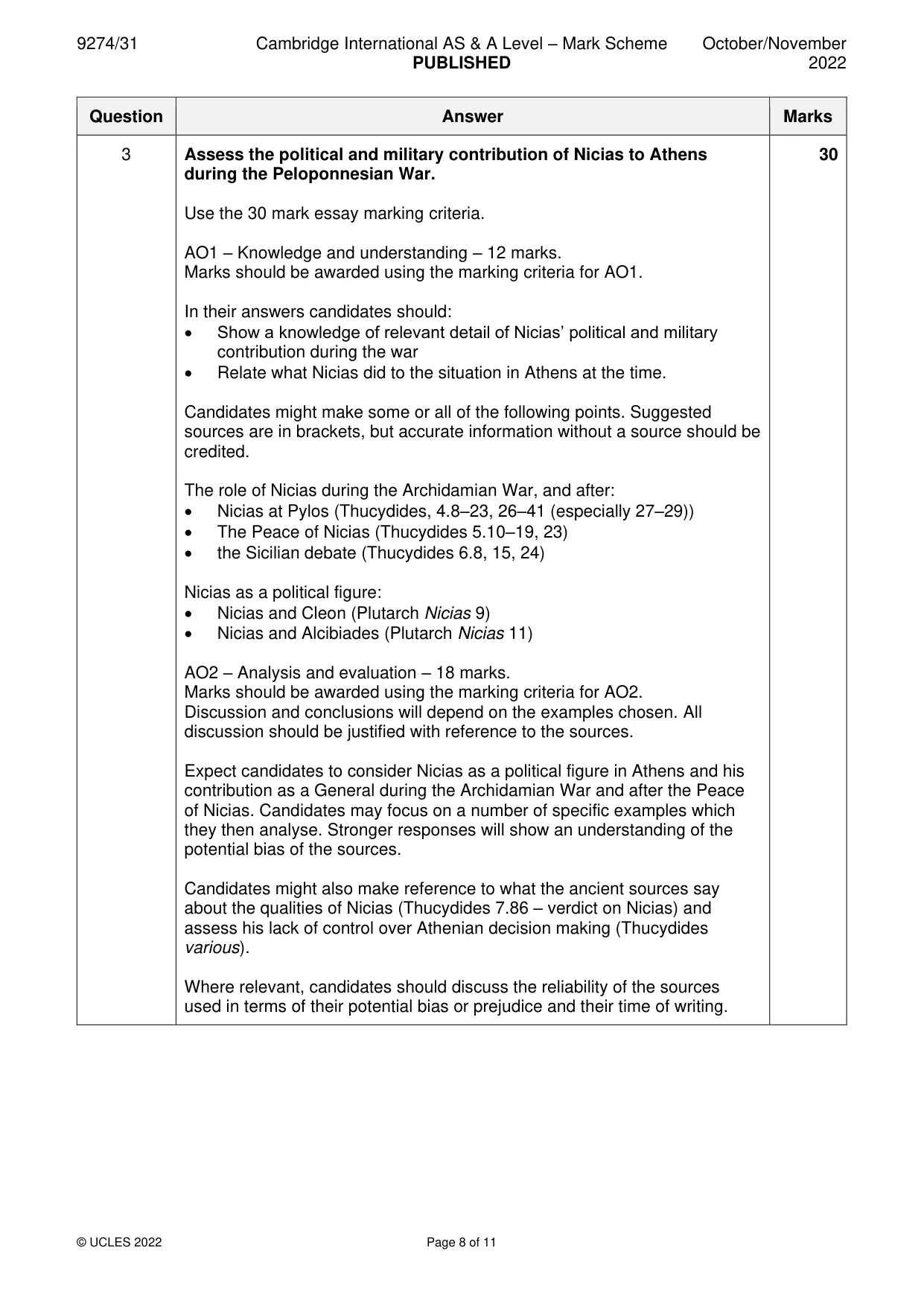
9274/31 Cambridge International AS & A Level – Mark Scheme PUBLISHED October/November 2022 © UCLES 2022 Page 8 of 11 Question Answer Marks 3 Assess the political and military contribution of Nicias to Athens during the Peloponnesian War. Use the 30 mark essay marking criteria. AO1 – Knowledge and understanding – 12 marks. Marks should be awarded using the marking criteria for AO1. In their answers candidates should: • Show a knowledge of relevant detail of Nicias’ political and military contribution during the war • Relate what Nicias did to the situation in Athens at the time. Candidates might make some or all of the following points. Suggested sources are in brackets, but accurate information without a source should be credited. The role of Nicias during the Archidamian War, and after: • Nicias at Pylos (Thucydides, 4.8–23, 26–41 (especially 27–29)) • The Peace of Nicias (Thucydides 5.10–19, 23) • the Sicilian debate (Thucydides 6.8, 15, 24) Nicias as a political figure: • Nicias and Cleon (Plutarch Nicias 9) • Nicias and Alcibiades (Plutarch Nicias 11) AO2 – Analysis and evaluation – 18 marks. Marks should be awarded using the marking criteria for AO2. Discussion and conclusions will depend on the examples chosen. All discussion should be justified with reference to the sources. Expect candidates to consider Nicias as a political figure in Athens and his contribution as a General during the Archidamian War and after the Peace of Nicias. Candidates may focus on a number of specific examples which they then analyse. Stronger responses will show an understanding of the potential bias of the sources. Candidates might also make reference to what the ancient sources say about the qualities of Nicias (Thucydides 7.86 – verdict on Nicias) and assess his lack of control over Athenian decision making (Thucydides various). Where relevant, candidates should discuss the reliability of the sources used in terms of their potential bias or prejudice and their time of writing. 30
Mark scheme, page 9
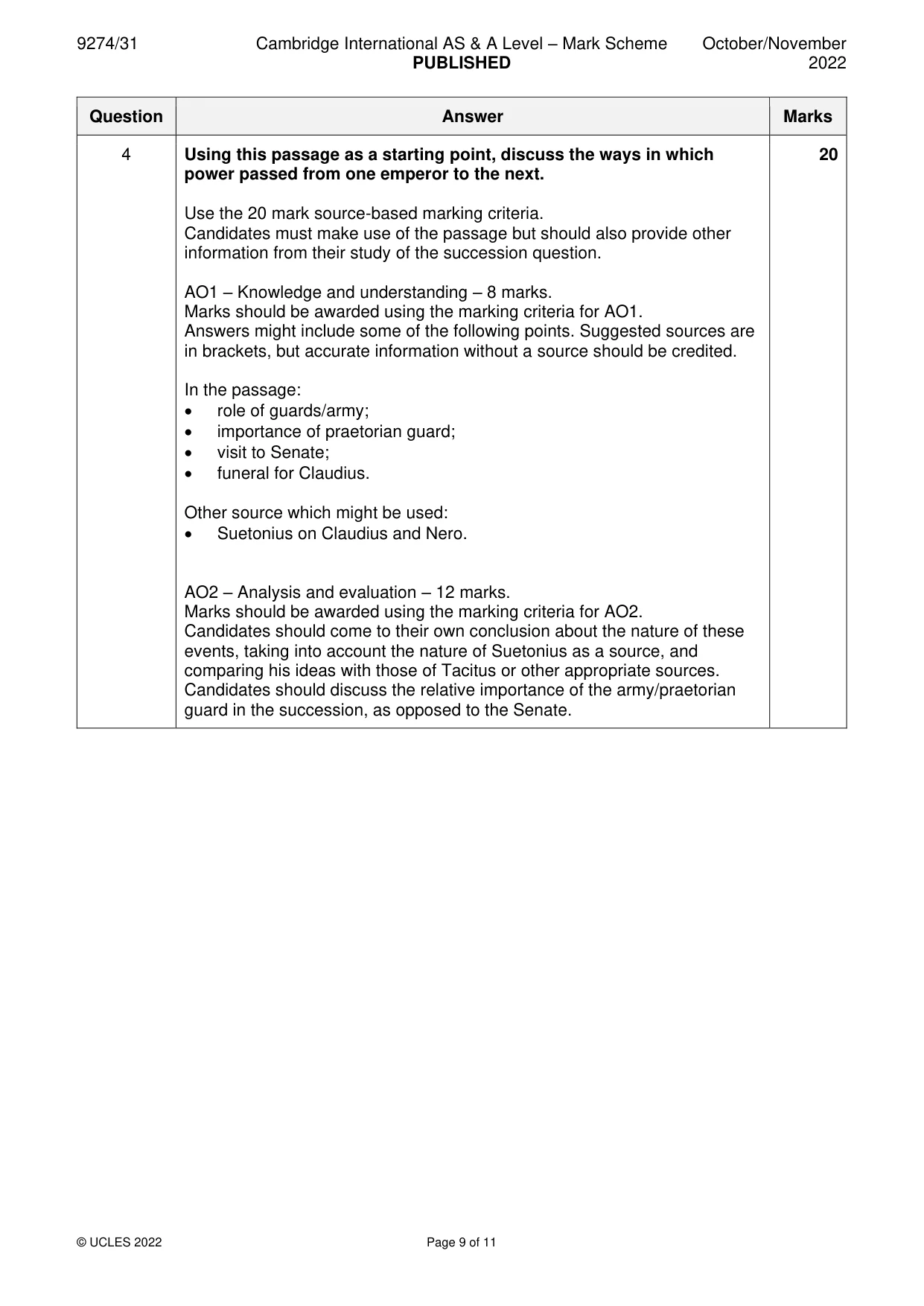
9274/31 Cambridge International AS & A Level – Mark Scheme PUBLISHED October/November 2022 © UCLES 2022 Page 9 of 11 Question Answer Marks 4 Using this passage as a starting point, discuss the ways in which power passed from one emperor to the next. Use the 20 mark source-based marking criteria. Candidates must make use of the passage but should also provide other information from their study of the succession question. AO1 – Knowledge and understanding – 8 marks. Marks should be awarded using the marking criteria for AO1. Answers might include some of the following points. Suggested sources are in brackets, but accurate information without a source should be credited. In the passage: • role of guards/army; • importance of praetorian guard; • visit to Senate; • funeral for Claudius. Other source which might be used: • Suetonius on Claudius and Nero. AO2 – Analysis and evaluation – 12 marks. Marks should be awarded using the marking criteria for AO2. Candidates should come to their own conclusion about the nature of these events, taking into account the nature of Suetonius as a source, and comparing his ideas with those of Tacitus or other appropriate sources. Candidates should discuss the relative importance of the army/praetorian guard in the succession, as opposed to the Senate. 20
Mark scheme, page 10
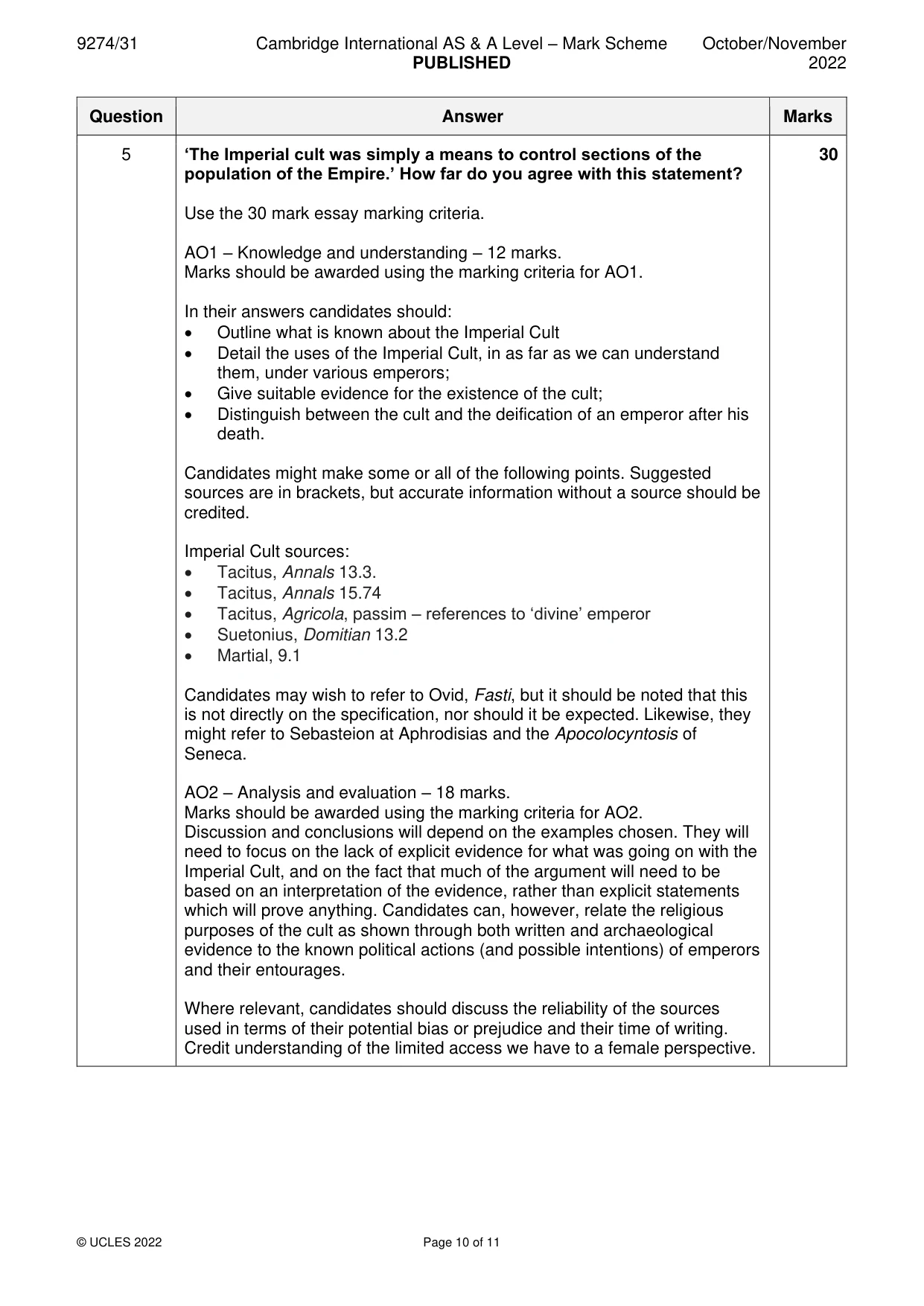
9274/31 Cambridge International AS & A Level – Mark Scheme PUBLISHED October/November 2022 © UCLES 2022 Page 10 of 11 Question Answer Marks 5 ‘The Imperial cult was simply a means to control sections of the population of the Empire.’ How far do you agree with this statement? Use the 30 mark essay marking criteria. AO1 – Knowledge and understanding – 12 marks. Marks should be awarded using the marking criteria for AO1. In their answers candidates should: • Outline what is known about the Imperial Cult • Detail the uses of the Imperial Cult, in as far as we can understand them, under various emperors; • Give suitable evidence for the existence of the cult; • Distinguish between the cult and the deification of an emperor after his death. Candidates might make some or all of the following points. Suggested sources are in brackets, but accurate information without a source should be credited. Imperial Cult sources: • Tacitus, Annals 13.3. • Tacitus, Annals 15.74 • Tacitus, Agricola, passim – references to ‘divine’ emperor • Suetonius, Domitian 13.2 • Martial, 9.1 Candidates may wish to refer to Ovid, Fasti, but it should be noted that this is not directly on the specification, nor should it be expected. Likewise, they might refer to Sebasteion at Aphrodisias and the Apocolocyntosis of Seneca. AO2 – Analysis and evaluation – 18 marks. Marks should be awarded using the marking criteria for AO2. Discussion and conclusions will depend on the examples chosen. They will need to focus on the lack of explicit evidence for what was going on with the Imperial Cult, and on the fact that much of the argument will need to be based on an interpretation of the evidence, rather than explicit statements which will prove anything. Candidates can, however, relate the religious purposes of the cult as shown through both written and archaeological evidence to the known political actions (and possible intentions) of emperors and their entourages. Where relevant, candidates should discuss the reliability of the sources used in terms of their potential bias or prejudice and their time of writing. Credit understanding of the limited access we have to a female perspective. 30
Mark scheme, page 11
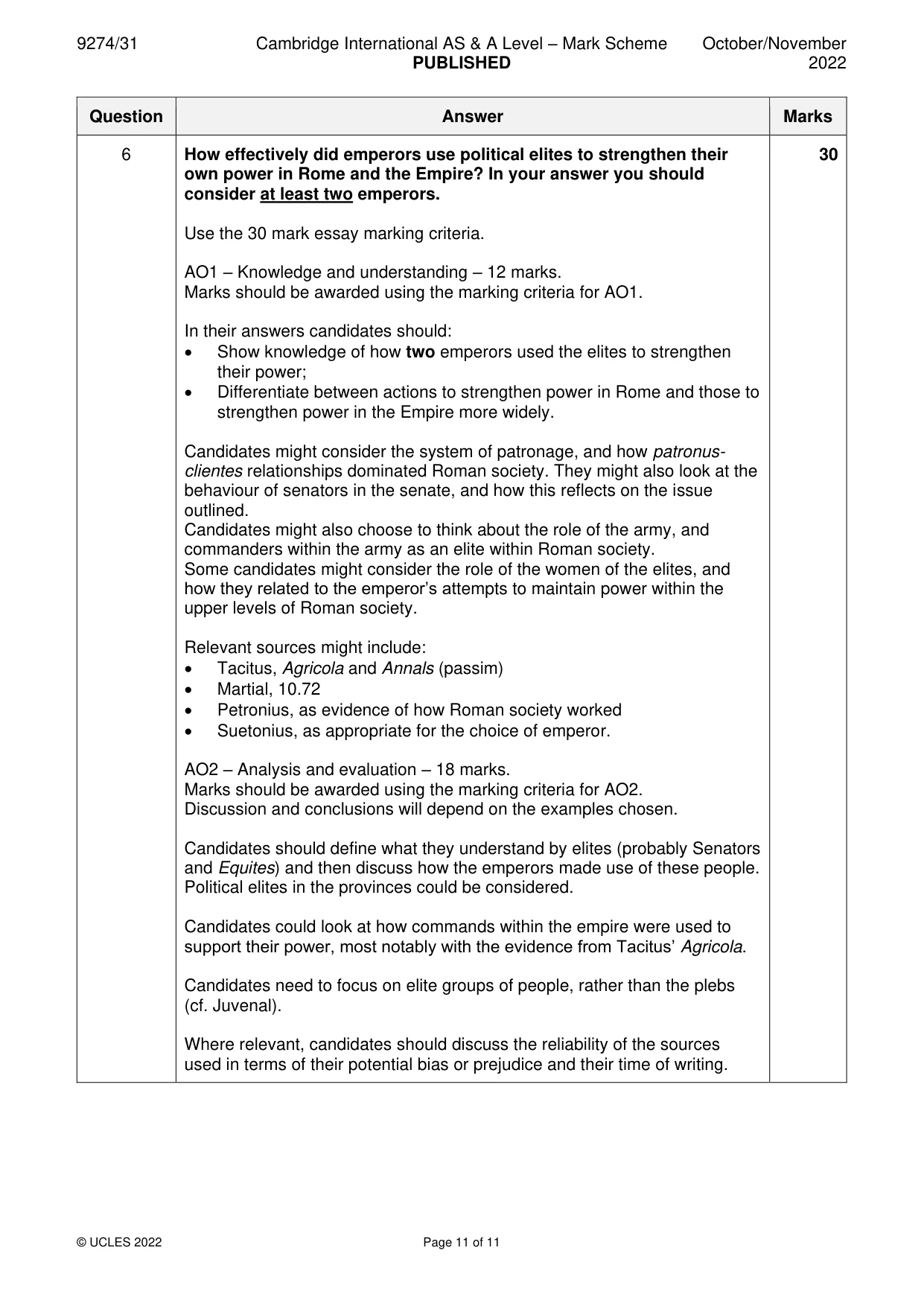
9274/31 Cambridge International AS & A Level – Mark Scheme PUBLISHED October/November 2022 © UCLES 2022 Page 11 of 11 Question Answer Marks 6 How effectively did emperors use political elites to strengthen their own power in Rome and the Empire? In your answer you should consider at least two emperors. Use the 30 mark essay marking criteria. AO1 – Knowledge and understanding – 12 marks. Marks should be awarded using the marking criteria for AO1. In their answers candidates should: • Show knowledge of how two emperors used the elites to strengthen their power; • Differentiate between actions to strengthen power in Rome and those to strengthen power in the Empire more widely. Candidates might consider the system of patronage, and how patronus- clientes relationships dominated Roman society. They might also look at the behaviour of senators in the senate, and how this reflects on the issue outlined. Candidates might also choose to think about the role of the army, and commanders within the army as an elite within Roman society. Some candidates might consider the role of the women of the elites, and how they related to the emperor’s attempts to maintain power within the upper levels of Roman society. Relevant sources might include: • Tacitus, Agricola and Annals (passim) • Martial, 10.72 • Petronius, as evidence of how Roman society worked • Suetonius, as appropriate for the choice of emperor. AO2 – Analysis and evaluation – 18 marks. Marks should be awarded using the marking criteria for AO2. Discussion and conclusions will depend on the examples chosen. Candidates should define what they understand by elites (probably Senators and Equites) and then discuss how the emperors made use of these people. Political elites in the provinces could be considered. Candidates could look at how commands within the empire were used to support their power, most notably with the evidence from Tacitus’ Agricola. Candidates need to focus on elite groups of people, rather than the plebs (cf. Juvenal). Where relevant, candidates should discuss the reliability of the sources used in terms of their potential bias or prejudice and their time of writing. 30
What you needed in this session
Cambridge’s own grade thresholds for 2022 Oct/Nov, Paper 3 · Variant 1. A higher threshold means an easier paper — the bar moves with how the cohort did.