Cambridge A Level Classical Studies 9274 — 2020 Oct/Nov Paper 3 · Variant 3
9274/33/O/N/20 · 50 marks · ≈56 min
The question paper and its mark scheme, free to read here and free to download. This is Cambridge’s own paper, exactly as it was sat.
Question paper4 pages

Mark scheme7 pages
Answers below. Sit the paper first if you are practising.
Paper as text
Question paper, page 1
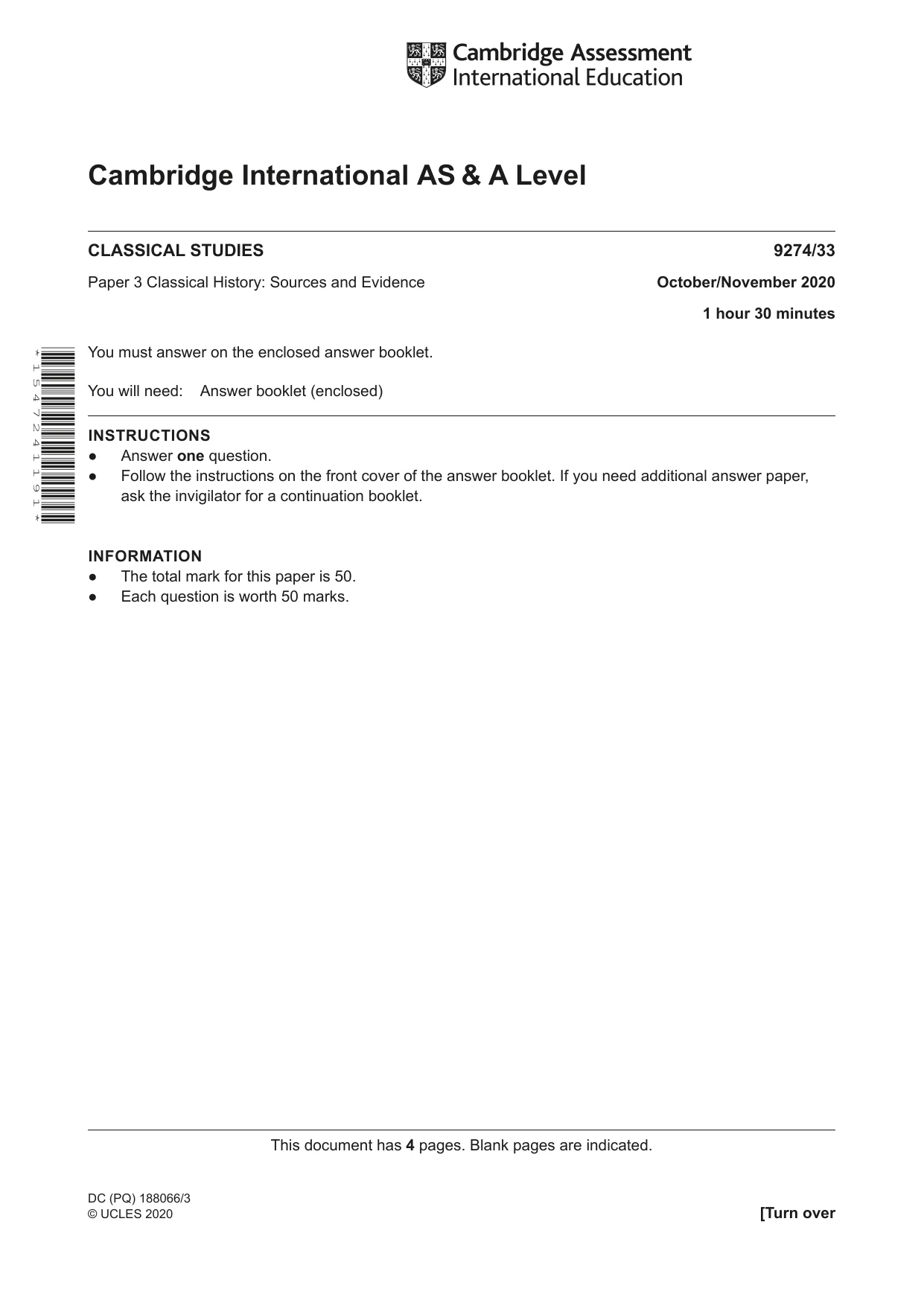
Cambridge International AS & A Level * 1 5 4 7 2 4 1 1 9 1 * DC (PQ) 188066/3 © UCLES 2020 [Turn over This document has 4 pages. Blank pages are indicated. CLASSICAL STUDIES 9274/33 Paper 3 Classical History: Sources and Evidence October/November 2020 1 hour 30 minutes You must answer on the enclosed answer booklet. You will need: Answer booklet (enclosed) INSTRUCTIONS ● Answer one question. ● Follow the instructions on the front cover of the answer booklet. If you need additional answer paper, ask the invigilator for a continuation booklet. INFORMATION ● The total mark for this paper is 50. ● Each question is worth 50 marks.
Question paper, page 2
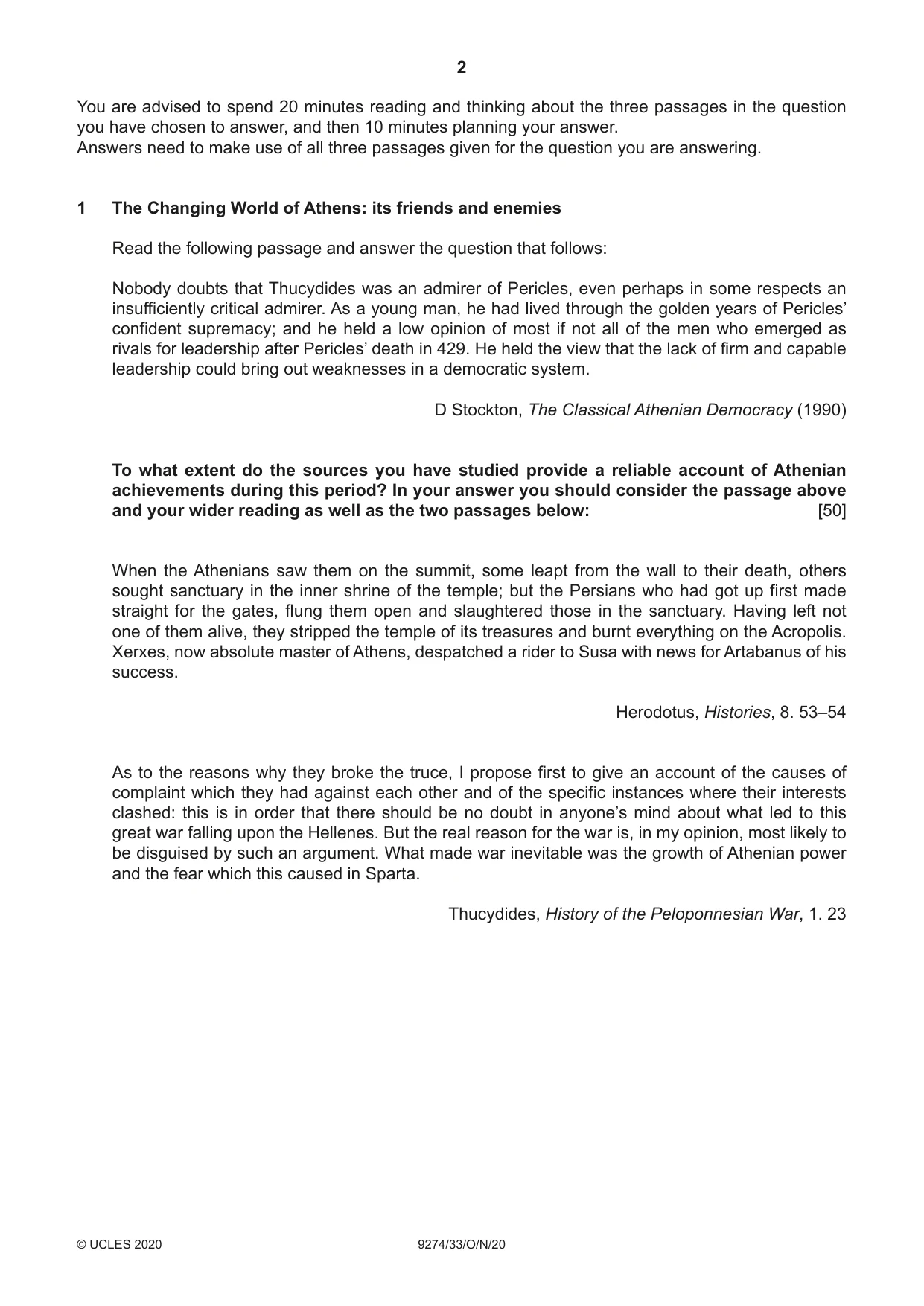
2 9274/33/O/N/20 © UCLES 2020 You are advised to spend 20 minutes reading and thinking about the three passages in the question you have chosen to answer, and then 10 minutes planning your answer. Answers need to make use of all three passages given for the question you are answering. 1 The Changing World of Athens: its friends and enemies Read the following passage and answer the question that follows: Nobody doubts that Thucydides was an admirer of Pericles, even perhaps in some respects an insufficiently critical admirer. As a young man, he had lived through the golden years of Pericles’ confident supremacy; and he held a low opinion of most if not all of the men who emerged as rivals for leadership after Pericles’ death in 429. He held the view that the lack of firm and capable leadership could bring out weaknesses in a democratic system. D Stockton, The Classical Athenian Democracy (1990) To what extent do the sources you have studied provide a reliable account of Athenian achievements during this period? In your answer you should consider the passage above and your wider reading as well as the two passages below: [50] When the Athenians saw them on the summit, some leapt from the wall to their death, others sought sanctuary in the inner shrine of the temple; but the Persians who had got up first made straight for the gates, flung them open and slaughtered those in the sanctuary. Having left not one of them alive, they stripped the temple of its treasures and burnt everything on the Acropolis. Xerxes, now absolute master of Athens, despatched a rider to Susa with news for Artabanus of his success. Herodotus, Histories, 8. 53–54 As to the reasons why they broke the truce, I propose first to give an account of the causes of complaint which they had against each other and of the specific instances where their interests clashed: this is in order that there should be no doubt in anyone’s mind about what led to this great war falling upon the Hellenes. But the real reason for the war is, in my opinion, most likely to be disguised by such an argument. What made war inevitable was the growth of Athenian power and the fear which this caused in Sparta. Thucydides, History of the Peloponnesian War, 1. 23
Question paper, page 3
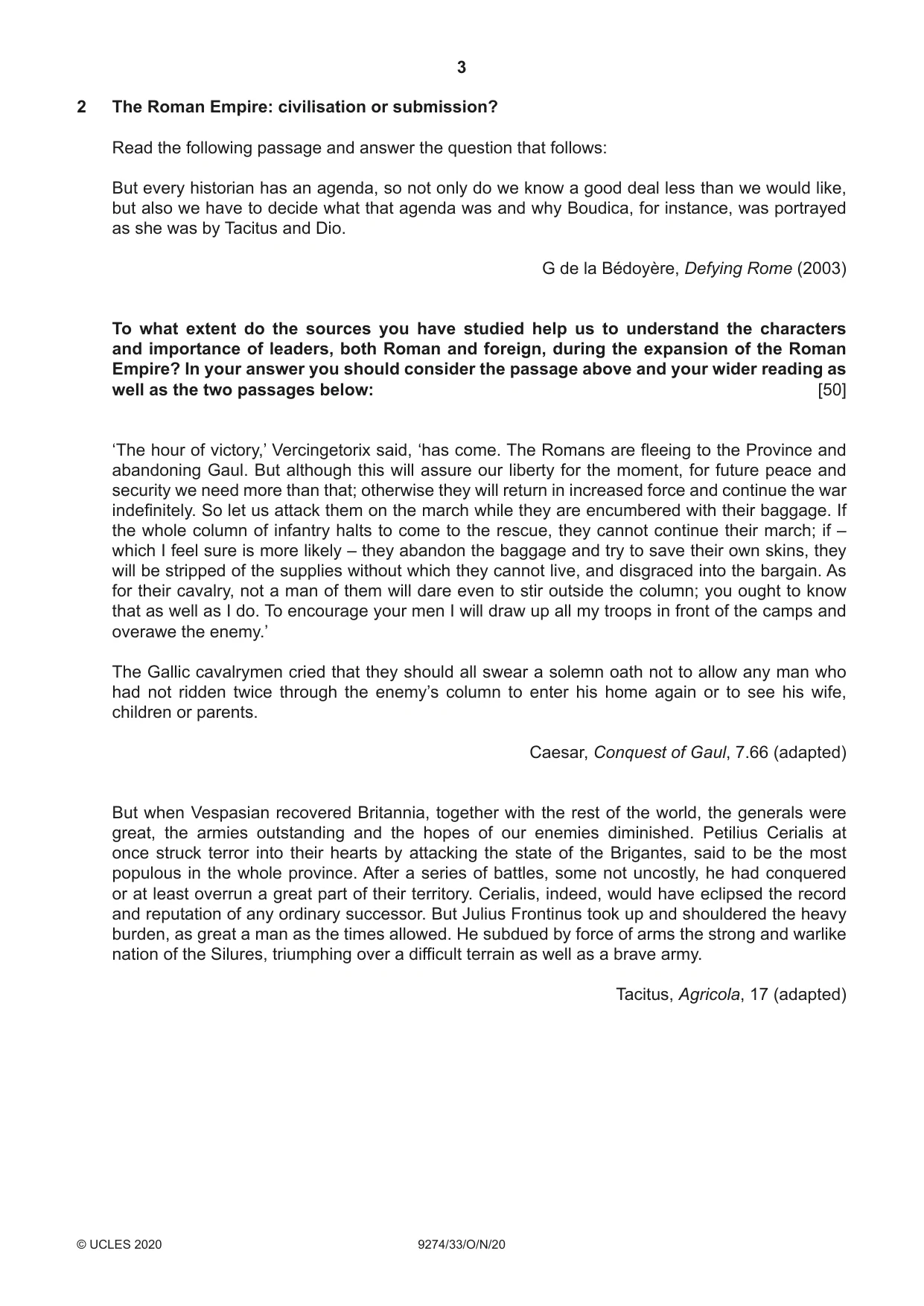
3 9274/33/O/N/20 © UCLES 2020 2 The Roman Empire: civilisation or submission? Read the following passage and answer the question that follows: But every historian has an agenda, so not only do we know a good deal less than we would like, but also we have to decide what that agenda was and why Boudica, for instance, was portrayed as she was by Tacitus and Dio. G de la Bédoyère, Defying Rome (2003) To what extent do the sources you have studied help us to understand the characters and importance of leaders, both Roman and foreign, during the expansion of the Roman Empire? In your answer you should consider the passage above and your wider reading as well as the two passages below: [50] ‘The hour of victory,’ Vercingetorix said, ‘has come. The Romans are fleeing to the Province and abandoning Gaul. But although this will assure our liberty for the moment, for future peace and security we need more than that; otherwise they will return in increased force and continue the war indefinitely. So let us attack them on the march while they are encumbered with their baggage. If the whole column of infantry halts to come to the rescue, they cannot continue their march; if – which I feel sure is more likely – they abandon the baggage and try to save their own skins, they will be stripped of the supplies without which they cannot live, and disgraced into the bargain. As for their cavalry, not a man of them will dare even to stir outside the column; you ought to know that as well as I do. To encourage your men I will draw up all my troops in front of the camps and overawe the enemy.’ The Gallic cavalrymen cried that they should all swear a solemn oath not to allow any man who had not ridden twice through the enemy’s column to enter his home again or to see his wife, children or parents. Caesar, Conquest of Gaul, 7.66 (adapted) But when Vespasian recovered Britannia, together with the rest of the world, the generals were great, the armies outstanding and the hopes of our enemies diminished. Petilius Cerialis at once struck terror into their hearts by attacking the state of the Brigantes, said to be the most populous in the whole province. After a series of battles, some not uncostly, he had conquered or at least overrun a great part of their territory. Cerialis, indeed, would have eclipsed the record and reputation of any ordinary successor. But Julius Frontinus took up and shouldered the heavy burden, as great a man as the times allowed. He subdued by force of arms the strong and warlike nation of the Silures, triumphing over a difficult terrain as well as a brave army. Tacitus, Agricola, 17 (adapted)
Question paper, page 4
4 9274/33/O/N/20 © UCLES 2020 Permission to reproduce items where third-party owned material protected by copyright is included has been sought and cleared where possible. Every reasonable effort has been made by the publisher (UCLES) to trace copyright holders, but if any items requiring clearance have unwittingly been included, the publisher will be pleased to make amends at the earliest possible opportunity. To avoid the issue of disclosure of answer-related information to candidates, all copyright acknowledgements are reproduced online in the Cambridge Assessment International Education Copyright Acknowledgements Booklet. This is produced for each series of examinations and is freely available to download at www.cambridgeinternational.org after the live examination series. Cambridge Assessment International Education is part of the Cambridge Assessment Group. Cambridge Assessment is the brand name of the University of Cambridge Local Examinations Syndicate (UCLES), which itself is a department of the University of Cambridge. BLANK PAGE
Mark scheme, page 1
This document consists of 7 printed pages. © UCLES 2020 [Turn over Cambridge International AS & A Level CLASSICAL STUDIES 9274/33 Paper 3 Classical History – Sources and Evidence October/November 2020 MARK SCHEME Maximum Mark: 50 Published This mark scheme is published as an aid to teachers and candidates, to indicate the requirements of the examination. It shows the basis on which Examiners were instructed to award marks. It does not indicate the details of the discussions that took place at an Examiners’ meeting before marking began, which would have considered the acceptability of alternative answers. Mark schemes should be read in conjunction with the question paper and the Principal Examiner Report for Teachers. Cambridge International will not enter into discussions about these mark schemes. Cambridge International is publishing the mark schemes for the October/November 2020 series for most Cambridge IGCSE™, Cambridge International A and AS Level and Cambridge Pre-U components, and some Cambridge O Level components.
Mark scheme, page 2
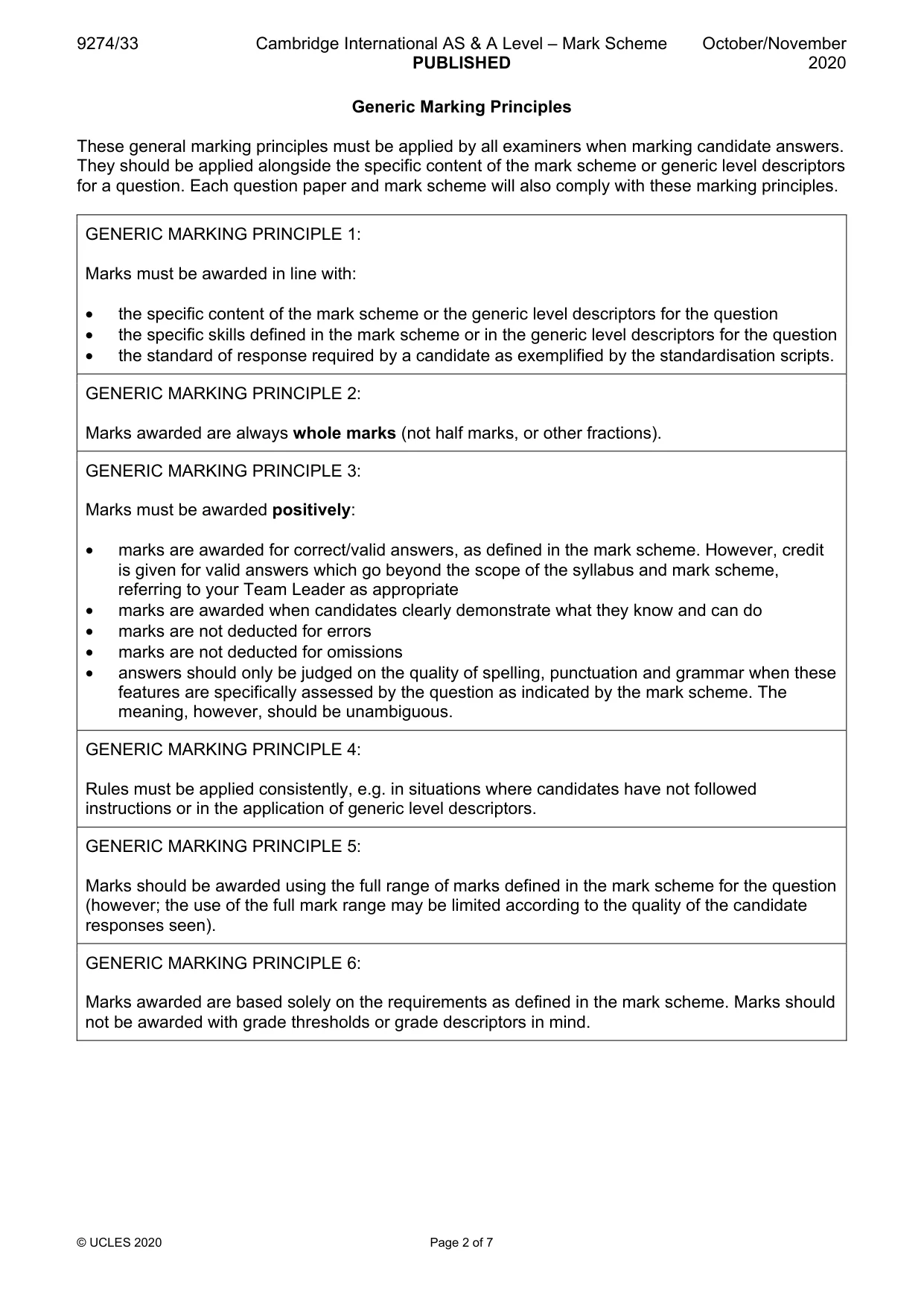
9274/33 Cambridge International AS & A Level – Mark Scheme PUBLISHED October/November 2020 © UCLES 2020 Page 2 of 7 Generic Marking Principles These general marking principles must be applied by all examiners when marking candidate answers. They should be applied alongside the specific content of the mark scheme or generic level descriptors for a question. Each question paper and mark scheme will also comply with these marking principles. GENERIC MARKING PRINCIPLE 1: Marks must be awarded in line with: • the specific content of the mark scheme or the generic level descriptors for the question • the specific skills defined in the mark scheme or in the generic level descriptors for the question • the standard of response required by a candidate as exemplified by the standardisation scripts. GENERIC MARKING PRINCIPLE 2: Marks awarded are always whole marks (not half marks, or other fractions). GENERIC MARKING PRINCIPLE 3: Marks must be awarded positively: • marks are awarded for correct/valid answers, as defined in the mark scheme. However, credit is given for valid answers which go beyond the scope of the syllabus and mark scheme, referring to your Team Leader as appropriate • marks are awarded when candidates clearly demonstrate what they know and can do • marks are not deducted for errors • marks are not deducted for omissions • answers should only be judged on the quality of spelling, punctuation and grammar when these features are specifically assessed by the question as indicated by the mark scheme. The meaning, however, should be unambiguous. GENERIC MARKING PRINCIPLE 4: Rules must be applied consistently, e.g. in situations where candidates have not followed instructions or in the application of generic level descriptors. GENERIC MARKING PRINCIPLE 5: Marks should be awarded using the full range of marks defined in the mark scheme for the question (however; the use of the full mark range may be limited according to the quality of the candidate responses seen). GENERIC MARKING PRINCIPLE 6: Marks awarded are based solely on the requirements as defined in the mark scheme. Marks should not be awarded with grade thresholds or grade descriptors in mind.
Mark scheme, page 3
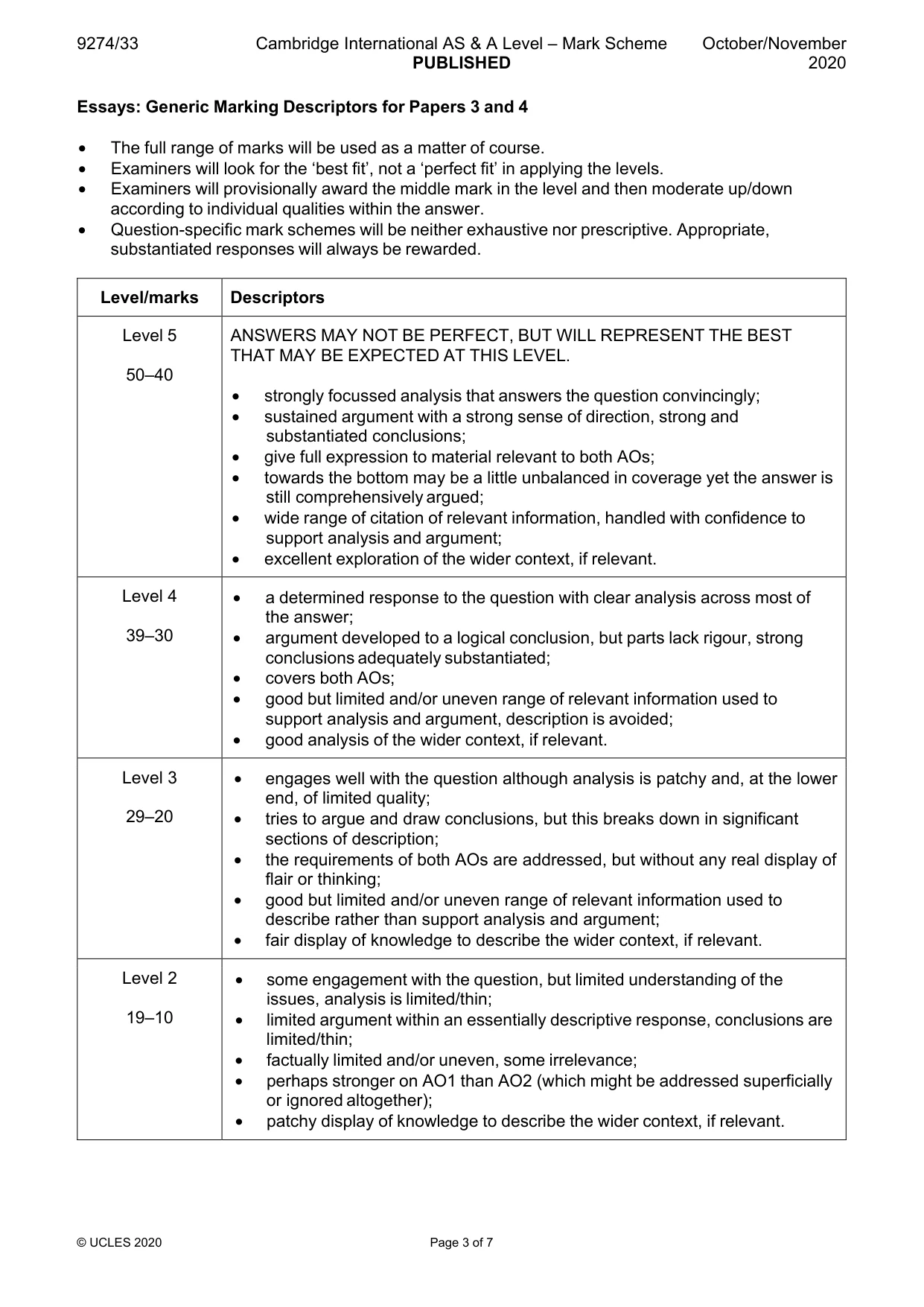
9274/33 Cambridge International AS & A Level – Mark Scheme PUBLISHED October/November 2020 © UCLES 2020 Page 3 of 7 Essays: Generic Marking Descriptors for Papers 3 and 4 • The full range of marks will be used as a matter of course. • Examiners will look for the ‘best fit’, not a ‘perfect fit’ in applying the levels. • Examiners will provisionally award the middle mark in the level and then moderate up/down according to individual qualities within the answer. • Question-specific mark schemes will be neither exhaustive nor prescriptive. Appropriate, substantiated responses will always be rewarded. Level/marks Descriptors Level 5 50–40 ANSWERS MAY NOT BE PERFECT, BUT WILL REPRESENT THE BEST THAT MAY BE EXPECTED AT THIS LEVEL. • strongly focussed analysis that answers the question convincingly; • sustained argument with a strong sense of direction, strong and substantiated conclusions; • give full expression to material relevant to both AOs; • towards the bottom may be a little unbalanced in coverage yet the answer is still comprehensively argued; • wide range of citation of relevant information, handled with confidence to support analysis and argument; • excellent exploration of the wider context, if relevant. Level 4 39–30 • a determined response to the question with clear analysis across most of the answer; • argument developed to a logical conclusion, but parts lack rigour, strong conclusions adequately substantiated; • covers both AOs; • good but limited and/or uneven range of relevant information used to support analysis and argument, description is avoided; • good analysis of the wider context, if relevant. Level 3 29–20 • engages well with the question although analysis is patchy and, at the lower end, of limited quality; • tries to argue and draw conclusions, but this breaks down in significant sections of description; • the requirements of both AOs are addressed, but without any real display of flair or thinking; • good but limited and/or uneven range of relevant information used to describe rather than support analysis and argument; • fair display of knowledge to describe the wider context, if relevant. Level 2 19–10 • some engagement with the question, but limited understanding of the issues, analysis is limited/thin; • limited argument within an essentially descriptive response, conclusions are limited/thin; • factually limited and/or uneven, some irrelevance; • perhaps stronger on AO1 than AO2 (which might be addressed superficially or ignored altogether); • patchy display of knowledge to describe the wider context, if relevant.
Mark scheme, page 4
9274/33 Cambridge International AS & A Level – Mark Scheme PUBLISHED October/November 2020 © UCLES 2020 Page 4 of 7 Level/marks Descriptors Level 1 9–0 • little or no engagement with the question, little or no analysis offered; • little or no argument, conclusions are very weak, assertions are unsupported and/or of limited relevance; • little or no display of relevant information; • little or no attempt to address AO2; • little or no reference to the wider context, if relevant.
Mark scheme, page 5
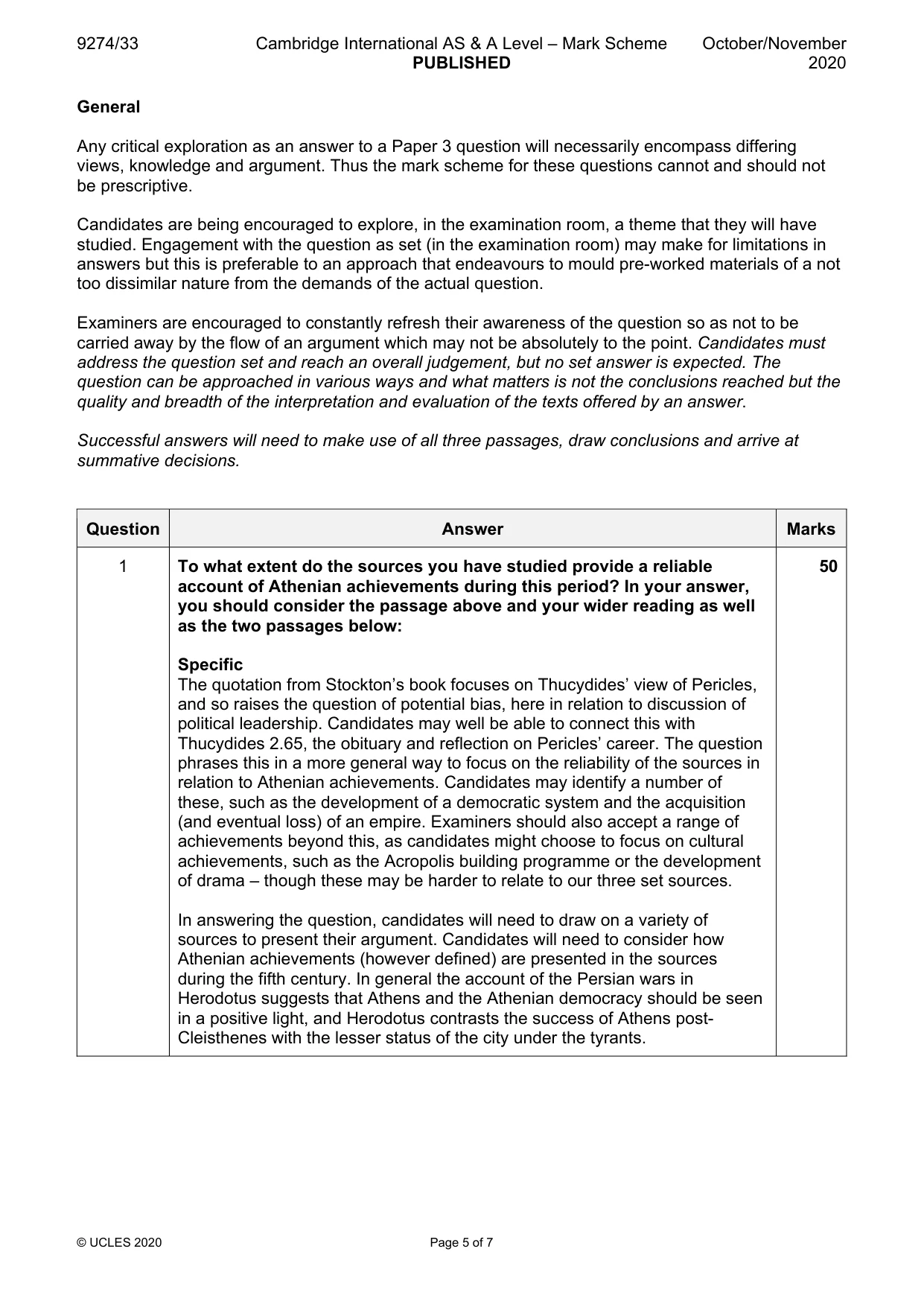
9274/33 Cambridge International AS & A Level – Mark Scheme PUBLISHED October/November 2020 © UCLES 2020 Page 5 of 7 General Any critical exploration as an answer to a Paper 3 question will necessarily encompass differing views, knowledge and argument. Thus the mark scheme for these questions cannot and should not be prescriptive. Candidates are being encouraged to explore, in the examination room, a theme that they will have studied. Engagement with the question as set (in the examination room) may make for limitations in answers but this is preferable to an approach that endeavours to mould pre-worked materials of a not too dissimilar nature from the demands of the actual question. Examiners are encouraged to constantly refresh their awareness of the question so as not to be carried away by the flow of an argument which may not be absolutely to the point. Candidates must address the question set and reach an overall judgement, but no set answer is expected. The question can be approached in various ways and what matters is not the conclusions reached but the quality and breadth of the interpretation and evaluation of the texts offered by an answer. Successful answers will need to make use of all three passages, draw conclusions and arrive at summative decisions. Question Answer Marks 1 To what extent do the sources you have studied provide a reliable account of Athenian achievements during this period? In your answer, you should consider the passage above and your wider reading as well as the two passages below: Specific The quotation from Stockton’s book focuses on Thucydides’ view of Pericles, and so raises the question of potential bias, here in relation to discussion of political leadership. Candidates may well be able to connect this with Thucydides 2.65, the obituary and reflection on Pericles’ career. The question phrases this in a more general way to focus on the reliability of the sources in relation to Athenian achievements. Candidates may identify a number of these, such as the development of a democratic system and the acquisition (and eventual loss) of an empire. Examiners should also accept a range of achievements beyond this, as candidates might choose to focus on cultural achievements, such as the Acropolis building programme or the development of drama – though these may be harder to relate to our three set sources. In answering the question, candidates will need to draw on a variety of sources to present their argument. Candidates will need to consider how Athenian achievements (however defined) are presented in the sources during the fifth century. In general the account of the Persian wars in Herodotus suggests that Athens and the Athenian democracy should be seen in a positive light, and Herodotus contrasts the success of Athens post- Cleisthenes with the lesser status of the city under the tyrants. 50
Mark scheme, page 6
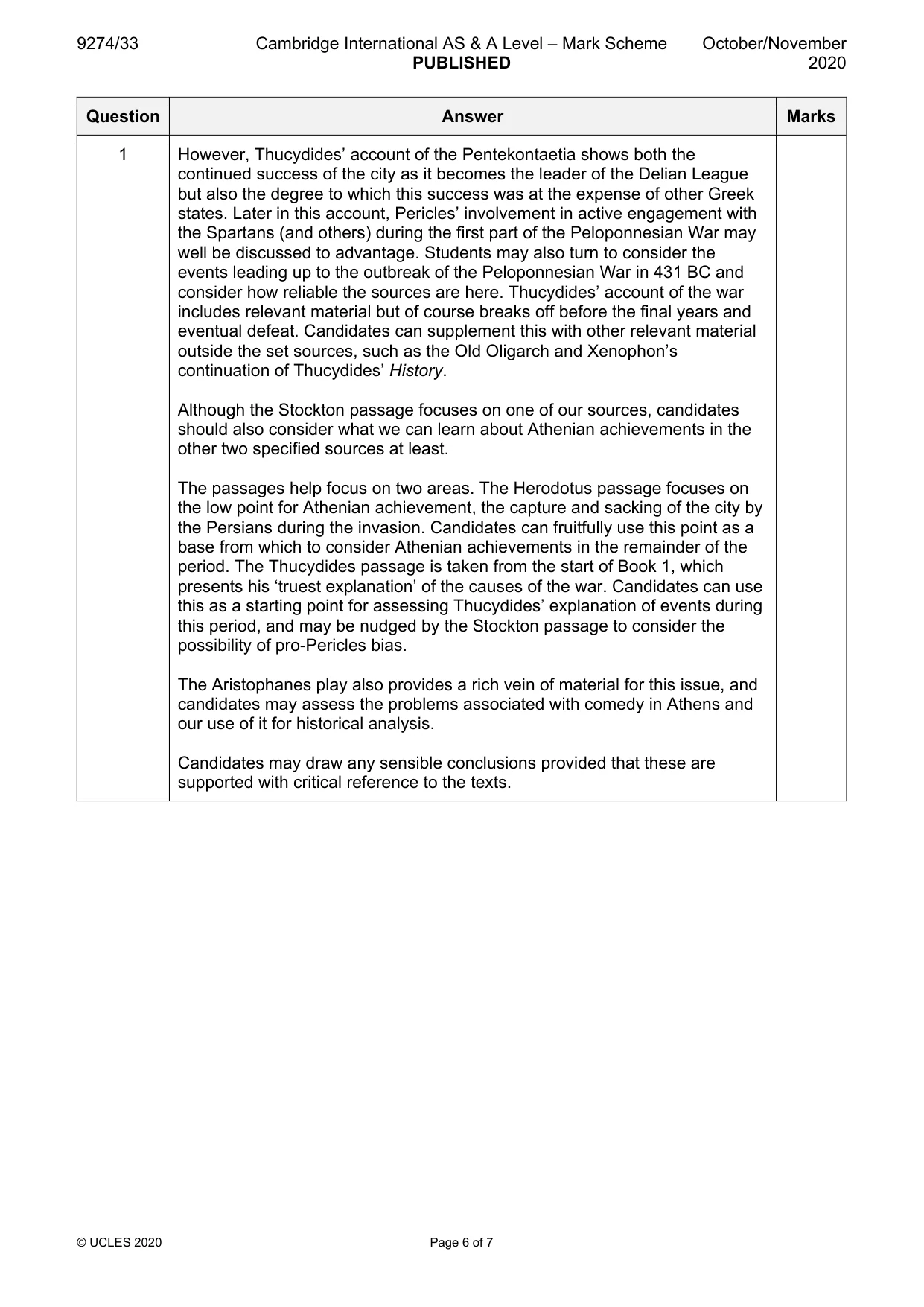
9274/33 Cambridge International AS & A Level – Mark Scheme PUBLISHED October/November 2020 © UCLES 2020 Page 6 of 7 Question Answer Marks 1 However, Thucydides’ account of the Pentekontaetia shows both the continued success of the city as it becomes the leader of the Delian League but also the degree to which this success was at the expense of other Greek states. Later in this account, Pericles’ involvement in active engagement with the Spartans (and others) during the first part of the Peloponnesian War may well be discussed to advantage. Students may also turn to consider the events leading up to the outbreak of the Peloponnesian War in 431 BC and consider how reliable the sources are here. Thucydides’ account of the war includes relevant material but of course breaks off before the final years and eventual defeat. Candidates can supplement this with other relevant material outside the set sources, such as the Old Oligarch and Xenophon’s continuation of Thucydides’ History. Although the Stockton passage focuses on one of our sources, candidates should also consider what we can learn about Athenian achievements in the other two specified sources at least. The passages help focus on two areas. The Herodotus passage focuses on the low point for Athenian achievement, the capture and sacking of the city by the Persians during the invasion. Candidates can fruitfully use this point as a base from which to consider Athenian achievements in the remainder of the period. The Thucydides passage is taken from the start of Book 1, which presents his ‘truest explanation’ of the causes of the war. Candidates can use this as a starting point for assessing Thucydides’ explanation of events during this period, and may be nudged by the Stockton passage to consider the possibility of pro-Pericles bias. The Aristophanes play also provides a rich vein of material for this issue, and candidates may assess the problems associated with comedy in Athens and our use of it for historical analysis. Candidates may draw any sensible conclusions provided that these are supported with critical reference to the texts.
Mark scheme, page 7
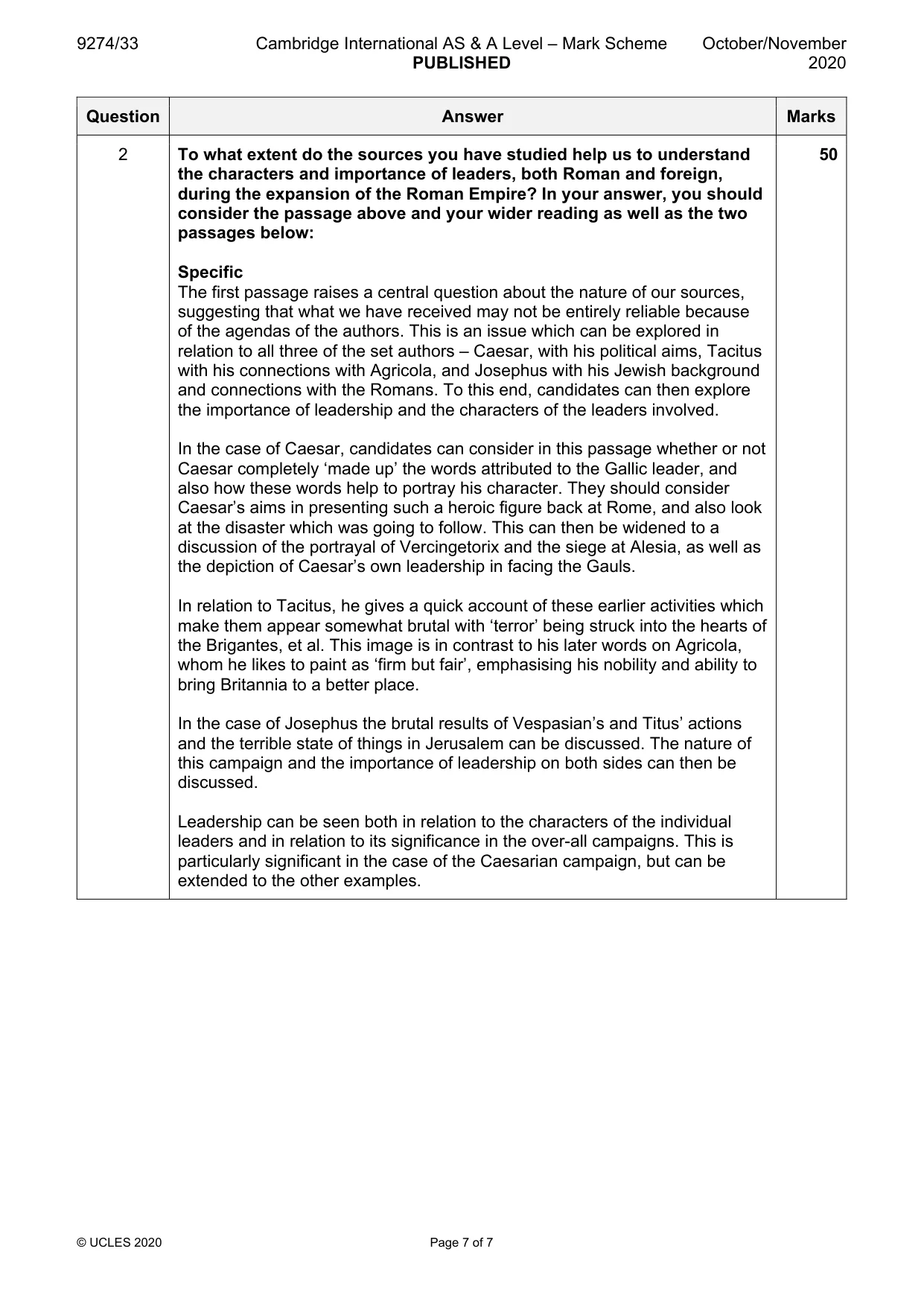
9274/33 Cambridge International AS & A Level – Mark Scheme PUBLISHED October/November 2020 © UCLES 2020 Page 7 of 7 Question Answer Marks 2 To what extent do the sources you have studied help us to understand the characters and importance of leaders, both Roman and foreign, during the expansion of the Roman Empire? In your answer, you should consider the passage above and your wider reading as well as the two passages below: Specific The first passage raises a central question about the nature of our sources, suggesting that what we have received may not be entirely reliable because of the agendas of the authors. This is an issue which can be explored in relation to all three of the set authors – Caesar, with his political aims, Tacitus with his connections with Agricola, and Josephus with his Jewish background and connections with the Romans. To this end, candidates can then explore the importance of leadership and the characters of the leaders involved. In the case of Caesar, candidates can consider in this passage whether or not Caesar completely ‘made up’ the words attributed to the Gallic leader, and also how these words help to portray his character. They should consider Caesar’s aims in presenting such a heroic figure back at Rome, and also look at the disaster which was going to follow. This can then be widened to a discussion of the portrayal of Vercingetorix and the siege at Alesia, as well as the depiction of Caesar’s own leadership in facing the Gauls. In relation to Tacitus, he gives a quick account of these earlier activities which make them appear somewhat brutal with ‘terror’ being struck into the hearts of the Brigantes, et al. This image is in contrast to his later words on Agricola, whom he likes to paint as ‘firm but fair’, emphasising his nobility and ability to bring Britannia to a better place. In the case of Josephus the brutal results of Vespasian’s and Titus’ actions and the terrible state of things in Jerusalem can be discussed. The nature of this campaign and the importance of leadership on both sides can then be discussed. Leadership can be seen both in relation to the characters of the individual leaders and in relation to its significance in the over-all campaigns. This is particularly significant in the case of the Caesarian campaign, but can be extended to the other examples. 50
What you needed in this session
Cambridge’s own grade thresholds for 2020 Oct/Nov, Paper 3 · Variant 3. A higher threshold means an easier paper — the bar moves with how the cohort did.