Cambridge A Level Classical Studies 9274 — 2021 Oct/Nov Paper 3 · Variant 2
9274/32/O/N/21 · 50 marks · ≈56 min
The question paper and its mark scheme, free to read here and free to download. This is Cambridge’s own paper, exactly as it was sat.
Question paper4 pages
Mark scheme7 pages
Answers below. Sit the paper first if you are practising.
Paper as text
Question paper, page 1
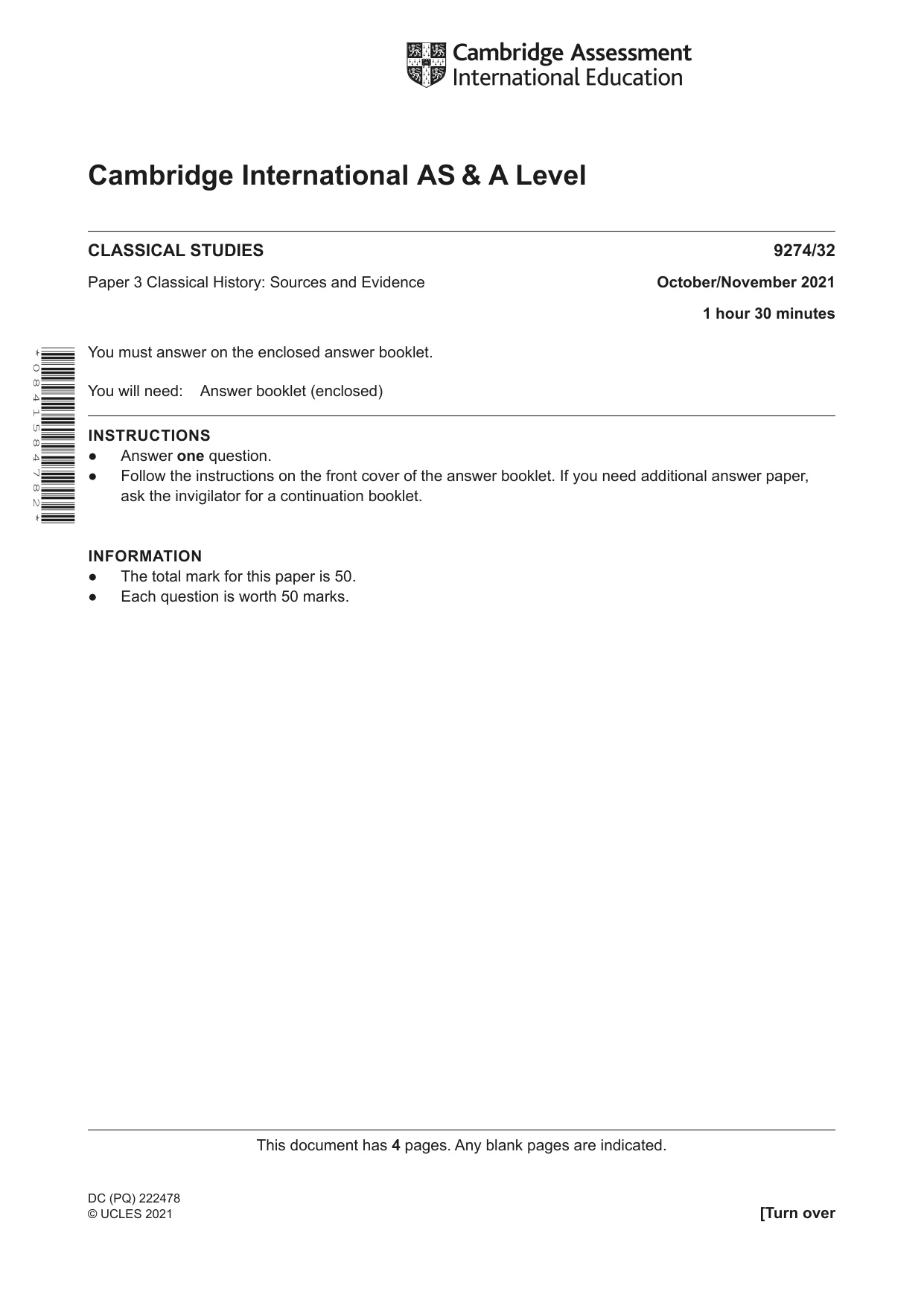
This document has 4 pages. Any blank pages are indicated. Cambridge International AS & A Level * 0 8 4 1 5 8 4 7 8 2 * DC (PQ) 222478 © UCLES 2021 [Turn over CLASSICAL STUDIES 9274/32 Paper 3 Classical History: Sources and Evidence October/November 2021 1 hour 30 minutes You must answer on the enclosed answer booklet. You will need: Answer booklet (enclosed) INSTRUCTIONS ● Answer one question. ● Follow the instructions on the front cover of the answer booklet. If you need additional answer paper, ask the invigilator for a continuation booklet. INFORMATION ● The total mark for this paper is 50. ● Each question is worth 50 marks.
Question paper, page 2
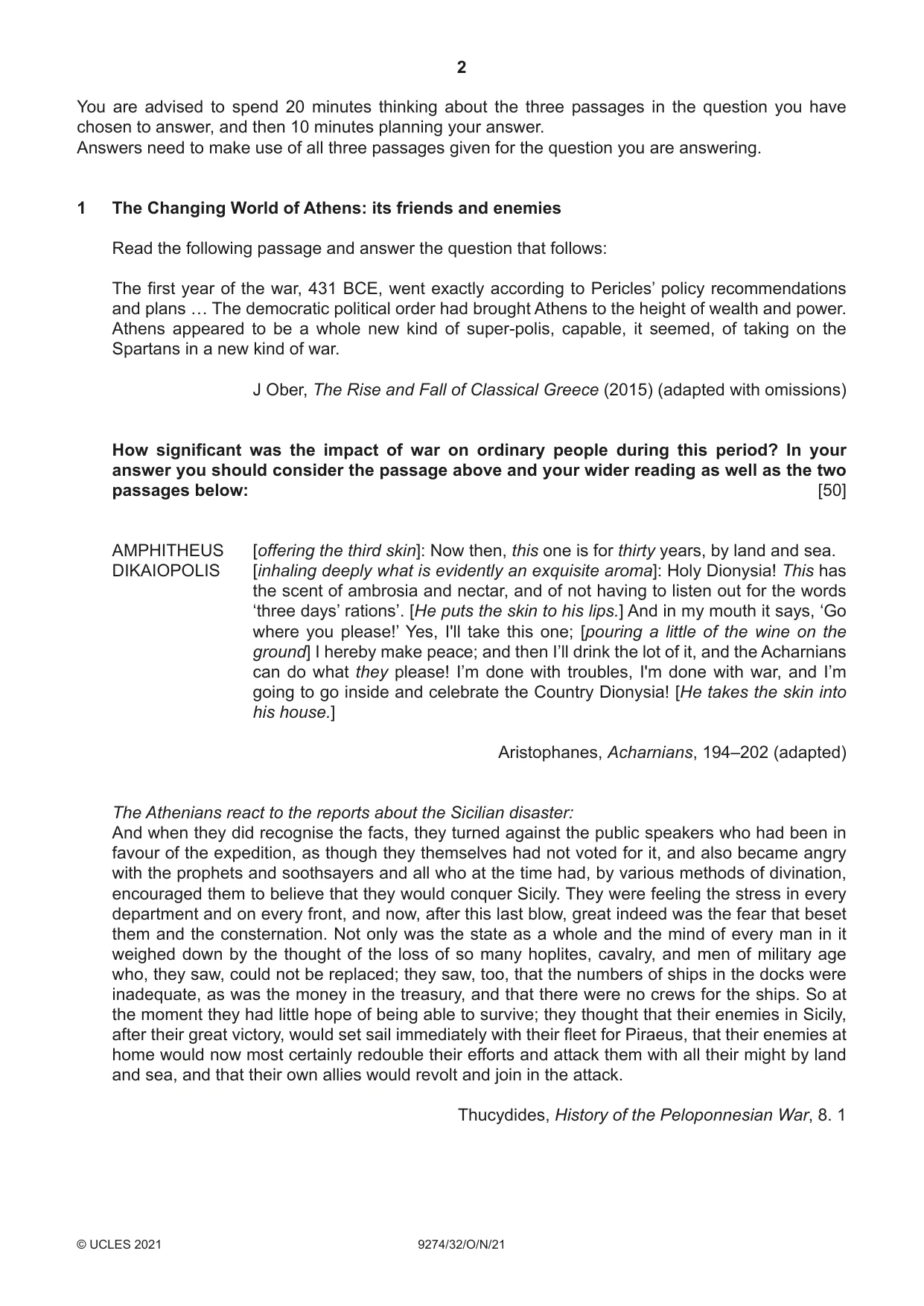
2 9274/32/O/N/21 © UCLES 2021 You are advised to spend 20 minutes thinking about the three passages in the question you have chosen to answer, and then 10 minutes planning your answer. Answers need to make use of all three passages given for the question you are answering. 1 The Changing World of Athens: its friends and enemies Read the following passage and answer the question that follows: The first year of the war, 431 BCE, went exactly according to Pericles’ policy recommendations and plans … The democratic political order had brought Athens to the height of wealth and power. Athens appeared to be a whole new kind of super-polis, capable, it seemed, of taking on the Spartans in a new kind of war. J Ober, The Rise and Fall of Classical Greece (2015) (adapted with omissions) How significant was the impact of war on ordinary people during this period? In your answer you should consider the passage above and your wider reading as well as the two passages below: [50] AMPHITHEUS [offering the third skin]: Now then, this one is for thirty years, by land and sea. DIKAIOPOLIS [inhaling deeply what is evidently an exquisite aroma]: Holy Dionysia! This has the scent of ambrosia and nectar, and of not having to listen out for the words ‘three days’ rations’. [He puts the skin to his lips.] And in my mouth it says, ‘Go where you please!’ Yes, I'll take this one; [pouring a little of the wine on the ground] I hereby make peace; and then I’ll drink the lot of it, and the Acharnians can do what they please! I’m done with troubles, I'm done with war, and I’m going to go inside and celebrate the Country Dionysia! [He takes the skin into his house.] Aristophanes, Acharnians, 194–202 (adapted) The Athenians react to the reports about the Sicilian disaster: And when they did recognise the facts, they turned against the public speakers who had been in favour of the expedition, as though they themselves had not voted for it, and also became angry with the prophets and soothsayers and all who at the time had, by various methods of divination, encouraged them to believe that they would conquer Sicily. They were feeling the stress in every department and on every front, and now, after this last blow, great indeed was the fear that beset them and the consternation. Not only was the state as a whole and the mind of every man in it weighed down by the thought of the loss of so many hoplites, cavalry, and men of military age who, they saw, could not be replaced; they saw, too, that the numbers of ships in the docks were inadequate, as was the money in the treasury, and that there were no crews for the ships. So at the moment they had little hope of being able to survive; they thought that their enemies in Sicily, after their great victory, would set sail immediately with their fleet for Piraeus, that their enemies at home would now most certainly redouble their efforts and attack them with all their might by land and sea, and that their own allies would revolt and join in the attack. Thucydides, History of the Peloponnesian War, 8. 1
Question paper, page 3
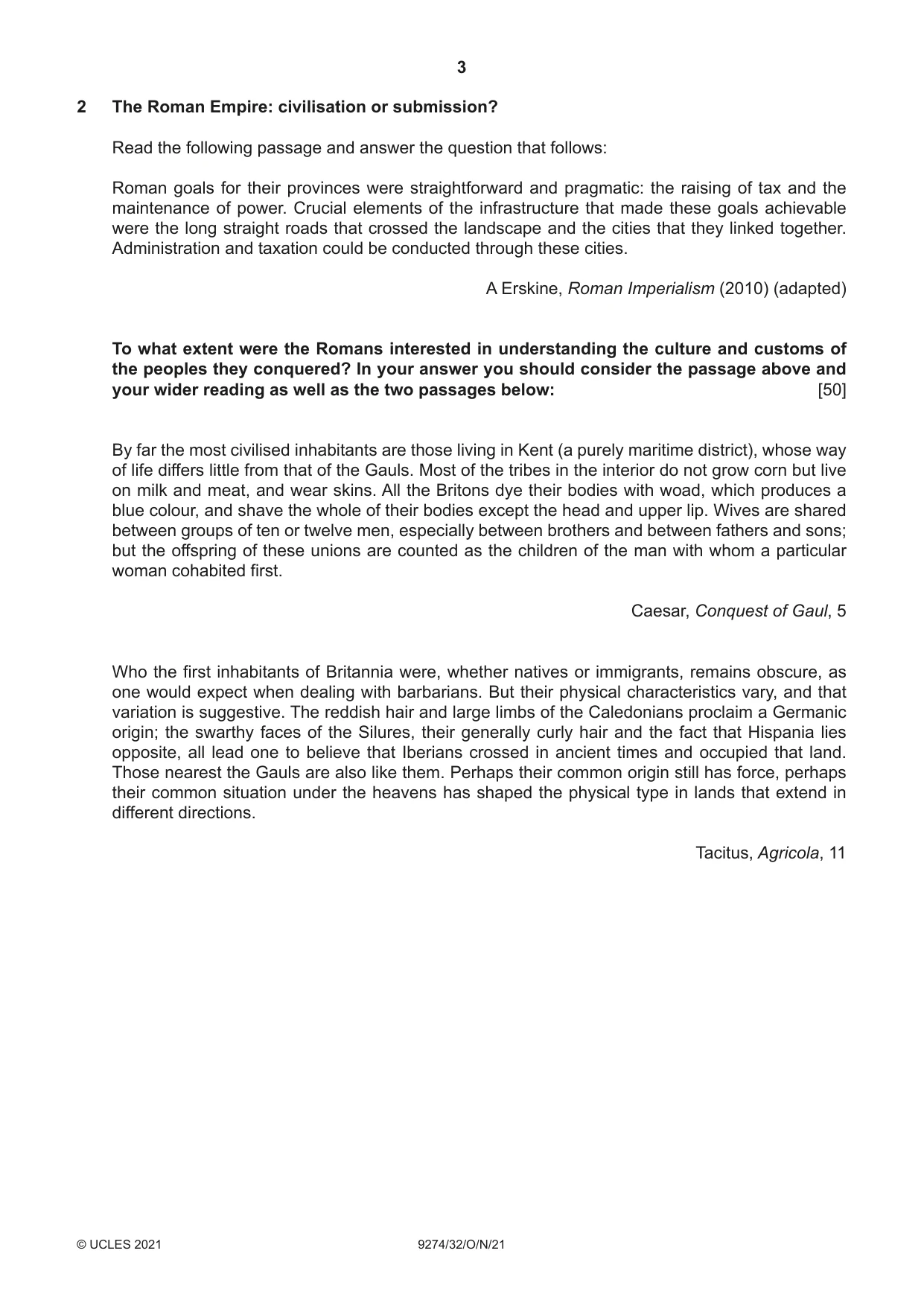
3 9274/32/O/N/21 © UCLES 2021 2 The Roman Empire: civilisation or submission? Read the following passage and answer the question that follows: Roman goals for their provinces were straightforward and pragmatic: the raising of tax and the maintenance of power. Crucial elements of the infrastructure that made these goals achievable were the long straight roads that crossed the landscape and the cities that they linked together. Administration and taxation could be conducted through these cities. A Erskine, Roman Imperialism (2010) (adapted) To what extent were the Romans interested in understanding the culture and customs of the peoples they conquered? In your answer you should consider the passage above and your wider reading as well as the two passages below: [50] By far the most civilised inhabitants are those living in Kent (a purely maritime district), whose way of life differs little from that of the Gauls. Most of the tribes in the interior do not grow corn but live on milk and meat, and wear skins. All the Britons dye their bodies with woad, which produces a blue colour, and shave the whole of their bodies except the head and upper lip. Wives are shared between groups of ten or twelve men, especially between brothers and between fathers and sons; but the offspring of these unions are counted as the children of the man with whom a particular woman cohabited first. Caesar, Conquest of Gaul, 5 Who the first inhabitants of Britannia were, whether natives or immigrants, remains obscure, as one would expect when dealing with barbarians. But their physical characteristics vary, and that variation is suggestive. The reddish hair and large limbs of the Caledonians proclaim a Germanic origin; the swarthy faces of the Silures, their generally curly hair and the fact that Hispania lies opposite, all lead one to believe that Iberians crossed in ancient times and occupied that land. Those nearest the Gauls are also like them. Perhaps their common origin still has force, perhaps their common situation under the heavens has shaped the physical type in lands that extend in different directions. Tacitus, Agricola, 11
Question paper, page 4
4 9274/32/O/N/21 © UCLES 2021 Permission to reproduce items where third-party owned material protected by copyright is included has been sought and cleared where possible. Every reasonable effort has been made by the publisher (UCLES) to trace copyright holders, but if any items requiring clearance have unwittingly been included, the publisher will be pleased to make amends at the earliest possible opportunity. To avoid the issue of disclosure of answer-related information to candidates, all copyright acknowledgements are reproduced online in the Cambridge Assessment International Education Copyright Acknowledgements Booklet. This is produced for each series of examinations and is freely available to download at www.cambridgeinternational.org after the live examination series. Cambridge Assessment International Education is part of the Cambridge Assessment Group. Cambridge Assessment is the brand name of the University of Cambridge Local Examinations Syndicate (UCLES), which itself is a department of the University of Cambridge. BLANK PAGE
Mark scheme, page 1
This document consists of 7 printed pages. © UCLES 2021 [Turn over Cambridge International AS & A Level CLASSICAL STUDIES 9274/32 Paper 3 Classical History – Sources & Evidence October/November 2021 MARK SCHEME Maximum Mark: 50 Published This mark scheme is published as an aid to teachers and candidates, to indicate the requirements of the examination. It shows the basis on which Examiners were instructed to award marks. It does not indicate the details of the discussions that took place at an Examiners’ meeting before marking began, which would have considered the acceptability of alternative answers. Mark schemes should be read in conjunction with the question paper and the Principal Examiner Report for Teachers. Cambridge International will not enter into discussions about these mark schemes. Cambridge International is publishing the mark schemes for the October/November 2021 series for most Cambridge IGCSE™, Cambridge International A and AS Level components and some Cambridge O Level components.
Mark scheme, page 2
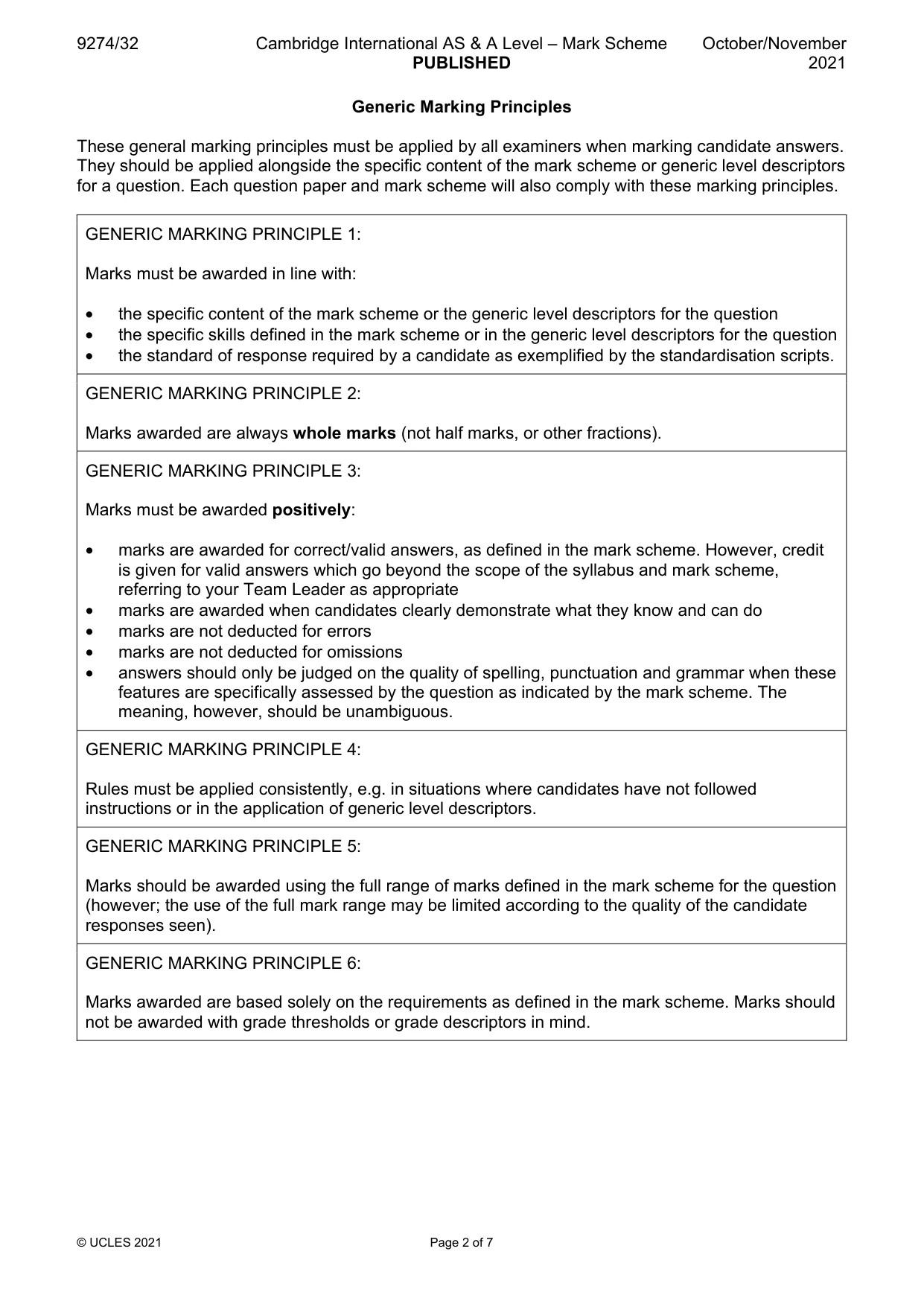
9274/32 Cambridge International AS & A Level – Mark Scheme PUBLISHED October/November 2021 © UCLES 2021 Page 2 of 7 Generic Marking Principles These general marking principles must be applied by all examiners when marking candidate answers. They should be applied alongside the specific content of the mark scheme or generic level descriptors for a question. Each question paper and mark scheme will also comply with these marking principles. GENERIC MARKING PRINCIPLE 1: Marks must be awarded in line with: • the specific content of the mark scheme or the generic level descriptors for the question • the specific skills defined in the mark scheme or in the generic level descriptors for the question • the standard of response required by a candidate as exemplified by the standardisation scripts. GENERIC MARKING PRINCIPLE 2: Marks awarded are always whole marks (not half marks, or other fractions). GENERIC MARKING PRINCIPLE 3: Marks must be awarded positively: • marks are awarded for correct/valid answers, as defined in the mark scheme. However, credit is given for valid answers which go beyond the scope of the syllabus and mark scheme, referring to your Team Leader as appropriate • marks are awarded when candidates clearly demonstrate what they know and can do • marks are not deducted for errors • marks are not deducted for omissions • answers should only be judged on the quality of spelling, punctuation and grammar when these features are specifically assessed by the question as indicated by the mark scheme. The meaning, however, should be unambiguous. GENERIC MARKING PRINCIPLE 4: Rules must be applied consistently, e.g. in situations where candidates have not followed instructions or in the application of generic level descriptors. GENERIC MARKING PRINCIPLE 5: Marks should be awarded using the full range of marks defined in the mark scheme for the question (however; the use of the full mark range may be limited according to the quality of the candidate responses seen). GENERIC MARKING PRINCIPLE 6: Marks awarded are based solely on the requirements as defined in the mark scheme. Marks should not be awarded with grade thresholds or grade descriptors in mind.
Mark scheme, page 3
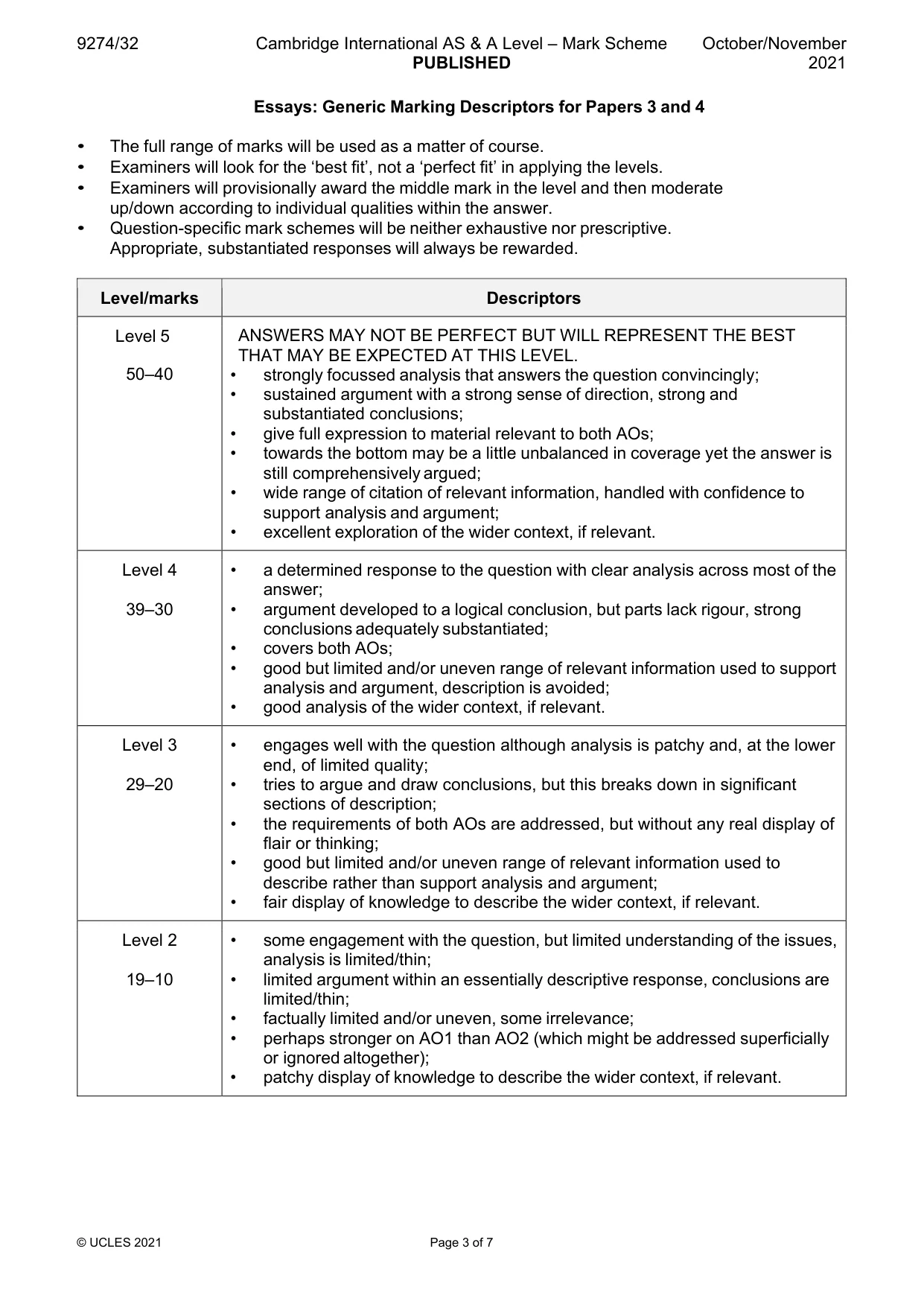
9274/32 Cambridge International AS & A Level – Mark Scheme PUBLISHED October/November 2021 © UCLES 2021 Page 3 of 7 Essays: Generic Marking Descriptors for Papers 3 and 4 • The full range of marks will be used as a matter of course. • Examiners will look for the ‘best fit’, not a ‘perfect fit’ in applying the levels. • Examiners will provisionally award the middle mark in the level and then moderate up/down according to individual qualities within the answer. • Question-specific mark schemes will be neither exhaustive nor prescriptive. Appropriate, substantiated responses will always be rewarded. Level/marks Descriptors Level 5 50–40 ANSWERS MAY NOT BE PERFECT BUT WILL REPRESENT THE BEST THAT MAY BE EXPECTED AT THIS LEVEL. • strongly focussed analysis that answers the question convincingly; • sustained argument with a strong sense of direction, strong and substantiated conclusions; • give full expression to material relevant to both AOs; • towards the bottom may be a little unbalanced in coverage yet the answer is still comprehensively argued; • wide range of citation of relevant information, handled with confidence to support analysis and argument; • excellent exploration of the wider context, if relevant. Level 4 39–30 • a determined response to the question with clear analysis across most of the answer; • argument developed to a logical conclusion, but parts lack rigour, strong conclusions adequately substantiated; • covers both AOs; • good but limited and/or uneven range of relevant information used to support analysis and argument, description is avoided; • good analysis of the wider context, if relevant. Level 3 29–20 • engages well with the question although analysis is patchy and, at the lower end, of limited quality; • tries to argue and draw conclusions, but this breaks down in significant sections of description; • the requirements of both AOs are addressed, but without any real display of flair or thinking; • good but limited and/or uneven range of relevant information used to describe rather than support analysis and argument; • fair display of knowledge to describe the wider context, if relevant. Level 2 19–10 • some engagement with the question, but limited understanding of the issues, analysis is limited/thin; • limited argument within an essentially descriptive response, conclusions are limited/thin; • factually limited and/or uneven, some irrelevance; • perhaps stronger on AO1 than AO2 (which might be addressed superficially or ignored altogether); • patchy display of knowledge to describe the wider context, if relevant.
Mark scheme, page 4
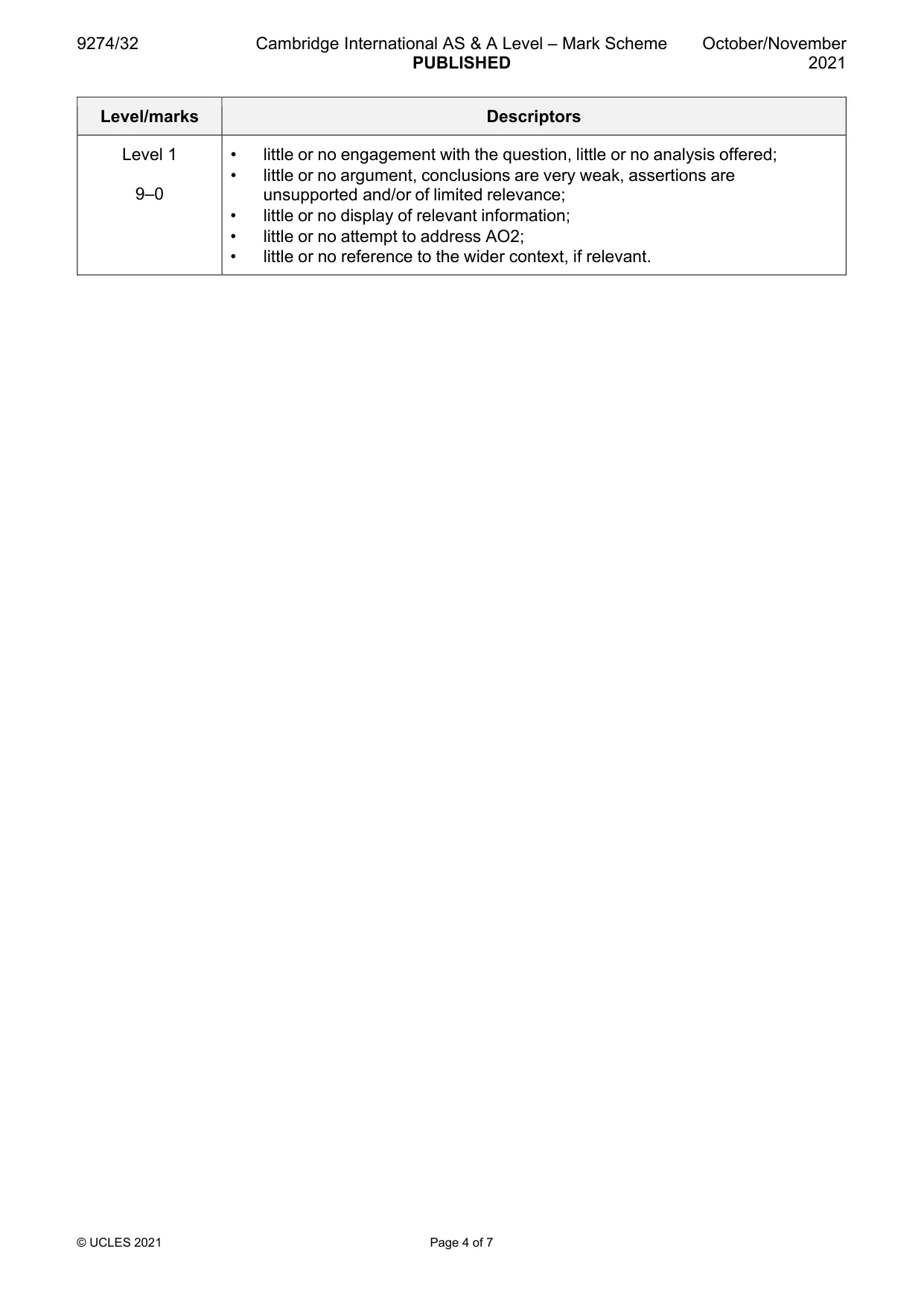
9274/32 Cambridge International AS & A Level – Mark Scheme PUBLISHED October/November 2021 © UCLES 2021 Page 4 of 7 Level/marks Descriptors Level 1 9–0 • little or no engagement with the question, little or no analysis offered; • little or no argument, conclusions are very weak, assertions are unsupported and/or of limited relevance; • little or no display of relevant information; • little or no attempt to address AO2; • little or no reference to the wider context, if relevant.
Mark scheme, page 5
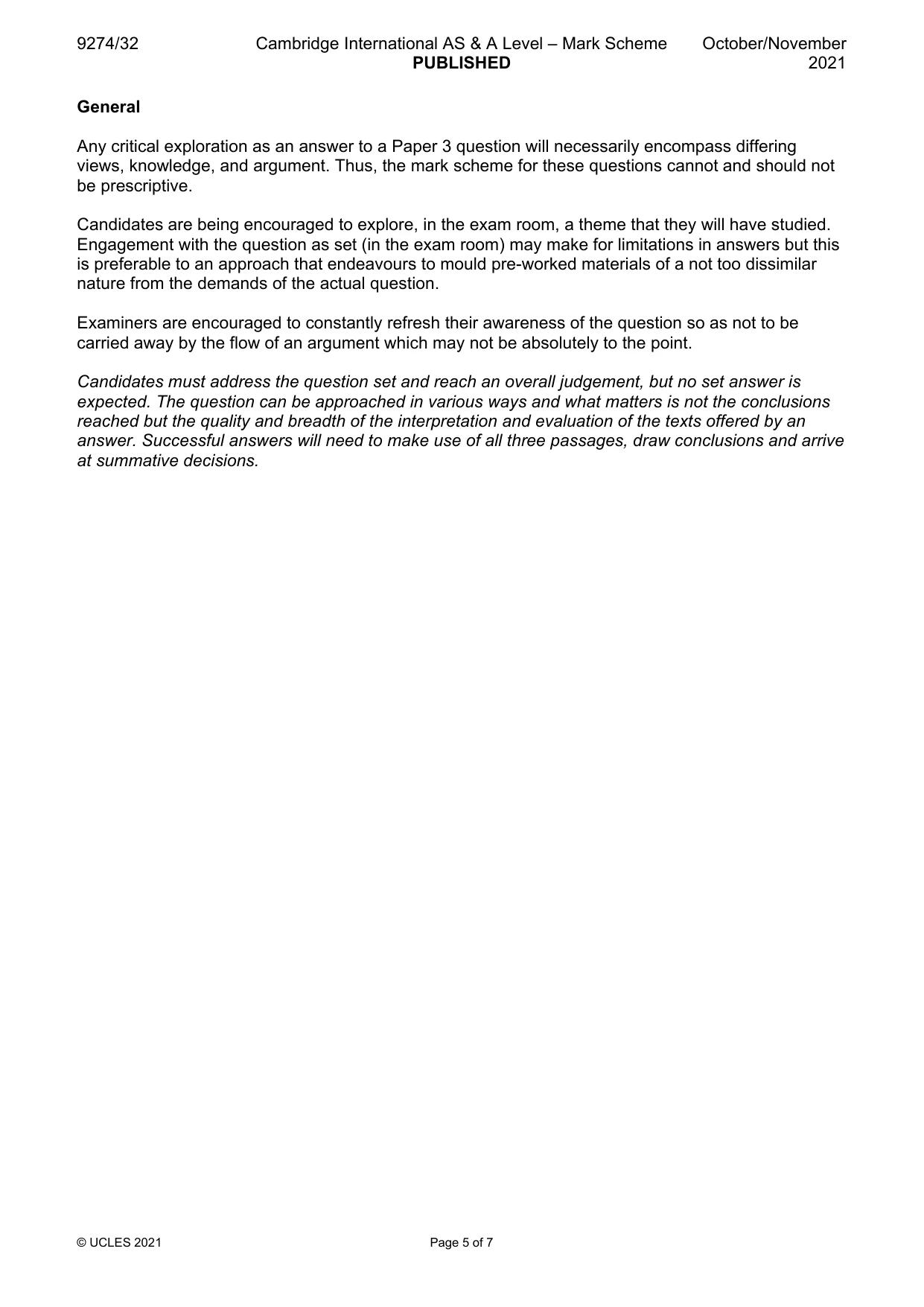
9274/32 Cambridge International AS & A Level – Mark Scheme PUBLISHED October/November 2021 © UCLES 2021 Page 5 of 7 General Any critical exploration as an answer to a Paper 3 question will necessarily encompass differing views, knowledge, and argument. Thus, the mark scheme for these questions cannot and should not be prescriptive. Candidates are being encouraged to explore, in the exam room, a theme that they will have studied. Engagement with the question as set (in the exam room) may make for limitations in answers but this is preferable to an approach that endeavours to mould pre-worked materials of a not too dissimilar nature from the demands of the actual question. Examiners are encouraged to constantly refresh their awareness of the question so as not to be carried away by the flow of an argument which may not be absolutely to the point. Candidates must address the question set and reach an overall judgement, but no set answer is expected. The question can be approached in various ways and what matters is not the conclusions reached but the quality and breadth of the interpretation and evaluation of the texts offered by an answer. Successful answers will need to make use of all three passages, draw conclusions and arrive at summative decisions.
Mark scheme, page 6
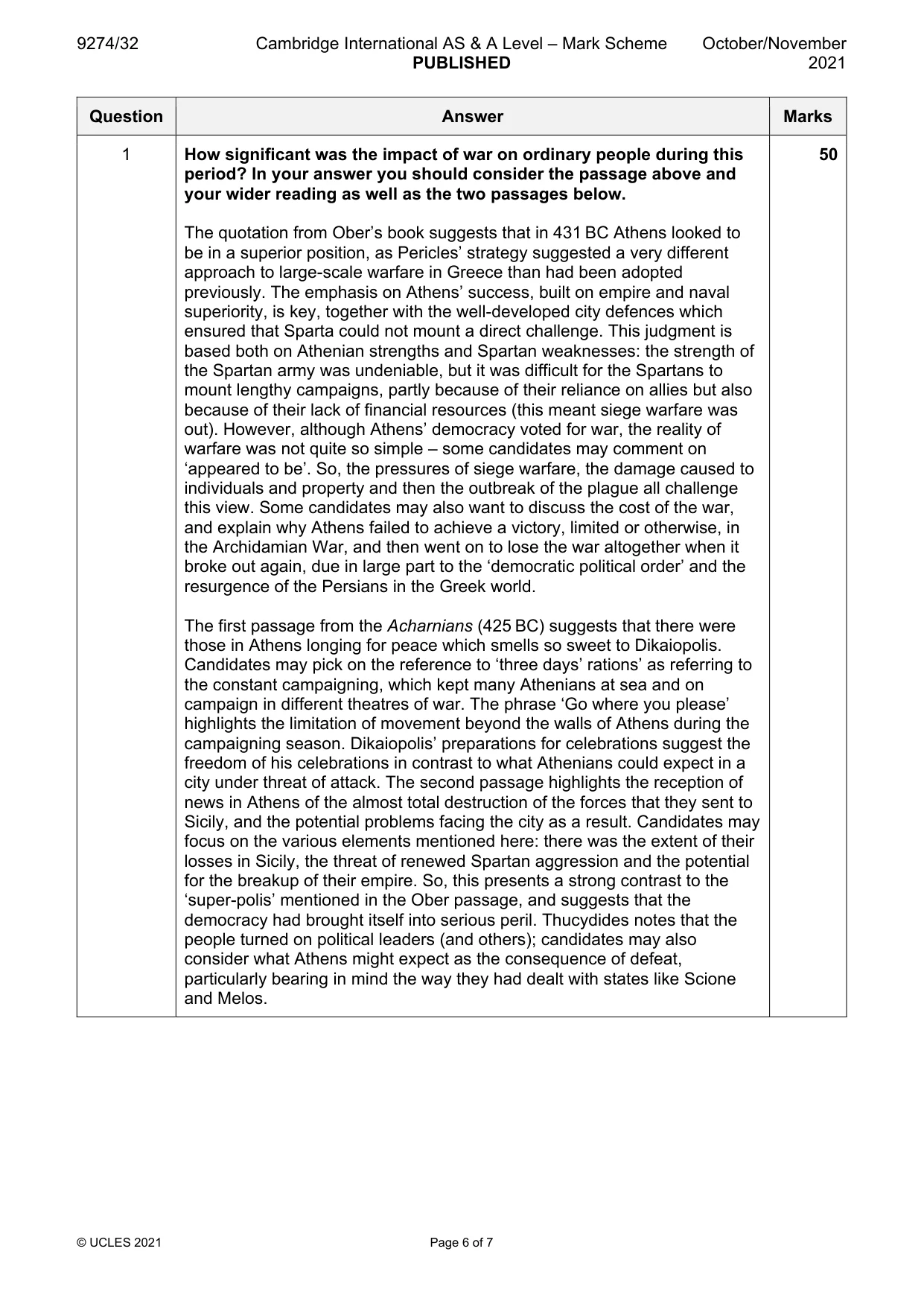
9274/32 Cambridge International AS & A Level – Mark Scheme PUBLISHED October/November 2021 © UCLES 2021 Page 6 of 7 Question Answer Marks 1 How significant was the impact of war on ordinary people during this period? In your answer you should consider the passage above and your wider reading as well as the two passages below. The quotation from Ober’s book suggests that in 431 BC Athens looked to be in a superior position, as Pericles’ strategy suggested a very different approach to large-scale warfare in Greece than had been adopted previously. The emphasis on Athens’ success, built on empire and naval superiority, is key, together with the well-developed city defences which ensured that Sparta could not mount a direct challenge. This judgment is based both on Athenian strengths and Spartan weaknesses: the strength of the Spartan army was undeniable, but it was difficult for the Spartans to mount lengthy campaigns, partly because of their reliance on allies but also because of their lack of financial resources (this meant siege warfare was out). However, although Athens’ democracy voted for war, the reality of warfare was not quite so simple – some candidates may comment on ‘appeared to be’. So, the pressures of siege warfare, the damage caused to individuals and property and then the outbreak of the plague all challenge this view. Some candidates may also want to discuss the cost of the war, and explain why Athens failed to achieve a victory, limited or otherwise, in the Archidamian War, and then went on to lose the war altogether when it broke out again, due in large part to the ‘democratic political order’ and the resurgence of the Persians in the Greek world. The first passage from the Acharnians (425 BC) suggests that there were those in Athens longing for peace which smells so sweet to Dikaiopolis. Candidates may pick on the reference to ‘three days’ rations’ as referring to the constant campaigning, which kept many Athenians at sea and on campaign in different theatres of war. The phrase ‘Go where you please’ highlights the limitation of movement beyond the walls of Athens during the campaigning season. Dikaiopolis’ preparations for celebrations suggest the freedom of his celebrations in contrast to what Athenians could expect in a city under threat of attack. The second passage highlights the reception of news in Athens of the almost total destruction of the forces that they sent to Sicily, and the potential problems facing the city as a result. Candidates may focus on the various elements mentioned here: there was the extent of their losses in Sicily, the threat of renewed Spartan aggression and the potential for the breakup of their empire. So, this presents a strong contrast to the ‘super-polis’ mentioned in the Ober passage, and suggests that the democracy had brought itself into serious peril. Thucydides notes that the people turned on political leaders (and others); candidates may also consider what Athens might expect as the consequence of defeat, particularly bearing in mind the way they had dealt with states like Scione and Melos. 50
Mark scheme, page 7
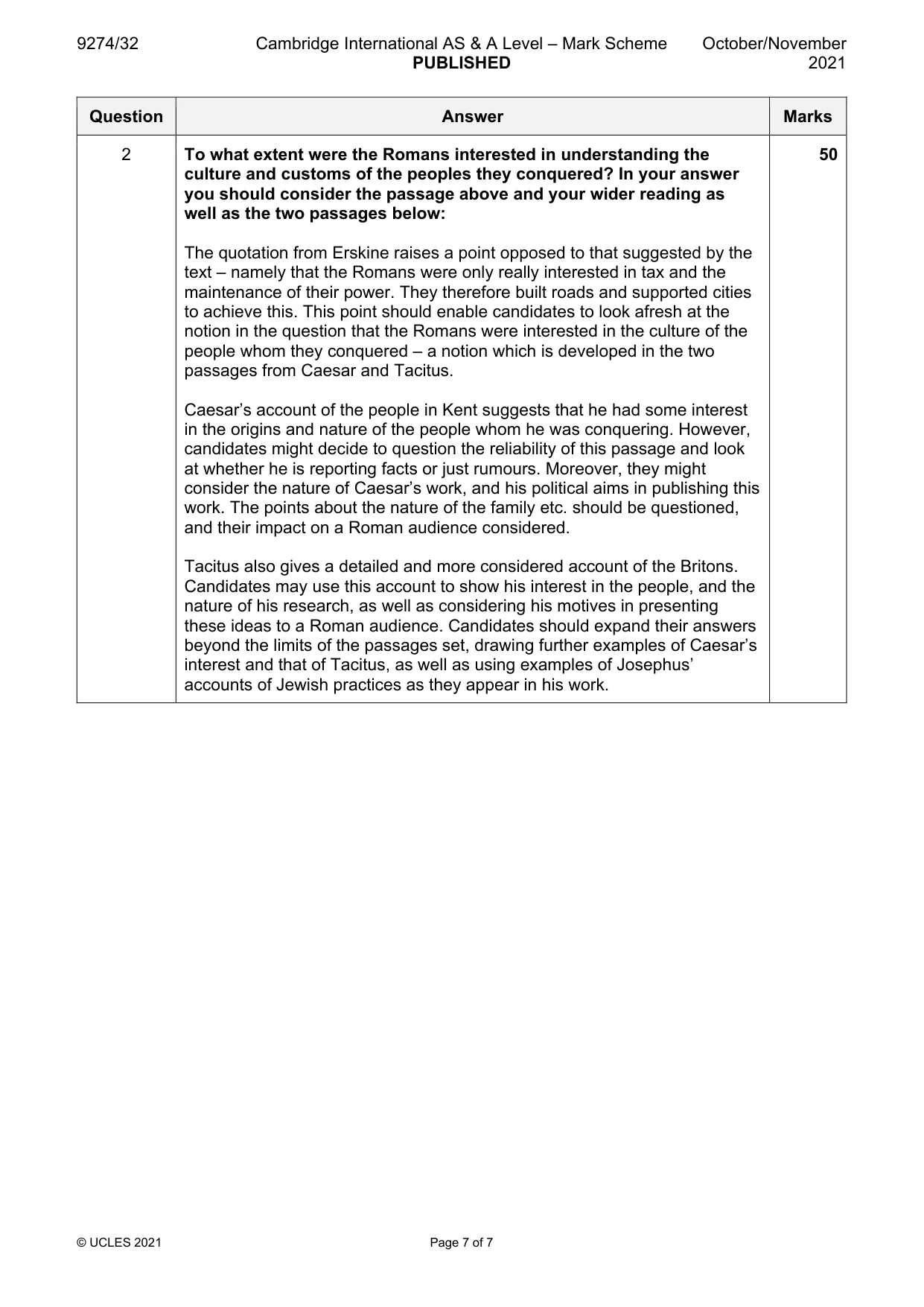
9274/32 Cambridge International AS & A Level – Mark Scheme PUBLISHED October/November 2021 © UCLES 2021 Page 7 of 7 Question Answer Marks 2 To what extent were the Romans interested in understanding the culture and customs of the peoples they conquered? In your answer you should consider the passage above and your wider reading as well as the two passages below: The quotation from Erskine raises a point opposed to that suggested by the text – namely that the Romans were only really interested in tax and the maintenance of their power. They therefore built roads and supported cities to achieve this. This point should enable candidates to look afresh at the notion in the question that the Romans were interested in the culture of the people whom they conquered – a notion which is developed in the two passages from Caesar and Tacitus. Caesar’s account of the people in Kent suggests that he had some interest in the origins and nature of the people whom he was conquering. However, candidates might decide to question the reliability of this passage and look at whether he is reporting facts or just rumours. Moreover, they might consider the nature of Caesar’s work, and his political aims in publishing this work. The points about the nature of the family etc. should be questioned, and their impact on a Roman audience considered. Tacitus also gives a detailed and more considered account of the Britons. Candidates may use this account to show his interest in the people, and the nature of his research, as well as considering his motives in presenting these ideas to a Roman audience. Candidates should expand their answers beyond the limits of the passages set, drawing further examples of Caesar’s interest and that of Tacitus, as well as using examples of Josephus’ accounts of Jewish practices as they appear in his work. 50
What you needed in this session
Cambridge’s own grade thresholds for 2021 Oct/Nov, Paper 3 · Variant 2. A higher threshold means an easier paper — the bar moves with how the cohort did.