Cambridge A Level Classical Studies 9274 — 2020 Oct/Nov Paper 3 · Variant 2
9274/32/O/N/20 · 50 marks · ≈56 min
The question paper and its mark scheme, free to read here and free to download. This is Cambridge’s own paper, exactly as it was sat.
Question paper4 pages

Mark scheme7 pages
Answers below. Sit the paper first if you are practising.
Paper as text
Question paper, page 1
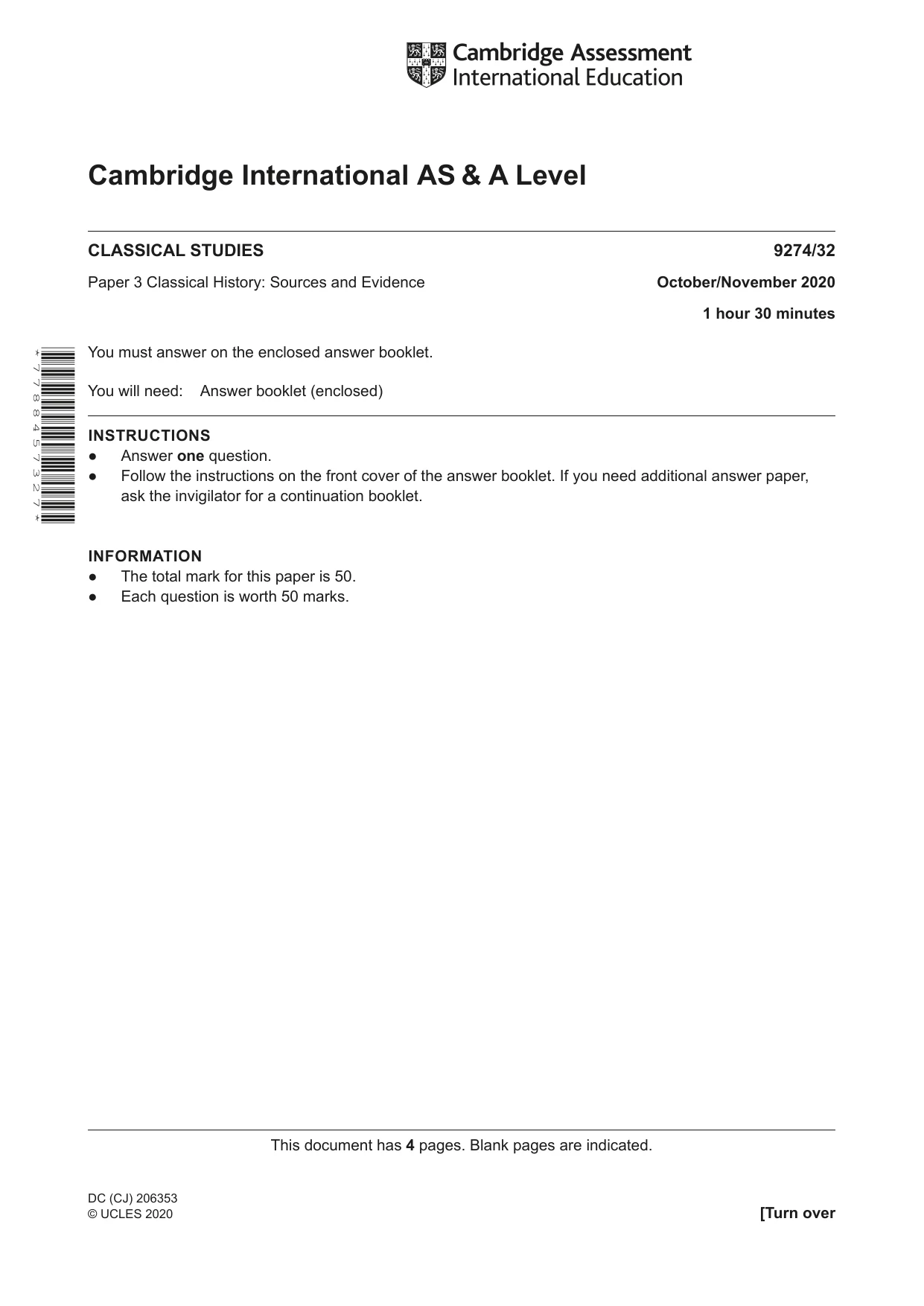
DC (CJ) 206353 © UCLES 2020 [Turn over This document has 4 pages. Blank pages are indicated. * 7 7 8 8 4 5 7 3 2 7 * CLASSICAL STUDIES 9274/32 Paper 3 Classical History: Sources and Evidence October/November 2020 1 hour 30 minutes You must answer on the enclosed answer booklet. You will need: Answer booklet (enclosed) INSTRUCTIONS ● Answer one question. ● Follow the instructions on the front cover of the answer booklet. If you need additional answer paper, ask the invigilator for a continuation booklet. INFORMATION ● The total mark for this paper is 50. ● Each question is worth 50 marks. Cambridge International AS & A Level
Question paper, page 2
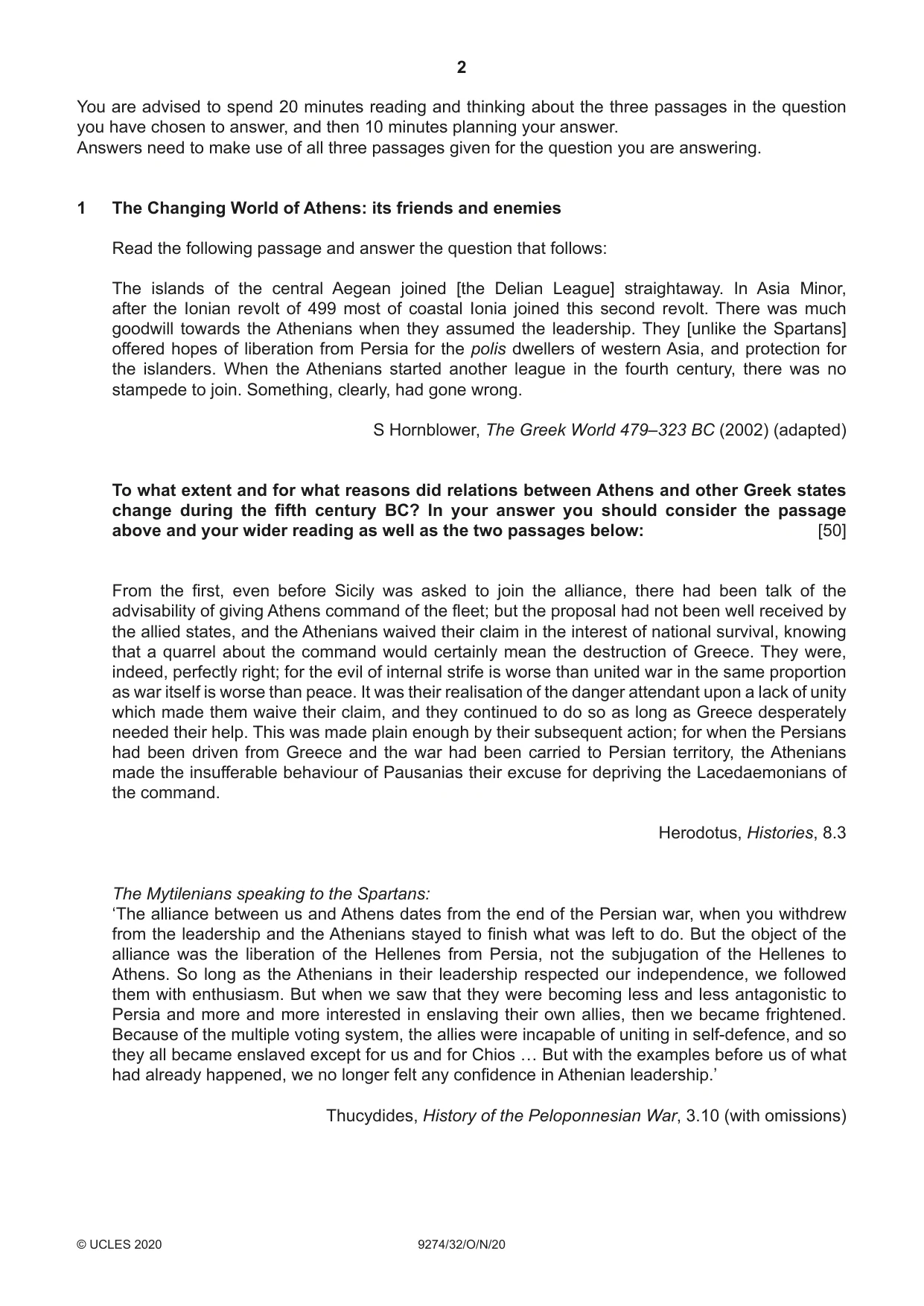
2 9274/32/O/N/20 © UCLES 2020 You are advised to spend 20 minutes reading and thinking about the three passages in the question you have chosen to answer, and then 10 minutes planning your answer. Answers need to make use of all three passages given for the question you are answering. 1 The Changing World of Athens: its friends and enemies Read the following passage and answer the question that follows: The islands of the central Aegean joined [the Delian League] straightaway. In Asia Minor, after the Ionian revolt of 499 most of coastal Ionia joined this second revolt. There was much goodwill towards the Athenians when they assumed the leadership. They [unlike the Spartans] offered hopes of liberation from Persia for the polis dwellers of western Asia, and protection for the islanders. When the Athenians started another league in the fourth century, there was no stampede to join. Something, clearly, had gone wrong. S Hornblower, The Greek World 479–323 BC (2002) (adapted) To what extent and for what reasons did relations between Athens and other Greek states change during the fifth century BC? In your answer you should consider the passage above and your wider reading as well as the two passages below: [50] From the first, even before Sicily was asked to join the alliance, there had been talk of the advisability of giving Athens command of the fleet; but the proposal had not been well received by the allied states, and the Athenians waived their claim in the interest of national survival, knowing that a quarrel about the command would certainly mean the destruction of Greece. They were, indeed, perfectly right; for the evil of internal strife is worse than united war in the same proportion as war itself is worse than peace. It was their realisation of the danger attendant upon a lack of unity which made them waive their claim, and they continued to do so as long as Greece desperately needed their help. This was made plain enough by their subsequent action; for when the Persians had been driven from Greece and the war had been carried to Persian territory, the Athenians made the insufferable behaviour of Pausanias their excuse for depriving the Lacedaemonians of the command. Herodotus, Histories, 8.3 The Mytilenians speaking to the Spartans: ‘The alliance between us and Athens dates from the end of the Persian war, when you withdrew from the leadership and the Athenians stayed to finish what was left to do. But the object of the alliance was the liberation of the Hellenes from Persia, not the subjugation of the Hellenes to Athens. So long as the Athenians in their leadership respected our independence, we followed them with enthusiasm. But when we saw that they were becoming less and less antagonistic to Persia and more and more interested in enslaving their own allies, then we became frightened. Because of the multiple voting system, the allies were incapable of uniting in self-defence, and so they all became enslaved except for us and for Chios … But with the examples before us of what had already happened, we no longer felt any confidence in Athenian leadership.’ Thucydides, History of the Peloponnesian War, 3.10 (with omissions)
Question paper, page 3
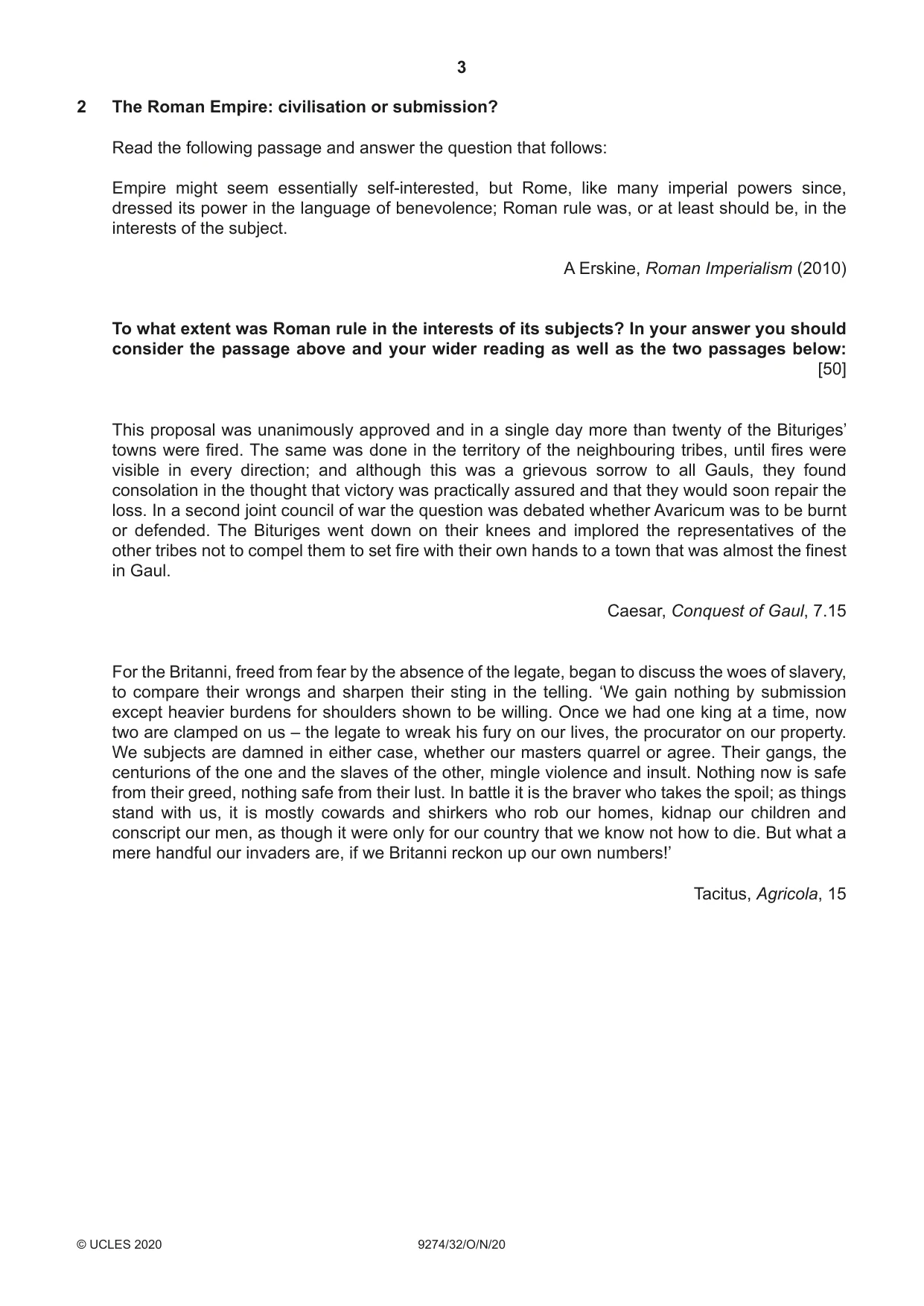
3 9274/32/O/N/20 © UCLES 2020 2 The Roman Empire: civilisation or submission? Read the following passage and answer the question that follows: Empire might seem essentially self-interested, but Rome, like many imperial powers since, dressed its power in the language of benevolence; Roman rule was, or at least should be, in the interests of the subject. A Erskine, Roman Imperialism (2010) To what extent was Roman rule in the interests of its subjects? In your answer you should consider the passage above and your wider reading as well as the two passages below: [50] This proposal was unanimously approved and in a single day more than twenty of the Bituriges’ towns were fired. The same was done in the territory of the neighbouring tribes, until fires were visible in every direction; and although this was a grievous sorrow to all Gauls, they found consolation in the thought that victory was practically assured and that they would soon repair the loss. In a second joint council of war the question was debated whether Avaricum was to be burnt or defended. The Bituriges went down on their knees and implored the representatives of the other tribes not to compel them to set fire with their own hands to a town that was almost the finest in Gaul. Caesar, Conquest of Gaul, 7.15 For the Britanni, freed from fear by the absence of the legate, began to discuss the woes of slavery, to compare their wrongs and sharpen their sting in the telling. ‘We gain nothing by submission except heavier burdens for shoulders shown to be willing. Once we had one king at a time, now two are clamped on us – the legate to wreak his fury on our lives, the procurator on our property. We subjects are damned in either case, whether our masters quarrel or agree. Their gangs, the centurions of the one and the slaves of the other, mingle violence and insult. Nothing now is safe from their greed, nothing safe from their lust. In battle it is the braver who takes the spoil; as things stand with us, it is mostly cowards and shirkers who rob our homes, kidnap our children and conscript our men, as though it were only for our country that we know not how to die. But what a mere handful our invaders are, if we Britanni reckon up our own numbers!’ Tacitus, Agricola, 15
Question paper, page 4
4 9274/32/O/N/20 © UCLES 2020 Permission to reproduce items where third-party owned material protected by copyright is included has been sought and cleared where possible. Every reasonable effort has been made by the publisher (UCLES) to trace copyright holders, but if any items requiring clearance have unwittingly been included, the publisher will be pleased to make amends at the earliest possible opportunity. To avoid the issue of disclosure of answer-related information to candidates, all copyright acknowledgements are reproduced online in the Cambridge Assessment International Education Copyright Acknowledgements Booklet. This is produced for each series of examinations and is freely available to download at www.cambridgeinternational.org after the live examination series. Cambridge Assessment International Education is part of the Cambridge Assessment Group. Cambridge Assessment is the brand name of the University of Cambridge Local Examinations Syndicate (UCLES), which itself is a department of the University of Cambridge. BLANK PAGE
Mark scheme, page 1
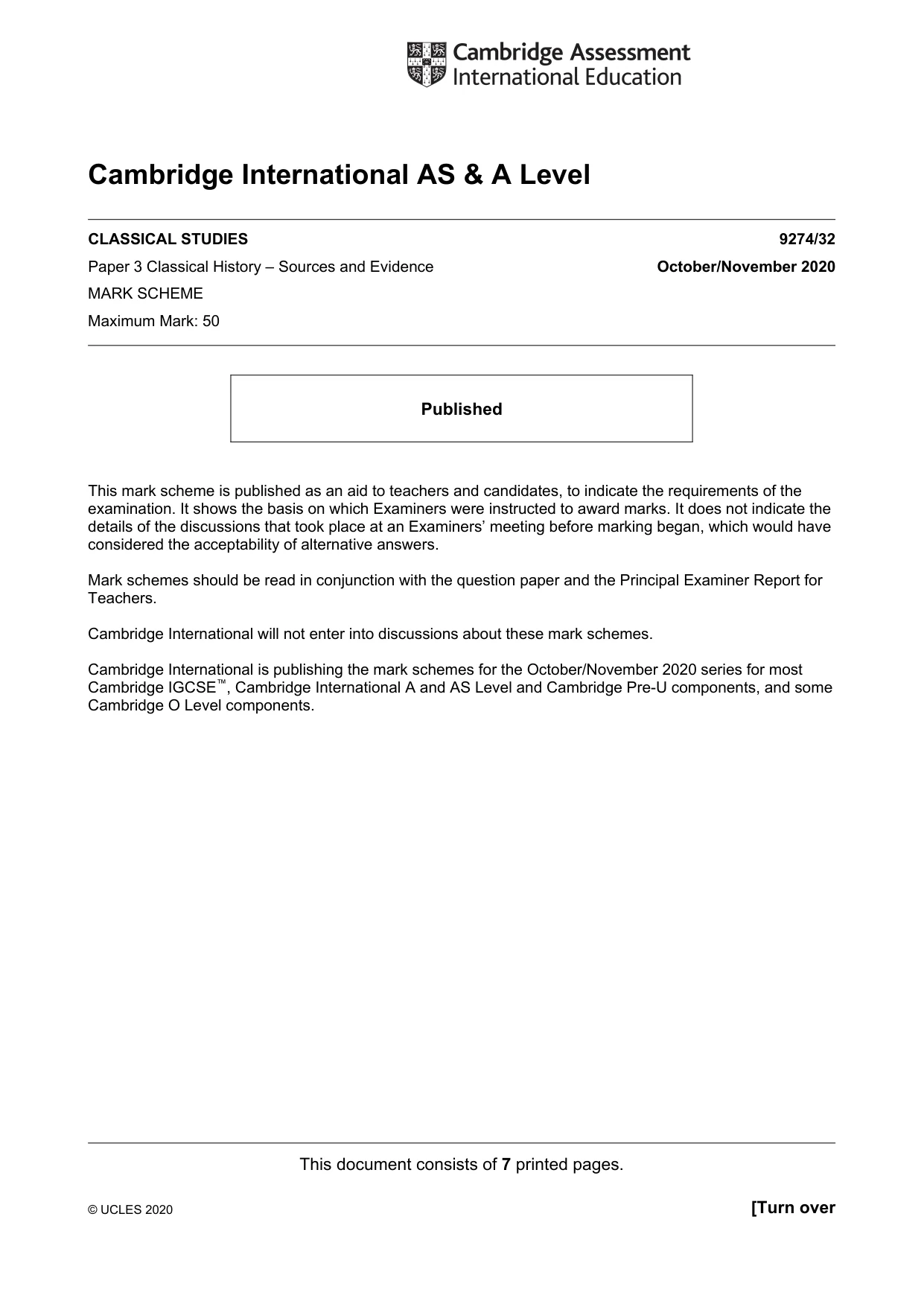
This document consists of 7 printed pages. © UCLES 2020 [Turn over Cambridge International AS & A Level CLASSICAL STUDIES 9274/32 Paper 3 Classical History – Sources and Evidence October/November 2020 MARK SCHEME Maximum Mark: 50 Published This mark scheme is published as an aid to teachers and candidates, to indicate the requirements of the examination. It shows the basis on which Examiners were instructed to award marks. It does not indicate the details of the discussions that took place at an Examiners’ meeting before marking began, which would have considered the acceptability of alternative answers. Mark schemes should be read in conjunction with the question paper and the Principal Examiner Report for Teachers. Cambridge International will not enter into discussions about these mark schemes. Cambridge International is publishing the mark schemes for the October/November 2020 series for most Cambridge IGCSE™, Cambridge International A and AS Level and Cambridge Pre-U components, and some Cambridge O Level components.
Mark scheme, page 2
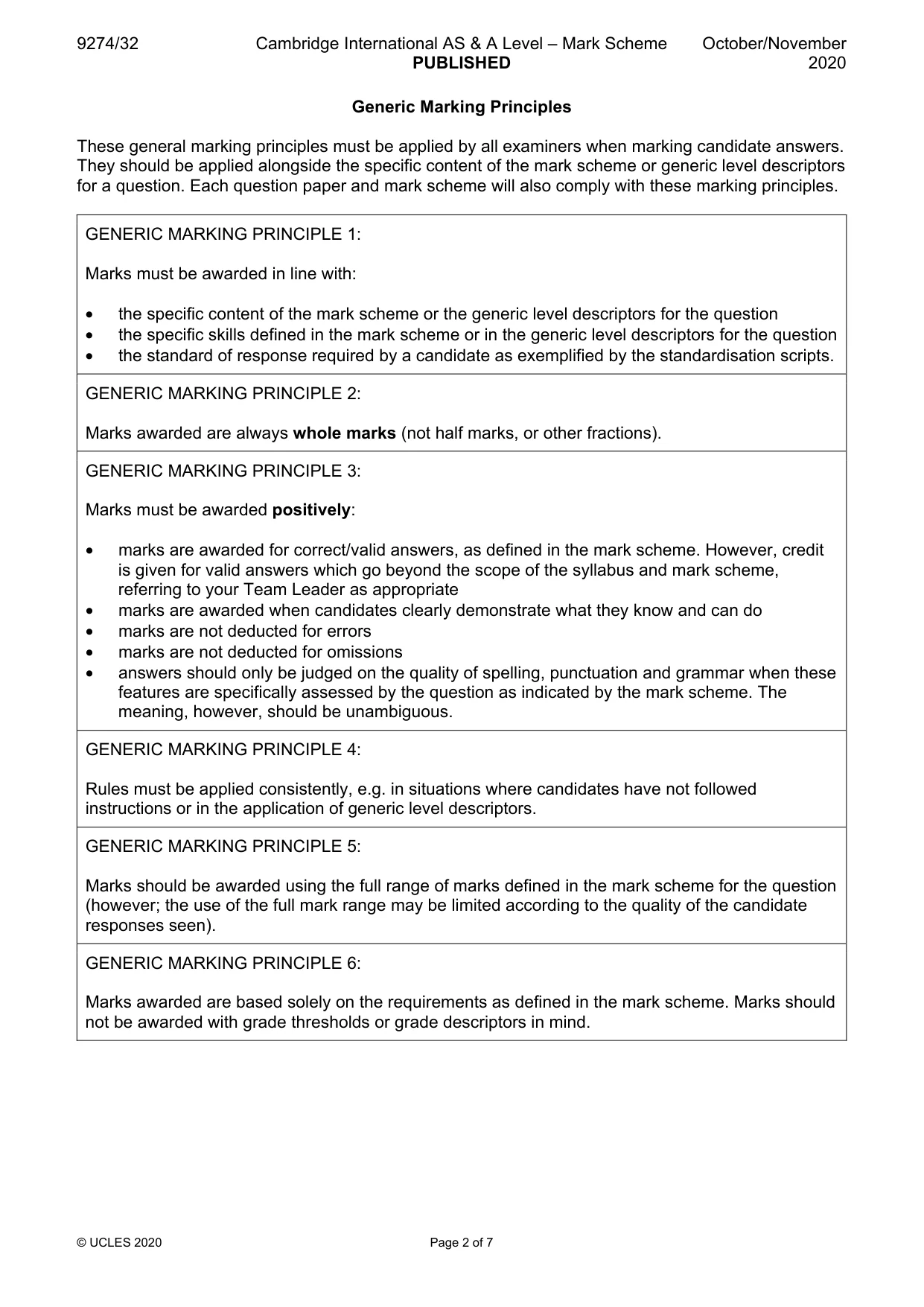
9274/32 Cambridge International AS & A Level – Mark Scheme PUBLISHED October/November 2020 © UCLES 2020 Page 2 of 7 Generic Marking Principles These general marking principles must be applied by all examiners when marking candidate answers. They should be applied alongside the specific content of the mark scheme or generic level descriptors for a question. Each question paper and mark scheme will also comply with these marking principles. GENERIC MARKING PRINCIPLE 1: Marks must be awarded in line with: • the specific content of the mark scheme or the generic level descriptors for the question • the specific skills defined in the mark scheme or in the generic level descriptors for the question • the standard of response required by a candidate as exemplified by the standardisation scripts. GENERIC MARKING PRINCIPLE 2: Marks awarded are always whole marks (not half marks, or other fractions). GENERIC MARKING PRINCIPLE 3: Marks must be awarded positively: • marks are awarded for correct/valid answers, as defined in the mark scheme. However, credit is given for valid answers which go beyond the scope of the syllabus and mark scheme, referring to your Team Leader as appropriate • marks are awarded when candidates clearly demonstrate what they know and can do • marks are not deducted for errors • marks are not deducted for omissions • answers should only be judged on the quality of spelling, punctuation and grammar when these features are specifically assessed by the question as indicated by the mark scheme. The meaning, however, should be unambiguous. GENERIC MARKING PRINCIPLE 4: Rules must be applied consistently, e.g. in situations where candidates have not followed instructions or in the application of generic level descriptors. GENERIC MARKING PRINCIPLE 5: Marks should be awarded using the full range of marks defined in the mark scheme for the question (however; the use of the full mark range may be limited according to the quality of the candidate responses seen). GENERIC MARKING PRINCIPLE 6: Marks awarded are based solely on the requirements as defined in the mark scheme. Marks should not be awarded with grade thresholds or grade descriptors in mind.
Mark scheme, page 3
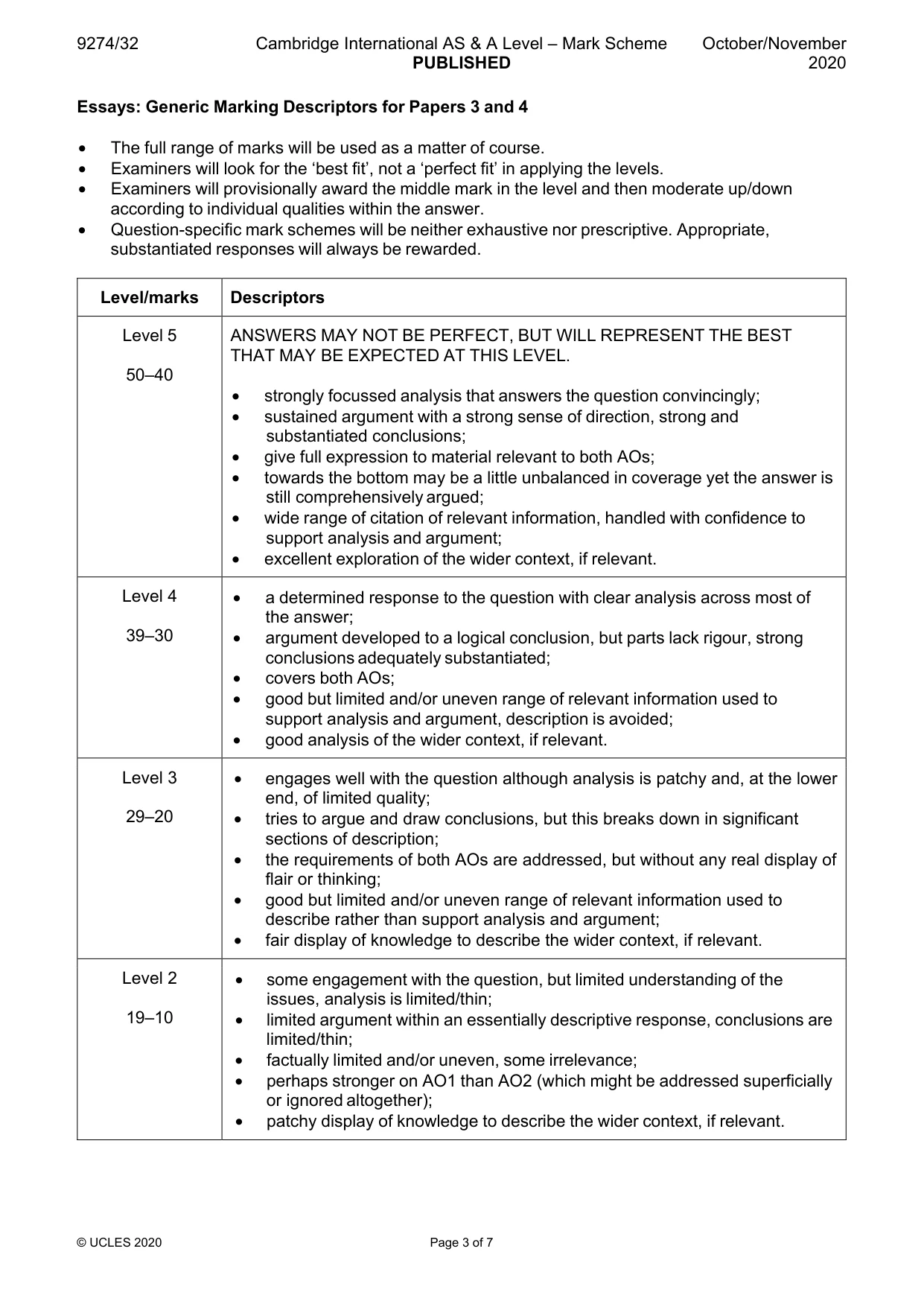
9274/32 Cambridge International AS & A Level – Mark Scheme PUBLISHED October/November 2020 © UCLES 2020 Page 3 of 7 Essays: Generic Marking Descriptors for Papers 3 and 4 • The full range of marks will be used as a matter of course. • Examiners will look for the ‘best fit’, not a ‘perfect fit’ in applying the levels. • Examiners will provisionally award the middle mark in the level and then moderate up/down according to individual qualities within the answer. • Question-specific mark schemes will be neither exhaustive nor prescriptive. Appropriate, substantiated responses will always be rewarded. Level/marks Descriptors Level 5 50–40 ANSWERS MAY NOT BE PERFECT, BUT WILL REPRESENT THE BEST THAT MAY BE EXPECTED AT THIS LEVEL. • strongly focussed analysis that answers the question convincingly; • sustained argument with a strong sense of direction, strong and substantiated conclusions; • give full expression to material relevant to both AOs; • towards the bottom may be a little unbalanced in coverage yet the answer is still comprehensively argued; • wide range of citation of relevant information, handled with confidence to support analysis and argument; • excellent exploration of the wider context, if relevant. Level 4 39–30 • a determined response to the question with clear analysis across most of the answer; • argument developed to a logical conclusion, but parts lack rigour, strong conclusions adequately substantiated; • covers both AOs; • good but limited and/or uneven range of relevant information used to support analysis and argument, description is avoided; • good analysis of the wider context, if relevant. Level 3 29–20 • engages well with the question although analysis is patchy and, at the lower end, of limited quality; • tries to argue and draw conclusions, but this breaks down in significant sections of description; • the requirements of both AOs are addressed, but without any real display of flair or thinking; • good but limited and/or uneven range of relevant information used to describe rather than support analysis and argument; • fair display of knowledge to describe the wider context, if relevant. Level 2 19–10 • some engagement with the question, but limited understanding of the issues, analysis is limited/thin; • limited argument within an essentially descriptive response, conclusions are limited/thin; • factually limited and/or uneven, some irrelevance; • perhaps stronger on AO1 than AO2 (which might be addressed superficially or ignored altogether); • patchy display of knowledge to describe the wider context, if relevant.
Mark scheme, page 4
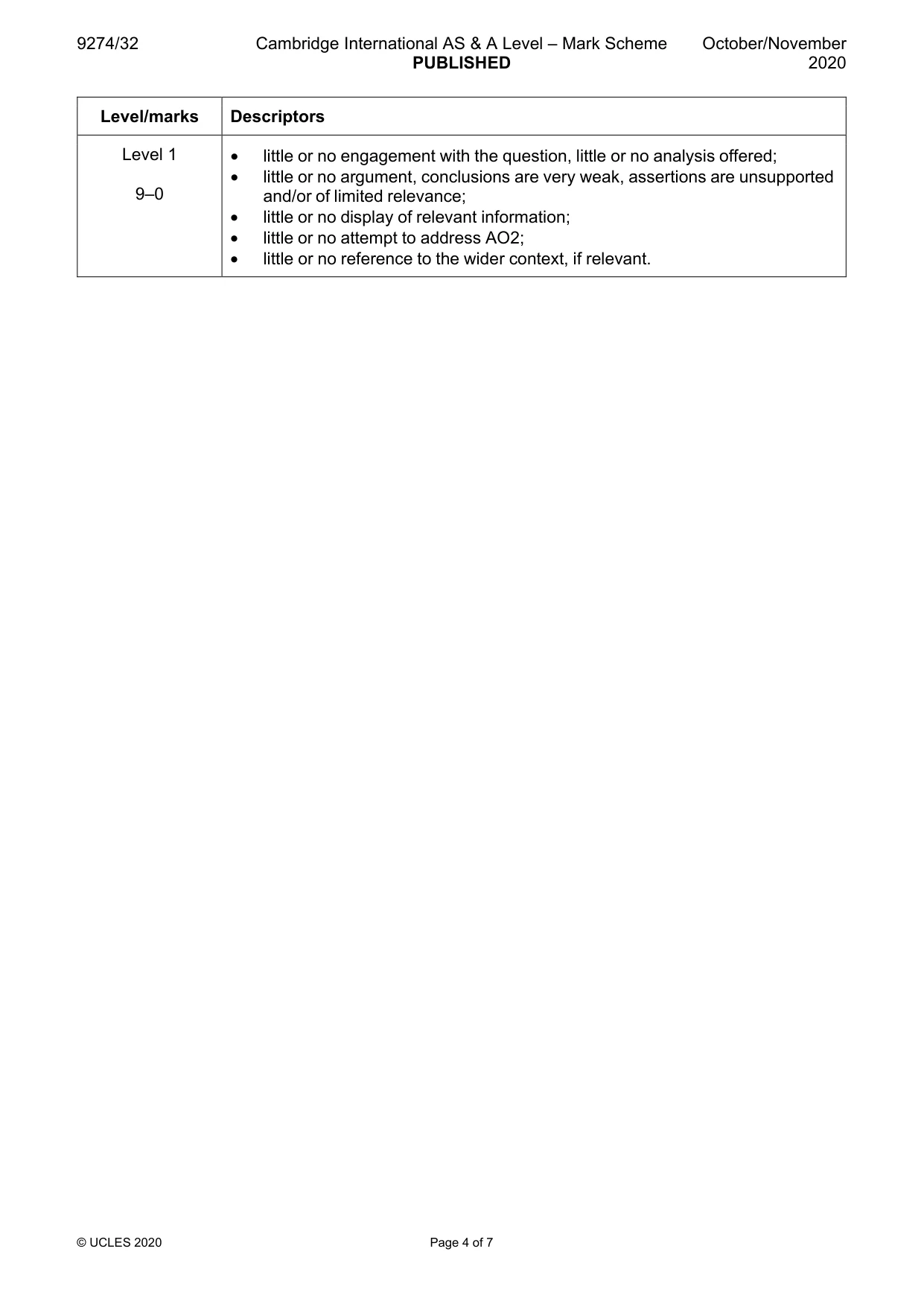
9274/32 Cambridge International AS & A Level – Mark Scheme PUBLISHED October/November 2020 © UCLES 2020 Page 4 of 7 Level/marks Descriptors Level 1 9–0 • little or no engagement with the question, little or no analysis offered; • little or no argument, conclusions are very weak, assertions are unsupported and/or of limited relevance; • little or no display of relevant information; • little or no attempt to address AO2; • little or no reference to the wider context, if relevant.
Mark scheme, page 5
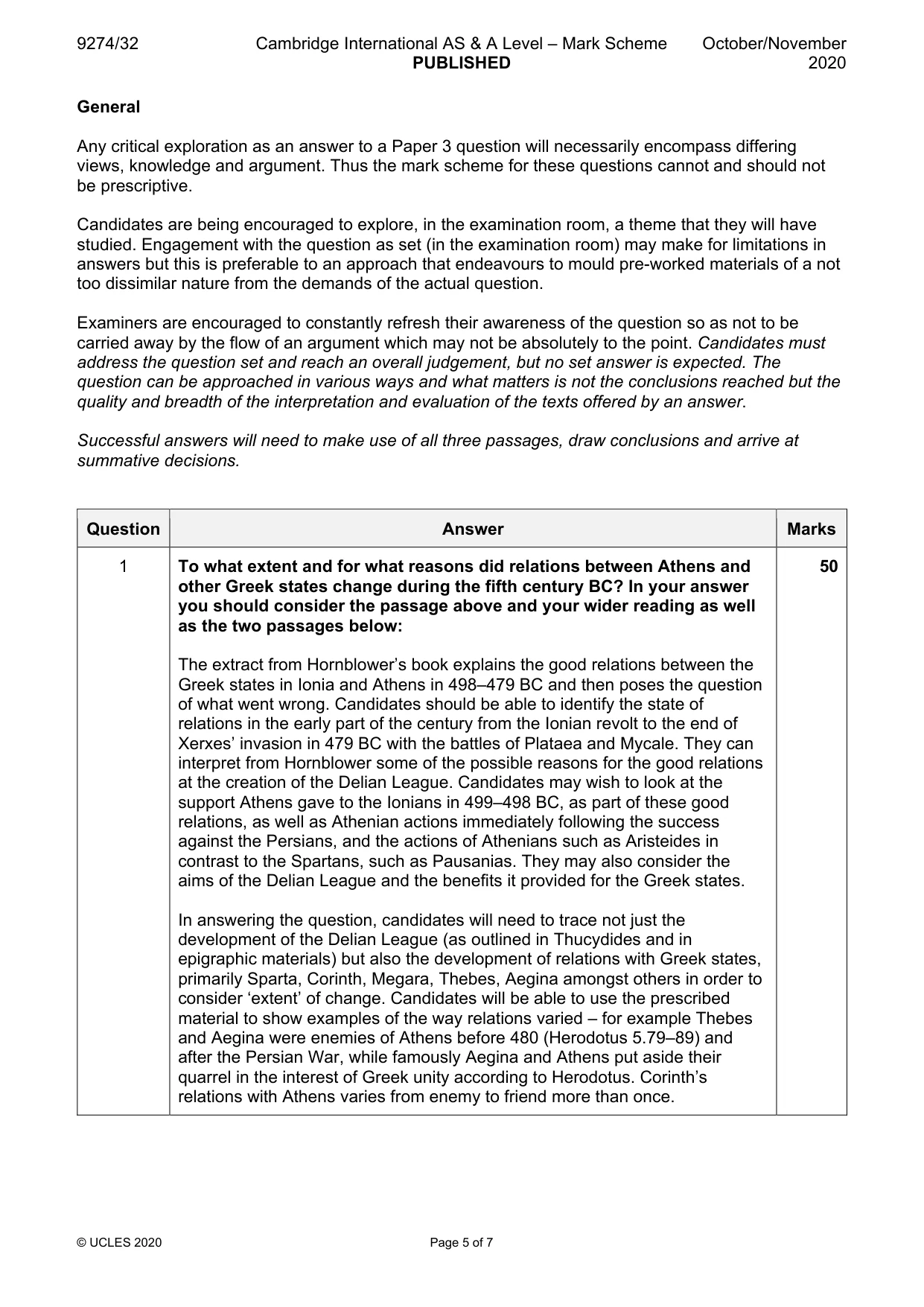
9274/32 Cambridge International AS & A Level – Mark Scheme PUBLISHED October/November 2020 © UCLES 2020 Page 5 of 7 General Any critical exploration as an answer to a Paper 3 question will necessarily encompass differing views, knowledge and argument. Thus the mark scheme for these questions cannot and should not be prescriptive. Candidates are being encouraged to explore, in the examination room, a theme that they will have studied. Engagement with the question as set (in the examination room) may make for limitations in answers but this is preferable to an approach that endeavours to mould pre-worked materials of a not too dissimilar nature from the demands of the actual question. Examiners are encouraged to constantly refresh their awareness of the question so as not to be carried away by the flow of an argument which may not be absolutely to the point. Candidates must address the question set and reach an overall judgement, but no set answer is expected. The question can be approached in various ways and what matters is not the conclusions reached but the quality and breadth of the interpretation and evaluation of the texts offered by an answer. Successful answers will need to make use of all three passages, draw conclusions and arrive at summative decisions. Question Answer Marks 1 To what extent and for what reasons did relations between Athens and other Greek states change during the fifth century BC? In your answer you should consider the passage above and your wider reading as well as the two passages below: The extract from Hornblower’s book explains the good relations between the Greek states in Ionia and Athens in 498–479 BC and then poses the question of what went wrong. Candidates should be able to identify the state of relations in the early part of the century from the Ionian revolt to the end of Xerxes’ invasion in 479 BC with the battles of Plataea and Mycale. They can interpret from Hornblower some of the possible reasons for the good relations at the creation of the Delian League. Candidates may wish to look at the support Athens gave to the Ionians in 499–498 BC, as part of these good relations, as well as Athenian actions immediately following the success against the Persians, and the actions of Athenians such as Aristeides in contrast to the Spartans, such as Pausanias. They may also consider the aims of the Delian League and the benefits it provided for the Greek states. In answering the question, candidates will need to trace not just the development of the Delian League (as outlined in Thucydides and in epigraphic materials) but also the development of relations with Greek states, primarily Sparta, Corinth, Megara, Thebes, Aegina amongst others in order to consider ‘extent’ of change. Candidates will be able to use the prescribed material to show examples of the way relations varied – for example Thebes and Aegina were enemies of Athens before 480 (Herodotus 5.79–89) and after the Persian War, while famously Aegina and Athens put aside their quarrel in the interest of Greek unity according to Herodotus. Corinth’s relations with Athens varies from enemy to friend more than once. 50
Mark scheme, page 6
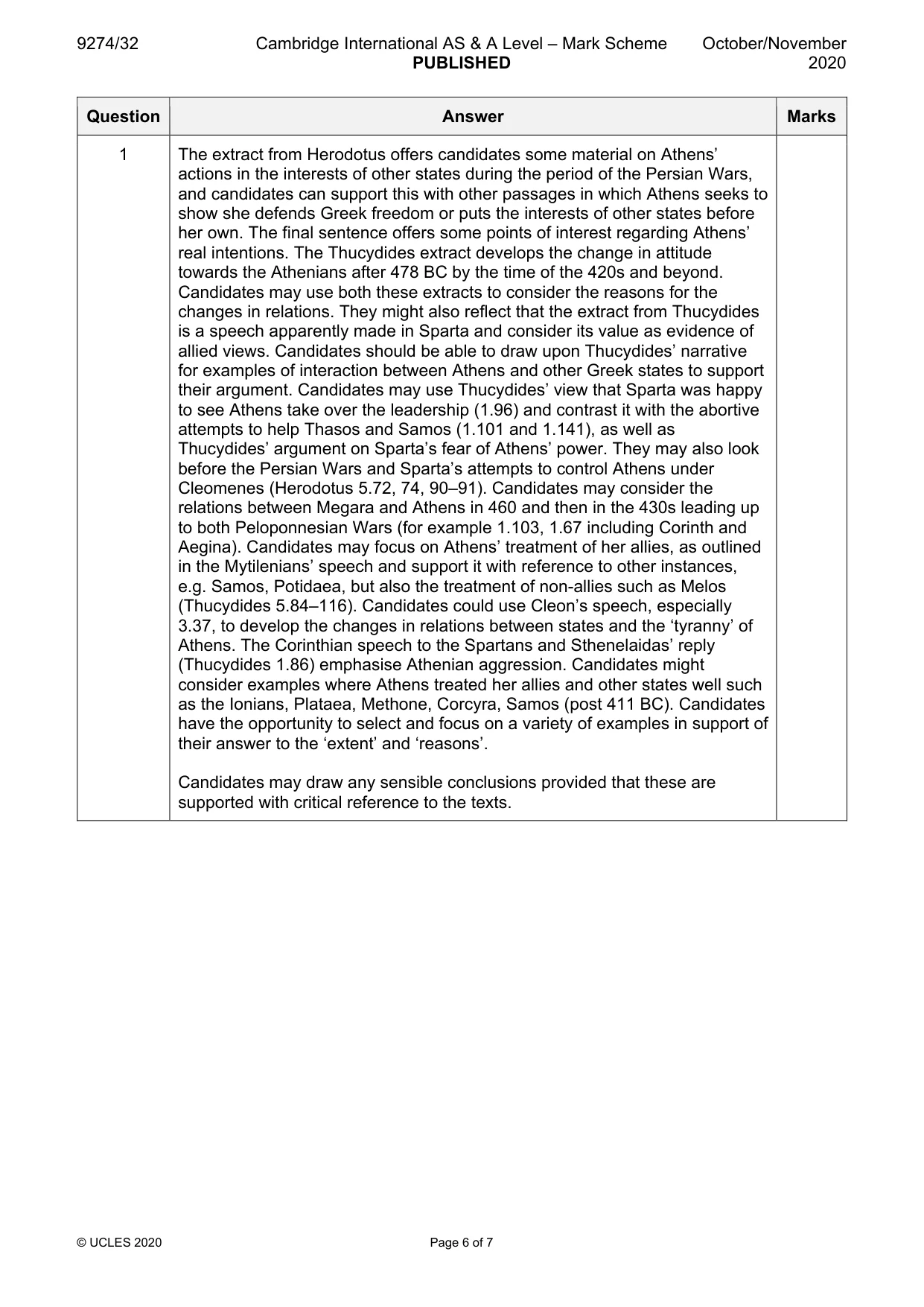
9274/32 Cambridge International AS & A Level – Mark Scheme PUBLISHED October/November 2020 © UCLES 2020 Page 6 of 7 Question Answer Marks 1 The extract from Herodotus offers candidates some material on Athens’ actions in the interests of other states during the period of the Persian Wars, and candidates can support this with other passages in which Athens seeks to show she defends Greek freedom or puts the interests of other states before her own. The final sentence offers some points of interest regarding Athens’ real intentions. The Thucydides extract develops the change in attitude towards the Athenians after 478 BC by the time of the 420s and beyond. Candidates may use both these extracts to consider the reasons for the changes in relations. They might also reflect that the extract from Thucydides is a speech apparently made in Sparta and consider its value as evidence of allied views. Candidates should be able to draw upon Thucydides’ narrative for examples of interaction between Athens and other Greek states to support their argument. Candidates may use Thucydides’ view that Sparta was happy to see Athens take over the leadership (1.96) and contrast it with the abortive attempts to help Thasos and Samos (1.101 and 1.141), as well as Thucydides’ argument on Sparta’s fear of Athens’ power. They may also look before the Persian Wars and Sparta’s attempts to control Athens under Cleomenes (Herodotus 5.72, 74, 90–91). Candidates may consider the relations between Megara and Athens in 460 and then in the 430s leading up to both Peloponnesian Wars (for example 1.103, 1.67 including Corinth and Aegina). Candidates may focus on Athens’ treatment of her allies, as outlined in the Mytilenians’ speech and support it with reference to other instances, e.g. Samos, Potidaea, but also the treatment of non-allies such as Melos (Thucydides 5.84–116). Candidates could use Cleon’s speech, especially 3.37, to develop the changes in relations between states and the ‘tyranny’ of Athens. The Corinthian speech to the Spartans and Sthenelaidas’ reply (Thucydides 1.86) emphasise Athenian aggression. Candidates might consider examples where Athens treated her allies and other states well such as the Ionians, Plataea, Methone, Corcyra, Samos (post 411 BC). Candidates have the opportunity to select and focus on a variety of examples in support of their answer to the ‘extent’ and ‘reasons’. Candidates may draw any sensible conclusions provided that these are supported with critical reference to the texts.
Mark scheme, page 7
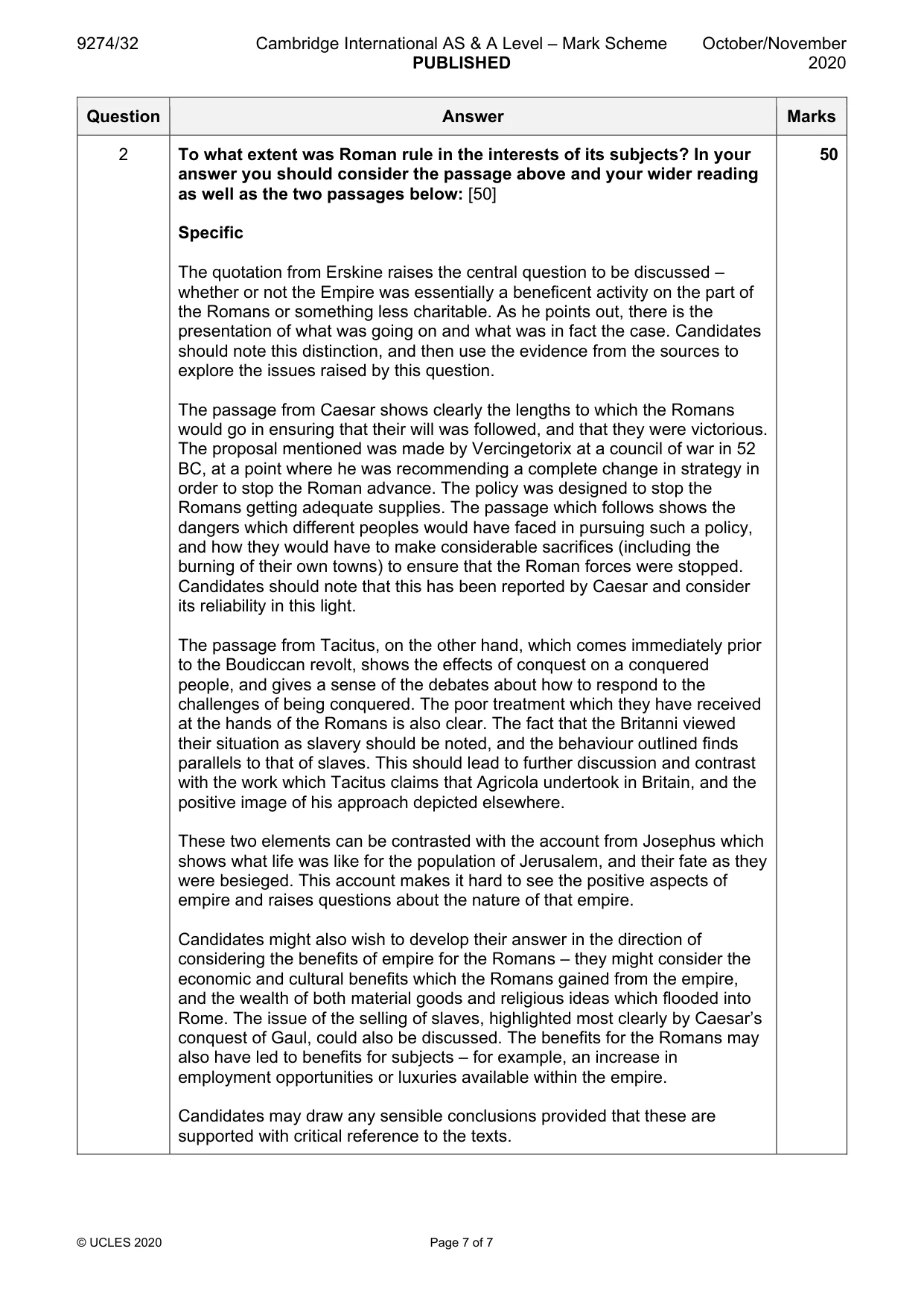
9274/32 Cambridge International AS & A Level – Mark Scheme PUBLISHED October/November 2020 © UCLES 2020 Page 7 of 7 Question Answer Marks 2 To what extent was Roman rule in the interests of its subjects? In your answer you should consider the passage above and your wider reading as well as the two passages below: [50] Specific The quotation from Erskine raises the central question to be discussed – whether or not the Empire was essentially a beneficent activity on the part of the Romans or something less charitable. As he points out, there is the presentation of what was going on and what was in fact the case. Candidates should note this distinction, and then use the evidence from the sources to explore the issues raised by this question. The passage from Caesar shows clearly the lengths to which the Romans would go in ensuring that their will was followed, and that they were victorious. The proposal mentioned was made by Vercingetorix at a council of war in 52 BC, at a point where he was recommending a complete change in strategy in order to stop the Roman advance. The policy was designed to stop the Romans getting adequate supplies. The passage which follows shows the dangers which different peoples would have faced in pursuing such a policy, and how they would have to make considerable sacrifices (including the burning of their own towns) to ensure that the Roman forces were stopped. Candidates should note that this has been reported by Caesar and consider its reliability in this light. The passage from Tacitus, on the other hand, which comes immediately prior to the Boudiccan revolt, shows the effects of conquest on a conquered people, and gives a sense of the debates about how to respond to the challenges of being conquered. The poor treatment which they have received at the hands of the Romans is also clear. The fact that the Britanni viewed their situation as slavery should be noted, and the behaviour outlined finds parallels to that of slaves. This should lead to further discussion and contrast with the work which Tacitus claims that Agricola undertook in Britain, and the positive image of his approach depicted elsewhere. These two elements can be contrasted with the account from Josephus which shows what life was like for the population of Jerusalem, and their fate as they were besieged. This account makes it hard to see the positive aspects of empire and raises questions about the nature of that empire. Candidates might also wish to develop their answer in the direction of considering the benefits of empire for the Romans – they might consider the economic and cultural benefits which the Romans gained from the empire, and the wealth of both material goods and religious ideas which flooded into Rome. The issue of the selling of slaves, highlighted most clearly by Caesar’s conquest of Gaul, could also be discussed. The benefits for the Romans may also have led to benefits for subjects – for example, an increase in employment opportunities or luxuries available within the empire. Candidates may draw any sensible conclusions provided that these are supported with critical reference to the texts. 50
What you needed in this session
Cambridge’s own grade thresholds for 2020 Oct/Nov, Paper 3 · Variant 2. A higher threshold means an easier paper — the bar moves with how the cohort did.