Cambridge A Level Chemistry 9701 — 2022 May/June Paper 4 · Variant 2
9701/42/M/J/22 · 9 questions · 100 marks · ≈113 min
The question paper and its mark scheme, free to read here and free to download. This is Cambridge’s own paper, exactly as it was sat.
Question paper24 pages



Mark scheme16 pages
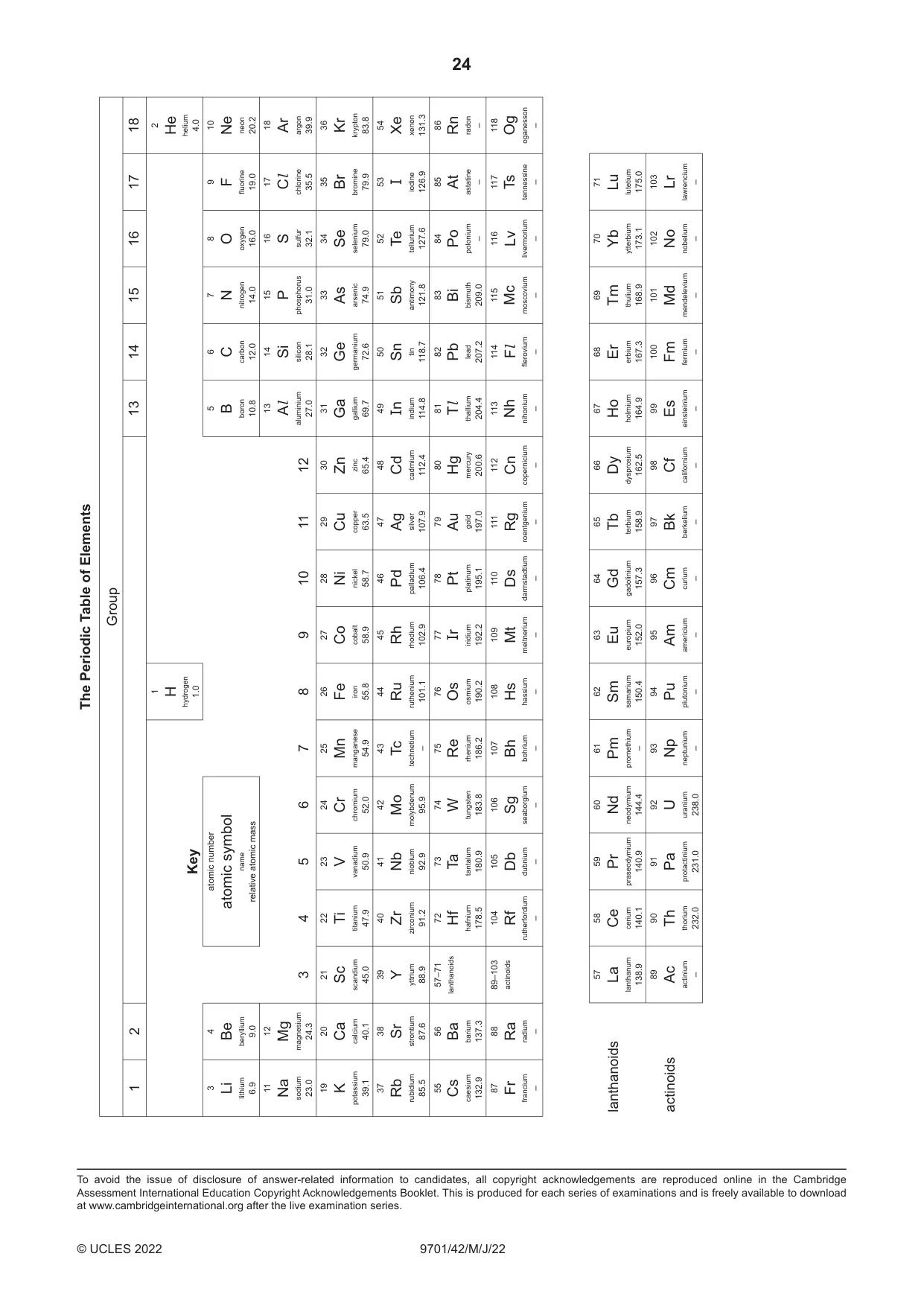
Answers below. Sit the paper first if you are practising.
Questions as text
Q1 · The solubility of the Group 2 hydroxides increases down the group
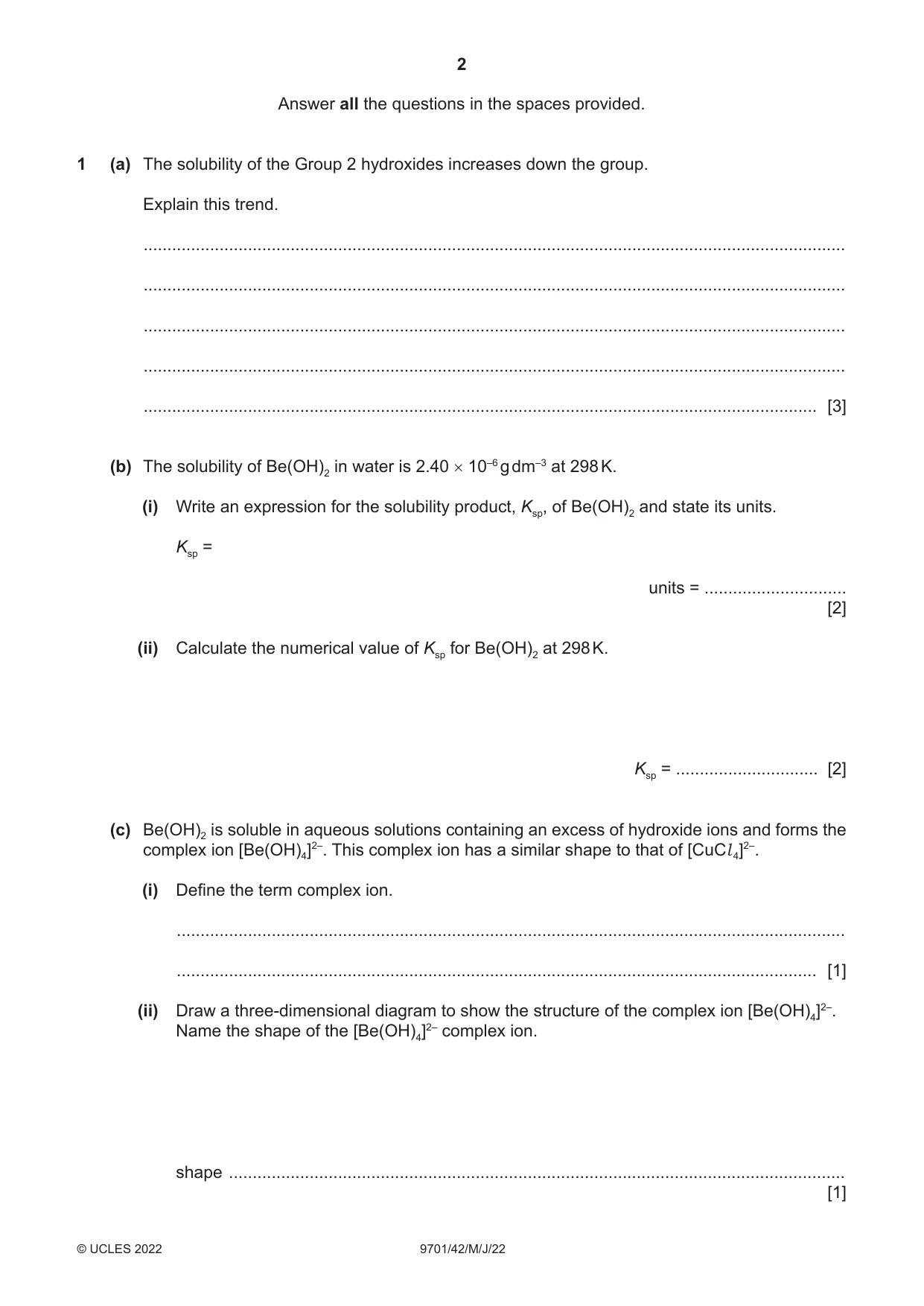
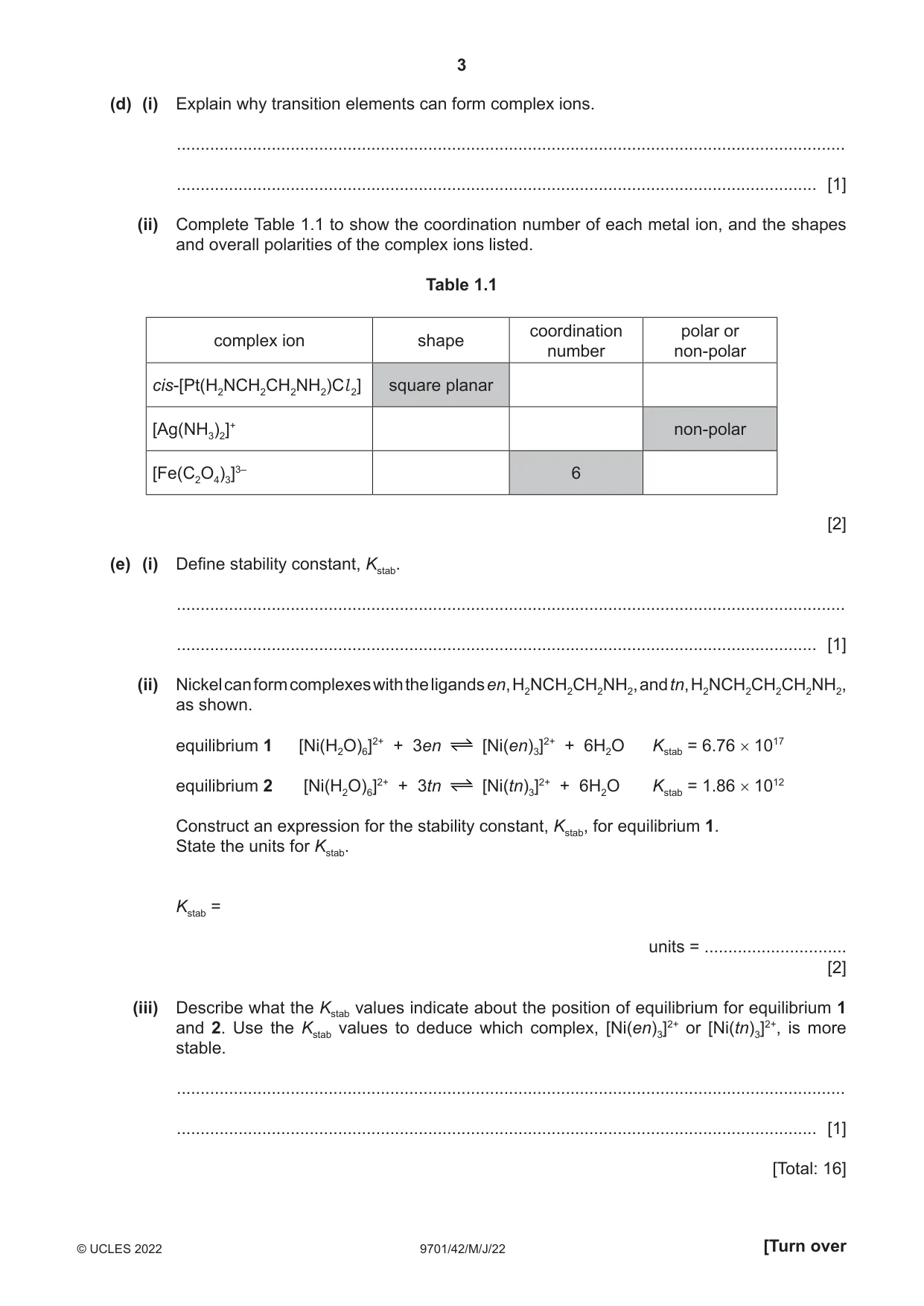
1 (a) The solubility of the Group 2 hydroxides increases down the group. Explain this trend. .................................................................................................................................................... .................................................................................................................................................... .................................................................................................................................................... .................................................................................................................................................... .............................................................................................................................................. [3] (b) The solubility of Be(OH)2 in water is 2.40 × 10⁻⁶ g dm–3 at 298 K. (i) Write an expression for the solubility product, Ksp, of Be(OH)2 and state its units. Ksp = units = .............................. [2] (ii) Calculate the numerical value of Ksp for Be(OH)2 at 298 K. Ksp = .............................. [2] (c) Be(OH)2 is soluble in aqueous solutions containing an excess of hydroxide ions and forms the complex ion [Be(OH)4]2–. This complex ion has a similar shape to that of [CuCl 4]2–. (i) Define the term complex ion. ............................................................................................................................................. ....................................................................................................................................... [1] (ii) Draw a three-dimensional diagram to show the structure of the complex ion [Be(OH)4]2–. Name the shape of the [Be(OH)4]2– complex ion. shape .................................................................................................................................. [1] (d) (i) Explain why transition elements can form complex ions. ............................................................................................................................................. ....................................................................................................................................... [1] (ii) Complete Table 1.1 to show the coordination number of each metal ion, and the shapes and overall polarities of the complex ions listed. Table 1.1 coordination polar or complex ion shape number non-polar cis-[Pt(H2NCH2CH2NH2)Cl 2] square planar [Ag(NH3)2]+ non-polar [Fe(C2O4)3]3– 6 [2] (e) (i) Define stability constant, Kstab. ............................................................................................................................................. ....................................................................................................................................... [1] (ii) Nickel can form complexes with the ligands en, H2NCH2CH2NH2, and tn, H2NCH2CH2CH2NH2, as shown. equilibrium 1 [Ni(H2O)6]2+ + 3en [Ni(en)3]2+ + 6H2O Kstab = 6.76 × 10¹⁷ equilibrium 2 [Ni(H2O)6]2+ + 3tn [Ni(tn)3]2+ + 6H2O Kstab = 1.86 × 10¹² Construct an expression for the stability constant, Kstab, for equilibrium 1. State the units for Kstab. Kstab = units = .............................. [2] (iii) Describe what the Kstab values indicate about the position of equilibrium for equilibrium 1 and 2. Use the Kstab values to deduce which complex, [Ni(en)3]2+ or [Ni(tn)3]2+, is more stable. ............................................................................................................................................. ....................................................................................................................................... [1] [Total: 16]
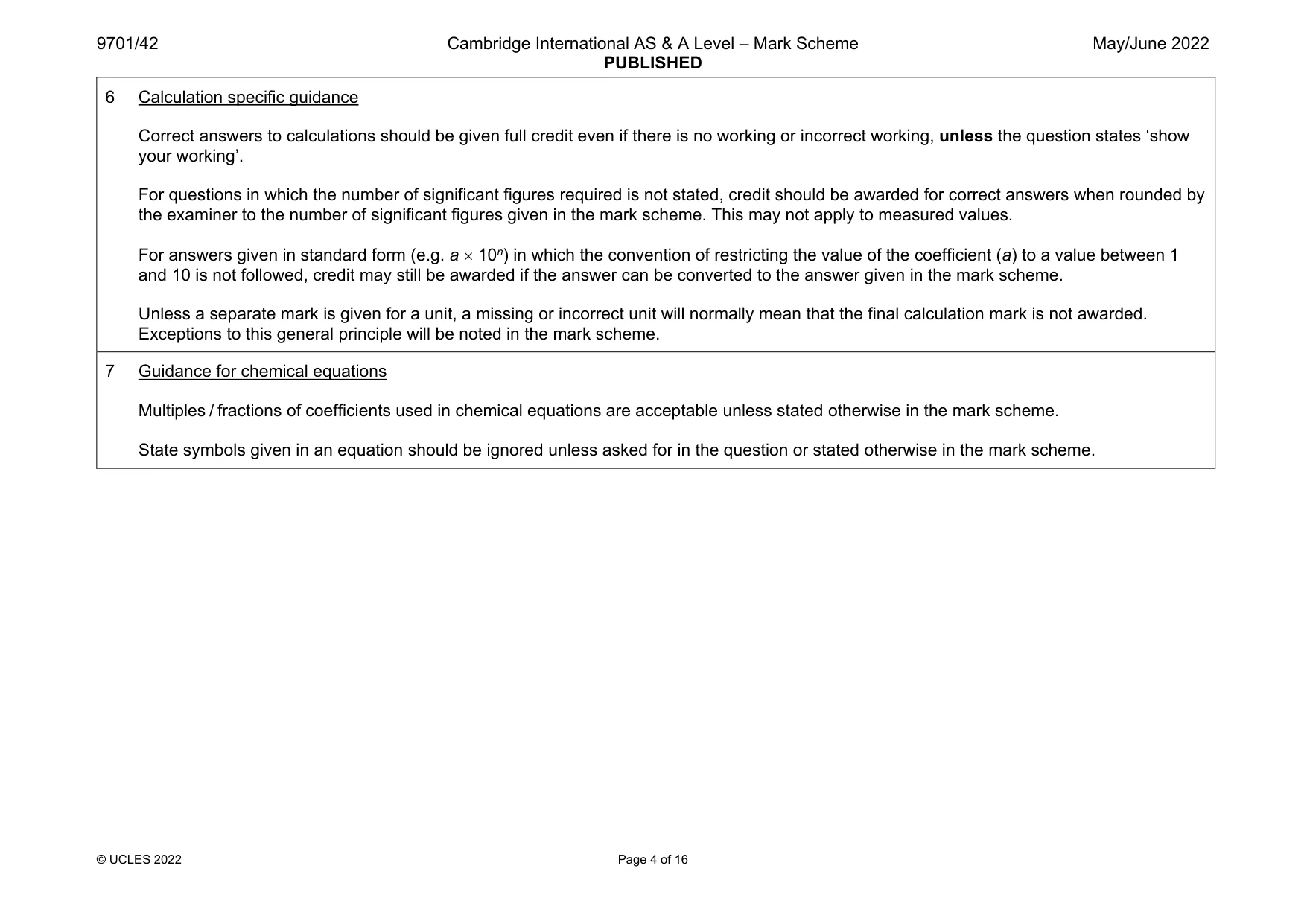
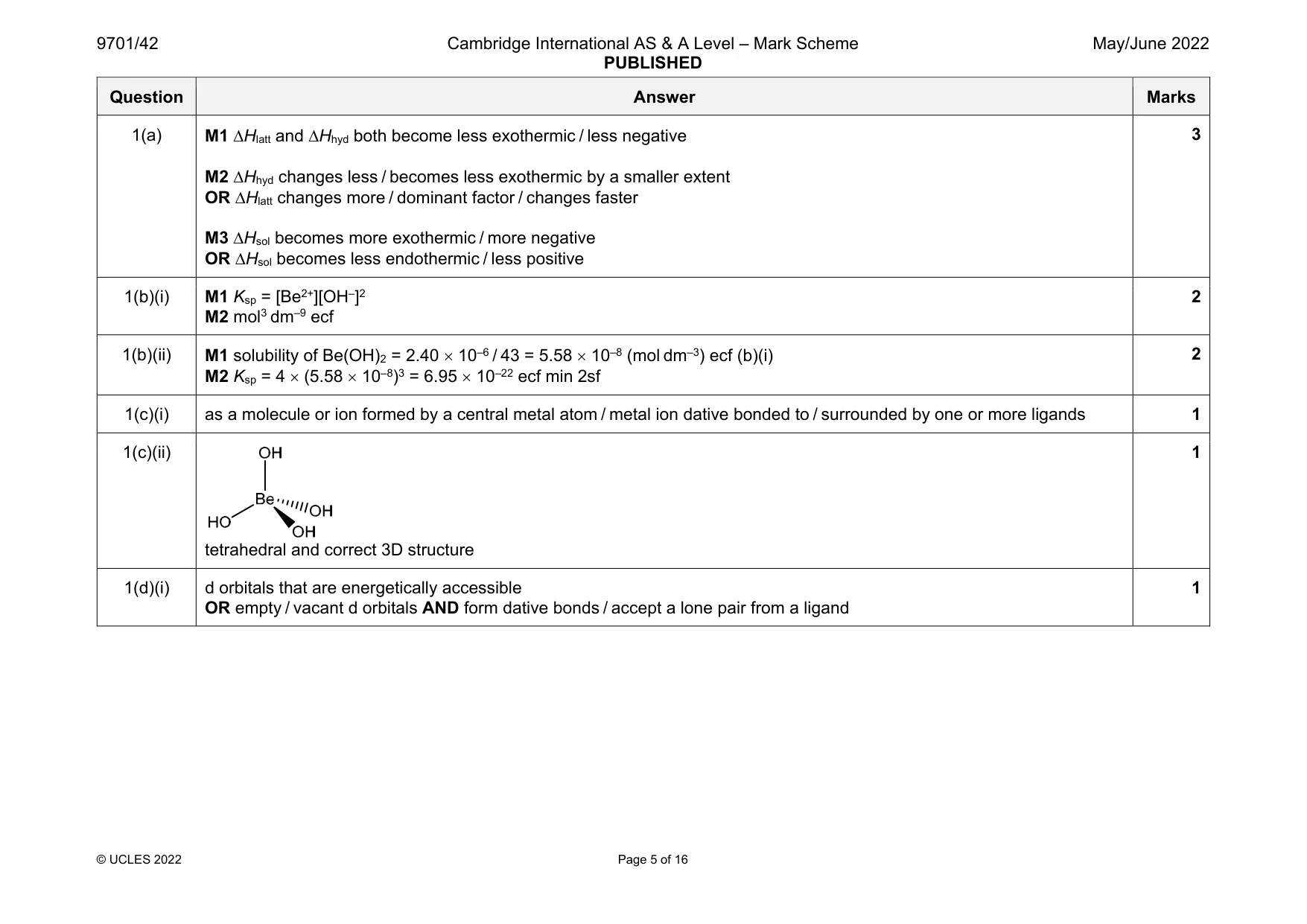
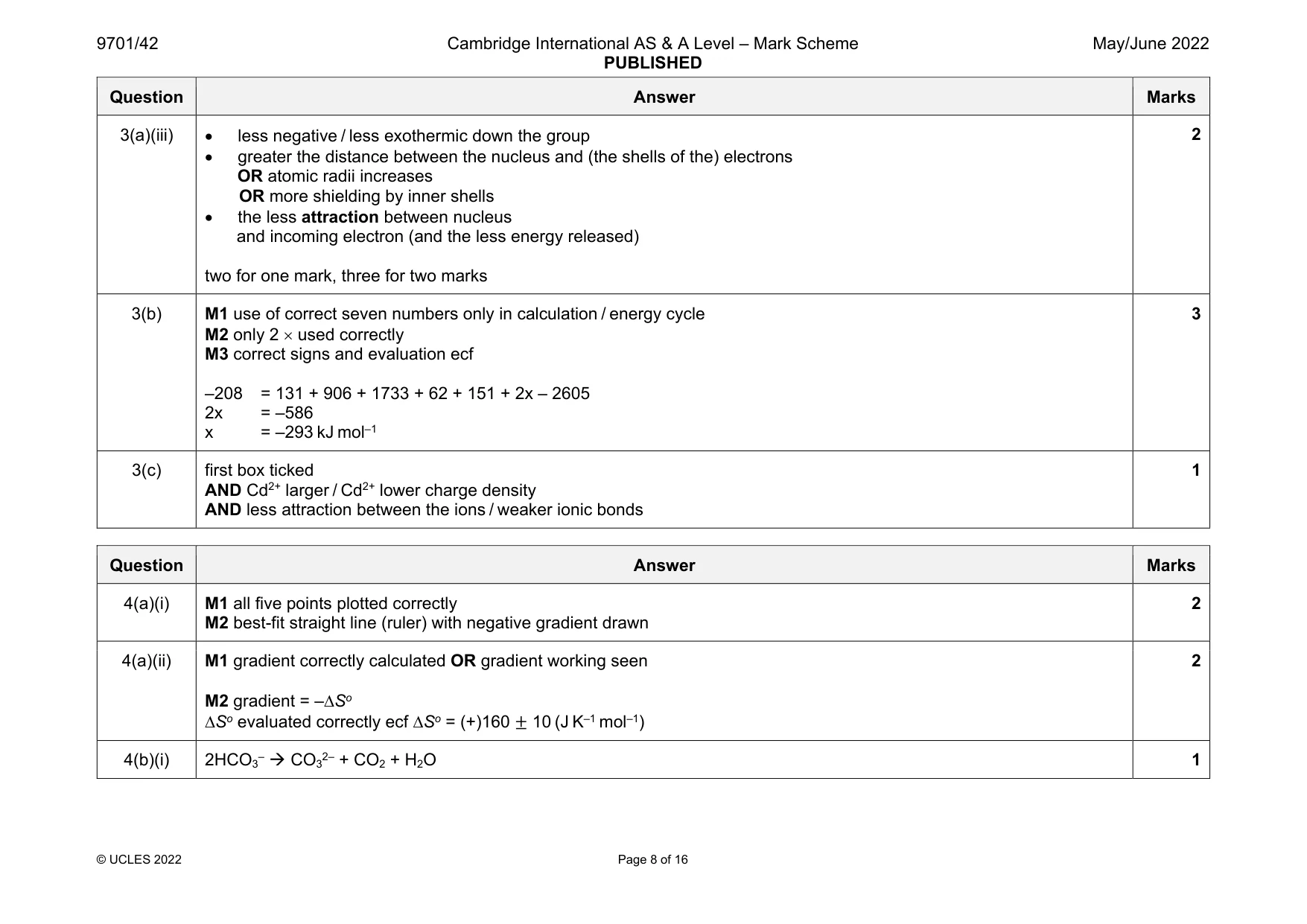
Mark scheme: 1(a) M2 Hhyd changes less / becomes less exothermic by a smaller extent OR Hlatt changes more / dominant factor / changes faster M3 Hsol becomes more exothermic / more negative OR Hsol becomes less endothermic / less positive 1(b)(i) M1 Ksp = [Be2+][OH–]2 M2 mol3 dm–9 ecf 2 1(b)(ii) M1 solubility of Be(OH)2 = 2.40 10–6 / 43 = 5.58 10–8 (mol dm–3) ecf (b)(i) M2 Ksp = 4 (5.58 10–8)3 = 6.95 10–22 ecf min 2sf 2 1(c)(i) as a molecule or ion formed by a central metal atom / metal ion dative bonded to / surrounded by one or more ligands 1 1(c)(ii) tetrahedral and correct 3D structure 1 1(d)(i) d orbitals that are energetically accessible OR empty / vacant d orbitals AND form dative bonds / accept a lone pair from a ligand 1 Question Answer Marks 1(d)(ii) complex ion shape coordination number polarity cis-[Pt(en)Cl2] square planar 4 polar [Ag(NH3)2]+ linear 2 non-polar [Fe(C2O4)3]3- octahedral 6 non-polar three for one mark, six for two marks 2 1(e)(i) the equilibrium constant for the formation of the complex ion in a solvent (from its constituent ions or molecules) 1 1(e)(ii) M1 Kstab = [Ni(en)32+] / [Ni(H2O)62+][en]3 M1 units = mol–3 dm9 ecf 2 1(e)(iii) the equilibria lie to the right / product side OR equilibrium 1 lies more to the right AND en complex is more stable / [Ni(en)3]2+ is more stable 1
Q2 · Explain why transition elements have variable oxidation states
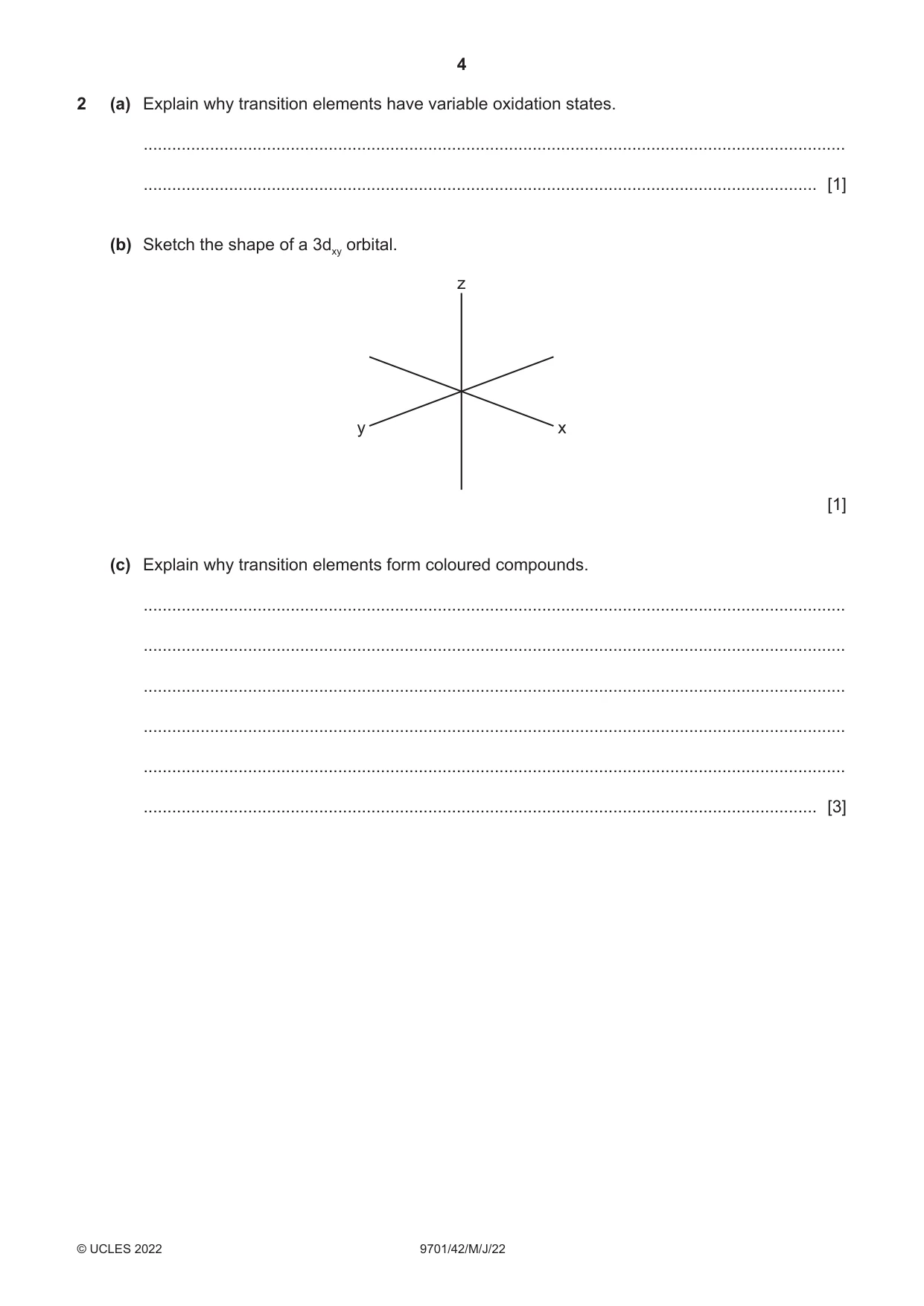
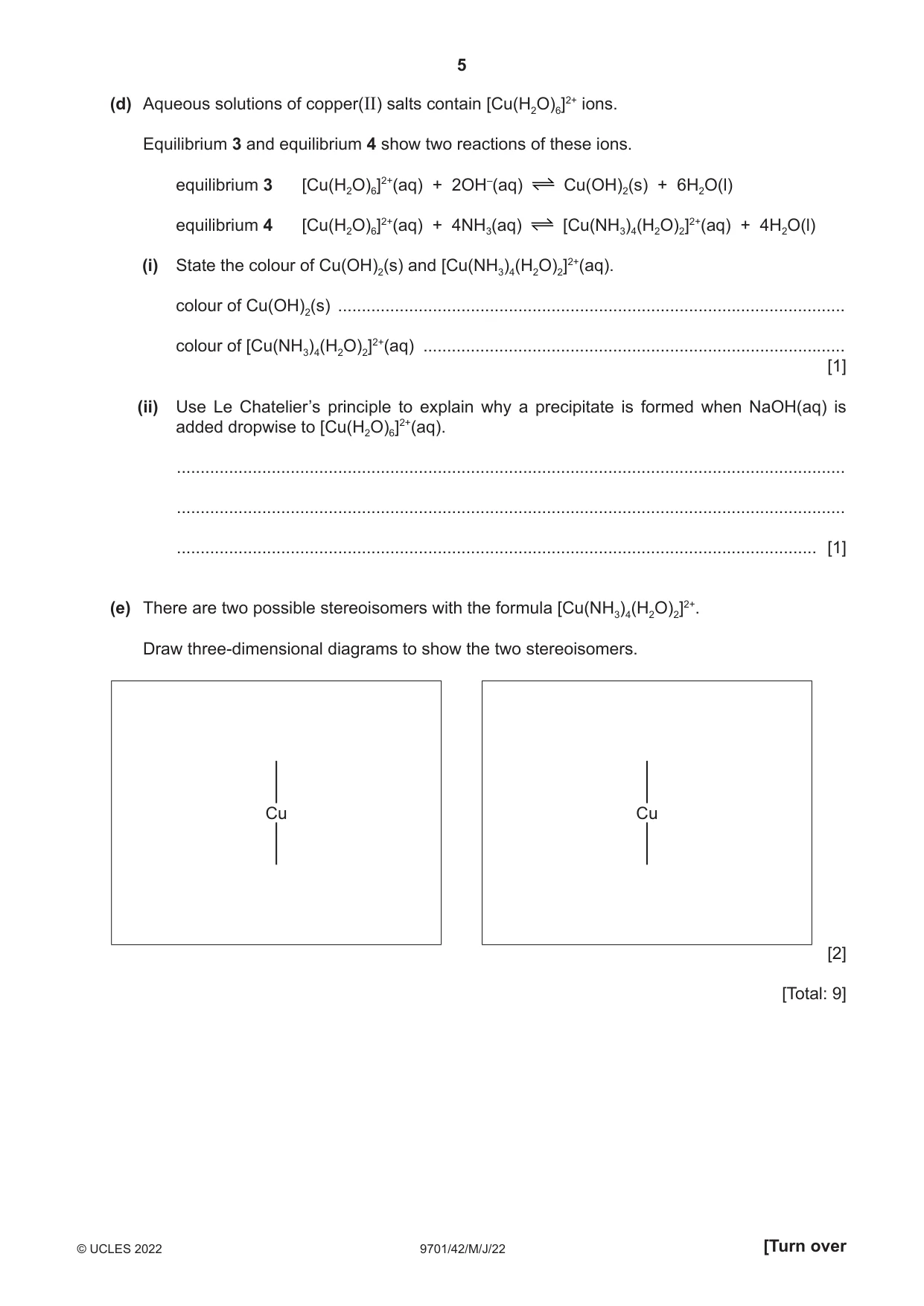
2 (a) Explain why transition elements have variable oxidation states. .................................................................................................................................................... .............................................................................................................................................. [1] (b) Sketch the shape of a 3dxy orbital. z y x [1] (c) Explain why transition elements form coloured compounds. .................................................................................................................................................... .................................................................................................................................................... .................................................................................................................................................... .................................................................................................................................................... .................................................................................................................................................... .............................................................................................................................................. [3] (d) Aqueous solutions of copper(II) salts contain [Cu(H2O)6]2+ ions. Equilibrium 3 and equilibrium 4 show two reactions of these ions. equilibrium 3 [Cu(H2O)6]2+(aq) + 2OH–(aq) Cu(OH)2(s) + 6H2O(l) equilibrium 4 [Cu(H2O)6]2+(aq) + 4NH3(aq) [Cu(NH3)4(H2O)2]2+(aq) + 4H2O(l) (i) State the colour of Cu(OH)2(s) and [Cu(NH3)4(H2O)2]2+(aq). colour of Cu(OH)2(s) ............................................................................................................ colour of [Cu(NH3)4(H2O)2]2+(aq) .......................................................................................... [1] (ii) Use Le Chatelier’s principle to explain why a precipitate is formed when NaOH(aq) is added dropwise to [Cu(H2O)6]2+(aq). ............................................................................................................................................. ............................................................................................................................................. ....................................................................................................................................... [1] (e) There are two possible stereoisomers with the formula [Cu(NH3)4(H2O)2]2+. Draw three-dimensional diagrams to show the two stereoisomers. Cu Cu [2] [Total: 9]
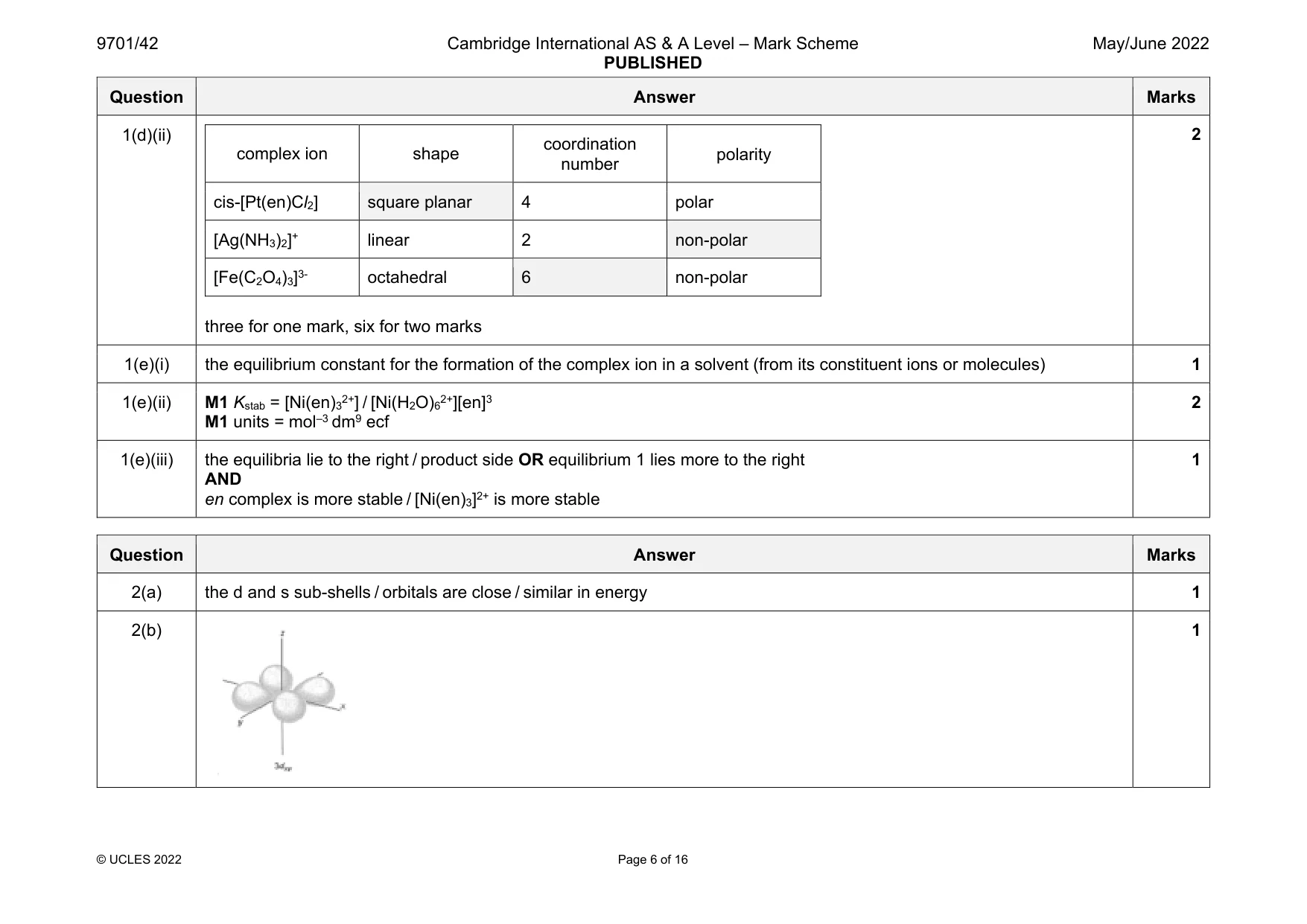
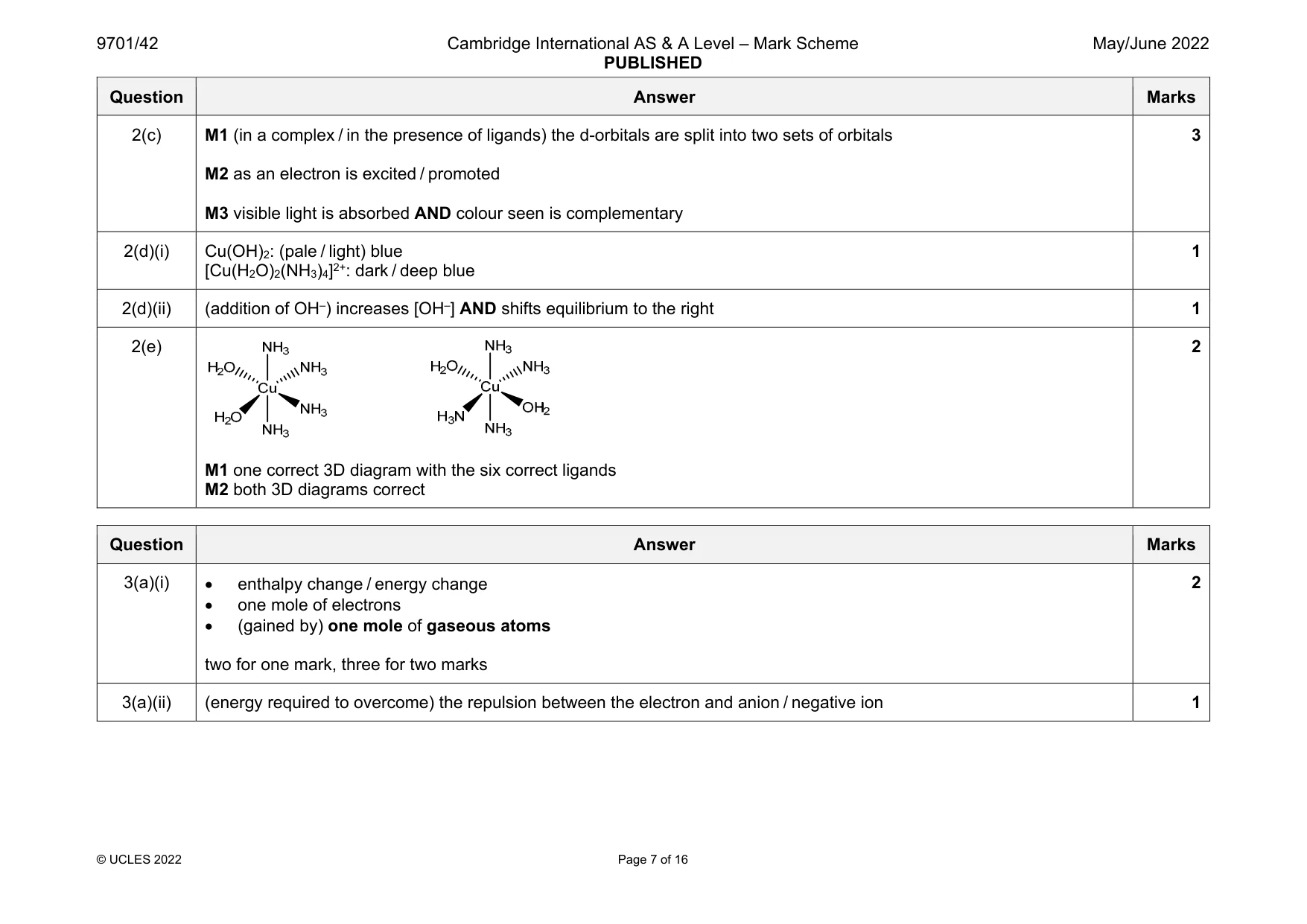
Mark scheme: 2(a) the d and s sub-shells / orbitals are close / similar in energy 1 2(b) 1 Question Answer Marks 2(c) M1 (in a complex / in the presence of ligands) the d-orbitals are split into two sets of orbitals M2 as an electron is excited / promoted M3 visible light is absorbed AND colour seen is complementary 3 2(d)(i) Cu(OH)2: (pale / light) blue [Cu(H2O)2(NH3)4]2+: dark / deep blue 1 2(d)(ii) (addition of OH–) increases [OH–] AND shifts equilibrium to the right 1 2(e) M1 one correct 3D diagram with the six correct ligands M2 both 3D diagrams correct 2
Q3 · Define first electron affinity
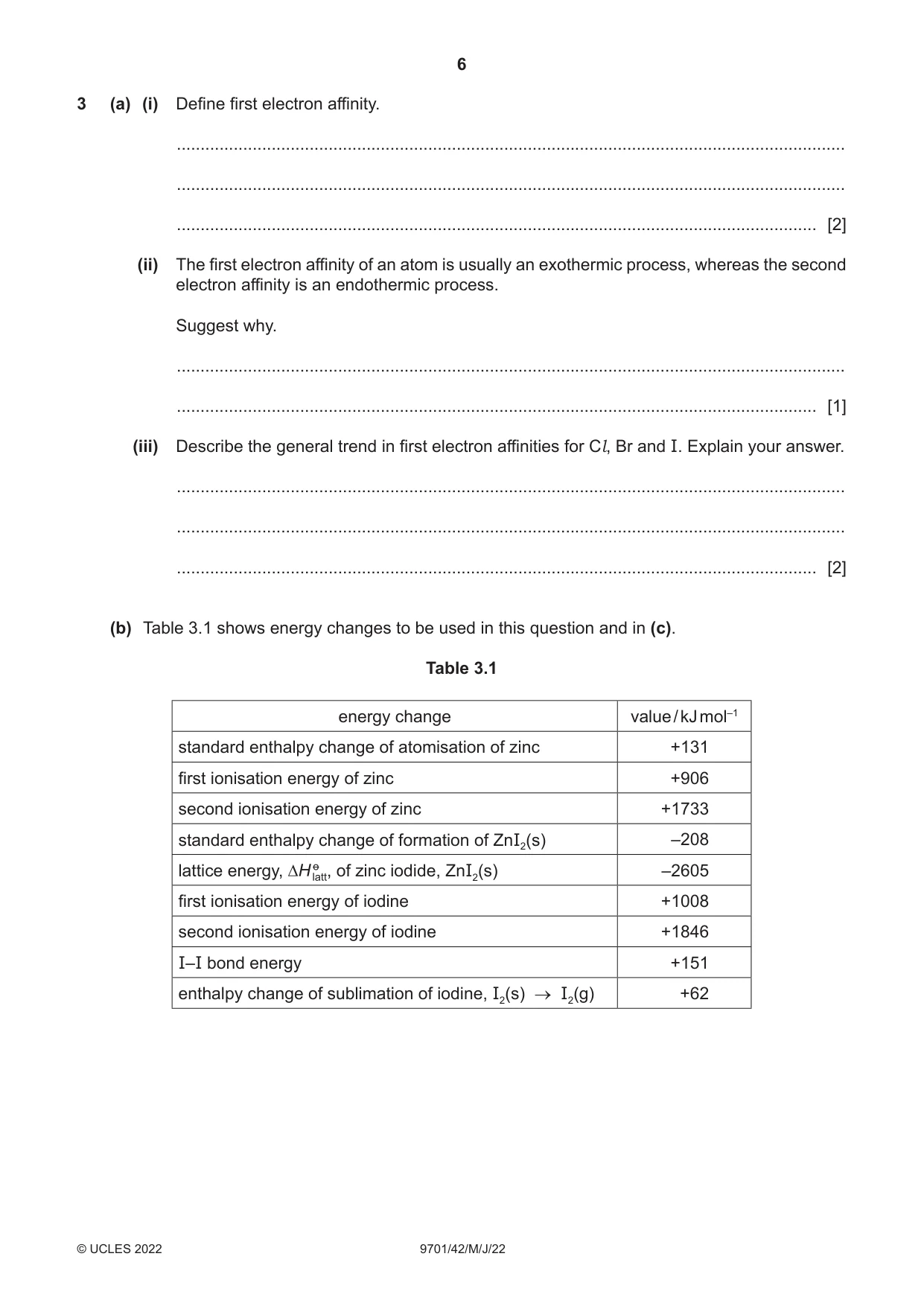
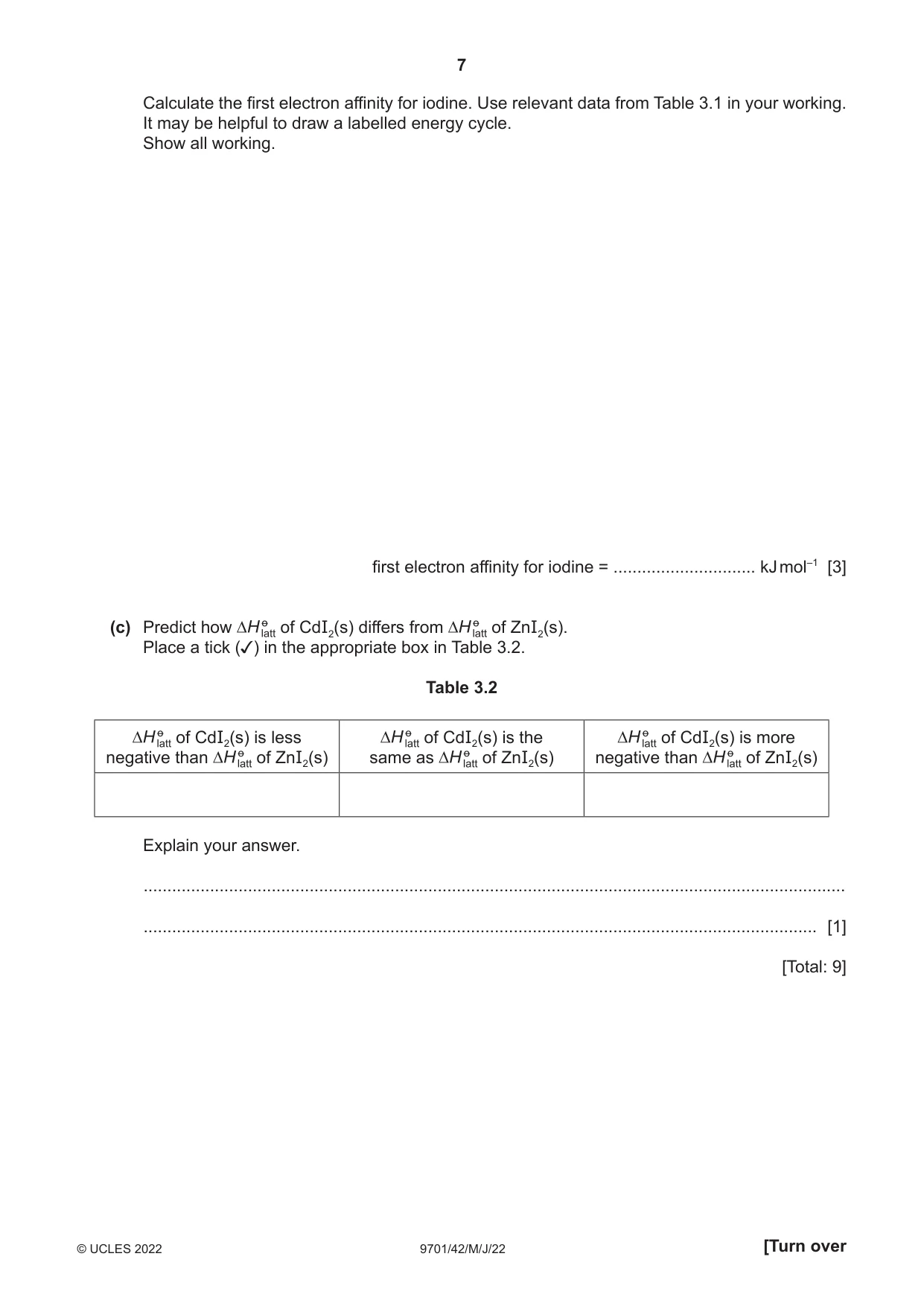
3 (a) (i) Define first electron affinity. ............................................................................................................................................. ............................................................................................................................................. ....................................................................................................................................... [2] (ii) The first electron affinity of an atom is usually an exothermic process, whereas the second electron affinity is an endothermic process. Suggest why. ............................................................................................................................................. ....................................................................................................................................... [1] (iii) Describe the general trend in first electron affinities for Cl, Br and I. Explain your answer. ............................................................................................................................................. ............................................................................................................................................. ....................................................................................................................................... [2] (b) Table 3.1 shows energy changes to be used in this question and in (c). Table 3.1 energy change value / kJ mol–1 standard enthalpy change of atomisation of zinc +131 first ionisation energy of zinc +906 second ionisation energy of zinc +1733 standard enthalpy change of formation of ZnI2(s) –208 lattice energy, , of zinc iodide, ZnI2(s) –2605 first ionisation energy of iodine +1008 second ionisation energy of iodine +1846 I–I bond energy +151 enthalpy change of sublimation of iodine, I2(s) → I2(g) +62 Calculate the first electron affinity for iodine. Use relevant data from Table 3.1 in your working. It may be helpful to draw a labelled energy cycle. Show all working. first electron affinity for iodine = .............................. kJ mol–1 [3] (c) Predict how of CdI2(s) differs from of ZnI2(s). Place a tick (✓) in the appropriate box in Table 3.2. Table 3.2 of CdI2(s) is less of CdI2(s) is the of CdI2(s) is more negative than of ZnI2(s) same as of ZnI2(s) negative than of ZnI2(s) Explain your answer. .................................................................................................................................................... .............................................................................................................................................. [1] [Total: 9]
Mark scheme: 3(a)(i) enthalpy change / energy change one mole of electrons (gained by) one mole of gaseous atoms two for one mark, three for two marks 3(a)(ii) (energy required to overcome) the repulsion between the electron and anion / negative ion 1 Question Answer Marks 3(a)(iii) less negative / less exothermic down the group greater the distance between the nucleus and (the shells of the) electrons OR atomic radii increases OR more shielding by inner shells the less attraction between nucleus and incoming electron (and the less energy released) two for one mark, three for two marks 2 3(b) M1 use of correct seven numbers only in calculation / energy cycle M2 only 2 used correctly M3 correct signs and evaluation ecf –208 = 131 + 906 + 1733 + 62 + 151 + 2x – 2605 2x = –586 x = –293 kJ mol–1 3 3(c) first box ticked AND Cd2+ larger / Cd2+ lower charge density AND less attraction between the ions / weaker ionic bonds 1
Q4 · Calcium carbonate decomposes on heating
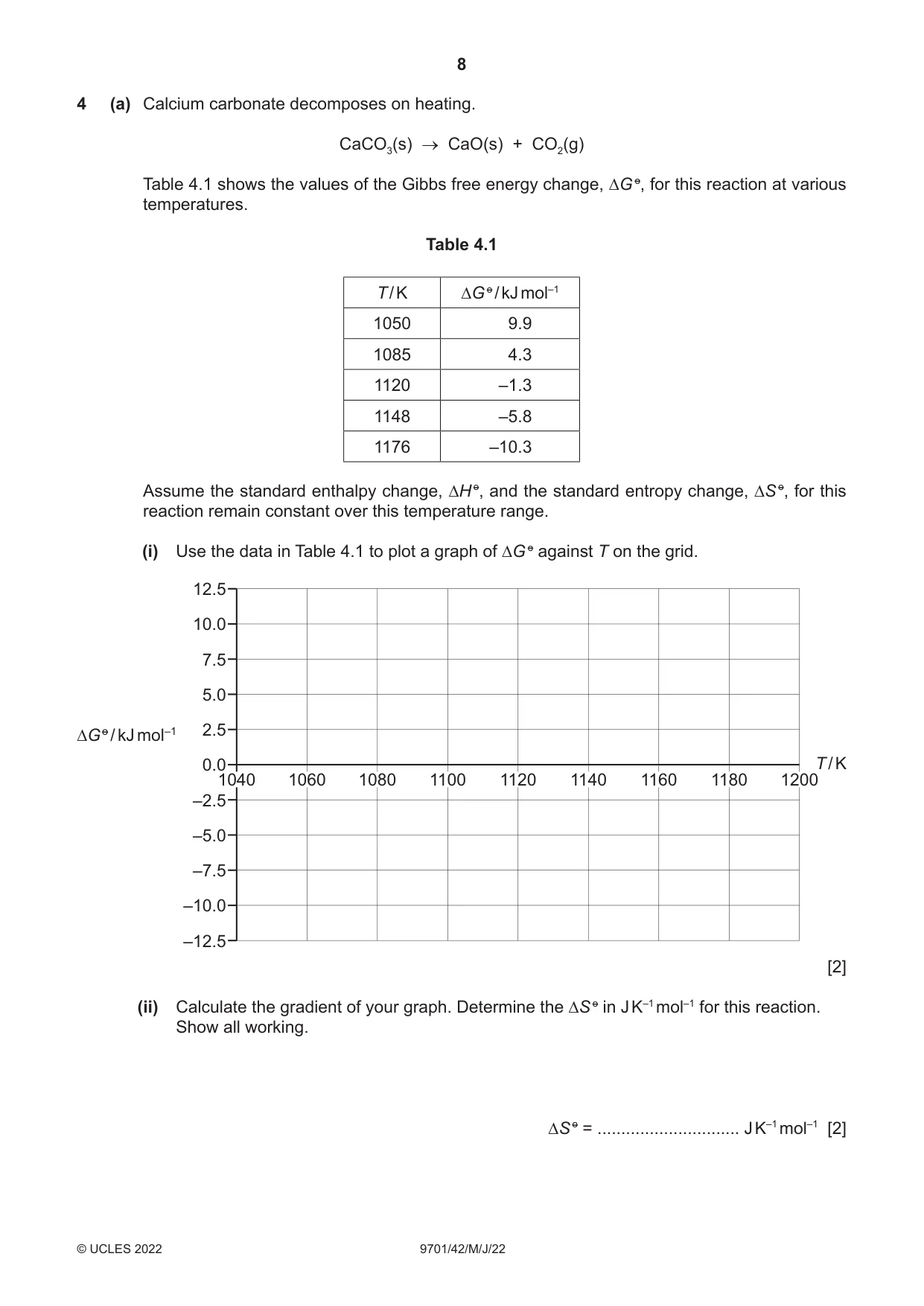
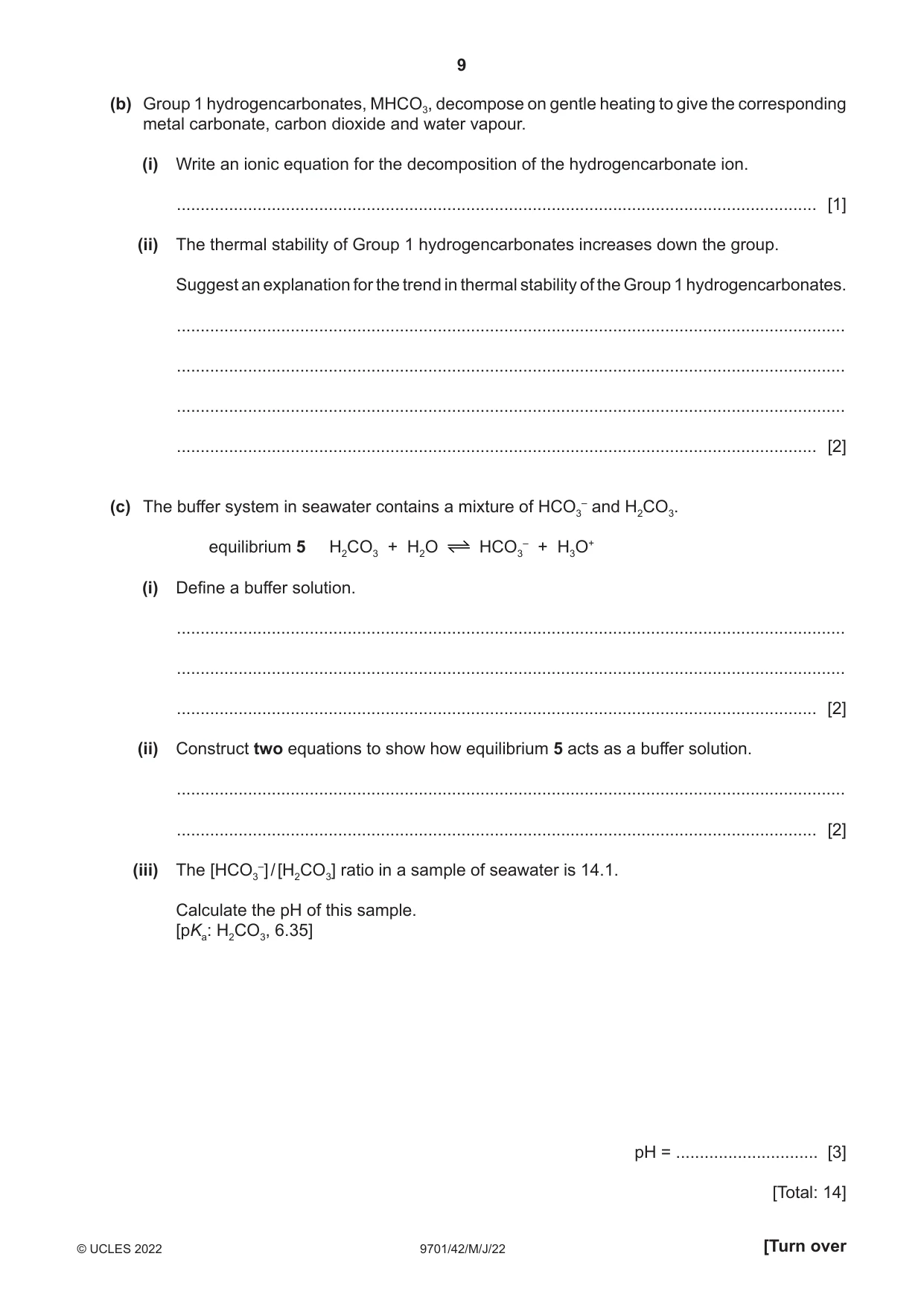
4 (a) Calcium carbonate decomposes on heating. CaCO3(s) → CaO(s) + CO2(g) Table 4.1 shows the values of the Gibbs free energy change, ∆G o, for this reaction at various temperatures. Table 4.1 T / K ∆G o / kJ mol–1 1050 9.9 1085 4.3 1120 –1.3 1148 –5.8 1176 –10.3 Assume the standard enthalpy change, ∆H o, and the standard entropy change, ∆S o, for this reaction remain constant over this temperature range. (i) Use the data in Table 4.1 to plot a graph of ∆G o against T on the grid. 12.5 10.0 7.5 5.0 o 2.5 G / kJ mol–1 0.0 T / K 1040 1060 1080 1100 1120 1140 1160 1180 1200 –2.5 –5.0 –7.5 –10.0 –12.5 [2] (ii) Calculate the gradient of your graph. Determine the ∆S o in J K–1 mol–1 for this reaction. Show all working. ∆S o = .............................. J K–1 mol–1 [2] (b) Group 1 hydrogencarbonates, MHCO3, decompose on gentle heating to give the corresponding metal carbonate, carbon dioxide and water vapour. (i) Write an ionic equation for the decomposition of the hydrogencarbonate ion. ....................................................................................................................................... [1] (ii) The thermal stability of Group 1 hydrogencarbonates increases down the group. Suggest an explanation for the trend in thermal stability of the Group 1 hydrogencarbonates. ............................................................................................................................................. ............................................................................................................................................. ............................................................................................................................................. ....................................................................................................................................... [2] (c) The buffer system in seawater contains a mixture of HCO3– and H2CO3. equilibrium 5 H2CO3 + H2O HCO3– + H3O+ (i) Define a buffer solution. ............................................................................................................................................. ............................................................................................................................................. ....................................................................................................................................... [2] (ii) Construct two equations to show how equilibrium 5 acts as a buffer solution. ............................................................................................................................................. ....................................................................................................................................... [2] (iii) The [HCO3–] / [H2CO3] ratio in a sample of seawater is 14.1. Calculate the pH of this sample. [pKa: H2CO3, 6.35] pH = .............................. [3] [Total: 14]
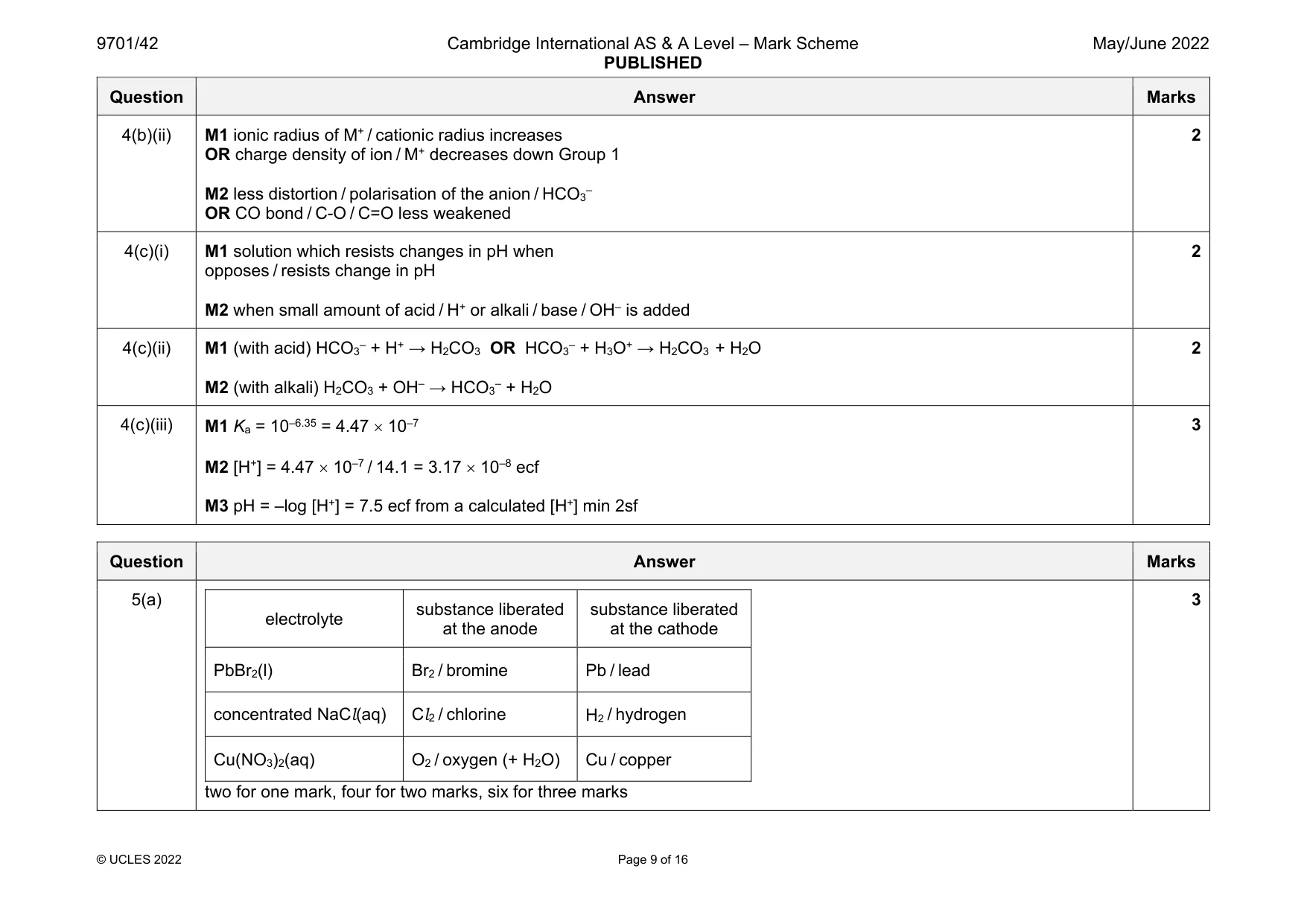
Mark scheme: 4(a)(i) M1 all five points plotted correctly M2 best-fit straight line (ruler) with negative gradient drawn 2 4(a)(ii) M1 gradient correctly calculated OR gradient working seen M2 gradient = –So So evaluated correctly ecf So = (+)160 ± 10 (J K–1 mol–1) 2 4(b)(i) 2HCO3– CO32– + CO2 + H2O 1 Question Answer Marks 4(b)(ii) M1 ionic radius of M+ / cationic radius increases OR charge density of ion / M+ decreases down Group 1 M2 less distortion / polarisation of the anion / HCO3– OR CO bond / C-O / C=O less weakened 2 4(c)(i) M1 solution which resists changes in pH when opposes / resists change in pH M2 when small amount of acid / H+ or alkali / base / OH– is added 2 4(c)(ii) M1 (with acid) HCO3– + H+ → H2CO3 OR HCO3– + H3O+ → H2CO3 + H2O M2 (with alkali) H2CO3 + OH– → HCO3– + H2O 2 4(c)(iii) M1 Ka = 10–6.35 = 4.47 10–7 M2 [H+] = 4.47 10–7 / 14.1 = 3.17 10–8 ecf M3 pH = –log [H+] = 7.5 ecf from a calculated [H+] min 2sf 3
Q5 · Complete Table 5.1 to predict the substance liberated at each electrode during…
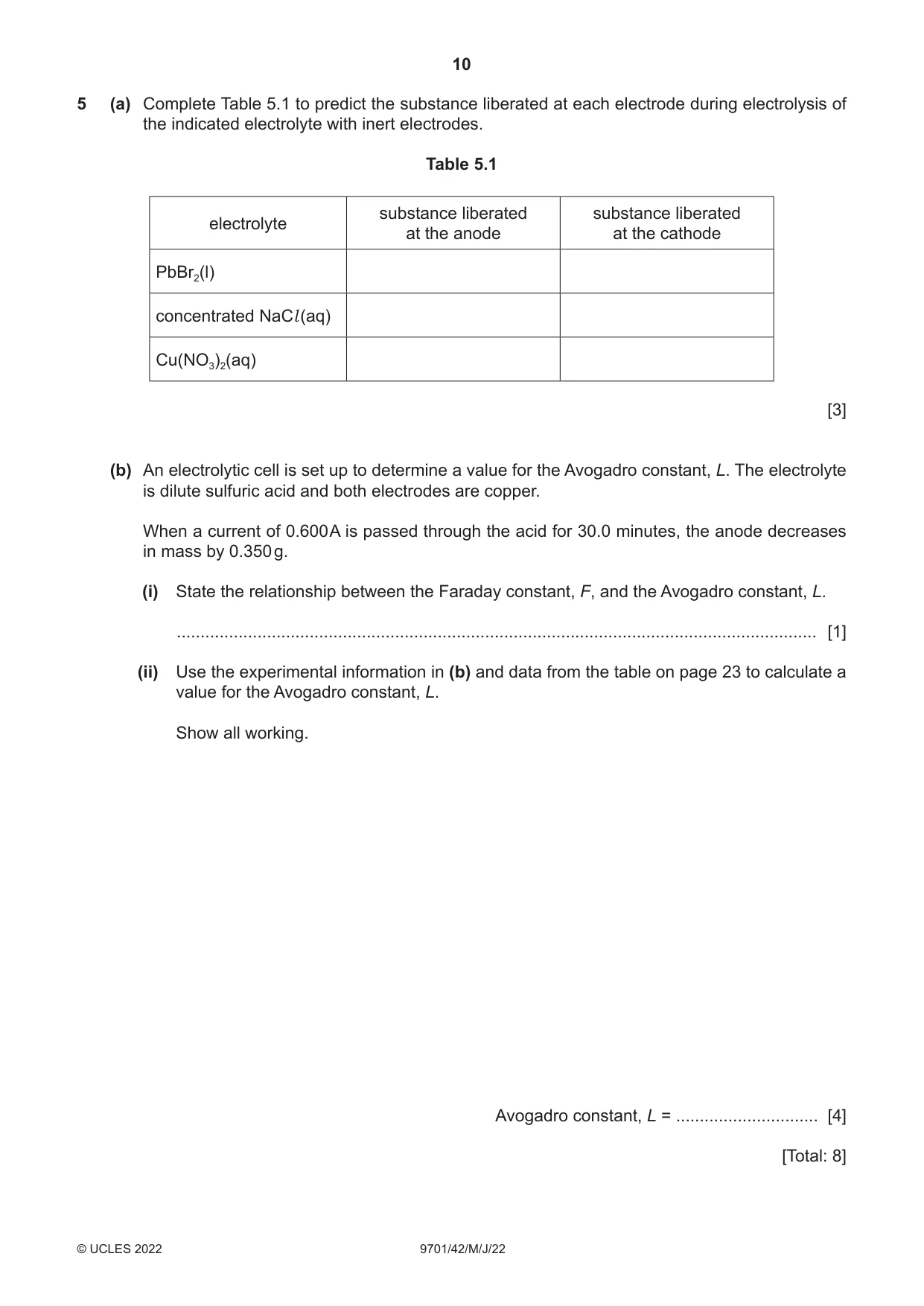
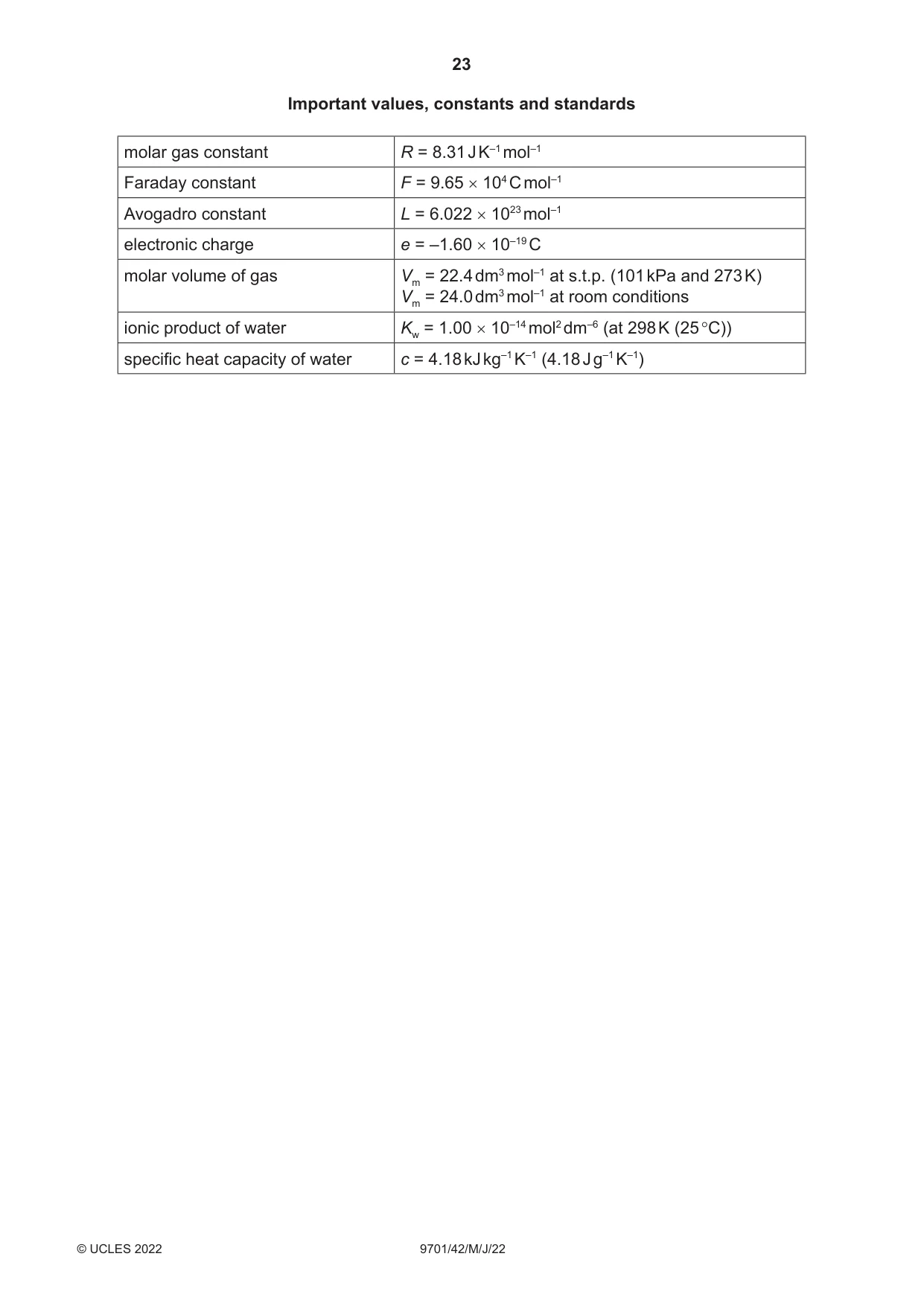
5 (a) Complete Table 5.1 to predict the substance liberated at each electrode during electrolysis of the indicated electrolyte with inert electrodes. Table 5.1 substance liberated substance liberated electrolyte at the anode at the cathode PbBr2(l) concentrated NaCl (aq) Cu(NO3)2(aq) [3] (b) An electrolytic cell is set up to determine a value for the Avogadro constant, L. The electrolyte is dilute sulfuric acid and both electrodes are copper. When a current of 0.600 A is passed through the acid for 30.0 minutes, the anode decreases in mass by 0.350 g. (i) State the relationship between the Faraday constant, F, and the Avogadro constant, L. ....................................................................................................................................... [1] (ii) Use the experimental information in (b) and data from the table on page 23 to calculate a value for the Avogadro constant, L. Show all working. Avogadro constant, L = .............................. [4] [Total: 8]
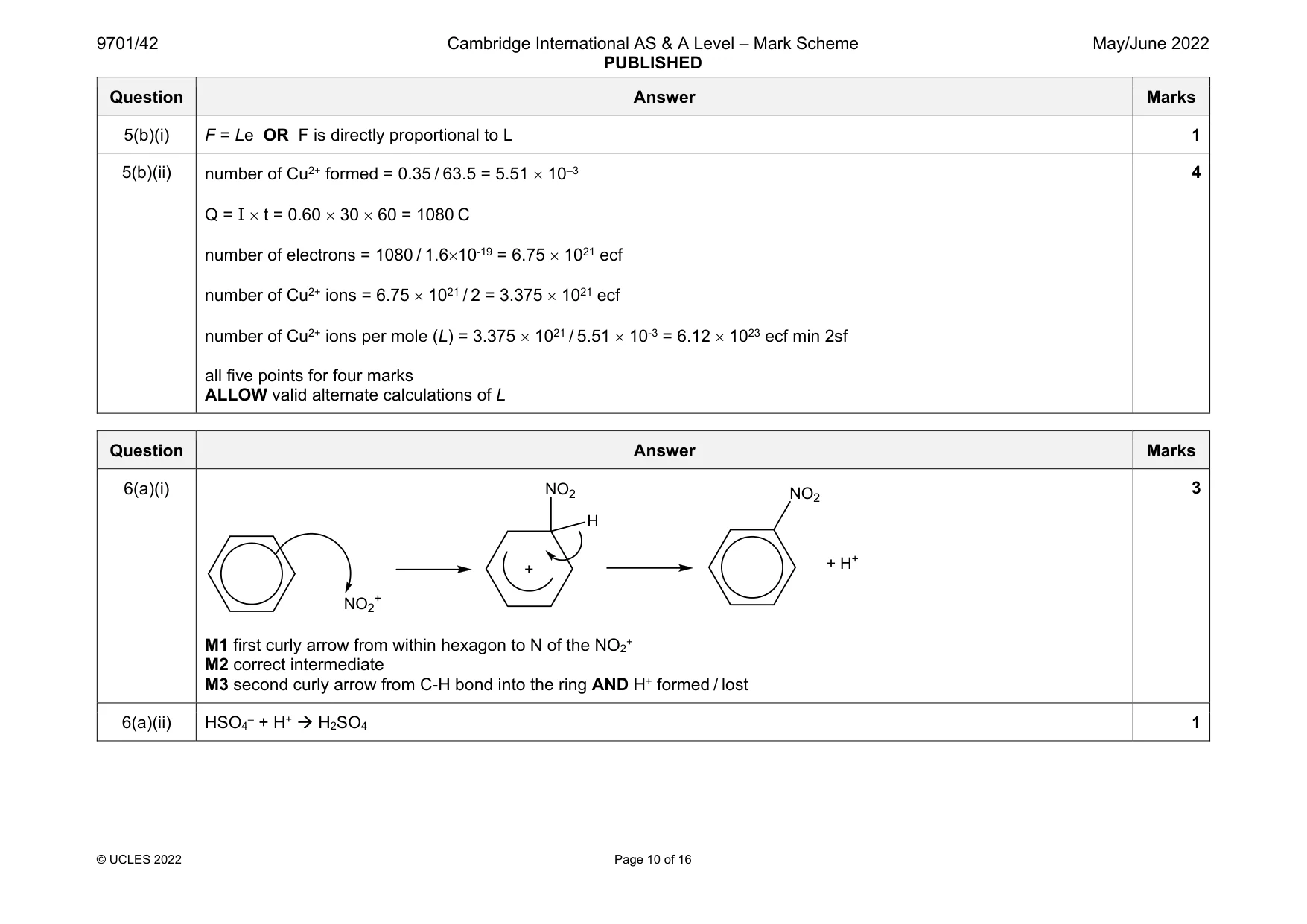
Mark scheme: 5(a) electrolyte substance liberated at the anode substance liberated at the cathode PbBr2(l) Br2 / bromine Pb / lead concentrated NaCl(aq) Cl2 / chlorine H2 / hydrogen Cu(NO3)2(aq) O2 / oxygen (+ H2O) Cu / copper two for one mark, four for two marks, six for three marks Question Answer Marks 5(b)(i) F = Le OR F is directly proportional to L 1 5(b)(ii) number of Cu2+ formed = 0.35 / 63.5 = 5.51 10–3 Q = I t = 0.60 30 60 = 1080 C number of electrons = 1080 / 1.610-19 = 6.75 1021 ecf number of Cu2+ ions = 6.75 1021 / 2 = 3.375 1021 ecf number of Cu2+ ions per mole (L) = 3.375 1021 / 5.51 10-3 = 6.12 1023 ecf min 2sf all five points for four marks ALLOW valid alternate calculations of L 4
Q6 · The reagent and conditions required for the nitration of benzene, benzoic acid and phenol…
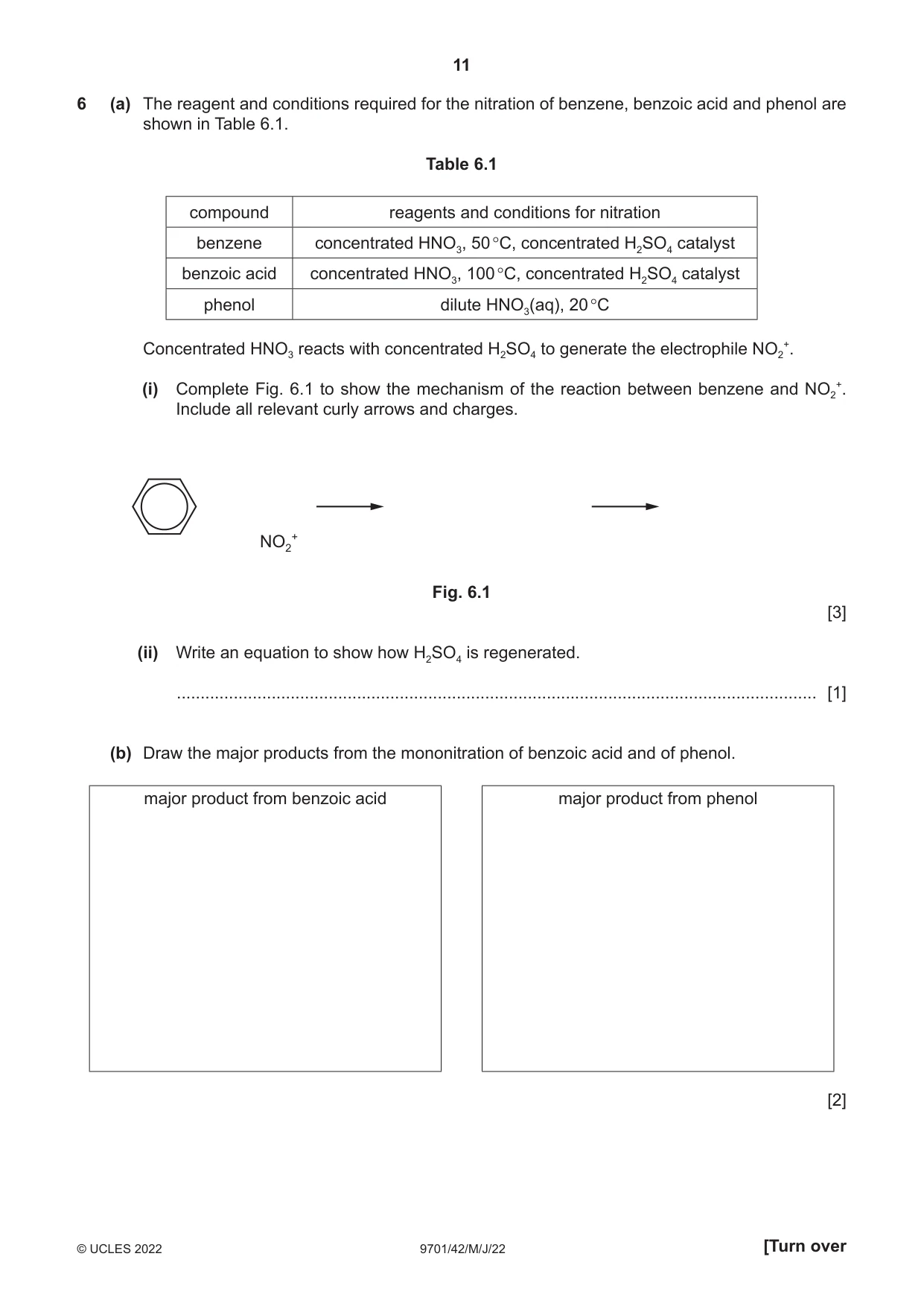
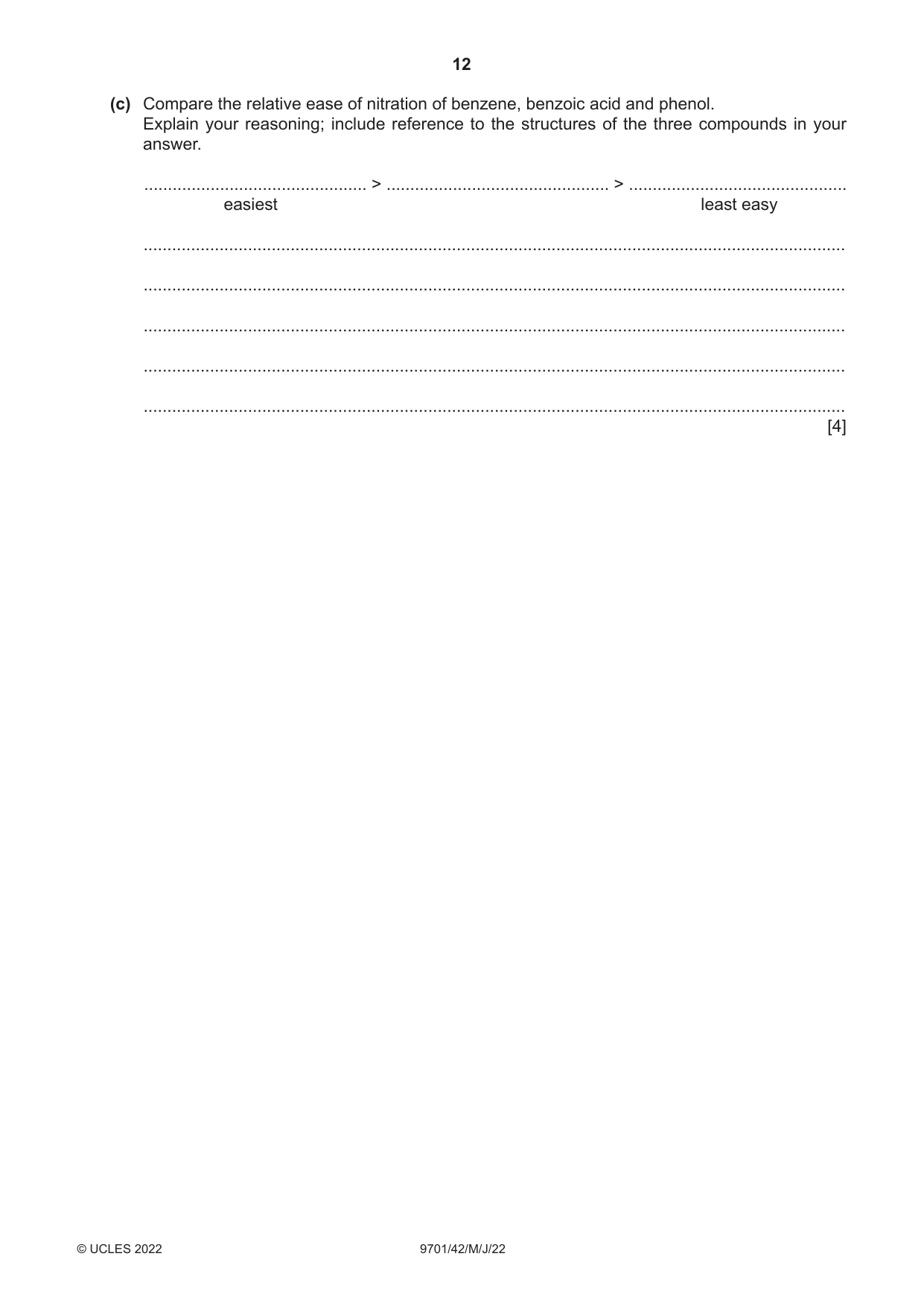
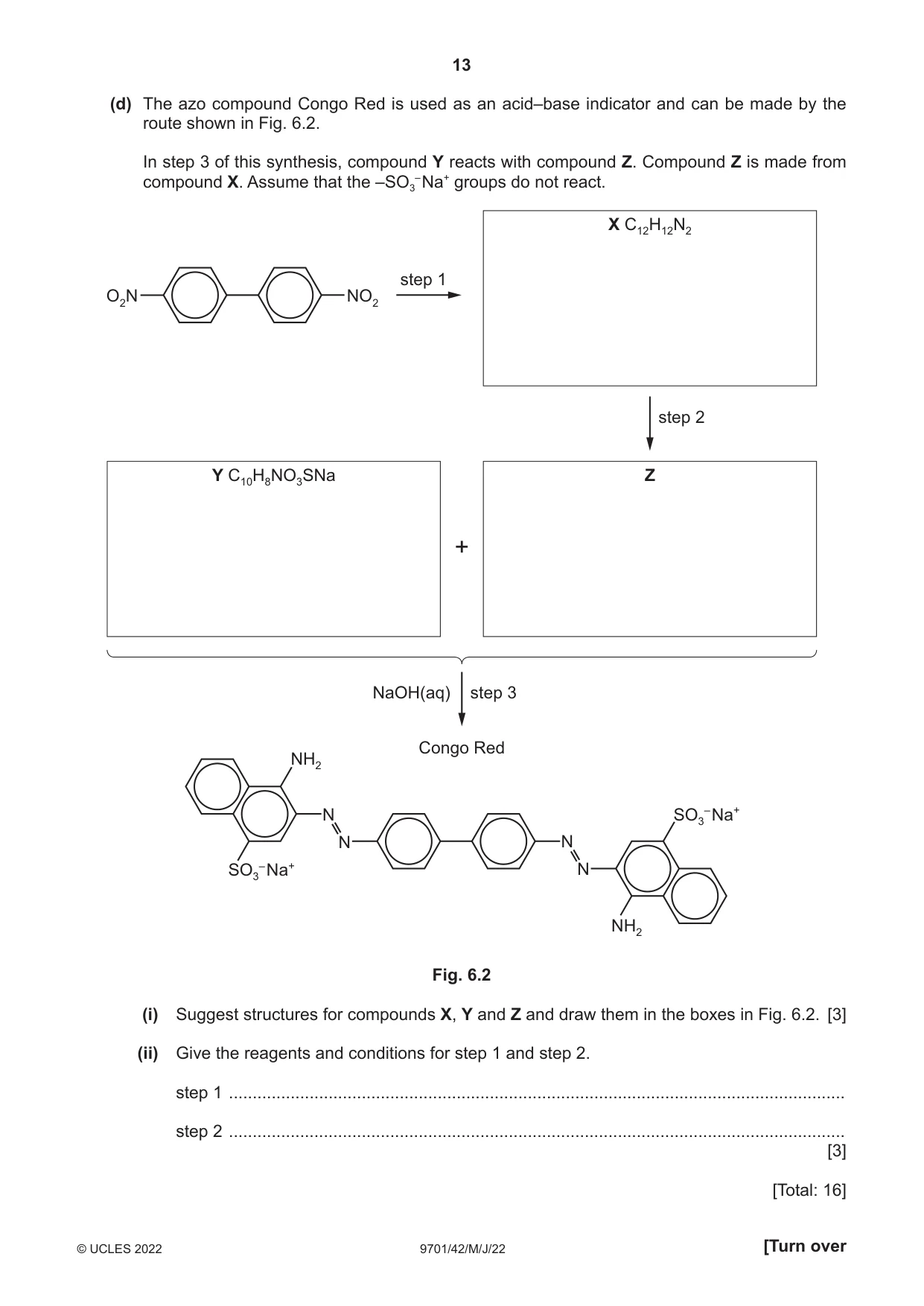
6 (a) The reagent and conditions required for the nitration of benzene, benzoic acid and phenol are shown in Table 6.1. Table 6.1 compound reagents and conditions for nitration benzene concentrated HNO3, 50 °C, concentrated H2SO4 catalyst benzoic acid concentrated HNO3, 100 °C, concentrated H2SO4 catalyst phenol dilute HNO3(aq), 20 °C Concentrated HNO3 reacts with concentrated H2SO4 to generate the electrophile NO2+. (i) Complete Fig. 6.1 to show the mechanism of the reaction between benzene and NO2+. Include all relevant curly arrows and charges. NO2+ Fig. 6.1 [3] (ii) Write an equation to show how H2SO4 is regenerated. ....................................................................................................................................... [1] (b) Draw the major products from the mononitration of benzoic acid and of phenol. major product from benzoic acid major product from phenol [2] (c) Compare the relative ease of nitration of benzene, benzoic acid and phenol. Explain your reasoning; include reference to the structures of the three compounds in your answer. ............................................... > ............................................... > .............................................. easiest least easy .................................................................................................................................................... .................................................................................................................................................... .................................................................................................................................................... .................................................................................................................................................... .................................................................................................................................................... [4] (d) The azo compound Congo Red is used as an acid–base indicator and can be made by the route shown in Fig. 6.2. In step 3 of this synthesis, compound Y reacts with compound Z. Compound Z is made from compound X. Assume that the –SO3– Na+ groups do not react. X C12H12N2 step 1 O2N NO2 step 2 Y C10H8NO3SNa Z + NaOH(aq) step 3 Congo Red NH2 N SO3– Na+ N N SO3– Na+ N NH2 Fig. 6.2 (i) Suggest structures for compounds X, Y and Z and draw them in the boxes in Fig. 6.2. [3] (ii) Give the reagents and conditions for step 1 and step 2. step 1 .................................................................................................................................. step 2 .................................................................................................................................. [3] [Total: 16]
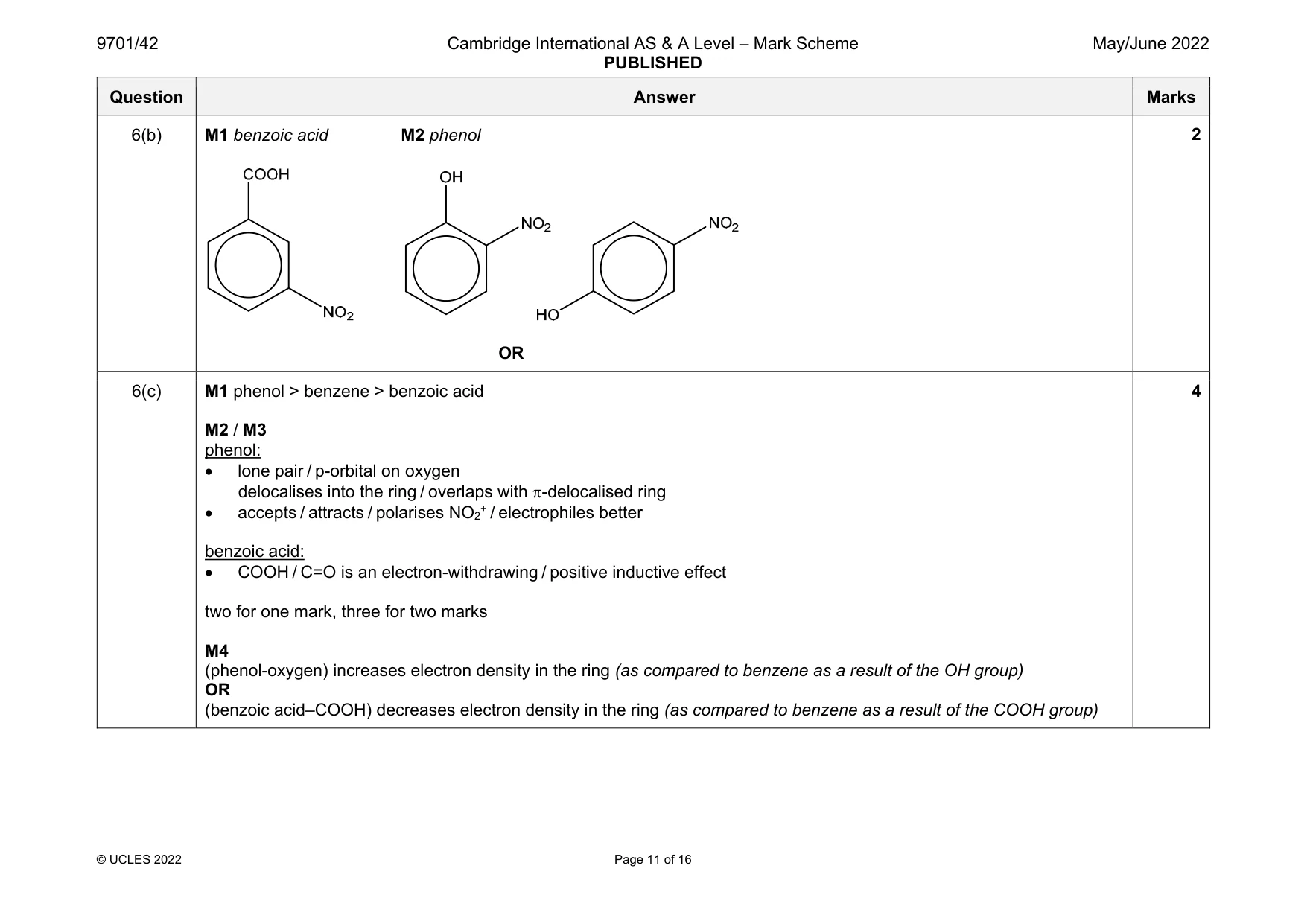
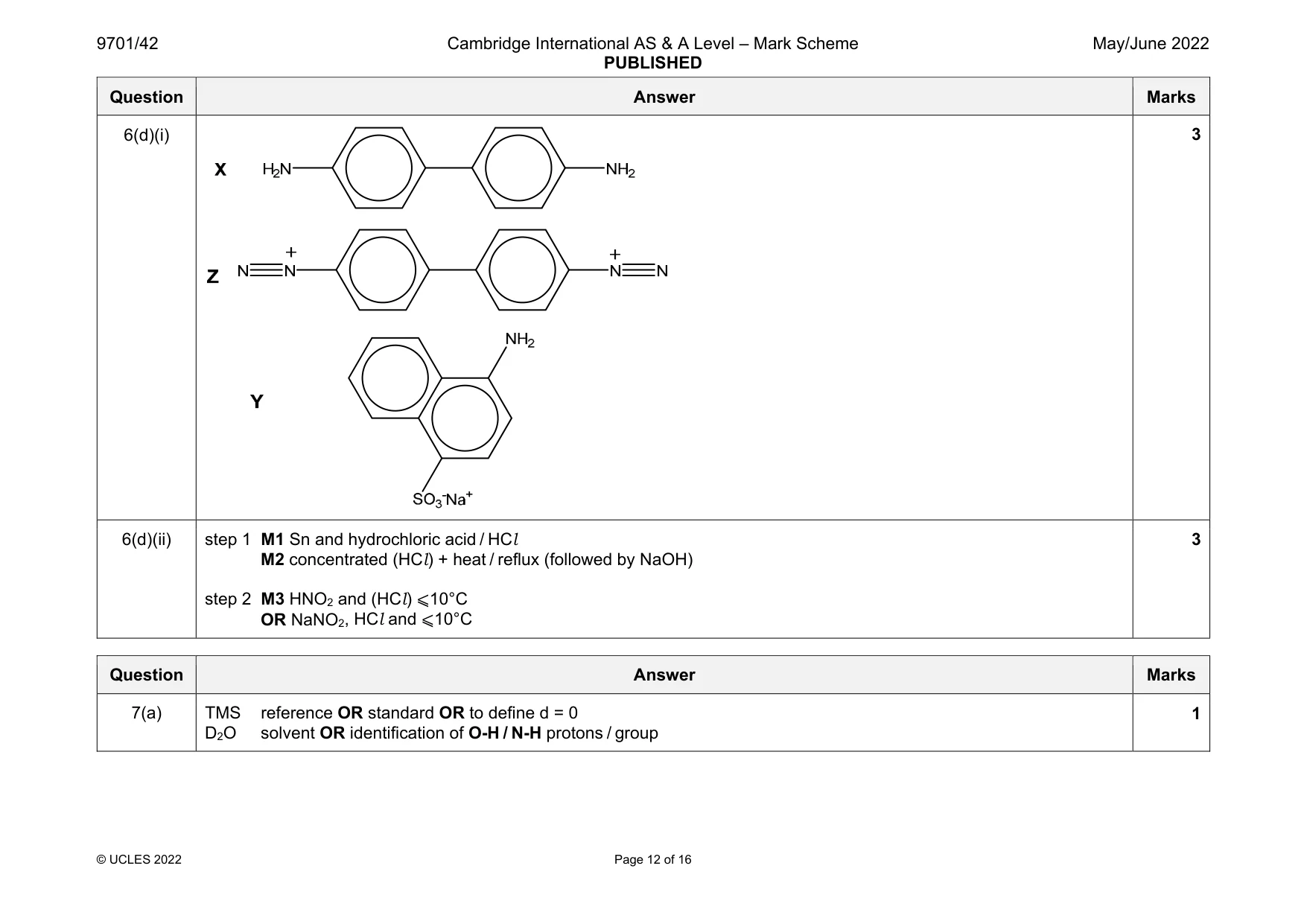
Mark scheme: 6(a)(i) NO2 + + NO2 H + H+ NO2 M1 first curly arrow from within hexagon to N of the NO2+ M2 correct intermediate M3 second curly arrow from C-H bond into the ring AND H+ formed / lost 6(a)(ii) HSO4– + H+ H2SO4 1 Question Answer Marks 6(b) M1 benzoic acid M2 phenol OR 2 6(c) M1 phenol > benzene > benzoic acid M2 / M3 phenol: lone pair / p-orbital on oxygen delocalises into the ring / overlaps with -delocalised ring accepts / attracts / polarises NO2+ / electrophiles better benzoic acid: COOH / C=O is an electron-withdrawing / positive inductive effect two for one mark, three for two marks M4 (phenol-oxygen) increases electron density in the ring (as compared to benzene as a result of the OH group) OR (benzoic acid–COOH) decreases electron density in the ring (as compared to benzene as a result of the COOH group) 4 Question Answer Marks 6(d)(i) 3 6(d)(ii) step 1 M1 Sn and hydrochloric acid / HCl M2 concentrated (HCl) + heat / reflux (followed by NaOH) step 2 M3 HNO2 and (HCl) ⩽10°C OR NaNO2, HCl and ⩽10°C 3
Q7 · State the uses of TMS and D2O in NMR spectroscopy
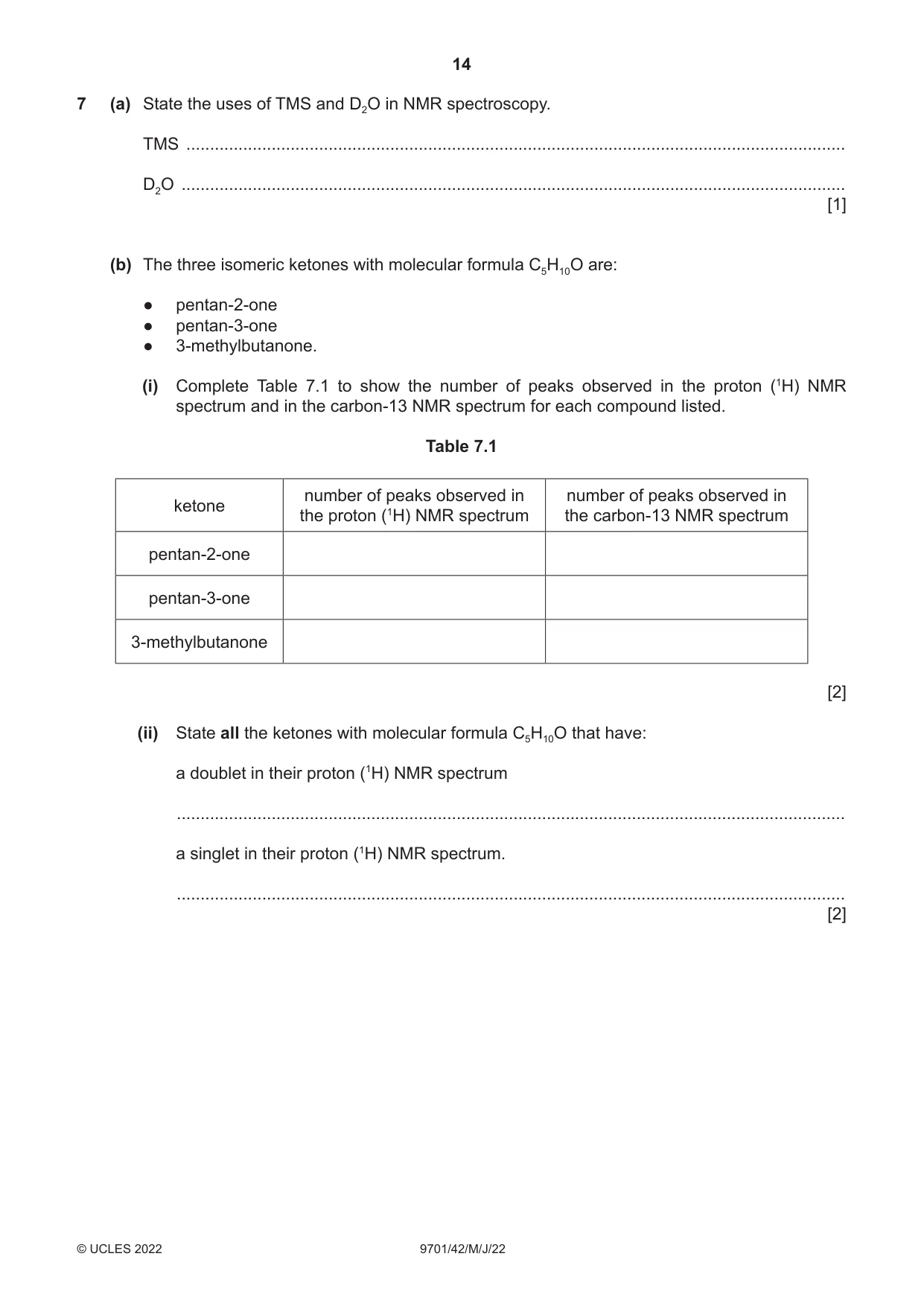
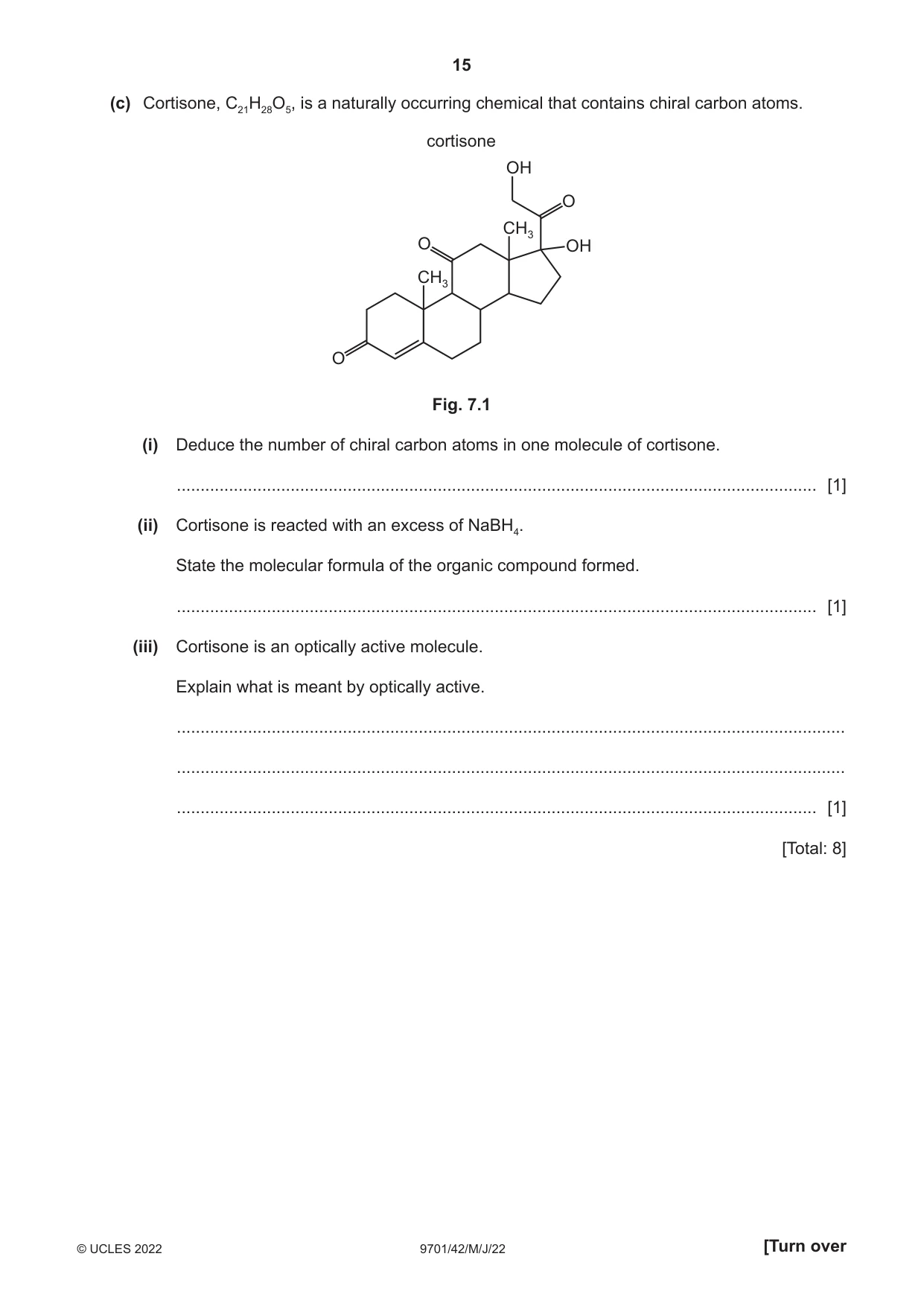
7 (a) State the uses of TMS and D2O in NMR spectroscopy. TMS ............................................................................................................................................ D2O ............................................................................................................................................. [1] (b) The three isomeric ketones with molecular formula C5H10O are: ● pentan-2-one ● pentan-3-one ● 3-methylbutanone. (i) Complete Table 7.1 to show the number of peaks observed in the proton (1H) NMR spectrum and in the carbon-13 NMR spectrum for each compound listed. Table 7.1 number of peaks observed in number of peaks observed in ketone the proton (1H) NMR spectrum the carbon-13 NMR spectrum pentan-2-one pentan-3-one 3-methylbutanone [2] (ii) State all the ketones with molecular formula C5H10O that have: a doublet in their proton (1H) NMR spectrum ............................................................................................................................................. a singlet in their proton (1H) NMR spectrum. ............................................................................................................................................. [2] (c) Cortisone, C21H28O5, is a naturally occurring chemical that contains chiral carbon atoms. cortisone OH O CH3 O OH CH3 O Fig. 7.1 (i) Deduce the number of chiral carbon atoms in one molecule of cortisone. ....................................................................................................................................... [1] (ii) Cortisone is reacted with an excess of NaBH4. State the molecular formula of the organic compound formed. ....................................................................................................................................... [1] (iii) Cortisone is an optically active molecule. Explain what is meant by optically active. ............................................................................................................................................. ............................................................................................................................................. ....................................................................................................................................... [1] [Total: 8]
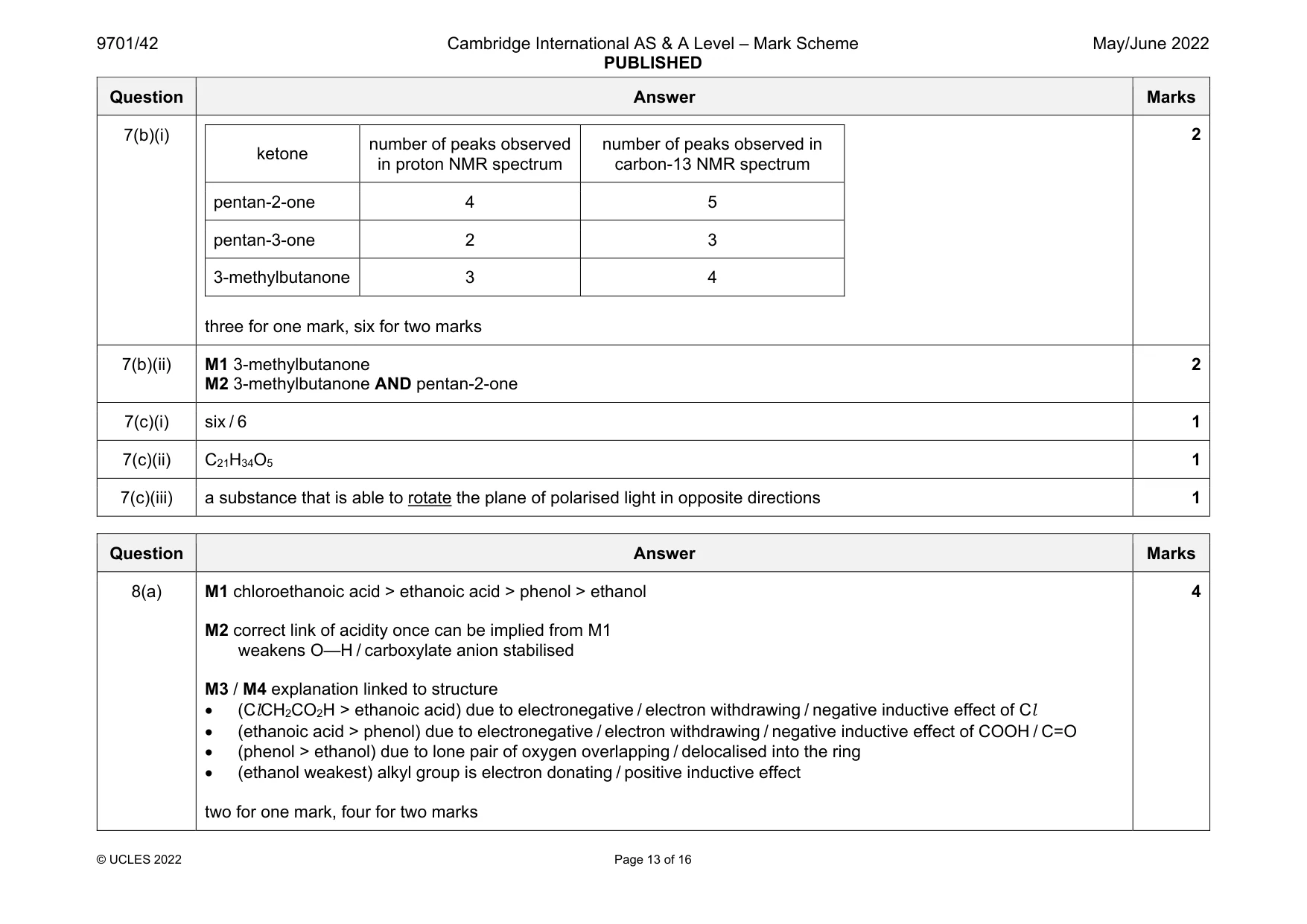
Mark scheme: 7(a) TMS reference OR standard OR to define d = 0 D2O solvent OR identification of O-H / N-H protons / group 1 Question Answer Marks 7(b)(i) ketone number of peaks observed in proton NMR spectrum number of peaks observed in carbon-13 NMR spectrum pentan-2-one 4 5 pentan-3-one 2 3 3-methylbutanone 3 4 three for one mark, six for two marks 2 7(b)(ii) M1 3-methylbutanone M2 3-methylbutanone AND pentan-2-one 2 7(c)(i) six / 6 1 7(c)(ii) C21H34O5 1 7(c)(iii) a substance that is able to rotate the plane of polarised light in opposite directions 1
Q8 · Compare the relative acidities of ethanol, ethanoic acid, chloroethanoic acid and phenol
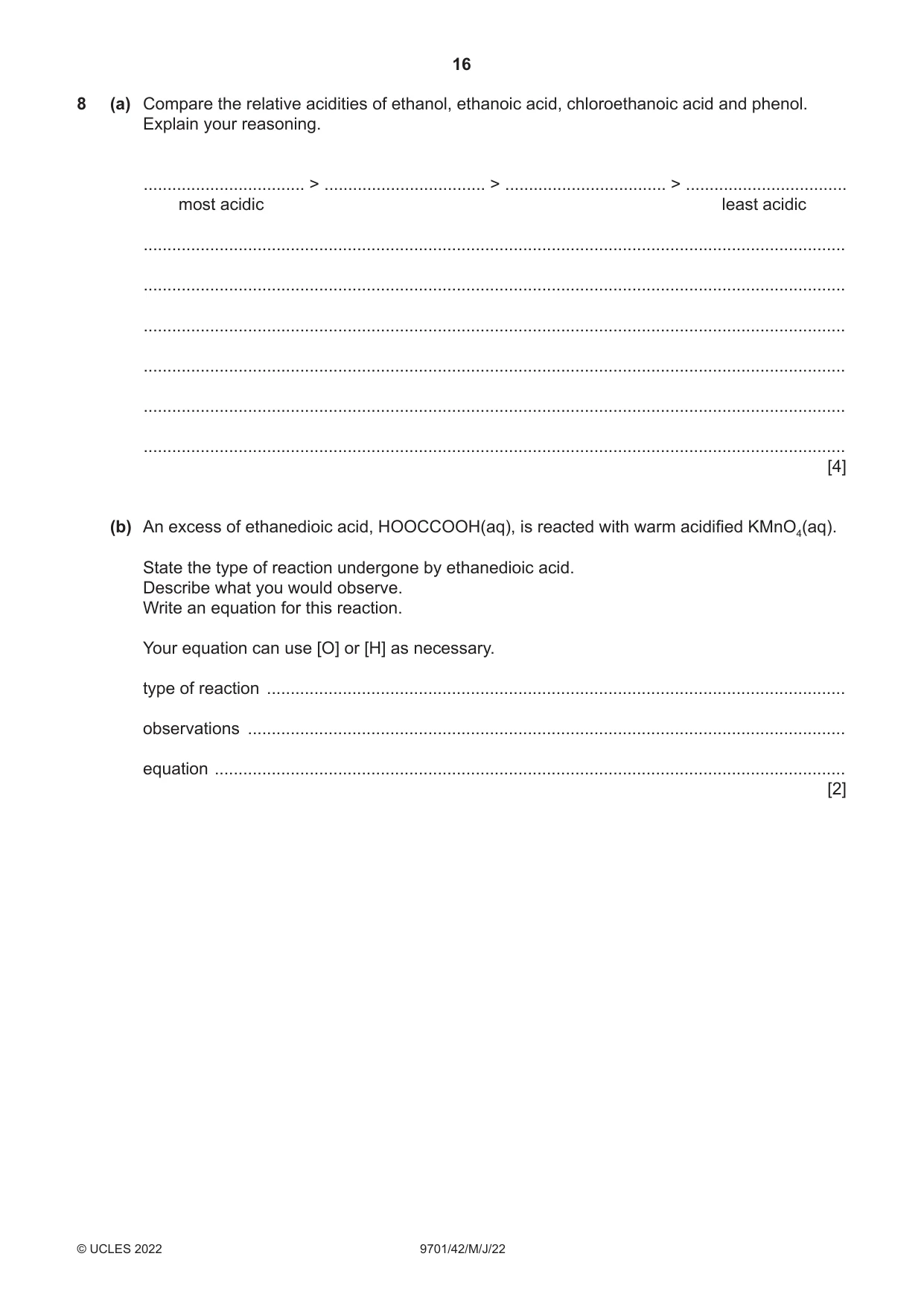
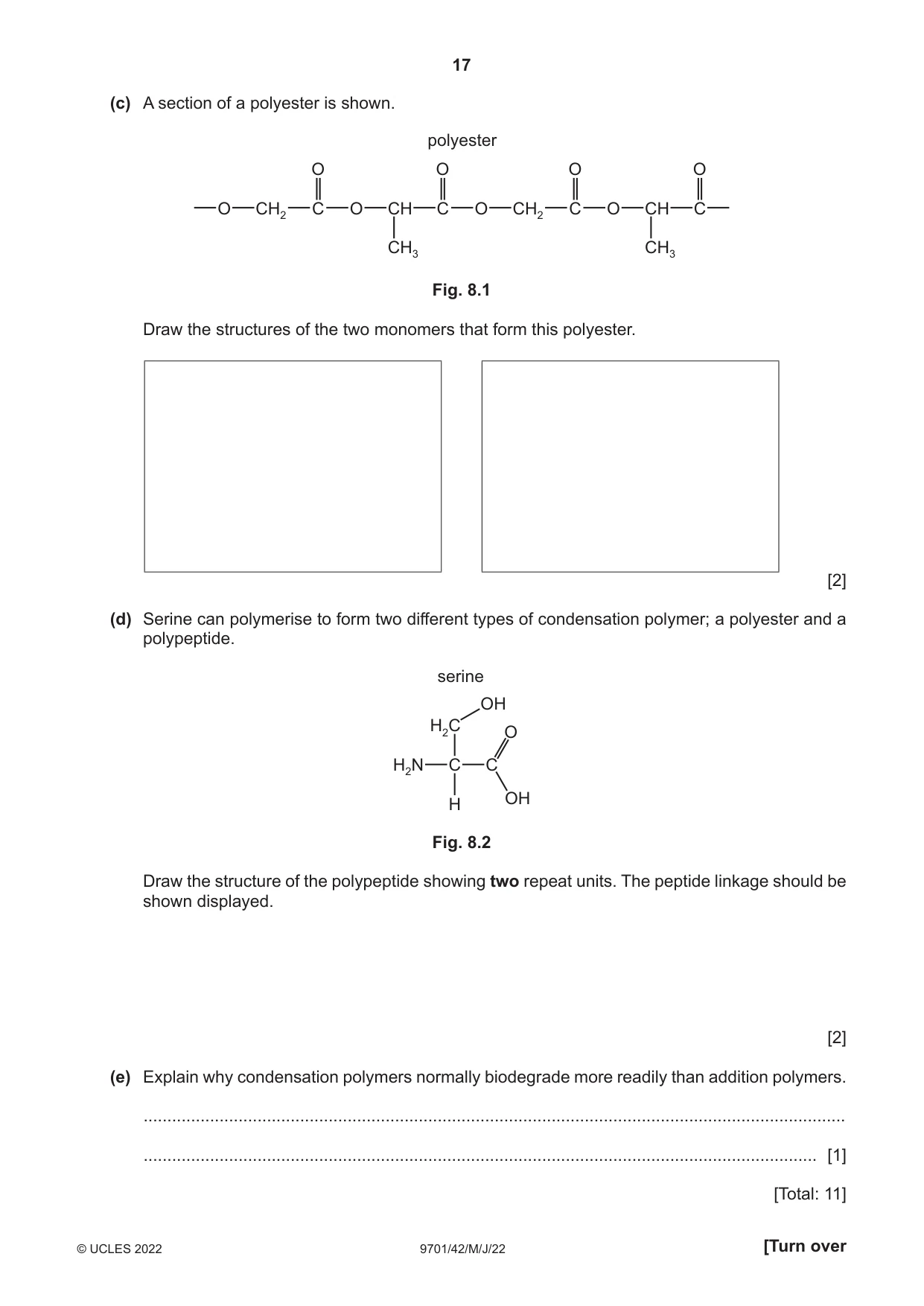
8 (a) Compare the relative acidities of ethanol, ethanoic acid, chloroethanoic acid and phenol. Explain your reasoning. .................................. > .................................. > .................................. > .................................. most acidic least acidic .................................................................................................................................................... .................................................................................................................................................... .................................................................................................................................................... .................................................................................................................................................... .................................................................................................................................................... .................................................................................................................................................... [4] (b) An excess of ethanedioic acid, HOOCCOOH(aq), is reacted with warm acidified KMnO4(aq). State the type of reaction undergone by ethanedioic acid. Describe what you would observe. Write an equation for this reaction. Your equation can use [O] or [H] as necessary. type of reaction ........................................................................................................................... observations ............................................................................................................................... equation ..................................................................................................................................... [2] (c) A section of a polyester is shown. polyester O O O O O CH2 C O CH C O CH2 C O CH C CH3 CH3 Fig. 8.1 Draw the structures of the two monomers that form this polyester. [2] (d) Serine can polymerise to form two different types of condensation polymer; a polyester and a polypeptide. serine OH H2C O H2N C C OH H Fig. 8.2 Draw the structure of the polypeptide showing two repeat units. The peptide linkage should be shown displayed. [2] (e) Explain why condensation polymers normally biodegrade more readily than addition polymers. .................................................................................................................................................... .............................................................................................................................................. [1] [Total: 11]
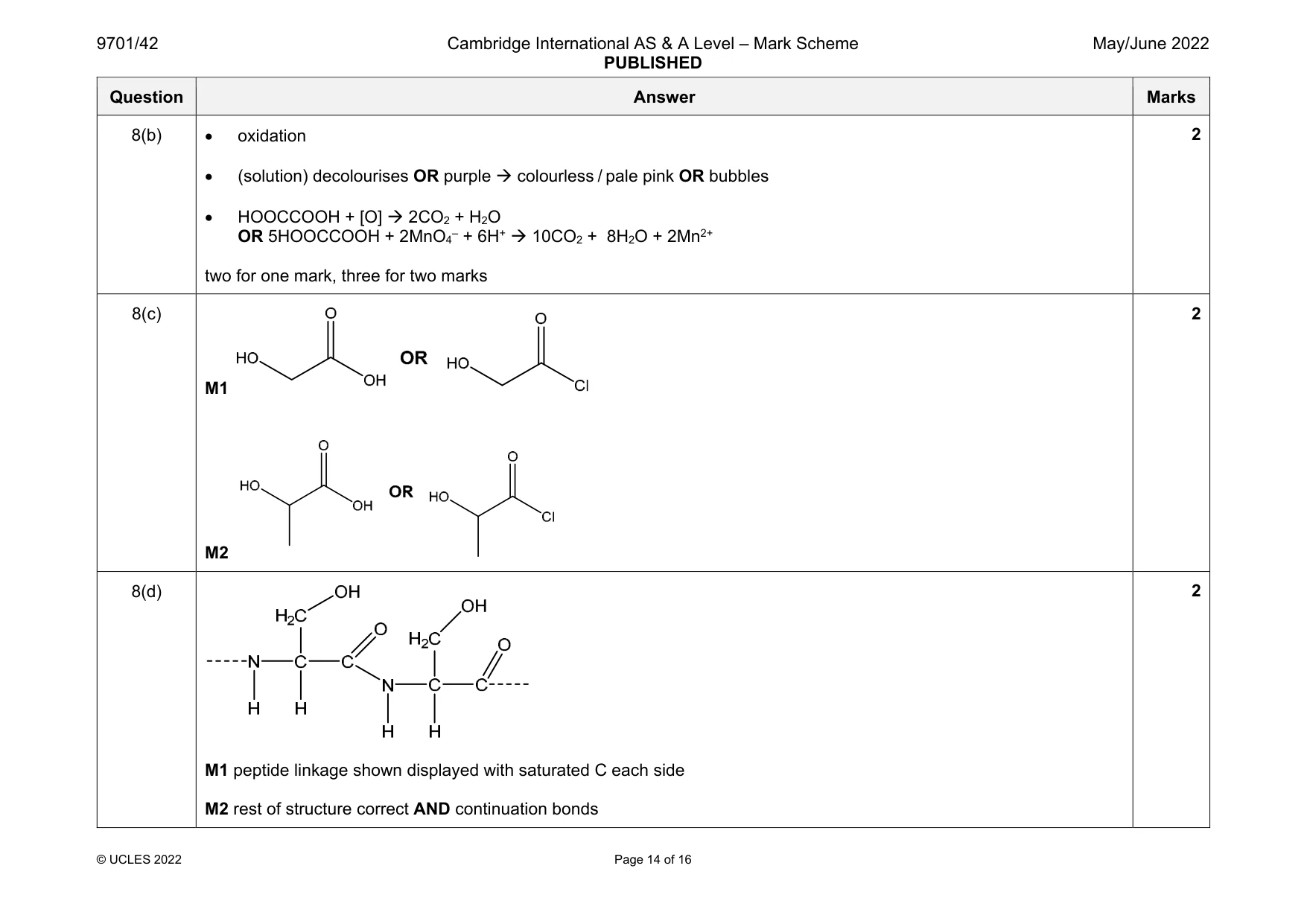
Mark scheme: 8(a) M1 chloroethanoic acid > ethanoic acid > phenol > ethanol M2 correct link of acidity once can be implied from M1 weakens O—H / carboxylate anion stabilised M3 / M4 explanation linked to structure (ClCH2CO2H > ethanoic acid) due to electronegative / electron withdrawing / negative inductive effect of Cl (ethanoic acid > phenol) due to electronegative / electron withdrawing / negative inductive effect of COOH / C=O (phenol > ethanol) due to lone pair of oxygen overlapping / delocalised into the ring (ethanol weakest) alkyl group is electron donating / positive inductive effect two for one mark, four for two marks Question Answer Marks 8(b) oxidation (solution) decolourises OR purple colourless / pale pink OR bubbles HOOCCOOH + [O] 2CO2 + H2O OR 5HOOCCOOH + 2MnO4– + 6H+ 10CO2 + 8H2O + 2Mn2+ two for one mark, three for two marks 2 8(c) M1 M2 2 8(d) M1 peptide linkage shown displayed with saturated C each side M2 rest of structure correct AND continuation bonds 2 Question Answer Marks 8(e) addition polymers do not hydrolyse OR condensation polymers can hydrolyse 1
Q9 · The structure of cyclohexylamine is shown in Fig
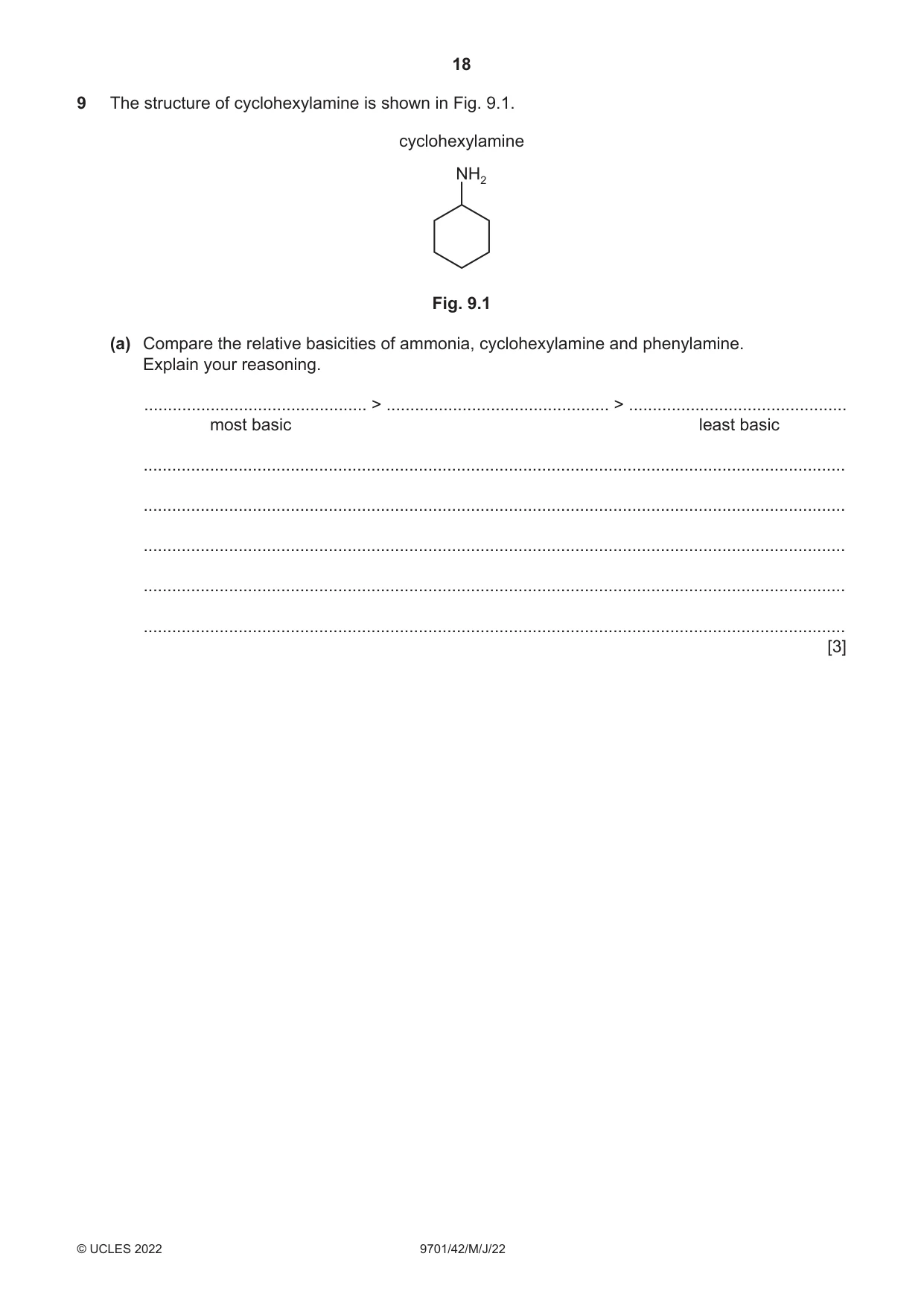
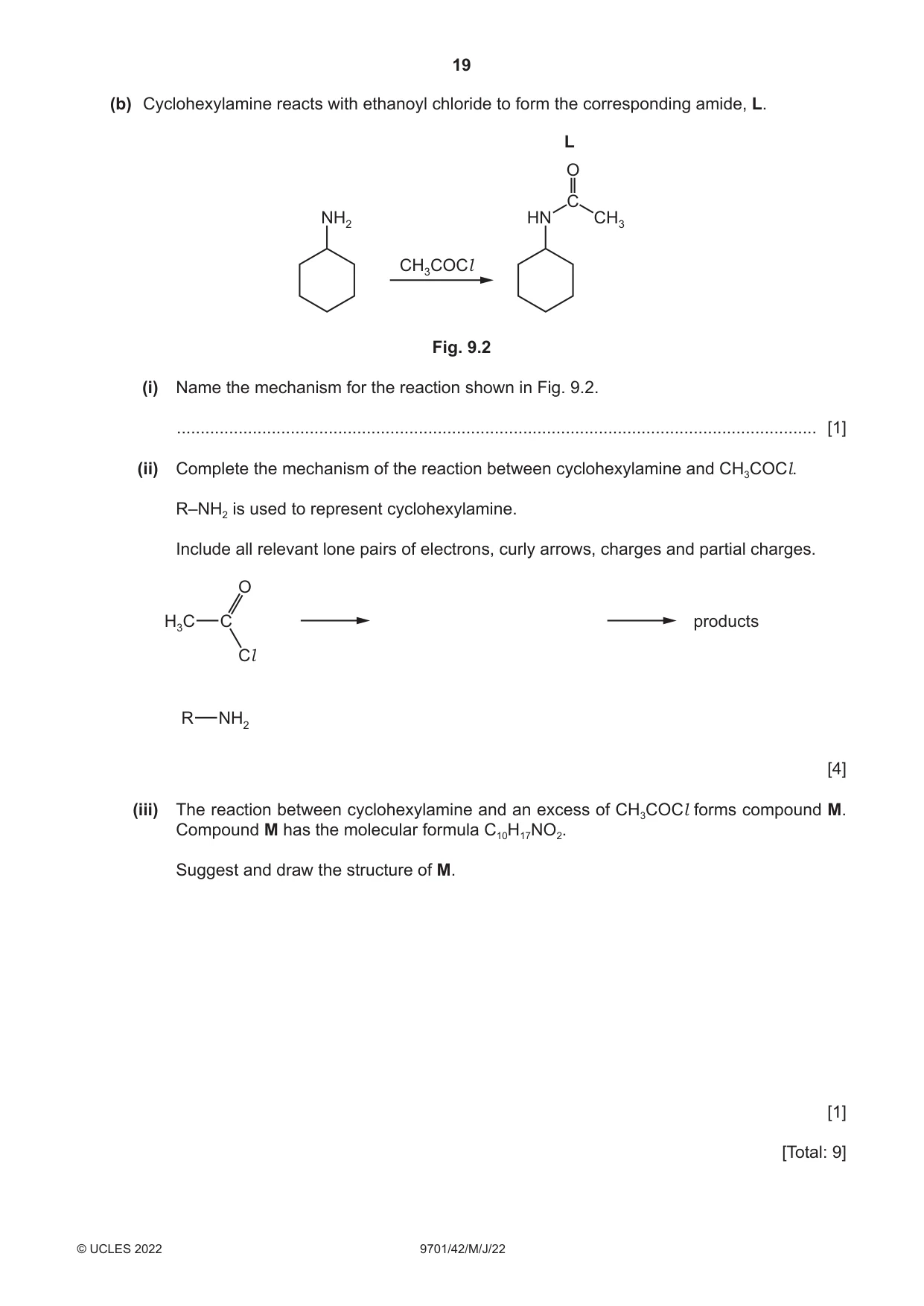
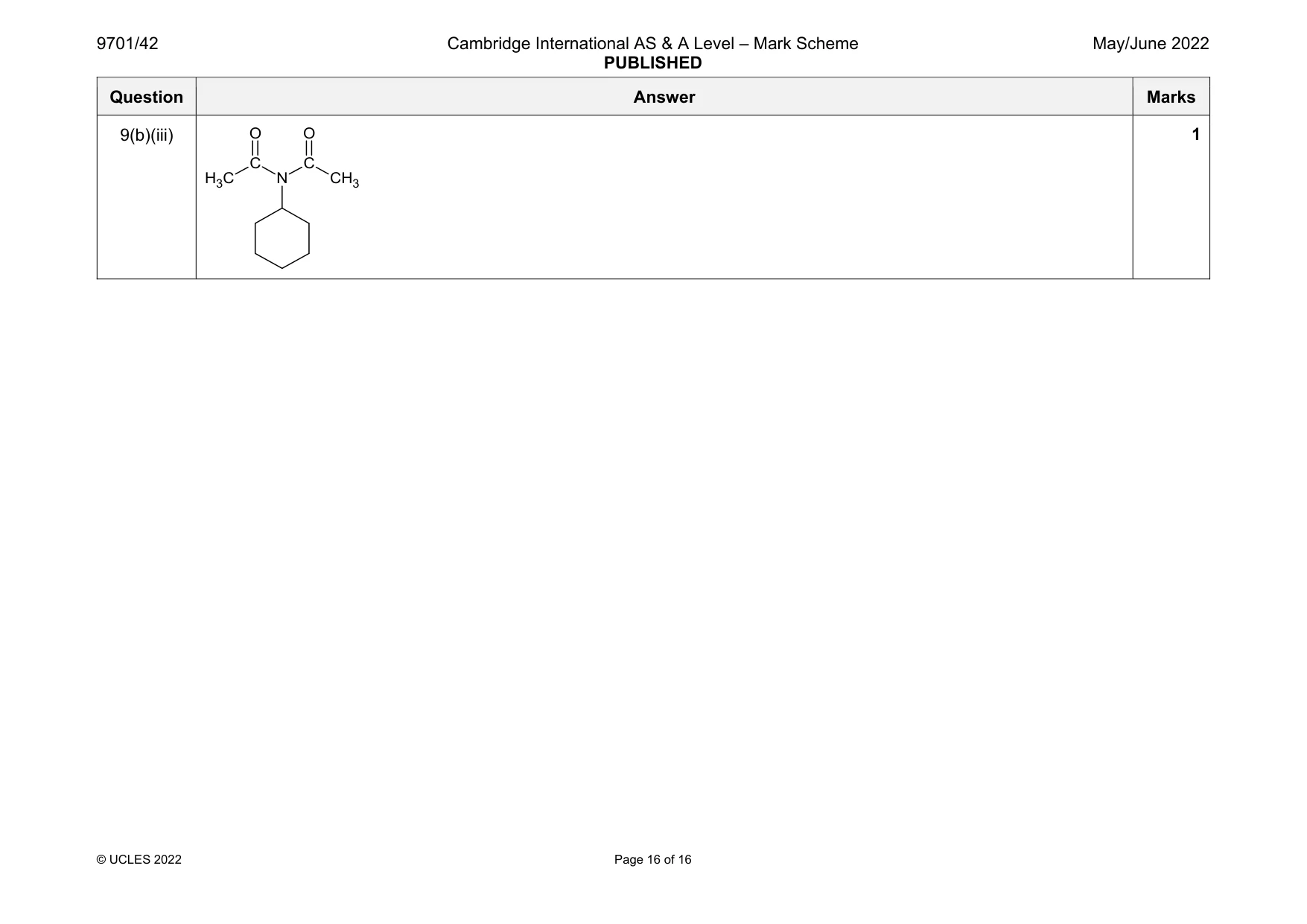
9 The structure of cyclohexylamine is shown in Fig. 9.1. cyclohexylamine NH2 Fig. 9.1 (a) Compare the relative basicities of ammonia, cyclohexylamine and phenylamine. Explain your reasoning. ............................................... > ............................................... > .............................................. most basic least basic .................................................................................................................................................... .................................................................................................................................................... .................................................................................................................................................... .................................................................................................................................................... .................................................................................................................................................... [3] (b) Cyclohexylamine reacts with ethanoyl chloride to form the corresponding amide, L. L O C NH2 HN CH3 CH3COCl Fig. 9.2 (i) Name the mechanism for the reaction shown in Fig. 9.2. ....................................................................................................................................... [1] (ii) Complete the mechanism of the reaction between cyclohexylamine and CH3COCl. R–NH2 is used to represent cyclohexylamine. Include all relevant lone pairs of electrons, curly arrows, charges and partial charges. O H3C C products Cl R NH2 [4] (iii) The reaction between cyclohexylamine and an excess of CH3COCl forms compound M. Compound M has the molecular formula C10H17NO2. Suggest and draw the structure of M. [1] [Total: 9]
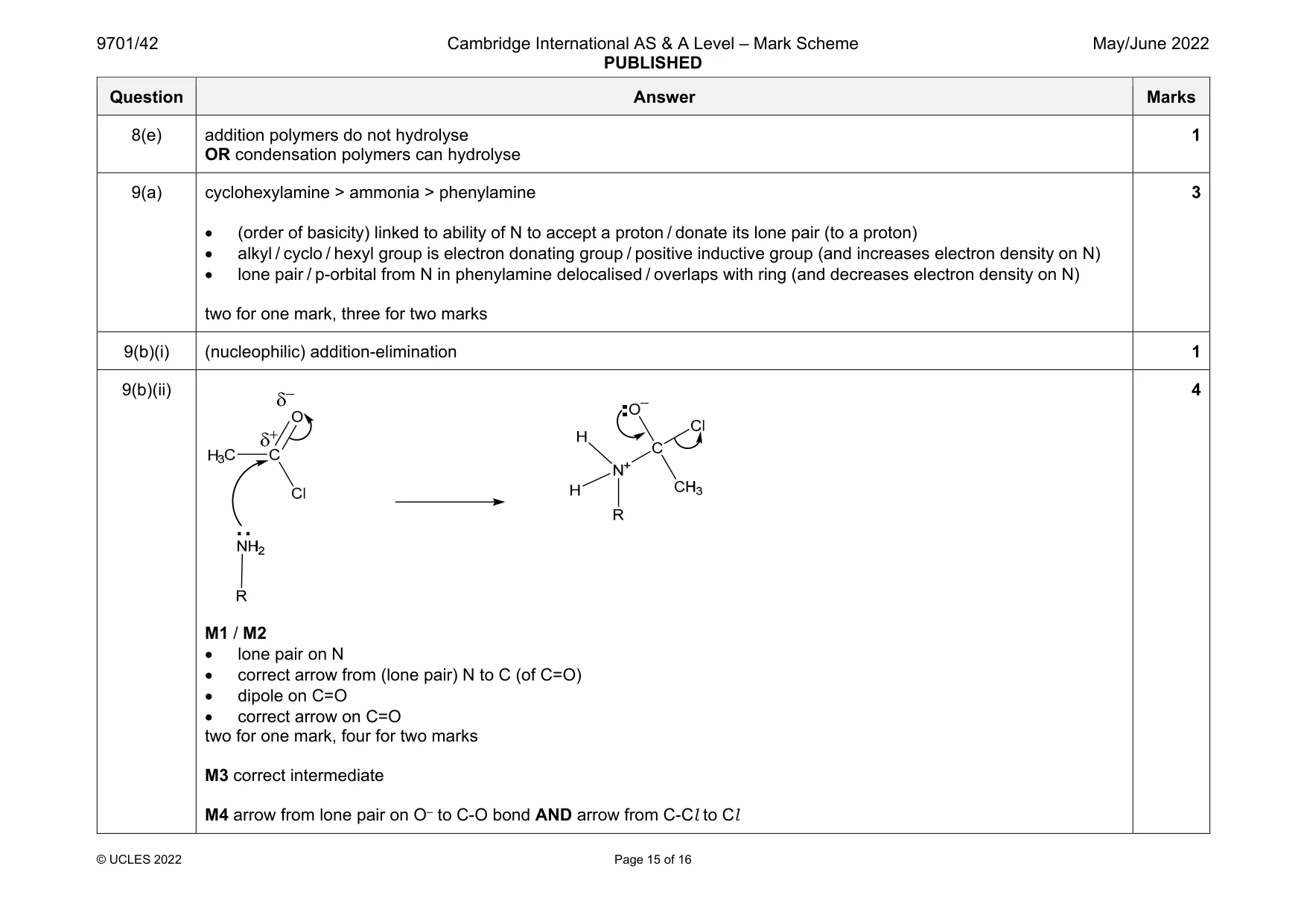
Mark scheme: 9(a) cyclohexylamine > ammonia > phenylamine (order of basicity) linked to ability of N to accept a proton / donate its lone pair (to a proton) alkyl / cyclo / hexyl group is electron donating group / positive inductive group (and increases electron density on N) lone pair / p-orbital from N in phenylamine delocalised / overlaps with ring (and decreases electron density on N) two for one mark, three for two marks 3 9(b)(i) (nucleophilic) addition-elimination 1 9(b)(ii) M1 / M2 lone pair on N correct arrow from (lone pair) N to C (of C=O) dipole on C=O correct arrow on C=O two for one mark, four for two marks M3 correct intermediate M4 arrow from lone pair on O– to C-O bond AND arrow from C-Cl to Cl 4 Question Answer Marks 9(b)(iii) N C CH3 O C O C H3 1
What was in this paper
The subtopics covered by these 9 questions, and how many questions each got. Open one in a new tab to see every Cambridge question on it.
What you needed in this session
Cambridge’s own grade thresholds for 2022 May/June, Paper 4 · Variant 2. A higher threshold means an easier paper — the bar moves with how the cohort did.