Cambridge A Level Chemistry 9701 — 2024 Feb/March Paper 4 · Variant 2
9701/42/F/M/24 · 6 questions · 100 marks · ≈113 min
The question paper and its mark scheme, free to read here and free to download. This is Cambridge’s own paper, exactly as it was sat.
Question paper28 pages
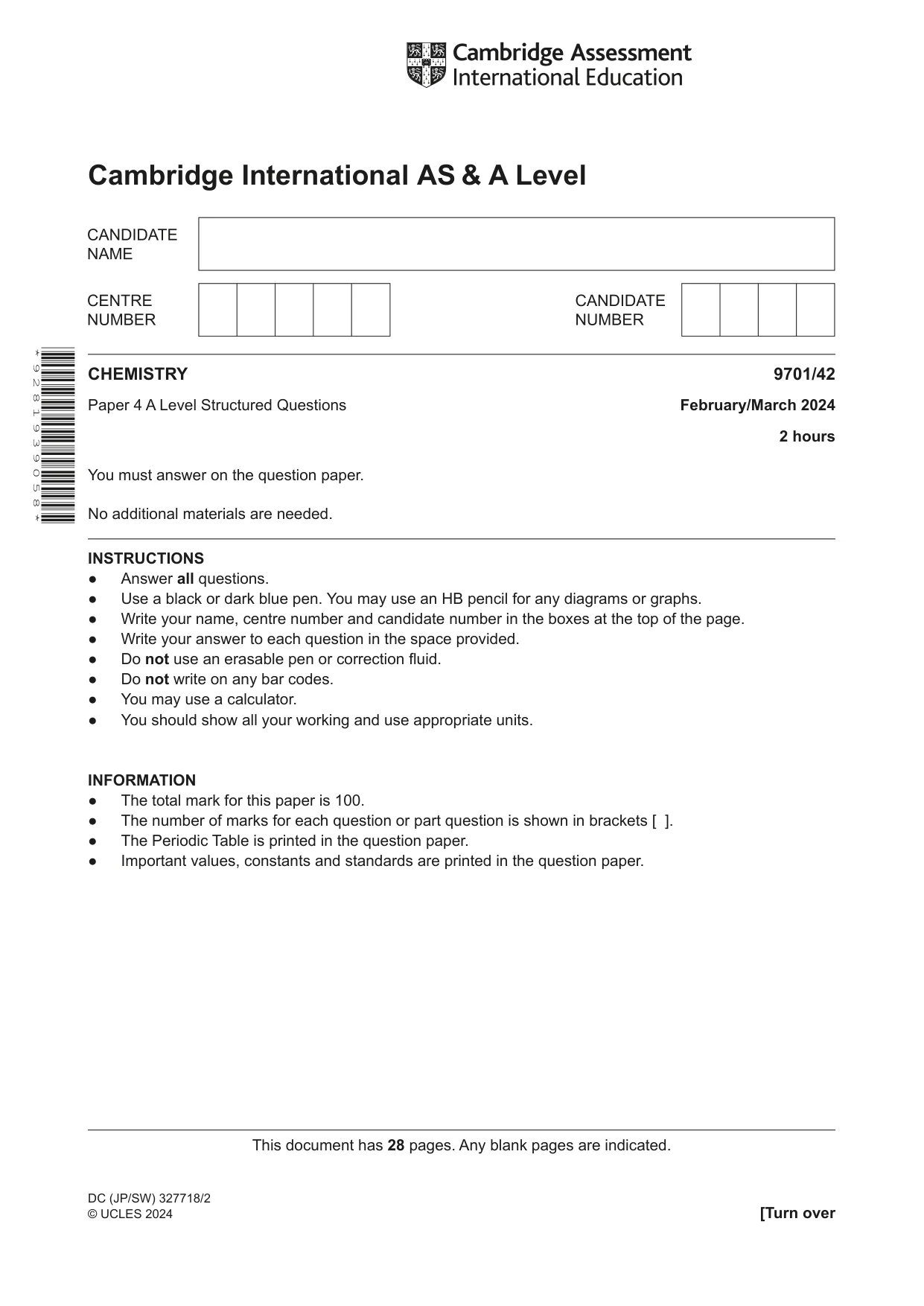
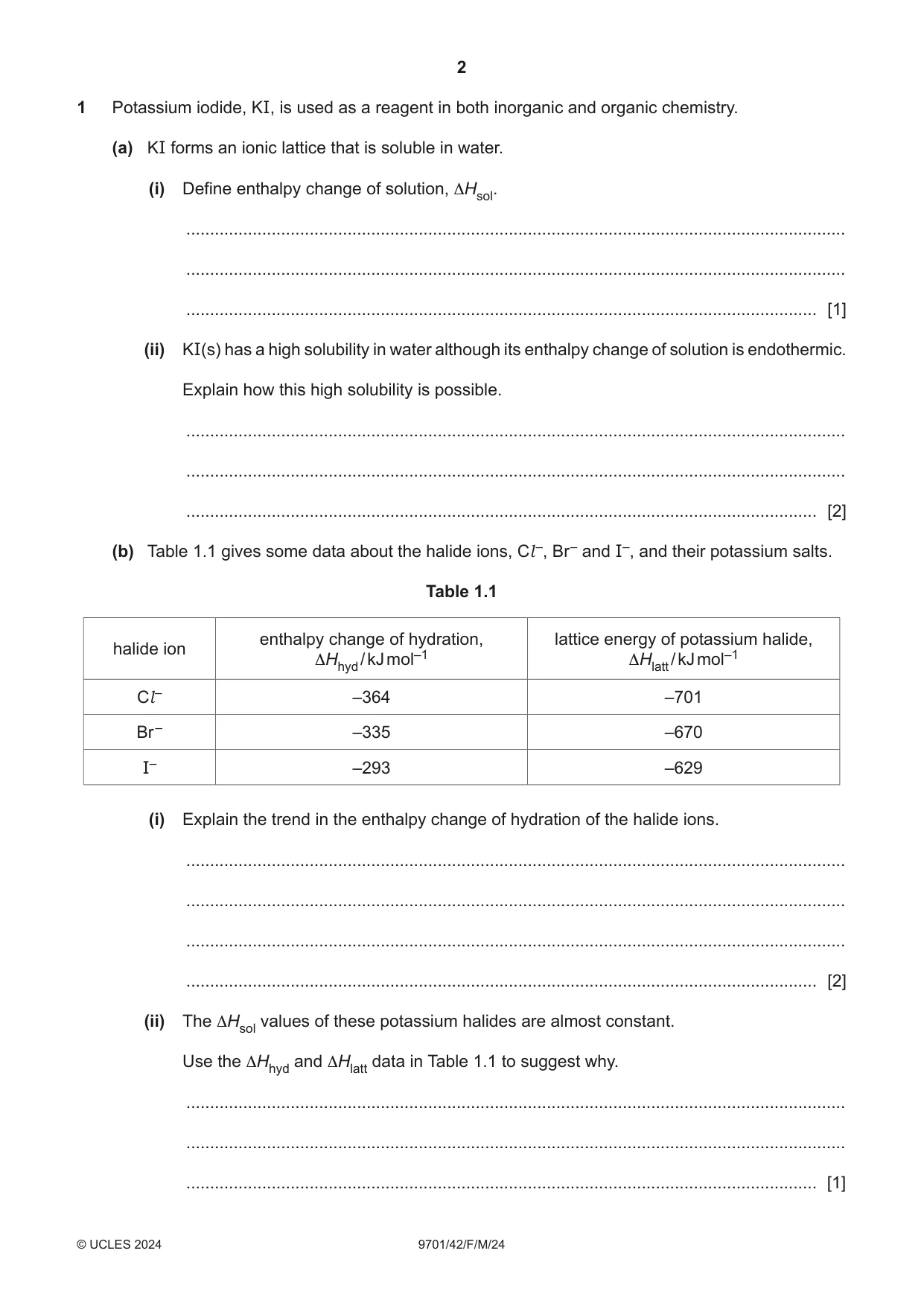
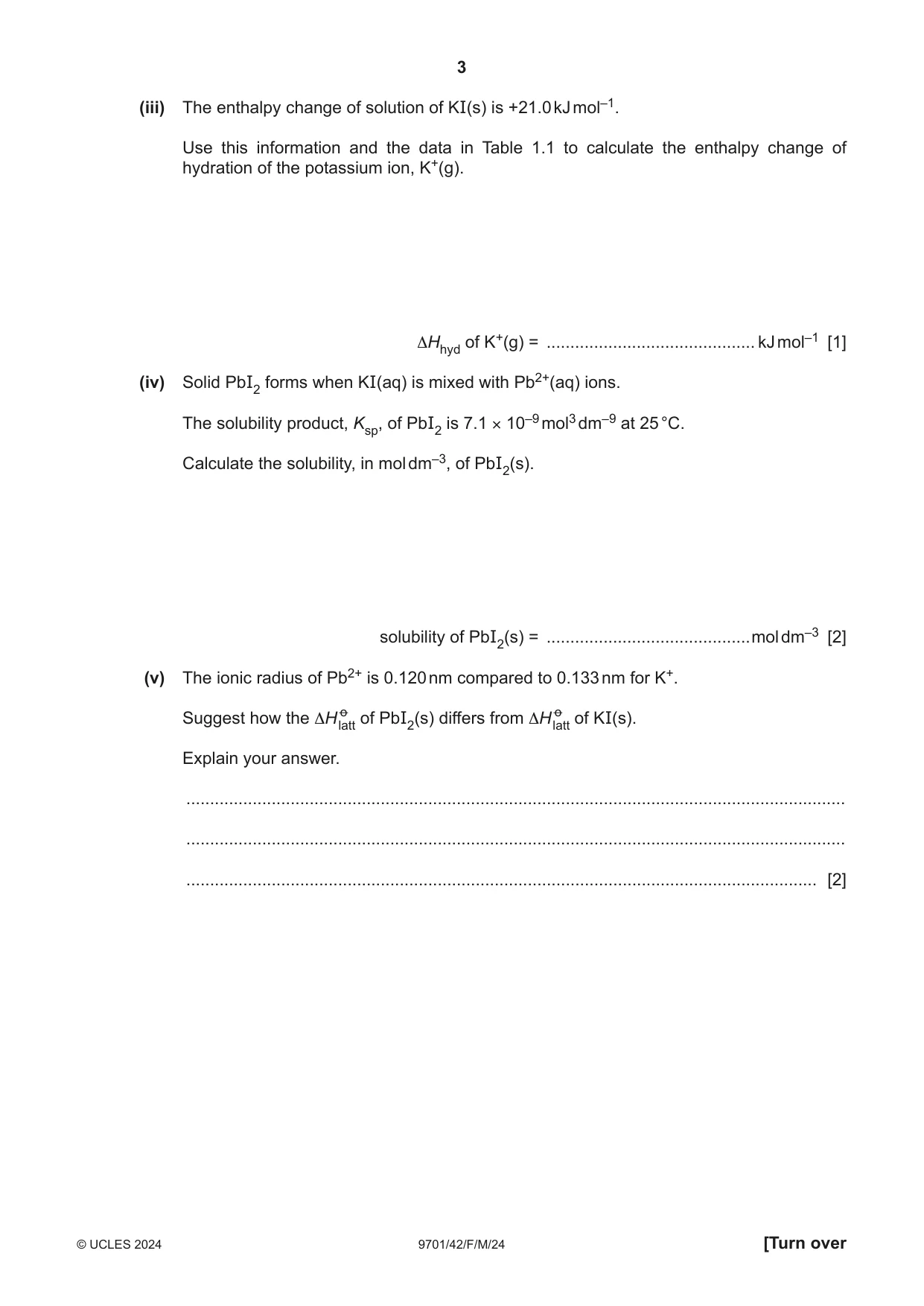
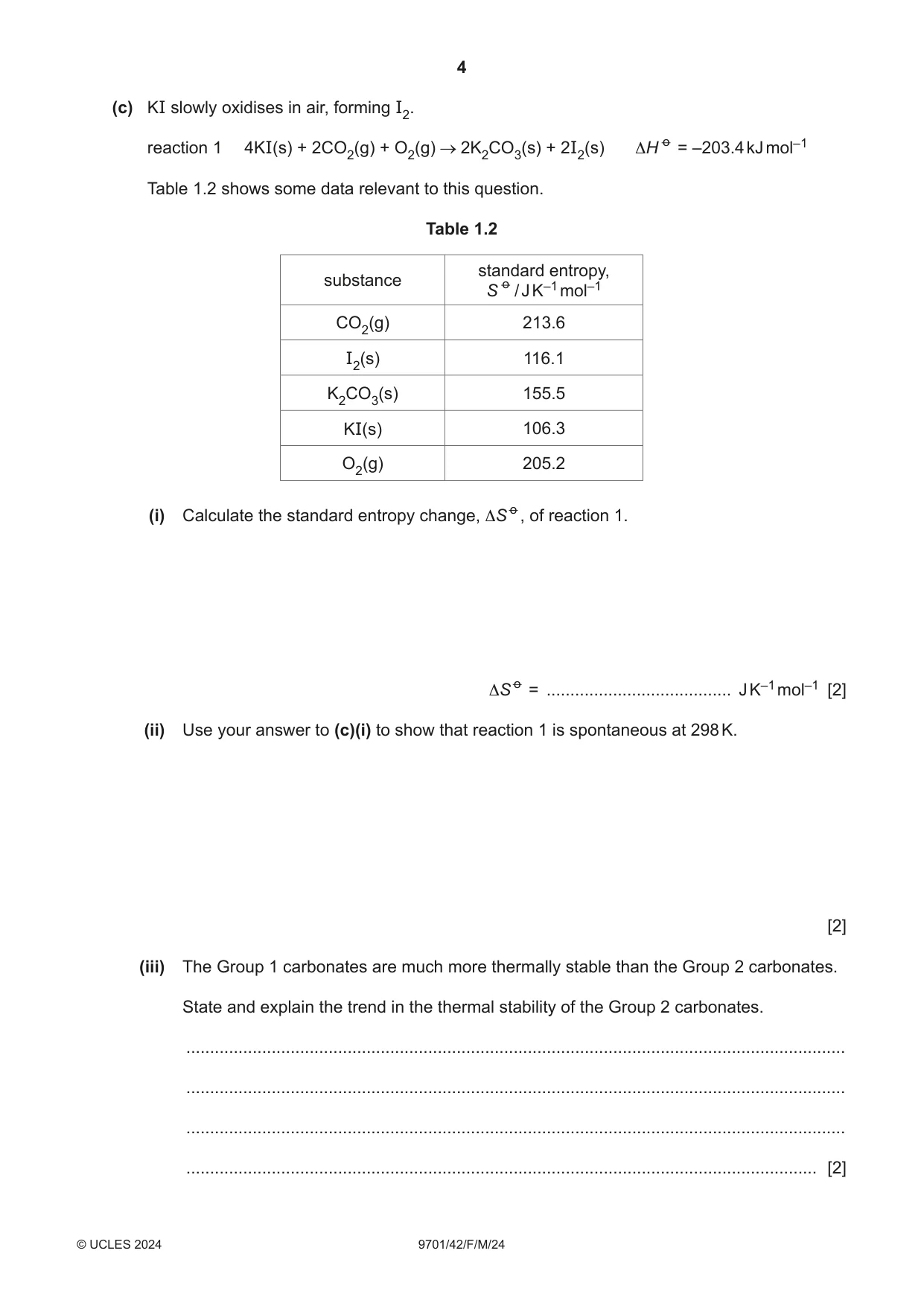

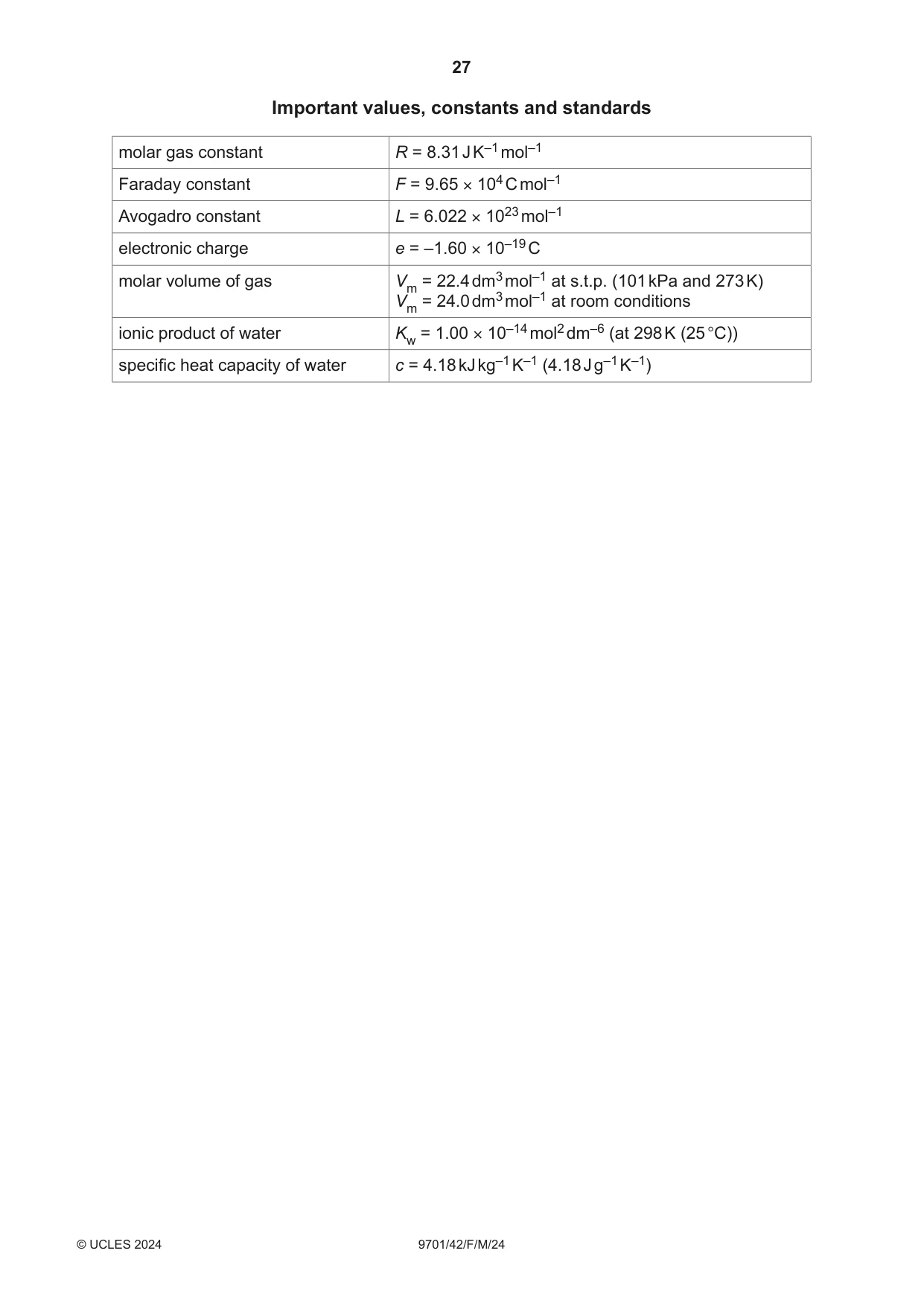
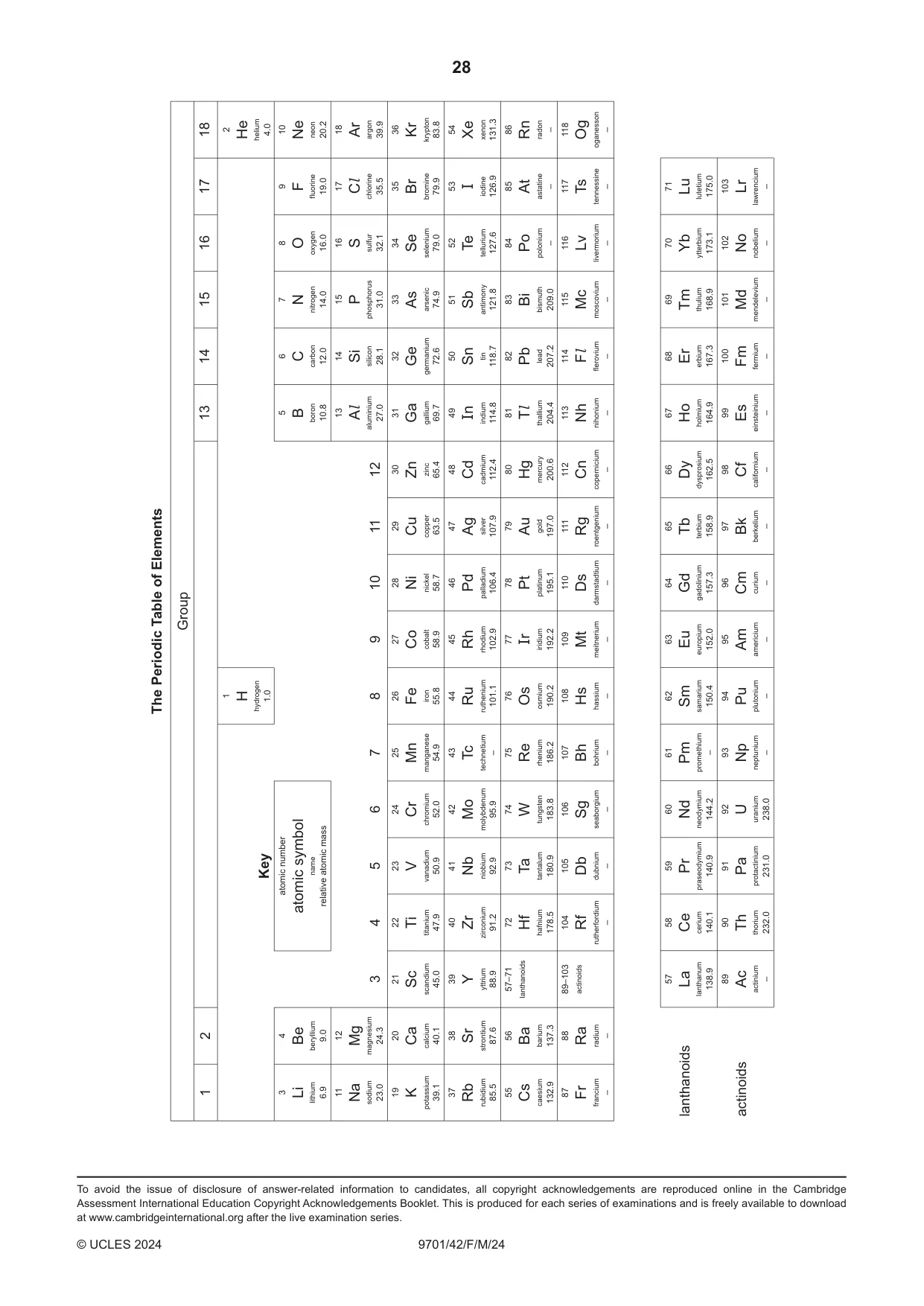
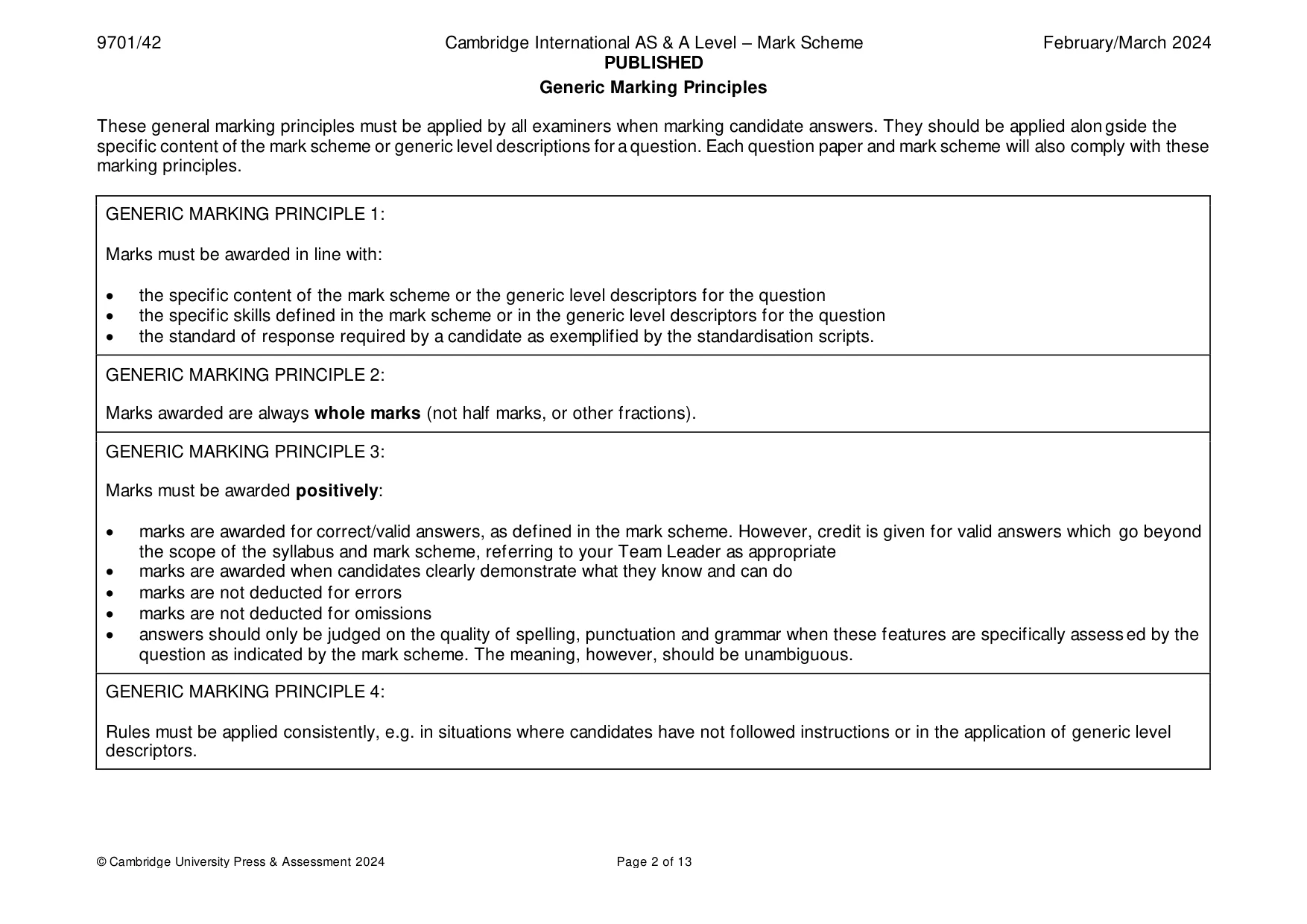
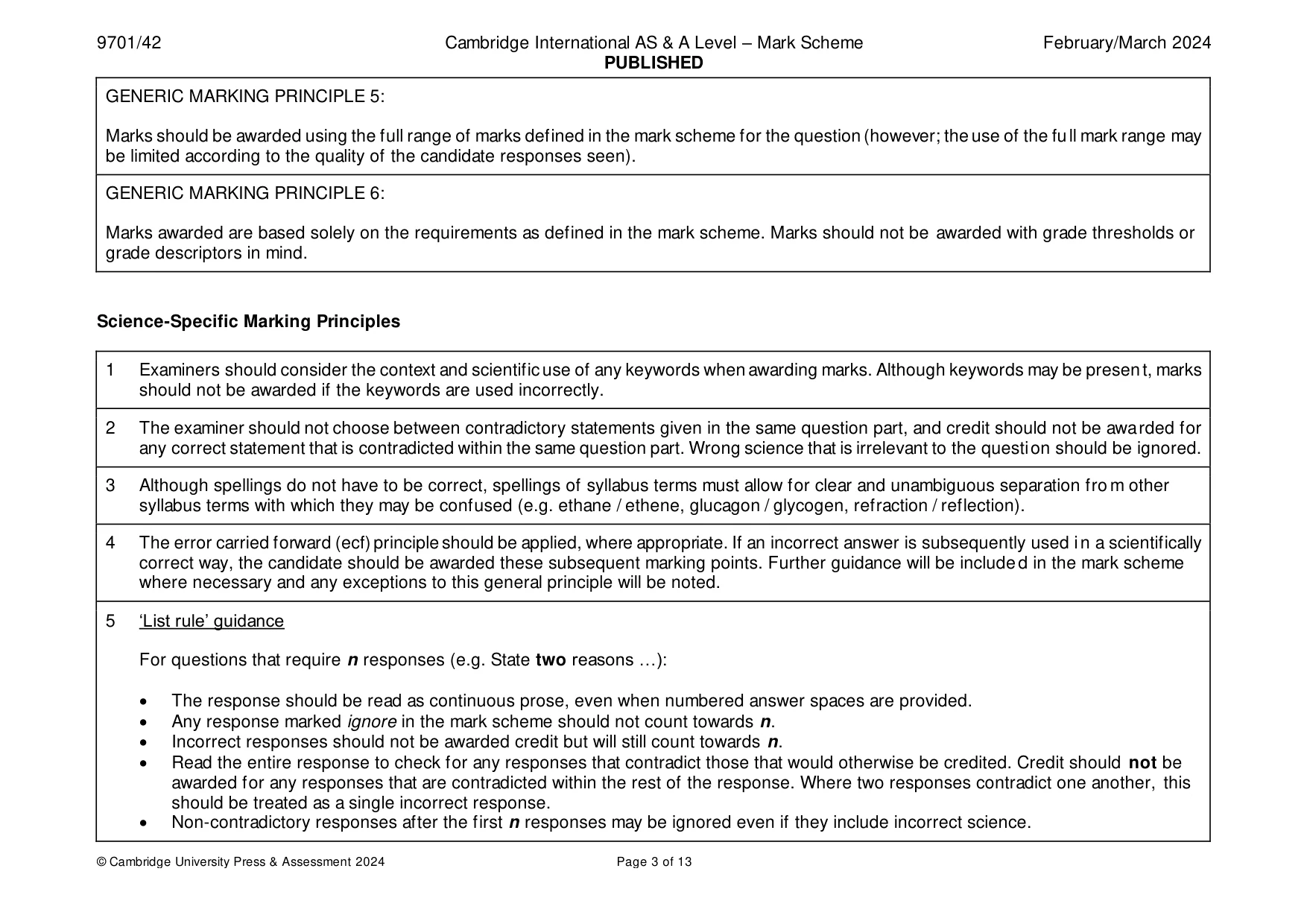
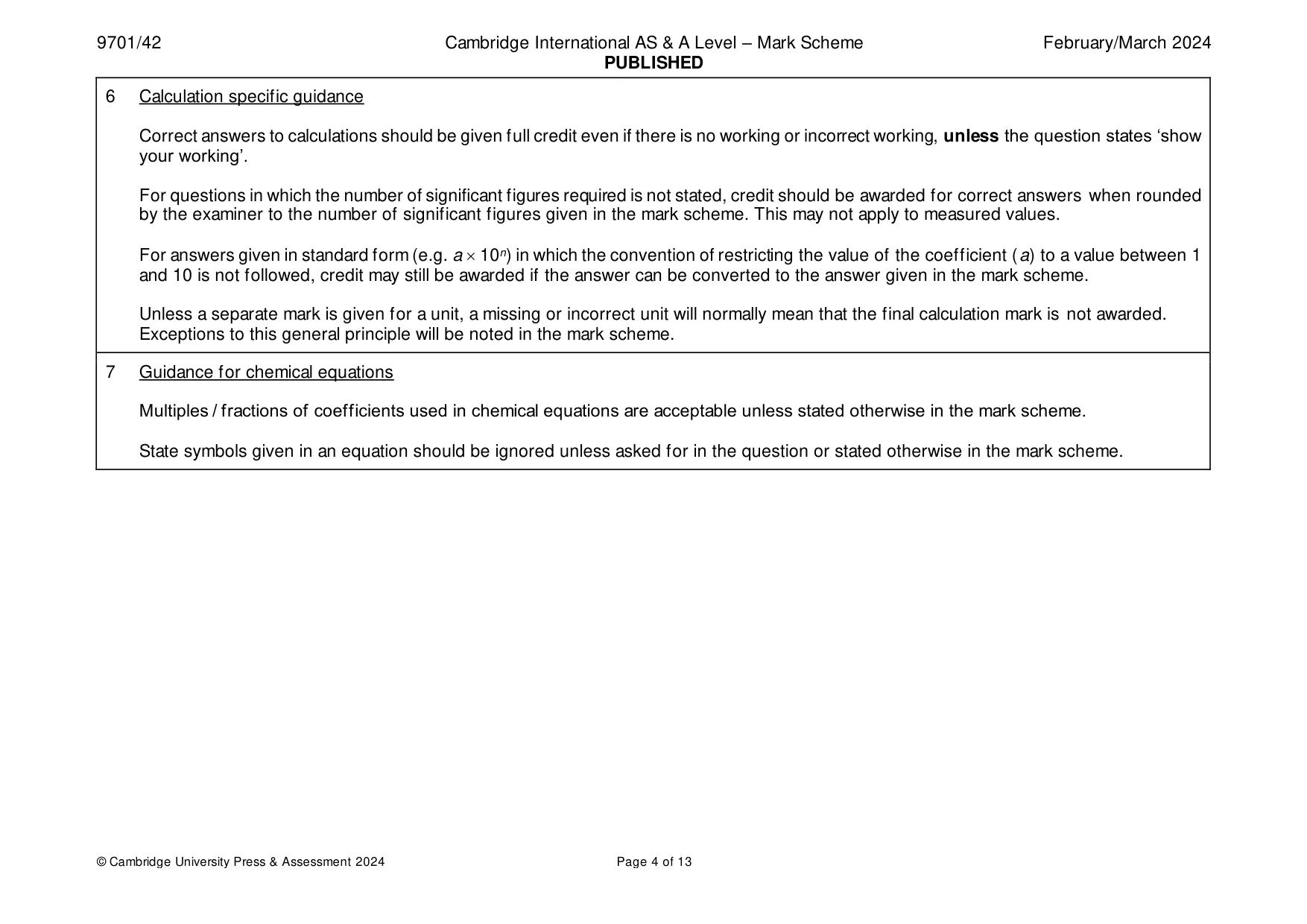
Mark scheme13 pages
Answers below. Sit the paper first if you are practising.
Questions as text
Q1 · Potassium iodide, KI, is used as a reagent in both inorganic and organic chemistry
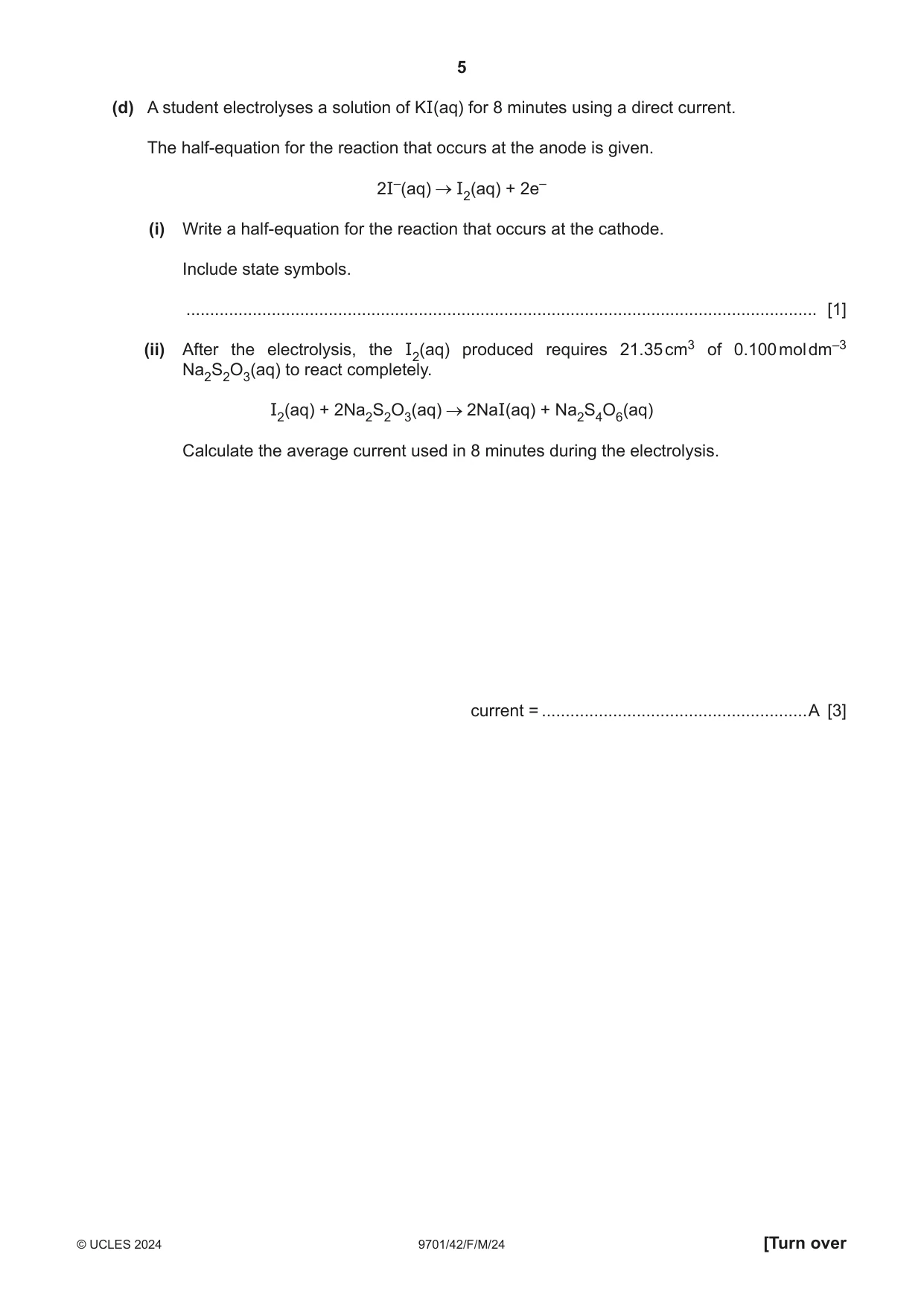
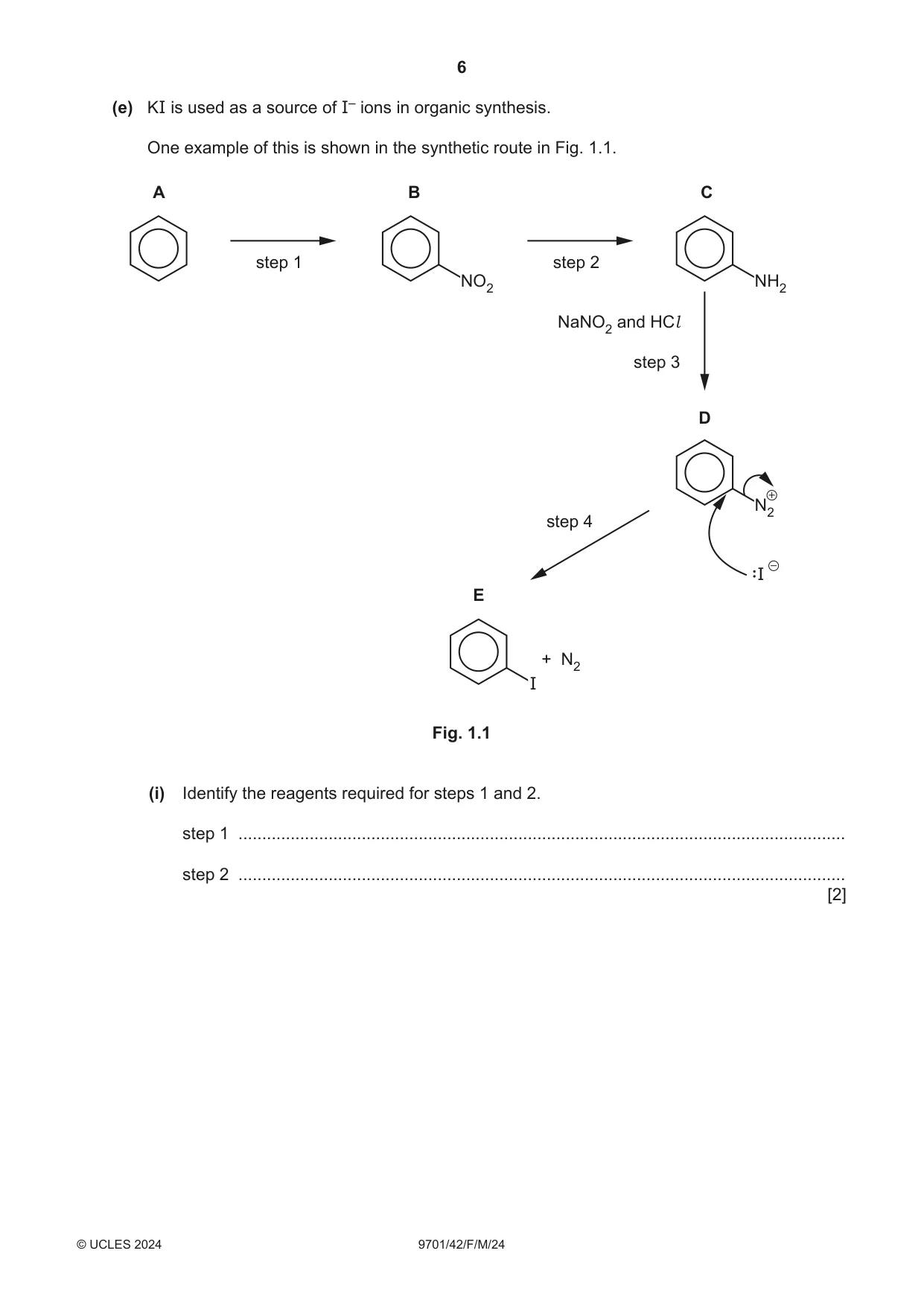
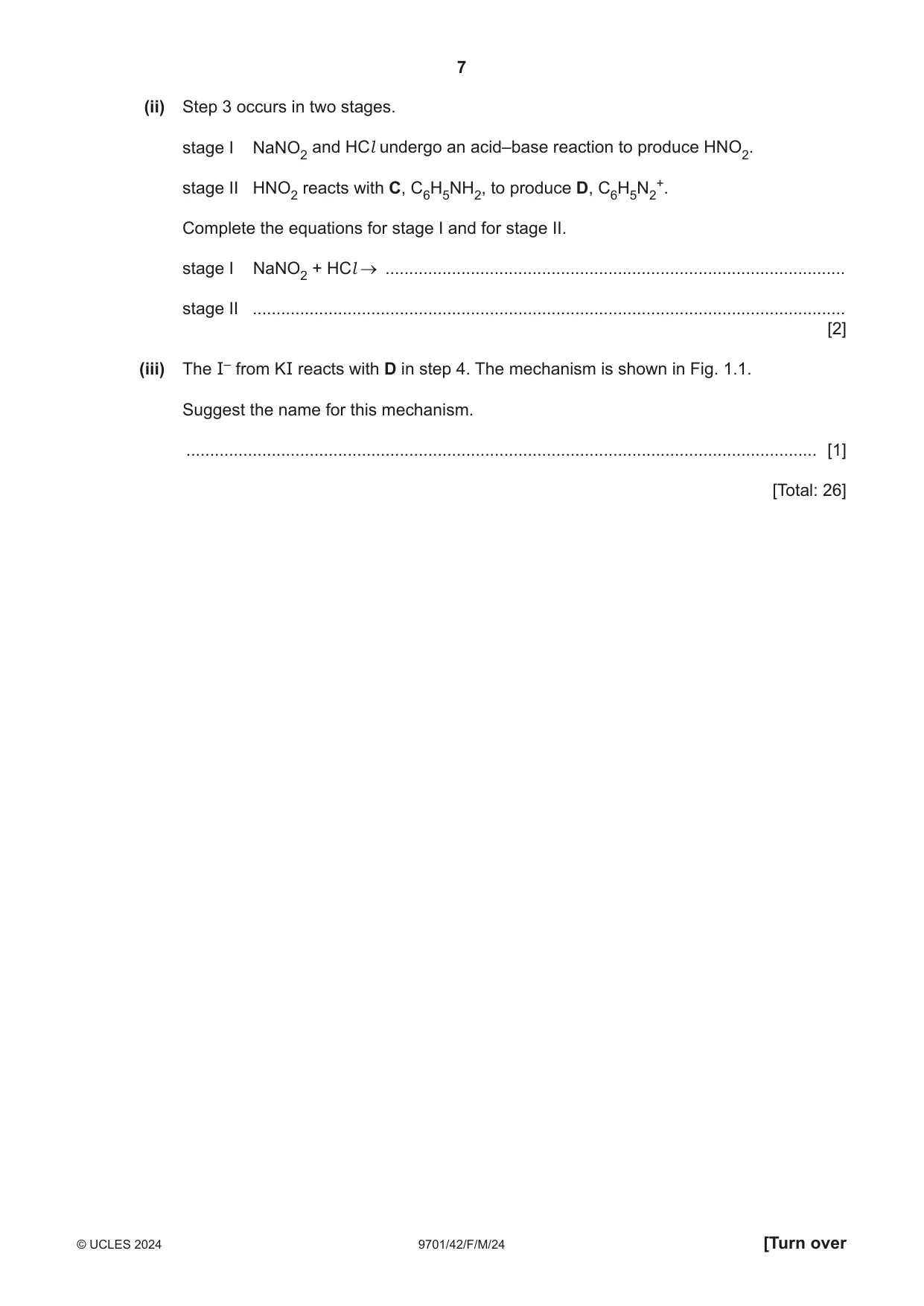
1 Potassium iodide, KI, is used as a reagent in both inorganic and organic chemistry. (a) KI forms an ionic lattice that is soluble in water. (i) Define enthalpy change of solution, ΔHsol. ........................................................................................................................................... ........................................................................................................................................... ..................................................................................................................................... [1] (ii) KI(s) has a high solubility in water although its enthalpy change of solution is endothermic. Explain how this high solubility is possible. ........................................................................................................................................... ........................................................................................................................................... ..................................................................................................................................... [2] (b) Table 1.1 gives some data about the halide ions, Cl –, Br – and I–, and their potassium salts. Table 1.1 enthalpy change of hydration, lattice energy of potassium halide, halide ion ΔHhyd / kJ mol–1 ΔHlatt / kJ mol–1 Cl – –364 –701 Br – –335 –670 I– –293 –629 (i) Explain the trend in the enthalpy change of hydration of the halide ions. ........................................................................................................................................... ........................................................................................................................................... ........................................................................................................................................... ..................................................................................................................................... [2] (ii) The ΔHsol values of these potassium halides are almost constant. Use the ΔHhyd and ΔHlatt data in Table 1.1 to suggest why. ........................................................................................................................................... ........................................................................................................................................... ..................................................................................................................................... [1] (iii) The enthalpy change of solution of KI(s) is +21.0 kJ mol–1. Use this information and the data in Table 1.1 to calculate the enthalpy change of hydration of the potassium ion, K+(g). ΔHhyd of K+(g) = ............................................ kJ mol–1 [1] (iv) Solid PbI2 forms when KI(aq) is mixed with Pb2+(aq) ions. The solubility product, Ksp, of PbI2 is 7.1 × 10⁻⁹ mol3 dm–9 at 25 °C. Calculate the solubility, in mol dm–3, of PbI2(s). solubility of PbI2(s) = ...........................................mol dm–3 [2] (v) The ionic radius of Pb2+ is 0.120 nm compared to 0.133 nm for K+. Suggest how the ΔH latto of PbI2(s) differs from ΔH latto of KI(s). Explain your answer. ........................................................................................................................................... ........................................................................................................................................... ..................................................................................................................................... [2] (c) KI slowly oxidises in air, forming I2. reaction 1 4KI(s) + 2CO2(g) + O2(g) 2K2CO3(s) + 2I2(s) ΔH o = –203.4 kJ mol–1 Table 1.2 shows some data relevant to this question. Table 1.2 standard entropy, substance o S / J K–1 mol–1 CO2(g) 213.6 I2(s) 116.1 K2CO3(s) 155.5 KI(s) 106.3 O2(g) 205.2 (i) Calculate the standard entropy change, ΔS o , of reaction 1. ΔS o = ....................................... J K–1 mol–1 [2] (ii) Use your answer to (c)(i) to show that reaction 1 is spontaneous at 298 K. [2] (iii) The Group 1 carbonates are much more thermally stable than the Group 2 carbonates. State and explain the trend in the thermal stability of the Group 2 carbonates. ........................................................................................................................................... ........................................................................................................................................... ........................................................................................................................................... ..................................................................................................................................... [2] (d) A student electrolyses a solution of KI(aq) for 8 minutes using a direct current. The half-equation for the reaction that occurs at the anode is given. 2I–(aq) I2(aq) + 2e– (i) Write a half-equation for the reaction that occurs at the cathode. Include state symbols. ..................................................................................................................................... [1] (ii) After the electrolysis, the I2(aq) produced requires 21.35 cm3 of 0.100 mol dm–3 Na2S2O3(aq) to react completely. I2(aq) + 2Na2S2O3(aq) 2NaI(aq) + Na2S4O6(aq) Calculate the average current used in 8 minutes during the electrolysis. current = ........................................................A [3] (e) KI is used as a source of I– ions in organic synthesis. One example of this is shown in the synthetic route in Fig. 1.1. A B C step 1 step 2 NO2 NH2 NaNO2 and HCl step 3 D N2 step 4 I E + N2 I Fig. 1.1 (i) Identify the reagents required for steps 1 and 2. step 1 ................................................................................................................................ step 2 ................................................................................................................................ [2] (ii) Step 3 occurs in two stages. stage I NaNO2 and HCl undergo an acid–base reaction to produce HNO2. stage II HNO2 reacts with C, C6H5NH2, to produce D, C6H5N2+. Complete the equations for stage I and for stage II. stage I NaNO2 + HCl ................................................................................................. stage II ............................................................................................................................. [2] (iii) The I– from KI reacts with D in step 4. The mechanism is shown in Fig. 1.1. Suggest the name for this mechanism. ..................................................................................................................................... [1] [Total: 26]
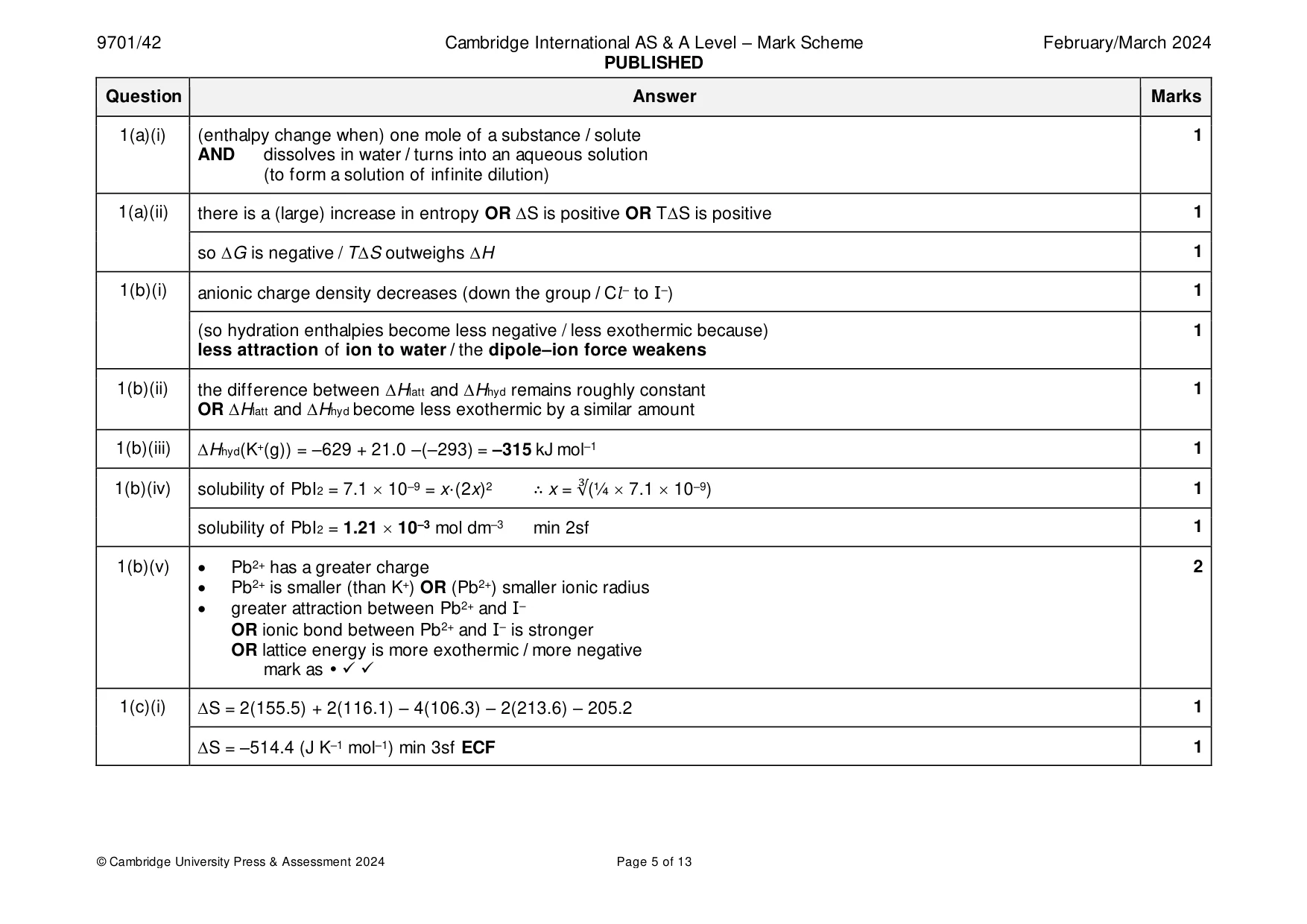
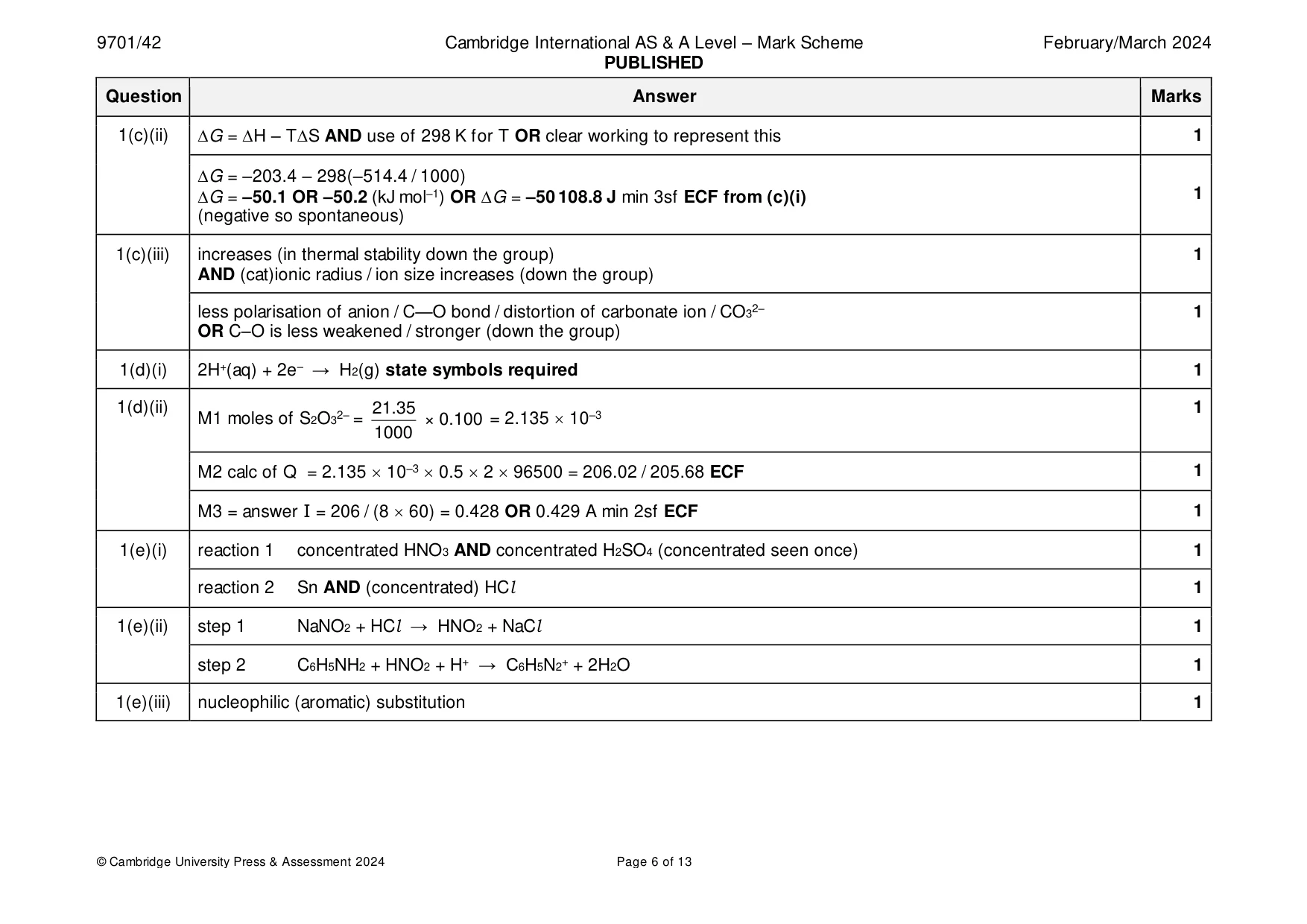
Mark scheme: Question Answer Marks 1(a)(i) (enthalpy change when) one mole of a substance / solute 1 AND dissolves in water / turns into an aqueous solution (to form a solution of infinite dilution) 1(a)(ii) there is a (large) increase in entropy OR S is positive OR TS is positive 1 so G is negative / TS outweighs H 1 1(b)(i) anionic charge density decreases (down the group / Cl – to I–) 1 (so hydration enthalpies become less negative / less exothermic because) 1 less attraction of ion to water / the dipole–ion force weakens 1(b)(ii) the difference between Hlatt and Hhyd remains roughly constant 1 OR Hlatt and Hhyd become less exothermic by a similar amount 1(b)(iii) Hhyd(K+(g)) = –629 + 21.0 –(–293) = –315 kJ mol–1 1 1(b)(iv) solubility of PbI2 = 7.1 10–9 = x·(2x)2 ∴ x = ∛(¼ 7.1 10–9) 1 solubility of PbI2 = 1.21 10–3 mol dm–3 min 2sf 1 1(b)(v) • Pb2+ has a greater charge 2 • Pb2+ is smaller (than K+) OR (Pb2+) smaller ionic radius • greater attraction between Pb2+ and I– OR ionic bond between Pb2+ and I– is stronger OR lattice energy is more exothermic / more negative mark as ✓ ✓ 1(c)(i) S = 2(155.5) + 2(116.1) – 4(106.3) – 2(213.6) – 205.2 1 S = –514.4 (J K–1 mol–1) min 3sf ECF 1 1(c)(ii) G = H – TS AND use of 298 K for T OR clear working to represent this 1 G = –203.4 – 298(–514.4 / 1000) G = –50.1 OR –50.2 (kJ mol–1) OR G = –50 108.8 J min 3sf ECF from (c)(i) 1 (negative so spontaneous) 1(c)(iii) increases (in thermal stability down the group) 1 AND (cat)ionic radius / ion size increases (down the group) less polarisation of anion / C—O bond / distortion of carbonate ion / CO32– 1 OR C–O is less weakened / stronger (down the group) 1(d)(i) 2H+(aq) + 2e– → H2(g) state symbols required 1 1(d)(ii) 21.35 1 M1 moles of S2O32– = × 0.100 = 2.135 10–3 1000 M2 calc of Q = 2.135 10–3 0.5 2 96500 = 206.02 / 205.68 ECF 1 M3 = answer I = 206 / (8 60) = 0.428 OR 0.429 A min 2sf ECF 1 1(e)(i) reaction 1 concentrated HNO3 AND concentrated H2SO4 (concentrated seen once) 1 reaction 2 Sn AND (concentrated) HCl 1 1(e)(ii) step 1 NaNO2 + HCl → HNO2 + NaCl 1 step 2 C6H5NH2 + HNO2 + H+ → C6H5N2+ + 2H2O 1 1(e)(iii) nucleophilic (aromatic) substitution 1
Q2 · Water is an amphoteric compound that also acts as a good solvent of polar and ionic…
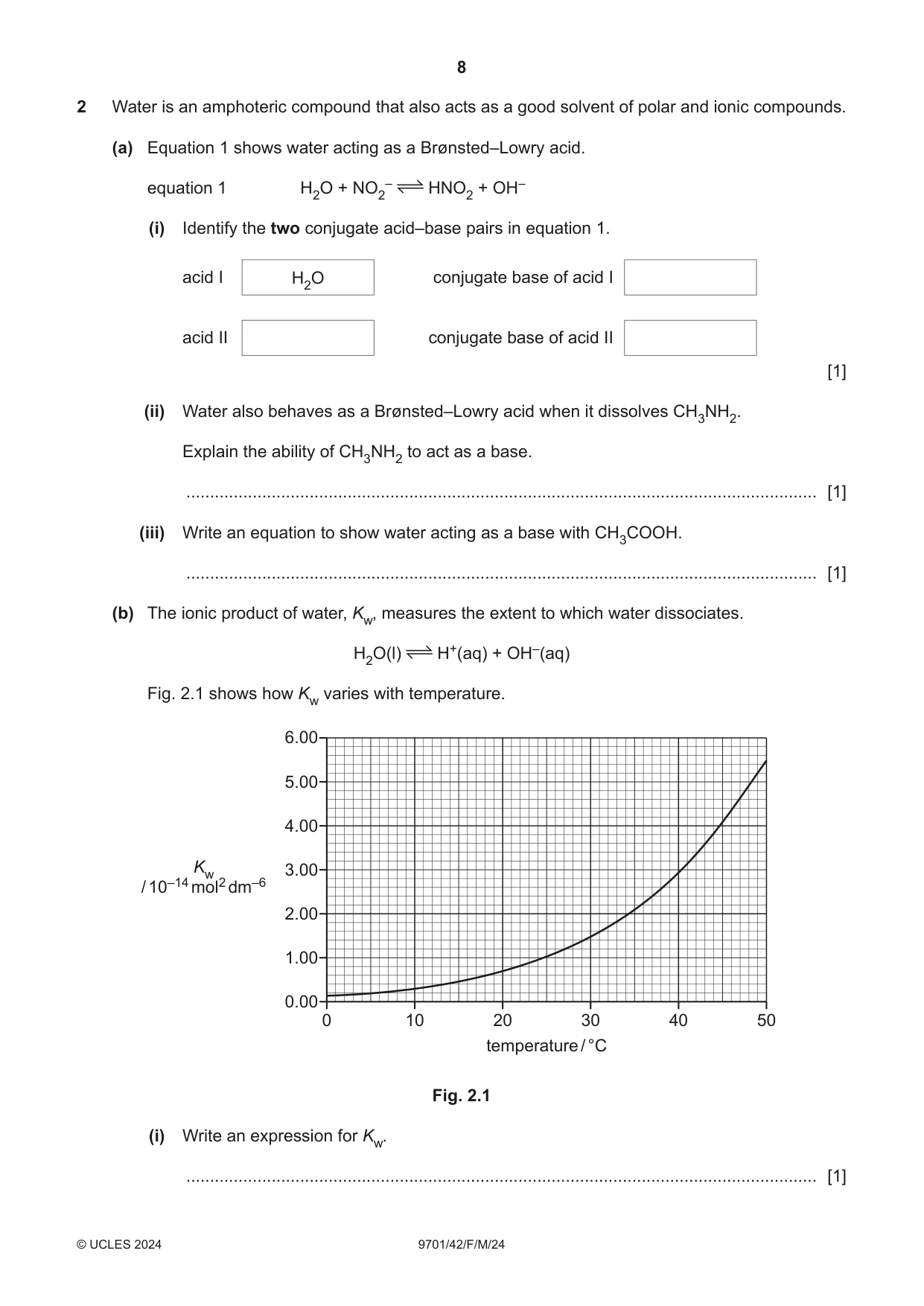
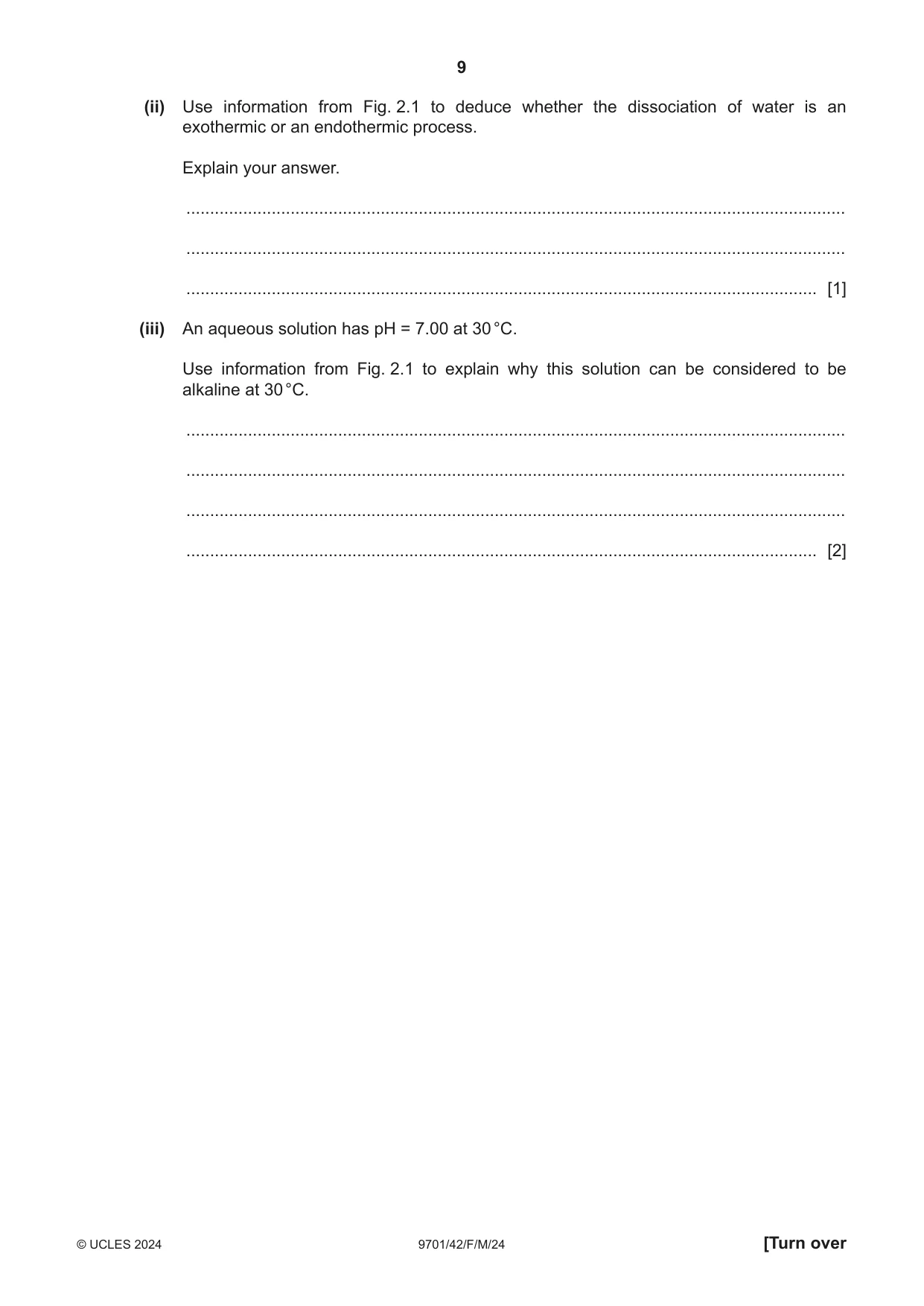
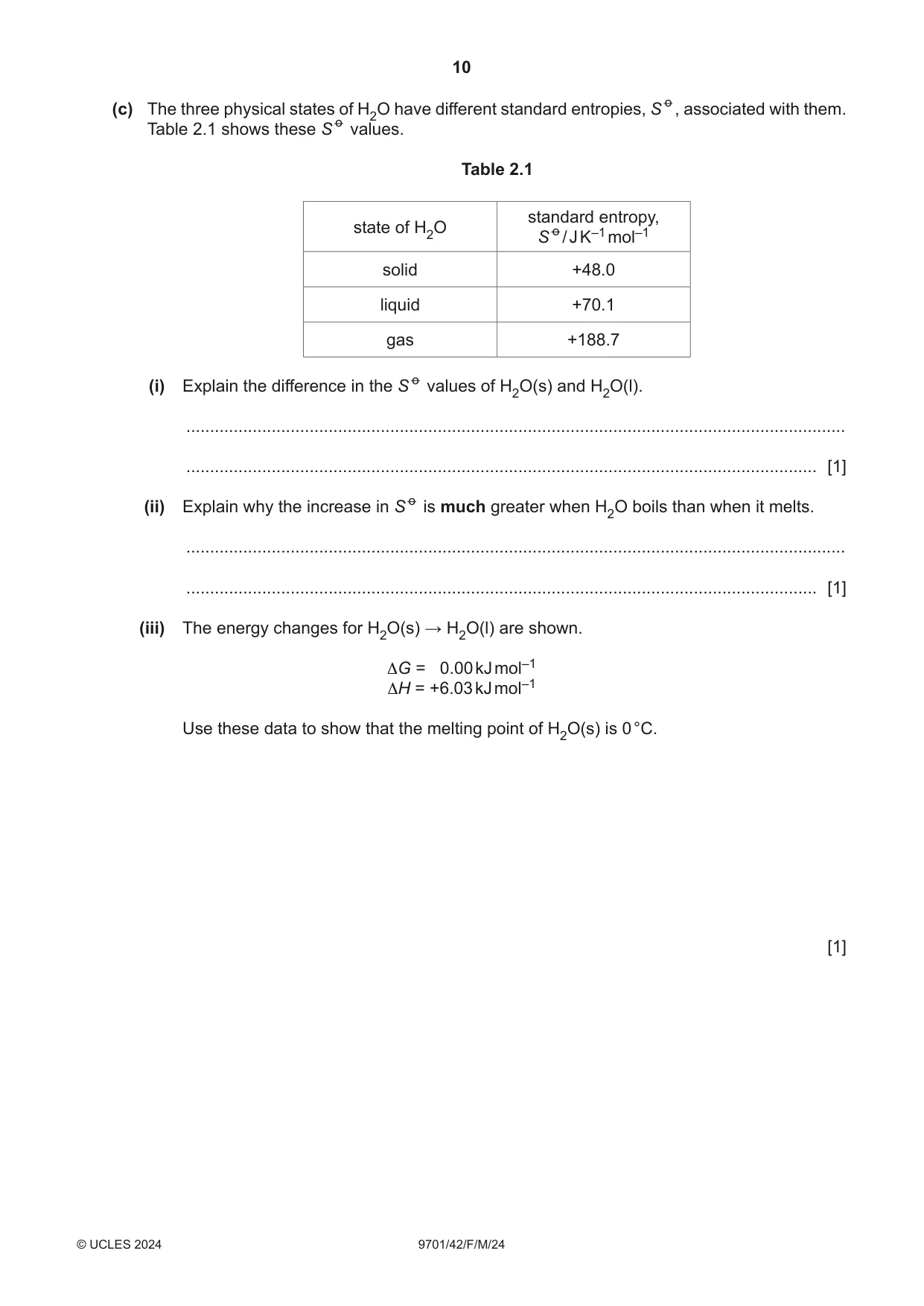
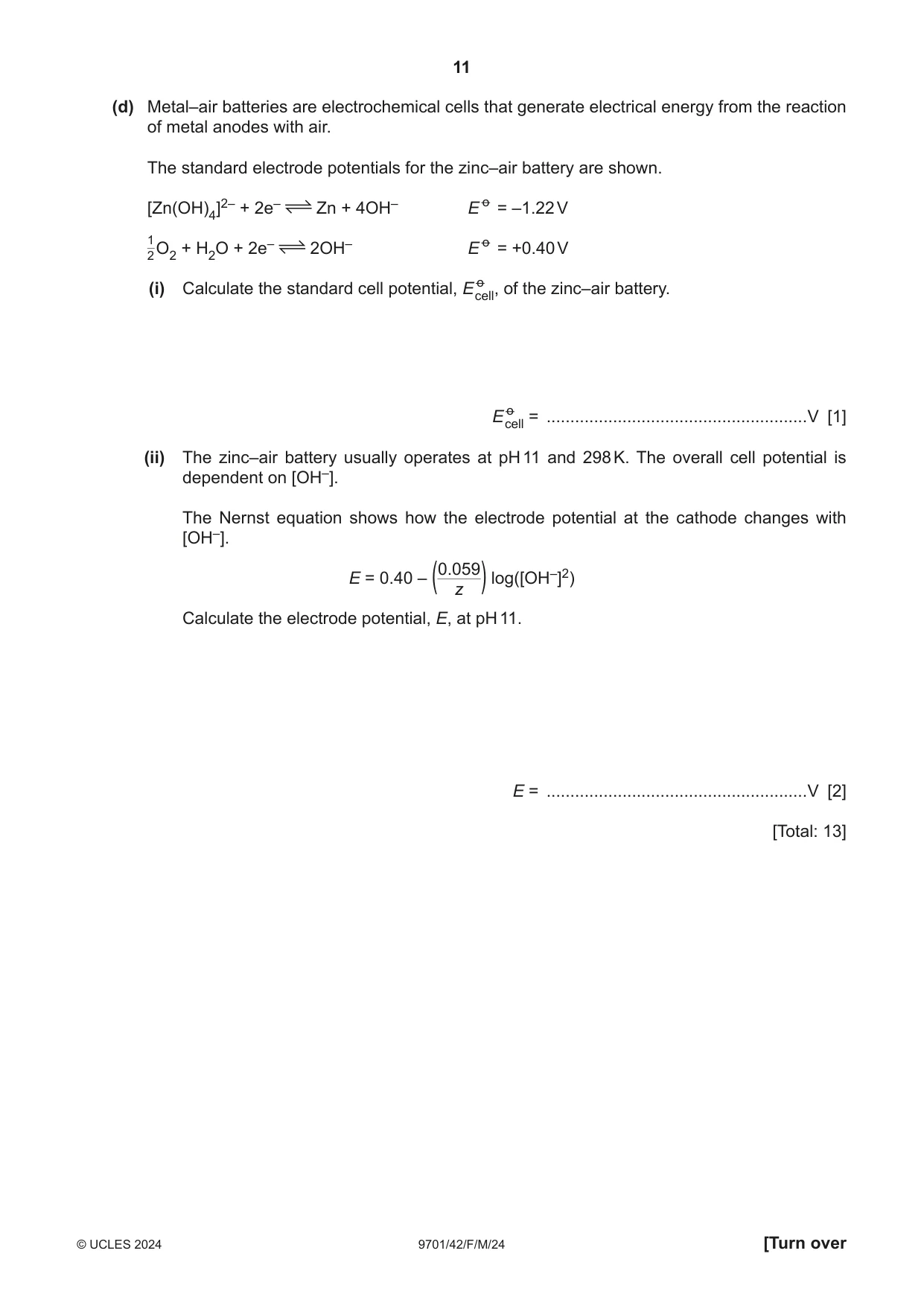
2 Water is an amphoteric compound that also acts as a good solvent of polar and ionic compounds. (a) Equation 1 shows water acting as a Brønsted–Lowry acid. equation 1 H2O + NO2– HNO2 + OH– (i) Identify the two conjugate acid–base pairs in equation 1. acid I H2O conjugate base of acid I acid II conjugate base of acid II [1] (ii) Water also behaves as a Brønsted–Lowry acid when it dissolves CH3NH2. Explain the ability of CH3NH2 to act as a base. ..................................................................................................................................... [1] (iii) Write an equation to show water acting as a base with CH3COOH. ..................................................................................................................................... [1] (b) The ionic product of water, Kw, measures the extent to which water dissociates. H2O(l) H+(aq) + OH–(aq) Fig. 2.1 shows how Kw varies with temperature. 6.00 5.00 4.00 Kw 3.00 / 10–14 mol2 dm–6 2.00 1.00 0.00 0 10 20 30 40 50 temperature / °C Fig. 2.1 (i) Write an expression for Kw. ..................................................................................................................................... [1] (ii) Use information from Fig. 2.1 to deduce whether the dissociation of water is an exothermic or an endothermic process. Explain your answer. ........................................................................................................................................... ........................................................................................................................................... ..................................................................................................................................... [1] (iii) An aqueous solution has pH = 7.00 at 30 °C. Use information from Fig. 2.1 to explain why this solution can be considered to be alkaline at 30 °C. ........................................................................................................................................... ........................................................................................................................................... ........................................................................................................................................... ..................................................................................................................................... [2] (c) The three physical states of H2O have different standard entropies, S o , associated with them. Table 2.1 shows these S o values. Table 2.1 standard entropy, state of H2O o S / J K–1 mol–1 solid +48.0 liquid +70.1 gas +188.7 (i) Explain the difference in the S o values of H2O(s) and H2O(l). ........................................................................................................................................... ..................................................................................................................................... [1] (ii) Explain why the increase in S o is much greater when H2O boils than when it melts. ........................................................................................................................................... ..................................................................................................................................... [1] (iii) The energy changes for H2O(s) → H2O(l) are shown. ΔG = 0.00 kJ mol–1 ΔH = +6.03 kJ mol–1 Use these data to show that the melting point of H2O(s) is 0 °C. [1] (d) Metal–air batteries are electrochemical cells that generate electrical energy from the reaction of metal anodes with air. The standard electrode potentials for the zinc–air battery are shown. [Zn(OH)4]2– + 2e– Zn + 4OH– E o = –1.22 V E o = +0.40 V 12 O2 + H2O + 2e– 2OH– (i) Calculate the standard cell potential, E cell,o of the zinc–air battery. E cello = .......................................................V [1] (ii) The zinc–air battery usually operates at pH 11 and 298 K. The overall cell potential is dependent on [OH–]. The Nernst equation shows how the electrode potential at the cathode changes with [OH–]. E = 0.40 – log([OH–]2) (0.059z ) Calculate the electrode potential, E, at pH 11. E = .......................................................V [2] [Total: 13]
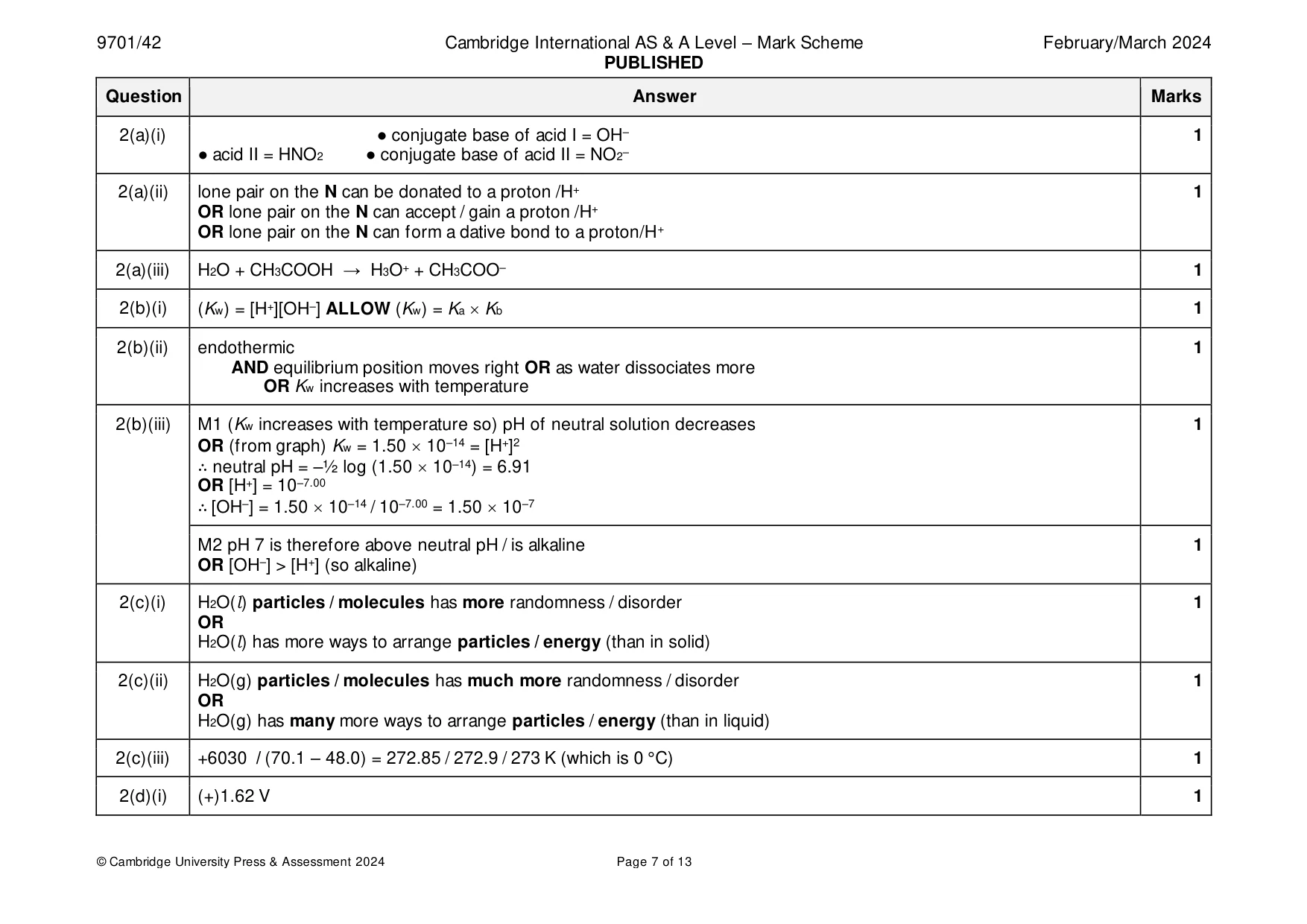
Mark scheme: 2(a)(i) ● conjugate base of acid I = OH– 1 ● acid II = HNO2 ● conjugate base of acid II = NO2– 2(a)(ii) lone pair on the N can be donated to a proton /H+ 1 OR lone pair on the N can accept / gain a proton /H+ OR lone pair on the N can form a dative bond to a proton/H+ 2(a)(iii) H2O + CH3COOH → H3O+ + CH3COO– 1 2(b)(i) (Kw) = [H+][OH–] ALLOW (Kw) = Ka Kb 1 2(b)(ii) endothermic 1 AND equilibrium position moves right OR as water dissociates more OR Kw increases with temperature 2(b)(iii) M1 (Kw increases with temperature so) pH of neutral solution decreases 1 OR (from graph) Kw = 1.50 10–14 = [H+]2 ∴ neutral pH = –½ log (1.50 10–14) = 6.91 OR [H+] = 10–7.00 ∴ [OH–] = 1.50 10–14 / 10–7.00 = 1.50 10–7 M2 pH 7 is therefore above neutral pH / is alkaline 1 OR [OH–] > [H+] (so alkaline) 2(c)(i) H2O(l) particles / molecules has more randomness / disorder 1 OR H2O(l) has more ways to arrange particles / energy (than in solid) 2(c)(ii) H2O(g) particles / molecules has much more randomness / disorder 1 OR H2O(g) has many more ways to arrange particles / energy (than in liquid) 2(c)(iii) +6030 / (70.1 – 48.0) = 272.85 / 272.9 / 273 K (which is 0 °C) 1 2(d)(i) (+)1.62 V 1 2(d)(ii) [OH–] = 10–14/10–11 = 1 10–3 1 E = +0.40 – ½ 0.059 log (10–3)2 = +0.40 – 0.059(–3) = +0.577 (V) min 2sf 1
Q3 · Iron is a transition metal in Group 8 of the Periodic Table
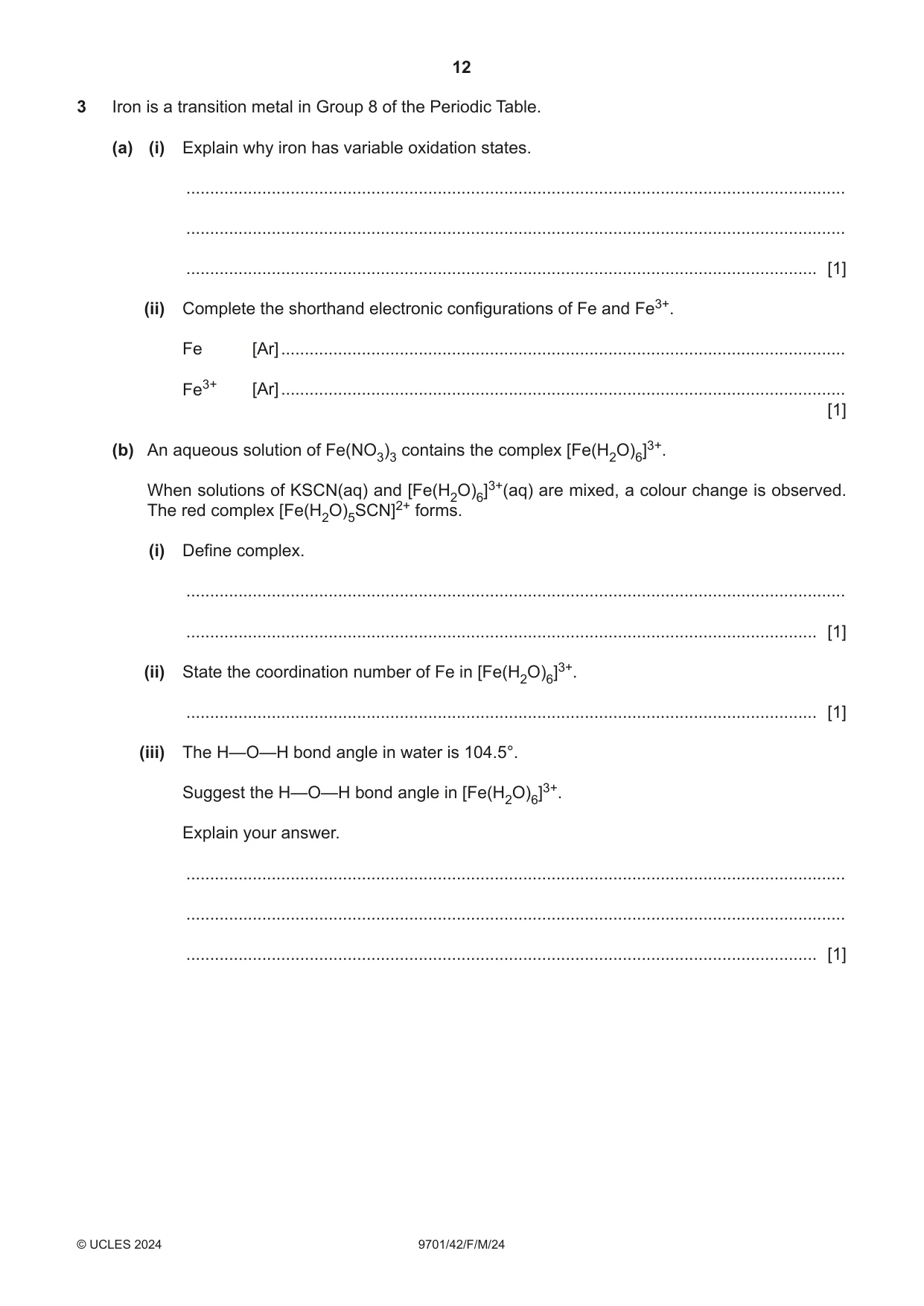
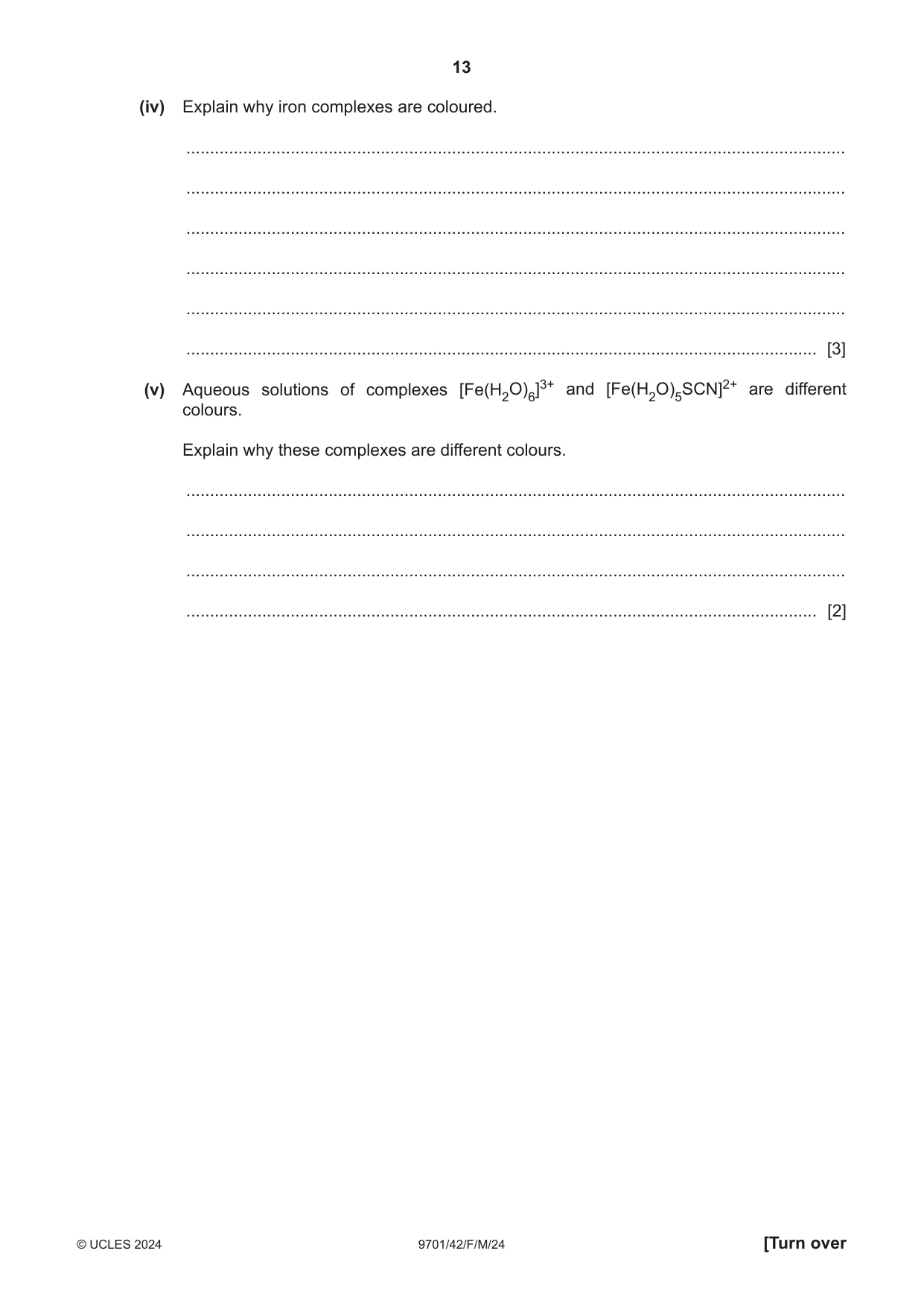
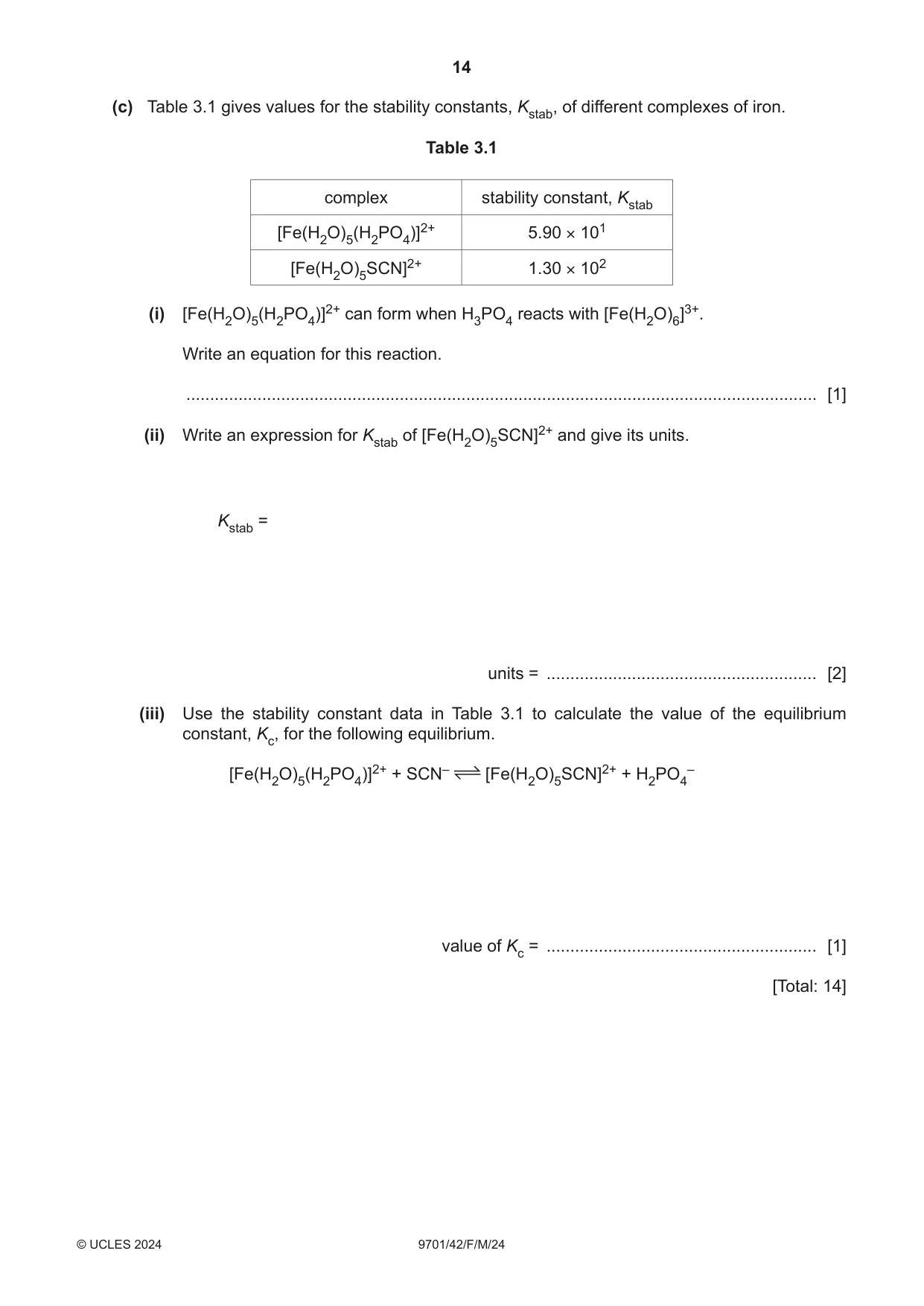
3 Iron is a transition metal in Group 8 of the Periodic Table. (a) (i) Explain why iron has variable oxidation states. ........................................................................................................................................... ........................................................................................................................................... ..................................................................................................................................... [1] (ii) Complete the shorthand electronic configurations of Fe and Fe3+. Fe [Ar] ....................................................................................................................... Fe3+ [Ar] ....................................................................................................................... [1] (b) An aqueous solution of Fe(NO3)3 contains the complex [Fe(H2O)6]3+. When solutions of KSCN(aq) and [Fe(H2O)6]3+(aq) are mixed, a colour change is observed. The red complex [Fe(H2O)5SCN]2+ forms. (i) Define complex. ........................................................................................................................................... ..................................................................................................................................... [1] (ii) State the coordination number of Fe in [Fe(H2O)6]3+. ..................................................................................................................................... [1] (iii) The H—O—H bond angle in water is 104.5°. Suggest the H—O—H bond angle in [Fe(H2O)6]3+. Explain your answer. ........................................................................................................................................... ........................................................................................................................................... ..................................................................................................................................... [1] (iv) Explain why iron complexes are coloured. ........................................................................................................................................... ........................................................................................................................................... ........................................................................................................................................... ........................................................................................................................................... ........................................................................................................................................... ..................................................................................................................................... [3] (v) Aqueous solutions of complexes [Fe(H2O)6]3+ and [Fe(H2O)5SCN]2+ are different colours. Explain why these complexes are different colours. ........................................................................................................................................... ........................................................................................................................................... ........................................................................................................................................... ..................................................................................................................................... [2] (c) Table 3.1 gives values for the stability constants, Kstab, of different complexes of iron. Table 3.1 complex stability constant, Kstab × 101 [Fe(H2O)5(H2PO4)]2+ 5.90 × 10² [Fe(H2O)5SCN]2+ 1.30 (i) [Fe(H2O)5(H2PO4)]2+ can form when H3PO4 reacts with [Fe(H2O)6]3+. Write an equation for this reaction. ..................................................................................................................................... [1] (ii) Write an expression for Kstab of [Fe(H2O)5SCN]2+ and give its units. Kstab = units = ......................................................... [2] (iii) Use the stability constant data in Table 3.1 to calculate the value of the equilibrium constant, Kc, for the following equilibrium. [Fe(H2O)5(H2PO4)]2+ + SCN– [Fe(H2O)5SCN]2+ + H2PO4– value of Kc = ......................................................... [1] [Total: 14]
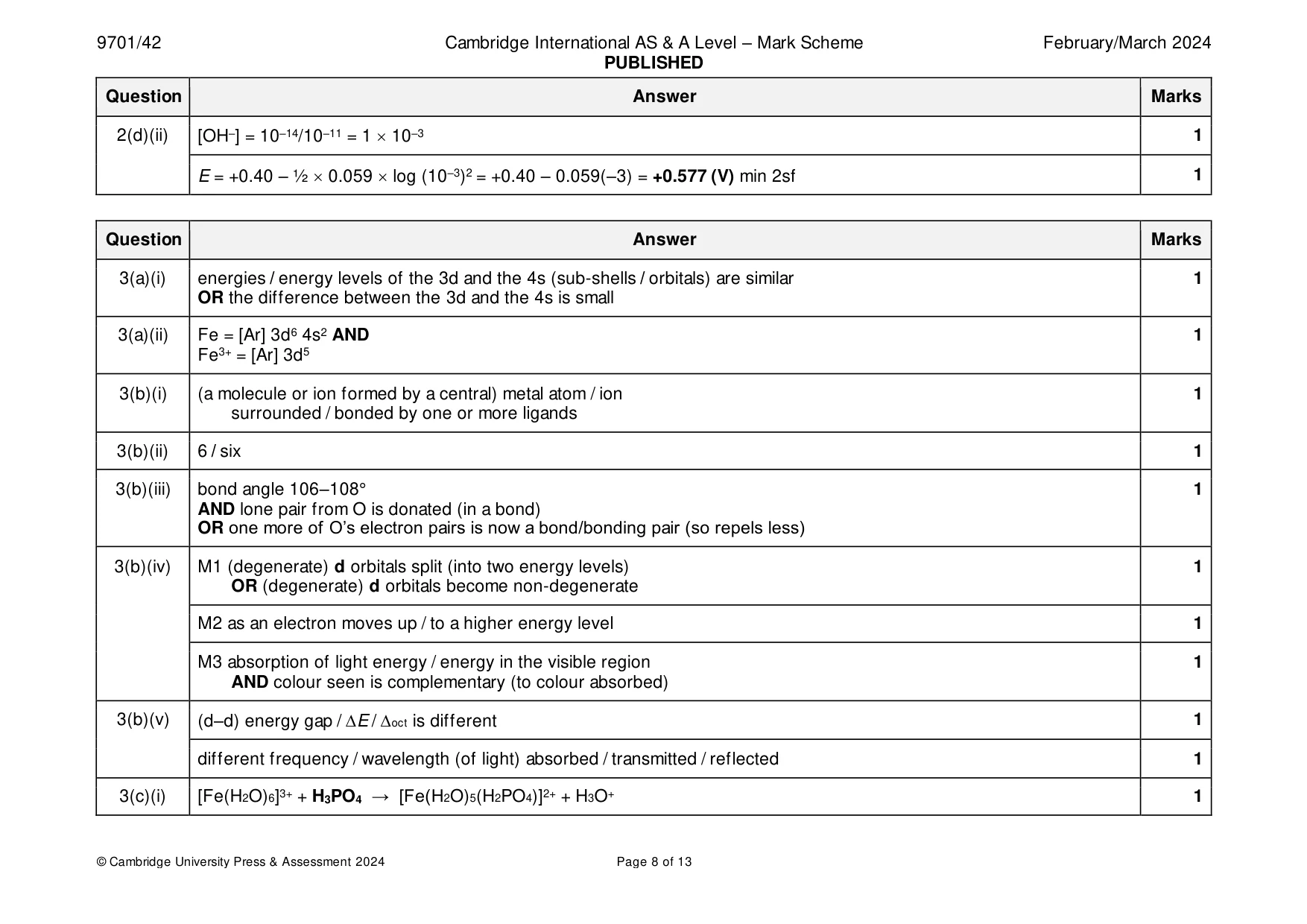
Mark scheme: 3(a)(i) energies / energy levels of the 3d and the 4s (sub-shells / orbitals) are similar 1 OR the difference between the 3d and the 4s is small 3(a)(ii) Fe = [Ar] 3d6 4s2 AND 1 Fe3+ = [Ar] 3d5 3(b)(i) (a molecule or ion formed by a central) metal atom / ion 1 surrounded / bonded by one or more ligands 3(b)(ii) 6 / six 1 3(b)(iii) bond angle 106–108° 1 AND lone pair from O is donated (in a bond) OR one more of O’s electron pairs is now a bond/bonding pair (so repels less) 3(b)(iv) M1 (degenerate) d orbitals split (into two energy levels) 1 OR (degenerate) d orbitals become non-degenerate M2 as an electron moves up / to a higher energy level 1 M3 absorption of light energy / energy in the visible region 1 AND colour seen is complementary (to colour absorbed) 3(b)(v) (d–d) energy gap / E / oct is different 1 different frequency / wavelength (of light) absorbed / transmitted / reflected 1 3(c)(i) [Fe(H2O)6]3+ + H3PO4 → [Fe(H2O)5(H2PO4)]2+ + H3O+ 1 3(c)(ii) [[Fe(H2 O)5 (SCN)]2 + ] 1 Kstab = [[Fe(H2 O)6 ]3+ ] [SCN– ] mol–1 dm3 u/c 1 3(c)(iii) 1.30 102 / 59.0 = 2.2(03) min 2sf 1
Q4 · Ruthenium and osmium are transition metals below iron in Group 8 of the Periodic Table
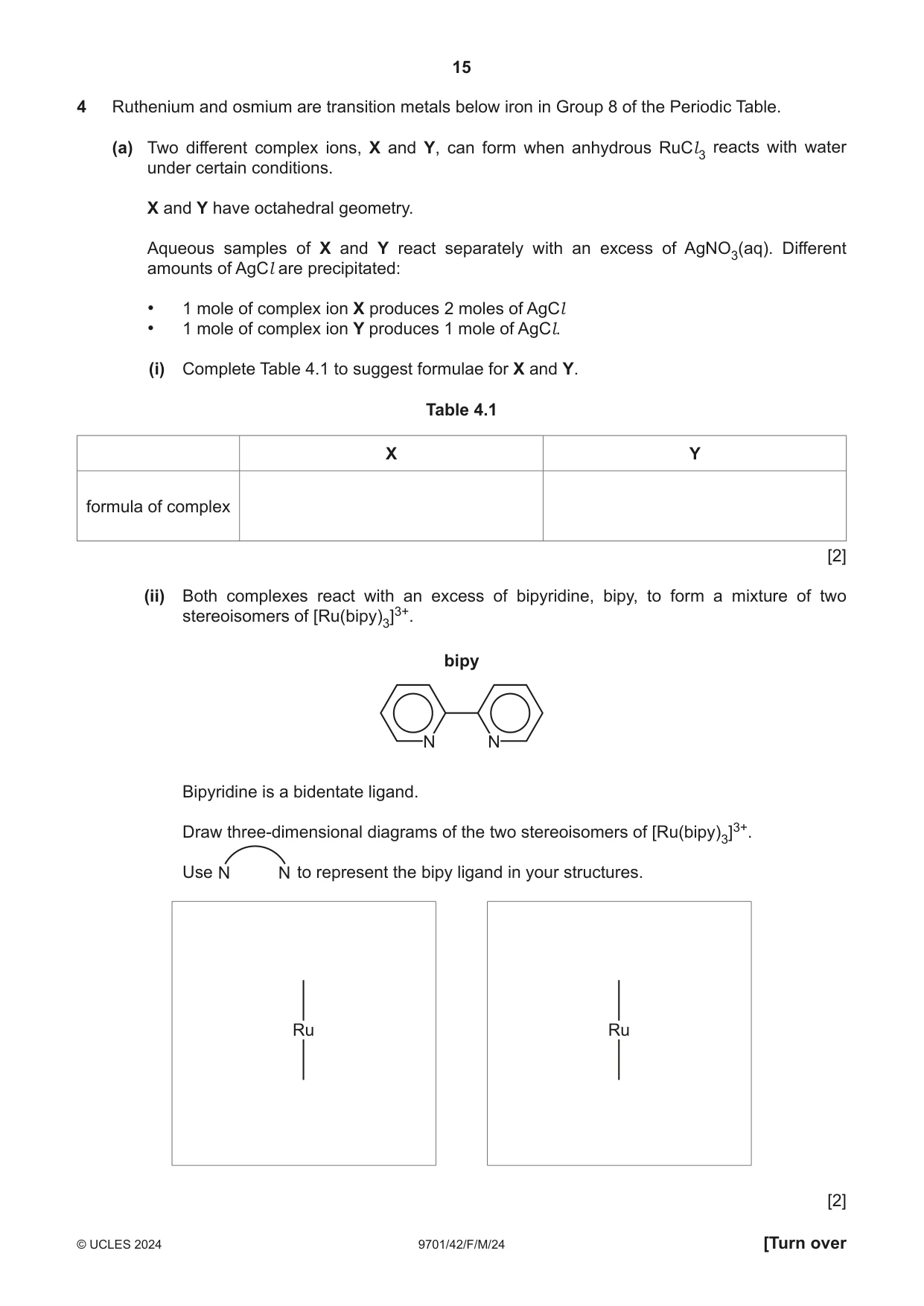
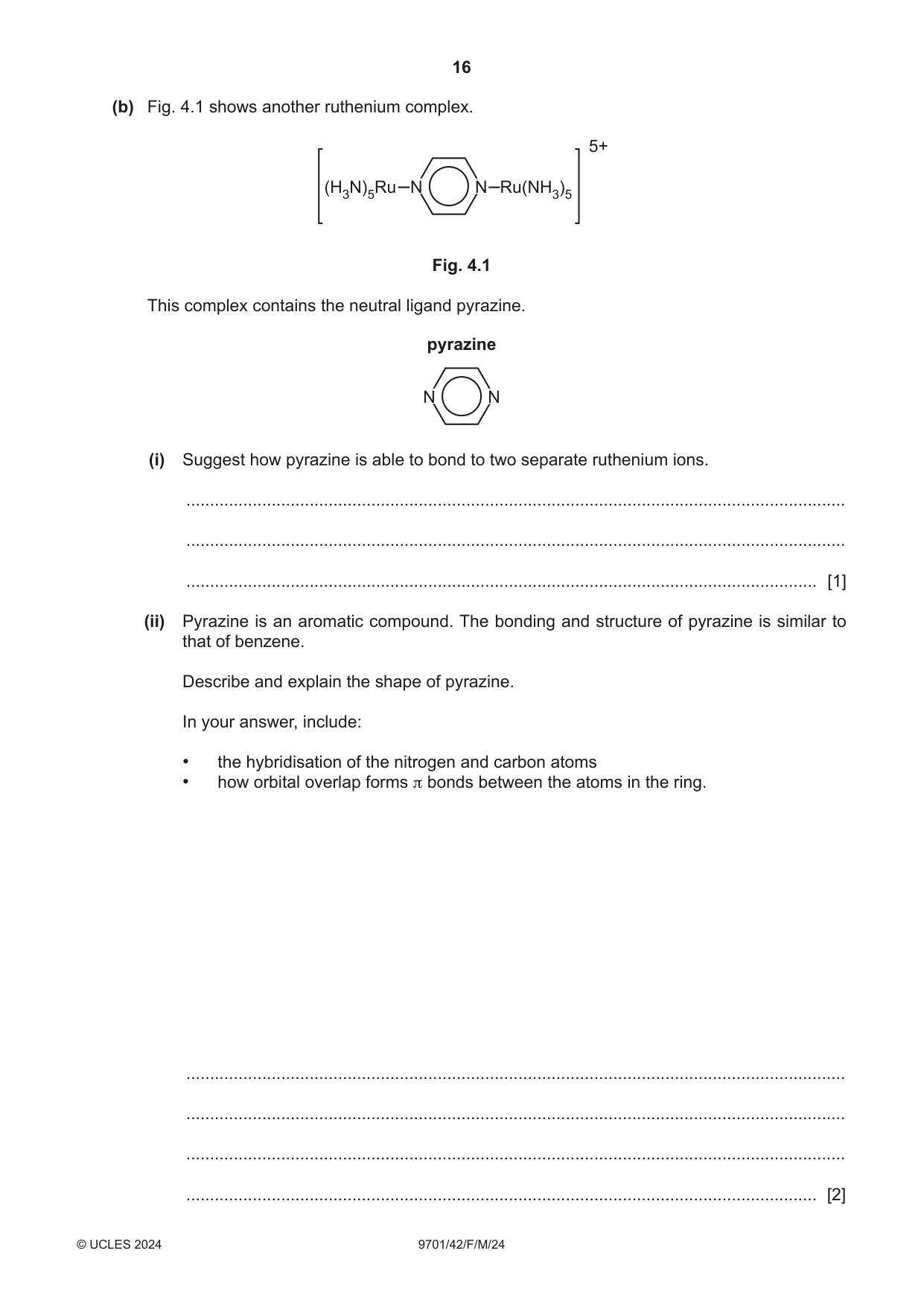
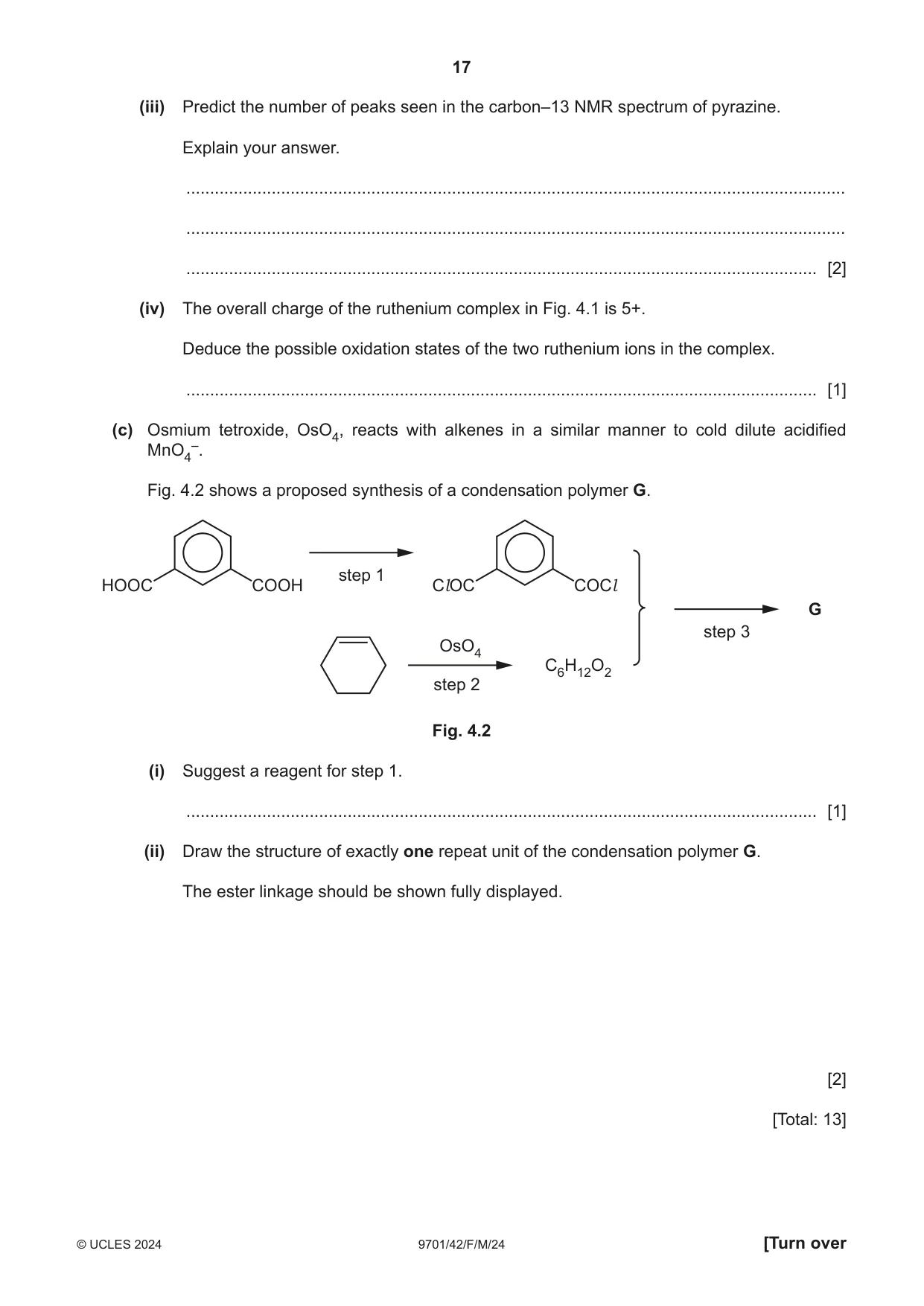
4 Ruthenium and osmium are transition metals below iron in Group 8 of the Periodic Table. (a) Two different complex ions, X and Y, can form when anhydrous RuCl 3 reacts with water under certain conditions. X and Y have octahedral geometry. Aqueous samples of X and Y react separately with an excess of AgNO3(aq). Different amounts of AgCl are precipitated: • 1 mole of complex ion X produces 2 moles of AgCl • 1 mole of complex ion Y produces 1 mole of AgCl. (i) Complete Table 4.1 to suggest formulae for X and Y. Table 4.1 X Y formula of complex [2] (ii) Both complexes react with an excess of bipyridine, bipy, to form a mixture of two stereoisomers of [Ru(bipy)3]3+. bipy N N Bipyridine is a bidentate ligand. Draw three-dimensional diagrams of the two stereoisomers of [Ru(bipy)3]3+. Use N N to represent the bipy ligand in your structures. Ru Ru [2] (b) Fig. 4.1 shows another ruthenium complex. 5+ (H3N)5Ru N N Ru(NH3)5 Fig. 4.1 This complex contains the neutral ligand pyrazine. pyrazine N N (i) Suggest how pyrazine is able to bond to two separate ruthenium ions. ........................................................................................................................................... ........................................................................................................................................... ..................................................................................................................................... [1] (ii) Pyrazine is an aromatic compound. The bonding and structure of pyrazine is similar to that of benzene. Describe and explain the shape of pyrazine. In your answer, include: • the hybridisation of the nitrogen and carbon atoms • how orbital overlap forms π bonds between the atoms in the ring. ........................................................................................................................................... ........................................................................................................................................... ........................................................................................................................................... ..................................................................................................................................... [2] (iii) Predict the number of peaks seen in the carbon–13 NMR spectrum of pyrazine. Explain your answer. ........................................................................................................................................... ........................................................................................................................................... ..................................................................................................................................... [2] (iv) The overall charge of the ruthenium complex in Fig. 4.1 is 5+. Deduce the possible oxidation states of the two ruthenium ions in the complex. ..................................................................................................................................... [1] (c) Osmium tetroxide, OsO4, reacts with alkenes in a similar manner to cold dilute acidified MnO4–. Fig. 4.2 shows a proposed synthesis of a condensation polymer G. step 1HOOC COOH ClOC COCl G step 3 OsO4 C6H12O2 step 2 Fig. 4.2 (i) Suggest a reagent for step 1. ..................................................................................................................................... [1] (ii) Draw the structure of exactly one repeat unit of the condensation polymer G. The ester linkage should be shown fully displayed. [2] [Total: 13]
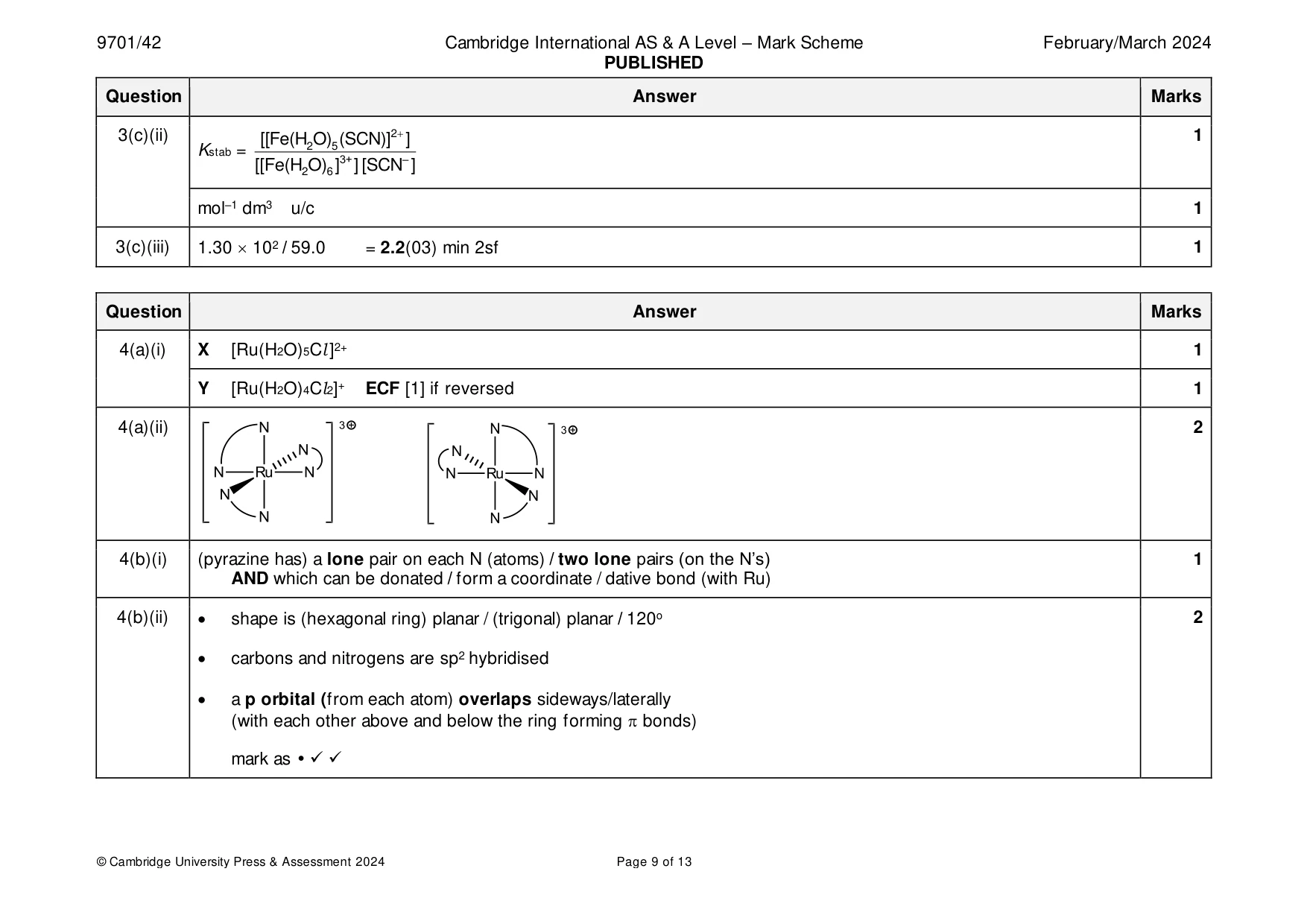
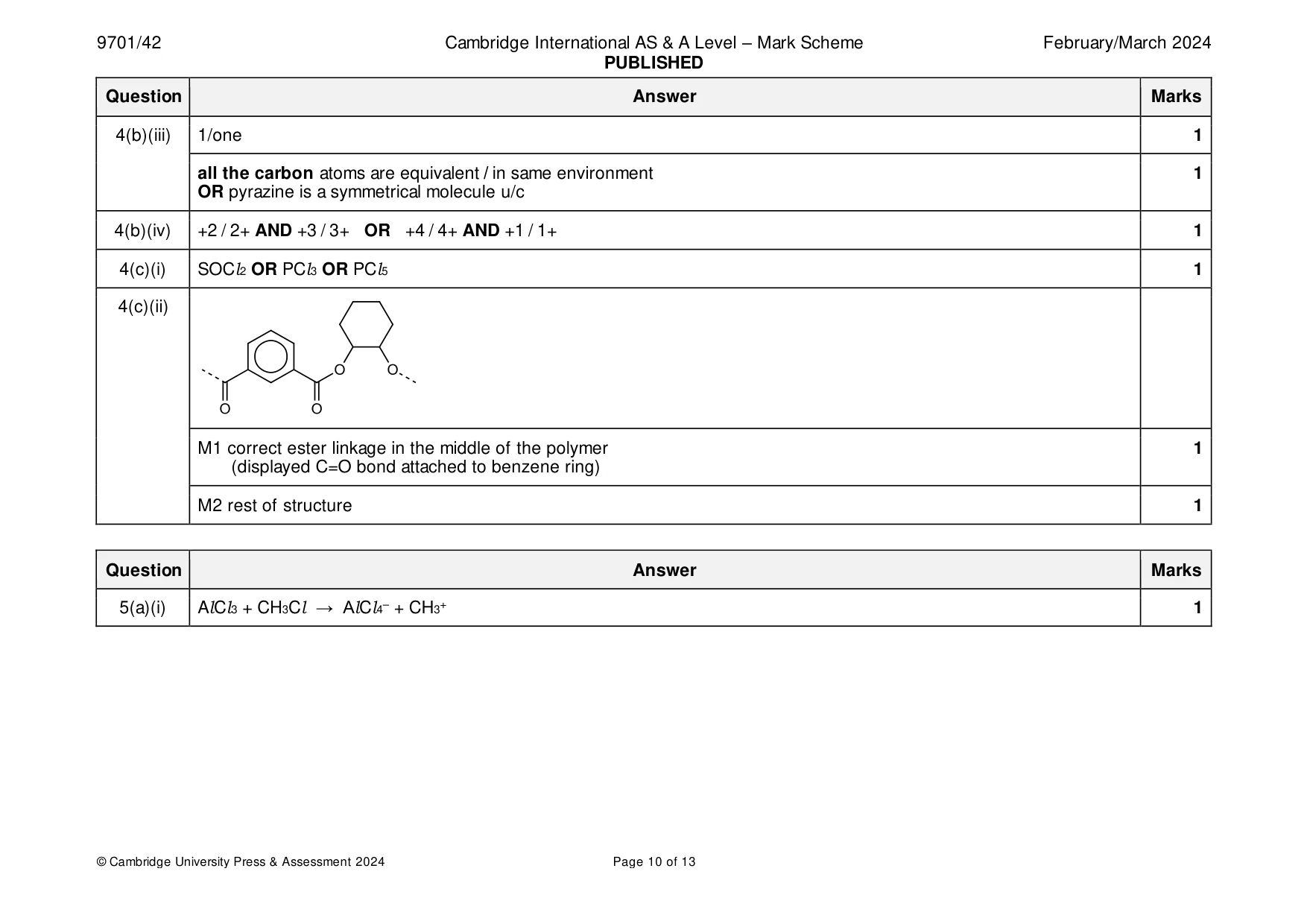
Mark scheme: 4(a)(i) X [Ru(H2O)5Cl ]2+ 1 Y [Ru(H2O)4Cl2]+ ECF [1] if reversed 1 4(a)(ii) 2 4(b)(i) (pyrazine has) a lone pair on each N (atoms) / two lone pairs (on the N’s) 1 AND which can be donated / form a coordinate / dative bond (with Ru) 4(b)(ii) • shape is (hexagonal ring) planar / (trigonal) planar / 120o 2 • carbons and nitrogens are sp2 hybridised • a p orbital (from each atom) overlaps sideways/laterally (with each other above and below the ring forming bonds) mark as ✓ ✓ 4(b)(iii) 1/one 1 all the carbon atoms are equivalent / in same environment 1 OR pyrazine is a symmetrical molecule u/c 4(b)(iv) +2 / 2+ AND +3 / 3+ OR +4 / 4+ AND +1 / 1+ 1 4(c)(i) SOCl2 OR PCl3 OR PCl5 1 4(c)(ii) M1 correct ester linkage in the middle of the polymer 1 (displayed C=O bond attached to benzene ring) M2 rest of structure 1
More questions on Stereoisomerism in transition element complexes
Q5 · Compound Q can be synthesised from chlorobenzene in seven steps, using the route shown in…
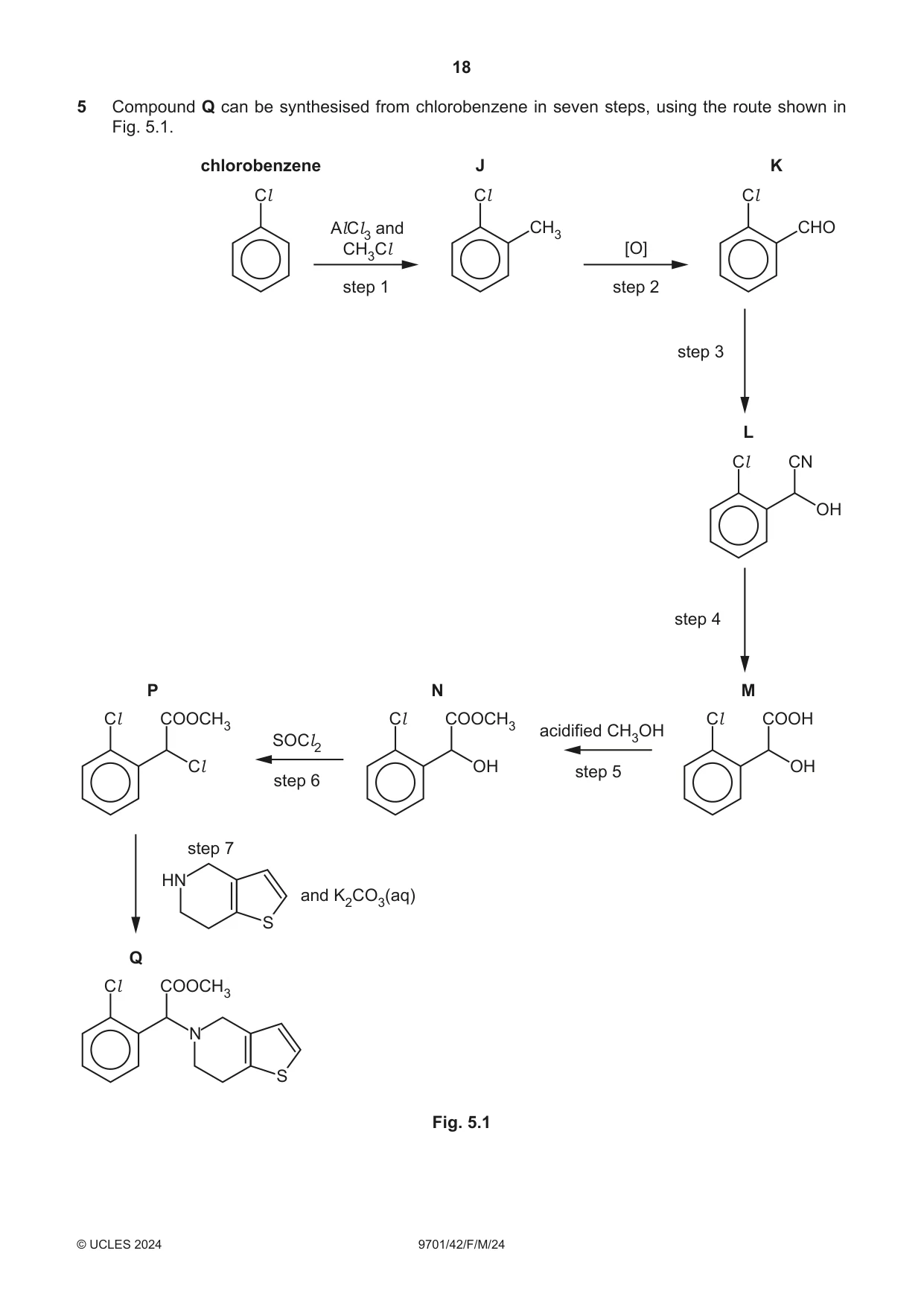
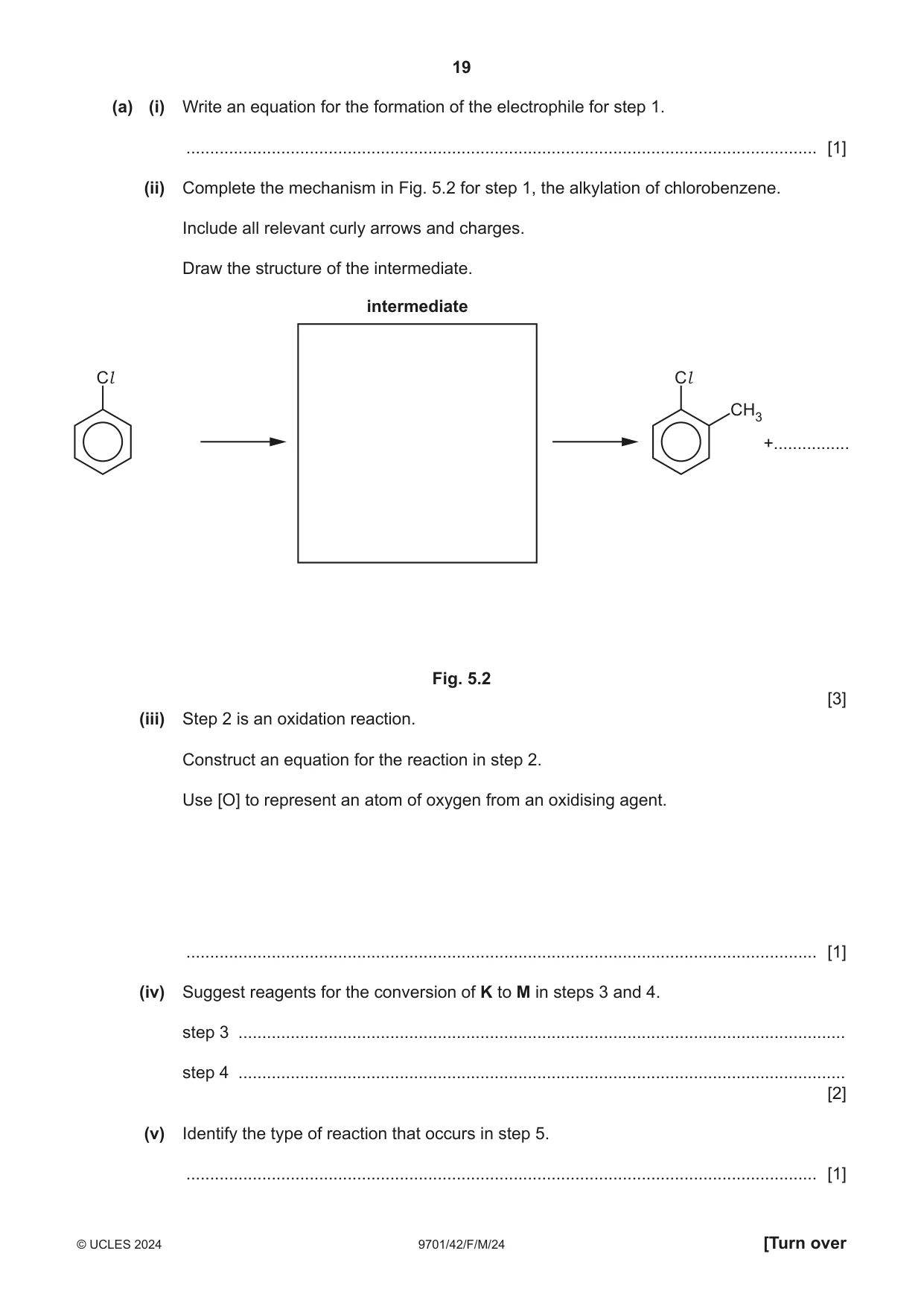
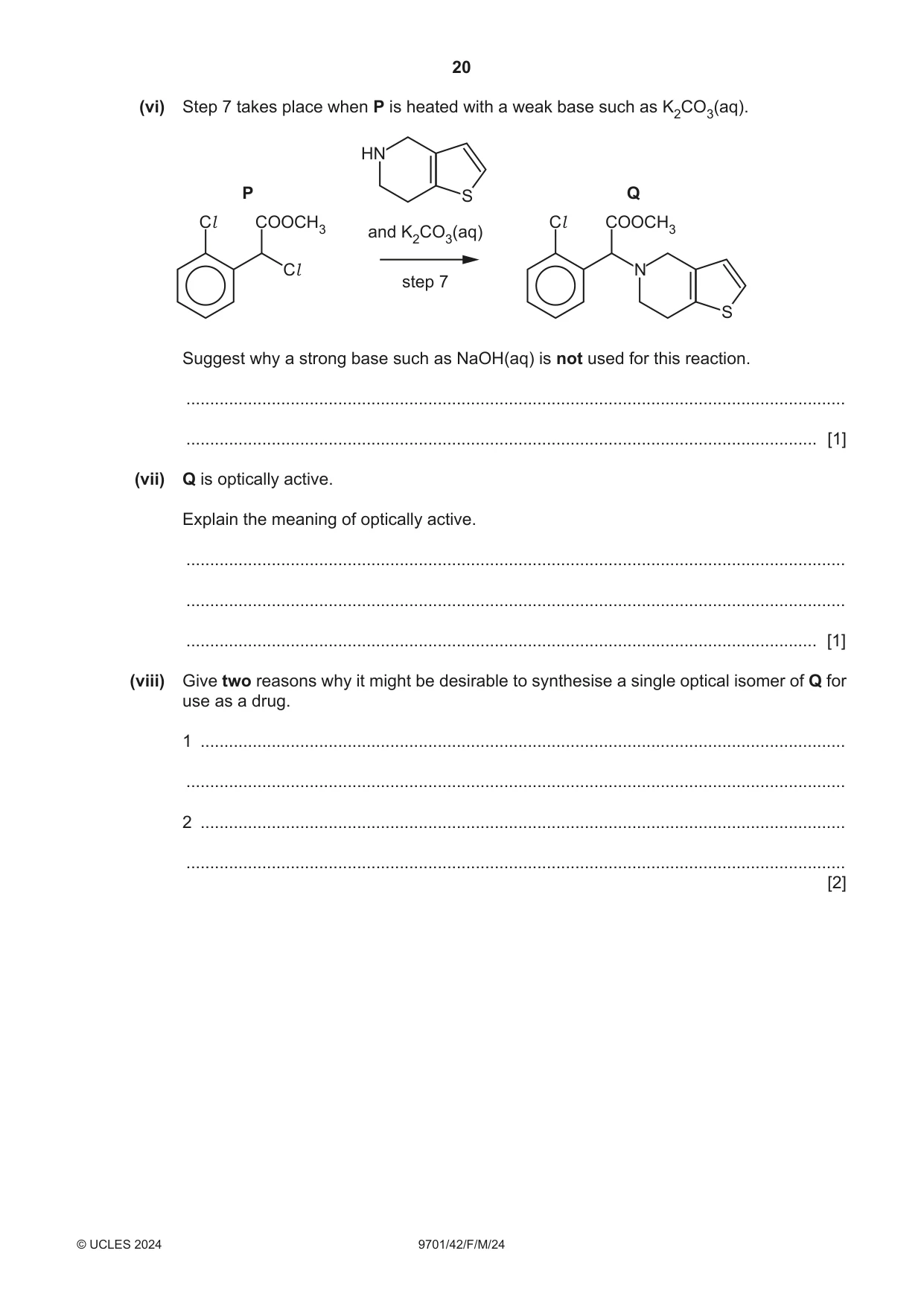
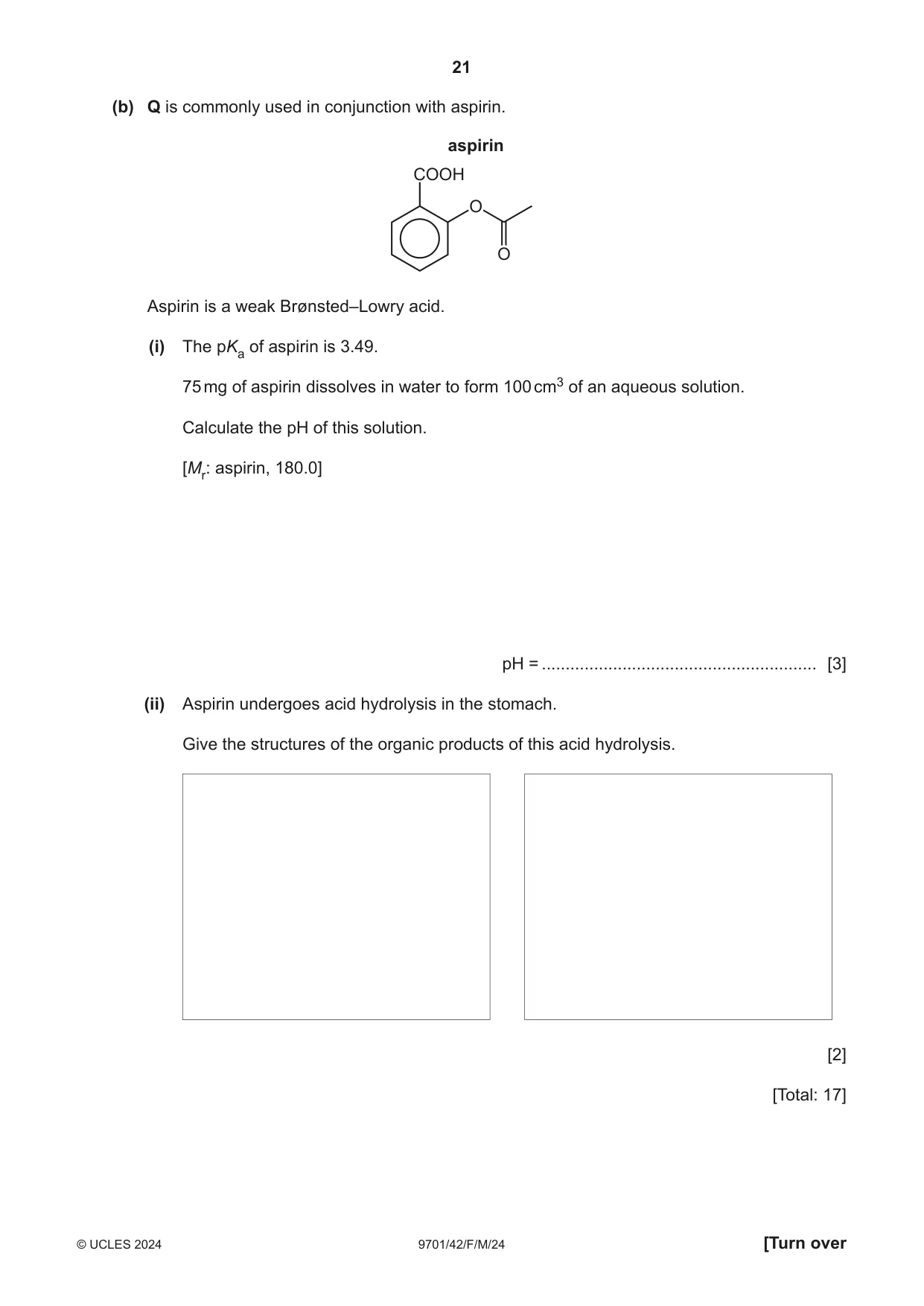
5 Compound Q can be synthesised from chlorobenzene in seven steps, using the route shown in Fig. 5.1. chlorobenzene J K Cl Cl Cl AlCl3 and CH3 CHO CH3Cl [O] step 1 step 2 step 3 L Cl CN OH step 4 P N M Cl COOCH3 Cl COOCH3 Cl COOH acidified CH3OH SOCl2 Cl OH OH step 5 step 6 step 7 HN and K2CO3(aq) S Q Cl COOCH3 N S Fig. 5.1 (a) (i) Write an equation for the formation of the electrophile for step 1. ..................................................................................................................................... [1] (ii) Complete the mechanism in Fig. 5.2 for step 1, the alkylation of chlorobenzene. Include all relevant curly arrows and charges. Draw the structure of the intermediate. intermediate Cl Cl CH3 +................ Fig. 5.2 [3] (iii) Step 2 is an oxidation reaction. Construct an equation for the reaction in step 2. Use [O] to represent an atom of oxygen from an oxidising agent. ..................................................................................................................................... [1] (iv) Suggest reagents for the conversion of K to M in steps 3 and 4. step 3 ................................................................................................................................ step 4 ................................................................................................................................ [2] (v) Identify the type of reaction that occurs in step 5. ..................................................................................................................................... [1] (vi) Step 7 takes place when P is heated with a weak base such as K2CO3(aq). HN P S Q Cl COOCH3 Cl COOCH3 and K2CO3(aq) Cl N step 7 S Suggest why a strong base such as NaOH(aq) is not used for this reaction. ........................................................................................................................................... ..................................................................................................................................... [1] (vii) Q is optically active. Explain the meaning of optically active. ........................................................................................................................................... ........................................................................................................................................... ..................................................................................................................................... [1] (viii) Give two reasons why it might be desirable to synthesise a single optical isomer of Q for use as a drug. 1 ........................................................................................................................................ ........................................................................................................................................... 2 ........................................................................................................................................ ........................................................................................................................................... [2] (b) Q is commonly used in conjunction with aspirin. aspirin COOH O O Aspirin is a weak Brønsted–Lowry acid. (i) The pKa of aspirin is 3.49. 75 mg of aspirin dissolves in water to form 100 cm3 of an aqueous solution. Calculate the pH of this solution. [Mr: aspirin, 180.0] pH = .......................................................... [3] (ii) Aspirin undergoes acid hydrolysis in the stomach. Give the structures of the organic products of this acid hydrolysis. [2] [Total: 17]
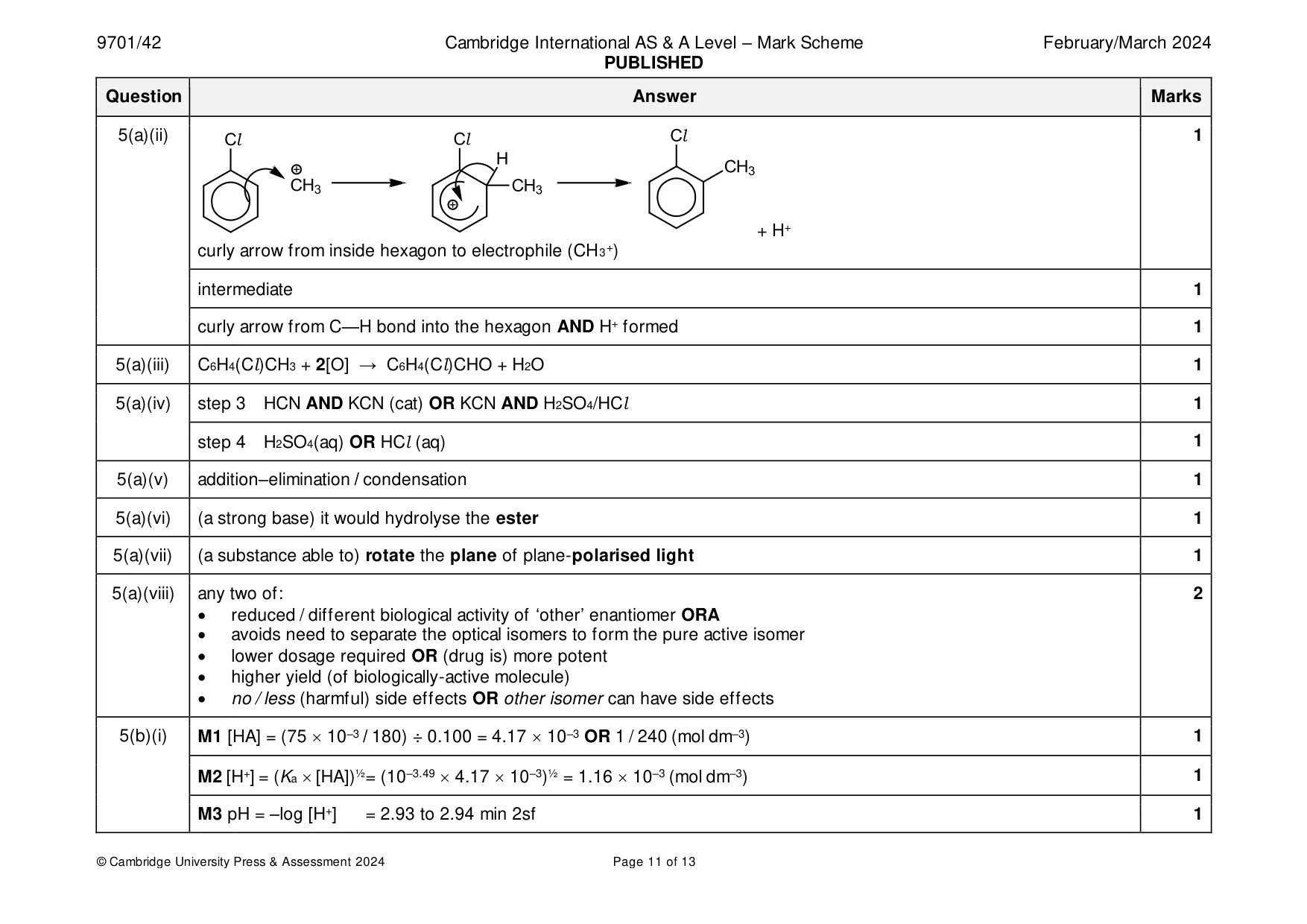
Mark scheme: 5(a)(i) AlCl3 + CH3Cl → AlCl4– + CH3+ 1 5(a)(ii) 1 + H+ curly arrow from inside hexagon to electrophile (CH3 +) intermediate 1 curly arrow from C—H bond into the hexagon AND H+ formed 1 5(a)(iii) C6H4(Cl)CH3 + 2[O] → C6H4(Cl)CHO + H2O 1 5(a)(iv) step 3 HCN AND KCN (cat) OR KCN AND H2SO4/HCl 1 step 4 H2SO4(aq) OR HCl (aq) 1 5(a)(v) addition–elimination / condensation 1 5(a)(vi) (a strong base) it would hydrolyse the ester 1 5(a)(vii) (a substance able to) rotate the plane of plane-polarised light 1 5(a)(viii) any two of: 2 • reduced / different biological activity of ‘other’ enantiomer ORA • avoids need to separate the optical isomers to form the pure active isomer • lower dosage required OR (drug is) more potent • higher yield (of biologically-active molecule) • no / less (harmful) side effects OR other isomer can have side effects 5(b)(i) M1 [HA] = (75 10–3 / 180) ÷ 0.100 = 4.17 10–3 OR 1 / 240 (mol dm–3) 1 M2 [H+] = (Ka [HA])½= (10–3.49 4.17 10–3)½ = 1.16 10–3 (mol dm–3) 1 M3 pH = –log [H+] = 2.93 to 2.94 min 2sf 1 5(b)(ii) 1 1 CH3COOH
Q6 · Amino acids are molecules that contain —NH2 and —COOH functional groups
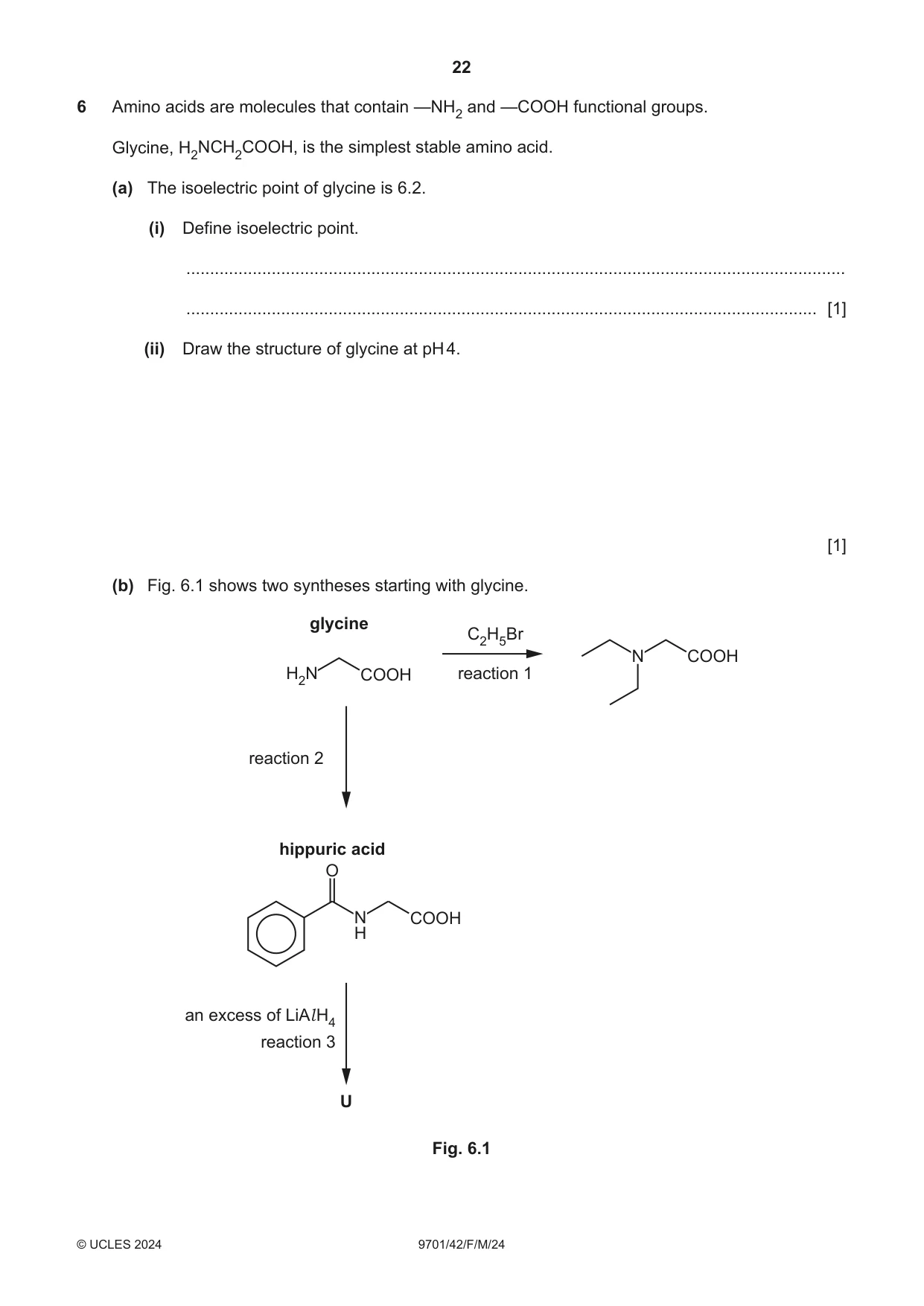
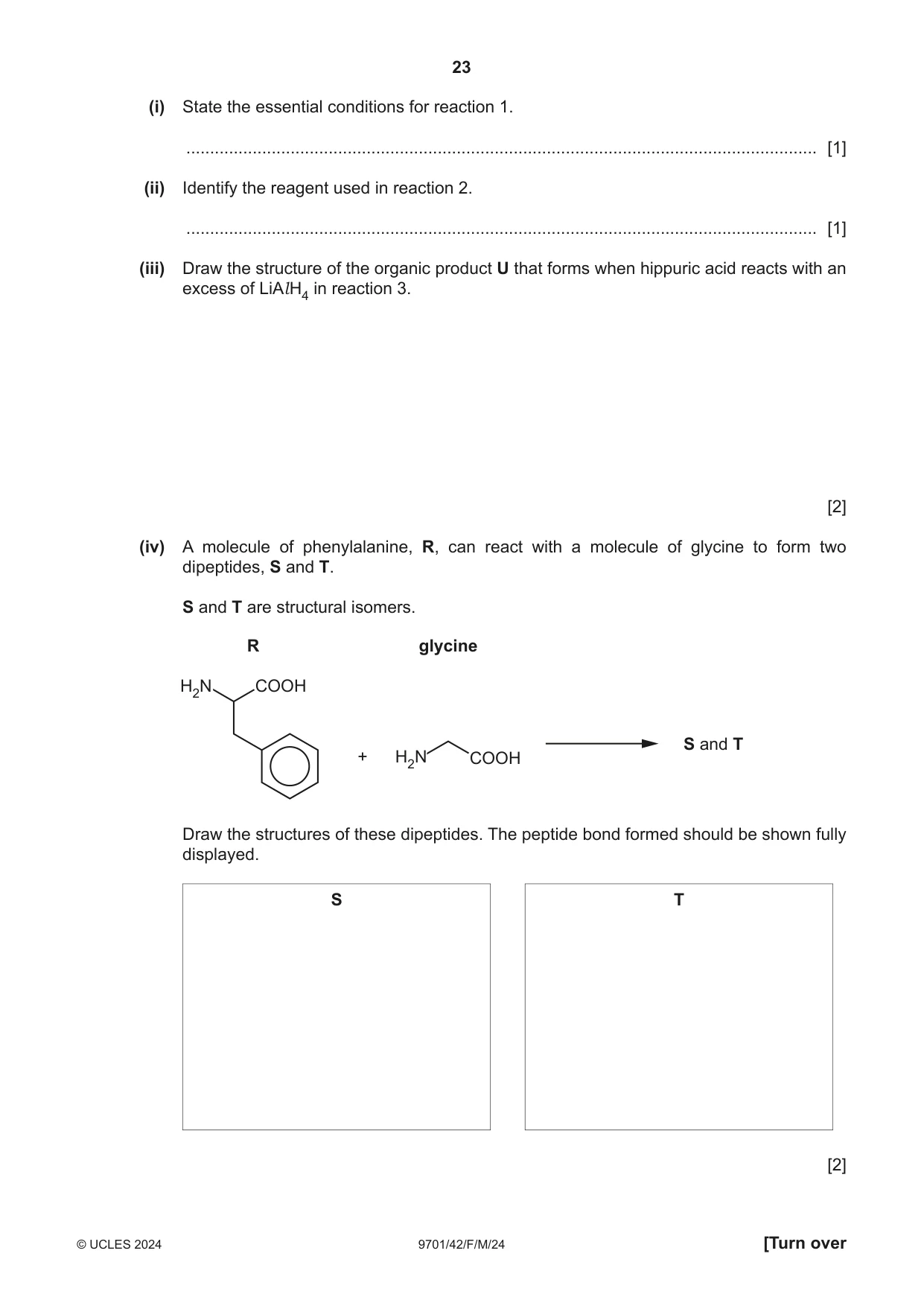
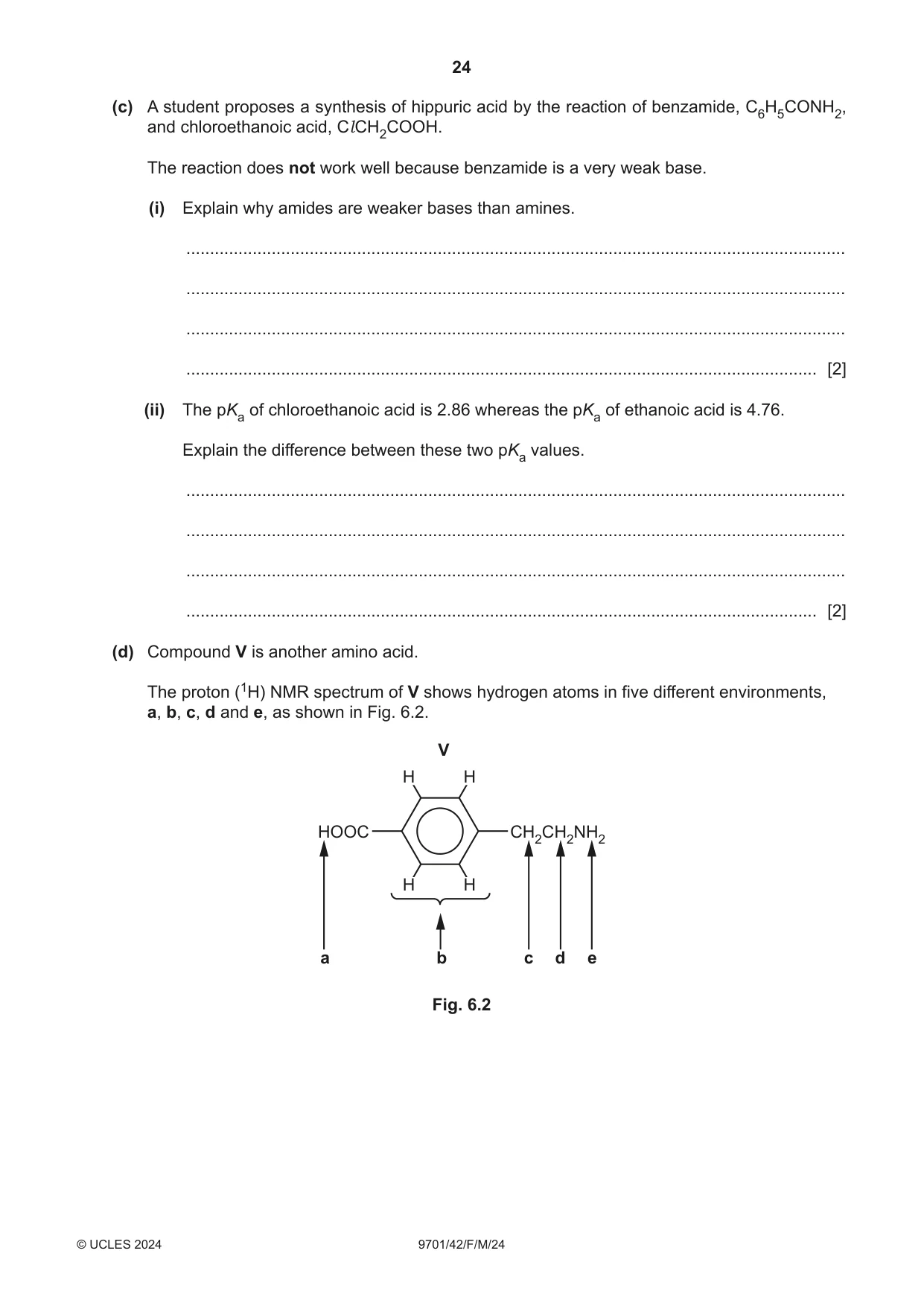
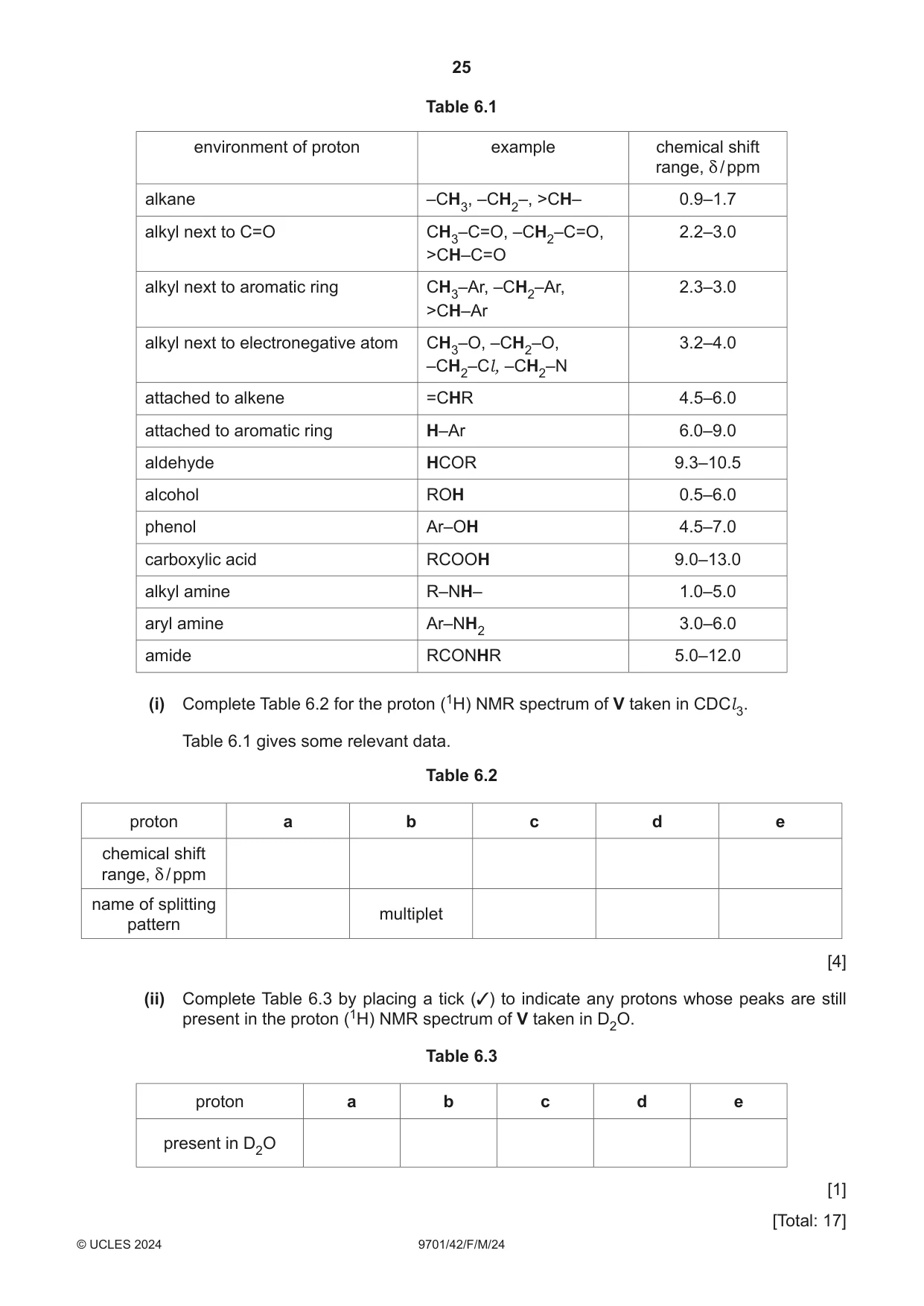
6 Amino acids are molecules that contain —NH2 and —COOH functional groups. Glycine, H2NCH2COOH, is the simplest stable amino acid. (a) The isoelectric point of glycine is 6.2. (i) Define isoelectric point. ........................................................................................................................................... ..................................................................................................................................... [1] (ii) Draw the structure of glycine at pH 4. [1] (b) Fig. 6.1 shows two syntheses starting with glycine. glycine C2H5Br N COOH H2N COOH reaction 1 reaction 2 hippuric acid O N COOH H an excess of LiAl H4 reaction 3 U Fig. 6.1 (i) State the essential conditions for reaction 1. ..................................................................................................................................... [1] (ii) Identify the reagent used in reaction 2. ..................................................................................................................................... [1] (iii) Draw the structure of the organic product U that forms when hippuric acid reacts with an excess of LiAl H4 in reaction 3. [2] (iv) A molecule of phenylalanine, R, can react with a molecule of glycine to form two dipeptides, S and T. S and T are structural isomers. R glycine H2N COOH S and T + H2N COOH Draw the structures of these dipeptides. The peptide bond formed should be shown fully displayed. S T [2] (c) A student proposes a synthesis of hippuric acid by the reaction of benzamide, C6H5CONH2, and chloroethanoic acid, Cl CH2COOH. The reaction does not work well because benzamide is a very weak base. (i) Explain why amides are weaker bases than amines. ........................................................................................................................................... ........................................................................................................................................... ........................................................................................................................................... ..................................................................................................................................... [2] (ii) The pKa of chloroethanoic acid is 2.86 whereas the pKa of ethanoic acid is 4.76. Explain the difference between these two pKa values. ........................................................................................................................................... ........................................................................................................................................... ........................................................................................................................................... ..................................................................................................................................... [2] (d) Compound V is another amino acid. The proton (1H) NMR spectrum of V shows hydrogen atoms in five different environments, a, b, c, d and e, as shown in Fig. 6.2. V H H HOOC CH2CH2NH2 H H a b c d e Fig. 6.2
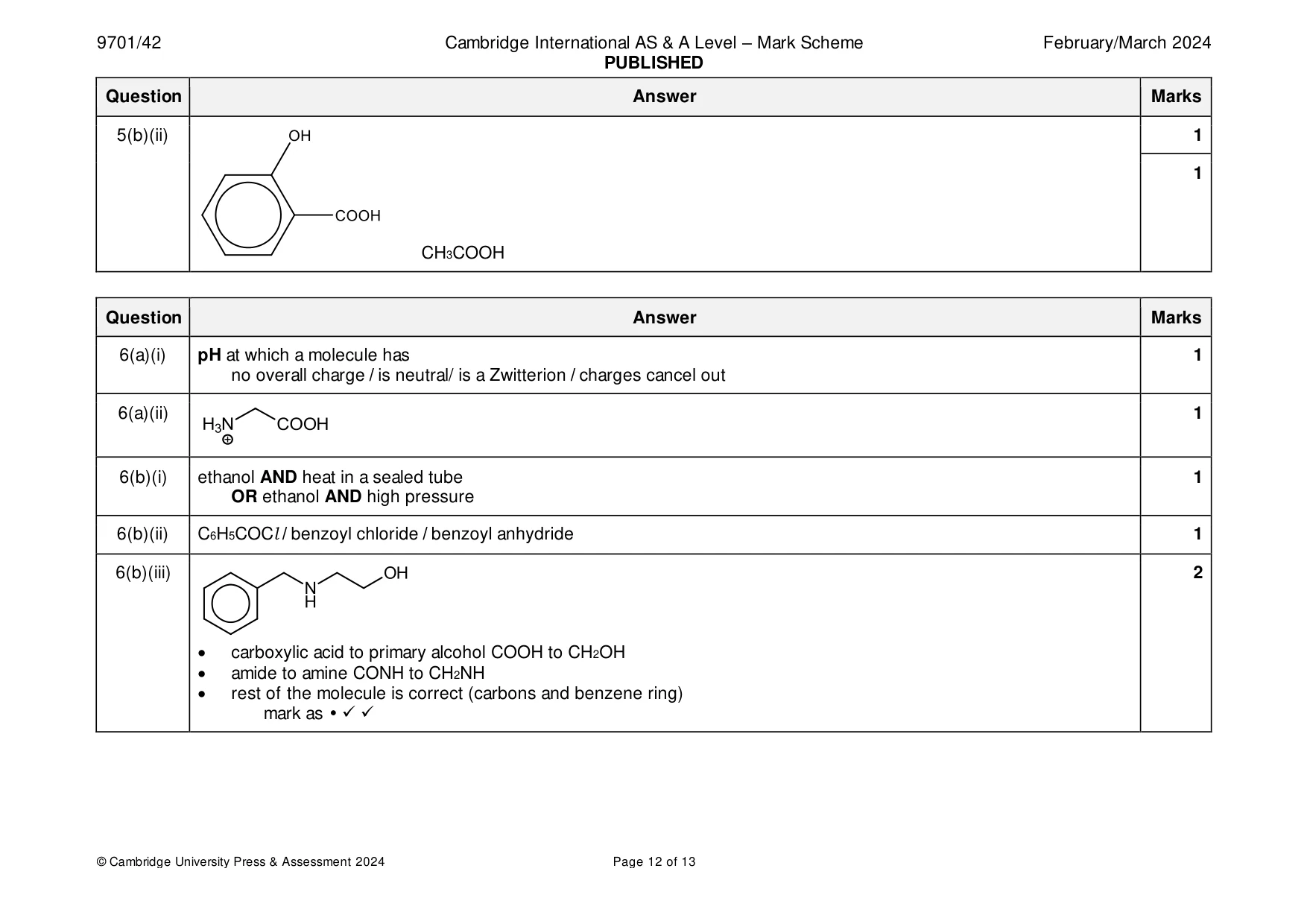
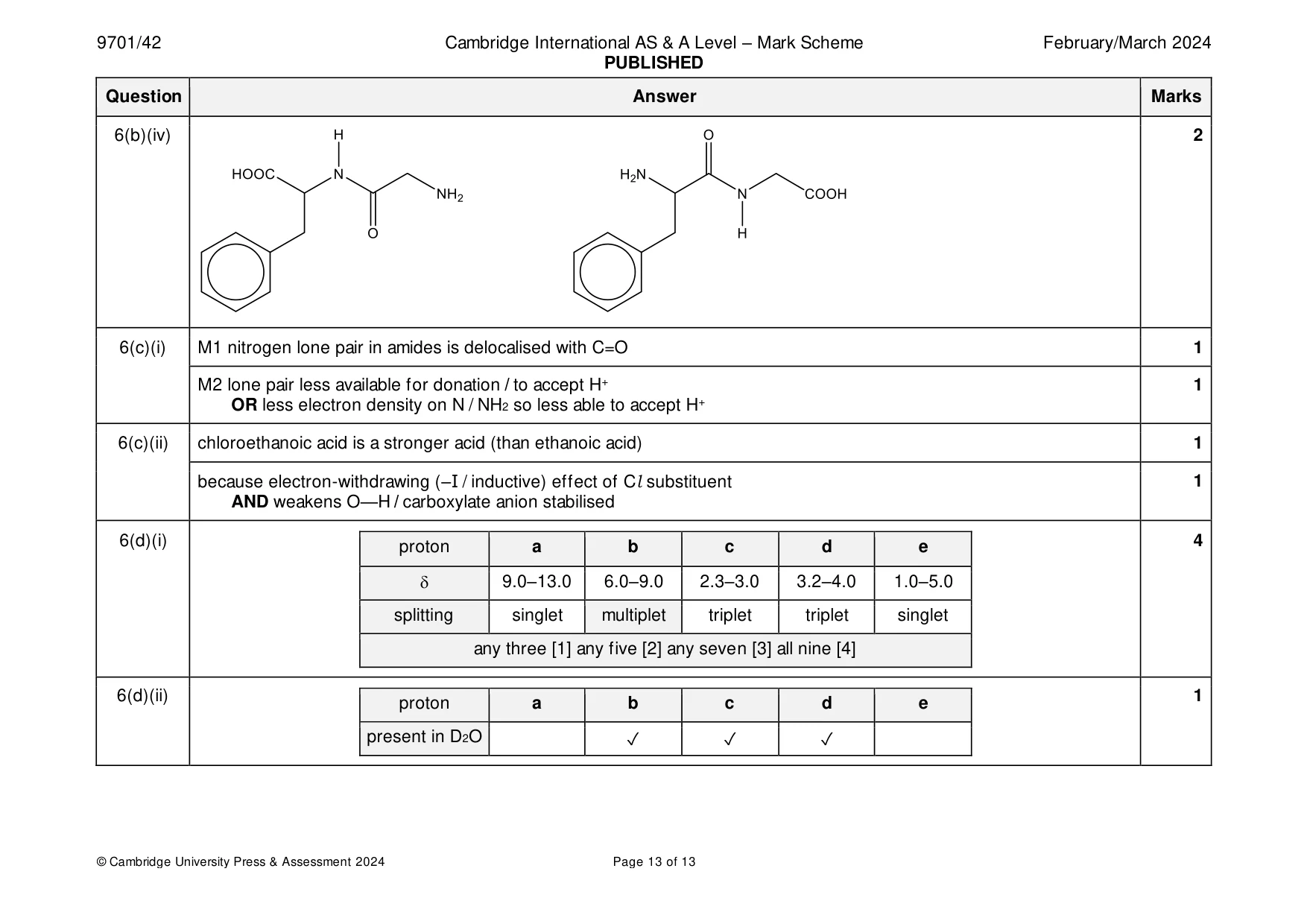
Mark scheme: 6(a)(i) pH at which a molecule has 1 no overall charge / is neutral/ is a Zwitterion / charges cancel out 6(a)(ii) 1 6(b)(i) ethanol AND heat in a sealed tube 1 OR ethanol AND high pressure 6(b)(ii) C6H5COCl / benzoyl chloride / benzoyl anhydride 1 6(b)(iii) 2 • carboxylic acid to primary alcohol COOH to CH2OH • amide to amine CONH to CH2NH • rest of the molecule is correct (carbons and benzene ring) mark as ✓ ✓ 6(b)(iv) 2 6(c)(i) M1 nitrogen lone pair in amides is delocalised with C=O 1 M2 lone pair less available for donation / to accept H+ 1 OR less electron density on N / NH2 so less able to accept H+ 6(c)(ii) chloroethanoic acid is a stronger acid (than ethanoic acid) 1 because electron-withdrawing (–I / inductive) effect of Cl substituent 1 AND weakens O—H / carboxylate anion stabilised 6(d)(i) 4 proton a b c d e 9.0–13.0 6.0–9.0 2.3–3.0 3.2–4.0 1.0–5.0 splitting singlet multiplet triplet triplet singlet any three [1] any five [2] any seven [3] all nine [4] 6(d)(ii) 1 proton a b c d e present in D2O ✓ ✓ ✓
What was in this paper
The subtopics covered by these 6 questions, and how many questions each got. Open one in a new tab to see every Cambridge question on it.
What you needed in this session
Cambridge’s own grade thresholds for 2024 Feb/March, Paper 4 · Variant 2. A higher threshold means an easier paper — the bar moves with how the cohort did.