Cambridge A Level Chemistry 9701 — 2022 May/June Paper 4 · Variant 1
9701/41/M/J/22 · 7 questions · 100 marks · ≈113 min
The question paper and its mark scheme, free to read here and free to download. This is Cambridge’s own paper, exactly as it was sat.
Question paper24 pages

Mark scheme15 pages
Answers below. Sit the paper first if you are practising.
Questions as text
Q1 · The solubility of the Group 2 sulfates decreases down the group
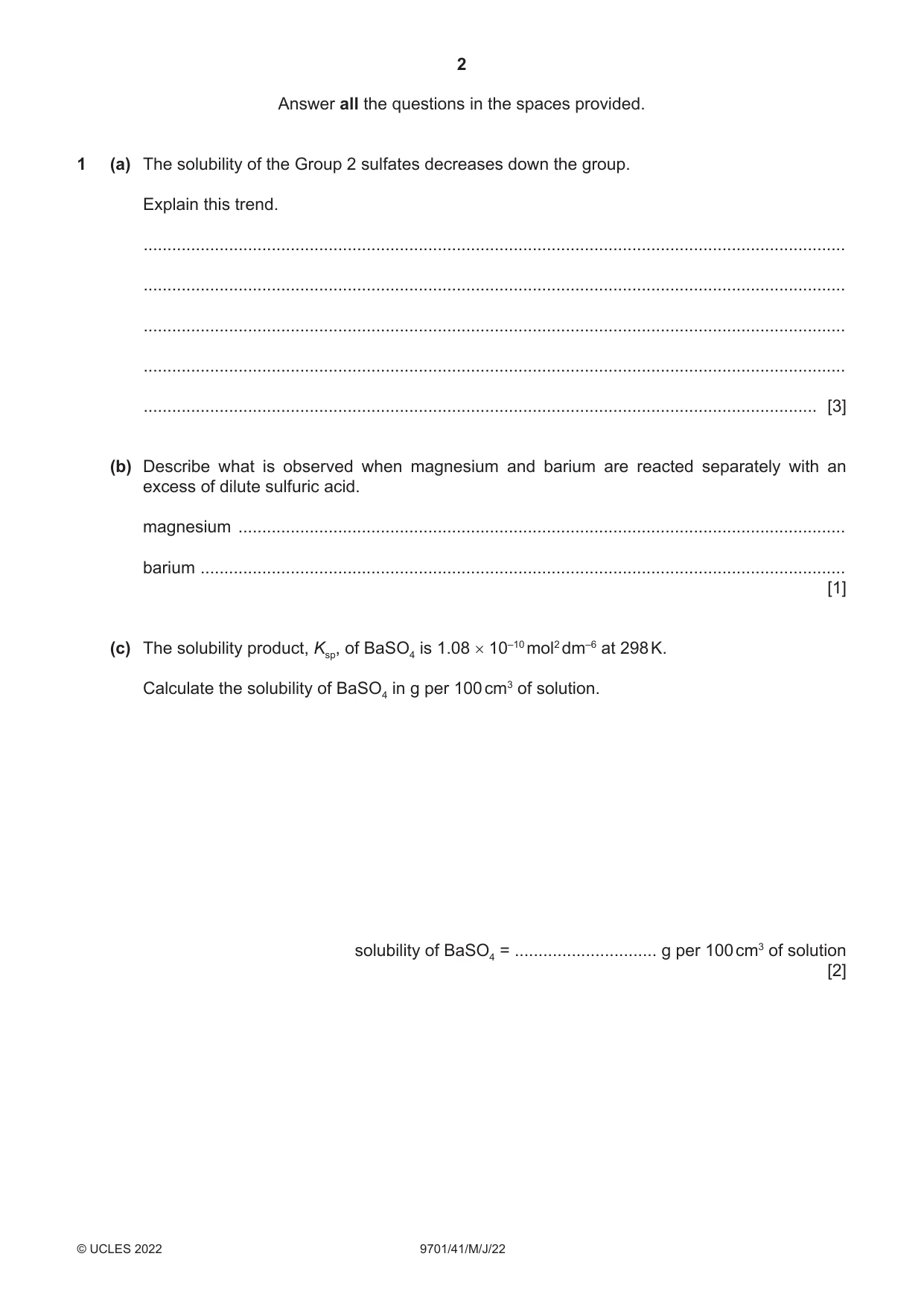
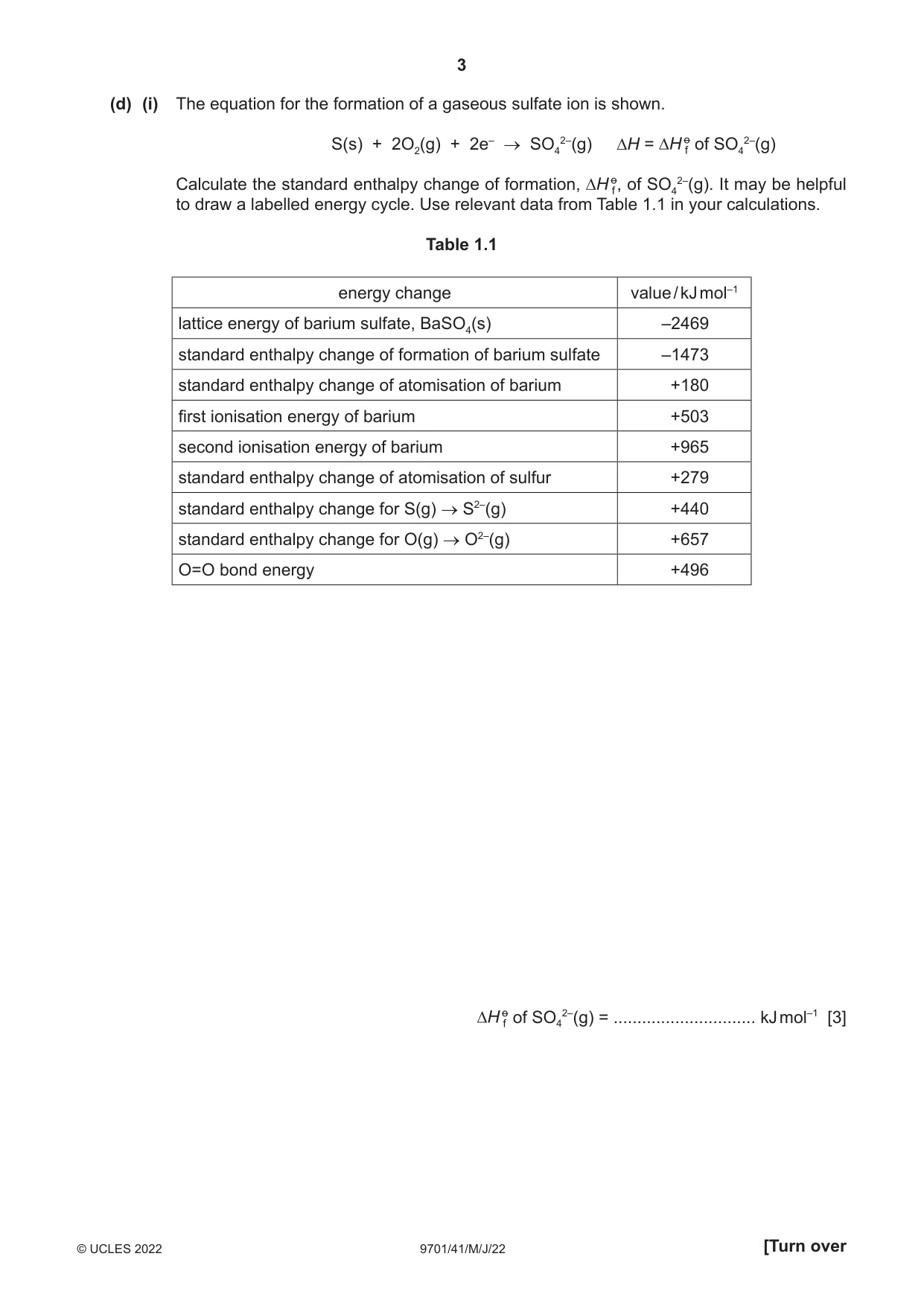
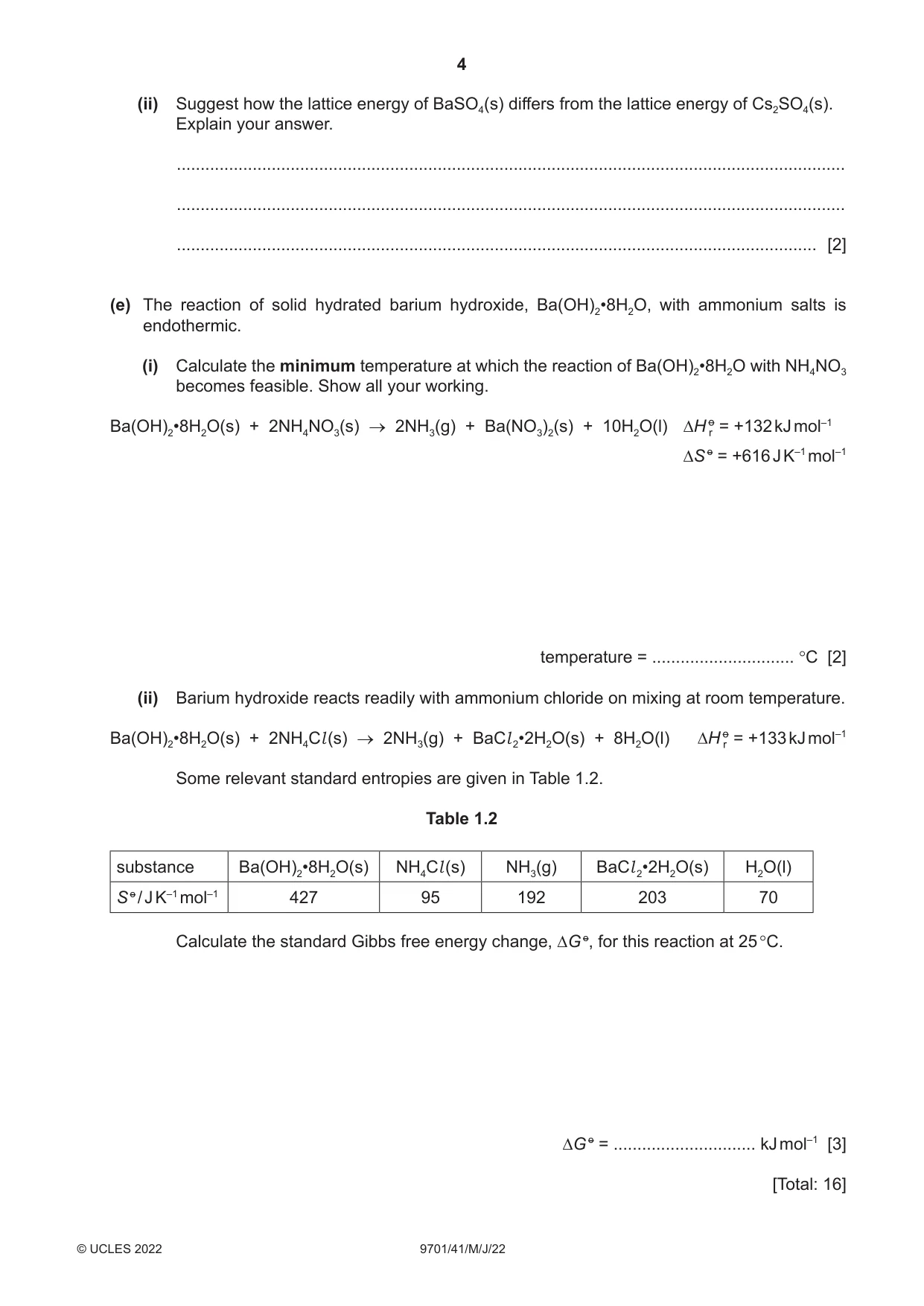
1 (a) The solubility of the Group 2 sulfates decreases down the group. Explain this trend. .................................................................................................................................................... .................................................................................................................................................... .................................................................................................................................................... .................................................................................................................................................... .............................................................................................................................................. [3] (b) Describe what is observed when magnesium and barium are reacted separately with an excess of dilute sulfuric acid. magnesium ................................................................................................................................. barium ........................................................................................................................................ [1] (c) The solubility product, Ksp, of BaSO4 is 1.08 × 10⁻¹⁰ mol2 dm–6 at 298 K. Calculate the solubility of BaSO4 in g per 100 cm3 of solution. solubility of BaSO4 = .............................. g per 100 cm3 of solution [2] (d) (i) The equation for the formation of a gaseous sulfate ion is shown. S(s) + 2O2(g) + 2e– → SO42–(g) ∆H = of SO42–(g) Calculate the standard enthalpy change of formation, , of SO42–(g). It may be helpful to draw a labelled energy cycle. Use relevant data from Table 1.1 in your calculations. Table 1.1 energy change value / kJ mol–1 lattice energy of barium sulfate, BaSO4(s) –2469 standard enthalpy change of formation of barium sulfate –1473 standard enthalpy change of atomisation of barium +180 first ionisation energy of barium +503 second ionisation energy of barium +965 standard enthalpy change of atomisation of sulfur +279 standard enthalpy change for S(g) → S2–(g) +440 standard enthalpy change for O(g) → O2–(g) +657 O=O bond energy +496 of SO42–(g) = .............................. kJ mol–1 [3] (ii) Suggest how the lattice energy of BaSO4(s) differs from the lattice energy of Cs2SO4(s). Explain your answer. ............................................................................................................................................. ............................................................................................................................................. ....................................................................................................................................... [2] (e) The reaction of solid hydrated barium hydroxide, Ba(OH)2•8H2O, with ammonium salts is endothermic. (i) Calculate the minimum temperature at which the reaction of Ba(OH)2•8H2O with NH4NO3 becomes feasible. Show all your working. Ba(OH)2•8H2O(s) + 2NH4NO3(s) → 2NH3(g) + Ba(NO3)2(s) + 10H2O(l) = +132 kJ mol–1 ∆S o = +616 J K–1 mol–1 temperature = .............................. °C [2] (ii) Barium hydroxide reacts readily with ammonium chloride on mixing at room temperature. Ba(OH)2•8H2O(s) + 2NH4Cl (s) → 2NH3(g) + BaCl 2•2H2O(s) + 8H2O(l) = +133 kJ mol–1 Some relevant standard entropies are given in Table 1.2. Table 1.2 substance Ba(OH)2•8H2O(s) NH4Cl (s) NH3(g) BaCl 2•2H2O(s) H2O(l) S o / J K–1 mol–1 427 95 192 203 70 Calculate the standard Gibbs free energy change, ∆G o, for this reaction at 25 °C. ∆G o = .............................. kJ mol–1 [3] [Total: 16]
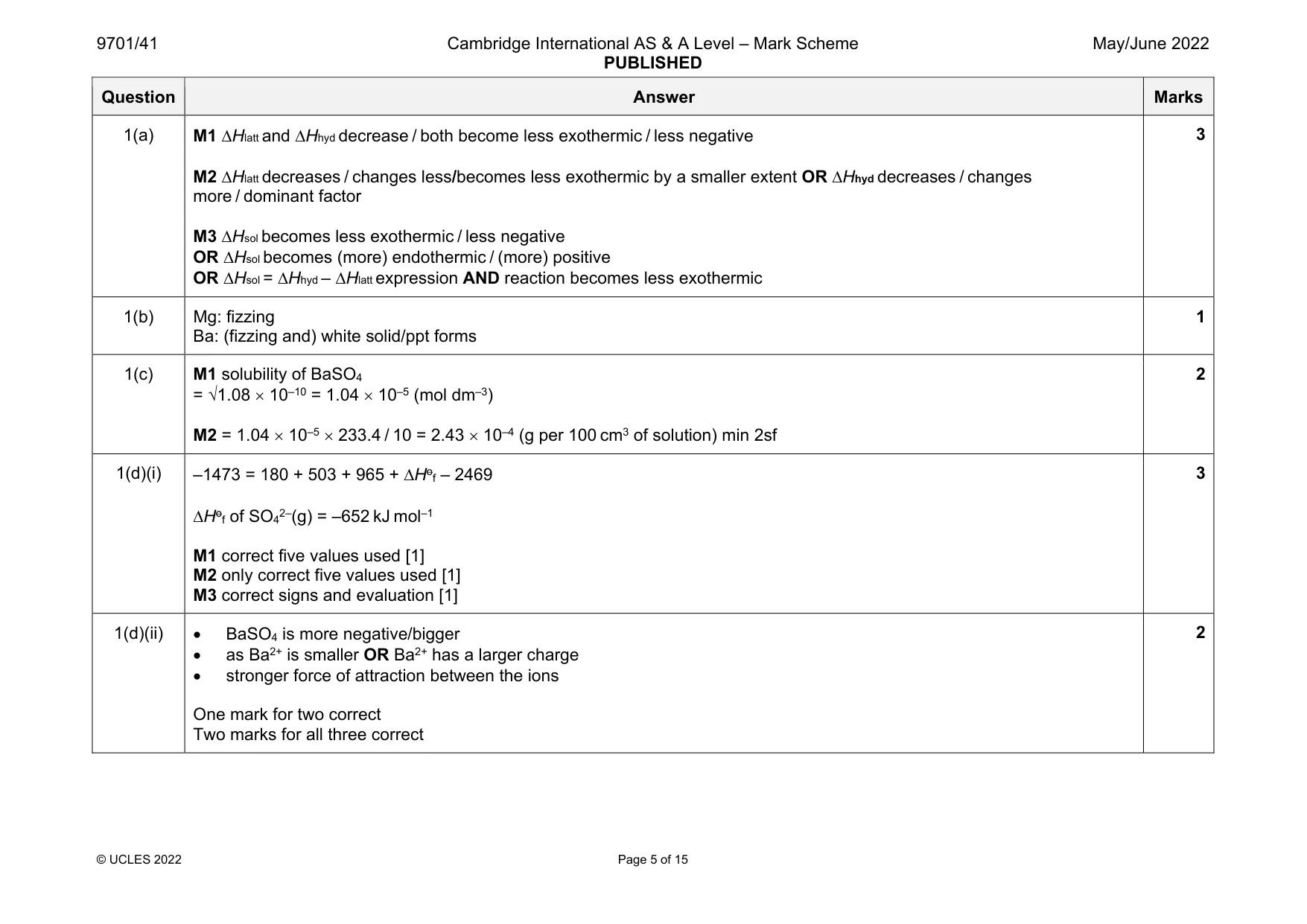
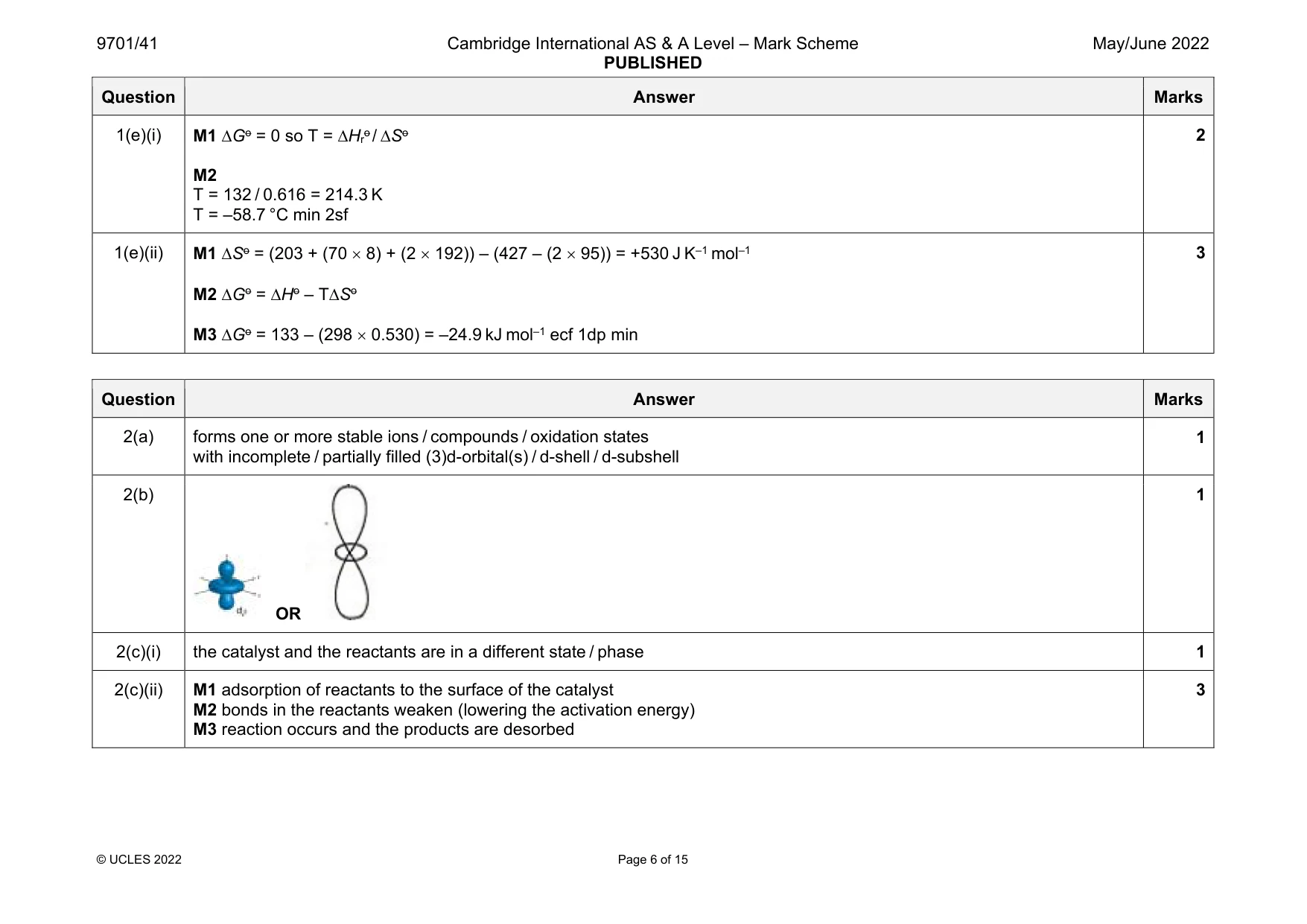
Mark scheme: 1(a) M2 Hlatt decreases / changes less/becomes less exothermic by a smaller extent OR Hhyd decreases / changes more / dominant factor M3 Hsol becomes less exothermic / less negative OR Hsol becomes (more) endothermic / (more) positive OR Hsol = Hhyd – Hlatt expression AND reaction becomes less exothermic 1(b) Mg: fizzing Ba: (fizzing and) white solid/ppt forms 1 1(c) M1 solubility of BaSO4 = √1.08 10–10 = 1.04 10–5 (mol dm–3) M2 = 1.04 10–5 233.4 / 10 = 2.43 10–4 (g per 100 cm3 of solution) min 2sf 2 1(d)(i) –1473 = 180 + 503 + 965 + Hof – 2469 Hof of SO42–(g) = –652 kJ mol–1 M1 correct five values used [1] M2 only correct five values used [1] M3 correct signs and evaluation [1] 3 1(d)(ii) BaSO4 is more negative/bigger as Ba2+ is smaller OR Ba2+ has a larger charge stronger force of attraction between the ions One mark for two correct Two marks for all three correct 2 Question Answer Marks 1(e)(i) M1 Go = 0 so T = Hro / So M2 T = 132 / 0.616 = 214.3 K T = –58.7 °C min 2sf 2 1(e)(ii) M1 So = (203 + (70 8) + (2 192)) – (427 – (2 95)) = +530 J K–1 mol–1 M2 Go = Ho – TSo M3 Go = 133 – (298 0.530) = –24.9 kJ mol–1 ecf 1dp min 3
Question 2
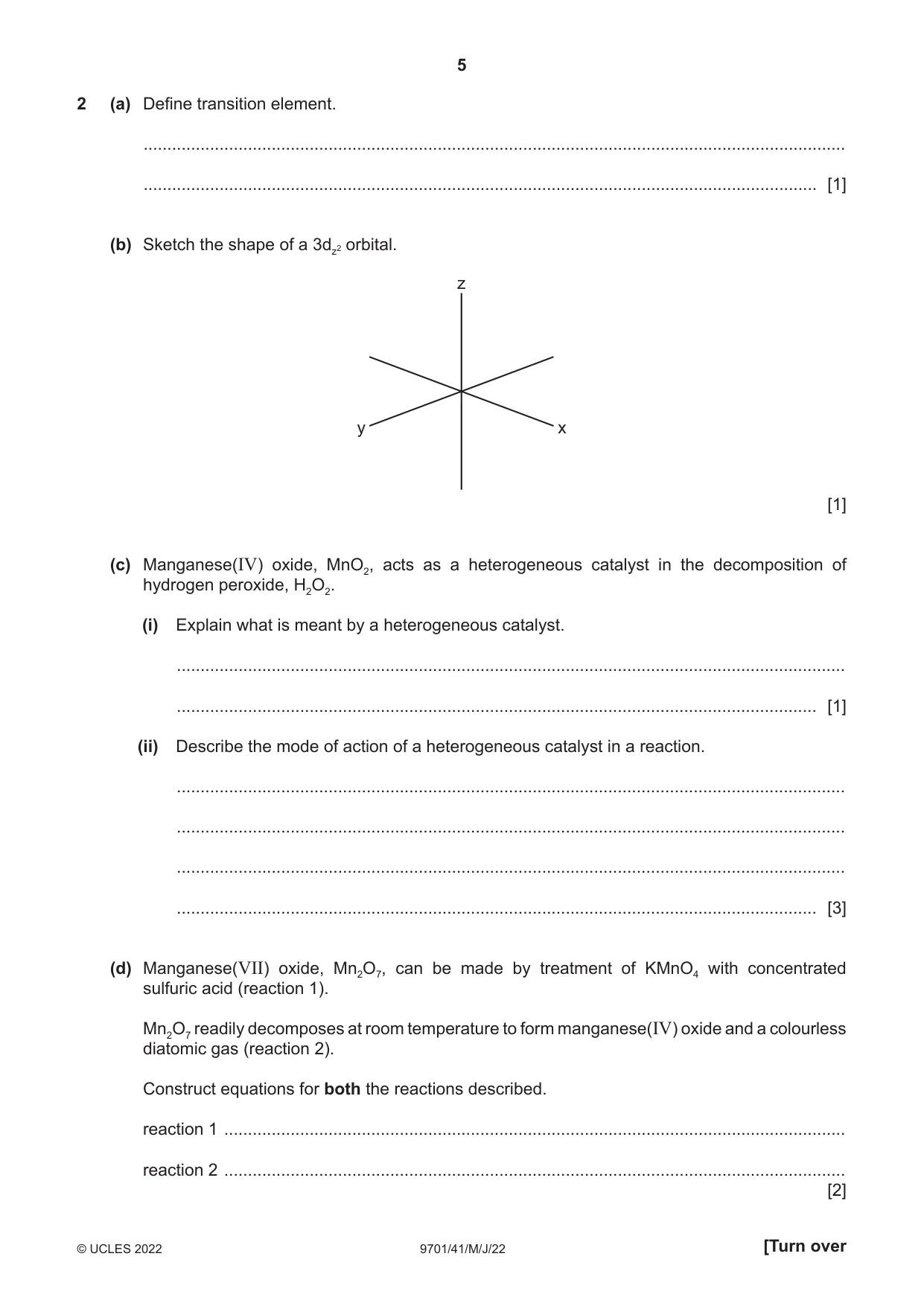
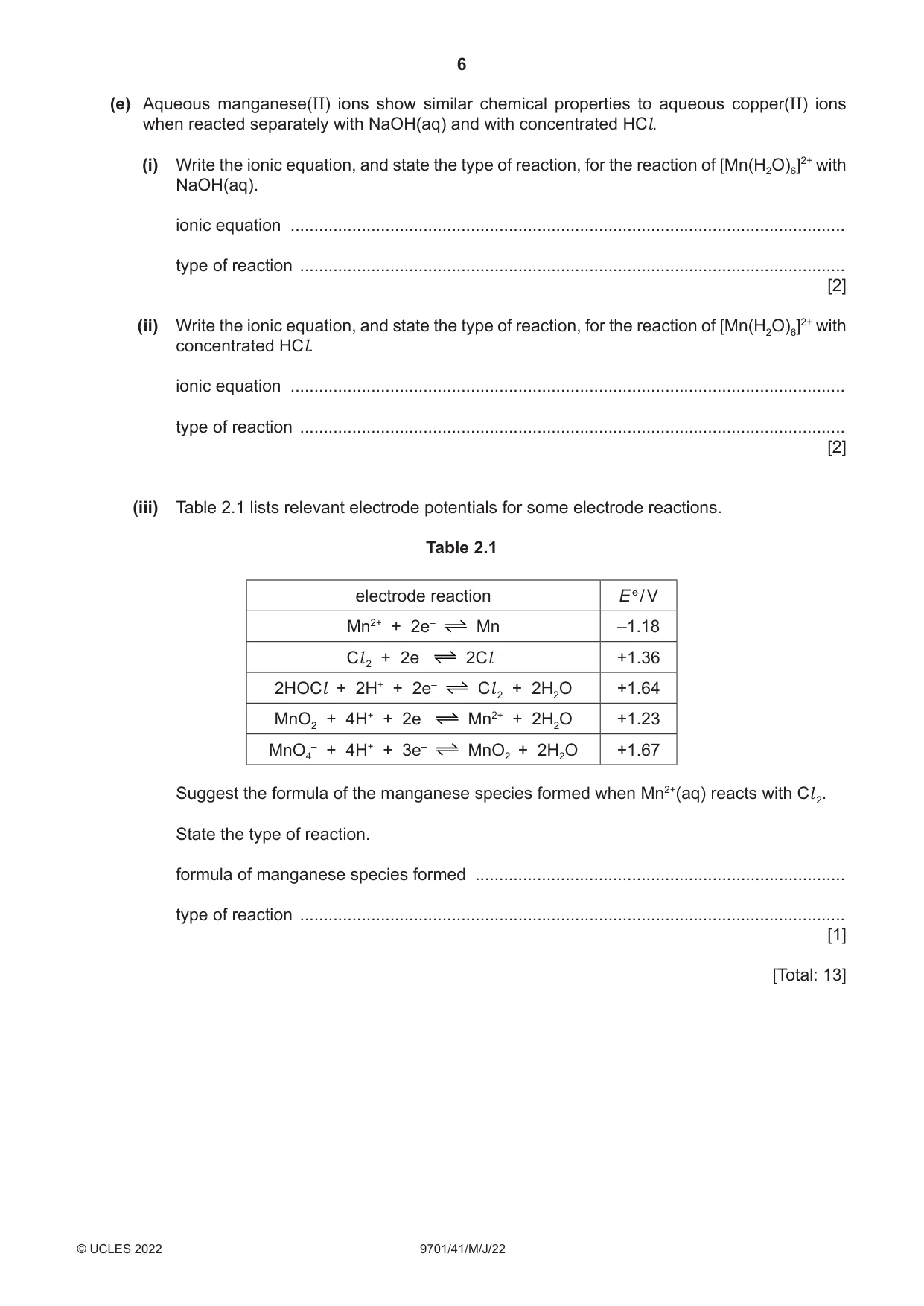
2 (a) Define transition element. .................................................................................................................................................... .............................................................................................................................................. [1] (b) Sketch the shape of a 3dz2 orbital. z y x [1] (c) Manganese(IV) oxide, MnO2, acts as a heterogeneous catalyst in the decomposition of hydrogen peroxide, H2O2. (i) Explain what is meant by a heterogeneous catalyst. ............................................................................................................................................. ....................................................................................................................................... [1] (ii) Describe the mode of action of a heterogeneous catalyst in a reaction. ............................................................................................................................................. ............................................................................................................................................. ............................................................................................................................................. ....................................................................................................................................... [3] (d) Manganese(VII) oxide, Mn2O7, can be made by treatment of KMnO4 with concentrated sulfuric acid (reaction 1). Mn2O7 readily decomposes at room temperature to form manganese(IV) oxide and a colourless diatomic gas (reaction 2). Construct equations for both the reactions described. reaction 1 ................................................................................................................................... reaction 2 ................................................................................................................................... [2] (e) Aqueous manganese(II) ions show similar chemical properties to aqueous copper(II) ions when reacted separately with NaOH(aq) and with concentrated HCl. (i) Write the ionic equation, and state the type of reaction, for the reaction of [Mn(H2O)6]2+ with NaOH(aq). ionic equation ...................................................................................................................... type of reaction .................................................................................................................... [2] (ii) Write the ionic equation, and state the type of reaction, for the reaction of [Mn(H2O)6]2+ with concentrated HCl. ionic equation ...................................................................................................................... type of reaction .................................................................................................................... [2] (iii) Table 2.1 lists relevant electrode potentials for some electrode reactions. Table 2.1 electrode reaction E o / V Mn2+ + 2e– Mn –1.18 Cl 2 + 2e– 2Cl – +1.36 2HOCl + 2H+ + 2e– Cl 2 + 2H2O +1.64 MnO2 + 4H+ + 2e– Mn2+ + 2H2O +1.23 MnO4– + 4H+ + 3e– MnO2 + 2H2O +1.67 Suggest the formula of the manganese species formed when Mn2+(aq) reacts with Cl 2. State the type of reaction. formula of manganese species formed ............................................................................... type of reaction .................................................................................................................... [1] [Total: 13]
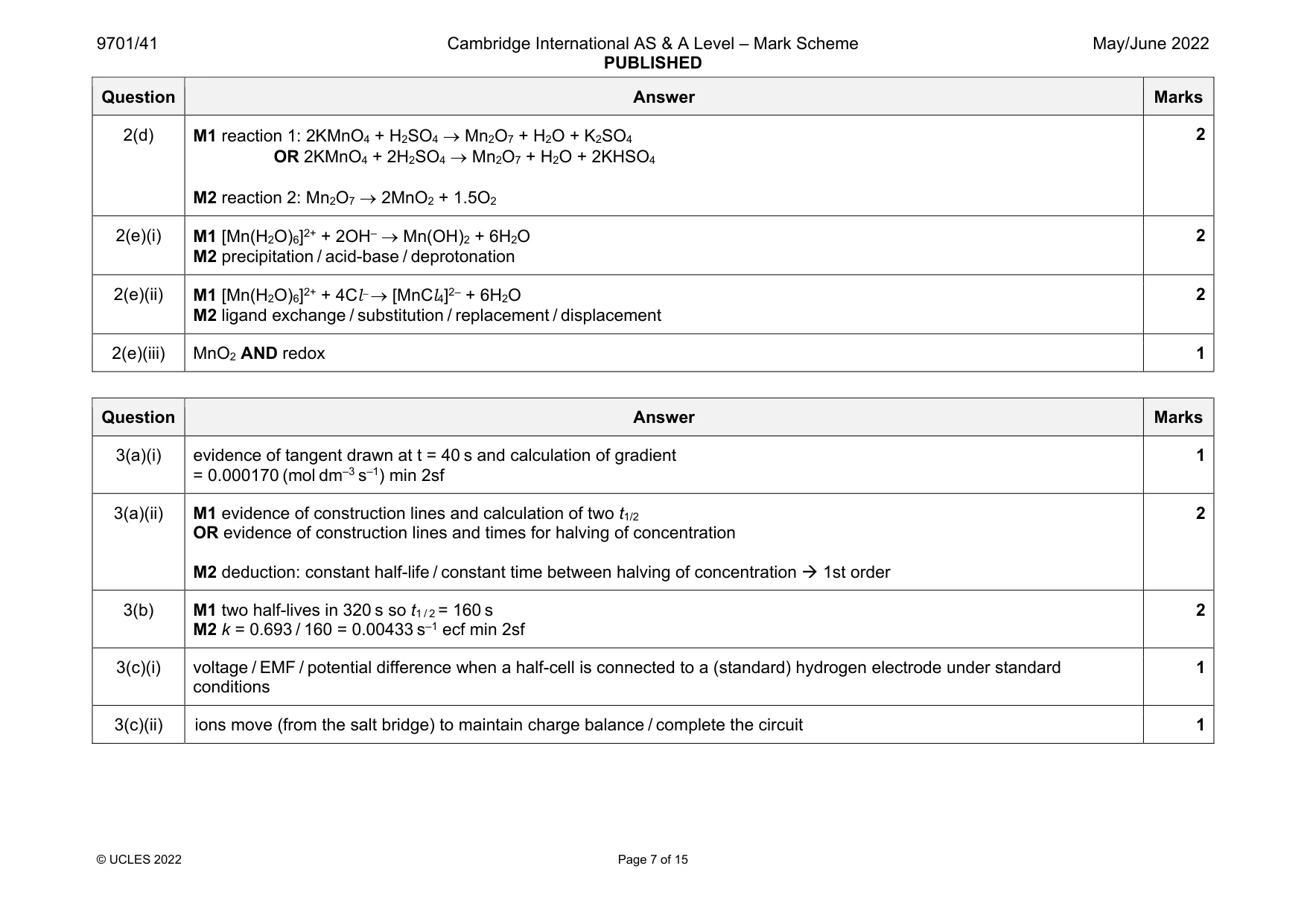
Mark scheme: 2(a) forms one or more stable ions / compounds / oxidation states with incomplete / partially filled (3)d-orbital(s) / d-shell / d-subshell 1 2(b) OR 1 2(c)(i) the catalyst and the reactants are in a different state / phase 1 2(c)(ii) M1 adsorption of reactants to the surface of the catalyst M2 bonds in the reactants weaken (lowering the activation energy) M3 reaction occurs and the products are desorbed 3 Question Answer Marks 2(d) M1 reaction 1: 2KMnO4 + H2SO4 Mn2O7 + H2O + K2SO4 OR 2KMnO4 + 2H2SO4 Mn2O7 + H2O + 2KHSO4 M2 reaction 2: Mn2O7 2MnO2 + 1.5O2 2 2(e)(i) M1 [Mn(H2O)6]2+ + 2OH– Mn(OH)2 + 6H2O M2 precipitation / acid-base / deprotonation 2 2(e)(ii) M1 [Mn(H2O)6]2+ + 4Cl– [MnCl4]2– + 6H2O M2 ligand exchange / substitution / replacement / displacement 2 2(e)(iii) MnO2 AND redox 1
Q3 · The rate of reaction between 2-chloro-2-methylpropane, (CH3)3CCl, and methanol is…
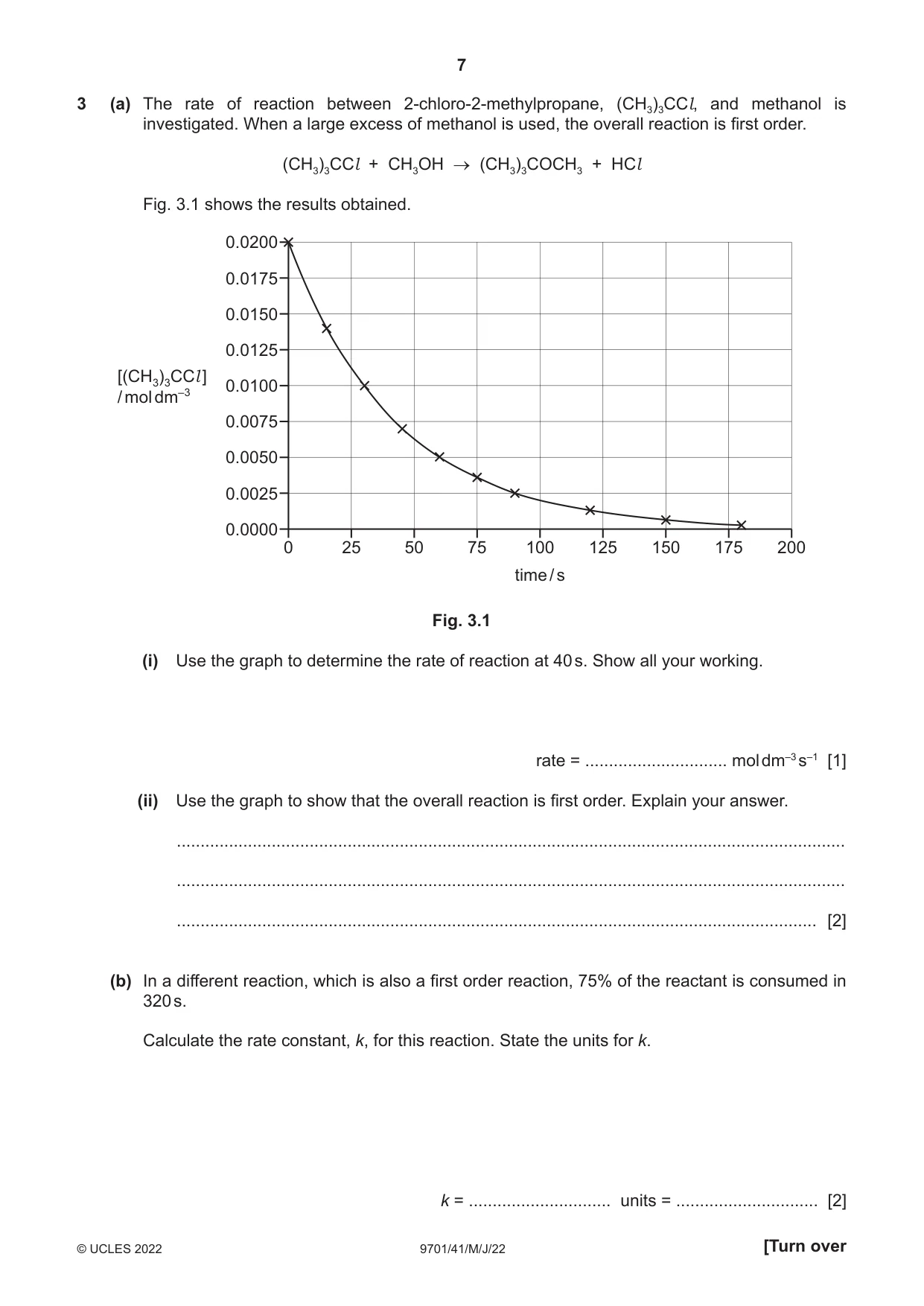
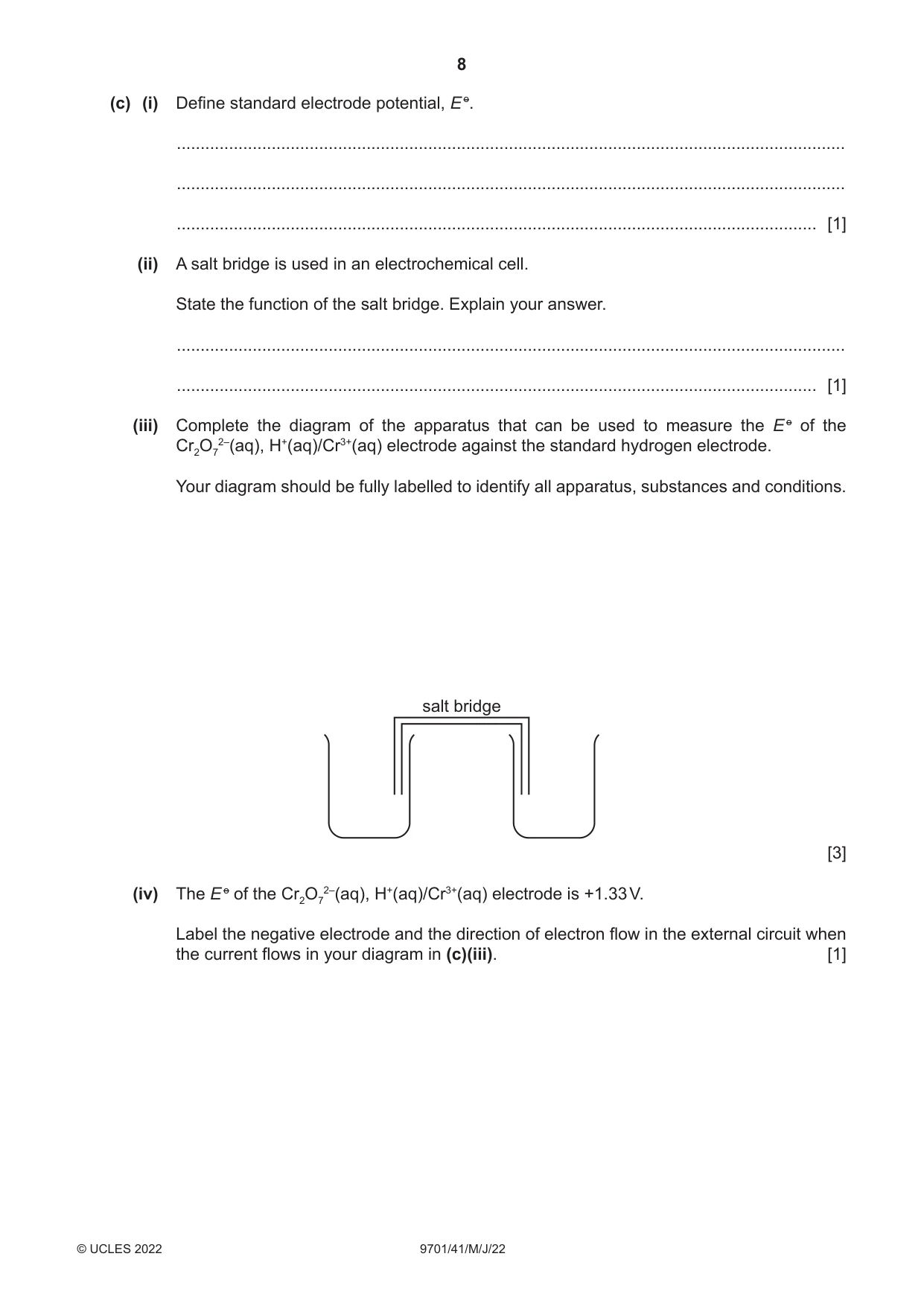
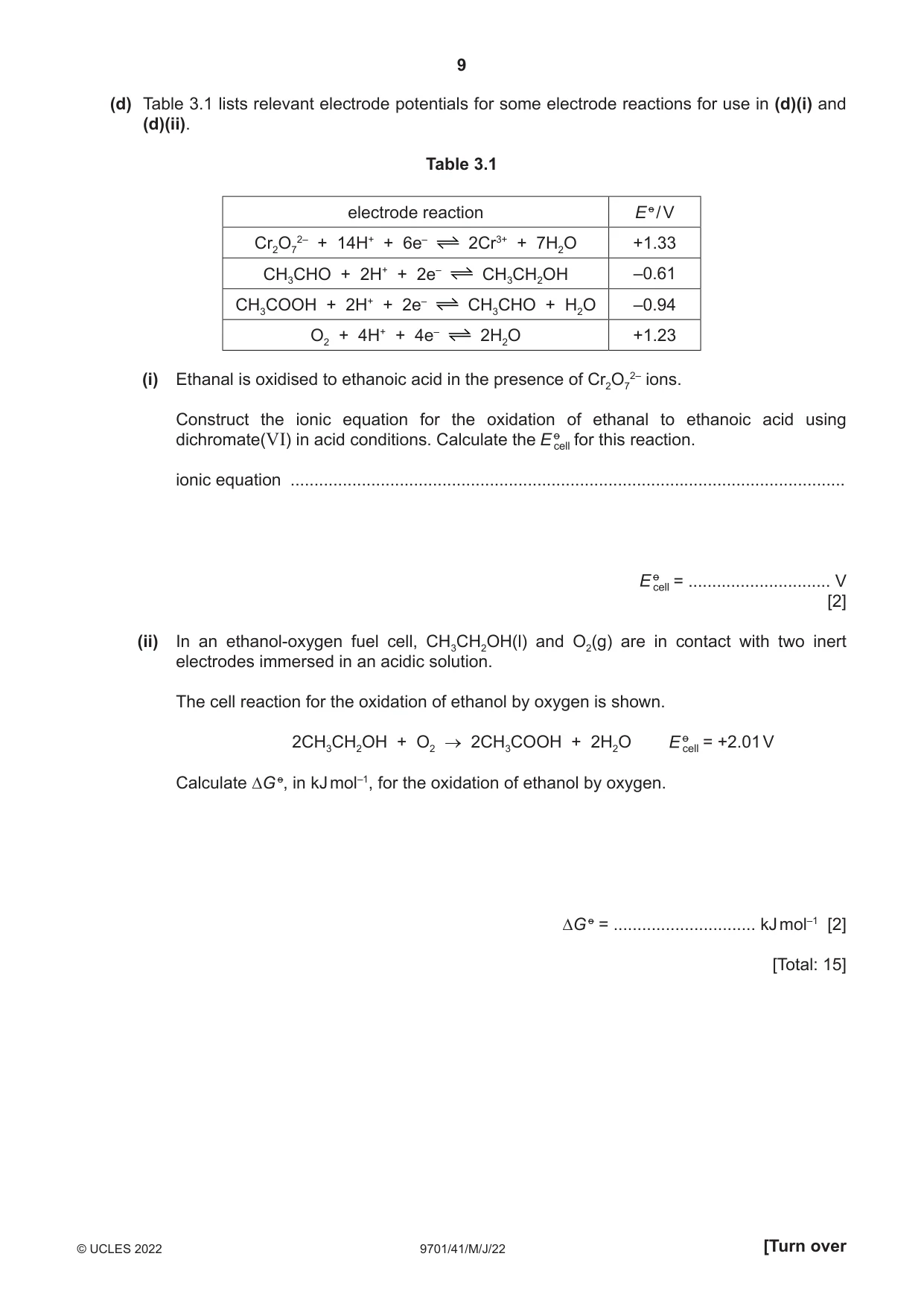
3 (a) The rate of reaction between 2-chloro-2-methylpropane, (CH3)3CCl, and methanol is investigated. When a large excess of methanol is used, the overall reaction is first order. (CH3)3CCl + CH3OH → (CH3)3COCH3 + HCl Fig. 3.1 shows the results obtained. 0.0200 0.0175 0.0150 0.0125 [(CH3)3CCl ] 0.0100 / mol dm–3 0.0075 0.0050 0.0025 0.0000 0 25 50 75 100 125 150 175 200 time / s Fig. 3.1 (i) Use the graph to determine the rate of reaction at 40 s. Show all your working. rate = .............................. mol dm–3 s–1 [1] (ii) Use the graph to show that the overall reaction is first order. Explain your answer. ............................................................................................................................................. ............................................................................................................................................. ....................................................................................................................................... [2] (b) In a different reaction, which is also a first order reaction, 75% of the reactant is consumed in 320 s. Calculate the rate constant, k, for this reaction. State the units for k. k = .............................. units = .............................. [2] (c) (i) Define standard electrode potential, E o. ............................................................................................................................................. ............................................................................................................................................. ....................................................................................................................................... [1] (ii) A salt bridge is used in an electrochemical cell. State the function of the salt bridge. Explain your answer. ............................................................................................................................................. ....................................................................................................................................... [1] (iii) Complete the diagram of the apparatus that can be used to measure the E o of the Cr2O72–(aq), H+(aq)/Cr3+(aq) electrode against the standard hydrogen electrode. Your diagram should be fully labelled to identify all apparatus, substances and conditions. salt bridge [3] (iv) The E o of the Cr2O72–(aq), H+(aq)/Cr3+(aq) electrode is +1.33 V. Label the negative electrode and the direction of electron flow in the external circuit when the current flows in your diagram in (c)(iii). [1] (d) Table 3.1 lists relevant electrode potentials for some electrode reactions for use in (d)(i) and (d)(ii). Table 3.1 electrode reaction E o / V Cr2O72– + 14H+ + 6e– 2Cr3+ + 7H2O +1.33 CH3CHO + 2H+ + 2e– CH3CH2OH –0.61 CH3COOH + 2H+ + 2e– CH3CHO + H2O –0.94 O2 + 4H+ + 4e– 2H2O +1.23 (i) Ethanal is oxidised to ethanoic acid in the presence of Cr2O72– ions. Construct the ionic equation for the oxidation of ethanal to ethanoic acid using dichromate(VI) in acid conditions. Calculate the for this reaction. ionic equation ...................................................................................................................... = .............................. V [2] (ii) In an ethanol-oxygen fuel cell, CH3CH2OH(l) and O2(g) are in contact with two inert electrodes immersed in an acidic solution. The cell reaction for the oxidation of ethanol by oxygen is shown. 2CH3CH2OH + O2 → 2CH3COOH + 2H2O = +2.01 V Calculate ∆G o, in kJ mol–1, for the oxidation of ethanol by oxygen. ∆G o = .............................. kJ mol–1 [2] [Total: 15]
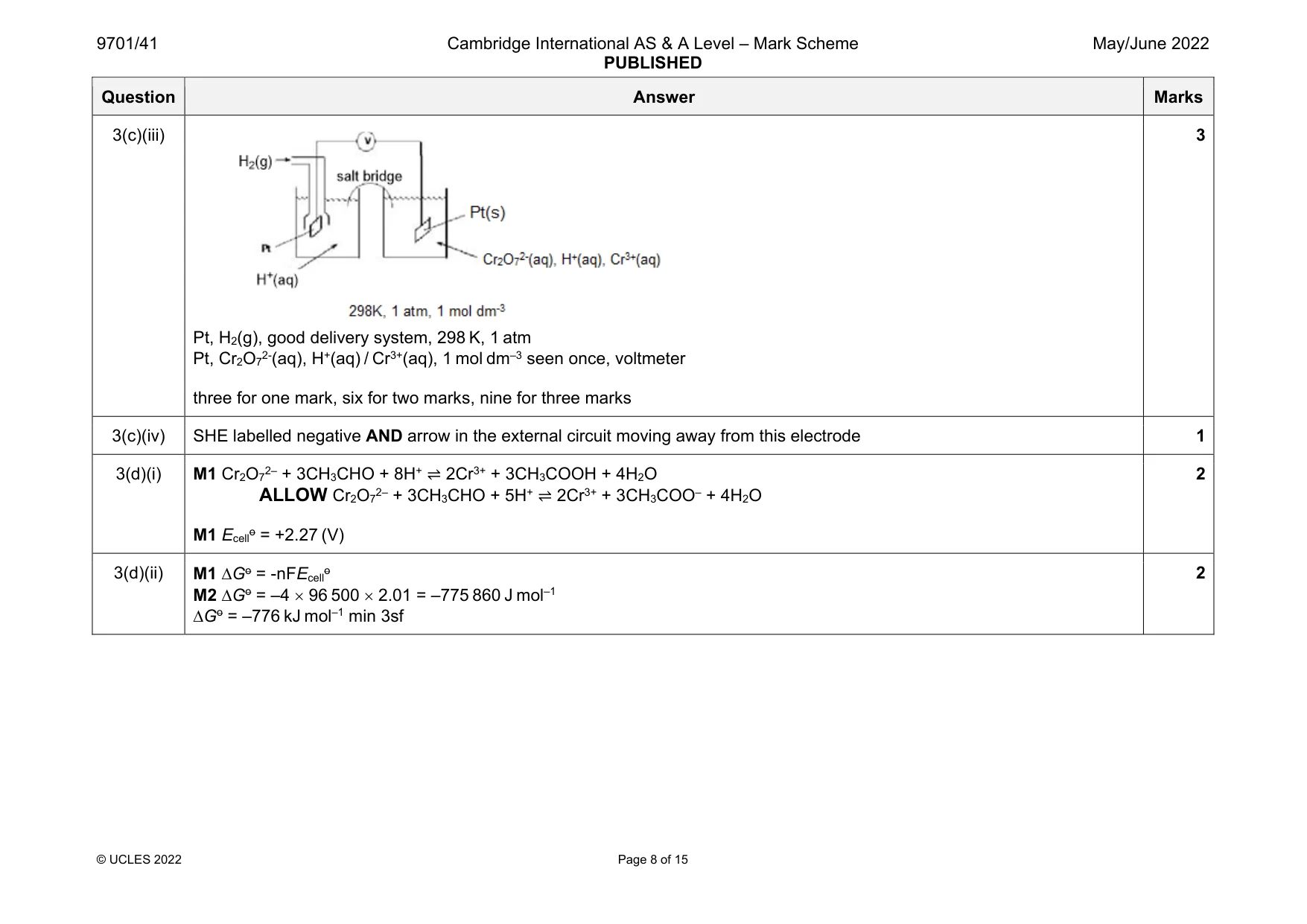
Mark scheme: 3(a)(i) evidence of tangent drawn at t = 40 s and calculation of gradient = 0.000170 (mol dm–3 s–1) min 2sf 1 3(a)(ii) M1 evidence of construction lines and calculation of two t1/2 OR evidence of construction lines and times for halving of concentration M2 deduction: constant half-life / constant time between halving of concentration 1st order 2 3(b) M1 two half-lives in 320 s so t1 / 2 = 160 s M2 k = 0.693 / 160 = 0.00433 s–1 ecf min 2sf 2 3(c)(i) voltage / EMF / potential difference when a half-cell is connected to a (standard) hydrogen electrode under standard conditions 1 3(c)(ii) ions move (from the salt bridge) to maintain charge balance / complete the circuit 1 Question Answer Marks 3(c)(iii) Pt, H2(g), good delivery system, 298 K, 1 atm Pt, Cr2O72-(aq), H+(aq) / Cr3+(aq), 1 mol dm–3 seen once, voltmeter three for one mark, six for two marks, nine for three marks 3 3(c)(iv) SHE labelled negative AND arrow in the external circuit moving away from this electrode 1 3(d)(i) M1 Cr2O72– + 3CH3CHO + 8H+ ⇌ 2Cr3+ + 3CH3COOH + 4H2O ALLOW Cr2O72– + 3CH3CHO + 5H+ ⇌ 2Cr3+ + 3CH3COO– + 4H2O M1 Ecello = +2.27 (V) 2 3(d)(ii) M1 Go = -nFEcello M2 Go = –4 96 500 2.01 = –775 860 J mol–1 Go = –776 kJ mol–1 min 3sf 2
More questions on Simple rate equations, orders of reaction and rate constants
Q4 · The 3d orbitals in an isolated Fe2+ ion are degenerate
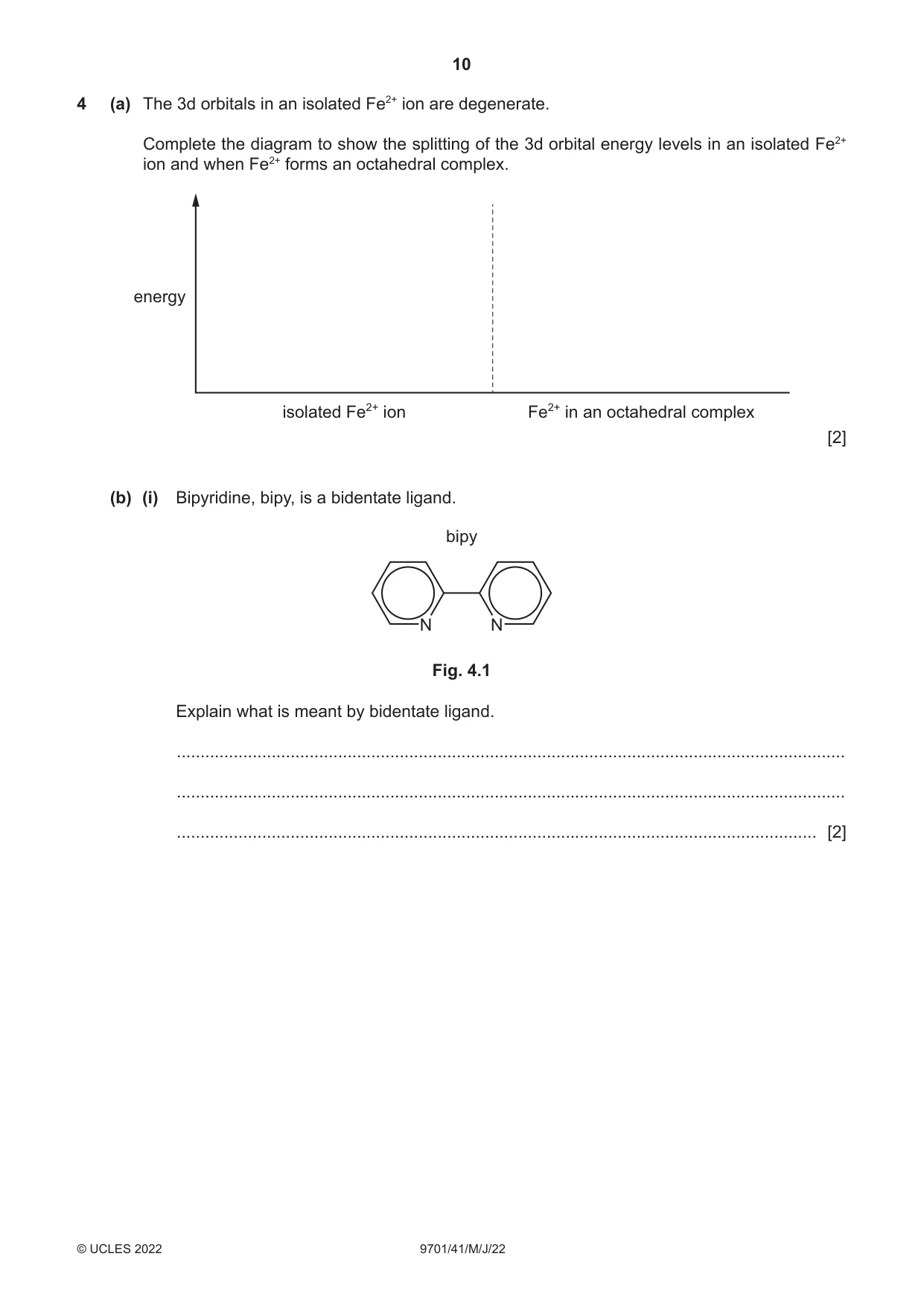
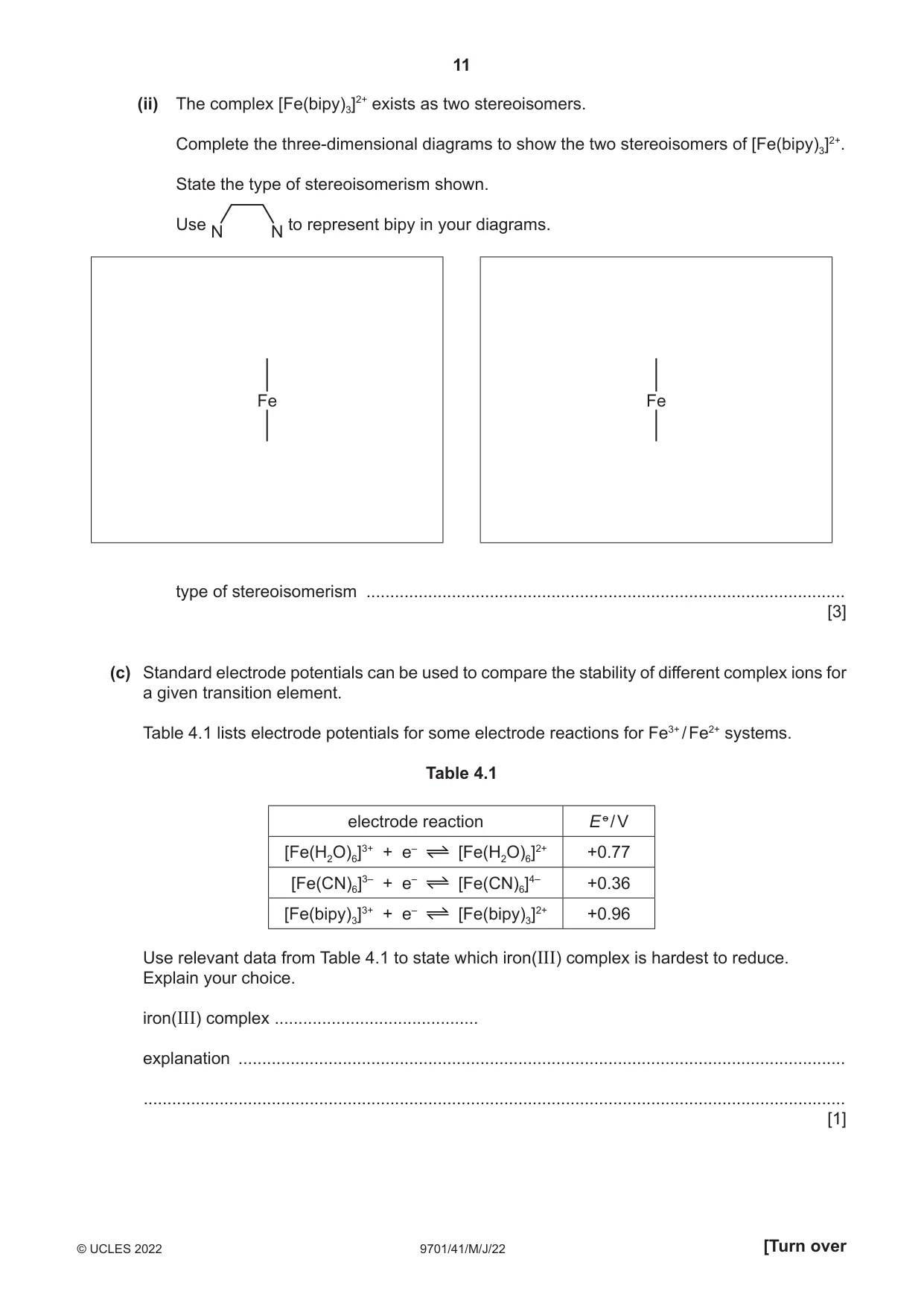
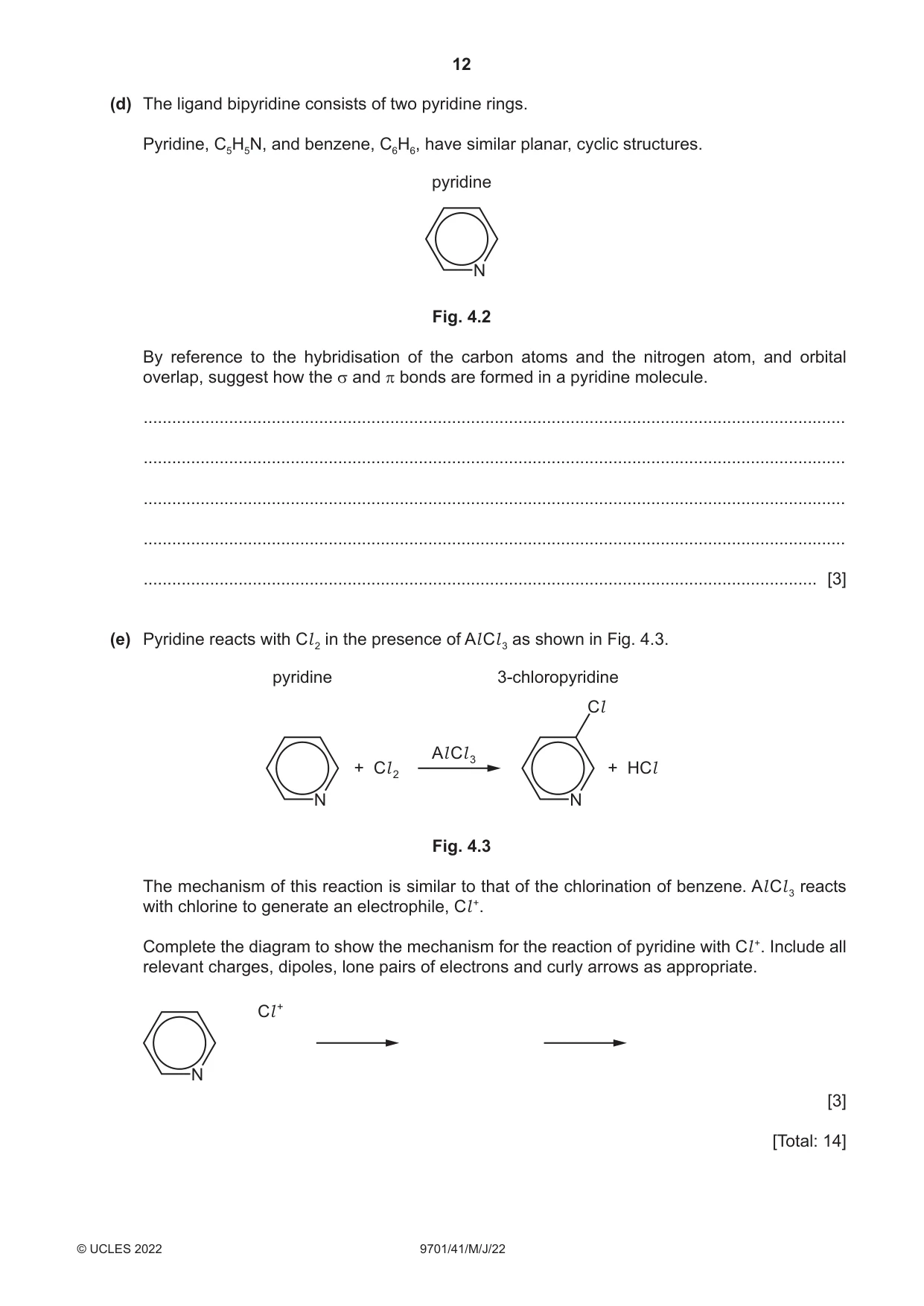
4 (a) The 3d orbitals in an isolated Fe2+ ion are degenerate. Complete the diagram to show the splitting of the 3d orbital energy levels in an isolated Fe2+ ion and when Fe2+ forms an octahedral complex. energy isolated Fe2+ ion Fe2+ in an octahedral complex [2] (b) (i) Bipyridine, bipy, is a bidentate ligand. bipy N N Fig. 4.1 Explain what is meant by bidentate ligand. ............................................................................................................................................. ............................................................................................................................................. ....................................................................................................................................... [2] (ii) The complex [Fe(bipy)3]2+ exists as two stereoisomers. Complete the three-dimensional diagrams to show the two stereoisomers of [Fe(bipy)3]2+. State the type of stereoisomerism shown. Use to represent bipy in your diagrams. N N Fe Fe type of stereoisomerism ...................................................................................................... [3] (c) Standard electrode potentials can be used to compare the stability of different complex ions for a given transition element. Table 4.1 lists electrode potentials for some electrode reactions for Fe3+ / Fe2+ systems. Table 4.1 electrode reaction E o / V [Fe(H2O)6]3+ + e– [Fe(H2O)6]2+ +0.77 [Fe(CN)6]3– + e– [Fe(CN)6]4– +0.36 [Fe(bipy)3]3+ + e– [Fe(bipy)3]2+ +0.96 Use relevant data from Table 4.1 to state which iron(III) complex is hardest to reduce. Explain your choice. iron(III) complex ........................................... explanation ................................................................................................................................. .................................................................................................................................................... [1] (d) The ligand bipyridine consists of two pyridine rings. Pyridine, C5H5N, and benzene, C6H6, have similar planar, cyclic structures. pyridine N Fig. 4.2 By reference to the hybridisation of the carbon atoms and the nitrogen atom, and orbital overlap, suggest how the σ and π bonds are formed in a pyridine molecule. .................................................................................................................................................... .................................................................................................................................................... .................................................................................................................................................... .................................................................................................................................................... .............................................................................................................................................. [3] (e) Pyridine reacts with Cl 2 in the presence of Al Cl 3 as shown in Fig. 4.3. pyridine 3-chloropyridine Cl Al Cl 3 + Cl 2 + HCl N N Fig. 4.3 The mechanism of this reaction is similar to that of the chlorination of benzene. Al Cl 3 reacts with chlorine to generate an electrophile, Cl +. Complete the diagram to show the mechanism for the reaction of pyridine with Cl +. Include all relevant charges, dipoles, lone pairs of electrons and curly arrows as appropriate. Cl + N [3] [Total: 14]
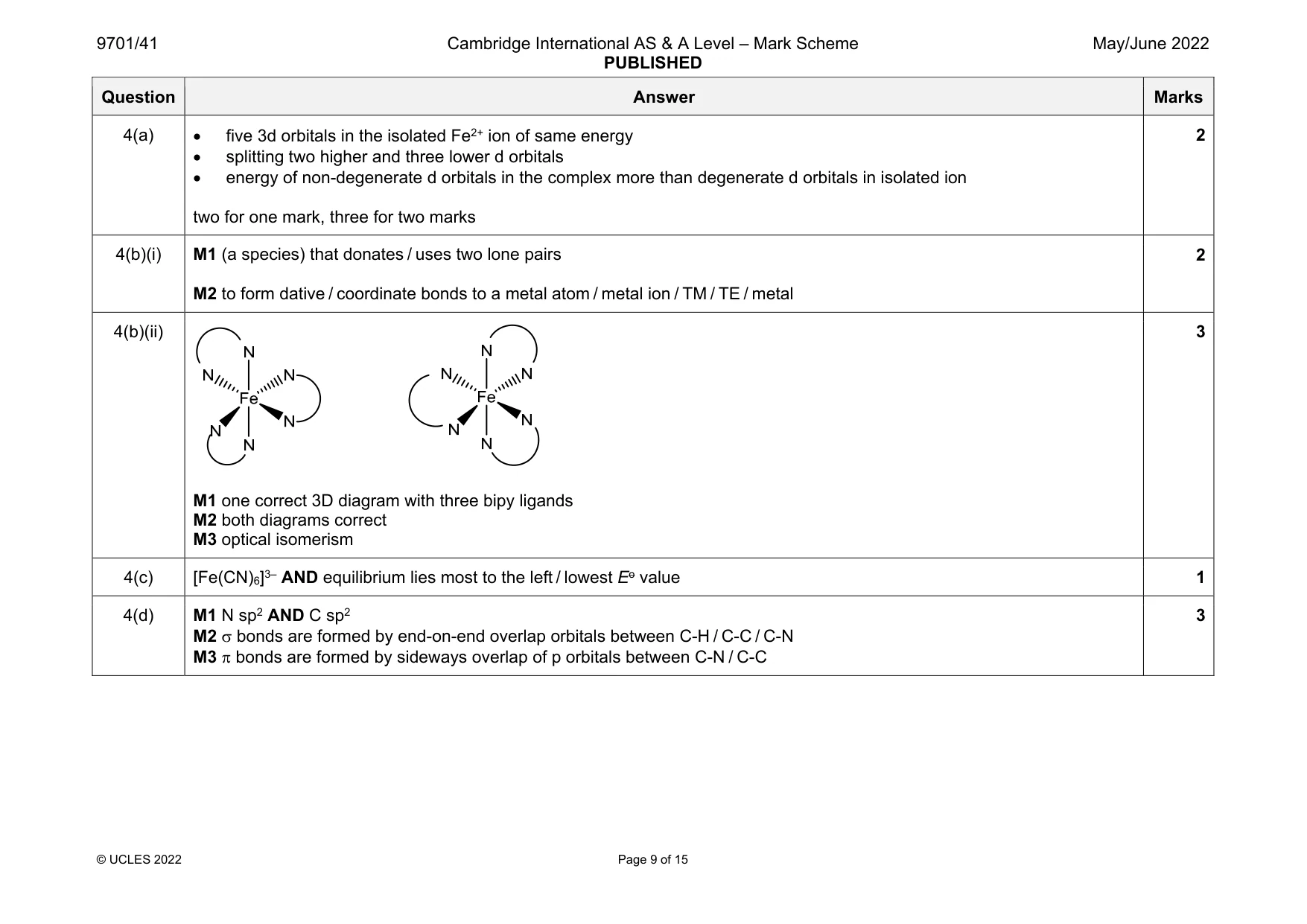
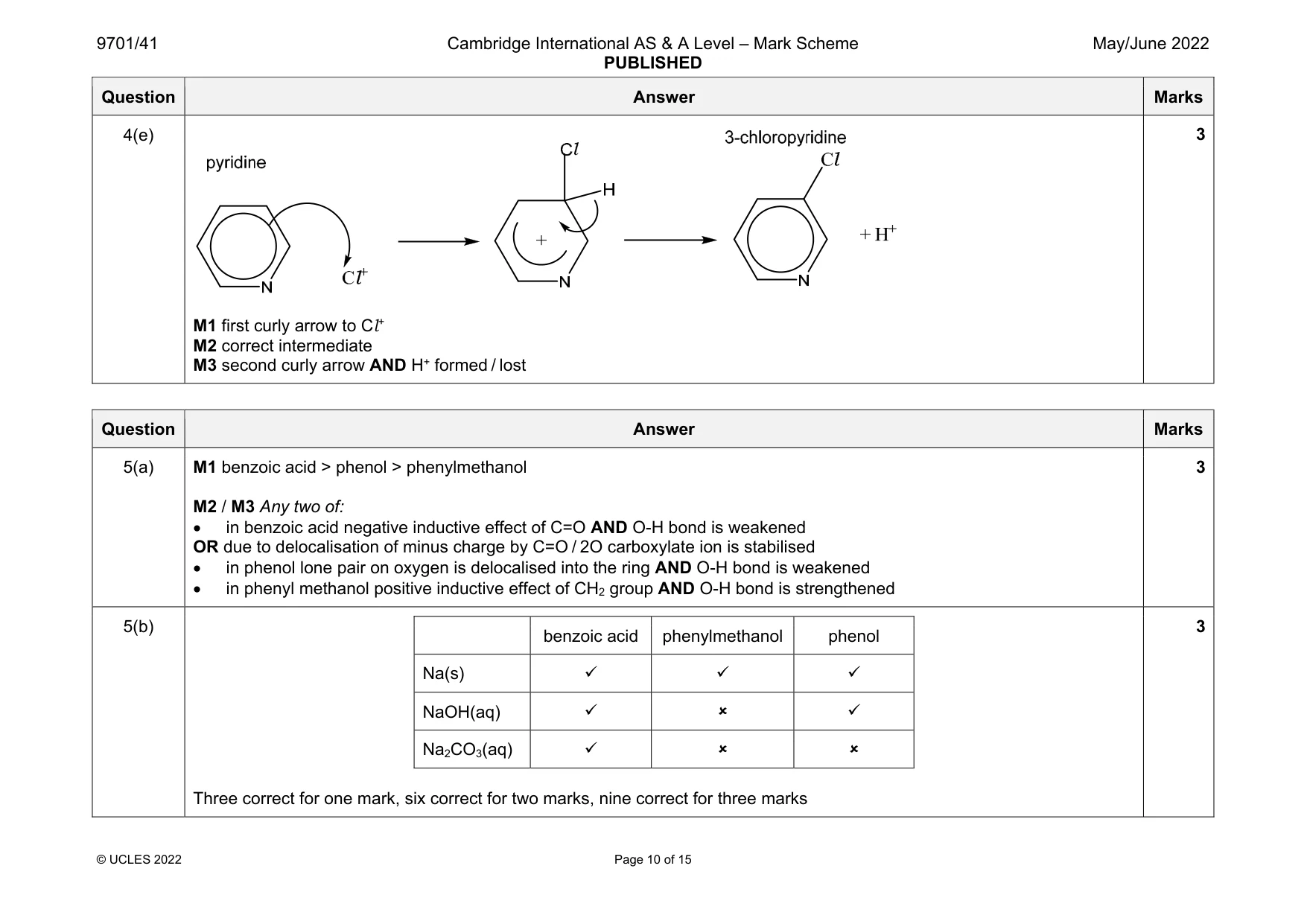
Mark scheme: 4(a) five 3d orbitals in the isolated Fe2+ ion of same energy splitting two higher and three lower d orbitals energy of non-degenerate d orbitals in the complex more than degenerate d orbitals in isolated ion two for one mark, three for two marks 2 4(b)(i) M1 (a species) that donates / uses two lone pairs M2 to form dative / coordinate bonds to a metal atom / metal ion / TM / TE / metal 2 4(b)(ii) M1 one correct 3D diagram with three bipy ligands M2 both diagrams correct M3 optical isomerism 3 4(c) [Fe(CN)6]3– AND equilibrium lies most to the left / lowest Eo value 1 4(d) M1 N sp2 AND C sp2 M2 bonds are formed by end-on-end overlap orbitals between C-H / C-C / C-N M3 bonds are formed by sideways overlap of p orbitals between C-N / C-C 3 Question Answer Marks 4(e) M1 first curly arrow to Cl+ M2 correct intermediate M3 second curly arrow AND H+ formed / lost 3
Q5 · Compare the relative acidities of benzoic acid (C6H5COOH), phenylmethanol (C6H5CH2OH)…
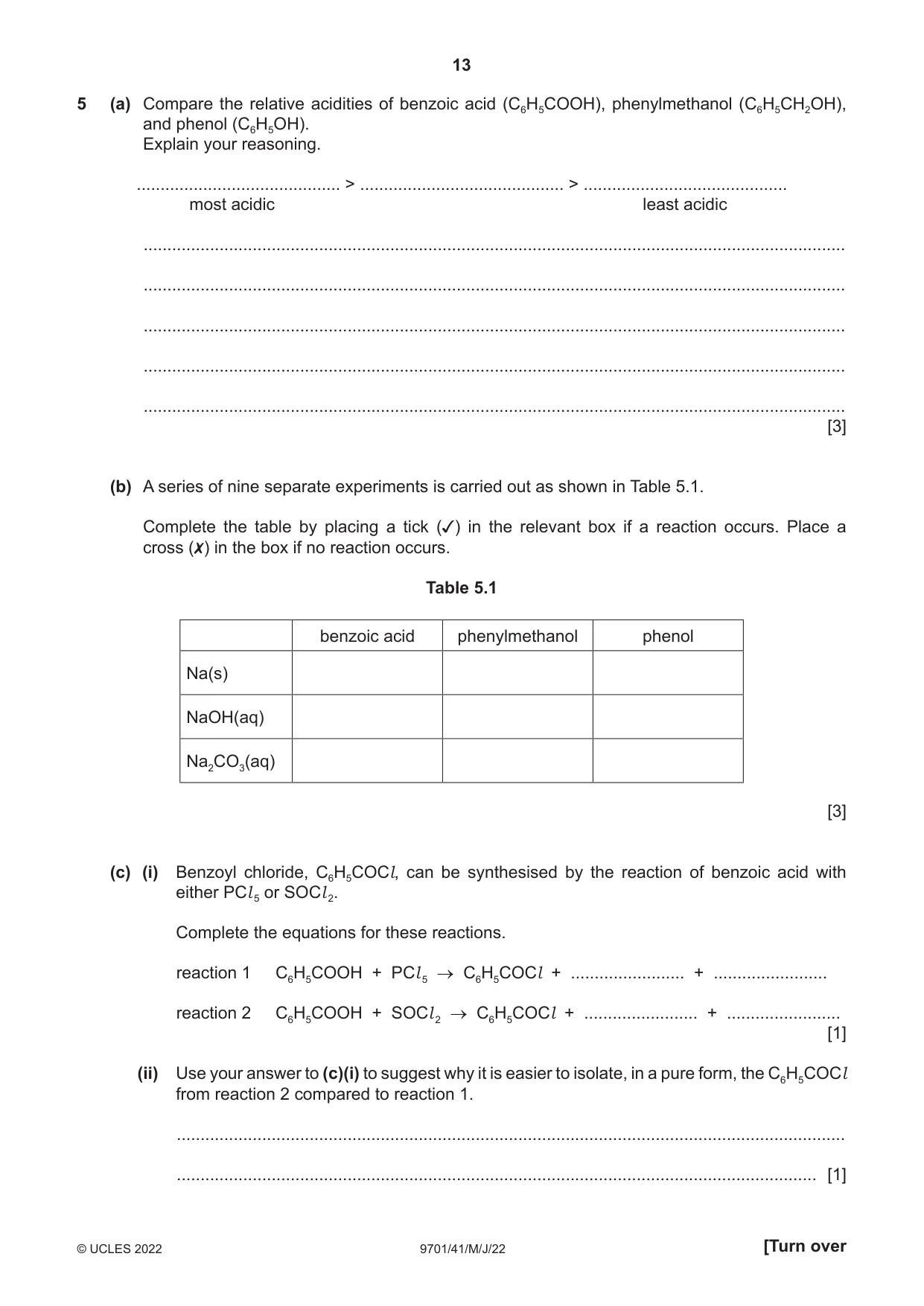
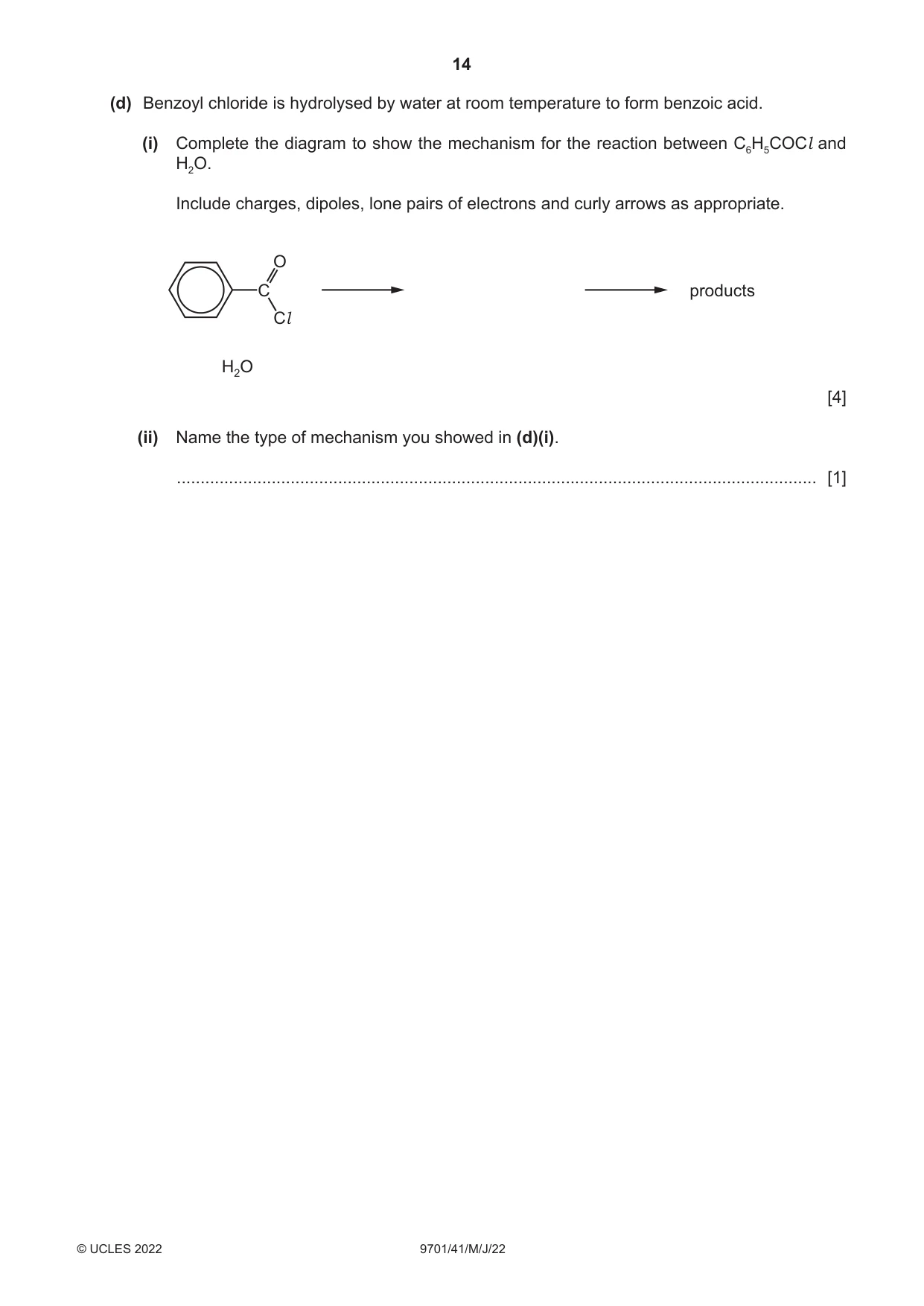
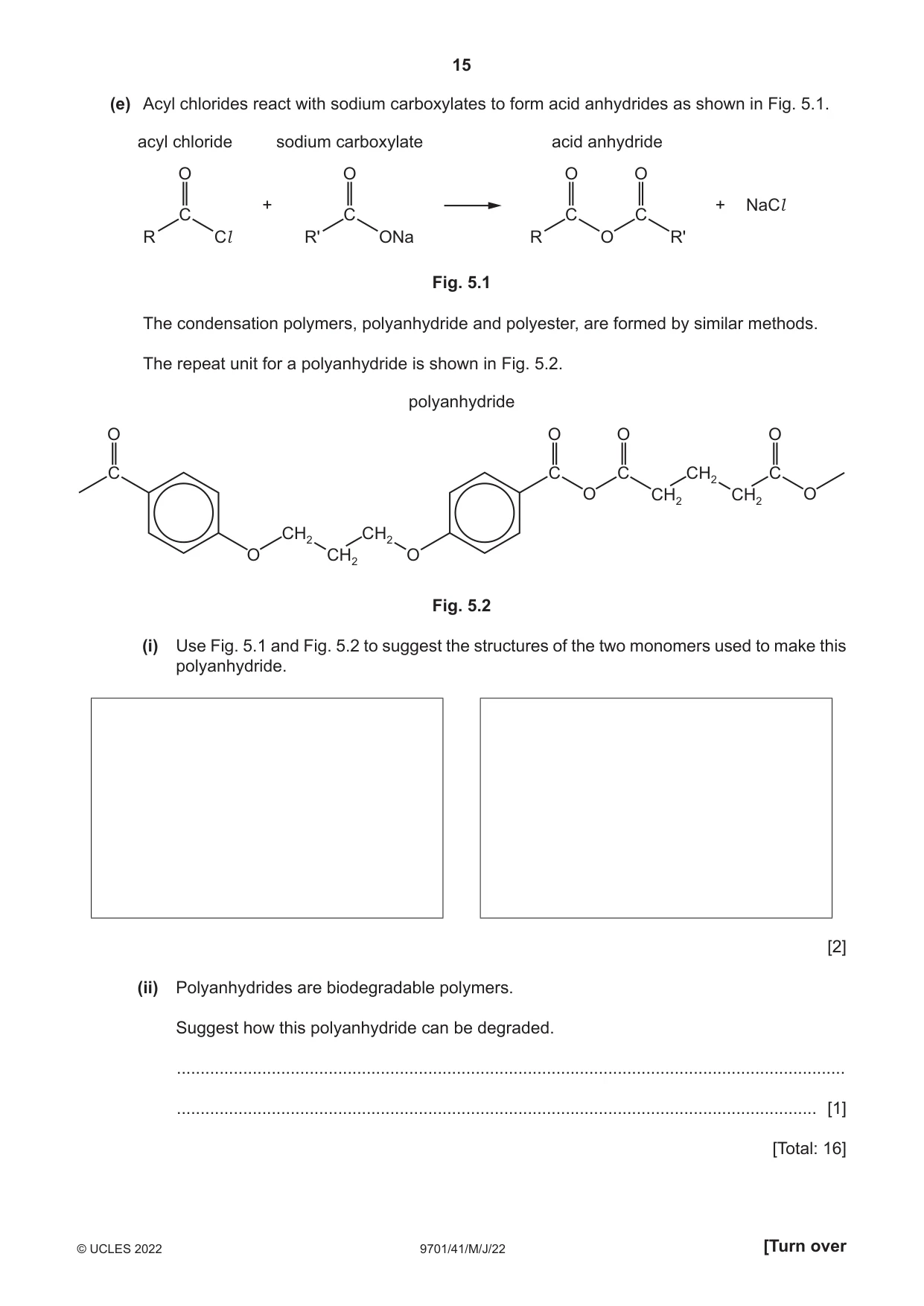
5 (a) Compare the relative acidities of benzoic acid (C6H5COOH), phenylmethanol (C6H5CH2OH), and phenol (C6H5OH). Explain your reasoning. ........................................... > ........................................... > ........................................... most acidic least acidic .................................................................................................................................................... .................................................................................................................................................... .................................................................................................................................................... .................................................................................................................................................... .................................................................................................................................................... [3] (b) A series of nine separate experiments is carried out as shown in Table 5.1. Complete the table by placing a tick (✓) in the relevant box if a reaction occurs. Place a cross (✗) in the box if no reaction occurs. Table 5.1 benzoic acid phenylmethanol phenol Na(s) NaOH(aq) Na2CO3(aq) [3] (c) (i) Benzoyl chloride, C6H5COCl, can be synthesised by the reaction of benzoic acid with either PCl 5 or SOCl 2. Complete the equations for these reactions. reaction 1 C6H5COOH + PCl 5 → C6H5COCl + ........................ + ........................ reaction 2 C6H5COOH + SOCl 2 → C6H5COCl + ........................ + ........................ [1] (ii) Use your answer to (c)(i) to suggest why it is easier to isolate, in a pure form, the C6H5COCl from reaction 2 compared to reaction 1. ............................................................................................................................................. ....................................................................................................................................... [1] (d) Benzoyl chloride is hydrolysed by water at room temperature to form benzoic acid. (i) Complete the diagram to show the mechanism for the reaction between C6H5COCl and H2O. Include charges, dipoles, lone pairs of electrons and curly arrows as appropriate. O C products Cl H2O [4] (ii) Name the type of mechanism you showed in (d)(i). ....................................................................................................................................... [1] (e) Acyl chlorides react with sodium carboxylates to form acid anhydrides as shown in Fig. 5.1. acyl chloride sodium carboxylate acid anhydride O O O O + + NaCl C C C C R Cl R' ONa R O R' Fig. 5.1 The condensation polymers, polyanhydride and polyester, are formed by similar methods. The repeat unit for a polyanhydride is shown in Fig. 5.2. polyanhydride O O O O C C C CH2 C O CH2 CH2 O CH2 CH2 O CH2 O Fig. 5.2 (i) Use Fig. 5.1 and Fig. 5.2 to suggest the structures of the two monomers used to make this polyanhydride. [2] (ii) Polyanhydrides are biodegradable polymers. Suggest how this polyanhydride can be degraded. ............................................................................................................................................. ....................................................................................................................................... [1] [Total: 16]
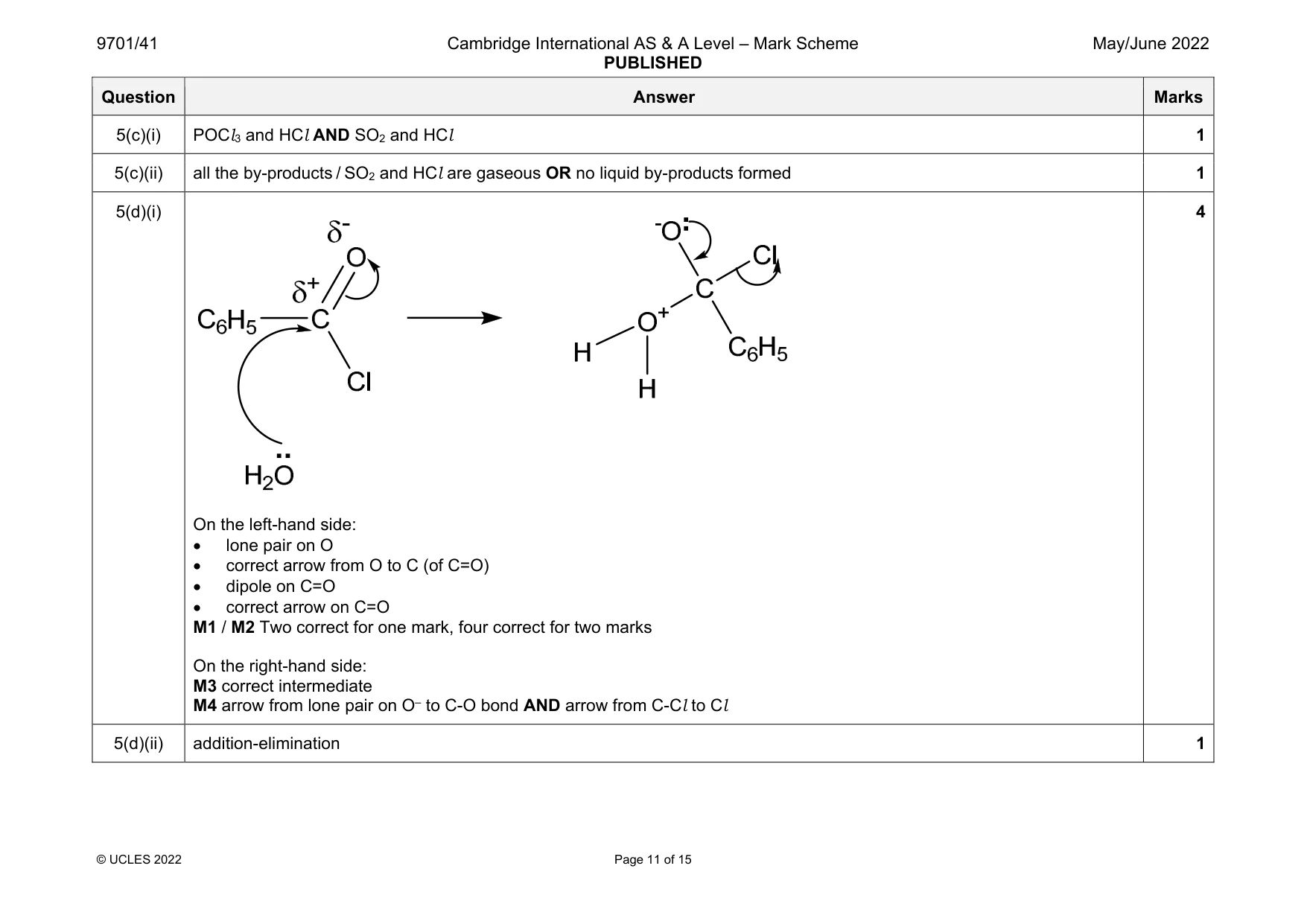
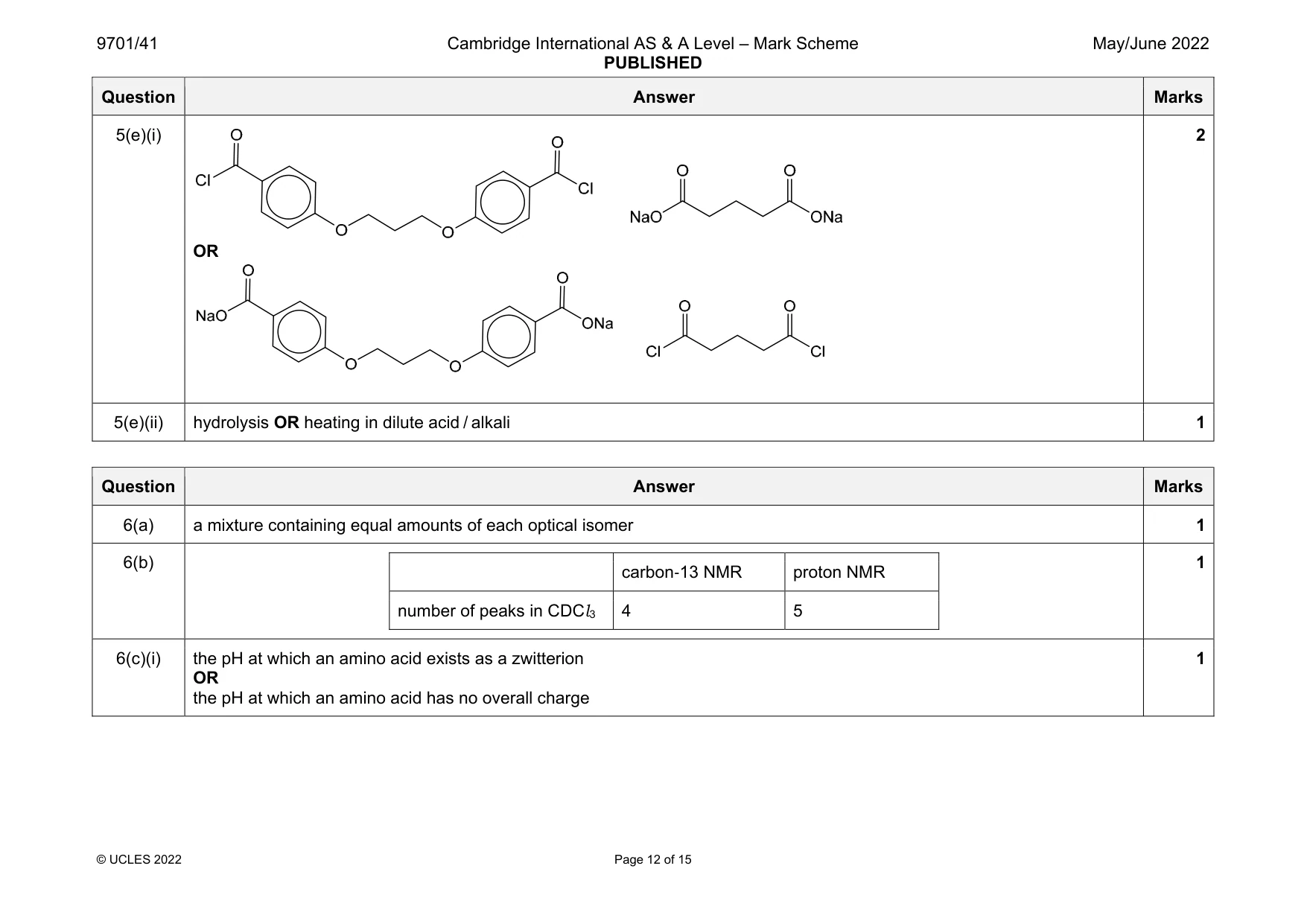
Mark scheme: 5(a) M1 benzoic acid > phenol > phenylmethanol M2 / M3 Any two of: in benzoic acid negative inductive effect of C=O AND O-H bond is weakened OR due to delocalisation of minus charge by C=O / 2O carboxylate ion is stabilised in phenol lone pair on oxygen is delocalised into the ring AND O-H bond is weakened in phenyl methanol positive inductive effect of CH2 group AND O-H bond is strengthened 5(b) benzoic acid phenylmethanol phenol Na(s) NaOH(aq) Na2CO3(aq) Three correct for one mark, six correct for two marks, nine correct for three marks 3 Question Answer Marks 5(c)(i) POCl3 and HCl AND SO2 and HCl 1 5(c)(ii) all the by-products / SO2 and HCl are gaseous OR no liquid by-products formed 1 5(d)(i) On the left-hand side: lone pair on O correct arrow from O to C (of C=O) dipole on C=O correct arrow on C=O M1 / M2 Two correct for one mark, four correct for two marks On the right-hand side: M3 correct intermediate M4 arrow from lone pair on O– to C-O bond AND arrow from C-Cl to Cl 4 5(d)(ii) addition-elimination 1 Question Answer Marks 5(e)(i) OR 2 5(e)(ii) hydrolysis OR heating in dilute acid / alkali 1
Q6 · Describe what is meant by a racemic mixture
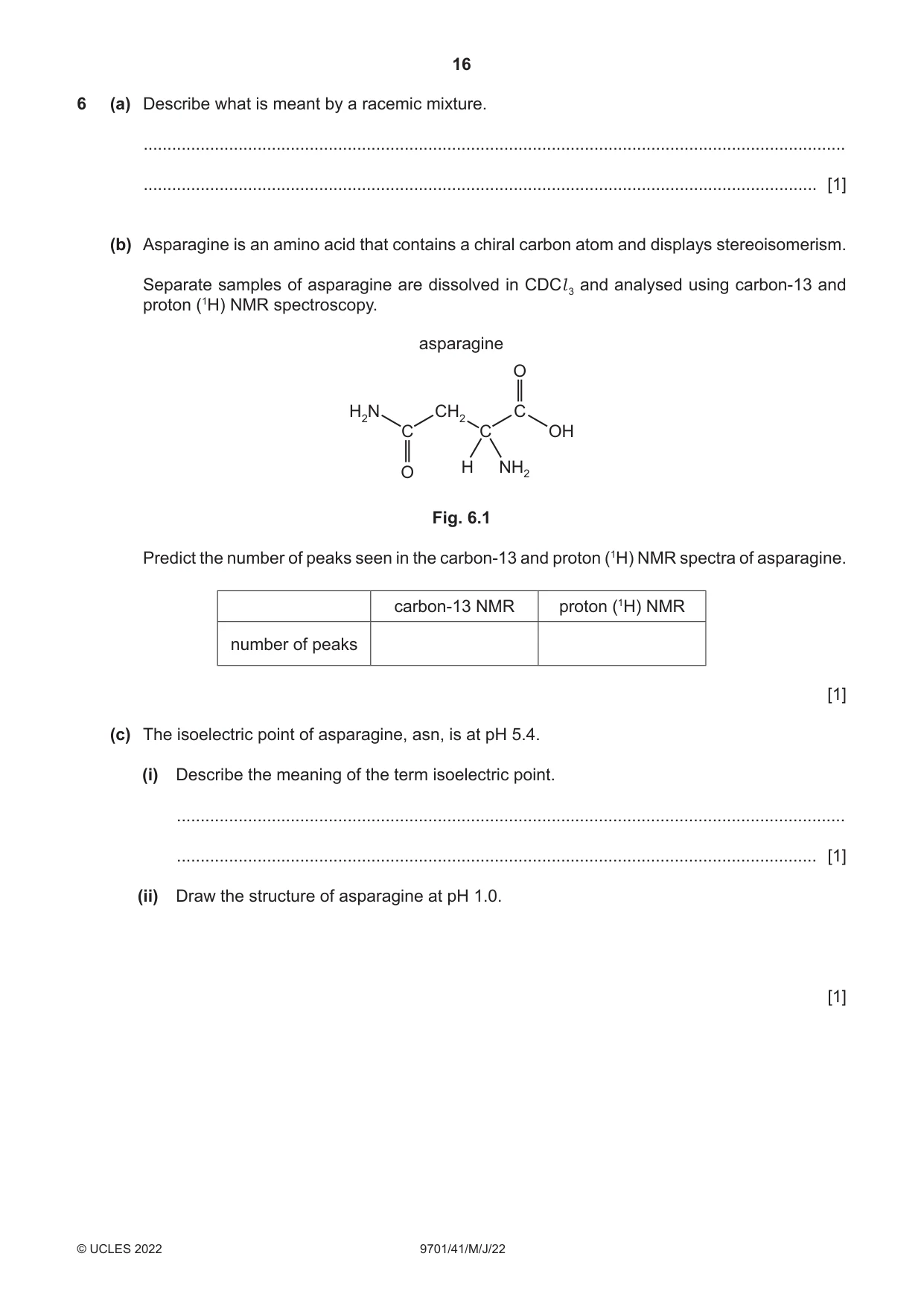
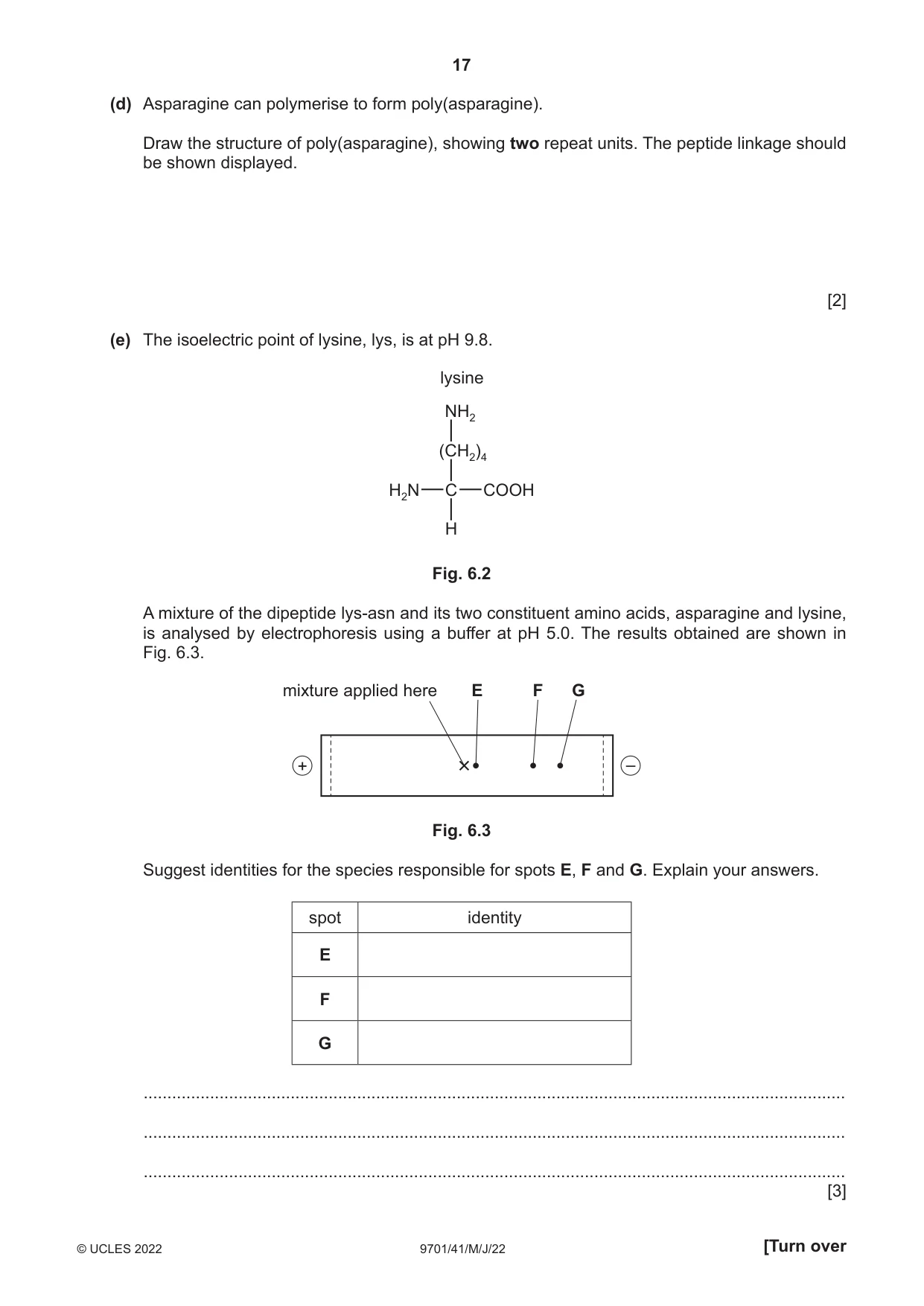
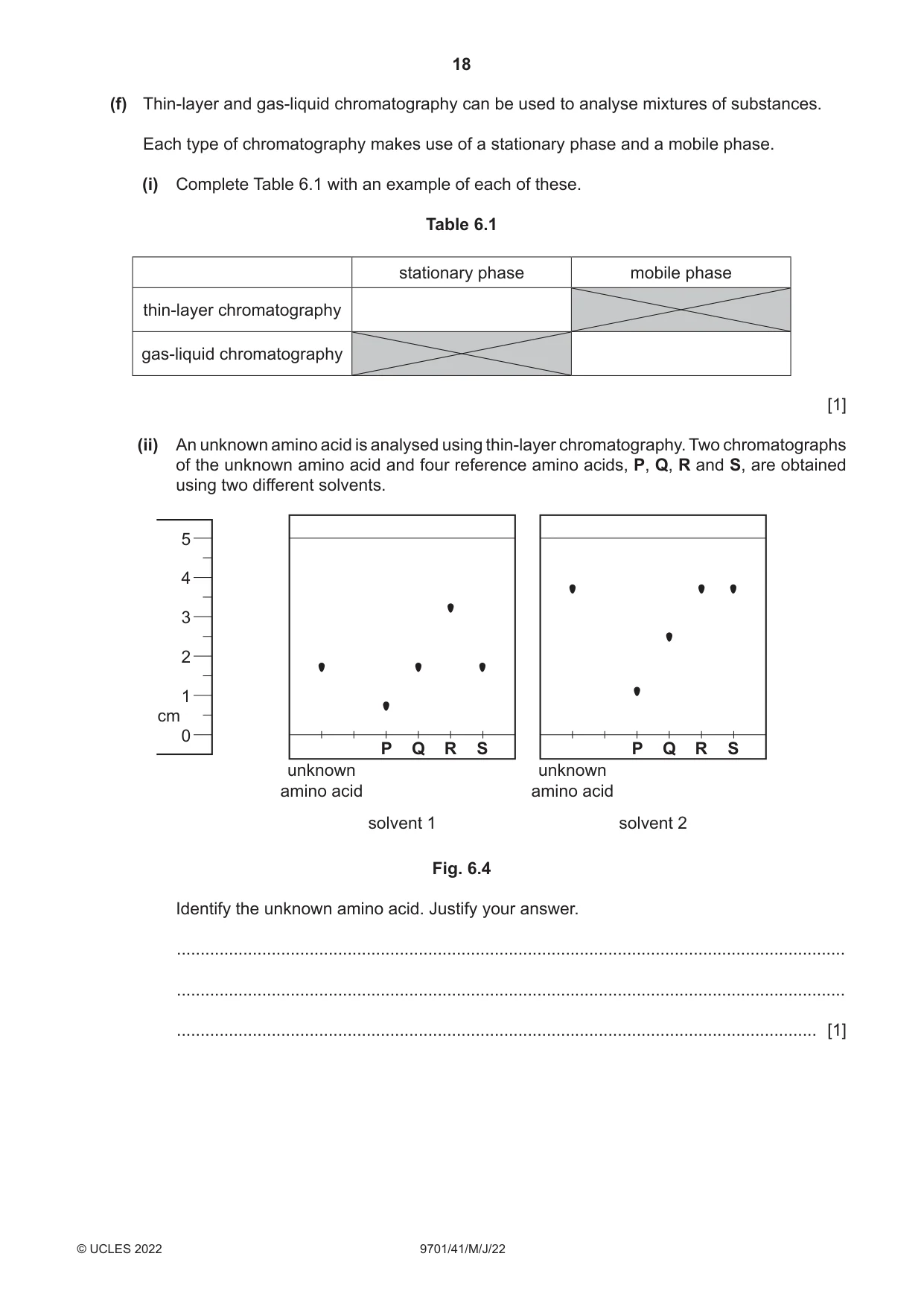
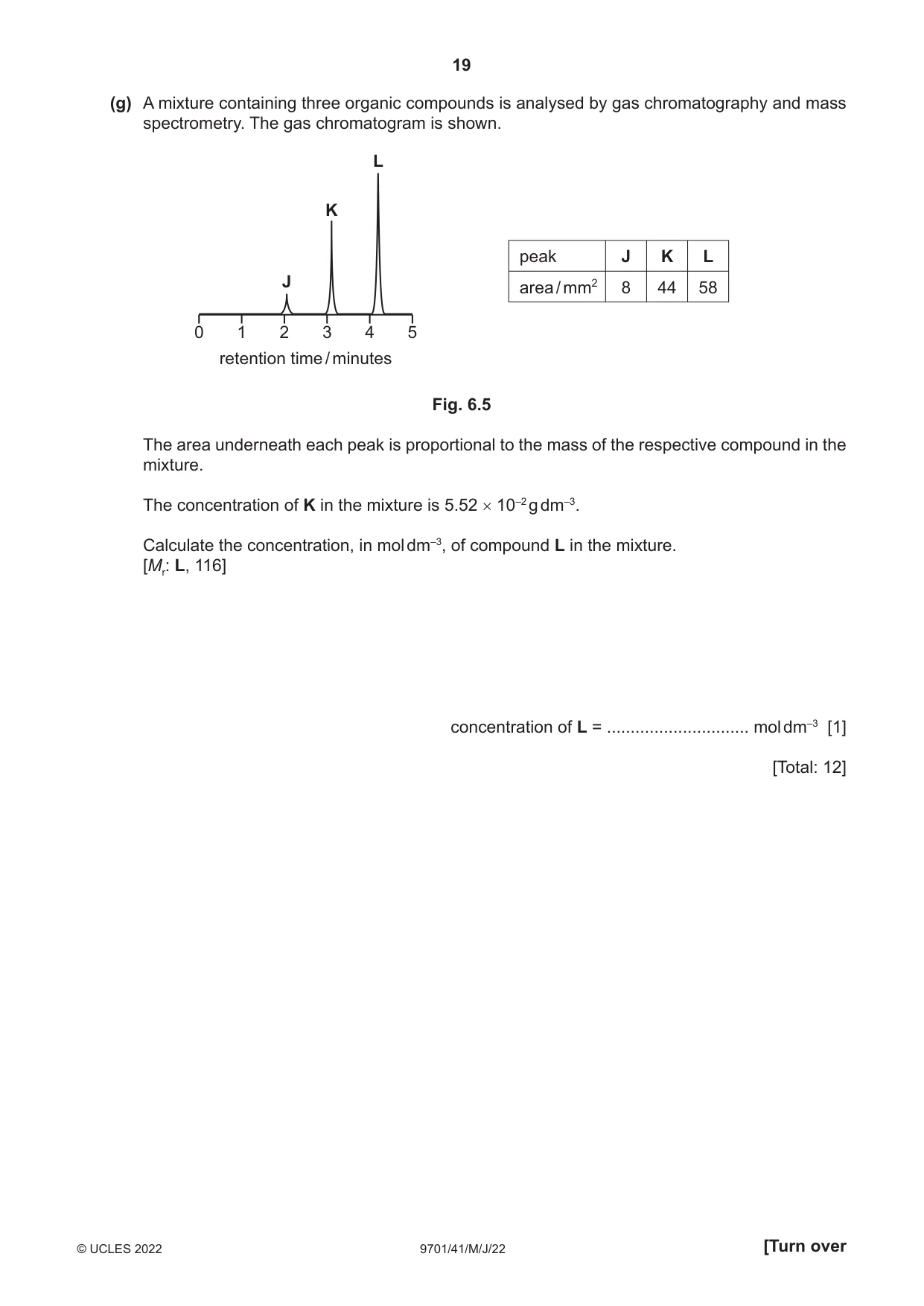
6 (a) Describe what is meant by a racemic mixture. .................................................................................................................................................... .............................................................................................................................................. [1] (b) Asparagine is an amino acid that contains a chiral carbon atom and displays stereoisomerism. Separate samples of asparagine are dissolved in CDCl 3 and analysed using carbon‑13 and proton (1H) NMR spectroscopy. asparagine O H2N CH2 C C C OH H NH2 O Fig. 6.1 Predict the number of peaks seen in the carbon‑13 and proton (1H) NMR spectra of asparagine. carbon‑13 NMR proton (1H) NMR number of peaks [1] (c) The isoelectric point of asparagine, asn, is at pH 5.4. (i) Describe the meaning of the term isoelectric point. ............................................................................................................................................. ....................................................................................................................................... [1] (ii) Draw the structure of asparagine at pH 1.0. [1] (d) Asparagine can polymerise to form poly(asparagine). Draw the structure of poly(asparagine), showing two repeat units. The peptide linkage should be shown displayed. [2] (e) The isoelectric point of lysine, lys, is at pH 9.8. lysine NH2 (CH2)4 H2N C COOH H Fig. 6.2 A mixture of the dipeptide lys-asn and its two constituent amino acids, asparagine and lysine, is analysed by electrophoresis using a buffer at pH 5.0. The results obtained are shown in Fig. 6.3. mixture applied here E F G + – Fig. 6.3 Suggest identities for the species responsible for spots E, F and G. Explain your answers. spot identity E F G .................................................................................................................................................... .................................................................................................................................................... .................................................................................................................................................... [3] (f) Thin-layer and gas-liquid chromatography can be used to analyse mixtures of substances. Each type of chromatography makes use of a stationary phase and a mobile phase. (i) Complete Table 6.1 with an example of each of these. Table 6.1 stationary phase mobile phase thin-layer chromatography gas-liquid chromatography [1] (ii) An unknown amino acid is analysed using thin-layer chromatography. Two chromatographs of the unknown amino acid and four reference amino acids, P, Q, R and S, are obtained using two different solvents. 5 4 3 2 1 cm 0 P Q R S P Q R S unknown unknown amino acid amino acid solvent 1 solvent 2 Fig. 6.4 Identify the unknown amino acid. Justify your answer. ............................................................................................................................................. ............................................................................................................................................. ....................................................................................................................................... [1] (g) A mixture containing three organic compounds is analysed by gas chromatography and mass spectrometry. The gas chromatogram is shown. L K peak J K L J area / mm2 8 44 58 0 1 2 3 4 5 retention time / minutes Fig. 6.5 The area underneath each peak is proportional to the mass of the respective compound in the mixture. The concentration of K in the mixture is 5.52 × 10⁻² g dm–3. Calculate the concentration, in mol dm–3, of compound L in the mixture. [Mr: L, 116] concentration of L = .............................. mol dm–3 [1] [Total: 12]
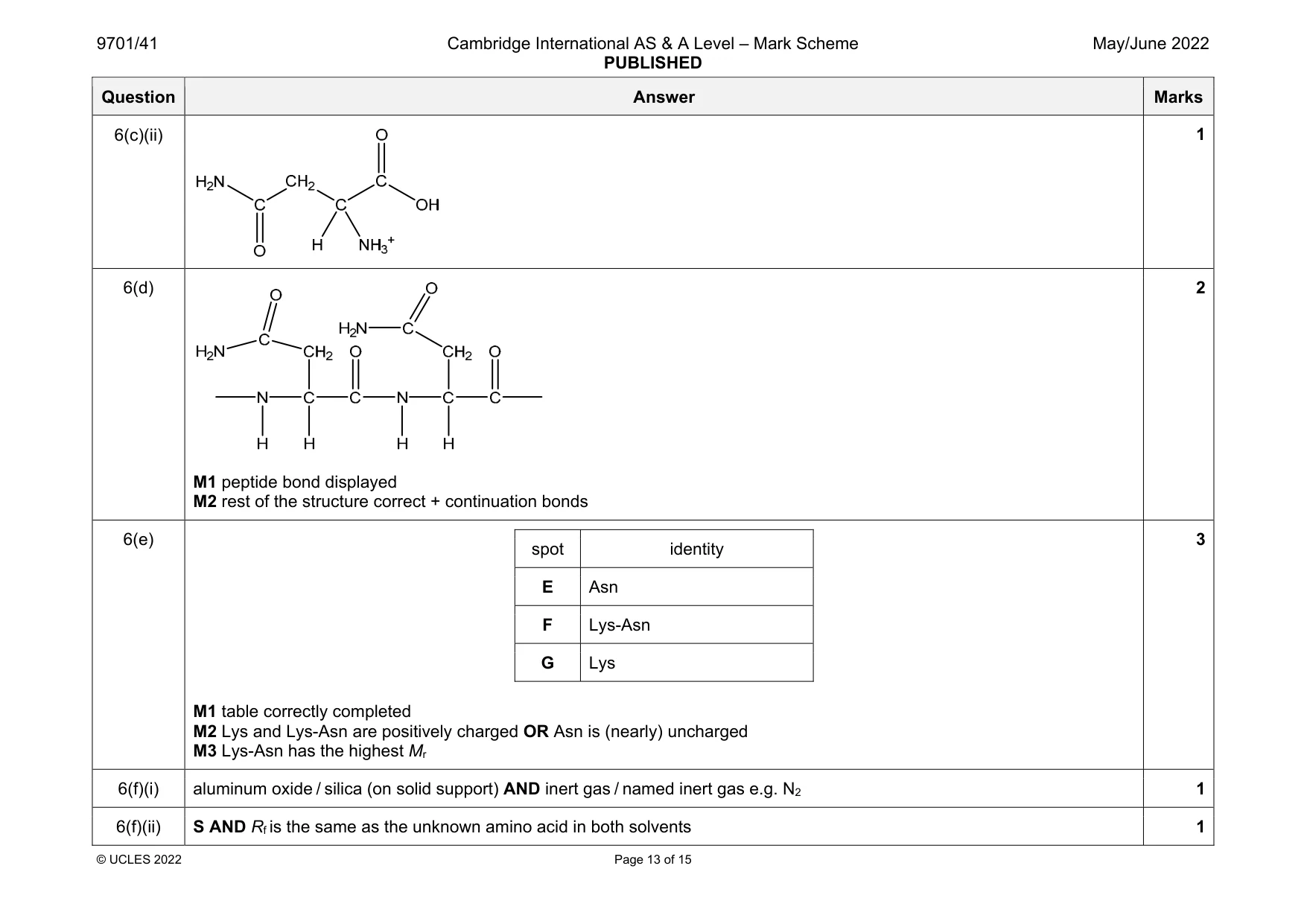
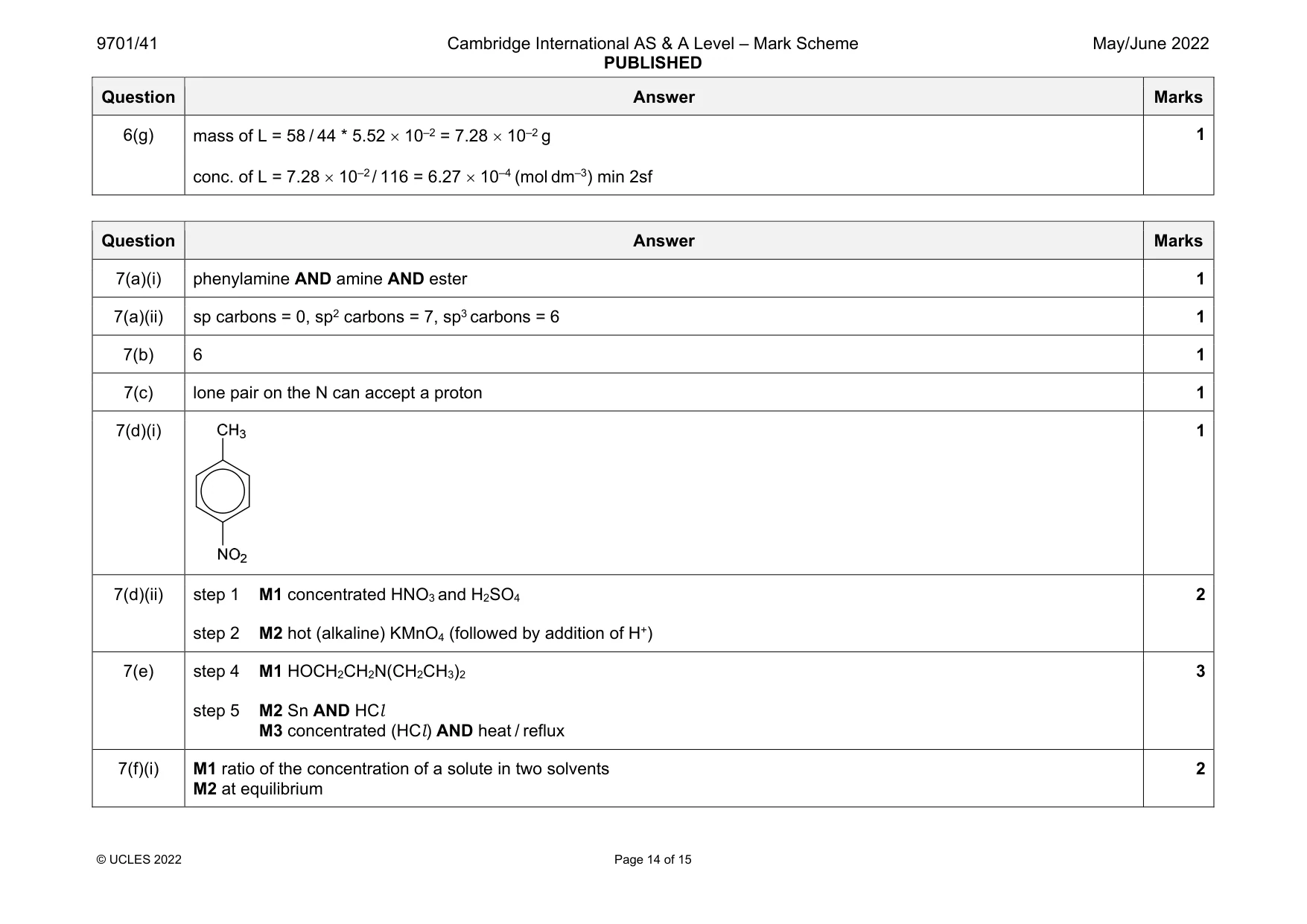
Mark scheme: 6(a) a mixture containing equal amounts of each optical isomer 1 6(b) carbon‑13 NMR proton NMR number of peaks in CDCl3 4 5 1 6(c)(i) the pH at which an amino acid exists as a zwitterion OR the pH at which an amino acid has no overall charge 1 Question Answer Marks 6(c)(ii) 1 6(d) M1 peptide bond displayed M2 rest of the structure correct + continuation bonds 2 6(e) spot identity E Asn F Lys-Asn G Lys M1 table correctly completed M2 Lys and Lys-Asn are positively charged OR Asn is (nearly) uncharged M3 Lys-Asn has the highest Mr 3 6(f)(i) aluminum oxide / silica (on solid support) AND inert gas / named inert gas e.g. N2 1 6(f)(ii) S AND Rf is the same as the unknown amino acid in both solvents 1 Question Answer Marks 6(g) mass of L = 58 / 44 * 5.52 10–2 = 7.28 10–2 g conc. of L = 7.28 10–2 / 116 = 6.27 10–4 (mol dm–3) min 2sf 1
Q7 · Procaine is used as an anaesthetic in medicine
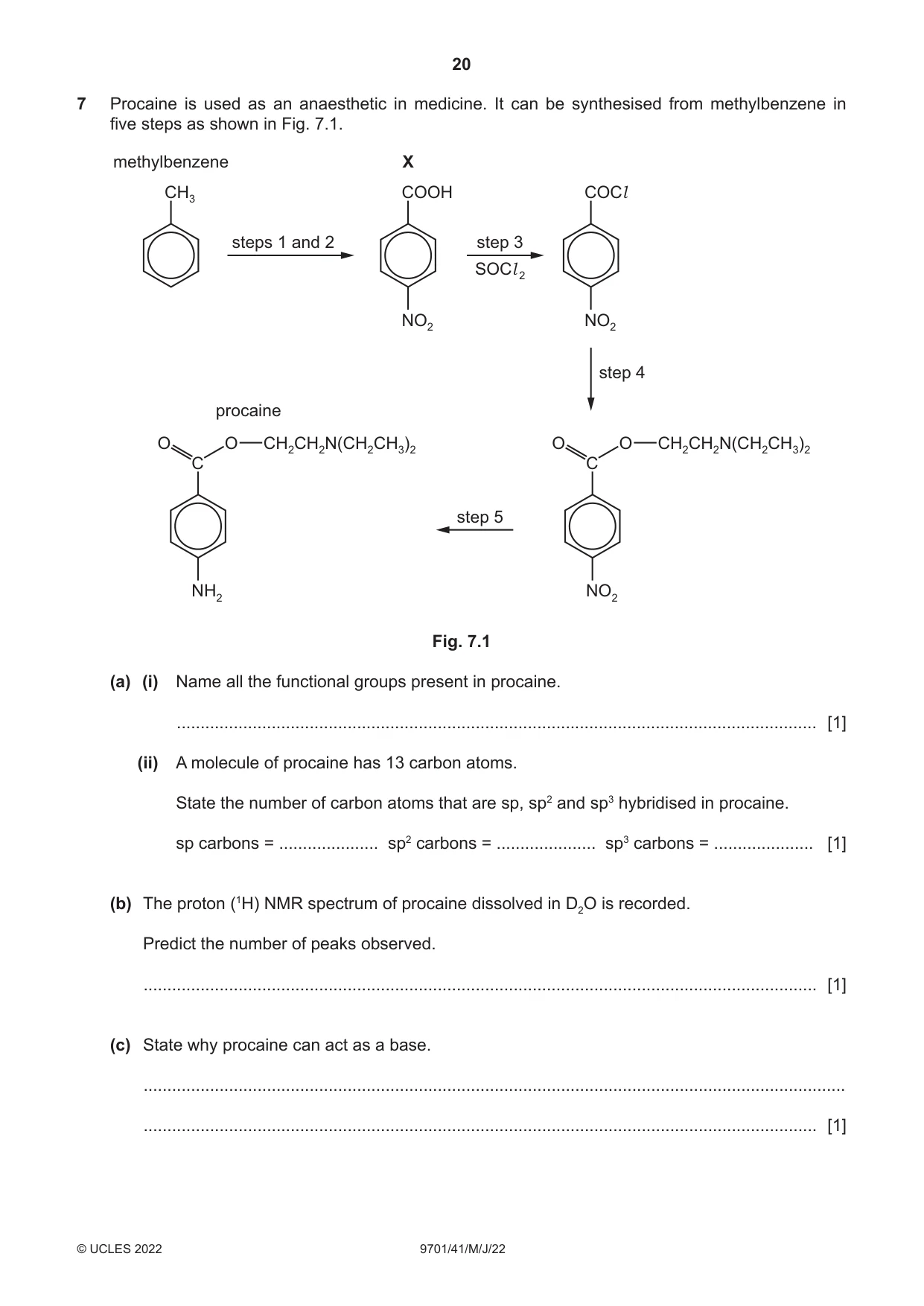
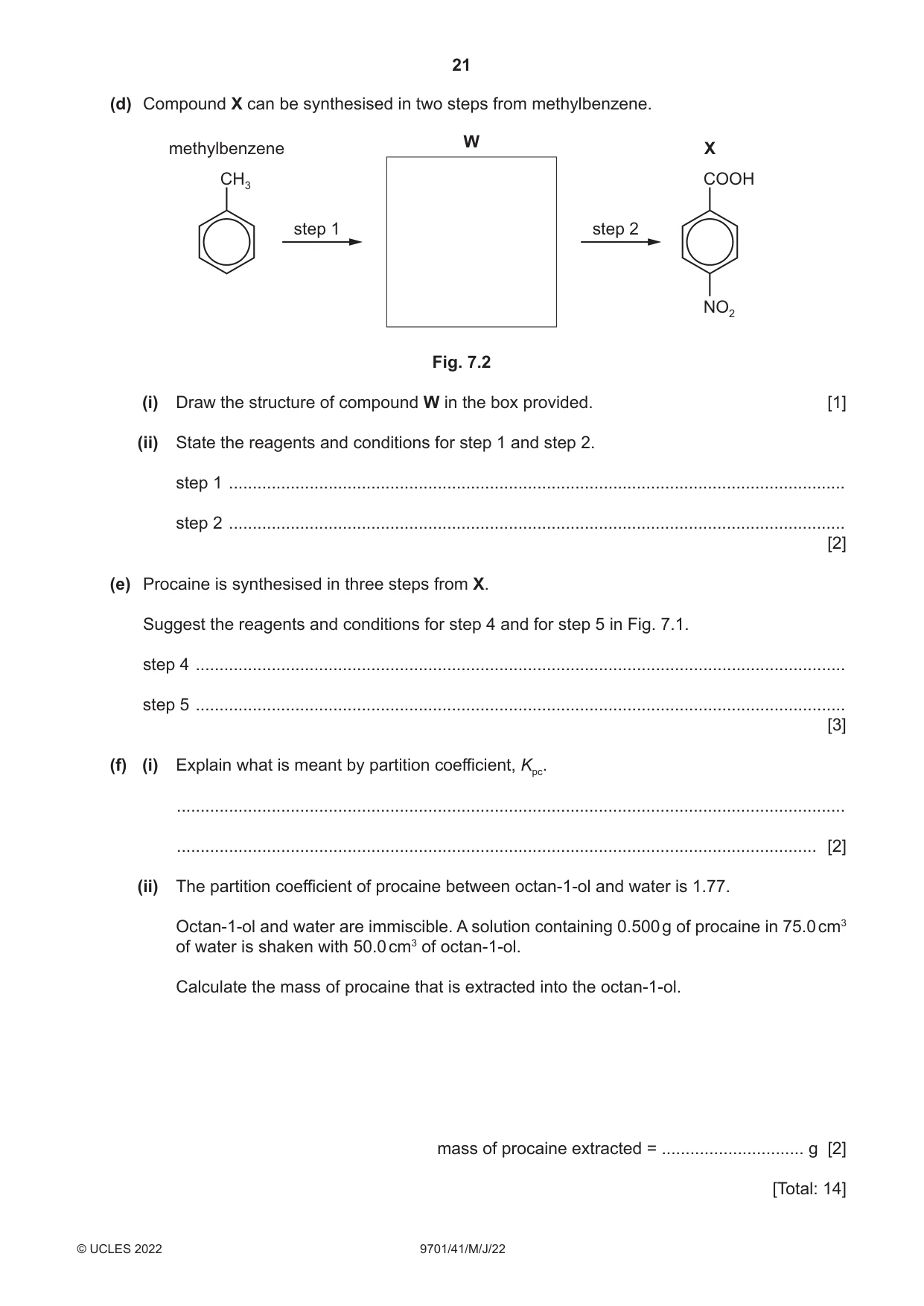
7 Procaine is used as an anaesthetic in medicine. It can be synthesised from methylbenzene in five steps as shown in Fig. 7.1. methylbenzene X CH3 COOH COCl steps 1 and 2 step 3 SOCl 2 NO2 NO2 step 4 procaine O O CH2CH2N(CH2CH3)2 O O CH2CH2N(CH2CH3)2 C C step 5 NH2 NO2 Fig. 7.1 (a) (i) Name all the functional groups present in procaine. ....................................................................................................................................... [1] (ii) A molecule of procaine has 13 carbon atoms. State the number of carbon atoms that are sp, sp2 and sp3 hybridised in procaine. sp carbons = ..................... sp2 carbons = ..................... sp3 carbons = ..................... [1] (b) The proton (1H) NMR spectrum of procaine dissolved in D2O is recorded. Predict the number of peaks observed. .............................................................................................................................................. [1] (c) State why procaine can act as a base. .................................................................................................................................................... .............................................................................................................................................. [1] (d) Compound X can be synthesised in two steps from methylbenzene. W methylbenzene X CH3 COOH step 1 step 2 NO2 Fig. 7.2 (i) Draw the structure of compound W in the box provided. [1] (ii) State the reagents and conditions for step 1 and step 2. step 1 .................................................................................................................................. step 2 .................................................................................................................................. [2] (e) Procaine is synthesised in three steps from X. Suggest the reagents and conditions for step 4 and for step 5 in Fig. 7.1. step 4 ......................................................................................................................................... step 5 ......................................................................................................................................... [3] (f) (i) Explain what is meant by partition coefficient, Kpc. ............................................................................................................................................. ....................................................................................................................................... [2] (ii) The partition coefficient of procaine between octan-1-ol and water is 1.77. Octan-1-ol and water are immiscible. A solution containing 0.500 g of procaine in 75.0 cm3 of water is shaken with 50.0 cm3 of octan‑1‑ol. Calculate the mass of procaine that is extracted into the octan‑1‑ol. mass of procaine extracted = .............................. g [2] [Total: 14]
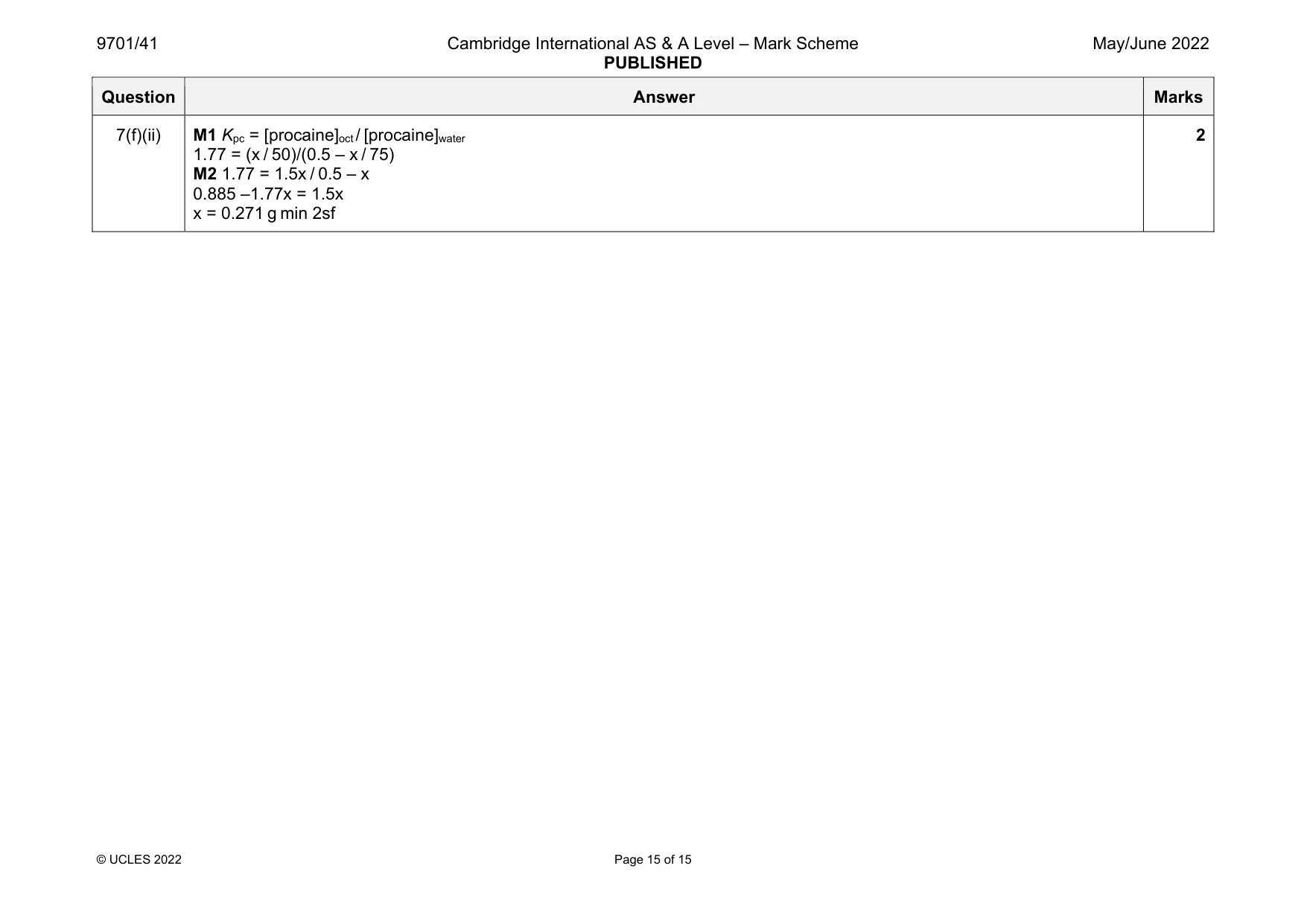
Mark scheme: 7(a)(i) phenylamine AND amine AND ester 1 7(a)(ii) sp carbons = 0, sp2 carbons = 7, sp3 carbons = 6 1 7(b) 6 1 7(c) lone pair on the N can accept a proton 1 7(d)(i) 1 7(d)(ii) step 1 M1 concentrated HNO3 and H2SO4 step 2 M2 hot (alkaline) KMnO4 (followed by addition of H+) 2 7(e) step 4 M1 HOCH2CH2N(CH2CH3)2 step 5 M2 Sn AND HCl M3 concentrated (HCl) AND heat / reflux 3 7(f)(i) M1 ratio of the concentration of a solute in two solvents M2 at equilibrium 2 Question Answer Marks 7(f)(ii) M1 Kpc = [procaine]oct / [procaine]water 1.77 = (x / 50)/(0.5 – x / 75) M2 1.77 = 1.5x / 0.5 – x 0.885 –1.77x = 1.5x x = 0.271 g min 2sf 2
What was in this paper
The subtopics covered by these 7 questions, and how many questions each got. Open one in a new tab to see every Cambridge question on it.
What you needed in this session
Cambridge’s own grade thresholds for 2022 May/June, Paper 4 · Variant 1. A higher threshold means an easier paper — the bar moves with how the cohort did.