Cambridge A Level Chemistry 9701 — 2024 May/June Paper 4 · Variant 2
9701/42/M/J/24 · 9 questions · 100 marks · ≈113 min
The question paper and its mark scheme, free to read here and free to download. This is Cambridge’s own paper, exactly as it was sat.
Question paper24 pages

Mark scheme15 pages
Answers below. Sit the paper first if you are practising.
Questions as text
Q1 · Describe the trend in the solubility of the sulfates of magnesium, calcium and strontium
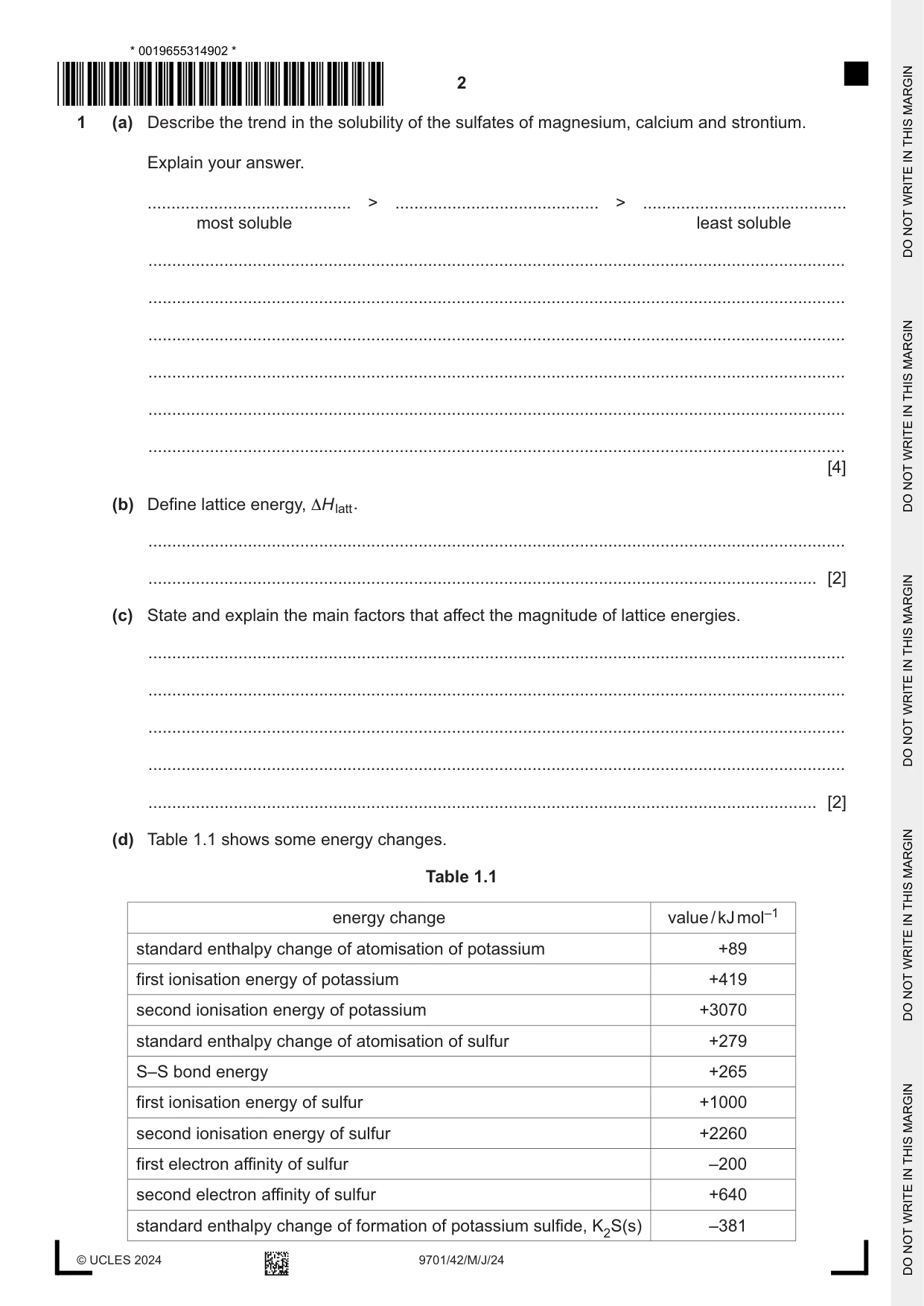
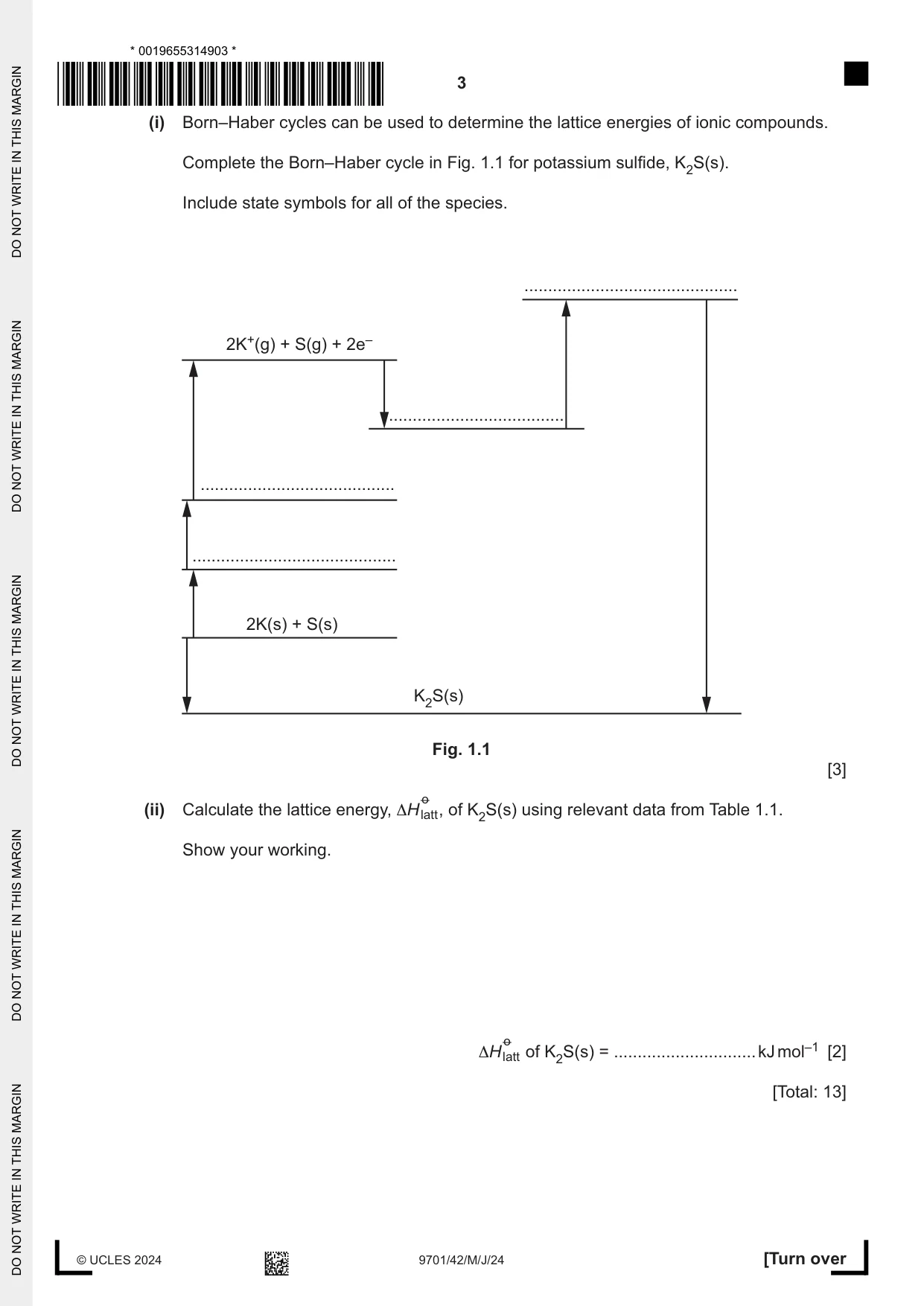
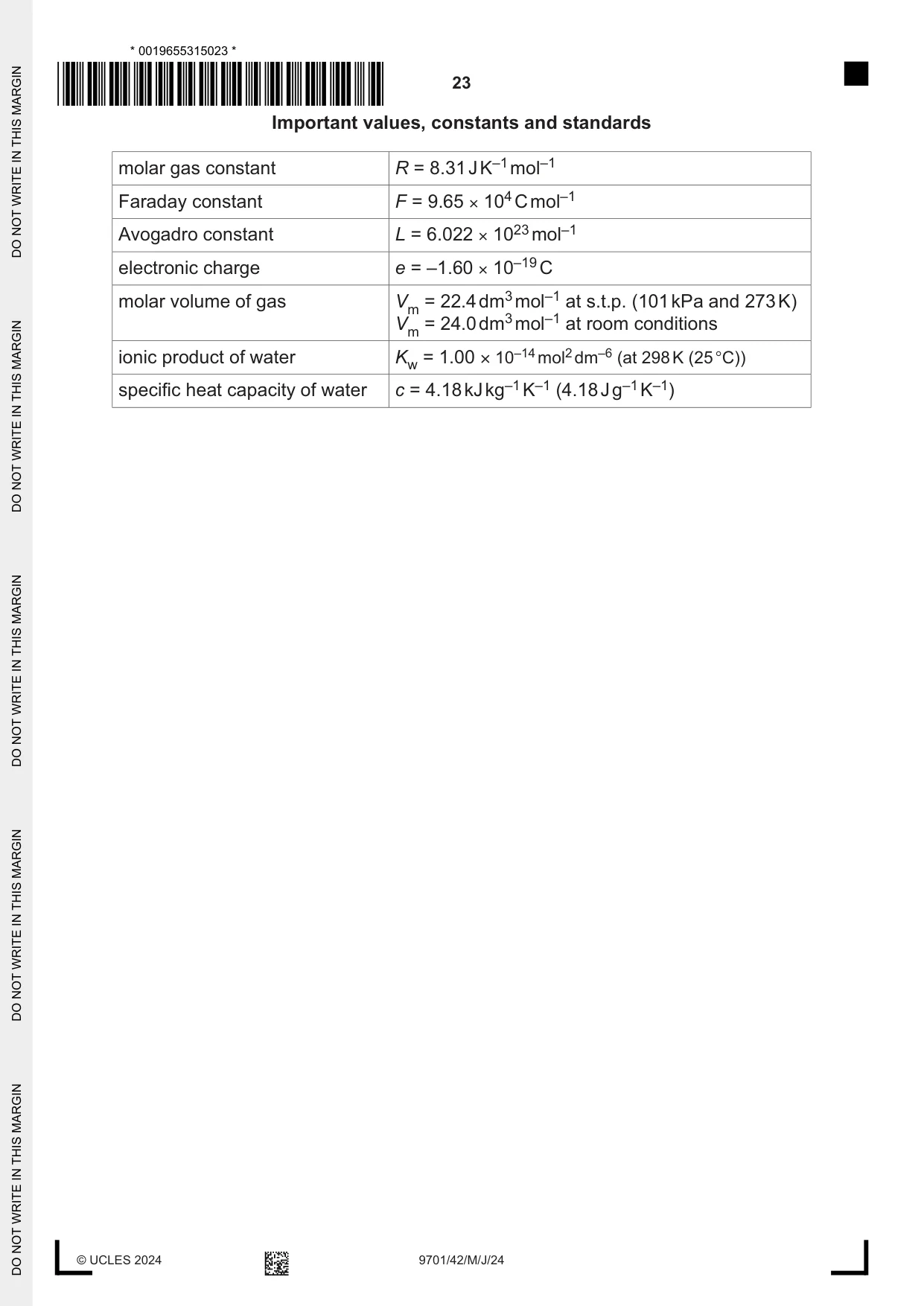
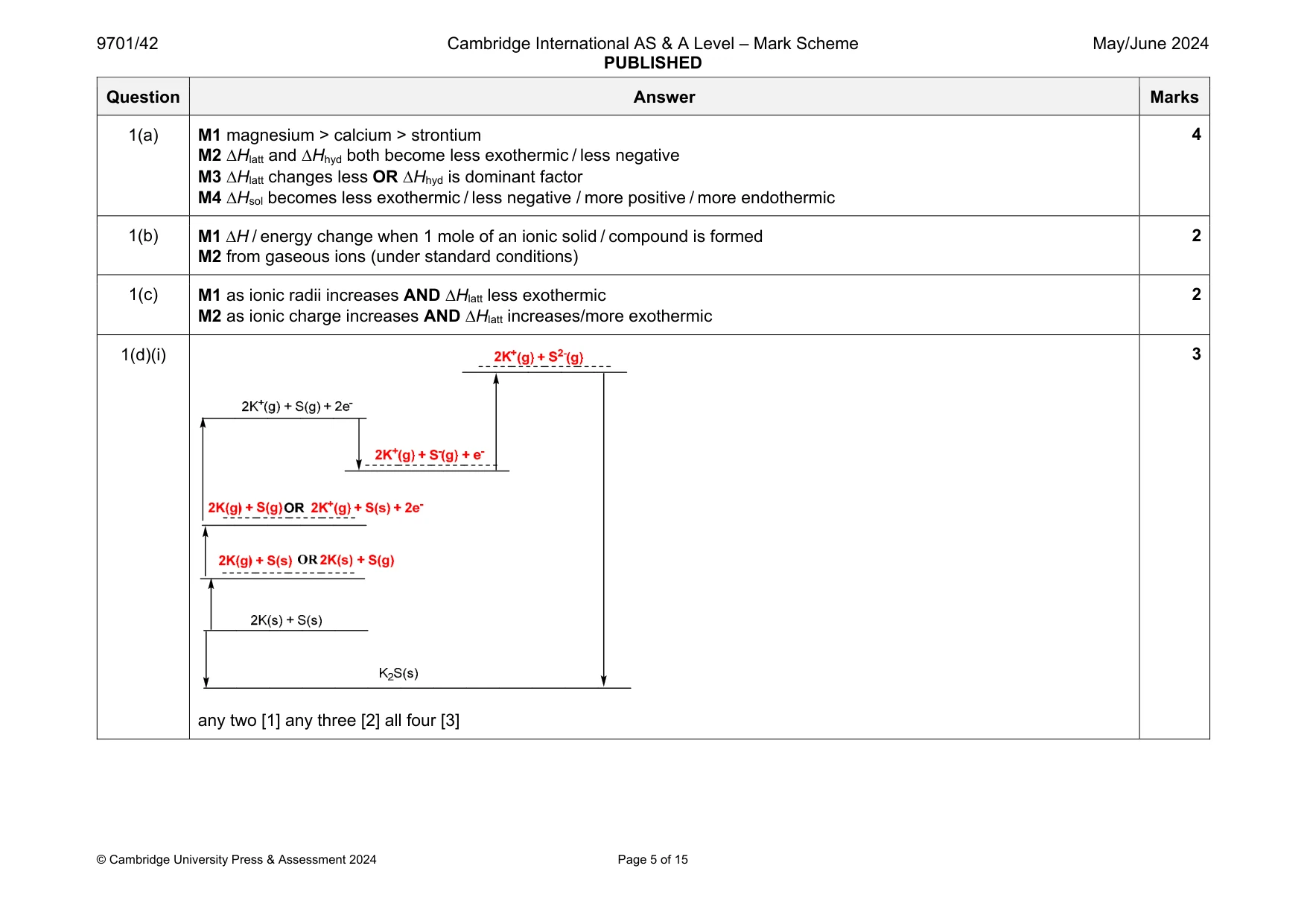
1 (a) Describe the trend in the solubility of the sulfates of magnesium, calcium and strontium. Explain your answer. ........................................... > ........................................... > ........................................... most soluble least soluble ................................................................................................................................................... ................................................................................................................................................... ................................................................................................................................................... ................................................................................................................................................... ................................................................................................................................................... ................................................................................................................................................... [4] (b) Define lattice energy, ΔH latt. ................................................................................................................................................... ............................................................................................................................................. [2] (c) State and explain the main factors that affect the magnitude of lattice energies. ................................................................................................................................................... ................................................................................................................................................... ................................................................................................................................................... ................................................................................................................................................... ............................................................................................................................................. [2] (d) Table 1.1 shows some energy changes. Table 1.1 energy change value / kJ mol–1 standard enthalpy change of atomisation of potassium +89 first ionisation energy of potassium +419 second ionisation energy of potassium +3070 standard enthalpy change of atomisation of sulfur +279 S–S bond energy +265 first ionisation energy of sulfur +1000 second ionisation energy of sulfur +2260 first electron affinity of sulfur –200 second electron affinity of sulfur +640 standard enthalpy change of formation of potassium sulfide, K2S(s) –381 (i) Born–Haber cycles can be used to determine the lattice energies of ionic compounds. Complete the Born–Haber cycle in Fig. 1.1 for potassium sulfide, K2S(s). Include state symbols for all of the species. ............................................. 2K+(g) + S(g) + 2e– ..................................... ......................................... ........................................... 2K(s) + S(s) K2S(s) Fig. 1.1 [3] o (ii) Calculate the lattice energy, ΔH latt, of K2S(s) using relevant data from Table 1.1. Show your working. o ΔH latt of K2S(s) = .............................. kJ mol–1 [2] [Total: 13]
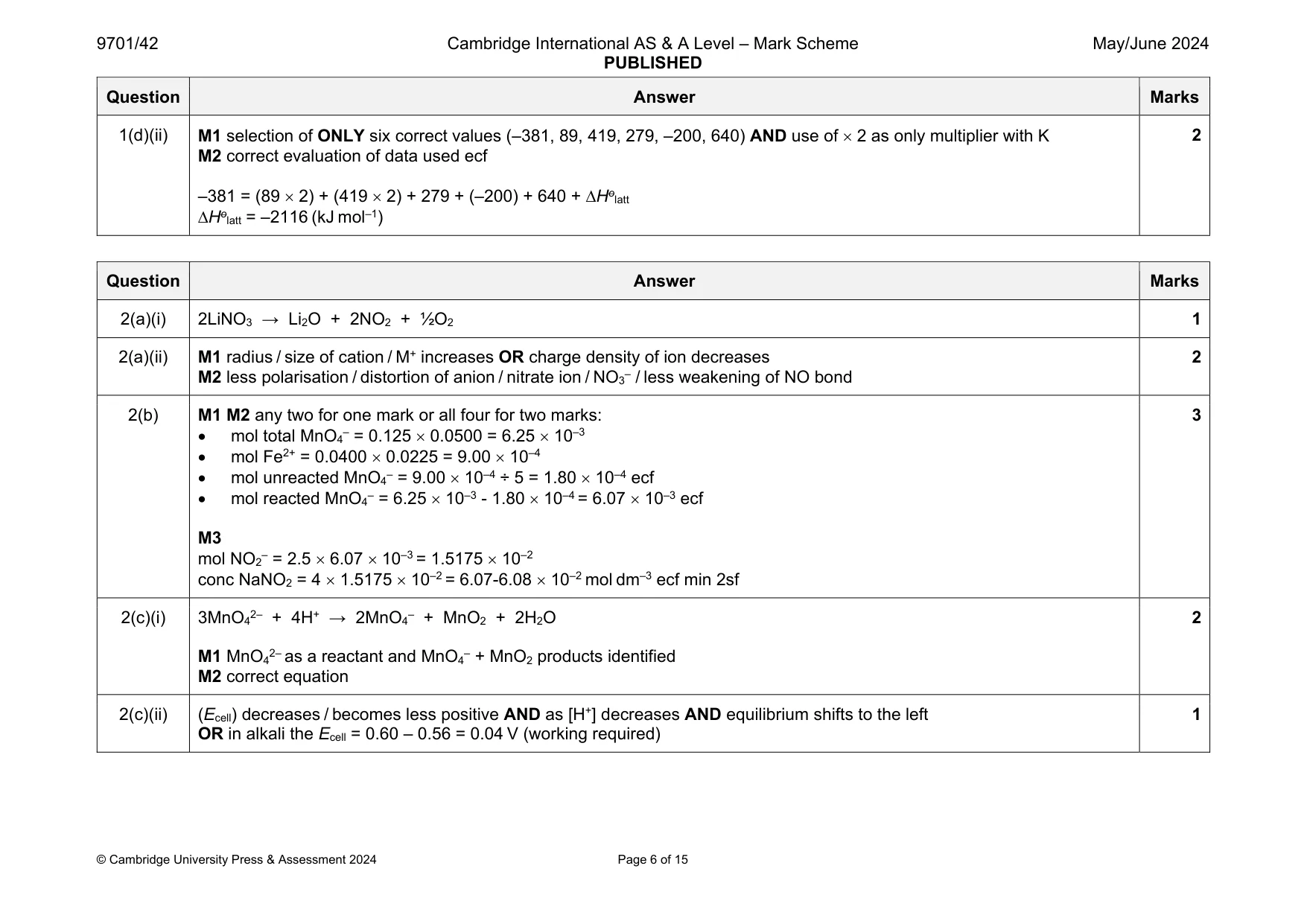
Mark scheme: 1(a) M1 magnesium > calcium > strontium M2 Hlatt and Hhyd both become less exothermic / less negative M3 Hlatt changes less OR Hhyd is dominant factor M4 Hsol becomes less exothermic / less negative / more positive / more endothermic 1(b) M1H / energy change when 1 mole of an ionic solid / compound is formed M2 from gaseous ions (under standard conditions) 2 1(c) M1 as ionic radii increases AND Hlatt less exothermic M2 as ionic charge increases AND Hlatt increases/more exothermic 2 1(d)(i) any two [1] any three [2] all four [3] 3 Question Answer Marks 1(d)(ii) M1 selection of ONLY six correct values (–381, 89, 419, 279, –200, 640) AND use of 2 as only multiplier with K M2 correct evaluation of data used ecf –381 = (89 2) + (419 2) + 279 + (–200) + 640 + Holatt Holatt = –2116 (kJ mol–1) 2
Q2 · Lithium nitrate, LiNO3, decomposes on heating in a similar way to Group 2 nitrates to…
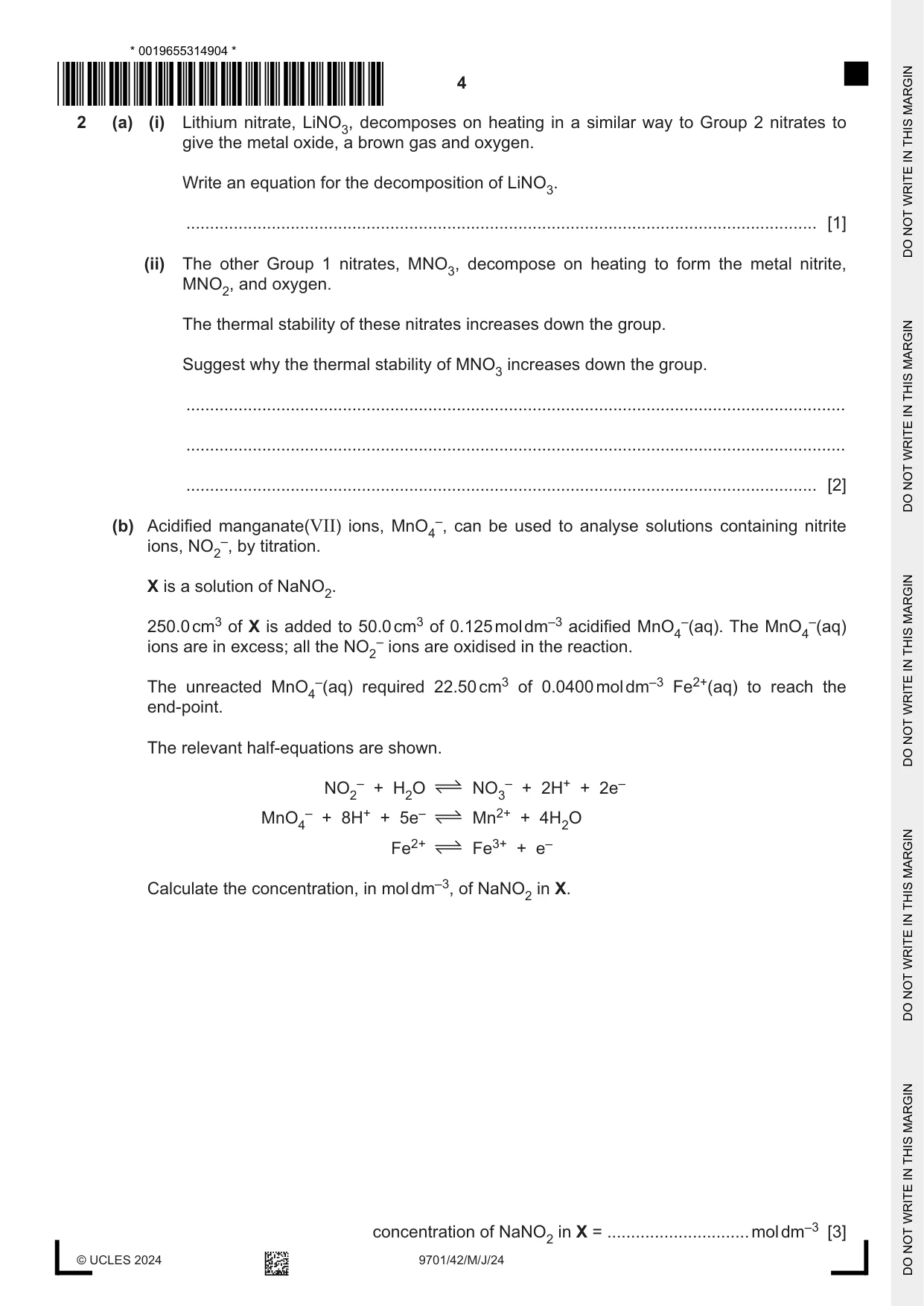
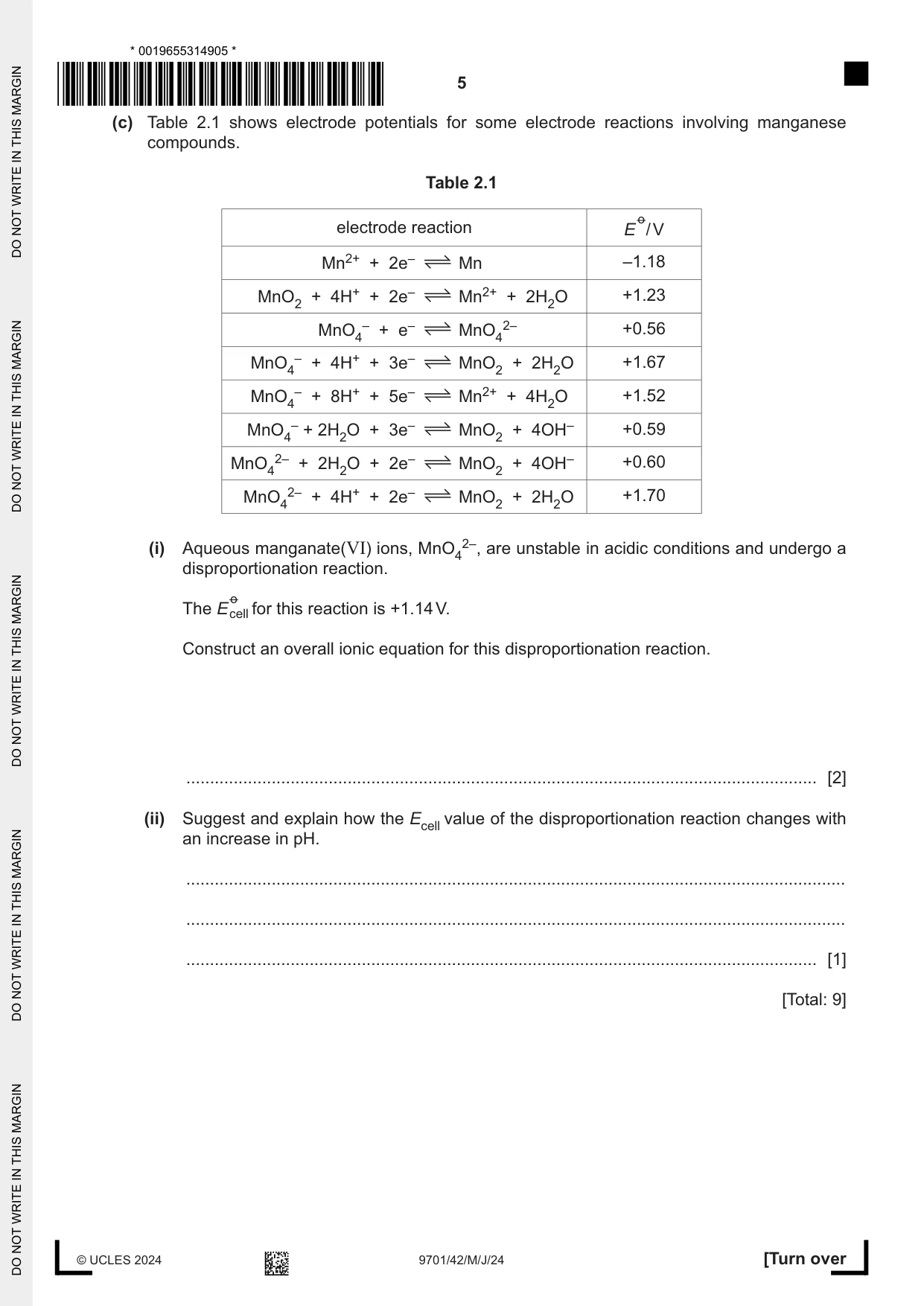
2 (a) (i) Lithium nitrate, LiNO3, decomposes on heating in a similar way to Group 2 nitrates to give the metal oxide, a brown gas and oxygen. Write an equation for the decomposition of LiNO3. ..................................................................................................................................... [1] (ii) The other Group 1 nitrates, MNO3, decompose on heating to form the metal nitrite, MNO2, and oxygen. The thermal stability of these nitrates increases down the group. Suggest why the thermal stability of MNO3 increases down the group. ........................................................................................................................................... ........................................................................................................................................... ..................................................................................................................................... [2] (b) Acidified manganate(VII) ions, MnO4–, can be used to analyse solutions containing nitrite ions, NO2 –, by titration. X is a solution of NaNO2. 250.0 cm3 of X is added to 50.0 cm3 of 0.125 mol dm–3 acidified MnO4–(aq). The MnO4–(aq) ions are in excess; all the NO2– ions are oxidised in the reaction. The unreacted MnO4–(aq) required 22.50 cm3 of 0.0400 mol dm–3 Fe2+(aq) to reach the end‑point. The relevant half‑equations are shown. NO2– + H2O NO3– + 2H+ + 2e– MnO4– + 8H+ + 5e– Mn2+ + 4H2O Fe2+ Fe3+ + e– Calculate the concentration, in mol dm–3, of NaNO2 in X. concentration of NaNO2 in X = .............................. mol dm–3 [3] (c) Table 2.1 shows electrode potentials for some electrode reactions involving manganese compounds. Table 2.1 o electrode reaction E / V Mn2+ + 2e– Mn –1.18 MnO2 + 4H+ + 2e– Mn2+ + 2H2O +1.23 MnO4– + e– MnO42– +0.56 MnO4– + 4H+ + 3e– MnO2 + 2H2O +1.67 MnO4– + 8H+ + 5e– Mn2+ + 4H2O +1.52 MnO4– + 2H2O + 3e– MnO2 + 4OH– +0.59 MnO42– + 2H2O + 2e– MnO2 + 4OH– +0.60 MnO42– + 4H+ + 2e– MnO2 + 2H2O +1.70 (i) Aqueous manganate(VI) ions, MnO42–, are unstable in acidic conditions and undergo a disproportionation reaction. o The E cell for this reaction is +1.14 V. Construct an overall ionic equation for this disproportionation reaction. ..................................................................................................................................... [2] (ii) Suggest and explain how the Ecell value of the disproportionation reaction changes with an increase in pH. ........................................................................................................................................... ........................................................................................................................................... ..................................................................................................................................... [1] [Total: 9]
Mark scheme: 2(a)(i) 2LiNO3 → Li2O + 2NO2 + ½O2 1 2(a)(ii) M1 radius / size of cation / M+ increases OR charge density of ion decreases M2 less polarisation / distortion of anion / nitrate ion / NO3– / less weakening of NO bond 2 2(b) M1 M2 any two for one mark or all four for two marks: mol total MnO4– = 0.125 0.0500 = 6.25 10–3 mol Fe2+ = 0.0400 0.0225 = 9.00 10–4 mol unreacted MnO4– = 9.00 10–4 ÷ 5 = 1.80 10–4 ecf mol reacted MnO4– = 6.25 10–3 - 1.80 10–4 = 6.07 10–3 ecf M3 mol NO2– = 2.5 6.07 10–3 = 1.5175 10–2 conc NaNO2 = 4 1.5175 10–2 = 6.07-6.08 10–2 mol dm–3 ecf min 2sf 3 2(c)(i) 3MnO42– + 4H+ → 2MnO4– + MnO2 + 2H2O M1 MnO42– as a reactant and MnO4– + MnO2 products identified M2 correct equation 2 2(c)(ii) (Ecell) decreases / becomes less positive AND as [H+] decreases AND equilibrium shifts to the left OR in alkali the Ecell = 0.60 – 0.56 = 0.04 V (working required) 1
Q3 · Carbon disulfide, CS2, is flammable and reacts readily with oxygen, as shown in reaction 1
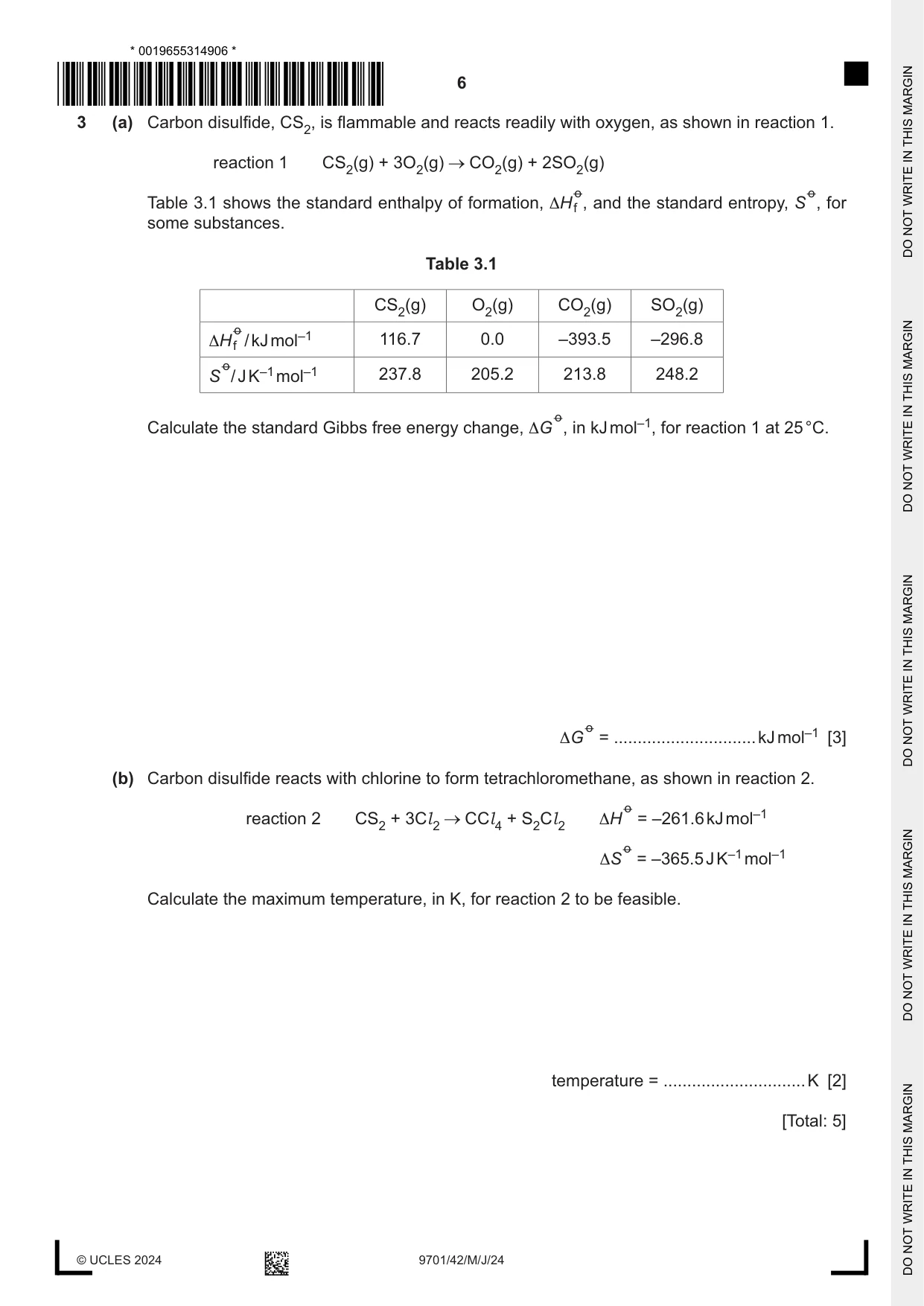
3 (a) Carbon disulfide, CS2, is flammable and reacts readily with oxygen, as shown in reaction 1. reaction 1 CS2(g) + 3O2(g) CO2(g) + 2SO2(g) o Table 3.1 shows the standard enthalpy of formation, ΔH f , and the standard entropy, S o, for some substances. Table 3.1 CS2(g) O2(g) CO2(g) SO2(g) o ΔH f / kJ mol–1 116.7 0.0 –393.5 –296.8 S o/ J K–1 mol–1 237.8 205.2 213.8 248.2 Calculate the standard Gibbs free energy change, ΔG o, in kJ mol–1, for reaction 1 at 25 °C. o ΔG = .............................. kJ mol–1 [3] (b) Carbon disulfide reacts with chlorine to form tetrachloromethane, as shown in reaction 2. o reaction 2 CS2 + 3Cl2 CCl 4 + S2Cl2 ΔH = –261.6 kJ mol–1 o ΔS = –365.5 J K–1 mol–1 Calculate the maximum temperature, in K, for reaction 2 to be feasible. temperature = .............................. K [2] [Total: 5]
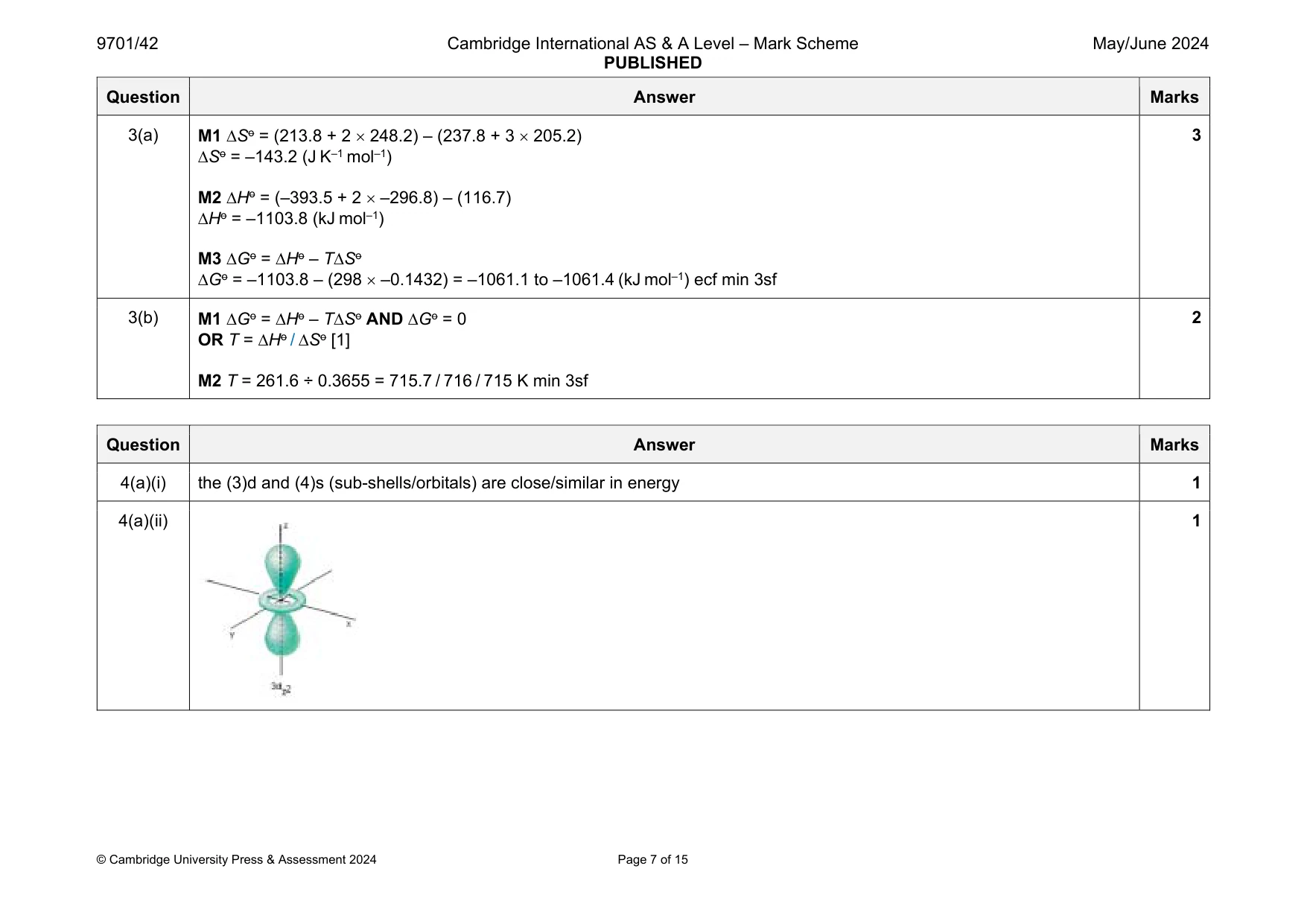
Mark scheme: 3(a) So = –143.2 (J K–1 mol–1) M2 Ho = (–393.5 + 2 –296.8) – (116.7) Ho = –1103.8 (kJ mol–1) M3 Go = Ho – TSo Go = –1103.8 – (298 –0.1432) = –1061.1 to –1061.4 (kJ mol–1) ecf min 3sf 3 3(b) M1 Go = Ho – TSo AND Go = 0 OR T = Ho / So [1] M2 T = 261.6 ÷ 0.3655 = 715.7 / 716 / 715 K min 3sf 2
Q4 · Explain why transition elements have variable oxidation states
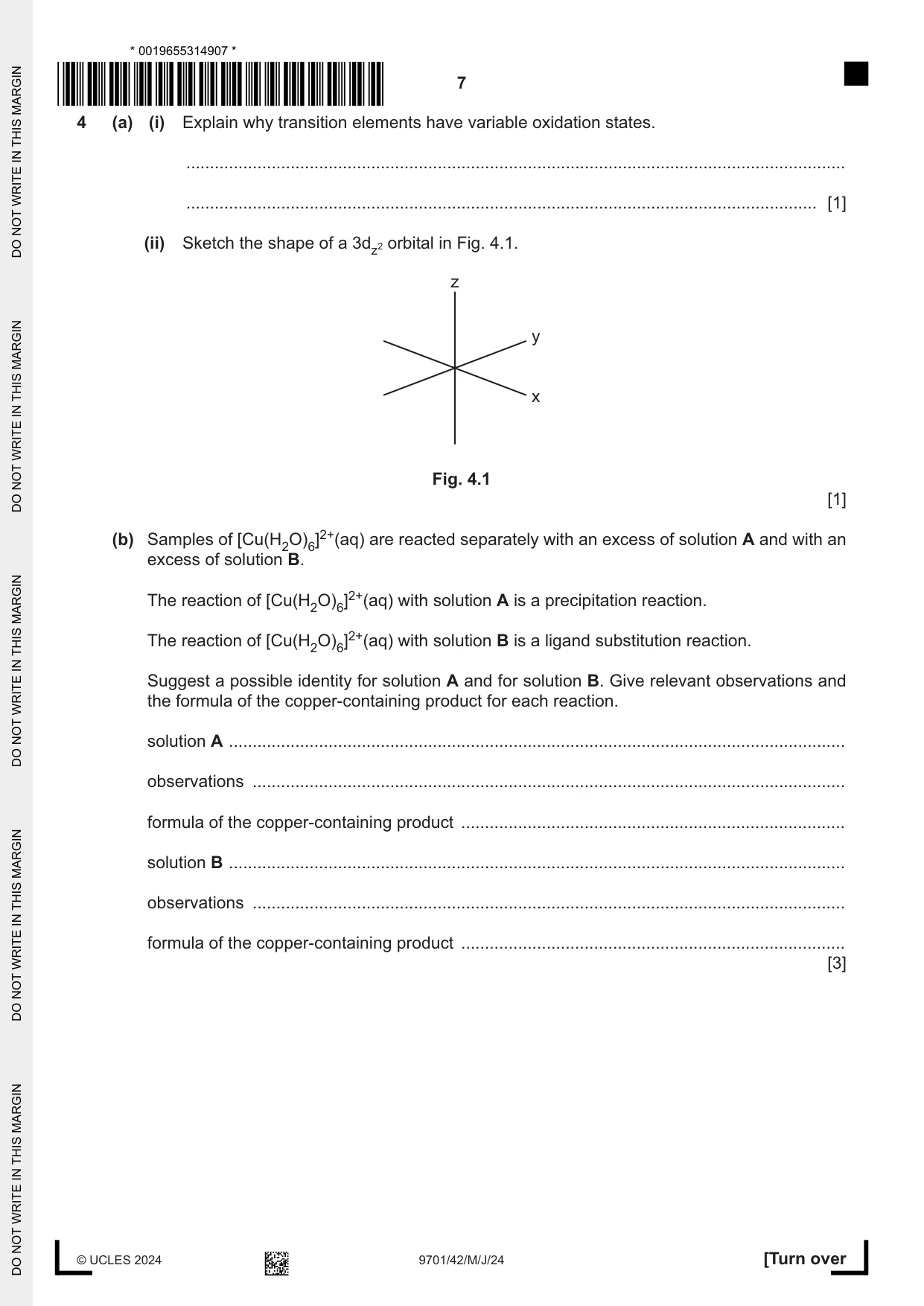
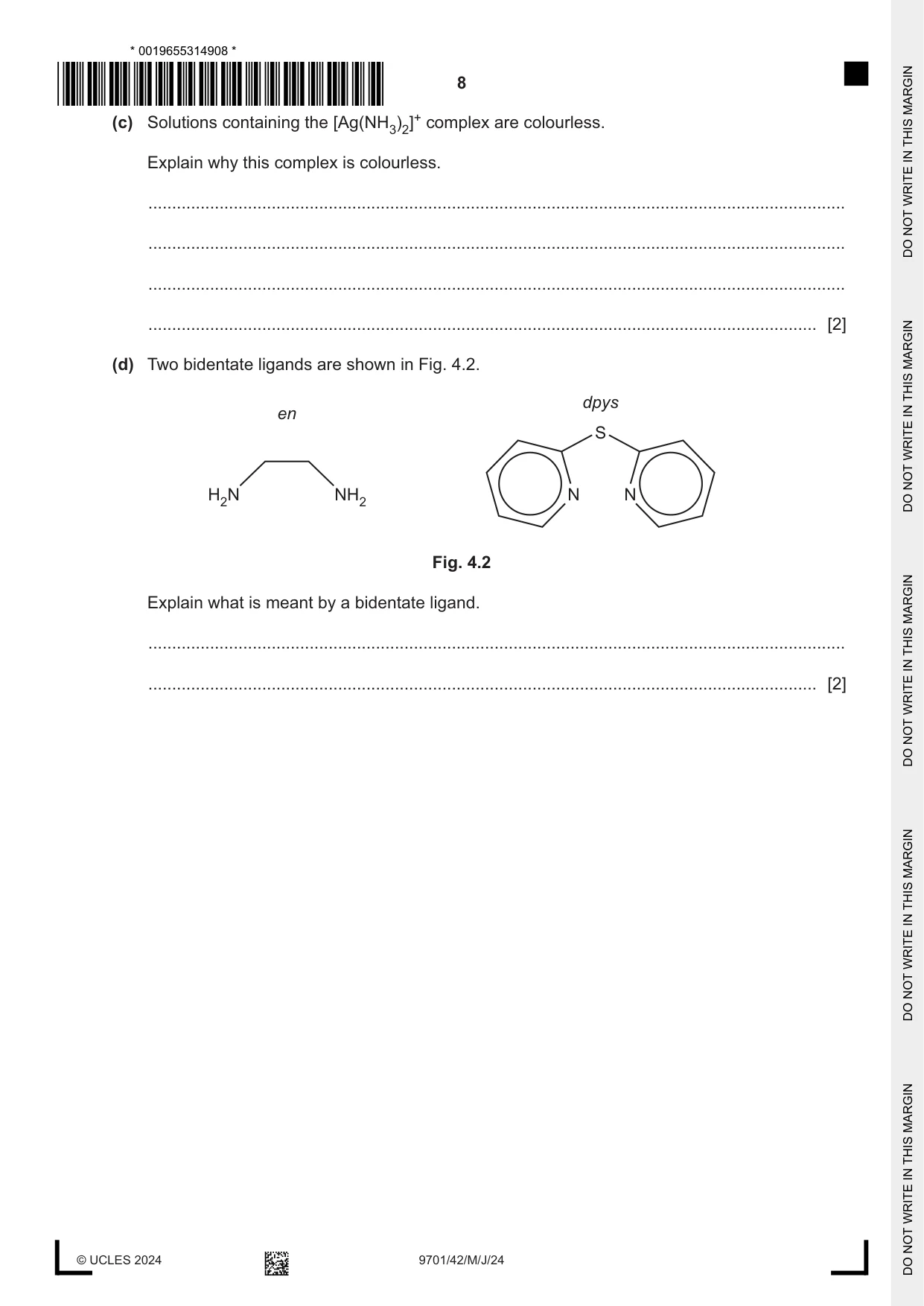
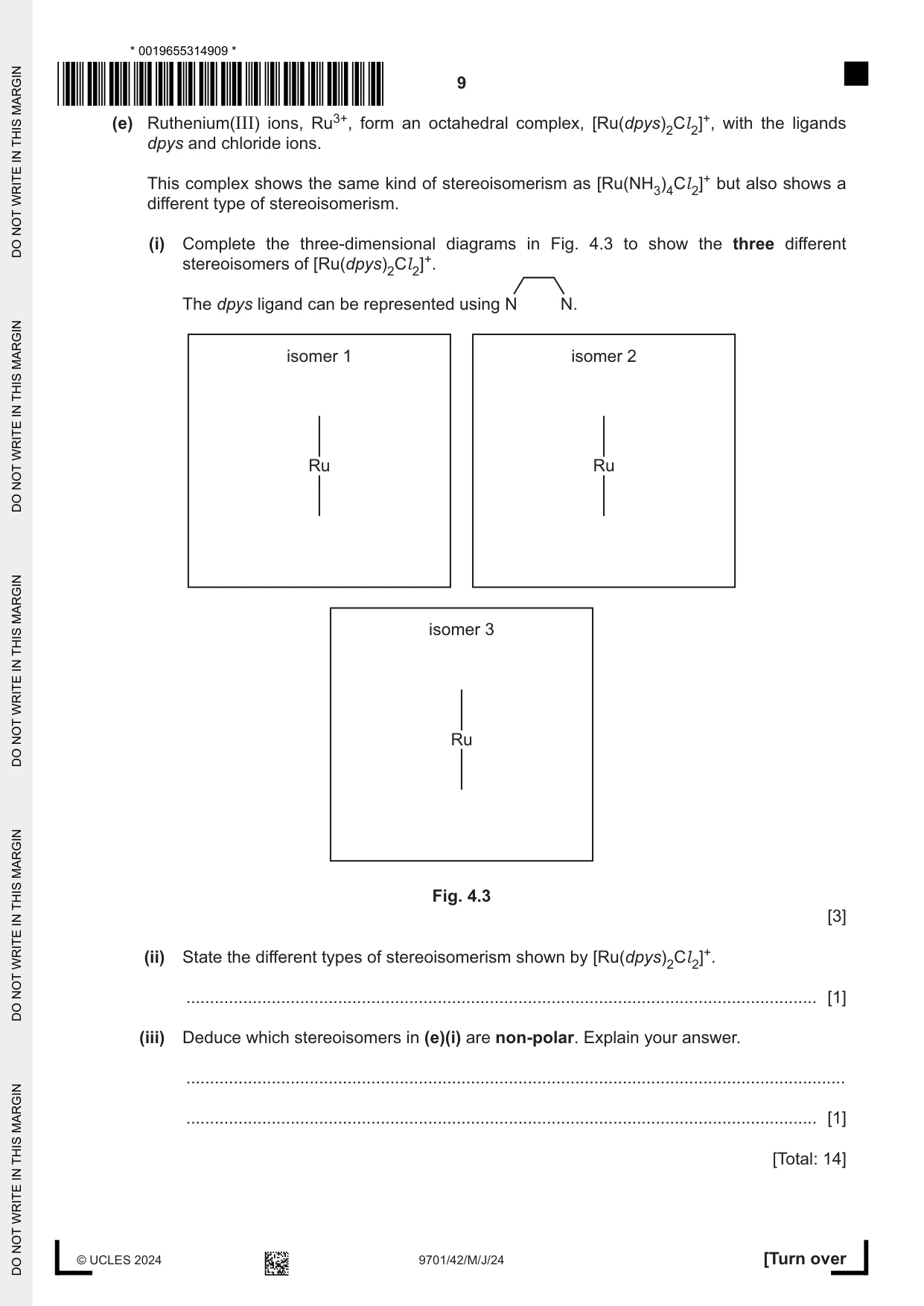
4 (a) (i) Explain why transition elements have variable oxidation states. ........................................................................................................................................... ..................................................................................................................................... [1] (ii) Sketch the shape of a 3dz2 orbital in Fig. 4.1. z y x Fig. 4.1 [1] (b) Samples of [Cu(H2O)6]2+(aq) are reacted separately with an excess of solution A and with an excess of solution B. The reaction of [Cu(H2O)6]2+(aq) with solution A is a precipitation reaction. The reaction of [Cu(H2O)6]2+(aq) with solution B is a ligand substitution reaction. Suggest a possible identity for solution A and for solution B. Give relevant observations and the formula of the copper‑containing product for each reaction. solution A .................................................................................................................................. observations ............................................................................................................................. formula of the copper‑containing product ................................................................................. solution B .................................................................................................................................. observations ............................................................................................................................. formula of the copper‑containing product ................................................................................. [3] (c) Solutions containing the [Ag(NH3)2]+ complex are colourless. Explain why this complex is colourless. ................................................................................................................................................... ................................................................................................................................................... ................................................................................................................................................... ............................................................................................................................................. [2] (d) Two bidentate ligands are shown in Fig. 4.2. dpys en S H2N NH2 N N Fig. 4.2 Explain what is meant by a bidentate ligand. ................................................................................................................................................... ............................................................................................................................................. [2] (e) Ruthenium(III) ions, Ru3+, form an octahedral complex, [Ru(dpys)2Cl2]+, with the ligands dpys and chloride ions. This complex shows the same kind of stereoisomerism as [Ru(NH3)4Cl2]+ but also shows a different type of stereoisomerism. (i) Complete the three‑dimensional diagrams in Fig. 4.3 to show the three different stereoisomers of [Ru(dpys)2Cl2]+. The dpys ligand can be represented using N N. isomer 1 isomer 2 Ru Ru isomer 3 Ru Fig. 4.3 [3] (ii) State the different types of stereoisomerism shown by [Ru(dpys)2Cl2]+. ..................................................................................................................................... [1] (iii) Deduce which stereoisomers in (e)(i) are non-polar. Explain your answer. ........................................................................................................................................... ..................................................................................................................................... [1] [Total: 14]
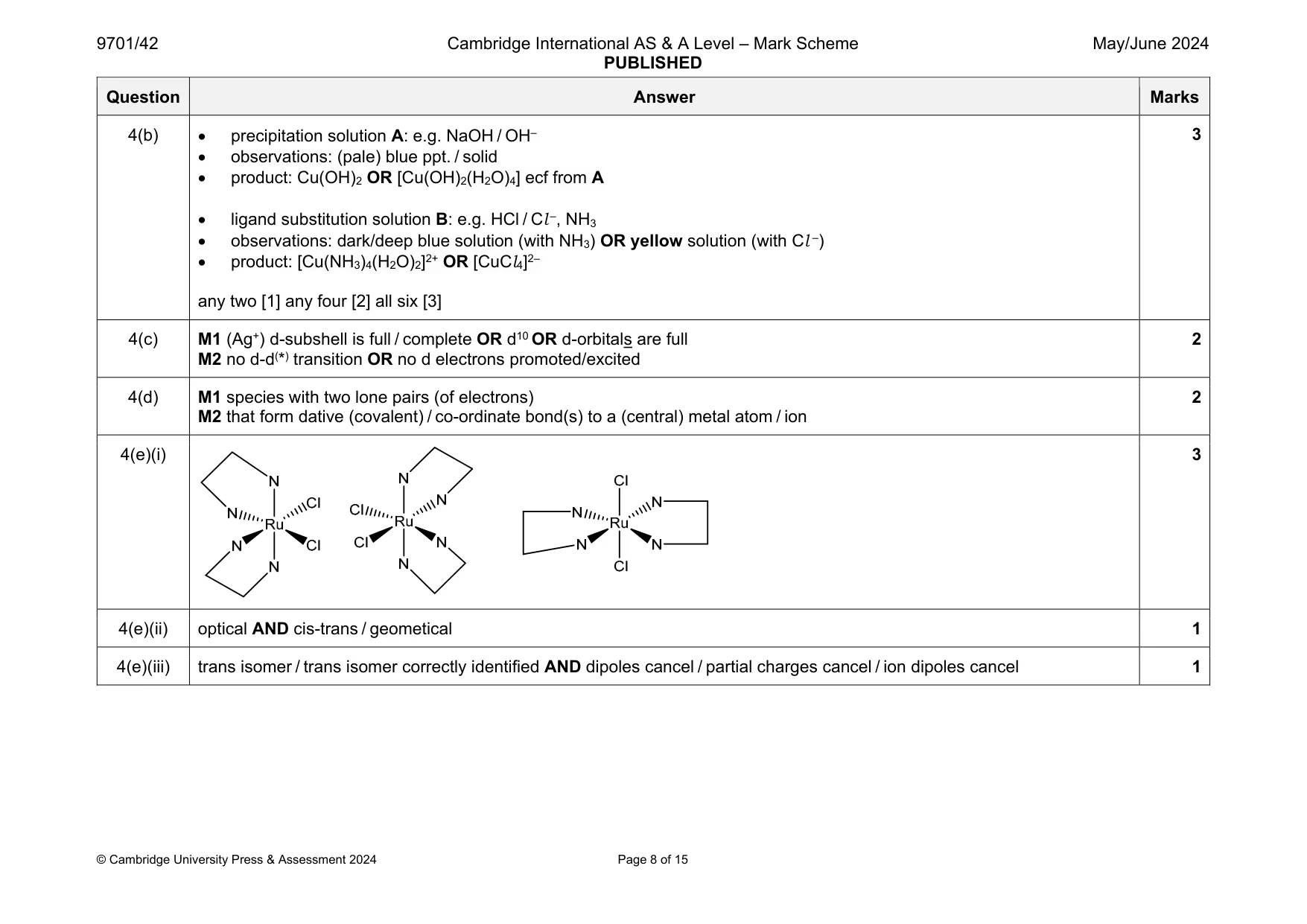
Mark scheme: 4(a)(i) the (3)d and (4)s (sub-shells/orbitals) are close/similar in energy 1 4(a)(ii) 1 Question Answer Marks 4(b) precipitation solution A: e.g. NaOH / OH– observations: (pale) blue ppt. / solid product: Cu(OH)2 OR [Cu(OH)2(H2O)4] ecf from A ligand substitution solution B: e.g. HCl / Cl –, NH3 observations: dark/deep blue solution (with NH3) OR yellow solution (with Cl –) product: [Cu(NH3)4(H2O)2]2+ OR [CuCl4]2– any two [1] any four [2] all six [3] 3 4(c) M1 (Ag+) d-subshell is full / complete OR d10 OR d-orbitals are full M2 no d-d(*) transition OR no d electrons promoted/excited 2 4(d) M1 species with two lone pairs (of electrons) M2 that form dative (covalent) / co-ordinate bond(s) to a (central) metal atom / ion 2 4(e)(i) 3 4(e)(ii) optical AND cis-trans / geometical 1 4(e)(iii) trans isomer / trans isomer correctly identified AND dipoles cancel / partial charges cancel / ion dipoles cancel 1
More questions on Stereoisomerism in transition element complexes
Q5 · Nitrosyl chloride, NOCl, can be formed by the reaction between nitrogen monoxide and…
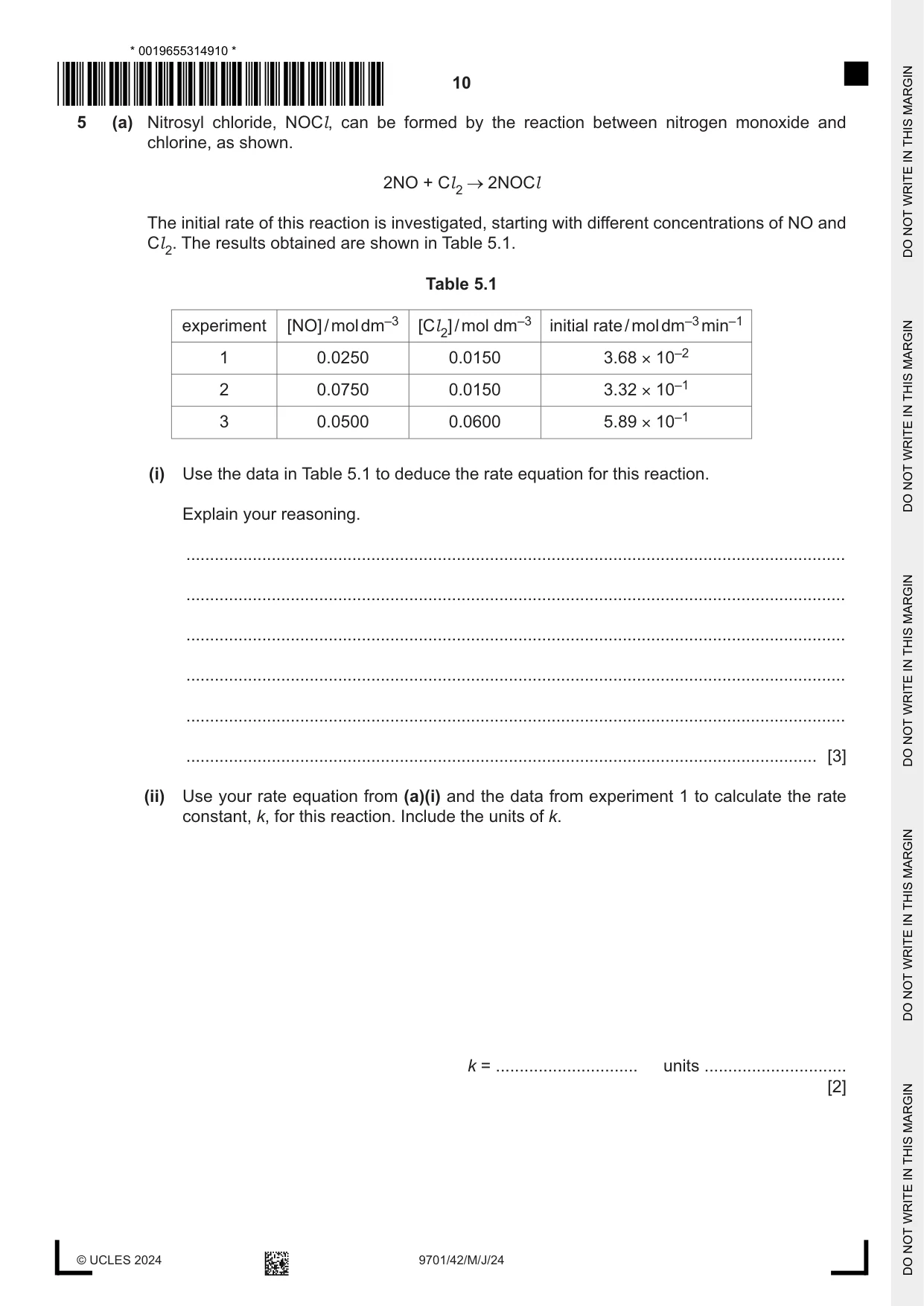
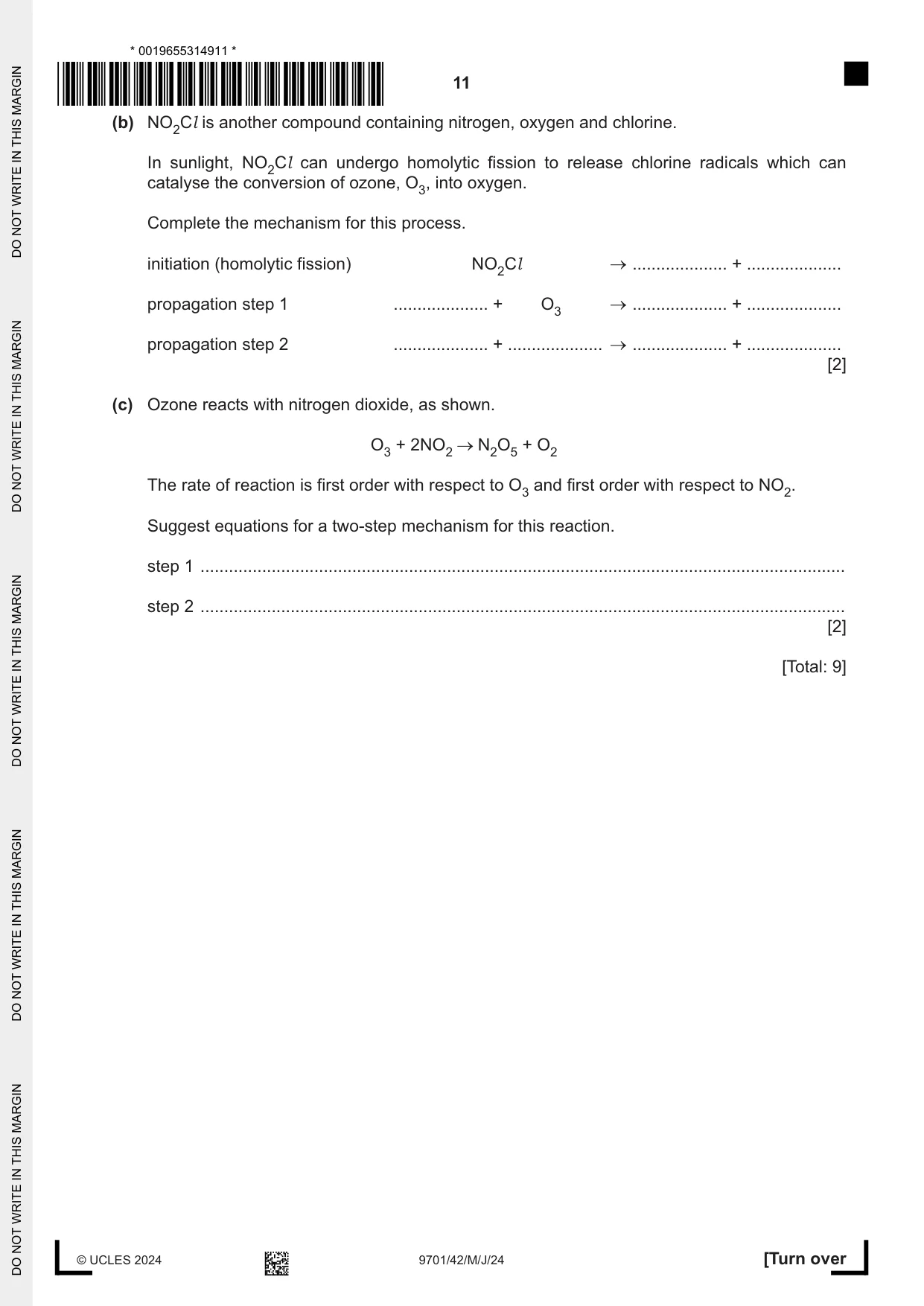
5 (a) Nitrosyl chloride, NOCl, can be formed by the reaction between nitrogen monoxide and chlorine, as shown. 2NO + Cl 2NOCl 2 The initial rate of this reaction is investigated, starting with different concentrations of NO and Cl 2. The results obtained are shown in Table 5.1. Table 5.1 experiment [NO] / mol dm–3 [Cl 2] / mol dm–3 initial rate / mol dm–3 min–1 1 0.0250 0.0150 3.68 × 10⁻² 2 0.0750 0.0150 3.32 × 10⁻¹ 3 0.0500 0.0600 5.89 × 10⁻¹ (i) Use the data in Table 5.1 to deduce the rate equation for this reaction. Explain your reasoning. ........................................................................................................................................... ........................................................................................................................................... ........................................................................................................................................... ........................................................................................................................................... ........................................................................................................................................... ..................................................................................................................................... [3] (ii) Use your rate equation from (a)(i) and the data from experiment 1 to calculate the rate constant, k, for this reaction. Include the units of k. k = .............................. units .............................. [2] (b) NO2Cl is another compound containing nitrogen, oxygen and chlorine. In sunlight, NO2Cl can undergo homolytic fission to release chlorine radicals which can catalyse the conversion of ozone, O3, into oxygen. Complete the mechanism for this process. initiation (homolytic fission) NO2Cl .................... + .................... propagation step 1 .................... + O3 .................... + .................... propagation step 2 .................... + .................... .................... + .................... [2] (c) Ozone reacts with nitrogen dioxide, as shown. O3 + 2NO2 N2O5 + O2 The rate of reaction is first order with respect to O3 and first order with respect to NO2. Suggest equations for a two‑step mechanism for this reaction. step 1 ........................................................................................................................................ step 2 ........................................................................................................................................ [2] [Total: 9]
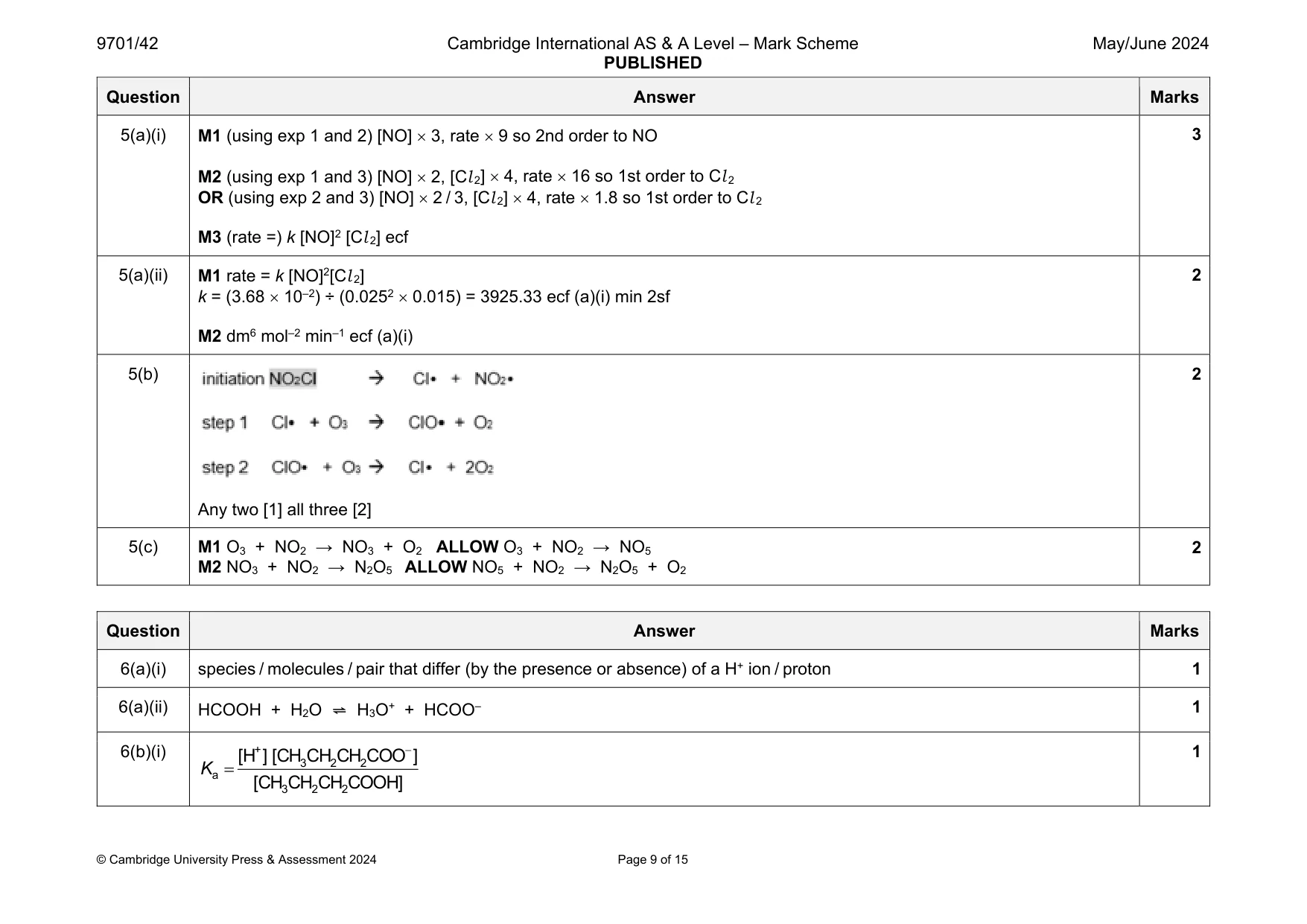
Mark scheme: 5(a)(i) M2 (using exp 1 and 3) [NO] 2, [Cl 2] 4, rate 16 so 1st order to Cl 2 OR (using exp 2 and 3) [NO] 2 / 3, [Cl 2] 4, rate 1.8 so 1st order to Cl 2 M3 (rate =) k [NO]2 [Cl 2] ecf 5(a)(ii) M1 rate = k [NO]2[Cl 2] k = (3.68 10–2) ÷ (0.0252 0.015) = 3925.33 ecf (a)(i) min 2sf M2 dm6 mol–2 min–1 ecf (a)(i) 2 5(b) Any two [1] all three [2] 2 5(c) M1 O3 + NO2 → NO3 + O2 ALLOW O3 + NO2 → NO5 M2 NO3 + NO2 → N2O5 ALLOW NO5 + NO2 → N2O5 + O2 2
More questions on Simple rate equations, orders of reaction and rate constants
Q6 · Aqueous solutions of methanoic acid, HCOOH, and propanoic acid, CH3CH2COOH, are mixed…
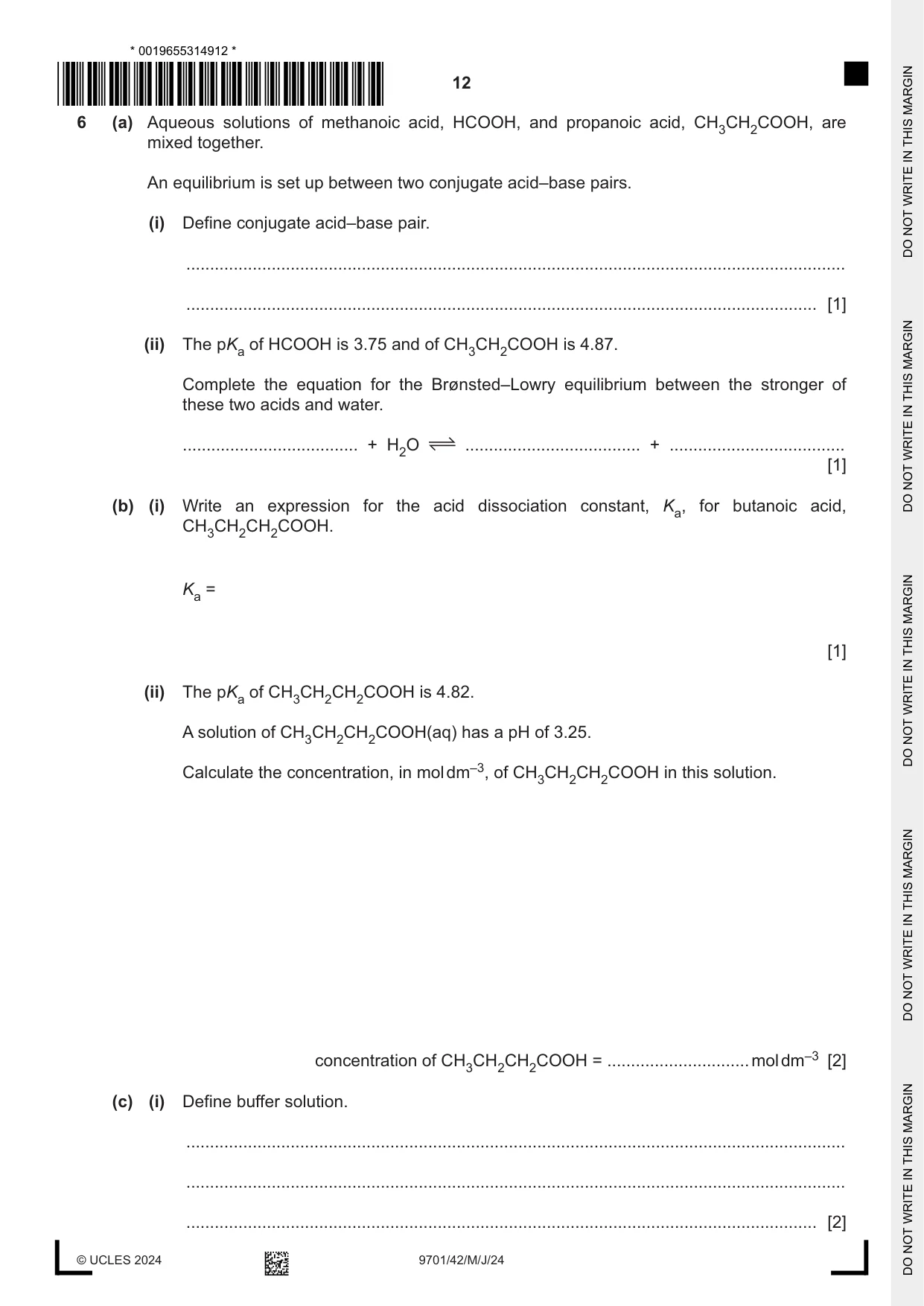
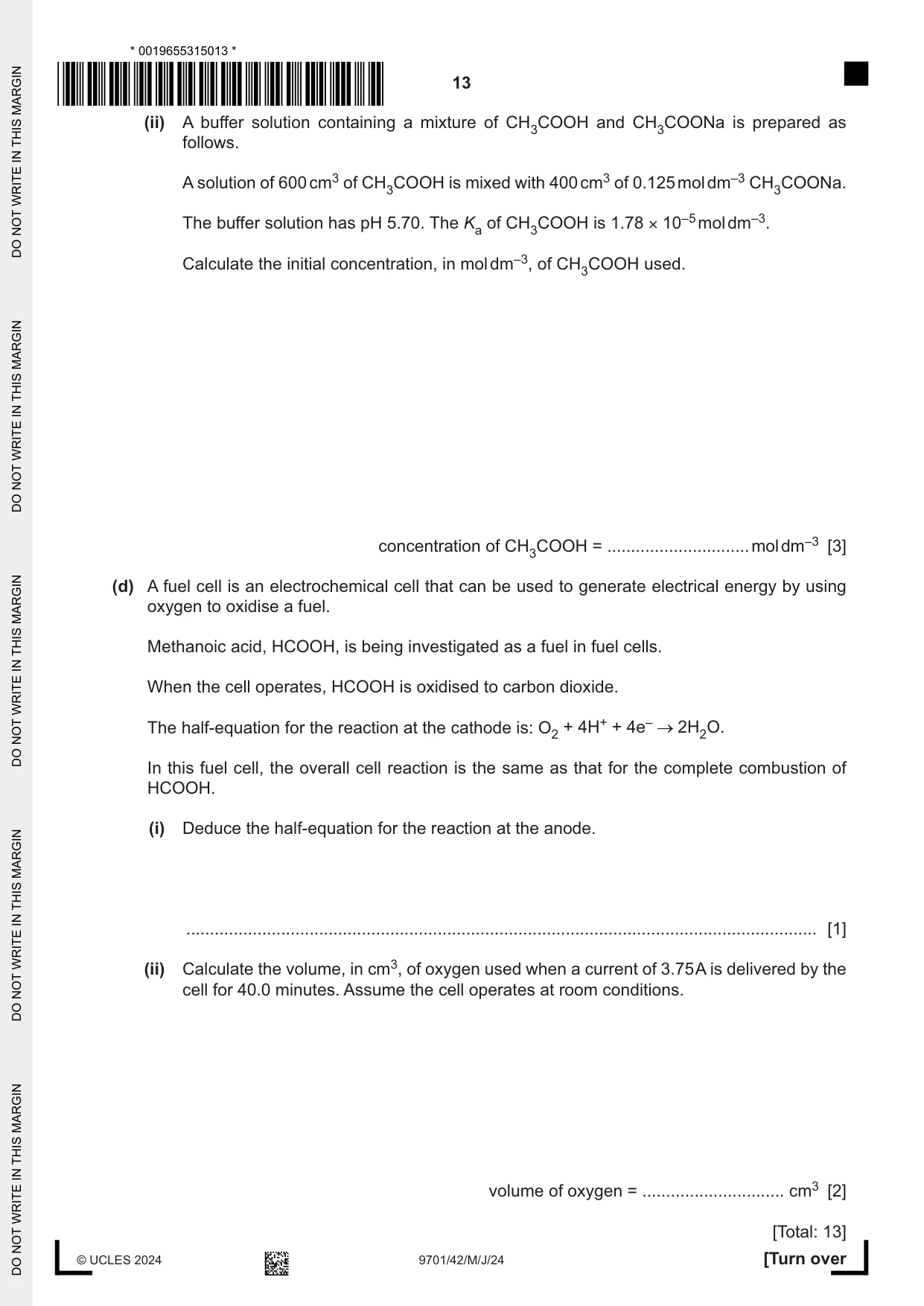
6 (a) Aqueous solutions of methanoic acid, HCOOH, and propanoic acid, CH3CH2COOH, are mixed together. An equilibrium is set up between two conjugate acid–base pairs. (i) Define conjugate acid–base pair. ........................................................................................................................................... ..................................................................................................................................... [1] (ii) The pKa of HCOOH is 3.75 and of CH3CH2COOH is 4.87. Complete the equation for the Brønsted–Lowry equilibrium between the stronger of these two acids and water. ..................................... + H2O ..................................... + ..................................... [1] (b) (i) Write an expression for the acid dissociation constant, Ka, for butanoic acid, CH3CH2CH2COOH. Ka = [1] (ii) The pKa of CH3CH2CH2COOH is 4.82. A solution of CH3CH2CH2COOH(aq) has a pH of 3.25. Calculate the concentration, in mol dm–3, of CH3CH2CH2COOH in this solution. concentration of CH3CH2CH2COOH = .............................. mol dm–3 [2] (c) (i) Define buffer solution. ........................................................................................................................................... ........................................................................................................................................... ..................................................................................................................................... [2] (ii) A buffer solution containing a mixture of CH3COOH and CH3COONa is prepared as follows. A solution of 600 cm3 of CH3COOH is mixed with 400 cm3 of 0.125 mol dm–3 CH3COONa. The buffer solution has pH 5.70. The Ka of CH3COOH is 1.78 × 10⁻⁵ mol dm–3. Calculate the initial concentration, in mol dm–3, of CH3COOH used. concentration of CH3COOH = .............................. mol dm–3 [3] (d) A fuel cell is an electrochemical cell that can be used to generate electrical energy by using oxygen to oxidise a fuel. Methanoic acid, HCOOH, is being investigated as a fuel in fuel cells. When the cell operates, HCOOH is oxidised to carbon dioxide. The half‑equation for the reaction at the cathode is: O2 + 4H+ + 4e– 2H2O. In this fuel cell, the overall cell reaction is the same as that for the complete combustion of HCOOH. (i) Deduce the half‑equation for the reaction at the anode. ..................................................................................................................................... [1] (ii) Calculate the volume, in cm3, of oxygen used when a current of 3.75 A is delivered by the cell for 40.0 minutes. Assume the cell operates at room conditions. volume of oxygen = .............................. cm3 [2] [Total: 13]
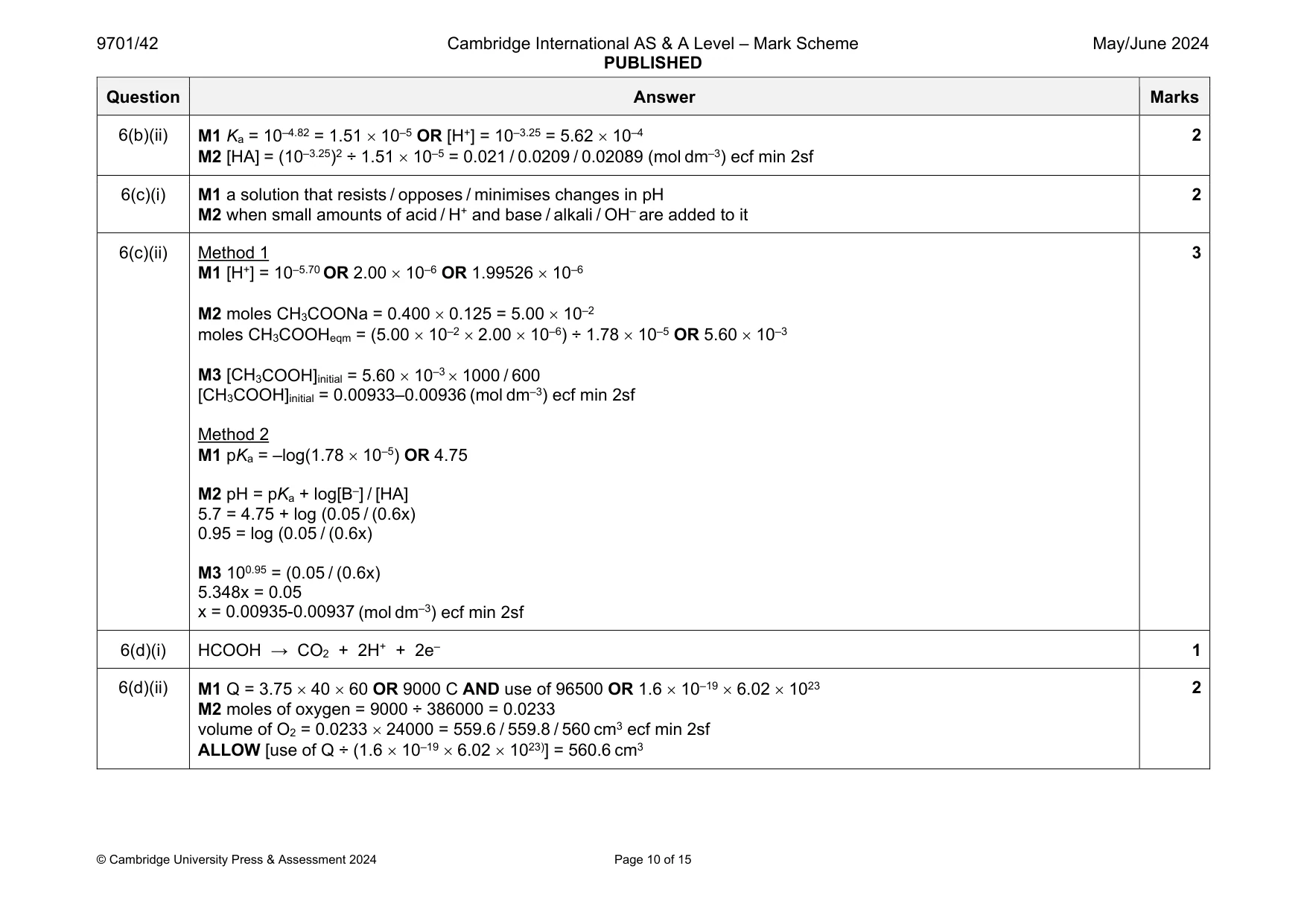
Mark scheme: 6(a)(i) species / molecules / pair that differ (by the presence or absence) of a H+ ion / proton 1 6(a)(ii) HCOOH + H2O ⇌ H3O+ + HCOO– 1 6(b)(i) + 3 2 2 a 3 2 2 [H ] [CH CH CH COO ] [CH CH CH COOH] K 1 Question Answer Marks 6(b)(ii) M1 Ka = 10–4.82 = 1.51 10–5 OR [H+] = 10–3.25 = 5.62 10–4 M2 [HA] = (10–3.25)2 ÷ 1.51 10–5 = 0.021 / 0.0209 / 0.02089 (mol dm–3) ecf min 2sf 2 6(c)(i) M1 a solution that resists / opposes / minimises changes in pH M2 when small amounts of acid / H+ and base / alkali / OH– are added to it 2 6(c)(ii) Method 1 M1 [H+] = 10–5.70 OR 2.00 10–6 OR 1.99526 10–6 M2 moles CH3COONa = 0.400 0.125 = 5.00 10–2 moles CH3COOHeqm = (5.00 10–2 2.00 10–6) ÷ 1.78 10–5 OR 5.60 10–3 M3 [CH3COOH]initial = 5.60 10–3 1000 / 600 [CH3COOH]initial = 0.00933–0.00936 (mol dm–3) ecf min 2sf Method 2 M1 pKa = –log(1.78 10–5) OR 4.75 M2 pH = pKa + log[B–] / [HA] 5.7 = 4.75 + log (0.05 / (0.6x) 0.95 = log (0.05 / (0.6x) M3 100.95 = (0.05 / (0.6x) 5.348x = 0.05 x = 0.00935-0.00937 (mol dm–3) ecf min 2sf 3 6(d)(i) HCOOH → CO2 + 2H+ + 2e– 1 6(d)(ii) M1 Q = 3.75 40 60 OR 9000 C AND use of 96500 OR 1.6 10–19 6.02 1023 M2 moles of oxygen = 9000 ÷ 386000 = 0.0233 volume of O2 = 0.0233 24000 = 559.6 / 559.8 / 560 cm3 ecf min 2sf ALLOW [use of Q ÷ (1.6 10–19 6.02 1023)] = 560.6 cm3 2
Q7 · Methyl red can be synthesised as shown in Fig
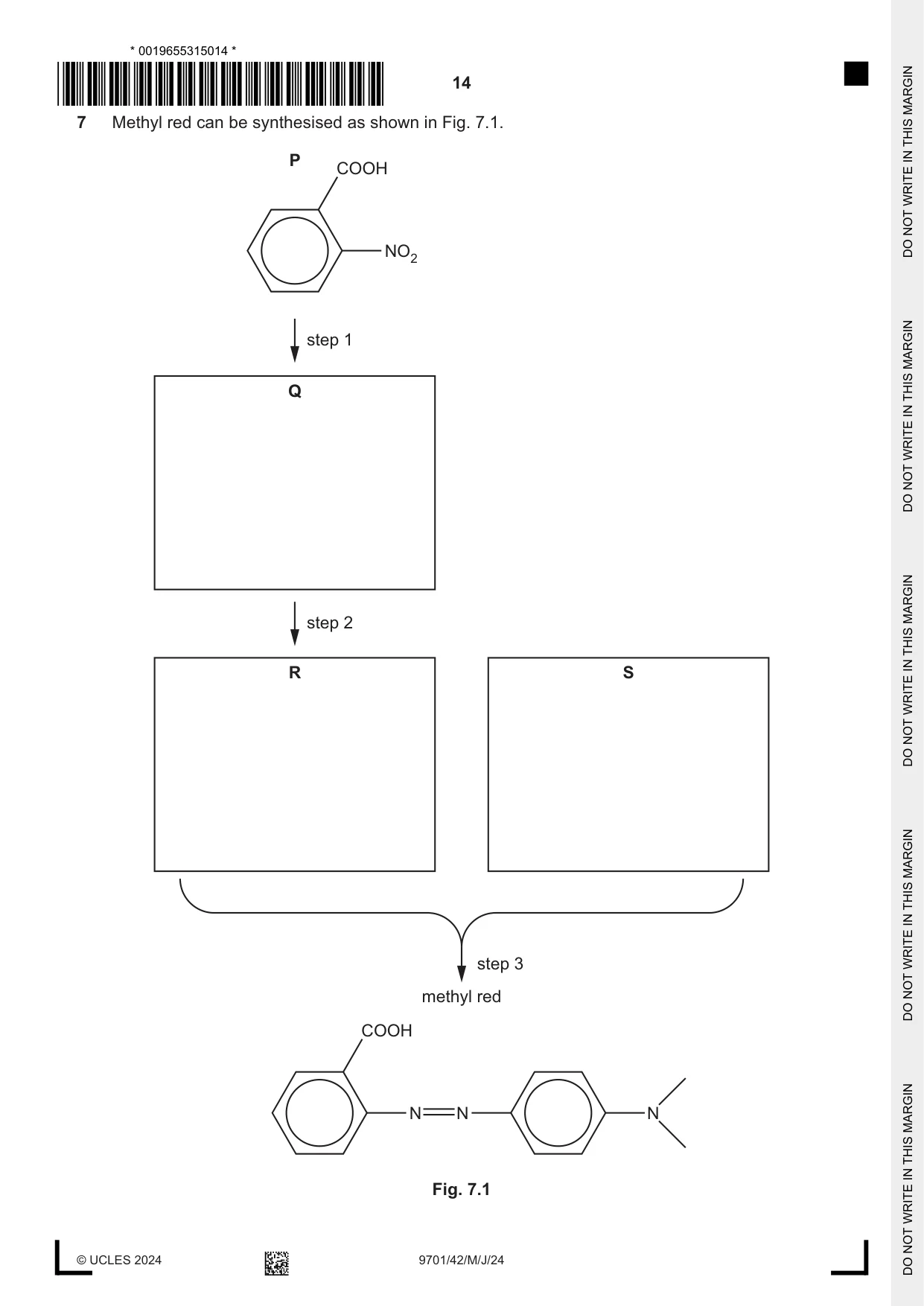
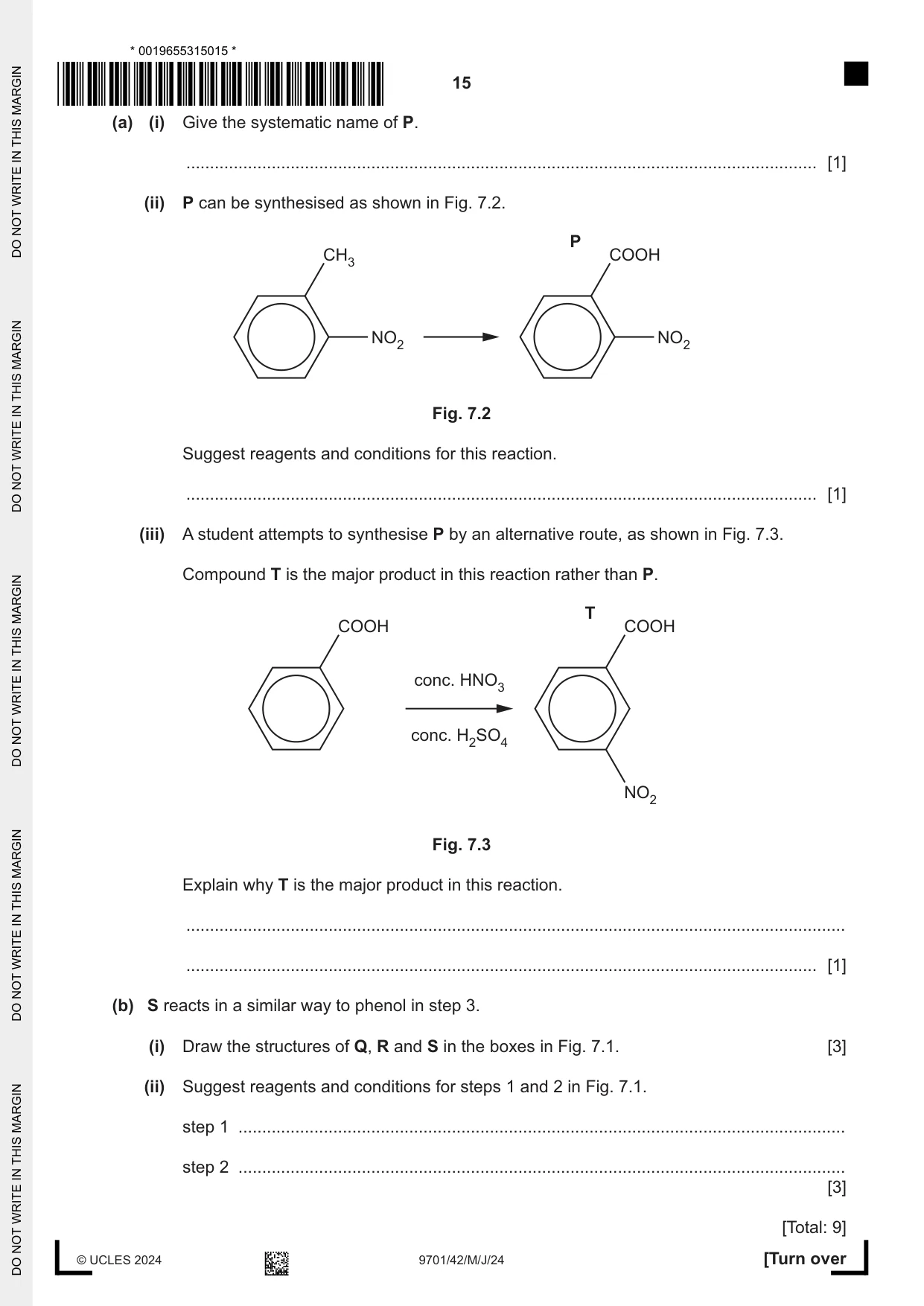
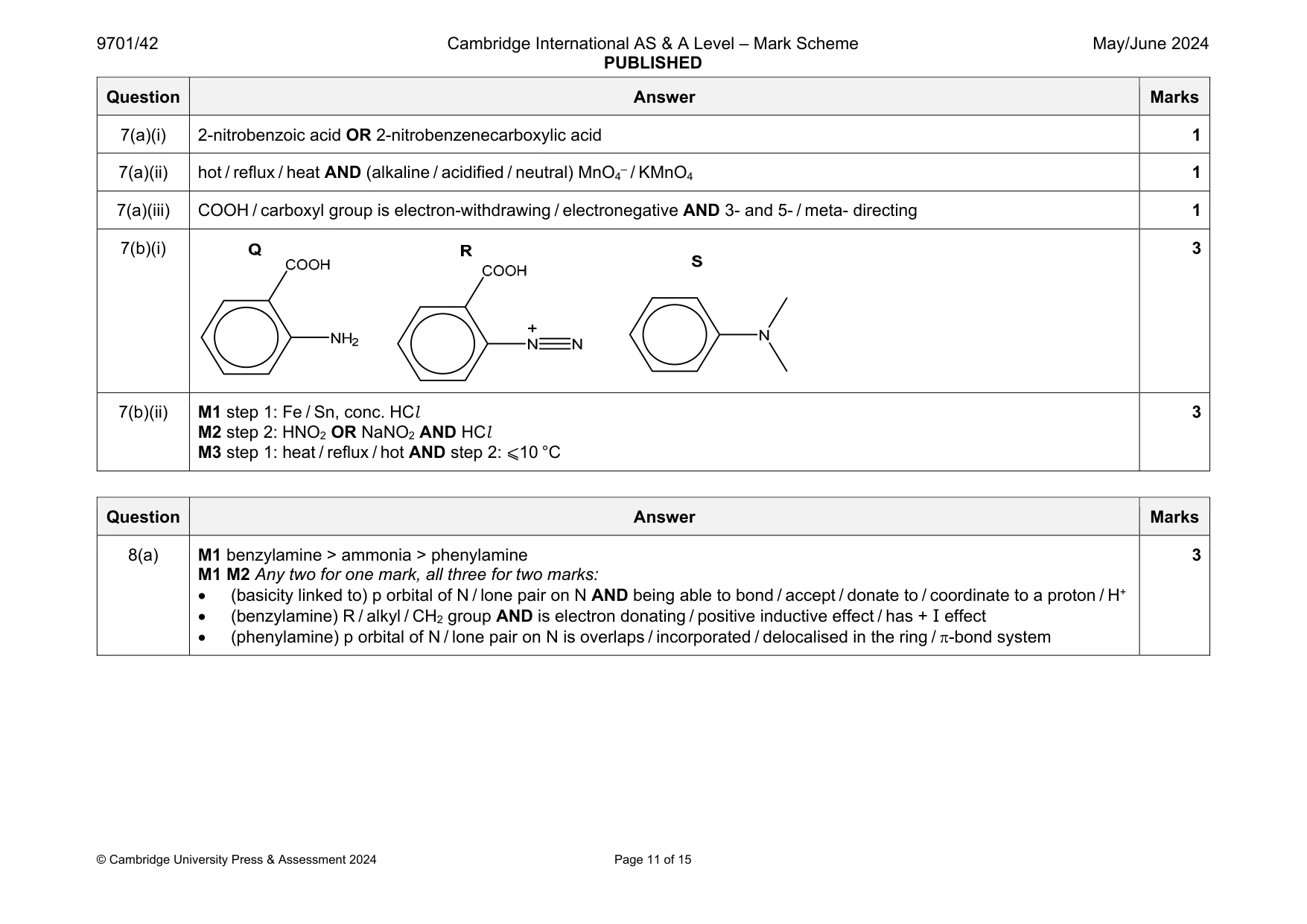
7 Methyl red can be synthesised as shown in Fig. 7.1. P COOH NO2 step 1 Q step 2 R S step 3 methyl red COOH N N N Fig. 7.1 (a) (i) Give the systematic name of P. ..................................................................................................................................... [1] (ii) P can be synthesised as shown in Fig. 7.2. P CH3 COOH NO2 NO2 Fig. 7.2 Suggest reagents and conditions for this reaction. ..................................................................................................................................... [1] (iii) A student attempts to synthesise P by an alternative route, as shown in Fig. 7.3. Compound T is the major product in this reaction rather than P. T COOH COOH conc. HNO3 conc. H2SO4 NO2 Fig. 7.3 Explain why T is the major product in this reaction. ........................................................................................................................................... ..................................................................................................................................... [1] (b) S reacts in a similar way to phenol in step 3. (i) Draw the structures of Q, R and S in the boxes in Fig. 7.1. [3] (ii) Suggest reagents and conditions for steps 1 and 2 in Fig. 7.1. step 1 ................................................................................................................................ step 2 ................................................................................................................................ [3] [Total: 9]
Mark scheme: 7(a)(i) 2-nitrobenzoic acid OR 2-nitrobenzenecarboxylic acid 1 7(a)(ii) hot / reflux / heat AND (alkaline / acidified / neutral) MnO4– / KMnO4 1 7(a)(iii) COOH / carboxyl group is electron-withdrawing / electronegative AND 3- and 5- / meta- directing 1 7(b)(i) 3 7(b)(ii) M1 step 1: Fe / Sn, conc. HCl M2 step 2: HNO2 OR NaNO2 AND HCl M3 step 1: heat / reflux / hot AND step 2: ⩽10 °C 3
Q8 · State the relative basicities of phenylamine, C6H5NH2, benzylamine, C6H5CH2NH2, and…
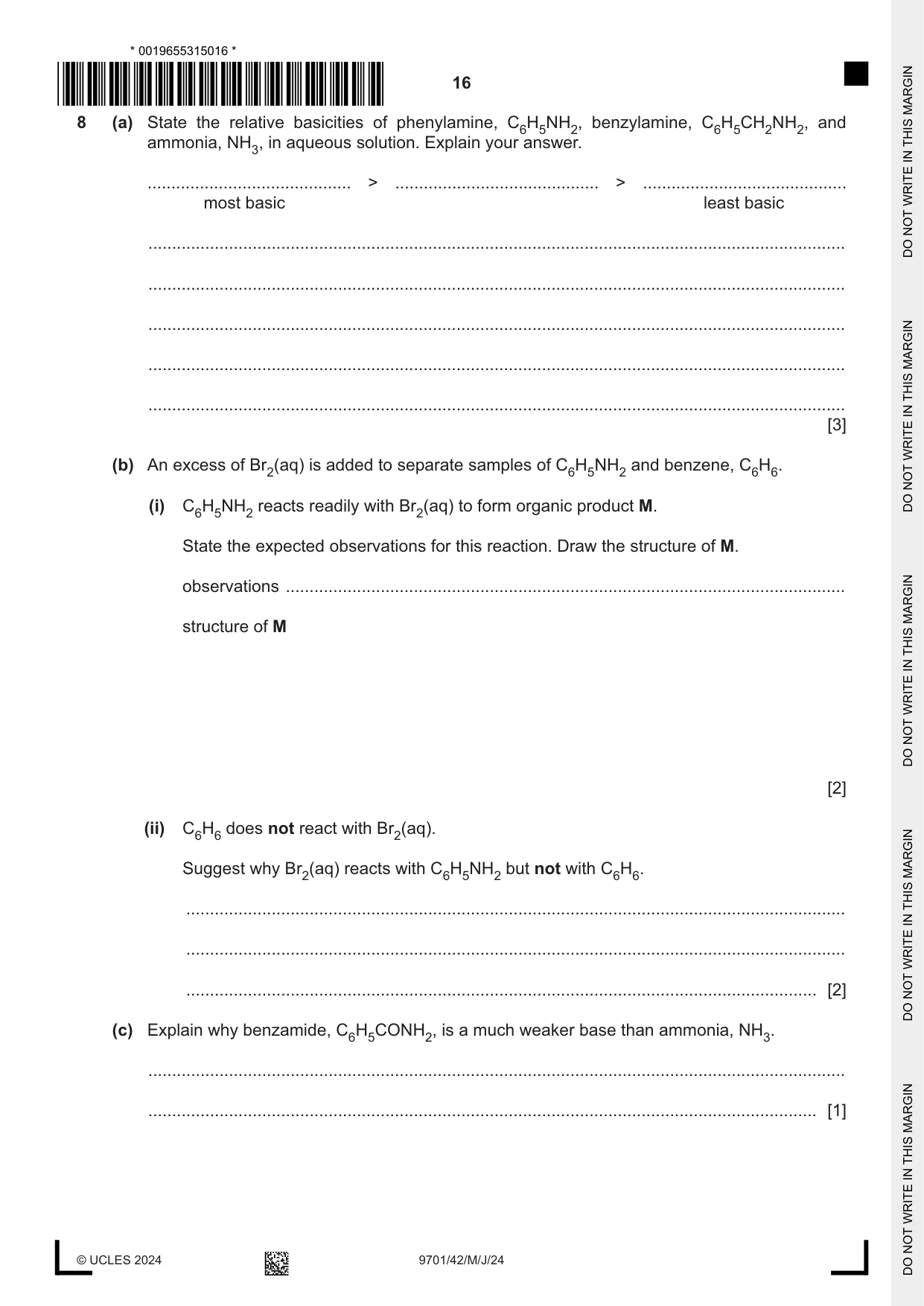
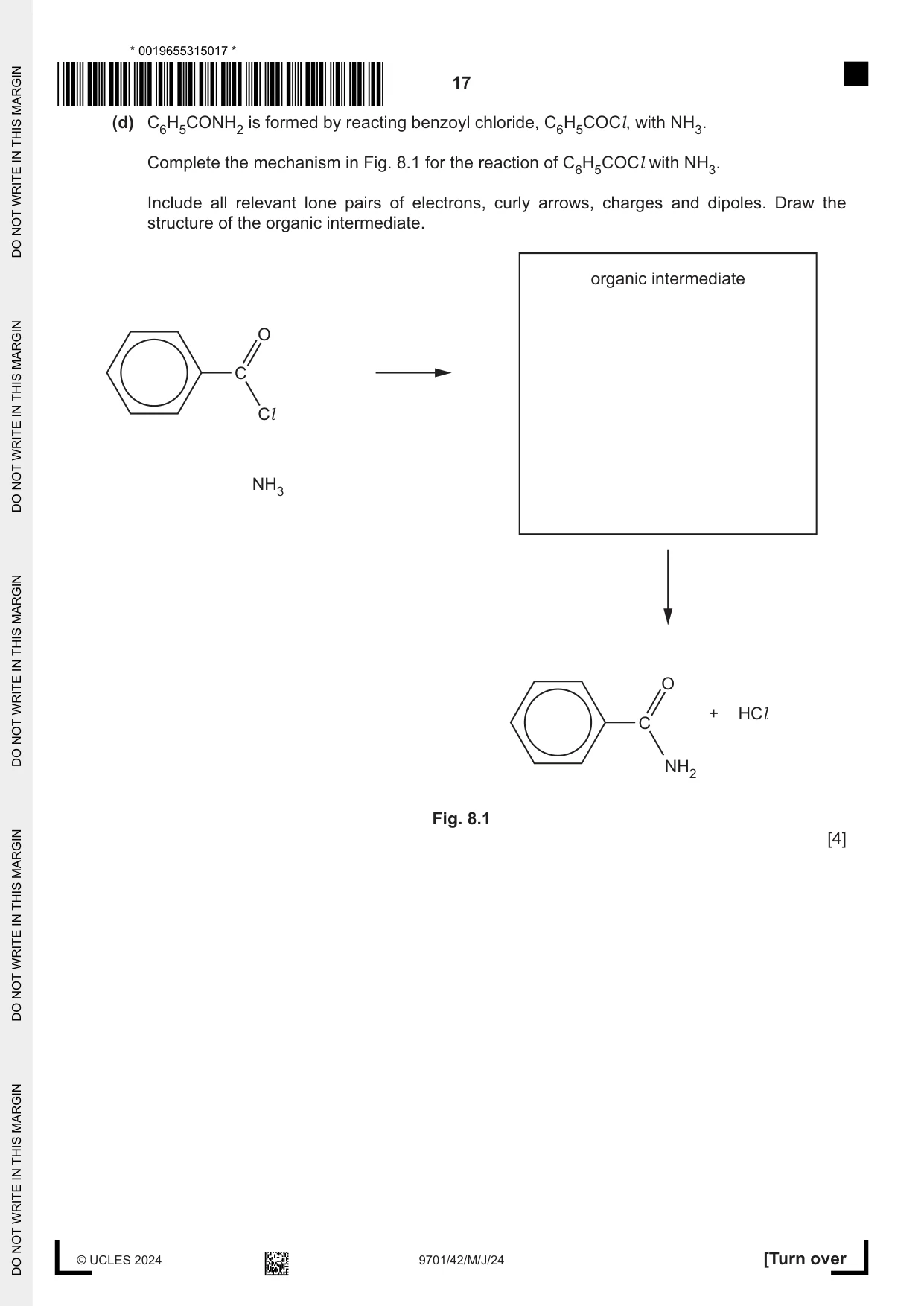
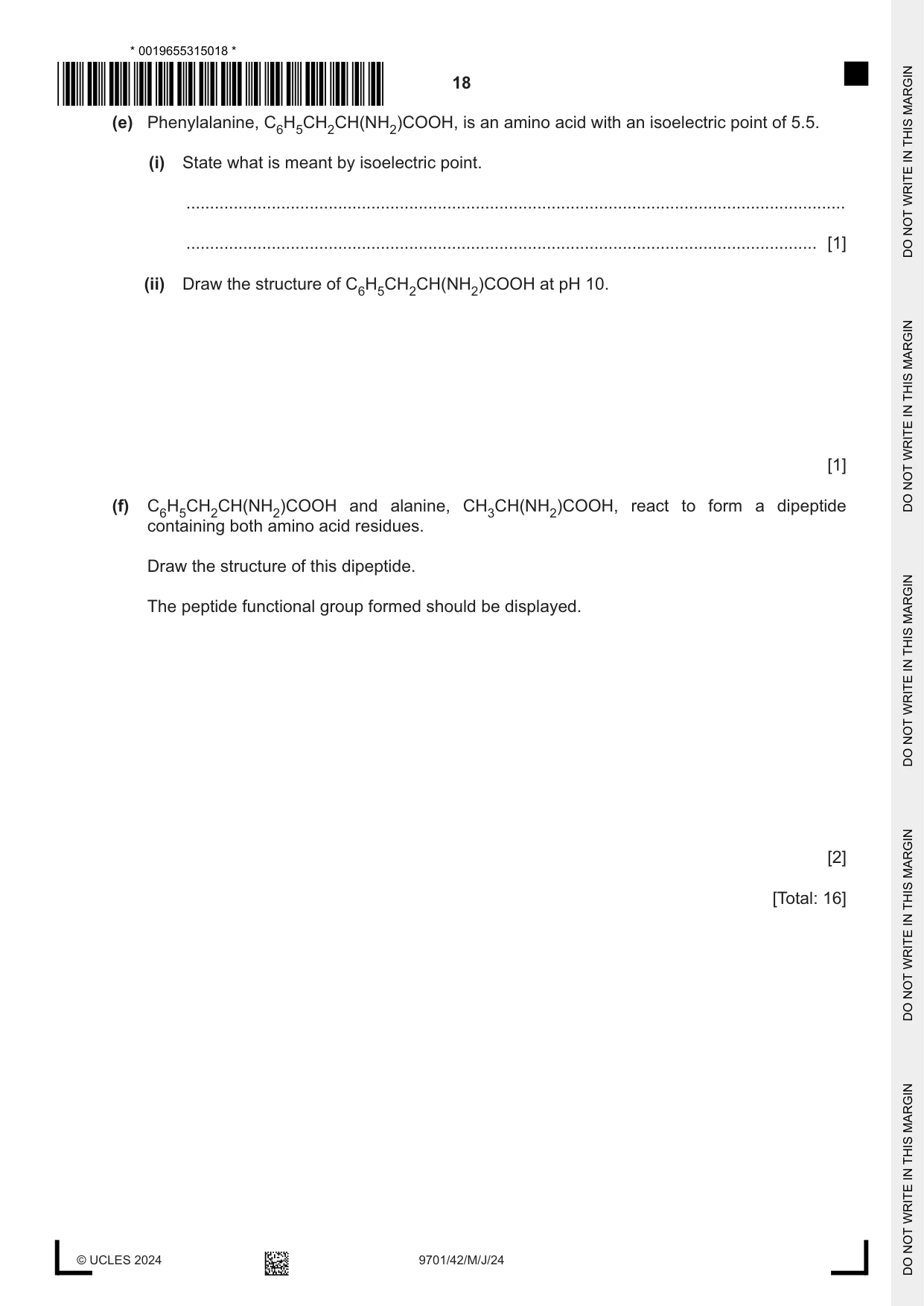
8 (a) State the relative basicities of phenylamine, C6H5NH2, benzylamine, C6H5CH2NH2, and ammonia, NH3, in aqueous solution. Explain your answer. ........................................... > ........................................... > ........................................... most basic least basic ................................................................................................................................................... ................................................................................................................................................... ................................................................................................................................................... ................................................................................................................................................... ................................................................................................................................................... [3] (b) An excess of Br2(aq) is added to separate samples of C6H5NH2 and benzene, C6H6. (i) C6H5NH2 reacts readily with Br2(aq) to form organic product M. State the expected observations for this reaction. Draw the structure of M. observations ...................................................................................................................... structure of M [2] (ii) C6H6 does not react with Br2(aq). Suggest why Br2(aq) reacts with C6H5NH2 but not with C6H6. ........................................................................................................................................... ........................................................................................................................................... ..................................................................................................................................... [2] (c) Explain why benzamide, C6H5CONH2, is a much weaker base than ammonia, NH3. ................................................................................................................................................... ............................................................................................................................................. [1] (d) C6H5CONH2 is formed by reacting benzoyl chloride, C6H5COCl, with NH3. Complete the mechanism in Fig. 8.1 for the reaction of C6H5COCl with NH3. Include all relevant lone pairs of electrons, curly arrows, charges and dipoles. Draw the structure of the organic intermediate. organic intermediate O C Cl NH3 O + HCl C NH2 Fig. 8.1 [4] (e) Phenylalanine, C6H5CH2CH(NH2)COOH, is an amino acid with an isoelectric point of 5.5. (i) State what is meant by isoelectric point. ........................................................................................................................................... ..................................................................................................................................... [1] (ii) Draw the structure of C6H5CH2CH(NH2)COOH at pH 10. [1] (f) C6H5CH2CH(NH2)COOH and alanine, CH3CH(NH2)COOH, react to form a dipeptide containing both amino acid residues. Draw the structure of this dipeptide. The peptide functional group formed should be displayed. [2] [Total: 16]
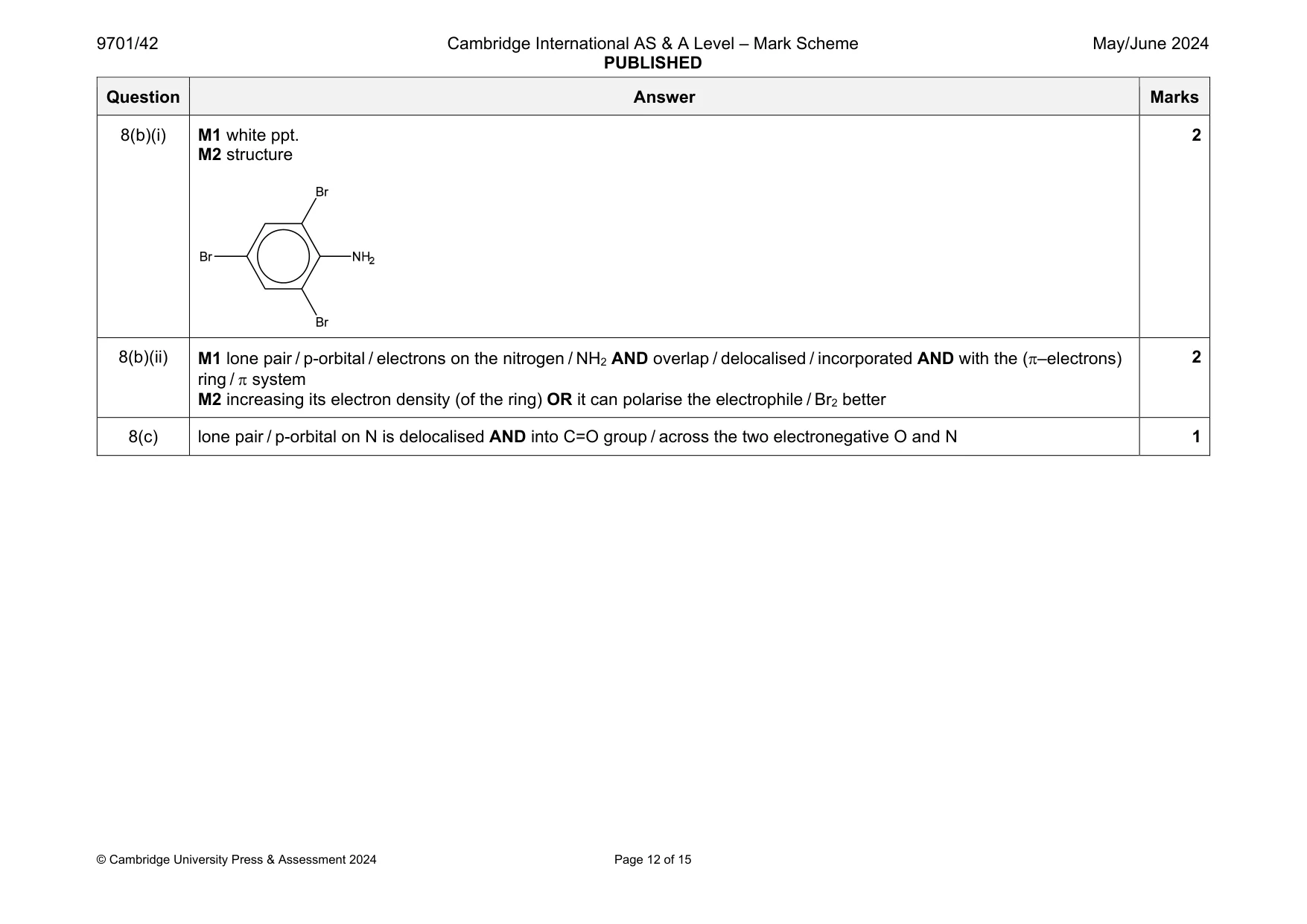
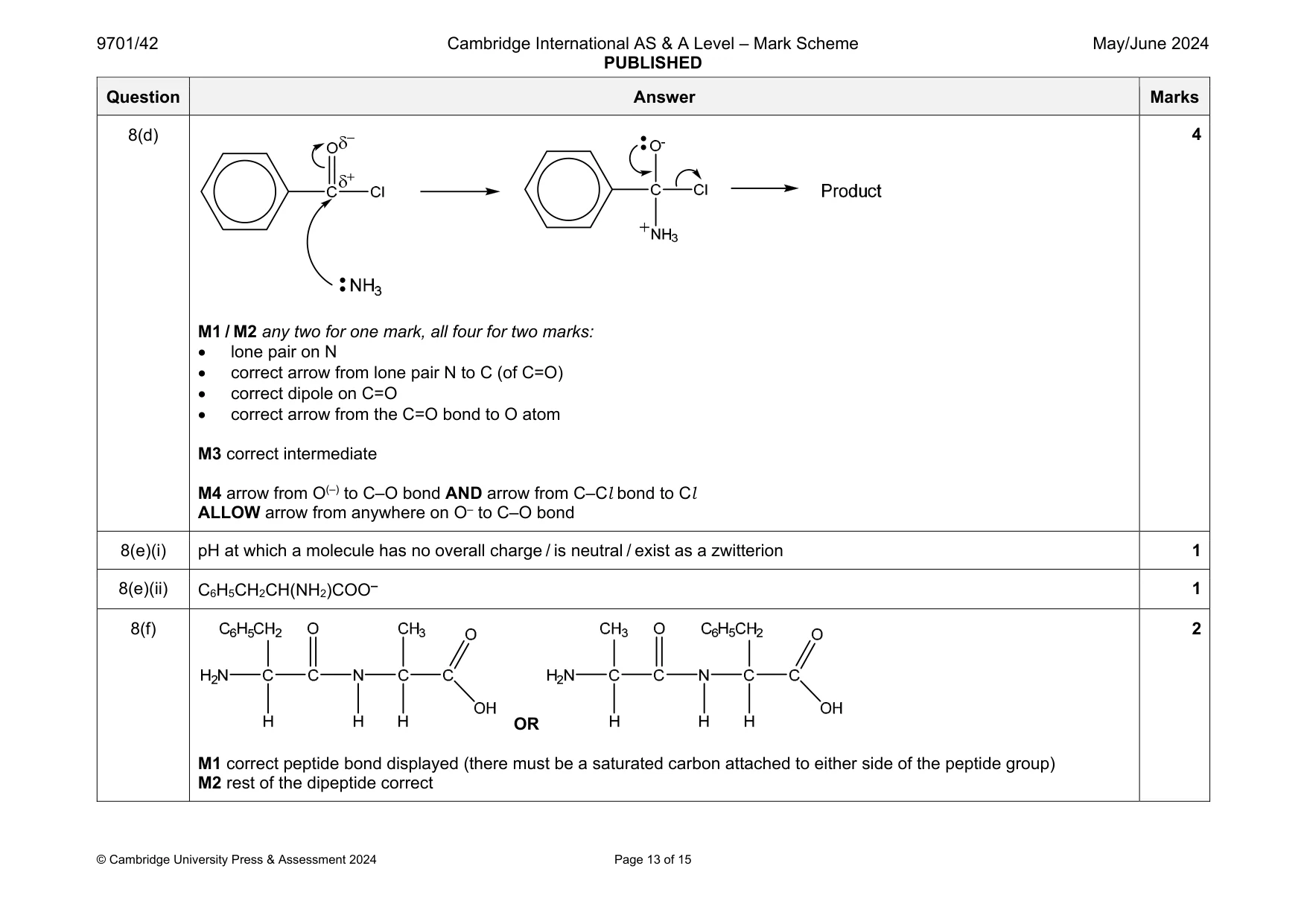
Mark scheme: 8(a) M1 benzylamine > ammonia > phenylamine M1 M2 Any two for one mark, all three for two marks: (basicity linked to) p orbital of N / lone pair on N AND being able to bond / accept / donate to / coordinate to a proton / H+ (benzylamine) R / alkyl / CH2 group AND is electron donating / positive inductive effect / has + I effect (phenylamine) p orbital of N / lone pair on N is overlaps / incorporated / delocalised in the ring / -bond system Question Answer Marks 8(b)(i) M1 white ppt. M2 structure 2 8(b)(ii) M1 lone pair / p-orbital / electrons on the nitrogen / NH2 AND overlap / delocalised / incorporated AND with the (–electrons) ring / system M2 increasing its electron density (of the ring) OR it can polarise the electrophile / Br2 better 2 8(c) lone pair / p-orbital on N is delocalised AND into C=O group / across the two electronegative O and N 1 Question Answer Marks 8(d) M1 / M2 any two for one mark, all four for two marks: lone pair on N correct arrow from lone pair N to C (of C=O) correct dipole on C=O correct arrow from the C=O bond to O atom M3 correct intermediate M4 arrow from O(–) to C–O bond AND arrow from C–Cl bond to Cl ALLOW arrow from anywhere on O– to C–O bond 4 8(e)(i) pH at which a molecule has no overall charge / is neutral / exist as a zwitterion 1 8(e)(ii) C6H5CH2CH(NH2)COO– 1 8(f) OR M1 correct peptide bond displayed (there must be a saturated carbon attached to either side of the peptide group) M2 rest of the dipeptide correct 2
Q9 · Explain why trichloroethanoic acid, CCl 3COOH, is more acidic than ethanoic acid, CH3COOH
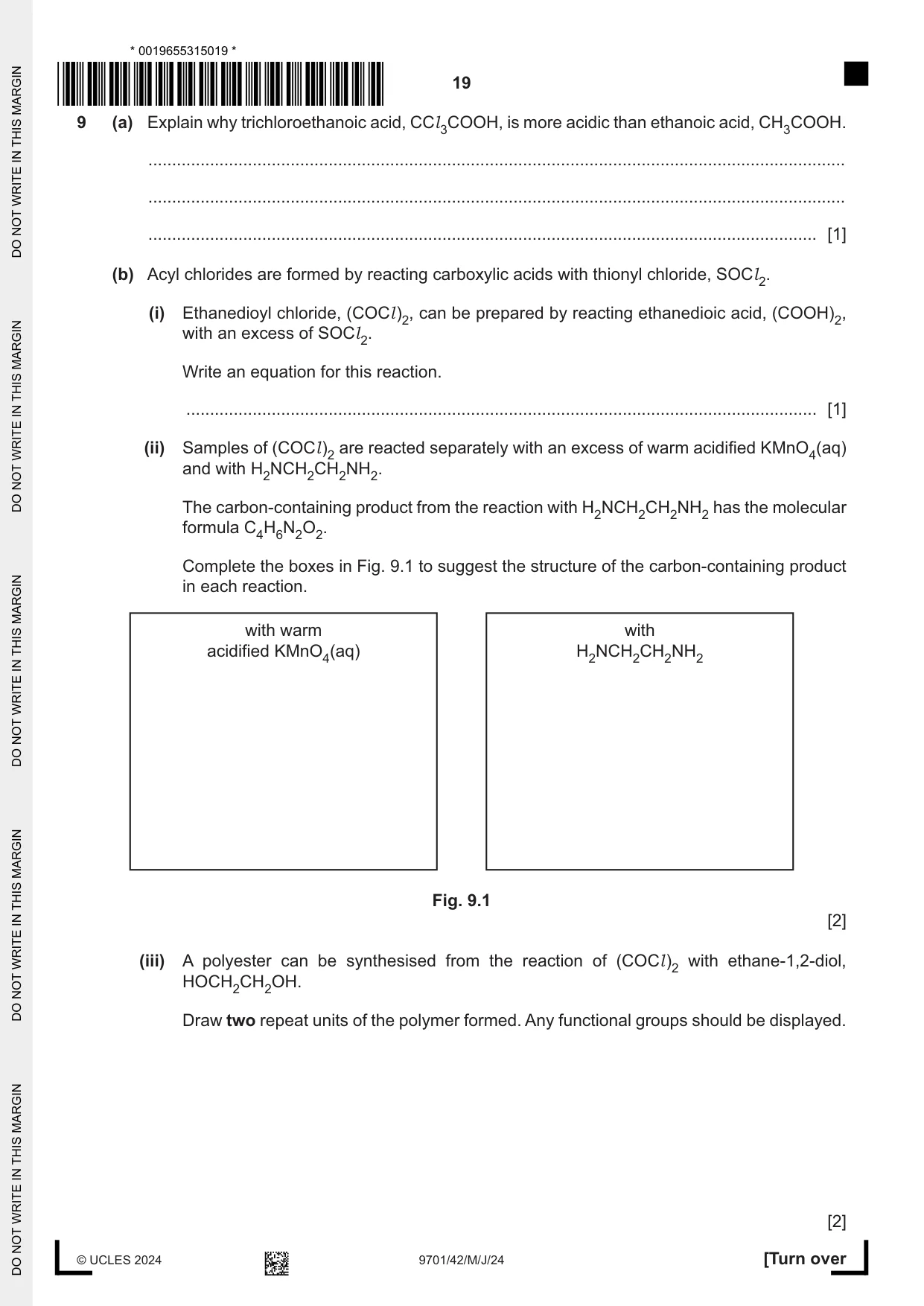
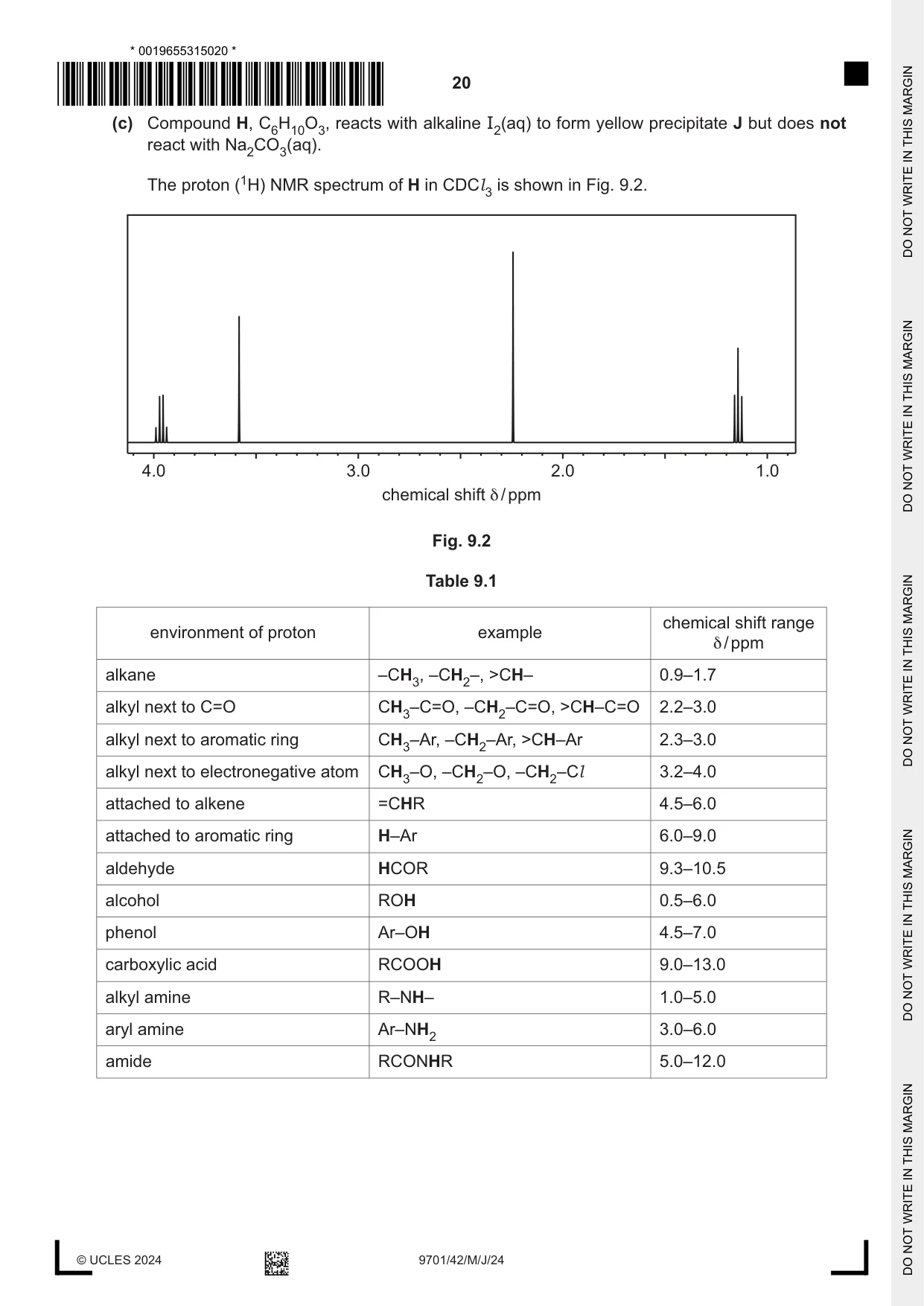
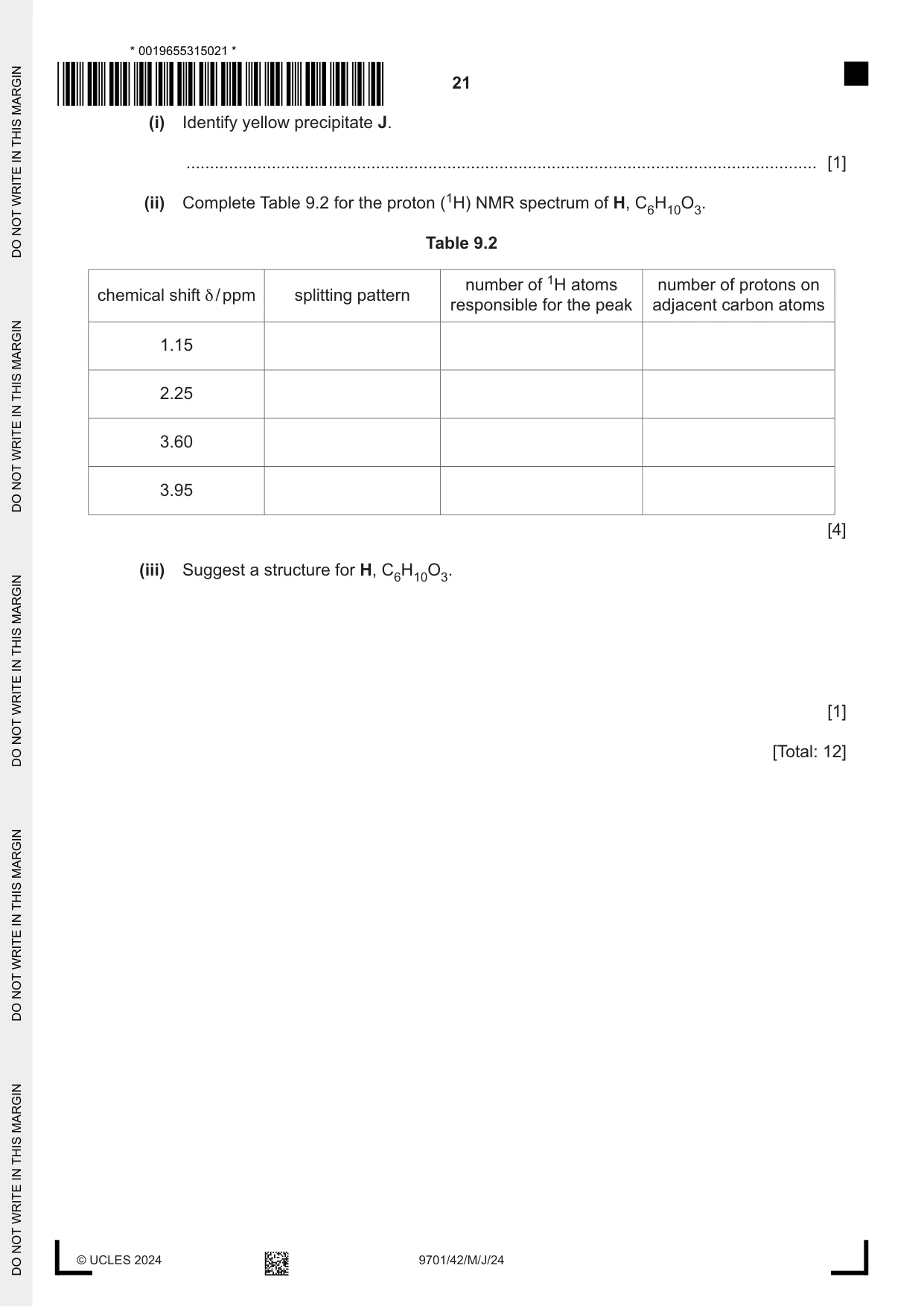
9 (a) Explain why trichloroethanoic acid, CCl 3COOH, is more acidic than ethanoic acid, CH3COOH. ................................................................................................................................................... ................................................................................................................................................... ............................................................................................................................................. [1] (b) Acyl chlorides are formed by reacting carboxylic acids with thionyl chloride, SOCl 2. (i) Ethanedioyl chloride, (COCl )2, can be prepared by reacting ethanedioic acid, (COOH)2, with an excess of SOCl 2. Write an equation for this reaction. ..................................................................................................................................... [1] (ii) Samples of (COCl )2 are reacted separately with an excess of warm acidified KMnO4(aq) and with H2NCH2CH2NH2. The carbon‑containing product from the reaction with H2NCH2CH2NH2 has the molecular formula C4H6N2O2. Complete the boxes in Fig. 9.1 to suggest the structure of the carbon‑containing product in each reaction. with warm with acidified KMnO4(aq) H2NCH2CH2NH2 Fig. 9.1 [2] (iii) A polyester can be synthesised from the reaction of (COCl )2 with ethane‑1,2‑diol, HOCH2CH2OH. Draw two repeat units of the polymer formed. Any functional groups should be displayed. [2] (c) Compound H, C6H10O3, reacts with alkaline I2(aq) to form yellow precipitate J but does not react with Na2CO3(aq). The proton (1H) NMR spectrum of H in CDCl is shown in Fig. 9.2. 3 4.0 3.0 2.0 1.0 chemical shift δ / ppm Fig. 9.2 Table 9.1 chemical shift range environment of proton example δ / ppm alkane –CH3, –CH2–, >CH– 0.9–1.7 alkyl next to C=O CH3–C=O, –CH2–C=O, >CH–C=O 2.2–3.0 alkyl next to aromatic ring CH3–Ar, –CH2–Ar, >CH–Ar 2.3–3.0 alkyl next to electronegative atom CH3–O, –CH2–O, –CH2–Cl 3.2–4.0 attached to alkene =CHR 4.5–6.0 attached to aromatic ring H–Ar 6.0–9.0 aldehyde HCOR 9.3–10.5 alcohol ROH 0.5–6.0 phenol Ar–OH 4.5–7.0 carboxylic acid RCOOH 9.0–13.0 alkyl amine R–NH– 1.0–5.0 aryl amine Ar–NH2 3.0–6.0 amide RCONHR 5.0–12.0 (i) Identify yellow precipitate J. ..................................................................................................................................... [1] (ii) Complete Table 9.2 for the proton (1H) NMR spectrum of H, C6H10O3. Table 9.2 number of 1H atoms number of protons on chemical shift δ / ppm splitting pattern responsible for the peak adjacent carbon atoms 1.15 2.25 3.60 3.95 [4] (iii) Suggest a structure for H, C6H10O3. [1] [Total: 12]
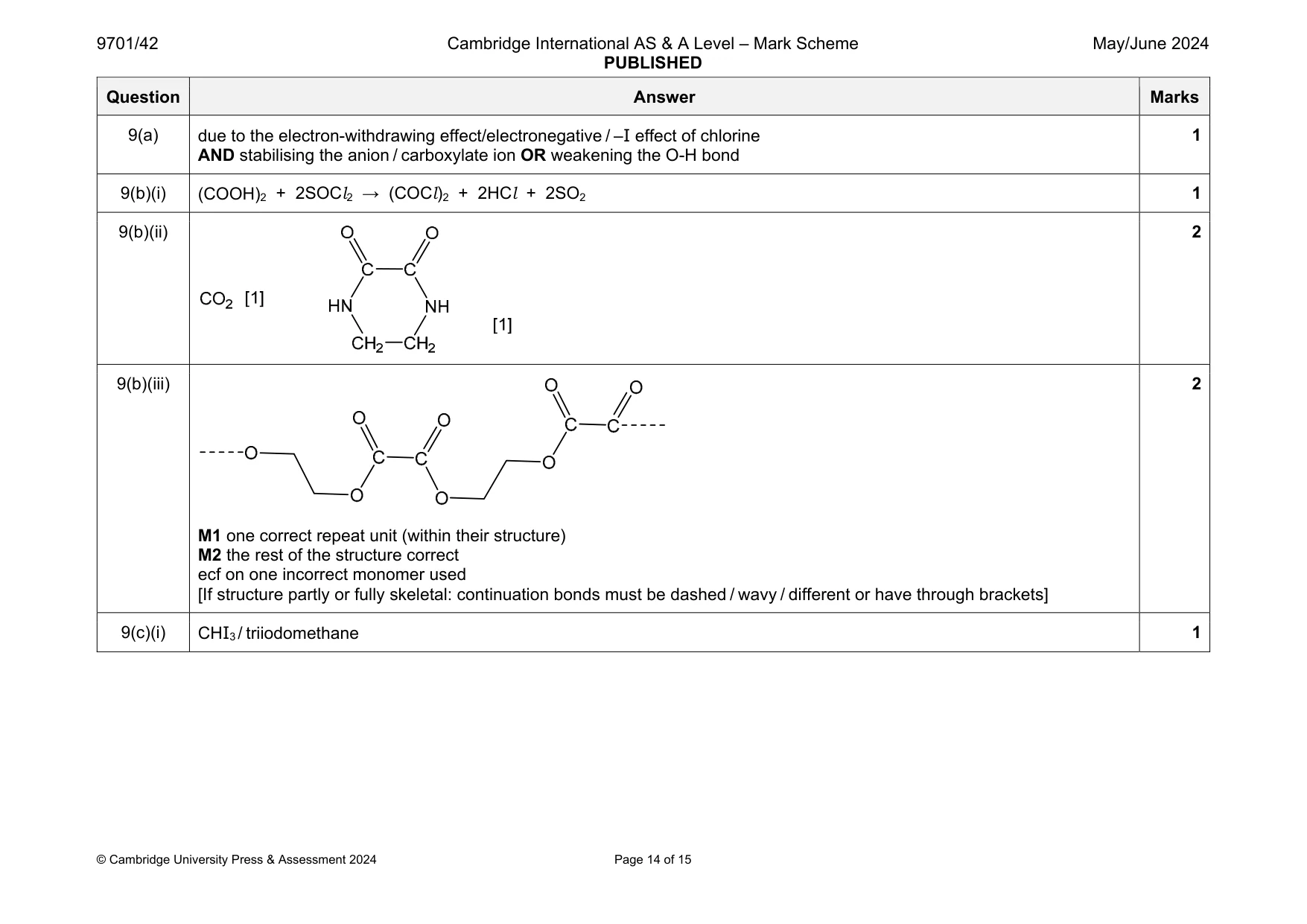
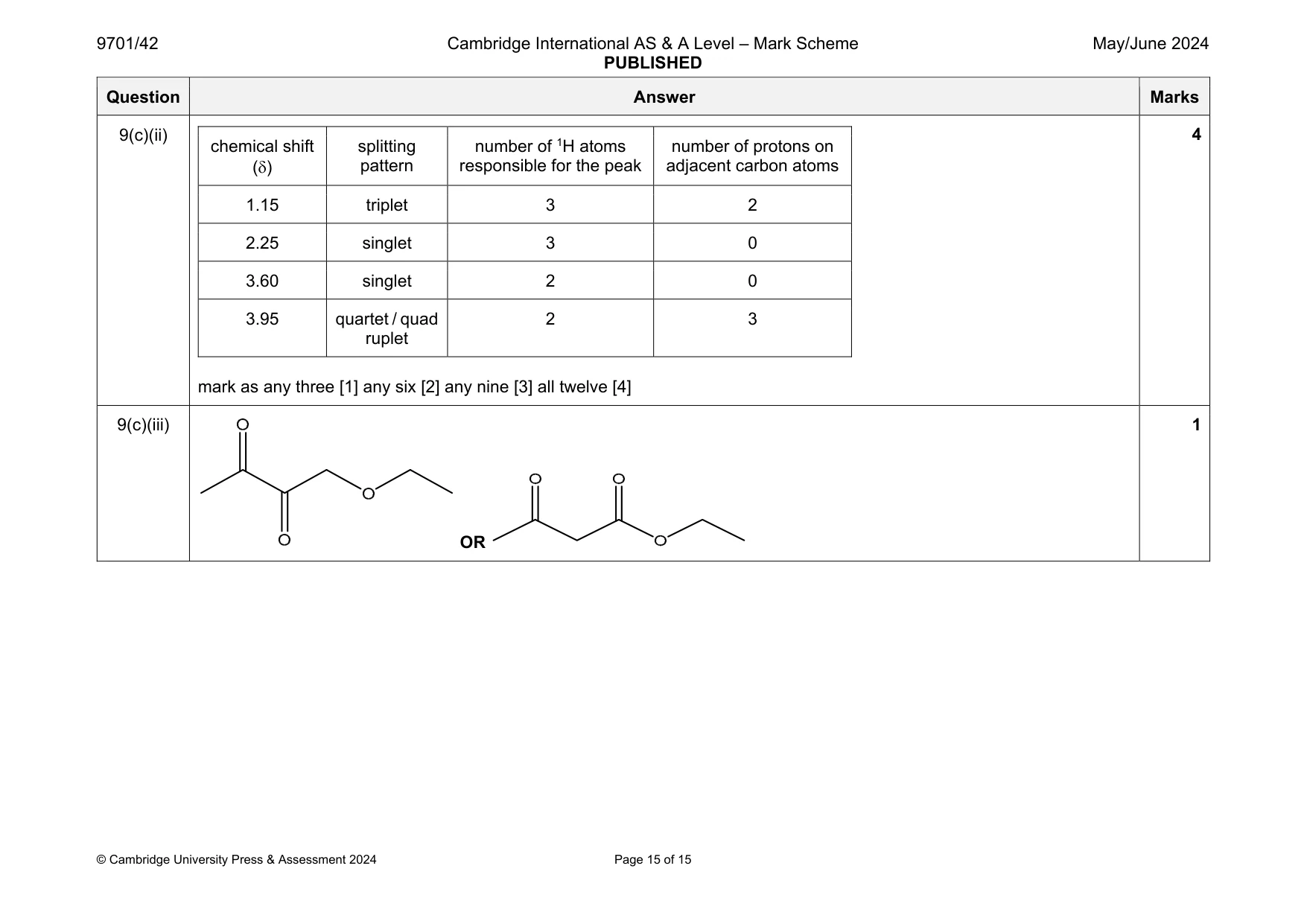
Mark scheme: 9(a) AND stabilising the anion / carboxylate ion OR weakening the O-H bond 1 9(b)(i) (COOH)2 + 2SOCl2 → (COCl)2 + 2HCl + 2SO2 1 9(b)(ii) 2 9(b)(iii) M1 one correct repeat unit (within their structure) M2 the rest of the structure correct ecf on one incorrect monomer used [If structure partly or fully skeletal: continuation bonds must be dashed / wavy / different or have through brackets] 2 9(c)(i) CHI3/ triiodomethane 1 Question Answer Marks 9(c)(ii) chemical shift () splitting pattern number of 1H atoms responsible for the peak number of protons on adjacent carbon atoms 1.15 triplet 3 2 2.25 singlet 3 0 3.60 singlet 2 0 3.95 quartet / quad ruplet 2 3 mark as any three [1] any six [2] any nine [3] all twelve [4] 4 9(c)(iii) OR 1
What was in this paper
The subtopics covered by these 9 questions, and how many questions each got. Open one in a new tab to see every Cambridge question on it.
1Gibbs free energy change, ΔG1Lattice energy and Born-Haber cycles1Organic synthesis1Phenylamine and azo compounds1Proton (1H) NMR spectroscopy1Simple rate equations, orders of reaction and rate constants1Standard electrode potentials E ⦵, standard cell potentials E ⦵ cell and the Nernst equation1Stereoisomerism in transition element complexes1What you needed in this session
Cambridge’s own grade thresholds for 2024 May/June, Paper 4 · Variant 2. A higher threshold means an easier paper — the bar moves with how the cohort did.