Cambridge A Level Chemistry 9701 — 2025 Feb/March Paper 4 · Variant 2
9701/42/F/M/25 · 6 questions · 100 marks · 120 min
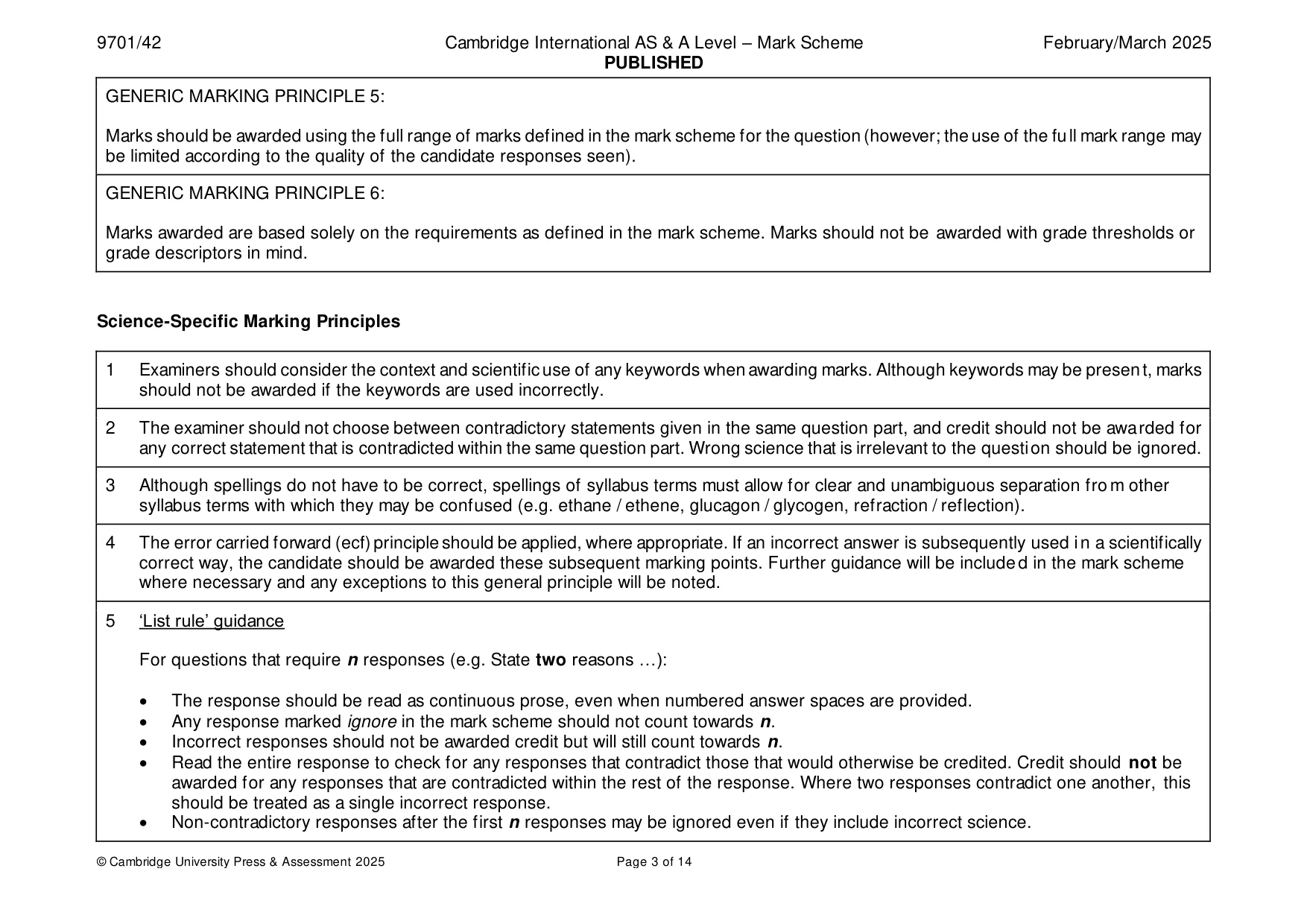
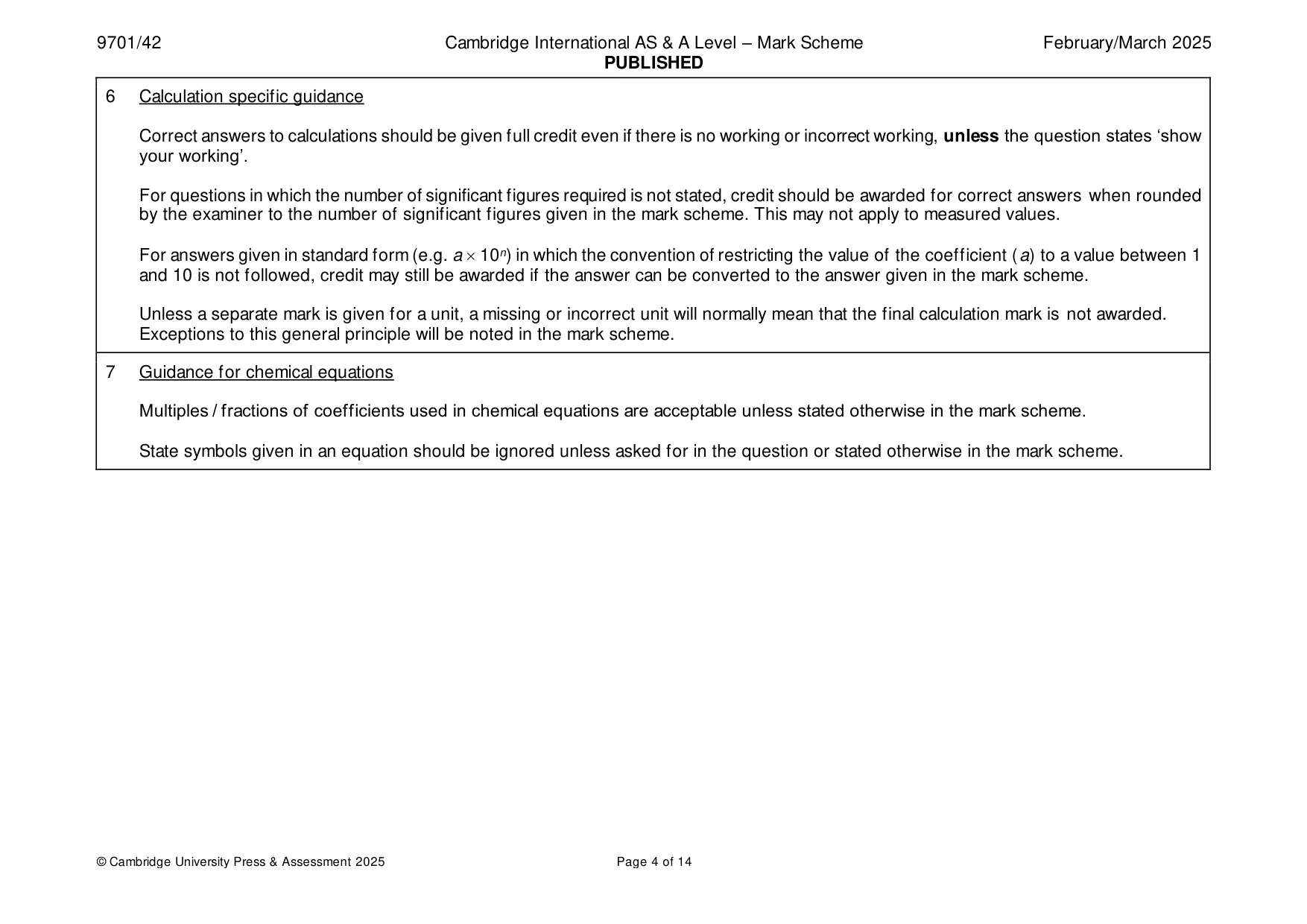
The question paper and its mark scheme, free to read here and free to download. This is Cambridge’s own paper, exactly as it was sat.
Question paper28 pages


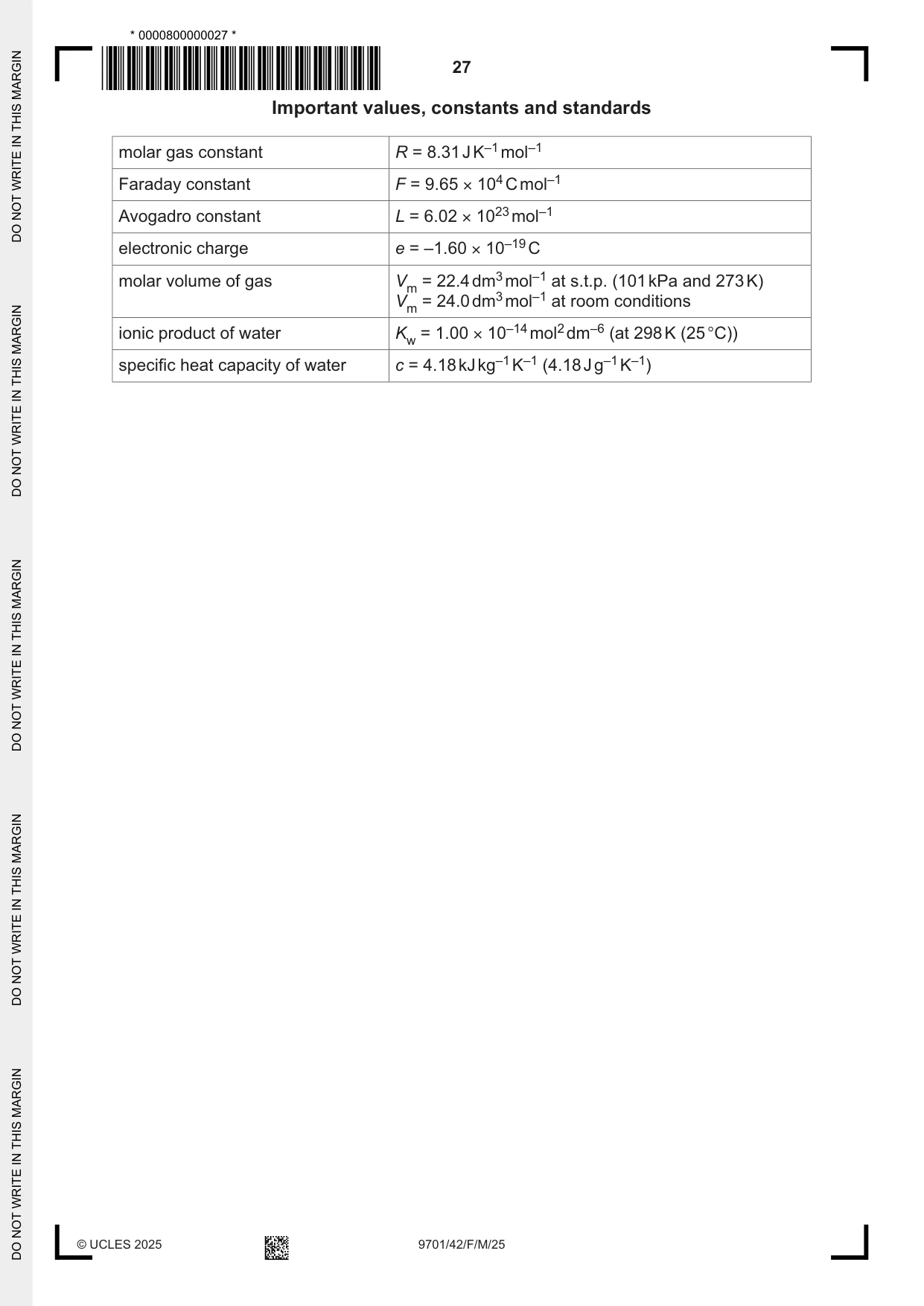
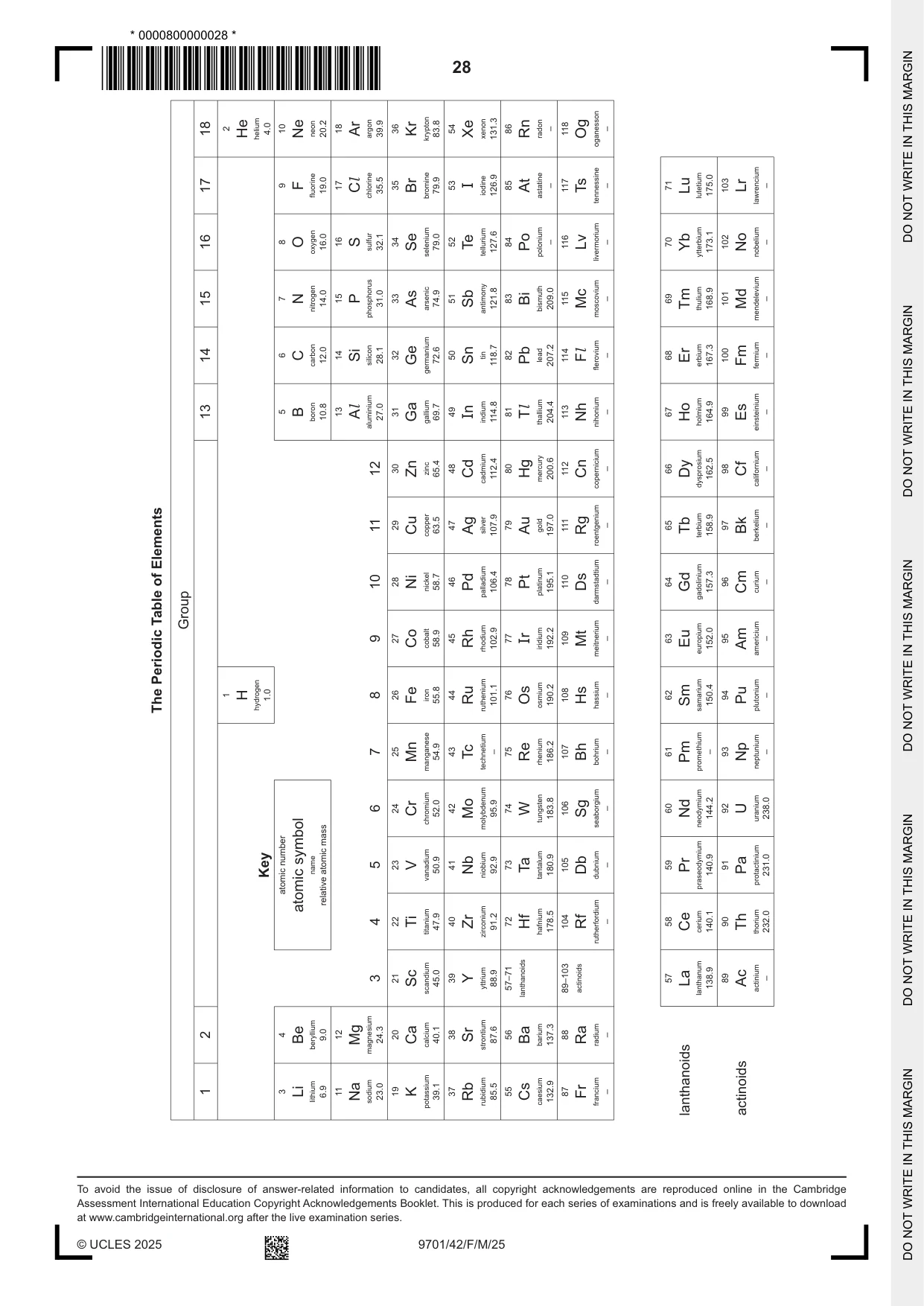
Mark scheme14 pages
Answers below. Sit the paper first if you are practising.
Questions as text
Q1 · Silver, Ag, is a metal in the d-block of the Periodic Table
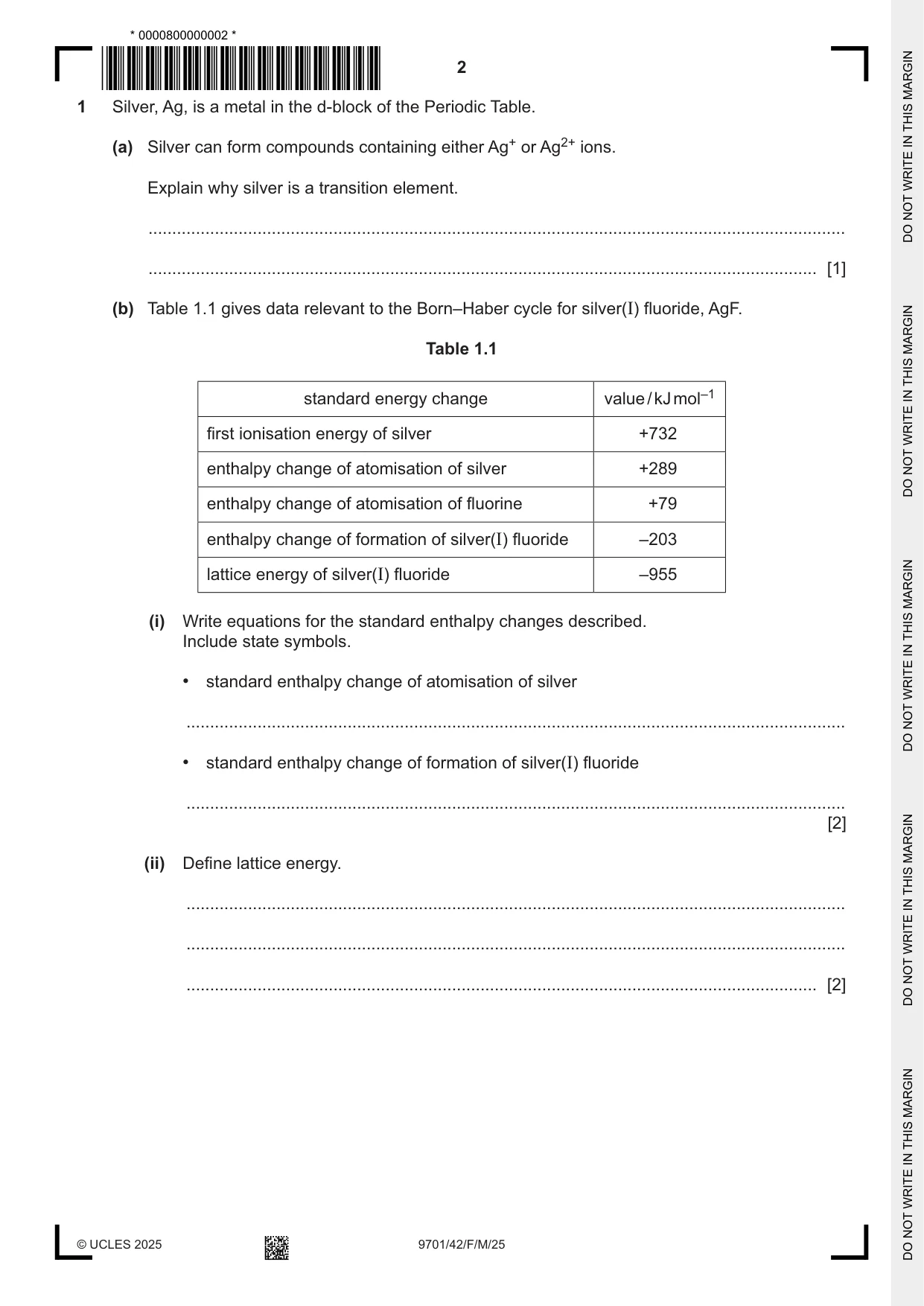
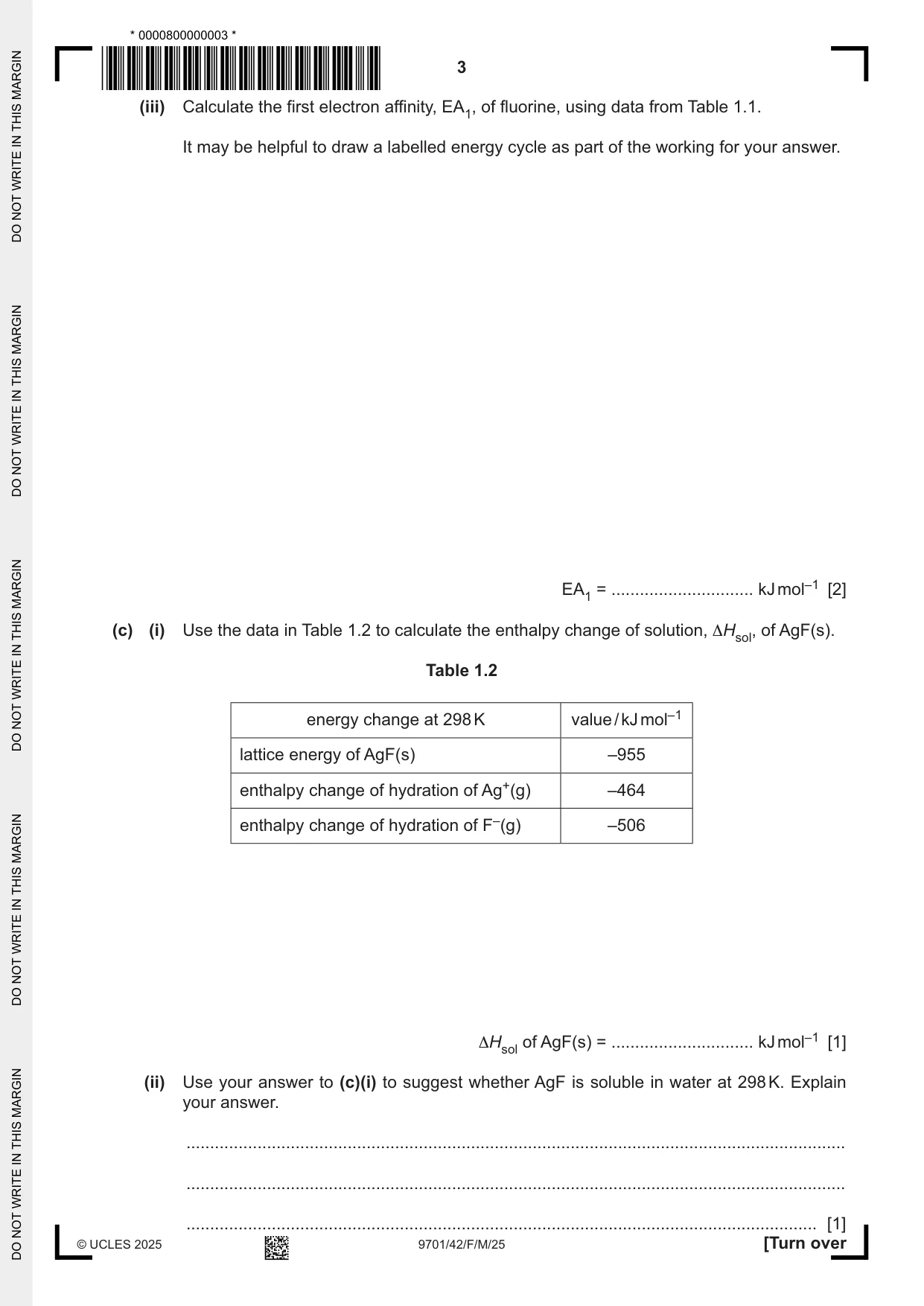
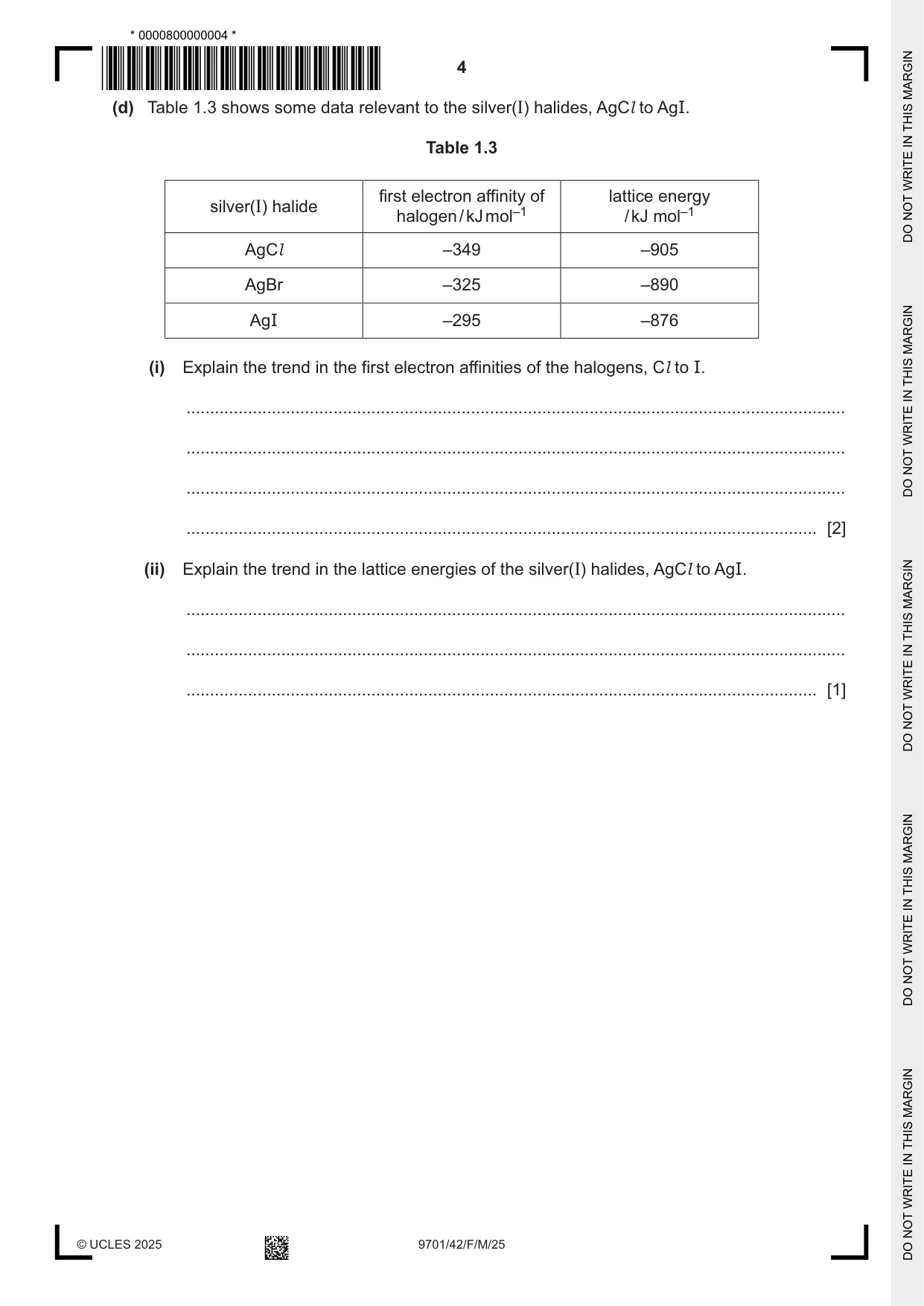
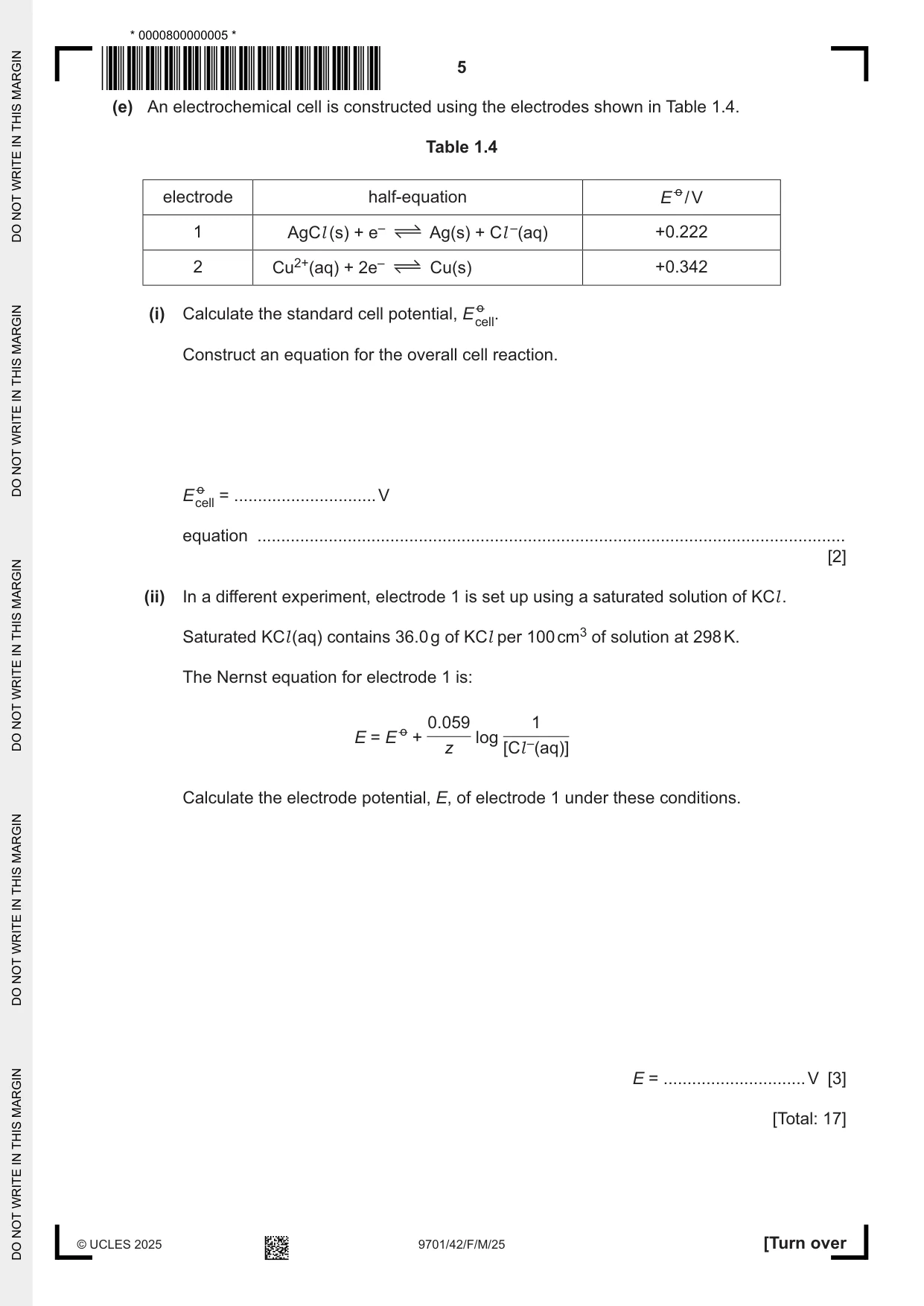
1 Silver, Ag, is a metal in the d-block of the Periodic Table. (a) Silver can form compounds containing either Ag+ or Ag2+ ions. Explain why silver is a transition element. ................................................................................................................................................... ............................................................................................................................................. [1] (b) Table 1.1 gives data relevant to the Born–Haber cycle for silver(I) fluoride, AgF. Table 1.1 standard energy change value / kJ mol–1 first ionisation energy of silver +732 enthalpy change of atomisation of silver +289 enthalpy change of atomisation of fluorine +79 enthalpy change of formation of silver(I) fluoride –203 lattice energy of silver(I) fluoride –955 (i) Write equations for the standard enthalpy changes described. Include state symbols. • standard enthalpy change of atomisation of silver ........................................................................................................................................... • standard enthalpy change of formation of silver(I) fluoride ........................................................................................................................................... [2] (ii) Define lattice energy. ........................................................................................................................................... ........................................................................................................................................... ..................................................................................................................................... [2] (iii) Calculate the first electron affinity, EA1, of fluorine, using data from Table 1.1. It may be helpful to draw a labelled energy cycle as part of the working for your answer. EA1 = .............................. kJ mol–1 [2] (c) (i) Use the data in Table 1.2 to calculate the enthalpy change of solution, ΔHsol, of AgF(s). Table 1.2 energy change at 298 K value / kJ mol–1 lattice energy of AgF(s) –955 enthalpy change of hydration of Ag+(g) –464 enthalpy change of hydration of F–(g) –506 ΔHsol of AgF(s) = .............................. kJ mol–1 [1] (ii) Use your answer to (c)(i) to suggest whether AgF is soluble in water at 298 K. Explain your answer. ........................................................................................................................................... ........................................................................................................................................... ................ ............................................................................................................... [1] (d) Table 1.3 shows some data relevant to the silver(I) halides, AgCl to AgI. Table 1.3 first electron affinity of lattice energy silver(I) halide halogen / kJ mol–1 / kJ mol–1 AgCl –349 –905 AgBr –325 –890 AgI –295 –876 (i) Explain the trend in the first electron affinities of the halogens, Cl to I. ........................................................................................................................................... ........................................................................................................................................... ........................................................................................................................................... ..................................................................................................................................... [2] (ii) Explain the trend in the lattice energies of the silver(I) halides, AgCl to AgI. ........................................................................................................................................... ........................................................................................................................................... ..................................................................................................................................... [1] (e) An electrochemical cell is constructed using the electrodes shown in Table 1.4. Table 1.4 electrode half-equation E o / V 1 AgCl (s) + e– Ag(s) + Cl –(aq) +0.222 2 Cu2+(aq) + 2e– Cu(s) +0.342 (i) Calculate the standard cell potential, E cell.o Construct an equation for the overall cell reaction. E o = .............................. V cell equation ............................................................................................................................ [2] (ii) In a different experiment, electrode 1 is set up using a saturated solution of KCl . Saturated KCl (aq) contains 36.0 g of KCl per 100 cm3 of solution at 298 K. The Nernst equation for electrode 1 is: 0.059 1 E = E o + log z [Cl –(aq)] Calculate the electrode potential, E, of electrode 1 under these conditions. E = .............................. V [3] [Total: 17]
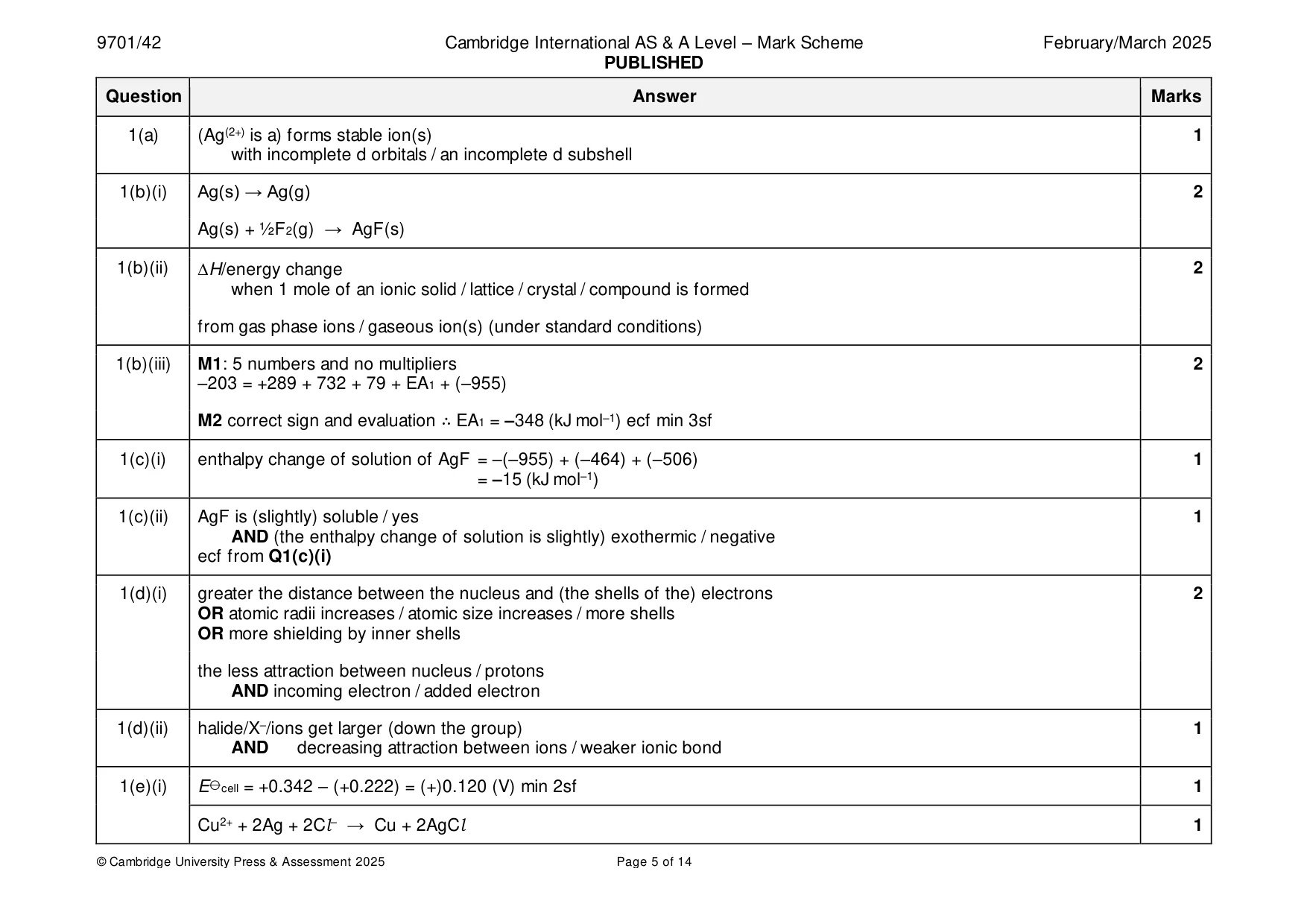
Mark scheme: Question Answer Marks 1(a) (Ag(2+) is a) forms stable ion(s) 1 with incomplete d orbitals / an incomplete d subshell 1(b)(i) Ag(s) → Ag(g) 2 Ag(s) + ½F2(g) → AgF(s) 1(b)(ii) H/energy change 2 when 1 mole of an ionic solid / lattice / crystal / compound is formed from gas phase ions / gaseous ion(s) (under standard conditions) 1(b)(iii) M1: 5 numbers and no multipliers 2 –203 = +289 + 732 + 79 + EA1 + (–955) M2 correct sign and evaluation ∴ EA1 = –348 (kJ mol–1) ecf min 3sf 1(c)(i) enthalpy change of solution of AgF = –(–955) + (–464) + (–506) 1 = –15 (kJ mol–1) 1(c)(ii) AgF is (slightly) soluble / yes 1 AND (the enthalpy change of solution is slightly) exothermic / negative ecf from Q1(c)(i) 1(d)(i) greater the distance between the nucleus and (the shells of the) electrons 2 OR atomic radii increases / atomic size increases / more shells OR more shielding by inner shells the less attraction between nucleus / protons AND incoming electron / added electron 1(d)(ii) halide/X–/ions get larger (down the group) 1 AND decreasing attraction between ions / weaker ionic bond 1(e)(i) E⦵cell = +0.342 – (+0.222) = (+)0.120 (V) min 2sf 1 Cu2+ + 2Ag + 2Cl– → Cu + 2AgCl 1 1(e)(ii) M1: [Cl–(aq)] = 10 36.0 / 74.6 = 4.83 (4.8257) mol dm–3 3 0.059 1 M2: E = 0.222 + log ecf M1 1 M1 M3: E = (+)0.182 (V) min 2sf ecf M1
Q2 · Propanone, CH3COCH3, is a common organic solvent and reagent
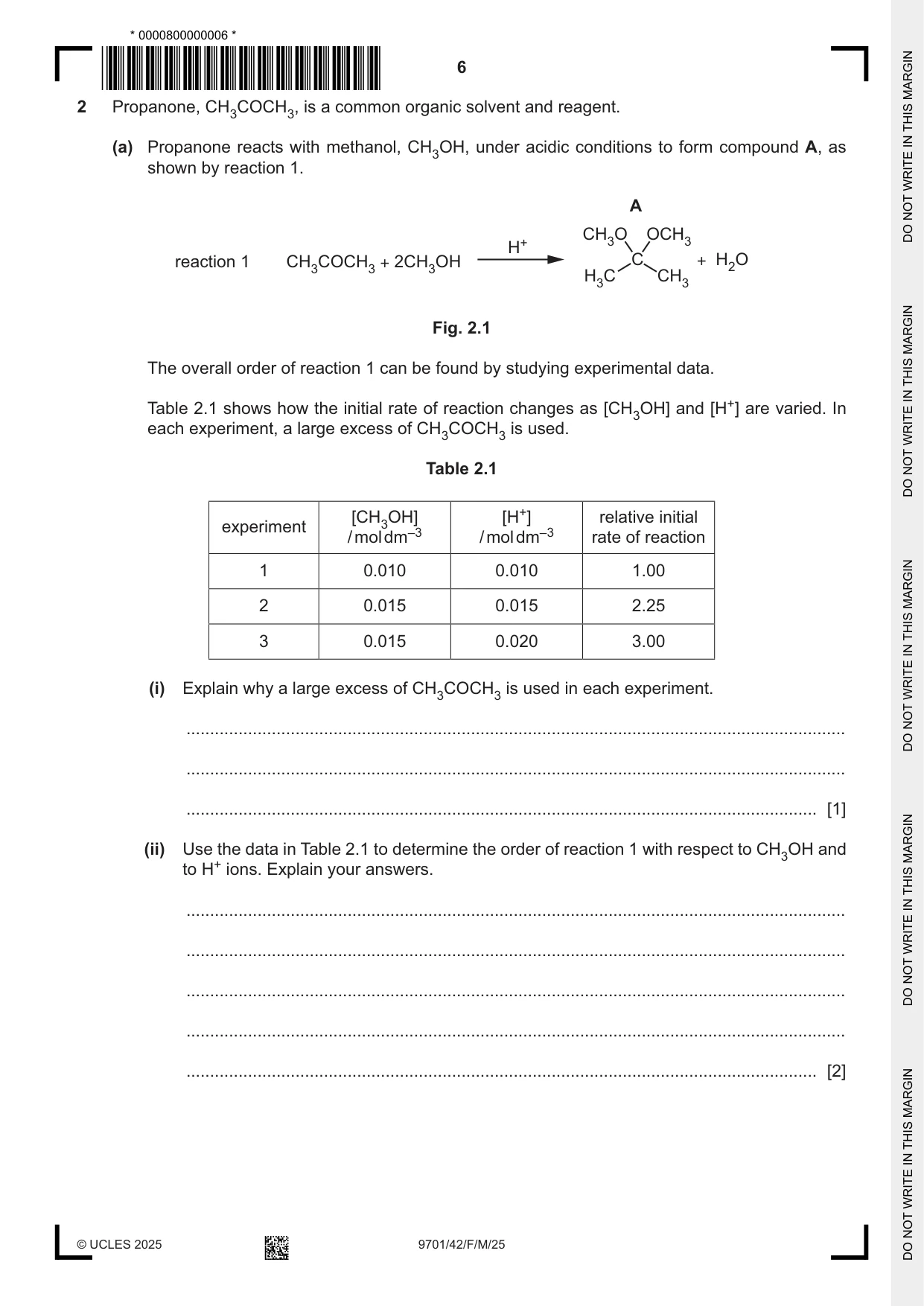
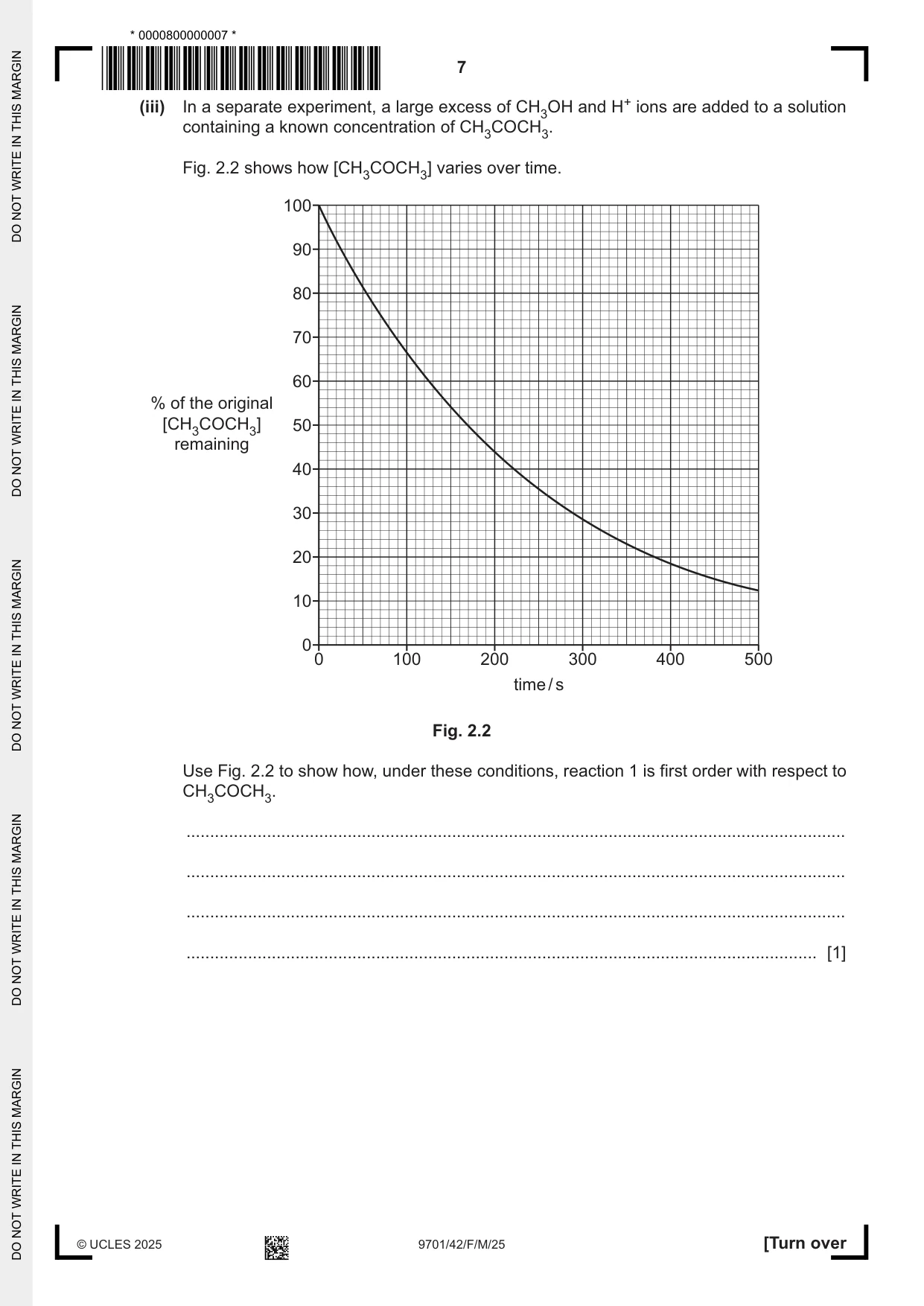
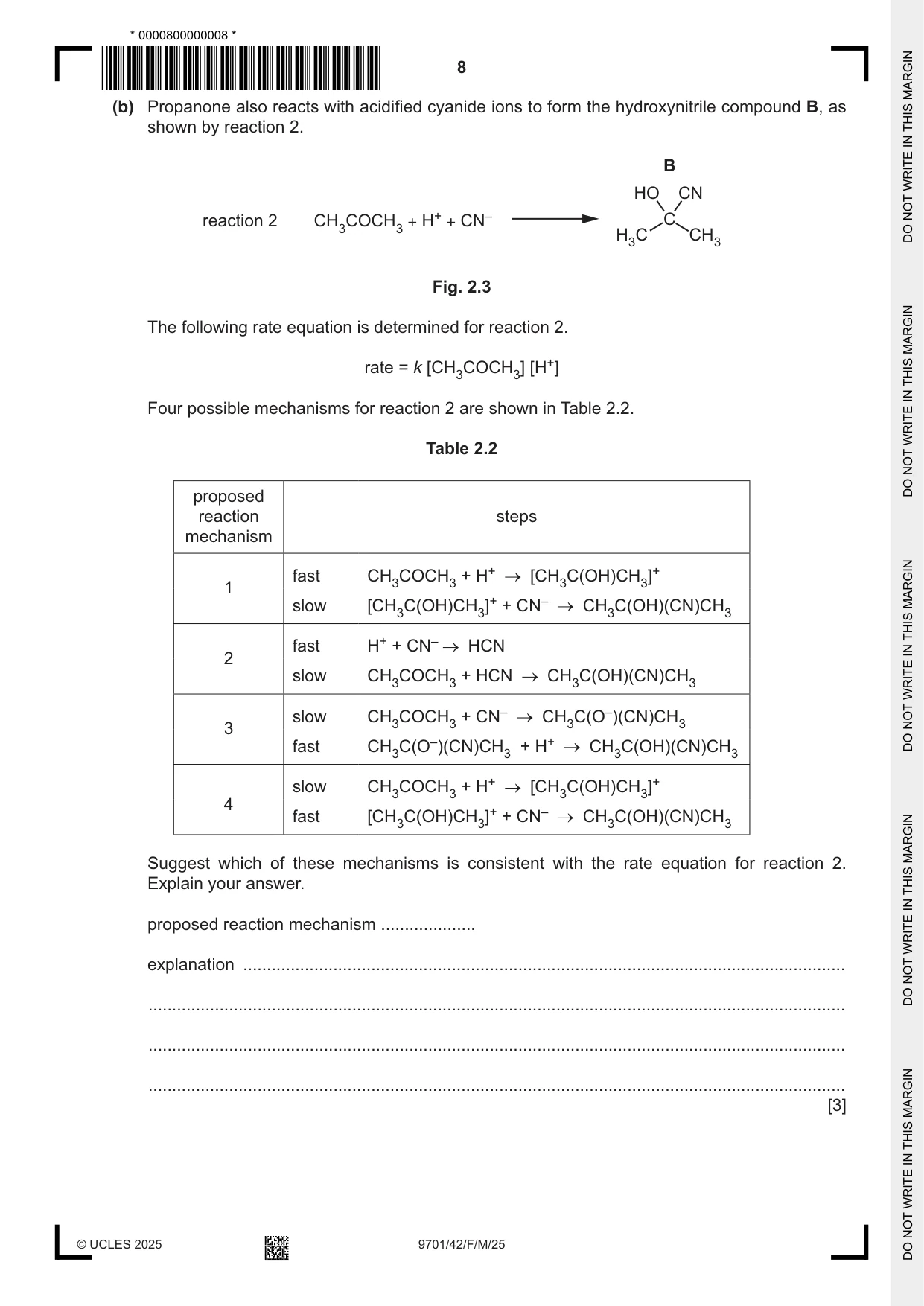
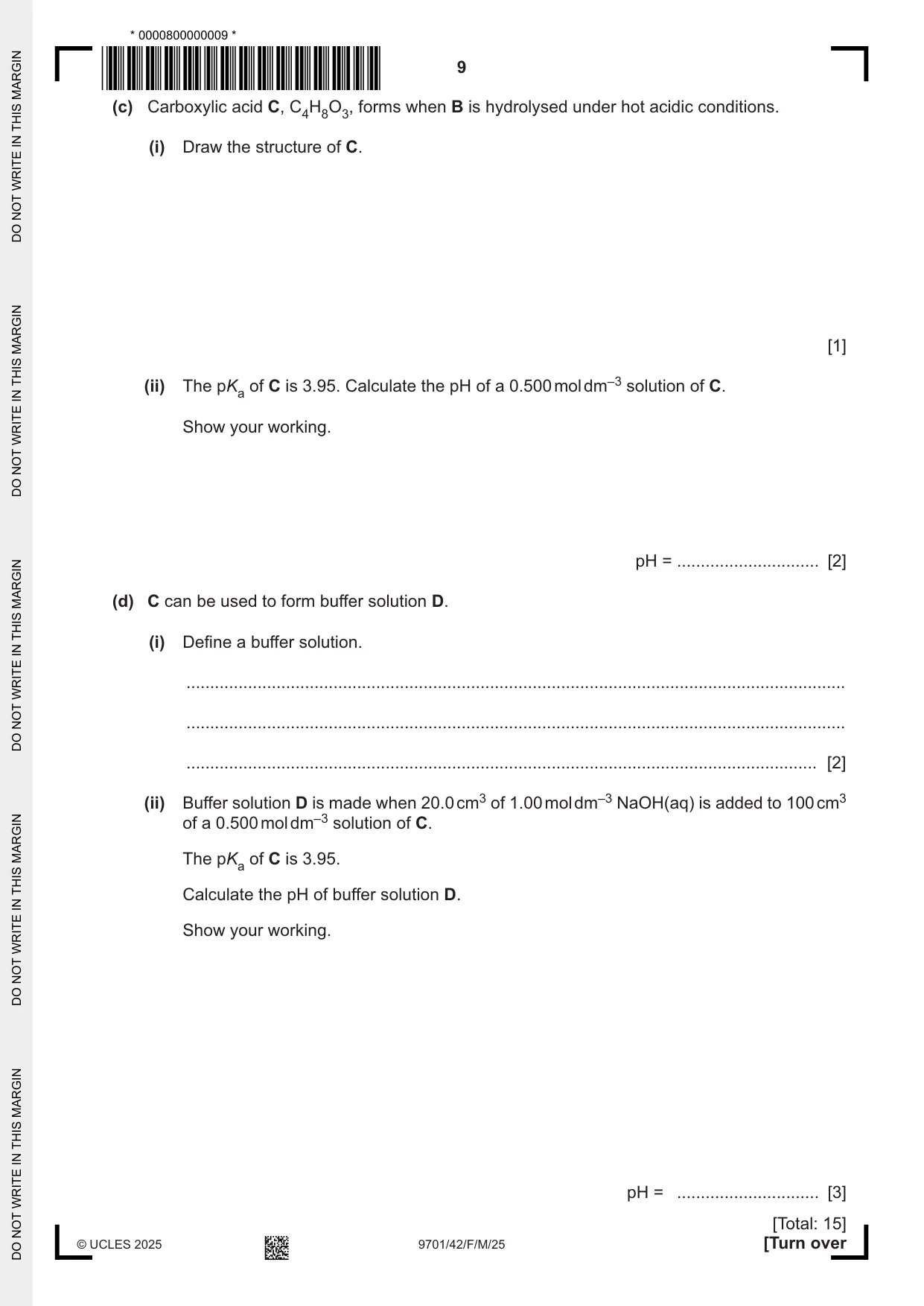
2 Propanone, CH3COCH3, is a common organic solvent and reagent. (a) Propanone reacts with methanol, CH3OH, under acidic conditions to form compound A, as shown by reaction 1. A CH3O OCH3 H+ reaction 1 CH3COCH3 + 2CH3OH C + H2O H3C CH3 Fig. 2.1 The overall order of reaction 1 can be found by studying experimental data. Table 2.1 shows how the initial rate of reaction changes as [CH3OH] and [H+] are varied. In each experiment, a large excess of CH3COCH3 is used. Table 2.1 [CH3OH] [H+] relative initial experiment / mol dm–3 / mol dm–3 rate of reaction 1 0.010 0.010 1.00 2 0.015 0.015 2.25 3 0.015 0.020 3.00 (i) Explain why a large excess of CH3COCH3 is used in each experiment. ........................................................................................................................................... ........................................................................................................................................... ..................................................................................................................................... [1] (ii) Use the data in Table 2.1 to determine the order of reaction 1 with respect to CH3OH and to H+ ions. Explain your answers. ........................................................................................................................................... ........................................................................................................................................... ........................................................................................................................................... ........................................................................................................................................... ..................................................................................................................................... [2] (iii) In a separate experiment, a large excess of CH3OH and H+ ions are added to a solution containing a known concentration of CH3COCH3. Fig. 2.2 shows how [CH3COCH3] varies over time. 100 90 80 70 60 % of the original [CH3COCH3] 50 remaining 40 30 20 10 0 0 100 200 300 400 500 time / s Fig. 2.2 Use Fig. 2.2 to show how, under these conditions, reaction 1 is first order with respect to CH3COCH3. ........................................................................................................................................... ........................................................................................................................................... ........................................................................................................................................... ..................................................................................................................................... [1] (b) Propanone also reacts with acidified cyanide ions to form the hydroxynitrile compound B, as shown by reaction 2. B HO CN reaction 2 CH3COCH3 + H+ + CN– C H3C CH3 Fig. 2.3 The following rate equation is determined for reaction 2. rate = k [CH3COCH3] [H+] Four possible mechanisms for reaction 2 are shown in Table 2.2. Table 2.2 proposed reaction steps mechanism fast CH3COCH3 + H+ [CH3C(OH)CH3]+ 1 slow [CH3C(OH)CH3]+ + CN– CH3C(OH)(CN)CH3 fast H+ + CN– HCN 2 slow CH3COCH3 + HCN CH3C(OH)(CN)CH3 slow CH3COCH3 + CN– CH3C(O–)(CN)CH3 3 fast CH3C(O–)(CN)CH3 + H+ CH3C(OH)(CN)CH3 slow CH3COCH3 + H+ [CH3C(OH)CH3]+ 4 fast [CH3C(OH)CH3]+ + CN– CH3C(OH)(CN)CH3 Suggest which of these mechanisms is consistent with the rate equation for reaction 2. Explain your answer. proposed reaction mechanism .................... explanation ............................................................................................................................... ................................................................................................................................................... ................................................................................................................................................... ................................................................................................................................................... [3] (c) Carboxylic acid C, C4H8O3, forms when B is hydrolysed under hot acidic conditions. (i) Draw the structure of C. [1] (ii) The pKa of C is 3.95. Calculate the pH of a 0.500 mol dm–3 solution of C. Show your working. pH = .............................. [2] (d) C can be used to form buffer solution D. (i) Define a buffer solution. ........................................................................................................................................... ........................................................................................................................................... ..................................................................................................................................... [2] (ii) Buffer solution D is made when 20.0 cm3 of 1.00 mol dm–3 NaOH(aq) is added to 100 cm3 of a 0.500 mol dm–3 solution of C. The pKa of C is 3.95. Calculate the pH of buffer solution D. Show your working. pH = .............................. [3] [Total: 15]
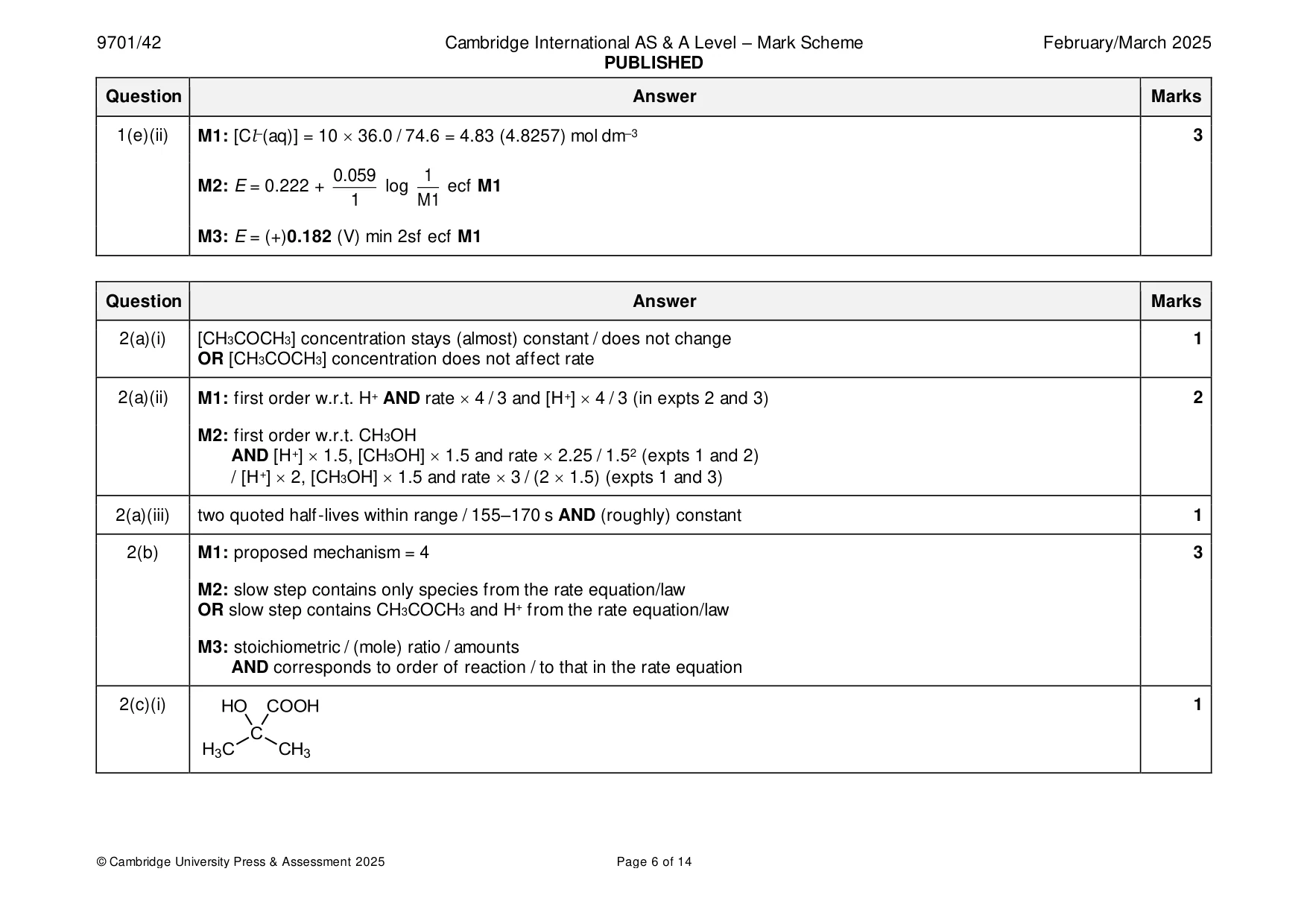
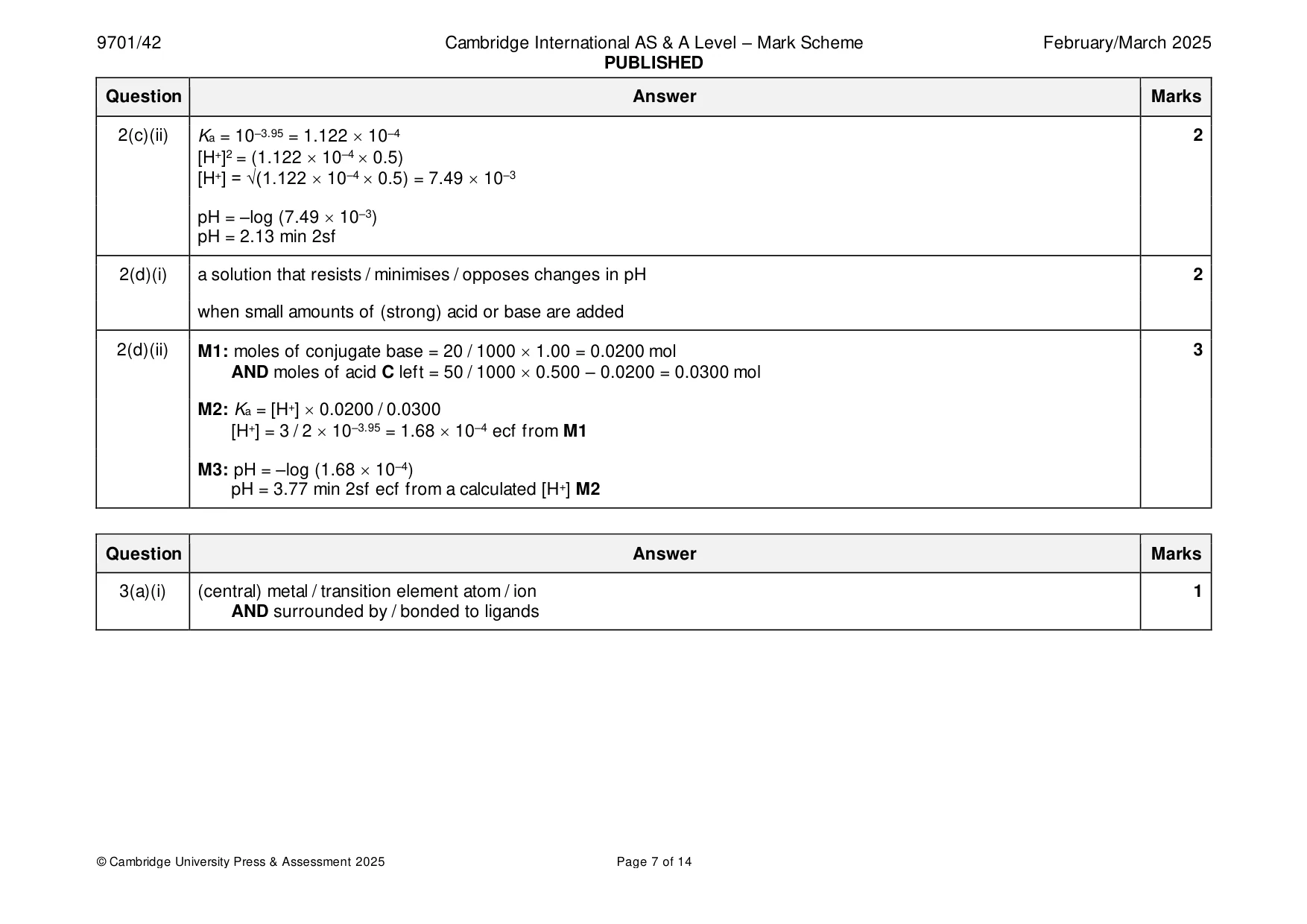
Mark scheme: 2(a)(i) [CH3COCH3] concentration stays (almost) constant / does not change 1 OR [CH3COCH3] concentration does not affect rate 2(a)(ii) M1: first order w.r.t. H+ AND rate 4 / 3 and [H+] 4 / 3 (in expts 2 and 3) 2 M2: first order w.r.t. CH3OH AND [H+] 1.5, [CH3OH] 1.5 and rate 2.25 / 1.52 (expts 1 and 2) / [H+] 2, [CH3OH] 1.5 and rate 3 / (2 1.5) (expts 1 and 3) 2(a)(iii) two quoted half-lives within range / 155–170 s AND (roughly) constant 1 2(b) M1: proposed mechanism = 4 3 M2: slow step contains only species from the rate equation/law OR slow step contains CH3COCH3 and H+ from the rate equation/law M3: stoichiometric / (mole) ratio / amounts AND corresponds to order of reaction / to that in the rate equation 2(c)(i) 1 2(c)(ii) Ka = 10–3.95 = 1.122 10–4 2 [H+]2 = (1.122 10–4 0.5) [H+] = √(1.122 10–4 0.5) = 7.49 10–3 pH = –log (7.49 10–3) pH = 2.13 min 2sf 2(d)(i) a solution that resists / minimises / opposes changes in pH 2 when small amounts of (strong) acid or base are added 2(d)(ii) M1: moles of conjugate base = 20 / 1000 1.00 = 0.0200 mol 3 AND moles of acid C left = 50 / 1000 0.500 – 0.0200 = 0.0300 mol M2: Ka = [H+] 0.0200 / 0.0300 [H+] = 3 / 2 10–3.95 = 1.68 10–4 ecf from M1 M3: pH = –log (1.68 10–4) pH = 3.77 min 2sf ecf from a calculated [H+] M2
More questions on Simple rate equations, orders of reaction and rate constants
Q3 · Fe2+ and Fe3+ ions are able to form a variety of complexes with different species
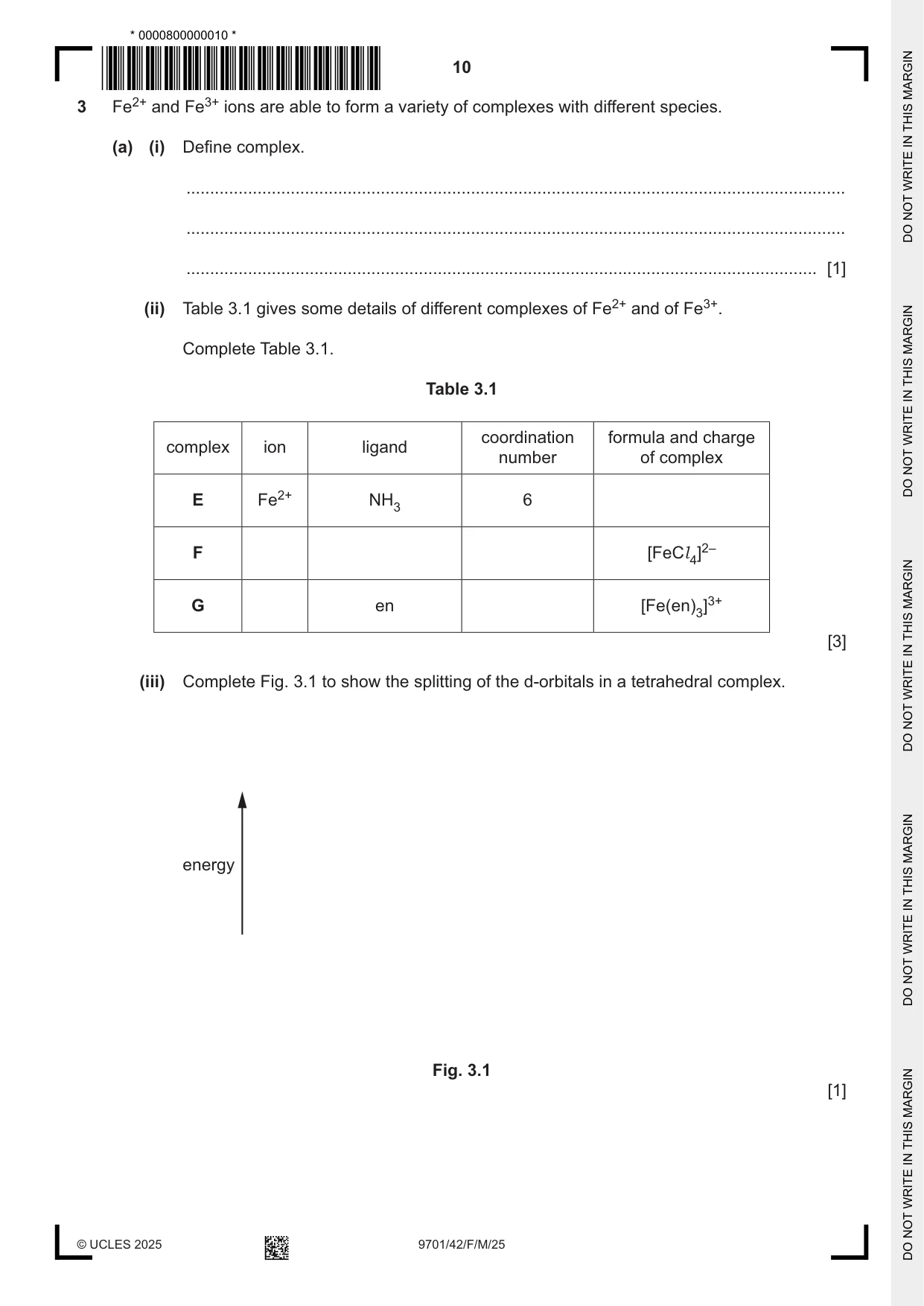
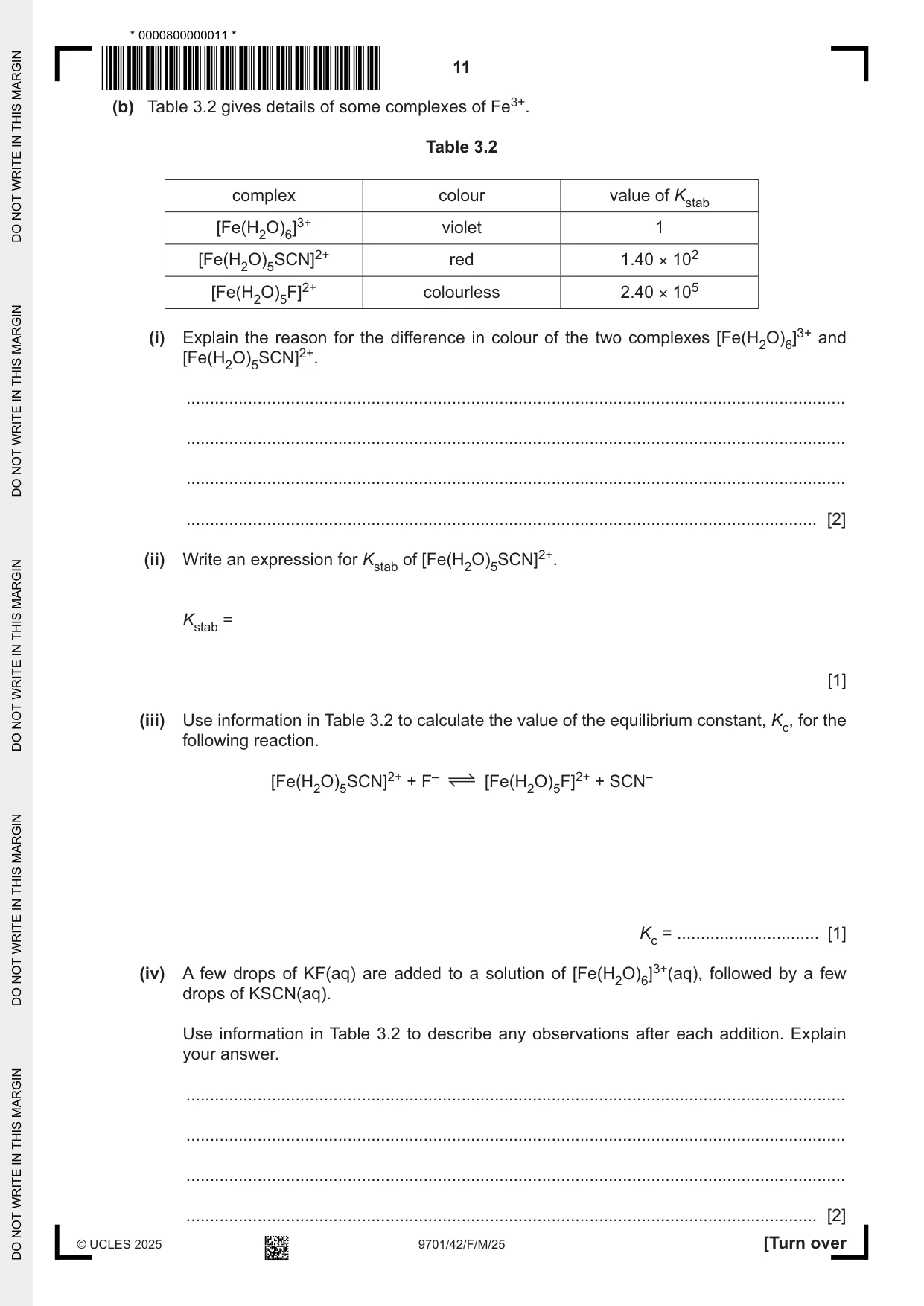
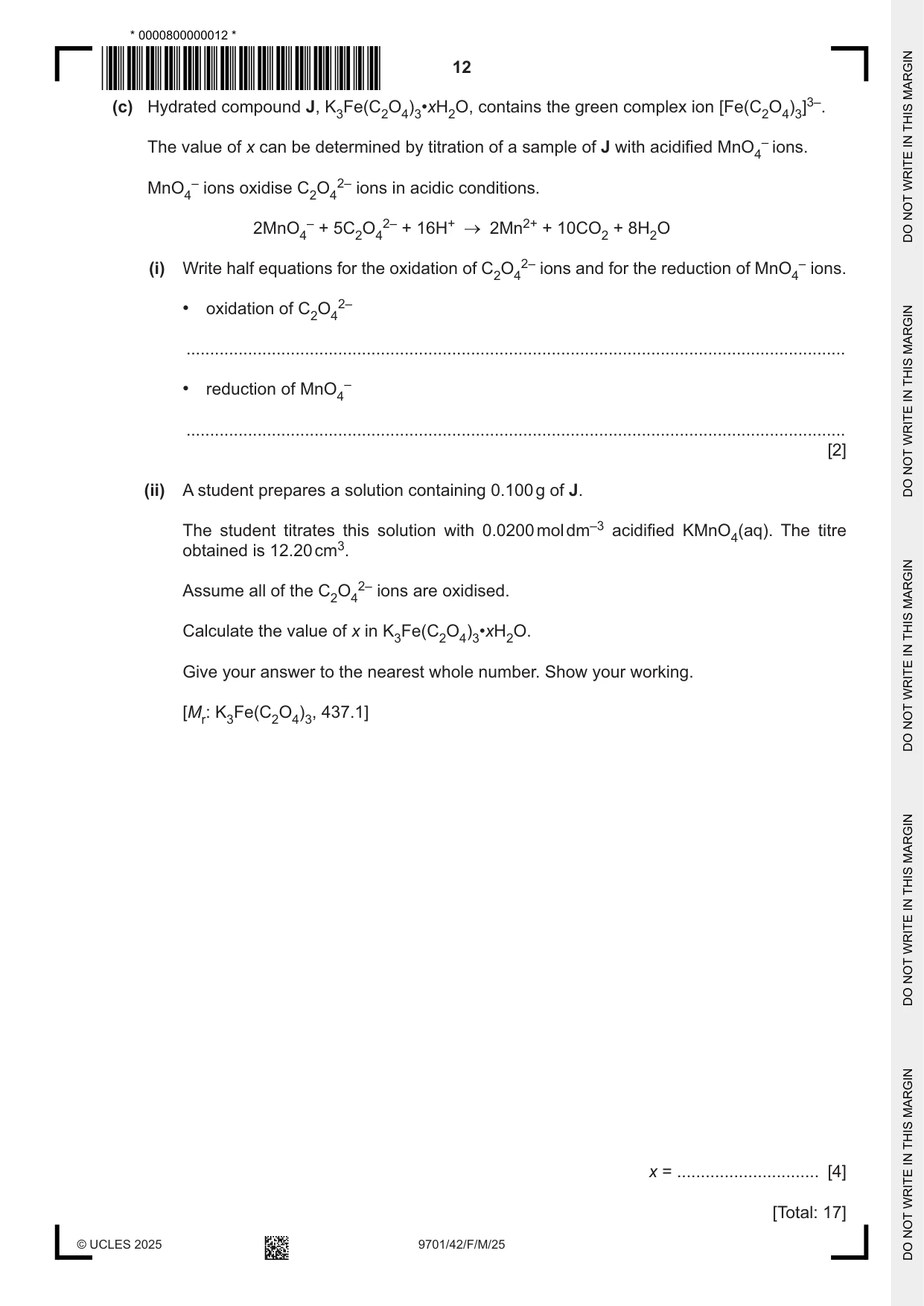
3 Fe2+ and Fe3+ ions are able to form a variety of complexes with different species. (a) (i) Define complex. ........................................................................................................................................... ........................................................................................................................................... ..................................................................................................................................... [1] (ii) Table 3.1 gives some details of different complexes of Fe2+ and of Fe3+. Complete Table 3.1. Table 3.1 coordination formula and charge complex ion ligand number of complex E Fe2+ NH3 6 F [FeCl 4]2– G en [Fe(en)3]3+ [3] (iii) Complete Fig. 3.1 to show the splitting of the d-orbitals in a tetrahedral complex. energy Fig. 3.1 [1] (b) Table 3.2 gives details of some complexes of Fe3+. Table 3.2 complex colour value of Kstab [Fe(H2O)6]3+ violet 1 [Fe(H2O)5SCN]2+ red 1.40 × 10² [Fe(H2O)5F]2+ colourless 2.40 × 10⁵ (i) Explain the reason for the difference in colour of the two complexes [Fe(H2O)6]3+ and [Fe(H2O)5SCN]2+. ........................................................................................................................................... ........................................................................................................................................... ........................................................................................................................................... ..................................................................................................................................... [2] (ii) Write an expression for Kstab of [Fe(H2O)5SCN]2+. Kstab = [1] (iii) Use information in Table 3.2 to calculate the value of the equilibrium constant, Kc, for the following reaction. [Fe(H2O)5SCN]2+ + F– [Fe(H2O)5F]2+ + SCN– Kc = .............................. [1] (iv) A few drops of KF(aq) are added to a solution of [Fe(H2O)6]3+(aq), followed by a few drops of KSCN(aq). Use information in Table 3.2 to describe any observations after each addition. Explain your answer. ........................................................................................................................................... ........................................................................................................................................... ........................................................................................................................................... ..................................................................................................................................... [2] (c) Hydrated compound J, K3Fe(C2O4)3•xH2O, contains the green complex ion [Fe(C2O4)3]3–. The value of x can be determined by titration of a sample of J with acidified MnO4– ions. MnO4– ions oxidise C2O42– ions in acidic conditions. 2MnO4– + 5C2O42– + 16H+ 2Mn2+ + 10CO2 + 8H2O (i) Write half equations for the oxidation of C2O42– ions and for the reduction of MnO4– ions. • oxidation of C2O42– ........................................................................................................................................... • reduction of MnO4– ........................................................................................................................................... [2] (ii) A student prepares a solution containing 0.100 g of J. The student titrates this solution with 0.0200 mol dm–3 acidified KMnO4(aq). The titre obtained is 12.20 cm3. Assume all of the C2O42– ions are oxidised. Calculate the value of x in K3Fe(C2O4)3•xH2O. Give your answer to the nearest whole number. Show your working. [Mr: K3Fe(C2O4)3, 437.1] x = .............................. [4] [Total: 17]
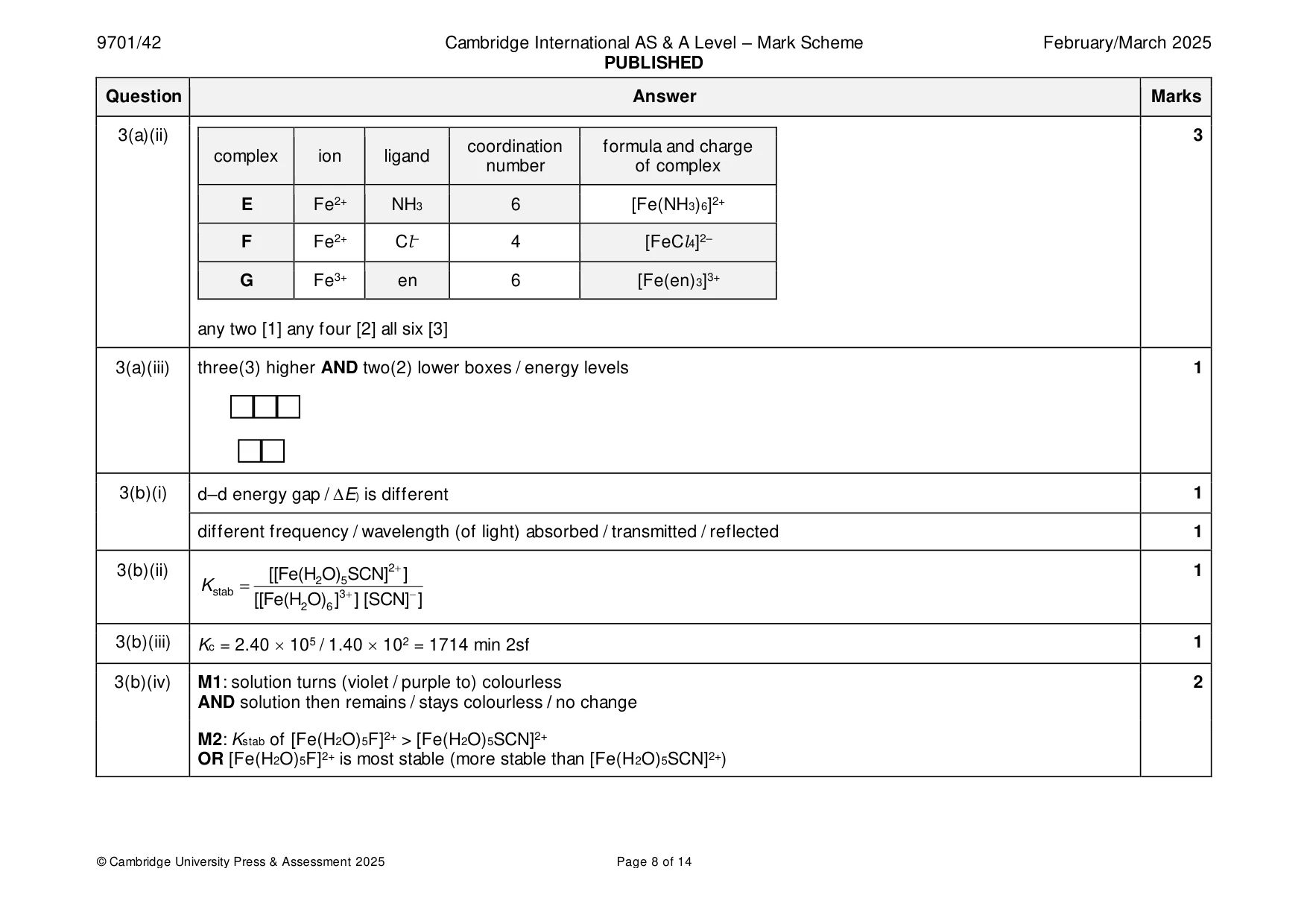
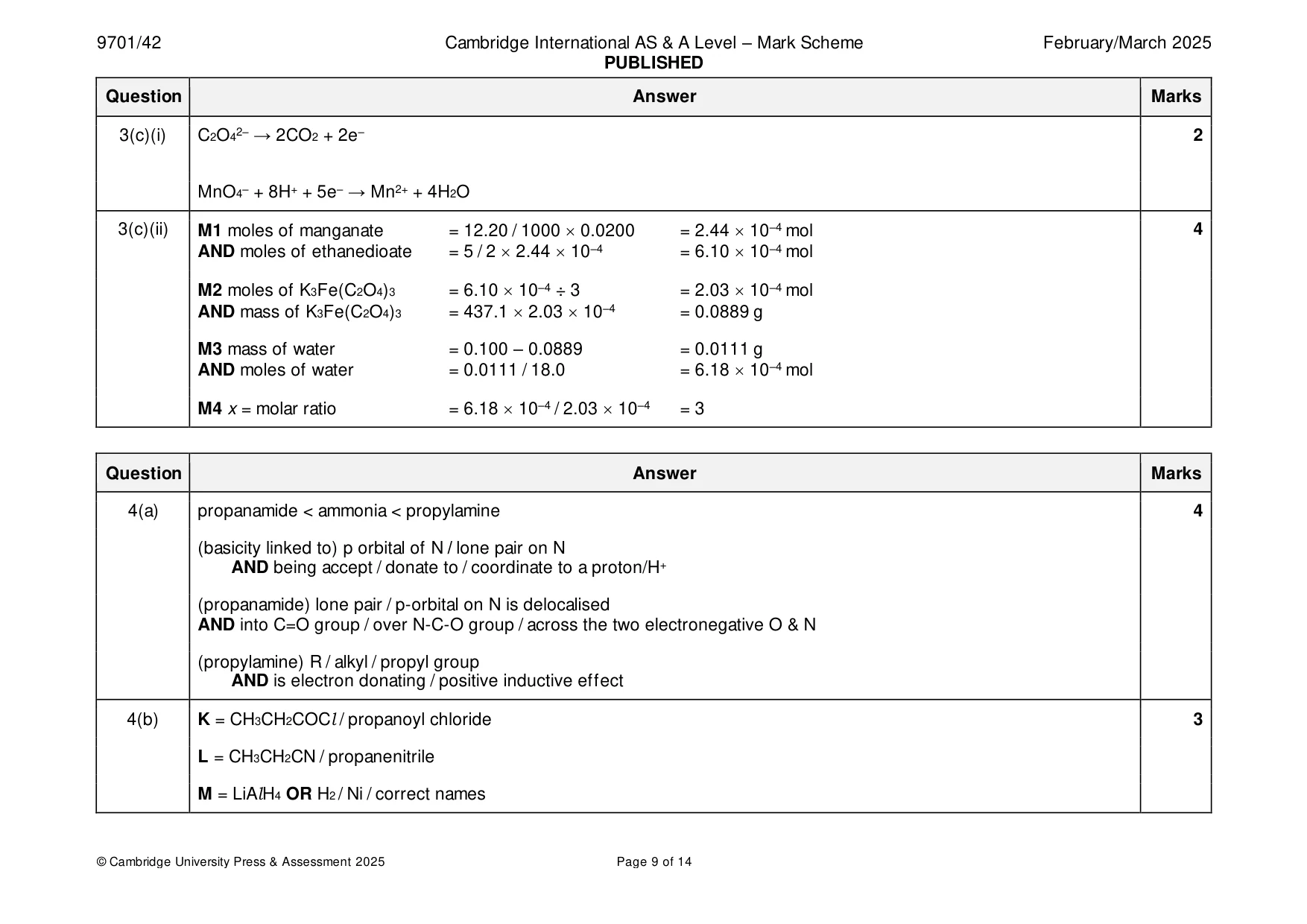
Mark scheme: 3(a)(i) (central) metal / transition element atom / ion 1 AND surrounded by / bonded to ligands 3(a)(ii) 3 coordination formula and charge complex ion ligand number of complex E Fe2+ NH3 6 [Fe(NH3)6]2+ F Fe2+ Cl– 4 [FeCl4]2– G Fe3+ en 6 [Fe(en)3]3+ any two [1] any four [2] all six [3] 3(a)(iii) three(3) higher AND two(2) lower boxes / energy levels 1 3(b)(i) d–d energy gap / E) is different 1 different frequency / wavelength (of light) absorbed / transmitted / reflected 1 3(b)(ii) [[Fe(H2 O)5 SCN]2 + ] 1 K stab = 3 + − [[Fe(H2 O)6 ] ] [SCN] ] 3(b)(iii) Kc = 2.40 105 / 1.40 102 = 1714 min 2sf 1 3(b)(iv) M1: solution turns (violet / purple to) colourless 2 AND solution then remains / stays colourless / no change M2: Kstab of [Fe(H2O)5F]2+ > [Fe(H2O)5SCN]2+ OR [Fe(H2O)5F]2+ is most stable (more stable than [Fe(H2O)5SCN]2+) 3(c)(i) C2O42– → 2CO2 + 2e– 2 MnO4– + 8H+ + 5e– → Mn2+ + 4H2O 3(c)(ii) M1 moles of manganate = 12.20 / 1000 0.0200 = 2.44 10–4 mol 4 AND moles of ethanedioate = 5 / 2 2.44 10–4 = 6.10 10–4 mol M2 moles of K3Fe(C2O4)3 = 6.10 10–4 ÷ 3 = 2.03 10–4 mol AND mass of K3Fe(C2O4)3 = 437.1 2.03 10–4 = 0.0889 g M3 mass of water = 0.100 – 0.0889 = 0.0111 g AND moles of water = 0.0111 / 18.0 = 6.18 10–4 mol M4 x = molar ratio = 6.18 10–4 / 2.03 10–4 = 3
Q4 · State the difference in the basicities of ammonia, NH3, propanamide, CH3CH2CONH2, and…
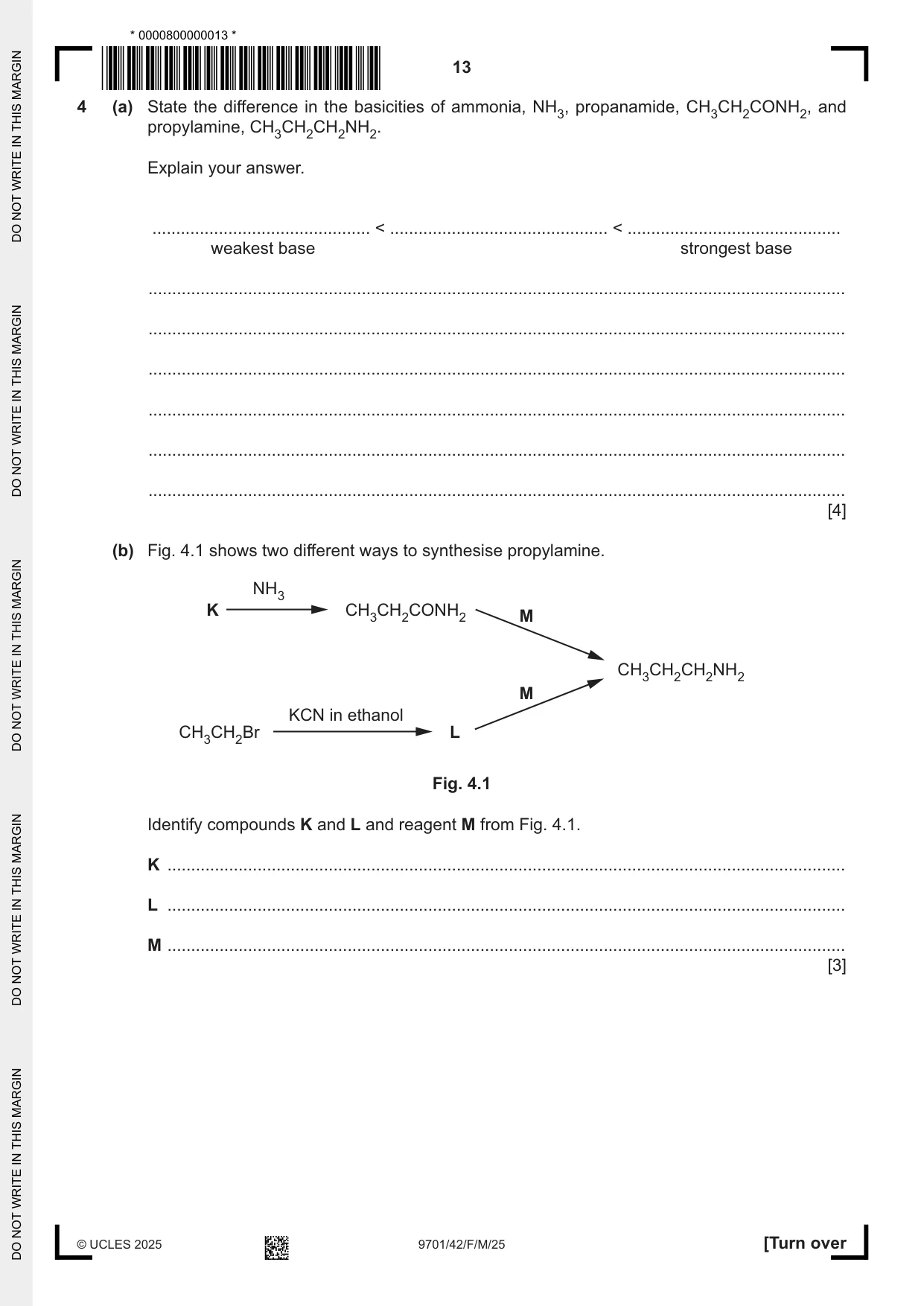
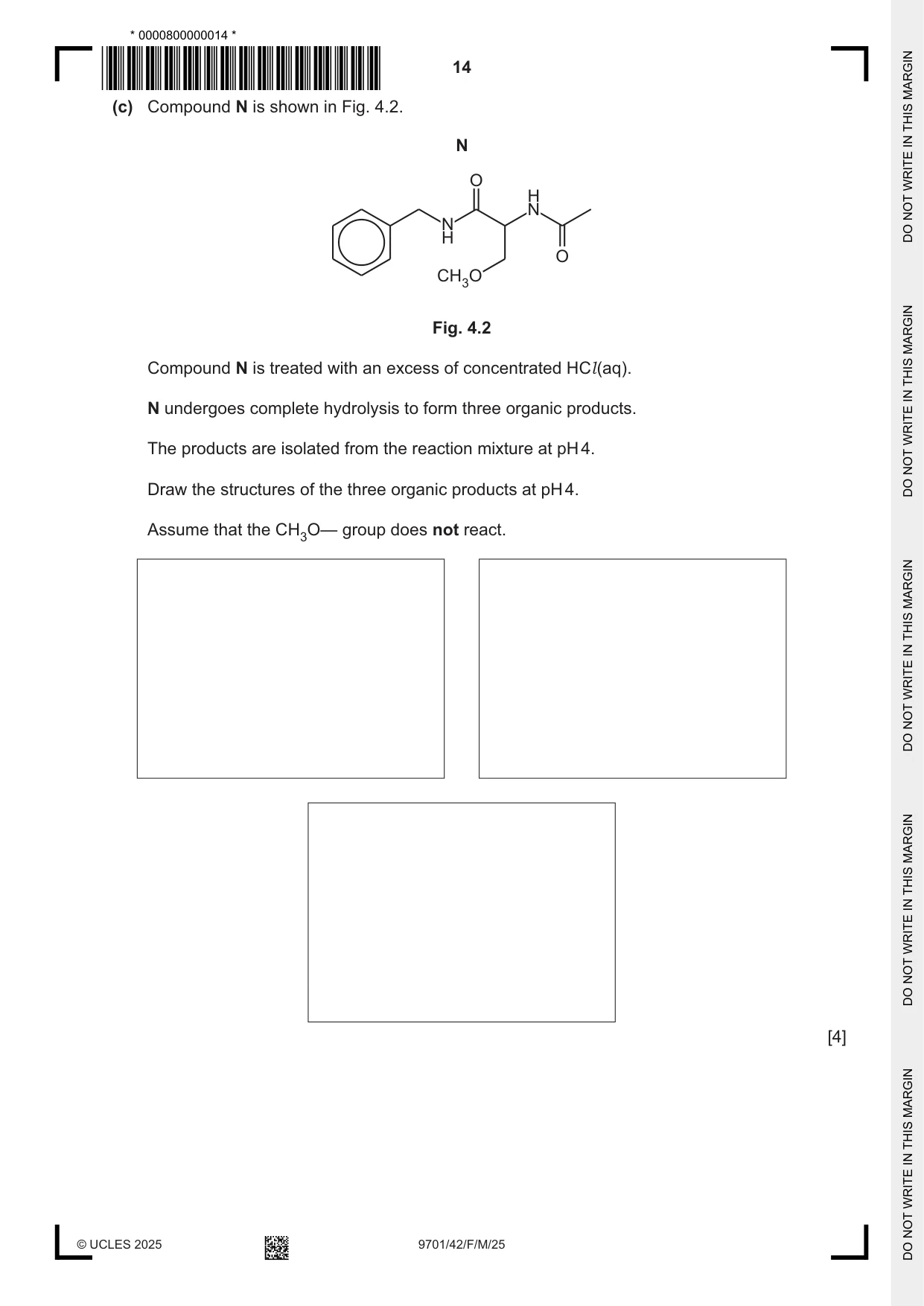
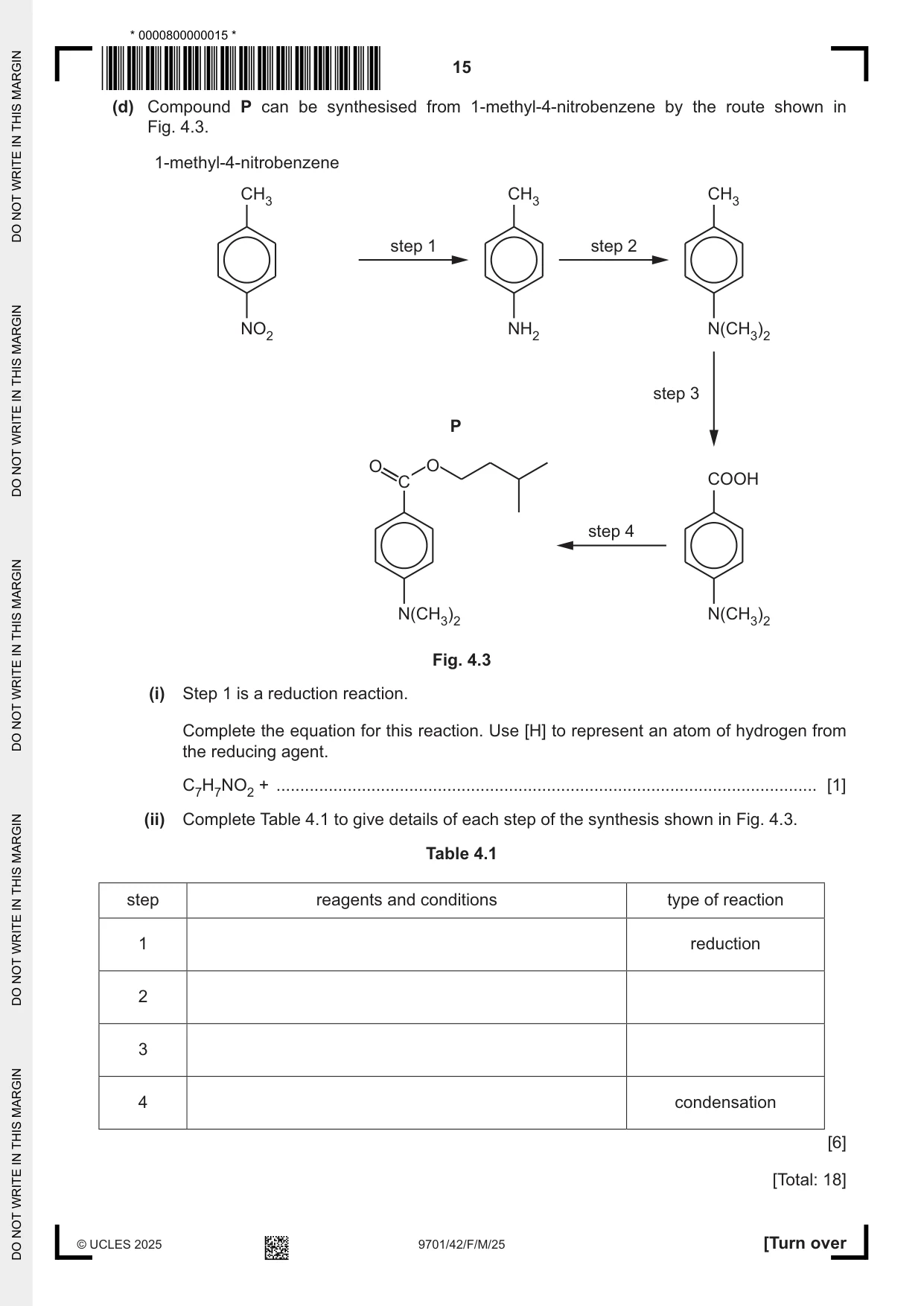
4 (a) State the difference in the basicities of ammonia, NH3, propanamide, CH3CH2CONH2, and propylamine, CH3CH2CH2NH2. Explain your answer. .............................................. < .............................................. < ............................................. weakest base strongest base ................................................................................................................................................... ................................................................................................................................................... ................................................................................................................................................... ................................................................................................................................................... ................................................................................................................................................... ................................................................................................................................................... [4] (b) Fig. 4.1 shows two different ways to synthesise propylamine. NH3 K CH3CH2CONH2 M CH3CH2CH2NH2 M KCN in ethanol CH3CH2Br L Fig. 4.1 Identify compounds K and L and reagent M from Fig. 4.1. K ............................................................................................................................................... L ............................................................................................................................................... M ............................................................................................................................................... [3] (c) Compound N is shown in Fig. 4.2. N O H N N H O CH3O Fig. 4.2 Compound N is treated with an excess of concentrated HCl (aq). N undergoes complete hydrolysis to form three organic products. The products are isolated from the reaction mixture at pH 4. Draw the structures of the three organic products at pH 4. Assume that the CH3O— group does not react. [4] (d) Compound P can be synthesised from 1-methyl-4-nitrobenzene by the route shown in Fig. 4.3. 1-methyl-4-nitrobenzene CH3 CH3 CH3 step 1 step 2 NO2 NH2 N(CH3)2 step 3 P O O C COOH step 4 N(CH3)2 N(CH3)2 Fig. 4.3 (i) Step 1 is a reduction reaction. Complete the equation for this reaction. Use [H] to represent an atom of hydrogen from the reducing agent. C7H7NO2 + .................................................................................................................. [1] (ii) Complete Table 4.1 to give details of each step of the synthesis shown in Fig. 4.3. Table 4.1 step reagents and conditions type of reaction 1 reduction 2 3 4 condensation [6] [Total: 18]
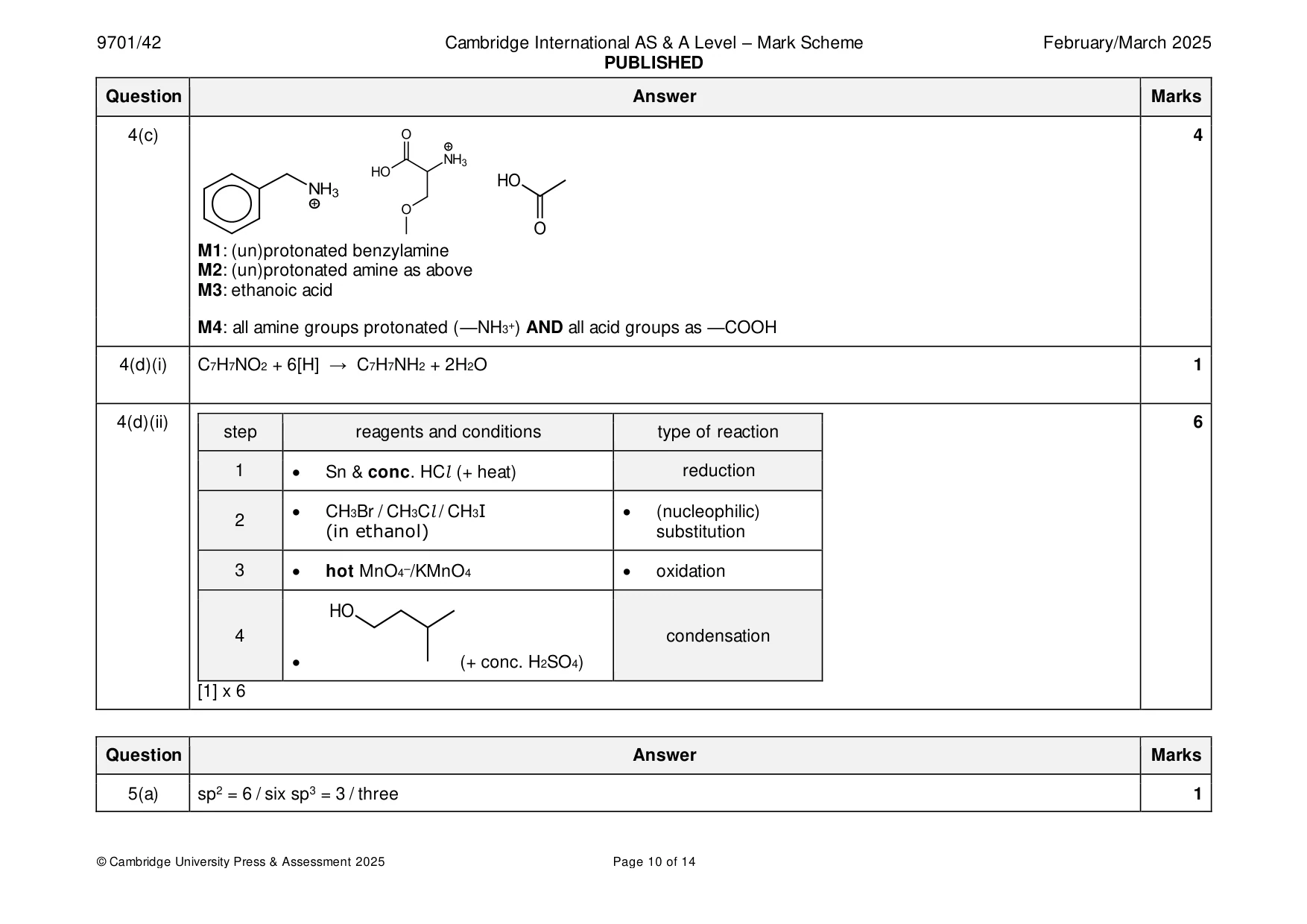
Mark scheme: 4(a) propanamide < ammonia < propylamine 4 (basicity linked to) p orbital of N / lone pair on N AND being accept / donate to / coordinate to a proton/H+ (propanamide) lone pair / p-orbital on N is delocalised AND into C=O group / over N-C-O group / across the two electronegative O & N (propylamine) R / alkyl / propyl group AND is electron donating / positive inductive effect 4(b) K = CH3CH2COCl / propanoyl chloride 3 L = CH3CH2CN / propanenitrile M = LiAlH4 OR H2 / Ni / correct names 4(c) 4 M1: (un)protonated benzylamine M2: (un)protonated amine as above M3: ethanoic acid M4: all amine groups protonated (—NH3+) AND all acid groups as —COOH 4(d)(i) C7H7NO2 + 6[H] → C7H7NH2 + 2H2O 1 4(d)(ii) 6 step reagents and conditions type of reaction 1 • Sn & conc. HCl (+ heat) reduction • CH3Br / CH3Cl / CH3I • (nucleophilic) 2 (in ethanol) substitution 3 • hot MnO4–/KMnO4 • oxidation 4 condensation • (+ conc. H2SO4) [1] x 6
Q5 · Cumene is an aromatic hydrocarbon used in the synthesis of other useful chemicals
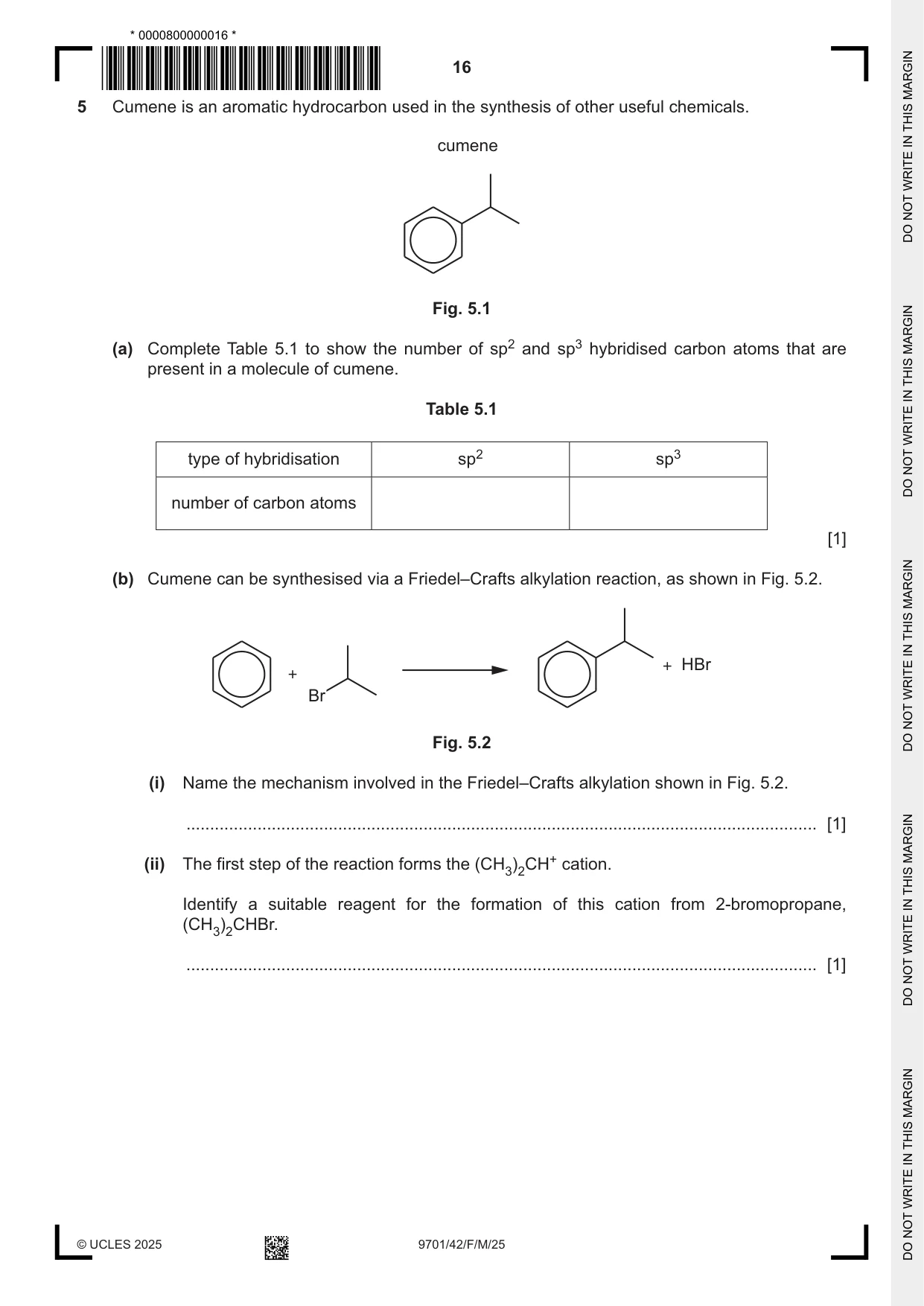
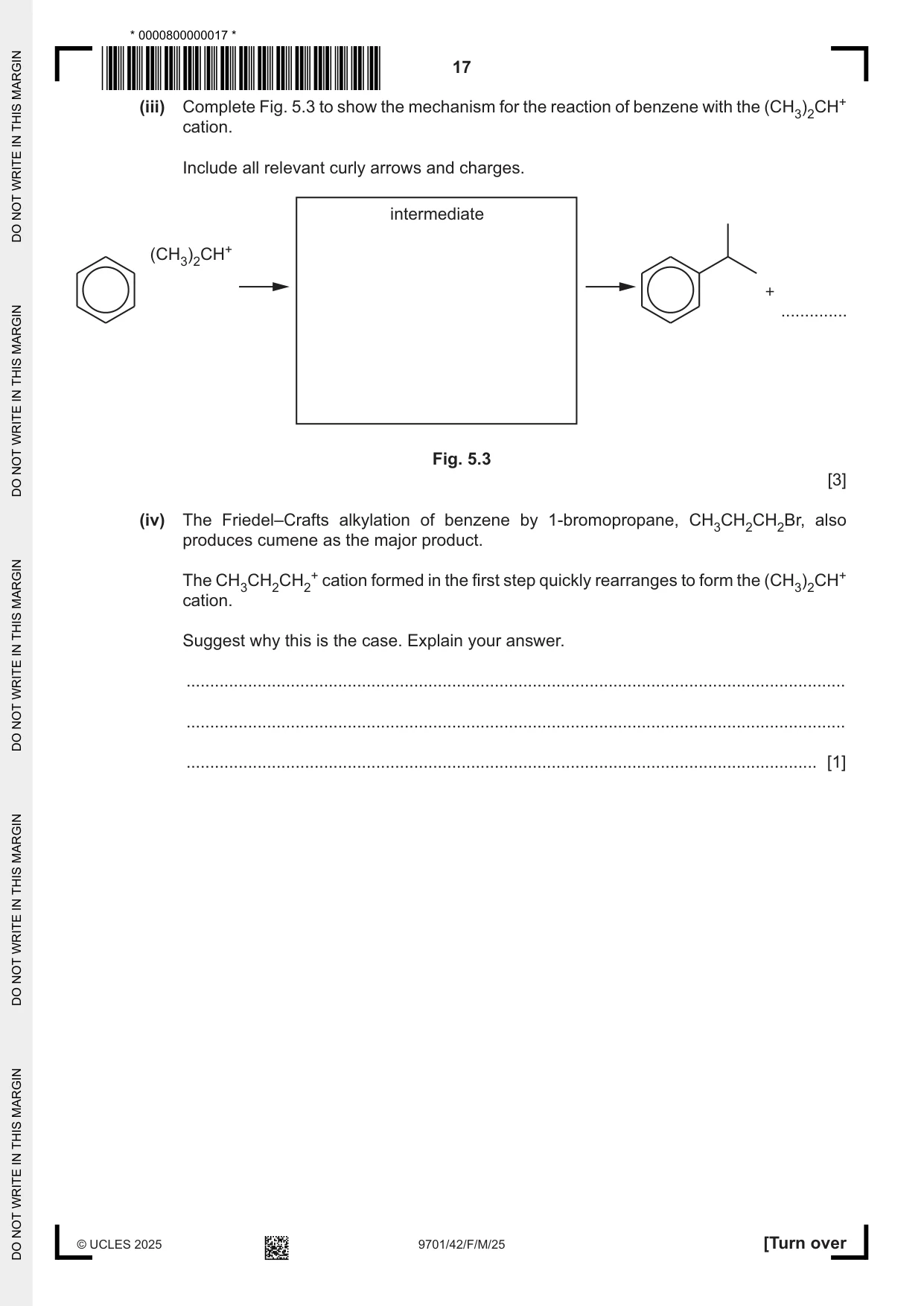
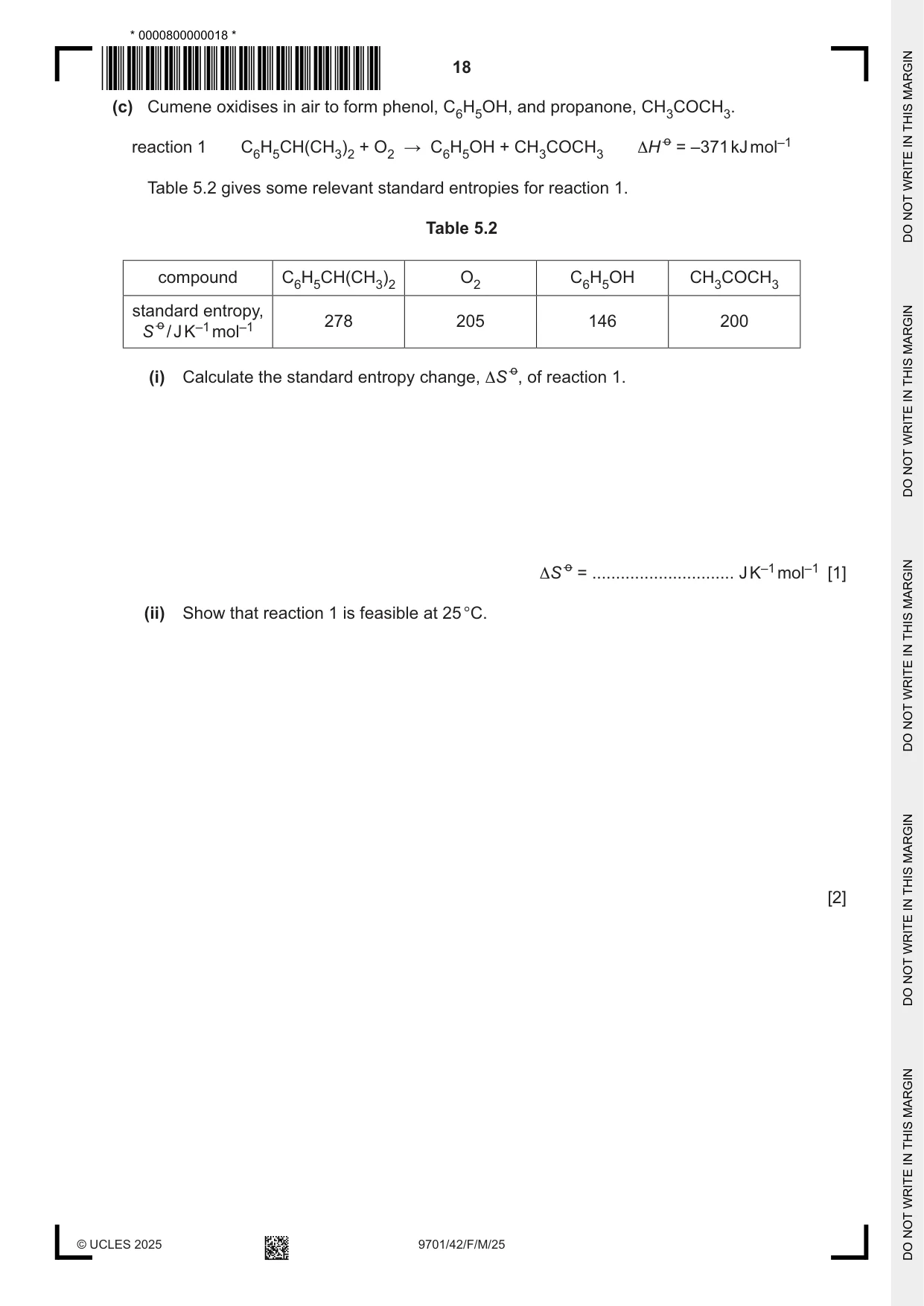
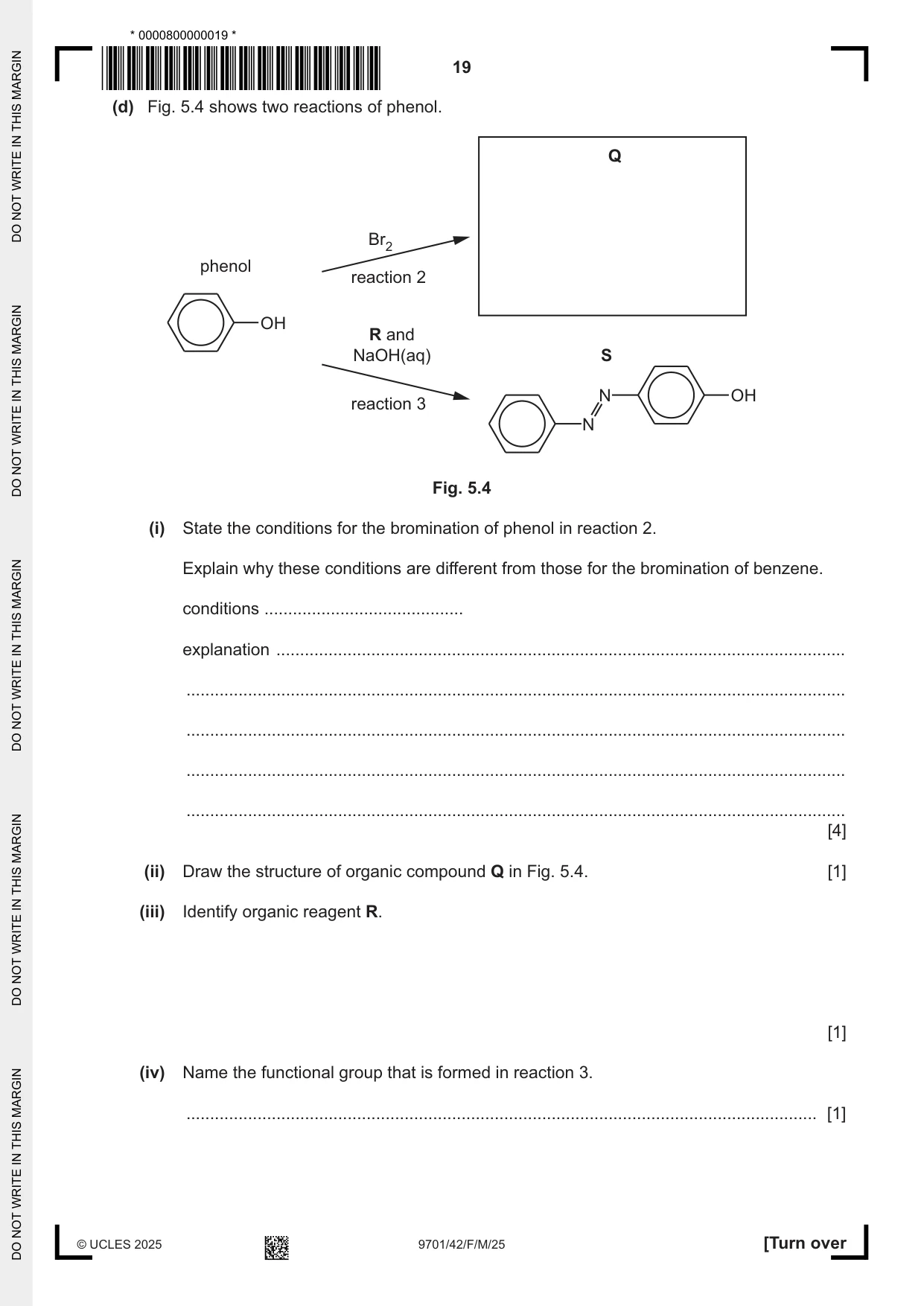
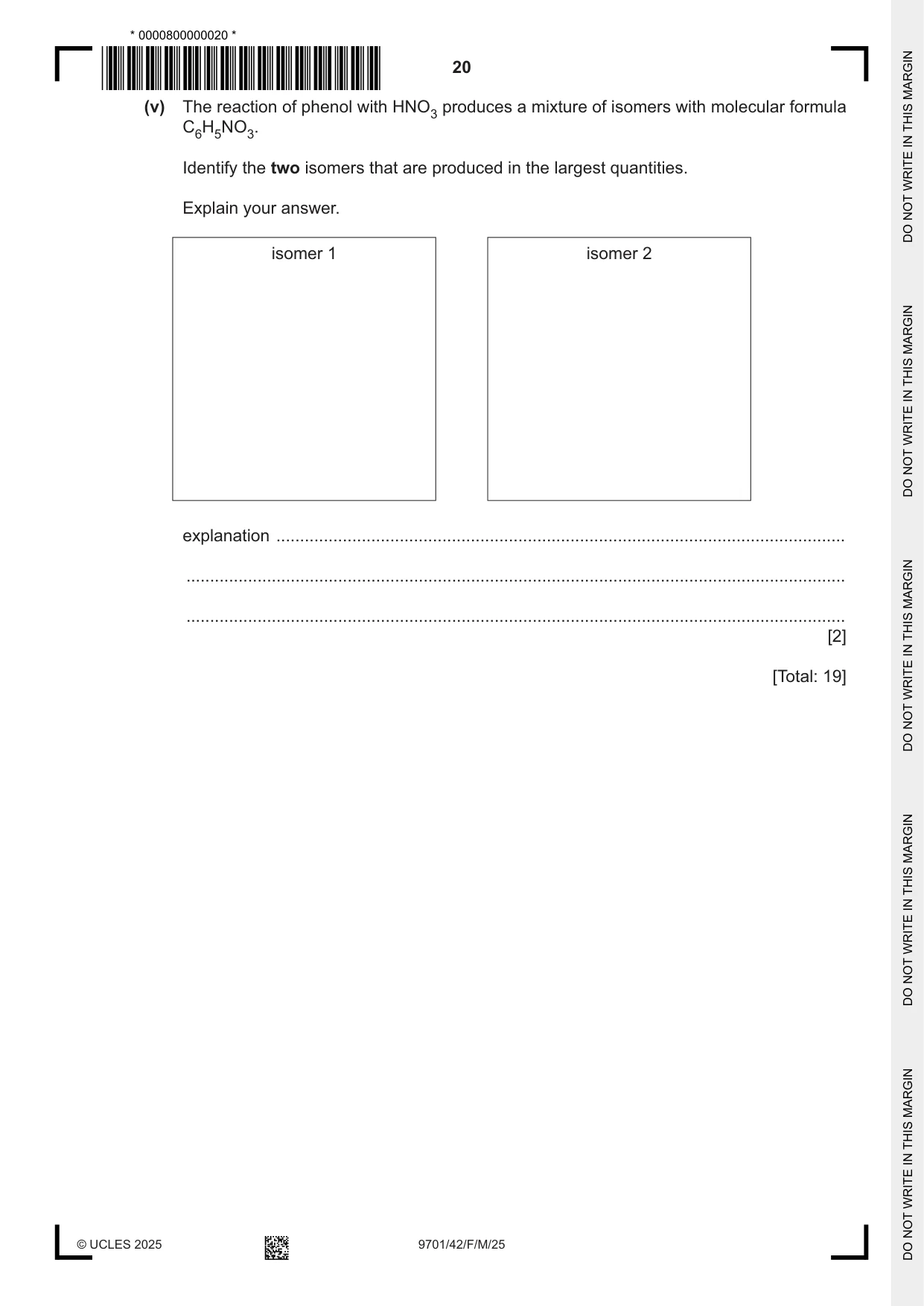
5 Cumene is an aromatic hydrocarbon used in the synthesis of other useful chemicals. cumene Fig. 5.1 (a) Complete Table 5.1 to show the number of sp2 and sp3 hybridised carbon atoms that are present in a molecule of cumene. Table 5.1 type of hybridisation sp2 sp3 number of carbon atoms [1] (b) Cumene can be synthesised via a Friedel–Crafts alkylation reaction, as shown in Fig. 5.2. + HBr + Br Fig. 5.2 (i) Name the mechanism involved in the Friedel–Crafts alkylation shown in Fig. 5.2. ..................................................................................................................................... [1] (ii) The first step of the reaction forms the (CH3)2CH+ cation. Identify a suitable reagent for the formation of this cation from 2-bromopropane, (CH3)2CHBr. ..................................................................................................................................... [1] (iii) Complete Fig. 5.3 to show the mechanism for the reaction of benzene with the (CH3)2CH+ cation. Include all relevant curly arrows and charges. intermediate (CH3)2CH+ + .............. Fig. 5.3 [3] (iv) The Friedel–Crafts alkylation of benzene by 1-bromopropane, CH3CH2CH2Br, also produces cumene as the major product. The CH3CH2CH2+ cation formed in the first step quickly rearranges to form the (CH3)2CH+ cation. Suggest why this is the case. Explain your answer. ........................................................................................................................................... ........................................................................................................................................... ..................................................................................................................................... [1] (c) Cumene oxidises in air to form phenol, C6H5OH, and propanone, CH3COCH3. reaction 1 C6H5CH(CH3)2 + O2 → C6H5OH + CH3COCH3 ΔH o = –371 kJ mol–1 Table 5.2 gives some relevant standard entropies for reaction 1. Table 5.2 compound C6H5CH(CH3)2 O2 C6H5OH CH3COCH3 standard entropy, o 278 205 146 200 S / J K–1 mol–1 (i) Calculate the standard entropy change, ΔS o, of reaction 1. ΔS o = .............................. J K–1 mol–1 [1] (ii) Show that reaction 1 is feasible at 25 °C. [2] (d) Fig. 5.4 shows two reactions of phenol. Q Br2 phenol reaction 2 OH R and NaOH(aq) S N OH reaction 3 N Fig. 5.4 (i) State the conditions for the bromination of phenol in reaction 2. Explain why these conditions are different from those for the bromination of benzene. conditions .......................................... explanation ........................................................................................................................ ........................................................................................................................................... ........................................................................................................................................... ........................................................................................................................................... ........................................................................................................................................... [4] (ii) Draw the structure of organic compound Q in Fig. 5.4. [1] (iii) Identify organic reagent R. [1] (iv) Name the functional group that is formed in reaction 3. ..................................................................................................................................... [1] (v) The reaction of phenol with HNO3 produces a mixture of isomers with molecular formula C6H5NO3. Identify the two isomers that are produced in the largest quantities. Explain your answer. isomer 1 isomer 2 explanation ........................................................................................................................ ........................................................................................................................................... ........................................................................................................................................... [2] [Total: 19] Question 6 starts on the next page.
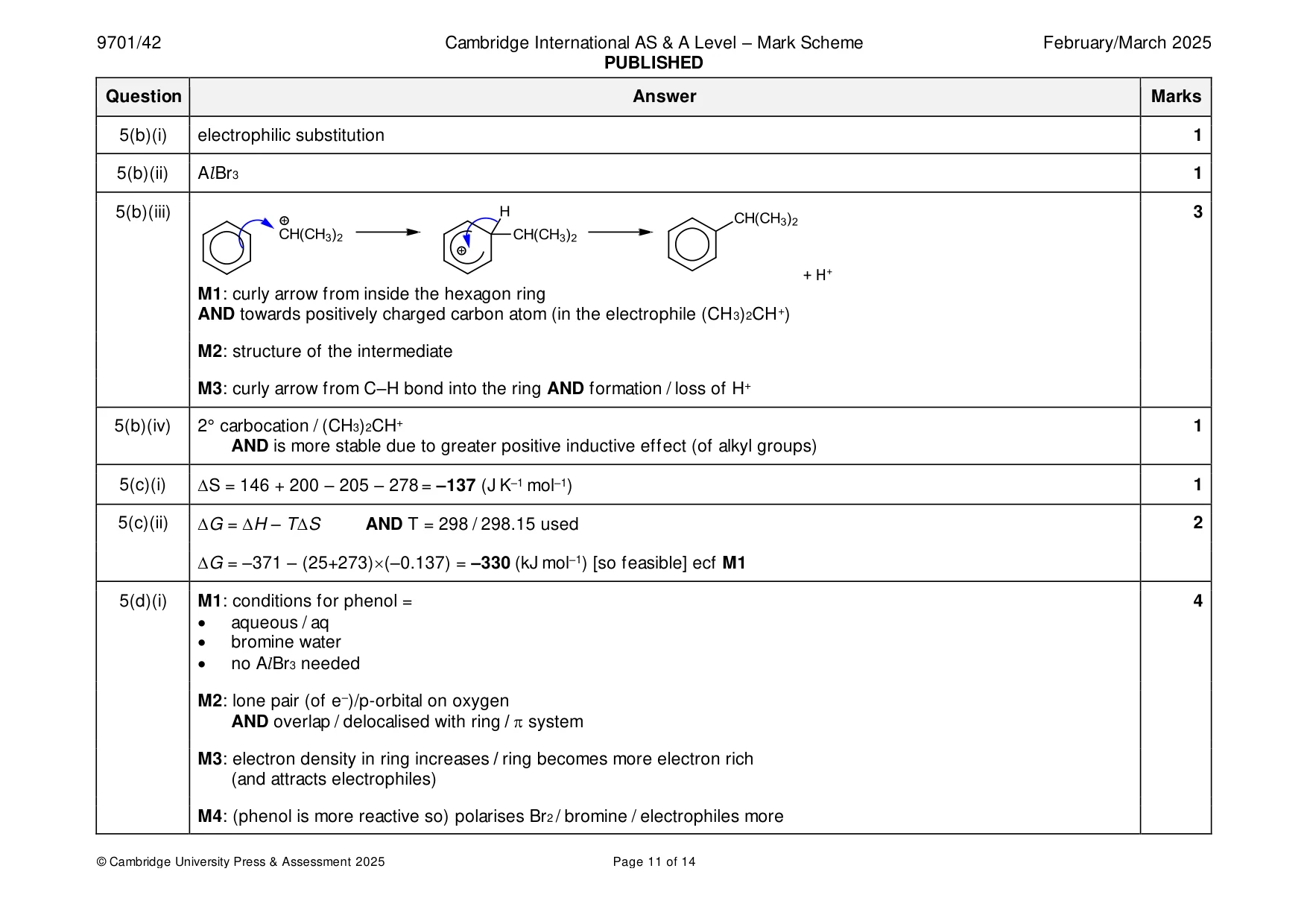
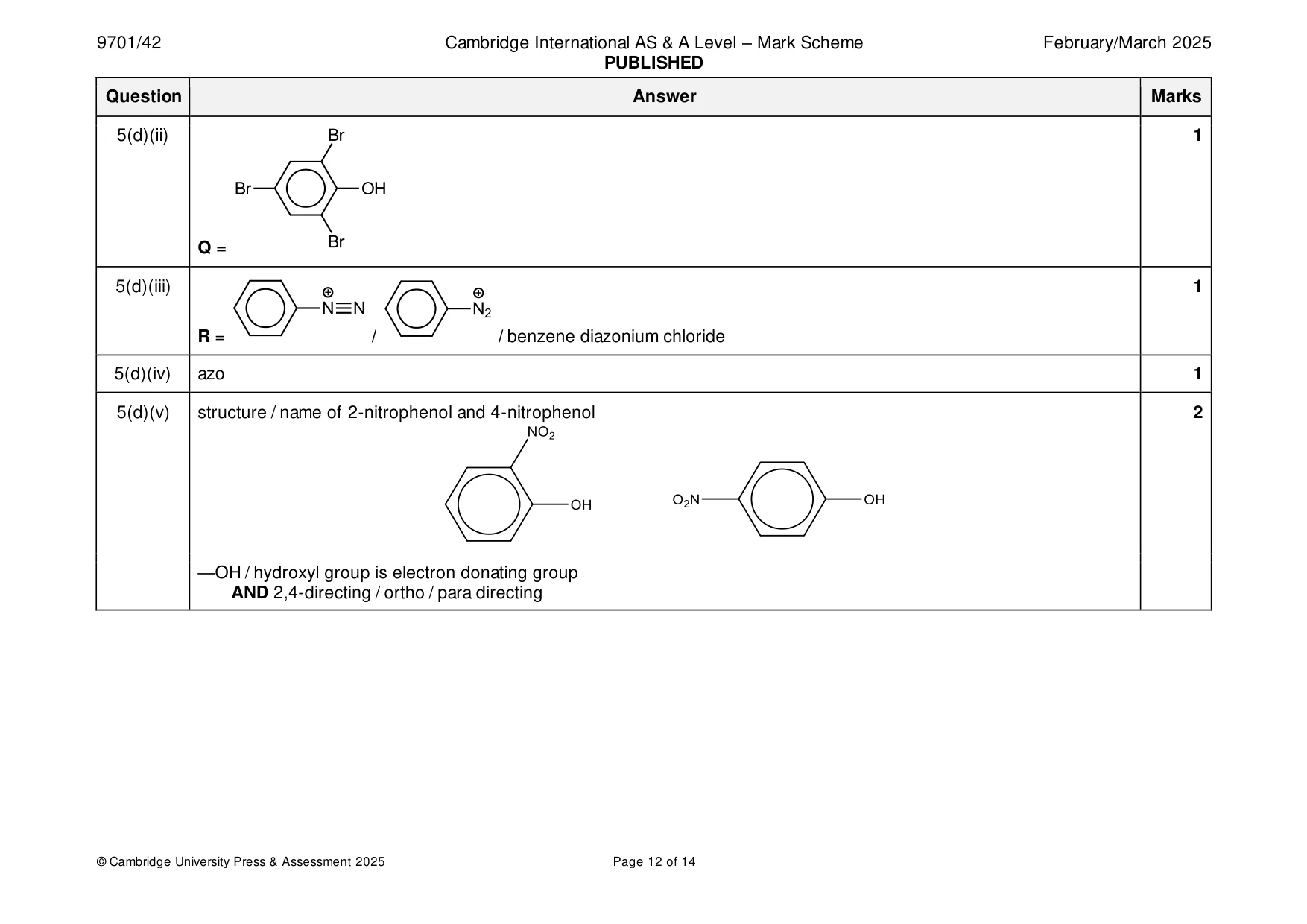
Mark scheme: 5(a) sp2 = 6 / six sp3 = 3 / three 1 5(b)(i) electrophilic substitution 1 5(b)(ii) Al Br3 1 5(b)(iii) 3 + H+ M1: curly arrow from inside the hexagon ring AND towards positively charged carbon atom (in the electrophile (CH3)2CH +) M2: structure of the intermediate M3: curly arrow from C–H bond into the ring AND formation / loss of H+ 5(b)(iv) 2° carbocation / (CH3)2CH+ 1 AND is more stable due to greater positive inductive effect (of alkyl groups) 5(c)(i) S = 146 + 200 – 205 – 278 = –137 (J K–1 mol–1) 1 5(c)(ii) G = H – TS AND T = 298 / 298.15 used 2 G = –371 – (25+273)(–0.137) = –330 (kJ mol–1) [so feasible] ecf M1 5(d)(i) M1: conditions for phenol = 4 • aqueous / aq • bromine water • no AlBr3 needed M2: lone pair (of e–)/p-orbital on oxygen AND overlap / delocalised with ring / system M3: electron density in ring increases / ring becomes more electron rich (and attracts electrophiles) M4: (phenol is more reactive so) polarises Br2 / bromine / electrophiles more 5(d)(ii) 1 Q = 5(d)(iii) 1 R = / / benzene diazonium chloride 5(d)(iv) azo 1 5(d)(v) structure / name of 2-nitrophenol and 4-nitrophenol 2 —OH / hydroxyl group is electron donating group AND 2,4-directing / ortho / para directing
Q6 · Maleic anhydride is an unsaturated cyclic compound used in the formation of several…
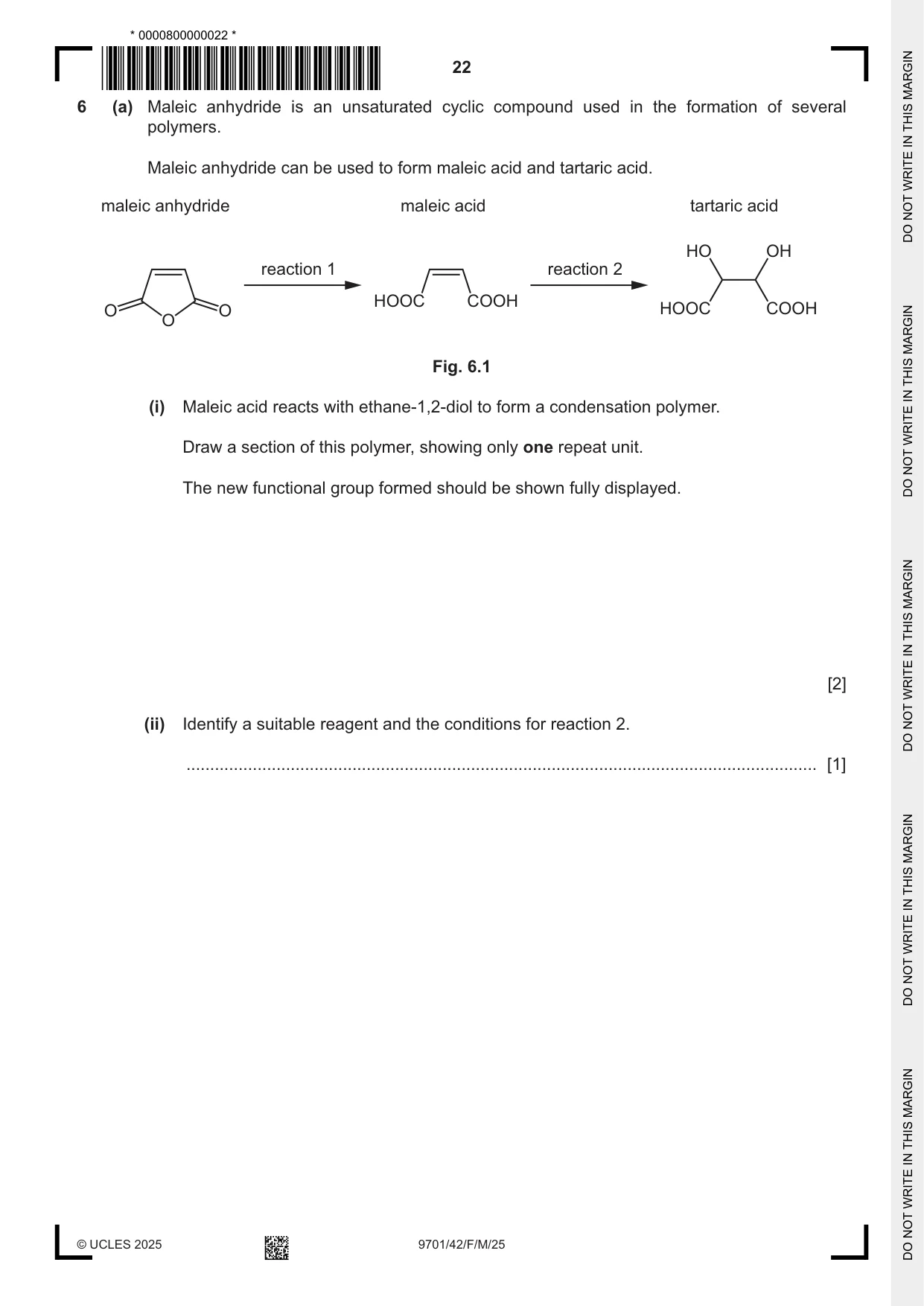
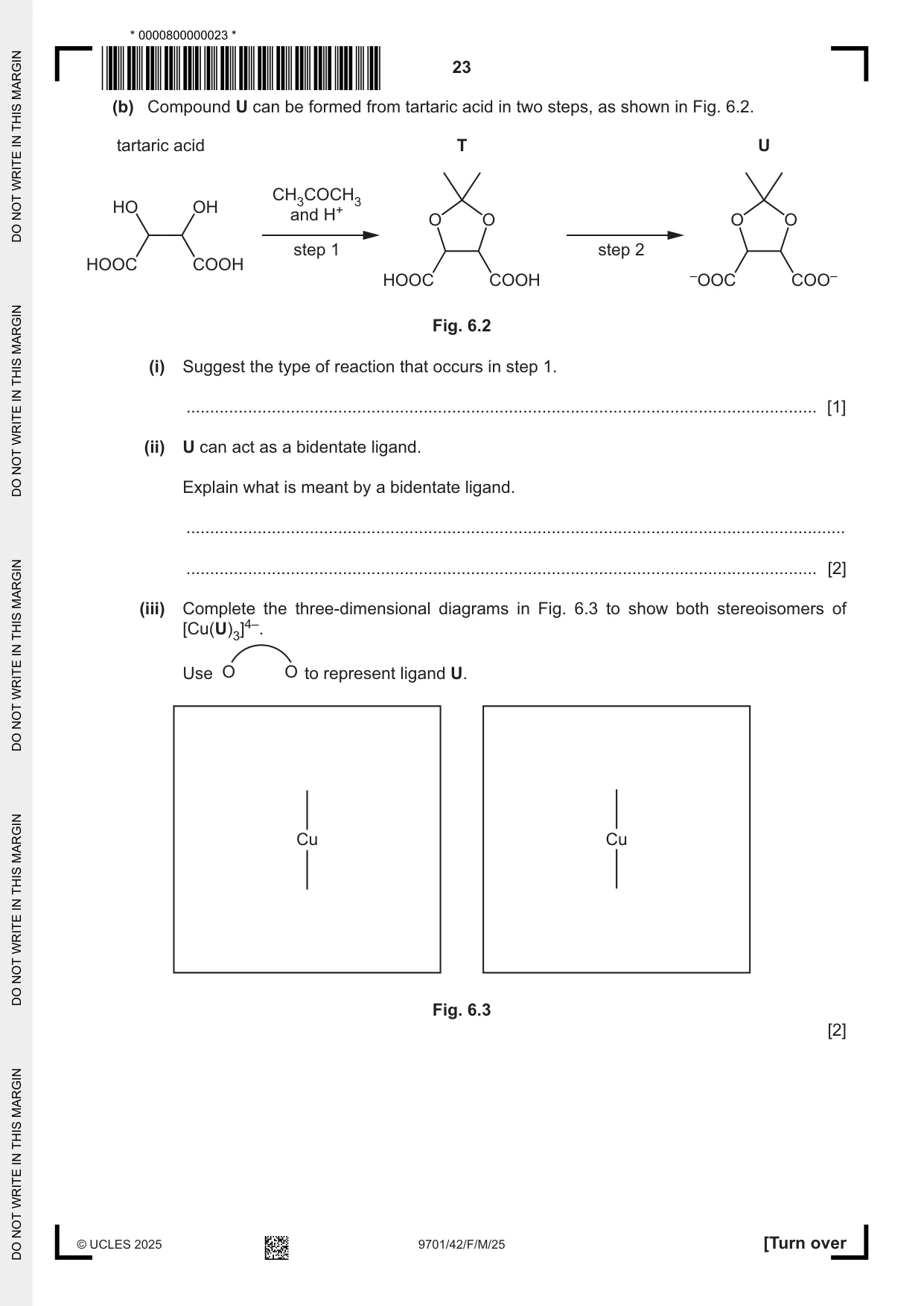
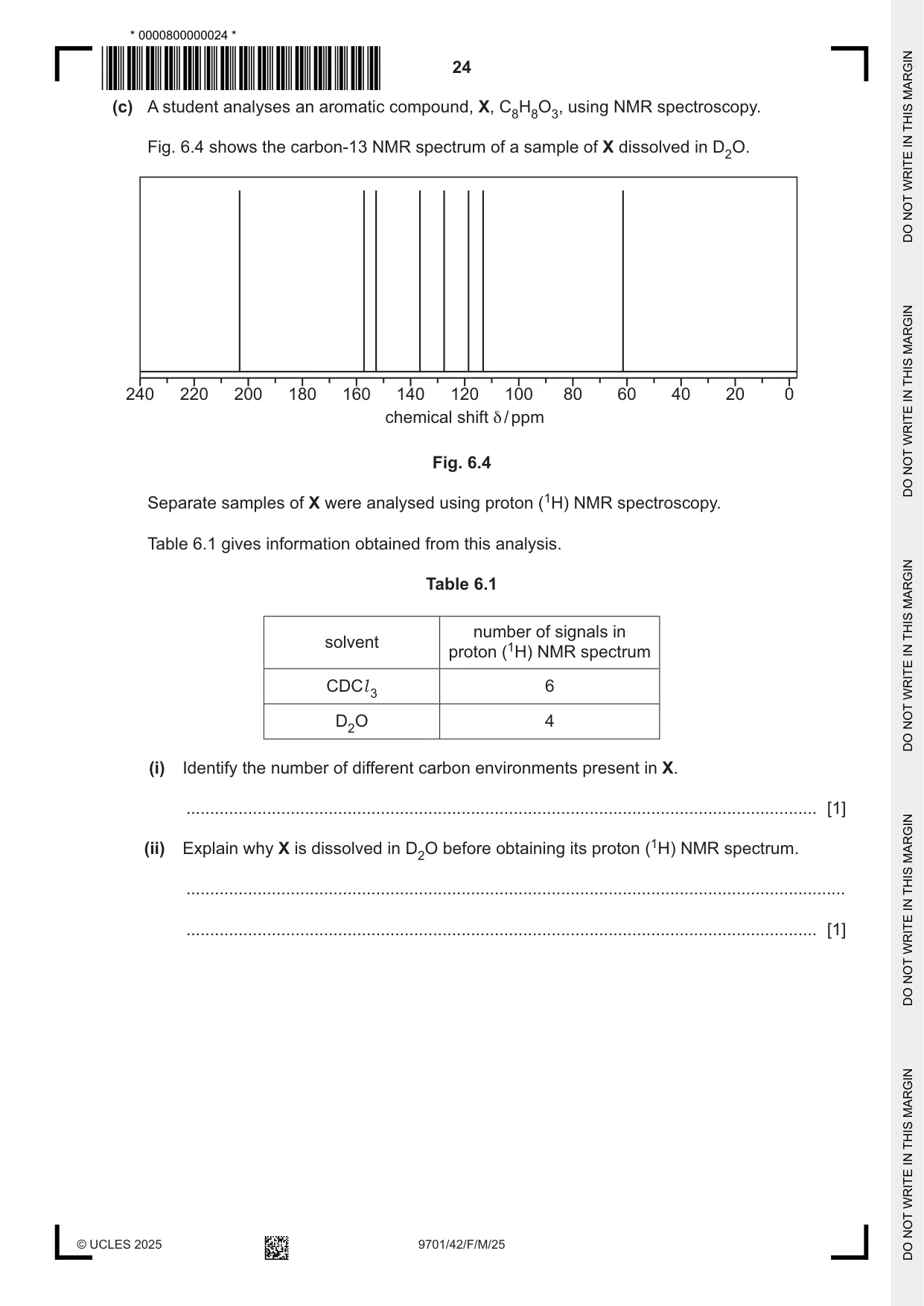
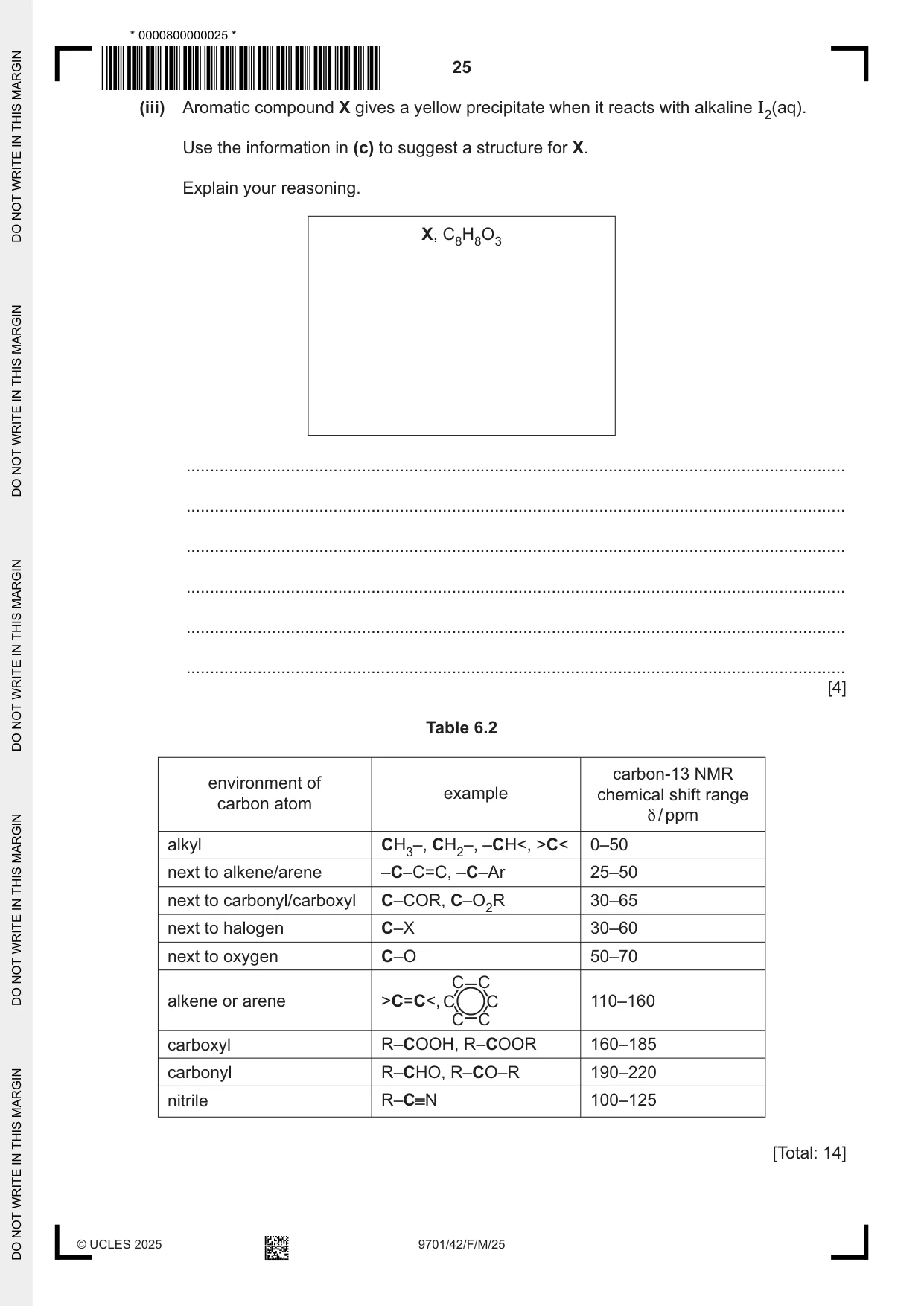
6 (a) Maleic anhydride is an unsaturated cyclic compound used in the formation of several polymers. Maleic anhydride can be used to form maleic acid and tartaric acid. maleic anhydride maleic acid tartaric acid HO OH reaction 1 reaction 2 HOOC COOH O O HOOC COOH O Fig. 6.1 (i) Maleic acid reacts with ethane-1,2-diol to form a condensation polymer. Draw a section of this polymer, showing only one repeat unit. The new functional group formed should be shown fully displayed. [2] (ii) Identify a suitable reagent and the conditions for reaction 2. ..................................................................................................................................... [1] (b) Compound U can be formed from tartaric acid in two steps, as shown in Fig. 6.2. tartaric acid T U CH3COCH3 HO OH and H+ O O O O step 1 step 2 HOOC COOH HOOC COOH –OOC COO– Fig. 6.2 (i) Suggest the type of reaction that occurs in step 1. ..................................................................................................................................... [1] (ii) U can act as a bidentate ligand. Explain what is meant by a bidentate ligand. ........................................................................................................................................... ..................................................................................................................................... [2] (iii) Complete the three-dimensional diagrams in Fig. 6.3 to show both stereoisomers of [Cu(U)3]4–. Use O O to represent ligand U. Cu Cu Fig. 6.3 [2] (c) A student analyses an aromatic compound, X, C8H8O3, using NMR spectroscopy. Fig. 6.4 shows the carbon-13 NMR spectrum of a sample of X dissolved in D2O. 240 220 200 180 160 140 120 100 80 60 40 20 0 chemical shift δ / ppm Fig. 6.4 Separate samples of X were analysed using proton (1H) NMR spectroscopy. Table 6.1 gives information obtained from this analysis. Table 6.1 number of signals in solvent proton (1H) NMR spectrum CDCl 6 3 D2O 4 (i) Identify the number of different carbon environments present in X. ..................................................................................................................................... [1] (ii) Explain why X is dissolved in D2O before obtaining its proton (1H) NMR spectrum. ........................................................................................................................................... ..................................................................................................................................... [1]
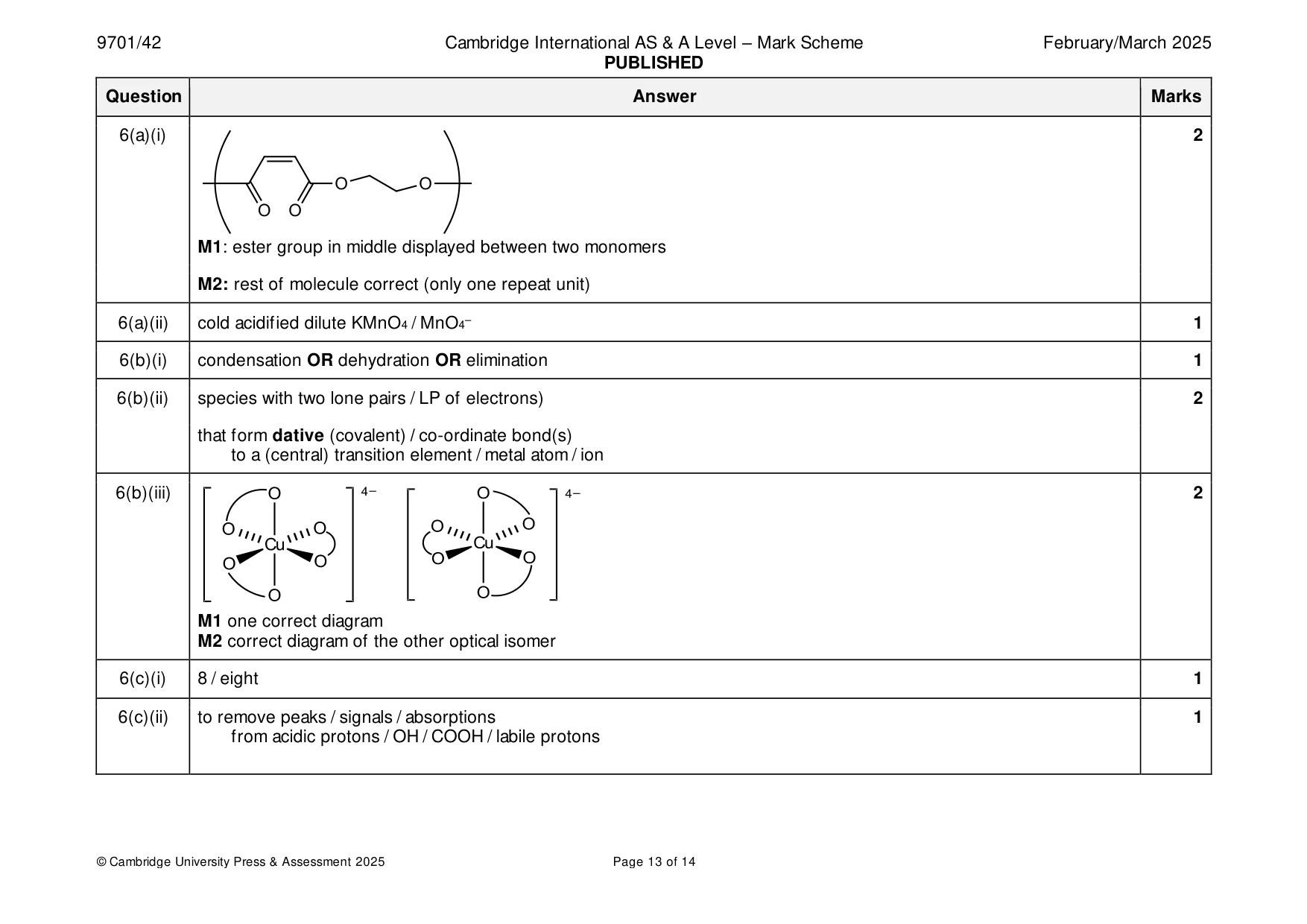
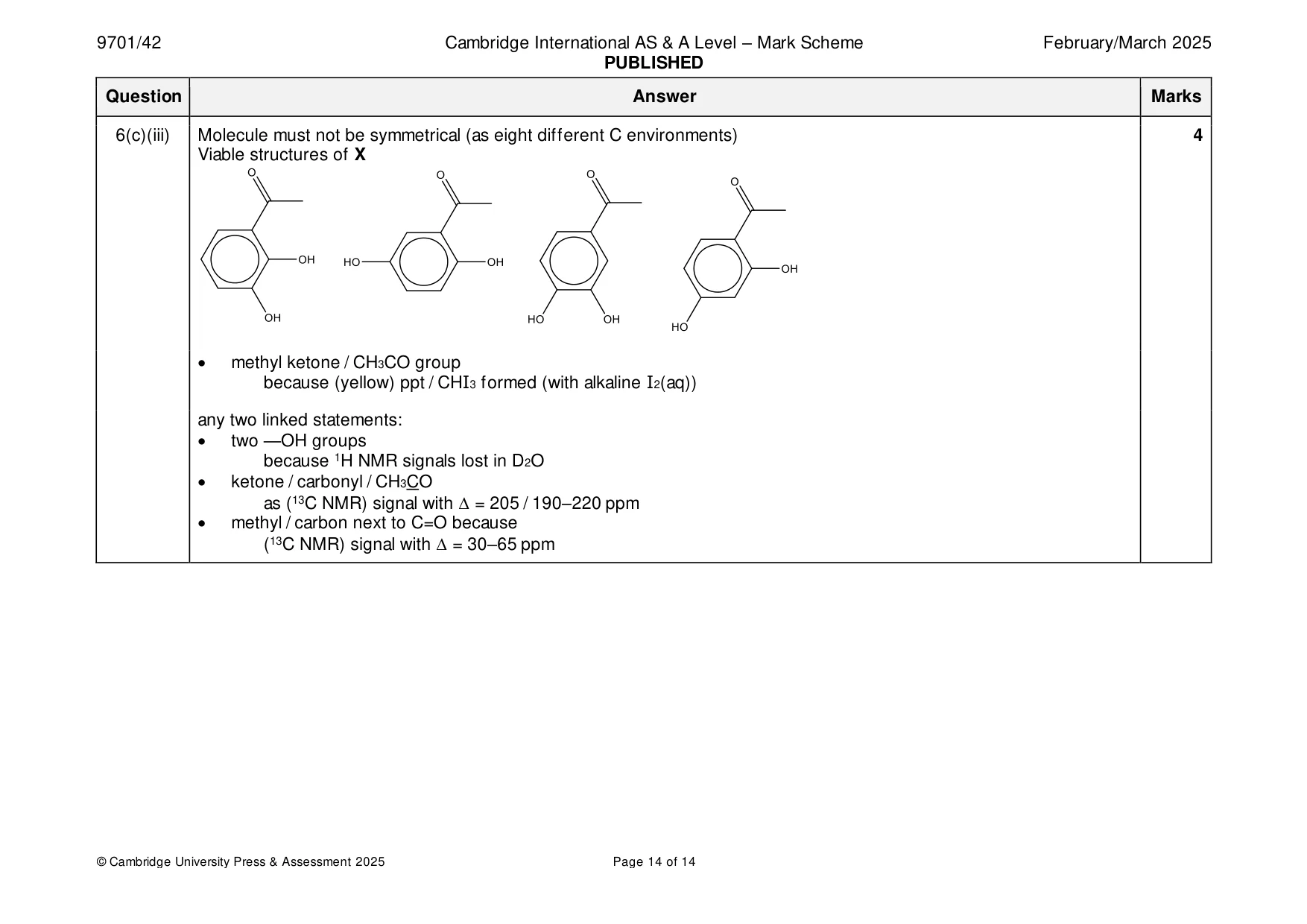
Mark scheme: 6(a)(i) 2 M1: ester group in middle displayed between two monomers M2: rest of molecule correct (only one repeat unit) 6(a)(ii) cold acidified dilute KMnO4 / MnO4– 1 6(b)(i) condensation OR dehydration OR elimination 1 6(b)(ii) species with two lone pairs / LP of electrons) 2 that form dative (covalent) / co-ordinate bond(s) to a (central) transition element / metal atom / ion 6(b)(iii) 2 M1 one correct diagram M2 correct diagram of the other optical isomer 6(c)(i) 8 / eight 1 6(c)(ii) to remove peaks / signals / absorptions 1 from acidic protons / OH / COOH / labile protons 6(c)(iii) Molecule must not be symmetrical (as eight different C environments) 4 Viable structures of X • methyl ketone / CH3CO group because (yellow) ppt / CHI3 formed (with alkaline I2(aq)) any two linked statements: • two —OH groups because 1H NMR signals lost in D2O • ketone / carbonyl / CH3CO as (13C NMR) signal with = 205 / 190–220 ppm • methyl / carbon next to C=O because (13C NMR) signal with = 30–65 ppm
What was in this paper
The subtopics covered by these 6 questions, and how many questions each got. Open one in a new tab to see every Cambridge question on it.
What you needed in this session
Cambridge’s own grade thresholds for 2025 Feb/March, Paper 4 · Variant 2. A higher threshold means an easier paper — the bar moves with how the cohort did.