Cambridge A Level Chemistry 9701 — 2021 Oct/Nov Paper 5 · Variant 3
9701/53/O/N/21 · 2 questions · 30 marks · ≈34 min
The question paper and its mark scheme, free to read here and free to download. This is Cambridge’s own paper, exactly as it was sat.
Question paper12 pages

Mark scheme8 pages
Answers below. Sit the paper first if you are practising.
Questions as text
Q1 · Potassium hydrogencarbonate, KHCO3, decomposes when strongly heated to form potassium…
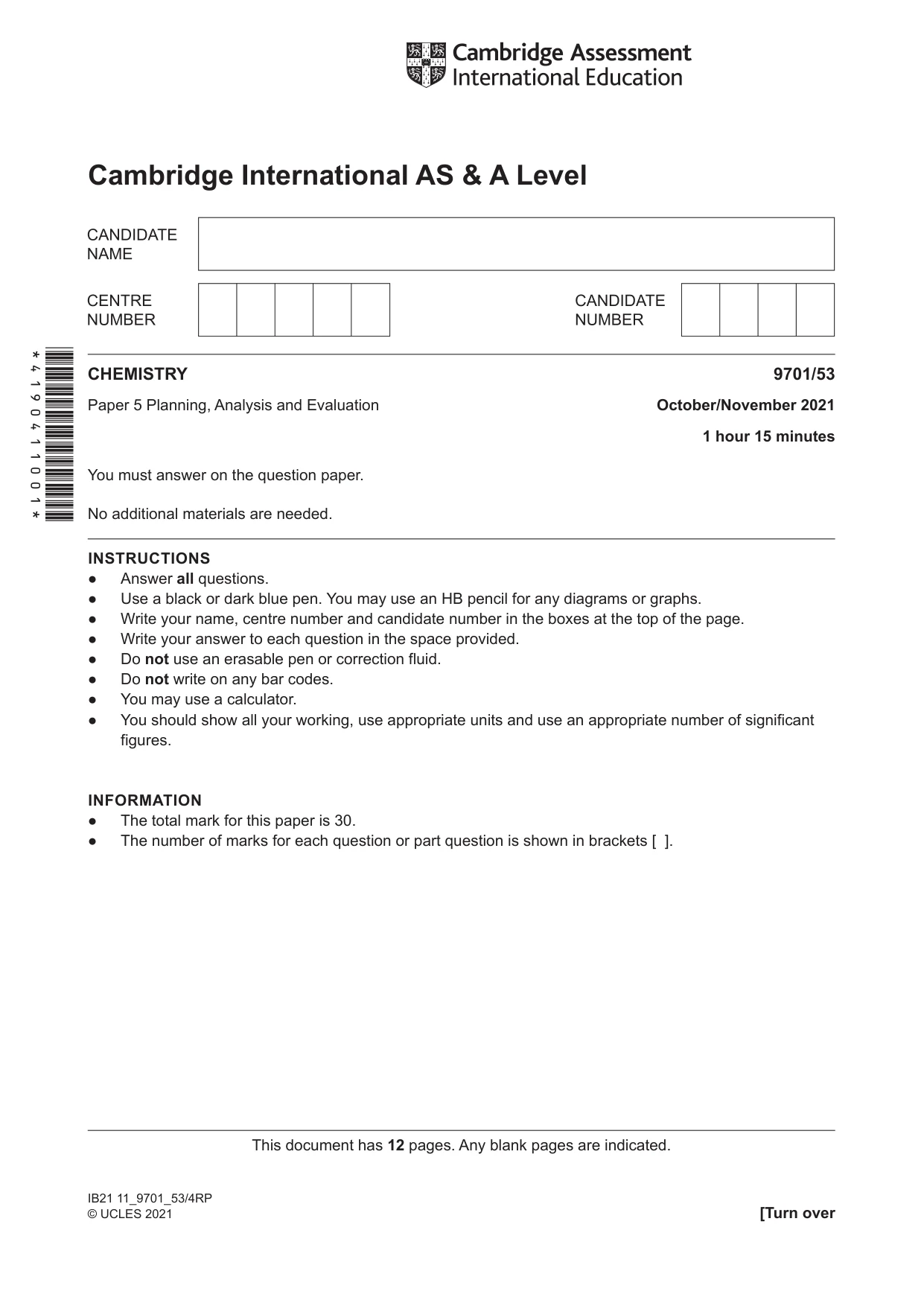
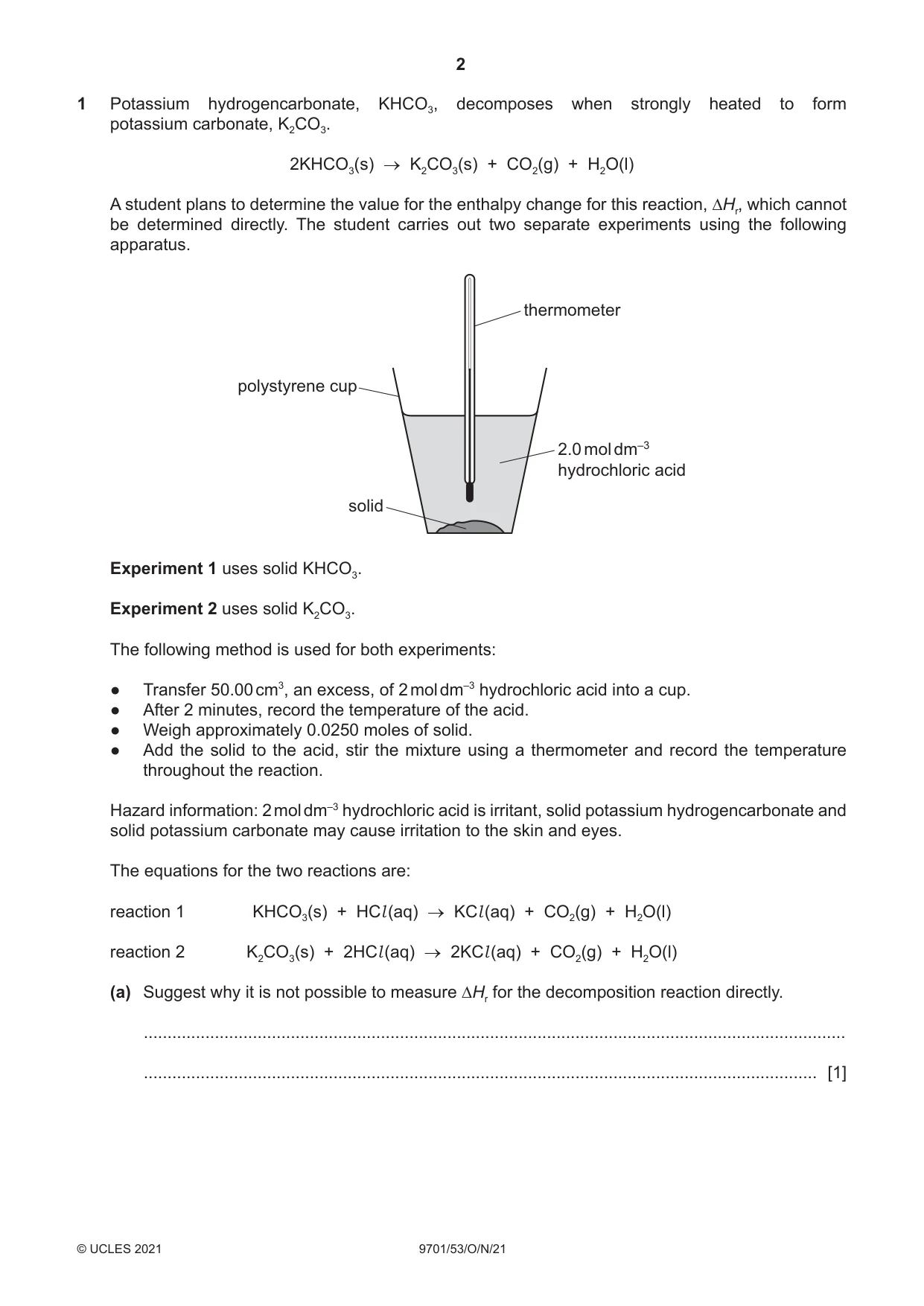
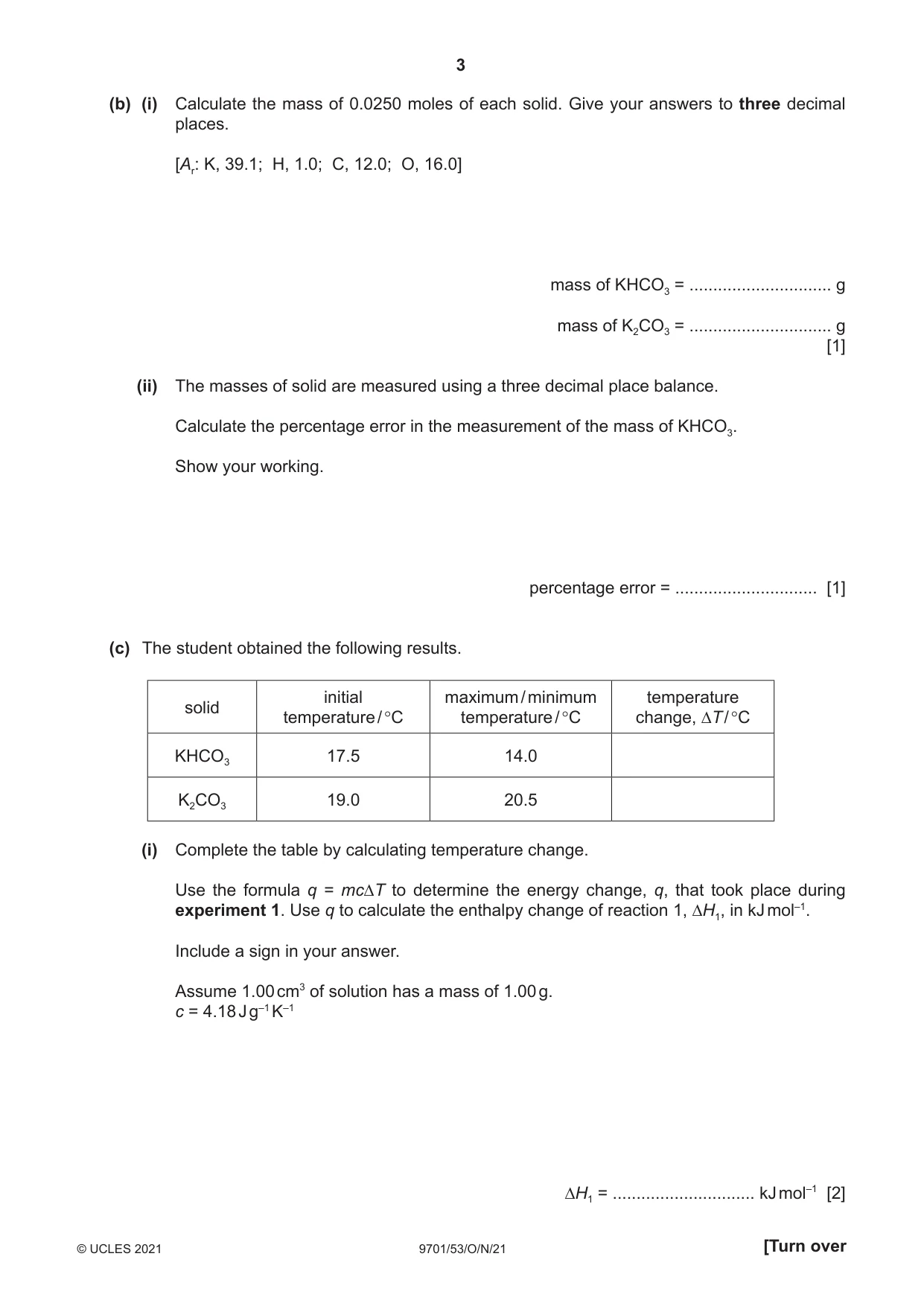
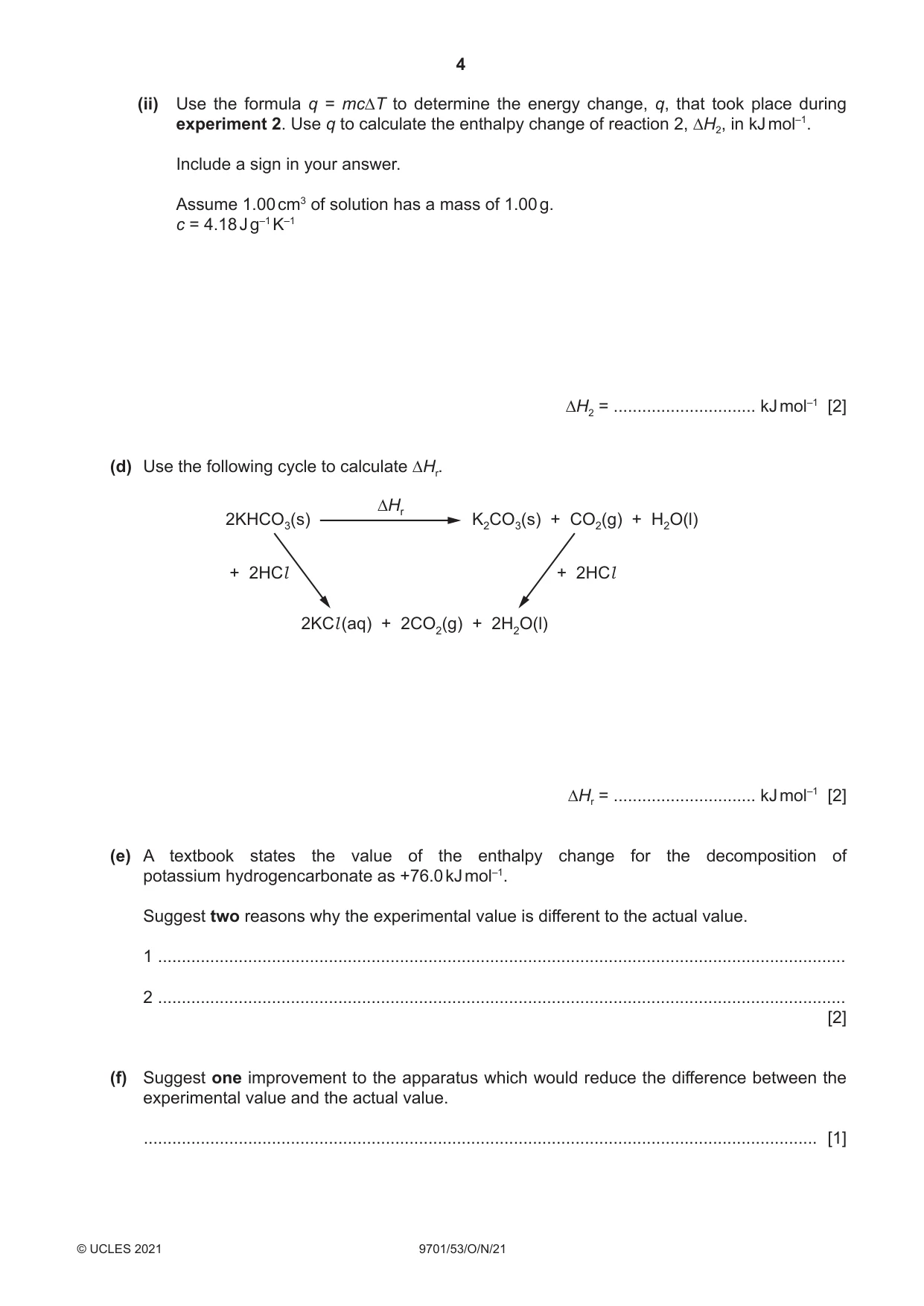
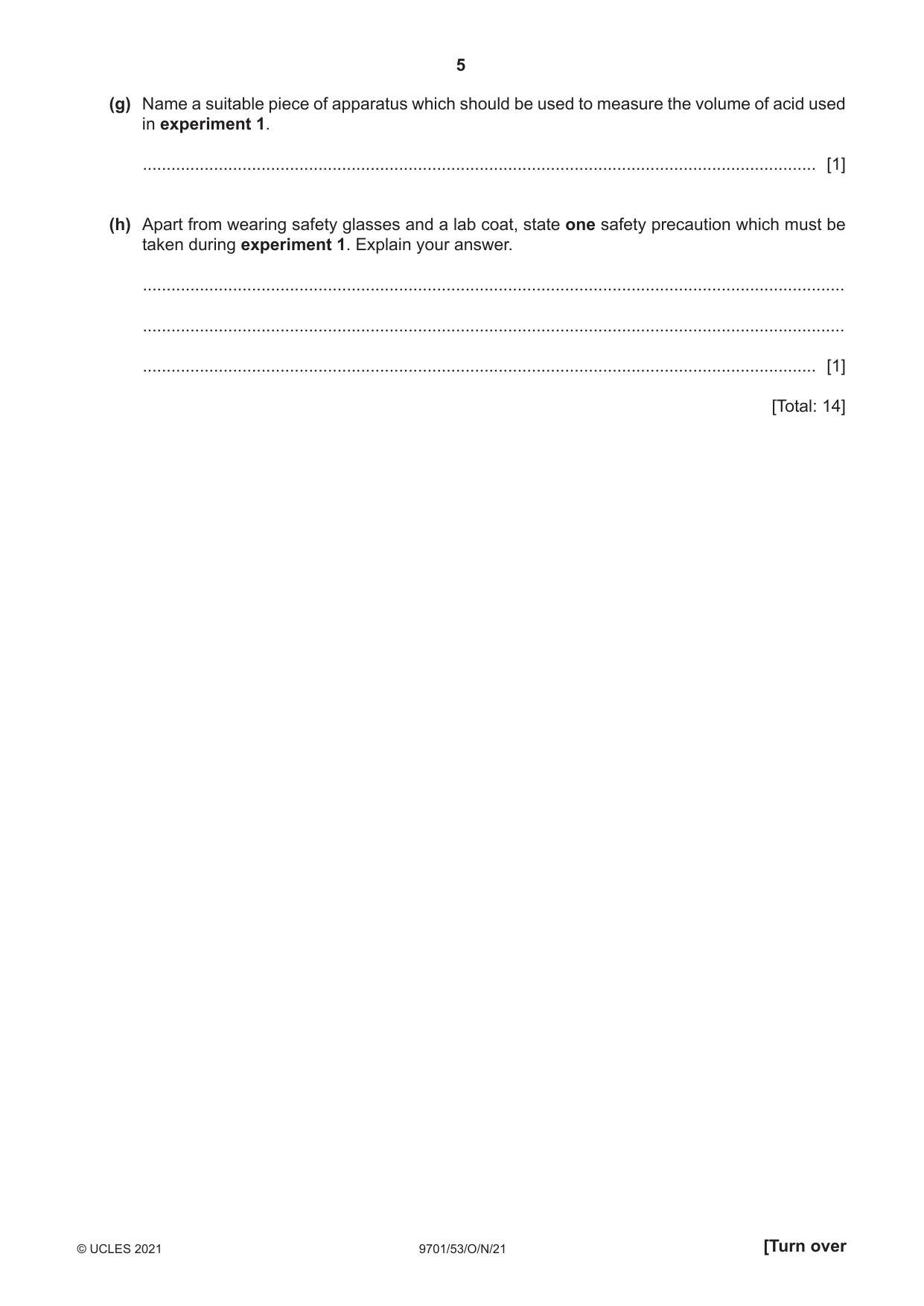
1 Potassium hydrogencarbonate, KHCO3, decomposes when strongly heated to form potassium carbonate, K2CO3. 2KHCO3(s) → K2CO3(s) + CO2(g) + H2O(l) A student plans to determine the value for the enthalpy change for this reaction, ∆Hr, which cannot be determined directly. The student carries out two separate experiments using the following apparatus. thermometer polystyrene cup 2.0 mol dm–3 hydrochloric acid solid Experiment 1 uses solid KHCO3. Experiment 2 uses solid K2CO3. The following method is used for both experiments: ● Transfer 50.00 cm3, an excess, of 2 mol dm–3 hydrochloric acid into a cup. ● After 2 minutes, record the temperature of the acid. ● Weigh approximately 0.0250 moles of solid. ● Add the solid to the acid, stir the mixture using a thermometer and record the temperature throughout the reaction. Hazard information: 2 mol dm–3 hydrochloric acid is irritant, solid potassium hydrogencarbonate and solid potassium carbonate may cause irritation to the skin and eyes. The equations for the two reactions are: reaction 1 KHCO3(s) + HCl (aq) → KCl (aq) + CO2(g) + H2O(l) reaction 2 K2CO3(s) + 2HCl (aq) → 2KCl (aq) + CO2(g) + H2O(l) (a) Suggest why it is not possible to measure ∆Hr for the decomposition reaction directly. .................................................................................................................................................... .............................................................................................................................................. [1] (b) (i) Calculate the mass of 0.0250 moles of each solid. Give your answers to three decimal places. [Ar: K, 39.1; H, 1.0; C, 12.0; O, 16.0] mass of KHCO3 = .............................. g mass of K2CO3 = .............................. g [1] (ii) The masses of solid are measured using a three decimal place balance. Calculate the percentage error in the measurement of the mass of KHCO3. Show your working. percentage error = .............................. [1] (c) The student obtained the following results. initial maximum / minimum temperature solid temperature / °C temperature / °C change, ∆T / °C KHCO3 17.5 14.0 K2CO3 19.0 20.5 (i) Complete the table by calculating temperature change. Use the formula q = mc∆T to determine the energy change, q, that took place during experiment 1. Use q to calculate the enthalpy change of reaction 1, ∆H1, in kJ mol–1. Include a sign in your answer. Assume 1.00 cm3 of solution has a mass of 1.00 g. c = 4.18 J g–1 K–1 ∆H1 = .............................. kJ mol–1 [2] (ii) Use the formula q = mc∆T to determine the energy change, q, that took place during experiment 2. Use q to calculate the enthalpy change of reaction 2, ∆H2, in kJ mol–1. Include a sign in your answer. Assume 1.00 cm3 of solution has a mass of 1.00 g. c = 4.18 J g–1 K–1 ∆H2 = .............................. kJ mol–1 [2] (d) Use the following cycle to calculate ∆Hr. ∆Hr 2KHCO3(s) K2CO3(s) + CO2(g) + H2O(l) + 2HCl + 2HCl 2KCl (aq) + 2CO2(g) + 2H2O(l) ∆Hr = .............................. kJ mol–1 [2] (e) A textbook states the value of the enthalpy change for the decomposition of potassium hydrogencarbonate as +76.0 kJ mol–1. Suggest two reasons why the experimental value is different to the actual value. 1 ................................................................................................................................................. 2 ................................................................................................................................................. [2] (f) Suggest one improvement to the apparatus which would reduce the difference between the experimental value and the actual value. .............................................................................................................................................. [1] (g) Name a suitable piece of apparatus which should be used to measure the volume of acid used in experiment 1. .............................................................................................................................................. [1] (h) Apart from wearing safety glasses and a lab coat, state one safety precaution which must be taken during experiment 1. Explain your answer. .................................................................................................................................................... .................................................................................................................................................... .............................................................................................................................................. [1] [Total: 14]
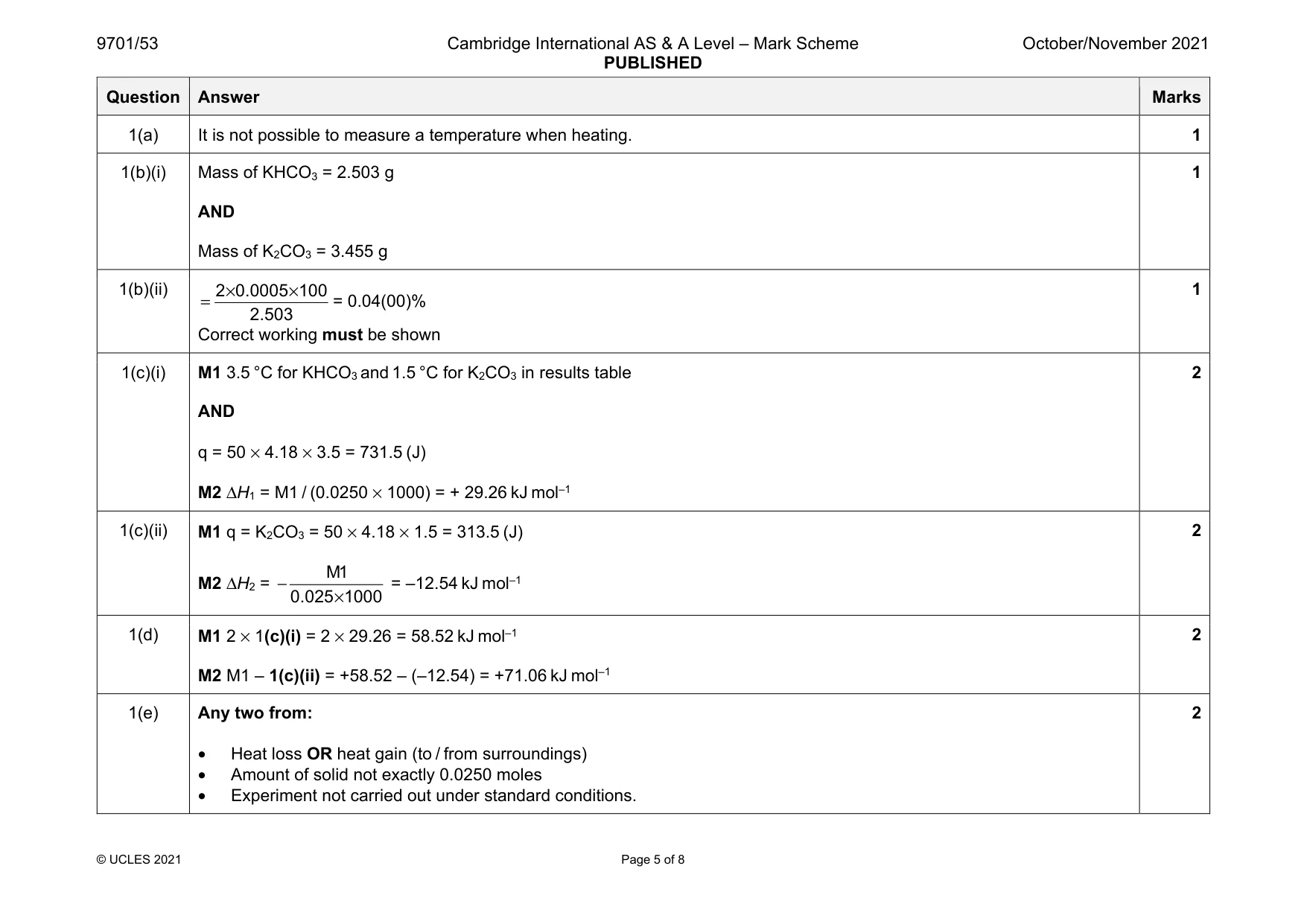
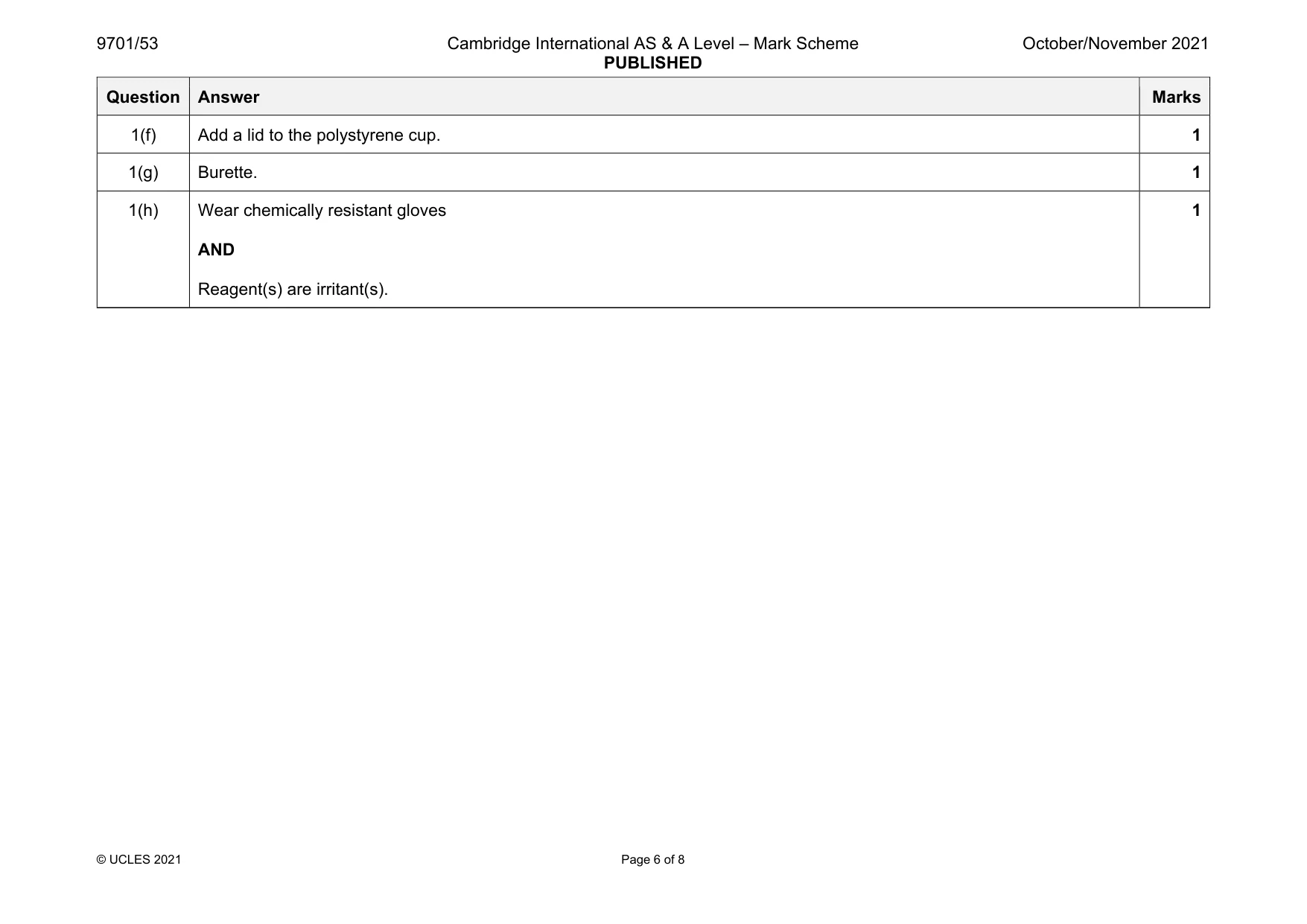
Mark scheme: 1(a) It is not possible to measure a temperature when heating. 1 1(b)(i) Mass of KHCO3 = 2.503 g AND Mass of K2CO3 = 3.455 g 1 1(b)(ii) 2 0.0005 100 2.503 × × = = 0.04(00)% Correct working must be shown 1 1(c)(i) M1 3.5 °C for KHCO3 and 1.5 °C for K2CO3 in results table AND q = 50 × 4.18 × 3.5 = 731.5 (J) M2 ΔH1 = M1 / (0.0250 × 1000) = + 29.26 kJ mol–1 2 1(c)(ii) M1 q = K2CO3 = 50 × 4.18 × 1.5 = 313.5 (J) M2 ΔH2 = M1 0.025 1000 − × = –12.54 kJ mol–1 2 1(d) M1 2 × 1(c)(i) = 2 × 29.26 = 58.52 kJ mol–1 M2 M1 – 1(c)(ii) = +58.52 – (–12.54) = +71.06 kJ mol–1 2 1(e) Any two from: • Heat loss OR heat gain (to / from surroundings) • Amount of solid not exactly 0.0250 moles • Experiment not carried out under standard conditions. 2 Question Answer Marks 1(f) Add a lid to the polystyrene cup. 1 1(g) Burette. 1 1(h) Wear chemically resistant gloves AND Reagent(s) are irritant(s). 1
Q2 · The rate of reaction between calcium carbonate, CaCO3, and hydrochloric acid, HCl, can be…
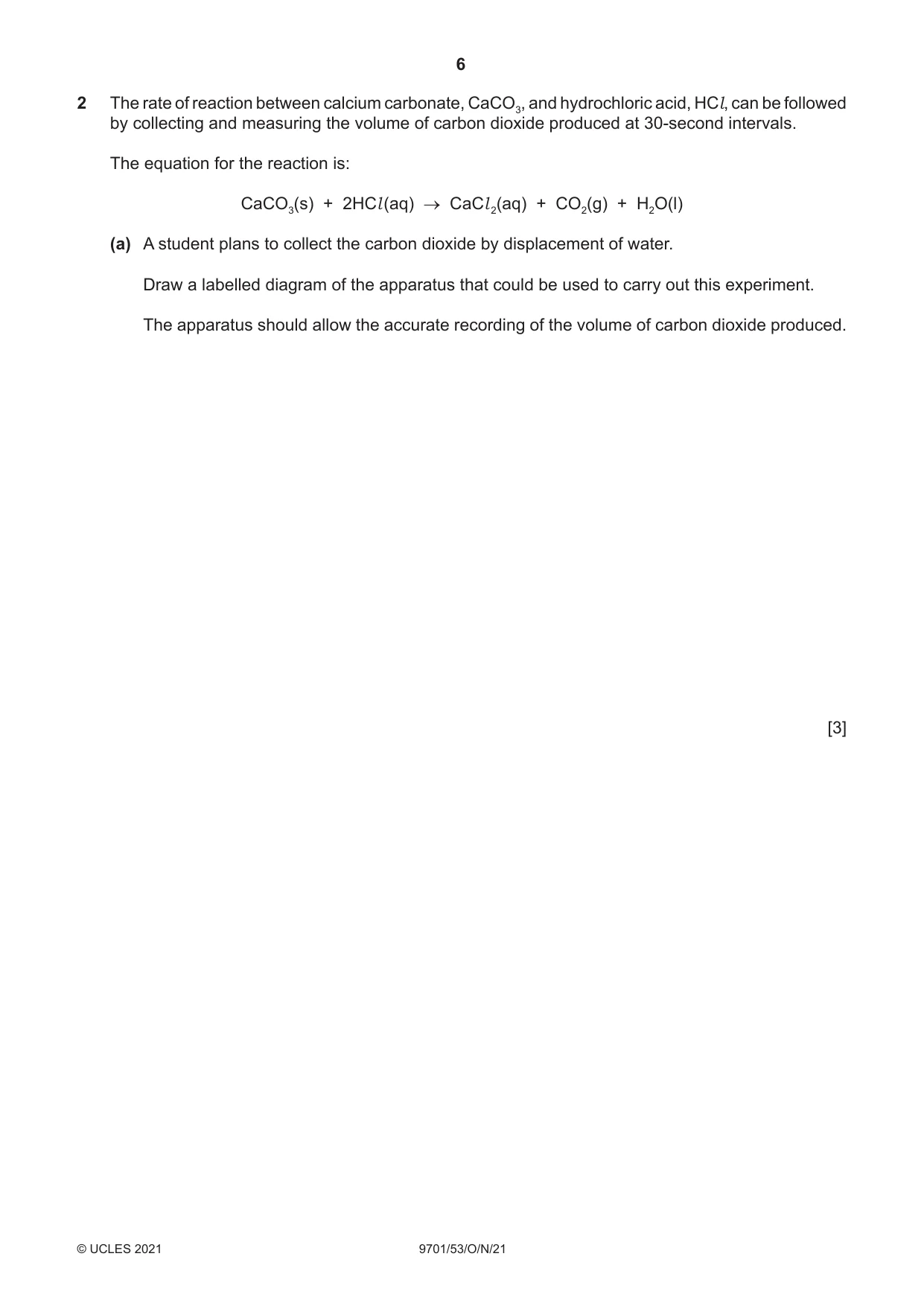
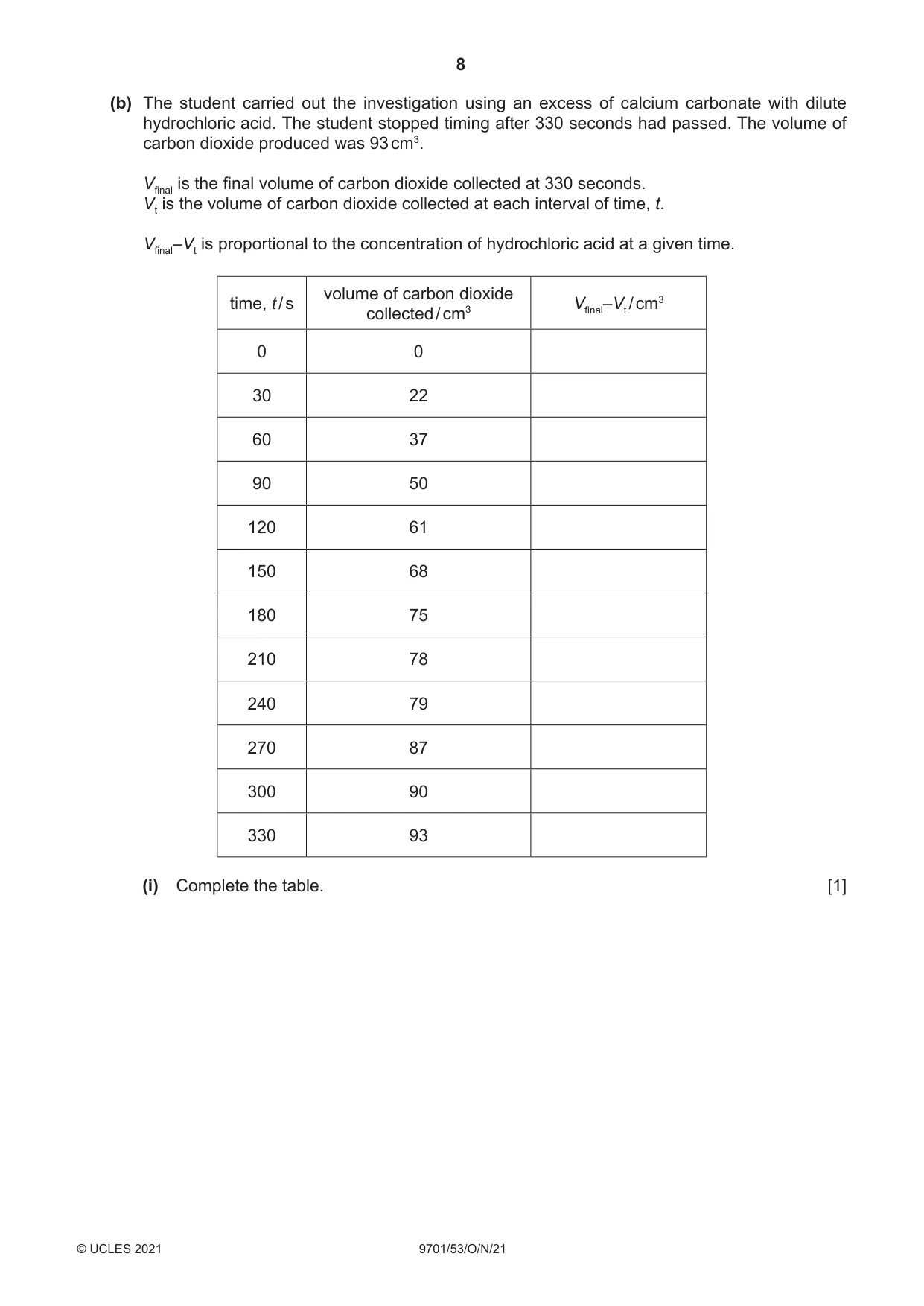
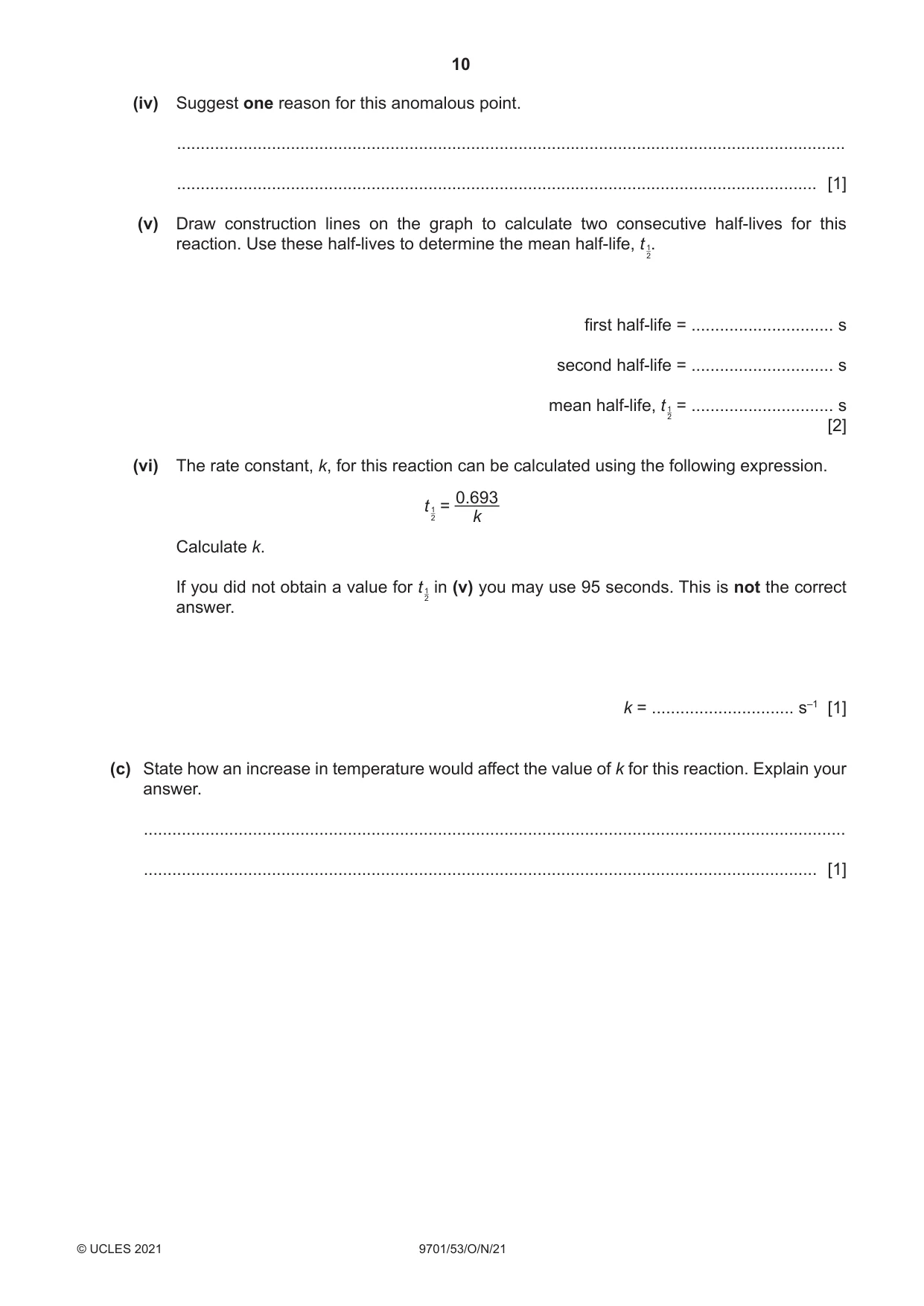
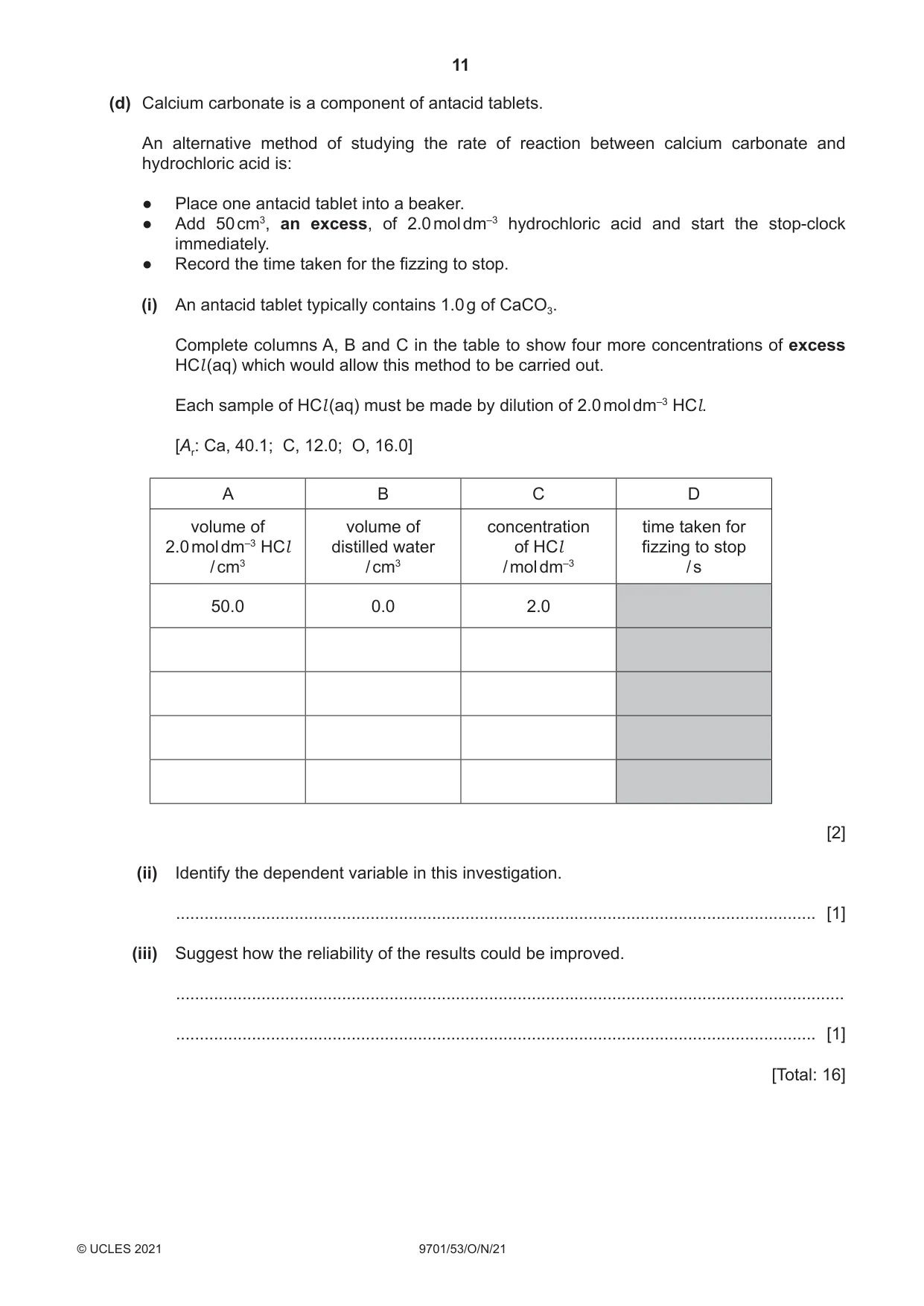
2 The rate of reaction between calcium carbonate, CaCO3, and hydrochloric acid, HCl, can be followed by collecting and measuring the volume of carbon dioxide produced at 30-second intervals. The equation for the reaction is: CaCO3(s) + 2HCl (aq) → CaCl 2(aq) + CO2(g) + H2O(l) (a) A student plans to collect the carbon dioxide by displacement of water. Draw a labelled diagram of the apparatus that could be used to carry out this experiment. The apparatus should allow the accurate recording of the volume of carbon dioxide produced. [3] Question 2 continues on the next page. (b) The student carried out the investigation using an excess of calcium carbonate with dilute hydrochloric acid. The student stopped timing after 330 seconds had passed. The volume of carbon dioxide produced was 93 cm3. Vfinal is the final volume of carbon dioxide collected at 330 seconds. Vt is the volume of carbon dioxide collected at each interval of time, t. Vfinal–Vt is proportional to the concentration of hydrochloric acid at a given time. volume of carbon dioxide time, t / s Vfinal–Vt / cm3 collected / cm3 0 0 30 22 60 37 90 50 120 61 150 68 180 75 210 78 240 79 270 87 300 90 330 93 (i) Complete the table. [1]
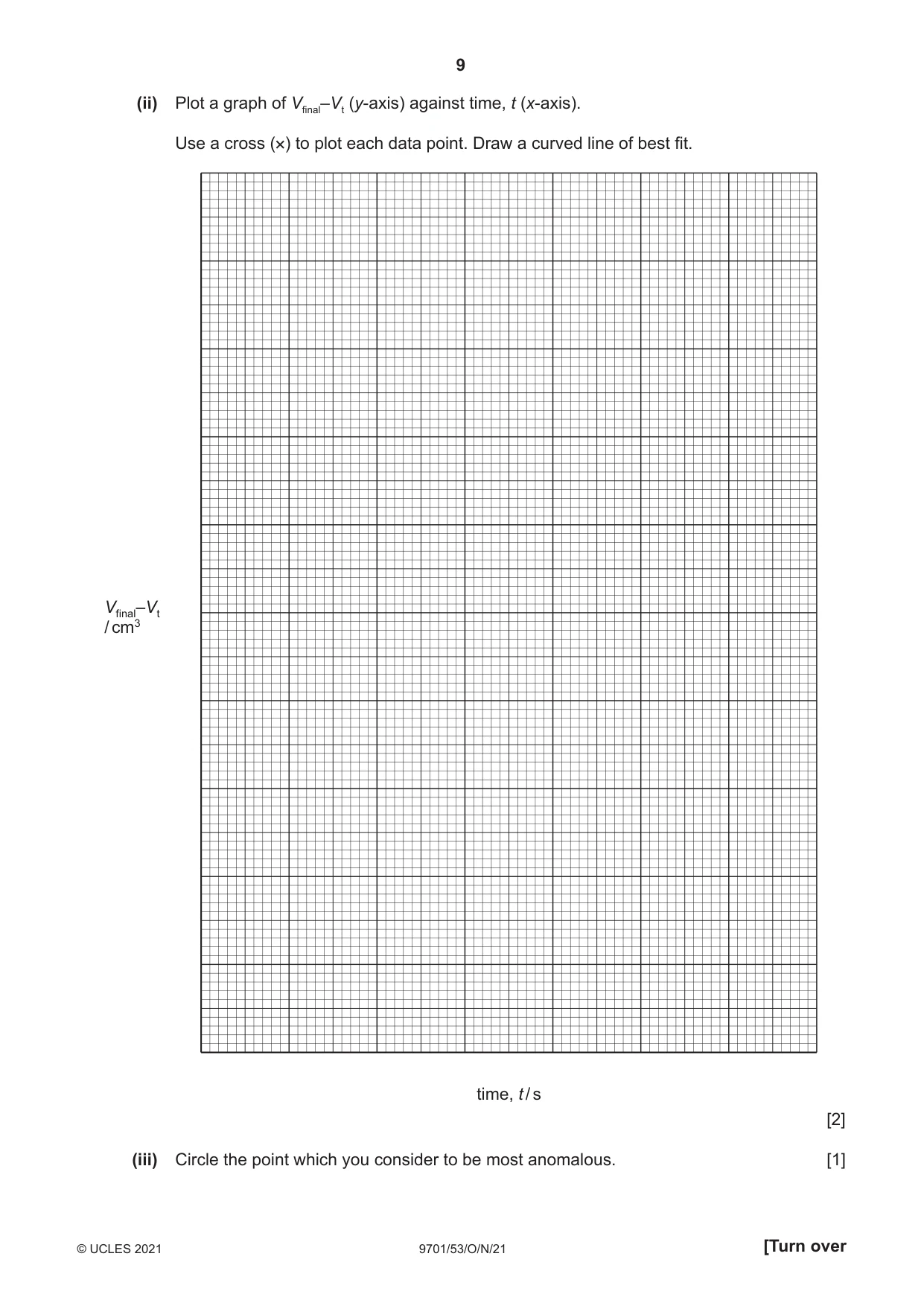
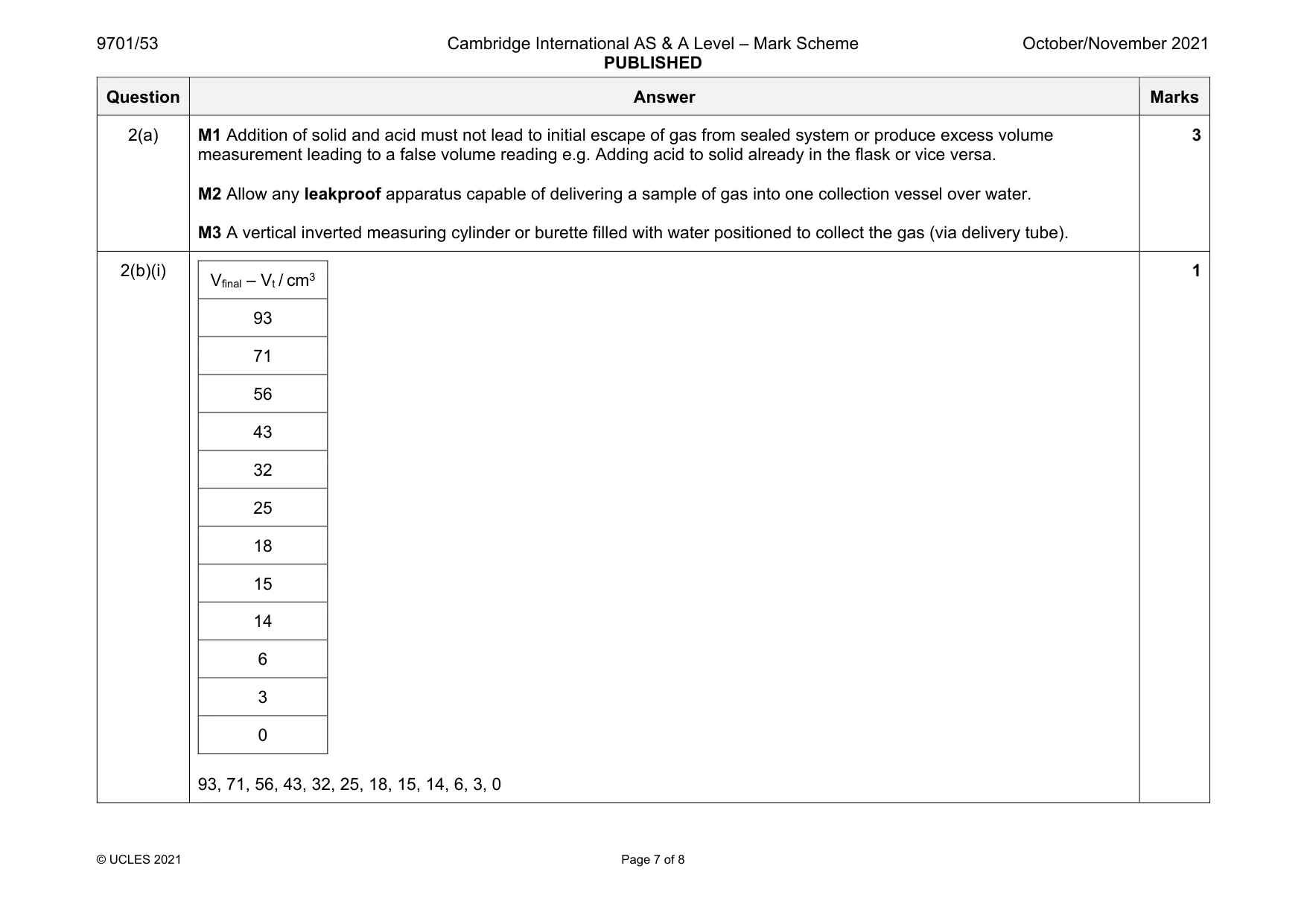
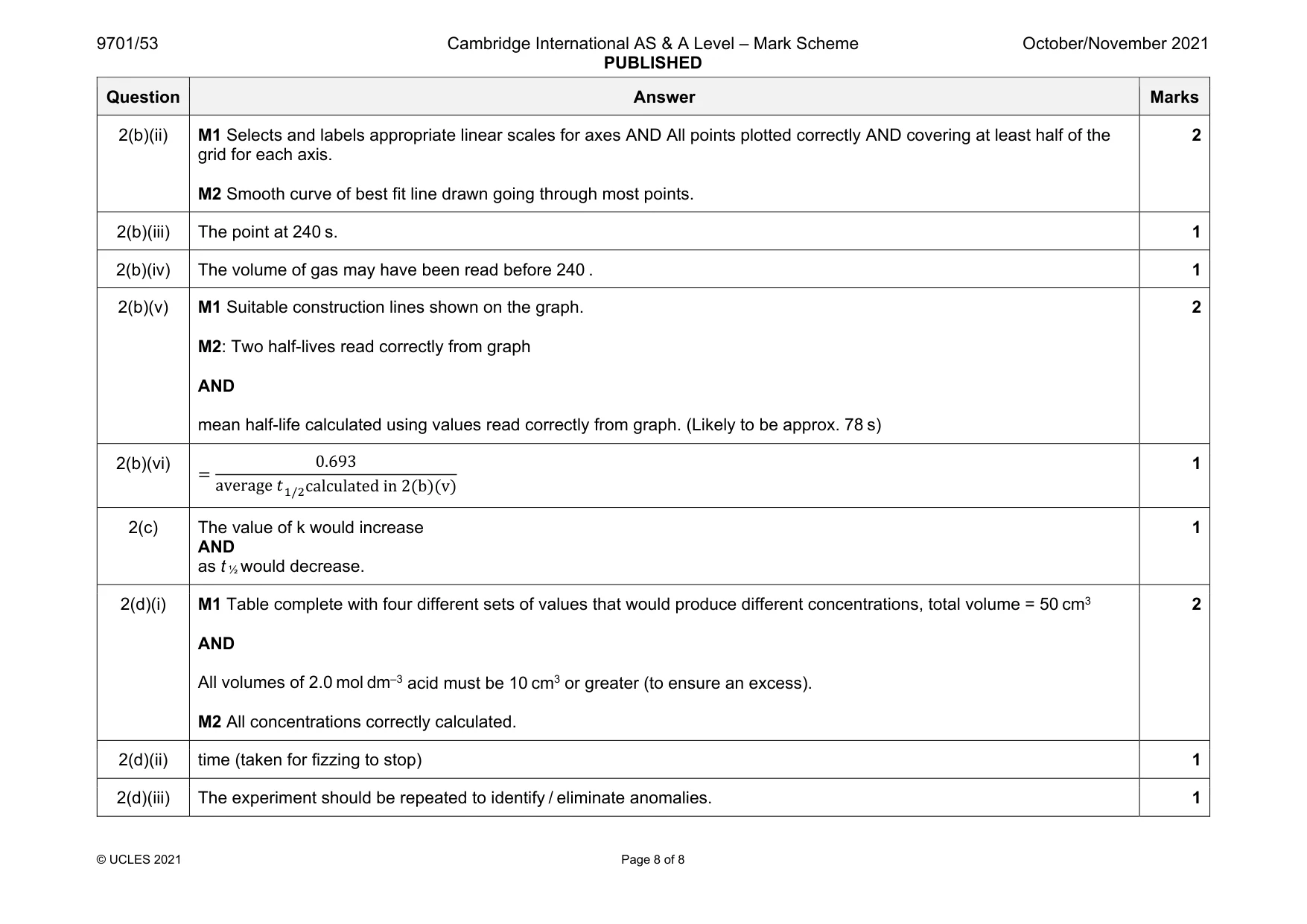
Mark scheme: 2(a) M1 Addition of solid and acid must not lead to initial escape of gas from sealed system or produce excess volume measurement leading to a false volume reading e.g. Adding acid to solid already in the flask or vice versa. M2 Allow any leakproof apparatus capable of delivering a sample of gas into one collection vessel over water. M3 A vertical inverted measuring cylinder or burette filled with water positioned to collect the gas (via delivery tube). 3 2(b)(i) Vfinal – Vt / cm3 93 71 56 43 32 25 18 15 14 6 3 0 93, 71, 56, 43, 32, 25, 18, 15, 14, 6, 3, 0 1 Question Answer Marks 2(b)(ii) M1 Selects and labels appropriate linear scales for axes AND All points plotted correctly AND covering at least half of the grid for each axis. M2 Smooth curve of best fit line drawn going through most points. 2 2(b)(iii) The point at 240 s. 1 2(b)(iv) The volume of gas may have been read before 240 . 1 2(b)(v) M1 Suitable construction lines shown on the graph. M2: Two half-lives read correctly from graph AND mean half-life calculated using values read correctly from graph. (Likely to be approx. 78 s) 2 2(b)(vi) = 0.693 average 𝑡ଵ/ଶ calculated in 2(b)(v) 1 2(c) The value of k would increase AND as t ½ would decrease. 1 2(d)(i) M1 Table complete with four different sets of values that would produce different concentrations, total volume = 50 cm3 AND All volumes of 2.0 mol dm–3 acid must be 10 cm3 or greater (to ensure an excess). M2 All concentrations correctly calculated. 2 2(d)(ii) time (taken for fizzing to stop) 1 2(d)(iii) The experiment should be repeated to identify / eliminate anomalies. 1
What was in this paper
The subtopics covered by these 2 questions, and how many questions each got. Open one in a new tab to see every Cambridge question on it.
What you needed in this session
Cambridge’s own grade thresholds for 2021 Oct/Nov, Paper 5 · Variant 3. A higher threshold means an easier paper — the bar moves with how the cohort did.