Cambridge A Level Chemistry 9701 — 2020 Oct/Nov Paper 4 · Variant 2
9701/42/O/N/20 · 7 questions · 100 marks · ≈113 min
The question paper and its mark scheme, free to read here and free to download. This is Cambridge’s own paper, exactly as it was sat.
Question paper20 pages
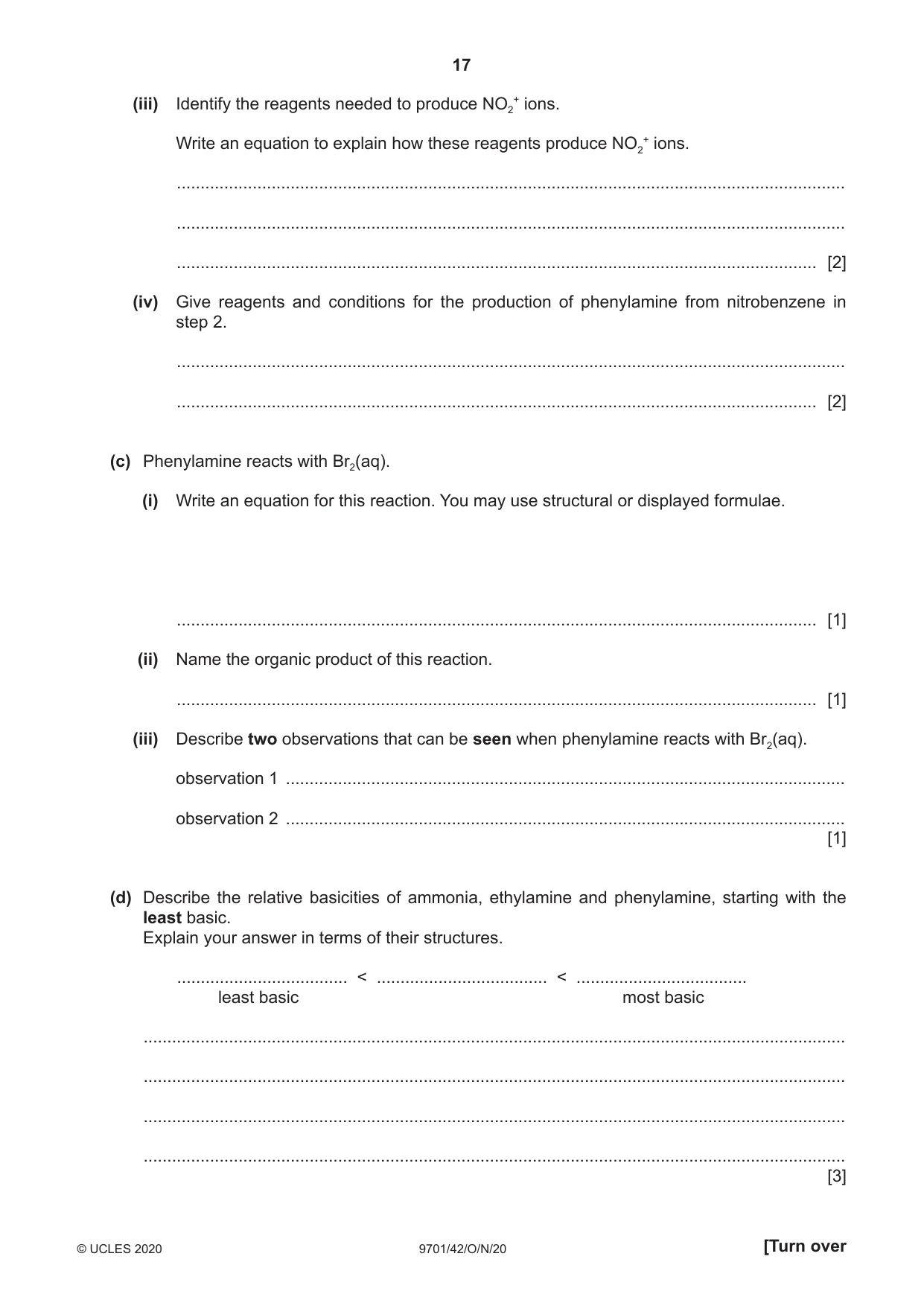
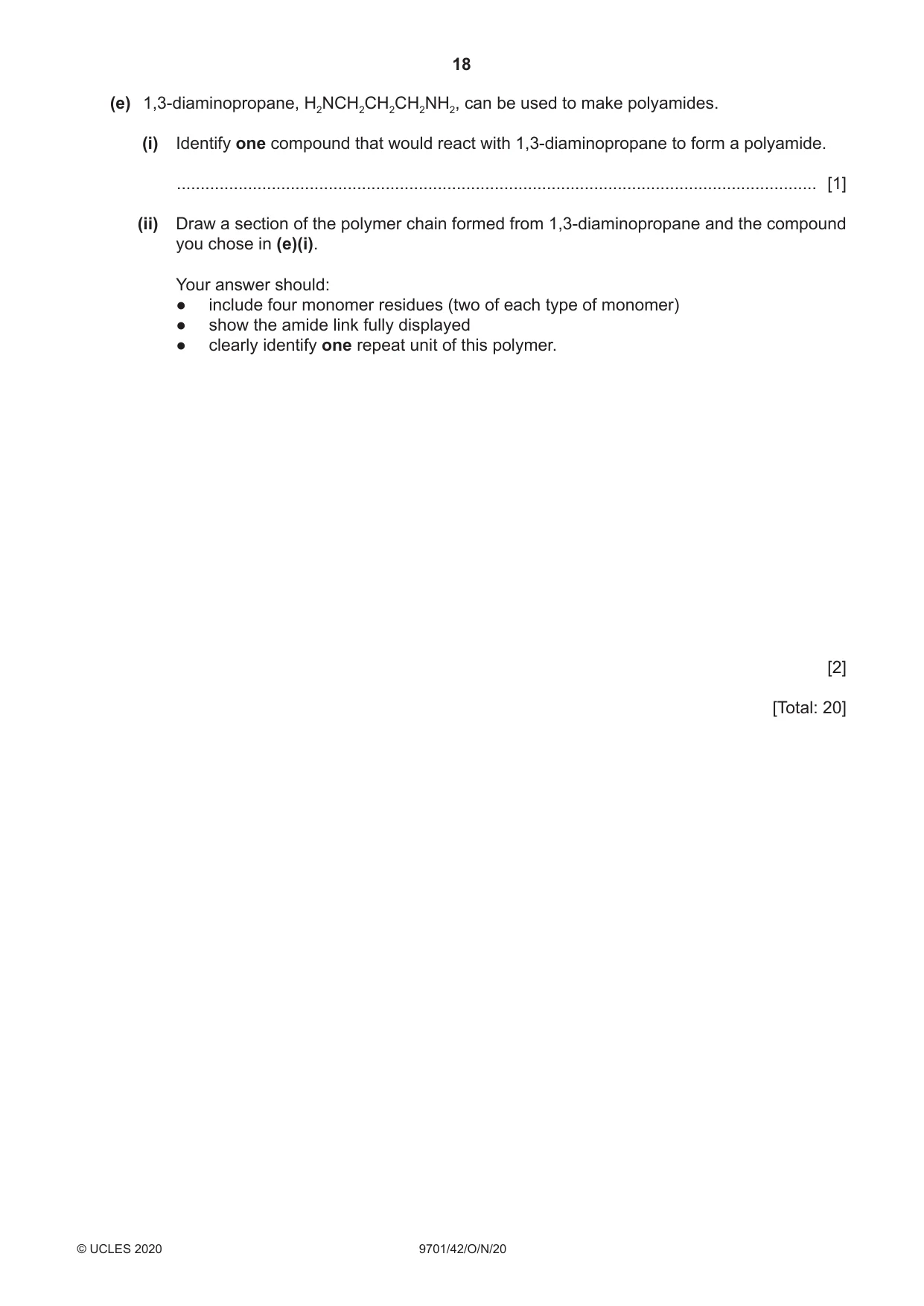

Mark scheme14 pages
Answers below. Sit the paper first if you are practising.
Questions as text
Q1 · The rate of the reaction H2(g) + I2(g) 2HI(g) is studied
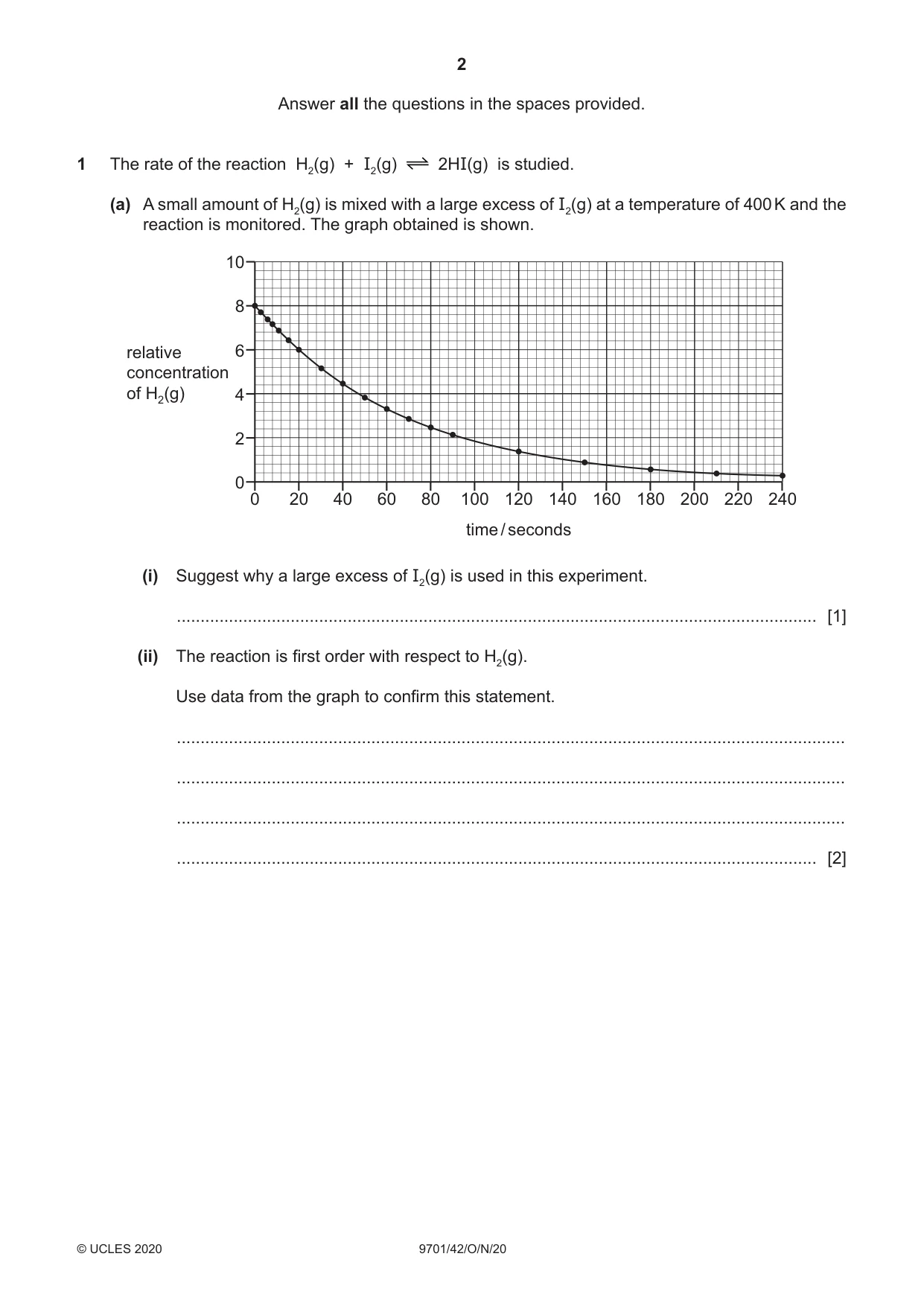
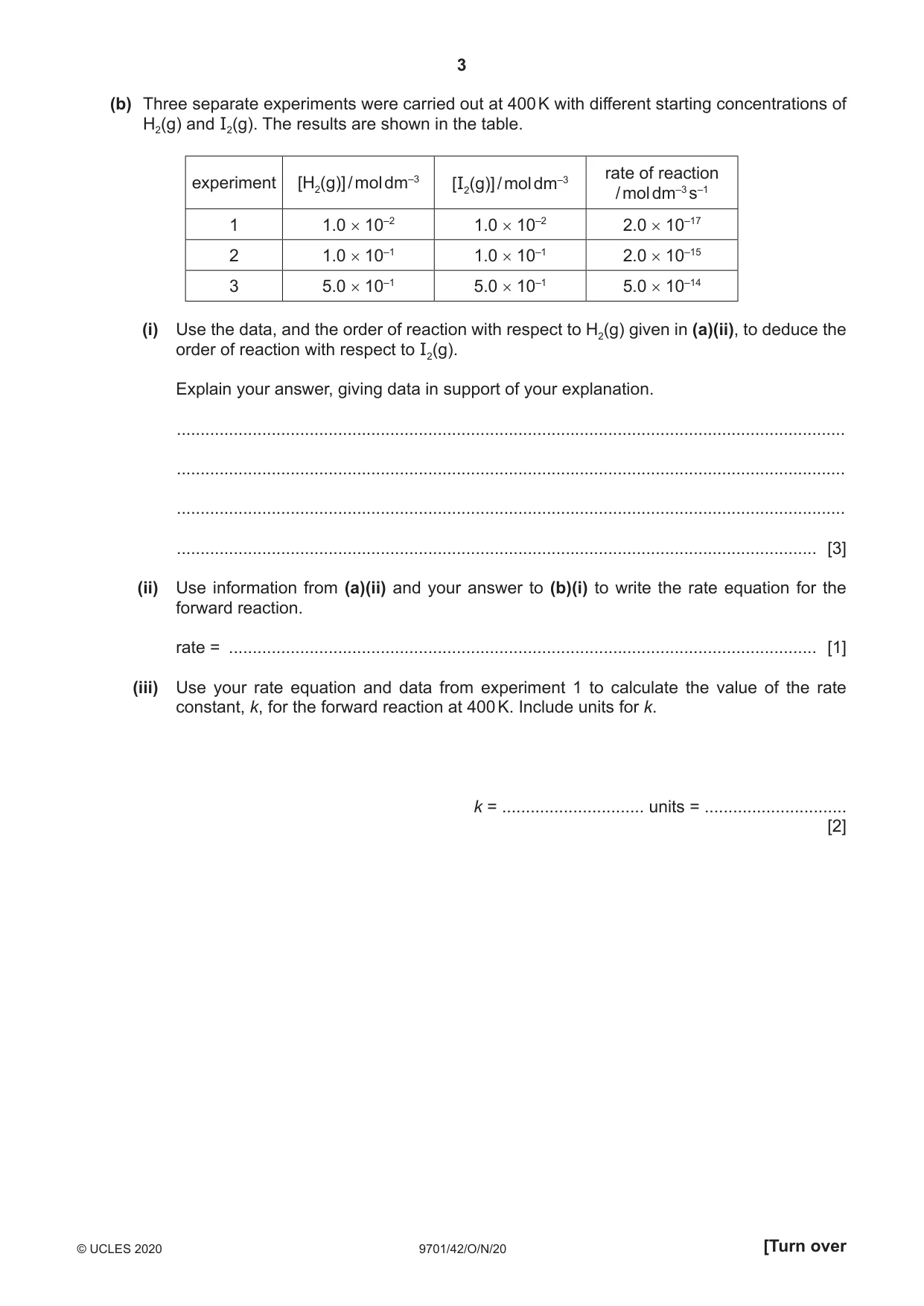
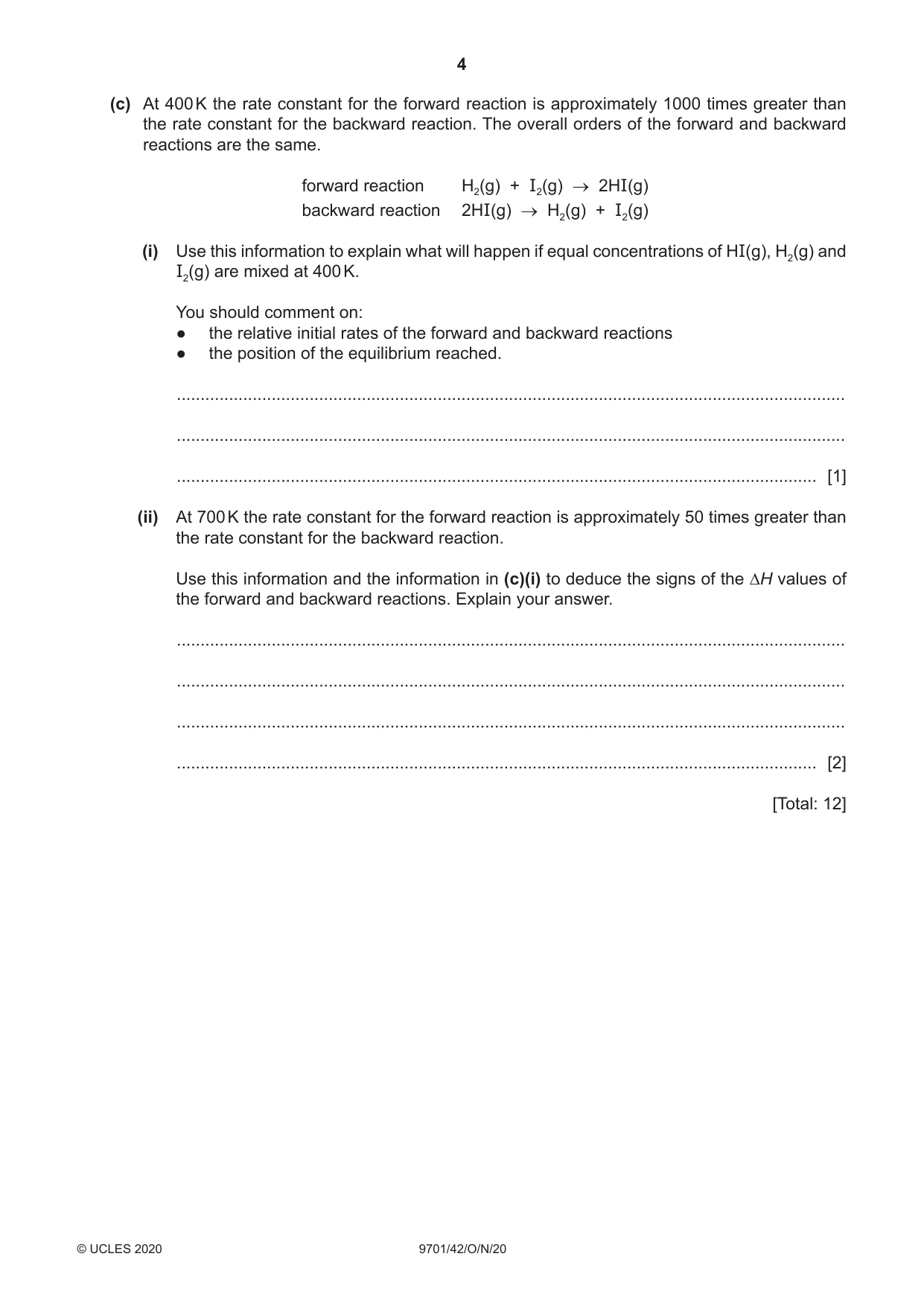
1 The rate of the reaction H2(g) + I2(g) 2HI(g) is studied. (a) A small amount of H2(g) is mixed with a large excess of I2(g) at a temperature of 400 K and the reaction is monitored. The graph obtained is shown. 10 8 relative 6 concentration of H2(g) 4 2 0 0 20 40 60 80 100 120 140 160 180 200 220 240 time / seconds (i) Suggest why a large excess of I2(g) is used in this experiment. ....................................................................................................................................... [1] (ii) The reaction is first order with respect to H2(g). Use data from the graph to confirm this statement. ............................................................................................................................................. ............................................................................................................................................. ............................................................................................................................................. ....................................................................................................................................... [2] (b) Three separate experiments were carried out at 400 K with different starting concentrations of H2(g) and I2(g). The results are shown in the table. rate of reaction experiment [H2(g)] / mol dm–3 [I2(g)] / mol dm–3 / mol dm–3 s–1 1 1.0 × 10⁻² 1.0 × 10⁻² 2.0 × 10⁻¹⁷ 2 1.0 × 10⁻¹ 1.0 × 10⁻¹ 2.0 × 10⁻¹⁵ 3 5.0 × 10⁻¹ 5.0 × 10⁻¹ 5.0 × 10⁻¹⁴ (i) Use the data, and the order of reaction with respect to H2(g) given in (a)(ii), to deduce the order of reaction with respect to I2(g). Explain your answer, giving data in support of your explanation. ............................................................................................................................................. ............................................................................................................................................. ............................................................................................................................................. ....................................................................................................................................... [3] (ii) Use information from (a)(ii) and your answer to (b)(i) to write the rate equation for the forward reaction. rate = ............................................................................................................................. [1] (iii) Use your rate equation and data from experiment 1 to calculate the value of the rate constant, k, for the forward reaction at 400 K. Include units for k. k = .............................. units = .............................. [2] (c) At 400 K the rate constant for the forward reaction is approximately 1000 times greater than the rate constant for the backward reaction. The overall orders of the forward and backward reactions are the same. forward reaction H2(g) + I2(g) → 2HI(g) backward reaction 2HI(g) → H2(g) + I2(g) (i) Use this information to explain what will happen if equal concentrations of HI(g), H2(g) and I2(g) are mixed at 400 K. You should comment on: ● the relative initial rates of the forward and backward reactions ● the position of the equilibrium reached. ............................................................................................................................................. ............................................................................................................................................. ....................................................................................................................................... [1] (ii) At 700 K the rate constant for the forward reaction is approximately 50 times greater than the rate constant for the backward reaction. Use this information and the information in (c)(i) to deduce the signs of the ∆H values of the forward and backward reactions. Explain your answer. ............................................................................................................................................. ............................................................................................................................................. ............................................................................................................................................. ....................................................................................................................................... [2] [Total: 12]
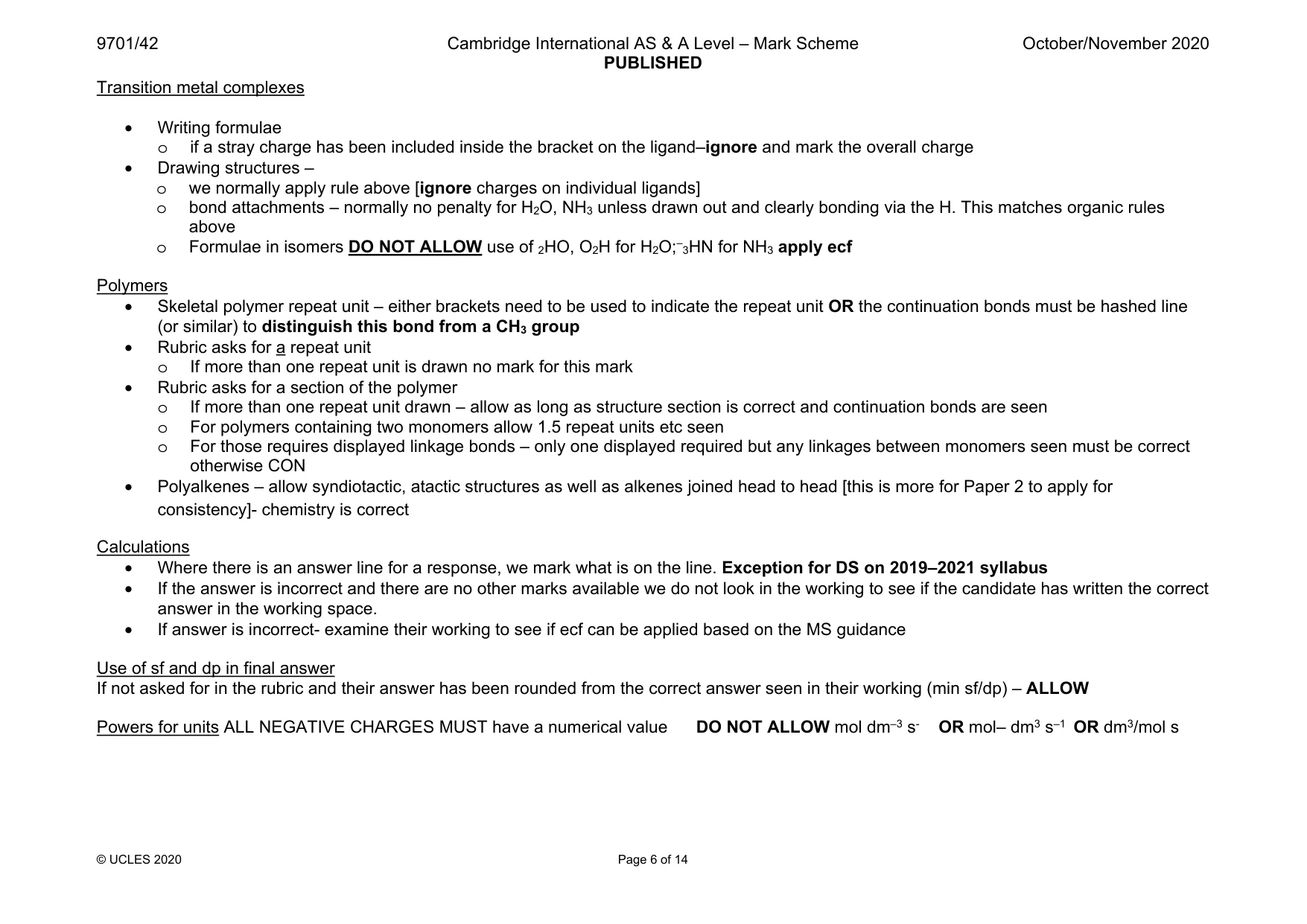
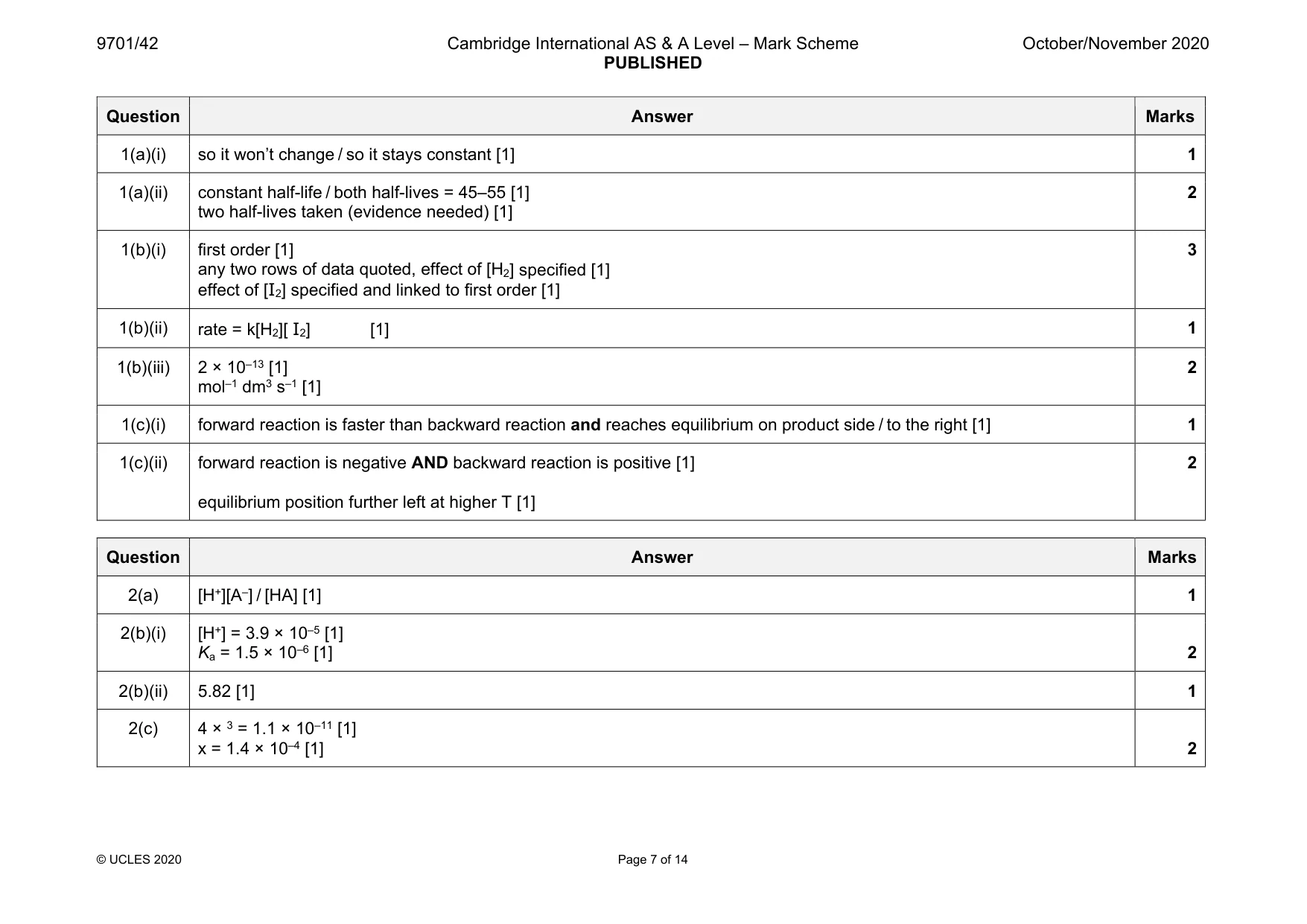
Mark scheme: 1(a)(i) so it won’t change / so it stays constant [1] 1 1(a)(ii) constant half-life / both half-lives = 45–55 [1] two half-lives taken (evidence needed) [1] 2 1(b)(i) first order [1] any two rows of data quoted, effect of [H2] specified [1] effect of [I2] specified and linked to first order [1] 3 1(b)(ii) rate = k[H2][ I2] [1] 1 1(b)(iii) 2 × 10–13 [1] mol–1 dm3 s–1 [1] 2 1(c)(i) forward reaction is faster than backward reaction and reaches equilibrium on product side / to the right [1] 1 1(c)(ii) forward reaction is negative AND backward reaction is positive [1] equilibrium position further left at higher T [1] 2
More questions on Simple rate equations, orders of reaction and rate constants
Q2 · Write an expression for the Ka of the weak acid HA in terms of the concentrations of the…
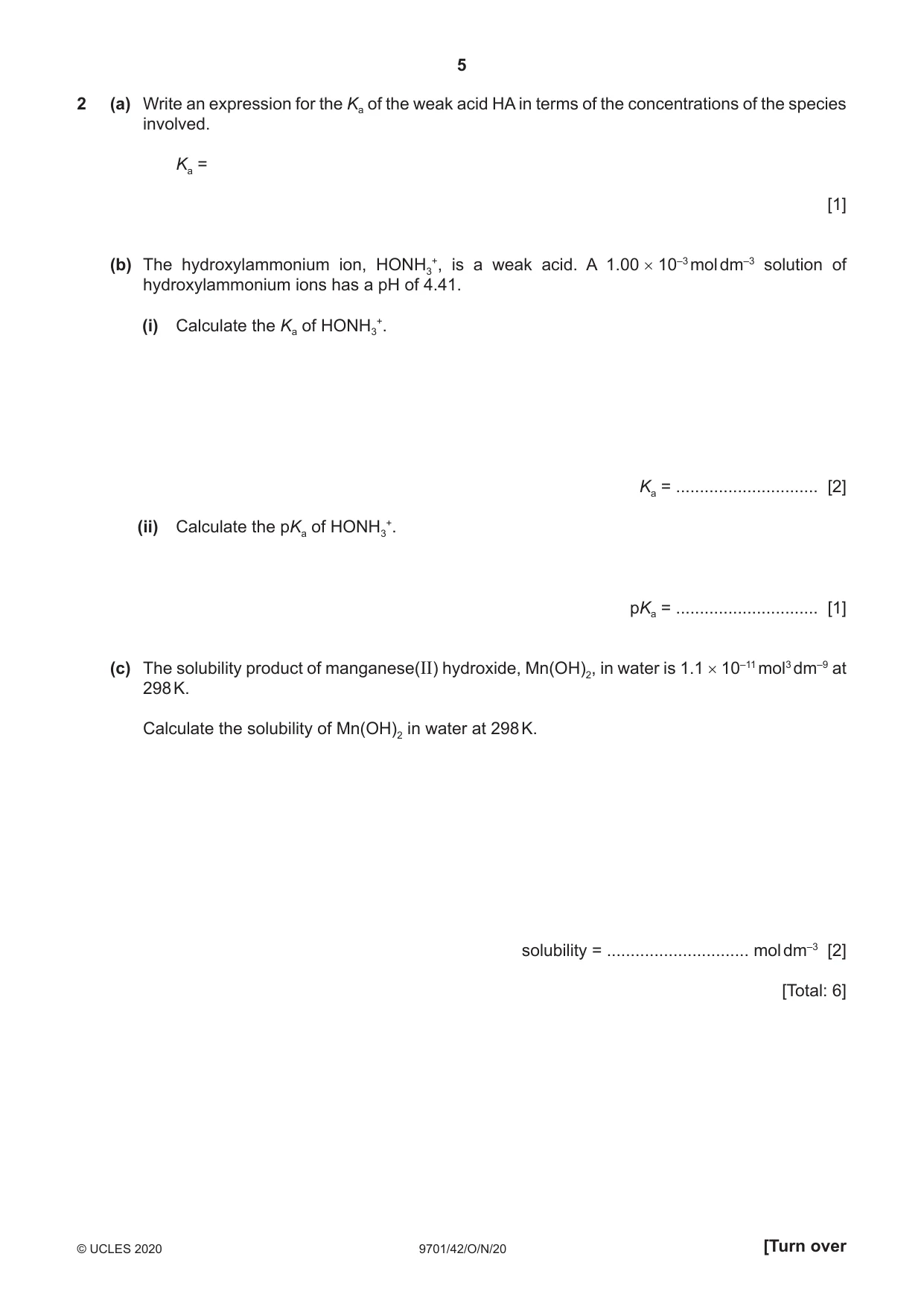
2 (a) Write an expression for the Ka of the weak acid HA in terms of the concentrations of the species involved. Ka = [1] (b) The hydroxylammonium ion, HONH3+, is a weak acid. A 1.00 × 10⁻³ mol dm–3 solution of hydroxylammonium ions has a pH of 4.41. (i) Calculate the Ka of HONH3+. Ka = .............................. [2] (ii) Calculate the pKa of HONH3+. pKa = .............................. [1] (c) The solubility product of manganese(II) hydroxide, Mn(OH)2, in water is 1.1 × 10⁻¹¹ mol3 dm–9 at 298 K. Calculate the solubility of Mn(OH)2 in water at 298 K. solubility = .............................. mol dm–3 [2] [Total: 6]
Mark scheme: 2(a) [H+][A–] / [HA] [1] 1 2(b)(i) [H+] = 3.9 × 10⁻⁵ [1] Ka = 1.5 × 10⁻⁶ [1] 2 2(b)(ii) 5.82 [1] 1 2(c) 4 × 3 = 1.1 × 10⁻¹¹ [1] x = 1.4 × 10⁻⁴ [1] 2
Q3 · The energy cycle shown can be used, along with suitable data, to calculate the enthalpy…
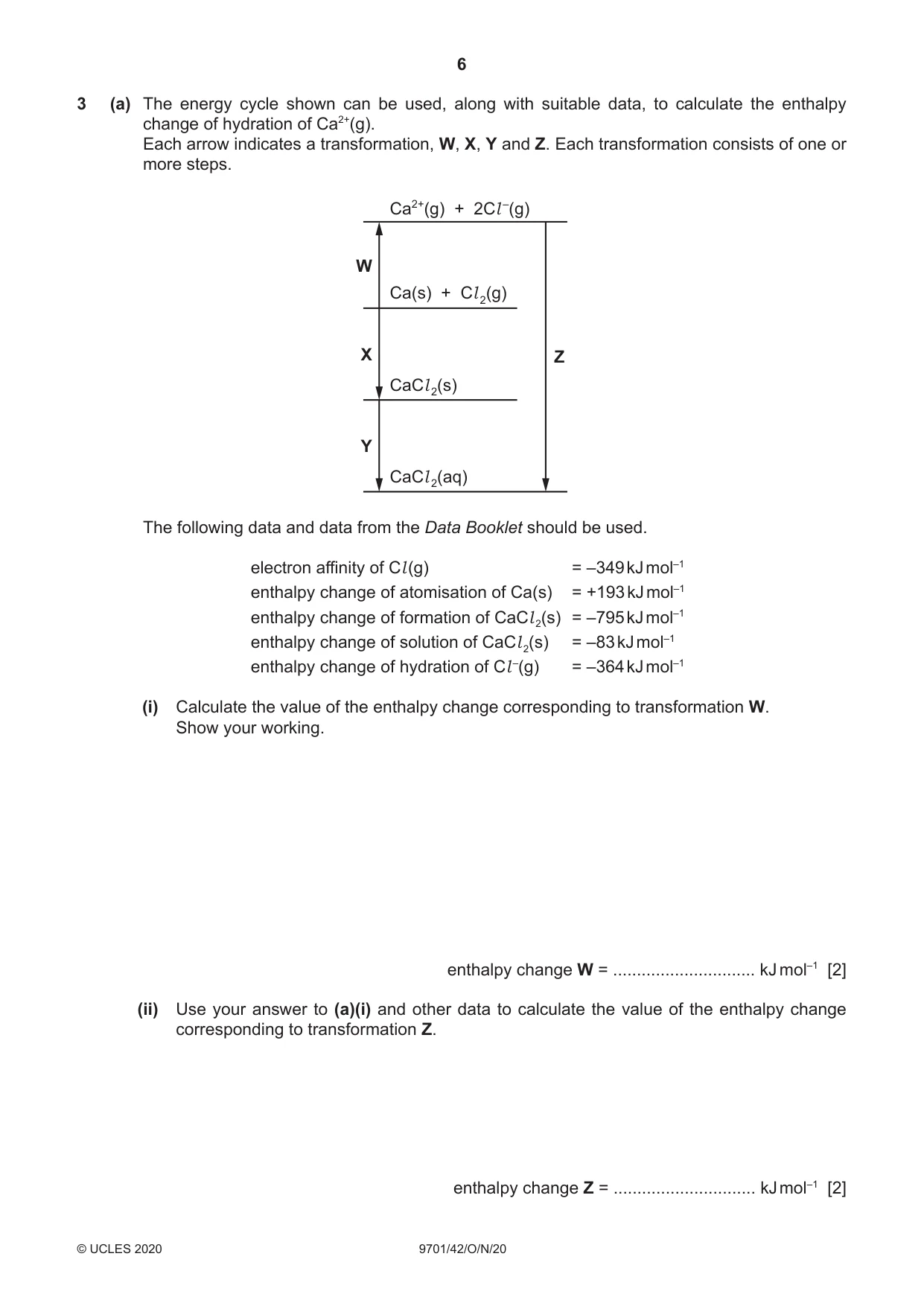
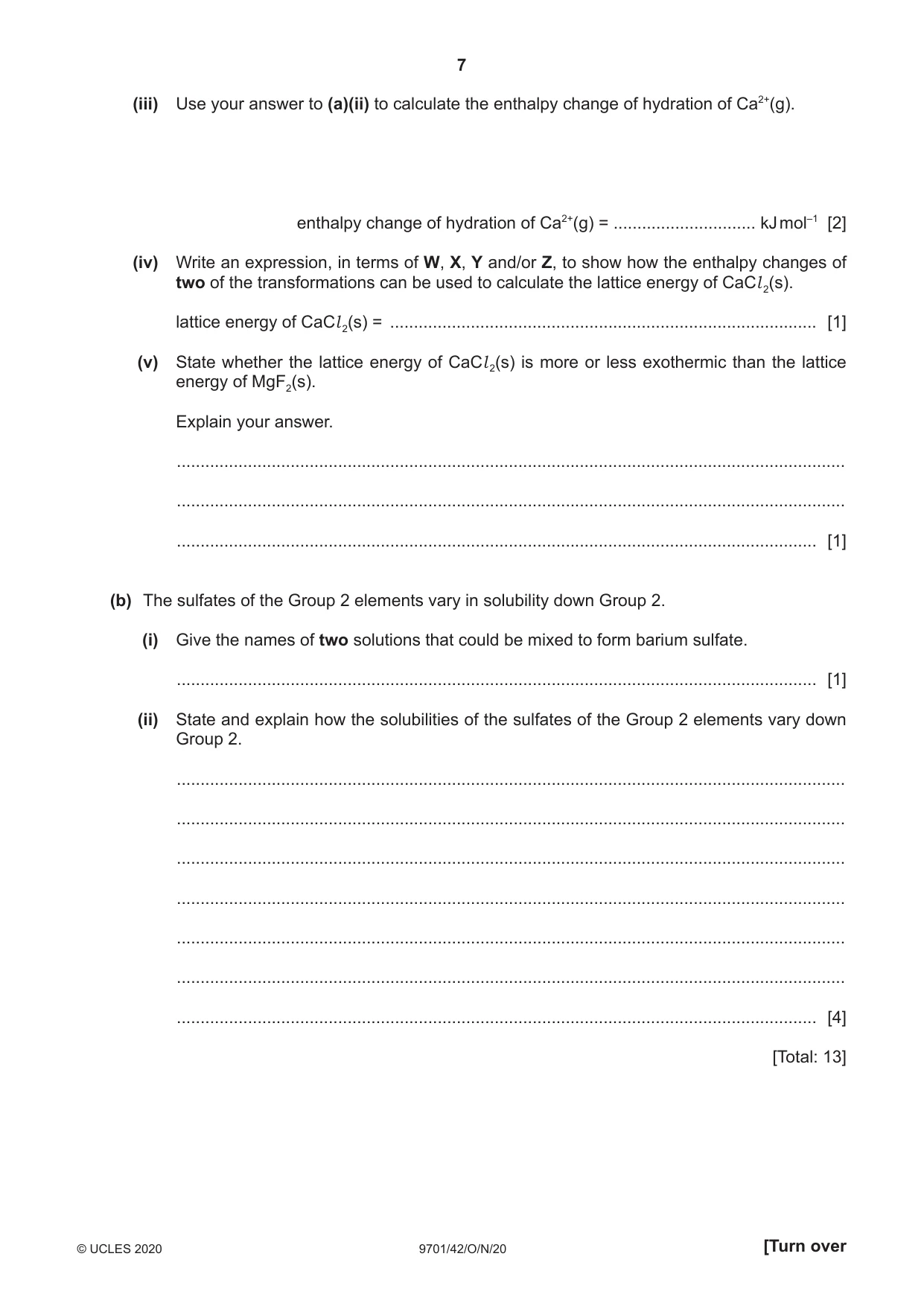
3 (a) The energy cycle shown can be used, along with suitable data, to calculate the enthalpy change of hydration of Ca2+(g). Each arrow indicates a transformation, W, X, Y and Z. Each transformation consists of one or more steps. Ca2+(g) + 2Cl –(g) W Ca(s) + Cl 2(g) X Z CaCl 2(s) Y CaCl 2(aq) The following data and data from the Data Booklet should be used. electron affinity of Cl (g) = –349 kJ mol–1 enthalpy change of atomisation of Ca(s) = +193 kJ mol–1 enthalpy change of formation of CaCl 2(s) = –795 kJ mol–1 enthalpy change of solution of CaCl 2(s) = –83 kJ mol–1 enthalpy change of hydration of Cl –(g) = –364 kJ mol–1 (i) Calculate the value of the enthalpy change corresponding to transformation W. Show your working. enthalpy change W = .............................. kJ mol–1 [2] (ii) Use your answer to (a)(i) and other data to calculate the value of the enthalpy change corresponding to transformation Z. enthalpy change Z = .............................. kJ mol–1 [2] (iii) Use your answer to (a)(ii) to calculate the enthalpy change of hydration of Ca2+(g). enthalpy change of hydration of Ca2+(g) = .............................. kJ mol–1 [2] (iv) Write an expression, in terms of W, X, Y and/or Z, to show how the enthalpy changes of two of the transformations can be used to calculate the lattice energy of CaCl 2(s). lattice energy of CaCl 2(s) = ........................................................................................... [1] (v) State whether the lattice energy of CaCl 2(s) is more or less exothermic than the lattice energy of MgF2(s). Explain your answer. ............................................................................................................................................. ............................................................................................................................................. ....................................................................................................................................... [1] (b) The sulfates of the Group 2 elements vary in solubility down Group 2. (i) Give the names of two solutions that could be mixed to form barium sulfate. ....................................................................................................................................... [1] (ii) State and explain how the solubilities of the sulfates of the Group 2 elements vary down Group 2. ............................................................................................................................................. ............................................................................................................................................. ............................................................................................................................................. ............................................................................................................................................. ............................................................................................................................................. ............................................................................................................................................. ....................................................................................................................................... [4] [Total: 13]
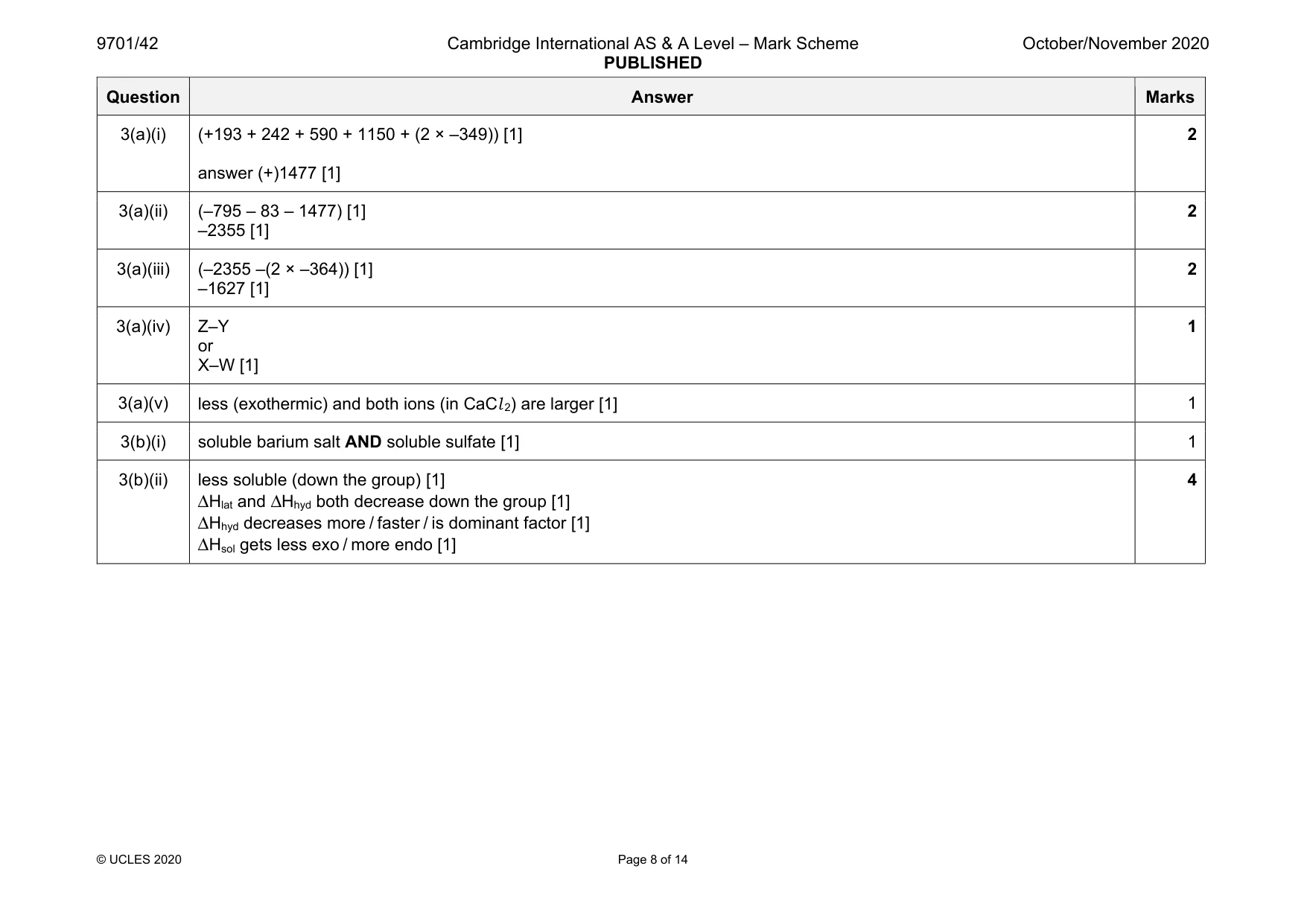
Mark scheme: 3(a)(i) (+193 + 242 + 590 + 1150 + (2 × –349)) [1] answer (+)1477 [1] 2 3(a)(ii) (–795 – 83 – 1477) [1] –2355 [1] 2 3(a)(iii) (–2355 –(2 × –364)) [1] –1627 [1] 2 3(a)(iv) Z–Y or X–W [1] 1 3(a)(v) less (exothermic) and both ions (in CaCl 2) are larger [1] 1 3(b)(i) soluble barium salt AND soluble sulfate [1] 1 3(b)(ii) less soluble (down the group) [1] ΔHlat and ΔHhyd both decrease down the group [1] ΔHhyd decreases more / faster / is dominant factor [1] ΔHsol gets less exo / more endo [1] 4
Q4 · Identify the substances liberated at the anode and at the cathode during the electrolysis…
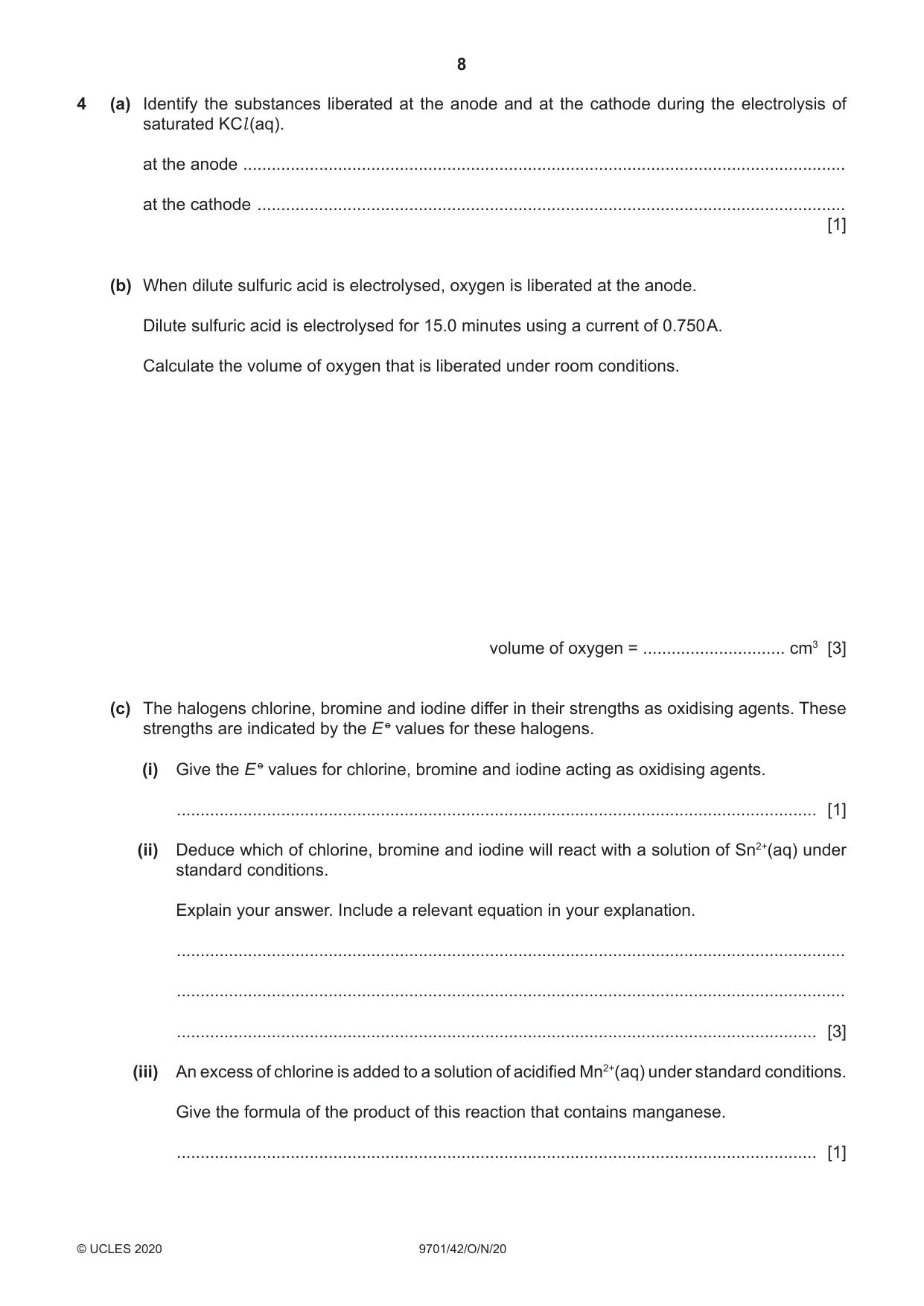
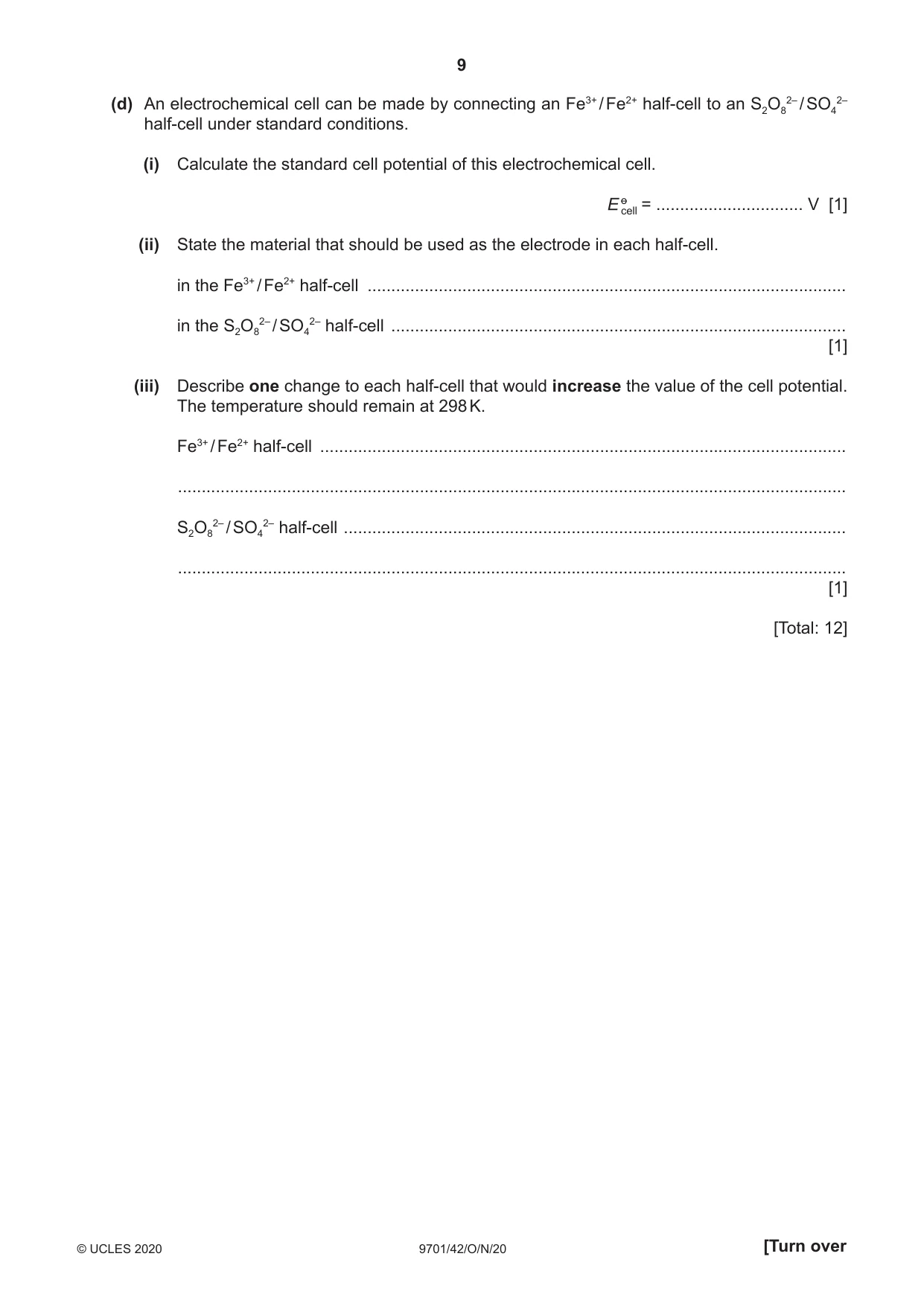
4 (a) Identify the substances liberated at the anode and at the cathode during the electrolysis of saturated KCl (aq). at the anode ............................................................................................................................... at the cathode ............................................................................................................................ [1] (b) When dilute sulfuric acid is electrolysed, oxygen is liberated at the anode. Dilute sulfuric acid is electrolysed for 15.0 minutes using a current of 0.750 A. Calculate the volume of oxygen that is liberated under room conditions. volume of oxygen = .............................. cm3 [3] (c) The halogens chlorine, bromine and iodine differ in their strengths as oxidising agents. These strengths are indicated by the E o values for these halogens. (i) Give the E o values for chlorine, bromine and iodine acting as oxidising agents. ....................................................................................................................................... [1] (ii) Deduce which of chlorine, bromine and iodine will react with a solution of Sn2+(aq) under standard conditions. Explain your answer. Include a relevant equation in your explanation. ............................................................................................................................................. ............................................................................................................................................. ....................................................................................................................................... [3] (iii) An excess of chlorine is added to a solution of acidified Mn2+(aq) under standard conditions. Give the formula of the product of this reaction that contains manganese. ....................................................................................................................................... [1] (d) An electrochemical cell can be made by connecting an Fe3+ / Fe2+ half-cell to an S2O82– / SO42– half-cell under standard conditions. (i) Calculate the standard cell potential of this electrochemical cell. = ............................... V [1] (ii) State the material that should be used as the electrode in each half-cell. in the Fe3+ / Fe2+ half-cell ...................................................................................................... in the S2O82– / SO42– half-cell ................................................................................................. [1] (iii) Describe one change to each half‑cell that would increase the value of the cell potential. The temperature should remain at 298 K. Fe3+ / Fe2+ half-cell ................................................................................................................ ............................................................................................................................................. S2O82– / SO42– half-cell .......................................................................................................... ............................................................................................................................................. [1] [Total: 12]
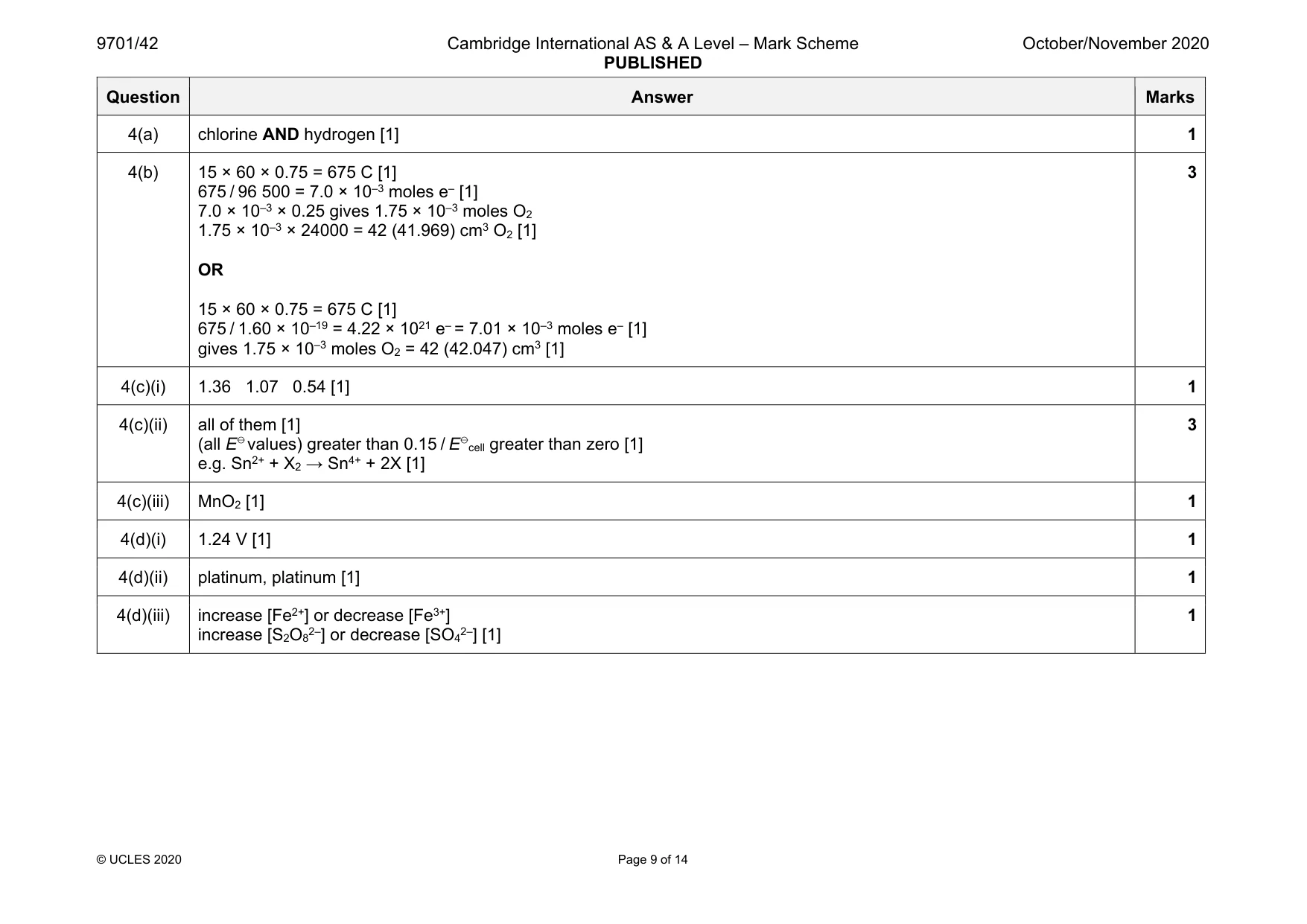
Mark scheme: 4(a) chlorine AND hydrogen [1] 1 4(b) 15 × 60 × 0.75 = 675 C [1] 675 / 96 500 = 7.0 × 10⁻³ moles e– [1] 7.0 × 10–3 × 0.25 gives 1.75 × 10⁻³ moles O2 1.75 × 10–3 × 24000 = 42 (41.969) cm3 O2 [1] OR 15 × 60 × 0.75 = 675 C [1] 675 / 1.60 × 10–19 = 4.22 × 10²¹ e– = 7.01 × 10⁻³ moles e– [1] gives 1.75 × 10⁻³ moles O2 = 42 (42.047) cm3 [1] 3 4(c)(i) 1.36 1.07 0.54 [1] 1 4(c)(ii) all of them [1] (all E ⦵ values) greater than 0.15 / E ⦵ cell greater than zero [1] e.g. Sn2+ + X2 → Sn4+ + 2X [1] 3 4(c)(iii) MnO2 [1] 1 4(d)(i) 1.24 V [1] 1 4(d)(ii) platinum, platinum [1] 1 4(d)(iii) increase [Fe2+] or decrease [Fe3+] increase [S2O82–] or decrease [SO42–] [1] 1
Q5 · Define the term transition element
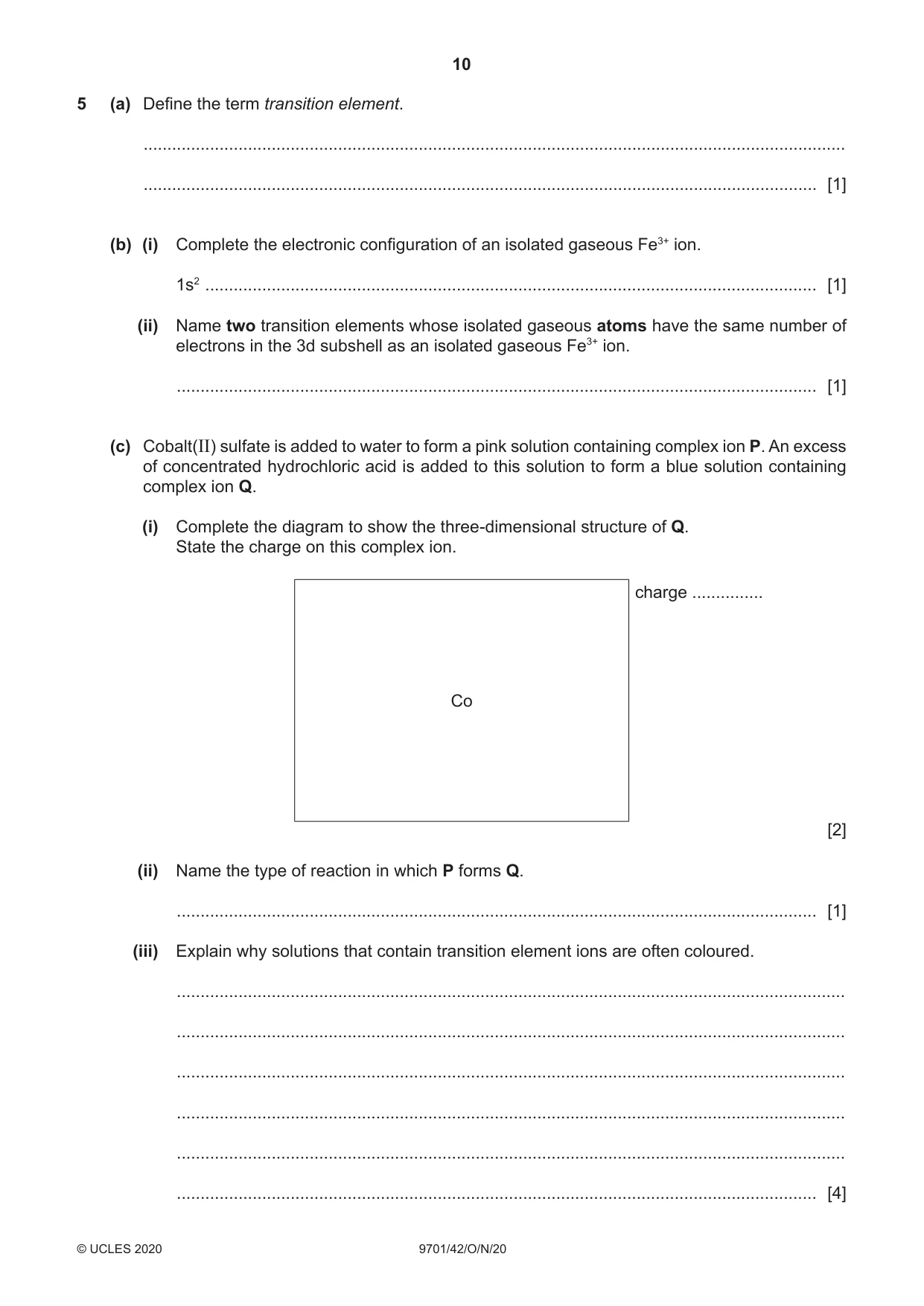
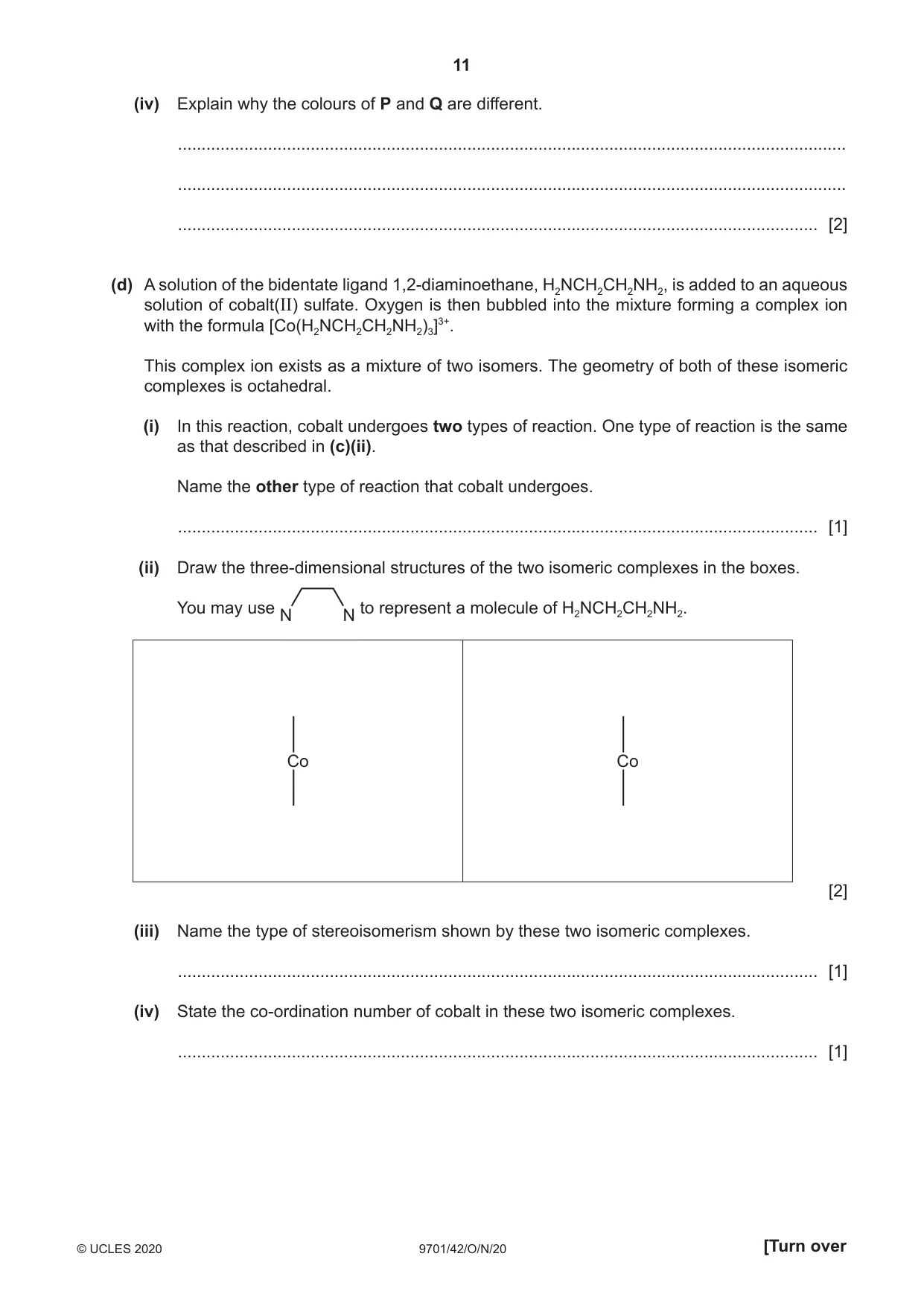
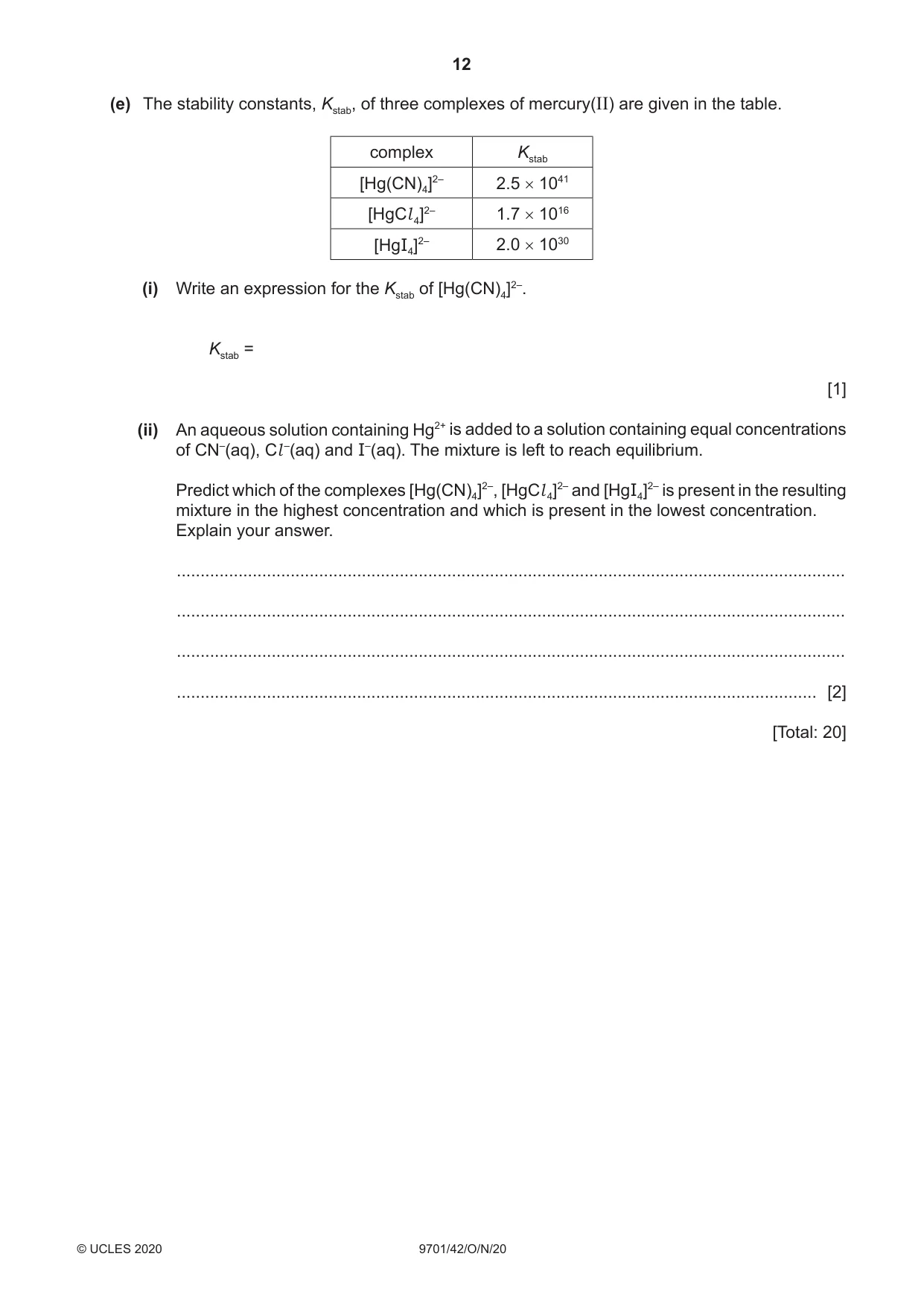
5 (a) Define the term transition element. .................................................................................................................................................... .............................................................................................................................................. [1] (b) (i) Complete the electronic configuration of an isolated gaseous Fe3+ ion. 1s2 ................................................................................................................................. [1] (ii) Name two transition elements whose isolated gaseous atoms have the same number of electrons in the 3d subshell as an isolated gaseous Fe3+ ion. ....................................................................................................................................... [1] (c) Cobalt(II) sulfate is added to water to form a pink solution containing complex ion P. An excess of concentrated hydrochloric acid is added to this solution to form a blue solution containing complex ion Q. (i) Complete the diagram to show the three-dimensional structure of Q. State the charge on this complex ion. charge ............... Co [2] (ii) Name the type of reaction in which P forms Q. ....................................................................................................................................... [1] (iii) Explain why solutions that contain transition element ions are often coloured. ............................................................................................................................................. ............................................................................................................................................. ............................................................................................................................................. ............................................................................................................................................. ............................................................................................................................................. ....................................................................................................................................... [4] (iv) Explain why the colours of P and Q are different. ............................................................................................................................................. ............................................................................................................................................. ....................................................................................................................................... [2] (d) A solution of the bidentate ligand 1,2‑diaminoethane, H2NCH2CH2NH2, is added to an aqueous solution of cobalt(II) sulfate. Oxygen is then bubbled into the mixture forming a complex ion with the formula [Co(H2NCH2CH2NH2)3]3+. This complex ion exists as a mixture of two isomers. The geometry of both of these isomeric complexes is octahedral. (i) In this reaction, cobalt undergoes two types of reaction. One type of reaction is the same as that described in (c)(ii). Name the other type of reaction that cobalt undergoes. ....................................................................................................................................... [1] (ii) Draw the three-dimensional structures of the two isomeric complexes in the boxes. You may use to represent a molecule of H2NCH2CH2NH2. N N Co Co [2] (iii) Name the type of stereoisomerism shown by these two isomeric complexes. ....................................................................................................................................... [1] (iv) State the co-ordination number of cobalt in these two isomeric complexes. ....................................................................................................................................... [1] (e) The stability constants, Kstab, of three complexes of mercury(II) are given in the table. complex Kstab [Hg(CN)4]2– 2.5 × 1041 [HgCl 4]2– 1.7 × 10¹⁶ [HgI4]2– 2.0 × 1030 (i) Write an expression for the Kstab of [Hg(CN)4]2–. Kstab = [1] (ii) An aqueous solution containing Hg2+ is added to a solution containing equal concentrations of CN–(aq), Cl –(aq) and I–(aq). The mixture is left to reach equilibrium. Predict which of the complexes [Hg(CN)4]2–, [HgCl 4]2– and [HgI4]2– is present in the resulting mixture in the highest concentration and which is present in the lowest concentration. Explain your answer. ............................................................................................................................................. ............................................................................................................................................. ............................................................................................................................................. ....................................................................................................................................... [2] [Total: 20]
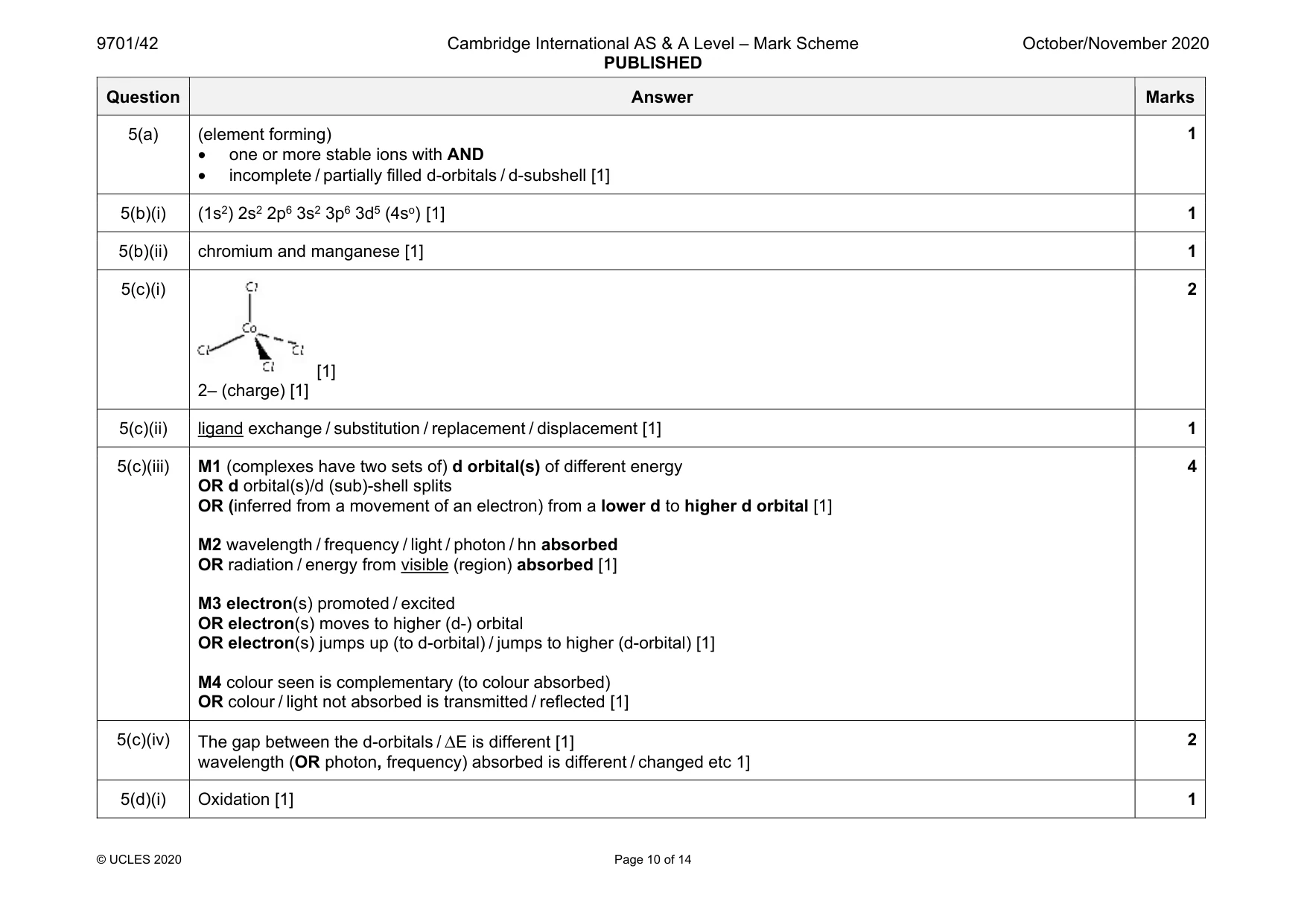
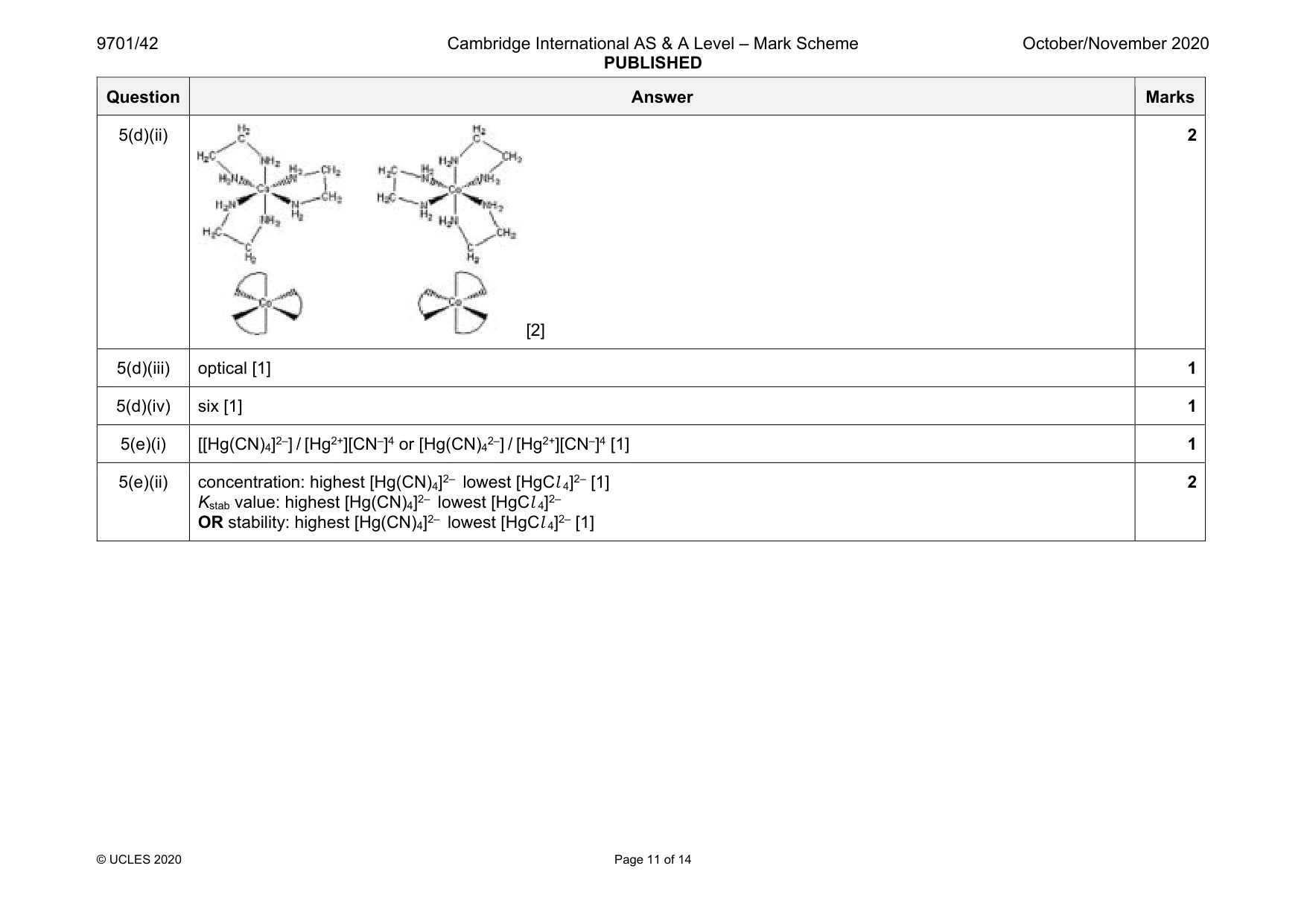
Mark scheme: 5(a) (element forming) • one or more stable ions with AND • incomplete / partially filled d-orbitals / d-subshell [1] 5(b)(i) (1s2) 2s2 2p6 3s2 3p6 3d5 (4so) [1] 1 5(b)(ii) chromium and manganese [1] 1 5(c)(i) [1] 2– (charge) [1] 2 5(c)(ii) ligand exchange / substitution / replacement / displacement [1] 1 5(c)(iii) M1 (complexes have two sets of) d orbital(s) of different energy OR d orbital(s)/d (sub)-shell splits OR (inferred from a movement of an electron) from a lower d to higher d orbital [1] M2 wavelength / frequency / light / photon / hn absorbed OR radiation / energy from visible (region) absorbed [1] M3 electron(s) promoted / excited OR electron(s) moves to higher (d-) orbital OR electron(s) jumps up (to d-orbital) / jumps to higher (d-orbital) [1] M4 colour seen is complementary (to colour absorbed) OR colour / light not absorbed is transmitted / reflected [1] 4 5(c)(iv) The gap between the d-orbitals / ΔE is different [1] wavelength (OR photon, frequency) absorbed is different / changed etc 1] 2 5(d)(i) Oxidation [1] 1 Question Answer Marks 5(d)(ii) [2] 2 5(d)(iii) optical [1] 1 5(d)(iv) six [1] 1 5(e)(i) [[Hg(CN)4]2–] / [Hg2+][CN–]4 or [Hg(CN)42–] / [Hg2+][CN–]4 [1] 1 5(e)(ii) concentration: highest [Hg(CN)4]2– lowest [HgCl 4]2– [1] Kstab value: highest [Hg(CN)4]2– lowest [HgCl 4]2– OR stability: highest [Hg(CN)4]2– lowest [HgCl 4]2– [1] 2
Q6 · Ethanoic acid, CH3CO2H and trichloroethanoic acid, CCl 3CO2H, are both carboxylic acids
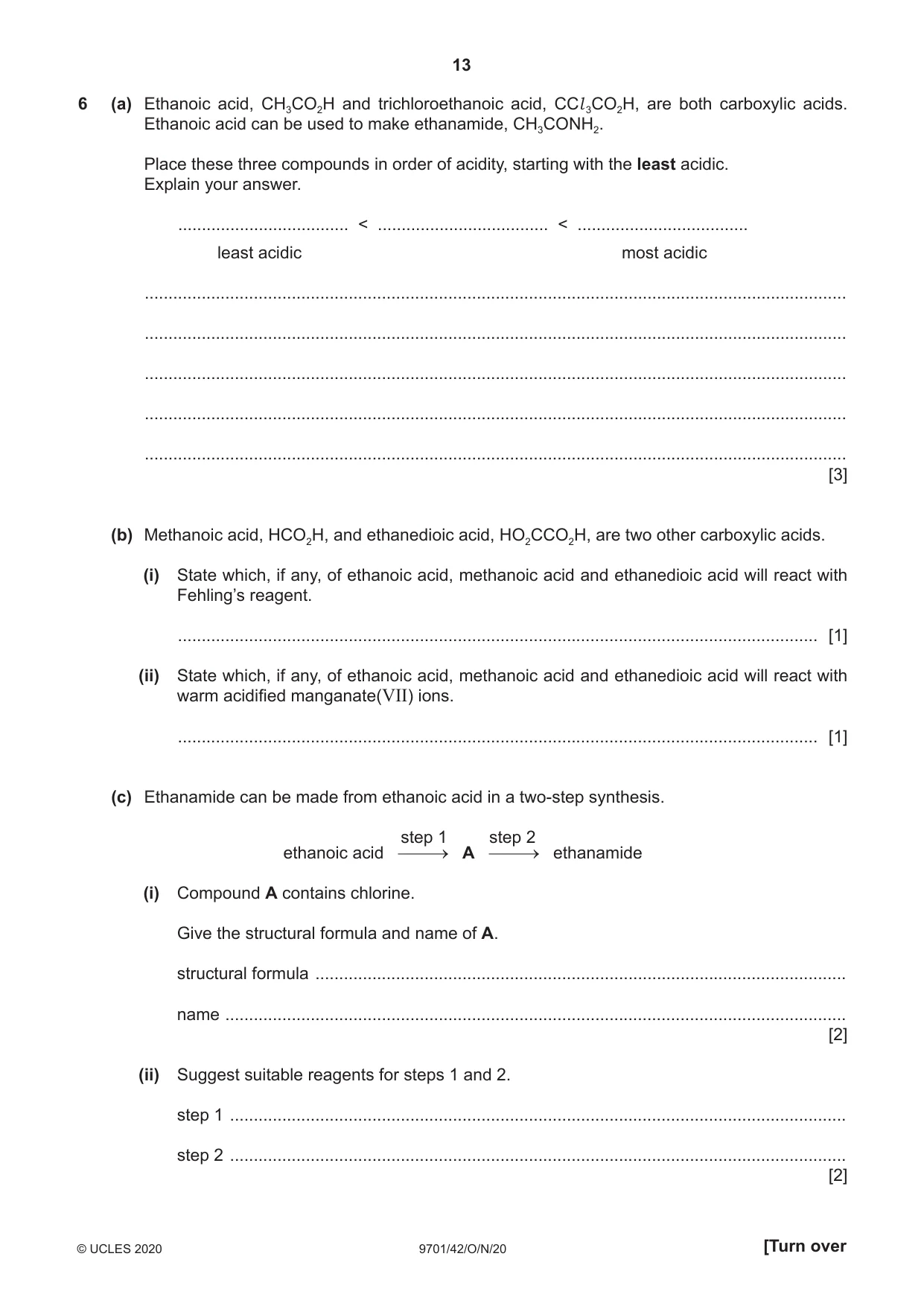
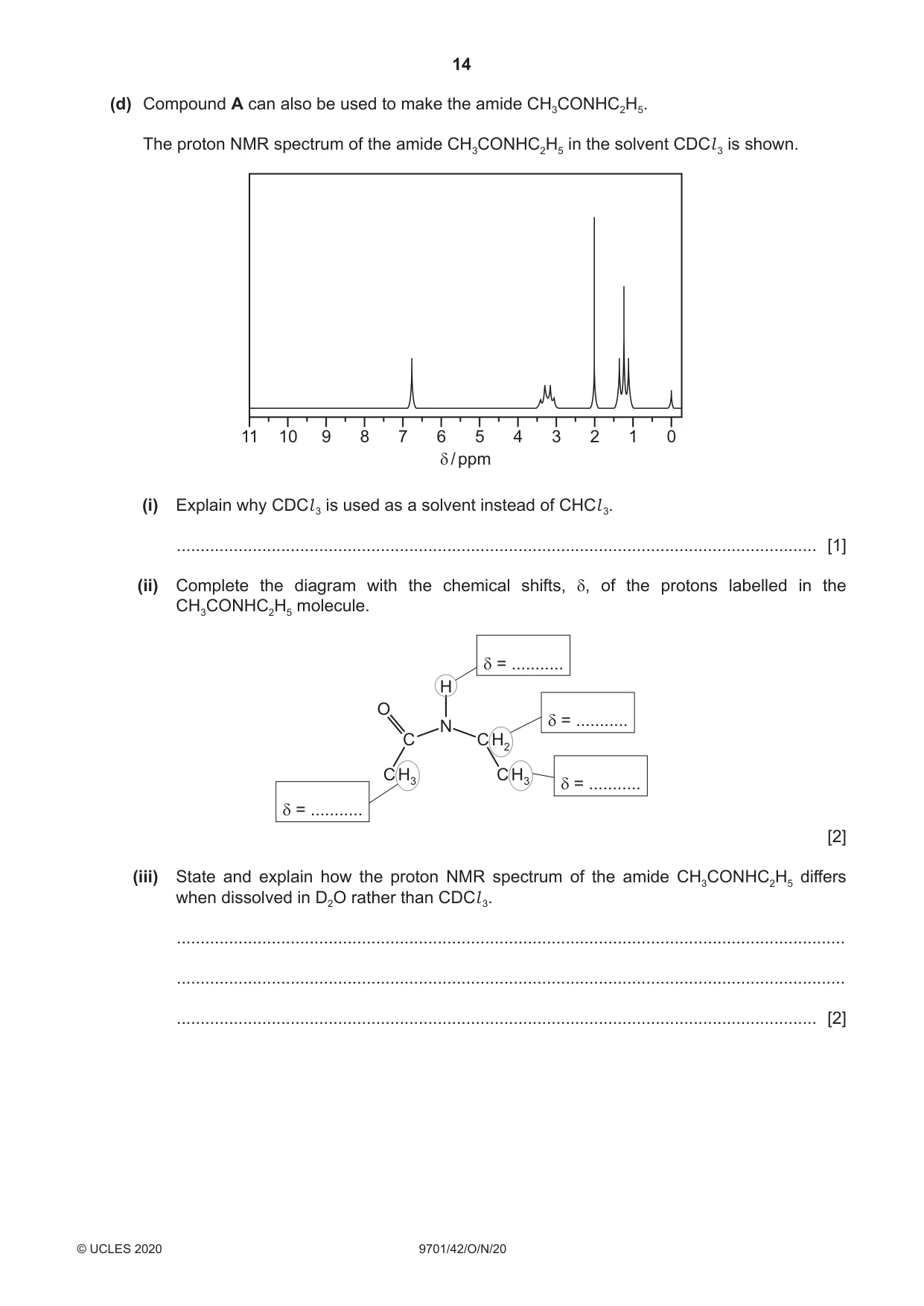
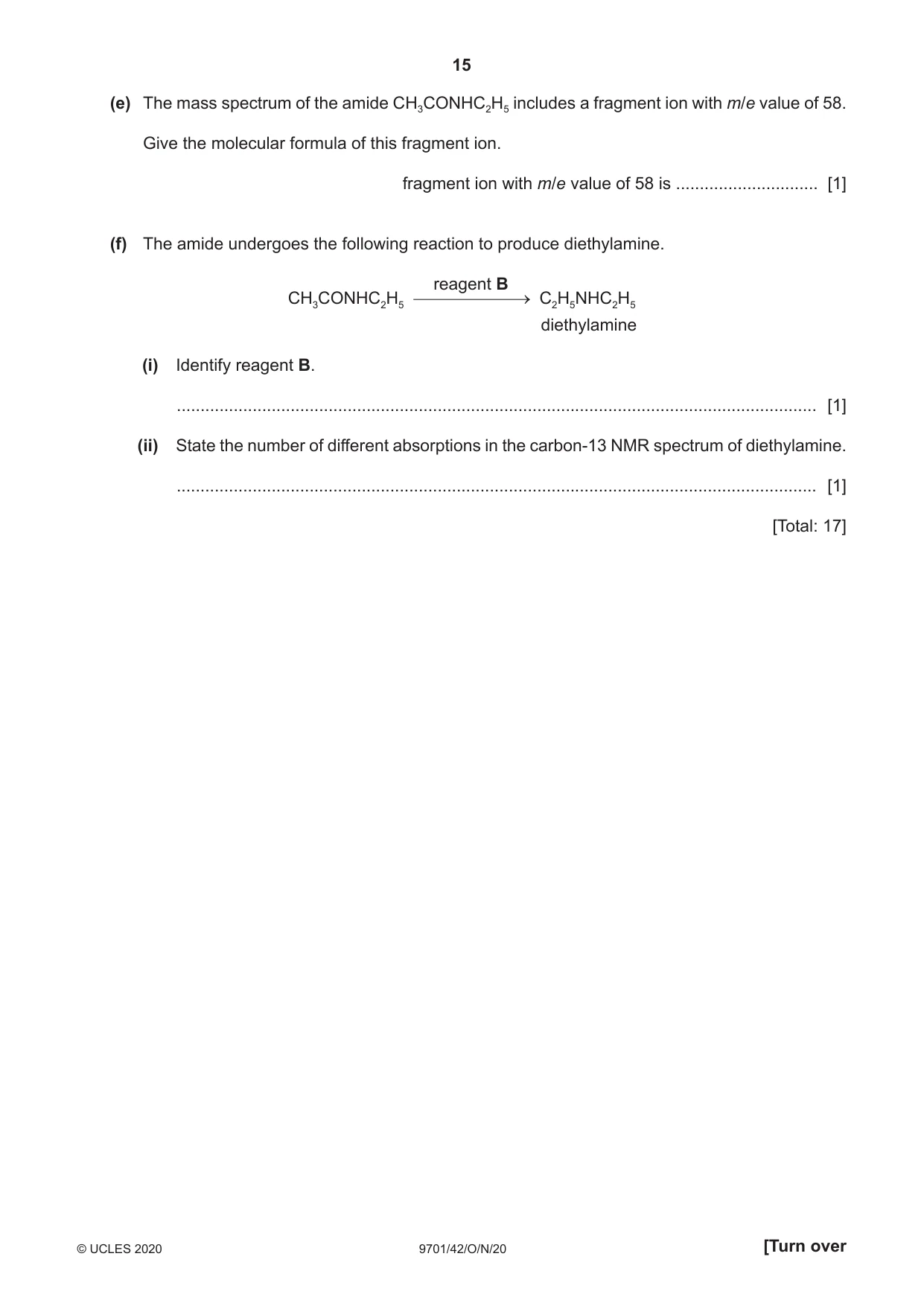
6 (a) Ethanoic acid, CH3CO2H and trichloroethanoic acid, CCl 3CO2H, are both carboxylic acids. Ethanoic acid can be used to make ethanamide, CH3CONH2. Place these three compounds in order of acidity, starting with the least acidic. Explain your answer. .................................... < .................................... < .................................... least acidic most acidic .................................................................................................................................................... .................................................................................................................................................... .................................................................................................................................................... .................................................................................................................................................... .................................................................................................................................................... [3] (b) Methanoic acid, HCO2H, and ethanedioic acid, HO2CCO2H, are two other carboxylic acids. (i) State which, if any, of ethanoic acid, methanoic acid and ethanedioic acid will react with Fehling’s reagent. ....................................................................................................................................... [1] (ii) State which, if any, of ethanoic acid, methanoic acid and ethanedioic acid will react with warm acidified manganate(VII) ions. ....................................................................................................................................... [1] (c) Ethanamide can be made from ethanoic acid in a two-step synthesis. step 1 step 2 ethanoic acid A ethanamide (i) Compound A contains chlorine. Give the structural formula and name of A. structural formula ................................................................................................................ name ................................................................................................................................... [2] (ii) Suggest suitable reagents for steps 1 and 2. step 1 .................................................................................................................................. step 2 .................................................................................................................................. [2] (d) Compound A can also be used to make the amide CH3CONHC2H5. The proton NMR spectrum of the amide CH3CONHC2H5 in the solvent CDCl 3 is shown. 11 10 9 8 7 6 5 4 3 2 1 0 δ / ppm (i) Explain why CDCl 3 is used as a solvent instead of CHCl 3. ....................................................................................................................................... [1] (ii) Complete the diagram with the chemical shifts, δ, of the protons labelled in the CH3CONHC2H5 molecule. = ........... H O = ........... N C C H2 C H3 C H3 = ........... = ........... [2] (iii) State and explain how the proton NMR spectrum of the amide CH3CONHC2H5 differs when dissolved in D2O rather than CDCl 3. ............................................................................................................................................. ............................................................................................................................................. ....................................................................................................................................... [2] (f) The amide undergoes the following reaction to produce diethylamine. reagent B CH3CONHC2H5 C2H5NHC2H5 diethylamine (i) Identify reagent B. ....................................................................................................................................... [1] (ii) State the number of different absorptions in the carbon‑13 NMR spectrum of diethylamine. ....................................................................................................................................... [1] [Total: 17]
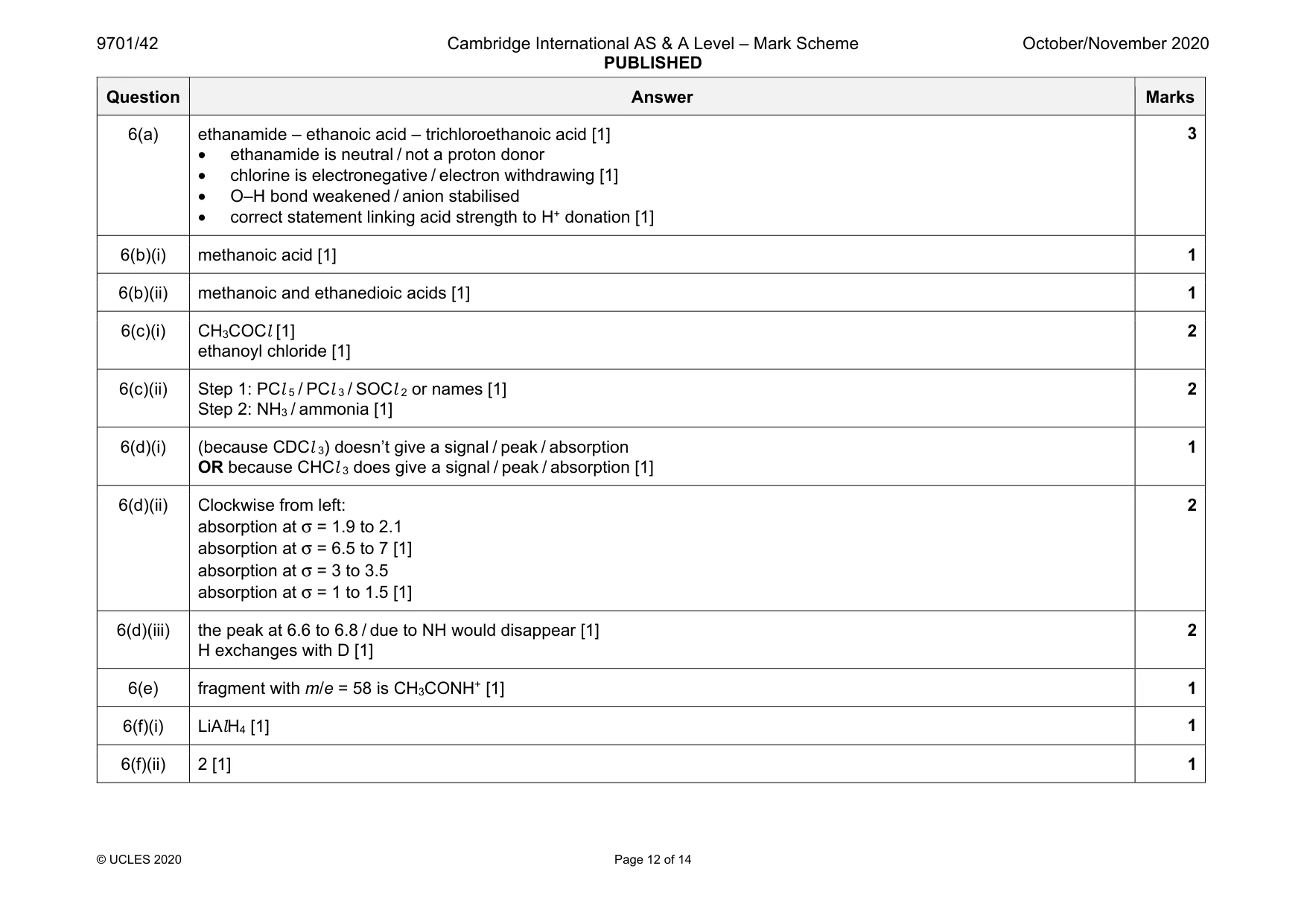
Mark scheme: 6(a) ethanamide – ethanoic acid – trichloroethanoic acid [1] • ethanamide is neutral / not a proton donor • chlorine is electronegative / electron withdrawing [1] • O–H bond weakened / anion stabilised • correct statement linking acid strength to H+ donation [1] 6(b)(i) methanoic acid [1] 1 6(b)(ii) methanoic and ethanedioic acids [1] 1 6(c)(i) CH3COCl [1] ethanoyl chloride [1] 2 6(c)(ii) Step 1: PCl 5 / PCl 3 / SOCl 2 or names [1] Step 2: NH3 / ammonia [1] 2 6(d)(i) (because CDCl 3) doesn’t give a signal / peak / absorption OR because CHCl 3 does give a signal / peak / absorption [1] 1 6(d)(ii) Clockwise from left: absorption at σ = 1.9 to 2.1 absorption at σ = 6.5 to 7 [1] absorption at σ = 3 to 3.5 absorption at σ = 1 to 1.5 [1] 2 6(d)(iii) the peak at 6.6 to 6.8 / due to NH would disappear [1] H exchanges with D [1] 2 6(e) fragment with m/e = 58 is CH3CONH+ [1] 1 6(f)(i) LiAlH4 [1] 1 6(f)(ii) 2 [1] 1
Q7 · Describe the structure of a benzene molecule, C6H6
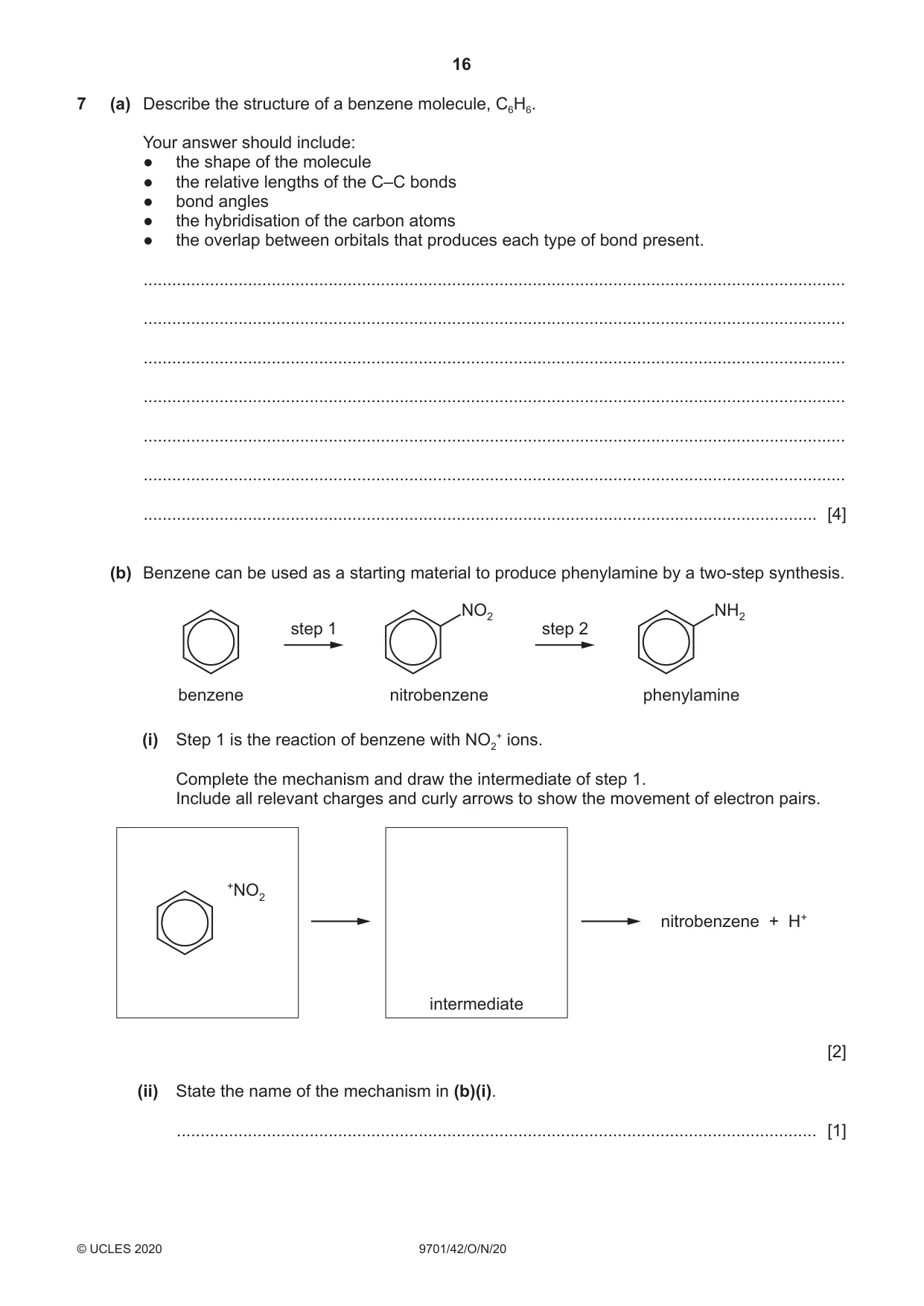
7 (a) Describe the structure of a benzene molecule, C6H6. Your answer should include: ● the shape of the molecule ● the relative lengths of the C–C bonds ● bond angles ● the hybridisation of the carbon atoms ● the overlap between orbitals that produces each type of bond present. .................................................................................................................................................... .................................................................................................................................................... .................................................................................................................................................... .................................................................................................................................................... .................................................................................................................................................... .................................................................................................................................................... .............................................................................................................................................. [4] (b) Benzene can be used as a starting material to produce phenylamine by a two-step synthesis. NO2 NH2 step 1 step 2 benzene nitrobenzene phenylamine (i) Step 1 is the reaction of benzene with NO2+ ions. Complete the mechanism and draw the intermediate of step 1. Include all relevant charges and curly arrows to show the movement of electron pairs. +NO2 nitrobenzene + H+ intermediate [2] (ii) State the name of the mechanism in (b)(i). ....................................................................................................................................... [1] (iii) Identify the reagents needed to produce NO2+ ions. Write an equation to explain how these reagents produce NO2+ ions. ............................................................................................................................................. ............................................................................................................................................. ....................................................................................................................................... [2] (iv) Give reagents and conditions for the production of phenylamine from nitrobenzene in step 2. ............................................................................................................................................. ....................................................................................................................................... [2] (c) Phenylamine reacts with Br2(aq). (i) Write an equation for this reaction. You may use structural or displayed formulae. ....................................................................................................................................... [1] (ii) Name the organic product of this reaction. ....................................................................................................................................... [1] (iii) Describe two observations that can be seen when phenylamine reacts with Br2(aq). observation 1 ....................................................................................................................... observation 2 ....................................................................................................................... [1] (d) Describe the relative basicities of ammonia, ethylamine and phenylamine, starting with the least basic. Explain your answer in terms of their structures. .................................... < .................................... < .................................... least basic most basic .................................................................................................................................................... .................................................................................................................................................... .................................................................................................................................................... .................................................................................................................................................... [3] (e) 1,3‑diaminopropane, H2NCH2CH2CH2NH2, can be used to make polyamides. (i) Identify one compound that would react with 1,3‑diaminopropane to form a polyamide. ....................................................................................................................................... [1] (ii) Draw a section of the polymer chain formed from 1,3‑diaminopropane and the compound you chose in (e)(i). Your answer should: ● include four monomer residues (two of each type of monomer) ● show the amide link fully displayed ● clearly identify one repeat unit of this polymer. [2] [Total: 20]
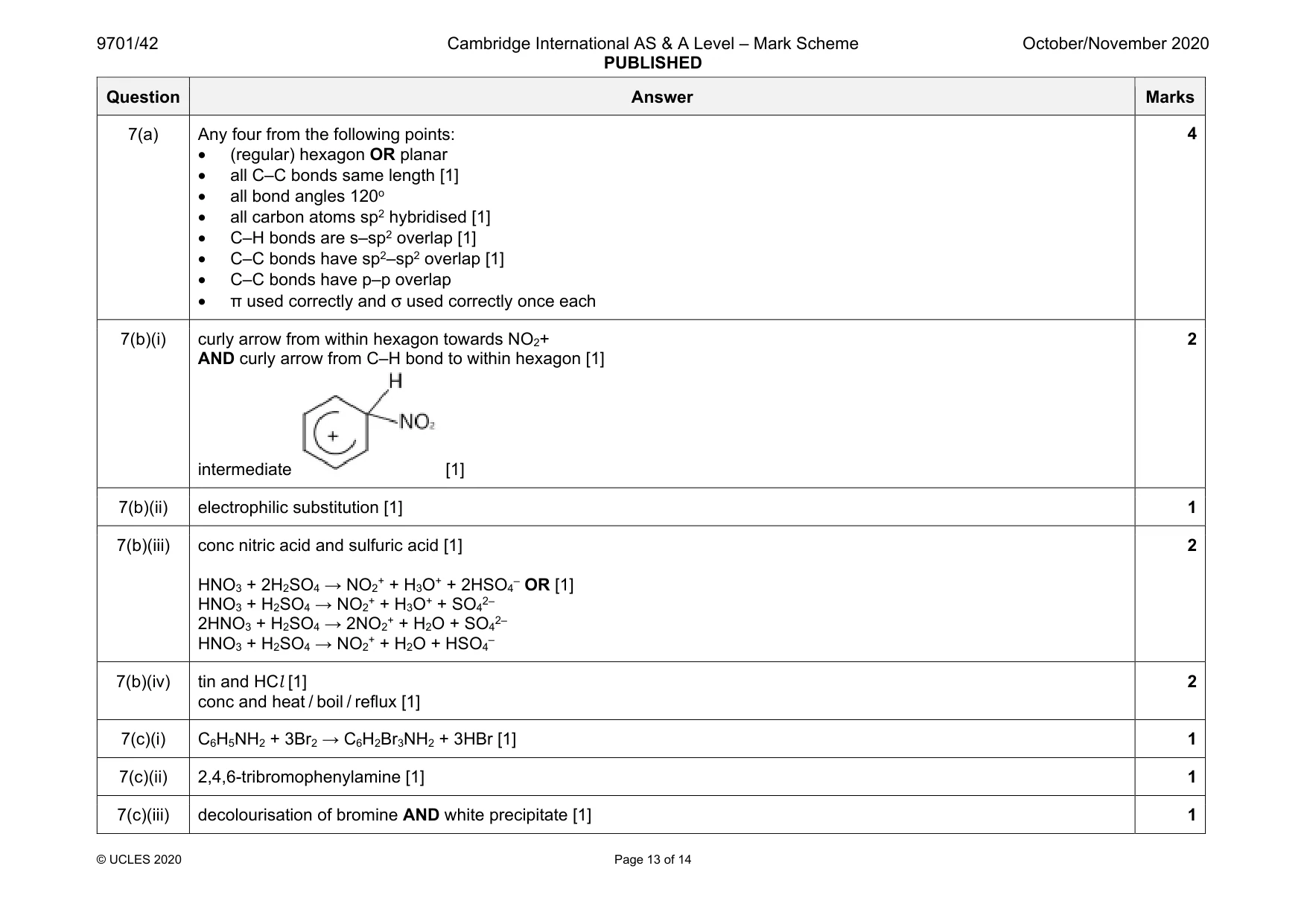
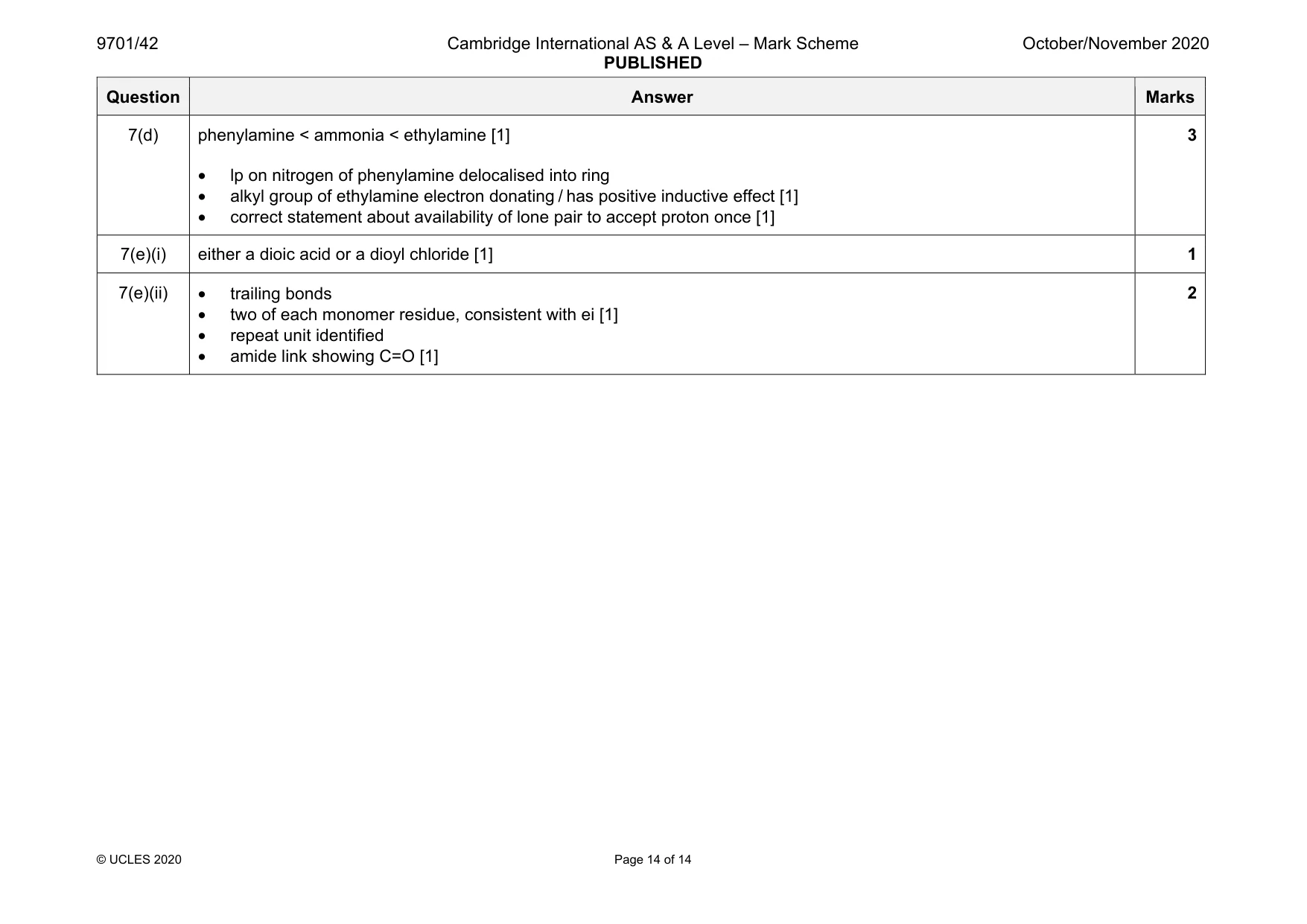
Mark scheme: 7(a) Any four from the following points: • (regular) hexagon OR planar • all C–C bonds same length [1] • all bond angles 120o • all carbon atoms sp2 hybridised [1] • C–H bonds are s–sp2 overlap [1] • C–C bonds have sp2–sp2 overlap [1] • C–C bonds have p–p overlap • π used correctly and σ used correctly once each 7(b)(i) curly arrow from within hexagon towards NO2+ AND curly arrow from C–H bond to within hexagon [1] intermediate [1] 2 7(b)(ii) electrophilic substitution [1] 1 7(b)(iii) conc nitric acid and sulfuric acid [1] HNO3 + 2H2SO4 → NO2+ + H3O+ + 2HSO4– OR [1] HNO3 + H2SO4 → NO2+ + H3O+ + SO42– 2HNO3 + H2SO4 → 2NO2+ + H2O + SO42– HNO3 + H2SO4 → NO2+ + H2O + HSO4– 2 7(b)(iv) tin and HCl [1] conc and heat / boil / reflux [1] 2 7(c)(i) C6H5NH2 + 3Br2 → C6H2Br3NH2 + 3HBr [1] 1 7(c)(ii) 2,4,6-tribromophenylamine [1] 1 7(c)(iii) decolourisation of bromine AND white precipitate [1] 1 Question Answer Marks 7(d) phenylamine < ammonia < ethylamine [1] • lp on nitrogen of phenylamine delocalised into ring • alkyl group of ethylamine electron donating / has positive inductive effect [1] • correct statement about availability of lone pair to accept proton once [1] 3 7(e)(i) either a dioic acid or a dioyl chloride [1] 1 7(e)(ii) • trailing bonds • two of each monomer residue, consistent with ei [1] • repeat unit identified • amide link showing C=O [1] 2
What was in this paper
The subtopics covered by these 7 questions, and how many questions each got. Open one in a new tab to see every Cambridge question on it.
What you needed in this session
Cambridge’s own grade thresholds for 2020 Oct/Nov, Paper 4 · Variant 2. A higher threshold means an easier paper — the bar moves with how the cohort did.