Cambridge A Level Chemistry 9701 — 2020 Oct/Nov Paper 4 · Variant 1
9701/41/O/N/20 · 10 questions · 100 marks · ≈113 min
The question paper and its mark scheme, free to read here and free to download. This is Cambridge’s own paper, exactly as it was sat.
Question paper24 pages


Mark scheme15 pages
Answers below. Sit the paper first if you are practising.
Questions as text
Q1 · Nitrogen monoxide, NO, reacts with oxygen to form nitrogen dioxide, NO2
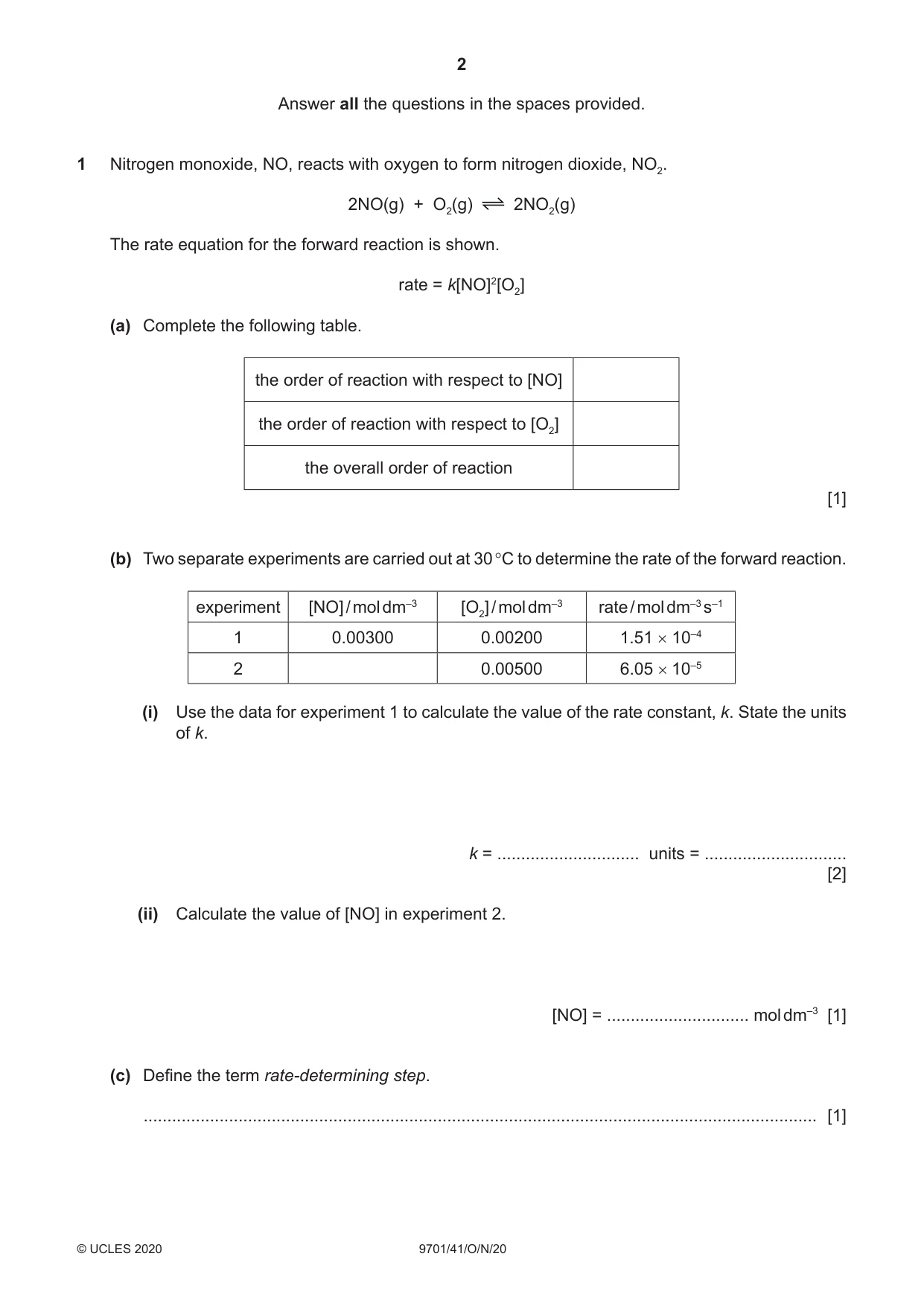
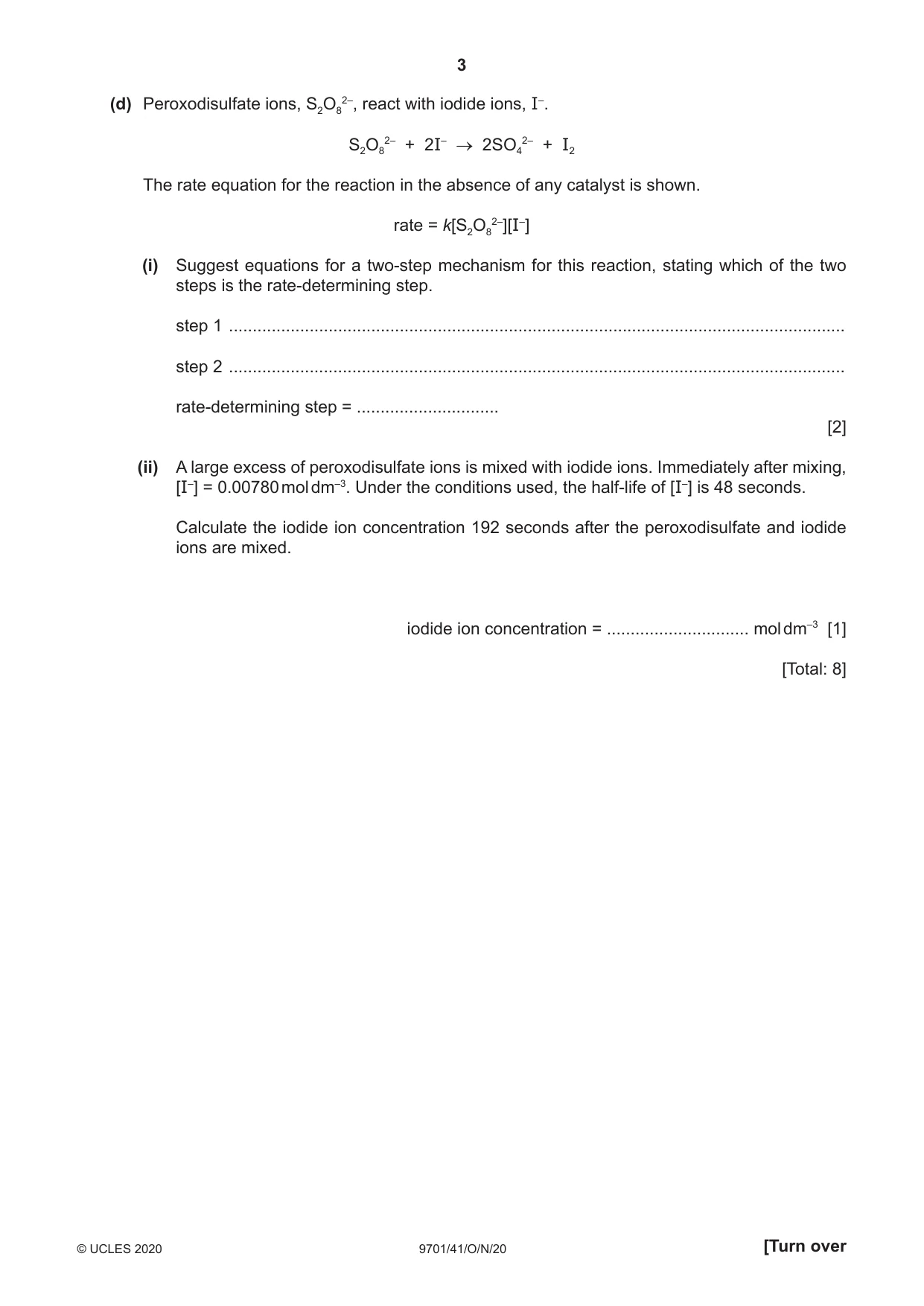
1 Nitrogen monoxide, NO, reacts with oxygen to form nitrogen dioxide, NO2. 2NO(g) + O2(g) 2NO2(g) The rate equation for the forward reaction is shown. rate = k[NO]2[O2] (a) Complete the following table. the order of reaction with respect to [NO] the order of reaction with respect to [O2] the overall order of reaction [1] (b) Two separate experiments are carried out at 30 °C to determine the rate of the forward reaction. experiment [NO] / mol dm–3 [O2] / mol dm–3 rate / mol dm–3 s–1 1 0.00300 0.00200 1.51 × 10⁻⁴ 2 0.00500 6.05 × 10⁻⁵ (i) Use the data for experiment 1 to calculate the value of the rate constant, k. State the units of k. k = .............................. units = .............................. [2] (ii) Calculate the value of [NO] in experiment 2. [NO] = .............................. mol dm–3 [1] (c) Define the term rate-determining step. .............................................................................................................................................. [1] (d) Peroxodisulfate ions, S2O82–, react with iodide ions, I–. S2O82– + 2I– → 2SO42– + I2 The rate equation for the reaction in the absence of any catalyst is shown. rate = k[S2O82–][I–] (i) Suggest equations for a two-step mechanism for this reaction, stating which of the two steps is the rate-determining step. step 1 .................................................................................................................................. step 2 .................................................................................................................................. rate-determining step = .............................. [2] (ii) A large excess of peroxodisulfate ions is mixed with iodide ions. Immediately after mixing, [I–] = 0.00780 mol dm–3. Under the conditions used, the half-life of [I–] is 48 seconds. Calculate the iodide ion concentration 192 seconds after the peroxodisulfate and iodide ions are mixed. iodide ion concentration = .............................. mol dm–3 [1] [Total: 8]
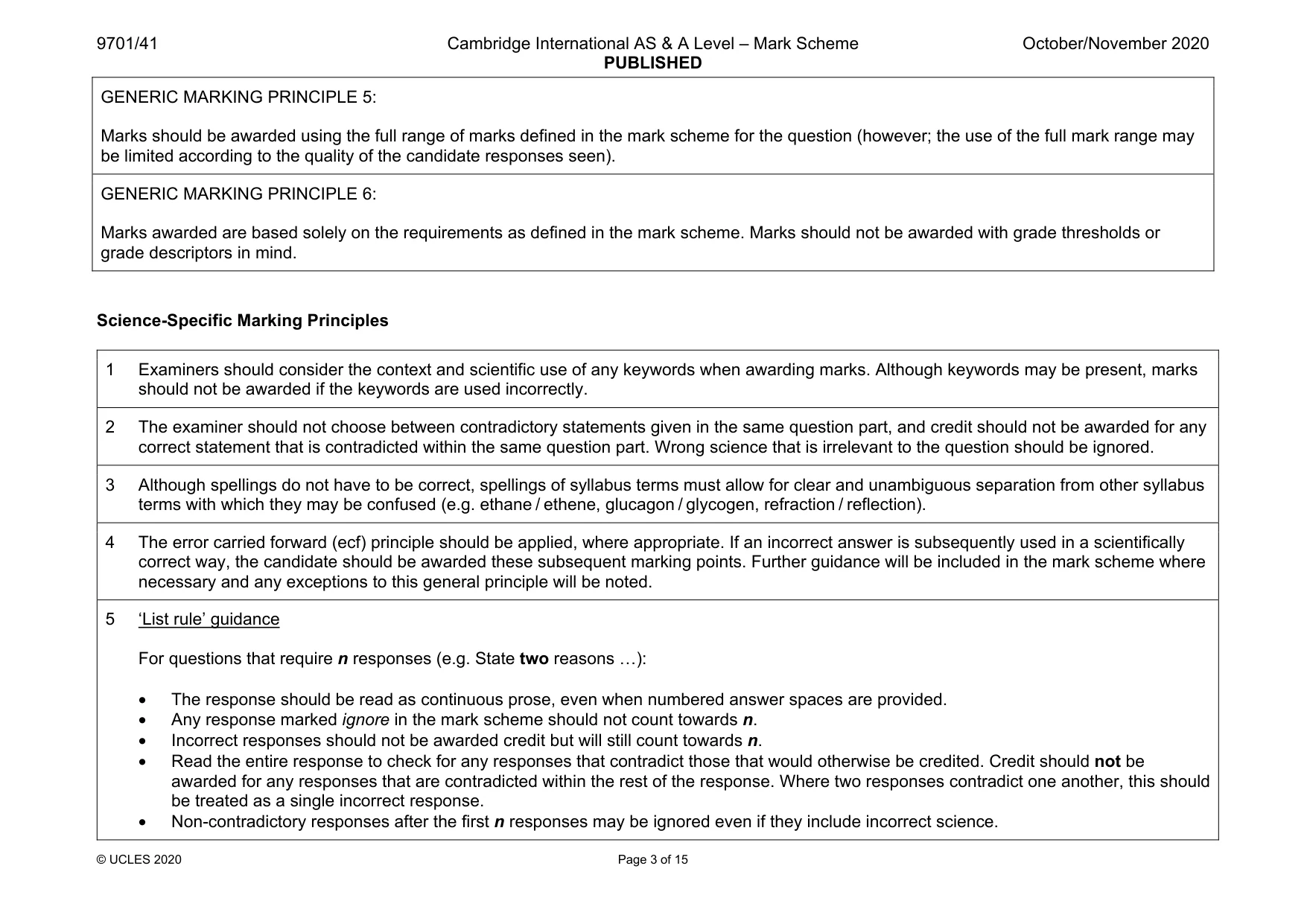
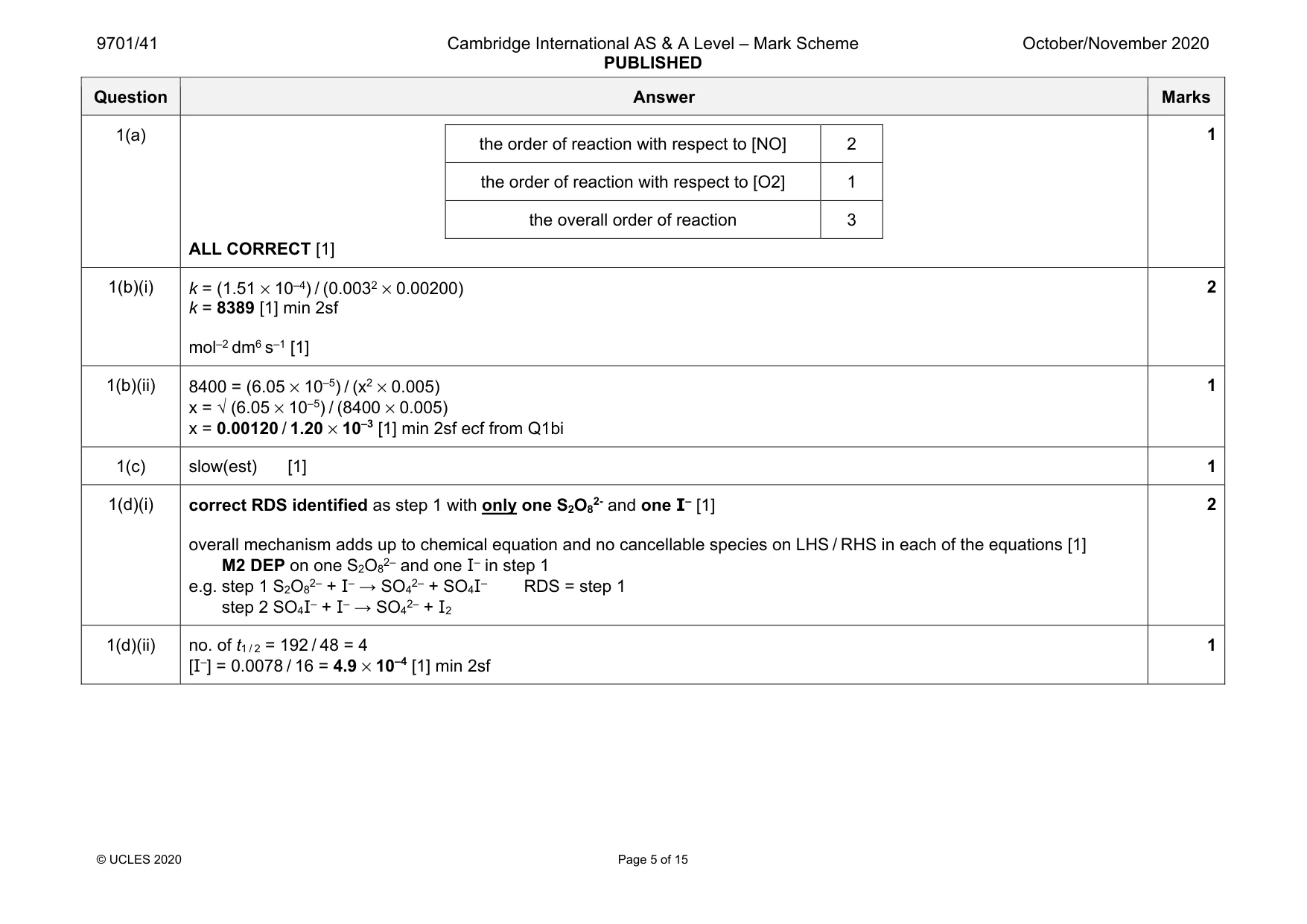
Mark scheme: 1(a) the order of reaction with respect to [NO] 2 the order of reaction with respect to [O2] 1 the overall order of reaction 3 ALL CORRECT [1] 1(b)(i) k = (1.51 × 10⁻⁴) / (0.0032 × 0.00200) k = 8389 [1] min 2sf mol–2 dm6 s–1 [1] 2 1(b)(ii) 8400 = (6.05 × 10⁻⁵) / (x2 × 0.005) x = √ (6.05 × 10⁻⁵) / (8400 × 0.005) x = 0.00120 / 1.20 × 10⁻³ [1] min 2sf ecf from Q1bi 1 1(c) slow(est) [1] 1 1(d)(i) correct RDS identified as step 1 with only one S2O82- and one I– [1] overall mechanism adds up to chemical equation and no cancellable species on LHS / RHS in each of the equations [1] M2 DEP on one S2O82– and one I– in step 1 e.g. step 1 S2O82– + I– → SO42– + SO4I– RDS = step 1 step 2 SO4I– + I– → SO42– + I2 2 1(d)(ii) no. of t1 / 2 = 192 / 48 = 4 [I–] = 0.0078 / 16 = 4.9 × 10⁻⁴ [1] min 2sf 1
More questions on Simple rate equations, orders of reaction and rate constants
Q2 · The lattice energies of three ionic compounds are given
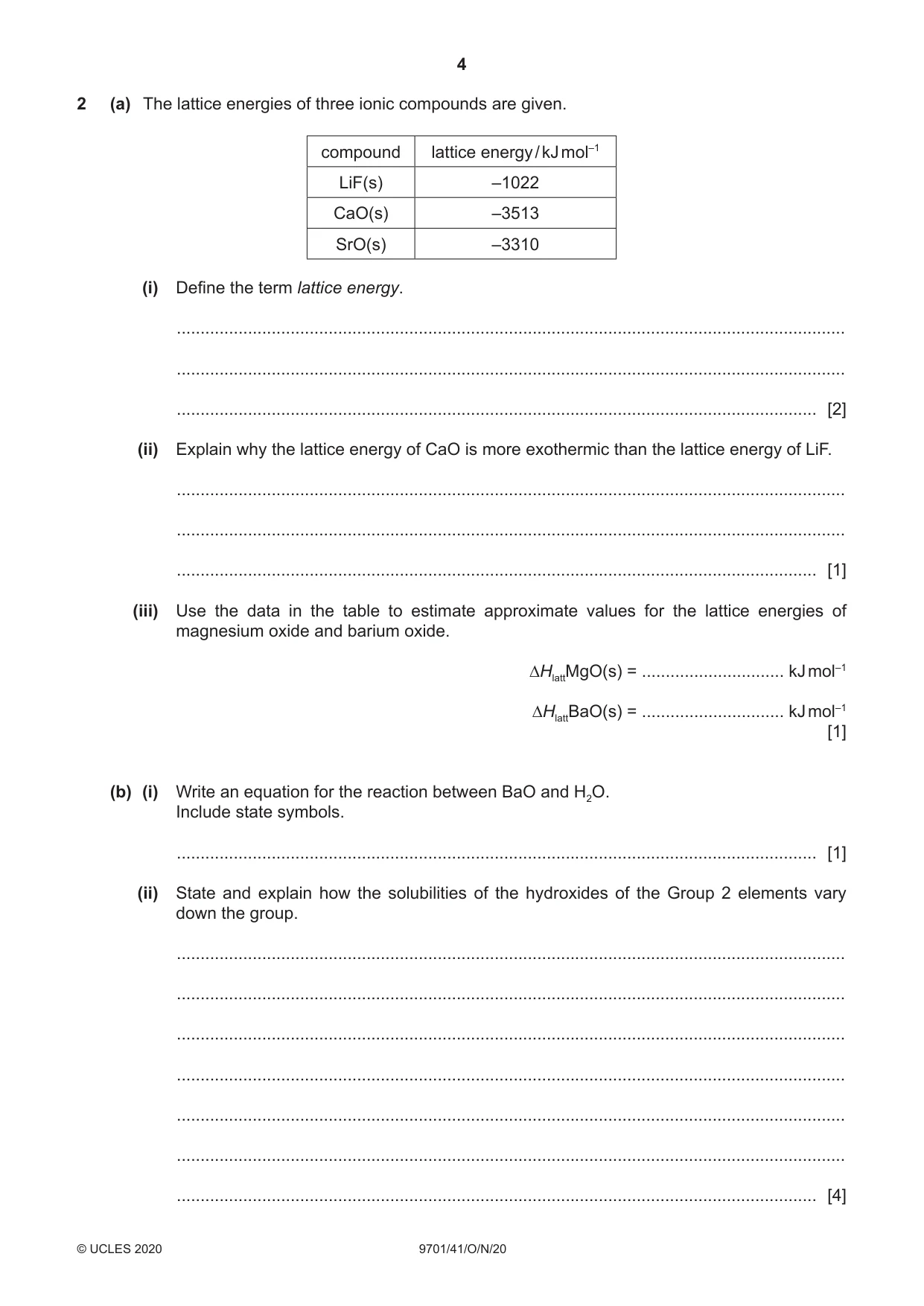
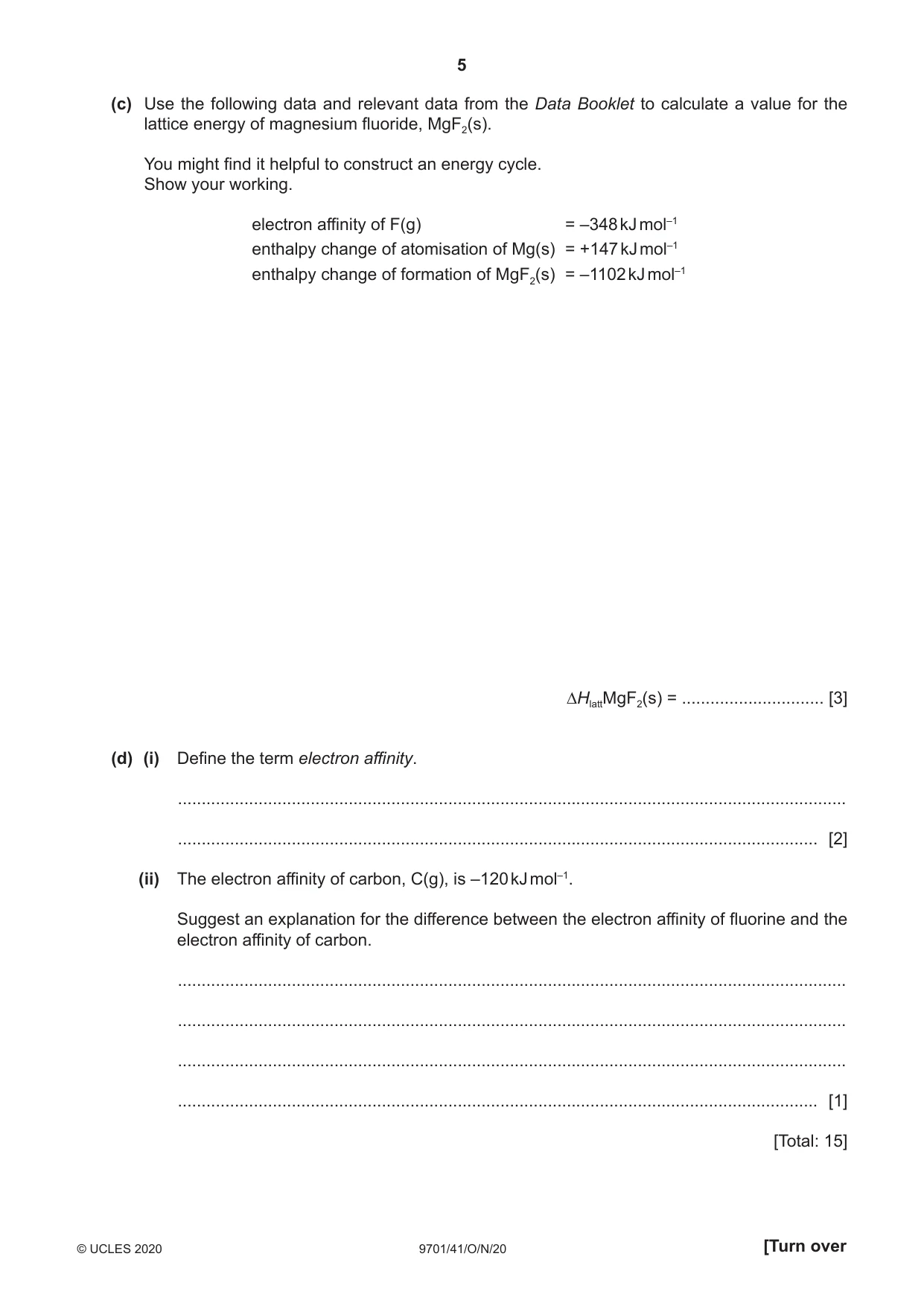
2 (a) The lattice energies of three ionic compounds are given. compound lattice energy / kJ mol–1 LiF(s) –1022 CaO(s) –3513 SrO(s) –3310 (i) Define the term lattice energy. ............................................................................................................................................. ............................................................................................................................................. ....................................................................................................................................... [2] (ii) Explain why the lattice energy of CaO is more exothermic than the lattice energy of LiF. ............................................................................................................................................. ............................................................................................................................................. ....................................................................................................................................... [1] (iii) Use the data in the table to estimate approximate values for the lattice energies of magnesium oxide and barium oxide. ∆HlattMgO(s) = .............................. kJ mol–1 ∆HlattBaO(s) = .............................. kJ mol–1 [1] (b) (i) Write an equation for the reaction between BaO and H2O. Include state symbols. ....................................................................................................................................... [1] (ii) State and explain how the solubilities of the hydroxides of the Group 2 elements vary down the group. ............................................................................................................................................. ............................................................................................................................................. ............................................................................................................................................. ............................................................................................................................................. ............................................................................................................................................. ............................................................................................................................................. ....................................................................................................................................... [4] (c) Use the following data and relevant data from the Data Booklet to calculate a value for the lattice energy of magnesium fluoride, MgF2(s). You might find it helpful to construct an energy cycle. Show your working. electron affinity of F(g) = –348 kJ mol–1 enthalpy change of atomisation of Mg(s) = +147 kJ mol–1 enthalpy change of formation of MgF2(s) = –1102 kJ mol–1 ∆HlattMgF2(s) = .............................. [3] (d) (i) Define the term electron affinity. ............................................................................................................................................. ....................................................................................................................................... [2] (ii) The electron affinity of carbon, C(g), is –120 kJ mol–1. Suggest an explanation for the difference between the electron affinity of fluorine and the electron affinity of carbon. ............................................................................................................................................. ............................................................................................................................................. ............................................................................................................................................. ....................................................................................................................................... [1] [Total: 15]
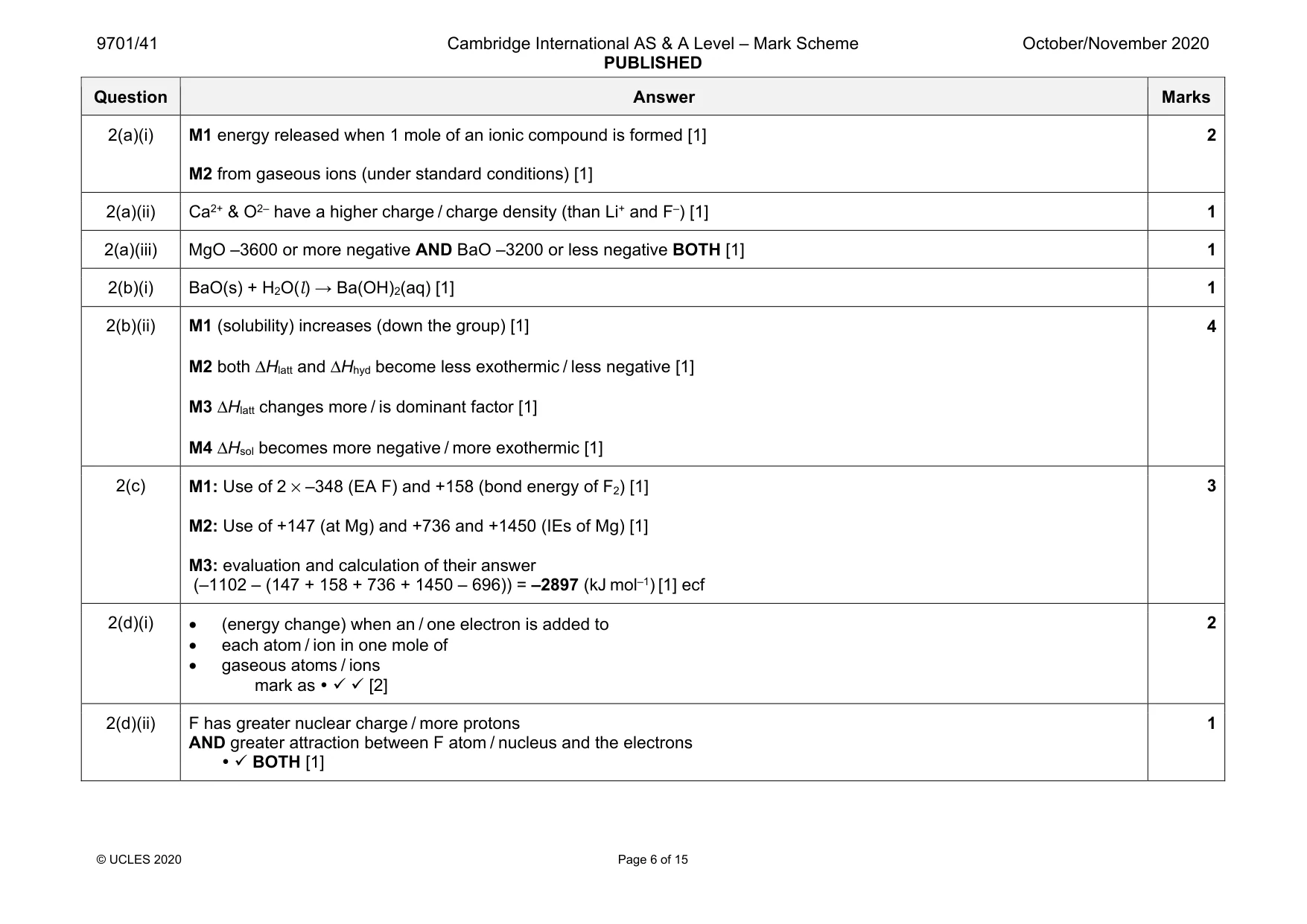
Mark scheme: 2(a)(i) M1 energy released when 1 mole of an ionic compound is formed [1] M2 from gaseous ions (under standard conditions) [1] 2 2(a)(ii) Ca2+ & O2– have a higher charge / charge density (than Li+ and F–) [1] 1 2(a)(iii) MgO –3600 or more negative AND BaO –3200 or less negative BOTH [1] 1 2(b)(i) BaO(s) + H2O(l) → Ba(OH)2(aq) [1] 1 2(b)(ii) M1 (solubility) increases (down the group) [1] M2 both ΔHlatt and ΔHhyd become less exothermic / less negative [1] M3 ΔHlatt changes more / is dominant factor [1] M4 ΔHsol becomes more negative / more exothermic [1] 4 2(c) M1: Use of 2 × –348 (EA F) and +158 (bond energy of F2) [1] M2: Use of +147 (at Mg) and +736 and +1450 (IEs of Mg) [1] M3: evaluation and calculation of their answer (–1102 – (147 + 158 + 736 + 1450 – 696)) = –2897 (kJ mol–1) [1] ecf 3 2(d)(i) • (energy change) when an / one electron is added to • each atom / ion in one mole of • gaseous atoms / ions mark as [2] 2 2(d)(ii) F has greater nuclear charge / more protons AND greater attraction between F atom / nucleus and the electrons BOTH [1] 1
Q3 · Identify the substances liberated at the anode and at the cathode during the electrolysis…
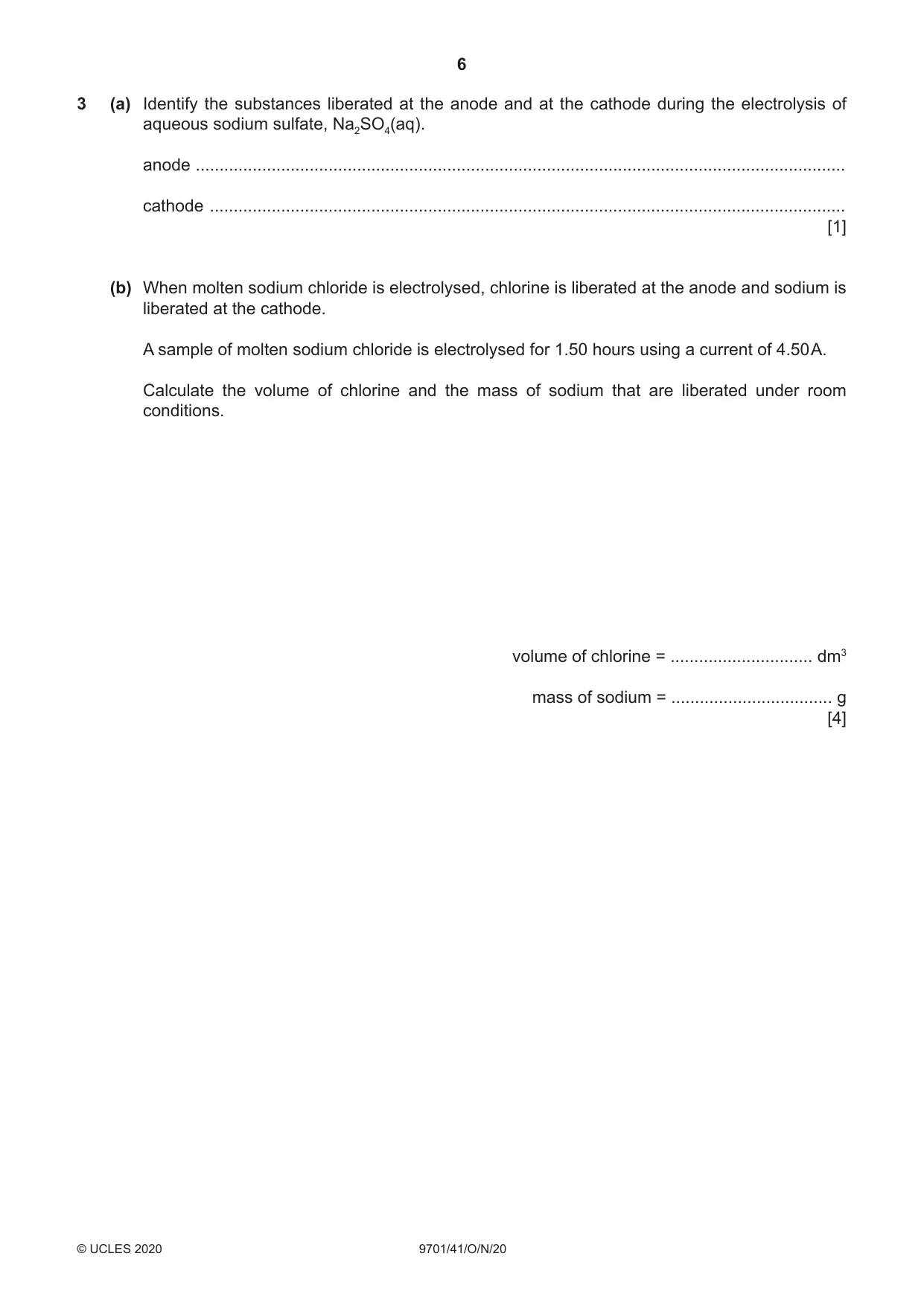
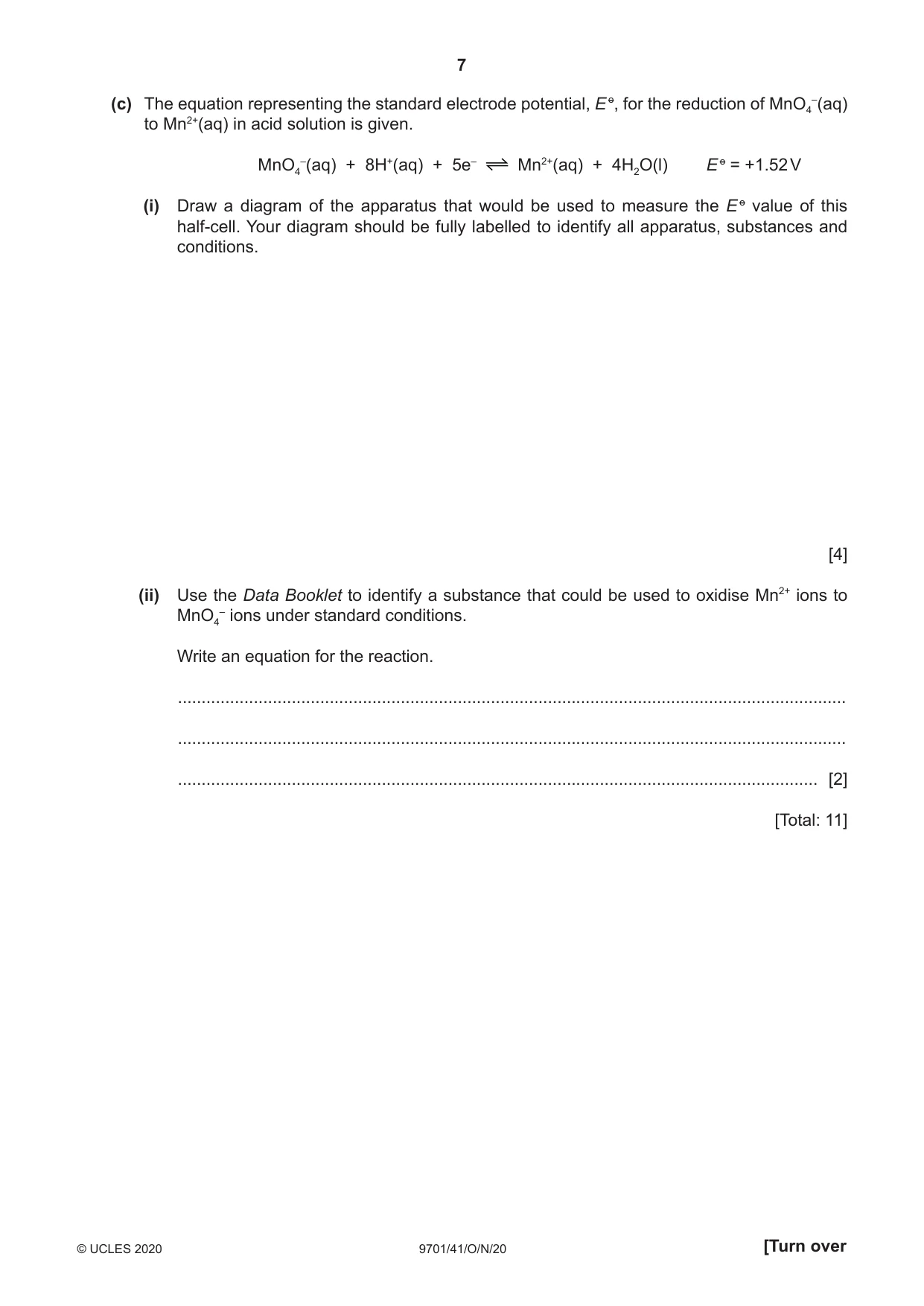
3 (a) Identify the substances liberated at the anode and at the cathode during the electrolysis of aqueous sodium sulfate, Na2SO4(aq). anode ......................................................................................................................................... cathode ...................................................................................................................................... [1] (b) When molten sodium chloride is electrolysed, chlorine is liberated at the anode and sodium is liberated at the cathode. A sample of molten sodium chloride is electrolysed for 1.50 hours using a current of 4.50 A. Calculate the volume of chlorine and the mass of sodium that are liberated under room conditions. volume of chlorine = .............................. dm3 mass of sodium = .................................. g [4] (c) The equation representing the standard electrode potential, E o, for the reduction of MnO4–(aq) to Mn2+(aq) in acid solution is given. MnO4–(aq) + 8H+(aq) + 5e– Mn2+(aq) + 4H2O(l) E o = +1.52 V (i) Draw a diagram of the apparatus that would be used to measure the E o value of this half-cell. Your diagram should be fully labelled to identify all apparatus, substances and conditions. [4] (ii) Use the Data Booklet to identify a substance that could be used to oxidise Mn2+ ions to MnO4– ions under standard conditions. Write an equation for the reaction. ............................................................................................................................................. ............................................................................................................................................. ....................................................................................................................................... [2] [Total: 11]
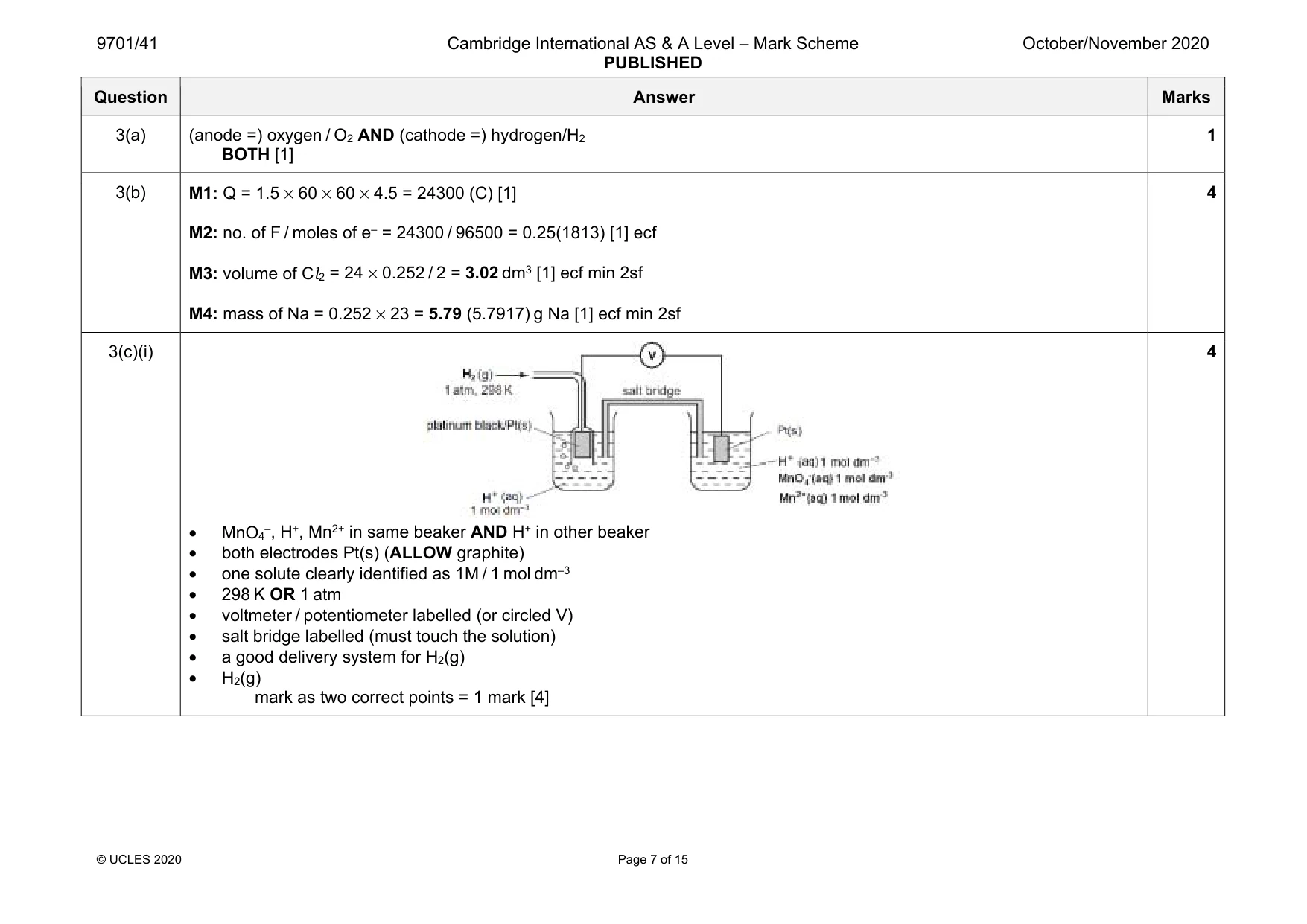
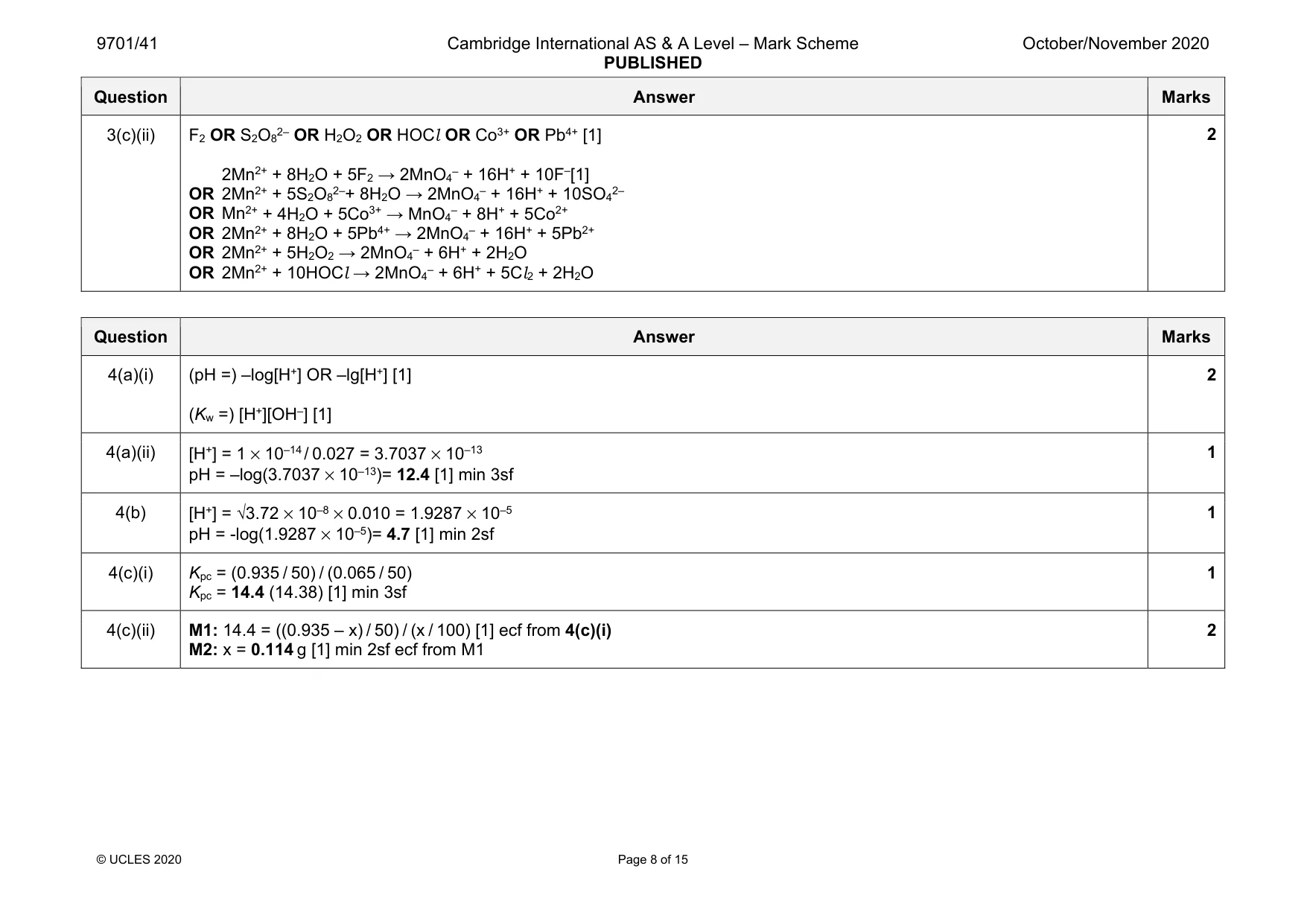
Mark scheme: 3(a) (anode =) oxygen / O2 AND (cathode =) hydrogen/H2 BOTH [1] 1 3(b) M1: Q = 1.5 × 60 × 60 × 4.5 = 24300 (C) [1] M2: no. of F / moles of e– = 24300 / 96500 = 0.25(1813) [1] ecf M3: volume of Cl2 = 24 × 0.252 / 2 = 3.02 dm3 [1] ecf min 2sf M4: mass of Na = 0.252 × 23 = 5.79 (5.7917) g Na [1] ecf min 2sf 4 3(c)(i) • MnO4–, H+, Mn2+ in same beaker AND H+ in other beaker • both electrodes Pt(s) (ALLOW graphite) • one solute clearly identified as 1M / 1 mol dm–3 • 298 K OR 1 atm • voltmeter / potentiometer labelled (or circled V) • salt bridge labelled (must touch the solution) • a good delivery system for H2(g) • H2(g) mark as two correct points = 1 mark [4] 4 Question Answer Marks 3(c)(ii) F2 OR S2O82– OR H2O2 OR HOCl OR Co3+ OR Pb4+ [1] 2Mn2+ + 8H2O + 5F2 → 2MnO4– + 16H+ + 10F–[1] OR 2Mn2+ + 5S2O82–+ 8H2O → 2MnO4– + 16H+ + 10SO42– OR Mn2+ + 4H2O + 5Co3+ → MnO4– + 8H+ + 5Co2+ OR 2Mn2+ + 8H2O + 5Pb4+ → 2MnO4– + 16H+ + 5Pb2+ OR 2Mn2+ + 5H2O2 → 2MnO4– + 6H+ + 2H2O OR 2Mn2+ + 10HOCl → 2MnO4– + 6H+ + 5Cl2 + 2H2O 2
Q4 · Give the mathematical expression for each of the terms pH and Kw
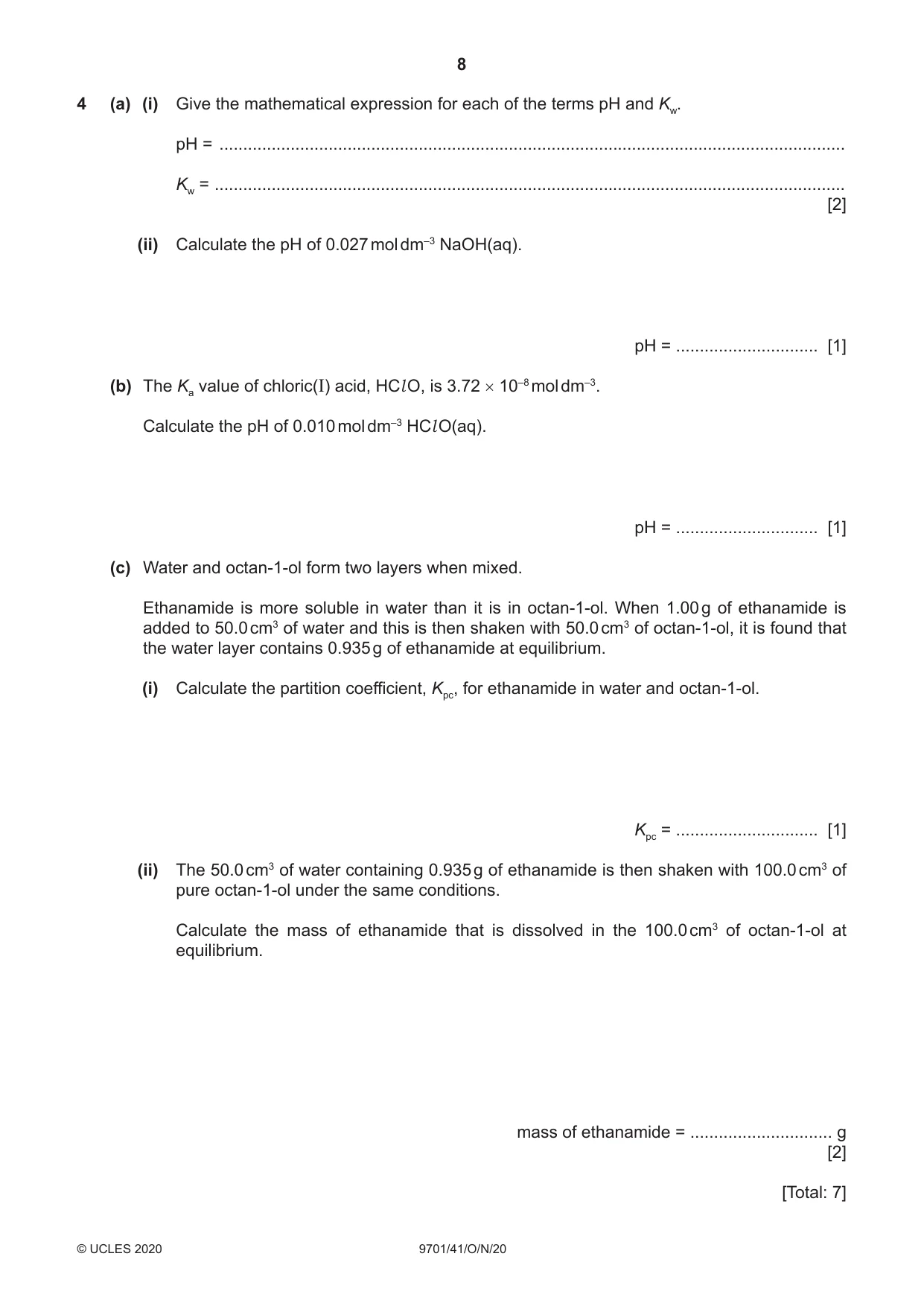
4 (a) (i) Give the mathematical expression for each of the terms pH and Kw. pH = ..................................................................................................................................... Kw = ..................................................................................................................................... [2] (ii) Calculate the pH of 0.027 mol dm–3 NaOH(aq). pH = .............................. [1] (b) The Ka value of chloric(I) acid, HCl O, is 3.72 × 10⁻⁸ mol dm–3. Calculate the pH of 0.010 mol dm–3 HCl O(aq). pH = .............................. [1] (c) Water and octan‑1‑ol form two layers when mixed. Ethanamide is more soluble in water than it is in octan‑1‑ol. When 1.00 g of ethanamide is added to 50.0 cm3 of water and this is then shaken with 50.0 cm3 of octan‑1‑ol, it is found that the water layer contains 0.935 g of ethanamide at equilibrium. (i) Calculate the partition coefficient, Kpc, for ethanamide in water and octan‑1‑ol. Kpc = .............................. [1] (ii) The 50.0 cm3 of water containing 0.935 g of ethanamide is then shaken with 100.0 cm3 of pure octan‑1‑ol under the same conditions. Calculate the mass of ethanamide that is dissolved in the 100.0 cm3 of octan‑1‑ol at equilibrium. mass of ethanamide = .............................. g [2] [Total: 7]
Mark scheme: 4(a)(i) (pH =) –log[H+] OR –lg[H+] [1] (Kw =) [H+][OH–] [1] 2 4(a)(ii) [H+] = 1 × 10–14 / 0.027 = 3.7037 × 10⁻¹³ pH = –log(3.7037 × 10⁻¹³)= 12.4 [1] min 3sf 1 4(b) [H+] = √3.72 × 10–8 × 0.010 = 1.9287 × 10⁻⁵ pH = -log(1.9287 × 10⁻⁵)= 4.7 [1] min 2sf 1 4(c)(i) Kpc = (0.935 / 50) / (0.065 / 50) Kpc = 14.4 (14.38) [1] min 3sf 1 4(c)(ii) M1: 14.4 = ((0.935 – x) / 50) / (x / 100) [1] ecf from 4(c)(i) M2: x = 0.114 g [1] min 2sf ecf from M1 2
Q5 · A solution is made by dissolving CuSO4•5H2O in an excess of aqueous ammonia
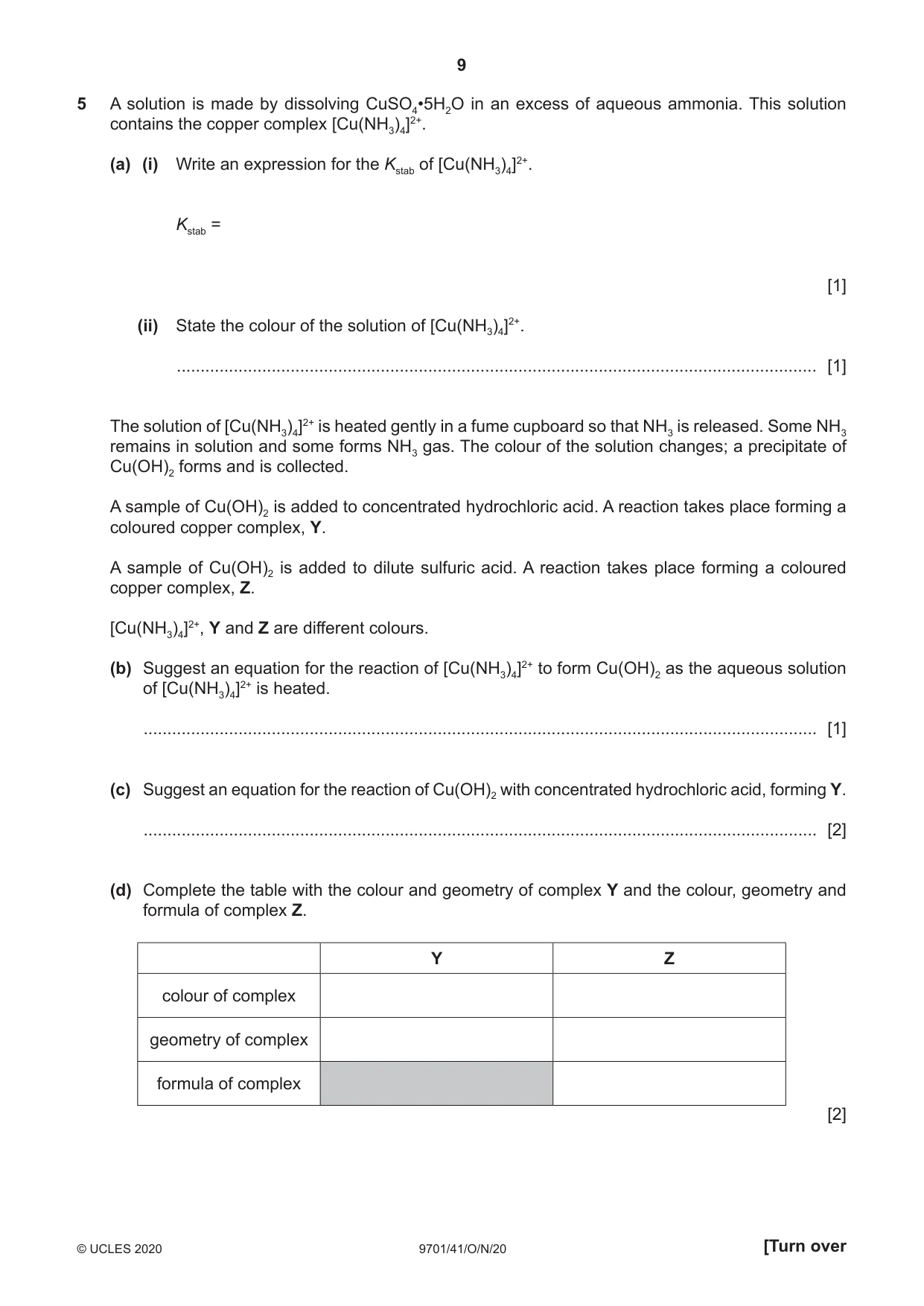
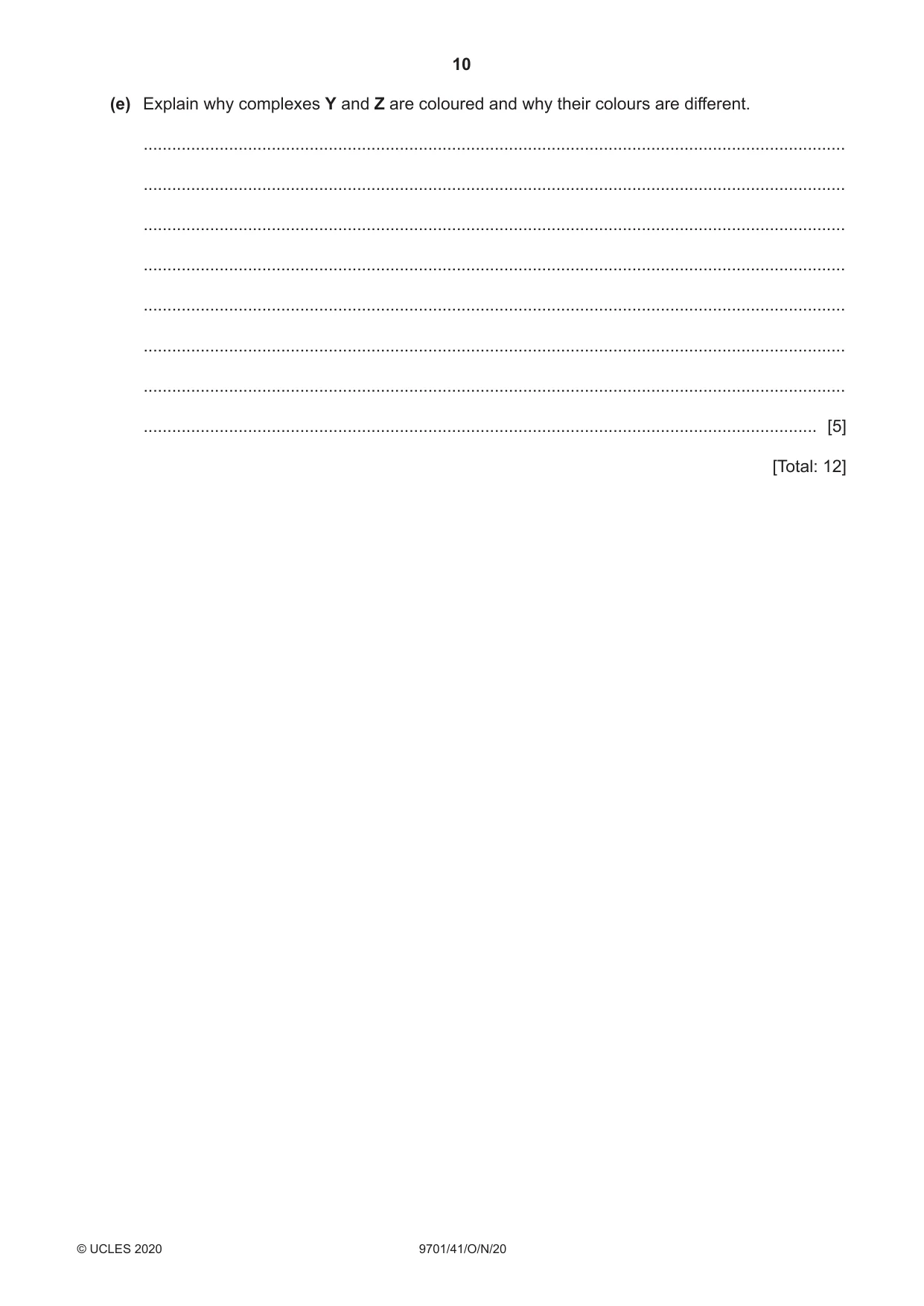
5 A solution is made by dissolving CuSO4•5H2O in an excess of aqueous ammonia. This solution contains the copper complex [Cu(NH3)4]2+. (a) (i) Write an expression for the Kstab of [Cu(NH3)4]2+. Kstab = [1] (ii) State the colour of the solution of [Cu(NH3)4]2+. ....................................................................................................................................... [1] The solution of [Cu(NH3)4]2+ is heated gently in a fume cupboard so that NH3 is released. Some NH3 remains in solution and some forms NH3 gas. The colour of the solution changes; a precipitate of Cu(OH)2 forms and is collected. A sample of Cu(OH)2 is added to concentrated hydrochloric acid. A reaction takes place forming a coloured copper complex, Y. A sample of Cu(OH)2 is added to dilute sulfuric acid. A reaction takes place forming a coloured copper complex, Z. [Cu(NH3)4]2+, Y and Z are different colours. (b) Suggest an equation for the reaction of [Cu(NH3)4]2+ to form Cu(OH)2 as the aqueous solution of [Cu(NH3)4]2+ is heated. .............................................................................................................................................. [1] (c) Suggest an equation for the reaction of Cu(OH)2 with concentrated hydrochloric acid, forming Y. .............................................................................................................................................. [2] (d) Complete the table with the colour and geometry of complex Y and the colour, geometry and formula of complex Z. Y Z colour of complex geometry of complex formula of complex [2] (e) Explain why complexes Y and Z are coloured and why their colours are different. .................................................................................................................................................... .................................................................................................................................................... .................................................................................................................................................... .................................................................................................................................................... .................................................................................................................................................... .................................................................................................................................................... .................................................................................................................................................... .............................................................................................................................................. [5] [Total: 12]
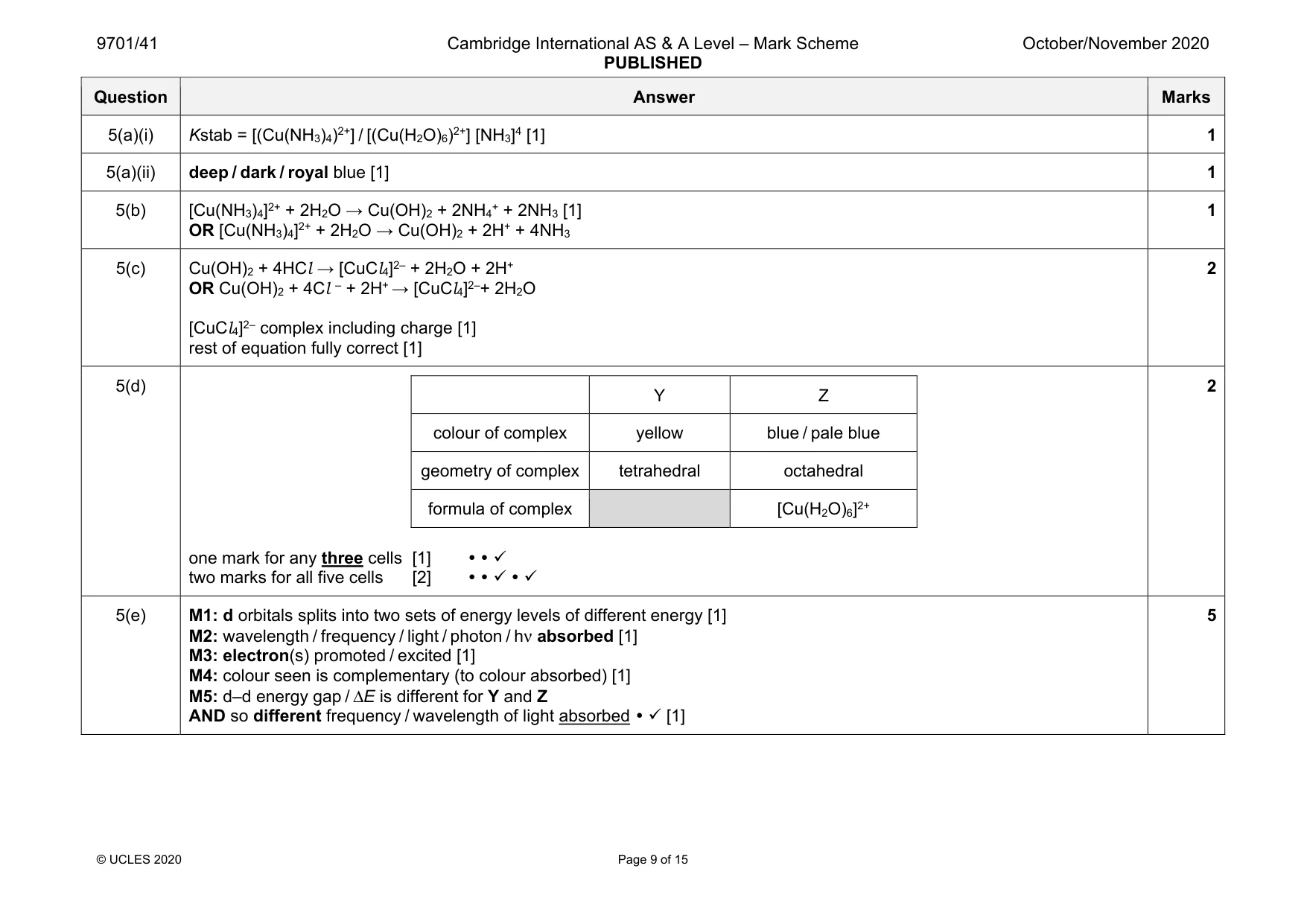
Mark scheme: 5(a)(i) Kstab = [(Cu(NH3)4)2+] / [(Cu(H2O)6)2+] [NH3]4 [1] 1 5(a)(ii) deep / dark / royal blue [1] 1 5(b) [Cu(NH3)4]2+ + 2H2O → Cu(OH)2 + 2NH4+ + 2NH3 [1] OR [Cu(NH3)4]2+ + 2H2O → Cu(OH)2 + 2H+ + 4NH3 1 5(c) Cu(OH)2 + 4HCl → [CuCl4]2– + 2H2O + 2H+ OR Cu(OH)2 + 4Cl – + 2H+ → [CuCl4]2–+ 2H2O [CuCl4]2– complex including charge [1] rest of equation fully correct [1] 2 5(d) Y Z colour of complex yellow blue / pale blue geometry of complex tetrahedral octahedral formula of complex [Cu(H2O)6]2+ one mark for any three cells [1] two marks for all five cells [2] 2 5(e) M1: d orbitals splits into two sets of energy levels of different energy [1] M2: wavelength / frequency / light / photon / hν absorbed [1] M3: electron(s) promoted / excited [1] M4: colour seen is complementary (to colour absorbed) [1] M5: d–d energy gap / ΔE is different for Y and Z AND so different frequency / wavelength of light absorbed [1] 5
Q6 · When 1.0 mol dm–3 Na2S2O3(aq) is added to a solution containing Ag+(aq) ions, a linear…
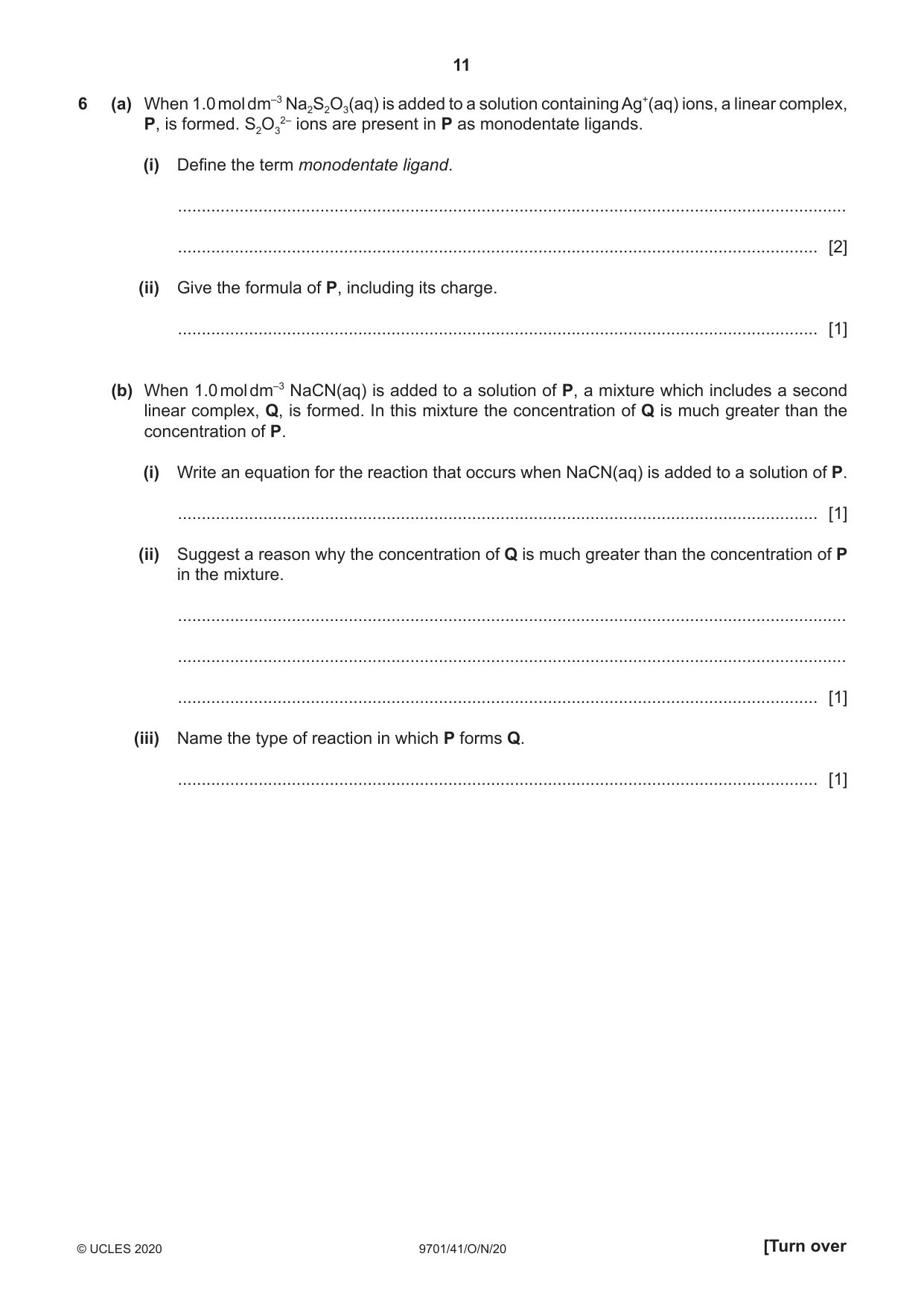
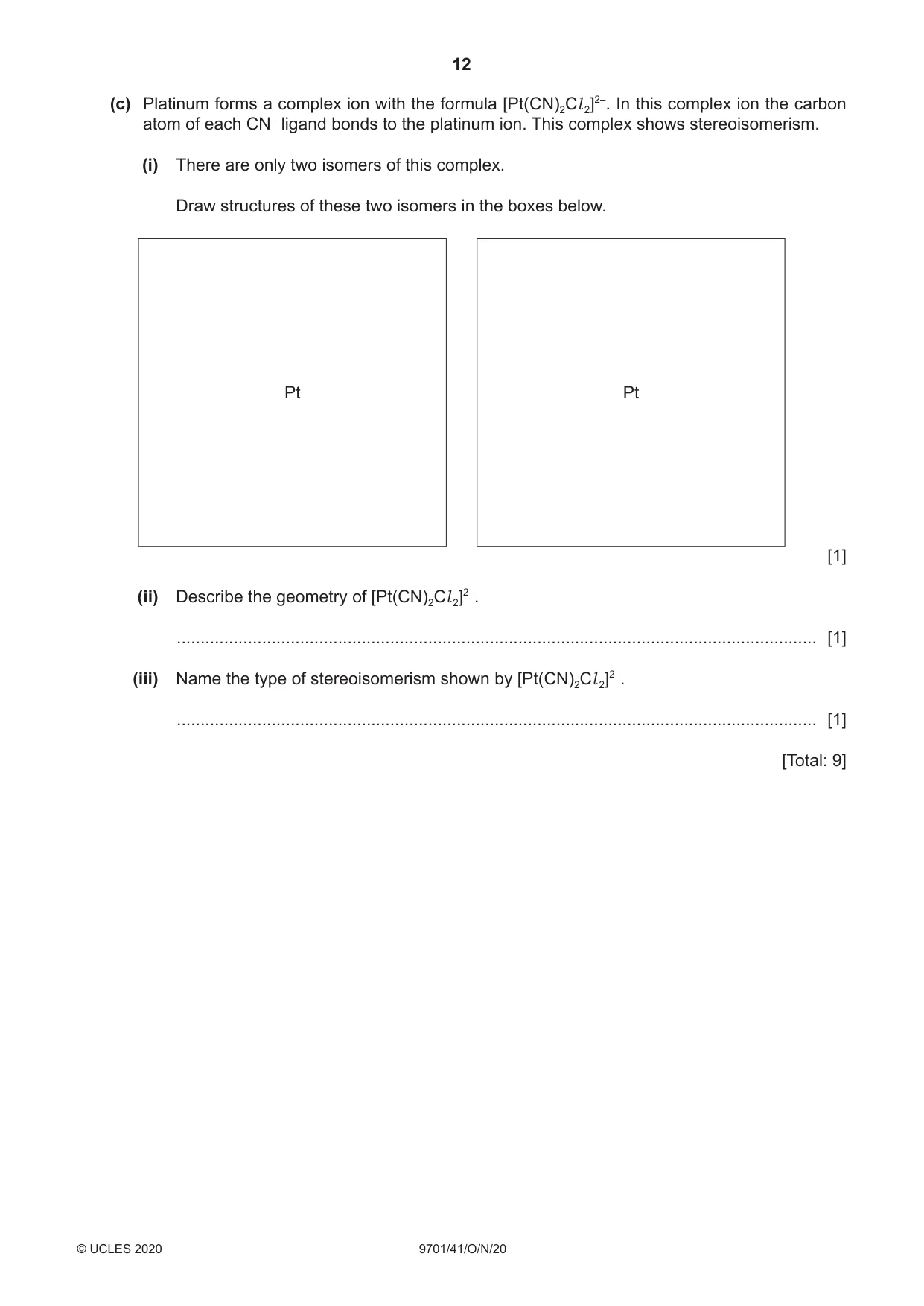
6 (a) When 1.0 mol dm–3 Na2S2O3(aq) is added to a solution containing Ag+(aq) ions, a linear complex, P, is formed. S2O32– ions are present in P as monodentate ligands. (i) Define the term monodentate ligand. ............................................................................................................................................. ....................................................................................................................................... [2] (ii) Give the formula of P, including its charge. ....................................................................................................................................... [1] (b) When 1.0 mol dm–3 NaCN(aq) is added to a solution of P, a mixture which includes a second linear complex, Q, is formed. In this mixture the concentration of Q is much greater than the concentration of P. (i) Write an equation for the reaction that occurs when NaCN(aq) is added to a solution of P. ....................................................................................................................................... [1] (ii) Suggest a reason why the concentration of Q is much greater than the concentration of P in the mixture. ............................................................................................................................................. ............................................................................................................................................. ....................................................................................................................................... [1] (iii) Name the type of reaction in which P forms Q. ....................................................................................................................................... [1] (c) Platinum forms a complex ion with the formula [Pt(CN)2Cl 2]2–. In this complex ion the carbon atom of each CN– ligand bonds to the platinum ion. This complex shows stereoisomerism. (i) There are only two isomers of this complex. Draw structures of these two isomers in the boxes below. Pt Pt [1] (ii) Describe the geometry of [Pt(CN)2Cl 2]2–. ....................................................................................................................................... [1] (iii) Name the type of stereoisomerism shown by [Pt(CN)2Cl 2]2–. ....................................................................................................................................... [1] [Total: 9]
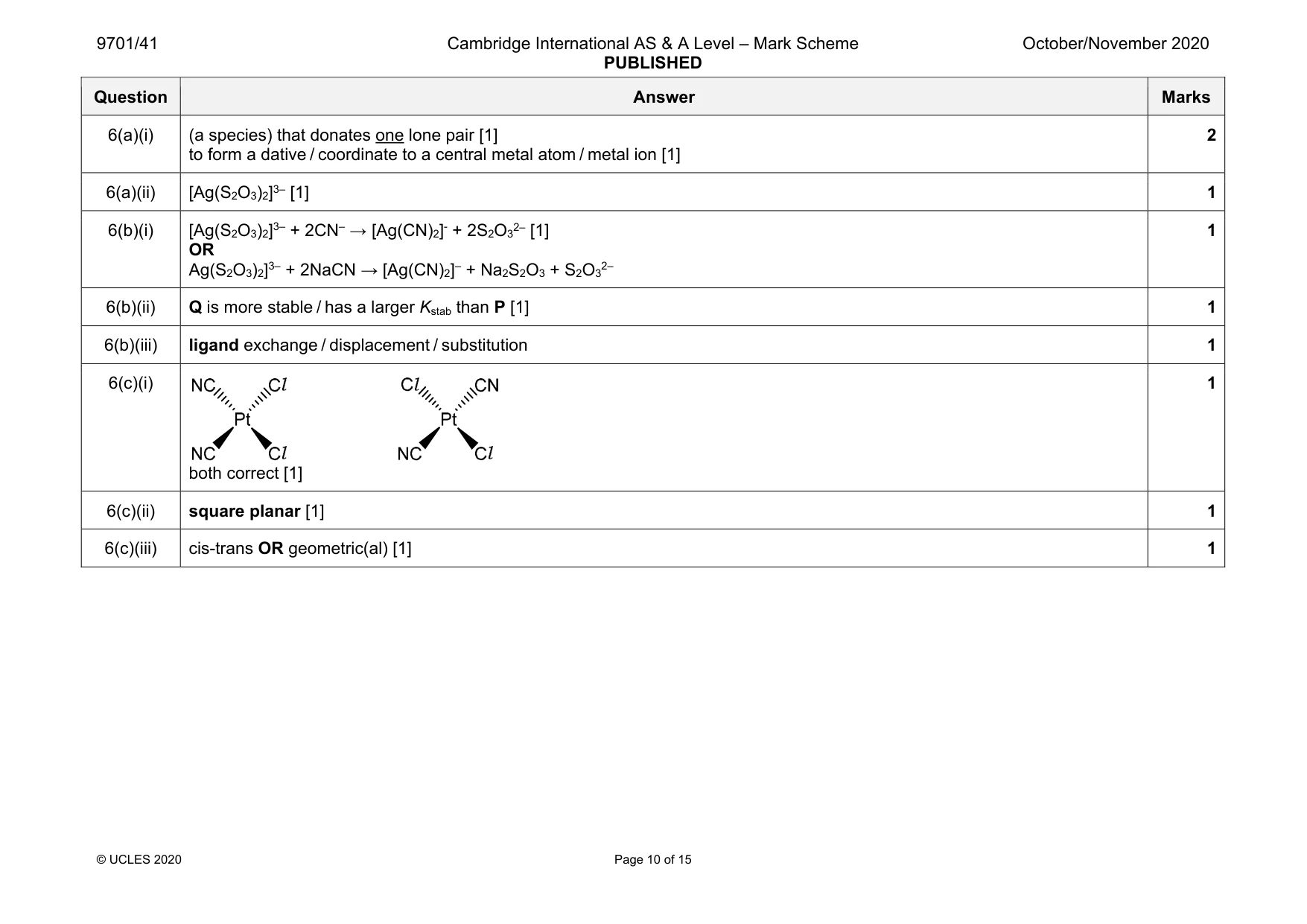
Mark scheme: 6(a)(i) (a species) that donates one lone pair [1] to form a dative / coordinate to a central metal atom / metal ion [1] 2 6(a)(ii) [Ag(S2O3)2]3– [1] 1 6(b)(i) [Ag(S2O3)2]3– + 2CN– → [Ag(CN)2]- + 2S2O32– [1] OR Ag(S2O3)2]3– + 2NaCN → [Ag(CN)2]– + Na2S2O3 + S2O32– 1 6(b)(ii) Q is more stable / has a larger Kstab than P [1] 1 6(b)(iii) ligand exchange / displacement / substitution 1 6(c)(i) both correct [1] 1 6(c)(ii) square planar [1] 1 6(c)(iii) cis-trans OR geometric(al) [1] 1
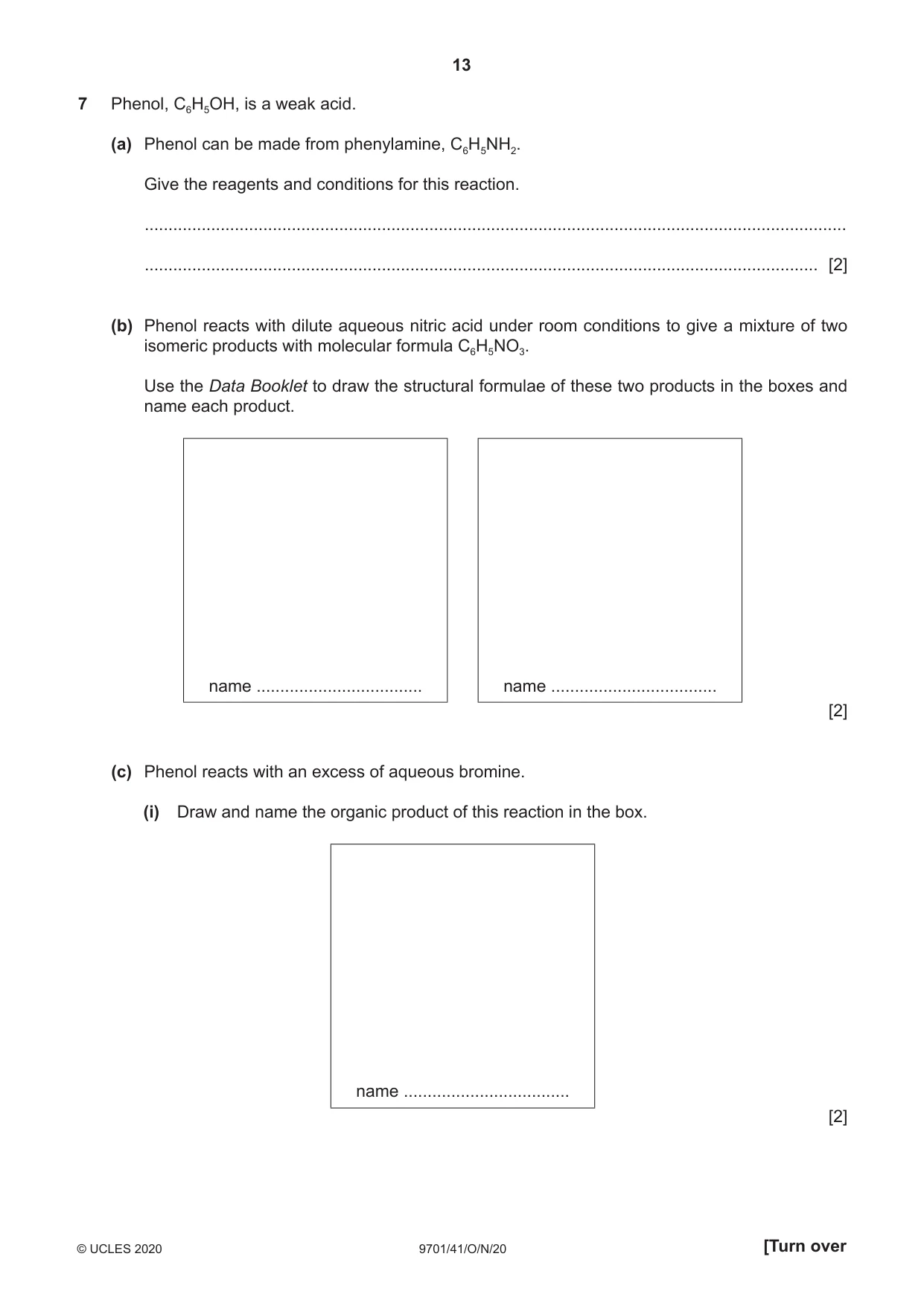
Q7 · Phenol, C6H5OH, is a weak acid
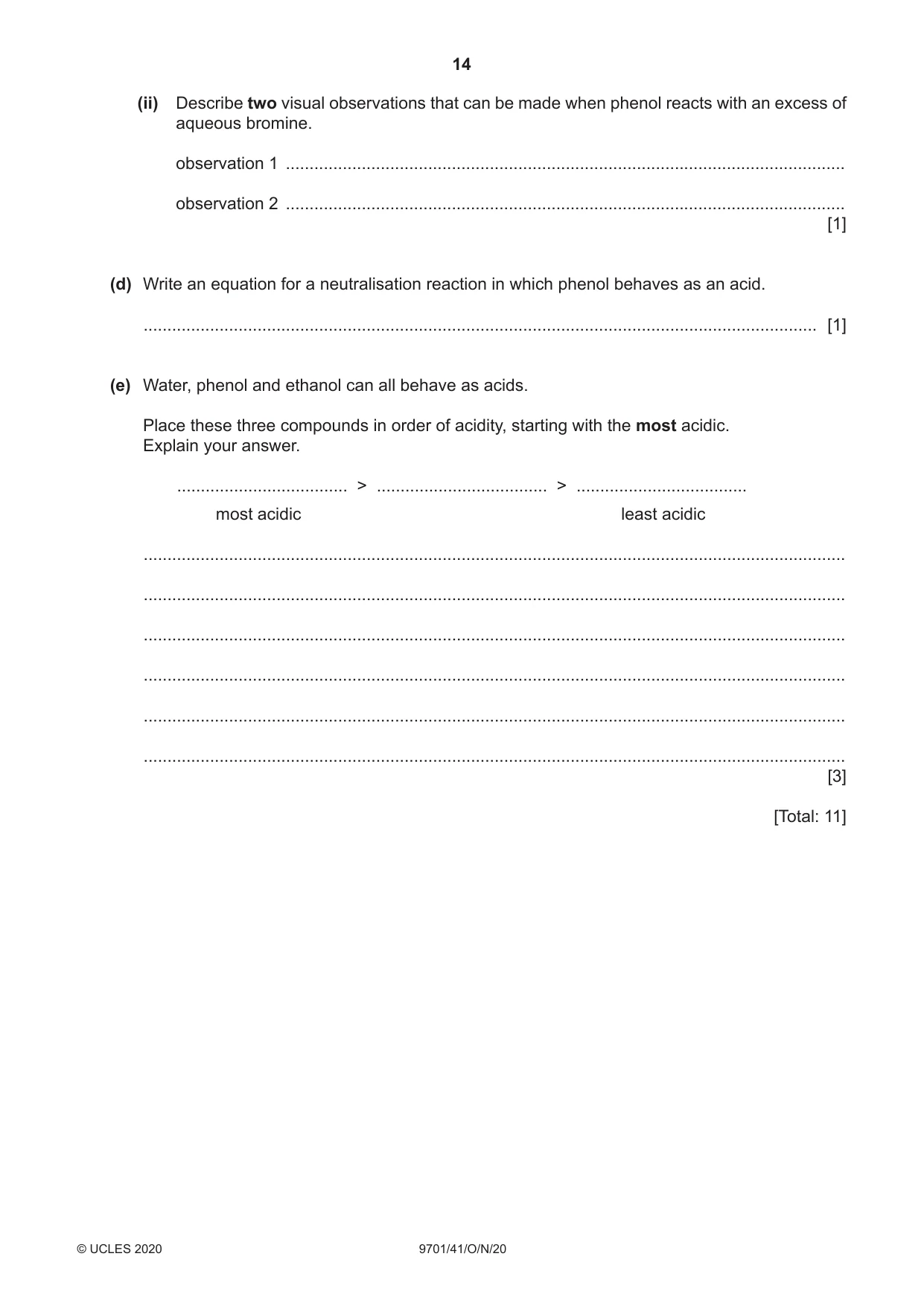
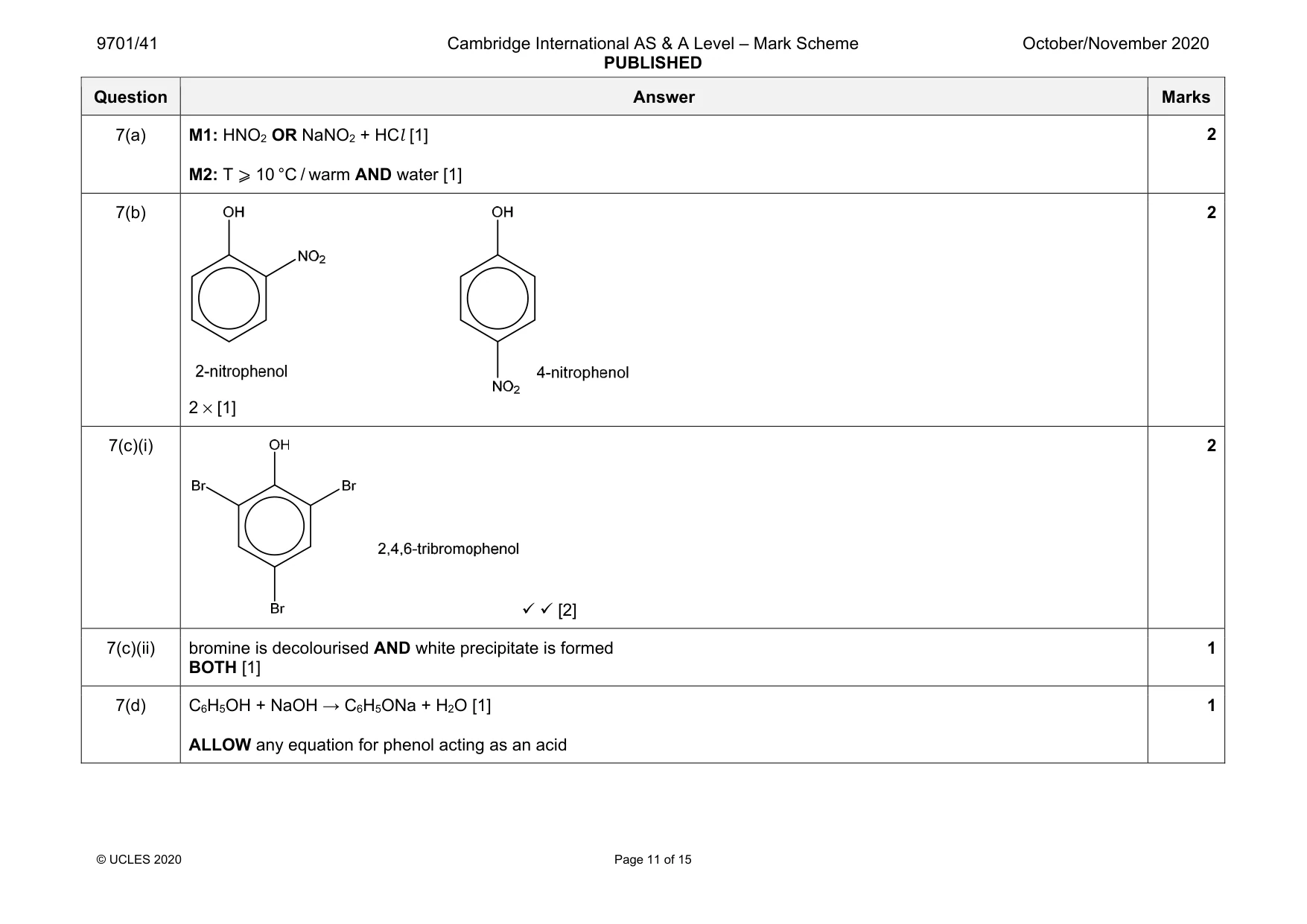
7 Phenol, C6H5OH, is a weak acid. (a) Phenol can be made from phenylamine, C6H5NH2. Give the reagents and conditions for this reaction. .................................................................................................................................................... .............................................................................................................................................. [2] (b) Phenol reacts with dilute aqueous nitric acid under room conditions to give a mixture of two isomeric products with molecular formula C6H5NO3. Use the Data Booklet to draw the structural formulae of these two products in the boxes and name each product. name ................................... name ................................... [2] (c) Phenol reacts with an excess of aqueous bromine. (i) Draw and name the organic product of this reaction in the box. name ................................... [2] (ii) Describe two visual observations that can be made when phenol reacts with an excess of aqueous bromine. observation 1 ....................................................................................................................... observation 2 ....................................................................................................................... [1] (d) Write an equation for a neutralisation reaction in which phenol behaves as an acid. .............................................................................................................................................. [1] (e) Water, phenol and ethanol can all behave as acids. Place these three compounds in order of acidity, starting with the most acidic. Explain your answer. .................................... > .................................... > .................................... most acidic least acidic .................................................................................................................................................... .................................................................................................................................................... .................................................................................................................................................... .................................................................................................................................................... .................................................................................................................................................... .................................................................................................................................................... [3] [Total: 11]
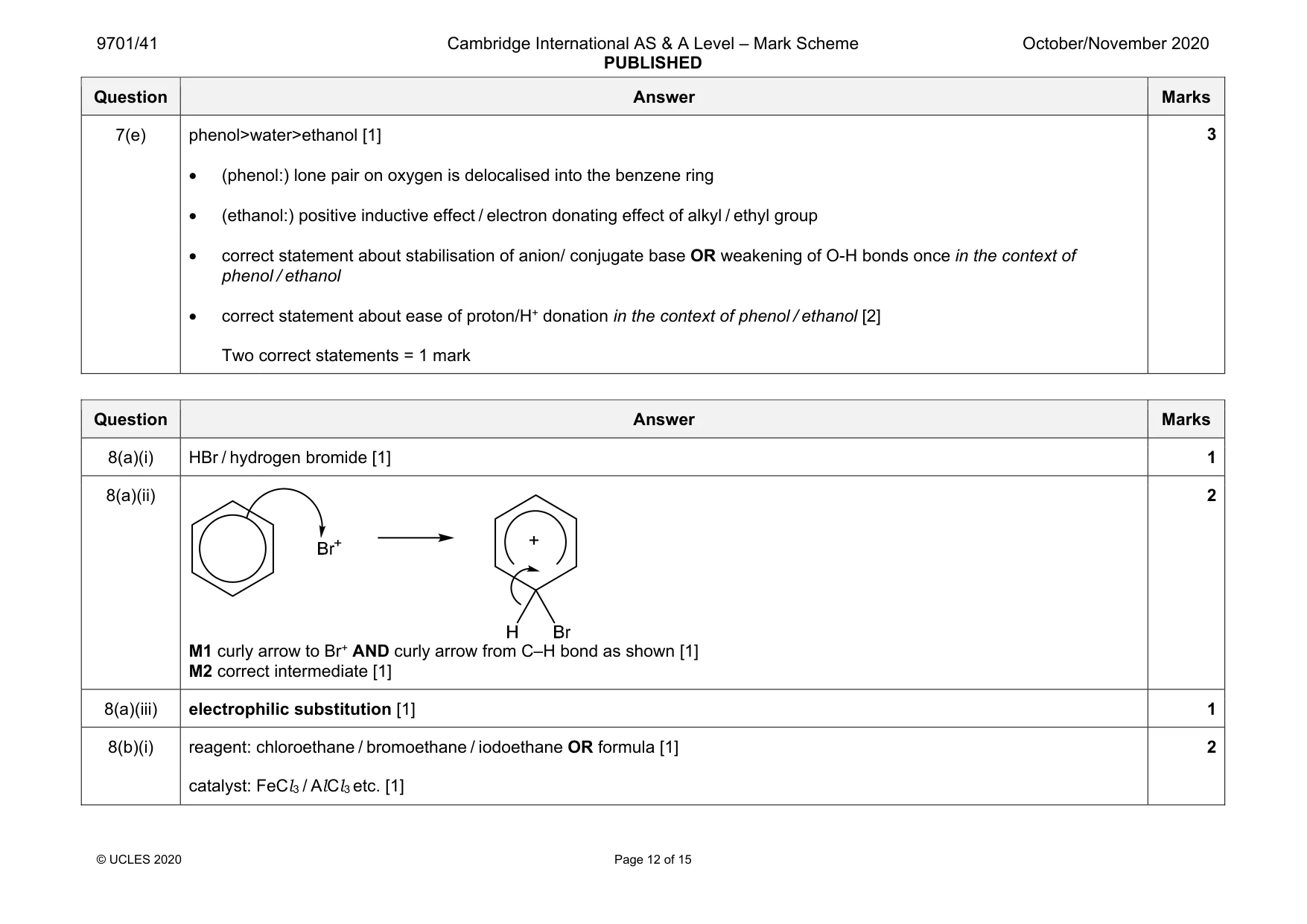
Mark scheme: 7(a) M2: T ⩾ 10 °C / warm AND water [1] 7(b) 2 × [1] 2 7(c)(i) [2] 2 7(c)(ii) bromine is decolourised AND white precipitate is formed BOTH [1] 1 7(d) C6H5OH + NaOH → C6H5ONa + H2O [1] ALLOW any equation for phenol acting as an acid 1 Question Answer Marks 7(e) phenol>water>ethanol [1] • (phenol:) lone pair on oxygen is delocalised into the benzene ring • (ethanol:) positive inductive effect / electron donating effect of alkyl / ethyl group • correct statement about stabilisation of anion/ conjugate base OR weakening of O-H bonds once in the context of phenol / ethanol • correct statement about ease of proton/H+ donation in the context of phenol / ethanol [2] Two correct statements = 1 mark 3
Q8 · Benzene, C6H6, can be obtained from crude oil
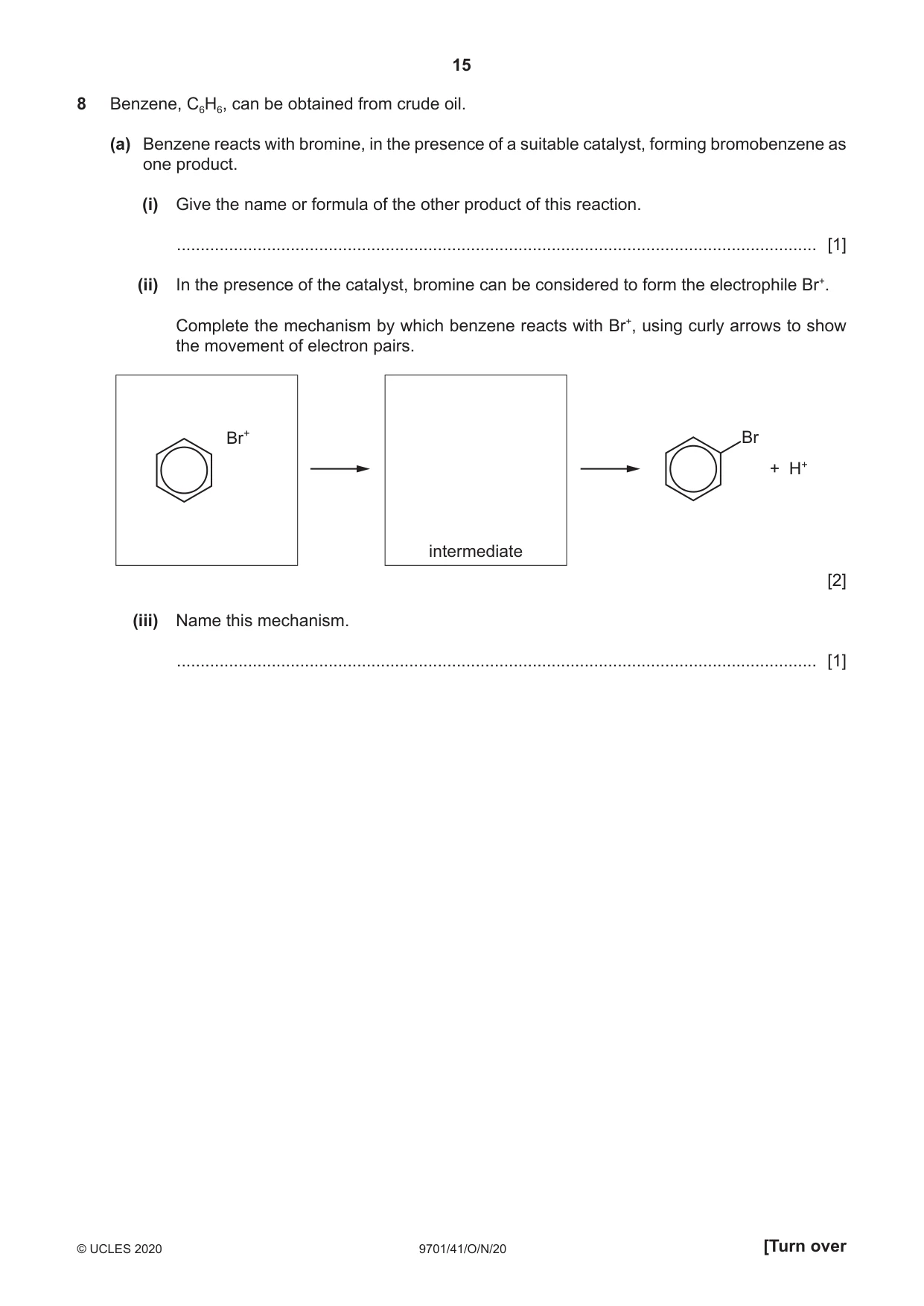
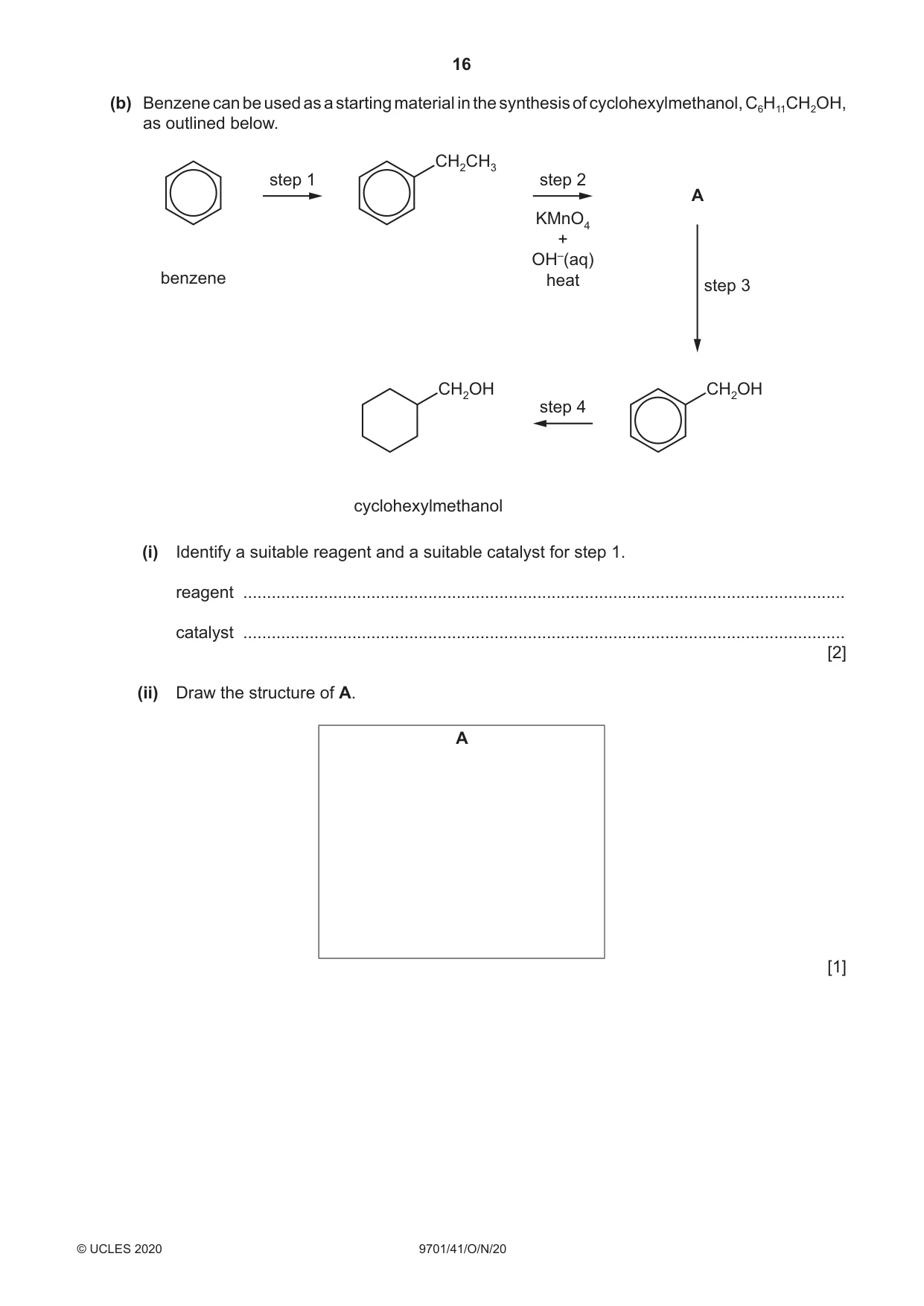
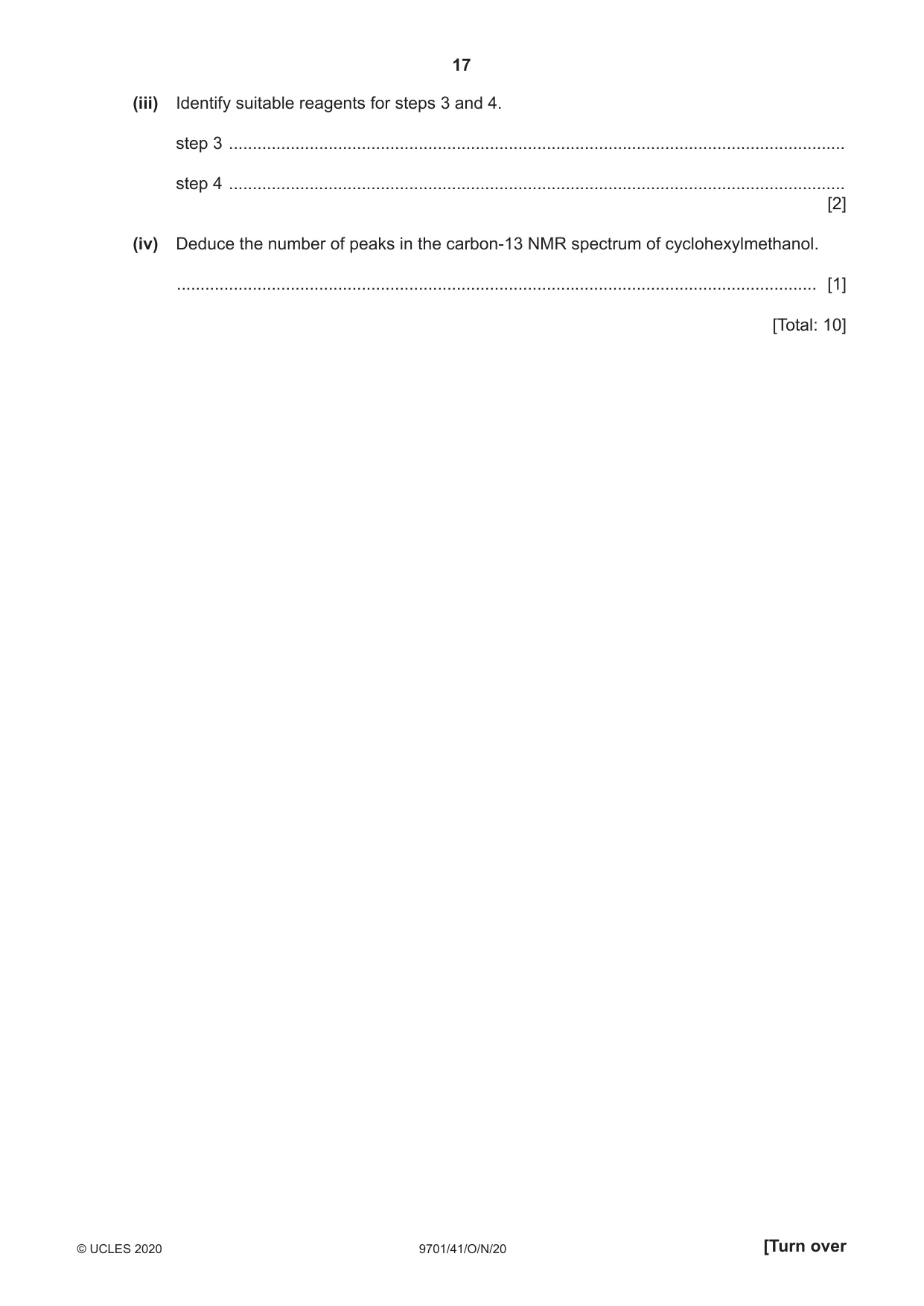
8 Benzene, C6H6, can be obtained from crude oil. (a) Benzene reacts with bromine, in the presence of a suitable catalyst, forming bromobenzene as one product. (i) Give the name or formula of the other product of this reaction. ....................................................................................................................................... [1] (ii) In the presence of the catalyst, bromine can be considered to form the electrophile Br+. Complete the mechanism by which benzene reacts with Br+, using curly arrows to show the movement of electron pairs. Br+ Br + H+ intermediate [2] (iii) Name this mechanism. ....................................................................................................................................... [1] (b) Benzene can be used as a starting material in the synthesis of cyclohexylmethanol, C6H11CH2OH, as outlined below. CH2CH3 step 1 step 2 A KMnO4 + OH–(aq) benzene heat step 3 CH2OH CH2OH step 4 cyclohexylmethanol (i) Identify a suitable reagent and a suitable catalyst for step 1. reagent ................................................................................................................................ catalyst ................................................................................................................................ [2] (ii) Draw the structure of A. A [1] (iii) Identify suitable reagents for steps 3 and 4. step 3 .................................................................................................................................. step 4 .................................................................................................................................. [2] (iv) Deduce the number of peaks in the carbon‑13 NMR spectrum of cyclohexylmethanol. ....................................................................................................................................... [1] [Total: 10]
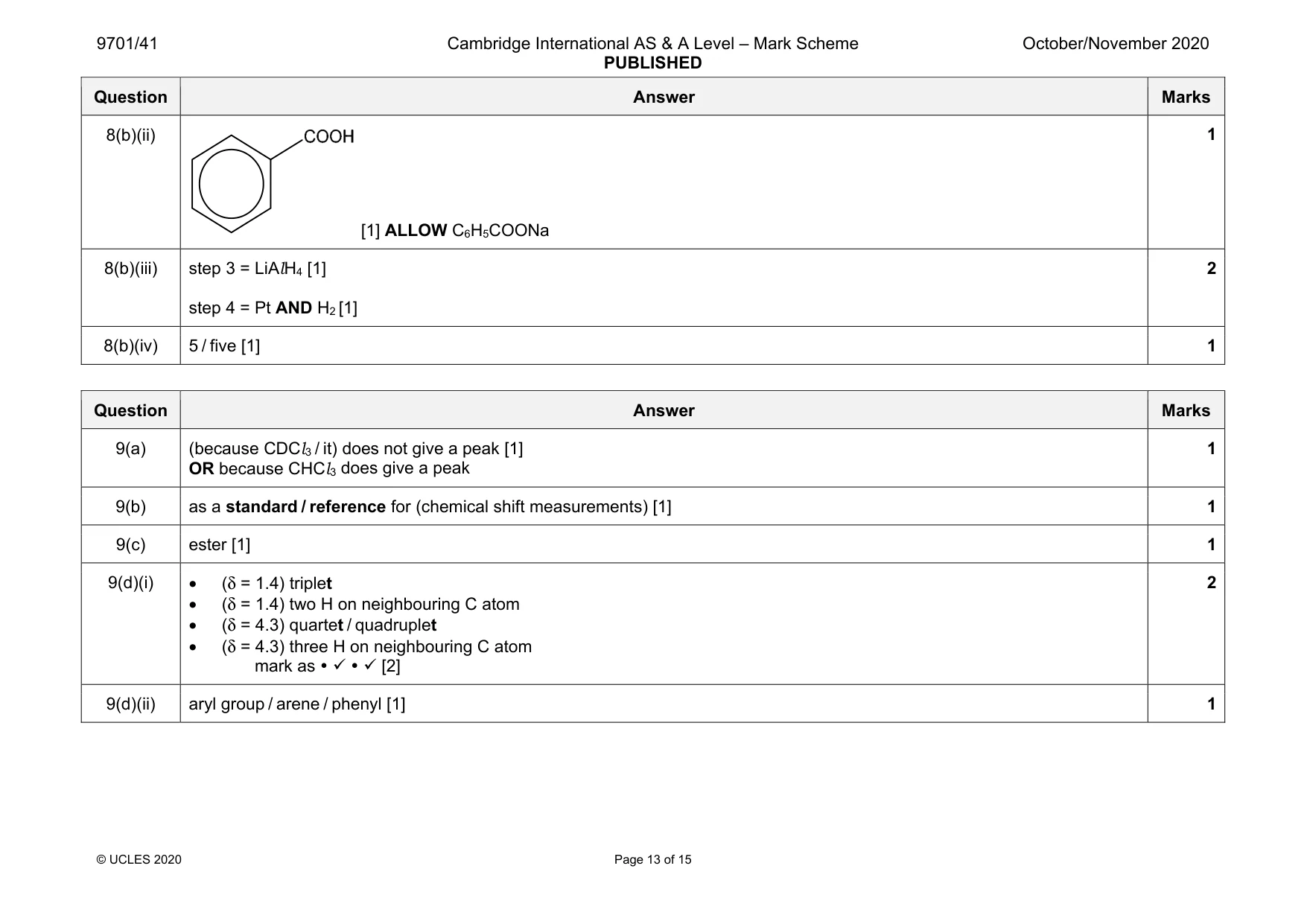
Mark scheme: 8(a)(i) HBr / hydrogen bromide [1] 1 8(a)(ii) M1 curly arrow to Br+ AND curly arrow from C–H bond as shown [1] M2 correct intermediate [1] 2 8(a)(iii) electrophilic substitution [1] 1 8(b)(i) reagent: chloroethane / bromoethane / iodoethane OR formula [1] catalyst: FeCl3 / AlCl3 etc. [1] 2 Question Answer Marks 8(b)(ii) [1] ALLOW C6H5COONa 1 8(b)(iii) step 3 = LiAlH4 [1] step 4 = Pt AND H2 [1] 2 8(b)(iv) 5 / five [1] 1
Q9 · The proton NMR spectrum of compound E in the solvent CDCl 3 is shown
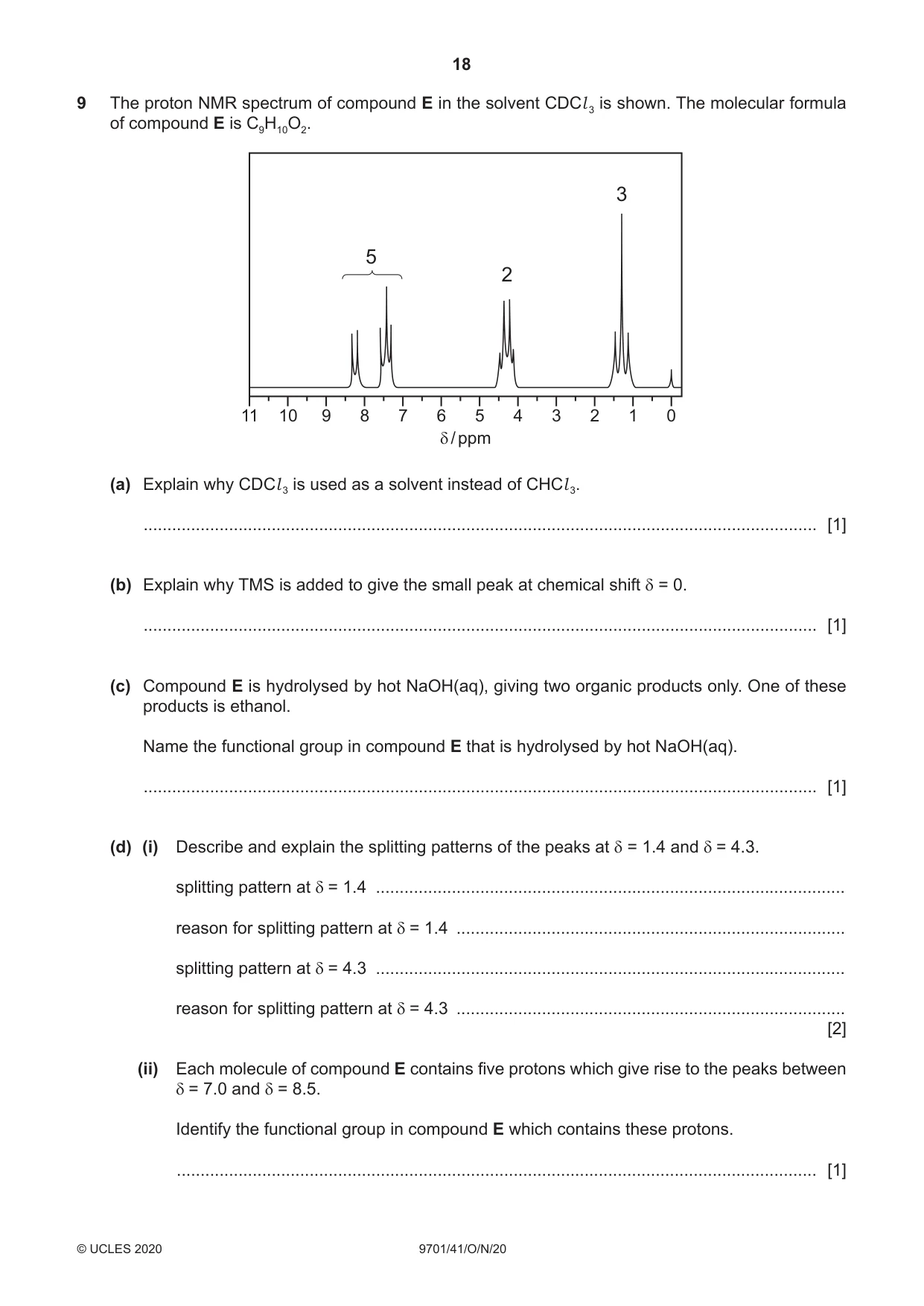
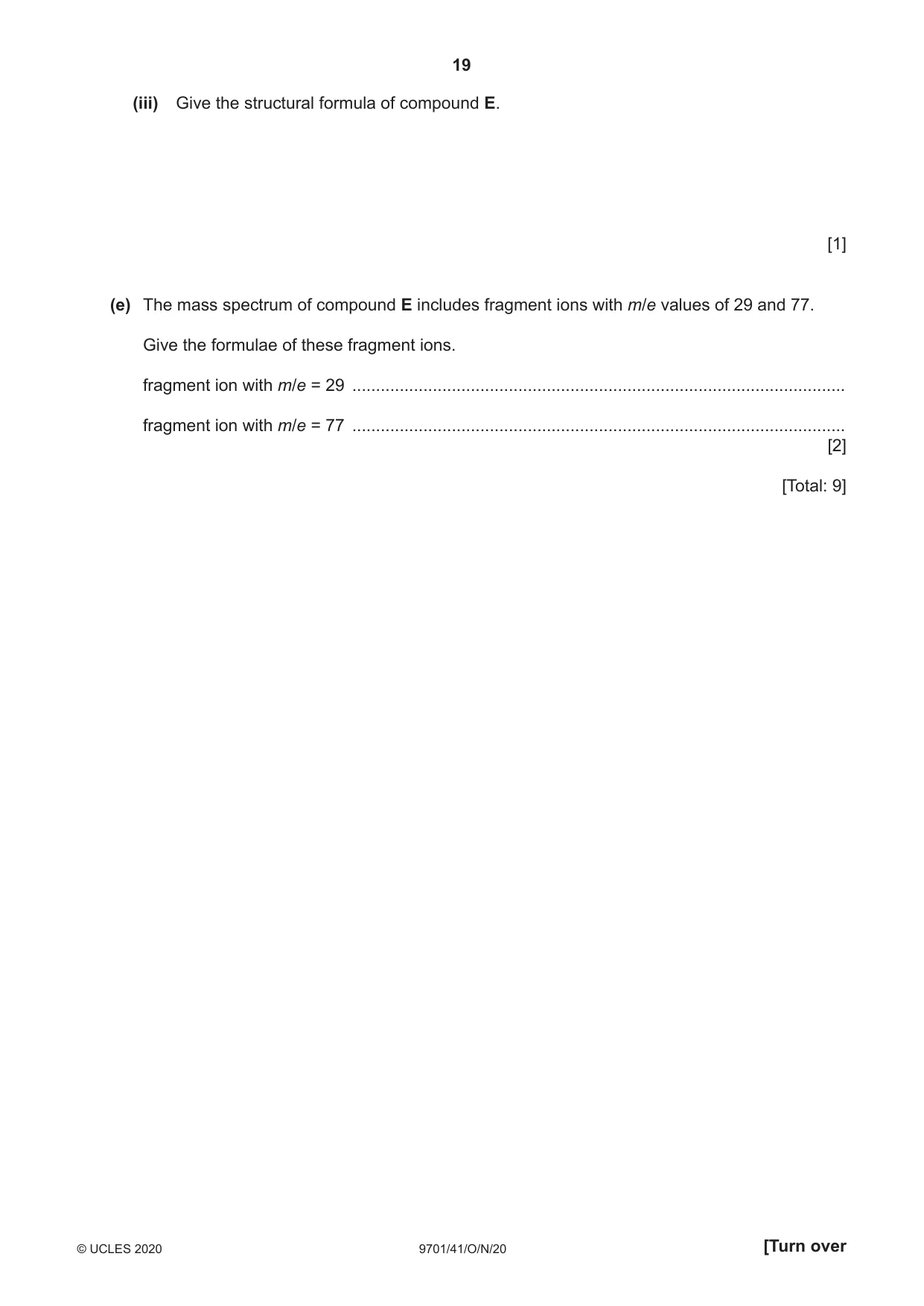
9 The proton NMR spectrum of compound E in the solvent CDCl 3 is shown. The molecular formula of compound E is C9H10O2. 3 5 2 11 10 9 8 7 6 5 4 3 2 1 0 δ / ppm (a) Explain why CDCl 3 is used as a solvent instead of CHCl 3. .............................................................................................................................................. [1] (b) Explain why TMS is added to give the small peak at chemical shift δ = 0. .............................................................................................................................................. [1] (c) Compound E is hydrolysed by hot NaOH(aq), giving two organic products only. One of these products is ethanol. Name the functional group in compound E that is hydrolysed by hot NaOH(aq). .............................................................................................................................................. [1] (d) (i) Describe and explain the splitting patterns of the peaks at δ = 1.4 and δ = 4.3. splitting pattern at δ = 1.4 .................................................................................................... reason for splitting pattern at δ = 1.4 ................................................................................... splitting pattern at δ = 4.3 .................................................................................................... reason for splitting pattern at δ = 4.3 ................................................................................... [2] (ii) Each molecule of compound E contains five protons which give rise to the peaks between δ = 7.0 and δ = 8.5. Identify the functional group in compound E which contains these protons. ....................................................................................................................................... [1] (iii) Give the structural formula of compound E. [1] (e) The mass spectrum of compound E includes fragment ions with m/e values of 29 and 77. Give the formulae of these fragment ions. fragment ion with m/e = 29 ......................................................................................................... fragment ion with m/e = 77 ......................................................................................................... [2] [Total: 9]
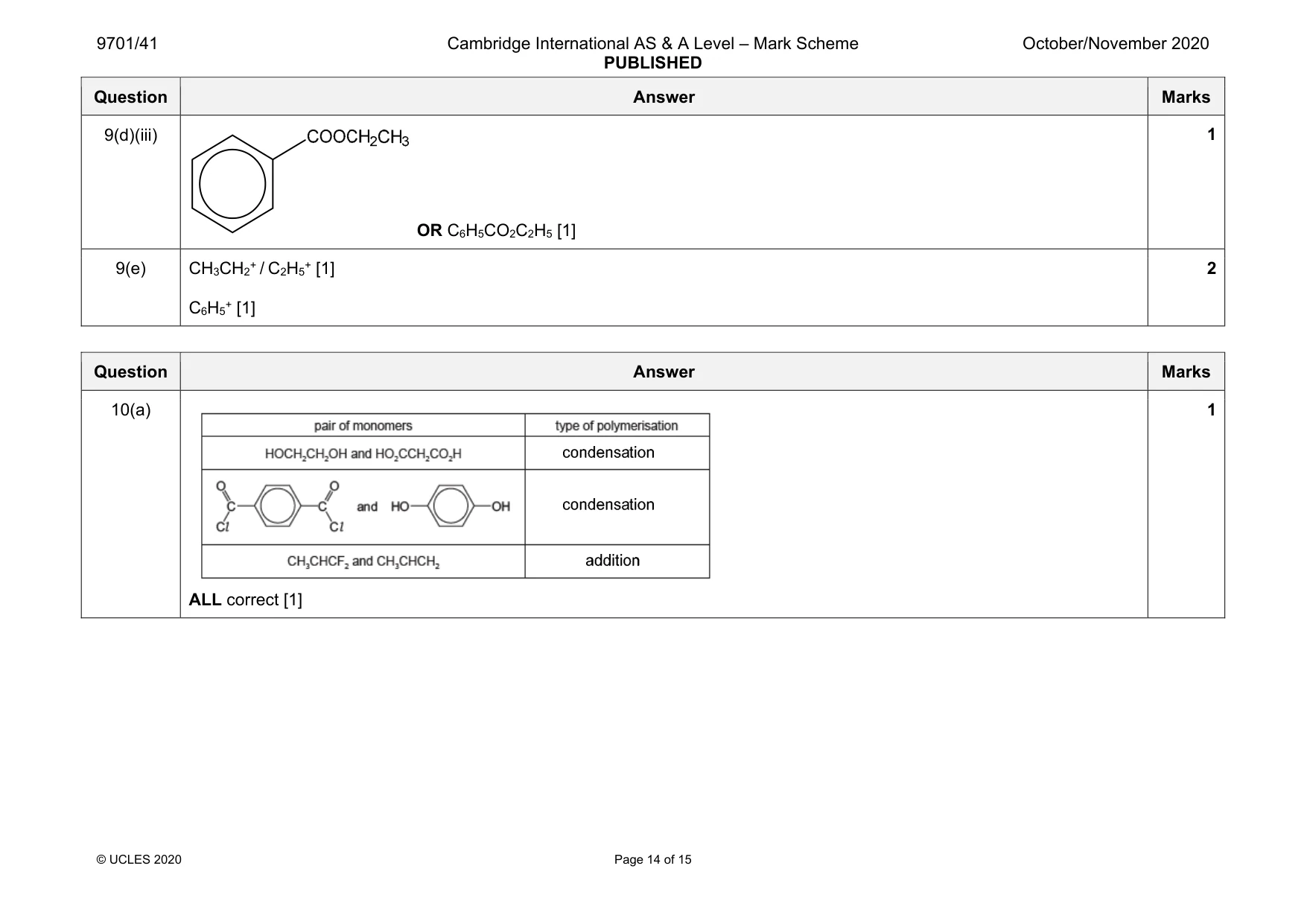
Mark scheme: 9(a) OR because CHCl3 does give a peak 1 9(b) as a standard / reference for (chemical shift measurements) [1] 1 9(c) ester [1] 1 9(d)(i) • (δ = 1.4) triplet • (δ = 1.4) two H on neighbouring C atom • (δ = 4.3) quartet / quadruplet • (δ = 4.3) three H on neighbouring C atom mark as [2] 2 9(d)(ii) aryl group / arene / phenyl [1] 1 Question Answer Marks 9(d)(iii) OR C6H5CO2C2H5 [1] 1 9(e) CH3CH2+ / C2H5+ [1] C6H5+ [1] 2
Q10 · The table shows three pairs of monomers that are capable of polymerisation
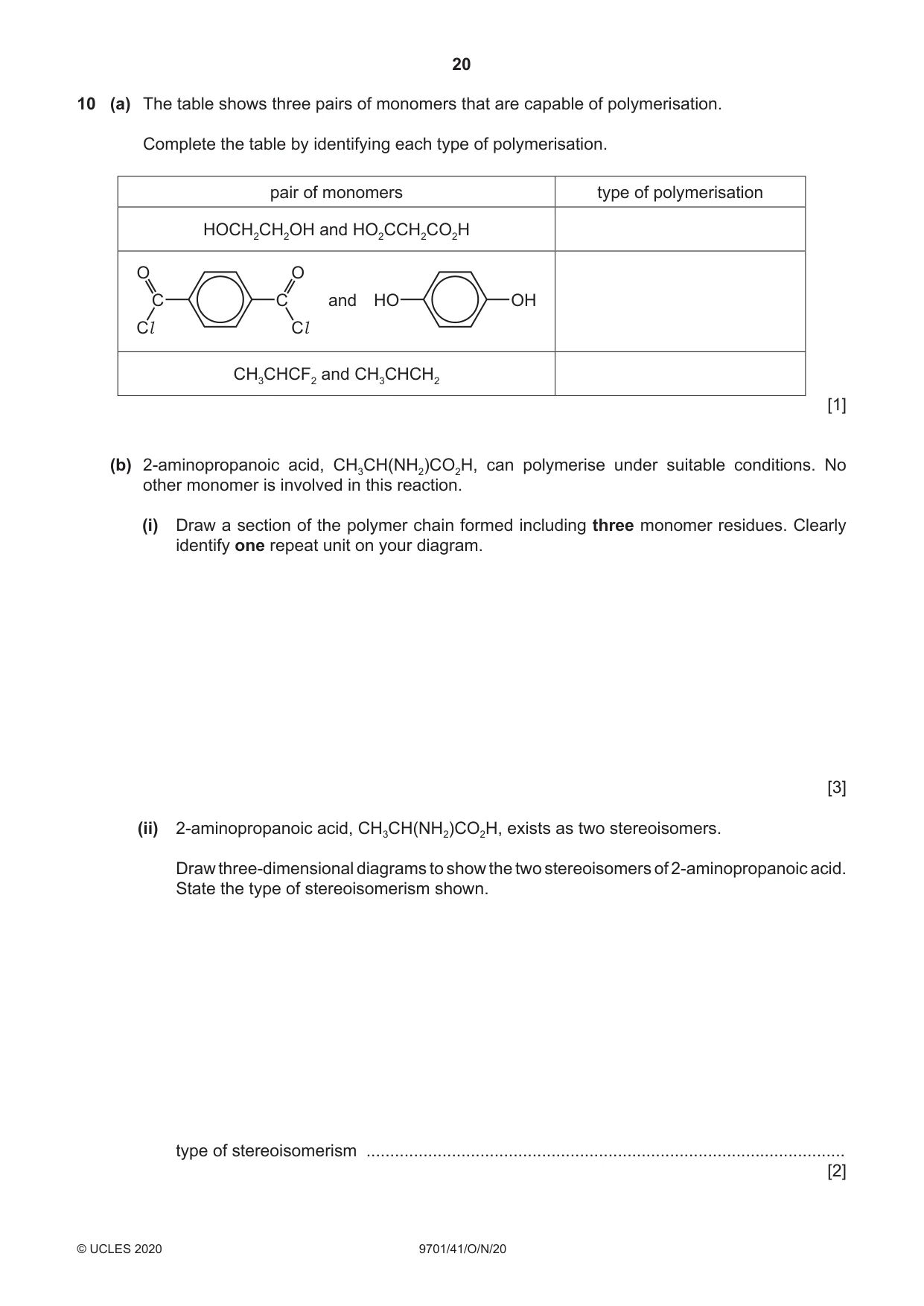
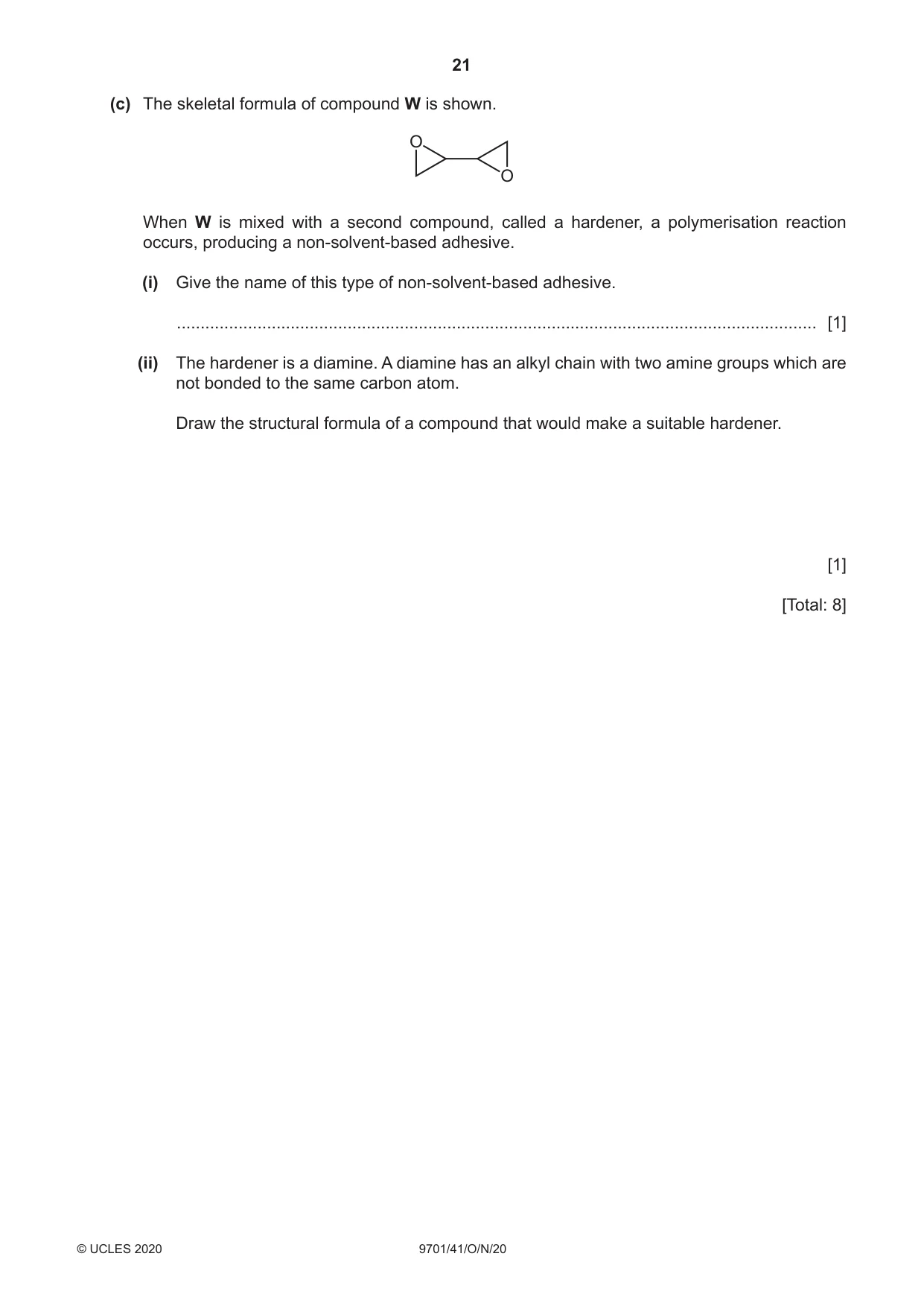
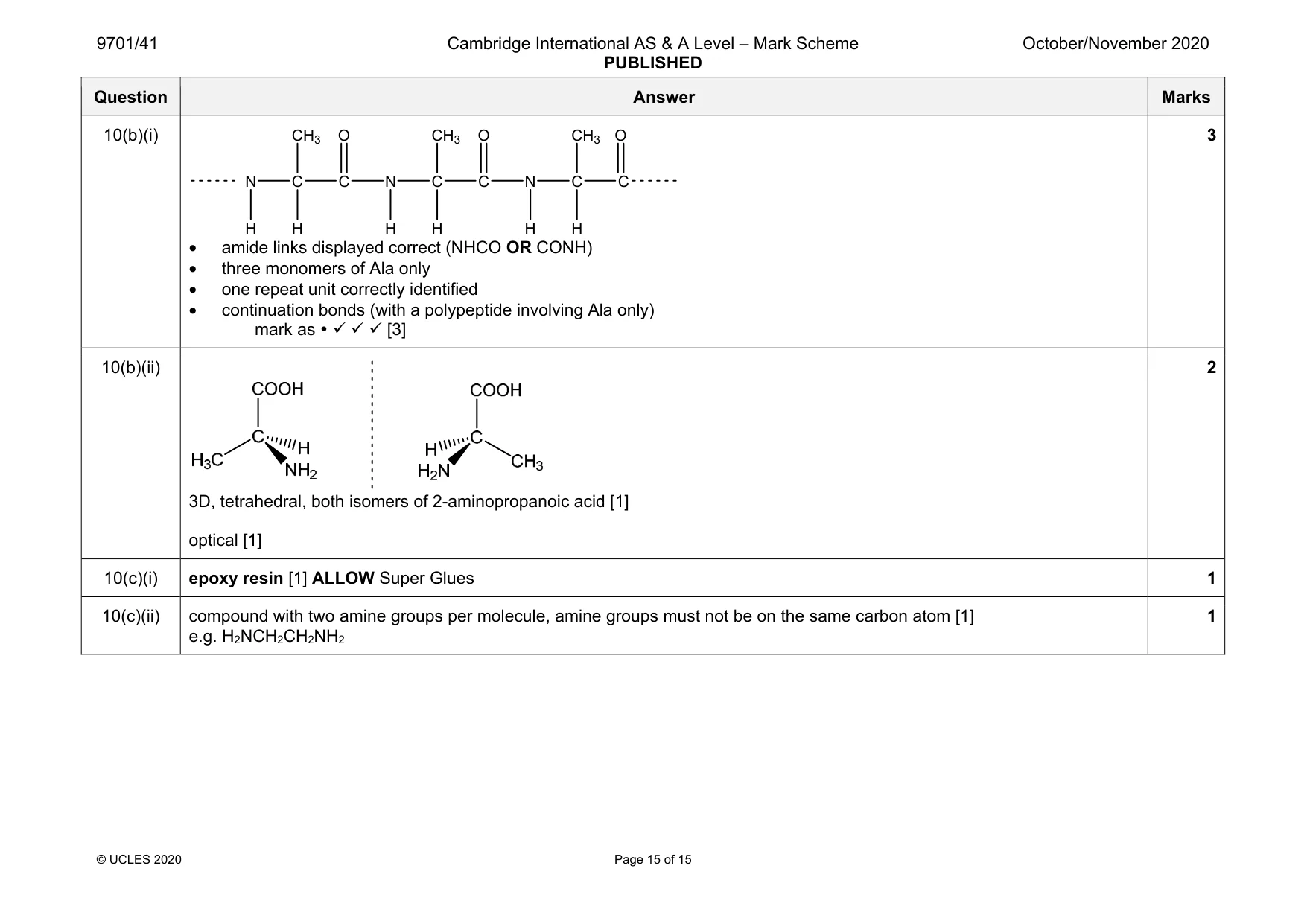
10 (a) The table shows three pairs of monomers that are capable of polymerisation. Complete the table by identifying each type of polymerisation. pair of monomers type of polymerisation HOCH2CH2OH and HO2CCH2CO2H O O C C and HO OH Cl Cl CH3CHCF2 and CH3CHCH2 [1] (b) 2‑aminopropanoic acid, CH3CH(NH2)CO2H, can polymerise under suitable conditions. No other monomer is involved in this reaction. (i) Draw a section of the polymer chain formed including three monomer residues. Clearly identify one repeat unit on your diagram. [3] (ii) 2‑aminopropanoic acid, CH3CH(NH2)CO2H, exists as two stereoisomers. Draw three-dimensional diagrams to show the two stereoisomers of 2‑aminopropanoic acid. State the type of stereoisomerism shown. type of stereoisomerism ...................................................................................................... [2] (c) The skeletal formula of compound W is shown. O O When W is mixed with a second compound, called a hardener, a polymerisation reaction occurs, producing a non-solvent-based adhesive. (i) Give the name of this type of non-solvent-based adhesive. ....................................................................................................................................... [1] (ii) The hardener is a diamine. A diamine has an alkyl chain with two amine groups which are not bonded to the same carbon atom. Draw the structural formula of a compound that would make a suitable hardener. [1] [Total: 8]
Mark scheme: 10(a) ALL correct [1] 1 Question Answer Marks 10(b)(i) O C C N C H CH3 C H N CH3 H H O N H C CH3 C H O • amide links displayed correct (NHCO OR CONH) • three monomers of Ala only • one repeat unit correctly identified • continuation bonds (with a polypeptide involving Ala only) mark as [3] 3 10(b)(ii) 3D, tetrahedral, both isomers of 2-aminopropanoic acid [1] optical [1] 2 10(c)(i) epoxy resin [1] ALLOW Super Glues 1 10(c)(ii) compound with two amine groups per molecule, amine groups must not be on the same carbon atom [1] e.g. H2NCH2CH2NH2 1
What was in this paper
The subtopics covered by these 10 questions, and how many questions each got. Open one in a new tab to see every Cambridge question on it.
1Amino acids1Arenes1Colour of complexes1General characteristic chemical properties of the first set of transition elements, titanium to copper1Lattice energy and Born-Haber cycles1Phenol1Proton (1H) NMR spectroscopy1Simple rate equations, orders of reaction and rate constants1Standard electrode potentials E ⦵, standard cell potentials E ⦵ cell and the Nernst equation1What you needed in this session
Cambridge’s own grade thresholds for 2020 Oct/Nov, Paper 4 · Variant 1. A higher threshold means an easier paper — the bar moves with how the cohort did.