Cambridge A Level Chemistry 9701 — 2018 Oct/Nov Paper 4 · Variant 2
9701/42/O/N/18 · 9 questions · 100 marks · ≈113 min
The question paper and its mark scheme, free to read here and free to download. This is Cambridge’s own paper, exactly as it was sat.
Question paper24 pages


Mark scheme13 pages
Answers below. Sit the paper first if you are practising.
Questions as text
Q1 · An alkene, a carboxylic acid and a ketone, all of similar volatility, are mixed together
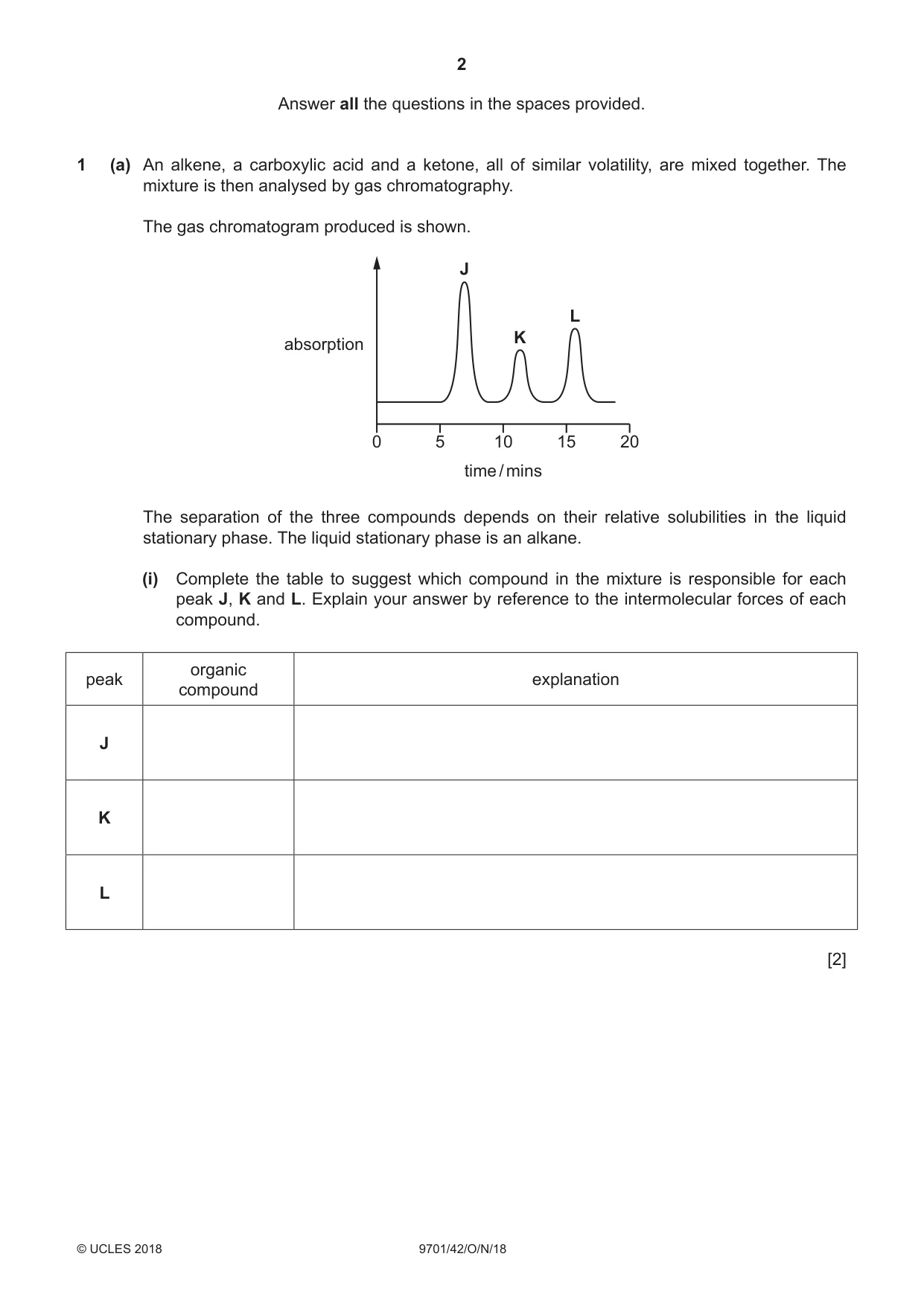
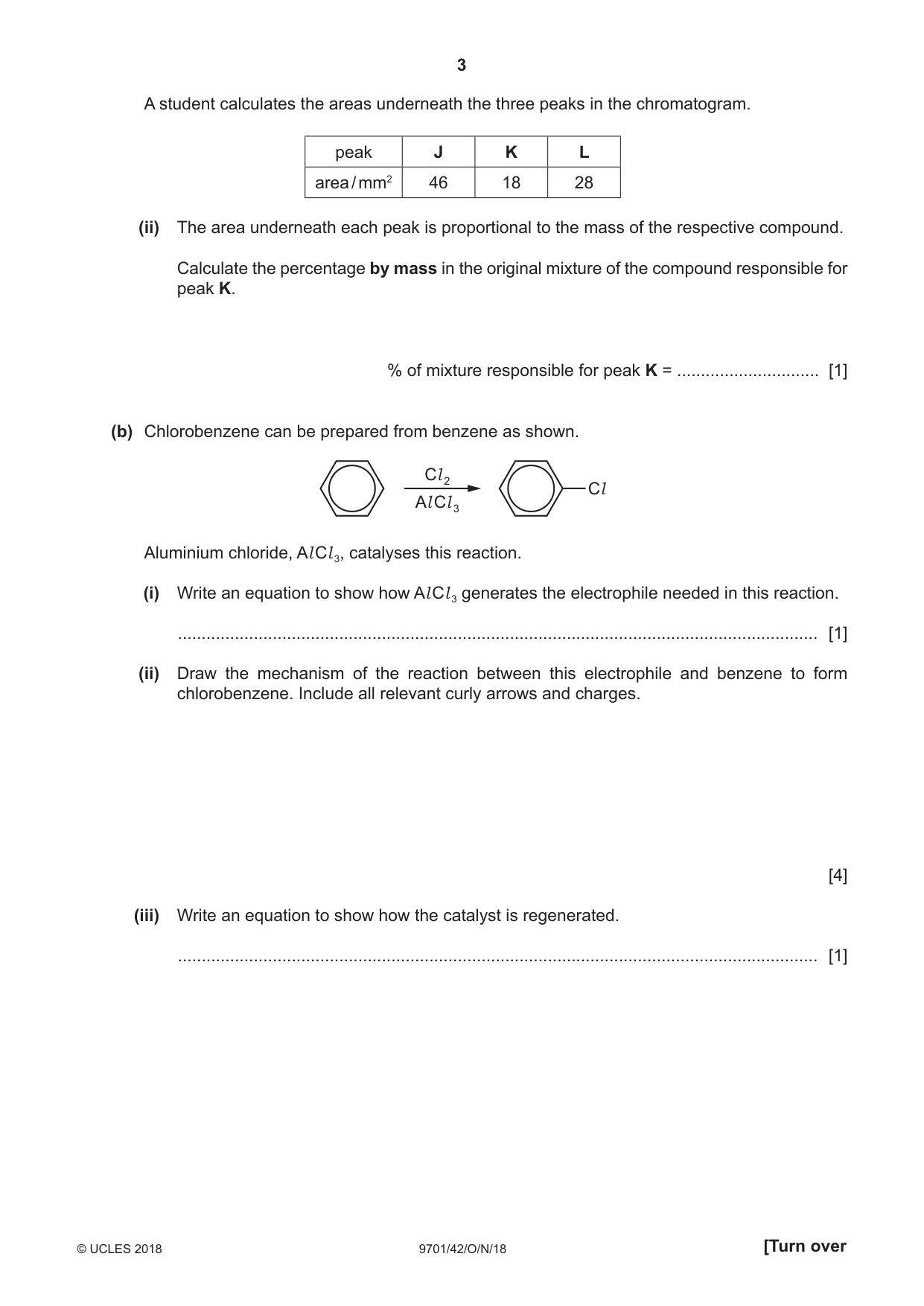
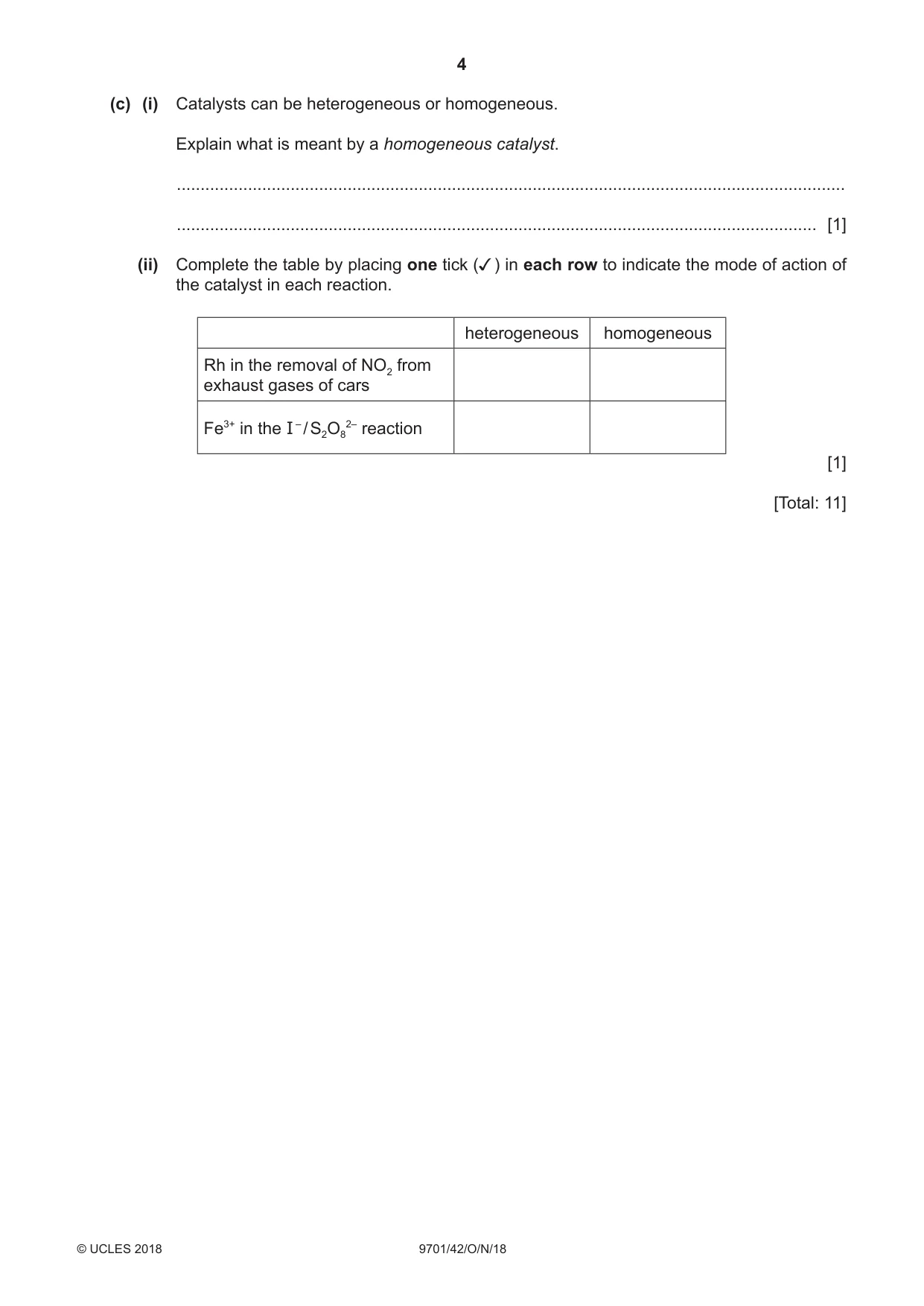
1 (a) An alkene, a carboxylic acid and a ketone, all of similar volatility, are mixed together. The mixture is then analysed by gas chromatography. The gas chromatogram produced is shown. J L K absorption 0 5 10 15 20 time / mins The separation of the three compounds depends on their relative solubilities in the liquid stationary phase. The liquid stationary phase is an alkane. (i) Complete the table to suggest which compound in the mixture is responsible for each peak J, K and L. Explain your answer by reference to the intermolecular forces of each compound. organic peak explanation compound J K L [2] A student calculates the areas underneath the three peaks in the chromatogram. peak J K L area / mm2 46 18 28 (ii) The area underneath each peak is proportional to the mass of the respective compound. Calculate the percentage by mass in the original mixture of the compound responsible for peak K. % of mixture responsible for peak K = .............................. [1] (b) Chlorobenzene can be prepared from benzene as shown. Cl 2 Cl Al Cl 3 Aluminium chloride, Al Cl 3, catalyses this reaction. (i) Write an equation to show how Al Cl 3 generates the electrophile needed in this reaction. ....................................................................................................................................... [1] (ii) Draw the mechanism of the reaction between this electrophile and benzene to form chlorobenzene. Include all relevant curly arrows and charges. [4] (iii) Write an equation to show how the catalyst is regenerated. ....................................................................................................................................... [1] (c) (i) Catalysts can be heterogeneous or homogeneous. Explain what is meant by a homogeneous catalyst. ............................................................................................................................................. ....................................................................................................................................... [1] (ii) Complete the table by placing one tick () in each row to indicate the mode of action of the catalyst in each reaction. heterogeneous homogeneous Rh in the removal of NO2 from exhaust gases of cars Fe3+ in the I – / S2O82– reaction [1] [Total: 11]
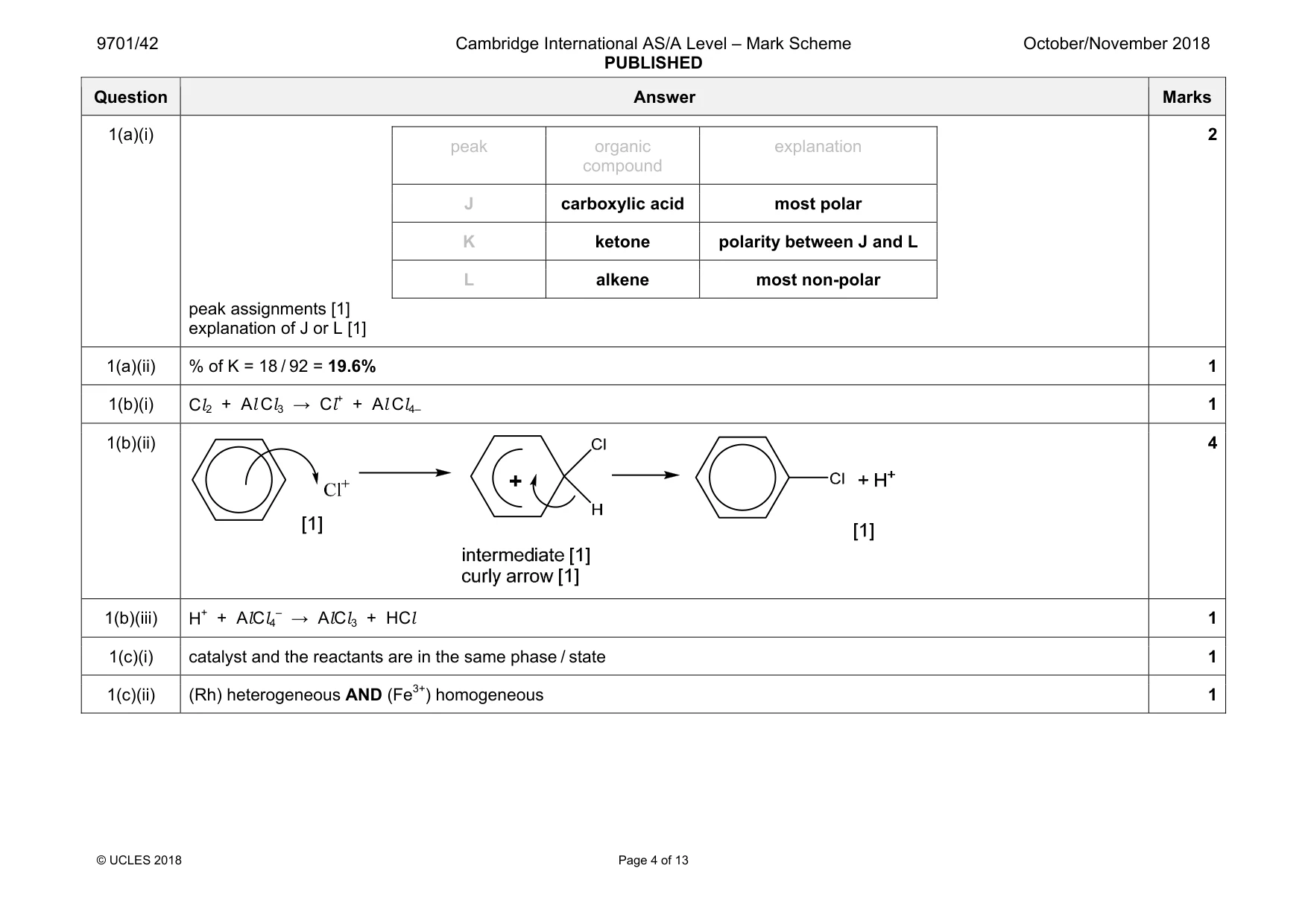
Mark scheme: 1(a)(i) peak organic compound explanation J carboxylic acid most polar K ketone polarity between J and L L alkene most non-polar peak assignments [1] explanation of J or L [1] 2 1(a)(ii) % of K = 18 / 92 = 19.6% 1 1(b)(i) Cl2 + Al Cl3 → Cl+ + Al Cl4– 1 1(b)(ii) 4 1(b)(iii) H+ + AlCl4 – → AlCl3 + HCl 1 1(c)(i) catalyst and the reactants are in the same phase / state 1 1(c)(ii) (Rh) heterogeneous AND (Fe3+) homogeneous 1
Q2 · Complete the electronic configuration for Cu and Cu2+
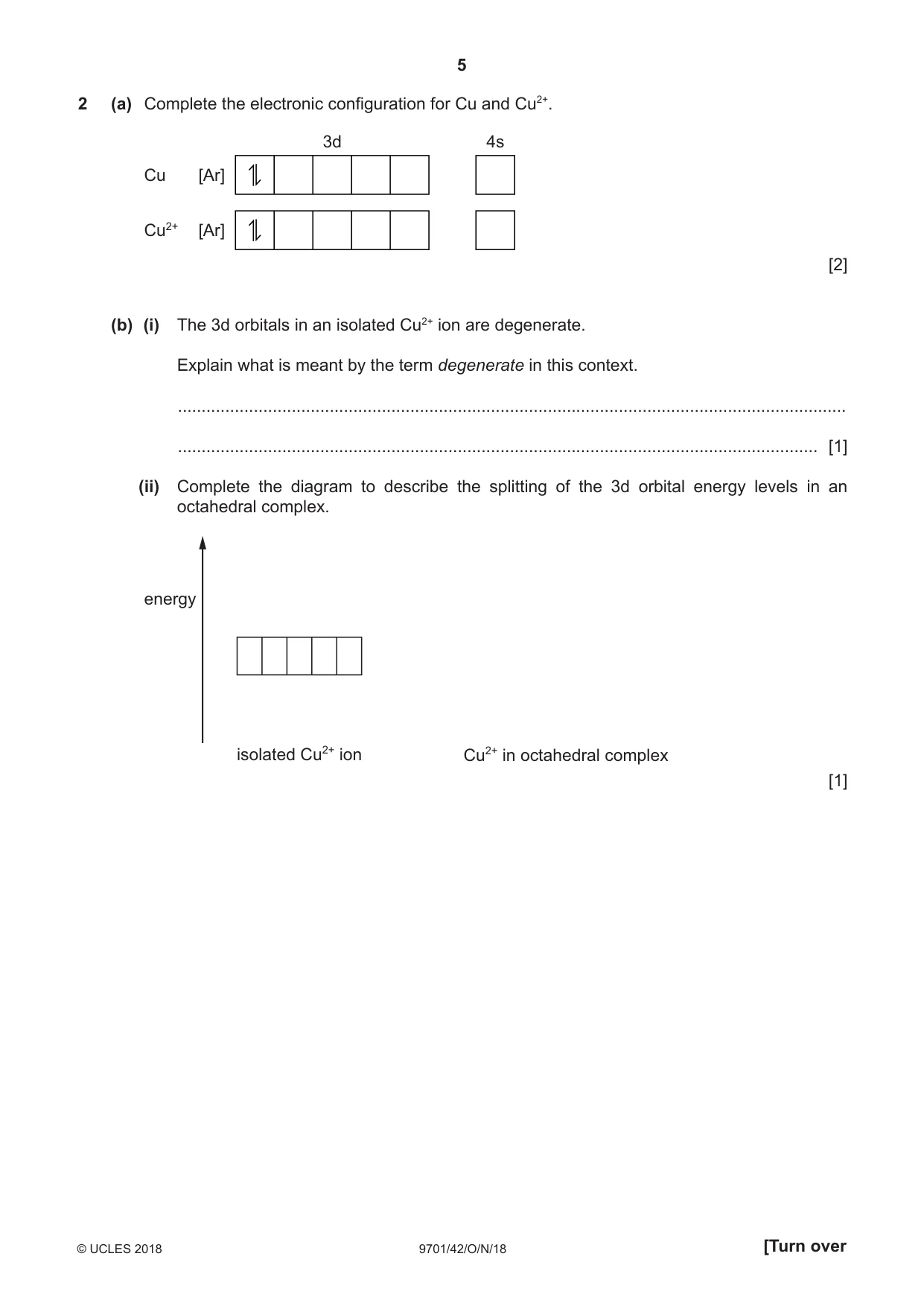
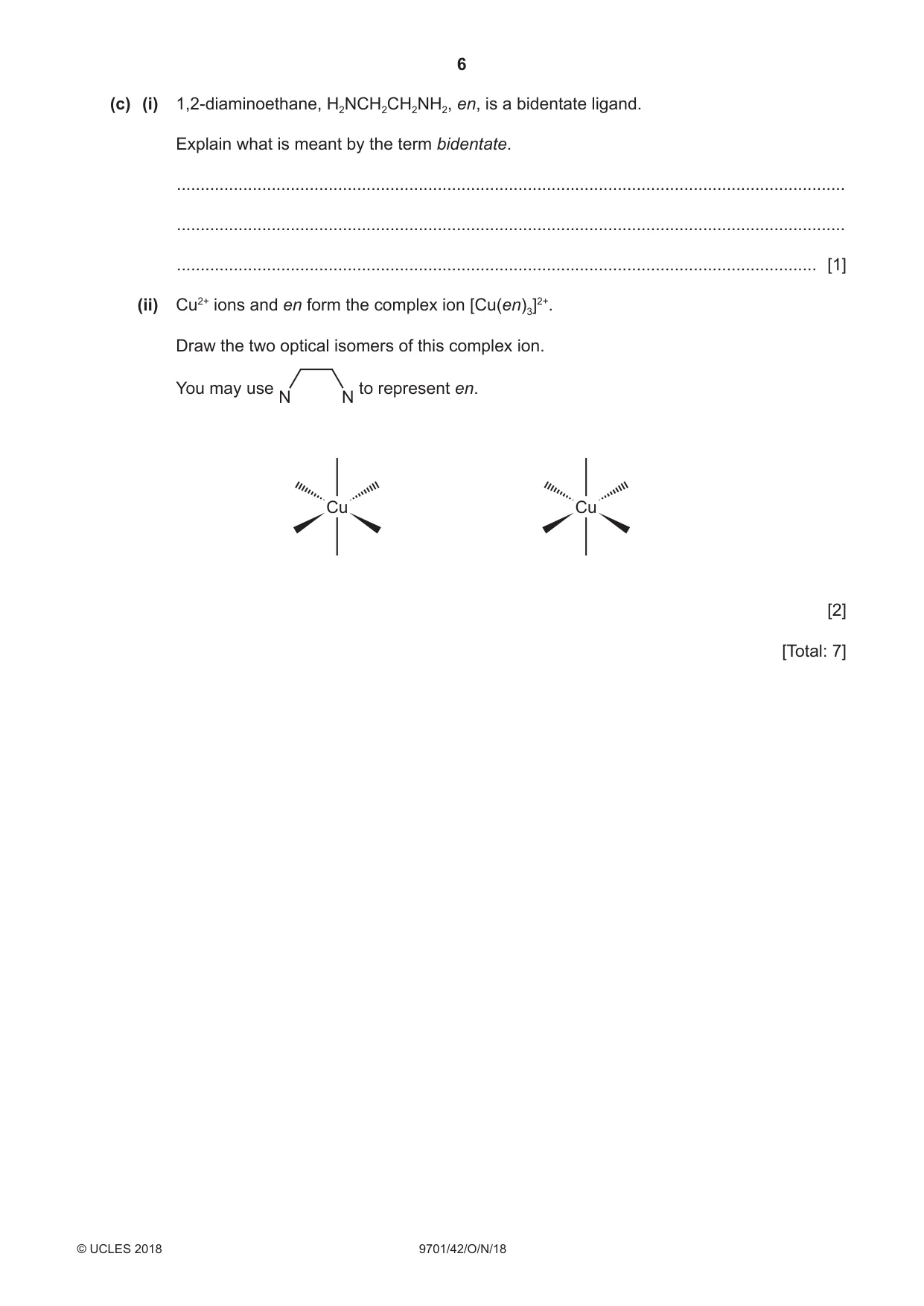
2 (a) Complete the electronic configuration for Cu and Cu2+. 3d 4s Cu [Ar] Cu2+ [Ar] [2] (b) (i) The 3d orbitals in an isolated Cu2+ ion are degenerate. Explain what is meant by the term degenerate in this context. ............................................................................................................................................. ....................................................................................................................................... [1] (ii) Complete the diagram to describe the splitting of the 3d orbital energy levels in an octahedral complex. energy isolated Cu2+ ion Cu2+ in octahedral complex [1] (c) (i) 1,2-diaminoethane, H2NCH2CH2NH2, en, is a bidentate ligand. Explain what is meant by the term bidentate. ............................................................................................................................................. ............................................................................................................................................. ....................................................................................................................................... [1] (ii) Cu2+ ions and en form the complex ion [Cu(en)3]2+. Draw the two optical isomers of this complex ion. You may use to represent en. N N Cu Cu [2] [Total: 7]
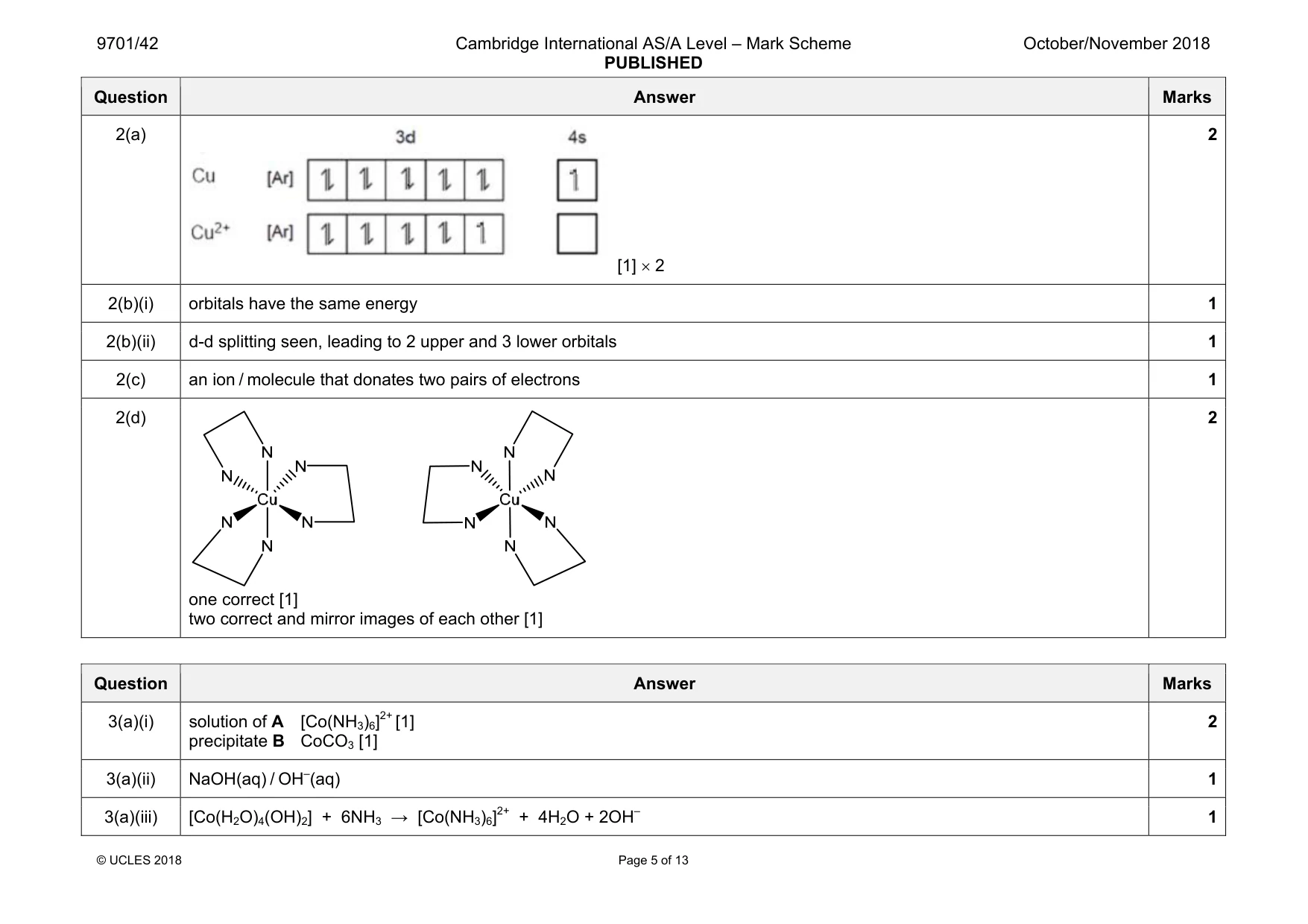
Mark scheme: 2(a) [1] × 2 2 2(b)(i) orbitals have the same energy 1 2(b)(ii) d-d splitting seen, leading to 2 upper and 3 lower orbitals 1 2(c) an ion / molecule that donates two pairs of electrons 1 2(d) one correct [1] two correct and mirror images of each other [1] 2
More questions on Stereoisomerism in transition element complexes
Q3 · The reaction scheme shows some reactions of [Co(H2O)6]2+
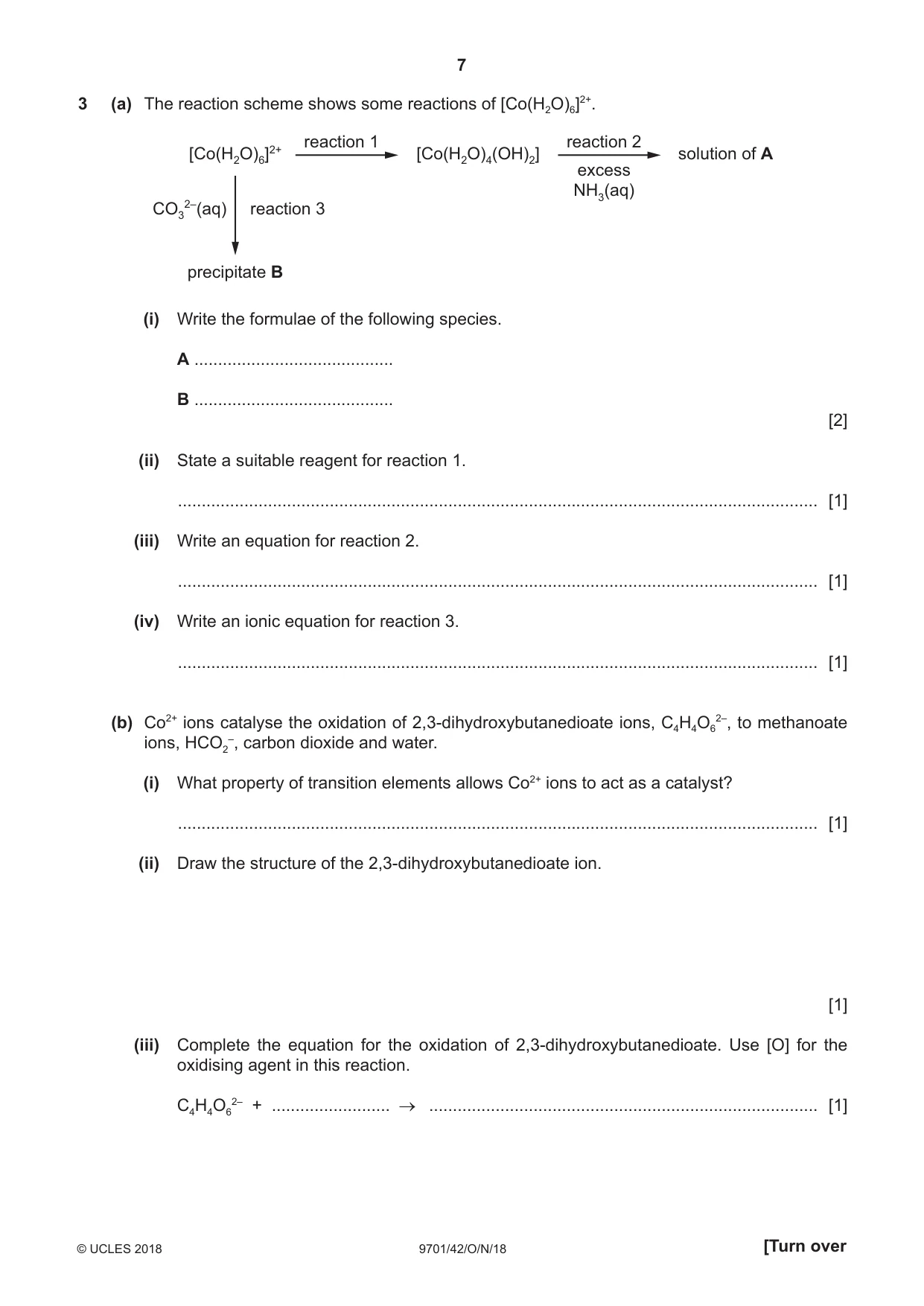
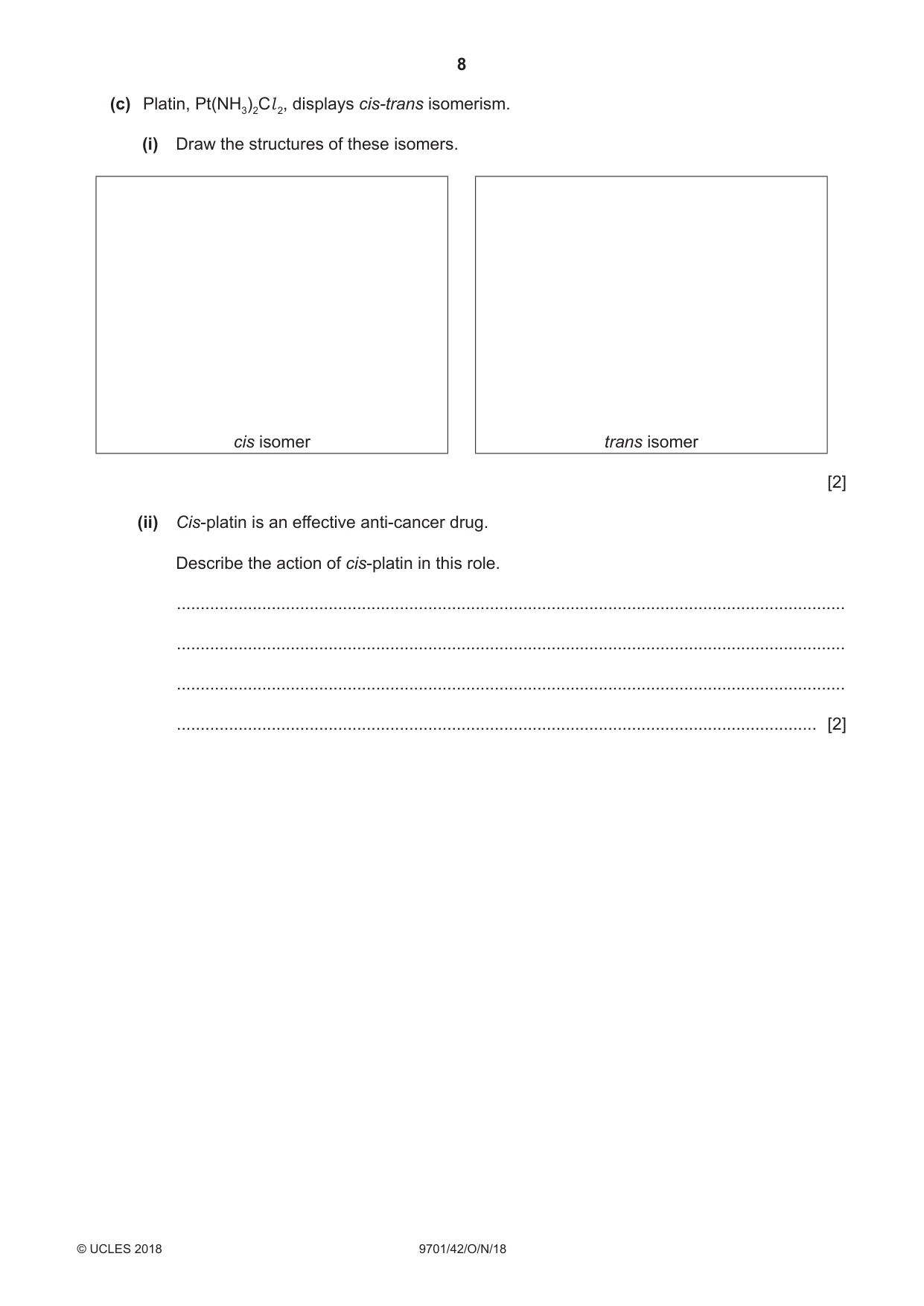
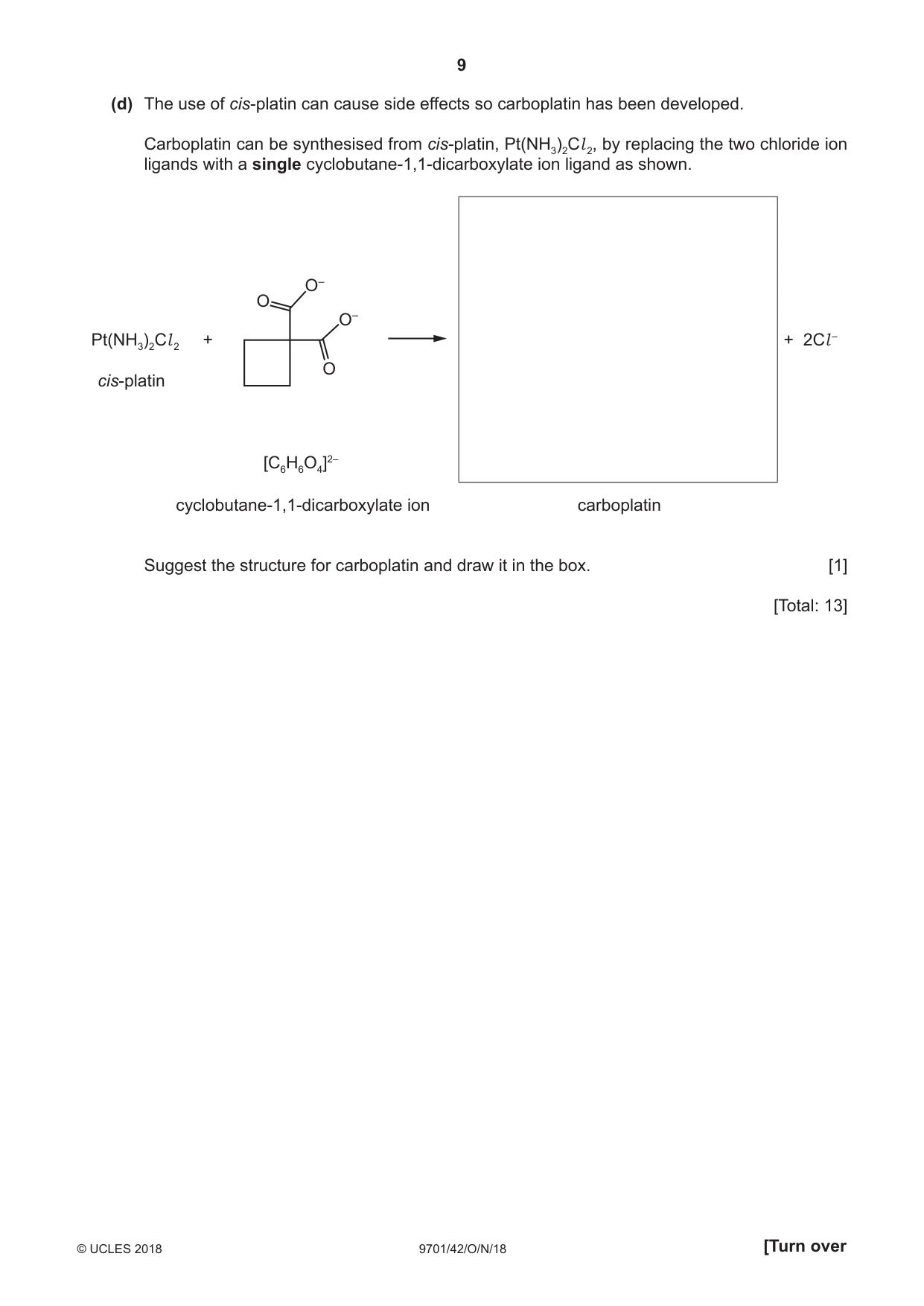
3 (a) The reaction scheme shows some reactions of [Co(H2O)6]2+. reaction 1 reaction 2 [Co(H2O)6]2+ [Co(H2O)4(OH)2] solution of A excess NH3(aq) CO32–(aq) reaction 3 precipitate B (i) Write the formulae of the following species. A .......................................... B .......................................... [2] (ii) State a suitable reagent for reaction 1. ....................................................................................................................................... [1] (iii) Write an equation for reaction 2. ....................................................................................................................................... [1] (iv) Write an ionic equation for reaction 3. ....................................................................................................................................... [1] (b) Co2+ ions catalyse the oxidation of 2,3-dihydroxybutanedioate ions, C4H4O62–, to methanoate ions, HCO2–, carbon dioxide and water. (i) What property of transition elements allows Co2+ ions to act as a catalyst? ....................................................................................................................................... [1] (ii) Draw the structure of the 2,3-dihydroxybutanedioate ion. [1] (iii) Complete the equation for the oxidation of 2,3-dihydroxybutanedioate. Use [O] for the oxidising agent in this reaction. C4H4O62– + ......................... (c) Platin, Pt(NH3)2Cl 2, displays cis-trans isomerism. (i) Draw the structures of these isomers. cis isomer trans isomer [2] (ii) Cis-platin is an effective anti-cancer drug. Describe the action of cis-platin in this role. ............................................................................................................................................. ............................................................................................................................................. ............................................................................................................................................. ....................................................................................................................................... [2] (d) The use of cis‑platin can cause side effects so carboplatin has been developed. Carboplatin can be synthesised from cis‑platin, Pt(NH3)2Cl 2, by replacing the two chloride ion ligands with a single cyclobutane‑1,1‑dicarboxylate ion ligand as shown. O– O O– Pt(NH3)2Cl 2 + + 2Cl – O cis-platin [C6H6O4]2– cyclobutane-1,1-dicarboxylate ion carboplatin Suggest the structure for carboplatin and draw it in the box. [1] [Total: 13]
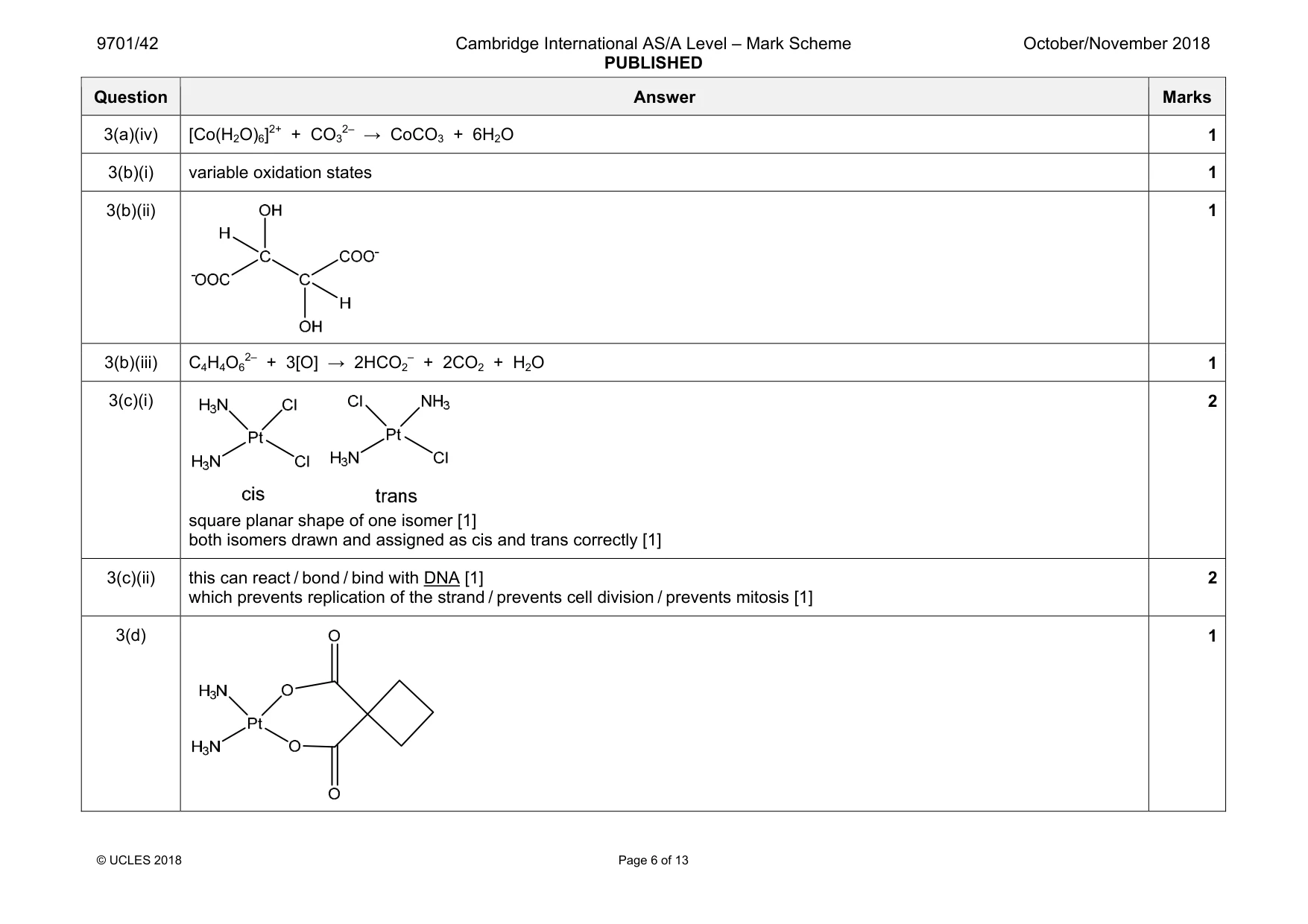
Mark scheme: 3(a)(i) precipitate B CoCO3 [1] 2 3(a)(ii) NaOH(aq) / OH–(aq) 1 3(a)(iii) [Co(H2O)4(OH)2] + 6NH3 → [Co(NH3)6]2+ + 4H2O + 2OH– 1 Question Answer Marks 3(a)(iv) [Co(H2O)6]2+ + CO3 2– → CoCO3 + 6H2O 1 3(b)(i) variable oxidation states 1 3(b)(ii) 1 3(b)(iii) C4H4O6 2– + 3[O] → 2HCO2 – + 2CO2 + H2O 1 3(c)(i) square planar shape of one isomer [1] both isomers drawn and assigned as cis and trans correctly [1] 2 3(c)(ii) this can react / bond / bind with DNA [1] which prevents replication of the strand / prevents cell division / prevents mitosis [1] 2 3(d) 1
Q4 · Calcium nitride, Ca3N2 , reacts readily with water to form a white precipitate suspended…
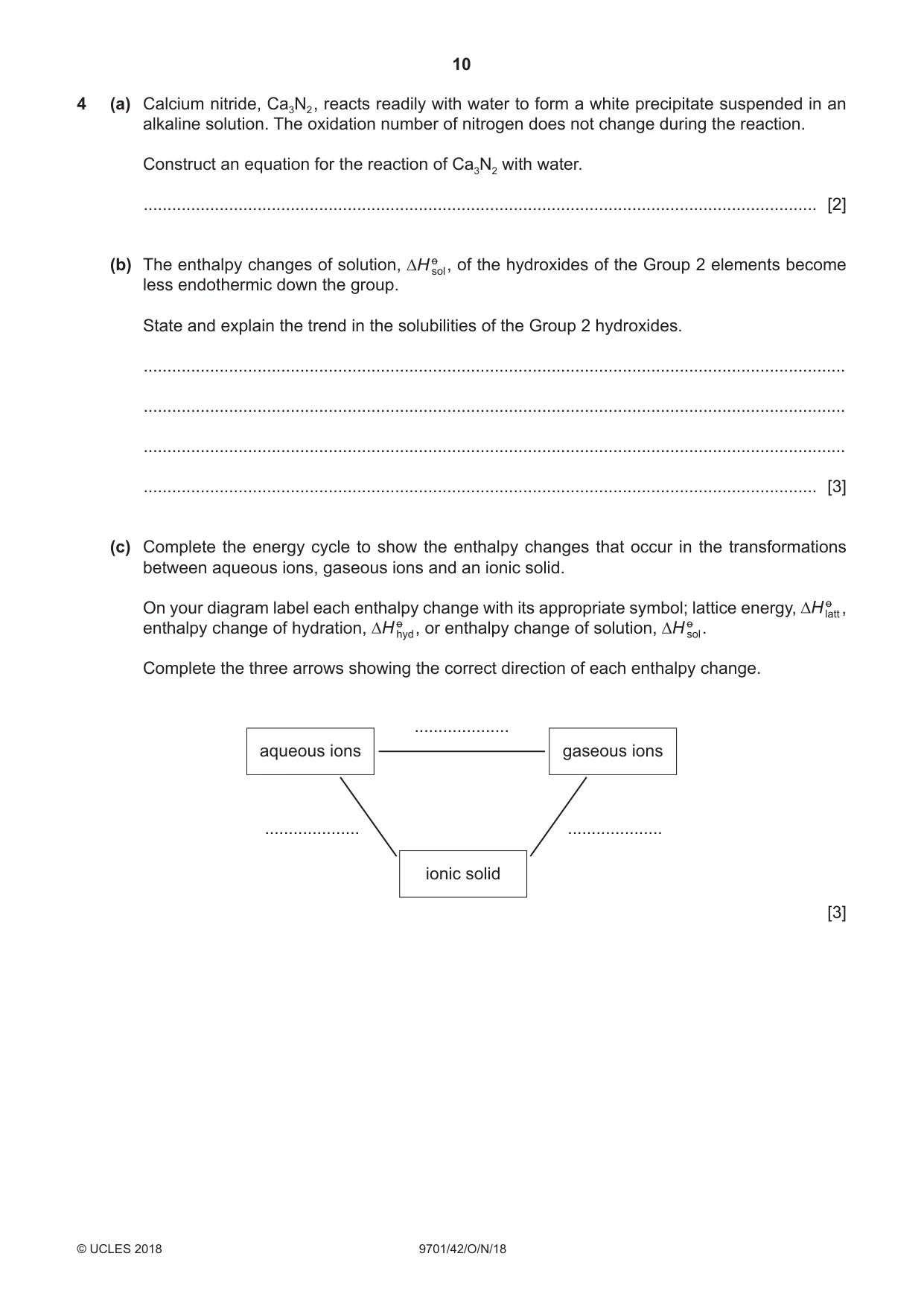
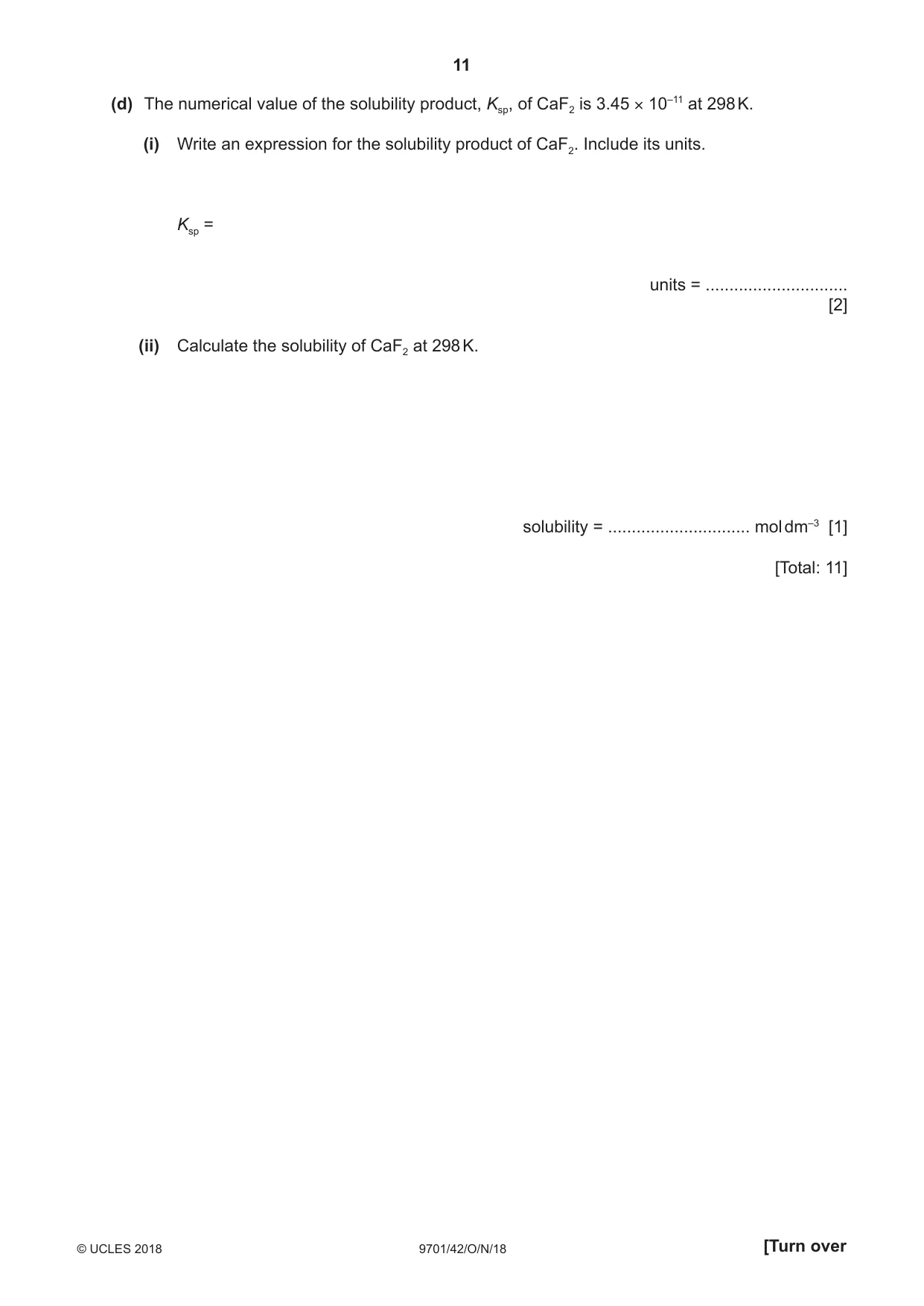
4 (a) Calcium nitride, Ca3N2 , reacts readily with water to form a white precipitate suspended in an alkaline solution. The oxidation number of nitrogen does not change during the reaction. Construct an equation for the reaction of Ca3N2 with water. .............................................................................................................................................. [2] (b) The enthalpy changes of solution, , of the hydroxides of the Group 2 elements become less endothermic down the group. State and explain the trend in the solubilities of the Group 2 hydroxides. .................................................................................................................................................... .................................................................................................................................................... .................................................................................................................................................... .............................................................................................................................................. [3] (c) Complete the energy cycle to show the enthalpy changes that occur in the transformations between aqueous ions, gaseous ions and an ionic solid. On your diagram label each enthalpy change with its appropriate symbol; lattice energy, , enthalpy change of hydration, , or enthalpy change of solution, . Complete the three arrows showing the correct direction of each enthalpy change. .................... aqueous ions gaseous ions .................... .................... ionic solid [3] (d) The numerical value of the solubility product, Ksp, of CaF2 is 3.45 × 10⁻¹¹ at 298 K. (i) Write an expression for the solubility product of CaF2. Include its units. Ksp = units = .............................. [2] (ii) Calculate the solubility of CaF2 at 298 K. solubility = .............................. mol dm–3 [1] [Total: 11]
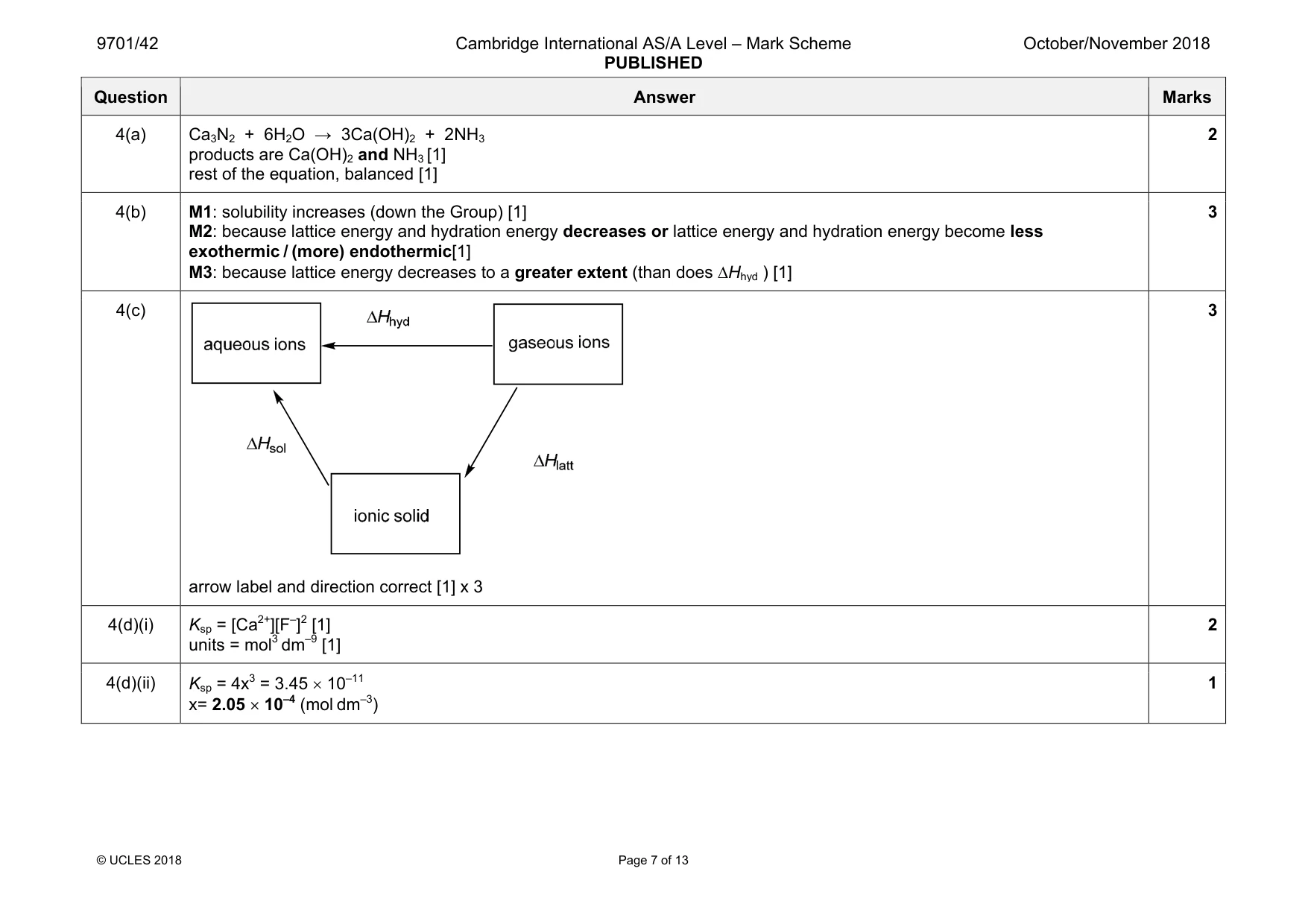
Mark scheme: 4(a) Ca3N2 + 6H2O → 3Ca(OH)2 + 2NH3 products are Ca(OH)2 and NH3 [1] rest of the equation, balanced [1] 2 4(b) M1: solubility increases (down the Group) [1] M2: because lattice energy and hydration energy decreases or lattice energy and hydration energy become less exothermic / (more) endothermic[1] M3: because lattice energy decreases to a greater extent (than does ∆Hhyd ) [1] 3 4(c) arrow label and direction correct [1] x 3 3 4(d)(i) Ksp = [Ca2+][F–]2 [1] units = mol3 dm–9 [1] 2 4(d)(ii) Ksp = 4x3 = 3.45 × 10⁻¹¹ x= 2.05 × 10⁻⁴ (mol dm–3) 1
Q5 · Explain why the thermal stability of the Group 2 nitrates increases down the group
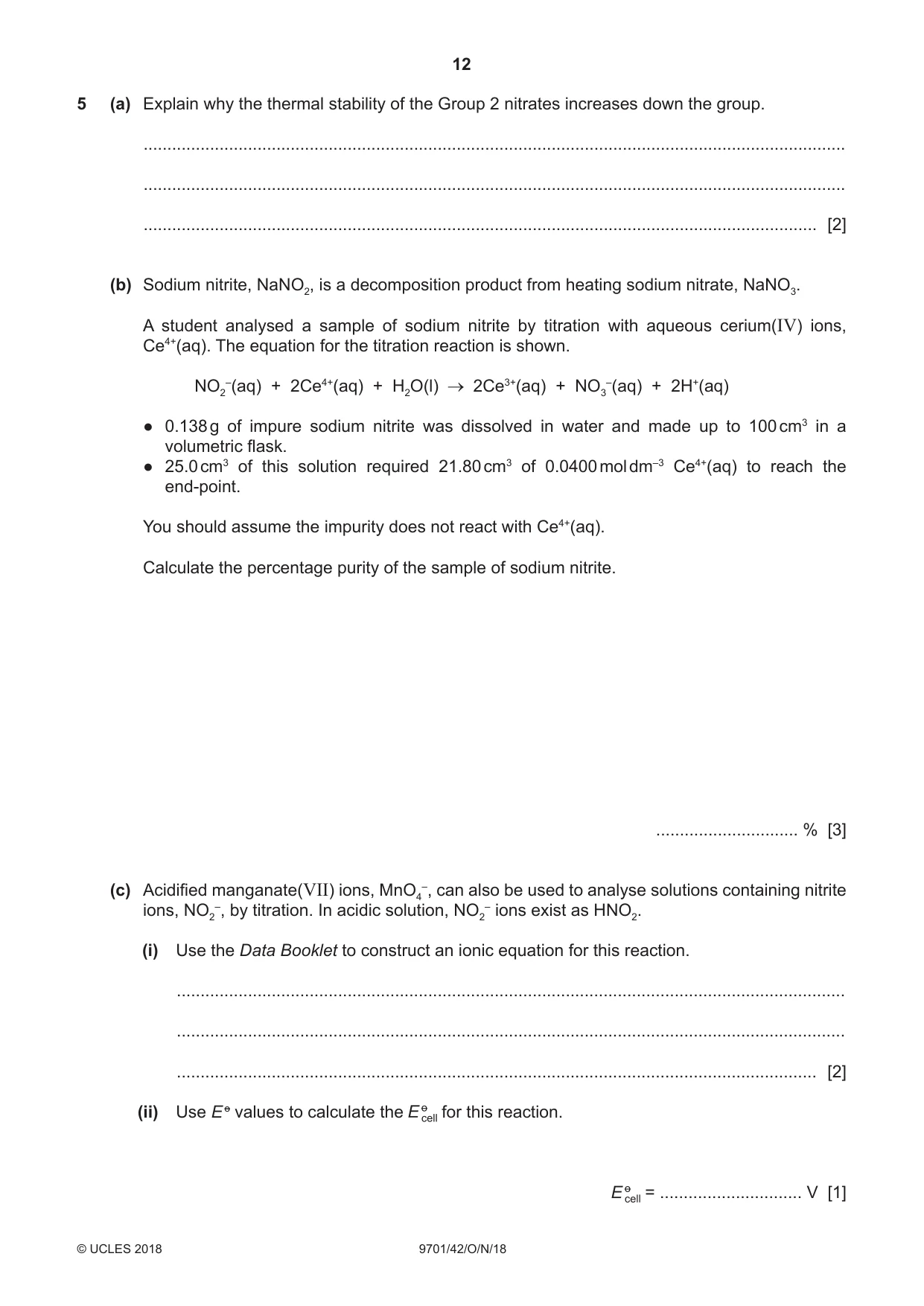
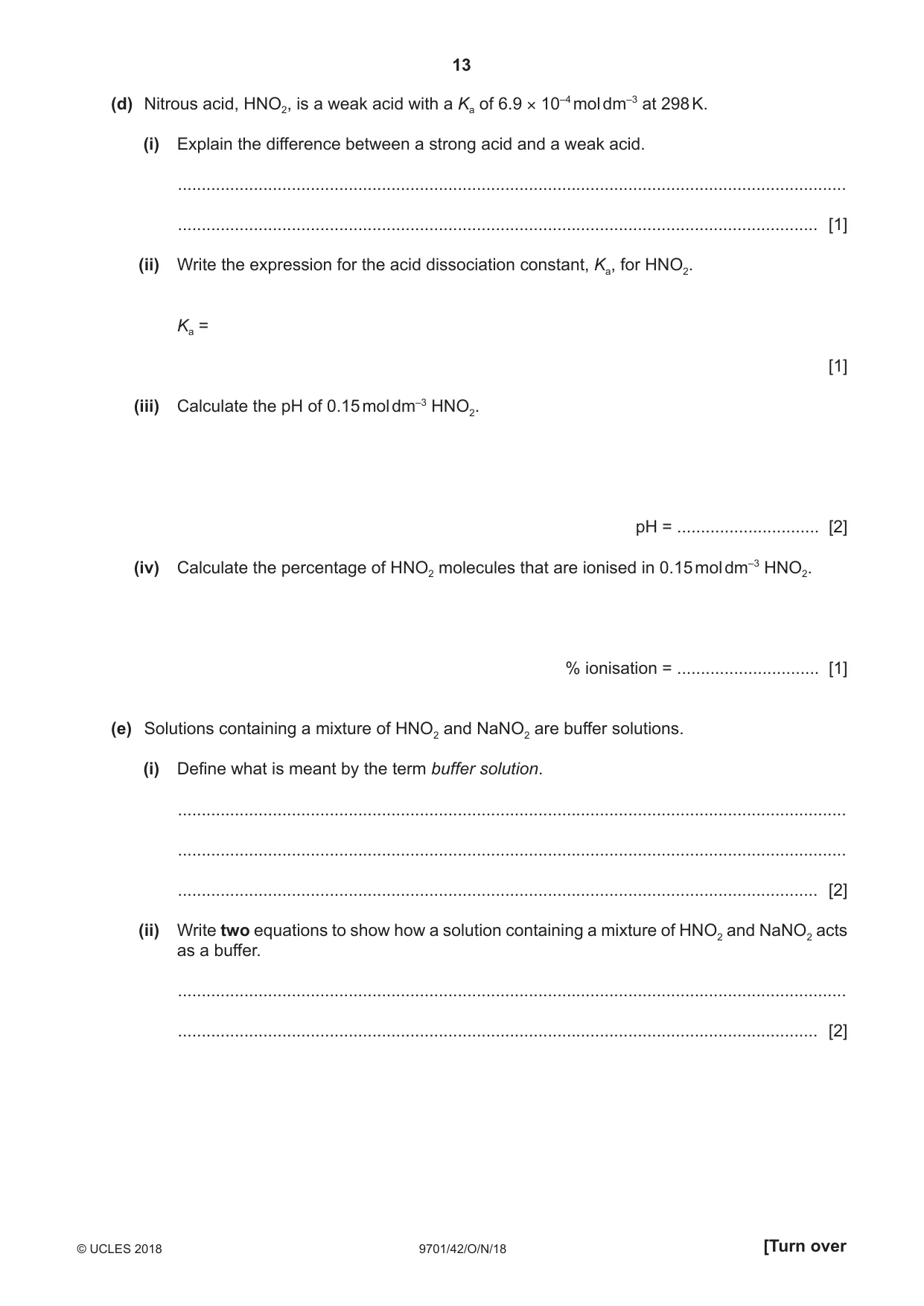
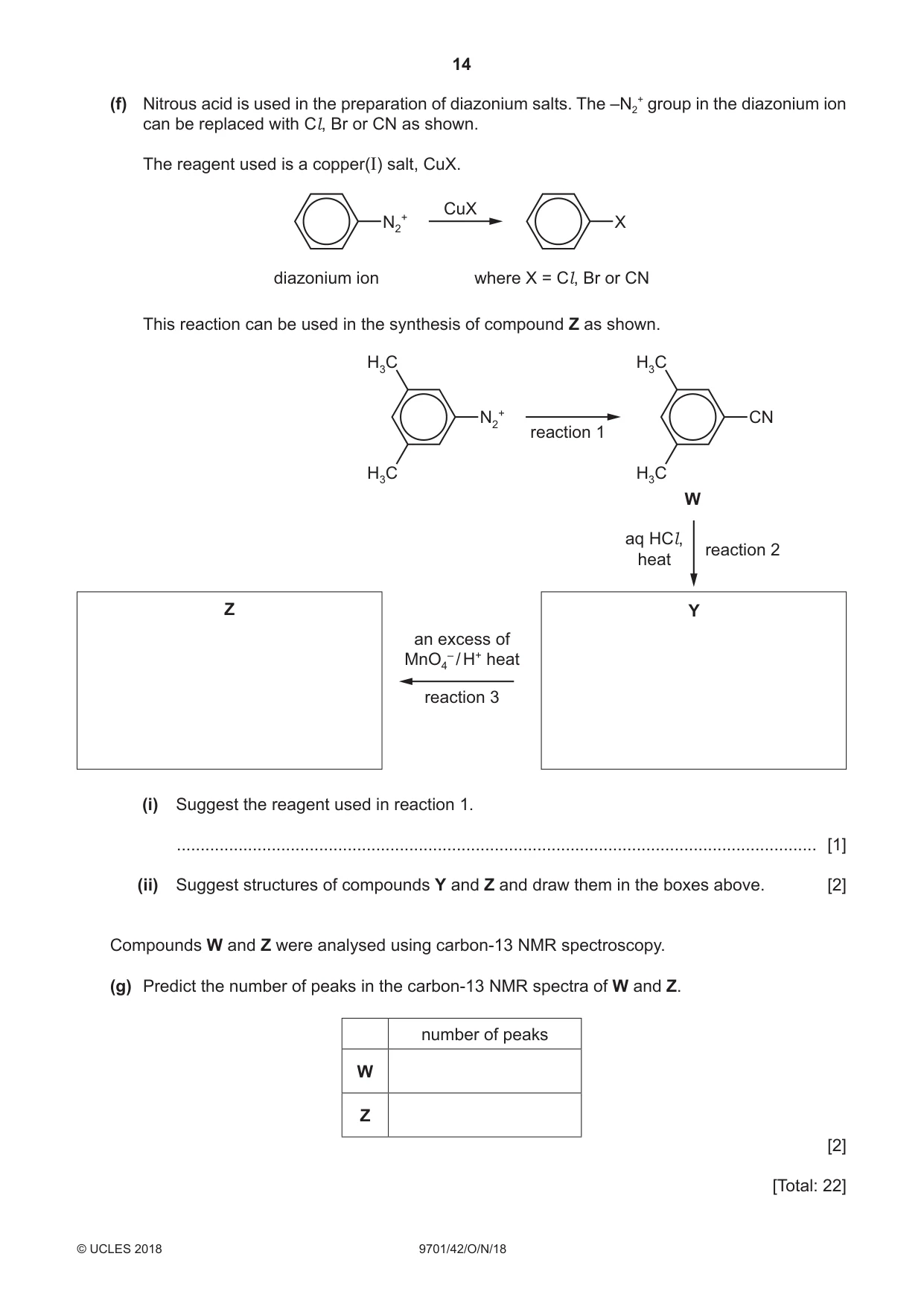
5 (a) Explain why the thermal stability of the Group 2 nitrates increases down the group. .................................................................................................................................................... .................................................................................................................................................... .............................................................................................................................................. [2] (b) Sodium nitrite, NaNO2, is a decomposition product from heating sodium nitrate, NaNO3. A student analysed a sample of sodium nitrite by titration with aqueous cerium(IV) ions, Ce4+(aq). The equation for the titration reaction is shown. NO2–(aq) + 2Ce4+(aq) + H2O(l) 2Ce3+(aq) + NO3–(aq) + 2H+(aq) ●● 0.138 g of impure sodium nitrite was dissolved in water and made up to 100 cm3 in a volumetric flask. ●● 25.0 cm3 of this solution required 21.80 cm3 of 0.0400 mol dm–3 Ce4+(aq) to reach the end‑point. You should assume the impurity does not react with Ce4+(aq). Calculate the percentage purity of the sample of sodium nitrite. .............................. % [3] (c) Acidified manganate(VII) ions, MnO4–, can also be used to analyse solutions containing nitrite ions, NO2–, by titration. In acidic solution, NO2– ions exist as HNO2. (i) Use the Data Booklet to construct an ionic equation for this reaction. ............................................................................................................................................. ............................................................................................................................................. ....................................................................................................................................... [2] (ii) Use E o values to calculate the for this reaction. = .............................. V [1] (d) Nitrous acid, HNO2, is a weak acid with a Ka of 6.9 × 10⁻⁴ mol dm–3 at 298 K. (i) Explain the difference between a strong acid and a weak acid. ............................................................................................................................................. ....................................................................................................................................... [1] (ii) Write the expression for the acid dissociation constant, Ka, for HNO2. Ka = [1] (iii) Calculate the pH of 0.15 mol dm–3 HNO2. pH = .............................. [2] (iv) Calculate the percentage of HNO2 molecules that are ionised in 0.15 mol dm–3 HNO2. % ionisation = .............................. [1] (e) Solutions containing a mixture of HNO2 and NaNO2 are buffer solutions. (i) Define what is meant by the term buffer solution. ............................................................................................................................................. ............................................................................................................................................. ....................................................................................................................................... [2] (ii) Write two equations to show how a solution containing a mixture of HNO2 and NaNO2 acts as a buffer. ............................................................................................................................................. ....................................................................................................................................... [2] (f) Nitrous acid is used in the preparation of diazonium salts. The –N2+ group in the diazonium ion can be replaced with Cl, Br or CN as shown. The reagent used is a copper(I) salt, CuX. CuX N2+ X diazonium ion where X = Cl, Br or CN This reaction can be used in the synthesis of compound Z as shown. H3C H3C N2+ CN reaction 1 H3C H3C W aq HCl, reaction 2 heat Z Y an excess of MnO4– / H+ heat reaction 3 (i) Suggest the reagent used in reaction 1. ....................................................................................................................................... [1] (ii) Suggest structures of compounds Y and Z and draw them in the boxes above. [2] Compounds W and Z were analysed using carbon‑13 NMR spectroscopy. (g) Predict the number of peaks in the carbon‑13 NMR spectra of W and Z. number of peaks W Z [2] [Total: 22] Question 6 starts on the next page.
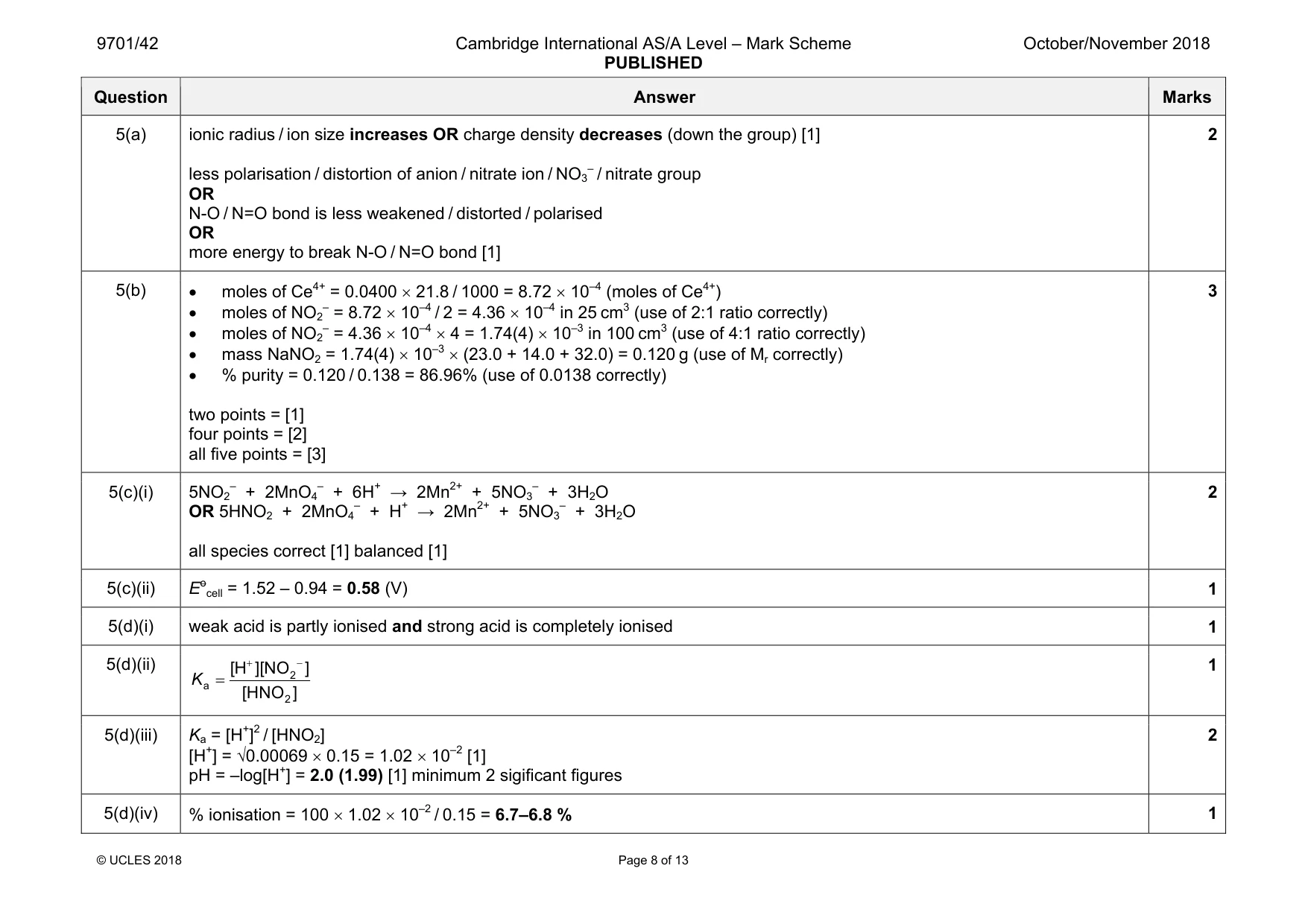
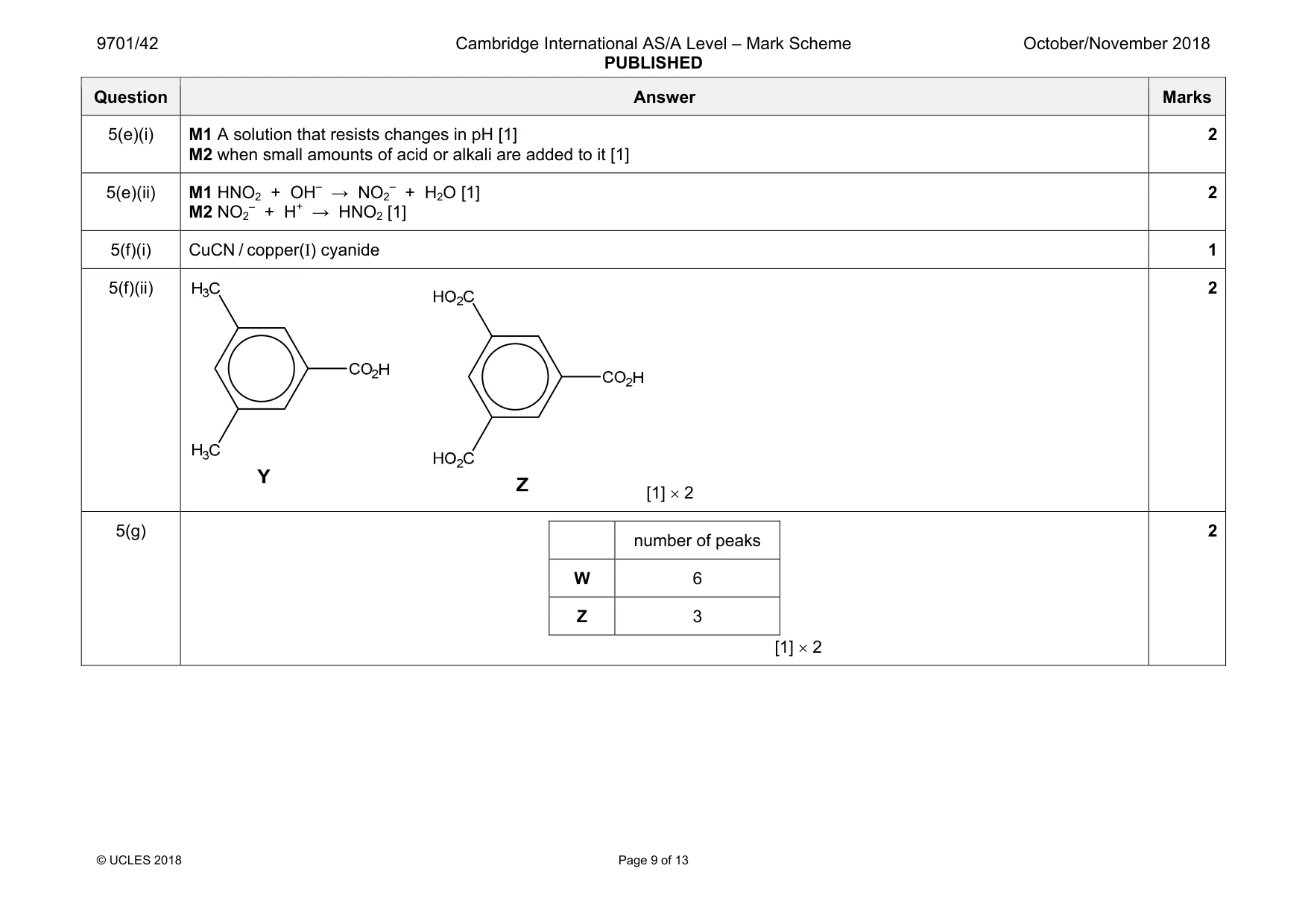
Mark scheme: 5(a) ionic radius / ion size increases OR charge density decreases (down the group) [1] less polarisation / distortion of anion / nitrate ion / NO3 – / nitrate group OR N-O / N=O bond is less weakened / distorted / polarised OR more energy to break N-O / N=O bond [1] 2 5(b) • moles of Ce4+ = 0.0400 × 21.8 / 1000 = 8.72 × 10⁻⁴ (moles of Ce4+) • moles of NO2 – = 8.72 × 10⁻⁴ / 2 = 4.36 × 10⁻⁴ in 25 cm3 (use of 2:1 ratio correctly) • moles of NO2 – = 4.36 × 10–4 × 4 = 1.74(4) × 10–3 in 100 cm3 (use of 4:1 ratio correctly) • mass NaNO2 = 1.74(4) × 10–3 × (23.0 + 14.0 + 32.0) = 0.120 g (use of Mr correctly) • % purity = 0.120 / 0.138 = 86.96% (use of 0.0138 correctly) two points = [1] four points = [2] all five points = [3] 3 5(c)(i) 5NO2 – + 2MnO4 – + 6H+ → 2Mn2+ + 5NO3 – + 3H2O OR 5HNO2 + 2MnO4 – + H+ → 2Mn2+ + 5NO3 – + 3H2O all species correct [1] balanced [1] 2 5(c)(ii) Eo cell = 1.52 – 0.94 = 0.58 (V) 1 5(d)(i) weak acid is partly ionised and strong acid is completely ionised 1 5(d)(ii) + − = 2 a 2 [H ][NO ] [HNO ] K 1 5(d)(iii) Ka = [H+]2 / [HNO2] [H+] = √0.00069 × 0.15 = 1.02 × 10⁻² [1] pH = –log[H+] = 2.0 (1.99) [1] minimum 2 sigificant figures 2 5(d)(iv) % ionisation = 100 × 1.02 × 10–2 / 0.15 = 6.7–6.8 % 1 Question Answer Marks 5(e)(i) M1 A solution that resists changes in pH [1] M2 when small amounts of acid or alkali are added to it [1] 2 5(e)(ii) M1 HNO2 + OH– → NO2 – + H2O [1] M2 NO2 – + H+ → HNO2 [1] 2 5(f)(i) CuCN / copper(I) cyanide 1 5(f)(ii) [1] × 2 2 5(g) number of peaks W 6 Z 3 [1] × 2 2
Q6 · 2-hydroxypropanoic acid can be synthesised in four steps from ethanoic acid
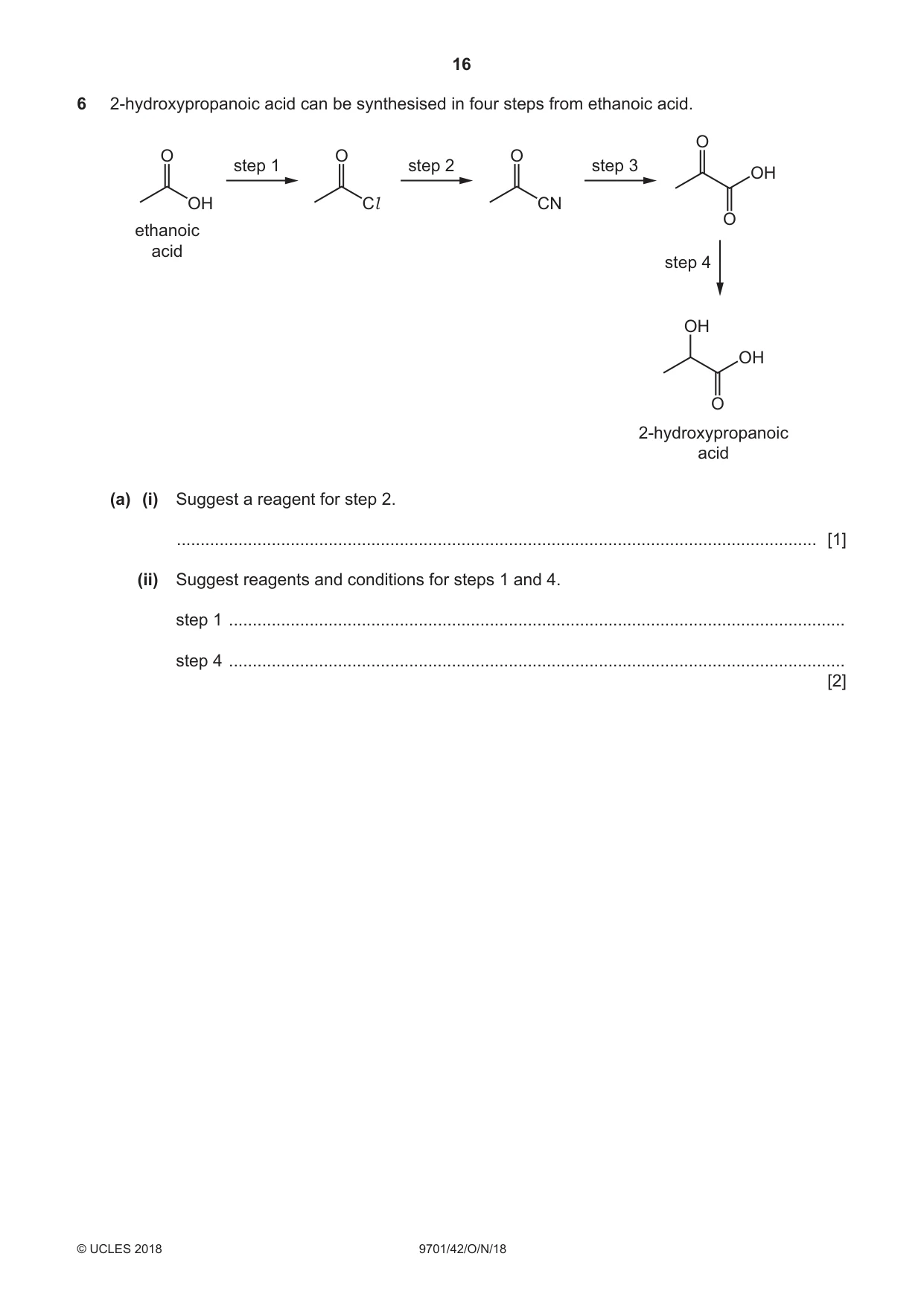
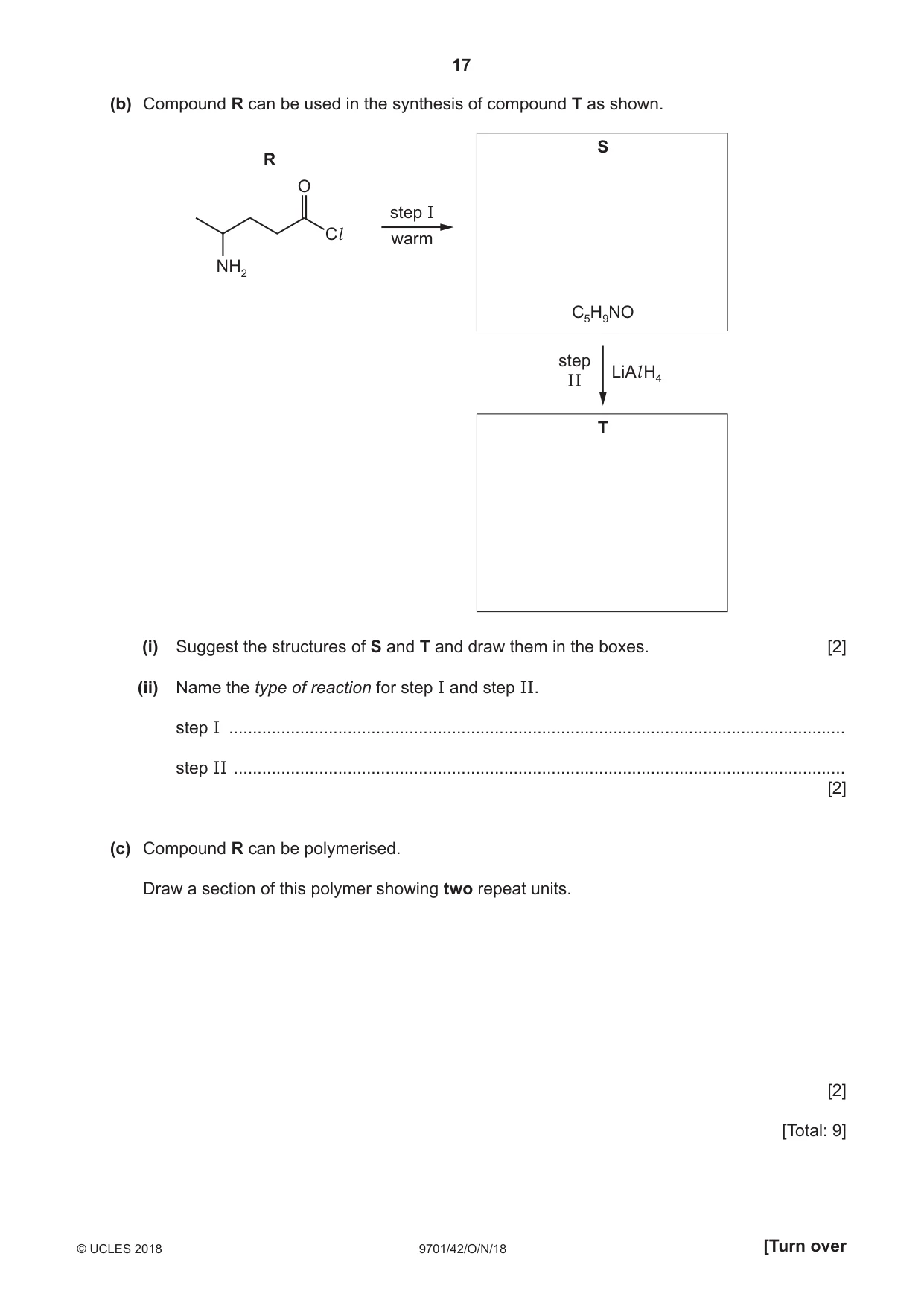
6 2-hydroxypropanoic acid can be synthesised in four steps from ethanoic acid. O O O O step 1 step 2 step 3 OH OH Cl CN O ethanoic acid step 4 OH OH O 2-hydroxypropanoic acid (a) (i) Suggest a reagent for step 2. ....................................................................................................................................... [1] (ii) Suggest reagents and conditions for steps 1 and 4. step 1 .................................................................................................................................. step 4 .................................................................................................................................. [2] (b) Compound R can be used in the synthesis of compound T as shown. S R O step I Cl warm NH2 C5H9NO step LiAl H4 II T (i) Suggest the structures of S and T and draw them in the boxes. [2] (ii) Name the type of reaction for step I and step II. step I ................................................................................................................................... step II ................................................................................................................................. [2] (c) Compound R can be polymerised. Draw a section of this polymer showing two repeat units. [2] [Total: 9]
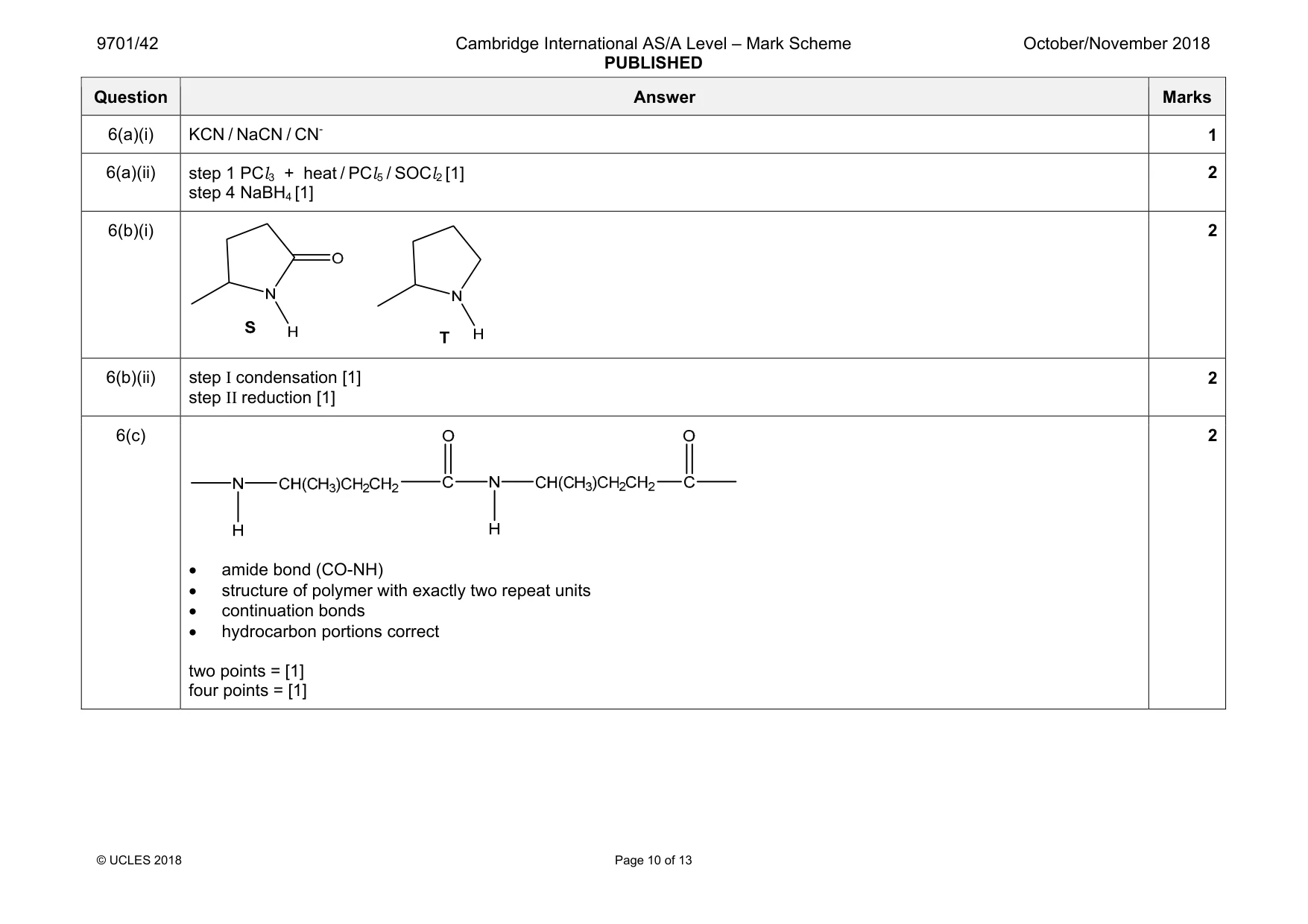
Mark scheme: 6(a)(i) 1 6(a)(ii) step 1 PCl3 + heat / PCl5 / SOCl2 [1] step 4 NaBH4 [1] 2 6(b)(i) 2 6(b)(ii) step I condensation [1] step II reduction [1] 2 6(c) • amide bond (CO-NH) • structure of polymer with exactly two repeat units • continuation bonds • hydrocarbon portions correct two points = [1] four points = [1] 2
Q7 · Polyurethanes are polymers made by the reaction of a diisocyanate with a diol as shown
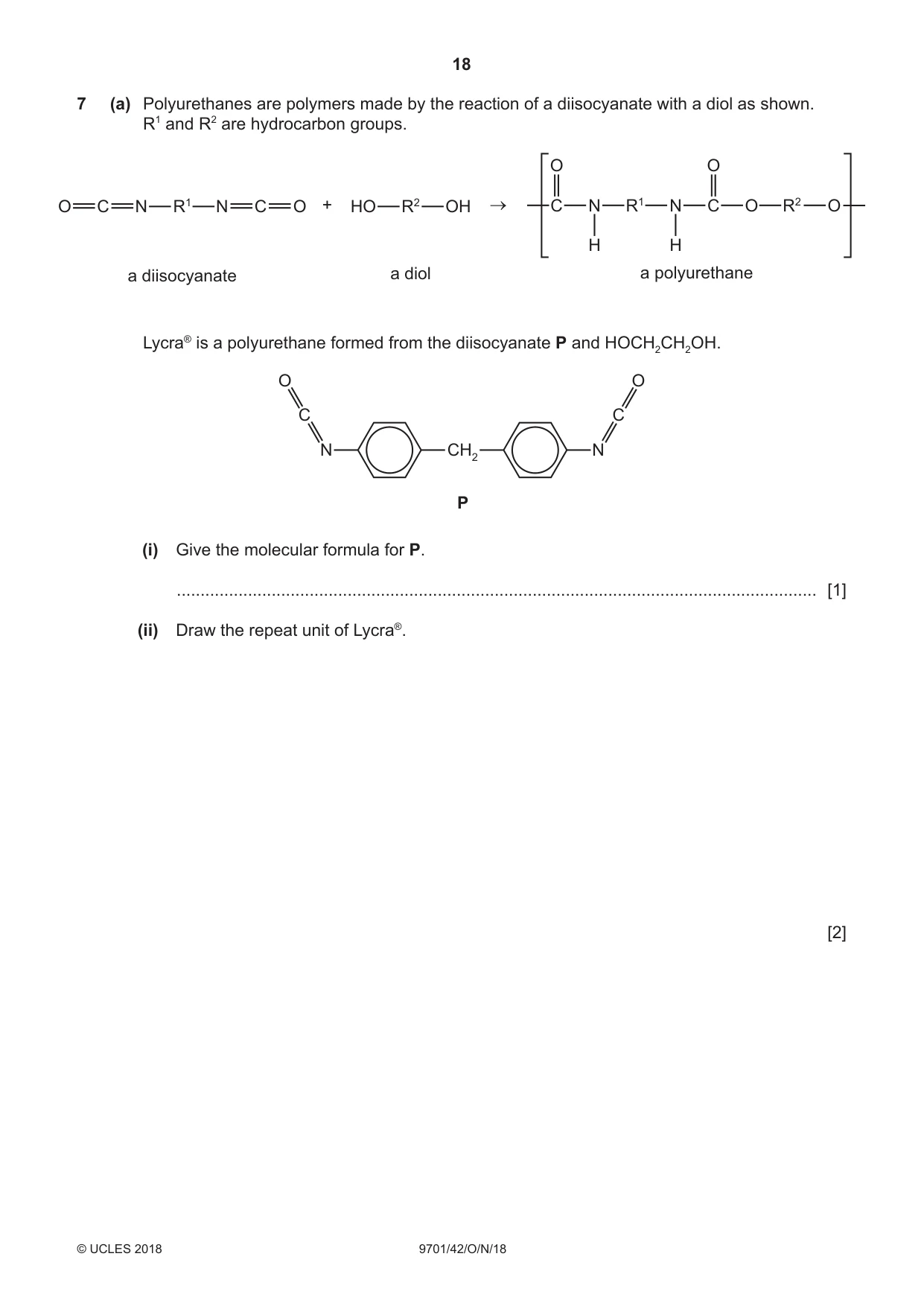
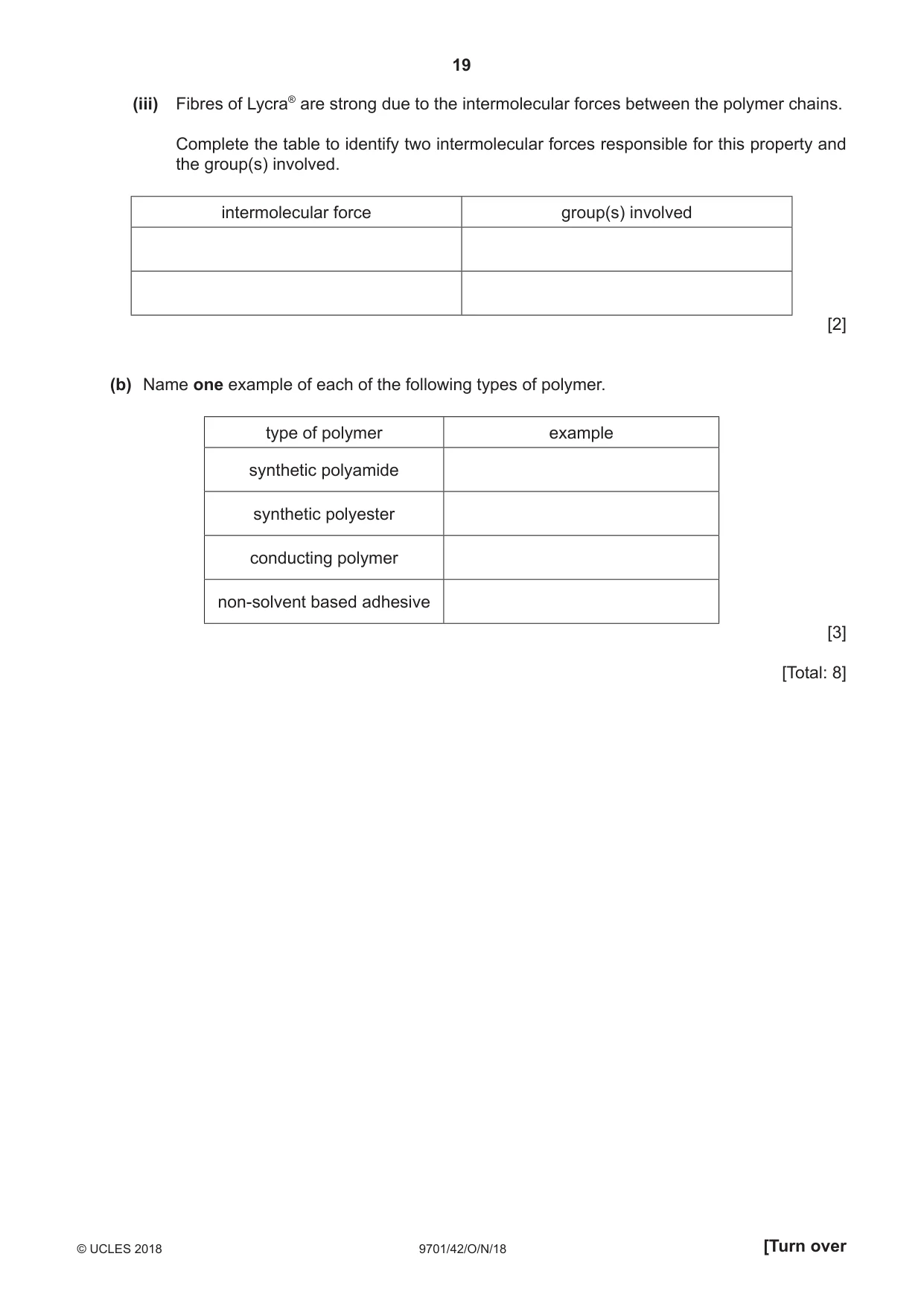
7 (a) Polyurethanes are polymers made by the reaction of a diisocyanate with a diol as shown. R1 and R2 are hydrocarbon groups. O O O C N R1 N C O + HO R2 OH C N R1 N C O R2 O H H a diisocyanate a diol a polyurethane Lycra® is a polyurethane formed from the diisocyanate P and HOCH2CH2OH. O O C C N CH2 N P (i) Give the molecular formula for P. ....................................................................................................................................... [1] (ii) Draw the repeat unit of Lycra®. [2] (iii) Fibres of Lycra® are strong due to the intermolecular forces between the polymer chains. Complete the table to identify two intermolecular forces responsible for this property and the group(s) involved. intermolecular force group(s) involved [2] (b) Name one example of each of the following types of polymer. type of polymer example synthetic polyamide synthetic polyester conducting polymer non-solvent based adhesive [3] [Total: 8]
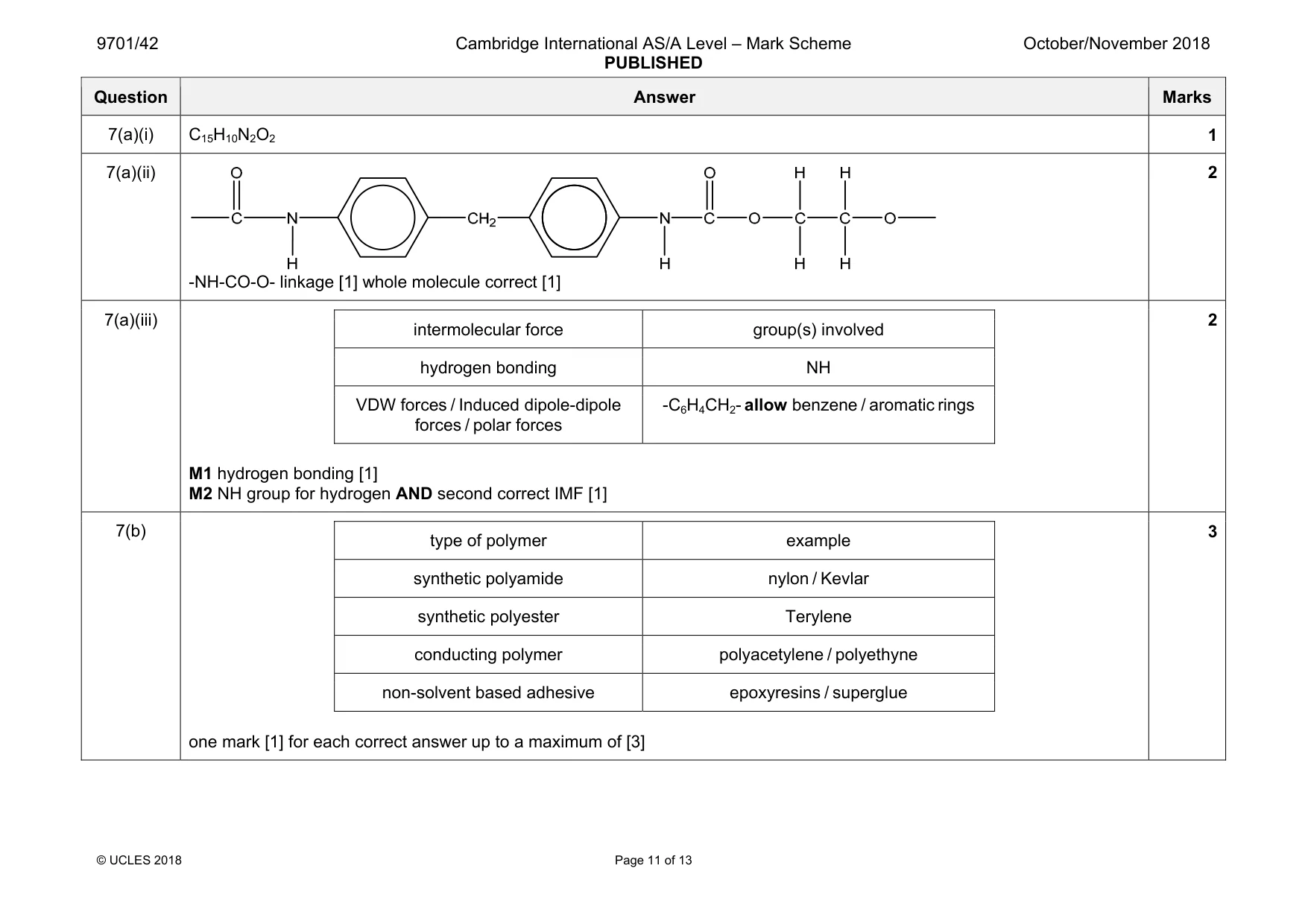
Mark scheme: 7(a)(i) C15H10N2O2 1 7(a)(ii) -NH-CO-O- linkage [1] whole molecule correct [1] 2 7(a)(iii) intermolecular force group(s) involved hydrogen bonding NH VDW forces / Induced dipole-dipole forces / polar forces -C6H4CH2- allow benzene / aromatic rings M1 hydrogen bonding [1] M2 NH group for hydrogen AND second correct IMF [1] 2 7(b) type of polymer example synthetic polyamide nylon / Kevlar synthetic polyester Terylene conducting polymer polyacetylene / polyethyne non-solvent based adhesive epoxyresins / superglue one mark [1] for each correct answer up to a maximum of [3] 3
Q8 · Chloramine, NH2Cl, can be used in the treatment of drinking water to kill bacteria
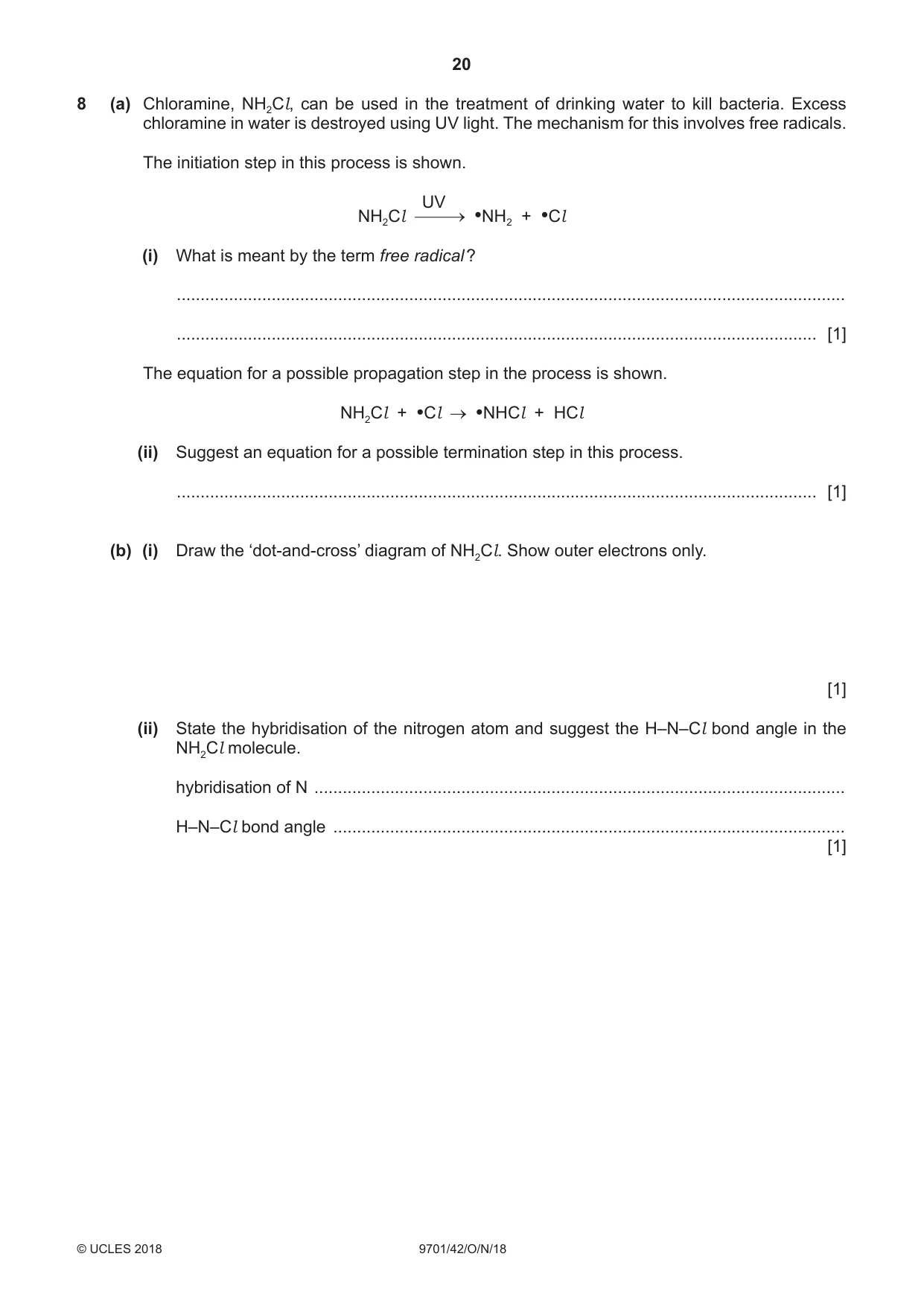
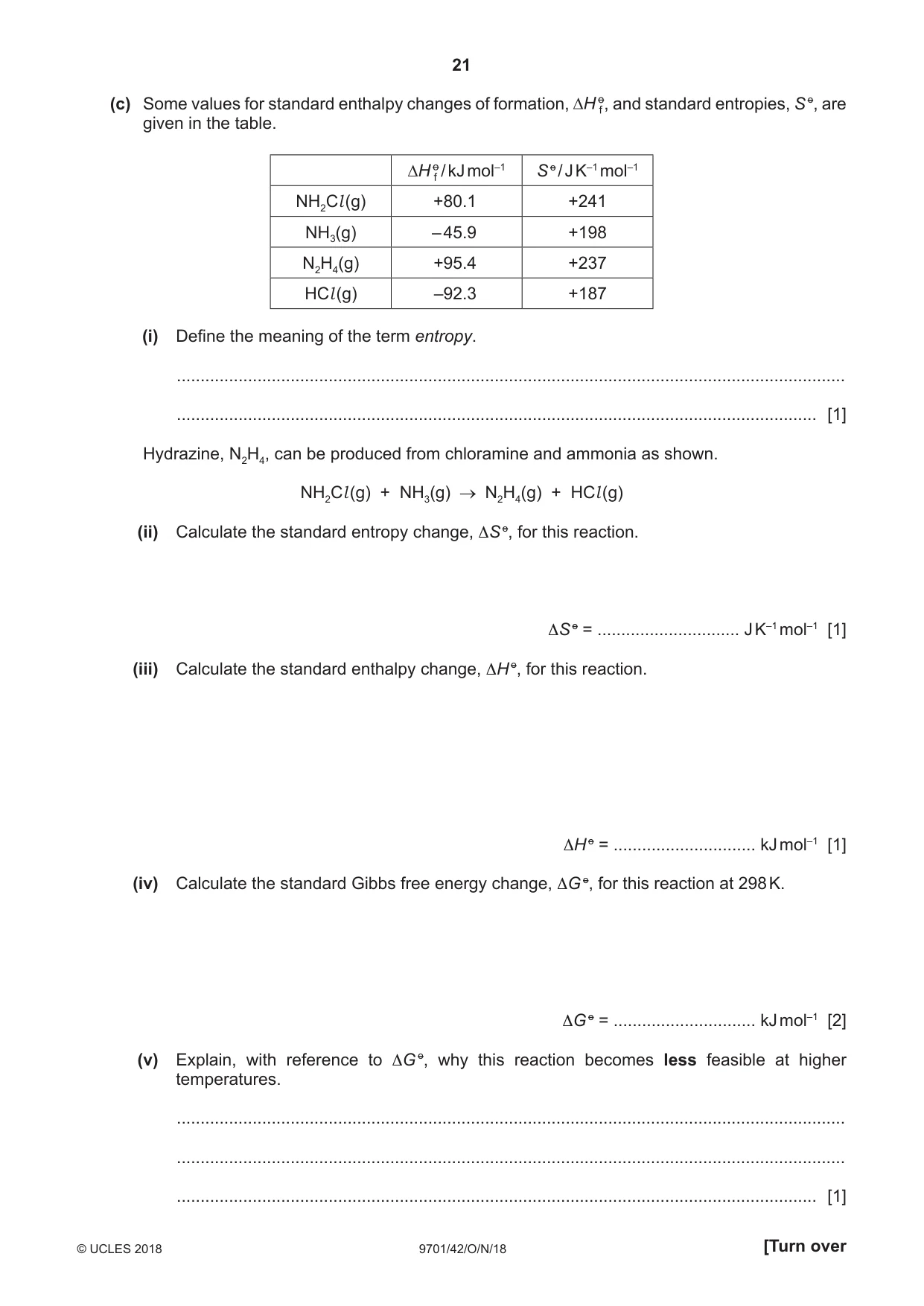
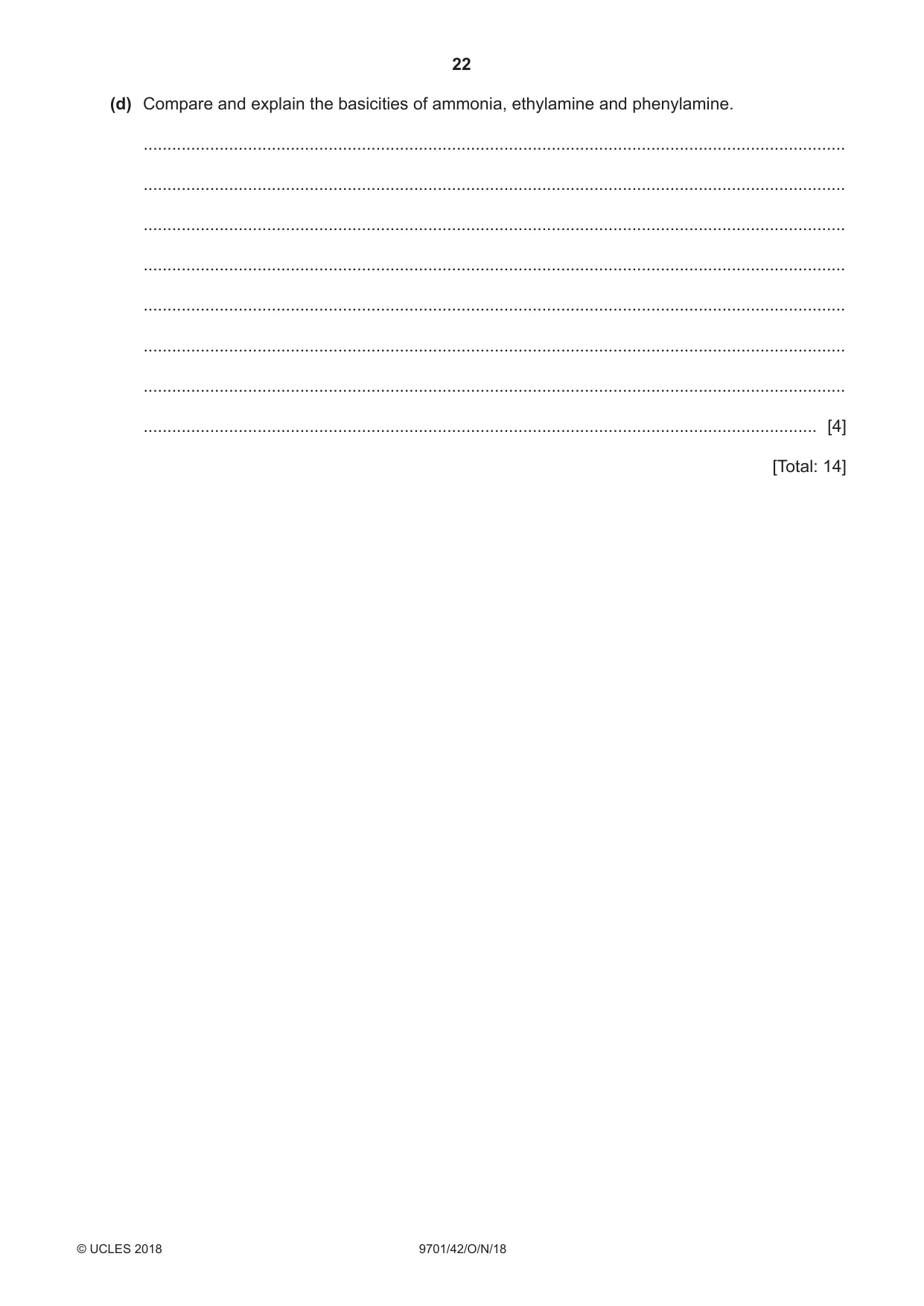
8 (a) Chloramine, NH2Cl, can be used in the treatment of drinking water to kill bacteria. Excess chloramine in water is destroyed using UV light. The mechanism for this involves free radicals. The initiation step in this process is shown. UV NH2Cl ●NH2 + ●Cl (i) What is meant by the term free radical ? ............................................................................................................................................. ....................................................................................................................................... [1] The equation for a possible propagation step in the process is shown. NH2Cl + ●Cl ●NHCl + HCl (ii) Suggest an equation for a possible termination step in this process. ....................................................................................................................................... [1] (b) (i) Draw the ‘dot-and-cross’ diagram of NH2Cl. Show outer electrons only. [1] (ii) State the hybridisation of the nitrogen atom and suggest the H–N–Cl bond angle in the NH2Cl molecule. hybridisation of N ................................................................................................................ H–N–Cl bond angle ............................................................................................................. [1] (c) Some values for standard enthalpy changes of formation, , and standard entropies, S o, are given in the table. / kJ mol–1 S o / J K–1 mol–1 NH2Cl (g) +80.1 +241 NH3(g) – 45.9 +198 N2H4(g) +95.4 +237 HCl (g) –92.3 +187 (i) Define the meaning of the term entropy. ............................................................................................................................................. ....................................................................................................................................... [1] Hydrazine, N2H4, can be produced from chloramine and ammonia as shown. NH2Cl (g) + NH3(g) N2H4(g) + HCl (g) (ii) Calculate the standard entropy change, ΔS o, for this reaction. ΔS o = .............................. J K–1 mol–1 [1] (iii) Calculate the standard enthalpy change, ΔH o, for this reaction. ΔH o = .............................. kJ mol–1 [1] (iv) Calculate the standard Gibbs free energy change, ΔG o, for this reaction at 298 K. ΔG o = .............................. kJ mol–1 [2] (v) Explain, with reference to ΔG o, why this reaction becomes less feasible at higher temperatures. ............................................................................................................................................. ............................................................................................................................................. ....................................................................................................................................... [1] (d) Compare and explain the basicities of ammonia, ethylamine and phenylamine. .................................................................................................................................................... .................................................................................................................................................... .................................................................................................................................................... .................................................................................................................................................... .................................................................................................................................................... .................................................................................................................................................... .................................................................................................................................................... .............................................................................................................................................. [4] [Total: 14]
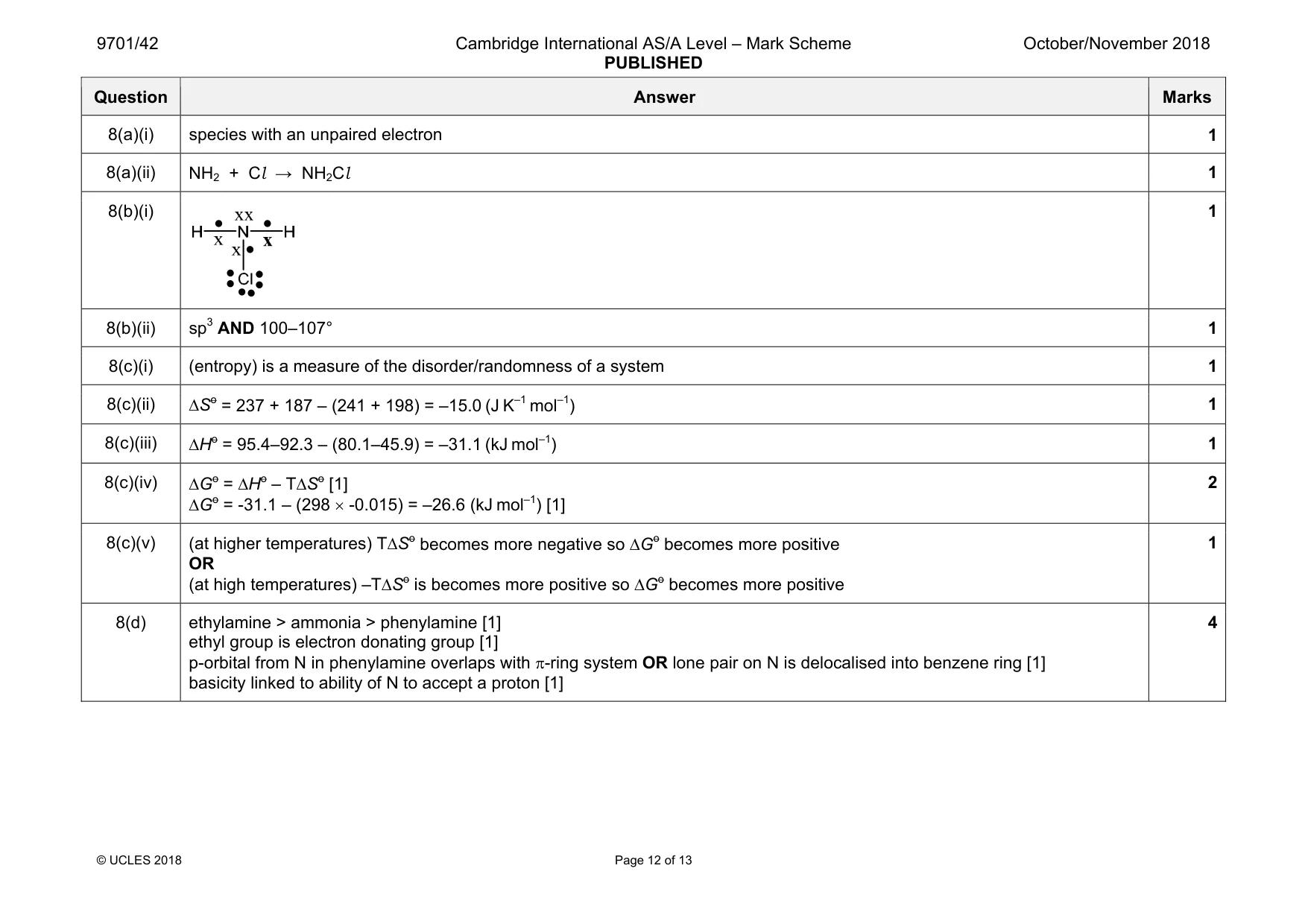
Mark scheme: 8(a)(i) species with an unpaired electron 1 8(a)(ii) NH2 + Cl → NH2Cl 1 8(b)(i) 1 8(b)(ii) sp3 AND 100–107° 1 8(c)(i) (entropy) is a measure of the disorder/randomness of a system 1 8(c)(ii) ∆So = 237 + 187 – (241 + 198) = –15.0 (J K–1 mol–1) 1 8(c)(iii) ∆Ho = 95.4–92.3 – (80.1–45.9) = –31.1 (kJ mol–1) 1 8(c)(iv) ∆Go = ∆Ho – T∆So [1] ∆Go = -31.1 – (298 × -0.015) = –26.6 (kJ mol–1) [1] 2 8(c)(v) (at higher temperatures) T∆So becomes more negative so ∆Go becomes more positive OR (at high temperatures) –T∆So is becomes more positive so ∆Go becomes more positive 1 8(d) ethylamine > ammonia > phenylamine [1] ethyl group is electron donating group [1] p-orbital from N in phenylamine overlaps with π-ring system OR lone pair on N is delocalised into benzene ring [1] basicity linked to ability of N to accept a proton [1] 4
Q9 · Use information from the Data Booklet to draw the structure of the dipeptide glu‑cys
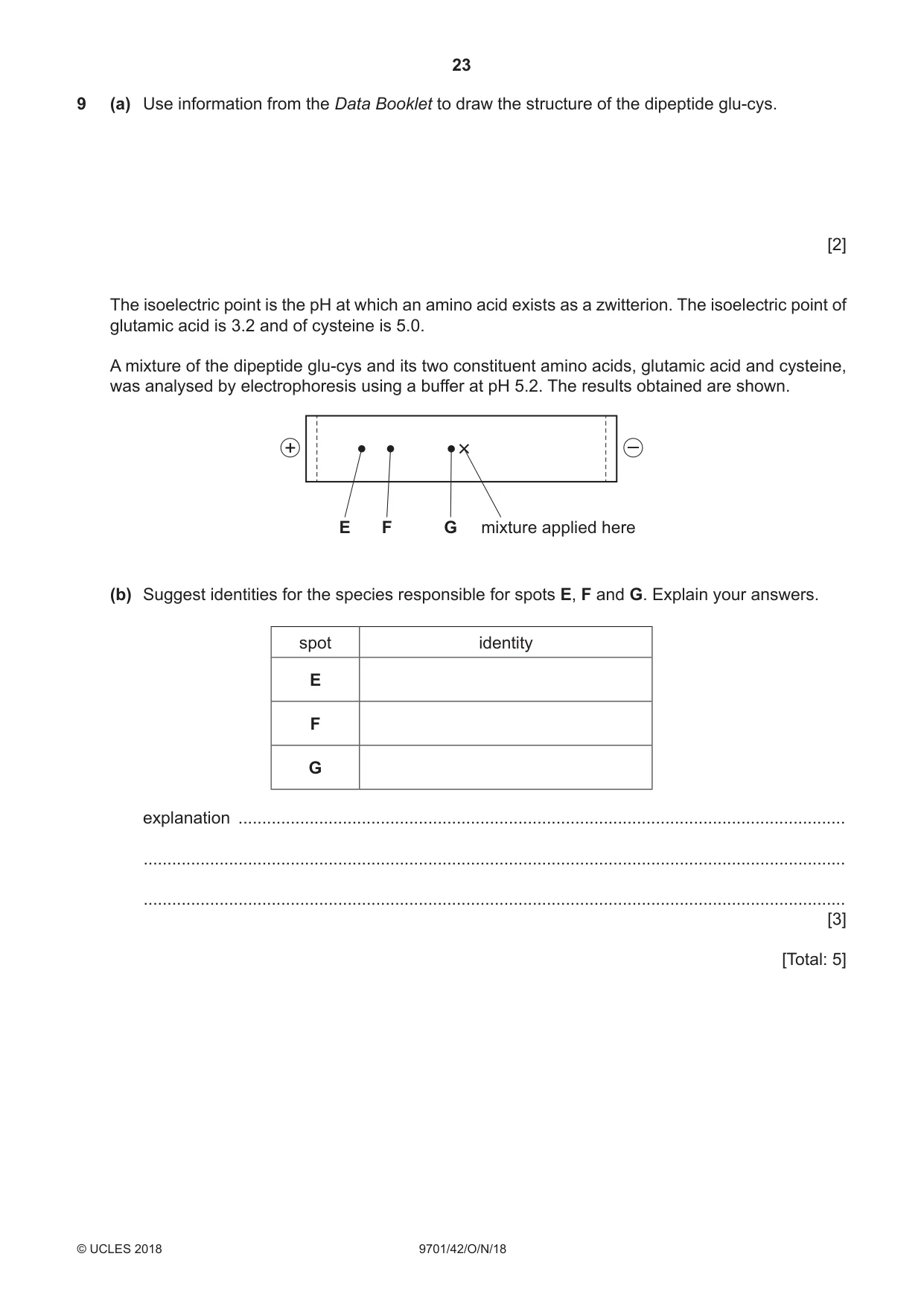
9 (a) Use information from the Data Booklet to draw the structure of the dipeptide glu‑cys. [2] The isoelectric point is the pH at which an amino acid exists as a zwitterion. The isoelectric point of glutamic acid is 3.2 and of cysteine is 5.0. A mixture of the dipeptide glu-cys and its two constituent amino acids, glutamic acid and cysteine, was analysed by electrophoresis using a buffer at pH 5.2. The results obtained are shown. + – E F G mixture applied here (b) Suggest identities for the species responsible for spots E, F and G. Explain your answers. spot identity E F G explanation ................................................................................................................................. .................................................................................................................................................... .................................................................................................................................................... [3] [Total: 5]
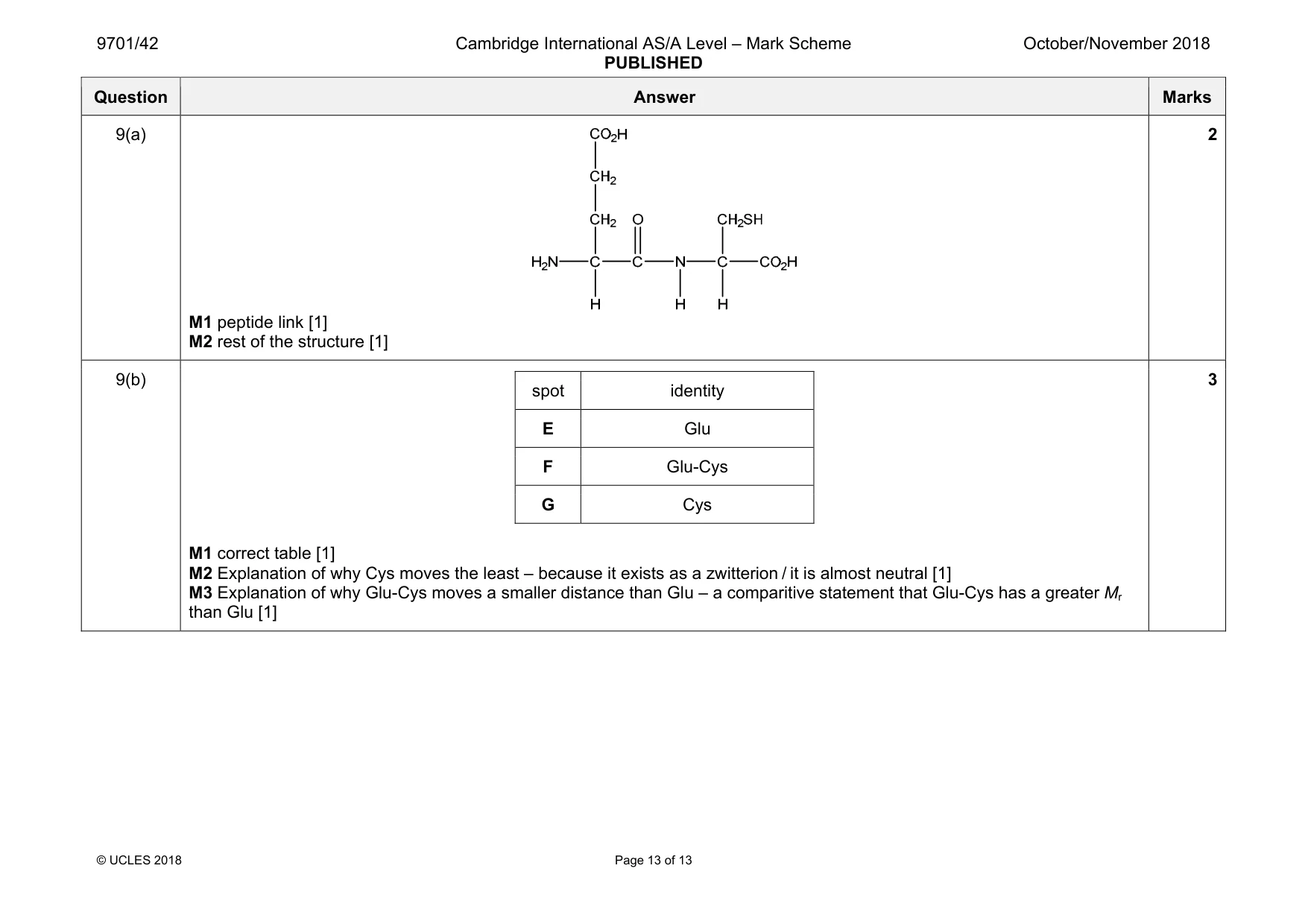
Mark scheme: 9(a) M1 peptide link [1] M2 rest of the structure [1] 2 9(b) spot identity E Glu F Glu-Cys G Cys M1 correct table [1] M2 Explanation of why Cys moves the least – because it exists as a zwitterion / it is almost neutral [1] M3 Explanation of why Glu-Cys moves a smaller distance than Glu – a comparitive statement that Glu-Cys has a greater Mr than Glu [1] 3
What was in this paper
The subtopics covered by these 9 questions, and how many questions each got. Open one in a new tab to see every Cambridge question on it.
1Condensation polymerisation1Gas / liquid chromatography1General characteristic chemical properties of the first set of transition elements, titanium to copper1Organic synthesis1Shapes of molecules1Similarities and trends in the properties of the Group 2 metals, magnesium to barium, and their compounds1Standard electrode potentials E ⦵, standard cell potentials E ⦵ cell and the Nernst equation1Stereoisomerism in transition element complexes1What you needed in this session
Cambridge’s own grade thresholds for 2018 Oct/Nov, Paper 4 · Variant 2. A higher threshold means an easier paper — the bar moves with how the cohort did.