Cambridge A Level Chemistry 9701 — 2018 Oct/Nov Paper 4 · Variant 1
9701/41/O/N/18 · 8 questions · 100 marks · ≈113 min
The question paper and its mark scheme, free to read here and free to download. This is Cambridge’s own paper, exactly as it was sat.
Question paper20 pages
Mark scheme14 pages
Answers below. Sit the paper first if you are practising.
Questions as text
Q1 · An aldehyde, an alkane and a carboxylic acid, all of similar volatility, are mixed…
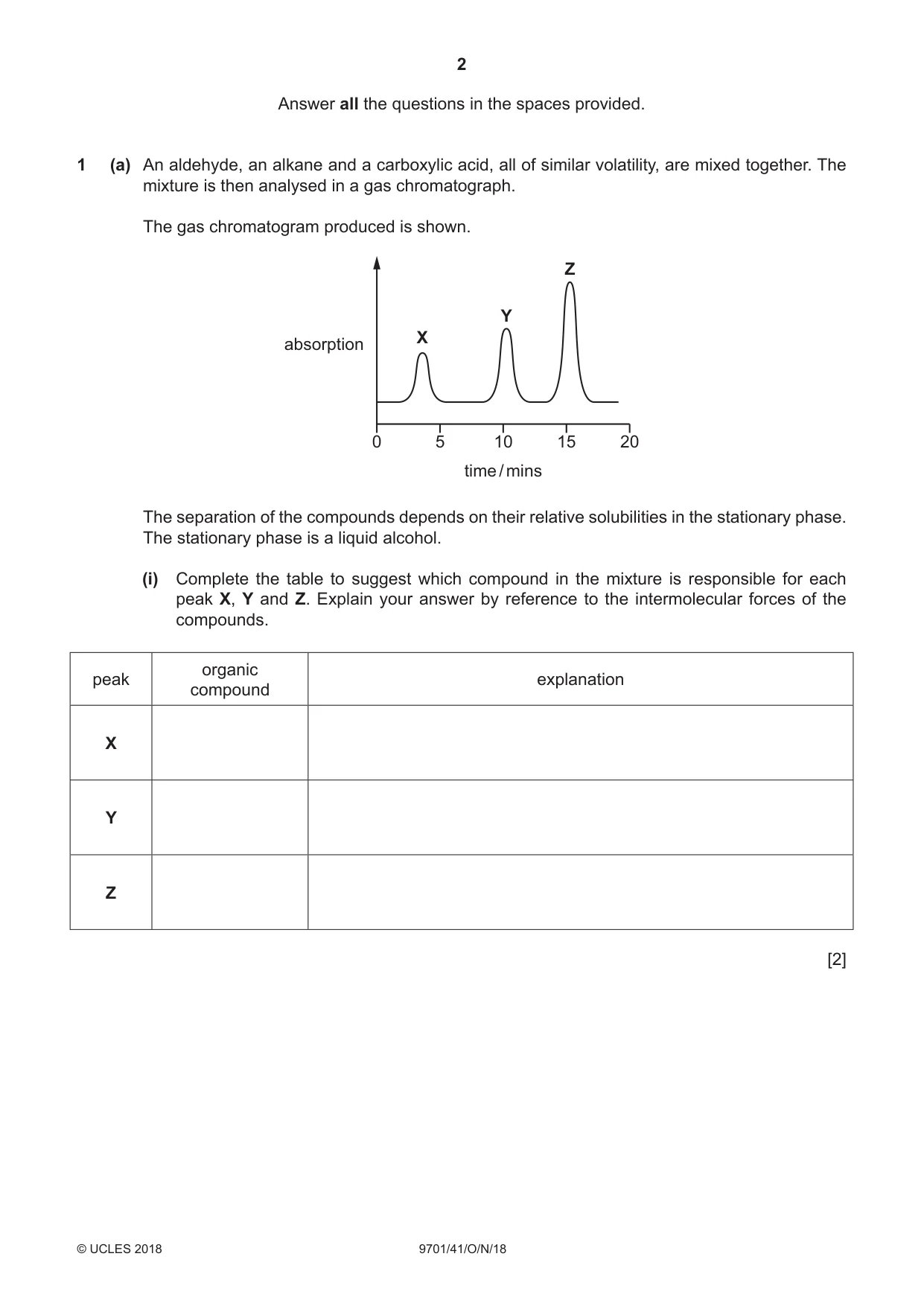
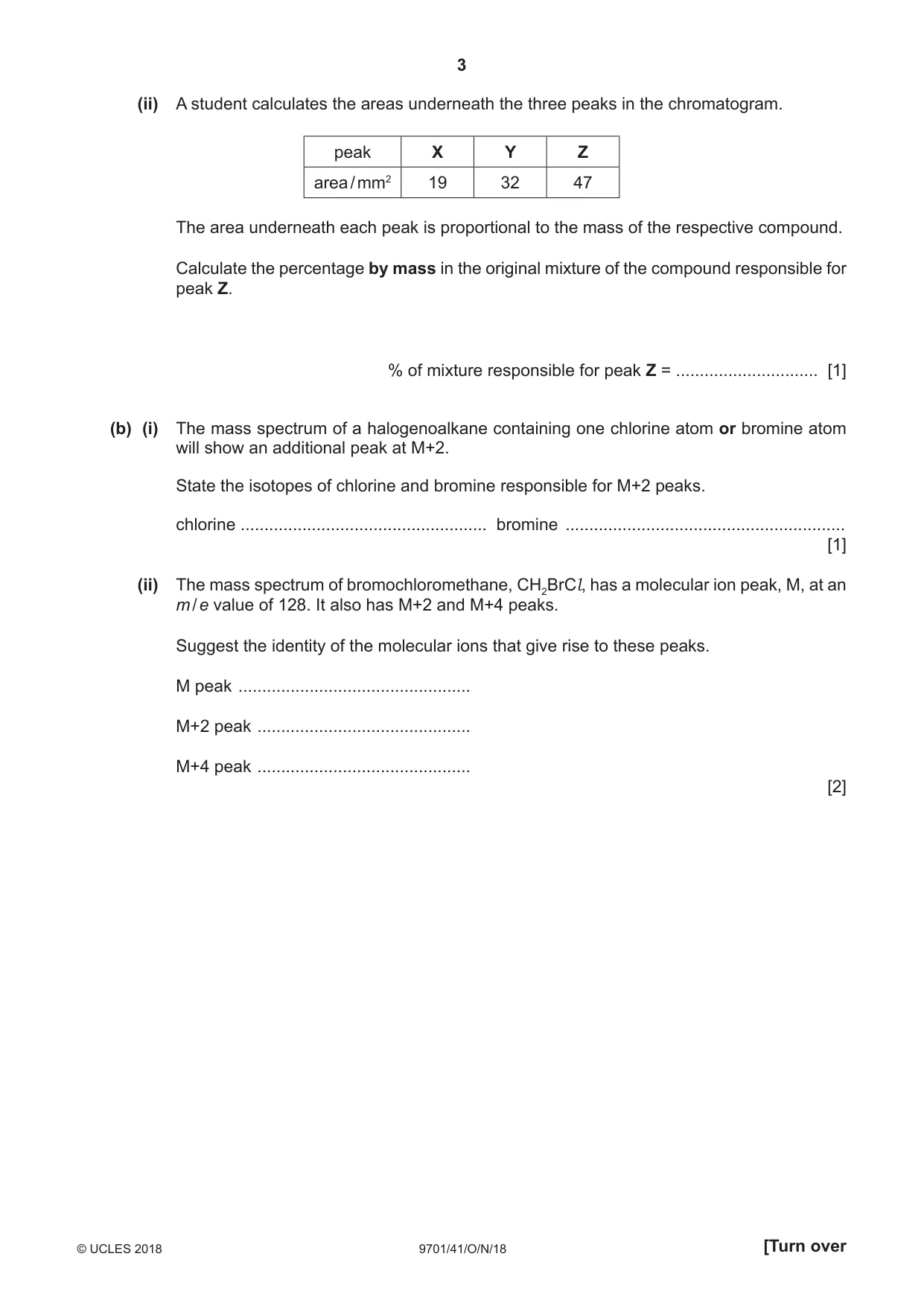
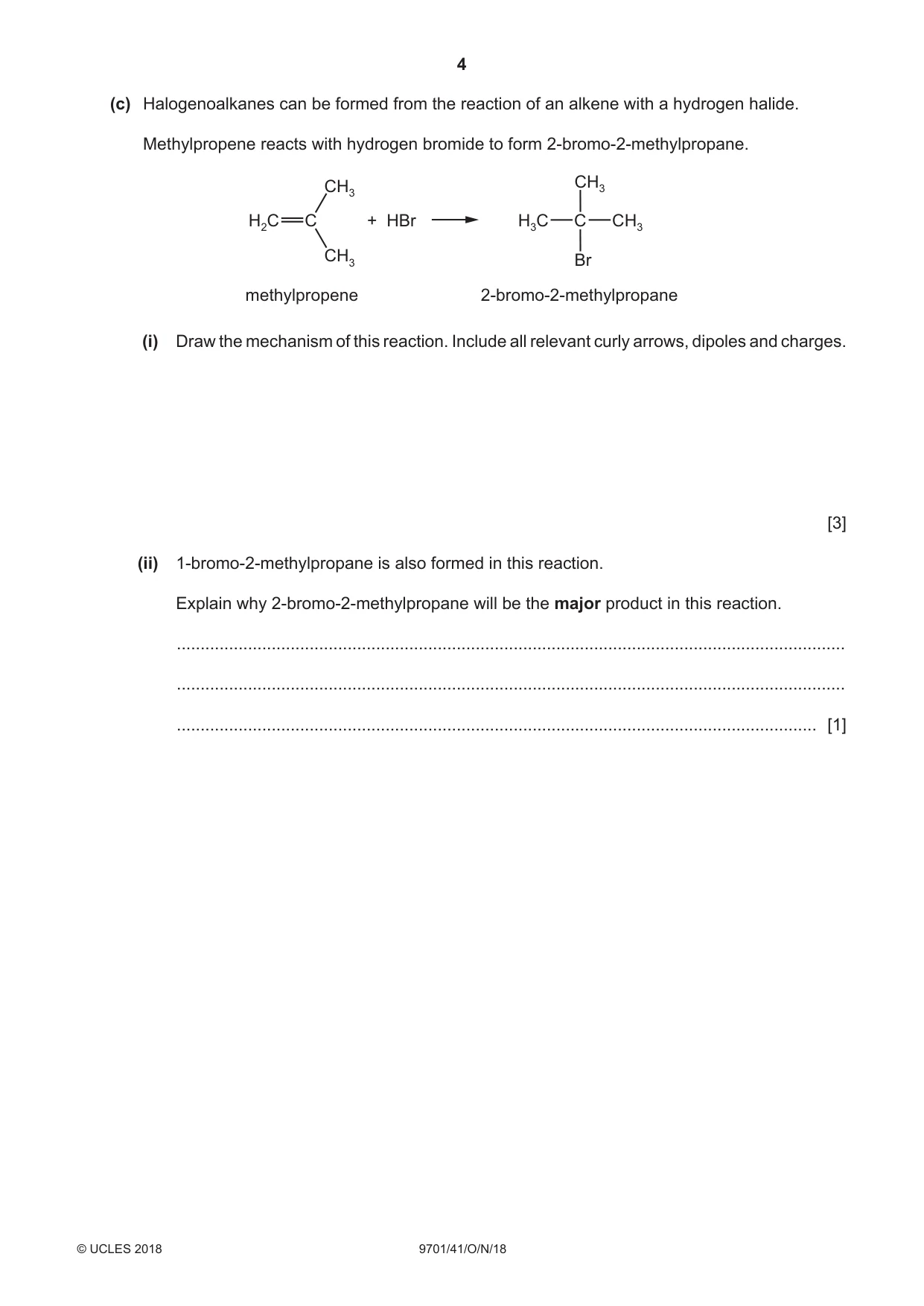
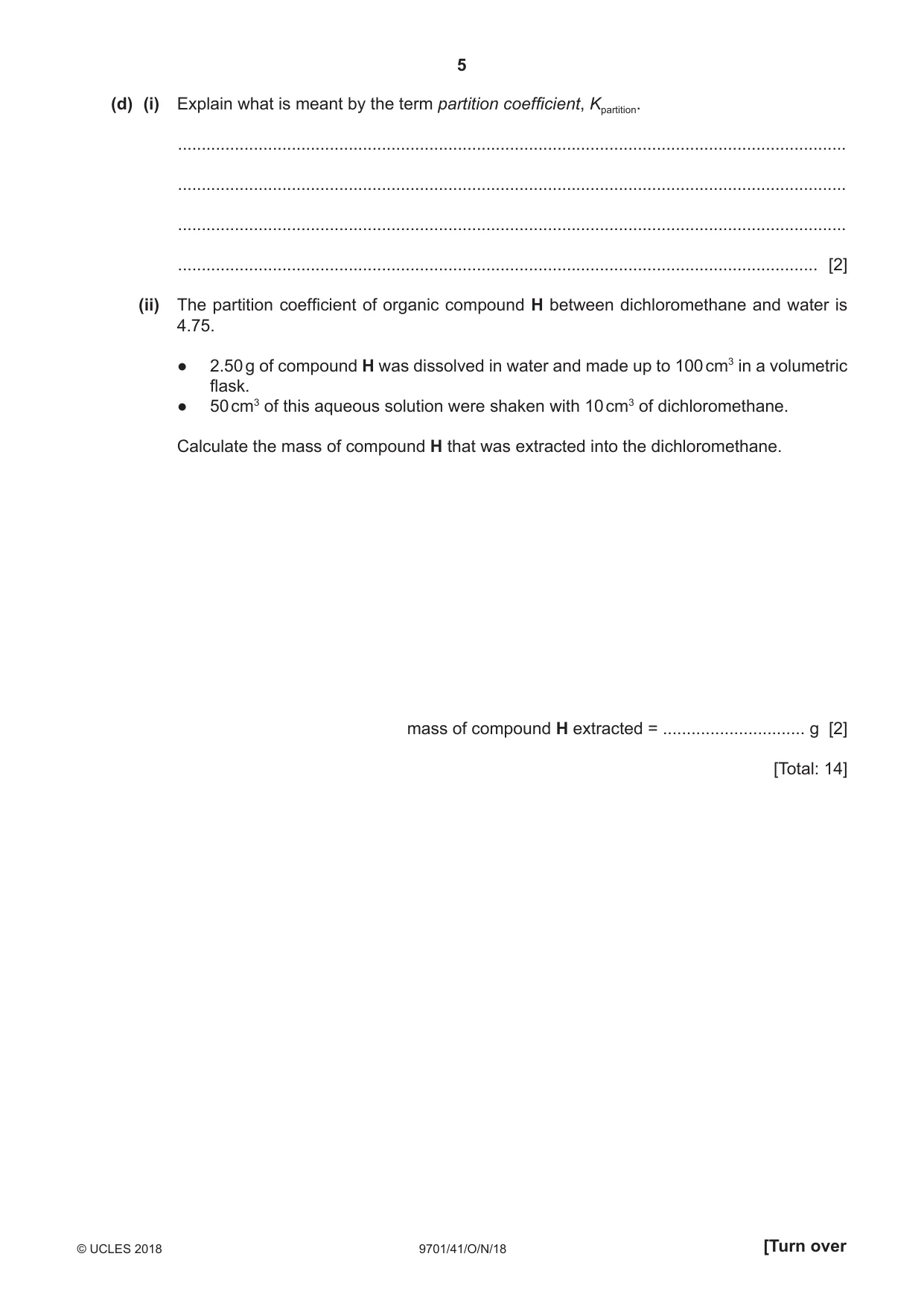
1 (a) An aldehyde, an alkane and a carboxylic acid, all of similar volatility, are mixed together. The mixture is then analysed in a gas chromatograph. The gas chromatogram produced is shown. Z Y X absorption 0 5 10 15 20 time / mins The separation of the compounds depends on their relative solubilities in the stationary phase. The stationary phase is a liquid alcohol. (i) Complete the table to suggest which compound in the mixture is responsible for each peak X, Y and Z. Explain your answer by reference to the intermolecular forces of the compounds. organic peak explanation compound X Y Z [2] (ii) A student calculates the areas underneath the three peaks in the chromatogram. peak X Y Z area / mm2 19 32 47 The area underneath each peak is proportional to the mass of the respective compound. Calculate the percentage by mass in the original mixture of the compound responsible for peak Z. % of mixture responsible for peak Z = .............................. [1] (b) (i) The mass spectrum of a halogenoalkane containing one chlorine atom or bromine atom will show an additional peak at M+2. State the isotopes of chlorine and bromine responsible for M+2 peaks. chlorine .................................................... bromine ............................................................ [1] (ii) The mass spectrum of bromochloromethane, CH2BrCl, has a molecular ion peak, M, at an m / e value of 128. It also has M+2 and M+4 peaks. Suggest the identity of the molecular ions that give rise to these peaks. M peak ................................................. M+2 peak ............................................. M+4 peak ............................................. [2] (c) Halogenoalkanes can be formed from the reaction of an alkene with a hydrogen halide. Methylpropene reacts with hydrogen bromide to form 2-bromo-2-methylpropane. CH3 CH3 H2C C + HBr H3C C CH3 CH3 Br methylpropene 2-bromo-2-methylpropane (i) Draw the mechanism of this reaction. Include all relevant curly arrows, dipoles and charges. [3] (ii) 1-bromo-2-methylpropane is also formed in this reaction. Explain why 2-bromo-2-methylpropane will be the major product in this reaction. ............................................................................................................................................. ............................................................................................................................................. ....................................................................................................................................... [1] (d) (i) Explain what is meant by the term partition coefficient, Kpartition. ............................................................................................................................................. ............................................................................................................................................. ............................................................................................................................................. ....................................................................................................................................... [2] (ii) The partition coefficient of organic compound H between dichloromethane and water is 4.75. ● 2.50 g of compound H was dissolved in water and made up to 100 cm3 in a volumetric flask. ● 50 cm3 of this aqueous solution were shaken with 10 cm3 of dichloromethane. Calculate the mass of compound H that was extracted into the dichloromethane. mass of compound H extracted = .............................. g [2] [Total: 14]
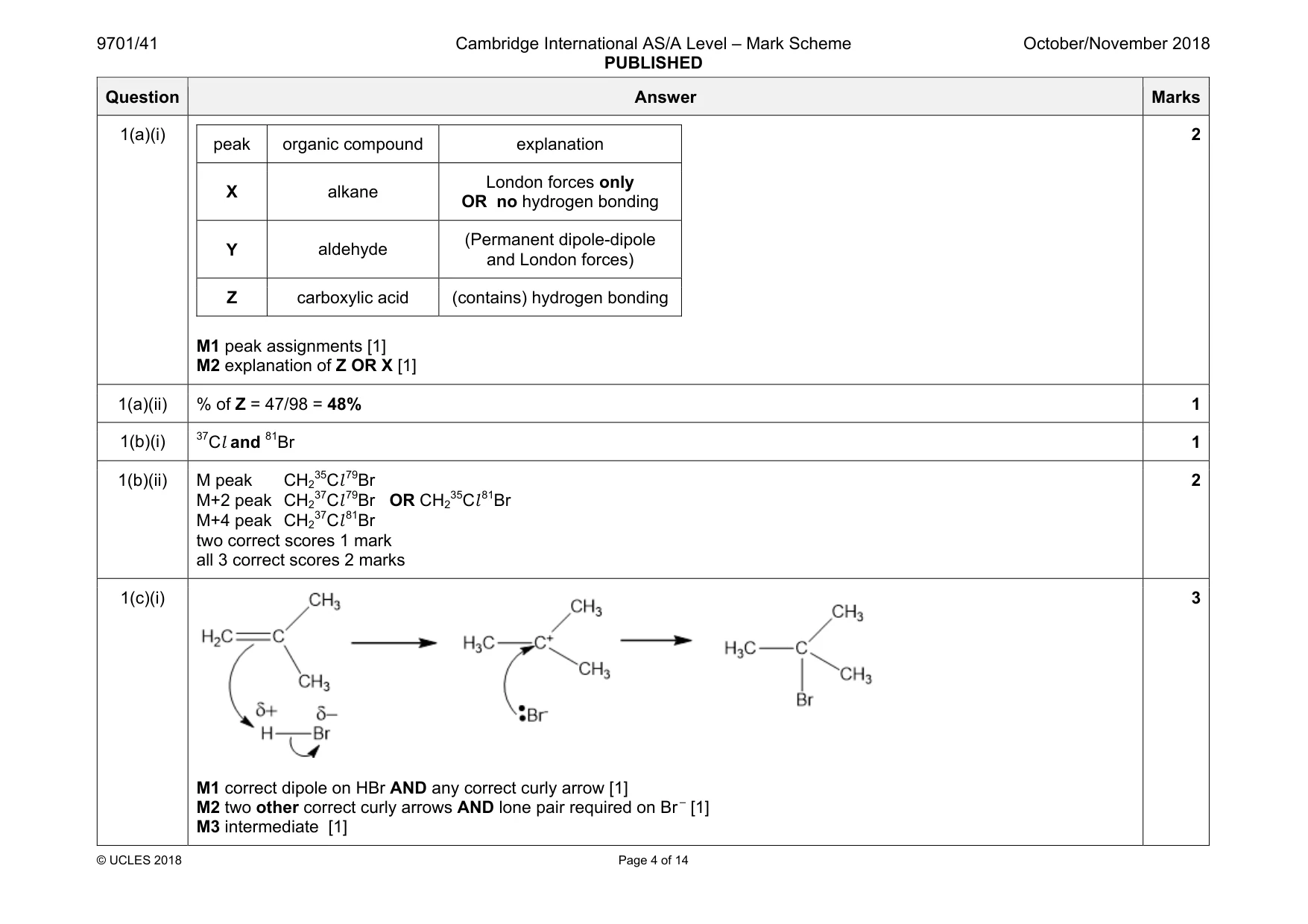
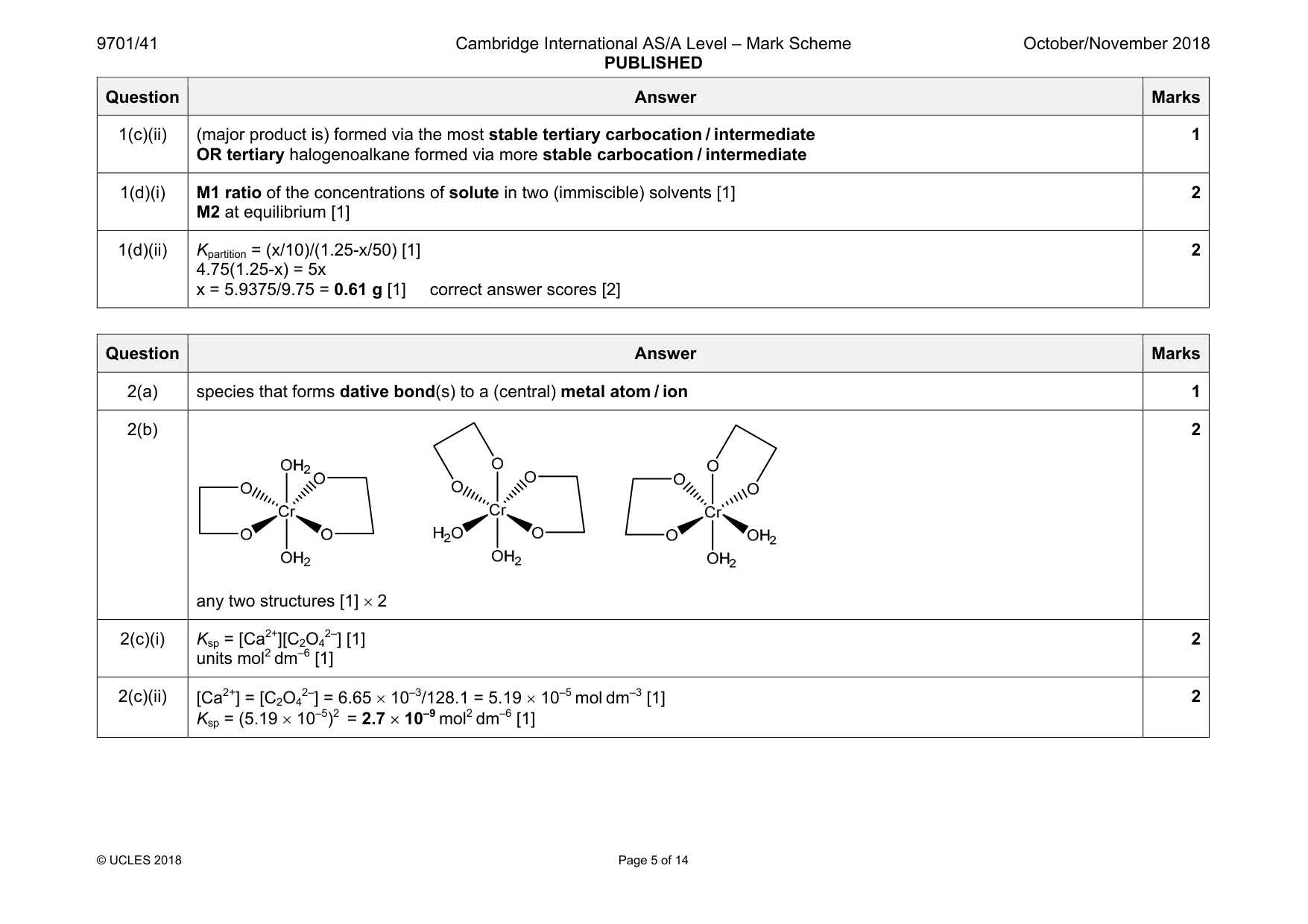
Mark scheme: 1(a)(i) peak organic compound explanation X alkane London forces only OR no hydrogen bonding Y aldehyde (Permanent dipole-dipole and London forces) Z carboxylic acid (contains) hydrogen bonding M1 peak assignments [1] M2 explanation of Z OR X [1] 2 1(a)(ii) % of Z = 47/98 = 48% 1 1(b)(i) 37Cl and 81Br 1 1(b)(ii) M peak CH2 35Cl 79Br M+2 peak CH2 37Cl 79Br OR CH2 35Cl 81Br M+4 peak CH2 37Cl 81Br two correct scores 1 mark all 3 correct scores 2 marks 2 1(c)(i) M1 correct dipole on HBr AND any correct curly arrow [1] M2 two other correct curly arrows AND lone pair required on Br – [1] M3 intermediate [1] 3 Question Answer Marks 1(c)(ii) (major product is) formed via the most stable tertiary carbocation / intermediate OR tertiary halogenoalkane formed via more stable carbocation / intermediate 1 1(d)(i) M1 ratio of the concentrations of solute in two (immiscible) solvents [1] M2 at equilibrium [1] 2 1(d)(ii) Kpartition = (x/10)/(1.25-x/50) [1] 4.75(1.25-x) = 5x x = 5.9375/9.75 = 0.61 g [1] correct answer scores [2] 2
Q2 · Ethanedioate ions, C2O42–, are bidentate ligands
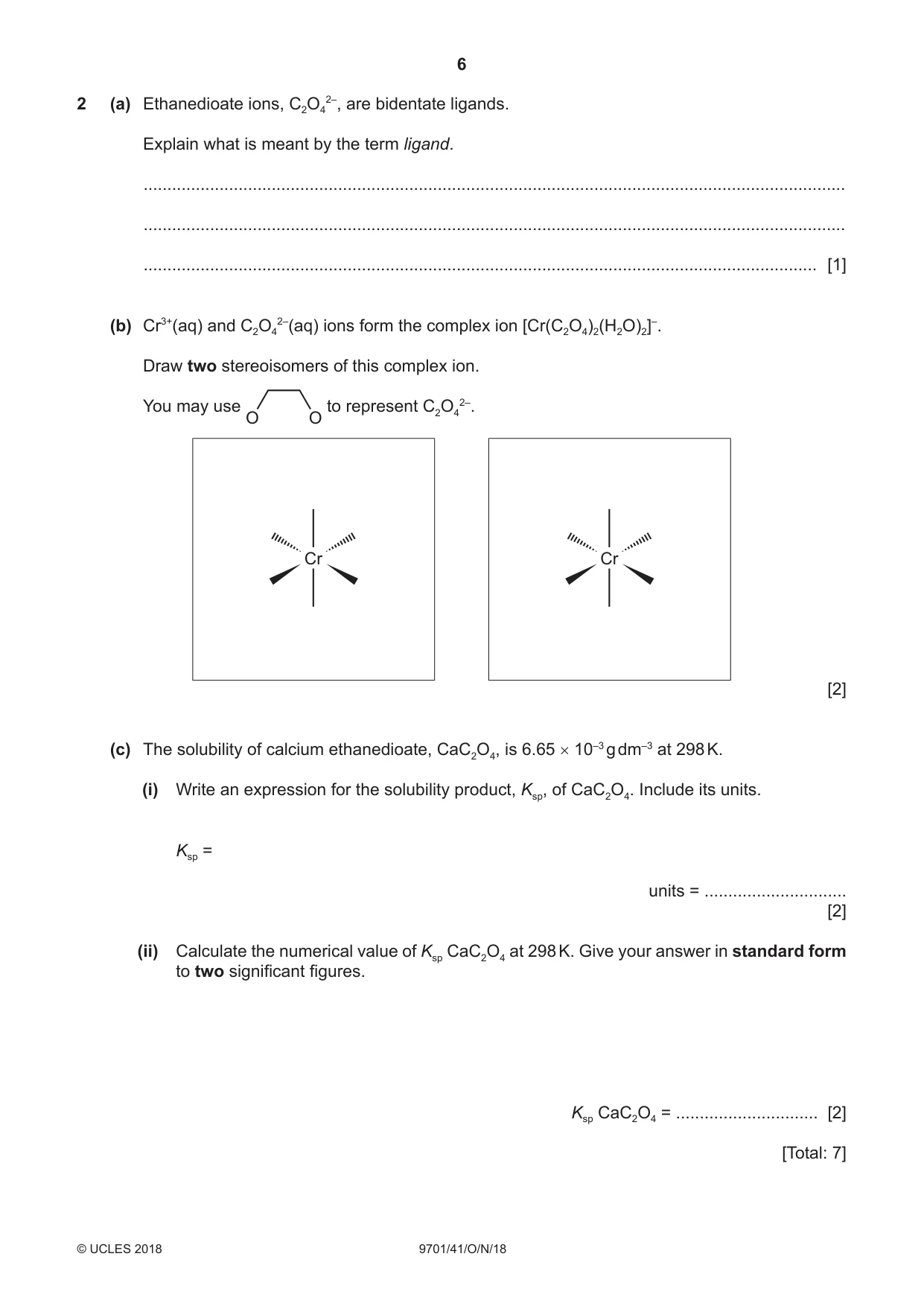
2 (a) Ethanedioate ions, C2O42–, are bidentate ligands. Explain what is meant by the term ligand. .................................................................................................................................................... .................................................................................................................................................... .............................................................................................................................................. [1] (b) Cr3+(aq) and C2O42–(aq) ions form the complex ion [Cr(C2O4)2(H2O)2]–. Draw two stereoisomers of this complex ion. You may use to represent C2O42–. O O Cr Cr [2] (c) The solubility of calcium ethanedioate, CaC2O4, is 6.65 × 10⁻³ g dm–3 at 298 K. (i) Write an expression for the solubility product, Ksp, of CaC2O4. Include its units. Ksp = units = .............................. [2] (ii) Calculate the numerical value of Ksp CaC2O4 at 298 K. Give your answer in standard form to two significant figures. Ksp CaC2O4 = .............................. [2] [Total: 7]
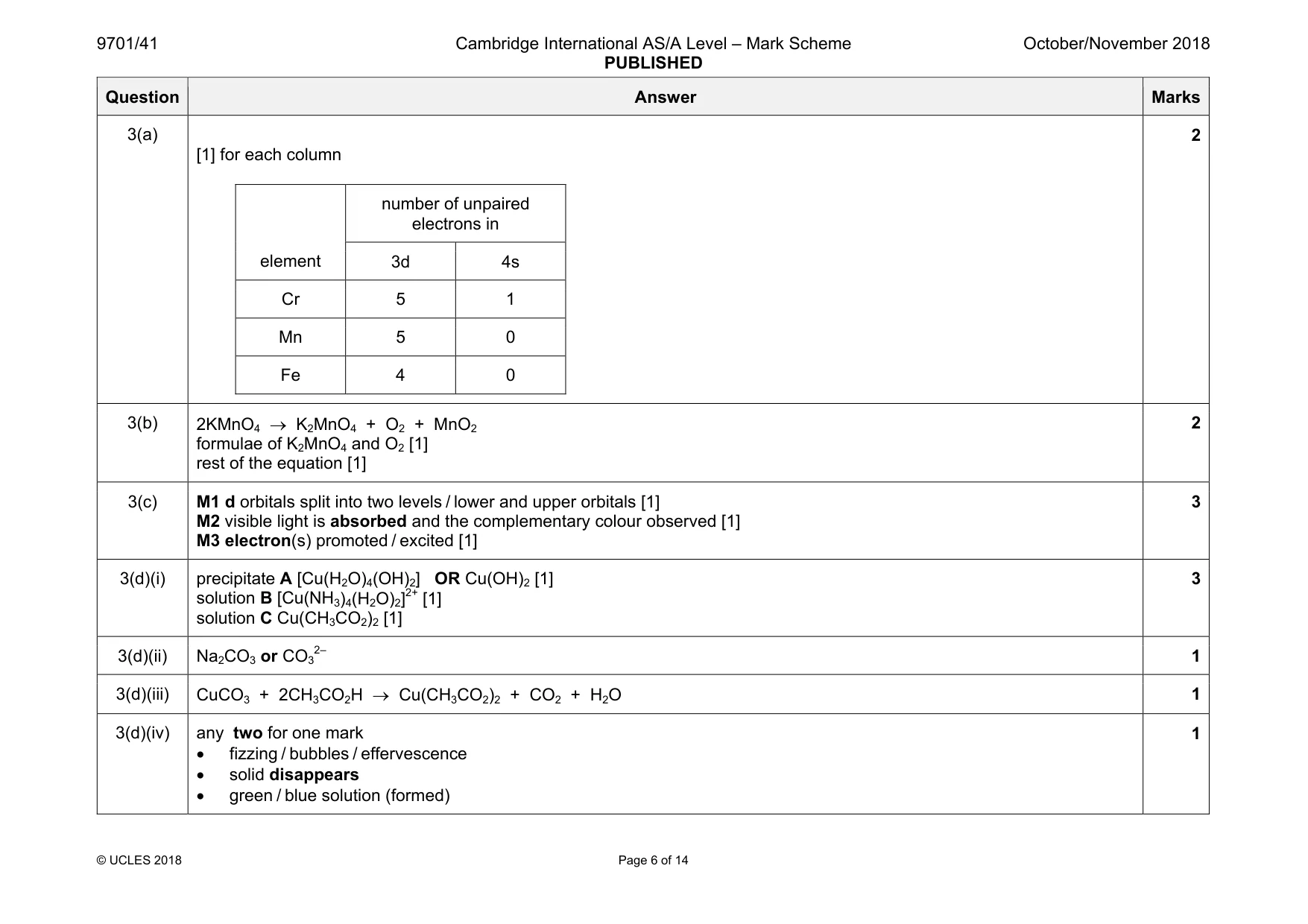
Mark scheme: 2(a) species that forms dative bond(s) to a (central) metal atom / ion 1 2(b) any two structures [1] × 2 2 2(c)(i) Ksp = [Ca2+][C2O4 2–] [1] units mol2 dm–6 [1] 2 2(c)(ii) [Ca2+] = [C2O4 2–] = 6.65 × 10⁻³/128.1 = 5.19 × 10⁻⁵ mol dm–3 [1] Ksp = (5.19 × 10⁻⁵)2 = 2.7 × 10⁻⁹ mol2 dm–6 [1] 2
Q3 · Complete the table to show the total number of unpaired electrons in the 3d and 4s…
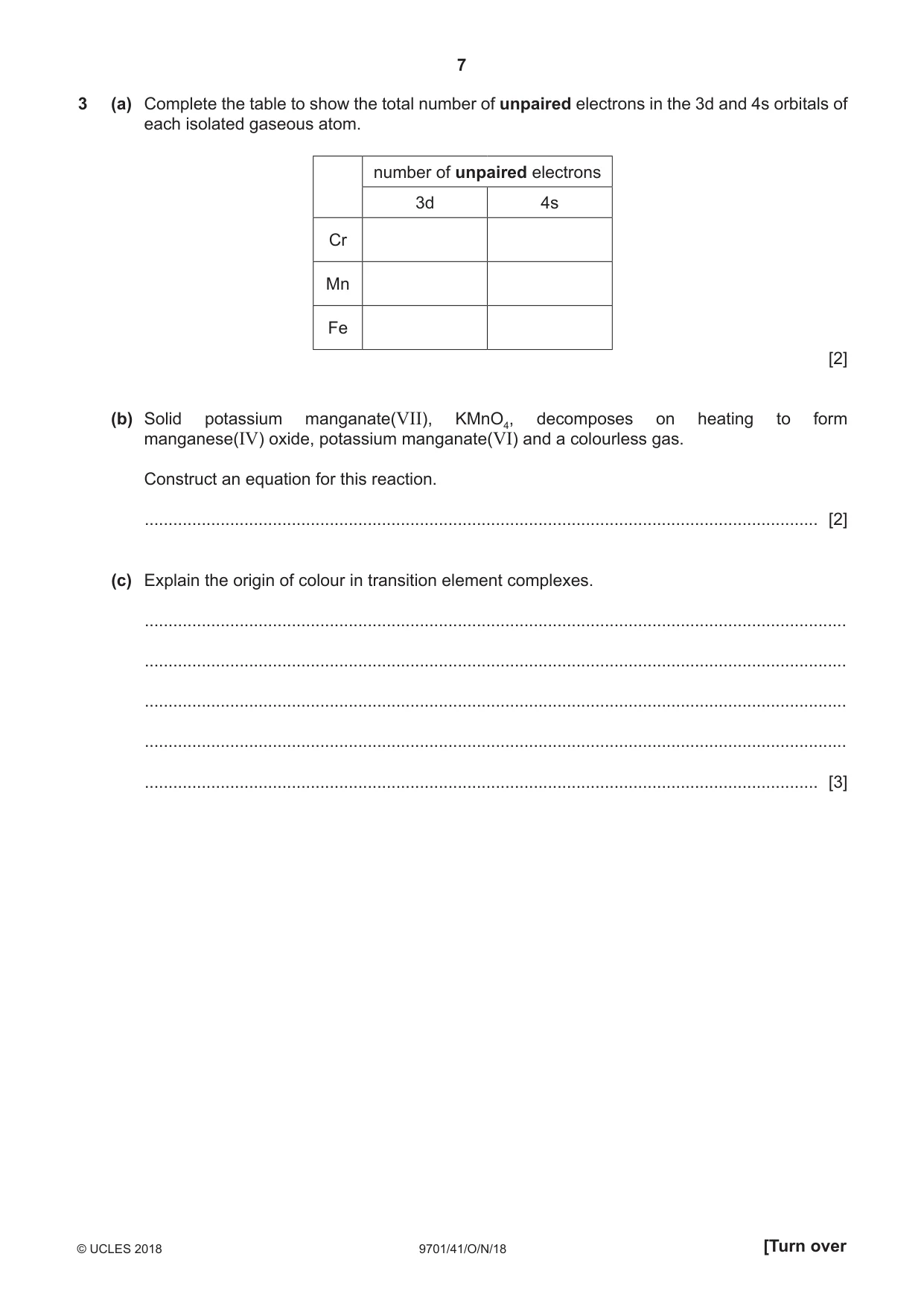
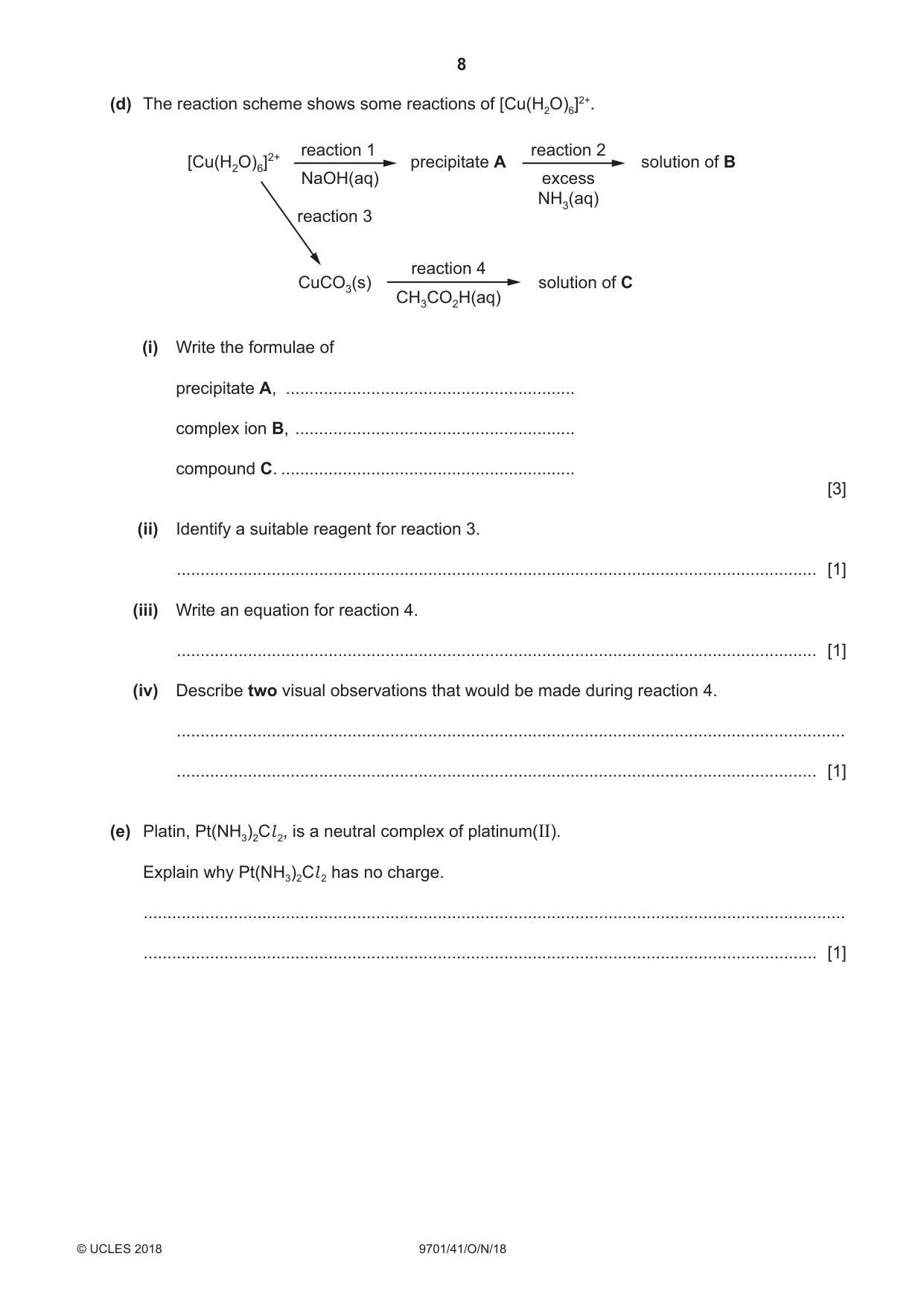
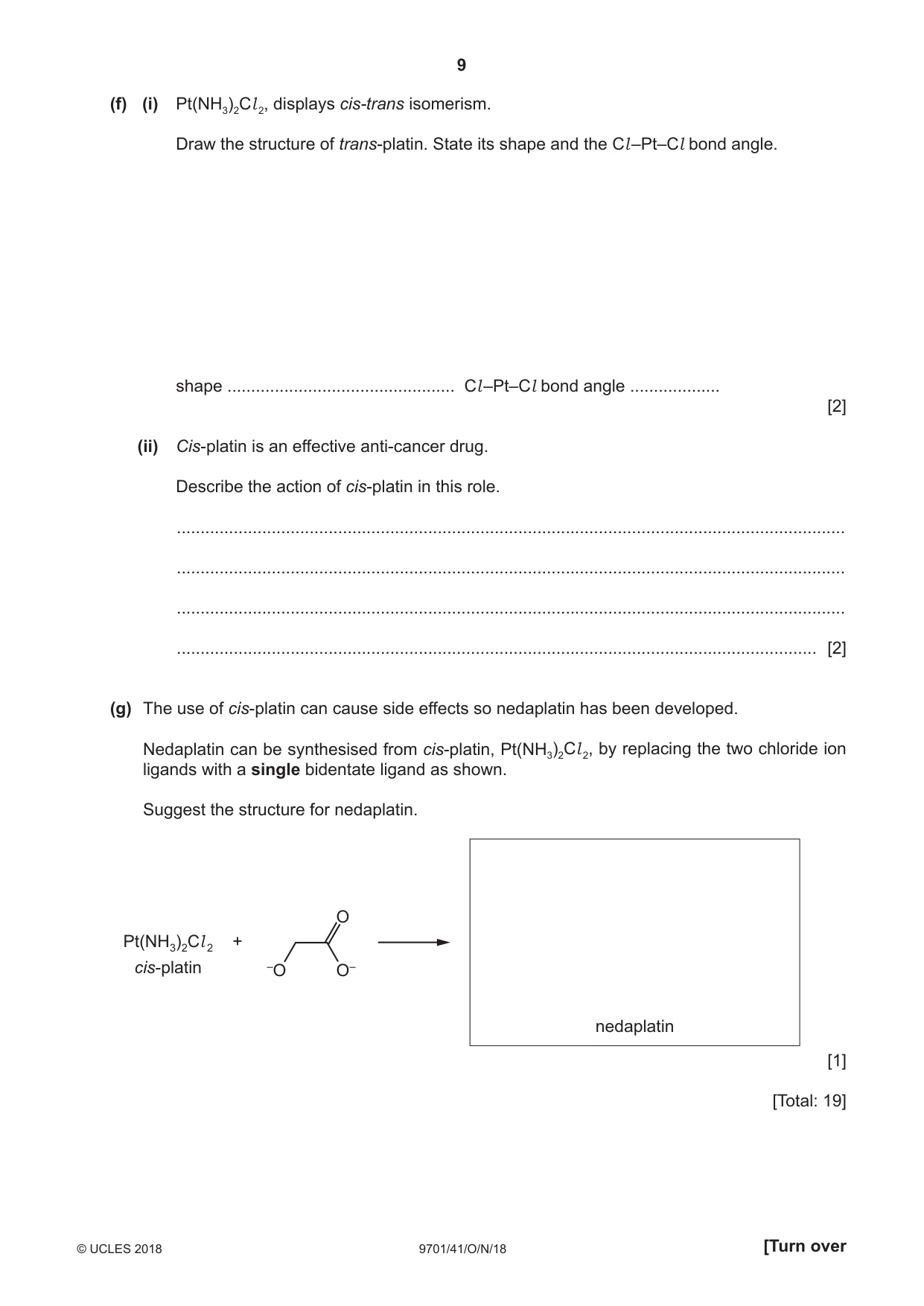
3 (a) Complete the table to show the total number of unpaired electrons in the 3d and 4s orbitals of each isolated gaseous atom. number of unpaired electrons 3d 4s Cr Mn Fe [2] (b) Solid potassium manganate(VII), KMnO4, decomposes on heating to form manganese(IV) oxide, potassium manganate(VI) and a colourless gas. Construct an equation for this reaction. .............................................................................................................................................. [2] (c) Explain the origin of colour in transition element complexes. .................................................................................................................................................... .................................................................................................................................................... .................................................................................................................................................... .................................................................................................................................................... .............................................................................................................................................. [3] (d) The reaction scheme shows some reactions of [Cu(H2O)6]2+. reaction 1 reaction 2 [Cu(H2O)6]2+ precipitate A solution of B NaOH(aq) excess NH3(aq) reaction 3 reaction 4 CuCO3(s) solution of C CH3CO2H(aq) (i) Write the formulae of precipitate A, .............................................................. complex ion B, ........................................................... compound C................................................................ [3] (ii) Identify a suitable reagent for reaction 3. ....................................................................................................................................... [1] (iii) Write an equation for reaction 4. ....................................................................................................................................... [1] (iv) Describe two visual observations that would be made during reaction 4. ............................................................................................................................................. ....................................................................................................................................... [1] (e) Platin, Pt(NH3)2Cl 2, is a neutral complex of platinum(II). Explain why Pt(NH3)2Cl 2 has no charge. .................................................................................................................................................... .............................................................................................................................................. [1] (f) (i) Pt(NH3)2Cl 2, displays cis-trans isomerism. Draw the structure of trans-platin. State its shape and the Cl –Pt–Cl bond angle. shape ................................................ Cl –Pt–Cl bond angle ................... [2] (ii) Cis-platin is an effective anti-cancer drug. Describe the action of cis-platin in this role. ............................................................................................................................................. ............................................................................................................................................. ............................................................................................................................................. ....................................................................................................................................... [2] (g) The use of cis-platin can cause side effects so nedaplatin has been developed. Nedaplatin can be synthesised from cis‑platin, Pt(NH3)2Cl 2, by replacing the two chloride ion ligands with a single bidentate ligand as shown. Suggest the structure for nedaplatin. O Pt(NH3)2Cl 2 + cis-platin –O O– nedaplatin [1] [Total: 19]
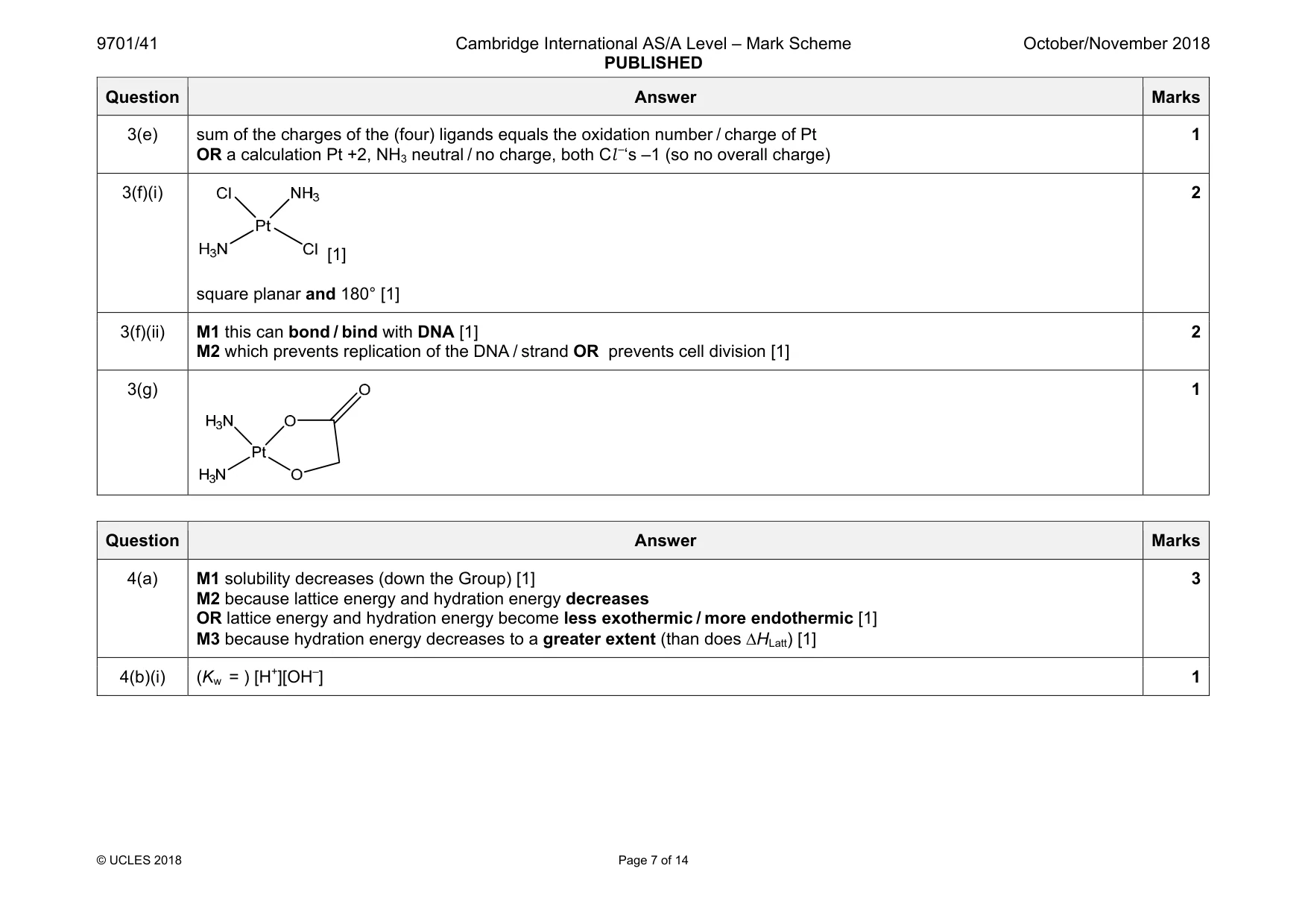
Mark scheme: 3(a) [1] for each column element number of unpaired electrons in 3d 4s Cr 5 1 Mn 5 0 Fe 4 0 2 3(b) 2KMnO4 → K2MnO4 + O2 + MnO2 formulae of K2MnO4 and O2 [1] rest of the equation [1] 2 3(c) M1 d orbitals split into two levels / lower and upper orbitals [1] M2 visible light is absorbed and the complementary colour observed [1] M3 electron(s) promoted / excited [1] 3 3(d)(i) precipitate A [Cu(H2O)4(OH)2] OR Cu(OH)2 [1] solution B [Cu(NH3)4(H2O)2]2+ [1] solution C Cu(CH3CO2)2 [1] 3 3(d)(ii) Na2CO3 or CO3 2– 1 3(d)(iii) CuCO3 + 2CH3CO2H → Cu(CH3CO2)2 + CO2 + H2O 1 3(d)(iv) any two for one mark • fizzing / bubbles / effervescence • solid disappears • green / blue solution (formed) 1 Question Answer Marks 3(e) sum of the charges of the (four) ligands equals the oxidation number / charge of Pt OR a calculation Pt +2, NH3 neutral / no charge, both Cl –‘s –1 (so no overall charge) 1 3(f)(i) [1] square planar and 180° [1] 2 3(f)(ii) M1 this can bond / bind with DNA [1] M2 which prevents replication of the DNA / strand OR prevents cell division [1] 2 3(g) 1
Q4 · The enthalpy change of solution, , of the Group 2 sulfates becomes more endothermic down…
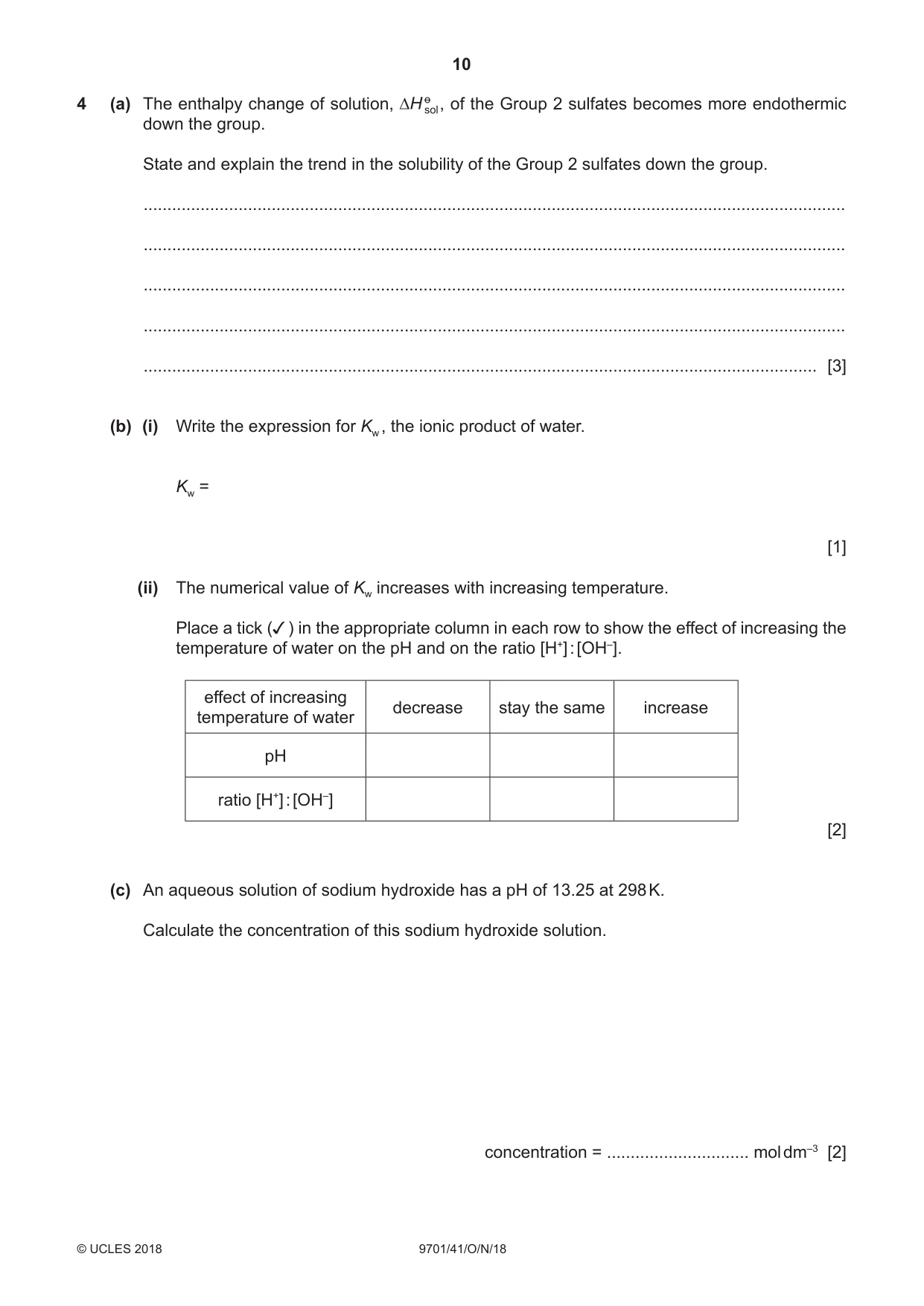
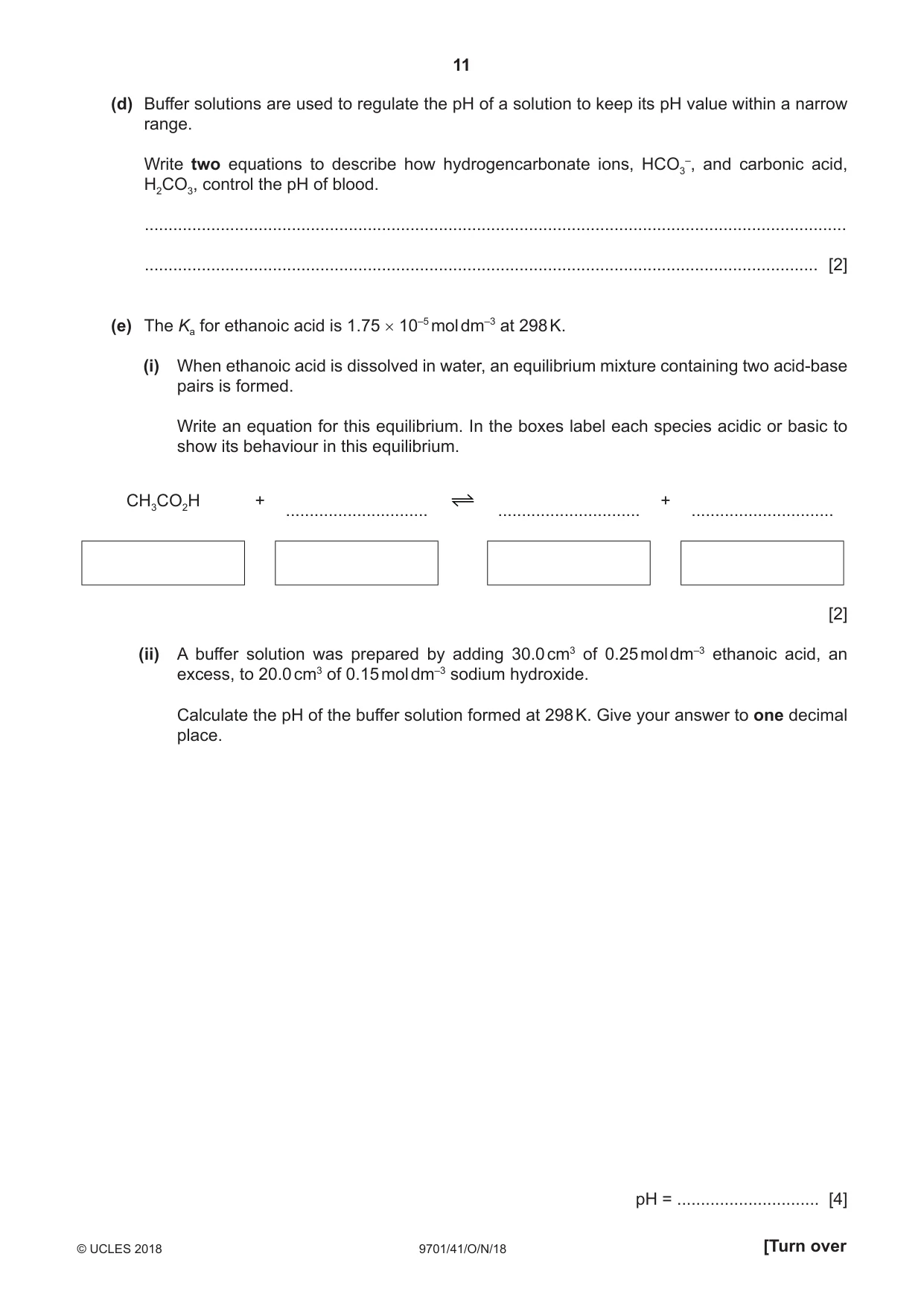
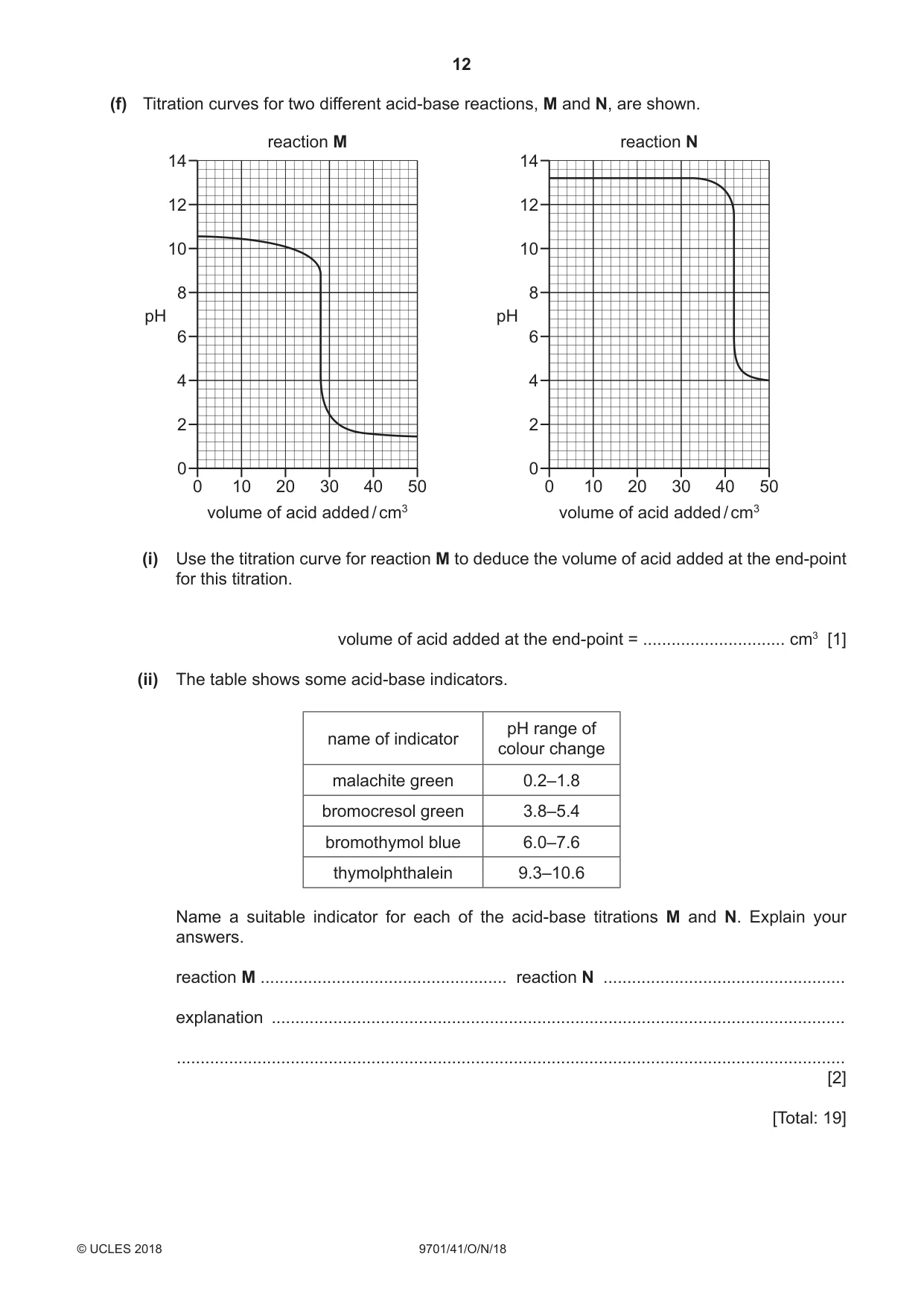
4 (a) The enthalpy change of solution, , of the Group 2 sulfates becomes more endothermic down the group. State and explain the trend in the solubility of the Group 2 sulfates down the group. .................................................................................................................................................... .................................................................................................................................................... .................................................................................................................................................... .................................................................................................................................................... .............................................................................................................................................. [3] (b) (i) Write the expression for Kw , the ionic product of water. Kw = [1] (ii) The numerical value of Kw increases with increasing temperature. Place a tick () in the appropriate column in each row to show the effect of increasing the temperature of water on the pH and on the ratio [H+] : [OH–]. effect of increasing decrease stay the same increase temperature of water pH ratio [H+] : [OH–] [2] (c) An aqueous solution of sodium hydroxide has a pH of 13.25 at 298 K. Calculate the concentration of this sodium hydroxide solution. concentration = .............................. mol dm–3 [2] (d) Buffer solutions are used to regulate the pH of a solution to keep its pH value within a narrow range. Write two equations to describe how hydrogencarbonate ions, HCO3–, and carbonic acid, H2CO3, control the pH of blood. .................................................................................................................................................... .............................................................................................................................................. [2] (e) The Ka for ethanoic acid is 1.75 × 10⁻⁵ mol dm–3 at 298 K. (i) When ethanoic acid is dissolved in water, an equilibrium mixture containing two acid‑base pairs is formed. Write an equation for this equilibrium. In the boxes label each species acidic or basic to show its behaviour in this equilibrium. CH3CO2H + + .............................. .............................. .............................. [2] (ii) A buffer solution was prepared by adding 30.0 cm3 of 0.25 mol dm–3 ethanoic acid, an excess, to 20.0 cm3 of 0.15 mol dm–3 sodium hydroxide. Calculate the pH of the buffer solution formed at 298 K. Give your answer to one decimal place. pH = .............................. [4] (f) Titration curves for two different acid-base reactions, M and N, are shown. reaction M reaction N 14 14 12 12 10 10 8 8 pH pH 6 6 4 4 2 2 0 0 0 10 20 30 40 50 0 10 20 30 40 50 volume of acid added / cm3 volume of acid added / cm3 (i) Use the titration curve for reaction M to deduce the volume of acid added at the end‑point for this titration. volume of acid added at the end-point = .............................. cm3 [1] (ii) The table shows some acid-base indicators. pH range of name of indicator colour change malachite green 0.2–1.8 bromocresol green 3.8–5.4 bromothymol blue 6.0–7.6 thymolphthalein 9.3–10.6 Name a suitable indicator for each of the acid-base titrations M and N. Explain your answers. reaction M .................................................... reaction N .................................................... explanation .......................................................................................................................... ............................................................................................................................................. [2] [Total: 19]
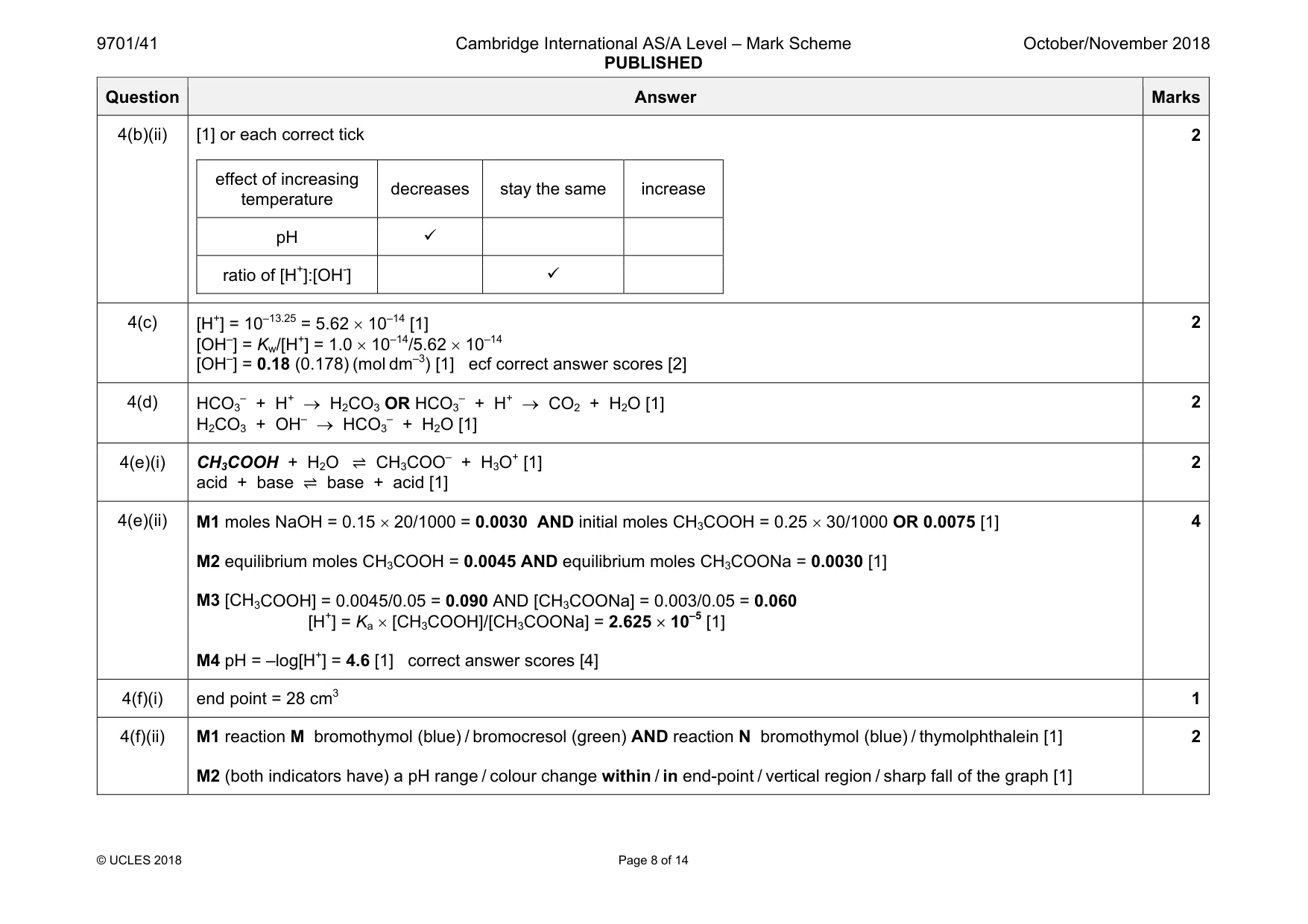
Mark scheme: 4(a) M1 solubility decreases (down the Group) [1] M2 because lattice energy and hydration energy decreases OR lattice energy and hydration energy become less exothermic / more endothermic [1] M3 because hydration energy decreases to a greater extent (than does ∆HLatt) [1] 3 4(b)(i) (Kw = ) [H+][OH–] 1 Question Answer Marks 4(b)(ii) [1] or each correct tick effect of increasing temperature decreases stay the same increase pH 9 ratio of [H+]:[OH-] 9 2 4(c) [H+] = 10–13.25 = 5.62 × 10⁻¹⁴ [1] [OH–] = Kw/[H+] = 1.0 × 10⁻¹⁴/5.62 × 10–14 [OH–] = 0.18 (0.178) (mol dm–3) [1] ecf correct answer scores [2] 2 4(d) HCO3 – + H+ → H2CO3 OR HCO3 – + H+ → CO2 + H2O [1] H2CO3 + OH– → HCO3 – + H2O [1] 2 4(e)(i) CH3COOH + H2O ⇌ CH3COO– + H3O+ [1] acid + base ⇌ base + acid [1] 2 4(e)(ii) M1 moles NaOH = 0.15 × 20/1000 = 0.0030 AND initial moles CH3COOH = 0.25 × 30/1000 OR 0.0075 [1] M2 equilibrium moles CH3COOH = 0.0045 AND equilibrium moles CH3COONa = 0.0030 [1] M3 [CH3COOH] = 0.0045/0.05 = 0.090 AND [CH3COONa] = 0.003/0.05 = 0.060 [H+] = Ka × [CH3COOH]/[CH3COONa] = 2.625 × 10⁻⁵ [1] M4 pH = –log[H+] = 4.6 [1] correct answer scores [4] 4 4(f)(i) end point = 28 cm3 1 4(f)(ii) M1 reaction M bromothymol (blue) / bromocresol (green) AND reaction N bromothymol (blue) / thymolphthalein [1] M2 (both indicators have) a pH range / colour change within / in end-point / vertical region / sharp fall of the graph [1] 2
Q5 · Polyhydroxyamide is a fire-resistant polyamide which is formed from the two monomers, F…
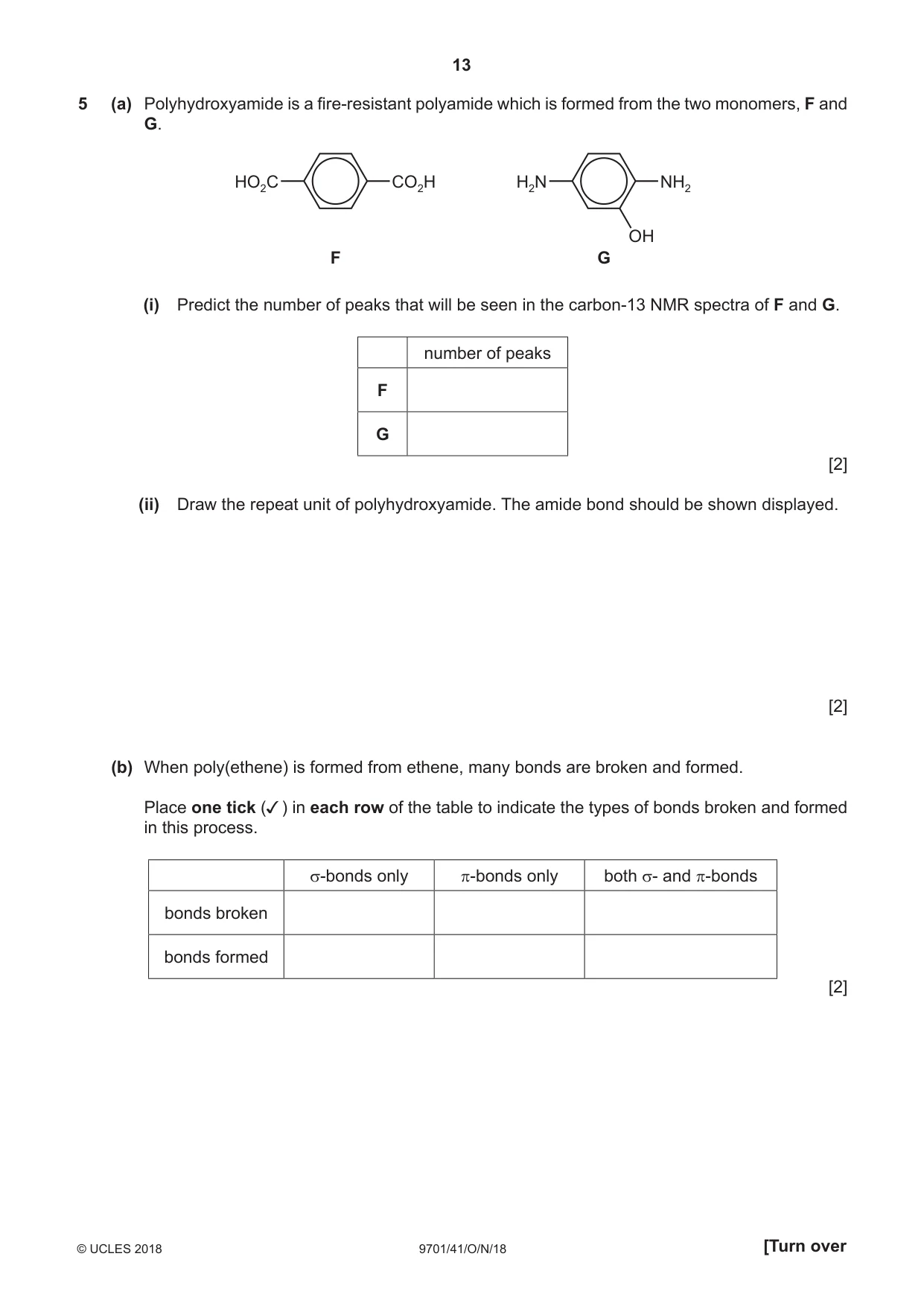
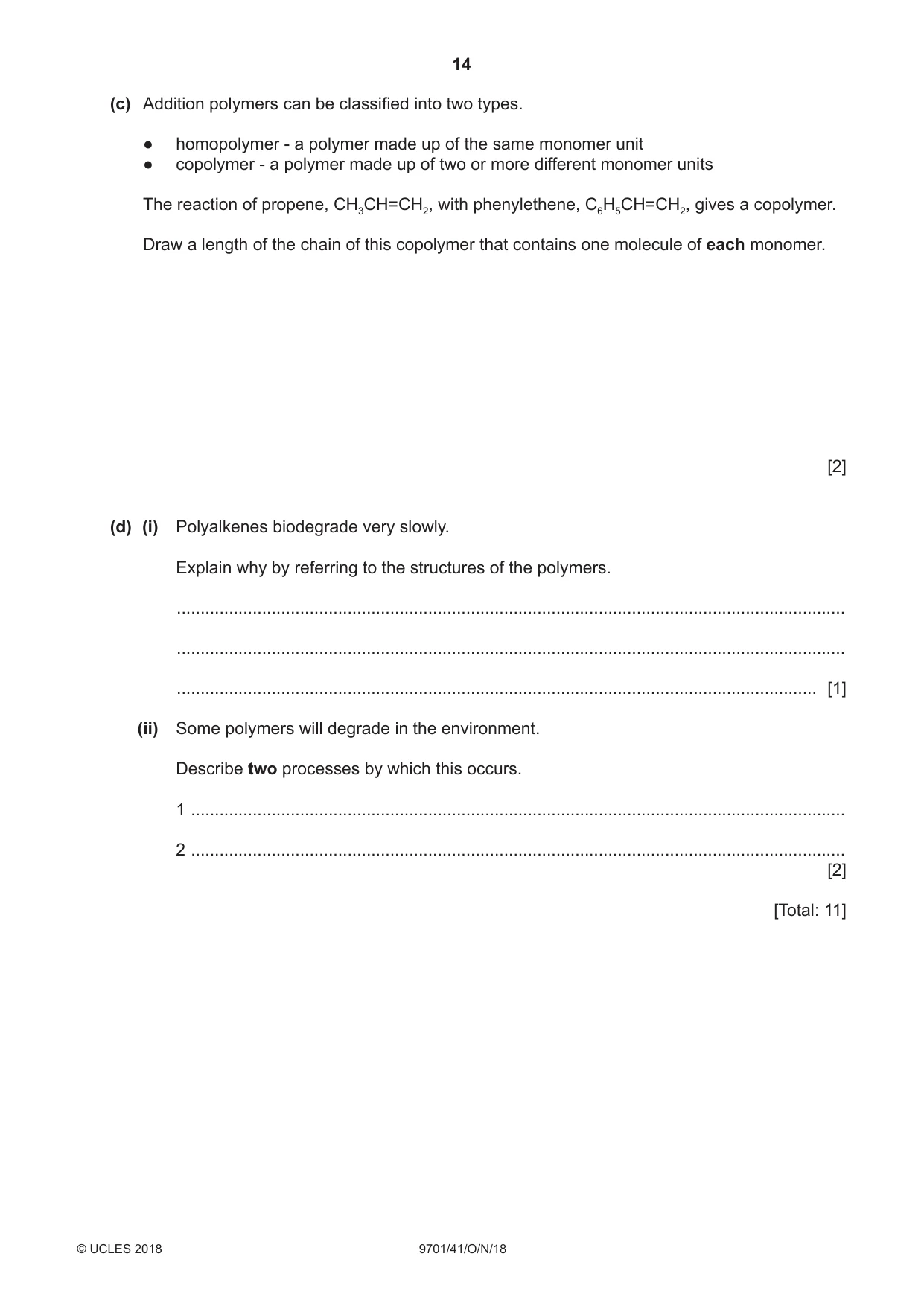
5 (a) Polyhydroxyamide is a fire-resistant polyamide which is formed from the two monomers, F and G. HO2C CO2H H2N NH2 OH F G (i) Predict the number of peaks that will be seen in the carbon-13 NMR spectra of F and G. number of peaks F G [2] (ii) Draw the repeat unit of polyhydroxyamide. The amide bond should be shown displayed. [2] (b) When poly(ethene) is formed from ethene, many bonds are broken and formed. Place one tick () in each row of the table to indicate the types of bonds broken and formed in this process. σ-bonds only π-bonds only both σ- and π-bonds bonds broken bonds formed [2] (c) Addition polymers can be classified into two types. ●● homopolymer - a polymer made up of the same monomer unit ●● copolymer - a polymer made up of two or more different monomer units The reaction of propene, CH3CH=CH2, with phenylethene, C6H5CH=CH2, gives a copolymer. Draw a length of the chain of this copolymer that contains one molecule of each monomer. [2] (d) (i) Polyalkenes biodegrade very slowly. Explain why by referring to the structures of the polymers. ............................................................................................................................................. ............................................................................................................................................. ....................................................................................................................................... [1] (ii) Some polymers will degrade in the environment. Describe two processes by which this occurs. 1 .......................................................................................................................................... 2 .......................................................................................................................................... [2] [Total: 11]
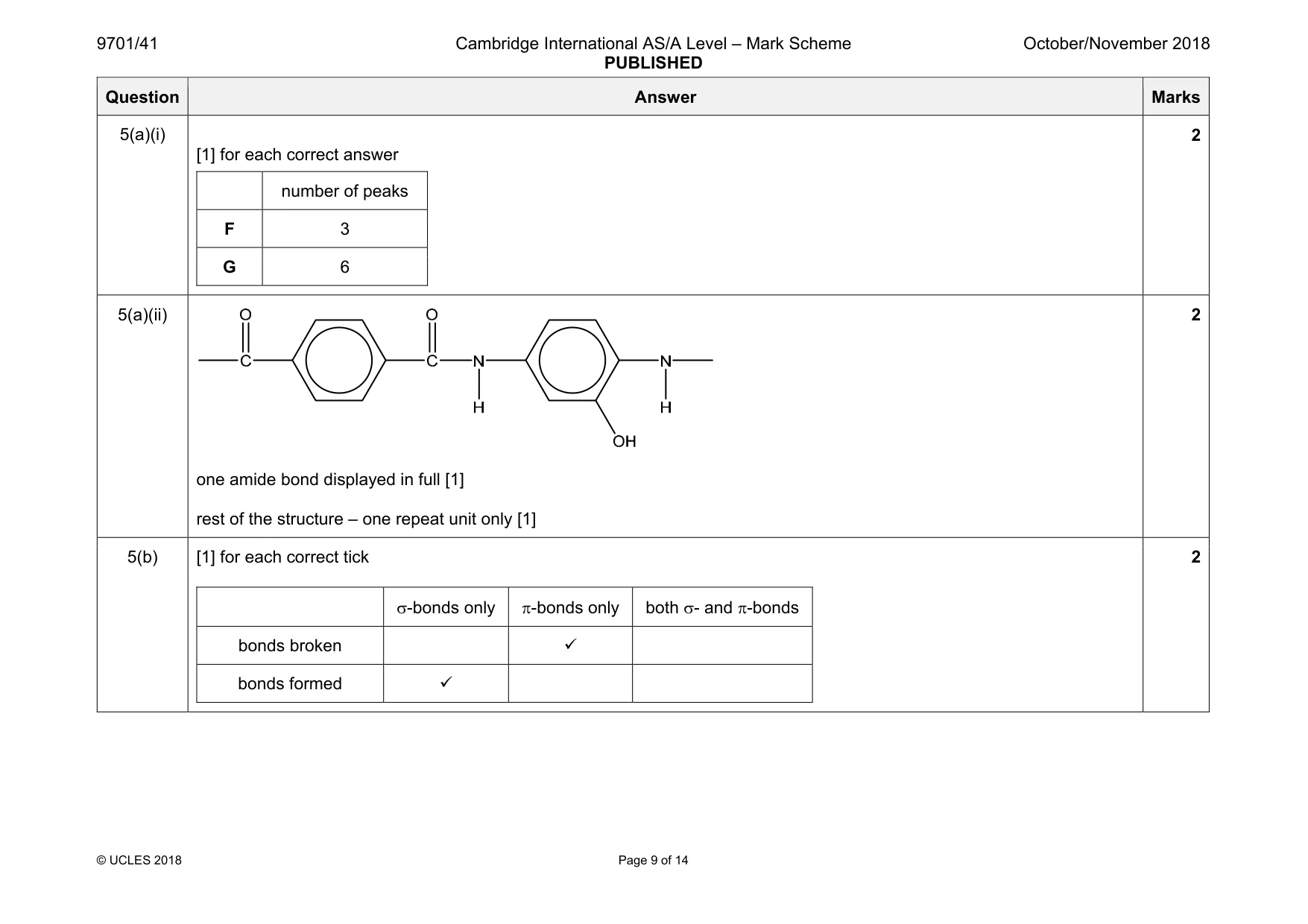
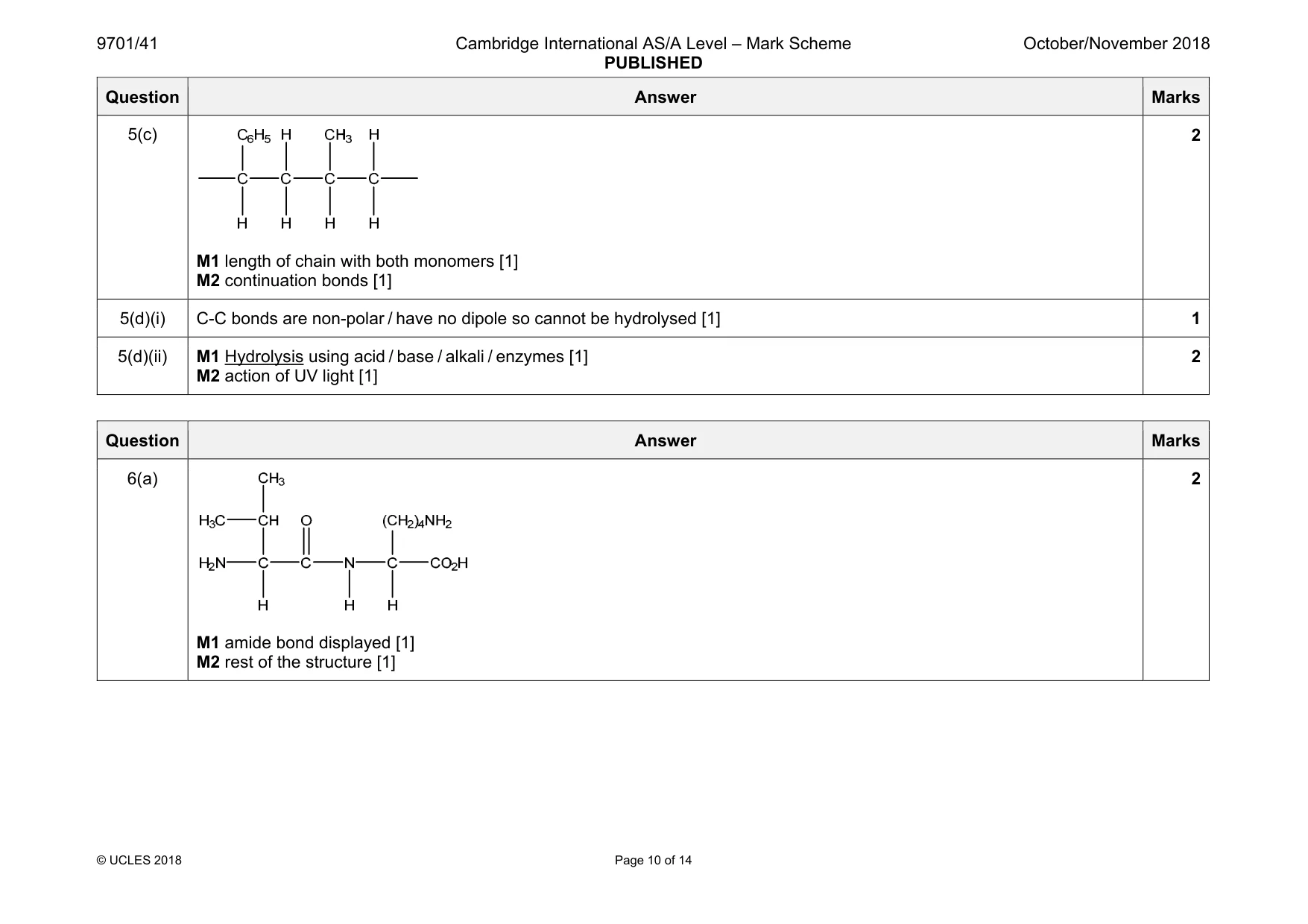
Mark scheme: 5(a)(i) [1] for each correct answer number of peaks F 3 G 6 2 5(a)(ii) one amide bond displayed in full [1] rest of the structure – one repeat unit only [1] 2 5(b) [1] for each correct tick σ-bonds only π-bonds only both σ- and π-bonds bonds broken 9 bonds formed 9 2 Question Answer Marks 5(c) M1 length of chain with both monomers [1] M2 continuation bonds [1] 2 5(d)(i) C-C bonds are non-polar / have no dipole so cannot be hydrolysed [1] 1 5(d)(ii) M1 Hydrolysis using acid / base / alkali / enzymes [1] M2 action of UV light [1] 2
Q6 · Use the Data Booklet to draw the structure of the dipeptide val-lys
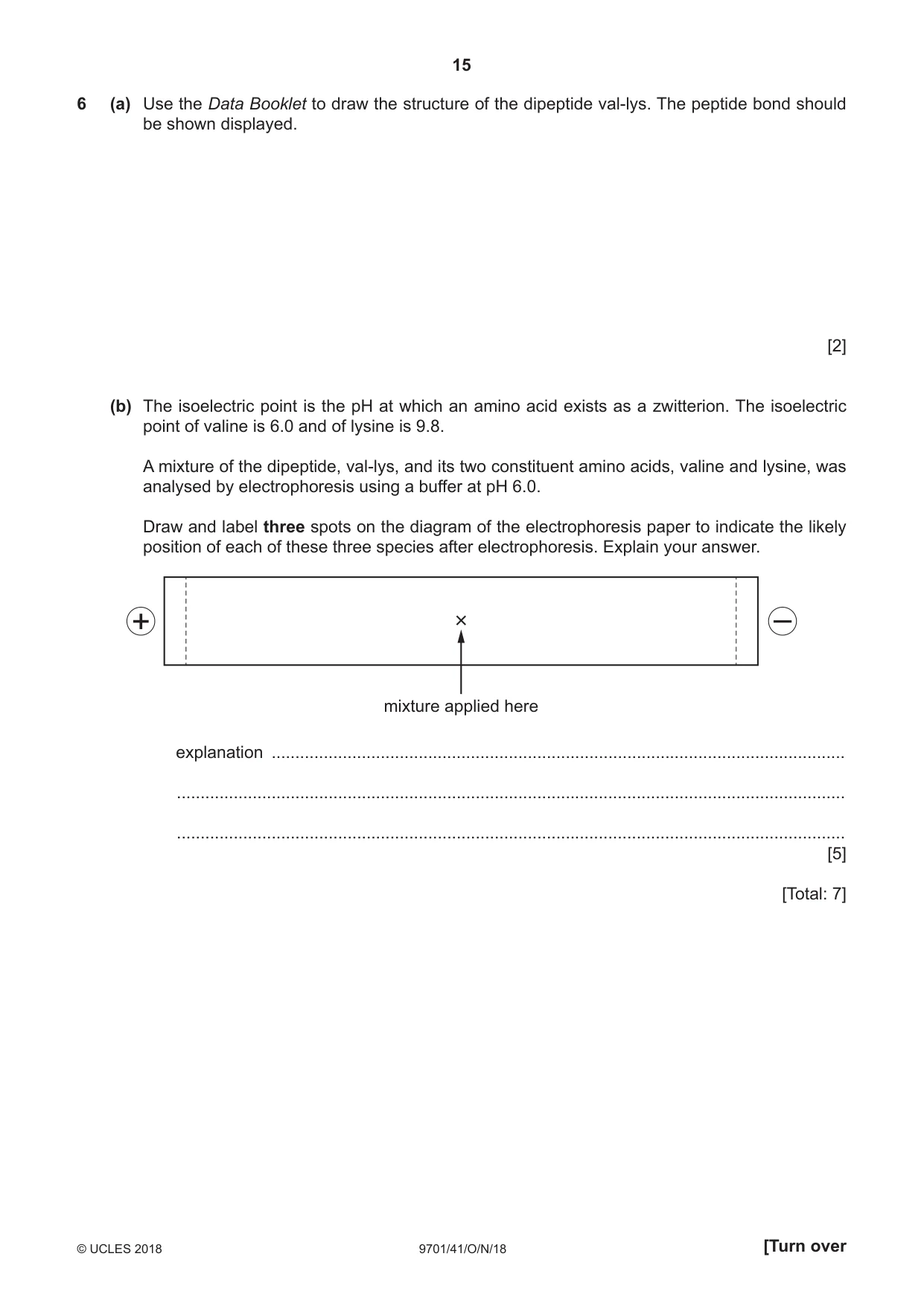
6 (a) Use the Data Booklet to draw the structure of the dipeptide val-lys. The peptide bond should be shown displayed. [2] (b) The isoelectric point is the pH at which an amino acid exists as a zwitterion. The isoelectric point of valine is 6.0 and of lysine is 9.8. A mixture of the dipeptide, val-lys, and its two constituent amino acids, valine and lysine, was analysed by electrophoresis using a buffer at pH 6.0. Draw and label three spots on the diagram of the electrophoresis paper to indicate the likely position of each of these three species after electrophoresis. Explain your answer. + – mixture applied here explanation .......................................................................................................................... ............................................................................................................................................. ............................................................................................................................................. [5] [Total: 7]
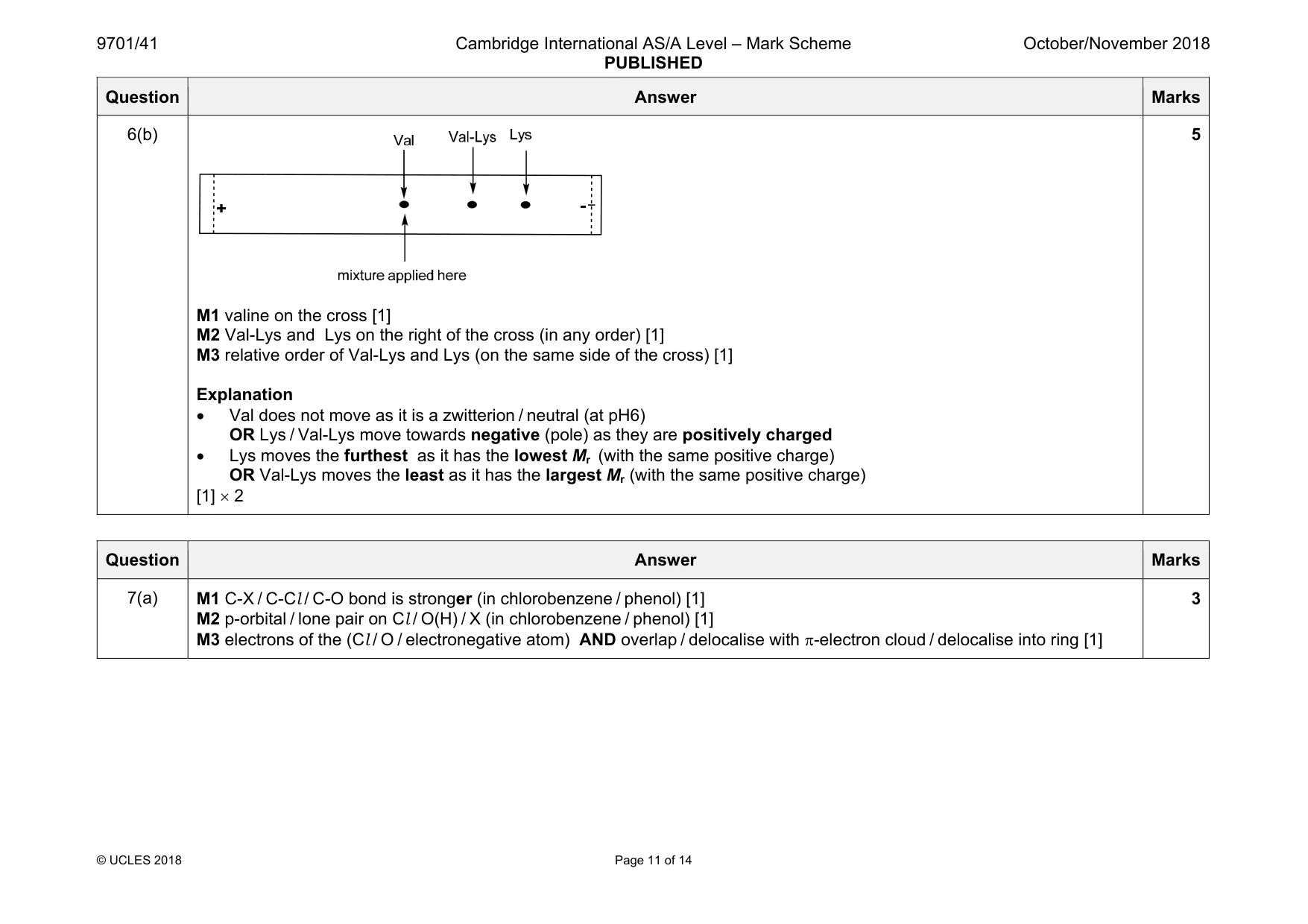
Mark scheme: 6(a) M1 amide bond displayed [1] M2 rest of the structure [1] 2 Question Answer Marks 6(b) M1 valine on the cross [1] M2 Val-Lys and Lys on the right of the cross (in any order) [1] M3 relative order of Val-Lys and Lys (on the same side of the cross) [1] Explanation • Val does not move as it is a zwitterion / neutral (at pH6) OR Lys / Val-Lys move towards negative (pole) as they are positively charged • Lys moves the furthest as it has the lowest Mr (with the same positive charge) OR Val-Lys moves the least as it has the largest Mr (with the same positive charge) [1] × 2 5
Q7 · Chlorobenzene and phenol both show a lack of reactivity towards reactants that cause the…
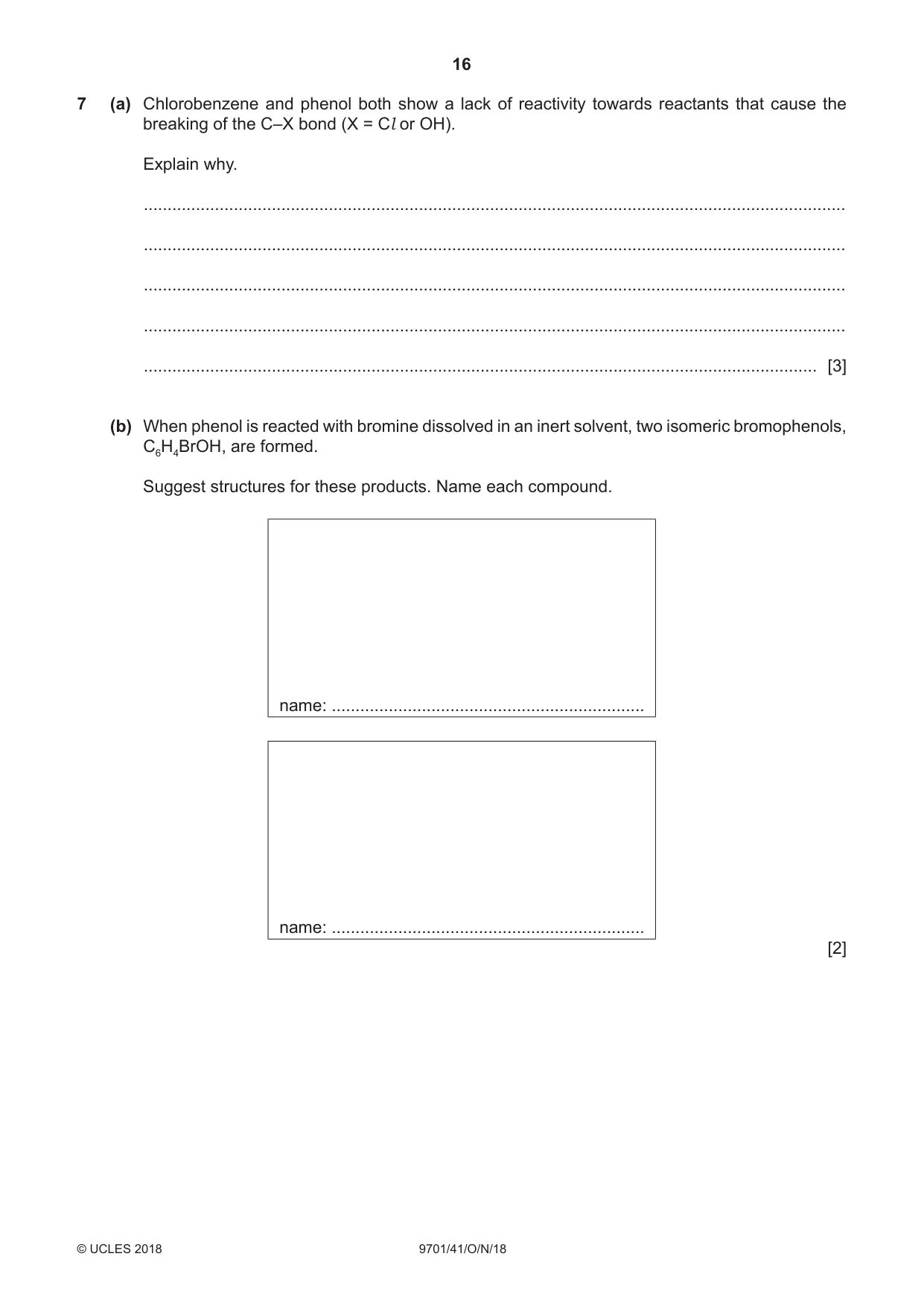
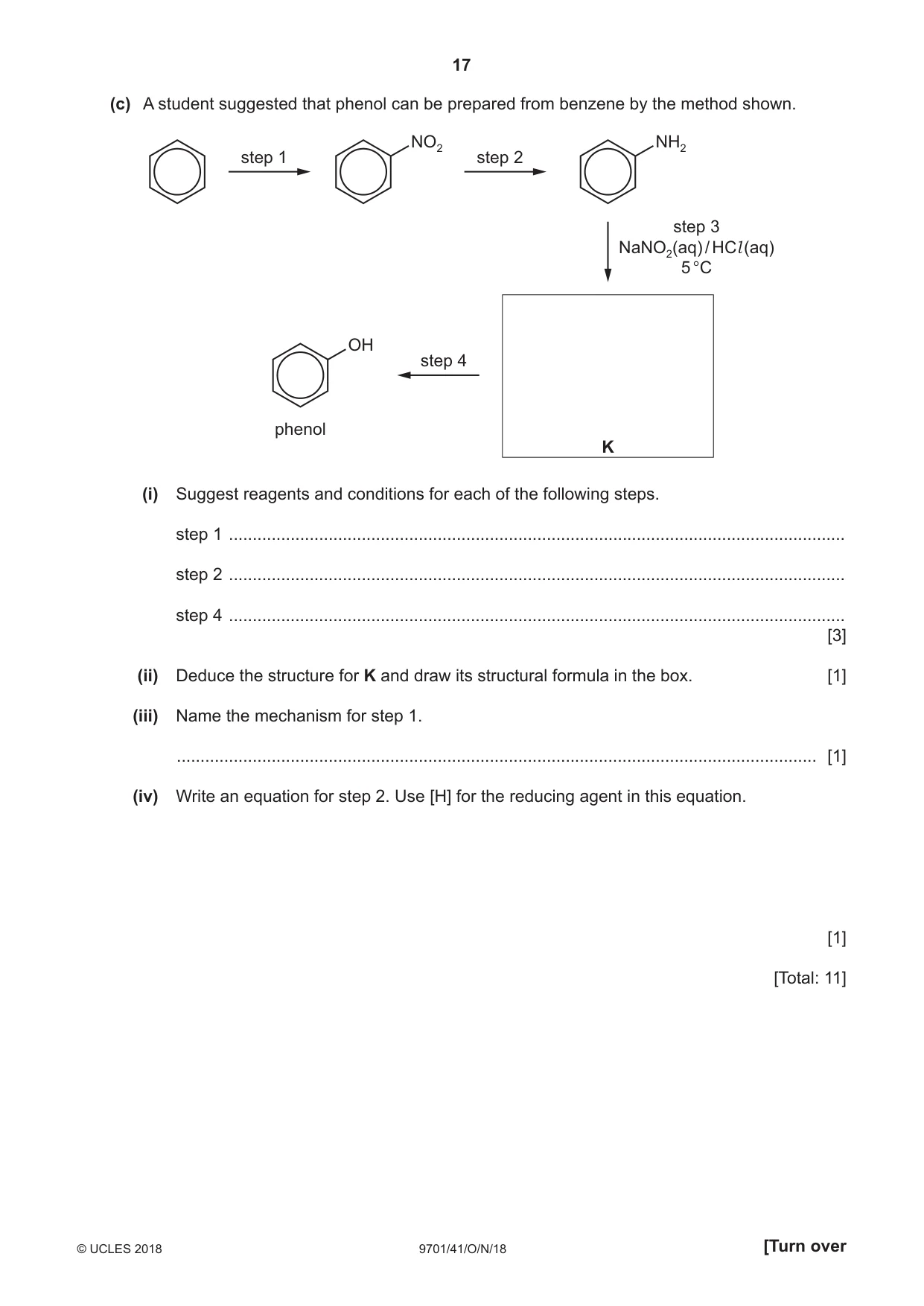
7 (a) Chlorobenzene and phenol both show a lack of reactivity towards reactants that cause the breaking of the C–X bond (X = Cl or OH). Explain why. .................................................................................................................................................... .................................................................................................................................................... .................................................................................................................................................... .................................................................................................................................................... .............................................................................................................................................. [3] (b) When phenol is reacted with bromine dissolved in an inert solvent, two isomeric bromophenols, C6H4BrOH, are formed. Suggest structures for these products. Name each compound. name: .................................................................. name: .................................................................. [2] (c) A student suggested that phenol can be prepared from benzene by the method shown. NO2 NH2 step 1 step 2 step 3 NaNO2(aq) / HCl (aq) 5 °C OH step 4 phenol K (i) Suggest reagents and conditions for each of the following steps. step 1 .................................................................................................................................. step 2 .................................................................................................................................. step 4 .................................................................................................................................. [3] (ii) Deduce the structure for K and draw its structural formula in the box. [1] (iii) Name the mechanism for step 1. ....................................................................................................................................... [1] (iv) Write an equation for step 2. Use [H] for the reducing agent in this equation. [1] [Total: 11]
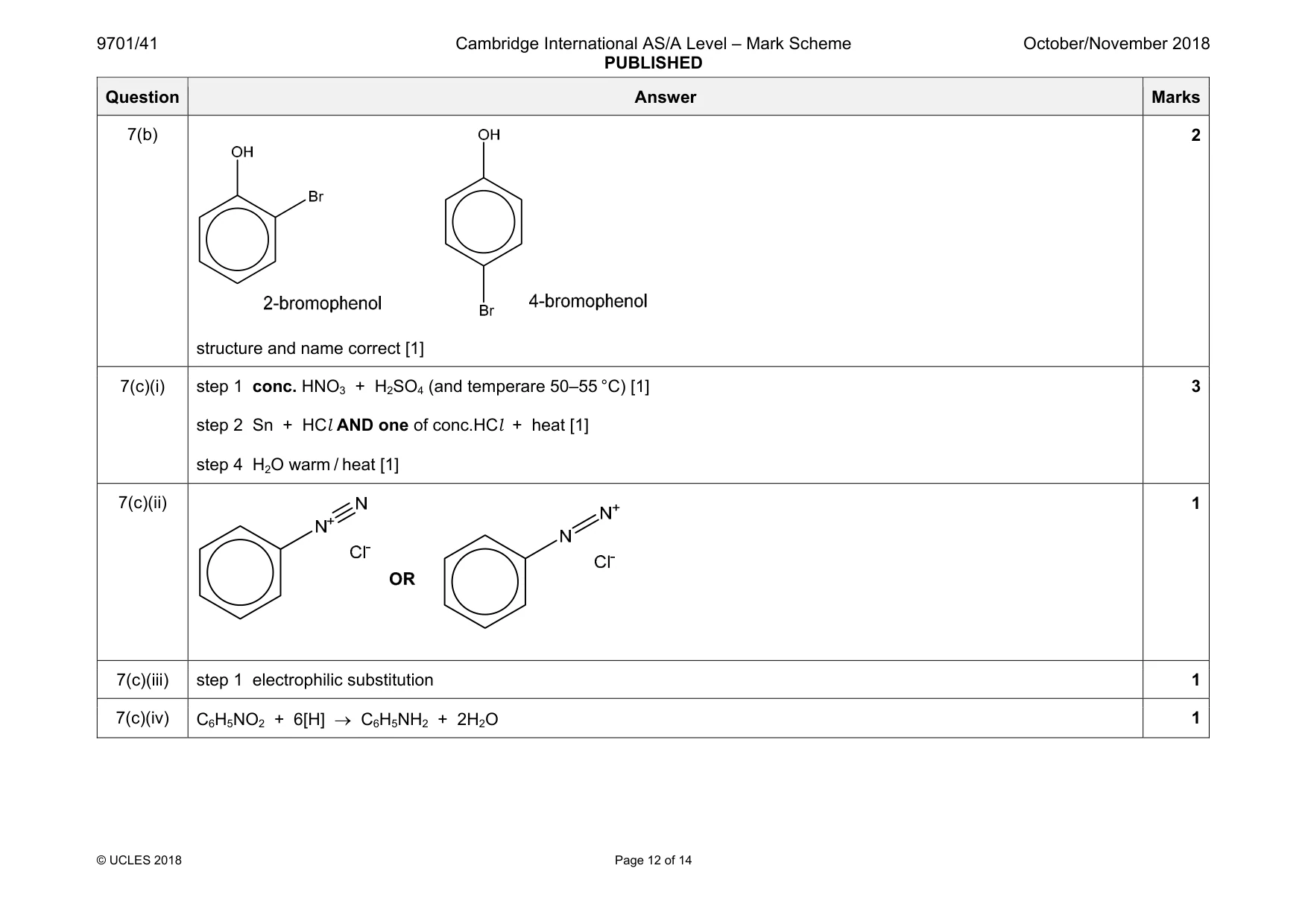
Mark scheme: 7(a) M2 p-orbital / lone pair on Cl / O(H) / X (in chlorobenzene / phenol) [1] M3 electrons of the (Cl / O / electronegative atom) AND overlap / delocalise with π-electron cloud / delocalise into ring [1] 3 Question Answer Marks 7(b) structure and name correct [1] 2 7(c)(i) step 1 conc. HNO3 + H2SO4 (and temperare 50–55 °C) [1] step 2 Sn + HCl AND one of conc.HCl + heat [1] step 4 H2O warm / heat [1] 3 7(c)(ii) 1 7(c)(iii) step 1 electrophilic substitution 1 7(c)(iv) C6H5NO2 + 6[H] → C6H5NH2 + 2H2O 1
Q8 · Entropy is a measure of the disorder of a system
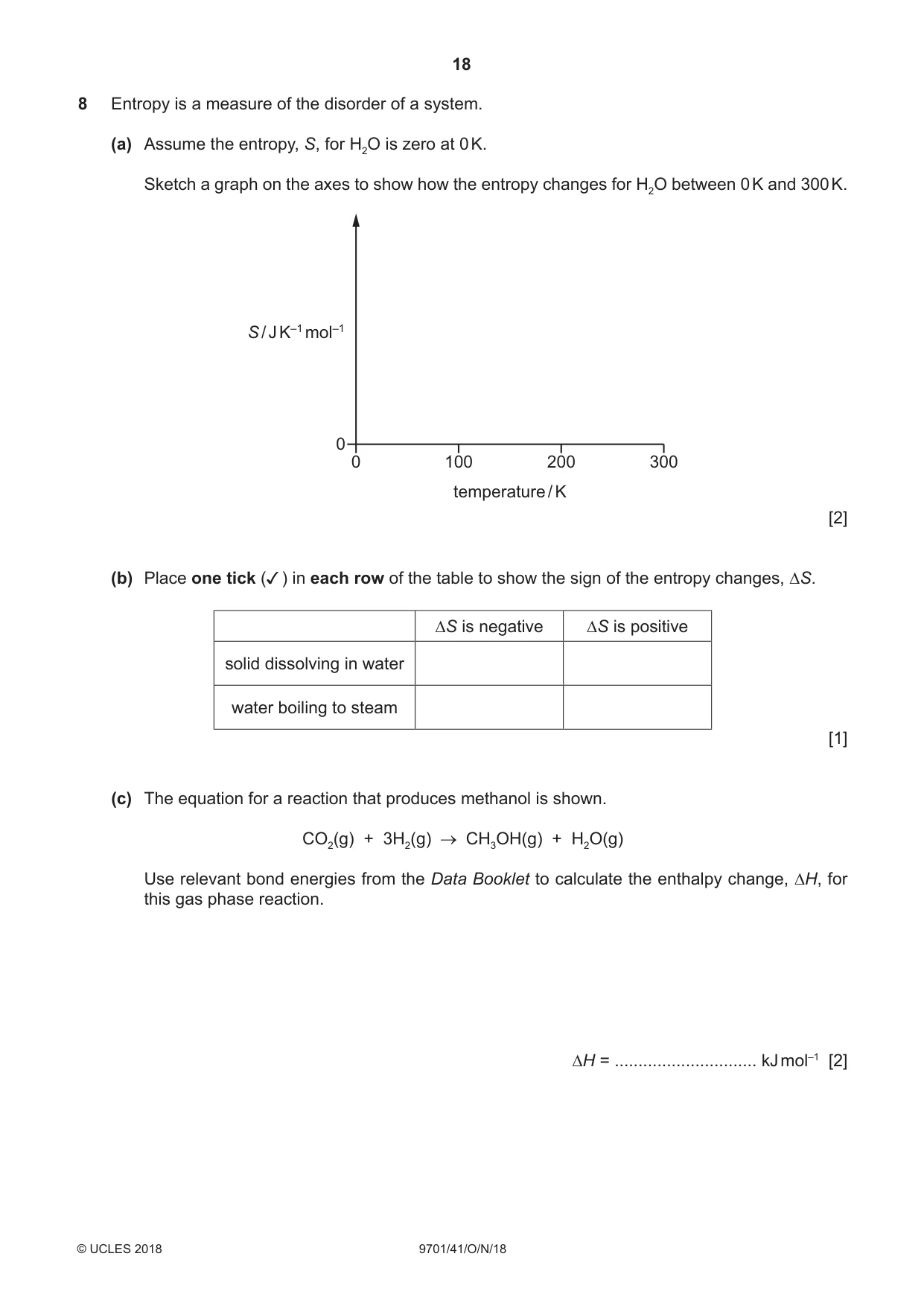
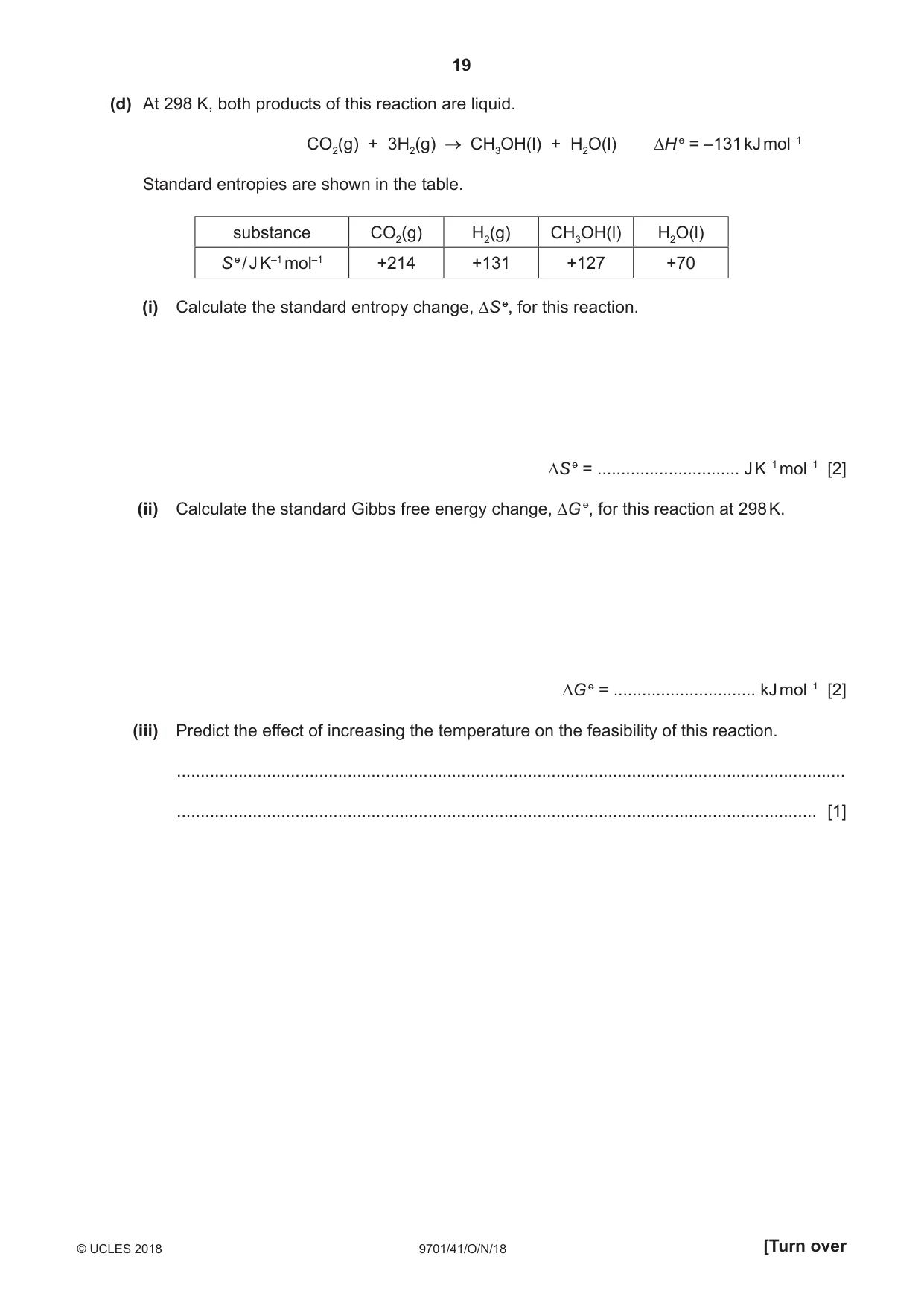
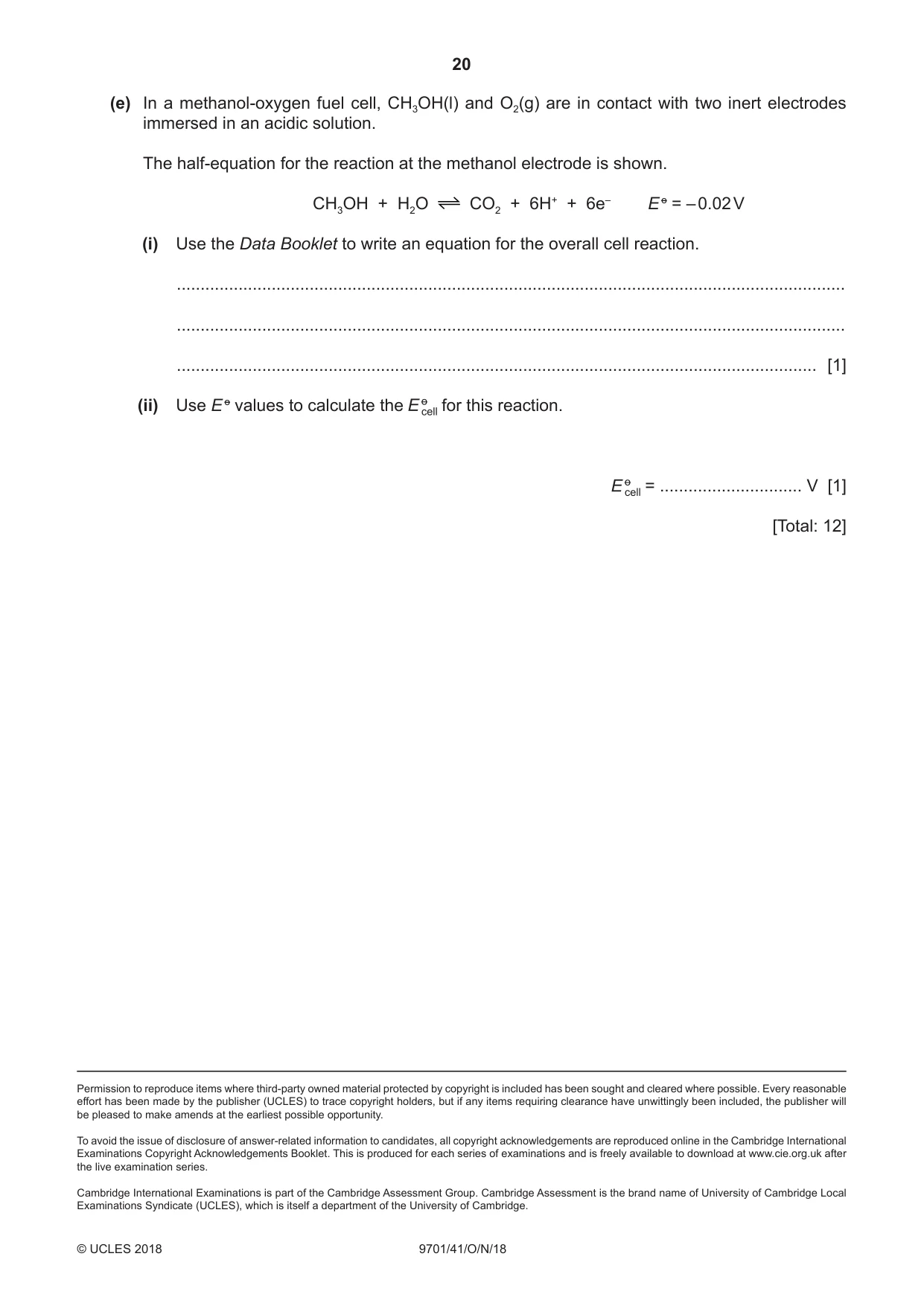
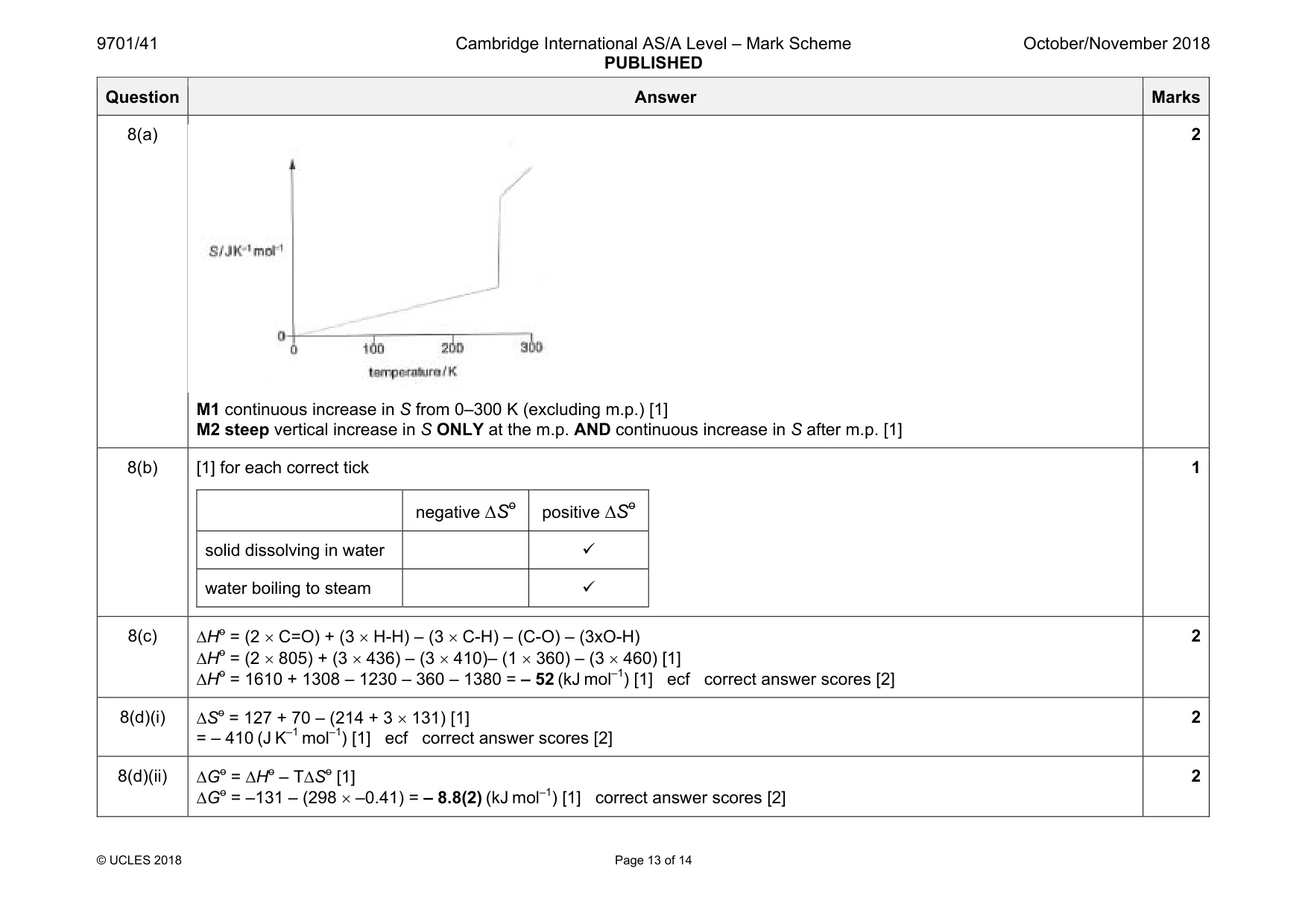
8 Entropy is a measure of the disorder of a system. (a) Assume the entropy, S, for H2O is zero at 0 K. Sketch a graph on the axes to show how the entropy changes for H2O between 0 K and 300 K. S / J K–1 mol–1 0 0 100 200 300 temperature / K [2] (b) Place one tick () in each row of the table to show the sign of the entropy changes, ΔS. ΔS is negative ΔS is positive solid dissolving in water water boiling to steam [1] (c) The equation for a reaction that produces methanol is shown. CO2(g) + 3H2(g) CH3OH(g) + H2O(g) Use relevant bond energies from the Data Booklet to calculate the enthalpy change, ΔH, for this gas phase reaction. ΔH = .............................. kJ mol–1 [2] (d) At 298 K, both products of this reaction are liquid. CO2(g) + 3H2(g) CH3OH(l) + H2O(l) ΔH o = –131 kJ mol–1 Standard entropies are shown in the table. substance CO2(g) H2(g) CH3OH(l) H2O(l) S o / J K–1 mol–1 +214 +131 +127 +70 (i) Calculate the standard entropy change, ΔS o, for this reaction. ΔS o = .............................. J K–1 mol–1 [2] (ii) Calculate the standard Gibbs free energy change, ΔG o, for this reaction at 298 K. ΔG o = .............................. kJ mol–1 [2] (iii) Predict the effect of increasing the temperature on the feasibility of this reaction. ............................................................................................................................................. ....................................................................................................................................... [1] (e) In a methanol-oxygen fuel cell, CH3OH(l) and O2(g) are in contact with two inert electrodes immersed in an acidic solution. The half-equation for the reaction at the methanol electrode is shown. CH3OH + H2O CO2 + 6H+ + 6e– E o = – 0.02 V (i) Use the Data Booklet to write an equation for the overall cell reaction. ............................................................................................................................................. ............................................................................................................................................. ....................................................................................................................................... [1] (ii) Use E o values to calculate the for this reaction. = .............................. V [1] [Total: 12]
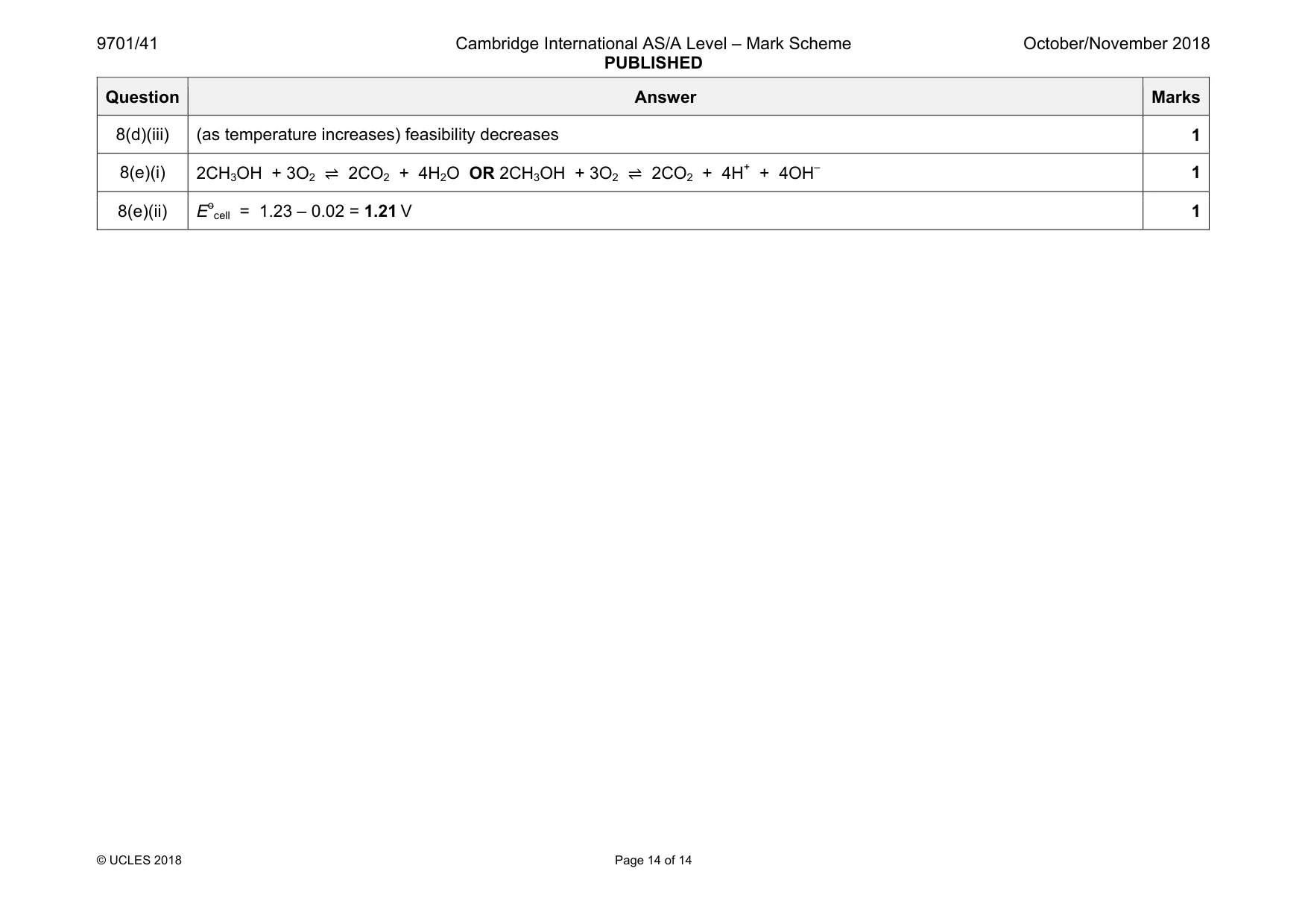
Mark scheme: 8(a) M1 continuous increase in S from 0–300 K (excluding m.p.) [1] M2 steep vertical increase in S ONLY at the m.p. AND continuous increase in S after m.p. [1] 2 8(b) [1] for each correct tick negative ∆So positive ∆So solid dissolving in water 9 water boiling to steam 9 1 8(c) ∆Ho = (2 × C=O) + (3 × H-H) – (3 × C-H) – (C-O) – (3xO-H) ∆Ho = (2 × 805) + (3 × 436) – (3 × 410)– (1 × 360) – (3 × 460) [1] ∆Ho = 1610 + 1308 – 1230 – 360 – 1380 = – 52 (kJ mol–1) [1] ecf correct answer scores [2] 2 8(d)(i) ∆So = 127 + 70 – (214 + 3 × 131) [1] = – 410 (J K–1 mol–1) [1] ecf correct answer scores [2] 2 8(d)(ii) ∆Go = ∆Ho – T∆So [1] ∆Go = –131 – (298 × –0.41) = – 8.8(2) (kJ mol–1) [1] correct answer scores [2] 2 Question Answer Marks 8(d)(iii) (as temperature increases) feasibility decreases 1 8(e)(i) 2CH3OH + 3O2 ⇌ 2CO2 + 4H2O OR 2CH3OH + 3O2 ⇌ 2CO2 + 4H+ + 4OH– 1 8(e)(ii) Eo cell = 1.23 – 0.02 = 1.21 V 1
What was in this paper
The subtopics covered by these 8 questions, and how many questions each got. Open one in a new tab to see every Cambridge question on it.
What you needed in this session
Cambridge’s own grade thresholds for 2018 Oct/Nov, Paper 4 · Variant 1. A higher threshold means an easier paper — the bar moves with how the cohort did.