Cambridge A Level Chemistry 9701 — 2017 May/June Paper 4 · Variant 2
9701/42/M/J/17 · 8 questions · 100 marks · ≈113 min
The question paper and its mark scheme, free to read here and free to download. This is Cambridge’s own paper, exactly as it was sat.
Question paper20 pages

Mark scheme13 pages
Answers below. Sit the paper first if you are practising.
Questions as text
Q1 · Describe and explain the variation in the thermal stabilities of the carbonates of the…
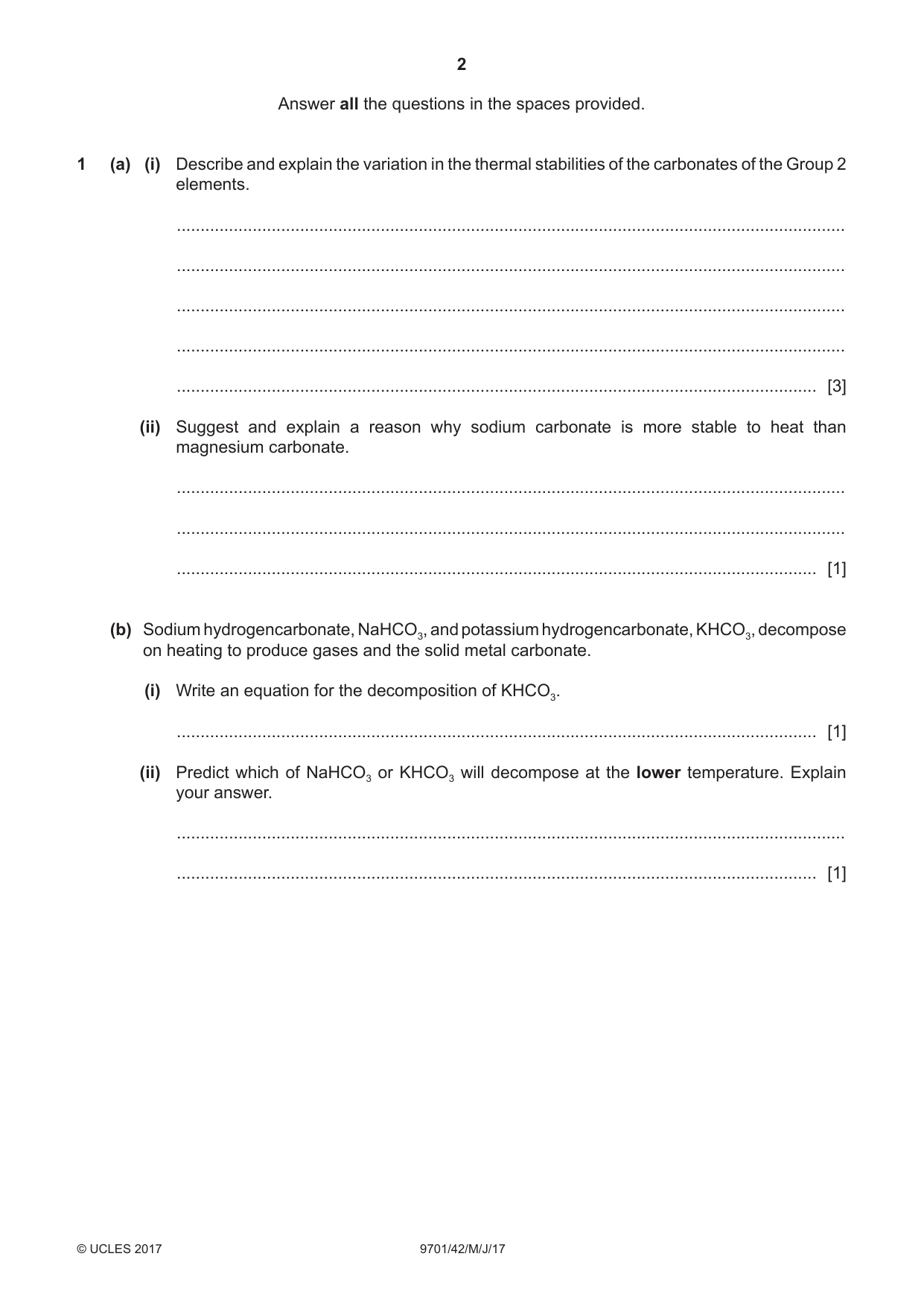
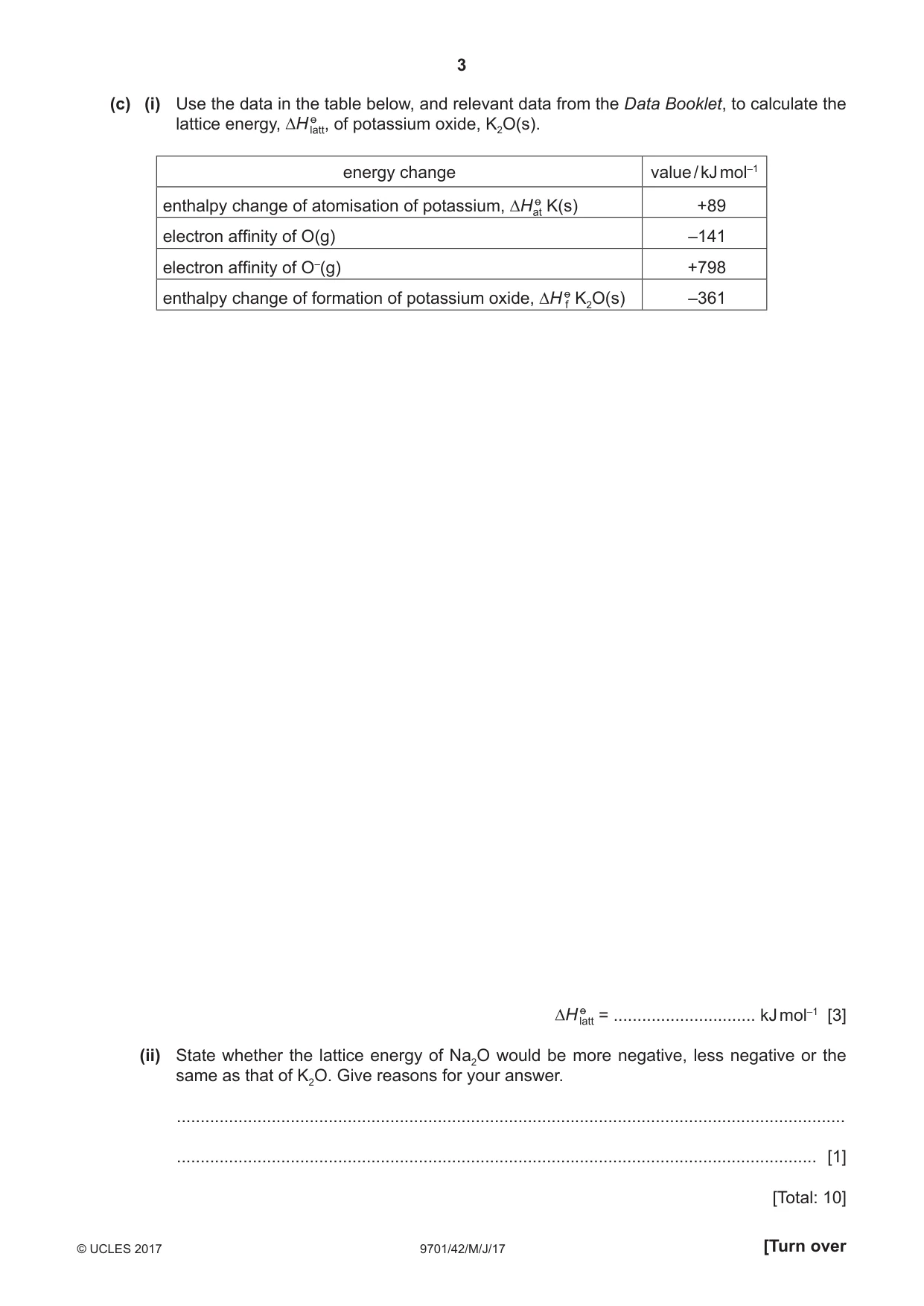
1 (a) (i) Describe and explain the variation in the thermal stabilities of the carbonates of the Group 2 elements. ............................................................................................................................................. ............................................................................................................................................. ............................................................................................................................................. ............................................................................................................................................. ....................................................................................................................................... [3] (ii) Suggest and explain a reason why sodium carbonate is more stable to heat than magnesium carbonate. ............................................................................................................................................. ............................................................................................................................................. ....................................................................................................................................... [1] (b) Sodium hydrogencarbonate, NaHCO3, and potassium hydrogencarbonate, KHCO3, decompose on heating to produce gases and the solid metal carbonate. (i) Write an equation for the decomposition of KHCO3. ....................................................................................................................................... [1] (ii) Predict which of NaHCO3 or KHCO3 will decompose at the lower temperature. Explain your answer. ............................................................................................................................................. ....................................................................................................................................... [1] (c) (i) Use the data in the table below, and relevant data from the Data Booklet, to calculate the lattice energy, , of potassium oxide, K2O(s). energy change value / kJ mol–1 enthalpy change of atomisation of potassium, K(s) +89 electron affinity of O(g) –141 electron affinity of O–(g) +798 enthalpy change of formation of potassium oxide, K2O(s) –361 = .............................. kJ mol–1 [3] (ii) State whether the lattice energy of Na2O would be more negative, less negative or the same as that of K2O. Give reasons for your answer. ............................................................................................................................................. ....................................................................................................................................... [1] [Total: 10]
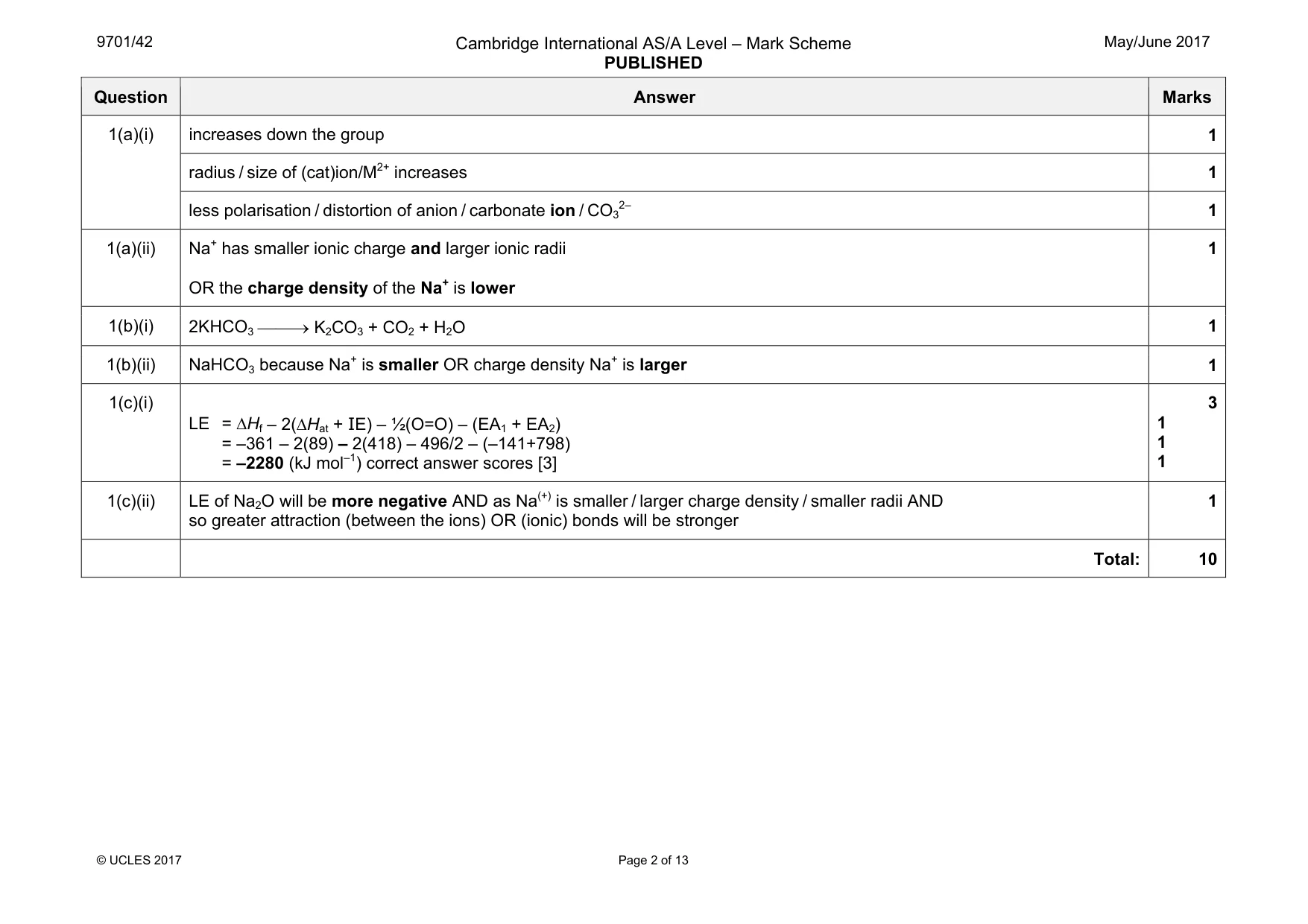
Mark scheme: 1(a)(i) increases down the group 1 radius / size of (cat)ion/M2+ increases 1 less polarisation / distortion of anion / carbonate ion / CO3 2– 1 1(a)(ii) Na+ has smaller ionic charge and larger ionic radii OR the charge density of the Na+ is lower 1 1(b)(i) 2KHCO3 → K2CO3 + CO2 + H2O 1 1(b)(ii) NaHCO3 because Na+ is smaller OR charge density Na+ is larger 1 1(c)(i) LE = ∆Hf – 2(∆Hat + IE) – ½(O=O) – (EA1 + EA2) = –361 – 2(89) – 2(418) – 496/2 – (–141+798) = –2280 (kJ mol–1) correct answer scores [3] 3 1 1 1 1(c)(ii) LE of Na2O will be more negative AND as Na(+) is smaller / larger charge density / smaller radii AND so greater attraction (between the ions) OR (ionic) bonds will be stronger 1 Total: 10
Q2 · Complete the table to show how both AgNO3(aq) and NH3(aq) could be used to distinguish…
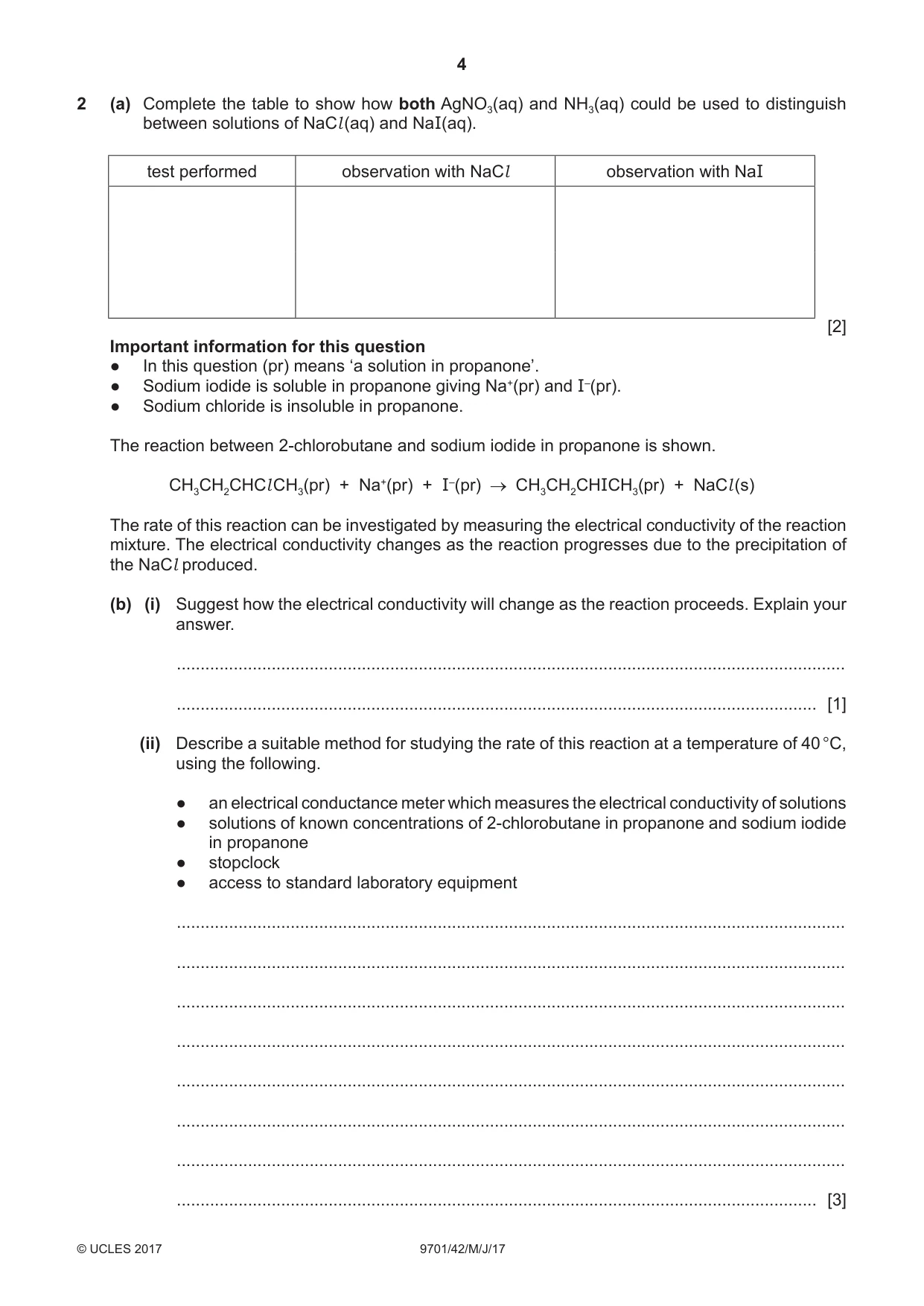
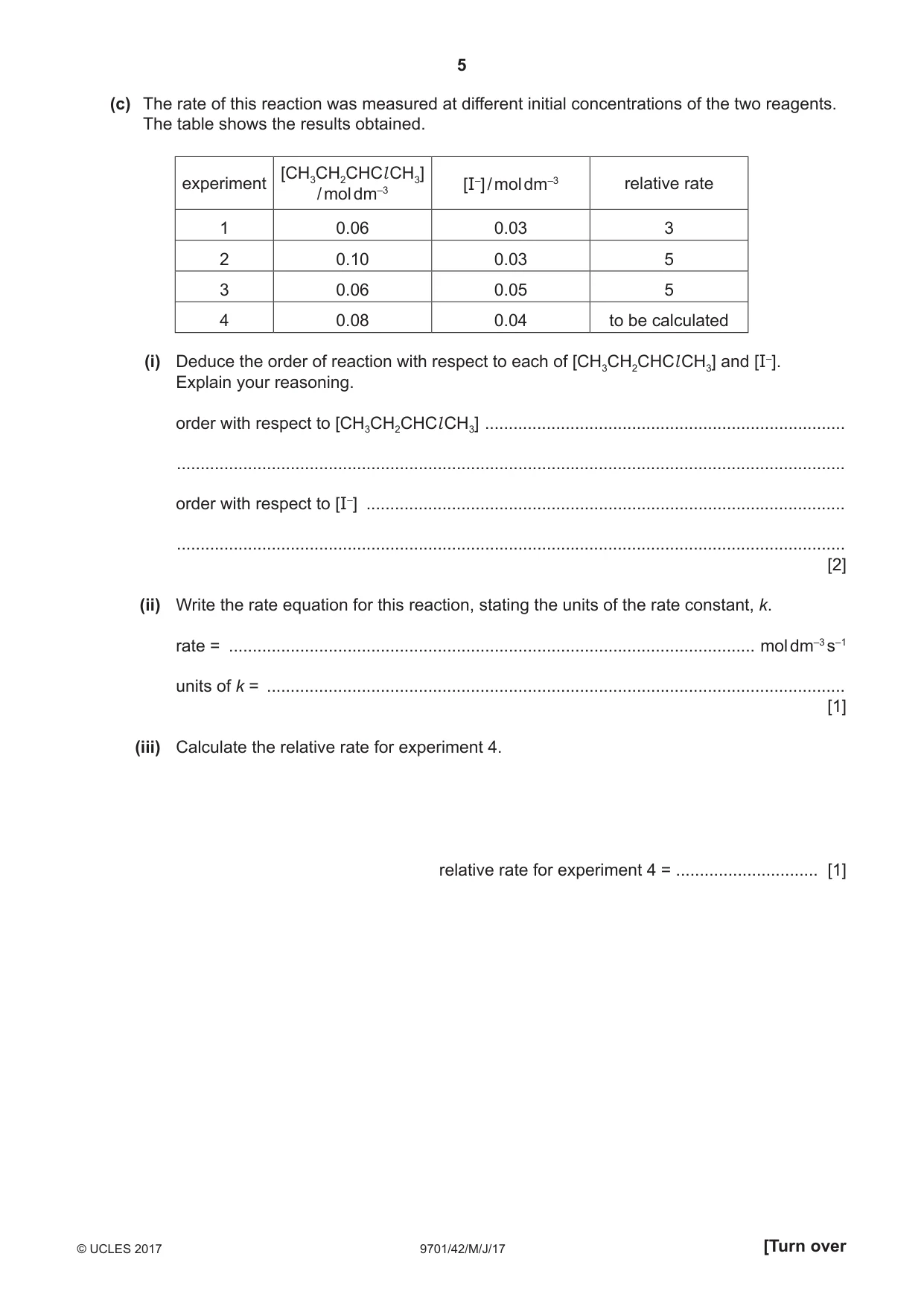
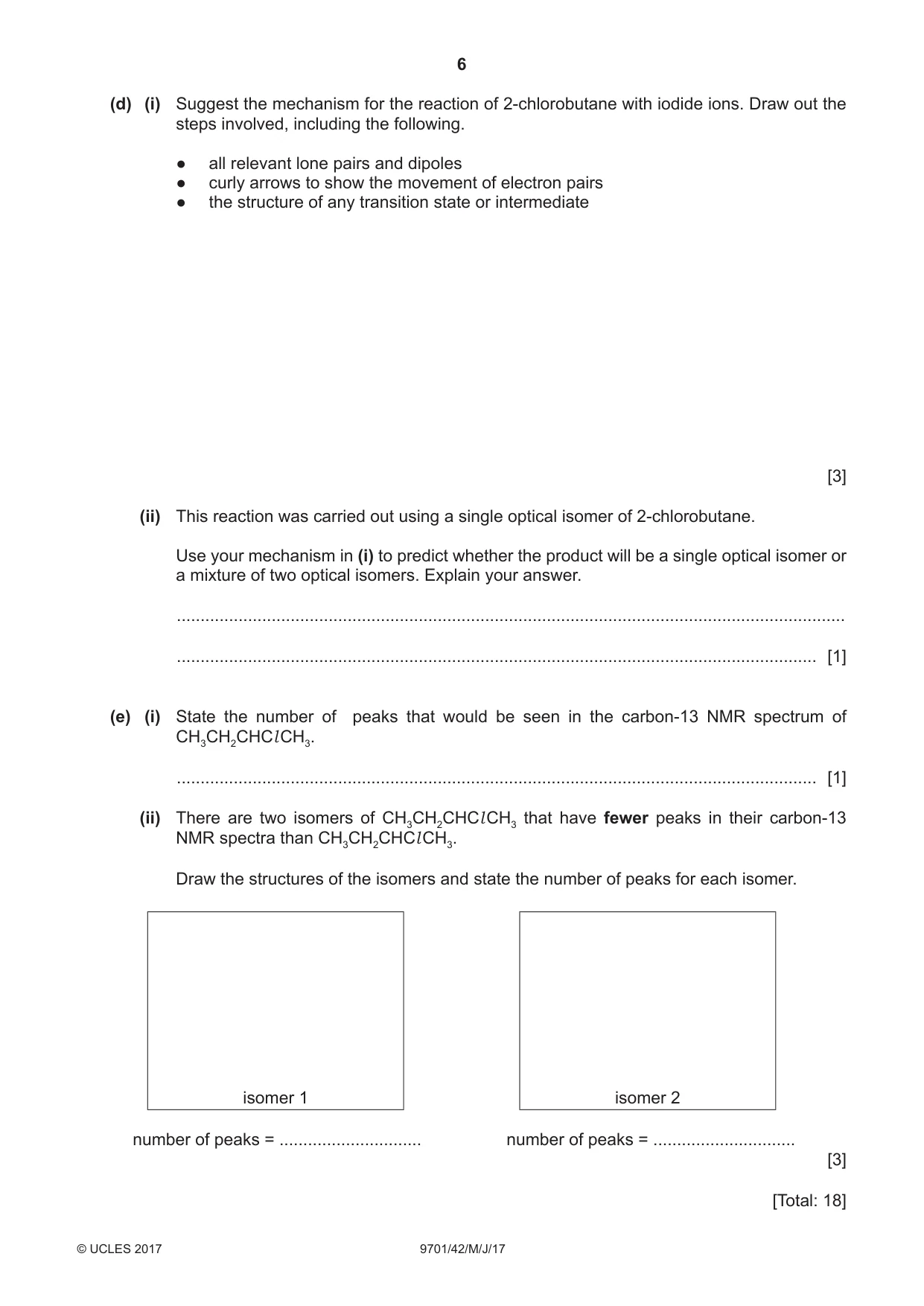
2 (a) Complete the table to show how both AgNO3(aq) and NH3(aq) could be used to distinguish between solutions of NaCl (aq) and NaI(aq). test performed observation with NaCl observation with NaI [2] Important information for this question ● In this question (pr) means ‘a solution in propanone’. ● Sodium iodide is soluble in propanone giving Na+(pr) and I–(pr). ● Sodium chloride is insoluble in propanone. The reaction between 2-chlorobutane and sodium iodide in propanone is shown. CH3CH2CHCl CH3(pr) + Na+(pr) + I–(pr) CH3CH2CHICH3(pr) + NaCl (s) The rate of this reaction can be investigated by measuring the electrical conductivity of the reaction mixture. The electrical conductivity changes as the reaction progresses due to the precipitation of the NaCl produced. (b) (i) Suggest how the electrical conductivity will change as the reaction proceeds. Explain your answer. ............................................................................................................................................. ....................................................................................................................................... [1] (ii) Describe a suitable method for studying the rate of this reaction at a temperature of 40 °C, using the following. ● an electrical conductance meter which measures the electrical conductivity of solutions ● solutions of known concentrations of 2-chlorobutane in propanone and sodium iodide in propanone ● stopclock ● access to standard laboratory equipment ............................................................................................................................................. ............................................................................................................................................. ............................................................................................................................................. ............................................................................................................................................. ............................................................................................................................................. ............................................................................................................................................. ............................................................................................................................................. ....................................................................................................................................... [3] (c) The rate of this reaction was measured at different initial concentrations of the two reagents. The table shows the results obtained. [CH3CH2CHCl CH3] experiment [I–] / mol dm–3 relative rate / mol dm–3 1 0.06 0.03 3 2 0.10 0.03 5 3 0.06 0.05 5 4 0.08 0.04 to be calculated (i) Deduce the order of reaction with respect to each of [CH3CH2CHCl CH3] and [I–]. Explain your reasoning. order with respect to [CH3CH2CHCl CH3] ............................................................................ ............................................................................................................................................. order with respect to [I–] ...................................................................................................... ............................................................................................................................................. [2] (ii) Write the rate equation for this reaction, stating the units of the rate constant, k. rate = ................................................................................................................ mol dm–3 s–1 units of k = ........................................................................................................................... [1] (iii) Calculate the relative rate for experiment 4. relative rate for experiment 4 = .............................. [1] (d) (i) Suggest the mechanism for the reaction of 2-chlorobutane with iodide ions. Draw out the steps involved, including the following. ● all relevant lone pairs and dipoles ● curly arrows to show the movement of electron pairs ● the structure of any transition state or intermediate [3] (ii) This reaction was carried out using a single optical isomer of 2-chlorobutane. Use your mechanism in (i) to predict whether the product will be a single optical isomer or a mixture of two optical isomers. Explain your answer. ............................................................................................................................................. ....................................................................................................................................... [1] (e) (i) State the number of peaks that would be seen in the carbon-13 NMR spectrum of CH3CH2CHCl CH3. ....................................................................................................................................... [1] (ii) There are two isomers of CH3CH2CHCl CH3 that have fewer peaks in their carbon-13 NMR spectra than CH3CH2CHCl CH3. Draw the structures of the isomers and state the number of peaks for each isomer. isomer 1 isomer 2 number of peaks = .............................. number of peaks = .............................. [3] [Total: 18] Question 3 starts on the next page.
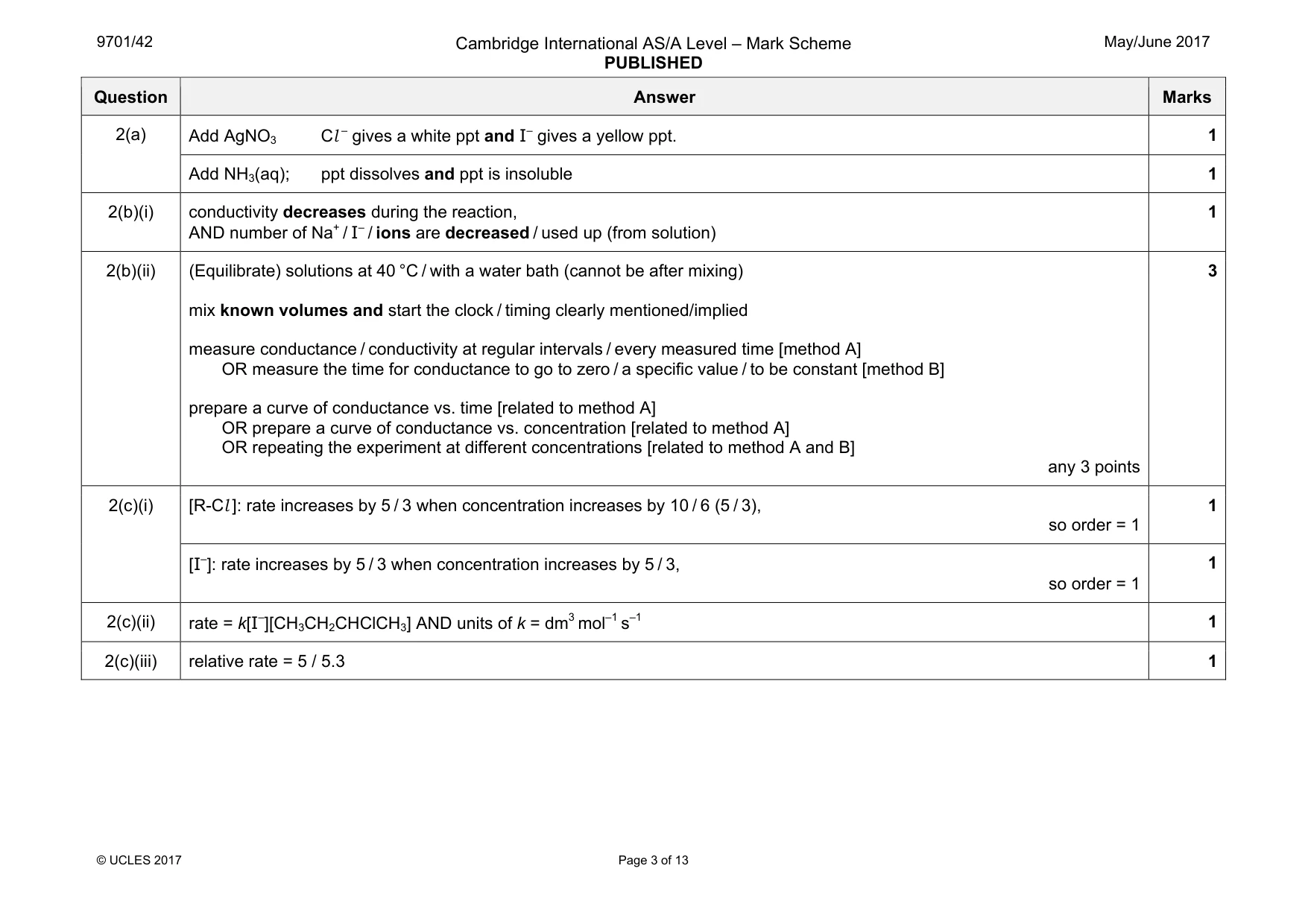
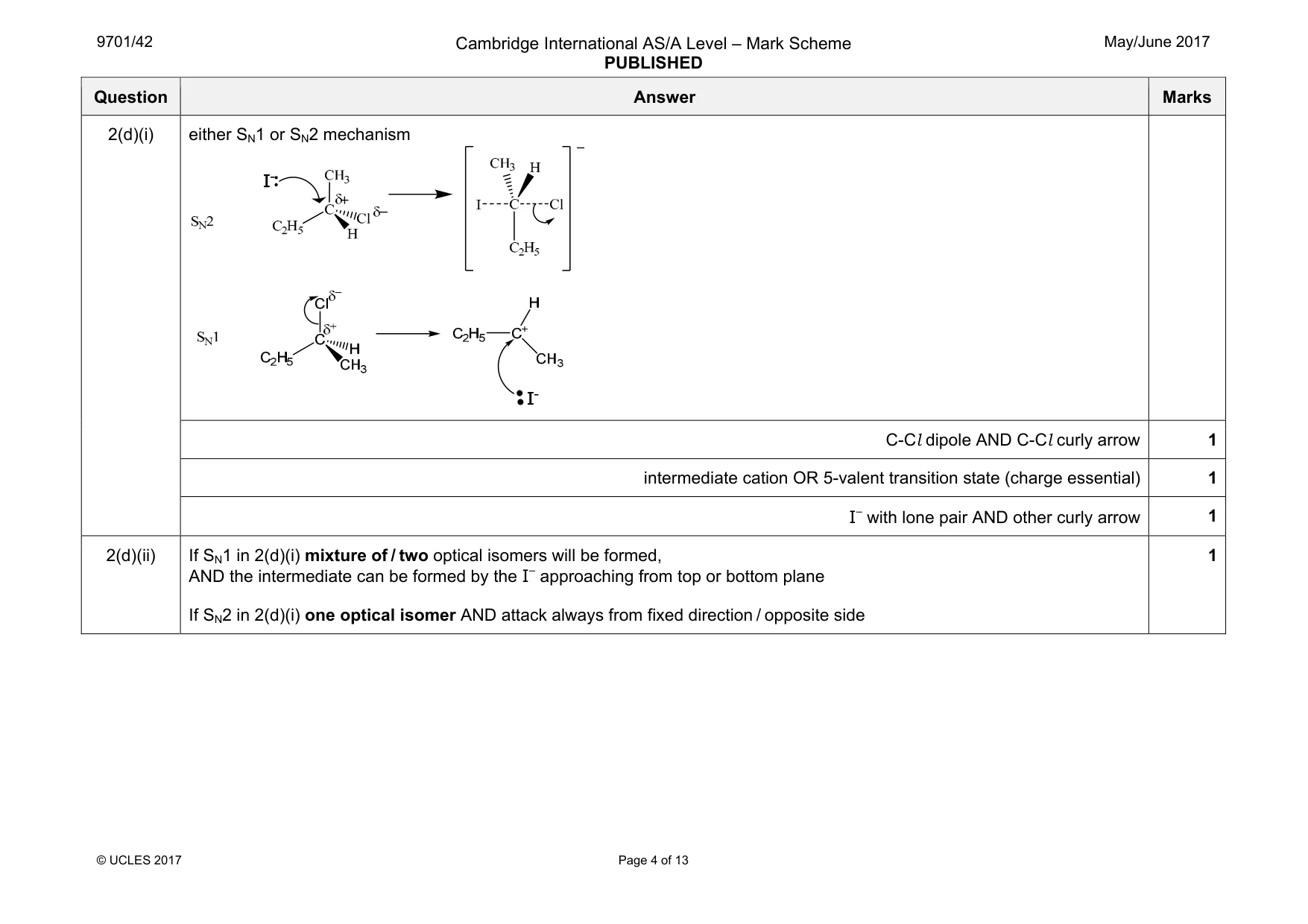
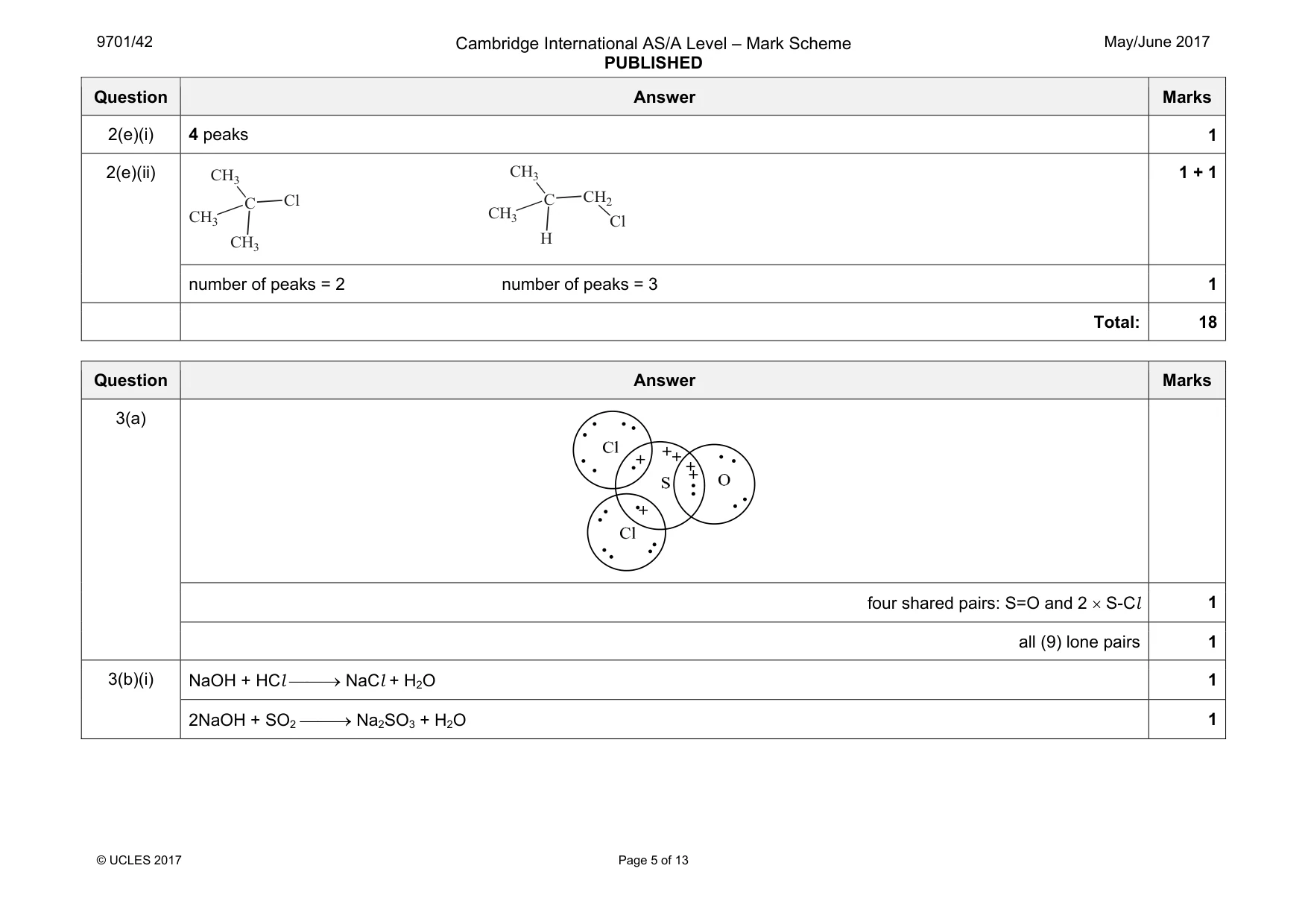
Mark scheme: 2(a) Add AgNO3 1 Add NH3(aq); ppt dissolves and ppt is insoluble 1 2(b)(i) conductivity decreases during the reaction, AND number of Na+ / I– / ions are decreased / used up (from solution) 1 2(b)(ii) (Equilibrate) solutions at 40 °C / with a water bath (cannot be after mixing) mix known volumes and start the clock / timing clearly mentioned/implied measure conductance / conductivity at regular intervals / every measured time [method A] OR measure the time for conductance to go to zero / a specific value / to be constant [method B] prepare a curve of conductance vs. time [related to method A] OR prepare a curve of conductance vs. concentration [related to method A] OR repeating the experiment at different concentrations [related to method A and B] any 3 points 3 2(c)(i) [R-Cl ]: rate increases by 5 / 3 when concentration increases by 10 / 6 (5 / 3), so order = 1 1 [I–]: rate increases by 5 / 3 when concentration increases by 5 / 3, so order = 1 1 2(c)(ii) rate = k[I–][CH3CH2CHClCH3] AND units of k = dm3 mol–1 s–1 1 2(c)(iii) relative rate = 5 / 5.3 1 Question Answer Marks 2(d)(i) either SN1 or SN2 mechanism C-Cl dipole AND C-Cl curly arrow 1 intermediate cation OR 5-valent transition state (charge essential) 1 I– with lone pair AND other curly arrow 1 2(d)(ii) If SN1 in 2(d)(i) mixture of / two optical isomers will be formed, AND the intermediate can be formed by the I– approaching from top or bottom plane If SN2 in 2(d)(i) one optical isomer AND attack always from fixed direction / opposite side 1 Question Answer Marks 2(e)(i) 4 peaks 1 2(e)(ii) 1 + 1 number of peaks = 2 number of peaks = 3 1 Total: 18 CH3 C CH3 CH3 Cl CH3 C CH3 H CH2 Cl
More questions on Simple rate equations, orders of reaction and rate constants
Q3 · In a molecule of SOCl 2 the sulfur atom has four bonds
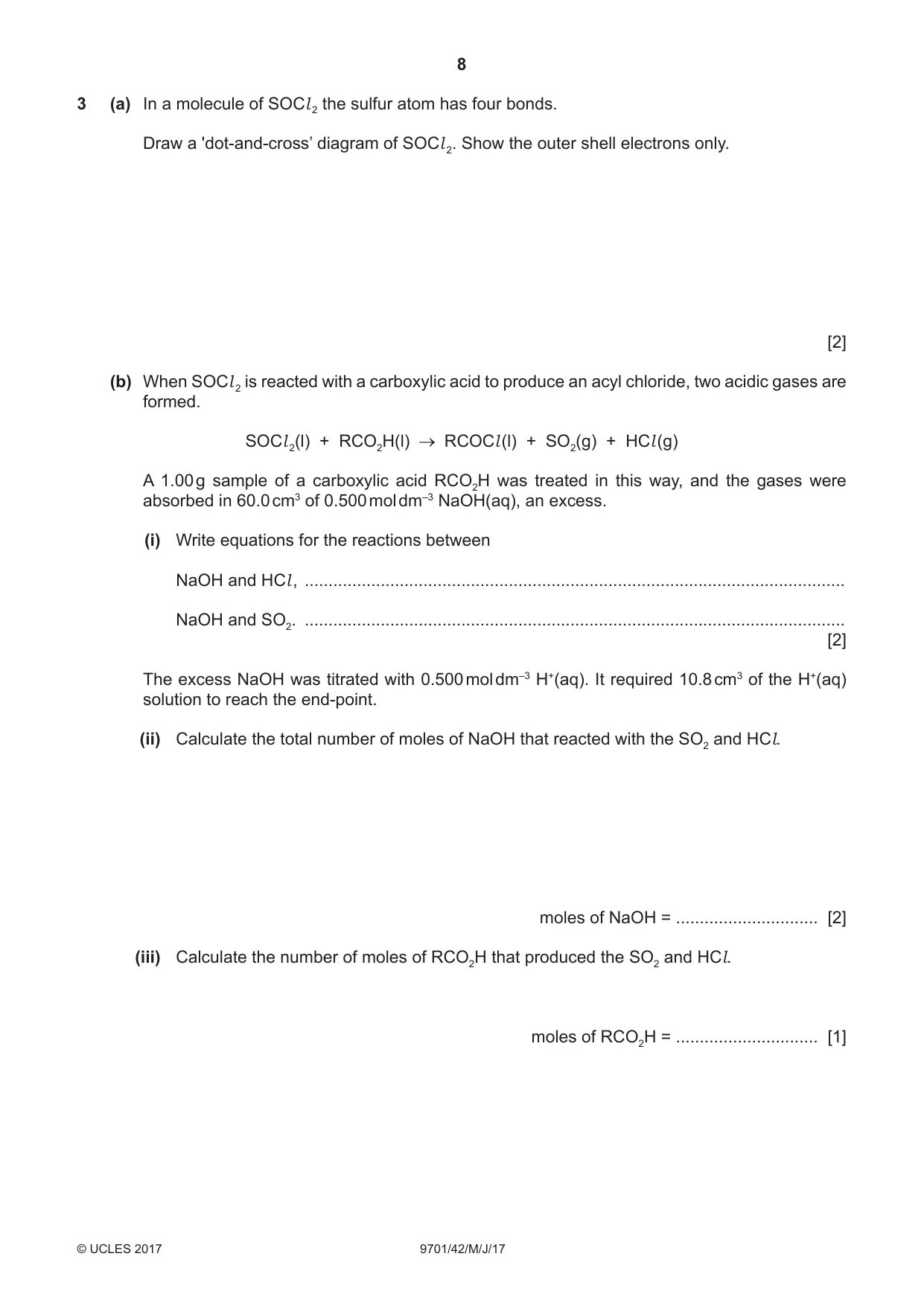
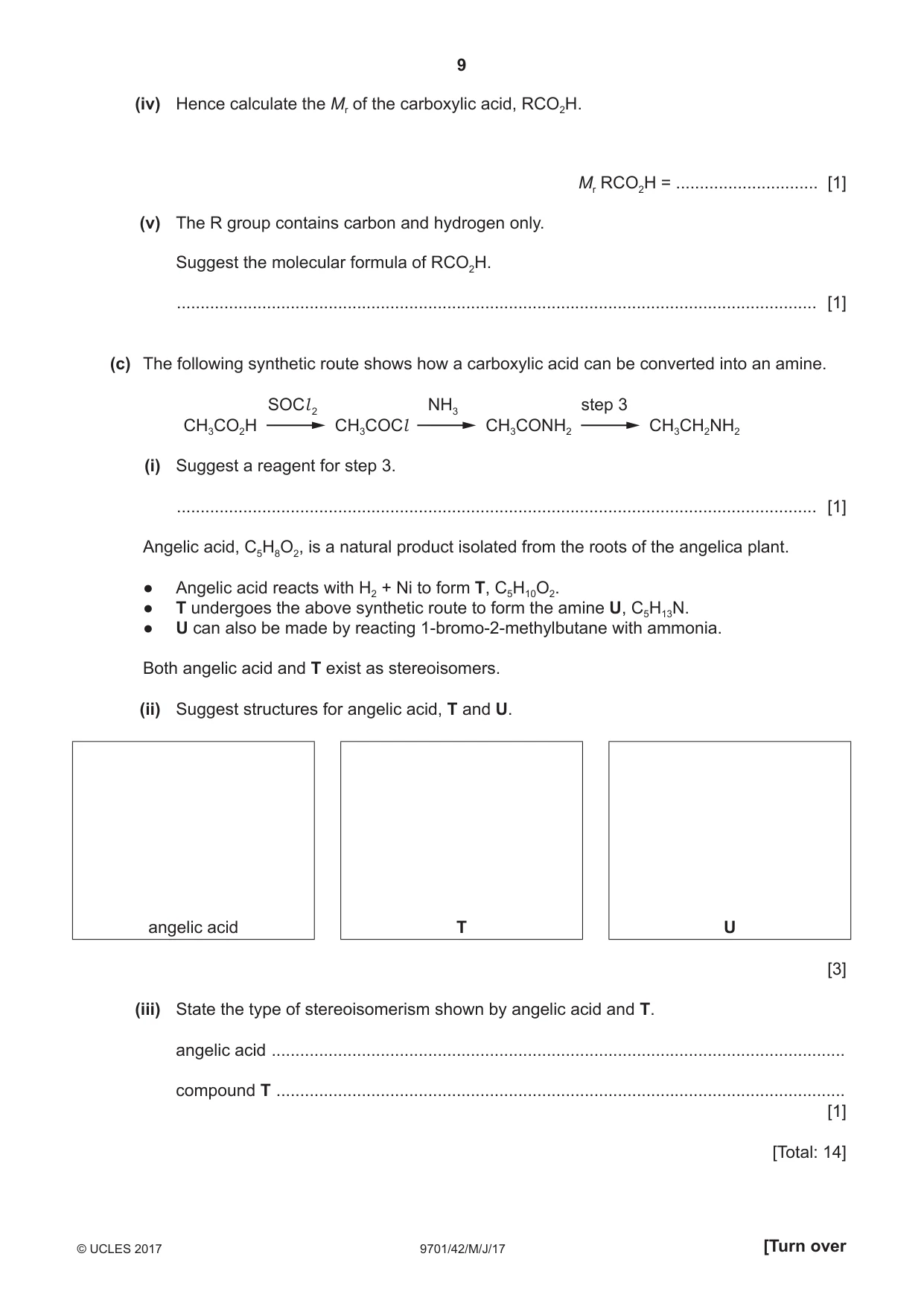
3 (a) In a molecule of SOCl 2 the sulfur atom has four bonds. Draw a 'dot-and-cross’ diagram of SOCl 2. Show the outer shell electrons only. [2] (b) When SOCl 2 is reacted with a carboxylic acid to produce an acyl chloride, two acidic gases are formed. SOCl 2(l) + RCO2H(l) RCOCl (l) + SO2(g) + HCl (g) A 1.00 g sample of a carboxylic acid RCO2H was treated in this way, and the gases were absorbed in 60.0 cm3 of 0.500 mol dm–3 NaOH(aq), an excess. (i) Write equations for the reactions between NaOH and HCl , ................................................................................................................... NaOH and SO2. ................................................................................................................... [2] The excess NaOH was titrated with 0.500 mol dm–3 H+(aq). It required 10.8 cm3 of the H+(aq) solution to reach the end-point. (ii) Calculate the total number of moles of NaOH that reacted with the SO2 and HCl. moles of NaOH = .............................. [2] (iii) Calculate the number of moles of RCO2H that produced the SO2 and HCl. moles of RCO2H = .............................. [1] (iv) Hence calculate the Mr of the carboxylic acid, RCO2H. Mr RCO2H = .............................. [1] (v) The R group contains carbon and hydrogen only. Suggest the molecular formula of RCO2H. ....................................................................................................................................... [1] (c) The following synthetic route shows how a carboxylic acid can be converted into an amine. SOCl 2 NH3 step 3 CH3CO2H CH3COCl CH3CONH2 CH3CH2NH2 (i) Suggest a reagent for step 3. ....................................................................................................................................... [1] Angelic acid, C5H8O2, is a natural product isolated from the roots of the angelica plant. ● Angelic acid reacts with H2 + Ni to form T, C5H10O2. ● T undergoes the above synthetic route to form the amine U, C5H13N. ● U can also be made by reacting 1-bromo-2-methylbutane with ammonia. Both angelic acid and T exist as stereoisomers. (ii) Suggest structures for angelic acid, T and U. angelic acid T U [3] (iii) State the type of stereoisomerism shown by angelic acid and T. angelic acid ......................................................................................................................... compound T ........................................................................................................................ [1] [Total: 14]
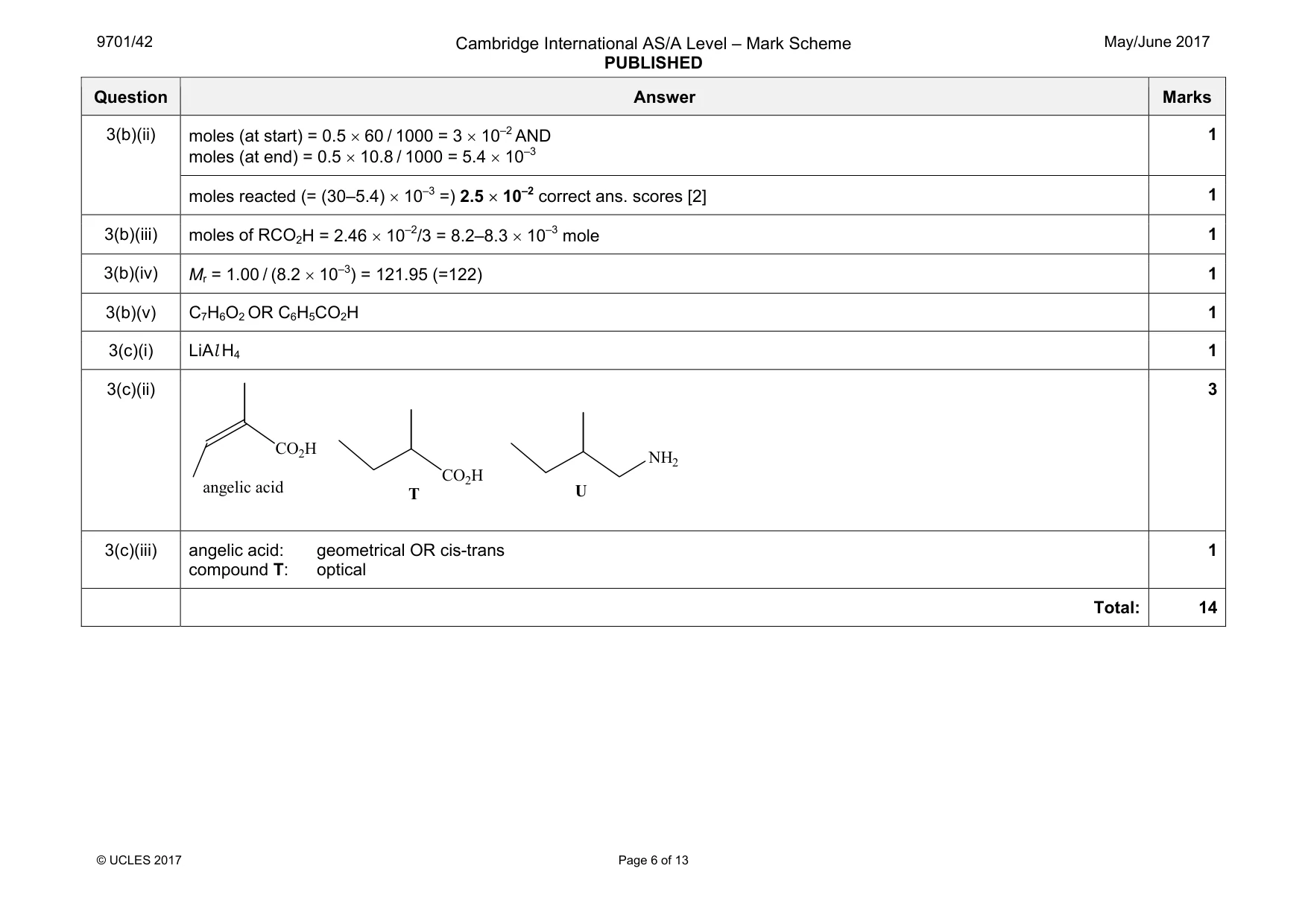
Mark scheme: 3(a) four shared pairs: S=O and 2 × S-Cl 1 all (9) lone pairs 1 3(b)(i) NaOH + HCl → NaCl + H2O 1 2NaOH + SO2 → Na2SO3 + H2O 1 Question Answer Marks 3(b)(ii) moles (at start) = 0.5 × 60 / 1000 = 3 × 10⁻² AND moles (at end) = 0.5 × 10.8 / 1000 = 5.4 × 10⁻³ 1 moles reacted (= (30–5.4) × 10–3 =) 2.5 × 10⁻² correct ans. scores [2] 1 3(b)(iii) moles of RCO2H = 2.46 × 10⁻²/3 = 8.2–8.3 × 10⁻³ mole 1 3(b)(iv) Mr = 1.00 / (8.2 × 10⁻³) = 121.95 (=122) 1 3(b)(v) C7H6O2 OR C6H5CO2H 1 3(c)(i) LiAl H4 1 3(c)(ii) angelic acid T U CO2H CO2H NH2 3 3(c)(iii) angelic acid: geometrical OR cis-trans compound T: optical 1 Total: 14
Q4 · A number of isomers with the formula Cr(H2O)6Cl 3 exist
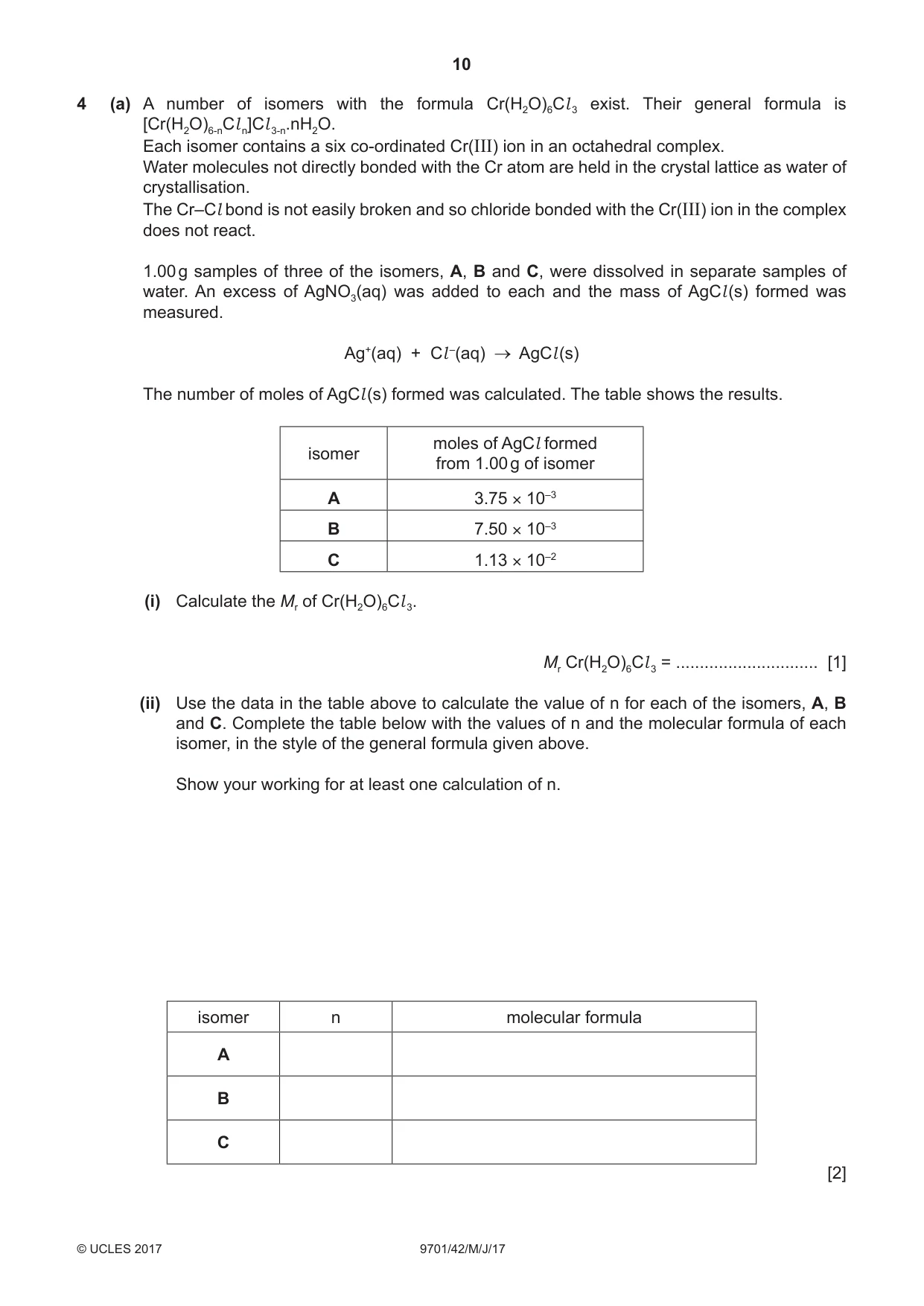
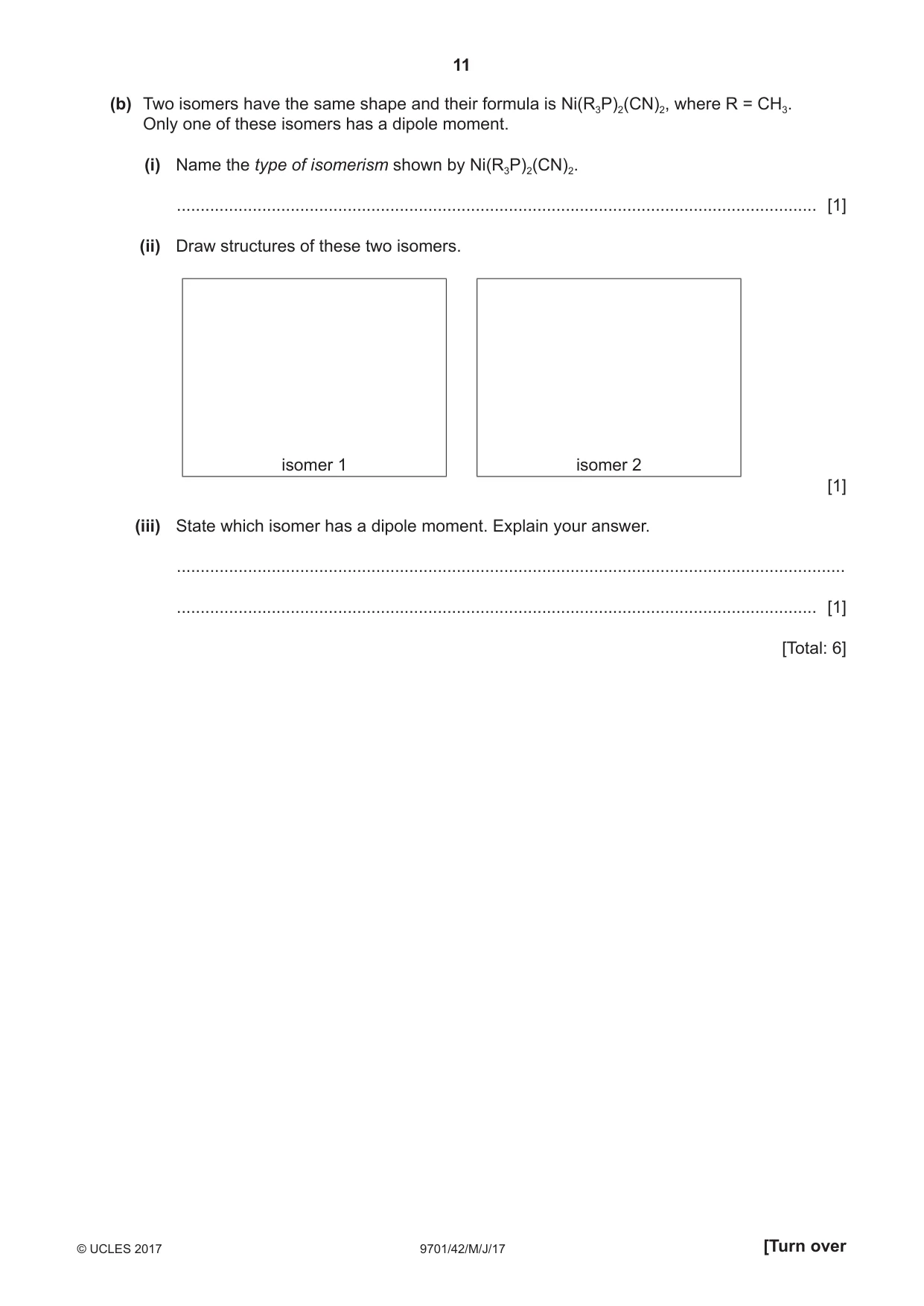
4 (a) A number of isomers with the formula Cr(H2O)6Cl 3 exist. Their general formula is [Cr(H2O)6-nCl n]Cl 3-n.nH2O. Each isomer contains a six co-ordinated Cr(III) ion in an octahedral complex. Water molecules not directly bonded with the Cr atom are held in the crystal lattice as water of crystallisation. The Cr–Cl bond is not easily broken and so chloride bonded with the Cr(III) ion in the complex does not react. 1.00 g samples of three of the isomers, A, B and C, were dissolved in separate samples of water. An excess of AgNO3(aq) was added to each and the mass of AgCl (s) formed was measured. Ag+(aq) + Cl –(aq) AgCl (s) The number of moles of AgCl (s) formed was calculated. The table shows the results. moles of AgCl formed isomer from 1.00 g of isomer A 3.75 × 10⁻³ B 7.50 × 10⁻³ C 1.13 × 10⁻² (i) Calculate the Mr of Cr(H2O)6Cl 3. Mr Cr(H2O)6Cl 3 = .............................. [1] (ii) Use the data in the table above to calculate the value of n for each of the isomers, A, B and C. Complete the table below with the values of n and the molecular formula of each isomer, in the style of the general formula given above. Show your working for at least one calculation of n. isomer n molecular formula A B C [2] (b) Two isomers have the same shape and their formula is Ni(R3P)2(CN)2, where R = CH3. Only one of these isomers has a dipole moment. (i) Name the type of isomerism shown by Ni(R3P)2(CN)2. ....................................................................................................................................... [1] (ii) Draw structures of these two isomers. isomer 1 isomer 2 [1] (iii) State which isomer has a dipole moment. Explain your answer. ............................................................................................................................................. ....................................................................................................................................... [1] [Total: 6]
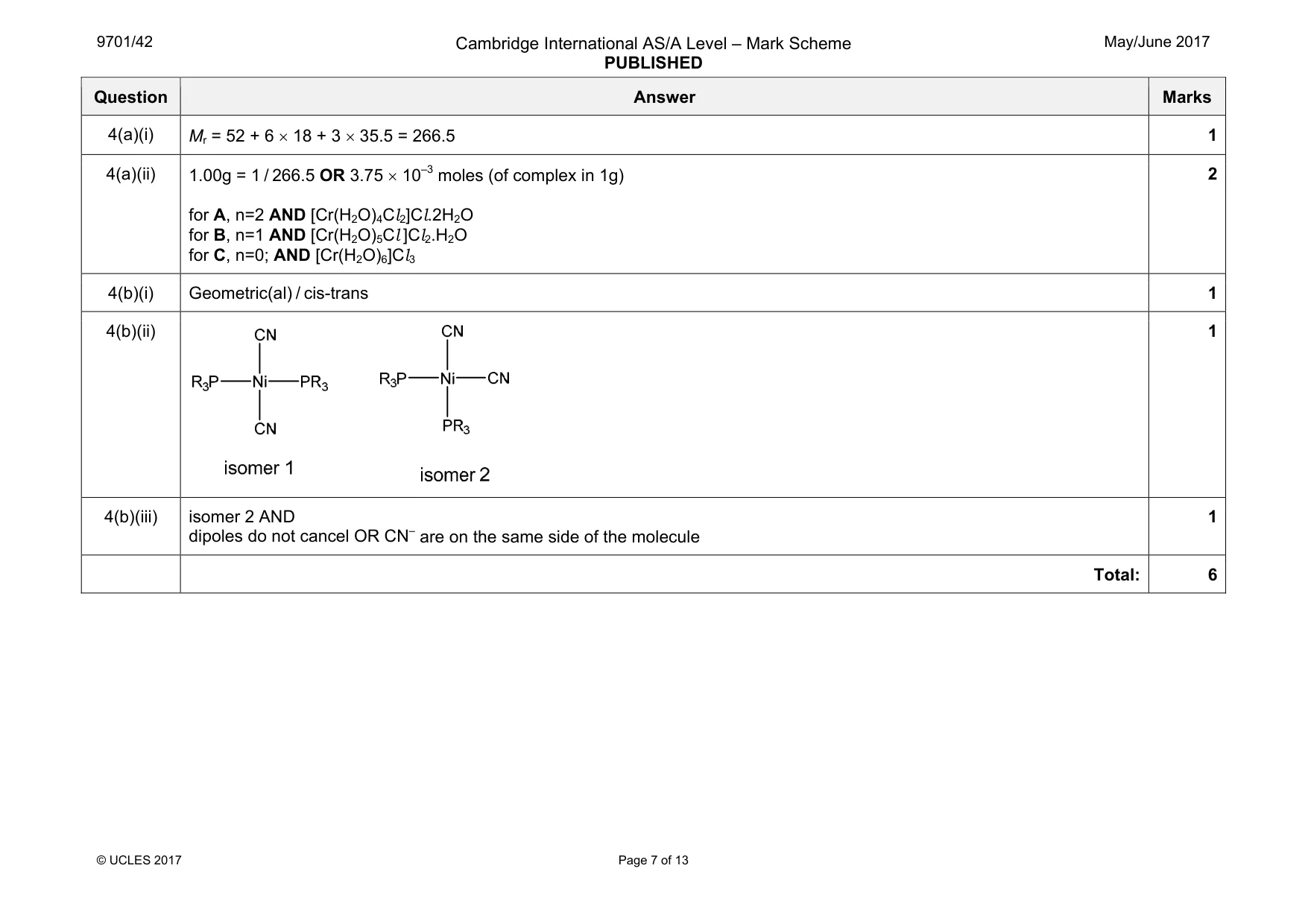
Mark scheme: 4(a)(i) 1 4(a)(ii) 1.00g = 1 / 266.5 OR 3.75 × 10⁻³ moles (of complex in 1g) for A, n=2 AND [Cr(H2O)4Cl2]Cl.2H2O for B, n=1 AND [Cr(H2O)5Cl ]Cl2.H2O for C, n=0; AND [Cr(H2O)6]Cl3 2 4(b)(i) Geometric(al) / cis-trans 1 4(b)(ii) 1 4(b)(iii) isomer 2 AND dipoles do not cancel OR CN– are on the same side of the molecule 1 Total: 6
Q5 · 1,2-diaminoethane, en, H2NCH2CH2NH2, is a bidentate ligand
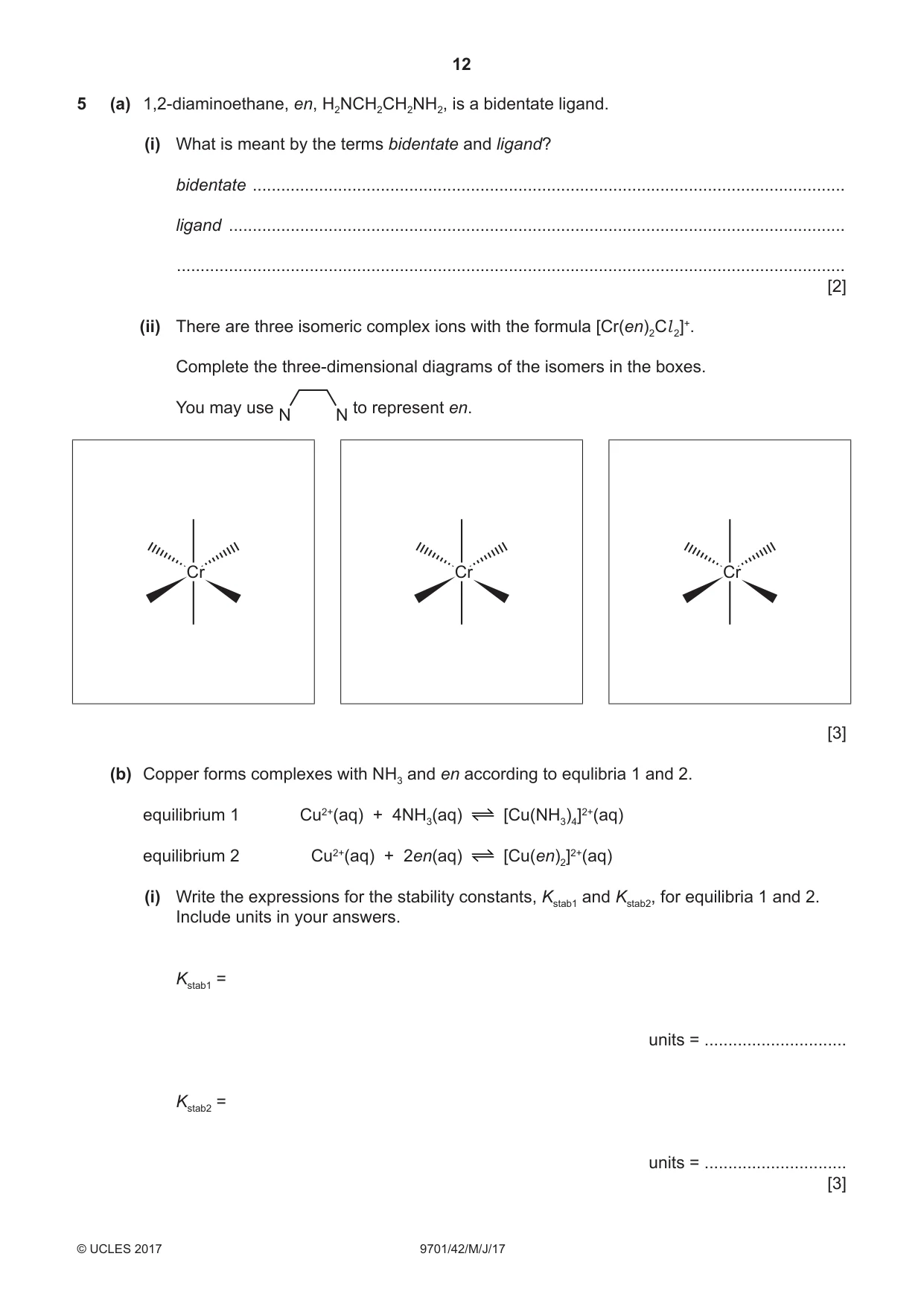
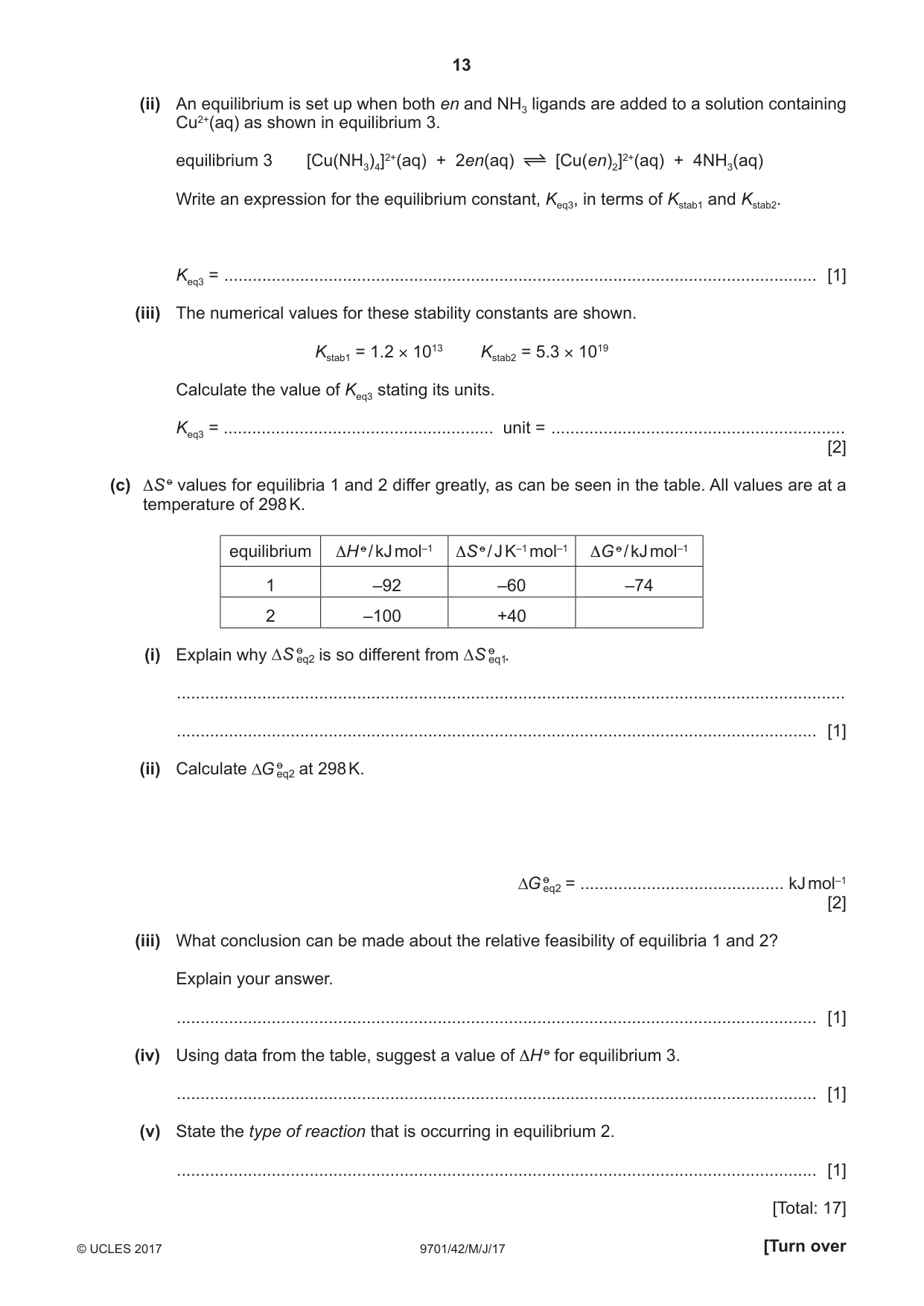
5 (a) 1,2-diaminoethane, en, H2NCH2CH2NH2, is a bidentate ligand. (i) What is meant by the terms bidentate and ligand? bidentate ............................................................................................................................. ligand ................................................................................................................................... ............................................................................................................................................. [2] (ii) There are three isomeric complex ions with the formula [Cr(en)2Cl 2]+. Complete the three-dimensional diagrams of the isomers in the boxes. You may use to represent en. N N Cr Cr Cr [3] (b) Copper forms complexes with NH3 and en according to equlibria 1 and 2. equilibrium 1 Cu2+(aq) + 4NH3(aq) [Cu(NH3)4]2+(aq) equilibrium 2 Cu2+(aq) + 2en(aq) [Cu(en)2]2+(aq) (i) Write the expressions for the stability constants, Kstab1 and Kstab2, for equilibria 1 and 2. Include units in your answers. Kstab1 = units = .............................. Kstab2 = units = .............................. [3] (ii) An equilibrium is set up when both en and NH3 ligands are added to a solution containing Cu2+(aq) as shown in equilibrium 3. equilibrium 3 [Cu(NH3)4]2+(aq) + 2en(aq) [Cu(en)2]2+(aq) + 4NH3(aq) Write an expression for the equilibrium constant, Keq3, in terms of Kstab1 and Kstab2. Keq3 = ............................................................................................................................. [1] (iii) The numerical values for these stability constants are shown. Kstab1 = 1.2 × 10¹³ Kstab2 = 5.3 × 10¹⁹ Calculate the value of Keq3 stating its units. Keq3 = ......................................................... unit = .............................................................. [2] (c) ΔS o values for equilibria 1 and 2 differ greatly, as can be seen in the table. All values are at a temperature of 298 K. equilibrium ΔH o / kJ mol–1 ΔS o / J K–1 mol–1 ΔG o / kJ mol–1 1 –92 –60 –74 2 –100 +40 (i) Explain why is so different from . ............................................................................................................................................. ....................................................................................................................................... [1] (ii) Calculate at 298 K. = ........................................... kJ mol–1 [2] (iii) What conclusion can be made about the relative feasibility of equilibria 1 and 2? Explain your answer. ....................................................................................................................................... [1] (iv) Using data from the table, suggest a value of ΔH o for equilibrium 3. ....................................................................................................................................... [1] (v) State the type of reaction that is occurring in equilibrium 2. ....................................................................................................................................... [1] [Total: 17]
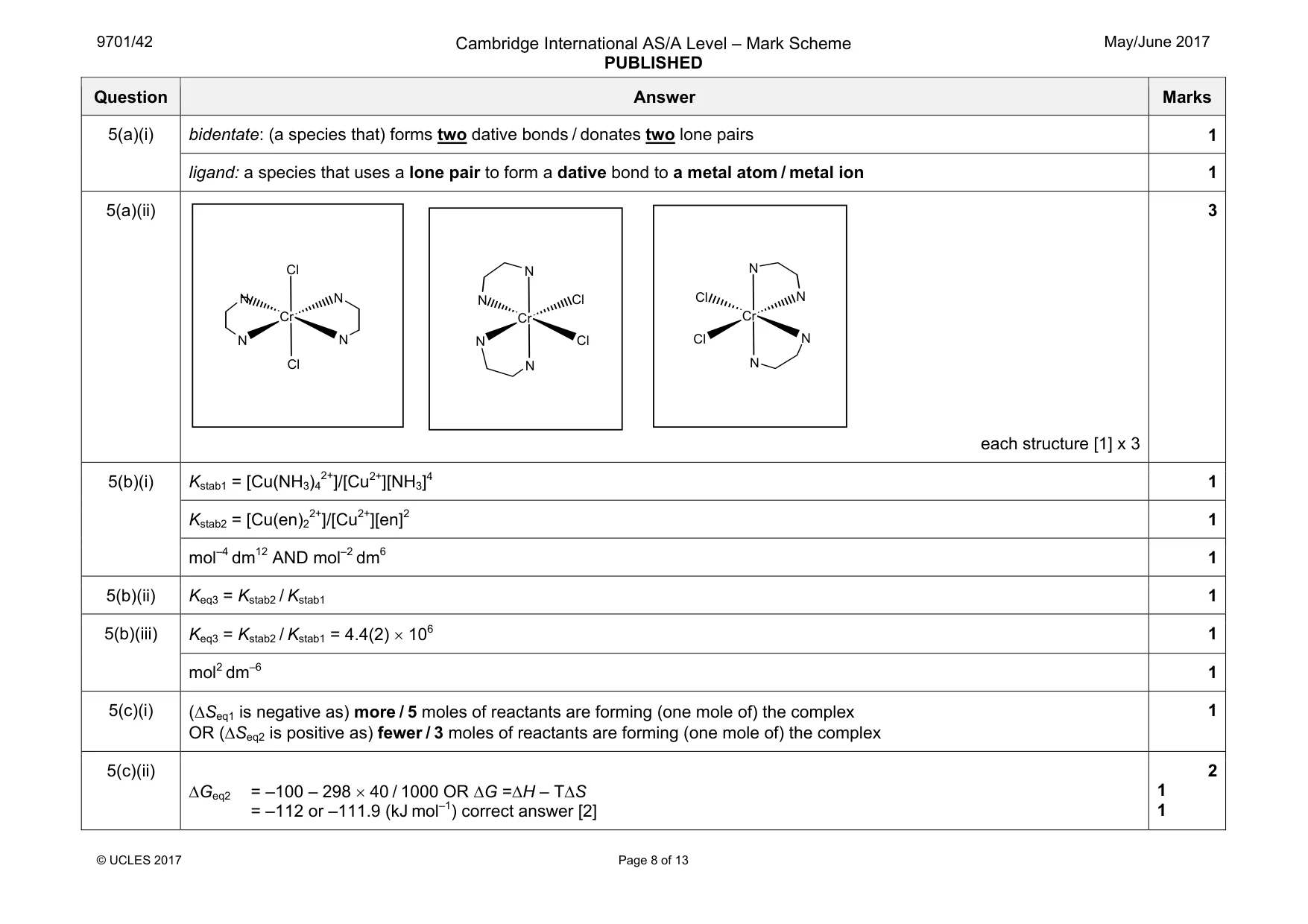
Mark scheme: 5(a)(i) bidentate: (a species that) forms two dative bonds / donates two lone pairs 1 ligand: a species that uses a lone pair to form a dative bond to a metal atom / metal ion 1 5(a)(ii) N Cr N N N Cl Cl Cl Cr Cl N N N N N Cr N Cl Cl N N each structure [1] x 3 3 5(b)(i) Kstab1 = [Cu(NH3)4 2+]/[Cu2+][NH3]4 1 Kstab2 = [Cu(en)2 2+]/[Cu2+][en]2 1 mol–4 dm12 AND mol–2 dm6 1 5(b)(ii) Keq3 = Kstab2 / Kstab1 1 5(b)(iii) Keq3 = Kstab2 / Kstab1 = 4.4(2) × 106 1 mol2 dm–6 1 5(c)(i) (∆Seq1 is negative as) more / 5 moles of reactants are forming (one mole of) the complex OR (∆Seq2 is positive as) fewer / 3 moles of reactants are forming (one mole of) the complex 1 5(c)(ii) ∆Geq2 = –100 – 298 × 40 / 1000 OR ∆G =∆H – T∆S = –112 or –111.9 (kJ mol–1) correct answer [2] 2 1 1 Question Answer Marks 5(c)(iii) Since (∆Geq2) is more negative (than ∆Geq1) AND equilibrium 2 is more feasible 1 5(c)(iv) ∆H(3) = –8 (kJ mol–1) 1 5(c)(v) ligand exchange / replacement / substitution / displacement 1 Total: 17
Q6 · The table lists some organic acids and their pKa values
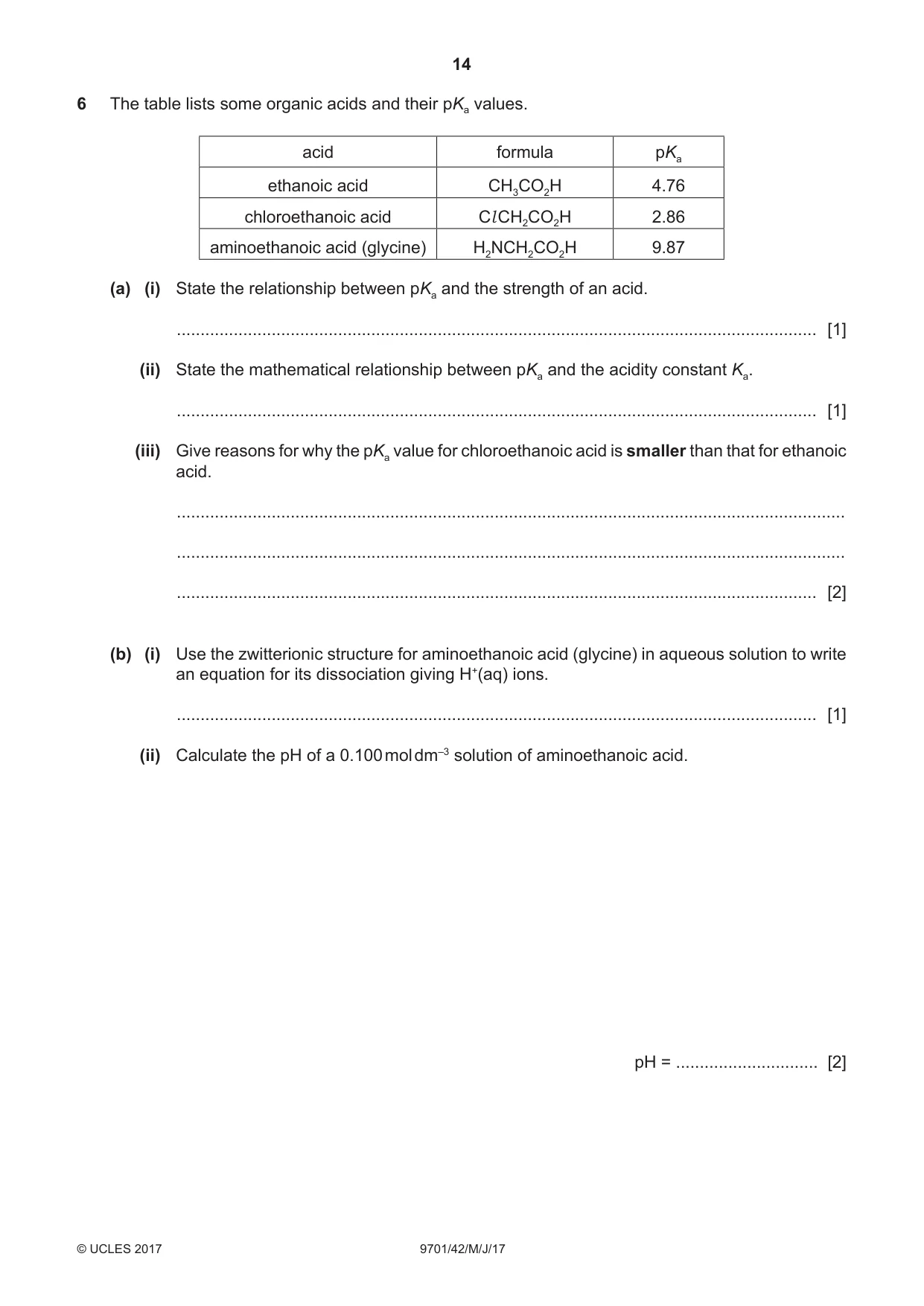
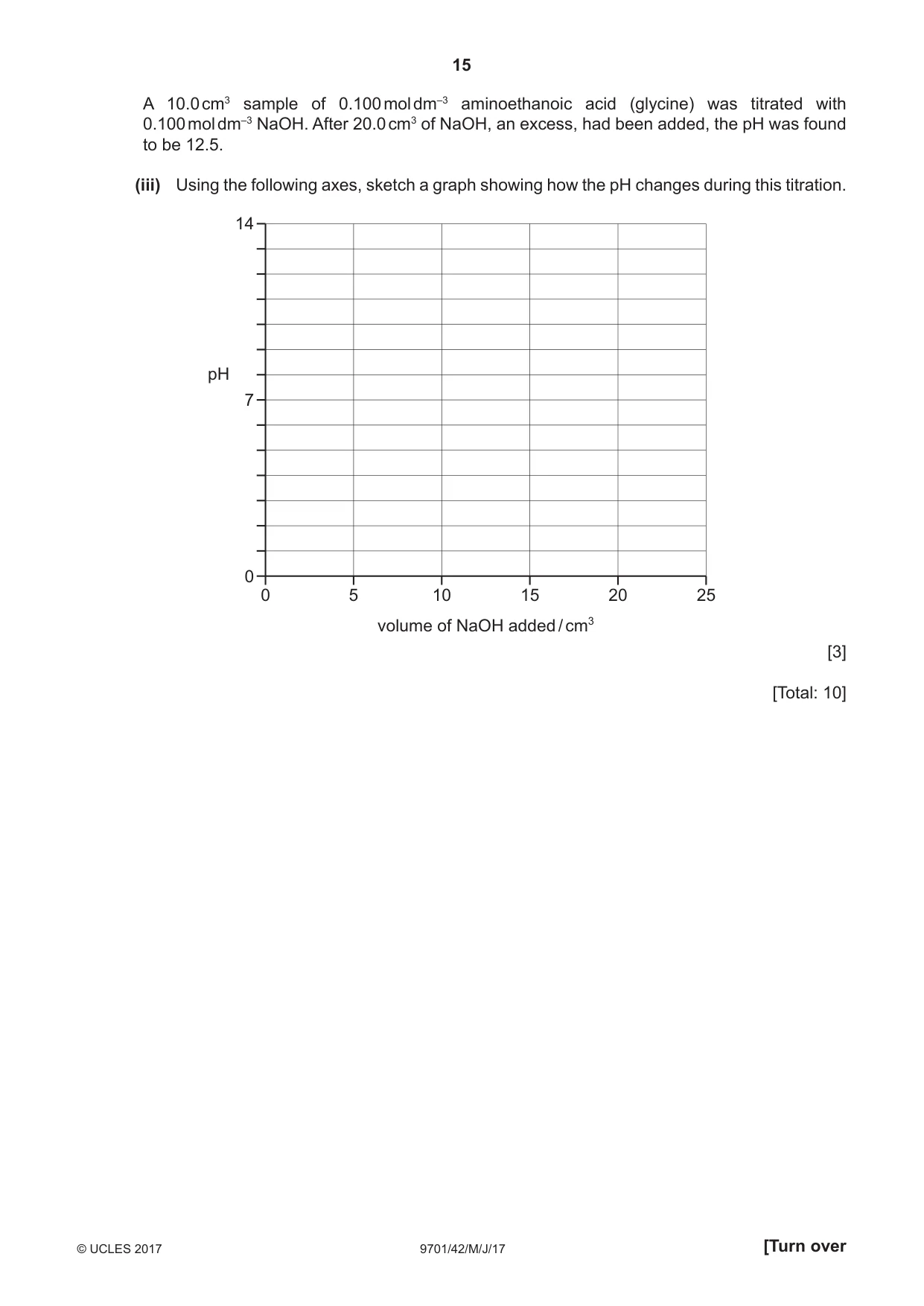
6 The table lists some organic acids and their pKa values. acid formula pKa ethanoic acid CH3CO2H 4.76 chloroethanoic acid Cl CH2CO2H 2.86 aminoethanoic acid (glycine) H2NCH2CO2H 9.87 (a) (i) State the relationship between pKa and the strength of an acid. ....................................................................................................................................... [1] (ii) State the mathematical relationship between pKa and the acidity constant Ka. ....................................................................................................................................... [1] (iii) Give reasons for why the pKa value for chloroethanoic acid is smaller than that for ethanoic acid. ............................................................................................................................................. ............................................................................................................................................. ....................................................................................................................................... [2] (b) (i) Use the zwitterionic structure for aminoethanoic acid (glycine) in aqueous solution to write an equation for its dissociation giving H+(aq) ions. ....................................................................................................................................... [1] (ii) Calculate the pH of a 0.100 mol dm–3 solution of aminoethanoic acid. pH = .............................. [2] A 10.0 cm3 sample of 0.100 mol dm–3 aminoethanoic acid (glycine) was titrated with 0.100 mol dm–3 NaOH. After 20.0 cm3 of NaOH, an excess, had been added, the pH was found to be 12.5. (iii) Using the following axes, sketch a graph showing how the pH changes during this titration. 14 pH 7 0 0 5 10 15 20 25 volume of NaOH added / cm3 [3] [Total: 10]
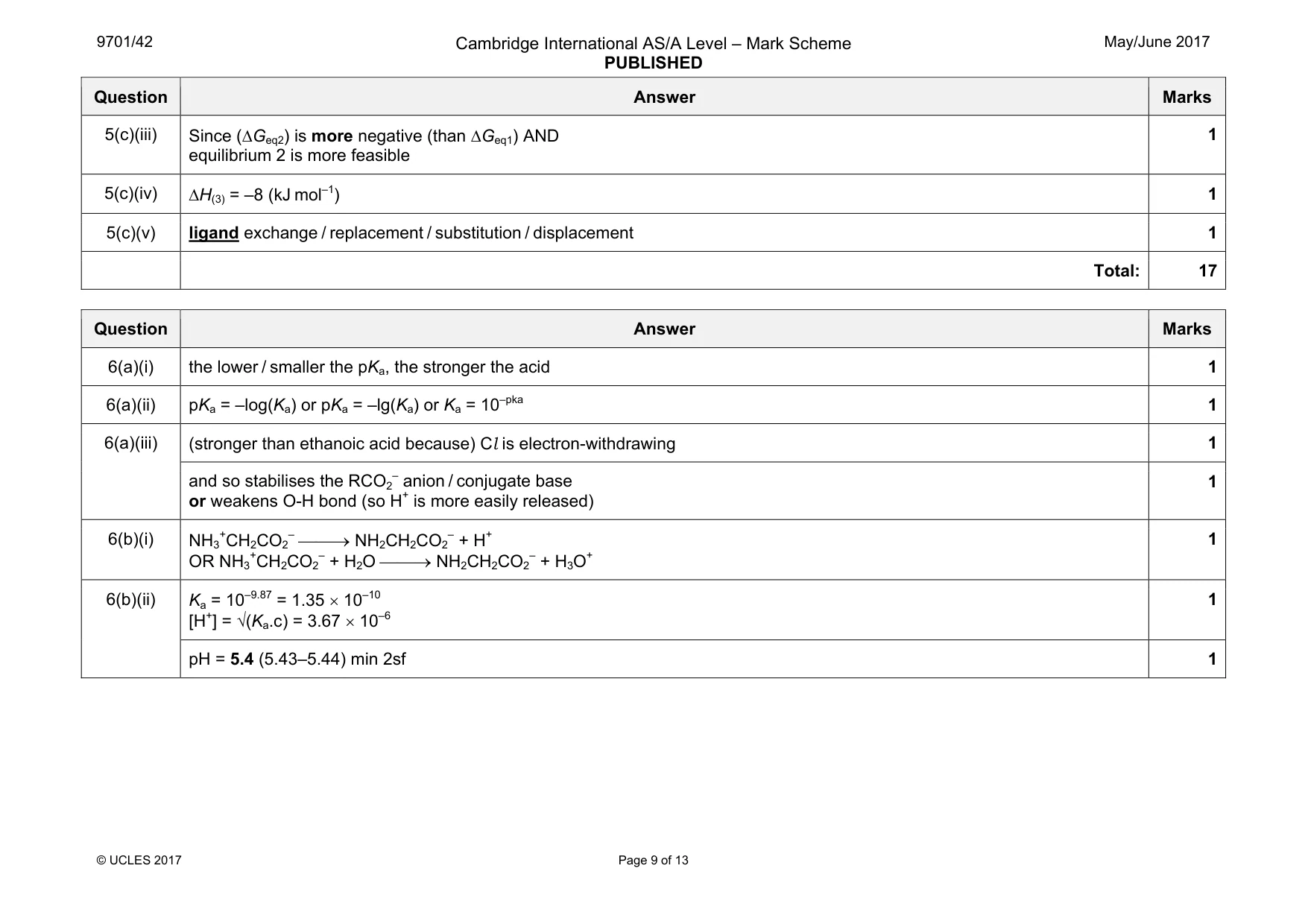
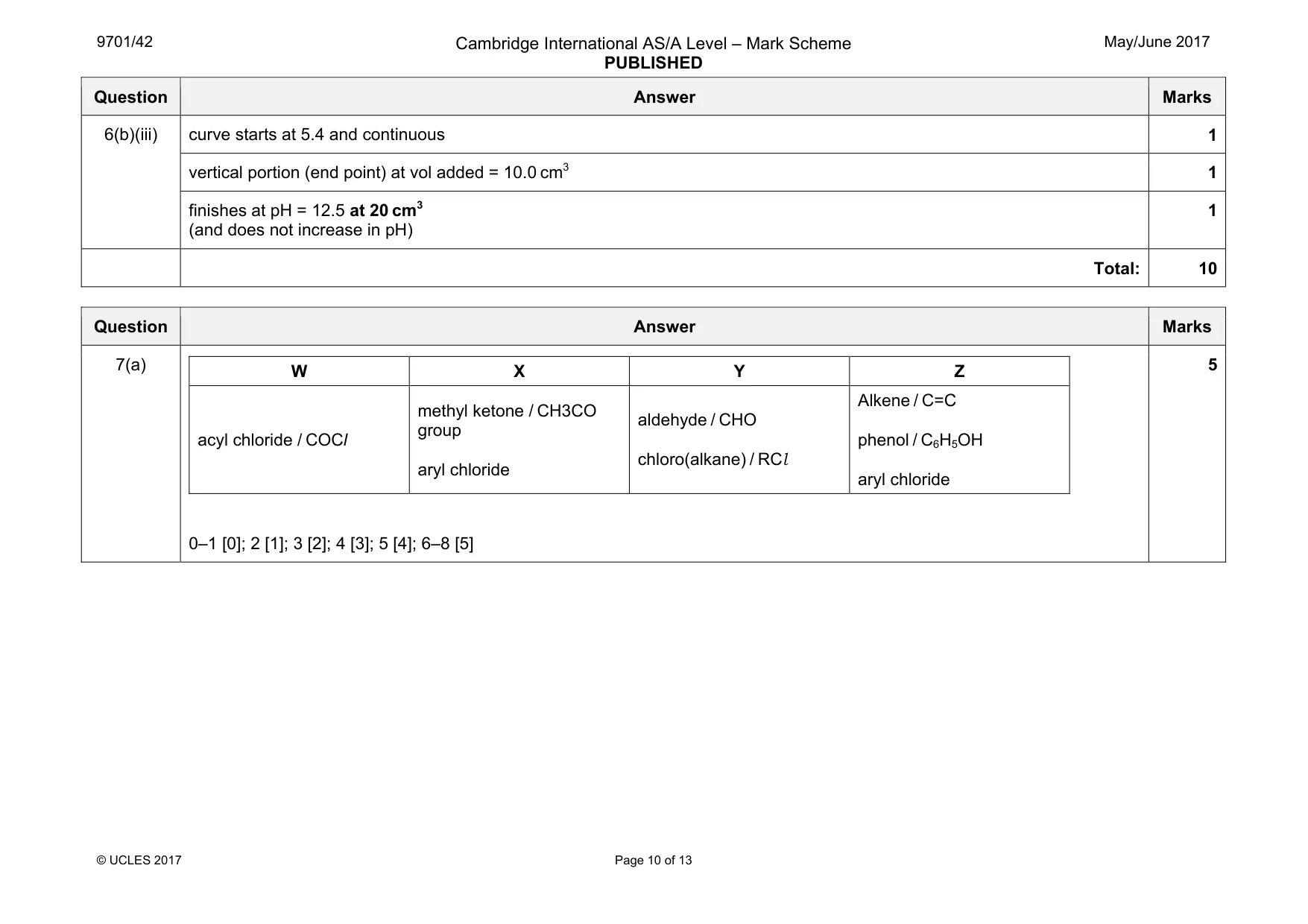
Mark scheme: 6(a)(i) the lower / smaller the pKa, the stronger the acid 1 6(a)(ii) pKa = –log(Ka) or pKa = –lg(Ka) or Ka = 10–pka 1 6(a)(iii) (stronger than ethanoic acid because) Cl is electron-withdrawing 1 and so stabilises the RCO2 – anion / conjugate base or weakens O-H bond (so H+ is more easily released) 1 6(b)(i) NH3 +CH2CO2 – → NH2CH2CO2 – + H+ OR NH3 +CH2CO2 – + H2O → NH2CH2CO2 – + H3O+ 1 6(b)(ii) Ka = 10–9.87 = 1.35 × 10⁻¹⁰ [H+] = √(Ka.c) = 3.67 × 10⁻⁶ 1 pH = 5.4 (5.43–5.44) min 2sf 1 Question Answer Marks 6(b)(iii) curve starts at 5.4 and continuous 1 vertical portion (end point) at vol added = 10.0 cm3 1 finishes at pH = 12.5 at 20 cm3 (and does not increase in pH) 1 Total: 10
Q7 · Compounds W, X, Y and Z are isomers of each other with the molecular formula C8H7Cl O
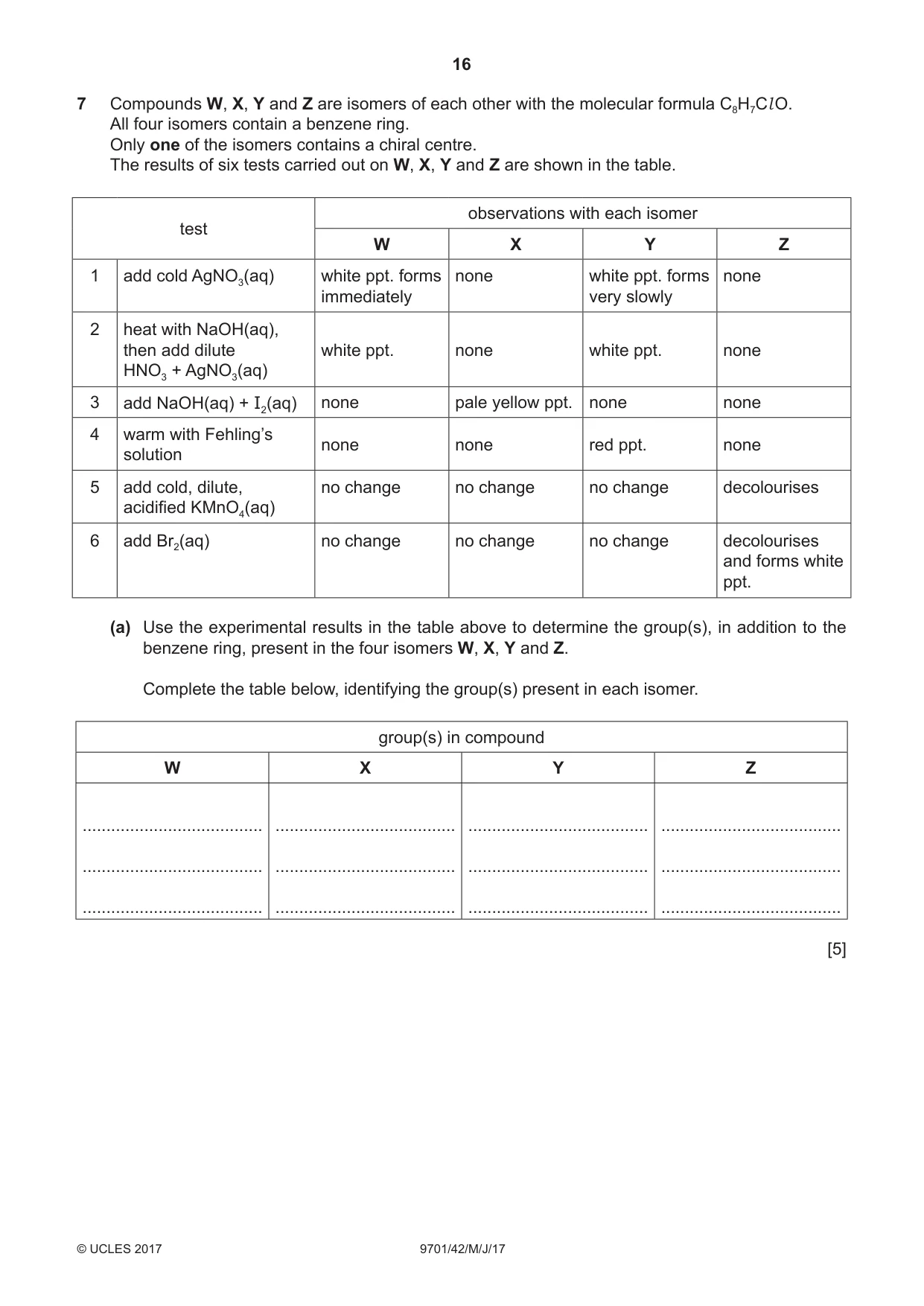
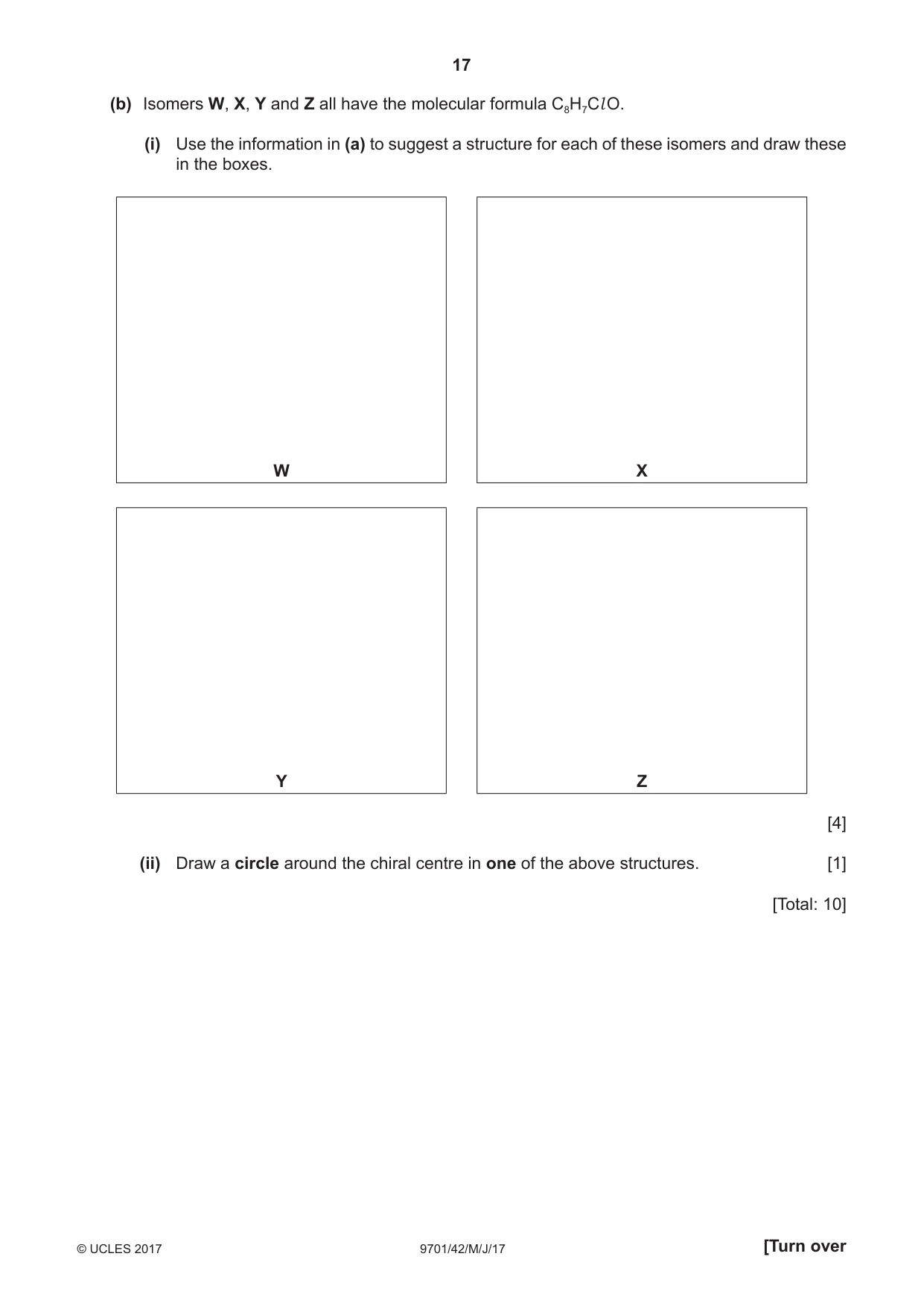
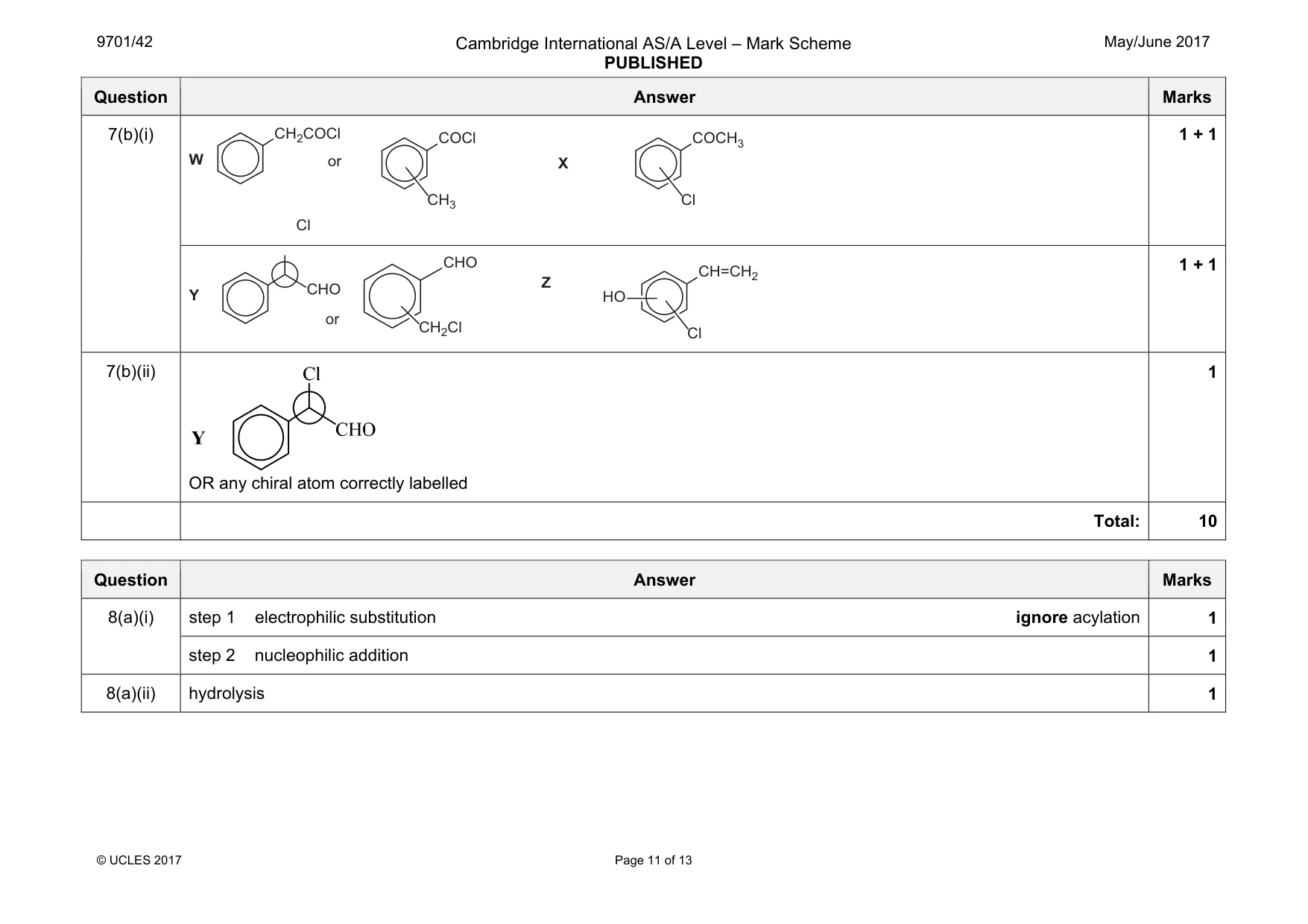
7 Compounds W, X, Y and Z are isomers of each other with the molecular formula C8H7Cl O. All four isomers contain a benzene ring. Only one of the isomers contains a chiral centre. The results of six tests carried out on W, X, Y and Z are shown in the table. observations with each isomer test W X Y Z 1 add cold AgNO3(aq) white ppt. forms none white ppt. forms none immediately very slowly 2 heat with NaOH(aq), then add dilute white ppt. none white ppt. none HNO3 + AgNO3(aq) 3 add NaOH(aq) + I2(aq) none pale yellow ppt. none none 4 warm with Fehling’s none none red ppt. none solution 5 add cold, dilute, no change no change no change decolourises acidified KMnO4(aq) 6 add Br2(aq) no change no change no change decolourises and forms white ppt. (a) Use the experimental results in the table above to determine the group(s), in addition to the benzene ring, present in the four isomers W, X, Y and Z. Complete the table below, identifying the group(s) present in each isomer. group(s) in compound W X Y Z ...................................... ...................................... ...................................... ...................................... ...................................... ...................................... ...................................... ...................................... ...................................... ...................................... ...................................... ...................................... [5] (b) Isomers W, X, Y and Z all have the molecular formula C8H7Cl O. (i) Use the information in (a) to suggest a structure for each of these isomers and draw these in the boxes. W X Y Z [4] (ii) Draw a circle around the chiral centre in one of the above structures. [1] [Total: 10]
Mark scheme: 7(a) W X Y Z acyl chloride / COCl methyl ketone / CH3CO group aryl chloride aldehyde / CHO chloro(alkane) / RCl Alkene / C=C phenol / C6H5OH aryl chloride 0–1 [0]; 2 [1]; 3 [2]; 4 [3]; 5 [4]; 6–8 [5] 5 Question Answer Marks 7(b)(i) 1 + 1 1 + 1 7(b)(ii) OR any chiral atom correctly labelled 1 Total: 10 CH2COCl or COCl CH3 COCH3 Cl Cl W X CHO Z CH=CH2 Cl HO Y CHO CH2Cl or
Q8 · The amino acid tyrosine can be synthesised from phenol by the route shown
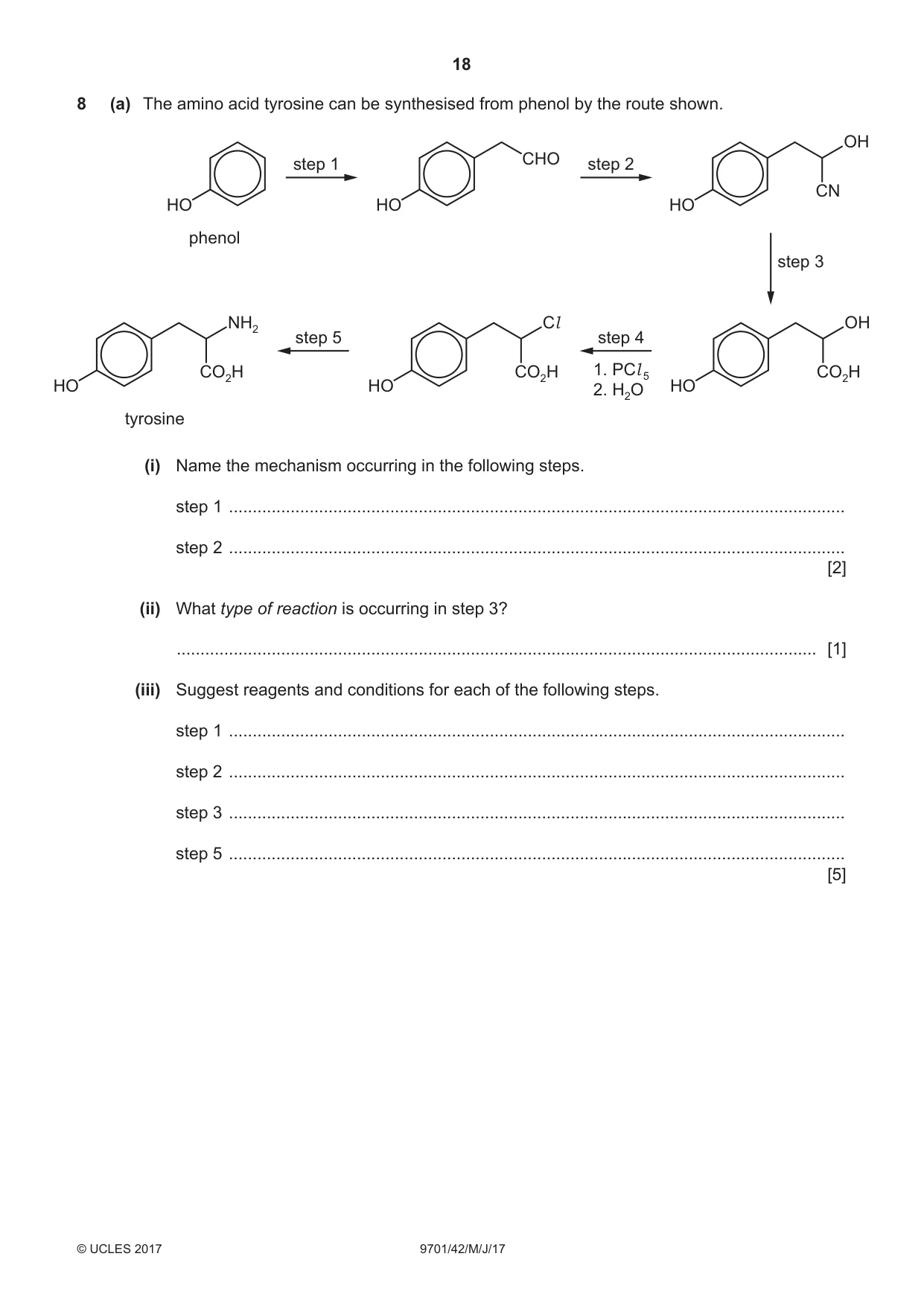
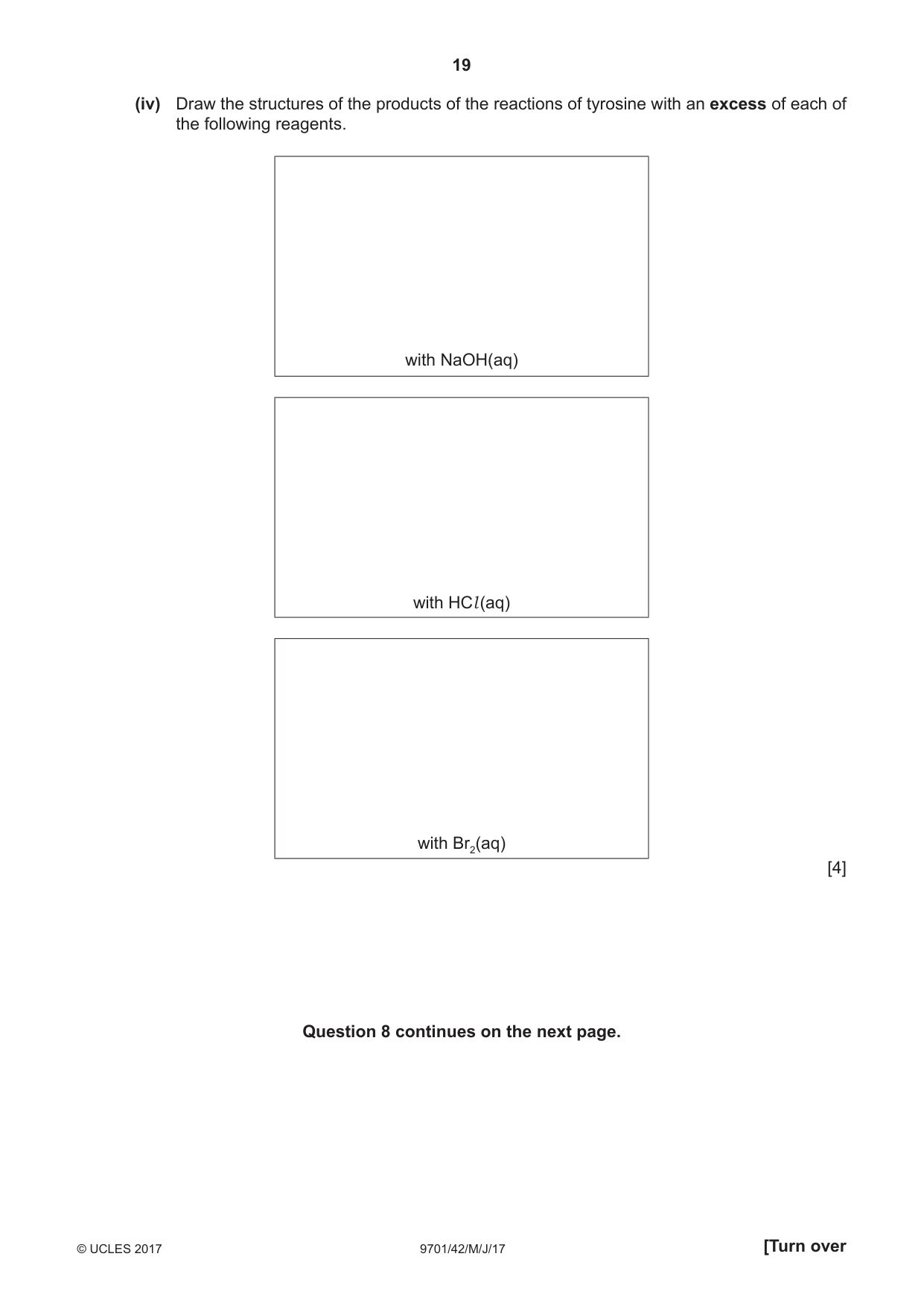
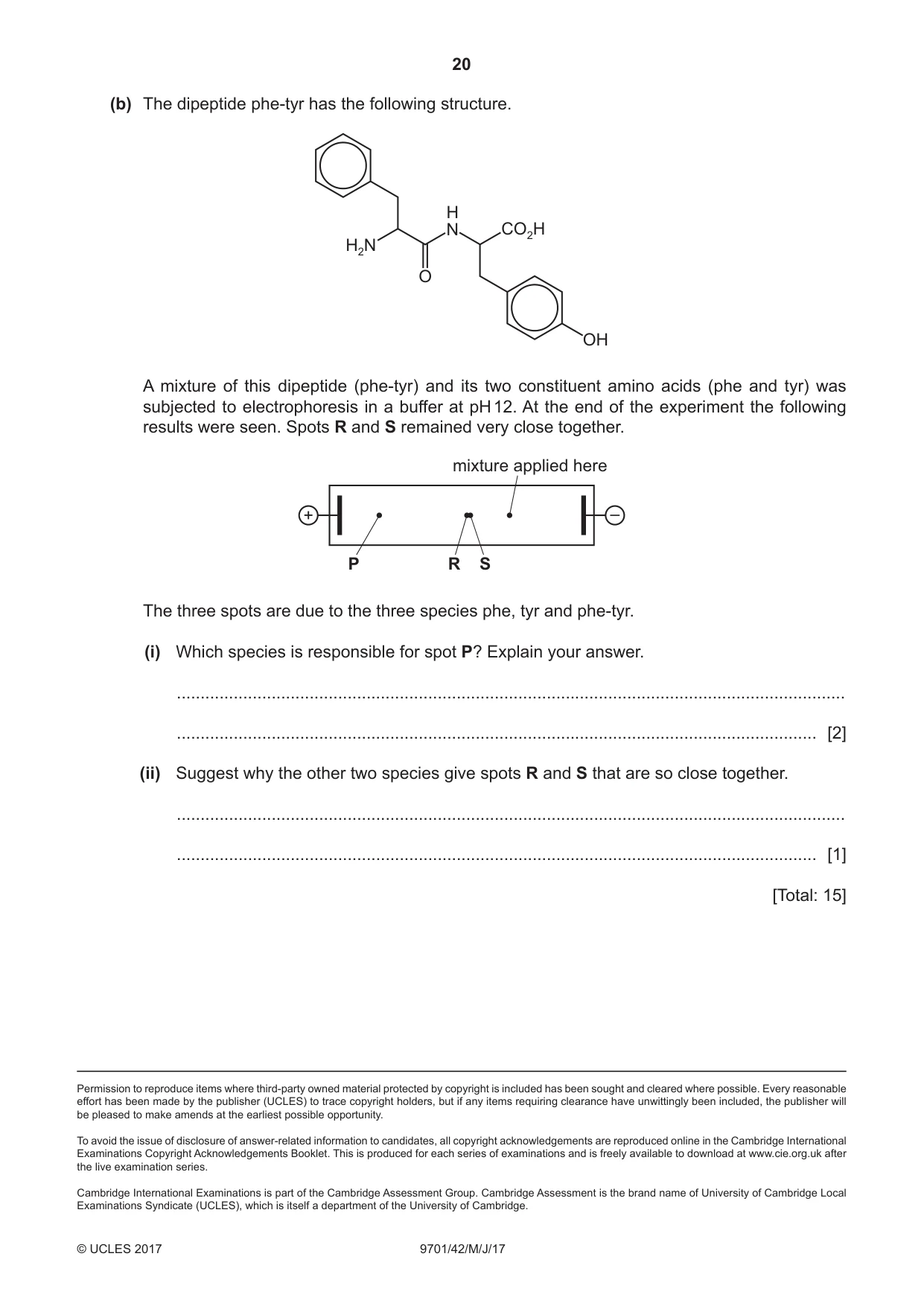
8 (a) The amino acid tyrosine can be synthesised from phenol by the route shown. OH CHO step 1 step 2 CN HO HO HO phenol step 3 NH2 Cl OH step 5 step 4 CO2H CO2H 1. PCl 5 CO2H HO HO 2. H2O HO tyrosine (i) Name the mechanism occurring in the following steps. step 1 .................................................................................................................................. step 2 .................................................................................................................................. [2] (ii) What type of reaction is occurring in step 3? ....................................................................................................................................... [1] (iii) Suggest reagents and conditions for each of the following steps. step 1 .................................................................................................................................. step 2 .................................................................................................................................. step 3 .................................................................................................................................. step 5 .................................................................................................................................. [5] (iv) Draw the structures of the products of the reactions of tyrosine with an excess of each of the following reagents. with NaOH(aq) with HCl (aq) with Br2(aq) [4] Question 8 continues on the next page. (b) The dipeptide phe-tyr has the following structure. H N CO2H H2N O OH A mixture of this dipeptide (phe-tyr) and its two constituent amino acids (phe and tyr) was subjected to electrophoresis in a buffer at pH 12. At the end of the experiment the following results were seen. Spots R and S remained very close together. mixture applied here + – P R S The three spots are due to the three species phe, tyr and phe-tyr. (i) Which species is responsible for spot P? Explain your answer. ............................................................................................................................................. ....................................................................................................................................... [2] (ii) Suggest why the other two species give spots R and S that are so close together. ............................................................................................................................................. ....................................................................................................................................... [1] [Total: 15]
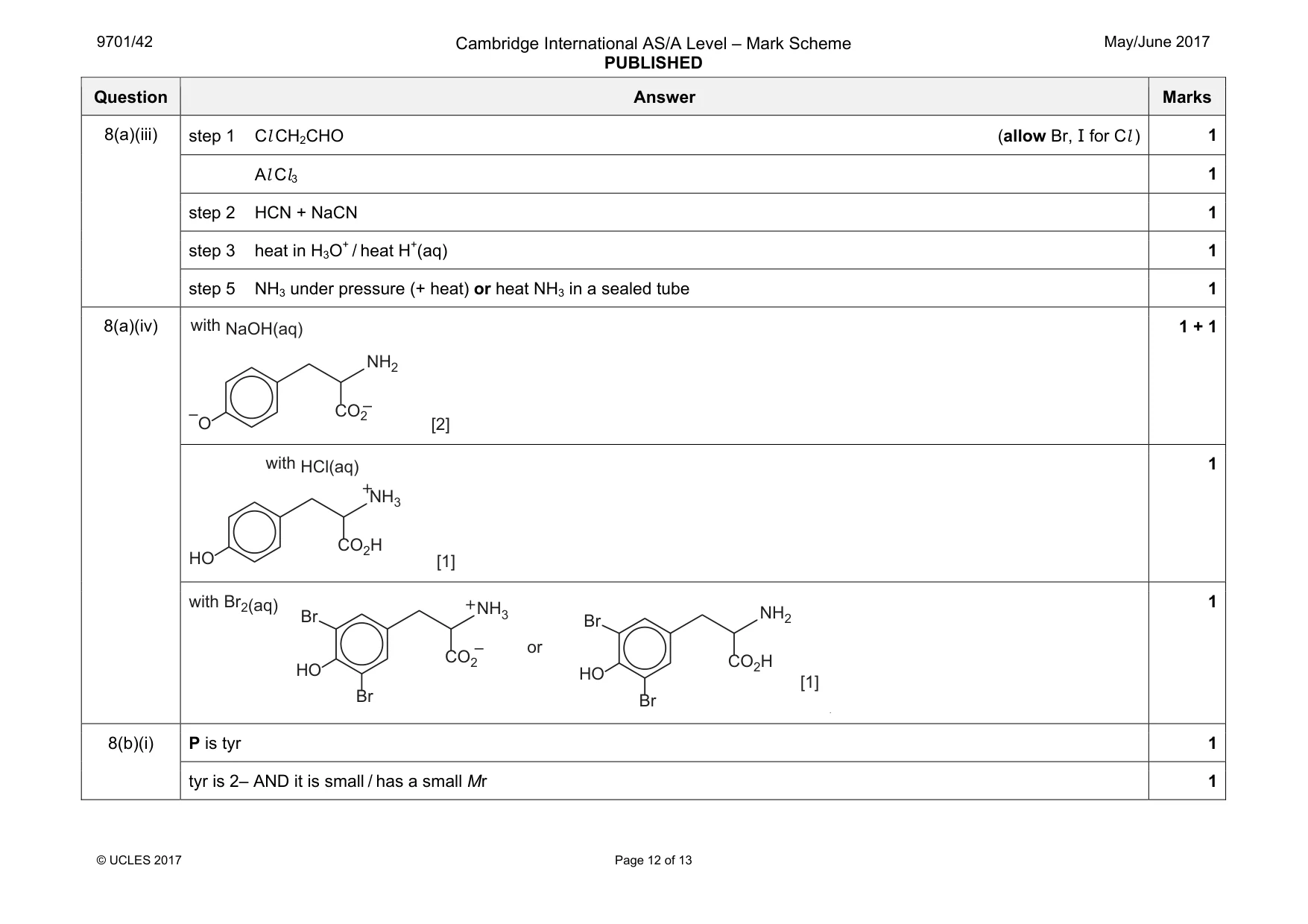
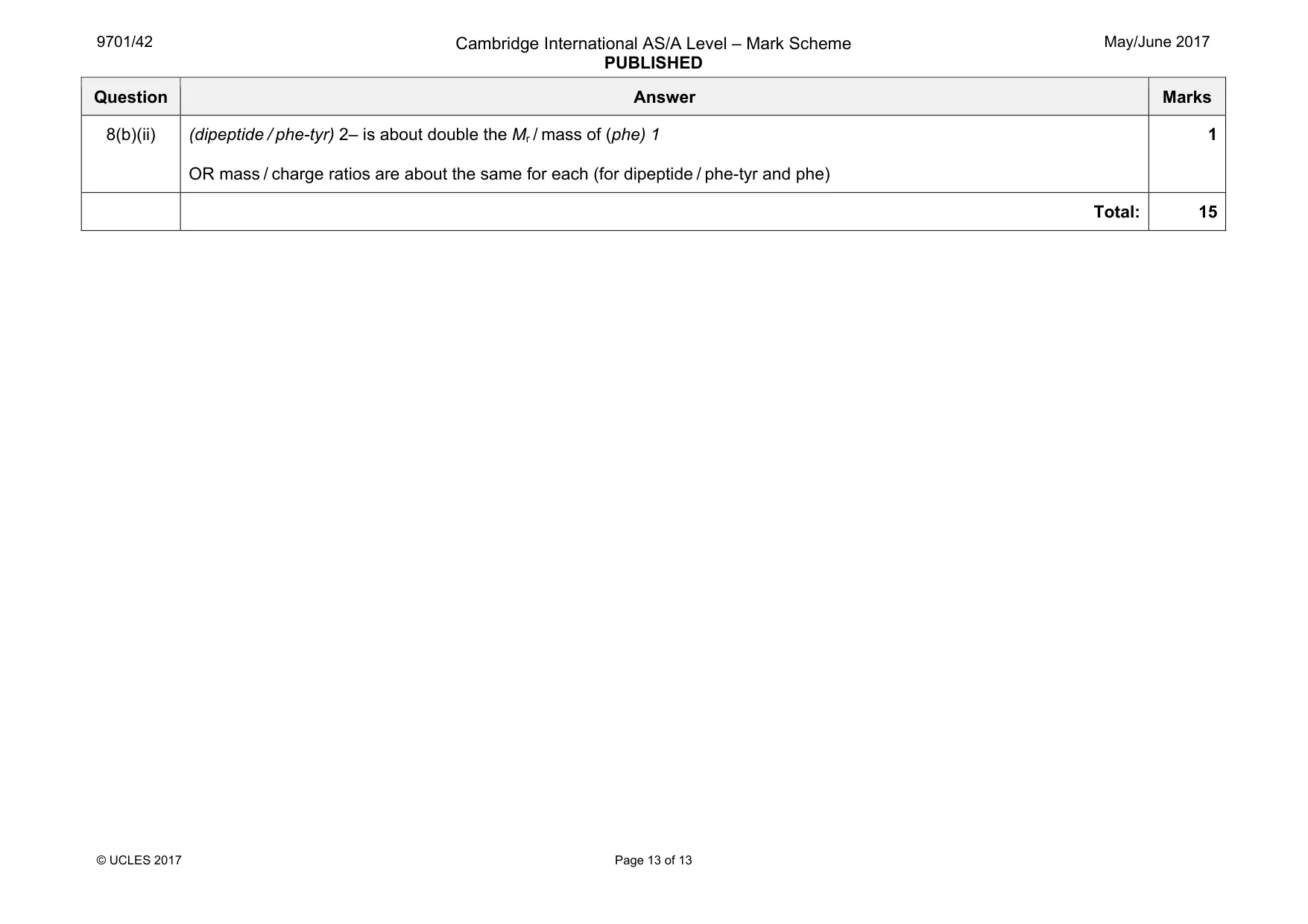
Mark scheme: 8(a)(i) step 1 electrophilic substitution ignore acylation 1 step 2 nucleophilic addition 1 8(a)(ii) hydrolysis 1 Question Answer Marks 8(a)(iii) step 1 Cl CH2CHO (allow Br, I for Cl ) 1 Al Cl3 1 step 2 HCN + NaCN 1 step 3 heat in H3O+ / heat H+(aq) 1 step 5 NH3 under pressure (+ heat) or heat NH3 in a sealed tube 1 8(a)(iv) 1 + 1 1 1 8(b)(i) P is tyr 1 tyr is 2– AND it is small / has a small Mr 1 with NaOH(aq) NH2 O CO2 [2] with HCl(aq) NH3 HO CO2H [1] with Br2(aq) NH3 HO CO2 Br Br NH2 HO CO2H Br Br or [1] Question Answer Marks 8(b)(ii) (dipeptide / phe-tyr) 2– is about double the Mr / mass of (phe) 1 OR mass / charge ratios are about the same for each (for dipeptide / phe-tyr and phe) 1 Total: 15
What was in this paper
The subtopics covered by these 8 questions, and how many questions each got. Open one in a new tab to see every Cambridge question on it.
What you needed in this session
Cambridge’s own grade thresholds for 2017 May/June, Paper 4 · Variant 2. A higher threshold means an easier paper — the bar moves with how the cohort did.