Cambridge A Level Chemistry 9701 — 2017 May/June Paper 4 · Variant 1
9701/41/M/J/17 · 6 questions · 100 marks · ≈113 min
The question paper and its mark scheme, free to read here and free to download. This is Cambridge’s own paper, exactly as it was sat.
Question paper16 pages
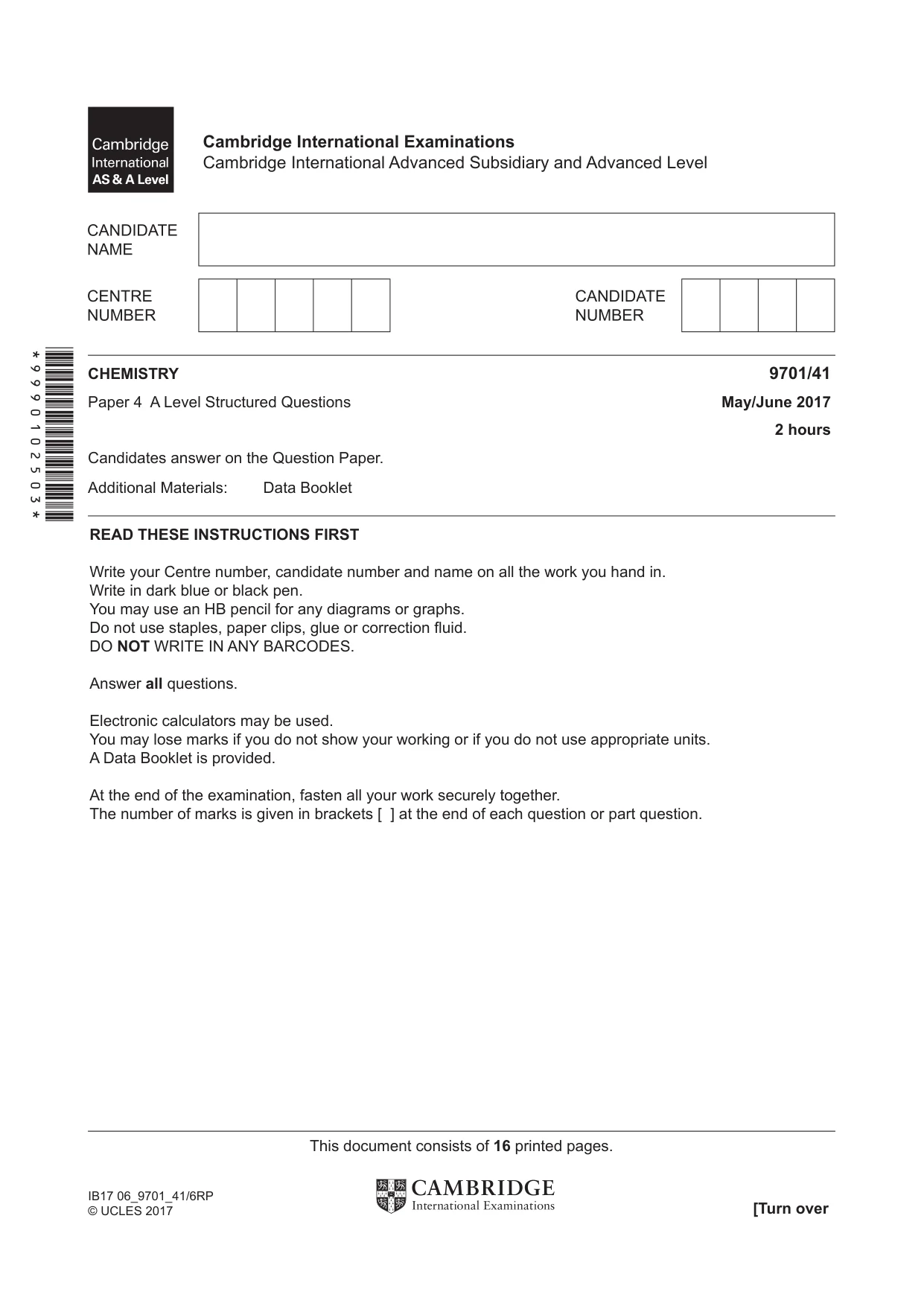
Mark scheme12 pages
Answers below. Sit the paper first if you are practising.
Questions as text
Q1 · Describe and explain the variation in the solubilities of the hydroxides of the Group 2…
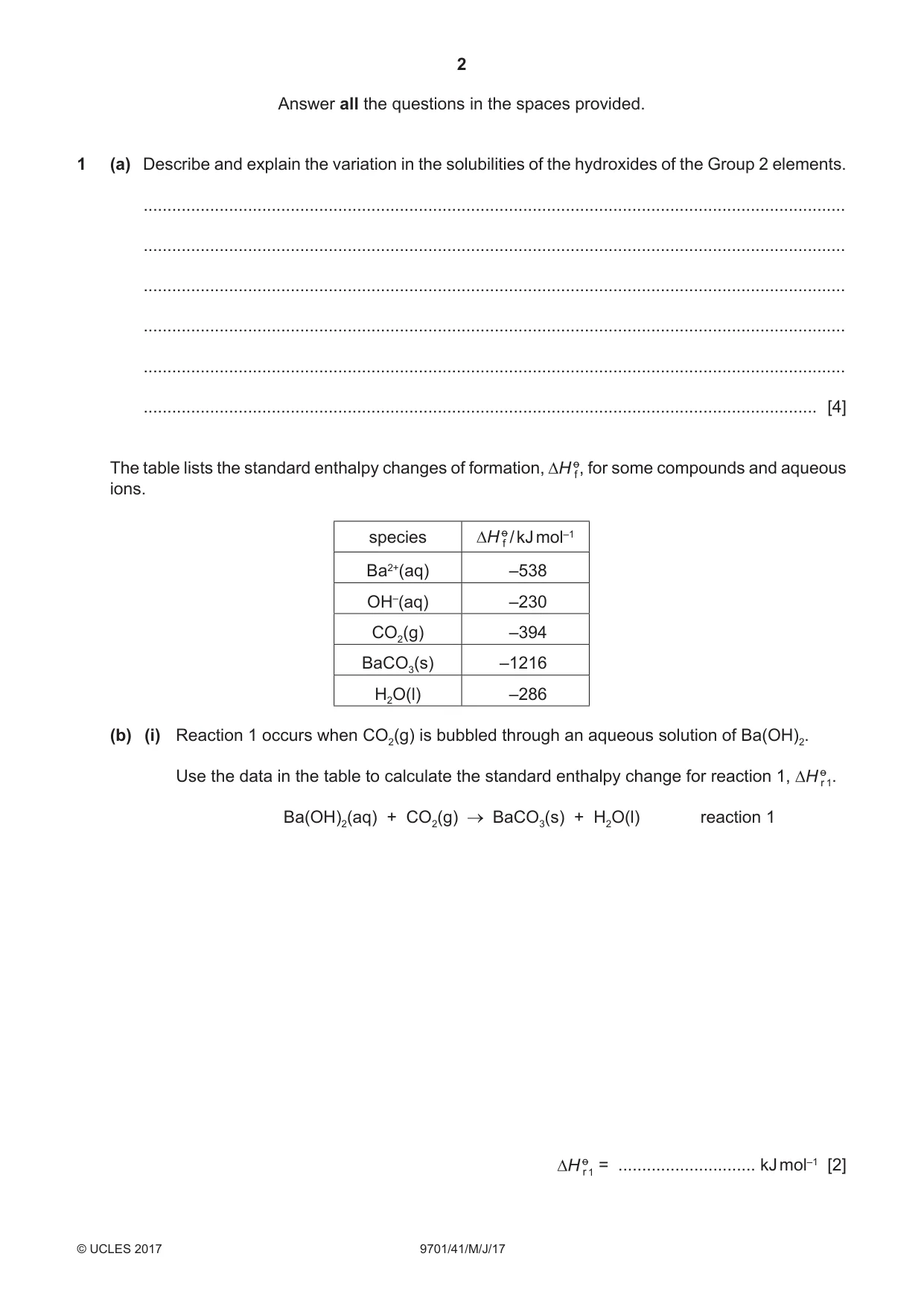
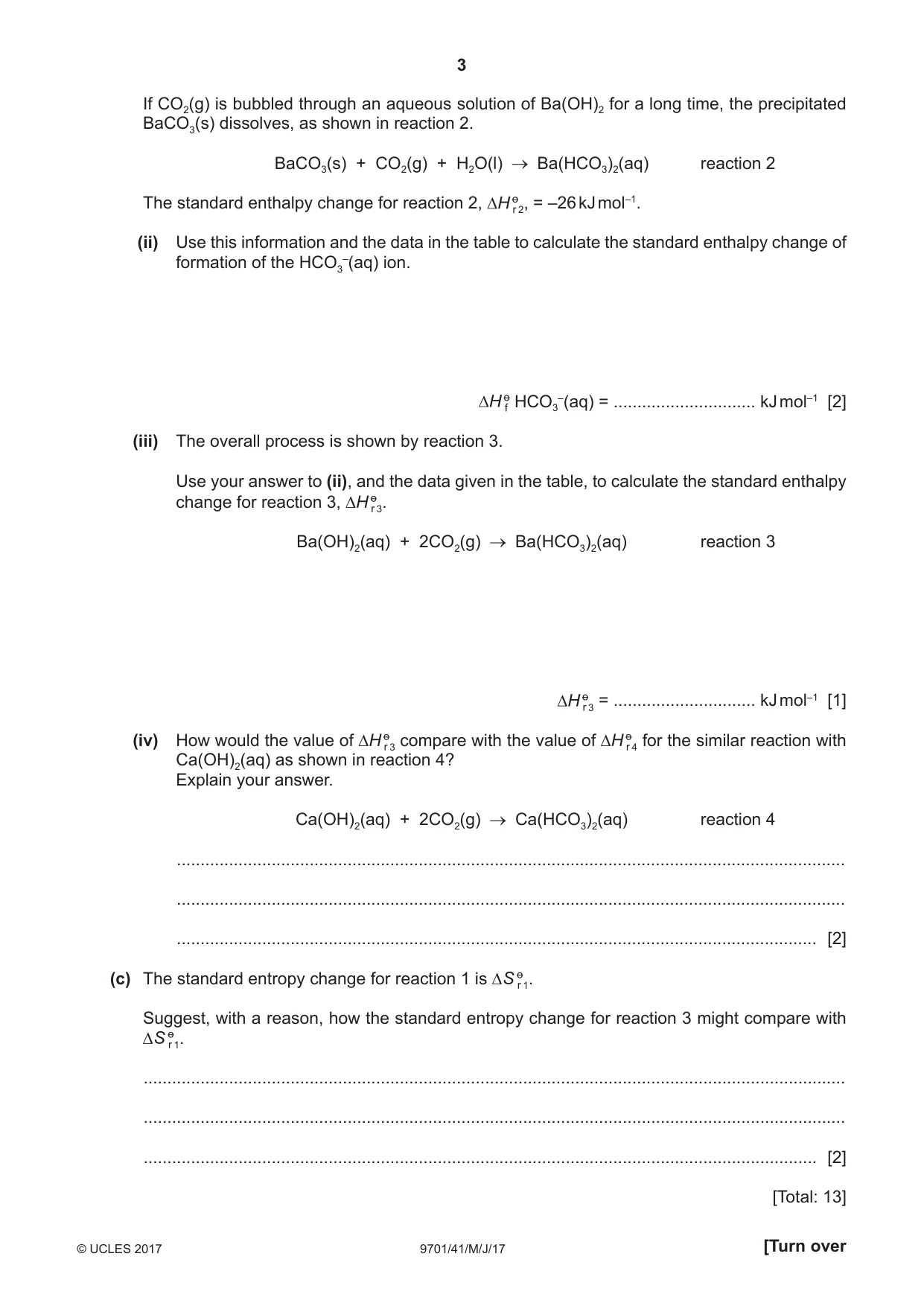
1 (a) Describe and explain the variation in the solubilities of the hydroxides of the Group 2 elements. .................................................................................................................................................... .................................................................................................................................................... .................................................................................................................................................... .................................................................................................................................................... .................................................................................................................................................... .............................................................................................................................................. [4] The table lists the standard enthalpy changes of formation, , for some compounds and aqueous ions. species / kJ mol–1 Ba2+(aq) –538 OH–(aq) –230 CO2(g) –394 BaCO3(s) –1216 H2O(l) –286 (b) (i) Reaction 1 occurs when CO2(g) is bubbled through an aqueous solution of Ba(OH)2. Use the data in the table to calculate the standard enthalpy change for reaction 1, 1. Ba(OH)2(aq) + CO2(g) BaCO3(s) + H2O(l) reaction 1 1 = ............................. kJ mol–1 [2] If CO2(g) is bubbled through an aqueous solution of Ba(OH)2 for a long time, the precipitated BaCO3(s) dissolves, as shown in reaction 2. BaCO3(s) + CO2(g) + H2O(l) Ba(HCO3)2(aq) reaction 2 The standard enthalpy change for reaction 2, 2, = –26 kJ mol–1. (ii) Use this information and the data in the table to calculate the standard enthalpy change of formation of the HCO3–(aq) ion. HCO3–(aq) = .............................. kJ mol–1 [2] (iii) The overall process is shown by reaction 3. Use your answer to (ii), and the data given in the table, to calculate the standard enthalpy change for reaction 3, 3. Ba(OH)2(aq) + 2CO2(g) Ba(HCO3)2(aq) reaction 3 3 = .............................. kJ mol–1 [1] (iv) How would the value of 3 compare with the value of 4 for the similar reaction with Ca(OH)2(aq) as shown in reaction 4? Explain your answer. Ca(OH)2(aq) + 2CO2(g) Ca(HCO3)2(aq) reaction 4 ............................................................................................................................................. ............................................................................................................................................. ....................................................................................................................................... [2] (c) The standard entropy change for reaction 1 is 1. Suggest, with a reason, how the standard entropy change for reaction 3 might compare with 1. .................................................................................................................................................... .................................................................................................................................................... .............................................................................................................................................. [2] [Total: 13]
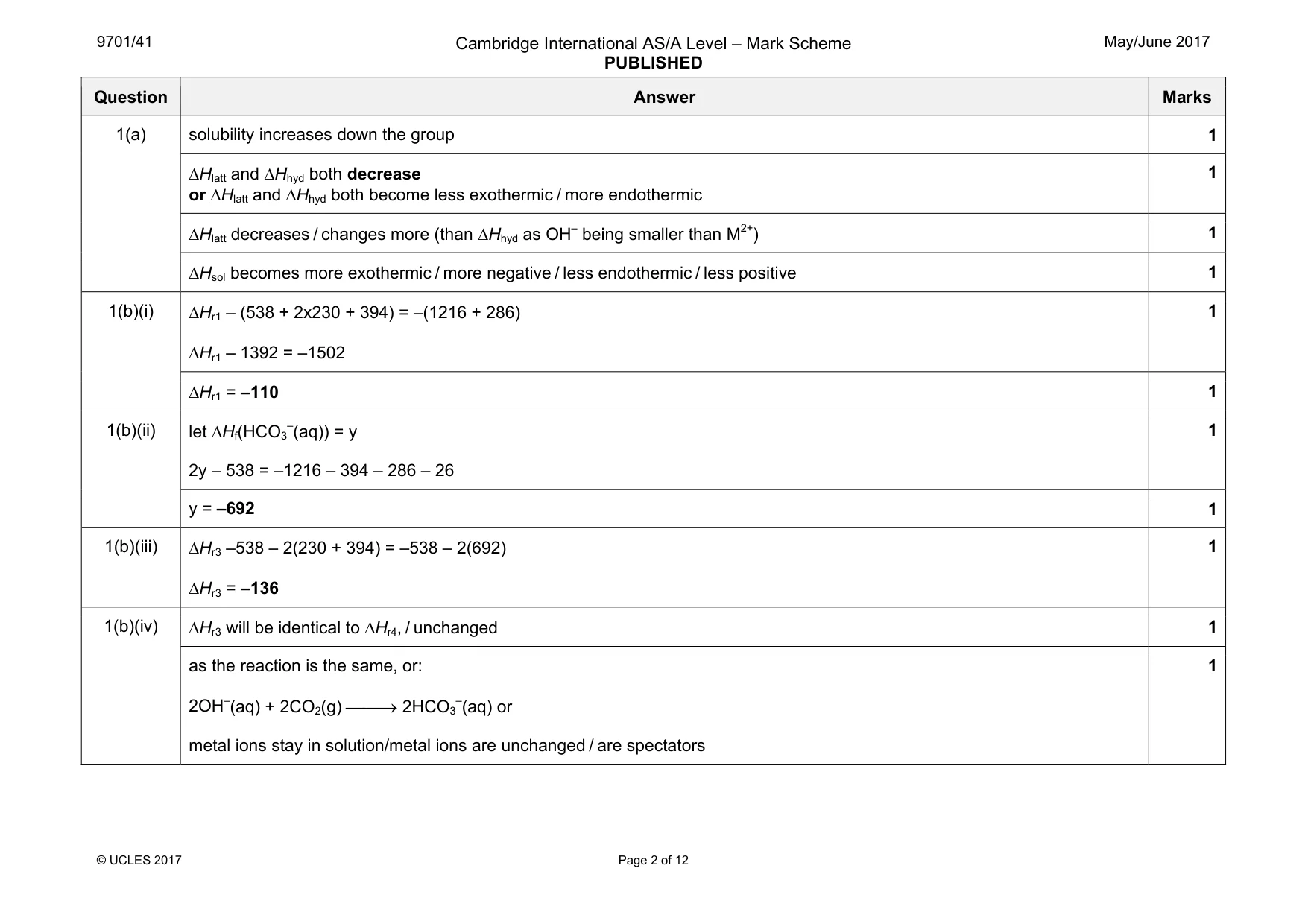
Mark scheme: 1(a) solubility increases down the group 1 ∆Hlatt and ∆Hhyd both decrease or ∆Hlatt and ∆Hhyd both become less exothermic / more endothermic 1 ∆Hlatt decreases / changes more (than ∆Hhyd as OH– being smaller than M2+) 1 ∆Hsol becomes more exothermic / more negative / less endothermic / less positive 1 1(b)(i) ∆Hr1 – (538 + 2x230 + 394) = –(1216 + 286) ∆Hr1 – 1392 = –1502 1 ∆Hr1 = –110 1 1(b)(ii) let ∆Hf(HCO3 –(aq)) = y 2y – 538 = –1216 – 394 – 286 – 26 1 y = –692 1 1(b)(iii) ∆Hr3 –538 – 2(230 + 394) = –538 – 2(692) ∆Hr3 = –136 1 1(b)(iv) ∆Hr3 will be identical to ∆Hr4, / unchanged 1 as the reaction is the same, or: 2OH–(aq) + 2CO2(g) → 2HCO3 –(aq) or metal ions stay in solution/metal ions are unchanged / are spectators 1 Question Answer Marks 1(c) more gaseous moles are being consumed (in reaction 3) or more CO2 moles are being consumed (in reaction 3) 1 ∆S is therefore expected to be more negative/less positive for reaction 3. 1 Total: 13
Q2 · One atom of each of the four elements H, C, N and O can bond together in different ways
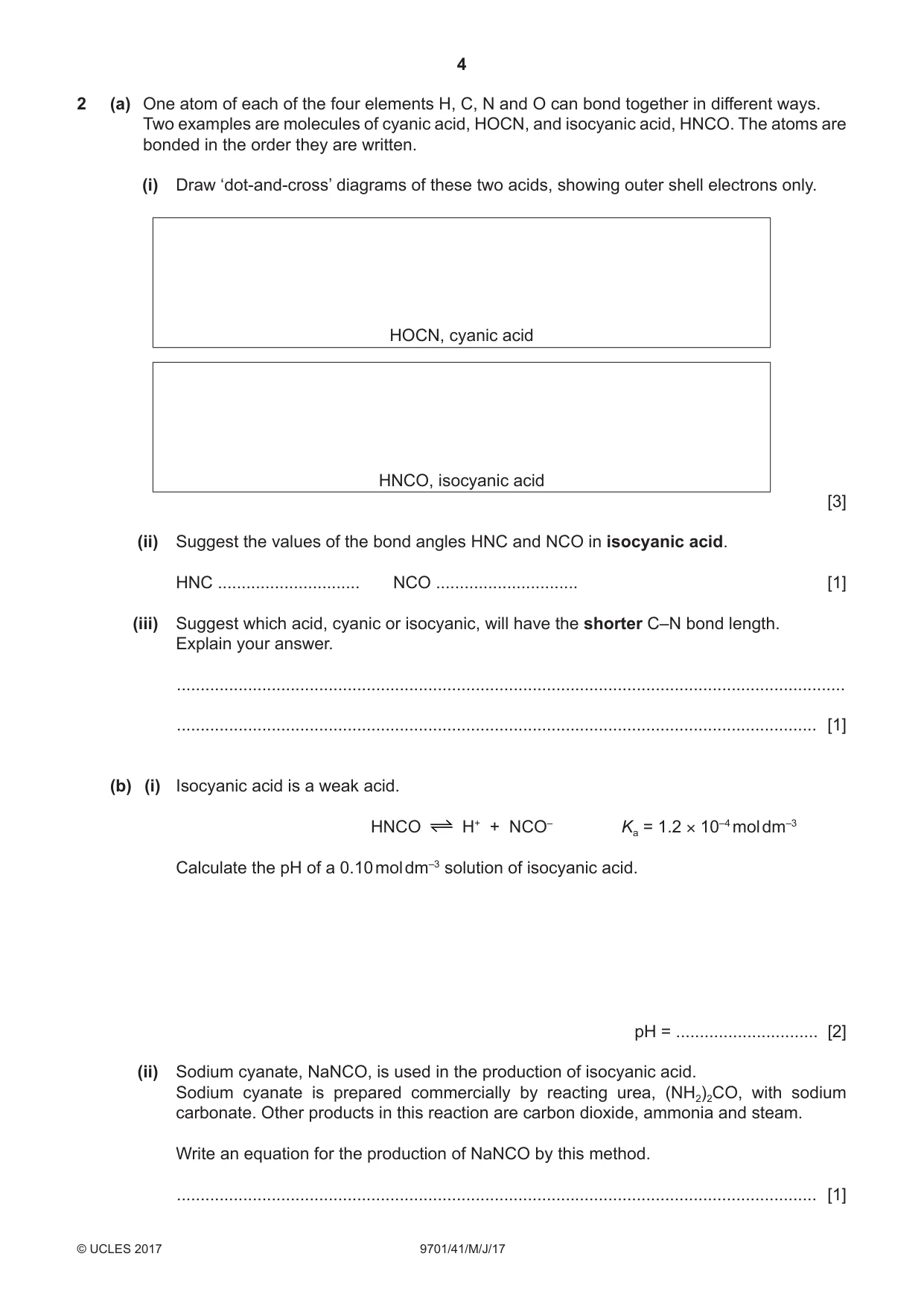
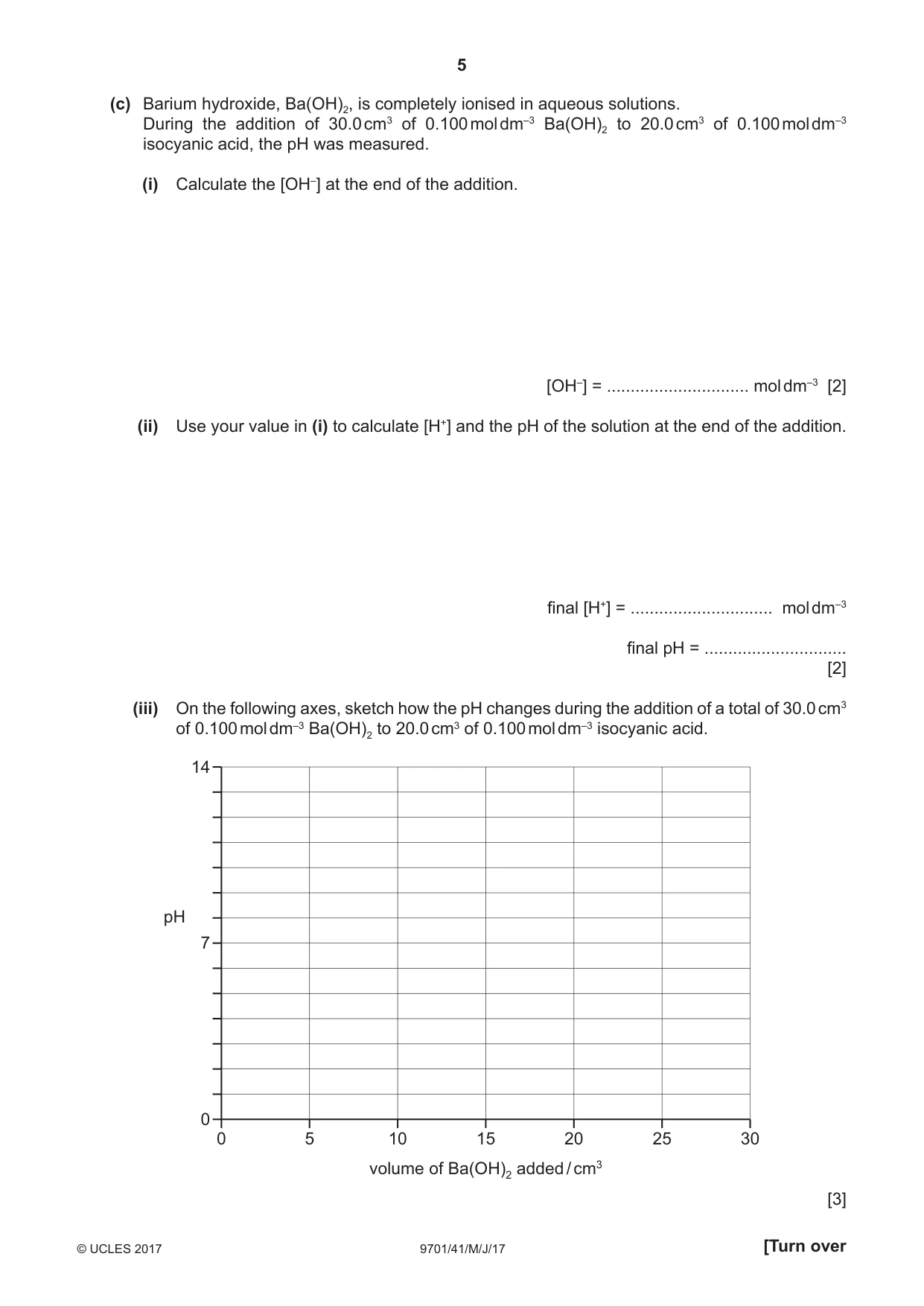
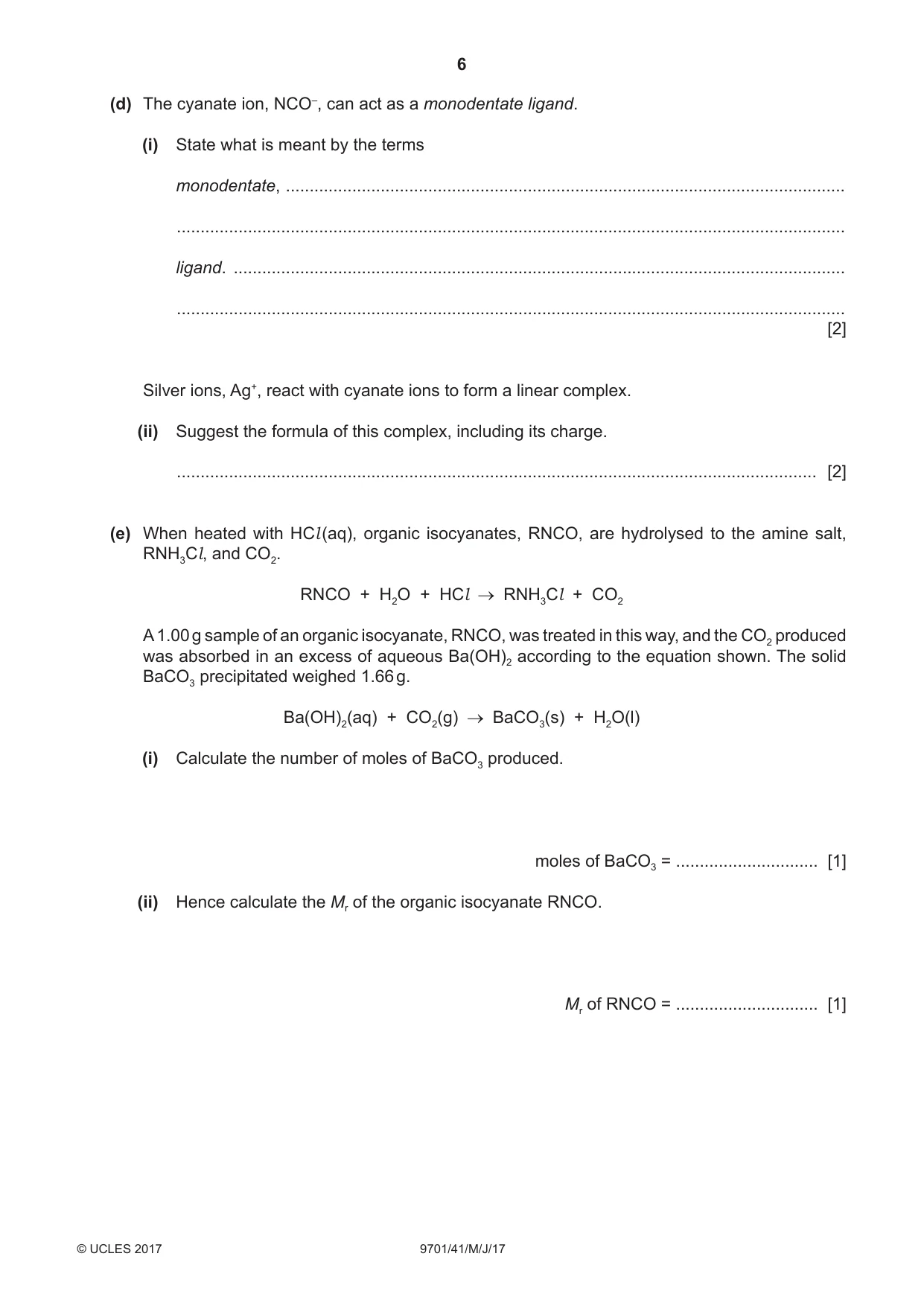
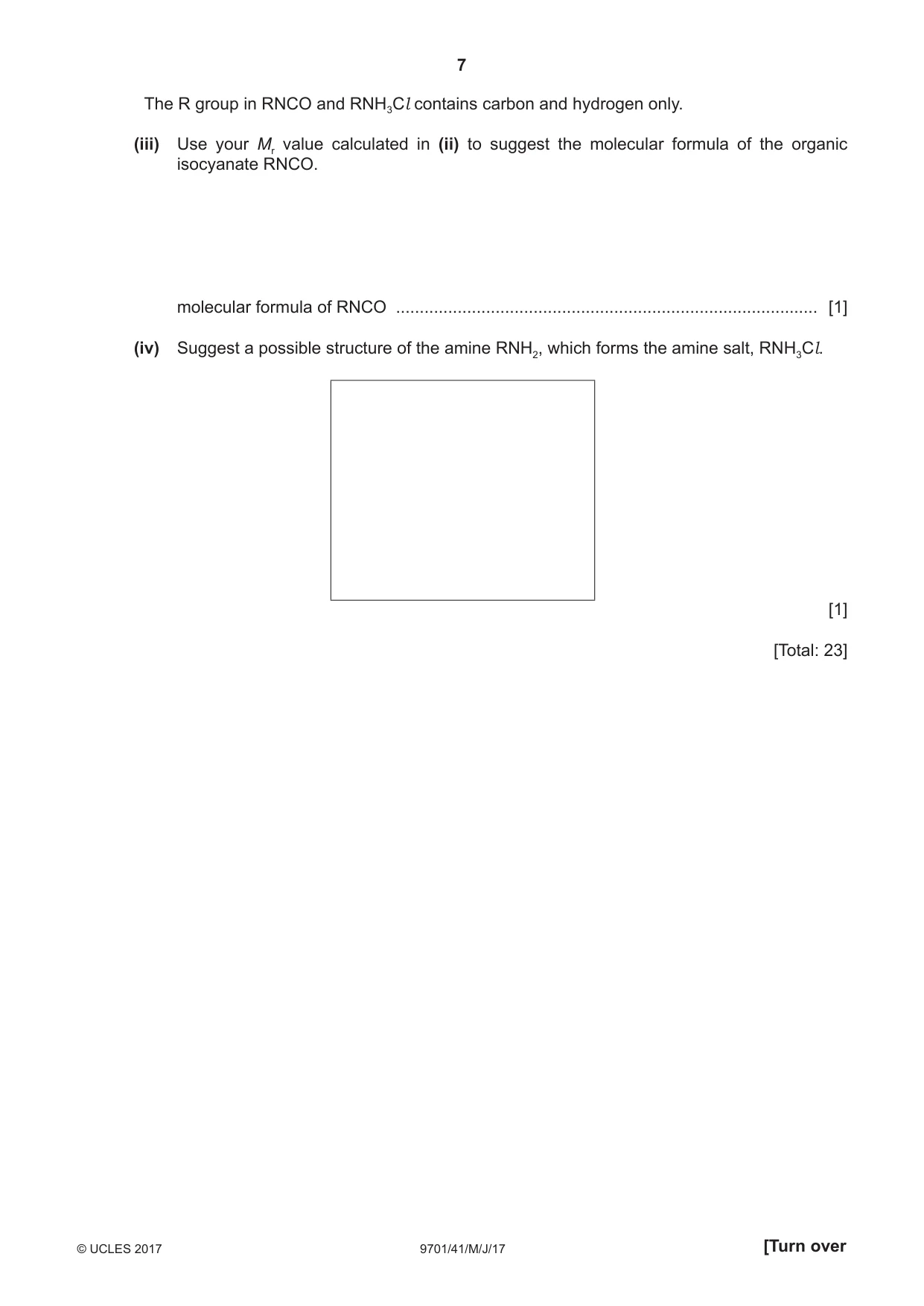
2 (a) One atom of each of the four elements H, C, N and O can bond together in different ways. Two examples are molecules of cyanic acid, HOCN, and isocyanic acid, HNCO. The atoms are bonded in the order they are written. (i) Draw ‘dot-and-cross’ diagrams of these two acids, showing outer shell electrons only. HOCN, cyanic acid HNCO, isocyanic acid [3] (ii) Suggest the values of the bond angles HNC and NCO in isocyanic acid. HNC .............................. NCO .............................. [1] (iii) Suggest which acid, cyanic or isocyanic, will have the shorter C–N bond length. Explain your answer. ............................................................................................................................................. ....................................................................................................................................... [1] (b) (i) Isocyanic acid is a weak acid. HNCO H+ + NCO– Ka = 1.2 × 10⁻⁴ mol dm–3 Calculate the pH of a 0.10 mol dm–3 solution of isocyanic acid. pH = .............................. [2] (ii) Sodium cyanate, NaNCO, is used in the production of isocyanic acid. Sodium cyanate is prepared commercially by reacting urea, (NH2)2CO, with sodium carbonate. Other products in this reaction are carbon dioxide, ammonia and steam. Write an equation for the production of NaNCO by this method. ....................................................................................................................................... [1] (c) Barium hydroxide, Ba(OH)2, is completely ionised in aqueous solutions. During the addition of 30.0 cm3 of 0.100 mol dm–3 Ba(OH)2 to 20.0 cm3 of 0.100 mol dm–3 isocyanic acid, the pH was measured. (i) Calculate the [OH–] at the end of the addition. [OH–] = .............................. mol dm–3 [2] (ii) Use your value in (i) to calculate [H+] and the pH of the solution at the end of the addition. final [H+] = .............................. mol dm–3 final pH = .............................. [2] (iii) On the following axes, sketch how the pH changes during the addition of a total of 30.0 cm3 of 0.100 mol dm–3 Ba(OH)2 to 20.0 cm3 of 0.100 mol dm–3 isocyanic acid. 14 pH 7 0 0 5 10 15 20 25 30 volume of Ba(OH)2 added / cm3 [3] (d) The cyanate ion, NCO–, can act as a monodentate ligand. (i) State what is meant by the terms monodentate, ...................................................................................................................... ............................................................................................................................................. ligand. .................................................................................................................................. ............................................................................................................................................. [2] Silver ions, Ag+, react with cyanate ions to form a linear complex. (ii) Suggest the formula of this complex, including its charge. ....................................................................................................................................... [2] (e) When heated with HCl (aq), organic isocyanates, RNCO, are hydrolysed to the amine salt, RNH3Cl, and CO2. RNCO + H2O + HCl RNH3Cl + CO2 A 1.00 g sample of an organic isocyanate, RNCO, was treated in this way, and the CO2 produced was absorbed in an excess of aqueous Ba(OH)2 according to the equation shown. The solid BaCO3 precipitated weighed 1.66 g. Ba(OH)2(aq) + CO2(g) BaCO3(s) + H2O(l) (i) Calculate the number of moles of BaCO3 produced. moles of BaCO3 = .............................. [1] (ii) Hence calculate the Mr of the organic isocyanate RNCO. Mr of RNCO = .............................. [1] The R group in RNCO and RNH3Cl contains carbon and hydrogen only. (iii) Use your Mr value calculated in (ii) to suggest the molecular formula of the organic isocyanate RNCO. molecular formula of RNCO .......................................................................................... [1] (iv) Suggest a possible structure of the amine RNH2, which forms the amine salt, RNH3Cl. [1] [Total: 23]
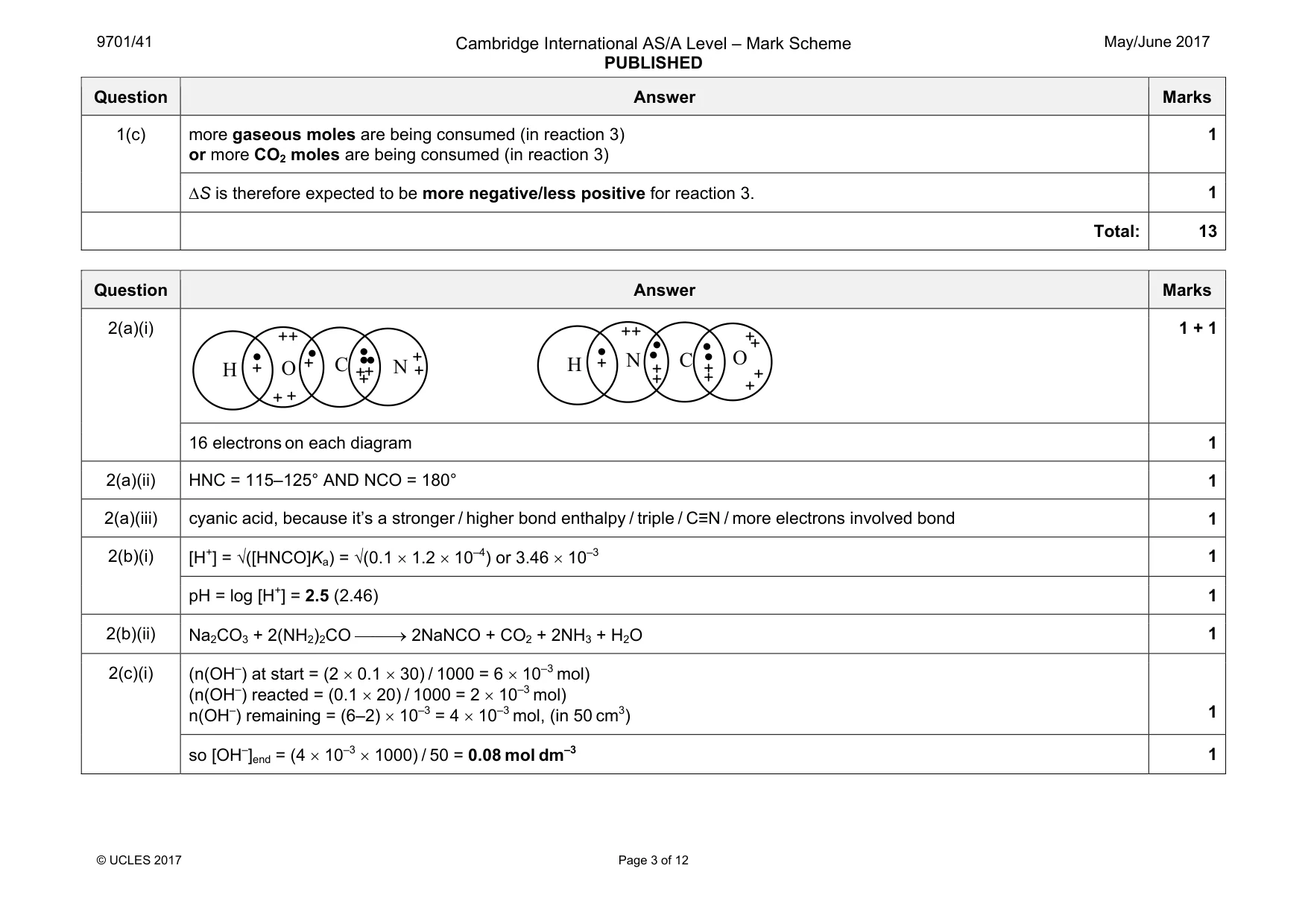
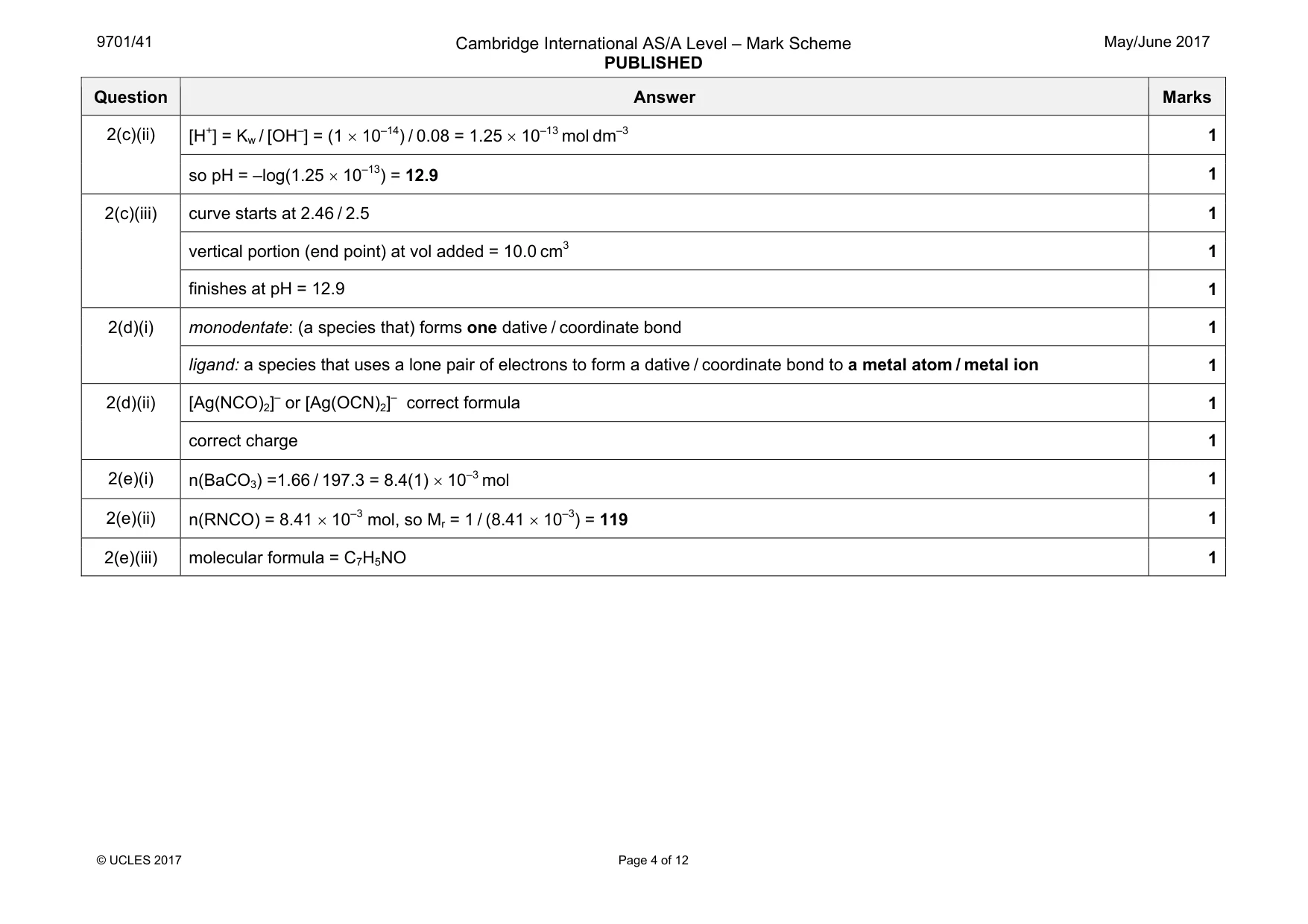
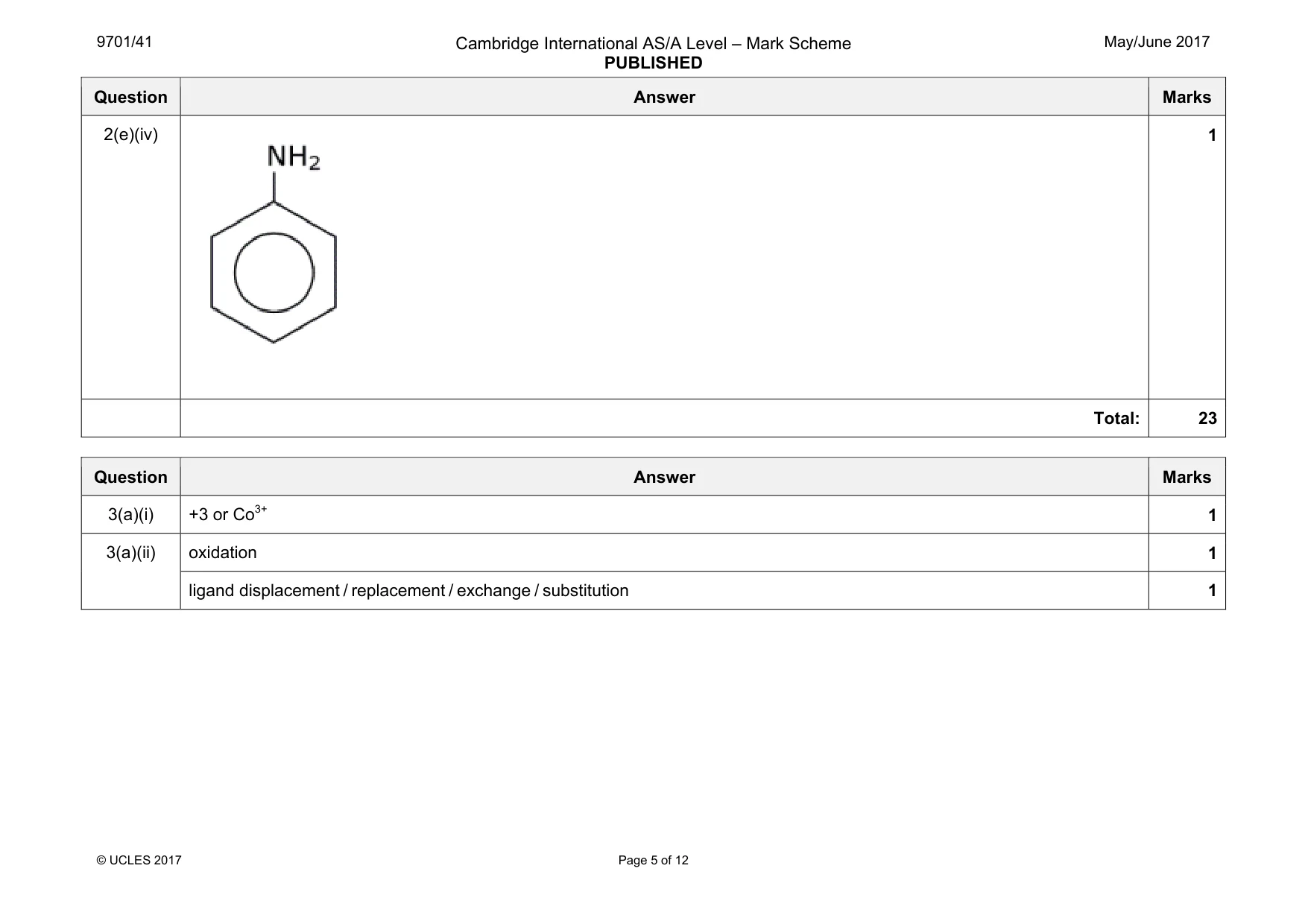
Mark scheme: 2(a)(i) H O C N H N O C 1 + 1 16 electrons on each diagram 1 2(a)(ii) HNC = 115–125° AND NCO = 180° 1 2(a)(iii) cyanic acid, because it’s a stronger / higher bond enthalpy / triple / C≡N / more electrons involved bond 1 2(b)(i) [H+] = √([HNCO]Ka) = √(0.1 × 1.2 × 10–4) or 3.46 × 10⁻³ 1 pH = log [H+] = 2.5 (2.46) 1 2(b)(ii) Na2CO3 + 2(NH2)2CO → 2NaNCO + CO2 + 2NH3 + H2O 1 2(c)(i) (n(OH–) at start = (2 × 0.1 × 30) / 1000 = 6 × 10⁻³ mol) (n(OH–) reacted = (0.1 × 20) / 1000 = 2 × 10⁻³ mol) n(OH–) remaining = (6–2) × 10–3 = 4 × 10⁻³ mol, (in 50 cm3) 1 so [OH–]end = (4 × 10–3 × 1000) / 50 = 0.08 mol dm–3 1 Question Answer Marks 2(c)(ii) [H+] = Kw / [OH–] = (1 × 10–14) / 0.08 = 1.25 × 10⁻¹³ mol dm–3 1 so pH = –log(1.25 × 10⁻¹³) = 12.9 1 2(c)(iii) curve starts at 2.46 / 2.5 1 vertical portion (end point) at vol added = 10.0 cm3 1 finishes at pH = 12.9 1 2(d)(i) monodentate: (a species that) forms one dative / coordinate bond 1 ligand: a species that uses a lone pair of electrons to form a dative / coordinate bond to a metal atom / metal ion 1 2(d)(ii) [Ag(NCO)2]– or [Ag(OCN)2]– correct formula 1 correct charge 1 2(e)(i) n(BaCO3) =1.66 / 197.3 = 8.4(1) × 10–3 mol 1 2(e)(ii) n(RNCO) = 8.41 × 10⁻³ mol, so Mr = 1 / (8.41 × 10⁻³) = 119 1 2(e)(iii) molecular formula = C7H5NO 1 Question Answer Marks 2(e)(iv) 1 Total: 23
Q3 · Bubbling air through different aqueous mixtures of CoCl 2, NH4Cl and NH3 produces various…
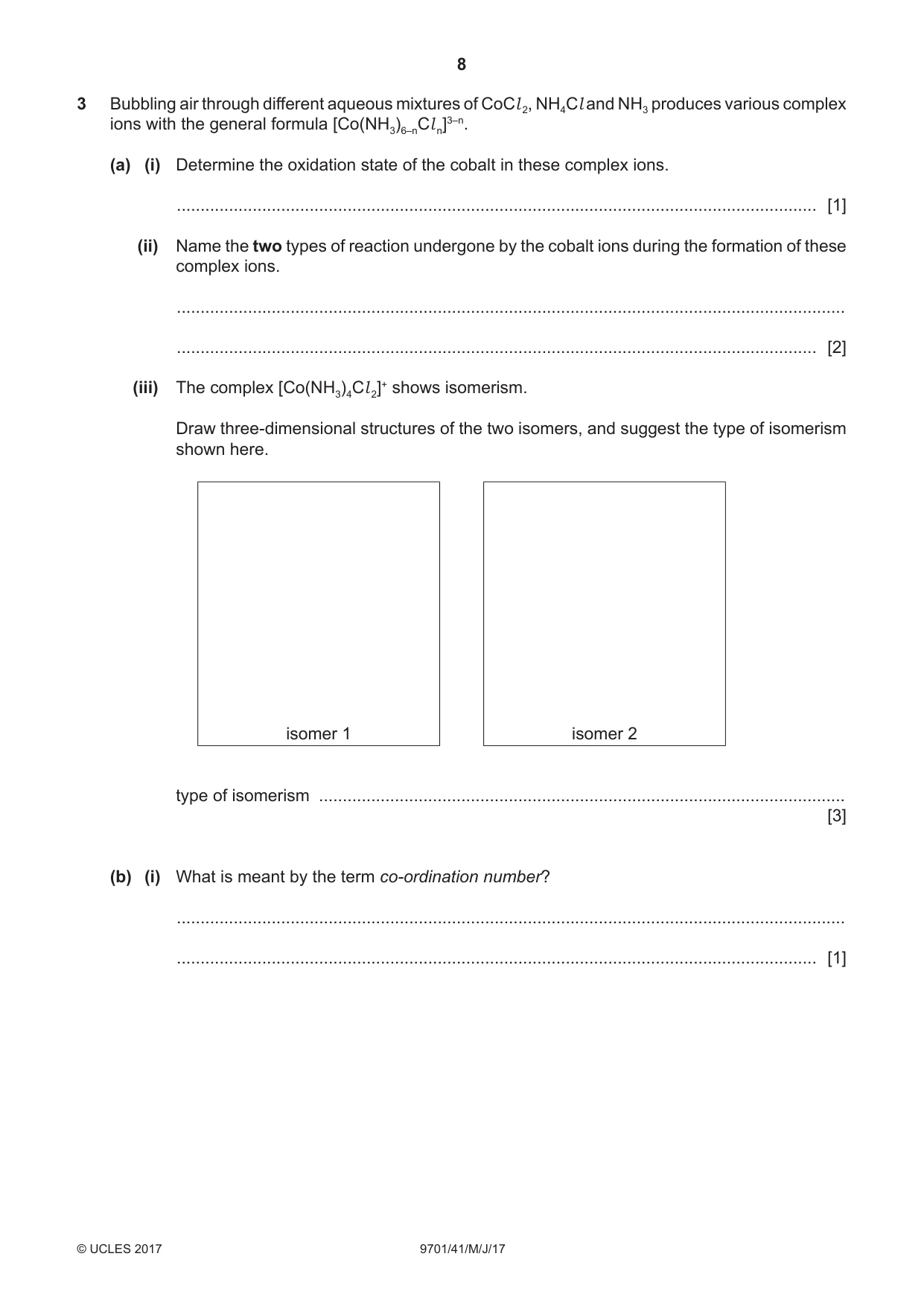
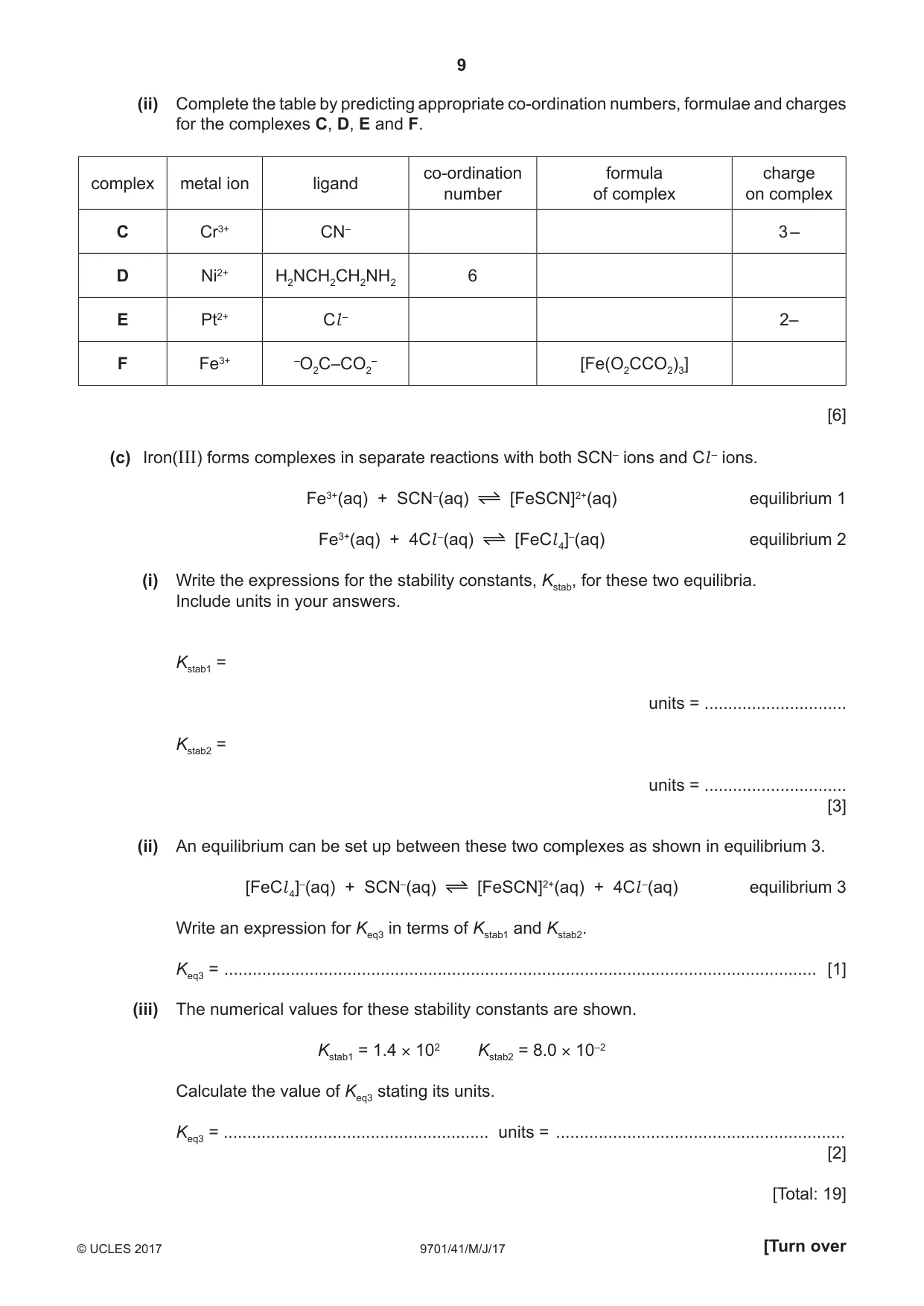
3 Bubbling air through different aqueous mixtures of CoCl 2, NH4Cl and NH3 produces various complex ions with the general formula [Co(NH3)6–nCl n]3–n. (a) (i) Determine the oxidation state of the cobalt in these complex ions. ....................................................................................................................................... [1] (ii) Name the two types of reaction undergone by the cobalt ions during the formation of these complex ions. ............................................................................................................................................. ....................................................................................................................................... [2] (iii) The complex [Co(NH3)4Cl 2]+ shows isomerism. Draw three-dimensional structures of the two isomers, and suggest the type of isomerism shown here. isomer 1 isomer 2 type of isomerism ................................................................................................................ [3] (b) (i) What is meant by the term co-ordination number? ............................................................................................................................................. ....................................................................................................................................... [1] (ii) Complete the table by predicting appropriate co-ordination numbers, formulae and charges for the complexes C, D, E and F. co-ordination formula chargecomplex metal ion ligand number of complex on complex C Cr3+ CN– 3 – D Ni2+ H2NCH2CH2NH2 6 E Pt2+ Cl – 2– F Fe3+ –O2C–CO2– [Fe(O2CCO2)3] [6] (c) Iron(III) forms complexes in separate reactions with both SCN– ions and Cl – ions. Fe3+(aq) + SCN–(aq) [FeSCN]2+(aq) equilibrium 1 Fe3+(aq) + 4Cl –(aq) [FeCl 4]–(aq) equilibrium 2 (i) Write the expressions for the stability constants, Kstab, for these two equilibria. Include units in your answers. Kstab1 = units = .............................. Kstab2 = units = .............................. [3] (ii) An equilibrium can be set up between these two complexes as shown in equilibrium 3. [FeCl 4]–(aq) + SCN–(aq) [FeSCN]2+(aq) + 4Cl –(aq) equilibrium 3 Write an expression for Keq3 in terms of Kstab1 and Kstab2. Keq3 = ............................................................................................................................. [1] (iii) The numerical values for these stability constants are shown. Kstab1 = 1.4 × 10² Kstab2 = 8.0 × 10⁻² Calculate the value of Keq3 stating its units. Keq3 = ........................................................ units = .............................................................. [2] [Total: 19]
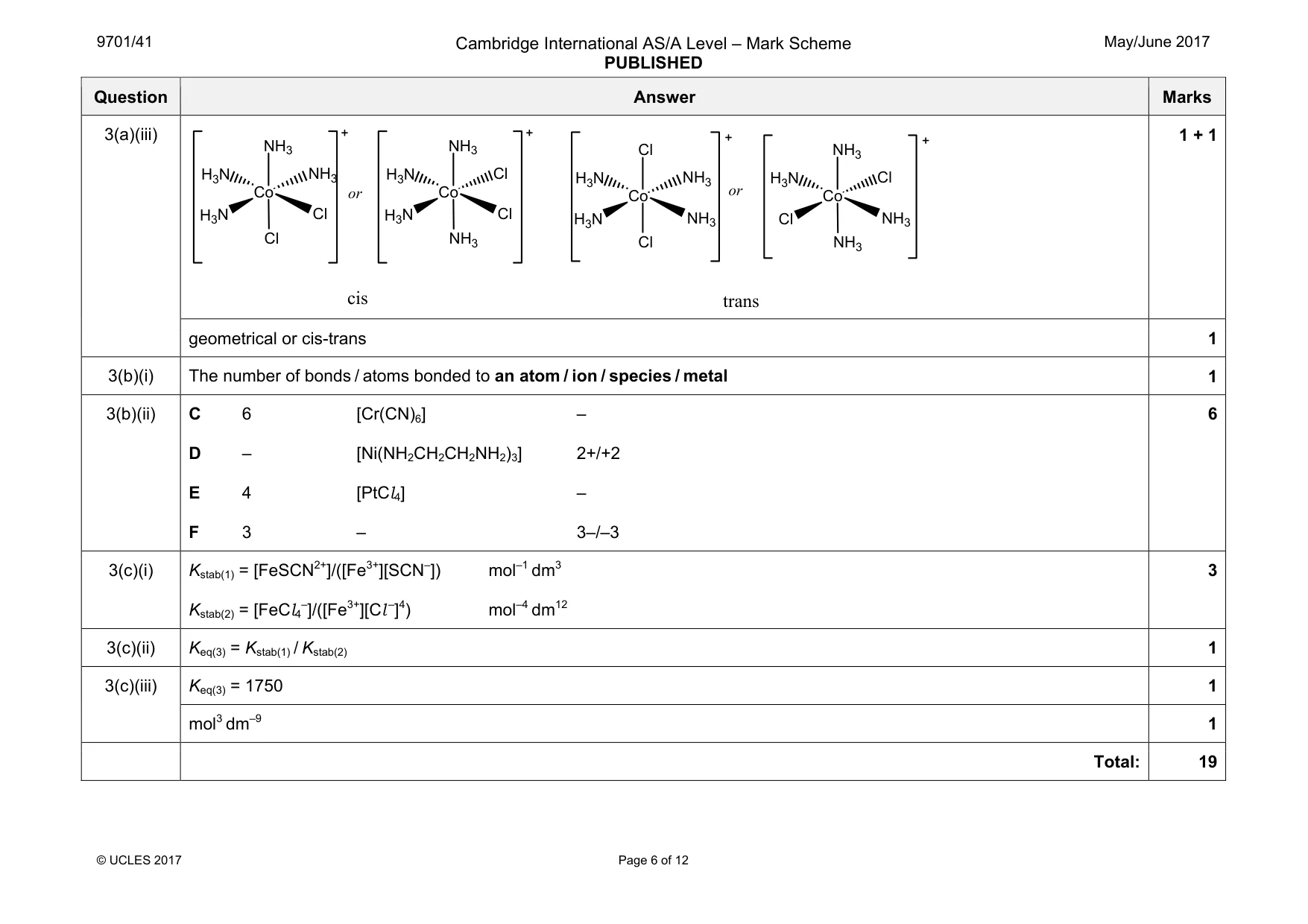
Mark scheme: 3(a)(i) 1 3(a)(ii) oxidation 1 ligand displacement / replacement / exchange / substitution 1 Question Answer Marks 3(a)(iii) Cl Co Cl H3N H3N NH3 NH3 NH3 Co NH3 H3N H3N Cl Cl cis trans NH3 Co Cl H3N Cl NH3 NH3 or Cl Co NH3 H3N H3N NH3 Cl or 1 + 1 geometrical or cis-trans 1 3(b)(i) The number of bonds / atoms bonded to an atom / ion / species / metal 1 3(b)(ii) C 6 [Cr(CN)6] – D – [Ni(NH2CH2CH2NH2)3] 2+/+2 E 4 [PtCl4] – F 3 – 3–/–3 6 3(c)(i) Kstab(1) = [FeSCN2+]/([Fe3+][SCN–]) mol–1 dm3 Kstab(2) = [FeCl4 –]/([Fe3+][Cl –]4) mol–4 dm12 3 3(c)(ii) Keq(3) = Kstab(1) / Kstab(2) 1 3(c)(iii) Keq(3) = 1750 1 mol3 dm–9 1 Total: 19
Q4 · Carvone occurs in spearmint and a stereoisomer of carvone occurs in caraway seeds
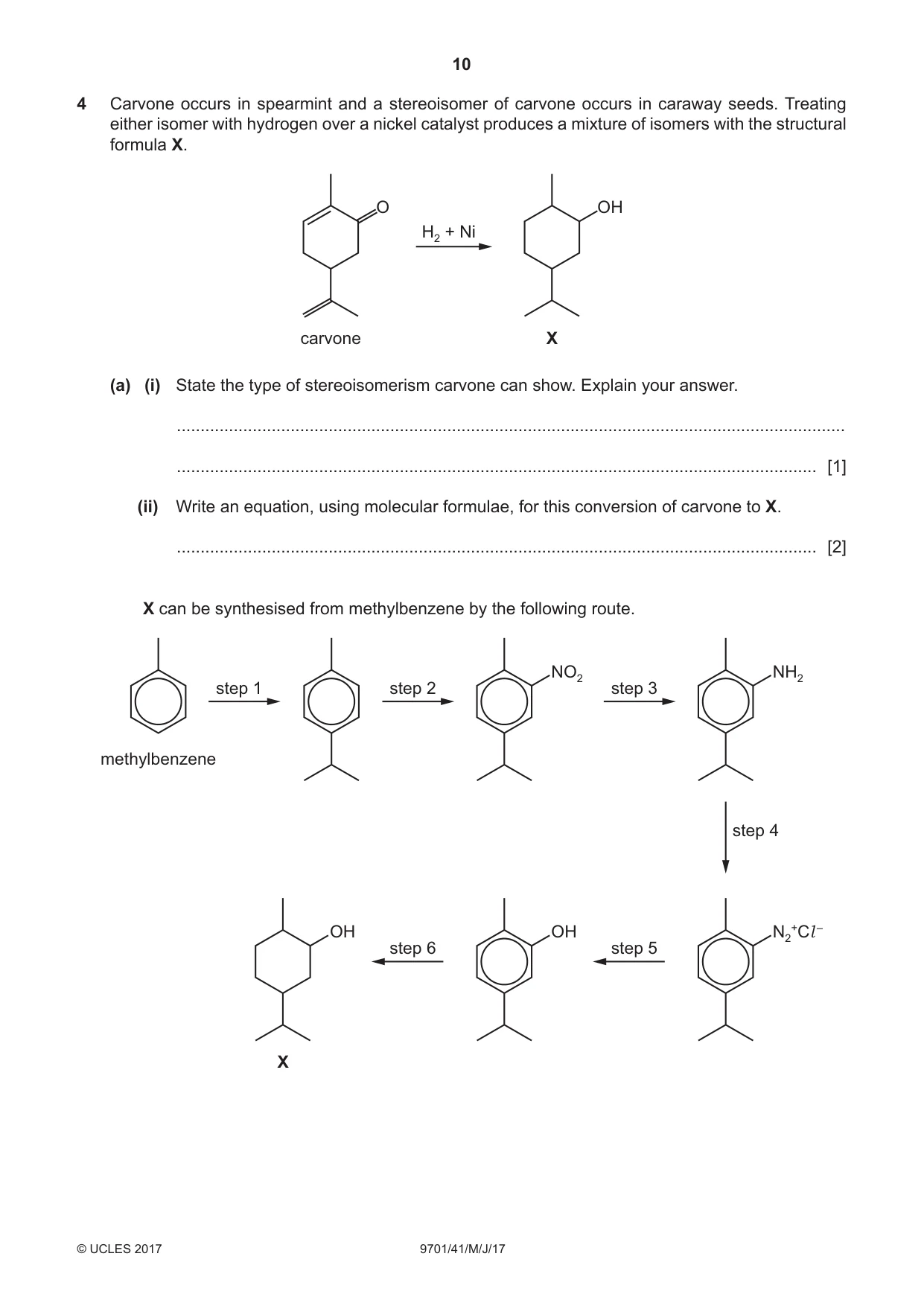
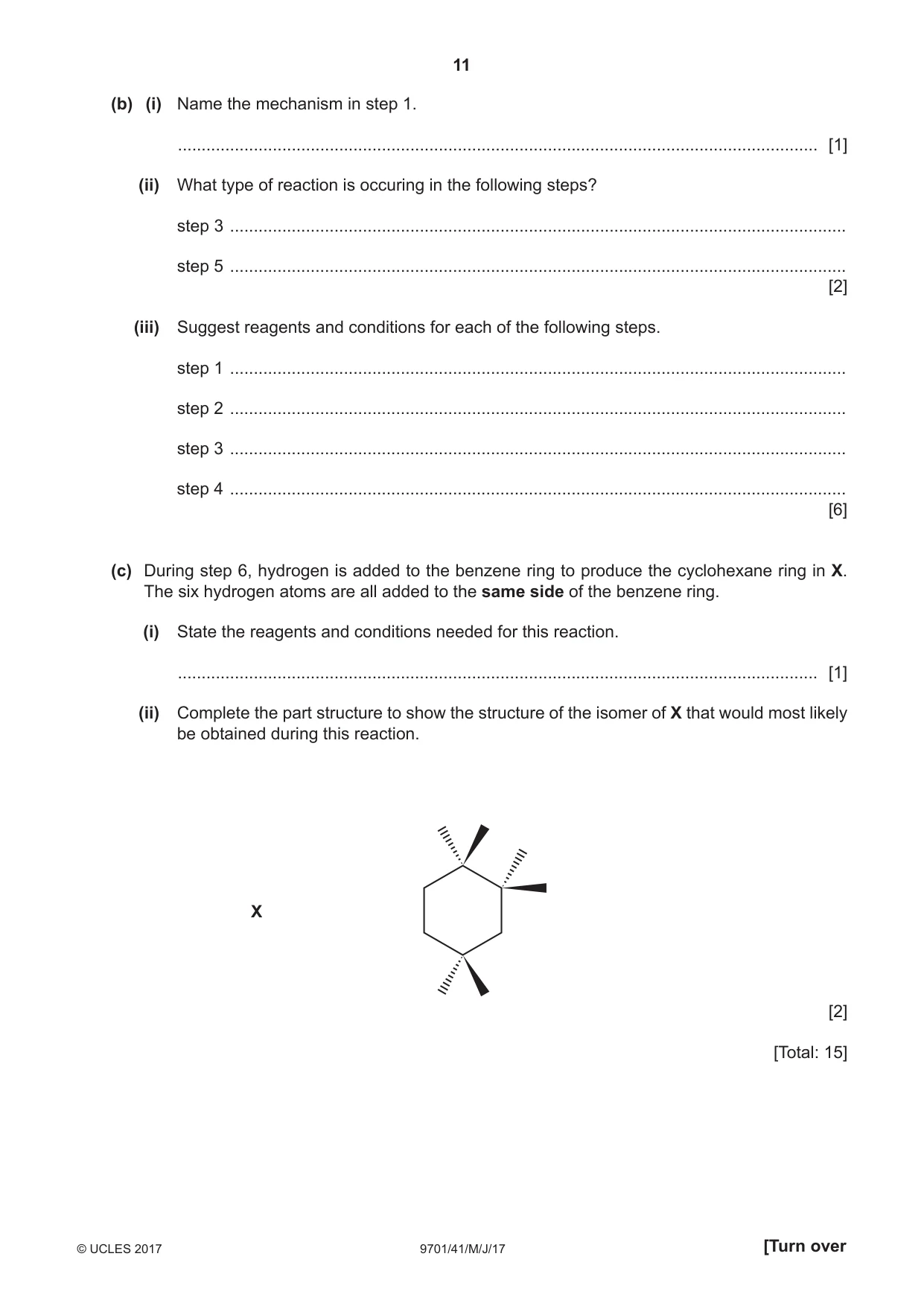
4 Carvone occurs in spearmint and a stereoisomer of carvone occurs in caraway seeds. Treating either isomer with hydrogen over a nickel catalyst produces a mixture of isomers with the structural formula X. O OH H2 + Ni carvone X (a) (i) State the type of stereoisomerism carvone can show. Explain your answer. ............................................................................................................................................. ....................................................................................................................................... [1] (ii) Write an equation, using molecular formulae, for this conversion of carvone to X. ....................................................................................................................................... [2] X can be synthesised from methylbenzene by the following route. NO2 NH2 step 1 step 2 step 3 methylbenzene step 4 OH OH N2+Cl – step 6 step 5 X (b) (i) Name the mechanism in step 1. ....................................................................................................................................... [1] (ii) What type of reaction is occuring in the following steps? step 3 .................................................................................................................................. step 5 .................................................................................................................................. [2] (iii) Suggest reagents and conditions for each of the following steps. step 1 .................................................................................................................................. step 2 .................................................................................................................................. step 3 .................................................................................................................................. step 4 .................................................................................................................................. [6] (c) During step 6, hydrogen is added to the benzene ring to produce the cyclohexane ring in X. The six hydrogen atoms are all added to the same side of the benzene ring. (i) State the reagents and conditions needed for this reaction. ....................................................................................................................................... [1] (ii) Complete the part structure to show the structure of the isomer of X that would most likely be obtained during this reaction. X [2] [Total: 15]
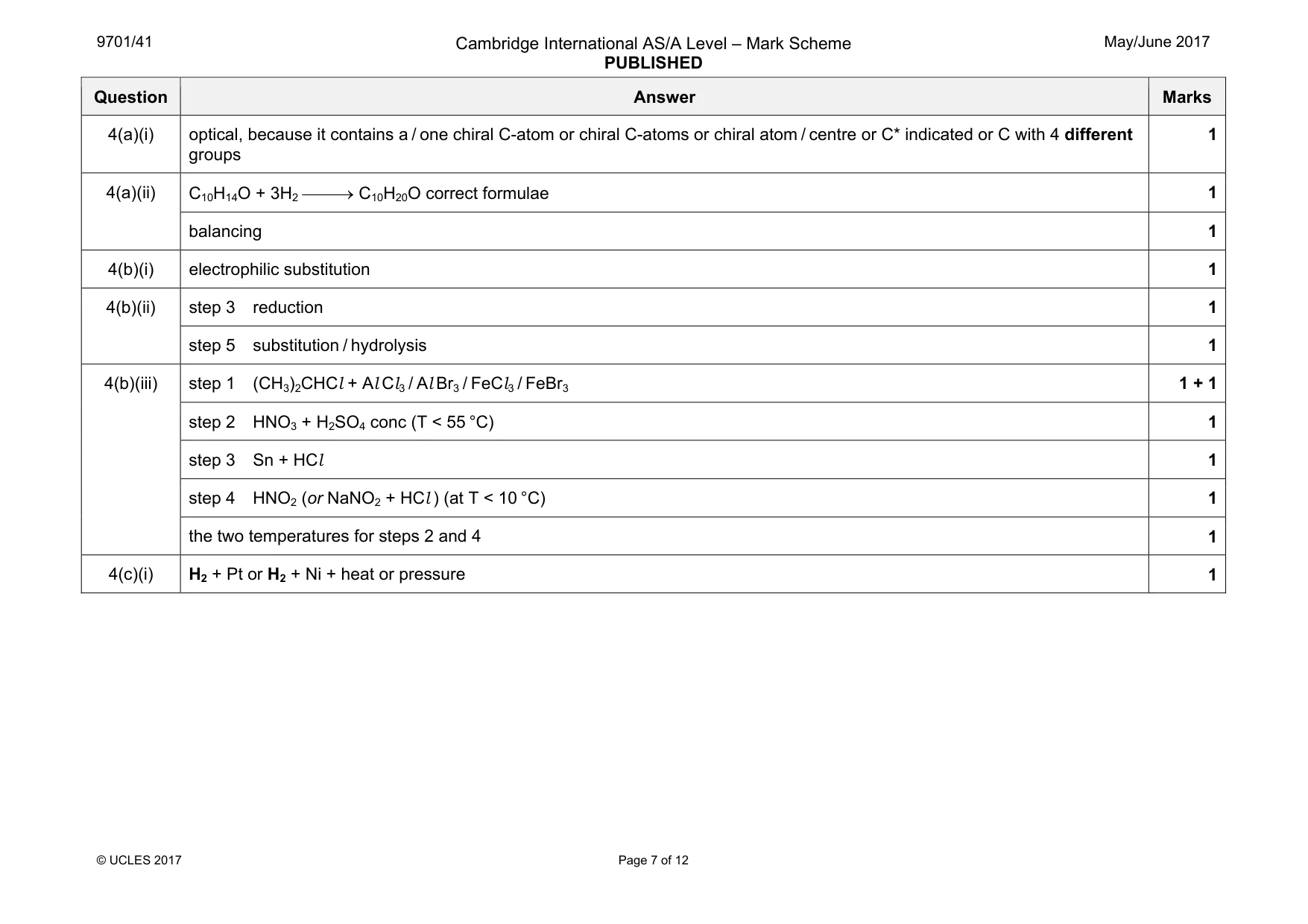
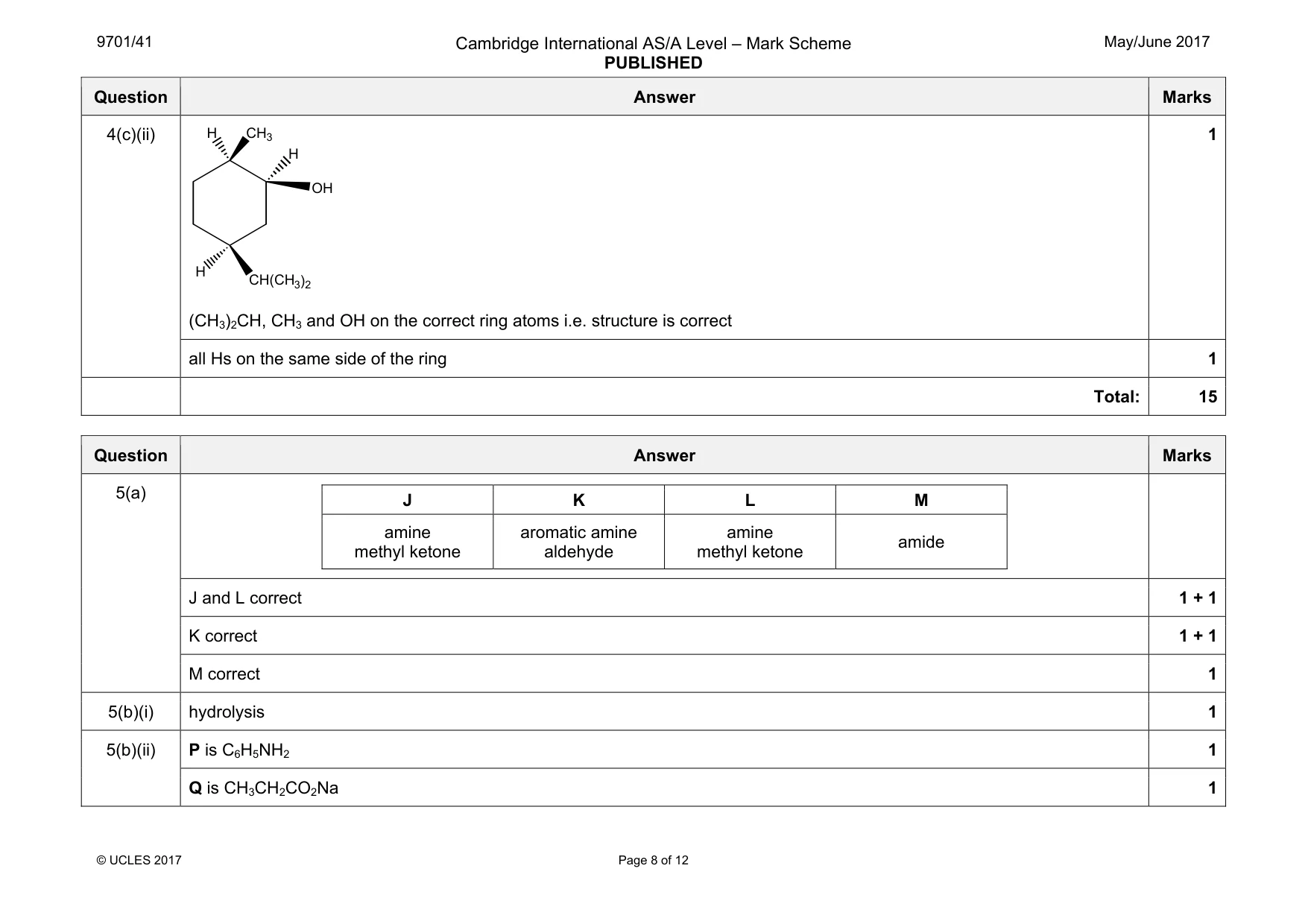
Mark scheme: 4(a)(i) optical, because it contains a / one chiral C-atom or chiral C-atoms or chiral atom / centre or C* indicated or C with 4 different groups 1 4(a)(ii) C10H14O + 3H2 → C10H20O correct formulae 1 balancing 1 4(b)(i) electrophilic substitution 1 4(b)(ii) step 3 reduction 1 step 5 substitution / hydrolysis 1 4(b)(iii) step 1 (CH3)2CHCl + Al Cl3 / Al Br3 / FeCl3 / FeBr3 1 + 1 step 2 HNO3 + H2SO4 conc (T < 55 °C) 1 step 3 Sn + HCl 1 step 4 HNO2 (or NaNO2 + HCl ) (at T < 10 °C) 1 the two temperatures for steps 2 and 4 1 4(c)(i) H2 + Pt or H2 + Ni + heat or pressure 1 Question Answer Marks 4(c)(ii) H H H CH(CH3)2 OH CH3 (CH3)2CH, CH3 and OH on the correct ring atoms i.e. structure is correct 1 all Hs on the same side of the ring 1 Total: 15
More questions on Reacting masses and volumes (of solutions and gases)
Q5 · Compounds J, K, L and M are isomers of each other with the molecular formula C9H11NO
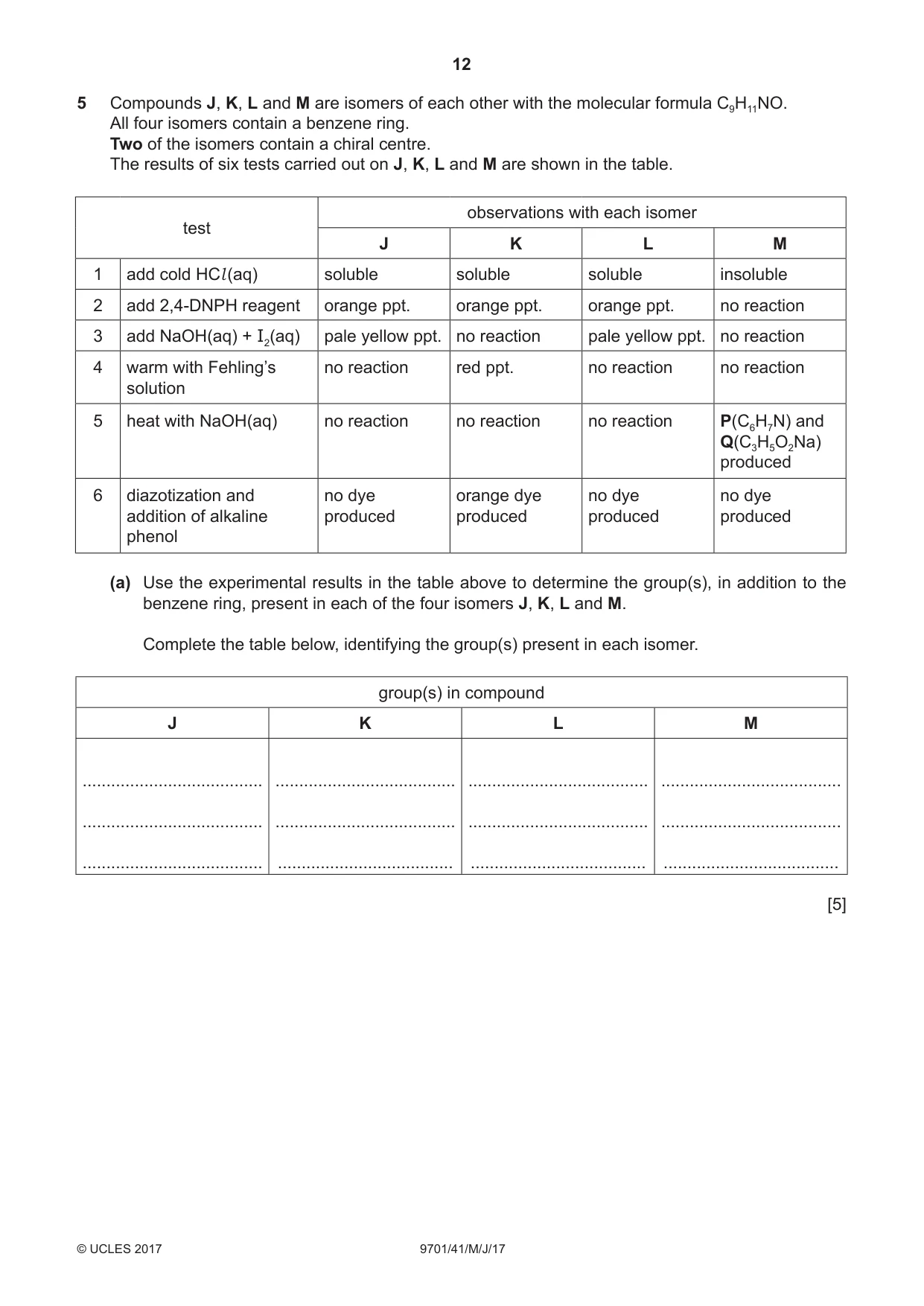
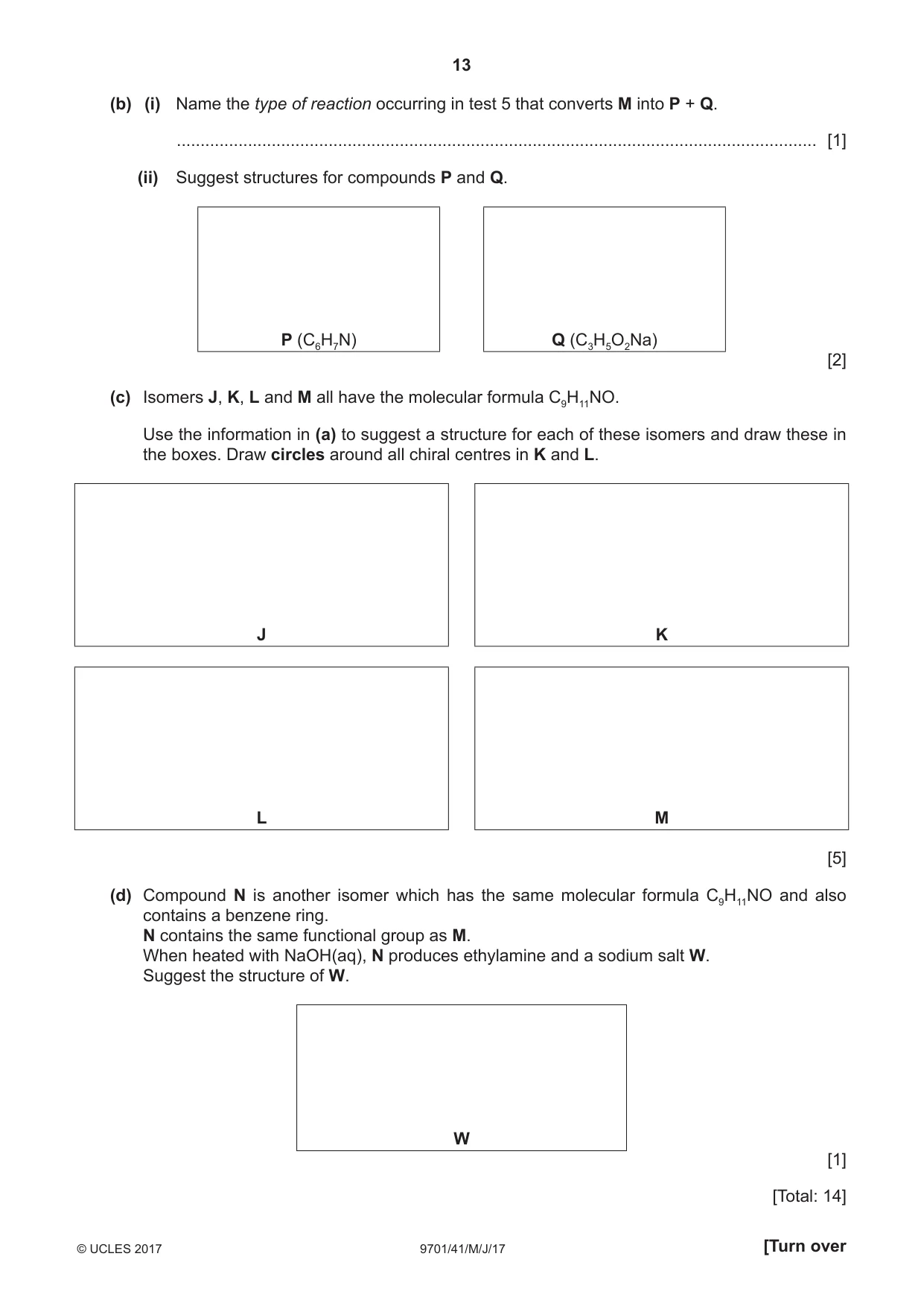
5 Compounds J, K, L and M are isomers of each other with the molecular formula C9H11NO. All four isomers contain a benzene ring. Two of the isomers contain a chiral centre. The results of six tests carried out on J, K, L and M are shown in the table. observations with each isomer test J K L M 1 add cold HCl (aq) soluble soluble soluble insoluble 2 add 2,4-DNPH reagent orange ppt. orange ppt. orange ppt. no reaction 3 add NaOH(aq) + I2(aq) pale yellow ppt. no reaction pale yellow ppt. no reaction 4 warm with Fehling’s no reaction red ppt. no reaction no reaction solution 5 heat with NaOH(aq) no reaction no reaction no reaction P(C6H7N) and Q(C3H5O2Na) produced 6 diazotization and no dye orange dye no dye no dye addition of alkaline produced produced produced produced phenol (a) Use the experimental results in the table above to determine the group(s), in addition to the benzene ring, present in each of the four isomers J, K, L and M. Complete the table below, identifying the group(s) present in each isomer. group(s) in compound J K L M ...................................... ...................................... ...................................... ...................................... ...................................... ...................................... ...................................... ...................................... ...................................... ..................................... ..................................... ..................................... [5] (b) (i) Name the type of reaction occurring in test 5 that converts M into P + Q. ....................................................................................................................................... [1] (ii) Suggest structures for compounds P and Q. P (C6H7N) Q (C3H5O2Na) [2] (c) Isomers J, K, L and M all have the molecular formula C9H11NO. Use the information in (a) to suggest a structure for each of these isomers and draw these in the boxes. Draw circles around all chiral centres in K and L. J K L M [5] (d) Compound N is another isomer which has the same molecular formula C9H11NO and also contains a benzene ring. N contains the same functional group as M. When heated with NaOH(aq), N produces ethylamine and a sodium salt W. Suggest the structure of W. W [1] [Total: 14]
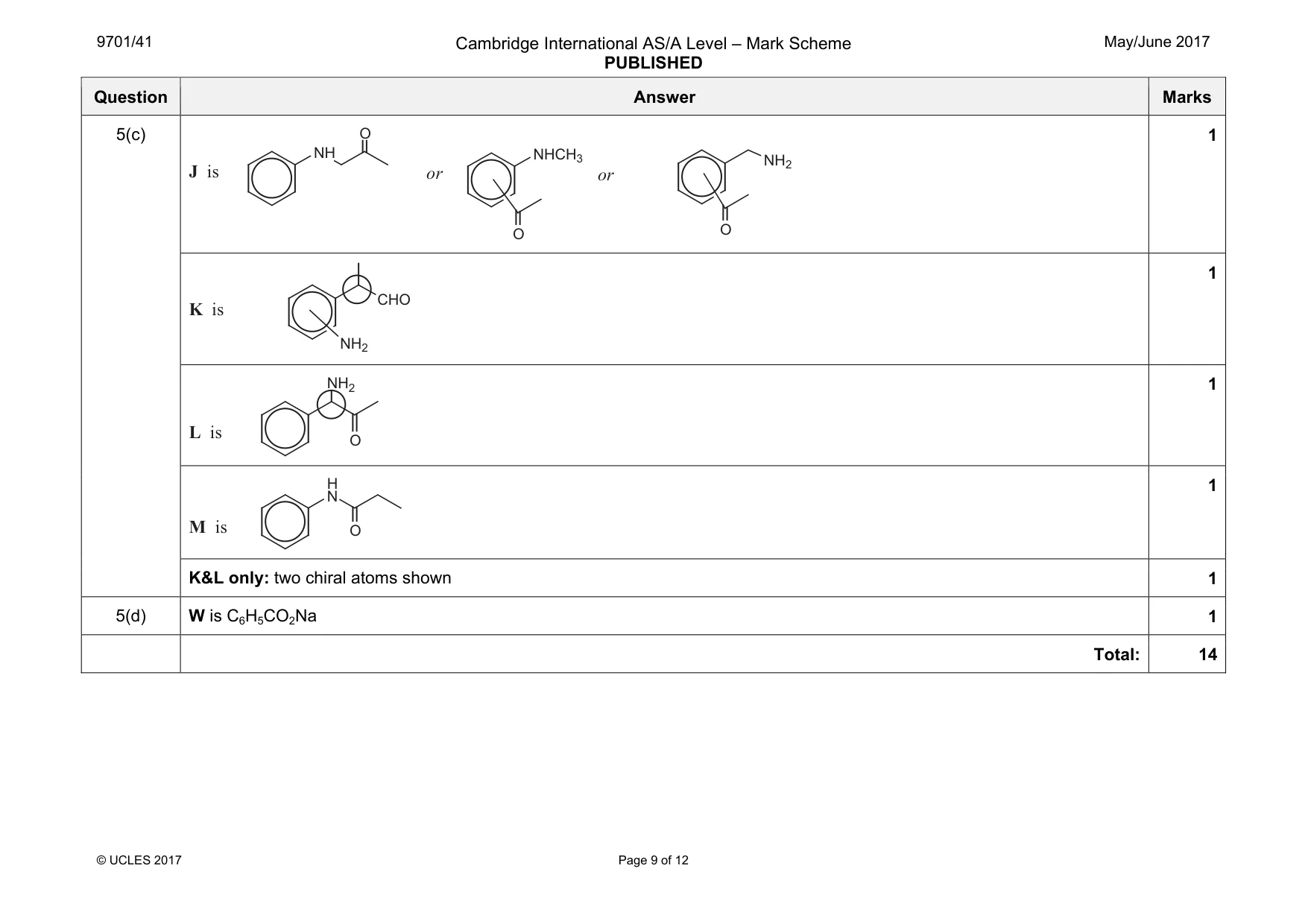
Mark scheme: 5(a) J K L M amine methyl ketone aromatic amine aldehyde amine methyl ketone amide J and L correct 1 + 1 K correct 1 + 1 M correct 1 5(b)(i) hydrolysis 1 5(b)(ii) P is C6H5NH2 1 Q is CH3CH2CO2Na 1 Question Answer Marks 5(c) 1 1 1 1 K&L only: two chiral atoms shown 1 5(d) W is C6H5CO2Na 1 Total: 14 J is NH O or NHCH3 O NH2 or O CHO NH2 K is L is NH2 O H N O M is
More questions on Formulas, functional groups and the naming of organic compounds
Q6 · The reaction between 1-chloro-1-phenylethane and hydroxide ions to produce…
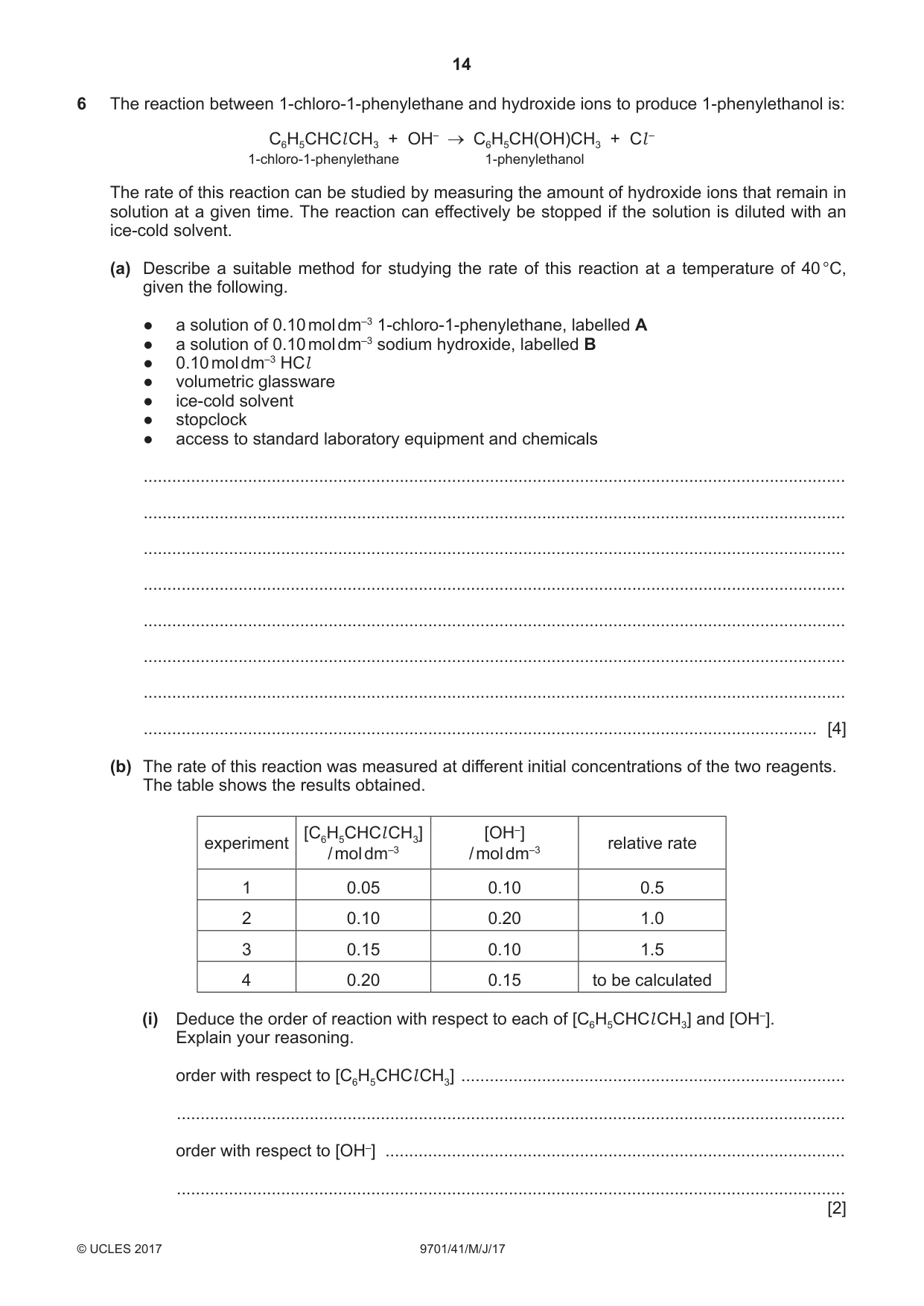
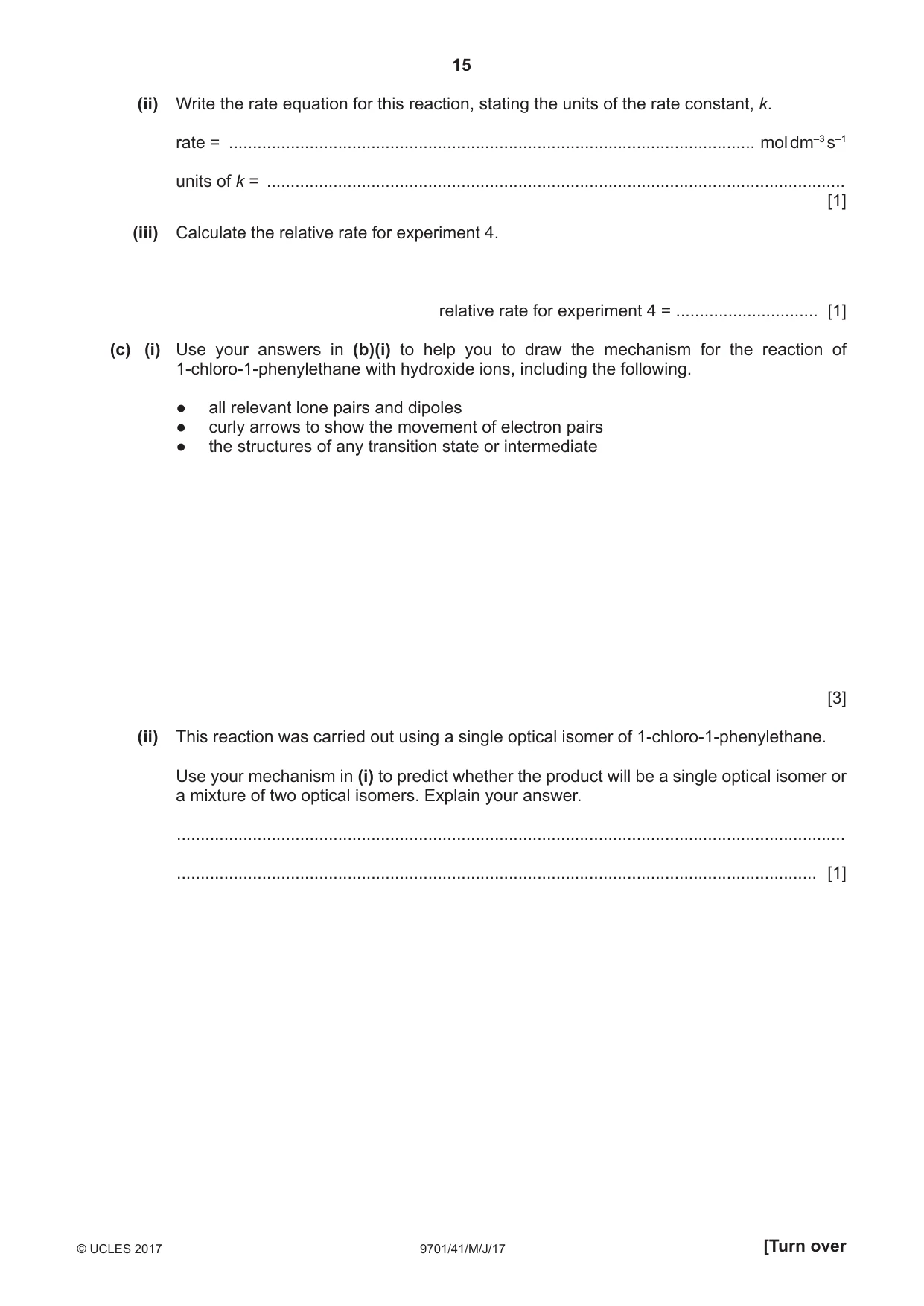
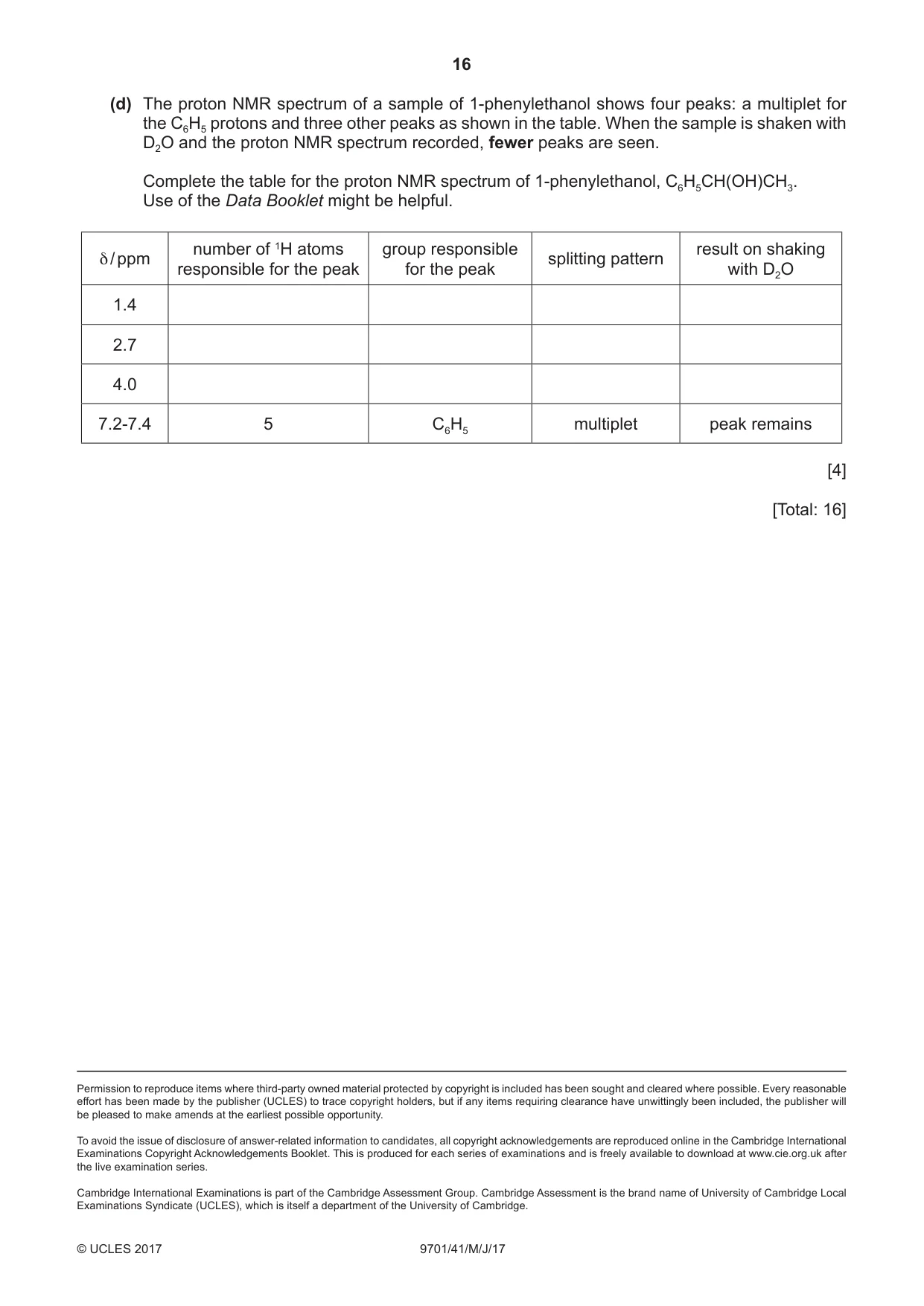
6 The reaction between 1-chloro-1-phenylethane and hydroxide ions to produce 1-phenylethanol is: C6H5CHCl CH3 + OH– C6H5CH(OH)CH3 + Cl – 1-chloro-1-phenylethane 1-phenylethanol The rate of this reaction can be studied by measuring the amount of hydroxide ions that remain in solution at a given time. The reaction can effectively be stopped if the solution is diluted with an ice-cold solvent. (a) Describe a suitable method for studying the rate of this reaction at a temperature of 40 °C, given the following. ● a solution of 0.10 mol dm–3 1-chloro-1-phenylethane, labelled A ● a solution of 0.10 mol dm–3 sodium hydroxide, labelled B ● 0.10 mol dm–3 HCl ● volumetric glassware ● ice-cold solvent ● stopclock ● access to standard laboratory equipment and chemicals .................................................................................................................................................... .................................................................................................................................................... .................................................................................................................................................... .................................................................................................................................................... .................................................................................................................................................... .................................................................................................................................................... .................................................................................................................................................... .............................................................................................................................................. [4] (b) The rate of this reaction was measured at different initial concentrations of the two reagents. The table shows the results obtained. [C6H5CHCl CH3] [OH–] experiment relative rate / mol dm–3 / mol dm–3 1 0.05 0.10 0.5 2 0.10 0.20 1.0 3 0.15 0.10 1.5 4 0.20 0.15 to be calculated (i) Deduce the order of reaction with respect to each of [C6H5CHCl CH3] and [OH–]. Explain your reasoning. order with respect to [C6H5CHCl CH3] .................................................................................. ............................................................................................................................................. order with respect to [OH–] .................................................................................................. ............................................................................................................................................. [2] (ii) Write the rate equation for this reaction, stating the units of the rate constant, k. rate = ................................................................................................................ mol dm–3 s–1 units of k = ........................................................................................................................... [1] (iii) Calculate the relative rate for experiment 4. relative rate for experiment 4 = .............................. [1] (c) (i) Use your answers in (b)(i) to help you to draw the mechanism for the reaction of 1-chloro-1-phenylethane with hydroxide ions, including the following. ● all relevant lone pairs and dipoles ● curly arrows to show the movement of electron pairs ● the structures of any transition state or intermediate [3] (ii) This reaction was carried out using a single optical isomer of 1-chloro-1-phenylethane. Use your mechanism in (i) to predict whether the product will be a single optical isomer or a mixture of two optical isomers. Explain your answer. ............................................................................................................................................. ....................................................................................................................................... [1] (d) The proton NMR spectrum of a sample of 1-phenylethanol shows four peaks: a multiplet for the C6H5 protons and three other peaks as shown in the table. When the sample is shaken with D2O and the proton NMR spectrum recorded, fewer peaks are seen. Complete the table for the proton NMR spectrum of 1-phenylethanol, C6H5CH(OH)CH3. Use of the Data Booklet might be helpful. number of 1H atoms group responsible result on shakingδ / ppm splitting pattern responsible for the peak for the peak with D2O 1.4 2.7 4.0 7.2-7.4 5 C6H5 multiplet peak remains [4] [Total: 16]
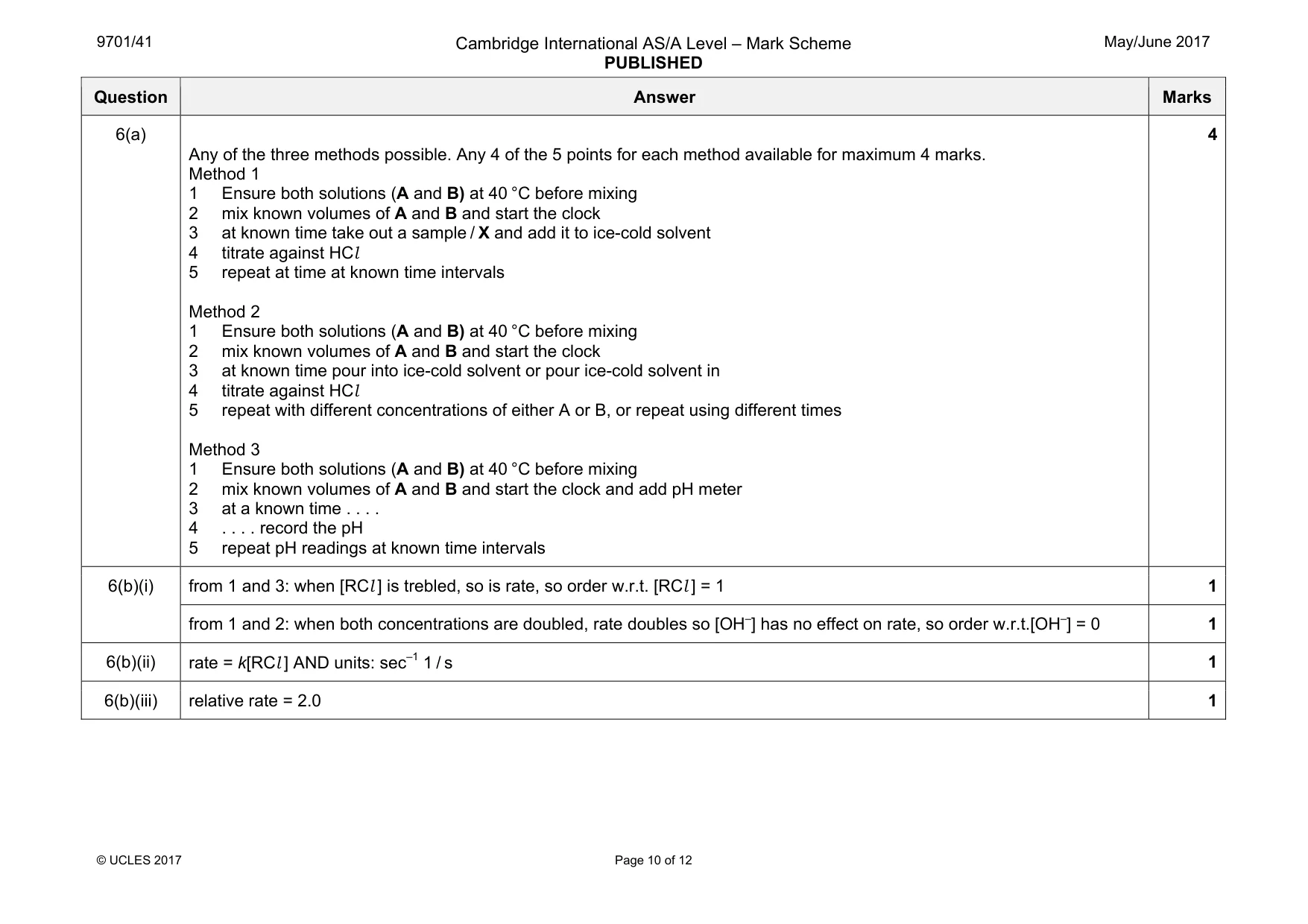
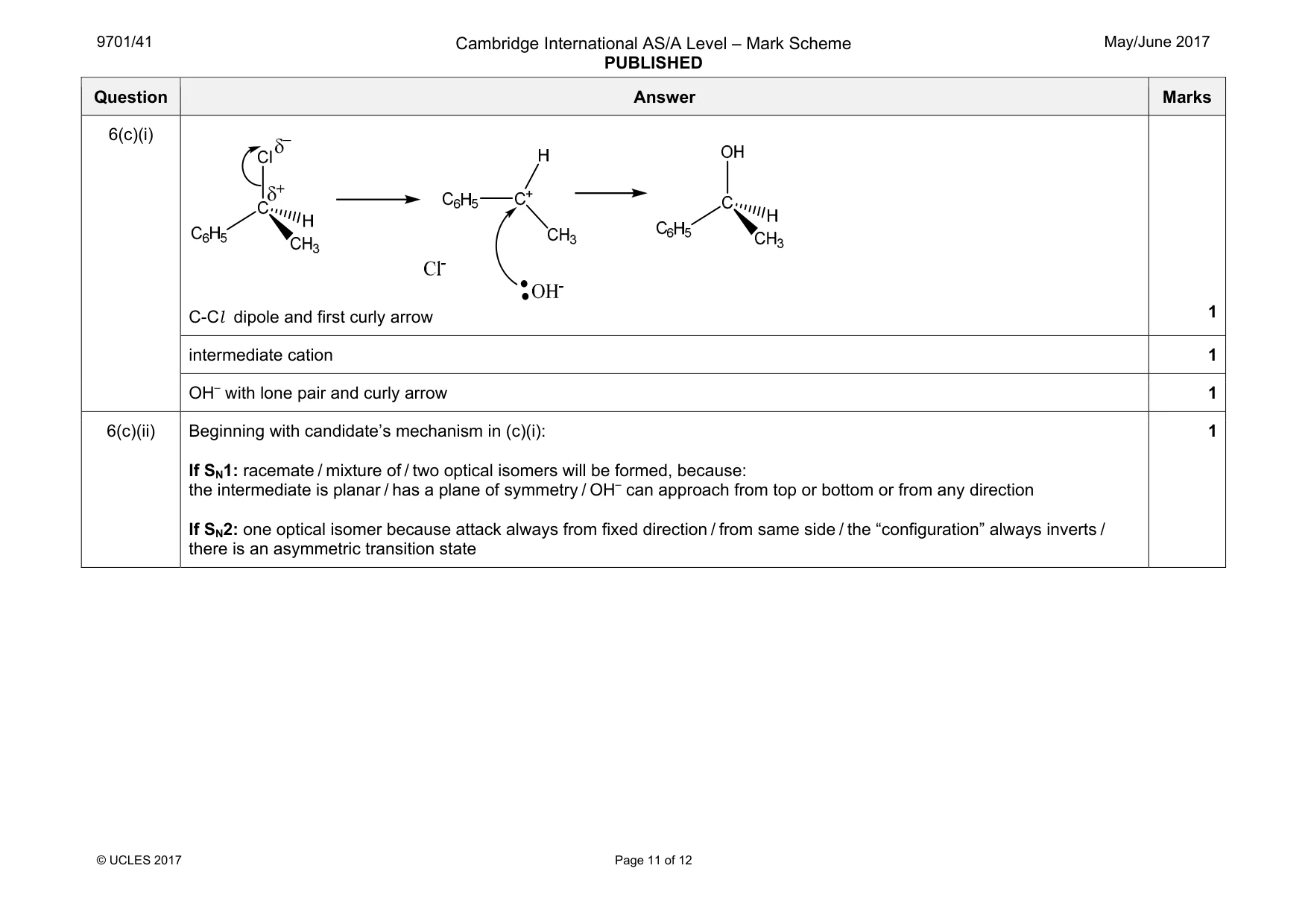
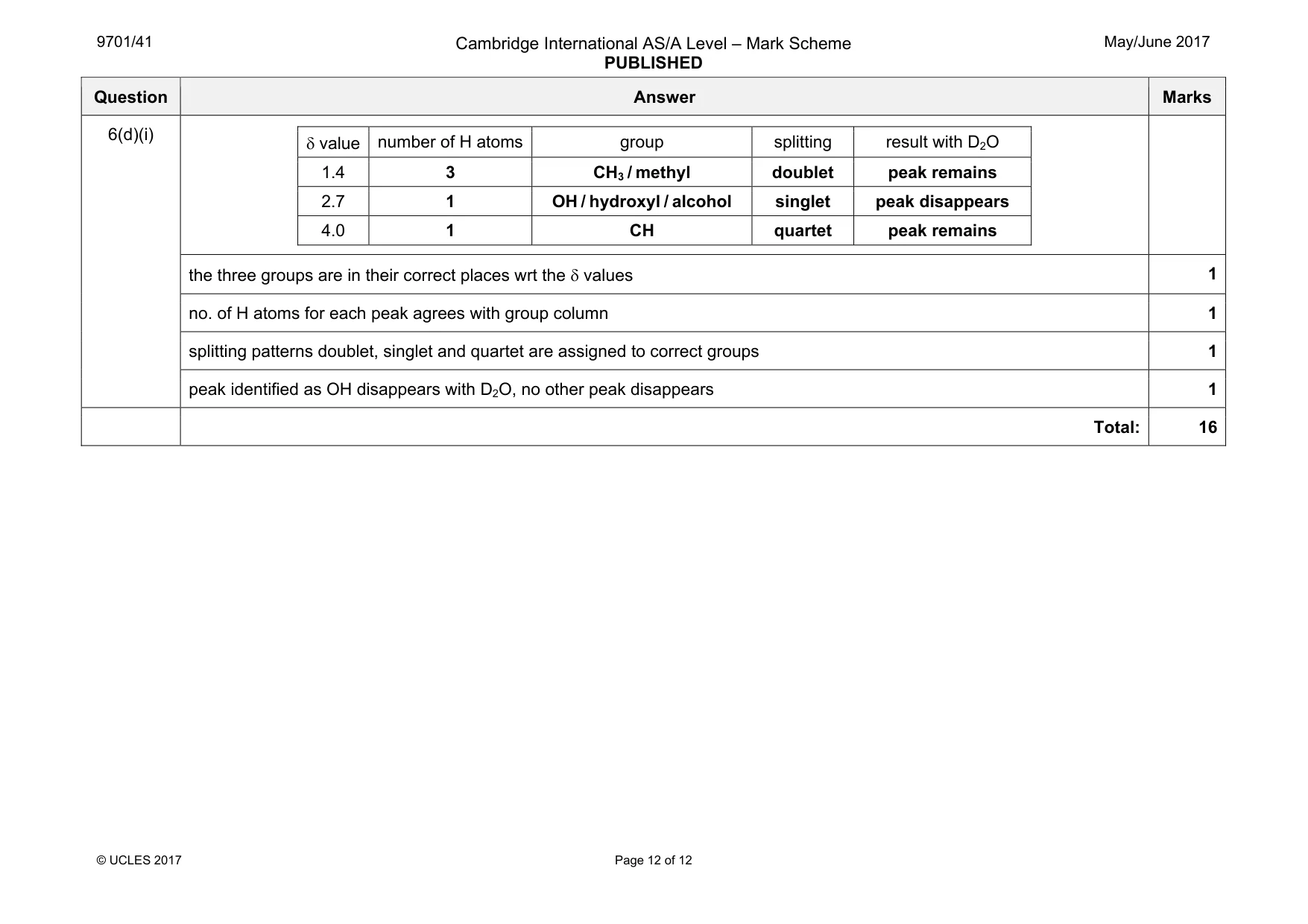
Mark scheme: 6(a) Any of the three methods possible. Any 4 of the 5 points for each method available for maximum 4 marks. Method 1 1 Ensure both solutions (A and B) at 40 °C before mixing 2 mix known volumes of A and B and start the clock 3 at known time take out a sample / X and add it to ice-cold solvent 4 titrate against HCl 5 repeat at time at known time intervals Method 2 1 Ensure both solutions (A and B) at 40 °C before mixing 2 mix known volumes of A and B and start the clock 3 at known time pour into ice-cold solvent or pour ice-cold solvent in 4 titrate against HCl 5 repeat with different concentrations of either A or B, or repeat using different times Method 3 1 Ensure both solutions (A and B) at 40 °C before mixing 2 mix known volumes of A and B and start the clock and add pH meter 3 at a known time . . . . 4 . . . . record the pH 5 repeat pH readings at known time intervals 4 6(b)(i) from 1 and 3: when [RCl ] is trebled, so is rate, so order w.r.t. [RCl ] = 1 1 from 1 and 2: when both concentrations are doubled, rate doubles so [OH–] has no effect on rate, so order w.r.t.[OH–] = 0 1 6(b)(ii) rate = k[RCl ] AND units: sec–1 1 / s 1 6(b)(iii) relative rate = 2.0 1 Question Answer Marks 6(c)(i) C-Cl dipole and first curly arrow 1 intermediate cation 1 OH– with lone pair and curly arrow 1 6(c)(ii) Beginning with candidate’s mechanism in (c)(i): If SN1: racemate / mixture of / two optical isomers will be formed, because: the intermediate is planar / has a plane of symmetry / OH– can approach from top or bottom or from any direction If SN2: one optical isomer because attack always from fixed direction / from same side / the “configuration” always inverts / there is an asymmetric transition state 1 Question Answer Marks 6(d)(i) δ value number of H atoms group splitting result with D2O 1.4 3 CH3 / methyl doublet peak remains 2.7 1 OH / hydroxyl / alcohol singlet peak disappears 4.0 1 CH quartet peak remains the three groups are in their correct places wrt the δ values 1 no. of H atoms for each peak agrees with group column 1 splitting patterns doublet, singlet and quartet are assigned to correct groups 1 peak identified as OH disappears with D2O, no other peak disappears 1 Total: 16
More questions on Simple rate equations, orders of reaction and rate constants
What was in this paper
The subtopics covered by these 6 questions, and how many questions each got. Open one in a new tab to see every Cambridge question on it.
1Formulas, functional groups and the naming of organic compounds1General characteristic chemical properties of the first set of transition elements, titanium to copper1Hess’s law1Reacting masses and volumes (of solutions and gases)1Simple rate equations, orders of reaction and rate constants1What you needed in this session
Cambridge’s own grade thresholds for 2017 May/June, Paper 4 · Variant 1. A higher threshold means an easier paper — the bar moves with how the cohort did.