Cambridge A Level Chemistry 9701 — 2014 May/June Paper 4 · Variant 2
9701/42/M/J/14 · 100 marks · ≈113 min
The question paper and its mark scheme, free to read here and free to download. This is Cambridge’s own paper, exactly as it was sat.
Question paper20 pages

Mark scheme9 pages
Answers below. Sit the paper first if you are practising.
Paper as text
Question paper, page 1
This document consists of 19 printed pages and 1 blank page. [Turn over IB14 06_9701_42/6RP © UCLES 2014 For Examiner’s Use 1 2 3 4 5 6 7 8 Total READ THESE INSTRUCTIONS FIRST Write your Centre number, candidate number and name on all the work you hand in. Write in dark blue or black pen. You may use an HB pencil for any diagrams or graphs. Do not use staples, paper clips, glue or correction fl uid. DO NOT WRITE IN ANY BARCODES. Section A Answer all questions. Section B Answer all questions. Electronic calculators may be used. You may lose marks if you do not show your working or if you do not use appropriate units. A Data Booklet is provided. At the end of the examination, fasten all your work securely together. The number of marks is given in brackets [ ] at the end of each question or part question. CHEMISTRY 9701/42 Paper 4 Structured Questions May/June 2014 2 hours Candidates answer on the Question Paper. Additional Materials: Data Booklet Cambridge International Examinations Cambridge International Advanced Level
Question paper, page 2
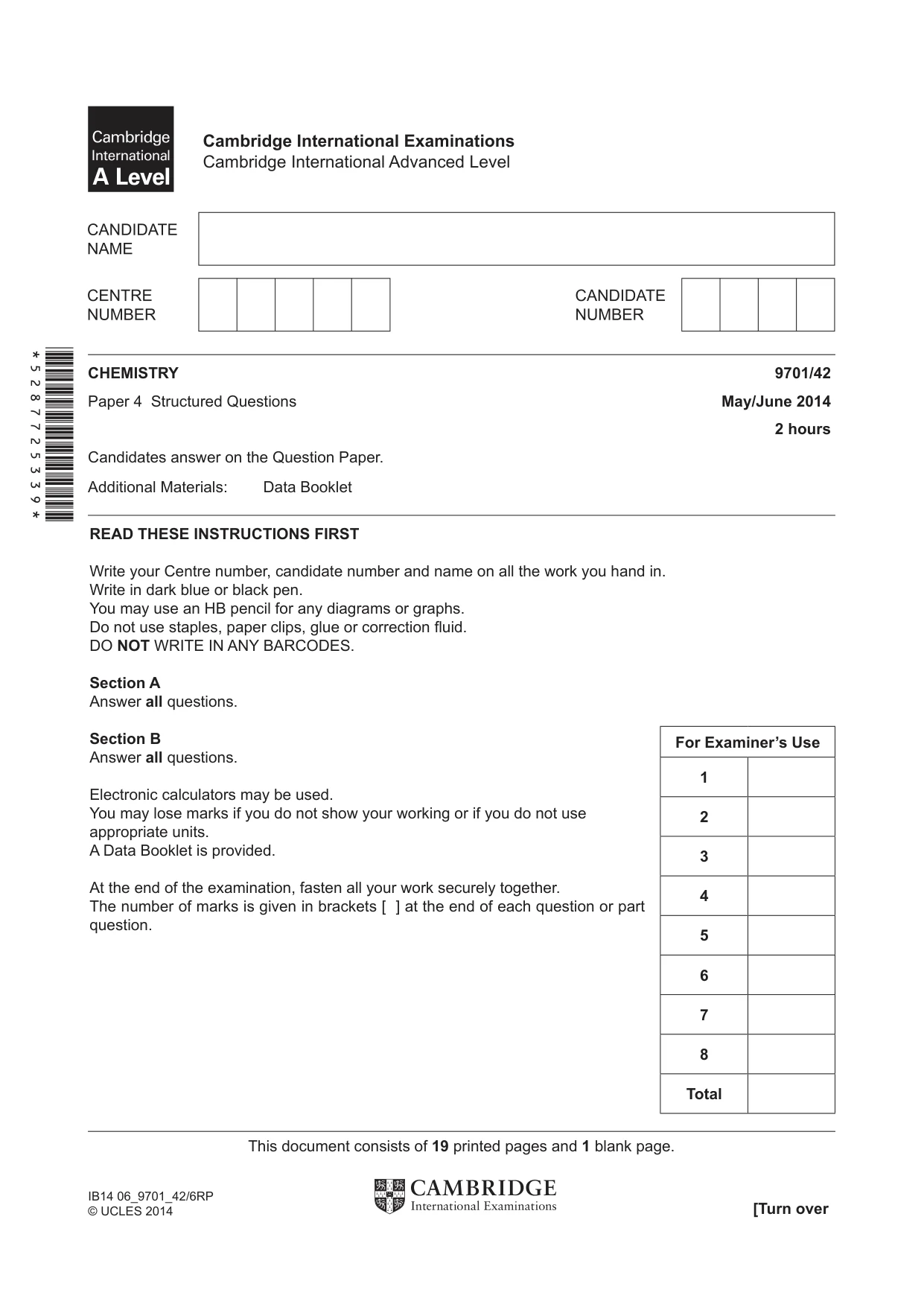
2 9701/42/M/J/14 © UCLES 2014 Section A Answer all the questions in the spaces provided. 1 (a) (i) On the diagrams below, show the outer electron arrangements of the atoms and ions indicated. (Use the symbol to represent a pair of electrons in an orbital.) 4s 3d Fe 4s 3d Fe2+(aq) 4s 3d Zn2+(aq) (ii) Use the above diagrams to explain why Fe2+(aq) ions are coloured, whereas Zn2+(aq) ions are colourless. … … … … [4] (b) When concentrated HCl is added to a solution of Cu2+(aq) ions, the solution turns yellow. (i) State the formula of the species responsible for the yellow colour and name the type of reaction that has occurred. … … (ii) Ammonia can react as a base or as a ligand. Describe the colour changes that occur when NH3(aq) is gradually added, with stirring, to the yellow solution, until the NH3(aq) is in excess. Identify the three ions or compounds responsible for the new colours. … … … … … … [7]
Question paper, page 3
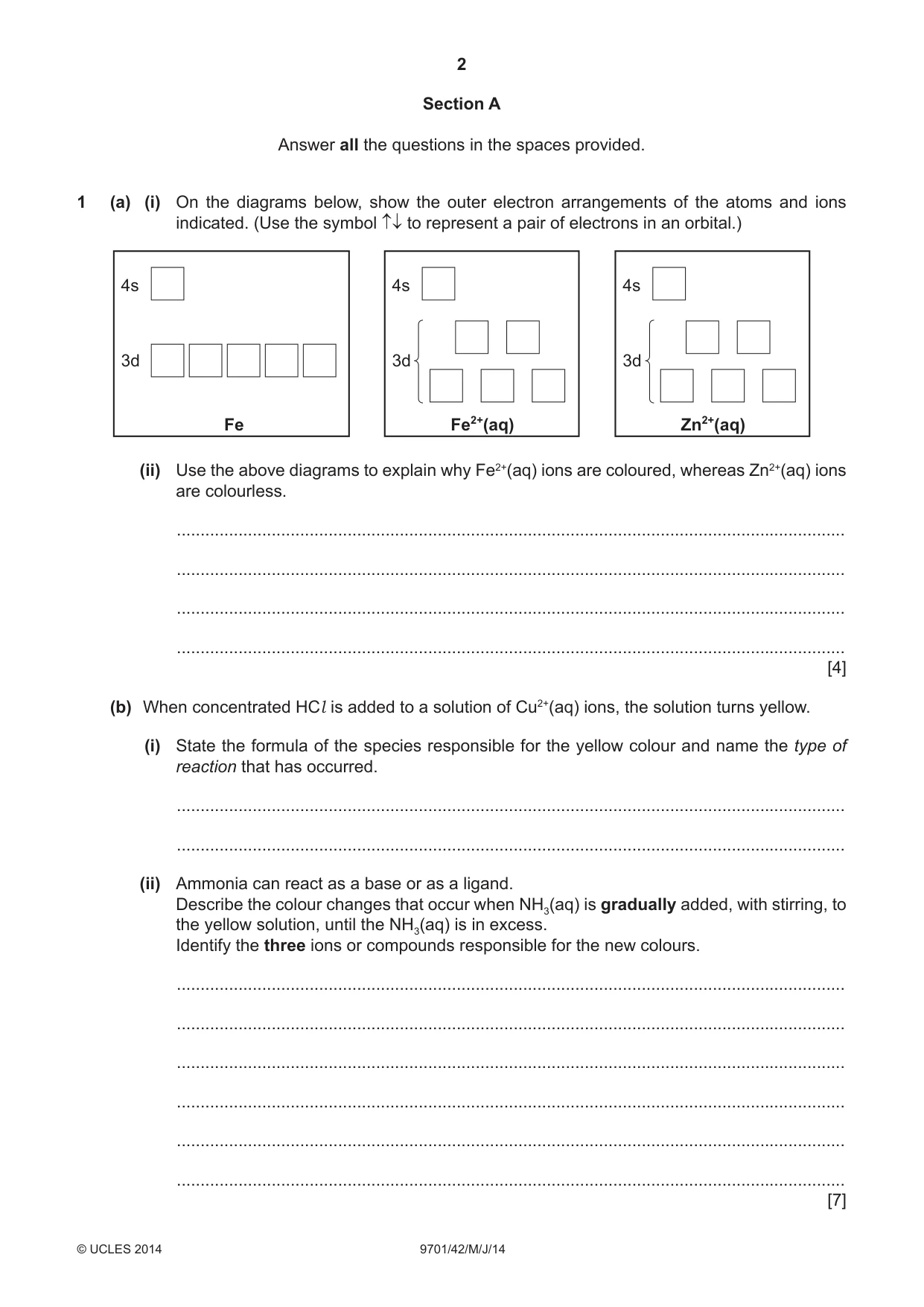
3 9701/42/M/J/14 © UCLES 2014 [Turn over (c) When aqueous solutions of KI and K2S2O8 are mixed almost no reaction occurs, but when a few drops of Fe2+(aq) or Fe3+(aq) are added, iodine, I2(aq), is produced at a steady rate. (i) Write an equation for the overall reaction. … (ii) State the precise role of the iron ions during this reaction. … (iii) By means of equations or otherwise, explain why the presence of either Fe2+ or Fe3+ is able to speed up the reaction. … … … [3] [Total: 14]
Question paper, page 4
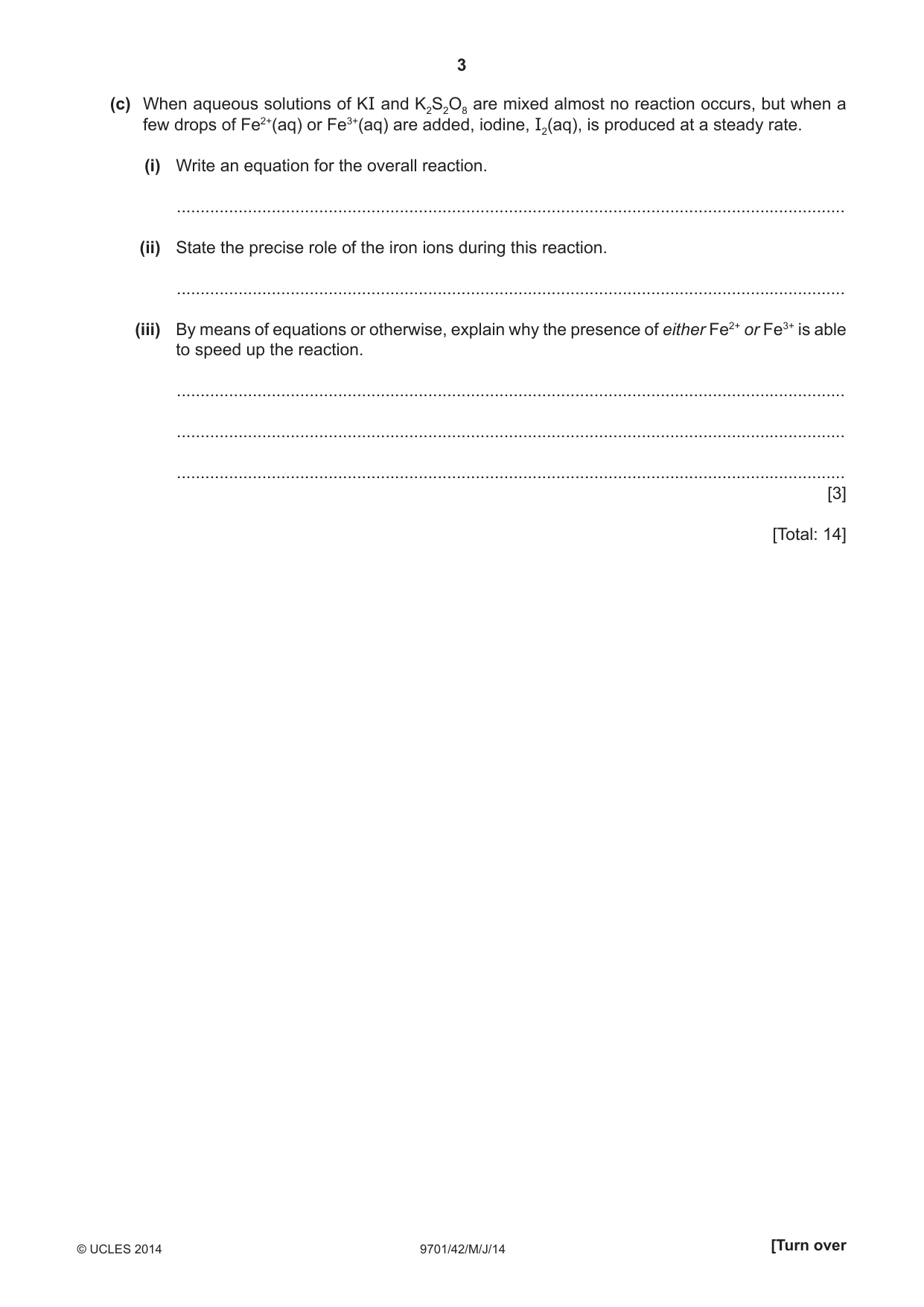
4 9701/42/M/J/14 © UCLES 2014 2 Lead(II) chloride, PbCl 2, can be used in the manufacture of some types of coloured glass. PbCl 2 is only sparingly soluble in water. The [Pb2+] in a saturated solution of PbCl 2 can be estimated by measuring the cell potential, Ecell, of the following cell. B D C saturated solution of PbCl 2 solid PbCl 2 H2(g) 1 atm, 298 K A salt bridge (a) In the spaces below, identify what the four letters A-D in the above diagram represent. A … B … C … D … [4] (b) In a saturated solution of PbCl 2, [PbCl 2(aq)] = 3.5 10–2 mol dm–3. (i) The E o for the Pb2+ / Pb electrode is – 0.13 V. Predict the potential of the right-hand electrode in the diagram above. Indicate this by placing a tick in the appropriate box in the table below. electrode potential / V place one tick only in this column – 0.17 – 0.13 – 0.09 0.00 Explain your answer. … …
Question paper, page 5
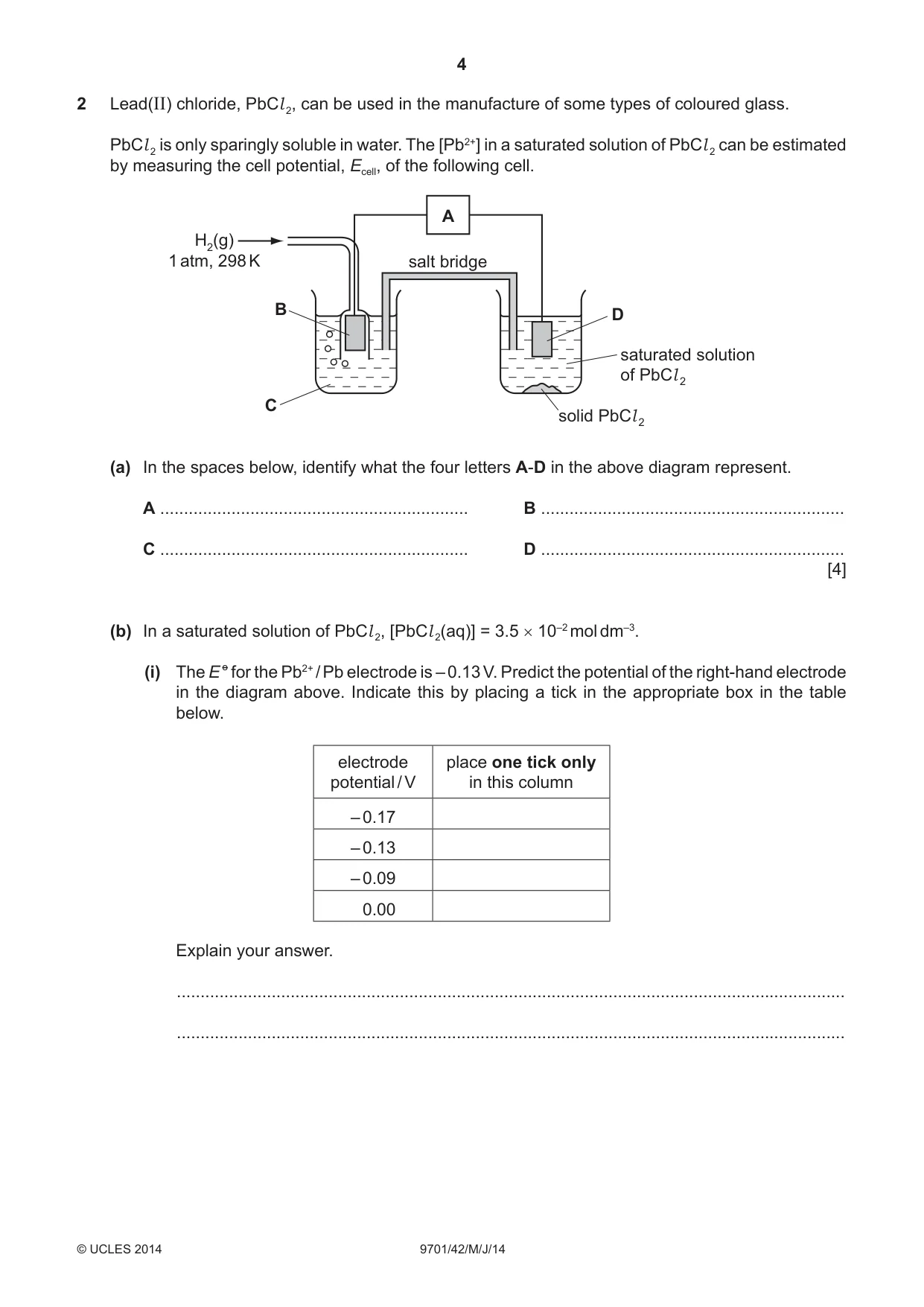
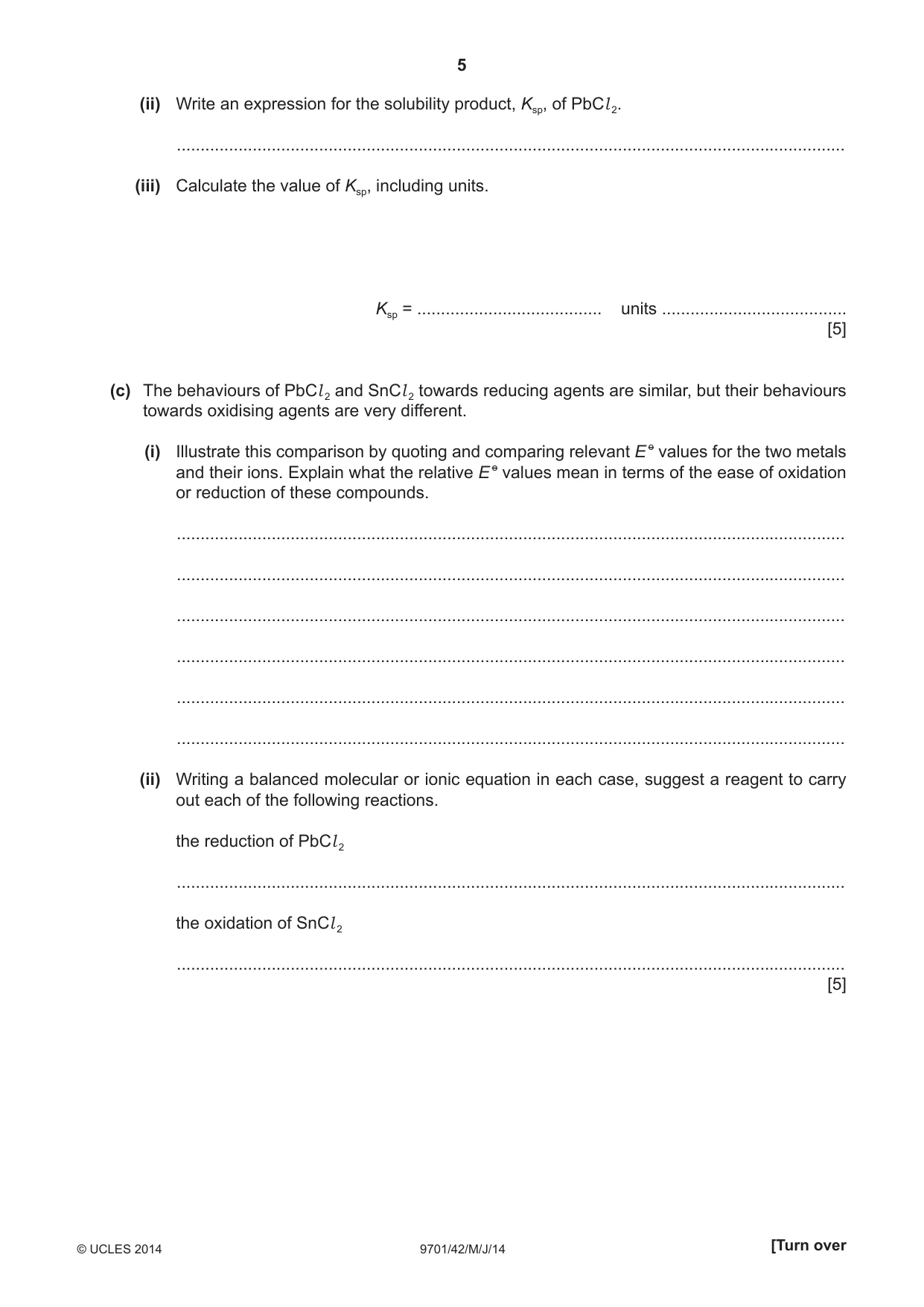
5 9701/42/M/J/14 © UCLES 2014 [Turn over (ii) Write an expression for the solubility product, Ksp, of PbCl 2. … (iii) Calculate the value of Ksp, including units. Ksp = … units … [5] (c) The behaviours of PbCl 2 and SnCl 2 towards reducing agents are similar, but their behaviours towards oxidising agents are very different. (i) Illustrate this comparison by quoting and comparing relevant E o values for the two metals and their ions. Explain what the relative E o values mean in terms of the ease of oxidation or reduction of these compounds. … … … … … … (ii) Writing a balanced molecular or ionic equation in each case, suggest a reagent to carry out each of the following reactions. the reduction of PbCl 2 … the oxidation of SnCl 2 … [5]
Question paper, page 6
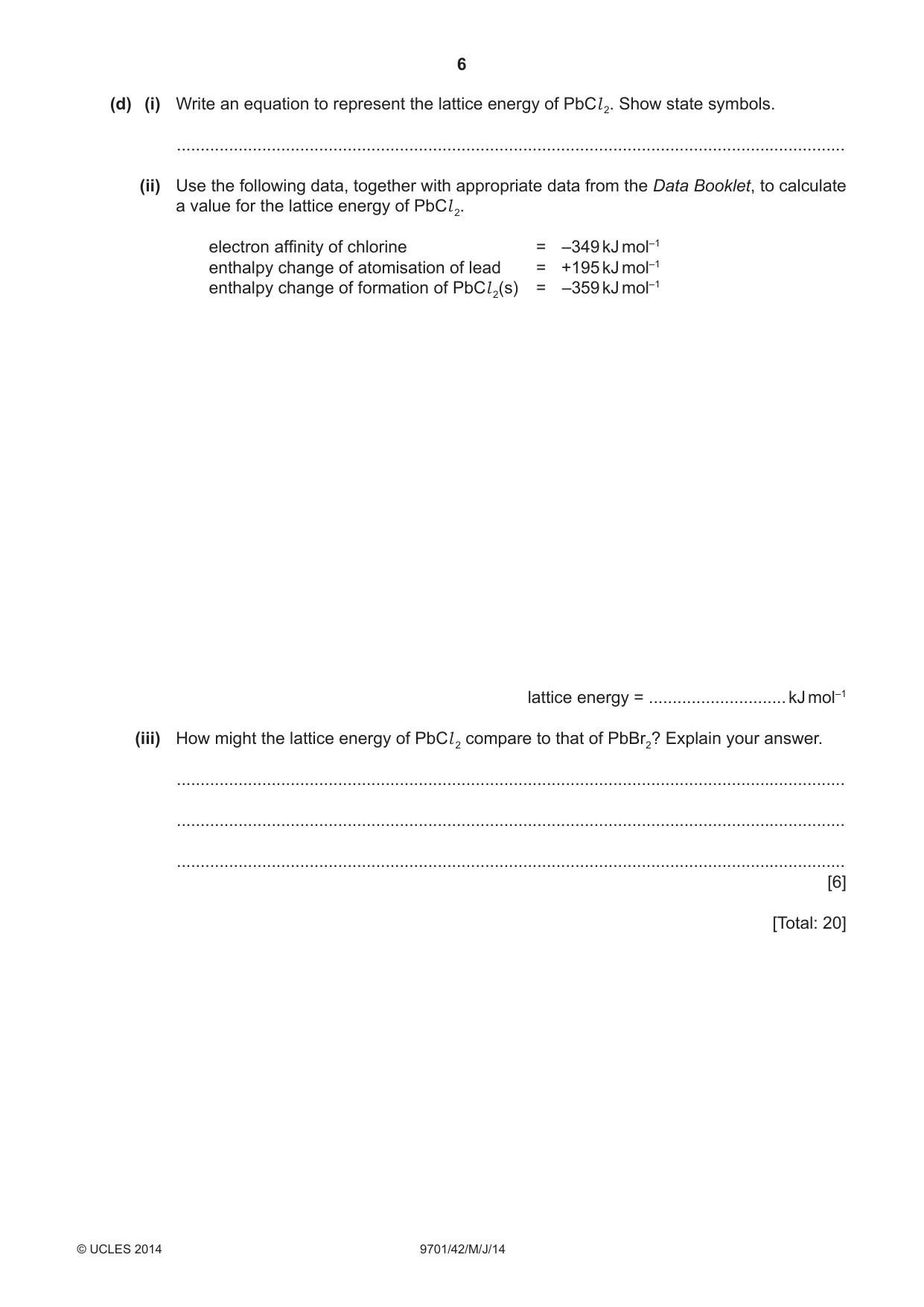
6 9701/42/M/J/14 © UCLES 2014 (d) (i) Write an equation to represent the lattice energy of PbCl 2. Show state symbols. … (ii) Use the following data, together with appropriate data from the Data Booklet, to calculate a value for the lattice energy of PbCl 2. electron affi nity of chlorine = –349 kJ mol–1 enthalpy change of atomisation of lead = +195 kJ mol–1 enthalpy change of formation of PbCl 2(s) = –359 kJ mol–1 lattice energy = … kJ mol–1 (iii) How might the lattice energy of PbCl 2 compare to that of PbBr2? Explain your answer. … … … [6] [Total: 20]
Question paper, page 7
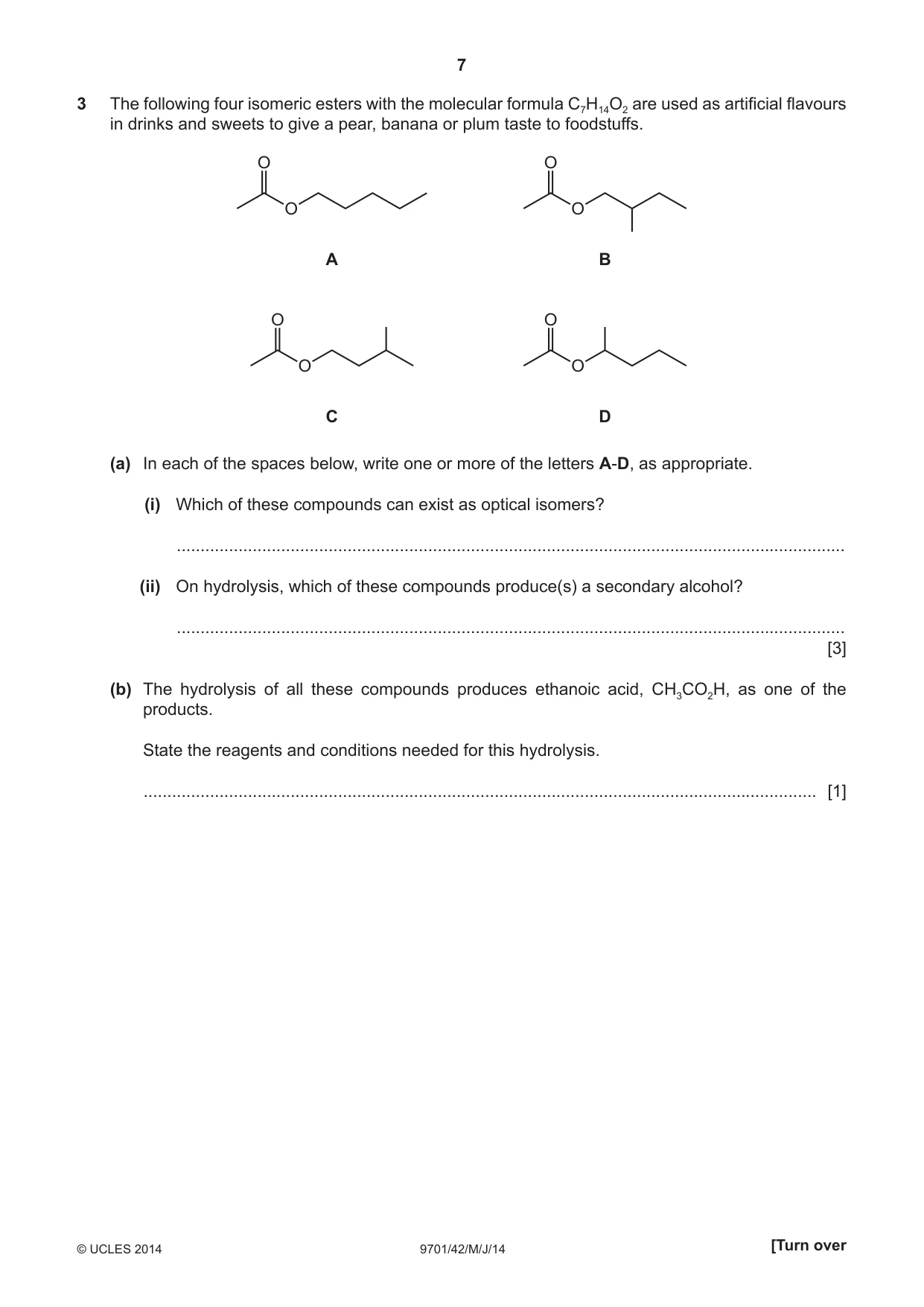
7 9701/42/M/J/14 © UCLES 2014 [Turn over 3 The following four isomeric esters with the molecular formula C7H14O2 are used as artifi cial fl avours in drinks and sweets to give a pear, banana or plum taste to foodstuffs. O O A O O B O O C O O D (a) In each of the spaces below, write one or more of the letters A-D, as appropriate. (i) Which of these compounds can exist as optical isomers? … (ii) On hydrolysis, which of these compounds produce(s) a secondary alcohol? … [3] (b) The hydrolysis of all these compounds produces ethanoic acid, CH3CO2H, as one of the products. State the reagents and conditions needed for this hydrolysis. … [1]
Question paper, page 8
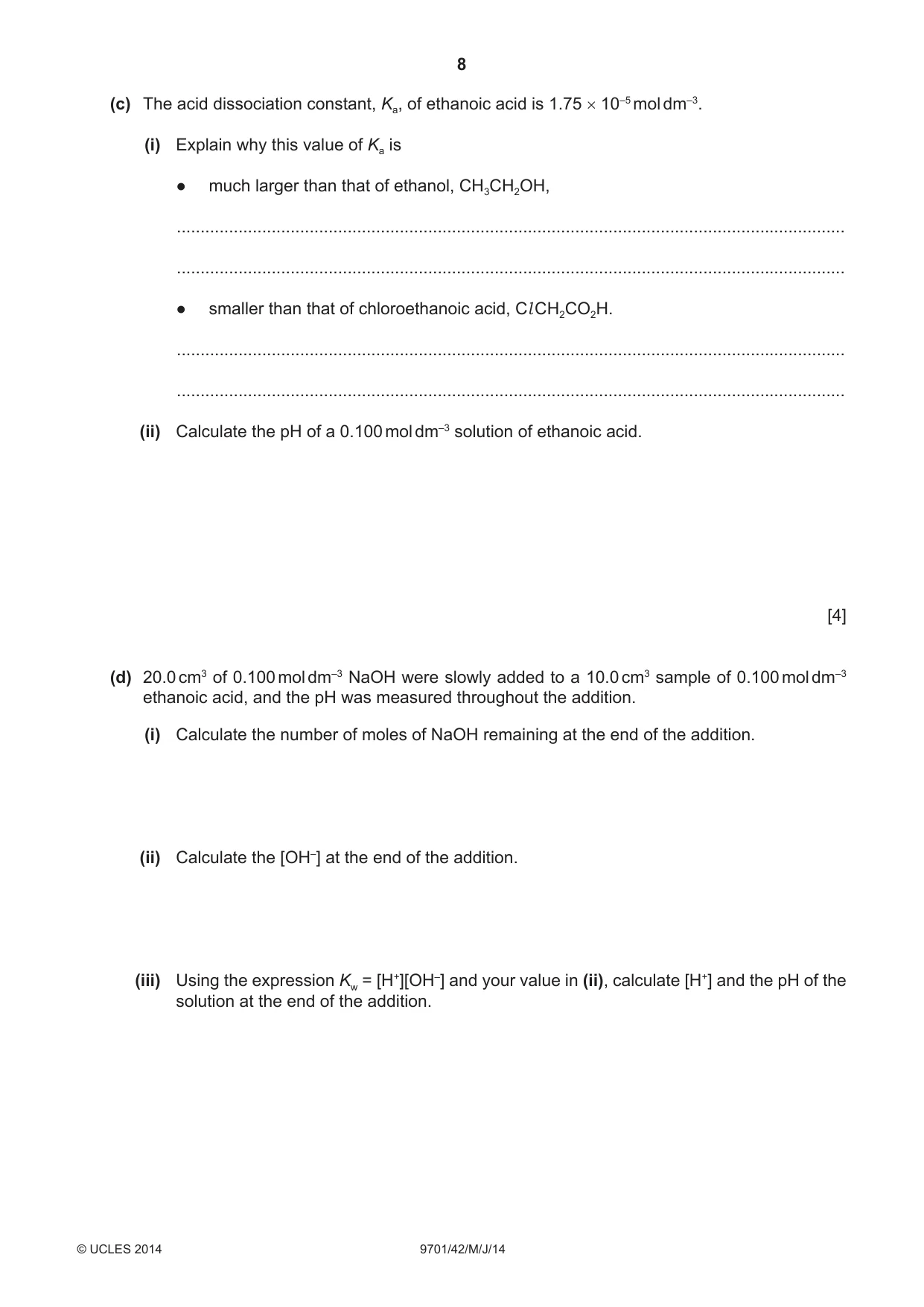
8 9701/42/M/J/14 © UCLES 2014 (c) The acid dissociation constant, Ka, of ethanoic acid is 1.75 10–5 mol dm–3. (i) Explain why this value of Ka is ● much larger than that of ethanol, CH3CH2OH, … … ● smaller than that of chloroethanoic acid, Cl CH2CO2H. … … (ii) Calculate the pH of a 0.100 mol dm–3 solution of ethanoic acid. [4] (d) 20.0 cm3 of 0.100 mol dm–3 NaOH were slowly added to a 10.0 cm3 sample of 0.100 mol dm–3 ethanoic acid, and the pH was measured throughout the addition. (i) Calculate the number of moles of NaOH remaining at the end of the addition. (ii) Calculate the [OH–] at the end of the addition. (iii) Using the expression Kw = [H+][OH–] and your value in (ii), calculate [H+] and the pH of the solution at the end of the addition.
Question paper, page 9
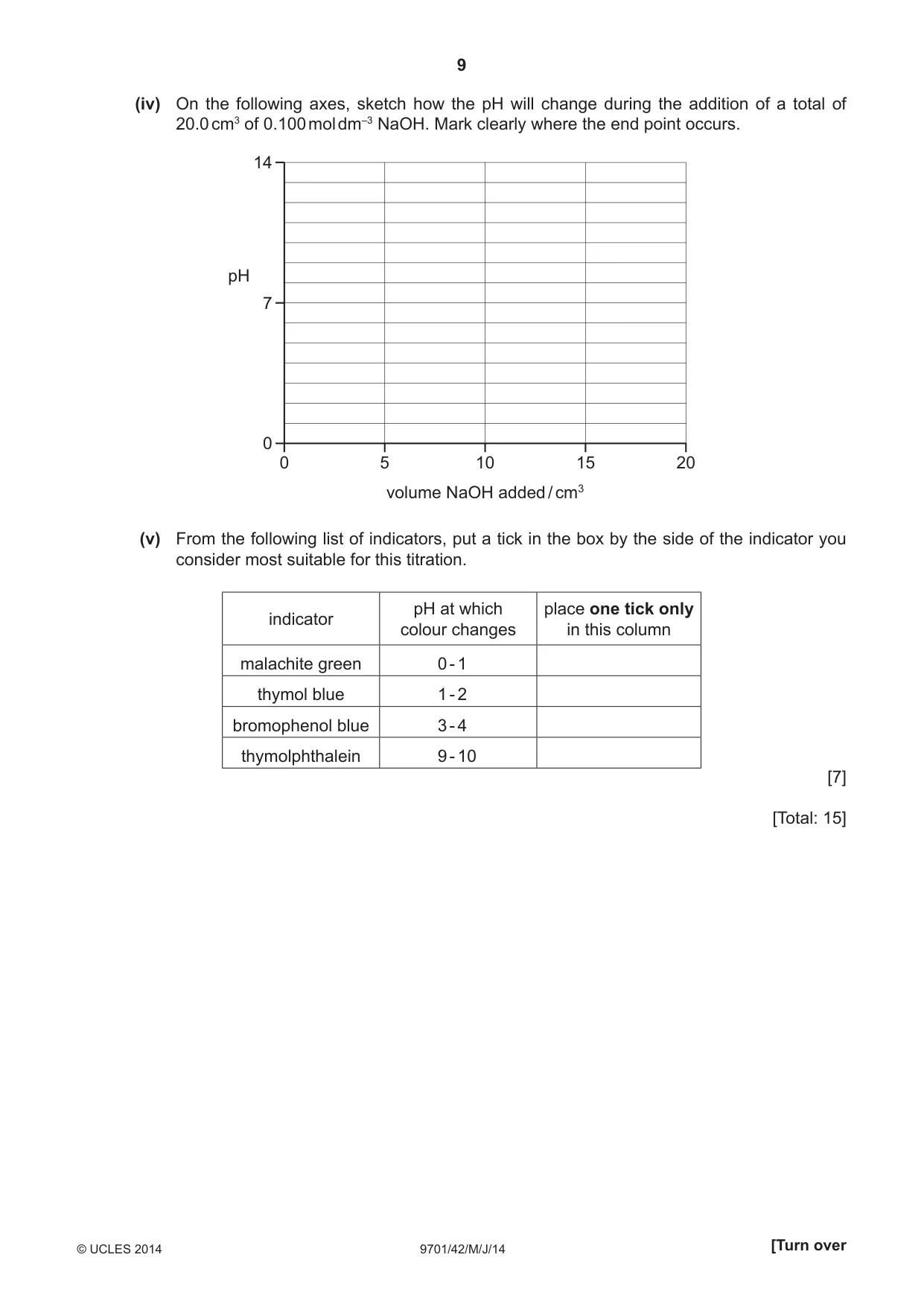
9 9701/42/M/J/14 © UCLES 2014 [Turn over (iv) On the following axes, sketch how the pH will change during the addition of a total of 20.0 cm3 of 0.100 mol dm–3 NaOH. Mark clearly where the end point occurs. 0 5 10 volume NaOH added / cm3 15 20 14 7 0 pH (v) From the following list of indicators, put a tick in the box by the side of the indicator you consider most suitable for this titration. indicator pH at which colour changes place one tick only in this column malachite green 0 - 1 thymol blue 1 - 2 bromophenol blue 3 - 4 thymolphthalein 9 - 10 [7] [Total: 15]
Question paper, page 10
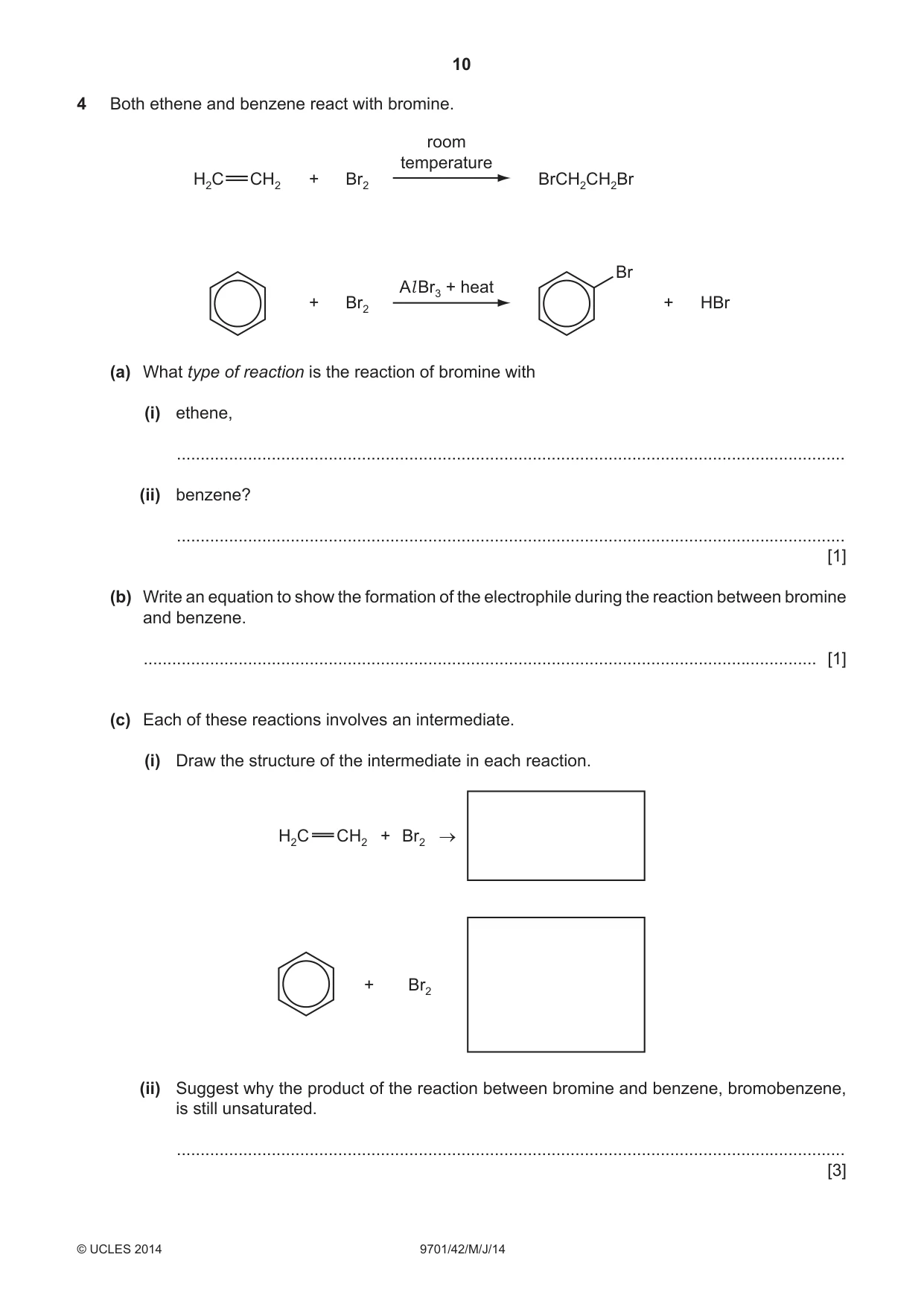
10 9701/42/M/J/14 © UCLES 2014 4 Both ethene and benzene react with bromine. H2C CH2 BrCH2CH2Br Br Br2 + Br2 + HBr + room temperature Al Br3 + heat (a) What type of reaction is the reaction of bromine with (i) ethene, … (ii) benzene? … [1] (b) Write an equation to show the formation of the electrophile during the reaction between bromine and benzene. … [1] (c) Each of these reactions involves an intermediate. (i) Draw the structure of the intermediate in each reaction. + Br2 + → Br2 H2C CH2 (ii) Suggest why the product of the reaction between bromine and benzene, bromobenzene, is still unsaturated. … [3]
Question paper, page 11
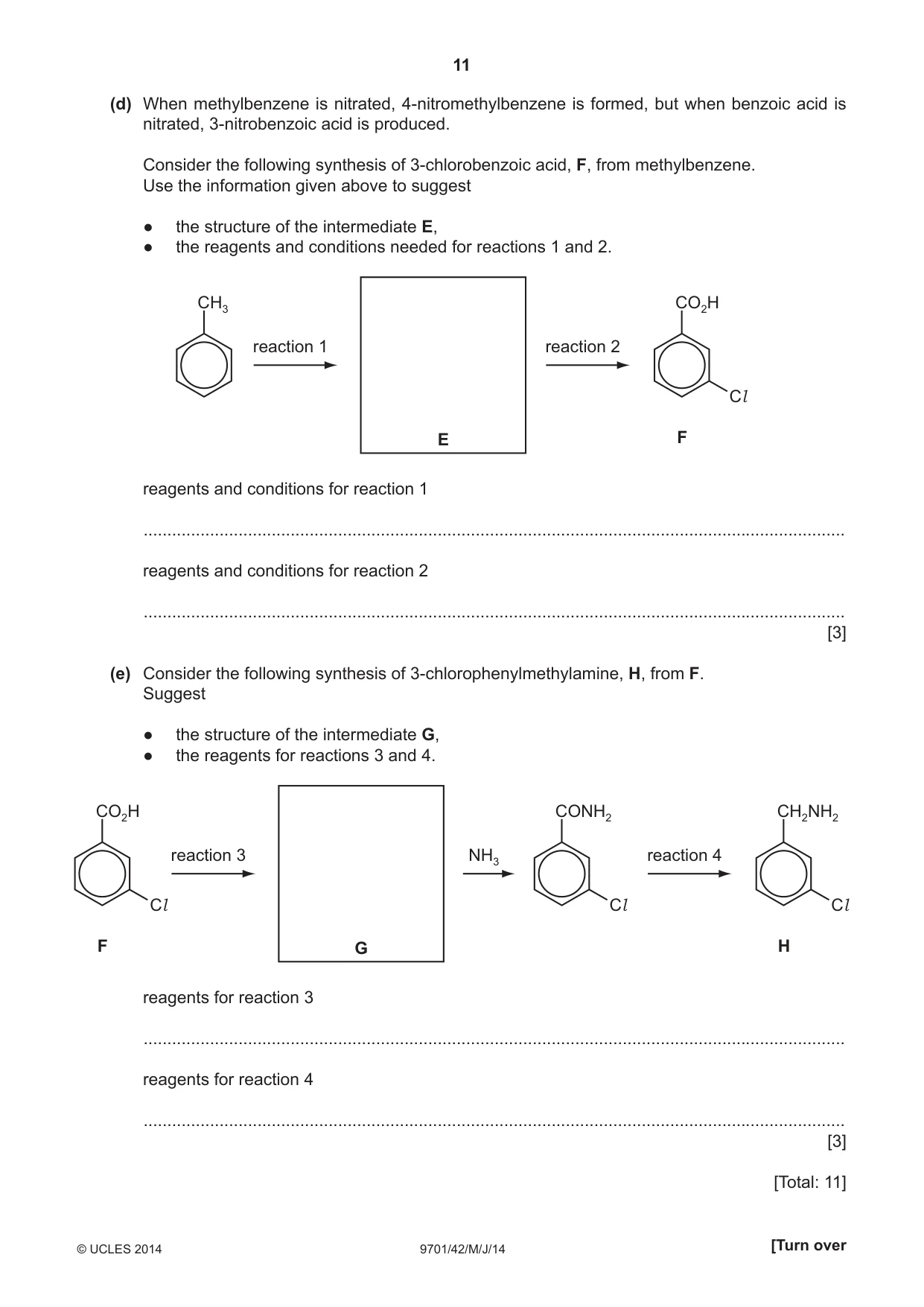
11 9701/42/M/J/14 © UCLES 2014 [Turn over (d) When methylbenzene is nitrated, 4-nitromethylbenzene is formed, but when benzoic acid is nitrated, 3-nitrobenzoic acid is produced. Consider the following synthesis of 3-chlorobenzoic acid, F, from methylbenzene. Use the information given above to suggest ● the structure of the intermediate E, ● the reagents and conditions needed for reactions 1 and 2. CH3 CO2H Cl reaction 1 reaction 2 E F reagents and conditions for reaction 1 … reagents and conditions for reaction 2 … [3] (e) Consider the following synthesis of 3-chlorophenylmethylamine, H, from F. Suggest ● the structure of the intermediate G, ● the reagents for reactions 3 and 4. CO2H CH2NH2 Cl CONH2 Cl reaction 3 reaction 4 NH3 G Cl F H reagents for reaction 3 … reagents for reaction 4 … [3] [Total: 11]
Question paper, page 12
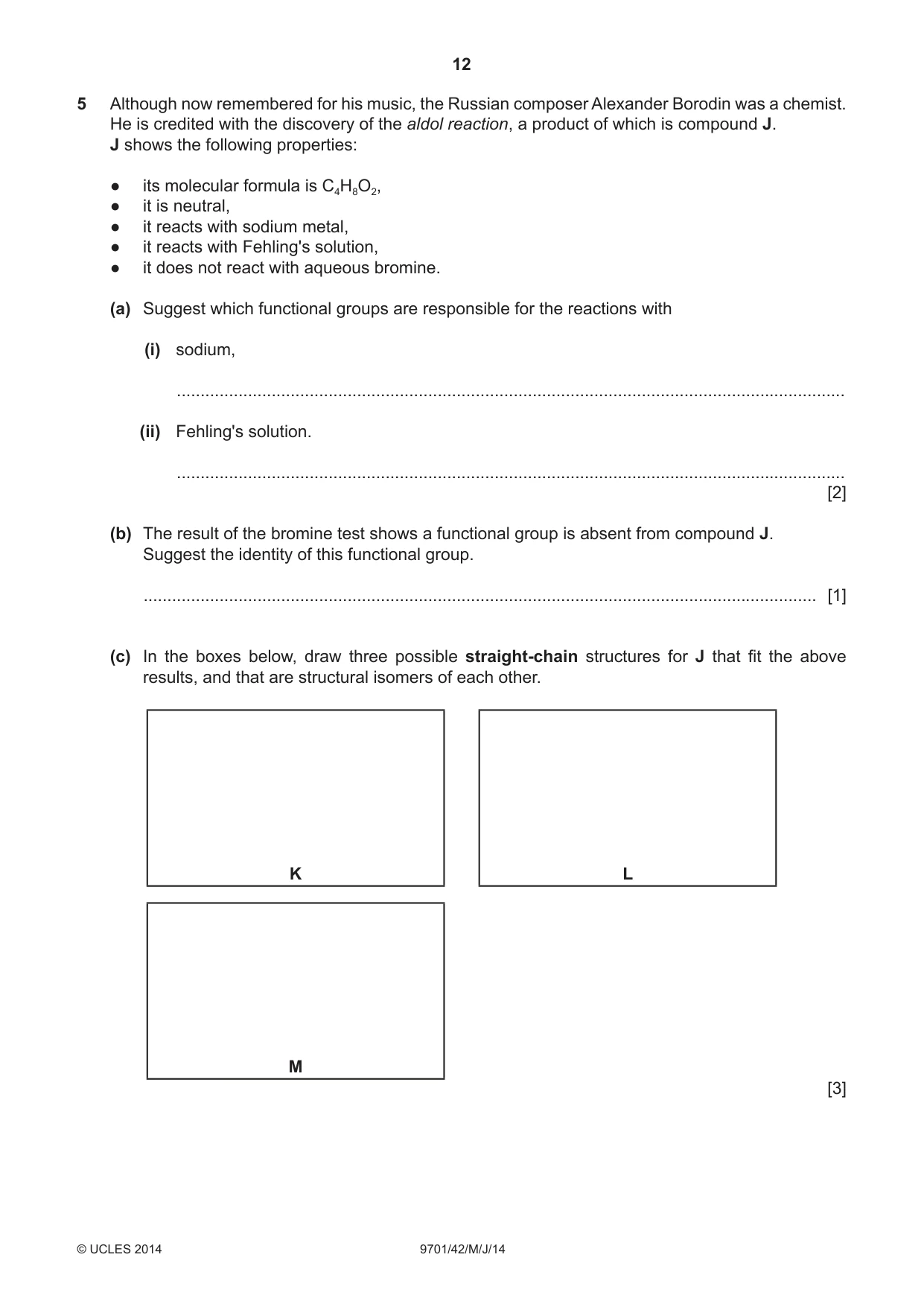
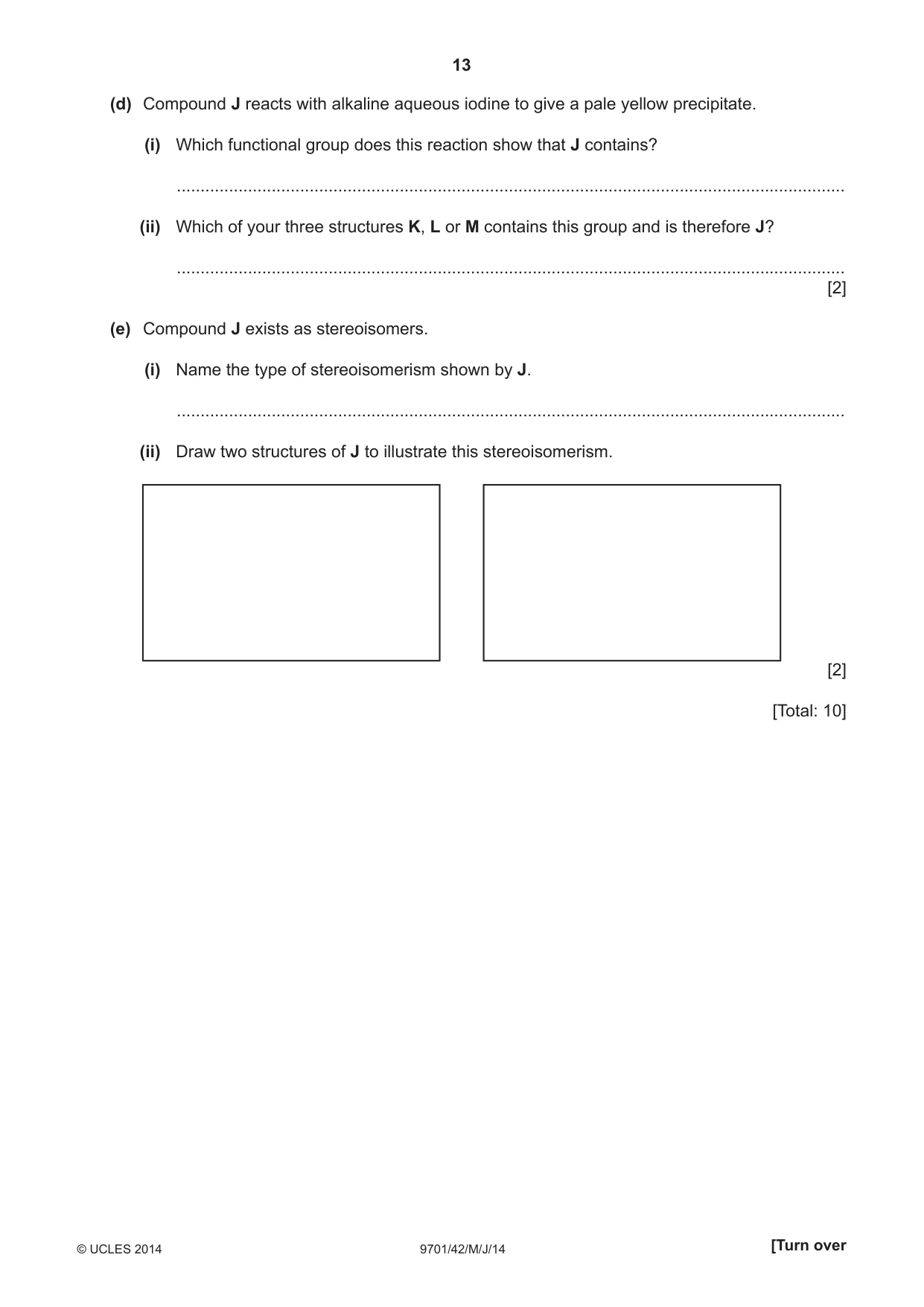
12 9701/42/M/J/14 © UCLES 2014 5 Although now remembered for his music, the Russian composer Alexander Borodin was a chemist. He is credited with the discovery of the aldol reaction, a product of which is compound J. J shows the following properties: ● its molecular formula is C4H8O2, ● it is neutral, ● it reacts with sodium metal, ● it reacts with Fehling's solution, ● it does not react with aqueous bromine. (a) Suggest which functional groups are responsible for the reactions with (i) sodium, … (ii) Fehling's solution. … [2] (b) The result of the bromine test shows a functional group is absent from compound J. Suggest the identity of this functional group. … [1] (c) In the boxes below, draw three possible straight-chain structures for J that fi t the above results, and that are structural isomers of each other. K L M [3]
Question paper, page 13
13 9701/42/M/J/14 © UCLES 2014 [Turn over (d) Compound J reacts with alkaline aqueous iodine to give a pale yellow precipitate. (i) Which functional group does this reaction show that J contains? … (ii) Which of your three structures K, L or M contains this group and is therefore J? … [2] (e) Compound J exists as stereoisomers. (i) Name the type of stereoisomerism shown by J. … (ii) Draw two structures of J to illustrate this stereoisomerism. [2] [Total: 10]
Question paper, page 14
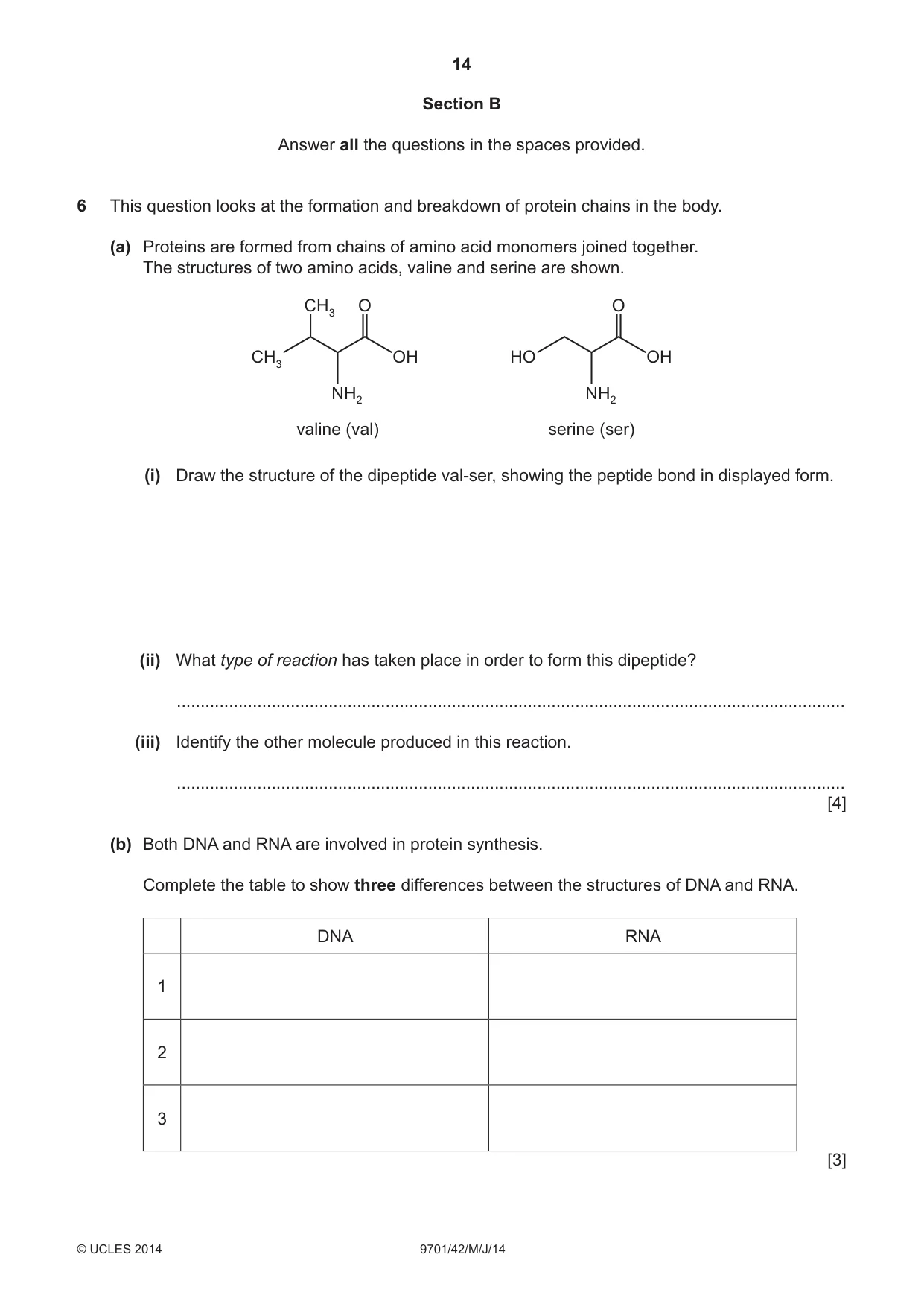
14 9701/42/M/J/14 © UCLES 2014 Section B Answer all the questions in the spaces provided. 6 This question looks at the formation and breakdown of protein chains in the body. (a) Proteins are formed from chains of amino acid monomers joined together. The structures of two amino acids, valine and serine are shown. O valine (val) CH3 CH3 NH2 OH O serine (ser) HO NH2 OH (i) Draw the structure of the dipeptide val-ser, showing the peptide bond in displayed form. (ii) What type of reaction has taken place in order to form this dipeptide? … (iii) Identify the other molecule produced in this reaction. … [4] (b) Both DNA and RNA are involved in protein synthesis. Complete the table to show three differences between the structures of DNA and RNA. DNA RNA 1 2 3 [3]
Question paper, page 15
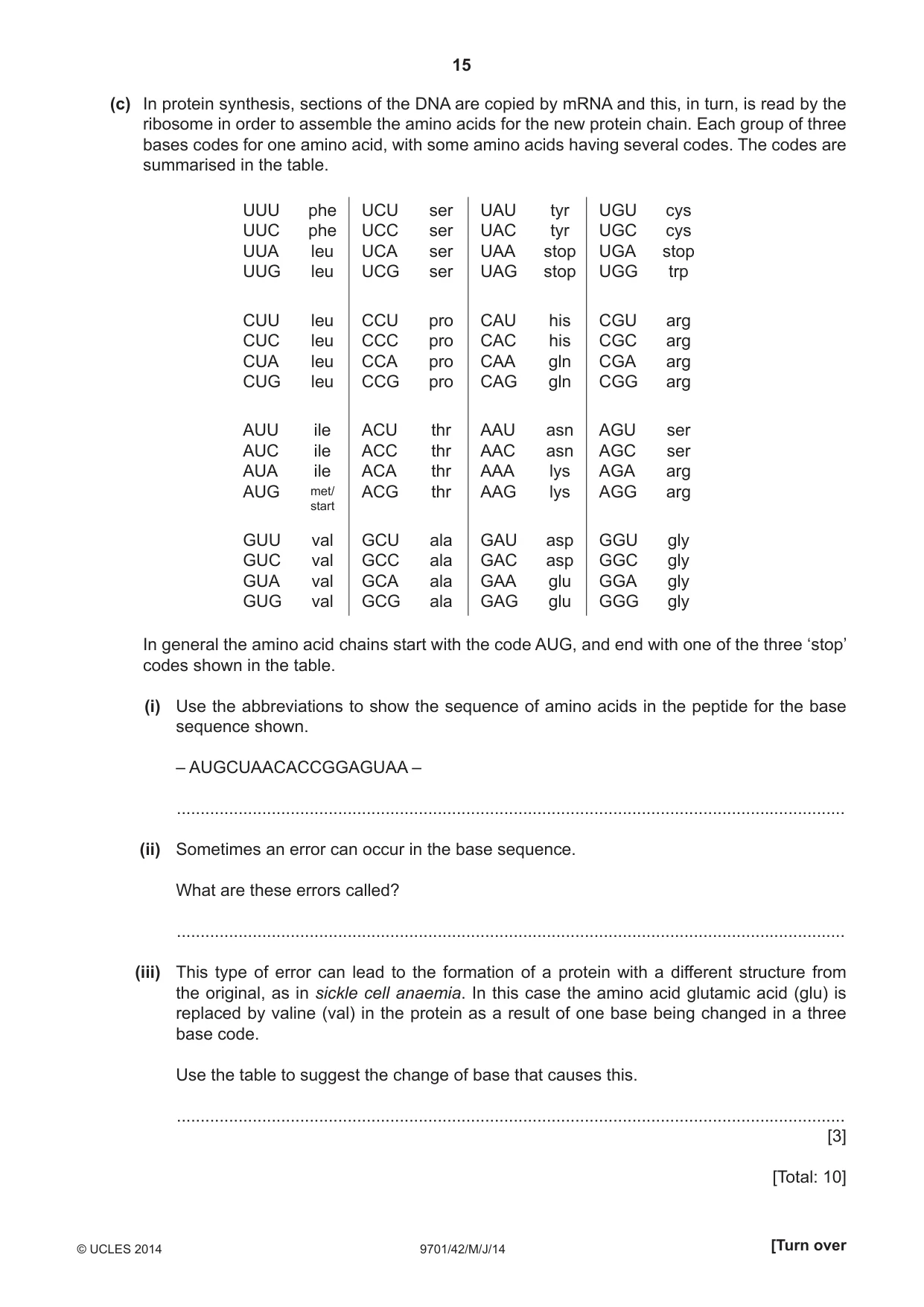
15 9701/42/M/J/14 © UCLES 2014 [Turn over (c) In protein synthesis, sections of the DNA are copied by mRNA and this, in turn, is read by the ribosome in order to assemble the amino acids for the new protein chain. Each group of three bases codes for one amino acid, with some amino acids having several codes. The codes are summarised in the table. UUU UUC UUA UUG phe phe leu leu UCU UCC UCA UCG ser ser ser ser UAU UAC UAA UAG tyr tyr stop stop UGU UGC UGA UGG cys cys stop trp CUU CUC CUA CUG leu leu leu leu CCU CCC CCA CCG pro pro pro pro CAU CAC CAA CAG his his gln gln CGU CGC CGA CGG arg arg arg arg AUU AUC AUA AUG ile ile ile met/ start ACU ACC ACA ACG thr thr thr thr AAU AAC AAA AAG asn asn lys lys AGU AGC AGA AGG ser ser arg arg GUU GUC GUA GUG val val val val GCU GCC GCA GCG ala ala ala ala GAU GAC GAA GAG asp asp glu glu GGU GGC GGA GGG gly gly gly gly In general the amino acid chains start with the code AUG, and end with one of the three ‘stop’ codes shown in the table. (i) Use the abbreviations to show the sequence of amino acids in the peptide for the base sequence shown. – AUGCUAACACCGGAGUAA – … (ii) Sometimes an error can occur in the base sequence. What are these errors called? … (iii) This type of error can lead to the formation of a protein with a different structure from the original, as in sickle cell anaemia. In this case the amino acid glutamic acid (glu) is replaced by valine (val) in the protein as a result of one base being changed in a three base code. Use the table to suggest the change of base that causes this. … [3] [Total: 10]
Question paper, page 16
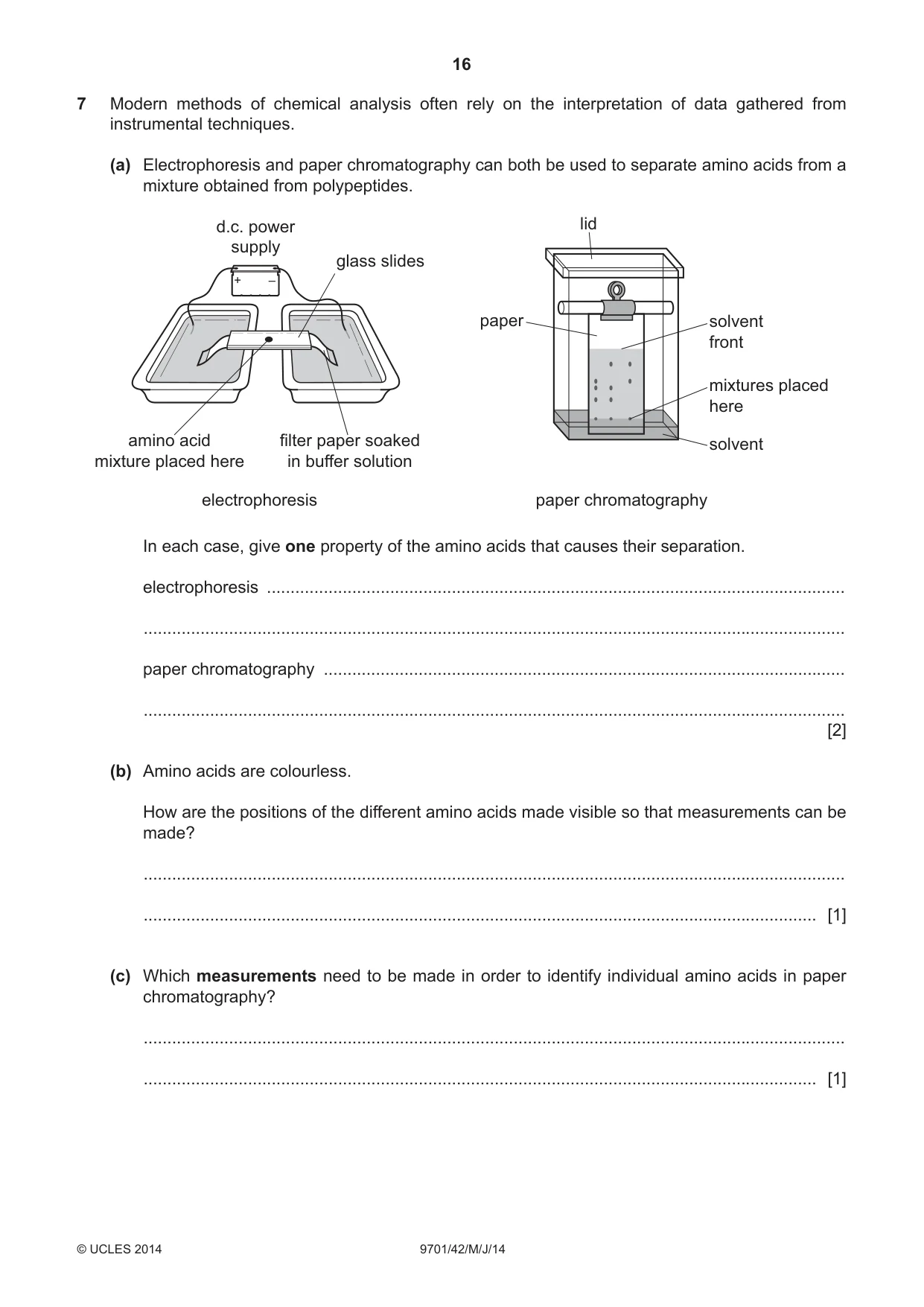
16 9701/42/M/J/14 © UCLES 2014 7 Modern methods of chemical analysis often rely on the interpretation of data gathered from instrumental techniques. (a) Electrophoresis and paper chromatography can both be used to separate amino acids from a mixture obtained from polypeptides. + – amino acid mixture placed here filter paper soaked in buffer solution glass slides d.c. power supply electrophoresis paper chromatography paper solvent front mixtures placed here solvent lid In each case, give one property of the amino acids that causes their separation. electrophoresis … … paper chromatography … … [2] (b) Amino acids are colourless. How are the positions of the different amino acids made visible so that measurements can be made? … … [1] (c) Which measurements need to be made in order to identify individual amino acids in paper chromatography? … … [1]
Question paper, page 17
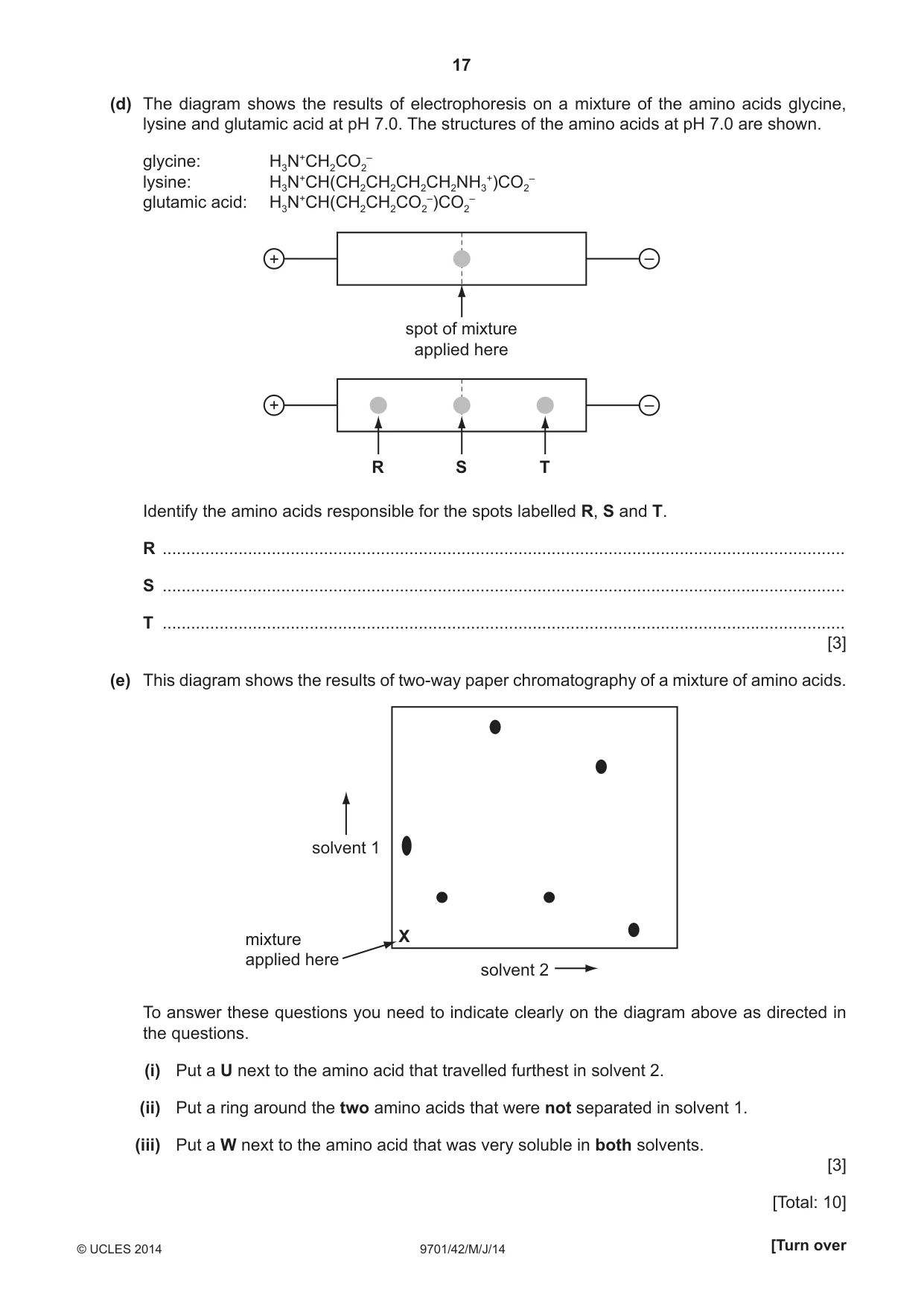
17 9701/42/M/J/14 © UCLES 2014 [Turn over (d) The diagram shows the results of electrophoresis on a mixture of the amino acids glycine, lysine and glutamic acid at pH 7.0. The structures of the amino acids at pH 7.0 are shown. glycine: H3N+CH2CO2 – lysine: H3N+CH(CH2CH2CH2CH2NH3 +)CO2 – glutamic acid: H3N+CH(CH2CH2CO2 –)CO2 – + – spot of mixture applied here + – S R T Identify the amino acids responsible for the spots labelled R, S and T. R … S … T … [3] (e) This diagram shows the results of two-way paper chromatography of a mixture of amino acids. X solvent 2 solvent 1 mixture applied here To answer these questions you need to indicate clearly on the diagram above as directed in the questions. (i) Put a U next to the amino acid that travelled furthest in solvent 2. (ii) Put a ring around the two amino acids that were not separated in solvent 1. (iii) Put a W next to the amino acid that was very soluble in both solvents. [3] [Total: 10]
Question paper, page 18
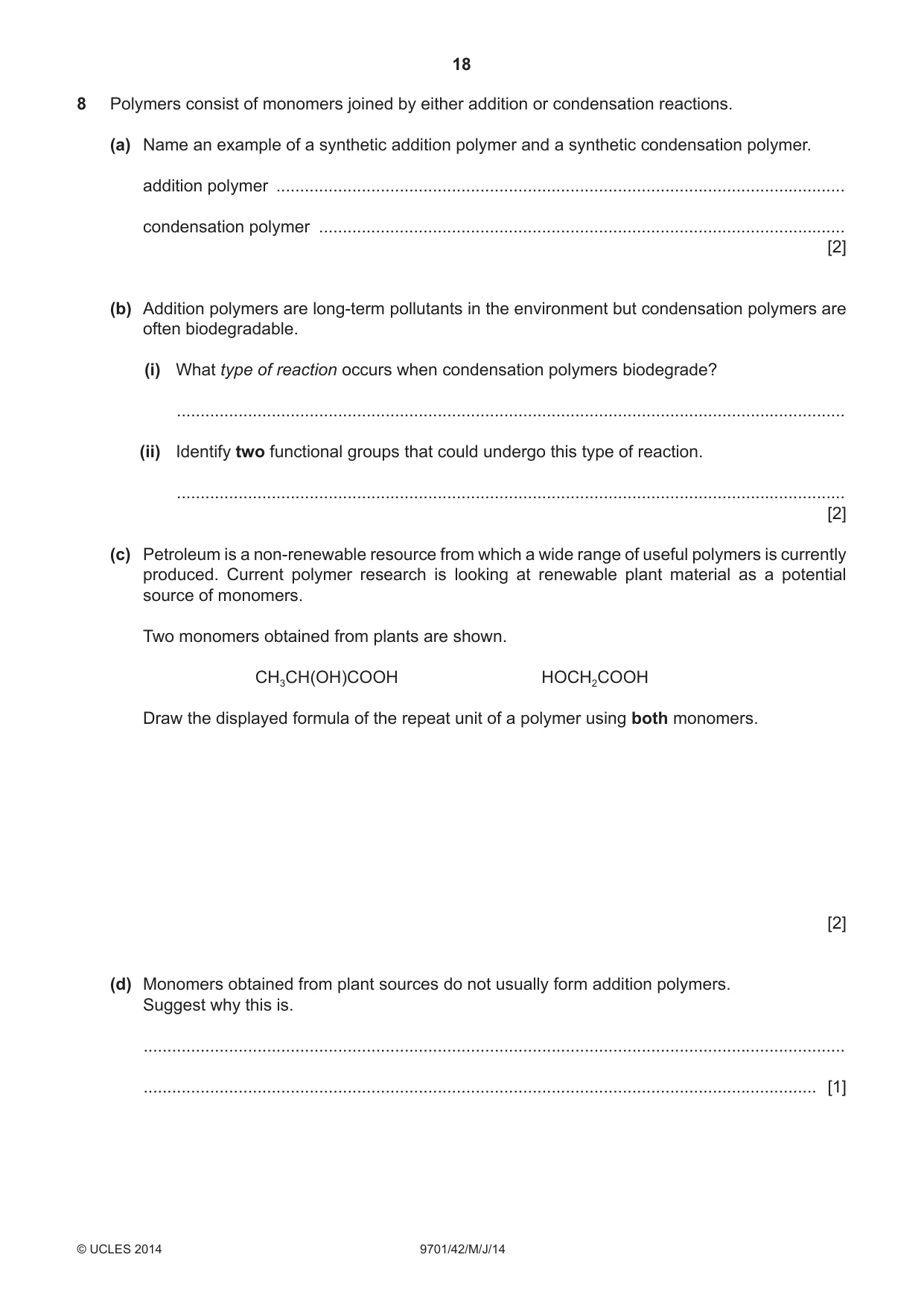
18 9701/42/M/J/14 © UCLES 2014 8 Polymers consist of monomers joined by either addition or condensation reactions. (a) Name an example of a synthetic addition polymer and a synthetic condensation polymer. addition polymer … condensation polymer … [2] (b) Addition polymers are long-term pollutants in the environment but condensation polymers are often biodegradable. (i) What type of reaction occurs when condensation polymers biodegrade? … (ii) Identify two functional groups that could undergo this type of reaction. … [2] (c) Petroleum is a non-renewable resource from which a wide range of useful polymers is currently produced. Current polymer research is looking at renewable plant material as a potential source of monomers. Two monomers obtained from plants are shown. CH3CH(OH)COOH HOCH2COOH Draw the displayed formula of the repeat unit of a polymer using both monomers. [2] (d) Monomers obtained from plant sources do not usually form addition polymers. Suggest why this is. … … [1]
Question paper, page 19
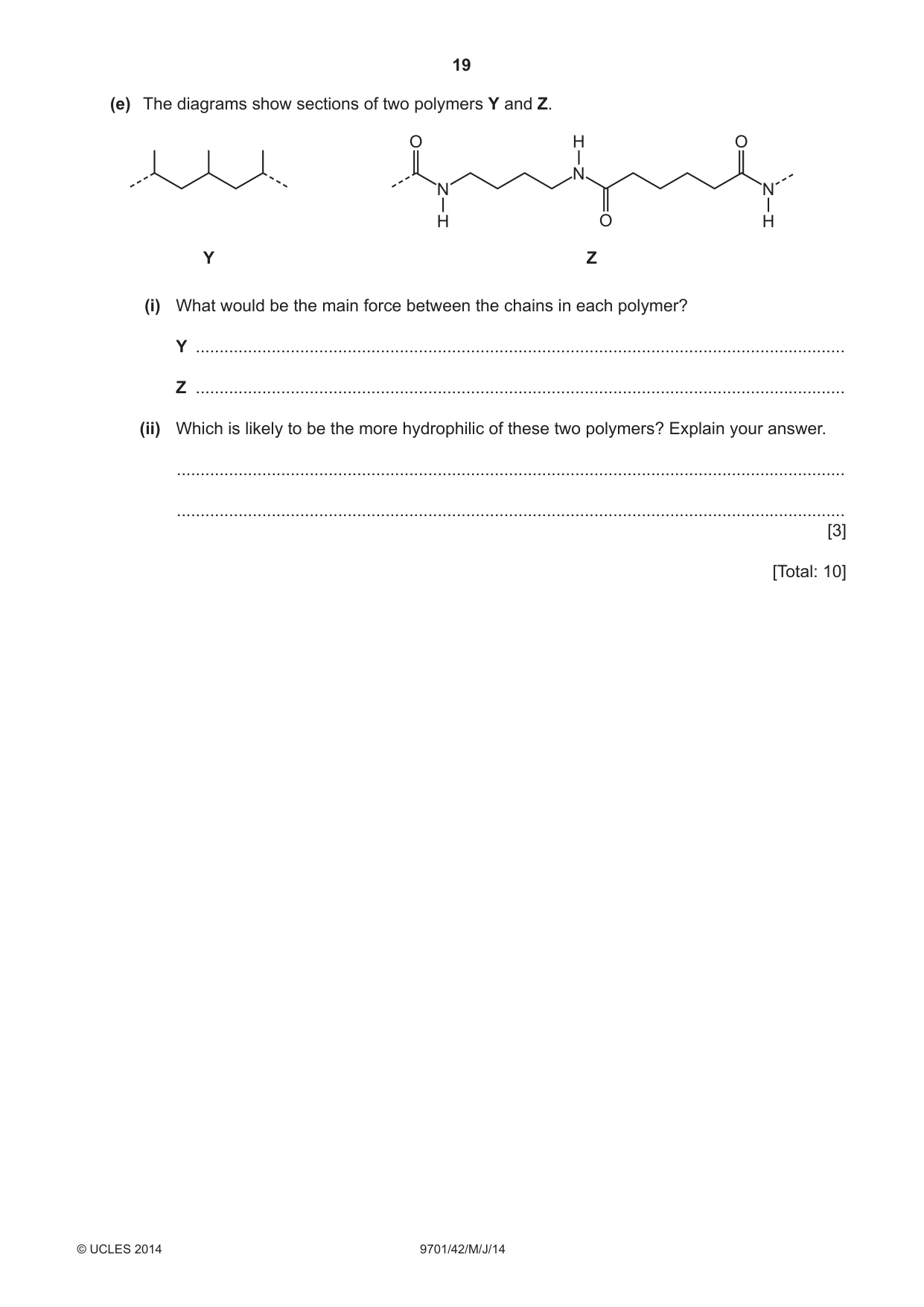
19 9701/42/M/J/14 © UCLES 2014 [Turn over (e) The diagrams show sections of two polymers Y and Z. O O H N N H O N H Z Y (i) What would be the main force between the chains in each polymer? Y … Z … (ii) Which is likely to be the more hydrophilic of these two polymers? Explain your answer. … … [3] [Total: 10]
Question paper, page 20
20 Permission to reproduce items where third-party owned material protected by copyright is included has been sought and cleared where possible. Every reasonable effort has been made by the publisher (UCLES) to trace copyright holders, but if any items requiring clearance have unwittingly been included the publisher will be pleased to make amends at the earliest possible opportunity. Cambridge International Examinations is part of the Cambridge Assessment Group. Cambridge Assessment is the brand name of University of Cambridge Local Examinations Syndicate (UCLES), which is itself a department of the University of Cambridge. 9701/42/M/J/14 © UCLES 2014 BLANK PAGE
Mark scheme, page 1
CAMBRIDGE INTERNATIONAL EXAMINATIONS GCE Advanced Level MARK SCHEME for the May/June 2014 series 9701 CHEMISTRY 9701/42 Paper 4 (Structured Questions), maximum raw mark 100 This mark scheme is published as an aid to teachers and candidates, to indicate the requirements of the examination. It shows the basis on which Examiners were instructed to award marks. It does not indicate the details of the discussions that took place at an Examiners’ meeting before marking began, which would have considered the acceptability of alternative answers. Mark schemes should be read in conjunction with the question paper and the Principal Examiner Report for Teachers. Cambridge will not enter into discussions about these mark schemes. Cambridge is publishing the mark schemes for the May/June 2014 series for most IGCSE, GCE Advanced Level and Advanced Subsidiary Level components and some Ordinary Level components.
Mark scheme, page 2
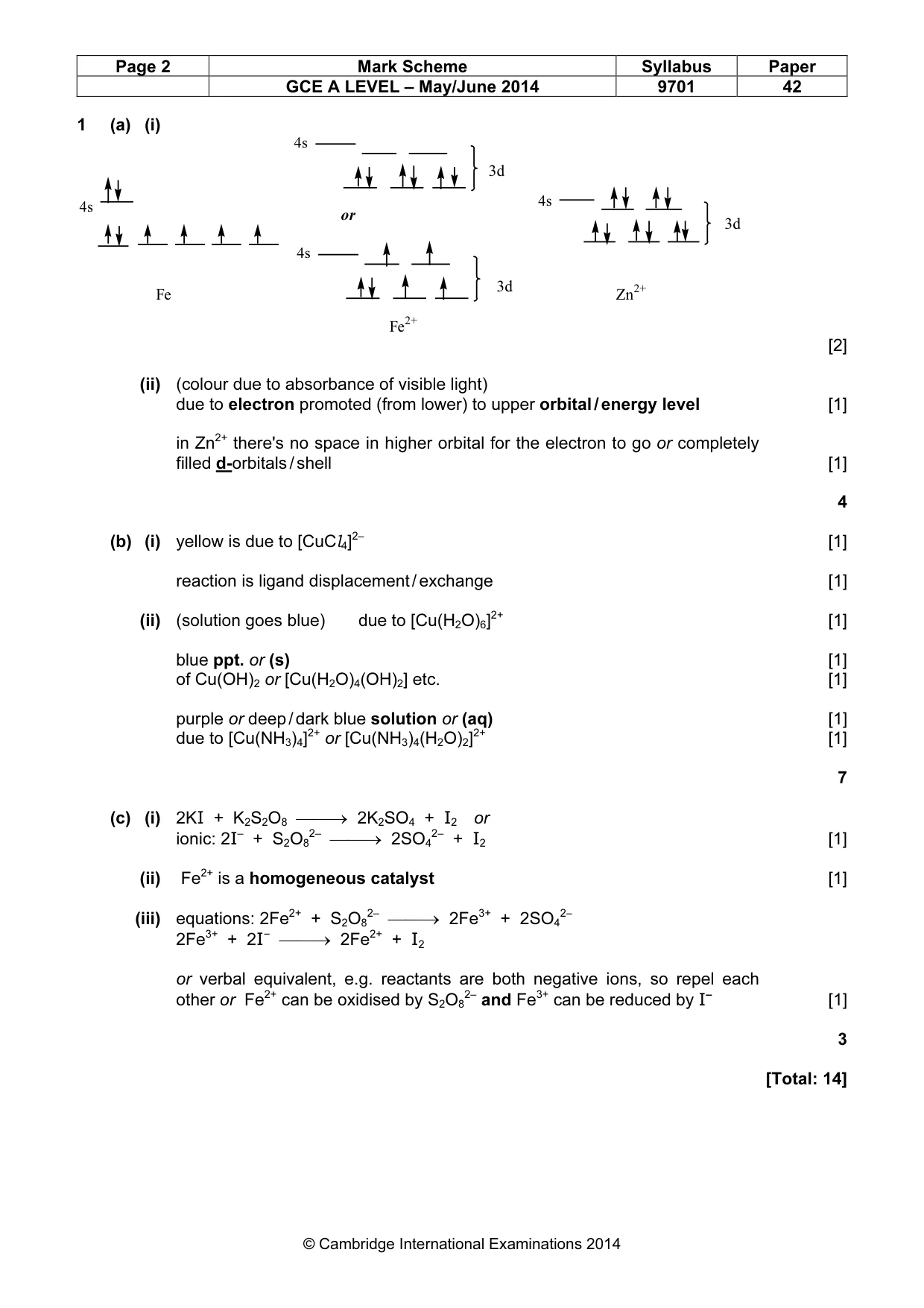
Page 2 Mark Scheme Syllabus Paper GCE A LEVEL – May/June 2014 9701 42 © Cambridge International Examinations 2014 1 (a) (i) 4s 3d 4s 3d 4s Fe Fe2+ Zn2+ 3d 4s or [2] (ii) (colour due to absorbance of visible light) due to electron promoted (from lower) to upper orbital / energy level [1] in Zn2+ there's no space in higher orbital for the electron to go or completely filled d-orbitals / shell [1] 4 (b) (i) yellow is due to [CuCl4]2– [1] reaction is ligand displacement / exchange [1] (ii) (solution goes blue) due to [Cu(H2O)6]2+ [1] blue ppt. or (s) [1] of Cu(OH)2 or [Cu(H2O)4(OH)2] etc. [1] purple or deep / dark blue solution or (aq) [1] due to [Cu(NH3)4]2+ or [Cu(NH3)4(H2O)2]2+ [1] 7 (c) (i) 2KI + K2S2O8 → 2K2SO4 + I2 or ionic: 2I– + S2O8 2– → 2SO4 2– + I2 [1] (ii) Fe2+ is a homogeneous catalyst [1] (iii) equations: 2Fe2+ + S2O8 2– → 2Fe3+ + 2SO4 2– 2Fe3+ + 2I– → 2Fe2+ + I2 or verbal equivalent, e.g. reactants are both negative ions, so repel each other or Fe2+ can be oxidised by S2O8 2– and Fe3+ can be reduced by I– [1] 3 [Total: 14]
Mark scheme, page 3
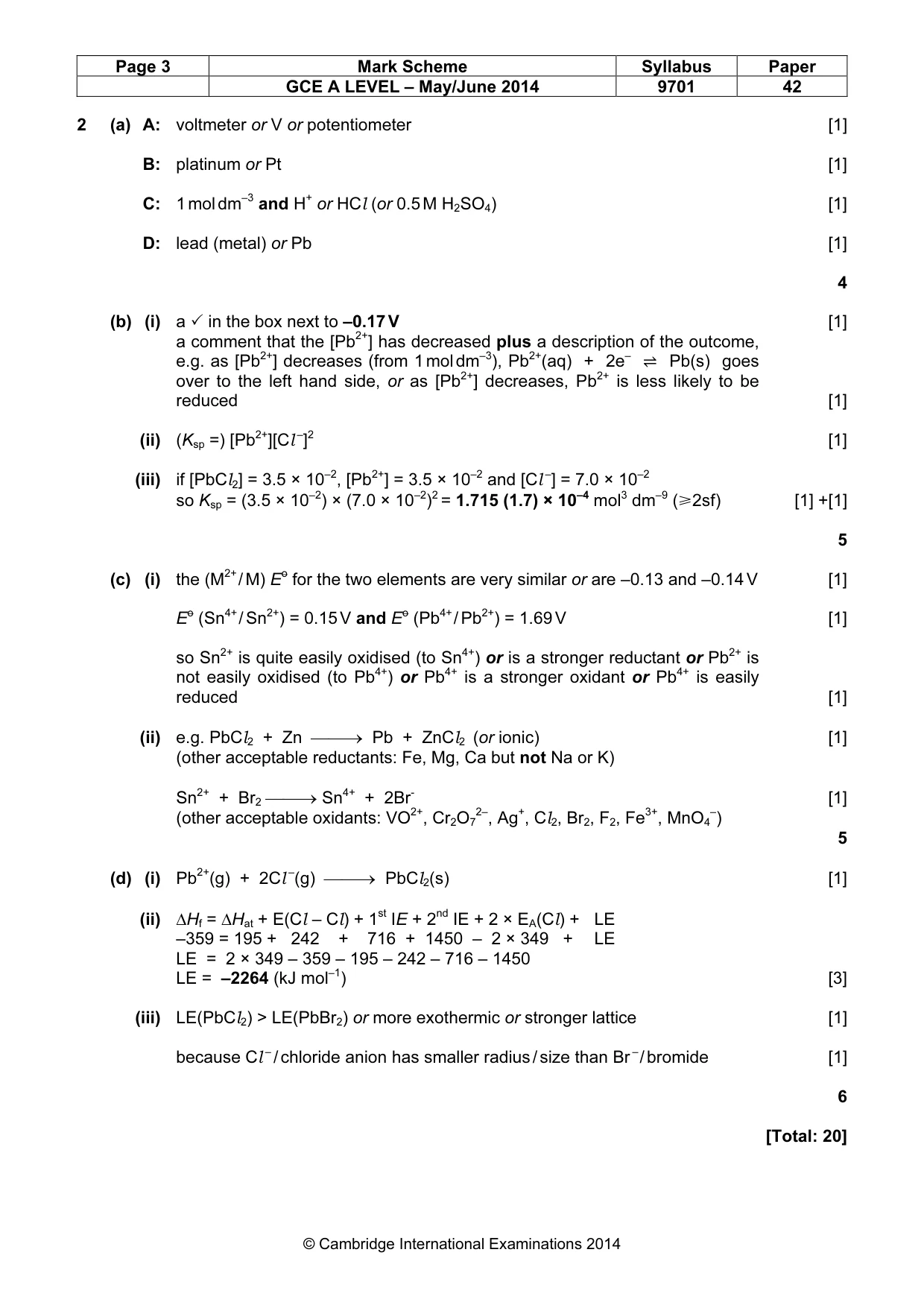
Page 3 Mark Scheme Syllabus Paper GCE A LEVEL – May/June 2014 9701 42 © Cambridge International Examinations 2014 2 (a) A: voltmeter or V or potentiometer [1] B: platinum or Pt [1] C: 1 mol dm–3 and H+ or HCl (or 0.5 M H2SO4) [1] D: lead (metal) or Pb [1] 4 (b) (i) a ✓ in the box next to –0.17 V [1] a comment that the [Pb2+] has decreased plus a description of the outcome, e.g. as [Pb2+] decreases (from 1 mol dm–3), Pb2+(aq) + 2e– ⇌ Pb(s) goes over to the left hand side, or as [Pb2+] decreases, Pb2+ is less likely to be reduced [1] (ii) (Ksp =) [Pb2+][Cl –]2 [1] (iii) if [PbCl2] = 3.5 × 10⁻², [Pb2+] = 3.5 × 10⁻² and [Cl –] = 7.0 × 10⁻² so Ksp = (3.5 × 10–2) × (7.0 × 10–2)2 = 1.715 (1.7) × 10–4 mol3 dm–9 ([2sf) [1] +[1] 5 (c) (i) the (M2+ / M) Eo for the two elements are very similar or are –0.13 and –0.14 V [1] Eo (Sn4+ / Sn2+) = 0.15 V and Eo (Pb4+ / Pb2+) = 1.69 V [1] so Sn2+ is quite easily oxidised (to Sn4+) or is a stronger reductant or Pb2+ is not easily oxidised (to Pb4+) or Pb4+ is a stronger oxidant or Pb4+ is easily reduced [1] (ii) e.g. PbCl2 + Zn → Pb + ZnCl2 (or ionic) [1] (other acceptable reductants: Fe, Mg, Ca but not Na or K) Sn2+ + Br2 → Sn4+ + 2Br- [1] (other acceptable oxidants: VO2+, Cr2O7 2–, Ag+, Cl2, Br2, F2, Fe3+, MnO4 –) 5 (d) (i) Pb2+(g) + 2Cl –(g) → PbCl2(s) [1] (ii) ∆Hf = ∆Hat + E(Cl – Cl) + 1st IE + 2nd IE + 2 × EA(Cl) + LE –359 = 195 + 242 + 716 + 1450 – 2 × 349 + LE LE = 2 × 349 – 359 – 195 – 242 – 716 – 1450 LE = –2264 (kJ mol–1) [3] (iii) LE(PbCl2) > LE(PbBr2) or more exothermic or stronger lattice [1] because Cl – / chloride anion has smaller radius / size than Br – / bromide [1] 6 [Total: 20]
Mark scheme, page 4
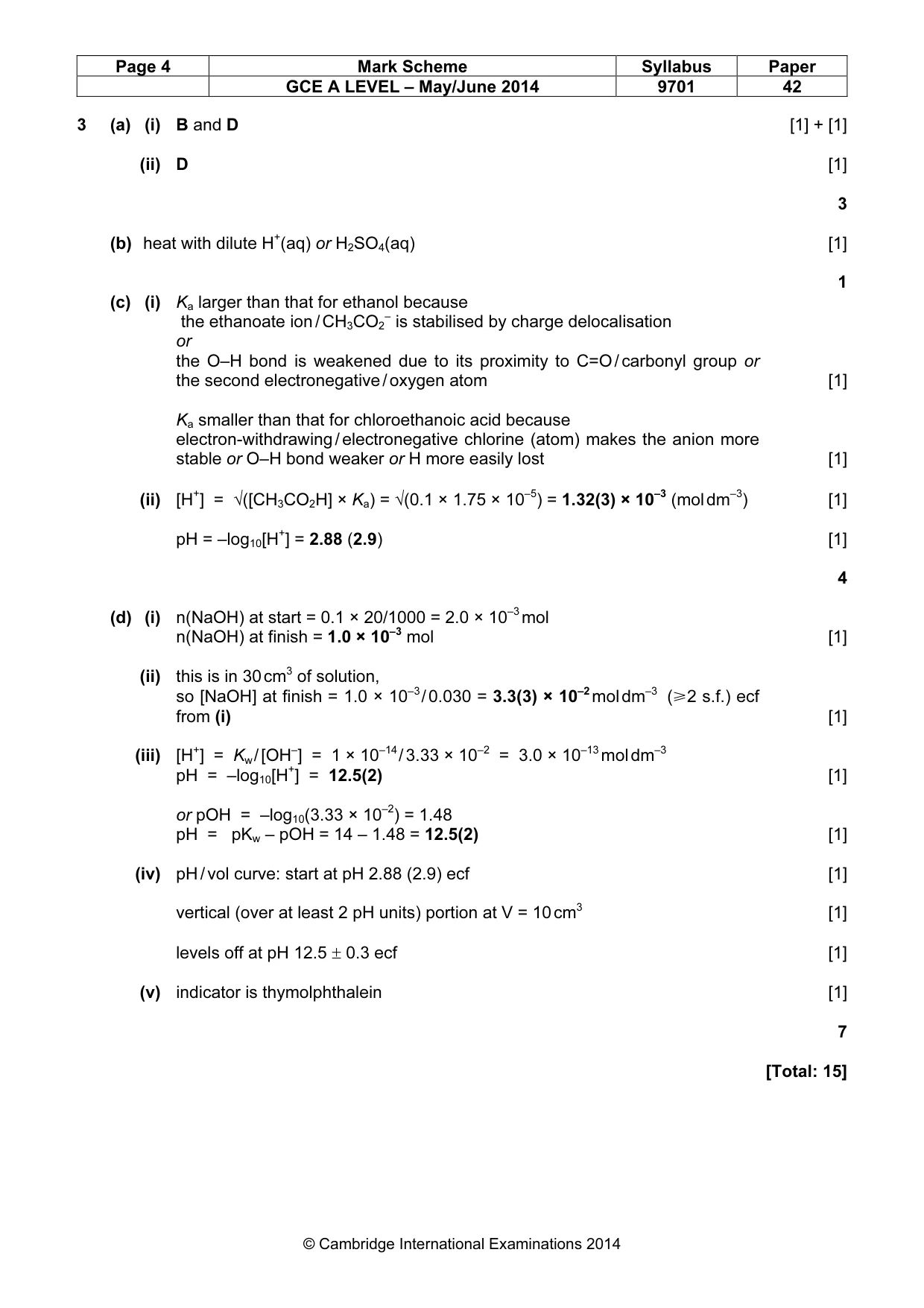
Page 4 Mark Scheme Syllabus Paper GCE A LEVEL – May/June 2014 9701 42 © Cambridge International Examinations 2014 3 (a) (i) B and D [1] + [1] (ii) D [1] 3 (b) heat with dilute H+(aq) or H2SO4(aq) [1] 1 (c) (i) Ka larger than that for ethanol because the ethanoate ion / CH3CO2 – is stabilised by charge delocalisation or the O–H bond is weakened due to its proximity to C=O / carbonyl group or the second electronegative / oxygen atom [1] Ka smaller than that for chloroethanoic acid because electron-withdrawing / electronegative chlorine (atom) makes the anion more stable or O–H bond weaker or H more easily lost [1] (ii) [H+] = √([CH3CO2H] × Ka) = √(0.1 × 1.75 × 10–5) = 1.32(3) × 10–3 (mol dm–3) [1] pH = –log10[H+] = 2.88 (2.9) [1] 4 (d) (i) n(NaOH) at start = 0.1 × 20/1000 = 2.0 × 10⁻³ mol n(NaOH) at finish = 1.0 × 10⁻³ mol [1] (ii) this is in 30 cm3 of solution, so [NaOH] at finish = 1.0 × 10⁻³ / 0.030 = 3.3(3) × 10–2 mol dm–3 ([2 s.f.) ecf from (i) [1] (iii) [H+] = Kw / [OH–] = 1 × 10–14 / 3.33 × 10–2 = 3.0 × 10⁻¹³ mol dm–3 pH = –log10[H+] = 12.5(2) [1] or pOH = –log10(3.33 × 10⁻²) = 1.48 pH = pKw – pOH = 14 – 1.48 = 12.5(2) [1] (iv) pH / vol curve: start at pH 2.88 (2.9) ecf [1] vertical (over at least 2 pH units) portion at V = 10 cm3 [1] levels off at pH 12.5 ± 0.3 ecf [1] (v) indicator is thymolphthalein [1] 7 [Total: 15]
Mark scheme, page 5
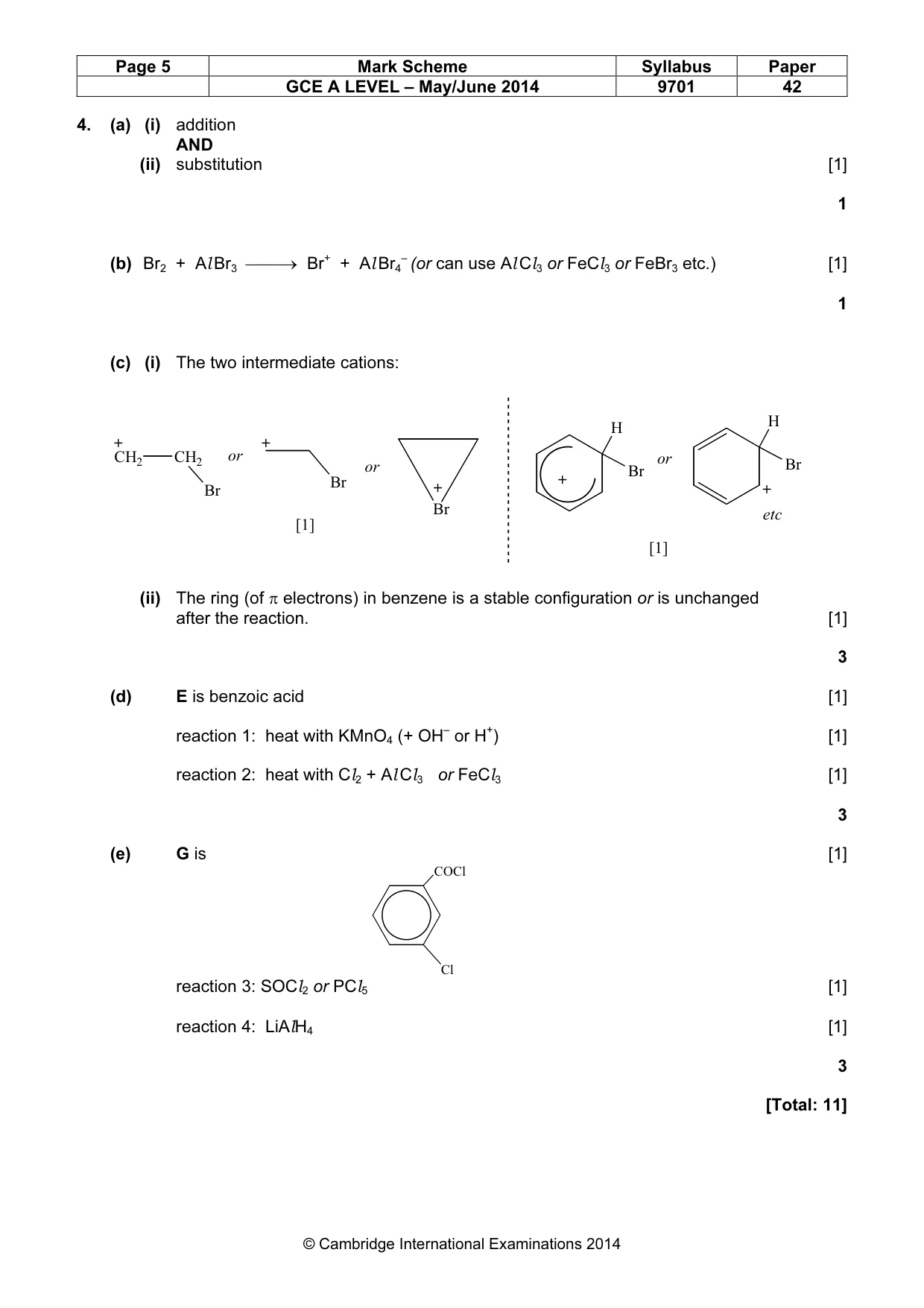
Page 5 Mark Scheme Syllabus Paper GCE A LEVEL – May/June 2014 9701 42 © Cambridge International Examinations 2014 4. (a) (i) addition AND (ii) substitution [1] 1 (b) Br2 + Al Br3 → Br+ + Al Br4 – (or can use Al Cl3 or FeCl3 or FeBr3 etc.) [1] 1 (c) (i) The two intermediate cations: CH2 CH2 Br Br H [1] [1] or Br Br or Br H or etc (ii) The ring (of π electrons) in benzene is a stable configuration or is unchanged after the reaction. [1] 3 (d) E is benzoic acid [1] reaction 1: heat with KMnO4 (+ OH– or H+) [1] reaction 2: heat with Cl2 + Al Cl3 or FeCl3 [1] 3 (e) G is [1] COCl Cl reaction 3: SOCl2 or PCl5 [1] reaction 4: LiAlH4 [1] 3 [Total: 11]
Mark scheme, page 6
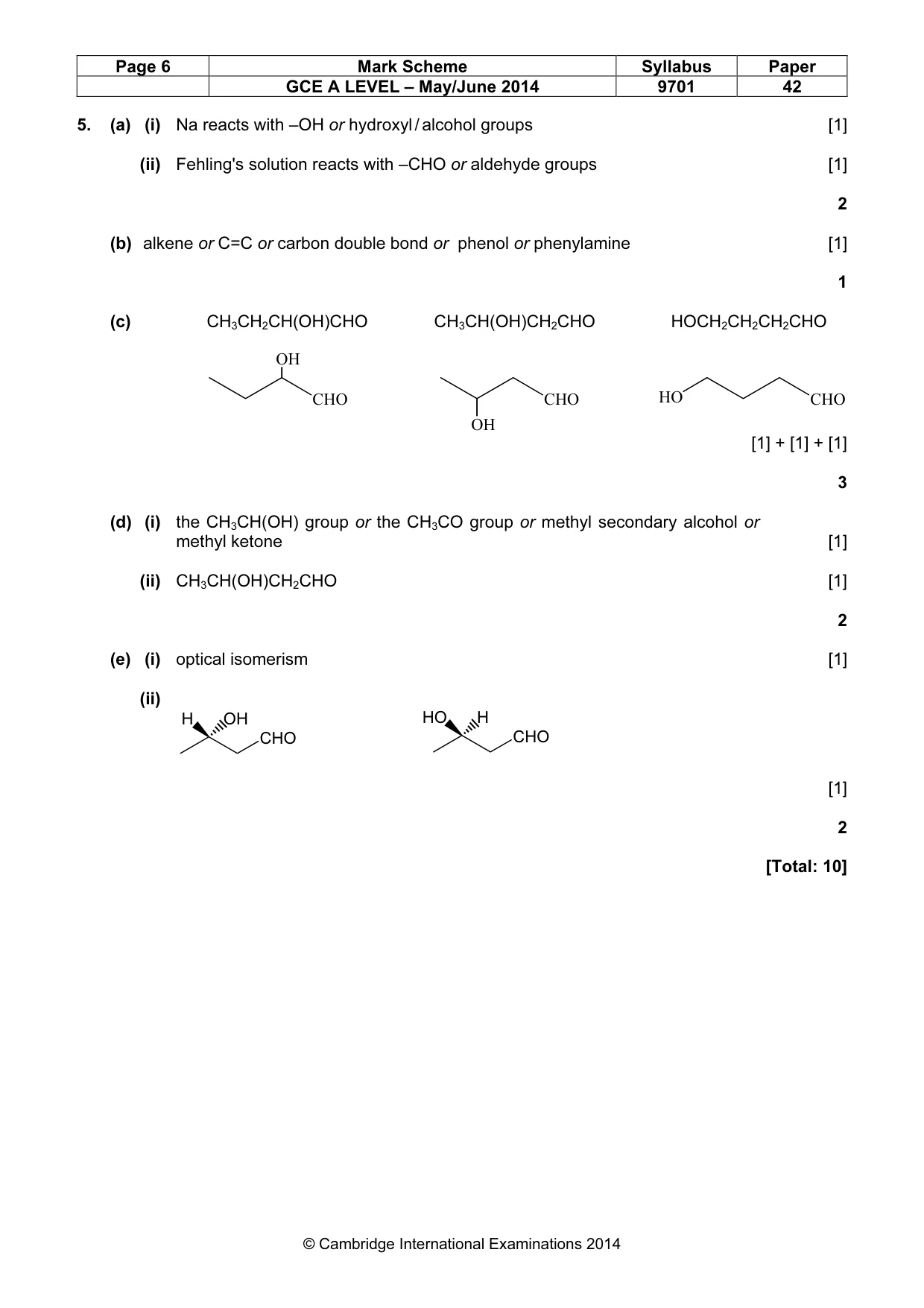
Page 6 Mark Scheme Syllabus Paper GCE A LEVEL – May/June 2014 9701 42 © Cambridge International Examinations 2014 5. (a) (i) Na reacts with –OH or hydroxyl / alcohol groups [1] (ii) Fehling's solution reacts with –CHO or aldehyde groups [1] 2 (b) alkene or C=C or carbon double bond or phenol or phenylamine [1] 1 (c) CH3CH2CH(OH)CHO CH3CH(OH)CH2CHO HOCH2CH2CH2CHO CHO CHO CHO OH OH HO [1] + [1] + [1] 3 (d) (i) the CH3CH(OH) group or the CH3CO group or methyl secondary alcohol or methyl ketone [1] (ii) CH3CH(OH)CH2CHO [1] 2 (e) (i) optical isomerism [1] (ii) CHO OH H CHO H HO [1] 2 [Total: 10]
Mark scheme, page 7
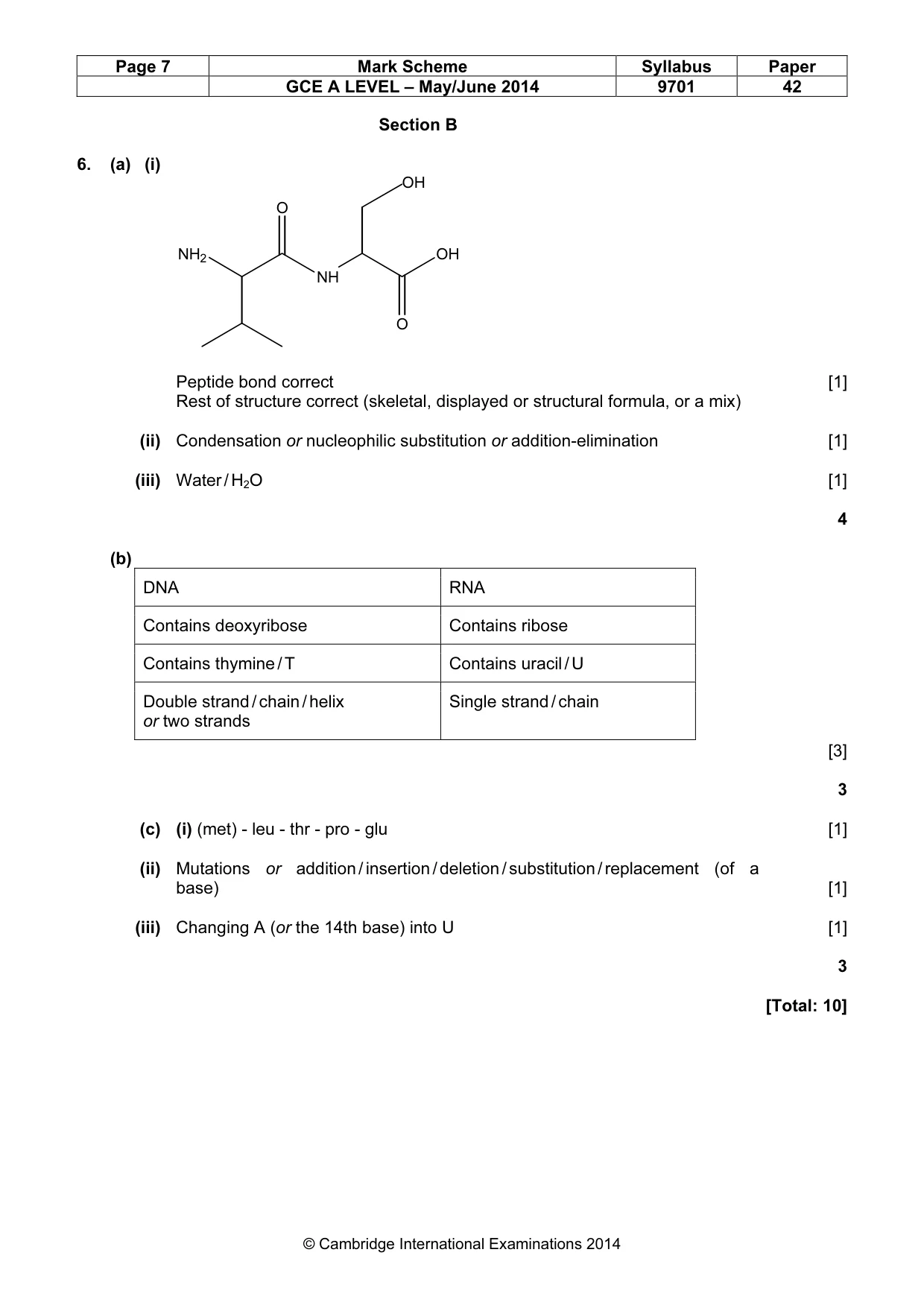
Page 7 Mark Scheme Syllabus Paper GCE A LEVEL – May/June 2014 9701 42 © Cambridge International Examinations 2014 Section B 6. (a) (i) NH2 NH OH O O OH Peptide bond correct [1] Rest of structure correct (skeletal, displayed or structural formula, or a mix) (ii) Condensation or nucleophilic substitution or addition-elimination [1] (iii) Water / H2O [1] 4 (b) DNA RNA Contains deoxyribose Contains ribose Contains thymine / T Contains uracil / U Double strand / chain / helix or two strands Single strand / chain [3] 3 (c) (i) (met) - leu - thr - pro - glu [1] (ii) Mutations or addition / insertion / deletion / substitution / replacement (of a base) [1] (iii) Changing A (or the 14th base) into U [1] 3 [Total: 10]
Mark scheme, page 8
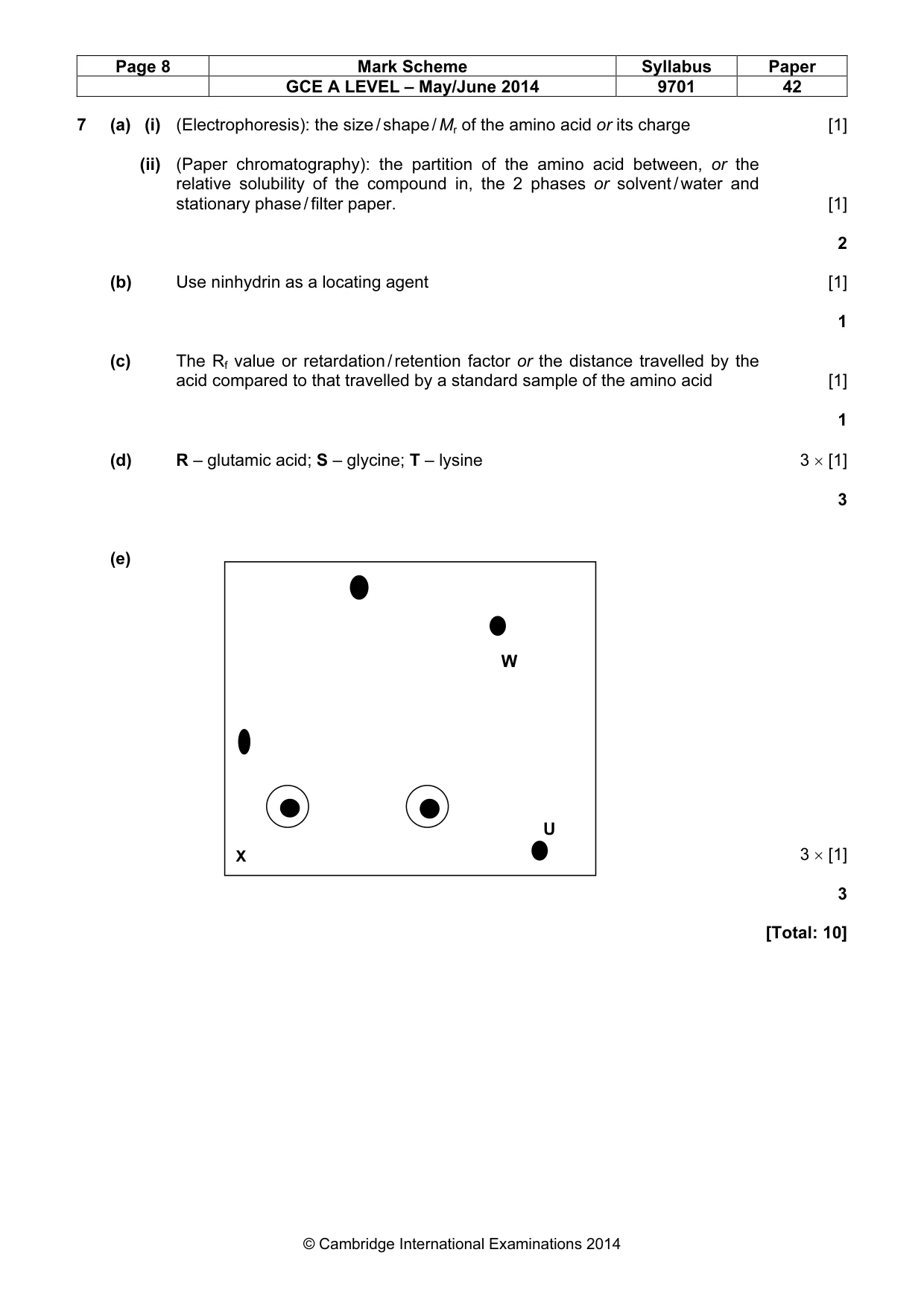
Page 8 Mark Scheme Syllabus Paper GCE A LEVEL – May/June 2014 9701 42 © Cambridge International Examinations 2014 7 (a) (i) (Electrophoresis): the size / shape / Mr of the amino acid or its charge [1] (ii) (Paper chromatography): the partition of the amino acid between, or the relative solubility of the compound in, the 2 phases or solvent / water and stationary phase / filter paper. [1] 2 (b) Use ninhydrin as a locating agent [1] 1 (c) The Rf value or retardation / retention factor or the distance travelled by the acid compared to that travelled by a standard sample of the amino acid [1] 1 (d) R – glutamic acid; S – glycine; T – lysine 3 × [1] 3 (e) 3 × [1] 3 [Total: 10] X U W
Mark scheme, page 9
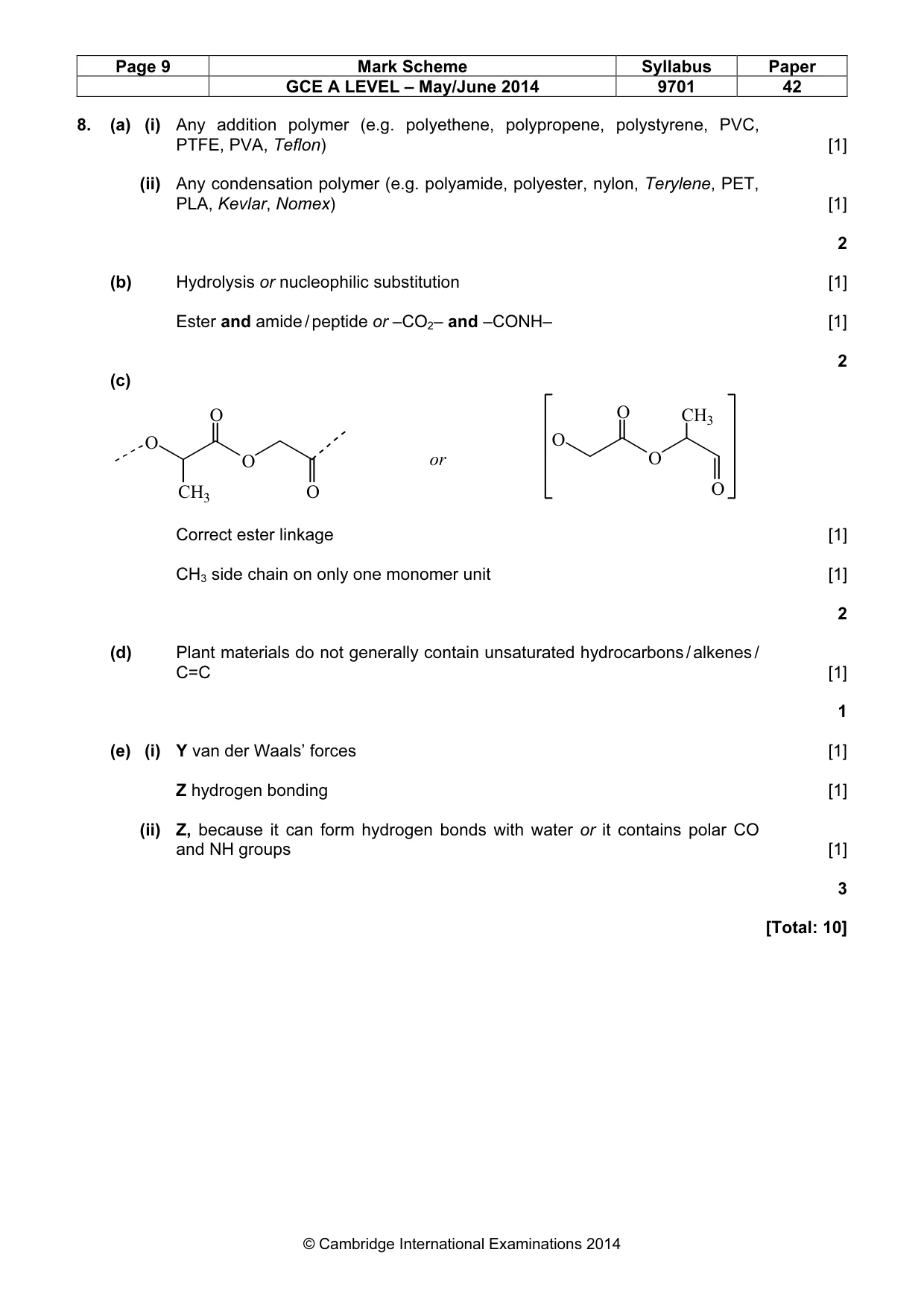
Page 9 Mark Scheme Syllabus Paper GCE A LEVEL – May/June 2014 9701 42 © Cambridge International Examinations 2014 8. (a) (i) Any addition polymer (e.g. polyethene, polypropene, polystyrene, PVC, PTFE, PVA, Teflon) [1] (ii) Any condensation polymer (e.g. polyamide, polyester, nylon, Terylene, PET, PLA, Kevlar, Nomex) [1] 2 (b) Hydrolysis or nucleophilic substitution [1] Ester and amide / peptide or –CO2– and –CONH– [1] 2 (c) O O CH3 O O O O O O CH3 or Correct ester linkage [1] CH3 side chain on only one monomer unit [1] 2 (d) Plant materials do not generally contain unsaturated hydrocarbons / alkenes / C=C [1] 1 (e) (i) Y van der Waals’ forces [1] Z hydrogen bonding [1] (ii) Z, because it can form hydrogen bonds with water or it contains polar CO and NH groups [1] 3 [Total: 10]
What you needed in this session
Cambridge’s own grade thresholds for 2014 May/June, Paper 4 · Variant 2. A higher threshold means an easier paper — the bar moves with how the cohort did.