Cambridge A Level Chemistry 9701 — 2014 May/June Paper 4 · Variant 3
9701/43/M/J/14 · 100 marks · ≈113 min
The question paper and its mark scheme, free to read here and free to download. This is Cambridge’s own paper, exactly as it was sat.
Question paper20 pages
Mark scheme8 pages
Answers below. Sit the paper first if you are practising.
Paper as text
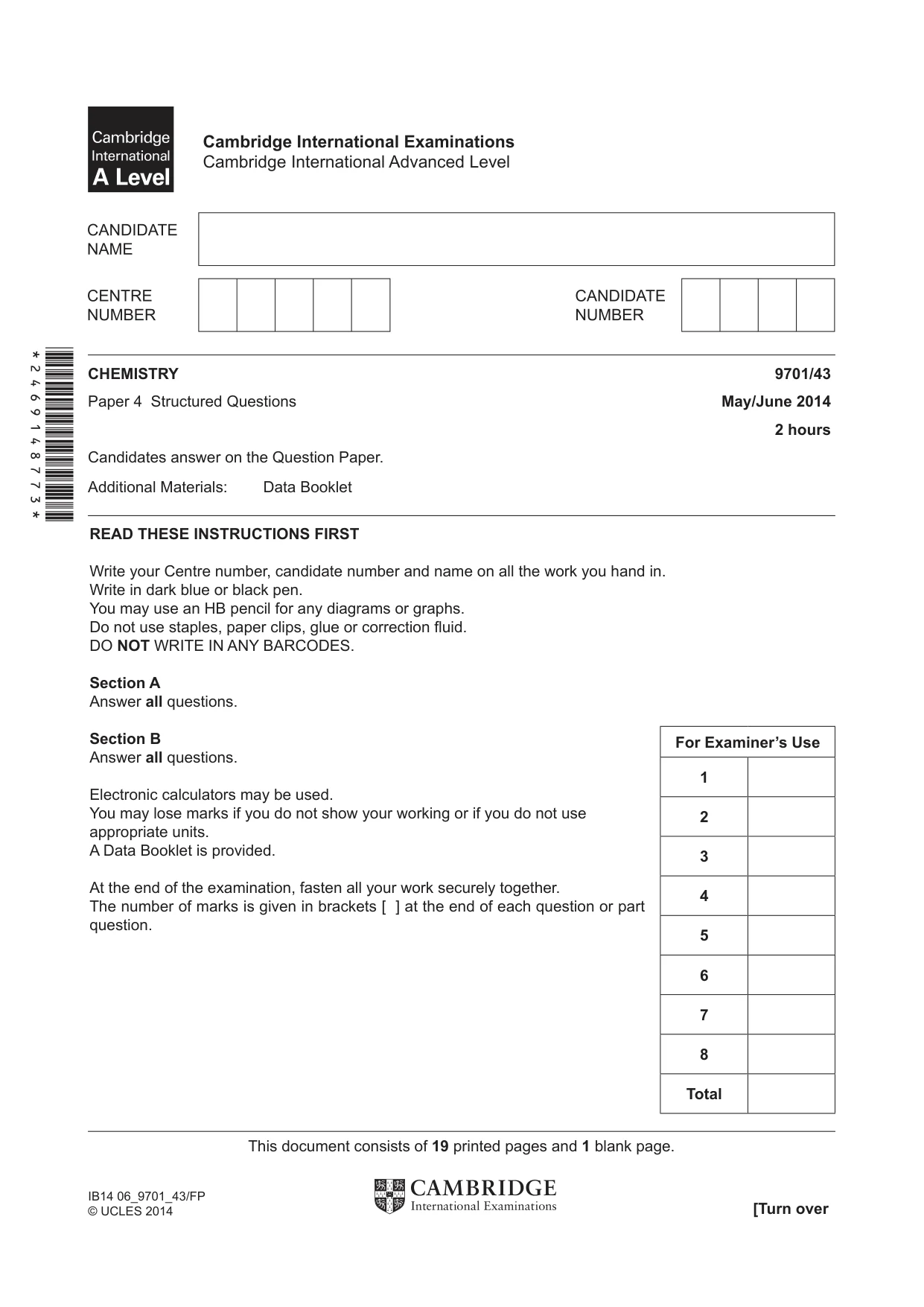
Question paper, page 1
This document consists of 19 printed pages and 1 blank page. [Turn over IB14 06_9701_43/FP © UCLES 2014 For Examiner’s Use 1 2 3 4 5 6 7 8 Total READ THESE INSTRUCTIONS FIRST Write your Centre number, candidate number and name on all the work you hand in. Write in dark blue or black pen. You may use an HB pencil for any diagrams or graphs. Do not use staples, paper clips, glue or correction fl uid. DO NOT WRITE IN ANY BARCODES. Section A Answer all questions. Section B Answer all questions. Electronic calculators may be used. You may lose marks if you do not show your working or if you do not use appropriate units. A Data Booklet is provided. At the end of the examination, fasten all your work securely together. The number of marks is given in brackets [ ] at the end of each question or part question. CHEMISTRY 9701/43 Paper 4 Structured Questions May/June 2014 2 hours Candidates answer on the Question Paper. Additional Materials: Data Booklet Cambridge International Examinations Cambridge International Advanced Level
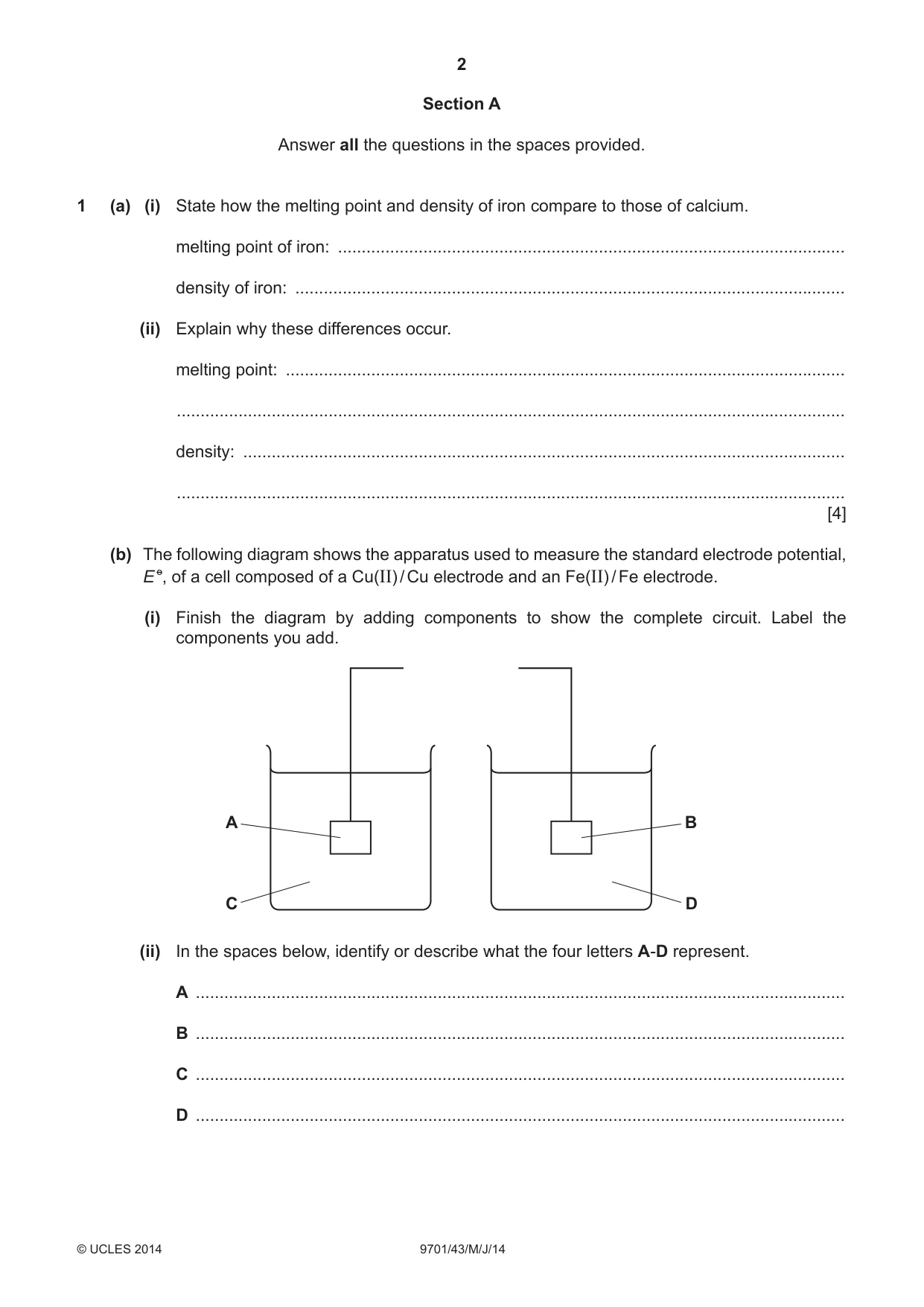
Question paper, page 2
2 9701/43/M/J/14 © UCLES 2014 Section A Answer all the questions in the spaces provided. 1 (a) (i) State how the melting point and density of iron compare to those of calcium. melting point of iron: … density of iron: … (ii) Explain why these differences occur. melting point: … … density: … … [4] (b) The following diagram shows the apparatus used to measure the standard electrode potential, E o, of a cell composed of a Cu(II) / Cu electrode and an Fe(II) / Fe electrode. (i) Finish the diagram by adding components to show the complete circuit. Label the components you add. A C B D (ii) In the spaces below, identify or describe what the four letters A-D represent. A … B … C … D …
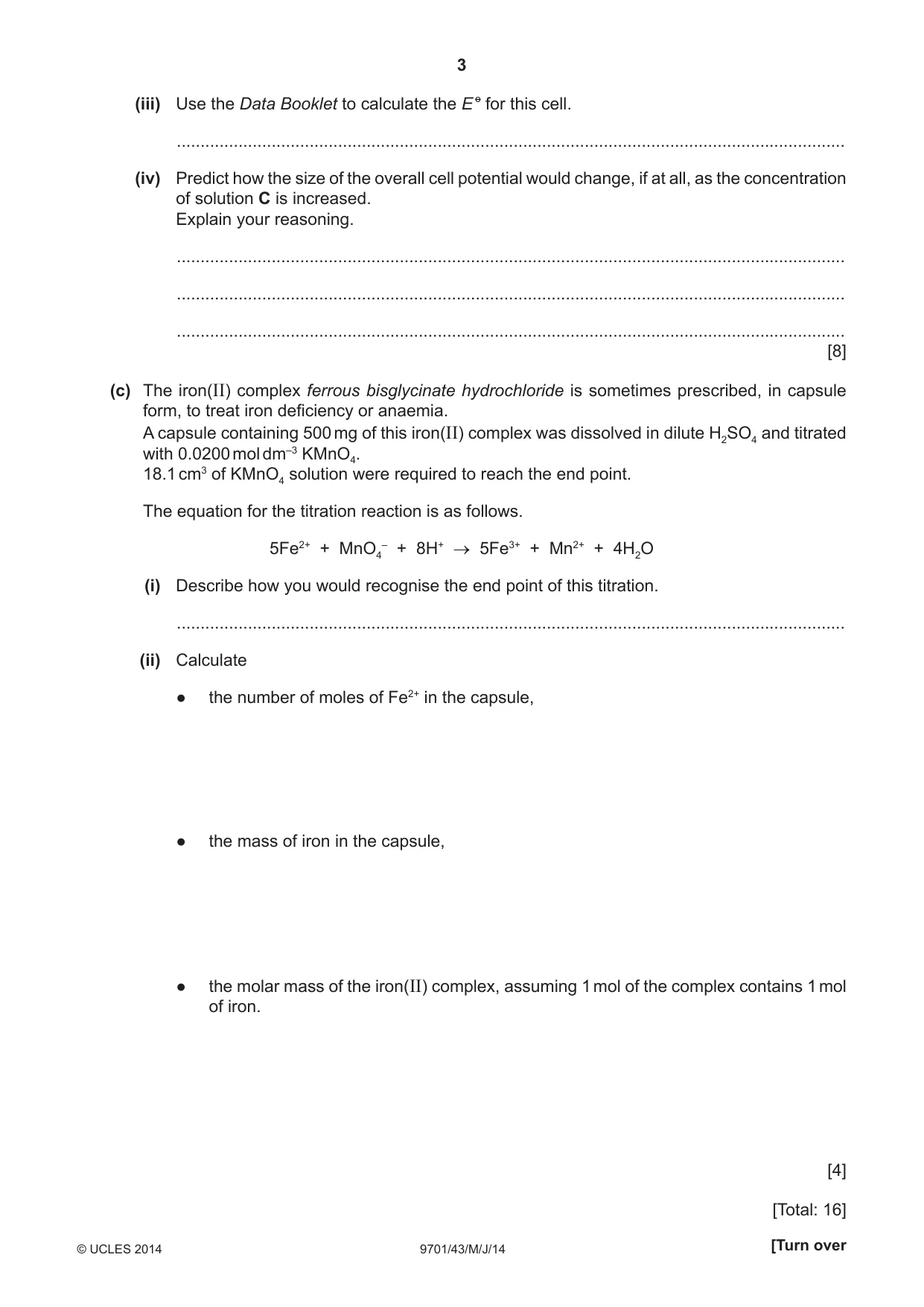
Question paper, page 3
3 9701/43/M/J/14 © UCLES 2014 [Turn over (iii) Use the Data Booklet to calculate the E o for this cell. … (iv) Predict how the size of the overall cell potential would change, if at all, as the concentration of solution C is increased. Explain your reasoning. … … … [8] (c) The iron(II) complex ferrous bisglycinate hydrochloride is sometimes prescribed, in capsule form, to treat iron defi ciency or anaemia. A capsule containing 500 mg of this iron(II) complex was dissolved in dilute H2SO4 and titrated with 0.0200 mol dm–3 KMnO4. 18.1 cm3 of KMnO4 solution were required to reach the end point. The equation for the titration reaction is as follows. 5Fe2+ + MnO4 – + 8H+ 5Fe3+ + Mn2+ + 4H2O (i) Describe how you would recognise the end point of this titration. … (ii) Calculate ● the number of moles of Fe2+ in the capsule, ● the mass of iron in the capsule, ● the molar mass of the iron(II) complex, assuming 1 mol of the complex contains 1 mol of iron. [4] [Total: 16]
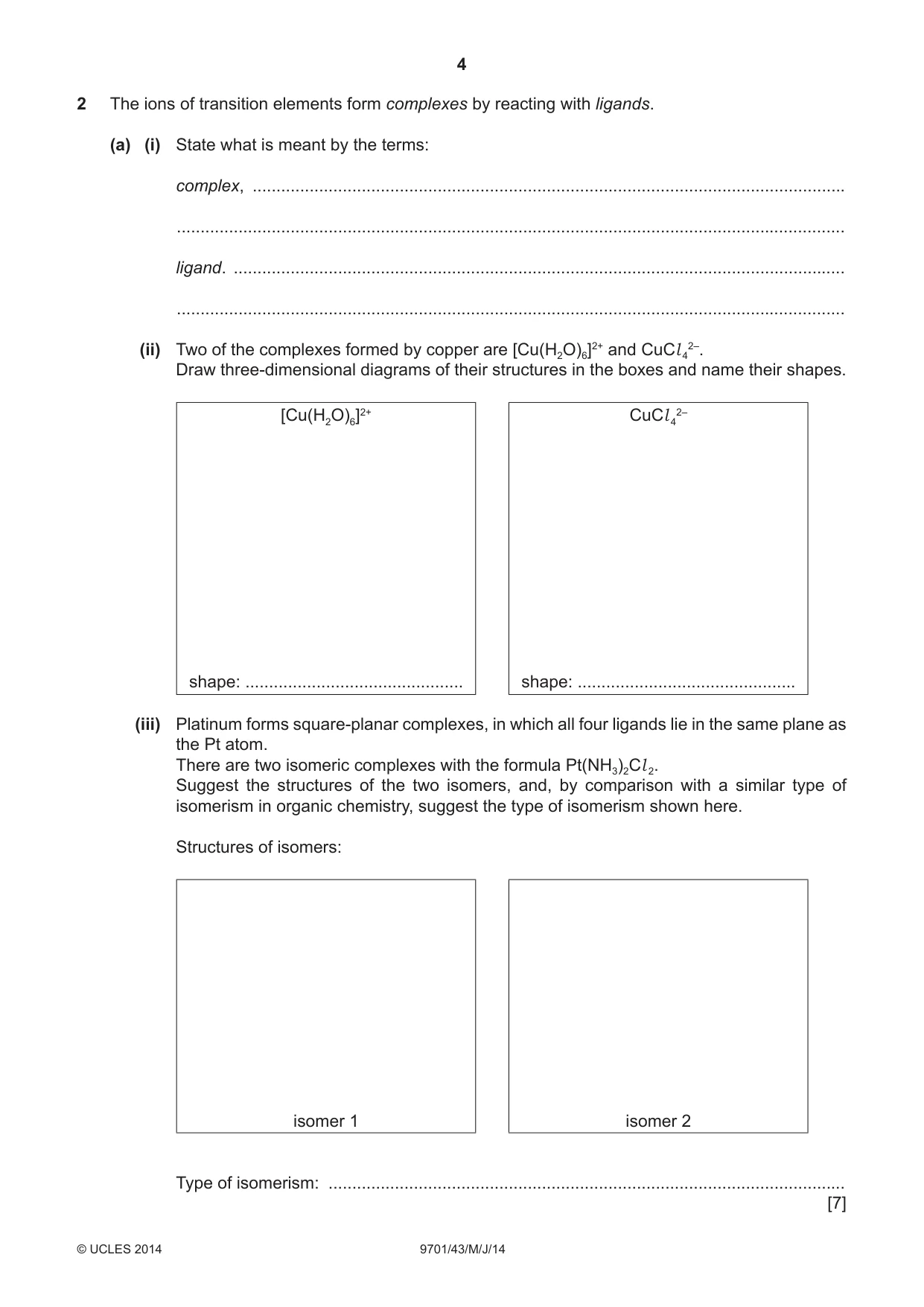
Question paper, page 4
4 9701/43/M/J/14 © UCLES 2014 2 The ions of transition elements form complexes by reacting with ligands. (a) (i) State what is meant by the terms: complex, … … ligand. … … (ii) Two of the complexes formed by copper are [Cu(H2O)6]2+ and CuCl 4 2–. Draw three-dimensional diagrams of their structures in the boxes and name their shapes. [Cu(H2O)6]2+ shape: … CuCl 4 2– shape: … (iii) Platinum forms square-planar complexes, in which all four ligands lie in the same plane as the Pt atom. There are two isomeric complexes with the formula Pt(NH3)2Cl 2. Suggest the structures of the two isomers, and, by comparison with a similar type of isomerism in organic chemistry, suggest the type of isomerism shown here. Structures of isomers: isomer 1 isomer 2 Type of isomerism: … [7]
Question paper, page 5
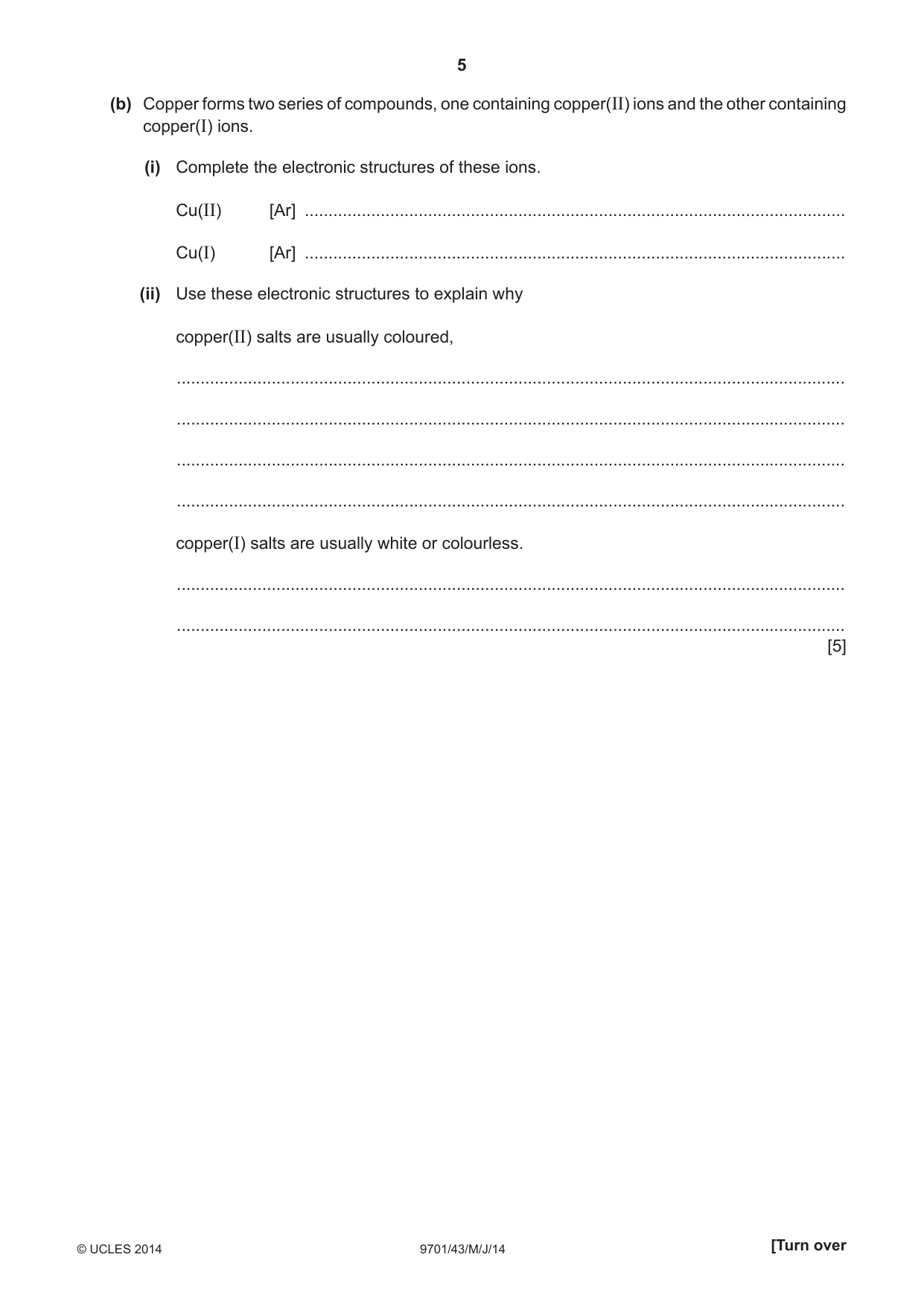
5 9701/43/M/J/14 © UCLES 2014 [Turn over (b) Copper forms two series of compounds, one containing copper(II) ions and the other containing copper(I) ions. (i) Complete the electronic structures of these ions. Cu(II) [Ar] … Cu(I) [Ar] … (ii) Use these electronic structures to explain why copper(II) salts are usually coloured, … … … … copper(I) salts are usually white or colourless. … … [5]
Question paper, page 6
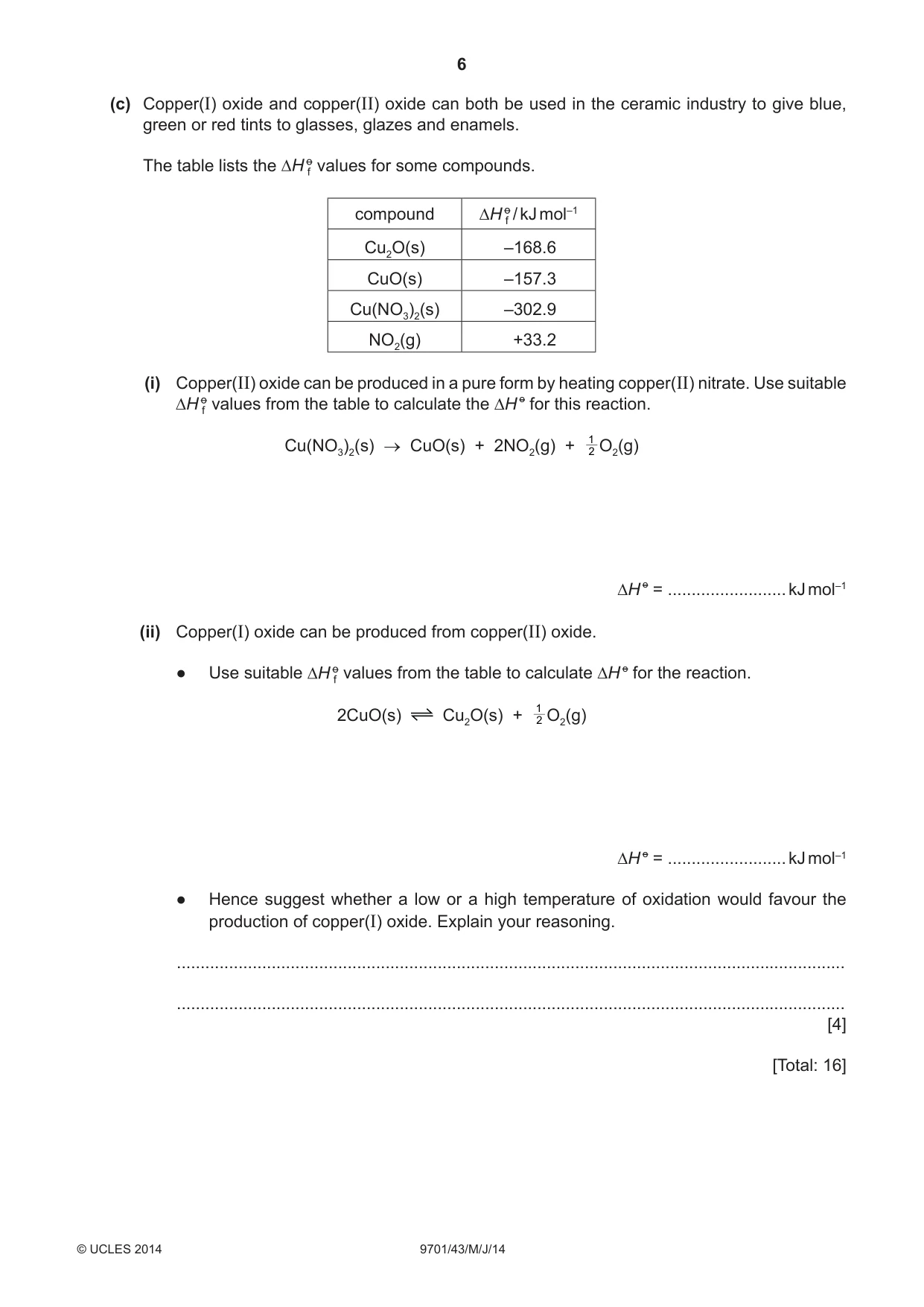
6 9701/43/M/J/14 © UCLES 2014 (c) Copper(I) oxide and copper(II) oxide can both be used in the ceramic industry to give blue, green or red tints to glasses, glazes and enamels. The table lists the values for some compounds. compound / kJ mol–1 Cu2O(s) –168.6 CuO(s) –157.3 Cu(NO3)2(s) –302.9 NO2(g) +33.2 (i) Copper(II) oxide can be produced in a pure form by heating copper(II) nitrate. Use suitable values from the table to calculate the H o for this reaction. Cu(NO3)2(s) CuO(s) + 2NO2(g) + 2 1 O2(g) H o = … kJ mol–1 (ii) Copper(I) oxide can be produced from copper(II) oxide. ● Use suitable values from the table to calculate H o for the reaction. 2CuO(s) Cu2O(s) + 2 1 O2(g) H o = … kJ mol–1 ● Hence suggest whether a low or a high temperature of oxidation would favour the production of copper(I) oxide. Explain your reasoning. … … [4] [Total: 16]
Question paper, page 7
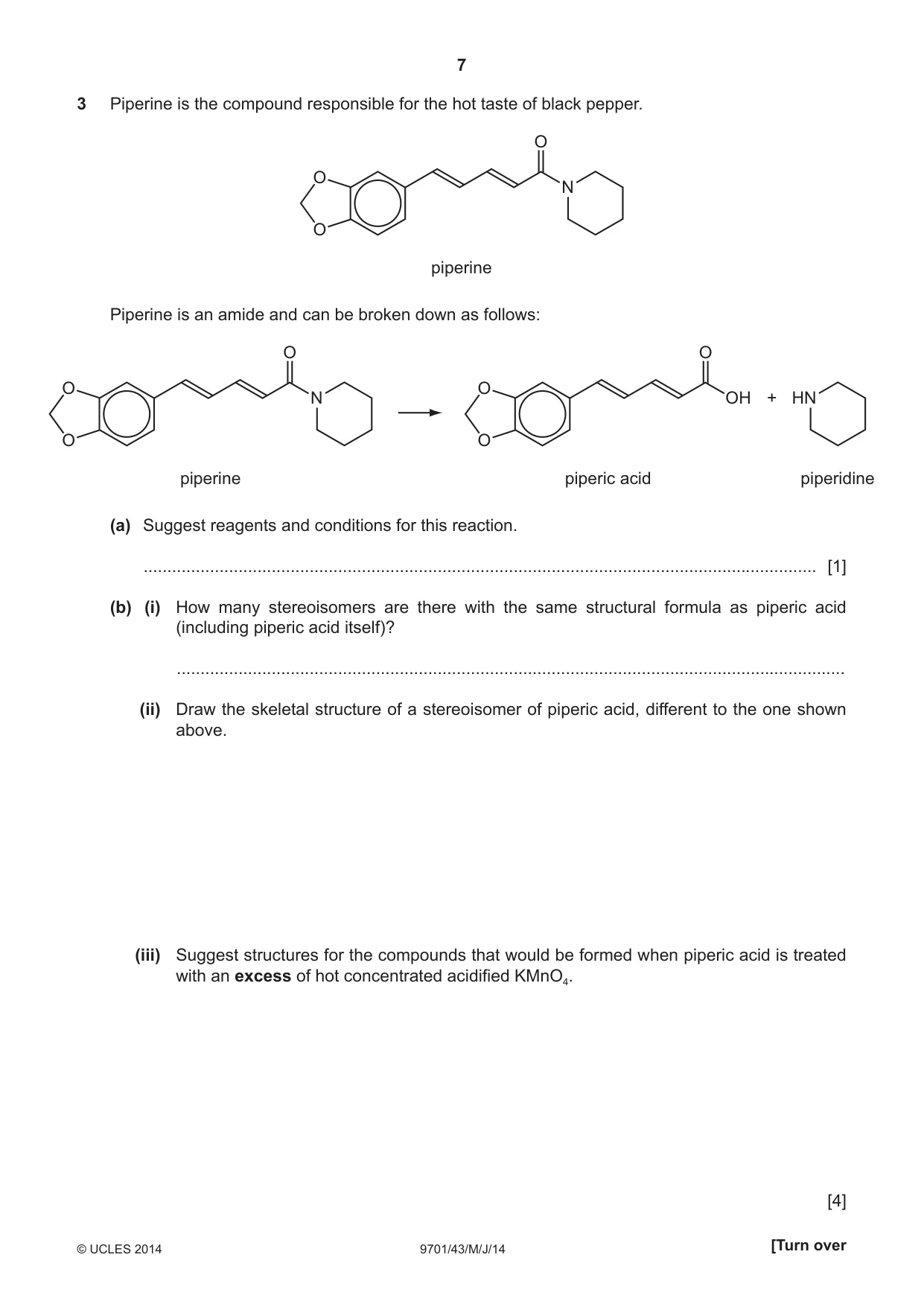
7 9701/43/M/J/14 © UCLES 2014 [Turn over 3 Piperine is the compound responsible for the hot taste of black pepper. O N O O piperine Piperine is an amide and can be broken down as follows: O N HN O O piperine O OH + O O piperic acid piperidine (a) Suggest reagents and conditions for this reaction. … [1] (b) (i) How many stereoisomers are there with the same structural formula as piperic acid (including piperic acid itself)? … (ii) Draw the skeletal structure of a stereoisomer of piperic acid, different to the one shown above. (iii) Suggest structures for the compounds that would be formed when piperic acid is treated with an excess of hot concentrated acidifi ed KMnO4. [4]
Question paper, page 8
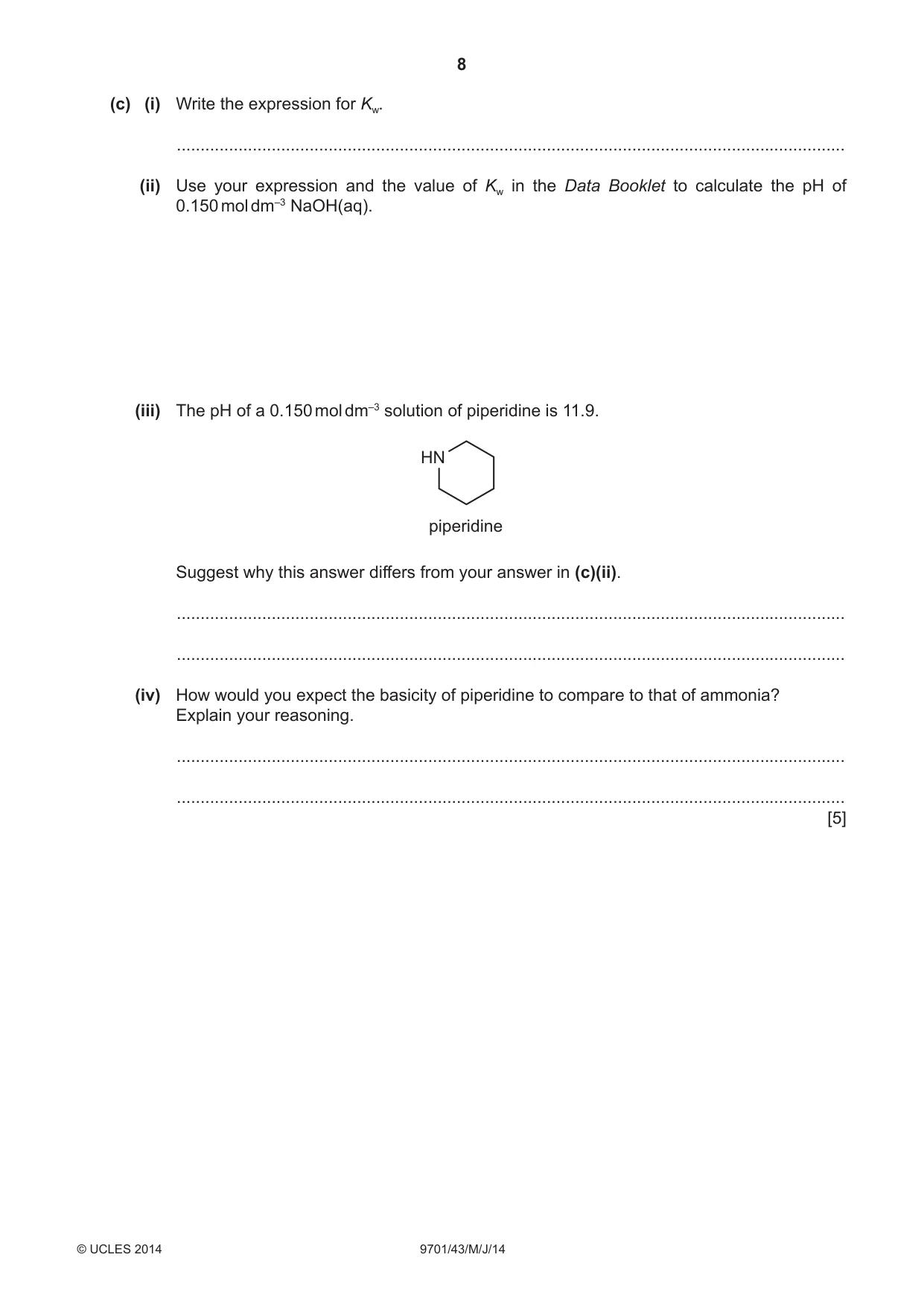
8 9701/43/M/J/14 © UCLES 2014 (c) (i) Write the expression for Kw. … (ii) Use your expression and the value of Kw in the Data Booklet to calculate the pH of 0.150 mol dm–3 NaOH(aq). (iii) The pH of a 0.150 mol dm–3 solution of piperidine is 11.9. HN piperidine Suggest why this answer differs from your answer in (c)(ii). … … (iv) How would you expect the basicity of piperidine to compare to that of ammonia? Explain your reasoning. … … [5]
Question paper, page 9
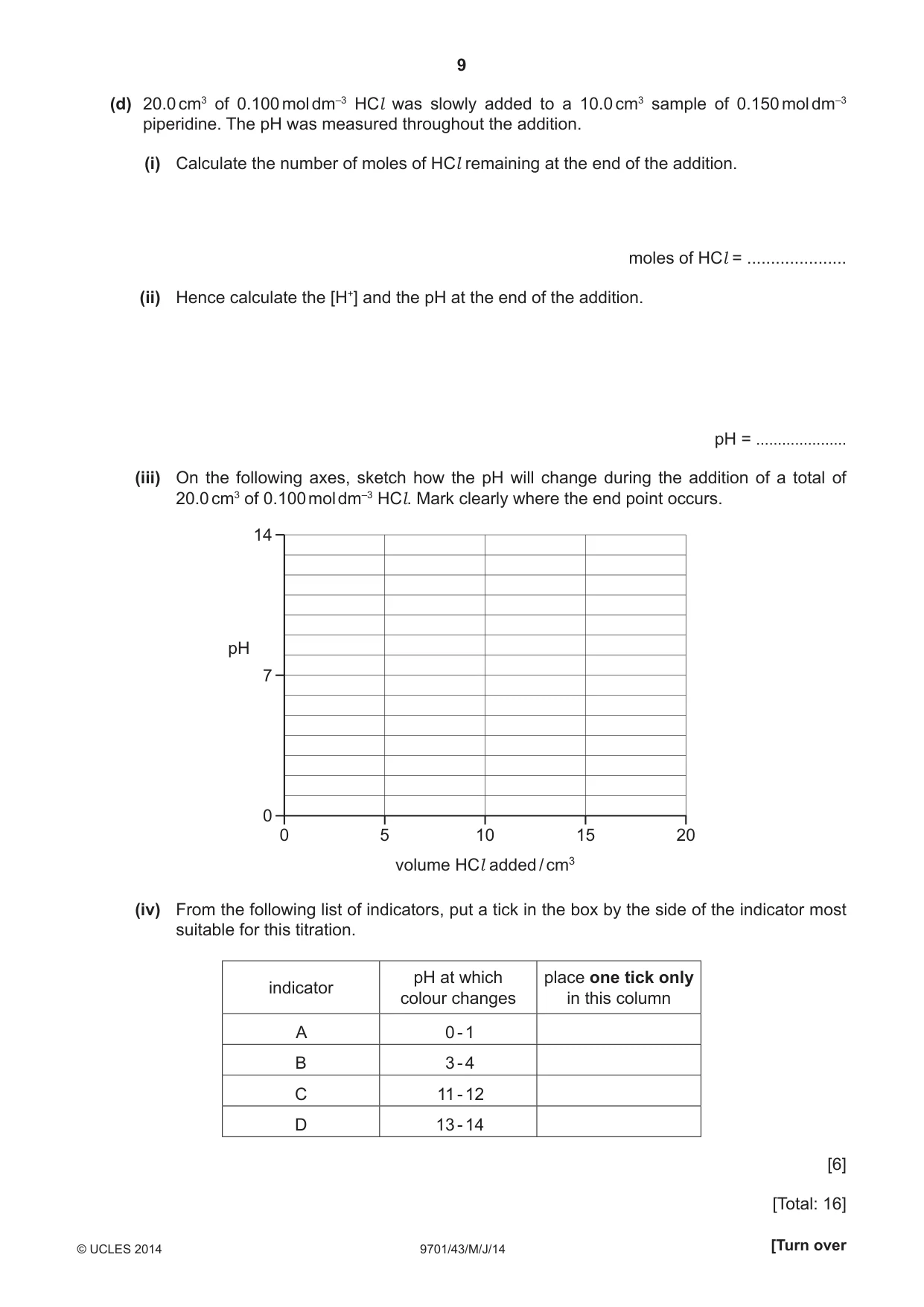
9 9701/43/M/J/14 © UCLES 2014 [Turn over (d) 20.0 cm3 of 0.100 mol dm–3 HCl was slowly added to a 10.0 cm3 sample of 0.150 mol dm–3 piperidine. The pH was measured throughout the addition. (i) Calculate the number of moles of HCl remaining at the end of the addition. moles of HCl = … (ii) Hence calculate the [H+] and the pH at the end of the addition. pH = … (iii) On the following axes, sketch how the pH will change during the addition of a total of 20.0 cm3 of 0.100 mol dm–3 HCl. Mark clearly where the end point occurs. 0 5 10 volume HCl added / cm3 15 20 14 7 0 pH (iv) From the following list of indicators, put a tick in the box by the side of the indicator most suitable for this titration. indicator pH at which colour changes place one tick only in this column A 0 - 1 B 3 - 4 C 11 - 12 D 13 - 14 [6] [Total: 16]
Question paper, page 10
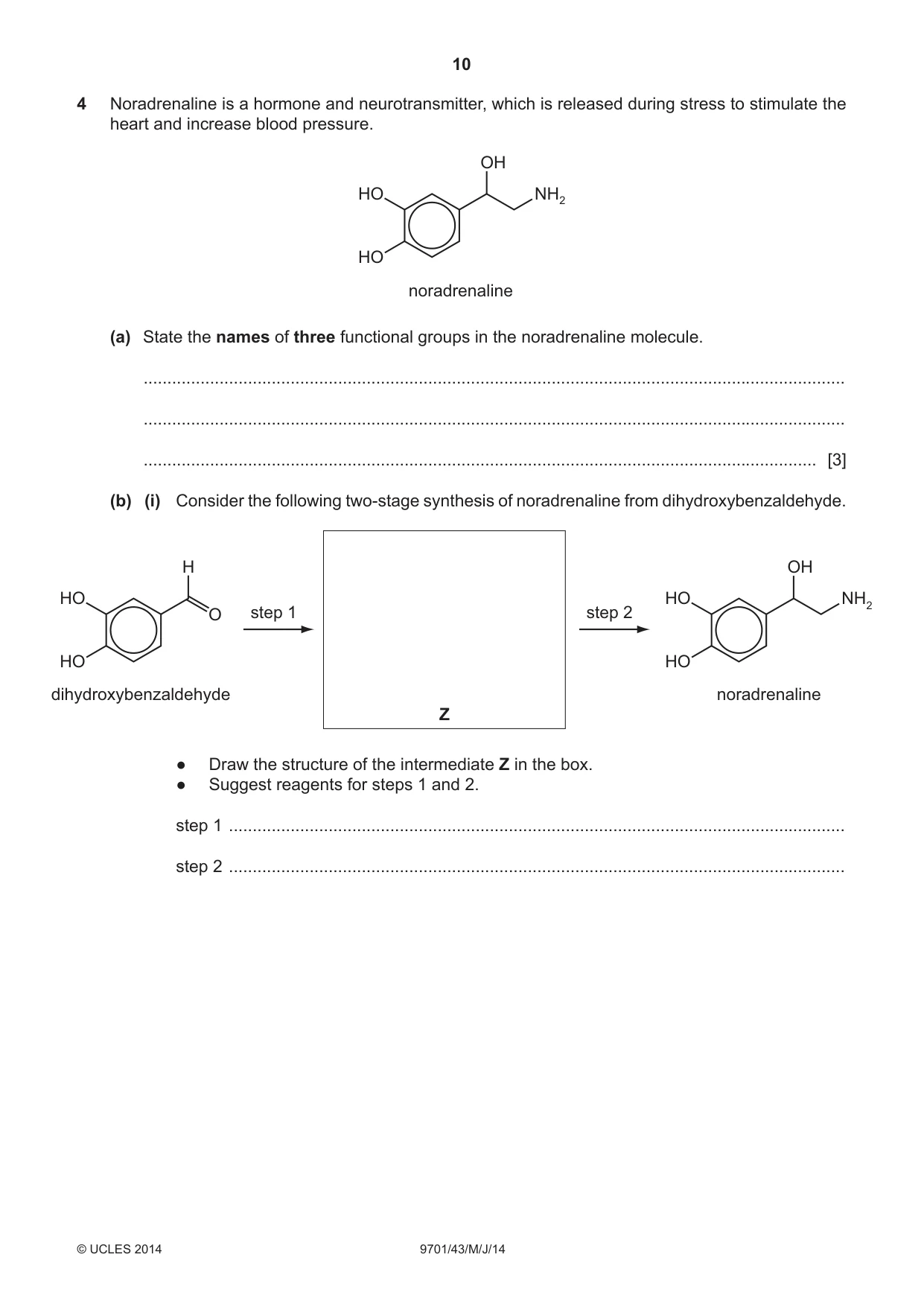
10 9701/43/M/J/14 © UCLES 2014 4 Noradrenaline is a hormone and neurotransmitter, which is released during stress to stimulate the heart and increase blood pressure. HO OH NH2 HO noradrenaline (a) State the names of three functional groups in the noradrenaline molecule. … … … [3] (b) (i) Consider the following two-stage synthesis of noradrenaline from dihydroxybenzaldehyde. HO OH NH2 HO HO H O HO step 2 step 1 dihydroxybenzaldehyde noradrenaline Z ● Draw the structure of the intermediate Z in the box. ● Suggest reagents for steps 1 and 2. step 1 … step 2 …
Question paper, page 11
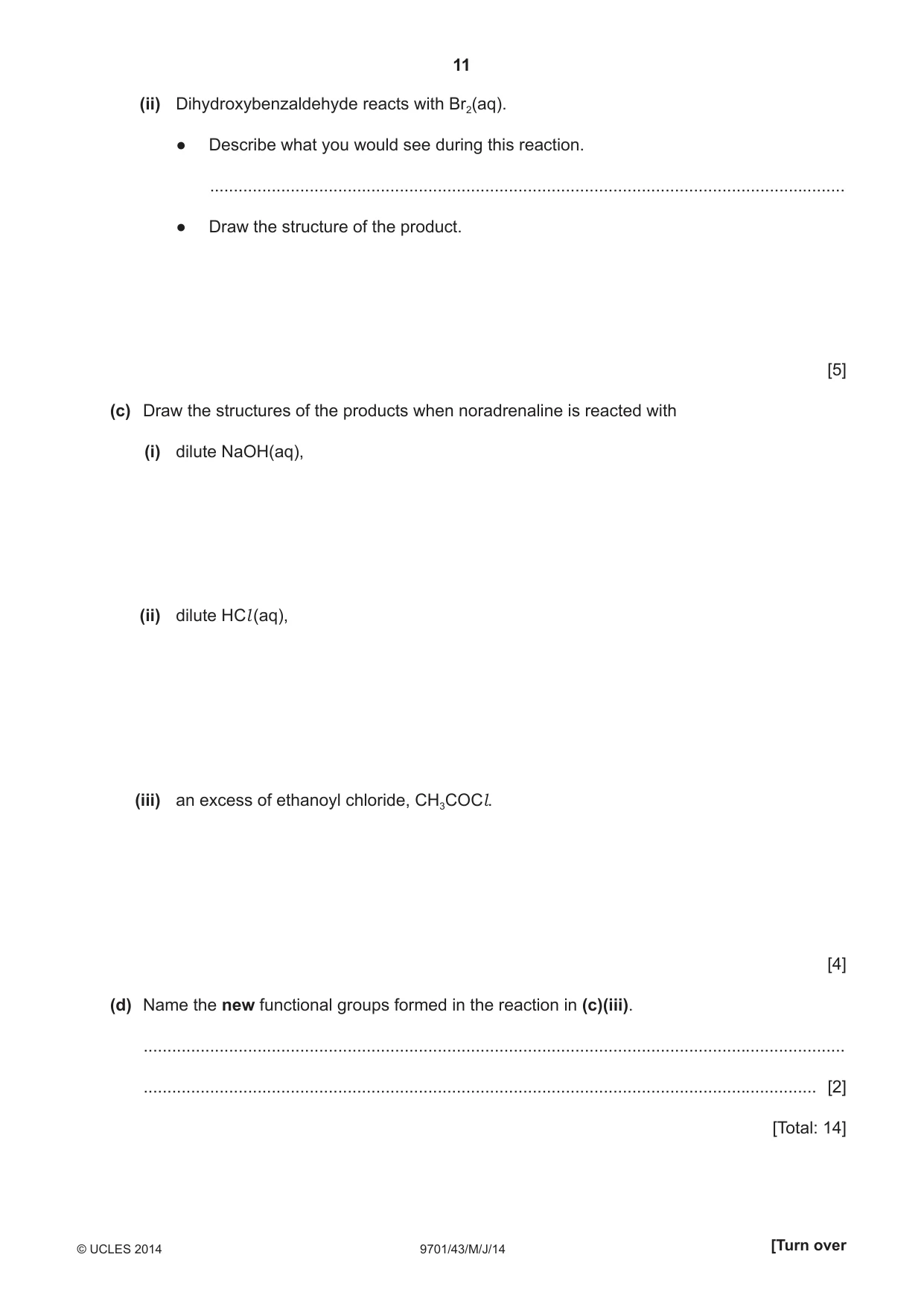
11 9701/43/M/J/14 © UCLES 2014 [Turn over (ii) Dihydroxybenzaldehyde reacts with Br2(aq). ● Describe what you would see during this reaction. … ● Draw the structure of the product. [5] (c) Draw the structures of the products when noradrenaline is reacted with (i) dilute NaOH(aq), (ii) dilute HCl (aq), (iii) an excess of ethanoyl chloride, CH3COCl. [4] (d) Name the new functional groups formed in the reaction in (c)(iii). … … [2] [Total: 14]
Question paper, page 12
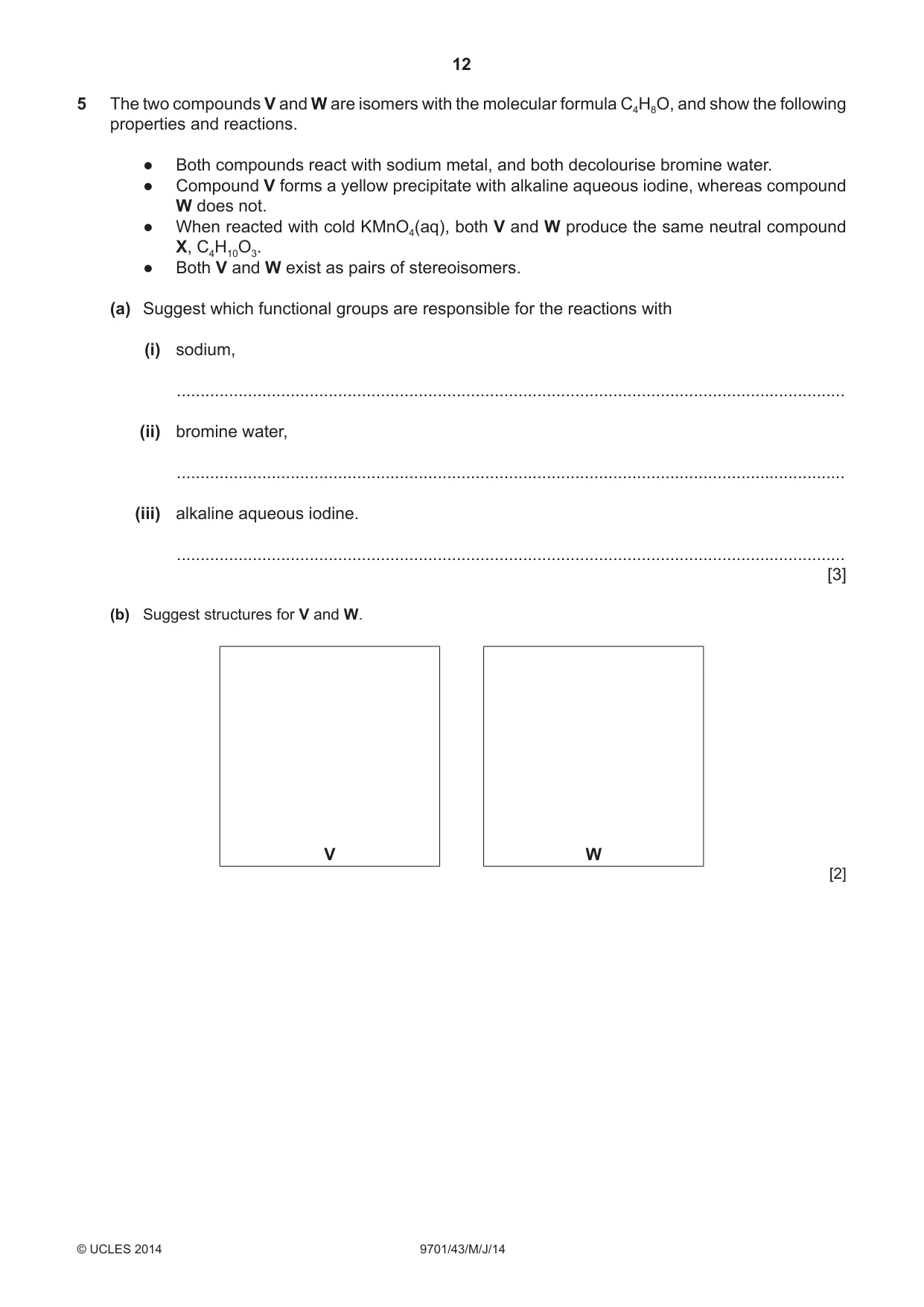
12 9701/43/M/J/14 © UCLES 2014 5 The two compounds V and W are isomers with the molecular formula C4H8O, and show the following properties and reactions. ● Both compounds react with sodium metal, and both decolourise bromine water. ● Compound V forms a yellow precipitate with alkaline aqueous iodine, whereas compound W does not. ● When reacted with cold KMnO4(aq), both V and W produce the same neutral compound X, C4H10O3. ● Both V and W exist as pairs of stereoisomers. (a) Suggest which functional groups are responsible for the reactions with (i) sodium, … (ii) bromine water, … (iii) alkaline aqueous iodine. … [3] (b) Suggest structures for V and W. V W [2]
Question paper, page 13
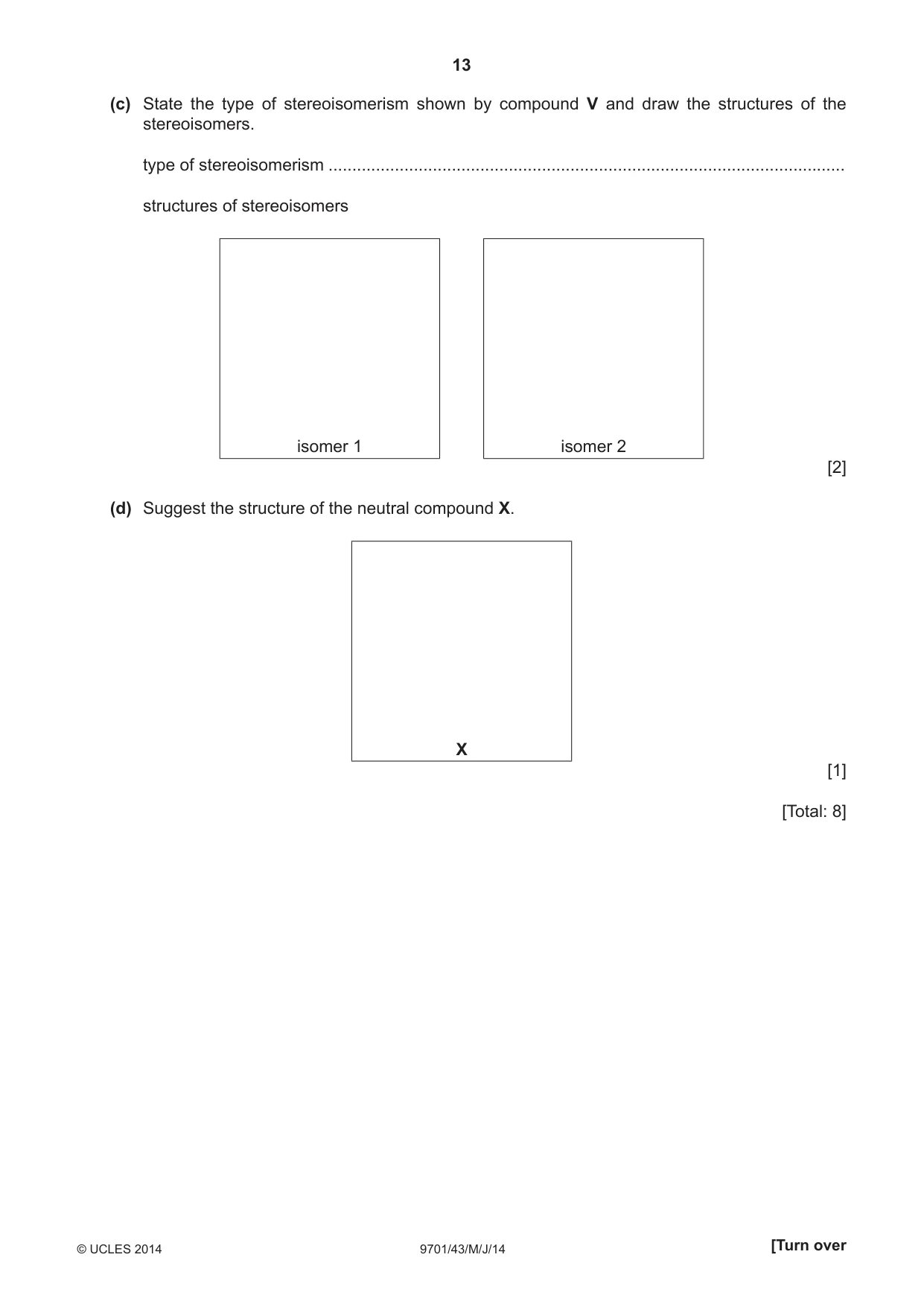
13 9701/43/M/J/14 © UCLES 2014 [Turn over (c) State the type of stereoisomerism shown by compound V and draw the structures of the stereoisomers. type of stereoisomerism … structures of stereoisomers isomer 1 isomer 2 [2] (d) Suggest the structure of the neutral compound X. X [1] [Total: 8]
Question paper, page 14
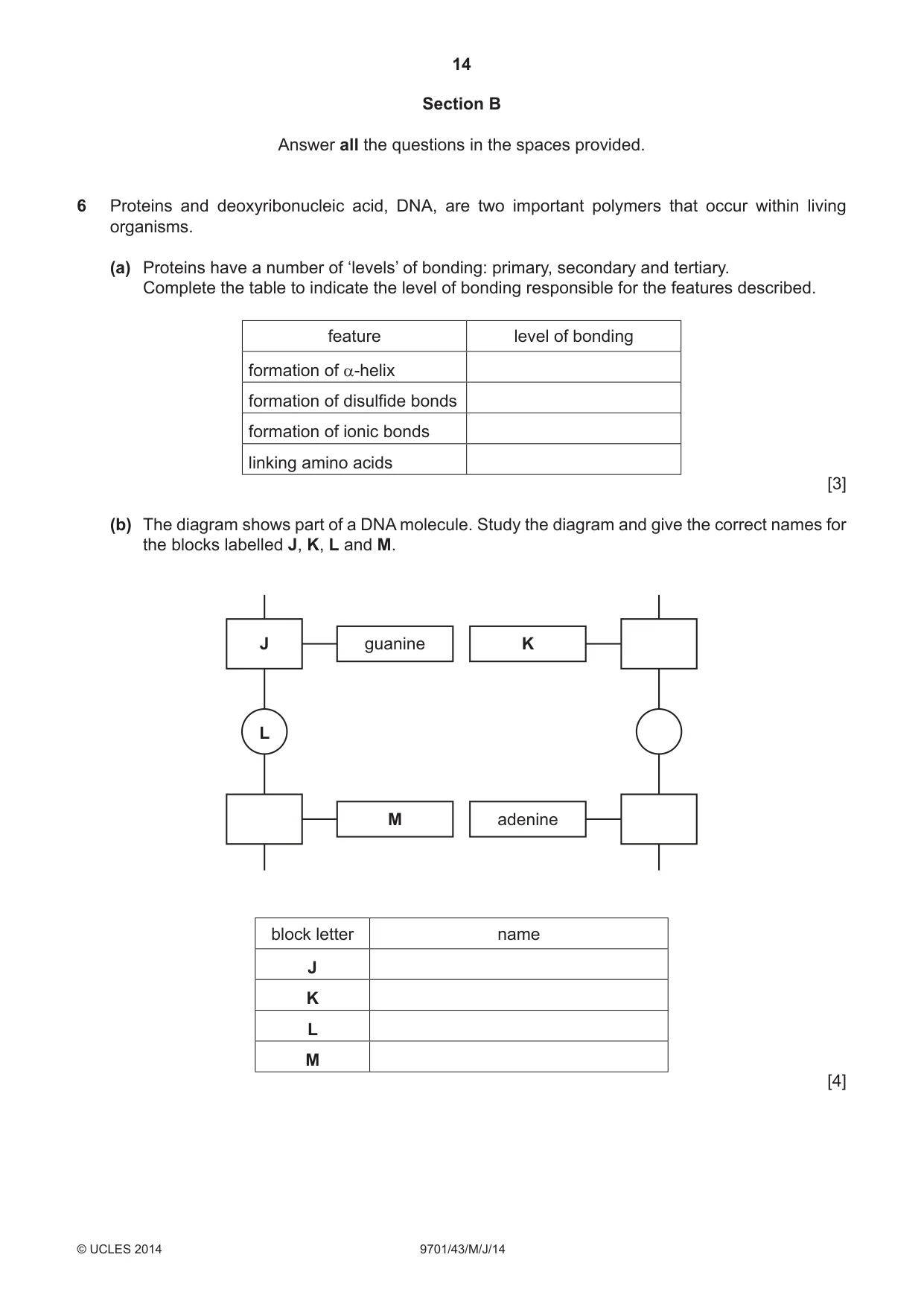
14 9701/43/M/J/14 © UCLES 2014 Section B Answer all the questions in the spaces provided. 6 Proteins and deoxyribonucleic acid, DNA, are two important polymers that occur within living organisms. (a) Proteins have a number of ‘levels’ of bonding: primary, secondary and tertiary. Complete the table to indicate the level of bonding responsible for the features described. feature level of bonding formation of -helix formation of disulfi de bonds formation of ionic bonds linking amino acids [3] (b) The diagram shows part of a DNA molecule. Study the diagram and give the correct names for the blocks labelled J, K, L and M. guanine J K M adenine L block letter name J K L M [4]
Question paper, page 15
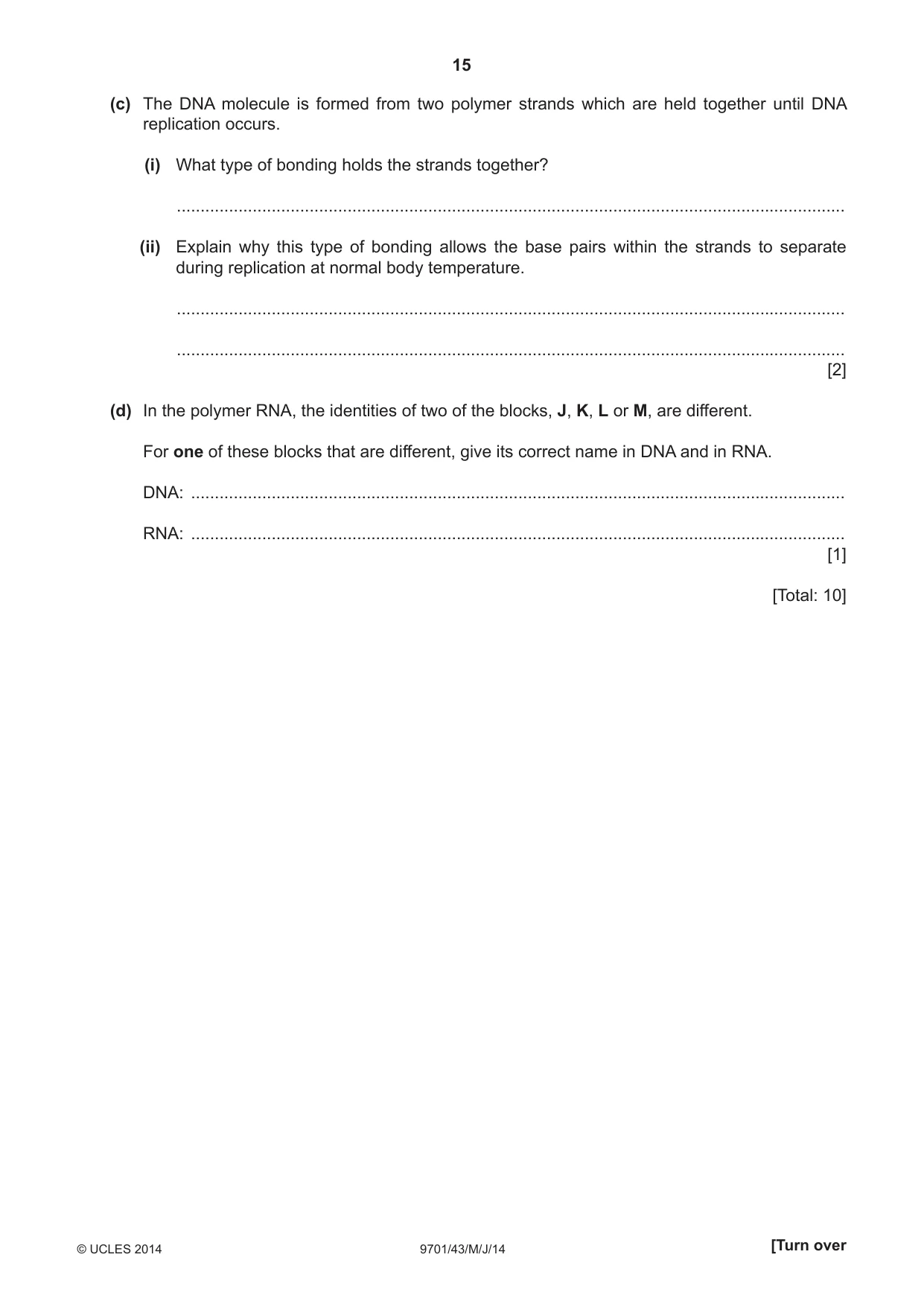
15 9701/43/M/J/14 © UCLES 2014 [Turn over (c) The DNA molecule is formed from two polymer strands which are held together until DNA replication occurs. (i) What type of bonding holds the strands together? … (ii) Explain why this type of bonding allows the base pairs within the strands to separate during replication at normal body temperature. … … [2] (d) In the polymer RNA, the identities of two of the blocks, J, K, L or M, are different. For one of these blocks that are different, give its correct name in DNA and in RNA. DNA: … RNA: … [1] [Total: 10]
Question paper, page 16
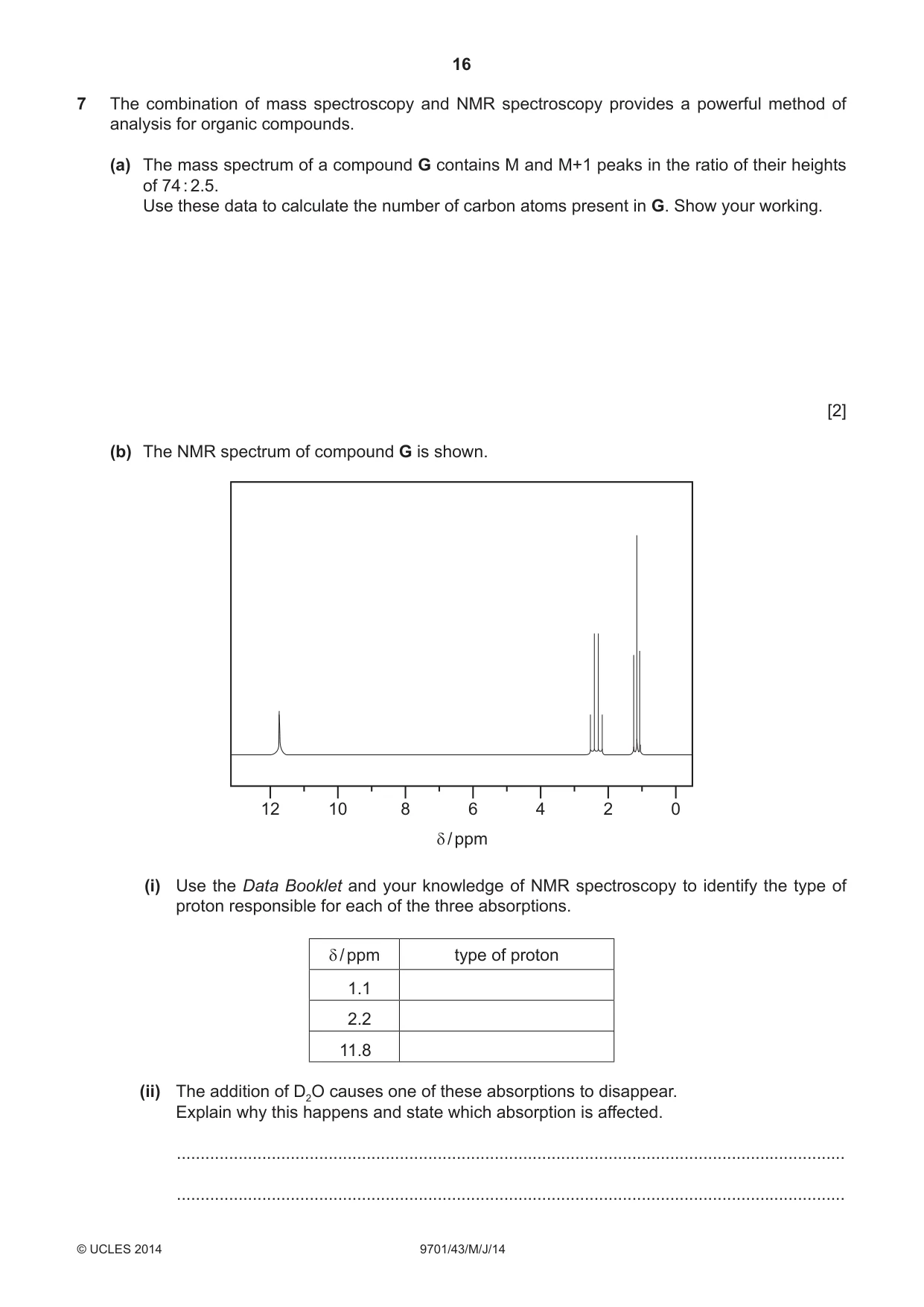
16 9701/43/M/J/14 © UCLES 2014 7 The combination of mass spectroscopy and NMR spectroscopy provides a powerful method of analysis for organic compounds. (a) The mass spectrum of a compound G contains M and M+1 peaks in the ratio of their heights of 74 : 2.5. Use these data to calculate the number of carbon atoms present in G. Show your working. [2] (b) The NMR spectrum of compound G is shown. 12 10 8 δ / ppm 4 6 2 0 (i) Use the Data Booklet and your knowledge of NMR spectroscopy to identify the type of proton responsible for each of the three absorptions. / ppm type of proton 1.1 2.2 11.8 (ii) The addition of D2O causes one of these absorptions to disappear. Explain why this happens and state which absorption is affected. … …
Question paper, page 17
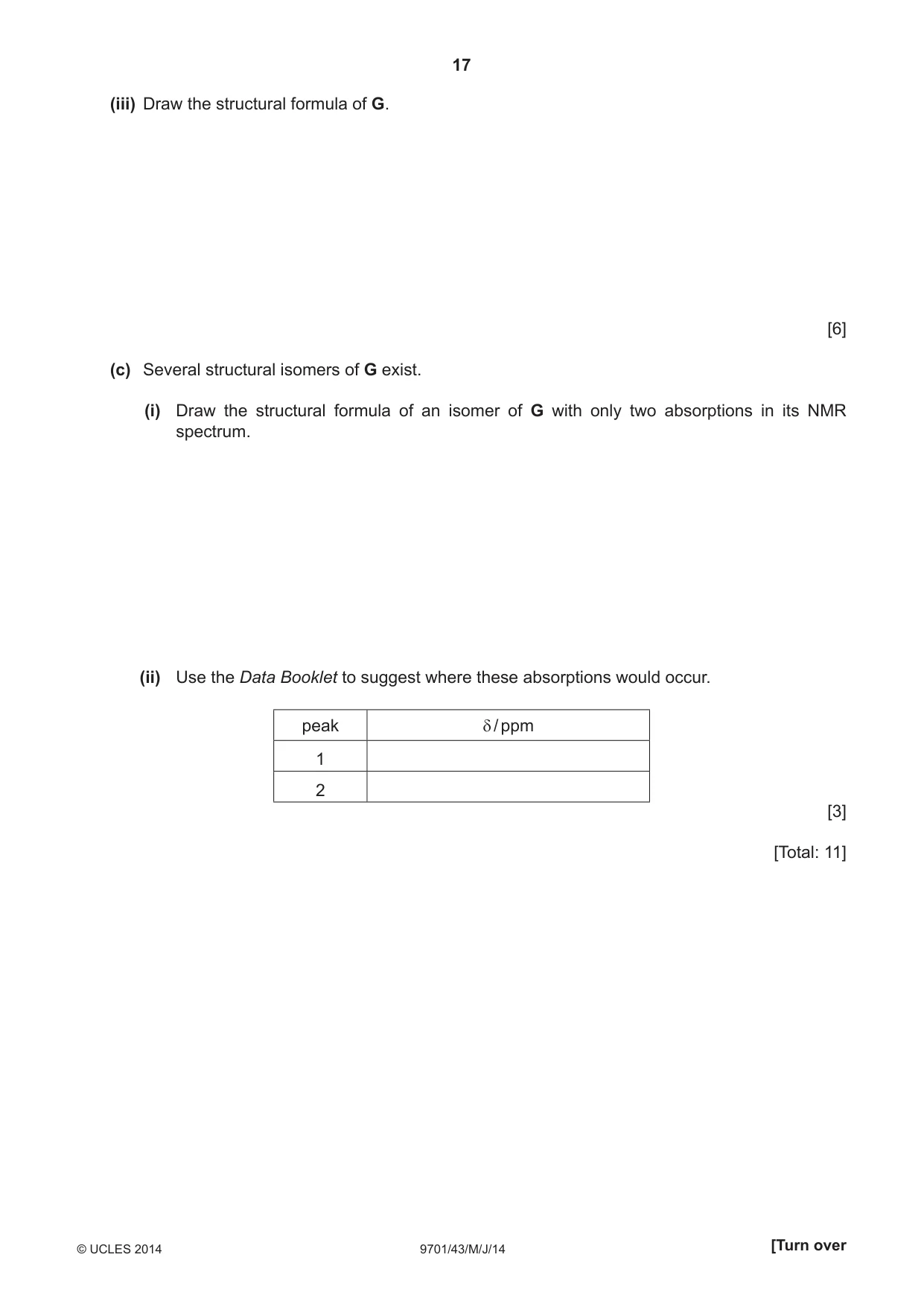
17 9701/43/M/J/14 © UCLES 2014 [Turn over (iii) Draw the structural formula of G. [6] (c) Several structural isomers of G exist. (i) Draw the structural formula of an isomer of G with only two absorptions in its NMR spectrum. (ii) Use the Data Booklet to suggest where these absorptions would occur. peak / ppm 1 2 [3] [Total: 11]
Question paper, page 18
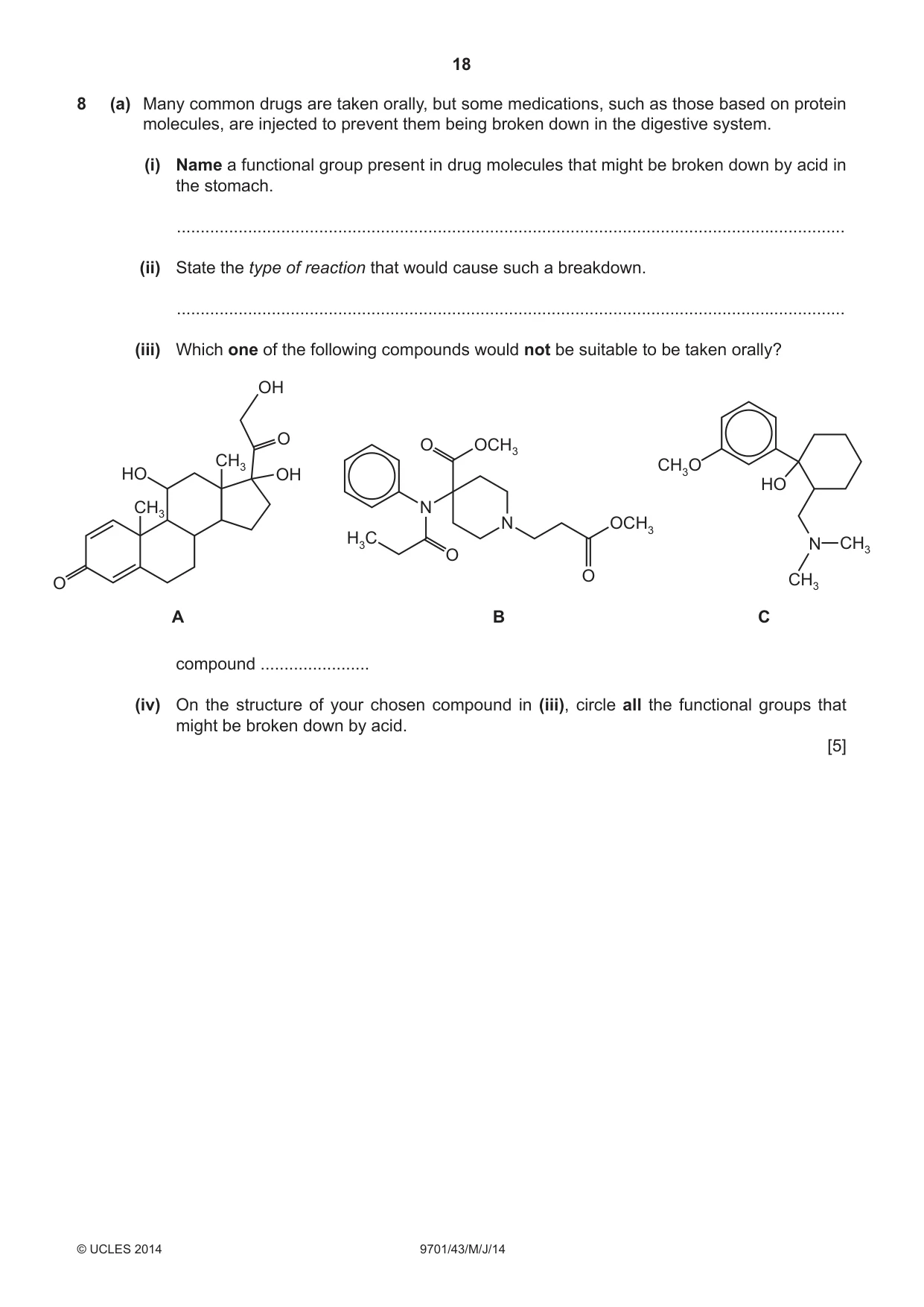
18 9701/43/M/J/14 © UCLES 2014 8 (a) Many common drugs are taken orally, but some medications, such as those based on protein molecules, are injected to prevent them being broken down in the digestive system. (i) Name a functional group present in drug molecules that might be broken down by acid in the stomach. … (ii) State the type of reaction that would cause such a breakdown. … (iii) Which one of the following compounds would not be suitable to be taken orally? O HO CH3 CH3 OH OH O A B C N N O O O H3C OCH3 OCH3 CH3 CH3 N CH3O HO compound … (iv) On the structure of your chosen compound in (iii), circle all the functional groups that might be broken down by acid. [5]
Question paper, page 19
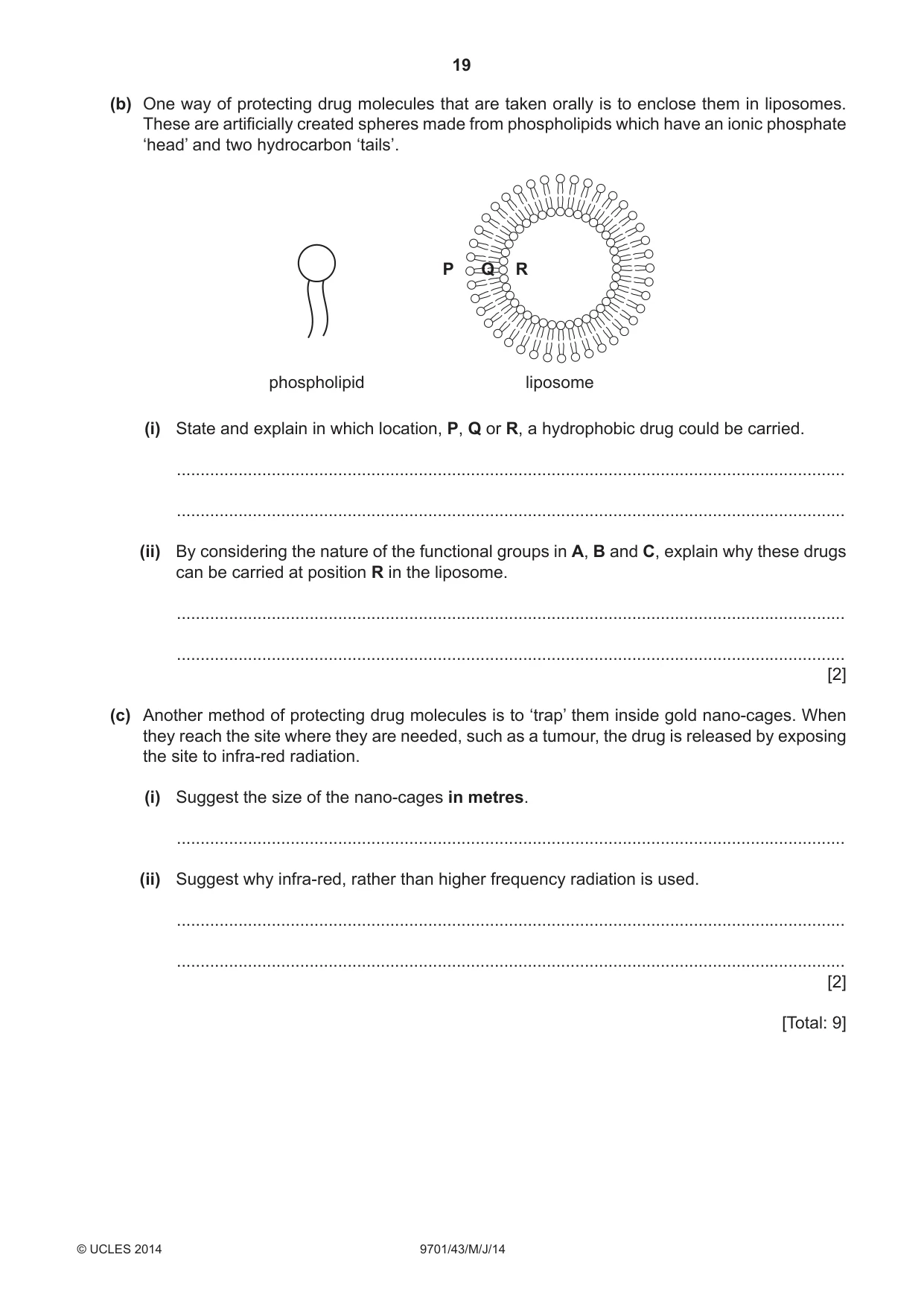
19 9701/43/M/J/14 © UCLES 2014 [Turn over (b) One way of protecting drug molecules that are taken orally is to enclose them in liposomes. These are artifi cially created spheres made from phospholipids which have an ionic phosphate ‘head’ and two hydrocarbon ‘tails’. phospholipid liposome P Q R (i) State and explain in which location, P, Q or R, a hydrophobic drug could be carried. … … (ii) By considering the nature of the functional groups in A, B and C, explain why these drugs can be carried at position R in the liposome. … … [2] (c) Another method of protecting drug molecules is to ‘trap’ them inside gold nano-cages. When they reach the site where they are needed, such as a tumour, the drug is released by exposing the site to infra-red radiation. (i) Suggest the size of the nano-cages in metres. … (ii) Suggest why infra-red, rather than higher frequency radiation is used. … … [2] [Total: 9]
Question paper, page 20
20 Permission to reproduce items where third-party owned material protected by copyright is included has been sought and cleared where possible. Every reasonable effort has been made by the publisher (UCLES) to trace copyright holders, but if any items requiring clearance have unwittingly been included the publisher will be pleased to make amends at the earliest possible opportunity. Cambridge International Examinations is part of the Cambridge Assessment Group. Cambridge Assessment is the brand name of University of Cambridge Local Examinations Syndicate (UCLES), which is itself a department of the University of Cambridge. 9701/43/M/J/14 © UCLES 2014 BLANK PAGE
Mark scheme, page 1
CAMBRIDGE INTERNATIONAL EXAMINATIONS GCE Advanced Level MARK SCHEME for the May/June 2014 series 9701 CHEMISTRY 9701/43 Paper 4 (Structured Questions), maximum raw mark 100 This mark scheme is published as an aid to teachers and candidates, to indicate the requirements of the examination. It shows the basis on which Examiners were instructed to award marks. It does not indicate the details of the discussions that took place at an Examiners’ meeting before marking began, which would have considered the acceptability of alternative answers. Mark schemes should be read in conjunction with the question paper and the Principal Examiner Report for Teachers. Cambridge will not enter into discussions about these mark schemes. Cambridge is publishing the mark schemes for the May/June 2014 series for most IGCSE, GCE Advanced Level and Advanced Subsidiary Level components and some Ordinary Level components.
Mark scheme, page 2
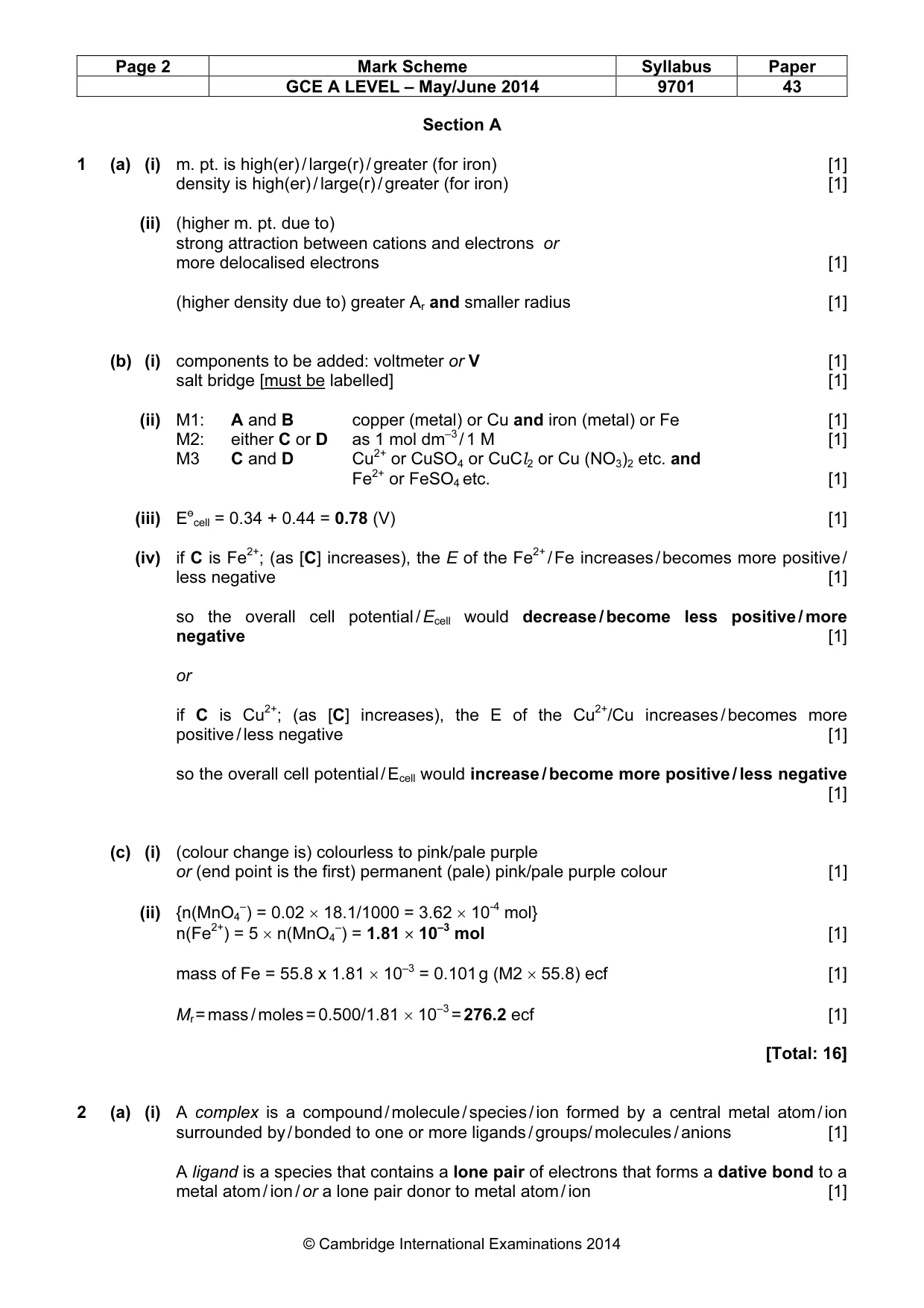
Page 2 Mark Scheme Syllabus Paper GCE A LEVEL – May/June 2014 9701 43 © Cambridge International Examinations 2014 Section A 1 (a) (i) m. pt. is high(er) / large(r) / greater (for iron) [1] density is high(er) / large(r) / greater (for iron) [1] (ii) (higher m. pt. due to) strong attraction between cations and electrons or more delocalised electrons [1] (higher density due to) greater Ar and smaller radius [1] (b) (i) components to be added: voltmeter or V [1] salt bridge [must be labelled] [1] (ii) M1: A and B copper (metal) or Cu and iron (metal) or Fe [1] M2: either C or D as 1 mol dm–3 / 1 M [1] M3 C and D Cu2+ or CuSO4 or CuCl2 or Cu (NO3)2 etc. and Fe2+ or FeSO4 etc. [1] (iii) Eo cell = 0.34 + 0.44 = 0.78 (V) [1] (iv) if C is Fe2+; (as [C] increases), the E of the Fe2+ / Fe increases / becomes more positive / less negative [1] so the overall cell potential / Ecell would decrease / become less positive / more negative [1] or if C is Cu2+; (as [C] increases), the E of the Cu2+/Cu increases / becomes more positive / less negative [1] so the overall cell potential / Ecell would increase / become more positive / less negative [1] (c) (i) (colour change is) colourless to pink/pale purple or (end point is the first) permanent (pale) pink/pale purple colour [1] (ii) {n(MnO4 –) = 0.02 × 18.1/1000 = 3.62 × 10⁻⁴ mol} n(Fe2+) = 5 × n(MnO4 –) = 1.81 × 10⁻³ mol [1] mass of Fe = 55.8 x 1.81 × 10–3 = 0.101 g (M2 × 55.8) ecf [1] Mr = mass / moles = 0.500/1.81 × 10–3 = 276.2 ecf [1] [Total: 16] 2 (a) (i) A complex is a compound / molecule / species / ion formed by a central metal atom / ion surrounded by / bonded to one or more ligands / groups/ molecules / anions [1] A ligand is a species that contains a lone pair of electrons that forms a dative bond to a metal atom / ion / or a lone pair donor to metal atom / ion [1]
Mark scheme, page 3
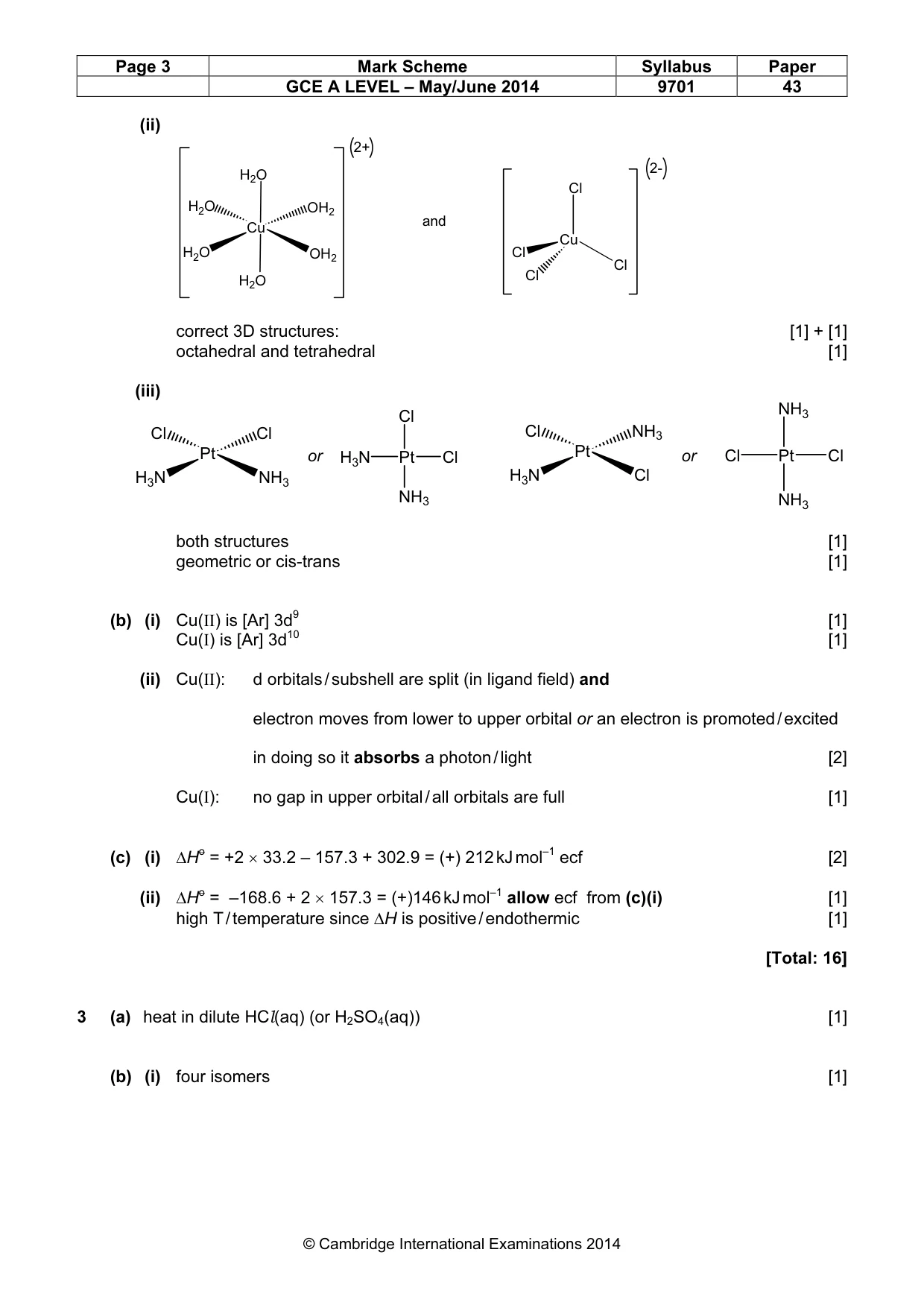
Page 3 Mark Scheme Syllabus Paper GCE A LEVEL – May/June 2014 9701 43 © Cambridge International Examinations 2014 (ii) H2O Cu H2O OH2 OH2 H2O H2O 2+ and Cl Cl Cu Cl Cl 2- correct 3D structures: [1] + [1] octahedral and tetrahedral [1] (iii) H3N Pt Cl Cl NH3 H3N Pt Cl NH3 Cl or Cl Pt Cl H3N NH3 NH3 Pt Cl Cl NH3 or both structures [1] geometric or cis-trans [1] (b) (i) Cu(II) is [Ar] 3d9 [1] Cu(I) is [Ar] 3d10 [1] (ii) Cu(II): d orbitals / subshell are split (in ligand field) and electron moves from lower to upper orbital or an electron is promoted / excited in doing so it absorbs a photon / light [2] Cu(I): no gap in upper orbital / all orbitals are full [1] (c) (i) ∆Ho = +2 × 33.2 – 157.3 + 302.9 = (+) 212 kJ mol–1 ecf [2] (ii) ∆Ho = –168.6 + 2 × 157.3 = (+)146 kJ mol–1 allow ecf from (c)(i) [1] high T / temperature since ∆H is positive / endothermic [1] [Total: 16] 3 (a) heat in dilute HCl(aq) (or H2SO4(aq)) [1] (b) (i) four isomers [1]
Mark scheme, page 4
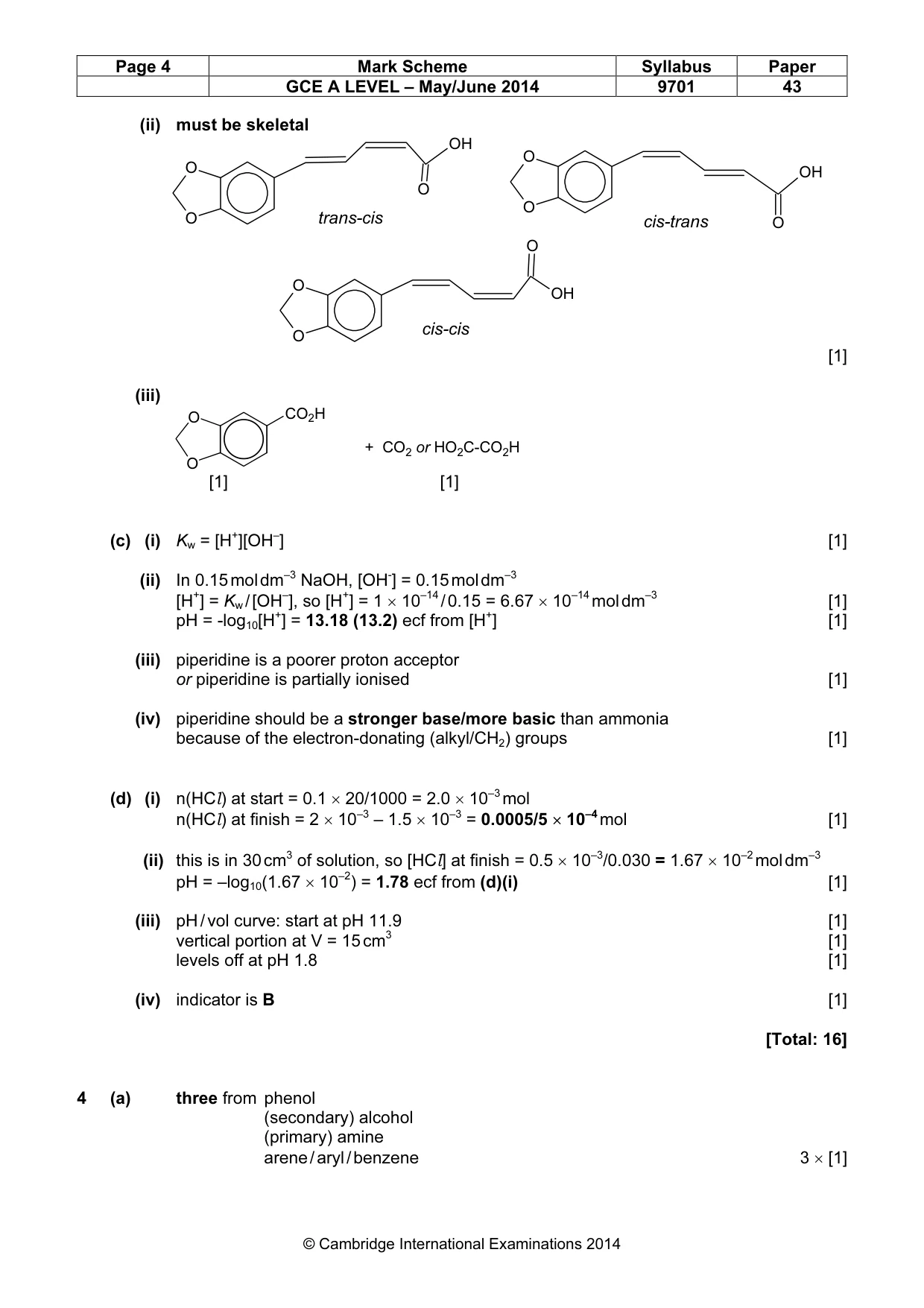
Page 4 Mark Scheme Syllabus Paper GCE A LEVEL – May/June 2014 9701 43 © Cambridge International Examinations 2014 (ii) must be skeletal O O OH O O O O OH trans-cis cis-cis cis-trans O O O OH [1] (iii) CO2H O O + CO2 or HO2C-CO2H [1] [1] (c) (i) Kw = [H+][OH–] [1] (ii) In 0.15 mol dm–3 NaOH, [OH-] = 0.15 mol dm–3 [H+] = Kw / [OH–], so [H+] = 1 × 10–14 / 0.15 = 6.67 × 10⁻¹⁴ mol dm–3 [1] pH = -log10[H+] = 13.18 (13.2) ecf from [H+] [1] (iii) piperidine is a poorer proton acceptor or piperidine is partially ionised [1] (iv) piperidine should be a stronger base/more basic than ammonia because of the electron-donating (alkyl/CH2) groups [1] (d) (i) n(HCl) at start = 0.1 × 20/1000 = 2.0 × 10⁻³ mol n(HCl) at finish = 2 × 10⁻³ – 1.5 × 10–3 = 0.0005/5 × 10–4 mol [1] (ii) this is in 30 cm3 of solution, so [HCl] at finish = 0.5 × 10⁻³/0.030 = 1.67 × 10⁻² mol dm–3 pH = –log10(1.67 × 10⁻²) = 1.78 ecf from (d)(i) [1] (iii) pH / vol curve: start at pH 11.9 [1] vertical portion at V = 15 cm3 [1] levels off at pH 1.8 [1] (iv) indicator is B [1] [Total: 16] 4 (a) three from phenol (secondary) alcohol (primary) amine arene / aryl / benzene 3 × [1]
Mark scheme, page 5
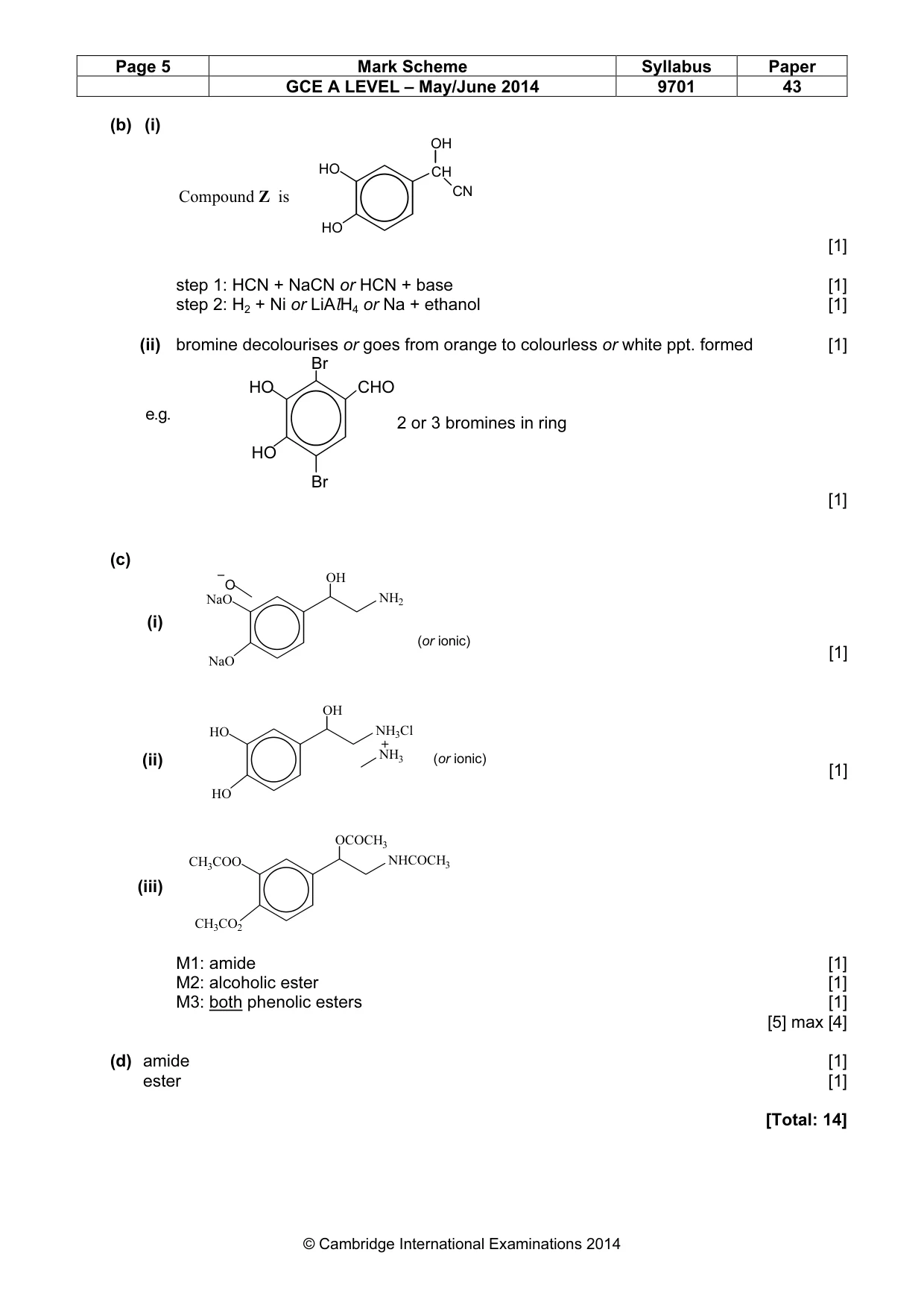
Page 5 Mark Scheme Syllabus Paper GCE A LEVEL – May/June 2014 9701 43 © Cambridge International Examinations 2014 (b) (i) HO HO CH OH CN Compound Z is [1] step 1: HCN + NaCN or HCN + base [1] step 2: H2 + Ni or LiAlH4 or Na + ethanol [1] (ii) bromine decolourises or goes from orange to colourless or white ppt. formed [1] HO HO CHO Br Br e.g. (2 or 3 x Br in ring) [1] (c) NH2 OH NaO NaO NH3Cl OH HO HO NHCOCH3 OCOCH3 CH3CO2 CH3COO (i) (ii) (iii) [1] [1] (or ionic) (or ionic) O NH3 M1: amide [1] M2: alcoholic ester [1] M3: both phenolic esters [1] [5] max [4] (d) amide [1] ester [1] [Total: 14] 2 or 3 bromines in ring (i) (ii) (iii) [1] [1]
Mark scheme, page 6
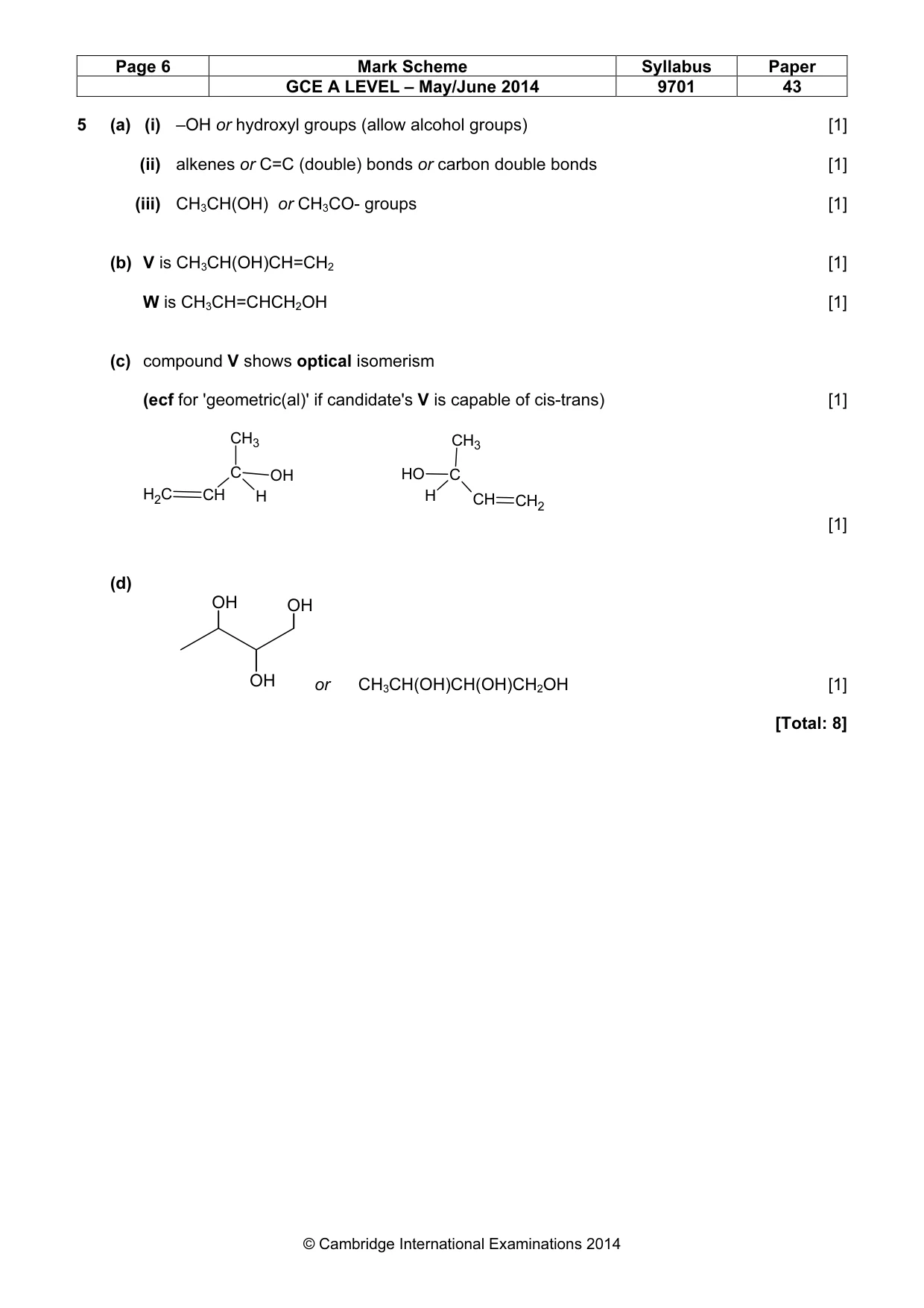
Page 6 Mark Scheme Syllabus Paper GCE A LEVEL – May/June 2014 9701 43 © Cambridge International Examinations 2014 5 (a) (i) –OH or hydroxyl groups (allow alcohol groups) [1] (ii) alkenes or C=C (double) bonds or carbon double bonds [1] (iii) CH3CH(OH) or CH3CO- groups [1] (b) V is CH3CH(OH)CH=CH2 [1] W is CH3CH=CHCH2OH [1] (c) compound V shows optical isomerism (ecf for 'geometric(al)' if candidate's V is capable of cis-trans) [1] CH3 C CH H OH C H2 CH3 C CH H O H CH2 [1] (d) OH OH OH or CH3CH(OH)CH(OH)CH2OH [1] [Total: 8]
Mark scheme, page 7
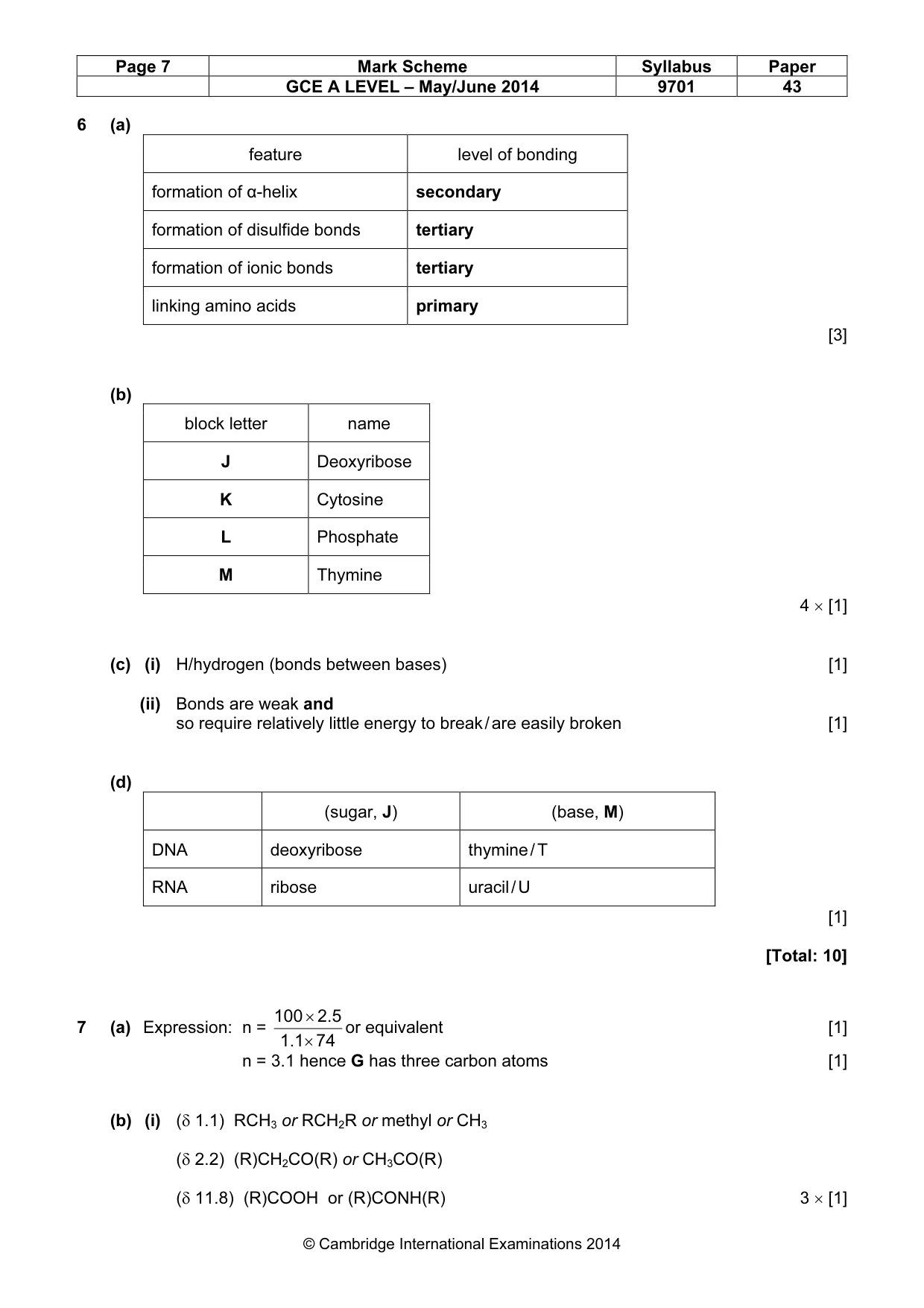
Page 7 Mark Scheme Syllabus Paper GCE A LEVEL – May/June 2014 9701 43 © Cambridge International Examinations 2014 6 (a) feature level of bonding formation of α-helix secondary formation of disulfide bonds tertiary formation of ionic bonds tertiary linking amino acids primary [3] (b) block letter name J Deoxyribose K Cytosine L Phosphate M Thymine 4 × [1] (c) (i) H/hydrogen (bonds between bases) [1] (ii) Bonds are weak and so require relatively little energy to break / are easily broken [1] (d) (sugar, J) (base, M) DNA deoxyribose thymine / T RNA ribose uracil / U [1] [Total: 10] 7 (a) Expression: n = 74 1.1 2.5 100 × × or equivalent [1] n = 3.1 hence G has three carbon atoms [1] (b) (i) (δ 1.1) RCH3 or RCH2R or methyl or CH3 (δ 2.2) (R)CH2CO(R) or CH3CO(R) (δ 11.8) (R)COOH or (R)CONH(R) 3 × [1]
Mark scheme, page 8
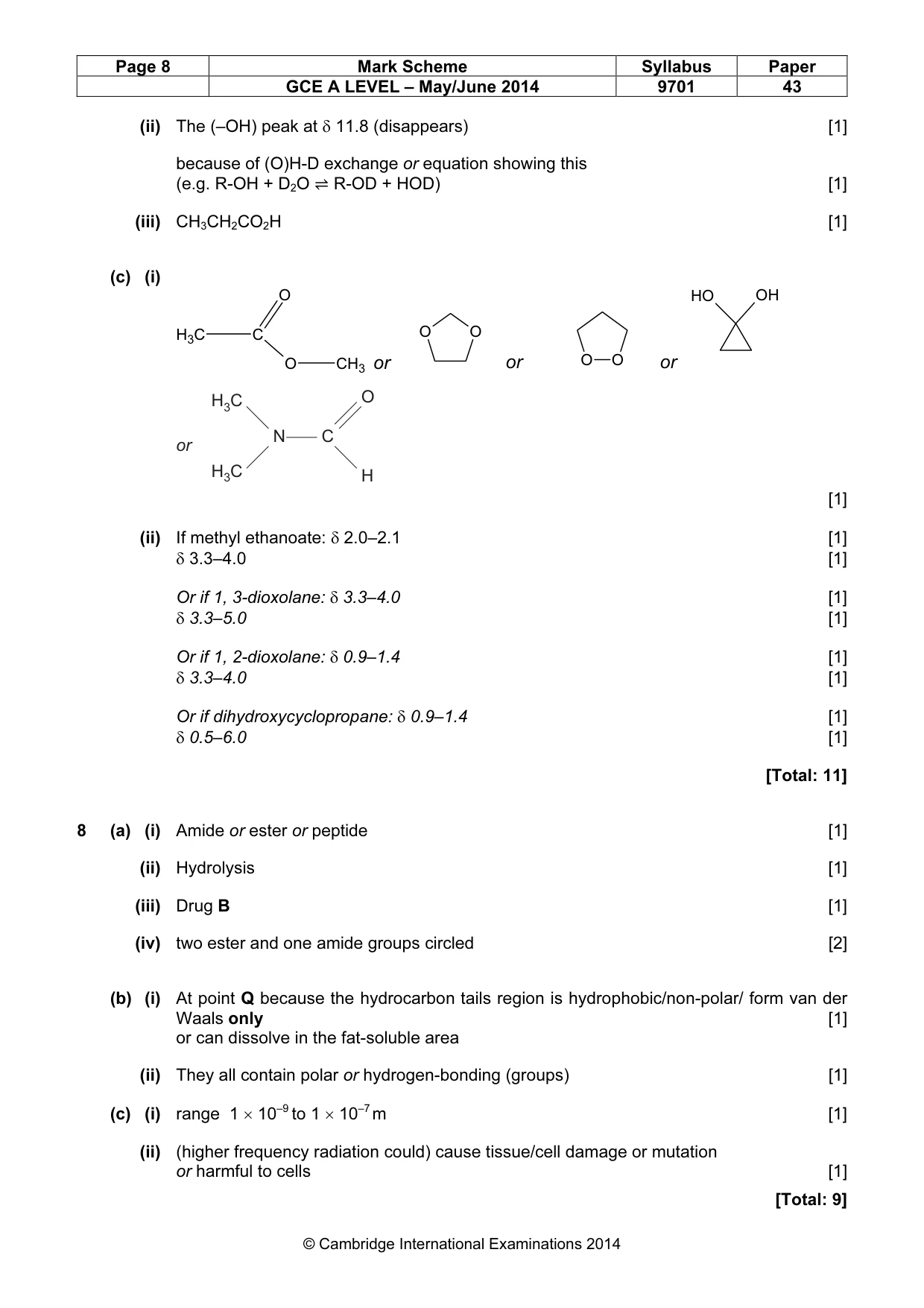
Page 8 Mark Scheme Syllabus Paper GCE A LEVEL – May/June 2014 9701 43 © Cambridge International Examinations 2014 (ii) The (–OH) peak at δ 11.8 (disappears) [1] because of (O)H-D exchange or equation showing this (e.g. R-OH + D2O ⇌ R-OD + HOD) [1] (iii) CH3CH2CO2H [1] (c) (i) C H3 C O O CH3 O O O O O H OH or or or [1] (ii) If methyl ethanoate: δ 2.0–2.1 [1] δ 3.3–4.0 [1] Or if 1, 3-dioxolane: δ 3.3–4.0 [1] δ 3.3–5.0 [1] Or if 1, 2-dioxolane: δ 0.9–1.4 [1] δ 3.3–4.0 [1] Or if dihydroxycyclopropane: δ 0.9–1.4 [1] δ 0.5–6.0 [1] [Total: 11] 8 (a) (i) Amide or ester or peptide [1] (ii) Hydrolysis [1] (iii) Drug B [1] (iv) two ester and one amide groups circled [2] (b) (i) At point Q because the hydrocarbon tails region is hydrophobic/non-polar/ form van der Waals only [1] or can dissolve in the fat-soluble area (ii) They all contain polar or hydrogen-bonding (groups) [1] (c) (i) range 1 × 10⁻⁹ to 1 × 10⁻⁷ m [1] (ii) (higher frequency radiation could) cause tissue/cell damage or mutation or harmful to cells [1] [Total: 9] or H3C H3C N C O H
What you needed in this session
Cambridge’s own grade thresholds for 2014 May/June, Paper 4 · Variant 3. A higher threshold means an easier paper — the bar moves with how the cohort did.