Cambridge A Level Chemistry 9701 — 2013 Oct/Nov Paper 4 · Variant 2
9701/42/O/N/13 · 100 marks · ≈113 min
The question paper and its mark scheme, free to read here and free to download. This is Cambridge’s own paper, exactly as it was sat.
Question paper20 pages




Mark scheme10 pages
Answers below. Sit the paper first if you are practising.
Paper as text
Question paper, page 1
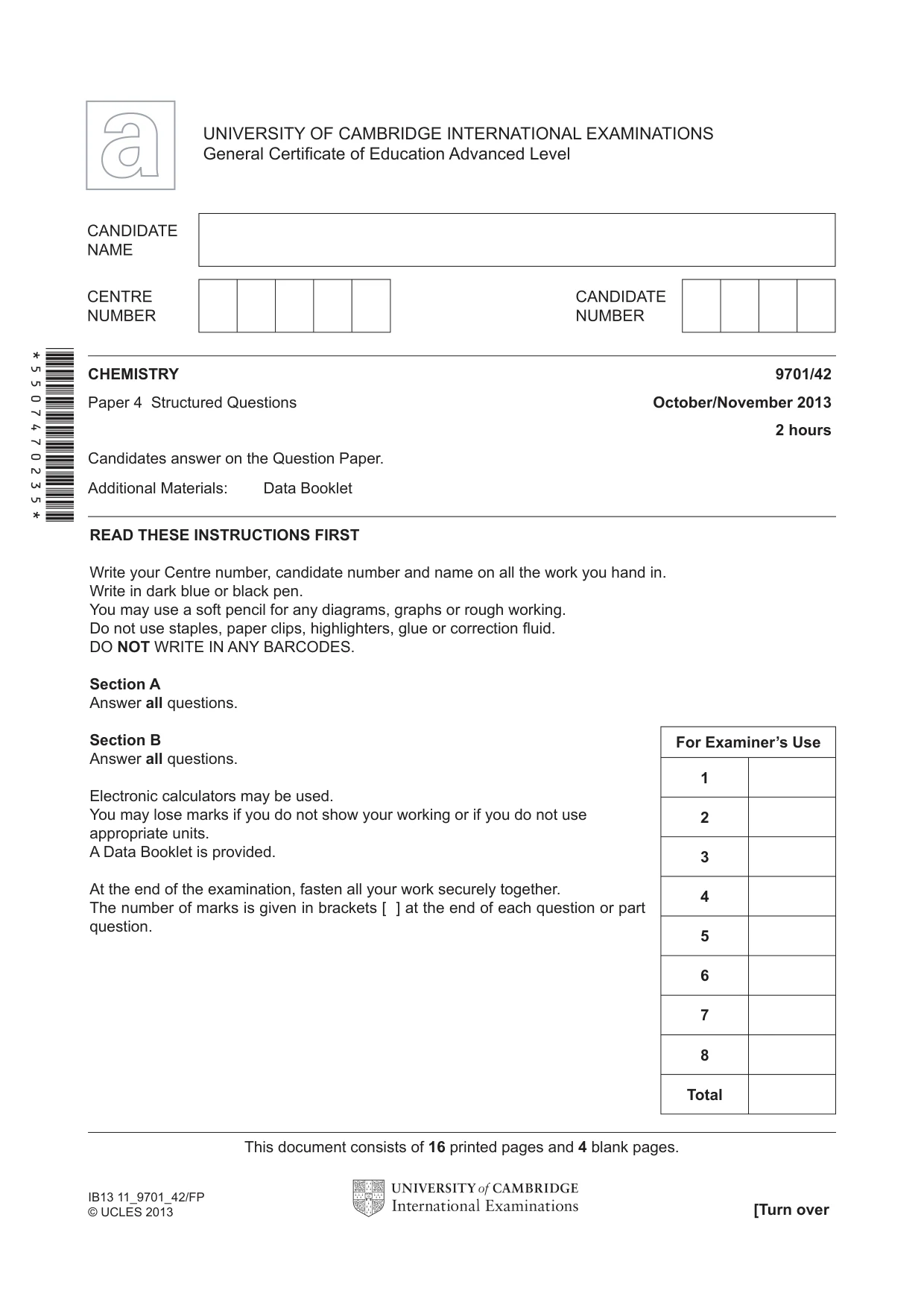
READ THESE INSTRUCTIONS FIRST Write your Centre number, candidate number and name on all the work you hand in. Write in dark blue or black pen. You may use a soft pencil for any diagrams, graphs or rough working. Do not use staples, paper clips, highlighters, glue or correction fl uid. DO NOT WRITE IN ANY BARCODES. Section A Answer all questions. Section B Answer all questions. Electronic calculators may be used. You may lose marks if you do not show your working or if you do not use appropriate units. A Data Booklet is provided. At the end of the examination, fasten all your work securely together. The number of marks is given in brackets [ ] at the end of each question or part question. CHEMISTRY 9701/42 Paper 4 Structured Questions October/November 2013 2 hours Candidates answer on the Question Paper. Additional Materials: Data Booklet UNIVERSITY OF CAMBRIDGE INTERNATIONAL EXAMINATIONS General Certifi cate of Education Advanced Level This document consists of 16 printed pages and 4 blank pages. [Turn over IB13 11_9701_42/FP © UCLES 2013 *5507470235* For Examiner’s Use 1 2 3 4 5 6 7 8 Total
Question paper, page 2
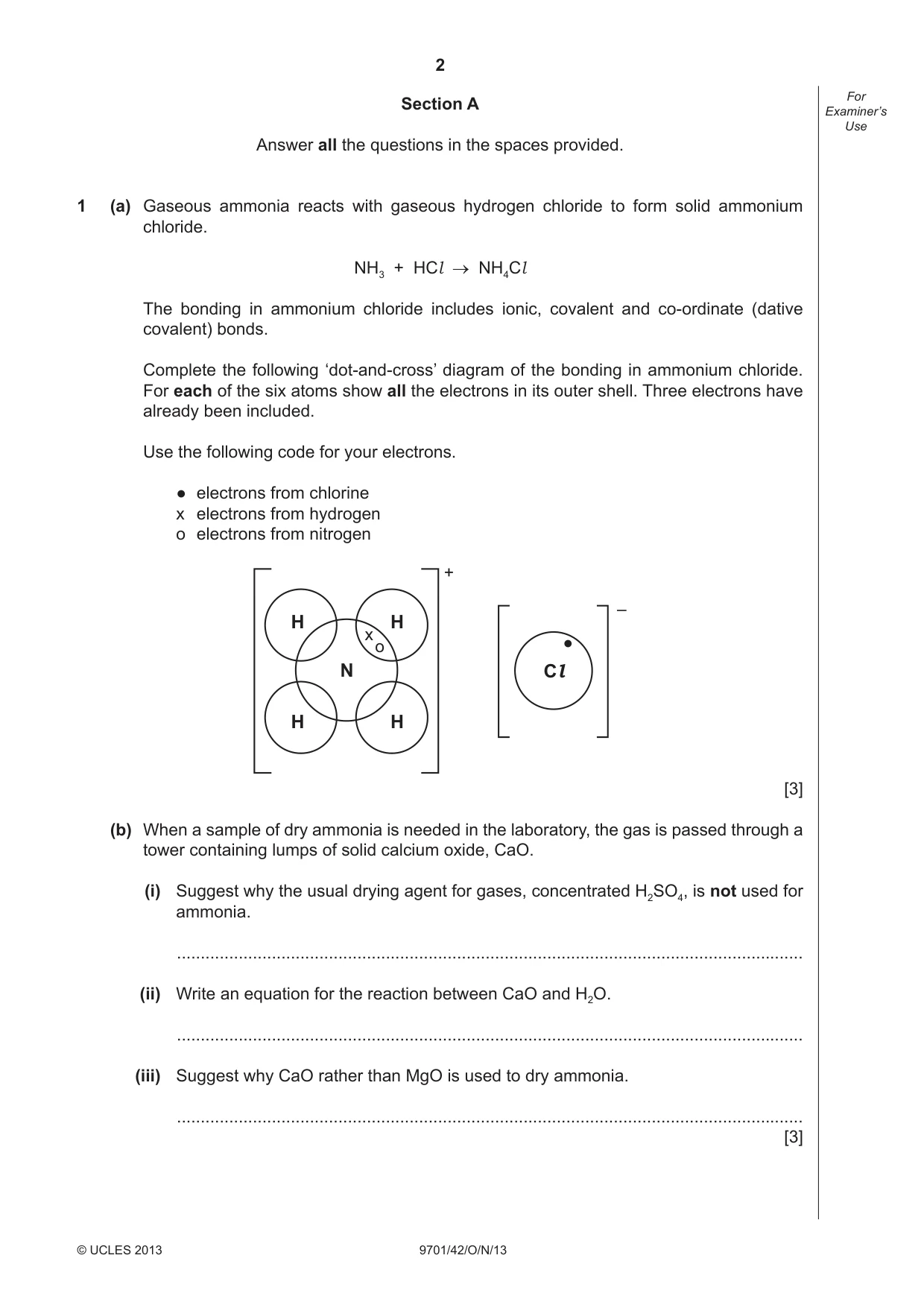
2 9701/42/O/N/13 © UCLES 2013 For Examiner’s Use Section A Answer all the questions in the spaces provided. 1 (a) Gaseous ammonia reacts with gaseous hydrogen chloride to form solid ammonium chloride. NH3 + HCl → NH4Cl The bonding in ammonium chloride includes ionic, covalent and co-ordinate (dative covalent) bonds. Complete the following ‘dot-and-cross’ diagram of the bonding in ammonium chloride. For each of the six atoms show all the electrons in its outer shell. Three electrons have already been included. Use the following code for your electrons. ● electrons from chlorine x electrons from hydrogen o electrons from nitrogen H H H N Cl H + – ● xo [3] (b) When a sample of dry ammonia is needed in the laboratory, the gas is passed through a tower containing lumps of solid calcium oxide, CaO. (i) Suggest why the usual drying agent for gases, concentrated H2SO4, is not used for ammonia. … (ii) Write an equation for the reaction between CaO and H2O. … (iii) Suggest why CaO rather than MgO is used to dry ammonia. … [3]
Question paper, page 3
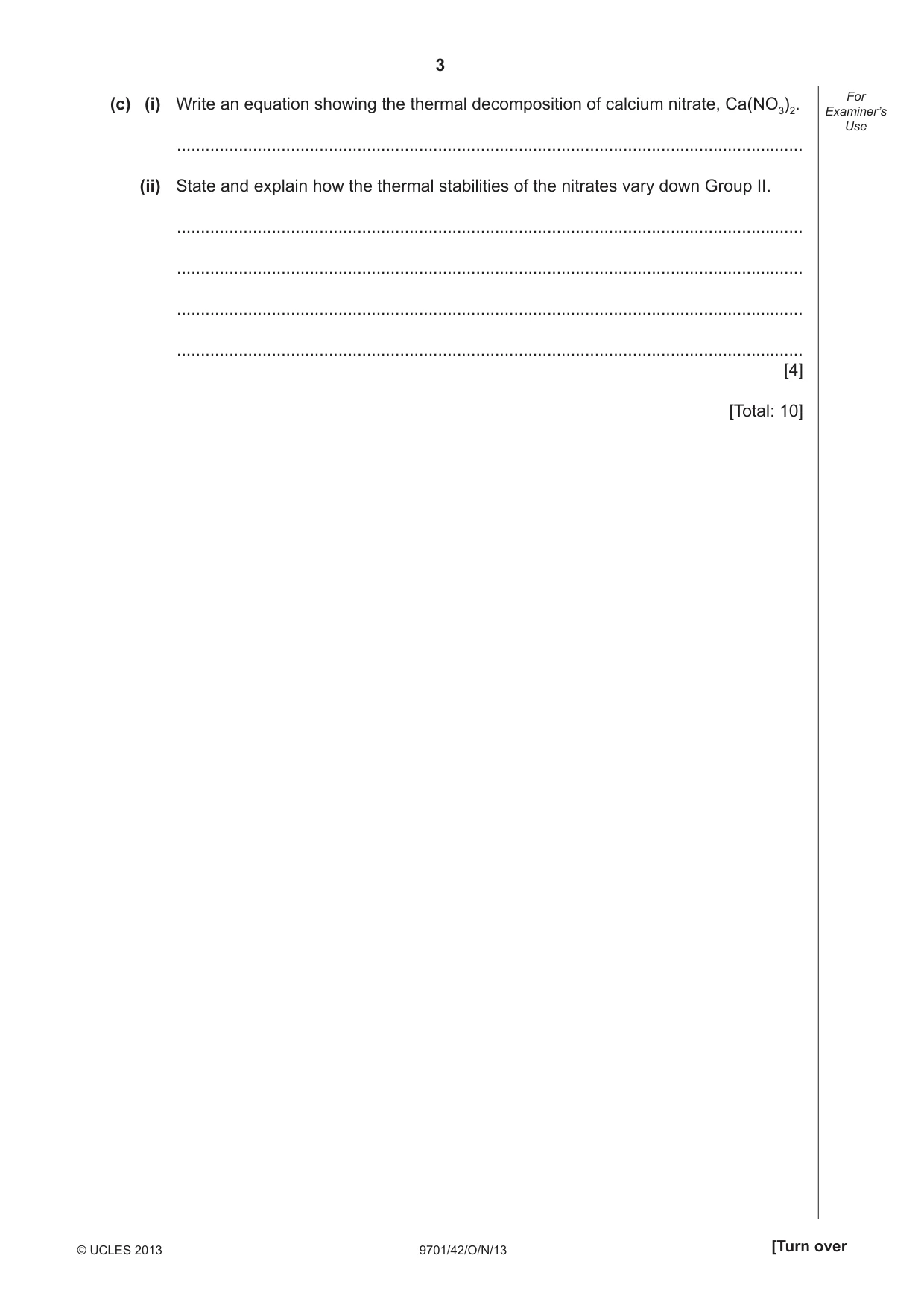
3 9701/42/O/N/13 © UCLES 2013 [Turn over For Examiner’s Use (c) (i) Write an equation showing the thermal decomposition of calcium nitrate, Ca(NO3)2. … (ii) State and explain how the thermal stabilities of the nitrates vary down Group II. … … … … [4] [Total: 10]
Question paper, page 4
4 9701/42/O/N/13 BLANK PAGE © UCLES 2013
Question paper, page 5
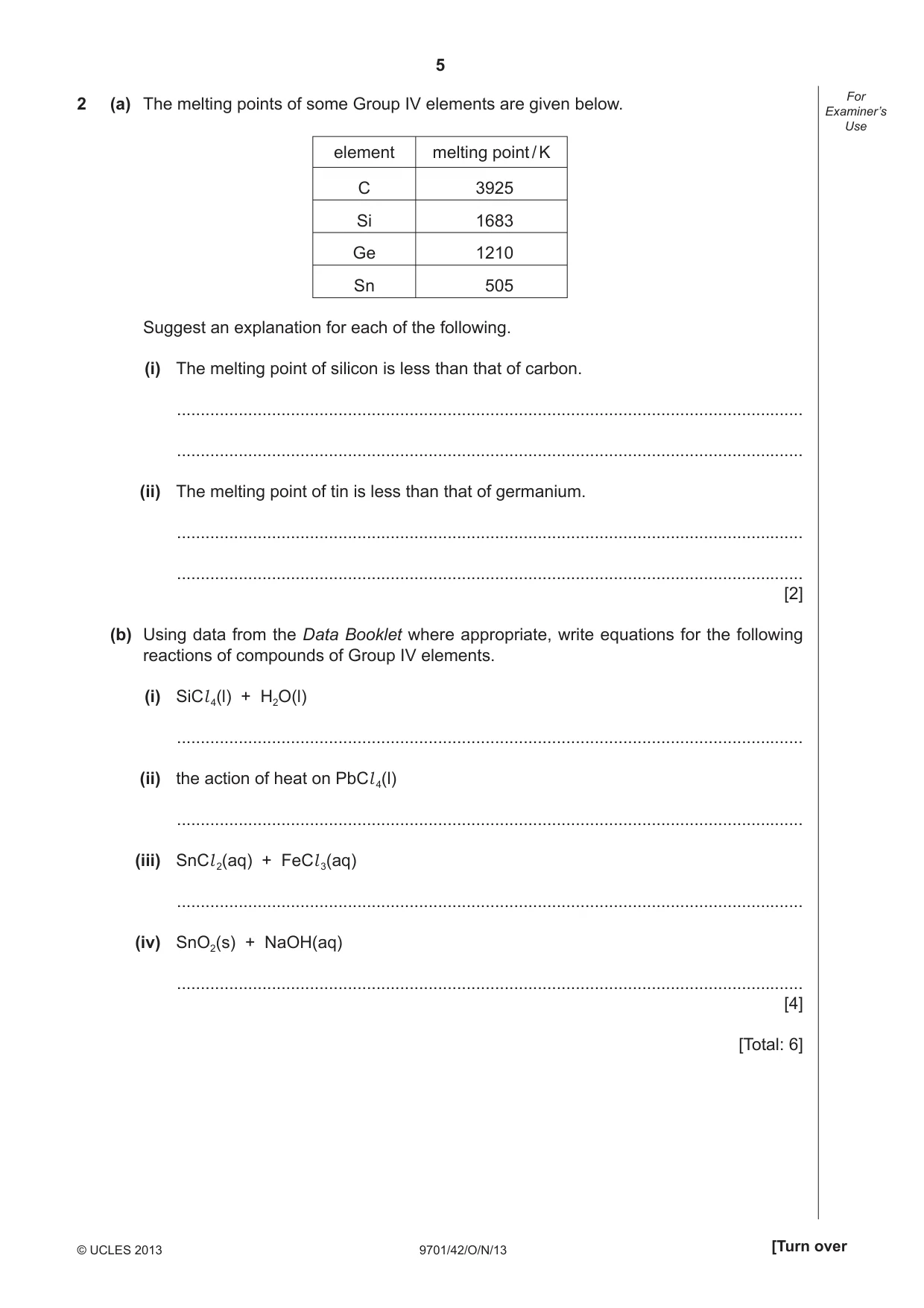
5 9701/42/O/N/13 © UCLES 2013 [Turn over For Examiner’s Use 2 (a) The melting points of some Group IV elements are given below. element melting point / K C 3925 Si 1683 Ge 1210 Sn 505 Suggest an explanation for each of the following. (i) The melting point of silicon is less than that of carbon. … … (ii) The melting point of tin is less than that of germanium. … … [2] (b) Using data from the Data Booklet where appropriate, write equations for the following reactions of compounds of Group IV elements. (i) SiCl 4(l) + H2O(l) … (ii) the action of heat on PbCl 4(l) … (iii) SnCl 2(aq) + FeCl 3(aq) … (iv) SnO2(s) + NaOH(aq) … [4] [Total: 6]
Question paper, page 6
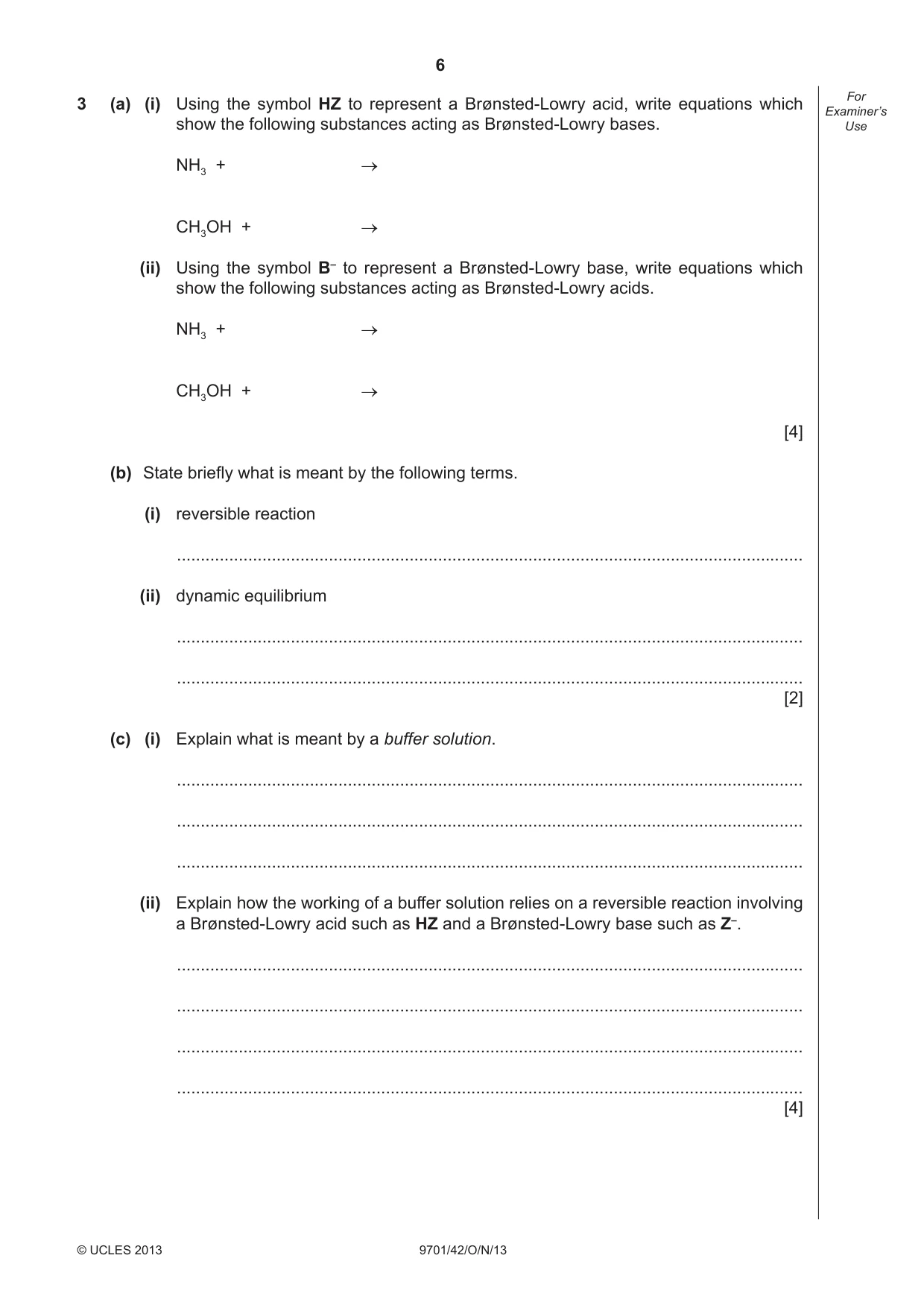
6 9701/42/O/N/13 © UCLES 2013 For Examiner’s Use 3 (a) (i) Using the symbol HZ to represent a Brønsted-Lowry acid, write equations which show the following substances acting as Brønsted-Lowry bases. NH3 + → CH3OH + → (ii) Using the symbol B– to represent a Brønsted-Lowry base, write equations which show the following substances acting as Brønsted-Lowry acids. NH3 + → CH3OH + → [4] (b) State briefl y what is meant by the following terms. (i) reversible reaction … (ii) dynamic equilibrium … … [2] (c) (i) Explain what is meant by a buffer solution. … … … (ii) Explain how the working of a buffer solution relies on a reversible reaction involving a Brønsted-Lowry acid such as HZ and a Brønsted-Lowry base such as Z–. … … … … [4]
Question paper, page 7
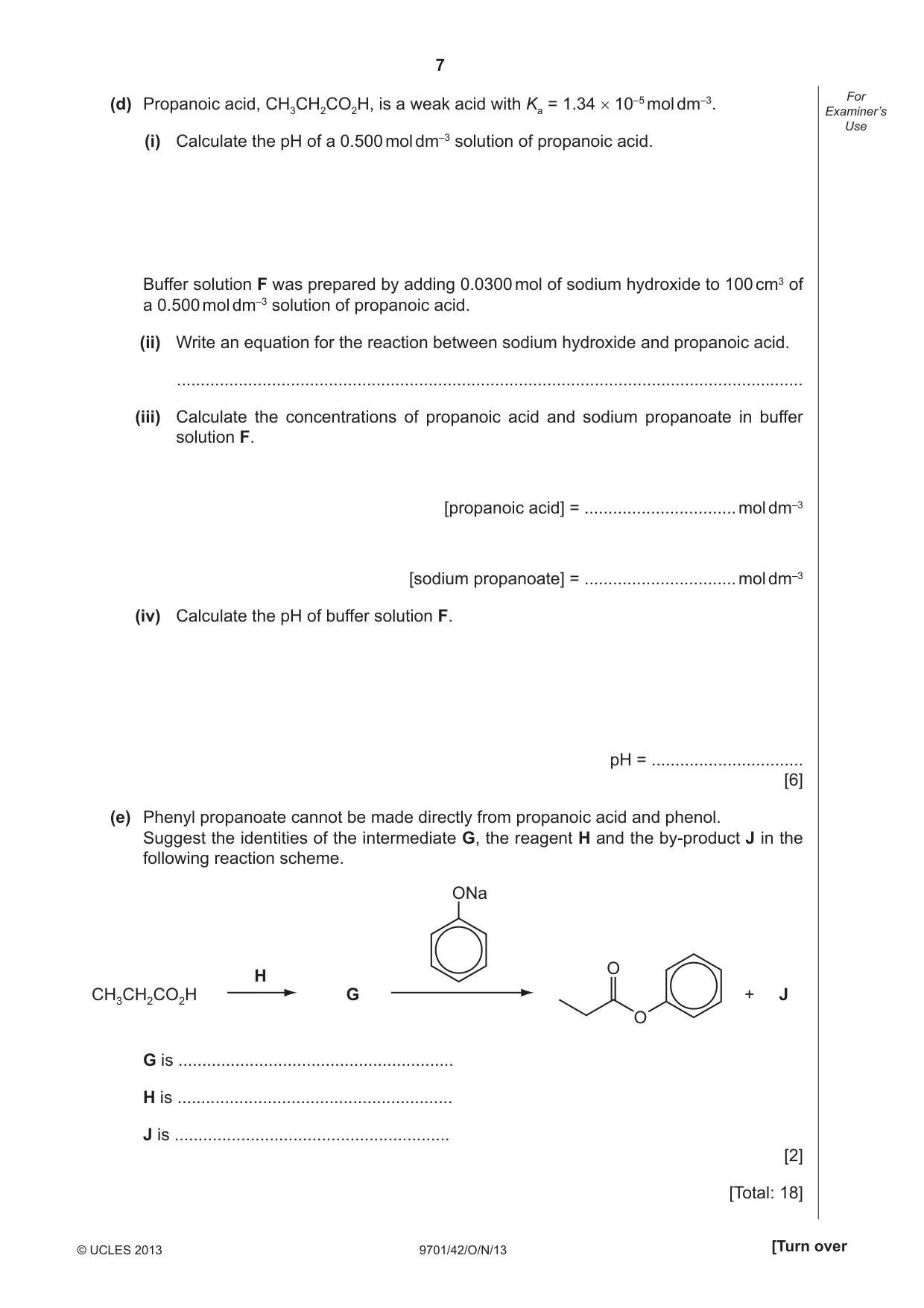
7 9701/42/O/N/13 © UCLES 2013 [Turn over For Examiner’s Use (d) Propanoic acid, CH3CH2CO2H, is a weak acid with Ka = 1.34 × 10⁻⁵ mol dm–3. (i) Calculate the pH of a 0.500 mol dm–3 solution of propanoic acid. Buffer solution F was prepared by adding 0.0300 mol of sodium hydroxide to 100 cm3 of a 0.500 mol dm–3 solution of propanoic acid. (ii) Write an equation for the reaction between sodium hydroxide and propanoic acid. … (iii) Calculate the concentrations of propanoic acid and sodium propanoate in buffer solution F. [propanoic acid] = … mol dm–3 [sodium propanoate] = … mol dm–3 (iv) Calculate the pH of buffer solution F. pH = … [6] (e) Phenyl propanoate cannot be made directly from propanoic acid and phenol. Suggest the identities of the intermediate G, the reagent H and the by-product J in the following reaction scheme. O ONa O + J G CH3CH2CO2H H G is … H is … J is … [2] [Total: 18]
Question paper, page 8
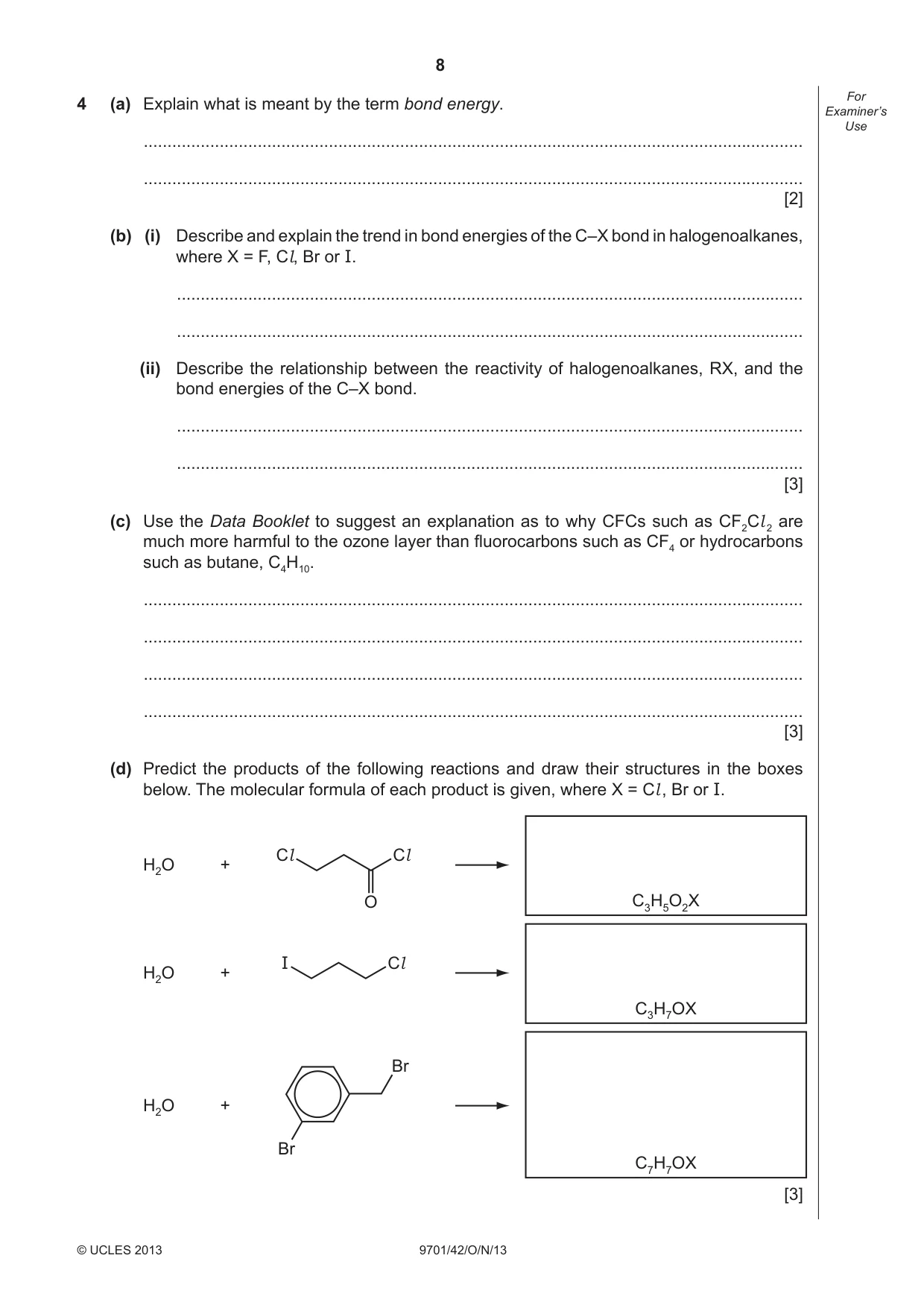
8 9701/42/O/N/13 © UCLES 2013 For Examiner’s Use 4 (a) Explain what is meant by the term bond energy. … … [2] (b) (i) Describe and explain the trend in bond energies of the C–X bond in halogenoalkanes, where X = F, Cl, Br or I. … … (ii) Describe the relationship between the reactivity of halogenoalkanes, RX, and the bond energies of the C–X bond. … … [3] (c) Use the Data Booklet to suggest an explanation as to why CFCs such as CF2Cl 2 are much more harmful to the ozone layer than fl uorocarbons such as CF4 or hydrocarbons such as butane, C4H10. … … … … [3] (d) Predict the products of the following reactions and draw their structures in the boxes below. The molecular formula of each product is given, where X = Cl , Br or I. H2O C3H5O2X + Cl Cl O H2O C3H7OX + I Cl H2O C7H7OX + Br Br [3]
Question paper, page 9
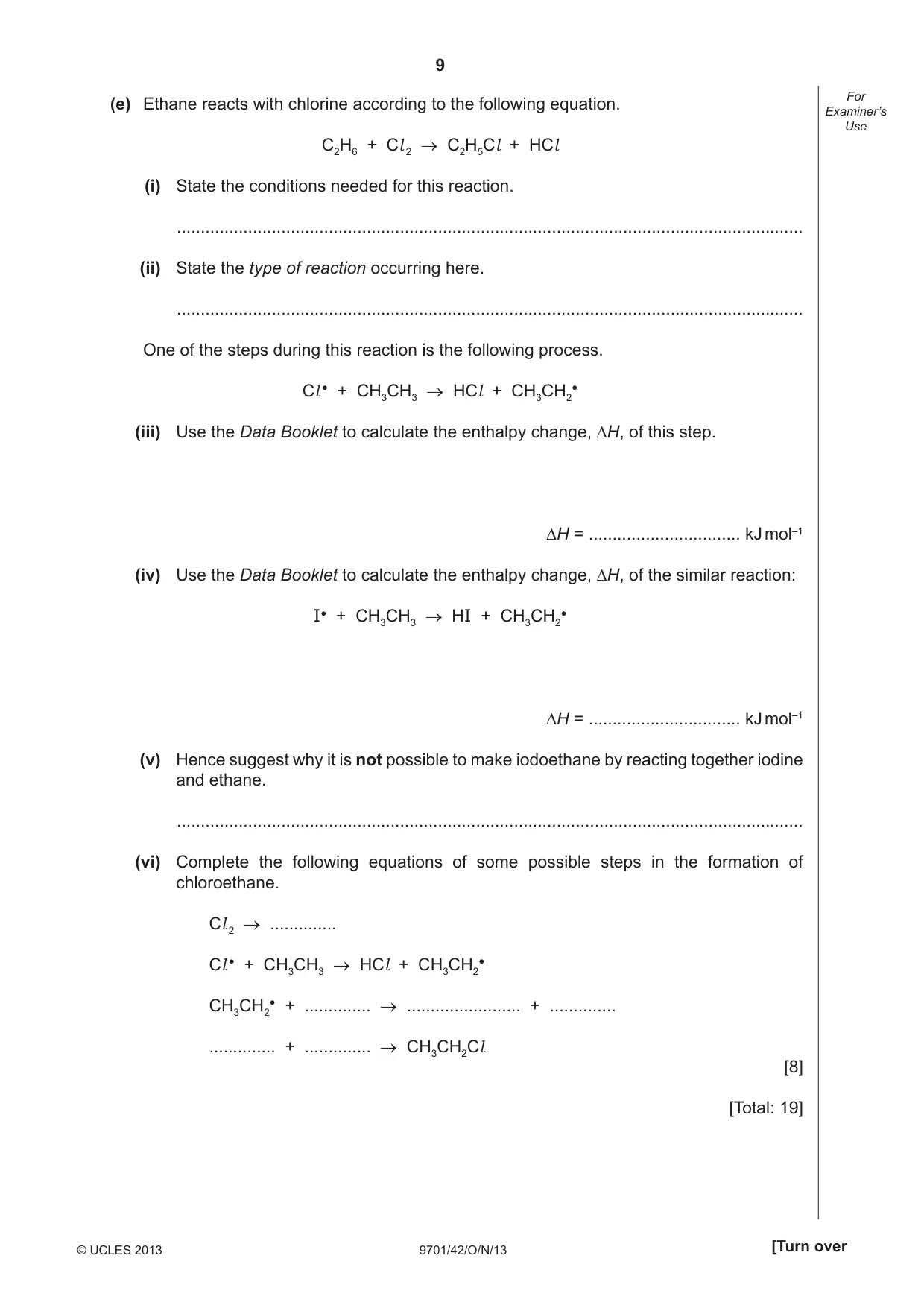
9 9701/42/O/N/13 © UCLES 2013 [Turn over For Examiner’s Use (e) Ethane reacts with chlorine according to the following equation. C2H6 + Cl 2 → C2H5Cl + HCl (i) State the conditions needed for this reaction. … (ii) State the type of reaction occurring here. … One of the steps during this reaction is the following process. Cl ● + CH3CH3 → HCl + CH3CH2 ● (iii) Use the Data Booklet to calculate the enthalpy change, ∆H, of this step. ∆H = … kJ mol–1 (iv) Use the Data Booklet to calculate the enthalpy change, ∆H, of the similar reaction: I● + CH3CH3 → HI + CH3CH2 ● ∆H = … kJ mol–1 (v) Hence suggest why it is not possible to make iodoethane by reacting together iodine and ethane. … (vi) Complete the following equations of some possible steps in the formation of chloroethane. Cl 2 → … Cl ● + CH3CH3 → HCl + CH3CH2 ● CH3CH2 ● + … → … + … … + … → CH3CH2Cl [8] [Total: 19]
Question paper, page 10
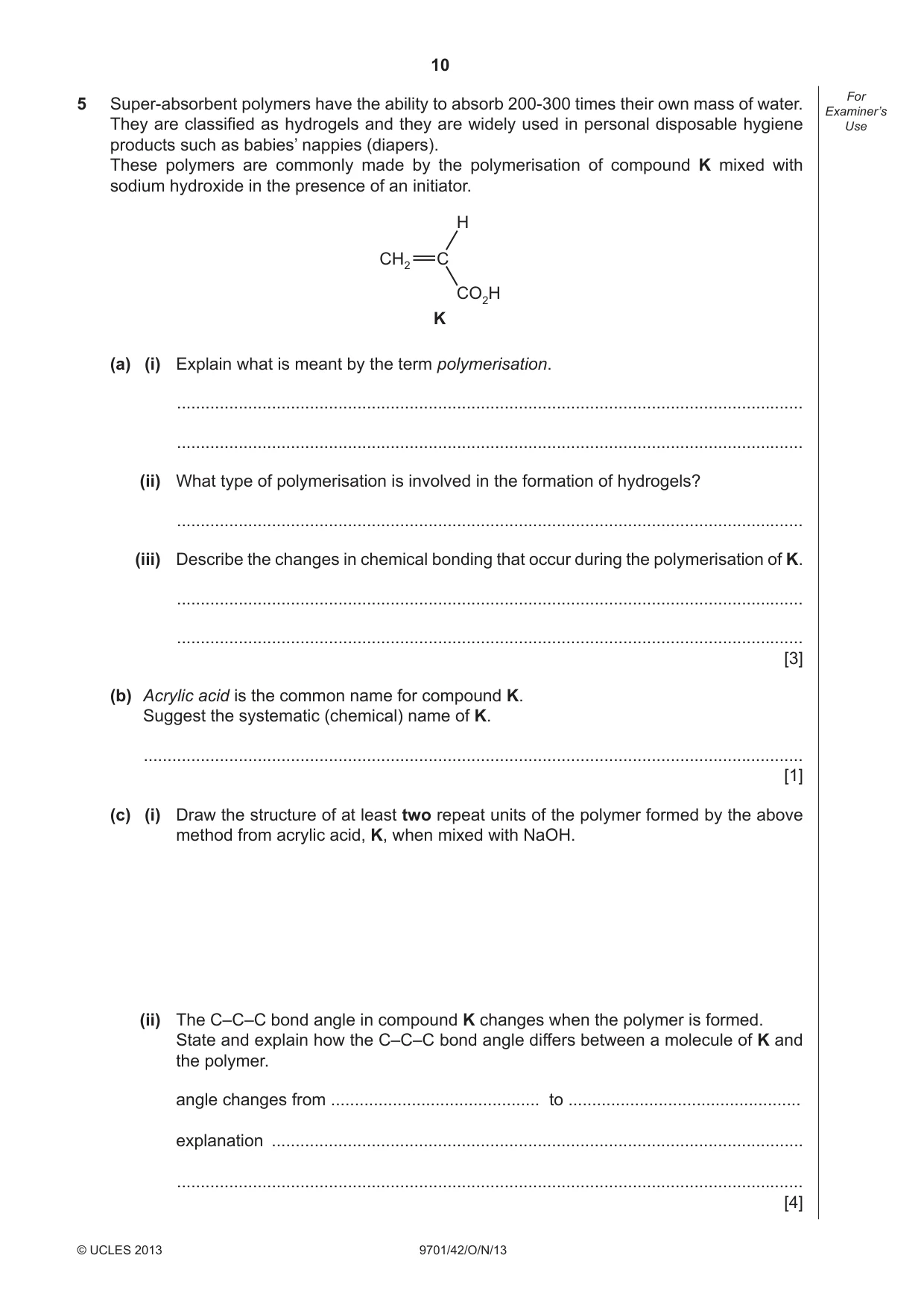
10 9701/42/O/N/13 © UCLES 2013 For Examiner’s Use 5 Super-absorbent polymers have the ability to absorb 200-300 times their own mass of water. They are classifi ed as hydrogels and they are widely used in personal disposable hygiene products such as babies’ nappies (diapers). These polymers are commonly made by the polymerisation of compound K mixed with sodium hydroxide in the presence of an initiator. CH2 C H CO2H K (a) (i) Explain what is meant by the term polymerisation. … … (ii) What type of polymerisation is involved in the formation of hydrogels? … (iii) Describe the changes in chemical bonding that occur during the polymerisation of K. … … [3] (b) Acrylic acid is the common name for compound K. Suggest the systematic (chemical) name of K. … [1] (c) (i) Draw the structure of at least two repeat units of the polymer formed by the above method from acrylic acid, K, when mixed with NaOH. (ii) The C–C–C bond angle in compound K changes when the polymer is formed. State and explain how the C–C–C bond angle differs between a molecule of K and the polymer. angle changes from … to … explanation … … [4]
Question paper, page 11
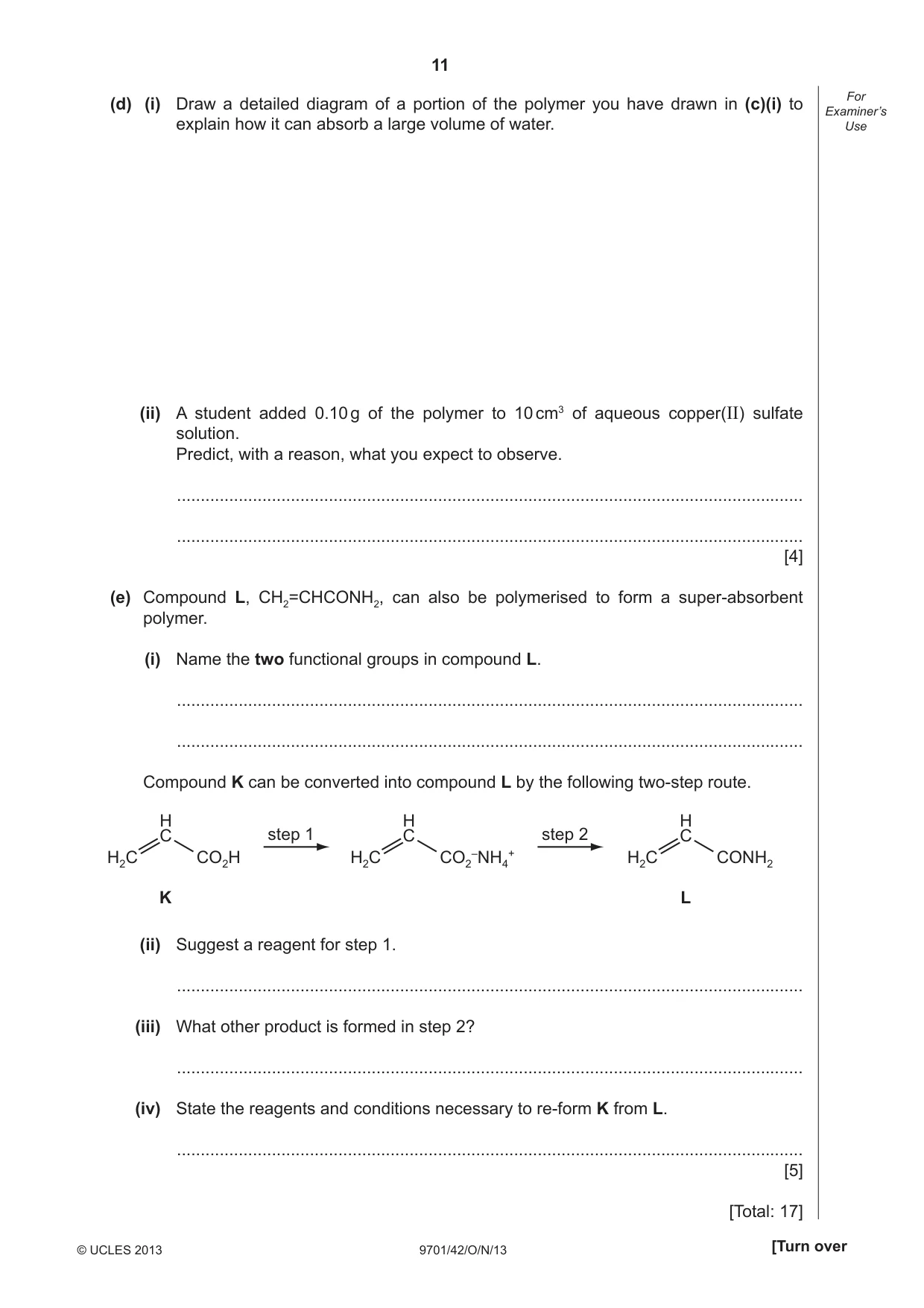
11 9701/42/O/N/13 © UCLES 2013 [Turn over For Examiner’s Use (d) (i) Draw a detailed diagram of a portion of the polymer you have drawn in (c)(i) to explain how it can absorb a large volume of water. (ii) A student added 0.10 g of the polymer to 10 cm3 of aqueous copper(II) sulfate solution. Predict, with a reason, what you expect to observe. … … [4] (e) Compound L, CH2=CHCONH2, can also be polymerised to form a super-absorbent polymer. (i) Name the two functional groups in compound L. … … Compound K can be converted into compound L by the following two-step route. H2C CO2H H C H2C CO2 –NH4 + H C K H2C CONH2 H C L step 1 step 2 (ii) Suggest a reagent for step 1. … (iii) What other product is formed in step 2? … (iv) State the reagents and conditions necessary to re-form K from L. … [5] [Total: 17]
Question paper, page 12
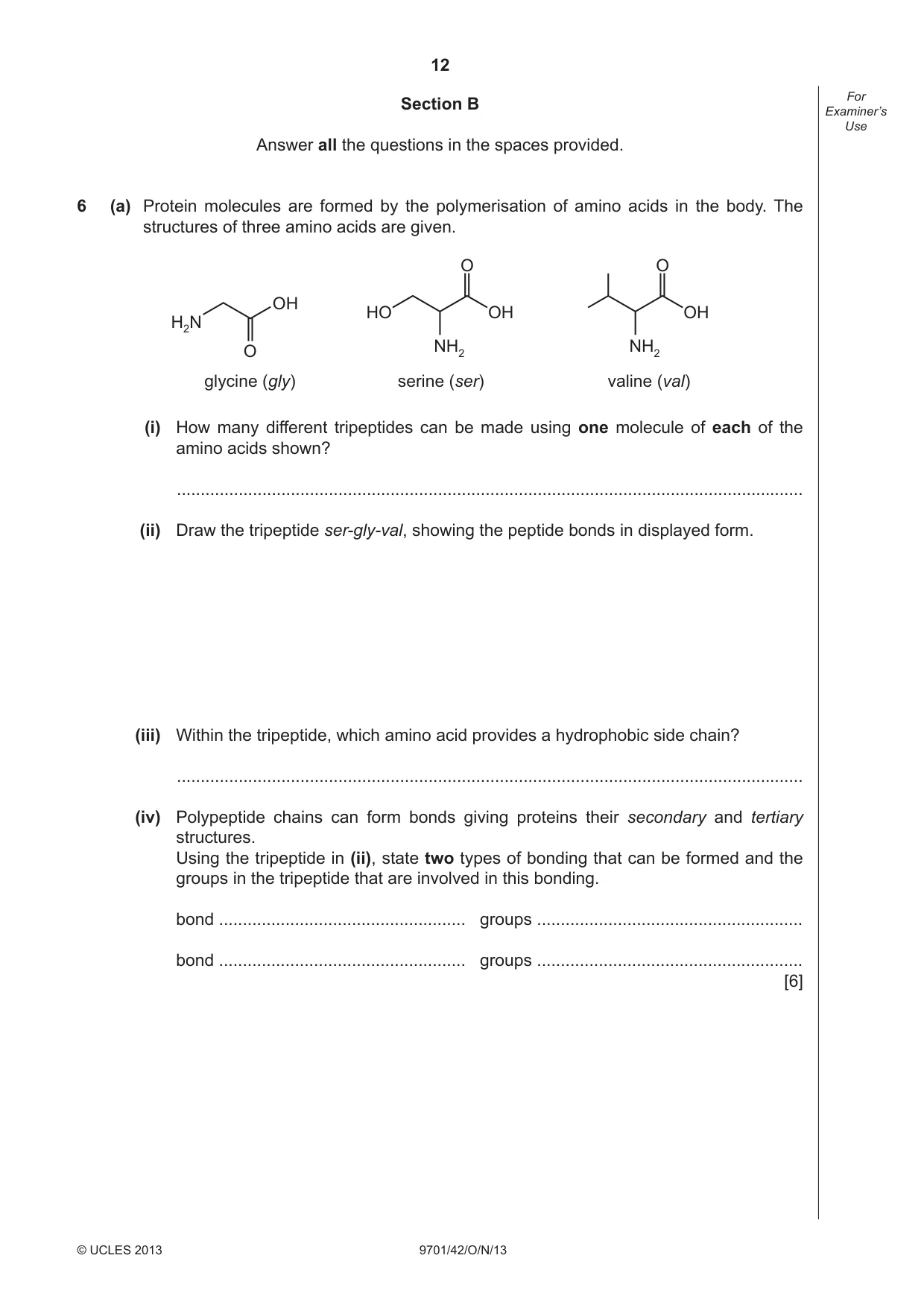
12 9701/42/O/N/13 © UCLES 2013 For Examiner’s Use Section B Answer all the questions in the spaces provided. 6 (a) Protein molecules are formed by the polymerisation of amino acids in the body. The structures of three amino acids are given. OH H2N O OH HO NH2 O OH NH2 O glycine (gly) serine (ser) valine (val) (i) How many different tripeptides can be made using one molecule of each of the amino acids shown? … (ii) Draw the tripeptide ser-gly-val, showing the peptide bonds in displayed form. (iii) Within the tripeptide, which amino acid provides a hydrophobic side chain? … (iv) Polypeptide chains can form bonds giving proteins their secondary and tertiary structures. Using the tripeptide in (ii), state two types of bonding that can be formed and the groups in the tripeptide that are involved in this bonding. bond … groups … bond … groups … [6]
Question paper, page 13
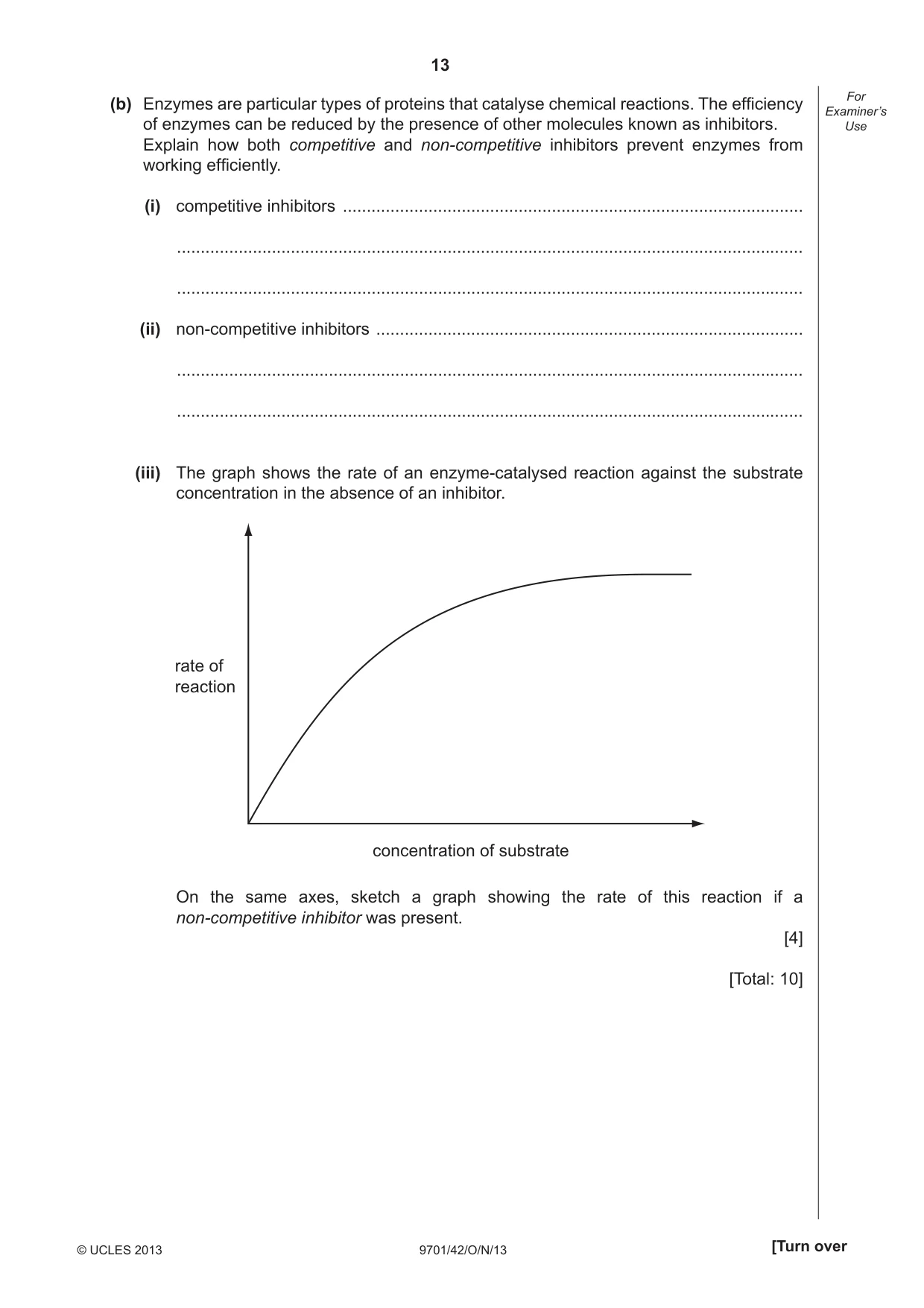
13 9701/42/O/N/13 © UCLES 2013 [Turn over For Examiner’s Use (b) Enzymes are particular types of proteins that catalyse chemical reactions. The effi ciency of enzymes can be reduced by the presence of other molecules known as inhibitors. Explain how both competitive and non-competitive inhibitors prevent enzymes from working effi ciently. (i) competitive inhibitors … … … (ii) non-competitive inhibitors … … … (iii) The graph shows the rate of an enzyme-catalysed reaction against the substrate concentration in the absence of an inhibitor. rate of reaction concentration of substrate On the same axes, sketch a graph showing the rate of this reaction if a non-competitive inhibitor was present. [4] [Total: 10]
Question paper, page 14
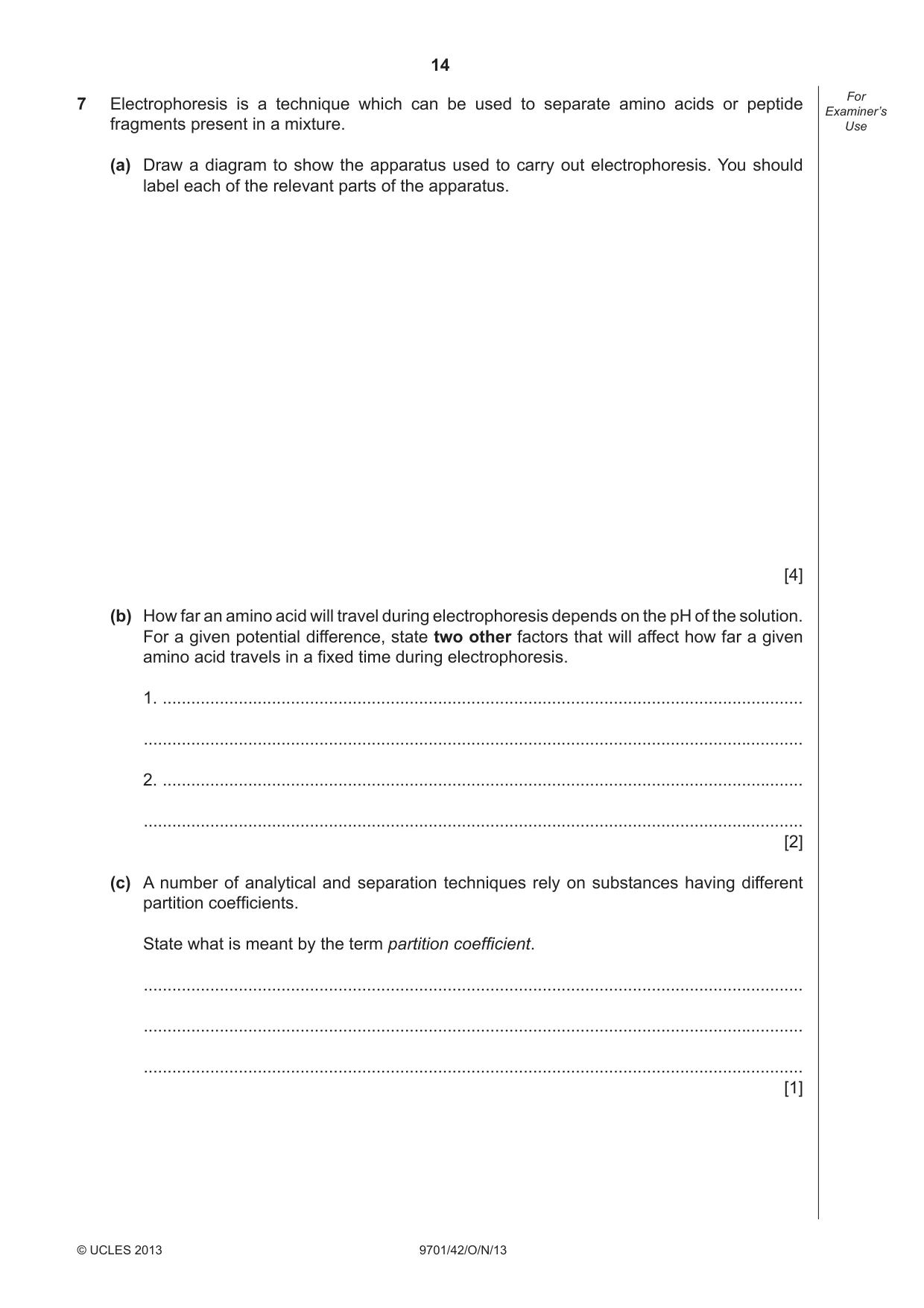
14 9701/42/O/N/13 © UCLES 2013 For Examiner’s Use 7 Electrophoresis is a technique which can be used to separate amino acids or peptide fragments present in a mixture. (a) Draw a diagram to show the apparatus used to carry out electrophoresis. You should label each of the relevant parts of the apparatus. [4] (b) How far an amino acid will travel during electrophoresis depends on the pH of the solution. For a given potential difference, state two other factors that will affect how far a given amino acid travels in a fi xed time during electrophoresis. 1. … … 2. … … [2] (c) A number of analytical and separation techniques rely on substances having different partition coeffi cients. State what is meant by the term partition coeffi cient. … … … [1]
Question paper, page 15
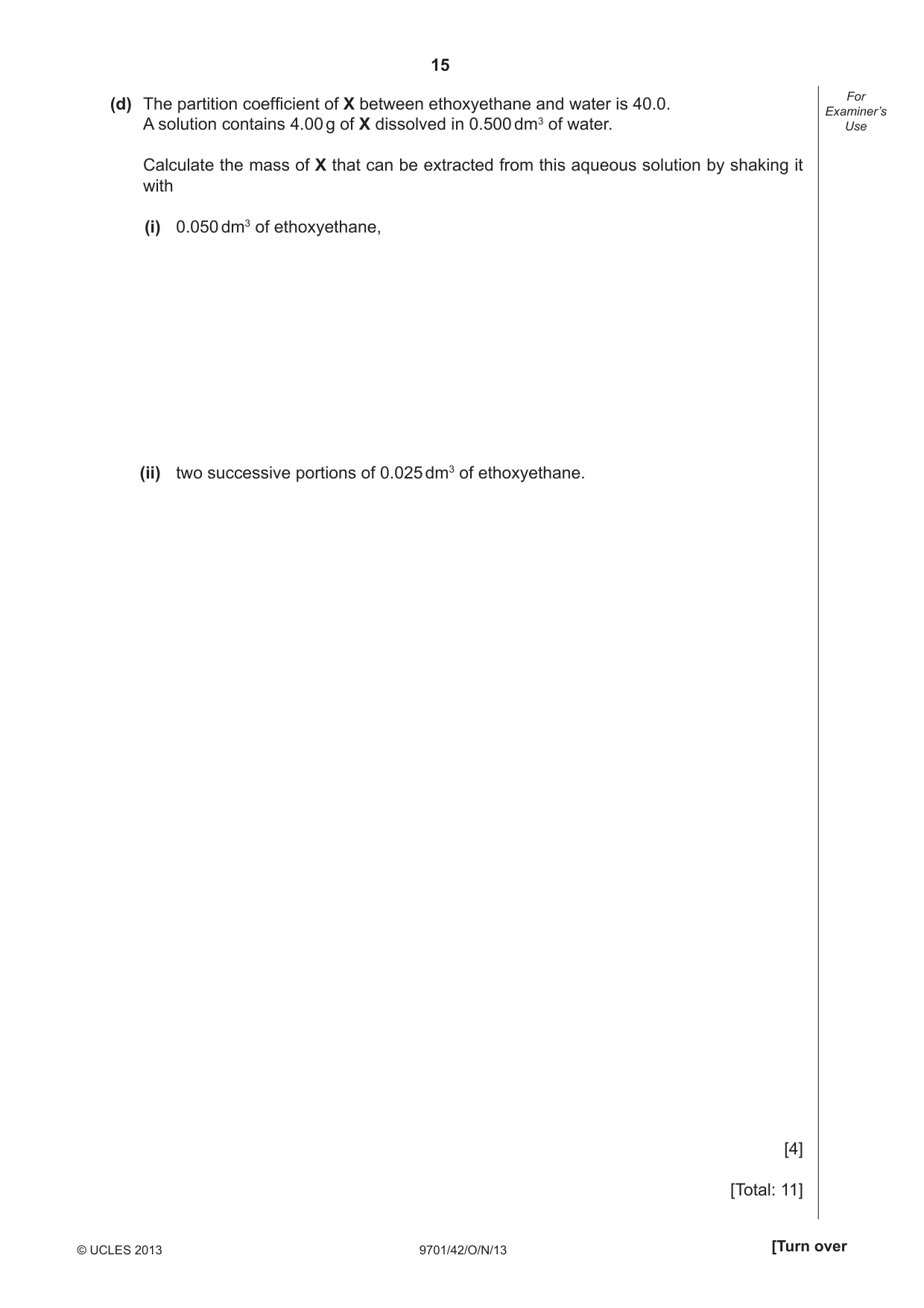
15 9701/42/O/N/13 © UCLES 2013 [Turn over For Examiner’s Use (d) The partition coeffi cient of X between ethoxyethane and water is 40.0. A solution contains 4.00 g of X dissolved in 0.500 dm3 of water. Calculate the mass of X that can be extracted from this aqueous solution by shaking it with (i) 0.050 dm3 of ethoxyethane, (ii) two successive portions of 0.025 dm3 of ethoxyethane. [4] [Total: 11]
Question paper, page 16
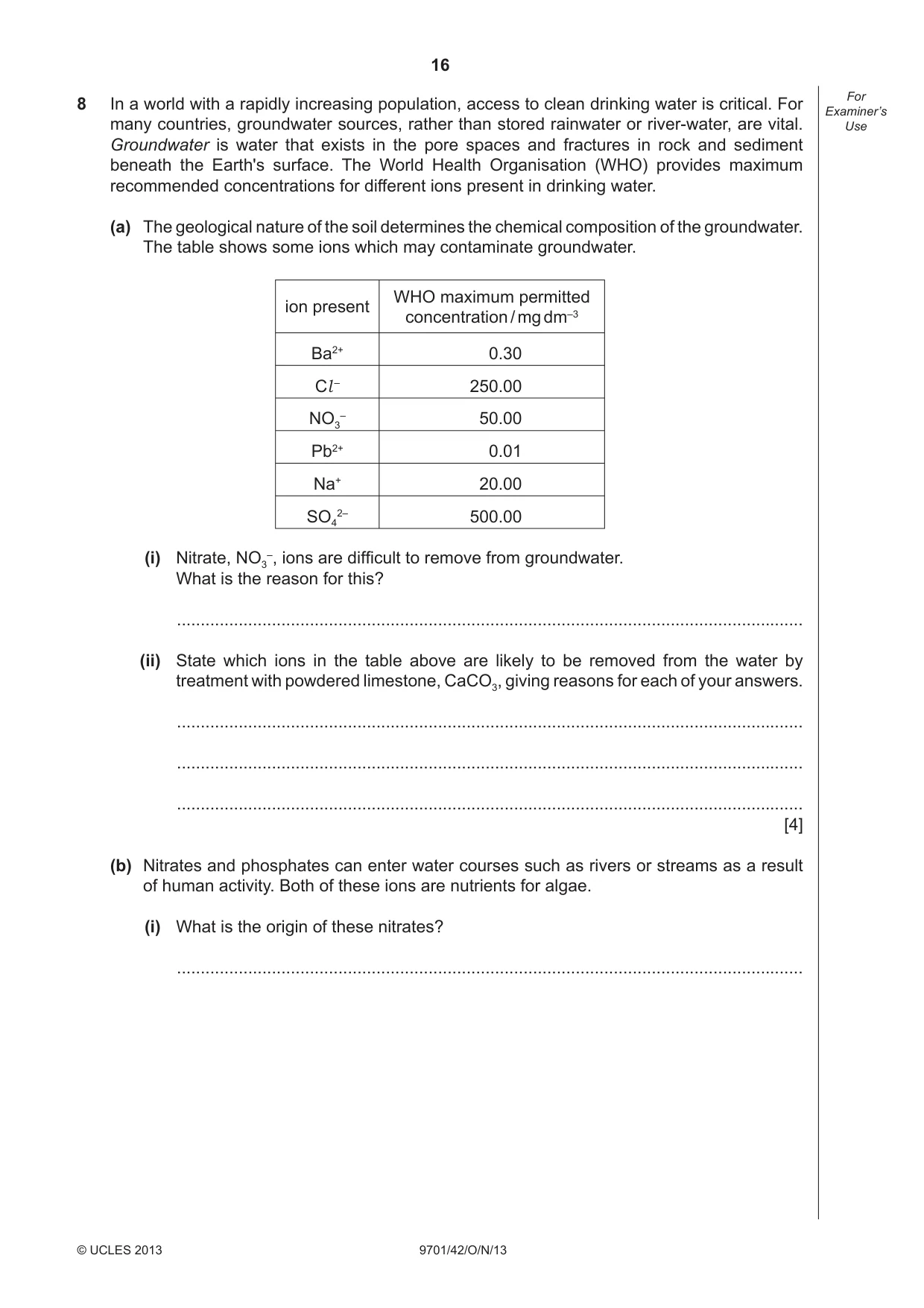
16 9701/42/O/N/13 © UCLES 2013 For Examiner’s Use 8 In a world with a rapidly increasing population, access to clean drinking water is critical. For many countries, groundwater sources, rather than stored rainwater or river-water, are vital. Groundwater is water that exists in the pore spaces and fractures in rock and sediment beneath the Earth's surface. The World Health Organisation (WHO) provides maximum recommended concentrations for different ions present in drinking water. (a) The geological nature of the soil determines the chemical composition of the groundwater. The table shows some ions which may contaminate groundwater. ion present WHO maximum permitted concentration / mg dm–3 Ba2+ 0.30 Cl – 250.00 NO3 – 50.00 Pb2+ 0.01 Na+ 20.00 SO4 2– 500.00 (i) Nitrate, NO3 –, ions are diffi cult to remove from groundwater. What is the reason for this? … (ii) State which ions in the table above are likely to be removed from the water by treatment with powdered limestone, CaCO3, giving reasons for each of your answers. … … … [4] (b) Nitrates and phosphates can enter water courses such as rivers or streams as a result of human activity. Both of these ions are nutrients for algae. (i) What is the origin of these nitrates? …
Question paper, page 17
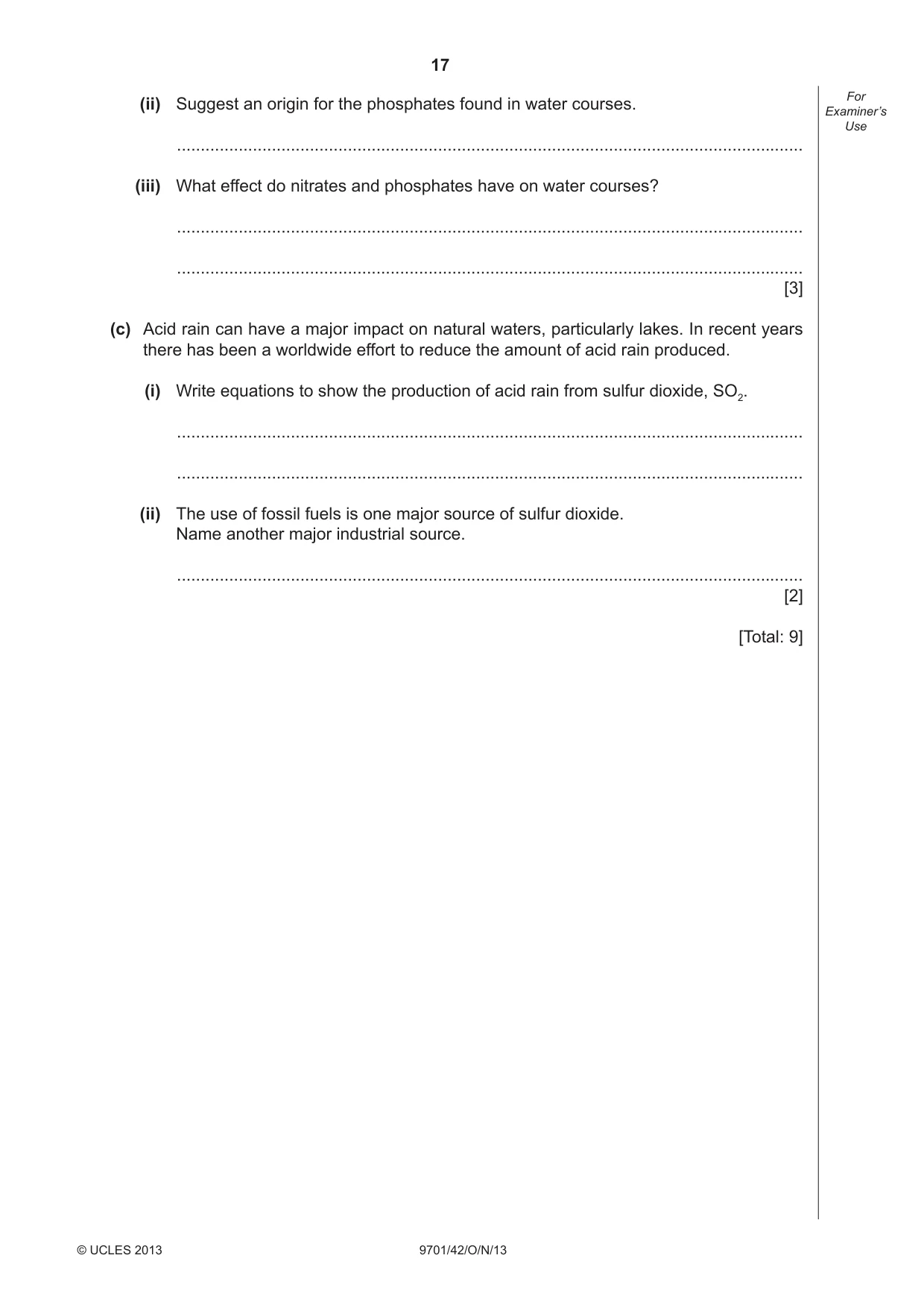
17 9701/42/O/N/13 © UCLES 2013 [Turn over For Examiner’s Use (ii) Suggest an origin for the phosphates found in water courses. … (iii) What effect do nitrates and phosphates have on water courses? … … [3] (c) Acid rain can have a major impact on natural waters, particularly lakes. In recent years there has been a worldwide effort to reduce the amount of acid rain produced. (i) Write equations to show the production of acid rain from sulfur dioxide, SO2. … … (ii) The use of fossil fuels is one major source of sulfur dioxide. Name another major industrial source. … [2] [Total: 9]
Question paper, page 18
18 9701/42/O/N/13 BLANK PAGE © UCLES 2013
Question paper, page 19
19 9701/42/O/N/13 BLANK PAGE © UCLES 2013
Question paper, page 20
20 Permission to reproduce items where third-party owned material protected by copyright is included has been sought and cleared where possible. Every reasonable effort has been made by the publisher (UCLES) to trace copyright holders, but if any items requiring clearance have unwittingly been included the publisher will be pleased to make amends at the earliest possible opportunity. University of Cambridge International Examinations is part of the Cambridge Assessment Group. Cambridge Assessment is the brand name of University of Cambridge Local Examinations Syndicate (UCLES), which is itself a department of the University of Cambridge. 9701/42/O/N/13 © UCLES 2013 BLANK PAGE
Mark scheme, page 1
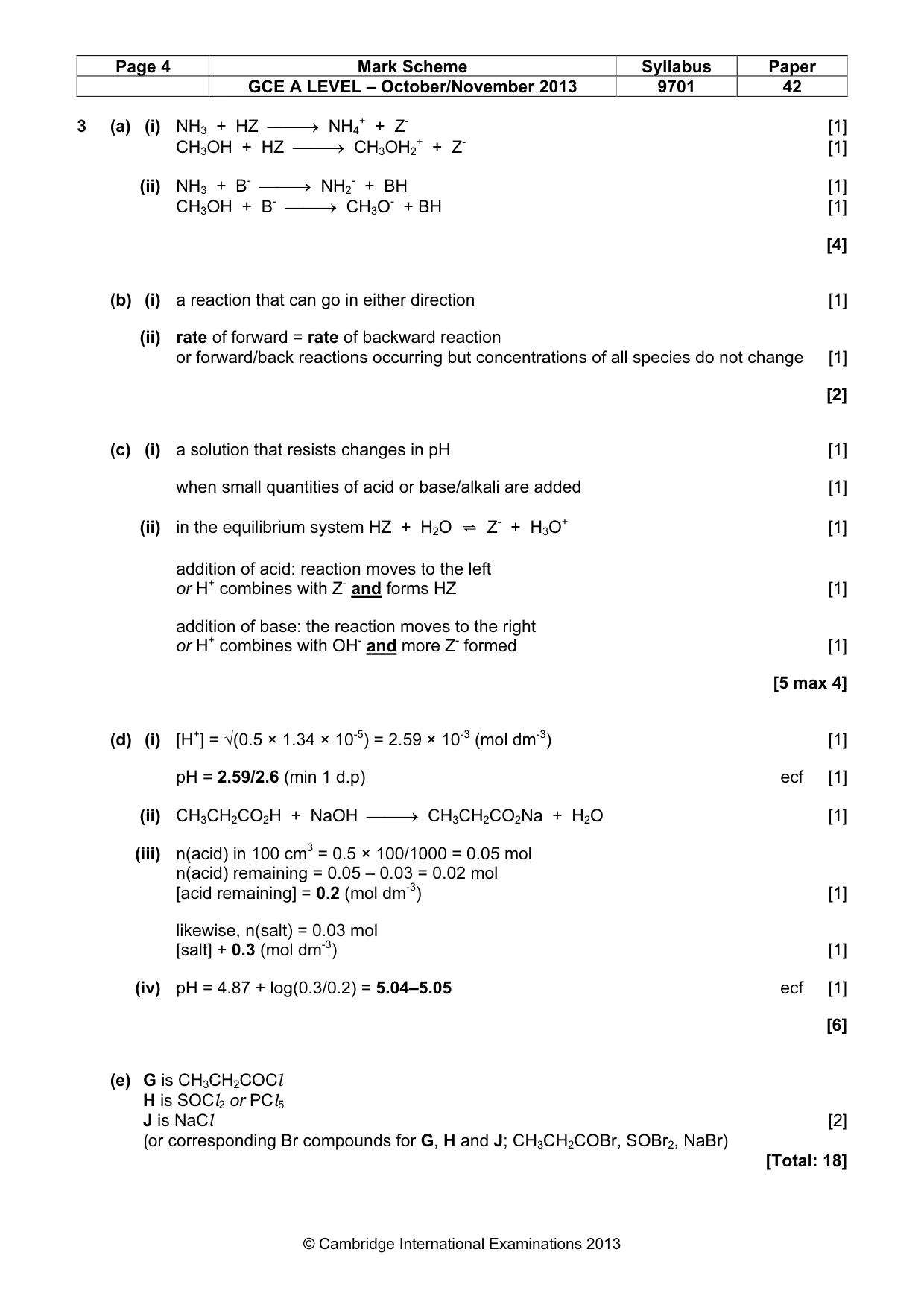
CAMBRIDGE INTERNATIONAL EXAMINATIONS GCE Advanced Level MARK SCHEME for the October/November 2013 series 9701 CHEMISTRY 9701/42 Paper 4 (A2 Structured Questions), maximum raw mark 100 This mark scheme is published as an aid to teachers and candidates, to indicate the requirements of the examination. It shows the basis on which Examiners were instructed to award marks. It does not indicate the details of the discussions that took place at an Examiners’ meeting before marking began, which would have considered the acceptability of alternative answers. Mark schemes should be read in conjunction with the question paper and the Principal Examiner Report for Teachers. Cambridge will not enter into discussions about these mark schemes. Cambridge is publishing the mark schemes for the October/November 2013 series for most IGCSE, GCE Advanced Level and Advanced Subsidiary Level components and some Ordinary Level components.
Mark scheme, page 2
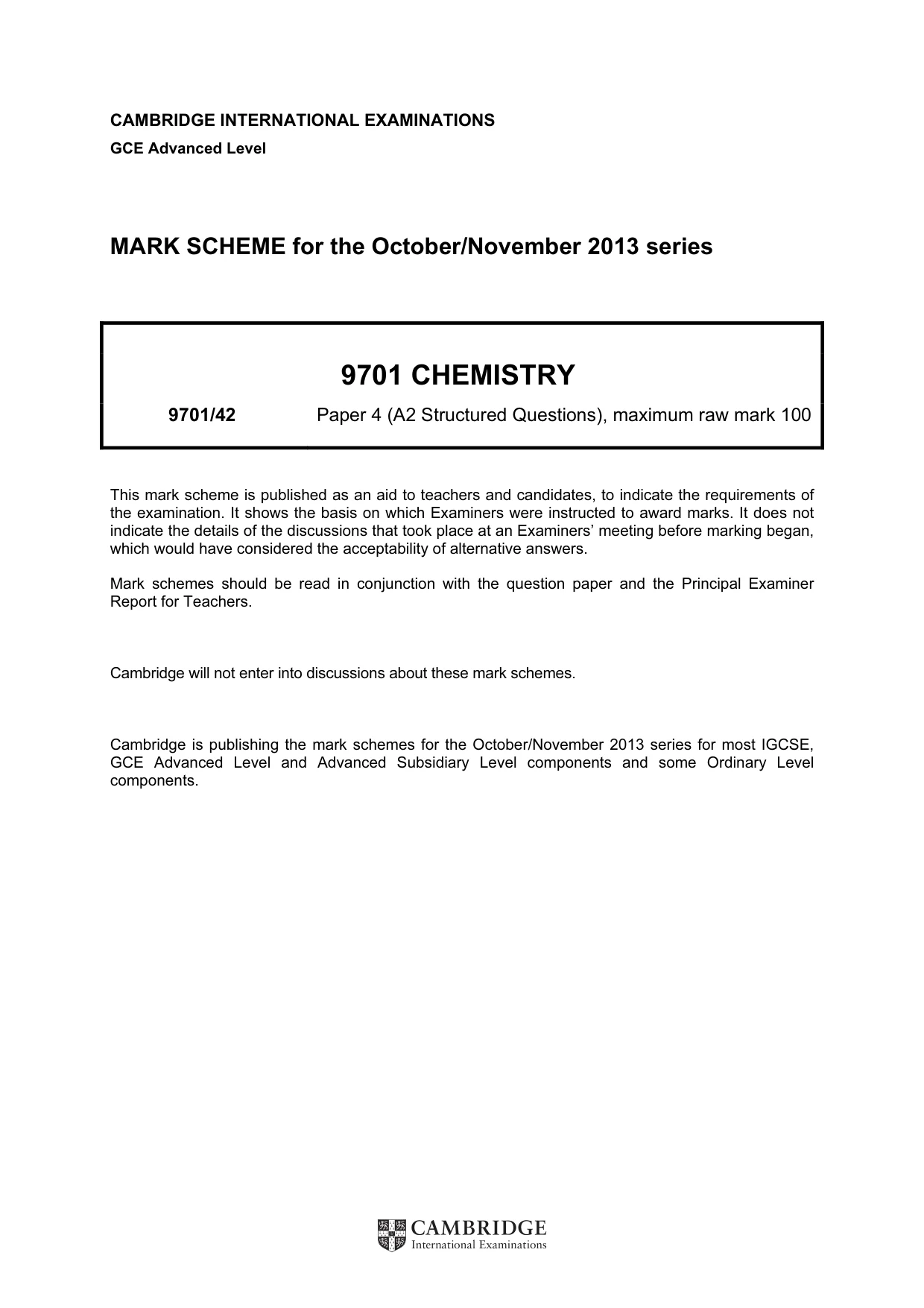
Page 2 Mark Scheme Syllabus Paper GCE A LEVEL – October/November 2013 9701 42 © Cambridge International Examinations 2013 1 (a) 8 e- around chlorine [1] 1 H–electron (+) on the Cl - ion [1] 3 covalent (ox) and one dative (oo) around N [1] [3] (b) (i) it would react (with H2SO4) [1] (ii) CaO + H2O → Ca(OH)2 [1] (iii) CaO absorbs more water or CaO has greater affinity for water [1] [3] (c) (i) 2Ca(NO3)2 → 2CaO + 4NO2 + O2 [1] (ii) (Down the group, the nitrates) become more stable/stability increases [1] because the size/radius of ion (M2+) increases [1] thus causing less polarisation/distortion of the anion/NO3 -/N-O bond [1] [4] [Total: 10]
Mark scheme, page 3
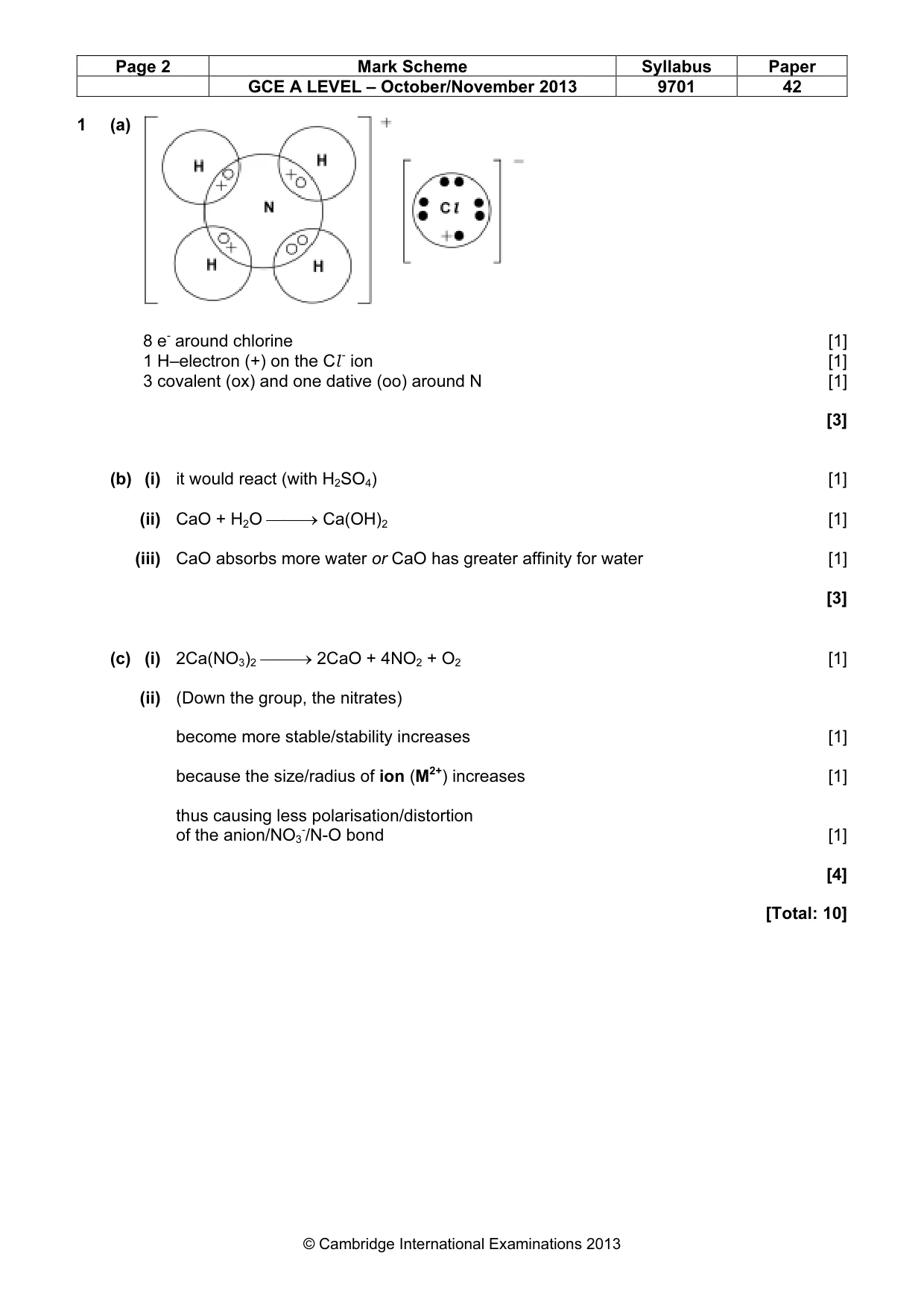
Page 3 Mark Scheme Syllabus Paper GCE A LEVEL – October/November 2013 9701 42 © Cambridge International Examinations 2013 2 (a) (i) Si-Si bonds are weaker (than C-C bonds) [1] (ii) metallic (Sn) is weaker than (giant) covalent (Ge) [1] [2] (b) (i) SiCl4 + 2H2O → SiO2 + 4HCl or SiCl4 + 4H20 → Si(OH)4 + 4HCl or SiCl4 + 3H20 → H2SiO3 + 4HCl (partial hydrolysis is not sufficient e.g. to SiCl3OH + HCl) [1] (ii) PbCl4 → PbCl2 + Cl2 [1] (iii) SnCl2 + 2FeCl3 → SnCl4 + 2FeCl2 [1] (iv) SnO2 + 2NaOH → Na2SnO3 + H2O or SnO2 + 2NaOH + 2H2O → Na2Sn(OH)6 or ionic equation SnO2 + 2OH- → SnO3 2- + H2O [1] [4] [Total: 6]
Mark scheme, page 4
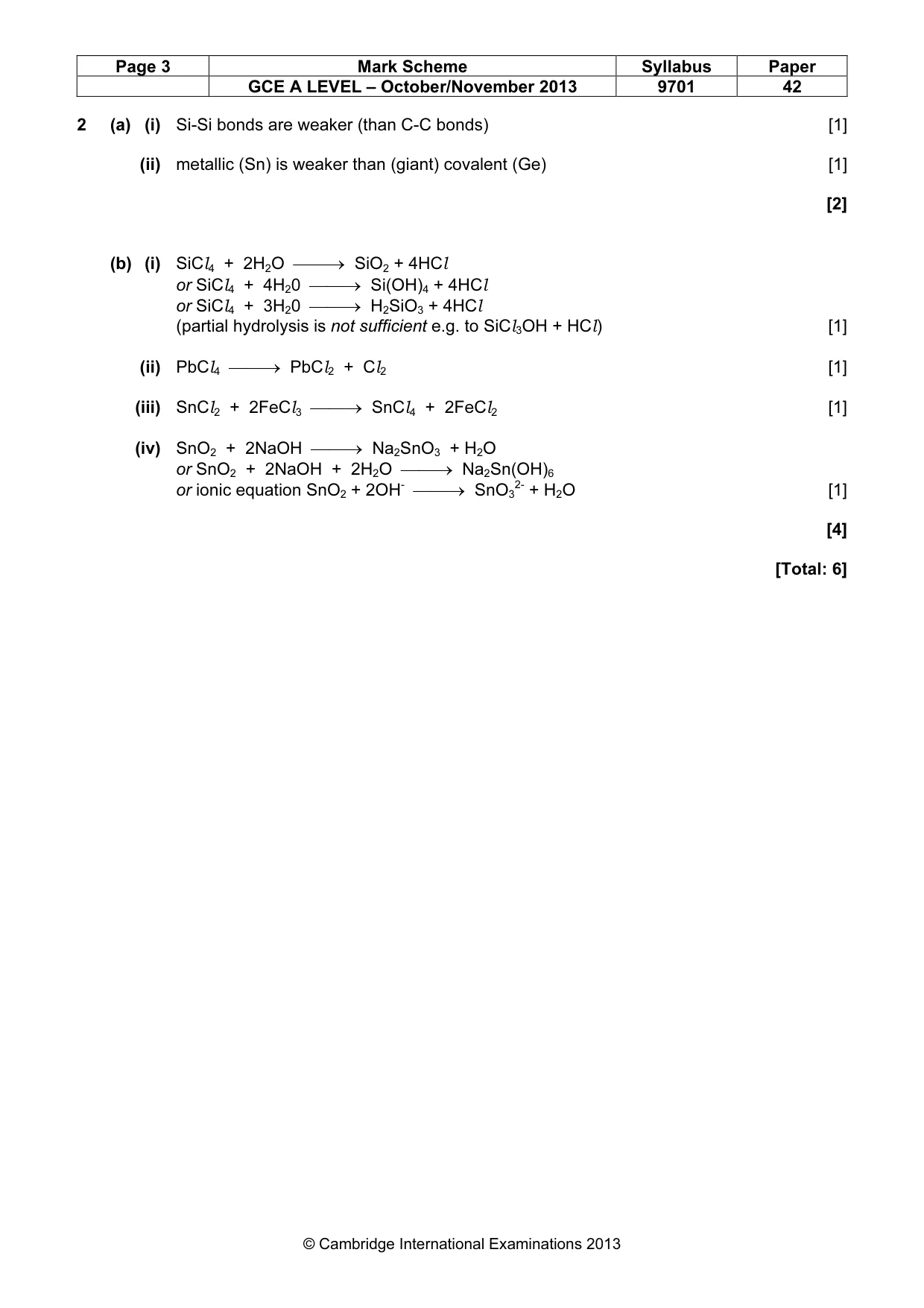
Page 4 Mark Scheme Syllabus Paper GCE A LEVEL – October/November 2013 9701 42 © Cambridge International Examinations 2013 3 (a) (i) NH3 + HZ → NH4 + + Z- [1] CH3OH + HZ → CH3OH2 + + Z- [1] (ii) NH3 + B- → NH2 - + BH [1] CH3OH + B- → CH3O- + BH [1] [4] (b) (i) a reaction that can go in either direction [1] (ii) rate of forward = rate of backward reaction or forward/back reactions occurring but concentrations of all species do not change [1] [2] (c) (i) a solution that resists changes in pH [1] when small quantities of acid or base/alkali are added [1] (ii) in the equilibrium system HZ + H2O ⇋ Z- + H3O+ [1] addition of acid: reaction moves to the left or H+ combines with Z- and forms HZ [1] addition of base: the reaction moves to the right or H+ combines with OH- and more Z- formed [1] [5 max 4] (d) (i) [H+] = √(0.5 × 1.34 × 10-5) = 2.59 × 10⁻³ (mol dm-3) [1] pH = 2.59/2.6 (min 1 d.p) ecf [1] (ii) CH3CH2CO2H + NaOH → CH3CH2CO2Na + H2O [1] (iii) n(acid) in 100 cm3 = 0.5 × 100/1000 = 0.05 mol n(acid) remaining = 0.05 – 0.03 = 0.02 mol [acid remaining] = 0.2 (mol dm-3) [1] likewise, n(salt) = 0.03 mol [salt] + 0.3 (mol dm-3) [1] (iv) pH = 4.87 + log(0.3/0.2) = 5.04–5.05 ecf [1] [6] (e) G is CH3CH2COCl H is SOCl2 or PCl5 J is NaCl [2] (or corresponding Br compounds for G, H and J; CH3CH2COBr, SOBr2, NaBr) [Total: 18]
Mark scheme, page 5
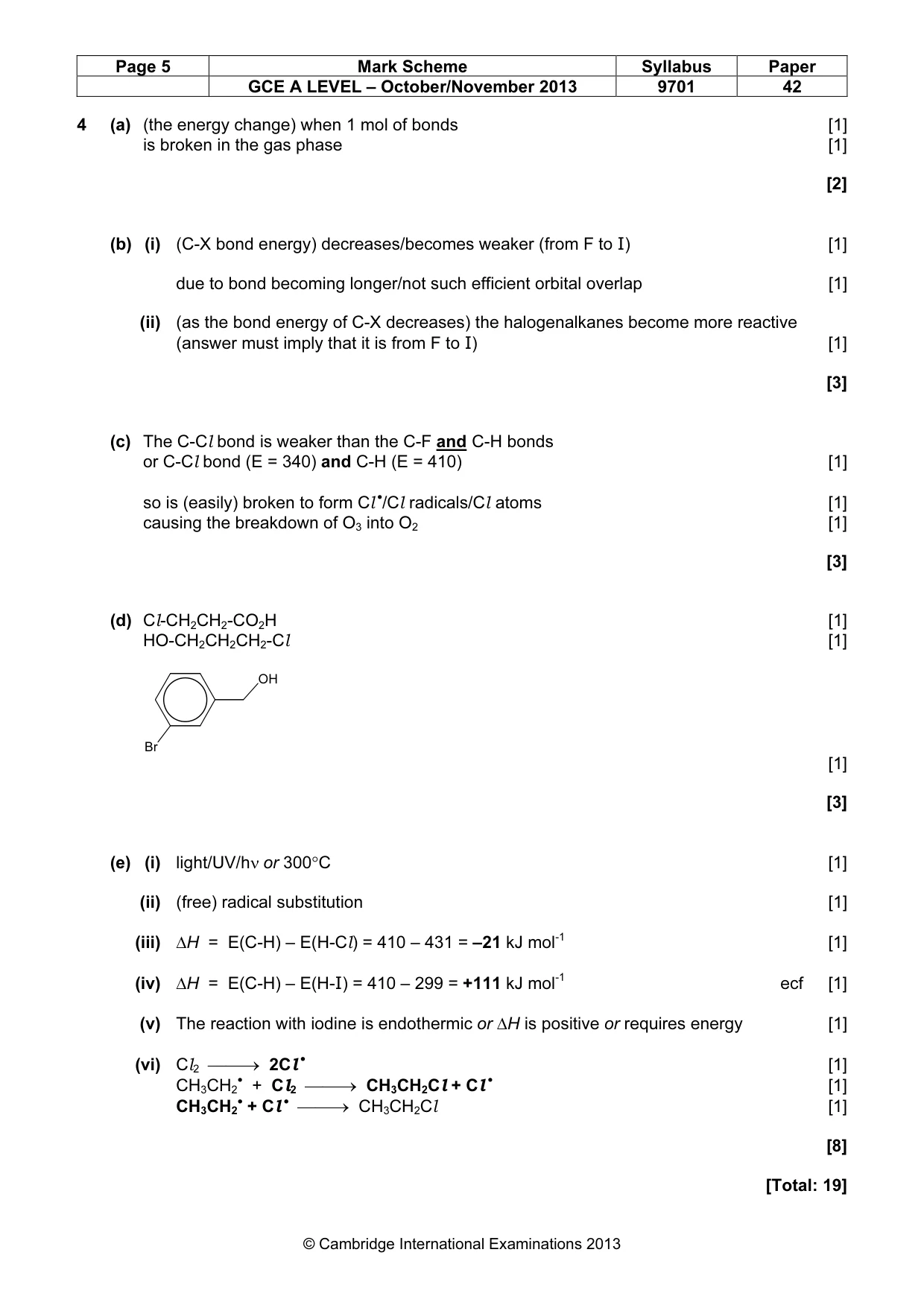
Page 5 Mark Scheme Syllabus Paper GCE A LEVEL – October/November 2013 9701 42 © Cambridge International Examinations 2013 4 (a) (the energy change) when 1 mol of bonds [1] is broken in the gas phase [1] [2] (b) (i) (C-X bond energy) decreases/becomes weaker (from F to I) [1] due to bond becoming longer/not such efficient orbital overlap [1] (ii) (as the bond energy of C-X decreases) the halogenalkanes become more reactive (answer must imply that it is from F to I) [1] [3] (c) The C-Cl bond is weaker than the C-F and C-H bonds or C-Cl bond (E = 340) and C-H (E = 410) [1] so is (easily) broken to form Cl •/Cl radicals/Cl atoms [1] causing the breakdown of O3 into O2 [1] [3] (d) Cl-CH2CH2-CO2H [1] HO-CH2CH2CH2-Cl [1] Br OH [1] [3] (e) (i) light/UV/hν or 300°C [1] (ii) (free) radical substitution [1] (iii) ∆H = E(C-H) – E(H-Cl) = 410 – 431 = –21 kJ mol-1 [1] (iv) ∆H = E(C-H) – E(H-I) = 410 – 299 = +111 kJ mol-1 ecf [1] (v) The reaction with iodine is endothermic or ∆H is positive or requires energy [1] (vi) Cl2 → 2Cl • [1] CH3CH2 • + Cl2 → CH3CH2Cl + Cl • [1] CH3CH2 • + Cl • → CH3CH2Cl [1] [8] [Total: 19]
Mark scheme, page 6
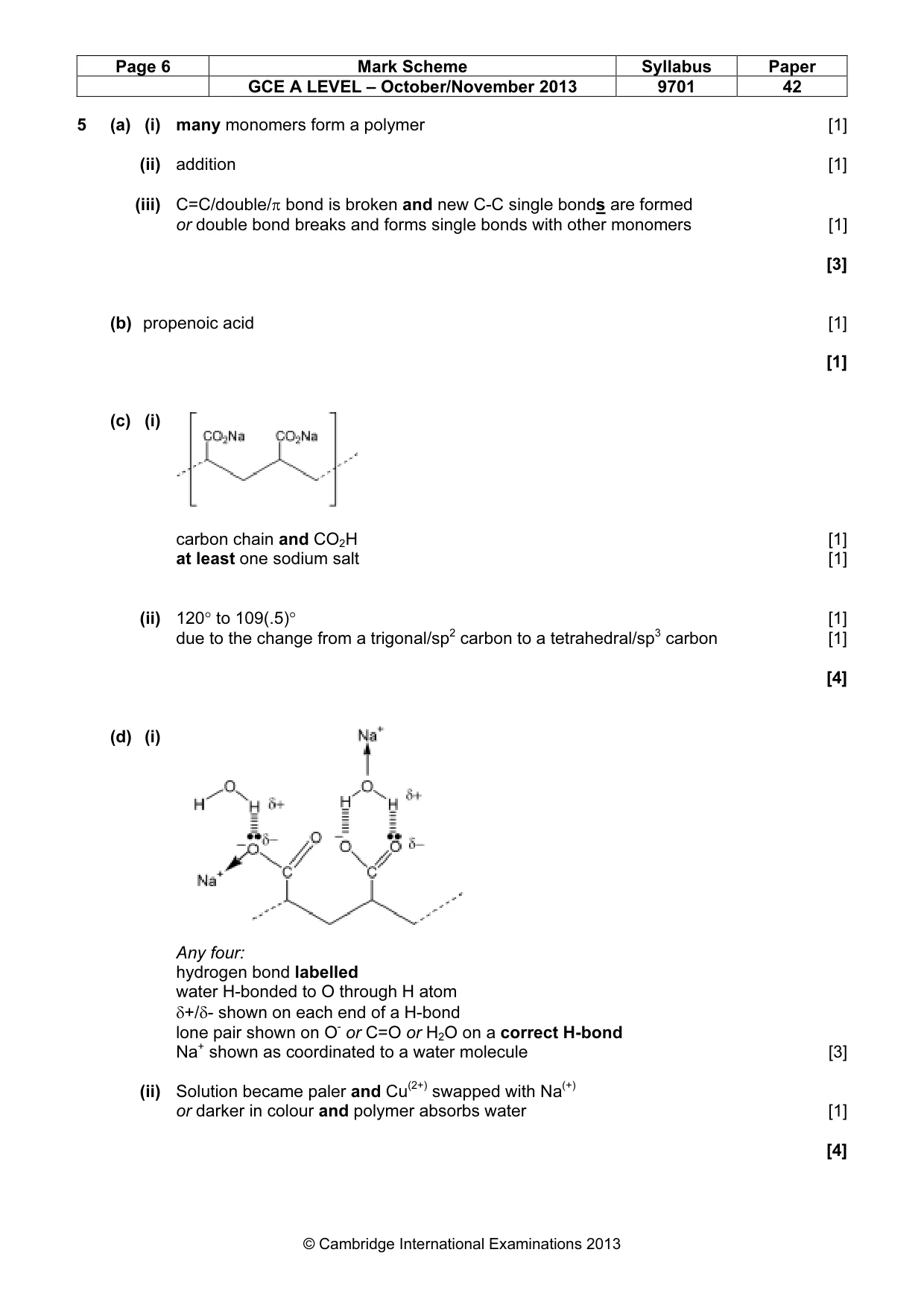
Page 6 Mark Scheme Syllabus Paper GCE A LEVEL – October/November 2013 9701 42 © Cambridge International Examinations 2013 5 (a) (i) many monomers form a polymer [1] (ii) addition [1] (iii) C=C/double/π bond is broken and new C-C single bonds are formed or double bond breaks and forms single bonds with other monomers [1] [3] (b) propenoic acid [1] [1] (c) (i) carbon chain and CO2H [1] at least one sodium salt [1] (ii) 120° to 109(.5)° [1] due to the change from a trigonal/sp2 carbon to a tetrahedral/sp3 carbon [1] [4] (d) (i) Any four: hydrogen bond labelled water H-bonded to O through H atom δ+/δ- shown on each end of a H-bond lone pair shown on O- or C=O or H2O on a correct H-bond Na+ shown as coordinated to a water molecule [3] (ii) Solution became paler and Cu(2+) swapped with Na(+) or darker in colour and polymer absorbs water [1] [4]
Mark scheme, page 7
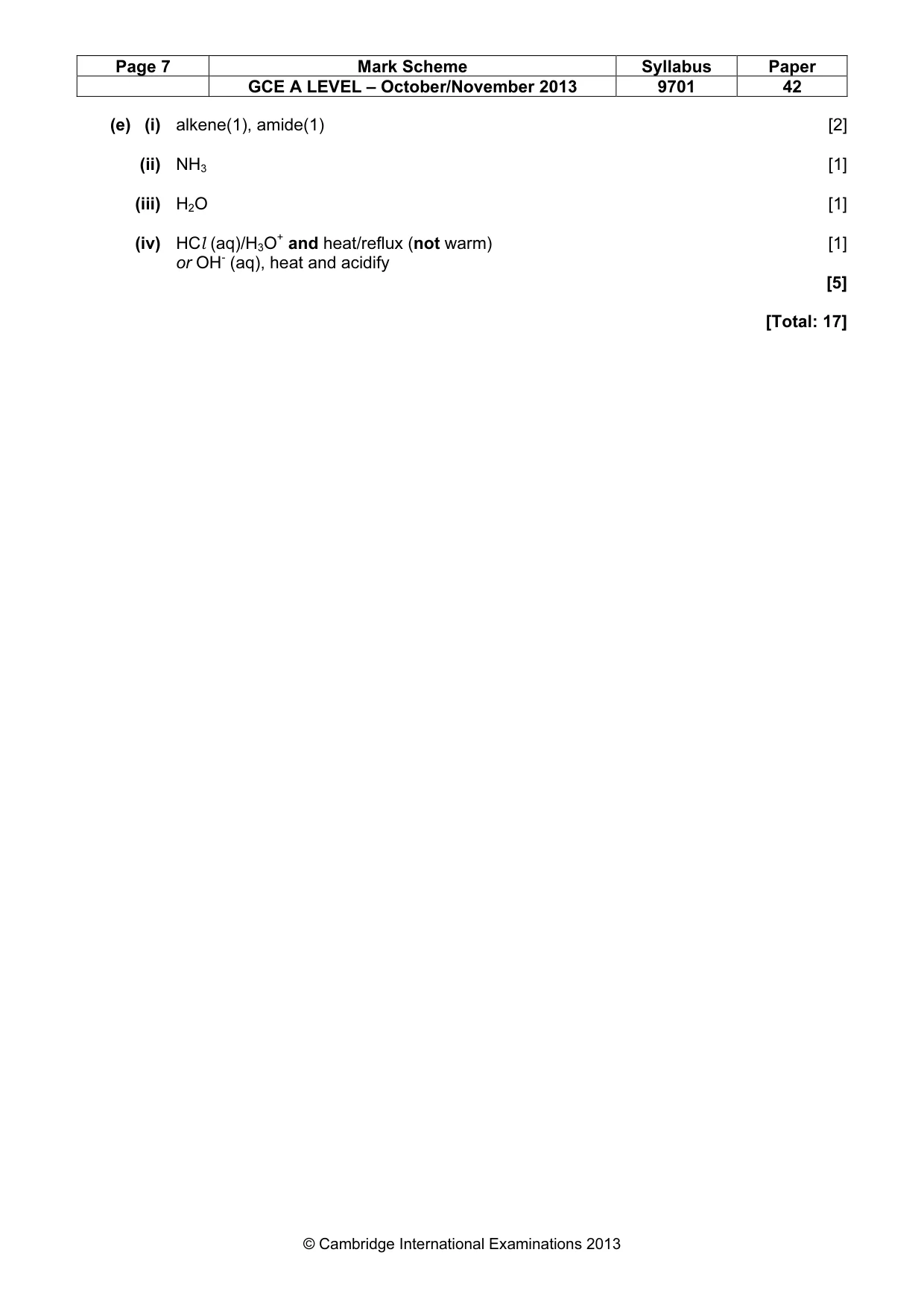
Page 7 Mark Scheme Syllabus Paper GCE A LEVEL – October/November 2013 9701 42 © Cambridge International Examinations 2013 (e) (i) alkene(1), amide(1) [2] (ii) NH3 [1] (iii) H2O [1] (iv) HCl (aq)/H3O+ and heat/reflux (not warm) [1] or OH- (aq), heat and acidify [5] [Total: 17]
Mark scheme, page 8
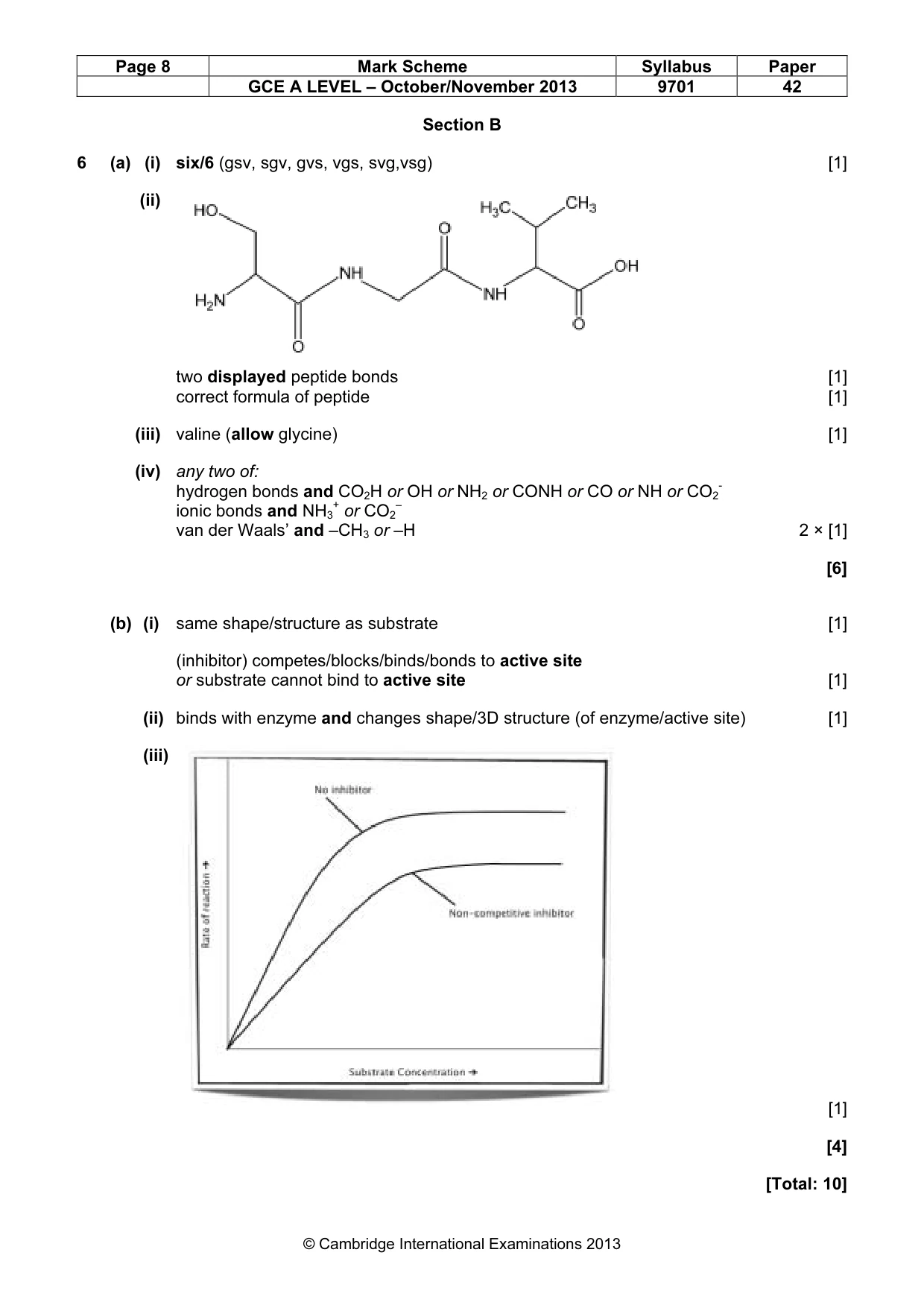
Page 8 Mark Scheme Syllabus Paper GCE A LEVEL – October/November 2013 9701 42 © Cambridge International Examinations 2013 Section B 6 (a) (i) six/6 (gsv, sgv, gvs, vgs, svg,vsg) [1] (ii) two displayed peptide bonds [1] correct formula of peptide [1] (iii) valine (allow glycine) [1] (iv) any two of: hydrogen bonds and CO2H or OH or NH2 or CONH or CO or NH or CO2 - ionic bonds and NH3 + or CO2 – van der Waals’ and –CH3 or –H 2 × [1] [6] (b) (i) same shape/structure as substrate [1] (inhibitor) competes/blocks/binds/bonds to active site or substrate cannot bind to active site [1] (ii) binds with enzyme and changes shape/3D structure (of enzyme/active site) [1] (iii) [1] [4] [Total: 10]
Mark scheme, page 9
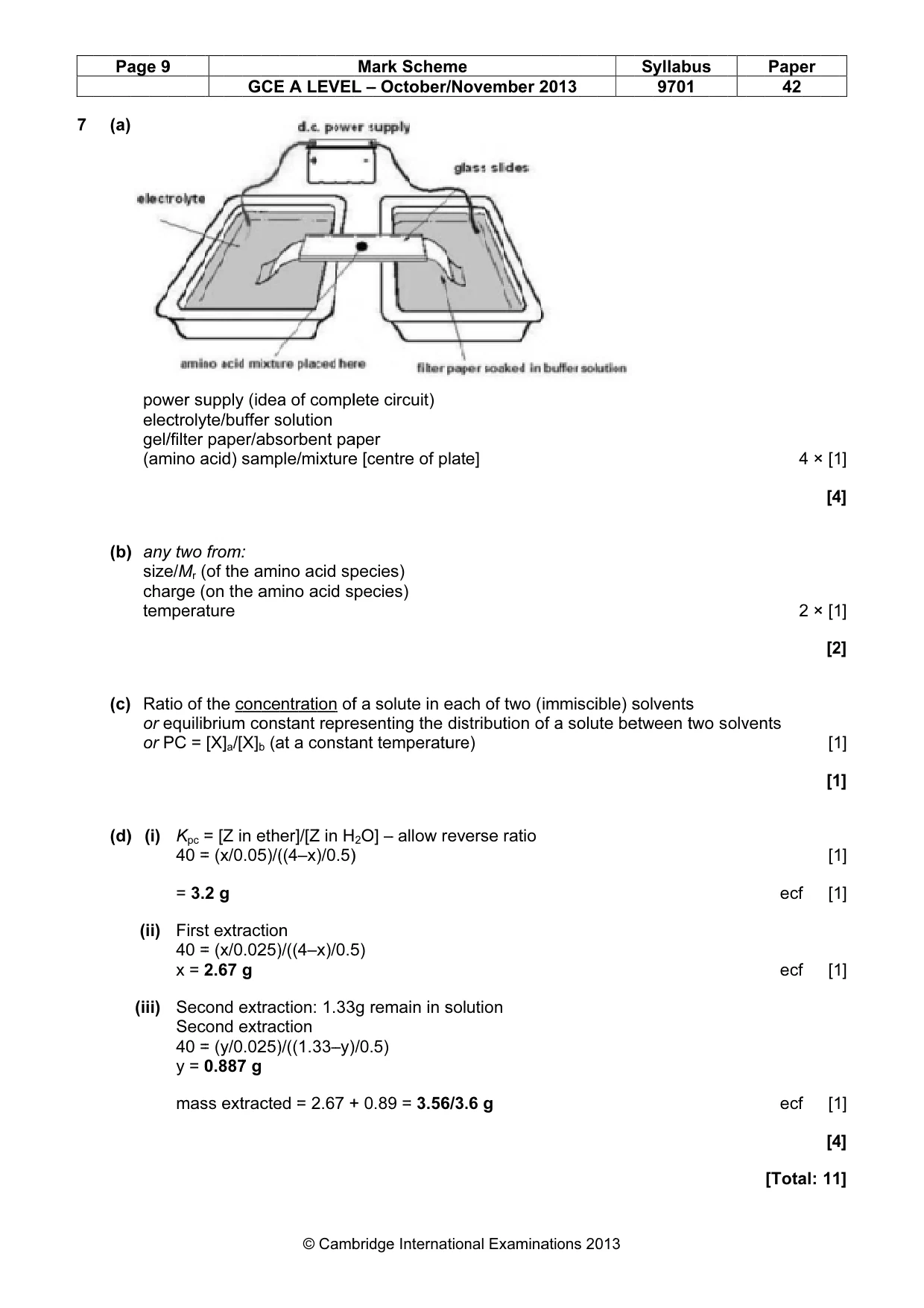
7 ( ( ( ( Pa (a) (b) (c) (d) age p e g ( ) a s c te R o o ) ( (i (ii e 9 pow elec gel/ am any size cha em Rat or e or P (i) i) i) 9 wer ctro /filt mino y tw e/M arge mpe tio equ PC K 40 = F 40 x S S 40 y m r su oly ter o a wo Mr ( e ( era of uilib = Kpc = 0 = 3. irst 0 = = 2 ec ec 0 = = 0 mas upp yte/ pa acid fro (of on tur the briu [X] = [Z = (x 2 g t ex = (x 2.6 con con = (y 0.8 ss e ply /bu ape d) s om: the th re e c um ]a/[X Z i x/0 g xtr x/0 67 d e d e y/0 887 ext G y (id uffe er/a sam : e a e a con m co X]b n e .05 ract .02 g ext ext .02 7 g trac CE dea er s abs mp ami am nce ons b (a eth 5)/( tion 25) trac trac 25) cte E A a o solu sor ple/ ino mino entr sta at a er] ((4– n )/((4 ctio ctio )/(( ed = A L © of c utio rbe /mi o ac o a rati ant a c ]/[Z –x) 4–x on: on 1.3 = 2 EV Ca com on nt ixtu cid acid ion rep on Z in )/0 x)/ 1. 33– 2.67 VEL amb mpl pa ure sp d s n of pre sta n H .5) /0.5 33 –y) 7 + Ma L – brid lete ape e [c pec pe f a ese ant 2O ) 5) 3g r /0. + 0 ark – O dge e c er cen cies cie so ent te O] – rem 5) .89 k S Octo e In circ ntre s) es) olut ing mp – al mai 9 = Sch ob nter uit e of te i g th per low in i = 3. hem ber/ rnat ) f p n e he ratu w r in s .56 me /No tion late eac dis ure eve sol 6/3. e ove nal e] ch strib e) ers utio .6 g em Ex of but se on g mbe xam two tion rat er 2 mina o ( n o tio 201 atio im of a 13 ons mis a so s 20 sci olu 013 ible ute 3 e) s be S sol etw yll 97 ve wee ab 701 nts en t bus 1 s two s o solven Pa 4 nts e e e [To ape 42 4 2 ecf ecf ecf ota er 4 × 2 × f f f al: × [1 [4 × [1 [2 [1 [1 [1 [1 [1 [1 [4 11 ] 4] ] 2] ] ] ] ] ] ] 4] ]
Mark scheme, page 10
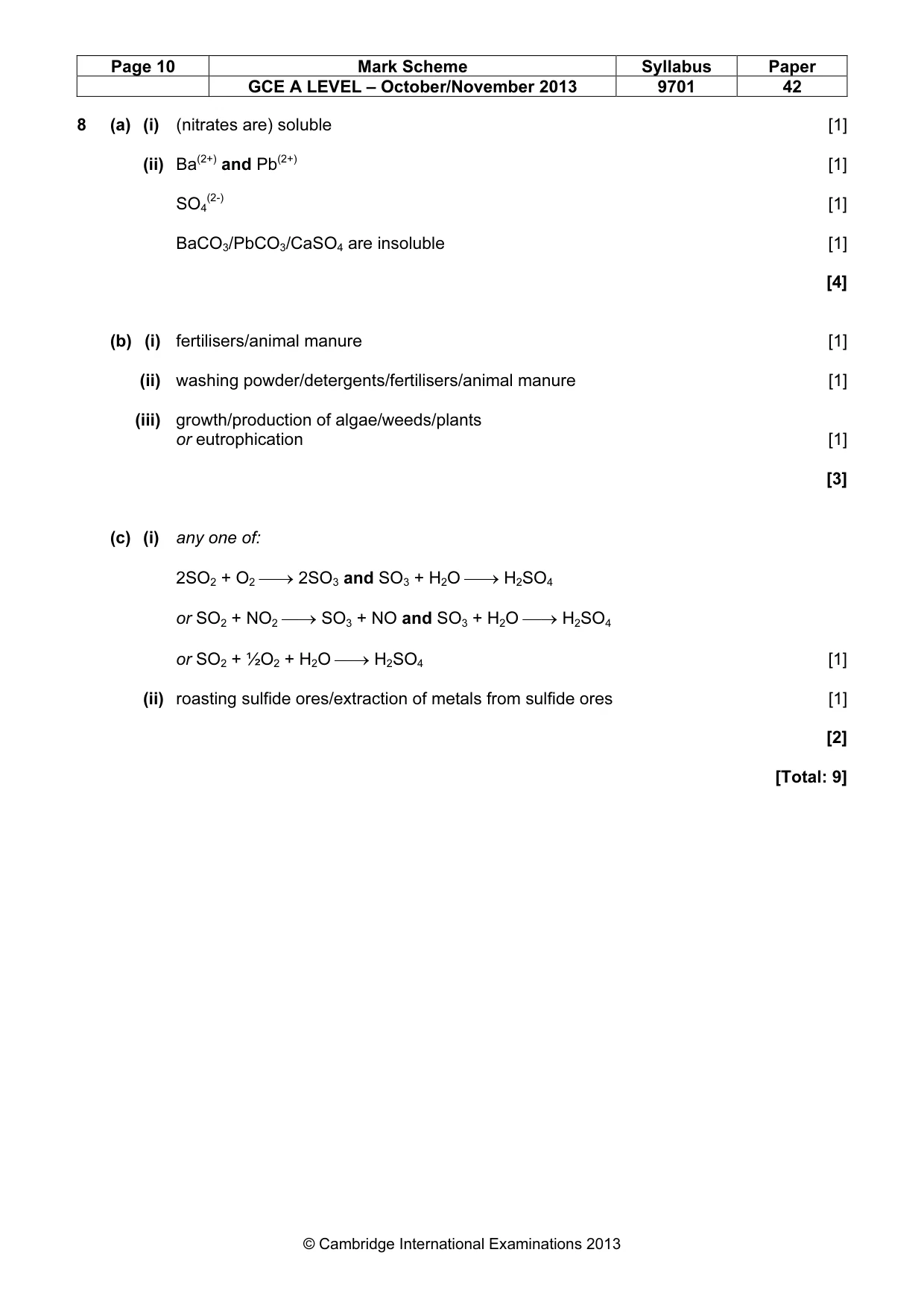
Page 10 Mark Scheme Syllabus Paper GCE A LEVEL – October/November 2013 9701 42 © Cambridge International Examinations 2013 8 (a) (i) (nitrates are) soluble [1] (ii) Ba(2+) and Pb(2+) [1] SO4 (2-) [1] BaCO3/PbCO3/CaSO4 are insoluble [1] [4] (b) (i) fertilisers/animal manure [1] (ii) washing powder/detergents/fertilisers/animal manure [1] (iii) growth/production of algae/weeds/plants or eutrophication [1] [3] (c) (i) any one of: 2SO2 + O2 → 2SO3 and SO3 + H2O → H2SO4 or SO2 + NO2 → SO3 + NO and SO3 + H2O → H2SO4 or SO2 + ½O2 + H2O → H2SO4 [1] (ii) roasting sulfide ores/extraction of metals from sulfide ores [1] [2] [Total: 9]
What you needed in this session
Cambridge’s own grade thresholds for 2013 Oct/Nov, Paper 4 · Variant 2. A higher threshold means an easier paper — the bar moves with how the cohort did.