Cambridge A Level Chemistry 9701 — 2013 Oct/Nov Paper 4 · Variant 3
9701/43/O/N/13 · 100 marks · ≈113 min
The question paper and its mark scheme, free to read here and free to download. This is Cambridge’s own paper, exactly as it was sat.
Question paper20 pages


Mark scheme11 pages
Answers below. Sit the paper first if you are practising.
Paper as text
Question paper, page 1
READ THESE INSTRUCTIONS FIRST Write your Centre number, candidate number and name on all the work you hand in. Write in dark blue or black pen. You may use a soft pencil for any diagrams, graphs or rough working. Do not use staples, paper clips, highlighters, glue or correction fl uid. DO NOT WRITE IN ANY BARCODES. Section A Answer all questions. Section B Answer all questions. Electronic calculators may be used. You may lose marks if you do not show your working or if you do not use appropriate units. A Data Booklet is provided. At the end of the examination, fasten all your work securely together. The number of marks is given in brackets [ ] at the end of each question or part question. CHEMISTRY 9701/43 Paper 4 Structured Questions October/November 2013 2 hours Candidates answer on the Question Paper. Additional Materials: Data Booklet UNIVERSITY OF CAMBRIDGE INTERNATIONAL EXAMINATIONS General Certifi cate of Education Advanced Level This document consists of 18 printed pages and 2 blank pages. [Turn over IB13 11_9701_43/4RP © UCLES 2013 *6208133357* For Examiner’s Use 1 2 3 4 5 6 7 8 9 Total
Question paper, page 2
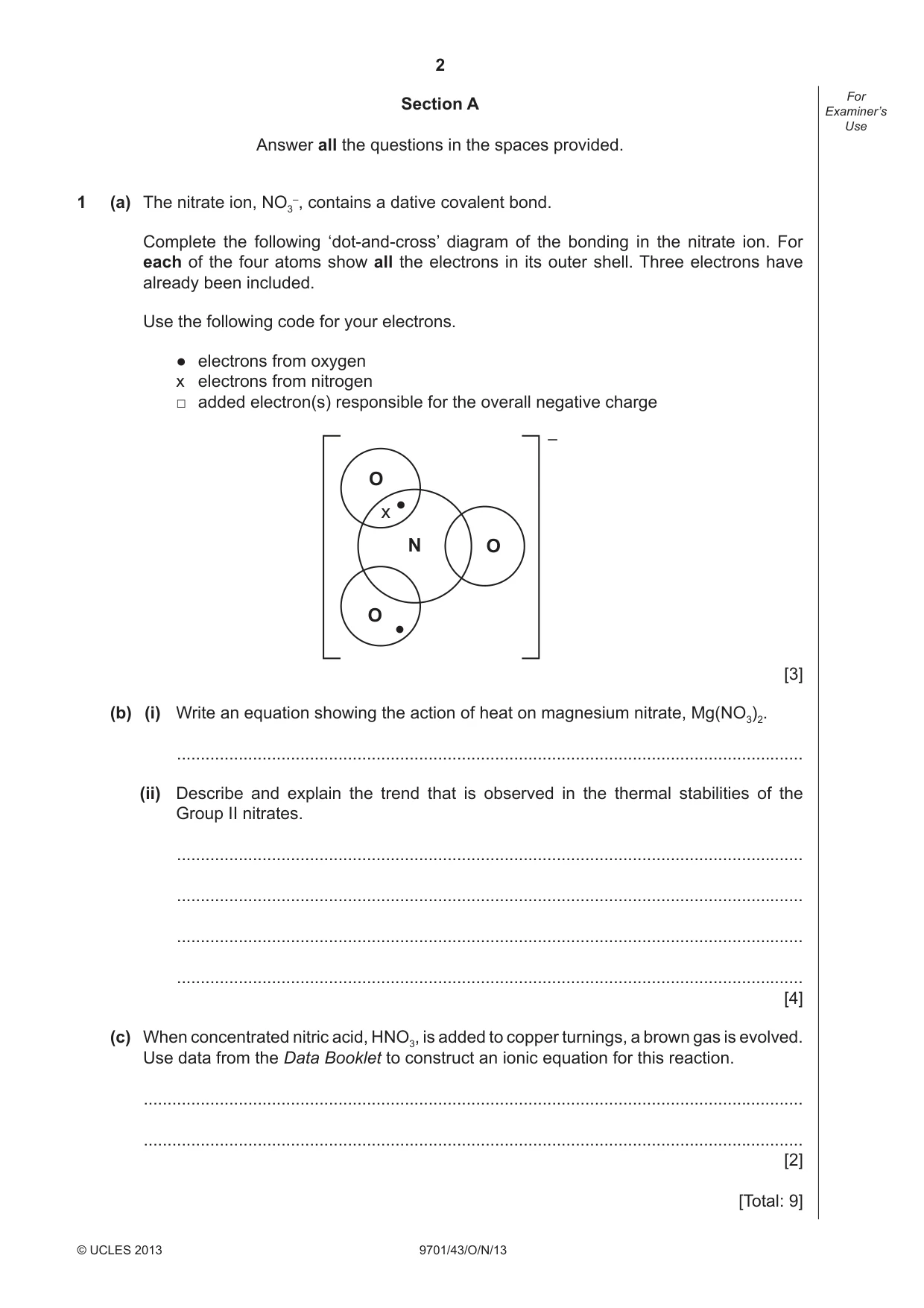
2 9701/43/O/N/13 © UCLES 2013 For Examiner’s Use Section A Answer all the questions in the spaces provided. 1 (a) The nitrate ion, NO3 –, contains a dative covalent bond. Complete the following ‘dot-and-cross’ diagram of the bonding in the nitrate ion. For each of the four atoms show all the electrons in its outer shell. Three electrons have already been included. Use the following code for your electrons. ● electrons from oxygen x electrons from nitrogen □ added electron(s) responsible for the overall negative charge ● ● N O O O x – [3] (b) (i) Write an equation showing the action of heat on magnesium nitrate, Mg(NO3)2. … (ii) Describe and explain the trend that is observed in the thermal stabilities of the Group II nitrates. … … … … [4] (c) When concentrated nitric acid, HNO3, is added to copper turnings, a brown gas is evolved. Use data from the Data Booklet to construct an ionic equation for this reaction. … … [2] [Total: 9]
Question paper, page 3
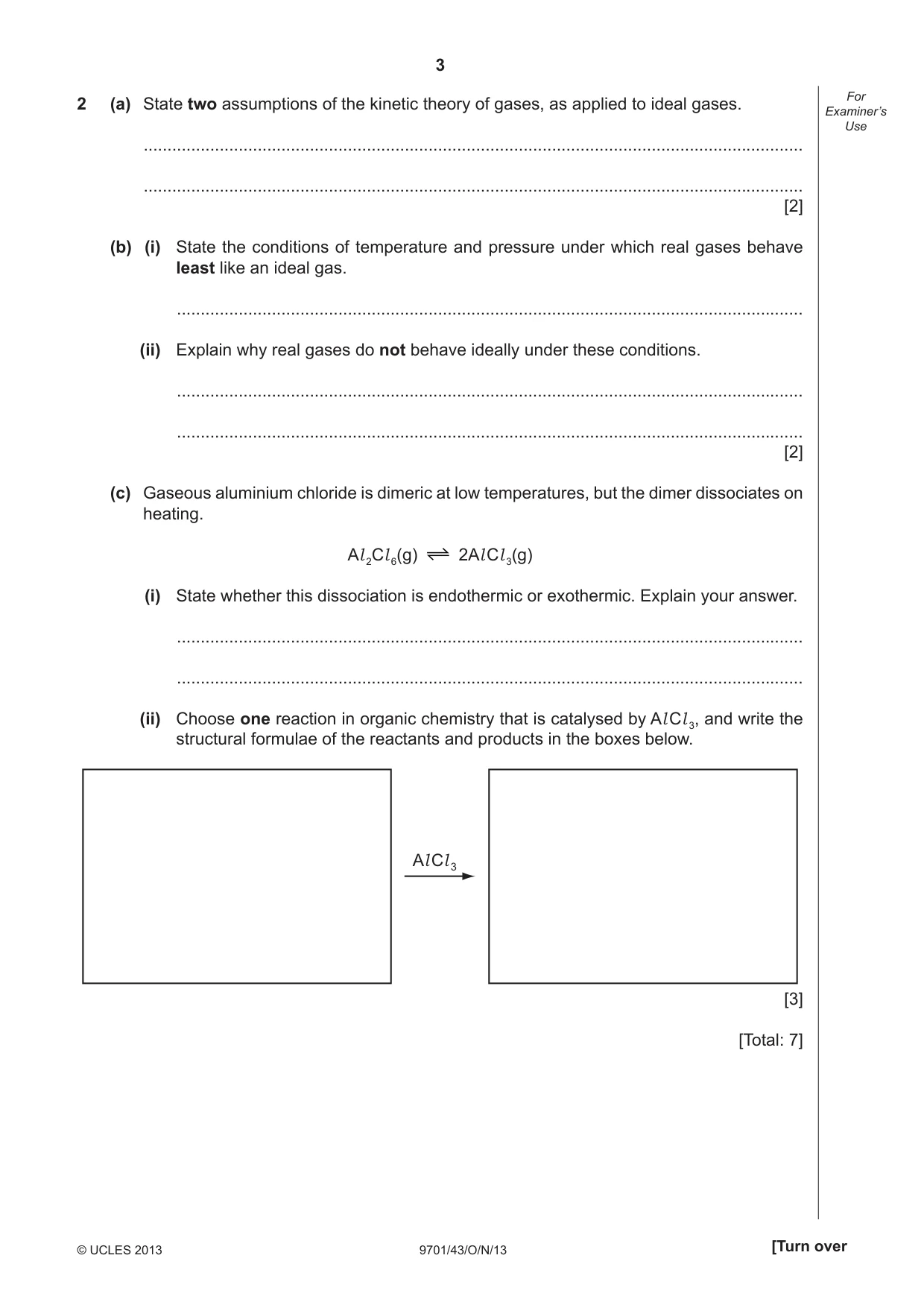
3 9701/43/O/N/13 © UCLES 2013 [Turn over For Examiner’s Use 2 (a) State two assumptions of the kinetic theory of gases, as applied to ideal gases. … … [2] (b) (i) State the conditions of temperature and pressure under which real gases behave least like an ideal gas. … (ii) Explain why real gases do not behave ideally under these conditions. … … [2] (c) Gaseous aluminium chloride is dimeric at low temperatures, but the dimer dissociates on heating. Al 2Cl 6(g) 2Al Cl 3(g) (i) State whether this dissociation is endothermic or exothermic. Explain your answer. … … (ii) Choose one reaction in organic chemistry that is catalysed by Al Cl 3, and write the structural formulae of the reactants and products in the boxes below. Al Cl 3 [3] [Total: 7]
Question paper, page 4
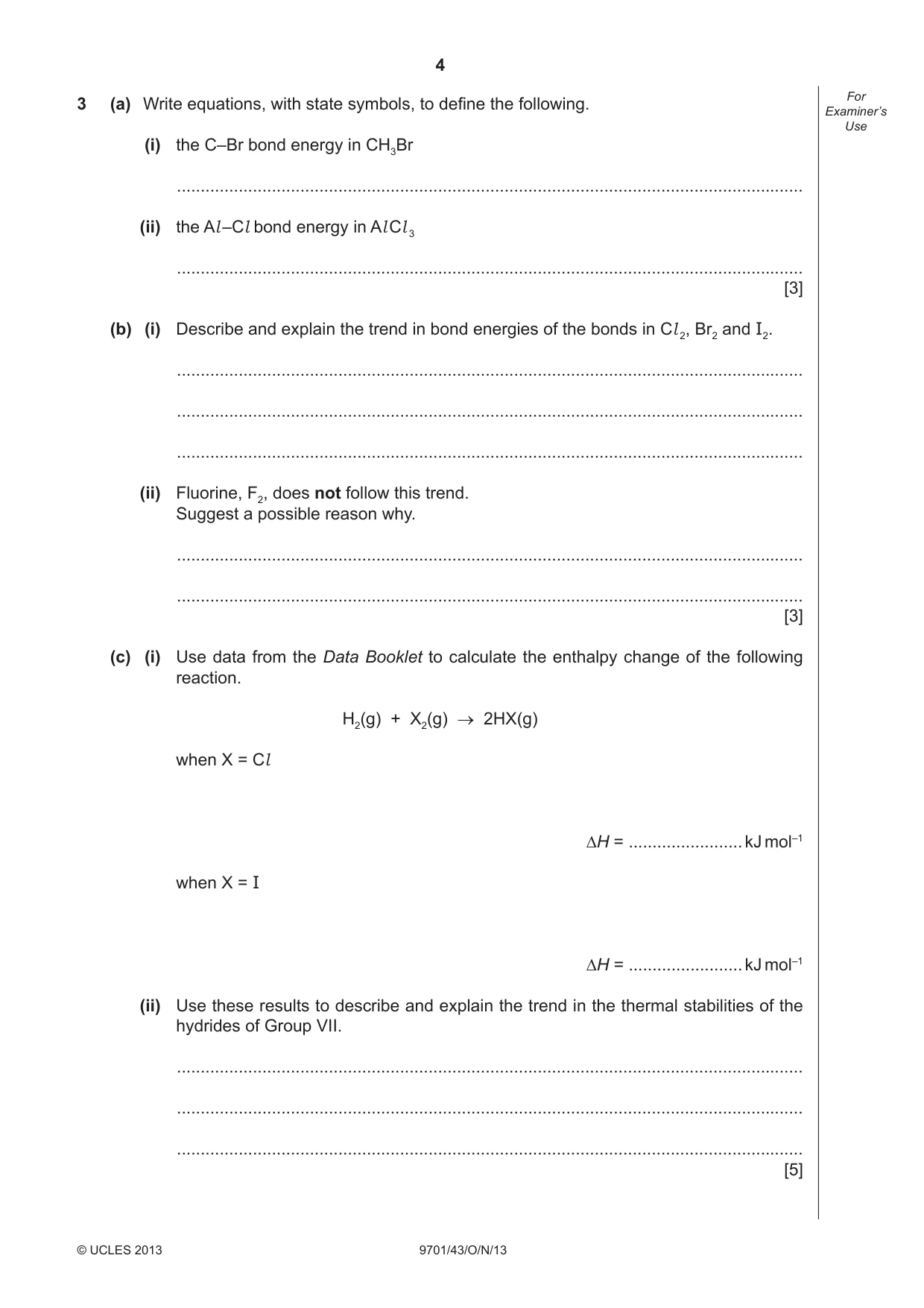
4 9701/43/O/N/13 © UCLES 2013 For Examiner’s Use 3 (a) Write equations, with state symbols, to defi ne the following. (i) the C–Br bond energy in CH3Br … (ii) the Al –Cl bond energy in Al Cl 3 … [3] (b) (i) Describe and explain the trend in bond energies of the bonds in Cl 2, Br2 and I2. … … … (ii) Fluorine, F2, does not follow this trend. Suggest a possible reason why. … … [3] (c) (i) Use data from the Data Booklet to calculate the enthalpy change of the following reaction. H2(g) + X2(g) → 2HX(g) when X = Cl ∆H = … kJ mol–1 when X = I ∆H = … kJ mol–1 (ii) Use these results to describe and explain the trend in the thermal stabilities of the hydrides of Group VII. … … … [5]
Question paper, page 5
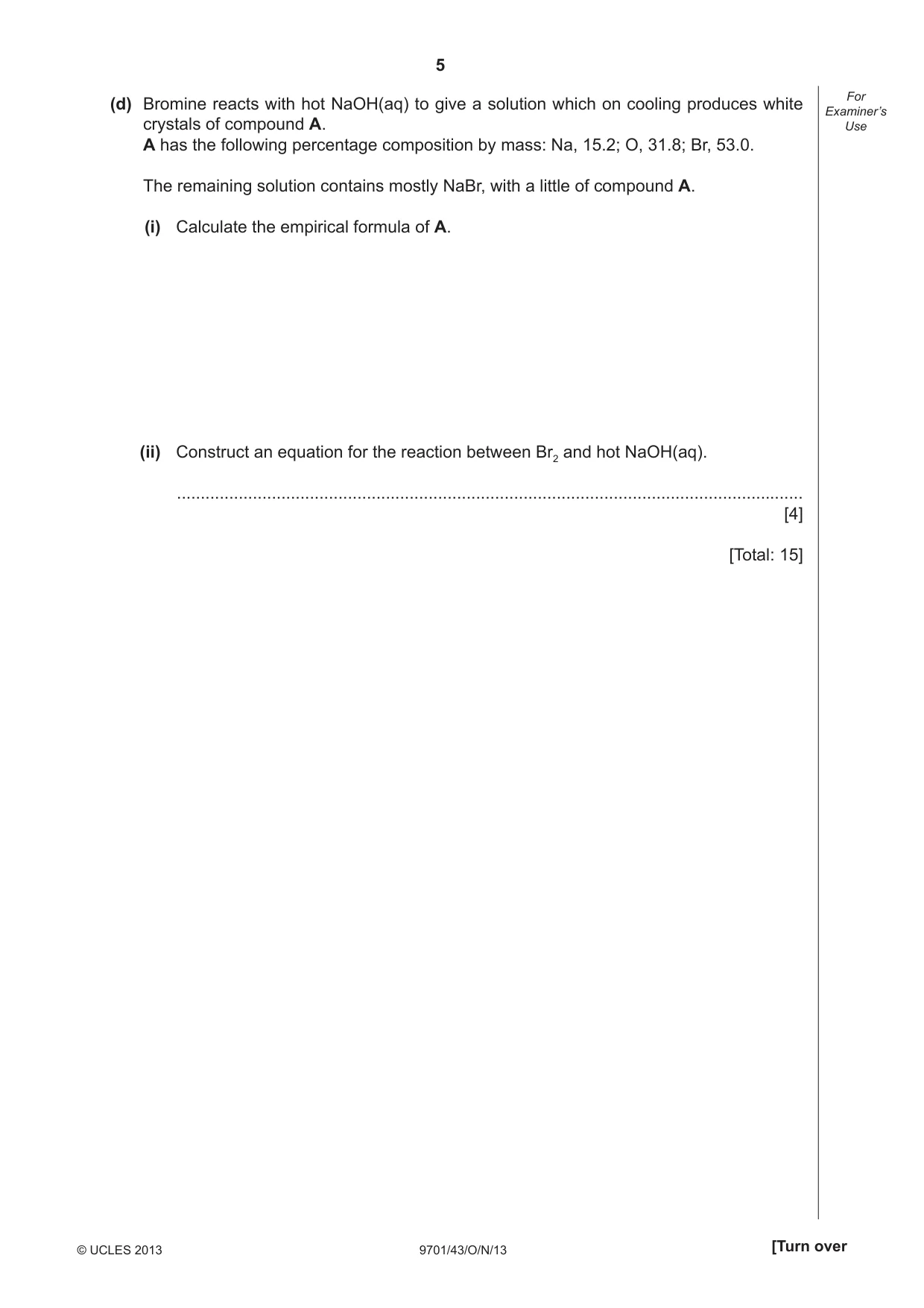
5 9701/43/O/N/13 © UCLES 2013 [Turn over For Examiner’s Use (d) Bromine reacts with hot NaOH(aq) to give a solution which on cooling produces white crystals of compound A. A has the following percentage composition by mass: Na, 15.2; O, 31.8; Br, 53.0. The remaining solution contains mostly NaBr, with a little of compound A. (i) Calculate the empirical formula of A. (ii) Construct an equation for the reaction between Br2 and hot NaOH(aq). … [4] [Total: 15]
Question paper, page 6
6 9701/43/O/N/13 BLANK PAGE © UCLES 2013
Question paper, page 7
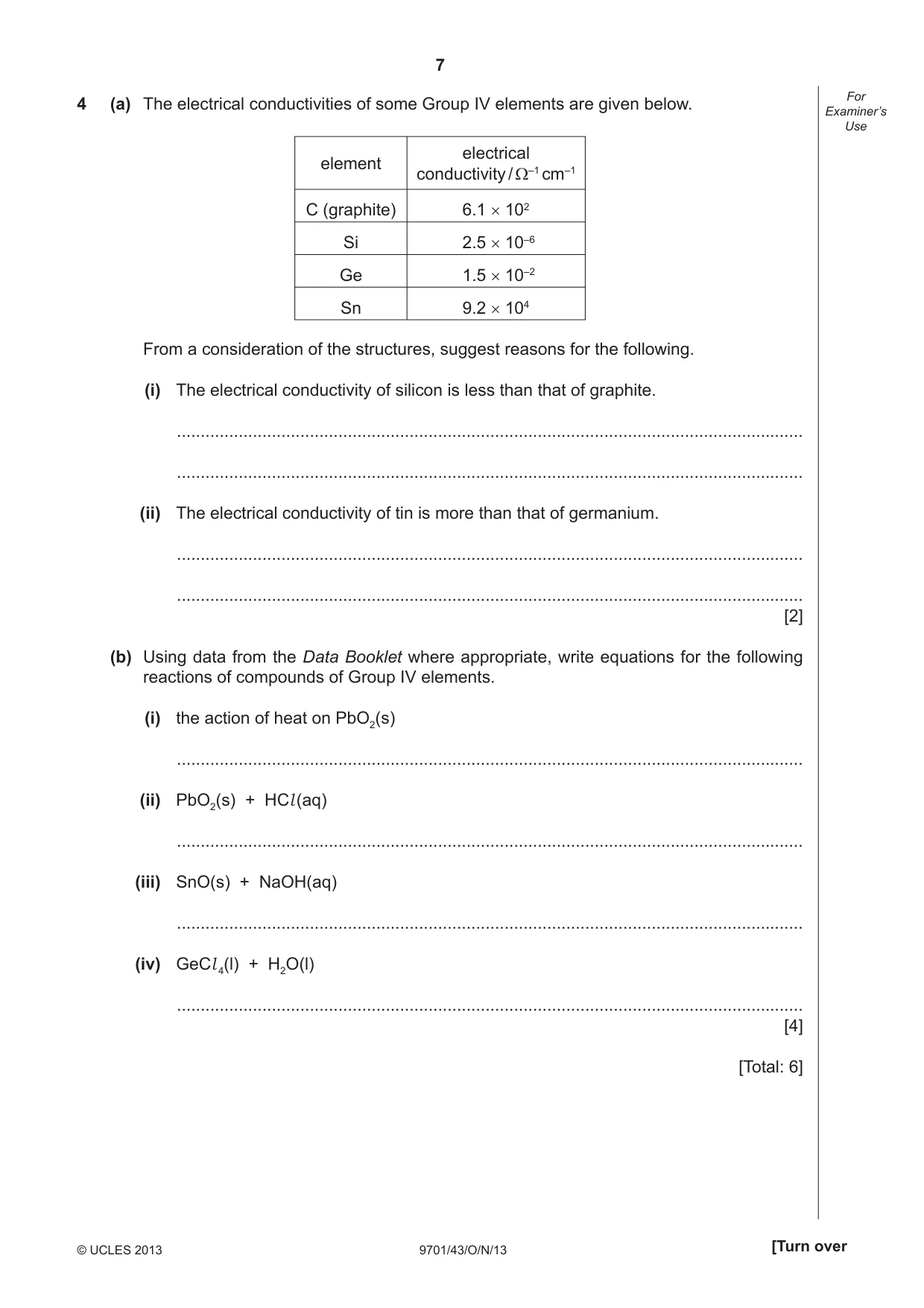
7 9701/43/O/N/13 © UCLES 2013 [Turn over For Examiner’s Use 4 (a) The electrical conductivities of some Group IV elements are given below. element electrical conductivity / Ω–1 cm–1 C (graphite) 6.1 × 10² Si 2.5 × 10⁻⁶ Ge 1.5 × 10⁻² Sn 9.2 × 10⁴ From a consideration of the structures, suggest reasons for the following. (i) The electrical conductivity of silicon is less than that of graphite. … … (ii) The electrical conductivity of tin is more than that of germanium. … … [2] (b) Using data from the Data Booklet where appropriate, write equations for the following reactions of compounds of Group IV elements. (i) the action of heat on PbO2(s) … (ii) PbO2(s) + HCl (aq) … (iii) SnO(s) + NaOH(aq) … (iv) GeCl 4(l) + H2O(l) … [4] [Total: 6]
Question paper, page 8
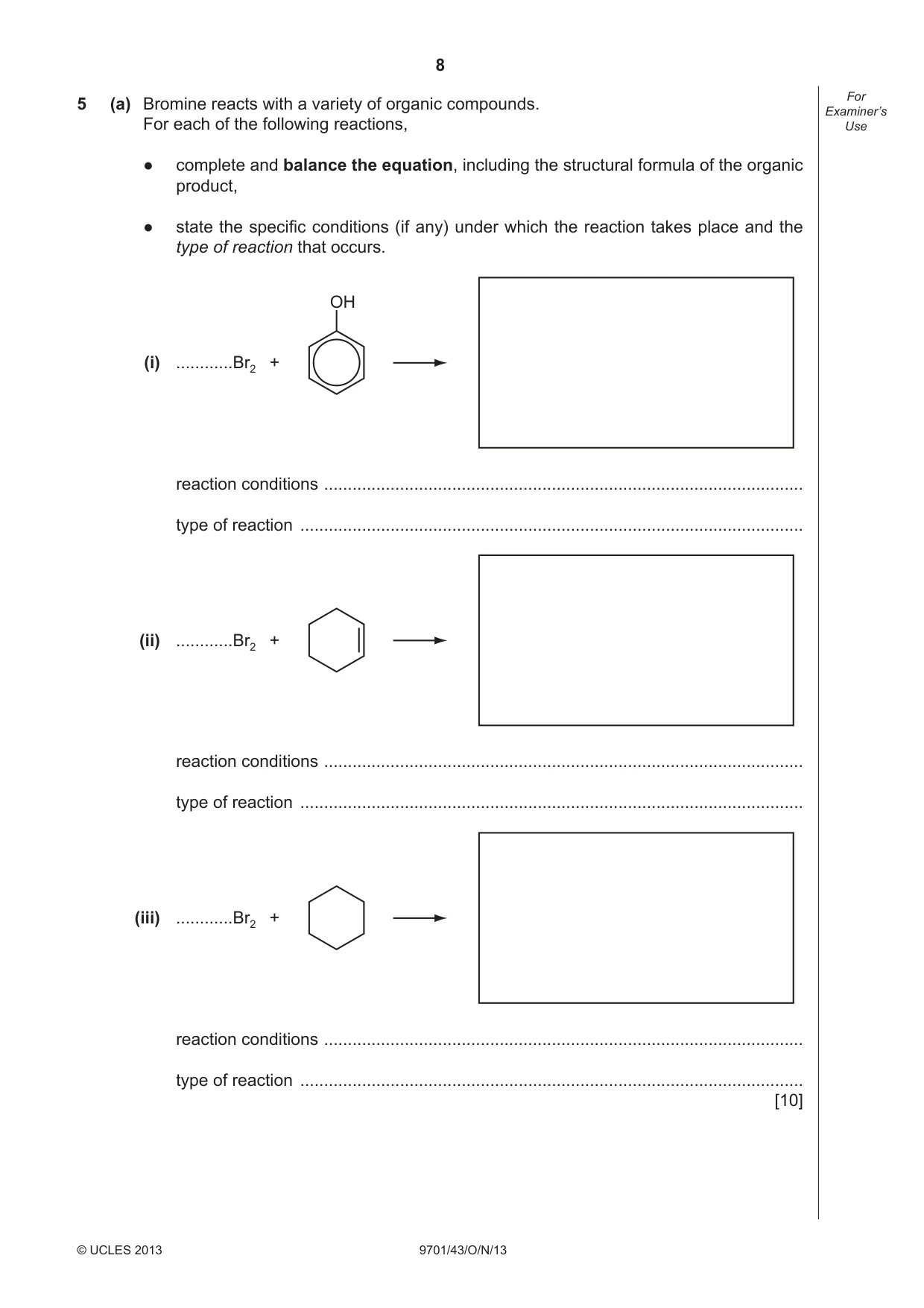
8 9701/43/O/N/13 © UCLES 2013 For Examiner’s Use 5 (a) Bromine reacts with a variety of organic compounds. For each of the following reactions, ● complete and balance the equation, including the structural formula of the organic product, ● state the specific conditions (if any) under which the reaction takes place and the type of reaction that occurs. (i) …Br2 + OH reaction conditions … type of reaction … (ii) …Br2 + reaction conditions … type of reaction … (iii) …Br2 + reaction conditions … type of reaction … [10]
Question paper, page 9
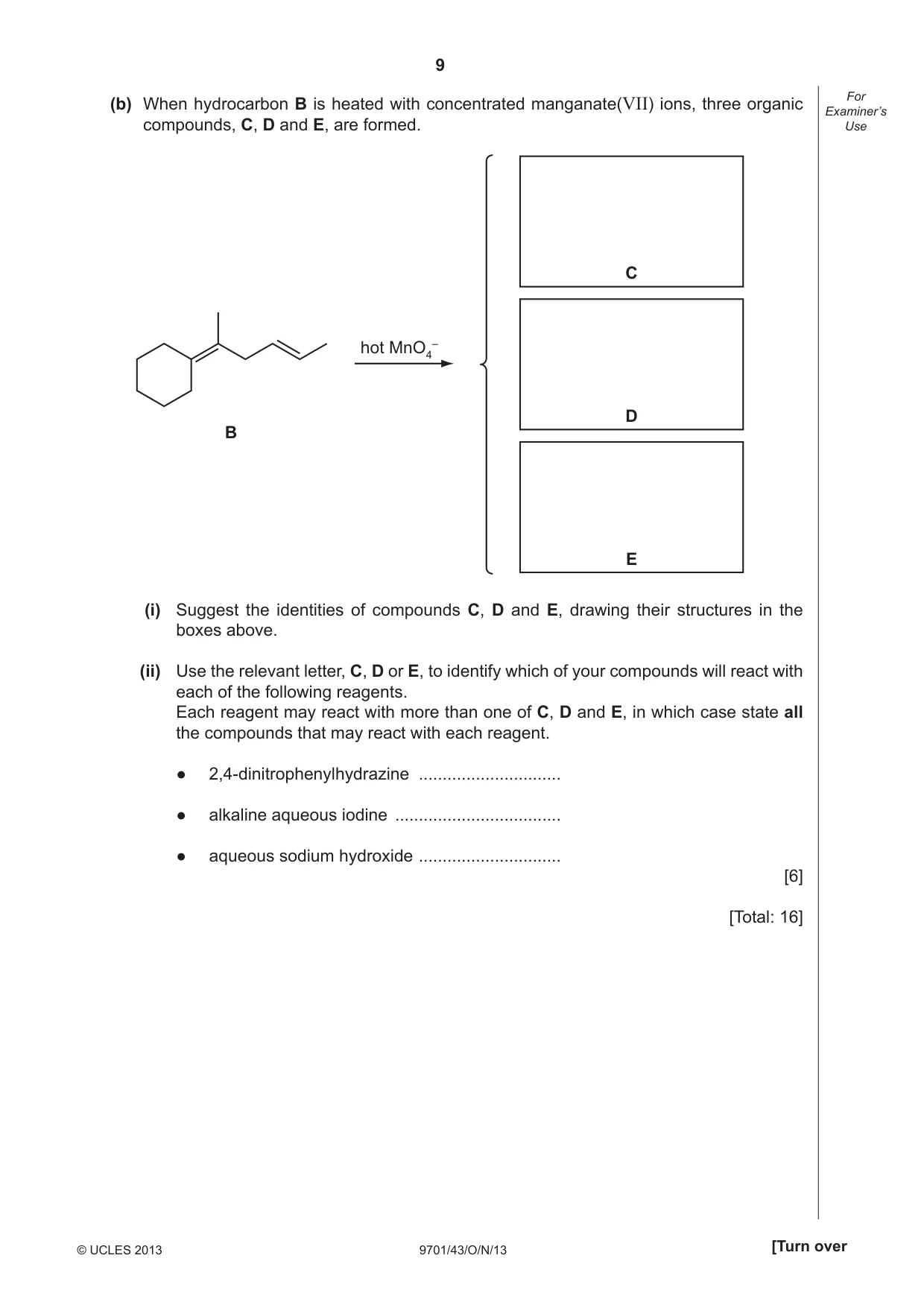
9 9701/43/O/N/13 © UCLES 2013 [Turn over For Examiner’s Use (b) When hydrocarbon B is heated with concentrated manganate(VII) ions, three organic compounds, C, D and E, are formed. B hot MnO4 – C D E (i) Suggest the identities of compounds C, D and E, drawing their structures in the boxes above. (ii) Use the relevant letter, C, D or E, to identify which of your compounds will react with each of the following reagents. Each reagent may react with more than one of C, D and E, in which case state all the compounds that may react with each reagent. ● 2,4-dinitrophenylhydrazine … ● alkaline aqueous iodine … ● aqueous sodium hydroxide … [6] [Total: 16]
Question paper, page 10
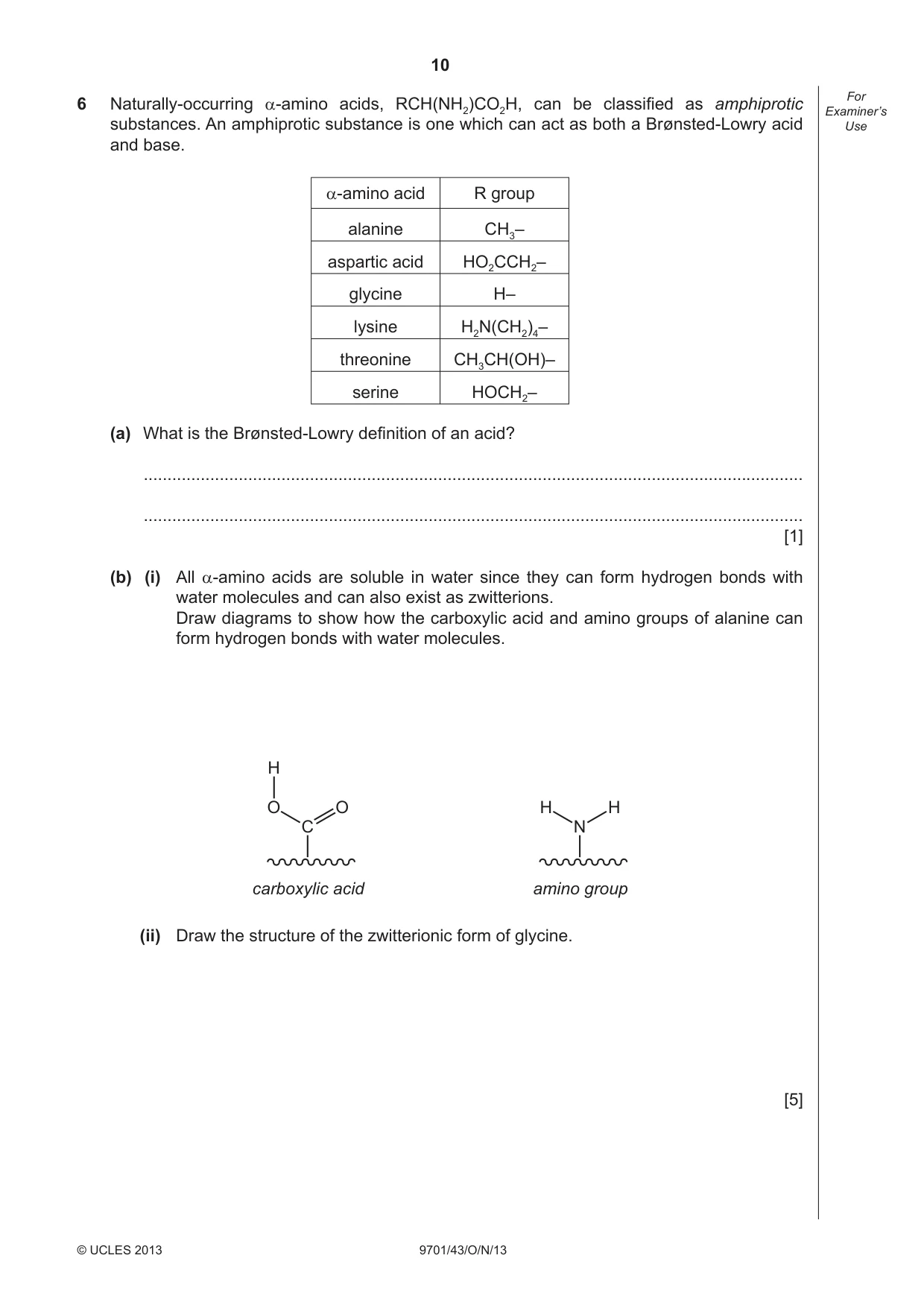
10 9701/43/O/N/13 © UCLES 2013 For Examiner’s Use 6 Naturally-occurring α-amino acids, RCH(NH2)CO2H, can be classifi ed as amphiprotic substances. An amphiprotic substance is one which can act as both a Brønsted-Lowry acid and base. α-amino acid R group alanine CH3– aspartic acid HO2CCH2– glycine H– lysine H2N(CH2)4– threonine CH3CH(OH)– serine HOCH2– (a) What is the Brønsted-Lowry defi nition of an acid? … … [1] (b) (i) All α-amino acids are soluble in water since they can form hydrogen bonds with water molecules and can also exist as zwitterions. Draw diagrams to show how the carboxylic acid and amino groups of alanine can form hydrogen bonds with water molecules. O O C H carboxylic acid H H N amino group (ii) Draw the structure of the zwitterionic form of glycine. [5]
Question paper, page 11
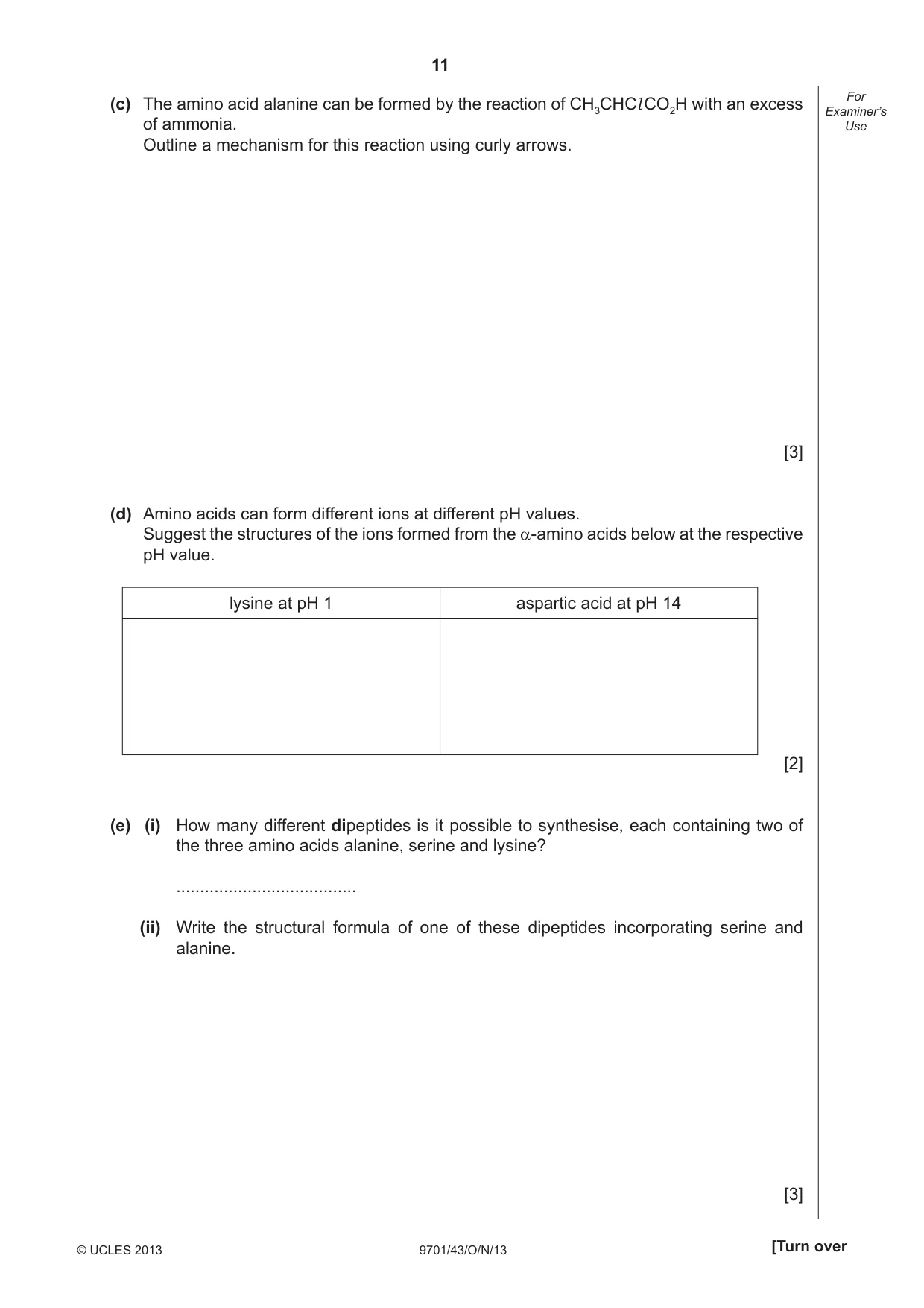
11 9701/43/O/N/13 © UCLES 2013 [Turn over For Examiner’s Use (c) The amino acid alanine can be formed by the reaction of CH3CHCl CO2H with an excess of ammonia. Outline a mechanism for this reaction using curly arrows. [3] (d) Amino acids can form different ions at different pH values. Suggest the structures of the ions formed from the α-amino acids below at the respective pH value. lysine at pH 1 aspartic acid at pH 14 [2] (e) (i) How many different dipeptides is it possible to synthesise, each containing two of the three amino acids alanine, serine and lysine? … (ii) Write the structural formula of one of these dipeptides incorporating serine and alanine. [3]
Question paper, page 12
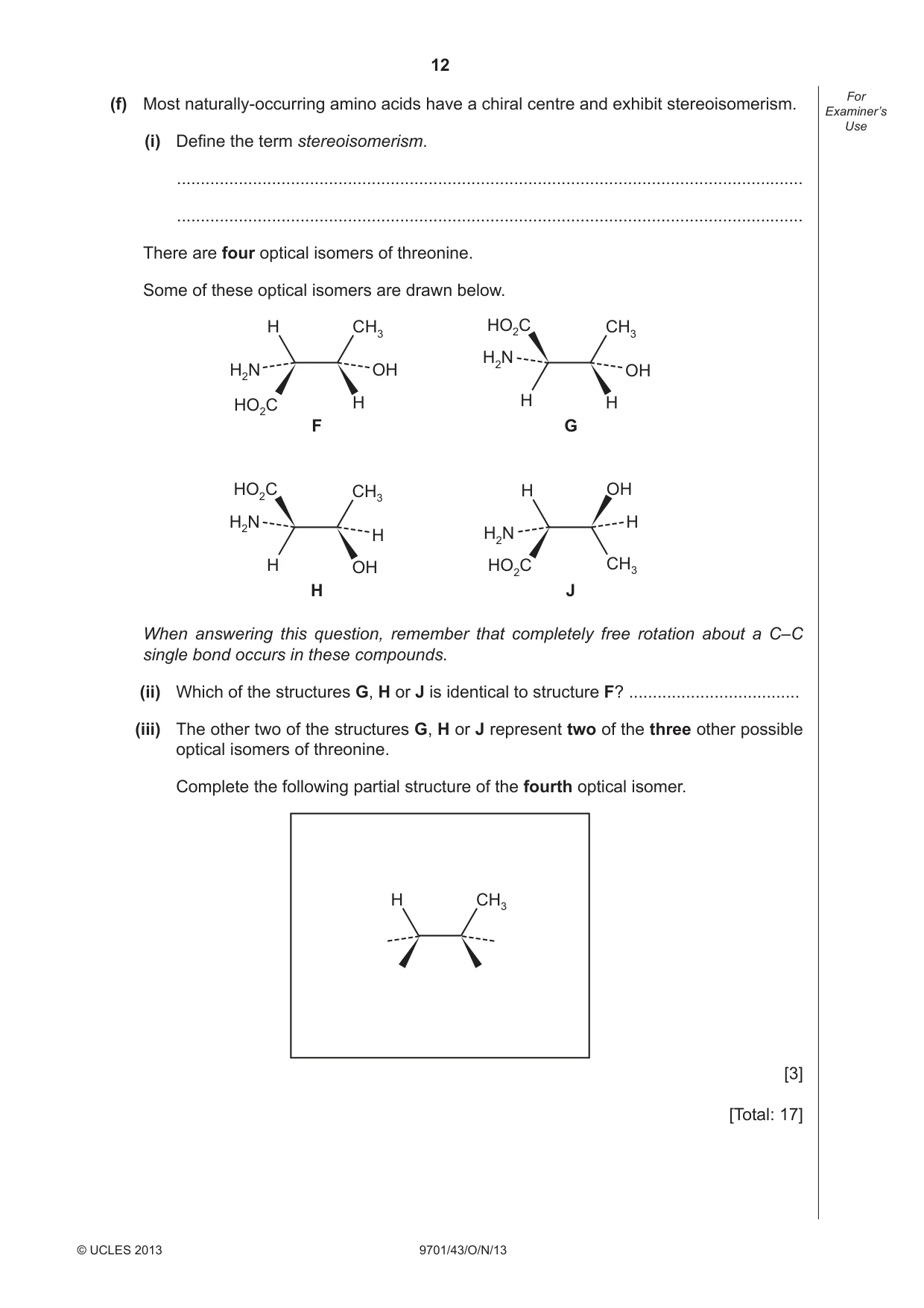
12 9701/43/O/N/13 © UCLES 2013 For Examiner’s Use (f) Most naturally-occurring amino acids have a chiral centre and exhibit stereoisomerism. (i) Defi ne the term stereoisomerism. … … There are four optical isomers of threonine. Some of these optical isomers are drawn below. H H2N HO2C CH3 OH H F H H2N HO2C CH3 OH H G H H2N HO2C CH3 H OH H H H2N HO2C CH3 H OH J When answering this question, remember that completely free rotation about a C–C single bond occurs in these compounds. (ii) Which of the structures G, H or J is identical to structure F? … (iii) The other two of the structures G, H or J represent two of the three other possible optical isomers of threonine. Complete the following partial structure of the fourth optical isomer. H CH3 [3] [Total: 17]
Question paper, page 13
13 9701/43/O/N/13 BLANK PAGE © UCLES 2013 PLEASE TURN OVER FOR SECTION B [Turn over
Question paper, page 14
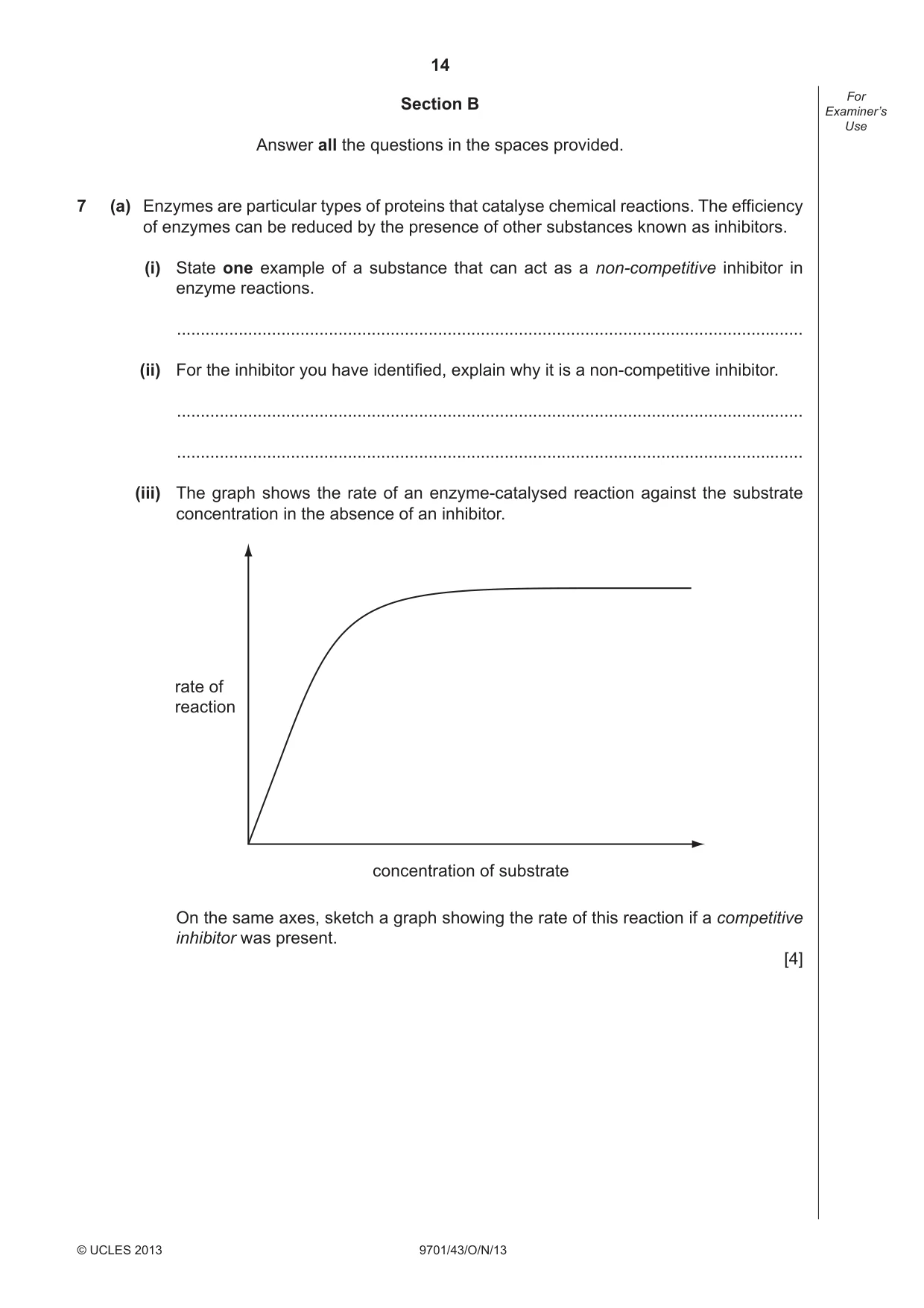
14 9701/43/O/N/13 © UCLES 2013 For Examiner’s Use Section B Answer all the questions in the spaces provided. 7 (a) Enzymes are particular types of proteins that catalyse chemical reactions. The effi ciency of enzymes can be reduced by the presence of other substances known as inhibitors. (i) State one example of a substance that can act as a non-competitive inhibitor in enzyme reactions. … (ii) For the inhibitor you have identifi ed, explain why it is a non-competitive inhibitor. … … (iii) The graph shows the rate of an enzyme-catalysed reaction against the substrate concentration in the absence of an inhibitor. rate of reaction concentration of substrate On the same axes, sketch a graph showing the rate of this reaction if a competitive inhibitor was present. [4]
Question paper, page 15
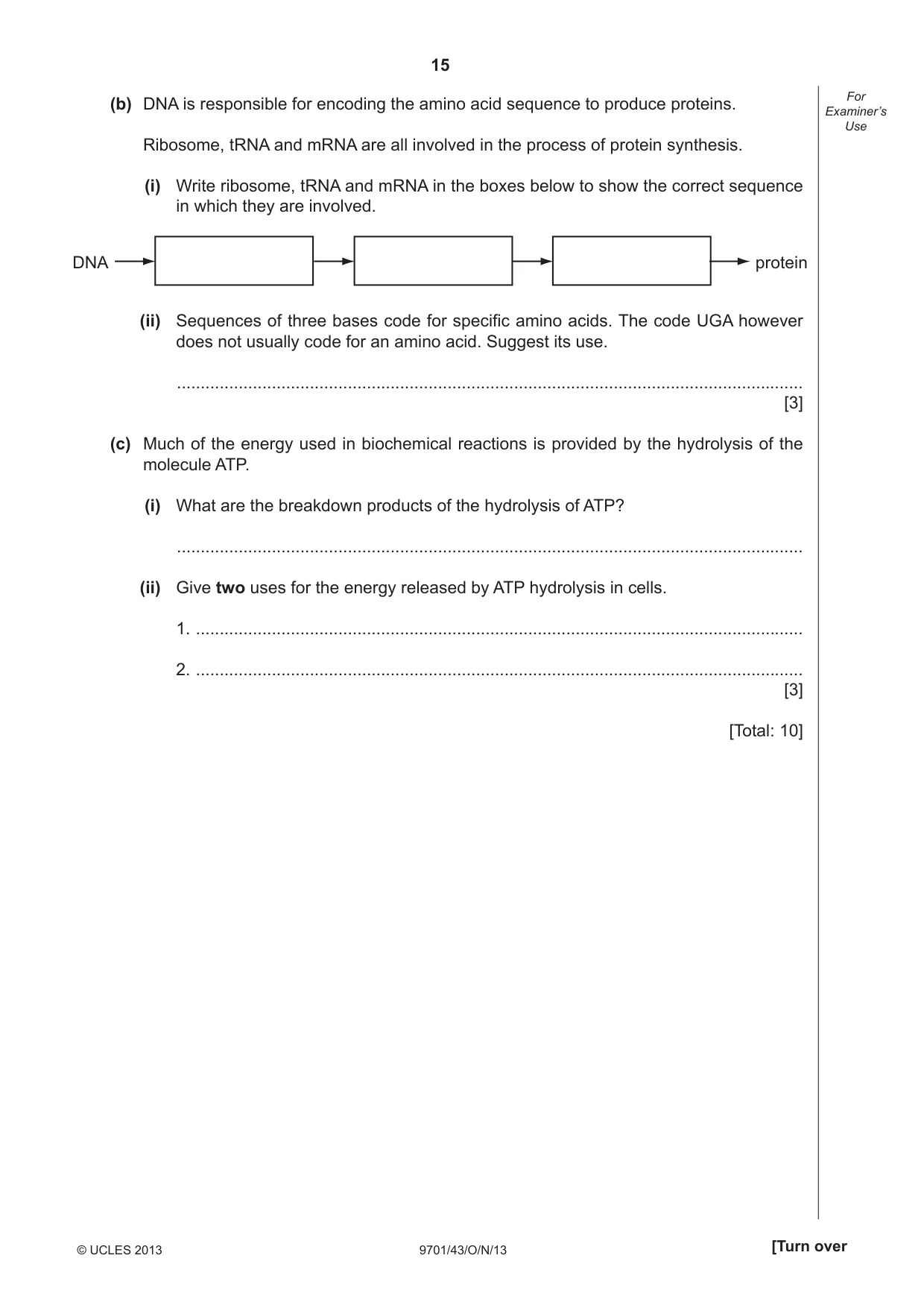
15 9701/43/O/N/13 © UCLES 2013 [Turn over For Examiner’s Use (b) DNA is responsible for encoding the amino acid sequence to produce proteins. Ribosome, tRNA and mRNA are all involved in the process of protein synthesis. (i) Write ribosome, tRNA and mRNA in the boxes below to show the correct sequence in which they are involved. DNA protein (ii) Sequences of three bases code for specifi c amino acids. The code UGA however does not usually code for an amino acid. Suggest its use. … [3] (c) Much of the energy used in biochemical reactions is provided by the hydrolysis of the molecule ATP. (i) What are the breakdown products of the hydrolysis of ATP? … (ii) Give two uses for the energy released by ATP hydrolysis in cells. 1. … 2. … [3] [Total: 10]
Question paper, page 16
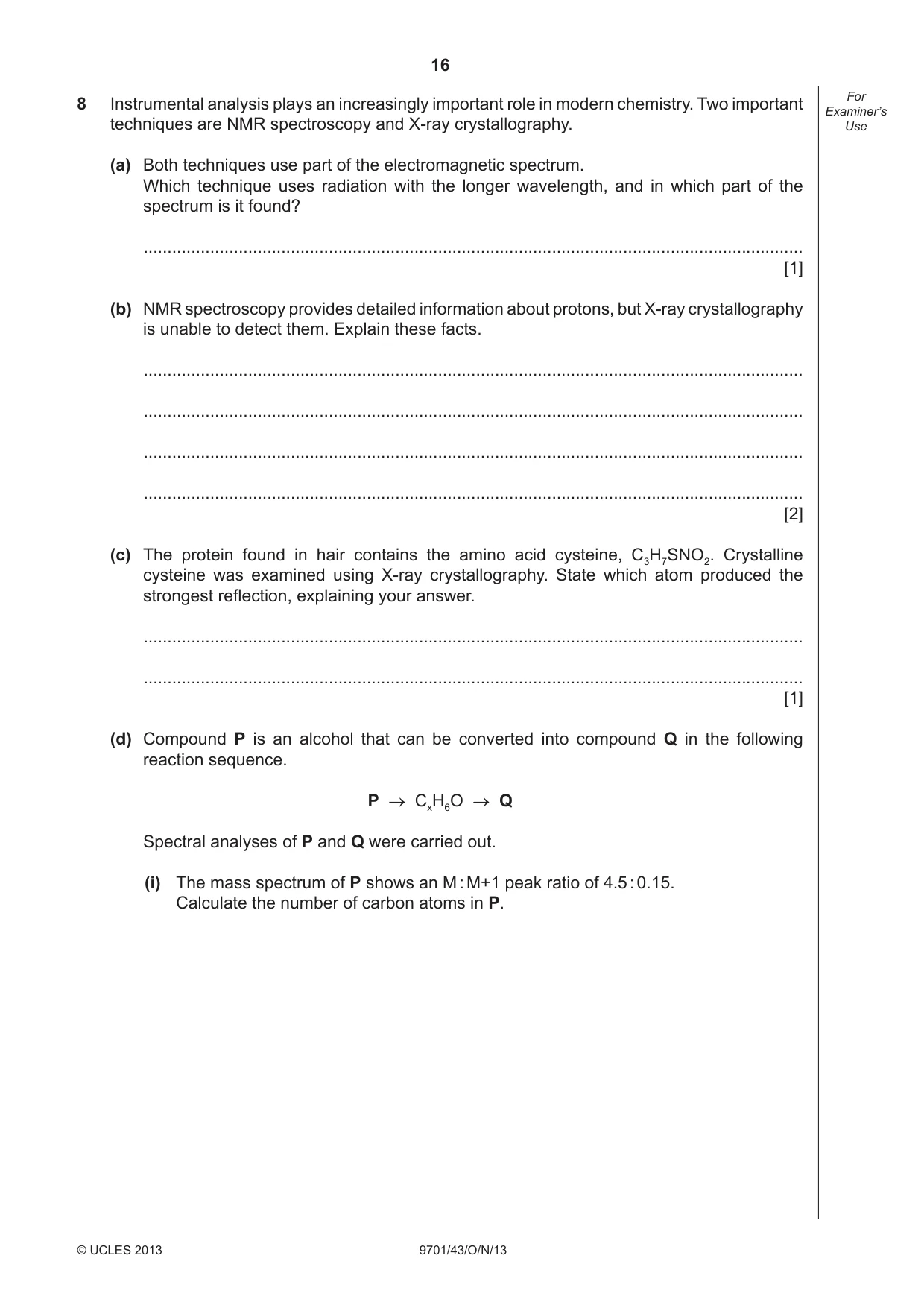
16 9701/43/O/N/13 © UCLES 2013 For Examiner’s Use 8 Instrumental analysis plays an increasingly important role in modern chemistry. Two important techniques are NMR spectroscopy and X-ray crystallography. (a) Both techniques use part of the electromagnetic spectrum. Which technique uses radiation with the longer wavelength, and in which part of the spectrum is it found? … [1] (b) NMR spectroscopy provides detailed information about protons, but X-ray crystallography is unable to detect them. Explain these facts. … … … … [2] (c) The protein found in hair contains the amino acid cysteine, C3H7SNO2. Crystalline cysteine was examined using X-ray crystallography. State which atom produced the strongest refl ection, explaining your answer. … … [1] (d) Compound P is an alcohol that can be converted into compound Q in the following reaction sequence. P → CxH6O → Q Spectral analyses of P and Q were carried out. (i) The mass spectrum of P shows an M : M+1 peak ratio of 4.5 : 0.15. Calculate the number of carbon atoms in P.
Question paper, page 17
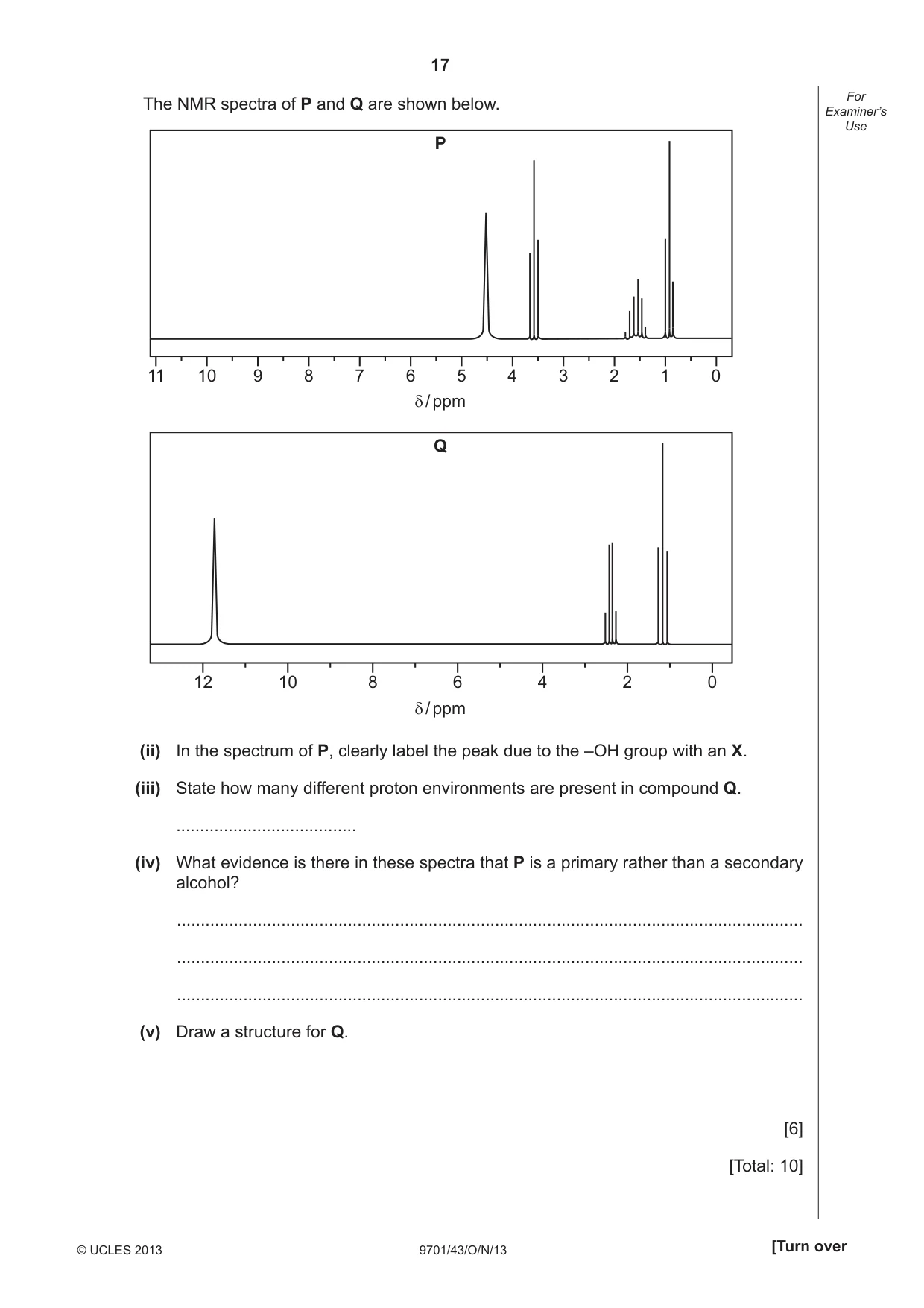
17 9701/43/O/N/13 © UCLES 2013 [Turn over For Examiner’s Use The NMR spectra of P and Q are shown below. 11 10 9 8 7 6 5 4 3 2 1 0 δ / ppm 12 10 8 6 4 2 0 δ / ppm P Q (ii) In the spectrum of P, clearly label the peak due to the –OH group with an X. (iii) State how many different proton environments are present in compound Q. … (iv) What evidence is there in these spectra that P is a primary rather than a secondary alcohol? … … … (v) Draw a structure for Q. [6] [Total: 10]
Question paper, page 18
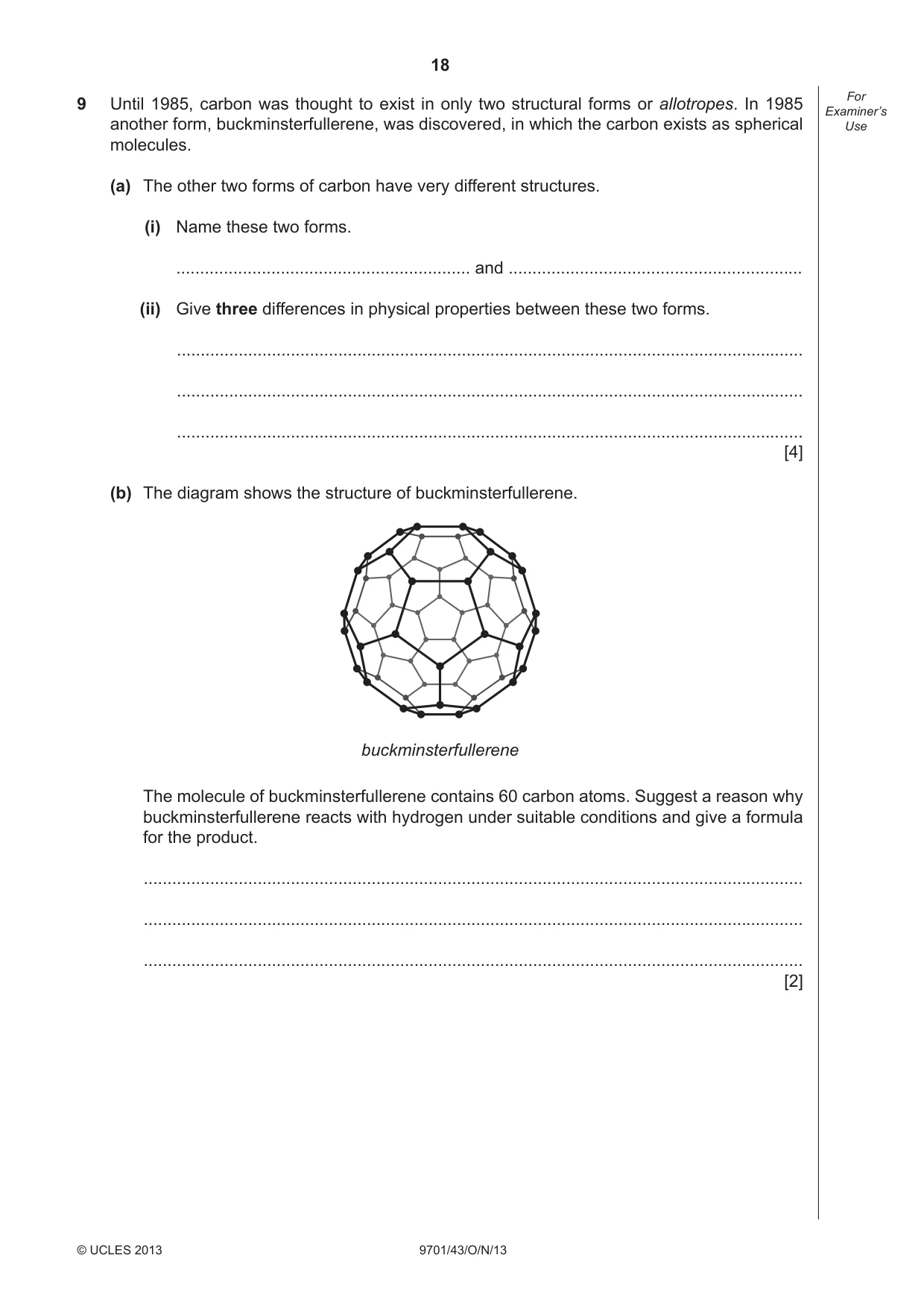
18 9701/43/O/N/13 © UCLES 2013 For Examiner’s Use 9 Until 1985, carbon was thought to exist in only two structural forms or allotropes. In 1985 another form, buckminsterfullerene, was discovered, in which the carbon exists as spherical molecules. (a) The other two forms of carbon have very different structures. (i) Name these two forms. … and … (ii) Give three differences in physical properties between these two forms. … … … [4] (b) The diagram shows the structure of buckminsterfullerene. buckminsterfullerene The molecule of buckminsterfullerene contains 60 carbon atoms. Suggest a reason why buckminsterfullerene reacts with hydrogen under suitable conditions and give a formula for the product. … … … [2]
Question paper, page 19
19 9701/43/O/N/13 © UCLES 2013 [Turn over For Examiner’s Use (c) In 2010, two scientists from the University of Manchester were awarded the Nobel Prize for Physics for their work on graphene, a new structural form of carbon. Graphene is one of the new ‘nano-materials’ being developed for commercial uses in the next 10 years. graphene (i) Graphene is in the form of sheets of carbon one atom thick. Calculate the number of carbon atoms present in a sheet of graphene with a mass of one thousandth of a gram (0.001 g). The number of hexagons in a large sheet of graphene can be assumed to be one half of the number of carbon atoms. Each hexagon has an area of 690 nm2. (ii) Calculate the area of the sheet of graphene in (i). area of sheet = … nm2 (iii) Would you expect samples of graphene and buckminsterfullerene to be electrical conductors? Explain your answers. graphene … … buckminsterfullerene … … [4] [Total: 10]
Question paper, page 20
20 Permission to reproduce items where third-party owned material protected by copyright is included has been sought and cleared where possible. Every reasonable effort has been made by the publisher (UCLES) to trace copyright holders, but if any items requiring clearance have unwittingly been included the publisher will be pleased to make amends at the earliest possible opportunity. University of Cambridge International Examinations is part of the Cambridge Assessment Group. Cambridge Assessment is the brand name of University of Cambridge Local Examinations Syndicate (UCLES), which is itself a department of the University of Cambridge. 9701/43/O/N/13 © UCLES 2013 BLANK PAGE
Mark scheme, page 1
CAMBRIDGE INTERNATIONAL EXAMINATIONS GCE Advanced Level MARK SCHEME for the October/November 2013 series 9701 CHEMISTRY 9701/43 Paper 4 (A2 Structured Questions), maximum raw mark 100 This mark scheme is published as an aid to teachers and candidates, to indicate the requirements of the examination. It shows the basis on which Examiners were instructed to award marks. It does not indicate the details of the discussions that took place at an Examiners’ meeting before marking began, which would have considered the acceptability of alternative answers. Mark schemes should be read in conjunction with the question paper and the Principal Examiner Report for Teachers. Cambridge will not enter into discussions about these mark schemes. Cambridge is publishing the mark schemes for the October/November 2013 series for most IGCSE, GCE Advanced Level and Advanced Subsidiary Level components and some Ordinary Level components.
Mark scheme, page 2
Page 2 Mark Scheme Syllabus Paper GCE A LEVEL – October/November 2013 9701 43 © Cambridge International Examinations 2013 1 (a) O O N O dative bond to an oxygen using two N electrons [1] 8 electrons around N in 1 double + 2 single bonds [1] a total of 24 electrons, including one, and only one "" [1] (the extra electron, "", can be in a bond or a lone pair) [3] (b) (i) 2Mg(NO3)2 → 2MgO + 4NO2 + O2 [1] (ii) (down the group) nitrates become more stable or are more difficult to decompose or need a higher temperature to decompose [1] because there is less polarisation of the anion / nitrate ion / N–O bonds [1] as radius of M2+ / metal ion increases or charge density of the cation decreases [1] [4] (c) Cu + 4H+ + 2NO3 – → Cu2+ + 2NO2 + 2H2O species [1] balancing [1] [2] [Total: 9]
Mark scheme, page 3
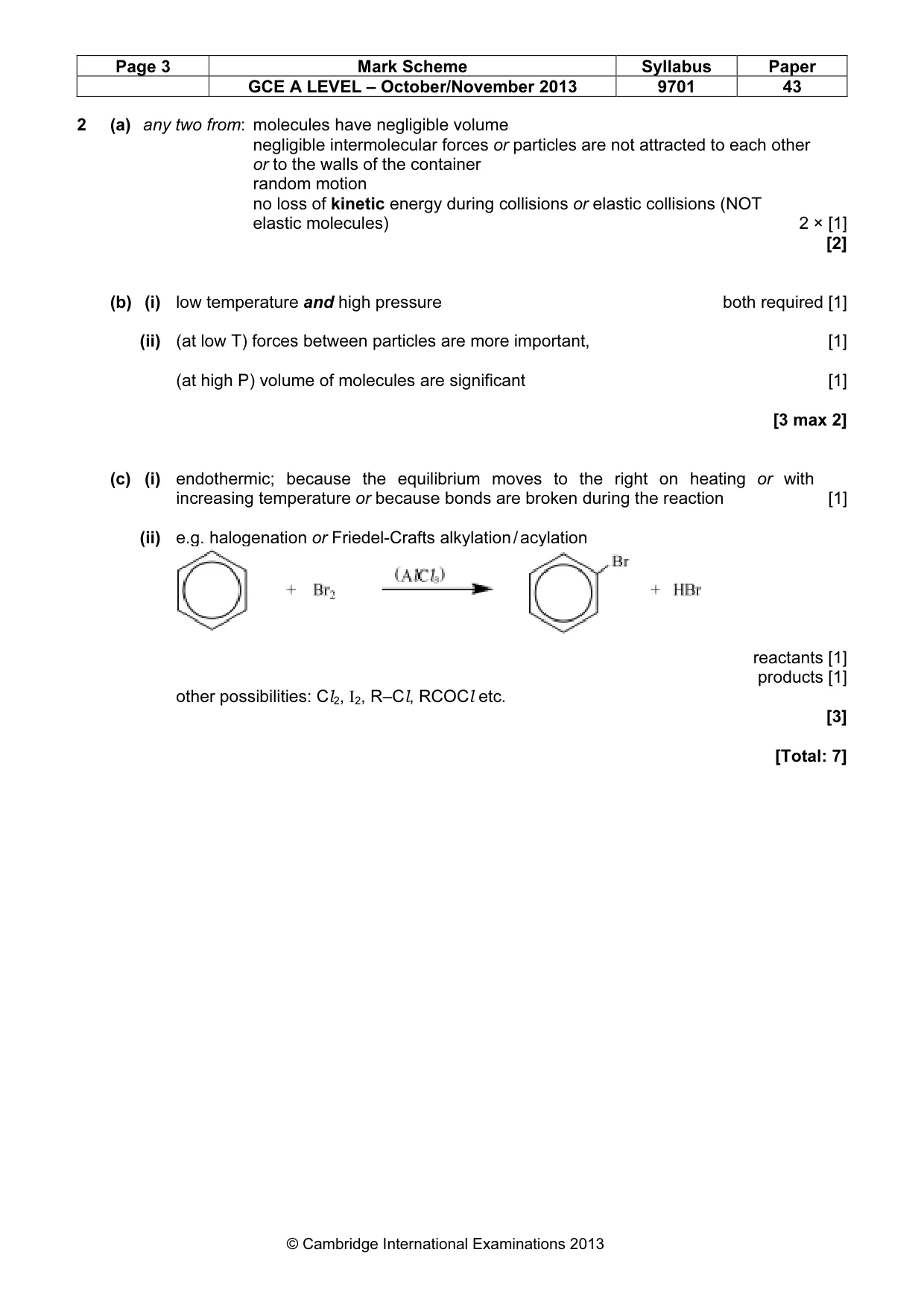
Page 3 Mark Scheme Syllabus Paper GCE A LEVEL – October/November 2013 9701 43 © Cambridge International Examinations 2013 2 (a) any two from: molecules have negligible volume negligible intermolecular forces or particles are not attracted to each other or to the walls of the container random motion no loss of kinetic energy during collisions or elastic collisions (NOT elastic molecules) 2 × [1] [2] (b) (i) low temperature and high pressure both required [1] (ii) (at low T) forces between particles are more important, [1] (at high P) volume of molecules are significant [1] [3 max 2] (c) (i) endothermic; because the equilibrium moves to the right on heating or with increasing temperature or because bonds are broken during the reaction [1] (ii) e.g. halogenation or Friedel-Crafts alkylation / acylation reactants [1] products [1] other possibilities: Cl2, I2, R–Cl, RCOCl etc. [3] [Total: 7]
Mark scheme, page 4
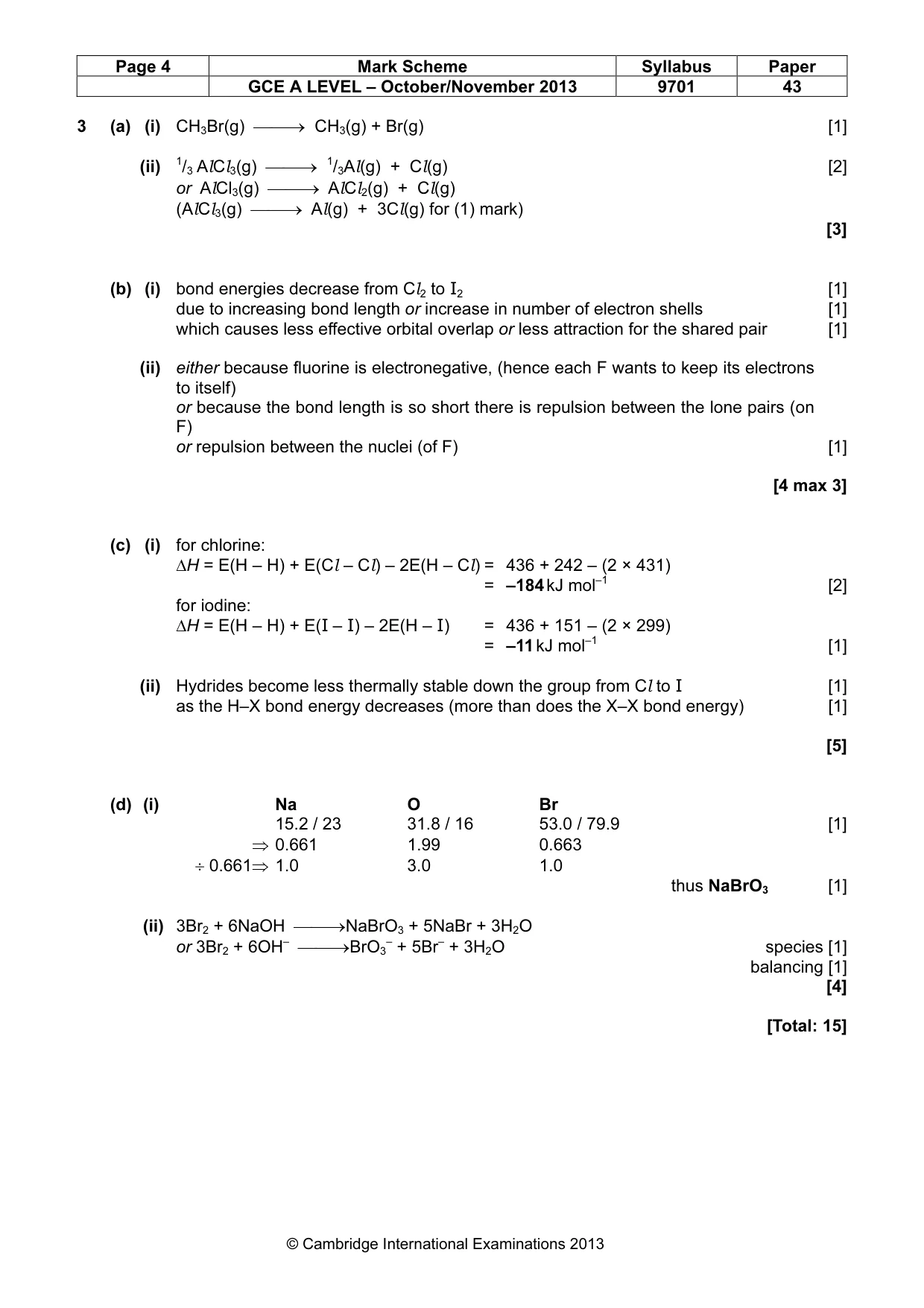
Page 4 Mark Scheme Syllabus Paper GCE A LEVEL – October/November 2013 9701 43 © Cambridge International Examinations 2013 3 (a) (i) CH3Br(g) → CH3(g) + Br(g) [1] (ii) 1/3 AlCl3(g) → 1/3Al(g) + Cl(g) [2] or AlCl3(g) → AlCl2(g) + Cl(g) (AlCl3(g) → Al(g) + 3Cl(g) for (1) mark) [3] (b) (i) bond energies decrease from Cl2 to I2 [1] due to increasing bond length or increase in number of electron shells [1] which causes less effective orbital overlap or less attraction for the shared pair [1] (ii) either because fluorine is electronegative, (hence each F wants to keep its electrons to itself) or because the bond length is so short there is repulsion between the lone pairs (on F) or repulsion between the nuclei (of F) [1] [4 max 3] (c) (i) for chlorine: ∆H = E(H – H) + E(Cl – Cl) – 2E(H – Cl) = 436 + 242 – (2 × 431) = –184 kJ mol–1 [2] for iodine: ∆H = E(H – H) + E(I – I) – 2E(H – I) = 436 + 151 – (2 × 299) = –11 kJ mol–1 [1] (ii) Hydrides become less thermally stable down the group from Cl to I [1] as the H–X bond energy decreases (more than does the X–X bond energy) [1] [5] (d) (i) Na O Br 15.2 / 23 31.8 / 16 53.0 / 79.9 [1] ⇒ 0.661 1.99 0.663 ÷ 0.661⇒ 1.0 3.0 1.0 thus NaBrO3 [1] (ii) 3Br2 + 6NaOH →NaBrO3 + 5NaBr + 3H2O or 3Br2 + 6OH– →BrO3 – + 5Br– + 3H2O species [1] balancing [1] [4] [Total: 15]
Mark scheme, page 5
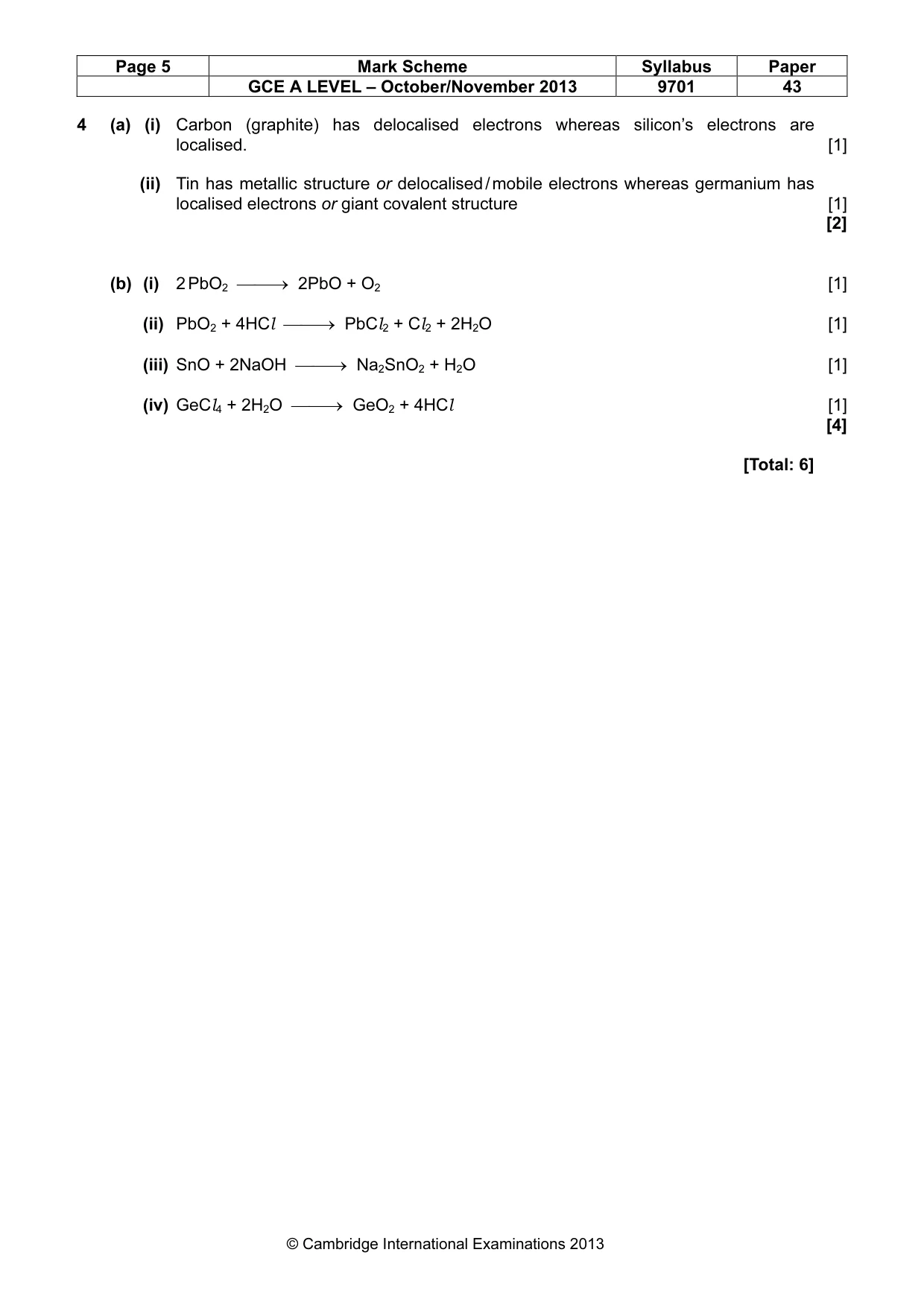
Page 5 Mark Scheme Syllabus Paper GCE A LEVEL – October/November 2013 9701 43 © Cambridge International Examinations 2013 4 (a) (i) Carbon (graphite) has delocalised electrons whereas silicon’s electrons are localised. [1] (ii) Tin has metallic structure or delocalised / mobile electrons whereas germanium has localised electrons or giant covalent structure [1] [2] (b) (i) 2 PbO2 → 2PbO + O2 [1] (ii) PbO2 + 4HCl → PbCl2 + Cl2 + 2H2O [1] (iii) SnO + 2NaOH → Na2SnO2 + H2O [1] (iv) GeCl4 + 2H2O → GeO2 + 4HCl [1] [4] [Total: 6]
Mark scheme, page 6
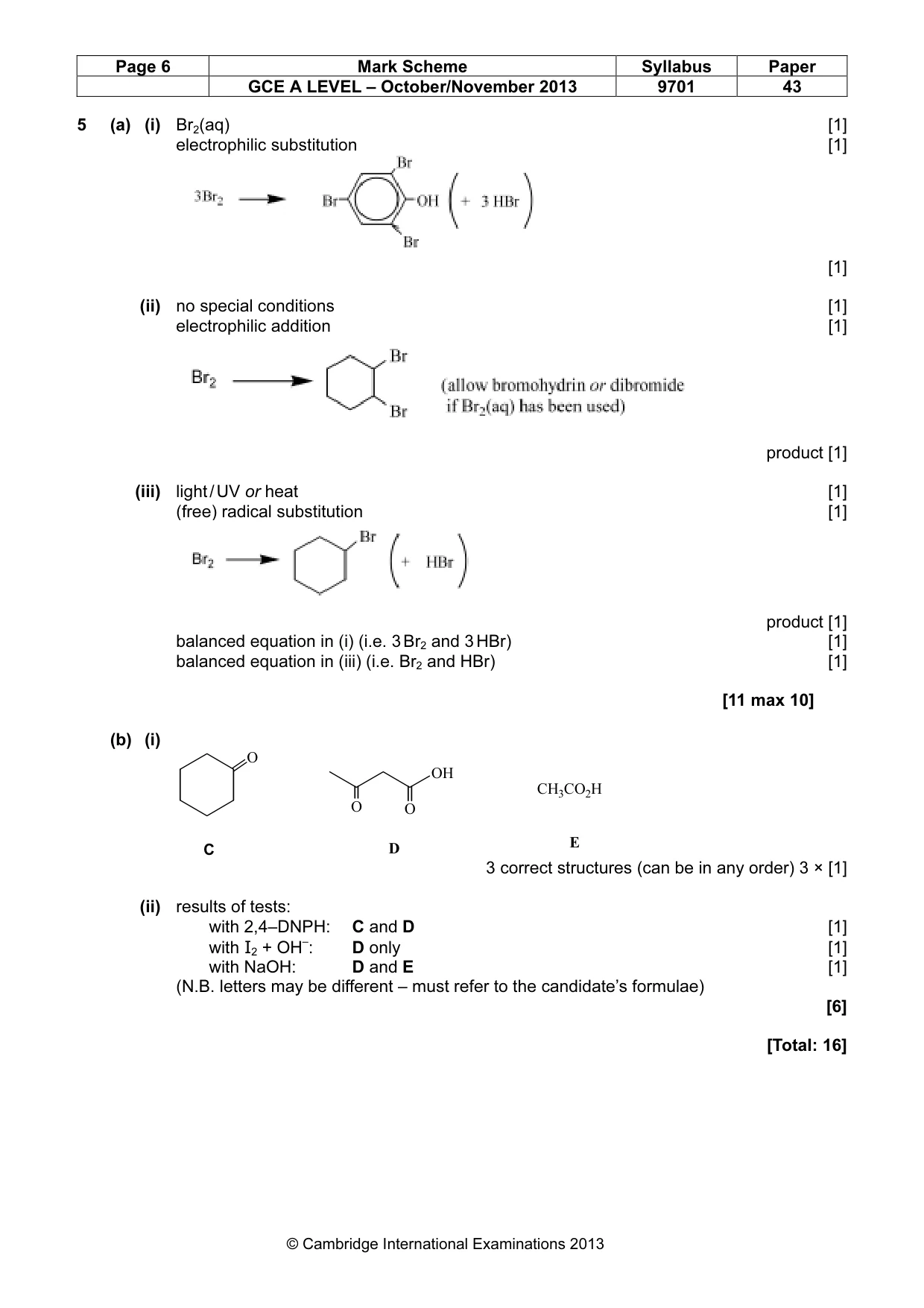
Page 6 Mark Scheme Syllabus Paper GCE A LEVEL – October/November 2013 9701 43 © Cambridge International Examinations 2013 5 (a) (i) Br2(aq) [1] electrophilic substitution [1] [1] (ii) no special conditions [1] electrophilic addition [1] product [1] (iii) light / UV or heat [1] (free) radical substitution [1] product [1] balanced equation in (i) (i.e. 3 Br2 and 3 HBr) [1] balanced equation in (iii) (i.e. Br2 and HBr) [1] [11 max 10] (b) (i) O OH O O CH3CO2H D E C 3 correct structures (can be in any order) 3 × [1] (ii) results of tests: with 2,4–DNPH: C and D [1] with I2 + OH–: D only [1] with NaOH: D and E [1] (N.B. letters may be different – must refer to the candidate’s formulae) [6] [TotaI: 16]
Mark scheme, page 7
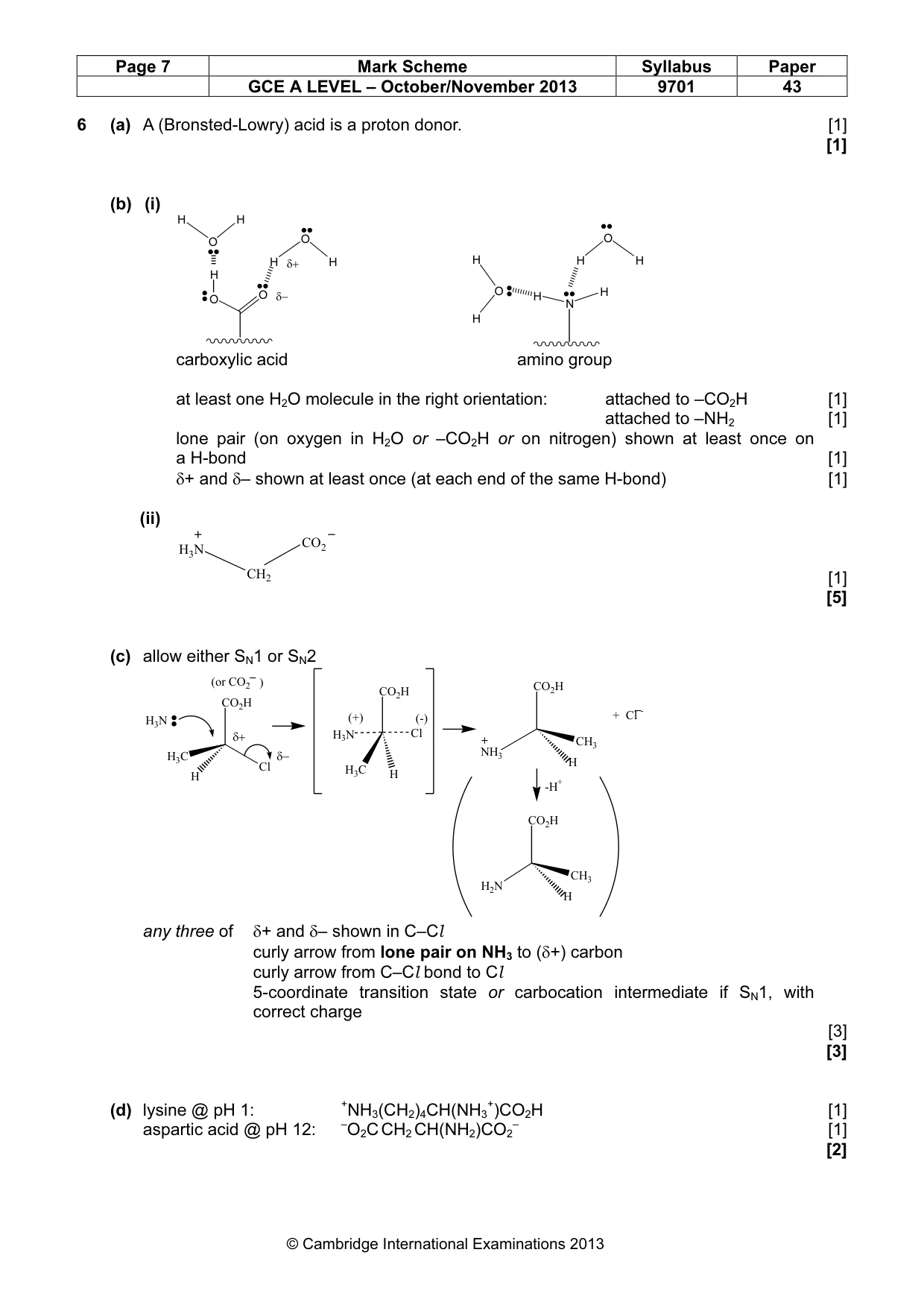
Page 7 Mark Scheme Syllabus Paper GCE A LEVEL – October/November 2013 9701 43 © Cambridge International Examinations 2013 6 (a) A (Bronsted-Lowry) acid is a proton donor. [1] [1] (b) (i) O H O N H H H O H H O H H O H H O H δ− δ+ carboxylic acid amino group at least one H2O molecule in the right orientation: attached to –CO2H [1] attached to –NH2 [1] lone pair (on oxygen in H2O or –CO2H or on nitrogen) shown at least once on a H-bond [1] δ+ and δ– shown at least once (at each end of the same H-bond) [1] (ii) H3N CH2 CO2 [1] [5] (c) allow either SN1 or SN2 CO2H Cl H3C H H3N (or CO2 ) δ+ δ− CO2H H3C H H3N Cl CO2H NH3 CH3 H (+) (-) + Cl - -H+ CO2H H2N CH3 H any three of δ+ and δ– shown in C–Cl curly arrow from lone pair on NH3 to (δ+) carbon curly arrow from C–Cl bond to Cl 5-coordinate transition state or carbocation intermediate if SN1, with correct charge [3] [3] (d) lysine @ pH 1: +NH3(CH2)4CH(NH3 +)CO2H [1] aspartic acid @ pH 12: –O2C CH2 CH(NH2)CO2 – [1] [2]
Mark scheme, page 8
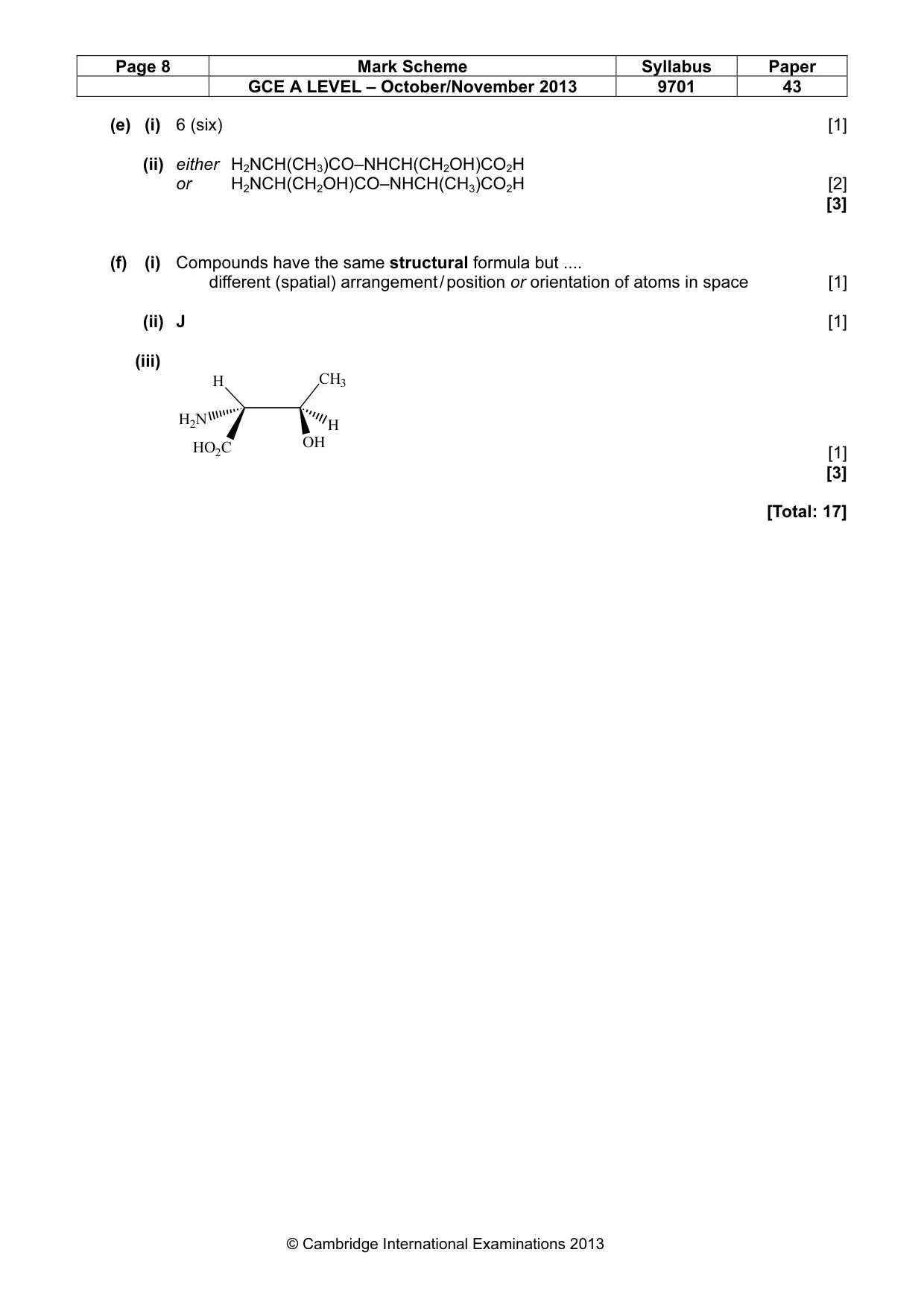
Page 8 Mark Scheme Syllabus Paper GCE A LEVEL – October/November 2013 9701 43 © Cambridge International Examinations 2013 (e) (i) 6 (six) [1] (ii) either H2NCH(CH3)CO–NHCH(CH2OH)CO2H or H2NCH(CH2OH)CO–NHCH(CH3)CO2H [2] [3] (f) (i) Compounds have the same structural formula but … different (spatial) arrangement / position or orientation of atoms in space [1] (ii) J [1] (iii) H CH3 H2N H HO2C OH [1] [3] [Total: 17]
Mark scheme, page 9
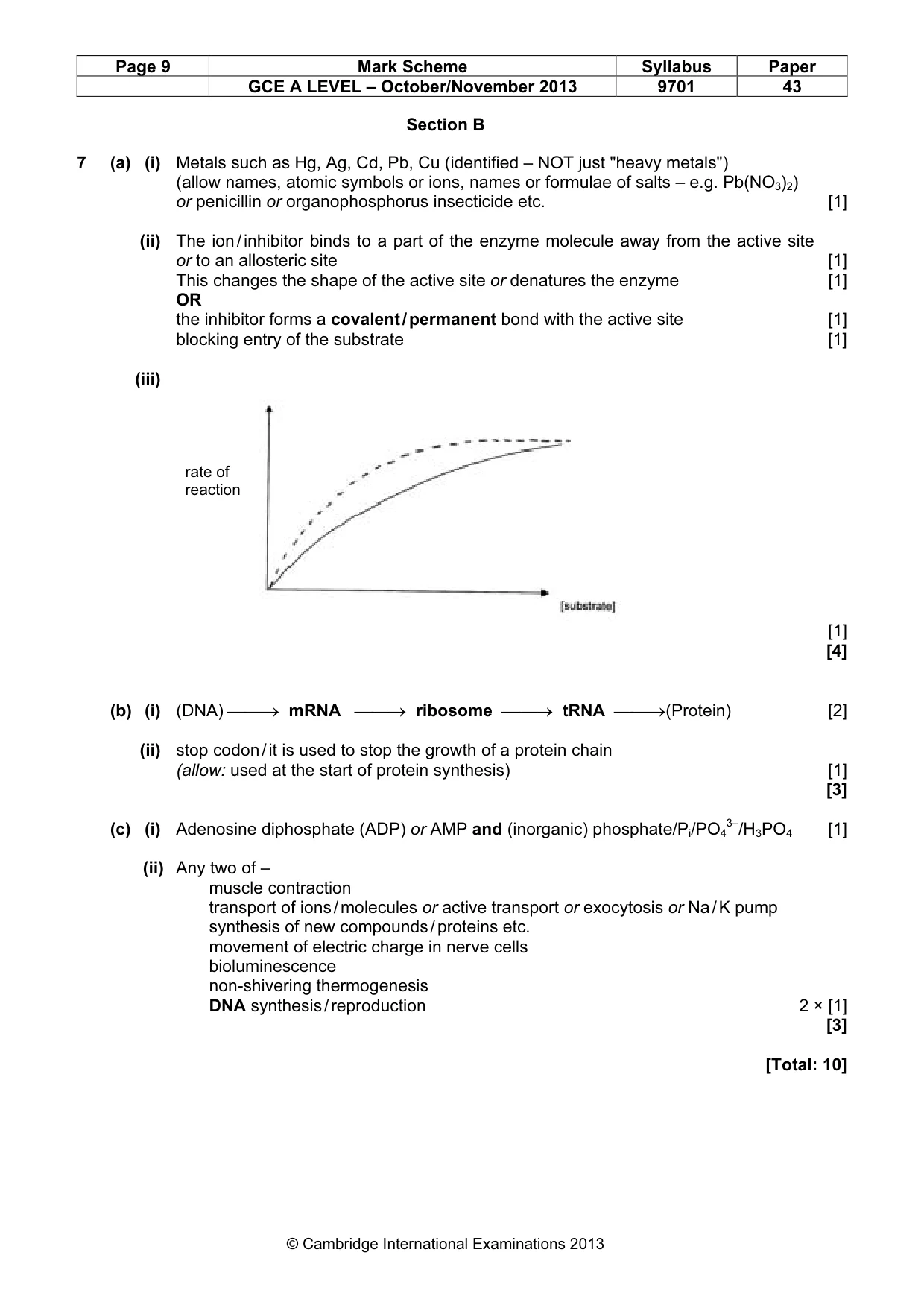
Page 9 Mark Scheme Syllabus Paper GCE A LEVEL – October/November 2013 9701 43 © Cambridge International Examinations 2013 Section B 7 (a) (i) Metals such as Hg, Ag, Cd, Pb, Cu (identified – NOT just "heavy metals") (allow names, atomic symbols or ions, names or formulae of salts – e.g. Pb(NO3)2) or penicillin or organophosphorus insecticide etc. [1] (ii) The ion / inhibitor binds to a part of the enzyme molecule away from the active site or to an allosteric site [1] This changes the shape of the active site or denatures the enzyme [1] OR the inhibitor forms a covalent / permanent bond with the active site [1] blocking entry of the substrate [1] (iii) [1] [4] (b) (i) (DNA) → mRNA → ribosome → tRNA →(Protein) [2] (ii) stop codon / it is used to stop the growth of a protein chain (allow: used at the start of protein synthesis) [1] [3] (c) (i) Adenosine diphosphate (ADP) or AMP and (inorganic) phosphate/Pi/PO4 3–/H3PO4 [1] (ii) Any two of – muscle contraction transport of ions / molecules or active transport or exocytosis or Na / K pump synthesis of new compounds / proteins etc. movement of electric charge in nerve cells bioluminescence non-shivering thermogenesis DNA synthesis / reproduction 2 × [1] [3] [Total: 10] rate of reaction
Mark scheme, page 10
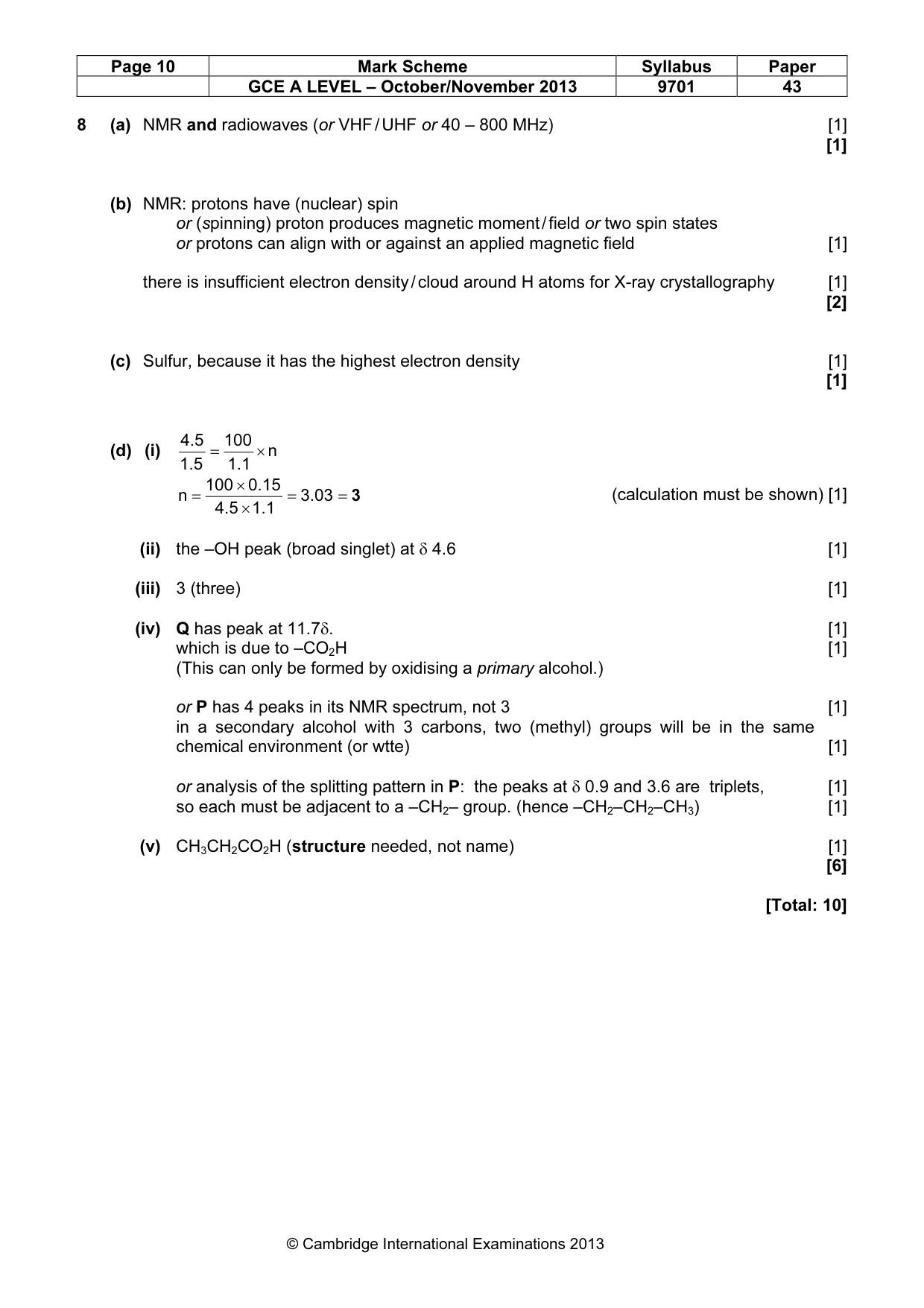
Page 10 Mark Scheme Syllabus Paper GCE A LEVEL – October/November 2013 9701 43 © Cambridge International Examinations 2013 8 (a) NMR and radiowaves (or VHF / UHF or 40 – 800 MHz) [1] [1] (b) NMR: protons have (nuclear) spin or (spinning) proton produces magnetic moment / field or two spin states or protons can align with or against an applied magnetic field [1] there is insufficient electron density / cloud around H atoms for X-ray crystallography [1] [2] (c) Sulfur, because it has the highest electron density [1] [1] (d) (i) n 1.1 100 1.5 4.5 × = 3 = = × × = 3.03 1.1 4.5 0.15 100 n (calculation must be shown) [1] (ii) the –OH peak (broad singlet) at δ 4.6 [1] (iii) 3 (three) [1] (iv) Q has peak at 11.7δ. [1] which is due to –CO2H [1] (This can only be formed by oxidising a primary alcohol.) or P has 4 peaks in its NMR spectrum, not 3 [1] in a secondary alcohol with 3 carbons, two (methyl) groups will be in the same chemical environment (or wtte) [1] or analysis of the splitting pattern in P: the peaks at δ 0.9 and 3.6 are triplets, [1] so each must be adjacent to a –CH2– group. (hence –CH2–CH2–CH3) [1] (v) CH3CH2CO2H (structure needed, not name) [1] [6] [Total: 10]
Mark scheme, page 11
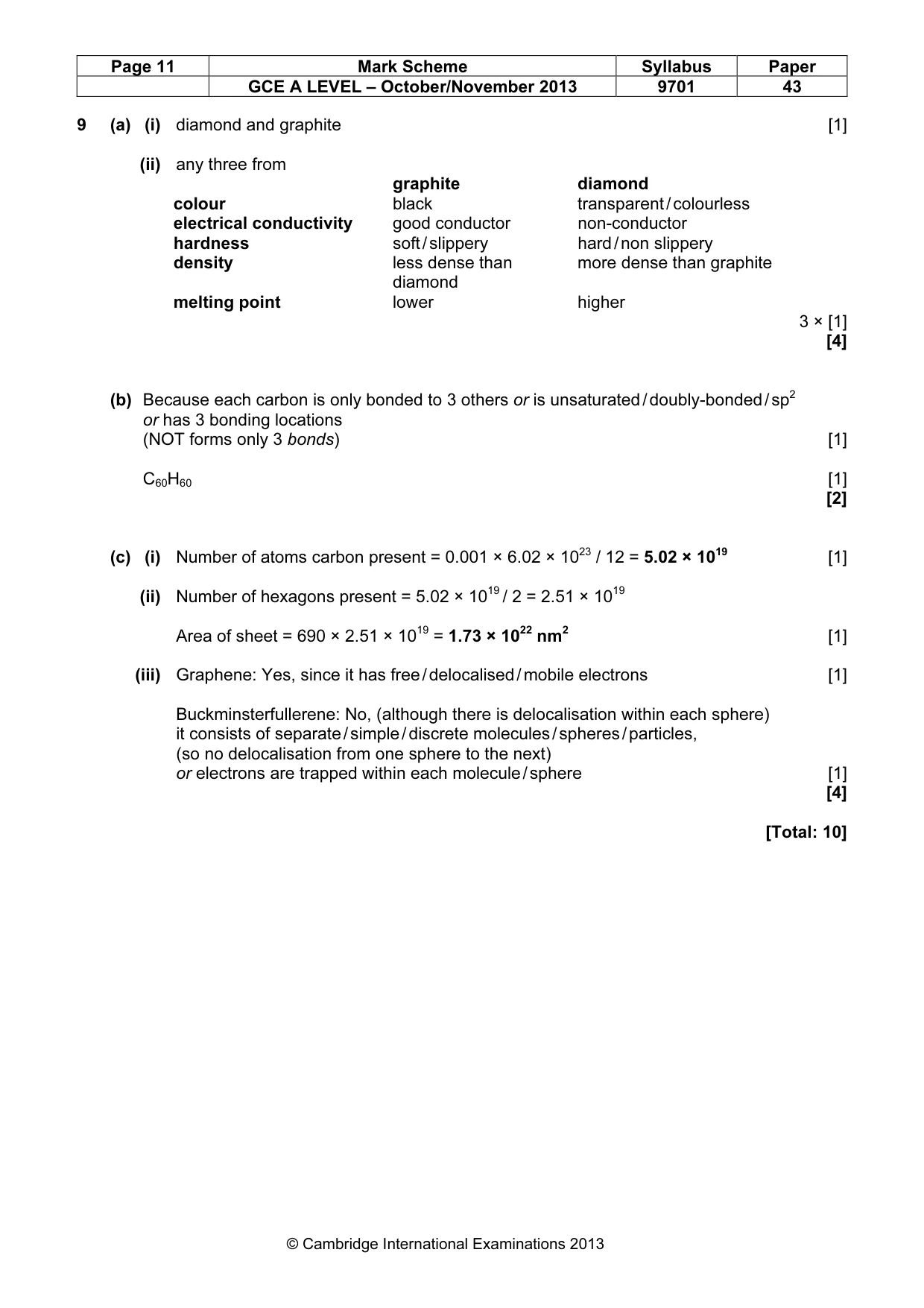
Page 11 Mark Scheme Syllabus Paper GCE A LEVEL – October/November 2013 9701 43 © Cambridge International Examinations 2013 9 (a) (i) diamond and graphite [1] (ii) any three from graphite diamond colour black transparent / colourless electrical conductivity good conductor non-conductor hardness soft / slippery hard / non slippery density less dense than diamond more dense than graphite melting point lower higher 3 × [1] [4] (b) Because each carbon is only bonded to 3 others or is unsaturated / doubly-bonded / sp2 or has 3 bonding locations (NOT forms only 3 bonds) [1] C60H60 [1] [2] (c) (i) Number of atoms carbon present = 0.001 × 6.02 × 1023 / 12 = 5.02 × 10¹⁹ [1] (ii) Number of hexagons present = 5.02 × 10¹⁹ / 2 = 2.51 × 10¹⁹ Area of sheet = 690 × 2.51 × 1019 = 1.73 × 10²² nm2 [1] (iii) Graphene: Yes, since it has free / delocalised / mobile electrons [1] Buckminsterfullerene: No, (although there is delocalisation within each sphere) it consists of separate / simple / discrete molecules / spheres / particles, (so no delocalisation from one sphere to the next) or electrons are trapped within each molecule / sphere [1] [4] [Total: 10]
What you needed in this session
Cambridge’s own grade thresholds for 2013 Oct/Nov, Paper 4 · Variant 3. A higher threshold means an easier paper — the bar moves with how the cohort did.