Cambridge A Level Chemistry 9701 — 2013 May/June Paper 5 · Variant 3
9701/53/M/J/13 · 30 marks · ≈34 min
The question paper and its mark scheme, free to read here and free to download. This is Cambridge’s own paper, exactly as it was sat.
Question paper12 pages



Mark scheme5 pages
Answers below. Sit the paper first if you are practising.
Paper as text
Question paper, page 1
READ THESE INSTRUCTIONS FIRST Write your Centre number, candidate number and name on all the work you hand in. Write in dark blue or black pen. You may use a soft pencil for any diagrams, graphs or rough working. Do not use staples, paper clips, highlighters, glue or correction fl uid. DO NOT WRITE IN ANY BARCODES. Answer all questions. Electronic calculators may be used. You may lose marks if you do not show your working or if you do not use appropriate units. Use of a Data Booklet is unnecessary. At the end of the examination, fasten all your work securely together. The number of marks is given in brackets [ ] at the end of each question or part question. CHEMISTRY 9701/53 Paper 5 Planning, Analysis and Evaluation May/June 2013 1 hour 15 minutes Candidates answer on the Question Paper. No Additional Materials are required. UNIVERSITY OF CAMBRIDGE INTERNATIONAL EXAMINATIONS General Certifi cate of Education Advanced Level This document consists of 9 printed pages and 3 blank pages. [Turn over IB13 06_9701_53/FP © UCLES 2013 *2945979709* For Examiner’s Use 1 2 Total
Question paper, page 2
2 9701/53/M/J/13 BLANK PAGE © UCLES 2013 [Turn over
Question paper, page 3
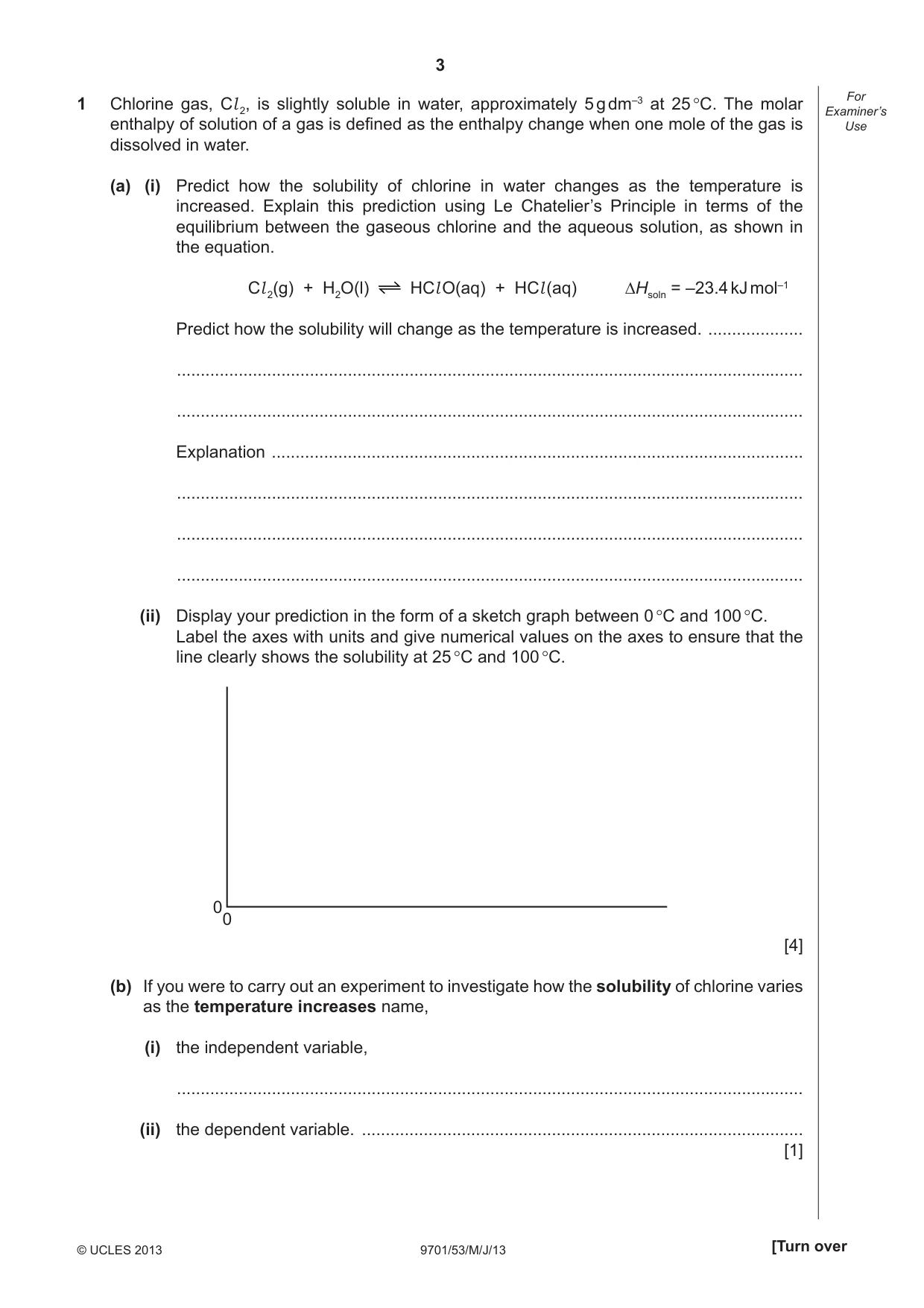
3 9701/53/M/J/13 © UCLES 2013 [Turn over For Examiner’s Use 1 Chlorine gas, Cl 2, is slightly soluble in water, approximately 5 g dm–3 at 25 °C. The molar enthalpy of solution of a gas is defi ned as the enthalpy change when one mole of the gas is dissolved in water. (a) (i) Predict how the solubility of chlorine in water changes as the temperature is increased. Explain this prediction using Le Chatelier’s Principle in terms of the equilibrium between the gaseous chlorine and the aqueous solution, as shown in the equation. Cl 2(g) + H2O(l) HCl O(aq) + HCl (aq) ∆Hsoln = –23.4 kJ mol–1 Predict how the solubility will change as the temperature is increased. … … … Explanation … … … … (ii) Display your prediction in the form of a sketch graph between 0 °C and 100 °C. Label the axes with units and give numerical values on the axes to ensure that the line clearly shows the solubility at 25 °C and 100 °C. 00 [4] (b) If you were to carry out an experiment to investigate how the solubility of chlorine varies as the temperature increases name, (i) the independent variable, … (ii) the dependent variable. … [1]
Question paper, page 4
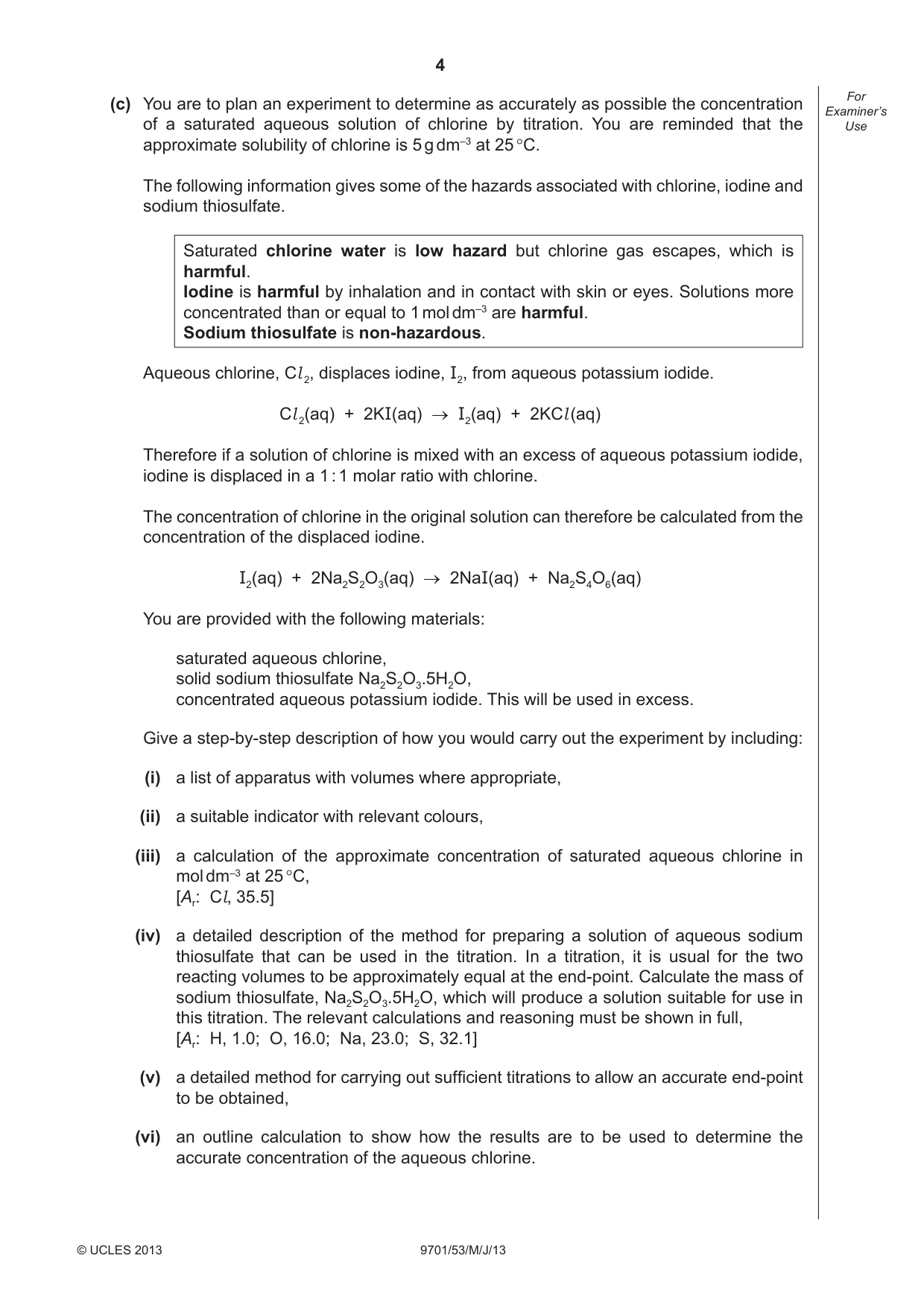
4 9701/53/M/J/13 © UCLES 2013 For Examiner’s Use (c) You are to plan an experiment to determine as accurately as possible the concentration of a saturated aqueous solution of chlorine by titration. You are reminded that the approximate solubility of chlorine is 5 g dm–3 at 25 °C. The following information gives some of the hazards associated with chlorine, iodine and sodium thiosulfate. Saturated chlorine water is low hazard but chlorine gas escapes, which is harmful. Iodine is harmful by inhalation and in contact with skin or eyes. Solutions more concentrated than or equal to 1 mol dm–3 are harmful. Sodium thiosulfate is non-hazardous. Aqueous chlorine, Cl 2, displaces iodine, I2, from aqueous potassium iodide. Cl 2(aq) + 2KI(aq) → I2(aq) + 2KCl (aq) Therefore if a solution of chlorine is mixed with an excess of aqueous potassium iodide, iodine is displaced in a 1 : 1 molar ratio with chlorine. The concentration of chlorine in the original solution can therefore be calculated from the concentration of the displaced iodine. I2(aq) + 2Na2S2O3(aq) → 2NaI(aq) + Na2S4O6(aq) You are provided with the following materials: saturated aqueous chlorine, solid sodium thiosulfate Na2S2O3.5H2O, concentrated aqueous potassium iodide. This will be used in excess. Give a step-by-step description of how you would carry out the experiment by including: (i) a list of apparatus with volumes where appropriate, (ii) a suitable indicator with relevant colours, (iii) a calculation of the approximate concentration of saturated aqueous chlorine in mol dm–3 at 25 °C, [Ar: Cl, 35.5] (iv) a detailed description of the method for preparing a solution of aqueous sodium thiosulfate that can be used in the titration. In a titration, it is usual for the two reacting volumes to be approximately equal at the end-point. Calculate the mass of sodium thiosulfate, Na2S2O3.5H2O, which will produce a solution suitable for use in this titration. The relevant calculations and reasoning must be shown in full, [Ar: H, 1.0; O, 16.0; Na, 23.0; S, 32.1] (v) a detailed method for carrying out suffi cient titrations to allow an accurate end-point to be obtained, (vi) an outline calculation to show how the results are to be used to determine the accurate concentration of the aqueous chlorine.
Question paper, page 5
5 9701/53/M/J/13 © UCLES 2013 [Turn over For Examiner’s Use … … … … … … … … … … … … … … … … … … … … … … … … … … …
Question paper, page 6
6 9701/53/M/J/13 © UCLES 2013 For Examiner’s Use … … … … … … … … … … … … … … [8] (d) State one hazard that must be considered when planning the experiment and describe a precaution that should be taken to keep risks from this hazard to a minimum. You should use the information in (c). … … … … [2] [Total: 15]
Question paper, page 7
7 9701/53/M/J/13 © UCLES 2013 [Turn over QUESTION 2 STARTS ON THE NEXT PAGE.
Question paper, page 8
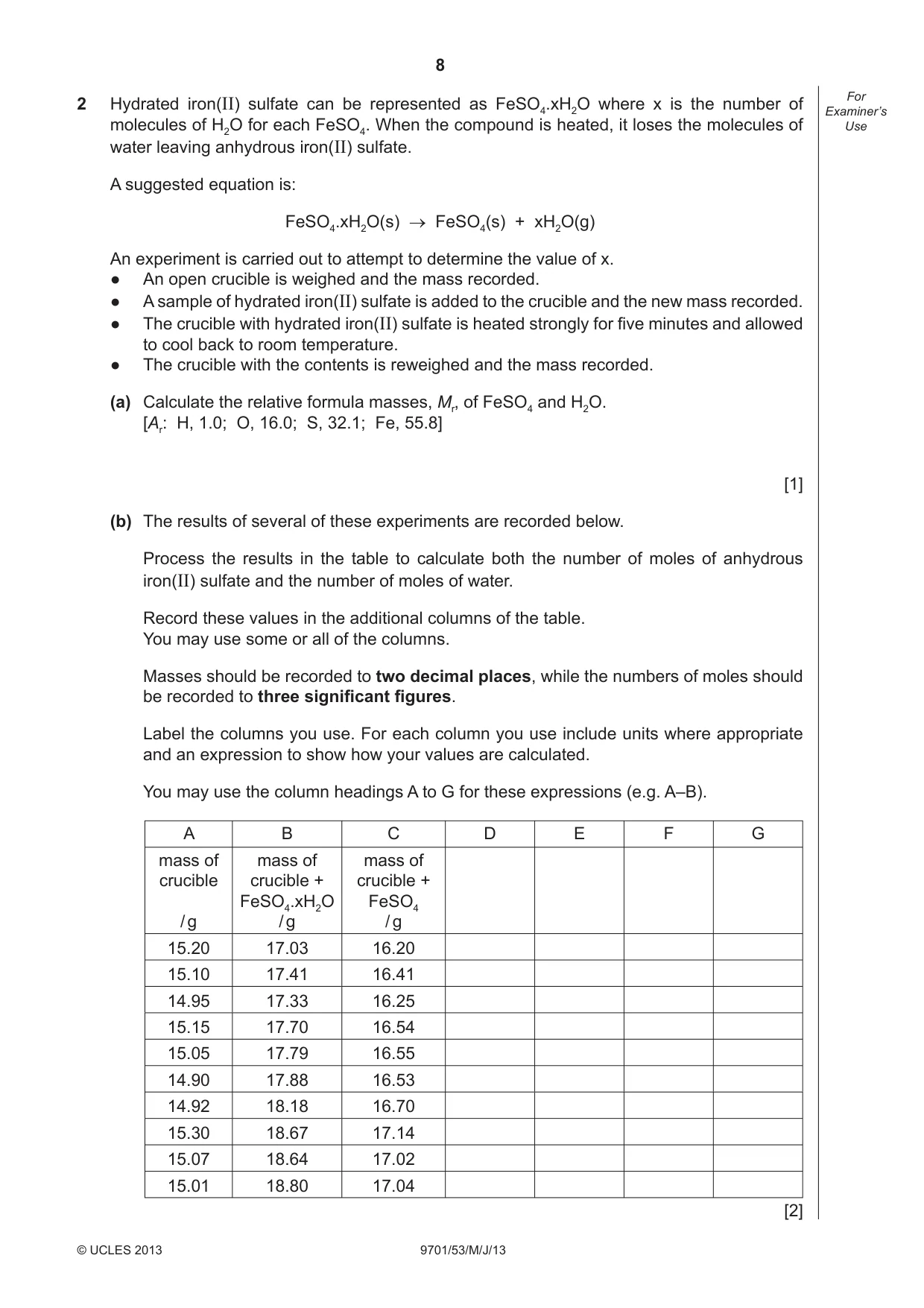
8 9701/53/M/J/13 © UCLES 2013 For Examiner’s Use 2 Hydrated iron(II) sulfate can be represented as FeSO4.xH2O where x is the number of molecules of H2O for each FeSO4. When the compound is heated, it loses the molecules of water leaving anhydrous iron(II) sulfate. A suggested equation is: FeSO4.xH2O(s) → FeSO4(s) + xH2O(g) An experiment is carried out to attempt to determine the value of x. ● An open crucible is weighed and the mass recorded. ● A sample of hydrated iron(II) sulfate is added to the crucible and the new mass recorded. ● The crucible with hydrated iron(II) sulfate is heated strongly for fi ve minutes and allowed to cool back to room temperature. ● The crucible with the contents is reweighed and the mass recorded. (a) Calculate the relative formula masses, Mr, of FeSO4 and H2O. [Ar: H, 1.0; O, 16.0; S, 32.1; Fe, 55.8] [1] (b) The results of several of these experiments are recorded below. Process the results in the table to calculate both the number of moles of anhydrous iron(II) sulfate and the number of moles of water. Record these values in the additional columns of the table. You may use some or all of the columns. Masses should be recorded to two decimal places, while the numbers of moles should be recorded to three signifi cant fi gures. Label the columns you use. For each column you use include units where appropriate and an expression to show how your values are calculated. You may use the column headings A to G for these expressions (e.g. A–B). A B C D E F G mass of crucible / g mass of crucible + FeSO4.xH2O / g mass of crucible + FeSO4 / g 15.20 17.03 16.20 15.10 17.41 16.41 14.95 17.33 16.25 15.15 17.70 16.54 15.05 17.79 16.55 14.90 17.88 16.53 14.92 18.18 16.70 15.30 18.67 17.14 15.07 18.64 17.02 15.01 18.80 17.04 [2]
Question paper, page 9
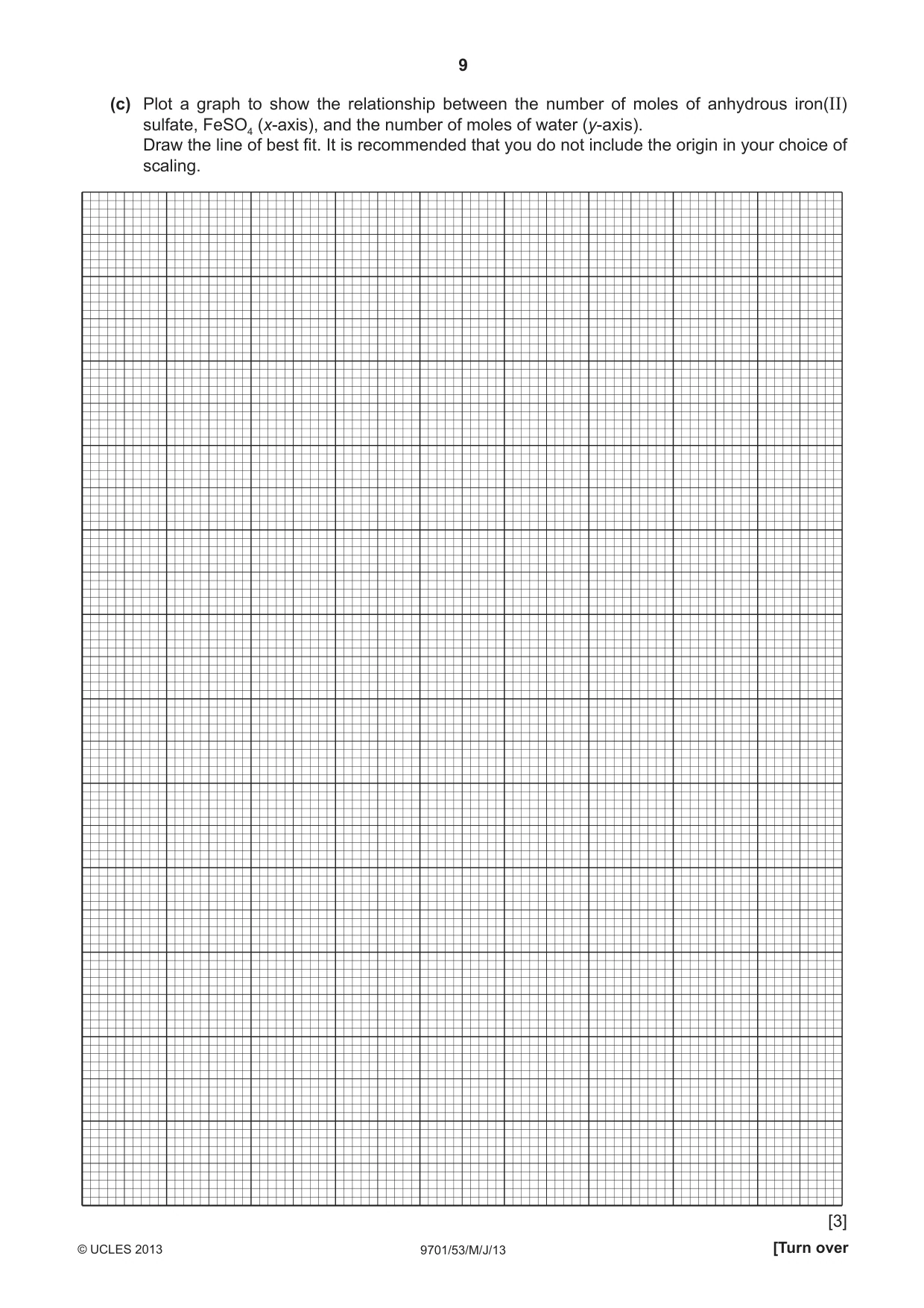
9 9701/53/M/J/13 © UCLES 2013 [Turn over (c) Plot a graph to show the relationship between the number of moles of anhydrous iron(II) sulfate, FeSO4 (x-axis), and the number of moles of water (y-axis). Draw the line of best fi t. It is recommended that you do not include the origin in your choice of scaling. [3]
Question paper, page 10
10 9701/53/M/J/13 © UCLES 2013 For Examiner’s Use (d) Circle and label on the graph any point(s) you consider to be anomalous. For each anomalous point give a different reason why it is anomalous clearly indicating which point you are describing. … … … … … … … … [3] (e) Determine the slope of the graph. You must mark clearly on the graph any construction lines and show clearly in your calculation how the intercepts were used in the calculation of the slope. [3] (f) Comment on the reliability of the data provided in (b). … … … [1] (g) (i) Use the value of the slope of your graph calculated in (e) to suggest the correct formula for hydrated iron(II) sulfate. … … … (ii) Explain your answer to (i). … … … [2] [Total: 15]
Question paper, page 11
11 9701/53/M/J/13 BLANK PAGE © UCLES 2013 [Turn over
Question paper, page 12
12 Permission to reproduce items where third-party owned material protected by copyright is included has been sought and cleared where possible. Every reasonable effort has been made by the publisher (UCLES) to trace copyright holders, but if any items requiring clearance have unwittingly been included the publisher will be pleased to make amends at the earliest possible opportunity. University of Cambridge International Examinations is part of the Cambridge Assessment Group. Cambridge Assessment is the brand name of University of Cambridge Local Examinations Syndicate (UCLES), which is itself a department of the University of Cambridge. 9701/53/M/J/13 © UCLES 2013 BLANK PAGE
Mark scheme, page 1
CAMBRIDGE INTERNATIONAL EXAMINATIONS GCE Advanced Level MARK SCHEME for the May/June 2013 series 9701 CHEMISTRY 9701/53 Paper 5 (Planning, Analysis and Evaluation), maximum raw mark 30 This mark scheme is published as an aid to teachers and candidates, to indicate the requirements of the examination. It shows the basis on which Examiners were instructed to award marks. It does not indicate the details of the discussions that took place at an Examiners’ meeting before marking began, which would have considered the acceptability of alternative answers. Mark schemes should be read in conjunction with the question paper and the Principal Examiner Report for Teachers. Cambridge will not enter into discussions about these mark schemes. Cambridge is publishing the mark schemes for the May/June 2013 series for most IGCSE, GCE Advanced Level and Advanced Subsidiary Level components and some Ordinary Level components.
Mark scheme, page 2
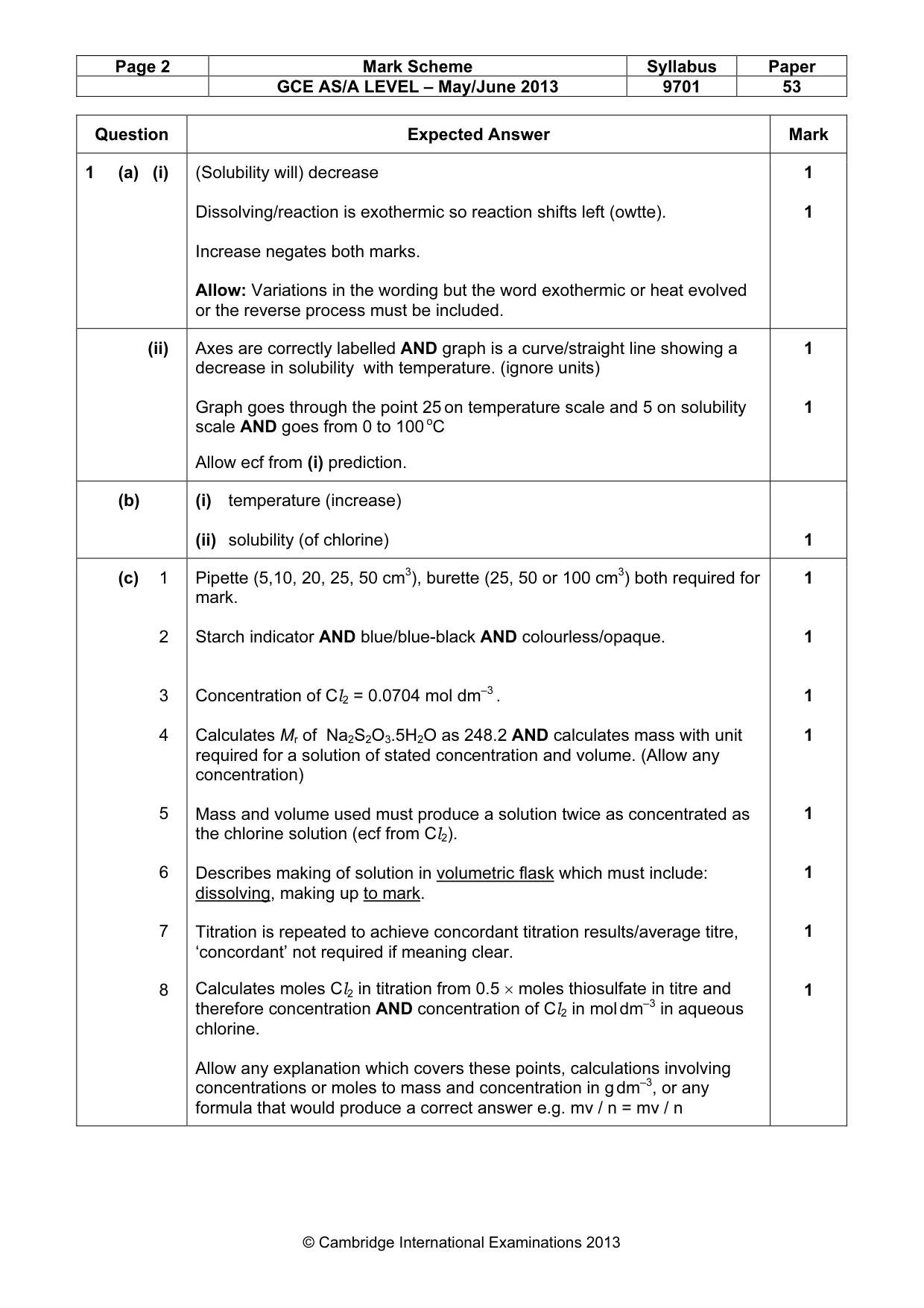
Page 2 Mark Scheme Syllabus Paper GCE AS/A LEVEL – May/June 2013 9701 53 © Cambridge International Examinations 2013 Question Expected Answer Mark 1 (a) (i) (Solubility will) decrease Dissolving/reaction is exothermic so reaction shifts left (owtte). Increase negates both marks. Allow: Variations in the wording but the word exothermic or heat evolved or the reverse process must be included. 1 1 (ii) Axes are correctly labelled AND graph is a curve/straight line showing a decrease in solubility with temperature. (ignore units) Graph goes through the point 25 on temperature scale and 5 on solubility scale AND goes from 0 to 100 oC Allow ecf from (i) prediction. 1 1 (b) (i) temperature (increase) (ii) solubility (of chlorine) 1 (c) 1 2 3 4 5 6 7 8 Pipette (5,10, 20, 25, 50 cm3), burette (25, 50 or 100 cm3) both required for mark. Starch indicator AND blue/blue-black AND colourless/opaque. Concentration of Cl2 = 0.0704 mol dm–3 . Calculates Mr of Na2S2O3.5H2O as 248.2 AND calculates mass with unit required for a solution of stated concentration and volume. (Allow any concentration) Mass and volume used must produce a solution twice as concentrated as the chlorine solution (ecf from Cl2). Describes making of solution in volumetric flask which must include: dissolving, making up to mark. Titration is repeated to achieve concordant titration results/average titre, ‘concordant’ not required if meaning clear. Calculates moles Cl2 in titration from 0.5 × moles thiosulfate in titre and therefore concentration AND concentration of Cl2 in mol dm–3 in aqueous chlorine. Allow any explanation which covers these points, calculations involving concentrations or moles to mass and concentration in g dm–3, or any formula that would produce a correct answer e.g. mv / n = mv / n 1 1 1 1 1 1 1 1
Mark scheme, page 3
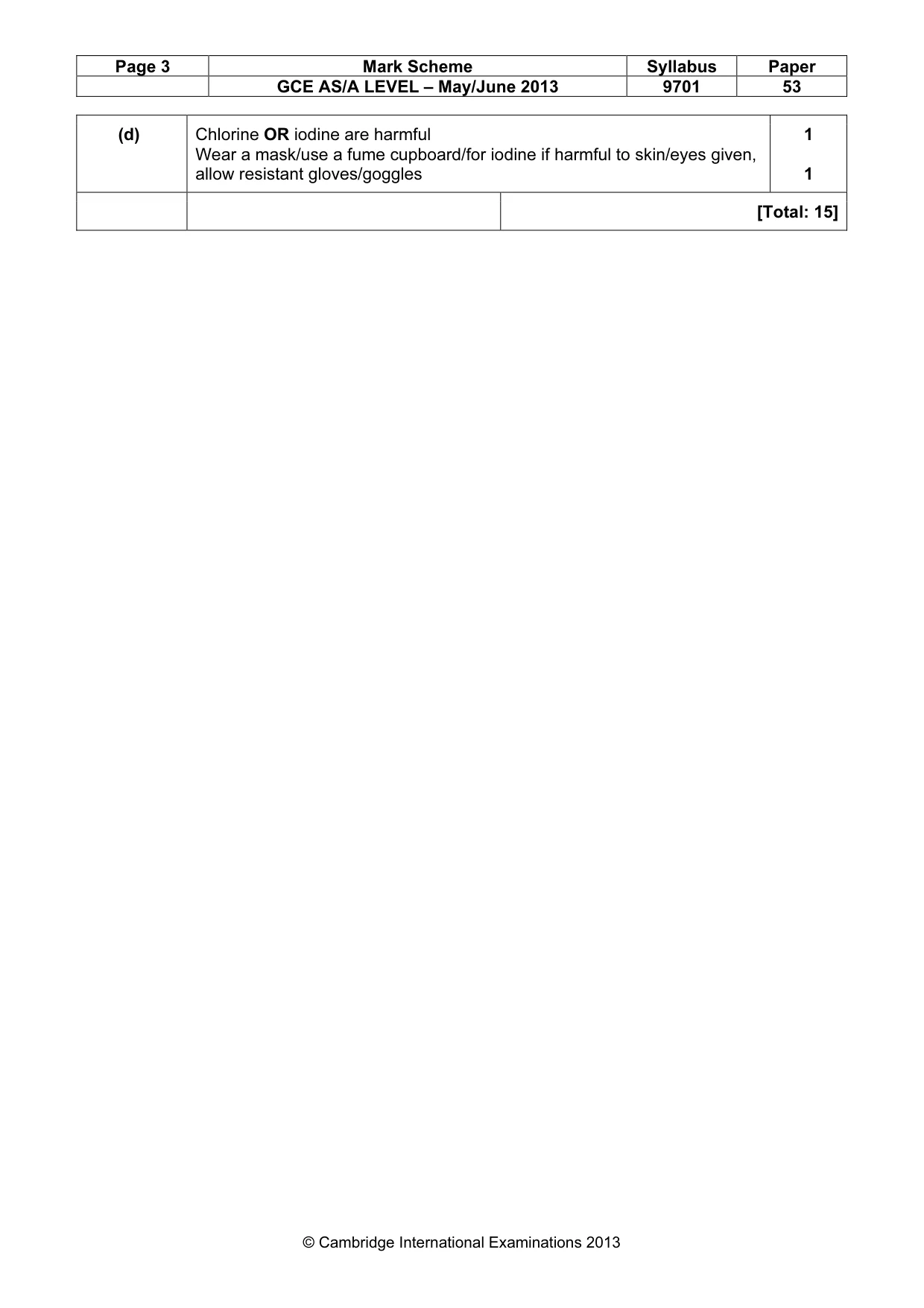
Page 3 Mark Scheme Syllabus Paper GCE AS/A LEVEL – May/June 2013 9701 53 © Cambridge International Examinations 2013 (d) Chlorine OR iodine are harmful Wear a mask/use a fume cupboard/for iodine if harmful to skin/eyes given, allow resistant gloves/goggles 1 1 [Total: 15]
Mark scheme, page 4
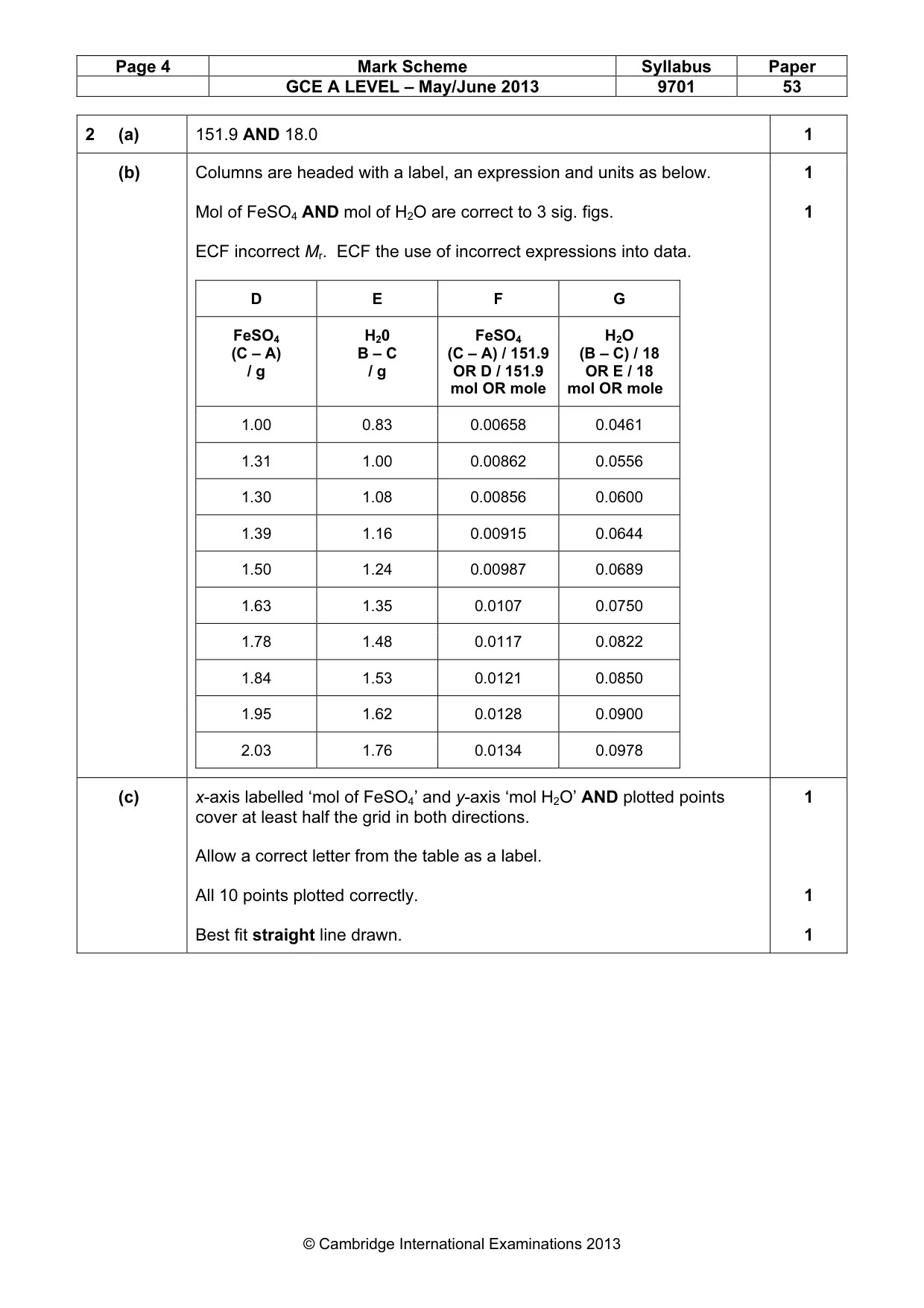
Page 4 Mark Scheme Syllabus Paper GCE A LEVEL – May/June 2013 9701 53 © Cambridge International Examinations 2013 2 (a) 151.9 AND 18.0 1 (b) Columns are headed with a label, an expression and units as below. Mol of FeSO4 AND mol of H2O are correct to 3 sig. figs. ECF incorrect Mr. ECF the use of incorrect expressions into data. D E F G FeSO4 (C – A) / g H20 B – C / g FeSO4 (C – A) / 151.9 OR D / 151.9 mol OR mole H2O (B – C) / 18 OR E / 18 mol OR mole 1.00 0.83 0.00658 0.0461 1.31 1.00 0.00862 0.0556 1.30 1.08 0.00856 0.0600 1.39 1.16 0.00915 0.0644 1.50 1.24 0.00987 0.0689 1.63 1.35 0.0107 0.0750 1.78 1.48 0.0117 0.0822 1.84 1.53 0.0121 0.0850 1.95 1.62 0.0128 0.0900 2.03 1.76 0.0134 0.0978 1 1 (c) x-axis labelled ‘mol of FeSO4’ and y-axis ‘mol H2O’ AND plotted points cover at least half the grid in both directions. Allow a correct letter from the table as a label. All 10 points plotted correctly. Best fit straight line drawn. 1 1 1
Mark scheme, page 5
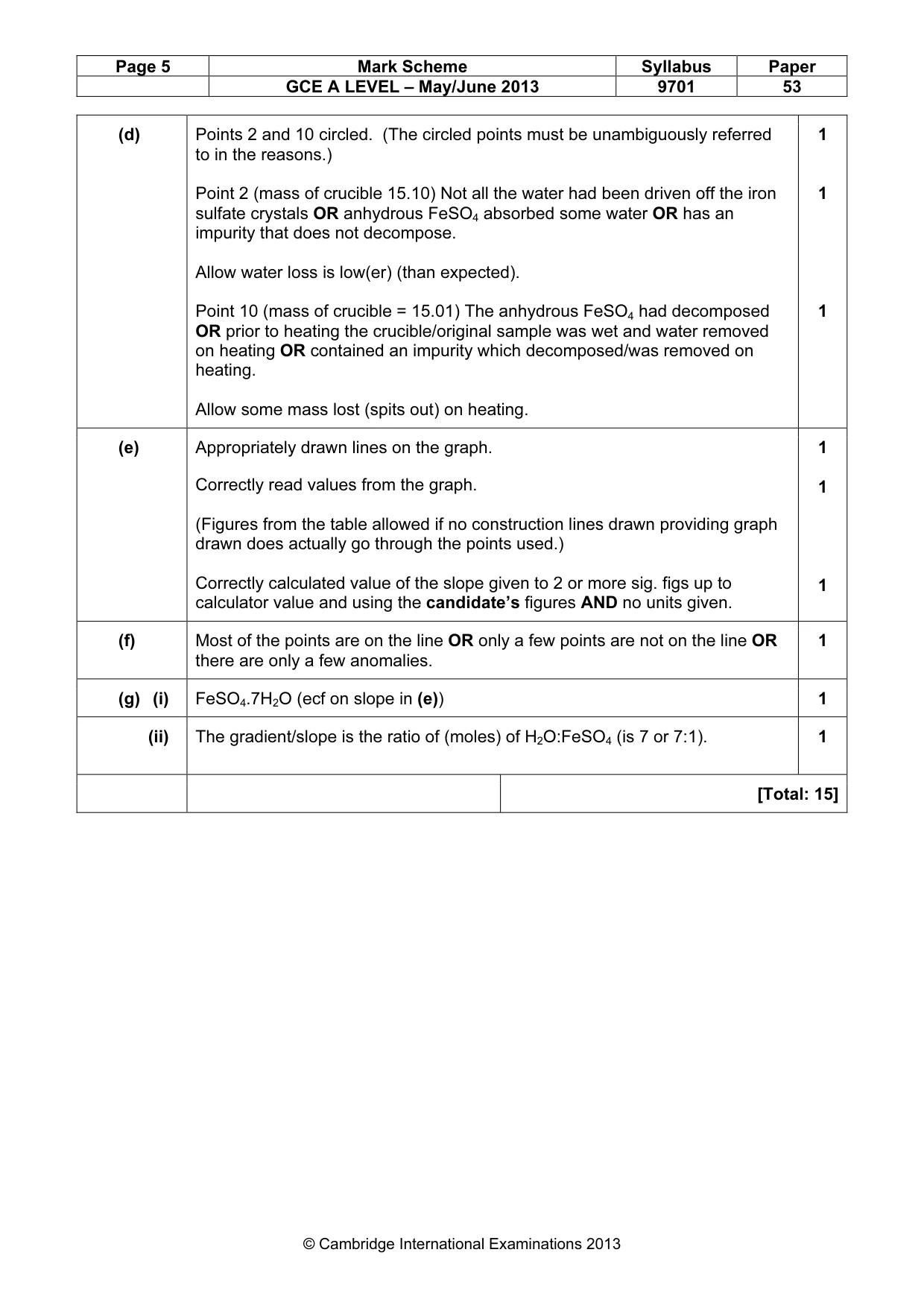
Page 5 Mark Scheme Syllabus Paper GCE A LEVEL – May/June 2013 9701 53 © Cambridge International Examinations 2013 (d) Points 2 and 10 circled. (The circled points must be unambiguously referred to in the reasons.) Point 2 (mass of crucible 15.10) Not all the water had been driven off the iron sulfate crystals OR anhydrous FeSO4 absorbed some water OR has an impurity that does not decompose. Allow water loss is low(er) (than expected). Point 10 (mass of crucible = 15.01) The anhydrous FeSO4 had decomposed OR prior to heating the crucible/original sample was wet and water removed on heating OR contained an impurity which decomposed/was removed on heating. Allow some mass lost (spits out) on heating. 1 1 1 (e) Appropriately drawn lines on the graph. Correctly read values from the graph. (Figures from the table allowed if no construction lines drawn providing graph drawn does actually go through the points used.) Correctly calculated value of the slope given to 2 or more sig. figs up to calculator value and using the candidate’s figures AND no units given. 1 1 1 (f) Most of the points are on the line OR only a few points are not on the line OR there are only a few anomalies. 1 (g) (i) FeSO4.7H2O (ecf on slope in (e)) 1 (ii) The gradient/slope is the ratio of (moles) of H2O:FeSO4 (is 7 or 7:1). 1 [Total: 15]
What you needed in this session
Cambridge’s own grade thresholds for 2013 May/June, Paper 5 · Variant 3. A higher threshold means an easier paper — the bar moves with how the cohort did.