Cambridge A Level Chemistry 9701 — 2013 May/June Paper 2 · Variant 3
9701/23/M/J/13 · 60 marks · ≈68 min
The question paper and its mark scheme, free to read here and free to download. This is Cambridge’s own paper, exactly as it was sat.
Question paper12 pages
Mark scheme7 pages
Answers below. Sit the paper first if you are practising.
Paper as text
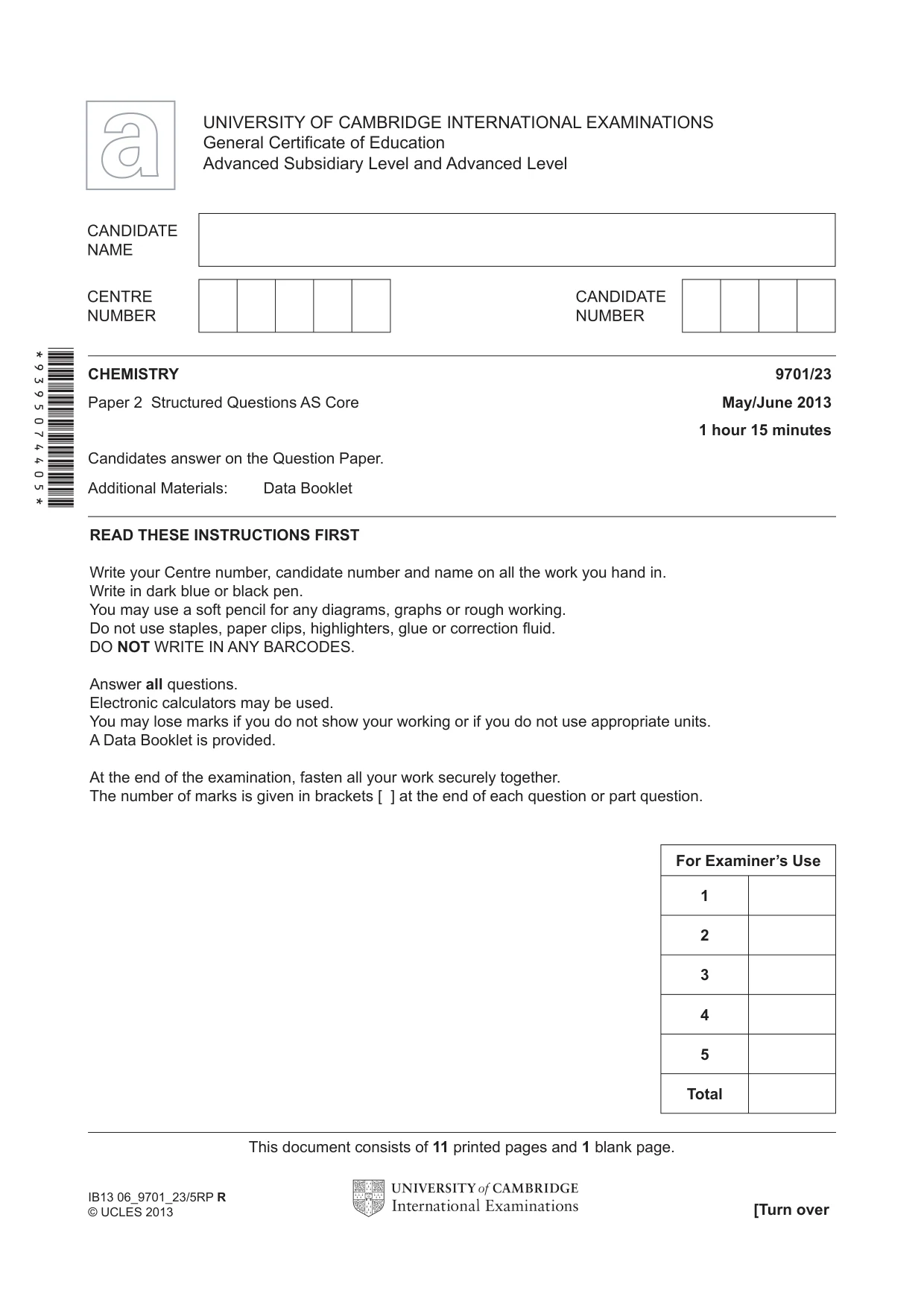
Question paper, page 1
READ THESE INSTRUCTIONS FIRST Write your Centre number, candidate number and name on all the work you hand in. Write in dark blue or black pen. You may use a soft pencil for any diagrams, graphs or rough working. Do not use staples, paper clips, highlighters, glue or correction fl uid. DO NOT WRITE IN ANY BARCODES. Answer all questions. Electronic calculators may be used. You may lose marks if you do not show your working or if you do not use appropriate units. A Data Booklet is provided. At the end of the examination, fasten all your work securely together. The number of marks is given in brackets [ ] at the end of each question or part question. CHEMISTRY 9701/23 Paper 2 Structured Questions AS Core May/June 2013 1 hour 15 minutes Candidates answer on the Question Paper. Additional Materials: Data Booklet UNIVERSITY OF CAMBRIDGE INTERNATIONAL EXAMINATIONS General Certifi cate of Education Advanced Subsidiary Level and Advanced Level This document consists of 11 printed pages and 1 blank page. [Turn over IB13 06_9701_23/5RP R © UCLES 2013 *9395074405* For Examiner’s Use 1 2 3 4 5 Total
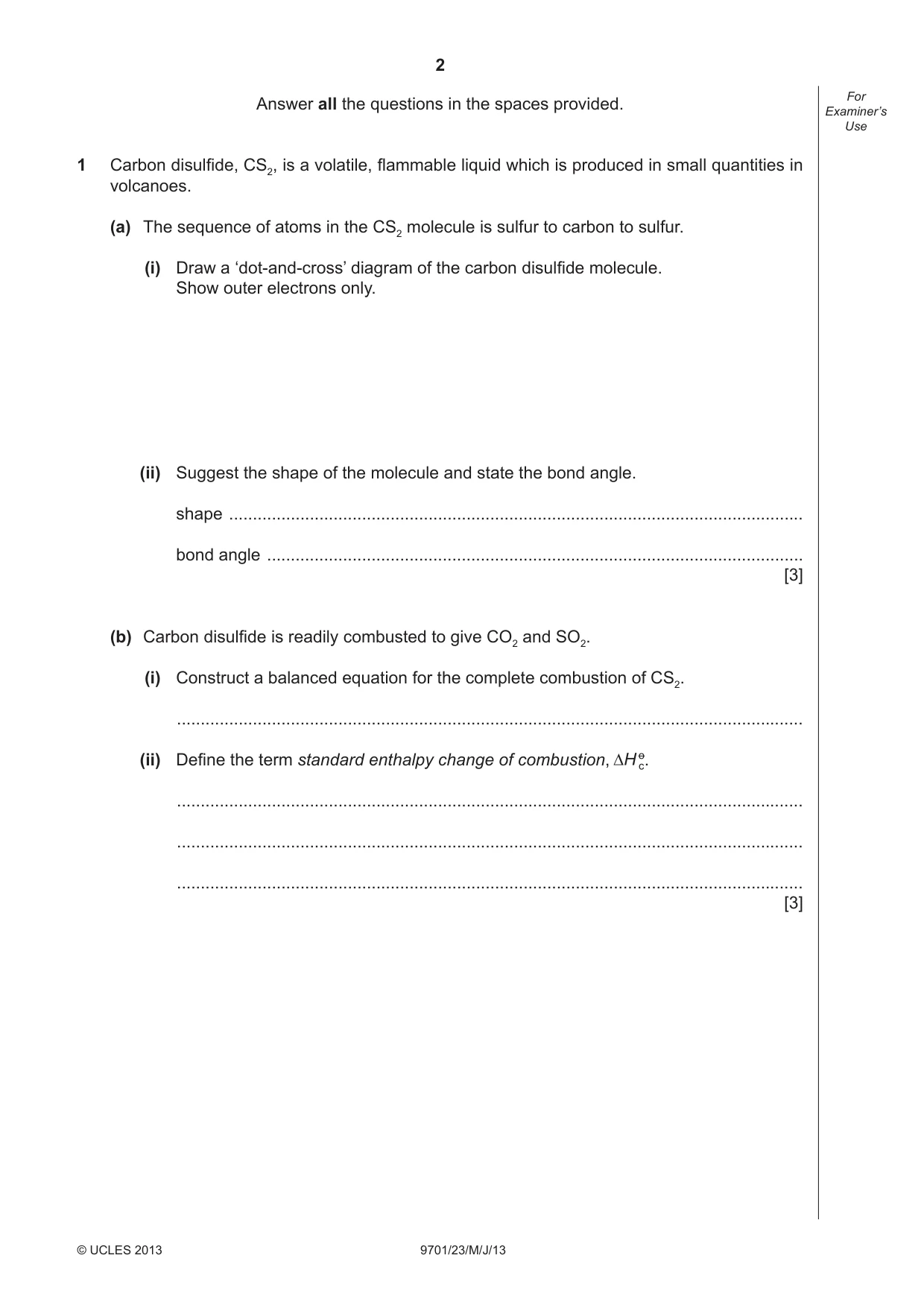
Question paper, page 2
2 9701/23/M/J/13 © UCLES 2013 For Examiner’s Use Answer all the questions in the spaces provided. 1 Carbon disulfi de, CS2, is a volatile, fl ammable liquid which is produced in small quantities in volcanoes. (a) The sequence of atoms in the CS2 molecule is sulfur to carbon to sulfur. (i) Draw a ‘dot-and-cross’ diagram of the carbon disulfi de molecule. Show outer electrons only. (ii) Suggest the shape of the molecule and state the bond angle. shape … bond angle … [3] (b) Carbon disulfi de is readily combusted to give CO2 and SO2. (i) Construct a balanced equation for the complete combustion of CS2. … (ii) Defi ne the term standard enthalpy change of combustion, . … … … [3]
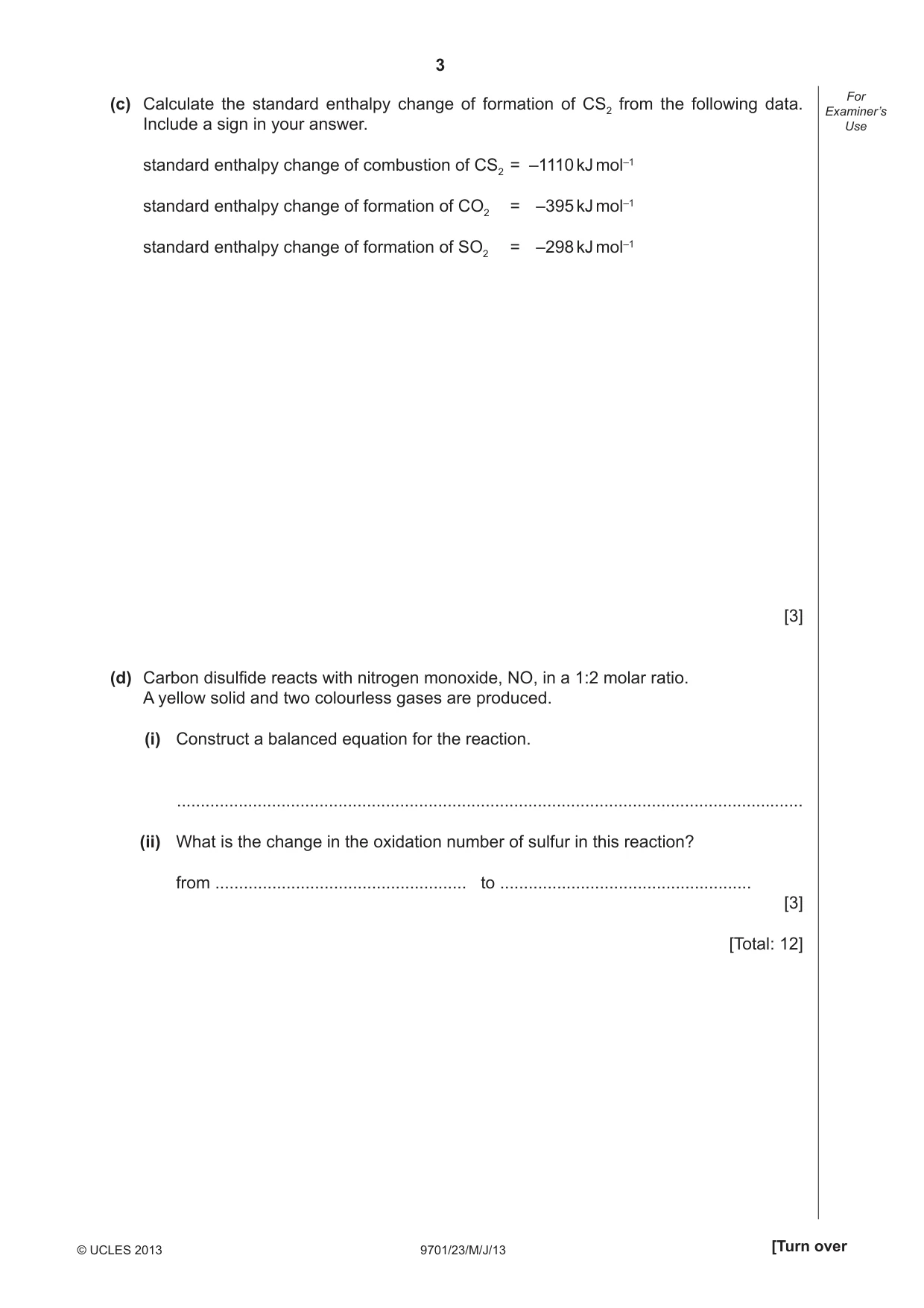
Question paper, page 3
3 9701/23/M/J/13 © UCLES 2013 [Turn over For Examiner’s Use (c) Calculate the standard enthalpy change of formation of CS2 from the following data. Include a sign in your answer. standard enthalpy change of combustion of CS2 = –1110 kJ mol–1 standard enthalpy change of formation of CO2 = –395 kJ mol–1 standard enthalpy change of formation of SO2 = –298 kJ mol–1 [3] (d) Carbon disulfi de reacts with nitrogen monoxide, NO, in a 1:2 molar ratio. A yellow solid and two colourless gases are produced. (i) Construct a balanced equation for the reaction. … (ii) What is the change in the oxidation number of sulfur in this reaction? from … to … [3] [Total: 12]
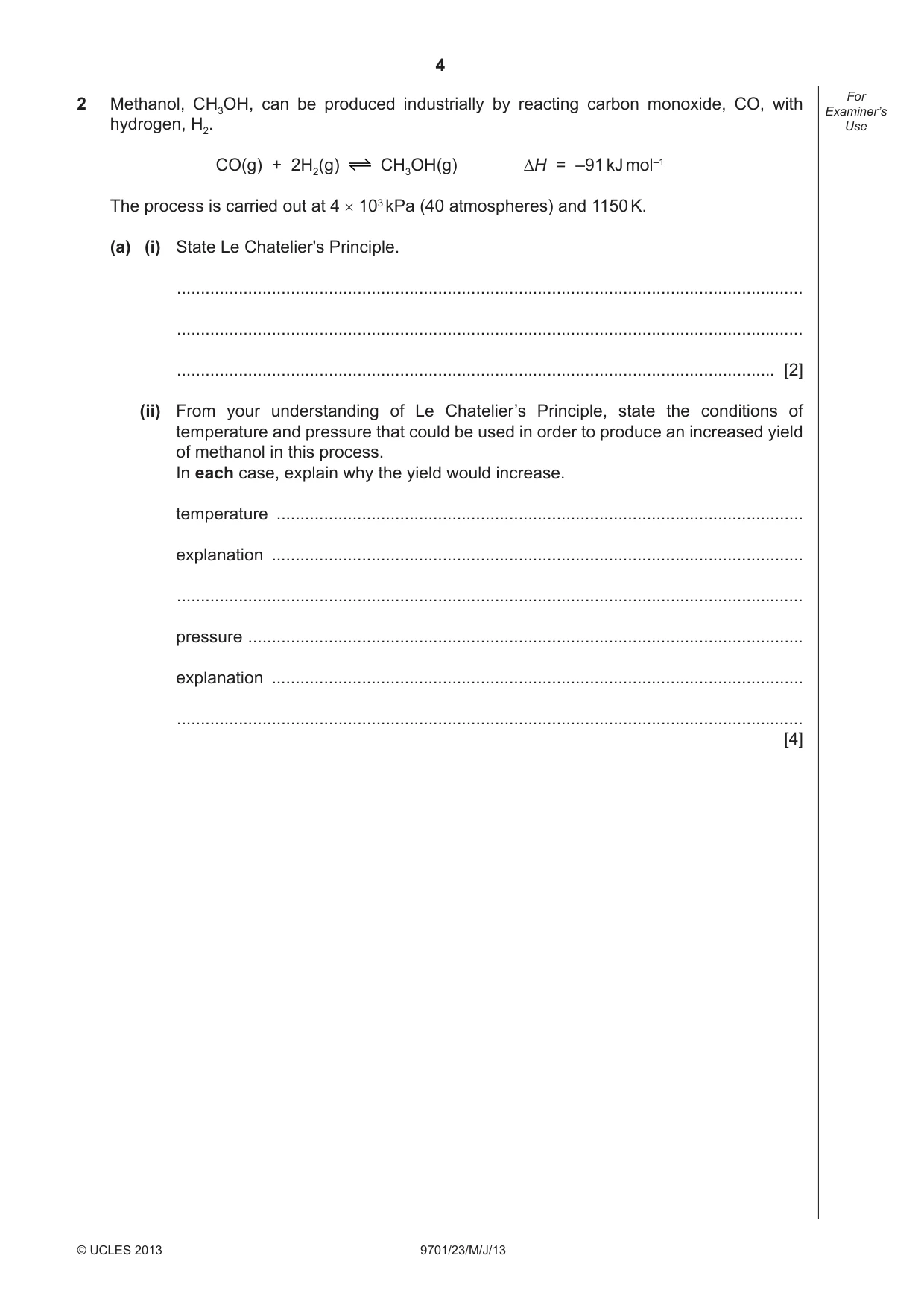
Question paper, page 4
4 9701/23/M/J/13 © UCLES 2013 For Examiner’s Use 2 Methanol, CH3OH, can be produced industrially by reacting carbon monoxide, CO, with hydrogen, H2. CO(g) + 2H2(g) CH3OH(g) ∆H = –91 kJ mol–1 The process is carried out at 4 × 10³ kPa (40 atmospheres) and 1150 K. (a) (i) State Le Chatelier's Principle. … … … [2] (ii) From your understanding of Le Chatelier’s Principle, state the conditions of temperature and pressure that could be used in order to produce an increased yield of methanol in this process. In each case, explain why the yield would increase. temperature … explanation … … pressure … explanation … … [4]
Question paper, page 5
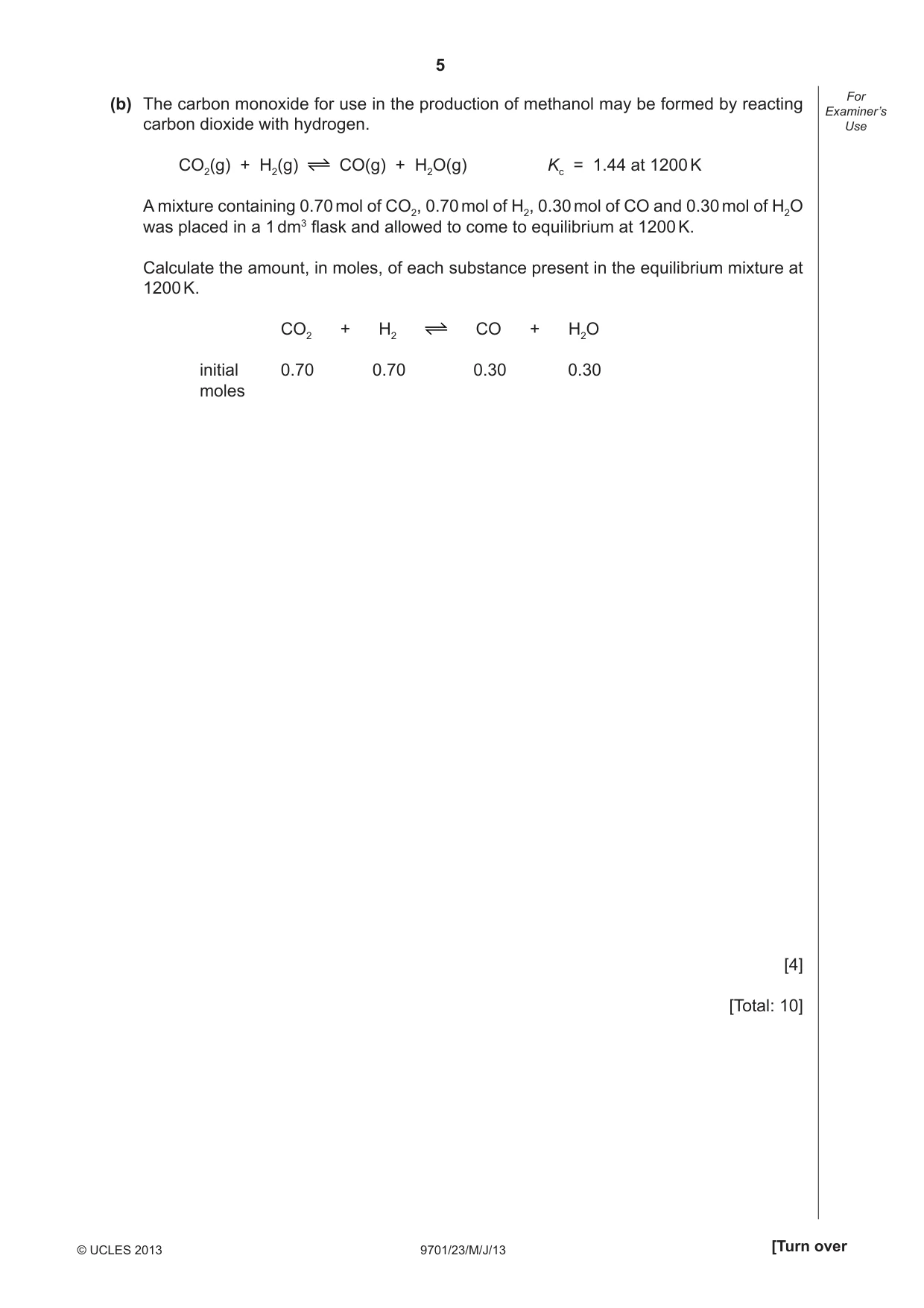
5 9701/23/M/J/13 © UCLES 2013 [Turn over For Examiner’s Use (b) The carbon monoxide for use in the production of methanol may be formed by reacting carbon dioxide with hydrogen. CO2(g) + H2(g) CO(g) + H2O(g) Kc = 1.44 at 1200 K A mixture containing 0.70 mol of CO2, 0.70 mol of H2, 0.30 mol of CO and 0.30 mol of H2O was placed in a 1 dm3 fl ask and allowed to come to equilibrium at 1200 K. Calculate the amount, in moles, of each substance present in the equilibrium mixture at 1200 K. CO2 + H2 CO + H2O initial 0.70 0.70 0.30 0.30 moles [4] [Total: 10]
Question paper, page 6
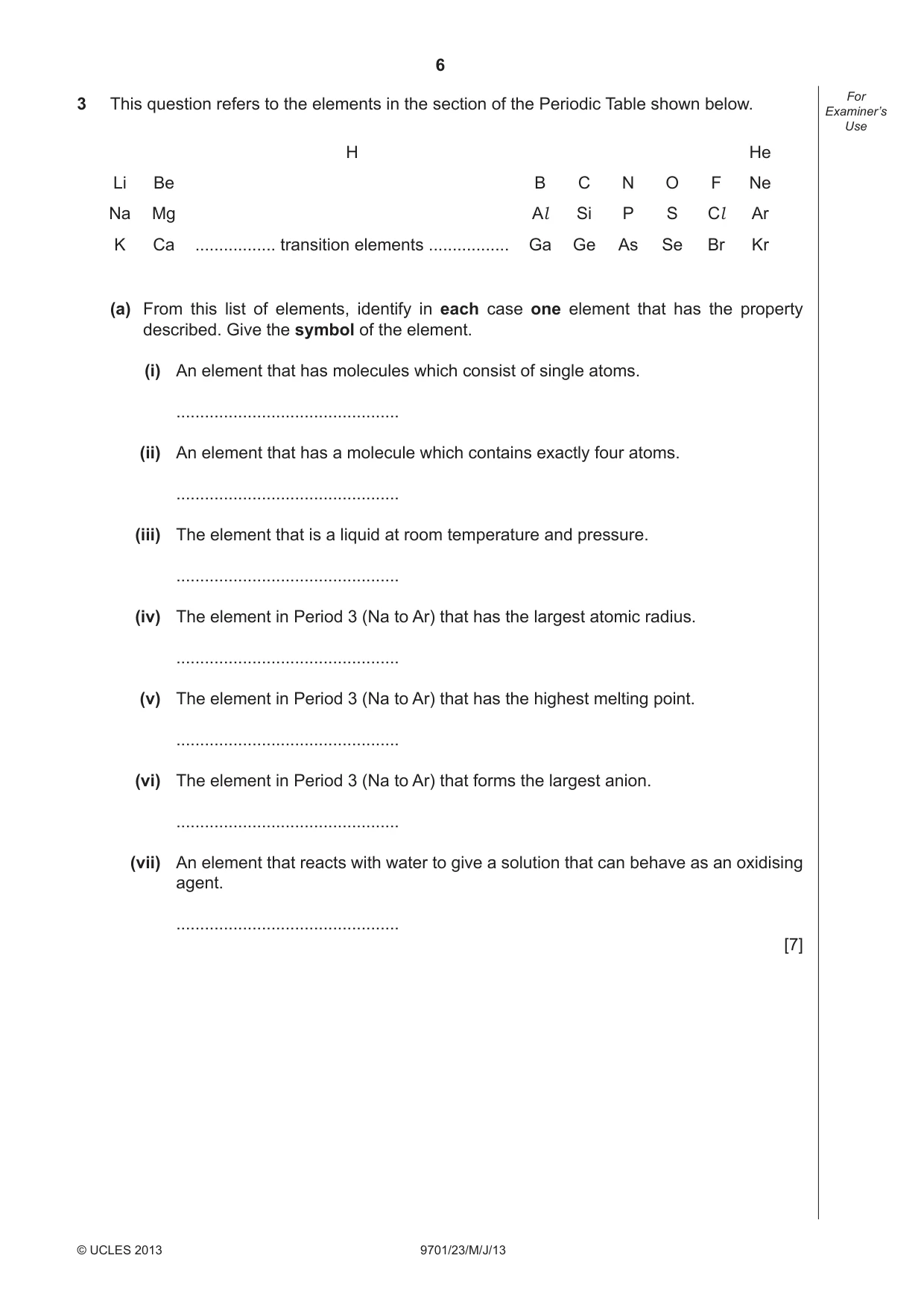
6 9701/23/M/J/13 © UCLES 2013 For Examiner’s Use 3 This question refers to the elements in the section of the Periodic Table shown below. H He Li Be B C N O F Ne Na Mg Al Si P S Cl Ar K Ca … transition elements … Ga Ge As Se Br Kr (a) From this list of elements, identify in each case one element that has the property described. Give the symbol of the element. (i) An element that has molecules which consist of single atoms. … (ii) An element that has a molecule which contains exactly four atoms. … (iii) The element that is a liquid at room temperature and pressure. … (iv) The element in Period 3 (Na to Ar) that has the largest atomic radius. … (v) The element in Period 3 (Na to Ar) that has the highest melting point. … (vi) The element in Period 3 (Na to Ar) that forms the largest anion. … (vii) An element that reacts with water to give a solution that can behave as an oxidising agent. … [7]
Question paper, page 7
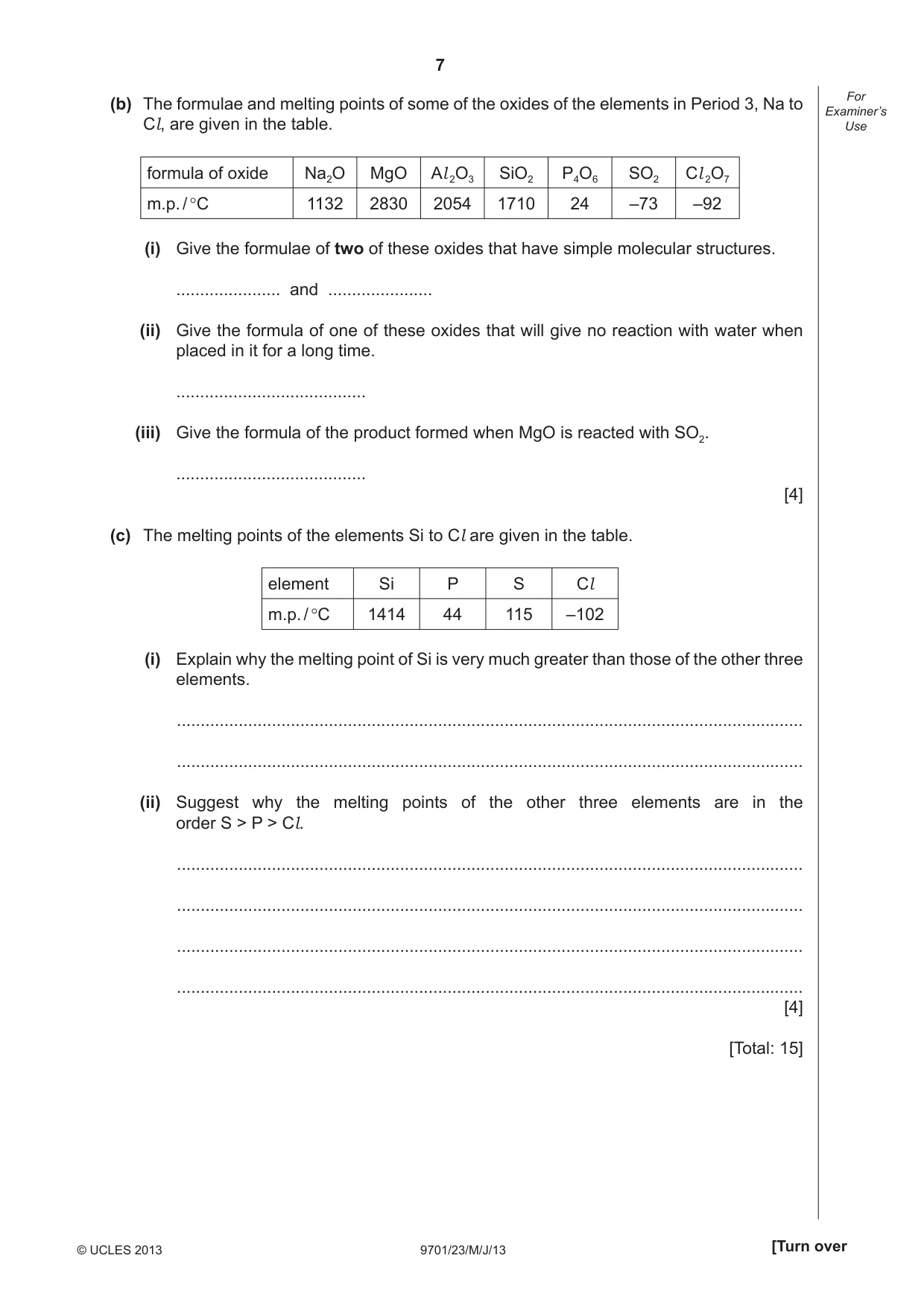
7 9701/23/M/J/13 © UCLES 2013 [Turn over For Examiner’s Use (b) The formulae and melting points of some of the oxides of the elements in Period 3, Na to Cl, are given in the table. formula of oxide Na2O MgO Al 2O3 SiO2 P4O6 SO2 Cl 2O7 m.p. / °C 1132 2830 2054 1710 24 –73 –92 (i) Give the formulae of two of these oxides that have simple molecular structures. … and … (ii) Give the formula of one of these oxides that will give no reaction with water when placed in it for a long time. … (iii) Give the formula of the product formed when MgO is reacted with SO2. … [4] (c) The melting points of the elements Si to Cl are given in the table. element Si P S Cl m.p. / °C 1414 44 115 –102 (i) Explain why the melting point of Si is very much greater than those of the other three elements. … … (ii) Suggest why the melting points of the other three elements are in the order S > P > Cl. … … … … [4] [Total: 15]
Question paper, page 8
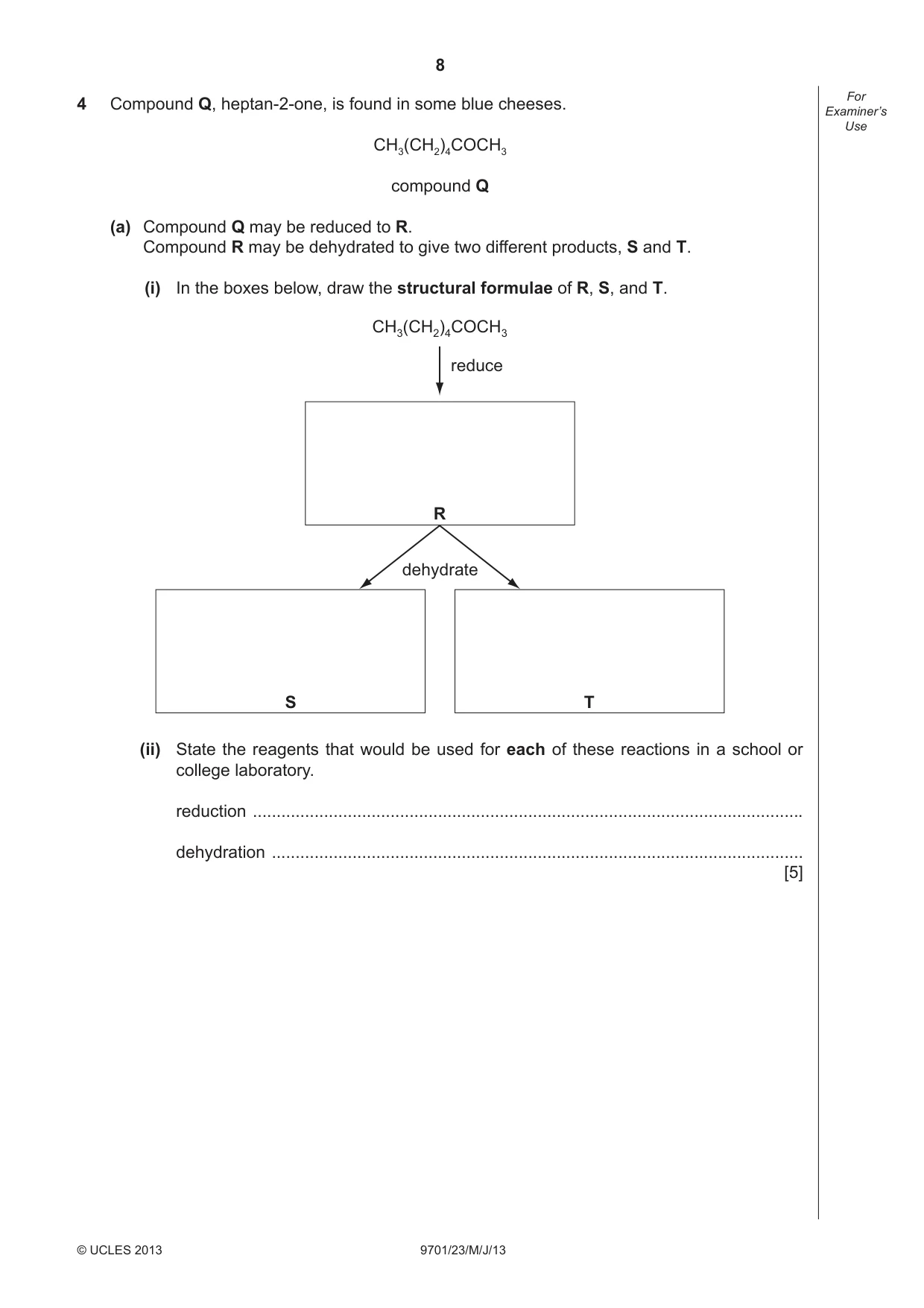
8 9701/23/M/J/13 © UCLES 2013 For Examiner’s Use 4 Compound Q, heptan-2-one, is found in some blue cheeses. CH3(CH2)4COCH3 compound Q (a) Compound Q may be reduced to R. Compound R may be dehydrated to give two different products, S and T. (i) In the boxes below, draw the structural formulae of R, S, and T. CH3(CH2)4COCH3 R reduce S T dehydrate (ii) State the reagents that would be used for each of these reactions in a school or college laboratory. reduction … dehydration … [5]
Question paper, page 9
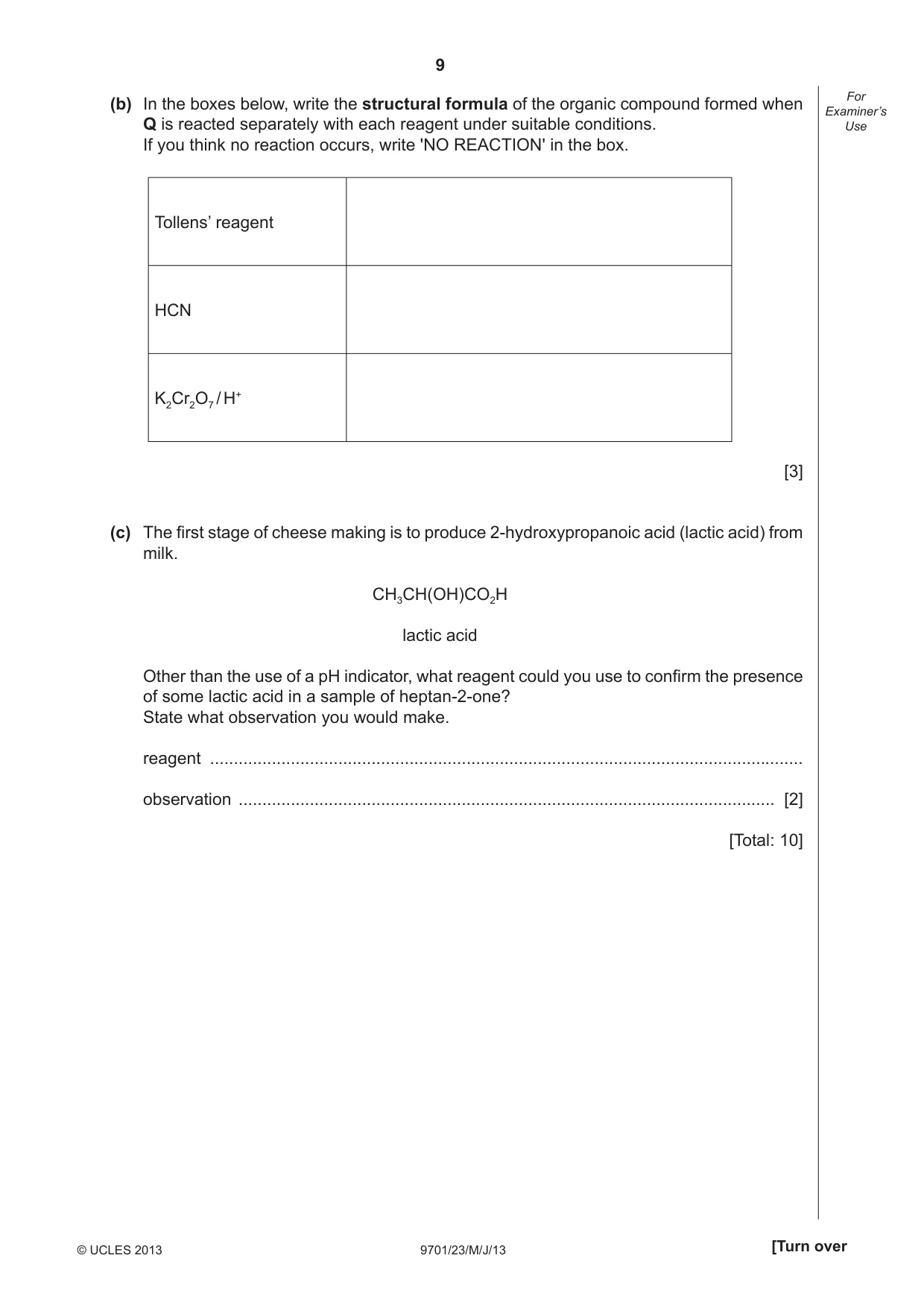
9 9701/23/M/J/13 © UCLES 2013 [Turn over For Examiner’s Use (b) In the boxes below, write the structural formula of the organic compound formed when Q is reacted separately with each reagent under suitable conditions. If you think no reaction occurs, write 'NO REACTION' in the box. Tollens’ reagent HCN K2Cr2O7 / H+ [3] (c) The fi rst stage of cheese making is to produce 2-hydroxypropanoic acid (lactic acid) from milk. CH3CH(OH)CO2H lactic acid Other than the use of a pH indicator, what reagent could you use to confi rm the presence of some lactic acid in a sample of heptan-2-one? State what observation you would make. reagent … observation … [2] [Total: 10]
Question paper, page 10
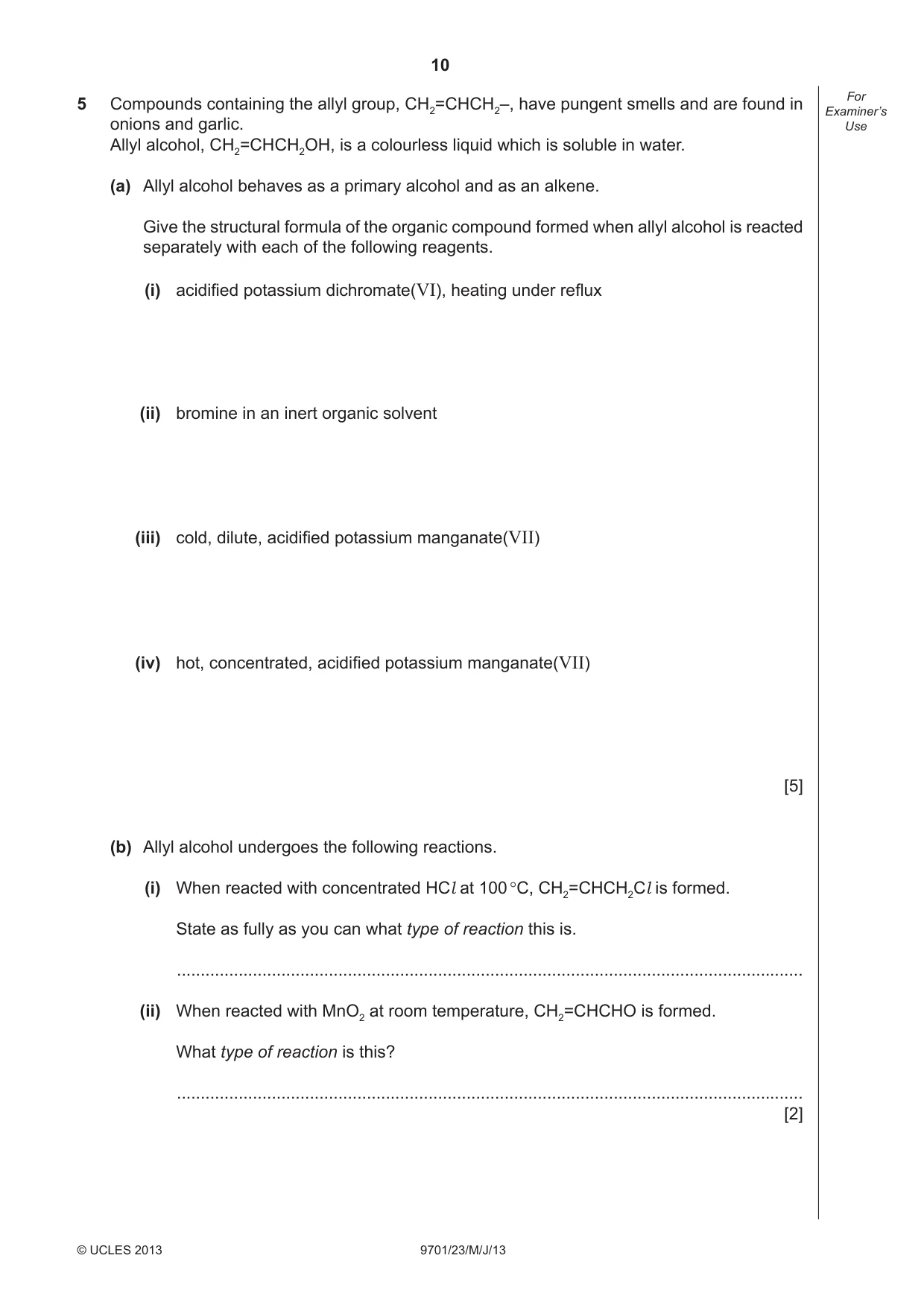
10 9701/23/M/J/13 © UCLES 2013 For Examiner’s Use 5 Compounds containing the allyl group, CH2=CHCH2–, have pungent smells and are found in onions and garlic. Allyl alcohol, CH2=CHCH2OH, is a colourless liquid which is soluble in water. (a) Allyl alcohol behaves as a primary alcohol and as an alkene. Give the structural formula of the organic compound formed when allyl alcohol is reacted separately with each of the following reagents. (i) acidifi ed potassium dichromate(VI), heating under refl ux (ii) bromine in an inert organic solvent (iii) cold, dilute, acidifi ed potassium manganate(VII) (iv) hot, concentrated, acidifi ed potassium manganate(VII) [5] (b) Allyl alcohol undergoes the following reactions. (i) When reacted with concentrated HCl at 100 °C, CH2=CHCH2Cl is formed. State as fully as you can what type of reaction this is. … (ii) When reacted with MnO2 at room temperature, CH2=CHCHO is formed. What type of reaction is this? … [2]
Question paper, page 11
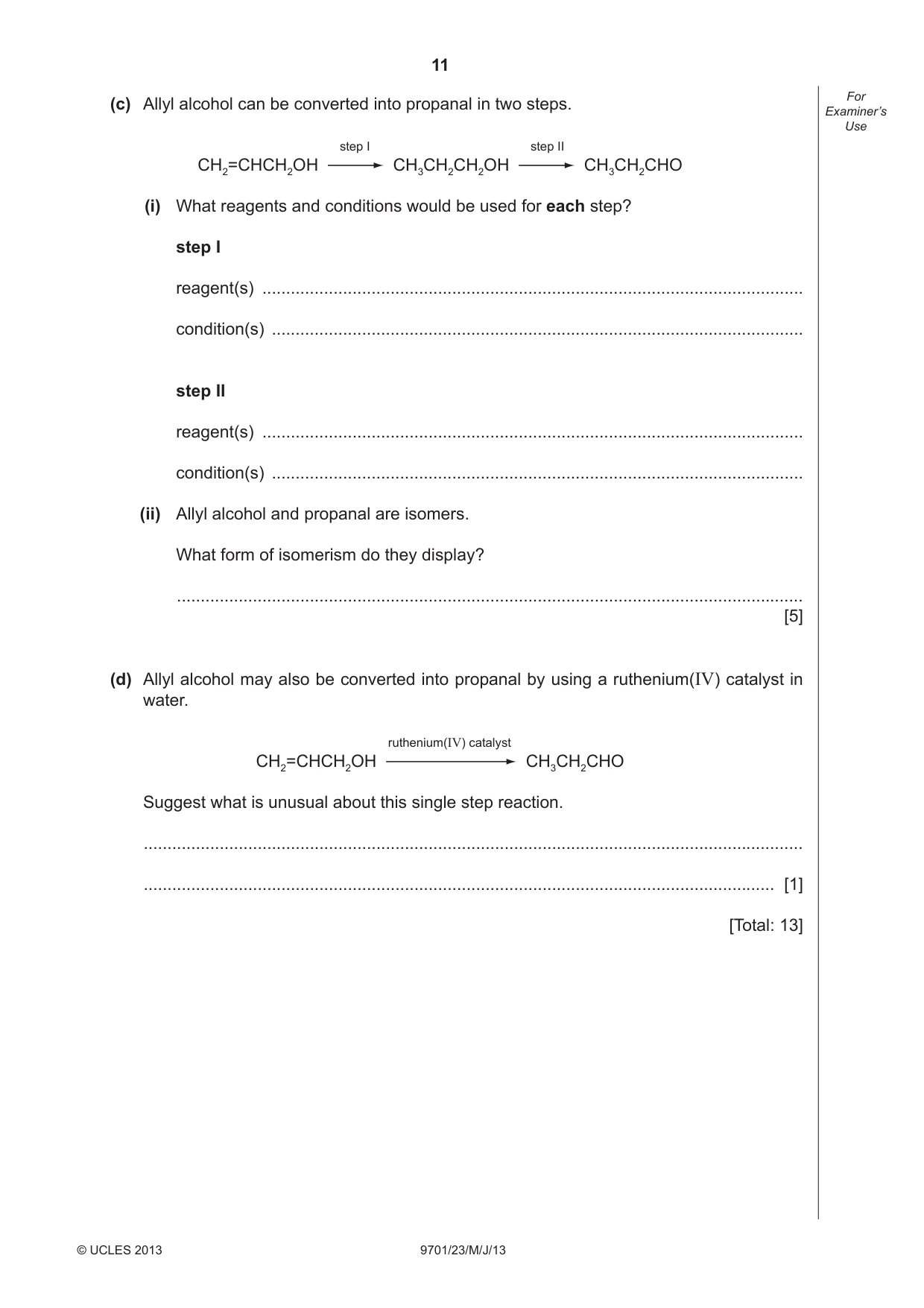
11 9701/23/M/J/13 © UCLES 2013 [Turn over For Examiner’s Use (c) Allyl alcohol can be converted into propanal in two steps. step I step II CH2=CHCH2OH CH3CH2CH2OH CH3CH2CHO (i) What reagents and conditions would be used for each step? step I reagent(s) … condition(s) … step II reagent(s) … condition(s) … (ii) Allyl alcohol and propanal are isomers. What form of isomerism do they display? … [5] (d) Allyl alcohol may also be converted into propanal by using a ruthenium(IV) catalyst in water. ruthenium(IV) catalyst CH2=CHCH2OH CH3CH2CHO Suggest what is unusual about this single step reaction. … … [1] [Total: 13]
Question paper, page 12
12 Permission to reproduce items where third-party owned material protected by copyright is included has been sought and cleared where possible. Every reasonable effort has been made by the publisher (UCLES) to trace copyright holders, but if any items requiring clearance have unwittingly been included the publisher will be pleased to make amends at the earliest possible opportunity. University of Cambridge International Examinations is part of the Cambridge Assessment Group. Cambridge Assessment is the brand name of University of Cambridge Local Examinations Syndicate (UCLES), which is itself a department of the University of Cambridge. 9701/23/M/J/13 © UCLES 2013 BLANK PAGE
Mark scheme, page 1
CAMBRIDGE INTERNATIONAL EXAMINATIONS GCE Advanced Subsidiary Level and GCE Advanced Level MARK SCHEME for the May/June 2013 series 9701 CHEMISTRY 9701/23 Paper 2 (AS Structured Questions), maximum raw mark 60 This mark scheme is published as an aid to teachers and candidates, to indicate the requirements of the examination. It shows the basis on which Examiners were instructed to award marks. It does not indicate the details of the discussions that took place at an Examiners’ meeting before marking began, which would have considered the acceptability of alternative answers. Mark schemes should be read in conjunction with the question paper and the Principal Examiner Report for Teachers. Cambridge will not enter into discussions about these mark schemes. Cambridge is publishing the mark schemes for the May/June 2013 series for most IGCSE, GCE Advanced Level and Advanced Subsidiary Level components and some Ordinary Level components.
Mark scheme, page 2
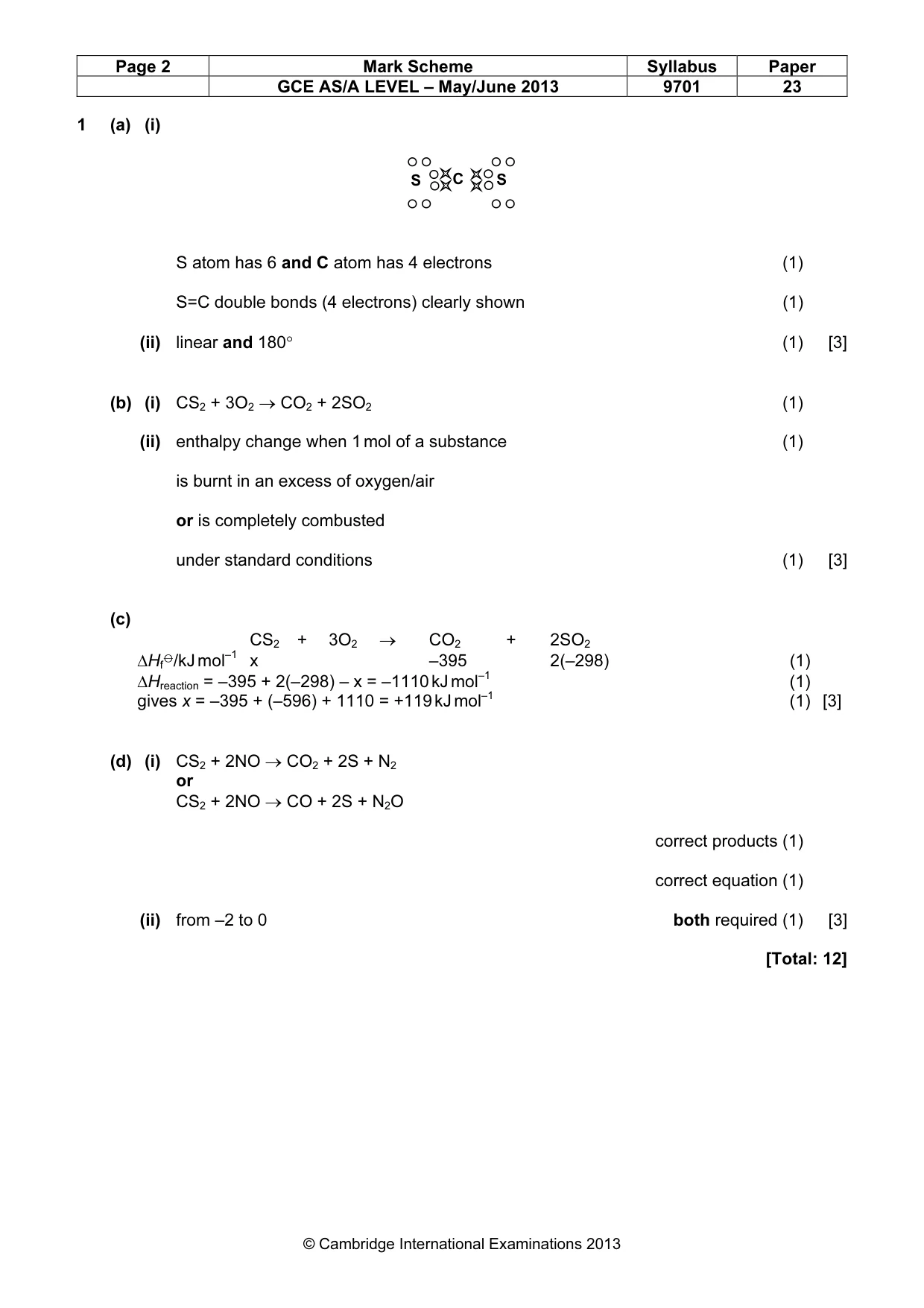
Page 2 Mark Scheme Syllabus Paper GCE AS/A LEVEL – May/June 2013 9701 23 © Cambridge International Examinations 2013 1 (a) (i) S atom has 6 and C atom has 4 electrons (1) S=C double bonds (4 electrons) clearly shown (1) (ii) linear and 180° (1) [3] (b) (i) CS2 + 3O2 → CO2 + 2SO2 (1) (ii) enthalpy change when 1 mol of a substance (1) is burnt in an excess of oxygen/air or is completely combusted under standard conditions (1) [3] (c) CS2 + 3O2 → CO2 + 2SO2 ∆Hf⦵/kJ mol–1 x –395 2(–298) (1) ∆Hreaction = –395 + 2(–298) – x = –1110 kJ mol–1 (1) gives x = –395 + (–596) + 1110 = +119 kJ mol–1 (1) [3] (d) (i) CS2 + 2NO → CO2 + 2S + N2 or CS2 + 2NO → CO + 2S + N2O correct products (1) correct equation (1) (ii) from –2 to 0 both required (1) [3] [Total: 12] C S S
Mark scheme, page 3
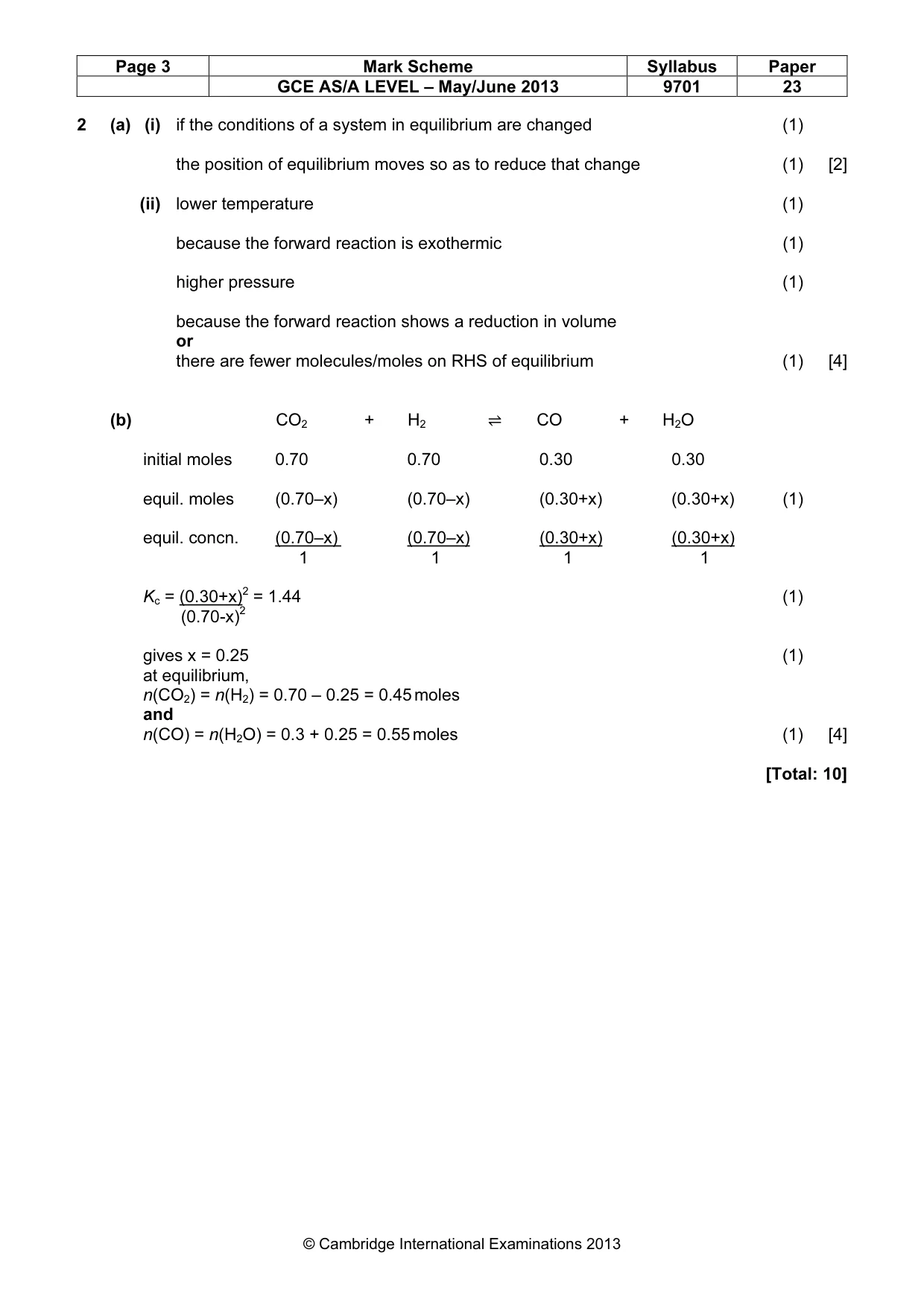
Page 3 Mark Scheme Syllabus Paper GCE AS/A LEVEL – May/June 2013 9701 23 © Cambridge International Examinations 2013 2 (a) (i) if the conditions of a system in equilibrium are changed (1) the position of equilibrium moves so as to reduce that change (1) [2] (ii) lower temperature (1) because the forward reaction is exothermic (1) higher pressure (1) because the forward reaction shows a reduction in volume or there are fewer molecules/moles on RHS of equilibrium (1) [4] (b) CO2 + H2 ⇌ CO + H2O initial moles 0.70 0.70 0.30 0.30 equil. moles (0.70–x) (0.70–x) (0.30+x) (0.30+x) (1) equil. concn. (0.70–x) (0.70–x) (0.30+x) (0.30+x) 1 1 1 1 Kc = (0.30+x)2 = 1.44 (1) (0.70-x)2 gives x = 0.25 (1) at equilibrium, n(CO2) = n(H2) = 0.70 – 0.25 = 0.45 moles and n(CO) = n(H2O) = 0.3 + 0.25 = 0.55 moles (1) [4] [Total: 10]
Mark scheme, page 4
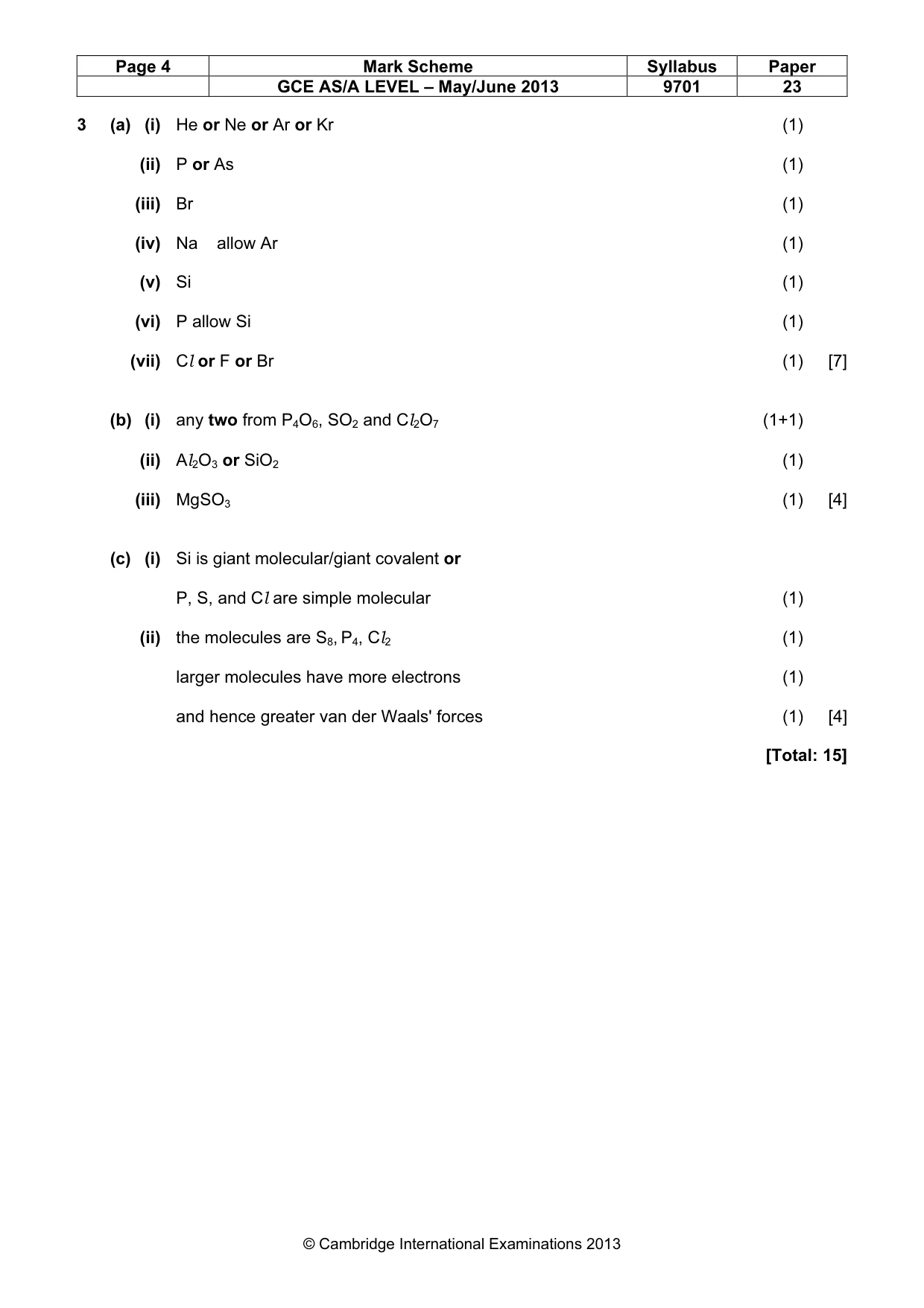
Page 4 Mark Scheme Syllabus Paper GCE AS/A LEVEL – May/June 2013 9701 23 © Cambridge International Examinations 2013 3 (a) (i) He or Ne or Ar or Kr (1) (ii) P or As (1) (iii) Br (1) (iv) Na allow Ar (1) (v) Si (1) (vi) P allow Si (1) (vii) Cl or F or Br (1) [7] (b) (i) any two from P4O6, SO2 and Cl2O7 (1+1) (ii) Al2O3 or SiO2 (1) (iii) MgSO3 (1) [4] (c) (i) Si is giant molecular/giant covalent or P, S, and Cl are simple molecular (1) (ii) the molecules are S8, P4, Cl2 (1) larger molecules have more electrons (1) and hence greater van der Waals' forces (1) [4] [Total: 15]
Mark scheme, page 5
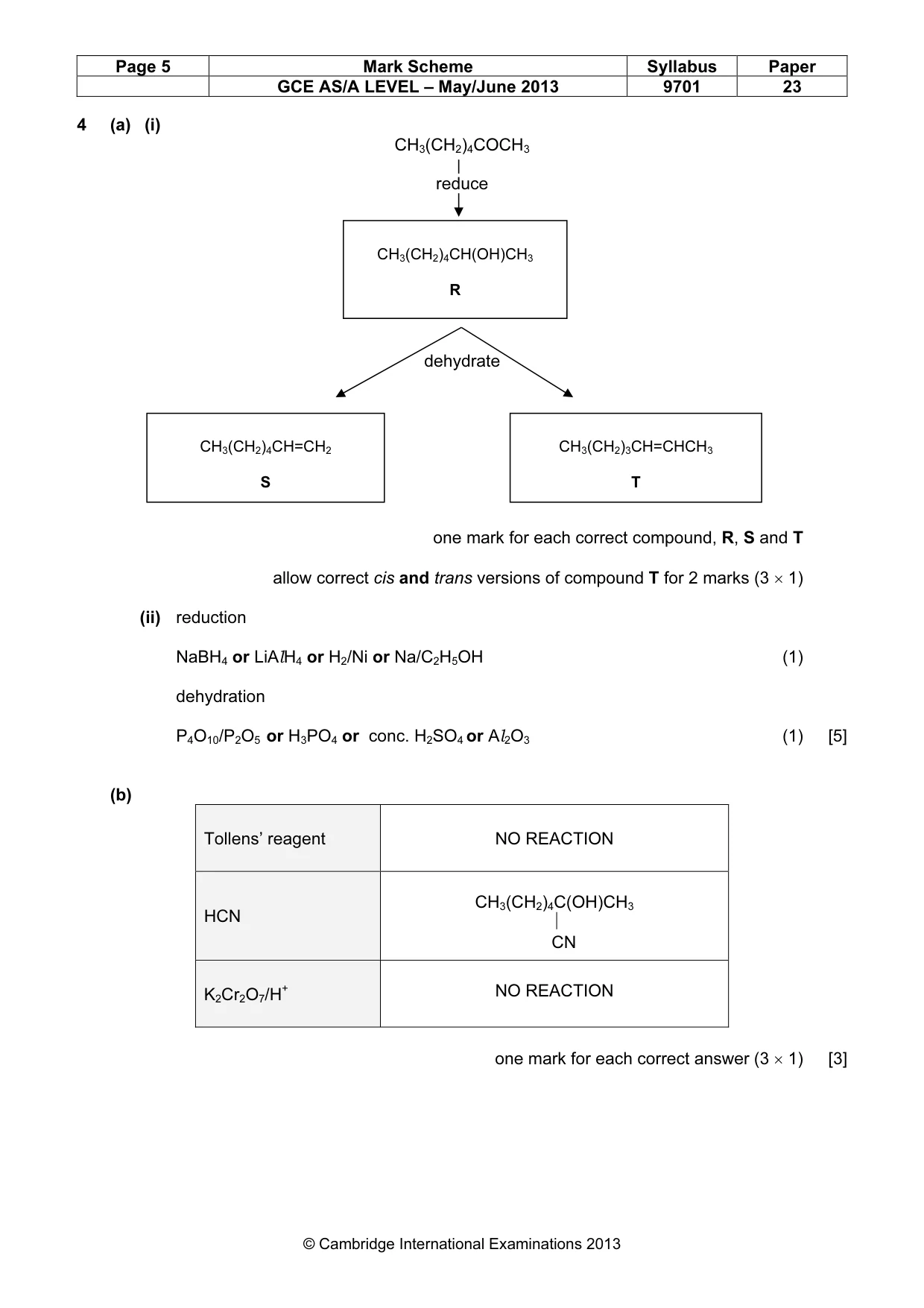
Page 5 Mark Scheme Syllabus Paper GCE AS/A LEVEL – May/June 2013 9701 23 © Cambridge International Examinations 2013 4 (a) (i) CH3(CH2)4COCH3 reduce dehydrate one mark for each correct compound, R, S and T allow correct cis and trans versions of compound T for 2 marks (3 × 1) (ii) reduction NaBH4 or LiAlH4 or H2/Ni or Na/C2H5OH (1) dehydration P4O10/P2O5 or H3PO4 or conc. H2SO4 or Al2O3 (1) [5] (b) Tollens’ reagent NO REACTION HCN CH3(CH2)4C(OH)CH3 CN K2Cr2O7/H+ NO REACTION one mark for each correct answer (3 × 1) [3] CH3(CH2)4CH(OH)CH3 R CH3(CH2)3CH=CHCH3 T CH3(CH2)4CH=CH2 S
Mark scheme, page 6
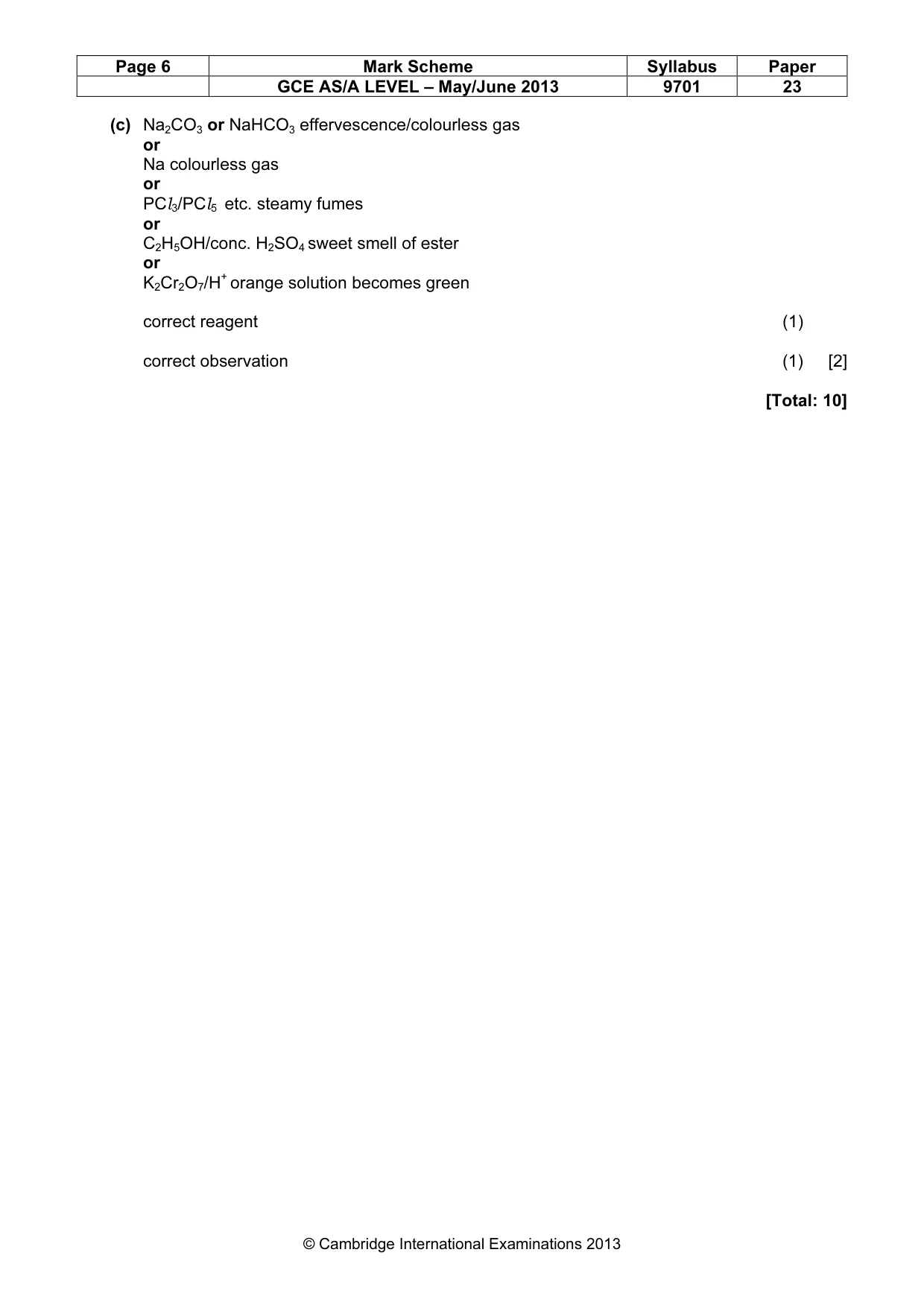
Page 6 Mark Scheme Syllabus Paper GCE AS/A LEVEL – May/June 2013 9701 23 © Cambridge International Examinations 2013 (c) Na2CO3 or NaHCO3 effervescence/colourless gas or Na colourless gas or PCl3/PCl5 etc. steamy fumes or C2H5OH/conc. H2SO4 sweet smell of ester or K2Cr2O7/H+ orange solution becomes green correct reagent (1) correct observation (1) [2] [Total: 10]
Mark scheme, page 7
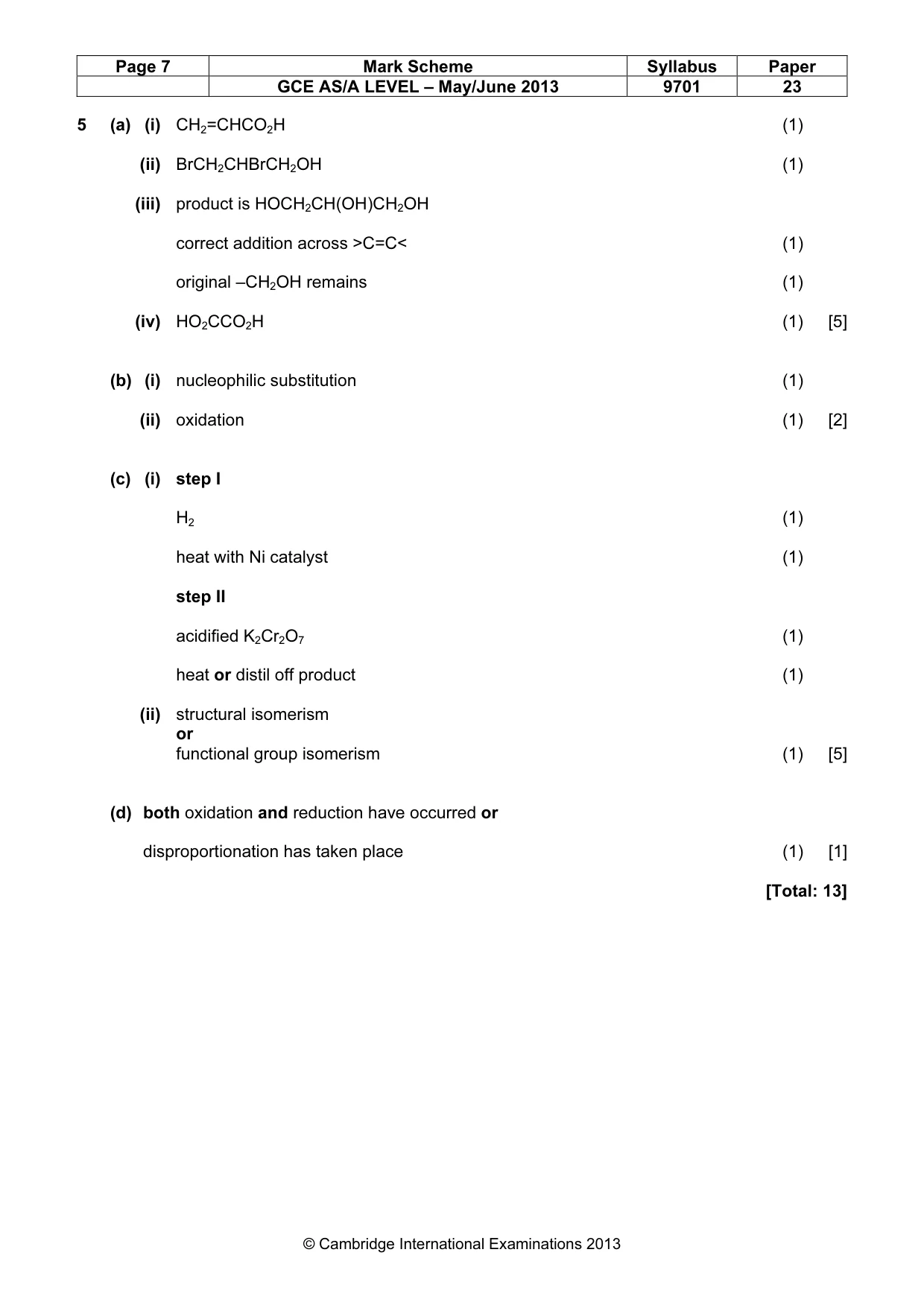
Page 7 Mark Scheme Syllabus Paper GCE AS/A LEVEL – May/June 2013 9701 23 © Cambridge International Examinations 2013 5 (a) (i) CH2=CHCO2H (1) (ii) BrCH2CHBrCH2OH (1) (iii) product is HOCH2CH(OH)CH2OH correct addition across >C=C< (1) original –CH2OH remains (1) (iv) HO2CCO2H (1) [5] (b) (i) nucleophilic substitution (1) (ii) oxidation (1) [2] (c) (i) step I H2 (1) heat with Ni catalyst (1) step II acidified K2Cr2O7 (1) heat or distil off product (1) (ii) structural isomerism or functional group isomerism (1) [5] (d) both oxidation and reduction have occurred or disproportionation has taken place (1) [1] [Total: 13]
What you needed in this session
Cambridge’s own grade thresholds for 2013 May/June, Paper 2 · Variant 3. A higher threshold means an easier paper — the bar moves with how the cohort did.