Cambridge A Level Chemistry 9701 — 2012 Oct/Nov Paper 4 · Variant 2
9701/42/O/N/12 · 100 marks · ≈113 min
The question paper and its mark scheme, free to read here and free to download. This is Cambridge’s own paper, exactly as it was sat.
Question paper20 pages



Mark scheme11 pages
Answers below. Sit the paper first if you are practising.
Paper as text
Question paper, page 1
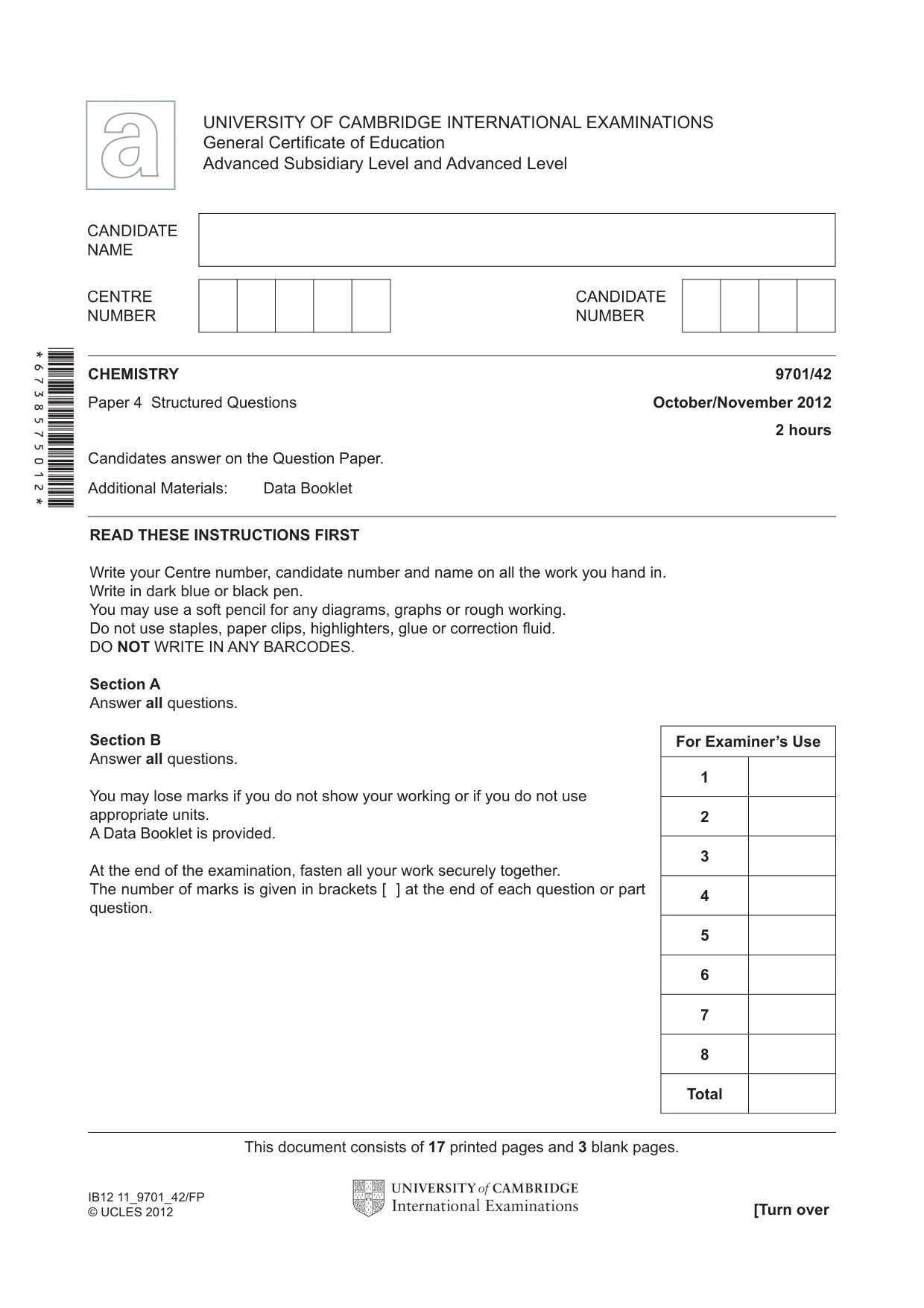
READ THESE INSTRUCTIONS FIRST Write your Centre number, candidate number and name on all the work you hand in. Write in dark blue or black pen. You may use a soft pencil for any diagrams, graphs or rough working. Do not use staples, paper clips, highlighters, glue or correction fl uid. DO NOT WRITE IN ANY BARCODES. Section A Answer all questions. Section B Answer all questions. You may lose marks if you do not show your working or if you do not use appropriate units. A Data Booklet is provided. At the end of the examination, fasten all your work securely together. The number of marks is given in brackets [ ] at the end of each question or part question. CHEMISTRY 9701/42 Paper 4 Structured Questions October/November 2012 2 hours Candidates answer on the Question Paper. Additional Materials: Data Booklet UNIVERSITY OF CAMBRIDGE INTERNATIONAL EXAMINATIONS General Certifi cate of Education Advanced Subsidiary Level and Advanced Level This document consists of 17 printed pages and 3 blank pages. [Turn over IB12 11_9701_42/FP © UCLES 2012 *6738575012* For Examiner’s Use 1 2 3 4 5 6 7 8 Total
Question paper, page 2
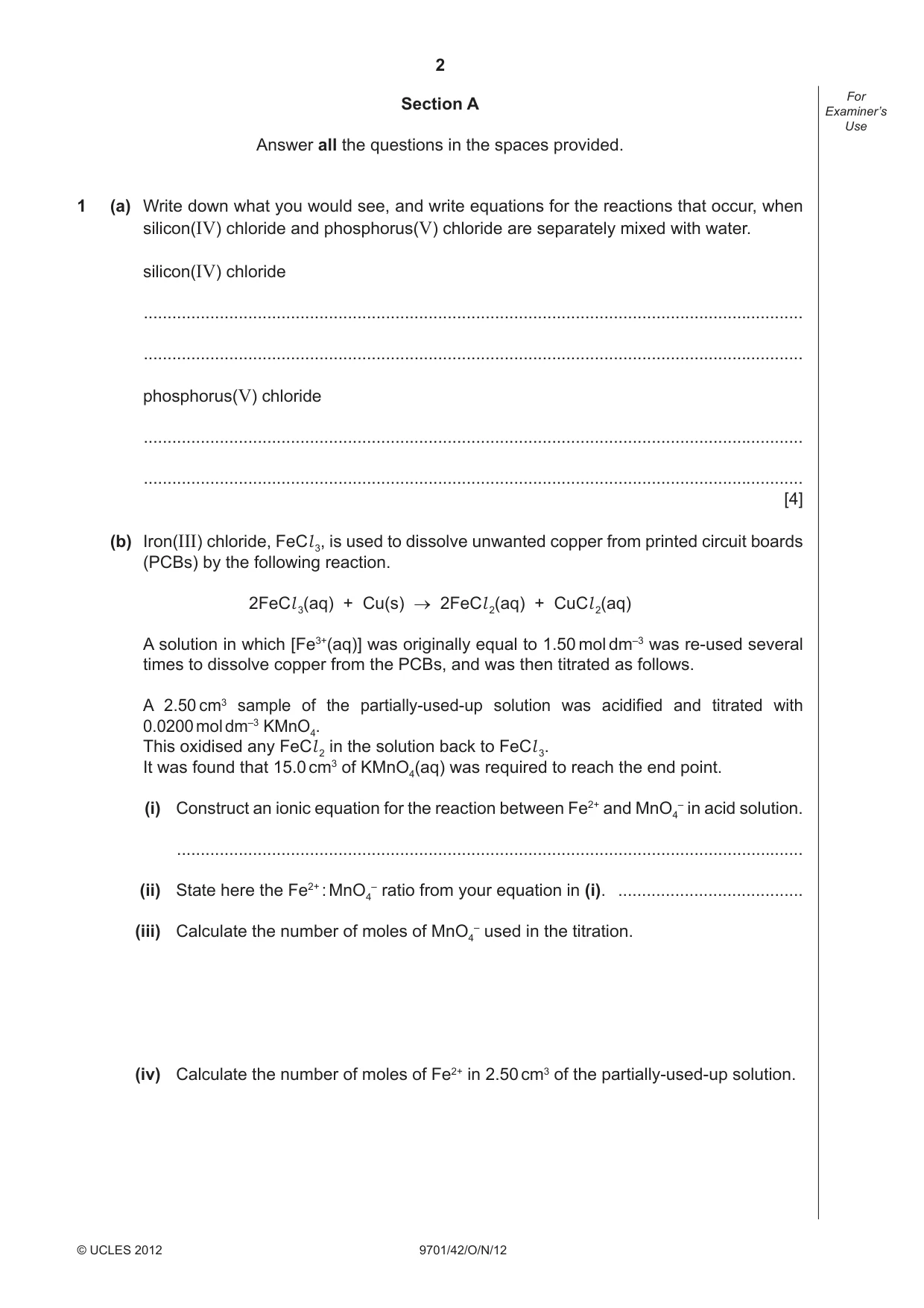
2 9701/42/O/N/12 © UCLES 2012 For Examiner’s Use Section A Answer all the questions in the spaces provided. 1 (a) Write down what you would see, and write equations for the reactions that occur, when silicon(IV) chloride and phosphorus(V) chloride are separately mixed with water. silicon(IV) chloride … … phosphorus(V) chloride … … [4] (b) Iron(III) chloride, FeCl 3, is used to dissolve unwanted copper from printed circuit boards (PCBs) by the following reaction. 2FeCl 3(aq) + Cu(s) → 2FeCl 2(aq) + CuCl 2(aq) A solution in which [Fe3+(aq)] was originally equal to 1.50 mol dm–3 was re-used several times to dissolve copper from the PCBs, and was then titrated as follows. A 2.50 cm3 sample of the partially-used-up solution was acidifi ed and titrated with 0.0200 mol dm–3 KMnO4. This oxidised any FeCl 2 in the solution back to FeCl 3. It was found that 15.0 cm3 of KMnO4(aq) was required to reach the end point. (i) Construct an ionic equation for the reaction between Fe2+ and MnO4 – in acid solution. … (ii) State here the Fe2+ : MnO4 – ratio from your equation in (i). … (iii) Calculate the number of moles of MnO4 – used in the titration. (iv) Calculate the number of moles of Fe2+ in 2.50 cm3 of the partially-used-up solution.
Question paper, page 3
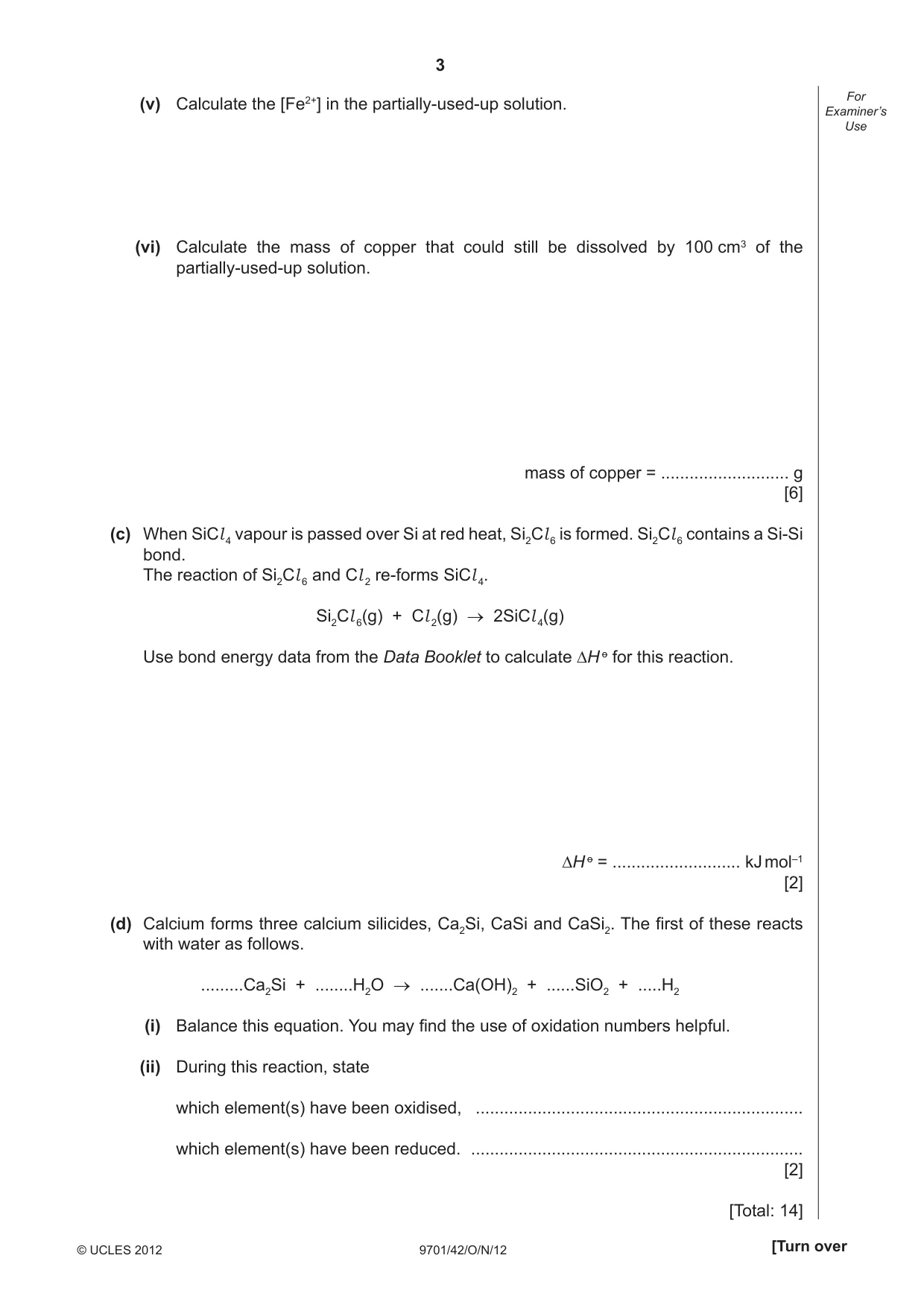
3 9701/42/O/N/12 © UCLES 2012 [Turn over For Examiner’s Use (v) Calculate the [Fe2+] in the partially-used-up solution. (vi) Calculate the mass of copper that could still be dissolved by 100 cm3 of the partially-used-up solution. mass of copper = … g [6] (c) When SiCl 4 vapour is passed over Si at red heat, Si2Cl 6 is formed. Si2Cl 6 contains a Si-Si bond. The reaction of Si2Cl 6 and Cl 2 re-forms SiCl 4. Si2Cl 6(g) + Cl 2(g) → 2SiCl 4(g) Use bond energy data from the Data Booklet to calculate ∆H o for this reaction. ∆H o = … kJ mol–1 [2] (d) Calcium forms three calcium silicides, Ca2Si, CaSi and CaSi2. The fi rst of these reacts with water as follows. …Ca2Si + …H2O → …Ca(OH)2 + …SiO2 + …H2 (i) Balance this equation. You may fi nd the use of oxidation numbers helpful. (ii) During this reaction, state which element(s) have been oxidised, … which element(s) have been reduced. … [2] [Total: 14]
Question paper, page 4
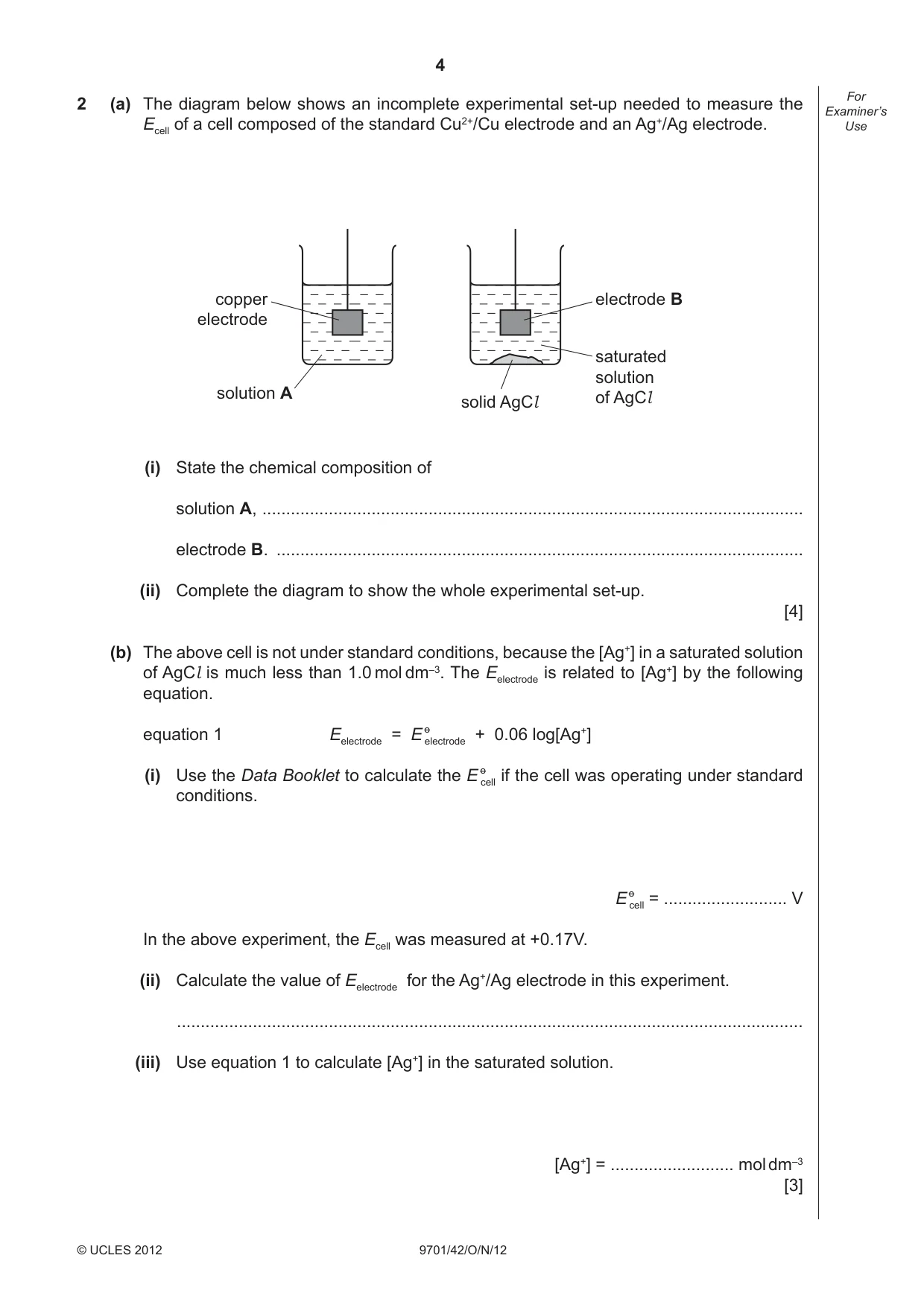
4 9701/42/O/N/12 © UCLES 2012 For Examiner’s Use 2 (a) The diagram below shows an incomplete experimental set-up needed to measure the Ecell of a cell composed of the standard Cu2+/Cu electrode and an Ag+/Ag electrode. copper electrode solution A electrode B saturated solution of AgCl solid AgCl (i) State the chemical composition of solution A, … electrode B. … (ii) Complete the diagram to show the whole experimental set-up. [4] (b) The above cell is not under standard conditions, because the [Ag+] in a saturated solution of AgCl is much less than 1.0 mol dm–3. The Eelectrode is related to [Ag+] by the following equation. equation 1 Eelectrode = E electrode + 0.06 log[Ag+] (i) Use the Data Booklet to calculate the E cell if the cell was operating under standard conditions. E cell = … V In the above experiment, the Ecell was measured at +0.17V. (ii) Calculate the value of Eelectrode for the Ag+/Ag electrode in this experiment. … (iii) Use equation 1 to calculate [Ag+] in the saturated solution. [Ag+] = … mol dm–3 [3] o o o
Question paper, page 5
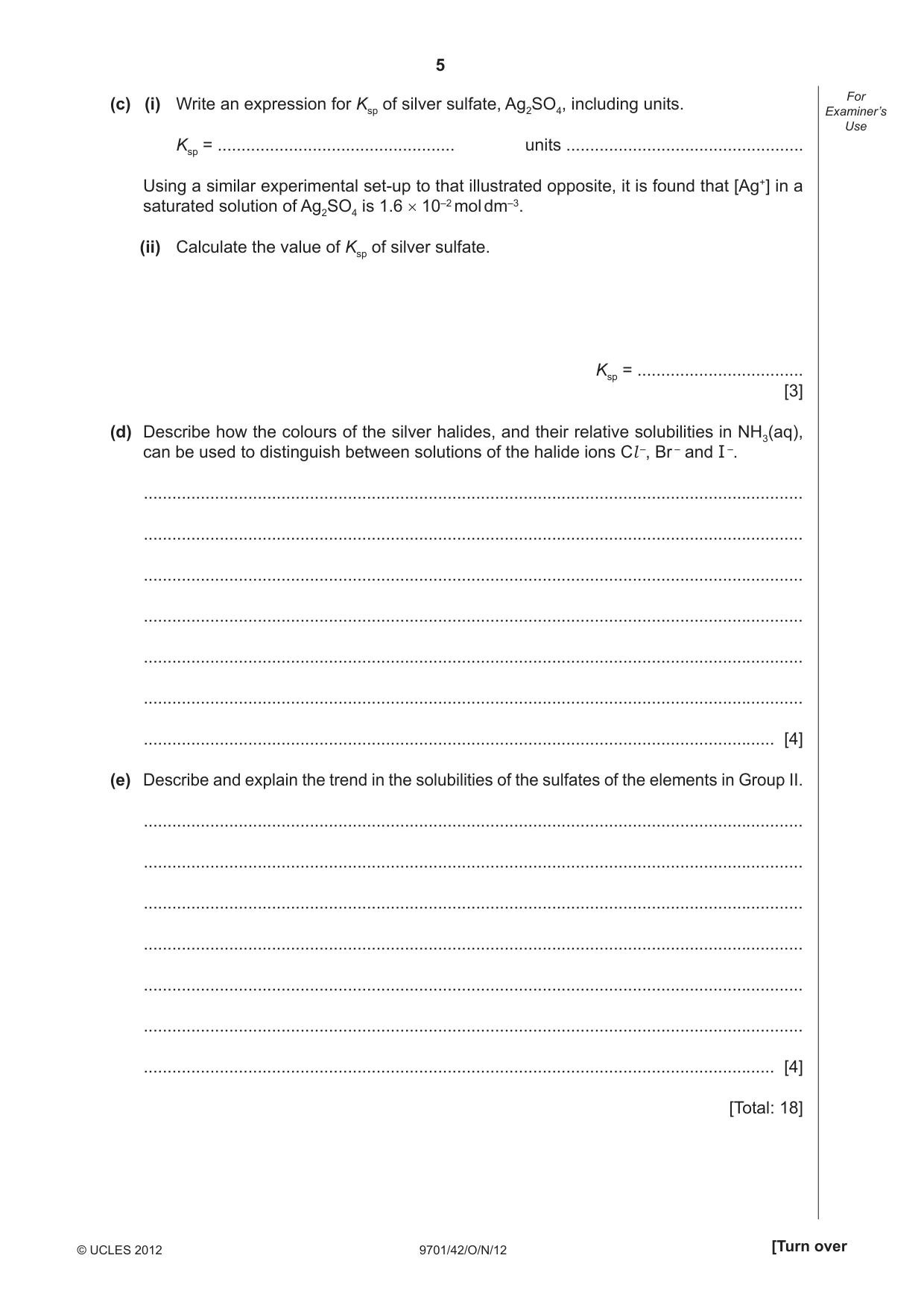
5 9701/42/O/N/12 © UCLES 2012 [Turn over For Examiner’s Use (c) (i) Write an expression for Ksp of silver sulfate, Ag2SO4, including units. Ksp = … units … Using a similar experimental set-up to that illustrated opposite, it is found that [Ag+] in a saturated solution of Ag2SO4 is 1.6 × 10⁻² mol dm–3. (ii) Calculate the value of Ksp of silver sulfate. Ksp = … [3] (d) Describe how the colours of the silver halides, and their relative solubilities in NH3(aq), can be used to distinguish between solutions of the halide ions Cl –, Br – and I –. … … … … … … … [4] (e) Describe and explain the trend in the solubilities of the sulfates of the elements in Group II. … … … … … … … [4] [Total: 18]
Question paper, page 6
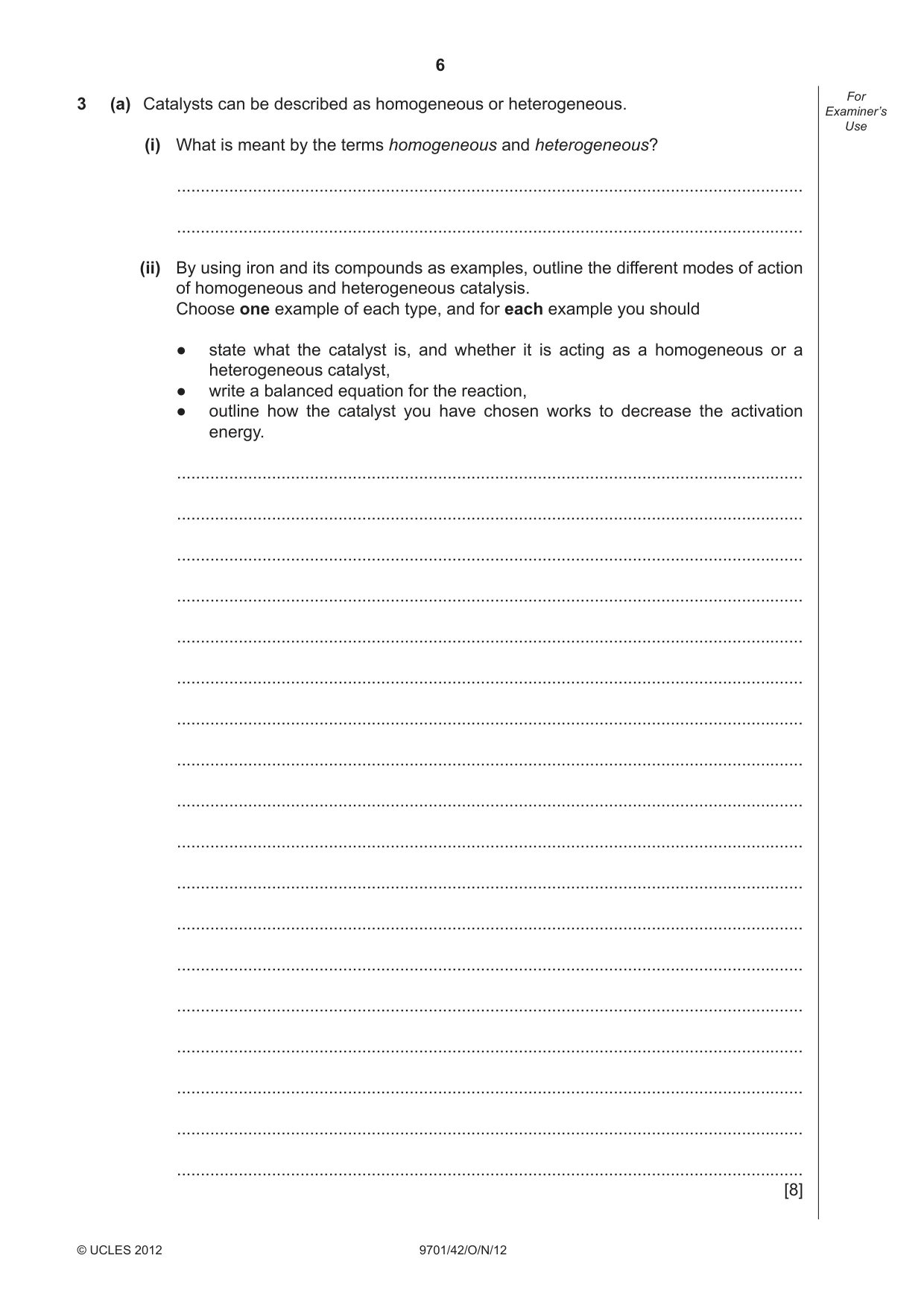
6 9701/42/O/N/12 © UCLES 2012 For Examiner’s Use 3 (a) Catalysts can be described as homogeneous or heterogeneous. (i) What is meant by the terms homogeneous and heterogeneous? … … (ii) By using iron and its compounds as examples, outline the different modes of action of homogeneous and heterogeneous catalysis. Choose one example of each type, and for each example you should ● state what the catalyst is, and whether it is acting as a homogeneous or a heterogeneous catalyst, ● write a balanced equation for the reaction, ● outline how the catalyst you have chosen works to decrease the activation energy. … … … … … … … … … … … … … … … … … … [8]
Question paper, page 7
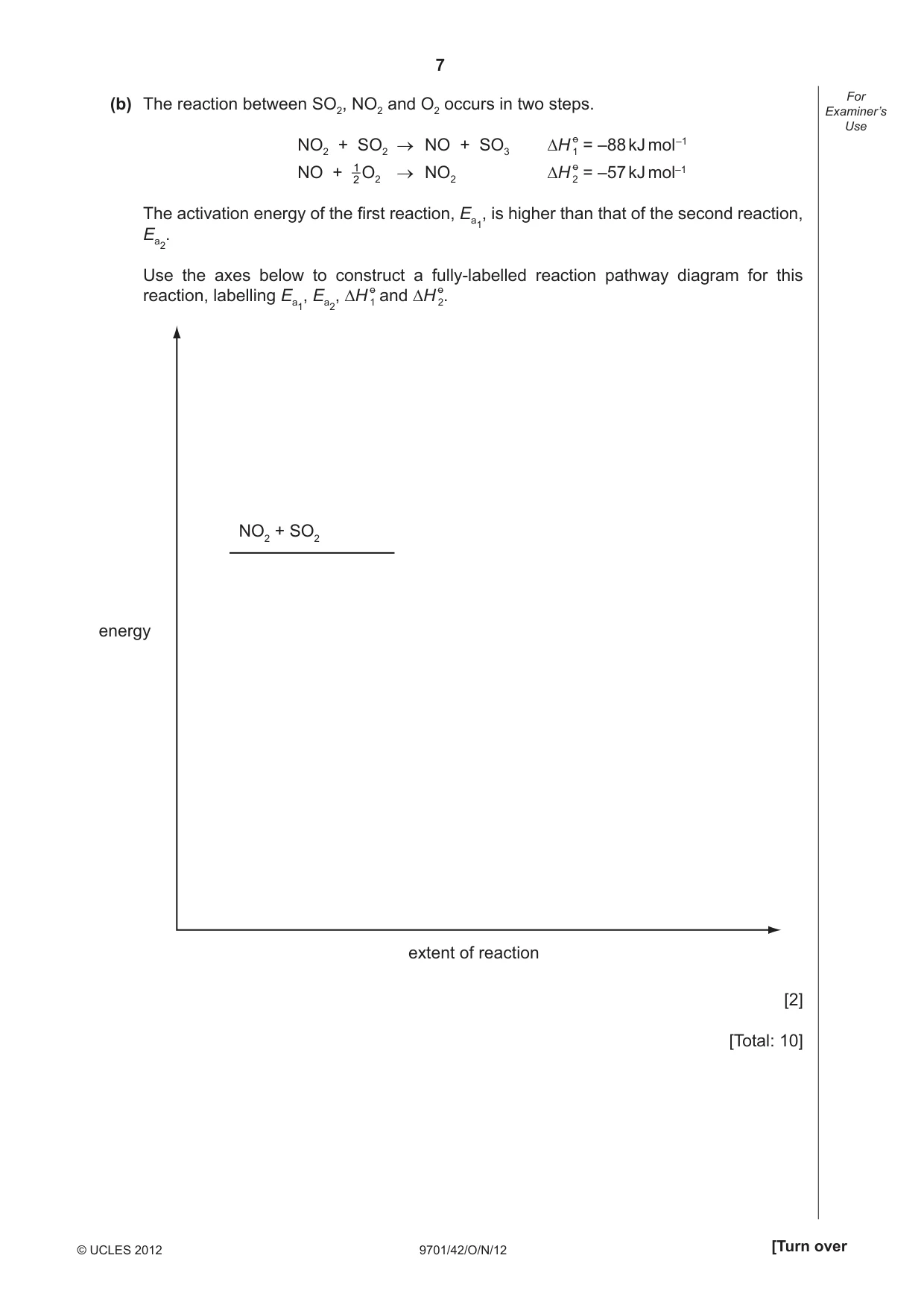
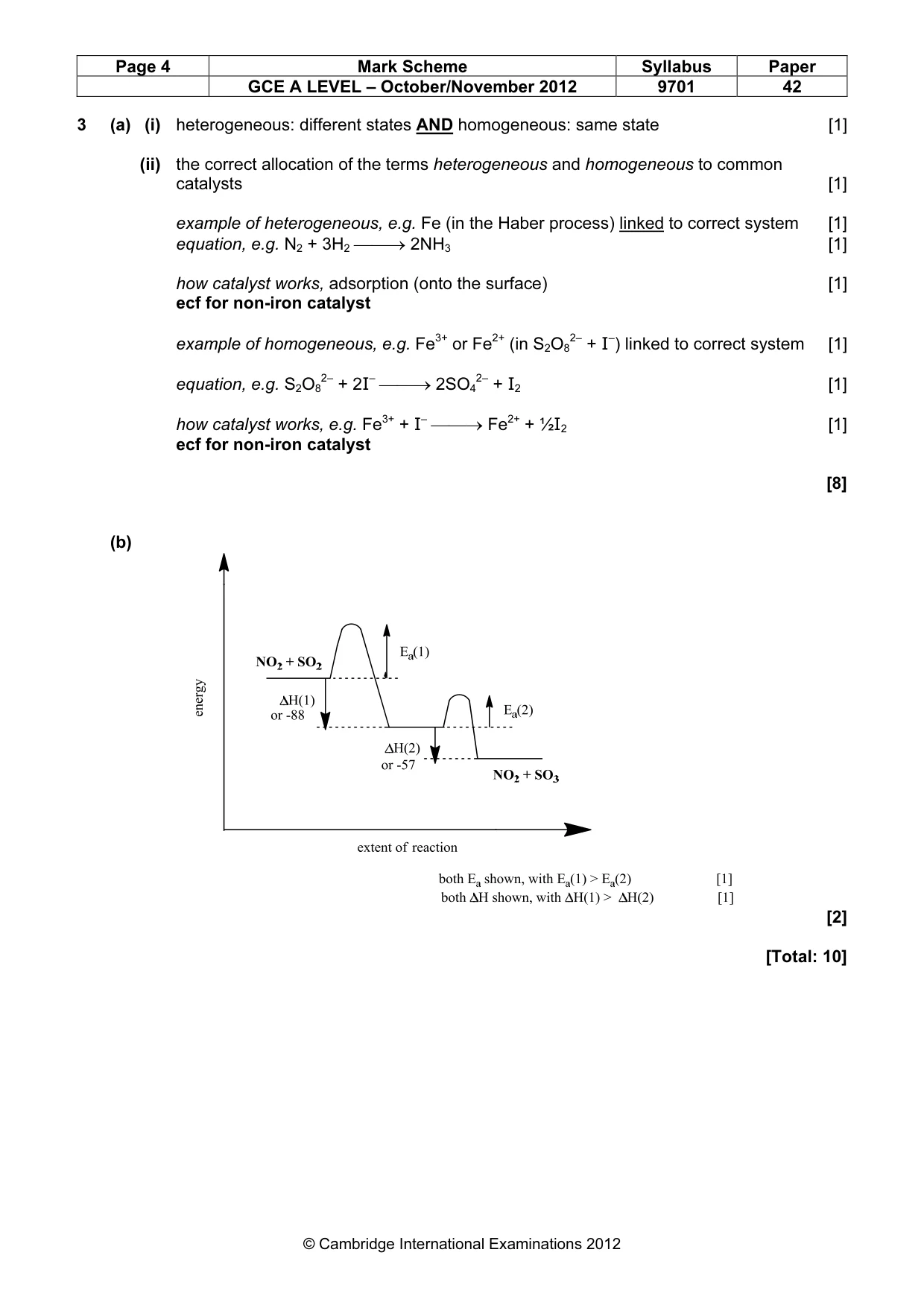
7 9701/42/O/N/12 © UCLES 2012 [Turn over For Examiner’s Use (b) The reaction between SO2, NO2 and O2 occurs in two steps. NO2 + SO2 → NO + SO3 ∆H 1 = –88 kJ mol–1 NO + 2 1O2 → NO2 ∆H 2 = –57 kJ mol–1 The activation energy of the fi rst reaction, Ea1, is higher than that of the second reaction, Ea2. Use the axes below to construct a fully-labelled reaction pathway diagram for this reaction, labelling Ea1, Ea2, ∆H 1 and ∆H 2. energy extent of reaction NO2 + SO2 [2] [Total: 10] o o o o
Question paper, page 8
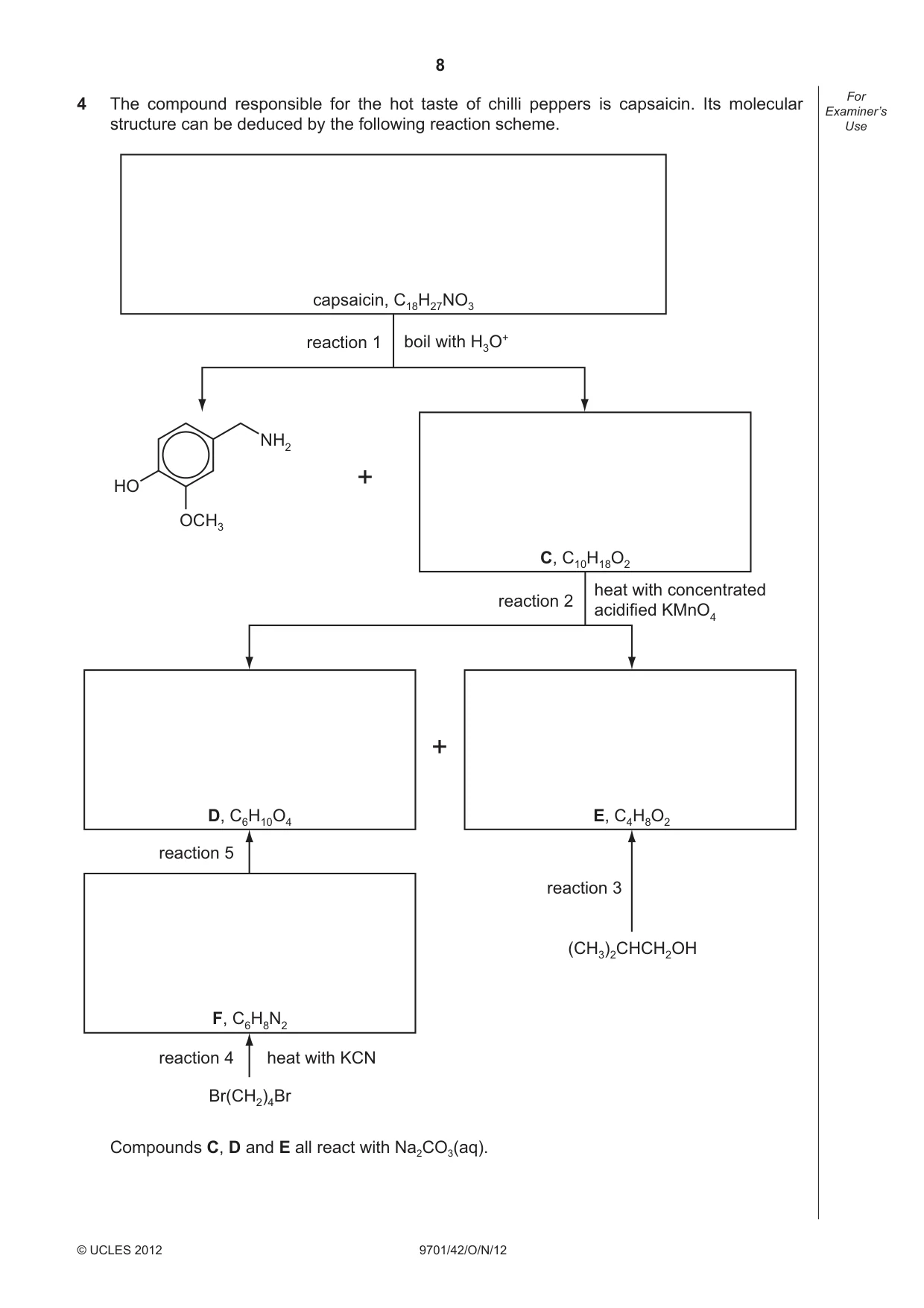
8 9701/42/O/N/12 © UCLES 2012 For Examiner’s Use 4 The compound responsible for the hot taste of chilli peppers is capsaicin. Its molecular structure can be deduced by the following reaction scheme. capsaicin, C18H27NO3 C, C10H18O2 D, C6H10O4 E, C4H8O2 + + boil with H3O+ reaction 5 reaction 3 reaction 4 heat with KCN heat with concentrated acidified KMnO4 NH2 OCH3 HO F, C6H8N2 Br(CH2)4Br (CH3)2CHCH2OH reaction 1 reaction 2 Compounds C, D and E all react with Na2CO3(aq).
Question paper, page 9
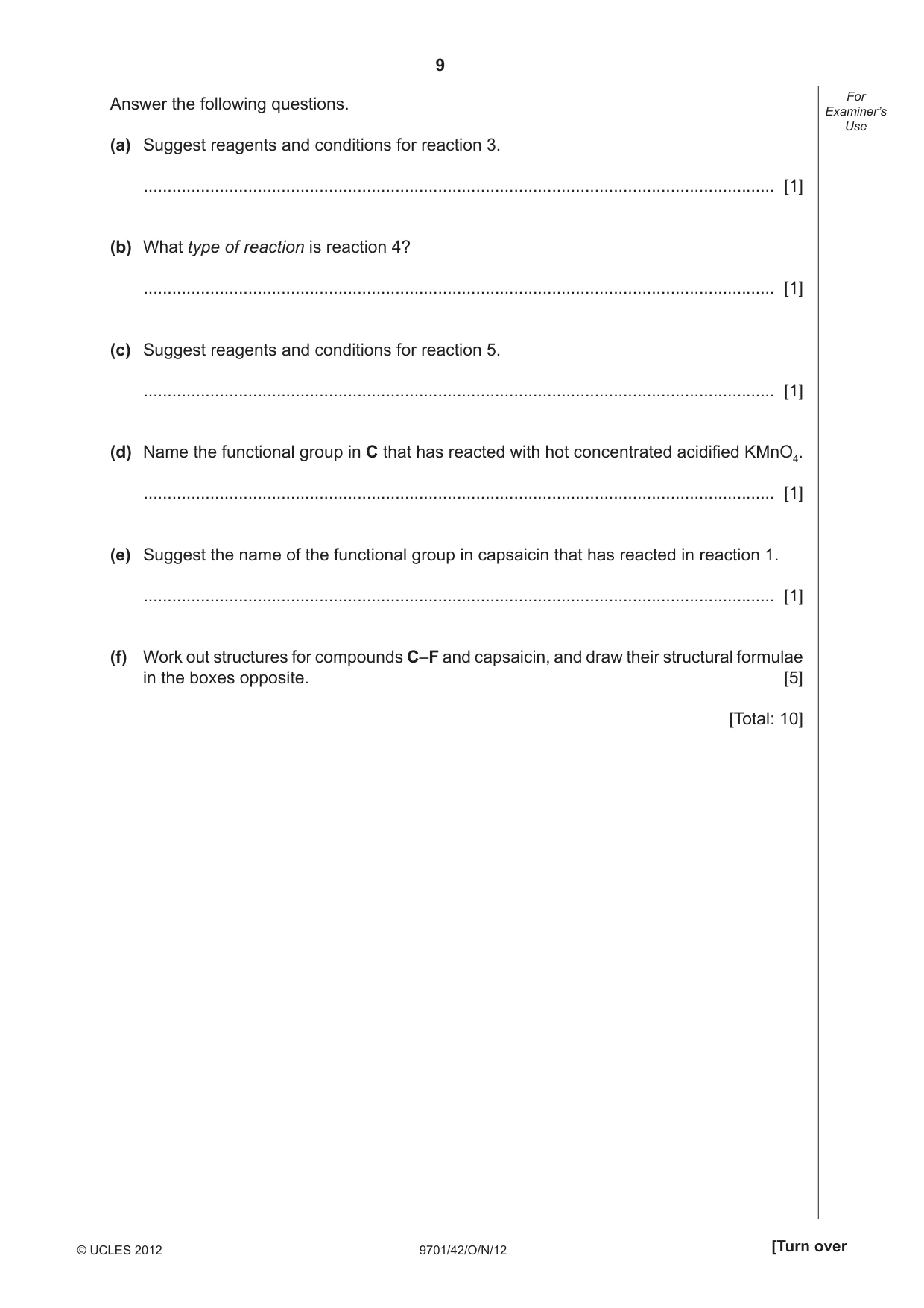
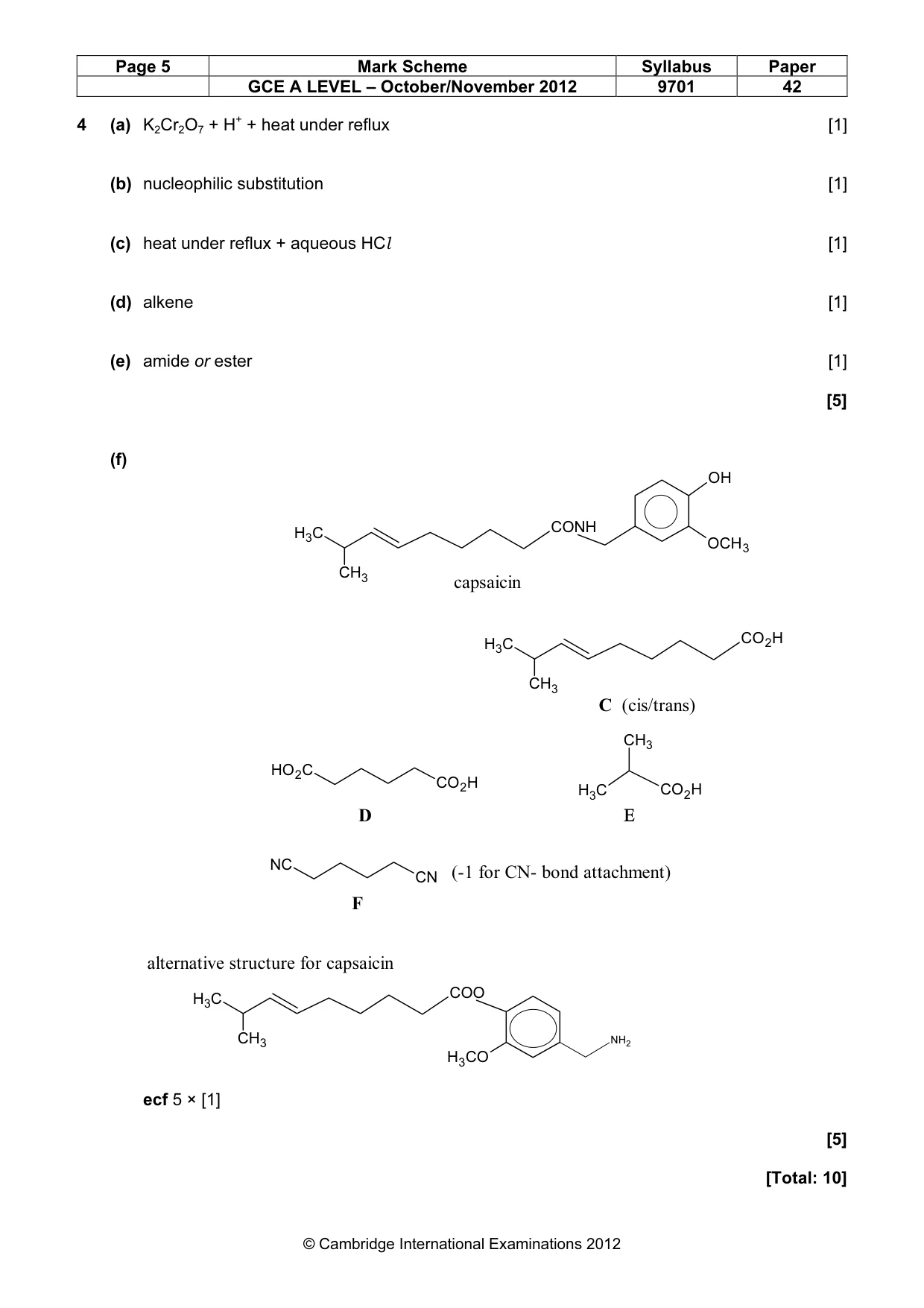
9 9701/42/O/N/12 © UCLES 2012 [Turn over For Examiner’s Use Answer the following questions. (a) Suggest reagents and conditions for reaction 3. … [1] (b) What type of reaction is reaction 4? … [1] (c) Suggest reagents and conditions for reaction 5. … [1] (d) Name the functional group in C that has reacted with hot concentrated acidifi ed KMnO4. … [1] (e) Suggest the name of the functional group in capsaicin that has reacted in reaction 1. … [1] (f) Work out structures for compounds C–F and capsaicin, and draw their structural formulae in the boxes opposite. [5] [Total: 10]
Question paper, page 10
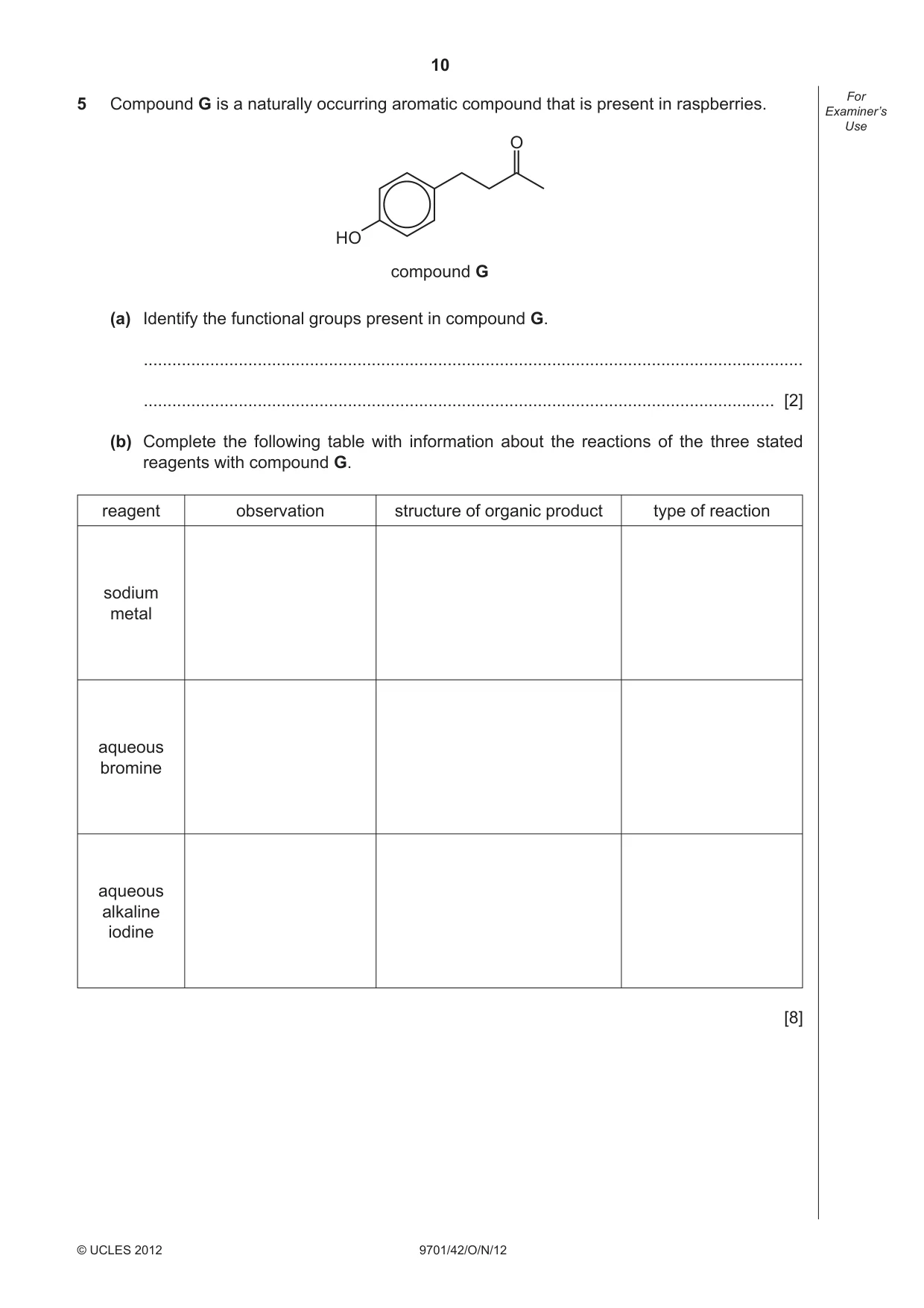
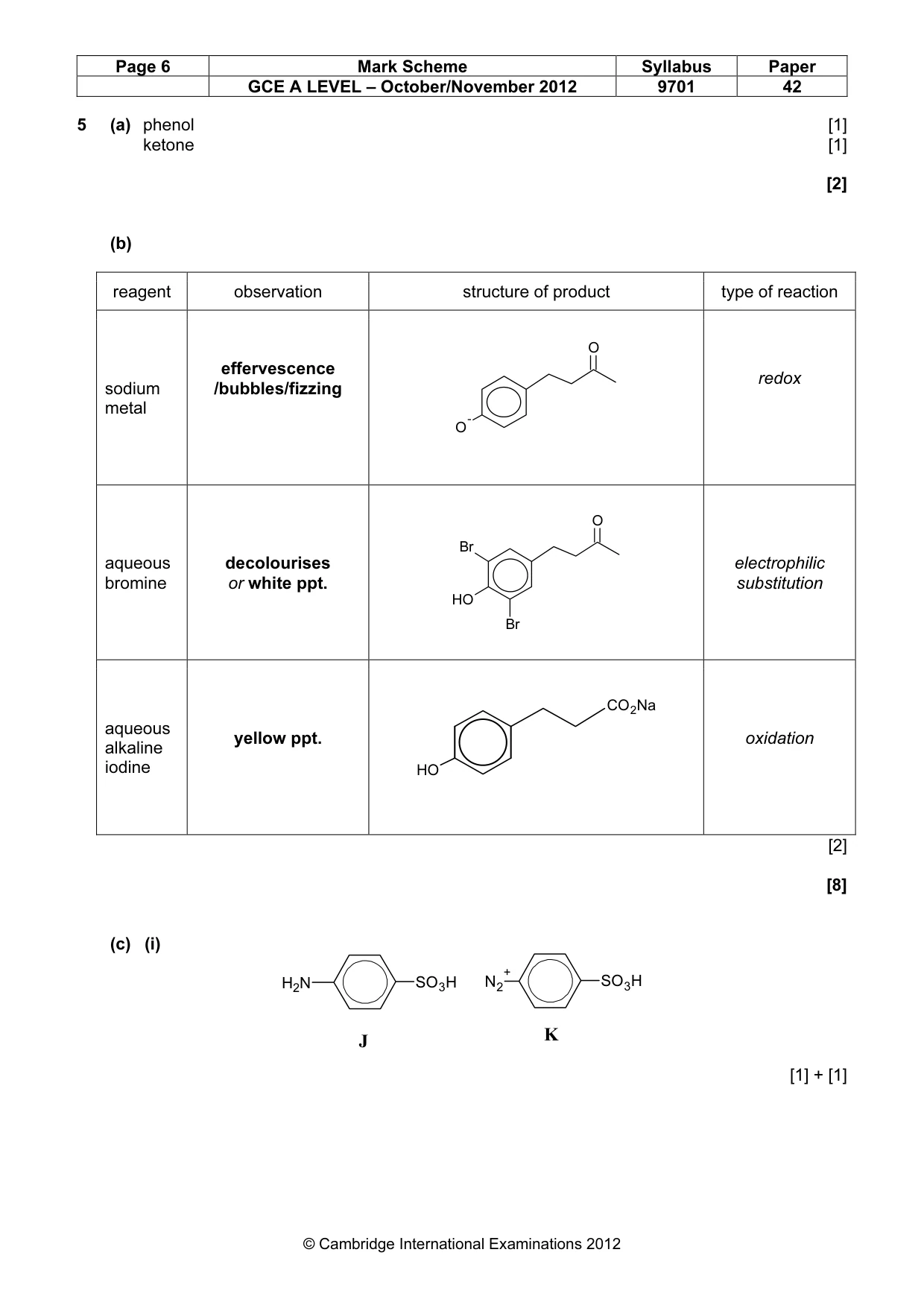
10 9701/42/O/N/12 © UCLES 2012 For Examiner’s Use 5 Compound G is a naturally occurring aromatic compound that is present in raspberries. HO O compound G (a) Identify the functional groups present in compound G. … … [2] (b) Complete the following table with information about the reactions of the three stated reagents with compound G. reagent observation structure of organic product type of reaction sodium metal aqueous bromine aqueous alkaline iodine [8]
Question paper, page 11
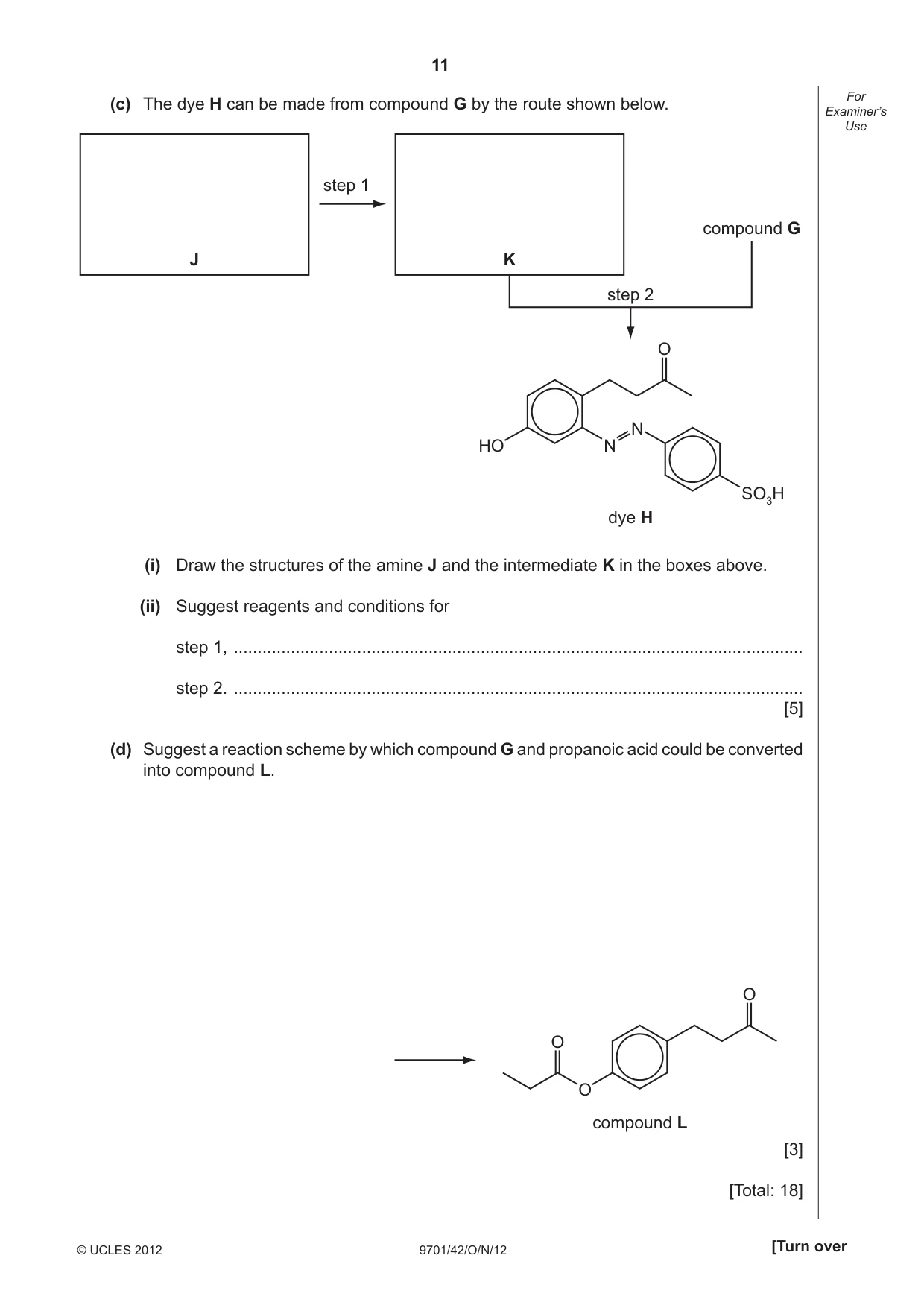
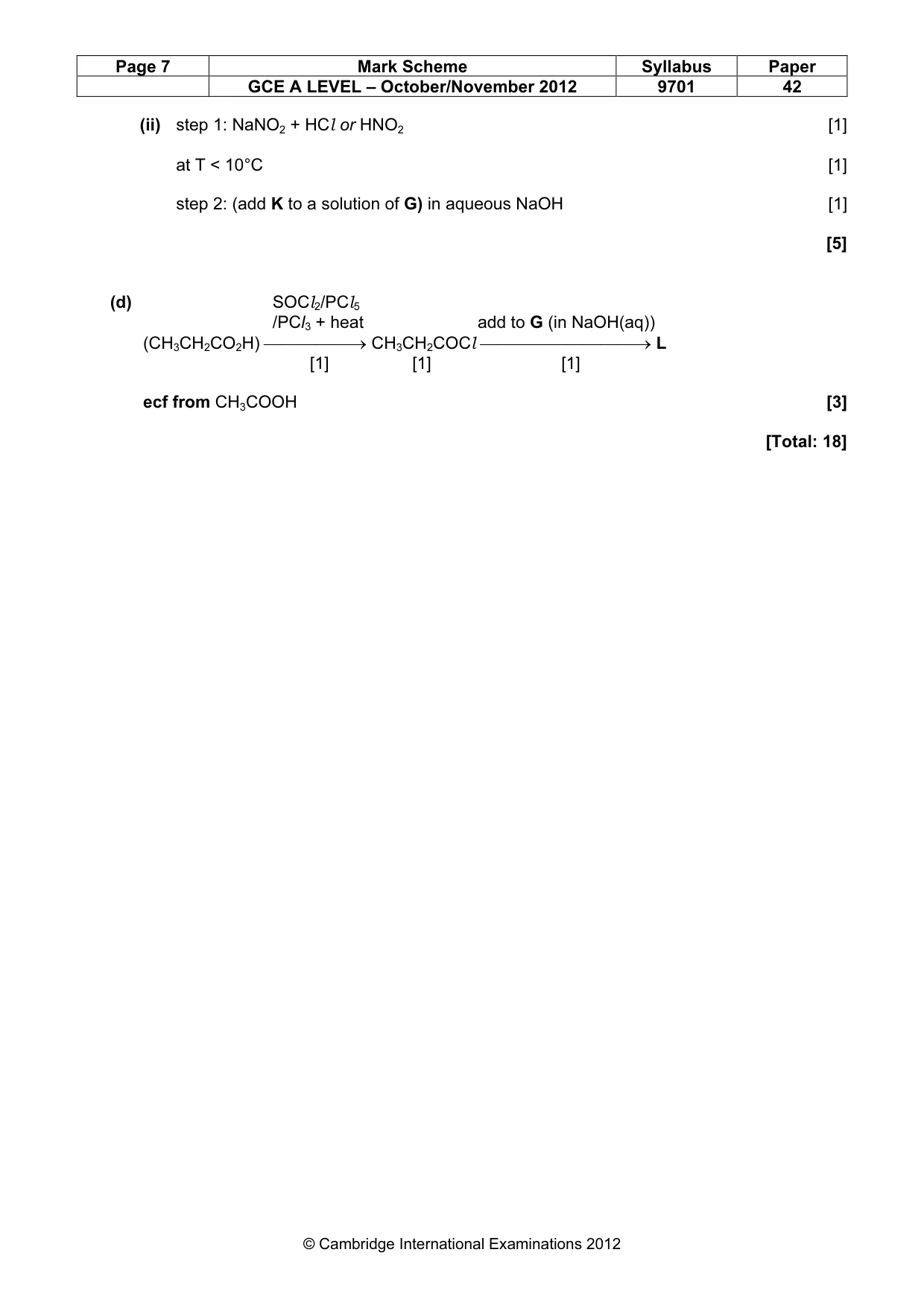
11 9701/42/O/N/12 © UCLES 2012 [Turn over For Examiner’s Use (c) The dye H can be made from compound G by the route shown below. J K step 1 step 2 compound G dye H HO N SO3H N O (i) Draw the structures of the amine J and the intermediate K in the boxes above. (ii) Suggest reagents and conditions for step 1, … step 2. … [5] (d) Suggest a reaction scheme by which compound G and propanoic acid could be converted into compound L. compound L O O O [3] [Total: 18]
Question paper, page 12
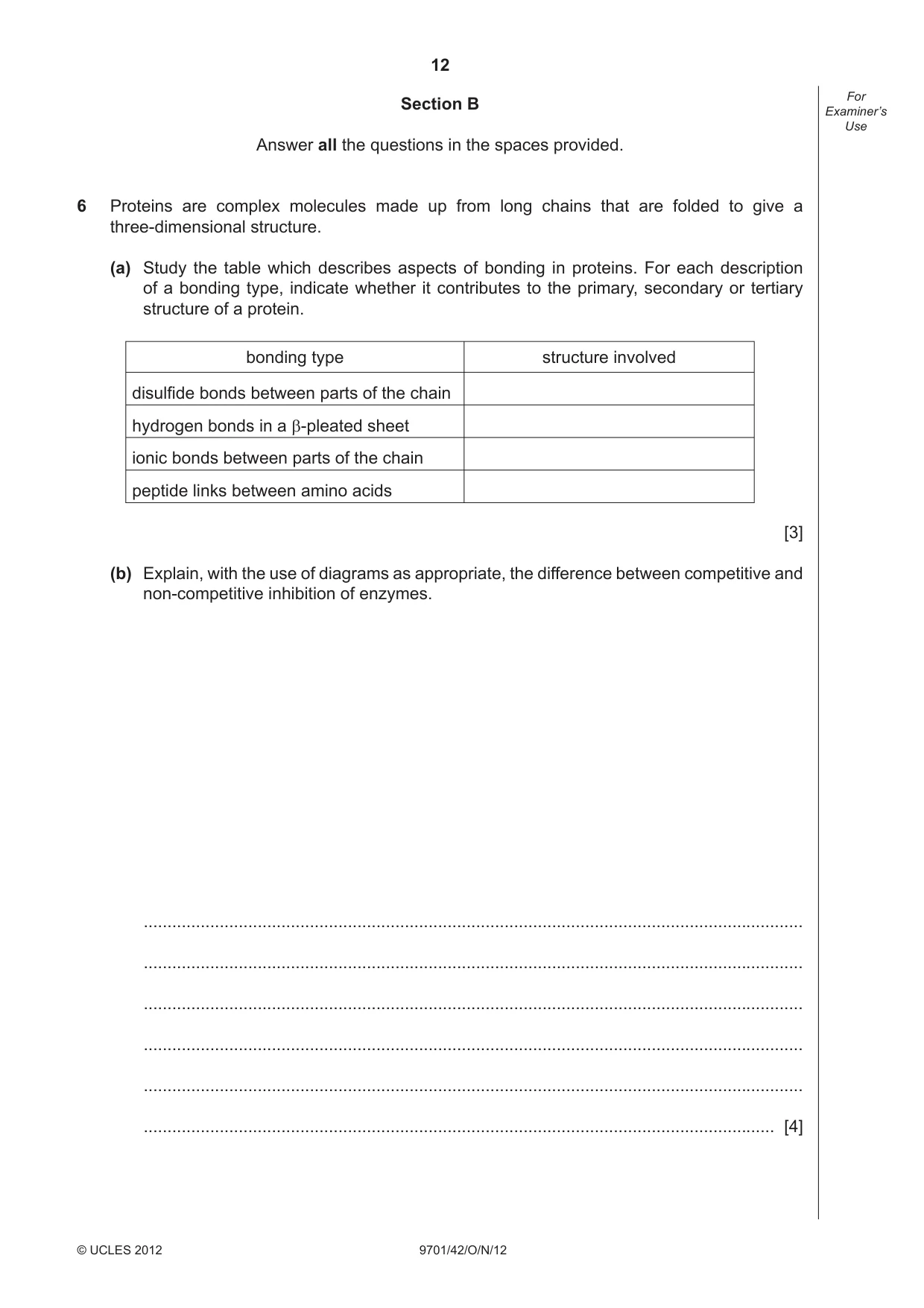
12 9701/42/O/N/12 © UCLES 2012 For Examiner’s Use Section B Answer all the questions in the spaces provided. 6 Proteins are complex molecules made up from long chains that are folded to give a three-dimensional structure. (a) Study the table which describes aspects of bonding in proteins. For each description of a bonding type, indicate whether it contributes to the primary, secondary or tertiary structure of a protein. bonding type structure involved disulfi de bonds between parts of the chain hydrogen bonds in a β-pleated sheet ionic bonds between parts of the chain peptide links between amino acids [3] (b) Explain, with the use of diagrams as appropriate, the difference between competitive and non-competitive inhibition of enzymes. … … … … … … [4]
Question paper, page 13
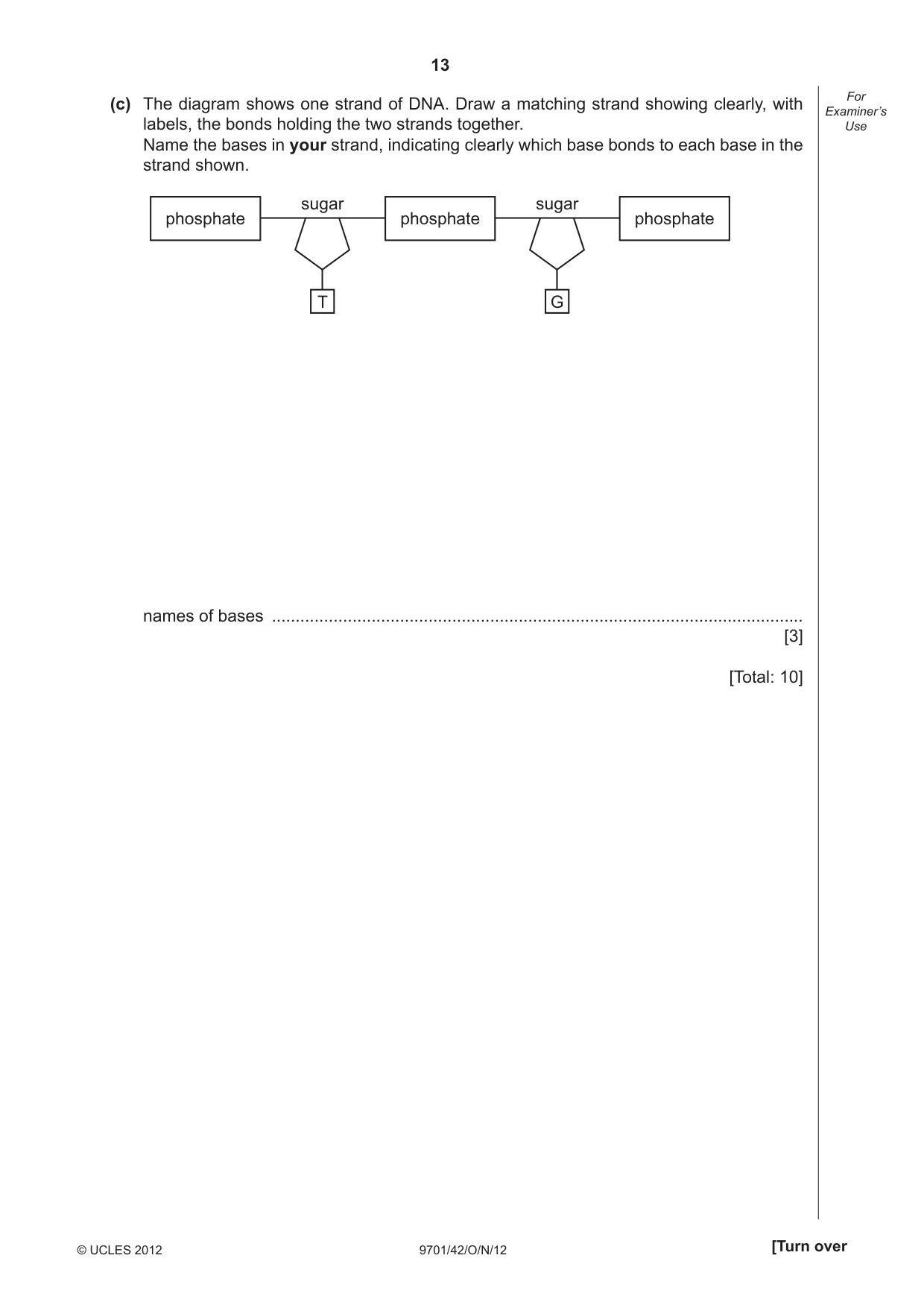
13 9701/42/O/N/12 © UCLES 2012 [Turn over For Examiner’s Use (c) The diagram shows one strand of DNA. Draw a matching strand showing clearly, with labels, the bonds holding the two strands together. Name the bases in your strand, indicating clearly which base bonds to each base in the strand shown. phosphate T phosphate phosphate G sugar sugar names of bases … [3] [Total: 10]
Question paper, page 14
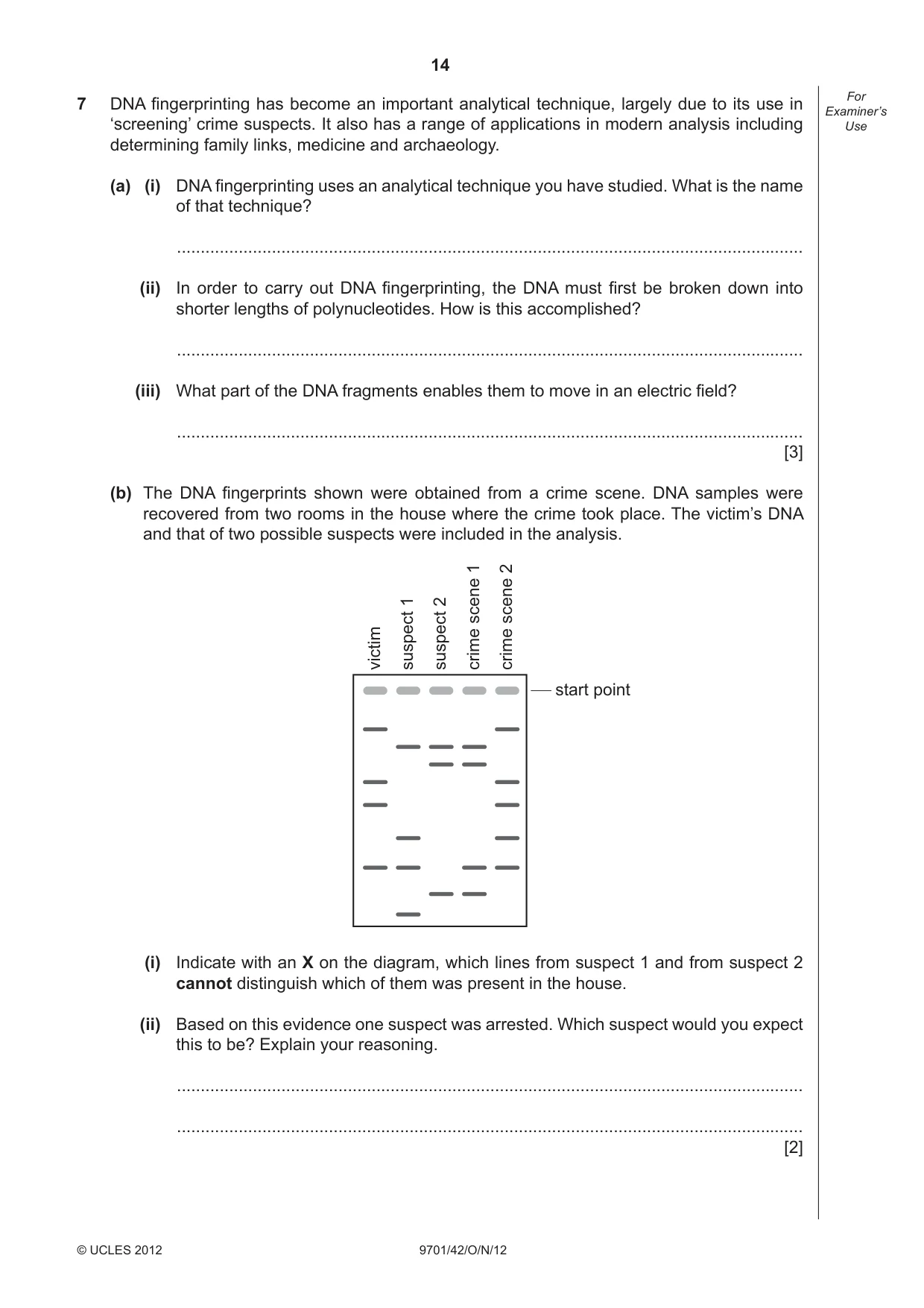
14 9701/42/O/N/12 © UCLES 2012 For Examiner’s Use 7 DNA fi ngerprinting has become an important analytical technique, largely due to its use in ‘screening’ crime suspects. It also has a range of applications in modern analysis including determining family links, medicine and archaeology. (a) (i) DNA fi ngerprinting uses an analytical technique you have studied. What is the name of that technique? … (ii) In order to carry out DNA fi ngerprinting, the DNA must fi rst be broken down into shorter lengths of polynucleotides. How is this accomplished? … (iii) What part of the DNA fragments enables them to move in an electric fi eld? … [3] (b) The DNA fi ngerprints shown were obtained from a crime scene. DNA samples were recovered from two rooms in the house where the crime took place. The victim’s DNA and that of two possible suspects were included in the analysis. victim suspect 1 suspect 2 crime scene 1 crime scene 2 start point (i) Indicate with an X on the diagram, which lines from suspect 1 and from suspect 2 cannot distinguish which of them was present in the house. (ii) Based on this evidence one suspect was arrested. Which suspect would you expect this to be? Explain your reasoning. … … [2]
Question paper, page 15
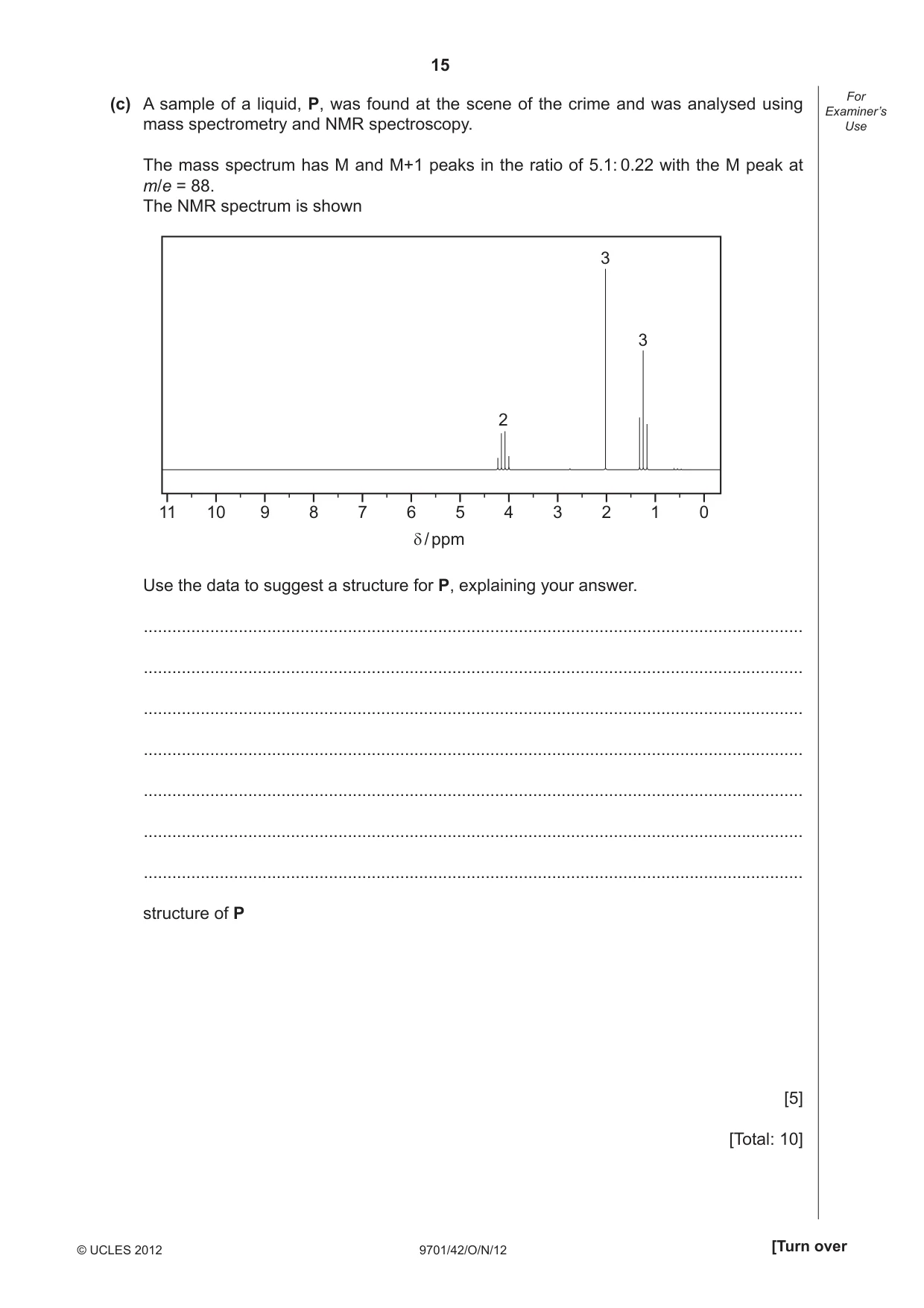
15 9701/42/O/N/12 © UCLES 2012 [Turn over For Examiner’s Use (c) A sample of a liquid, P, was found at the scene of the crime and was analysed using mass spectrometry and NMR spectroscopy. The mass spectrum has M and M+1 peaks in the ratio of 5.1: 0.22 with the M peak at m/e = 88. The NMR spectrum is shown 10 11 9 8 7 6 5 4 3 2 1 2 0 3 3 δ / ppm Use the data to suggest a structure for P, explaining your answer. … … … … … … … structure of P [5] [Total: 10]
Question paper, page 16
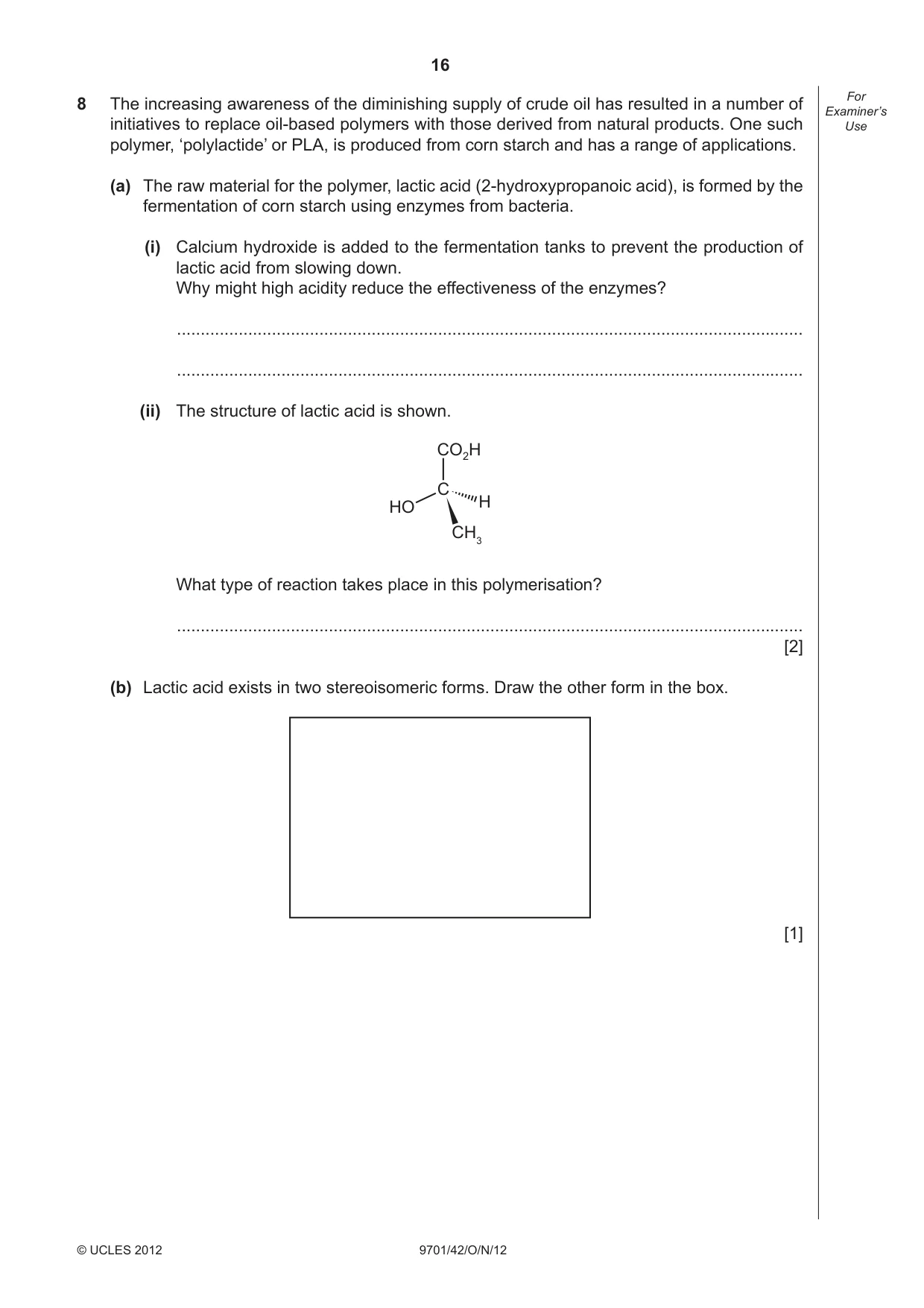
16 9701/42/O/N/12 © UCLES 2012 For Examiner’s Use 8 The increasing awareness of the diminishing supply of crude oil has resulted in a number of initiatives to replace oil-based polymers with those derived from natural products. One such polymer, ‘polylactide’ or PLA, is produced from corn starch and has a range of applications. (a) The raw material for the polymer, lactic acid (2-hydroxypropanoic acid), is formed by the fermentation of corn starch using enzymes from bacteria. (i) Calcium hydroxide is added to the fermentation tanks to prevent the production of lactic acid from slowing down. Why might high acidity reduce the effectiveness of the enzymes? … … (ii) The structure of lactic acid is shown. H C CO2H CH3 HO What type of reaction takes place in this polymerisation? … [2] (b) Lactic acid exists in two stereoisomeric forms. Draw the other form in the box. [1]
Question paper, page 17
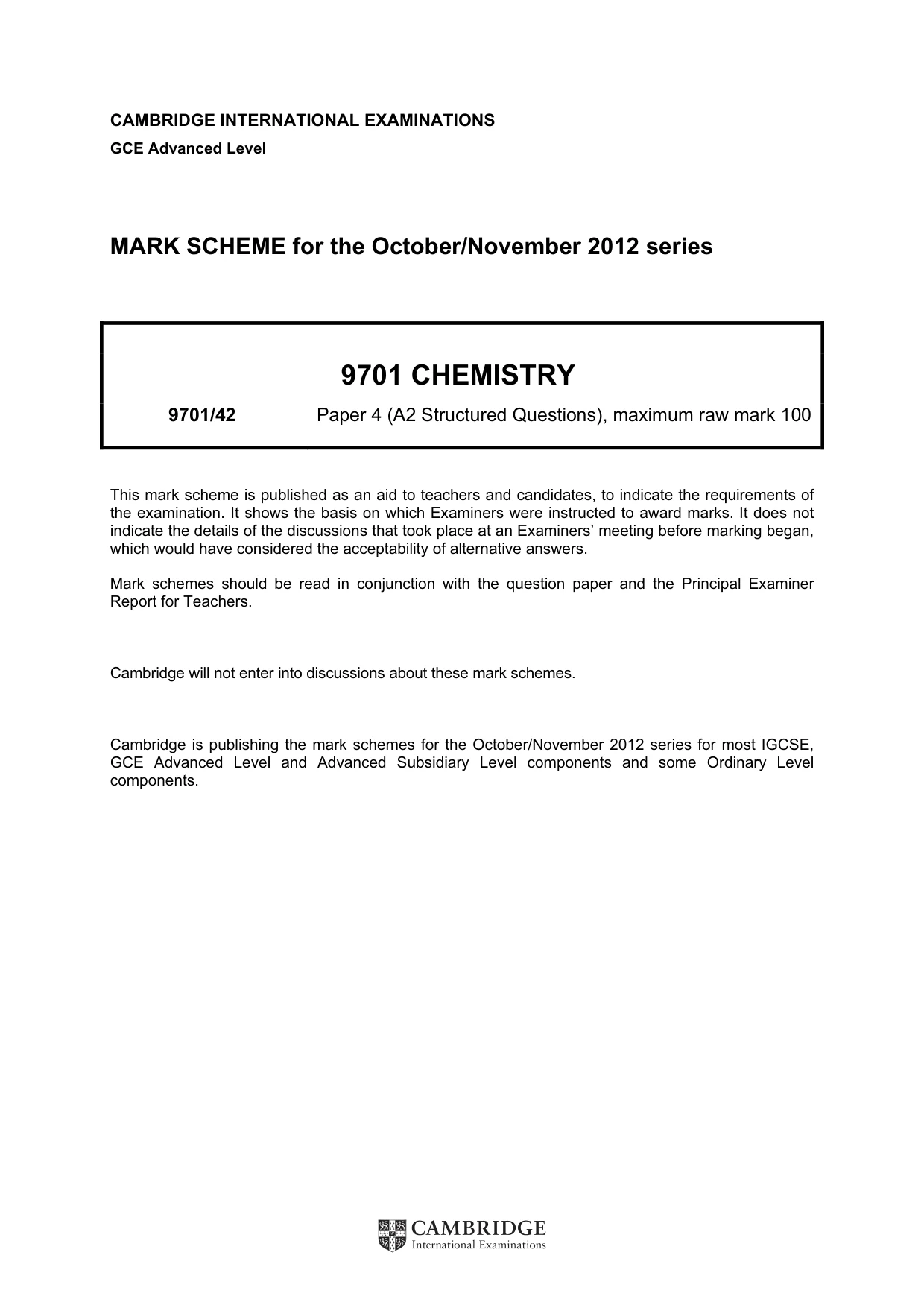
17 9701/42/O/N/12 © UCLES 2012 [Turn over For Examiner’s Use (c) One of the reasons PLA has attracted so much attention is that it is biodegradeable. This does, however, restrict some potential uses. The simple polymer has a melting point of around 175 °C, but softens between 60-80 °C. However, its thermoplastic properties enable it to have a range of uses in fi bres and in food packaging. (i) Explain why PLA would not be a suitable packaging material for foods pickled in vinegar. … … (ii) PLA containers are not used for hot drinks. Suggest why. … … [2] (d) Lactic acid can also be co-polymerised with glycolic acid. HO C H H C O OH glycolic acid (i) Draw a section of the co-polymer showing one repeat unit. (ii) Suggest what type(s) of bonding will occur between chains of this co-polymer, indicating the groups involved. … … … (iii) Suggest one property in which the co-polymer differs from PLA. … … [5] [Total: 10]
Question paper, page 18
18 9701/42/O/N/12 BLANK PAGE © UCLES 2012
Question paper, page 19
19 9701/42/O/N/12 BLANK PAGE © UCLES 2012
Question paper, page 20
20 Permission to reproduce items where third-party owned material protected by copyright is included has been sought and cleared where possible. Every reasonable effort has been made by the publisher (UCLES) to trace copyright holders, but if any items requiring clearance have unwittingly been included the publisher will be pleased to make amends at the earliest possible opportunity. University of Cambridge International Examinations is part of the Cambridge Assessment Group. Cambridge Assessment is the brand name of University of Cambridge Local Examinations Syndicate (UCLES), which is itself a department of the University of Cambridge. 9701/42/O/N/12 © UCLES 2012 BLANK PAGE
Mark scheme, page 1
CAMBRIDGE INTERNATIONAL EXAMINATIONS GCE Advanced Level MARK SCHEME for the October/November 2012 series 9701 CHEMISTRY 9701/42 Paper 4 (A2 Structured Questions), maximum raw mark 100 This mark scheme is published as an aid to teachers and candidates, to indicate the requirements of the examination. It shows the basis on which Examiners were instructed to award marks. It does not indicate the details of the discussions that took place at an Examiners’ meeting before marking began, which would have considered the acceptability of alternative answers. Mark schemes should be read in conjunction with the question paper and the Principal Examiner Report for Teachers. Cambridge will not enter into discussions about these mark schemes. Cambridge is publishing the mark schemes for the October/November 2012 series for most IGCSE, GCE Advanced Level and Advanced Subsidiary Level components and some Ordinary Level components.
Mark scheme, page 2
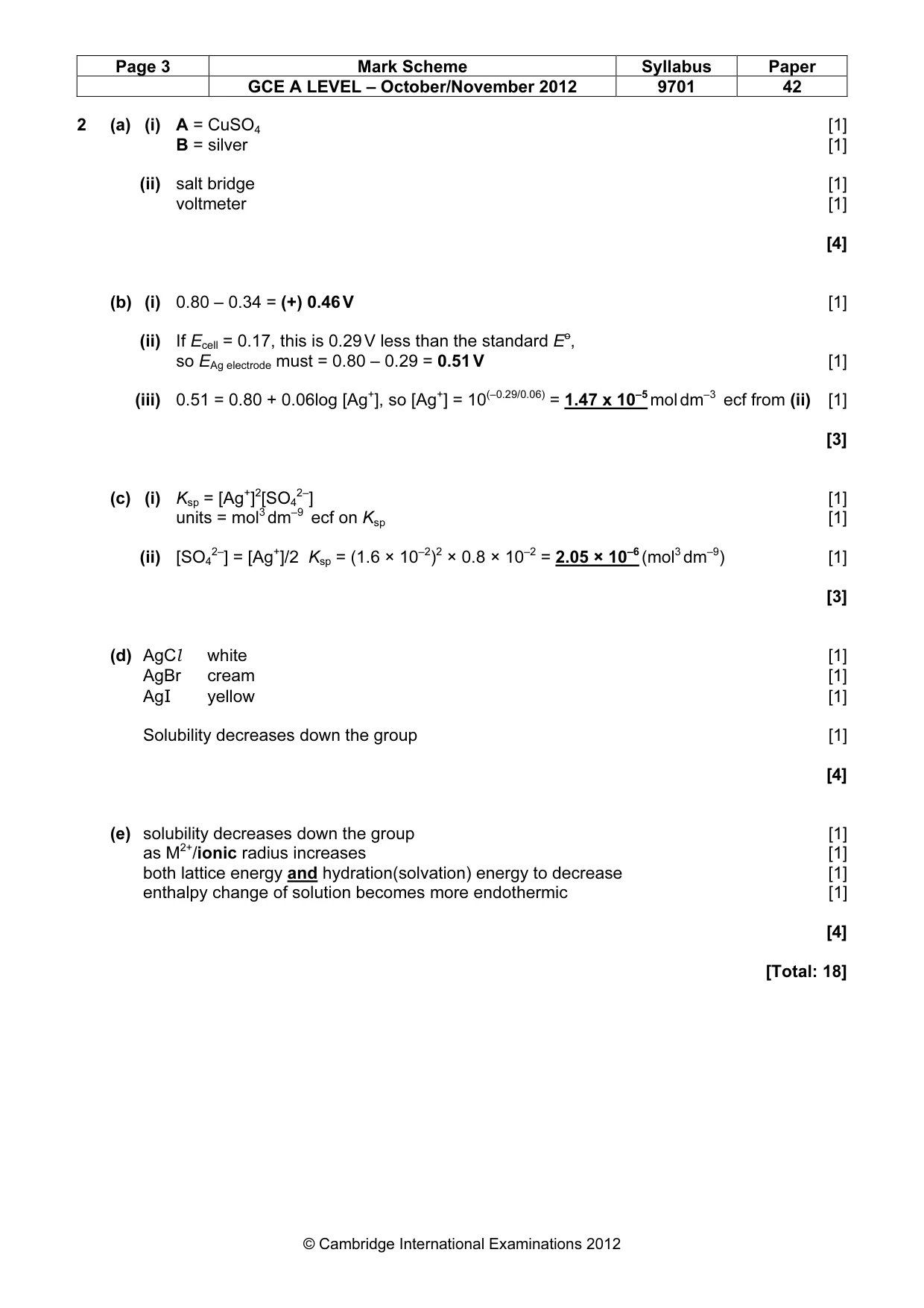
Page 2 Mark Scheme Syllabus Paper GCE A LEVEL – October/November 2012 9701 42 © Cambridge International Examinations 2012 1 (a) SiCl4: white solid or white/steamy fumes [1] SiCl4 + 2H2O → SiO2 + 4HCl [1] PCl5: fizzes or white/steamy fumes [1] PCl5 + 4H2O → H3PO4 + 5HCl [1] [4] (b) (i) MnO4 – + 8H+ + 5Fe2+ → Mn2+ + 4H2O + 5Fe3+ [1] (ii) 5 : 1 (iii) n(MnO4 –) = 0.02 × 15/1000 = 3 × 10⁻⁴ (mol) [1] (iv) n(Fe2+) = 5 × 3 × 10–4 = 1.5 × 10⁻³ (mol) ecf from (i) or (ii) [1] (v) [Fe2+] = 1.5 × 10–3 × 1000/2.5 = 0.6 (mol dm–3) ecf from (iv) [1] (vi) In the original solution, there was 0.15 mol of Fe3+ in 100 cm3. In the partially-used solution, there is 0.06 mol of Fe2+ in 100 cm3. So remaining Fe3+ = 0.15 – 0.06 = 0.09 mol. ecf from (v) [1] This can react with 0.045 mol of Cu, which = 0.045 × 63.5 = 2.86 g of copper. ecf [1] [6] (c) bonds broken are Si-Si and Cl-Cl = 222 + 244 = 466 kJ mol–1 bonds formed are 2 × Si-Cl = 2 × 359 = 718 kJ mol–1 ∆H = –252 kJ mol–1 [2] [2] (d) (i) Ca2Si + 6H2O → 2Ca(OH)2 + SiO2 + 4H2 [1] (ii) silcon has been oxidised AND hydrogen has been reduced [1] [2] [Total: 14]
Mark scheme, page 3
Page 3 Mark Scheme Syllabus Paper GCE A LEVEL – October/November 2012 9701 42 © Cambridge International Examinations 2012 2 (a) (i) A = CuSO4 [1] B = silver [1] (ii) salt bridge [1] voltmeter [1] [4] (b) (i) 0.80 – 0.34 = (+) 0.46 V [1] (ii) If Ecell = 0.17, this is 0.29 V less than the standard Eo, so EAg electrode must = 0.80 – 0.29 = 0.51 V [1] (iii) 0.51 = 0.80 + 0.06log [Ag+], so [Ag+] = 10(–0.29/0.06) = 1.47 x 10⁻⁵ mol dm–3 ecf from (ii) [1] [3] (c) (i) Ksp = [Ag+]2[SO4 2–] [1] units = mol3 dm–9 ecf on Ksp [1] (ii) [SO4 2–] = [Ag+]/2 Ksp = (1.6 × 10⁻²)2 × 0.8 × 10–2 = 2.05 × 10⁻⁶ (mol3 dm–9) [1] [3] (d) AgCl white [1] AgBr cream [1] AgI yellow [1] Solubility decreases down the group [1] [4] (e) solubility decreases down the group [1] as M2+/ionic radius increases [1] both lattice energy and hydration(solvation) energy to decrease [1] enthalpy change of solution becomes more endothermic [1] [4] [Total: 18]
Mark scheme, page 4
Page 4 Mark Scheme Syllabus Paper GCE A LEVEL – October/November 2012 9701 42 © Cambridge International Examinations 2012 3 (a) (i) heterogeneous: different states AND homogeneous: same state [1] (ii) the correct allocation of the terms heterogeneous and homogeneous to common catalysts [1] example of heterogeneous, e.g. Fe (in the Haber process) linked to correct system [1] equation, e.g. N2 + 3H2 → 2NH3 [1] how catalyst works, adsorption (onto the surface) [1] ecf for non-iron catalyst example of homogeneous, e.g. Fe3+ or Fe2+ (in S2O8 2– + I–) linked to correct system [1] equation, e.g. S2O8 2– + 2I– → 2SO4 2– + I2 [1] how catalyst works, e.g. Fe3+ + I– → Fe2+ + ½I2 [1] ecf for non-iron catalyst [8] (b) [2] [Total: 10]
Mark scheme, page 5
Page 5 Mark Scheme Syllabus Paper GCE A LEVEL – October/November 2012 9701 42 © Cambridge International Examinations 2012 4 (a) K2Cr2O7 + H+ + heat under reflux [1] (b) nucleophilic substitution [1] (c) heat under reflux + aqueous HCl [1] (d) alkene [1] (e) amide or ester [1] [5] (f) C H3 CH3 CO2H C (cis/trans) HO2C CO2H D C H3 CO2H CH3 Ε NC CN F (-1 for CN- bond attachment) C H3 CH3 CONH OH OCH3 C H3 CH3 COO H3CO NH2 alternative structure for capsaicin capsaicin ecf 5 × [1] [5] [Total: 10]
Mark scheme, page 6
Page 6 Mark Scheme Syllabus Paper GCE A LEVEL – October/November 2012 9701 42 © Cambridge International Examinations 2012 5 (a) phenol [1] ketone [1] [2] (b) reagent observation structure of product type of reaction sodium metal effervescence /bubbles/fizzing O - O redox aqueous bromine decolourises or white ppt. O H O Br Br electrophilic substitution aqueous alkaline iodine yellow ppt. CO2Na HO oxidation [2] [8] (c) (i) N H2 SO3H J N2 + SO3H K [1] + [1]
Mark scheme, page 7
Page 7 Mark Scheme Syllabus Paper GCE A LEVEL – October/November 2012 9701 42 © Cambridge International Examinations 2012 (ii) step 1: NaNO2 + HCl or HNO2 [1] at T < 10°C [1] step 2: (add K to a solution of G) in aqueous NaOH [1] [5] (d) SOCl2/PCl5 /PCl3 + heat add to G (in NaOH(aq)) (CH3CH2CO2H) → CH3CH2COCl → L [1] [1] [1] ecf from CH3COOH [3] [Total: 18]
Mark scheme, page 8
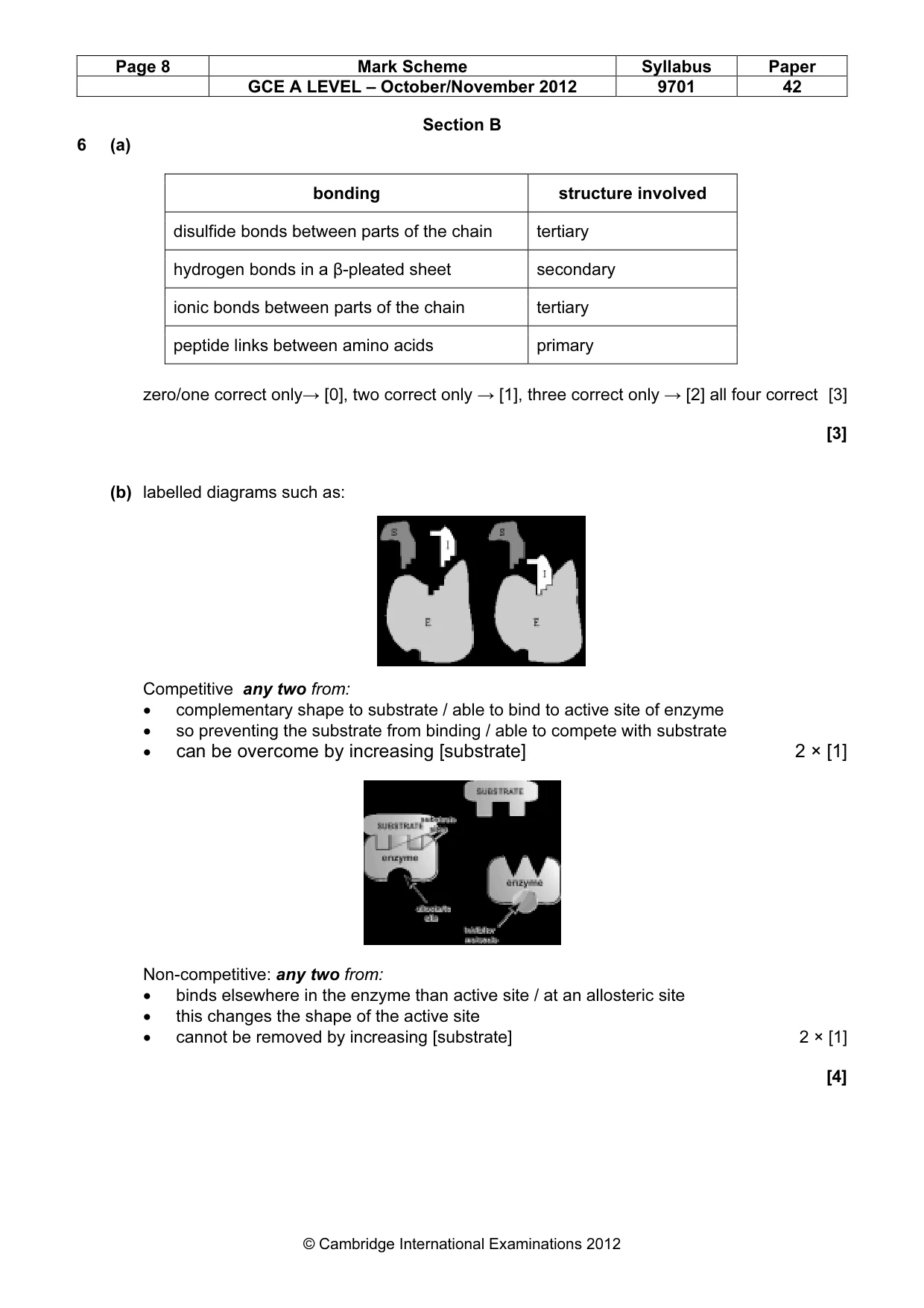
Page 8 Mark Scheme Syllabus Paper GCE A LEVEL – October/November 2012 9701 42 © Cambridge International Examinations 2012 Section B 6 (a) bonding structure involved disulfide bonds between parts of the chain tertiary hydrogen bonds in a β-pleated sheet secondary ionic bonds between parts of the chain tertiary peptide links between amino acids primary zero/one correct only→ [0], two correct only → [1], three correct only → [2] all four correct [3] [3] (b) labelled diagrams such as: Competitive any two from: • complementary shape to substrate / able to bind to active site of enzyme • so preventing the substrate from binding / able to compete with substrate • can be overcome by increasing [substrate] 2 × [1] Non-competitive: any two from: • binds elsewhere in the enzyme than active site / at an allosteric site • this changes the shape of the active site • cannot be removed by increasing [substrate] 2 × [1] [4]
Mark scheme, page 9
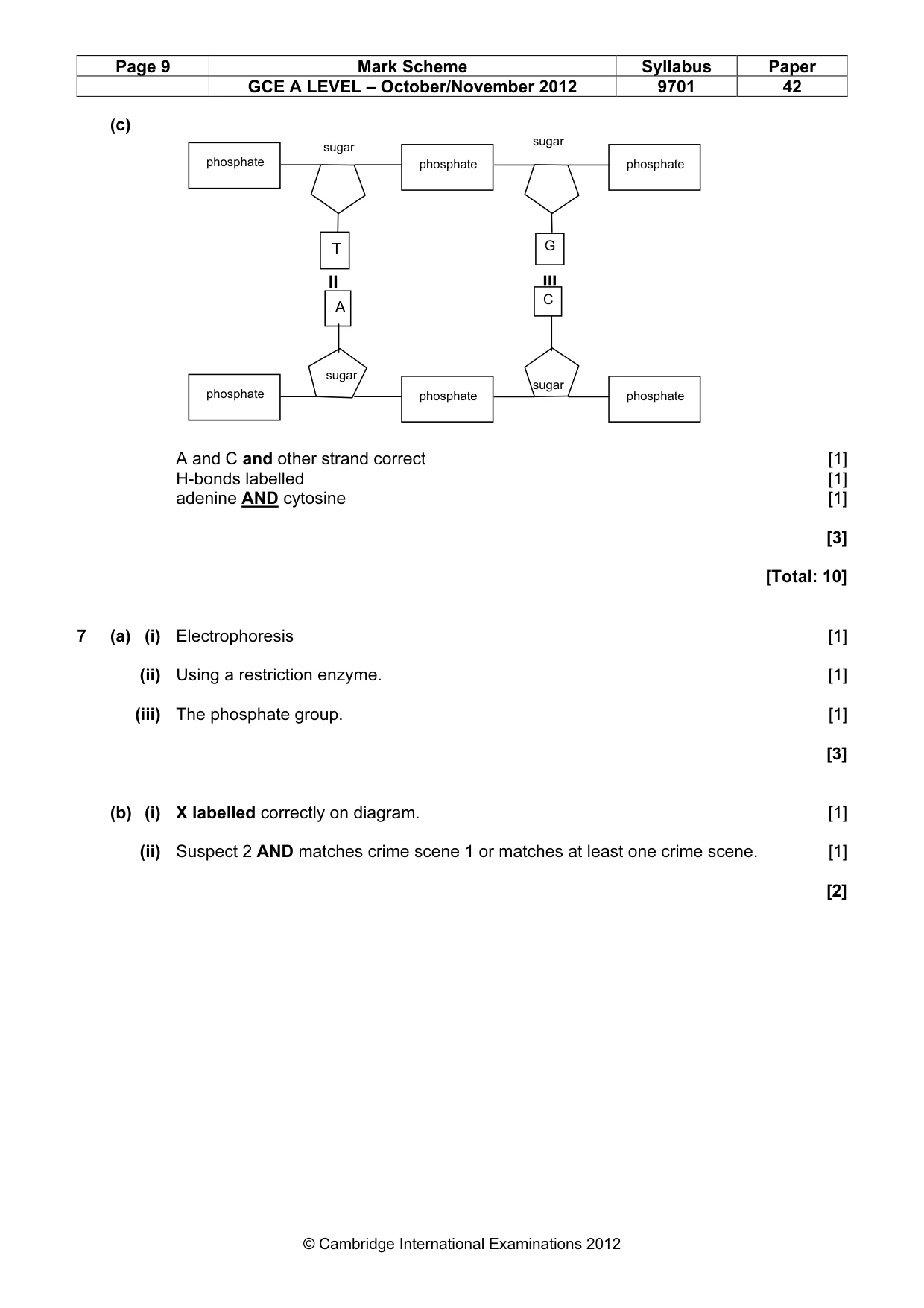
Page 9 Mark Scheme Syllabus Paper GCE A LEVEL – October/November 2012 9701 42 © Cambridge International Examinations 2012 (c) II III A and C and other strand correct [1] H-bonds labelled [1] adenine AND cytosine [1] [3] [Total: 10] 7 (a) (i) Electrophoresis [1] (ii) Using a restriction enzyme. [1] (iii) The phosphate group. [1] [3] (b) (i) X labelled correctly on diagram. [1] (ii) Suspect 2 AND matches crime scene 1 or matches at least one crime scene. [1] [2] sugar G T phosphate phosphate phosphate sugar sugar sugar C A phosphate phosphate phosphate
Mark scheme, page 10
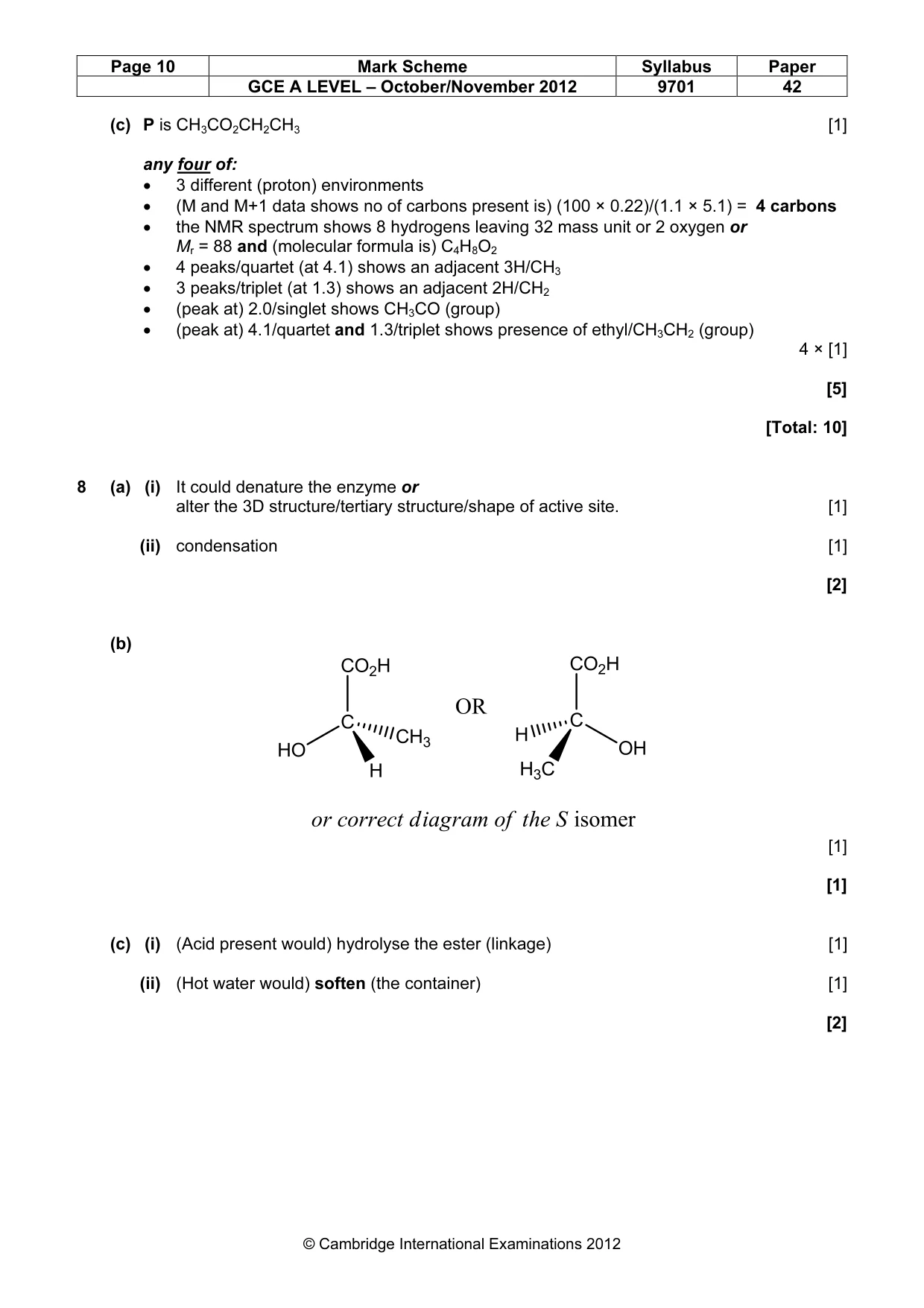
Page 10 Mark Scheme Syllabus Paper GCE A LEVEL – October/November 2012 9701 42 © Cambridge International Examinations 2012 (c) P is CH3CO2CH2CH3 [1] any four of: • 3 different (proton) environments • (M and M+1 data shows no of carbons present is) (100 × 0.22)/(1.1 × 5.1) = 4 carbons • the NMR spectrum shows 8 hydrogens leaving 32 mass unit or 2 oxygen or Mr = 88 and (molecular formula is) C4H8O2 • 4 peaks/quartet (at 4.1) shows an adjacent 3H/CH3 • 3 peaks/triplet (at 1.3) shows an adjacent 2H/CH2 • (peak at) 2.0/singlet shows CH3CO (group) • (peak at) 4.1/quartet and 1.3/triplet shows presence of ethyl/CH3CH2 (group) 4 × [1] [5] [Total: 10] 8 (a) (i) It could denature the enzyme or alter the 3D structure/tertiary structure/shape of active site. [1] (ii) condensation [1] [2] (b) [1] [1] (c) (i) (Acid present would) hydrolyse the ester (linkage) [1] (ii) (Hot water would) soften (the container) [1] [2]
Mark scheme, page 11
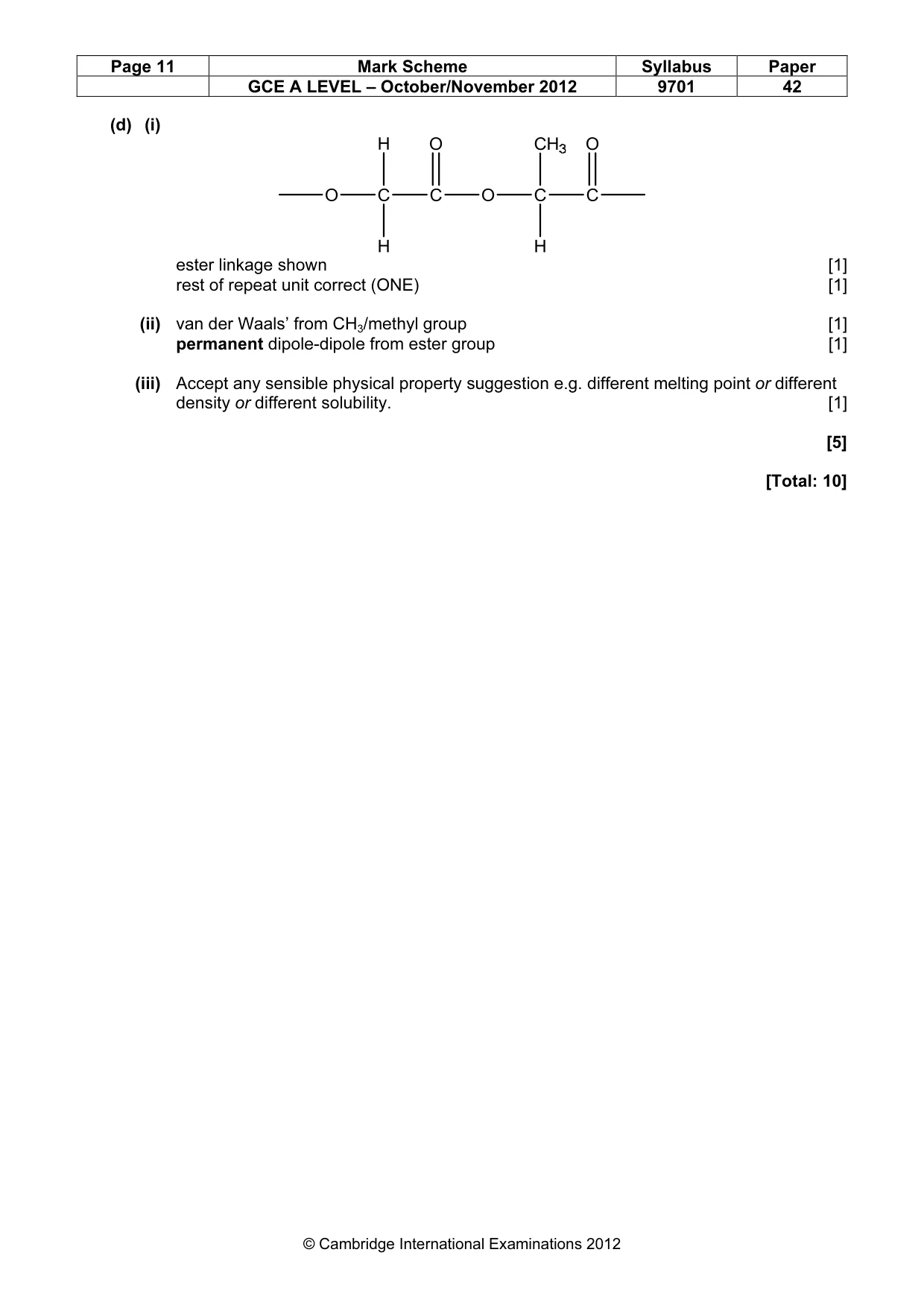
Page 11 Mark Scheme Syllabus Paper GCE A LEVEL – October/November 2012 9701 42 © Cambridge International Examinations 2012 (d) (i) ester linkage shown [1] rest of repeat unit correct (ONE) [1] (ii) van der Waals’ from CH3/methyl group [1] permanent dipole-dipole from ester group [1] (iii) Accept any sensible physical property suggestion e.g. different melting point or different density or different solubility. [1] [5] [Total: 10]
What you needed in this session
Cambridge’s own grade thresholds for 2012 Oct/Nov, Paper 4 · Variant 2. A higher threshold means an easier paper — the bar moves with how the cohort did.