Cambridge A Level Chemistry 9701 — 2012 Oct/Nov Paper 4 · Variant 3
9701/43/O/N/12 · 100 marks · ≈113 min
The question paper and its mark scheme, free to read here and free to download. This is Cambridge’s own paper, exactly as it was sat.
Question paper20 pages



Mark scheme10 pages
Answers below. Sit the paper first if you are practising.
Paper as text
Question paper, page 1
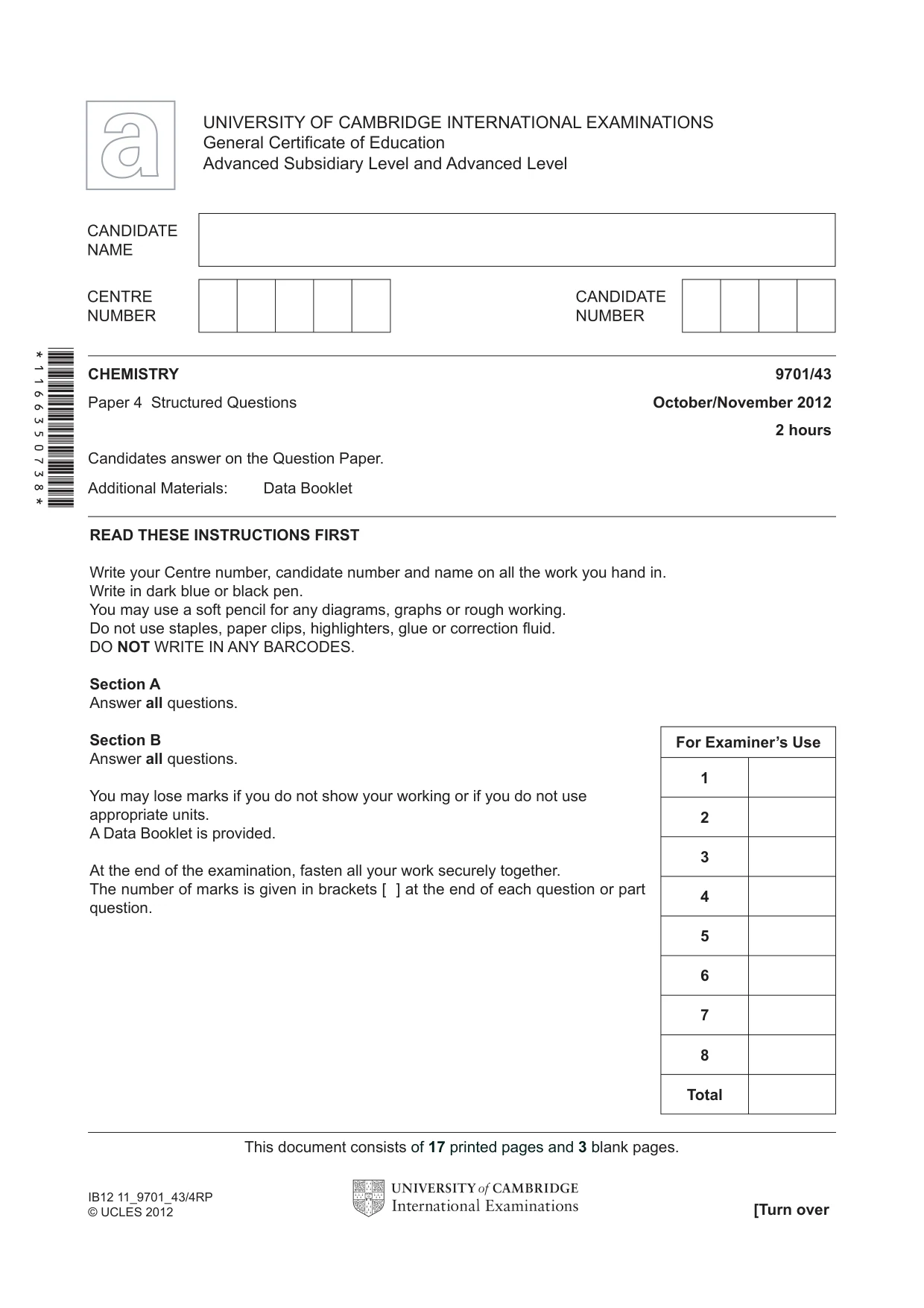
READ THESE INSTRUCTIONS FIRST Write your Centre number, candidate number and name on all the work you hand in. Write in dark blue or black pen. You may use a soft pencil for any diagrams, graphs or rough working. Do not use staples, paper clips, highlighters, glue or correction fl uid. DO NOT WRITE IN ANY BARCODES. Section A Answer all questions. Section B Answer all questions. You may lose marks if you do not show your working or if you do not use appropriate units. A Data Booklet is provided. At the end of the examination, fasten all your work securely together. The number of marks is given in brackets [ ] at the end of each question or part question. CHEMISTRY 9701/43 Paper 4 Structured Questions October/November 2012 2 hours Candidates answer on the Question Paper. Additional Materials: Data Booklet UNIVERSITY OF CAMBRIDGE INTERNATIONAL EXAMINATIONS General Certifi cate of Education Advanced Subsidiary Level and Advanced Level This document consists of 17 printed pages and 3 blank pages. [Turn over IB12 11_9701_43/4RP © UCLES 2012 *1166350738* For Examiner’s Use 1 2 3 4 5 6 7 8 Total
Question paper, page 2
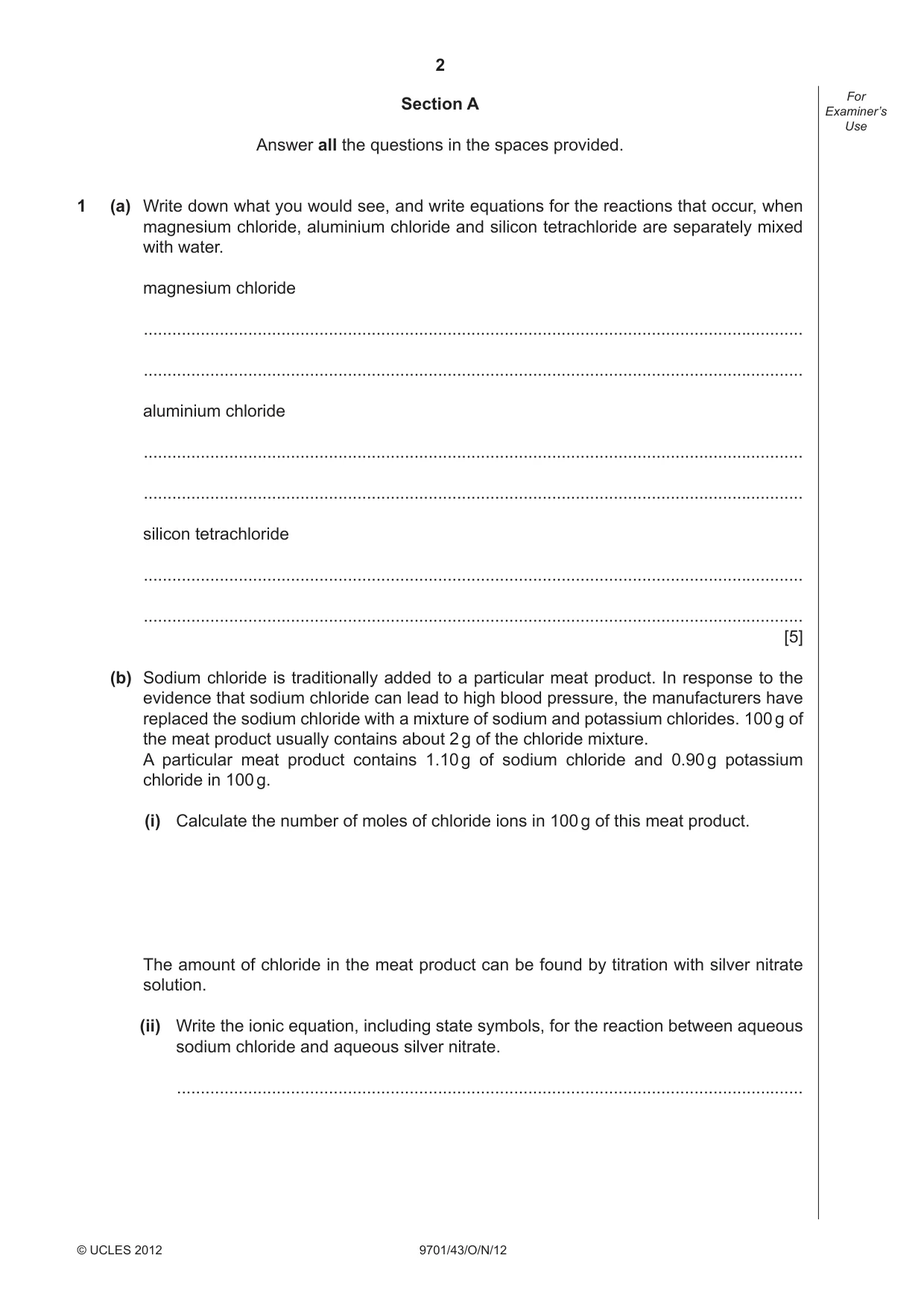
2 9701/43/O/N/12 © UCLES 2012 For Examiner’s Use Section A Answer all the questions in the spaces provided. 1 (a) Write down what you would see, and write equations for the reactions that occur, when magnesium chloride, aluminium chloride and silicon tetrachloride are separately mixed with water. magnesium chloride … … aluminium chloride … … silicon tetrachloride … … [5] (b) Sodium chloride is traditionally added to a particular meat product. In response to the evidence that sodium chloride can lead to high blood pressure, the manufacturers have replaced the sodium chloride with a mixture of sodium and potassium chlorides. 100 g of the meat product usually contains about 2 g of the chloride mixture. A particular meat product contains 1.10 g of sodium chloride and 0.90 g potassium chloride in 100 g. (i) Calculate the number of moles of chloride ions in 100 g of this meat product. The amount of chloride in the meat product can be found by titration with silver nitrate solution. (ii) Write the ionic equation, including state symbols, for the reaction between aqueous sodium chloride and aqueous silver nitrate. …
Question paper, page 3
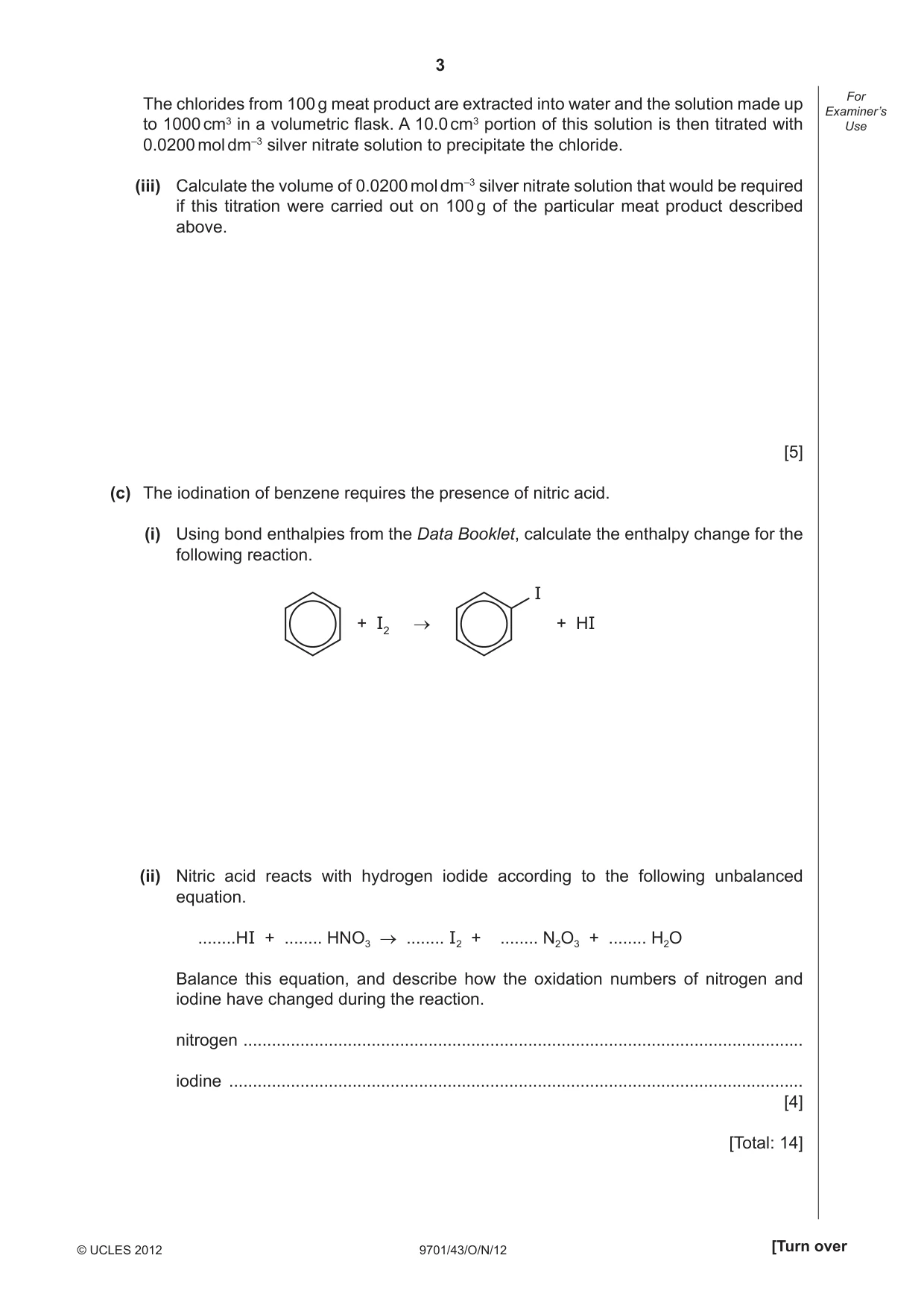
3 9701/43/O/N/12 © UCLES 2012 [Turn over For Examiner’s Use The chlorides from 100 g meat product are extracted into water and the solution made up to 1000 cm3 in a volumetric fl ask. A 10.0 cm3 portion of this solution is then titrated with 0.0200 mol dm–3 silver nitrate solution to precipitate the chloride. (iii) Calculate the volume of 0.0200 mol dm–3 silver nitrate solution that would be required if this titration were carried out on 100 g of the particular meat product described above. [5] (c) The iodination of benzene requires the presence of nitric acid. (i) Using bond enthalpies from the Data Booklet, calculate the enthalpy change for the following reaction. + I2 + HI I → (ii) Nitric acid reacts with hydrogen iodide according to the following unbalanced equation. …HI + … HNO3 → … I2 + … N2O3 + … H2O Balance this equation, and describe how the oxidation numbers of nitrogen and iodine have changed during the reaction. nitrogen … iodine … [4] [Total: 14]
Question paper, page 4
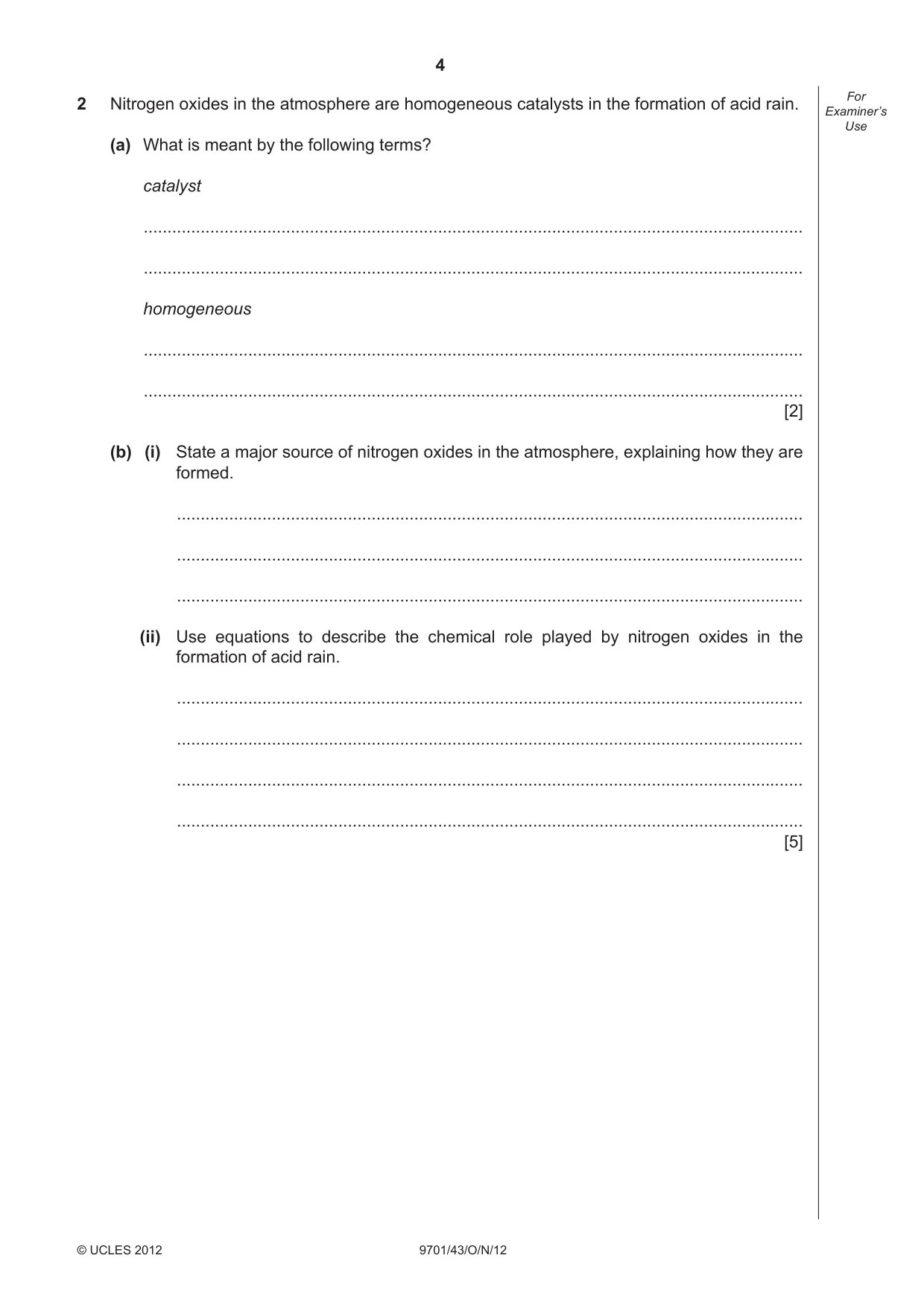
4 9701/43/O/N/12 © UCLES 2012 For Examiner’s Use 2 Nitrogen oxides in the atmosphere are homogeneous catalysts in the formation of acid rain. (a) What is meant by the following terms? catalyst … … homogeneous … … [2] (b) (i) State a major source of nitrogen oxides in the atmosphere, explaining how they are formed. … … … (ii) Use equations to describe the chemical role played by nitrogen oxides in the formation of acid rain. … … … … [5]
Question paper, page 5
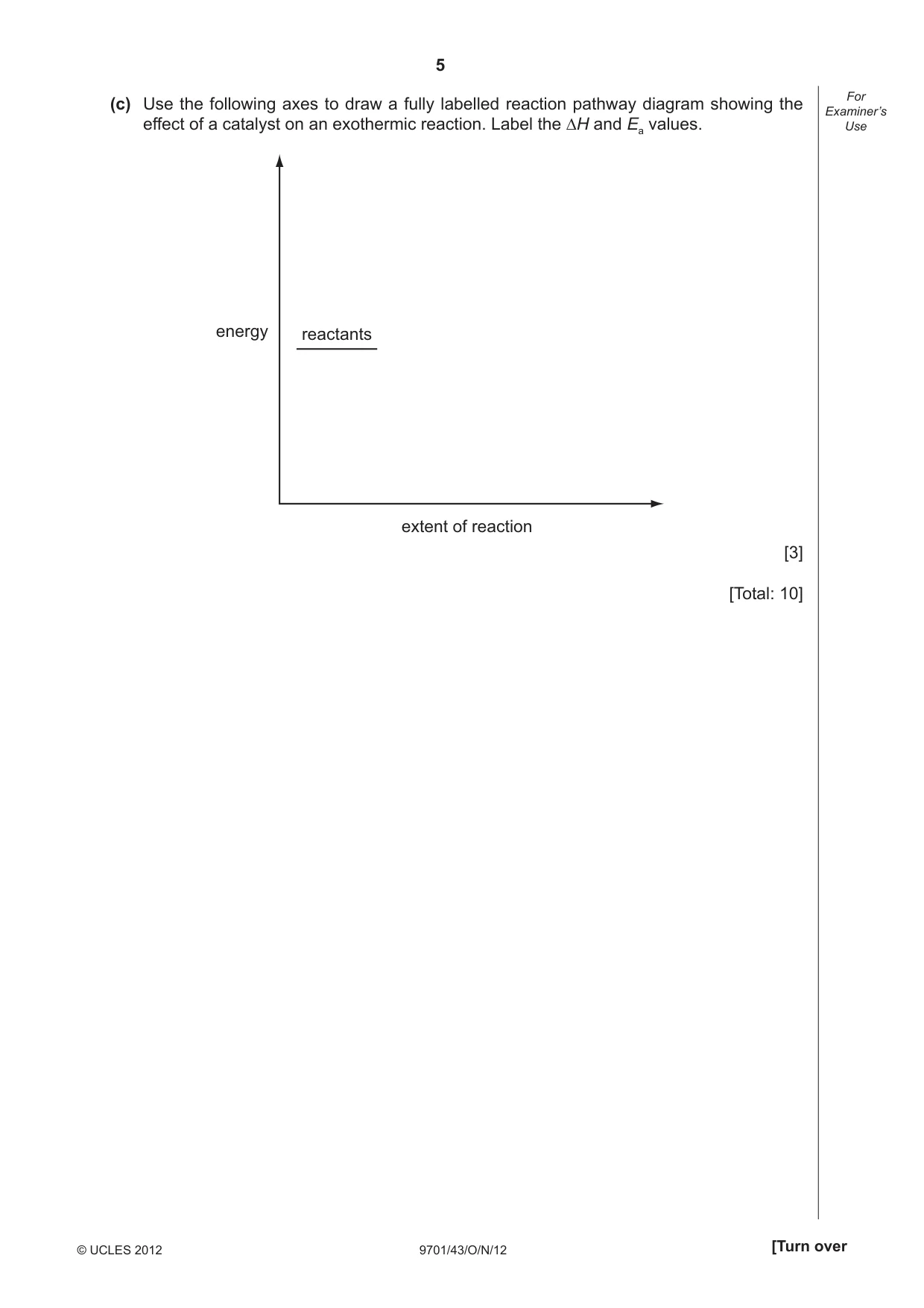
5 9701/43/O/N/12 © UCLES 2012 [Turn over For Examiner’s Use (c) Use the following axes to draw a fully labelled reaction pathway diagram showing the effect of a catalyst on an exothermic reaction. Label the ∆H and Ea values. energy extent of reaction reactants [3] [Total: 10]
Question paper, page 6
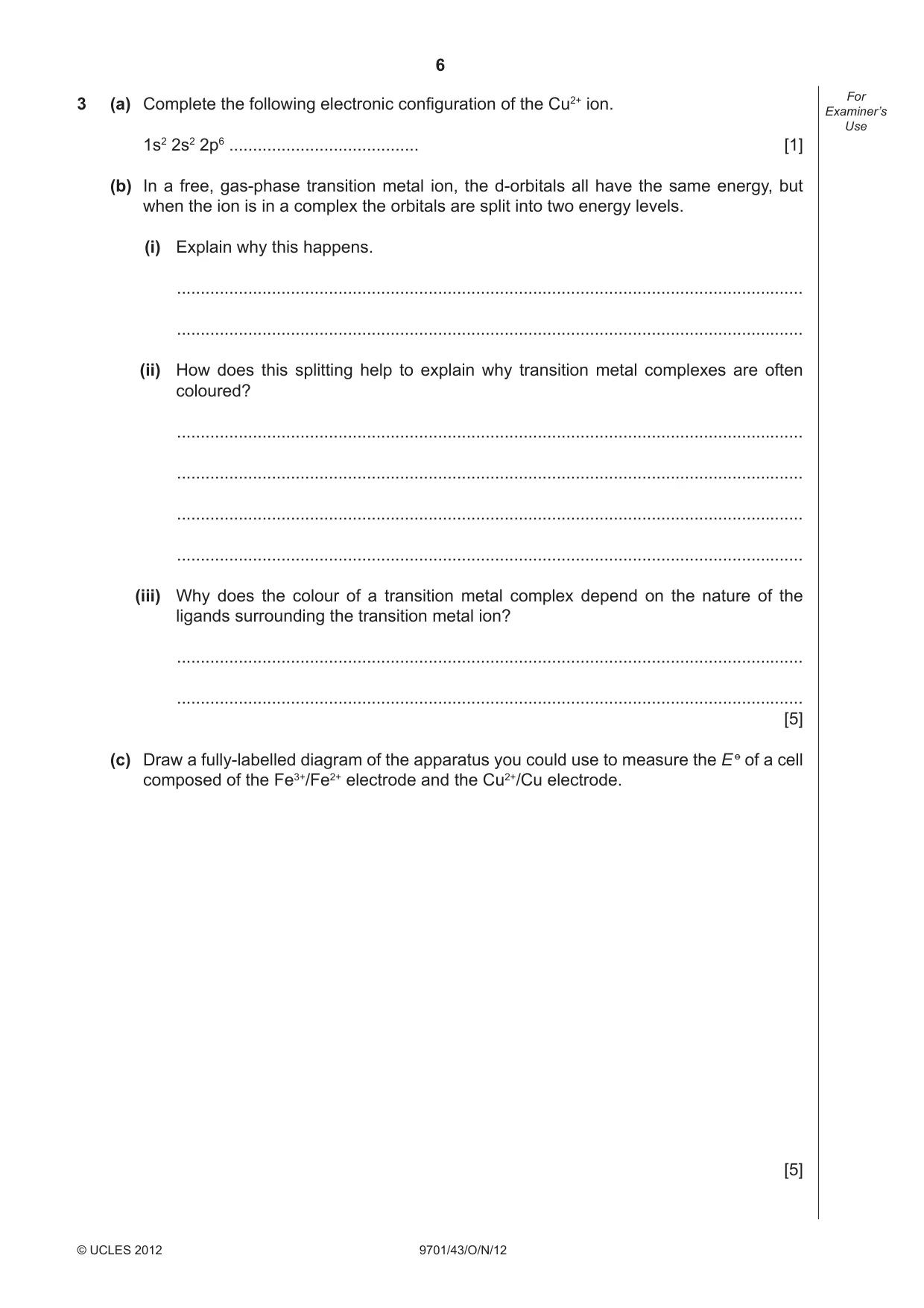
6 9701/43/O/N/12 © UCLES 2012 For Examiner’s Use 3 (a) Complete the following electronic confi guration of the Cu2+ ion. 1s2 2s2 2p6 … [1] (b) In a free, gas-phase transition metal ion, the d-orbitals all have the same energy, but when the ion is in a complex the orbitals are split into two energy levels. (i) Explain why this happens. … … (ii) How does this splitting help to explain why transition metal complexes are often coloured? … … … … (iii) Why does the colour of a transition metal complex depend on the nature of the ligands surrounding the transition metal ion? … … [5] (c) Draw a fully-labelled diagram of the apparatus you could use to measure the E o of a cell composed of the Fe3+/Fe2+ electrode and the Cu2+/Cu electrode. [5]
Question paper, page 7
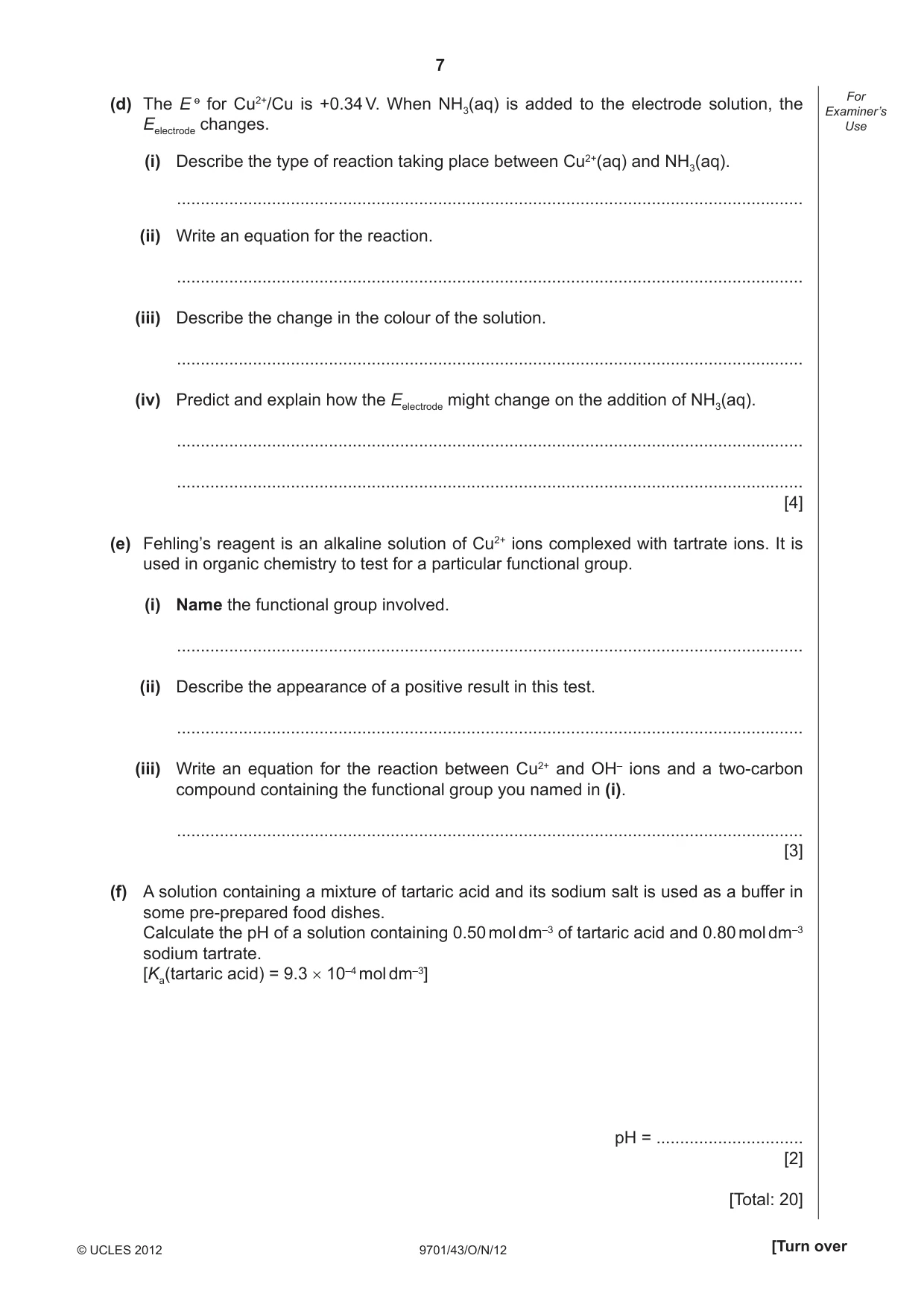
7 9701/43/O/N/12 © UCLES 2012 [Turn over For Examiner’s Use (d) The E o for Cu2+/Cu is +0.34 V. When NH3(aq) is added to the electrode solution, the Eelectrode changes. (i) Describe the type of reaction taking place between Cu2+(aq) and NH3(aq). … (ii) Write an equation for the reaction. … (iii) Describe the change in the colour of the solution. … (iv) Predict and explain how the Eelectrode might change on the addition of NH3(aq). … … [4] (e) Fehling’s reagent is an alkaline solution of Cu2+ ions complexed with tartrate ions. It is used in organic chemistry to test for a particular functional group. (i) Name the functional group involved. … (ii) Describe the appearance of a positive result in this test. … (iii) Write an equation for the reaction between Cu2+ and OH– ions and a two-carbon compound containing the functional group you named in (i). … [3] (f) A solution containing a mixture of tartaric acid and its sodium salt is used as a buffer in some pre-prepared food dishes. Calculate the pH of a solution containing 0.50 mol dm–3 of tartaric acid and 0.80 mol dm–3 sodium tartrate. [Ka(tartaric acid) = 9.3 × 10⁻⁴ mol dm–3] pH = … [2] [Total: 20]
Question paper, page 8
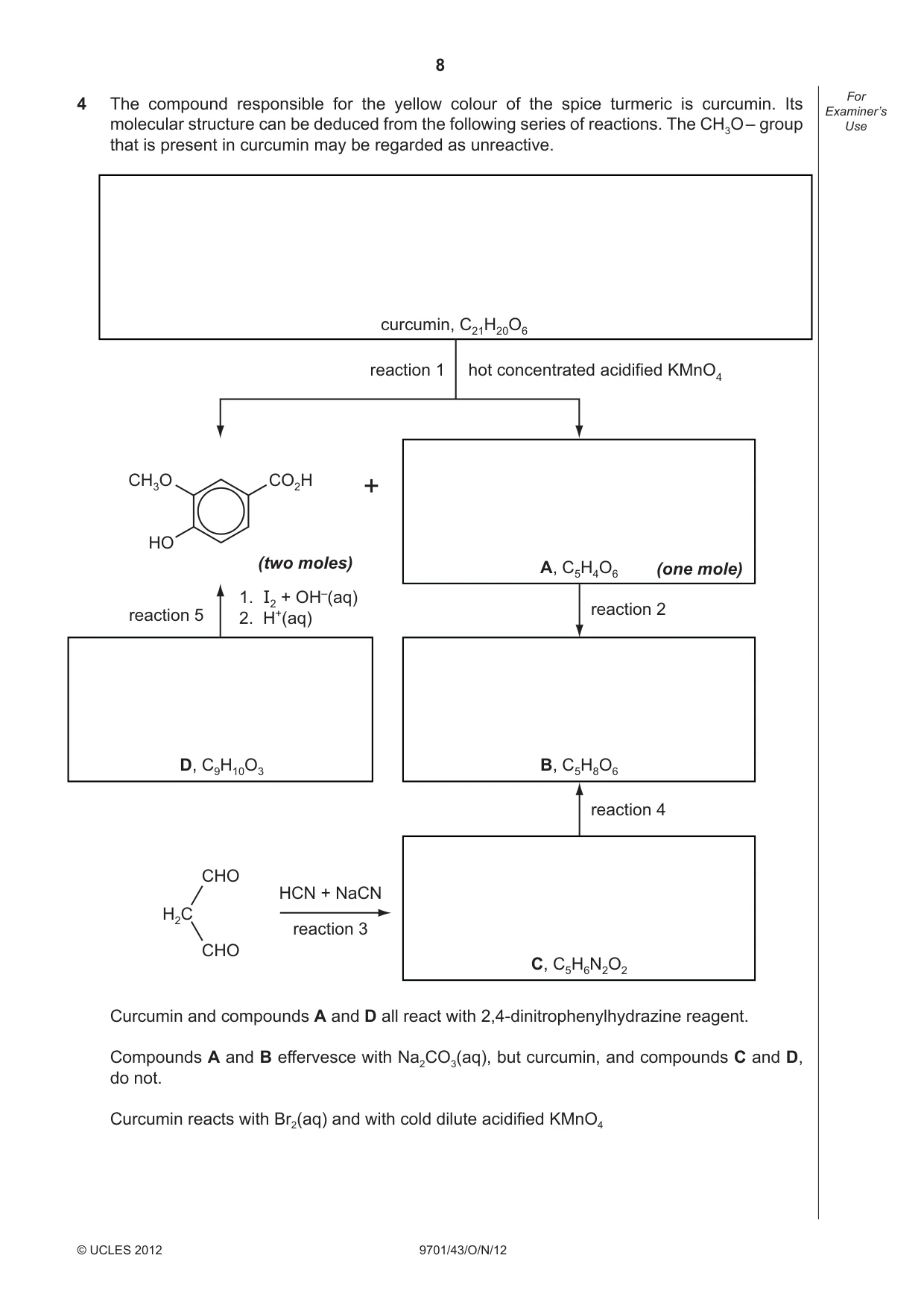
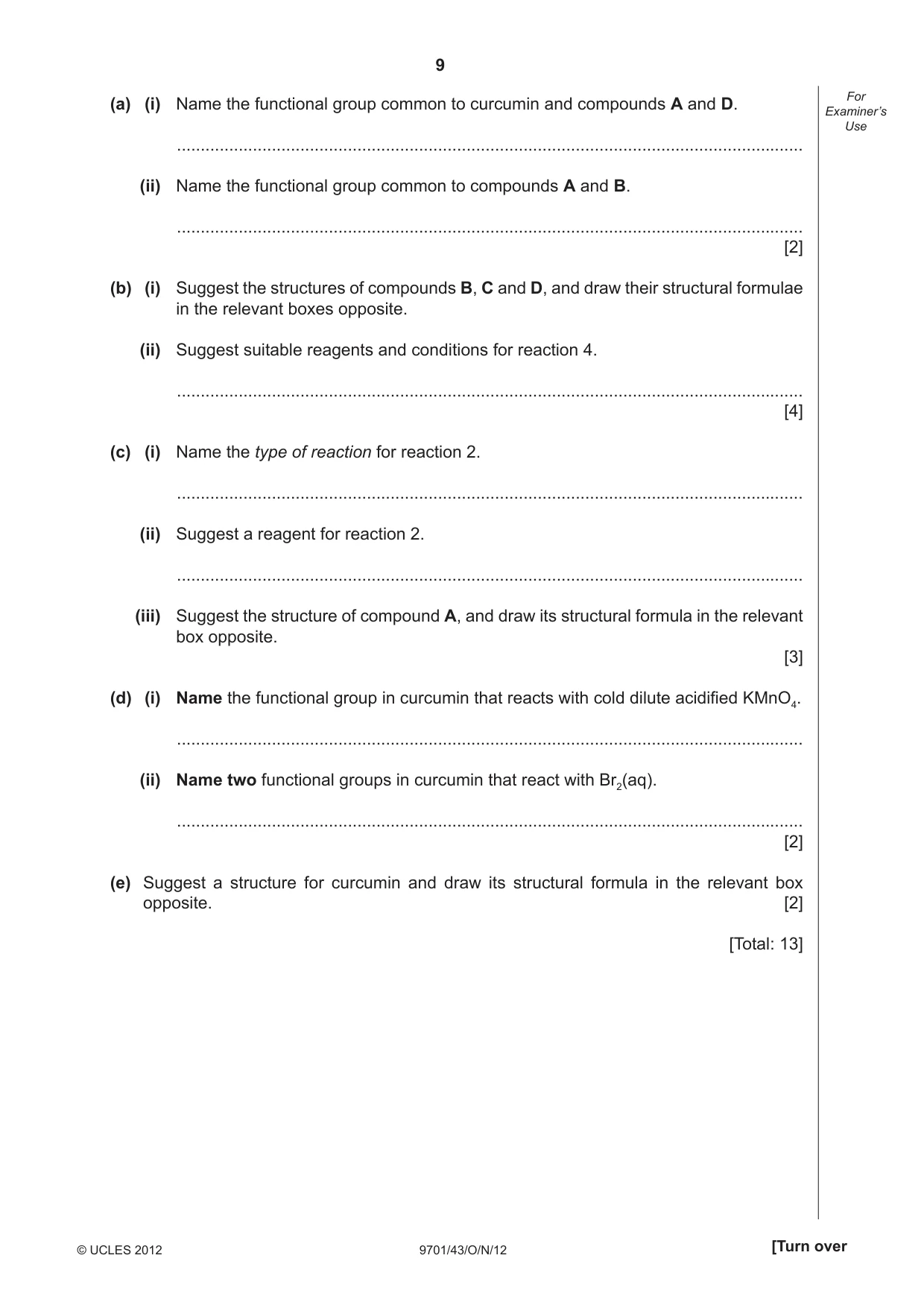
8 9701/43/O/N/12 © UCLES 2012 For Examiner’s Use 4 The compound responsible for the yellow colour of the spice turmeric is curcumin. Its molecular structure can be deduced from the following series of reactions. The CH3O – group that is present in curcumin may be regarded as unreactive. curcumin, C21H20O6 reaction 1 hot concentrated acidified KMnO4 + (one mole) (two moles) A, C5H4O6 B, C5H8O6 C, C5H6N2O2 D, C9H10O3 reaction 2 reaction 4 reaction 5 HCN + NaCN reaction 3 CO2H CH3O HO 1. I2 + OH–(aq) 2. H+(aq) CHO CHO H2C Curcumin and compounds A and D all react with 2,4-dinitrophenylhydrazine reagent. Compounds A and B effervesce with Na2CO3(aq), but curcumin, and compounds C and D, do not. Curcumin reacts with Br2(aq) and with cold dilute acidifi ed KMnO4
Question paper, page 9
9 9701/43/O/N/12 © UCLES 2012 [Turn over For Examiner’s Use (a) (i) Name the functional group common to curcumin and compounds A and D. … (ii) Name the functional group common to compounds A and B. … [2] (b) (i) Suggest the structures of compounds B, C and D, and draw their structural formulae in the relevant boxes opposite. (ii) Suggest suitable reagents and conditions for reaction 4. … [4] (c) (i) Name the type of reaction for reaction 2. … (ii) Suggest a reagent for reaction 2. … (iii) Suggest the structure of compound A, and draw its structural formula in the relevant box opposite. [3] (d) (i) Name the functional group in curcumin that reacts with cold dilute acidifi ed KMnO4. … (ii) Name two functional groups in curcumin that react with Br2(aq). … [2] (e) Suggest a structure for curcumin and draw its structural formula in the relevant box opposite. [2] [Total: 13]
Question paper, page 10
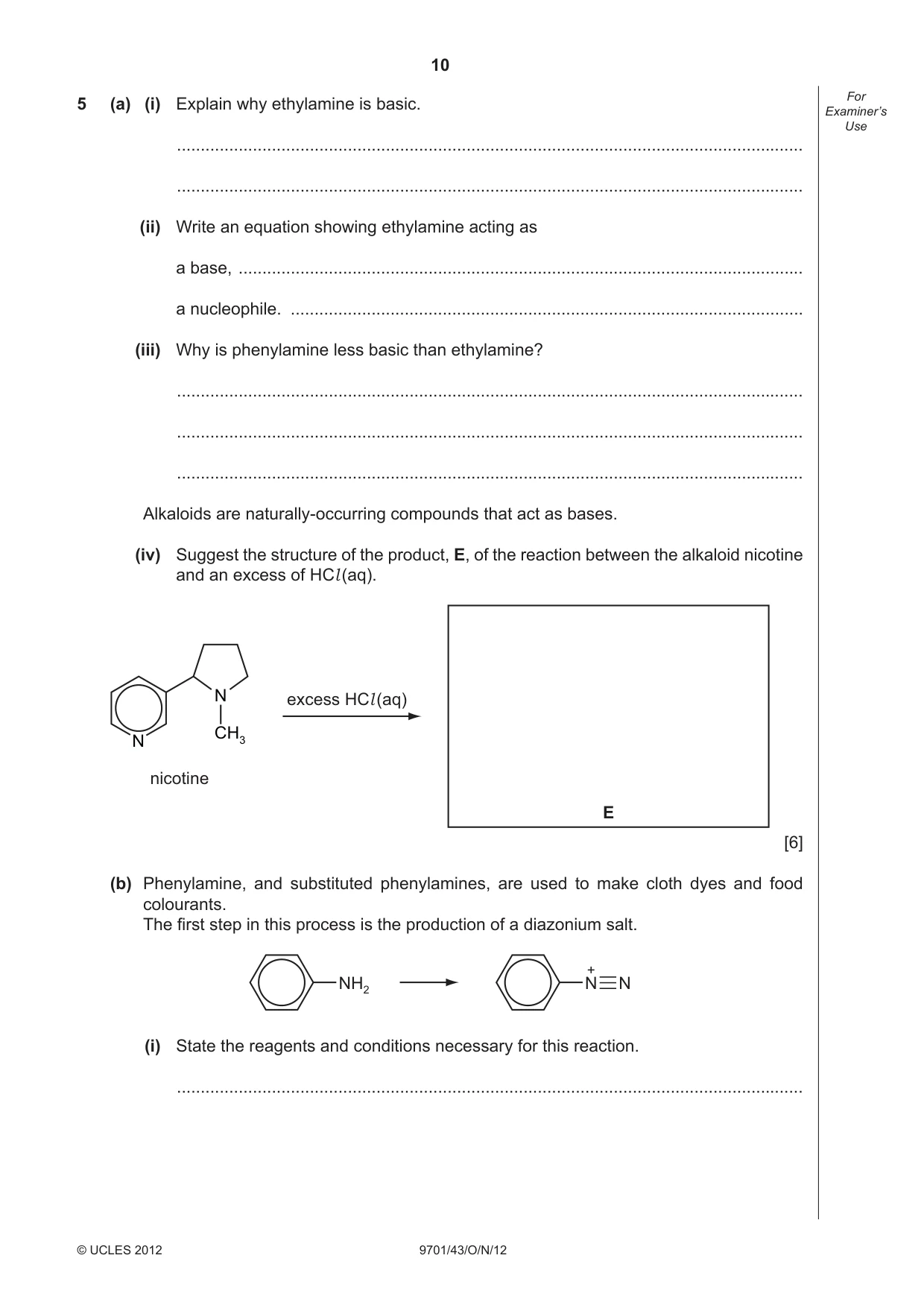
10 9701/43/O/N/12 © UCLES 2012 For Examiner’s Use 5 (a) (i) Explain why ethylamine is basic. … … (ii) Write an equation showing ethylamine acting as a base, … a nucleophile. … (iii) Why is phenylamine less basic than ethylamine? … … … Alkaloids are naturally-occurring compounds that act as bases. (iv) Suggest the structure of the product, E, of the reaction between the alkaloid nicotine and an excess of HCl (aq). E excess HCl (aq) nicotine N N CH3 [6] (b) Phenylamine, and substituted phenylamines, are used to make cloth dyes and food colourants. The fi rst step in this process is the production of a diazonium salt. NH2 N N + (i) State the reagents and conditions necessary for this reaction. …
Question paper, page 11
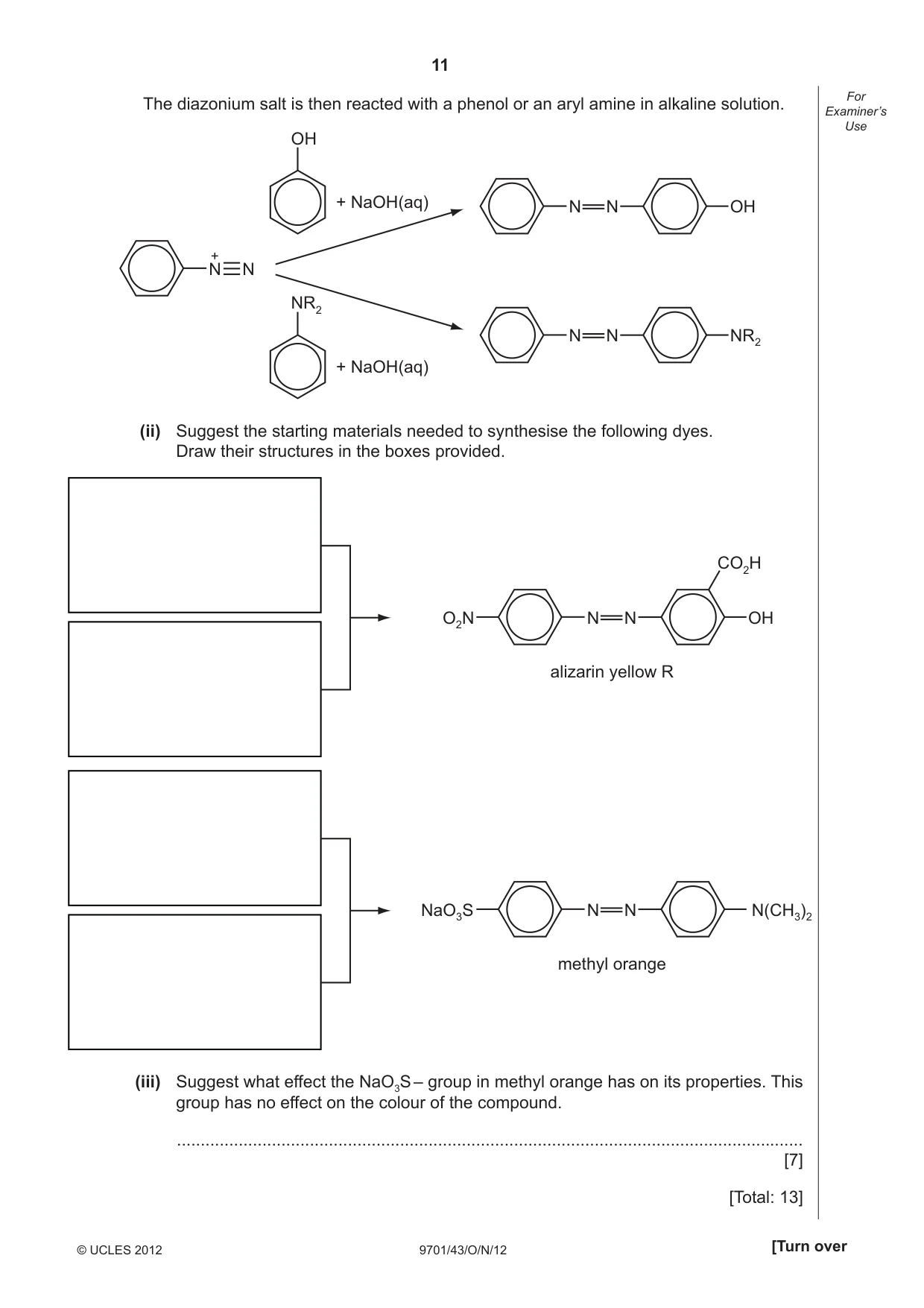
11 9701/43/O/N/12 © UCLES 2012 [Turn over For Examiner’s Use The diazonium salt is then reacted with a phenol or an aryl amine in alkaline solution. N N N OH N + OH + NaOH(aq) NR2 + NaOH(aq) N N NR2 (ii) Suggest the starting materials needed to synthesise the following dyes. Draw their structures in the boxes provided. N N OH O2N CO2H alizarin yellow R N N N(CH3)2 methyl orange NaO3S (iii) Suggest what effect the NaO3S – group in methyl orange has on its properties. This group has no effect on the colour of the compound. … [7] [Total: 13]
Question paper, page 12
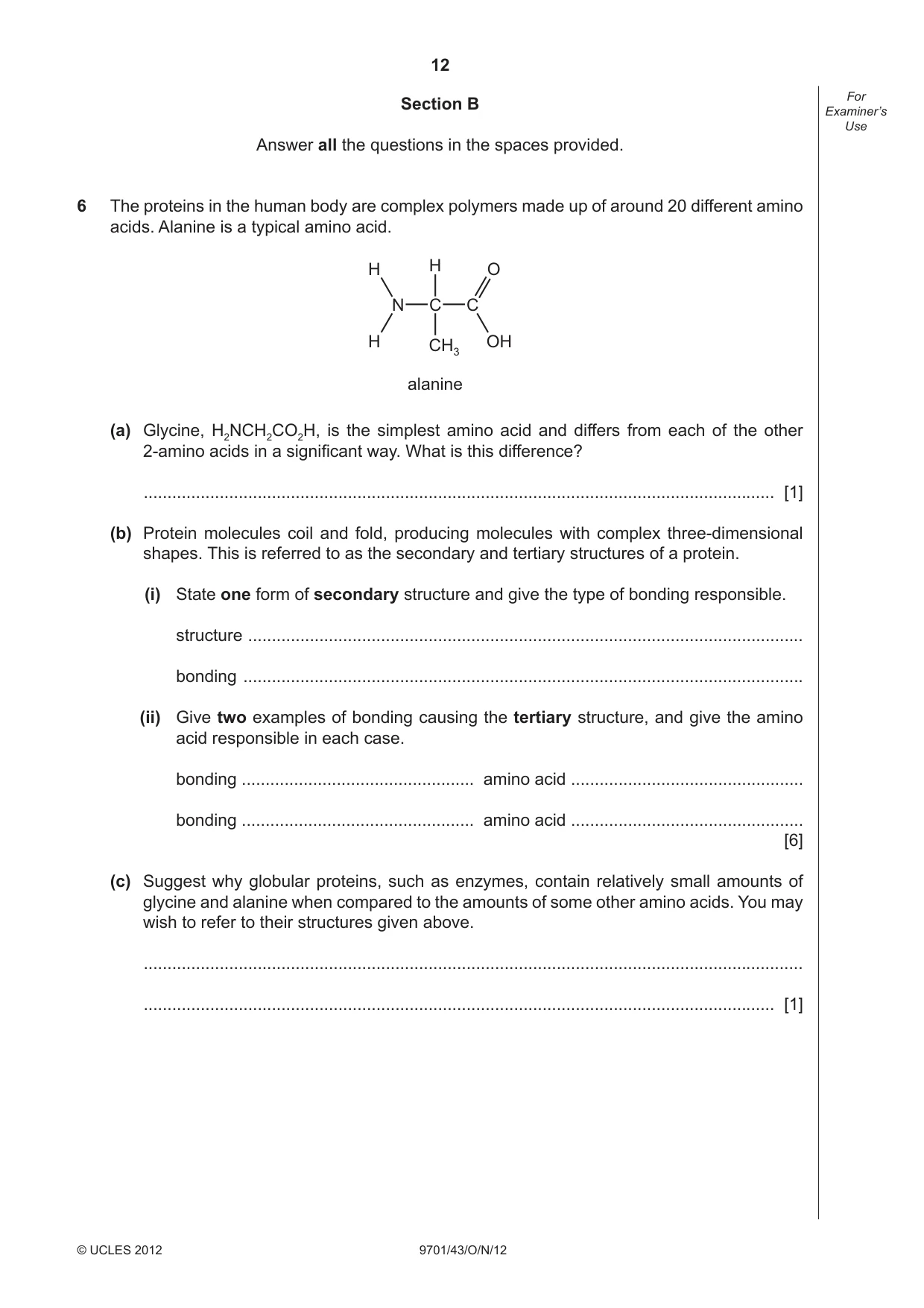
12 9701/43/O/N/12 © UCLES 2012 For Examiner’s Use Section B Answer all the questions in the spaces provided. 6 The proteins in the human body are complex polymers made up of around 20 different amino acids. Alanine is a typical amino acid. N C O OH H H alanine CH3 H C (a) Glycine, H2NCH2CO2H, is the simplest amino acid and differs from each of the other 2-amino acids in a signifi cant way. What is this difference? … [1] (b) Protein molecules coil and fold, producing molecules with complex three-dimensional shapes. This is referred to as the secondary and tertiary structures of a protein. (i) State one form of secondary structure and give the type of bonding responsible. structure … bonding … (ii) Give two examples of bonding causing the tertiary structure, and give the amino acid responsible in each case. bonding … amino acid … bonding … amino acid … [6] (c) Suggest why globular proteins, such as enzymes, contain relatively small amounts of glycine and alanine when compared to the amounts of some other amino acids. You may wish to refer to their structures given above. … … [1]
Question paper, page 13
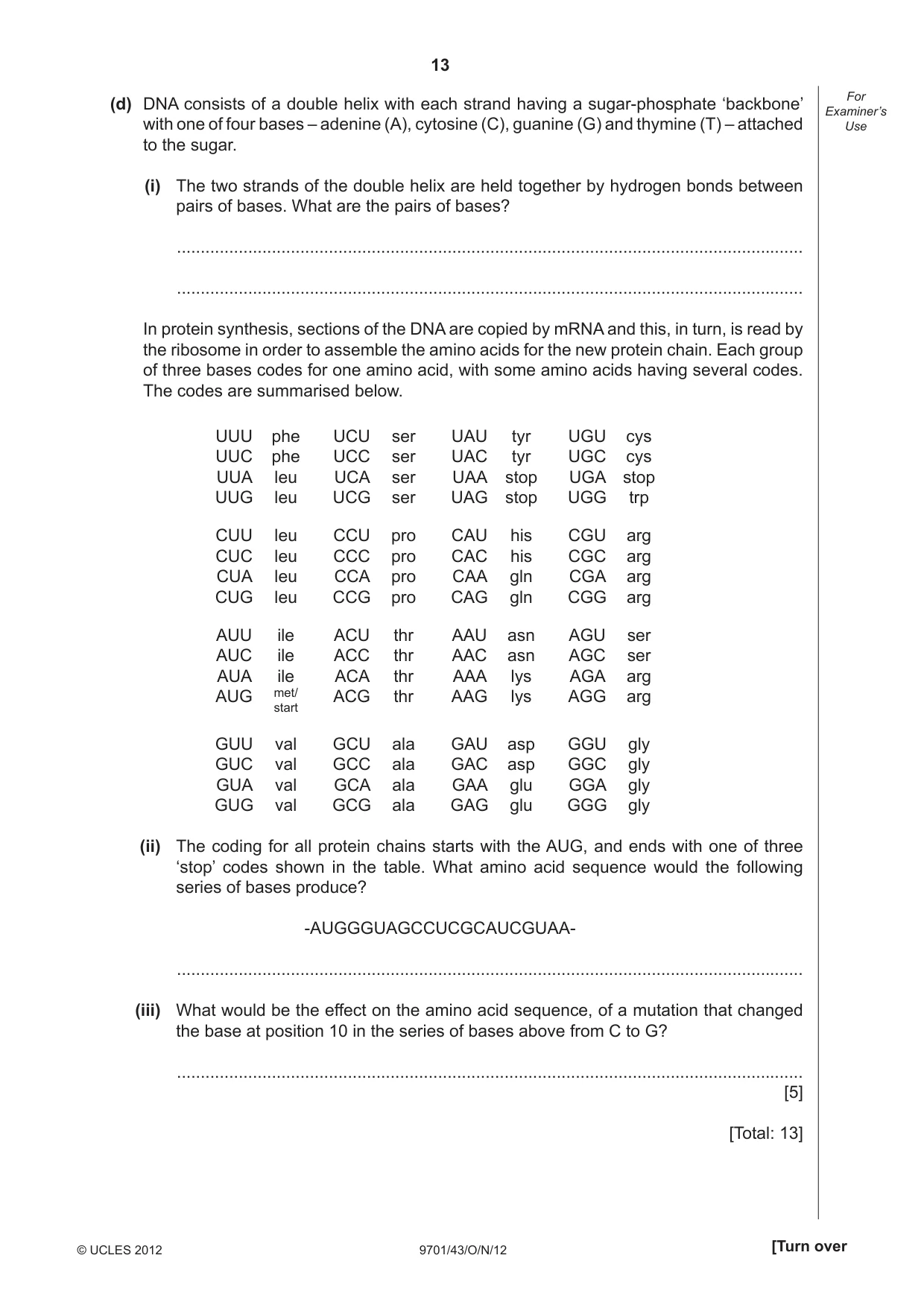
13 9701/43/O/N/12 © UCLES 2012 [Turn over For Examiner’s Use (d) DNA consists of a double helix with each strand having a sugar-phosphate ‘backbone’ with one of four bases – adenine (A), cytosine (C), guanine (G) and thymine (T) – attached to the sugar. (i) The two strands of the double helix are held together by hydrogen bonds between pairs of bases. What are the pairs of bases? … … In protein synthesis, sections of the DNA are copied by mRNA and this, in turn, is read by the ribosome in order to assemble the amino acids for the new protein chain. Each group of three bases codes for one amino acid, with some amino acids having several codes. The codes are summarised below. UUU UUC UUA UUG phe phe leu leu UCU UCC UCA UCG ser ser ser ser UAU UAC UAA UAG tyr tyr stop stop UGU UGC UGA UGG cys cys stop trp CUU CUC CUA CUG leu leu leu leu CCU CCC CCA CCG pro pro pro pro CAU CAC CAA CAG his his gln gln CGU CGC CGA CGG arg arg arg arg AUU AUC AUA AUG ile ile ile met/ start ACU ACC ACA ACG thr thr thr thr AAU AAC AAA AAG asn asn lys lys AGU AGC AGA AGG ser ser arg arg GUU GUC GUA GUG val val val val GCU GCC GCA GCG ala ala ala ala GAU GAC GAA GAG asp asp glu glu GGU GGC GGA GGG gly gly gly gly (ii) The coding for all protein chains starts with the AUG, and ends with one of three ‘stop’ codes shown in the table. What amino acid sequence would the following series of bases produce? -AUGGGUAGCCUCGCAUCGUAA- … (iii) What would be the effect on the amino acid sequence, of a mutation that changed the base at position 10 in the series of bases above from C to G? … [5] [Total: 13]
Question paper, page 14
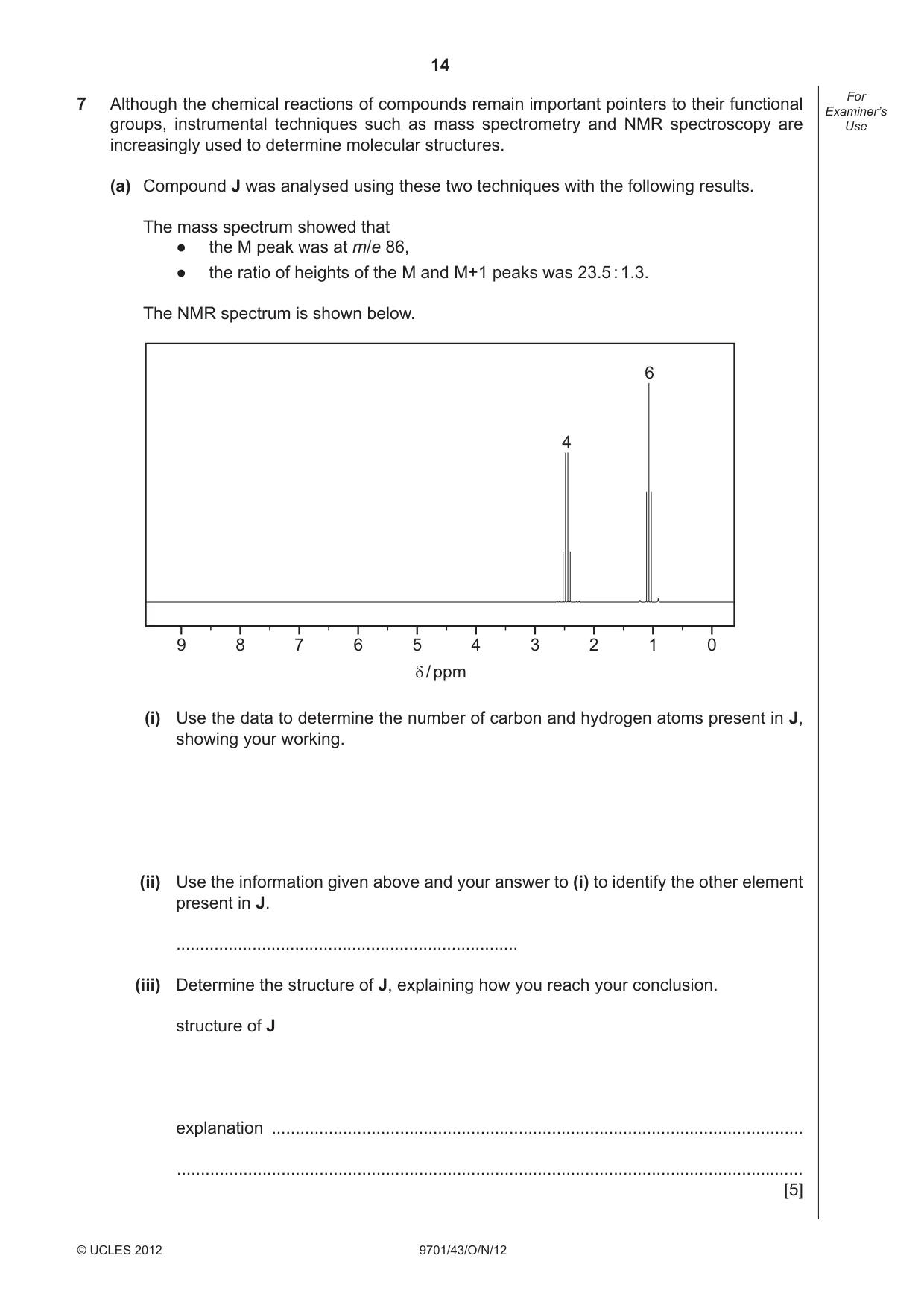
14 9701/43/O/N/12 © UCLES 2012 For Examiner’s Use 7 Although the chemical reactions of compounds remain important pointers to their functional groups, instrumental techniques such as mass spectrometry and NMR spectroscopy are increasingly used to determine molecular structures. (a) Compound J was analysed using these two techniques with the following results. The mass spectrum showed that ● the M peak was at m/e 86, ● the ratio of heights of the M and M+1 peaks was 23.5 : 1.3. The NMR spectrum is shown below. 9 8 7 6 5 4 3 2 1 0 4 6 δ / ppm (i) Use the data to determine the number of carbon and hydrogen atoms present in J, showing your working. (ii) Use the information given above and your answer to (i) to identify the other element present in J. … (iii) Determine the structure of J, explaining how you reach your conclusion. structure of J explanation … … [5]
Question paper, page 15
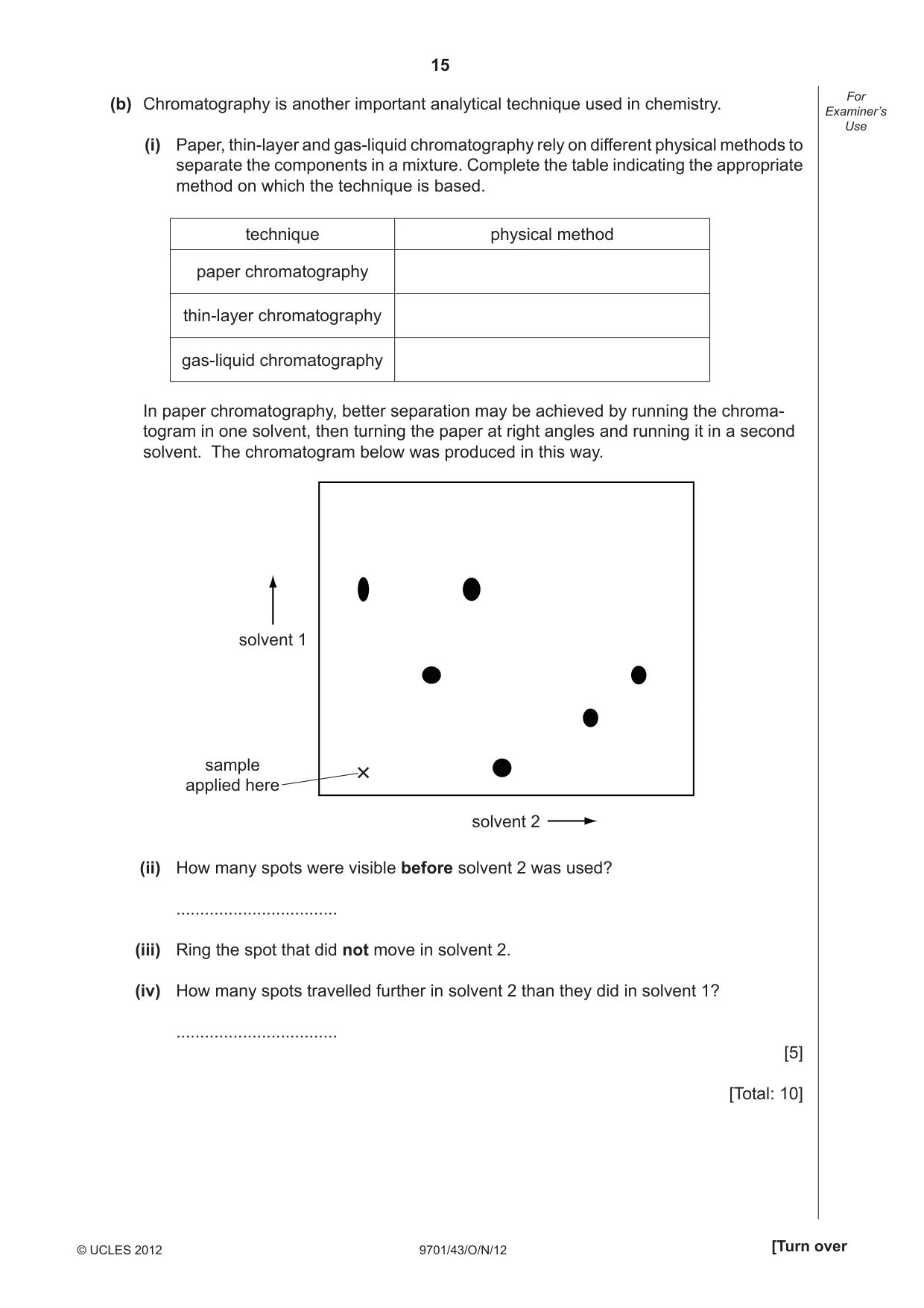
15 9701/43/O/N/12 © UCLES 2012 [Turn over For Examiner’s Use (b) Chromatography is another important analytical technique used in chemistry. (i) Paper, thin-layer and gas-liquid chromatography rely on different physical methods to separate the components in a mixture. Complete the table indicating the appropriate method on which the technique is based. technique physical method paper chromatography thin-layer chromatography gas-liquid chromatography In paper chromatography, better separation may be achieved by running the chroma- togram in one solvent, then turning the paper at right angles and running it in a second solvent. The chromatogram below was produced in this way. solvent 1 solvent 2 sample applied here (ii) How many spots were visible before solvent 2 was used? … (iii) Ring the spot that did not move in solvent 2. (iv) How many spots travelled further in solvent 2 than they did in solvent 1? … [5] [Total: 10]
Question paper, page 16
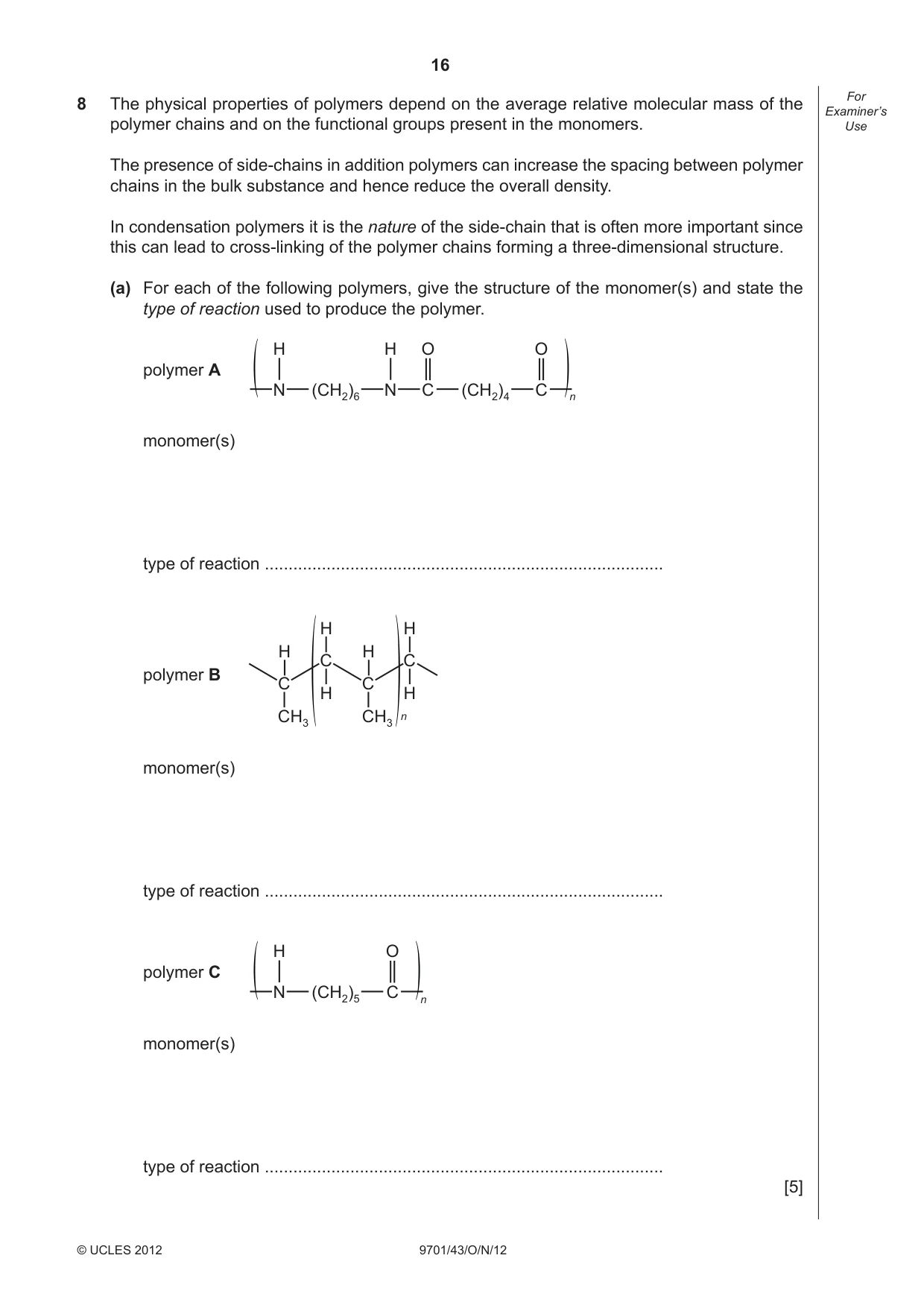
16 9701/43/O/N/12 © UCLES 2012 For Examiner’s Use 8 The physical properties of polymers depend on the average relative molecular mass of the polymer chains and on the functional groups present in the monomers. The presence of side-chains in addition polymers can increase the spacing between polymer chains in the bulk substance and hence reduce the overall density. In condensation polymers it is the nature of the side-chain that is often more important since this can lead to cross-linking of the polymer chains forming a three-dimensional structure. (a) For each of the following polymers, give the structure of the monomer(s) and state the type of reaction used to produce the polymer. N H polymer A (CH2)6 (CH2)4 N H C O C O n monomer(s) type of reaction … polymer B H C H C CH3 H C H H C CH3 H n monomer(s) type of reaction … N H polymer C (CH2)5 C O n monomer(s) type of reaction … [5]
Question paper, page 17
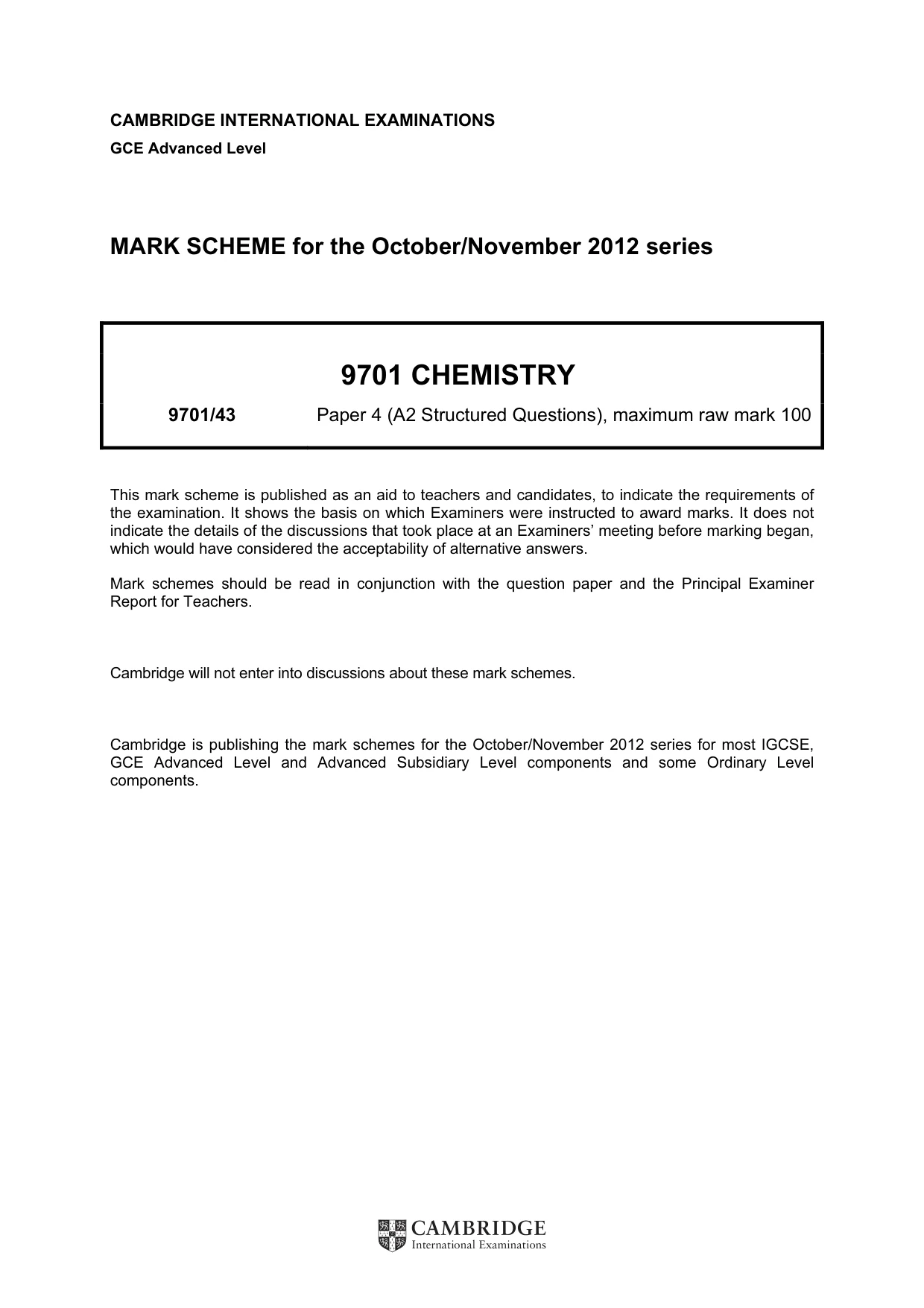
17 9701/43/O/N/12 © UCLES 2012 [Turn over For Examiner’s Use (b) Look at the structures of the three polymers and answer the following questions. (i) Suggest why the density of B is lower than that of A. … … (ii) Which polymer will have the weakest forces between chains, and what is the nature of these forces? … … [2] [Total: 7]
Question paper, page 18
18 9701/43/O/N/12 BLANK PAGE © UCLES 2012
Question paper, page 19
19 9701/43/O/N/12 BLANK PAGE © UCLES 2012
Question paper, page 20
20 Permission to reproduce items where third-party owned material protected by copyright is included has been sought and cleared where possible. Every reasonable effort has been made by the publisher (UCLES) to trace copyright holders, but if any items requiring clearance have unwittingly been included the publisher will be pleased to make amends at the earliest possible opportunity. University of Cambridge International Examinations is part of the Cambridge Assessment Group. Cambridge Assessment is the brand name of University of Cambridge Local Examinations Syndicate (UCLES), which is itself a department of the University of Cambridge. 9701/43/O/N/12 © UCLES 2012 BLANK PAGE
Mark scheme, page 1
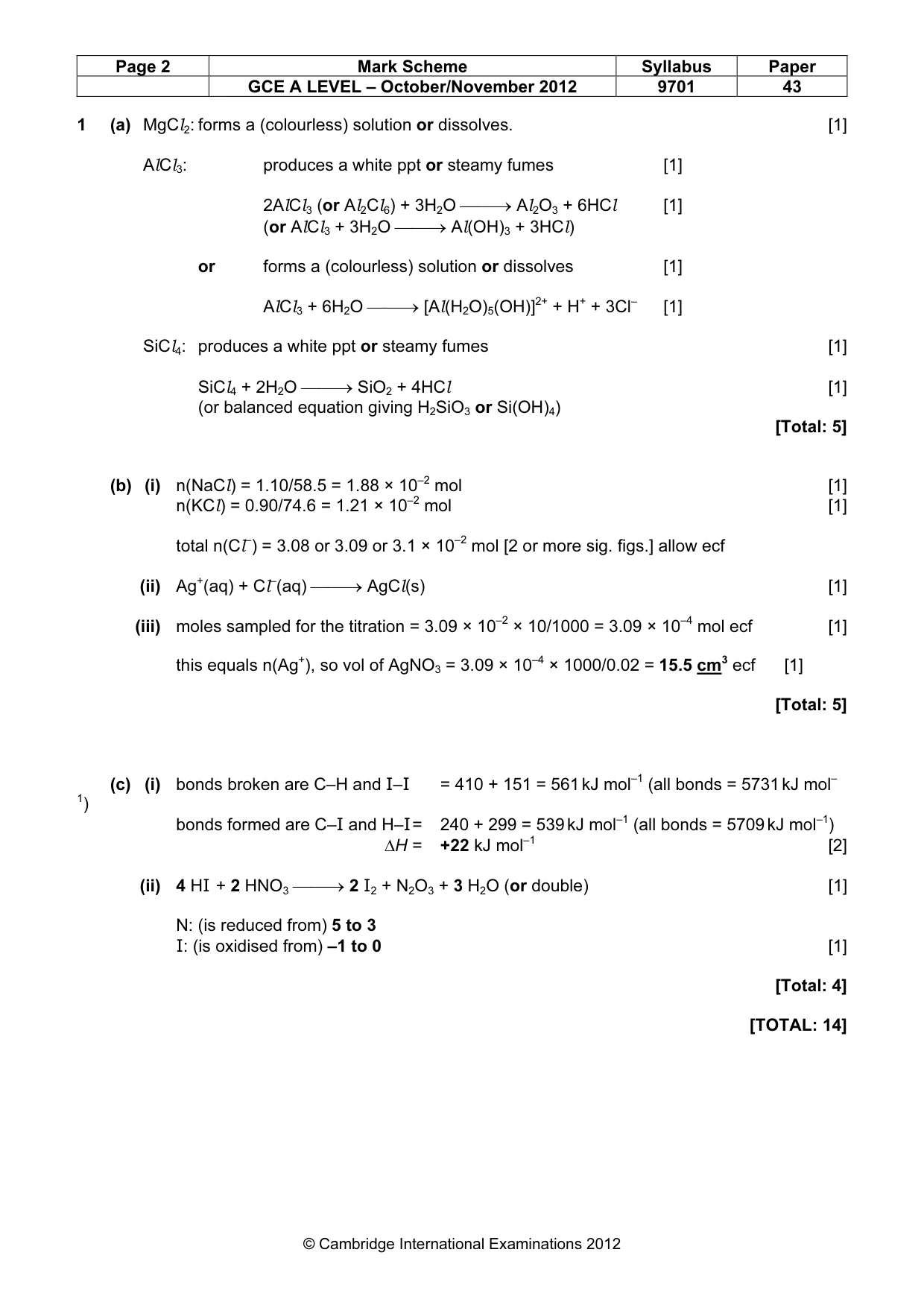
CAMBRIDGE INTERNATIONAL EXAMINATIONS GCE Advanced Level MARK SCHEME for the October/November 2012 series 9701 CHEMISTRY 9701/43 Paper 4 (A2 Structured Questions), maximum raw mark 100 This mark scheme is published as an aid to teachers and candidates, to indicate the requirements of the examination. It shows the basis on which Examiners were instructed to award marks. It does not indicate the details of the discussions that took place at an Examiners’ meeting before marking began, which would have considered the acceptability of alternative answers. Mark schemes should be read in conjunction with the question paper and the Principal Examiner Report for Teachers. Cambridge will not enter into discussions about these mark schemes. Cambridge is publishing the mark schemes for the October/November 2012 series for most IGCSE, GCE Advanced Level and Advanced Subsidiary Level components and some Ordinary Level components.
Mark scheme, page 2
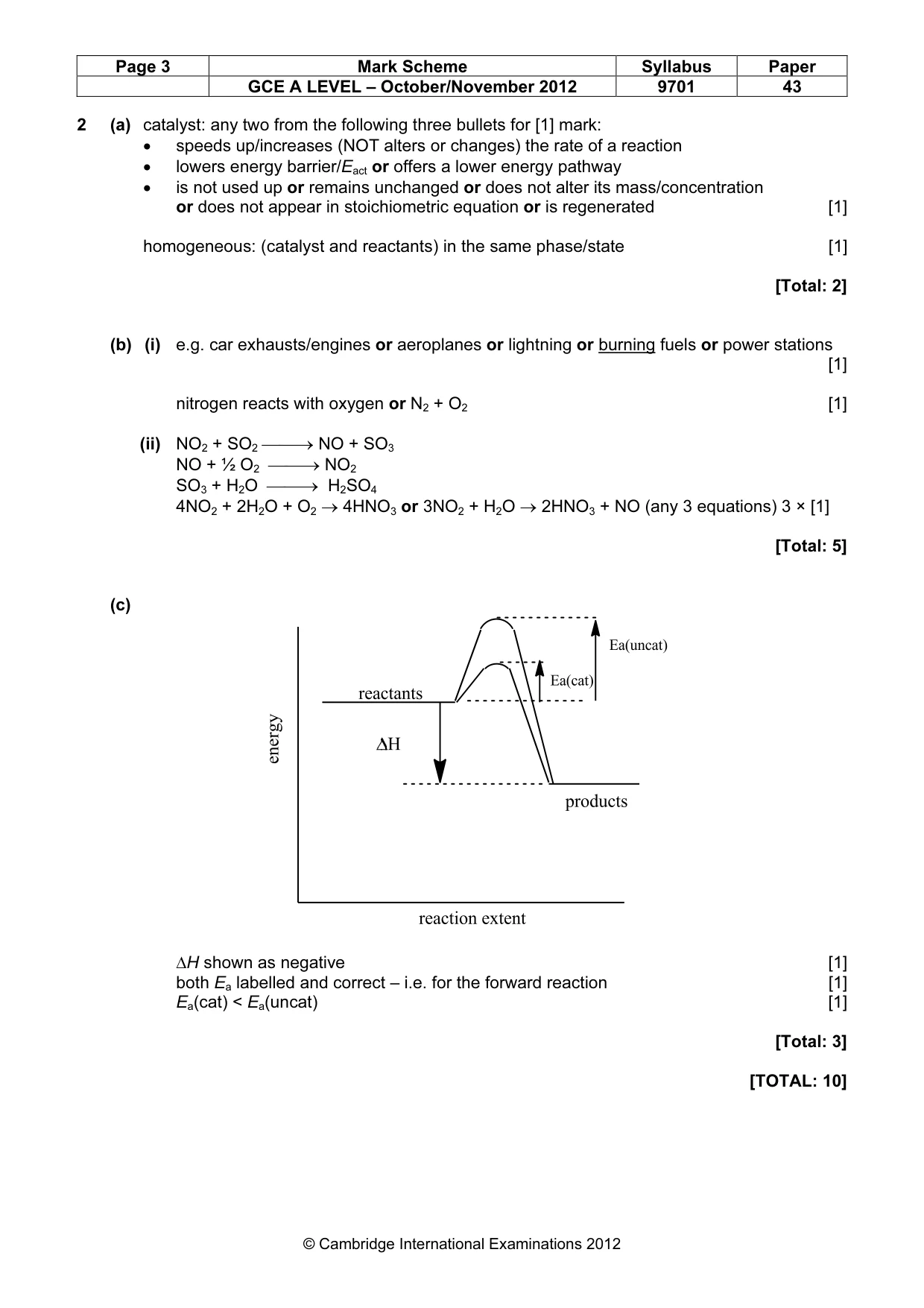
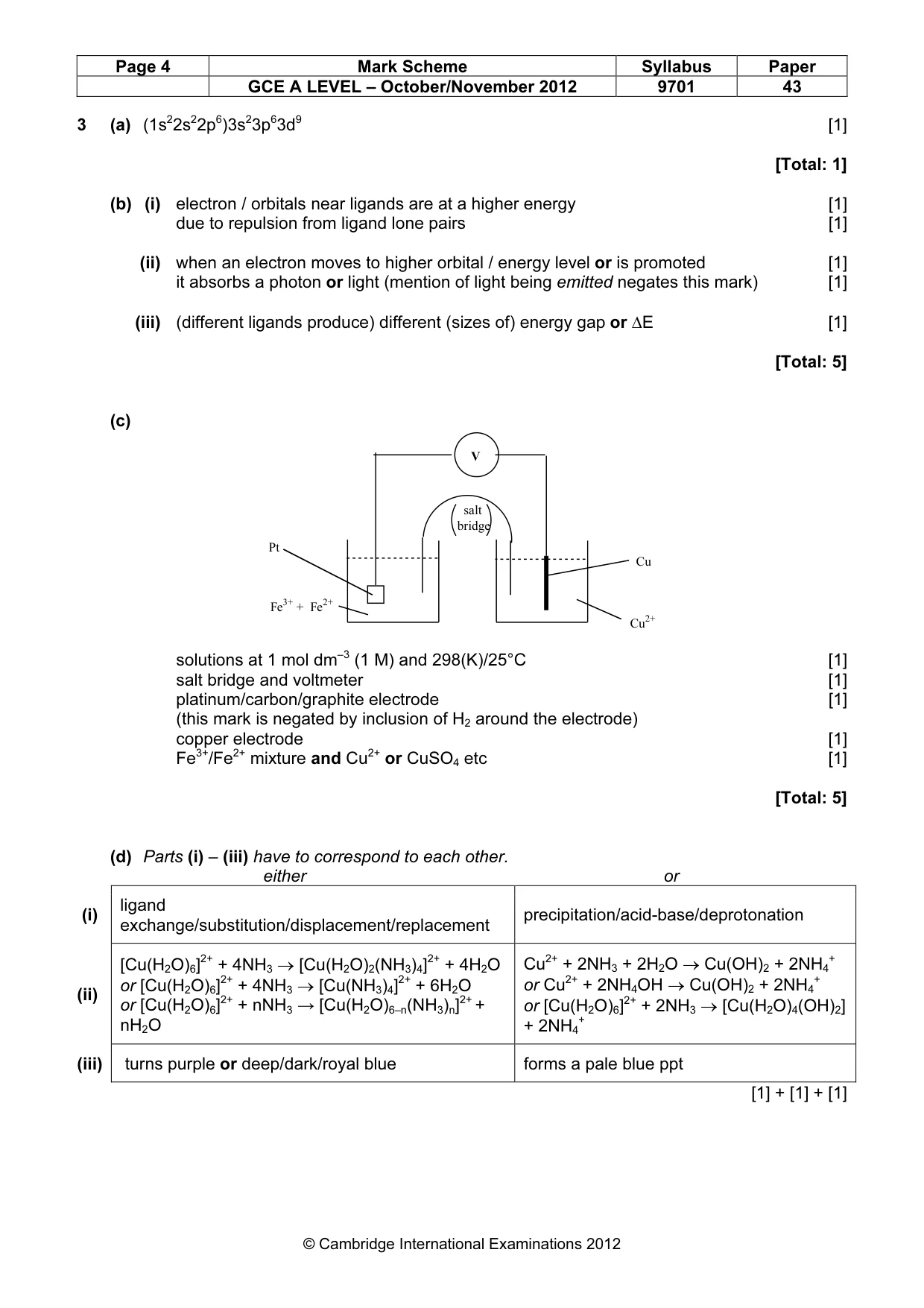
Page 2 Mark Scheme Syllabus Paper GCE A LEVEL – October/November 2012 9701 43 © Cambridge International Examinations 2012 1 (a) MgCl2: forms a (colourless) solution or dissolves. [1] AlCl3: produces a white ppt or steamy fumes [1] 2AlCl3 (or Al2Cl6) + 3H2O → Al2O3 + 6HCl [1] (or AlCl3 + 3H2O → Al(OH)3 + 3HCl) or forms a (colourless) solution or dissolves [1] AlCl3 + 6H2O → [Al(H2O)5(OH)]2+ + H+ + 3Cl– [1] SiCl4: produces a white ppt or steamy fumes [1] SiCl4 + 2H2O → SiO2 + 4HCl [1] (or balanced equation giving H2SiO3 or Si(OH)4) [Total: 5] (b) (i) n(NaCl) = 1.10/58.5 = 1.88 × 10⁻² mol [1] n(KCl) = 0.90/74.6 = 1.21 × 10⁻² mol [1] total n(Cl–) = 3.08 or 3.09 or 3.1 × 10⁻² mol [2 or more sig. figs.] allow ecf (ii) Ag+(aq) + Cl–(aq) → AgCl(s) [1] (iii) moles sampled for the titration = 3.09 × 10–2 × 10/1000 = 3.09 × 10⁻⁴ mol ecf [1] this equals n(Ag+), so vol of AgNO3 = 3.09 × 10–4 × 1000/0.02 = 15.5 cm3 ecf [1] [Total: 5] (c) (i) bonds broken are C–H and I–I = 410 + 151 = 561 kJ mol–1 (all bonds = 5731 kJ mol– 1) bonds formed are C–I and H–I = 240 + 299 = 539 kJ mol–1 (all bonds = 5709 kJ mol–1) ∆H = +22 kJ mol–1 [2] (ii) 4 HI + 2 HNO3 → 2 I2 + N2O3 + 3 H2O (or double) [1] N: (is reduced from) 5 to 3 I: (is oxidised from) –1 to 0 [1] [Total: 4] [TOTAL: 14]
Mark scheme, page 3
Page 3 Mark Scheme Syllabus Paper GCE A LEVEL – October/November 2012 9701 43 © Cambridge International Examinations 2012 2 (a) catalyst: any two from the following three bullets for [1] mark: • speeds up/increases (NOT alters or changes) the rate of a reaction • lowers energy barrier/Eact or offers a lower energy pathway • is not used up or remains unchanged or does not alter its mass/concentration or does not appear in stoichiometric equation or is regenerated [1] homogeneous: (catalyst and reactants) in the same phase/state [1] [Total: 2] (b) (i) e.g. car exhausts/engines or aeroplanes or lightning or burning fuels or power stations [1] nitrogen reacts with oxygen or N2 + O2 [1] (ii) NO2 + SO2 → NO + SO3 NO + ½ O2 → NO2 SO3 + H2O → H2SO4 4NO2 + 2H2O + O2 → 4HNO3 or 3NO2 + H2O → 2HNO3 + NO (any 3 equations) 3 × [1] [Total: 5] (c) ∆H shown as negative [1] both Ea labelled and correct – i.e. for the forward reaction [1] Ea(cat) < Ea(uncat) [1] [Total: 3] [TOTAL: 10]
Mark scheme, page 4
Page 4 Mark Scheme Syllabus Paper GCE A LEVEL – October/November 2012 9701 43 © Cambridge International Examinations 2012 3 (a) (1s22s22p6)3s23p63d9 [1] [Total: 1] (b) (i) electron / orbitals near ligands are at a higher energy [1] due to repulsion from ligand lone pairs [1] (ii) when an electron moves to higher orbital / energy level or is promoted [1] it absorbs a photon or light (mention of light being emitted negates this mark) [1] (iii) (different ligands produce) different (sizes of) energy gap or ∆E [1] [Total: 5] (c) V salt bridge Pt Cu Cu2+ Fe3+ + Fe2+ solutions at 1 mol dm–3 (1 M) and 298(K)/25°C [1] salt bridge and voltmeter [1] platinum/carbon/graphite electrode [1] (this mark is negated by inclusion of H2 around the electrode) copper electrode [1] Fe3+/Fe2+ mixture and Cu2+ or CuSO4 etc [1] [Total: 5] (d) Parts (i) – (iii) have to correspond to each other. either or (i) ligand exchange/substitution/displacement/replacement precipitation/acid-base/deprotonation (ii) [Cu(H2O)6]2+ + 4NH3 → [Cu(H2O)2(NH3)4]2+ + 4H2O or [Cu(H2O)6]2+ + 4NH3 → [Cu(NH3)4]2+ + 6H2O or [Cu(H2O)6]2+ + nNH3 → [Cu(H2O)6–n(NH3)n]2+ + nH2O Cu2+ + 2NH3 + 2H2O → Cu(OH)2 + 2NH4 + or Cu2+ + 2NH4OH → Cu(OH)2 + 2NH4 + or [Cu(H2O)6]2+ + 2NH3 → [Cu(H2O)4(OH)2] + 2NH4 + (iii) turns purple or deep/dark/royal blue forms a pale blue ppt [1] + [1] + [1]
Mark scheme, page 5
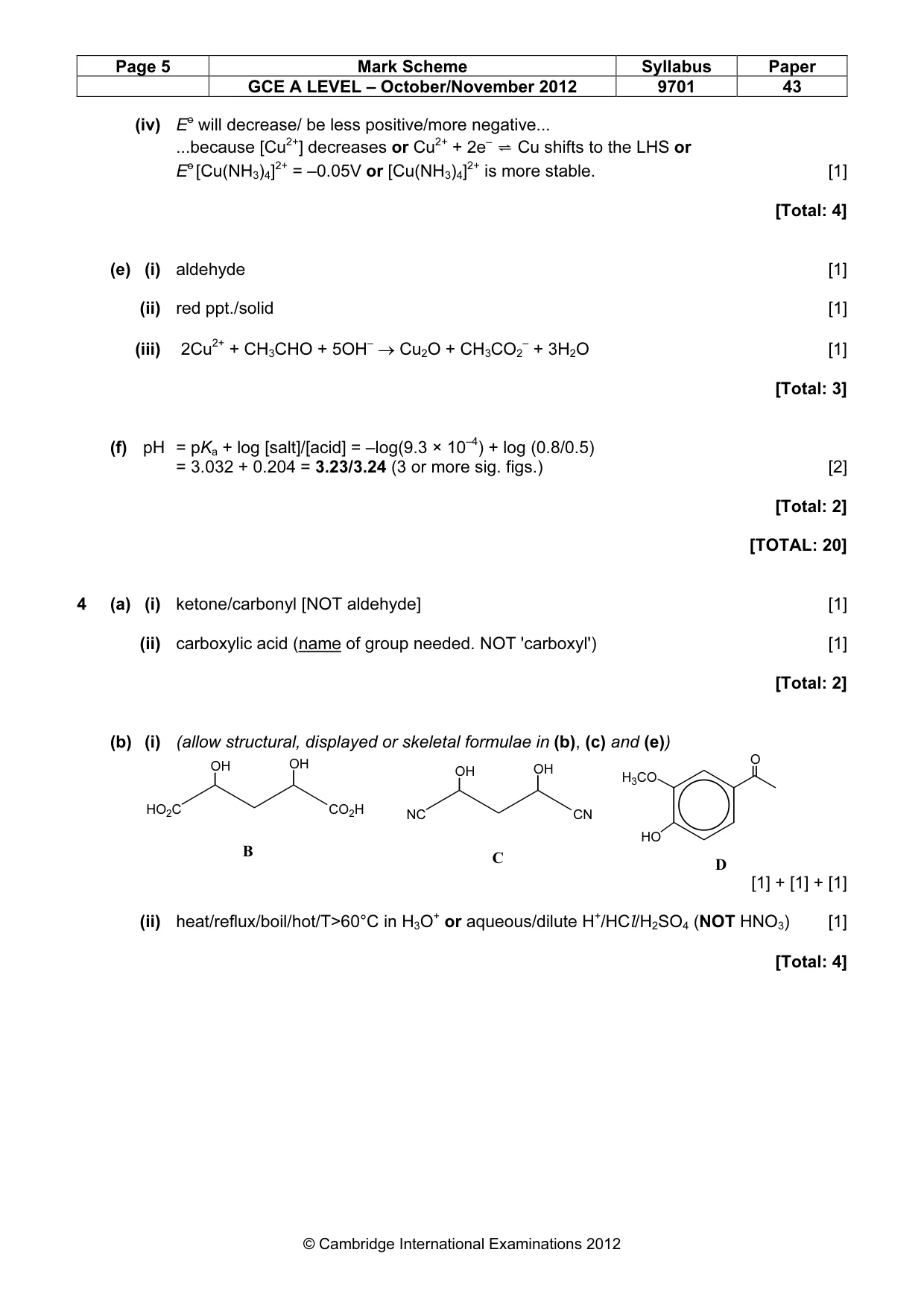
Page 5 Mark Scheme Syllabus Paper GCE A LEVEL – October/November 2012 9701 43 © Cambridge International Examinations 2012 (iv) Eo will decrease/ be less positive/more negative... ...because [Cu2+] decreases or Cu2+ + 2e– ⇋ Cu shifts to the LHS or Eo [Cu(NH3)4]2+ = –0.05V or [Cu(NH3)4]2+ is more stable. [1] [Total: 4] (e) (i) aldehyde [1] (ii) red ppt./solid [1] (iii) 2Cu2+ + CH3CHO + 5OH– → Cu2O + CH3CO2 – + 3H2O [1] [Total: 3] (f) pH = pKa + log [salt]/[acid] = –log(9.3 × 10⁻⁴) + log (0.8/0.5) = 3.032 + 0.204 = 3.23/3.24 (3 or more sig. figs.) [2] [Total: 2] [TOTAL: 20] 4 (a) (i) ketone/carbonyl [NOT aldehyde] [1] (ii) carboxylic acid (name of group needed. NOT 'carboxyl') [1] [Total: 2] (b) (i) (allow structural, displayed or skeletal formulae in (b), (c) and (e)) HO2C CO2H NC CN OH OH OH OH O HO H3CO B C D [1] + [1] + [1] (ii) heat/reflux/boil/hot/T>60°C in H3O+ or aqueous/dilute H+/HCl/H2SO4 (NOT HNO3) [1] [Total: 4]
Mark scheme, page 6
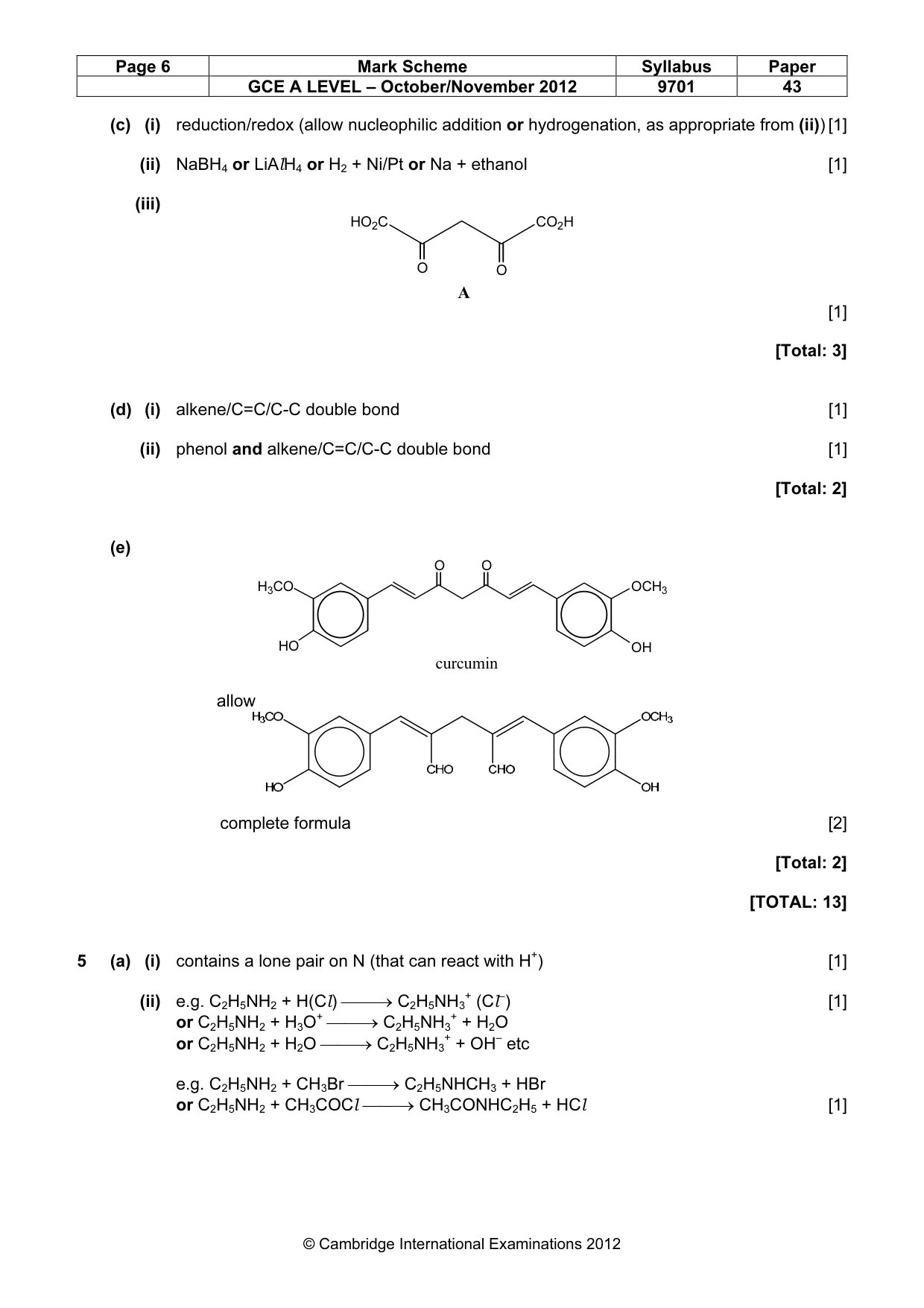
Page 6 Mark Scheme Syllabus Paper GCE A LEVEL – October/November 2012 9701 43 © Cambridge International Examinations 2012 (c) (i) reduction/redox (allow nucleophilic addition or hydrogenation, as appropriate from (ii)) [1] (ii) NaBH4 or LiAlH4 or H2 + Ni/Pt or Na + ethanol [1] (iii) HO2C CO2H O O A [1] [Total: 3] (d) (i) alkene/C=C/C-C double bond [1] (ii) phenol and alkene/C=C/C-C double bond [1] [Total: 2] (e) H3CO HO OH OCH3 O O curcumin allow complete formula [2] [Total: 2] [TOTAL: 13] 5 (a) (i) contains a lone pair on N (that can react with H+) [1] (ii) e.g. C2H5NH2 + H(Cl) → C2H5NH3 + (Cl–) [1] or C2H5NH2 + H3O+ → C2H5NH3 + + H2O or C2H5NH2 + H2O → C2H5NH3 + + OH– etc e.g. C2H5NH2 + CH3Br → C2H5NHCH3 + HBr or C2H5NH2 + CH3COCl → CH3CONHC2H5 + HCl [1]
Mark scheme, page 7
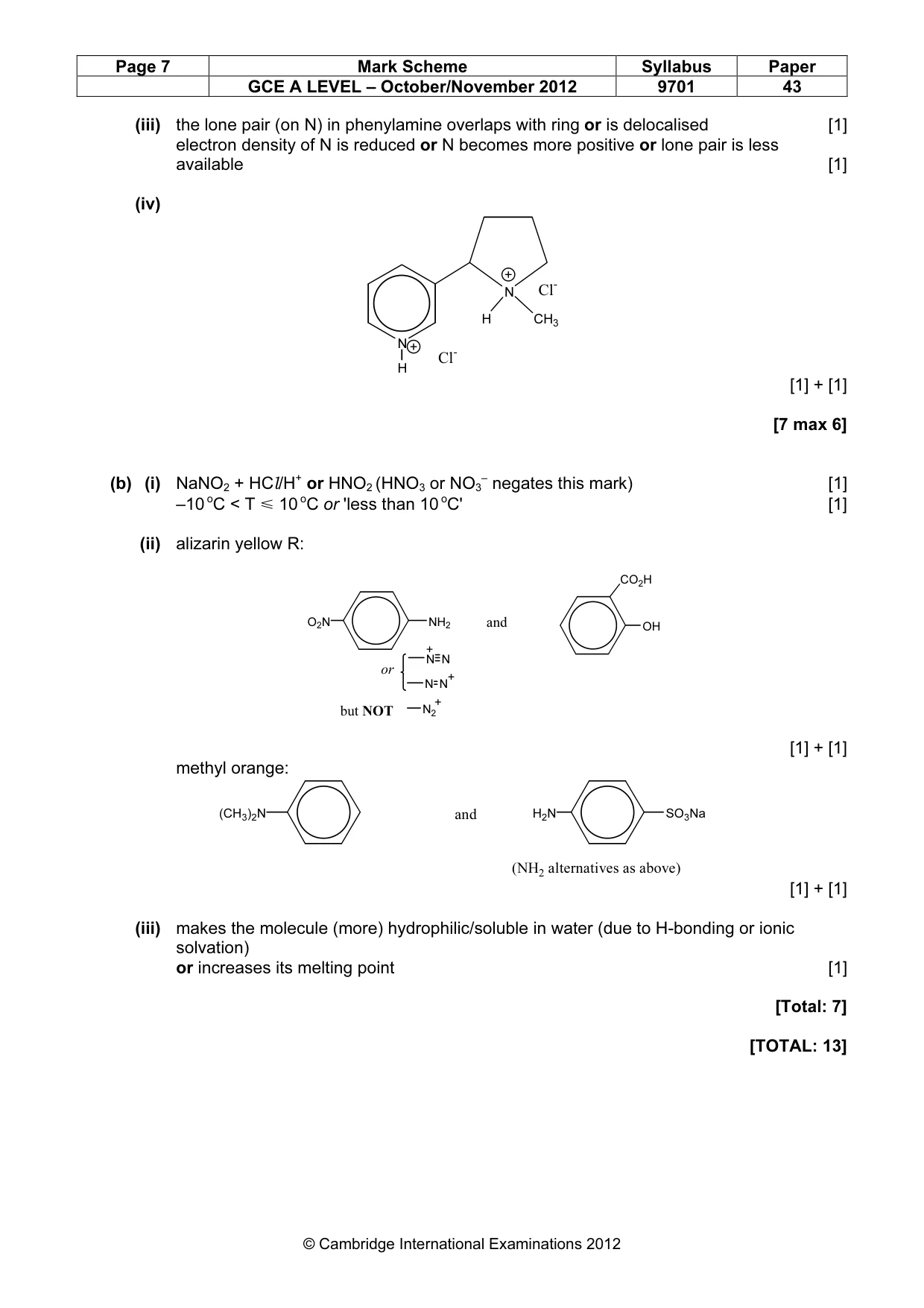
Page 7 Mark Scheme Syllabus Paper GCE A LEVEL – October/November 2012 9701 43 © Cambridge International Examinations 2012 (iii) the lone pair (on N) in phenylamine overlaps with ring or is delocalised [1] electron density of N is reduced or N becomes more positive or lone pair is less available [1] (iv) N N H H CH3 Cl- Cl- [1] + [1] [7 max 6] (b) (i) NaNO2 + HCl/H+ or HNO2 (HNO3 or NO3 – negates this mark) [1] –10 oC < T Y 10 oC or 'less than 10 oC' [1] (ii) alizarin yellow R: [1] + [1] methyl orange: (CH3)2N H2N SO3Na and (NH2 alternatives as above) [1] + [1] (iii) makes the molecule (more) hydrophilic/soluble in water (due to H-bonding or ionic solvation) or increases its melting point [1] [Total: 7] [TOTAL: 13] O2N NH2 CO2H OH and N N N N N2 or but NOT
Mark scheme, page 8
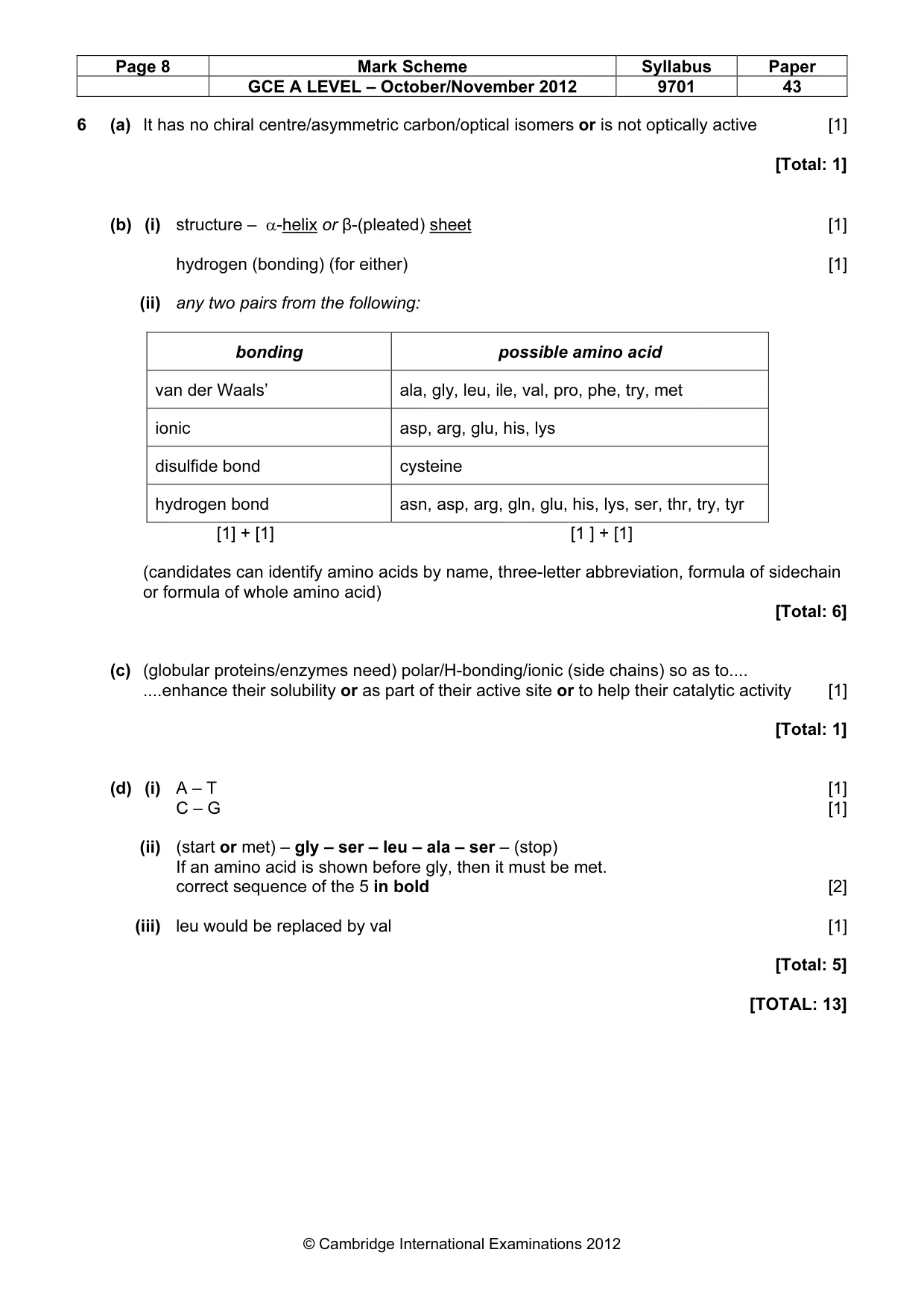
Page 8 Mark Scheme Syllabus Paper GCE A LEVEL – October/November 2012 9701 43 © Cambridge International Examinations 2012 6 (a) It has no chiral centre/asymmetric carbon/optical isomers or is not optically active [1] [Total: 1] (b) (i) structure – α-helix or β-(pleated) sheet [1] hydrogen (bonding) (for either) [1] (ii) any two pairs from the following: bonding possible amino acid van der Waals’ ala, gly, leu, ile, val, pro, phe, try, met ionic asp, arg, glu, his, lys disulfide bond cysteine hydrogen bond asn, asp, arg, gln, glu, his, lys, ser, thr, try, tyr [1] + [1] [1 ] + [1] (candidates can identify amino acids by name, three-letter abbreviation, formula of sidechain or formula of whole amino acid) [Total: 6] (c) (globular proteins/enzymes need) polar/H-bonding/ionic (side chains) so as to… …enhance their solubility or as part of their active site or to help their catalytic activity [1] [Total: 1] (d) (i) A – T [1] C – G [1] (ii) (start or met) – gly – ser – leu – ala – ser – (stop) If an amino acid is shown before gly, then it must be met. correct sequence of the 5 in bold [2] (iii) leu would be replaced by val [1] [Total: 5] [TOTAL: 13]
Mark scheme, page 9
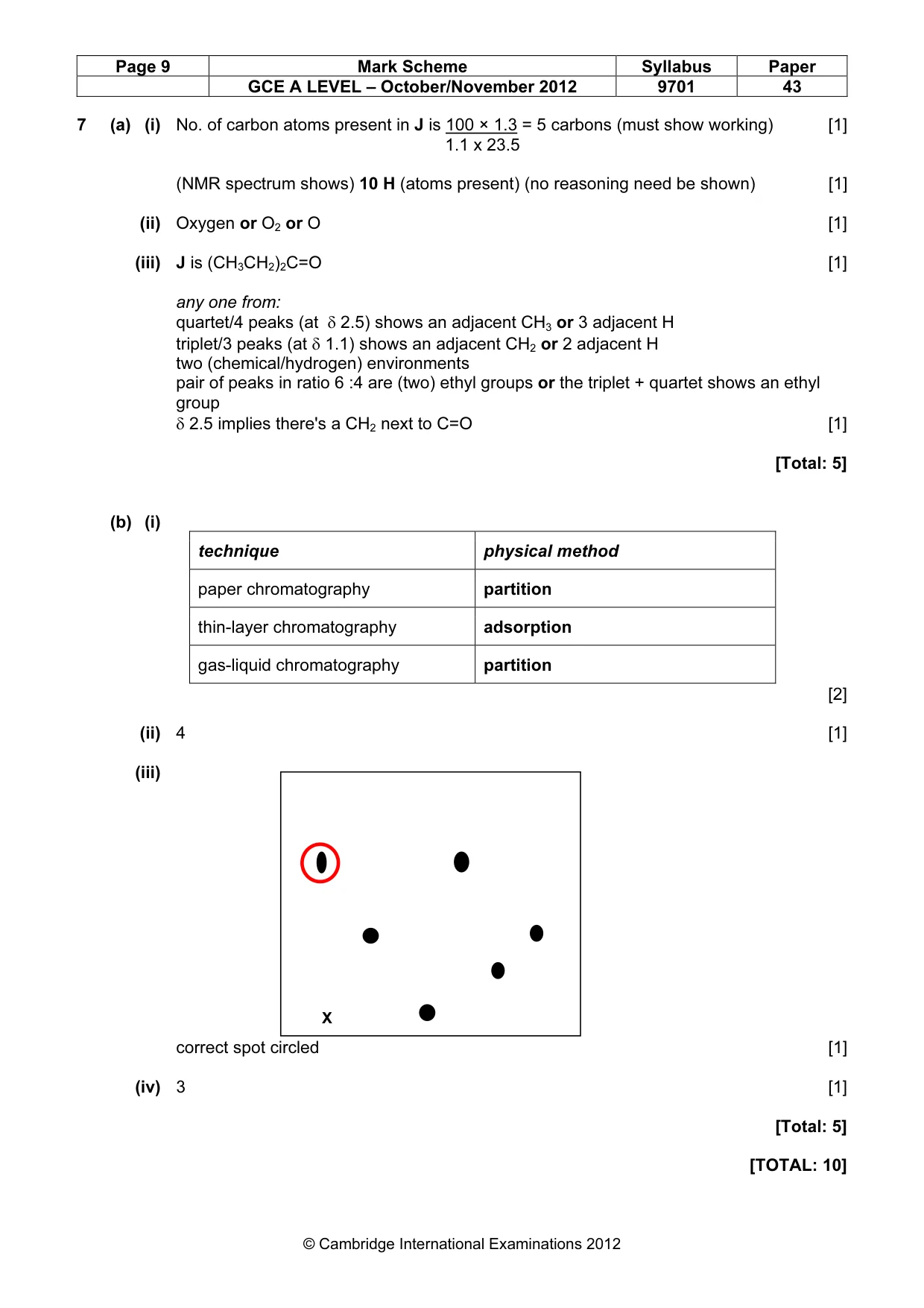
Page 9 Mark Scheme Syllabus Paper GCE A LEVEL – October/November 2012 9701 43 © Cambridge International Examinations 2012 7 (a) (i) No. of carbon atoms present in J is 100 × 1.3 = 5 carbons (must show working) [1] 1.1 x 23.5 (NMR spectrum shows) 10 H (atoms present) (no reasoning need be shown) [1] (ii) Oxygen or O2 or O [1] (iii) J is (CH3CH2)2C=O [1] any one from: quartet/4 peaks (at δ 2.5) shows an adjacent CH3 or 3 adjacent H triplet/3 peaks (at δ 1.1) shows an adjacent CH2 or 2 adjacent H two (chemical/hydrogen) environments pair of peaks in ratio 6 :4 are (two) ethyl groups or the triplet + quartet shows an ethyl group δ 2.5 implies there's a CH2 next to C=O [1] [Total: 5] (b) (i) technique physical method paper chromatography partition thin-layer chromatography adsorption gas-liquid chromatography partition [2] (ii) 4 [1] (iii) correct spot circled [1] (iv) 3 [1] [Total: 5] [TOTAL: 10] X
Mark scheme, page 10
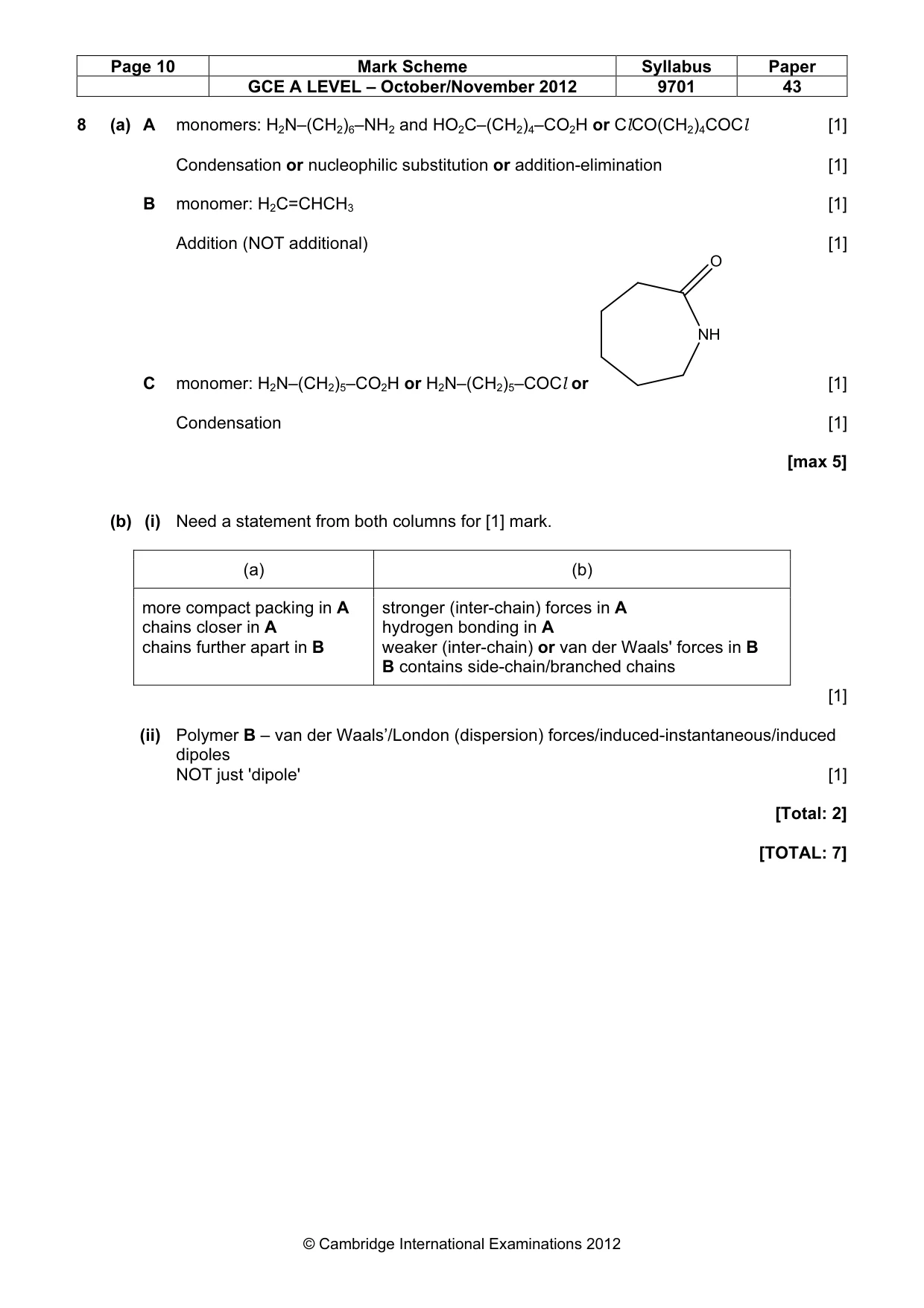
Page 10 Mark Scheme Syllabus Paper GCE A LEVEL – October/November 2012 9701 43 © Cambridge International Examinations 2012 8 (a) A monomers: H2N–(CH2)6–NH2 and HO2C–(CH2)4–CO2H or ClCO(CH2)4COCl [1] Condensation or nucleophilic substitution or addition-elimination [1] B monomer: H2C=CHCH3 [1] Addition (NOT additional) [1] C monomer: H2N–(CH2)5–CO2H or H2N–(CH2)5–COCl or [1] Condensation [1] [max 5] (b) (i) Need a statement from both columns for [1] mark. (a) (b) more compact packing in A chains closer in A chains further apart in B stronger (inter-chain) forces in A hydrogen bonding in A weaker (inter-chain) or van der Waals' forces in B B contains side-chain/branched chains [1] (ii) Polymer B – van der Waals’/London (dispersion) forces/induced-instantaneous/induced dipoles NOT just 'dipole' [1] [Total: 2] [TOTAL: 7]
What you needed in this session
Cambridge’s own grade thresholds for 2012 Oct/Nov, Paper 4 · Variant 3. A higher threshold means an easier paper — the bar moves with how the cohort did.