Cambridge A Level Chemistry 9701 — 2012 Oct/Nov Paper 2 · Variant 3
9701/23/O/N/12 · 60 marks · ≈68 min
The question paper and its mark scheme, free to read here and free to download. This is Cambridge’s own paper, exactly as it was sat.
Question paper12 pages
Mark scheme7 pages
Answers below. Sit the paper first if you are practising.
Paper as text
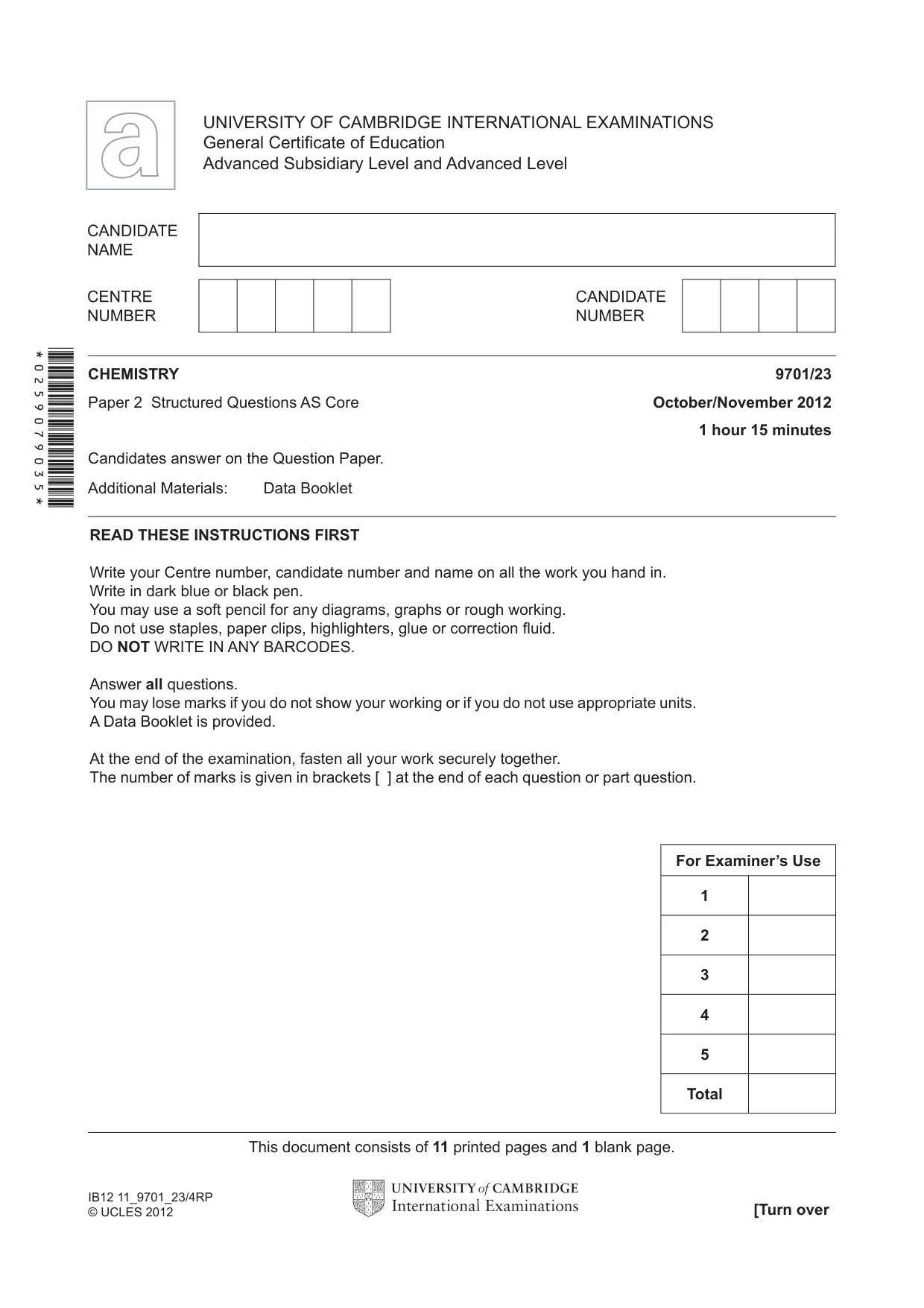
Question paper, page 1
READ THESE INSTRUCTIONS FIRST Write your Centre number, candidate number and name on all the work you hand in. Write in dark blue or black pen. You may use a soft pencil for any diagrams, graphs or rough working. Do not use staples, paper clips, highlighters, glue or correction fl uid. DO NOT WRITE IN ANY BARCODES. Answer all questions. You may lose marks if you do not show your working or if you do not use appropriate units. A Data Booklet is provided. At the end of the examination, fasten all your work securely together. The number of marks is given in brackets [ ] at the end of each question or part question. CHEMISTRY 9701/23 Paper 2 Structured Questions AS Core October/November 2012 1 hour 15 minutes Candidates answer on the Question Paper. Additional Materials: Data Booklet UNIVERSITY OF CAMBRIDGE INTERNATIONAL EXAMINATIONS General Certifi cate of Education Advanced Subsidiary Level and Advanced Level This document consists of 11 printed pages and 1 blank page. [Turn over IB12 11_9701_23/4RP © UCLES 2012 *0259079035* For Examiner’s Use 1 2 3 4 5 Total
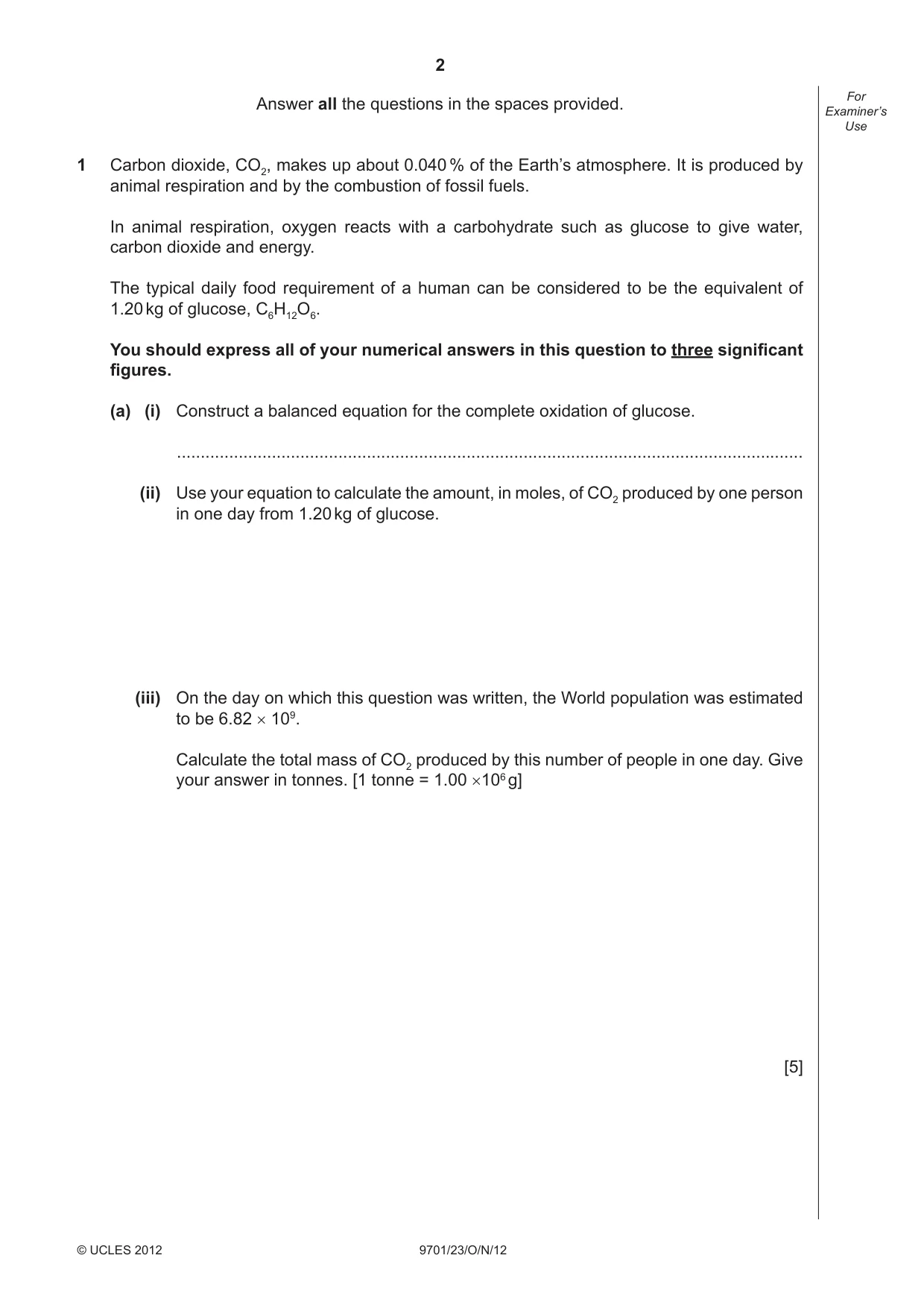
Question paper, page 2
2 9701/23/O/N/12 © UCLES 2012 For Examiner’s Use Answer all the questions in the spaces provided. 1 Carbon dioxide, CO2, makes up about 0.040 % of the Earth’s atmosphere. It is produced by animal respiration and by the combustion of fossil fuels. In animal respiration, oxygen reacts with a carbohydrate such as glucose to give water, carbon dioxide and energy. The typical daily food requirement of a human can be considered to be the equivalent of 1.20 kg of glucose, C6H12O6. You should express all of your numerical answers in this question to three signifi cant fi gures. (a) (i) Construct a balanced equation for the complete oxidation of glucose. … (ii) Use your equation to calculate the amount, in moles, of CO2 produced by one person in one day from 1.20 kg of glucose. (iii) On the day on which this question was written, the World population was estimated to be 6.82 × 10⁹. Calculate the total mass of CO2 produced by this number of people in one day. Give your answer in tonnes. [1 tonne = 1.00 ×10⁶ g] [5]
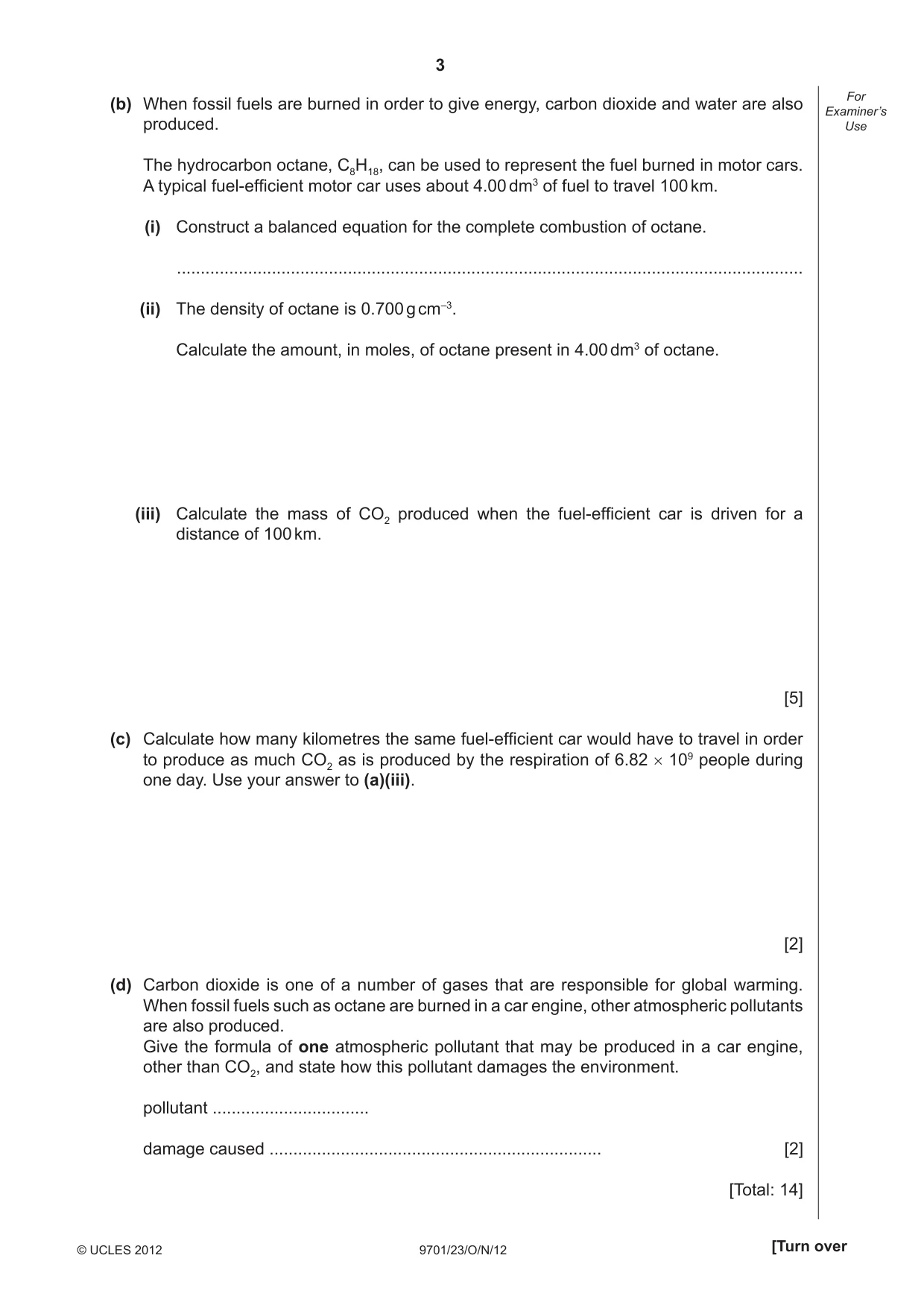
Question paper, page 3
3 9701/23/O/N/12 © UCLES 2012 [Turn over For Examiner’s Use (b) When fossil fuels are burned in order to give energy, carbon dioxide and water are also produced. The hydrocarbon octane, C8H18, can be used to represent the fuel burned in motor cars. A typical fuel-effi cient motor car uses about 4.00 dm3 of fuel to travel 100 km. (i) Construct a balanced equation for the complete combustion of octane. … (ii) The density of octane is 0.700 g cm–3. Calculate the amount, in moles, of octane present in 4.00 dm3 of octane. (iii) Calculate the mass of CO2 produced when the fuel-effi cient car is driven for a distance of 100 km. [5] (c) Calculate how many kilometres the same fuel-effi cient car would have to travel in order to produce as much CO2 as is produced by the respiration of 6.82 × 10⁹ people during one day. Use your answer to (a)(iii). [2] (d) Carbon dioxide is one of a number of gases that are responsible for global warming. When fossil fuels such as octane are burned in a car engine, other atmospheric pollutants are also produced. Give the formula of one atmospheric pollutant that may be produced in a car engine, other than CO2, and state how this pollutant damages the environment. pollutant … damage caused … [2] [Total: 14]
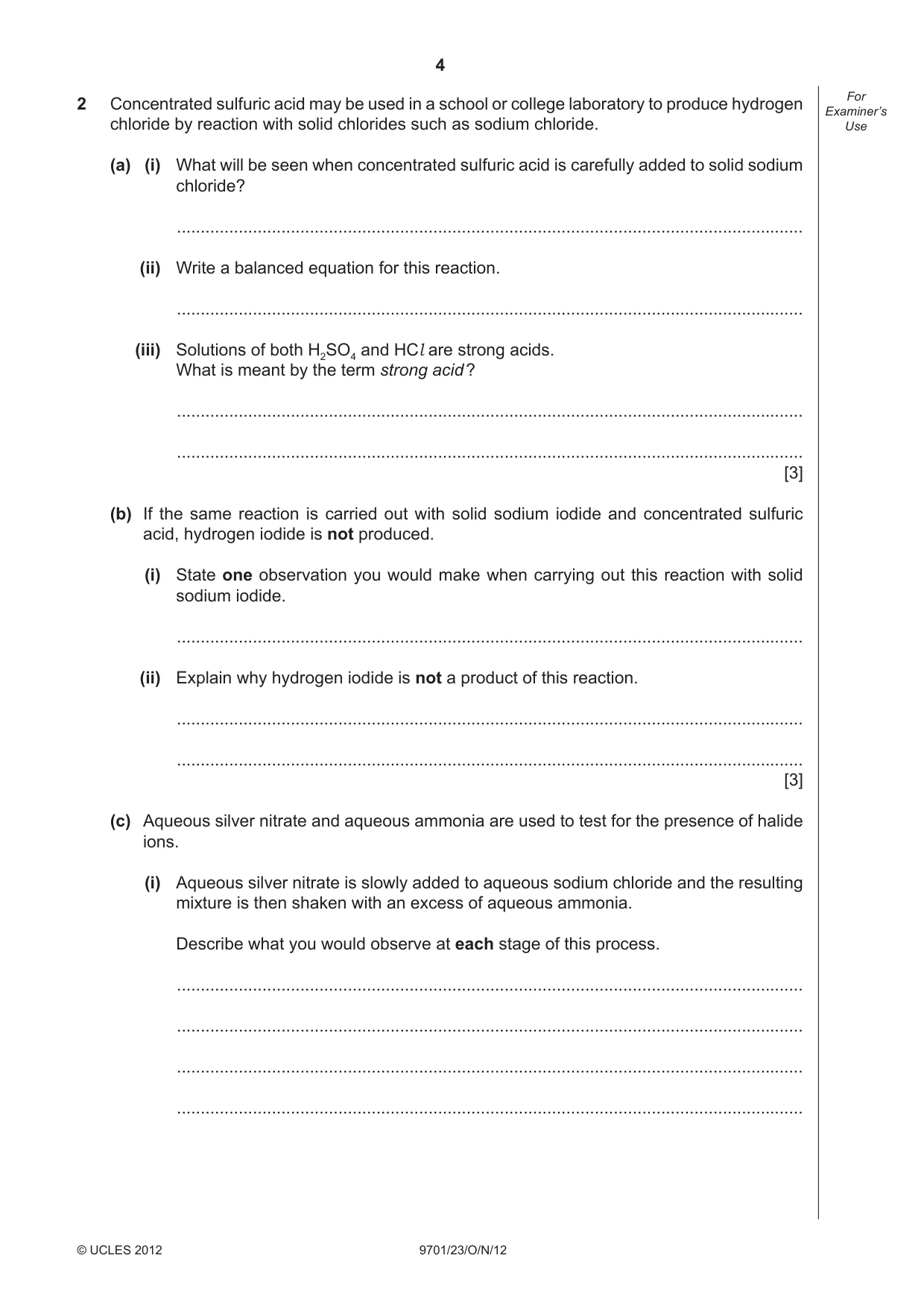
Question paper, page 4
4 9701/23/O/N/12 © UCLES 2012 For Examiner’s Use 2 Concentrated sulfuric acid may be used in a school or college laboratory to produce hydrogen chloride by reaction with solid chlorides such as sodium chloride. (a) (i) What will be seen when concentrated sulfuric acid is carefully added to solid sodium chloride? … (ii) Write a balanced equation for this reaction. … (iii) Solutions of both H2SO4 and HCl are strong acids. What is meant by the term strong acid ? … … [3] (b) If the same reaction is carried out with solid sodium iodide and concentrated sulfuric acid, hydrogen iodide is not produced. (i) State one observation you would make when carrying out this reaction with solid sodium iodide. … (ii) Explain why hydrogen iodide is not a product of this reaction. … … [3] (c) Aqueous silver nitrate and aqueous ammonia are used to test for the presence of halide ions. (i) Aqueous silver nitrate is slowly added to aqueous sodium chloride and the resulting mixture is then shaken with an excess of aqueous ammonia. Describe what you would observe at each stage of this process. … … … …
Question paper, page 5
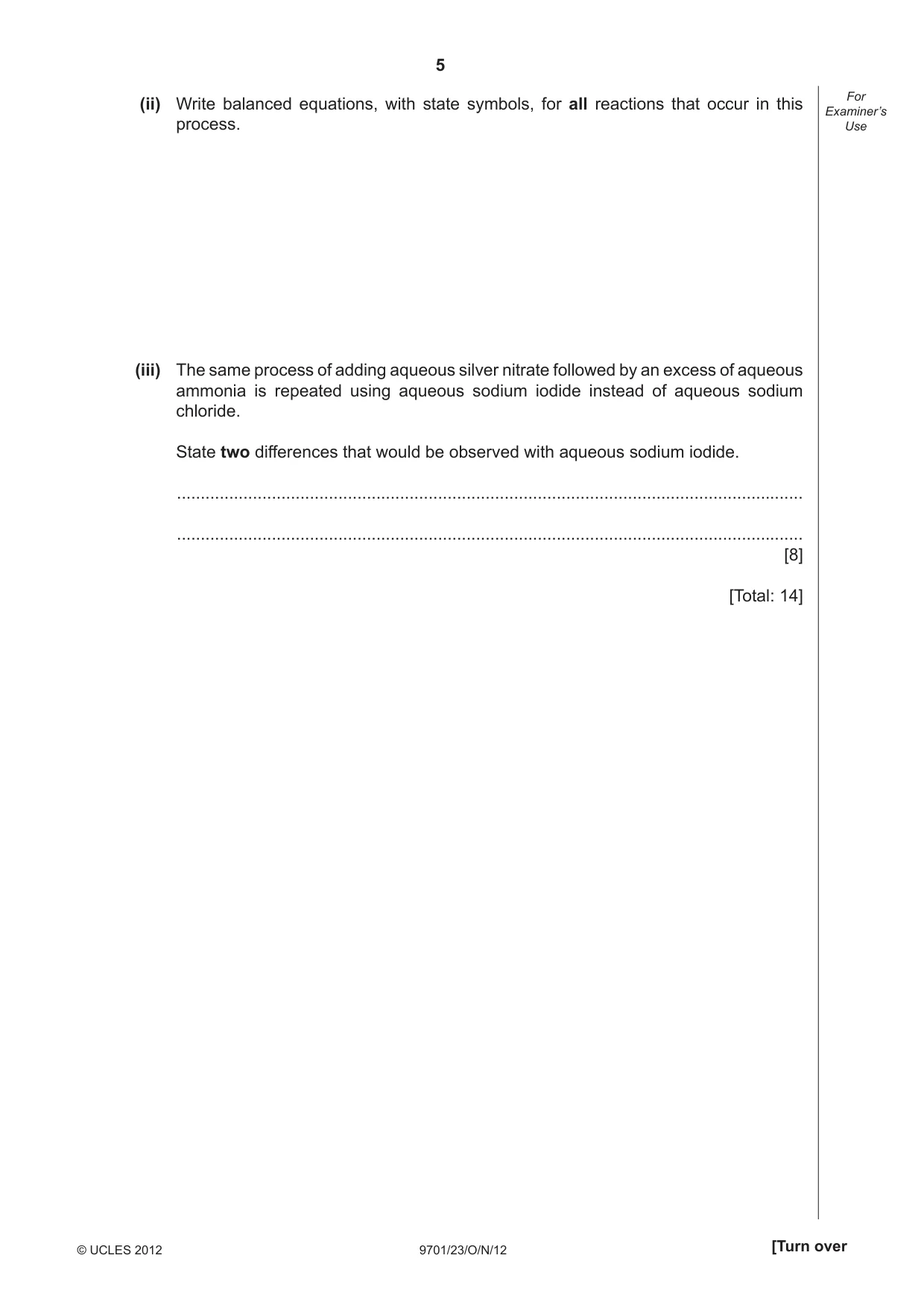
5 9701/23/O/N/12 © UCLES 2012 [Turn over For Examiner’s Use (ii) Write balanced equations, with state symbols, for all reactions that occur in this process. (iii) The same process of adding aqueous silver nitrate followed by an excess of aqueous ammonia is repeated using aqueous sodium iodide instead of aqueous sodium chloride. State two differences that would be observed with aqueous sodium iodide. … … [8] [Total: 14]
Question paper, page 6
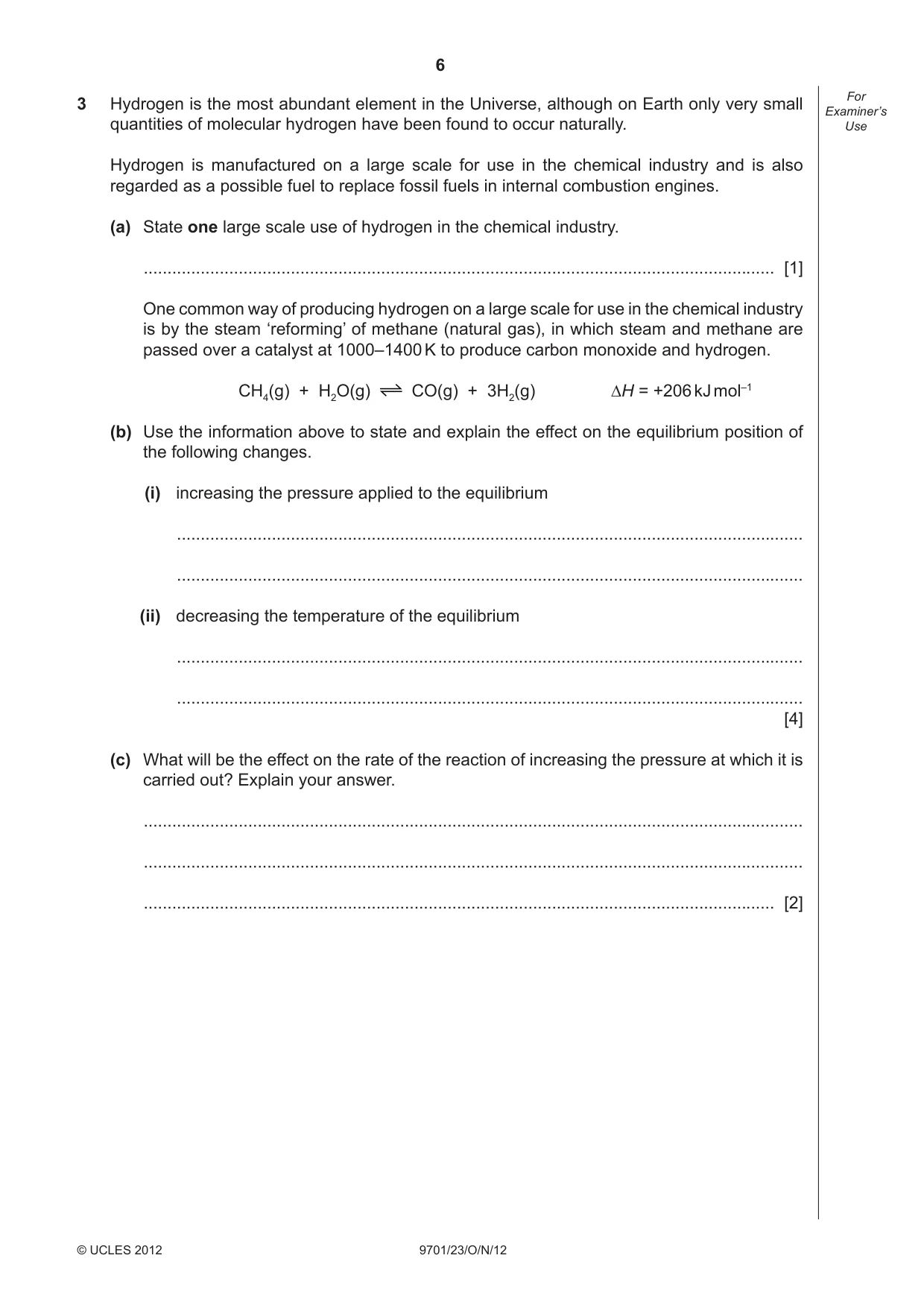
6 9701/23/O/N/12 © UCLES 2012 For Examiner’s Use 3 Hydrogen is the most abundant element in the Universe, although on Earth only very small quantities of molecular hydrogen have been found to occur naturally. Hydrogen is manufactured on a large scale for use in the chemical industry and is also regarded as a possible fuel to replace fossil fuels in internal combustion engines. (a) State one large scale use of hydrogen in the chemical industry. … [1] One common way of producing hydrogen on a large scale for use in the chemical industry is by the steam ‘reforming’ of methane (natural gas), in which steam and methane are passed over a catalyst at 1000–1400 K to produce carbon monoxide and hydrogen. CH4(g) + H2O(g) CO(g) + 3H2(g) ∆H = +206 kJ mol–1 (b) Use the information above to state and explain the effect on the equilibrium position of the following changes. (i) increasing the pressure applied to the equilibrium … … (ii) decreasing the temperature of the equilibrium … … [4] (c) What will be the effect on the rate of the reaction of increasing the pressure at which it is carried out? Explain your answer. … … … [2]
Question paper, page 7
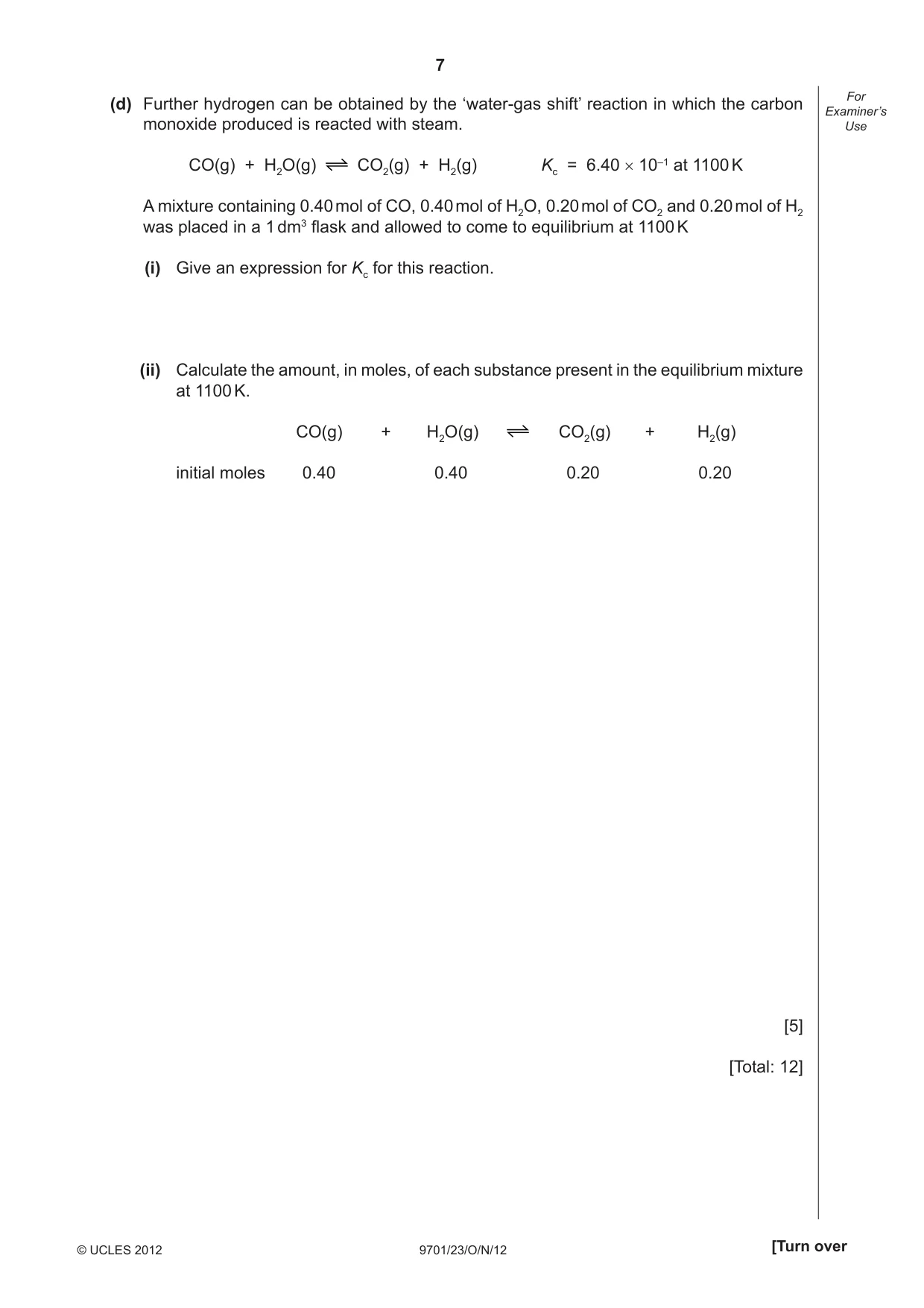
7 9701/23/O/N/12 © UCLES 2012 [Turn over For Examiner’s Use (d) Further hydrogen can be obtained by the ‘water-gas shift’ reaction in which the carbon monoxide produced is reacted with steam. CO(g) + H2O(g) CO2(g) + H2(g) Kc = 6.40 × 10⁻¹ at 1100 K A mixture containing 0.40 mol of CO, 0.40 mol of H2O, 0.20 mol of CO2 and 0.20 mol of H2 was placed in a 1 dm3 fl ask and allowed to come to equilibrium at 1100 K (i) Give an expression for Kc for this reaction. (ii) Calculate the amount, in moles, of each substance present in the equilibrium mixture at 1100 K. CO(g) + H2O(g) CO2(g) + H2(g) initial moles 0.40 0.40 0.20 0.20 [5] [Total: 12]
Question paper, page 8
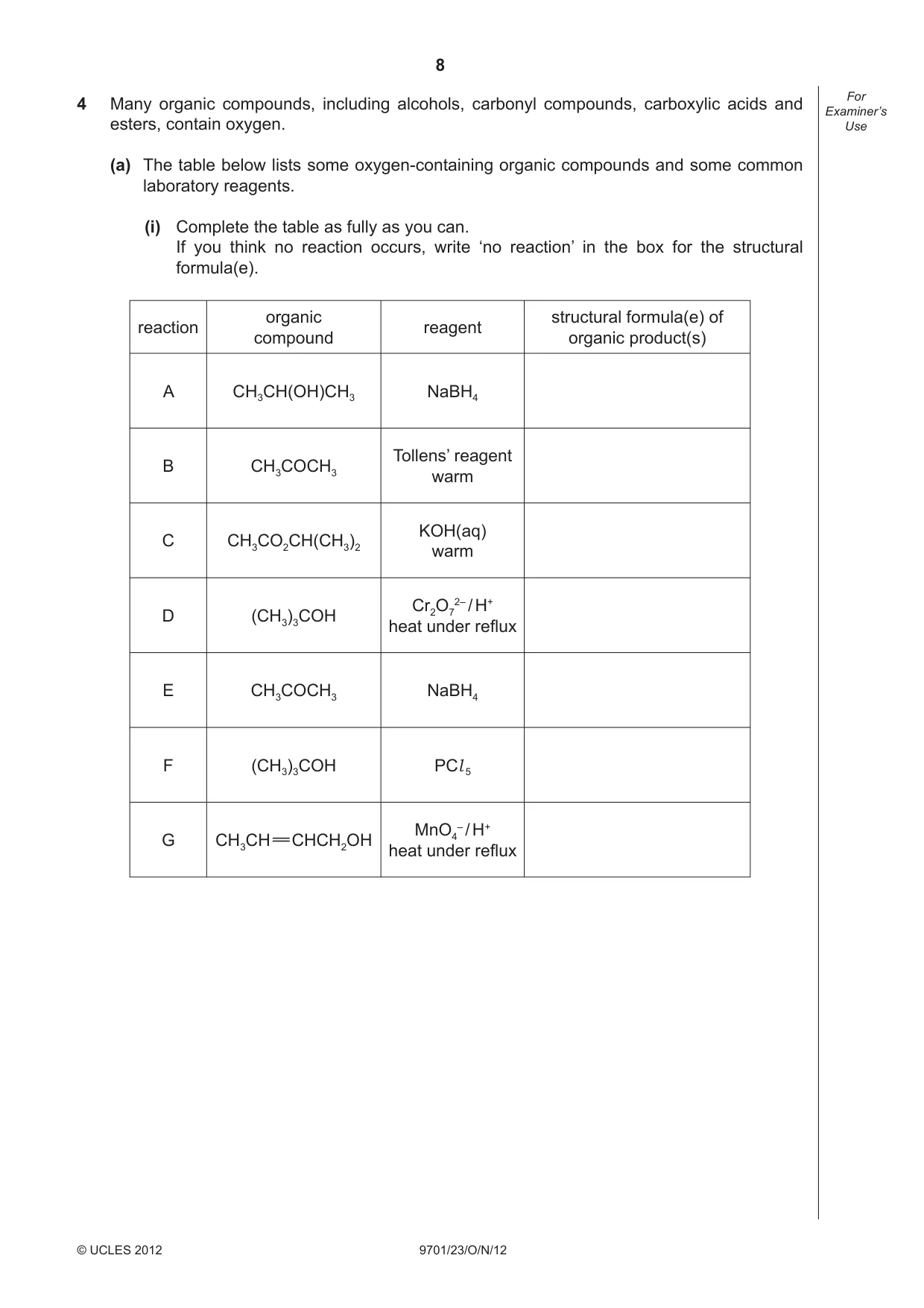
8 9701/23/O/N/12 © UCLES 2012 For Examiner’s Use 4 Many organic compounds, including alcohols, carbonyl compounds, carboxylic acids and esters, contain oxygen. (a) The table below lists some oxygen-containing organic compounds and some common laboratory reagents. (i) Complete the table as fully as you can. If you think no reaction occurs, write ‘no reaction’ in the box for the structural formula(e). reaction organic compound reagent structural formula(e) of organic product(s) A CH3CH(OH)CH3 NaBH4 B CH3COCH3 Tollens’ reagent warm C CH3CO2CH(CH3)2 KOH(aq) warm D (CH3)3COH Cr2O7 2– / H+ heat under refl ux E CH3COCH3 NaBH4 F (CH3)3COH PCl 5 G CH3CH CHCH2OH MnO4 – / H+ heat under refl ux
Question paper, page 9
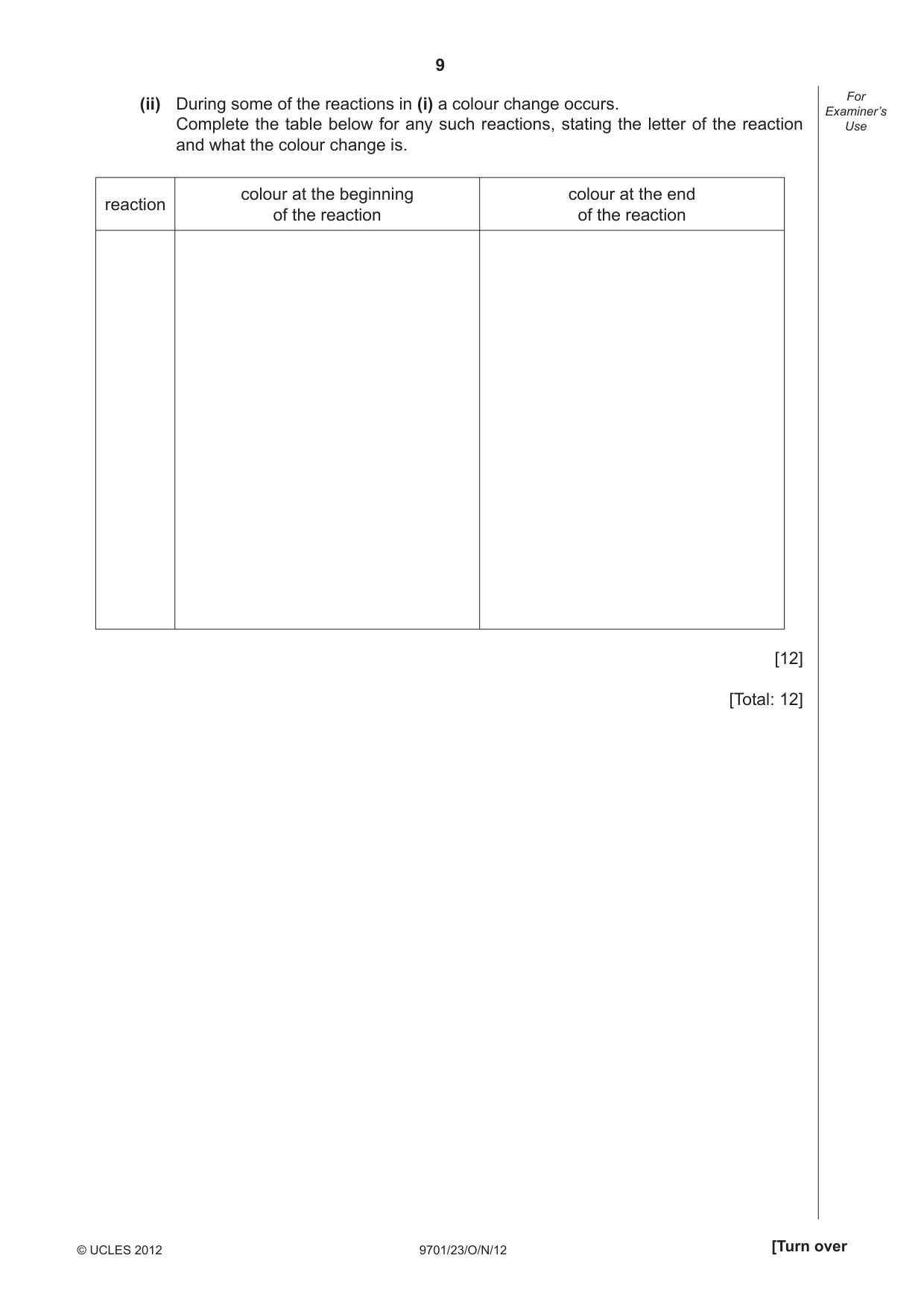
9 9701/23/O/N/12 © UCLES 2012 [Turn over For Examiner’s Use (ii) During some of the reactions in (i) a colour change occurs. Complete the table below for any such reactions, stating the letter of the reaction and what the colour change is. reaction colour at the beginning of the reaction colour at the end of the reaction [12] [Total: 12]
Question paper, page 10
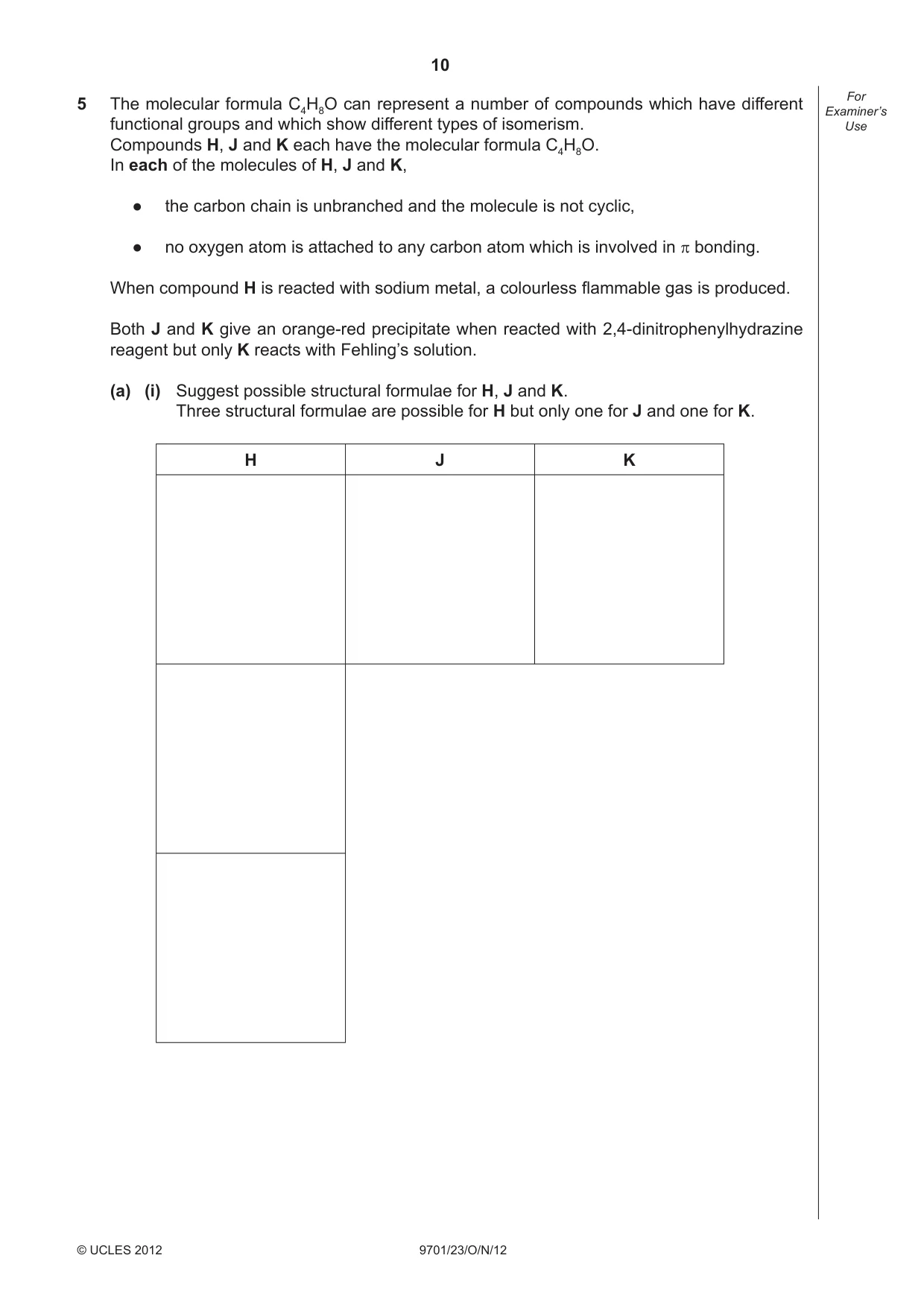
10 9701/23/O/N/12 © UCLES 2012 For Examiner’s Use 5 The molecular formula C4H8O can represent a number of compounds which have different functional groups and which show different types of isomerism. Compounds H, J and K each have the molecular formula C4H8O. In each of the molecules of H, J and K, ● the carbon chain is unbranched and the molecule is not cyclic, ● no oxygen atom is attached to any carbon atom which is involved in π bonding. When compound H is reacted with sodium metal, a colourless fl ammable gas is produced. Both J and K give an orange-red precipitate when reacted with 2,4-dinitrophenylhydrazine reagent but only K reacts with Fehling’s solution. (a) (i) Suggest possible structural formulae for H, J and K. Three structural formulae are possible for H but only one for J and one for K. H J K
Question paper, page 11
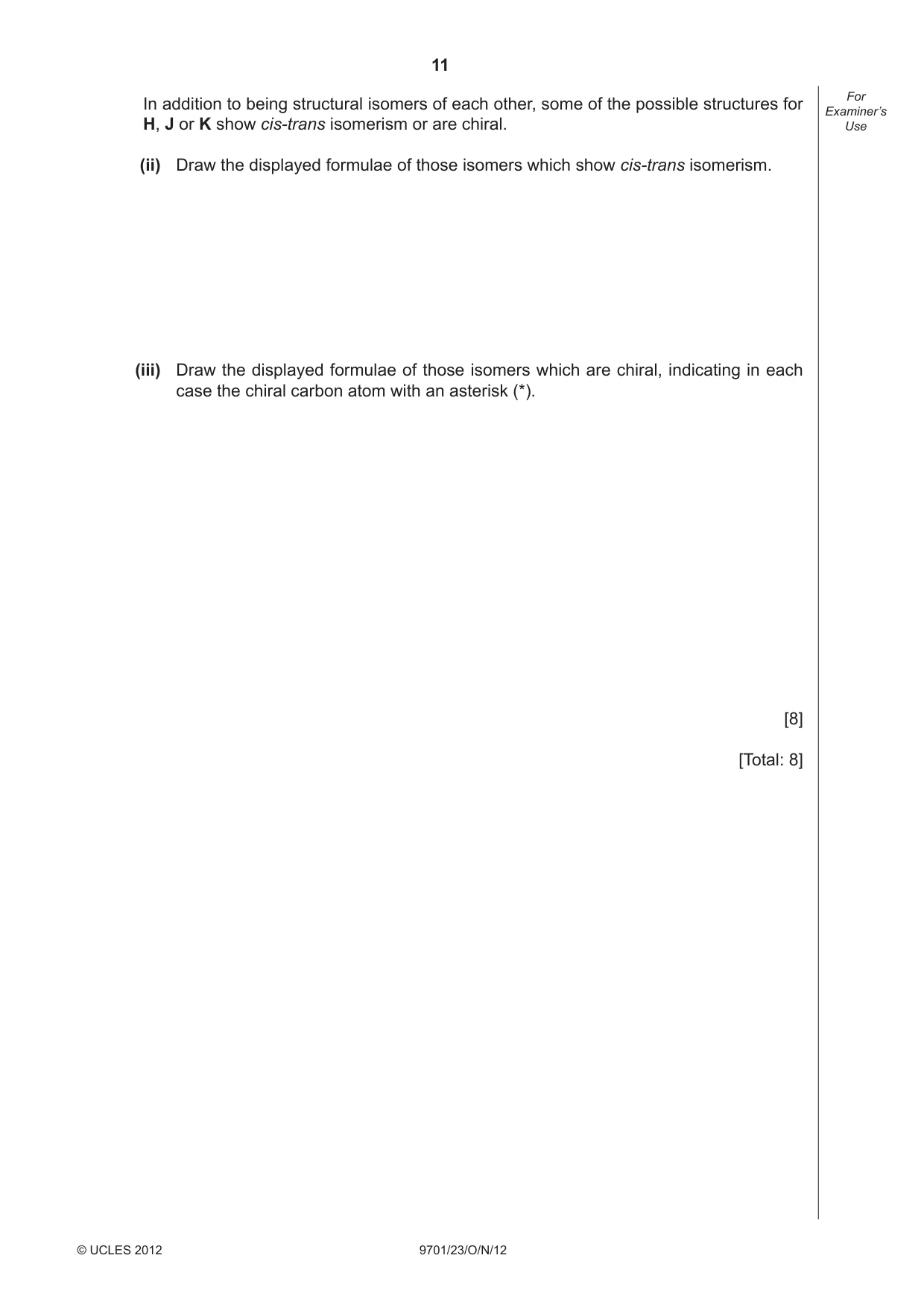
11 9701/23/O/N/12 © UCLES 2012 [Turn over For Examiner’s Use In addition to being structural isomers of each other, some of the possible structures for H, J or K show cis-trans isomerism or are chiral. (ii) Draw the displayed formulae of those isomers which show cis-trans isomerism. (iii) Draw the displayed formulae of those isomers which are chiral, indicating in each case the chiral carbon atom with an asterisk (*). [8] [Total: 8]
Question paper, page 12
12 Permission to reproduce items where third-party owned material protected by copyright is included has been sought and cleared where possible. Every reasonable effort has been made by the publisher (UCLES) to trace copyright holders, but if any items requiring clearance have unwittingly been included the publisher will be pleased to make amends at the earliest possible opportunity. University of Cambridge International Examinations is part of the Cambridge Assessment Group. Cambridge Assessment is the brand name of University of Cambridge Local Examinations Syndicate (UCLES), which is itself a department of the University of Cambridge. 9701/23/O/N/12 © UCLES 2012 BLANK PAGE
Mark scheme, page 1
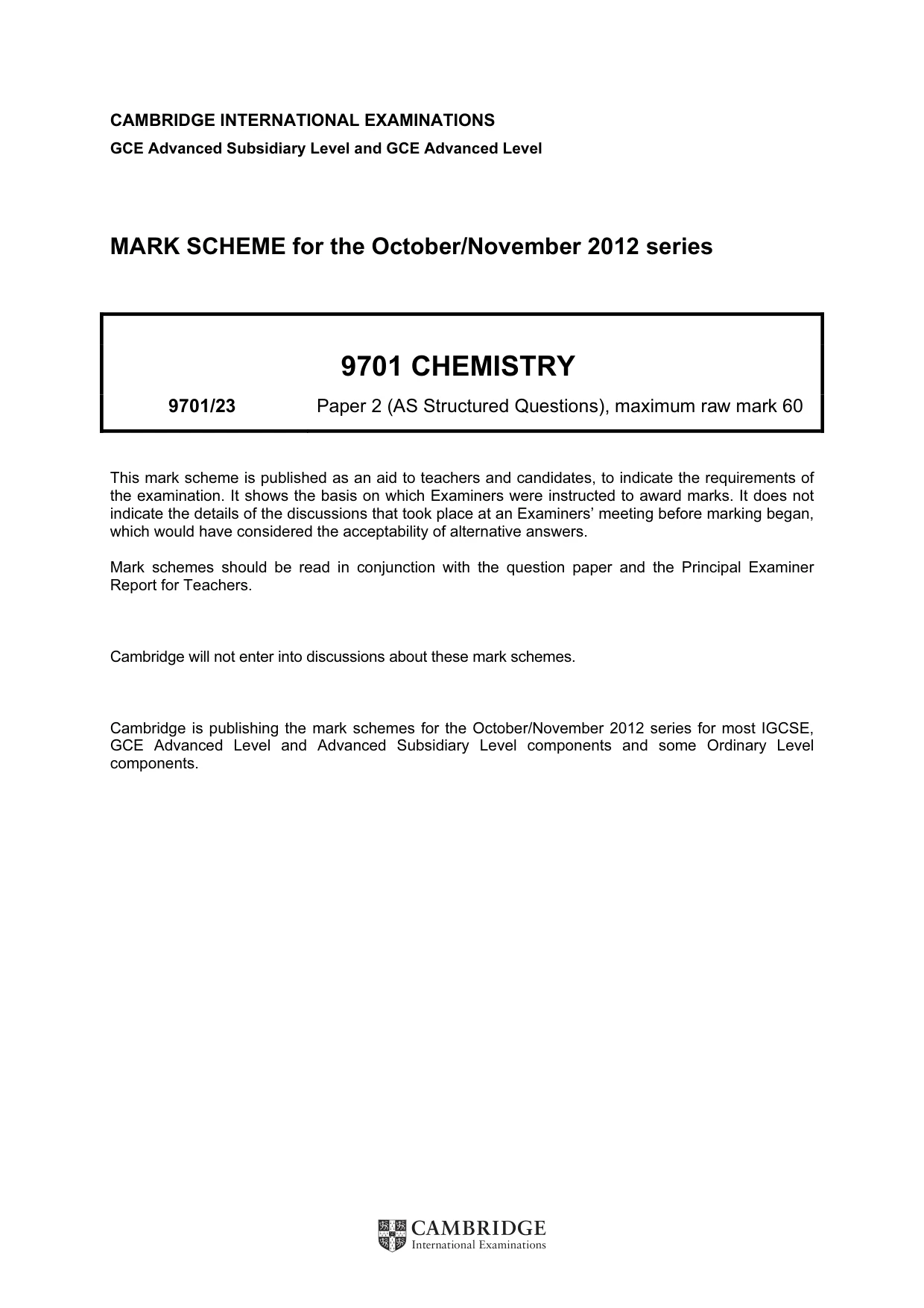
CAMBRIDGE INTERNATIONAL EXAMINATIONS GCE Advanced Subsidiary Level and GCE Advanced Level MARK SCHEME for the October/November 2012 series 9701 CHEMISTRY 9701/23 Paper 2 (AS Structured Questions), maximum raw mark 60 This mark scheme is published as an aid to teachers and candidates, to indicate the requirements of the examination. It shows the basis on which Examiners were instructed to award marks. It does not indicate the details of the discussions that took place at an Examiners’ meeting before marking began, which would have considered the acceptability of alternative answers. Mark schemes should be read in conjunction with the question paper and the Principal Examiner Report for Teachers. Cambridge will not enter into discussions about these mark schemes. Cambridge is publishing the mark schemes for the October/November 2012 series for most IGCSE, GCE Advanced Level and Advanced Subsidiary Level components and some Ordinary Level components.
Mark scheme, page 2
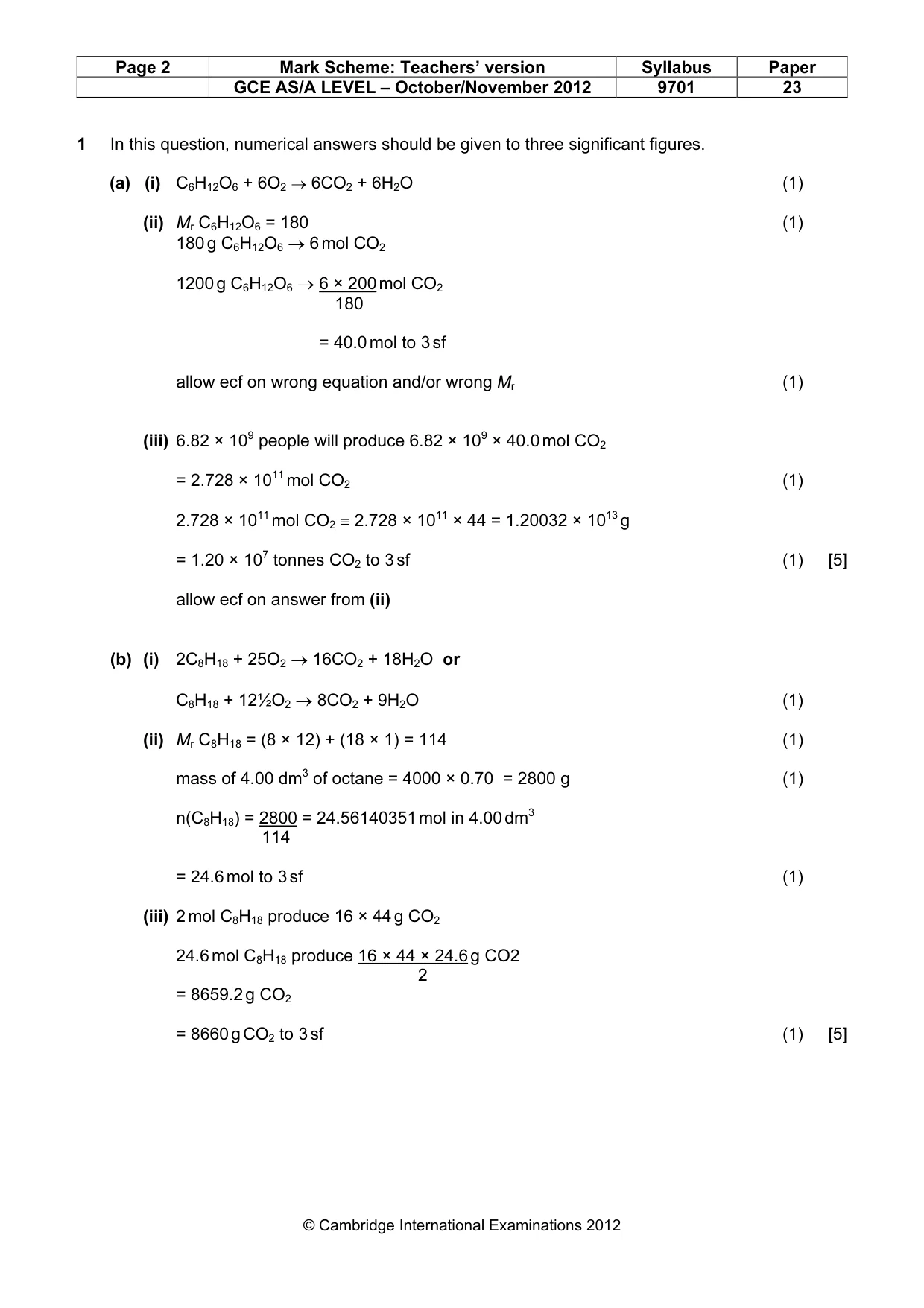
Page 2 Mark Scheme: Teachers’ version Syllabus Paper GCE AS/A LEVEL – October/November 2012 9701 23 © Cambridge International Examinations 2012 1 In this question, numerical answers should be given to three significant figures. (a) (i) C6H12O6 + 6O2 → 6CO2 + 6H2O (1) (ii) Mr C6H12O6 = 180 (1) 180 g C6H12O6 → 6 mol CO2 1200 g C6H12O6 → 6 × 200 mol CO2 180 = 40.0 mol to 3 sf allow ecf on wrong equation and/or wrong Mr (1) (iii) 6.82 × 10⁹ people will produce 6.82 × 109 × 40.0 mol CO2 = 2.728 × 10¹¹ mol CO2 (1) 2.728 × 10¹¹ mol CO2 ≡ 2.728 × 1011 × 44 = 1.20032 × 10¹³ g = 1.20 × 10⁷ tonnes CO2 to 3 sf (1) [5] allow ecf on answer from (ii) (b) (i) 2C8H18 + 25O2 → 16CO2 + 18H2O or C8H18 + 12½O2 → 8CO2 + 9H2O (1) (ii) Mr C8H18 = (8 × 12) + (18 × 1) = 114 (1) mass of 4.00 dm3 of octane = 4000 × 0.70 = 2800 g (1) n(C8H18) = 2800 = 24.56140351 mol in 4.00 dm3 114 = 24.6 mol to 3 sf (1) (iii) 2 mol C8H18 produce 16 × 44 g CO2 24.6 mol C8H18 produce 16 × 44 × 24.6 g CO2 2 = 8659.2 g CO2 = 8660 g CO2 to 3 sf (1) [5]
Mark scheme, page 3
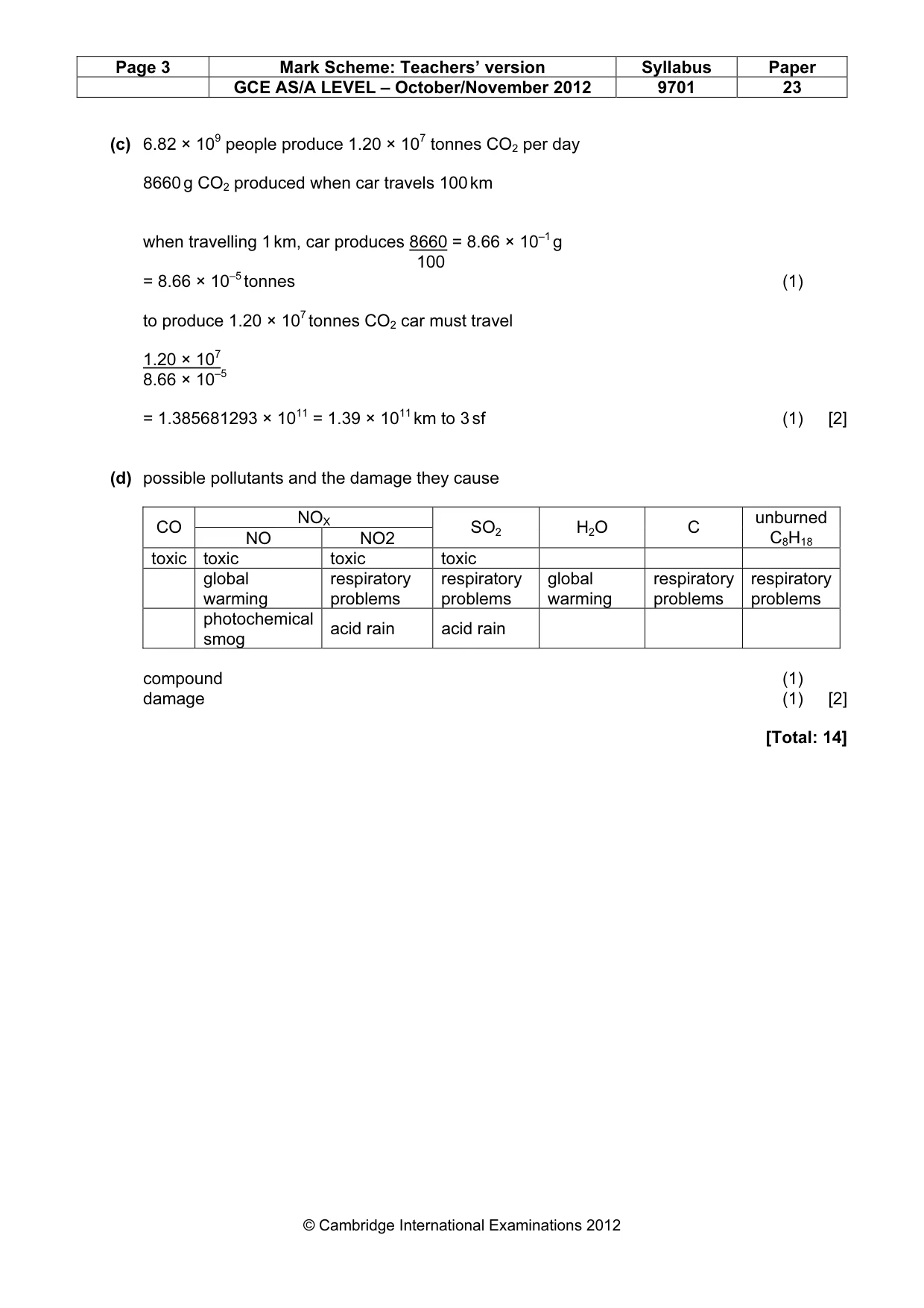
Page 3 Mark Scheme: Teachers’ version Syllabus Paper GCE AS/A LEVEL – October/November 2012 9701 23 © Cambridge International Examinations 2012 (c) 6.82 × 10⁹ people produce 1.20 × 10⁷ tonnes CO2 per day 8660 g CO2 produced when car travels 100 km when travelling 1 km, car produces 8660 = 8.66 × 10⁻¹ g 100 = 8.66 × 10⁻⁵ tonnes (1) to produce 1.20 × 10⁷ tonnes CO2 car must travel 1.20 × 10⁷ 8.66 × 10–5 = 1.385681293 × 1011 = 1.39 × 10¹¹ km to 3 sf (1) [2] (d) possible pollutants and the damage they cause NOX CO NO NO2 SO2 H2O C unburned C8H18 toxic toxic toxic toxic global warming respiratory problems respiratory problems global warming respiratory problems respiratory problems photochemical smog acid rain acid rain compound (1) damage (1) [2] [Total: 14]
Mark scheme, page 4
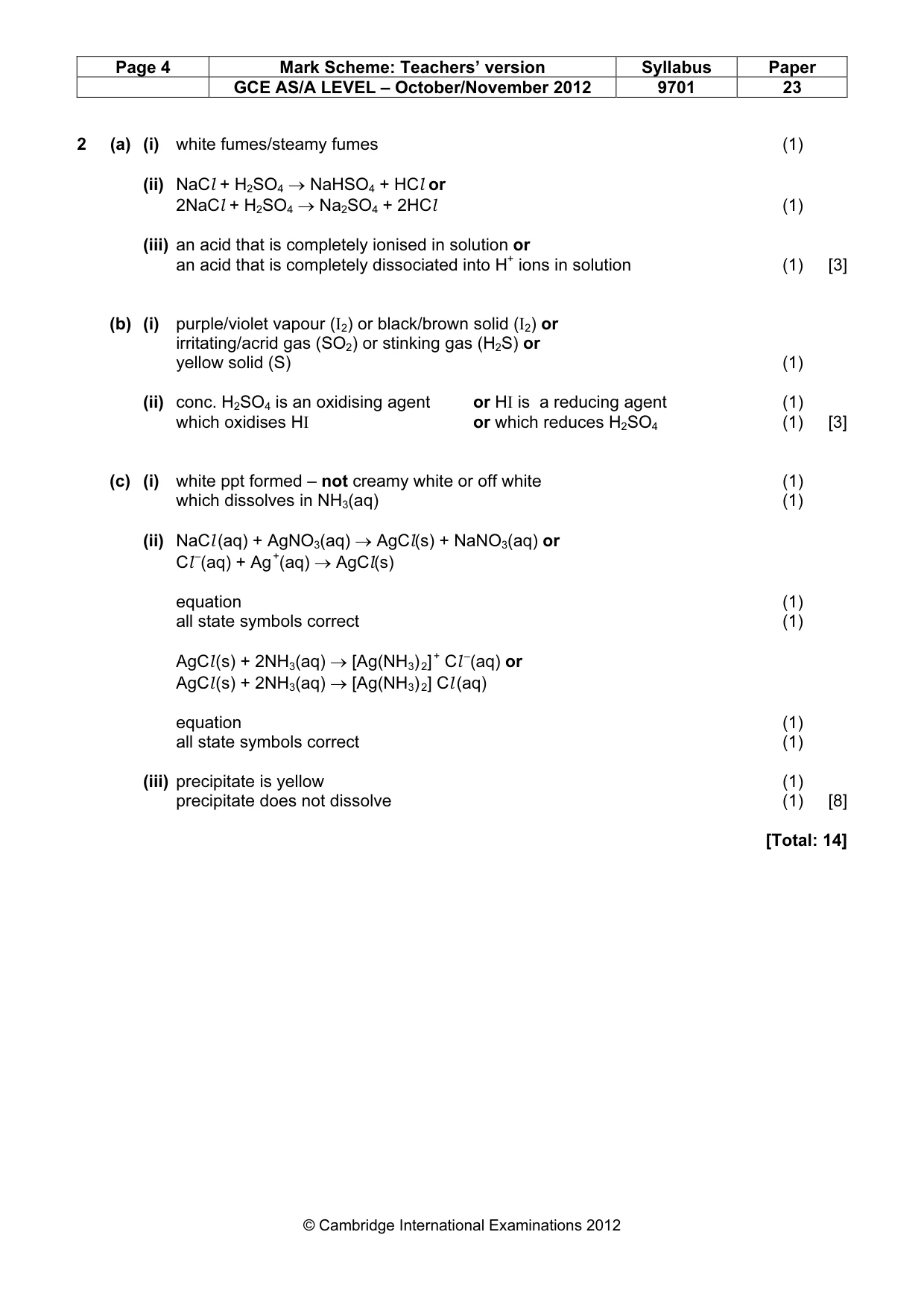
Page 4 Mark Scheme: Teachers’ version Syllabus Paper GCE AS/A LEVEL – October/November 2012 9701 23 © Cambridge International Examinations 2012 2 (a) (i) white fumes/steamy fumes (1) (ii) NaCl + H2SO4 → NaHSO4 + HCl or 2NaCl + H2SO4 → Na2SO4 + 2HCl (1) (iii) an acid that is completely ionised in solution or an acid that is completely dissociated into H+ ions in solution (1) [3] (b) (i) purple/violet vapour (I2) or black/brown solid (I2) or irritating/acrid gas (SO2) or stinking gas (H2S) or yellow solid (S) (1) (ii) conc. H2SO4 is an oxidising agent or HI is a reducing agent (1) which oxidises HI or which reduces H2SO4 (1) [3] (c) (i) white ppt formed – not creamy white or off white (1) which dissolves in NH3(aq) (1) (ii) NaCl (aq) + AgNO3(aq) → AgCl(s) + NaNO3(aq) or Cl –(aq) + Ag +(aq) → AgCl(s) equation (1) all state symbols correct (1) AgCl (s) + 2NH3(aq) → [Ag(NH3) 2] + Cl –(aq) or AgCl (s) + 2NH3(aq) → [Ag(NH3) 2] Cl (aq) equation (1) all state symbols correct (1) (iii) precipitate is yellow (1) precipitate does not dissolve (1) [8] [Total: 14]
Mark scheme, page 5
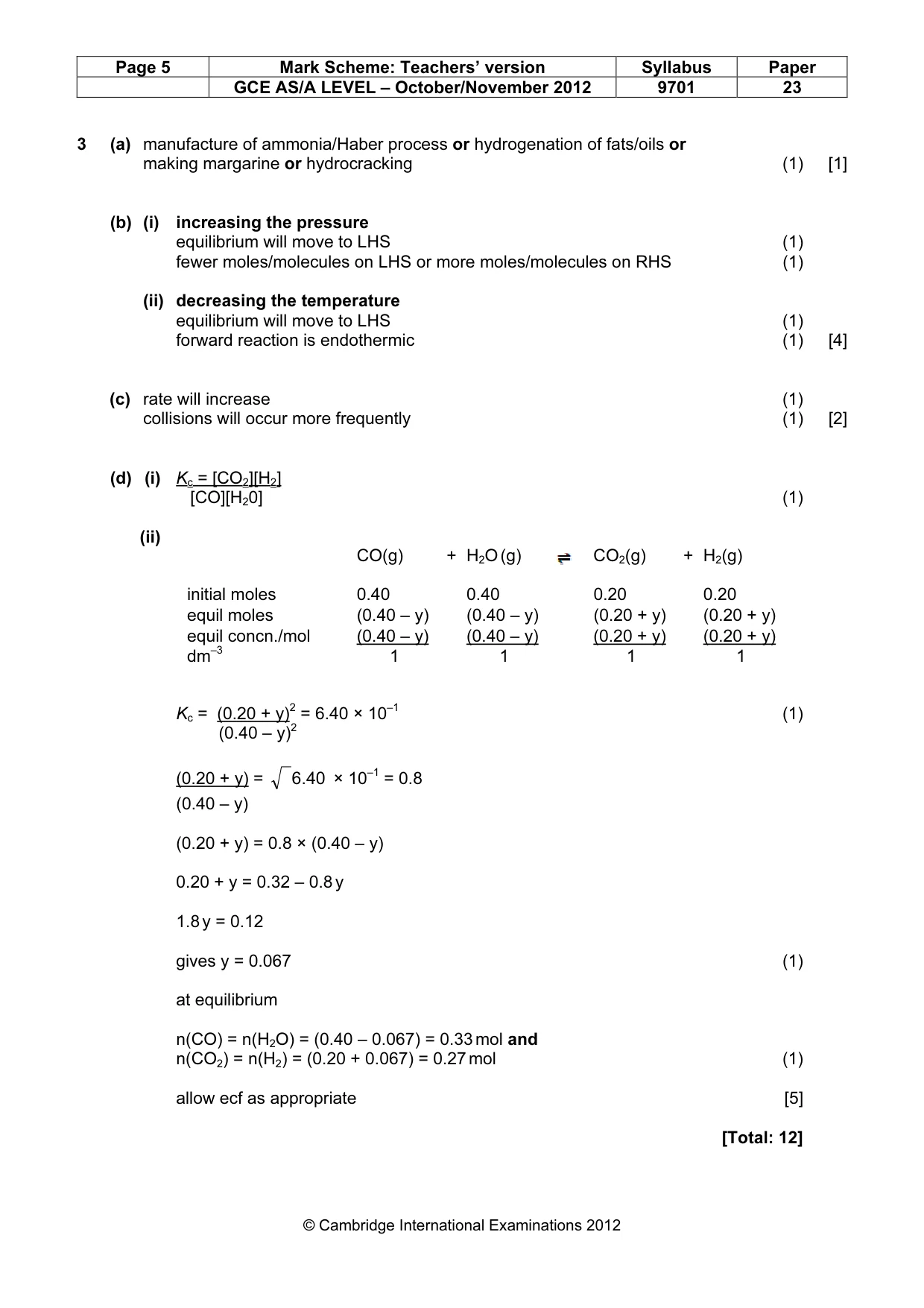
Page 5 Mark Scheme: Teachers’ version Syllabus Paper GCE AS/A LEVEL – October/November 2012 9701 23 © Cambridge International Examinations 2012 3 (a) manufacture of ammonia/Haber process or hydrogenation of fats/oils or making margarine or hydrocracking (1) [1] (b) (i) increasing the pressure equilibrium will move to LHS (1) fewer moles/molecules on LHS or more moles/molecules on RHS (1) (ii) decreasing the temperature equilibrium will move to LHS (1) forward reaction is endothermic (1) [4] (c) rate will increase (1) collisions will occur more frequently (1) [2] (d) (i) Kc = [CO2][H2] [CO][H20] (1) (ii) Kc = (0.20 + y)2 = 6.40 × 10⁻¹ (1) (0.40 – y)2 (0.20 + y) = 40 . 6 × 10–1 = 0.8 (0.40 – y) (0.20 + y) = 0.8 × (0.40 – y) 0.20 + y = 0.32 – 0.8 y 1.8 y = 0.12 gives y = 0.067 (1) at equilibrium n(CO) = n(H2O) = (0.40 – 0.067) = 0.33 mol and n(CO2) = n(H2) = (0.20 + 0.067) = 0.27 mol (1) allow ecf as appropriate [5] [Total: 12] CO(g) + H2O (g) CO2(g) + H2(g) initial moles 0.40 0.40 0.20 0.20 equil moles (0.40 – y) (0.40 – y) (0.20 + y) (0.20 + y) equil concn./mol dm–3 (0.40 – y) 1 (0.40 – y) 1 (0.20 + y) 1 (0.20 + y) 1
Mark scheme, page 6
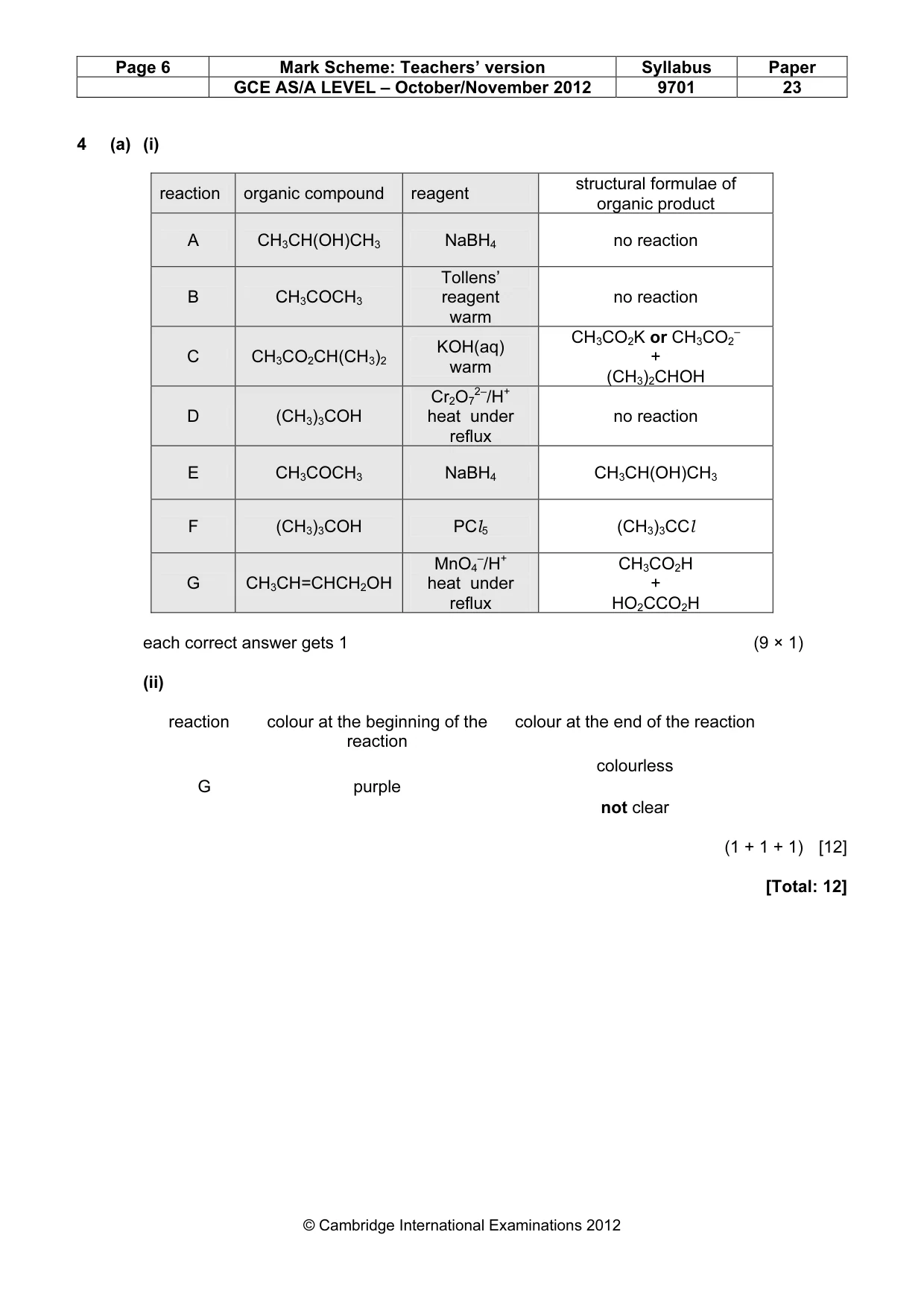
Page 6 Mark Scheme: Teachers’ version Syllabus Paper GCE AS/A LEVEL – October/November 2012 9701 23 © Cambridge International Examinations 2012 4 (a) (i) reaction organic compound reagent structural formulae of organic product A CH3CH(OH)CH3 NaBH4 no reaction B CH3COCH3 Tollens’ reagent warm no reaction C CH3CO2CH(CH3)2 KOH(aq) warm CH3CO2K or CH3CO2 – + (CH3)2CHOH D (CH3)3COH Cr2O7 2–/H+ heat under reflux no reaction E CH3COCH3 NaBH4 CH3CH(OH)CH3 F (CH3)3COH PCl5 (CH3)3CCl G CH3CH=CHCH2OH MnO4 –/H+ heat under reflux CH3CO2H + HO2CCO2H each correct answer gets 1 (9 × 1) (ii) reaction colour at the beginning of the reaction colour at the end of the reaction G purple colourless not clear (1 + 1 + 1) [12] [Total: 12]
Mark scheme, page 7
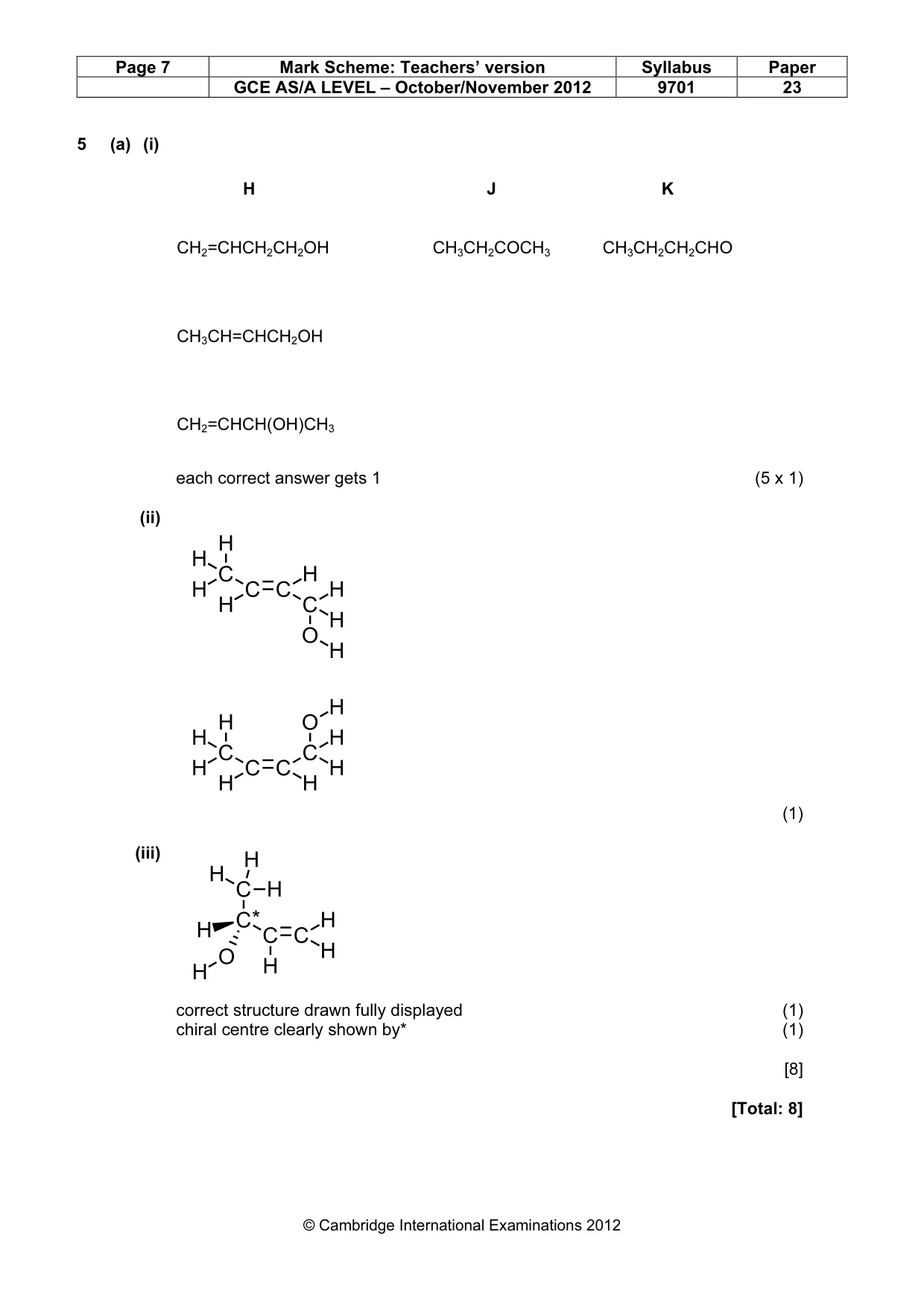
Page 7 Mark Scheme: Teachers’ version Syllabus Paper GCE AS/A LEVEL – October/November 2012 9701 23 © Cambridge International Examinations 2012 5 (a) (i) H J K CH2=CHCH2CH2OH CH3CH2COCH3 CH3CH2CH2CHO CH3CH=CHCH2OH CH2=CHCH(OH)CH3 each correct answer gets 1 (5 x 1) (ii) (1) (iii) correct structure drawn fully displayed (1) chiral centre clearly shown by* (1) [8] [Total: 8]
What you needed in this session
Cambridge’s own grade thresholds for 2012 Oct/Nov, Paper 2 · Variant 3. A higher threshold means an easier paper — the bar moves with how the cohort did.