Cambridge A Level Chemistry 9701 — 2012 May/June Paper 4 · Variant 2
9701/42/M/J/12 · 100 marks · ≈113 min
The question paper and its mark scheme, free to read here and free to download. This is Cambridge’s own paper, exactly as it was sat.
Question paper20 pages



Mark scheme10 pages
Answers below. Sit the paper first if you are practising.
Paper as text
Question paper, page 1
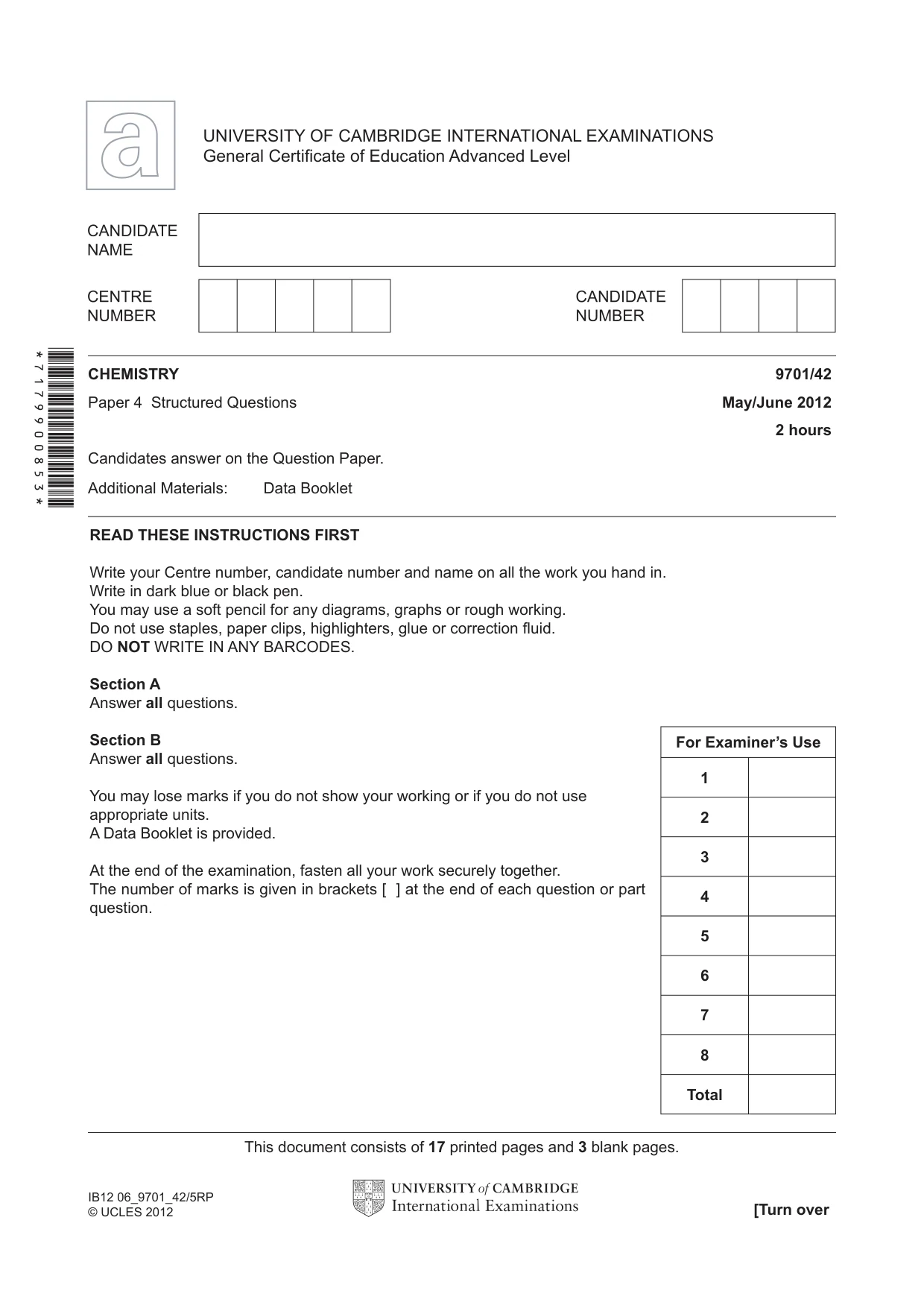
READ THESE INSTRUCTIONS FIRST Write your Centre number, candidate number and name on all the work you hand in. Write in dark blue or black pen. You may use a soft pencil for any diagrams, graphs or rough working. Do not use staples, paper clips, highlighters, glue or correction fl uid. DO NOT WRITE IN ANY BARCODES. Section A Answer all questions. Section B Answer all questions. You may lose marks if you do not show your working or if you do not use appropriate units. A Data Booklet is provided. At the end of the examination, fasten all your work securely together. The number of marks is given in brackets [ ] at the end of each question or part question. CHEMISTRY 9701/42 Paper 4 Structured Questions May/June 2012 2 hours Candidates answer on the Question Paper. Additional Materials: Data Booklet UNIVERSITY OF CAMBRIDGE INTERNATIONAL EXAMINATIONS General Certifi cate of Education Advanced Level This document consists of 17 printed pages and 3 blank pages. [Turn over IB12 06_9701_42/5RP © UCLES 2012 *7179900853* For Examiner’s Use 1 2 3 4 5 6 7 8 Total
Question paper, page 2
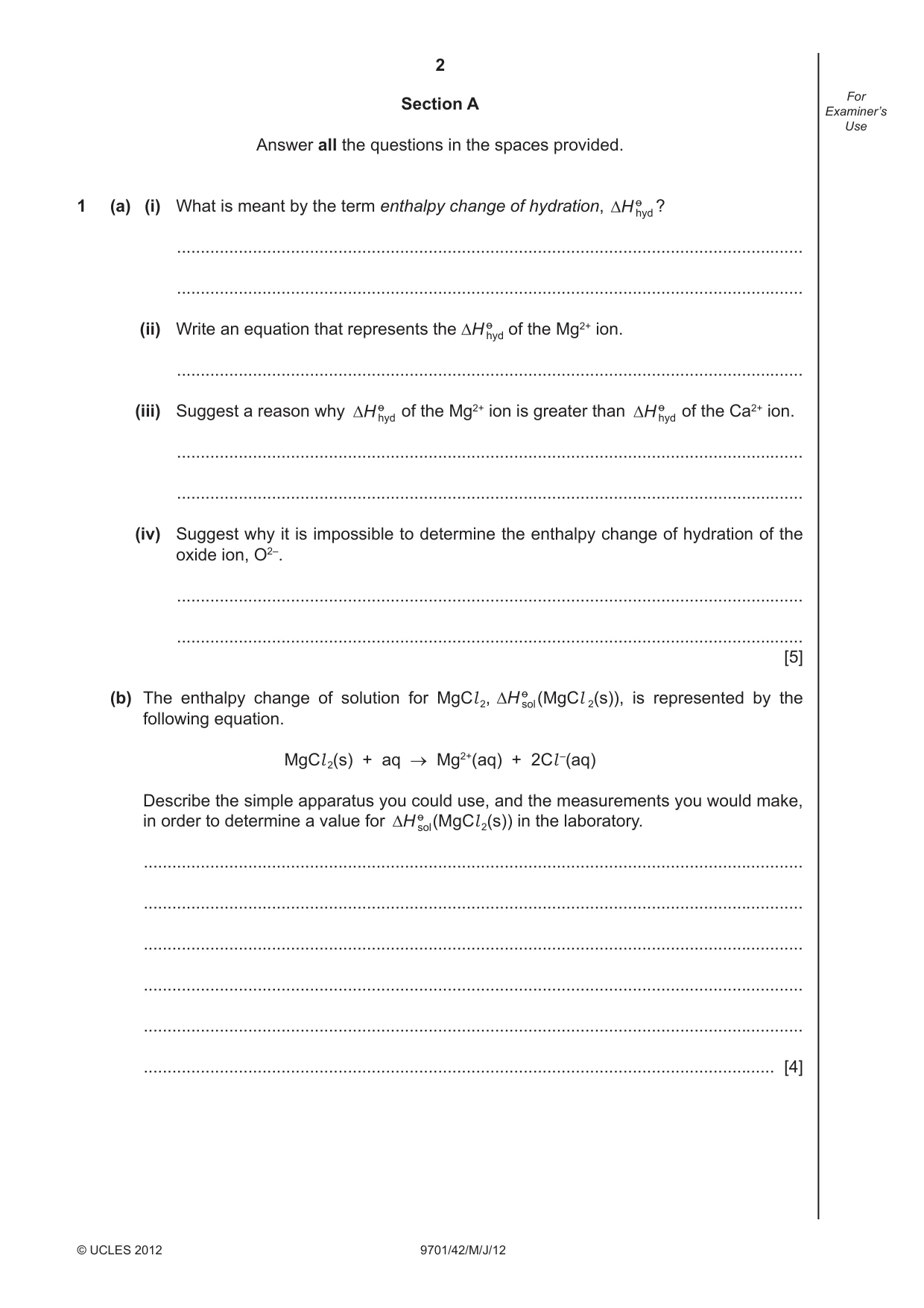
2 9701/42/M/J/12 © UCLES 2012 For Examiner’s Use Section A Answer all the questions in the spaces provided. 1 (a) (i) What is meant by the term enthalpy change of hydration, ? … … (ii) Write an equation that represents the of the Mg2+ ion. … (iii) Suggest a reason why of the Mg2+ ion is greater than of the Ca2+ ion. … … (iv) Suggest why it is impossible to determine the enthalpy change of hydration of the oxide ion, O2–. … … [5] (b) The enthalpy change of solution for MgCl 2, (MgCl 2(s)), is represented by the following equation. MgCl 2(s) + aq → Mg2+(aq) + 2Cl –(aq) Describe the simple apparatus you could use, and the measurements you would make, in order to determine a value for (MgCl 2(s)) in the laboratory. … … … … … … [4]
Question paper, page 3
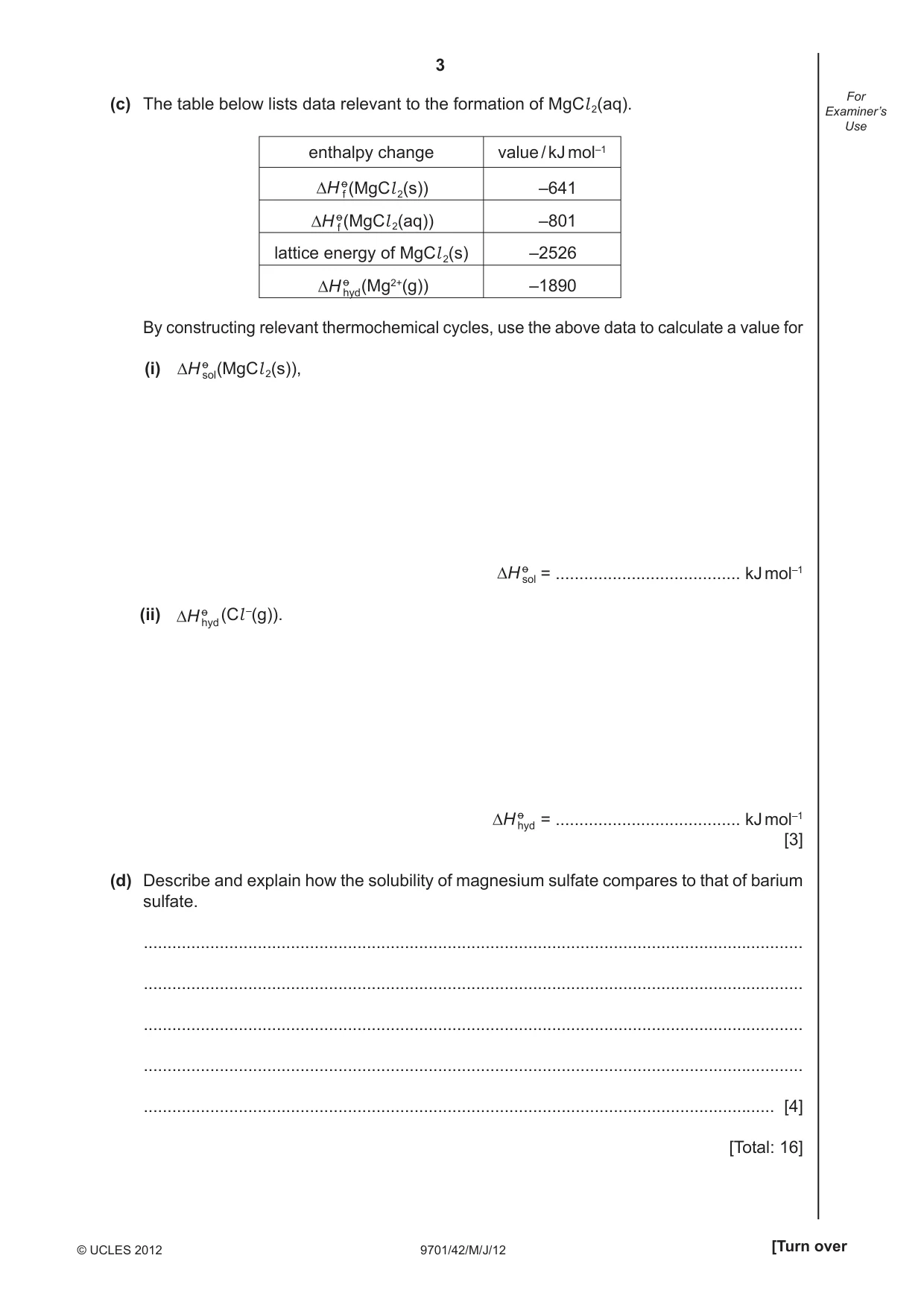
3 9701/42/M/J/12 © UCLES 2012 [Turn over For Examiner’s Use (c) The table below lists data relevant to the formation of MgCl 2(aq). enthalpy change value / kJ mol–1 (MgCl 2(s)) –641 (MgCl 2(aq)) –801 lattice energy of MgCl 2(s) –2526 (Mg2+(g)) –1890 By constructing relevant thermochemical cycles, use the above data to calculate a value for (i) (MgCl 2(s)), = … kJ mol–1 (ii) (Cl –(g)). = … kJ mol–1 [3] (d) Describe and explain how the solubility of magnesium sulfate compares to that of barium sulfate. … … … … … [4] [Total: 16]
Question paper, page 4
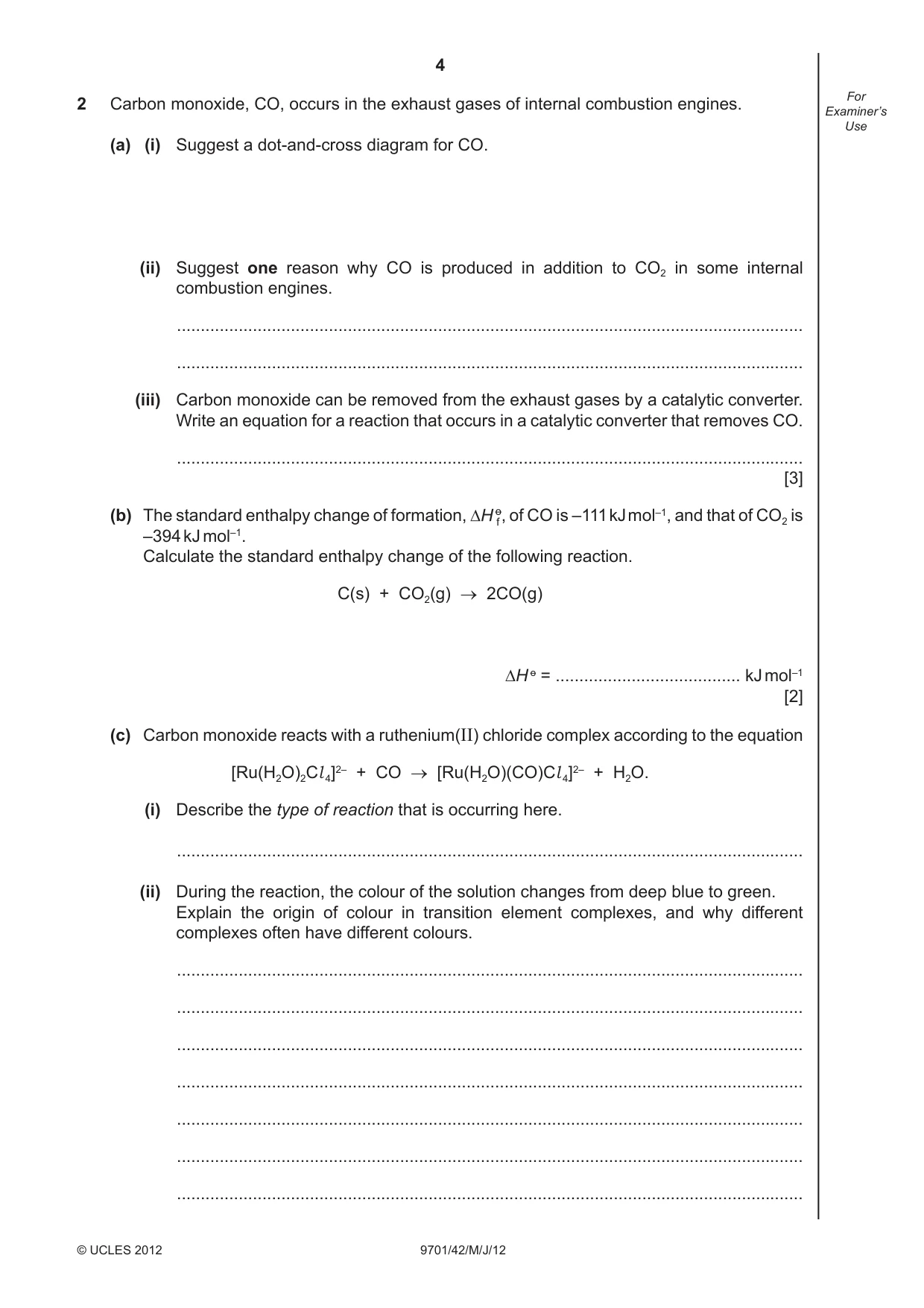
4 9701/42/M/J/12 © UCLES 2012 For Examiner’s Use 2 Carbon monoxide, CO, occurs in the exhaust gases of internal combustion engines. (a) (i) Suggest a dot-and-cross diagram for CO. (ii) Suggest one reason why CO is produced in addition to CO2 in some internal combustion engines. … … (iii) Carbon monoxide can be removed from the exhaust gases by a catalytic converter. Write an equation for a reaction that occurs in a catalytic converter that removes CO. … [3] (b) The standard enthalpy change of formation, , of CO is –111 kJ mol–1, and that of CO2 is –394 kJ mol–1. Calculate the standard enthalpy change of the following reaction. C(s) + CO2(g) → 2CO(g) ∆H o = … kJ mol–1 [2] (c) Carbon monoxide reacts with a ruthenium(II) chloride complex according to the equation [Ru(H2O)2Cl 4]2– + CO → [Ru(H2O)(CO)Cl 4]2– + H2O. (i) Describe the type of reaction that is occurring here. … (ii) During the reaction, the colour of the solution changes from deep blue to green. Explain the origin of colour in transition element complexes, and why different complexes often have different colours. … … … … … … …
Question paper, page 5
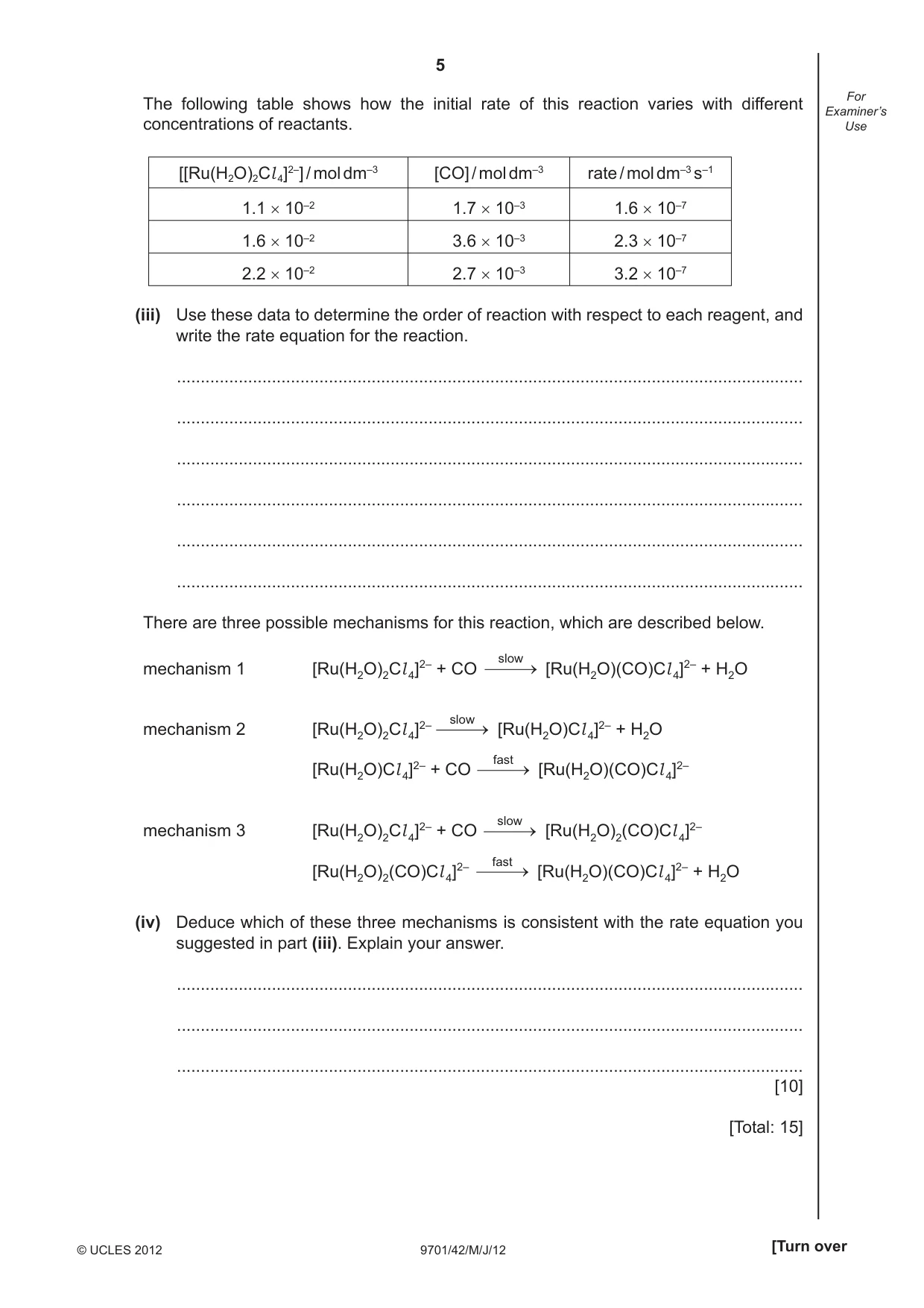
5 9701/42/M/J/12 © UCLES 2012 [Turn over For Examiner’s Use The following table shows how the initial rate of this reaction varies with different concentrations of reactants. [[Ru(H2O)2Cl 4]2–] / mol dm–3 [CO] / mol dm–3 rate / mol dm–3 s–1 1.1 × 10⁻² 1.7 × 10⁻³ 1.6 × 10⁻⁷ 1.6 × 10⁻² 3.6 × 10⁻³ 2.3 × 10⁻⁷ 2.2 × 10⁻² 2.7 × 10⁻³ 3.2 × 10⁻⁷ (iii) Use these data to determine the order of reaction with respect to each reagent, and write the rate equation for the reaction. … … … … … … There are three possible mechanisms for this reaction, which are described below. mechanism 1 [Ru(H2O)2Cl 4]2– + CO [Ru(H2O)(CO)Cl 4]2– + H2O [Ru(H2O)Cl 4]2– + CO [Ru(H2O)(CO)Cl 4]2– mechanism 2 [Ru(H2O)2Cl 4]2– [Ru(H2O)Cl 4]2– + H2O slow slow fast [Ru(H2O)2(CO)Cl 4]2– [Ru(H2O)(CO)Cl 4]2– + H2O mechanism 3 [Ru(H2O)2Cl 4]2– + CO [Ru(H2O)2(CO)Cl 4]2– slow fast (iv) Deduce which of these three mechanisms is consistent with the rate equation you suggested in part (iii). Explain your answer. … … … [10] [Total: 15]
Question paper, page 6
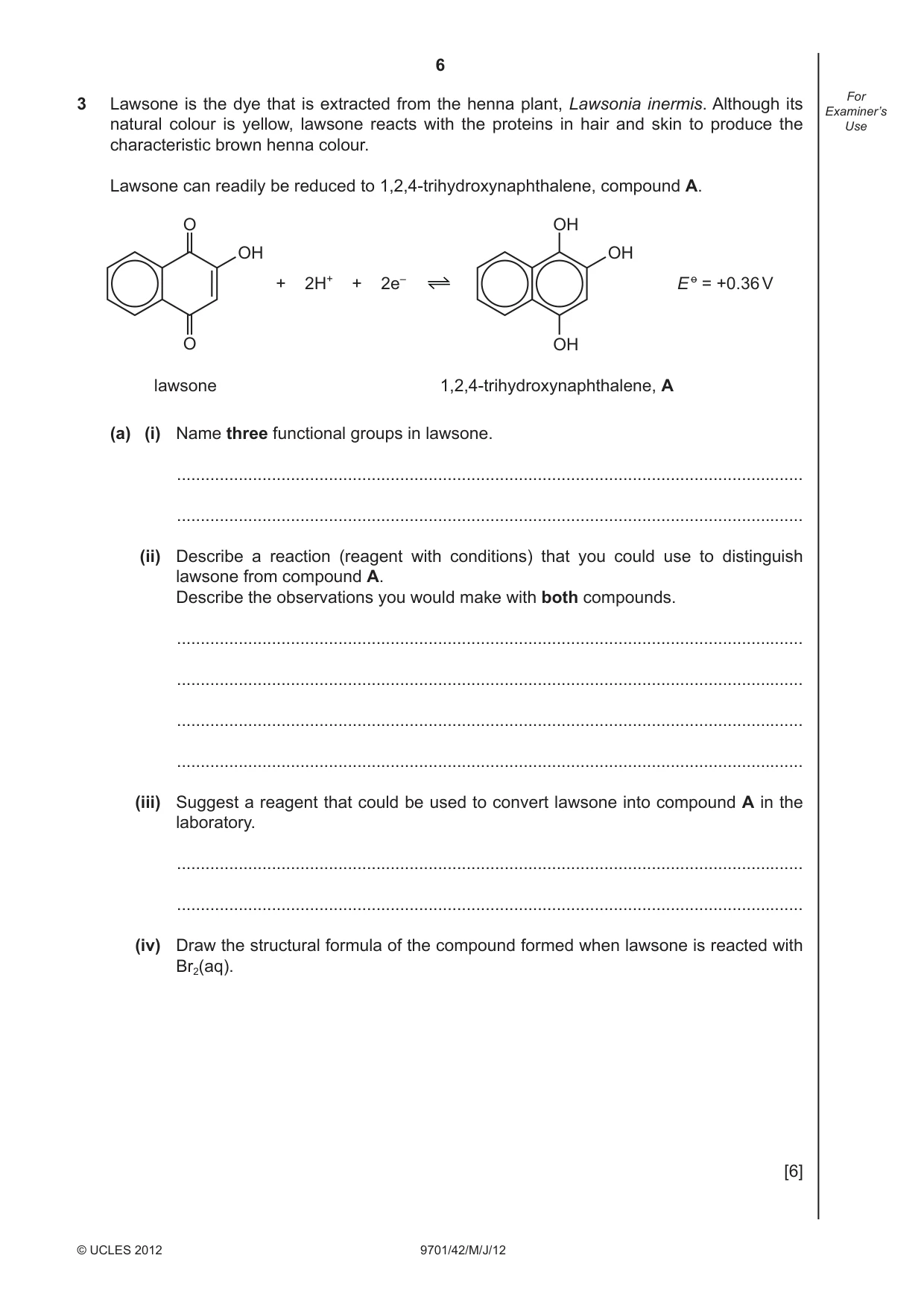
6 9701/42/M/J/12 © UCLES 2012 For Examiner’s Use 3 Lawsone is the dye that is extracted from the henna plant, Lawsonia inermis. Although its natural colour is yellow, lawsone reacts with the proteins in hair and skin to produce the characteristic brown henna colour. Lawsone can readily be reduced to 1,2,4-trihydroxynaphthalene, compound A. O OH + 2H+ + 2e– E o = +0.36 V O OH OH OH lawsone 1,2,4-trihydroxynaphthalene, A (a) (i) Name three functional groups in lawsone. … … (ii) Describe a reaction (reagent with conditions) that you could use to distinguish lawsone from compound A. Describe the observations you would make with both compounds. … … … … (iii) Suggest a reagent that could be used to convert lawsone into compound A in the laboratory. … … (iv) Draw the structural formula of the compound formed when lawsone is reacted with Br2(aq). [6]
Question paper, page 7
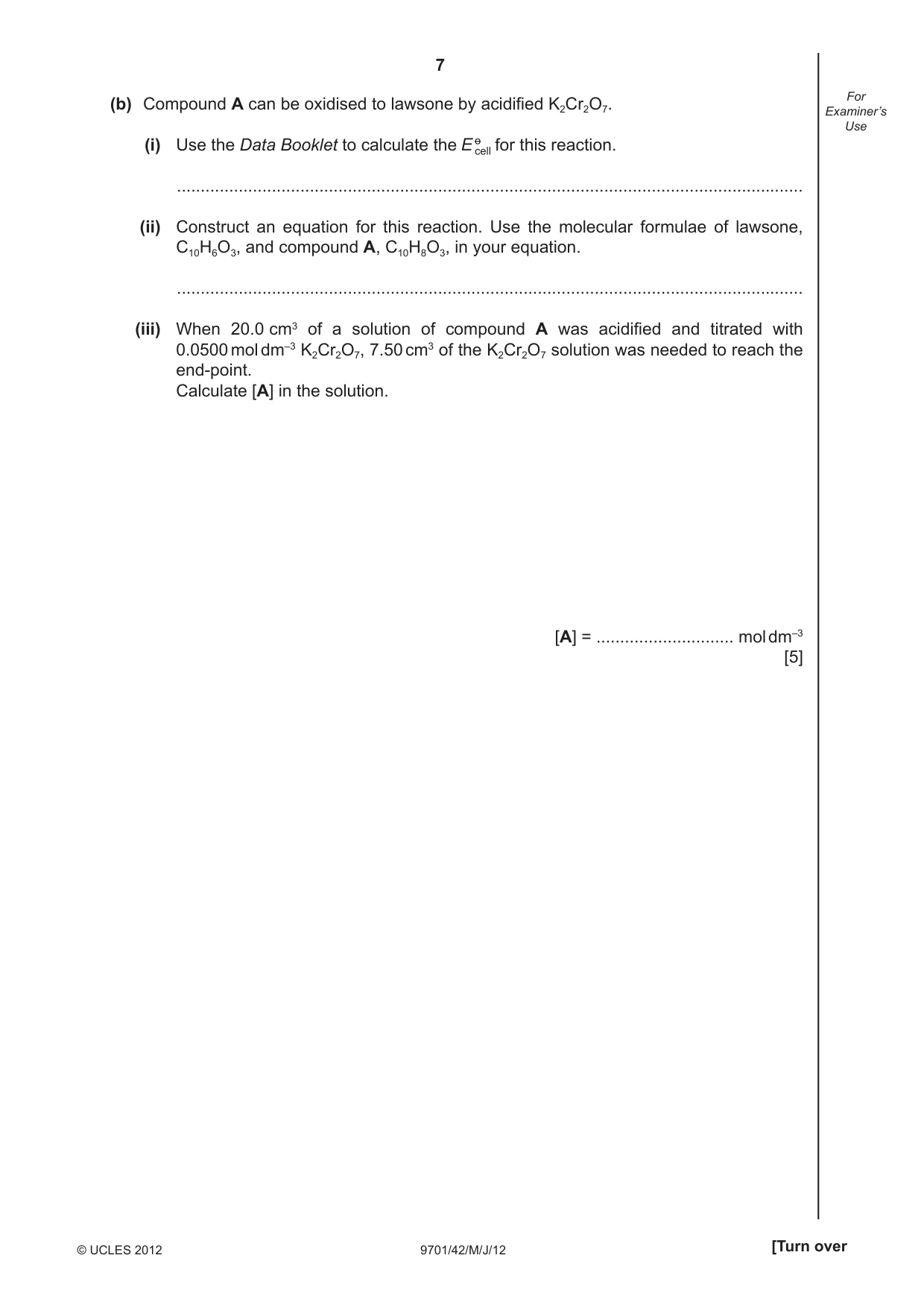
7 9701/42/M/J/12 © UCLES 2012 [Turn over For Examiner’s Use (b) Compound A can be oxidised to lawsone by acidifi ed K2Cr2O7. (i) Use the Data Booklet to calculate the for this reaction. … (ii) Construct an equation for this reaction. Use the molecular formulae of lawsone, C10H6O3, and compound A, C10H8O3, in your equation. … (iii) When 20.0 cm3 of a solution of compound A was acidifi ed and titrated with 0.0500 mol dm–3 K2Cr2O7, 7.50 cm3 of the K2Cr2O7 solution was needed to reach the end-point. Calculate [A] in the solution. [A] = … mol dm–3 [5]
Question paper, page 8
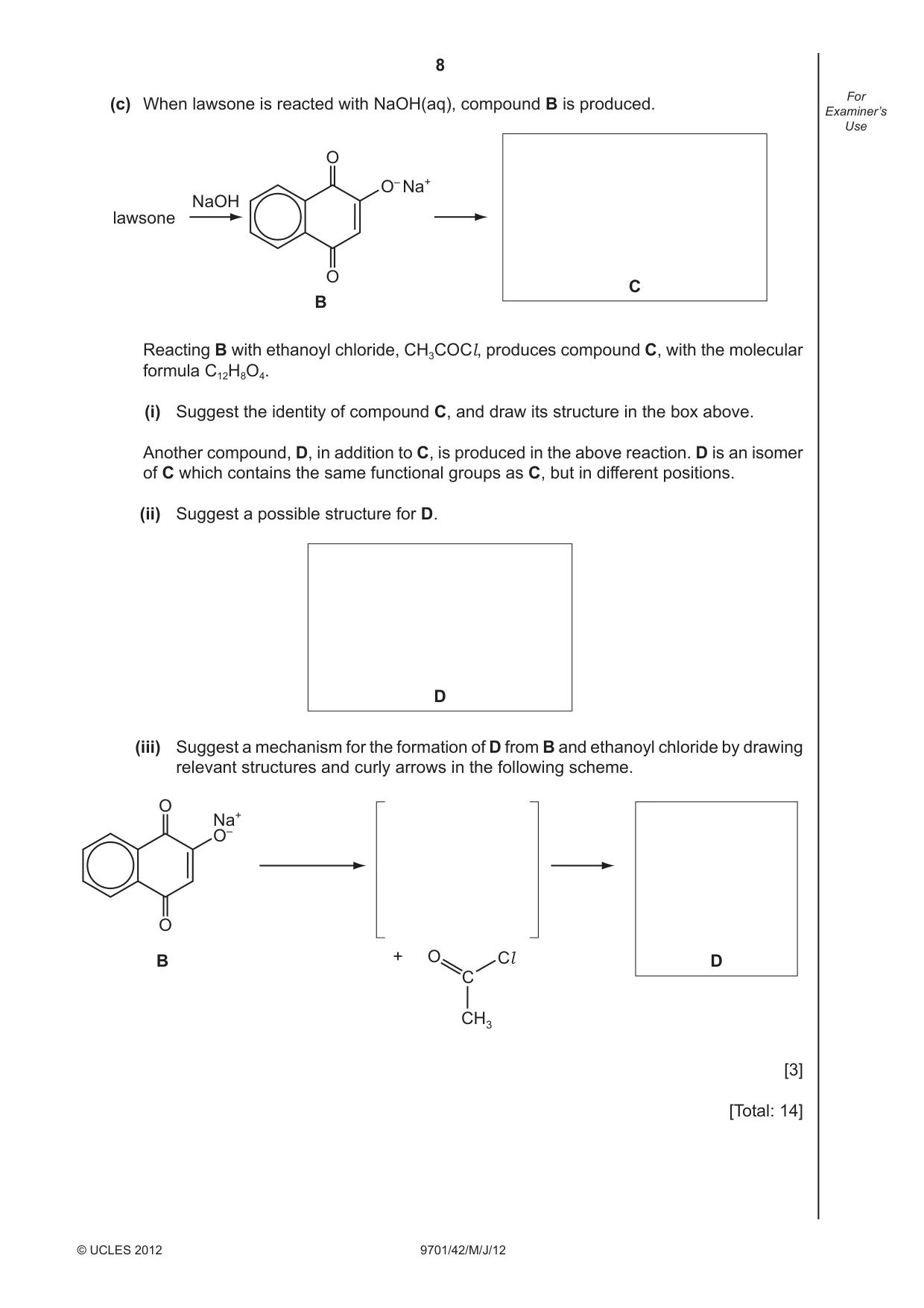
8 9701/42/M/J/12 © UCLES 2012 For Examiner’s Use (c) When lawsone is reacted with NaOH(aq), compound B is produced. O O– Na+ O NaOH lawsone C B Reacting B with ethanoyl chloride, CH3COCl, produces compound C, with the molecular formula C12H8O4. (i) Suggest the identity of compound C, and draw its structure in the box above. Another compound, D, in addition to C, is produced in the above reaction. D is an isomer of C which contains the same functional groups as C, but in different positions. (ii) Suggest a possible structure for D. D (iii) Suggest a mechanism for the formation of D from B and ethanoyl chloride by drawing relevant structures and curly arrows in the following scheme. O Na+ O– O O + C Cl CH3 D B [3] [Total: 14]
Question paper, page 9
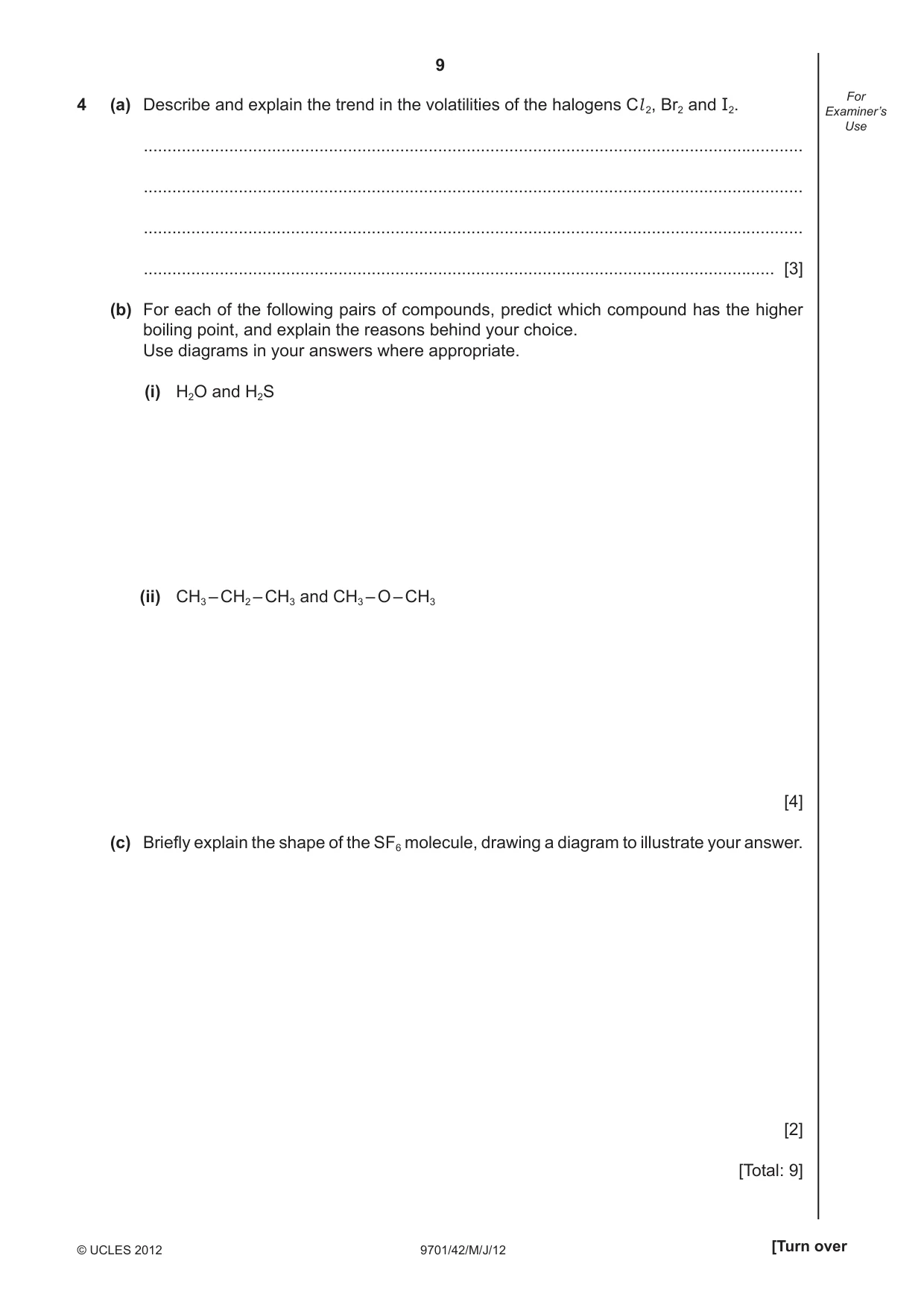
9 9701/42/M/J/12 © UCLES 2012 [Turn over For Examiner’s Use 4 (a) Describe and explain the trend in the volatilities of the halogens Cl 2, Br2 and I2. … … … … [3] (b) For each of the following pairs of compounds, predict which compound has the higher boiling point, and explain the reasons behind your choice. Use diagrams in your answers where appropriate. (i) H2O and H2S (ii) CH3 – CH2 – CH3 and CH3 – O – CH3 [4] (c) Briefl y explain the shape of the SF6 molecule, drawing a diagram to illustrate your answer. [2] [Total: 9]
Question paper, page 10
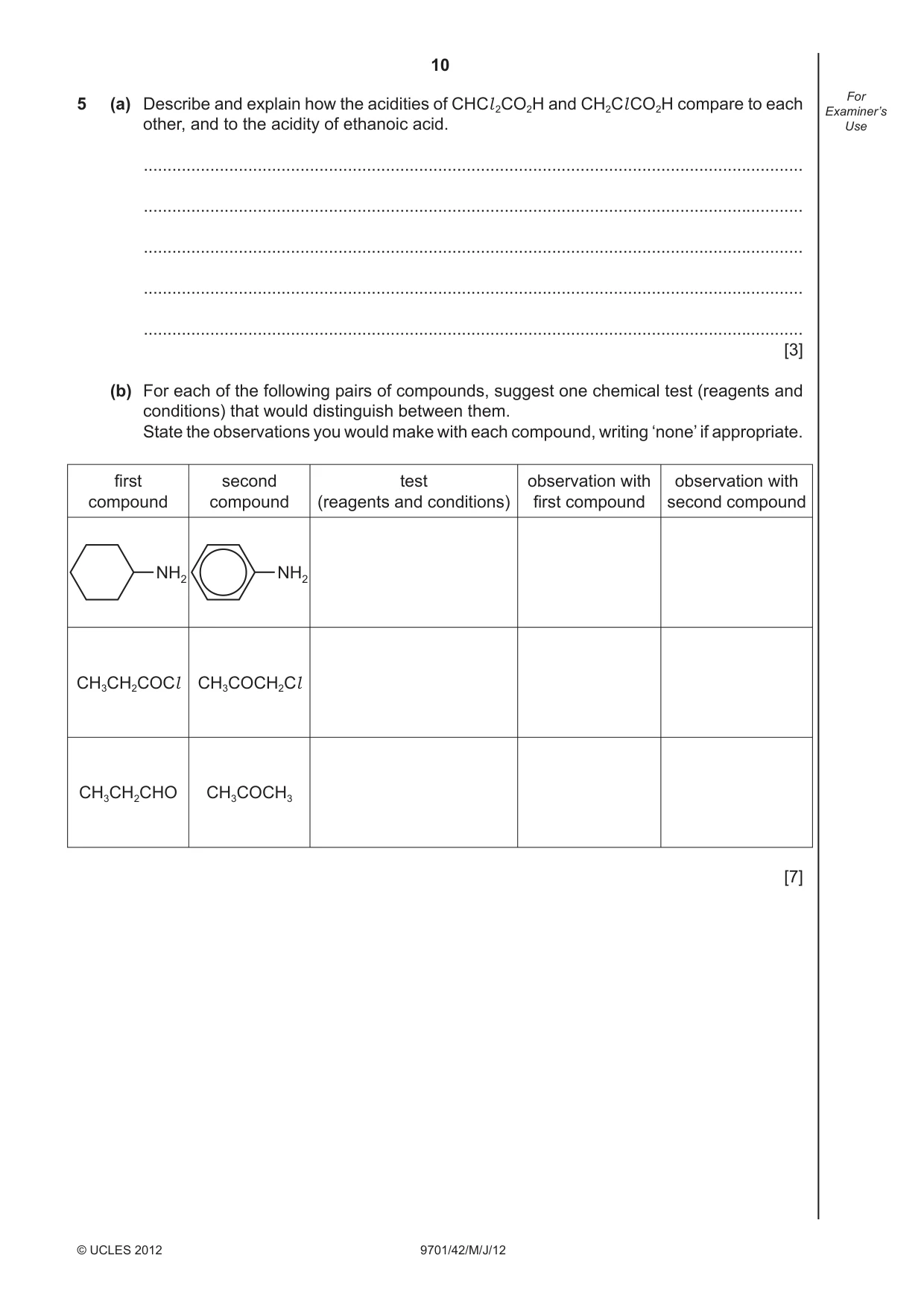
10 9701/42/M/J/12 © UCLES 2012 For Examiner’s Use 5 (a) Describe and explain how the acidities of CHCl 2CO2H and CH2Cl CO2H compare to each other, and to the acidity of ethanoic acid. … … … … … [3] (b) For each of the following pairs of compounds, suggest one chemical test (reagents and conditions) that would distinguish between them. State the observations you would make with each compound, writing ‘none’ if appropriate. fi rst compound second compound test (reagents and conditions) observation with fi rst compound observation with second compound NH2 NH2 CH3CH2COCl CH3COCH2Cl CH3CH2CHO CH3COCH3 [7]
Question paper, page 11
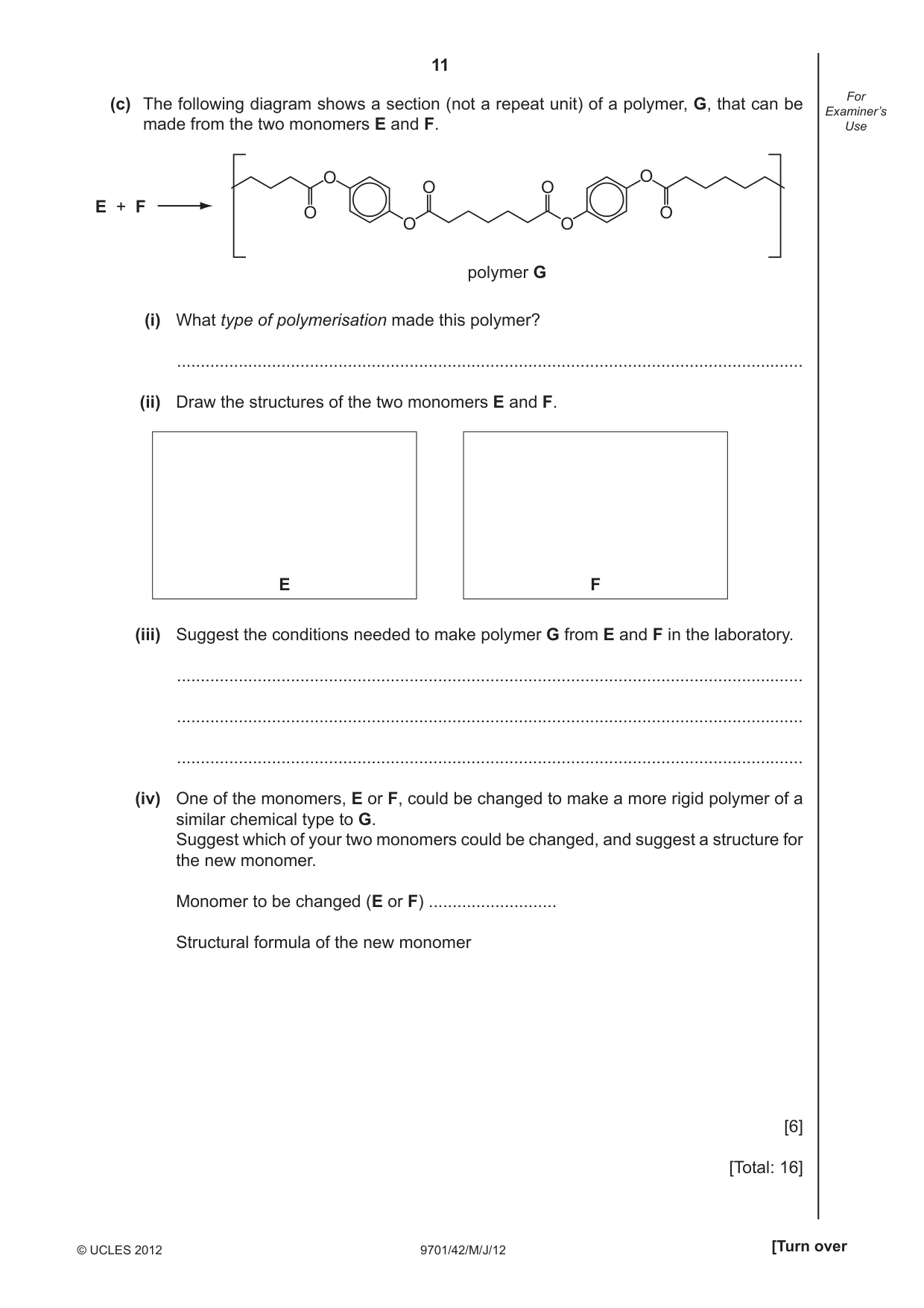
11 9701/42/M/J/12 © UCLES 2012 [Turn over For Examiner’s Use (c) The following diagram shows a section (not a repeat unit) of a polymer, G, that can be made from the two monomers E and F. O O O O O O O O polymer G E + F (i) What type of polymerisation made this polymer? … (ii) Draw the structures of the two monomers E and F. E F (iii) Suggest the conditions needed to make polymer G from E and F in the laboratory. … … … (iv) One of the monomers, E or F, could be changed to make a more rigid polymer of a similar chemical type to G. Suggest which of your two monomers could be changed, and suggest a structure for the new monomer. Monomer to be changed (E or F) … Structural formula of the new monomer [6] [Total: 16]
Question paper, page 12
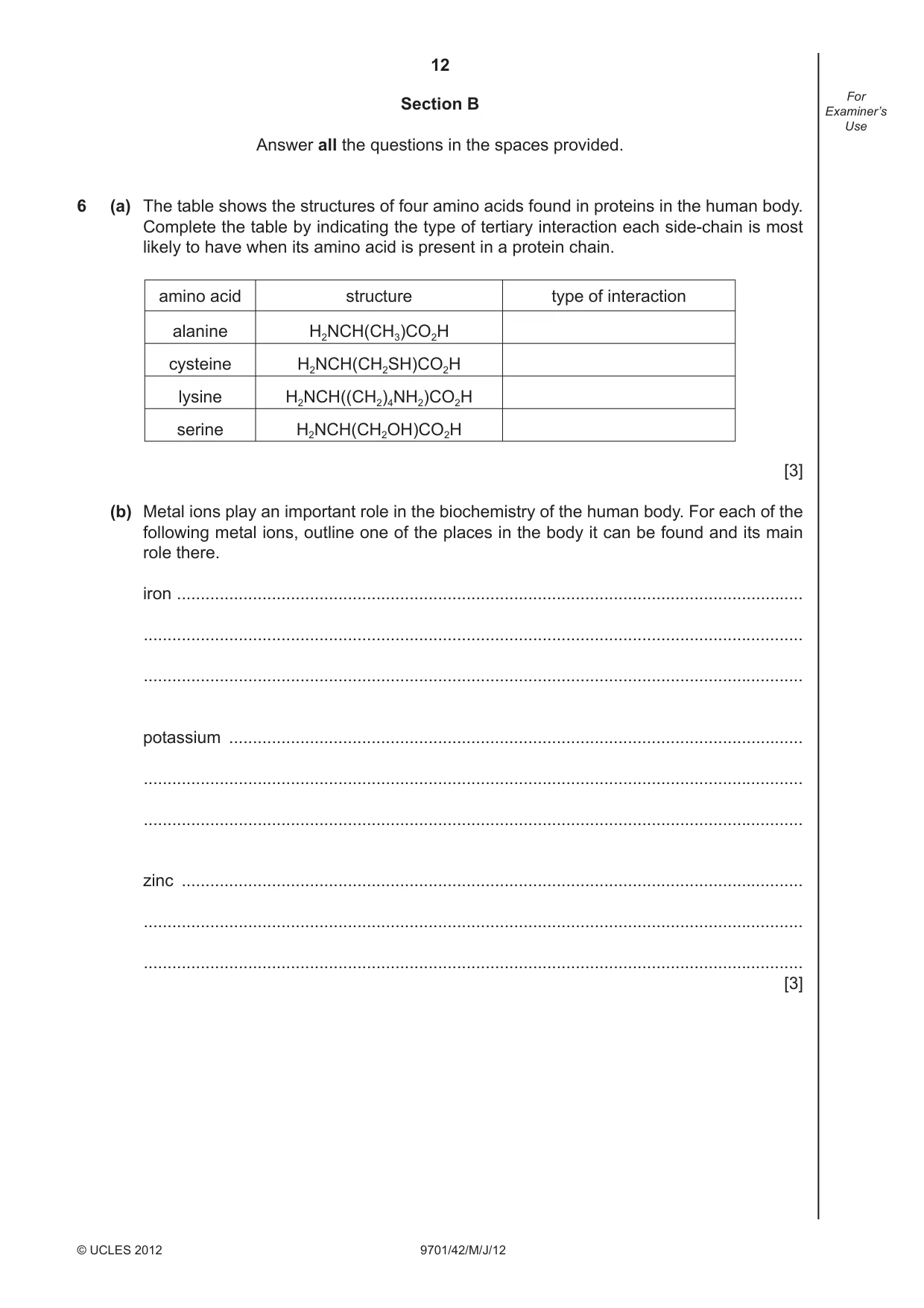
12 9701/42/M/J/12 © UCLES 2012 For Examiner’s Use Section B Answer all the questions in the spaces provided. 6 (a) The table shows the structures of four amino acids found in proteins in the human body. Complete the table by indicating the type of tertiary interaction each side-chain is most likely to have when its amino acid is present in a protein chain. amino acid structure type of interaction alanine H2NCH(CH3)CO2H cysteine H2NCH(CH2SH)CO2H lysine H2NCH((CH2)4NH2)CO2H serine H2NCH(CH2OH)CO2H [3] (b) Metal ions play an important role in the biochemistry of the human body. For each of the following metal ions, outline one of the places in the body it can be found and its main role there. iron … … … potassium … … … zinc … … … [3]
Question paper, page 13
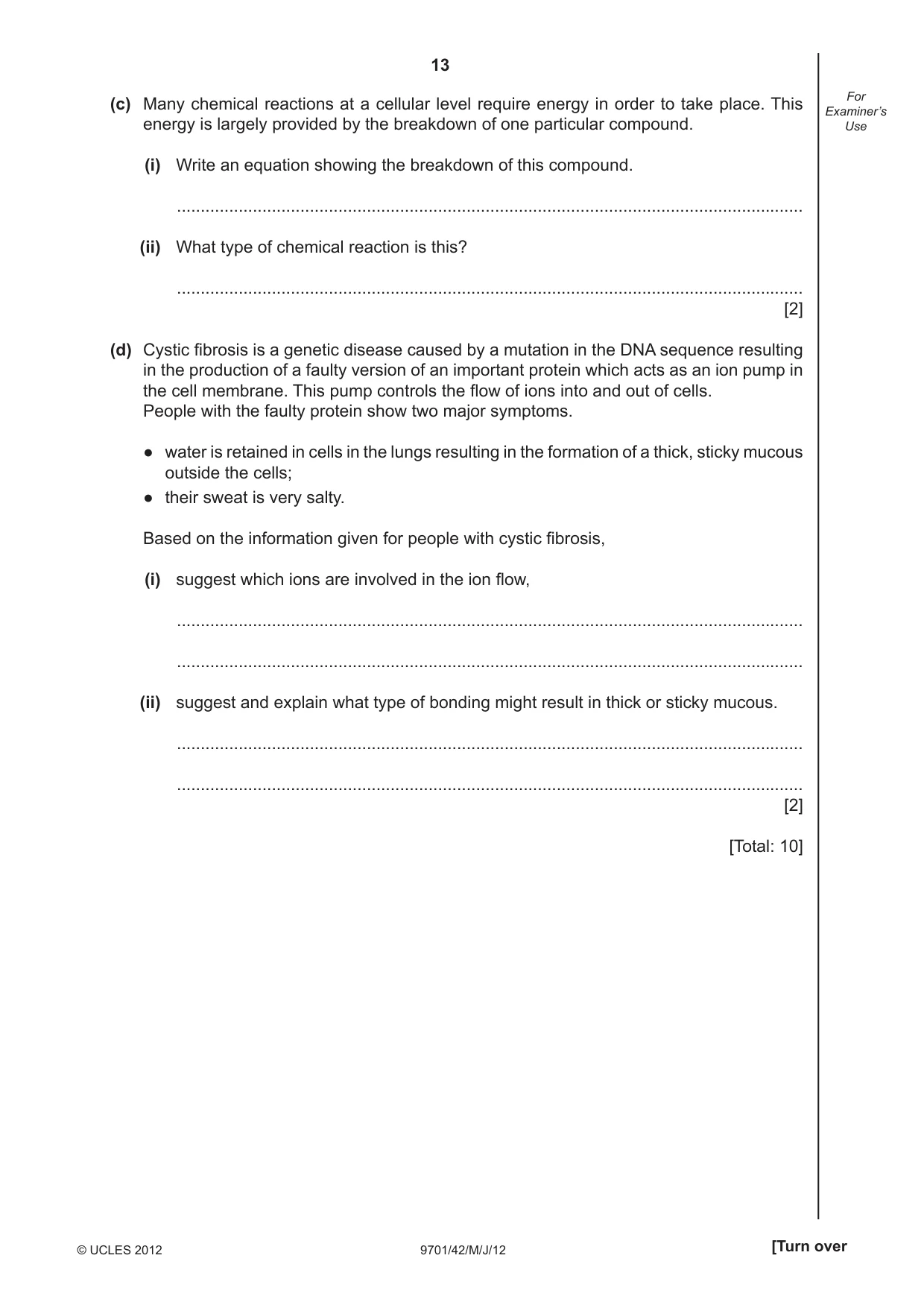
13 9701/42/M/J/12 © UCLES 2012 [Turn over For Examiner’s Use (c) Many chemical reactions at a cellular level require energy in order to take place. This energy is largely provided by the breakdown of one particular compound. (i) Write an equation showing the breakdown of this compound. … (ii) What type of chemical reaction is this? … [2] (d) Cystic fi brosis is a genetic disease caused by a mutation in the DNA sequence resulting in the production of a faulty version of an important protein which acts as an ion pump in the cell membrane. This pump controls the fl ow of ions into and out of cells. People with the faulty protein show two major symptoms. ● water is retained in cells in the lungs resulting in the formation of a thick, sticky mucous outside the cells; ● their sweat is very salty. Based on the information given for people with cystic fi brosis, (i) suggest which ions are involved in the ion fl ow, … … (ii) suggest and explain what type of bonding might result in thick or sticky mucous. … … [2] [Total: 10]
Question paper, page 14
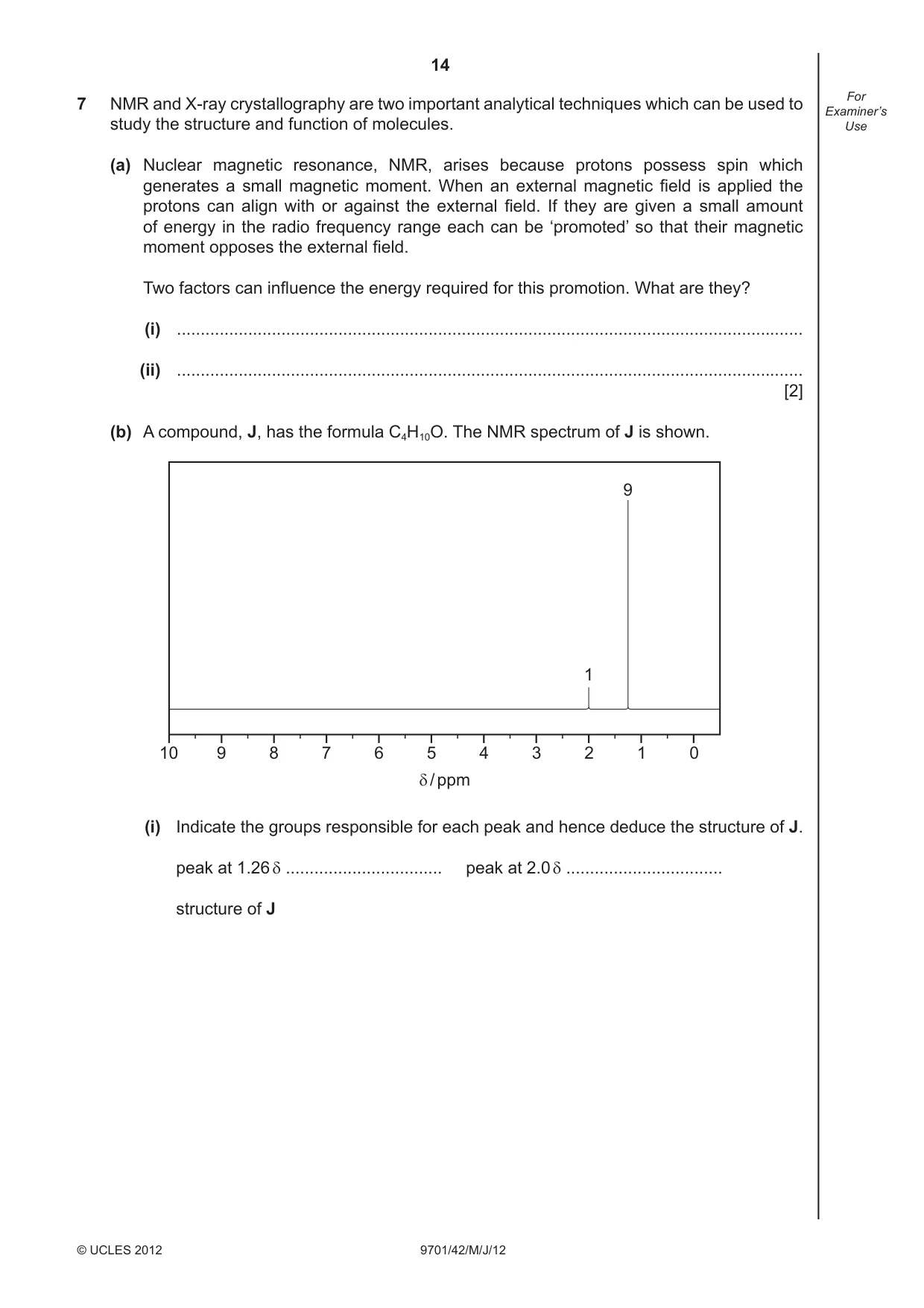
14 9701/42/M/J/12 © UCLES 2012 For Examiner’s Use 7 NMR and X-ray crystallography are two important analytical techniques which can be used to study the structure and function of molecules. (a) Nuclear magnetic resonance, NMR, arises because protons possess spin which generates a small magnetic moment. When an external magnetic fi eld is applied the protons can align with or against the external fi eld. If they are given a small amount of energy in the radio frequency range each can be ‘promoted’ so that their magnetic moment opposes the external fi eld. Two factors can infl uence the energy required for this promotion. What are they? (i) … (ii) … [2] (b) A compound, J, has the formula C4H10O. The NMR spectrum of J is shown. 10 9 8 7 6 5 4 3 2 1 1 0 9 δ / ppm (i) Indicate the groups responsible for each peak and hence deduce the structure of J. peak at 1.26 δ … peak at 2.0 δ … structure of J
Question paper, page 15
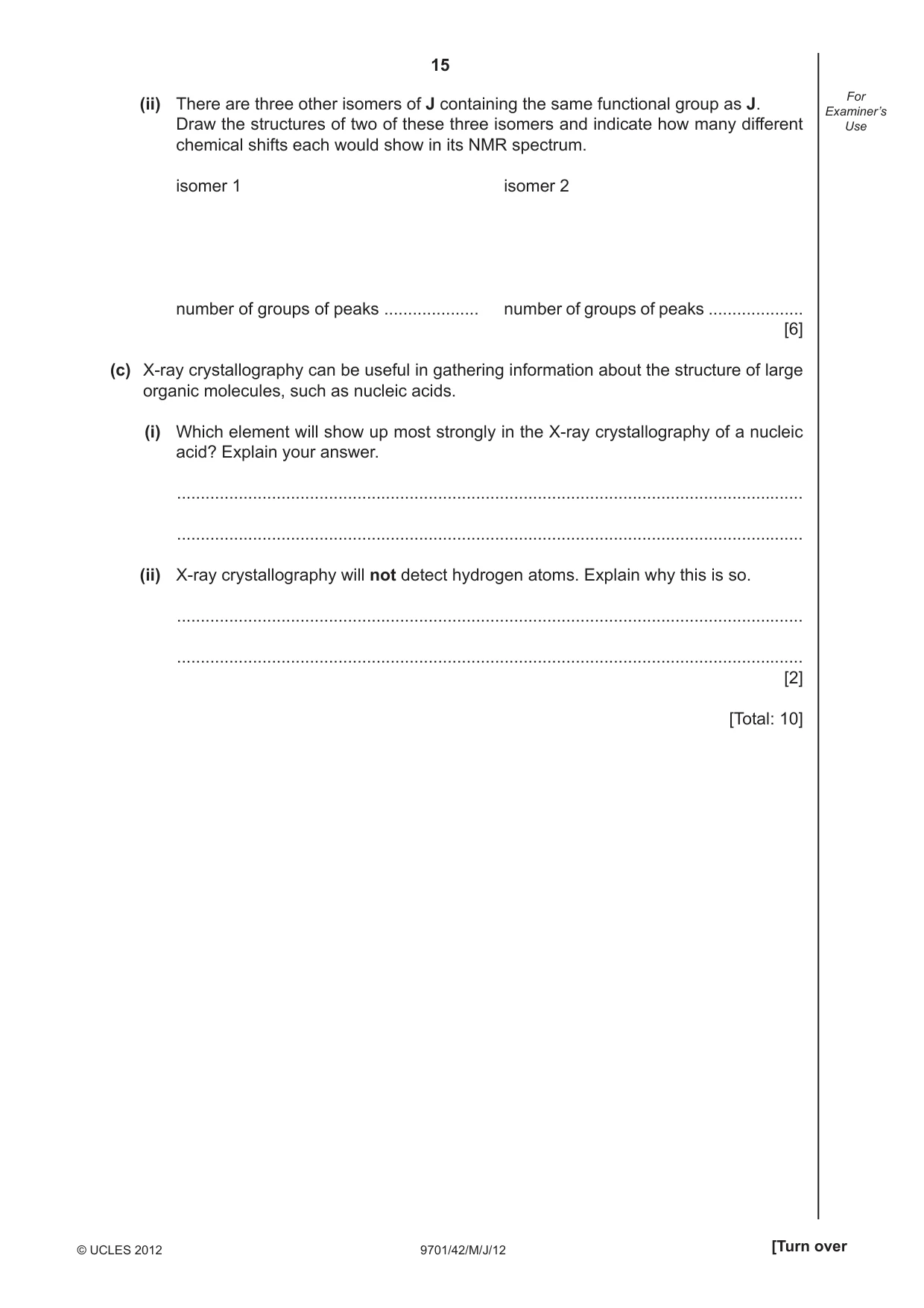
15 9701/42/M/J/12 © UCLES 2012 [Turn over For Examiner’s Use (ii) There are three other isomers of J containing the same functional group as J. Draw the structures of two of these three isomers and indicate how many different chemical shifts each would show in its NMR spectrum. isomer 1 isomer 2 number of groups of peaks … number of groups of peaks … [6] (c) X-ray crystallography can be useful in gathering information about the structure of large organic molecules, such as nucleic acids. (i) Which element will show up most strongly in the X-ray crystallography of a nucleic acid? Explain your answer. … … (ii) X-ray crystallography will not detect hydrogen atoms. Explain why this is so. … … [2] [Total: 10]
Question paper, page 16
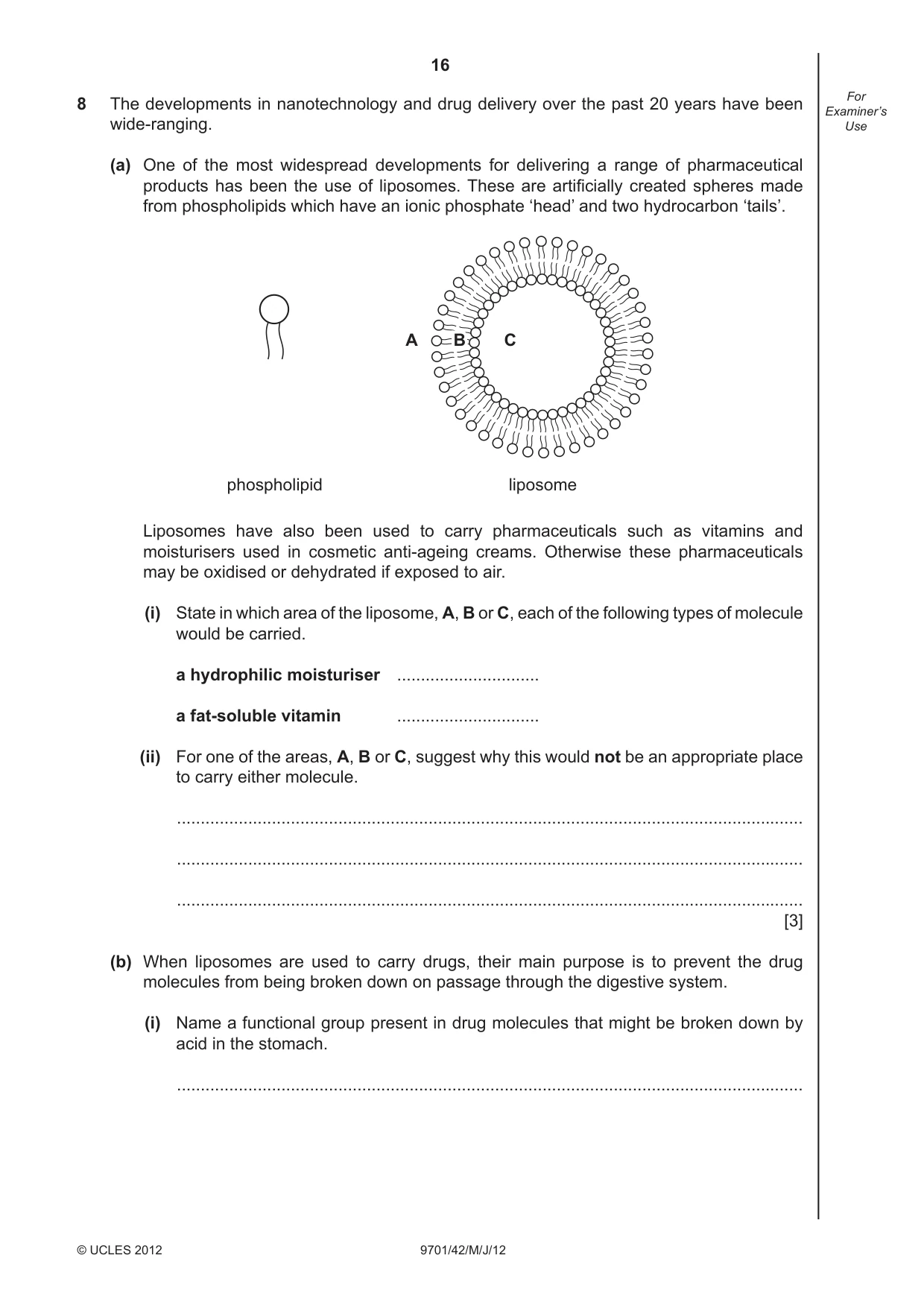
16 9701/42/M/J/12 © UCLES 2012 For Examiner’s Use 8 The developments in nanotechnology and drug delivery over the past 20 years have been wide-ranging. (a) One of the most widespread developments for delivering a range of pharmaceutical products has been the use of liposomes. These are artifi cially created spheres made from phospholipids which have an ionic phosphate ‘head’ and two hydrocarbon ‘tails’. A C B phospholipid liposome Liposomes have also been used to carry pharmaceuticals such as vitamins and moisturisers used in cosmetic anti-ageing creams. Otherwise these pharmaceuticals may be oxidised or dehydrated if exposed to air. (i) State in which area of the liposome, A, B or C, each of the following types of molecule would be carried. a hydrophilic moisturiser … a fat-soluble vitamin … (ii) For one of the areas, A, B or C, suggest why this would not be an appropriate place to carry either molecule. … … … [3] (b) When liposomes are used to carry drugs, their main purpose is to prevent the drug molecules from being broken down on passage through the digestive system. (i) Name a functional group present in drug molecules that might be broken down by acid in the stomach. …
Question paper, page 17
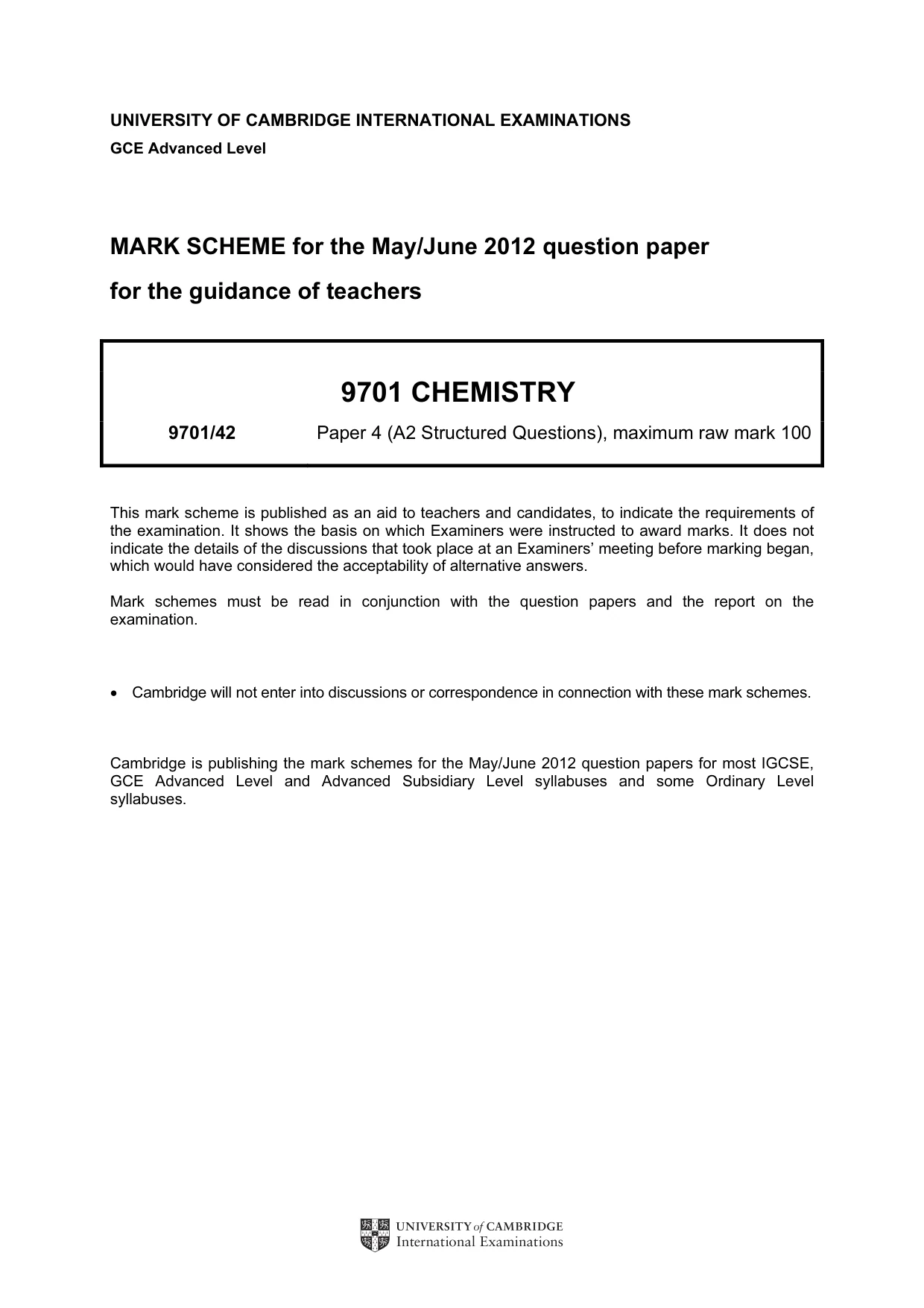
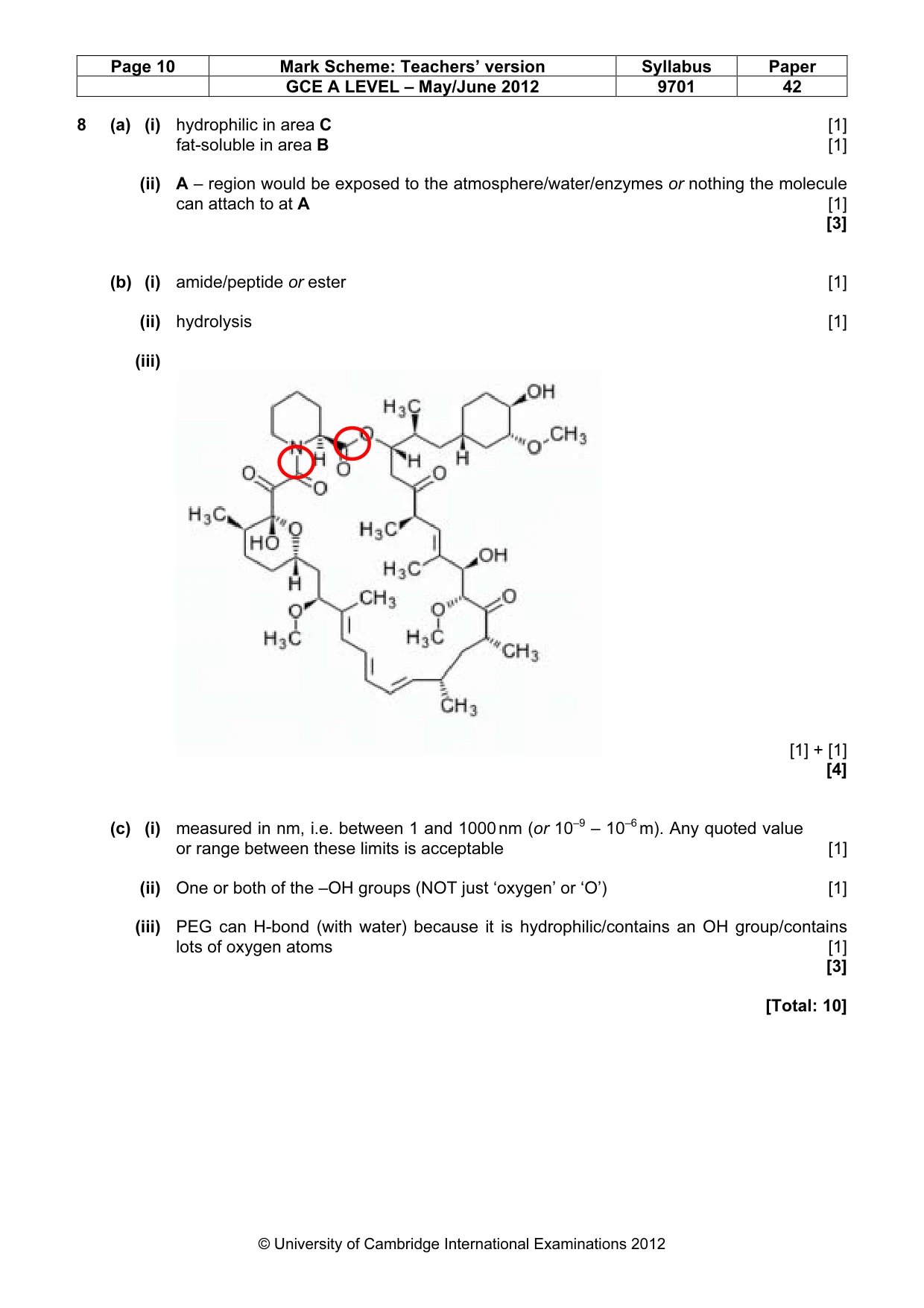
17 9701/42/M/J/12 © UCLES 2012 [Turn over For Examiner’s Use (ii) Name the type of reaction that would cause such a breakdown. … (iii) The drug Sirolimus is used to suppress possible rejection by the body after kidney transplants. N O O O O O O O O H3C H3C H3C H3C H3C O H3C CH3 CH3 CH3 CH3 O H H H H HO OH OH Sirolimus Circle two bonds, each in a different functional group that could be broken down in the digestive system. [4] (c) Sirolimus is not very soluble in water, greatly reducing its effectiveness when given by mouth or by injection. To increase its effectiveness when taken by mouth nano-sized crystals of the drug combined with poly(ethylene glycol) or PEG (shown below) are produced. HO — (CH2 — CH2 — O)n — H (i) Suggest what is meant by the term nano-sized. … (ii) Suggest where on the molecule of PEG the drug would be attached. … (iii) Why would bonding the drug to a PEG molecule improve its solubility in water? … [3] [Total: 10]
Question paper, page 18
18 9701/42/M/J/12 BLANK PAGE © UCLES 2012
Question paper, page 19
19 9701/42/M/J/12 BLANK PAGE © UCLES 2012
Question paper, page 20
20 Permission to reproduce items where third-party owned material protected by copyright is included has been sought and cleared where possible. Every reasonable effort has been made by the publisher (UCLES) to trace copyright holders, but if any items requiring clearance have unwittingly been included the publisher will be pleased to make amends at the earliest possible opportunity. University of Cambridge International Examinations is part of the Cambridge Assessment Group. Cambridge Assessment is the brand name of University of Cambridge Local Examinations Syndicate (UCLES), which is itself a department of the University of Cambridge. 9701/42/M/J/12 © UCLES 2012 BLANK PAGE
Mark scheme, page 1
UNIVERSITY OF CAMBRIDGE INTERNATIONAL EXAMINATIONS GCE Advanced Level MARK SCHEME for the May/June 2012 question paper for the guidance of teachers 9701 CHEMISTRY 9701/42 Paper 4 (A2 Structured Questions), maximum raw mark 100 This mark scheme is published as an aid to teachers and candidates, to indicate the requirements of the examination. It shows the basis on which Examiners were instructed to award marks. It does not indicate the details of the discussions that took place at an Examiners’ meeting before marking began, which would have considered the acceptability of alternative answers. Mark schemes must be read in conjunction with the question papers and the report on the examination. • Cambridge will not enter into discussions or correspondence in connection with these mark schemes. Cambridge is publishing the mark schemes for the May/June 2012 question papers for most IGCSE, GCE Advanced Level and Advanced Subsidiary Level syllabuses and some Ordinary Level syllabuses.
Mark scheme, page 2
Page 2 Mark Scheme: Teachers’ version Syllabus Paper GCE A LEVEL – May/June 2012 9701 42 © University of Cambridge International Examinations 2012 1 (a) (i) enthalpy/energy change/released when 1 mol of ions… [1] in the gas phase (are dissolved in) water [1] (ii) Mg2+(g) + aq (or H2O) → Mg2+(aq) or [Mg(H2O)6]2+ [1] (iii) Mg2+ has a smaller radius/size or greater charge density than Ca2+ (ions required) [1] (iv) O2– reacts with water to give OH– or equation: O2– + H2O → 2OH– [1] [5] (b) (apparatus: “insulated” calorimeter, water and thermometer) • measure (known volume/mass of) water or stated volume of water (into calorimeter) • take the temperature (of the water – NOT the MgCl 2) • weigh out known mass of MgCl 2 or stated mass of MgCl 2 • take final/highest/constant temperature or record temperature change/rise 4 × [1] [4] (c) (i) ∆Ho sol = 641 – 801 = –160 kJ mol–1 [1] (ii) ∆Ho hyd = (1890 – 2526 – 160)/2 = –398 kJ mol–1 [2] [3] (d) • solubility: MgSO4 > BaSO4 or decreases down the group • because ∆Hsol is more endothermic for BaSO4 or more exothermic for MgSO4 • due to larger rion or smaller charge density of Ba2+ (ion has to be mentioned) • leading to smaller LE and HE or LE and HE decrease • but difference in HE (between Mg2+ and Ba2+) is larger than the difference in LE (between MgSO4 and BaSO4) or HE is dominant or HE decreases more than LE any 4 points [4] [4] [Total: 16]
Mark scheme, page 3
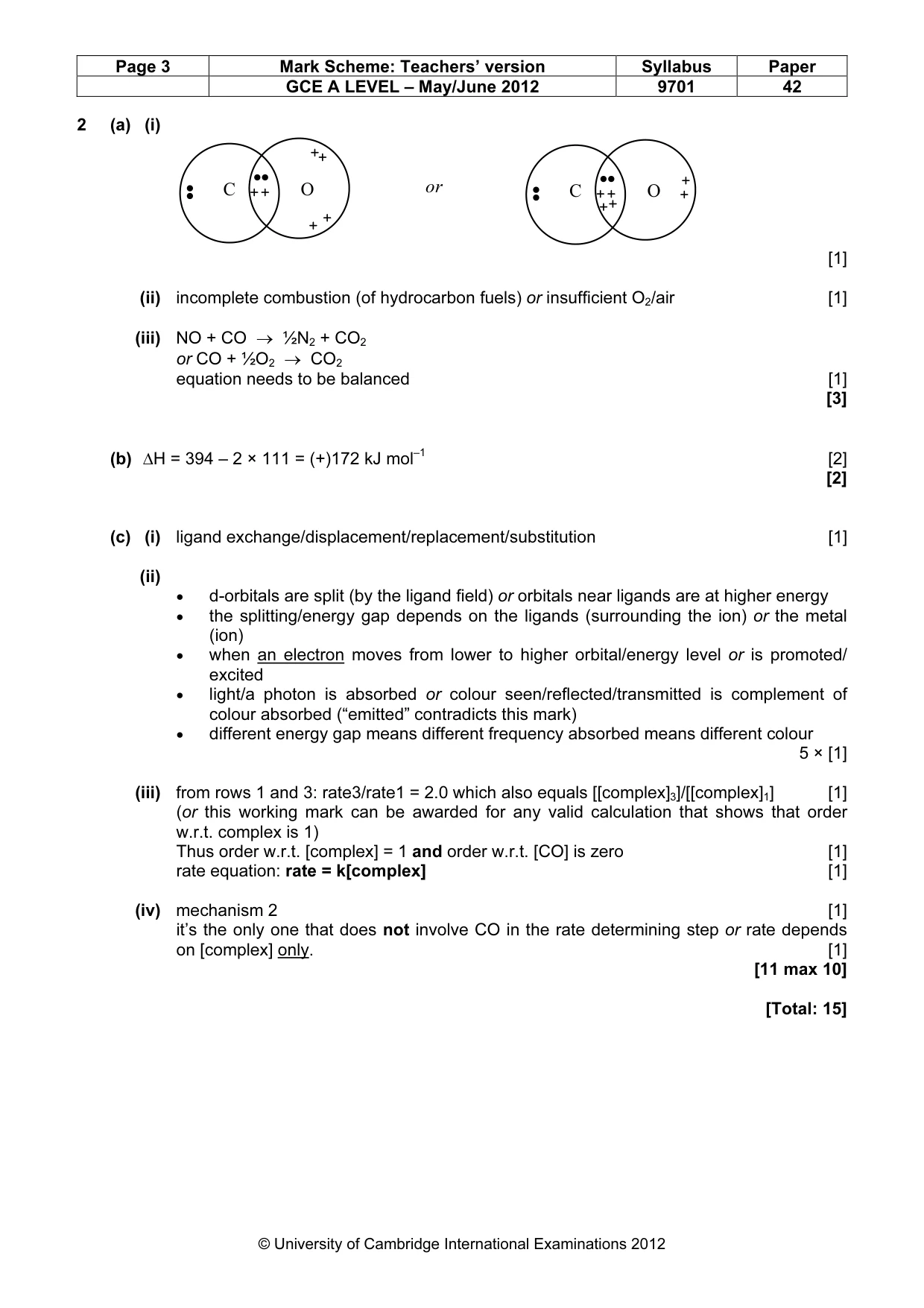
Page 3 Mark Scheme: Teachers’ version Syllabus Paper GCE A LEVEL – May/June 2012 9701 42 © University of Cambridge International Examinations 2012 2 (a) (i) C O C O or [1] (ii) incomplete combustion (of hydrocarbon fuels) or insufficient O2/air [1] (iii) NO + CO → ½N2 + CO2 or CO + ½O2 → CO2 equation needs to be balanced [1] [3] (b) ∆H = 394 – 2 × 111 = (+)172 kJ mol–1 [2] [2] (c) (i) ligand exchange/displacement/replacement/substitution [1] (ii) • d-orbitals are split (by the ligand field) or orbitals near ligands are at higher energy • the splitting/energy gap depends on the ligands (surrounding the ion) or the metal (ion) • when an electron moves from lower to higher orbital/energy level or is promoted/ excited • light/a photon is absorbed or colour seen/reflected/transmitted is complement of colour absorbed (“emitted” contradicts this mark) • different energy gap means different frequency absorbed means different colour 5 × [1] (iii) from rows 1 and 3: rate3/rate1 = 2.0 which also equals [[complex]3]/[[complex]1] [1] (or this working mark can be awarded for any valid calculation that shows that order w.r.t. complex is 1) Thus order w.r.t. [complex] = 1 and order w.r.t. [CO] is zero [1] rate equation: rate = k[complex] [1] (iv) mechanism 2 [1] it’s the only one that does not involve CO in the rate determining step or rate depends on [complex] only. [1] [11 max 10] [Total: 15]
Mark scheme, page 4
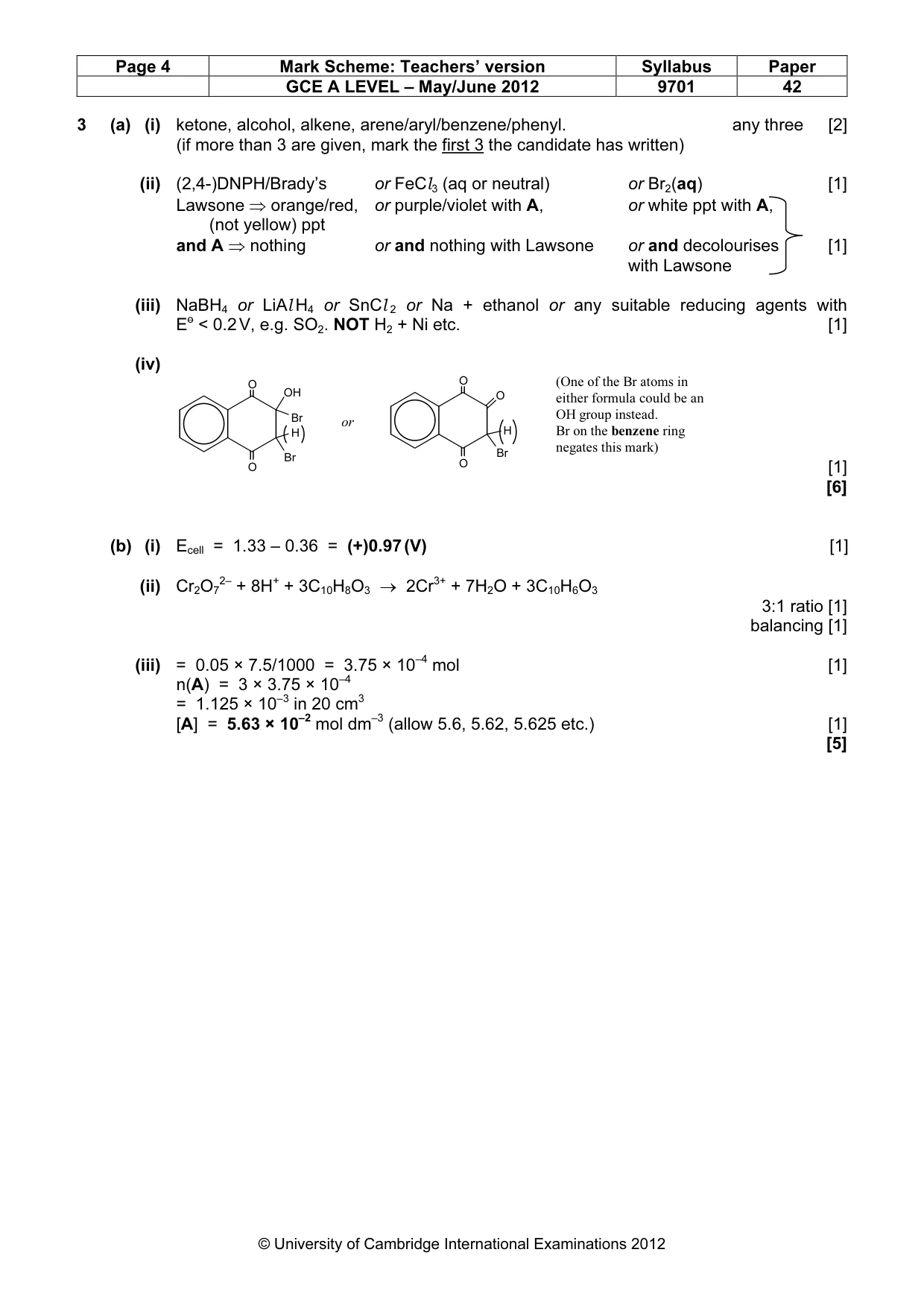
Page 4 Mark Scheme: Teachers’ version Syllabus Paper GCE A LEVEL – May/June 2012 9701 42 © University of Cambridge International Examinations 2012 3 (a) (i) ketone, alcohol, alkene, arene/aryl/benzene/phenyl. any three [2] (if more than 3 are given, mark the first 3 the candidate has written) (ii) (2,4-)DNPH/Brady’s or FeCl3 (aq or neutral) or Br2(aq) [1] Lawsone ⇒ orange/red, or purple/violet with A, or white ppt with A, (not yellow) ppt and A ⇒ nothing or and nothing with Lawsone or and decolourises [1] with Lawsone (iii) NaBH4 or LiAl H4 or SnCl 2 or Na + ethanol or any suitable reducing agents with Eo < 0.2 V, e.g. SO2. NOT H2 + Ni etc. [1] (iv) O O O O or OH Br H Br O H Br (One of the Br atoms in either formula could be an OH group instead. Br on the benzene ring negates this mark) [1] [6] (b) (i) Ecell = 1.33 – 0.36 = (+)0.97 (V) [1] (ii) Cr2O7 2– + 8H+ + 3C10H8O3 → 2Cr3+ + 7H2O + 3C10H6O3 3:1 ratio [1] balancing [1] (iii) = 0.05 × 7.5/1000 = 3.75 × 10⁻⁴ mol [1] n(A) = 3 × 3.75 × 10–4 = 1.125 × 10⁻³ in 20 cm3 [A] = 5.63 × 10⁻² mol dm–3 (allow 5.6, 5.62, 5.625 etc.) [1] [5]
Mark scheme, page 5
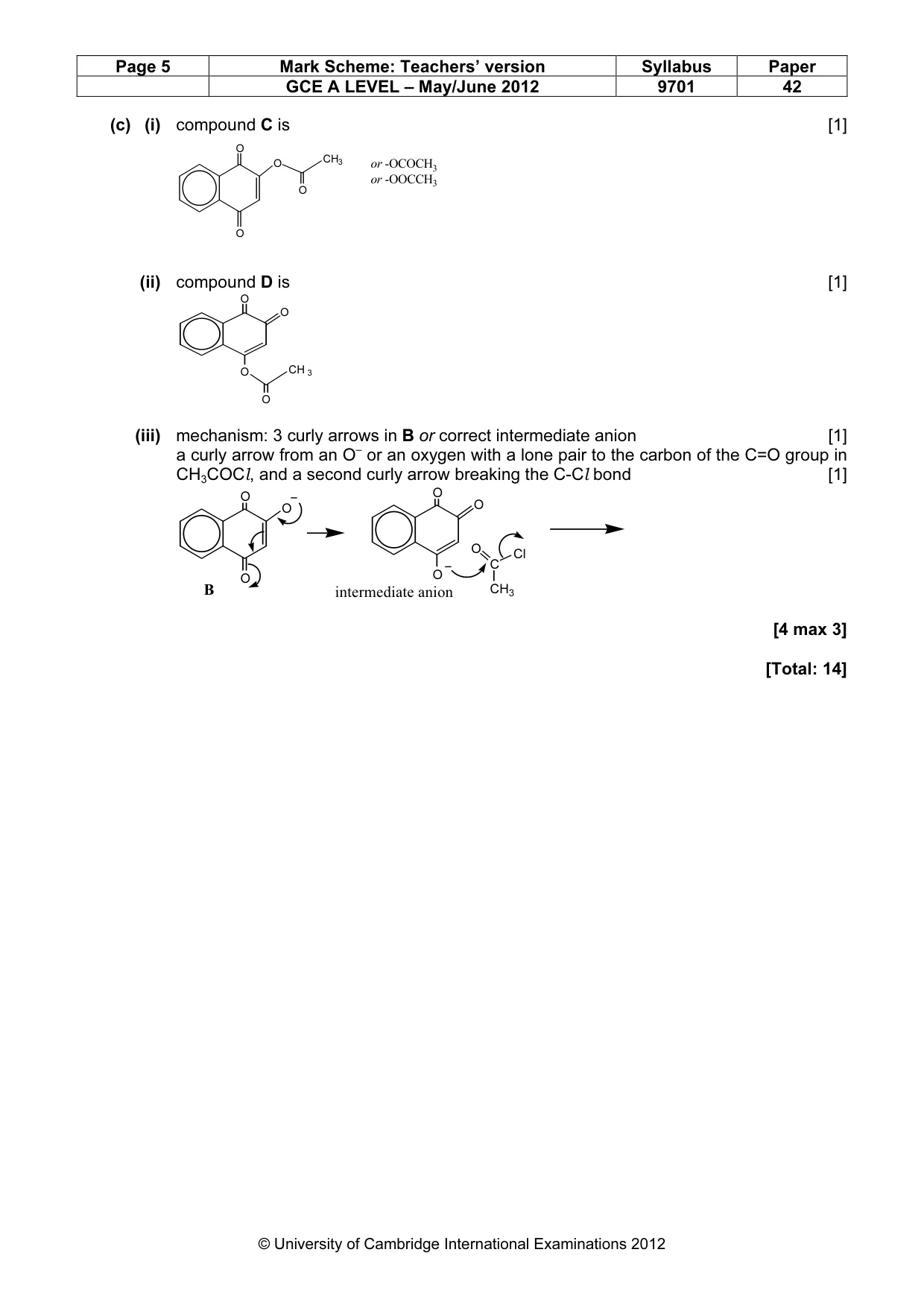
Page 5 Mark Scheme: Teachers’ version Syllabus Paper GCE A LEVEL – May/June 2012 9701 42 © University of Cambridge International Examinations 2012 (c) (i) compound C is [1] (ii) compound D is [1] O O O CH 3 O (iii) mechanism: 3 curly arrows in B or correct intermediate anion [1] a curly arrow from an O– or an oxygen with a lone pair to the carbon of the C=O group in CH3COCl, and a second curly arrow breaking the C-Cl bond [1] O O O O O O Cl C O B CH3 intermediate anion [4 max 3] [Total: 14] O O O CH3 O or -OCOCH3 or -OOCCH3
Mark scheme, page 6
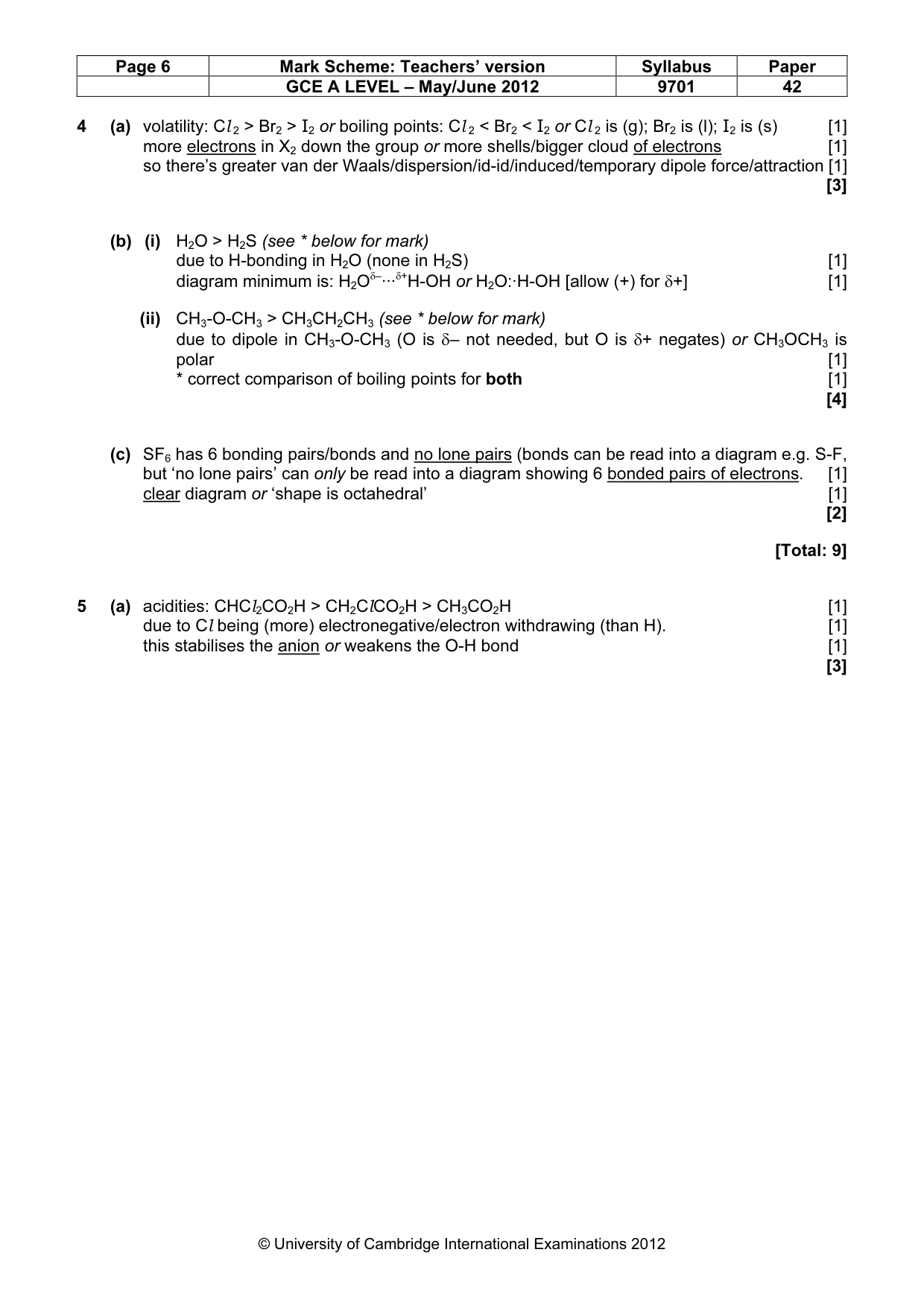
Page 6 Mark Scheme: Teachers’ version Syllabus Paper GCE A LEVEL – May/June 2012 9701 42 © University of Cambridge International Examinations 2012 4 (a) volatility: Cl 2 > Br2 > I2 or boiling points: Cl 2 < Br2 < I2 or Cl 2 is (g); Br2 is (l); I2 is (s) [1] more electrons in X2 down the group or more shells/bigger cloud of electrons [1] so there’s greater van der Waals/dispersion/id-id/induced/temporary dipole force/attraction [1] [3] (b) (i) H2O > H2S (see * below for mark) due to H-bonding in H2O (none in H2S) [1] diagram minimum is: H2Oδ–···δ+H-OH or H2O:·H-OH [allow (+) for δ+] [1] (ii) CH3-O-CH3 > CH3CH2CH3 (see * below for mark) due to dipole in CH3-O-CH3 (O is δ– not needed, but O is δ+ negates) or CH3OCH3 is polar [1] * correct comparison of boiling points for both [1] [4] (c) SF6 has 6 bonding pairs/bonds and no lone pairs (bonds can be read into a diagram e.g. S-F, but ‘no lone pairs’ can only be read into a diagram showing 6 bonded pairs of electrons. [1] clear diagram or ‘shape is octahedral’ [1] [2] [Total: 9] 5 (a) acidities: CHCl2CO2H > CH2ClCO2H > CH3CO2H [1] due to Cl being (more) electronegative/electron withdrawing (than H). [1] this stabilises the anion or weakens the O-H bond [1] [3]
Mark scheme, page 7
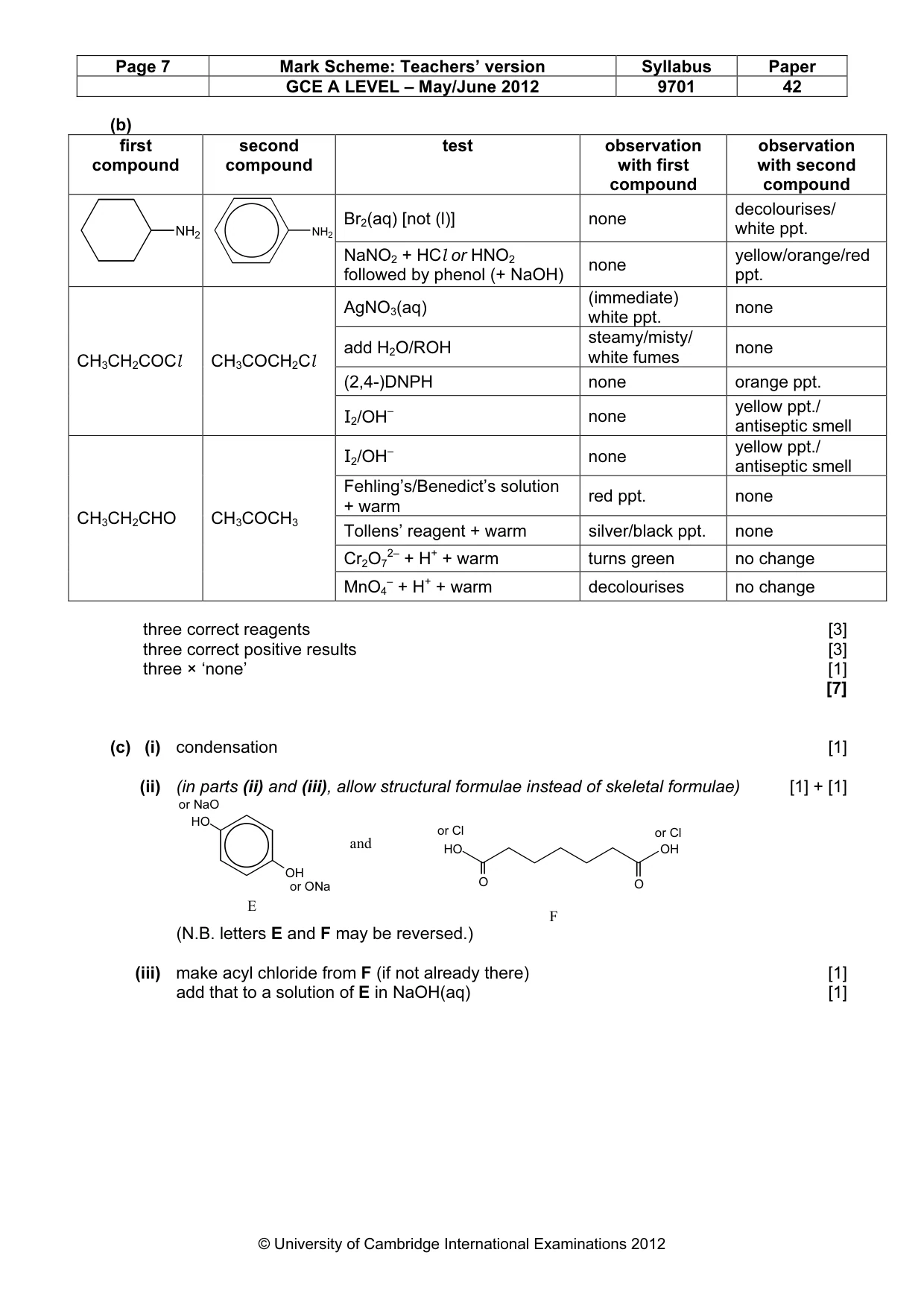
Page 7 Mark Scheme: Teachers’ version Syllabus Paper GCE A LEVEL – May/June 2012 9701 42 © University of Cambridge International Examinations 2012 (b) first compound second compound test observation with first compound observation with second compound Br2(aq) [not (l)] none decolourises/ white ppt. NH2 NH2 NaNO2 + HCl or HNO2 followed by phenol (+ NaOH) none yellow/orange/red ppt. AgNO3(aq) (immediate) white ppt. none add H2O/ROH steamy/misty/ white fumes none (2,4-)DNPH none orange ppt. CH3CH2COCl CH3COCH2Cl I2/OH– none yellow ppt./ antiseptic smell I2/OH– none yellow ppt./ antiseptic smell Fehling’s/Benedict’s solution + warm red ppt. none Tollens’ reagent + warm silver/black ppt. none Cr2O7 2– + H+ + warm turns green no change CH3CH2CHO CH3COCH3 MnO4 – + H+ + warm decolourises no change three correct reagents [3] three correct positive results [3] three × ‘none’ [1] [7] (c) (i) condensation [1] (ii) (in parts (ii) and (iii), allow structural formulae instead of skeletal formulae) [1] + [1] HO OH and HO OH O O E F or Cl or Cl or NaO or ONa (N.B. letters E and F may be reversed.) (iii) make acyl chloride from F (if not already there) [1] add that to a solution of E in NaOH(aq) [1]
Mark scheme, page 8
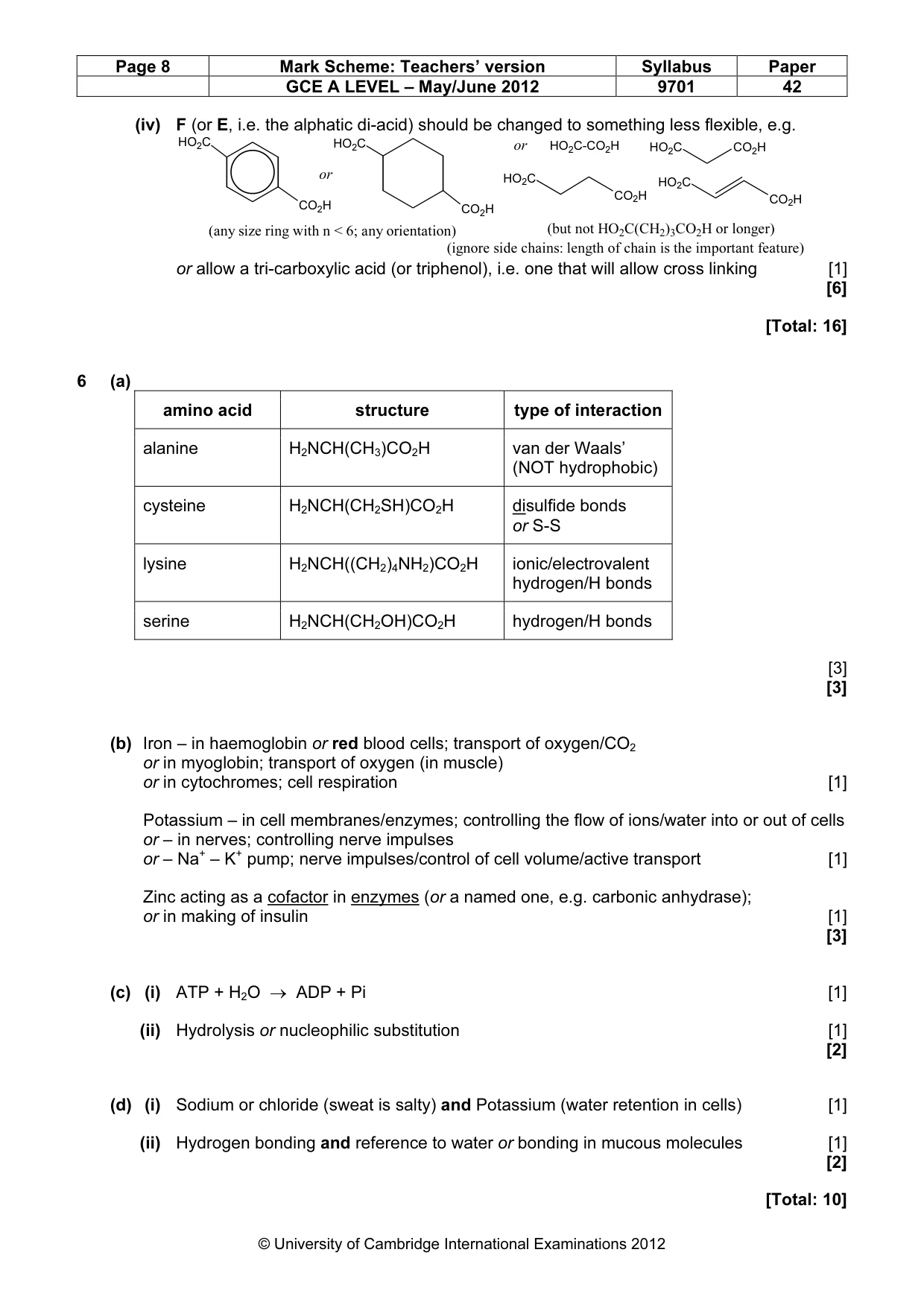
Page 8 Mark Scheme: Teachers’ version Syllabus Paper GCE A LEVEL – May/June 2012 9701 42 © University of Cambridge International Examinations 2012 (iv) F (or E, i.e. the alphatic di-acid) should be changed to something less flexible, e.g. HO2C CO2H HO2C CO2H HO2C CO2H or or HO2C CO2H HO2C CO2H HO2C-CO2H (but not HO2C(CH2)3CO2H or longer) (any size ring with n < 6; any orientation) (ignore side chains: length of chain is the important feature) or allow a tri-carboxylic acid (or triphenol), i.e. one that will allow cross linking [1] [6] [Total: 16] 6 (a) amino acid structure type of interaction alanine H2NCH(CH3)CO2H van der Waals’ (NOT hydrophobic) cysteine H2NCH(CH2SH)CO2H disulfide bonds or S-S lysine H2NCH((CH2)4NH2)CO2H ionic/electrovalent hydrogen/H bonds serine H2NCH(CH2OH)CO2H hydrogen/H bonds [3] [3] (b) Iron – in haemoglobin or red blood cells; transport of oxygen/CO2 or in myoglobin; transport of oxygen (in muscle) or in cytochromes; cell respiration [1] Potassium – in cell membranes/enzymes; controlling the flow of ions/water into or out of cells or – in nerves; controlling nerve impulses or – Na+ – K+ pump; nerve impulses/control of cell volume/active transport [1] Zinc acting as a cofactor in enzymes (or a named one, e.g. carbonic anhydrase); or in making of insulin [1] [3] (c) (i) ATP + H2O → ADP + Pi [1] (ii) Hydrolysis or nucleophilic substitution [1] [2] (d) (i) Sodium or chloride (sweat is salty) and Potassium (water retention in cells) [1] (ii) Hydrogen bonding and reference to water or bonding in mucous molecules [1] [2] [Total: 10]
Mark scheme, page 9
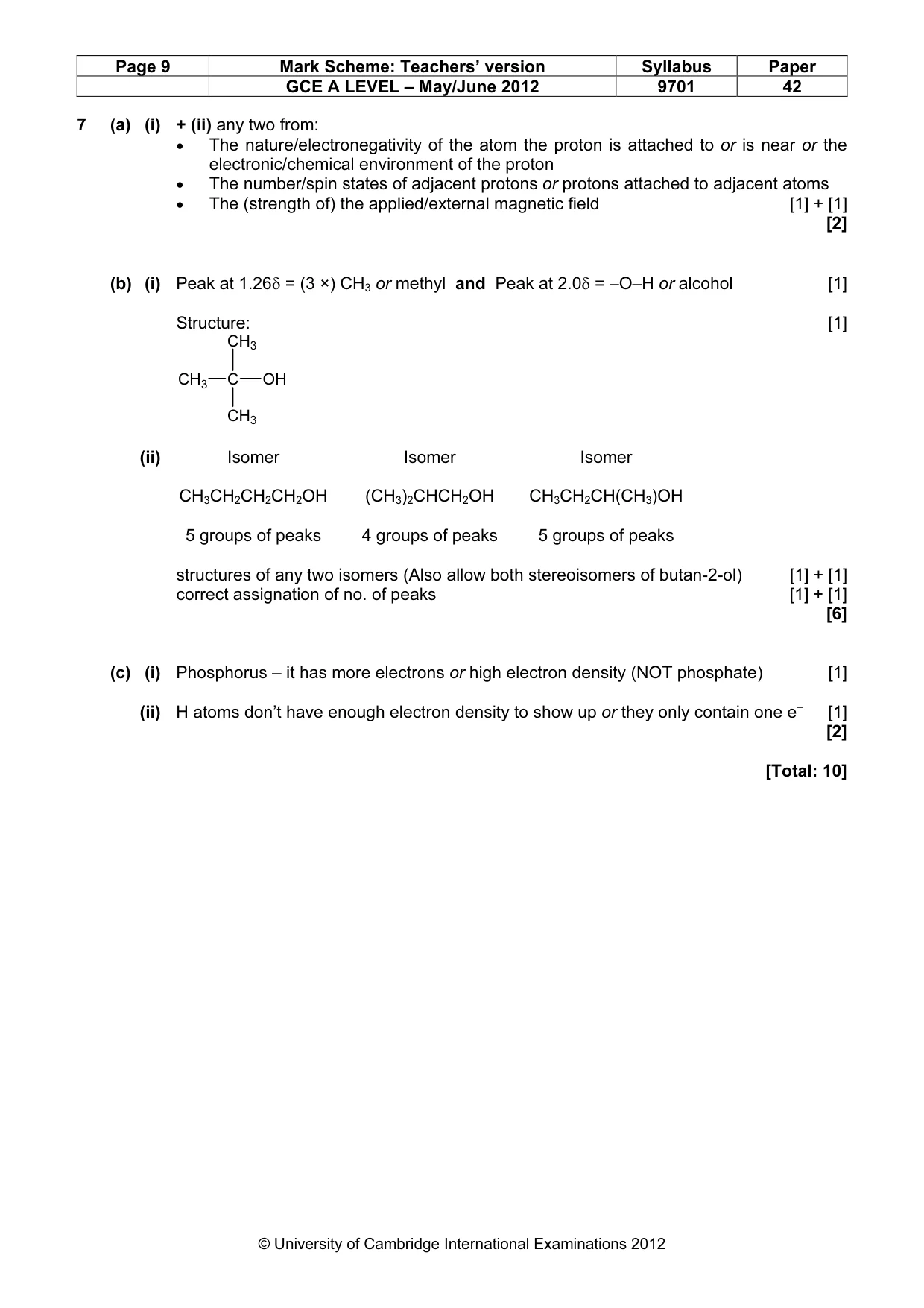
Page 9 Mark Scheme: Teachers’ version Syllabus Paper GCE A LEVEL – May/June 2012 9701 42 © University of Cambridge International Examinations 2012 7 (a) (i) + (ii) any two from: • The nature/electronegativity of the atom the proton is attached to or is near or the electronic/chemical environment of the proton • The number/spin states of adjacent protons or protons attached to adjacent atoms • The (strength of) the applied/external magnetic field [1] + [1] [2] (b) (i) Peak at 1.26δ = (3 ×) CH3 or methyl and Peak at 2.0δ = –O–H or alcohol [1] Structure: [1] CH3 C CH3 CH3 OH (ii) Isomer Isomer Isomer CH3CH2CH2CH2OH (CH3)2CHCH2OH CH3CH2CH(CH3)OH 5 groups of peaks 4 groups of peaks 5 groups of peaks structures of any two isomers (Also allow both stereoisomers of butan-2-ol) [1] + [1] correct assignation of no. of peaks [1] + [1] [6] (c) (i) Phosphorus – it has more electrons or high electron density (NOT phosphate) [1] (ii) H atoms don’t have enough electron density to show up or they only contain one e– [1] [2] [Total: 10]
Mark scheme, page 10
Page 10 Mark Scheme: Teachers’ version Syllabus Paper GCE A LEVEL – May/June 2012 9701 42 © University of Cambridge International Examinations 2012 8 (a) (i) hydrophilic in area C [1] fat-soluble in area B [1] (ii) A – region would be exposed to the atmosphere/water/enzymes or nothing the molecule can attach to at A [1] [3] (b) (i) amide/peptide or ester [1] (ii) hydrolysis [1] (iii) [1] + [1] [4] (c) (i) measured in nm, i.e. between 1 and 1000 nm (or 10–9 – 10–6 m). Any quoted value or range between these limits is acceptable [1] (ii) One or both of the –OH groups (NOT just ‘oxygen’ or ‘O’) [1] (iii) PEG can H-bond (with water) because it is hydrophilic/contains an OH group/contains lots of oxygen atoms [1] [3] [Total: 10]
What you needed in this session
Cambridge’s own grade thresholds for 2012 May/June, Paper 4 · Variant 2. A higher threshold means an easier paper — the bar moves with how the cohort did.