Cambridge A Level Chemistry 9701 — 2012 May/June Paper 4 · Variant 1
9701/41/M/J/12 · 100 marks · ≈113 min
The question paper and its mark scheme, free to read here and free to download. This is Cambridge’s own paper, exactly as it was sat.
Question paper20 pages


Mark scheme8 pages
Answers below. Sit the paper first if you are practising.
Paper as text
Question paper, page 1
READ THESE INSTRUCTIONS FIRST Write your Centre number, candidate number and name on all the work you hand in. Write in dark blue or black pen. You may use a soft pencil for any diagrams, graphs or rough working. Do not use staples, paper clips, highlighters, glue or correction fl uid. DO NOT WRITE IN ANY BARCODES. Section A Answer all questions. Section B Answer all questions. You may lose marks if you do not show your working or if you do not use appropriate units. A Data Booklet is provided. At the end of the examination, fasten all your work securely together. The number of marks is given in brackets [ ] at the end of each question or part question. CHEMISTRY 9701/41 Paper 4 Structured Questions May/June 2012 2 hours Candidates answer on the Question Paper. Additional Materials: Data Booklet UNIVERSITY OF CAMBRIDGE INTERNATIONAL EXAMINATIONS General Certifi cate of Education Advanced Level This document consists of 17 printed pages and 3 blank pages. [Turn over IB12 06_9701_41/5RP © UCLES 2012 *5533648812* For Examiner’s Use 1 2 3 4 5 6 7 8 Total
Question paper, page 2
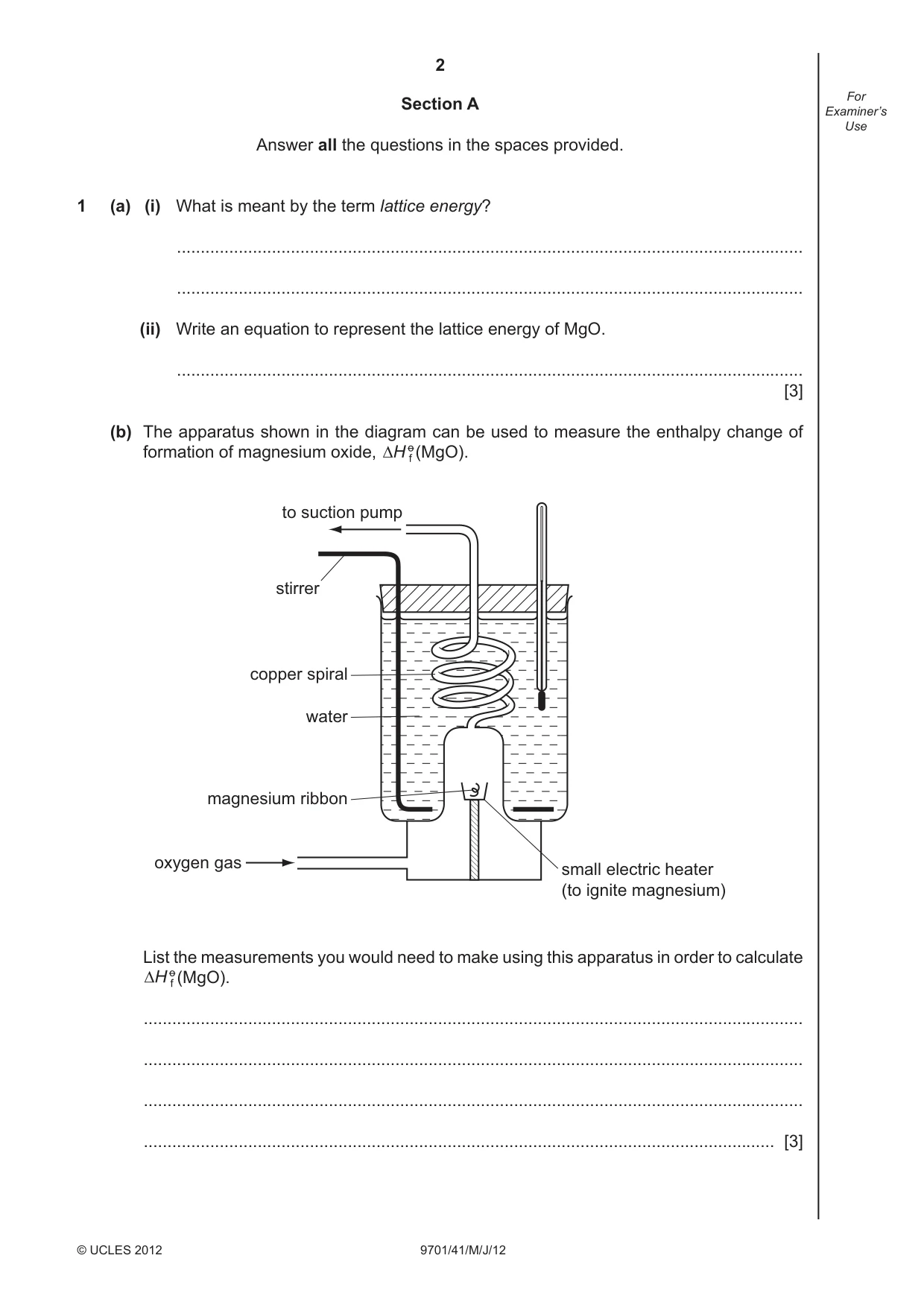
2 9701/41/M/J/12 © UCLES 2012 For Examiner’s Use Section A Answer all the questions in the spaces provided. 1 (a) (i) What is meant by the term lattice energy? … … (ii) Write an equation to represent the lattice energy of MgO. … [3] (b) The apparatus shown in the diagram can be used to measure the enthalpy change of formation of magnesium oxide, (MgO). oxygen gas magnesium ribbon water copper spiral stirrer to suction pump small electric heater (to ignite magnesium) List the measurements you would need to make using this apparatus in order to calculate (MgO). … … … … [3]
Question paper, page 3
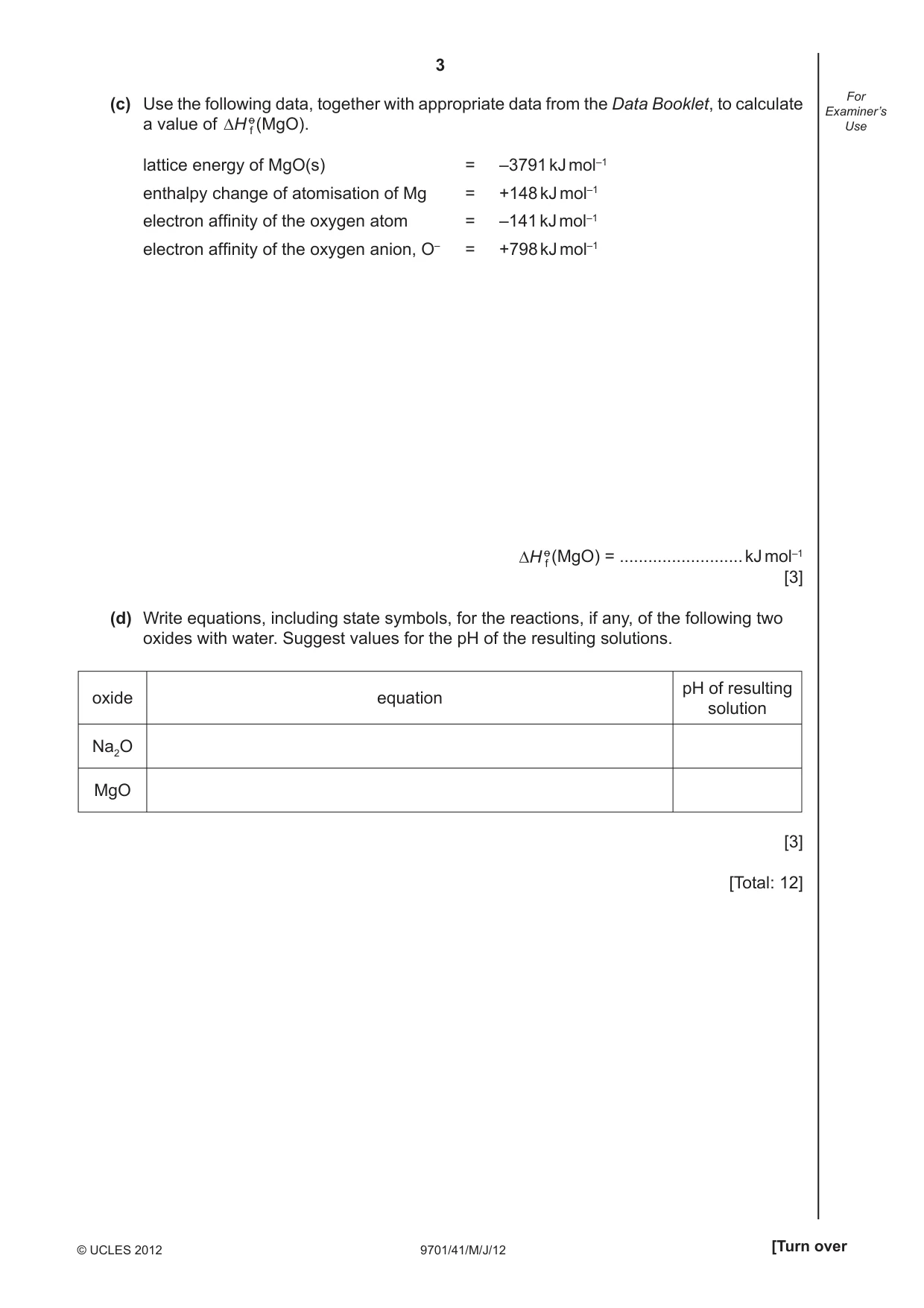
3 9701/41/M/J/12 © UCLES 2012 [Turn over For Examiner’s Use (c) Use the following data, together with appropriate data from the Data Booklet, to calculate a value of (MgO). lattice energy of MgO(s) = –3791 kJ mol–1 enthalpy change of atomisation of Mg = +148 kJ mol–1 electron affi nity of the oxygen atom = –141 kJ mol–1 electron affi nity of the oxygen anion, O– = +798 kJ mol–1 (MgO) = … kJ mol–1 [3] (d) Write equations, including state symbols, for the reactions, if any, of the following two oxides with water. Suggest values for the pH of the resulting solutions. oxide equation pH of resulting solution Na2O MgO [3] [Total: 12]
Question paper, page 4
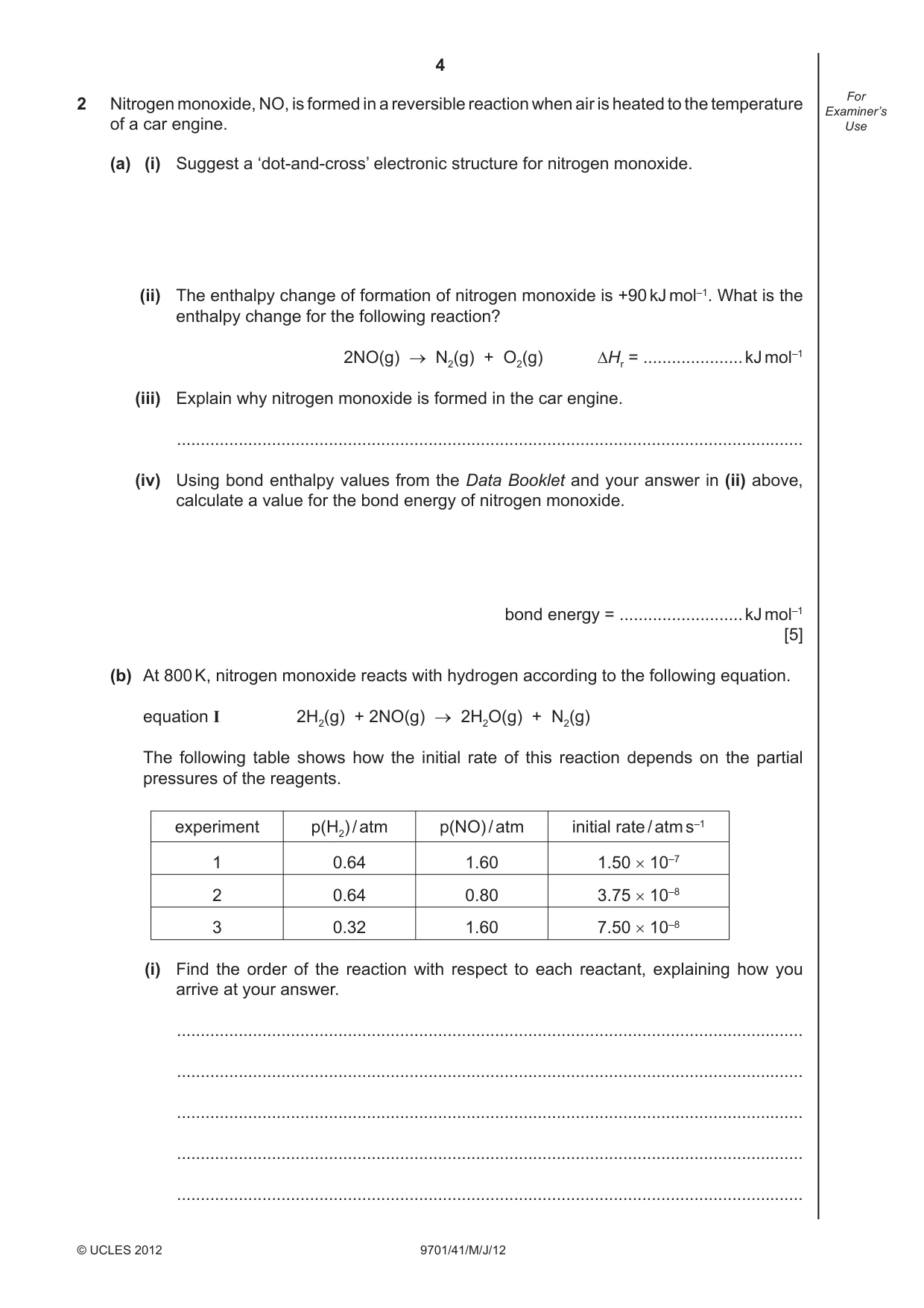
4 9701/41/M/J/12 © UCLES 2012 For Examiner’s Use 2 Nitrogen monoxide, NO, is formed in a reversible reaction when air is heated to the temperature of a car engine. (a) (i) Suggest a ‘dot-and-cross’ electronic structure for nitrogen monoxide. (ii) The enthalpy change of formation of nitrogen monoxide is +90 kJ mol–1. What is the enthalpy change for the following reaction? 2NO(g) → N2(g) + O2(g) ∆Hr = … kJ mol–1 (iii) Explain why nitrogen monoxide is formed in the car engine. … (iv) Using bond enthalpy values from the Data Booklet and your answer in (ii) above, calculate a value for the bond energy of nitrogen monoxide. bond energy = … kJ mol–1 [5] (b) At 800 K, nitrogen monoxide reacts with hydrogen according to the following equation. equation I 2H2(g) + 2NO(g) → 2H2O(g) + N2(g) The following table shows how the initial rate of this reaction depends on the partial pressures of the reagents. experiment p(H2) / atm p(NO) / atm initial rate / atm s–1 1 0.64 1.60 1.50 × 10⁻⁷ 2 0.64 0.80 3.75 × 10⁻⁸ 3 0.32 1.60 7.50 × 10⁻⁸ (i) Find the order of the reaction with respect to each reactant, explaining how you arrive at your answer. … … … … …
Question paper, page 5
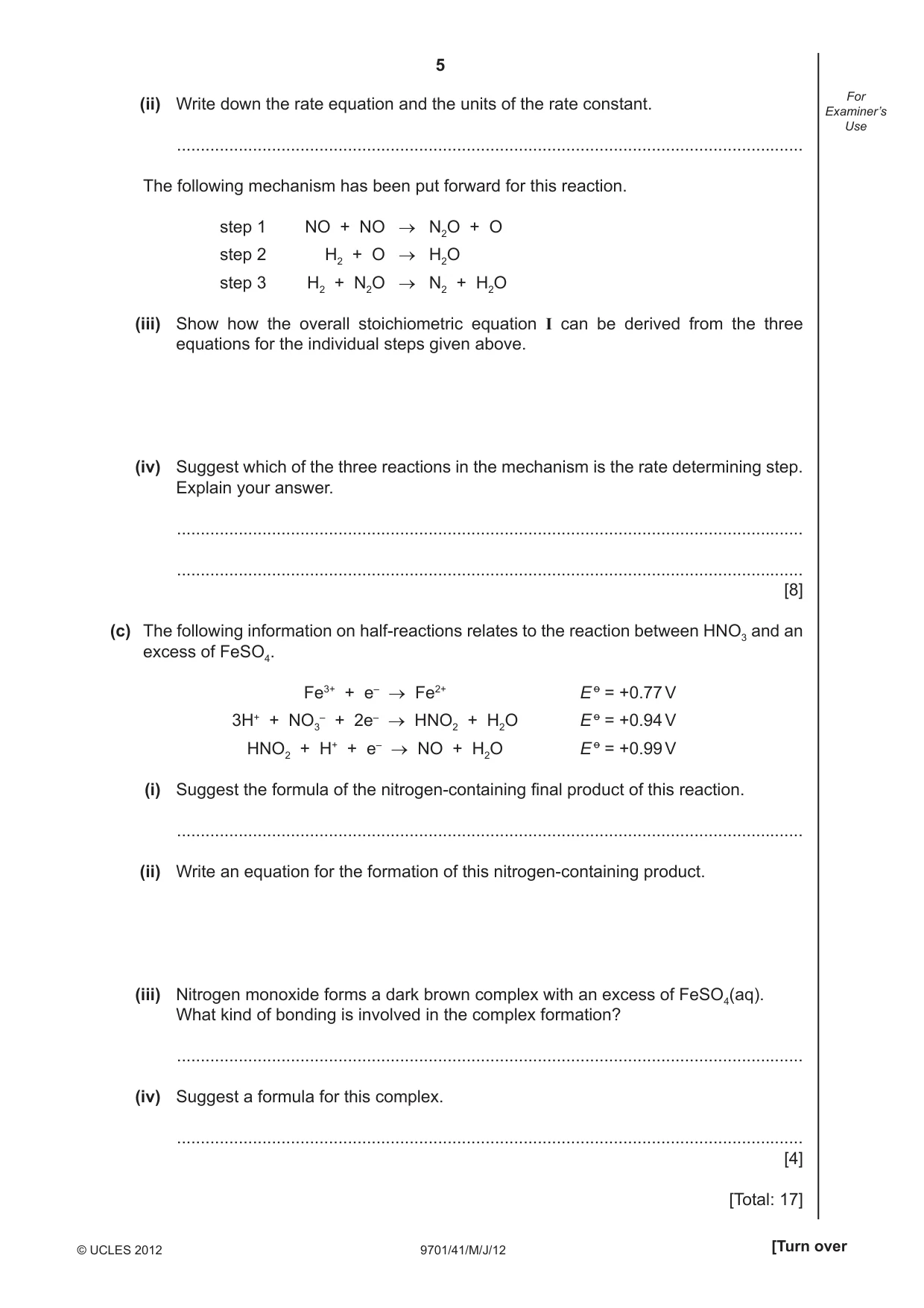
5 9701/41/M/J/12 © UCLES 2012 [Turn over For Examiner’s Use (ii) Write down the rate equation and the units of the rate constant. … The following mechanism has been put forward for this reaction. step 1 NO + NO → N2O + O step 2 H2 + O → H2O step 3 H2 + N2O → N2 + H2O (iii) Show how the overall stoichiometric equation I can be derived from the three equations for the individual steps given above. (iv) Suggest which of the three reactions in the mechanism is the rate determining step. Explain your answer. … … [8] (c) The following information on half-reactions relates to the reaction between HNO3 and an excess of FeSO4. Fe3+ + e– → Fe2+ E = +0.77 V 3H+ + NO3 – + 2e– → HNO2 + H2O E = +0.94 V HNO2 + H+ + e– → NO + H2O E = +0.99 V (i) Suggest the formula of the nitrogen-containing fi nal product of this reaction. … (ii) Write an equation for the formation of this nitrogen-containing product. (iii) Nitrogen monoxide forms a dark brown complex with an excess of FeSO4(aq). What kind of bonding is involved in the complex formation? … (iv) Suggest a formula for this complex. … [4] [Total: 17]
Question paper, page 6
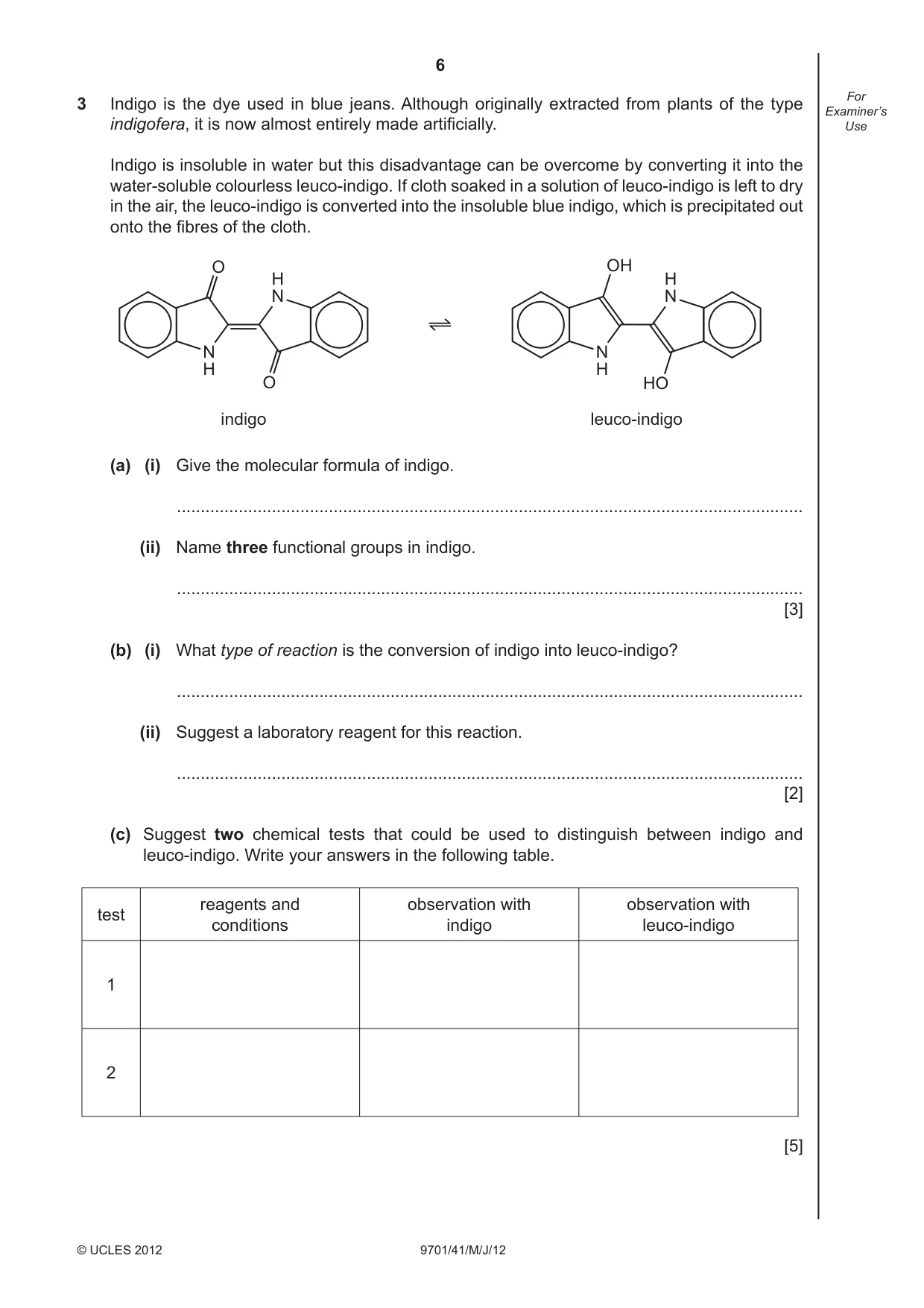
6 9701/41/M/J/12 © UCLES 2012 For Examiner’s Use 3 Indigo is the dye used in blue jeans. Although originally extracted from plants of the type indigofera, it is now almost entirely made artifi cially. Indigo is insoluble in water but this disadvantage can be overcome by converting it into the water-soluble colourless leuco-indigo. If cloth soaked in a solution of leuco-indigo is left to dry in the air, the leuco-indigo is converted into the insoluble blue indigo, which is precipitated out onto the fi bres of the cloth. N H H N O O indigo N H H N OH HO leuco-indigo (a) (i) Give the molecular formula of indigo. … (ii) Name three functional groups in indigo. … [3] (b) (i) What type of reaction is the conversion of indigo into leuco-indigo? … (ii) Suggest a laboratory reagent for this reaction. … [2] (c) Suggest two chemical tests that could be used to distinguish between indigo and leuco-indigo. Write your answers in the following table. test reagents and conditions observation with indigo observation with leuco-indigo 1 2 [5]
Question paper, page 7
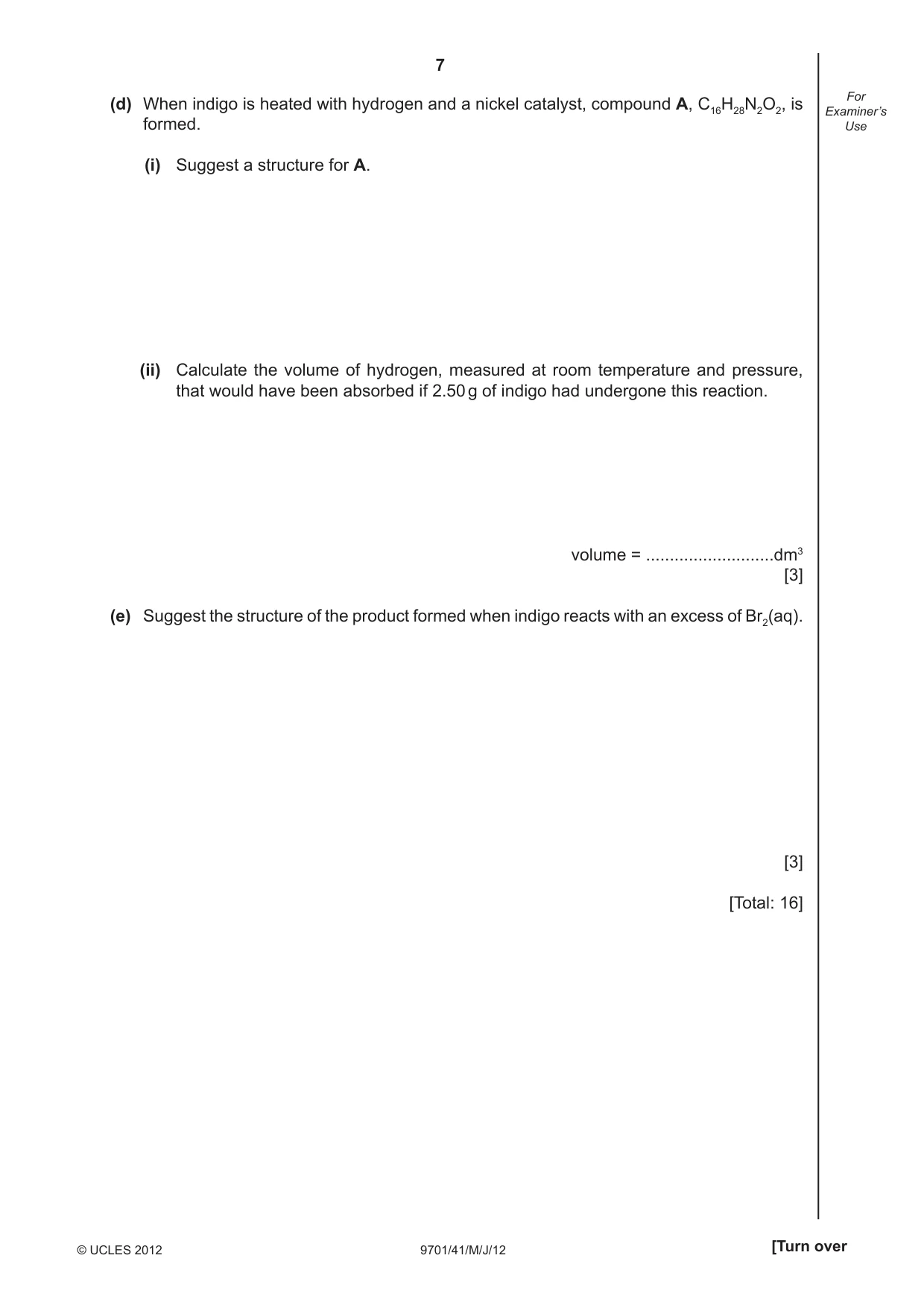
7 9701/41/M/J/12 © UCLES 2012 [Turn over For Examiner’s Use (d) When indigo is heated with hydrogen and a nickel catalyst, compound A, C16H28N2O2, is formed. (i) Suggest a structure for A. (ii) Calculate the volume of hydrogen, measured at room temperature and pressure, that would have been absorbed if 2.50 g of indigo had undergone this reaction. volume = …dm3 [3] (e) Suggest the structure of the product formed when indigo reacts with an excess of Br2(aq). [3] [Total: 16]
Question paper, page 8
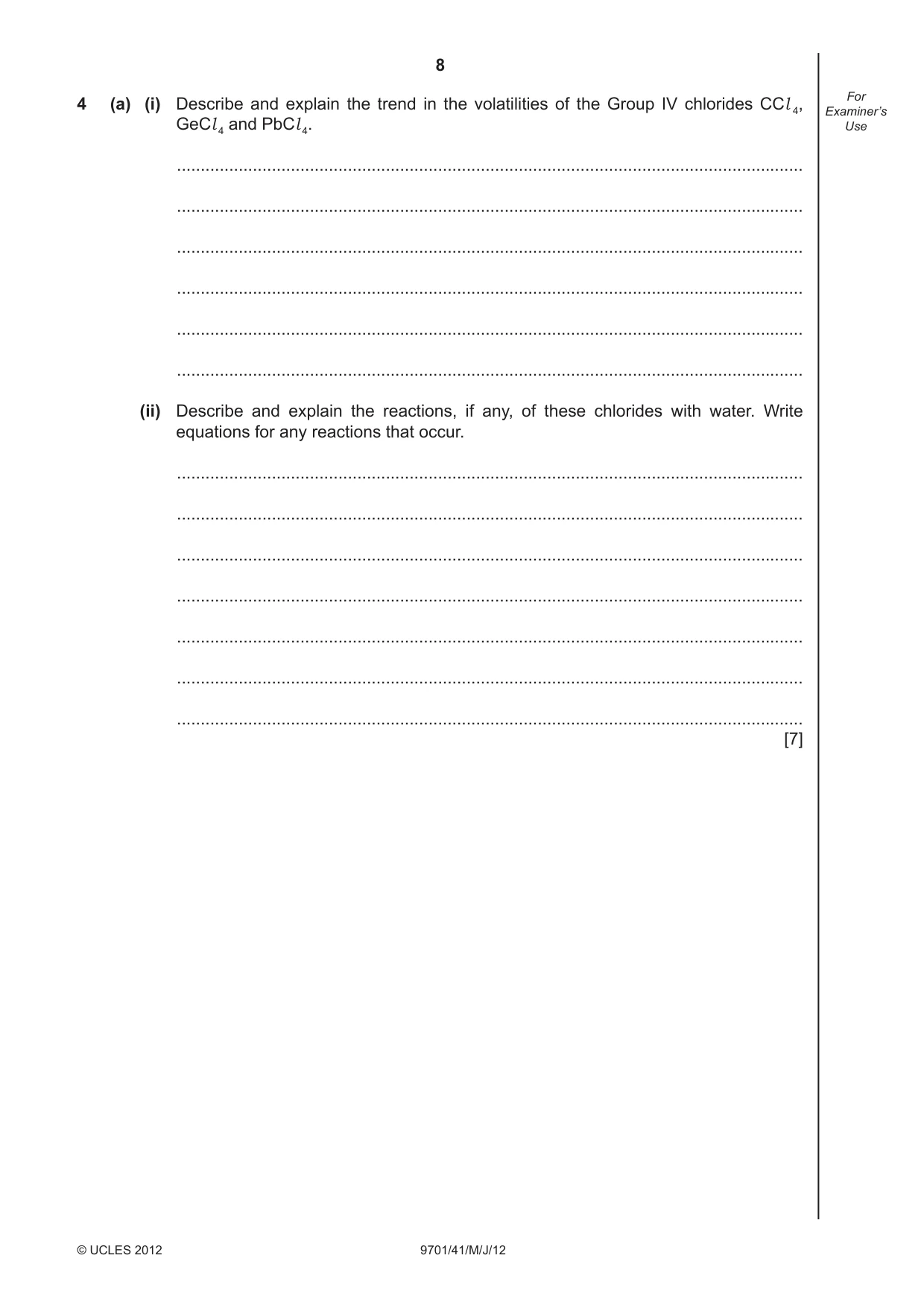
8 9701/41/M/J/12 © UCLES 2012 For Examiner’s Use 4 (a) (i) Describe and explain the trend in the volatilities of the Group IV chlorides CCl 4, GeCl 4 and PbCl 4. … … … … … … (ii) Describe and explain the reactions, if any, of these chlorides with water. Write equations for any reactions that occur. … … … … … … … [7]
Question paper, page 9
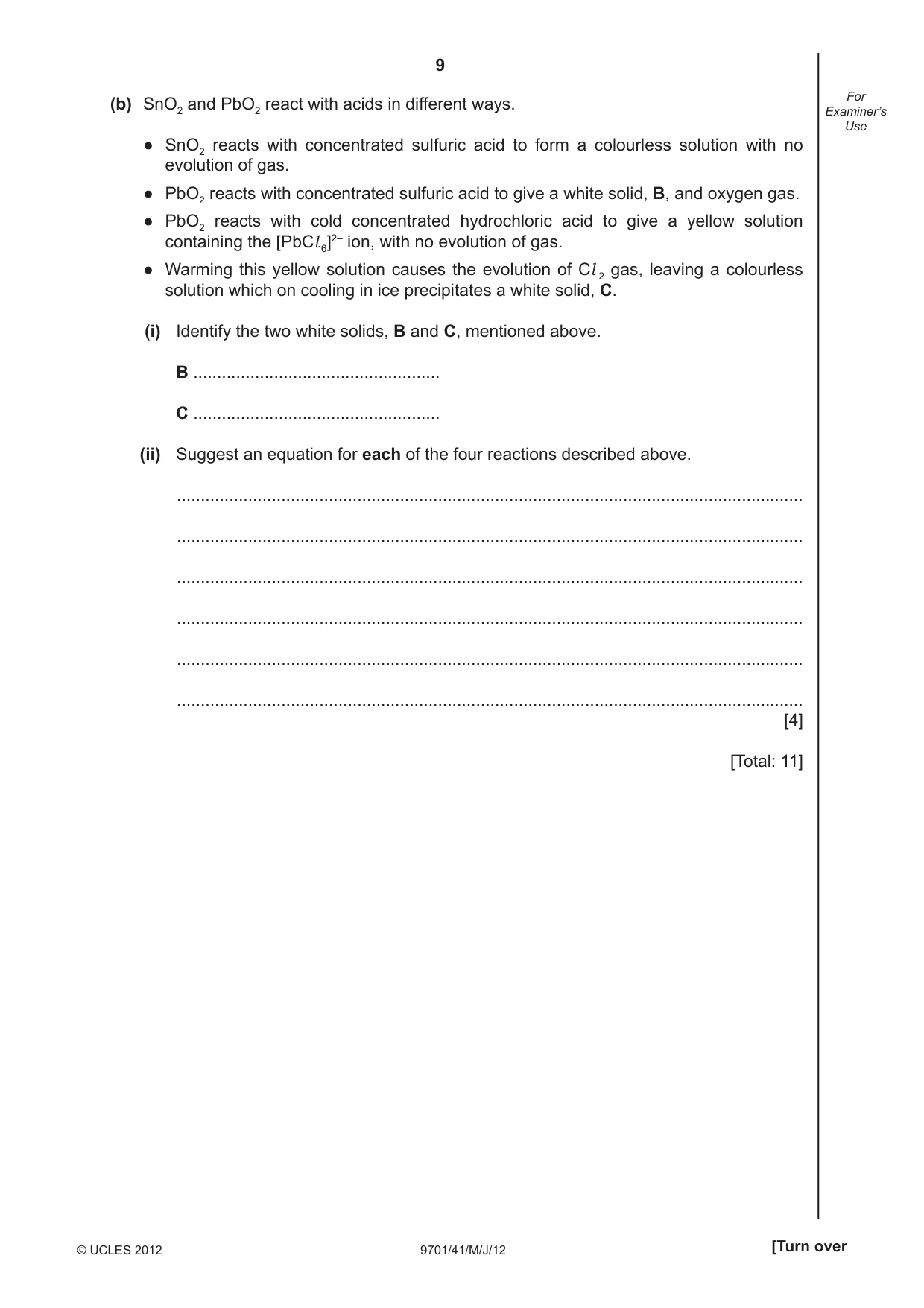
9 9701/41/M/J/12 © UCLES 2012 [Turn over For Examiner’s Use (b) SnO2 and PbO2 react with acids in different ways. ● SnO2 reacts with concentrated sulfuric acid to form a colourless solution with no evolution of gas. ● PbO2 reacts with concentrated sulfuric acid to give a white solid, B, and oxygen gas. ● PbO2 reacts with cold concentrated hydrochloric acid to give a yellow solution containing the [PbCl 6]2– ion, with no evolution of gas. ● Warming this yellow solution causes the evolution of Cl 2 gas, leaving a colourless solution which on cooling in ice precipitates a white solid, C. (i) Identify the two white solids, B and C, mentioned above. B … C … (ii) Suggest an equation for each of the four reactions described above. … … … … … … [4] [Total: 11]
Question paper, page 10
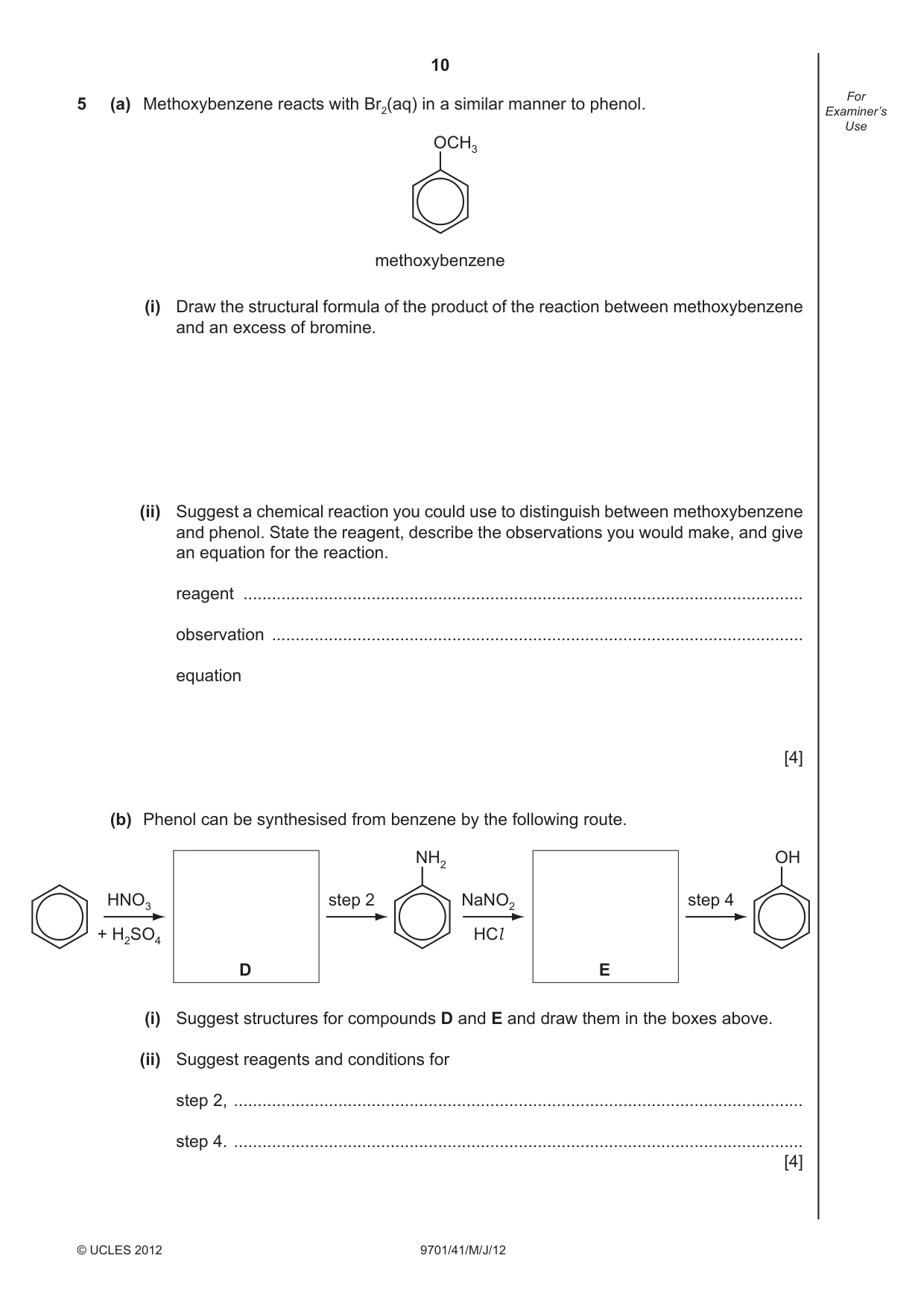
10 9701/41/M/J/12 © UCLES 2012 For Examiner’s Use 5 (a) Methoxybenzene reacts with Br2(aq) in a similar manner to phenol. OCH3 methoxybenzene (i) Draw the structural formula of the product of the reaction between methoxybenzene and an excess of bromine. (ii) Suggest a chemical reaction you could use to distinguish between methoxybenzene and phenol. State the reagent, describe the observations you would make, and give an equation for the reaction. reagent … observation … equation [4] (b) Phenol can be synthesised from benzene by the following route. NH2 HNO3 + H2SO4 NaNO2 HCl step 2 D OH step 4 E (i) Suggest structures for compounds D and E and draw them in the boxes above. (ii) Suggest reagents and conditions for step 2, … step 4. … [4]
Question paper, page 11
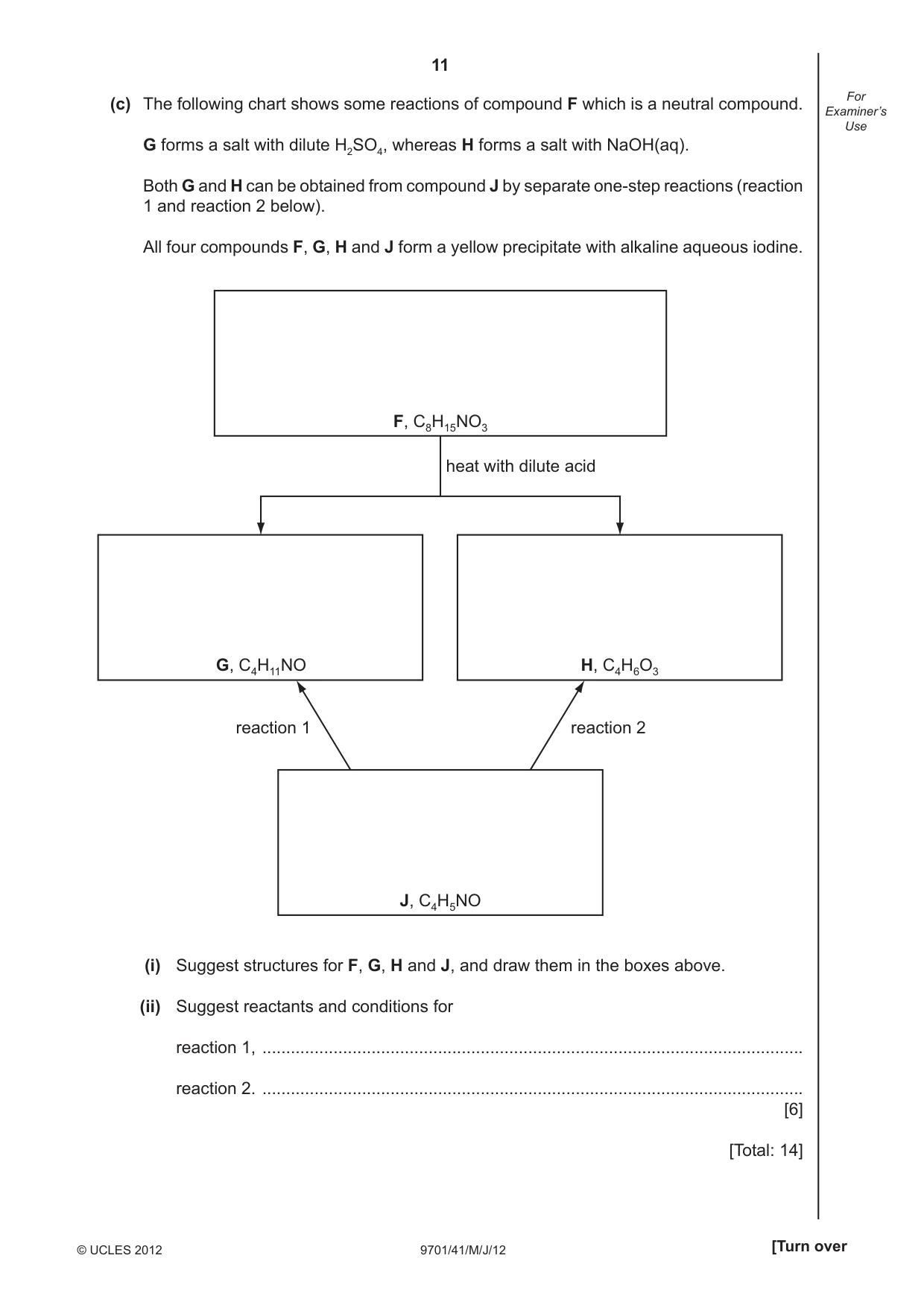
11 9701/41/M/J/12 © UCLES 2012 [Turn over For Examiner’s Use (c) The following chart shows some reactions of compound F which is a neutral compound. G forms a salt with dilute H2SO4, whereas H forms a salt with NaOH(aq). Both G and H can be obtained from compound J by separate one-step reactions (reaction 1 and reaction 2 below). All four compounds F, G, H and J form a yellow precipitate with alkaline aqueous iodine. F, C8H15NO3 J, C4H5NO G, C4H11NO H, C4H6O3 heat with dilute acid reaction 2 reaction 1 (i) Suggest structures for F, G, H and J, and draw them in the boxes above. (ii) Suggest reactants and conditions for reaction 1, … reaction 2. … [6] [Total: 14]
Question paper, page 12
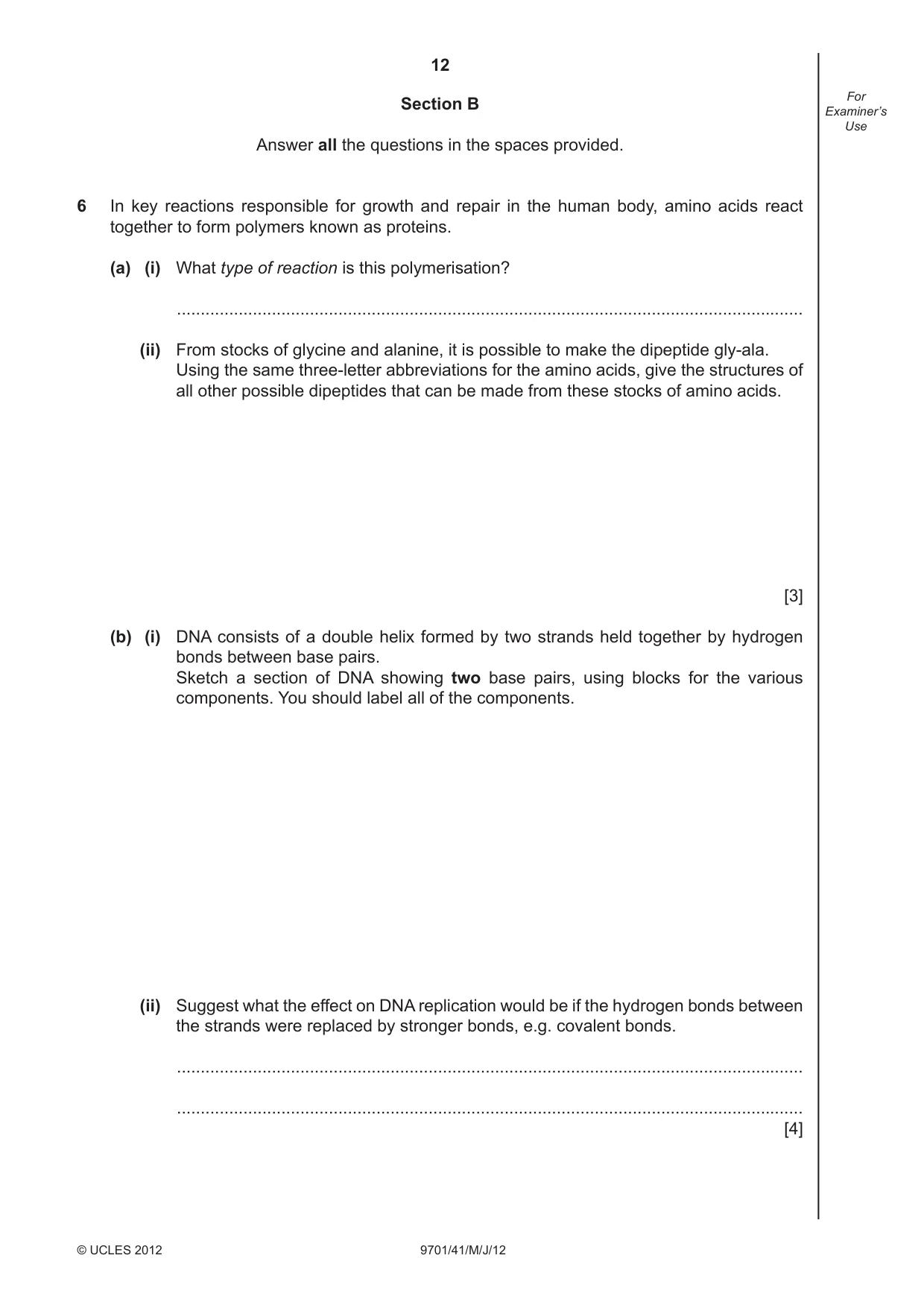
12 9701/41/M/J/12 © UCLES 2012 For Examiner’s Use Section B Answer all the questions in the spaces provided. 6 In key reactions responsible for growth and repair in the human body, amino acids react together to form polymers known as proteins. (a) (i) What type of reaction is this polymerisation? … (ii) From stocks of glycine and alanine, it is possible to make the dipeptide gly-ala. Using the same three-letter abbreviations for the amino acids, give the structures of all other possible dipeptides that can be made from these stocks of amino acids. [3] (b) (i) DNA consists of a double helix formed by two strands held together by hydrogen bonds between base pairs. Sketch a section of DNA showing two base pairs, using blocks for the various components. You should label all of the components. (ii) Suggest what the effect on DNA replication would be if the hydrogen bonds between the strands were replaced by stronger bonds, e.g. covalent bonds. … … [4]
Question paper, page 13
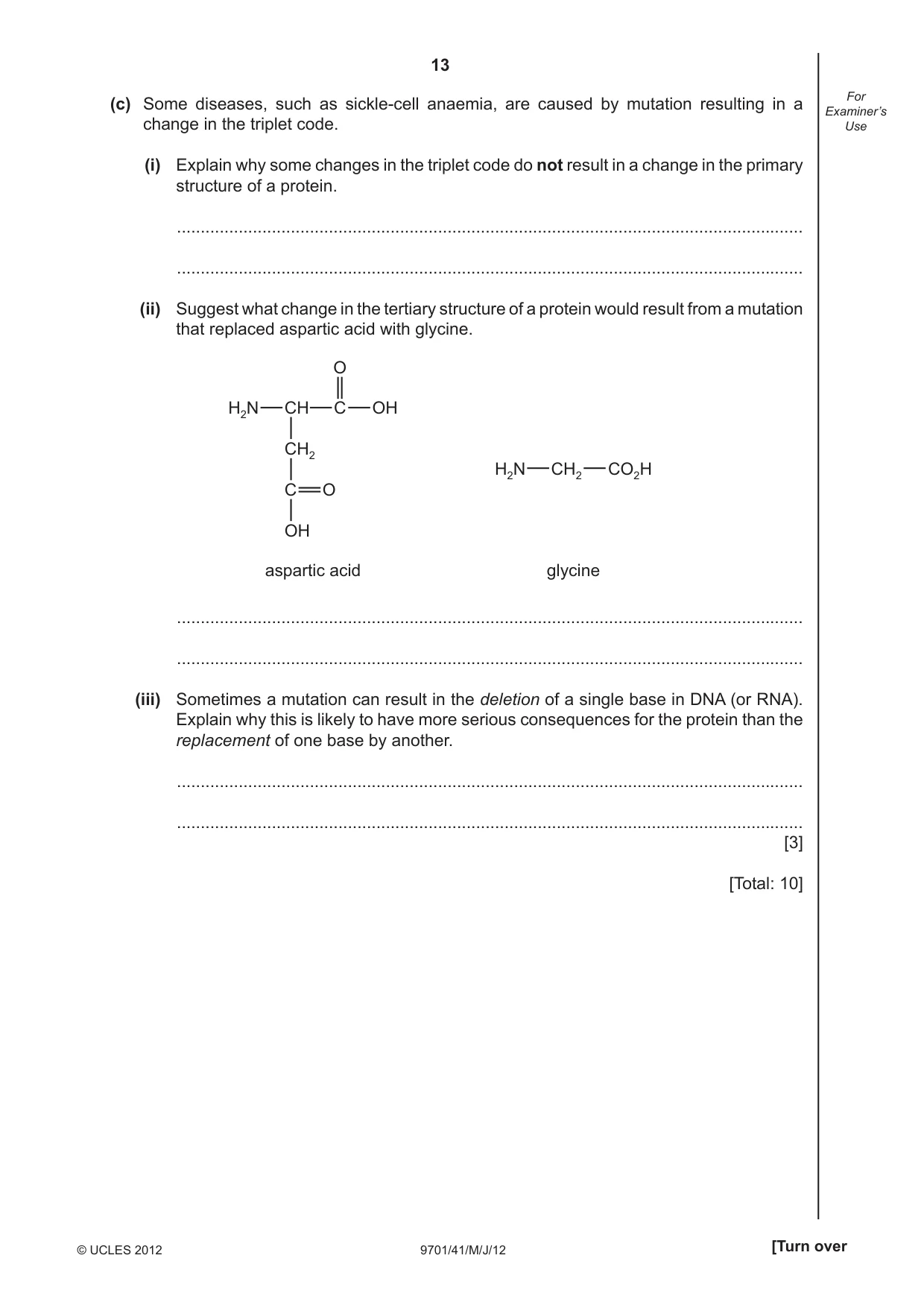
13 9701/41/M/J/12 © UCLES 2012 [Turn over For Examiner’s Use (c) Some diseases, such as sickle-cell anaemia, are caused by mutation resulting in a change in the triplet code. (i) Explain why some changes in the triplet code do not result in a change in the primary structure of a protein. … … (ii) Suggest what change in the tertiary structure of a protein would result from a mutation that replaced aspartic acid with glycine. CH CH2 H2N C O O OH C OH CH2 H2N CO2H aspartic acid glycine … … (iii) Sometimes a mutation can result in the deletion of a single base in DNA (or RNA). Explain why this is likely to have more serious consequences for the protein than the replacement of one base by another. … … [3] [Total: 10]
Question paper, page 14
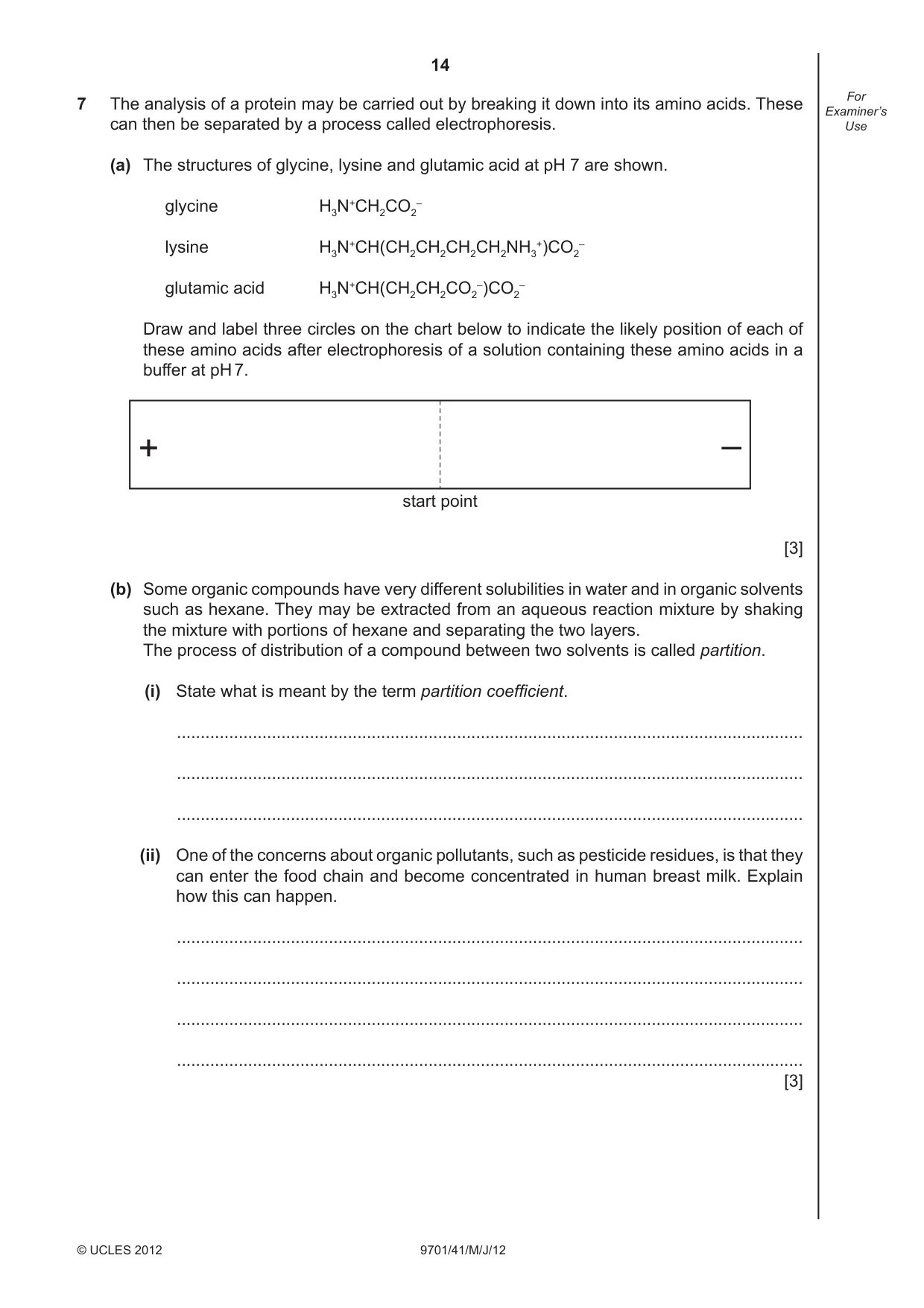
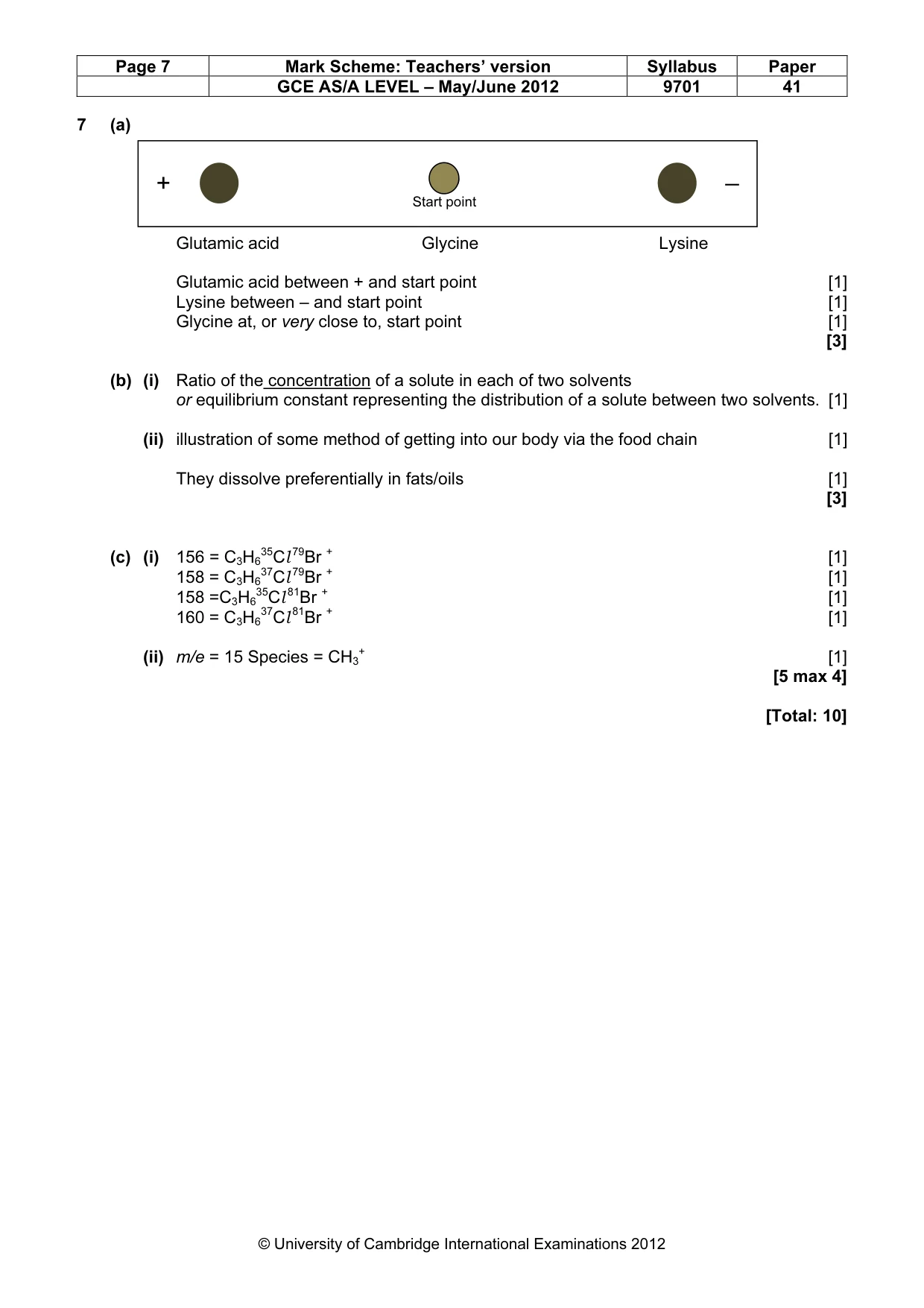
14 9701/41/M/J/12 © UCLES 2012 For Examiner’s Use 7 The analysis of a protein may be carried out by breaking it down into its amino acids. These can then be separated by a process called electrophoresis. (a) The structures of glycine, lysine and glutamic acid at pH 7 are shown. glycine H3N+CH2CO2 – lysine H3N+CH(CH2CH2CH2CH2NH3 +)CO2 – glutamic acid H3N+CH(CH2CH2CO2 –)CO2 – Draw and label three circles on the chart below to indicate the likely position of each of these amino acids after electrophoresis of a solution containing these amino acids in a buffer at pH 7. start point [3] (b) Some organic compounds have very different solubilities in water and in organic solvents such as hexane. They may be extracted from an aqueous reaction mixture by shaking the mixture with portions of hexane and separating the two layers. The process of distribution of a compound between two solvents is called partition. (i) State what is meant by the term partition coeffi cient. … … … (ii) One of the concerns about organic pollutants, such as pesticide residues, is that they can enter the food chain and become concentrated in human breast milk. Explain how this can happen. … … … … [3]
Question paper, page 15
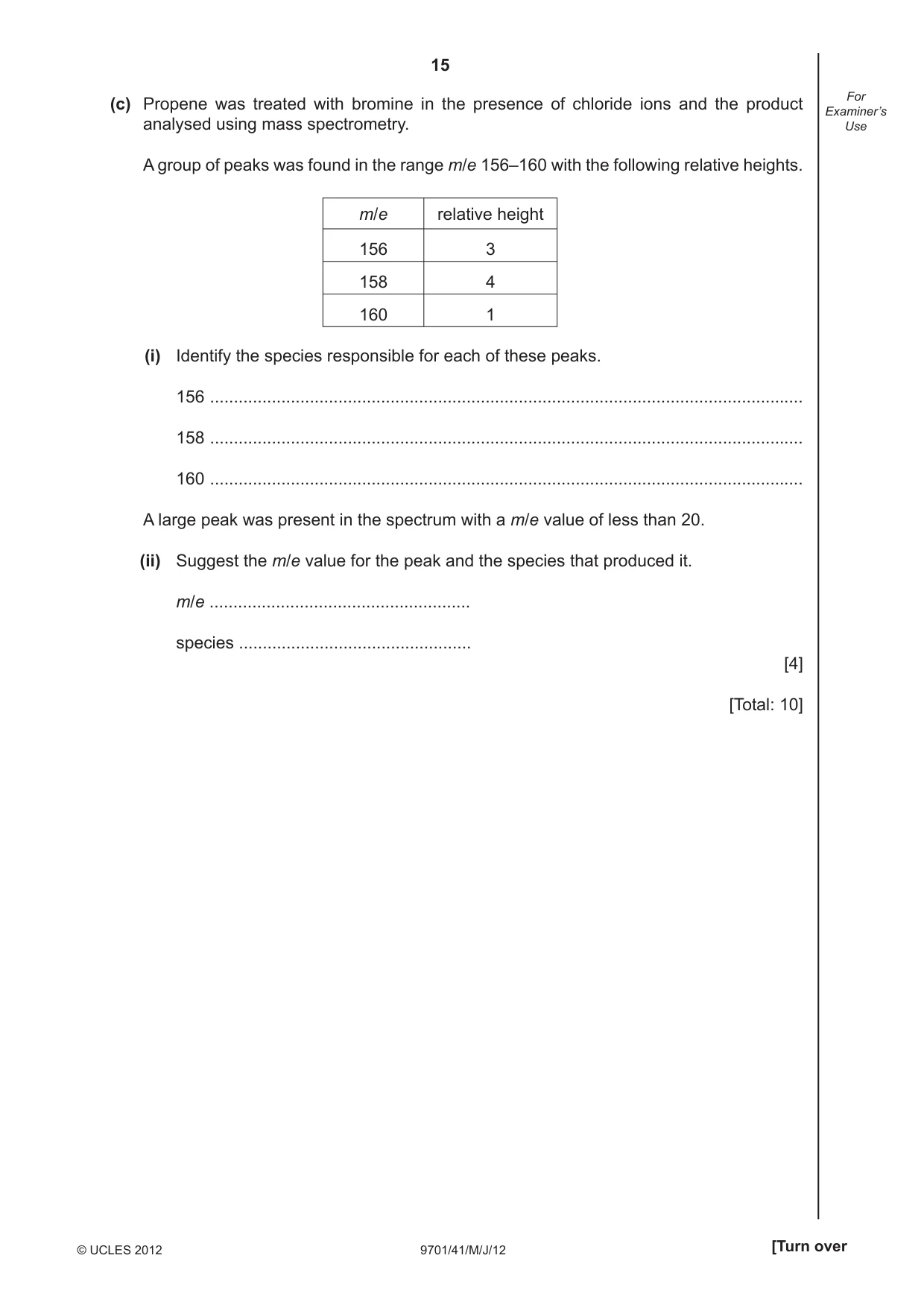
15 9701/41/M/J/12 © UCLES 2012 [Turn over For Examiner’s Use (c) Propene was treated with bromine in the presence of chloride ions and the product analysed using mass spectrometry. A group of peaks was found in the range m/e 156–160 with the following relative heights. m/e relative height 156 3 158 4 160 1 (i) Identify the species responsible for each of these peaks. 156 … 158 … 160 … A large peak was present in the spectrum with a m/e value of less than 20. (ii) Suggest the m/e value for the peak and the species that produced it. m/e … species … [4] [Total: 10]
Question paper, page 16
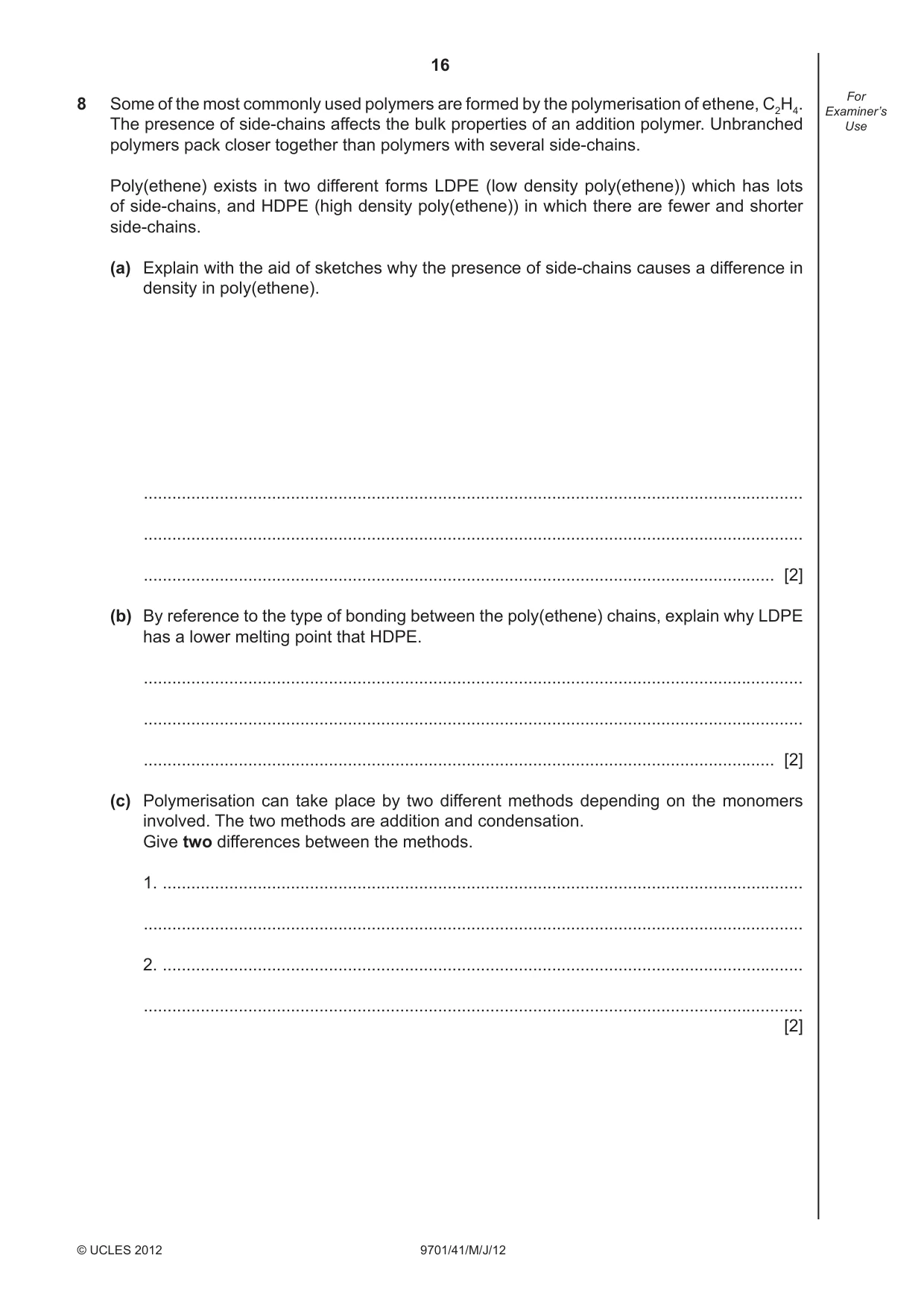
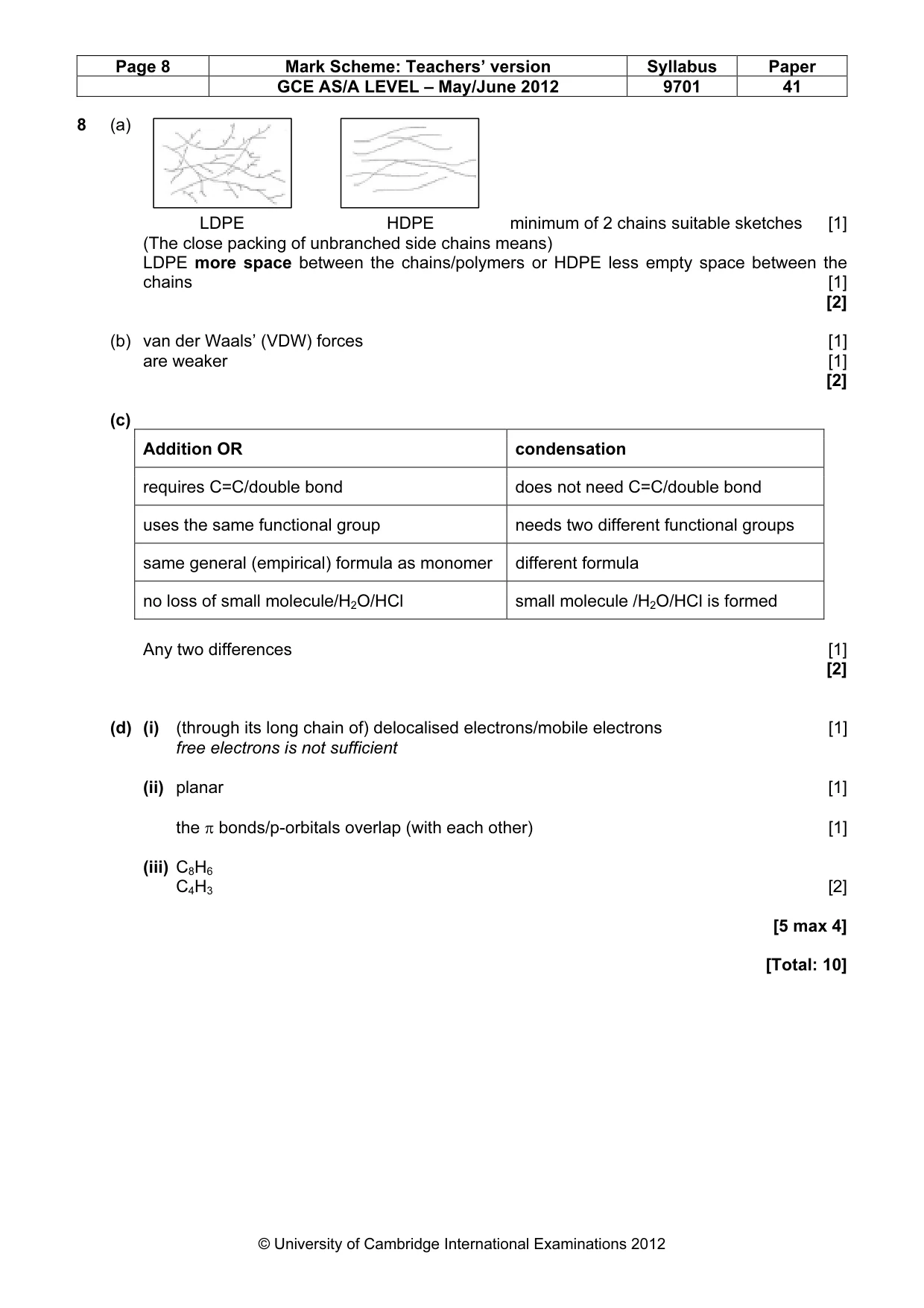
16 9701/41/M/J/12 © UCLES 2012 For Examiner’s Use 8 Some of the most commonly used polymers are formed by the polymerisation of ethene, C2H4. The presence of side-chains affects the bulk properties of an addition polymer. Unbranched polymers pack closer together than polymers with several side-chains. Poly(ethene) exists in two different forms LDPE (low density poly(ethene)) which has lots of side-chains, and HDPE (high density poly(ethene)) in which there are fewer and shorter side-chains. (a) Explain with the aid of sketches why the presence of side-chains causes a difference in density in poly(ethene). … … … [2] (b) By reference to the type of bonding between the poly(ethene) chains, explain why LDPE has a lower melting point that HDPE. … … … [2] (c) Polymerisation can take place by two different methods depending on the monomers involved. The two methods are addition and condensation. Give two differences between the methods. 1. … … 2. … … [2]
Question paper, page 17
17 9701/41/M/J/12 © UCLES 2012 [Turn over For Examiner’s Use (d) There has been a great deal of commercial interest in the development of polymers that can conduct electricity and/or emit light. A length of one such polymer is shown. n (i) Suggest how this polymer conducts electricity. … (ii) Suggest the molecular geometry required for this molecule to conduct. Explain your answer. … … (iii) What is the empirical formula of this polymer? … [4] [Total: 10]
Question paper, page 18
18 9701/41/M/J/12 BLANK PAGE © UCLES 2012
Question paper, page 19
19 9701/41/M/J/12 BLANK PAGE © UCLES 2012
Question paper, page 20
20 Permission to reproduce items where third-party owned material protected by copyright is included has been sought and cleared where possible. Every reasonable effort has been made by the publisher (UCLES) to trace copyright holders, but if any items requiring clearance have unwittingly been included the publisher will be pleased to make amends at the earliest possible opportunity. University of Cambridge International Examinations is part of the Cambridge Assessment Group. Cambridge Assessment is the brand name of University of Cambridge Local Examinations Syndicate (UCLES), which is itself a department of the University of Cambridge. 9701/41/M/J/12 © UCLES 2012 BLANK PAGE
Mark scheme, page 1
UNIVERSITY OF CAMBRIDGE INTERNATIONAL EXAMINATIONS GCE Advanced Subsidiary Level and GCE Advanced Level MARK SCHEME for the May/June 2012 question paper for the guidance of teachers 9701 CHEMISTRY 9701/41 Paper 4 (A2 Structured Questions), maximum raw mark 100 This mark scheme is published as an aid to teachers and candidates, to indicate the requirements of the examination. It shows the basis on which Examiners were instructed to award marks. It does not indicate the details of the discussions that took place at an Examiners’ meeting before marking began, which would have considered the acceptability of alternative answers. Mark schemes must be read in conjunction with the question papers and the report on the examination. • Cambridge will not enter into discussions or correspondence in connection with these mark schemes. Cambridge is publishing the mark schemes for the May/June 2012 question papers for most IGCSE, GCE Advanced Level and Advanced Subsidiary Level syllabuses and some Ordinary Level syllabuses.
Mark scheme, page 2
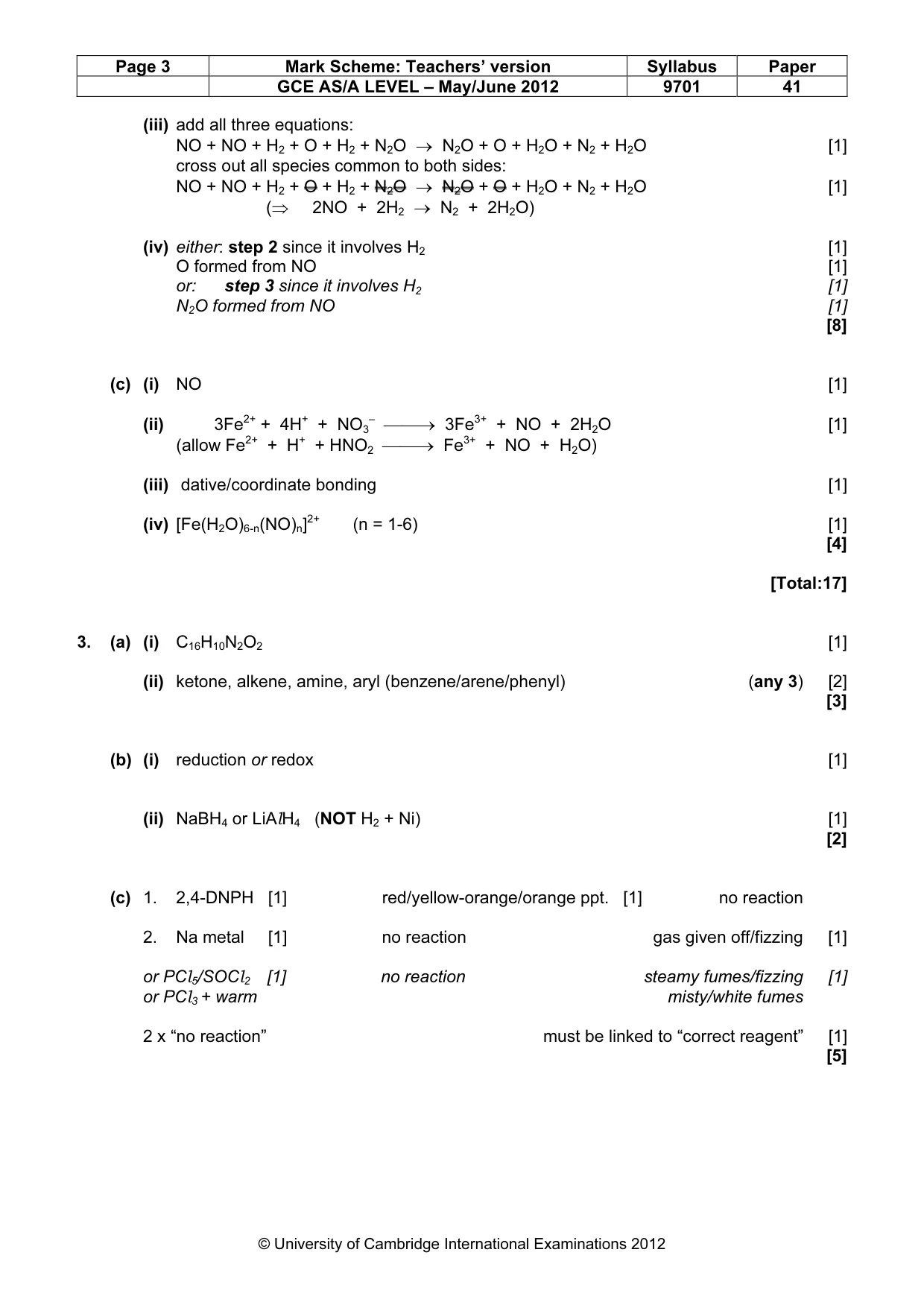
Page 2 Mark Scheme: Teachers’ version Syllabus Paper GCE AS/A LEVEL – May/June 2012 9701 41 © University of Cambridge International Examinations 2012 1 (a) (i) the enthalpy change/released when 1 mole is formed [1] of ionic lattice from the gas phase ions [1] (ii) Mg2+ + O2– → MgO [1] [3] (b) measurements needed: volume/mass/weight of water (in calorimeter) [1] initial + final temperature/temperature change/temperature rise (of the water) [1] mass of Mg (used)/mass MgO [1] Not volume/moles/mass of oxygen used [3] (c) ∆H = 148 + 736 + 1450 + 496/2 - 141 + 798 – 3791 = –552 kJ mol–1 [3] [3] (d) Na2O(s) + H2O(aq/l) → 2NaOH(aq) [1] MgO(s) + H2O(aq/l) → Mg(OH)2(s) or Mg(OH)2(aq) [1] pH 12.5-14 [NaOH] AND 8-10.5 [Mg(OH)2] respectively [1] [3] [Total: 12] 2. (a) (i) O N [1] (ii) –180 kJ mol–1 [1] (iii) (formation of NO is endothermic) so high T and equilibrium pushed over to NO side. or high T and needed to break N-N bond in N2 [1] (iv) –180 = 2 E(NO) – 994 – 496 [1] E(NO) = +655 kJ mol–1 [1] [5] (b) (i) (from 1 and 2:) as p(NO) halves, rate decreases to ¼ , so order = 2 [1] (from 1 and 3:) as p(H2) halves, so does rate, so order = 1 [1] (ii) rate = k pNO 2.pH2 [1] units (of k) are atm–2 s–1 [1]
Mark scheme, page 3
Page 3 Mark Scheme: Teachers’ version Syllabus Paper GCE AS/A LEVEL – May/June 2012 9701 41 © University of Cambridge International Examinations 2012 (iii) add all three equations: NO + NO + H2 + O + H2 + N2O → N2O + O + H2O + N2 + H2O [1] cross out all species common to both sides: NO + NO + H2 + O + H2 + N2O → N2O + O + H2O + N2 + H2O [1] (⇒ 2NO + 2H2 → N2 + 2H2O) (iv) either: step 2 since it involves H2 [1] O formed from NO [1] or: step 3 since it involves H2 [1] N2O formed from NO [1] [8] (c) (i) NO [1] (ii) 3Fe2+ + 4H+ + NO3 – → 3Fe3+ + NO + 2H2O [1] (allow Fe2+ + H+ + HNO2 → Fe3+ + NO + H2O) (iii) dative/coordinate bonding [1] (iv) [Fe(H2O)6-n(NO)n]2+ (n = 1-6) [1] [4] [Total:17] 3. (a) (i) C16H10N2O2 [1] (ii) ketone, alkene, amine, aryl (benzene/arene/phenyl) (any 3) [2] [3] (b) (i) reduction or redox [1] (ii) NaBH4 or LiAlH4 (NOT H2 + Ni) [1] [2] (c) 1. 2,4-DNPH [1] red/yellow-orange/orange ppt. [1] no reaction 2. Na metal [1] no reaction gas given off/fizzing [1] or PCl5/SOCl2 [1] no reaction steamy fumes/fizzing [1] or PCl3 + warm misty/white fumes 2 x “no reaction” must be linked to “correct reagent” [1] [5]
Mark scheme, page 4
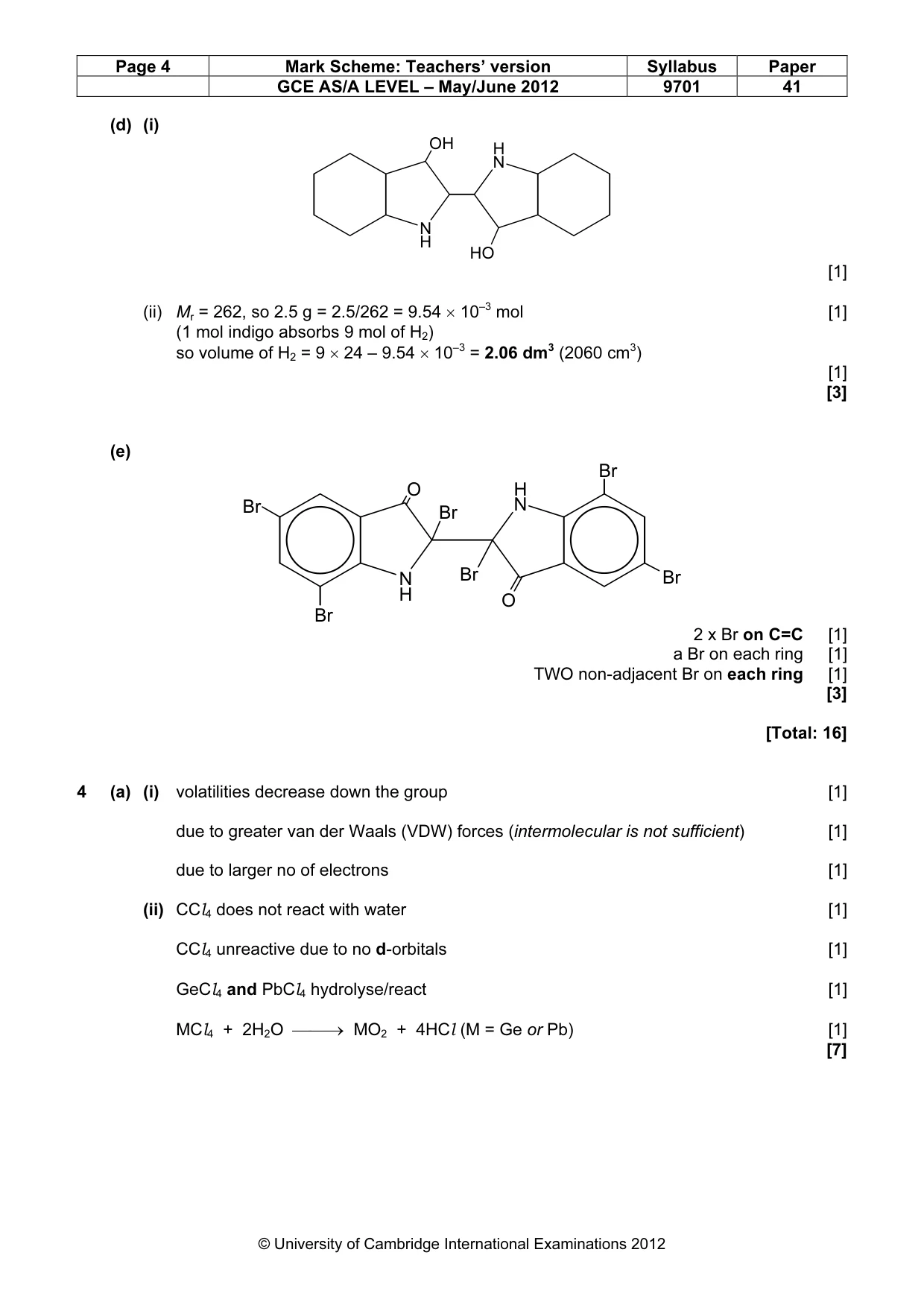
Page 4 Mark Scheme: Teachers’ version Syllabus Paper GCE AS/A LEVEL – May/June 2012 9701 41 © University of Cambridge International Examinations 2012 (d) (i) N H H N OH HO [1] (ii) Mr = 262, so 2.5 g = 2.5/262 = 9.54 × 10⁻³ mol [1] (1 mol indigo absorbs 9 mol of H2) so volume of H2 = 9 × 24 – 9.54 × 10–3 = 2.06 dm3 (2060 cm3) [1] [3] (e) N H H N O O Br Br Br Br Br Br 2 x Br on C=C [1] a Br on each ring [1] TWO non-adjacent Br on each ring [1] [3] [Total: 16] 4 (a) (i) volatilities decrease down the group [1] due to greater van der Waals (VDW) forces (intermolecular is not sufficient) [1] due to larger no of electrons [1] (ii) CCl4 does not react with water [1] CCl4 unreactive due to no d-orbitals [1] GeCl4 and PbCl4 hydrolyse/react [1] MCl4 + 2H2O → MO2 + 4HCl (M = Ge or Pb) [1] [7]
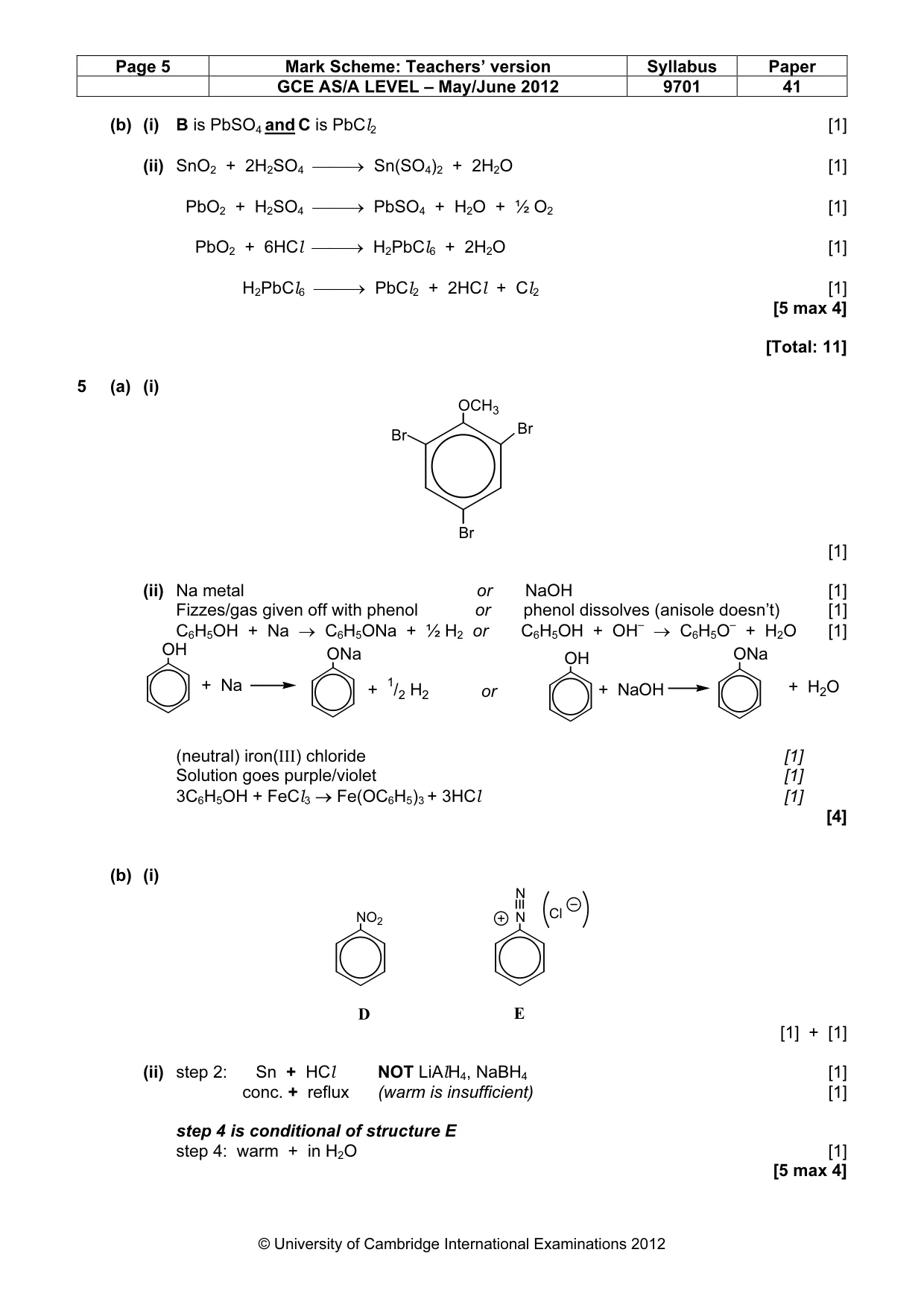
Mark scheme, page 5
Page 5 Mark Scheme: Teachers’ version Syllabus Paper GCE AS/A LEVEL – May/June 2012 9701 41 © University of Cambridge International Examinations 2012 (b) (i) B is PbSO4 and C is PbCl2 [1] (ii) SnO2 + 2H2SO4 → Sn(SO4)2 + 2H2O [1] PbO2 + H2SO4 → PbSO4 + H2O + ½ O2 [1] PbO2 + 6HCl → H2PbCl6 + 2H2O [1] H2PbCl6 → PbCl2 + 2HCl + Cl2 [1] [5 max 4] [Total: 11] 5 (a) (i) OCH3 Br Br Br [1] (ii) Na metal or NaOH [1] Fizzes/gas given off with phenol or phenol dissolves (anisole doesn’t) [1] C6H5OH + Na → C6H5ONa + ½ H2 or C6H5OH + OH– → C6H5O– + H2O [1] OH ONa OH ONa + Na + 1/2 H2 + NaOH + H2O or (neutral) iron(III) chloride [1] Solution goes purple/violet [1] 3C6H5OH + FeCl3 → Fe(OC6H5)3 + 3HCl [1] [4] (b) (i) NO2 N N Cl D E [1] + [1] (ii) step 2: Sn + HCl NOT LiAlH4, NaBH4 [1] conc. + reflux (warm is insufficient) [1] step 4 is conditional of structure E step 4: warm + in H2O [1] [5 max 4]
Mark scheme, page 6
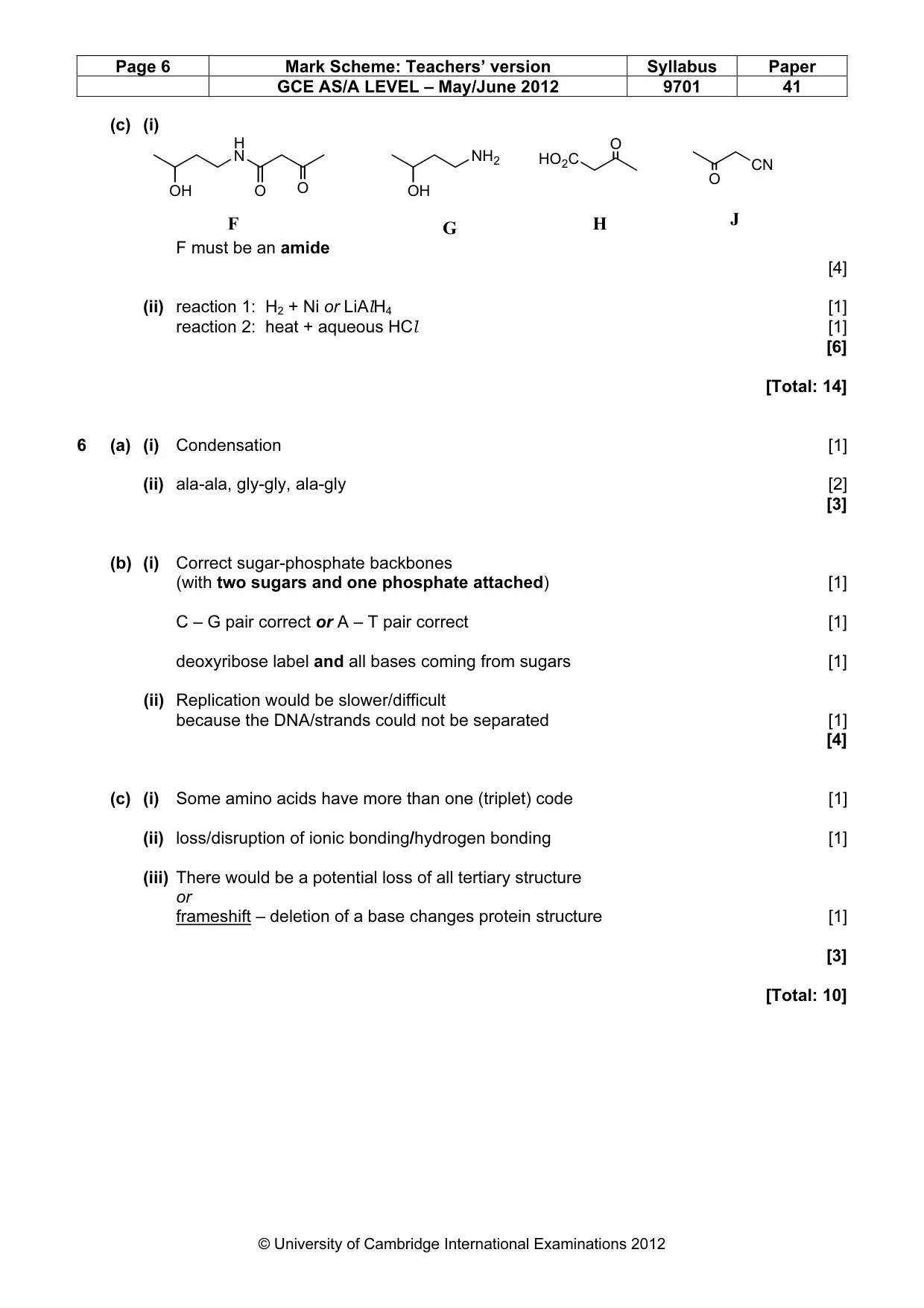
Page 6 Mark Scheme: Teachers’ version Syllabus Paper GCE AS/A LEVEL – May/June 2012 9701 41 © University of Cambridge International Examinations 2012 (c) (i) H N NH2 HO2C CN OH O O OH O O F G H J F must be an amide [4] (ii) reaction 1: H2 + Ni or LiAlH4 [1] reaction 2: heat + aqueous HCl [1] [6] [Total: 14] 6 (a) (i) Condensation [1] (ii) ala-ala, gly-gly, ala-gly [2] [3] (b) (i) Correct sugar-phosphate backbones (with two sugars and one phosphate attached) [1] C – G pair correct or A – T pair correct [1] deoxyribose label and all bases coming from sugars [1] (ii) Replication would be slower/difficult because the DNA/strands could not be separated [1] [4] (c) (i) Some amino acids have more than one (triplet) code [1] (ii) loss/disruption of ionic bonding/hydrogen bonding [1] (iii) There would be a potential loss of all tertiary structure or frameshift – deletion of a base changes protein structure [1] [3] [Total: 10]
Mark scheme, page 7
Page 7 Mark Scheme: Teachers’ version Syllabus Paper GCE AS/A LEVEL – May/June 2012 9701 41 © University of Cambridge International Examinations 2012 7 (a) Glutamic acid Glycine Lysine Glutamic acid between + and start point [1] Lysine between – and start point [1] Glycine at, or very close to, start point [1] [3] (b) (i) Ratio of the concentration of a solute in each of two solvents or equilibrium constant representing the distribution of a solute between two solvents. [1] (ii) illustration of some method of getting into our body via the food chain [1] They dissolve preferentially in fats/oils [1] [3] (c) (i) 156 = C3H6 35Cl 79Br + [1] 158 = C3H6 37Cl 79Br + [1] 158 =C3H6 35Cl 81Br + [1] 160 = C3H6 37Cl 81Br + [1] (ii) m/e = 15 Species = CH3 + [1] [5 max 4] [Total: 10] Start point + ̶
Mark scheme, page 8
Page 8 Mark Scheme: Teachers’ version Syllabus Paper GCE AS/A LEVEL – May/June 2012 9701 41 © University of Cambridge International Examinations 2012 8 (a) LDPE HDPE minimum of 2 chains suitable sketches [1] (The close packing of unbranched side chains means) LDPE more space between the chains/polymers or HDPE less empty space between the chains [1] [2] (b) van der Waals’ (VDW) forces [1] are weaker [1] [2] (c) Addition OR condensation requires C=C/double bond does not need C=C/double bond uses the same functional group needs two different functional groups same general (empirical) formula as monomer different formula no loss of small molecule/H2O/HCl small molecule /H2O/HCl is formed Any two differences [1] [2] (d) (i) (through its long chain of) delocalised electrons/mobile electrons [1] free electrons is not sufficient (ii) planar [1] the π bonds/p-orbitals overlap (with each other) [1] (iii) C8H6 C4H3 [2] [5 max 4] [Total: 10]
What you needed in this session
Cambridge’s own grade thresholds for 2012 May/June, Paper 4 · Variant 1. A higher threshold means an easier paper — the bar moves with how the cohort did.