Cambridge A Level Chemistry 9701 — 2011 Oct/Nov Paper 5 · Variant 3
9701/53/O/N/11 · 30 marks · ≈34 min
The question paper and its mark scheme, free to read here and free to download. This is Cambridge’s own paper, exactly as it was sat.
Question paper12 pages

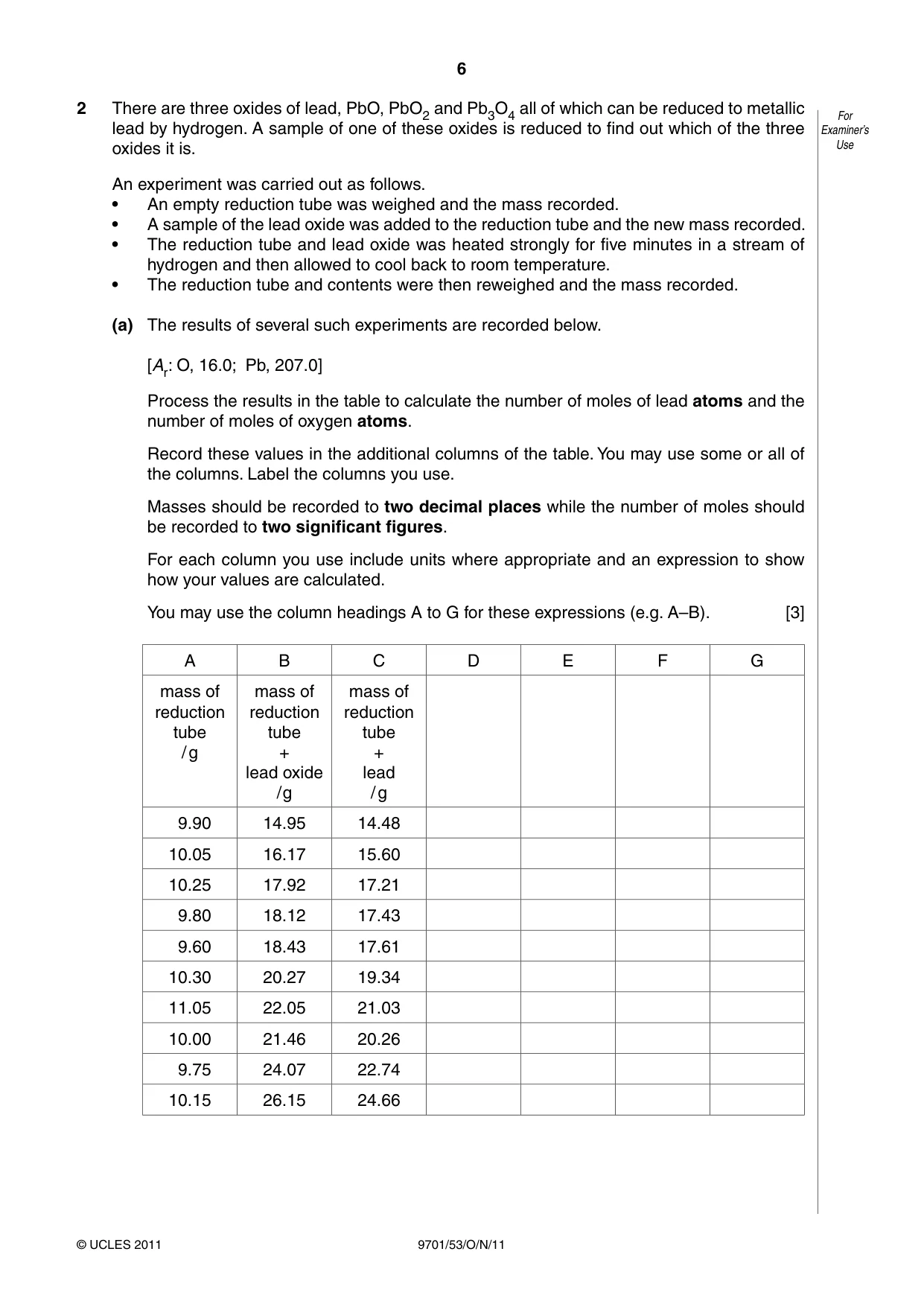
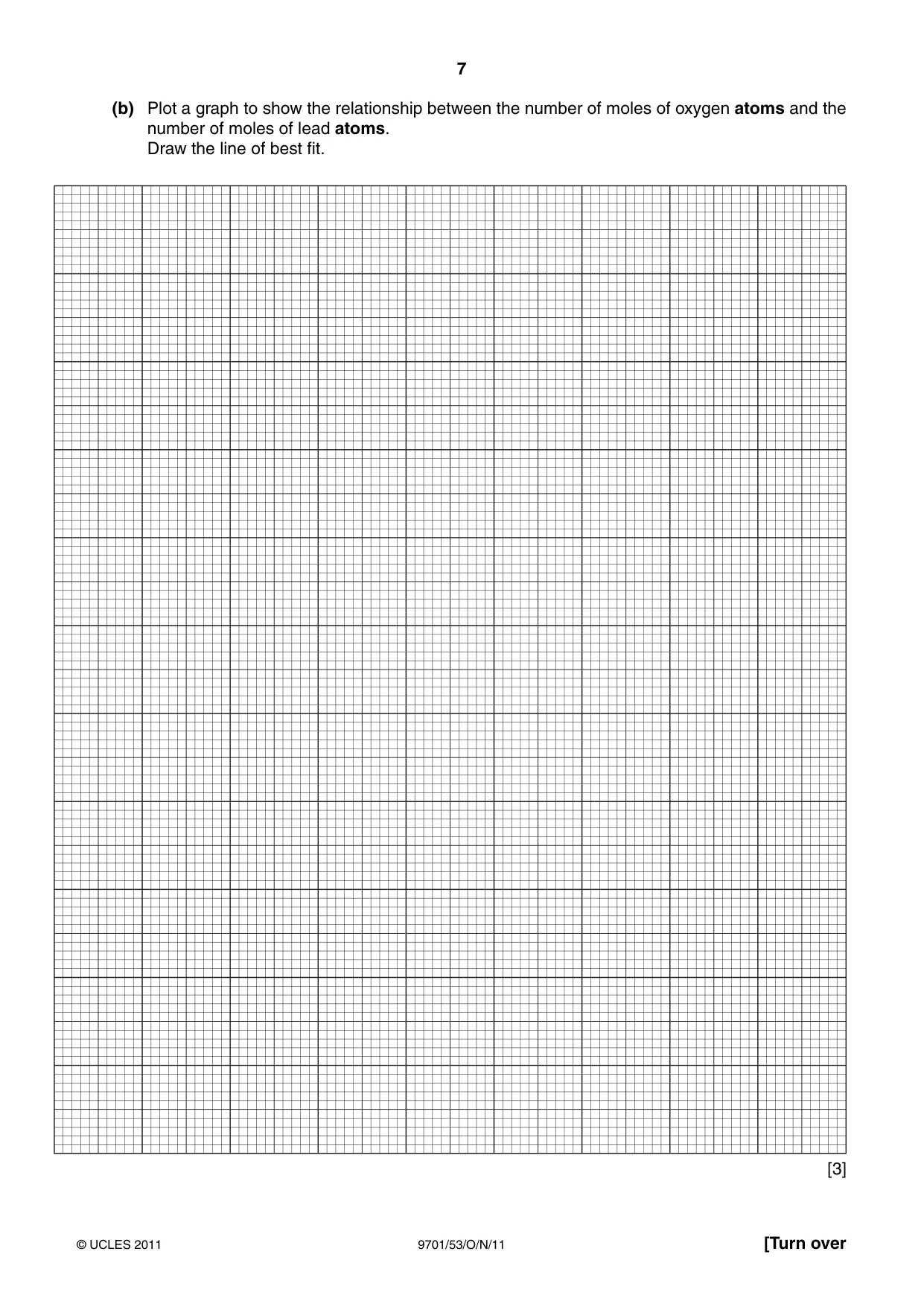
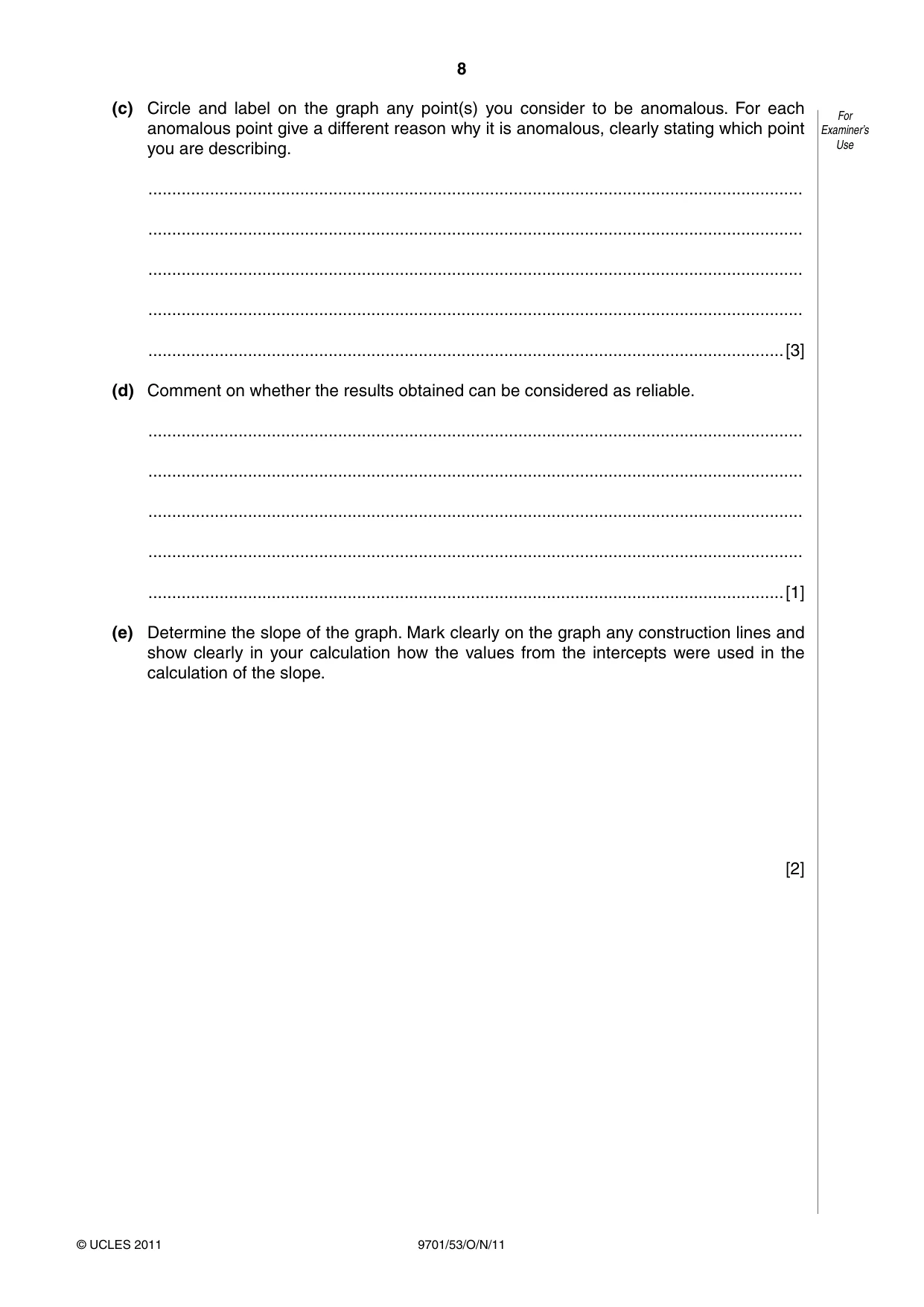
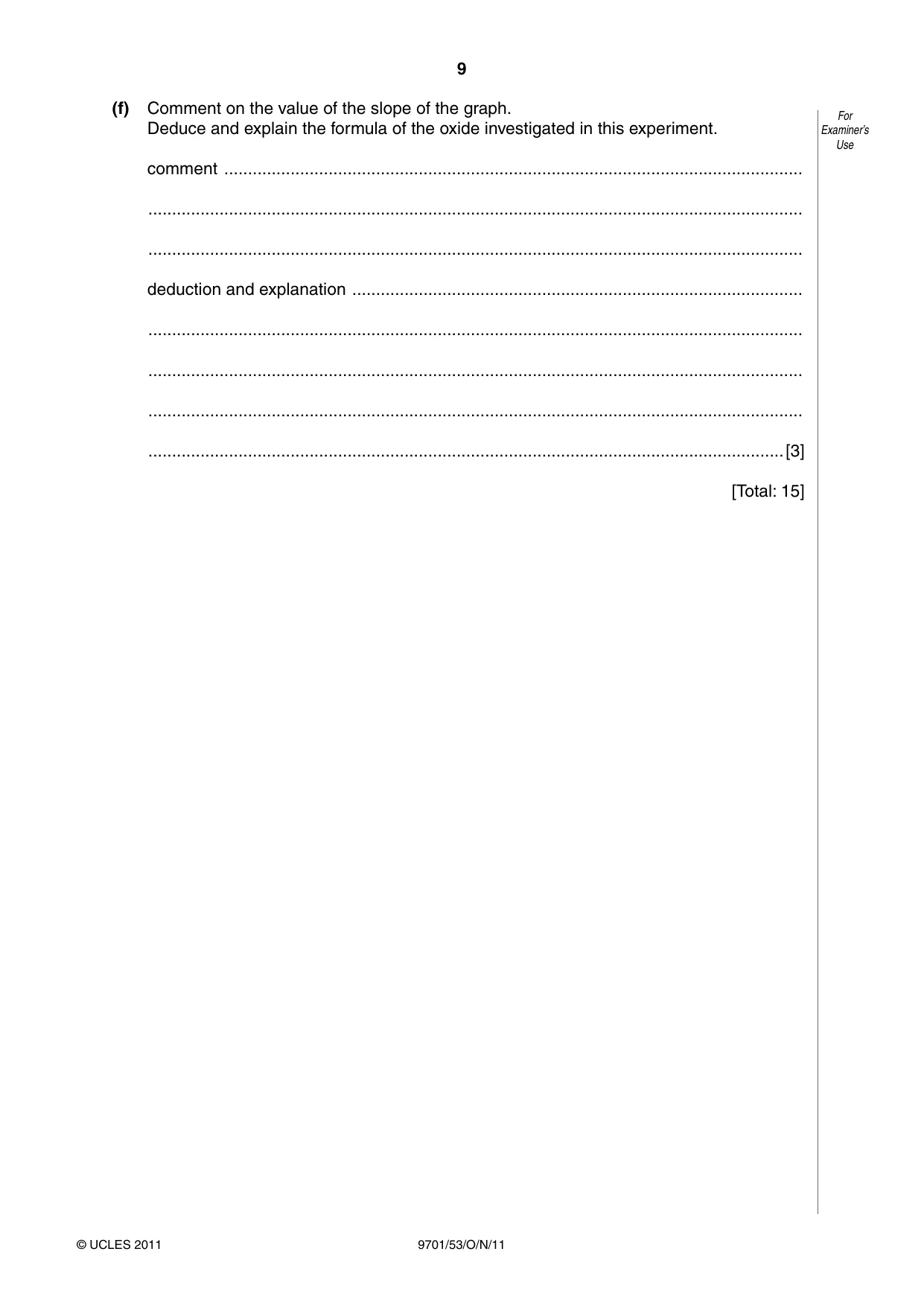


Mark scheme4 pages
Answers below. Sit the paper first if you are practising.
Paper as text
Question paper, page 1
This document consists of 8 printed pages and 4 blank pages. DC (SM/JG) 34306/5 © UCLES 2011 [Turn over UNIVERSITY OF CAMBRIDGE INTERNATIONAL EXAMINATIONS General Certificate of Education Advanced Subsidiary Level and Advanced Level * 7 1 2 7 3 9 7 7 1 6 * CHEMISTRY 9701/53 Paper 5 Planning, Analysis and Evaluation October/November 2011 1 hour 15 minutes Candidates answer on the Question Paper. No Additional Materials are required. READ THESE INSTRUCTIONS FIRST Write your Centre number, candidate number and name on all the work you hand in. Write in dark blue or black pen. You may use a soft pencil for any diagrams, graphs, or rough working. Do not use staples, paper clips, highlighters, glue or correction fluid. DO NOT WRITE IN ANY BARCODES. Answer all questions. You are advised to show all working in calculations. Use of Data Booklet is unnecessary. At the end of the examination, fasten all your work securely together. The number of marks is given in brackets [ ] at the end of each question or part question. For Examiner’s Use 1 2 Total
Question paper, page 2
2 9701/53/O/N/11 © UCLES 2011 BLANK PAGE
Question paper, page 3
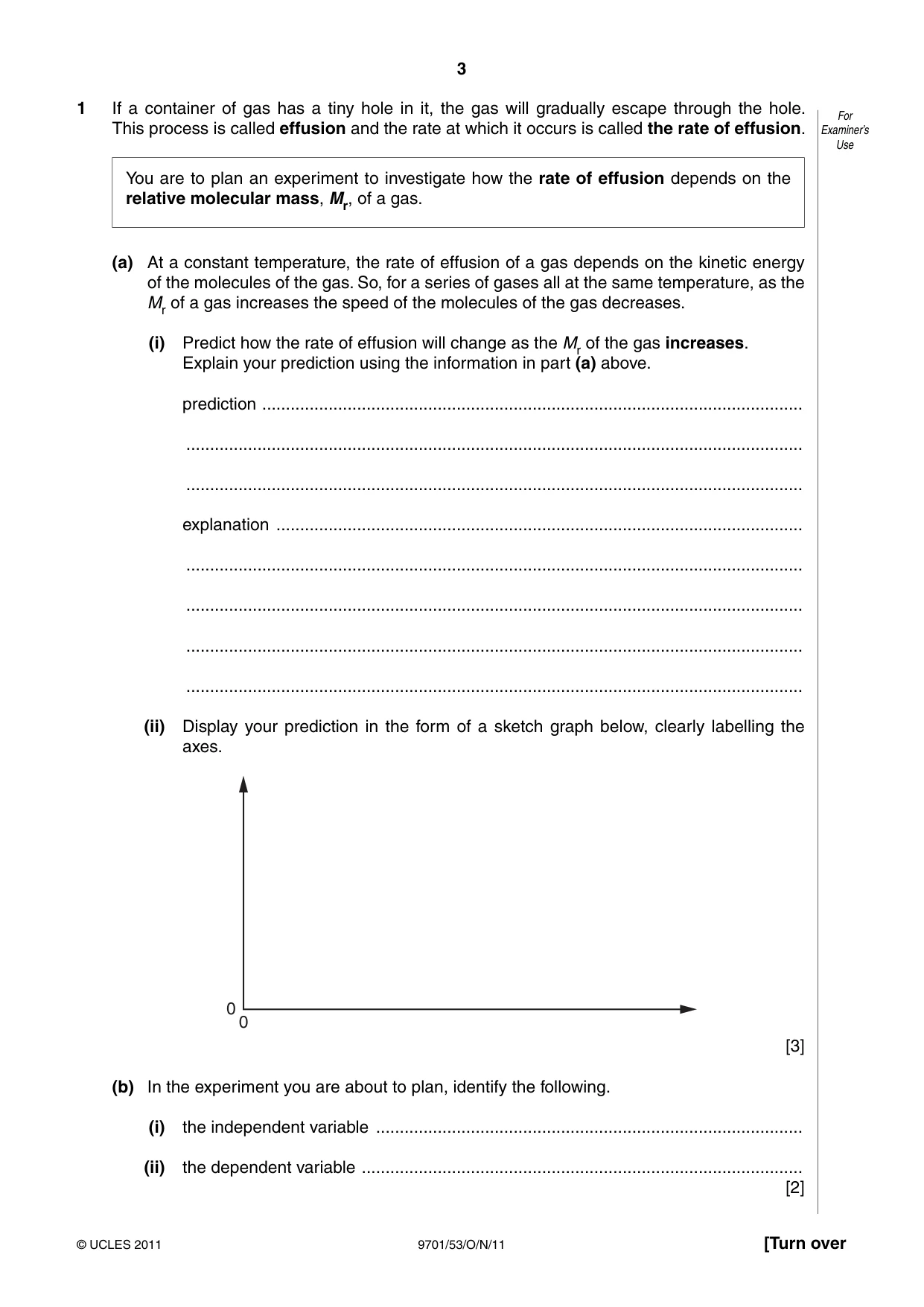
3 9701/53/O/N/11 © UCLES 2011 [Turn over For Examiner’s Use 1 If a container of gas has a tiny hole in it, the gas will gradually escape through the hole. This process is called effusion and the rate at which it occurs is called the rate of effusion. You are to plan an experiment to investigate how the rate of effusion depends on the relative molecular mass, Mr, of a gas. (a) At a constant temperature, the rate of effusion of a gas depends on the kinetic energy of the molecules of the gas. So, for a series of gases all at the same temperature, as the Mr of a gas increases the speed of the molecules of the gas decreases. (i) Predict how the rate of effusion will change as the Mr of the gas increases. Explain your prediction using the information in part (a) above. prediction … … … explanation … … … … … (ii) Display your prediction in the form of a sketch graph below, clearly labelling the axes. 0 0 [3] (b) In the experiment you are about to plan, identify the following. (i) the independent variable … (ii) the dependent variable … [2]
Question paper, page 4
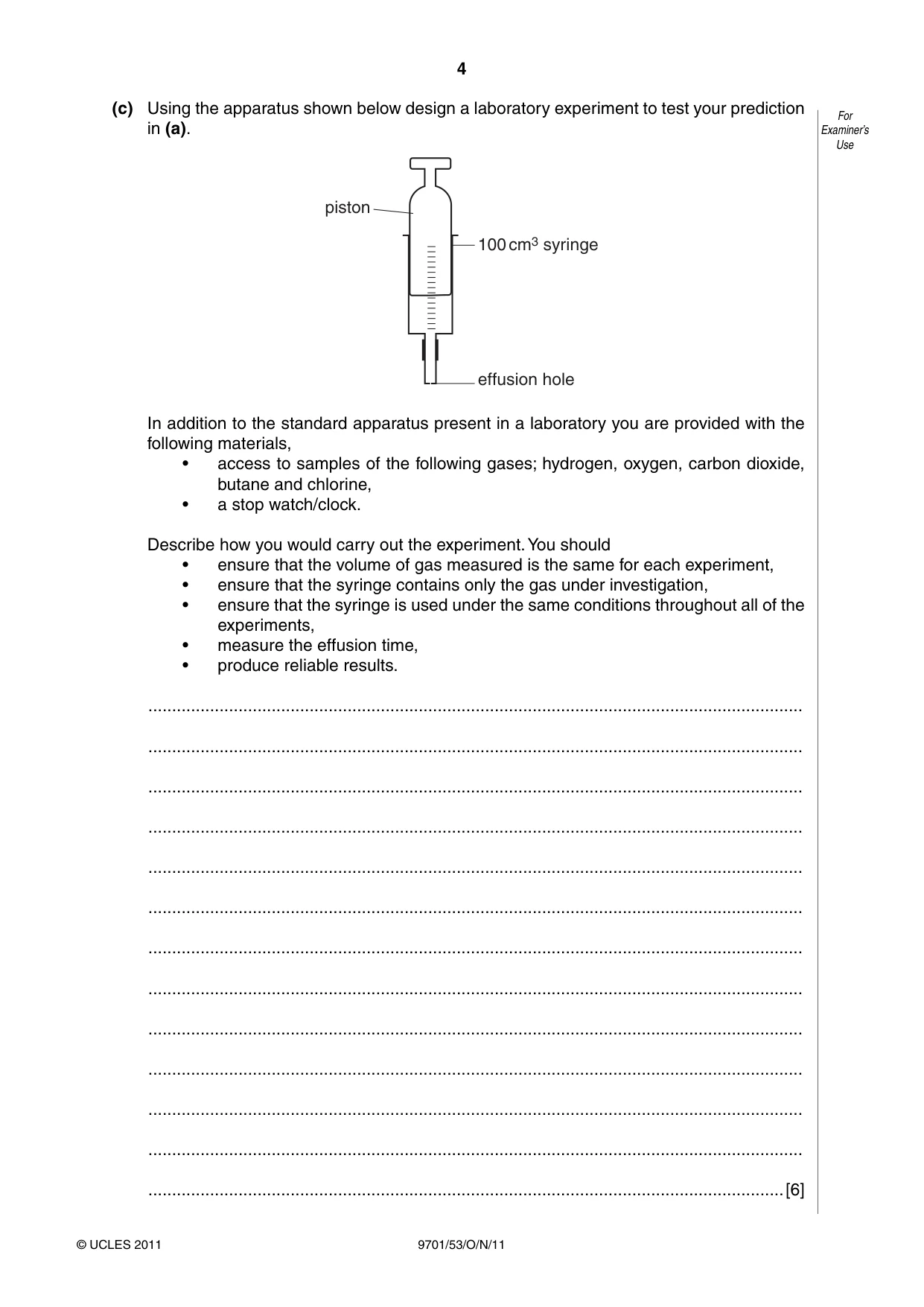
4 9701/53/O/N/11 © UCLES 2011 For Examiner’s Use (c) Using the apparatus shown below design a laboratory experiment to test your prediction in (a). 100 cm3 syringe effusion hole piston In addition to the standard apparatus present in a laboratory you are provided with the following materials, • access to samples of the following gases; hydrogen, oxygen, carbon dioxide, butane and chlorine, • a stop watch/clock. Describe how you would carry out the experiment. You should • ensure that the volume of gas measured is the same for each experiment, • ensure that the syringe contains only the gas under investigation, • ensure that the syringe is used under the same conditions throughout all of the experiments, • measure the effusion time, • produce reliable results. … … … … … … … … … … … … …[6]
Question paper, page 5
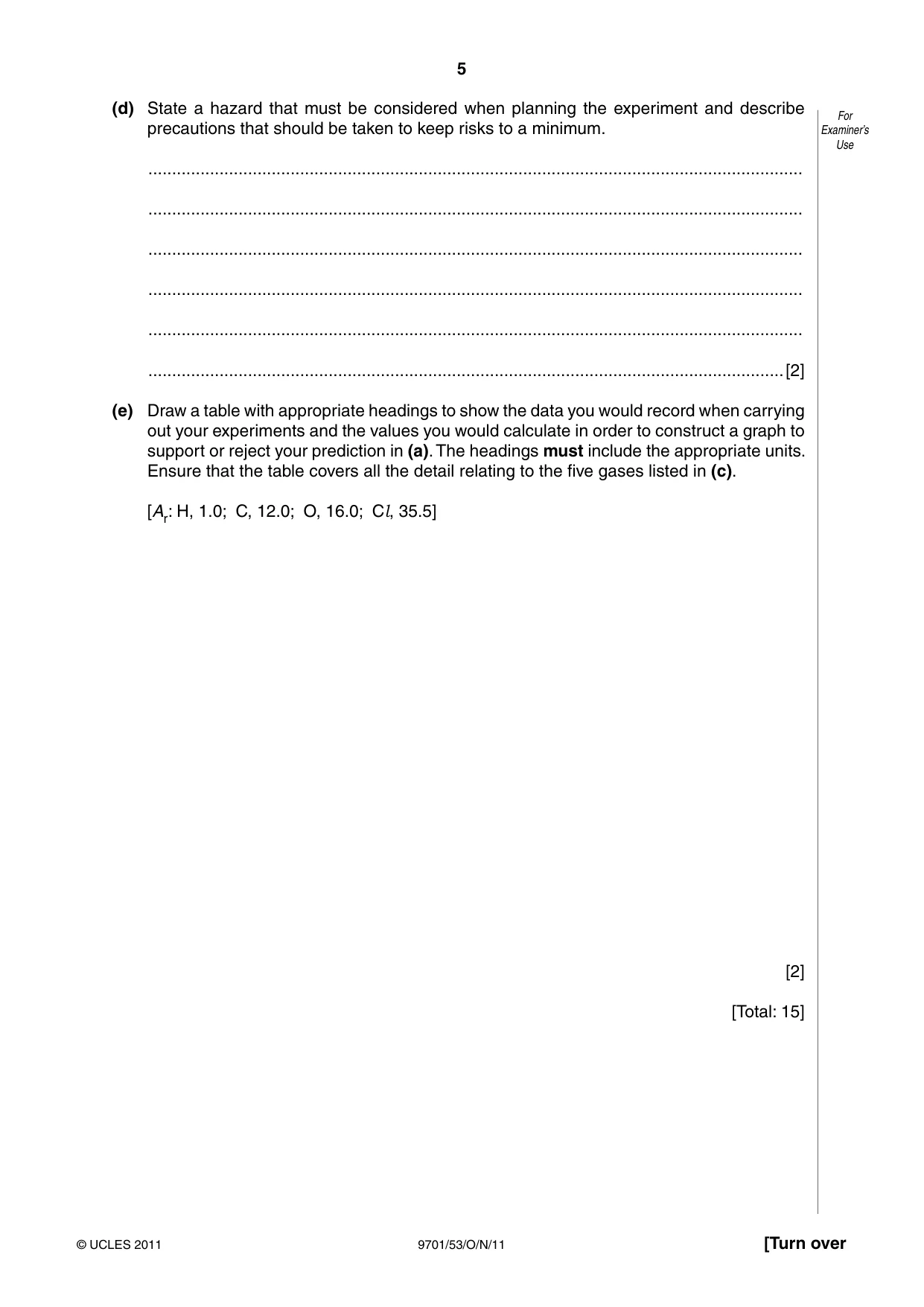
5 9701/53/O/N/11 © UCLES 2011 [Turn over For Examiner’s Use (d) State a hazard that must be considered when planning the experiment and describe precautions that should be taken to keep risks to a minimum. … … … … … …[2] (e) Draw a table with appropriate headings to show the data you would record when carrying out your experiments and the values you would calculate in order to construct a graph to support or reject your prediction in (a). The headings must include the appropriate units. Ensure that the table covers all the detail relating to the five gases listed in (c). [Ar: H, 1.0; C, 12.0; O, 16.0; Cl, 35.5] [2] [Total: 15]
Question paper, page 6
6 9701/53/O/N/11 © UCLES 2011 For Examiner’s Use 2 There are three oxides of lead, PbO, PbO2 and Pb3O4 all of which can be reduced to metallic lead by hydrogen. A sample of one of these oxides is reduced to find out which of the three oxides it is. An experiment was carried out as follows. • An empty reduction tube was weighed and the mass recorded. • A sample of the lead oxide was added to the reduction tube and the new mass recorded. • The reduction tube and lead oxide was heated strongly for five minutes in a stream of hydrogen and then allowed to cool back to room temperature. • The reduction tube and contents were then reweighed and the mass recorded. (a) The results of several such experiments are recorded below. [Ar: O, 16.0; Pb, 207.0] Process the results in the table to calculate the number of moles of lead atoms and the number of moles of oxygen atoms. Record these values in the additional columns of the table. You may use some or all of the columns. Label the columns you use. Masses should be recorded to two decimal places while the number of moles should be recorded to two significant figures. For each column you use include units where appropriate and an expression to show how your values are calculated. You may use the column headings A to G for these expressions (e.g. A–B). [3] A B C D E F G mass of reduction tube / g mass of reduction tube + lead oxide / g mass of reduction tube + lead / g 9.90 14.95 14.48 10.05 16.17 15.60 10.25 17.92 17.21 9.80 18.12 17.43 9.60 18.43 17.61 10.30 20.27 19.34 11.05 22.05 21.03 10.00 21.46 20.26 9.75 24.07 22.74 10.15 26.15 24.66
Question paper, page 7
7 9701/53/O/N/11 © UCLES 2011 [Turn over (b) Plot a graph to show the relationship between the number of moles of oxygen atoms and the number of moles of lead atoms. Draw the line of best fit. [3]
Question paper, page 8
8 9701/53/O/N/11 © UCLES 2011 For Examiner’s Use (c) Circle and label on the graph any point(s) you consider to be anomalous. For each anomalous point give a different reason why it is anomalous, clearly stating which point you are describing. … … … … …[3] (d) Comment on whether the results obtained can be considered as reliable. … … … … …[1] (e) Determine the slope of the graph. Mark clearly on the graph any construction lines and show clearly in your calculation how the values from the intercepts were used in the calculation of the slope. [2]
Question paper, page 9
9 9701/53/O/N/11 © UCLES 2011 For Examiner’s Use (f) Comment on the value of the slope of the graph. Deduce and explain the formula of the oxide investigated in this experiment. comment … … … deduction and explanation … … … … …[3] [Total: 15]
Question paper, page 10
10 9701/53/O/N/11 © UCLES 2011 BLANK PAGE
Question paper, page 11
11 9701/53/O/N/11 © UCLES 2011 BLANK PAGE
Question paper, page 12
12 9701/53/O/N/11 © UCLES 2011 BLANK PAGE Permission to reproduce items where third-party owned material protected by copyright is included has been sought and cleared where possible. Every reasonable effort has been made by the publisher (UCLES) to trace copyright holders, but if any items requiring clearance have unwittingly been included, the publisher will be pleased to make amends at the earliest possible opportunity. University of Cambridge International Examinations is part of the Cambridge Assessment Group. Cambridge Assessment is the brand name of University of Cambridge Local Examinations Syndicate (UCLES), which is itself a department of the University of Cambridge.
Mark scheme, page 1
UNIVERSITY OF CAMBRIDGE INTERNATIONAL EXAMINATIONS GCE Advanced Subsidiary Level and GCE Advanced Level MARK SCHEME for the October/November 2011 question paper for the guidance of teachers 9701 CHEMISTRY 9701/53 Paper 5 (Planning, Analysis and Evaluation), maximum raw mark 30 This mark scheme is published as an aid to teachers and candidates, to indicate the requirements of the examination. It shows the basis on which Examiners were instructed to award marks. It does not indicate the details of the discussions that took place at an Examiners’ meeting before marking began, which would have considered the acceptability of alternative answers. Mark schemes must be read in conjunction with the question papers and the report on the examination. • Cambridge will not enter into discussions or correspondence in connection with these mark schemes. Cambridge is publishing the mark schemes for the October/November 2011 question papers for most IGCSE, GCE Advanced Level and Advanced Subsidiary Level syllabuses and some Ordinary Level syllabuses.
Mark scheme, page 2
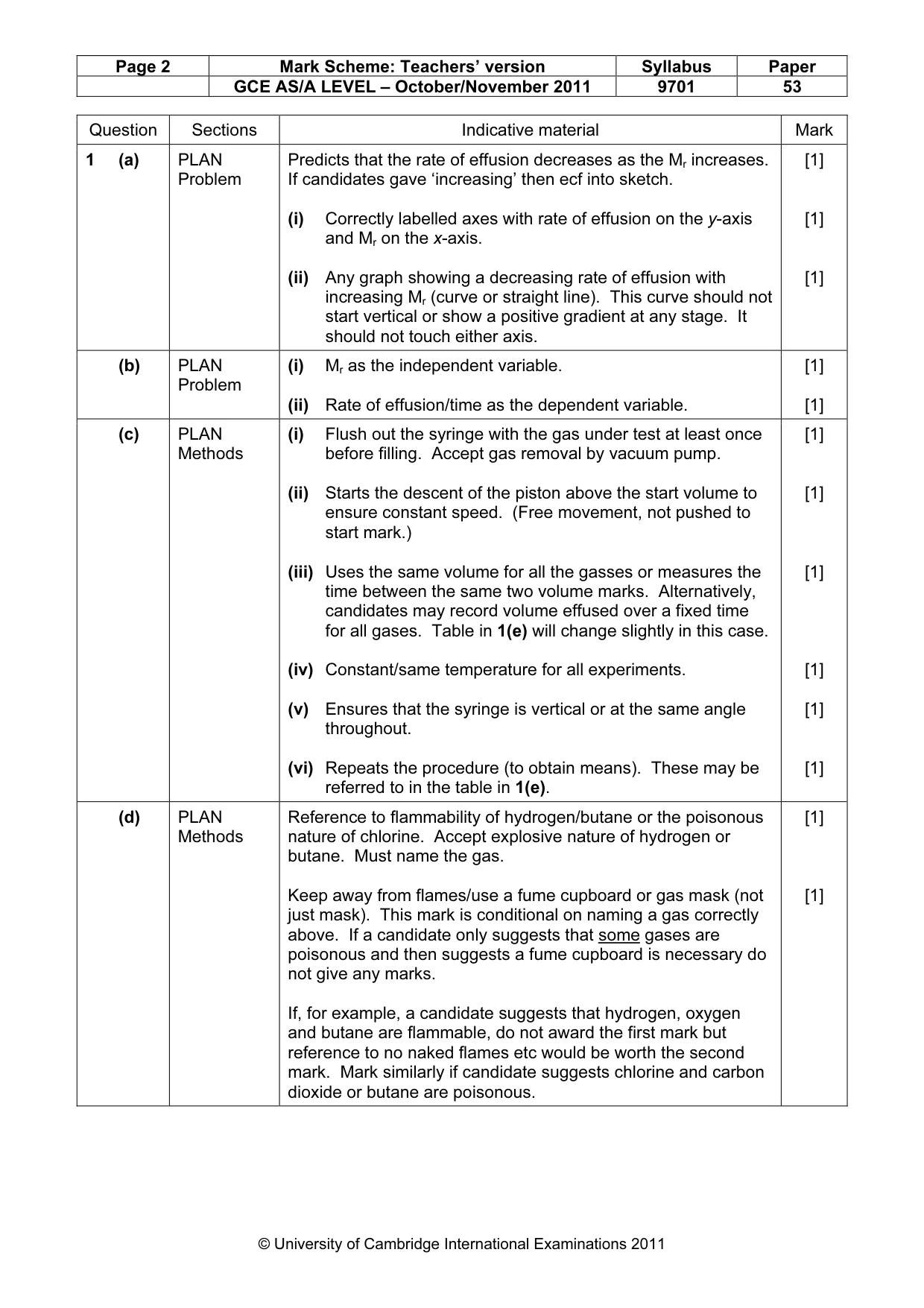
Page 2 Mark Scheme: Teachers’ version Syllabus Paper GCE AS/A LEVEL – October/November 2011 9701 53 © University of Cambridge International Examinations 2011 Question Sections Indicative material Mark 1 (a) PLAN Problem Predicts that the rate of effusion decreases as the Mr increases. If candidates gave ‘increasing’ then ecf into sketch. (i) Correctly labelled axes with rate of effusion on the y-axis and Mr on the x-axis. (ii) Any graph showing a decreasing rate of effusion with increasing Mr (curve or straight line). This curve should not start vertical or show a positive gradient at any stage. It should not touch either axis. [1] [1] [1] (b) PLAN Problem (i) Mr as the independent variable. (ii) Rate of effusion/time as the dependent variable. [1] [1] (c) PLAN Methods (i) Flush out the syringe with the gas under test at least once before filling. Accept gas removal by vacuum pump. (ii) Starts the descent of the piston above the start volume to ensure constant speed. (Free movement, not pushed to start mark.) (iii) Uses the same volume for all the gasses or measures the time between the same two volume marks. Alternatively, candidates may record volume effused over a fixed time for all gases. Table in 1(e) will change slightly in this case. (iv) Constant/same temperature for all experiments. (v) Ensures that the syringe is vertical or at the same angle throughout. (vi) Repeats the procedure (to obtain means). These may be referred to in the table in 1(e). [1] [1] [1] [1] [1] [1] (d) PLAN Methods Reference to flammability of hydrogen/butane or the poisonous nature of chlorine. Accept explosive nature of hydrogen or butane. Must name the gas. Keep away from flames/use a fume cupboard or gas mask (not just mask). This mark is conditional on naming a gas correctly above. If a candidate only suggests that some gases are poisonous and then suggests a fume cupboard is necessary do not give any marks. If, for example, a candidate suggests that hydrogen, oxygen and butane are flammable, do not award the first mark but reference to no naked flames etc would be worth the second mark. Mark similarly if candidate suggests chlorine and carbon dioxide or butane are poisonous. [1] [1]
Mark scheme, page 3
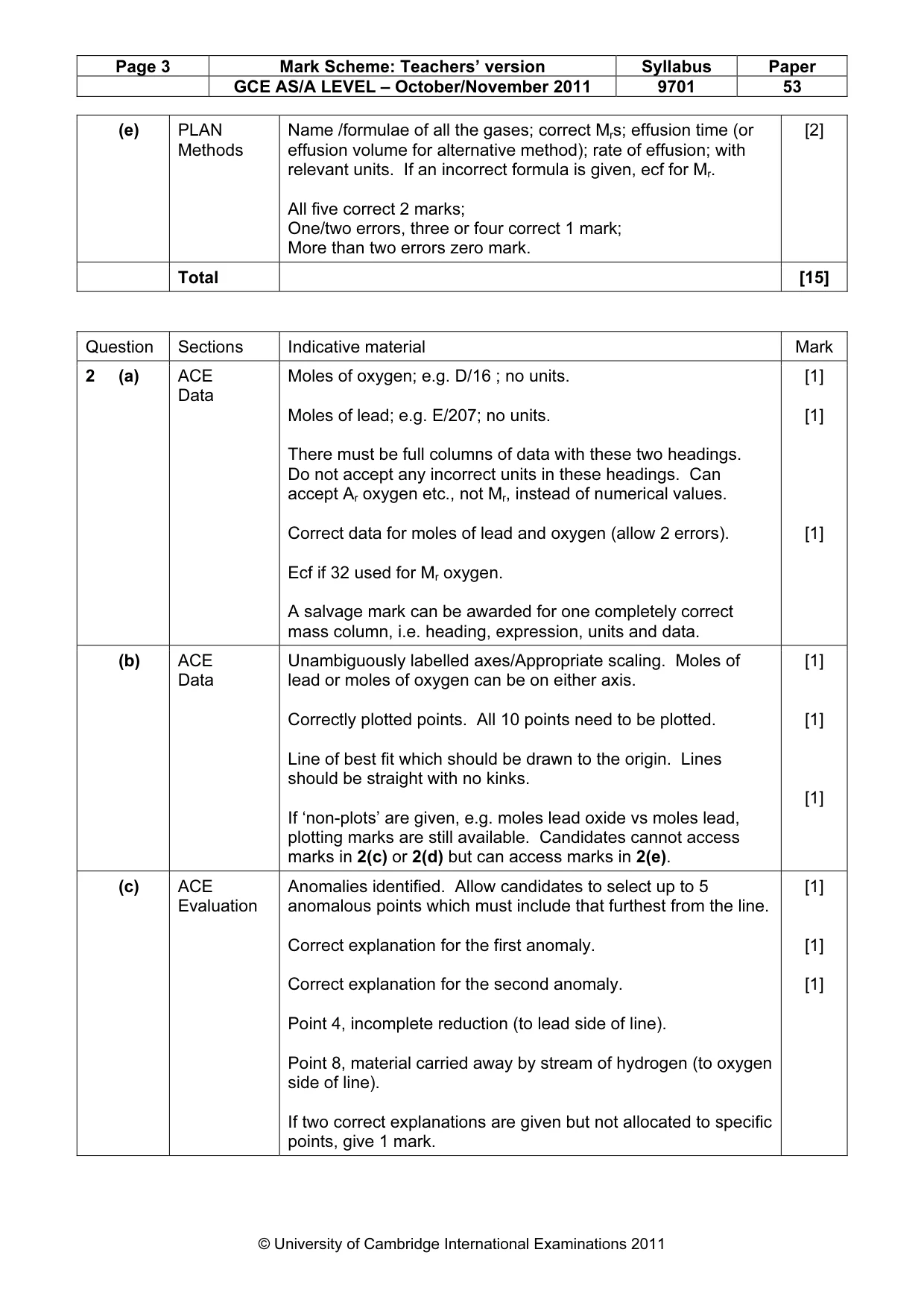
Page 3 Mark Scheme: Teachers’ version Syllabus Paper GCE AS/A LEVEL – October/November 2011 9701 53 © University of Cambridge International Examinations 2011 (e) PLAN Methods Name /formulae of all the gases; correct Mrs; effusion time (or effusion volume for alternative method); rate of effusion; with relevant units. If an incorrect formula is given, ecf for Mr. All five correct 2 marks; One/two errors, three or four correct 1 mark; More than two errors zero mark. [2] Total [15] Question Sections Indicative material Mark 2 (a) ACE Data Moles of oxygen; e.g. D/16 ; no units. Moles of lead; e.g. E/207; no units. There must be full columns of data with these two headings. Do not accept any incorrect units in these headings. Can accept Ar oxygen etc., not Mr, instead of numerical values. Correct data for moles of lead and oxygen (allow 2 errors). Ecf if 32 used for Mr oxygen. A salvage mark can be awarded for one completely correct mass column, i.e. heading, expression, units and data. [1] [1] [1] (b) ACE Data Unambiguously labelled axes/Appropriate scaling. Moles of lead or moles of oxygen can be on either axis. Correctly plotted points. All 10 points need to be plotted. Line of best fit which should be drawn to the origin. Lines should be straight with no kinks. If ‘non-plots’ are given, e.g. moles lead oxide vs moles lead, plotting marks are still available. Candidates cannot access marks in 2(c) or 2(d) but can access marks in 2(e). [1] [1] [1] (c) ACE Evaluation Anomalies identified. Allow candidates to select up to 5 anomalous points which must include that furthest from the line. Correct explanation for the first anomaly. Correct explanation for the second anomaly. Point 4, incomplete reduction (to lead side of line). Point 8, material carried away by stream of hydrogen (to oxygen side of line). If two correct explanations are given but not allocated to specific points, give 1 mark. [1] [1] [1]
Mark scheme, page 4
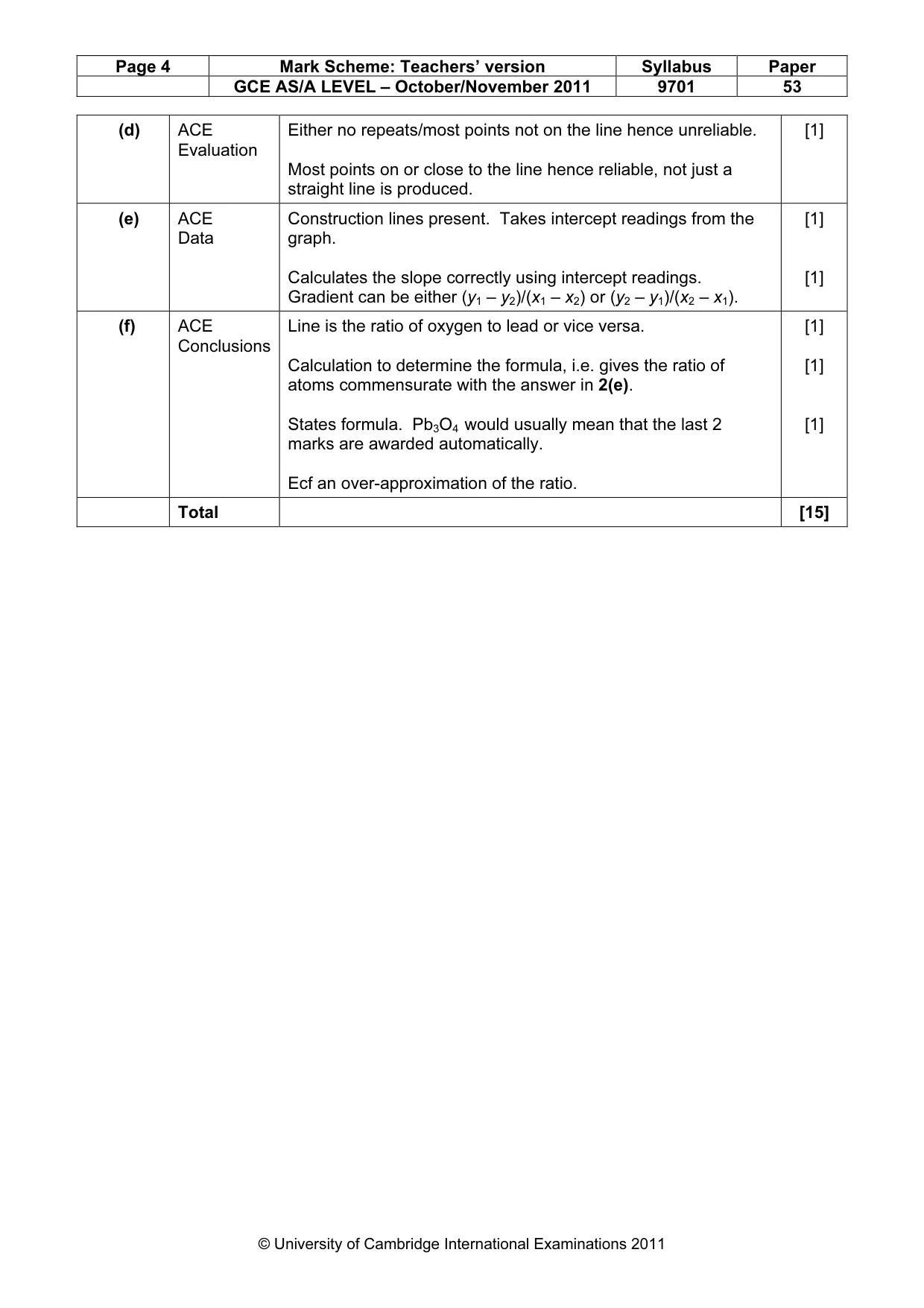
Page 4 Mark Scheme: Teachers’ version Syllabus Paper GCE AS/A LEVEL – October/November 2011 9701 53 © University of Cambridge International Examinations 2011 (d) ACE Evaluation Either no repeats/most points not on the line hence unreliable. Most points on or close to the line hence reliable, not just a straight line is produced. [1] (e) ACE Data Construction lines present. Takes intercept readings from the graph. Calculates the slope correctly using intercept readings. Gradient can be either (y1 – y2)/(x1 – x2) or (y2 – y1)/(x2 – x1). [1] [1] (f) ACE Conclusions Line is the ratio of oxygen to lead or vice versa. Calculation to determine the formula, i.e. gives the ratio of atoms commensurate with the answer in 2(e). States formula. Pb3O4 would usually mean that the last 2 marks are awarded automatically. Ecf an over-approximation of the ratio. [1] [1] [1] Total [15]
What you needed in this session
Cambridge’s own grade thresholds for 2011 Oct/Nov, Paper 5 · Variant 3. A higher threshold means an easier paper — the bar moves with how the cohort did.