Cambridge A Level Chemistry 9701 — 2010 Oct/Nov Paper 4 · Variant 2
9701/42/O/N/10 · 100 marks · ≈113 min
The question paper and its mark scheme, free to read here and free to download. This is Cambridge’s own paper, exactly as it was sat.
Question paper20 pages



Mark scheme7 pages
Answers below. Sit the paper first if you are practising.
Paper as text
Question paper, page 1
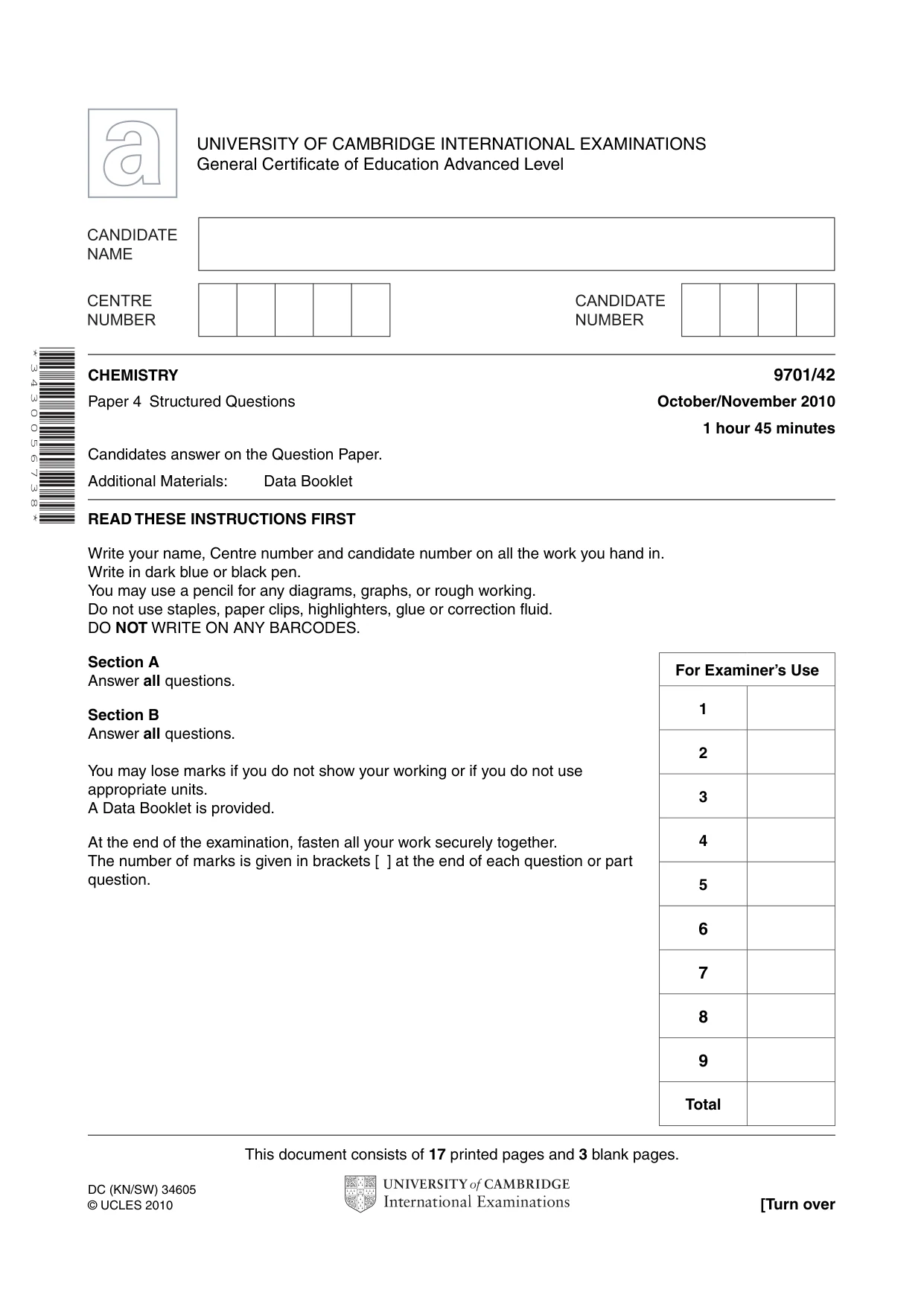
This document consists of 17 printed pages and 3 blank pages. DC (KN/SW) 34605 © UCLES 2010 [Turn over UNIVERSITY OF CAMBRIDGE INTERNATIONAL EXAMINATIONS General Certificate of Education Advanced Level READ THESE INSTRUCTIONS FIRST Write your name, Centre number and candidate number on all the work you hand in. Write in dark blue or black pen. You may use a pencil for any diagrams, graphs, or rough working. Do not use staples, paper clips, highlighters, glue or correction fluid. DO NOT WRITE ON ANY BARCODES. Section A Answer all questions. Section B Answer all questions. You may lose marks if you do not show your working or if you do not use appropriate units. A Data Booklet is provided. At the end of the examination, fasten all your work securely together. The number of marks is given in brackets [ ] at the end of each question or part question. * 3 4 3 0 0 5 6 7 3 8 * CHEMISTRY 9701/42 Paper 4 Structured Questions October/November 2010 1 hour 45 minutes Candidates answer on the Question Paper. Additional Materials: Data Booklet For Examiner’s Use 1 2 3 4 5 6 7 8 9 Total
Question paper, page 2
2 9701/42/O/N/10 © UCLES 2010 BLANK PAGE
Question paper, page 3
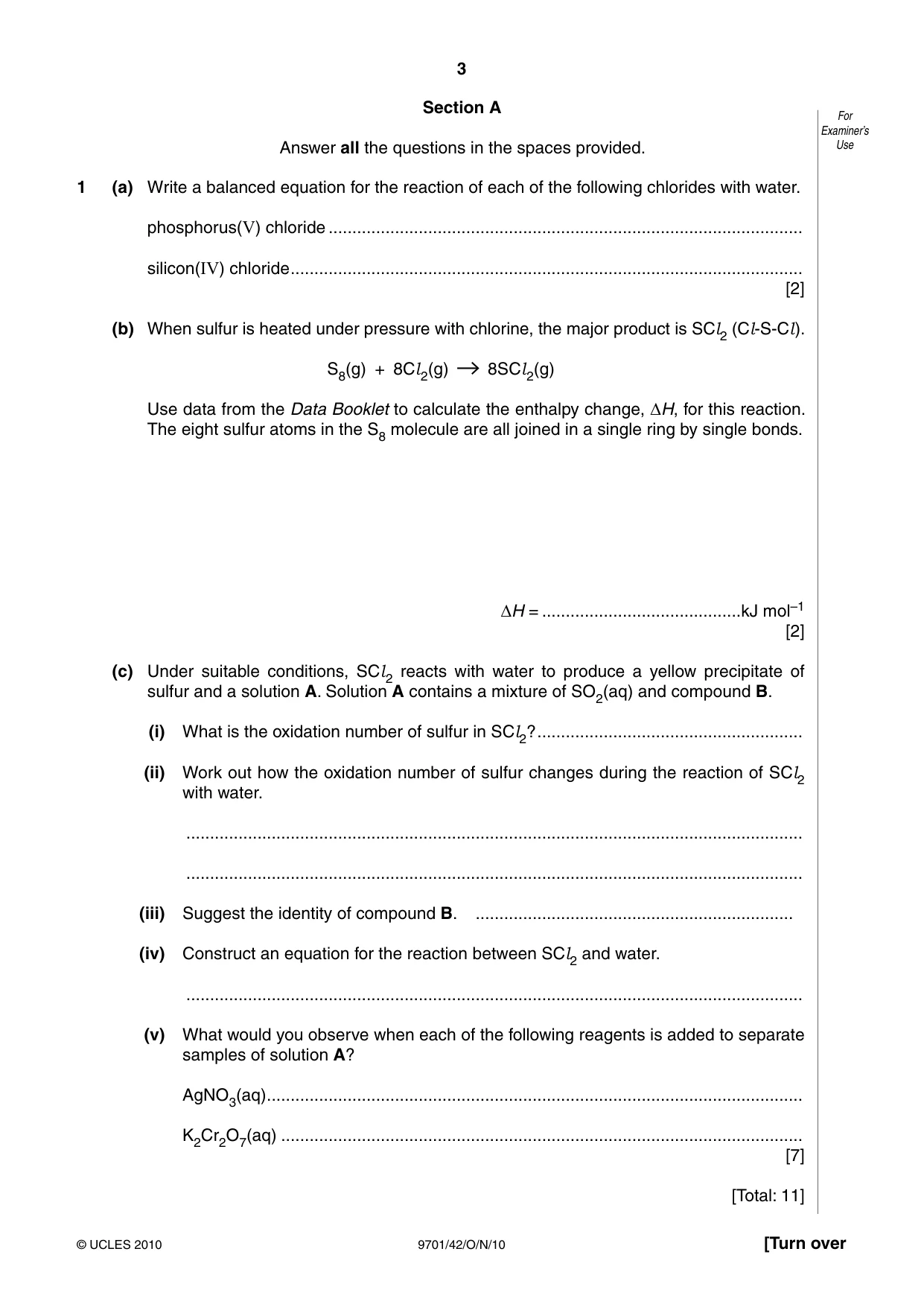
3 © UCLES 2010 [Turn over 9701/42/O/N/10 For Examiner’s Use Section A Answer all the questions in the spaces provided. 1 (a) Write a balanced equation for the reaction of each of the following chlorides with water. phosphorus(V) chloride … silicon(IV) chloride … [2] (b) When sulfur is heated under pressure with chlorine, the major product is SCl2 (Cl-S-Cl). S8(g) + 8Cl2(g) 8SCl2(g) Use data from the Data Booklet to calculate the enthalpy change, ∆H, for this reaction. The eight sulfur atoms in the S8 molecule are all joined in a single ring by single bonds. ∆H = …kJ mol–1 [2] (c) Under suitable conditions, SCl2 reacts with water to produce a yellow precipitate of sulfur and a solution A. Solution A contains a mixture of SO2(aq) and compound B. (i) What is the oxidation number of sulfur in SCl2? … (ii) Work out how the oxidation number of sulfur changes during the reaction of SCl2 with water. … … (iii) Suggest the identity of compound B. … (iv) Construct an equation for the reaction between SCl2 and water. … (v) What would you observe when each of the following reagents is added to separate samples of solution A? AgNO3(aq) … K2Cr2O7(aq) … [7] [Total: 11]
Question paper, page 4
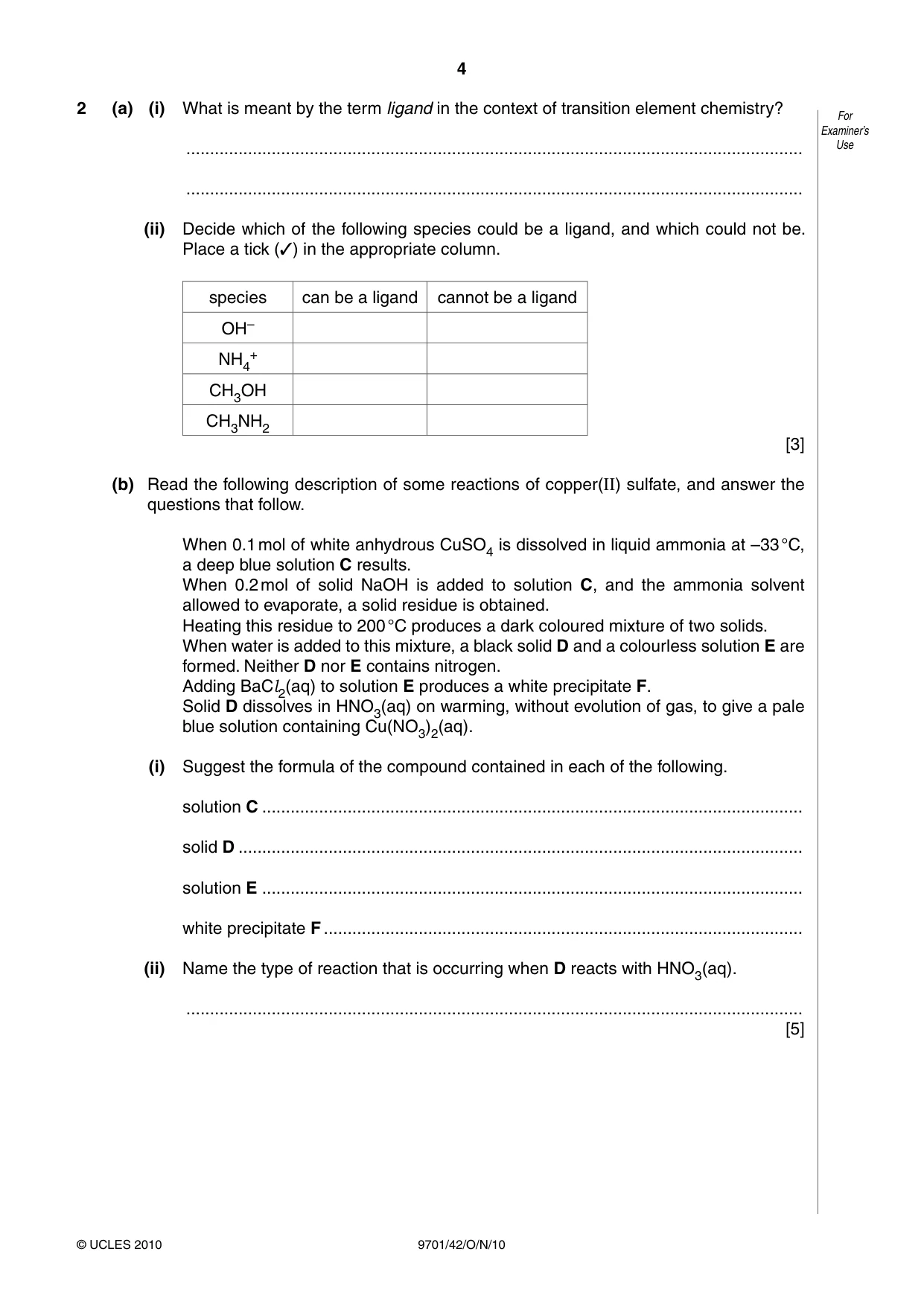
4 © UCLES 2010 9701/42/O/N/10 For Examiner’s Use 2 (a) (i) What is meant by the term ligand in the context of transition element chemistry? … … (ii) Decide which of the following species could be a ligand, and which could not be. Place a tick (✓) in the appropriate column. species can be a ligand cannot be a ligand OH– NH4 + CH3OH CH3NH2 [3] (b) Read the following description of some reactions of copper(II) sulfate, and answer the questions that follow. When 0.1 mol of white anhydrous CuSO4 is dissolved in liquid ammonia at –33 °C, a deep blue solution C results. When 0.2 mol of solid NaOH is added to solution C, and the ammonia solvent allowed to evaporate, a solid residue is obtained. Heating this residue to 200 °C produces a dark coloured mixture of two solids. When water is added to this mixture, a black solid D and a colourless solution E are formed. Neither D nor E contains nitrogen. Adding BaCl2(aq) to solution E produces a white precipitate F. Solid D dissolves in HNO3(aq) on warming, without evolution of gas, to give a pale blue solution containing Cu(NO3)2(aq). (i) Suggest the formula of the compound contained in each of the following. solution C … solid D … solution E … white precipitate F … (ii) Name the type of reaction that is occurring when D reacts with HNO3(aq). … [5]
Question paper, page 5
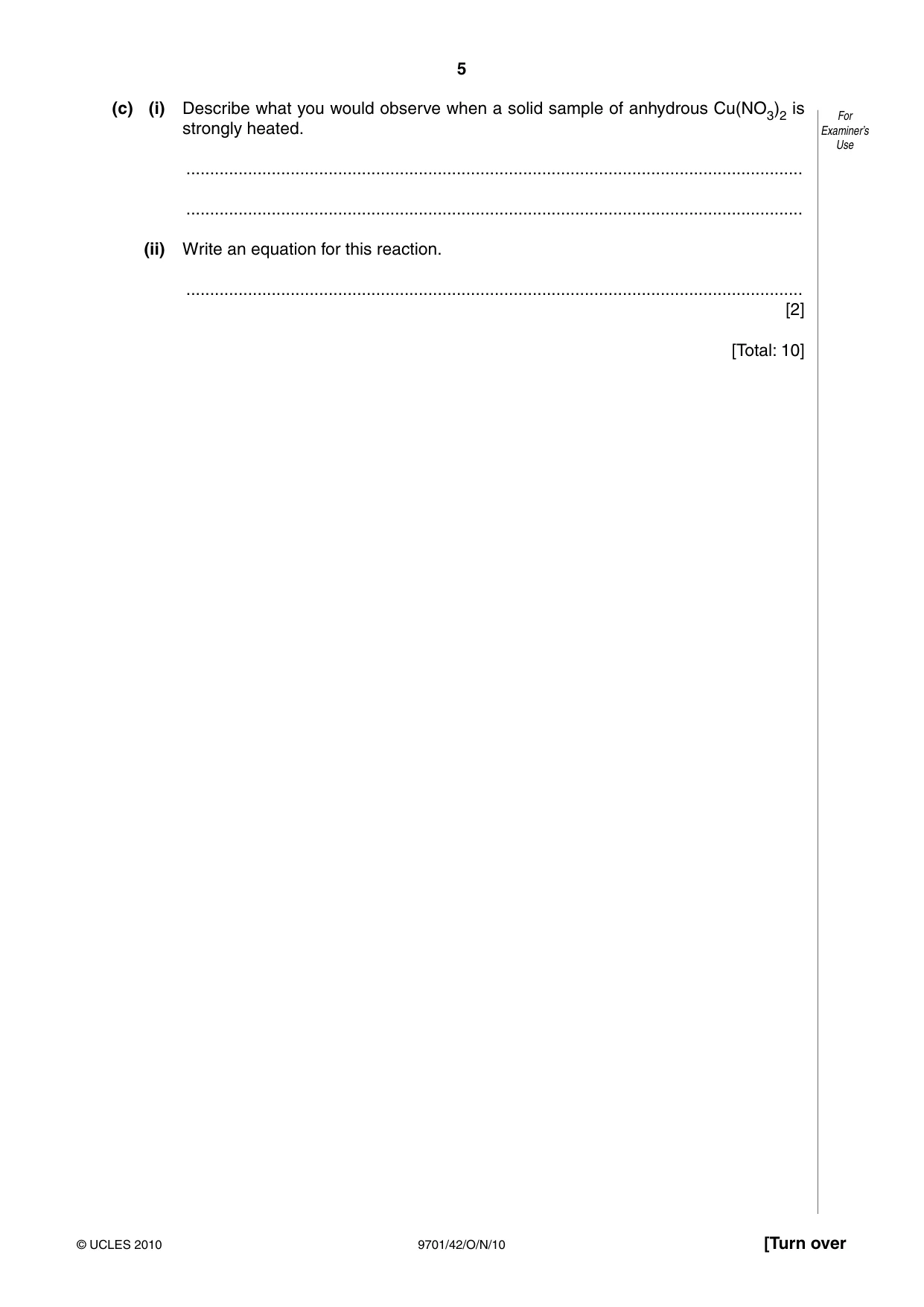
5 © UCLES 2010 [Turn over 9701/42/O/N/10 For Examiner’s Use (c) (i) Describe what you would observe when a solid sample of anhydrous Cu(NO3)2 is strongly heated. … … (ii) Write an equation for this reaction. … [2] [Total: 10]
Question paper, page 6
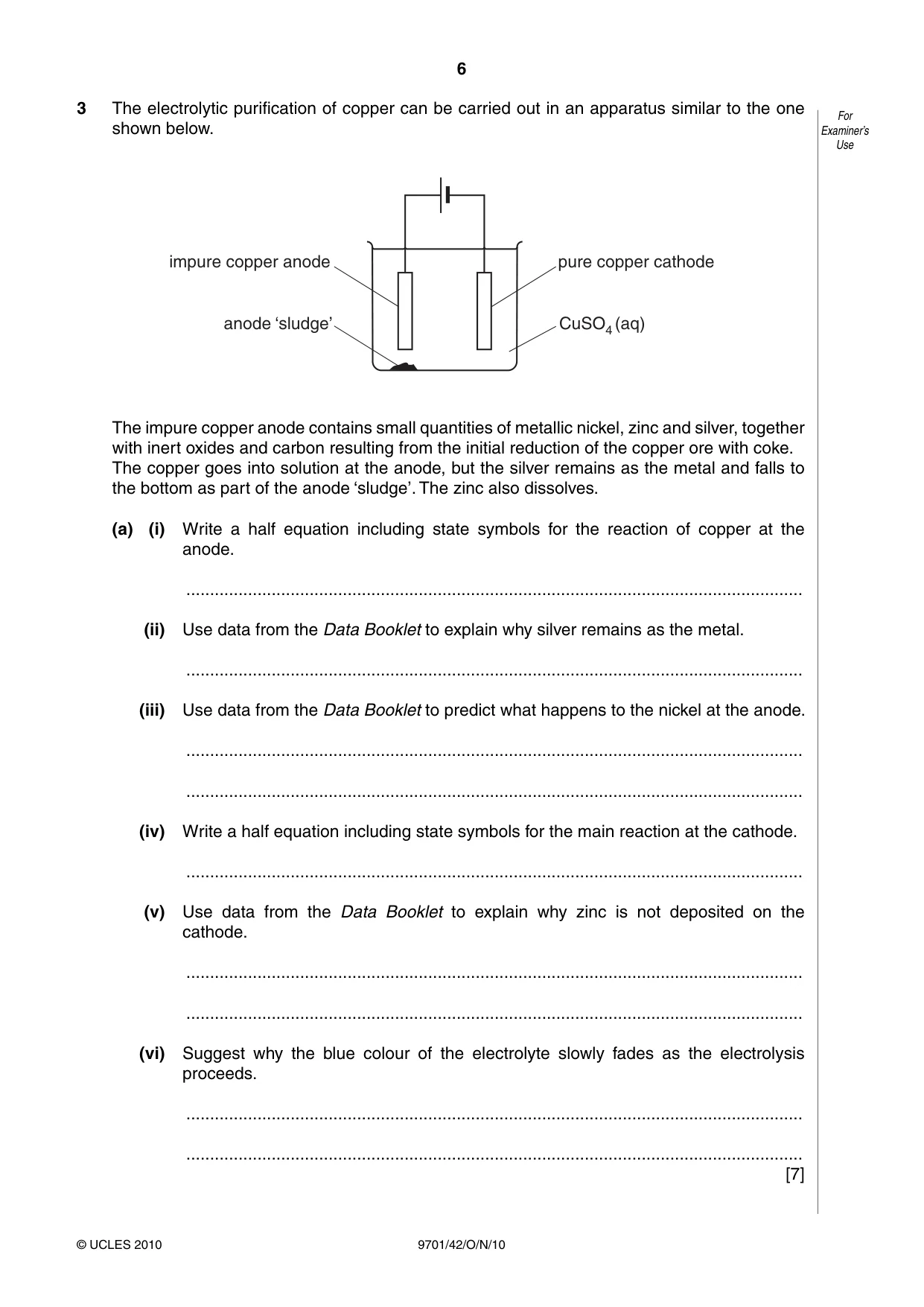
6 © UCLES 2010 9701/42/O/N/10 For Examiner’s Use 3 The electrolytic purification of copper can be carried out in an apparatus similar to the one shown below. impure copper anode anode ‘sludge’ pure copper cathode CuSO4 (aq) The impure copper anode contains small quantities of metallic nickel, zinc and silver, together with inert oxides and carbon resulting from the initial reduction of the copper ore with coke. The copper goes into solution at the anode, but the silver remains as the metal and falls to the bottom as part of the anode ‘sludge’. The zinc also dissolves. (a) (i) Write a half equation including state symbols for the reaction of copper at the anode. … (ii) Use data from the Data Booklet to explain why silver remains as the metal. … (iii) Use data from the Data Booklet to predict what happens to the nickel at the anode. … … (iv) Write a half equation including state symbols for the main reaction at the cathode. … (v) Use data from the Data Booklet to explain why zinc is not deposited on the cathode. … … (vi) Suggest why the blue colour of the electrolyte slowly fades as the electrolysis proceeds. … … [7]
Question paper, page 7
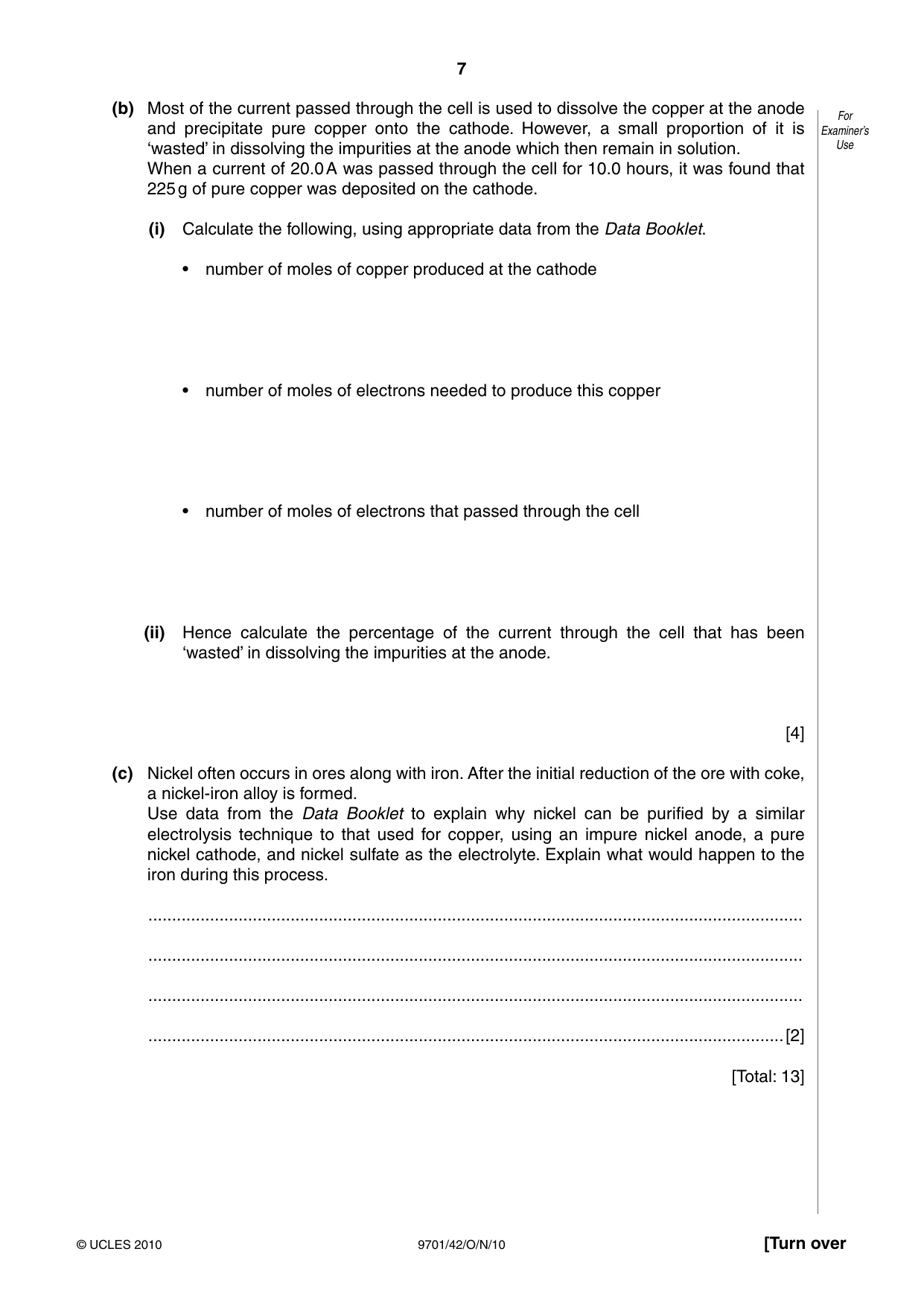
7 © UCLES 2010 [Turn over 9701/42/O/N/10 For Examiner’s Use (b) Most of the current passed through the cell is used to dissolve the copper at the anode and precipitate pure copper onto the cathode. However, a small proportion of it is ‘wasted’ in dissolving the impurities at the anode which then remain in solution. When a current of 20.0 A was passed through the cell for 10.0 hours, it was found that 225 g of pure copper was deposited on the cathode. (i) Calculate the following, using appropriate data from the Data Booklet. • number of moles of copper produced at the cathode • number of moles of electrons needed to produce this copper • number of moles of electrons that passed through the cell (ii) Hence calculate the percentage of the current through the cell that has been ‘wasted’ in dissolving the impurities at the anode. [4] (c) Nickel often occurs in ores along with iron. After the initial reduction of the ore with coke, a nickel-iron alloy is formed. Use data from the Data Booklet to explain why nickel can be purified by a similar electrolysis technique to that used for copper, using an impure nickel anode, a pure nickel cathode, and nickel sulfate as the electrolyte. Explain what would happen to the iron during this process. … … … …[2] [Total: 13]
Question paper, page 8
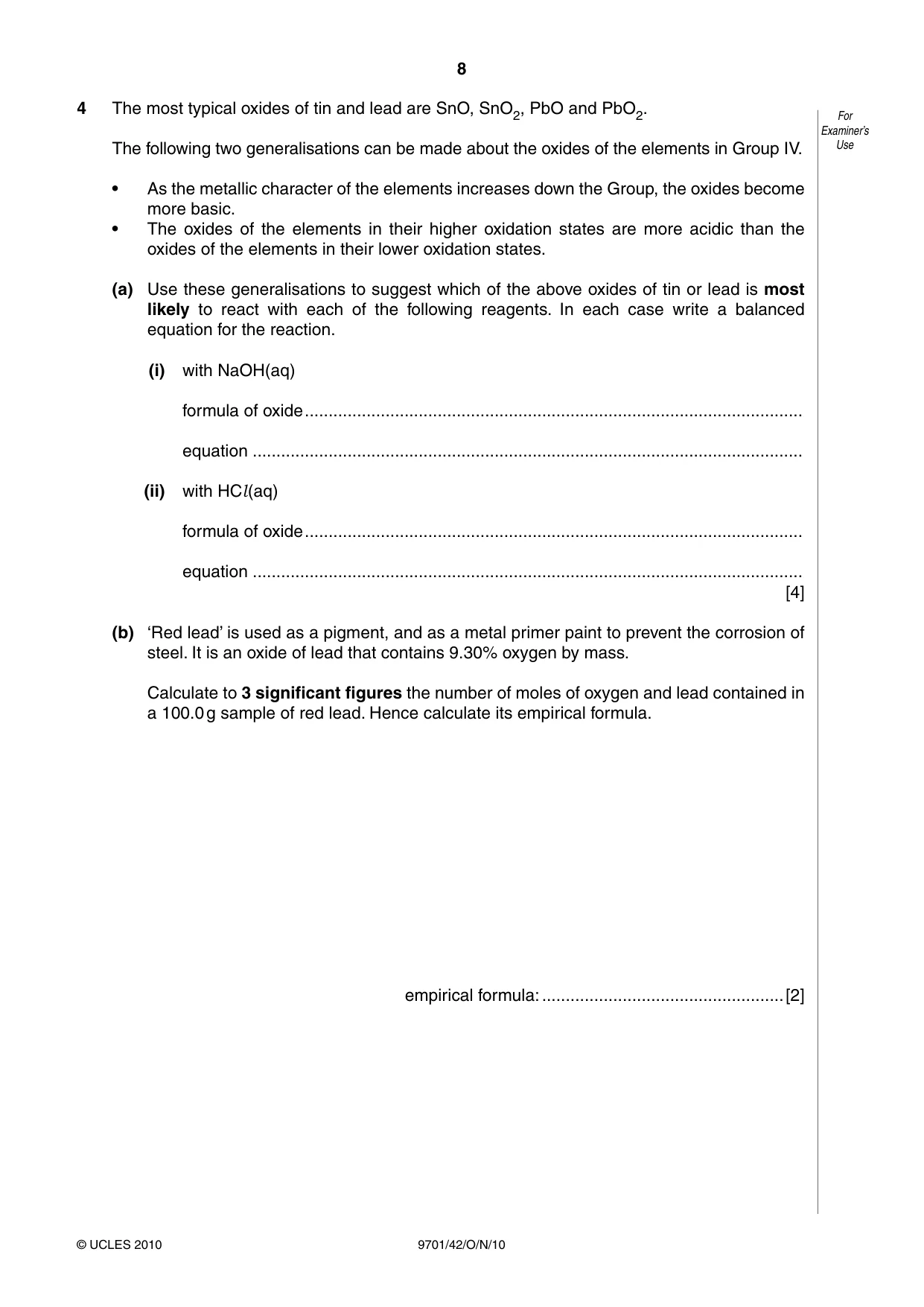
8 © UCLES 2010 9701/42/O/N/10 For Examiner’s Use 4 The most typical oxides of tin and lead are SnO, SnO2, PbO and PbO2. The following two generalisations can be made about the oxides of the elements in Group IV. • As the metallic character of the elements increases down the Group, the oxides become more basic. • The oxides of the elements in their higher oxidation states are more acidic than the oxides of the elements in their lower oxidation states. (a) Use these generalisations to suggest which of the above oxides of tin or lead is most likely to react with each of the following reagents. In each case write a balanced equation for the reaction. (i) with NaOH(aq) formula of oxide … equation … (ii) with HCl(aq) formula of oxide … equation … [4] (b) ‘Red lead’ is used as a pigment, and as a metal primer paint to prevent the corrosion of steel. It is an oxide of lead that contains 9.30% oxygen by mass. Calculate to 3 significant figures the number of moles of oxygen and lead contained in a 100.0 g sample of red lead. Hence calculate its empirical formula. empirical formula: …[2]
Question paper, page 9
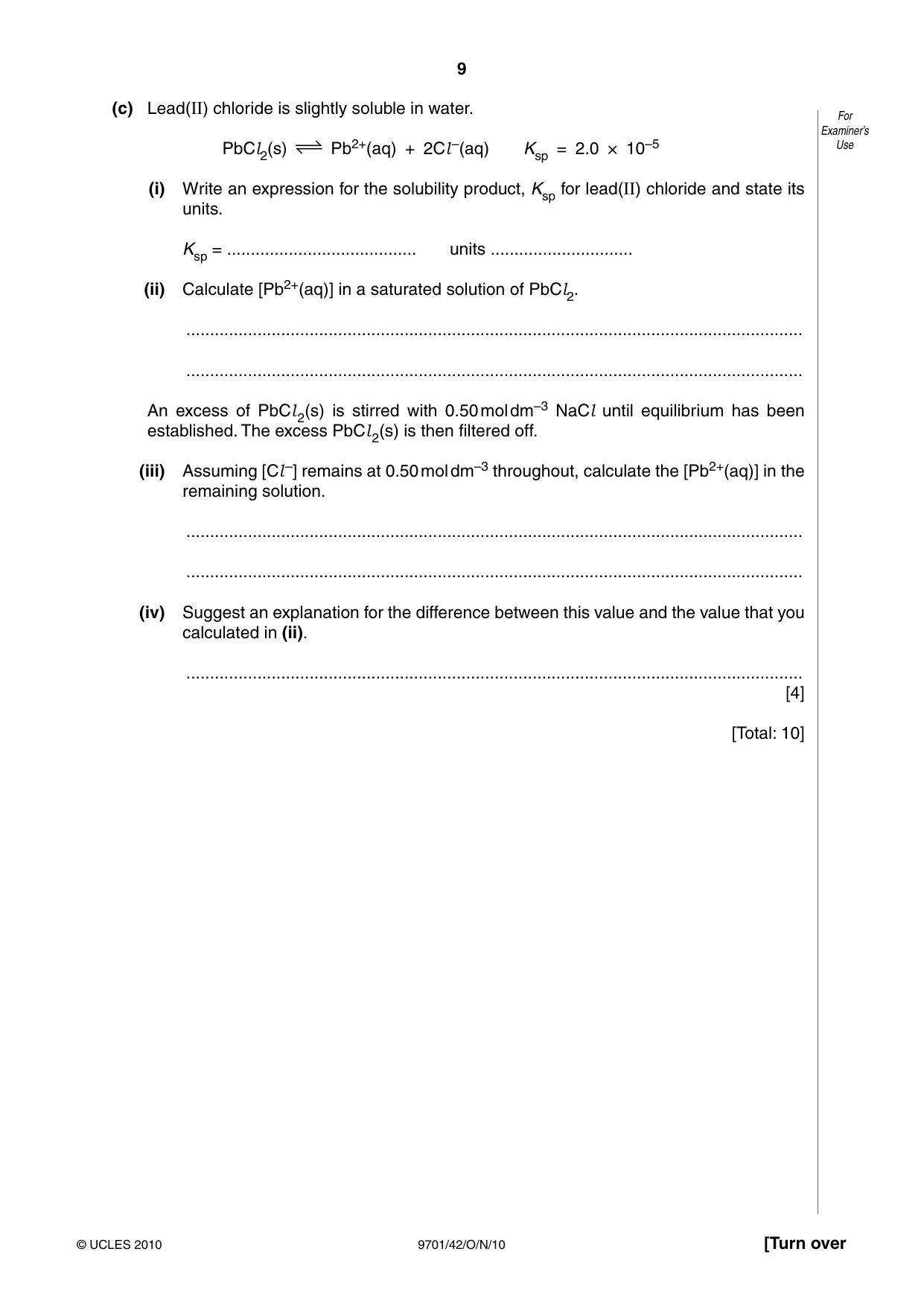
9 © UCLES 2010 [Turn over 9701/42/O/N/10 For Examiner’s Use (c) Lead(II) chloride is slightly soluble in water. PbCl2(s) Pb2+(aq) + 2Cl–(aq) Ksp = 2.0 × 10⁻⁵ (i) Write an expression for the solubility product, Ksp for lead(II) chloride and state its units. Ksp = … units … (ii) Calculate [Pb2+(aq)] in a saturated solution of PbCl2. … … An excess of PbCl2(s) is stirred with 0.50 mol dm–3 NaCl until equilibrium has been established. The excess PbCl2(s) is then filtered off. (iii) Assuming [Cl–] remains at 0.50 mol dm–3 throughout, calculate the [Pb2+(aq)] in the remaining solution. … … (iv) Suggest an explanation for the difference between this value and the value that you calculated in (ii). … [4] [Total: 10]
Question paper, page 10
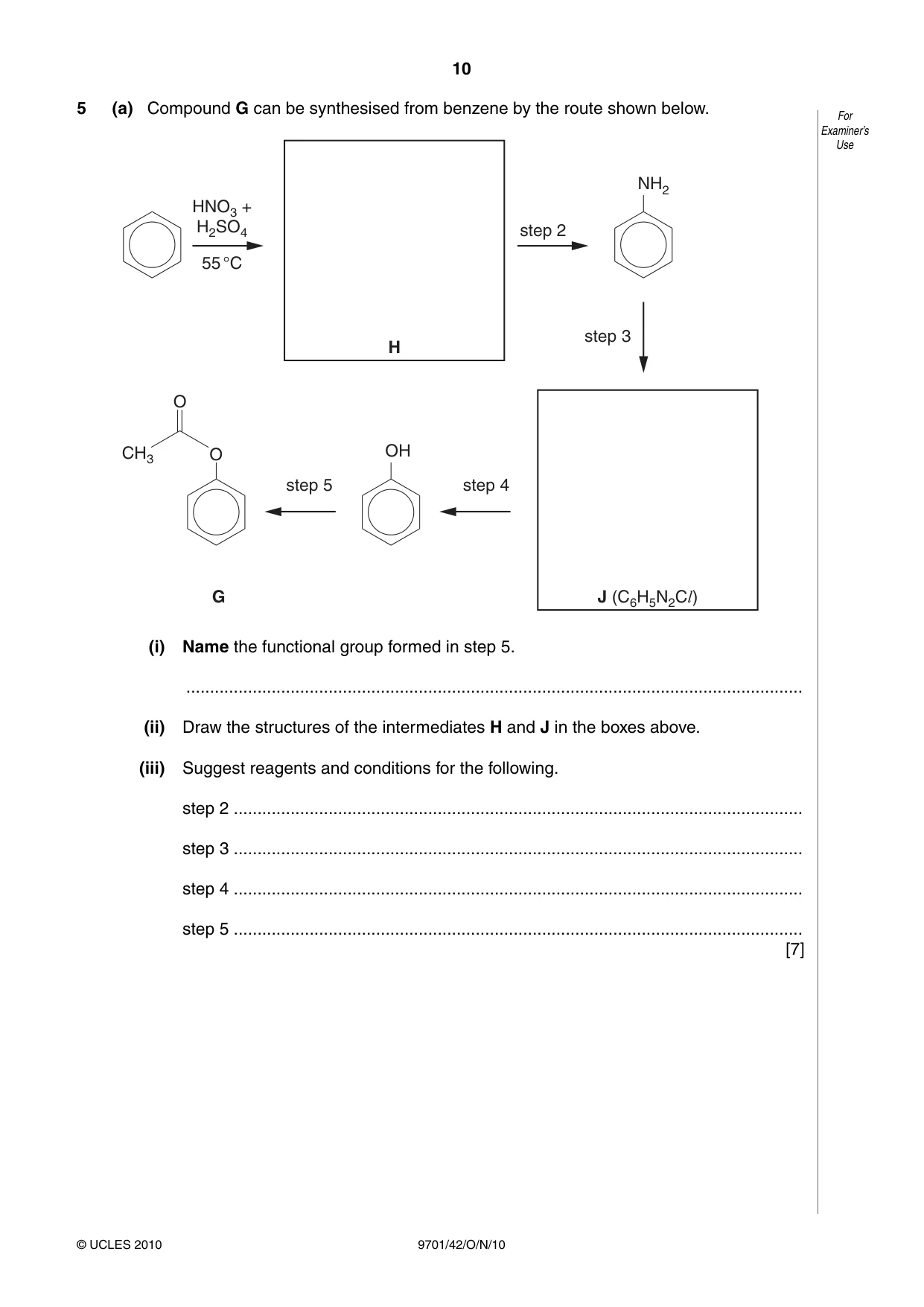
10 © UCLES 2010 9701/42/O/N/10 For Examiner’s Use 5 (a) Compound G can be synthesised from benzene by the route shown below. H J (C6H5N2Cl) G HNO3 + H2SO4 NH2 step 2 step 4 step 5 step 3 55 °C OH O O CH3 (i) Name the functional group formed in step 5. … (ii) Draw the structures of the intermediates H and J in the boxes above. (iii) Suggest reagents and conditions for the following. step 2 … step 3 … step 4 … step 5 … [7]
Question paper, page 11
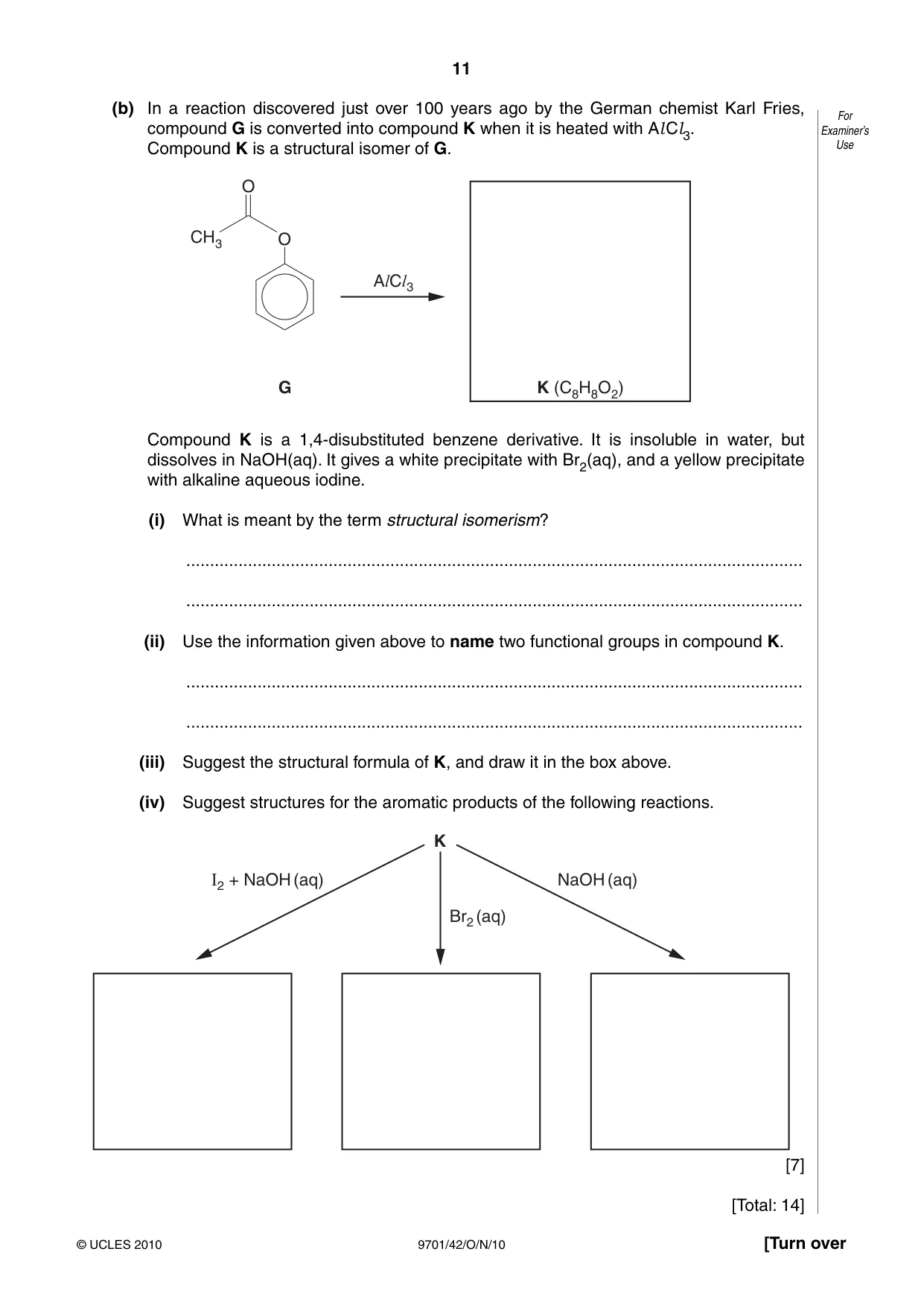
11 © UCLES 2010 [Turn over 9701/42/O/N/10 For Examiner’s Use (b) In a reaction discovered just over 100 years ago by the German chemist Karl Fries, compound G is converted into compound K when it is heated with AlCl3. Compound K is a structural isomer of G. K (C8H8O2) G AlCl3 O O CH3 Compound K is a 1,4-disubstituted benzene derivative. It is insoluble in water, but dissolves in NaOH(aq). It gives a white precipitate with Br2(aq), and a yellow precipitate with alkaline aqueous iodine. (i) What is meant by the term structural isomerism? … … (ii) Use the information given above to name two functional groups in compound K. … … (iii) Suggest the structural formula of K, and draw it in the box above. (iv) Suggest structures for the aromatic products of the following reactions. Br2 (aq) NaOH (aq) I2 + NaOH (aq) K [7] [Total: 14]
Question paper, page 12
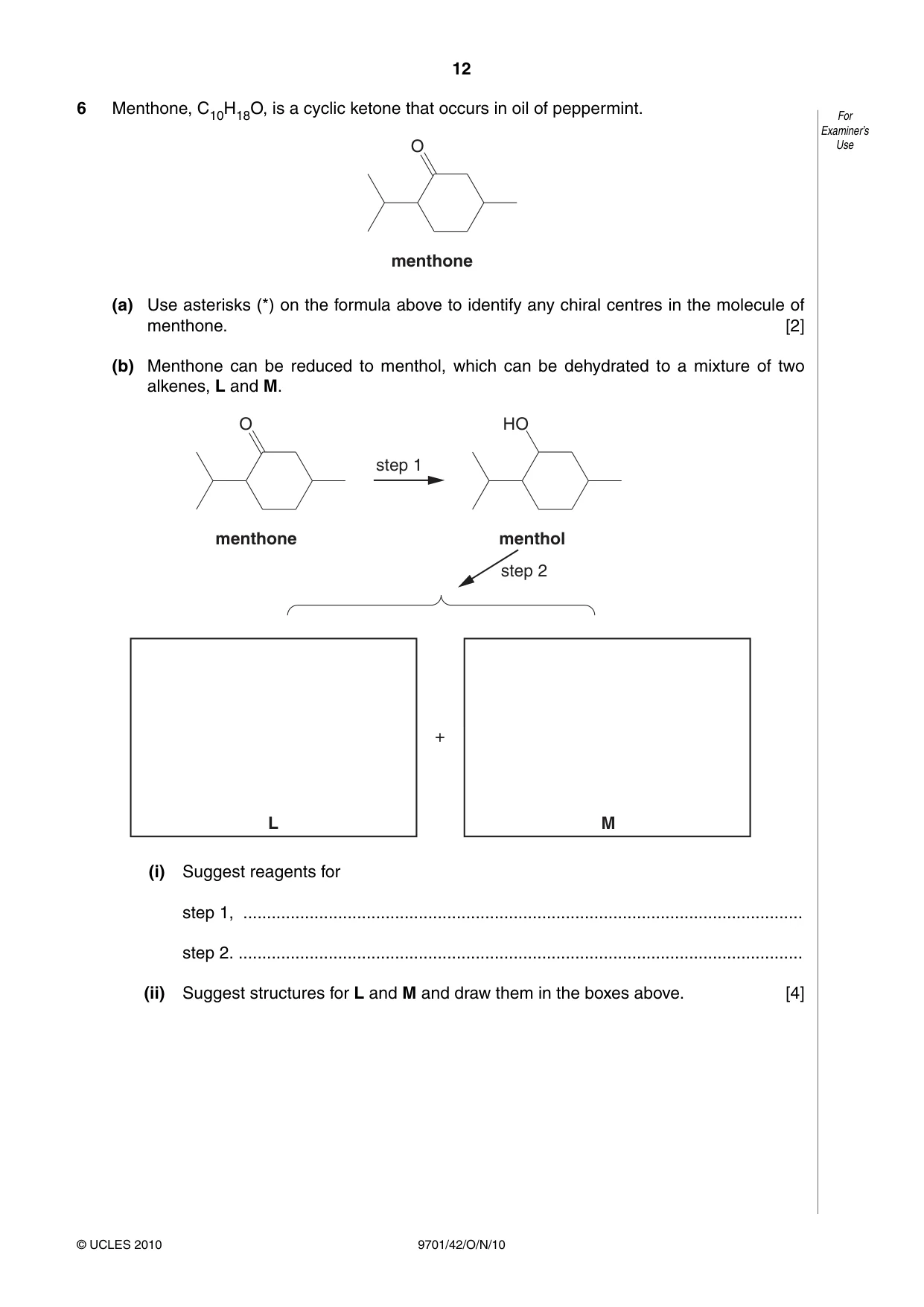
12 © UCLES 2010 9701/42/O/N/10 For Examiner’s Use 6 Menthone, C10H18O, is a cyclic ketone that occurs in oil of peppermint. O menthone (a) Use asterisks (*) on the formula above to identify any chiral centres in the molecule of menthone. [2] (b) Menthone can be reduced to menthol, which can be dehydrated to a mixture of two alkenes, L and M. O menthone L M HO menthol + step 1 step 2 (i) Suggest reagents for step 1, … step 2. … (ii) Suggest structures for L and M and draw them in the boxes above. [4]
Question paper, page 13
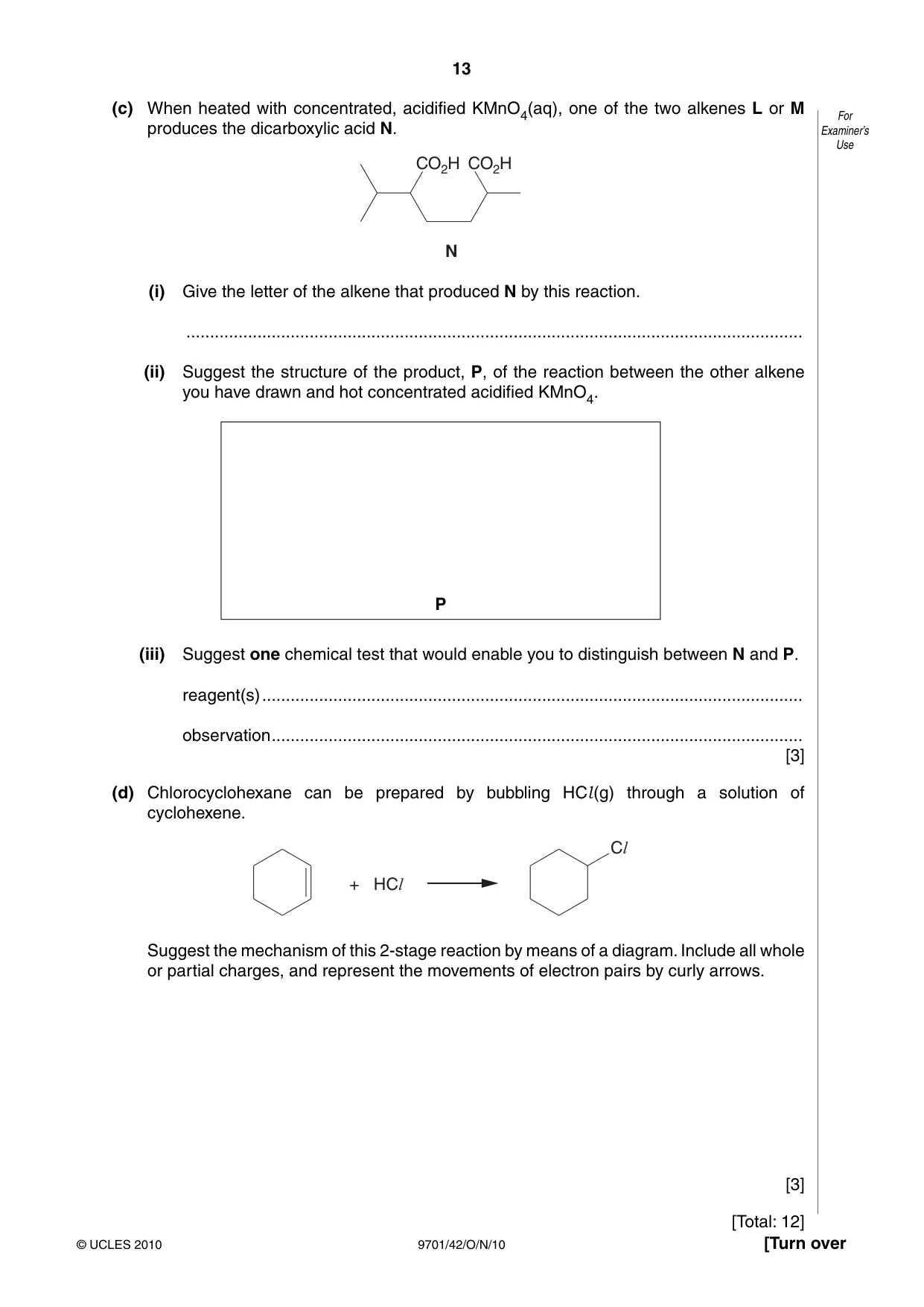
13 © UCLES 2010 [Turn over 9701/42/O/N/10 For Examiner’s Use (c) When heated with concentrated, acidified KMnO4(aq), one of the two alkenes L or M produces the dicarboxylic acid N. CO2H CO2H N (i) Give the letter of the alkene that produced N by this reaction. … (ii) Suggest the structure of the product, P, of the reaction between the other alkene you have drawn and hot concentrated acidified KMnO4. P (iii) Suggest one chemical test that would enable you to distinguish between N and P. reagent(s) … observation … [3] (d) Chlorocyclohexane can be prepared by bubbling HCl(g) through a solution of cyclohexene. Cl + HCl Suggest the mechanism of this 2-stage reaction by means of a diagram. Include all whole or partial charges, and represent the movements of electron pairs by curly arrows. [3] [Total: 12]
Question paper, page 14
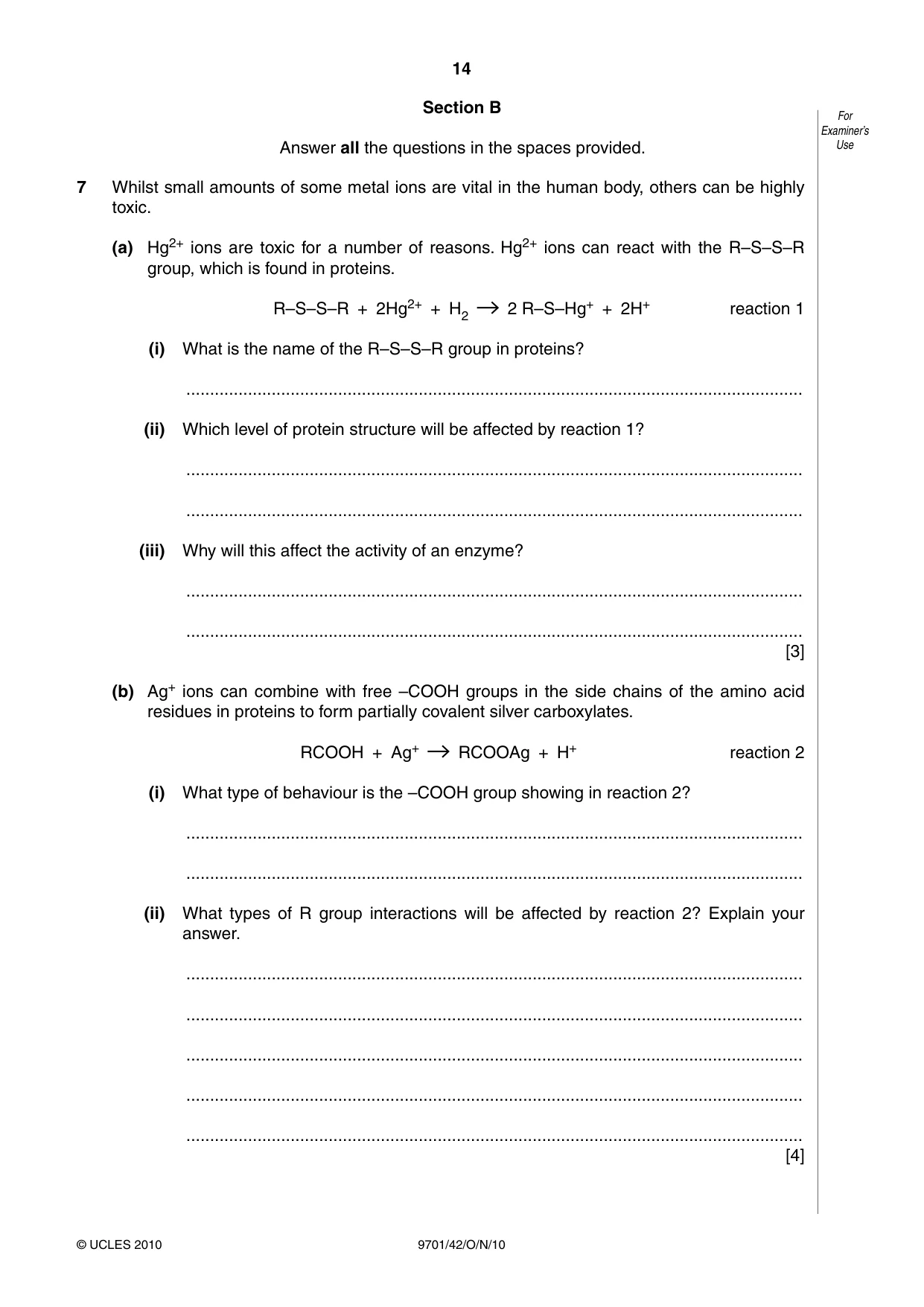
14 © UCLES 2010 9701/42/O/N/10 For Examiner’s Use Section B Answer all the questions in the spaces provided. 7 Whilst small amounts of some metal ions are vital in the human body, others can be highly toxic. (a) Hg2+ ions are toxic for a number of reasons. Hg2+ ions can react with the R–S–S–R group, which is found in proteins. R–S–S–R + 2Hg2+ + H2 2 R–S–Hg+ + 2H+ reaction 1 (i) What is the name of the R–S–S–R group in proteins? … (ii) Which level of protein structure will be affected by reaction 1? … … (iii) Why will this affect the activity of an enzyme? … … [3] (b) Ag+ ions can combine with free –COOH groups in the side chains of the amino acid residues in proteins to form partially covalent silver carboxylates. RCOOH + Ag+ RCOOAg + H+ reaction 2 (i) What type of behaviour is the –COOH group showing in reaction 2? … … (ii) What types of R group interactions will be affected by reaction 2? Explain your answer. … … … … … [4]
Question paper, page 15
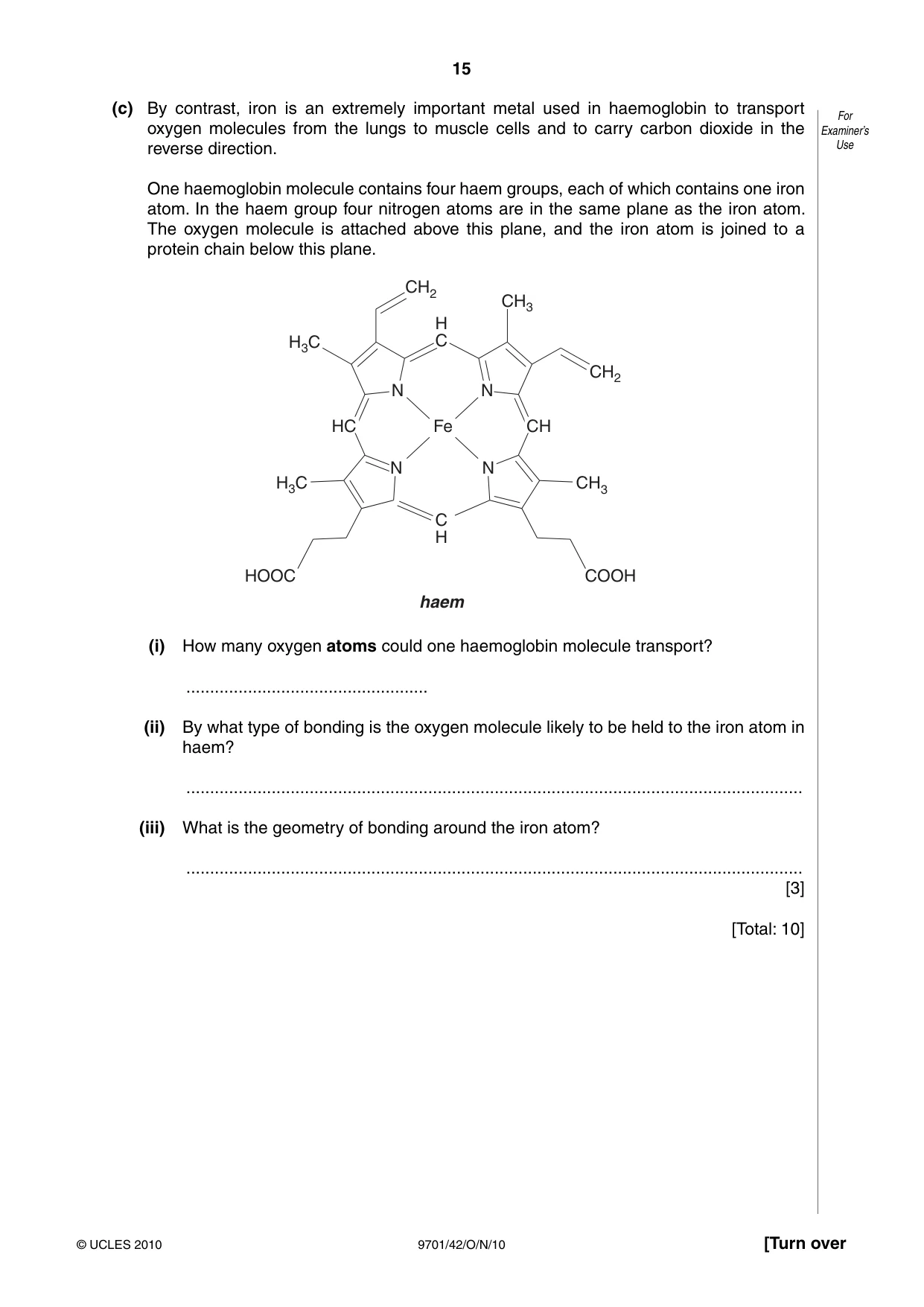
15 © UCLES 2010 [Turn over 9701/42/O/N/10 For Examiner’s Use (c) By contrast, iron is an extremely important metal used in haemoglobin to transport oxygen molecules from the lungs to muscle cells and to carry carbon dioxide in the reverse direction. One haemoglobin molecule contains four haem groups, each of which contains one iron atom. In the haem group four nitrogen atoms are in the same plane as the iron atom. The oxygen molecule is attached above this plane, and the iron atom is joined to a protein chain below this plane. H C Fe C H haem CH2 CH3 CH2 CH3 H3C H3C HOOC COOH N N N HC CH N (i) How many oxygen atoms could one haemoglobin molecule transport? … (ii) By what type of bonding is the oxygen molecule likely to be held to the iron atom in haem? … (iii) What is the geometry of bonding around the iron atom? … [3] [Total: 10]
Question paper, page 16
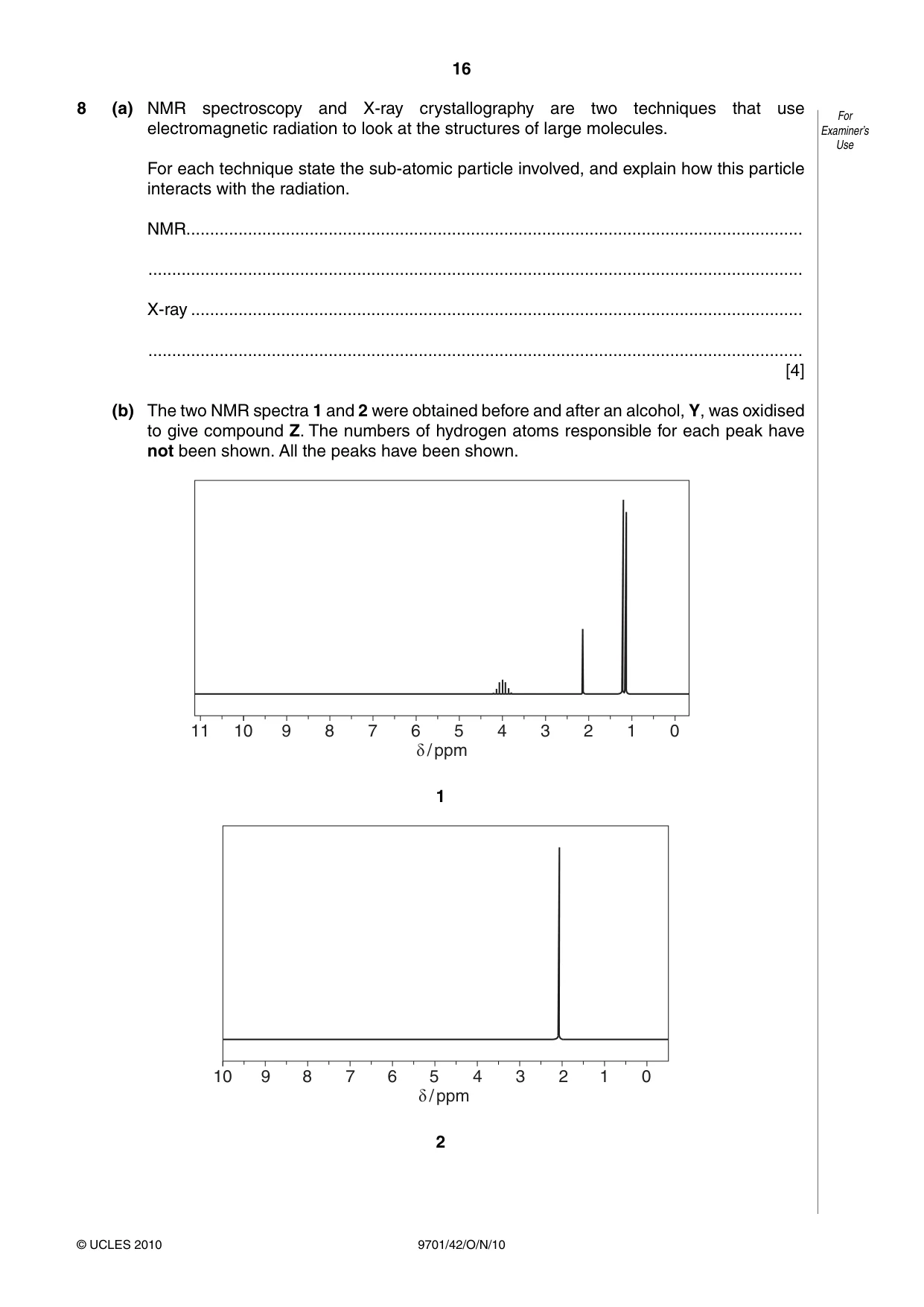
16 © UCLES 2010 9701/42/O/N/10 For Examiner’s Use 8 (a) NMR spectroscopy and X-ray crystallography are two techniques that use electromagnetic radiation to look at the structures of large molecules. For each technique state the sub-atomic particle involved, and explain how this particle interacts with the radiation. NMR… … X-ray … … [4] (b) The two NMR spectra 1 and 2 were obtained before and after an alcohol, Y, was oxidised to give compound Z. The numbers of hydrogen atoms responsible for each peak have not been shown. All the peaks have been shown. 11 10 9 8 7 6 5 4 3 2 1 0 δ / ppm 1 10 9 8 7 6 5 4 3 2 1 0 δ / ppm 2
Question paper, page 17
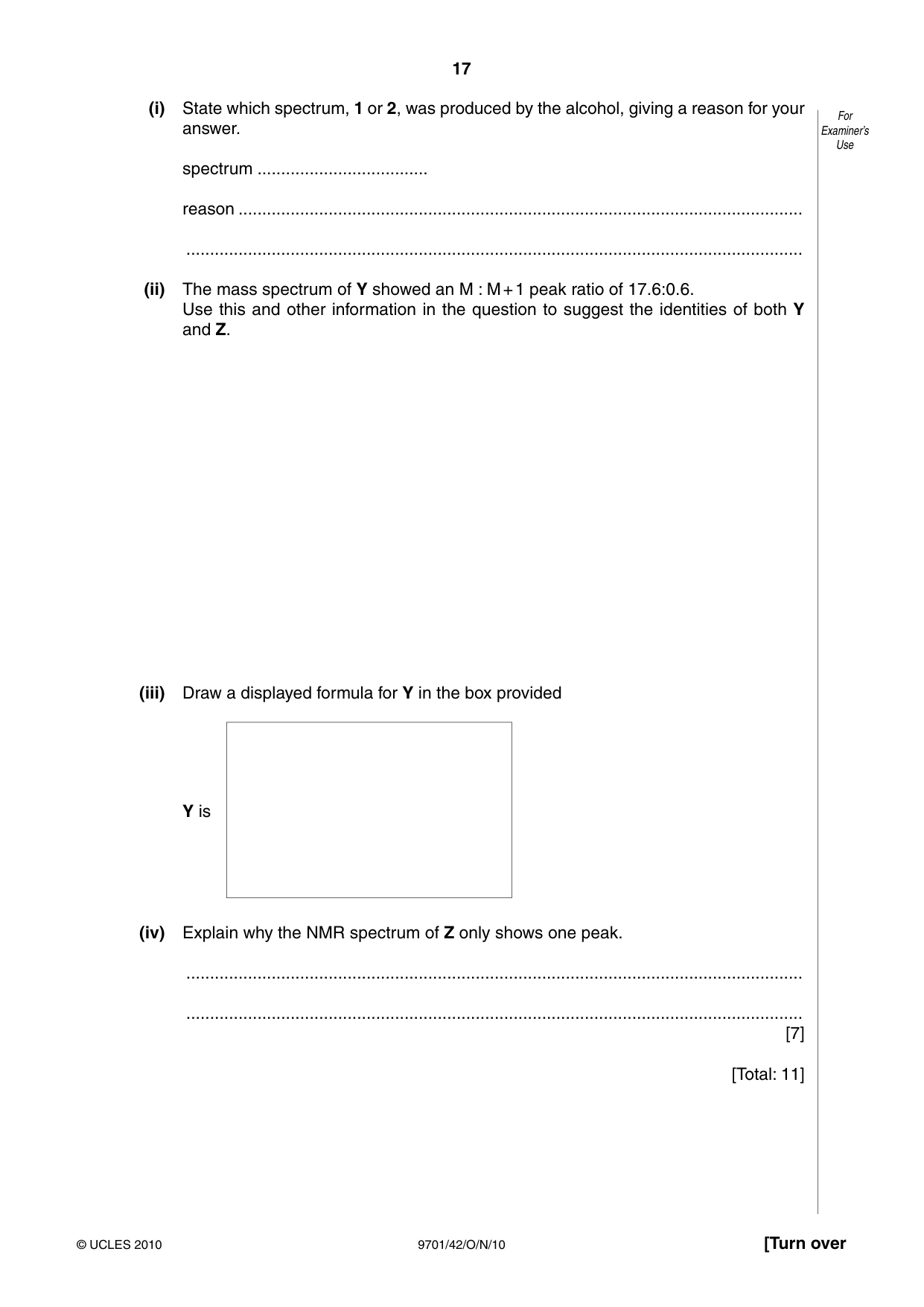
17 © UCLES 2010 [Turn over 9701/42/O/N/10 For Examiner’s Use (i) State which spectrum, 1 or 2, was produced by the alcohol, giving a reason for your answer. spectrum … reason … … (ii) The mass spectrum of Y showed an M : M + 1 peak ratio of 17.6:0.6. Use this and other information in the question to suggest the identities of both Y and Z. (iii) Draw a displayed formula for Y in the box provided Y is (iv) Explain why the NMR spectrum of Z only shows one peak. … … [7] [Total: 11]
Question paper, page 18
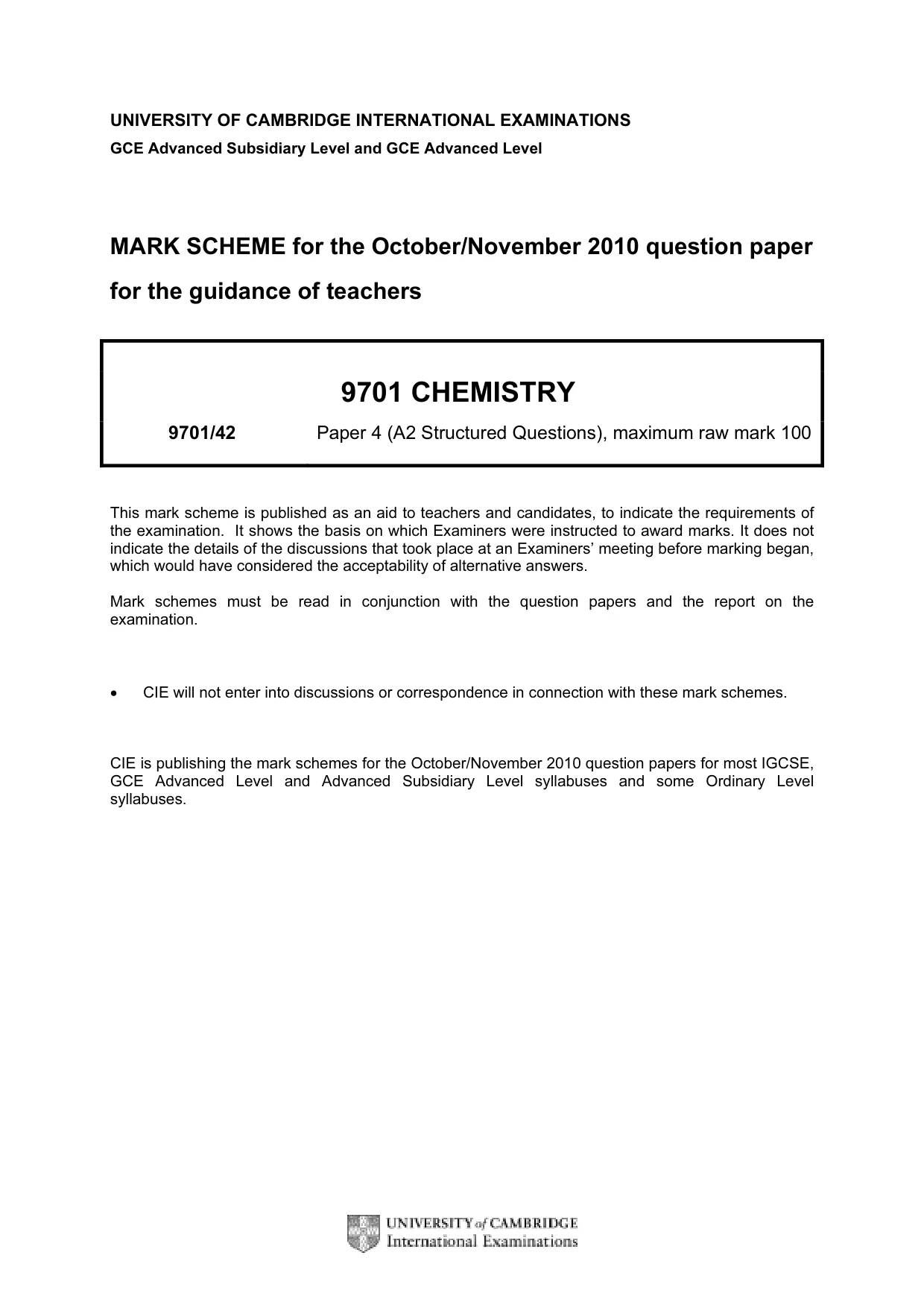
18 © UCLES 2010 9701/42/O/N/10 For Examiner’s Use 9 A possible source of energy for the road vehicles of the future is hydrogen. One of the problems still to be solved is the storage of the hydrogen in the vehicle. A conventional tank holding liquid hydrogen would have to be pressurised and refrigerated. In a crash, this type of tank could break resulting in the rapid release of hydrogen and an explosion. One alternative is to use a fuel tank packed with carbon nanotubes. The hydrogen in the tank would be adsorbed onto the surface of the nanotubes at a pressure of no more than a few atmospheres. (a) (i) What is the approximate width of a carbon nanotube? … (ii) In what structural form is the carbon in a nanotube? … (iii) What forces could be responsible for holding the hydrogen on the surface of the nanotubes? Explain your answer. … … … [4] (b) The hydrogen atoms in a fuel tank packed with nanotubes are closer together than in liquid hydrogen. Suggest one advantage of this. … …[1] (c) When a nanotube-packed fuel tank is full of hydrogen there is a steady pressure of hydrogen in the tank. While hydrogen gas is being removed from the fuel tank to power the car, the pressure in the fuel tank drops very little for some time. State Le Chatelier’s principle, and suggest how it explains this observation. … … … … … …[4] [Total: 9]
Question paper, page 19
19 9701/42/O/N/10 © UCLES 2010 BLANK PAGE
Question paper, page 20
20 9701/42/O/N/10 © UCLES 2010 BLANK PAGE Permission to reproduce items where third-party owned material protected by copyright is included has been sought and cleared where possible. Every reasonable effort has been made by the publisher (UCLES) to trace copyright holders, but if any items requiring clearance have unwittingly been included, the publisher will be pleased to make amends at the earliest possible opportunity. University of Cambridge International Examinations is part of the Cambridge Assessment Group. Cambridge Assessment is the brand name of University of Cambridge Local Examinations Syndicate (UCLES), which is itself a department of the University of Cambridge.
Mark scheme, page 1
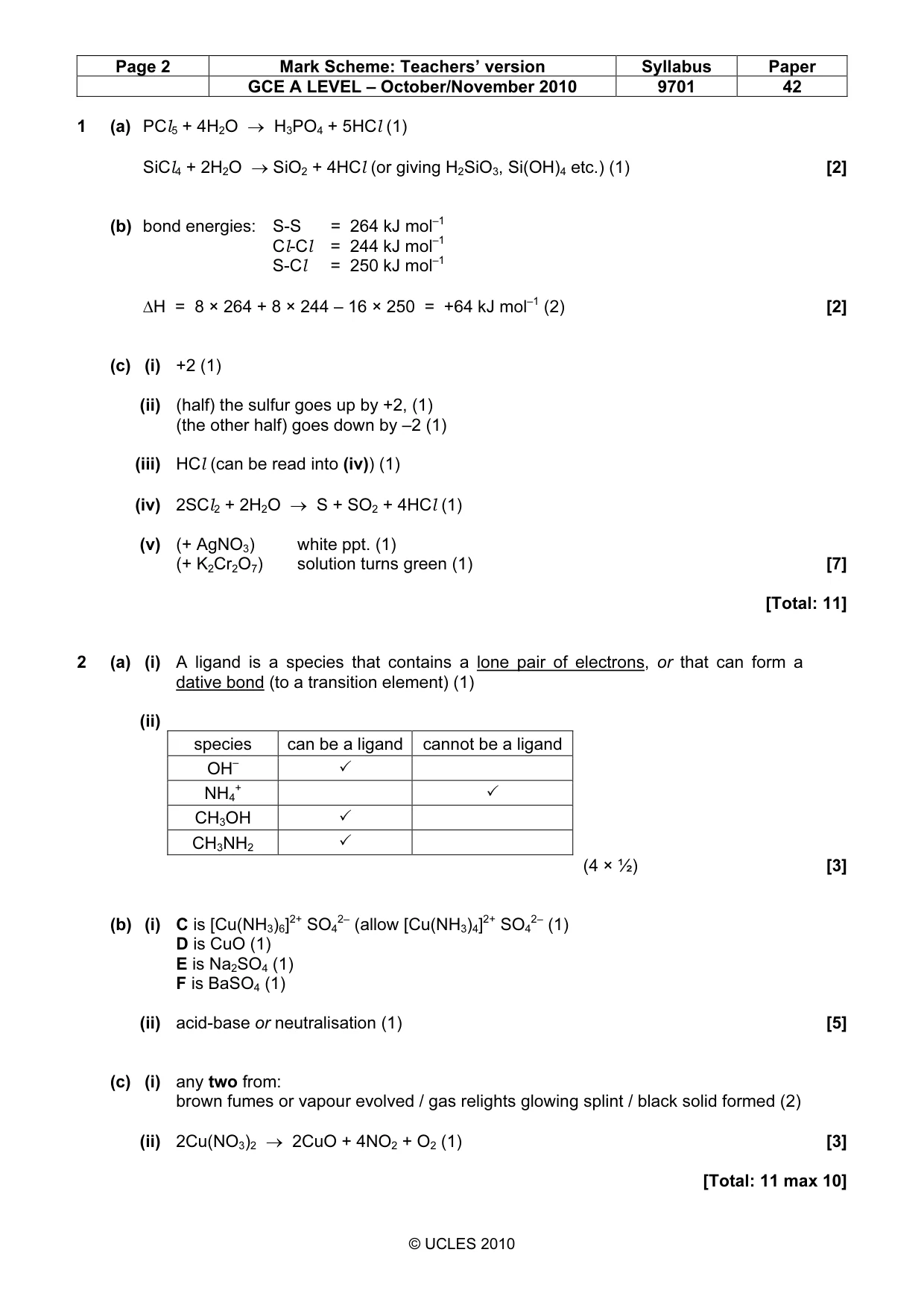
UNIVERSITY OF CAMBRIDGE INTERNATIONAL EXAMINATIONS GCE Advanced Subsidiary Level and GCE Advanced Level MARK SCHEME for the October/November 2010 question paper for the guidance of teachers 9701 CHEMISTRY 9701/42 Paper 4 (A2 Structured Questions), maximum raw mark 100 This mark scheme is published as an aid to teachers and candidates, to indicate the requirements of the examination. It shows the basis on which Examiners were instructed to award marks. It does not indicate the details of the discussions that took place at an Examiners’ meeting before marking began, which would have considered the acceptability of alternative answers. Mark schemes must be read in conjunction with the question papers and the report on the examination. • CIE will not enter into discussions or correspondence in connection with these mark schemes. CIE is publishing the mark schemes for the October/November 2010 question papers for most IGCSE, GCE Advanced Level and Advanced Subsidiary Level syllabuses and some Ordinary Level syllabuses.
Mark scheme, page 2
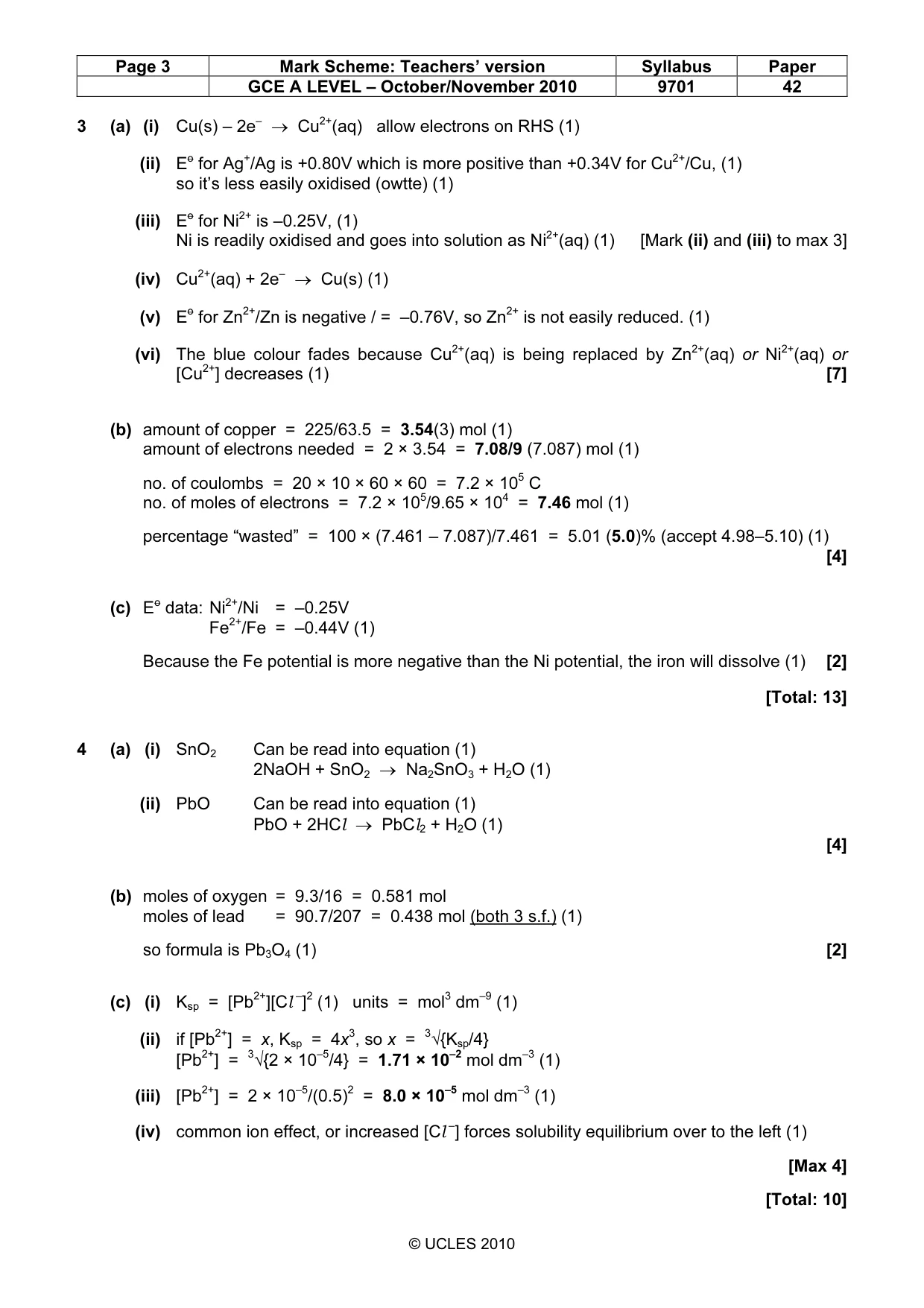
Page 2 Mark Scheme: Teachers’ version Syllabus Paper GCE A LEVEL – October/November 2010 9701 42 © UCLES 2010 1 (a) PCl5 + 4H2O → H3PO4 + 5HCl (1) SiCl4 + 2H2O → SiO2 + 4HCl (or giving H2SiO3, Si(OH)4 etc.) (1) [2] (b) bond energies: S-S = 264 kJ mol–1 Cl-Cl = 244 kJ mol–1 S-Cl = 250 kJ mol–1 ∆H = 8 × 264 + 8 × 244 – 16 × 250 = +64 kJ mol–1 (2) [2] (c) (i) +2 (1) (ii) (half) the sulfur goes up by +2, (1) (the other half) goes down by –2 (1) (iii) HCl (can be read into (iv)) (1) (iv) 2SCl2 + 2H2O → S + SO2 + 4HCl (1) (v) (+ AgNO3) white ppt. (1) (+ K2Cr2O7) solution turns green (1) [7] [Total: 11] 2 (a) (i) A ligand is a species that contains a lone pair of electrons, or that can form a dative bond (to a transition element) (1) (ii) species can be a ligand cannot be a ligand OH– ✓ NH4 + ✓ CH3OH ✓ CH3NH2 ✓ (4 × ½) [3] (b) (i) C is [Cu(NH3)6]2+ SO4 2– (allow [Cu(NH3)4]2+ SO4 2– (1) D is CuO (1) E is Na2SO4 (1) F is BaSO4 (1) (ii) acid-base or neutralisation (1) [5] (c) (i) any two from: brown fumes or vapour evolved / gas relights glowing splint / black solid formed (2) (ii) 2Cu(NO3)2 → 2CuO + 4NO2 + O2 (1) [3] [Total: 11 max 10]
Mark scheme, page 3
Page 3 Mark Scheme: Teachers’ version Syllabus Paper GCE A LEVEL – October/November 2010 9701 42 © UCLES 2010 3 (a) (i) Cu(s) – 2e– → Cu2+(aq) allow electrons on RHS (1) (ii) Eo for Ag+/Ag is +0.80V which is more positive than +0.34V for Cu2+/Cu, (1) so it’s less easily oxidised (owtte) (1) (iii) Eo for Ni2+ is –0.25V, (1) Ni is readily oxidised and goes into solution as Ni2+(aq) (1) [Mark (ii) and (iii) to max 3] (iv) Cu2+(aq) + 2e– → Cu(s) (1) (v) Eo for Zn2+/Zn is negative / = –0.76V, so Zn2+ is not easily reduced. (1) (vi) The blue colour fades because Cu2+(aq) is being replaced by Zn2+(aq) or Ni2+(aq) or [Cu2+] decreases (1) [7] (b) amount of copper = 225/63.5 = 3.54(3) mol (1) amount of electrons needed = 2 × 3.54 = 7.08/9 (7.087) mol (1) no. of coulombs = 20 × 10 × 60 × 60 = 7.2 × 10⁵ C no. of moles of electrons = 7.2 × 10⁵/9.65 × 104 = 7.46 mol (1) percentage “wasted” = 100 × (7.461 – 7.087)/7.461 = 5.01 (5.0)% (accept 4.98–5.10) (1) [4] (c) Eo data: Ni2+/Ni = –0.25V Fe2+/Fe = –0.44V (1) Because the Fe potential is more negative than the Ni potential, the iron will dissolve (1) [2] [Total: 13] 4 (a) (i) SnO2 Can be read into equation (1) 2NaOH + SnO2 → Na2SnO3 + H2O (1) (ii) PbO Can be read into equation (1) PbO + 2HCl → PbCl2 + H2O (1) [4] (b) moles of oxygen = 9.3/16 = 0.581 mol moles of lead = 90.7/207 = 0.438 mol (both 3 s.f.) (1) so formula is Pb3O4 (1) [2] (c) (i) Ksp = [Pb2+][Cl –]2 (1) units = mol3 dm–9 (1) (ii) if [Pb2+] = x, Ksp = 4x3, so x = 3√{Ksp/4} [Pb2+] = 3√{2 × 10⁻⁵/4} = 1.71 × 10⁻² mol dm–3 (1) (iii) [Pb2+] = 2 × 10⁻⁵/(0.5)2 = 8.0 × 10⁻⁵ mol dm–3 (1) (iv) common ion effect, or increased [Cl –] forces solubility equilibrium over to the left (1) [Max 4] [Total: 10]
Mark scheme, page 4
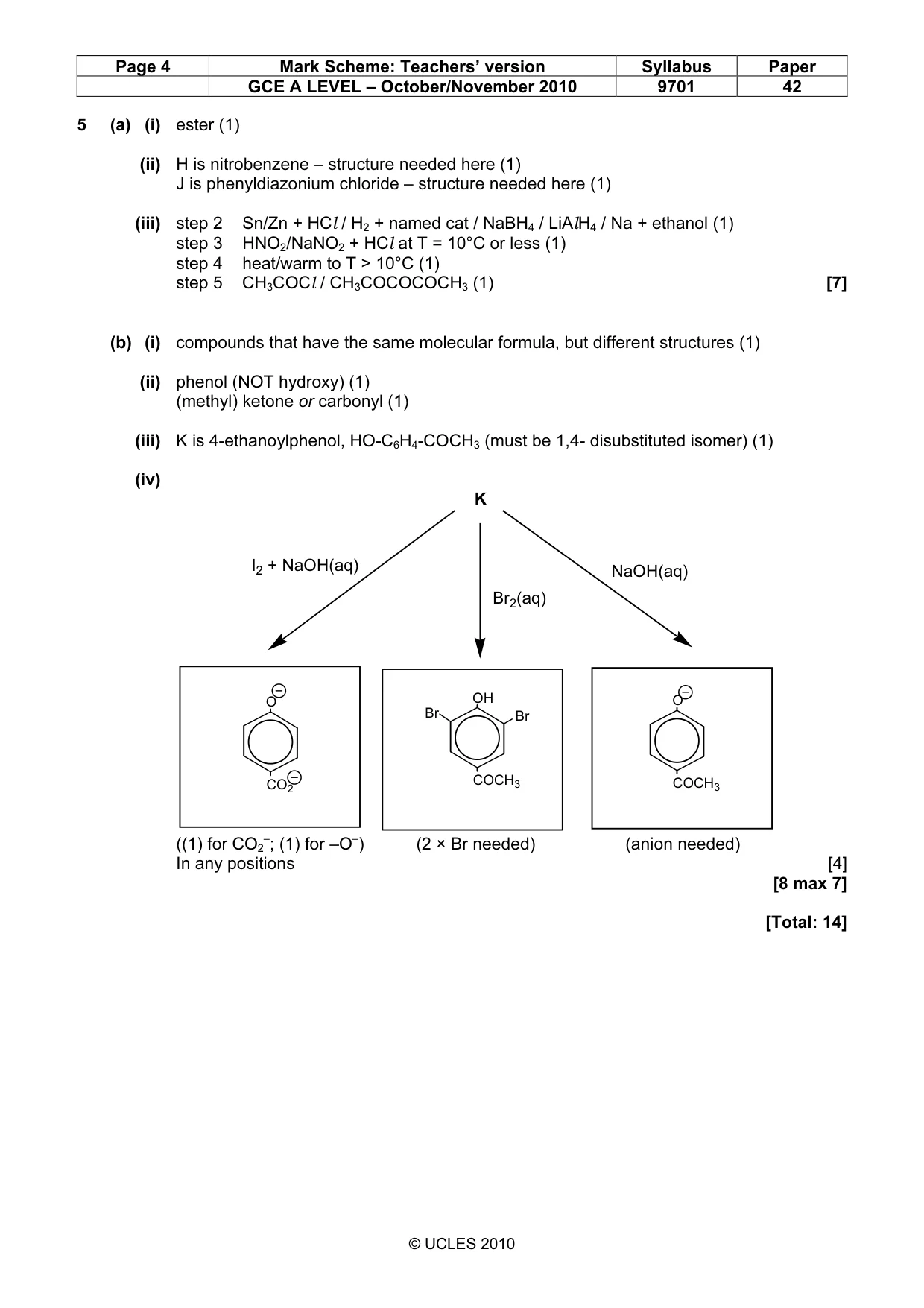
Page 4 Mark Scheme: Teachers’ version Syllabus Paper GCE A LEVEL – October/November 2010 9701 42 © UCLES 2010 5 (a) (i) ester (1) (ii) H is nitrobenzene – structure needed here (1) J is phenyldiazonium chloride – structure needed here (1) (iii) step 2 Sn/Zn + HCl / H2 + named cat / NaBH4 / LiAlH4 / Na + ethanol (1) step 3 HNO2/NaNO2 + HCl at T = 10°C or less (1) step 4 heat/warm to T > 10°C (1) step 5 CH3COCl / CH3COCOCOCH3 (1) [7] (b) (i) compounds that have the same molecular formula, but different structures (1) (ii) phenol (NOT hydroxy) (1) (methyl) ketone or carbonyl (1) (iii) K is 4-ethanoylphenol, HO-C6H4-COCH3 (must be 1,4- disubstituted isomer) (1) (iv) I2 + NaOH(aq) Br2(aq) NaOH(aq) K O CO2 OH COCH3 O COCH3 Br Br ((1) for CO2 –; (1) for –O–) (2 × Br needed) (anion needed) In any positions [4] [8 max 7] [Total: 14]
Mark scheme, page 5
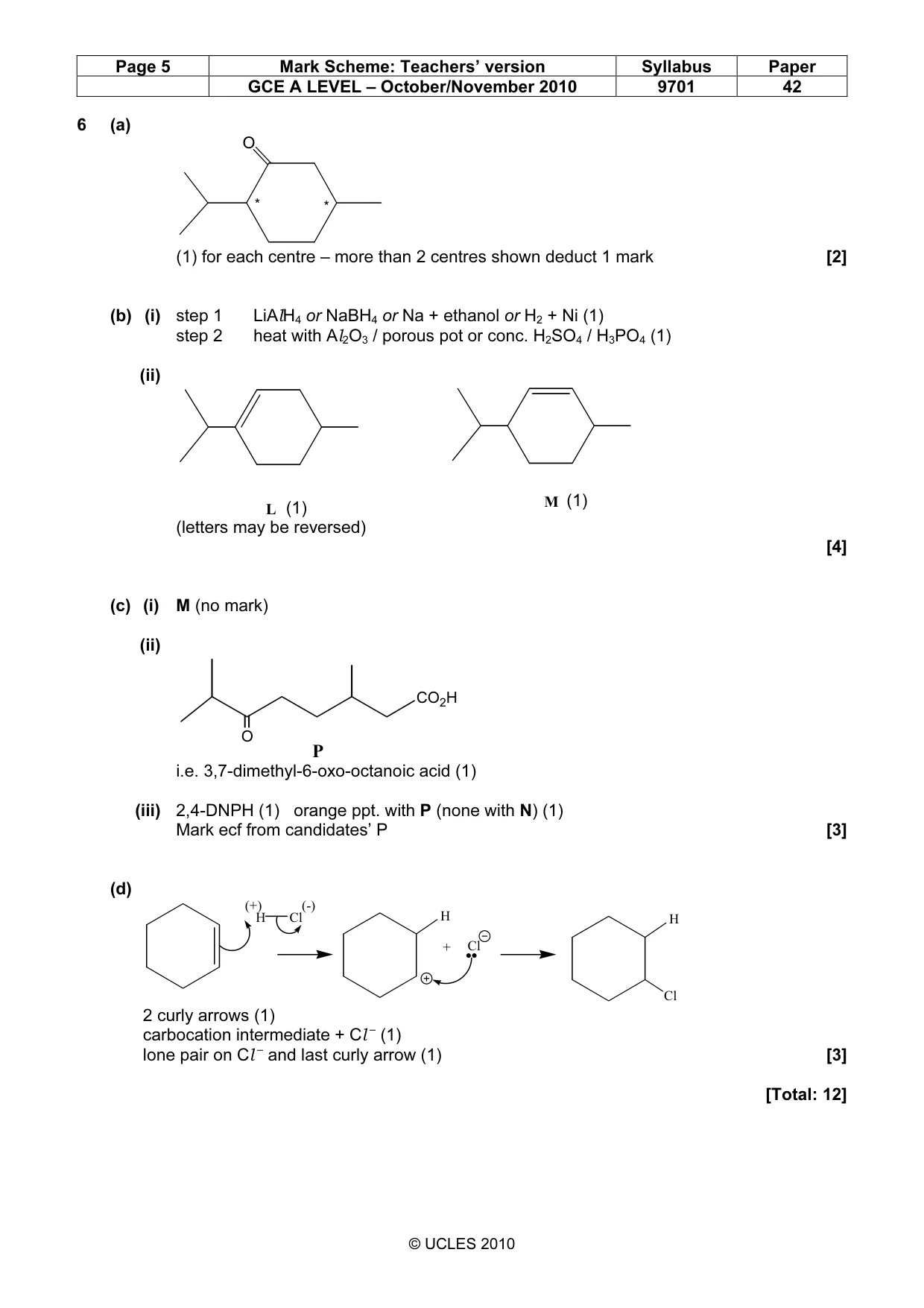
Page 5 Mark Scheme: Teachers’ version Syllabus Paper GCE A LEVEL – October/November 2010 9701 42 © UCLES 2010 6 (a) O * * (1) for each centre – more than 2 centres shown deduct 1 mark [2] (b) (i) step 1 LiAlH4 or NaBH4 or Na + ethanol or H2 + Ni (1) step 2 heat with Al2O3 / porous pot or conc. H2SO4 / H3PO4 (1) (ii) L M (letters may be reversed) [4] (c) (i) M (no mark) (ii) CO2H O P i.e. 3,7-dimethyl-6-oxo-octanoic acid (1) (iii) 2,4-DNPH (1) orange ppt. with P (none with N) (1) Mark ecf from candidates’ P [3] (d) H Cl (+) (-) H + Cl H Cl 2 curly arrows (1) carbocation intermediate + Cl – (1) lone pair on Cl – and last curly arrow (1) [3] [Total: 12] (1) (1)
Mark scheme, page 6
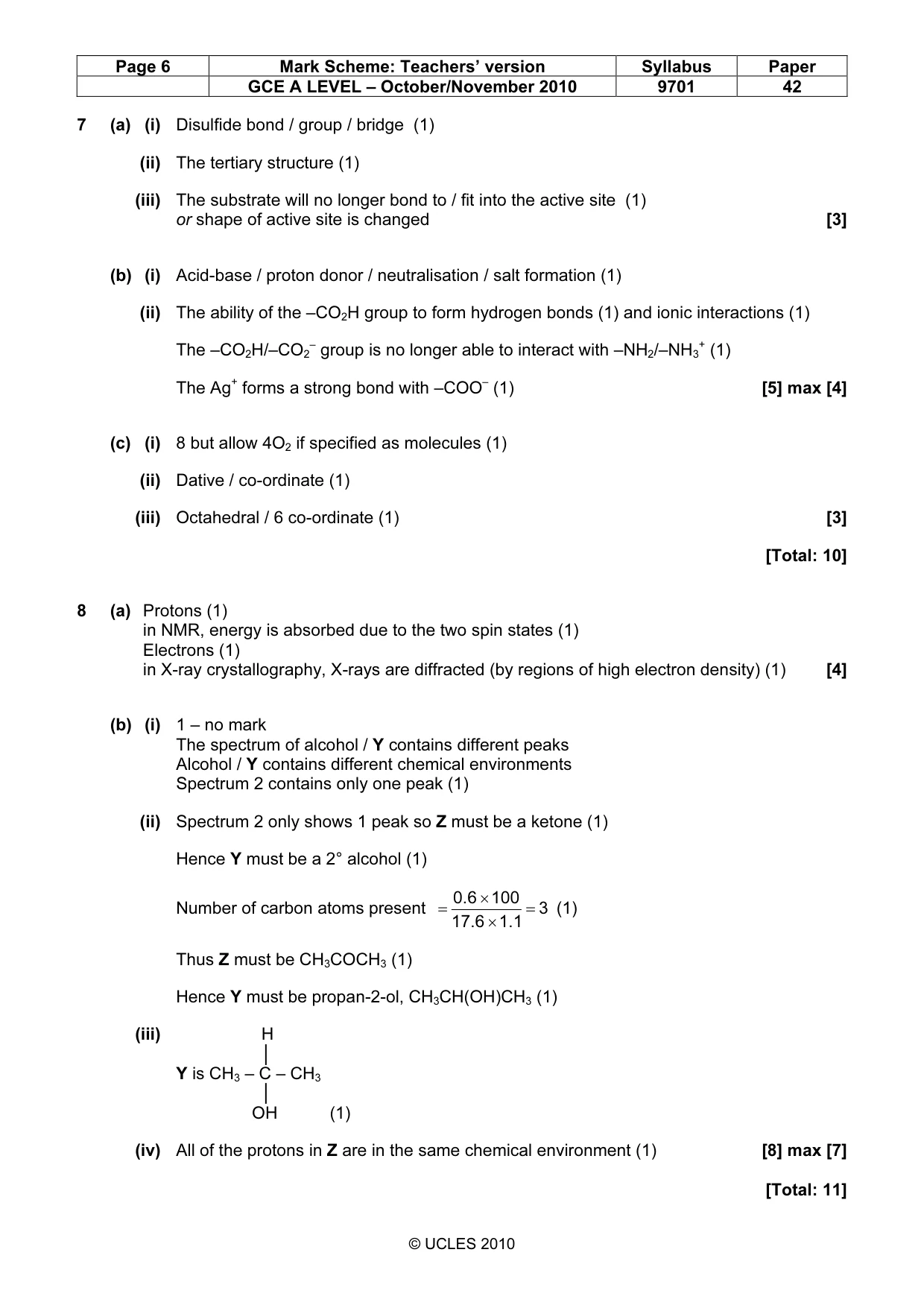
Page 6 Mark Scheme: Teachers’ version Syllabus Paper GCE A LEVEL – October/November 2010 9701 42 © UCLES 2010 7 (a) (i) Disulfide bond / group / bridge (1) (ii) The tertiary structure (1) (iii) The substrate will no longer bond to / fit into the active site (1) or shape of active site is changed [3] (b) (i) Acid-base / proton donor / neutralisation / salt formation (1) (ii) The ability of the –CO2H group to form hydrogen bonds (1) and ionic interactions (1) The –CO2H/–CO2 – group is no longer able to interact with –NH2/–NH3 + (1) The Ag+ forms a strong bond with –COO– (1) [5] max [4] (c) (i) 8 but allow 4O2 if specified as molecules (1) (ii) Dative / co-ordinate (1) (iii) Octahedral / 6 co-ordinate (1) [3] [Total: 10] 8 (a) Protons (1) in NMR, energy is absorbed due to the two spin states (1) Electrons (1) in X-ray crystallography, X-rays are diffracted (by regions of high electron density) (1) [4] (b) (i) 1 – no mark The spectrum of alcohol / Y contains different peaks Alcohol / Y contains different chemical environments Spectrum 2 contains only one peak (1) (ii) Spectrum 2 only shows 1 peak so Z must be a ketone (1) Hence Y must be a 2° alcohol (1) Number of carbon atoms present 3 1.1 17.6 100 0.6 = × × = (1) Thus Z must be CH3COCH3 (1) Hence Y must be propan-2-ol, CH3CH(OH)CH3 (1) (iii) H │ Y is CH3 – C – CH3 │ OH (1) (iv) All of the protons in Z are in the same chemical environment (1) [8] max [7] [Total: 11]
Mark scheme, page 7
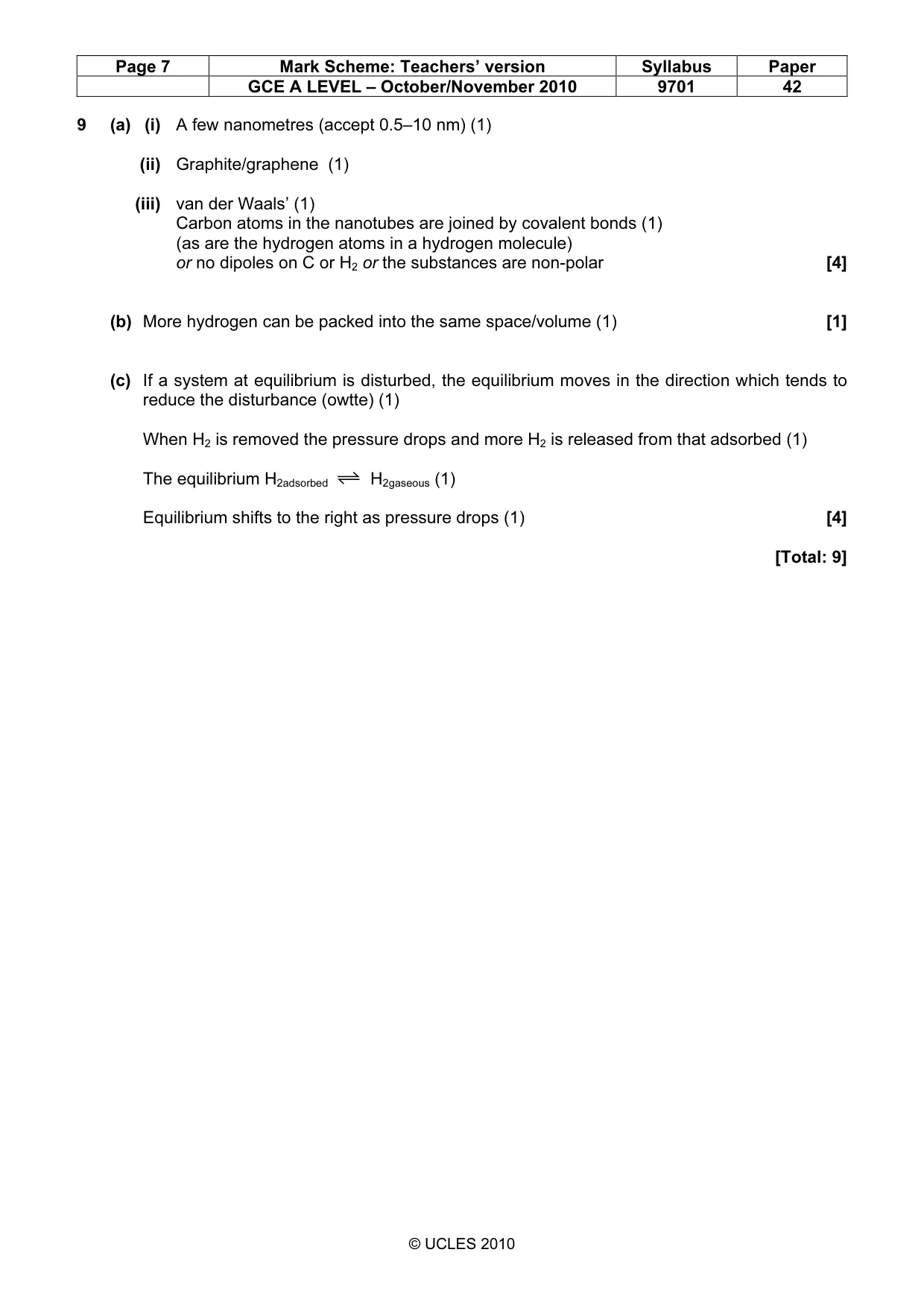
Page 7 Mark Scheme: Teachers’ version Syllabus Paper GCE A LEVEL – October/November 2010 9701 42 © UCLES 2010 9 (a) (i) A few nanometres (accept 0.5–10 nm) (1) (ii) Graphite/graphene (1) (iii) van der Waals’ (1) Carbon atoms in the nanotubes are joined by covalent bonds (1) (as are the hydrogen atoms in a hydrogen molecule) or no dipoles on C or H2 or the substances are non-polar [4] (b) More hydrogen can be packed into the same space/volume (1) [1] (c) If a system at equilibrium is disturbed, the equilibrium moves in the direction which tends to reduce the disturbance (owtte) (1) When H2 is removed the pressure drops and more H2 is released from that adsorbed (1) The equilibrium H2adsorbed H2gaseous (1) Equilibrium shifts to the right as pressure drops (1) [4] [Total: 9]
What you needed in this session
Cambridge’s own grade thresholds for 2010 Oct/Nov, Paper 4 · Variant 2. A higher threshold means an easier paper — the bar moves with how the cohort did.