Cambridge A Level Chemistry 9701 — 2010 Oct/Nov Paper 4 · Variant 3
9701/43/O/N/10 · 100 marks · ≈113 min
The question paper and its mark scheme, free to read here and free to download. This is Cambridge’s own paper, exactly as it was sat.
Question paper20 pages
Mark scheme8 pages
Answers below. Sit the paper first if you are practising.
Paper as text
Question paper, page 1
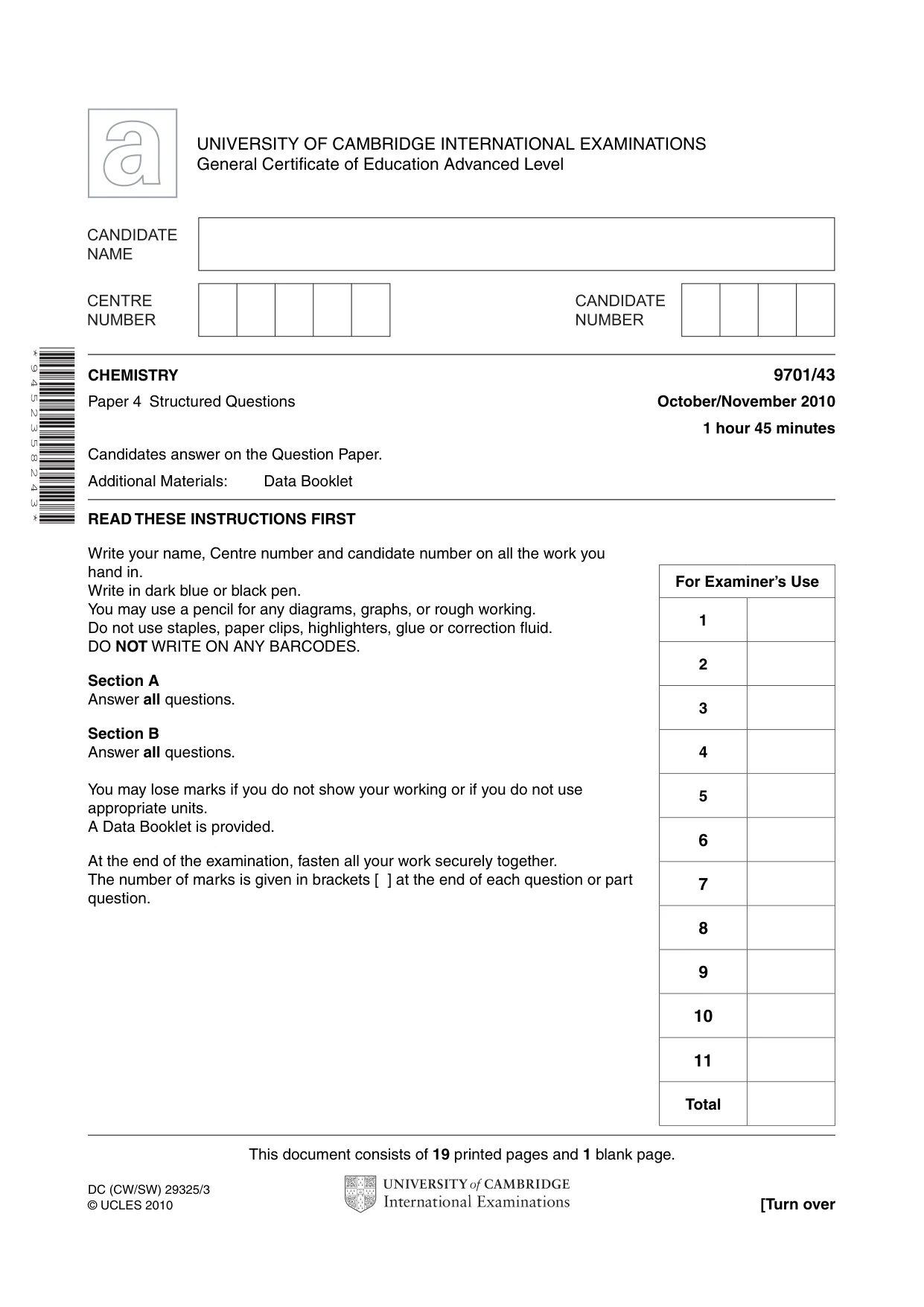
This document consists of 19 printed pages and 1 blank page. DC (CW/SW) 29325/3 © UCLES 2010 [Turn over UNIVERSITY OF CAMBRIDGE INTERNATIONAL EXAMINATIONS General Certificate of Education Advanced Level READ THESE INSTRUCTIONS FIRST Write your name, Centre number and candidate number on all the work you hand in. Write in dark blue or black pen. You may use a pencil for any diagrams, graphs, or rough working. Do not use staples, paper clips, highlighters, glue or correction fluid. DO NOT WRITE ON ANY BARCODES. Section A Answer all questions. Section B Answer all questions. You may lose marks if you do not show your working or if you do not use appropriate units. A Data Booklet is provided. At the end of the examination, fasten all your work securely together. The number of marks is given in brackets [ ] at the end of each question or part question. * 9 4 5 2 3 5 8 2 4 3 * CHEMISTRY 9701/43 Paper 4 Structured Questions October/November 2010 1 hour 45 minutes Candidates answer on the Question Paper. Additional Materials: Data Booklet For Examiner’s Use 1 2 3 4 5 6 7 8 9 10 11 Total
Question paper, page 2
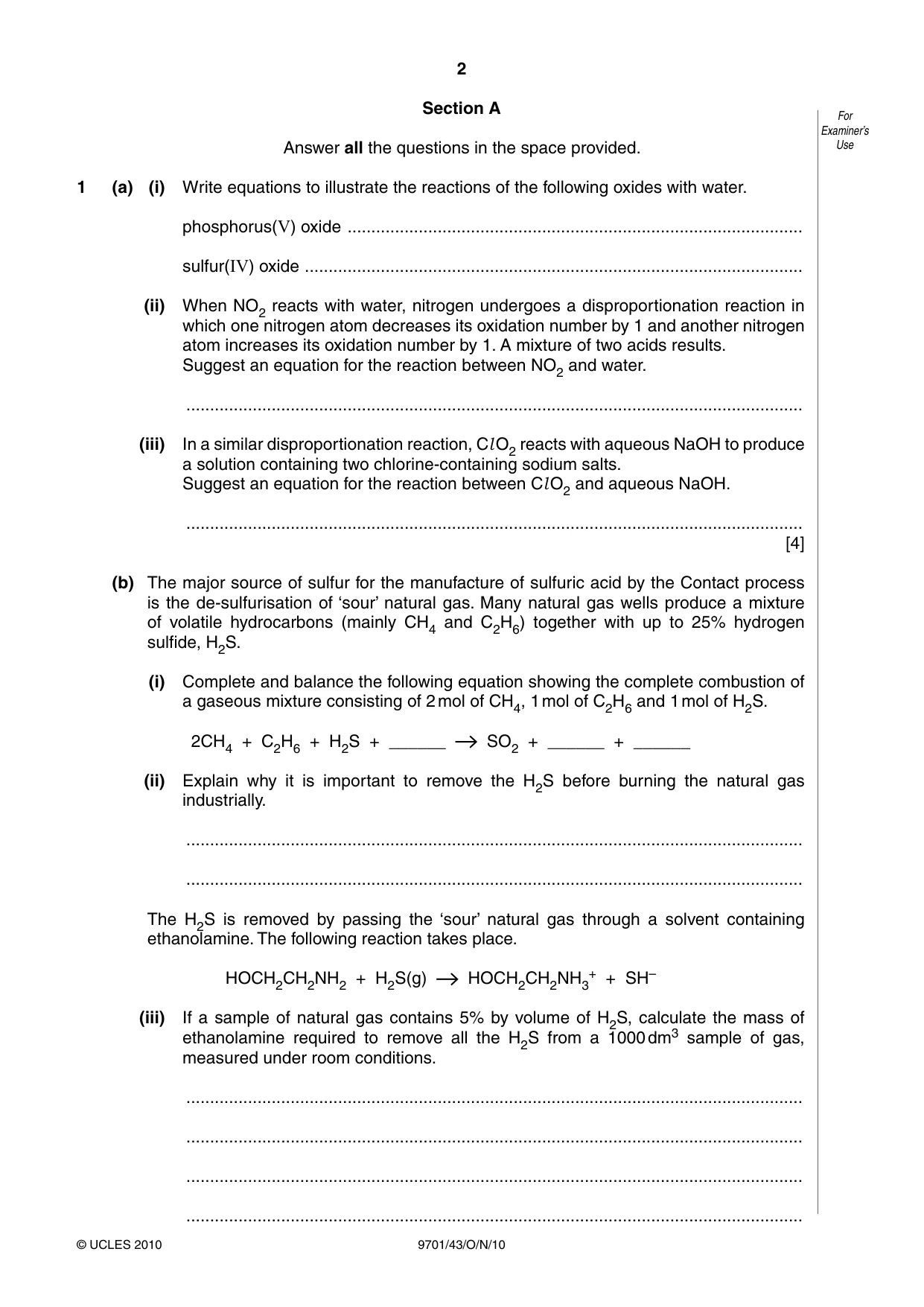
2 9701/43/O/N/10 © UCLES 2010 For Examiner’s Use Section A Answer all the questions in the space provided. 1 (a) (i) Write equations to illustrate the reactions of the following oxides with water. phosphorus(V) oxide … sulfur(IV) oxide … (ii) When NO2 reacts with water, nitrogen undergoes a disproportionation reaction in which one nitrogen atom decreases its oxidation number by 1 and another nitrogen atom increases its oxidation number by 1. A mixture of two acids results. Suggest an equation for the reaction between NO2 and water. … (iii) In a similar disproportionation reaction, Cl O2 reacts with aqueous NaOH to produce a solution containing two chlorine-containing sodium salts. Suggest an equation for the reaction between Cl O2 and aqueous NaOH. … [4] (b) The major source of sulfur for the manufacture of sulfuric acid by the Contact process is the de-sulfurisation of ‘sour’ natural gas. Many natural gas wells produce a mixture of volatile hydrocarbons (mainly CH4 and C2H6) together with up to 25% hydrogen sulfide, H2S. (i) Complete and balance the following equation showing the complete combustion of a gaseous mixture consisting of 2 mol of CH4, 1 mol of C2H6 and 1 mol of H2S. 2CH4 + C2H6 + H2S + ______ SO2 + ______ + ______ (ii) Explain why it is important to remove the H2S before burning the natural gas industrially. … … The H2S is removed by passing the ‘sour’ natural gas through a solvent containing ethanolamine. The following reaction takes place. HOCH2CH2NH2 + H2S(g) HOCH2CH2NH3 + + SH– (iii) If a sample of natural gas contains 5% by volume of H2S, calculate the mass of ethanolamine required to remove all the H2S from a 1000 dm3 sample of gas, measured under room conditions. … … … …
Question paper, page 3
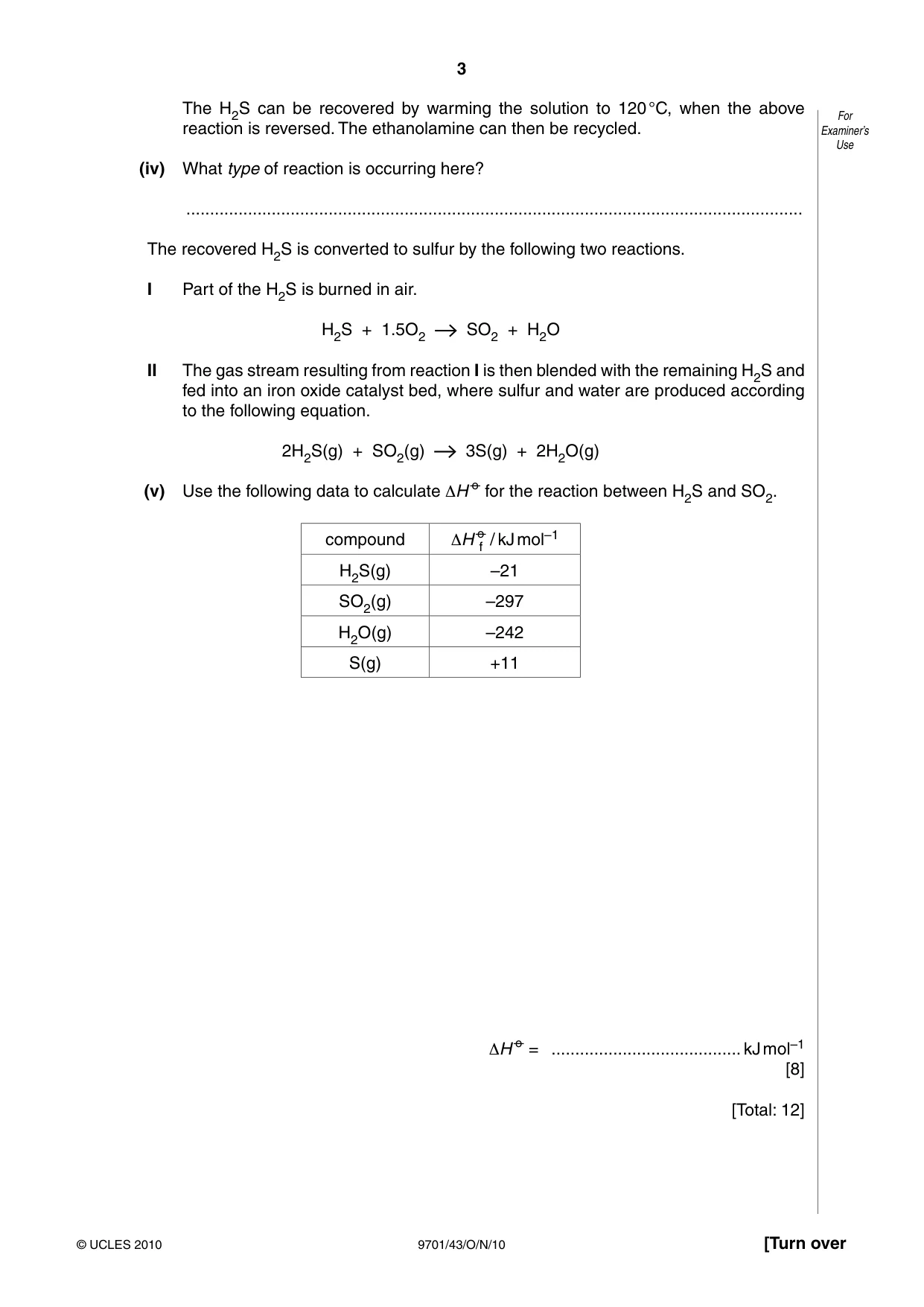
3 9701/43/O/N/10 © UCLES 2010 [Turn over For Examiner’s Use The H2S can be recovered by warming the solution to 120 °C, when the above reaction is reversed. The ethanolamine can then be recycled. (iv) What type of reaction is occurring here? … The recovered H2S is converted to sulfur by the following two reactions. I Part of the H2S is burned in air. H2S + 1.5O2 SO2 + H2O II The gas stream resulting from reaction I is then blended with the remaining H2S and fed into an iron oxide catalyst bed, where sulfur and water are produced according to the following equation. 2H2S(g) + SO2(g) 3S(g) + 2H2O(g) (v) Use the following data to calculate ΔH o–– for the reaction between H2S and SO2. compound ΔH o–– f / kJ mol–1 H2S(g) –21 SO2(g) –297 H2O(g) –242 S(g) +11 ΔH o–– = … kJ mol–1 [8] [Total: 12]
Question paper, page 4
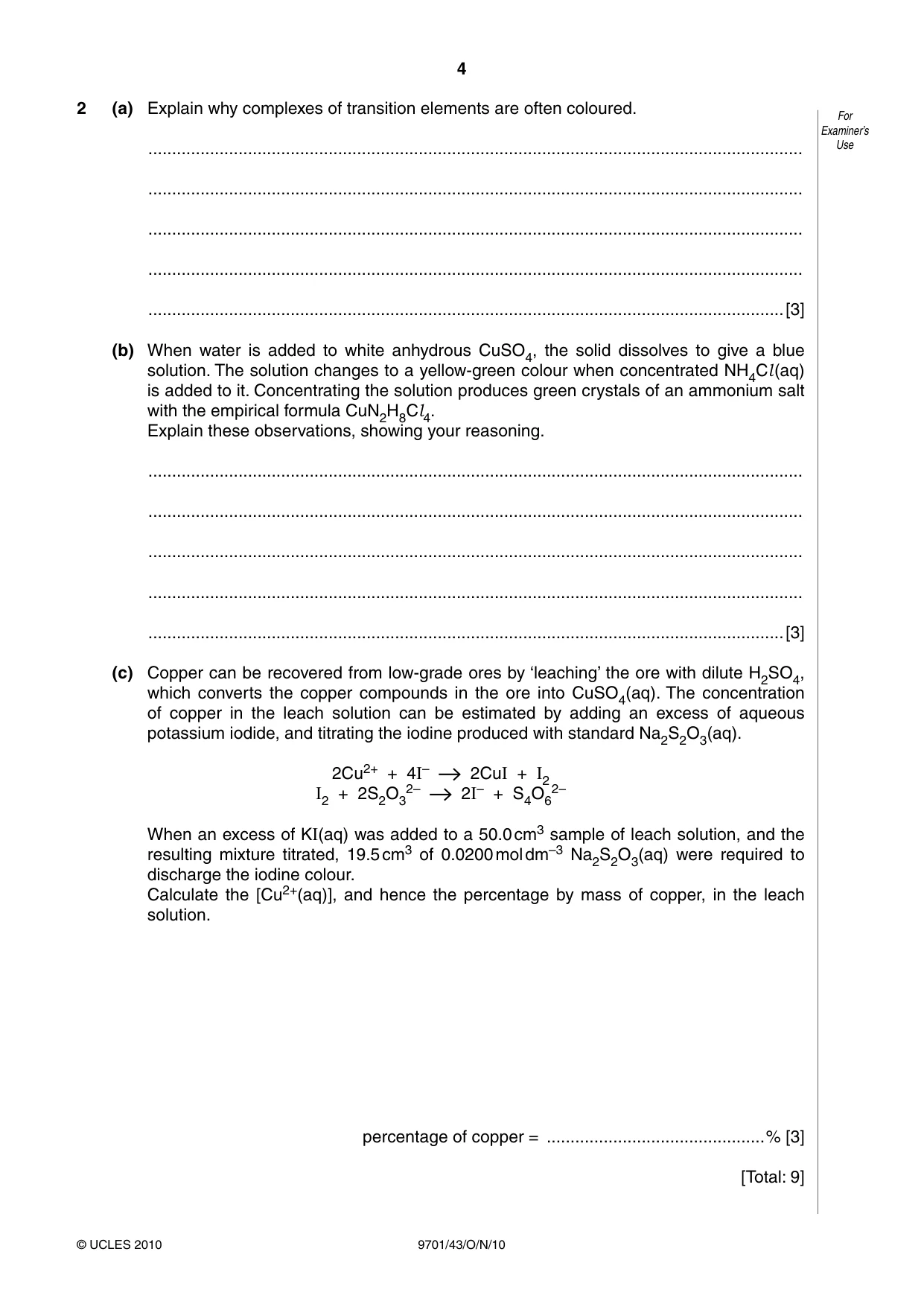
4 9701/43/O/N/10 © UCLES 2010 For Examiner’s Use 2 (a) Explain why complexes of transition elements are often coloured. … … … … …[3] (b) When water is added to white anhydrous CuSO4, the solid dissolves to give a blue solution. The solution changes to a yellow-green colour when concentrated NH4Cl (aq) is added to it. Concentrating the solution produces green crystals of an ammonium salt with the empirical formula CuN2H8Cl4. Explain these observations, showing your reasoning. … … … … …[3] (c) Copper can be recovered from low-grade ores by ‘leaching’ the ore with dilute H2SO4, which converts the copper compounds in the ore into CuSO4(aq). The concentration of copper in the leach solution can be estimated by adding an excess of aqueous potassium iodide, and titrating the iodine produced with standard Na2S2O3(aq). 2Cu2+ + 4I– 2CuI + I2 I2 + 2S2O3 2– 2I– + S4O6 2– When an excess of KI(aq) was added to a 50.0 cm3 sample of leach solution, and the resulting mixture titrated, 19.5 cm3 of 0.0200 mol dm–3 Na2S2O3(aq) were required to discharge the iodine colour. Calculate the [Cu2+(aq)], and hence the percentage by mass of copper, in the leach solution. percentage of copper = …% [3] [Total: 9]
Question paper, page 5
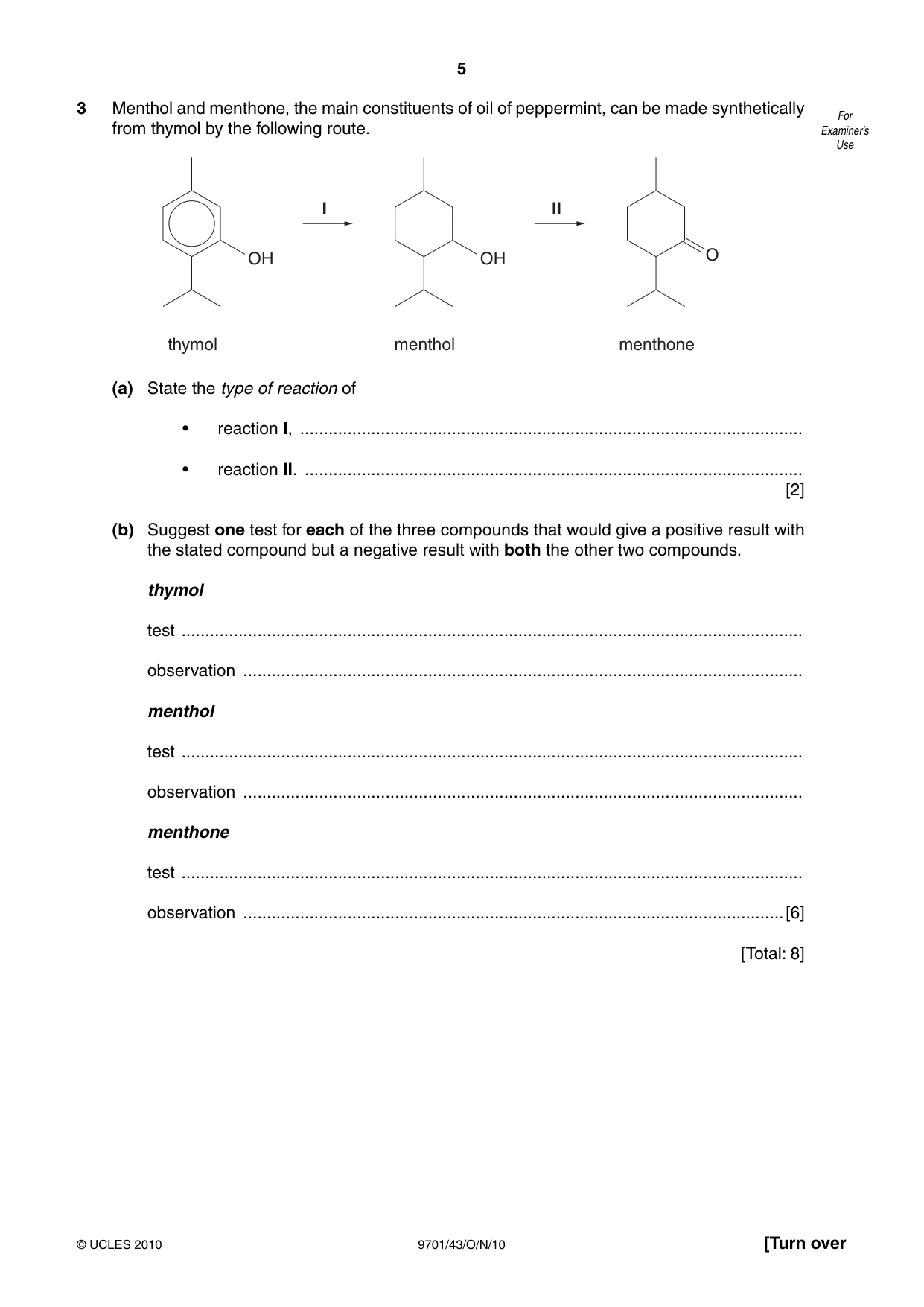
5 9701/43/O/N/10 © UCLES 2010 [Turn over For Examiner’s Use 3 Menthol and menthone, the main constituents of oil of peppermint, can be made synthetically from thymol by the following route. I OH II OH thymol menthol menthone O (a) State the type of reaction of • reaction I, … • reaction II. … [2] (b) Suggest one test for each of the three compounds that would give a positive result with the stated compound but a negative result with both the other two compounds. thymol test … observation … menthol test … observation … menthone test … observation …[6] [Total: 8]
Question paper, page 6
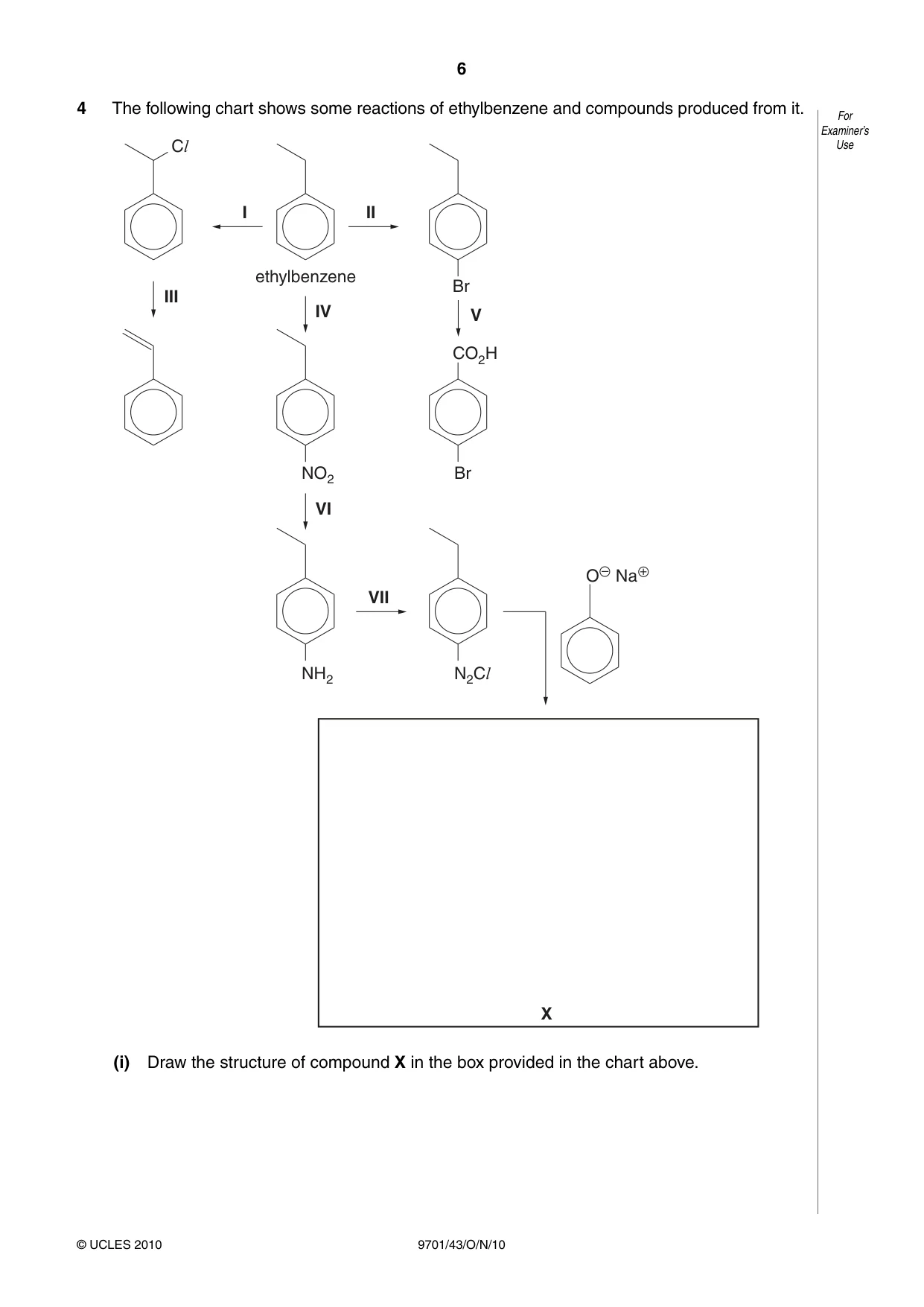
6 9701/43/O/N/10 © UCLES 2010 For Examiner’s Use 4 The following chart shows some reactions of ethylbenzene and compounds produced from it. Cl NO2 III I II ethylbenzene IV Br Br CO2H V VII X NH2 VI N2Cl O – Na + (i) Draw the structure of compound X in the box provided in the chart above.
Question paper, page 7
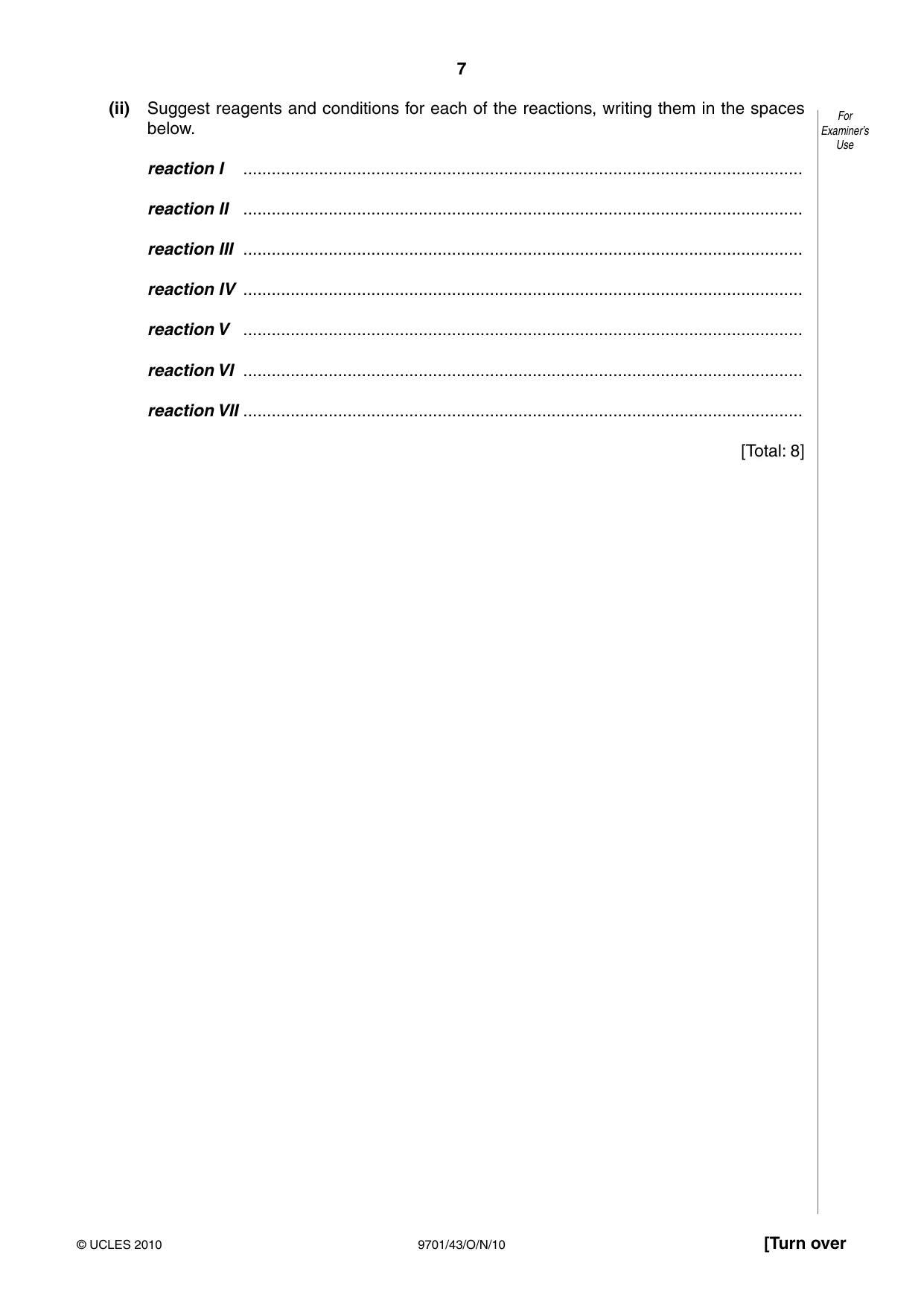
7 9701/43/O/N/10 © UCLES 2010 [Turn over For Examiner’s Use (ii) Suggest reagents and conditions for each of the reactions, writing them in the spaces below. reaction I … reaction II … reaction III … reaction IV … reaction V … reaction VI … reaction VII … [Total: 8]
Question paper, page 8
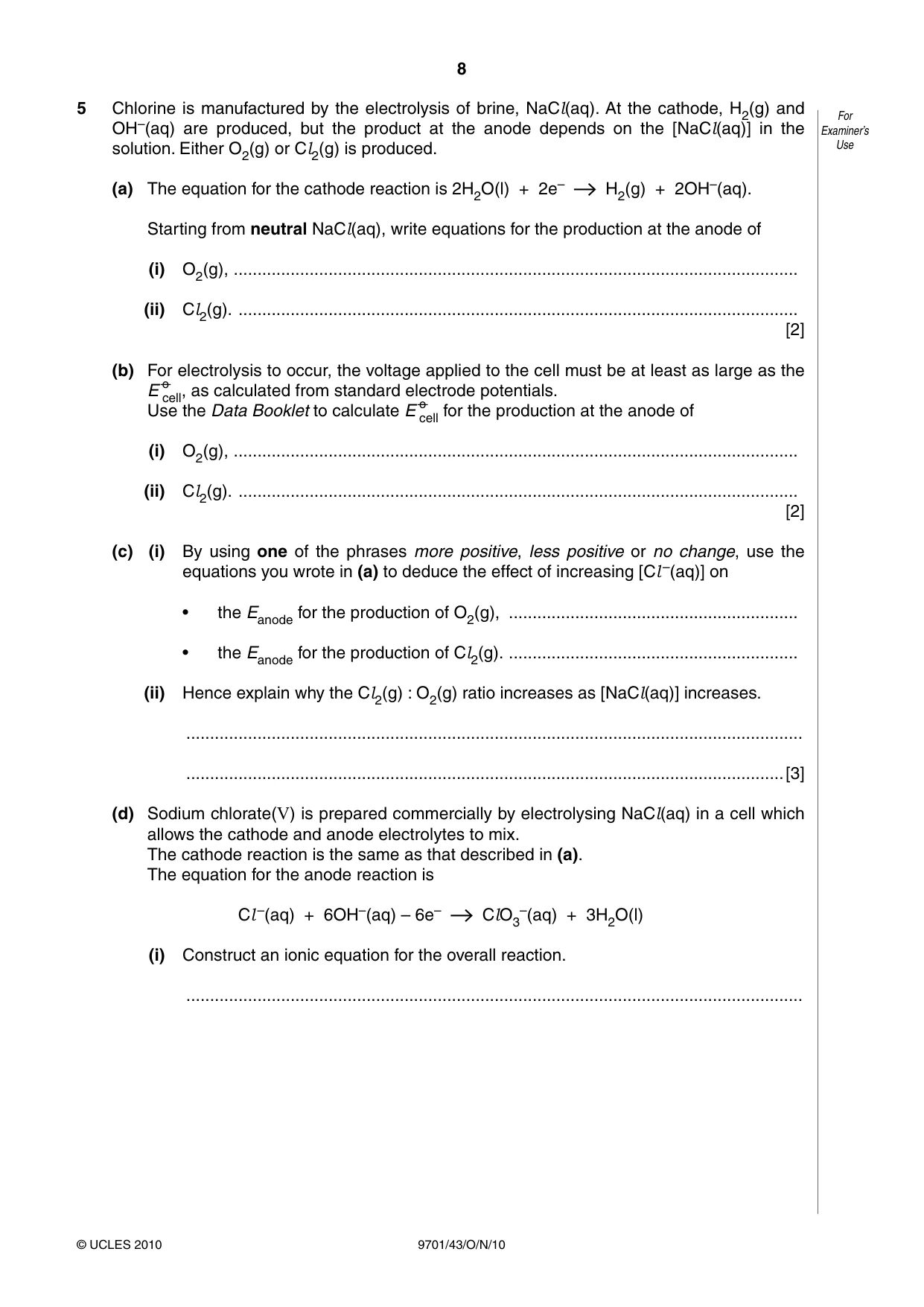
8 9701/43/O/N/10 © UCLES 2010 For Examiner’s Use 5 Chlorine is manufactured by the electrolysis of brine, NaCl(aq). At the cathode, H2(g) and OH–(aq) are produced, but the product at the anode depends on the [NaCl(aq)] in the solution. Either O2(g) or Cl2(g) is produced. (a) The equation for the cathode reaction is 2H2O(l) + 2e– H2(g) + 2OH–(aq). Starting from neutral NaCl(aq), write equations for the production at the anode of (i) O2(g), … (ii) Cl2(g). … [2] (b) For electrolysis to occur, the voltage applied to the cell must be at least as large as the E o–– cell, as calculated from standard electrode potentials. Use the Data Booklet to calculate E o–– cell for the production at the anode of (i) O2(g), … (ii) Cl2(g). … [2] (c) (i) By using one of the phrases more positive, less positive or no change, use the equations you wrote in (a) to deduce the effect of increasing [Cl –(aq)] on • the Eanode for the production of O2(g), … • the Eanode for the production of Cl2(g). … (ii) Hence explain why the Cl2(g) : O2(g) ratio increases as [NaCl(aq)] increases. … …[3] (d) Sodium chlorate(V) is prepared commercially by electrolysing NaCl(aq) in a cell which allows the cathode and anode electrolytes to mix. The cathode reaction is the same as that described in (a). The equation for the anode reaction is Cl –(aq) + 6OH–(aq) – 6e– ClO3 –(aq) + 3H2O(l) (i) Construct an ionic equation for the overall reaction. …
Question paper, page 9
9 9701/43/O/N/10 © UCLES 2010 [Turn over For Examiner’s Use (ii) Calculate the mass of NaClO3 that is produced when a current of 250 A is passed through the cell for 60 minutes. mass of NaCl O3 = …g [4] [Total: 11]
Question paper, page 10
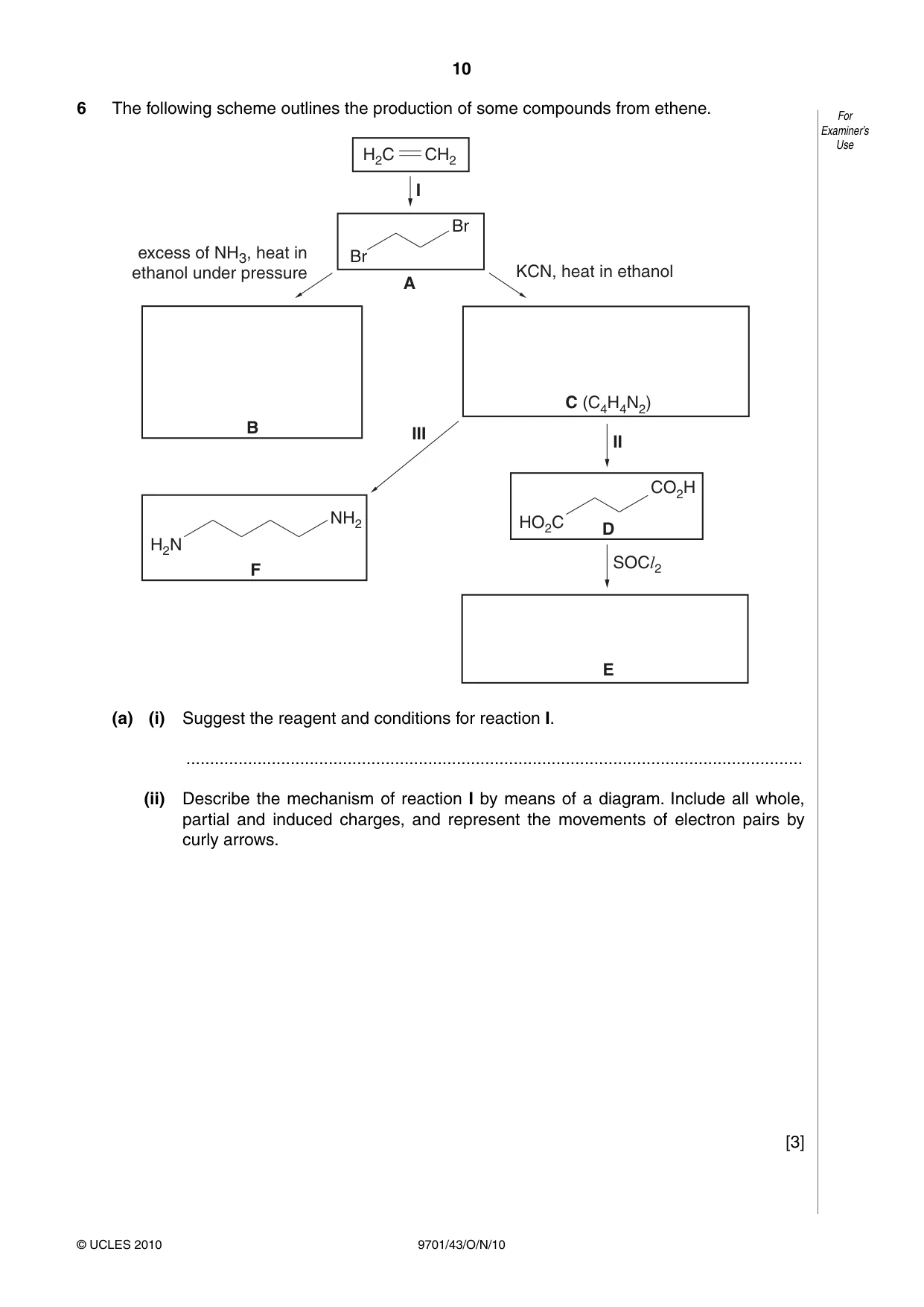
10 9701/43/O/N/10 © UCLES 2010 For Examiner’s Use 6 The following scheme outlines the production of some compounds from ethene. Br H2C CH2 I Br HO2C CO2H H2N NH2 A B C (C4H4N2) E F D II III SOCl2 KCN, heat in ethanol excess of NH3, heat in ethanol under pressure (a) (i) Suggest the reagent and conditions for reaction I. … (ii) Describe the mechanism of reaction I by means of a diagram. Include all whole, partial and induced charges, and represent the movements of electron pairs by curly arrows. [3]
Question paper, page 11
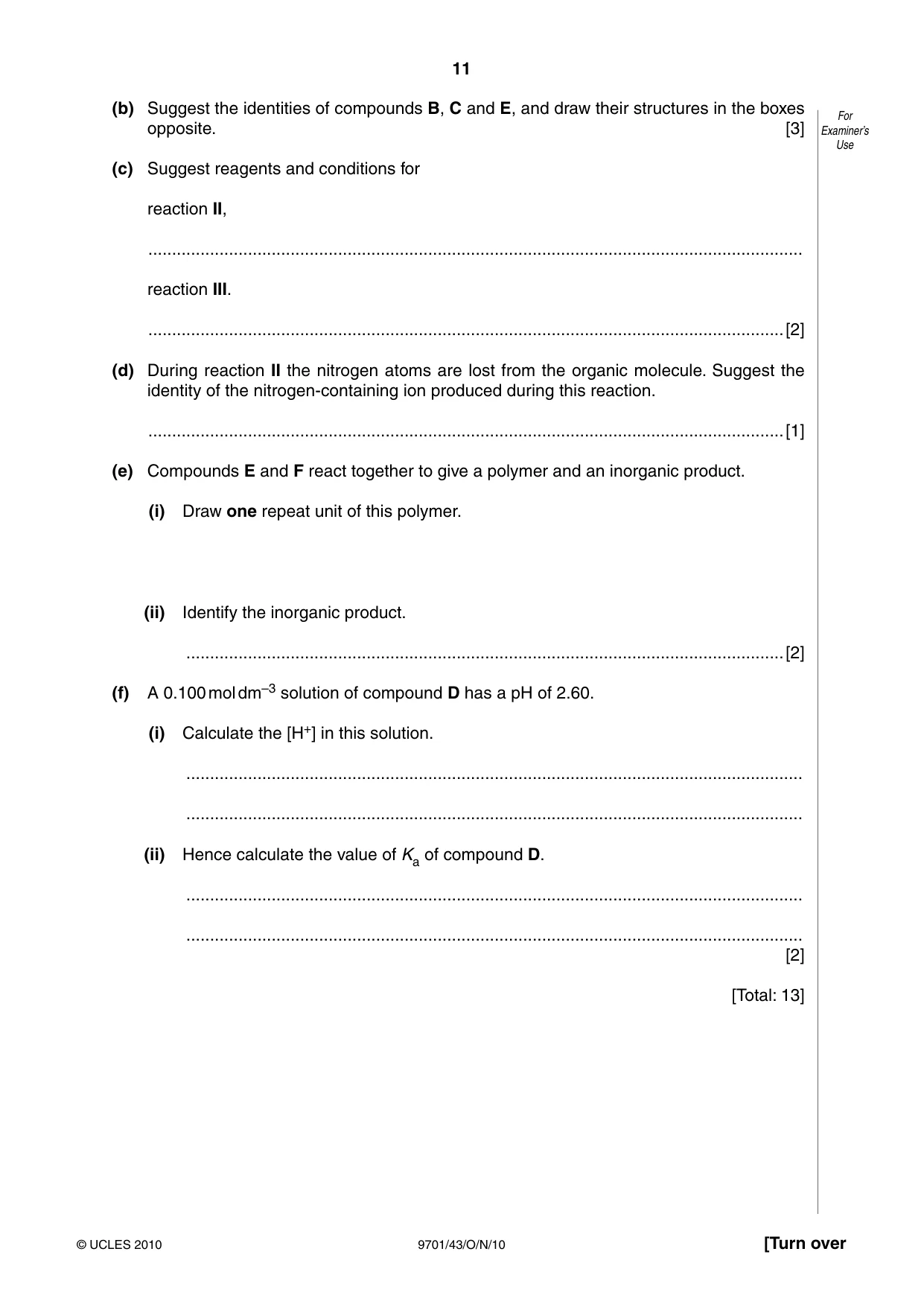
11 9701/43/O/N/10 © UCLES 2010 [Turn over For Examiner’s Use (b) Suggest the identities of compounds B, C and E, and draw their structures in the boxes opposite. [3] (c) Suggest reagents and conditions for reaction II, … reaction III. …[2] (d) During reaction II the nitrogen atoms are lost from the organic molecule. Suggest the identity of the nitrogen-containing ion produced during this reaction. …[1] (e) Compounds E and F react together to give a polymer and an inorganic product. (i) Draw one repeat unit of this polymer. (ii) Identify the inorganic product. …[2] (f) A 0.100 mol dm–3 solution of compound D has a pH of 2.60. (i) Calculate the [H+] in this solution. … … (ii) Hence calculate the value of Ka of compound D. … … [2] [Total: 13]
Question paper, page 12
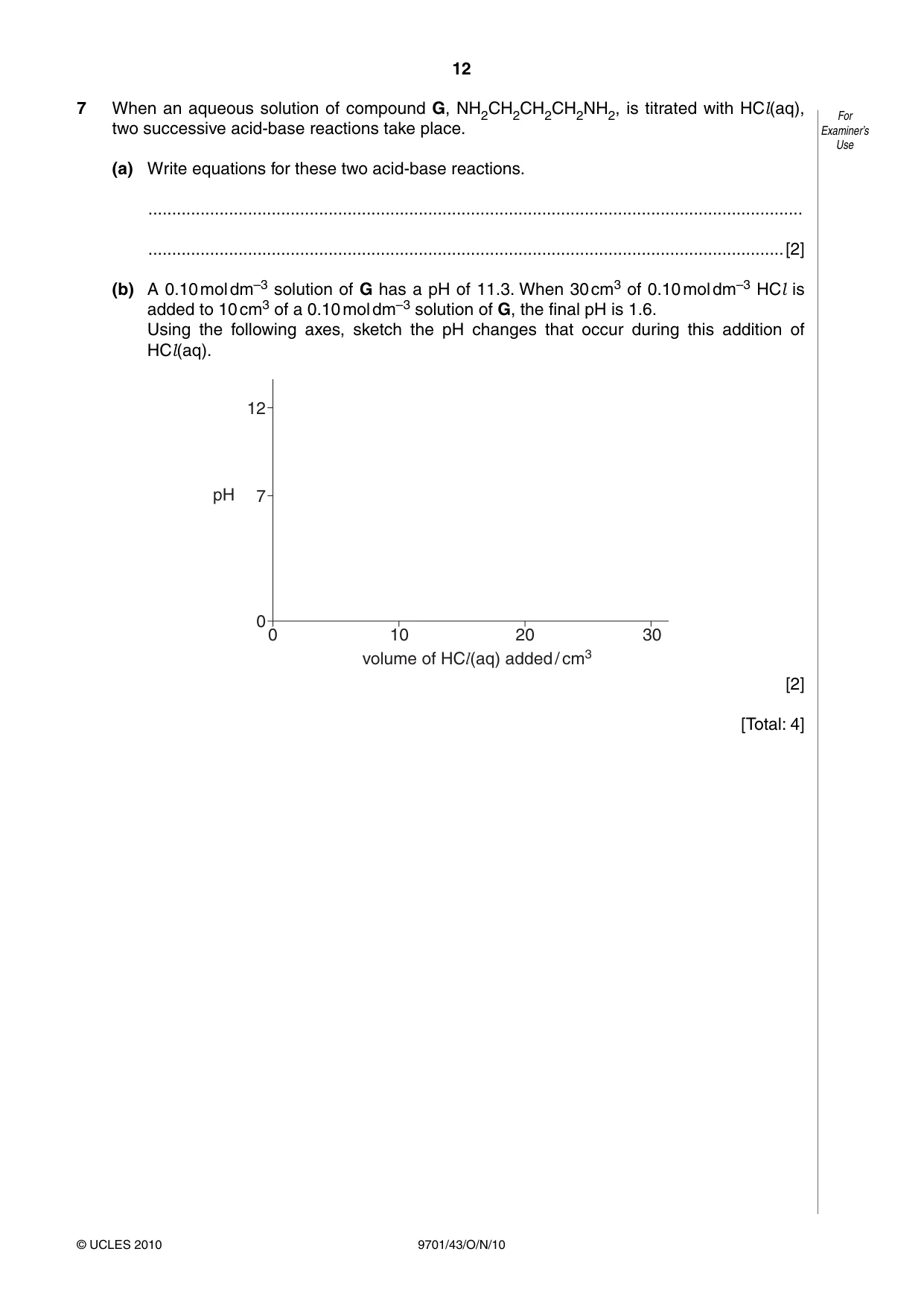
12 9701/43/O/N/10 © UCLES 2010 For Examiner’s Use 7 When an aqueous solution of compound G, NH2CH2CH2CH2NH2, is titrated with HCl(aq), two successive acid-base reactions take place. (a) Write equations for these two acid-base reactions. … …[2] (b) A 0.10 mol dm–3 solution of G has a pH of 11.3. When 30 cm3 of 0.10 mol dm–3 HCl is added to 10 cm3 of a 0.10 mol dm–3 solution of G, the final pH is 1.6. Using the following axes, sketch the pH changes that occur during this addition of HCl(aq). 0 0 pH 7 12 10 20 volume of HCl(aq) added / cm3 30 [2] [Total: 4]
Question paper, page 13
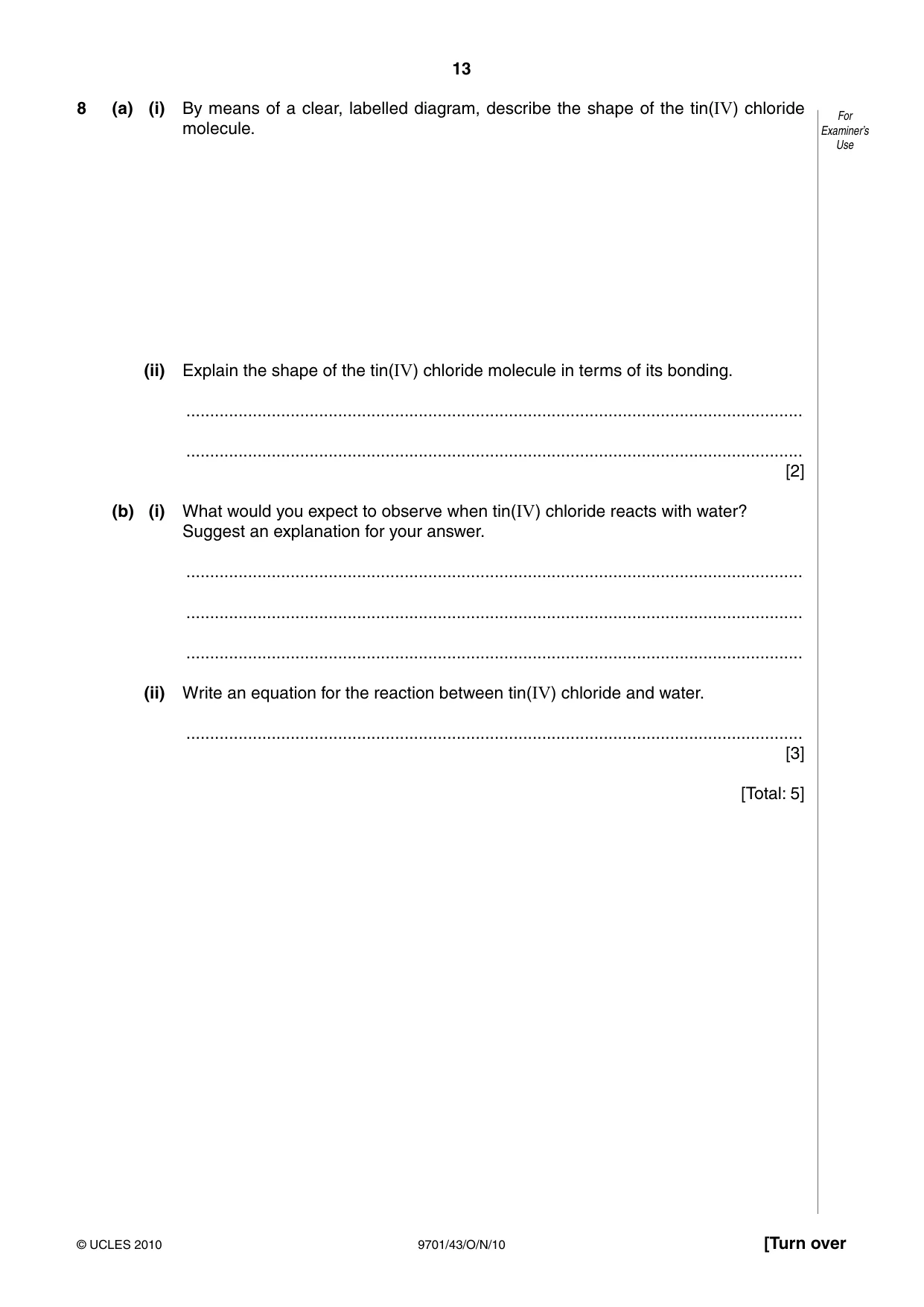
13 9701/43/O/N/10 © UCLES 2010 [Turn over For Examiner’s Use 8 (a) (i) By means of a clear, labelled diagram, describe the shape of the tin(IV) chloride molecule. (ii) Explain the shape of the tin(IV) chloride molecule in terms of its bonding. … … [2] (b) (i) What would you expect to observe when tin(IV) chloride reacts with water? Suggest an explanation for your answer. … … … (ii) Write an equation for the reaction between tin(IV) chloride and water. … [3] [Total: 5]
Question paper, page 14
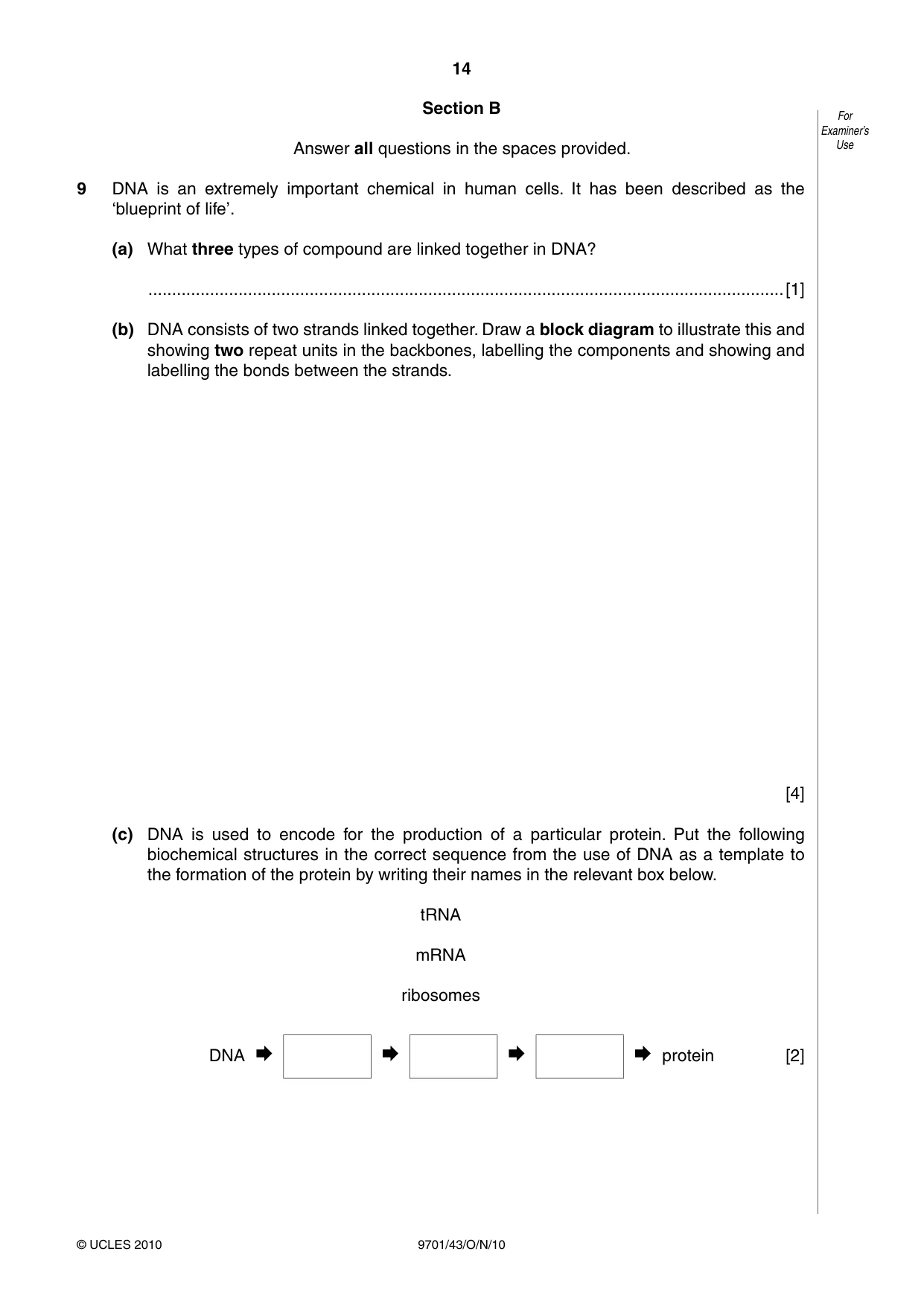
14 9701/43/O/N/10 © UCLES 2010 For Examiner’s Use Section B Answer all questions in the spaces provided. 9 DNA is an extremely important chemical in human cells. It has been described as the ‘blueprint of life’. (a) What three types of compound are linked together in DNA? …[1] (b) DNA consists of two strands linked together. Draw a block diagram to illustrate this and showing two repeat units in the backbones, labelling the components and showing and labelling the bonds between the strands. [4] (c) DNA is used to encode for the production of a particular protein. Put the following biochemical structures in the correct sequence from the use of DNA as a template to the formation of the protein by writing their names in the relevant box below. tRNA mRNA ribosomes DNA ¨ ¨ ¨ ¨ protein [2]
Question paper, page 15
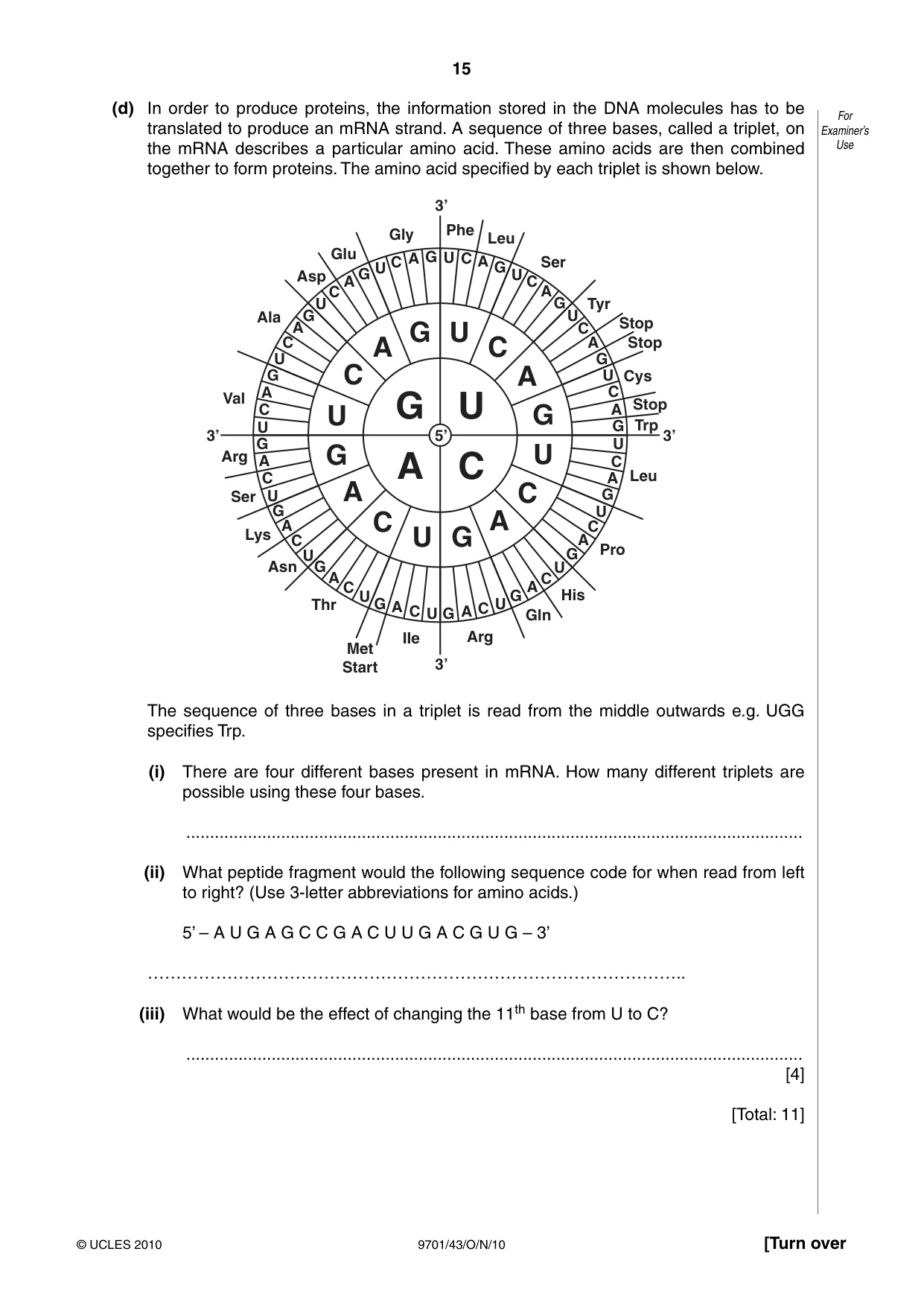
15 9701/43/O/N/10 © UCLES 2010 [Turn over For Examiner’s Use (d) In order to produce proteins, the information stored in the DNA molecules has to be translated to produce an mRNA strand. A sequence of three bases, called a triplet, on the mRNA describes a particular amino acid. These amino acids are then combined together to form proteins. The amino acid specified by each triplet is shown below. U U U U U U U U U U U U U U U U C C C C C C C C C C C C C C C C A A A A A A A A A A A A A A A A G G G G G G G G G G G G G G G G U U U U C C C C A A A A G G G G G U A C Val Arg Ser Lys Asn Thr IIe Arg Gln His Pro Leu Leu Phe Ser Tyr Cys Trp Stop Stop Stop Met Start Ala Asp Glu Gly 5’ 3’ 3’ 3’ 3’ The sequence of three bases in a triplet is read from the middle outwards e.g. UGG specifies Trp. (i) There are four different bases present in mRNA. How many different triplets are possible using these four bases. … (ii) What peptide fragment would the following sequence code for when read from left to right? (Use 3-letter abbreviations for amino acids.) 5’ – A U G A G C C G A C U U G A C G U G – 3’ ………………………………………………………………………………….. (iii) What would be the effect of changing the 11th base from U to C? … [4] [Total: 11]
Question paper, page 16
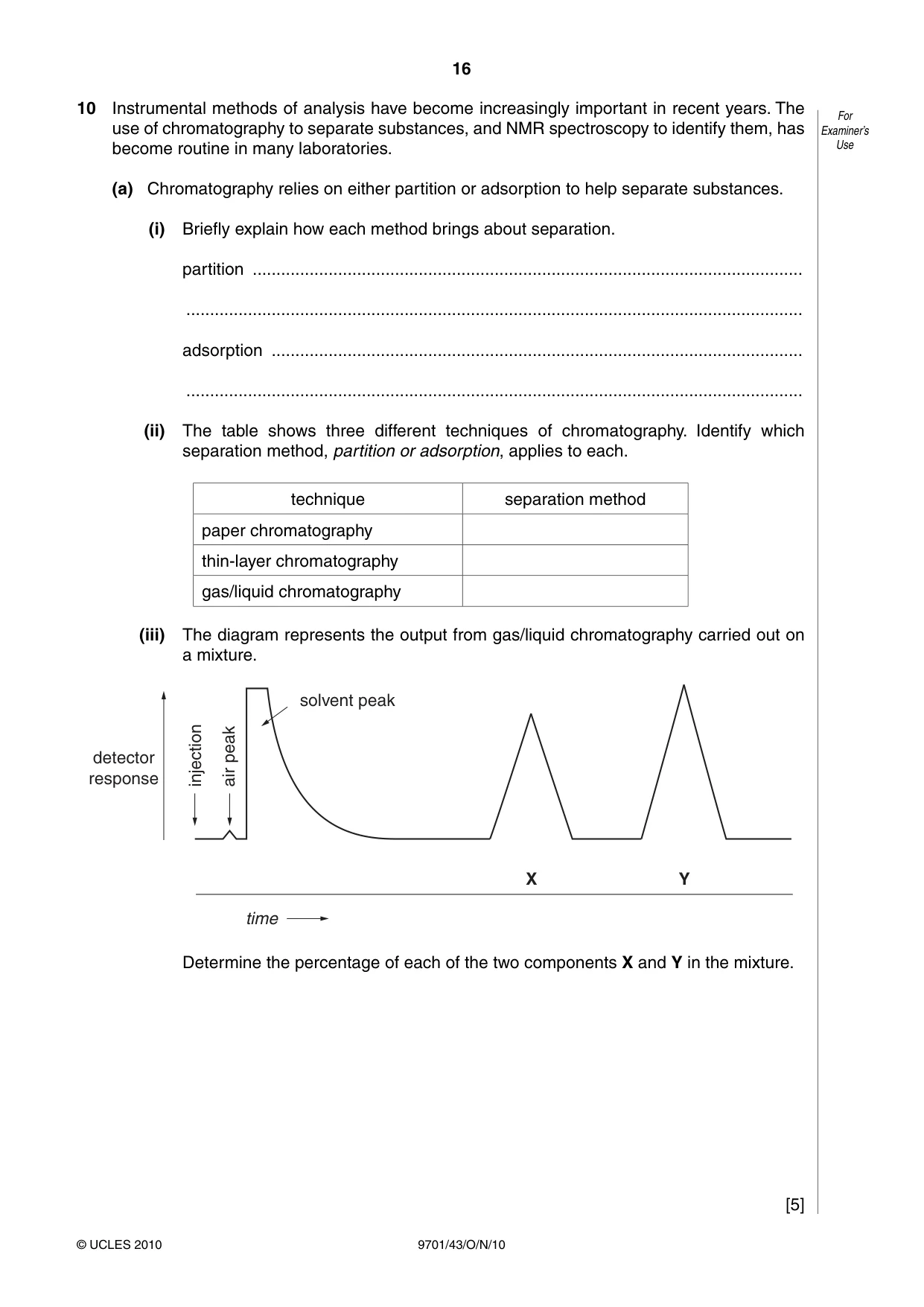
16 9701/43/O/N/10 © UCLES 2010 For Examiner’s Use 10 Instrumental methods of analysis have become increasingly important in recent years. The use of chromatography to separate substances, and NMR spectroscopy to identify them, has become routine in many laboratories. (a) Chromatography relies on either partition or adsorption to help separate substances. (i) Briefly explain how each method brings about separation. partition … … adsorption … … (ii) The table shows three different techniques of chromatography. Identify which separation method, partition or adsorption, applies to each. technique separation method paper chromatography thin-layer chromatography gas/liquid chromatography (iii) The diagram represents the output from gas/liquid chromatography carried out on a mixture. time injection detector response air peak solvent peak X Y Determine the percentage of each of the two components X and Y in the mixture. [5]
Question paper, page 17
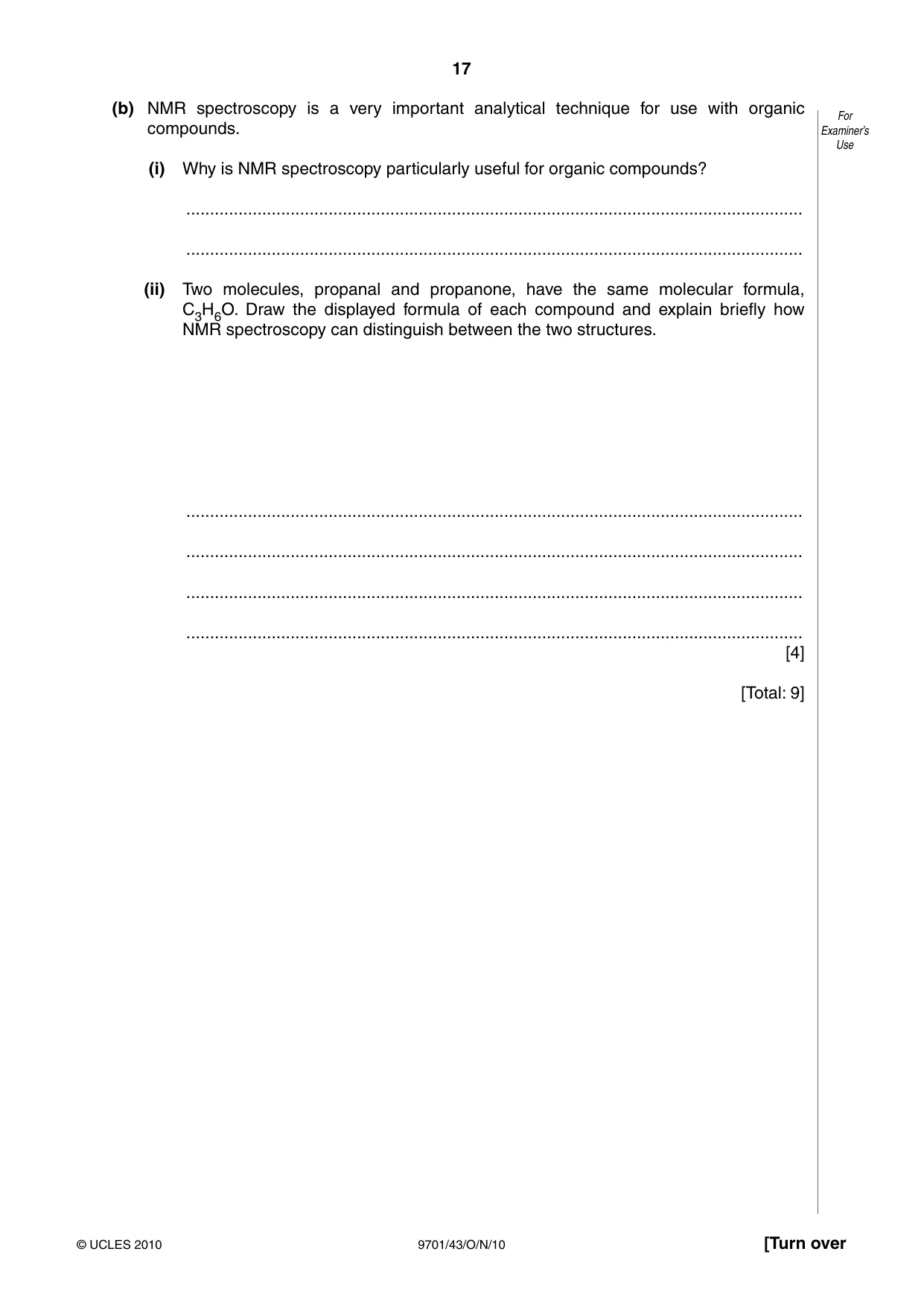
17 9701/43/O/N/10 © UCLES 2010 [Turn over For Examiner’s Use (b) NMR spectroscopy is a very important analytical technique for use with organic compounds. (i) Why is NMR spectroscopy particularly useful for organic compounds? … … (ii) Two molecules, propanal and propanone, have the same molecular formula, C3H6O. Draw the displayed formula of each compound and explain briefly how NMR spectroscopy can distinguish between the two structures. … … … … [4] [Total: 9]
Question paper, page 18
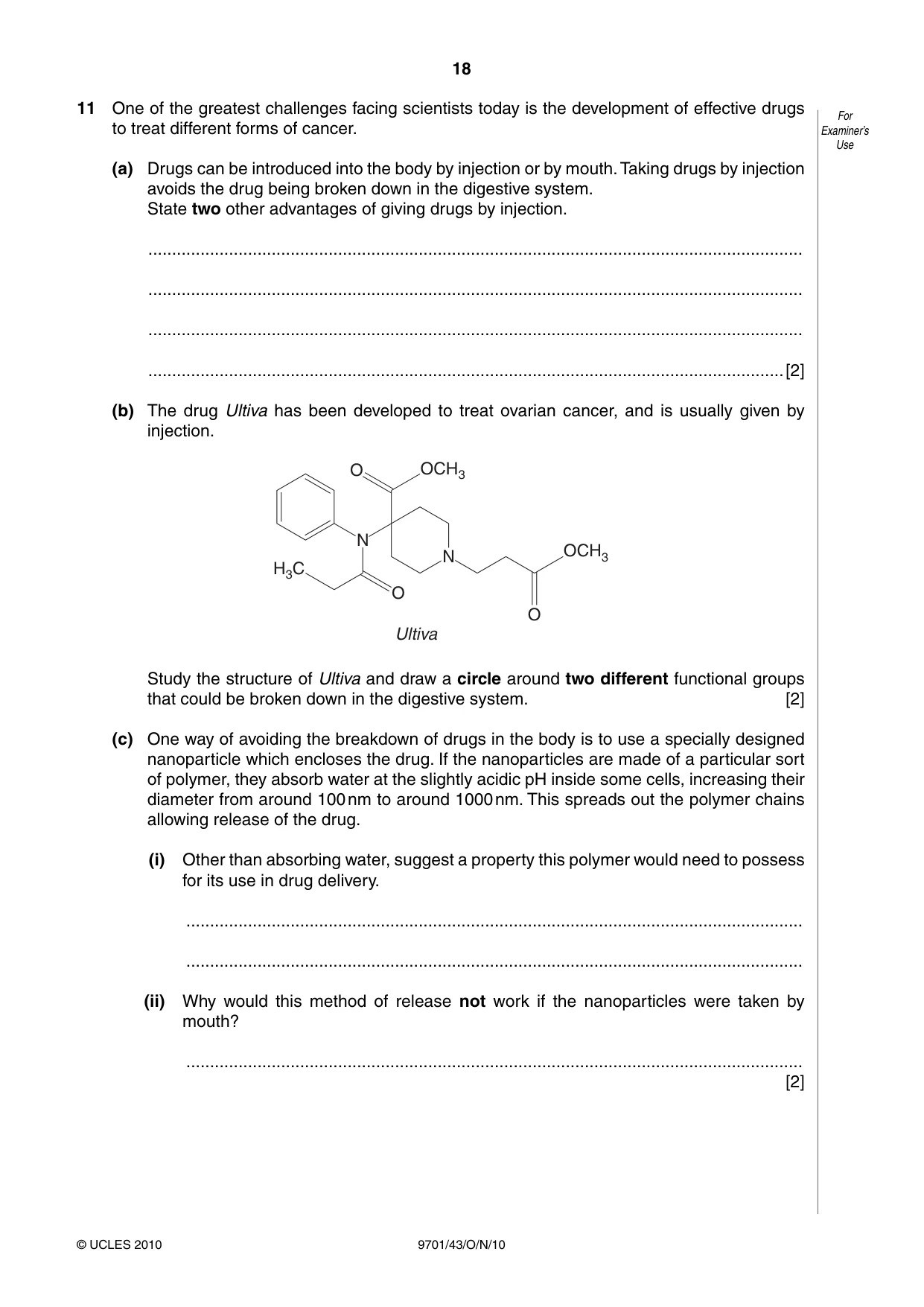
18 9701/43/O/N/10 © UCLES 2010 For Examiner’s Use 11 One of the greatest challenges facing scientists today is the development of effective drugs to treat different forms of cancer. (a) Drugs can be introduced into the body by injection or by mouth. Taking drugs by injection avoids the drug being broken down in the digestive system. State two other advantages of giving drugs by injection. … … … …[2] (b) The drug Ultiva has been developed to treat ovarian cancer, and is usually given by injection. H3C OCH3 OCH3 O O O N N Ultiva Study the structure of Ultiva and draw a circle around two different functional groups that could be broken down in the digestive system. [2] (c) One way of avoiding the breakdown of drugs in the body is to use a specially designed nanoparticle which encloses the drug. If the nanoparticles are made of a particular sort of polymer, they absorb water at the slightly acidic pH inside some cells, increasing their diameter from around 100 nm to around 1000 nm. This spreads out the polymer chains allowing release of the drug. (i) Other than absorbing water, suggest a property this polymer would need to possess for its use in drug delivery. … … (ii) Why would this method of release not work if the nanoparticles were taken by mouth? … [2]
Question paper, page 19
19 9701/43/O/N/10 © UCLES 2010 For Examiner’s Use (d) Polymers may be formed by two different types of chemical reaction. Name the two types of reaction and write an equation to illustrate each reaction type. name … equation … name … equation … [3] (e) The breakdown of polymers, such as carbohydrates and proteins in the body is important for digestion. What type of reaction is generally involved? …[1] [Total: 10]
Question paper, page 20
20 9701/43/O/N/10 © UCLES 2010 BLANK PAGE Permission to reproduce items where third-party owned material protected by copyright is included has been sought and cleared where possible. Every reasonable effort has been made by the publisher (UCLES) to trace copyright holders, but if any items requiring clearance have unwittingly been included, the publisher will be pleased to make amends at the earliest possible opportunity. University of Cambridge International Examinations is part of the Cambridge Assessment Group. Cambridge Assessment is the brand name of University of Cambridge Local Examinations Syndicate (UCLES), which is itself a department of the University of Cambridge.
Mark scheme, page 1
UNIVERSITY OF CAMBRIDGE INTERNATIONAL EXAMINATIONS GCE Advanced Subsidiary Level and GCE Advanced Level MARK SCHEME for the October/November 2010 question paper for the guidance of teachers 9701 CHEMISTRY 9701/43 Paper 4 (A2 Structured Questions), maximum raw mark 100 This mark scheme is published as an aid to teachers and candidates, to indicate the requirements of the examination. It shows the basis on which Examiners were instructed to award marks. It does not indicate the details of the discussions that took place at an Examiners’ meeting before marking began, which would have considered the acceptability of alternative answers. Mark schemes must be read in conjunction with the question papers and the report on the examination. • CIE will not enter into discussions or correspondence in connection with these mark schemes. CIE is publishing the mark schemes for the October/November 2010 question papers for most IGCSE, GCE Advanced Level and Advanced Subsidiary Level syllabuses and some Ordinary Level syllabuses.
Mark scheme, page 2
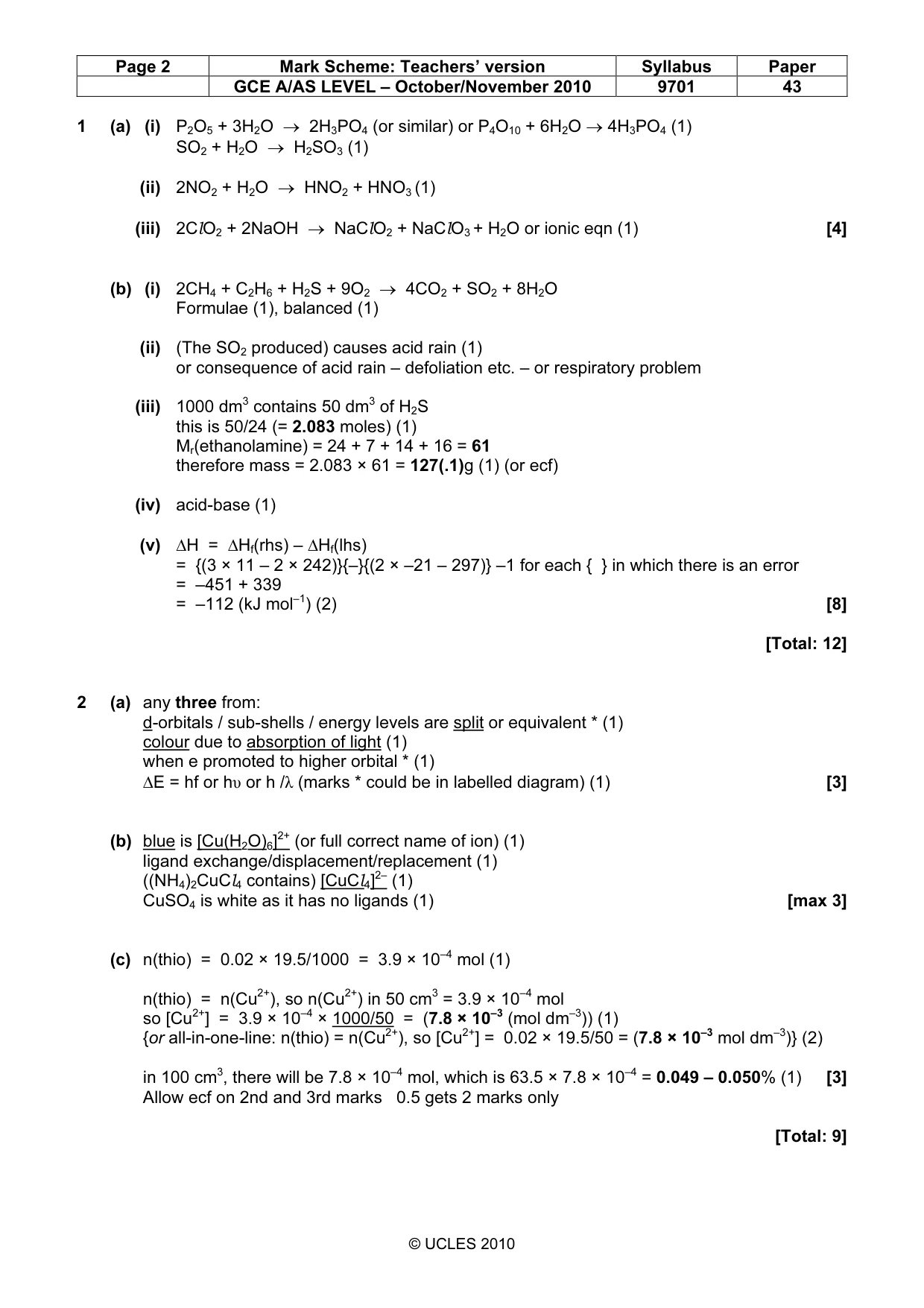
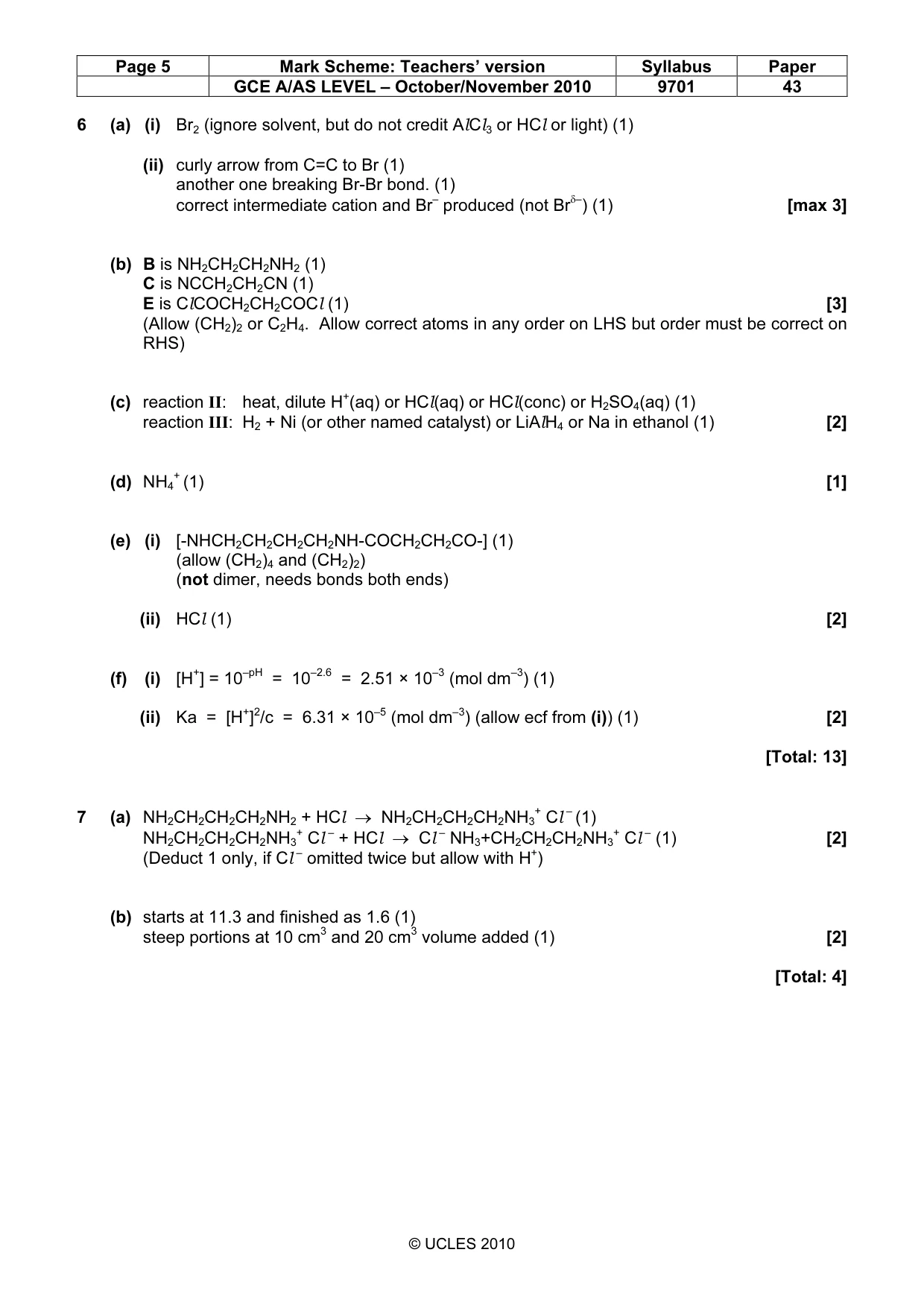
Page 2 Mark Scheme: Teachers’ version Syllabus Paper GCE A/AS LEVEL – October/November 2010 9701 43 © UCLES 2010 1 (a) (i) P2O5 + 3H2O → 2H3PO4 (or similar) or P4O10 + 6H2O → 4H3PO4 (1) SO2 + H2O → H2SO3 (1) (ii) 2NO2 + H2O → HNO2 + HNO3 (1) (iii) 2ClO2 + 2NaOH → NaClO2 + NaClO3 + H2O or ionic eqn (1) [4] (b) (i) 2CH4 + C2H6 + H2S + 9O2 → 4CO2 + SO2 + 8H2O Formulae (1), balanced (1) (ii) (The SO2 produced) causes acid rain (1) or consequence of acid rain – defoliation etc. – or respiratory problem (iii) 1000 dm3 contains 50 dm3 of H2S this is 50/24 (= 2.083 moles) (1) Mr(ethanolamine) = 24 + 7 + 14 + 16 = 61 therefore mass = 2.083 × 61 = 127(.1)g (1) (or ecf) (iv) acid-base (1) (v) ∆H = ∆Hf(rhs) – ∆Hf(lhs) = {(3 × 11 – 2 × 242)}{–}{(2 × –21 – 297)} –1 for each { } in which there is an error = –451 + 339 = –112 (kJ mol–1) (2) [8] [Total: 12] 2 (a) any three from: d-orbitals / sub-shells / energy levels are split or equivalent * (1) colour due to absorption of light (1) when e promoted to higher orbital * (1) ∆E = hf or hυ or h /λ (marks * could be in labelled diagram) (1) [3] (b) blue is [Cu(H2O)6]2+ (or full correct name of ion) (1) ligand exchange/displacement/replacement (1) ((NH4)2CuCl4 contains) [CuCl4]2– (1) CuSO4 is white as it has no ligands (1) [max 3] (c) n(thio) = 0.02 × 19.5/1000 = 3.9 × 10⁻⁴ mol (1) n(thio) = n(Cu2+), so n(Cu2+) in 50 cm3 = 3.9 × 10⁻⁴ mol so [Cu2+] = 3.9 × 10–4 × 1000/50 = (7.8 × 10⁻³ (mol dm–3)) (1) {or all-in-one-line: n(thio) = n(Cu2+), so [Cu2+] = 0.02 × 19.5/50 = (7.8 × 10⁻³ mol dm–3)} (2) in 100 cm3, there will be 7.8 × 10⁻⁴ mol, which is 63.5 × 7.8 × 10–4 = 0.049 – 0.050% (1) [3] Allow ecf on 2nd and 3rd marks 0.5 gets 2 marks only [Total: 9]
Mark scheme, page 3
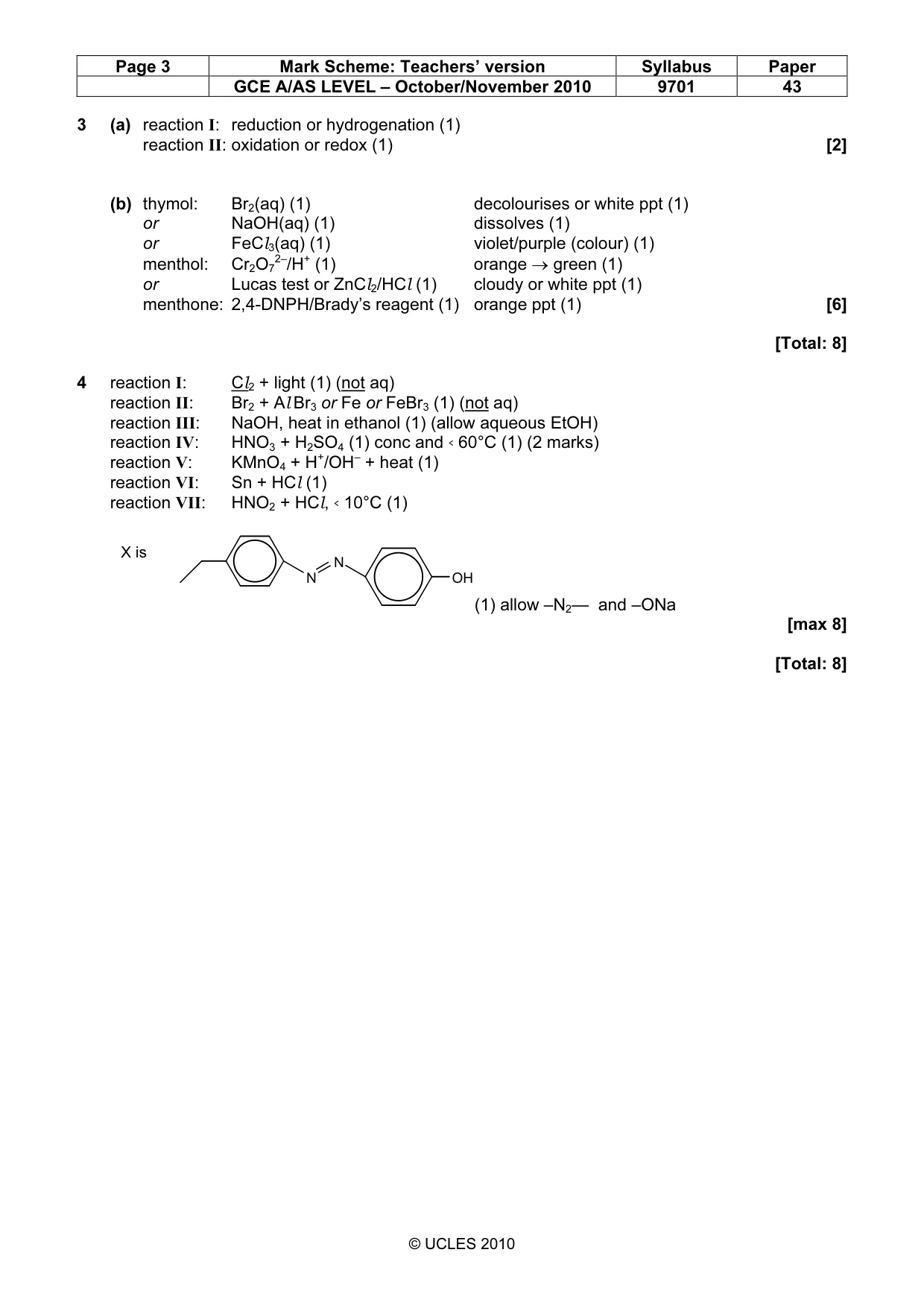
Page 3 Mark Scheme: Teachers’ version Syllabus Paper GCE A/AS LEVEL – October/November 2010 9701 43 © UCLES 2010 3 (a) reaction I: reduction or hydrogenation (1) reaction II: oxidation or redox (1) [2] (b) thymol: Br2(aq) (1) decolourises or white ppt (1) or NaOH(aq) (1) dissolves (1) or FeCl3(aq) (1) violet/purple (colour) (1) menthol: Cr2O7 2–/H+ (1) orange → green (1) or Lucas test or ZnCl2/HCl (1) cloudy or white ppt (1) menthone: 2,4-DNPH/Brady’s reagent (1) orange ppt (1) [6] [Total: 8] 4 reaction I: Cl2 + light (1) (not aq) reaction II: Br2 + Al Br3 or Fe or FeBr3 (1) (not aq) reaction III: NaOH, heat in ethanol (1) (allow aqueous EtOH) reaction IV: HNO3 + H2SO4 (1) conc and < 60°C (1) (2 marks) reaction V: KMnO4 + H+/OH– + heat (1) reaction VI: Sn + HCl (1) reaction VII: HNO2 + HCl, < 10°C (1) X is N N OH (1) allow –N2— and –ONa [max 8] [Total: 8] X is
Mark scheme, page 4
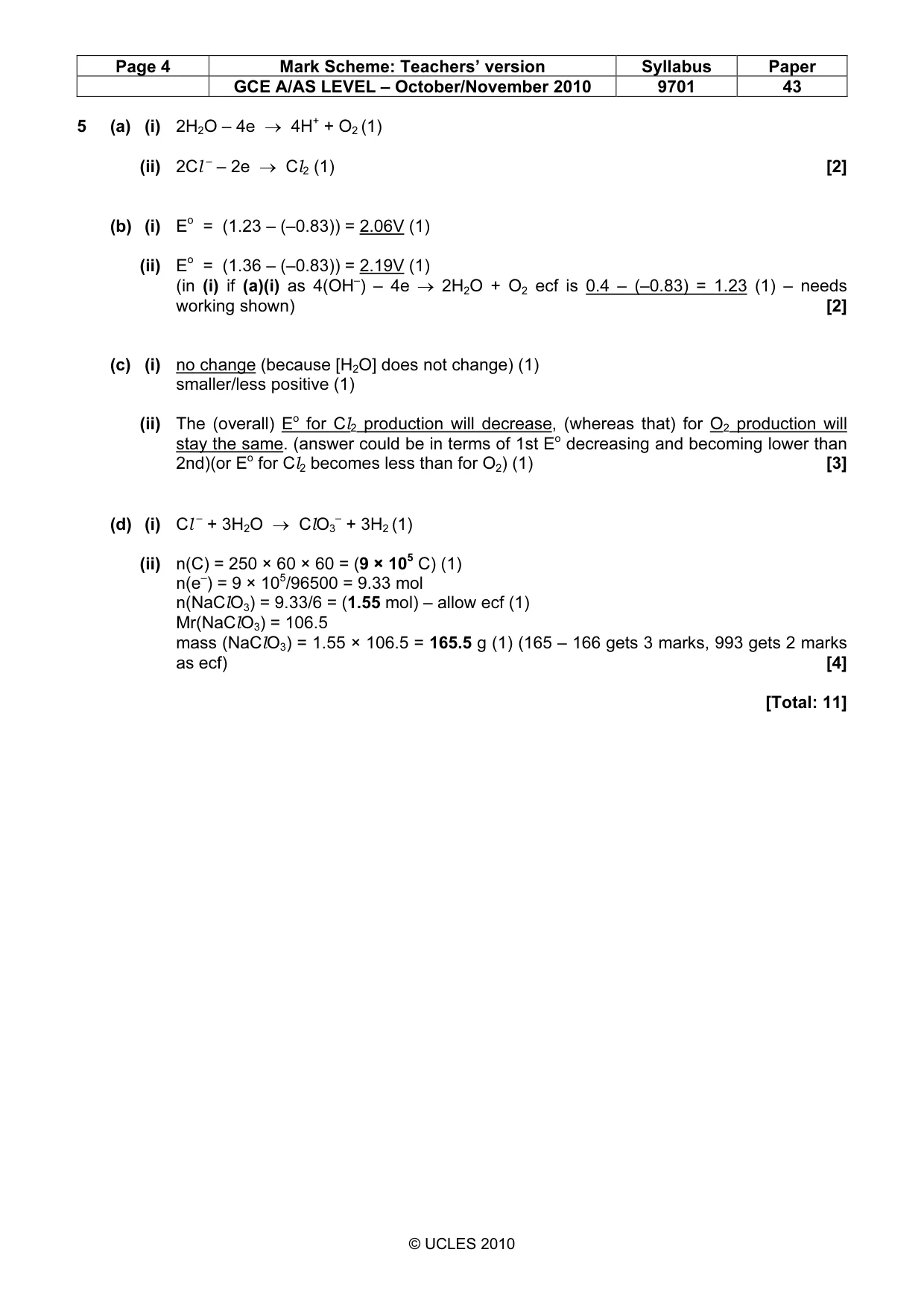
Page 4 Mark Scheme: Teachers’ version Syllabus Paper GCE A/AS LEVEL – October/November 2010 9701 43 © UCLES 2010 5 (a) (i) 2H2O – 4e → 4H+ + O2 (1) (ii) 2Cl – – 2e → Cl2 (1) [2] (b) (i) Eo = (1.23 – (–0.83)) = 2.06V (1) (ii) Eo = (1.36 – (–0.83)) = 2.19V (1) (in (i) if (a)(i) as 4(OH–) – 4e → 2H2O + O2 ecf is 0.4 – (–0.83) = 1.23 (1) – needs working shown) [2] (c) (i) no change (because [H2O] does not change) (1) smaller/less positive (1) (ii) The (overall) Eo for Cl2 production will decrease, (whereas that) for O2 production will stay the same. (answer could be in terms of 1st Eo decreasing and becoming lower than 2nd)(or Eo for Cl2 becomes less than for O2) (1) [3] (d) (i) Cl – + 3H2O → ClO3 – + 3H2 (1) (ii) n(C) = 250 × 60 × 60 = (9 × 10⁵ C) (1) n(e–) = 9 × 10⁵/96500 = 9.33 mol n(NaClO3) = 9.33/6 = (1.55 mol) – allow ecf (1) Mr(NaClO3) = 106.5 mass (NaClO3) = 1.55 × 106.5 = 165.5 g (1) (165 – 166 gets 3 marks, 993 gets 2 marks as ecf) [4] [Total: 11]
Mark scheme, page 5
Page 5 Mark Scheme: Teachers’ version Syllabus Paper GCE A/AS LEVEL – October/November 2010 9701 43 © UCLES 2010 6 (a) (i) Br2 (ignore solvent, but do not credit AlCl3 or HCl or light) (1) (ii) curly arrow from C=C to Br (1) another one breaking Br-Br bond. (1) correct intermediate cation and Br– produced (not Brδ–) (1) [max 3] (b) B is NH2CH2CH2NH2 (1) C is NCCH2CH2CN (1) E is ClCOCH2CH2COCl (1) [3] (Allow (CH2)2 or C2H4. Allow correct atoms in any order on LHS but order must be correct on RHS) (c) reaction II: heat, dilute H+(aq) or HCl(aq) or HCl(conc) or H2SO4(aq) (1) reaction III: H2 + Ni (or other named catalyst) or LiAlH4 or Na in ethanol (1) [2] (d) NH4 + (1) [1] (e) (i) [-NHCH2CH2CH2CH2NH-COCH2CH2CO-] (1) (allow (CH2)4 and (CH2)2) (not dimer, needs bonds both ends) (ii) HCl (1) [2] (f) (i) [H+] = 10–pH = 10–2.6 = 2.51 × 10⁻³ (mol dm–3) (1) (ii) Ka = [H+]2/c = 6.31 × 10⁻⁵ (mol dm–3) (allow ecf from (i)) (1) [2] [Total: 13] 7 (a) NH2CH2CH2CH2NH2 + HCl → NH2CH2CH2CH2NH3 + Cl – (1) NH2CH2CH2CH2NH3 + Cl – + HCl → Cl – NH3+CH2CH2CH2NH3 + Cl – (1) [2] (Deduct 1 only, if Cl – omitted twice but allow with H+) (b) starts at 11.3 and finished as 1.6 (1) steep portions at 10 cm3 and 20 cm3 volume added (1) [2] [Total: 4]
Mark scheme, page 6
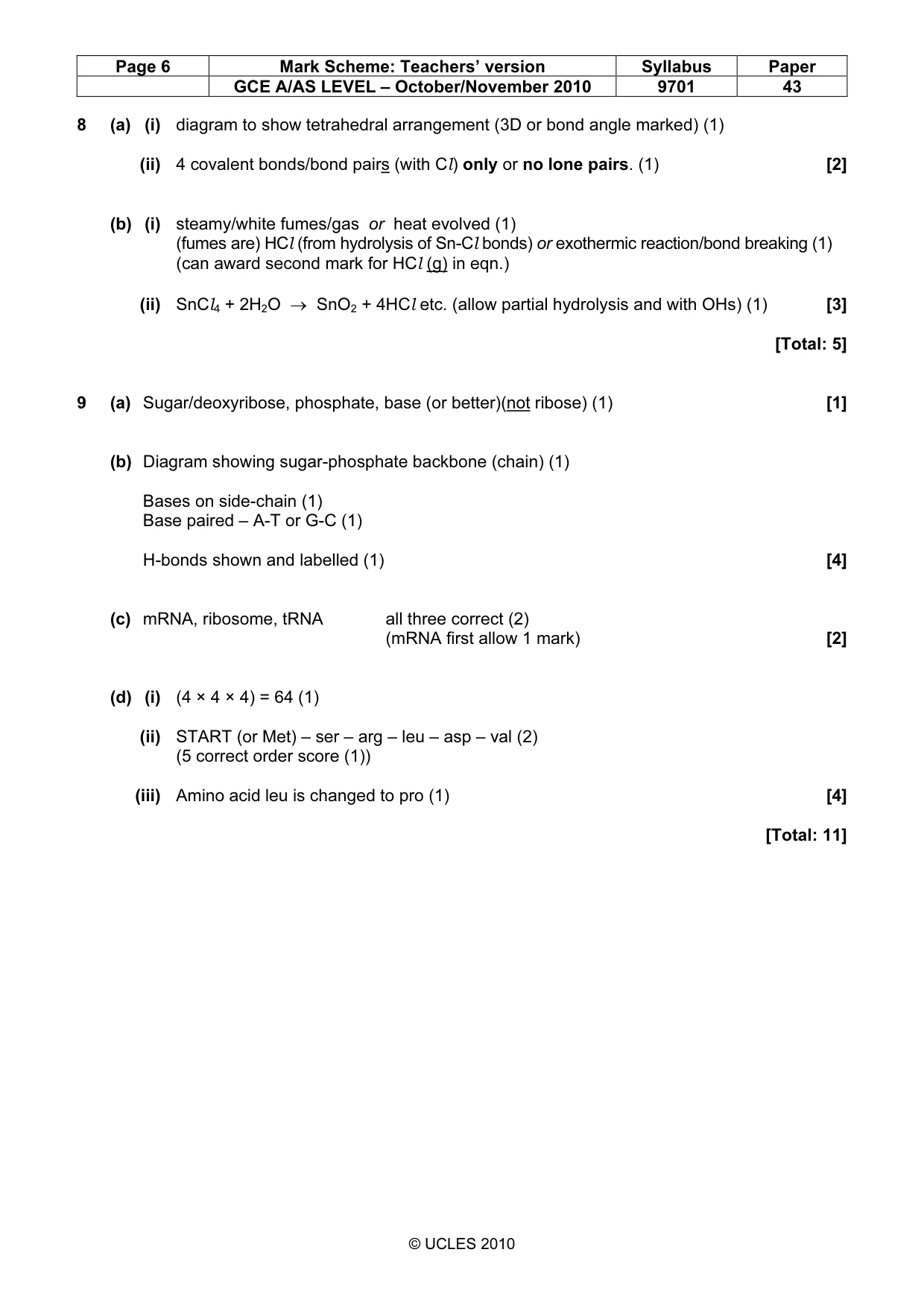
Page 6 Mark Scheme: Teachers’ version Syllabus Paper GCE A/AS LEVEL – October/November 2010 9701 43 © UCLES 2010 8 (a) (i) diagram to show tetrahedral arrangement (3D or bond angle marked) (1) (ii) 4 covalent bonds/bond pairs (with Cl) only or no lone pairs. (1) [2] (b) (i) steamy/white fumes/gas or heat evolved (1) (fumes are) HCl (from hydrolysis of Sn-Cl bonds) or exothermic reaction/bond breaking (1) (can award second mark for HCl (g) in eqn.) (ii) SnCl4 + 2H2O → SnO2 + 4HCl etc. (allow partial hydrolysis and with OHs) (1) [3] [Total: 5] 9 (a) Sugar/deoxyribose, phosphate, base (or better)(not ribose) (1) [1] (b) Diagram showing sugar-phosphate backbone (chain) (1) Bases on side-chain (1) Base paired – A-T or G-C (1) H-bonds shown and labelled (1) [4] (c) mRNA, ribosome, tRNA all three correct (2) (mRNA first allow 1 mark) [2] (d) (i) (4 × 4 × 4) = 64 (1) (ii) START (or Met) – ser – arg – leu – asp – val (2) (5 correct order score (1)) (iii) Amino acid leu is changed to pro (1) [4] [Total: 11]
Mark scheme, page 7
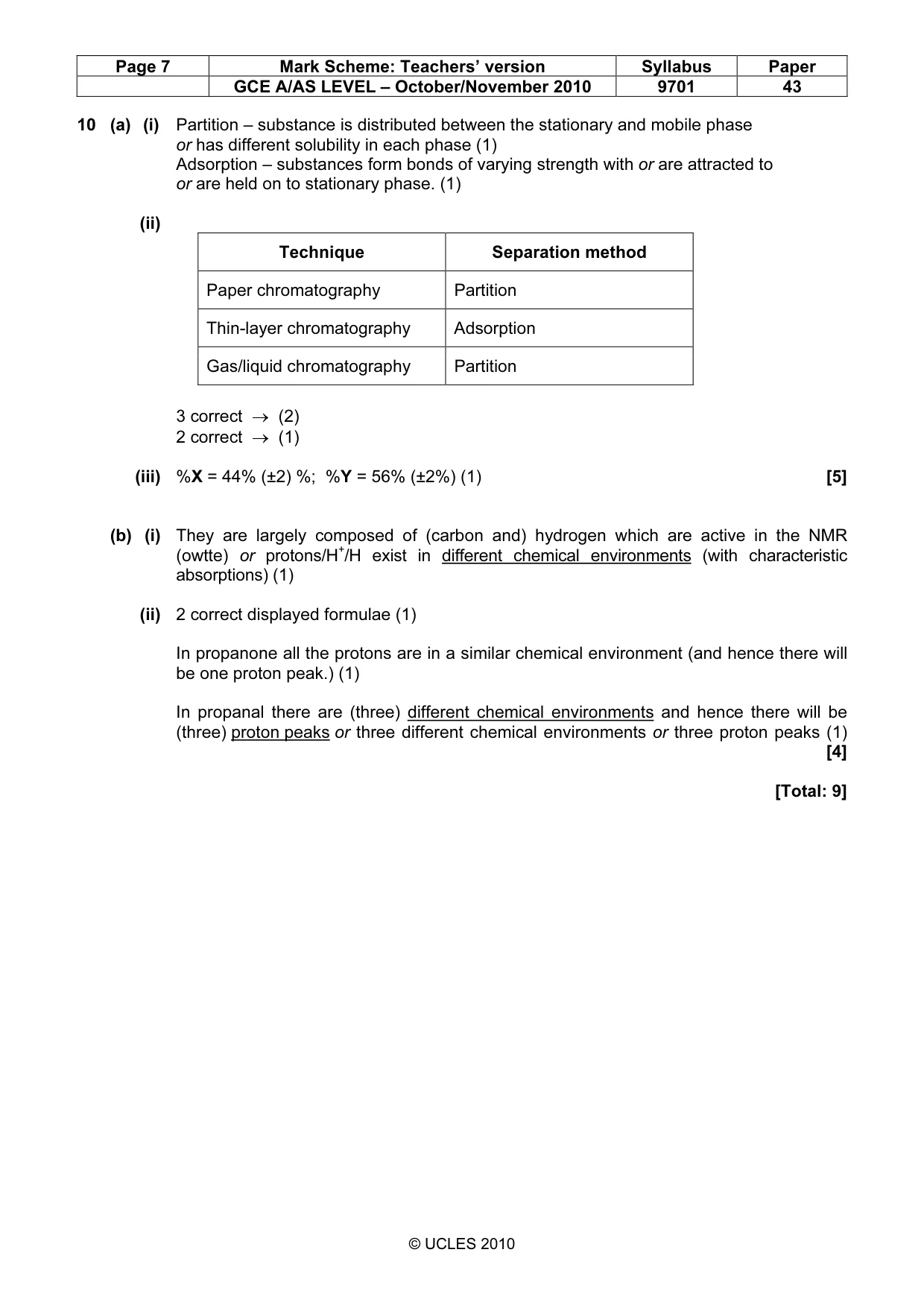
Page 7 Mark Scheme: Teachers’ version Syllabus Paper GCE A/AS LEVEL – October/November 2010 9701 43 © UCLES 2010 10 (a) (i) Partition – substance is distributed between the stationary and mobile phase or has different solubility in each phase (1) Adsorption – substances form bonds of varying strength with or are attracted to or are held on to stationary phase. (1) (ii) Technique Separation method Paper chromatography Partition Thin-layer chromatography Adsorption Gas/liquid chromatography Partition 3 correct → (2) 2 correct → (1) (iii) %X = 44% (±2) %; %Y = 56% (±2%) (1) [5] (b) (i) They are largely composed of (carbon and) hydrogen which are active in the NMR (owtte) or protons/H+/H exist in different chemical environments (with characteristic absorptions) (1) (ii) 2 correct displayed formulae (1) In propanone all the protons are in a similar chemical environment (and hence there will be one proton peak.) (1) In propanal there are (three) different chemical environments and hence there will be (three) proton peaks or three different chemical environments or three proton peaks (1) [4] [Total: 9]
Mark scheme, page 8
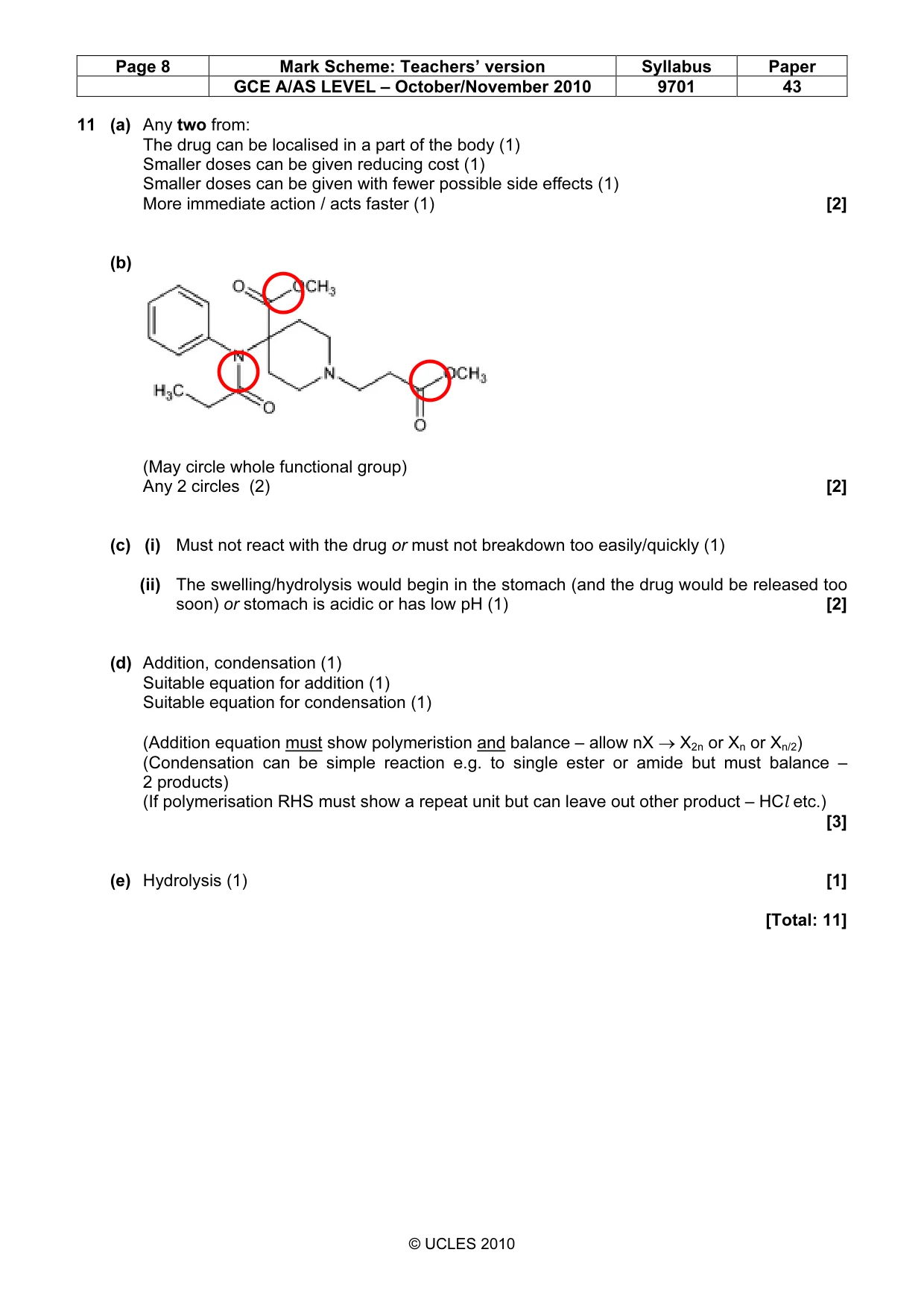
Page 8 Mark Scheme: Teachers’ version Syllabus Paper GCE A/AS LEVEL – October/November 2010 9701 43 © UCLES 2010 11 (a) Any two from: The drug can be localised in a part of the body (1) Smaller doses can be given reducing cost (1) Smaller doses can be given with fewer possible side effects (1) More immediate action / acts faster (1) [2] (b) (May circle whole functional group) Any 2 circles (2) [2] (c) (i) Must not react with the drug or must not breakdown too easily/quickly (1) (ii) The swelling/hydrolysis would begin in the stomach (and the drug would be released too soon) or stomach is acidic or has low pH (1) [2] (d) Addition, condensation (1) Suitable equation for addition (1) Suitable equation for condensation (1) (Addition equation must show polymeristion and balance – allow nX → X2n or Xn or Xn/2) (Condensation can be simple reaction e.g. to single ester or amide but must balance – 2 products) (If polymerisation RHS must show a repeat unit but can leave out other product – HCl etc.) [3] (e) Hydrolysis (1) [1] [Total: 11]
What you needed in this session
Cambridge’s own grade thresholds for 2010 Oct/Nov, Paper 4 · Variant 3. A higher threshold means an easier paper — the bar moves with how the cohort did.