Cambridge A Level Chemistry 9701 — 2010 Oct/Nov Paper 2 · Variant 3
9701/23/O/N/10 · 60 marks · ≈68 min
The question paper and its mark scheme, free to read here and free to download. This is Cambridge’s own paper, exactly as it was sat.
Question paper12 pages

Mark scheme5 pages
Answers below. Sit the paper first if you are practising.
Paper as text
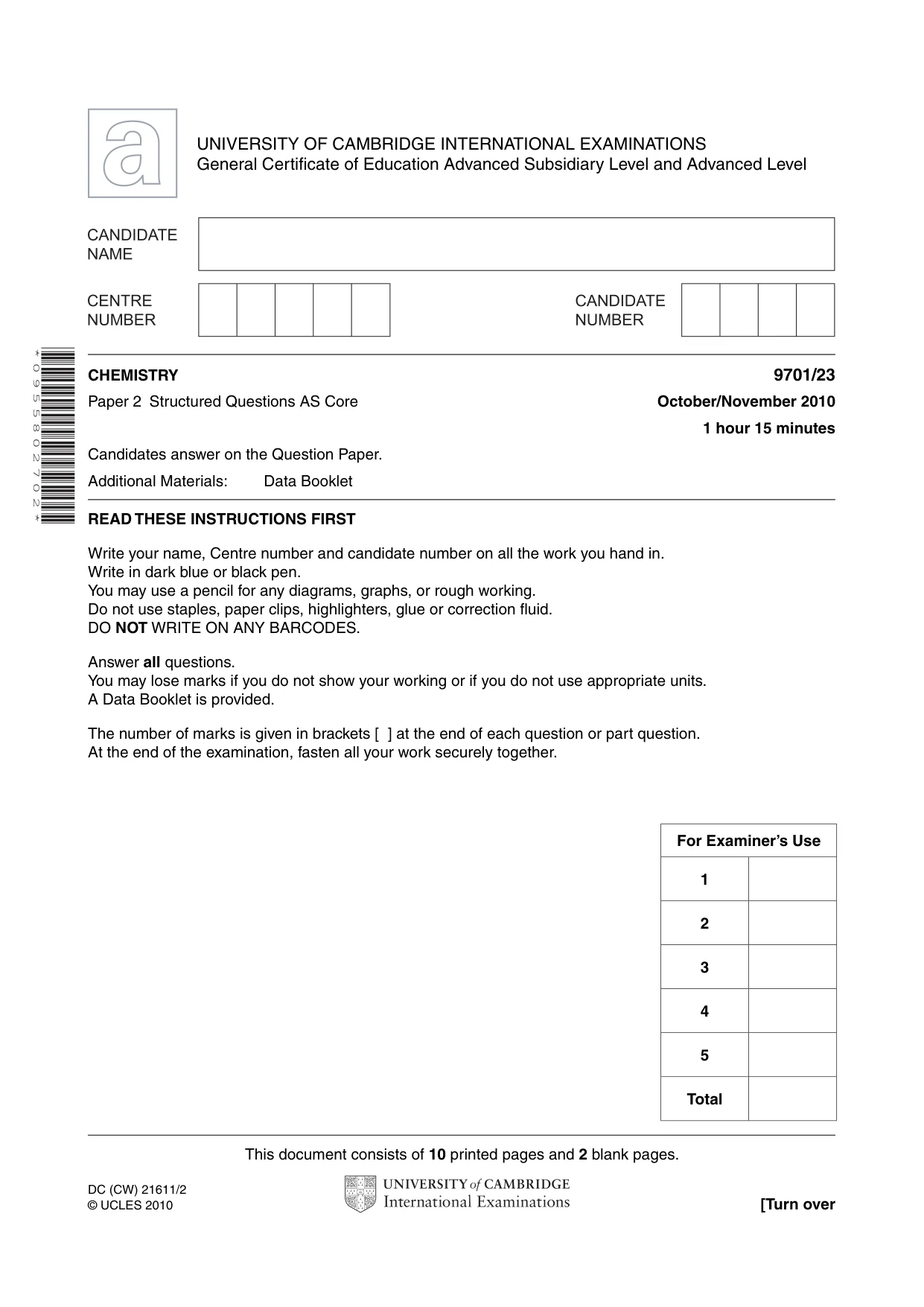
Question paper, page 1
This document consists of 10 printed pages and 2 blank pages. DC (CW) 21611/2 © UCLES 2010 [Turn over UNIVERSITY OF CAMBRIDGE INTERNATIONAL EXAMINATIONS General Certificate of Education Advanced Subsidiary Level and Advanced Level READ THESE INSTRUCTIONS FIRST Write your name, Centre number and candidate number on all the work you hand in. Write in dark blue or black pen. You may use a pencil for any diagrams, graphs, or rough working. Do not use staples, paper clips, highlighters, glue or correction fluid. DO NOT WRITE ON ANY BARCODES. Answer all questions. You may lose marks if you do not show your working or if you do not use appropriate units. A Data Booklet is provided. The number of marks is given in brackets [ ] at the end of each question or part question. At the end of the examination, fasten all your work securely together. * 0 9 5 5 8 0 2 7 0 2 * CHEMISTRY 9701/23 Paper 2 Structured Questions AS Core October/November 2010 1 hour 15 minutes Candidates answer on the Question Paper. Additional Materials: Data Booklet For Examiner’s Use 1 2 3 4 5 Total
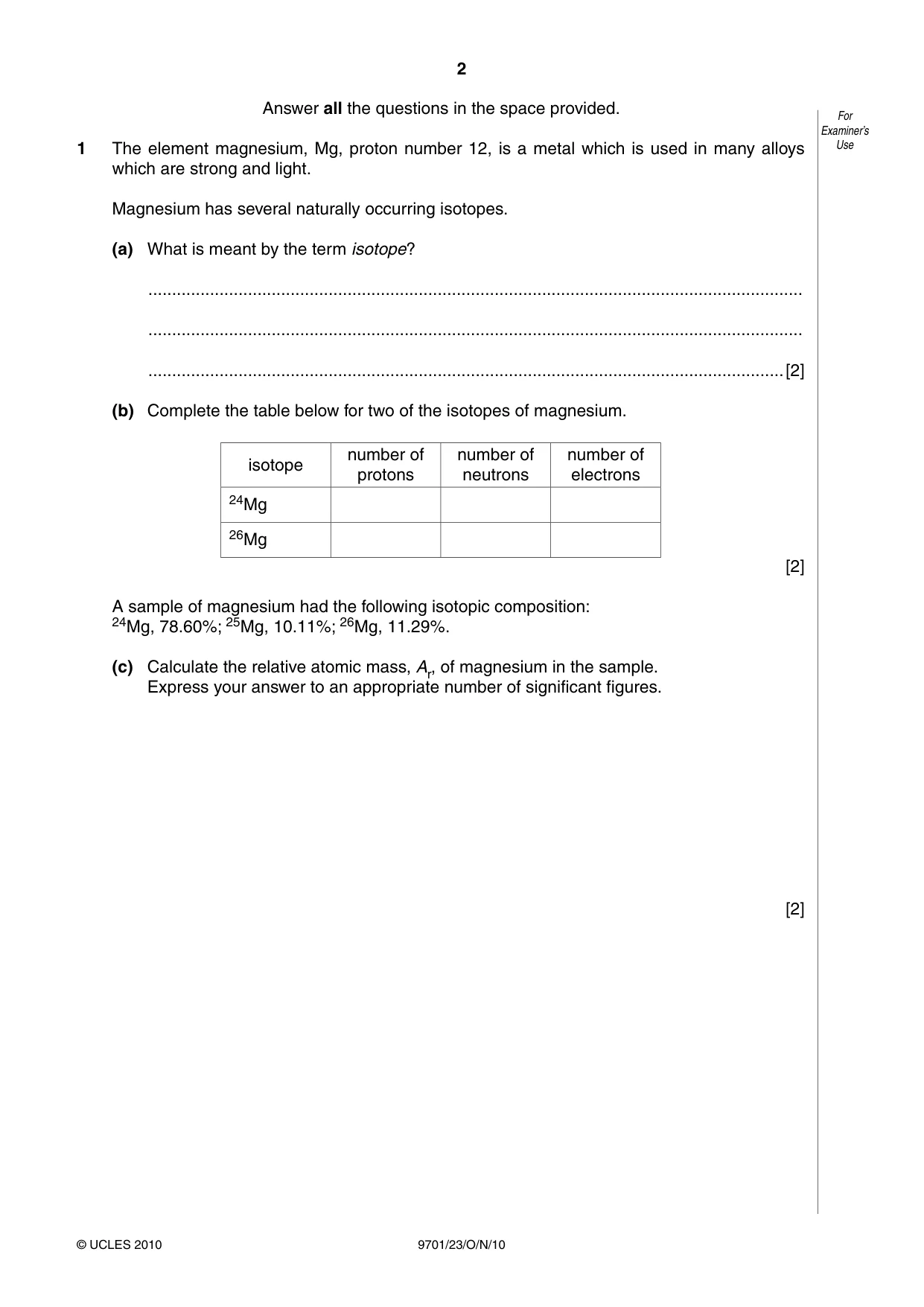
Question paper, page 2
2 9701/23/O/N/10 © UCLES 2010 For Examiner’s Use Answer all the questions in the space provided. 1 The element magnesium, Mg, proton number 12, is a metal which is used in many alloys which are strong and light. Magnesium has several naturally occurring isotopes. (a) What is meant by the term isotope? … … …[2] (b) Complete the table below for two of the isotopes of magnesium. isotope number of protons number of neutrons number of electrons 24Mg 26Mg [2] A sample of magnesium had the following isotopic composition: 24Mg, 78.60%; 25Mg, 10.11%; 26Mg, 11.29%. (c) Calculate the relative atomic mass, Ar, of magnesium in the sample. Express your answer to an appropriate number of significant figures. [2]
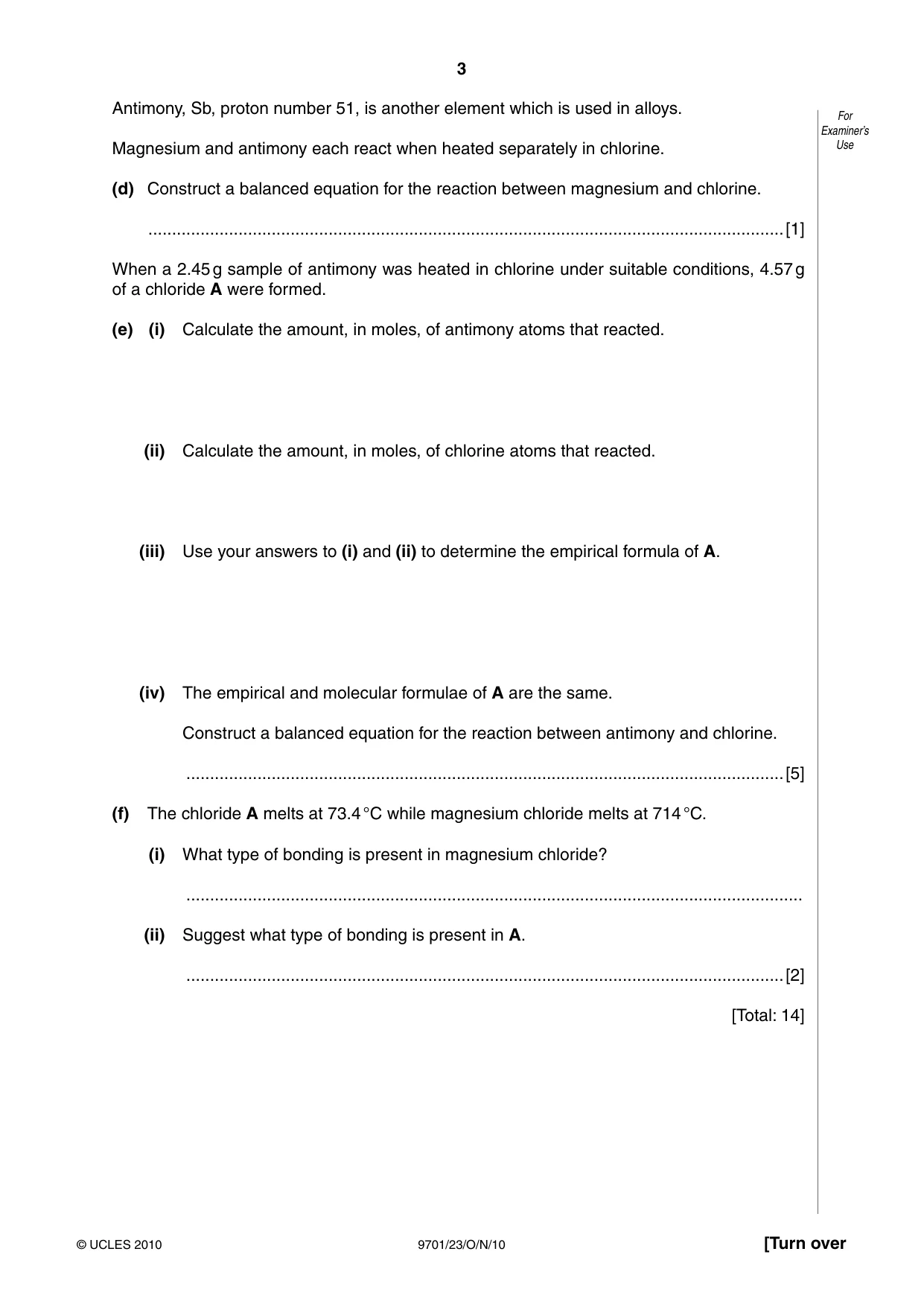
Question paper, page 3
3 9701/23/O/N/10 © UCLES 2010 [Turn over For Examiner’s Use Antimony, Sb, proton number 51, is another element which is used in alloys. Magnesium and antimony each react when heated separately in chlorine. (d) Construct a balanced equation for the reaction between magnesium and chlorine. …[1] When a 2.45 g sample of antimony was heated in chlorine under suitable conditions, 4.57 g of a chloride A were formed. (e) (i) Calculate the amount, in moles, of antimony atoms that reacted. (ii) Calculate the amount, in moles, of chlorine atoms that reacted. (iii) Use your answers to (i) and (ii) to determine the empirical formula of A. (iv) The empirical and molecular formulae of A are the same. Construct a balanced equation for the reaction between antimony and chlorine. …[5] (f) The chloride A melts at 73.4 °C while magnesium chloride melts at 714 °C. (i) What type of bonding is present in magnesium chloride? … (ii) Suggest what type of bonding is present in A. …[2] [Total: 14]
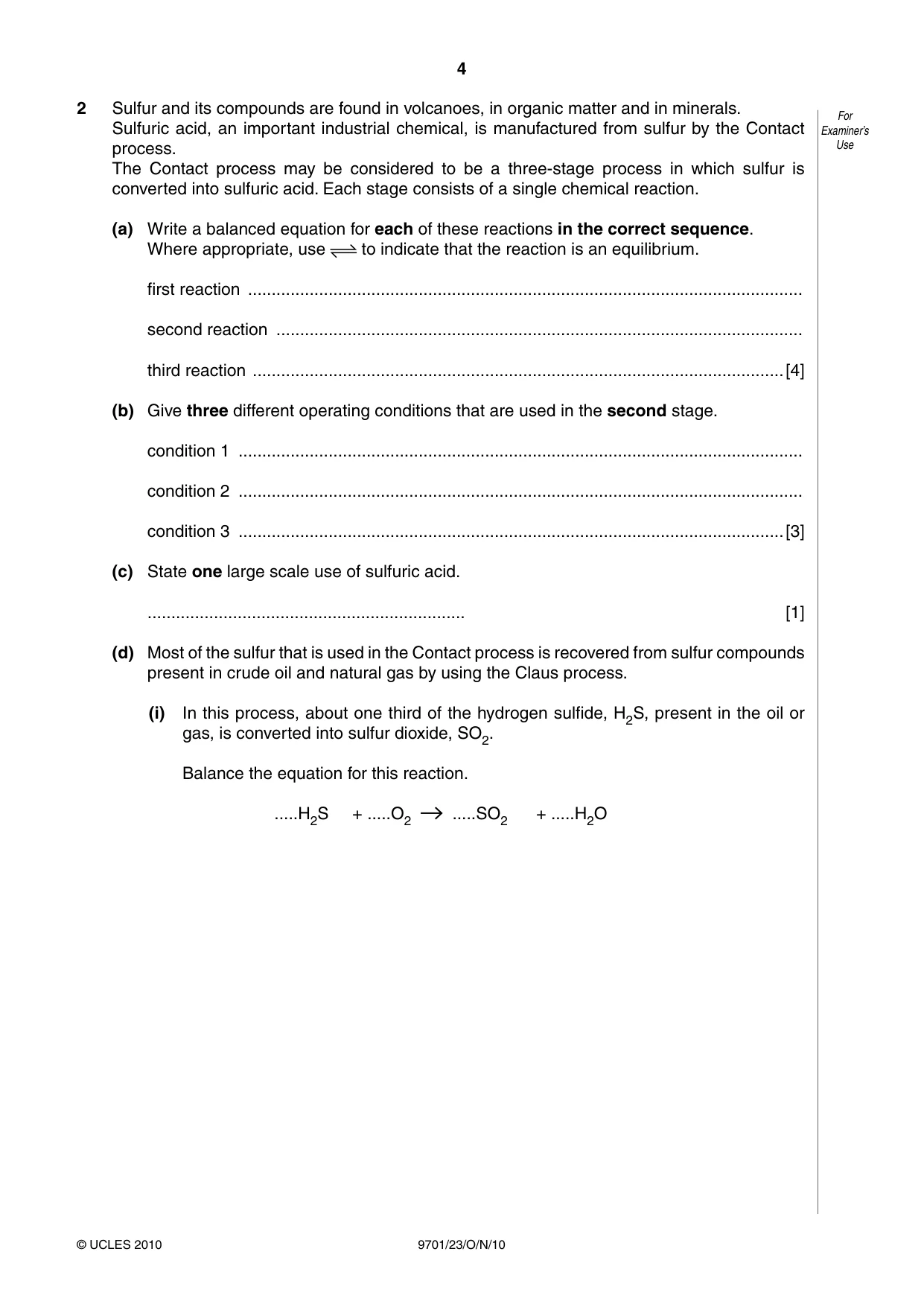
Question paper, page 4
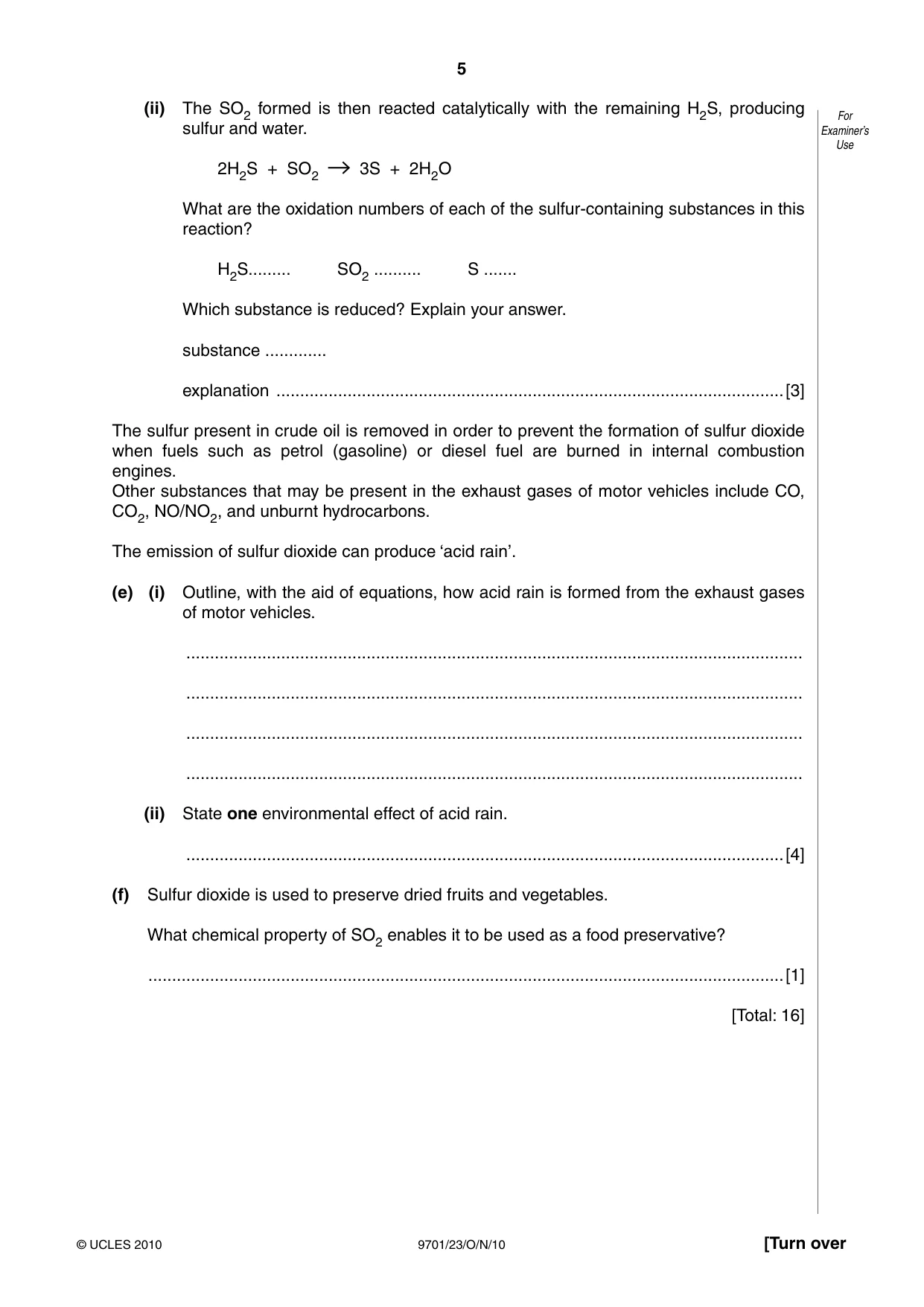
4 9701/23/O/N/10 © UCLES 2010 For Examiner’s Use 2 Sulfur and its compounds are found in volcanoes, in organic matter and in minerals. Sulfuric acid, an important industrial chemical, is manufactured from sulfur by the Contact process. The Contact process may be considered to be a three-stage process in which sulfur is converted into sulfuric acid. Each stage consists of a single chemical reaction. (a) Write a balanced equation for each of these reactions in the correct sequence. Where appropriate, use to indicate that the reaction is an equilibrium. first reaction … second reaction … third reaction …[4] (b) Give three different operating conditions that are used in the second stage. condition 1 … condition 2 … condition 3 …[3] (c) State one large scale use of sulfuric acid. … [1] (d) Most of the sulfur that is used in the Contact process is recovered from sulfur compounds present in crude oil and natural gas by using the Claus process. (i) In this process, about one third of the hydrogen sulfide, H2S, present in the oil or gas, is converted into sulfur dioxide, SO2. Balance the equation for this reaction. …H2S + …O2 …SO2 + …H2O
Question paper, page 5
5 9701/23/O/N/10 © UCLES 2010 [Turn over For Examiner’s Use (ii) The SO2 formed is then reacted catalytically with the remaining H2S, producing sulfur and water. 2H2S + SO2 3S + 2H2O What are the oxidation numbers of each of the sulfur-containing substances in this reaction? H2S… SO2 … S … Which substance is reduced? Explain your answer. substance … explanation …[3] The sulfur present in crude oil is removed in order to prevent the formation of sulfur dioxide when fuels such as petrol (gasoline) or diesel fuel are burned in internal combustion engines. Other substances that may be present in the exhaust gases of motor vehicles include CO, CO2, NO/NO2, and unburnt hydrocarbons. The emission of sulfur dioxide can produce ‘acid rain’. (e) (i) Outline, with the aid of equations, how acid rain is formed from the exhaust gases of motor vehicles. … … … … (ii) State one environmental effect of acid rain. …[4] (f) Sulfur dioxide is used to preserve dried fruits and vegetables. What chemical property of SO2 enables it to be used as a food preservative? …[1] [Total: 16]
Question paper, page 6
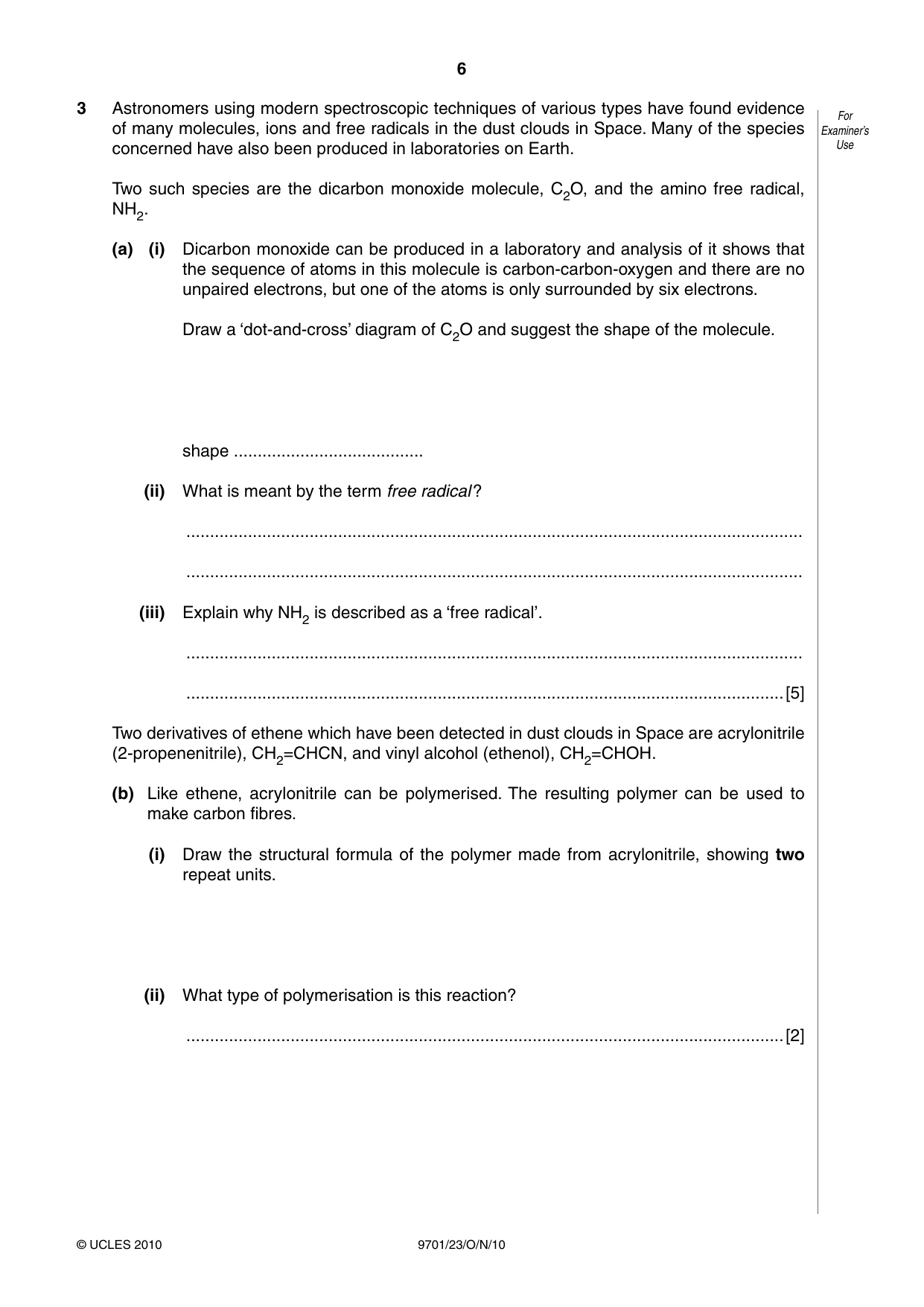
6 9701/23/O/N/10 © UCLES 2010 For Examiner’s Use 3 Astronomers using modern spectroscopic techniques of various types have found evidence of many molecules, ions and free radicals in the dust clouds in Space. Many of the species concerned have also been produced in laboratories on Earth. Two such species are the dicarbon monoxide molecule, C2O, and the amino free radical, NH2. (a) (i) Dicarbon monoxide can be produced in a laboratory and analysis of it shows that the sequence of atoms in this molecule is carbon-carbon-oxygen and there are no unpaired electrons, but one of the atoms is only surrounded by six electrons. Draw a ‘dot-and-cross’ diagram of C2O and suggest the shape of the molecule. shape … (ii) What is meant by the term free radical ? … … (iii) Explain why NH2 is described as a ‘free radical’. … …[5] Two derivatives of ethene which have been detected in dust clouds in Space are acrylonitrile (2-propenenitrile), CH2=CHCN, and vinyl alcohol (ethenol), CH2=CHOH. (b) Like ethene, acrylonitrile can be polymerised. The resulting polymer can be used to make carbon fibres. (i) Draw the structural formula of the polymer made from acrylonitrile, showing two repeat units. (ii) What type of polymerisation is this reaction? …[2]
Question paper, page 7
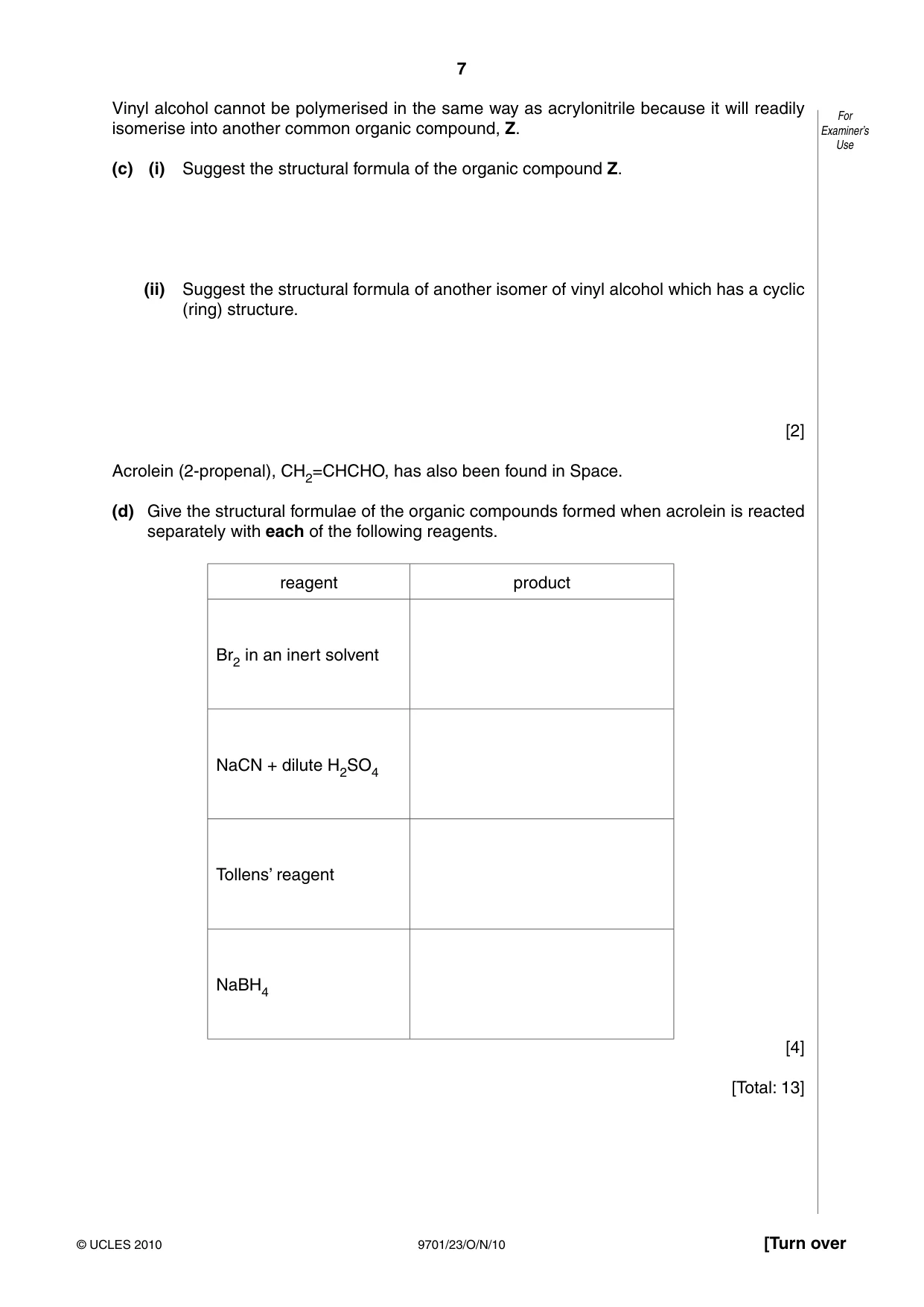
7 9701/23/O/N/10 © UCLES 2010 [Turn over For Examiner’s Use Vinyl alcohol cannot be polymerised in the same way as acrylonitrile because it will readily isomerise into another common organic compound, Z. (c) (i) Suggest the structural formula of the organic compound Z. (ii) Suggest the structural formula of another isomer of vinyl alcohol which has a cyclic (ring) structure. [2] Acrolein (2-propenal), CH2=CHCHO, has also been found in Space. (d) Give the structural formulae of the organic compounds formed when acrolein is reacted separately with each of the following reagents. reagent product Br2 in an inert solvent NaCN + dilute H2SO4 Tollens’ reagent NaBH4 [4] [Total: 13]
Question paper, page 8
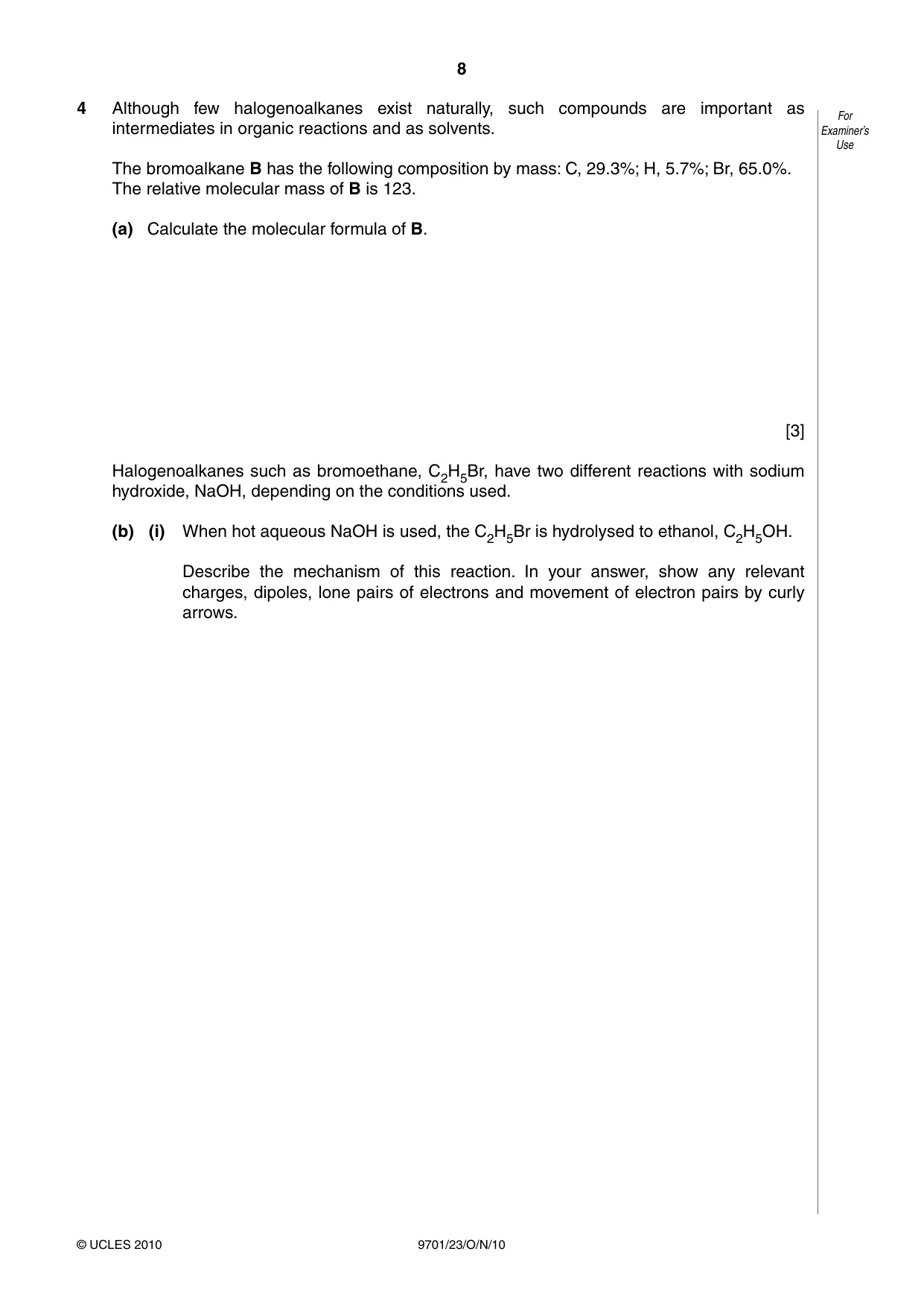
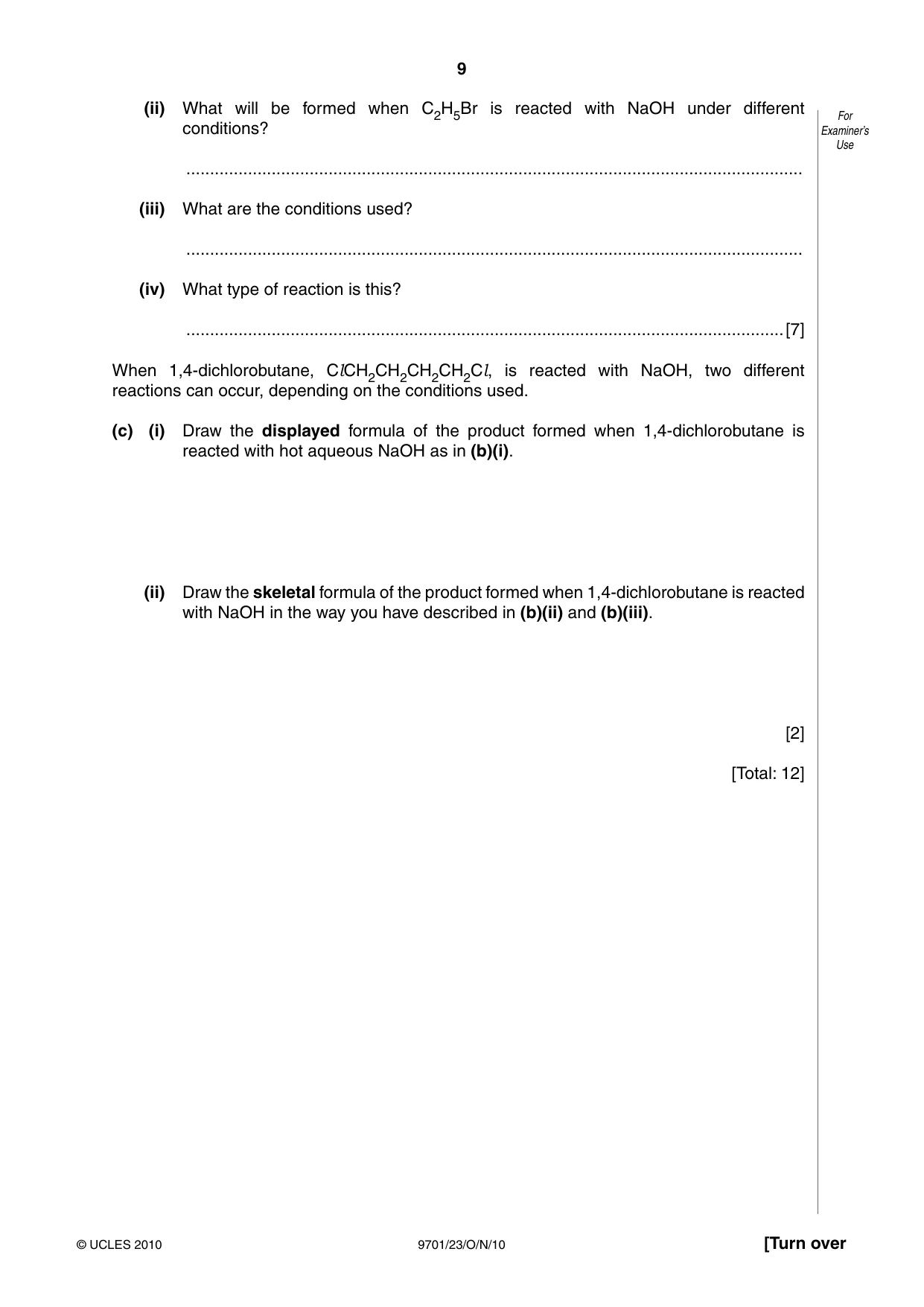
8 9701/23/O/N/10 © UCLES 2010 For Examiner’s Use 4 Although few halogenoalkanes exist naturally, such compounds are important as intermediates in organic reactions and as solvents. The bromoalkane B has the following composition by mass: C, 29.3%; H, 5.7%; Br, 65.0%. The relative molecular mass of B is 123. (a) Calculate the molecular formula of B. [3] Halogenoalkanes such as bromoethane, C2H5Br, have two different reactions with sodium hydroxide, NaOH, depending on the conditions used. (b) (i) When hot aqueous NaOH is used, the C2H5Br is hydrolysed to ethanol, C2H5OH. Describe the mechanism of this reaction. In your answer, show any relevant charges, dipoles, lone pairs of electrons and movement of electron pairs by curly arrows.
Question paper, page 9
9 9701/23/O/N/10 © UCLES 2010 [Turn over For Examiner’s Use (ii) What will be formed when C2H5Br is reacted with NaOH under different conditions? … (iii) What are the conditions used? … (iv) What type of reaction is this? …[7] When 1,4-dichlorobutane, ClCH2CH2CH2CH2Cl, is reacted with NaOH, two different reactions can occur, depending on the conditions used. (c) (i) Draw the displayed formula of the product formed when 1,4-dichlorobutane is reacted with hot aqueous NaOH as in (b)(i). (ii) Draw the skeletal formula of the product formed when 1,4-dichlorobutane is reacted with NaOH in the way you have described in (b)(ii) and (b)(iii). [2] [Total: 12]
Question paper, page 10
10 9701/23/O/N/10 © UCLES 2010 BLANK PAGE
Question paper, page 11
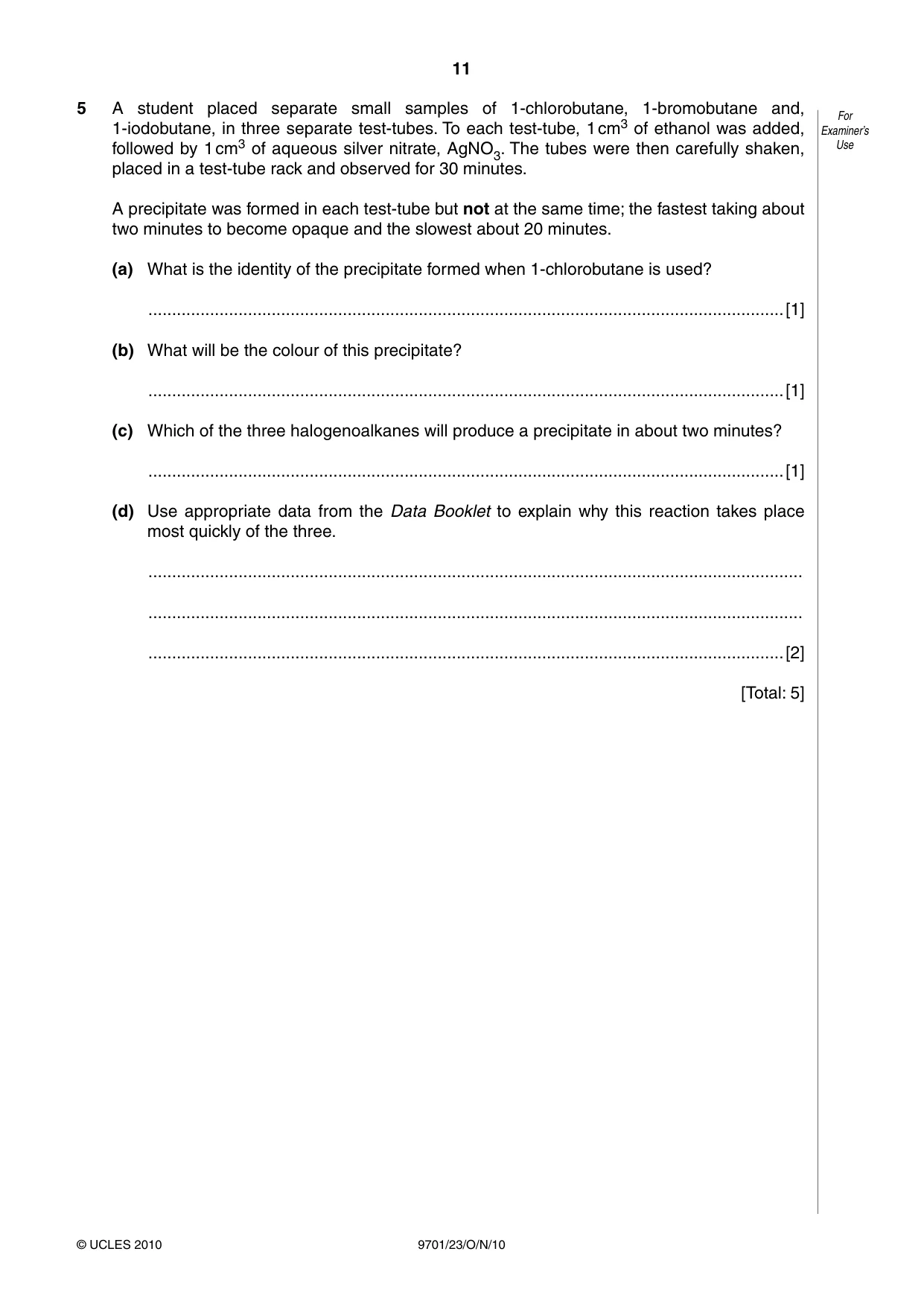
11 9701/23/O/N/10 © UCLES 2010 For Examiner’s Use 5 A student placed separate small samples of 1-chlorobutane, 1-bromobutane and, 1-iodobutane, in three separate test-tubes. To each test-tube, 1 cm3 of ethanol was added, followed by 1 cm3 of aqueous silver nitrate, AgNO3. The tubes were then carefully shaken, placed in a test-tube rack and observed for 30 minutes. A precipitate was formed in each test-tube but not at the same time; the fastest taking about two minutes to become opaque and the slowest about 20 minutes. (a) What is the identity of the precipitate formed when 1-chlorobutane is used? …[1] (b) What will be the colour of this precipitate? …[1] (c) Which of the three halogenoalkanes will produce a precipitate in about two minutes? …[1] (d) Use appropriate data from the Data Booklet to explain why this reaction takes place most quickly of the three. … … …[2] [Total: 5]
Question paper, page 12
12 9701/23/O/N/10 © UCLES 2010 BLANK PAGE Permission to reproduce items where third-party owned material protected by copyright is included has been sought and cleared where possible. Every reasonable effort has been made by the publisher (UCLES) to trace copyright holders, but if any items requiring clearance have unwittingly been included, the publisher will be pleased to make amends at the earliest possible opportunity. University of Cambridge International Examinations is part of the Cambridge Assessment Group. Cambridge Assessment is the brand name of University of Cambridge Local Examinations Syndicate (UCLES), which is itself a department of the University of Cambridge.
Mark scheme, page 1
UNIVERSITY OF CAMBRIDGE INTERNATIONAL EXAMINATIONS GCE Advanced Subsidiary Level and GCE Advanced Level MARK SCHEME for the October/November 2010 question paper for the guidance of teachers 9701 CHEMISTRY 9701/23 Paper 2 (AS Structured Questions), maximum raw mark 60 This mark scheme is published as an aid to teachers and candidates, to indicate the requirements of the examination. It shows the basis on which Examiners were instructed to award marks. It does not indicate the details of the discussions that took place at an Examiners’ meeting before marking began, which would have considered the acceptability of alternative answers. Mark schemes must be read in conjunction with the question papers and the report on the examination. • CIE will not enter into discussions or correspondence in connection with these mark schemes. CIE is publishing the mark schemes for the October/November 2010 question papers for most IGCSE, GCE Advanced Level and Advanced Subsidiary Level syllabuses and some Ordinary Level syllabuses.
Mark scheme, page 2
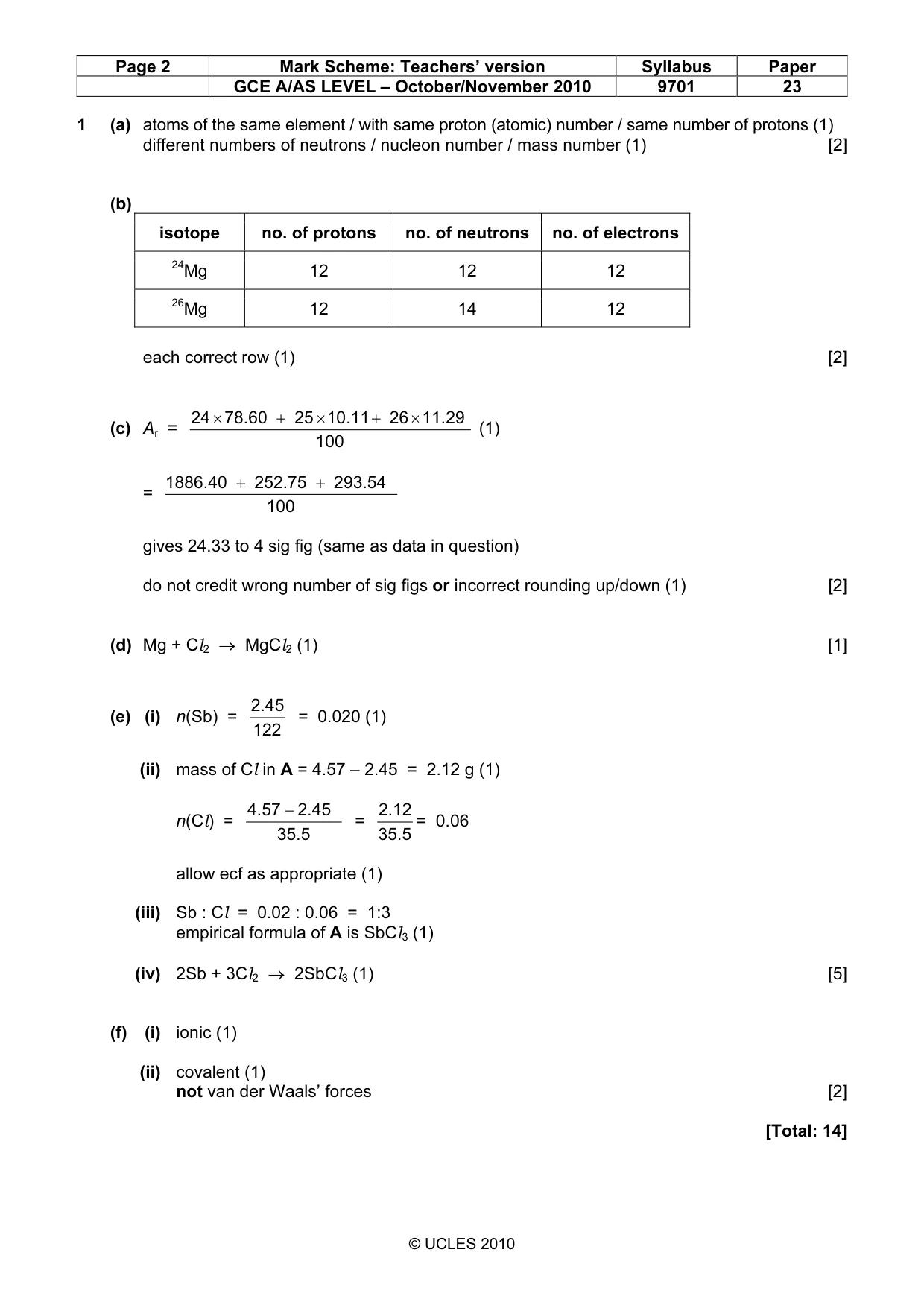
Page 2 Mark Scheme: Teachers’ version Syllabus Paper GCE A/AS LEVEL – October/November 2010 9701 23 © UCLES 2010 1 (a) atoms of the same element / with same proton (atomic) number / same number of protons (1) different numbers of neutrons / nucleon number / mass number (1) [2] (b) isotope no. of protons no. of neutrons no. of electrons 24Mg 12 12 12 26Mg 12 14 12 each correct row (1) [2] (c) Ar = 100 11.29 26 10.11 25 78.60 24 × + × + × (1) = 100 293.54 252.75 1886.40 + + gives 24.33 to 4 sig fig (same as data in question) do not credit wrong number of sig figs or incorrect rounding up/down (1) [2] (d) Mg + Cl2 → MgCl2 (1) [1] (e) (i) n(Sb) = 122 2.45 = 0.020 (1) (ii) mass of Cl in A = 4.57 – 2.45 = 2.12 g (1) n(Cl) = 35.5 2.45 4.57 − = 35.5 2.12 = 0.06 allow ecf as appropriate (1) (iii) Sb : Cl = 0.02 : 0.06 = 1:3 empirical formula of A is SbCl3 (1) (iv) 2Sb + 3Cl2 → 2SbCl3 (1) [5] (f) (i) ionic (1) (ii) covalent (1) not van der Waals’ forces [2] [Total: 14]
Mark scheme, page 3
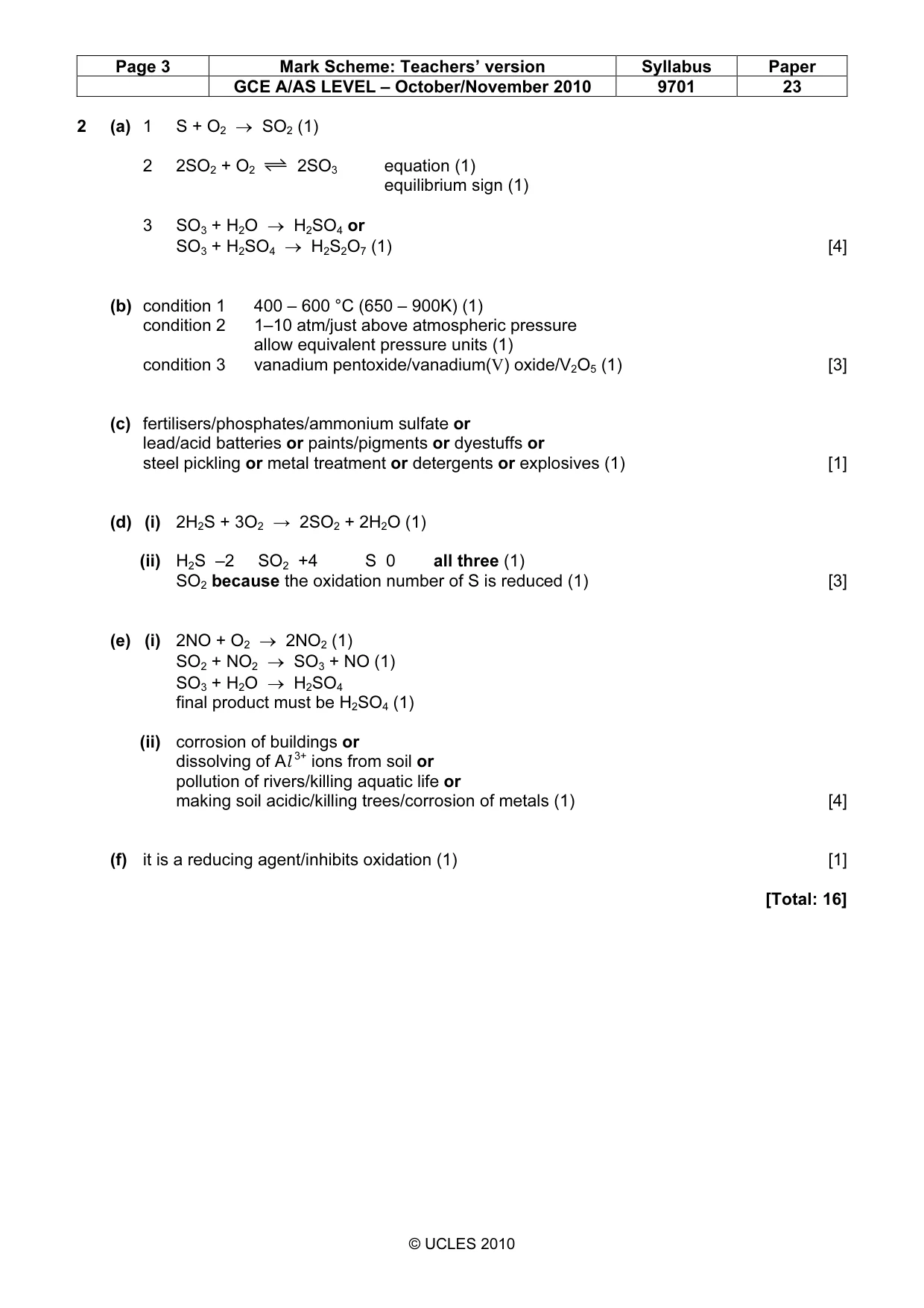
Page 3 Mark Scheme: Teachers’ version Syllabus Paper GCE A/AS LEVEL – October/November 2010 9701 23 © UCLES 2010 2 (a) 1 S + O2 → SO2 (1) 2 2SO2 + O2 2SO3 equation (1) equilibrium sign (1) 3 SO3 + H2O → H2SO4 or SO3 + H2SO4 → H2S2O7 (1) [4] (b) condition 1 400 – 600 °C (650 – 900K) (1) condition 2 1–10 atm/just above atmospheric pressure allow equivalent pressure units (1) condition 3 vanadium pentoxide/vanadium(V) oxide/V2O5 (1) [3] (c) fertilisers/phosphates/ammonium sulfate or lead/acid batteries or paints/pigments or dyestuffs or steel pickling or metal treatment or detergents or explosives (1) [1] (d) (i) 2H2S + 3O2 → 2SO2 + 2H2O (1) (ii) H2S –2 SO2 +4 S 0 all three (1) SO2 because the oxidation number of S is reduced (1) [3] (e) (i) 2NO + O2 → 2NO2 (1) SO2 + NO2 → SO3 + NO (1) SO3 + H2O → H2SO4 final product must be H2SO4 (1) (ii) corrosion of buildings or dissolving of Al 3+ ions from soil or pollution of rivers/killing aquatic life or making soil acidic/killing trees/corrosion of metals (1) [4] (f) it is a reducing agent/inhibits oxidation (1) [1] [Total: 16]
Mark scheme, page 4
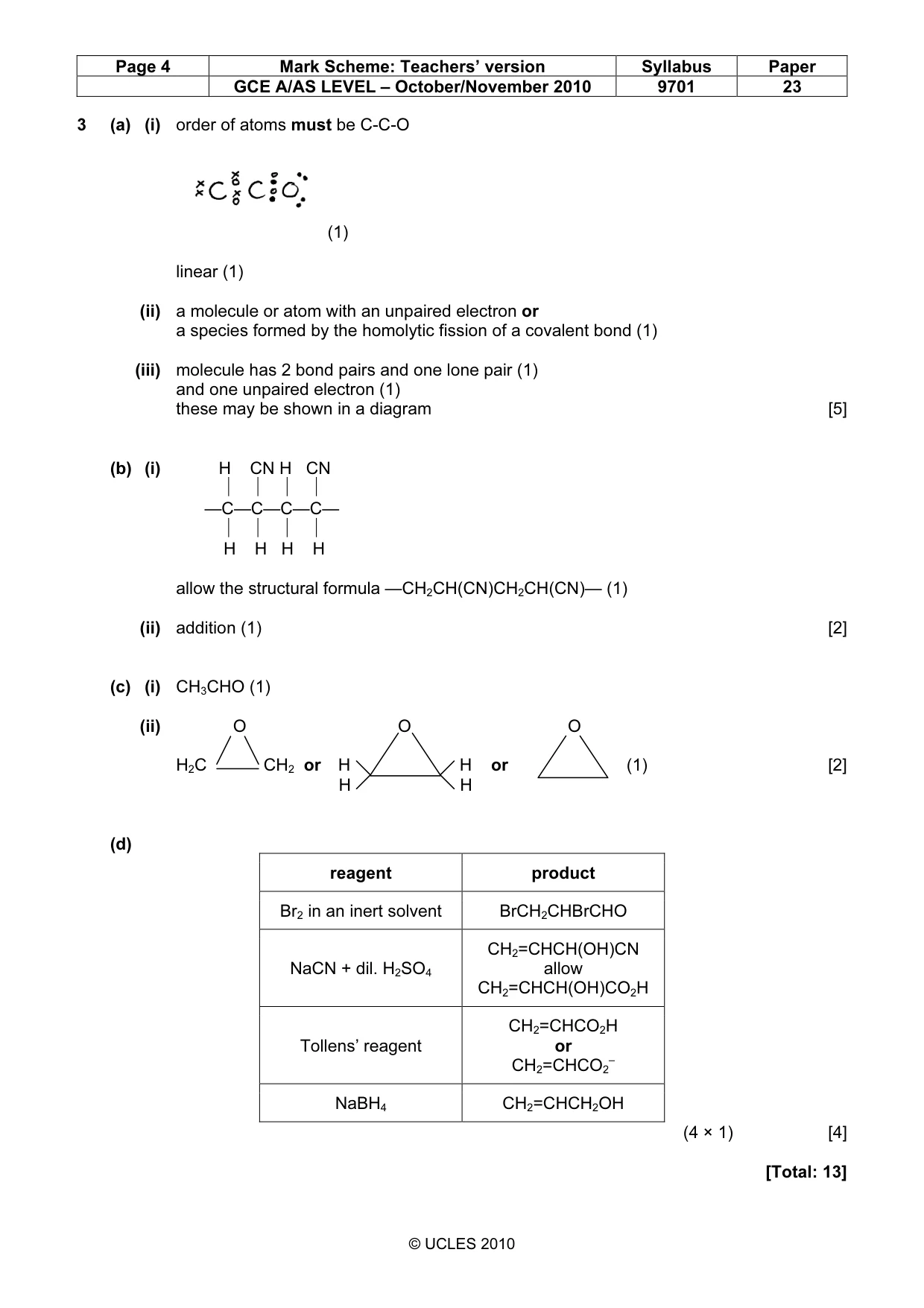
Page 4 Mark Scheme: Teachers’ version Syllabus Paper GCE A/AS LEVEL – October/November 2010 9701 23 © UCLES 2010 3 (a) (i) order of atoms must be C-C-O (1) linear (1) (ii) a molecule or atom with an unpaired electron or a species formed by the homolytic fission of a covalent bond (1) (iii) molecule has 2 bond pairs and one lone pair (1) and one unpaired electron (1) these may be shown in a diagram [5] (b) (i) H CN H CN —C—C—C—C— H H H H allow the structural formula —CH2CH(CN)CH2CH(CN)— (1) (ii) addition (1) [2] (c) (i) CH3CHO (1) (ii) O O O H2C CH2 or H H or (1) [2] H H (d) reagent product Br2 in an inert solvent BrCH2CHBrCHO NaCN + dil. H2SO4 CH2=CHCH(OH)CN allow CH2=CHCH(OH)CO2H Tollens’ reagent CH2=CHCO2H or CH2=CHCO2 – NaBH4 CH2=CHCH2OH (4 × 1) [4] [Total: 13]
Mark scheme, page 5
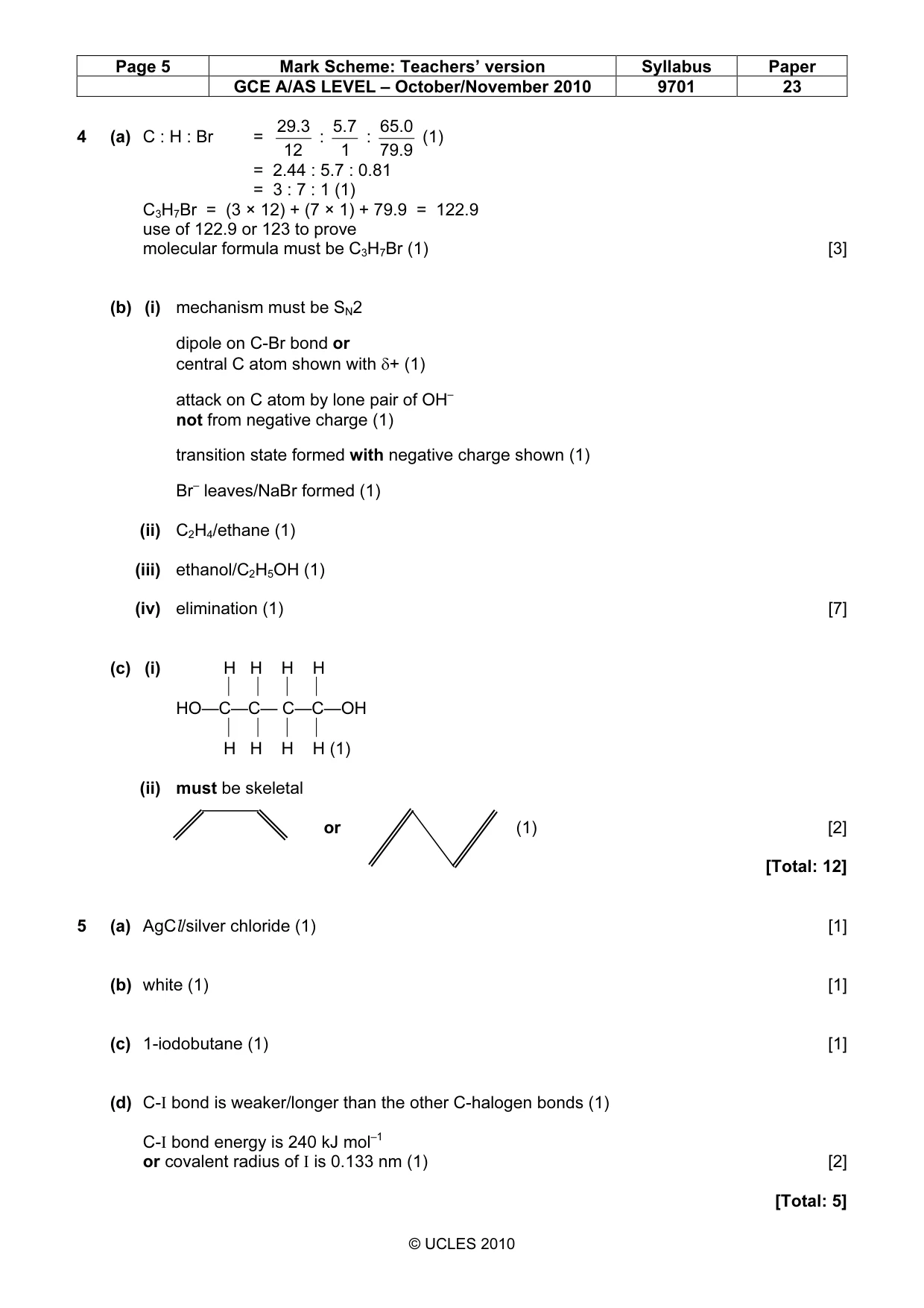
Page 5 Mark Scheme: Teachers’ version Syllabus Paper GCE A/AS LEVEL – October/November 2010 9701 23 © UCLES 2010 4 (a) C : H : Br = 12 29.3 : 1 5.7 : 79.9 65.0 (1) = 2.44 : 5.7 : 0.81 = 3 : 7 : 1 (1) C3H7Br = (3 × 12) + (7 × 1) + 79.9 = 122.9 use of 122.9 or 123 to prove molecular formula must be C3H7Br (1) [3] (b) (i) mechanism must be SN2 dipole on C-Br bond or central C atom shown with δ+ (1) attack on C atom by lone pair of OH– not from negative charge (1) transition state formed with negative charge shown (1) Br– leaves/NaBr formed (1) (ii) C2H4/ethane (1) (iii) ethanol/C2H5OH (1) (iv) elimination (1) [7] (c) (i) H H H H HO—C—C— C—C—OH H H H H (1) (ii) must be skeletal or (1) [2] [Total: 12] 5 (a) AgCl/silver chloride (1) [1] (b) white (1) [1] (c) 1-iodobutane (1) [1] (d) C-I bond is weaker/longer than the other C-halogen bonds (1) C-I bond energy is 240 kJ mol–1 or covalent radius of I is 0.133 nm (1) [2] [Total: 5]
What you needed in this session
Cambridge’s own grade thresholds for 2010 Oct/Nov, Paper 2 · Variant 3. A higher threshold means an easier paper — the bar moves with how the cohort did.