Cambridge A Level Chemistry 9701 — 2007 May/June Paper 1 · Variant 1
9701/11/M/J/07 · 40 marks · ≈45 min
The question paper and its mark scheme, free to read here and free to download. This is Cambridge’s own paper, exactly as it was sat.
Question paper16 pages

Mark scheme2 pages
Answers below. Sit the paper first if you are practising.
Paper as text
Question paper, page 1
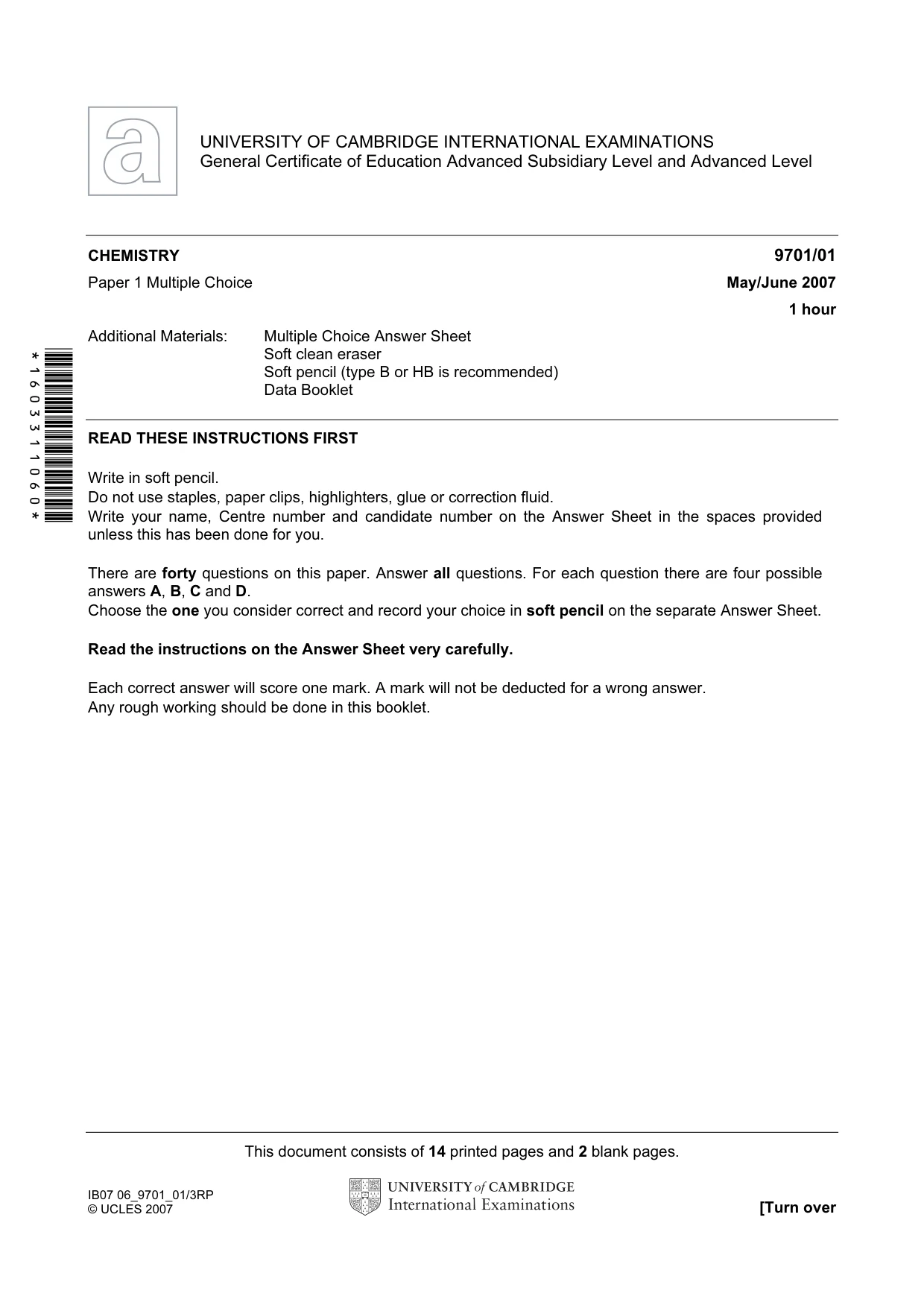
This document consists of 14 printed pages and 2 blank pages. IB07 06_9701_01/3RP © UCLES 2007 [Turn over *1603311060* UNIVERSITY OF CAMBRIDGE INTERNATIONAL EXAMINATIONS General Certificate of Education Advanced Subsidiary Level and Advanced Level CHEMISTRY 9701/01 Paper 1 Multiple Choice May/June 2007 1 hour Additional Materials: Multiple Choice Answer Sheet Soft clean eraser Soft pencil (type B or HB is recommended) Data Booklet READ THESE INSTRUCTIONS FIRST Write in soft pencil. Do not use staples, paper clips, highlighters, glue or correction fluid. Write your name, Centre number and candidate number on the Answer Sheet in the spaces provided unless this has been done for you. There are forty questions on this paper. Answer all questions. For each question there are four possible answers A, B, C and D. Choose the one you consider correct and record your choice in soft pencil on the separate Answer Sheet. Read the instructions on the Answer Sheet very carefully. Each correct answer will score one mark. A mark will not be deducted for a wrong answer. Any rough working should be done in this booklet.
Question paper, page 2
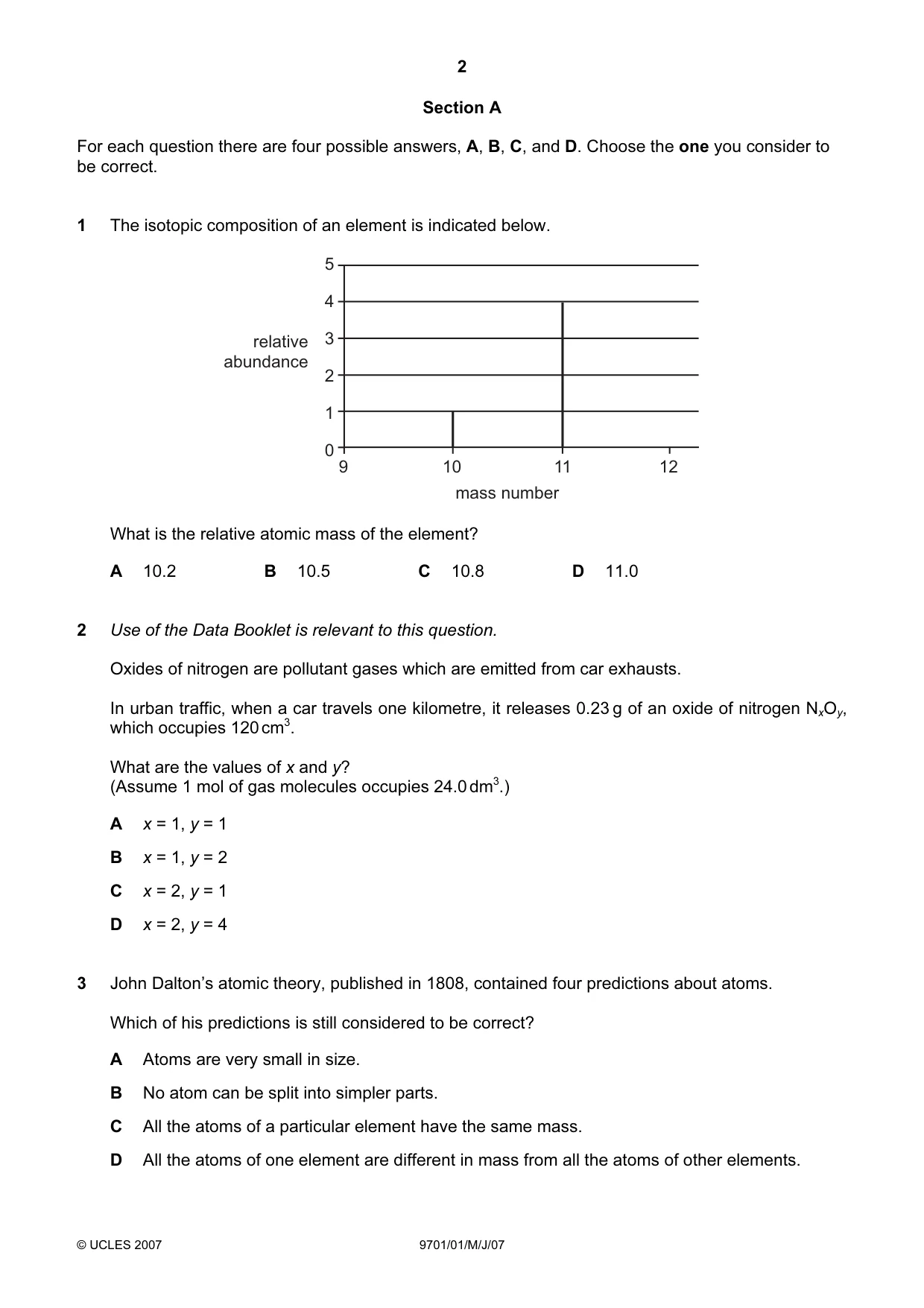
2 © UCLES 2007 9701/01/M/J/07 Section A For each question there are four possible answers, A, B, C, and D. Choose the one you consider to be correct. 1 The isotopic composition of an element is indicated below. relative abundance 5 4 3 2 1 0 mass number 9 10 11 12 What is the relative atomic mass of the element? A 10.2 B 10.5 C 10.8 D 11.0 2 Use of the Data Booklet is relevant to this question. Oxides of nitrogen are pollutant gases which are emitted from car exhausts. In urban traffic, when a car travels one kilometre, it releases 0.23 g of an oxide of nitrogen NxOy, which occupies 120 cm3. What are the values of x and y? (Assume 1 mol of gas molecules occupies 24.0 dm3.) A x = 1, y = 1 B x = 1, y = 2 C x = 2, y = 1 D x = 2, y = 4 3 John Dalton’s atomic theory, published in 1808, contained four predictions about atoms. Which of his predictions is still considered to be correct? A Atoms are very small in size. B No atom can be split into simpler parts. C All the atoms of a particular element have the same mass. D All the atoms of one element are different in mass from all the atoms of other elements.
Question paper, page 3
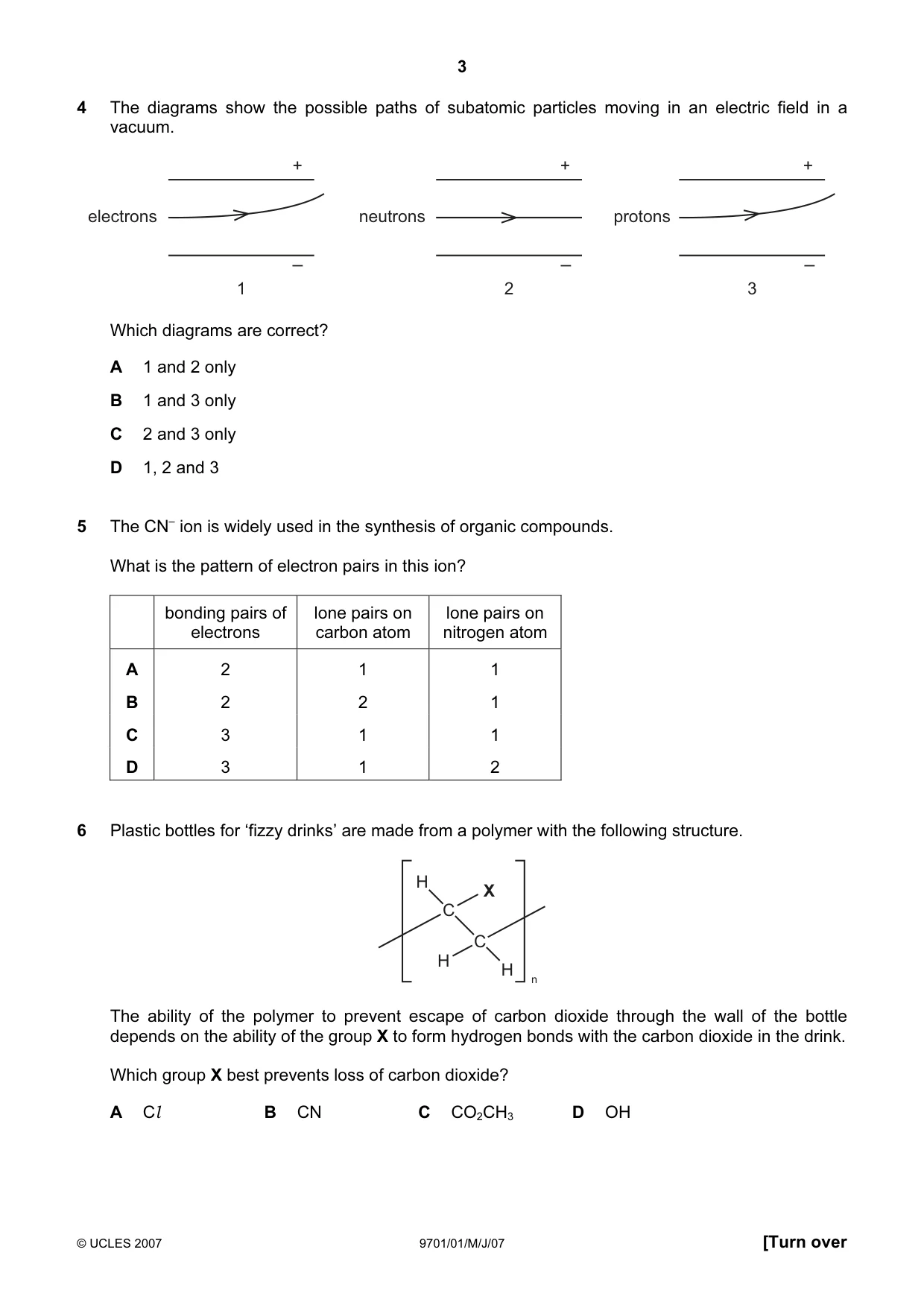
3 © UCLES 2007 9701/01/M/J/07 [Turn over 4 The diagrams show the possible paths of subatomic particles moving in an electric field in a vacuum. 1 + 2 + 3 + electrons neutrons protons – – – Which diagrams are correct? A 1 and 2 only B 1 and 3 only C 2 and 3 only D 1, 2 and 3 5 The CN– ion is widely used in the synthesis of organic compounds. What is the pattern of electron pairs in this ion? bonding pairs of electrons lone pairs on carbon atom lone pairs on nitrogen atom A 2 1 1 B 2 2 1 C 3 1 1 D 3 1 2 6 Plastic bottles for ‘fizzy drinks’ are made from a polymer with the following structure. C C H H H X n The ability of the polymer to prevent escape of carbon dioxide through the wall of the bottle depends on the ability of the group X to form hydrogen bonds with the carbon dioxide in the drink. Which group X best prevents loss of carbon dioxide? A Cl B CN C CO2CH3 D OH
Question paper, page 4
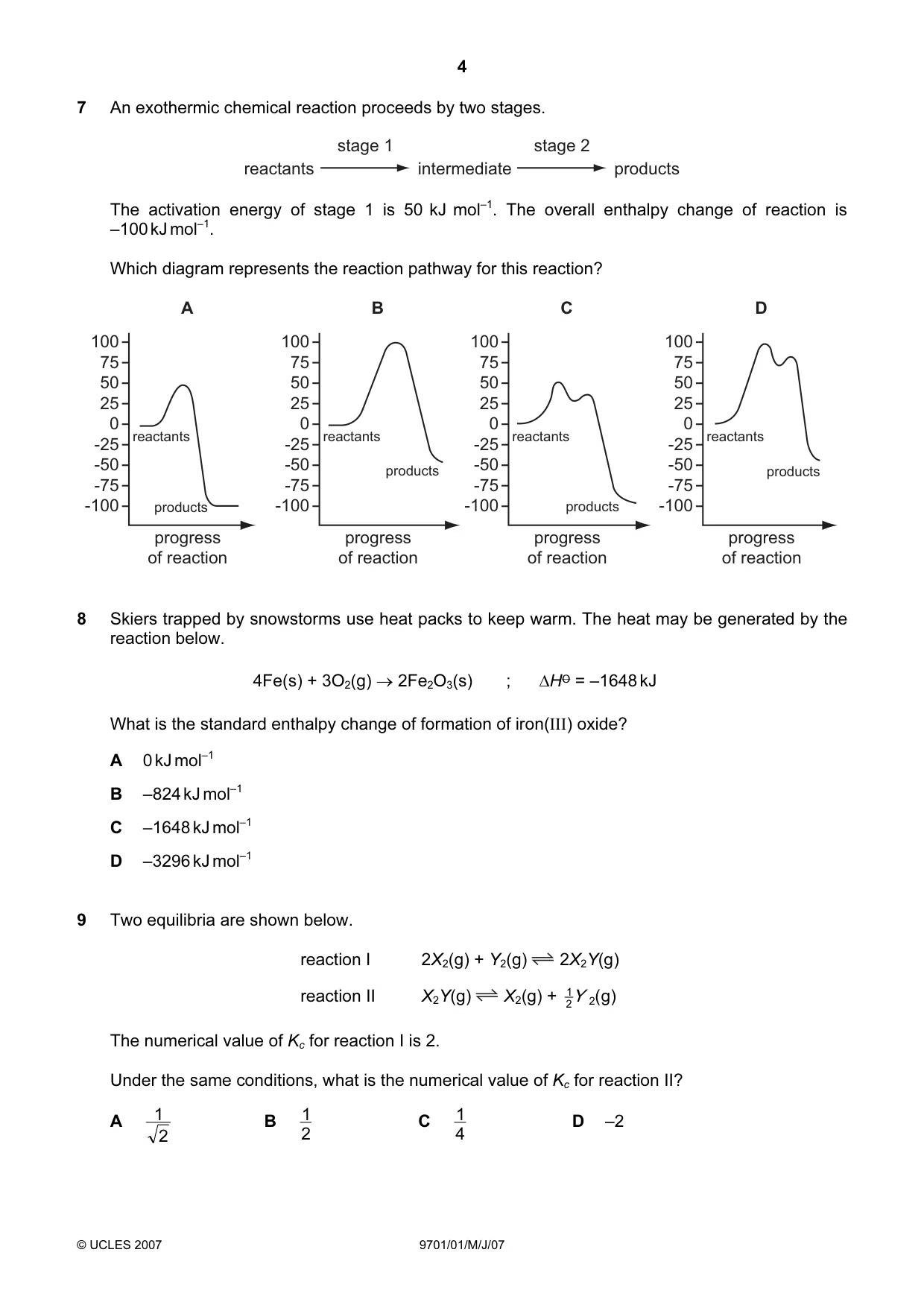
4 © UCLES 2007 9701/01/M/J/07 7 An exothermic chemical reaction proceeds by two stages. reactants intermediate products stage 1 stage 2 The activation energy of stage 1 is 50 kJ mol–1. The overall enthalpy change of reaction is –100 kJ mol–1. Which diagram represents the reaction pathway for this reaction? A 100 75 50 25 0 -25 -50 -75 -100 progress of reaction reactants products B 100 75 50 25 0 -25 -50 -75 -100 progress of reaction reactants products C 100 75 50 25 0 -25 -50 -75 -100 progress of reaction reactants products D 100 75 50 25 0 -25 -50 -75 -100 progress of reaction reactants products 8 Skiers trapped by snowstorms use heat packs to keep warm. The heat may be generated by the reaction below. 4Fe(s) + 3O2(g) → 2Fe2O3(s) ; ∆HO = –1648 kJ What is the standard enthalpy change of formation of iron(III) oxide? A 0 kJ mol–1 B –824 kJ mol–1 C –1648 kJ mol–1 D –3296 kJ mol–1 9 Two equilibria are shown below. reaction I 2X2(g) + Y2(g) 2X2Y(g) reaction II X2Y(g) X2(g) + ) g ( 2 1 2 Y The numerical value of Kc for reaction I is 2. Under the same conditions, what is the numerical value of Kc for reaction II? A 2 1 B 2 1 C 4 1 D –2
Question paper, page 5
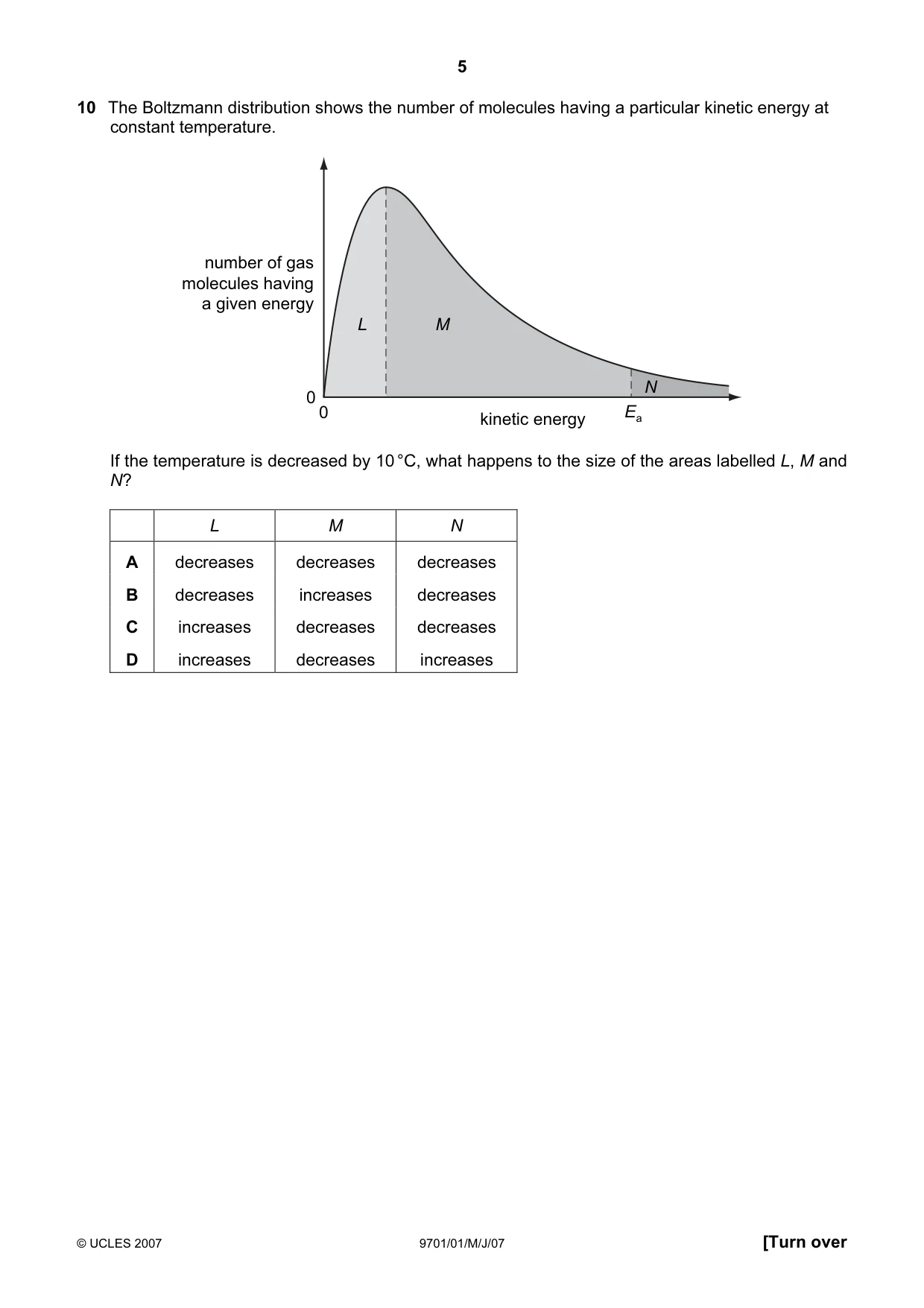
5 © UCLES 2007 9701/01/M/J/07 [Turn over 10 The Boltzmann distribution shows the number of molecules having a particular kinetic energy at constant temperature. number of gas molecules having a given energy 0 0 kinetic energy N L M Ea If the temperature is decreased by 10 °C, what happens to the size of the areas labelled L, M and N? L M N A decreases decreases decreases B decreases increases decreases C increases decreases decreases D increases decreases increases
Question paper, page 6
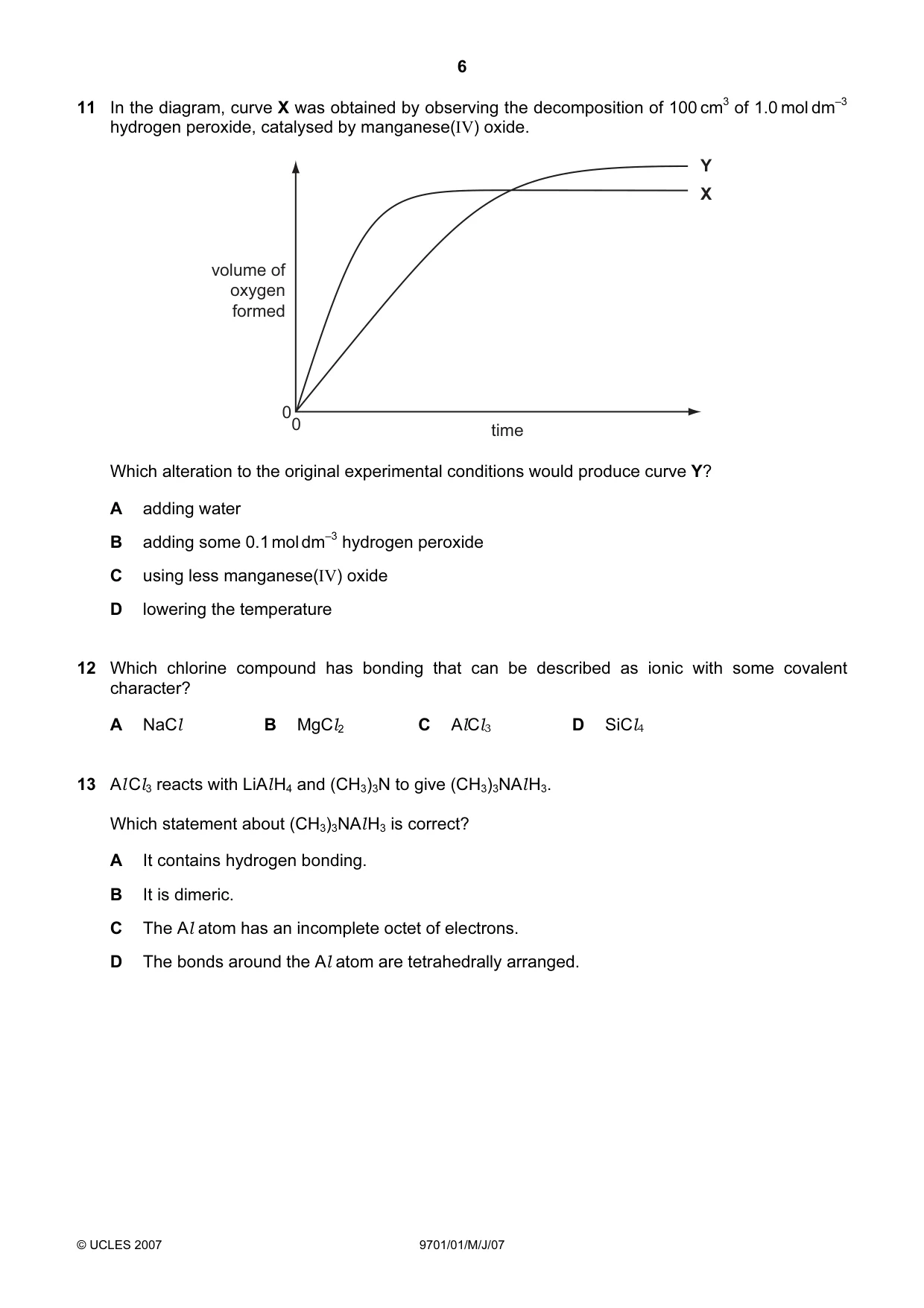
6 © UCLES 2007 9701/01/M/J/07 11 In the diagram, curve X was obtained by observing the decomposition of 100 cm3 of 1.0 mol dm–3 hydrogen peroxide, catalysed by manganese(IV) oxide. volume of oxygen formed 00 time Y X Which alteration to the original experimental conditions would produce curve Y? A adding water B adding some 0.1 mol dm–3 hydrogen peroxide C using less manganese(IV) oxide D lowering the temperature 12 Which chlorine compound has bonding that can be described as ionic with some covalent character? A NaCl B MgCl2 C AlCl3 D SiCl4 13 Al Cl3 reacts with LiAl H4 and (CH3)3N to give (CH3)3NAl H3. Which statement about (CH3)3NAl H3 is correct? A It contains hydrogen bonding. B It is dimeric. C The Al atom has an incomplete octet of electrons. D The bonds around the Al atom are tetrahedrally arranged.
Question paper, page 7
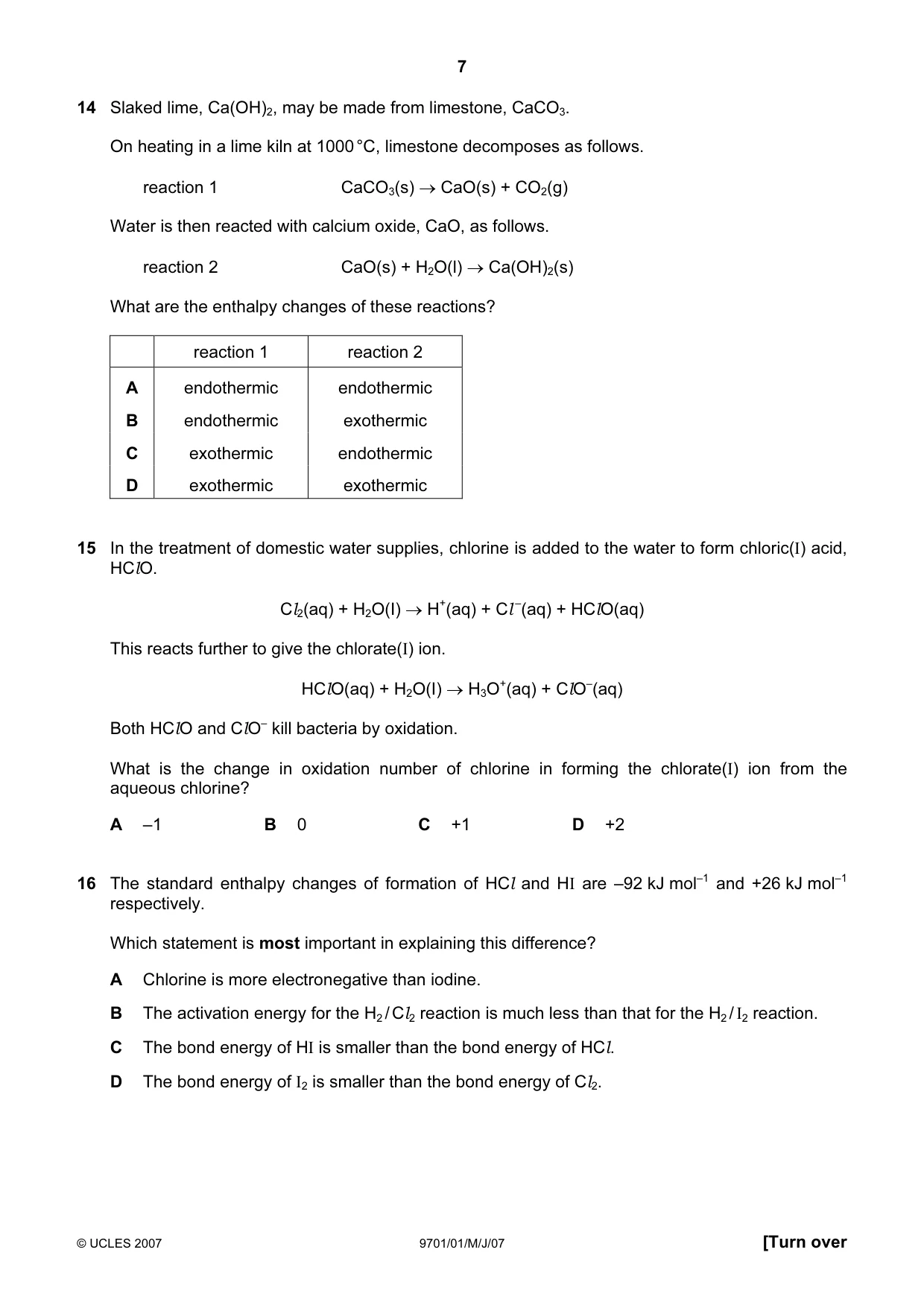
7 © UCLES 2007 9701/01/M/J/07 [Turn over 14 Slaked lime, Ca(OH)2, may be made from limestone, CaCO3. On heating in a lime kiln at 1000 °C, limestone decomposes as follows. reaction 1 CaCO3(s) → CaO(s) + CO2(g) Water is then reacted with calcium oxide, CaO, as follows. reaction 2 CaO(s) + H2O(l) → Ca(OH)2(s) What are the enthalpy changes of these reactions? reaction 1 reaction 2 A endothermic endothermic B endothermic exothermic C exothermic endothermic D exothermic exothermic 15 In the treatment of domestic water supplies, chlorine is added to the water to form chloric(I) acid, HClO. Cl2(aq) + H2O(I) → H+(aq) + Cl –(aq) + HClO(aq) This reacts further to give the chlorate(I) ion. HClO(aq) + H2O(I) → H3O+(aq) + ClO–(aq) Both HClO and ClO– kill bacteria by oxidation. What is the change in oxidation number of chlorine in forming the chlorate(I) ion from the aqueous chlorine? A –1 B 0 C +1 D +2 16 The standard enthalpy changes of formation of HCl and HI are –92 kJ mol–1 and +26 kJ mol–1 respectively. Which statement is most important in explaining this difference? A Chlorine is more electronegative than iodine. B The activation energy for the H2 / Cl2 reaction is much less than that for the H2 / I2 reaction. C The bond energy of HI is smaller than the bond energy of HCl. D The bond energy of I2 is smaller than the bond energy of Cl2.
Question paper, page 8
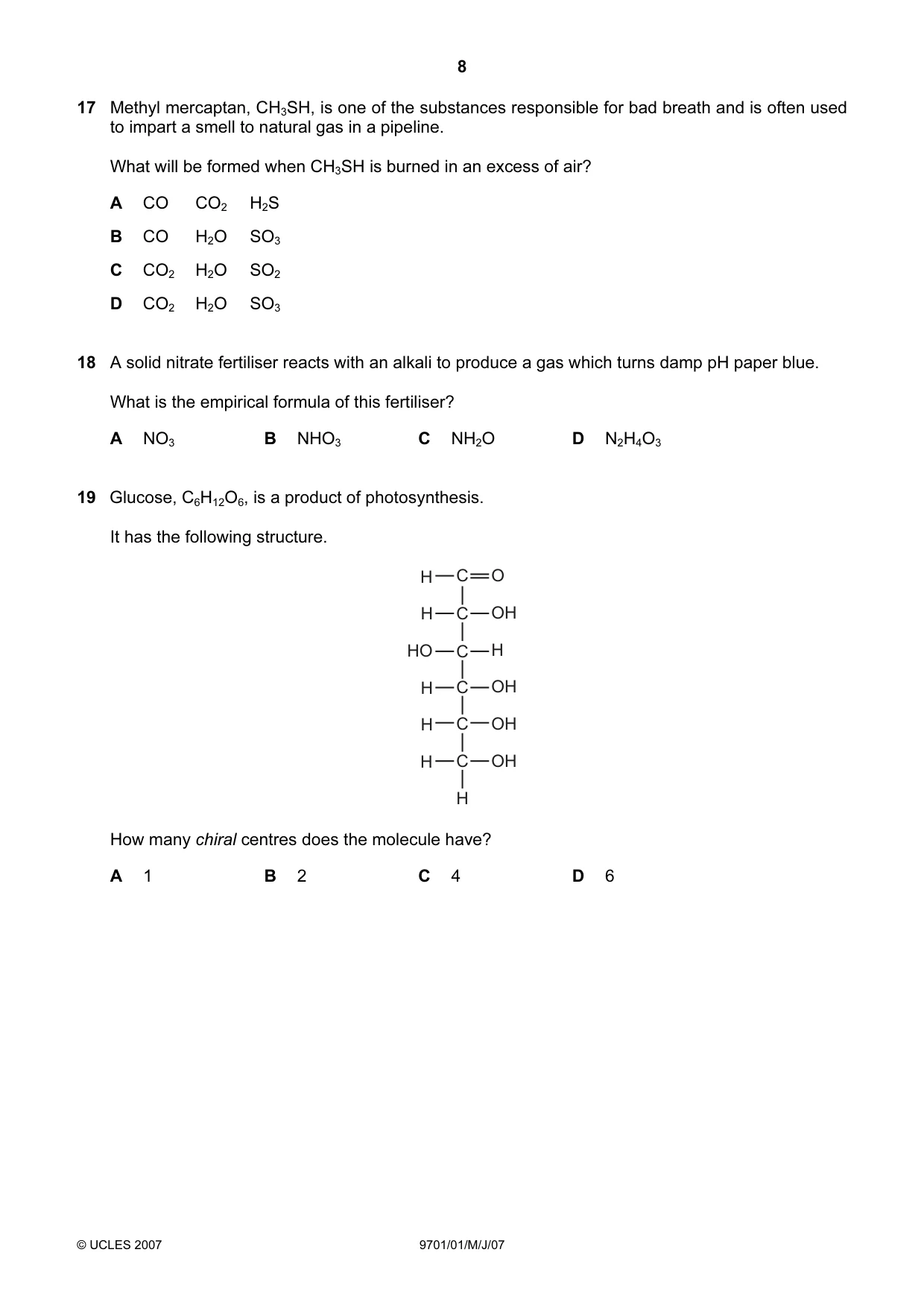
8 © UCLES 2007 9701/01/M/J/07 17 Methyl mercaptan, CH3SH, is one of the substances responsible for bad breath and is often used to impart a smell to natural gas in a pipeline. What will be formed when CH3SH is burned in an excess of air? A CO CO2 H2S B CO H2O SO3 C CO2 H2O SO2 D CO2 H2O SO3 18 A solid nitrate fertiliser reacts with an alkali to produce a gas which turns damp pH paper blue. What is the empirical formula of this fertiliser? A NO3 B NHO3 C NH2O D N2H4O3 19 Glucose, C6H12O6, is a product of photosynthesis. It has the following structure. H OH OH H OH OH H HO H H H H C C C C C C O How many chiral centres does the molecule have? A 1 B 2 C 4 D 6
Question paper, page 9
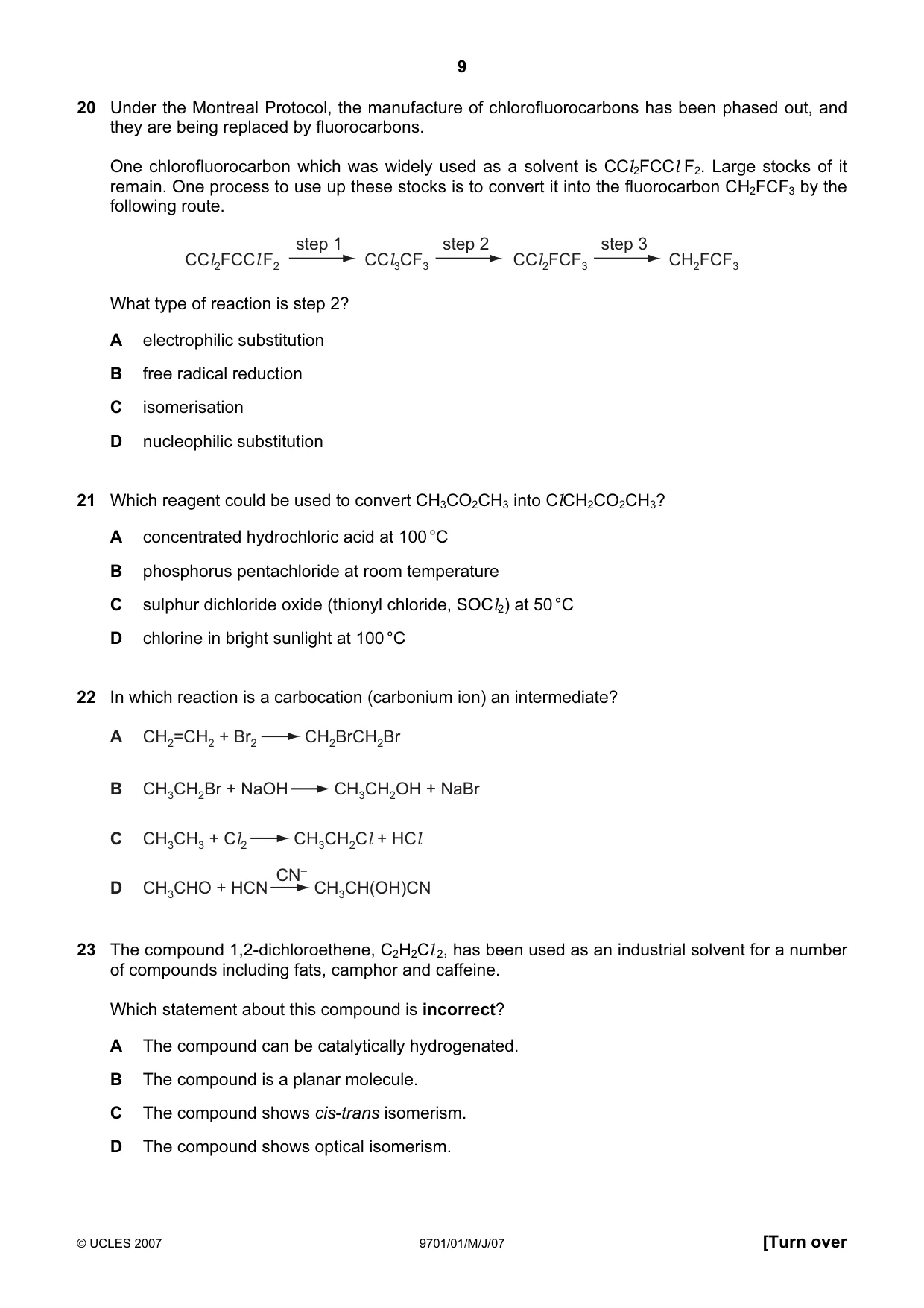
9 © UCLES 2007 9701/01/M/J/07 [Turn over 20 Under the Montreal Protocol, the manufacture of chlorofluorocarbons has been phased out, and they are being replaced by fluorocarbons. One chlorofluorocarbon which was widely used as a solvent is CCl2FCCl F2. Large stocks of it remain. One process to use up these stocks is to convert it into the fluorocarbon CH2FCF3 by the following route. CCl2FCCl F2 CCl3CF3 CCl2FCF3 CH2FCF3 step 1 step 2 step 3 What type of reaction is step 2? A electrophilic substitution B free radical reduction C isomerisation D nucleophilic substitution 21 Which reagent could be used to convert CH3CO2CH3 into ClCH2CO2CH3? A concentrated hydrochloric acid at 100 °C B phosphorus pentachloride at room temperature C sulphur dichloride oxide (thionyl chloride, SOCl2) at 50 °C D chlorine in bright sunlight at 100 °C 22 In which reaction is a carbocation (carbonium ion) an intermediate? A CH2=CH2 + Br2 CH2BrCH2Br B CH3CH2Br + NaOH CH3CH2OH + NaBr C CH3CH3 + Cl2 CH3CH2Cl + HCl D CH3CHO + HCN CH3CH(OH)CN CN– 23 The compound 1,2-dichloroethene, C2H2Cl 2, has been used as an industrial solvent for a number of compounds including fats, camphor and caffeine. Which statement about this compound is incorrect? A The compound can be catalytically hydrogenated. B The compound is a planar molecule. C The compound shows cis-trans isomerism. D The compound shows optical isomerism.
Question paper, page 10
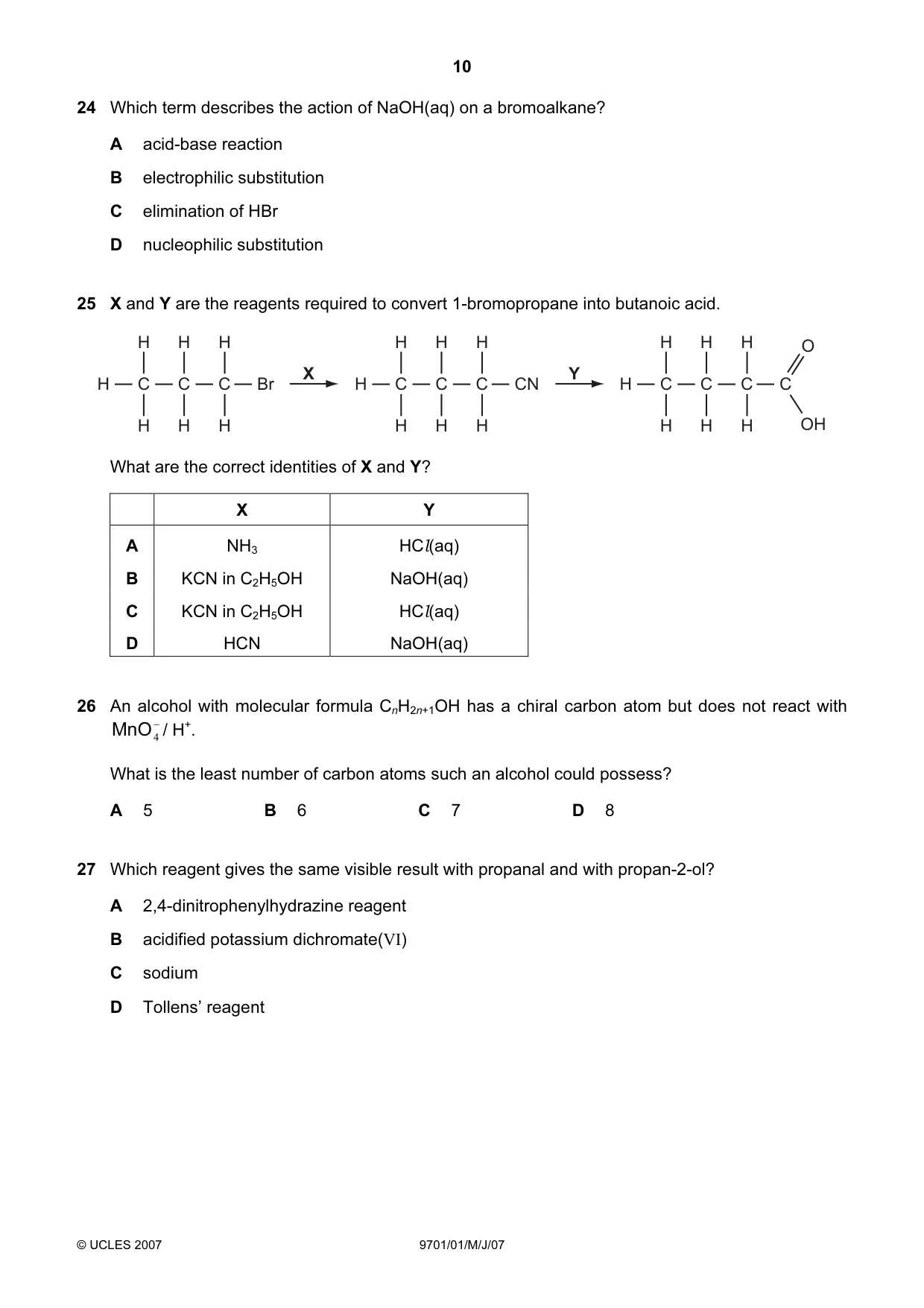
10 © UCLES 2007 9701/01/M/J/07 24 Which term describes the action of NaOH(aq) on a bromoalkane? A acid-base reaction B electrophilic substitution C elimination of HBr D nucleophilic substitution 25 X and Y are the reagents required to convert 1-bromopropane into butanoic acid. C H H H C H H H OH O H C C C H H H C H H H H C Br C H H H C H H H H C CN X Y What are the correct identities of X and Y? X Y A NH3 HCl(aq) B KCN in C2H5OH NaOH(aq) C KCN in C2H5OH HCl(aq) D HCN NaOH(aq) 26 An alcohol with molecular formula CnH2n+1OH has a chiral carbon atom but does not react with − 4 MnO / H+. What is the least number of carbon atoms such an alcohol could possess? A 5 B 6 C 7 D 8 27 Which reagent gives the same visible result with propanal and with propan-2-ol? A 2,4-dinitrophenylhydrazine reagent B acidified potassium dichromate(VI) C sodium D Tollens’ reagent
Question paper, page 11
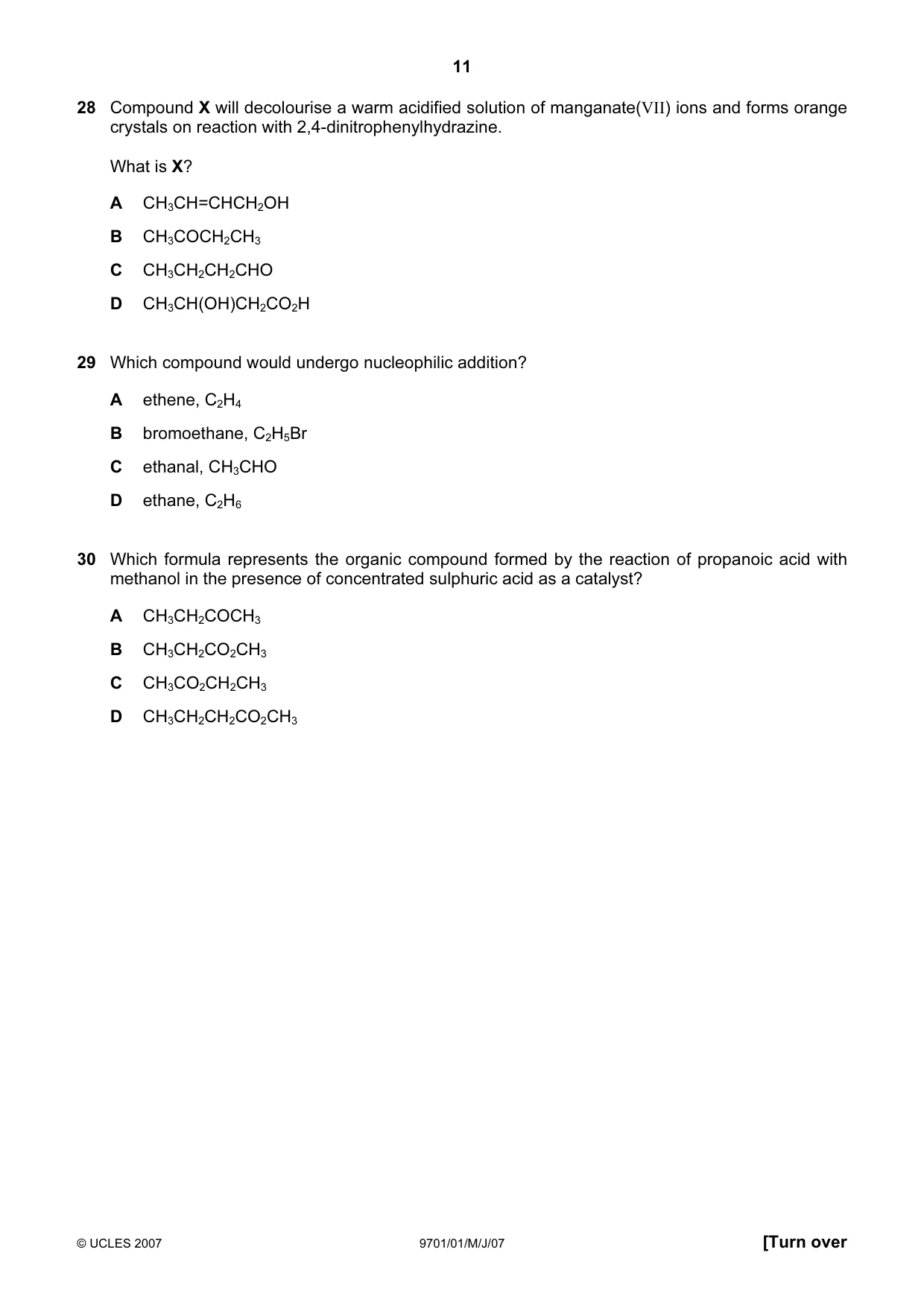
11 © UCLES 2007 9701/01/M/J/07 [Turn over 28 Compound X will decolourise a warm acidified solution of manganate(VII) ions and forms orange crystals on reaction with 2,4-dinitrophenylhydrazine. What is X? A CH3CH=CHCH2OH B CH3COCH2CH3 C CH3CH2CH2CHO D CH3CH(OH)CH2CO2H 29 Which compound would undergo nucleophilic addition? A ethene, C2H4 B bromoethane, C2H5Br C ethanal, CH3CHO D ethane, C2H6 30 Which formula represents the organic compound formed by the reaction of propanoic acid with methanol in the presence of concentrated sulphuric acid as a catalyst? A CH3CH2COCH3 B CH3CH2CO2CH3 C CH3CO2CH2CH3 D CH3CH2CH2CO2CH3
Question paper, page 12
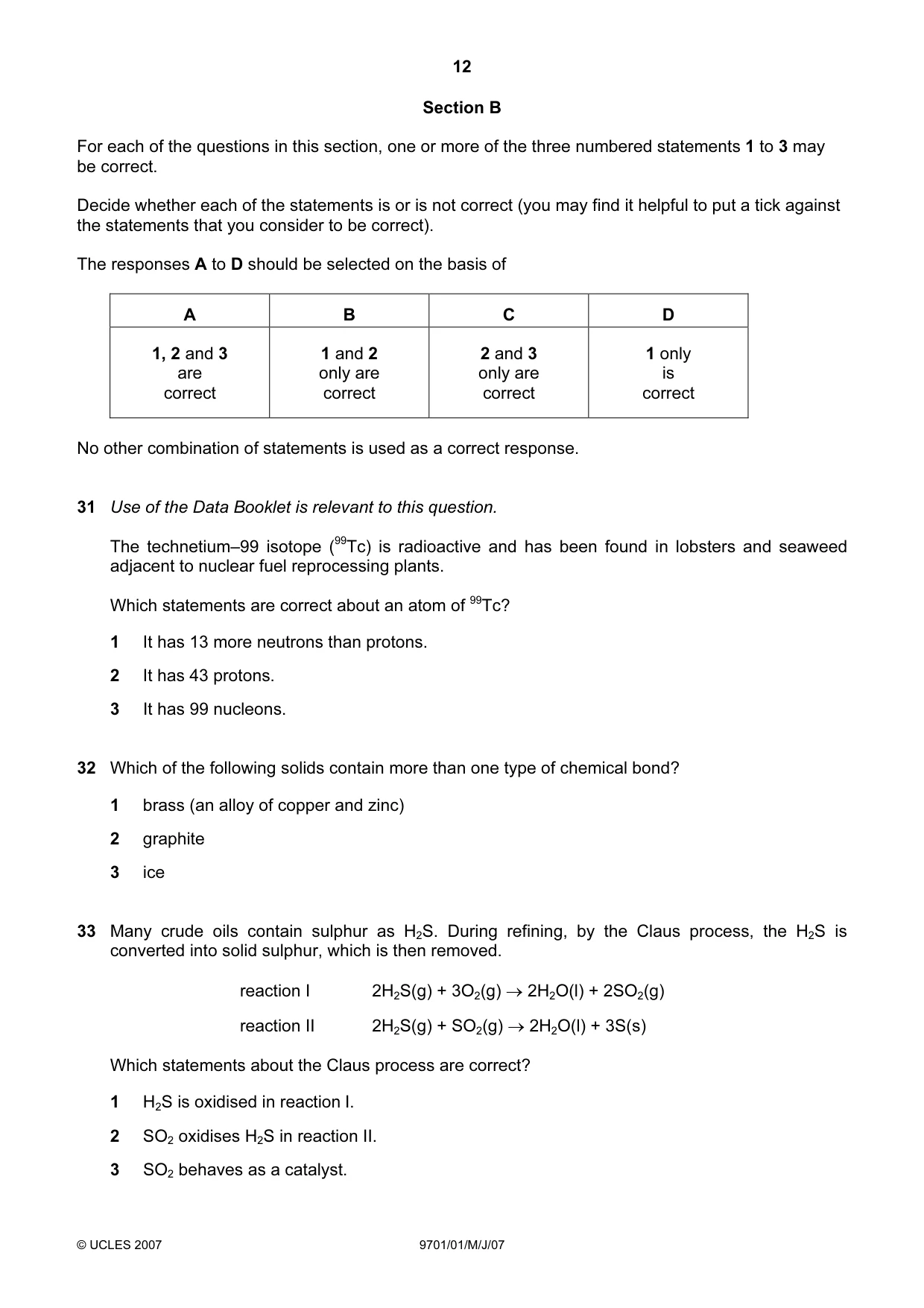
12 © UCLES 2007 9701/01/M/J/07 Section B For each of the questions in this section, one or more of the three numbered statements 1 to 3 may be correct. Decide whether each of the statements is or is not correct (you may find it helpful to put a tick against the statements that you consider to be correct). The responses A to D should be selected on the basis of A B C D 1, 2 and 3 are correct 1 and 2 only are correct 2 and 3 only are correct 1 only is correct No other combination of statements is used as a correct response. 31 Use of the Data Booklet is relevant to this question. The technetium–99 isotope (99Tc) is radioactive and has been found in lobsters and seaweed adjacent to nuclear fuel reprocessing plants. Which statements are correct about an atom of 99Tc? 1 It has 13 more neutrons than protons. 2 It has 43 protons. 3 It has 99 nucleons. 32 Which of the following solids contain more than one type of chemical bond? 1 brass (an alloy of copper and zinc) 2 graphite 3 ice 33 Many crude oils contain sulphur as H2S. During refining, by the Claus process, the H2S is converted into solid sulphur, which is then removed. reaction I 2H2S(g) + 3O2(g) → 2H2O(l) + 2SO2(g) reaction II 2H2S(g) + SO2(g) → 2H2O(l) + 3S(s) Which statements about the Claus process are correct? 1 H2S is oxidised in reaction I. 2 SO2 oxidises H2S in reaction II. 3 SO2 behaves as a catalyst.
Question paper, page 13
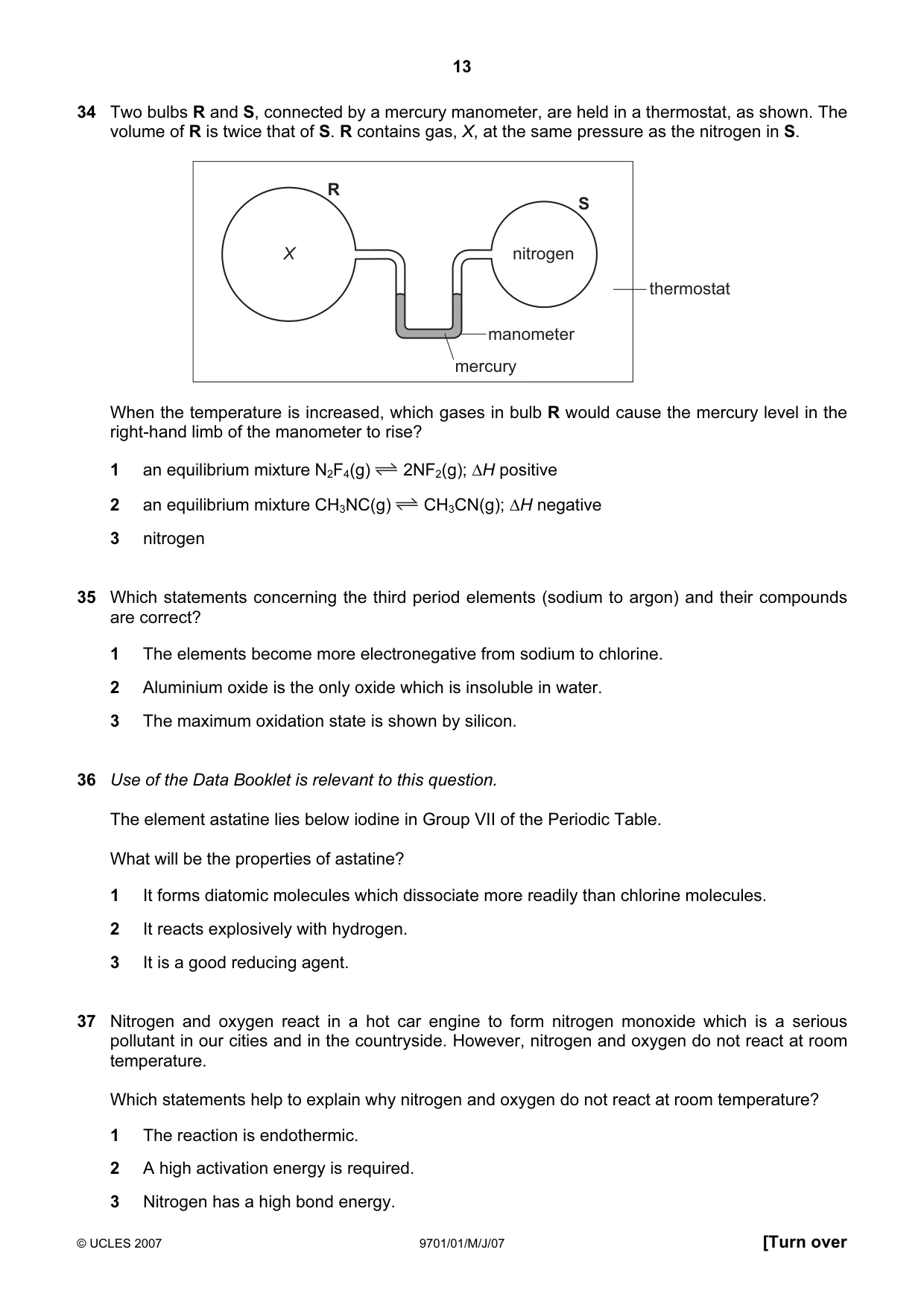
13 © UCLES 2007 9701/01/M/J/07 [Turn over 34 Two bulbs R and S, connected by a mercury manometer, are held in a thermostat, as shown. The volume of R is twice that of S. R contains gas, X, at the same pressure as the nitrogen in S. nitrogen X S R manometer mercury thermostat When the temperature is increased, which gases in bulb R would cause the mercury level in the right-hand limb of the manometer to rise? 1 an equilibrium mixture N2F4(g) 2NF2(g); ∆H positive 2 an equilibrium mixture CH3NC(g) CH3CN(g); ∆H negative 3 nitrogen 35 Which statements concerning the third period elements (sodium to argon) and their compounds are correct? 1 The elements become more electronegative from sodium to chlorine. 2 Aluminium oxide is the only oxide which is insoluble in water. 3 The maximum oxidation state is shown by silicon. 36 Use of the Data Booklet is relevant to this question. The element astatine lies below iodine in Group VII of the Periodic Table. What will be the properties of astatine? 1 It forms diatomic molecules which dissociate more readily than chlorine molecules. 2 It reacts explosively with hydrogen. 3 It is a good reducing agent. 37 Nitrogen and oxygen react in a hot car engine to form nitrogen monoxide which is a serious pollutant in our cities and in the countryside. However, nitrogen and oxygen do not react at room temperature. Which statements help to explain why nitrogen and oxygen do not react at room temperature? 1 The reaction is endothermic. 2 A high activation energy is required. 3 Nitrogen has a high bond energy.
Question paper, page 14
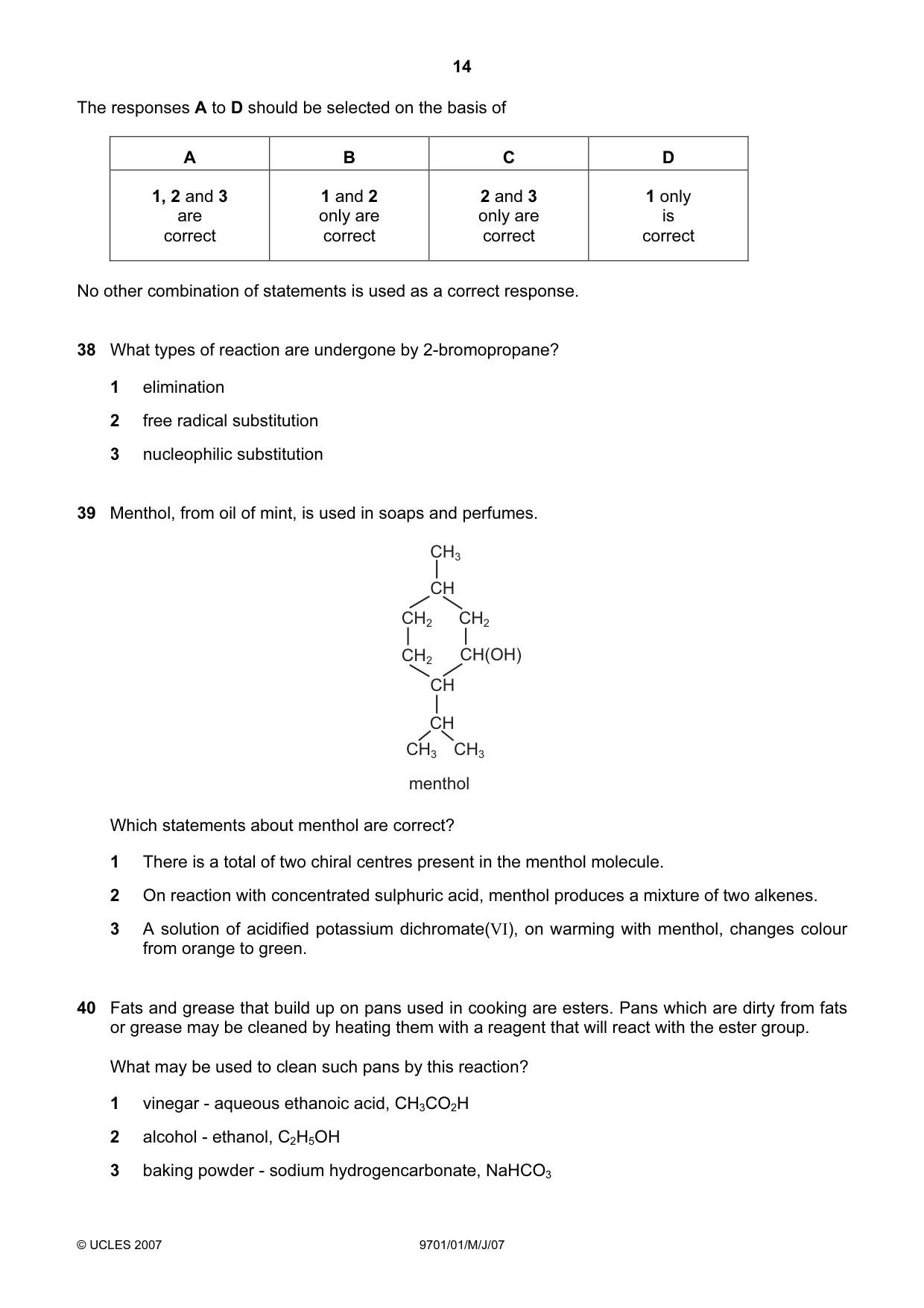
14 © UCLES 2007 9701/01/M/J/07 The responses A to D should be selected on the basis of A B C D 1, 2 and 3 are correct 1 and 2 only are correct 2 and 3 only are correct 1 only is correct No other combination of statements is used as a correct response. 38 What types of reaction are undergone by 2-bromopropane? 1 elimination 2 free radical substitution 3 nucleophilic substitution 39 Menthol, from oil of mint, is used in soaps and perfumes. CH2 CH2 CH(OH) CH2 CH CH CH CH3 CH3 CH3 menthol Which statements about menthol are correct? 1 There is a total of two chiral centres present in the menthol molecule. 2 On reaction with concentrated sulphuric acid, menthol produces a mixture of two alkenes. 3 A solution of acidified potassium dichromate(VI), on warming with menthol, changes colour from orange to green. 40 Fats and grease that build up on pans used in cooking are esters. Pans which are dirty from fats or grease may be cleaned by heating them with a reagent that will react with the ester group. What may be used to clean such pans by this reaction? 1 vinegar - aqueous ethanoic acid, CH3CO2H 2 alcohol - ethanol, C2H5OH 3 baking powder - sodium hydrogencarbonate, NaHCO3
Question paper, page 16
16 Permission to reproduce items where third-party owned material protected by copyright is included has been sought and cleared where possible. Every reasonable effort has been made by the publisher (UCLES) to trace copyright holders, but if any items requiring clearance have unwittingly been included, the publisher will be pleased to make amends at the earliest possible opportunity. University of Cambridge International Examinations is part of the Cambridge Assessment Group. Cambridge Assessment is the brand name of University of Cambridge Local Examinations Syndicate (UCLES), which is itself a department of the University of Cambridge. 9701/01/M/J/07 BLANK PAGE
Mark scheme, page 1
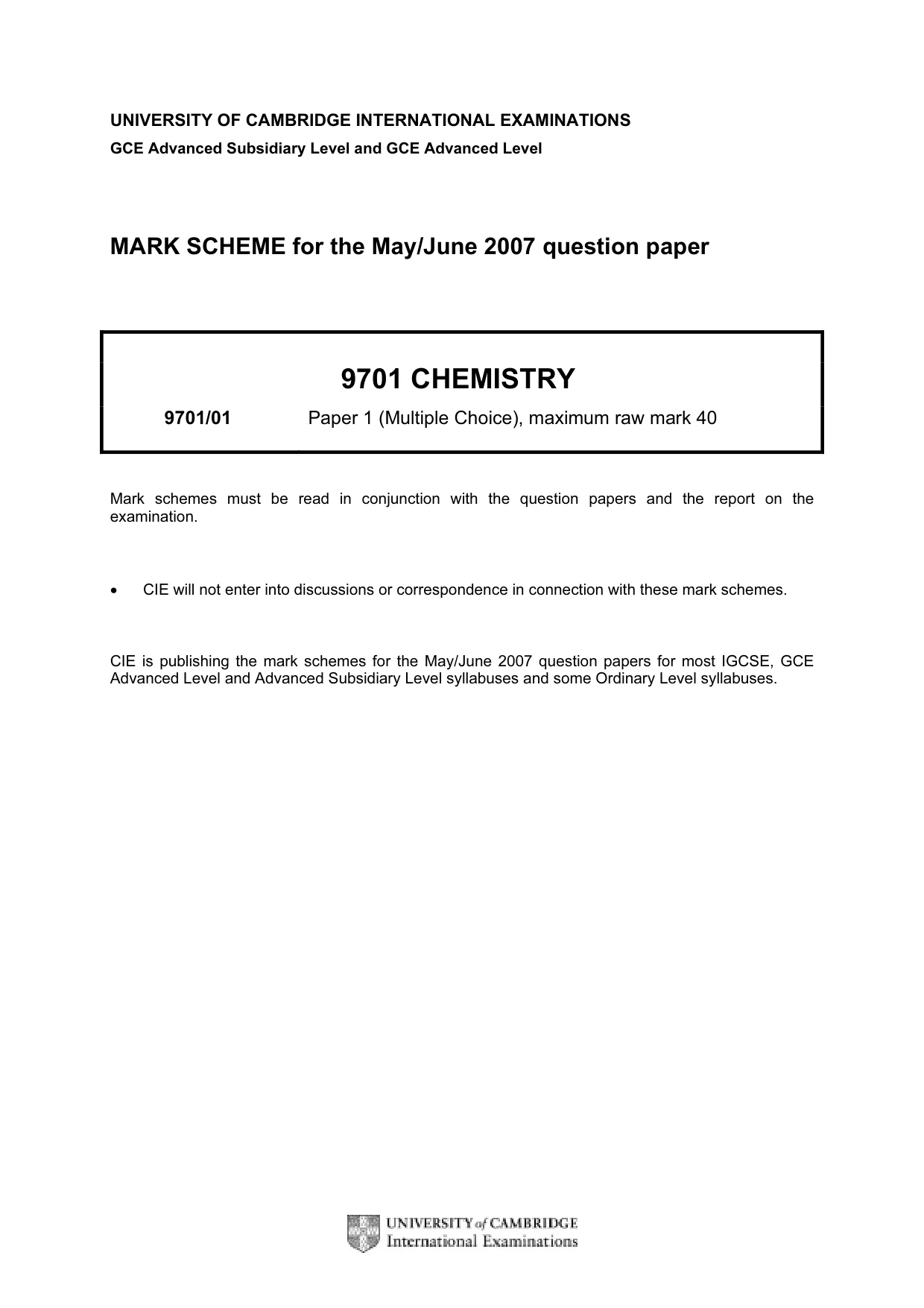
UNIVERSITY OF CAMBRIDGE INTERNATIONAL EXAMINATIONS GCE Advanced Subsidiary Level and GCE Advanced Level MARK SCHEME for the May/June 2007 question paper 9701 CHEMISTRY 9701/01 Paper 1 (Multiple Choice), maximum raw mark 40 Mark schemes must be read in conjunction with the question papers and the report on the examination. • CIE will not enter into discussions or correspondence in connection with these mark schemes. CIE is publishing the mark schemes for the May/June 2007 question papers for most IGCSE, GCE Advanced Level and Advanced Subsidiary Level syllabuses and some Ordinary Level syllabuses.
Mark scheme, page 2
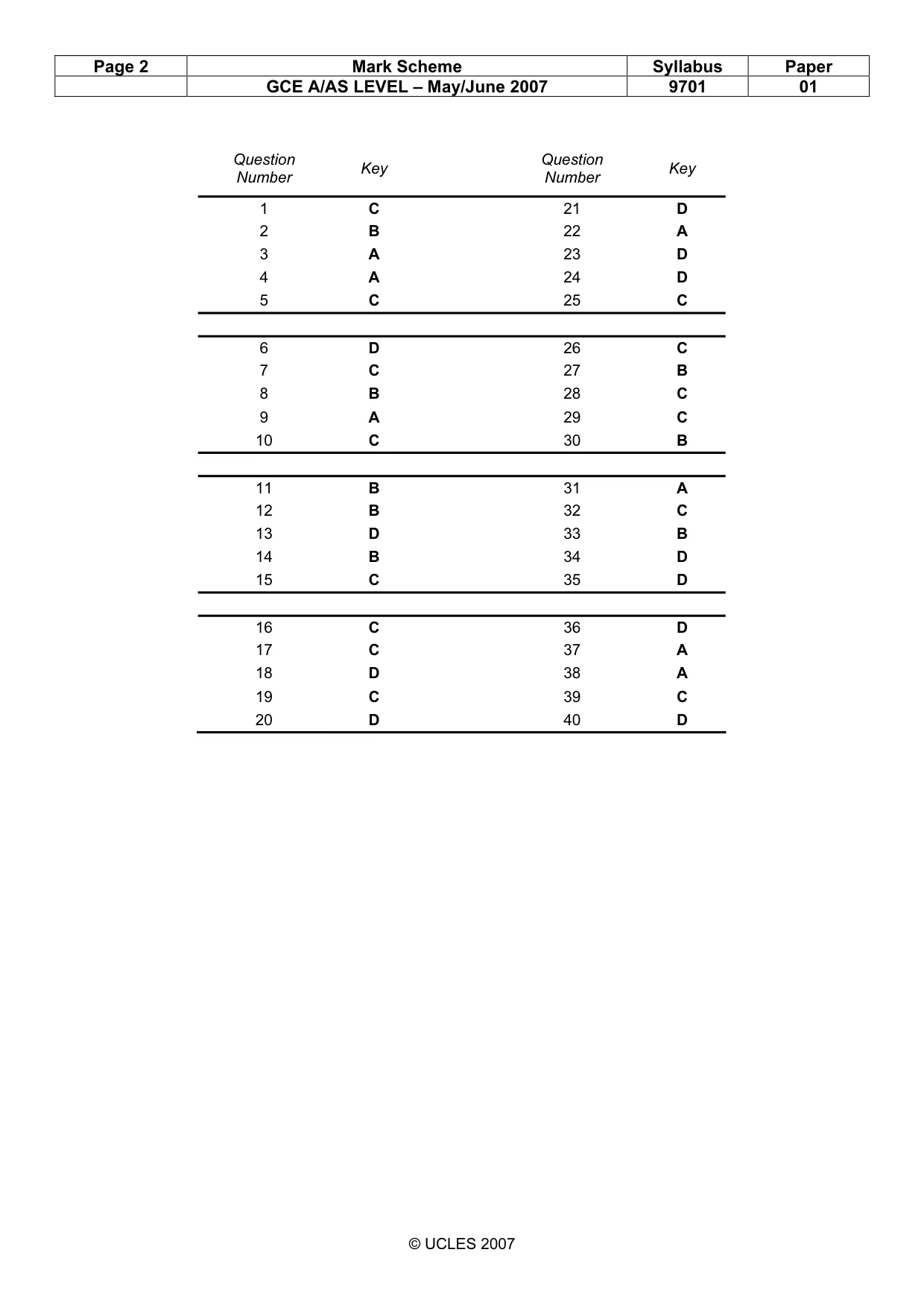
Page 2 Mark Scheme Syllabus Paper GCE A/AS LEVEL – May/June 2007 9701 01 © UCLES 2007 Question Number Key Question Number Key 1 C 21 D 2 B 22 A 3 A 23 D 4 A 24 D 5 C 25 C 6 D 26 C 7 C 27 B 8 B 28 C 9 A 29 C 10 C 30 B 11 B 31 A 12 B 32 C 13 D 33 B 14 B 34 D 15 C 35 D 16 C 36 D 17 C 37 A 18 D 38 A 19 C 39 C 20 D 40 D
What you needed in this session
Cambridge’s own grade thresholds for 2007 May/June, Paper 1 · Variant 1. A higher threshold means an easier paper — the bar moves with how the cohort did.