Cambridge A Level Chemistry 9701 — 2004 Oct/Nov Paper 1 · Variant 1
9701/11/O/N/04
The question paper and its mark scheme, free to read here and free to download. This is Cambridge’s own paper, exactly as it was sat.
Question paper20 pages


Mark scheme4 pages
Answers below. Sit the paper first if you are practising.
Paper as text
Question paper, page 1
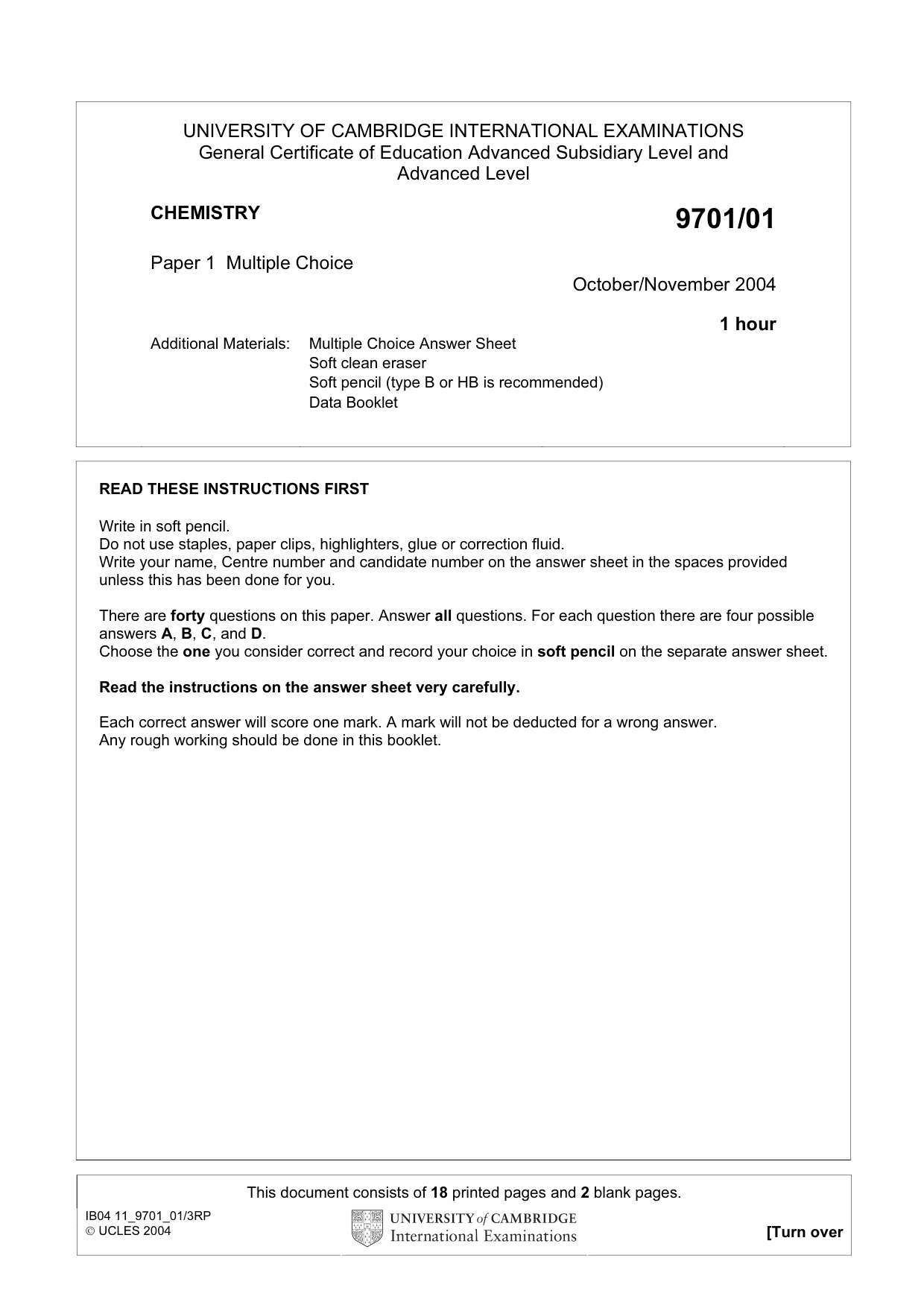
UNIVERSITY OF CAMBRIDGE INTERNATIONAL EXAMINATIONS General Certificate of Education Advanced Subsidiary Level and Advanced Level CHEMISTRY 9701/01 Paper 1 Multiple Choice October/November 2004 1 hour Additional Materials: Multiple Choice Answer Sheet Soft clean eraser Soft pencil (type B or HB is recommended) Data Booklet READ THESE INSTRUCTIONS FIRST Write in soft pencil. Do not use staples, paper clips, highlighters, glue or correction fluid. Write your name, Centre number and candidate number on the answer sheet in the spaces provided unless this has been done for you. There are forty questions on this paper. Answer all questions. For each question there are four possible answers A, B, C, and D. Choose the one you consider correct and record your choice in soft pencil on the separate answer sheet. Read the instructions on the answer sheet very carefully. Each correct answer will score one mark. A mark will not be deducted for a wrong answer. Any rough working should be done in this booklet. This document consists of 18 printed pages and 2 blank pages. IB04 11_9701_01/3RP UCLES 2004 [Turn over
Question paper, page 2
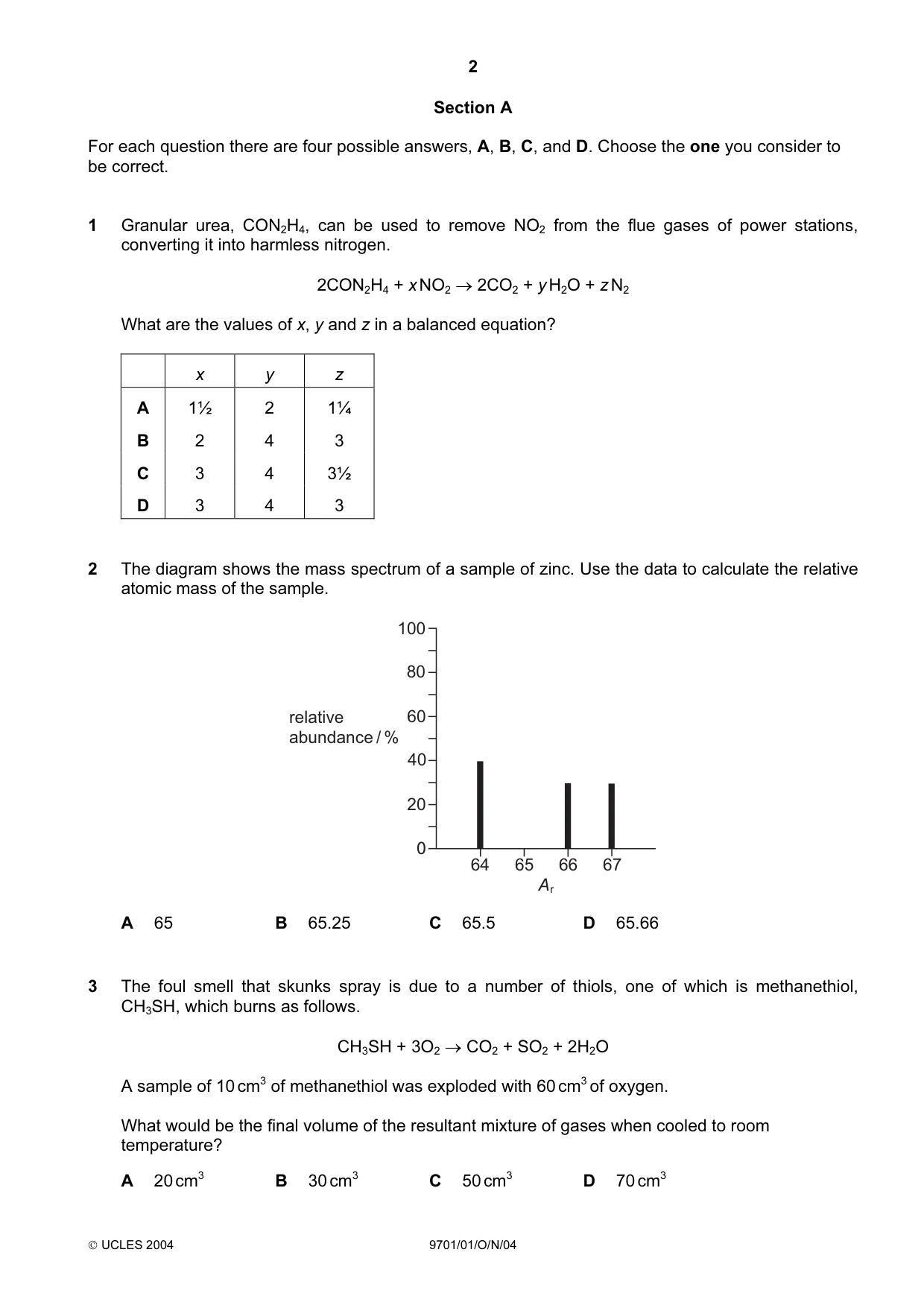
2 UCLES 2004 9701/01/O/N/04 Section A For each question there are four possible answers, A, B, C, and D. Choose the one you consider to be correct. 1 Granular urea, CON2H4, can be used to remove NO2 from the flue gases of power stations, converting it into harmless nitrogen. 2CON2H4 + x NO2 → 2CO2 + y H2O + z N2 What are the values of x, y and z in a balanced equation? x y z A 1½ 2 1¼ B 2 4 3 C 3 4 3½ D 3 4 3 2 The diagram shows the mass spectrum of a sample of zinc. Use the data to calculate the relative atomic mass of the sample. relative abundance / % 100 80 60 40 20 64 65 66 67 Ar 0 A 65 B 65.25 C 65.5 D 65.66 3 The foul smell that skunks spray is due to a number of thiols, one of which is methanethiol, CH3SH, which burns as follows. CH3SH + 3O2 → CO2 + SO2 + 2H2O A sample of 10 cm3 of methanethiol was exploded with 60 cm3 of oxygen. What would be the final volume of the resultant mixture of gases when cooled to room temperature? A 20 cm3 B 30 cm3 C 50 cm3 D 70 cm3
Question paper, page 3
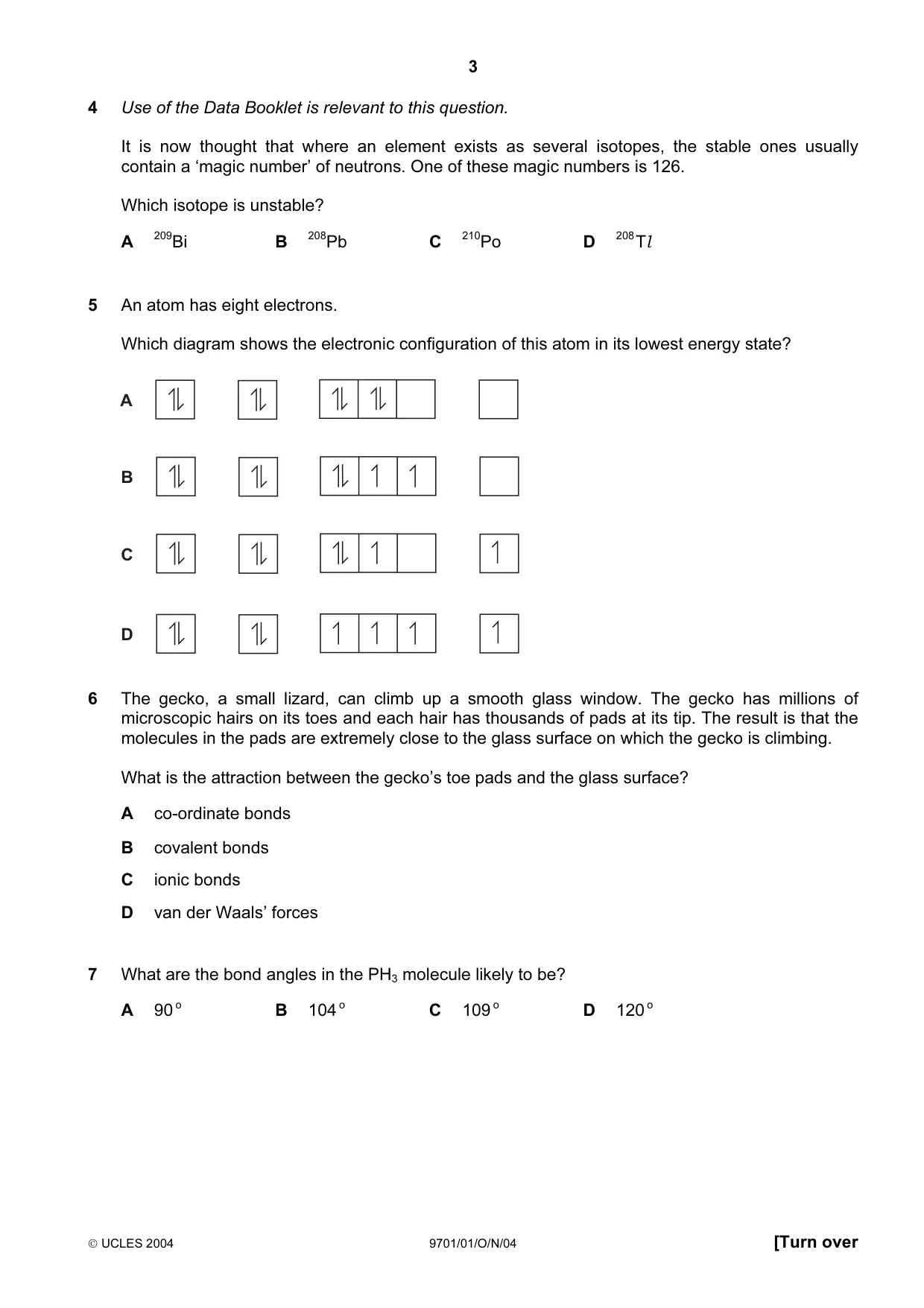
3 UCLES 2004 9701/01/O/N/04 [Turn over 4 Use of the Data Booklet is relevant to this question. It is now thought that where an element exists as several isotopes, the stable ones usually contain a ‘magic number’ of neutrons. One of these magic numbers is 126. Which isotope is unstable? A 209Bi B 208Pb C 210Po D 208 Tl 5 An atom has eight electrons. Which diagram shows the electronic configuration of this atom in its lowest energy state? 6 The gecko, a small lizard, can climb up a smooth glass window. The gecko has millions of microscopic hairs on its toes and each hair has thousands of pads at its tip. The result is that the molecules in the pads are extremely close to the glass surface on which the gecko is climbing. What is the attraction between the gecko’s toe pads and the glass surface? A co-ordinate bonds B covalent bonds C ionic bonds D van der Waals’ forces 7 What are the bond angles in the PH3 molecule likely to be? A 90 o B 104 o C 109 o D 120 o A B C D
Question paper, page 4
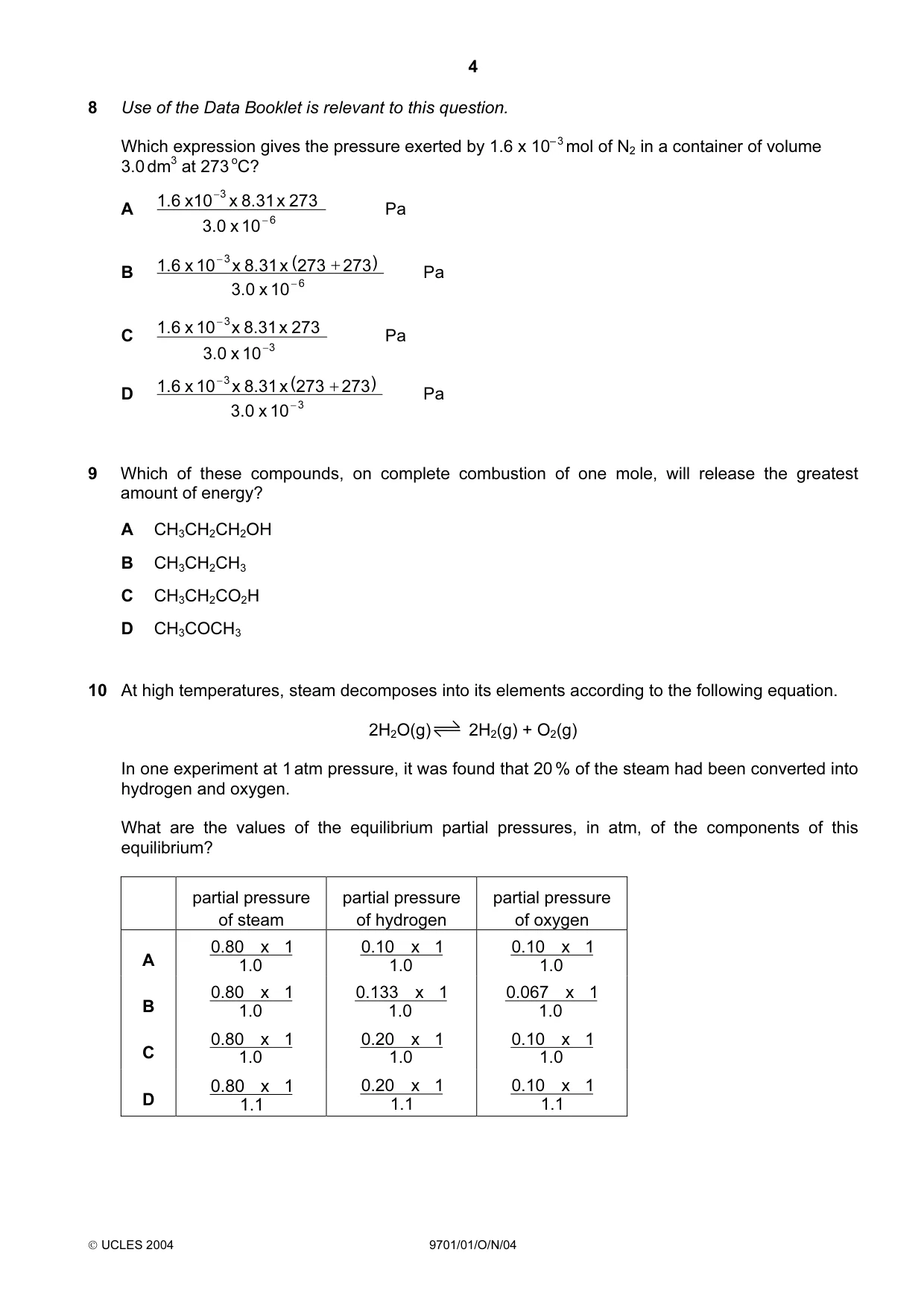
4 UCLES 2004 9701/01/O/N/04 8 Use of the Data Booklet is relevant to this question. Which expression gives the pressure exerted by 1.6 x 10– 3 mol of N2 in a container of volume 3.0 dm3 at 273 oC? A 6 3 10 x 3.0 273 x 8.31 x x10 1.6 − − Pa B 6 3 10 x 3.0 ) 273 273 ( x 8.31 x 10 x 1.6 − − + Pa C 3 3 10 x 3.0 273 x 8.31 x 10 x 1.6 − − Pa D 3 3 10 x 3.0 ) 273 273 ( x 8.31 x 10 x 1.6 − − + Pa 9 Which of these compounds, on complete combustion of one mole, will release the greatest amount of energy? A CH3CH2CH2OH B CH3CH2CH3 C CH3CH2CO2H D CH3COCH3 10 At high temperatures, steam decomposes into its elements according to the following equation. 2H2O(g) 2H2(g) + O2(g) In one experiment at 1 atm pressure, it was found that 20 % of the steam had been converted into hydrogen and oxygen. What are the values of the equilibrium partial pressures, in atm, of the components of this equilibrium? partial pressure of steam partial pressure of hydrogen partial pressure of oxygen A 1.0 1 x 0.80 1.0 1 x 0.10 1.0 1 x 0.10 B 1.0 1 x 0.80 1.0 1 x 0.133 1.0 1 x 0.067 C 1.0 1 x 0.80 1.0 1 x 0.20 1.0 1 x 0.10 D 1.1 1 x 0.80 1.1 1 x 0.20 1.1 1 x 0.10
Question paper, page 5
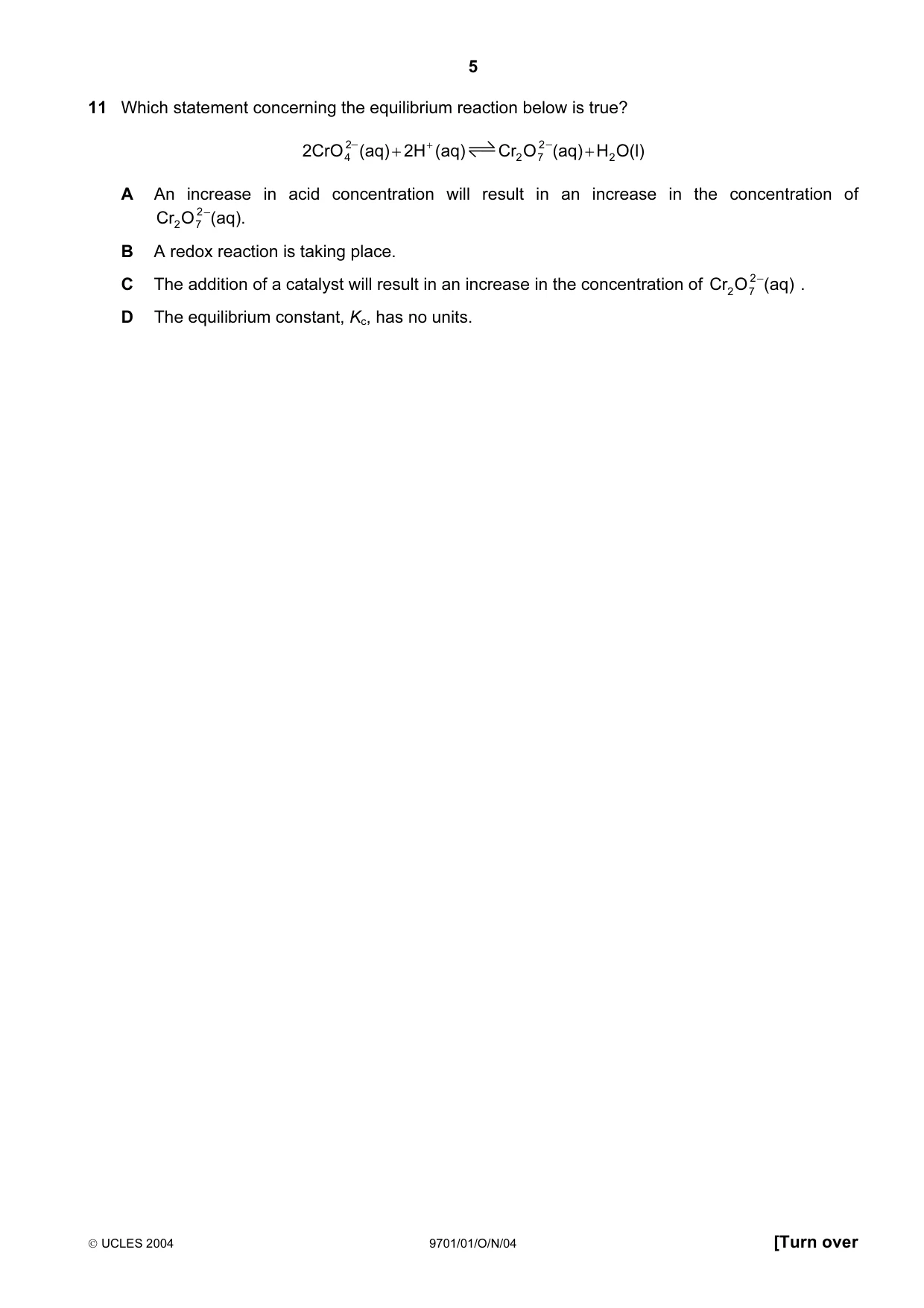
5 UCLES 2004 9701/01/O/N/04 [Turn over 11 Which statement concerning the equilibrium reaction below is true? (aq) 2H (aq) 2CrO _ 2 4 + + O(l) H (aq) O Cr 2 _ 2 7 2 + A An increase in acid concentration will result in an increase in the concentration of (aq). O Cr _ 2 7 2 B A redox reaction is taking place. C The addition of a catalyst will result in an increase in the concentration of (aq) O Cr _ 2 7 2 . D The equilibrium constant, Kc, has no units.
Question paper, page 6
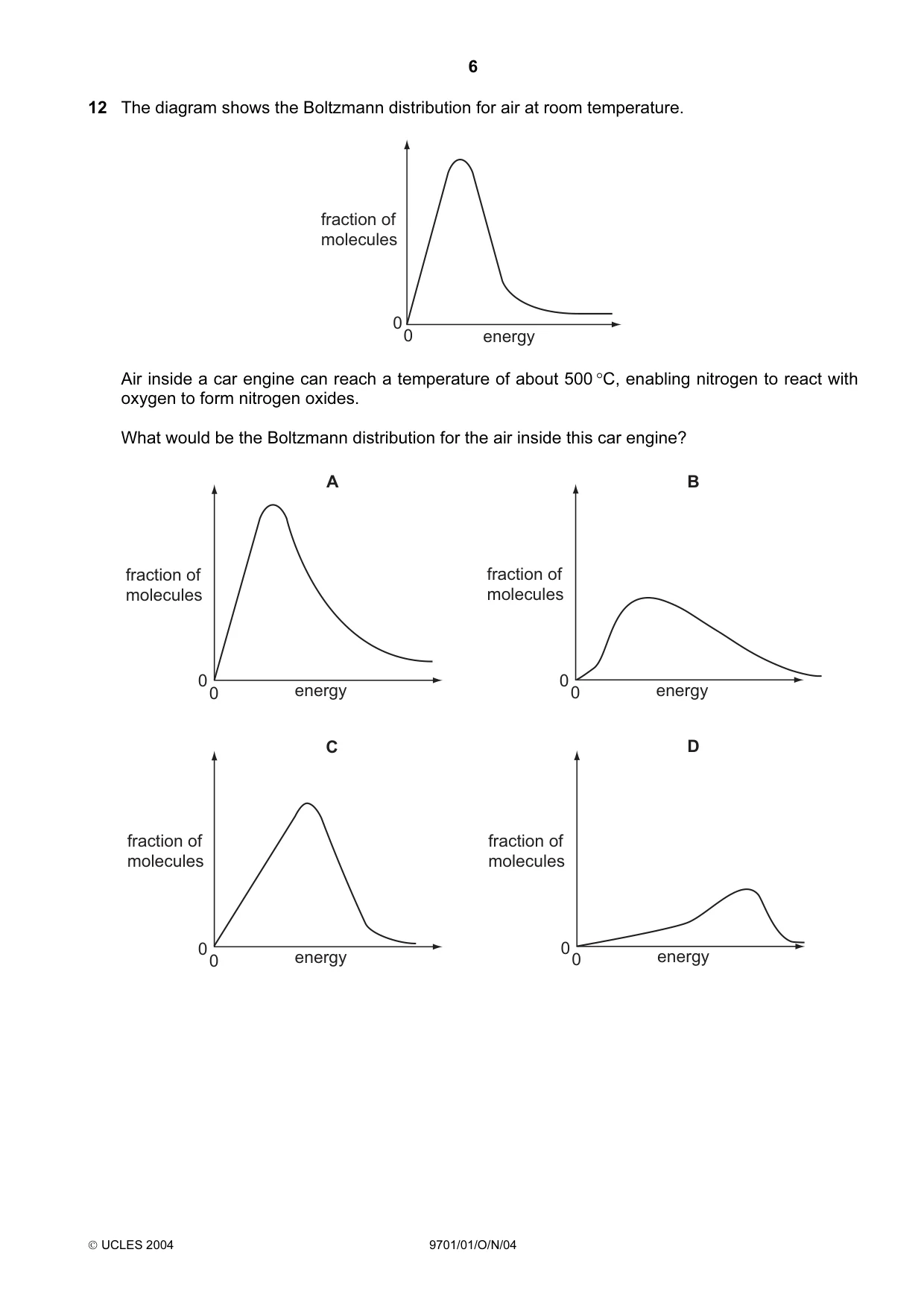
6 UCLES 2004 9701/01/O/N/04 12 The diagram shows the Boltzmann distribution for air at room temperature. energy fraction of molecules 00 Air inside a car engine can reach a temperature of about 500 °C, enabling nitrogen to react with oxygen to form nitrogen oxides. What would be the Boltzmann distribution for the air inside this car engine? energy fraction of molecules 00 energy fraction of molecules 00 energy fraction of molecules 00 energy fraction of molecules 00 A B C D
Question paper, page 7
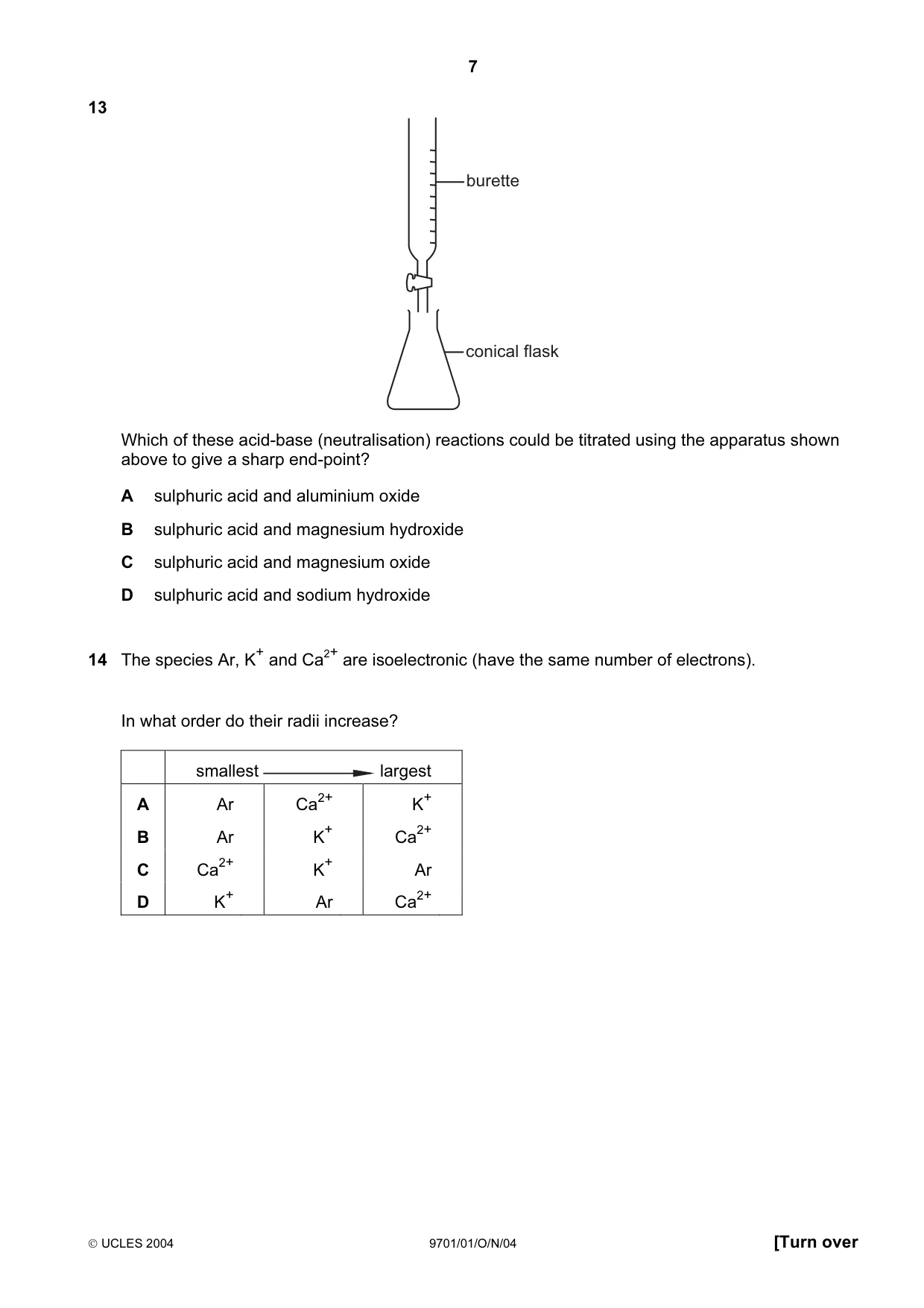
7 UCLES 2004 9701/01/O/N/04 [Turn over 13 conical flask burette Which of these acid-base (neutralisation) reactions could be titrated using the apparatus shown above to give a sharp end-point? A sulphuric acid and aluminium oxide B sulphuric acid and magnesium hydroxide C sulphuric acid and magnesium oxide D sulphuric acid and sodium hydroxide 14 The species Ar, K+ and Ca2+ are isoelectronic (have the same number of electrons). In what order do their radii increase? smallest largest A Ar Ca2+ K+ B Ar K+ Ca2+ C Ca2+ K+ Ar D K+ Ar Ca2+
Question paper, page 8
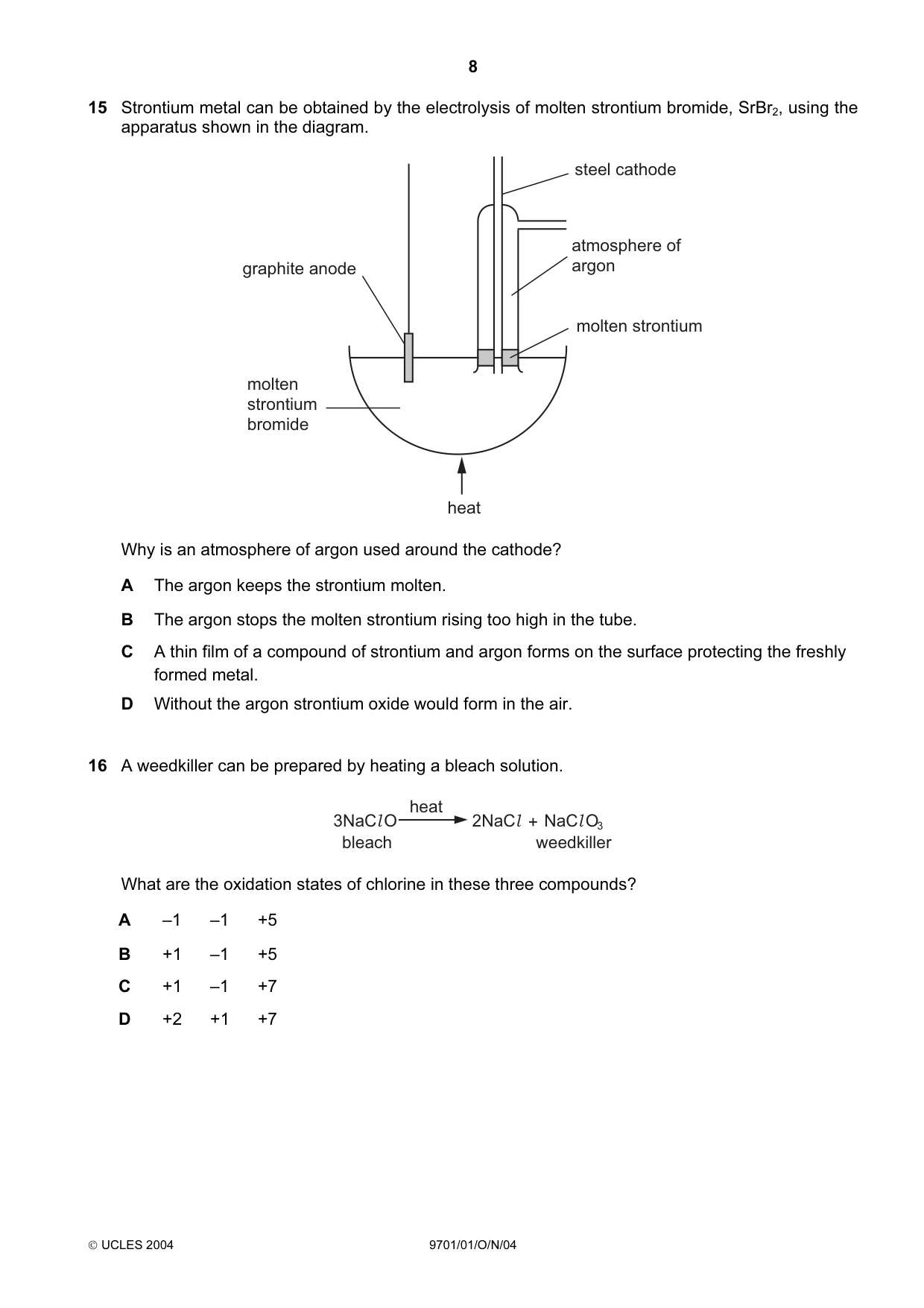
8 UCLES 2004 9701/01/O/N/04 15 Strontium metal can be obtained by the electrolysis of molten strontium bromide, SrBr2, using the apparatus shown in the diagram. heat molten strontium atmosphere of argon steel cathode molten strontium bromide graphite anode Why is an atmosphere of argon used around the cathode? A The argon keeps the strontium molten. B The argon stops the molten strontium rising too high in the tube. C A thin film of a compound of strontium and argon forms on the surface protecting the freshly formed metal. D Without the argon strontium oxide would form in the air. 16 A weedkiller can be prepared by heating a bleach solution. 3NaCl O heat bleach weedkiller NaCl O 3 + 2NaCl What are the oxidation states of chlorine in these three compounds? A –1 –1 +5 B +1 –1 +5 C +1 –1 +7 D +2 +1 +7
Question paper, page 9
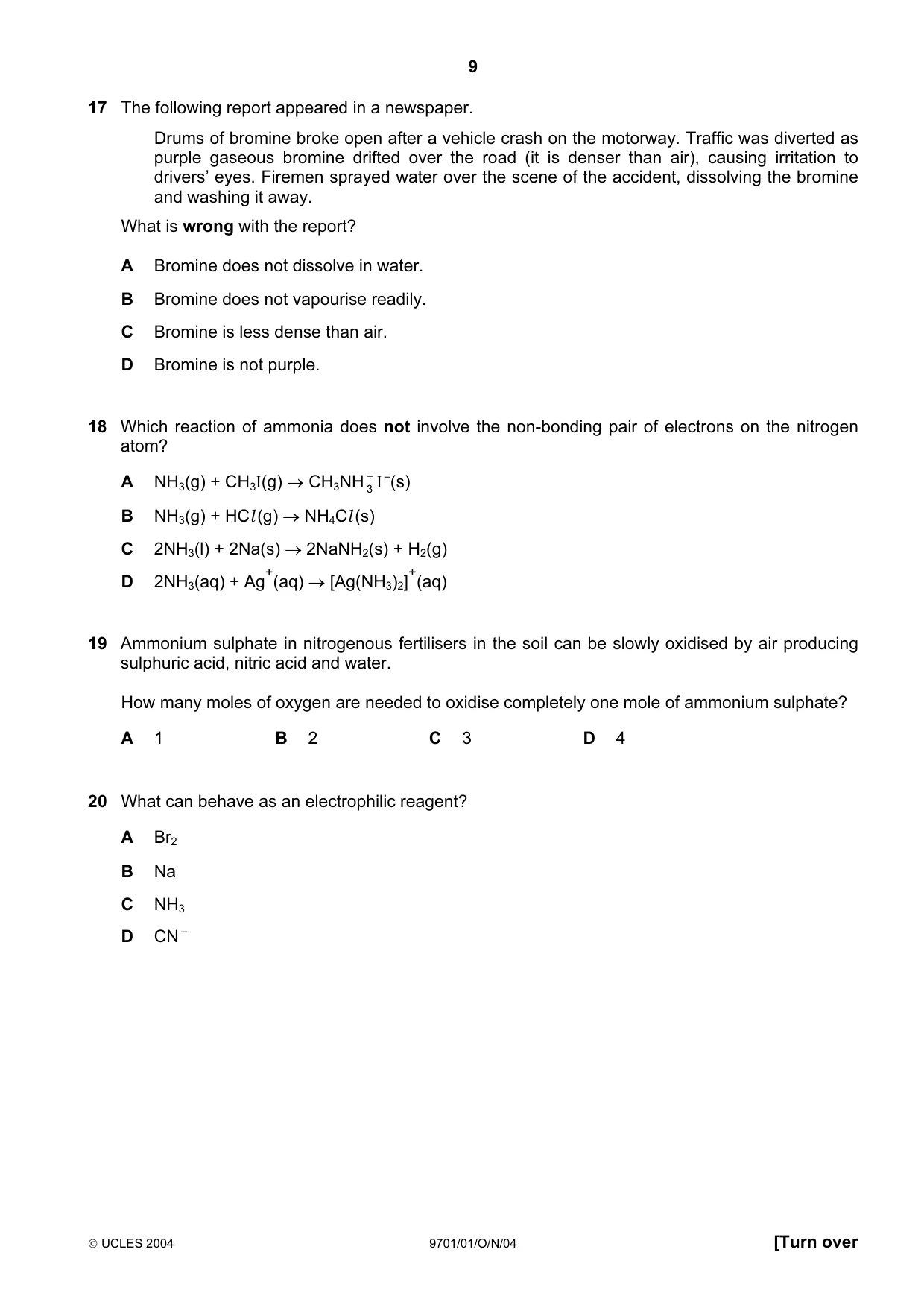
9 UCLES 2004 9701/01/O/N/04 [Turn over 17 The following report appeared in a newspaper. Drums of bromine broke open after a vehicle crash on the motorway. Traffic was diverted as purple gaseous bromine drifted over the road (it is denser than air), causing irritation to drivers’ eyes. Firemen sprayed water over the scene of the accident, dissolving the bromine and washing it away. What is wrong with the report? A Bromine does not dissolve in water. B Bromine does not vapourise readily. C Bromine is less dense than air. D Bromine is not purple. 18 Which reaction of ammonia does not involve the non-bonding pair of electrons on the nitrogen atom? A NH3(g) + CH3I(g) → CH3NH + 3 I –(s) B NH3(g) + HCl (g) → NH4Cl (s) C 2NH3(l) + 2Na(s) → 2NaNH2(s) + H2(g) D 2NH3(aq) + Ag+(aq) → [Ag(NH3)2]+(aq) 19 Ammonium sulphate in nitrogenous fertilisers in the soil can be slowly oxidised by air producing sulphuric acid, nitric acid and water. How many moles of oxygen are needed to oxidise completely one mole of ammonium sulphate? A 1 B 2 C 3 D 4 20 What can behave as an electrophilic reagent? A Br2 B Na C NH3 D CN –
Question paper, page 10
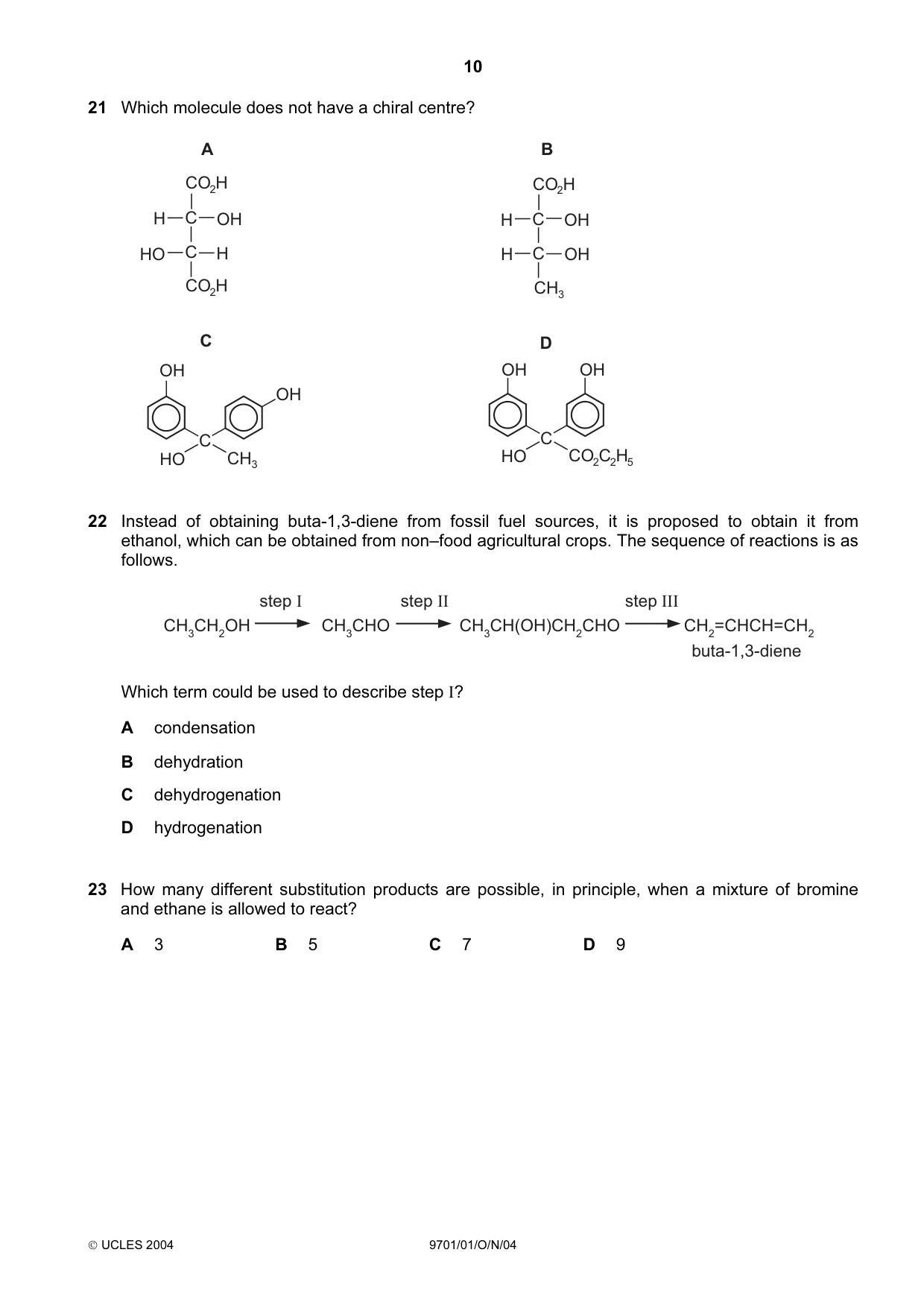
10 UCLES 2004 9701/01/O/N/04 21 Which molecule does not have a chiral centre? 22 Instead of obtaining buta-1,3-diene from fossil fuel sources, it is proposed to obtain it from ethanol, which can be obtained from non–food agricultural crops. The sequence of reactions is as follows. CH3CH2OH CH3CHO CH3CH(OH)CH2CHO CH2=CHCH=CH2 step I step II step III buta-1,3-diene Which term could be used to describe step I? A condensation B dehydration C dehydrogenation D hydrogenation 23 How many different substitution products are possible, in principle, when a mixture of bromine and ethane is allowed to react? A 3 B 5 C 7 D 9 OH A CO H 2 C H OH H OH C CO H 2 CO H 2 C H OH H OH C CH 3 B C C OH HO CH 3 OH D C OH HO CO C H 2 2 5
Question paper, page 11
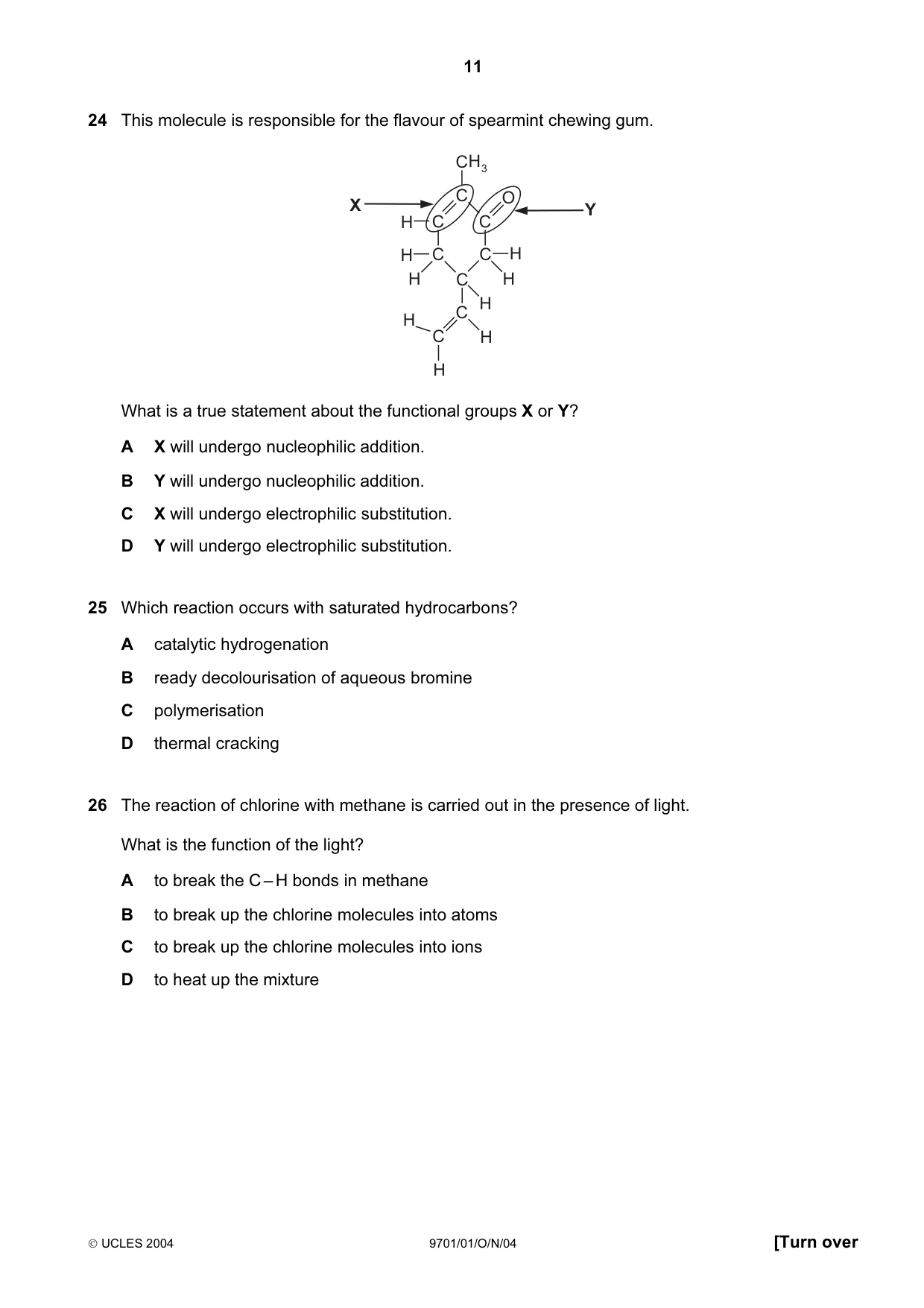
11 UCLES 2004 9701/01/O/N/04 [Turn over 24 This molecule is responsible for the flavour of spearmint chewing gum. C H C C C H H C H H H H C H C O C CH3 Y X H What is a true statement about the functional groups X or Y? A X will undergo nucleophilic addition. B Y will undergo nucleophilic addition. C X will undergo electrophilic substitution. D Y will undergo electrophilic substitution. 25 Which reaction occurs with saturated hydrocarbons? A catalytic hydrogenation B ready decolourisation of aqueous bromine C polymerisation D thermal cracking 26 The reaction of chlorine with methane is carried out in the presence of light. What is the function of the light? A to break the C – H bonds in methane B to break up the chlorine molecules into atoms C to break up the chlorine molecules into ions D to heat up the mixture
Question paper, page 12
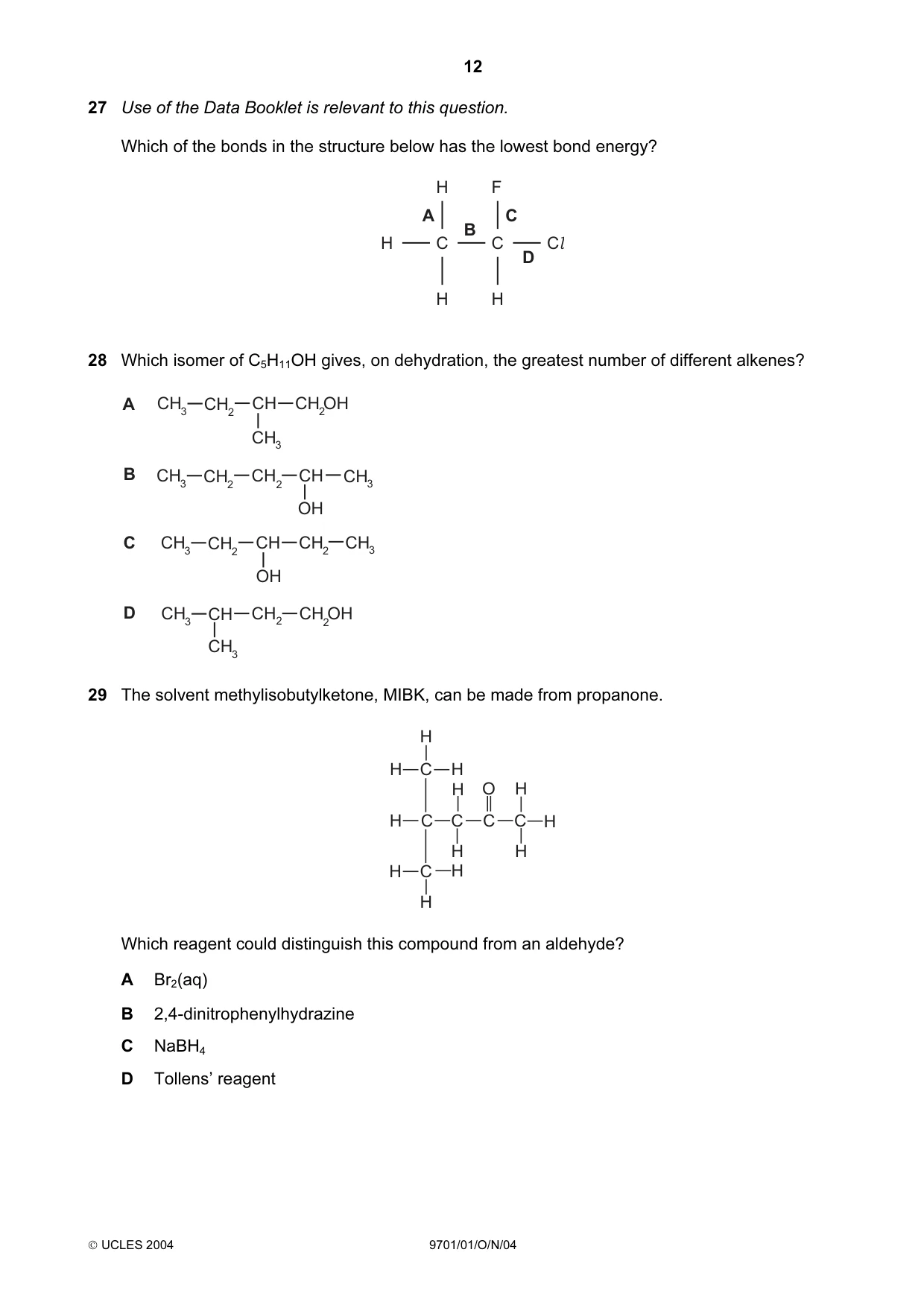
12 UCLES 2004 9701/01/O/N/04 27 Use of the Data Booklet is relevant to this question. Which of the bonds in the structure below has the lowest bond energy? A H H H C C C H F Cl B D 28 Which isomer of C5H11OH gives, on dehydration, the greatest number of different alkenes? 29 The solvent methylisobutylketone, MIBK, can be made from propanone. C H O C C H H H H C H H C C H H H H H Which reagent could distinguish this compound from an aldehyde? A Br2(aq) B 2,4-dinitrophenylhydrazine C NaBH4 D Tollens’ reagent CH3 OH CH2 CH CH3 CH2 CH3 OH CH 2 CH CH3 CH2 CH3 OH CH2 CH CH3 CH2 CH3 OH CH2 CH CH3 CH 2 A B C D
Question paper, page 13
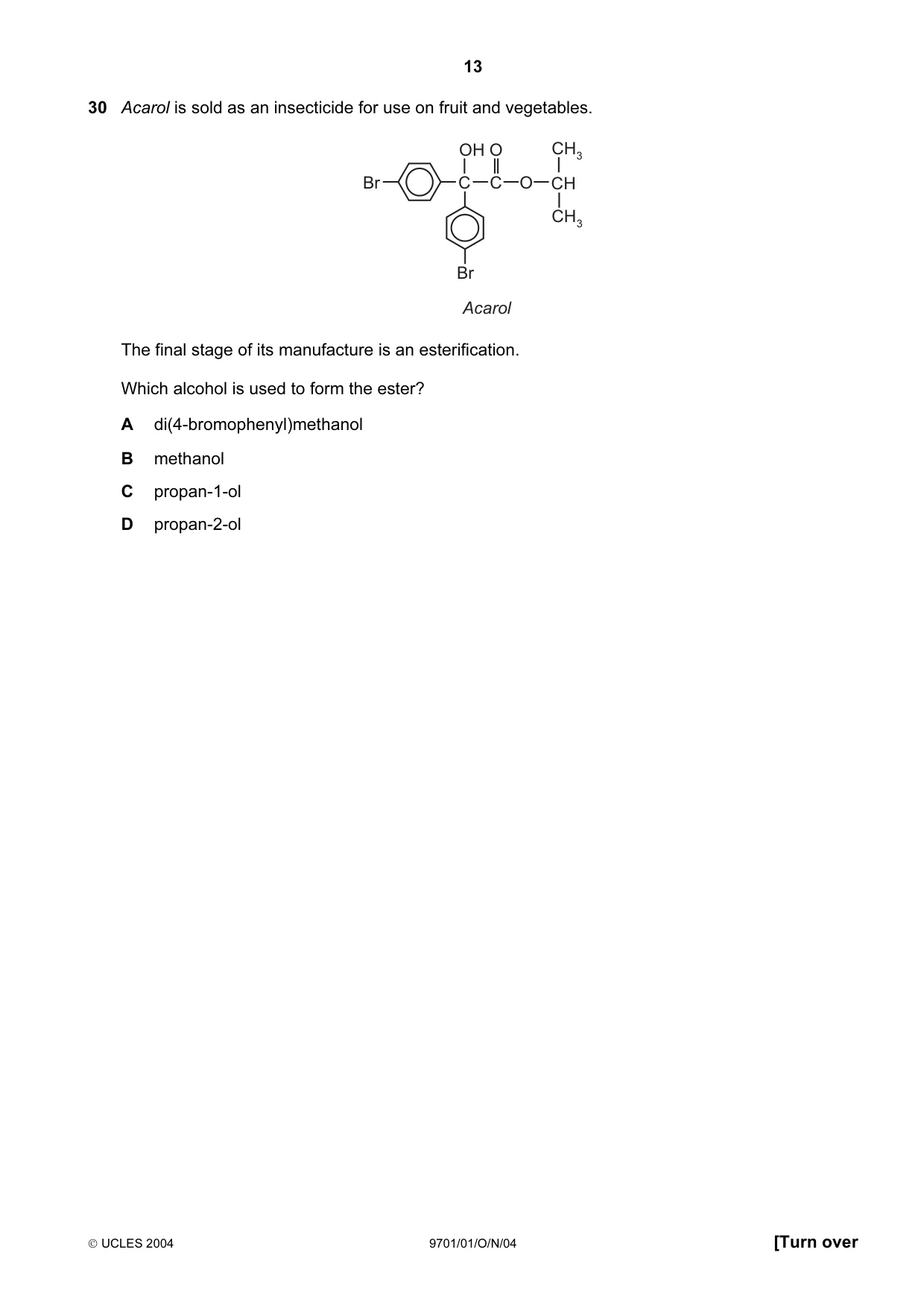
13 UCLES 2004 9701/01/O/N/04 [Turn over 30 Acarol is sold as an insecticide for use on fruit and vegetables. CH Br C Br OH C O O CH CH 3 3 Acarol The final stage of its manufacture is an esterification. Which alcohol is used to form the ester? A di(4-bromophenyl)methanol B methanol C propan-1-ol D propan-2-ol
Question paper, page 14
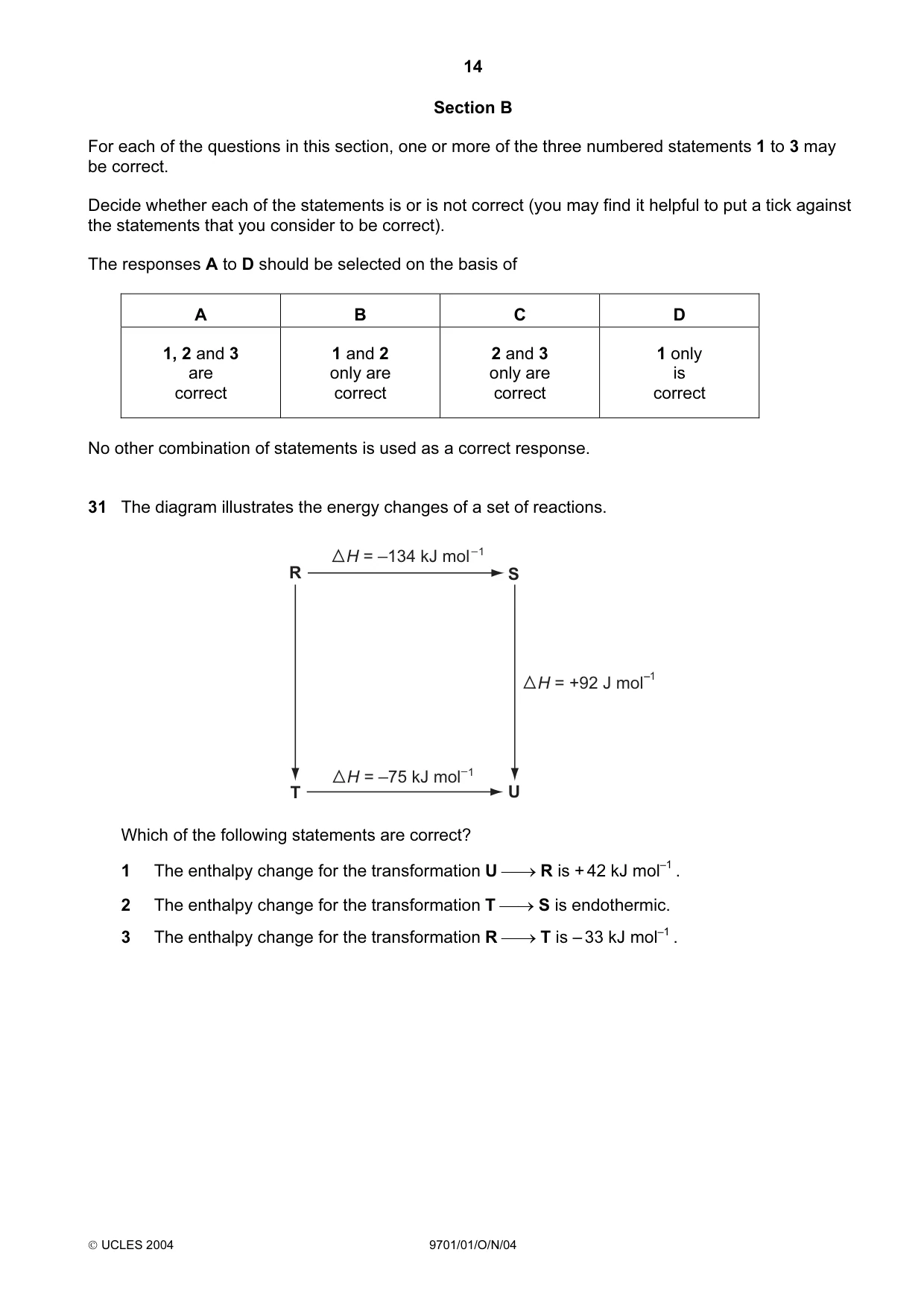
14 UCLES 2004 9701/01/O/N/04 Section B For each of the questions in this section, one or more of the three numbered statements 1 to 3 may be correct. Decide whether each of the statements is or is not correct (you may find it helpful to put a tick against the statements that you consider to be correct). The responses A to D should be selected on the basis of A B C D 1, 2 and 3 are correct 1 and 2 only are correct 2 and 3 only are correct 1 only is correct No other combination of statements is used as a correct response. 31 The diagram illustrates the energy changes of a set of reactions. R H = _134 kJ mol S T U H = _75 kJ mol H = +92 J mol 1 1 _ 1 _ Which of the following statements are correct? 1 The enthalpy change for the transformation U → R is + 42 kJ mol–1 . 2 The enthalpy change for the transformation T → S is endothermic. 3 The enthalpy change for the transformation R → T is – 33 kJ mol–1 .
Question paper, page 15
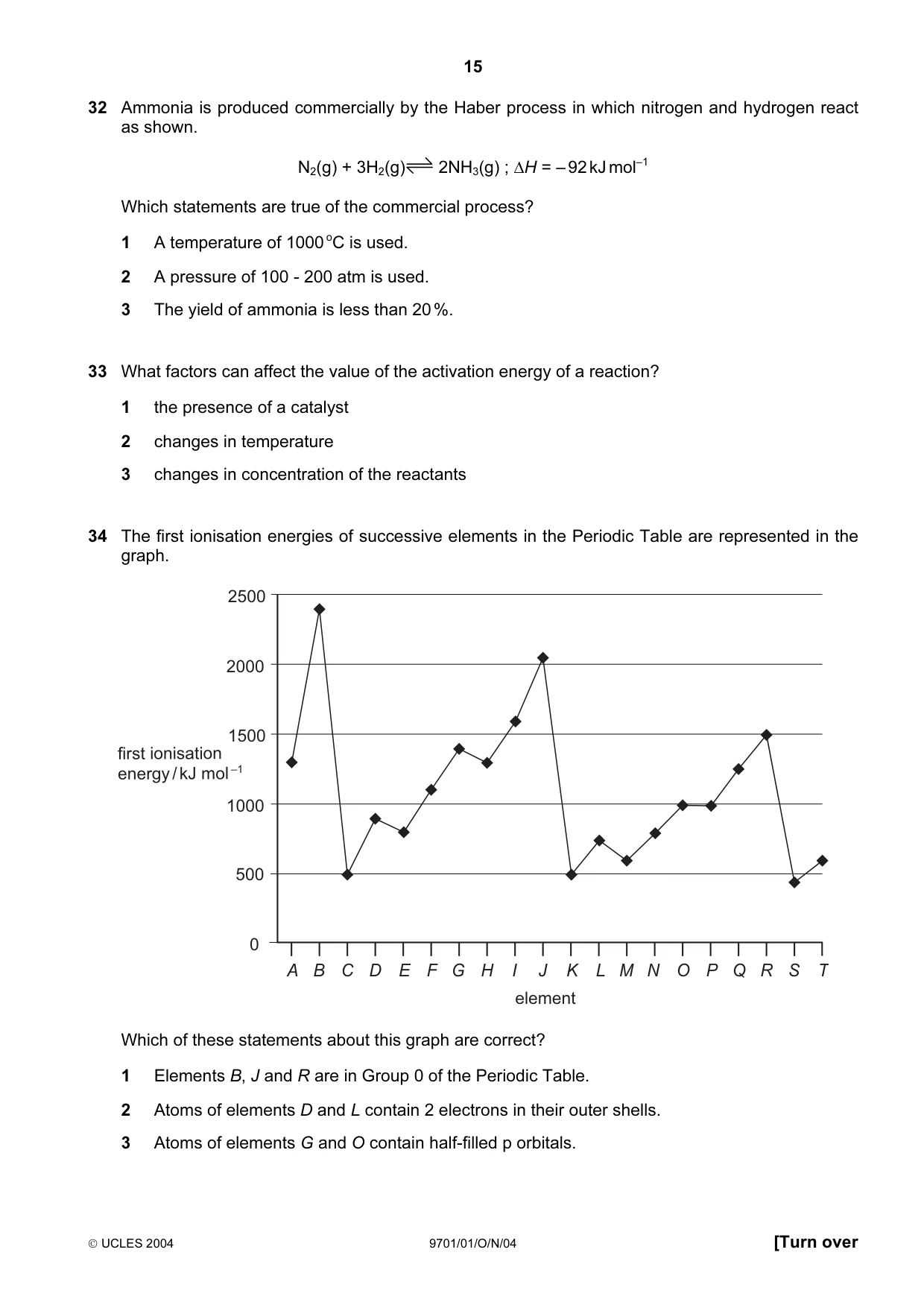
15 UCLES 2004 9701/01/O/N/04 [Turn over 32 Ammonia is produced commercially by the Haber process in which nitrogen and hydrogen react as shown. N2(g) + 3H2(g) 2NH3(g) ; ∆H = – 92 kJ mol–1 Which statements are true of the commercial process? 1 A temperature of 1000 oC is used. 2 A pressure of 100 - 200 atm is used. 3 The yield of ammonia is less than 20 %. 33 What factors can affect the value of the activation energy of a reaction? 1 the presence of a catalyst 2 changes in temperature 3 changes in concentration of the reactants 34 The first ionisation energies of successive elements in the Periodic Table are represented in the graph. A B C D E F G H I J K L M N O P Q R S T element 0 500 1000 1500 2000 2500 first ionisation energy / kJ mol _1 Which of these statements about this graph are correct? 1 Elements B, J and R are in Group 0 of the Periodic Table. 2 Atoms of elements D and L contain 2 electrons in their outer shells. 3 Atoms of elements G and O contain half-filled p orbitals.
Question paper, page 16
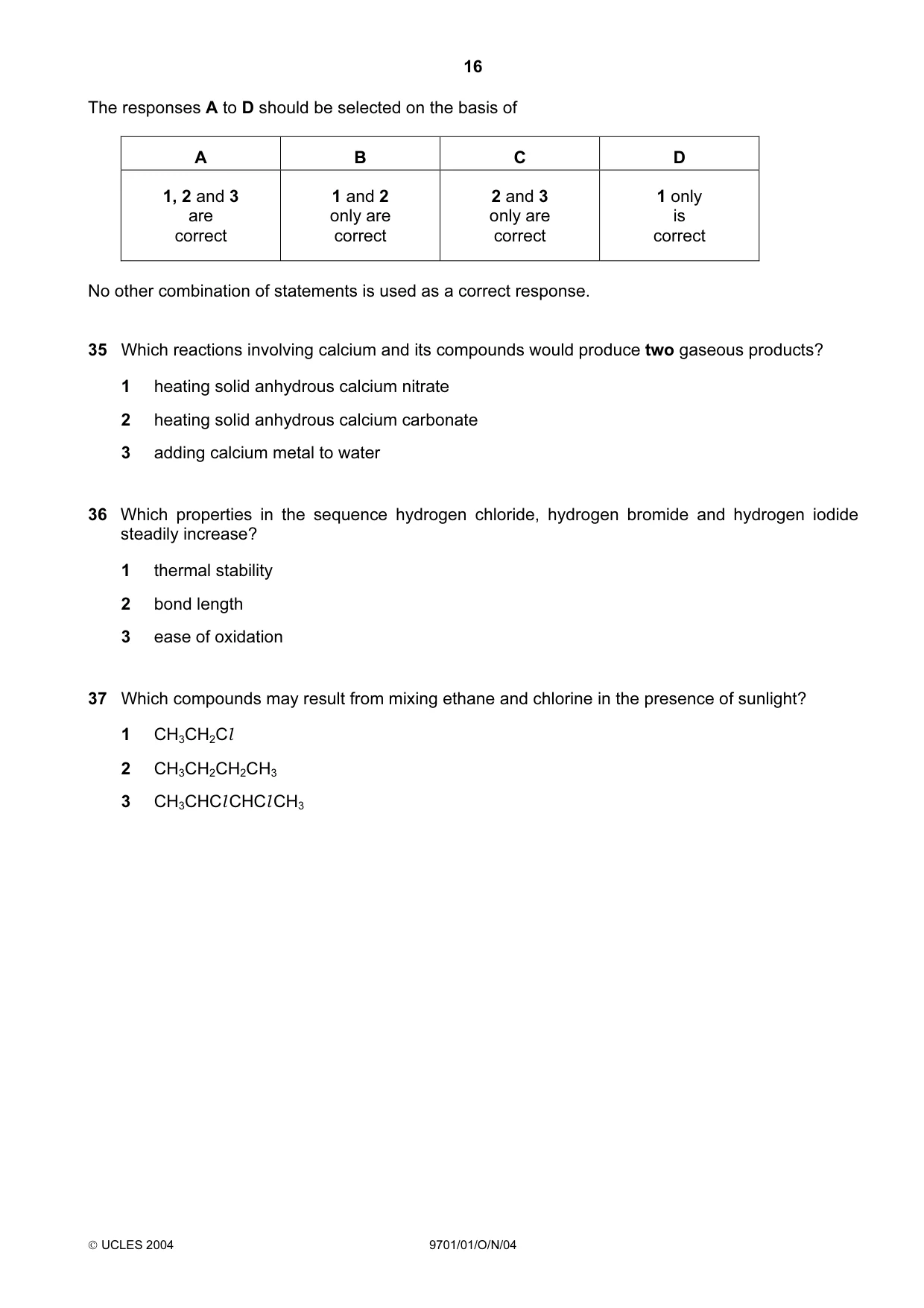
16 UCLES 2004 9701/01/O/N/04 The responses A to D should be selected on the basis of A B C D 1, 2 and 3 are correct 1 and 2 only are correct 2 and 3 only are correct 1 only is correct No other combination of statements is used as a correct response. 35 Which reactions involving calcium and its compounds would produce two gaseous products? 1 heating solid anhydrous calcium nitrate 2 heating solid anhydrous calcium carbonate 3 adding calcium metal to water 36 Which properties in the sequence hydrogen chloride, hydrogen bromide and hydrogen iodide steadily increase? 1 thermal stability 2 bond length 3 ease of oxidation 37 Which compounds may result from mixing ethane and chlorine in the presence of sunlight? 1 CH3CH2Cl 2 CH3CH2CH2CH3 3 CH3CHCl CHCl CH3
Question paper, page 17
17 UCLES 2004 9701/01/O/N/04 [Turn over 38 When halogenoalkanes, RX, are hydrolysed with NaOH, the corresponding sodium halide, NaX, is produced. RX + NaOH → ROH + NaX A student investigated the amount of NaX produced by hydrolysing CH3CH2Cl and another halogenoalkane, Y. In a given time the amount of sodium halide formed was greater with Y than with CH3CH2Cl. Y CH3CH2Cl time number of moles of NaX formed 0 0 Which compound could be Y? 1 Cl CH2CH2Cl 2 CH3CH2Br 3 CH3CH2I 39 Pentaerythritol is an intermediate in the manufacture of paint. C HOCH2 HOCH2 CH2OH CH2OH pentaerythritol Which of the following statements about pentaerythritol are correct? 1 It reacts with metallic sodium. 2 It is dehydrated by concentrated sulphuric acid to an alkene. 3 Its empirical formula is CH3O.
Question paper, page 18
18 UCLES 2004 9701/01/O/N/04 The responses A to D should be selected on the basis of A B C D 1, 2 and 3 are correct 1 and 2 only are correct 2 and 3 only are correct 1 only is correct No other combination of statements is used as a correct response. 40 Lactic acid builds up in muscles when oxygen is in short supply. It can cause muscular pain. Part of the reaction sequence is shown. CH2OHCH(OH)CHO → CH3COCO2H → CH3CH(OH)CO2H glyceraldehyde pyruvic acid lactic acid Which statements about the reaction sequence are correct? 1 An aldehyde is oxidised to a carboxylic acid. 2 A ketone is reduced to a secondary alcohol. 3 A secondary alcohol is oxidised to a ketone.
Question paper, page 20
20 University of Cambridge International Examinations is part of the University of Cambridge Local Examinations Syndicate (UCLES) which is itself a department of the University of Cambridge. 9701/01/O/N/04 BLANK PAGE
Mark scheme, page 1
UNIVERSITY OF CAMBRIDGE INTERNATIONAL EXAMINATIONS GCE Advanced Subsidiary and Advanced Level MARK SCHEME for the November 2004 question paper 9701 CHEMISTRY 9701/01 Paper 1 (Multiple Choice), maximum raw mark 40 This mark scheme is published as an aid to teachers and students, to indicate the requirements of the examination. This shows the basis on which Examiners were initially instructed to award marks. It does not indicate the details of the discussions that took place at an Examiners’ meeting before marking began. Any substantial changes to the mark scheme that arose from these discussions will be recorded in the published Report on the Examination. All Examiners are instructed that alternative correct answers and unexpected approaches in candidates’ scripts must be given marks that fairly reflect the relevant knowledge and skills demonstrated. Mark schemes must be read in conjunction with the question papers and the Report on the Examination. • CIE will not enter into discussion or correspondence in connection with these mark schemes. CIE is publishing the mark schemes for the November 2004 question papers for most IGCSE and GCE Advanced Level syllabuses.
Mark scheme, page 2
Grade thresholds taken for Syllabus 9701 (Chemistry) in the November 2004 examination. minimum mark required for grade: maximum mark available A B E Component 1 40 31 28 20 The thresholds (minimum marks) for Grades C and D are normally set by dividing the mark range between the B and the E thresholds into three. For example, if the difference between the B and the E threshold is 24 marks, the C threshold is set 8 marks below the B threshold and the D threshold is set another 8 marks down. If dividing the interval by three results in a fraction of a mark, then the threshold is normally rounded down.
Mark scheme, page 3
November 2004 GCE A AND AS LEVEL MARK SCHEME MAXIMUM MARK: 40 SYLLABUS/COMPONENT: 9701/01 CHEMISTRY Paper 1 (Multiple Choice)
Mark scheme, page 4
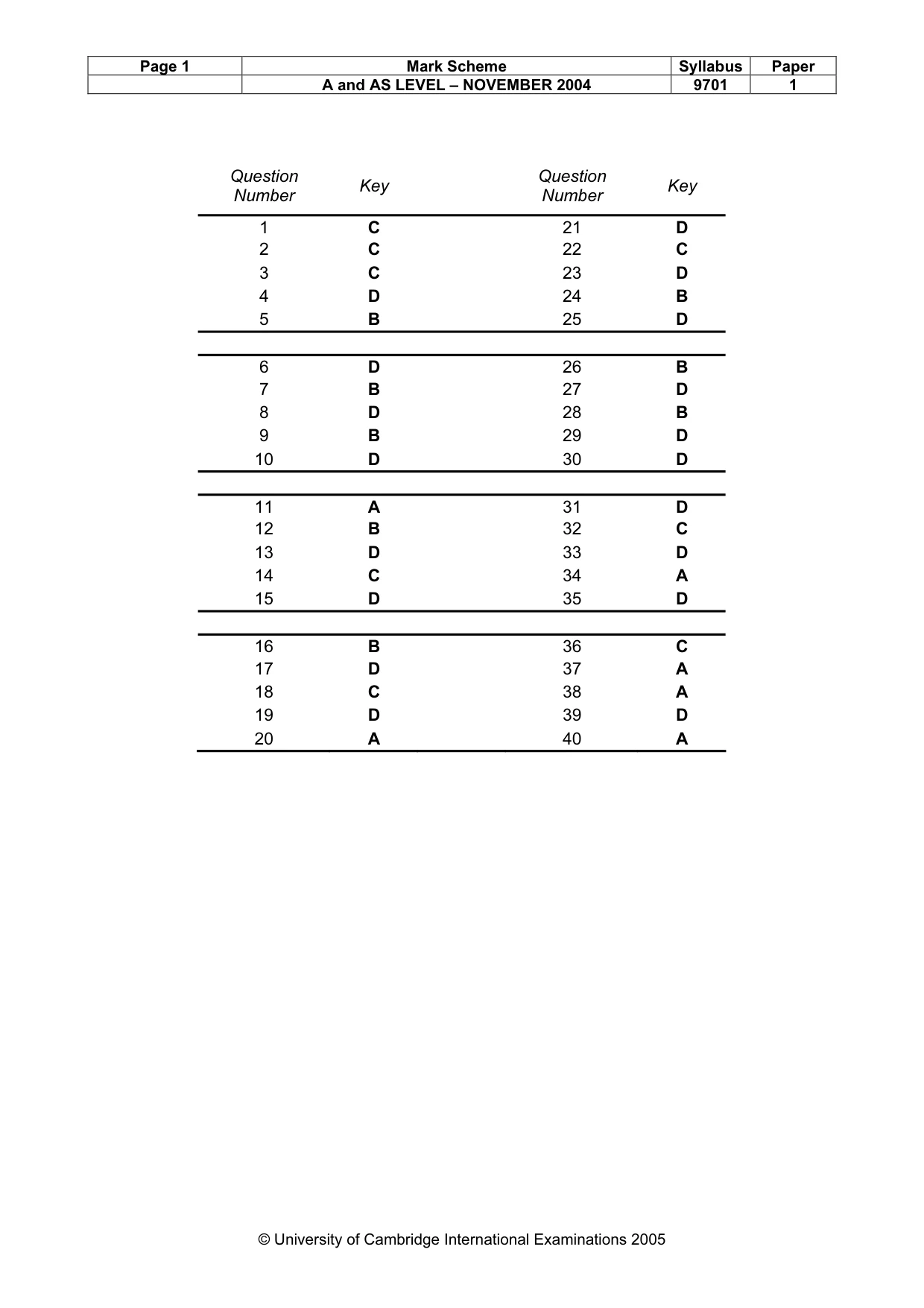
Page 1 Mark Scheme Syllabus Paper A and AS LEVEL – NOVEMBER 2004 9701 1 © University of Cambridge International Examinations 2005 Question Number Key Question Number Key 1 C 21 D 2 C 22 C 3 C 23 D 4 D 24 B 5 B 25 D 6 D 26 B 7 B 27 D 8 D 28 B 9 B 29 D 10 D 30 D 11 A 31 D 12 B 32 C 13 D 33 D 14 C 34 A 15 D 35 D 16 B 36 C 17 D 37 A 18 C 38 A 19 D 39 D 20 A 40 A