Cambridge A Level Business Studies (for final examination in 2015) 9707 — 2014 Oct/Nov Paper 1 · Variant 3
9707/13/O/N/14 · 40 marks · ≈45 min
The question paper and its mark scheme, free to read here and free to download. This is Cambridge’s own paper, exactly as it was sat.
Question paper4 pages


Mark scheme7 pages
Answers below. Sit the paper first if you are practising.
Paper as text
Question paper, page 1
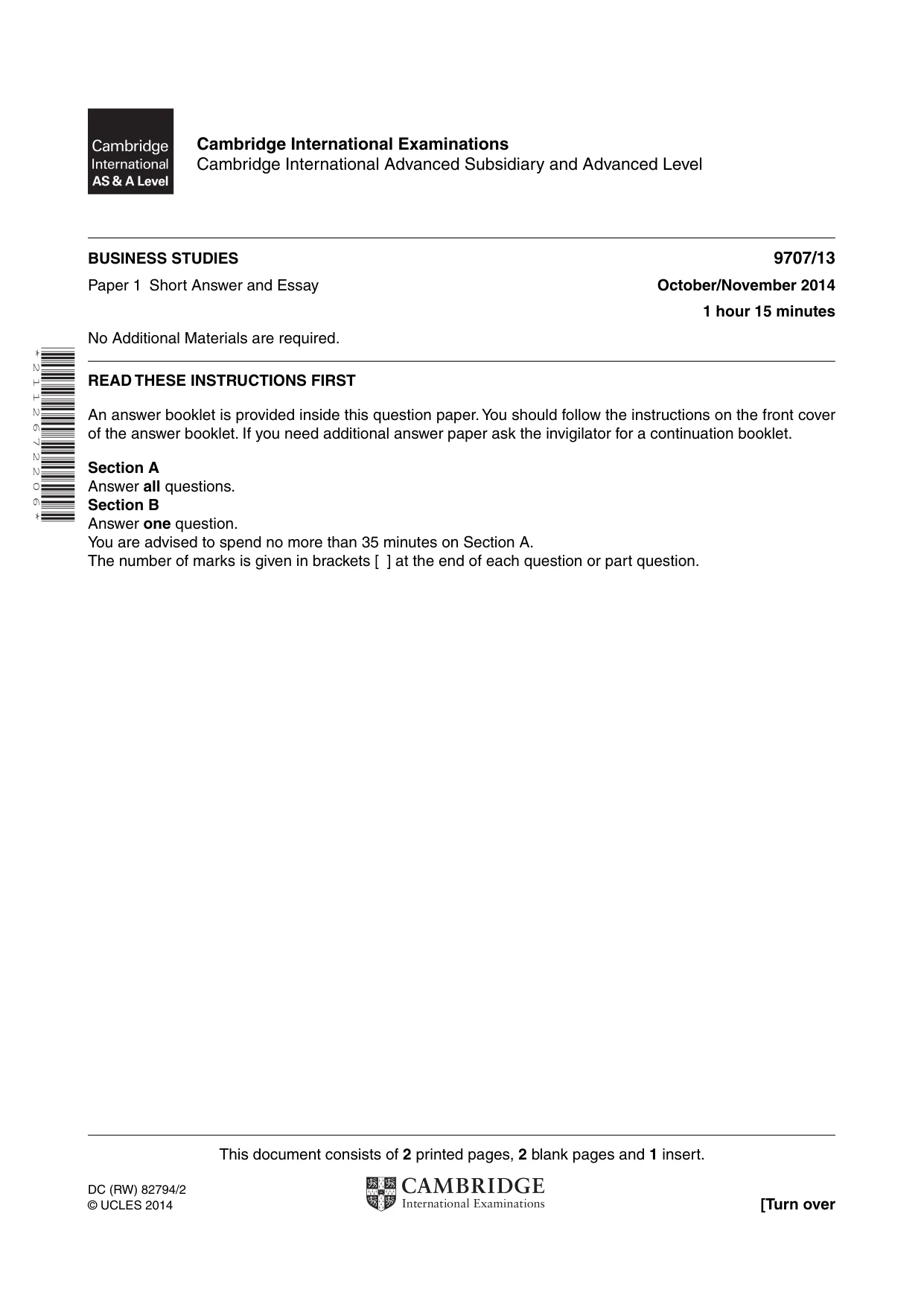
This document consists of 2 printed pages, 2 blank pages and 1 insert. DC (RW) 82794/2 © UCLES 2014 [Turn over Cambridge International Examinations Cambridge International Advanced Subsidiary and Advanced Level * 2 1 1 2 6 7 2 2 0 6 * BUSINESS STUDIES 9707/13 Paper 1 Short Answer and Essay October/November 2014 1 hour 15 minutes No Additional Materials are required. READ THESE INSTRUCTIONS FIRST An answer booklet is provided inside this question paper. You should follow the instructions on the front cover of the answer booklet. If you need additional answer paper ask the invigilator for a continuation booklet. Section A Answer all questions. Section B Answer one question. You are advised to spend no more than 35 minutes on Section A. The number of marks is given in brackets [ ] at the end of each question or part question.
Question paper, page 2
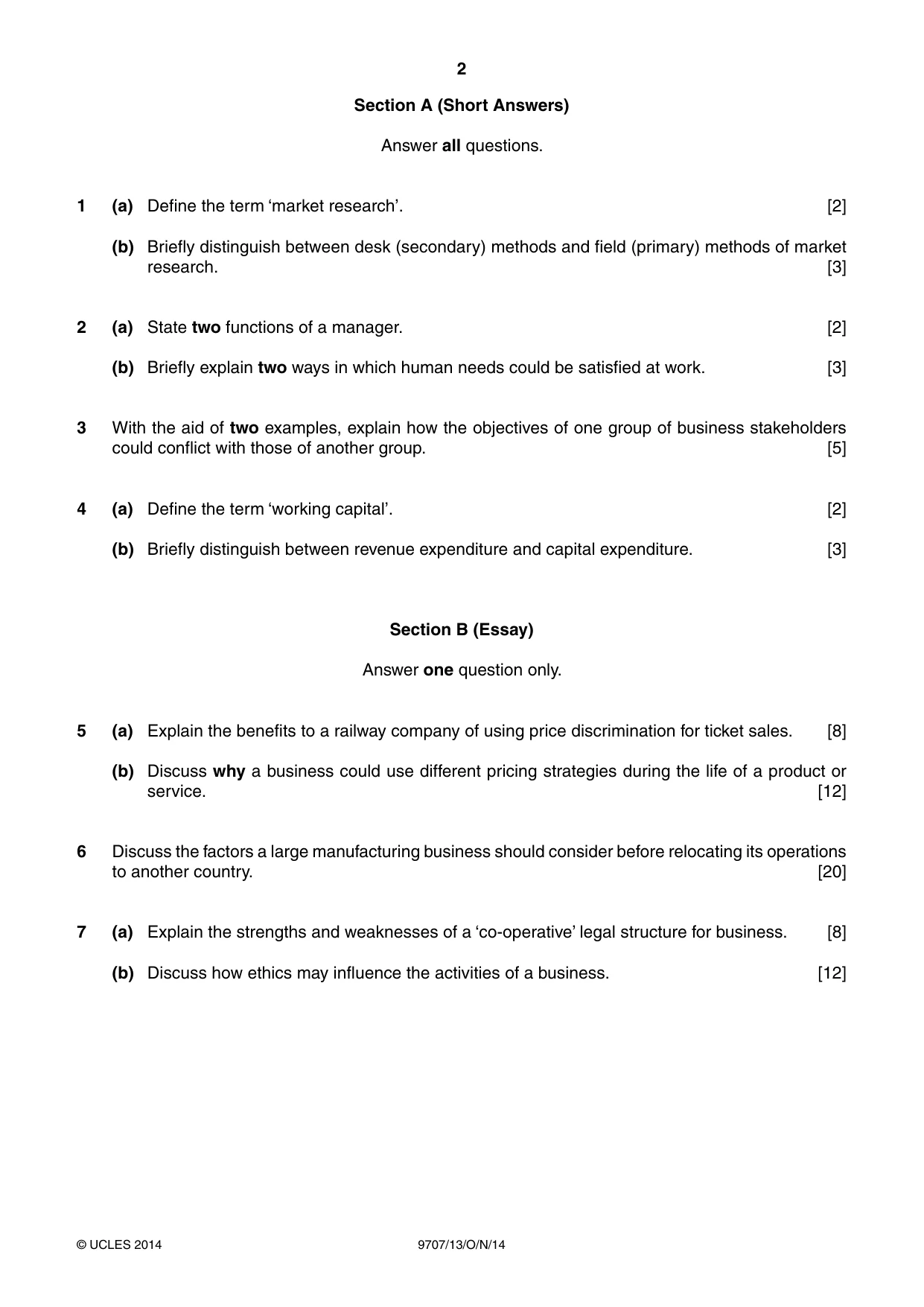
2 9707/13/O/N/14 © UCLES 2014 Section A (Short Answers) Answer all questions. 1 (a) Define the term ‘market research’. [2] (b) Briefly distinguish between desk (secondary) methods and field (primary) methods of market research. [3] 2 (a) State two functions of a manager. [2] (b) Briefly explain two ways in which human needs could be satisfied at work. [3] 3 With the aid of two examples, explain how the objectives of one group of business stakeholders could conflict with those of another group. [5] 4 (a) Define the term ‘working capital’. [2] (b) Briefly distinguish between revenue expenditure and capital expenditure. [3] Section B (Essay) Answer one question only. 5 (a) Explain the benefits to a railway company of using price discrimination for ticket sales. [8] (b) Discuss why a business could use different pricing strategies during the life of a product or service. [12] 6 Discuss the factors a large manufacturing business should consider before relocating its operations to another country. [20] 7 (a) Explain the strengths and weaknesses of a ‘co-operative’ legal structure for business. [8] (b) Discuss how ethics may influence the activities of a business. [12]
Question paper, page 3
3 9707/13/O/N/14 © UCLES 2014 BLANK PAGE
Question paper, page 4
4 9707/13/O/N/14 © UCLES 2014 Permission to reproduce items where third-party owned material protected by copyright is included has been sought and cleared where possible. Every reasonable effort has been made by the publisher (UCLES) to trace copyright holders, but if any items requiring clearance have unwittingly been included, the publisher will be pleased to make amends at the earliest possible opportunity. Cambridge International Examinations is part of the Cambridge Assessment Group. Cambridge Assessment is the brand name of University of Cambridge Local Examinations Syndicate (UCLES), which is itself a department of the University of Cambridge. BLANK PAGE
Mark scheme, page 1
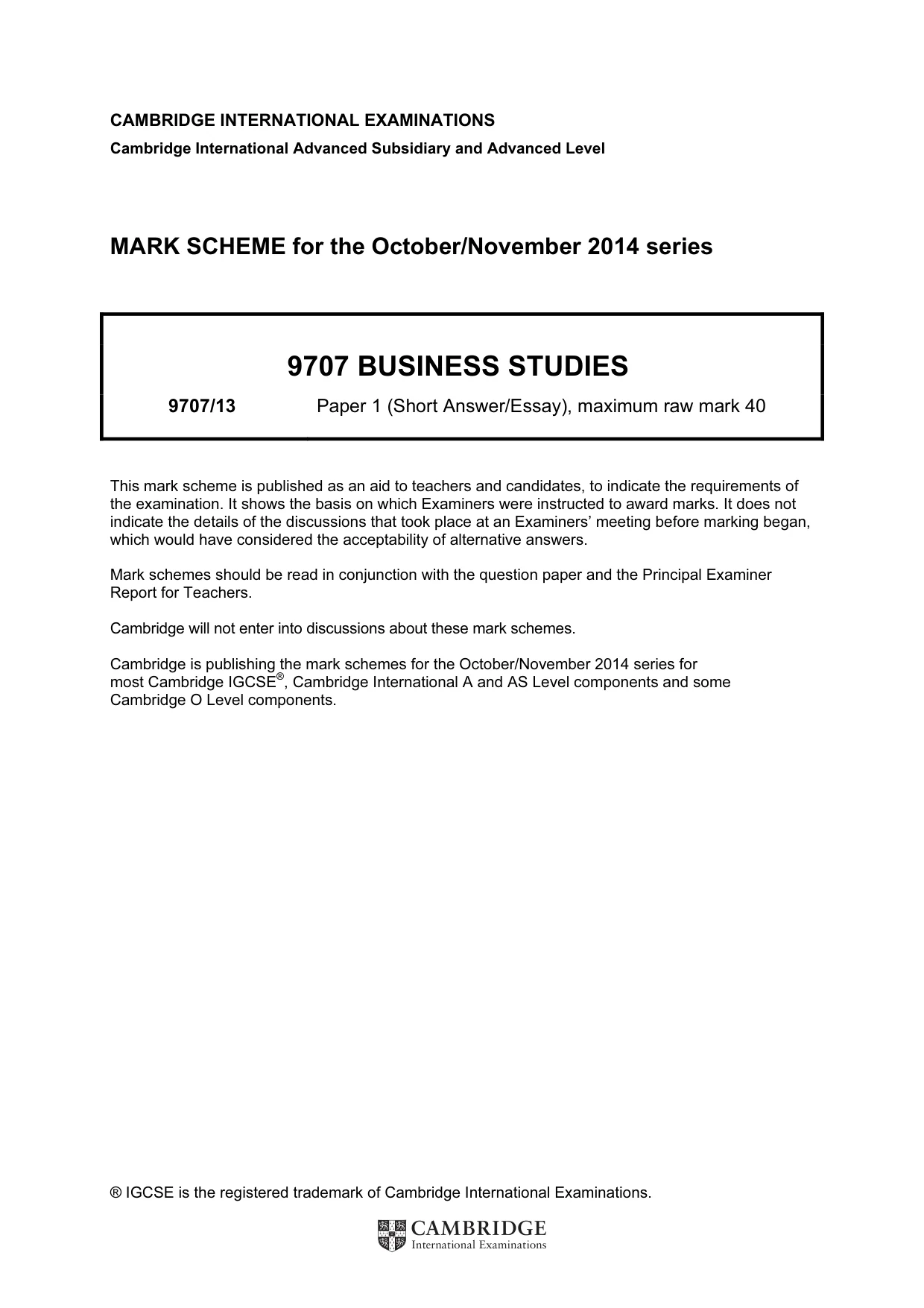
® IGCSE is the registered trademark of Cambridge International Examinations. CAMBRIDGE INTERNATIONAL EXAMINATIONS Cambridge International Advanced Subsidiary and Advanced Level MARK SCHEME for the October/November 2014 series 9707 BUSINESS STUDIES 9707/13 Paper 1 (Short Answer/Essay), maximum raw mark 40 This mark scheme is published as an aid to teachers and candidates, to indicate the requirements of the examination. It shows the basis on which Examiners were instructed to award marks. It does not indicate the details of the discussions that took place at an Examiners’ meeting before marking began, which would have considered the acceptability of alternative answers. Mark schemes should be read in conjunction with the question paper and the Principal Examiner Report for Teachers. Cambridge will not enter into discussions about these mark schemes. Cambridge is publishing the mark schemes for the October/November 2014 series for most Cambridge IGCSE®, Cambridge International A and AS Level components and some Cambridge O Level components.
Mark scheme, page 2
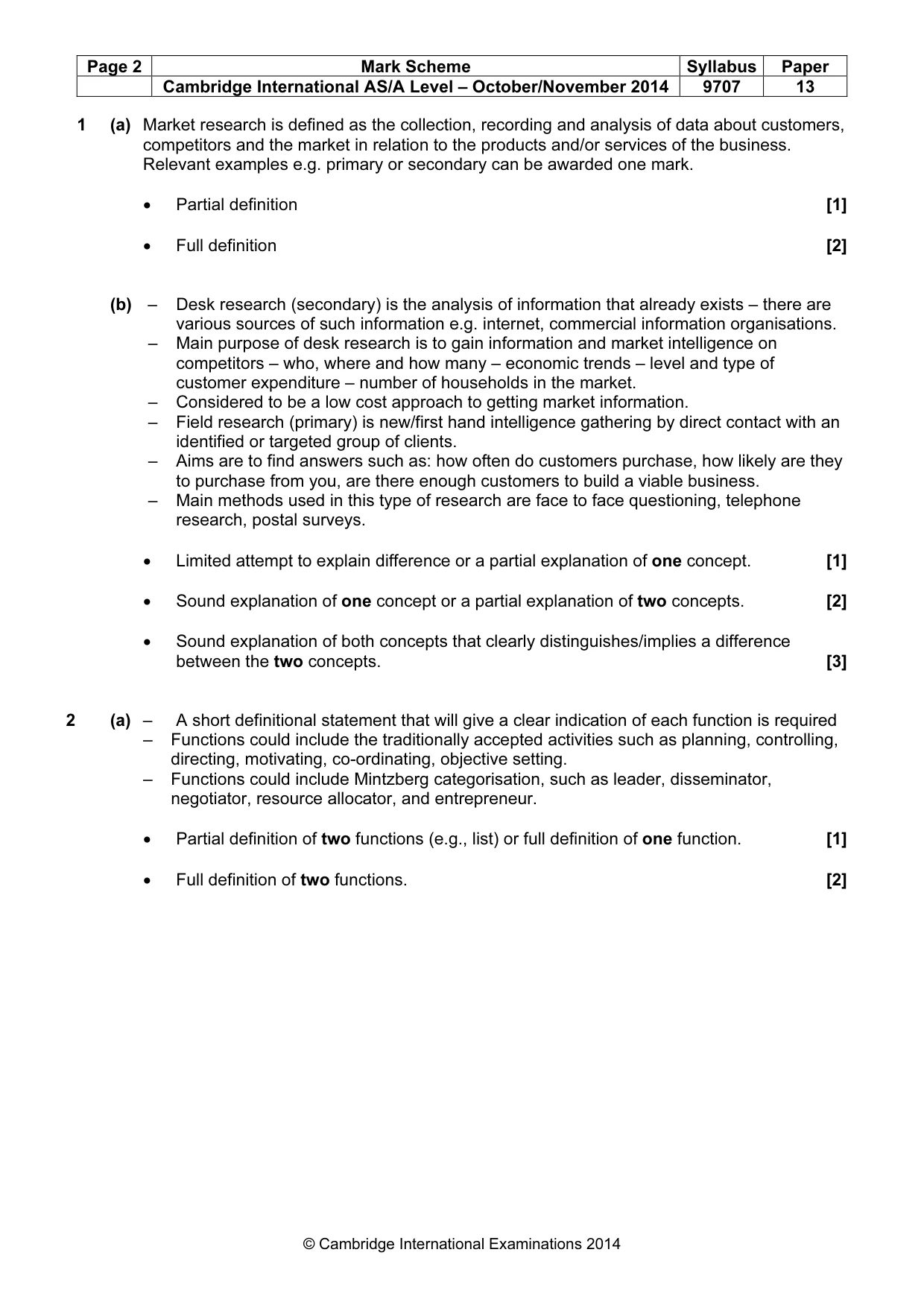
Page 2 Mark Scheme Syllabus Paper Cambridge International AS/A Level – October/November 2014 9707 13 © Cambridge International Examinations 2014 1 (a) Market research is defined as the collection, recording and analysis of data about customers, competitors and the market in relation to the products and/or services of the business. Relevant examples e.g. primary or secondary can be awarded one mark. • Partial definition [1] • Full definition [2] (b) – Desk research (secondary) is the analysis of information that already exists – there are various sources of such information e.g. internet, commercial information organisations. – Main purpose of desk research is to gain information and market intelligence on competitors – who, where and how many – economic trends – level and type of customer expenditure – number of households in the market. – Considered to be a low cost approach to getting market information. – Field research (primary) is new/first hand intelligence gathering by direct contact with an identified or targeted group of clients. – Aims are to find answers such as: how often do customers purchase, how likely are they to purchase from you, are there enough customers to build a viable business. – Main methods used in this type of research are face to face questioning, telephone research, postal surveys. • Limited attempt to explain difference or a partial explanation of one concept. [1] • Sound explanation of one concept or a partial explanation of two concepts. [2] • Sound explanation of both concepts that clearly distinguishes/implies a difference between the two concepts. [3] 2 (a) – A short definitional statement that will give a clear indication of each function is required – Functions could include the traditionally accepted activities such as planning, controlling, directing, motivating, co-ordinating, objective setting. – Functions could include Mintzberg categorisation, such as leader, disseminator, negotiator, resource allocator, and entrepreneur. • Partial definition of two functions (e.g., list) or full definition of one function. [1] • Full definition of two functions. [2]
Mark scheme, page 3
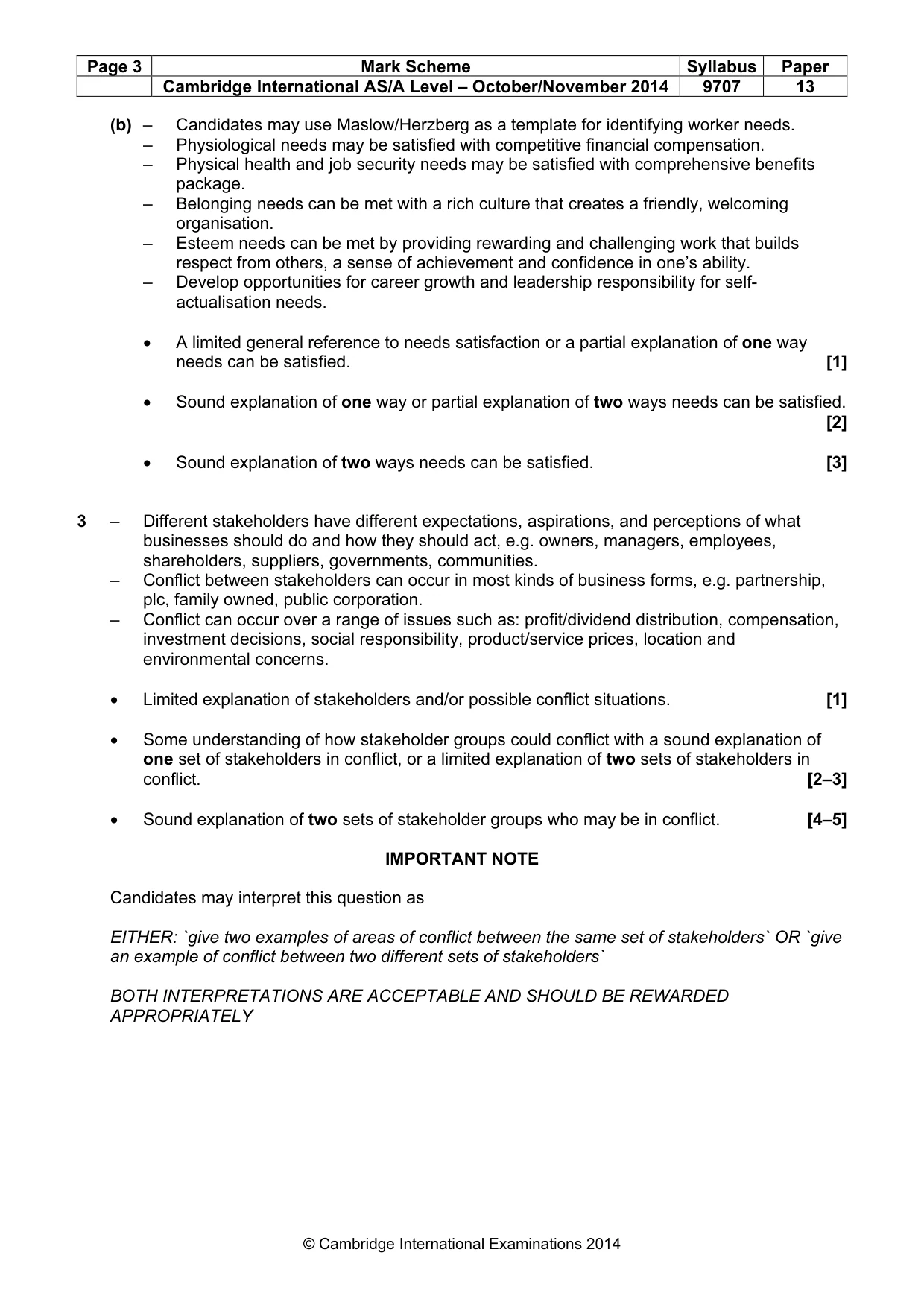
Page 3 Mark Scheme Syllabus Paper Cambridge International AS/A Level – October/November 2014 9707 13 © Cambridge International Examinations 2014 (b) – Candidates may use Maslow/Herzberg as a template for identifying worker needs. – Physiological needs may be satisfied with competitive financial compensation. – Physical health and job security needs may be satisfied with comprehensive benefits package. – Belonging needs can be met with a rich culture that creates a friendly, welcoming organisation. – Esteem needs can be met by providing rewarding and challenging work that builds respect from others, a sense of achievement and confidence in one’s ability. – Develop opportunities for career growth and leadership responsibility for self- actualisation needs. • A limited general reference to needs satisfaction or a partial explanation of one way needs can be satisfied. [1] • Sound explanation of one way or partial explanation of two ways needs can be satisfied. [2] • Sound explanation of two ways needs can be satisfied. [3] 3 – Different stakeholders have different expectations, aspirations, and perceptions of what businesses should do and how they should act, e.g. owners, managers, employees, shareholders, suppliers, governments, communities. – Conflict between stakeholders can occur in most kinds of business forms, e.g. partnership, plc, family owned, public corporation. – Conflict can occur over a range of issues such as: profit/dividend distribution, compensation, investment decisions, social responsibility, product/service prices, location and environmental concerns. • Limited explanation of stakeholders and/or possible conflict situations. [1] • Some understanding of how stakeholder groups could conflict with a sound explanation of one set of stakeholders in conflict, or a limited explanation of two sets of stakeholders in conflict. [2–3] • Sound explanation of two sets of stakeholder groups who may be in conflict. [4–5] IMPORTANT NOTE Candidates may interpret this question as EITHER: `give two examples of areas of conflict between the same set of stakeholders` OR `give an example of conflict between two different sets of stakeholders` BOTH INTERPRETATIONS ARE ACCEPTABLE AND SHOULD BE REWARDED APPROPRIATELY
Mark scheme, page 4
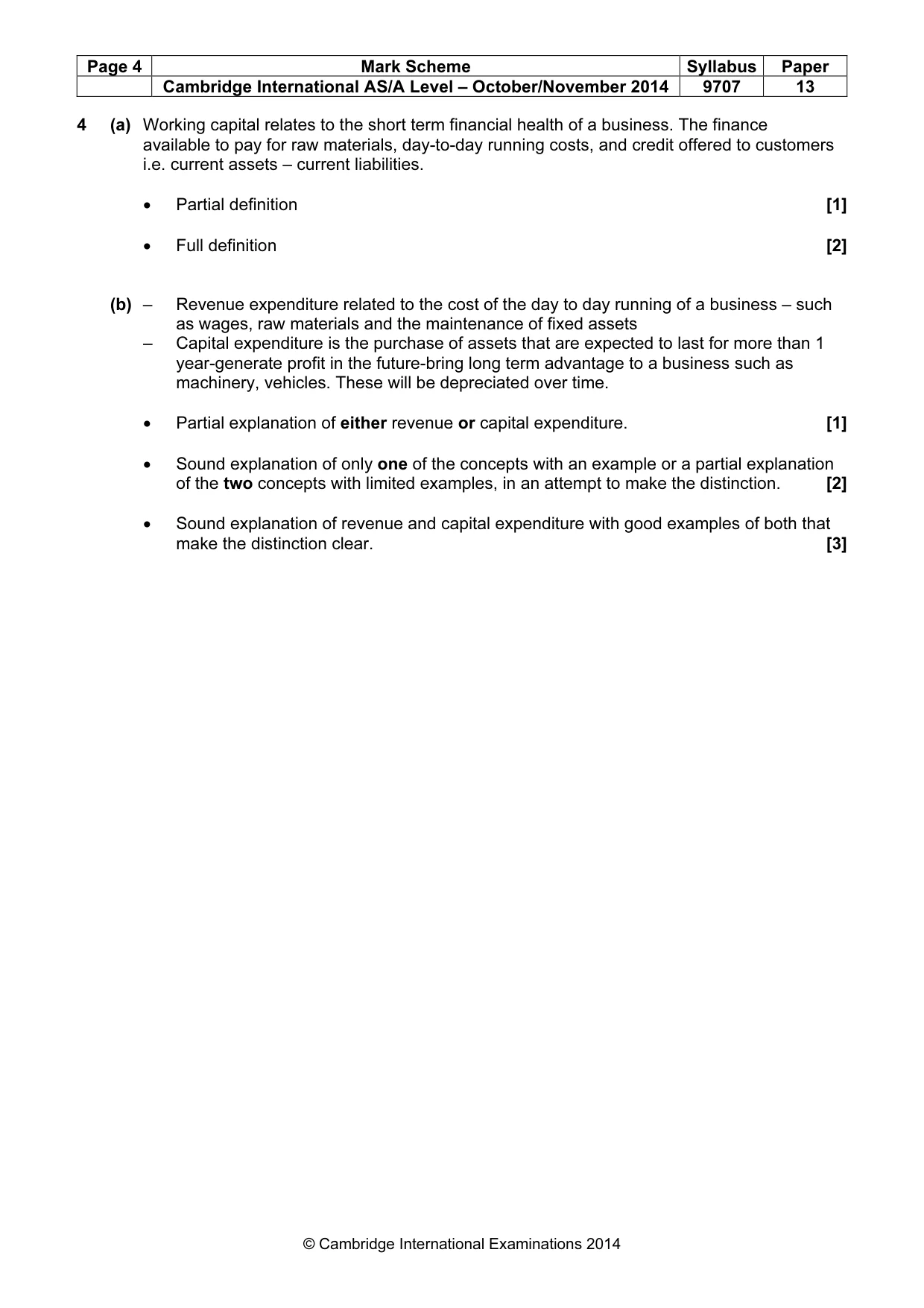
Page 4 Mark Scheme Syllabus Paper Cambridge International AS/A Level – October/November 2014 9707 13 © Cambridge International Examinations 2014 4 (a) Working capital relates to the short term financial health of a business. The finance available to pay for raw materials, day-to-day running costs, and credit offered to customers i.e. current assets – current liabilities. • Partial definition [1] • Full definition [2] (b) – Revenue expenditure related to the cost of the day to day running of a business – such as wages, raw materials and the maintenance of fixed assets – Capital expenditure is the purchase of assets that are expected to last for more than 1 year-generate profit in the future-bring long term advantage to a business such as machinery, vehicles. These will be depreciated over time. • Partial explanation of either revenue or capital expenditure. [1] • Sound explanation of only one of the concepts with an example or a partial explanation of the two concepts with limited examples, in an attempt to make the distinction. [2] • Sound explanation of revenue and capital expenditure with good examples of both that make the distinction clear. [3]
Mark scheme, page 5
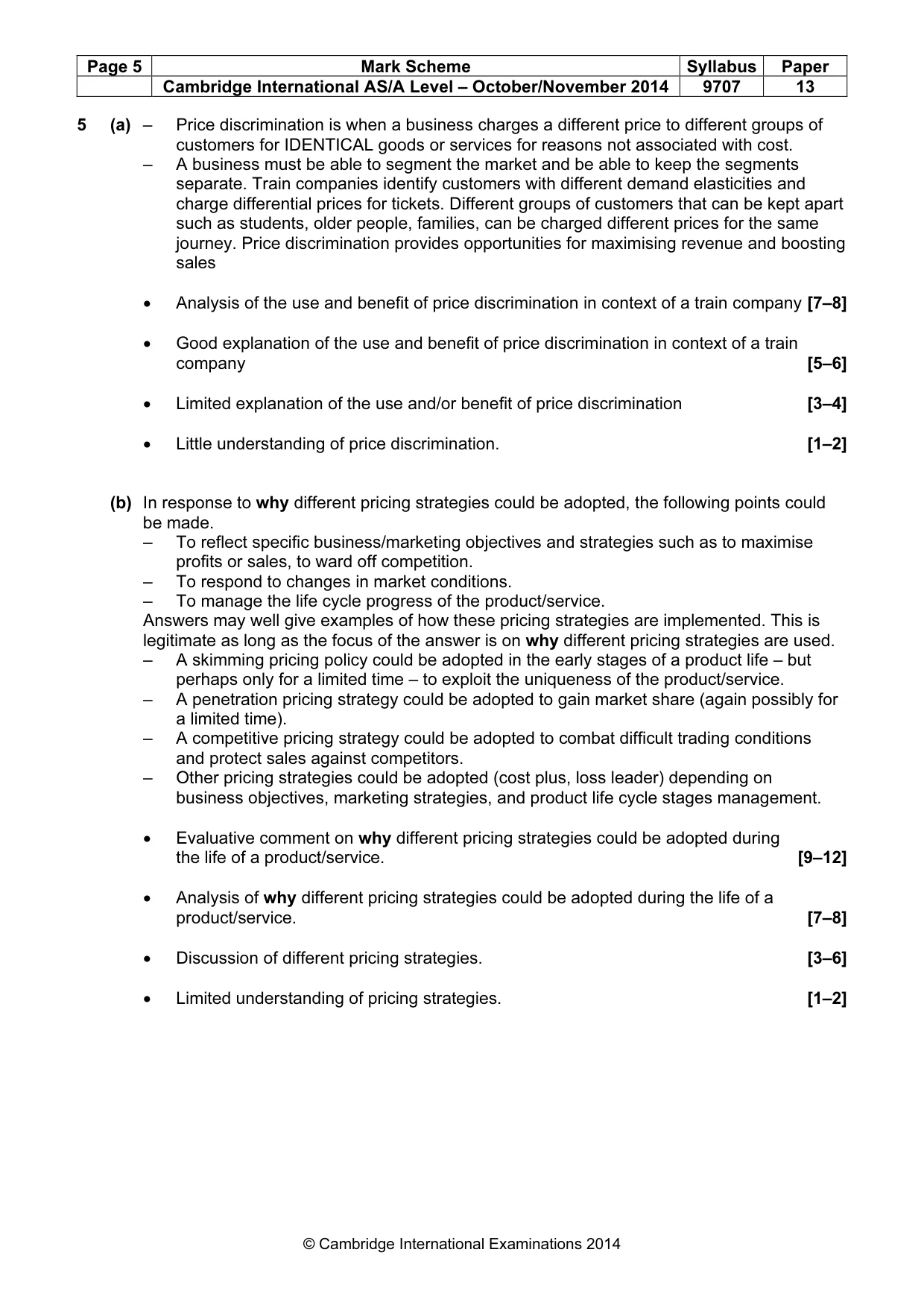
Page 5 Mark Scheme Syllabus Paper Cambridge International AS/A Level – October/November 2014 9707 13 © Cambridge International Examinations 2014 5 (a) – Price discrimination is when a business charges a different price to different groups of customers for IDENTICAL goods or services for reasons not associated with cost. – A business must be able to segment the market and be able to keep the segments separate. Train companies identify customers with different demand elasticities and charge differential prices for tickets. Different groups of customers that can be kept apart such as students, older people, families, can be charged different prices for the same journey. Price discrimination provides opportunities for maximising revenue and boosting sales • Analysis of the use and benefit of price discrimination in context of a train company [7–8] • Good explanation of the use and benefit of price discrimination in context of a train company [5–6] • Limited explanation of the use and/or benefit of price discrimination [3–4] • Little understanding of price discrimination. [1–2] (b) In response to why different pricing strategies could be adopted, the following points could be made. – To reflect specific business/marketing objectives and strategies such as to maximise profits or sales, to ward off competition. – To respond to changes in market conditions. – To manage the life cycle progress of the product/service. Answers may well give examples of how these pricing strategies are implemented. This is legitimate as long as the focus of the answer is on why different pricing strategies are used. – A skimming pricing policy could be adopted in the early stages of a product life – but perhaps only for a limited time – to exploit the uniqueness of the product/service. – A penetration pricing strategy could be adopted to gain market share (again possibly for a limited time). – A competitive pricing strategy could be adopted to combat difficult trading conditions and protect sales against competitors. – Other pricing strategies could be adopted (cost plus, loss leader) depending on business objectives, marketing strategies, and product life cycle stages management. • Evaluative comment on why different pricing strategies could be adopted during the life of a product/service. [9–12] • Analysis of why different pricing strategies could be adopted during the life of a product/service. [7–8] • Discussion of different pricing strategies. [3–6] • Limited understanding of pricing strategies. [1–2]
Mark scheme, page 6
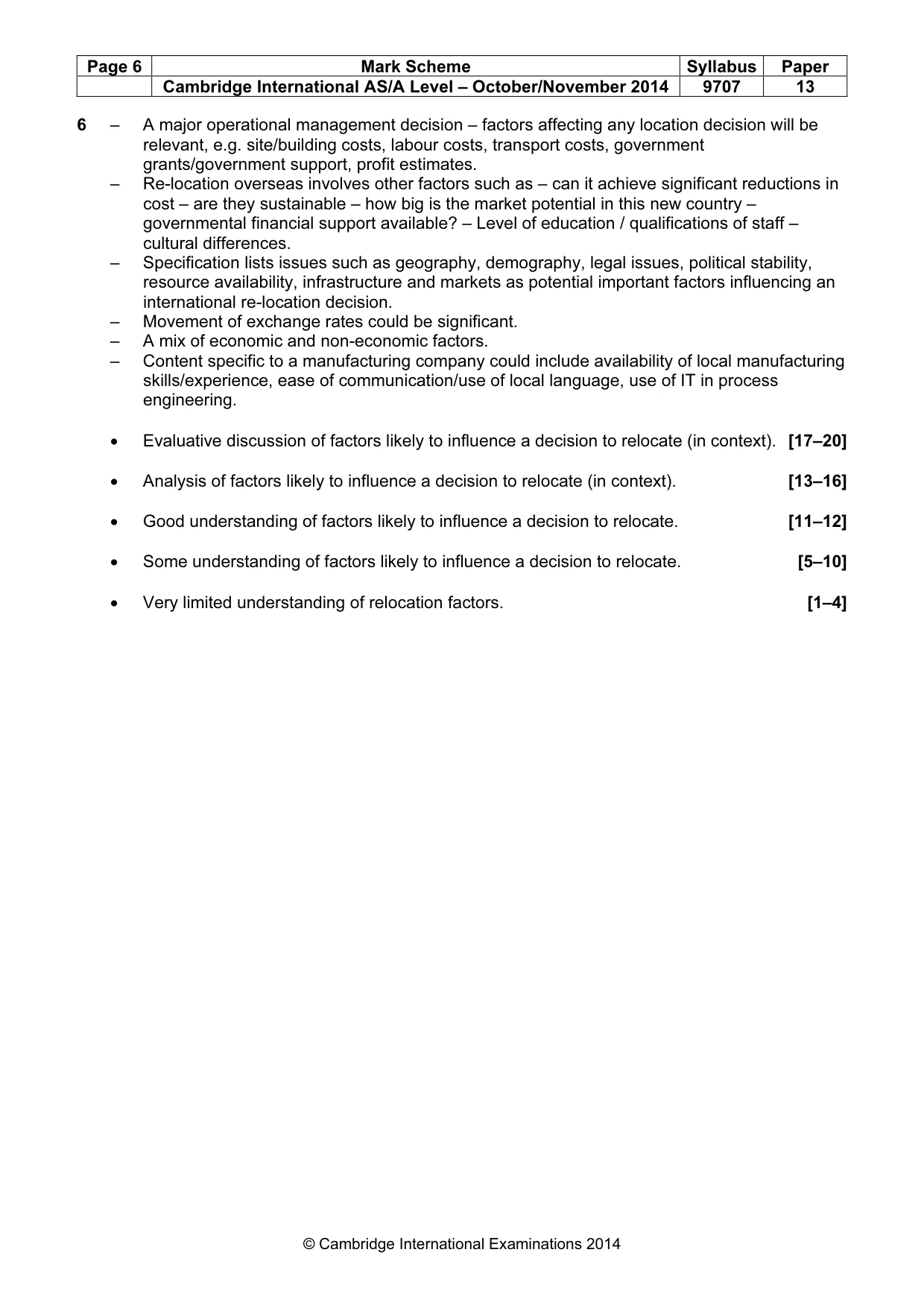
Page 6 Mark Scheme Syllabus Paper Cambridge International AS/A Level – October/November 2014 9707 13 © Cambridge International Examinations 2014 6 – A major operational management decision – factors affecting any location decision will be relevant, e.g. site/building costs, labour costs, transport costs, government grants/government support, profit estimates. – Re-location overseas involves other factors such as – can it achieve significant reductions in cost – are they sustainable – how big is the market potential in this new country – governmental financial support available? – Level of education / qualifications of staff – cultural differences. – Specification lists issues such as geography, demography, legal issues, political stability, resource availability, infrastructure and markets as potential important factors influencing an international re-location decision. – Movement of exchange rates could be significant. – A mix of economic and non-economic factors. – Content specific to a manufacturing company could include availability of local manufacturing skills/experience, ease of communication/use of local language, use of IT in process engineering. • Evaluative discussion of factors likely to influence a decision to relocate (in context). [17–20] • Analysis of factors likely to influence a decision to relocate (in context). [13–16] • Good understanding of factors likely to influence a decision to relocate. [11–12] • Some understanding of factors likely to influence a decision to relocate. [5–10] • Very limited understanding of relocation factors. [1–4]
Mark scheme, page 7
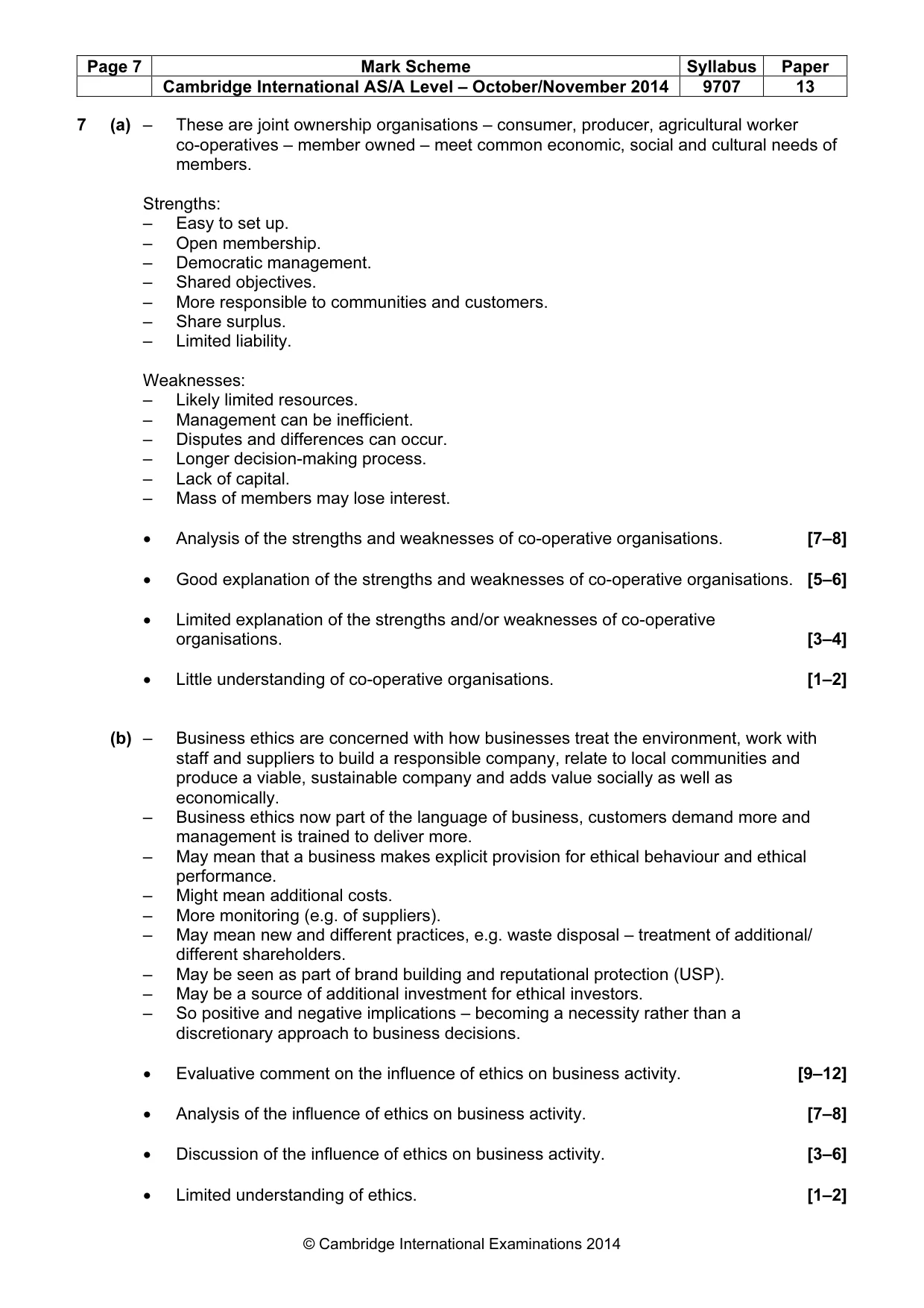
Page 7 Mark Scheme Syllabus Paper Cambridge International AS/A Level – October/November 2014 9707 13 © Cambridge International Examinations 2014 7 (a) – These are joint ownership organisations – consumer, producer, agricultural worker co-operatives – member owned – meet common economic, social and cultural needs of members. Strengths: – Easy to set up. – Open membership. – Democratic management. – Shared objectives. – More responsible to communities and customers. – Share surplus. – Limited liability. Weaknesses: – Likely limited resources. – Management can be inefficient. – Disputes and differences can occur. – Longer decision-making process. – Lack of capital. – Mass of members may lose interest. • Analysis of the strengths and weaknesses of co-operative organisations. [7–8] • Good explanation of the strengths and weaknesses of co-operative organisations. [5–6] • Limited explanation of the strengths and/or weaknesses of co-operative organisations. [3–4] • Little understanding of co-operative organisations. [1–2] (b) – Business ethics are concerned with how businesses treat the environment, work with staff and suppliers to build a responsible company, relate to local communities and produce a viable, sustainable company and adds value socially as well as economically. – Business ethics now part of the language of business, customers demand more and management is trained to deliver more. – May mean that a business makes explicit provision for ethical behaviour and ethical performance. – Might mean additional costs. – More monitoring (e.g. of suppliers). – May mean new and different practices, e.g. waste disposal – treatment of additional/ different shareholders. – May be seen as part of brand building and reputational protection (USP). – May be a source of additional investment for ethical investors. – So positive and negative implications – becoming a necessity rather than a discretionary approach to business decisions. • Evaluative comment on the influence of ethics on business activity. [9–12] • Analysis of the influence of ethics on business activity. [7–8] • Discussion of the influence of ethics on business activity. [3–6] • Limited understanding of ethics. [1–2]
What you needed in this session
Cambridge’s own grade thresholds for 2014 Oct/Nov, Paper 1 · Variant 3. A higher threshold means an easier paper — the bar moves with how the cohort did.