Cambridge A Level Business (for first examination in 2016) 9609 — 2023 Oct/Nov Paper 1 · Variant 2
9609/12/O/N/23 · 40 marks · ≈45 min
The question paper and its mark scheme, free to read here and free to download. This is Cambridge’s own paper, exactly as it was sat.
Question paper4 pages


Mark scheme24 pages
Answers below. Sit the paper first if you are practising.

Paper as text
Question paper, page 1
This document has 4 pages. Any blank pages are indicated. [Turn over Cambridge International AS & A Level * 7 1 1 6 4 7 5 6 9 2 * DC (CE) 316876/1 © UCLES 2023 BUSINESS 9609/12 Paper 1 Business Concepts 1 October/November 2023 1 hour 15 minutes You must answer on the enclosed answer booklet. You will need: Answer booklet (enclosed) INSTRUCTIONS ● Answer five questions in total: Section A: answer all questions. Section B: answer one question. ● Follow the instructions on the front cover of the answer booklet. If you need additional answer paper, ask the invigilator for a continuation booklet. INFORMATION ● The total mark for this paper is 40. ● The number of marks for each question or part question is shown in brackets [ ].
Question paper, page 2
2 9609/12/O/N/23 © UCLES 2023 Section A Answer all questions. 1 (a) Define the term job description. [2] (b) Explain one advantage to an employer of using a person specification. [3] 2 (a) Define the term business enterprise. [2] (b) Explain one reason why a business might fail. [3] 3 (a) Define the term bankruptcy. [2] (b) Explain one advantage of using retained earnings as a source of finance. [3] 4 Analyse one way a business might improve the efficiency of its operations. [5] Section B Answer one question only. EITHER 5 (a) Analyse two methods that a business could use to help employees satisfy their self- actualisation needs, as defined by Maslow. [8] (b) Evaluate whether an ability to motivate others is the most important role of a hotel manager. [12] OR 6 (a) Analyse two reasons why there should be a close link between the marketing objectives of a business and its corporate objectives. [8] (b) ‘This new airline will only succeed if it offers the lowest prices in the market’. Evaluate this view. [12]
Question paper, page 3
3 9609/12/O/N/23 © UCLES 2023 BLANK PAGE
Question paper, page 4
4 9609/12/O/N/23 © UCLES 2023 Permission to reproduce items where third-party owned material protected by copyright is included has been sought and cleared where possible. Every reasonable effort has been made by the publisher (UCLES) to trace copyright holders, but if any items requiring clearance have unwittingly been included, the publisher will be pleased to make amends at the earliest possible opportunity. To avoid the issue of disclosure of answer-related information to candidates, all copyright acknowledgements are reproduced online in the Cambridge Assessment International Education Copyright Acknowledgements Booklet. This is produced for each series of examinations and is freely available to download at www.cambridgeinternational.org after the live examination series. Cambridge Assessment International Education is part of Cambridge Assessment. Cambridge Assessment is the brand name of the University of Cambridge Local Examinations Syndicate (UCLES), which is a department of the University of Cambridge. BLANK PAGE
Mark scheme, page 1
This document consists of 24 printed pages. © UCLES 2023 [Turn over Cambridge International AS & A Level BUSINESS 9609/12 Paper 1 Short Answer/Essay October/November 2023 MARK SCHEME Maximum Mark: 40 Published This mark scheme is published as an aid to teachers and candidates, to indicate the requirements of the examination. It shows the basis on which Examiners were instructed to award marks. It does not indicate the details of the discussions that took place at an Examiners’ meeting before marking began, which would have considered the acceptability of alternative answers. Mark schemes should be read in conjunction with the question paper and the Principal Examiner Report for Teachers. Cambridge International will not enter into discussions about these mark schemes. Cambridge International is publishing the mark schemes for the October/November 2023 series for most Cambridge IGCSE, Cambridge International A and AS Level components, and some Cambridge O Level components.
Mark scheme, page 2
9609/12 Cambridge International AS & A Level – Mark Scheme PUBLISHED October/November 2023 © UCLES 2023 Page 2 of 24 Generic Marking Principles These general marking principles must be applied by all examiners when marking candidate answers. They should be applied alongside the specific content of the mark scheme or generic level descriptors for a question. Each question paper and mark scheme will also comply with these marking principles. GENERIC MARKING PRINCIPLE 1: Marks must be awarded in line with: • the specific content of the mark scheme or the generic level descriptors for the question • the specific skills defined in the mark scheme or in the generic level descriptors for the question • the standard of response required by a candidate as exemplified by the standardisation scripts. GENERIC MARKING PRINCIPLE 2: Marks awarded are always whole marks (not half marks, or other fractions). GENERIC MARKING PRINCIPLE 3: Marks must be awarded positively: • marks are awarded for correct/valid answers, as defined in the mark scheme. However, credit is given for valid answers which go beyond the scope of the syllabus and mark scheme, referring to your Team Leader as appropriate • marks are awarded when candidates clearly demonstrate what they know and can do • marks are not deducted for errors • marks are not deducted for omissions • answers should only be judged on the quality of spelling, punctuation and grammar when these features are specifically assessed by the question as indicated by the mark scheme. The meaning, however, should be unambiguous. GENERIC MARKING PRINCIPLE 4: Rules must be applied consistently, e.g., in situations where candidates have not followed instructions or in the application of generic level descriptors. GENERIC MARKING PRINCIPLE 5: Marks should be awarded using the full range of marks defined in the mark scheme for the question (however; the use of the full mark range may be limited according to the quality of the candidate responses seen). GENERIC MARKING PRINCIPLE 6: Marks awarded are based solely on the requirements as defined in the mark scheme. Marks should not be awarded with grade thresholds or grade descriptors in mind.
Mark scheme, page 3
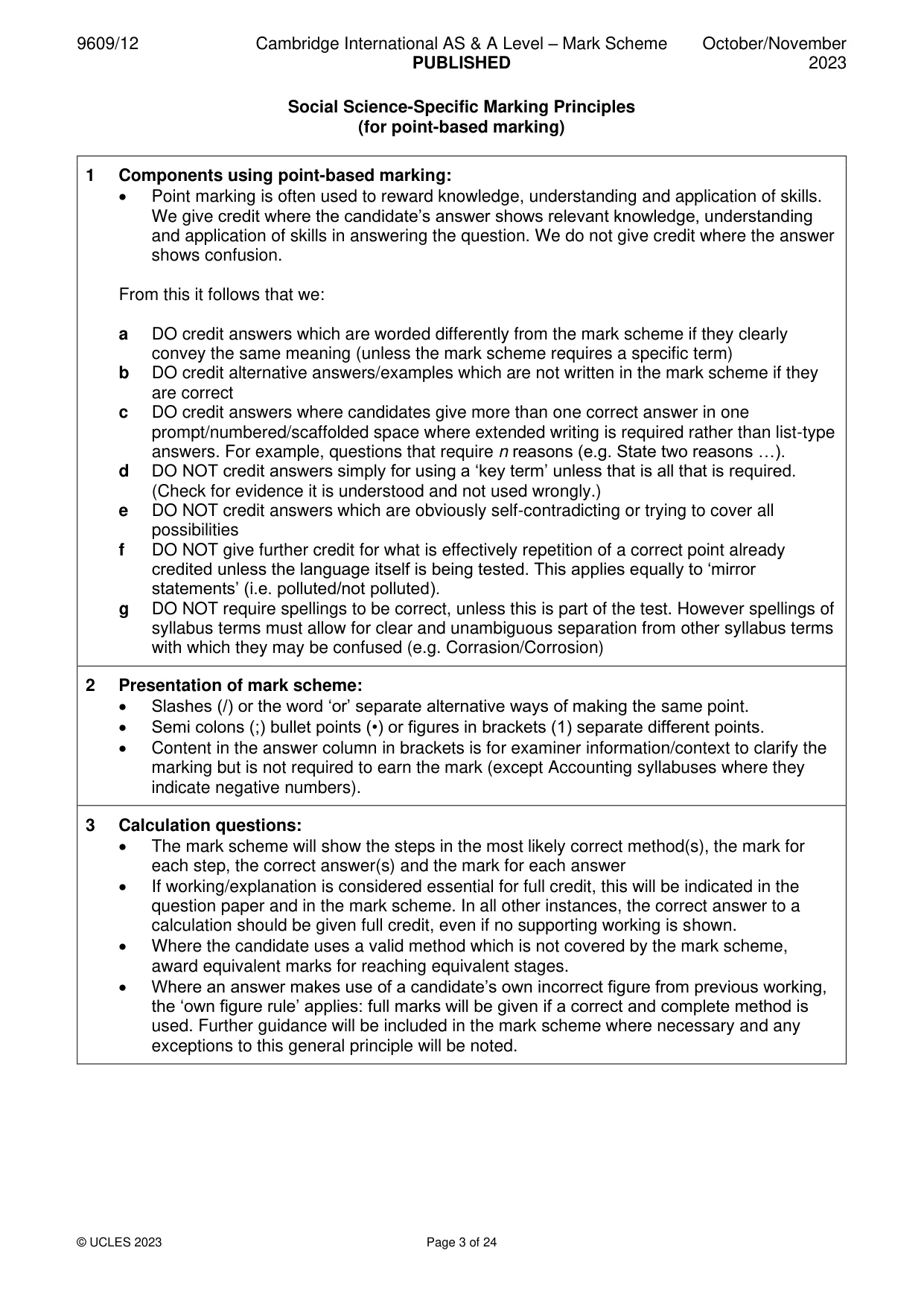
9609/12 Cambridge International AS & A Level – Mark Scheme PUBLISHED October/November 2023 © UCLES 2023 Page 3 of 24 Social Science-Specific Marking Principles (for point-based marking) 1 Components using point-based marking: • Point marking is often used to reward knowledge, understanding and application of skills. We give credit where the candidate’s answer shows relevant knowledge, understanding and application of skills in answering the question. We do not give credit where the answer shows confusion. From this it follows that we: a DO credit answers which are worded differently from the mark scheme if they clearly convey the same meaning (unless the mark scheme requires a specific term) b DO credit alternative answers/examples which are not written in the mark scheme if they are correct c DO credit answers where candidates give more than one correct answer in one prompt/numbered/scaffolded space where extended writing is required rather than list-type answers. For example, questions that require n reasons (e.g. State two reasons …). d DO NOT credit answers simply for using a ‘key term’ unless that is all that is required. (Check for evidence it is understood and not used wrongly.) e DO NOT credit answers which are obviously self-contradicting or trying to cover all possibilities f DO NOT give further credit for what is effectively repetition of a correct point already credited unless the language itself is being tested. This applies equally to ‘mirror statements’ (i.e. polluted/not polluted). g DO NOT require spellings to be correct, unless this is part of the test. However spellings of syllabus terms must allow for clear and unambiguous separation from other syllabus terms with which they may be confused (e.g. Corrasion/Corrosion) 2 Presentation of mark scheme: • Slashes (/) or the word ‘or’ separate alternative ways of making the same point. • Semi colons (;) bullet points (•) or figures in brackets (1) separate different points. • Content in the answer column in brackets is for examiner information/context to clarify the marking but is not required to earn the mark (except Accounting syllabuses where they indicate negative numbers). 3 Calculation questions: • The mark scheme will show the steps in the most likely correct method(s), the mark for each step, the correct answer(s) and the mark for each answer • If working/explanation is considered essential for full credit, this will be indicated in the question paper and in the mark scheme. In all other instances, the correct answer to a calculation should be given full credit, even if no supporting working is shown. • Where the candidate uses a valid method which is not covered by the mark scheme, award equivalent marks for reaching equivalent stages. • Where an answer makes use of a candidate’s own incorrect figure from previous working, the ‘own figure rule’ applies: full marks will be given if a correct and complete method is used. Further guidance will be included in the mark scheme where necessary and any exceptions to this general principle will be noted.
Mark scheme, page 4
9609/12 Cambridge International AS & A Level – Mark Scheme PUBLISHED October/November 2023 © UCLES 2023 Page 4 of 24 4 Annotation: • For point marking, ticks can be used to indicate correct answers and crosses can be used to indicate wrong answers. There is no direct relationship between ticks and marks. Ticks have no defined meaning for levels of response marking. • For levels of response marking, the level awarded should be annotated on the script. • Other annotations will be used by examiners as agreed during standardisation, and the meaning will be understood by all examiners who marked that paper.
Mark scheme, page 5
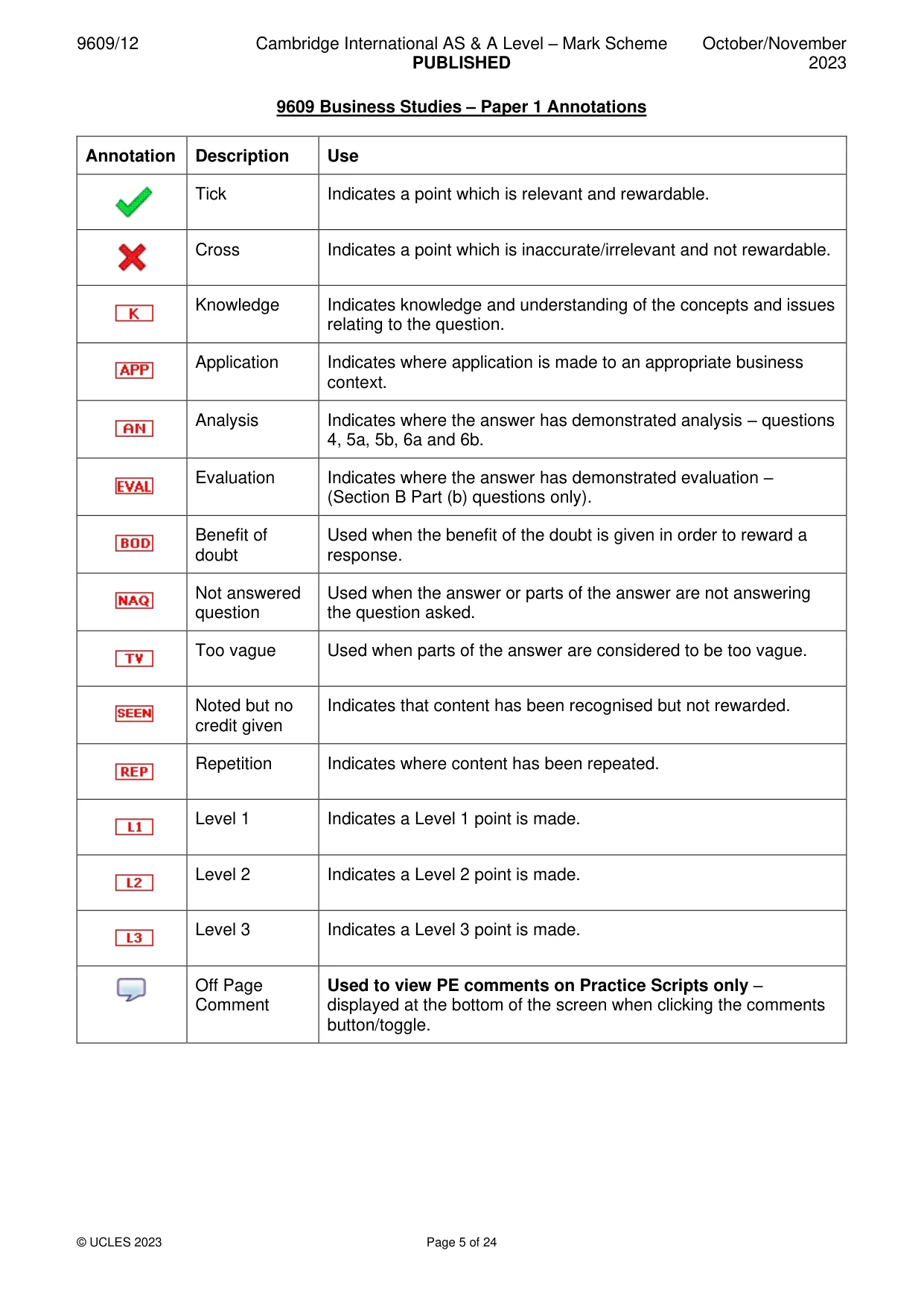
9609/12 Cambridge International AS & A Level – Mark Scheme PUBLISHED October/November 2023 © UCLES 2023 Page 5 of 24 9609 Business Studies – Paper 1 Annotations Annotation Description Use Tick Indicates a point which is relevant and rewardable. Cross Indicates a point which is inaccurate/irrelevant and not rewardable. Knowledge Indicates knowledge and understanding of the concepts and issues relating to the question. Application Indicates where application is made to an appropriate business context. Analysis Indicates where the answer has demonstrated analysis – questions 4, 5a, 5b, 6a and 6b. Evaluation Indicates where the answer has demonstrated evaluation – (Section B Part (b) questions only). Benefit of doubt Used when the benefit of the doubt is given in order to reward a response. Not answered question Used when the answer or parts of the answer are not answering the question asked. Too vague Used when parts of the answer are considered to be too vague. Noted but no credit given Indicates that content has been recognised but not rewarded. Repetition Indicates where content has been repeated. Level 1 Indicates a Level 1 point is made. Level 2 Indicates a Level 2 point is made. Level 3 Indicates a Level 3 point is made. Off Page Comment Used to view PE comments on Practice Scripts only – displayed at the bottom of the screen when clicking the comments button/toggle.
Mark scheme, page 6
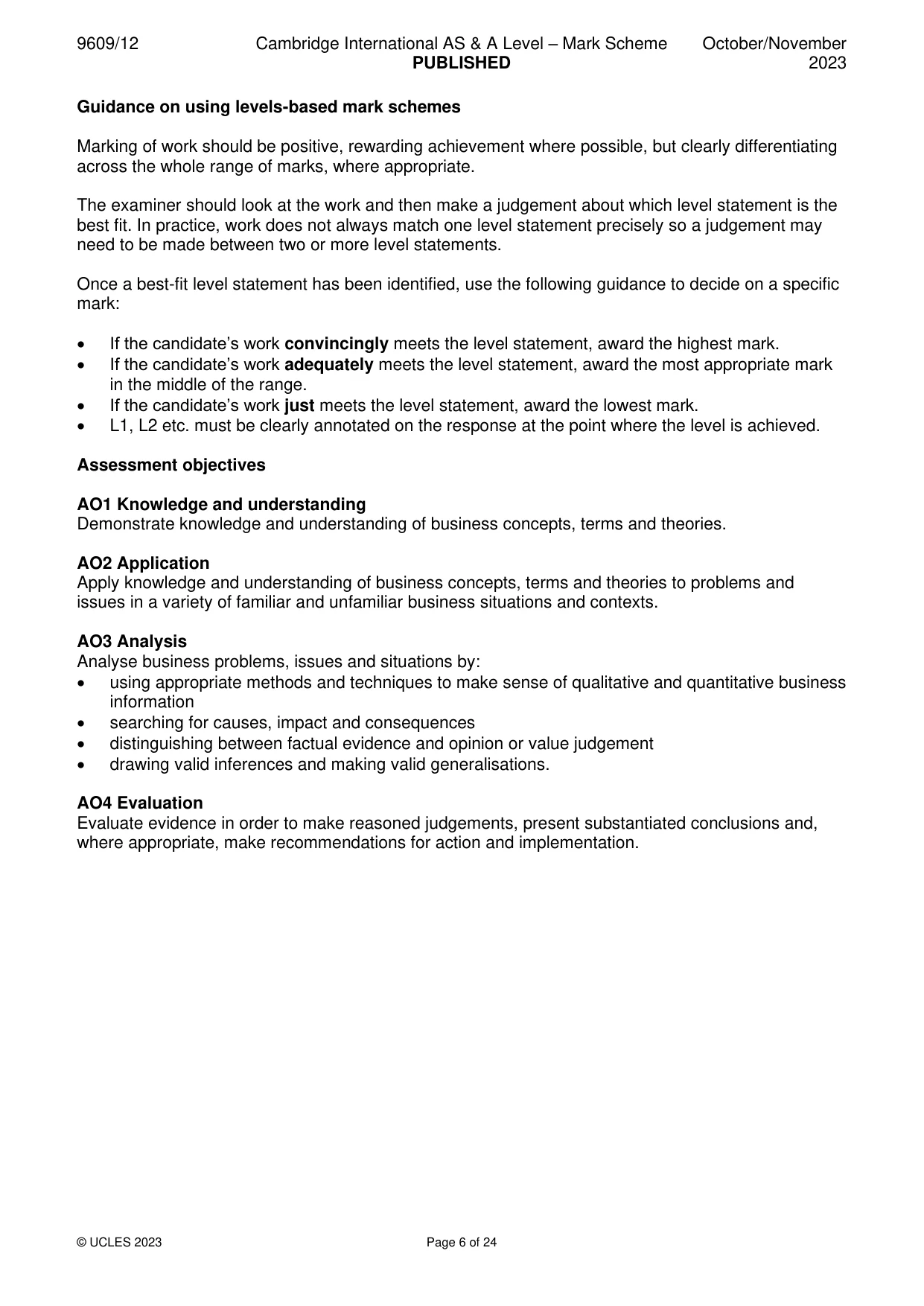
9609/12 Cambridge International AS & A Level – Mark Scheme PUBLISHED October/November 2023 © UCLES 2023 Page 6 of 24 Guidance on using levels-based mark schemes Marking of work should be positive, rewarding achievement where possible, but clearly differentiating across the whole range of marks, where appropriate. The examiner should look at the work and then make a judgement about which level statement is the best fit. In practice, work does not always match one level statement precisely so a judgement may need to be made between two or more level statements. Once a best-fit level statement has been identified, use the following guidance to decide on a specific mark: • If the candidate’s work convincingly meets the level statement, award the highest mark. • If the candidate’s work adequately meets the level statement, award the most appropriate mark in the middle of the range. • If the candidate’s work just meets the level statement, award the lowest mark. • L1, L2 etc. must be clearly annotated on the response at the point where the level is achieved. Assessment objectives AO1 Knowledge and understanding Demonstrate knowledge and understanding of business concepts, terms and theories. AO2 Application Apply knowledge and understanding of business concepts, terms and theories to problems and issues in a variety of familiar and unfamiliar business situations and contexts. AO3 Analysis Analyse business problems, issues and situations by: • using appropriate methods and techniques to make sense of qualitative and quantitative business information • searching for causes, impact and consequences • distinguishing between factual evidence and opinion or value judgement • drawing valid inferences and making valid generalisations. AO4 Evaluation Evaluate evidence in order to make reasoned judgements, present substantiated conclusions and, where appropriate, make recommendations for action and implementation.
Mark scheme, page 7
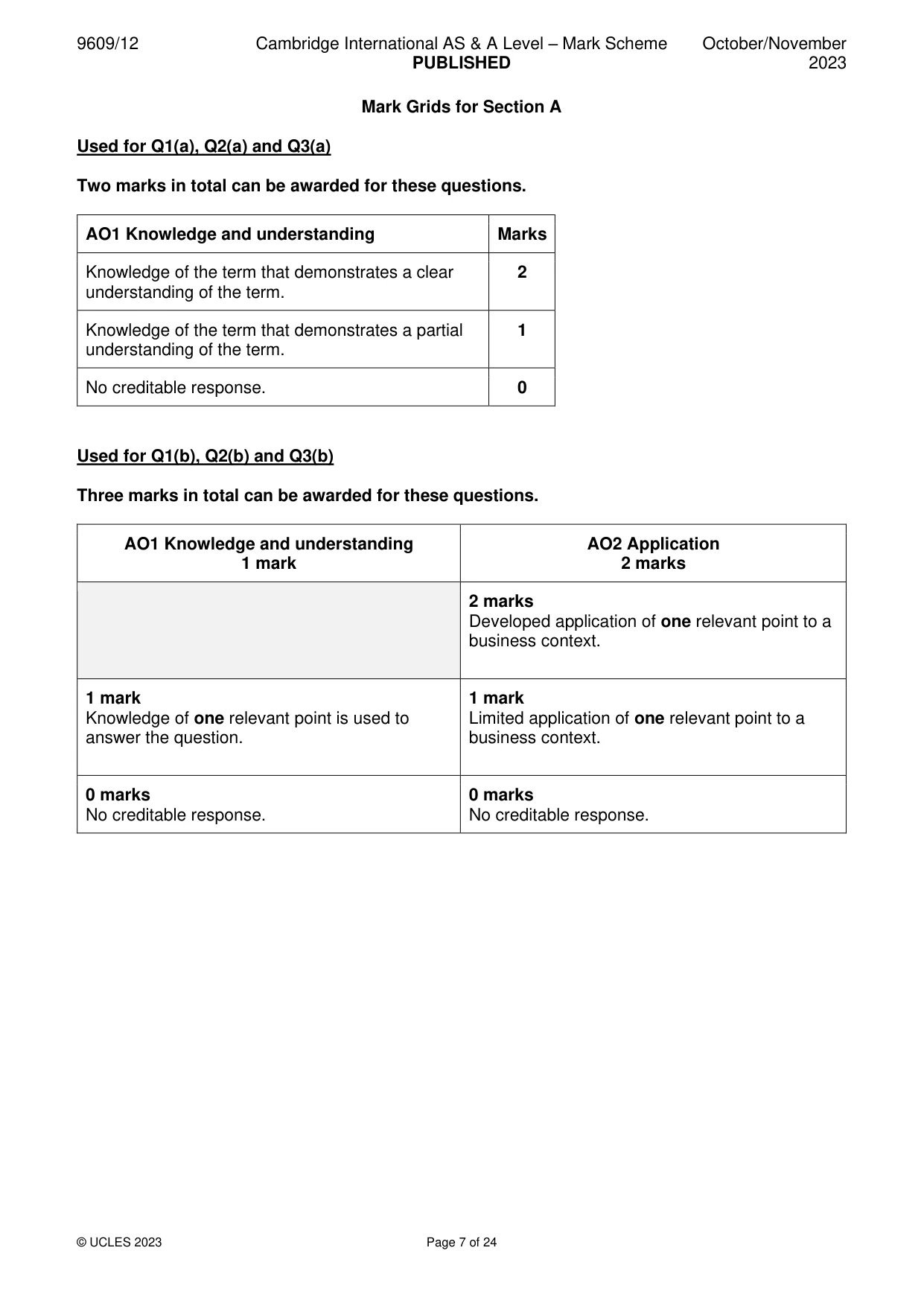
9609/12 Cambridge International AS & A Level – Mark Scheme PUBLISHED October/November 2023 © UCLES 2023 Page 7 of 24 Mark Grids for Section A Used for Q1(a), Q2(a) and Q3(a) Two marks in total can be awarded for these questions. AO1 Knowledge and understanding Marks Knowledge of the term that demonstrates a clear understanding of the term. 2 Knowledge of the term that demonstrates a partial understanding of the term. 1 No creditable response. 0 Used for Q1(b), Q2(b) and Q3(b) Three marks in total can be awarded for these questions. AO1 Knowledge and understanding 1 mark AO2 Application 2 marks 2 marks Developed application of one relevant point to a business context. 1 mark Knowledge of one relevant point is used to answer the question. 1 mark Limited application of one relevant point to a business context. 0 marks No creditable response. 0 marks No creditable response.
Mark scheme, page 8
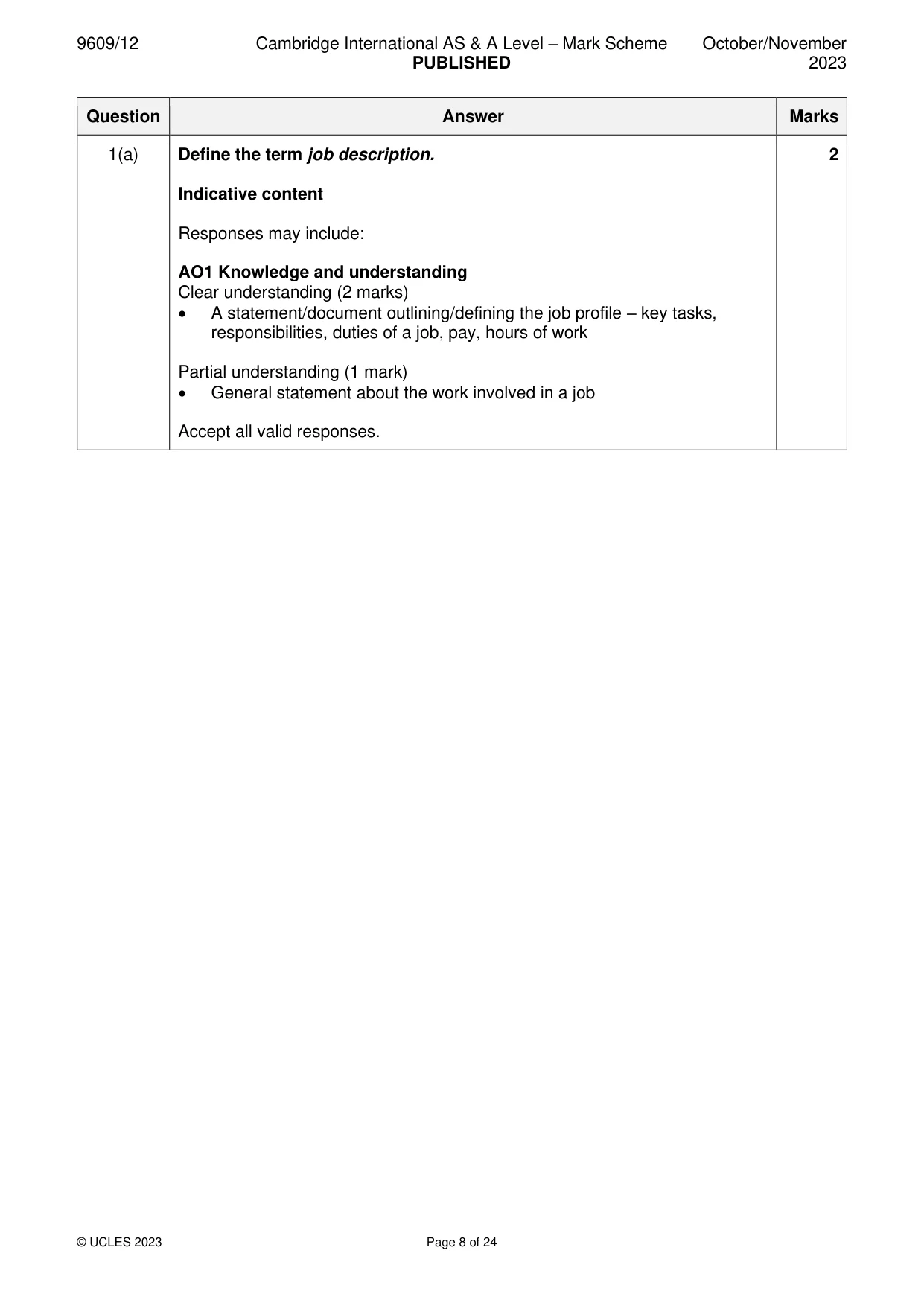
9609/12 Cambridge International AS & A Level – Mark Scheme PUBLISHED October/November 2023 © UCLES 2023 Page 8 of 24 Question Answer Marks 1(a) Define the term job description. Indicative content Responses may include: AO1 Knowledge and understanding Clear understanding (2 marks) • A statement/document outlining/defining the job profile – key tasks, responsibilities, duties of a job, pay, hours of work Partial understanding (1 mark) • General statement about the work involved in a job Accept all valid responses. 2
Mark scheme, page 9
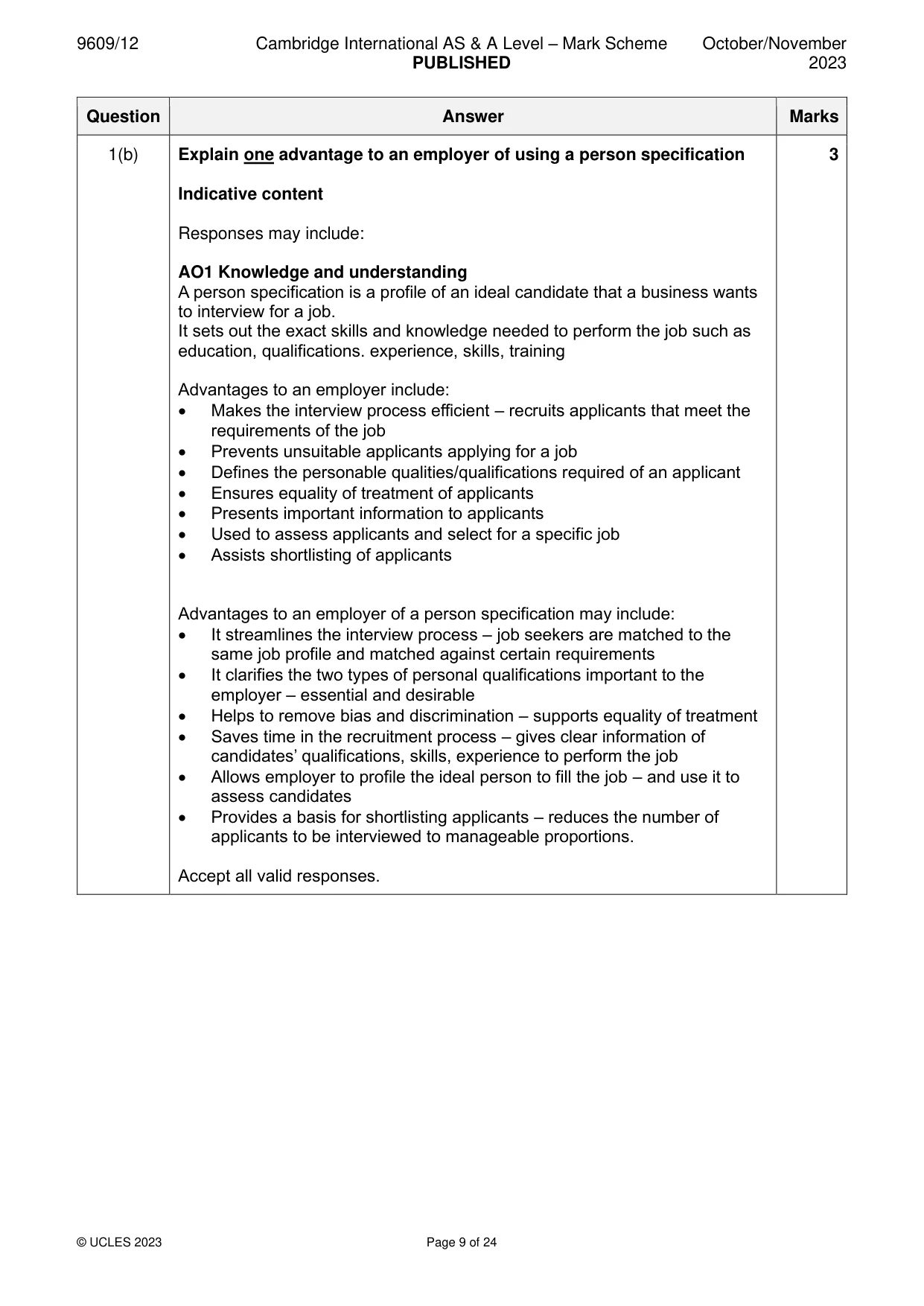
9609/12 Cambridge International AS & A Level – Mark Scheme PUBLISHED October/November 2023 © UCLES 2023 Page 9 of 24 Question Answer Marks 1(b) Explain one advantage to an employer of using a person specification Indicative content Responses may include: AO1 Knowledge and understanding A person specification is a profile of an ideal candidate that a business wants to interview for a job. It sets out the exact skills and knowledge needed to perform the job such as education, qualifications. experience, skills, training Advantages to an employer include: • Makes the interview process efficient – recruits applicants that meet the requirements of the job • Prevents unsuitable applicants applying for a job • Defines the personable qualities/qualifications required of an applicant • Ensures equality of treatment of applicants • Presents important information to applicants • Used to assess applicants and select for a specific job • Assists shortlisting of applicants Advantages to an employer of a person specification may include: • It streamlines the interview process – job seekers are matched to the same job profile and matched against certain requirements • It clarifies the two types of personal qualifications important to the employer – essential and desirable • Helps to remove bias and discrimination – supports equality of treatment • Saves time in the recruitment process – gives clear information of candidates’ qualifications, skills, experience to perform the job • Allows employer to profile the ideal person to fill the job – and use it to assess candidates • Provides a basis for shortlisting applicants – reduces the number of applicants to be interviewed to manageable proportions. Accept all valid responses. 3
Mark scheme, page 10
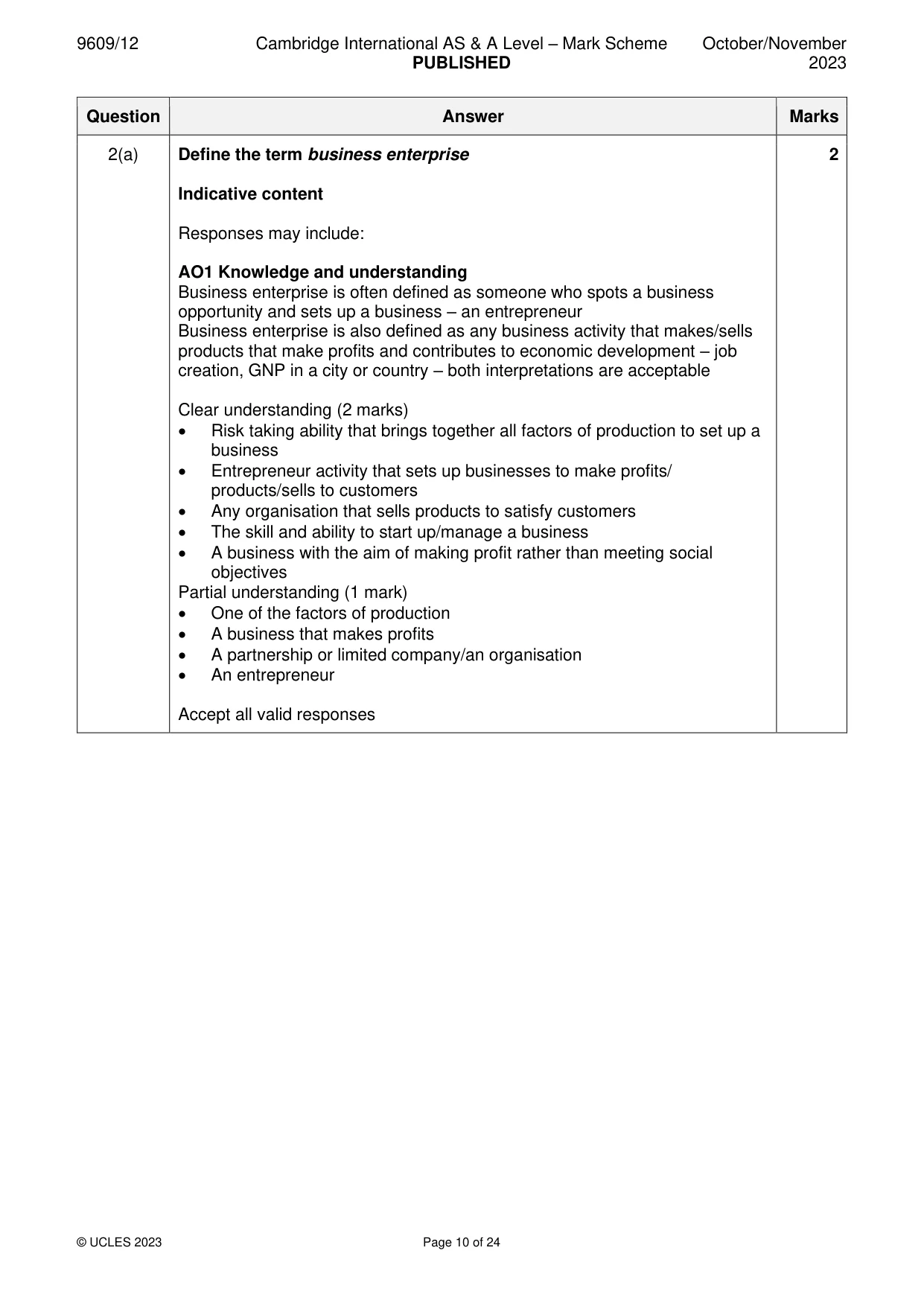
9609/12 Cambridge International AS & A Level – Mark Scheme PUBLISHED October/November 2023 © UCLES 2023 Page 10 of 24 Question Answer Marks 2(a) Define the term business enterprise Indicative content Responses may include: AO1 Knowledge and understanding Business enterprise is often defined as someone who spots a business opportunity and sets up a business – an entrepreneur Business enterprise is also defined as any business activity that makes/sells products that make profits and contributes to economic development – job creation, GNP in a city or country – both interpretations are acceptable Clear understanding (2 marks) • Risk taking ability that brings together all factors of production to set up a business • Entrepreneur activity that sets up businesses to make profits/ products/sells to customers • Any organisation that sells products to satisfy customers • The skill and ability to start up/manage a business • A business with the aim of making profit rather than meeting social objectives Partial understanding (1 mark) • One of the factors of production • A business that makes profits • A partnership or limited company/an organisation • An entrepreneur Accept all valid responses 2
Mark scheme, page 11
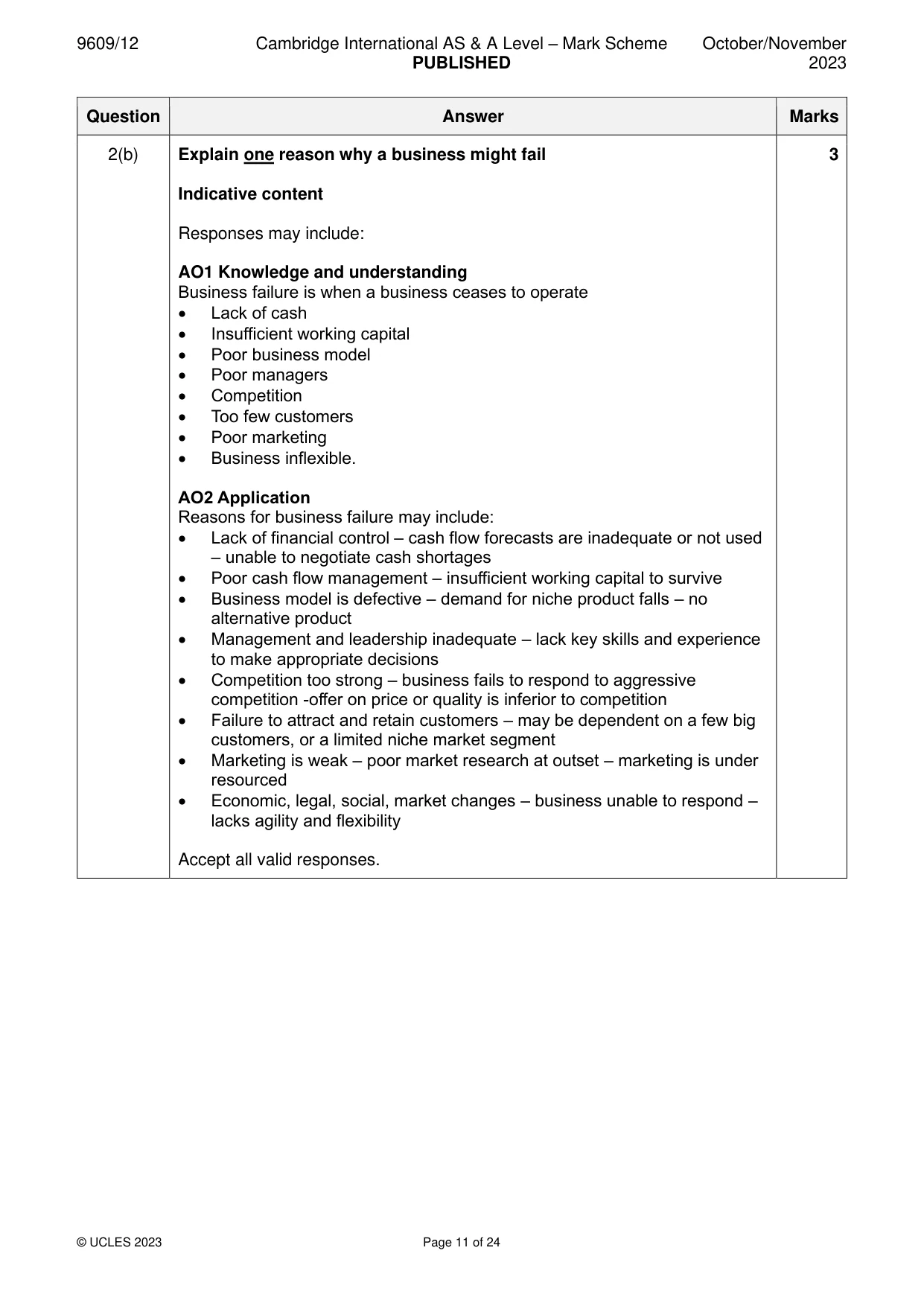
9609/12 Cambridge International AS & A Level – Mark Scheme PUBLISHED October/November 2023 © UCLES 2023 Page 11 of 24 Question Answer Marks 2(b) Explain one reason why a business might fail Indicative content Responses may include: AO1 Knowledge and understanding Business failure is when a business ceases to operate • Lack of cash • Insufficient working capital • Poor business model • Poor managers • Competition • Too few customers • Poor marketing • Business inflexible. AO2 Application Reasons for business failure may include: • Lack of financial control – cash flow forecasts are inadequate or not used – unable to negotiate cash shortages • Poor cash flow management – insufficient working capital to survive • Business model is defective – demand for niche product falls – no alternative product • Management and leadership inadequate – lack key skills and experience to make appropriate decisions • Competition too strong – business fails to respond to aggressive competition -offer on price or quality is inferior to competition • Failure to attract and retain customers – may be dependent on a few big customers, or a limited niche market segment • Marketing is weak – poor market research at outset – marketing is under resourced • Economic, legal, social, market changes – business unable to respond – lacks agility and flexibility Accept all valid responses. 3
Mark scheme, page 12
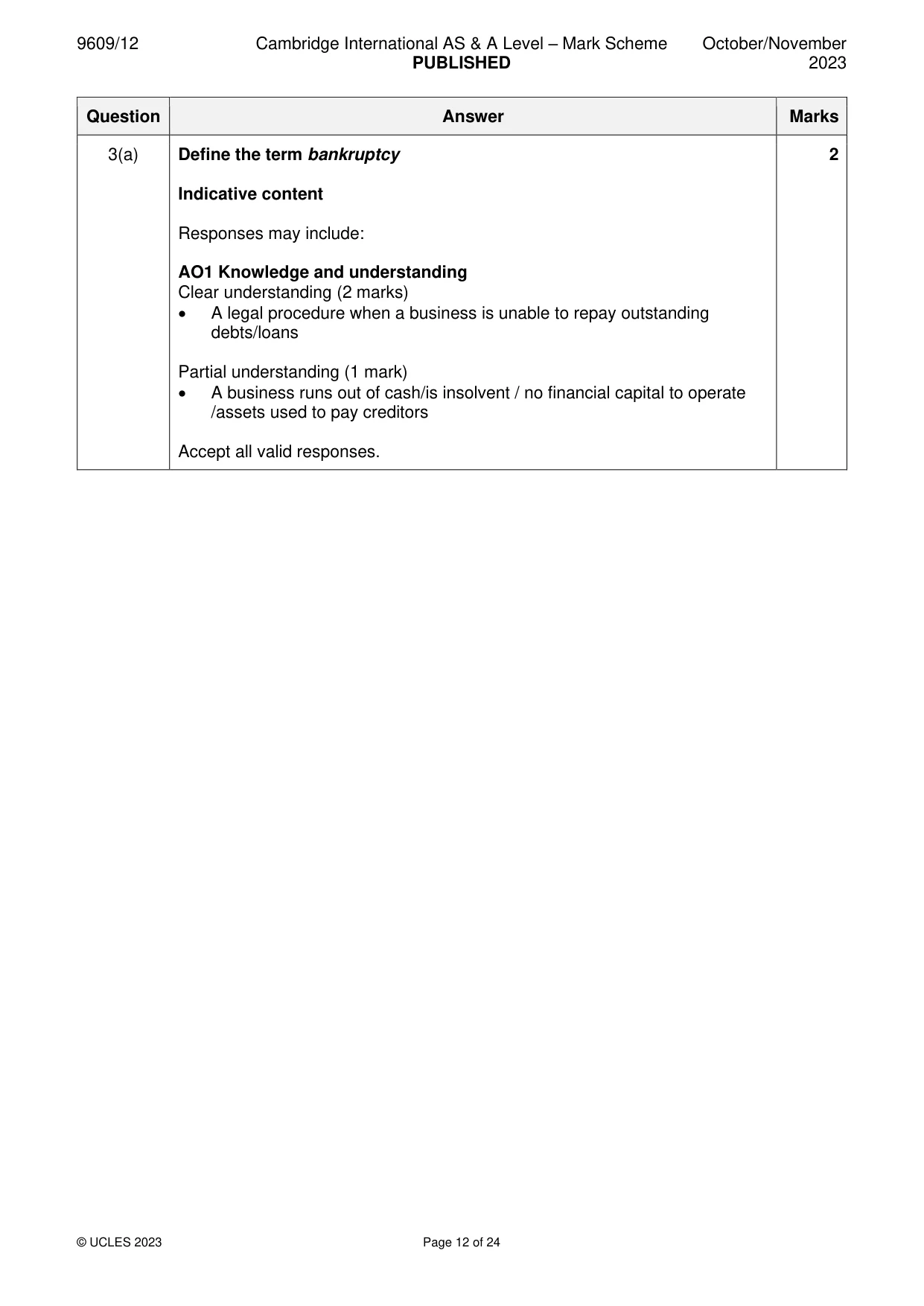
9609/12 Cambridge International AS & A Level – Mark Scheme PUBLISHED October/November 2023 © UCLES 2023 Page 12 of 24 Question Answer Marks 3(a) Define the term bankruptcy Indicative content Responses may include: AO1 Knowledge and understanding Clear understanding (2 marks) • A legal procedure when a business is unable to repay outstanding debts/loans Partial understanding (1 mark) • A business runs out of cash/is insolvent / no financial capital to operate /assets used to pay creditors Accept all valid responses. 2
Mark scheme, page 13
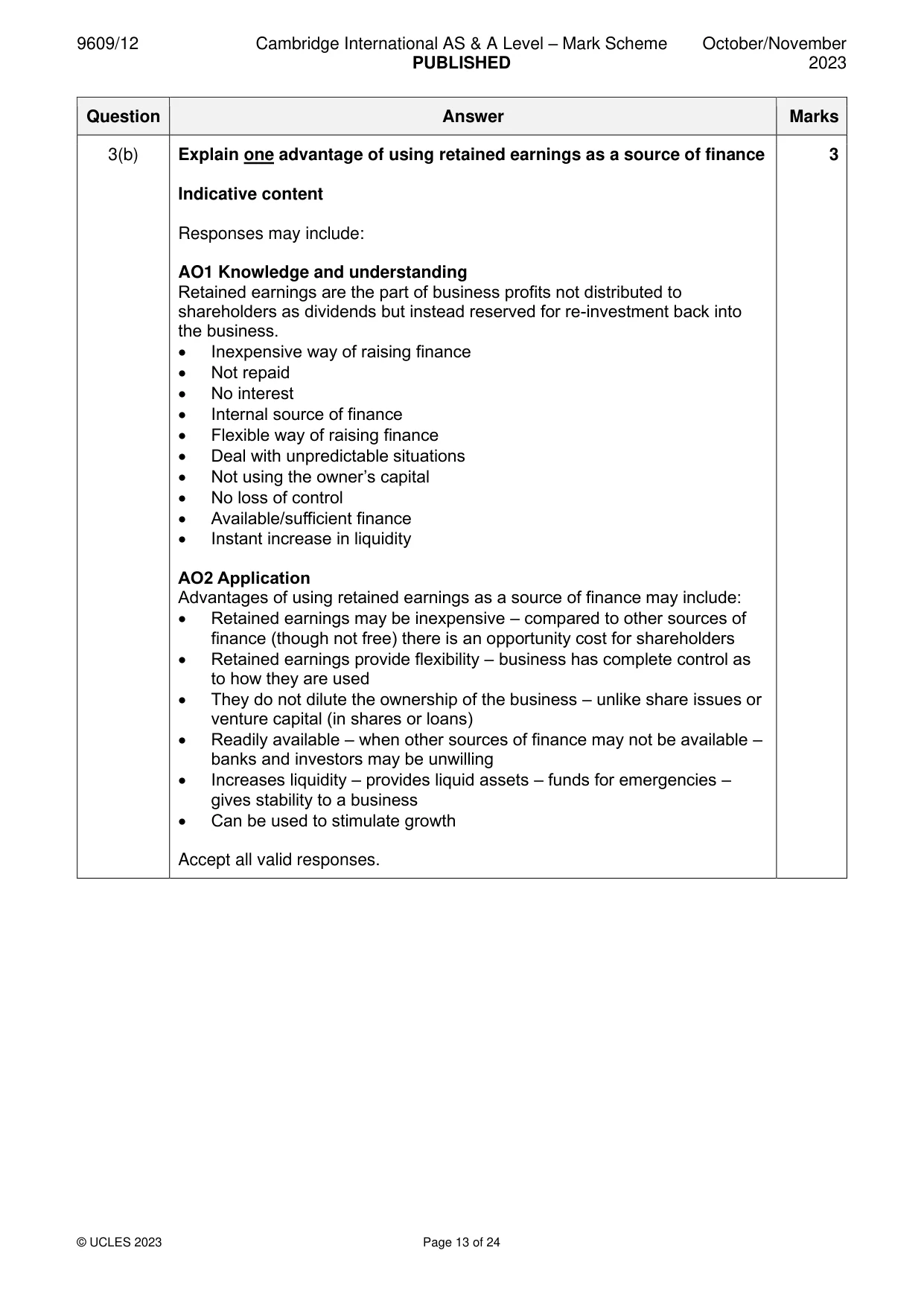
9609/12 Cambridge International AS & A Level – Mark Scheme PUBLISHED October/November 2023 © UCLES 2023 Page 13 of 24 Question Answer Marks 3(b) Explain one advantage of using retained earnings as a source of finance Indicative content Responses may include: AO1 Knowledge and understanding Retained earnings are the part of business profits not distributed to shareholders as dividends but instead reserved for re-investment back into the business. • Inexpensive way of raising finance • Not repaid • No interest • Internal source of finance • Flexible way of raising finance • Deal with unpredictable situations • Not using the owner’s capital • No loss of control • Available/sufficient finance • Instant increase in liquidity AO2 Application Advantages of using retained earnings as a source of finance may include: • Retained earnings may be inexpensive – compared to other sources of finance (though not free) there is an opportunity cost for shareholders • Retained earnings provide flexibility – business has complete control as to how they are used • They do not dilute the ownership of the business – unlike share issues or venture capital (in shares or loans) • Readily available – when other sources of finance may not be available – banks and investors may be unwilling • Increases liquidity – provides liquid assets – funds for emergencies – gives stability to a business • Can be used to stimulate growth Accept all valid responses. 3
Mark scheme, page 14
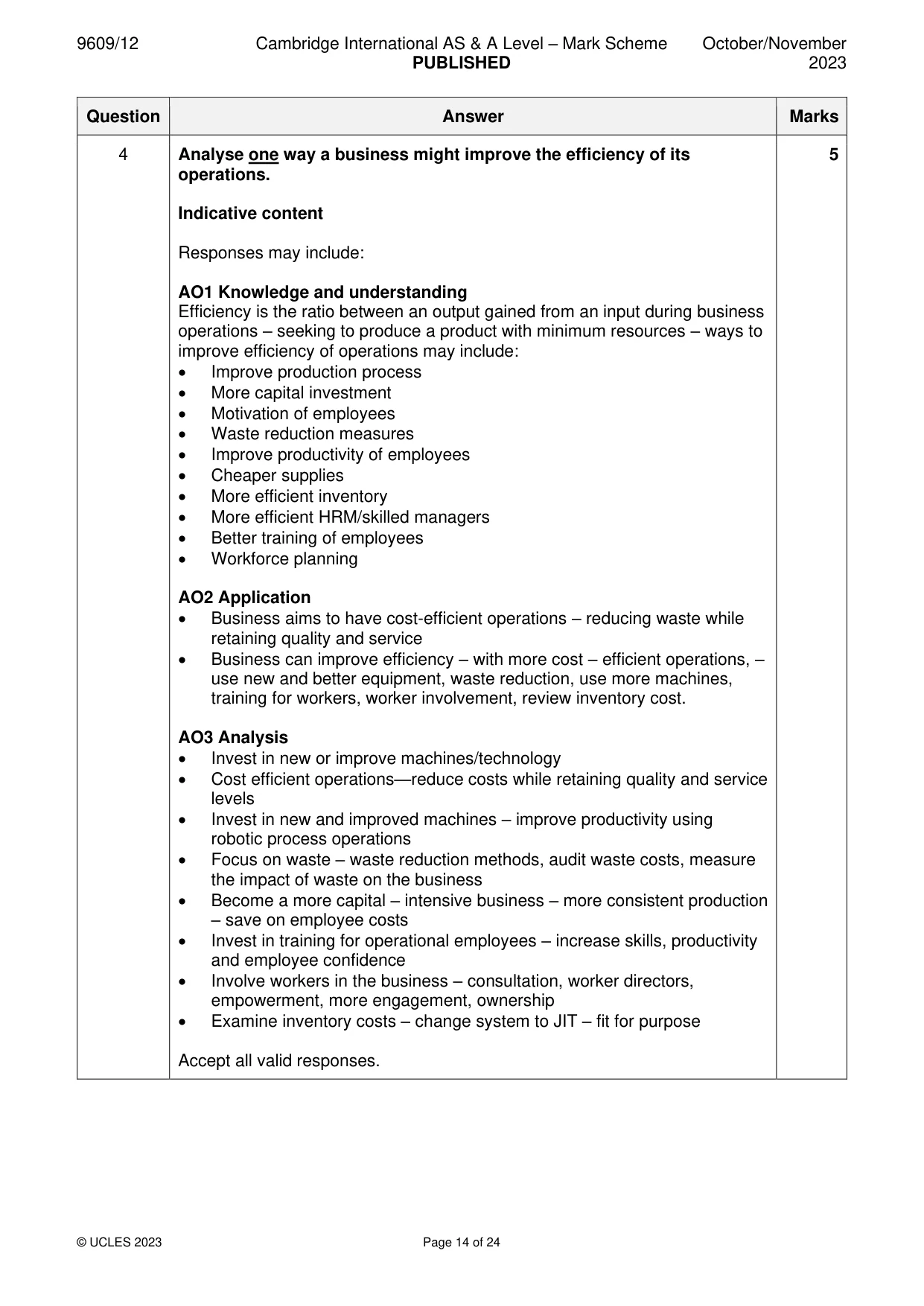
9609/12 Cambridge International AS & A Level – Mark Scheme PUBLISHED October/November 2023 © UCLES 2023 Page 14 of 24 Question Answer Marks 4 Analyse one way a business might improve the efficiency of its operations. Indicative content Responses may include: AO1 Knowledge and understanding Efficiency is the ratio between an output gained from an input during business operations – seeking to produce a product with minimum resources – ways to improve efficiency of operations may include: • Improve production process • More capital investment • Motivation of employees • Waste reduction measures • Improve productivity of employees • Cheaper supplies • More efficient inventory • More efficient HRM/skilled managers • Better training of employees • Workforce planning AO2 Application • Business aims to have cost-efficient operations – reducing waste while retaining quality and service • Business can improve efficiency – with more cost – efficient operations, – use new and better equipment, waste reduction, use more machines, training for workers, worker involvement, review inventory cost. AO3 Analysis • Invest in new or improve machines/technology • Cost efficient operations—reduce costs while retaining quality and service levels • Invest in new and improved machines – improve productivity using robotic process operations • Focus on waste – waste reduction methods, audit waste costs, measure the impact of waste on the business • Become a more capital – intensive business – more consistent production – save on employee costs • Invest in training for operational employees – increase skills, productivity and employee confidence • Involve workers in the business – consultation, worker directors, empowerment, more engagement, ownership • Examine inventory costs – change system to JIT – fit for purpose Accept all valid responses. 5
Mark scheme, page 15
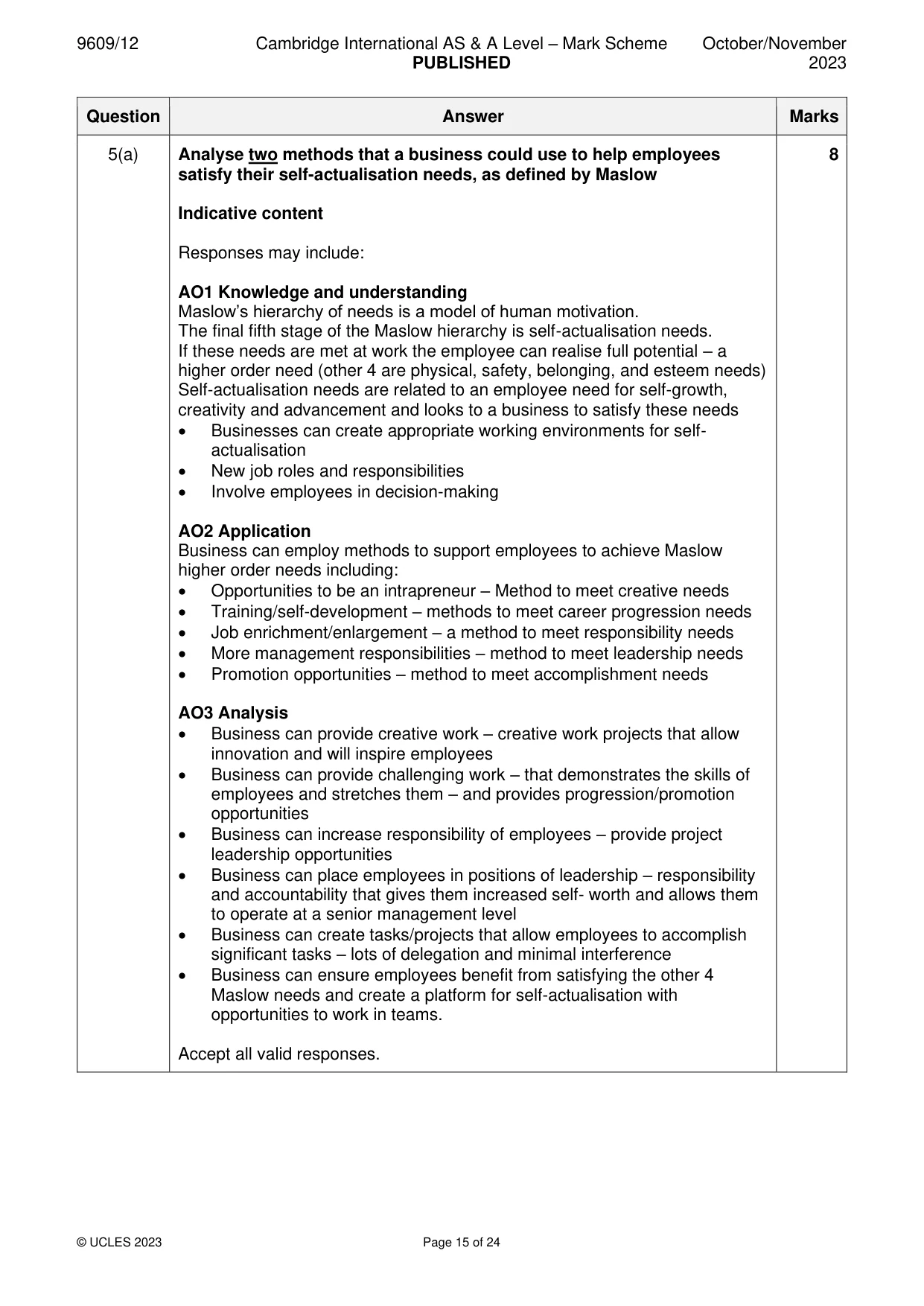
9609/12 Cambridge International AS & A Level – Mark Scheme PUBLISHED October/November 2023 © UCLES 2023 Page 15 of 24 Question Answer Marks 5(a) Analyse two methods that a business could use to help employees satisfy their self-actualisation needs, as defined by Maslow Indicative content Responses may include: AO1 Knowledge and understanding Maslow’s hierarchy of needs is a model of human motivation. The final fifth stage of the Maslow hierarchy is self-actualisation needs. If these needs are met at work the employee can realise full potential – a higher order need (other 4 are physical, safety, belonging, and esteem needs) Self-actualisation needs are related to an employee need for self-growth, creativity and advancement and looks to a business to satisfy these needs • Businesses can create appropriate working environments for self- actualisation • New job roles and responsibilities • Involve employees in decision-making AO2 Application Business can employ methods to support employees to achieve Maslow higher order needs including: • Opportunities to be an intrapreneur – Method to meet creative needs • Training/self-development – methods to meet career progression needs • Job enrichment/enlargement – a method to meet responsibility needs • More management responsibilities – method to meet leadership needs • Promotion opportunities – method to meet accomplishment needs AO3 Analysis • Business can provide creative work – creative work projects that allow innovation and will inspire employees • Business can provide challenging work – that demonstrates the skills of employees and stretches them – and provides progression/promotion opportunities • Business can increase responsibility of employees – provide project leadership opportunities • Business can place employees in positions of leadership – responsibility and accountability that gives them increased self- worth and allows them to operate at a senior management level • Business can create tasks/projects that allow employees to accomplish significant tasks – lots of delegation and minimal interference • Business can ensure employees benefit from satisfying the other 4 Maslow needs and create a platform for self-actualisation with opportunities to work in teams. Accept all valid responses. 8
Mark scheme, page 16
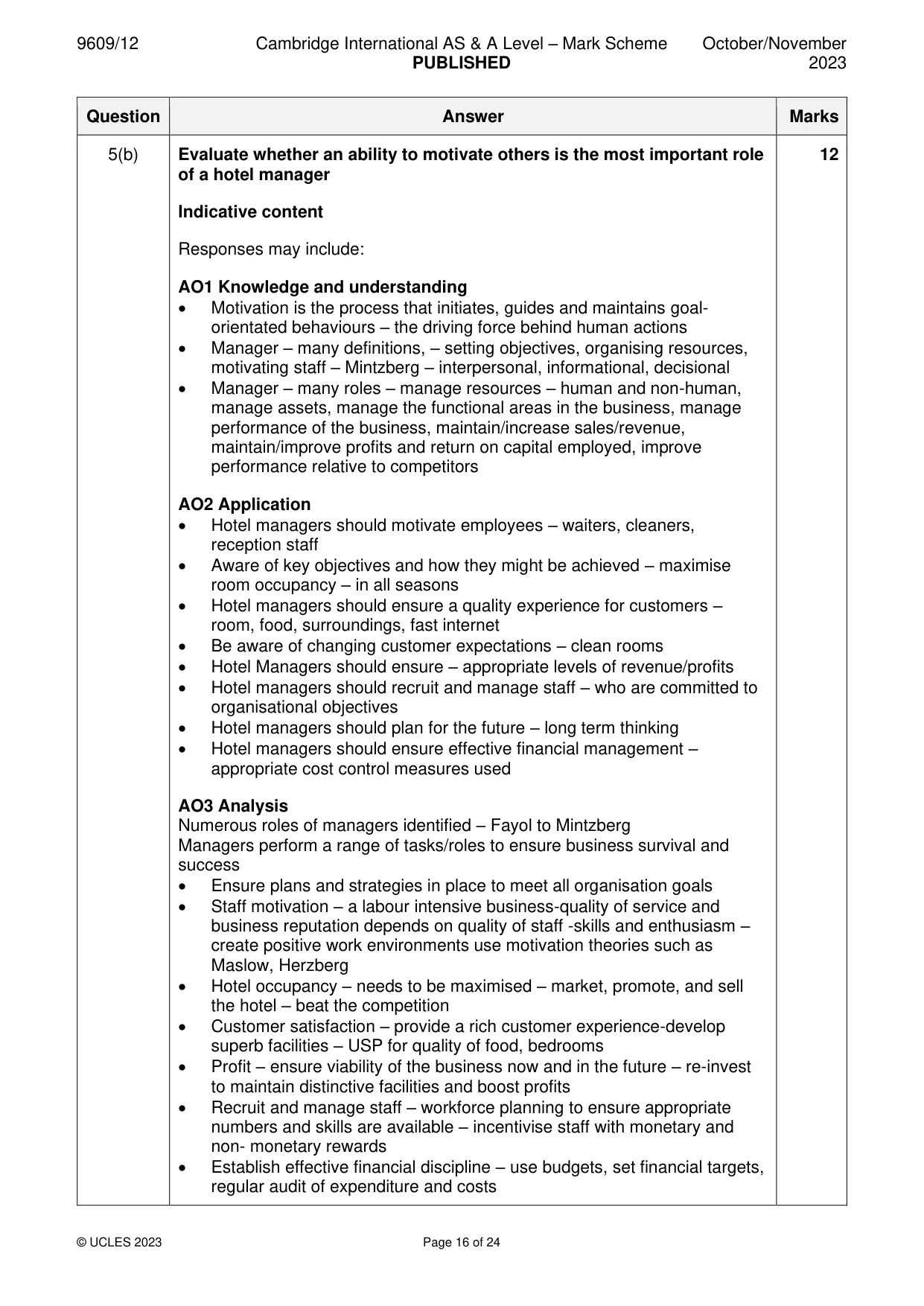
9609/12 Cambridge International AS & A Level – Mark Scheme PUBLISHED October/November 2023 © UCLES 2023 Page 16 of 24 Question Answer Marks 5(b) Evaluate whether an ability to motivate others is the most important role of a hotel manager Indicative content Responses may include: AO1 Knowledge and understanding • Motivation is the process that initiates, guides and maintains goal- orientated behaviours – the driving force behind human actions • Manager – many definitions, – setting objectives, organising resources, motivating staff – Mintzberg – interpersonal, informational, decisional • Manager – many roles – manage resources – human and non-human, manage assets, manage the functional areas in the business, manage performance of the business, maintain/increase sales/revenue, maintain/improve profits and return on capital employed, improve performance relative to competitors AO2 Application • Hotel managers should motivate employees – waiters, cleaners, reception staff • Aware of key objectives and how they might be achieved – maximise room occupancy – in all seasons • Hotel managers should ensure a quality experience for customers – room, food, surroundings, fast internet • Be aware of changing customer expectations – clean rooms • Hotel Managers should ensure – appropriate levels of revenue/profits • Hotel managers should recruit and manage staff – who are committed to organisational objectives • Hotel managers should plan for the future – long term thinking • Hotel managers should ensure effective financial management – appropriate cost control measures used AO3 Analysis Numerous roles of managers identified – Fayol to Mintzberg Managers perform a range of tasks/roles to ensure business survival and success • Ensure plans and strategies in place to meet all organisation goals • Staff motivation – a labour intensive business-quality of service and business reputation depends on quality of staff -skills and enthusiasm – create positive work environments use motivation theories such as Maslow, Herzberg • Hotel occupancy – needs to be maximised – market, promote, and sell the hotel – beat the competition • Customer satisfaction – provide a rich customer experience-develop superb facilities – USP for quality of food, bedrooms • Profit – ensure viability of the business now and in the future – re-invest to maintain distinctive facilities and boost profits • Recruit and manage staff – workforce planning to ensure appropriate numbers and skills are available – incentivise staff with monetary and non- monetary rewards • Establish effective financial discipline – use budgets, set financial targets, regular audit of expenditure and costs 12
Mark scheme, page 17
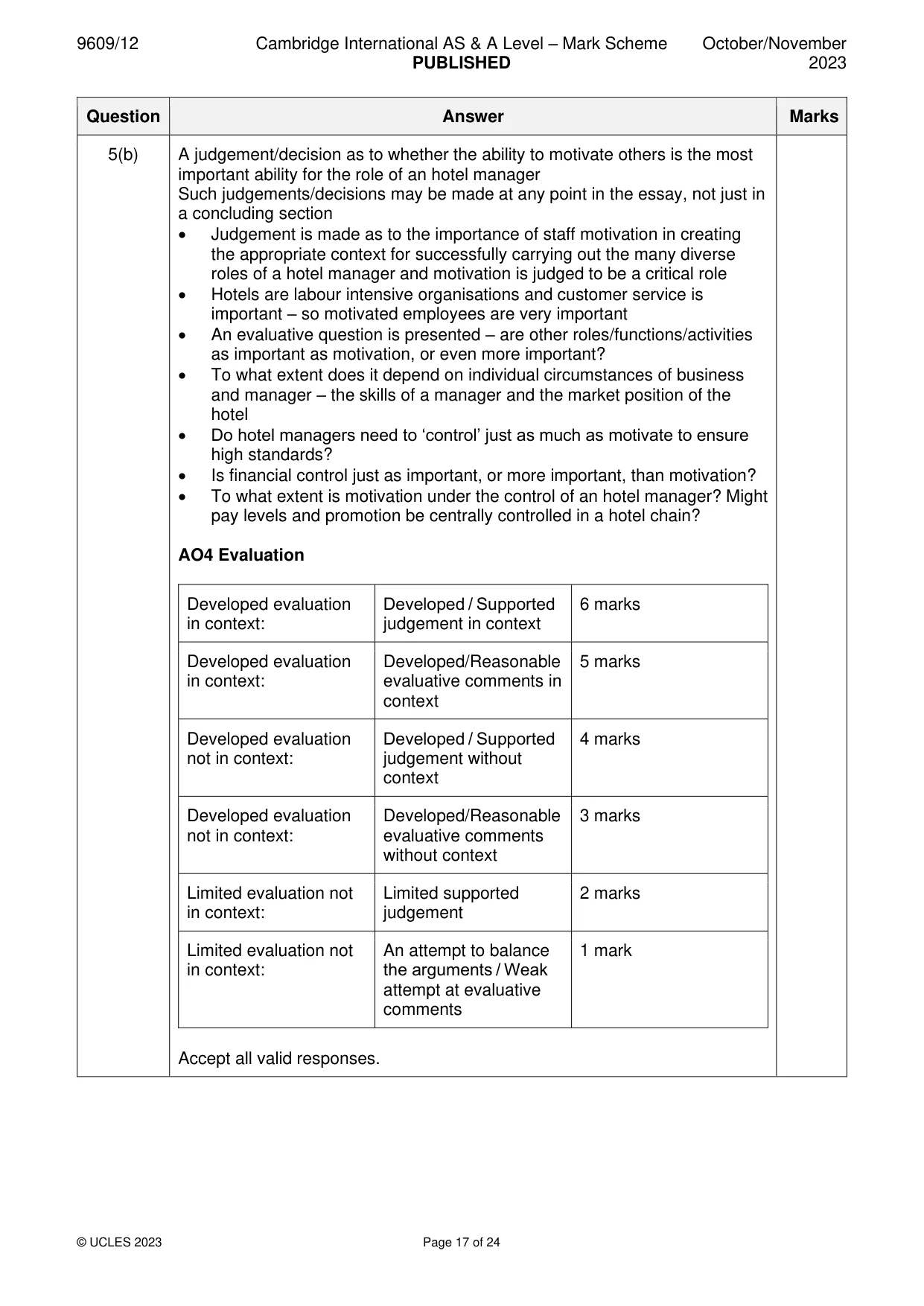
9609/12 Cambridge International AS & A Level – Mark Scheme PUBLISHED October/November 2023 © UCLES 2023 Page 17 of 24 Question Answer Marks 5(b) A judgement/decision as to whether the ability to motivate others is the most important ability for the role of an hotel manager Such judgements/decisions may be made at any point in the essay, not just in a concluding section • Judgement is made as to the importance of staff motivation in creating the appropriate context for successfully carrying out the many diverse roles of a hotel manager and motivation is judged to be a critical role • Hotels are labour intensive organisations and customer service is important – so motivated employees are very important • An evaluative question is presented – are other roles/functions/activities as important as motivation, or even more important? • To what extent does it depend on individual circumstances of business and manager – the skills of a manager and the market position of the hotel • Do hotel managers need to ‘control’ just as much as motivate to ensure high standards? • Is financial control just as important, or more important, than motivation? • To what extent is motivation under the control of an hotel manager? Might pay levels and promotion be centrally controlled in a hotel chain? AO4 Evaluation Developed evaluation in context: Developed / Supported judgement in context 6 marks Developed evaluation in context: Developed/Reasonable evaluative comments in context 5 marks Developed evaluation not in context: Developed / Supported judgement without context 4 marks Developed evaluation not in context: Developed/Reasonable evaluative comments without context 3 marks Limited evaluation not in context: Limited supported judgement 2 marks Limited evaluation not in context: An attempt to balance the arguments / Weak attempt at evaluative comments 1 mark Accept all valid responses.
Mark scheme, page 18
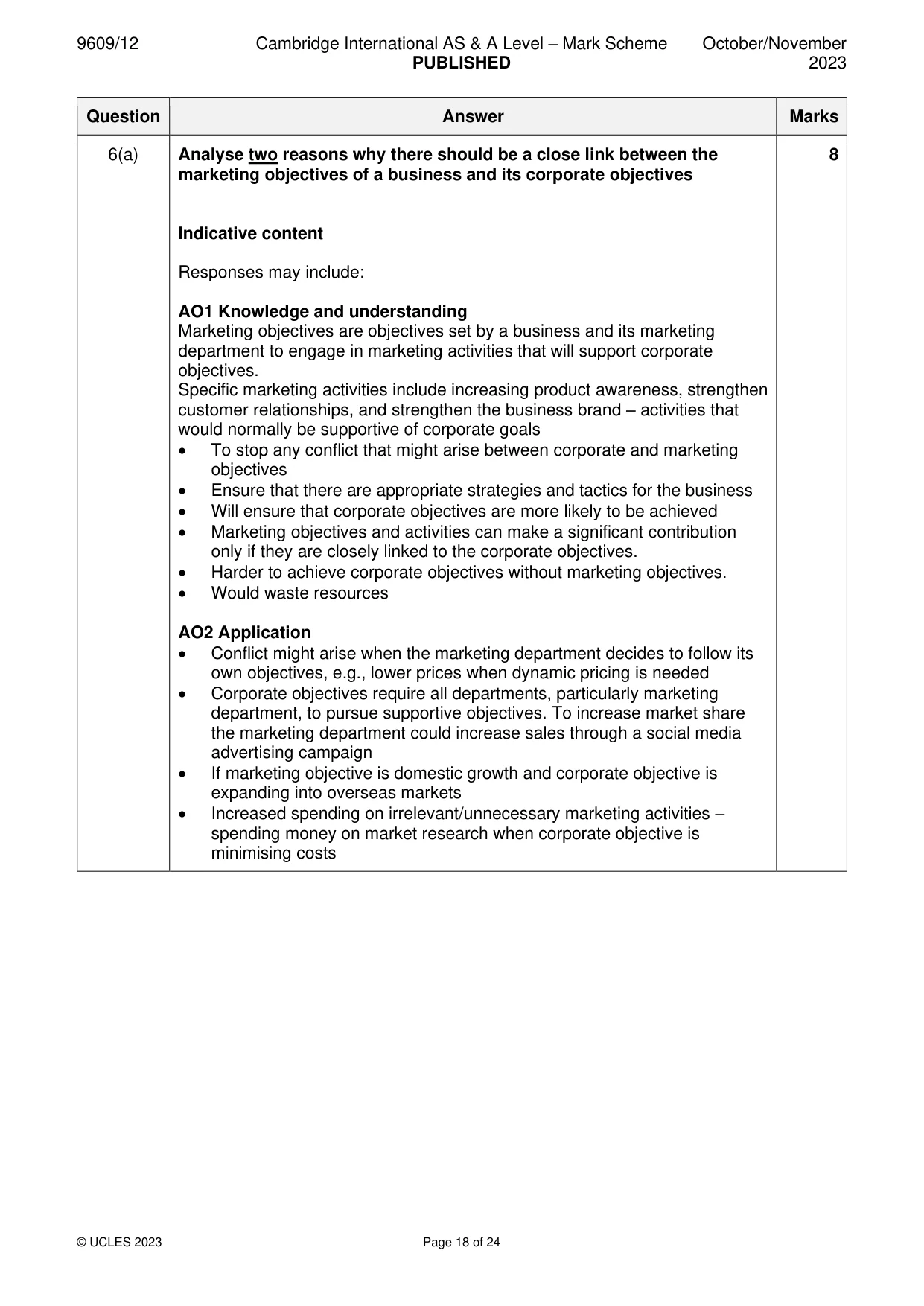
9609/12 Cambridge International AS & A Level – Mark Scheme PUBLISHED October/November 2023 © UCLES 2023 Page 18 of 24 Question Answer Marks 6(a) Analyse two reasons why there should be a close link between the marketing objectives of a business and its corporate objectives Indicative content Responses may include: AO1 Knowledge and understanding Marketing objectives are objectives set by a business and its marketing department to engage in marketing activities that will support corporate objectives. Specific marketing activities include increasing product awareness, strengthen customer relationships, and strengthen the business brand – activities that would normally be supportive of corporate goals • To stop any conflict that might arise between corporate and marketing objectives • Ensure that there are appropriate strategies and tactics for the business • Will ensure that corporate objectives are more likely to be achieved • Marketing objectives and activities can make a significant contribution only if they are closely linked to the corporate objectives. • Harder to achieve corporate objectives without marketing objectives. • Would waste resources AO2 Application • Conflict might arise when the marketing department decides to follow its own objectives, e.g., lower prices when dynamic pricing is needed • Corporate objectives require all departments, particularly marketing department, to pursue supportive objectives. To increase market share the marketing department could increase sales through a social media advertising campaign • If marketing objective is domestic growth and corporate objective is expanding into overseas markets • Increased spending on irrelevant/unnecessary marketing activities – spending money on market research when corporate objective is minimising costs 8
Mark scheme, page 19
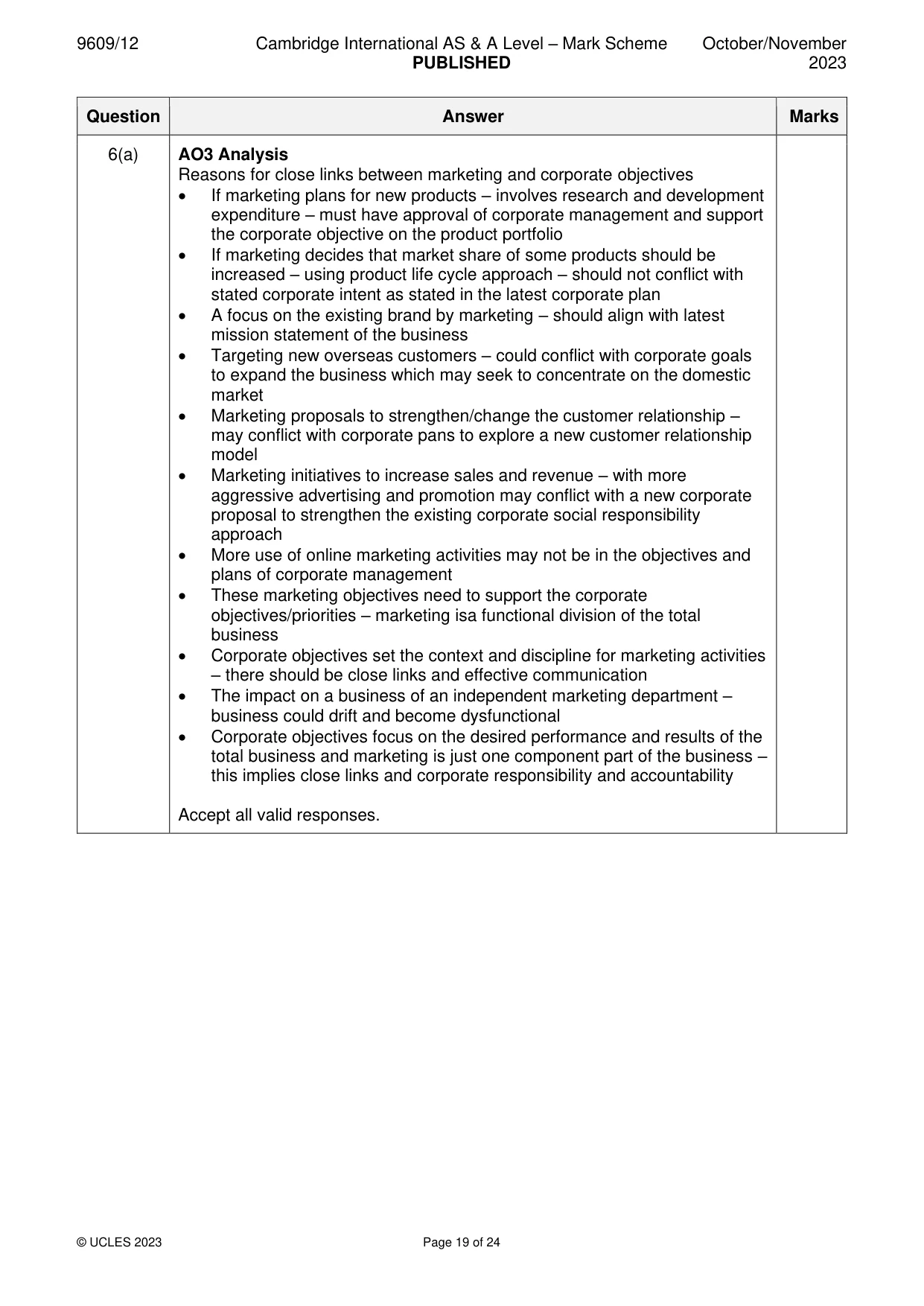
9609/12 Cambridge International AS & A Level – Mark Scheme PUBLISHED October/November 2023 © UCLES 2023 Page 19 of 24 Question Answer Marks 6(a) AO3 Analysis Reasons for close links between marketing and corporate objectives • If marketing plans for new products – involves research and development expenditure – must have approval of corporate management and support the corporate objective on the product portfolio • If marketing decides that market share of some products should be increased – using product life cycle approach – should not conflict with stated corporate intent as stated in the latest corporate plan • A focus on the existing brand by marketing – should align with latest mission statement of the business • Targeting new overseas customers – could conflict with corporate goals to expand the business which may seek to concentrate on the domestic market • Marketing proposals to strengthen/change the customer relationship – may conflict with corporate pans to explore a new customer relationship model • Marketing initiatives to increase sales and revenue – with more aggressive advertising and promotion may conflict with a new corporate proposal to strengthen the existing corporate social responsibility approach • More use of online marketing activities may not be in the objectives and plans of corporate management • These marketing objectives need to support the corporate objectives/priorities – marketing isa functional division of the total business • Corporate objectives set the context and discipline for marketing activities – there should be close links and effective communication • The impact on a business of an independent marketing department – business could drift and become dysfunctional • Corporate objectives focus on the desired performance and results of the total business and marketing is just one component part of the business – this implies close links and corporate responsibility and accountability Accept all valid responses.
Mark scheme, page 20
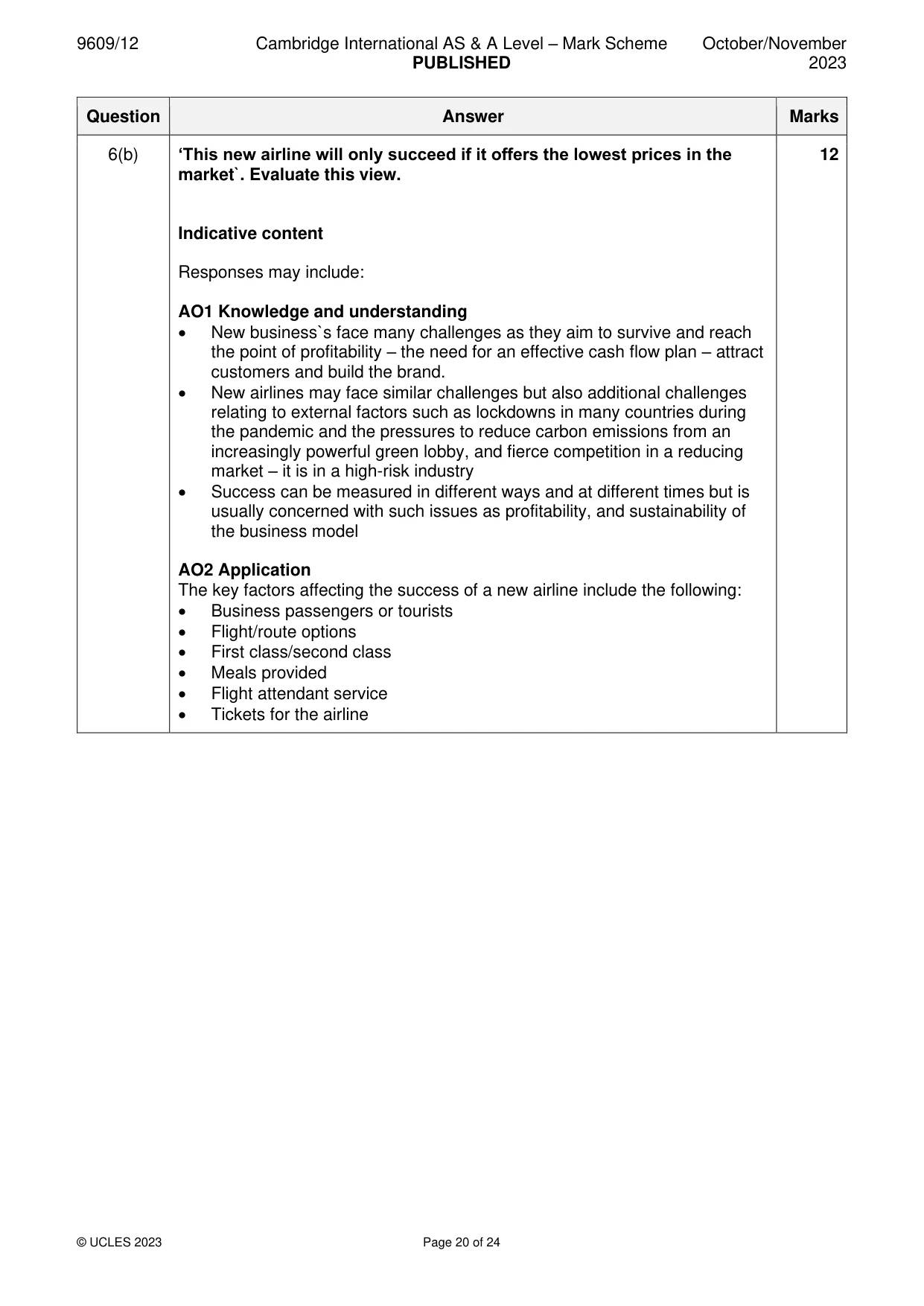
9609/12 Cambridge International AS & A Level – Mark Scheme PUBLISHED October/November 2023 © UCLES 2023 Page 20 of 24 Question Answer Marks 6(b) ‘This new airline will only succeed if it offers the lowest prices in the market`. Evaluate this view. Indicative content Responses may include: AO1 Knowledge and understanding • New business`s face many challenges as they aim to survive and reach the point of profitability – the need for an effective cash flow plan – attract customers and build the brand. • New airlines may face similar challenges but also additional challenges relating to external factors such as lockdowns in many countries during the pandemic and the pressures to reduce carbon emissions from an increasingly powerful green lobby, and fierce competition in a reducing market – it is in a high-risk industry • Success can be measured in different ways and at different times but is usually concerned with such issues as profitability, and sustainability of the business model AO2 Application The key factors affecting the success of a new airline include the following: • Business passengers or tourists • Flight/route options • First class/second class • Meals provided • Flight attendant service • Tickets for the airline 12
Mark scheme, page 21
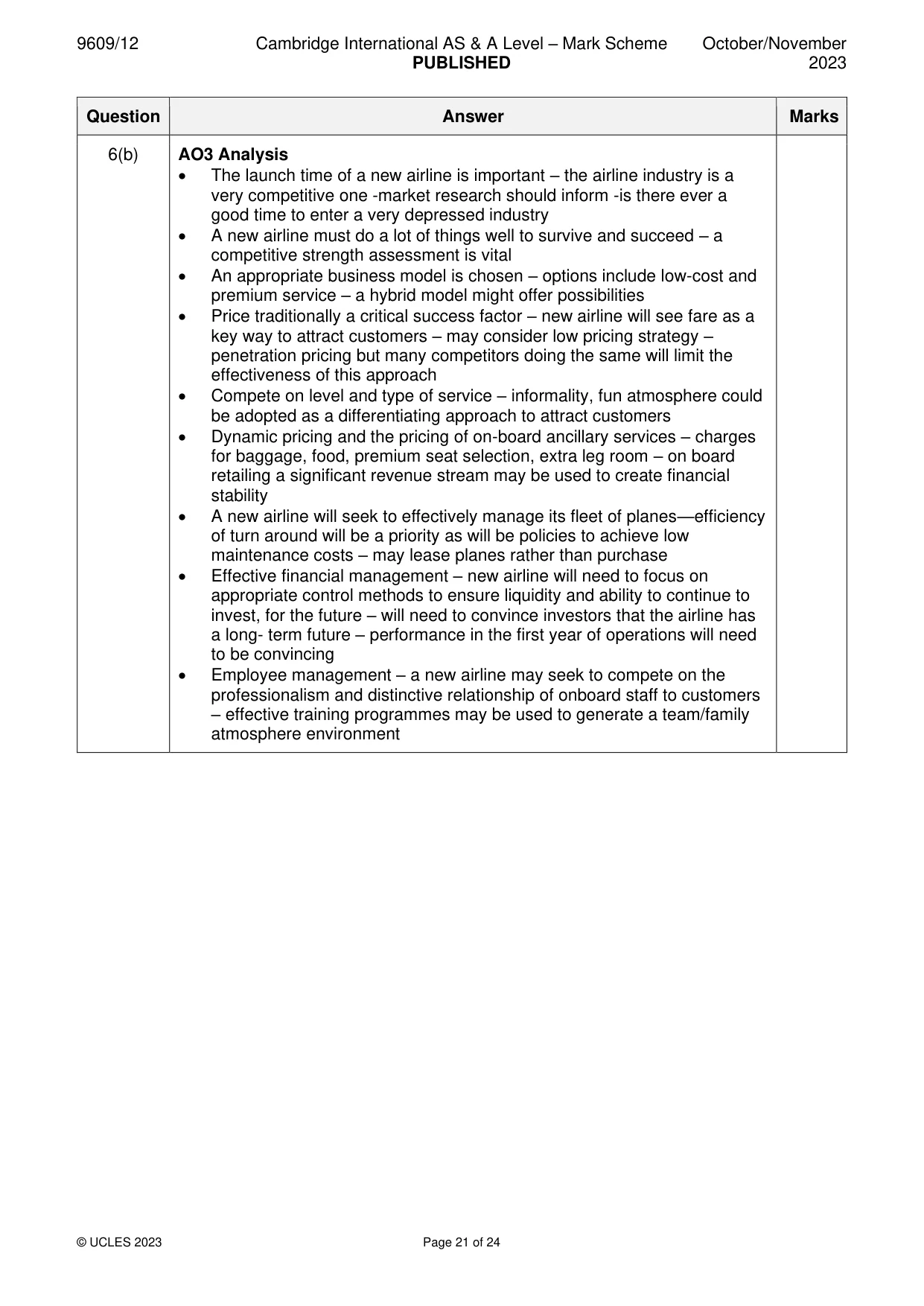
9609/12 Cambridge International AS & A Level – Mark Scheme PUBLISHED October/November 2023 © UCLES 2023 Page 21 of 24 Question Answer Marks 6(b) AO3 Analysis • The launch time of a new airline is important – the airline industry is a very competitive one -market research should inform -is there ever a good time to enter a very depressed industry • A new airline must do a lot of things well to survive and succeed – a competitive strength assessment is vital • An appropriate business model is chosen – options include low-cost and premium service – a hybrid model might offer possibilities • Price traditionally a critical success factor – new airline will see fare as a key way to attract customers – may consider low pricing strategy – penetration pricing but many competitors doing the same will limit the effectiveness of this approach • Compete on level and type of service – informality, fun atmosphere could be adopted as a differentiating approach to attract customers • Dynamic pricing and the pricing of on-board ancillary services – charges for baggage, food, premium seat selection, extra leg room – on board retailing a significant revenue stream may be used to create financial stability • A new airline will seek to effectively manage its fleet of planes—efficiency of turn around will be a priority as will be policies to achieve low maintenance costs – may lease planes rather than purchase • Effective financial management – new airline will need to focus on appropriate control methods to ensure liquidity and ability to continue to invest, for the future – will need to convince investors that the airline has a long- term future – performance in the first year of operations will need to be convincing • Employee management – a new airline may seek to compete on the professionalism and distinctive relationship of onboard staff to customers – effective training programmes may be used to generate a team/family atmosphere environment
Mark scheme, page 22
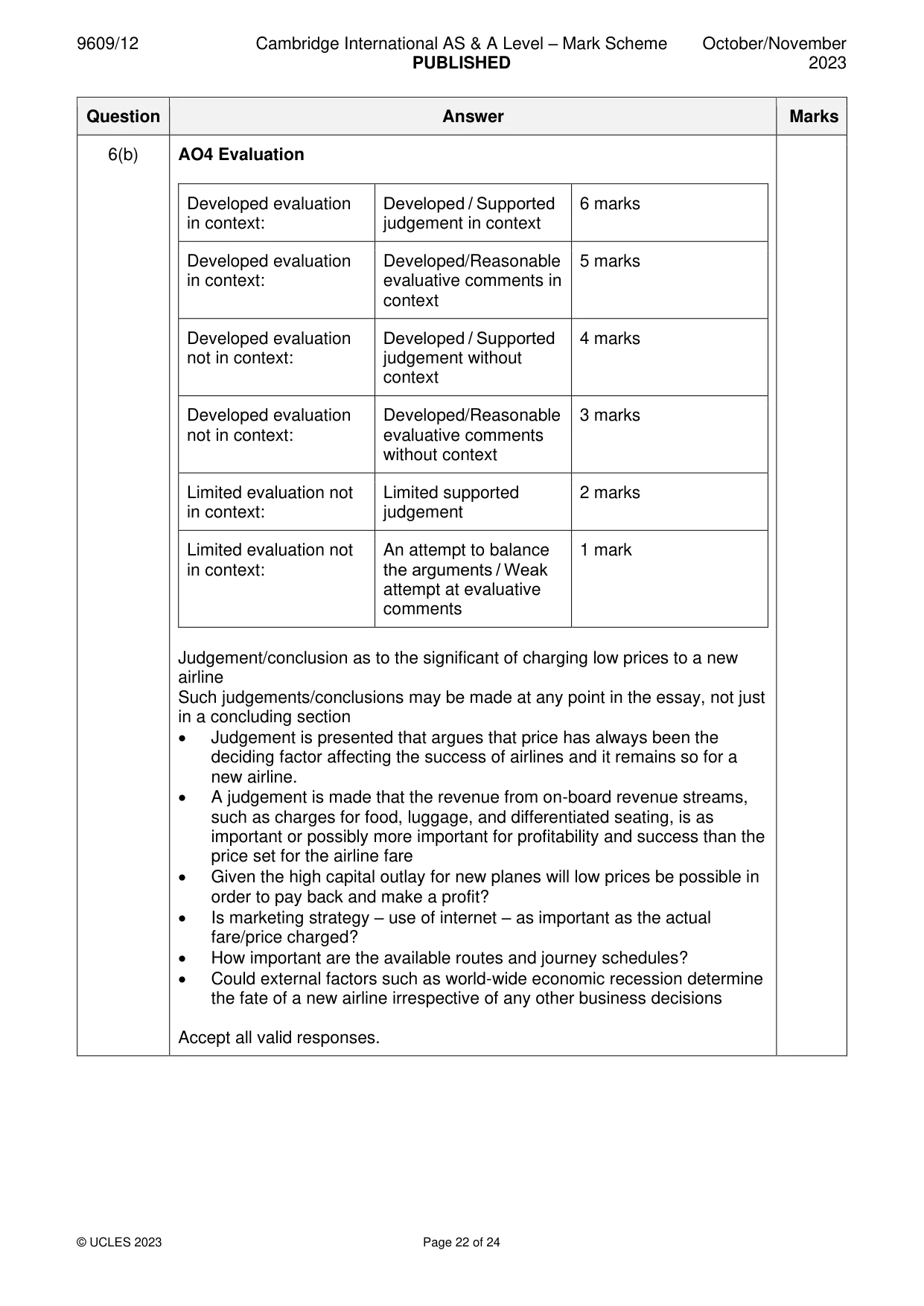
9609/12 Cambridge International AS & A Level – Mark Scheme PUBLISHED October/November 2023 © UCLES 2023 Page 22 of 24 Question Answer Marks 6(b) AO4 Evaluation Developed evaluation in context: Developed / Supported judgement in context 6 marks Developed evaluation in context: Developed/Reasonable evaluative comments in context 5 marks Developed evaluation not in context: Developed / Supported judgement without context 4 marks Developed evaluation not in context: Developed/Reasonable evaluative comments without context 3 marks Limited evaluation not in context: Limited supported judgement 2 marks Limited evaluation not in context: An attempt to balance the arguments / Weak attempt at evaluative comments 1 mark Judgement/conclusion as to the significant of charging low prices to a new airline Such judgements/conclusions may be made at any point in the essay, not just in a concluding section • Judgement is presented that argues that price has always been the deciding factor affecting the success of airlines and it remains so for a new airline. • A judgement is made that the revenue from on-board revenue streams, such as charges for food, luggage, and differentiated seating, is as important or possibly more important for profitability and success than the price set for the airline fare • Given the high capital outlay for new planes will low prices be possible in order to pay back and make a profit? • Is marketing strategy – use of internet – as important as the actual fare/price charged? • How important are the available routes and journey schedules? • Could external factors such as world-wide economic recession determine the fate of a new airline irrespective of any other business decisions Accept all valid responses.
Mark scheme, page 23
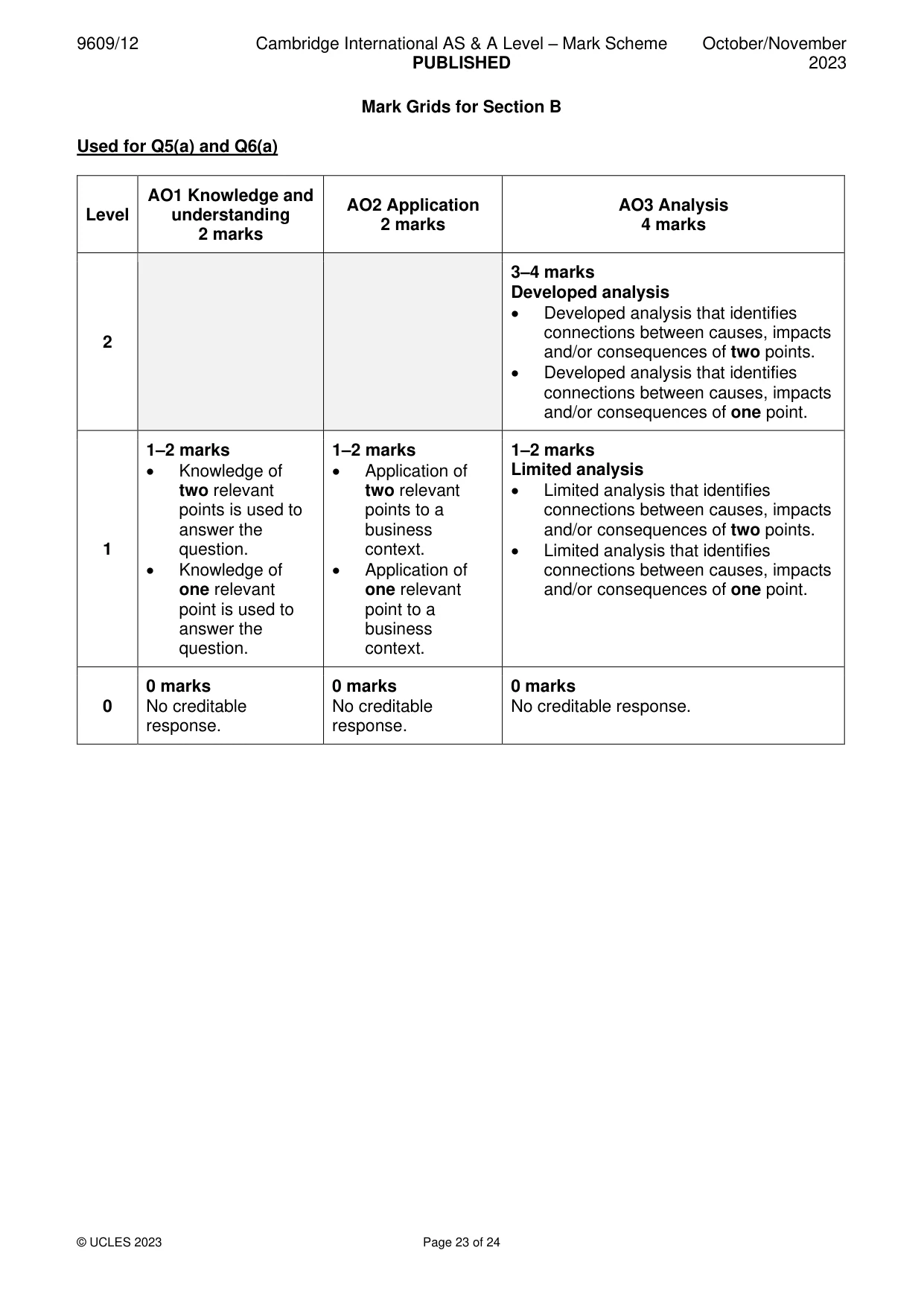
9609/12 Cambridge International AS & A Level – Mark Scheme PUBLISHED October/November 2023 © UCLES 2023 Page 23 of 24 Mark Grids for Section B Used for Q5(a) and Q6(a) Level AO1 Knowledge and understanding 2 marks AO2 Application 2 marks AO3 Analysis 4 marks 2 3–4 marks Developed analysis • Developed analysis that identifies connections between causes, impacts and/or consequences of two points. • Developed analysis that identifies connections between causes, impacts and/or consequences of one point. 1 1–2 marks • Knowledge of two relevant points is used to answer the question. • Knowledge of one relevant point is used to answer the question. 1–2 marks • Application of two relevant points to a business context. • Application of one relevant point to a business context. 1–2 marks Limited analysis • Limited analysis that identifies connections between causes, impacts and/or consequences of two points. • Limited analysis that identifies connections between causes, impacts and/or consequences of one point. 0 0 marks No creditable response. 0 marks No creditable response. 0 marks No creditable response.
Mark scheme, page 24
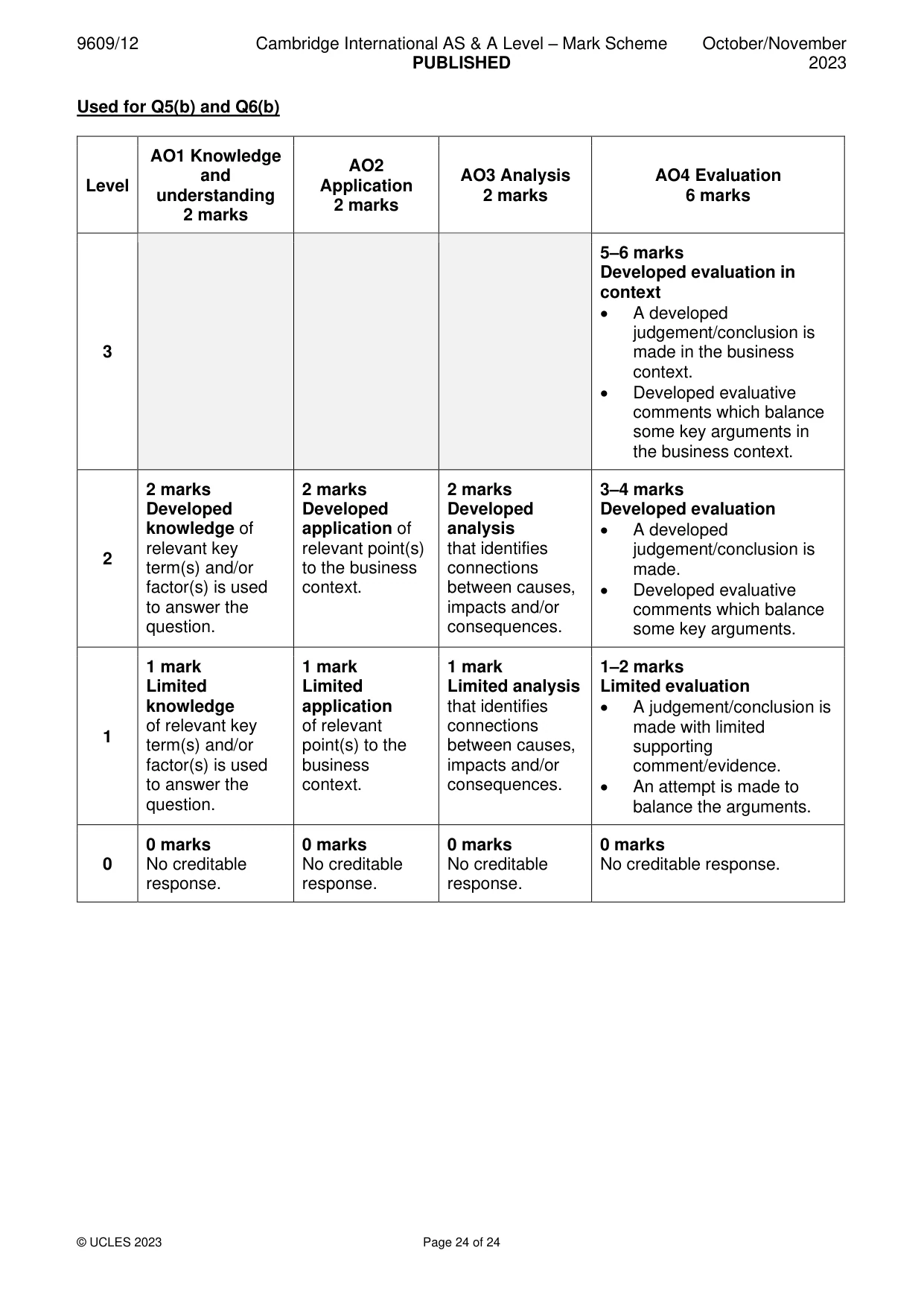
9609/12 Cambridge International AS & A Level – Mark Scheme PUBLISHED October/November 2023 © UCLES 2023 Page 24 of 24 Used for Q5(b) and Q6(b) Level AO1 Knowledge and understanding 2 marks AO2 Application 2 marks AO3 Analysis 2 marks AO4 Evaluation 6 marks 3 5–6 marks Developed evaluation in context • A developed judgement/conclusion is made in the business context. • Developed evaluative comments which balance some key arguments in the business context. 2 2 marks Developed knowledge of relevant key term(s) and/or factor(s) is used to answer the question. 2 marks Developed application of relevant point(s) to the business context. 2 marks Developed analysis that identifies connections between causes, impacts and/or consequences. 3–4 marks Developed evaluation • A developed judgement/conclusion is made. • Developed evaluative comments which balance some key arguments. 1 1 mark Limited knowledge of relevant key term(s) and/or factor(s) is used to answer the question. 1 mark Limited application of relevant point(s) to the business context. 1 mark Limited analysis that identifies connections between causes, impacts and/or consequences. 1–2 marks Limited evaluation • A judgement/conclusion is made with limited supporting comment/evidence. • An attempt is made to balance the arguments. 0 0 marks No creditable response. 0 marks No creditable response. 0 marks No creditable response. 0 marks No creditable response.
What you needed in this session
Cambridge’s own grade thresholds for 2023 Oct/Nov, Paper 1 · Variant 2. A higher threshold means an easier paper — the bar moves with how the cohort did.