Cambridge A Level Business (for first examination in 2016) 9609 — 2023 Oct/Nov Paper 1 · Variant 3
9609/13/O/N/23 · 40 marks · ≈45 min
The question paper and its mark scheme, free to read here and free to download. This is Cambridge’s own paper, exactly as it was sat.
Question paper4 pages


Mark scheme24 pages
Answers below. Sit the paper first if you are practising.

Paper as text
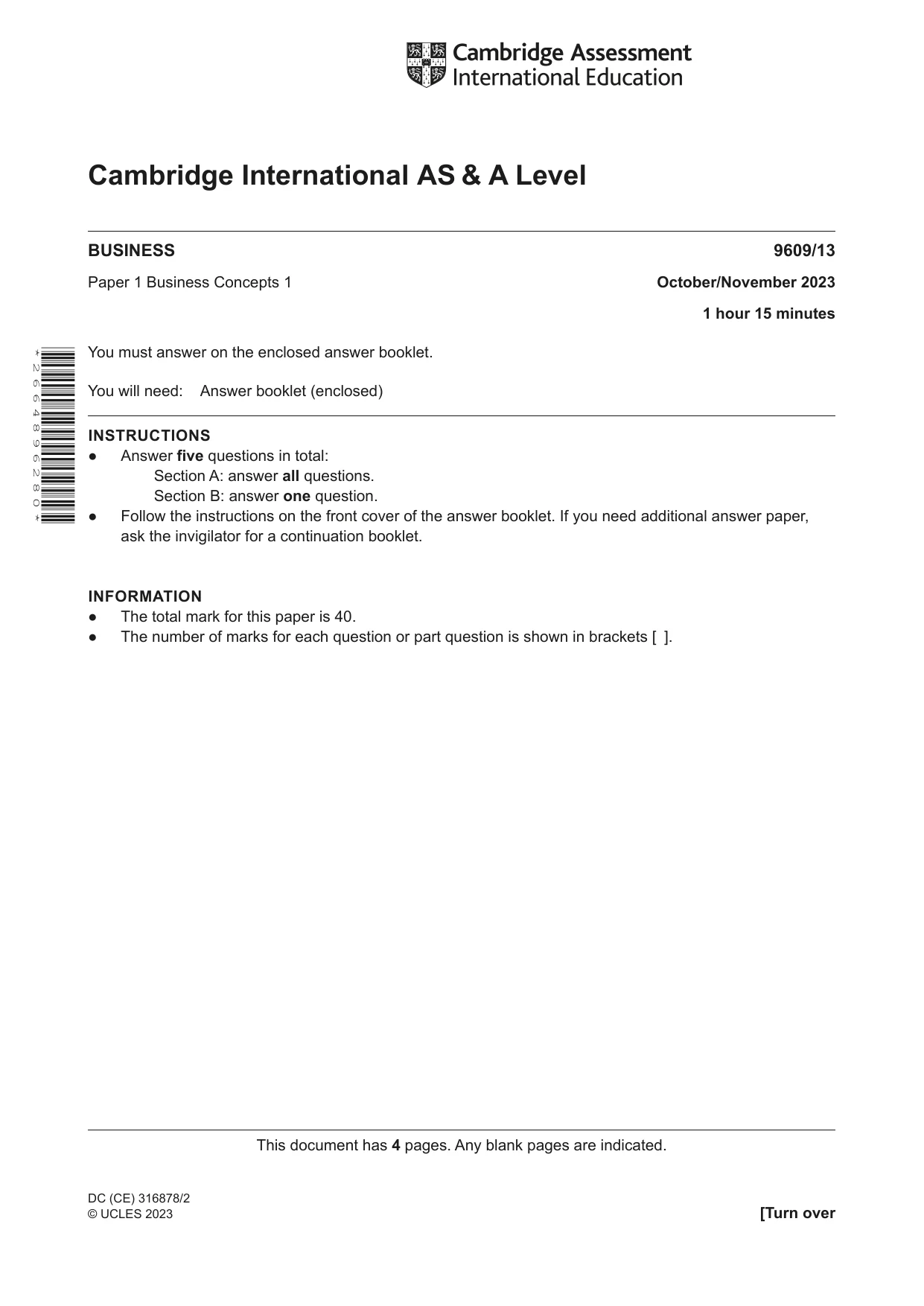
Question paper, page 1
This document has 4 pages. Any blank pages are indicated. [Turn over Cambridge International AS & A Level BUSINESS 9609/13 Paper 1 Business Concepts 1 October/November 2023 1 hour 15 minutes You must answer on the enclosed answer booklet. You will need: Answer booklet (enclosed) INSTRUCTIONS ● Answer five questions in total: Section A: answer all questions. Section B: answer one question. ● Follow the instructions on the front cover of the answer booklet. If you need additional answer paper, ask the invigilator for a continuation booklet. INFORMATION ● The total mark for this paper is 40. ● The number of marks for each question or part question is shown in brackets [ ]. DC (CE) 316878/2 © UCLES 2023 * 2 6 6 4 8 9 6 2 8 0 *
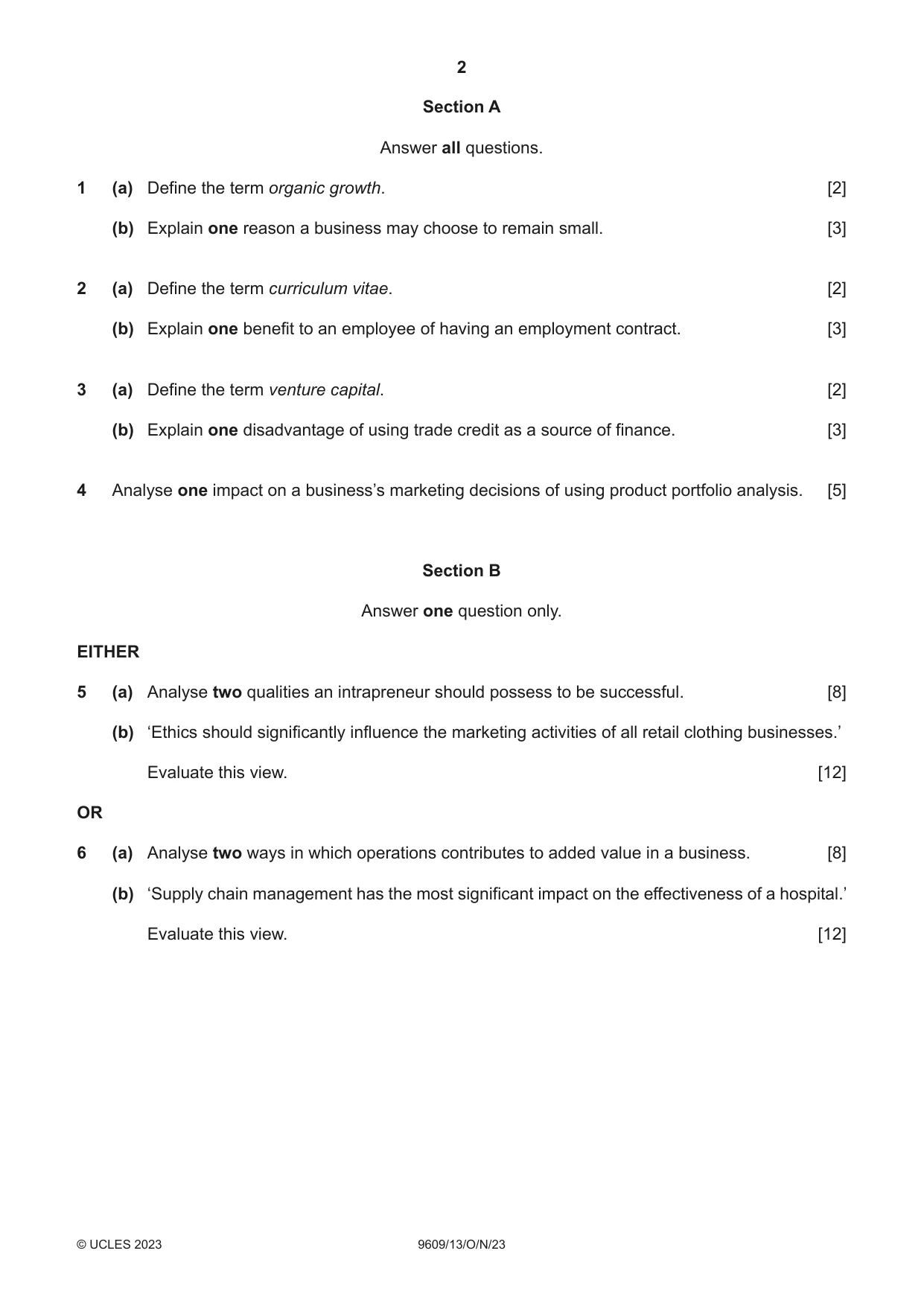
Question paper, page 2
2 9609/13/O/N/23 © UCLES 2023 Section A Answer all questions. 1 (a) Define the term organic growth. [2] (b) Explain one reason a business may choose to remain small. [3] 2 (a) Define the term curriculum vitae. [2] (b) Explain one benefit to an employee of having an employment contract. [3] 3 (a) Define the term venture capital. [2] (b) Explain one disadvantage of using trade credit as a source of finance. [3] 4 Analyse one impact on a business’s marketing decisions of using product portfolio analysis. [5] Section B Answer one question only. EITHER 5 (a) Analyse two qualities an intrapreneur should possess to be successful. [8] (b) ‘Ethics should significantly influence the marketing activities of all retail clothing businesses.’ Evaluate this view. [12] OR 6 (a) Analyse two ways in which operations contributes to added value in a business. [8] (b) ‘Supply chain management has the most significant impact on the effectiveness of a hospital.’ Evaluate this view. [12]
Question paper, page 3
3 9609/13/O/N/23 © UCLES 2023 BLANK PAGE
Question paper, page 4
4 9609/13/O/N/23 © UCLES 2023 Permission to reproduce items where third-party owned material protected by copyright is included has been sought and cleared where possible. Every reasonable effort has been made by the publisher (UCLES) to trace copyright holders, but if any items requiring clearance have unwittingly been included, the publisher will be pleased to make amends at the earliest possible opportunity. To avoid the issue of disclosure of answer-related information to candidates, all copyright acknowledgements are reproduced online in the Cambridge Assessment International Education Copyright Acknowledgements Booklet. This is produced for each series of examinations and is freely available to download at www.cambridgeinternational.org after the live examination series. Cambridge Assessment International Education is part of Cambridge Assessment. Cambridge Assessment is the brand name of the University of Cambridge Local Examinations Syndicate (UCLES), which is a department of the University of Cambridge. BLANK PAGE
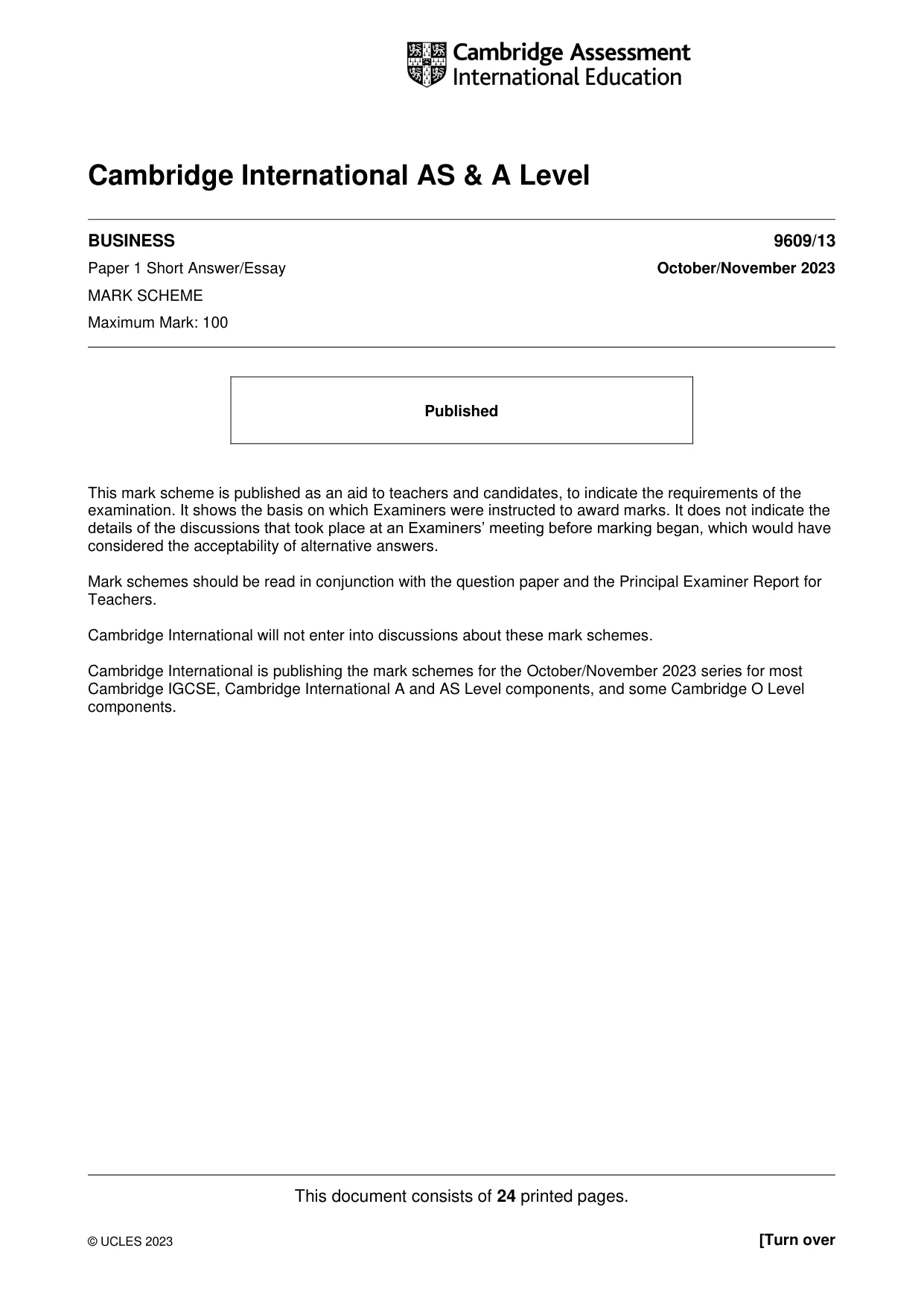
Mark scheme, page 1
This document consists of 24 printed pages. © UCLES 2023 [Turn over Cambridge International AS & A Level BUSINESS 9609/13 Paper 1 Short Answer/Essay October/November 2023 MARK SCHEME Maximum Mark: 100 Published This mark scheme is published as an aid to teachers and candidates, to indicate the requirements of the examination. It shows the basis on which Examiners were instructed to award marks. It does not indicate the details of the discussions that took place at an Examiners’ meeting before marking began, which would have considered the acceptability of alternative answers. Mark schemes should be read in conjunction with the question paper and the Principal Examiner Report for Teachers. Cambridge International will not enter into discussions about these mark schemes. Cambridge International is publishing the mark schemes for the October/November 2023 series for most Cambridge IGCSE, Cambridge International A and AS Level components, and some Cambridge O Level components.
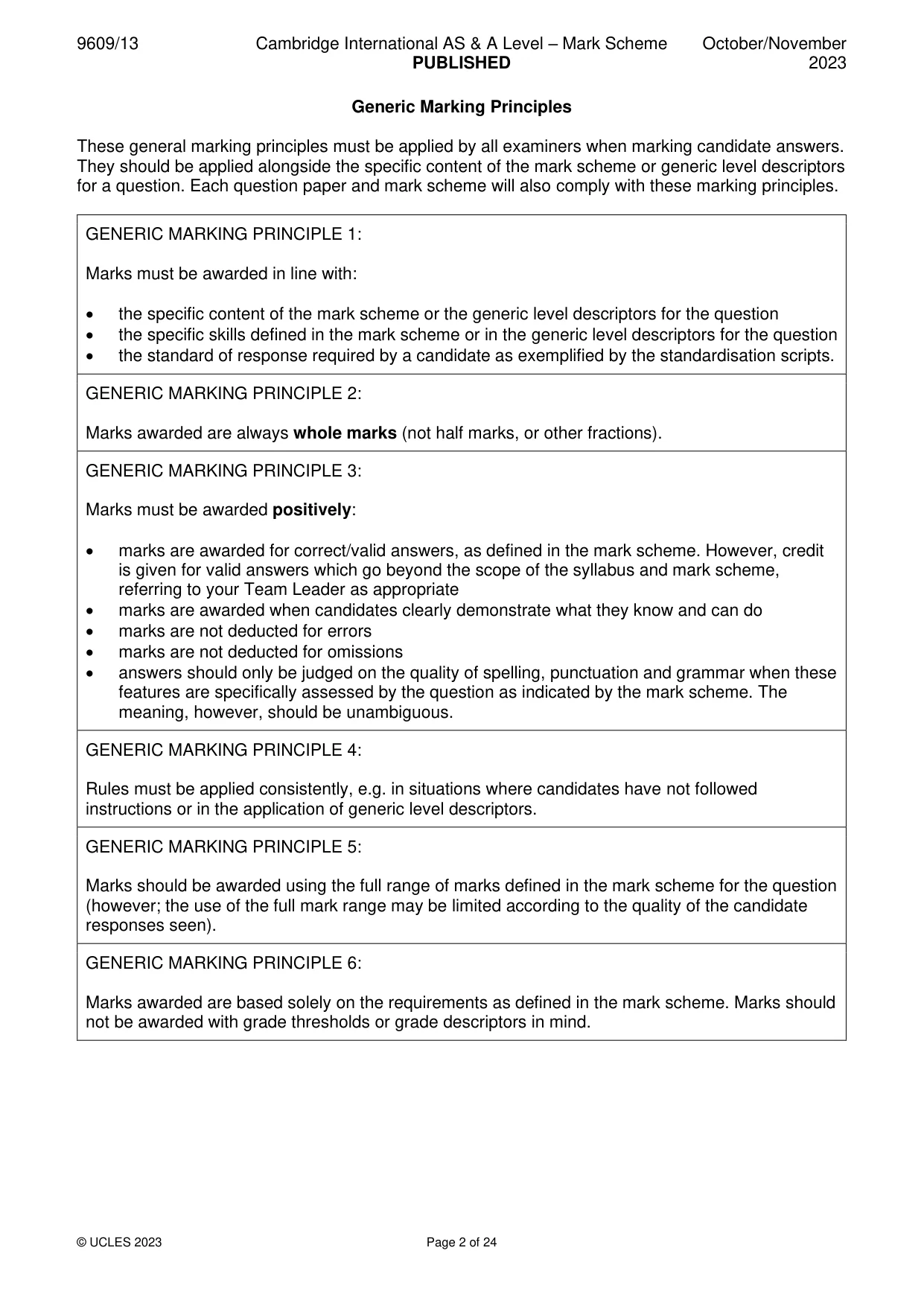
Mark scheme, page 2
9609/13 Cambridge International AS & A Level – Mark Scheme PUBLISHED October/November 2023 © UCLES 2023 Page 2 of 24 Generic Marking Principles These general marking principles must be applied by all examiners when marking candidate answers. They should be applied alongside the specific content of the mark scheme or generic level descriptors for a question. Each question paper and mark scheme will also comply with these marking principles. GENERIC MARKING PRINCIPLE 1: Marks must be awarded in line with: • the specific content of the mark scheme or the generic level descriptors for the question • the specific skills defined in the mark scheme or in the generic level descriptors for the question • the standard of response required by a candidate as exemplified by the standardisation scripts. GENERIC MARKING PRINCIPLE 2: Marks awarded are always whole marks (not half marks, or other fractions). GENERIC MARKING PRINCIPLE 3: Marks must be awarded positively: • marks are awarded for correct/valid answers, as defined in the mark scheme. However, credit is given for valid answers which go beyond the scope of the syllabus and mark scheme, referring to your Team Leader as appropriate • marks are awarded when candidates clearly demonstrate what they know and can do • marks are not deducted for errors • marks are not deducted for omissions • answers should only be judged on the quality of spelling, punctuation and grammar when these features are specifically assessed by the question as indicated by the mark scheme. The meaning, however, should be unambiguous. GENERIC MARKING PRINCIPLE 4: Rules must be applied consistently, e.g. in situations where candidates have not followed instructions or in the application of generic level descriptors. GENERIC MARKING PRINCIPLE 5: Marks should be awarded using the full range of marks defined in the mark scheme for the question (however; the use of the full mark range may be limited according to the quality of the candidate responses seen). GENERIC MARKING PRINCIPLE 6: Marks awarded are based solely on the requirements as defined in the mark scheme. Marks should not be awarded with grade thresholds or grade descriptors in mind.
Mark scheme, page 3
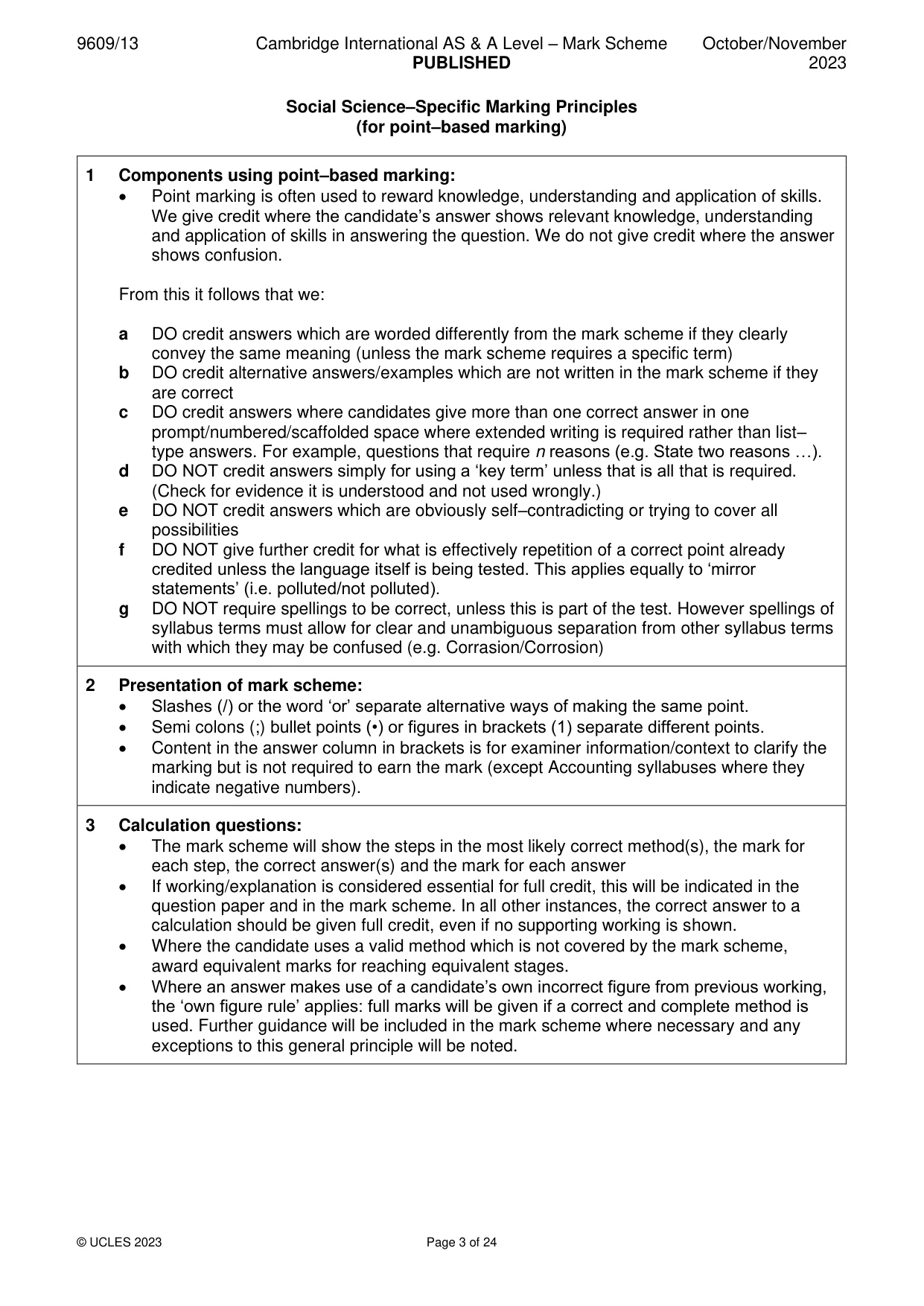
9609/13 Cambridge International AS & A Level – Mark Scheme PUBLISHED October/November 2023 © UCLES 2023 Page 3 of 24 Social Science–Specific Marking Principles (for point–based marking) 1 Components using point–based marking: • Point marking is often used to reward knowledge, understanding and application of skills. We give credit where the candidate’s answer shows relevant knowledge, understanding and application of skills in answering the question. We do not give credit where the answer shows confusion. From this it follows that we: a DO credit answers which are worded differently from the mark scheme if they clearly convey the same meaning (unless the mark scheme requires a specific term) b DO credit alternative answers/examples which are not written in the mark scheme if they are correct c DO credit answers where candidates give more than one correct answer in one prompt/numbered/scaffolded space where extended writing is required rather than list– type answers. For example, questions that require n reasons (e.g. State two reasons …). d DO NOT credit answers simply for using a ‘key term’ unless that is all that is required. (Check for evidence it is understood and not used wrongly.) e DO NOT credit answers which are obviously self–contradicting or trying to cover all possibilities f DO NOT give further credit for what is effectively repetition of a correct point already credited unless the language itself is being tested. This applies equally to ‘mirror statements’ (i.e. polluted/not polluted). g DO NOT require spellings to be correct, unless this is part of the test. However spellings of syllabus terms must allow for clear and unambiguous separation from other syllabus terms with which they may be confused (e.g. Corrasion/Corrosion) 2 Presentation of mark scheme: • Slashes (/) or the word ‘or’ separate alternative ways of making the same point. • Semi colons (;) bullet points (•) or figures in brackets (1) separate different points. • Content in the answer column in brackets is for examiner information/context to clarify the marking but is not required to earn the mark (except Accounting syllabuses where they indicate negative numbers). 3 Calculation questions: • The mark scheme will show the steps in the most likely correct method(s), the mark for each step, the correct answer(s) and the mark for each answer • If working/explanation is considered essential for full credit, this will be indicated in the question paper and in the mark scheme. In all other instances, the correct answer to a calculation should be given full credit, even if no supporting working is shown. • Where the candidate uses a valid method which is not covered by the mark scheme, award equivalent marks for reaching equivalent stages. • Where an answer makes use of a candidate’s own incorrect figure from previous working, the ‘own figure rule’ applies: full marks will be given if a correct and complete method is used. Further guidance will be included in the mark scheme where necessary and any exceptions to this general principle will be noted.
Mark scheme, page 4
9609/13 Cambridge International AS & A Level – Mark Scheme PUBLISHED October/November 2023 © UCLES 2023 Page 4 of 24 4 Annotation: • For point marking, ticks can be used to indicate correct answers and crosses can be used to indicate wrong answers. There is no direct relationship between ticks and marks. Ticks have no defined meaning for levels of response marking. • For levels of response marking, the level awarded should be annotated on the script. • Other annotations will be used by examiners as agreed during standardisation, and the meaning will be understood by all examiners who marked that paper.
Mark scheme, page 5
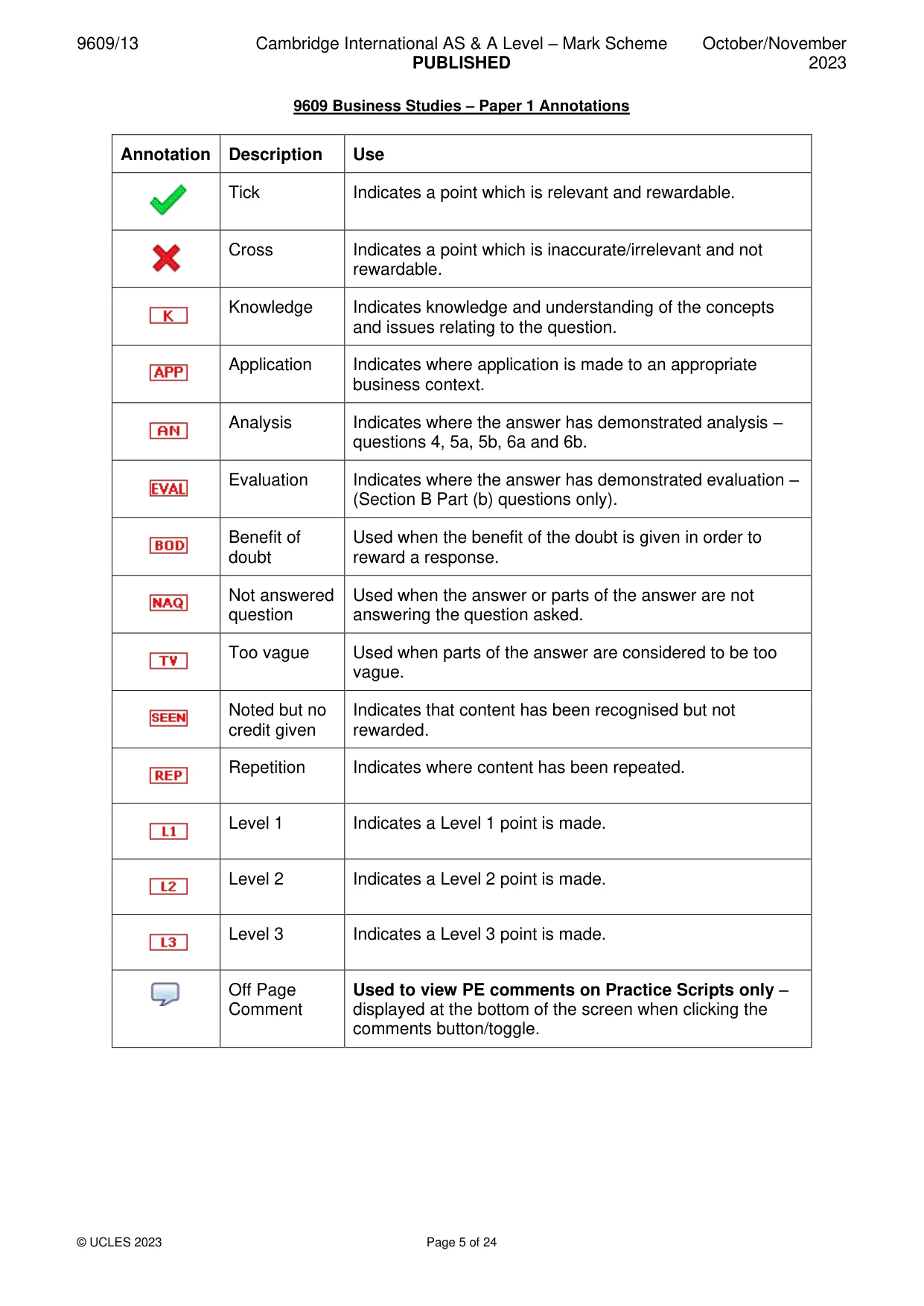
9609/13 Cambridge International AS & A Level – Mark Scheme PUBLISHED October/November 2023 © UCLES 2023 Page 5 of 24 9609 Business Studies – Paper 1 Annotations Annotation Description Use Tick Indicates a point which is relevant and rewardable. Cross Indicates a point which is inaccurate/irrelevant and not rewardable. Knowledge Indicates knowledge and understanding of the concepts and issues relating to the question. Application Indicates where application is made to an appropriate business context. Analysis Indicates where the answer has demonstrated analysis – questions 4, 5a, 5b, 6a and 6b. Evaluation Indicates where the answer has demonstrated evaluation – (Section B Part (b) questions only). Benefit of doubt Used when the benefit of the doubt is given in order to reward a response. Not answered question Used when the answer or parts of the answer are not answering the question asked. Too vague Used when parts of the answer are considered to be too vague. Noted but no credit given Indicates that content has been recognised but not rewarded. Repetition Indicates where content has been repeated. Level 1 Indicates a Level 1 point is made. Level 2 Indicates a Level 2 point is made. Level 3 Indicates a Level 3 point is made. Off Page Comment Used to view PE comments on Practice Scripts only – displayed at the bottom of the screen when clicking the comments button/toggle.
Mark scheme, page 6
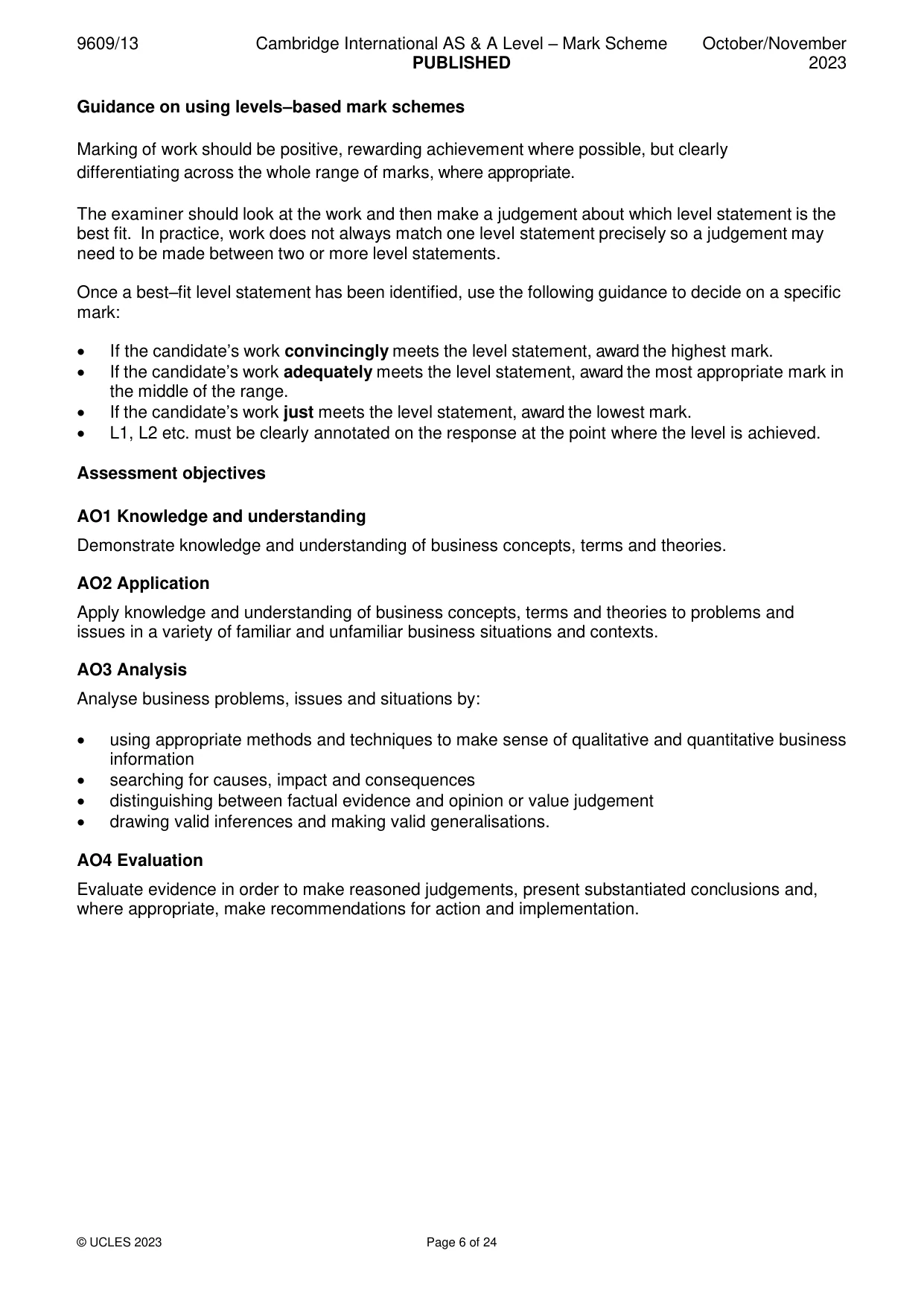
9609/13 Cambridge International AS & A Level – Mark Scheme PUBLISHED October/November 2023 © UCLES 2023 Page 6 of 24 Guidance on using levels–based mark schemes Marking of work should be positive, rewarding achievement where possible, but clearly differentiating across the whole range of marks, where appropriate. The examiner should look at the work and then make a judgement about which level statement is the best fit. In practice, work does not always match one level statement precisely so a judgement may need to be made between two or more level statements. Once a best–fit level statement has been identified, use the following guidance to decide on a specific mark: • If the candidate’s work convincingly meets the level statement, award the highest mark. • If the candidate’s work adequately meets the level statement, award the most appropriate mark in the middle of the range. • If the candidate’s work just meets the level statement, award the lowest mark. • L1, L2 etc. must be clearly annotated on the response at the point where the level is achieved. Assessment objectives AO1 Knowledge and understanding Demonstrate knowledge and understanding of business concepts, terms and theories. AO2 Application Apply knowledge and understanding of business concepts, terms and theories to problems and issues in a variety of familiar and unfamiliar business situations and contexts. AO3 Analysis Analyse business problems, issues and situations by: • using appropriate methods and techniques to make sense of qualitative and quantitative business information • searching for causes, impact and consequences • distinguishing between factual evidence and opinion or value judgement • drawing valid inferences and making valid generalisations. AO4 Evaluation Evaluate evidence in order to make reasoned judgements, present substantiated conclusions and, where appropriate, make recommendations for action and implementation.
Mark scheme, page 7
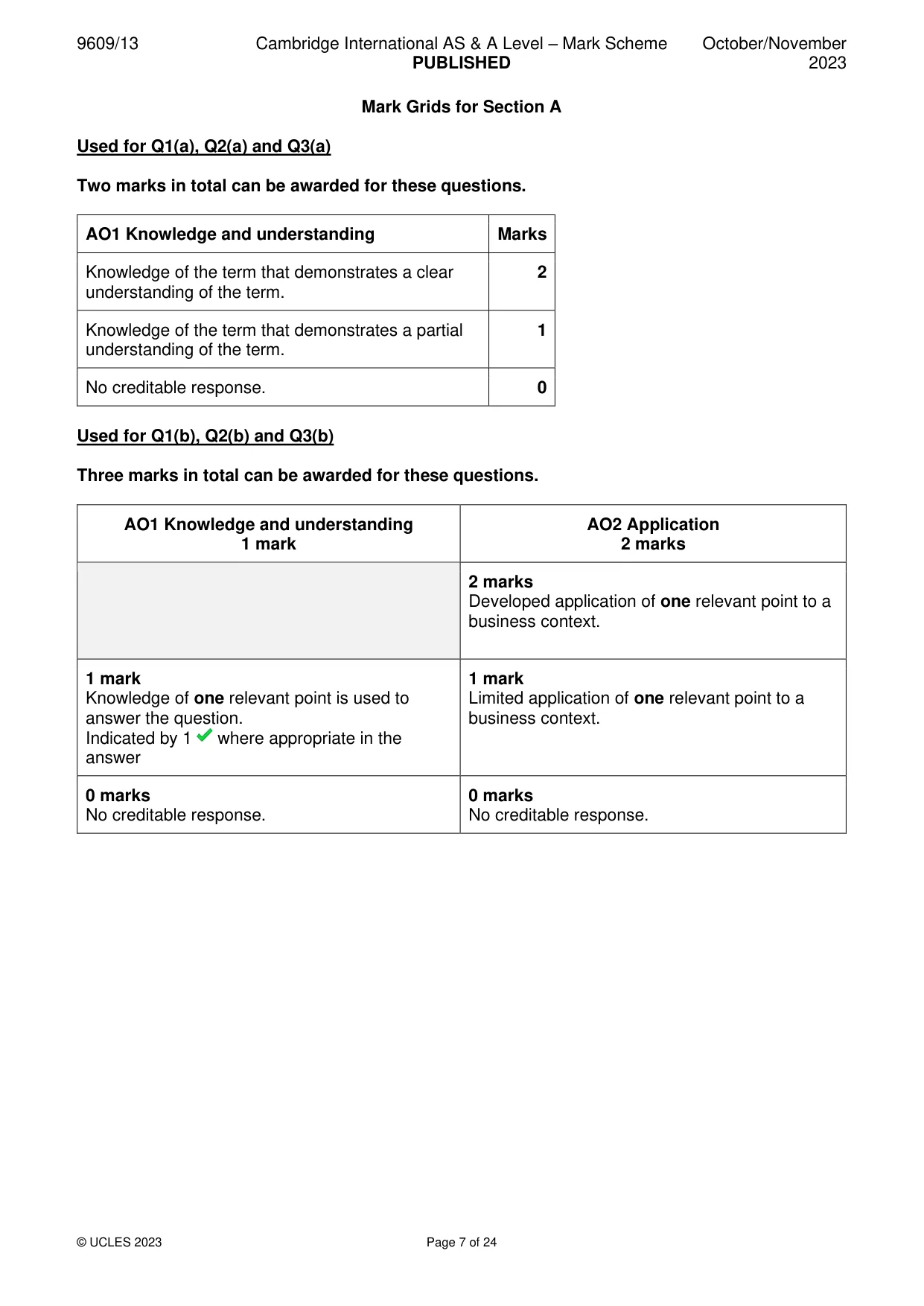
9609/13 Cambridge International AS & A Level – Mark Scheme PUBLISHED October/November 2023 © UCLES 2023 Page 7 of 24 Mark Grids for Section A Used for Q1(a), Q2(a) and Q3(a) Two marks in total can be awarded for these questions. AO1 Knowledge and understanding Marks Knowledge of the term that demonstrates a clear understanding of the term. 2 Knowledge of the term that demonstrates a partial understanding of the term. 1 No creditable response. 0 Used for Q1(b), Q2(b) and Q3(b) Three marks in total can be awarded for these questions. AO1 Knowledge and understanding 1 mark AO2 Application 2 marks 2 marks Developed application of one relevant point to a business context. 1 mark Knowledge of one relevant point is used to answer the question. Indicated by 1 where appropriate in the answer 1 mark Limited application of one relevant point to a business context. 0 marks No creditable response. 0 marks No creditable response.
Mark scheme, page 8
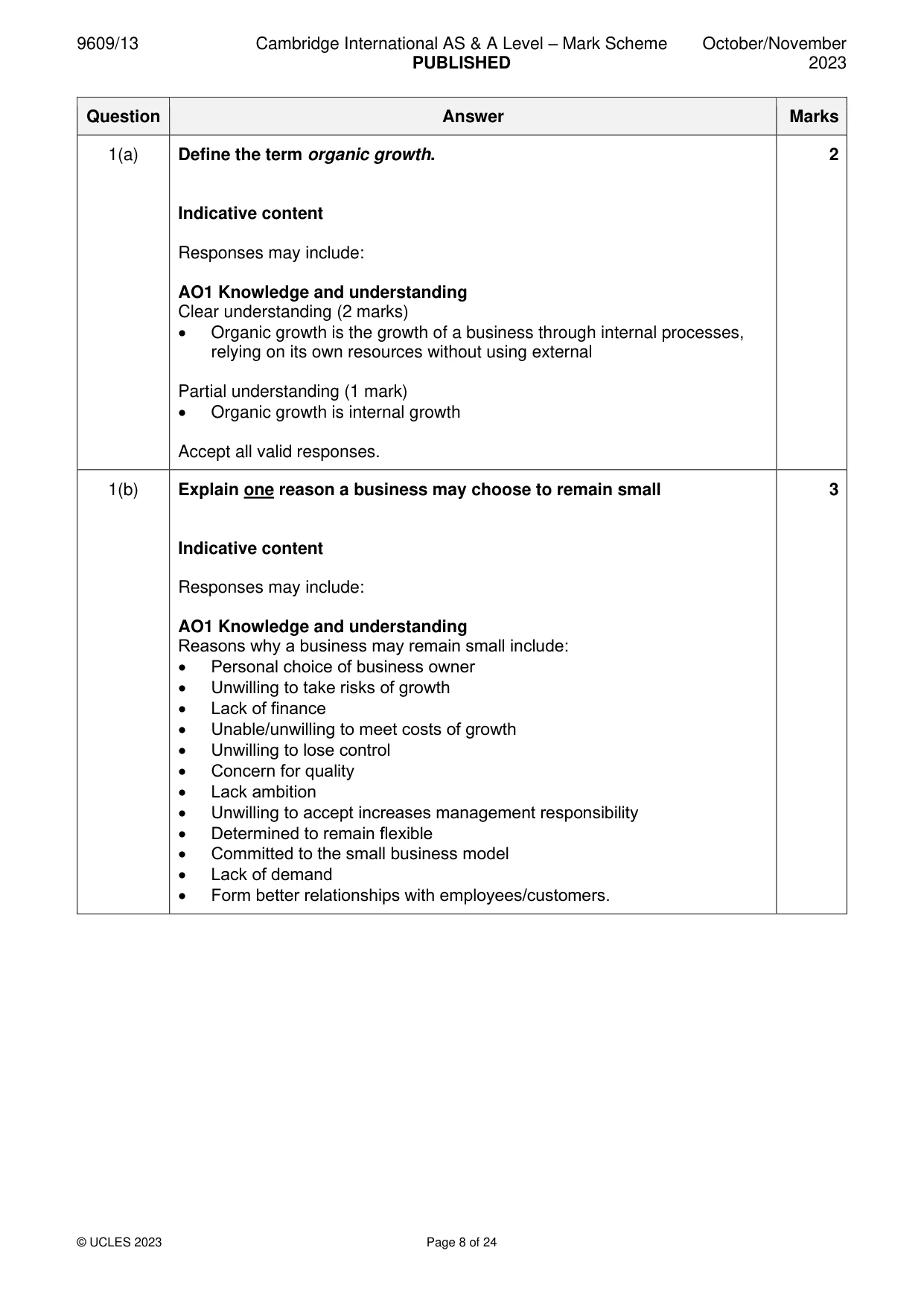
9609/13 Cambridge International AS & A Level – Mark Scheme PUBLISHED October/November 2023 © UCLES 2023 Page 8 of 24 Question Answer Marks 1(a) Define the term organic growth. Indicative content Responses may include: AO1 Knowledge and understanding Clear understanding (2 marks) • Organic growth is the growth of a business through internal processes, relying on its own resources without using external Partial understanding (1 mark) • Organic growth is internal growth Accept all valid responses. 2 1(b) Explain one reason a business may choose to remain small Indicative content Responses may include: AO1 Knowledge and understanding Reasons why a business may remain small include: • Personal choice of business owner • Unwilling to take risks of growth • Lack of finance • Unable/unwilling to meet costs of growth • Unwilling to lose control • Concern for quality • Lack ambition • Unwilling to accept increases management responsibility • Determined to remain flexible • Committed to the small business model • Lack of demand • Form better relationships with employees/customers. 3
Mark scheme, page 9
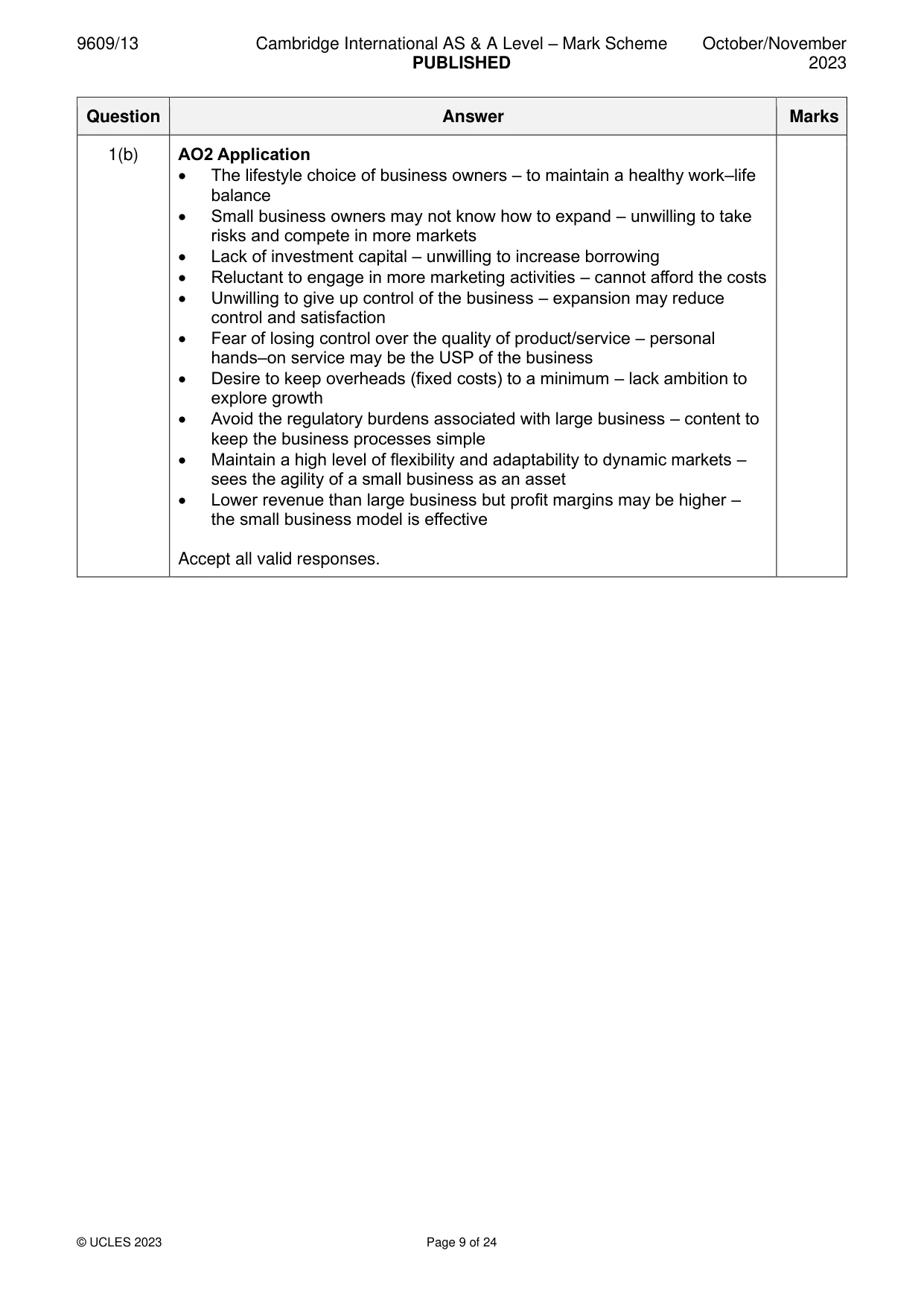
9609/13 Cambridge International AS & A Level – Mark Scheme PUBLISHED October/November 2023 © UCLES 2023 Page 9 of 24 Question Answer Marks 1(b) AO2 Application • The lifestyle choice of business owners – to maintain a healthy work–life balance • Small business owners may not know how to expand – unwilling to take risks and compete in more markets • Lack of investment capital – unwilling to increase borrowing • Reluctant to engage in more marketing activities – cannot afford the costs • Unwilling to give up control of the business – expansion may reduce control and satisfaction • Fear of losing control over the quality of product/service – personal hands–on service may be the USP of the business • Desire to keep overheads (fixed costs) to a minimum – lack ambition to explore growth • Avoid the regulatory burdens associated with large business – content to keep the business processes simple • Maintain a high level of flexibility and adaptability to dynamic markets – sees the agility of a small business as an asset • Lower revenue than large business but profit margins may be higher – the small business model is effective Accept all valid responses.
Mark scheme, page 10
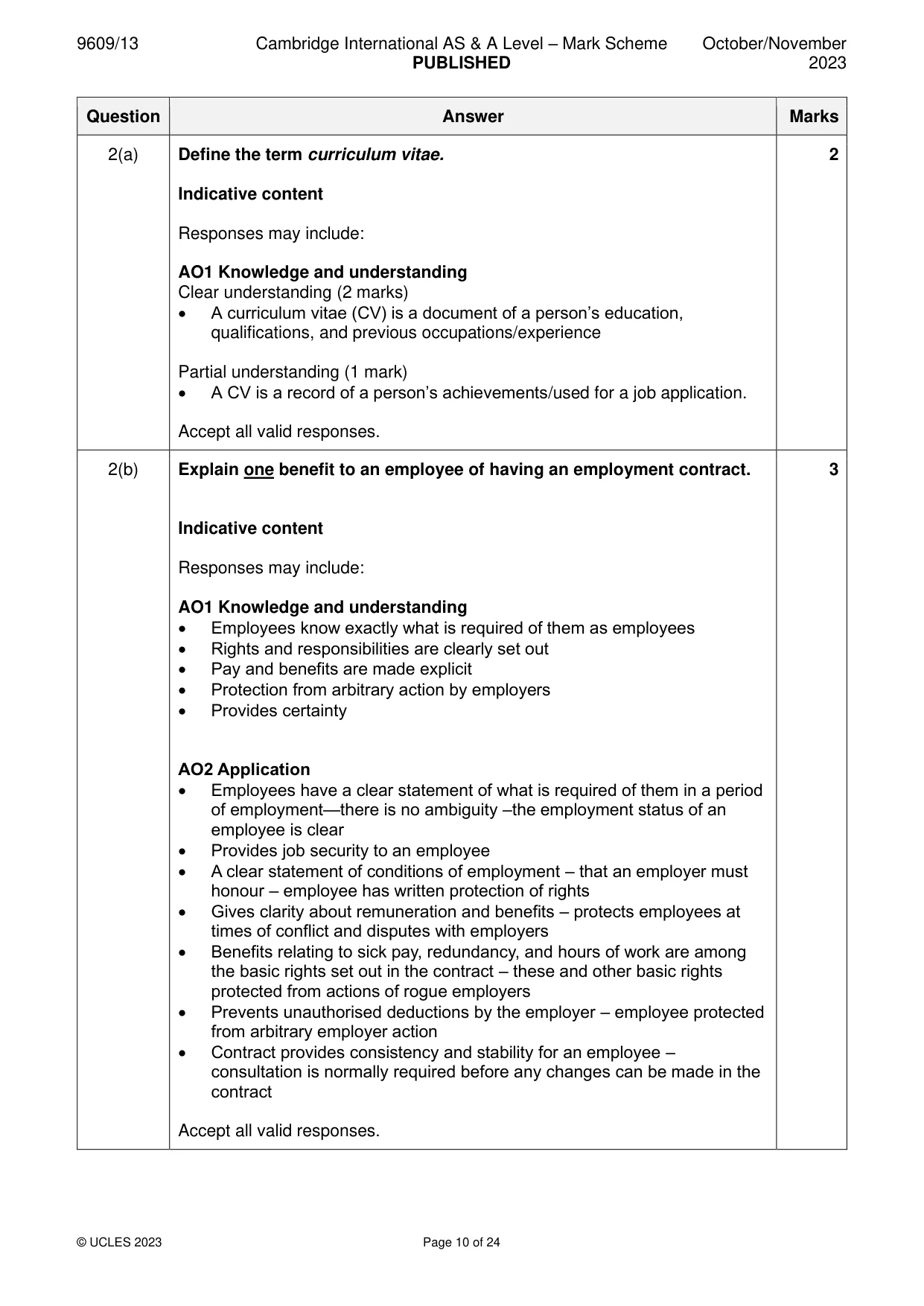
9609/13 Cambridge International AS & A Level – Mark Scheme PUBLISHED October/November 2023 © UCLES 2023 Page 10 of 24 Question Answer Marks 2(a) Define the term curriculum vitae. Indicative content Responses may include: AO1 Knowledge and understanding Clear understanding (2 marks) • A curriculum vitae (CV) is a document of a person’s education, qualifications, and previous occupations/experience Partial understanding (1 mark) • A CV is a record of a person’s achievements/used for a job application. Accept all valid responses. 2 2(b) Explain one benefit to an employee of having an employment contract. Indicative content Responses may include: AO1 Knowledge and understanding • Employees know exactly what is required of them as employees • Rights and responsibilities are clearly set out • Pay and benefits are made explicit • Protection from arbitrary action by employers • Provides certainty AO2 Application • Employees have a clear statement of what is required of them in a period of employment—there is no ambiguity –the employment status of an employee is clear • Provides job security to an employee • A clear statement of conditions of employment – that an employer must honour – employee has written protection of rights • Gives clarity about remuneration and benefits – protects employees at times of conflict and disputes with employers • Benefits relating to sick pay, redundancy, and hours of work are among the basic rights set out in the contract – these and other basic rights protected from actions of rogue employers • Prevents unauthorised deductions by the employer – employee protected from arbitrary employer action • Contract provides consistency and stability for an employee – consultation is normally required before any changes can be made in the contract Accept all valid responses. 3
Mark scheme, page 11
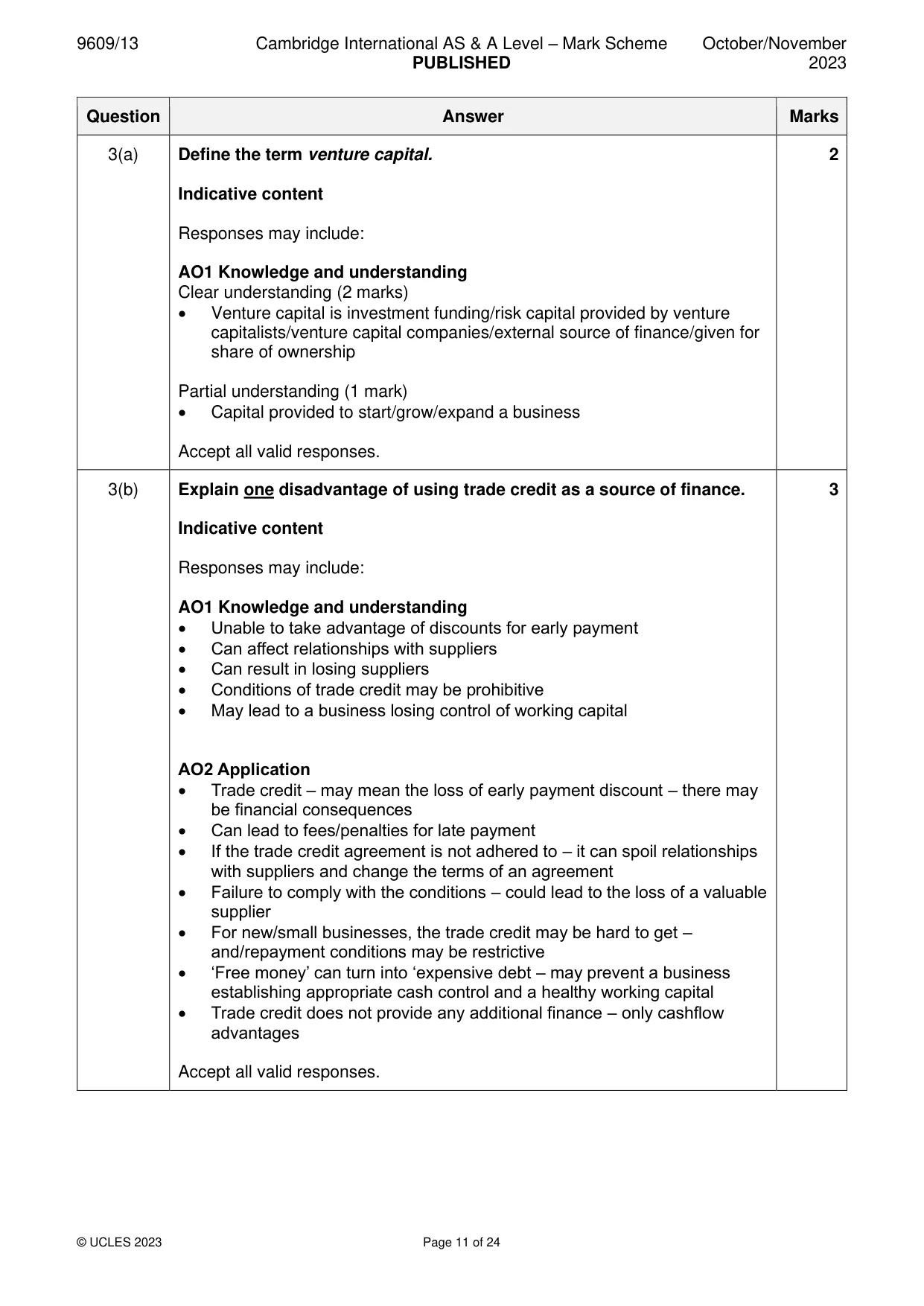
9609/13 Cambridge International AS & A Level – Mark Scheme PUBLISHED October/November 2023 © UCLES 2023 Page 11 of 24 Question Answer Marks 3(a) Define the term venture capital. Indicative content Responses may include: AO1 Knowledge and understanding Clear understanding (2 marks) • Venture capital is investment funding/risk capital provided by venture capitalists/venture capital companies/external source of finance/given for share of ownership Partial understanding (1 mark) • Capital provided to start/grow/expand a business Accept all valid responses. 2 3(b) Explain one disadvantage of using trade credit as a source of finance. Indicative content Responses may include: AO1 Knowledge and understanding • Unable to take advantage of discounts for early payment • Can affect relationships with suppliers • Can result in losing suppliers • Conditions of trade credit may be prohibitive • May lead to a business losing control of working capital AO2 Application • Trade credit – may mean the loss of early payment discount – there may be financial consequences • Can lead to fees/penalties for late payment • If the trade credit agreement is not adhered to – it can spoil relationships with suppliers and change the terms of an agreement • Failure to comply with the conditions – could lead to the loss of a valuable supplier • For new/small businesses, the trade credit may be hard to get – and/repayment conditions may be restrictive • ‘Free money’ can turn into ‘expensive debt – may prevent a business establishing appropriate cash control and a healthy working capital • Trade credit does not provide any additional finance – only cashflow advantages Accept all valid responses. 3
Mark scheme, page 12
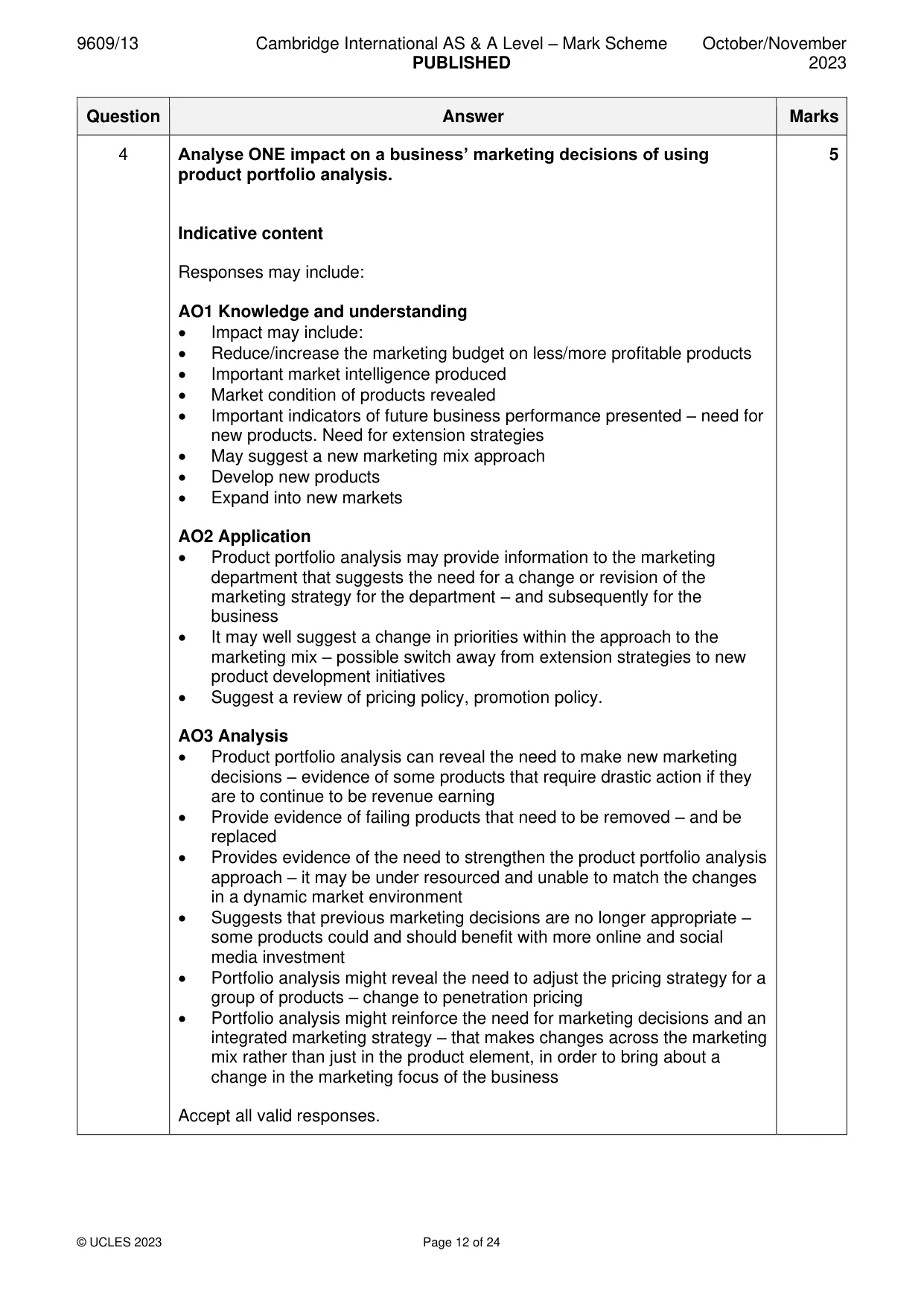
9609/13 Cambridge International AS & A Level – Mark Scheme PUBLISHED October/November 2023 © UCLES 2023 Page 12 of 24 Question Answer Marks 4 Analyse ONE impact on a business’ marketing decisions of using product portfolio analysis. Indicative content Responses may include: AO1 Knowledge and understanding • Impact may include: • Reduce/increase the marketing budget on less/more profitable products • Important market intelligence produced • Market condition of products revealed • Important indicators of future business performance presented – need for new products. Need for extension strategies • May suggest a new marketing mix approach • Develop new products • Expand into new markets AO2 Application • Product portfolio analysis may provide information to the marketing department that suggests the need for a change or revision of the marketing strategy for the department – and subsequently for the business • It may well suggest a change in priorities within the approach to the marketing mix – possible switch away from extension strategies to new product development initiatives • Suggest a review of pricing policy, promotion policy. AO3 Analysis • Product portfolio analysis can reveal the need to make new marketing decisions – evidence of some products that require drastic action if they are to continue to be revenue earning • Provide evidence of failing products that need to be removed – and be replaced • Provides evidence of the need to strengthen the product portfolio analysis approach – it may be under resourced and unable to match the changes in a dynamic market environment • Suggests that previous marketing decisions are no longer appropriate – some products could and should benefit with more online and social media investment • Portfolio analysis might reveal the need to adjust the pricing strategy for a group of products – change to penetration pricing • Portfolio analysis might reinforce the need for marketing decisions and an integrated marketing strategy – that makes changes across the marketing mix rather than just in the product element, in order to bring about a change in the marketing focus of the business Accept all valid responses. 5
Mark scheme, page 13
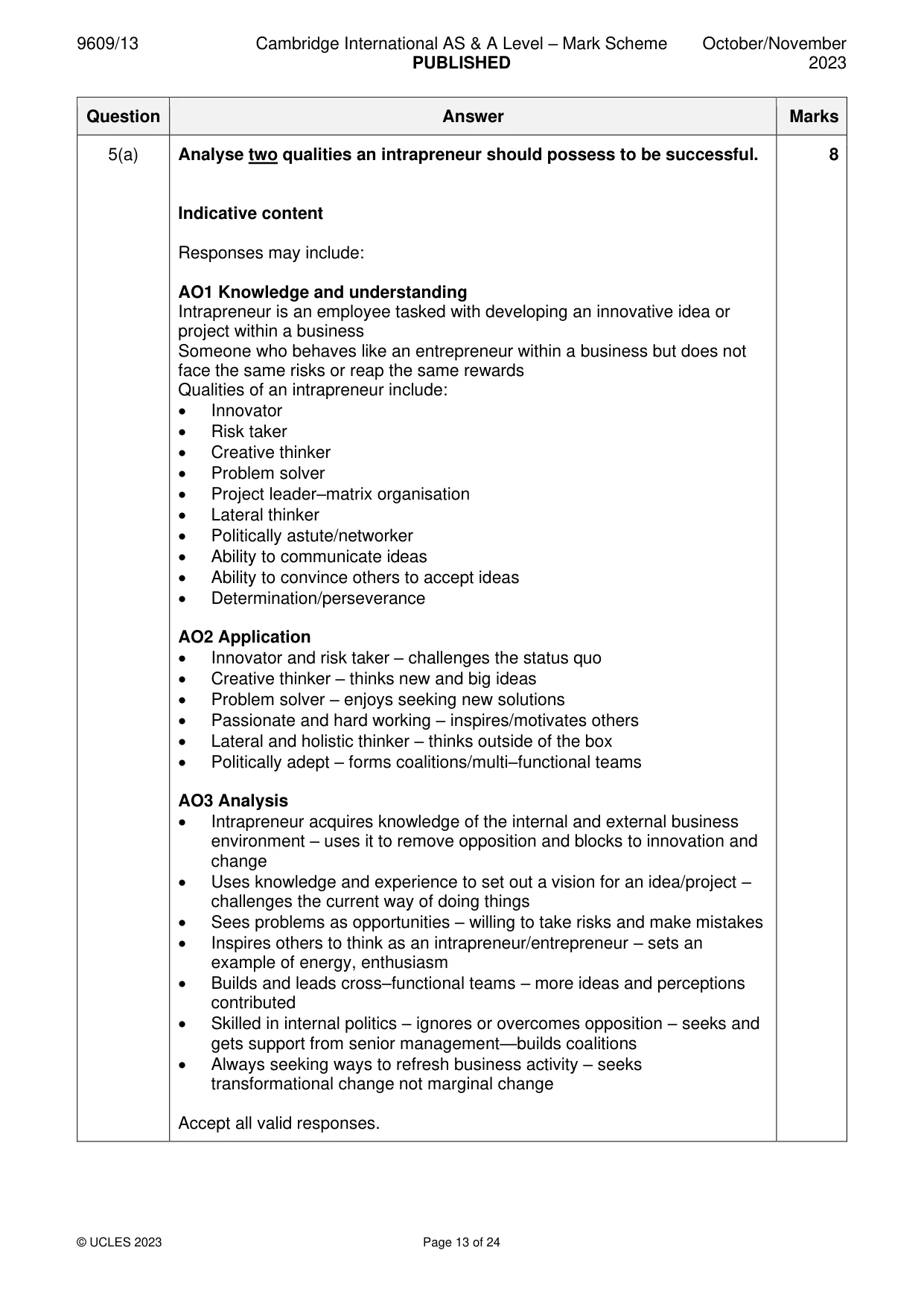
9609/13 Cambridge International AS & A Level – Mark Scheme PUBLISHED October/November 2023 © UCLES 2023 Page 13 of 24 Question Answer Marks 5(a) Analyse two qualities an intrapreneur should possess to be successful. Indicative content Responses may include: AO1 Knowledge and understanding Intrapreneur is an employee tasked with developing an innovative idea or project within a business Someone who behaves like an entrepreneur within a business but does not face the same risks or reap the same rewards Qualities of an intrapreneur include: • Innovator • Risk taker • Creative thinker • Problem solver • Project leader–matrix organisation • Lateral thinker • Politically astute/networker • Ability to communicate ideas • Ability to convince others to accept ideas • Determination/perseverance AO2 Application • Innovator and risk taker – challenges the status quo • Creative thinker – thinks new and big ideas • Problem solver – enjoys seeking new solutions • Passionate and hard working – inspires/motivates others • Lateral and holistic thinker – thinks outside of the box • Politically adept – forms coalitions/multi–functional teams AO3 Analysis • Intrapreneur acquires knowledge of the internal and external business environment – uses it to remove opposition and blocks to innovation and change • Uses knowledge and experience to set out a vision for an idea/project – challenges the current way of doing things • Sees problems as opportunities – willing to take risks and make mistakes • Inspires others to think as an intrapreneur/entrepreneur – sets an example of energy, enthusiasm • Builds and leads cross–functional teams – more ideas and perceptions contributed • Skilled in internal politics – ignores or overcomes opposition – seeks and gets support from senior management—builds coalitions • Always seeking ways to refresh business activity – seeks transformational change not marginal change Accept all valid responses. 8
Mark scheme, page 14
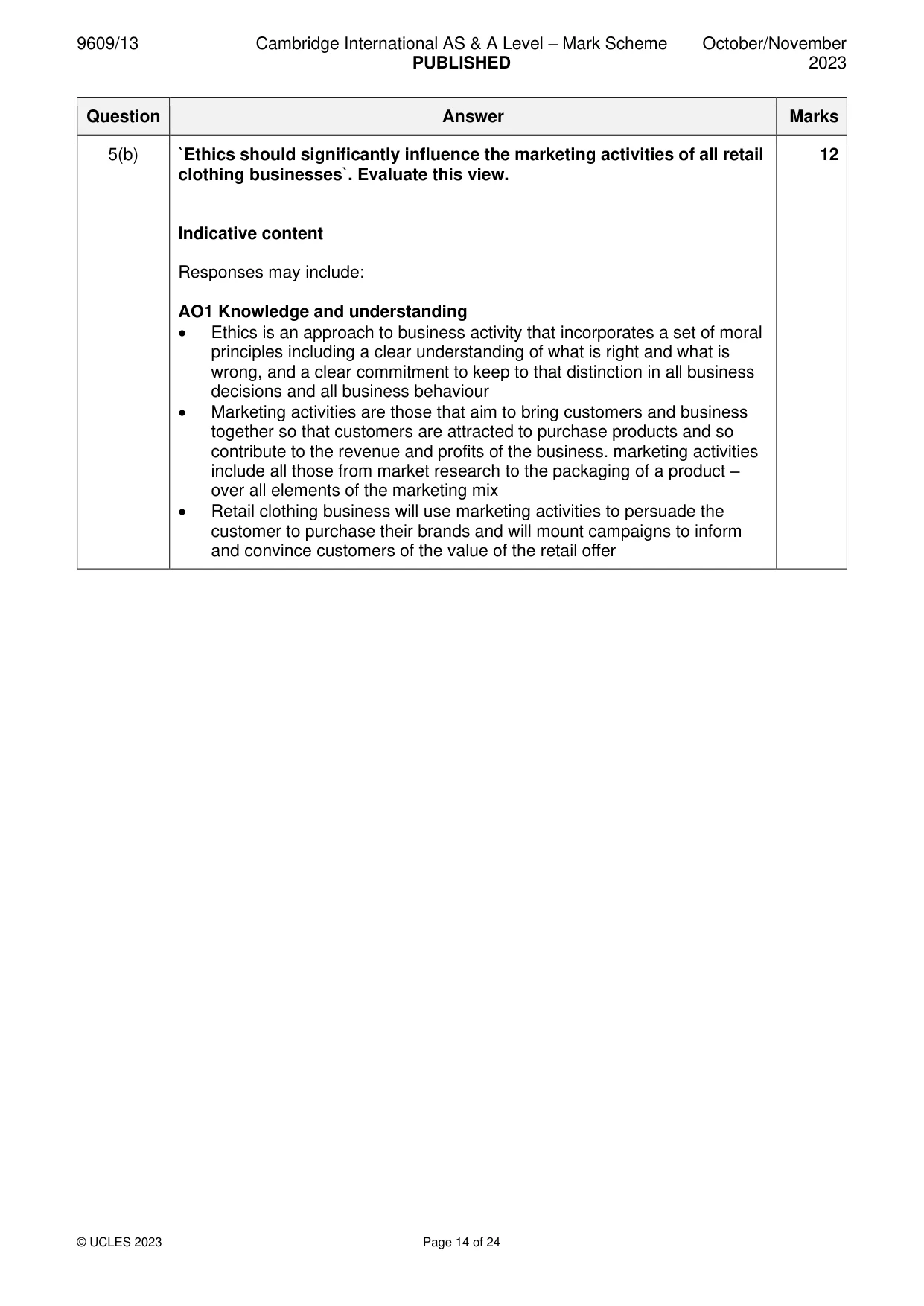
9609/13 Cambridge International AS & A Level – Mark Scheme PUBLISHED October/November 2023 © UCLES 2023 Page 14 of 24 Question Answer Marks 5(b) `Ethics should significantly influence the marketing activities of all retail clothing businesses`. Evaluate this view. Indicative content Responses may include: AO1 Knowledge and understanding • Ethics is an approach to business activity that incorporates a set of moral principles including a clear understanding of what is right and what is wrong, and a clear commitment to keep to that distinction in all business decisions and all business behaviour • Marketing activities are those that aim to bring customers and business together so that customers are attracted to purchase products and so contribute to the revenue and profits of the business. marketing activities include all those from market research to the packaging of a product – over all elements of the marketing mix • Retail clothing business will use marketing activities to persuade the customer to purchase their brands and will mount campaigns to inform and convince customers of the value of the retail offer 12
Mark scheme, page 15
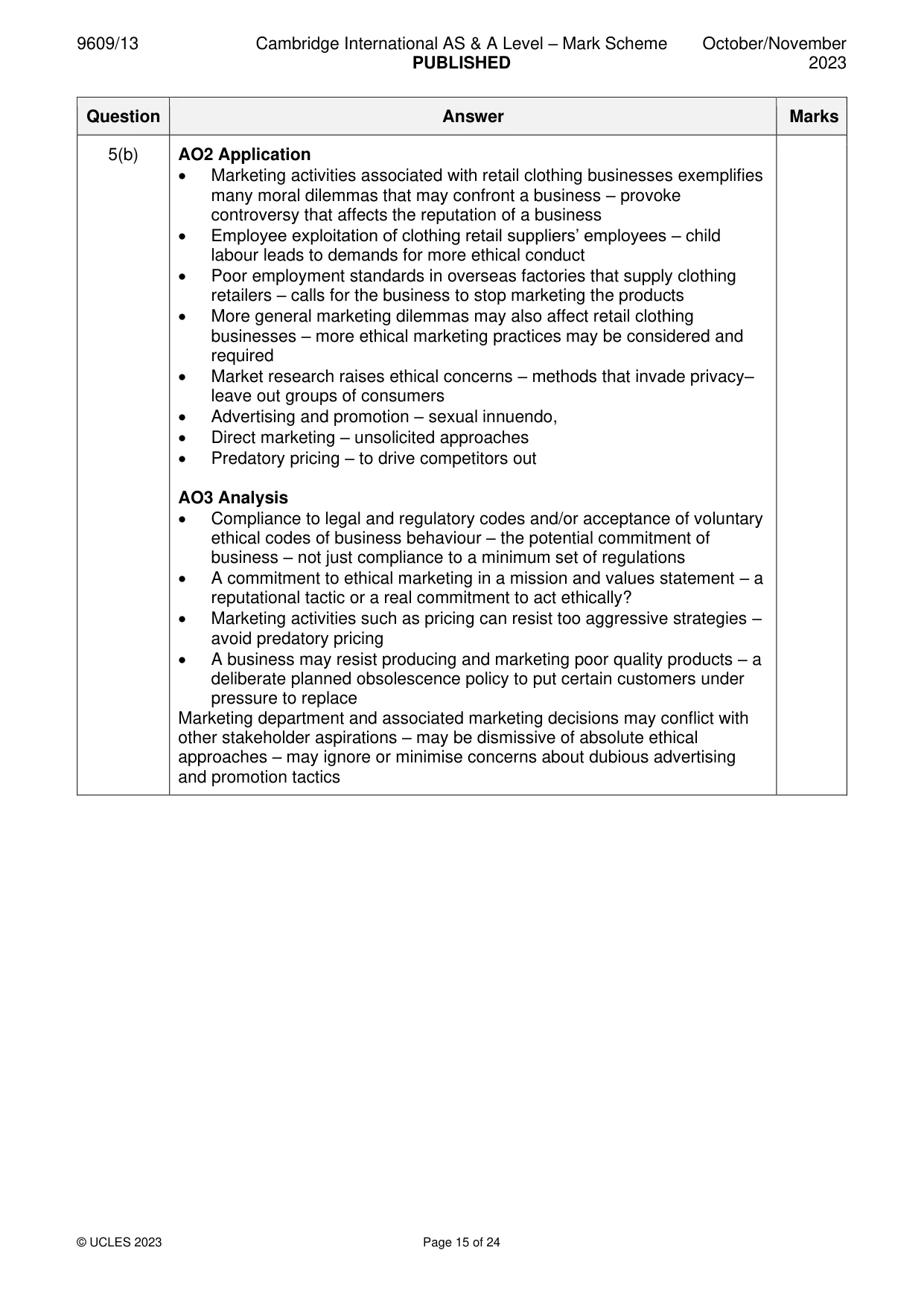
9609/13 Cambridge International AS & A Level – Mark Scheme PUBLISHED October/November 2023 © UCLES 2023 Page 15 of 24 Question Answer Marks 5(b) AO2 Application • Marketing activities associated with retail clothing businesses exemplifies many moral dilemmas that may confront a business – provoke controversy that affects the reputation of a business • Employee exploitation of clothing retail suppliers’ employees – child labour leads to demands for more ethical conduct • Poor employment standards in overseas factories that supply clothing retailers – calls for the business to stop marketing the products • More general marketing dilemmas may also affect retail clothing businesses – more ethical marketing practices may be considered and required • Market research raises ethical concerns – methods that invade privacy– leave out groups of consumers • Advertising and promotion – sexual innuendo, • Direct marketing – unsolicited approaches • Predatory pricing – to drive competitors out AO3 Analysis • Compliance to legal and regulatory codes and/or acceptance of voluntary ethical codes of business behaviour – the potential commitment of business – not just compliance to a minimum set of regulations • A commitment to ethical marketing in a mission and values statement – a reputational tactic or a real commitment to act ethically? • Marketing activities such as pricing can resist too aggressive strategies – avoid predatory pricing • A business may resist producing and marketing poor quality products – a deliberate planned obsolescence policy to put certain customers under pressure to replace Marketing department and associated marketing decisions may conflict with other stakeholder aspirations – may be dismissive of absolute ethical approaches – may ignore or minimise concerns about dubious advertising and promotion tactics
Mark scheme, page 16
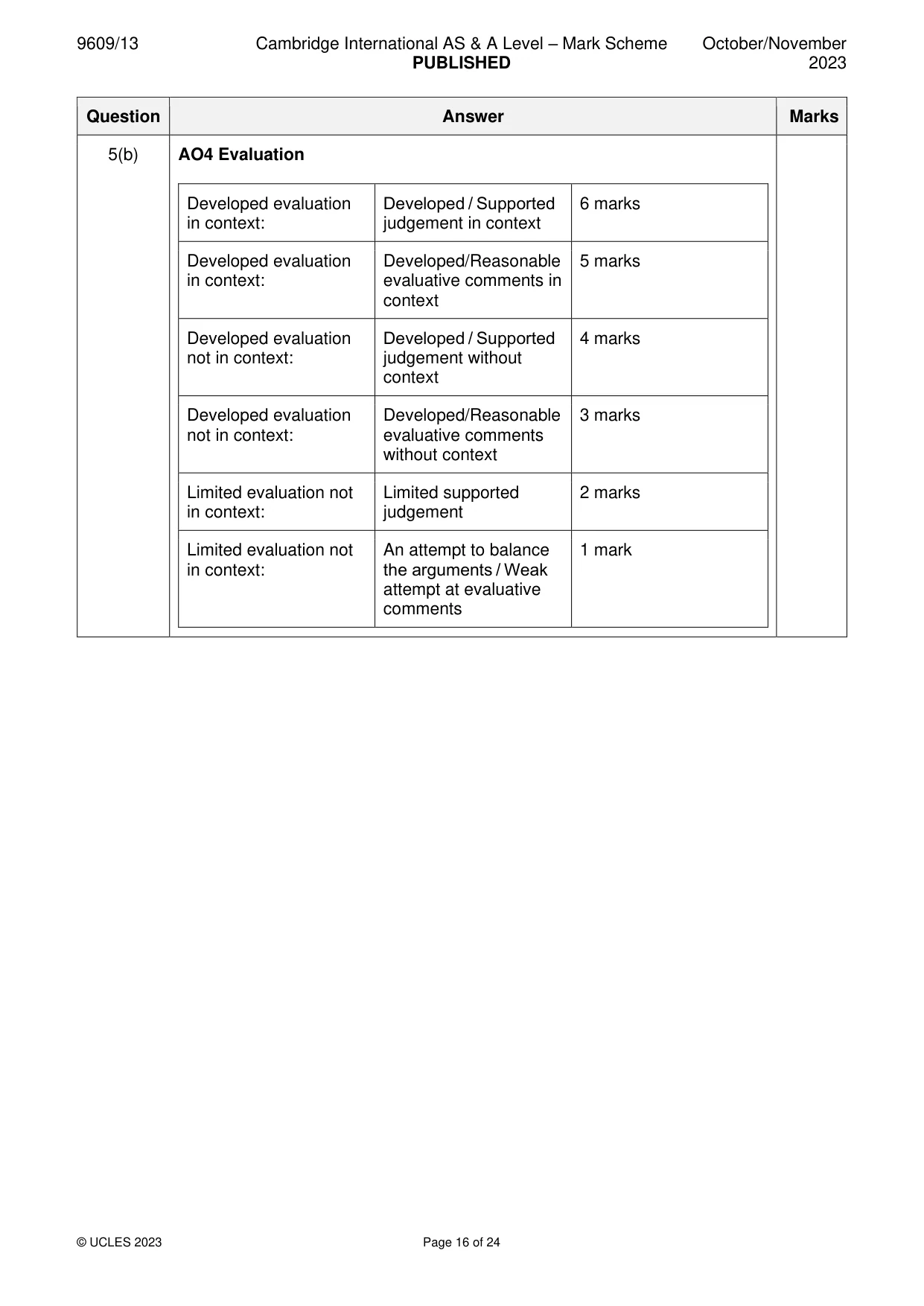
9609/13 Cambridge International AS & A Level – Mark Scheme PUBLISHED October/November 2023 © UCLES 2023 Page 16 of 24 Question Answer Marks 5(b) AO4 Evaluation Developed evaluation in context: Developed / Supported judgement in context 6 marks Developed evaluation in context: Developed/Reasonable evaluative comments in context 5 marks Developed evaluation not in context: Developed / Supported judgement without context 4 marks Developed evaluation not in context: Developed/Reasonable evaluative comments without context 3 marks Limited evaluation not in context: Limited supported judgement 2 marks Limited evaluation not in context: An attempt to balance the arguments / Weak attempt at evaluative comments 1 mark
Mark scheme, page 17
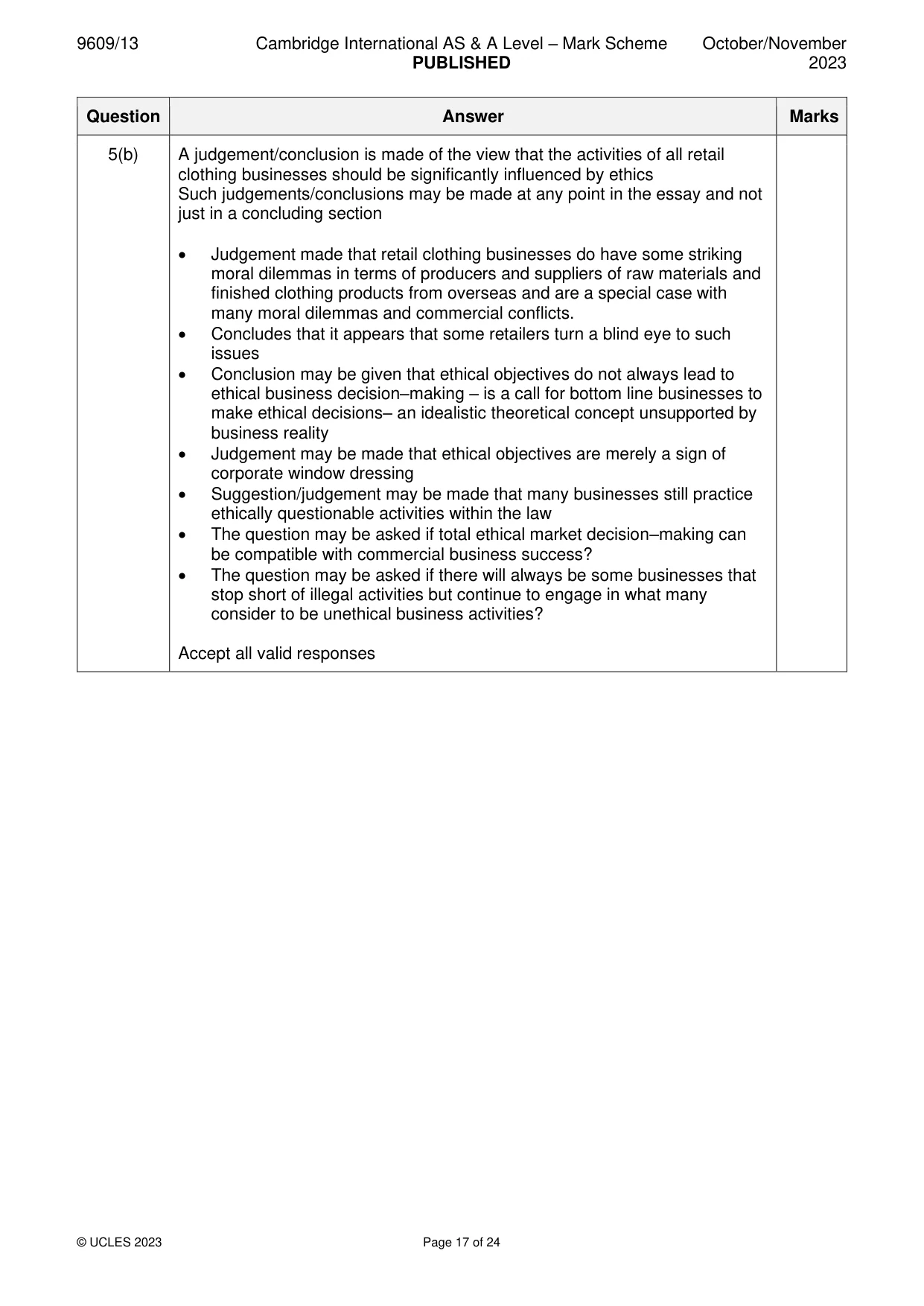
9609/13 Cambridge International AS & A Level – Mark Scheme PUBLISHED October/November 2023 © UCLES 2023 Page 17 of 24 Question Answer Marks 5(b) A judgement/conclusion is made of the view that the activities of all retail clothing businesses should be significantly influenced by ethics Such judgements/conclusions may be made at any point in the essay and not just in a concluding section • Judgement made that retail clothing businesses do have some striking moral dilemmas in terms of producers and suppliers of raw materials and finished clothing products from overseas and are a special case with many moral dilemmas and commercial conflicts. • Concludes that it appears that some retailers turn a blind eye to such issues • Conclusion may be given that ethical objectives do not always lead to ethical business decision–making – is a call for bottom line businesses to make ethical decisions– an idealistic theoretical concept unsupported by business reality • Judgement may be made that ethical objectives are merely a sign of corporate window dressing • Suggestion/judgement may be made that many businesses still practice ethically questionable activities within the law • The question may be asked if total ethical market decision–making can be compatible with commercial business success? • The question may be asked if there will always be some businesses that stop short of illegal activities but continue to engage in what many consider to be unethical business activities? Accept all valid responses
Mark scheme, page 18
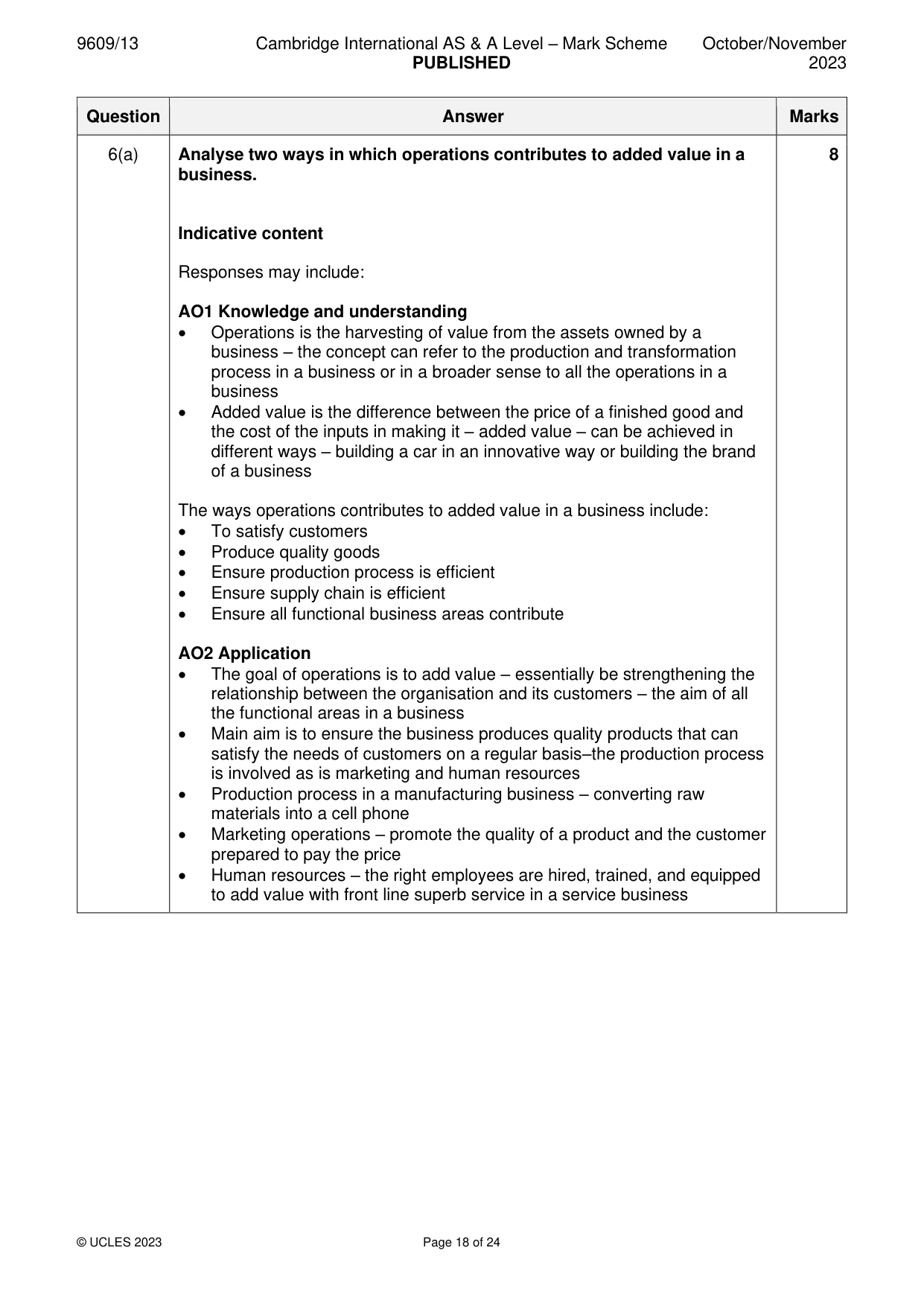
9609/13 Cambridge International AS & A Level – Mark Scheme PUBLISHED October/November 2023 © UCLES 2023 Page 18 of 24 Question Answer Marks 6(a) Analyse two ways in which operations contributes to added value in a business. Indicative content Responses may include: AO1 Knowledge and understanding • Operations is the harvesting of value from the assets owned by a business – the concept can refer to the production and transformation process in a business or in a broader sense to all the operations in a business • Added value is the difference between the price of a finished good and the cost of the inputs in making it – added value – can be achieved in different ways – building a car in an innovative way or building the brand of a business The ways operations contributes to added value in a business include: • To satisfy customers • Produce quality goods • Ensure production process is efficient • Ensure supply chain is efficient • Ensure all functional business areas contribute AO2 Application • The goal of operations is to add value – essentially be strengthening the relationship between the organisation and its customers – the aim of all the functional areas in a business • Main aim is to ensure the business produces quality products that can satisfy the needs of customers on a regular basis–the production process is involved as is marketing and human resources • Production process in a manufacturing business – converting raw materials into a cell phone • Marketing operations – promote the quality of a product and the customer prepared to pay the price • Human resources – the right employees are hired, trained, and equipped to add value with front line superb service in a service business 8
Mark scheme, page 19
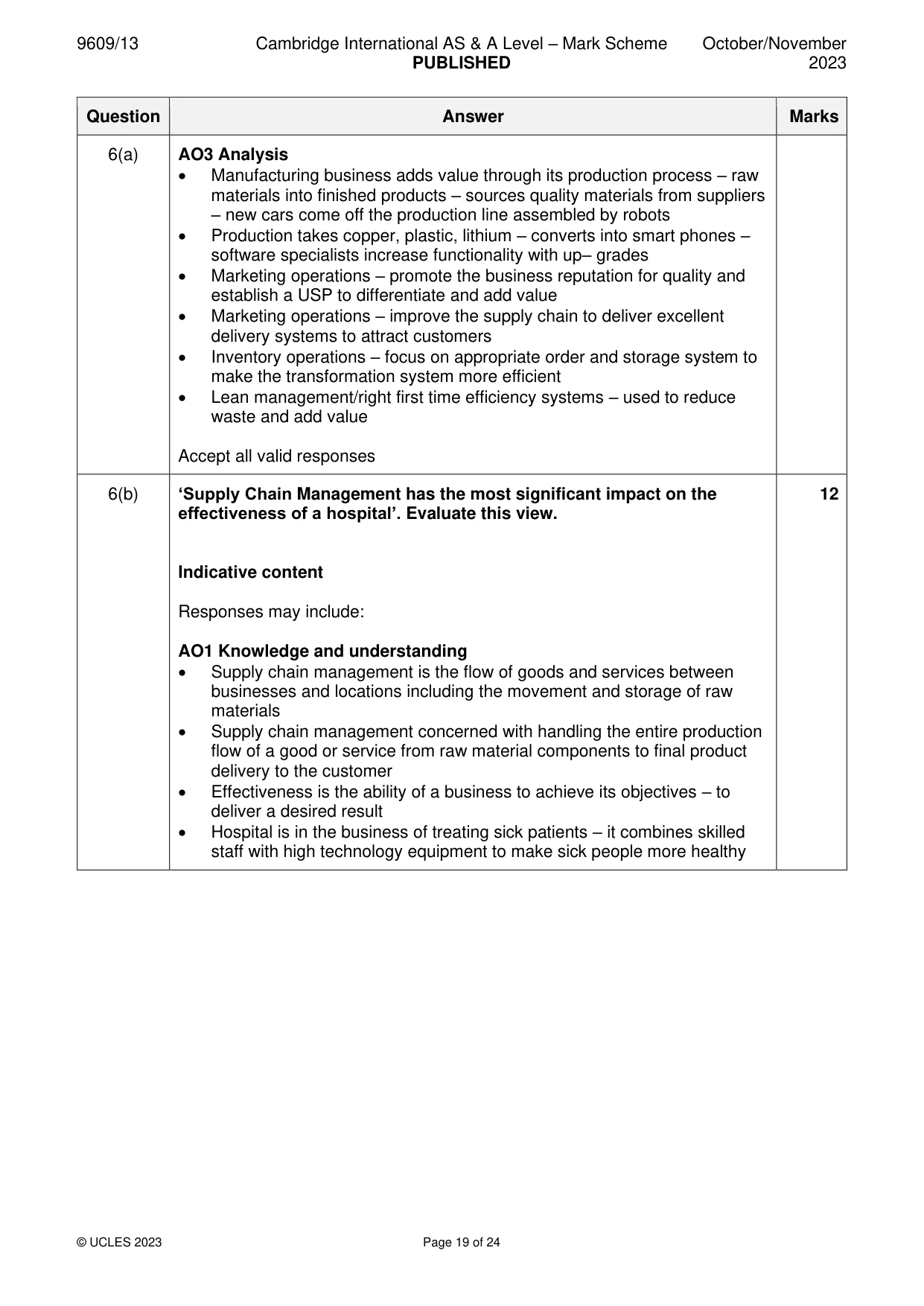
9609/13 Cambridge International AS & A Level – Mark Scheme PUBLISHED October/November 2023 © UCLES 2023 Page 19 of 24 Question Answer Marks 6(a) AO3 Analysis • Manufacturing business adds value through its production process – raw materials into finished products – sources quality materials from suppliers – new cars come off the production line assembled by robots • Production takes copper, plastic, lithium – converts into smart phones – software specialists increase functionality with up– grades • Marketing operations – promote the business reputation for quality and establish a USP to differentiate and add value • Marketing operations – improve the supply chain to deliver excellent delivery systems to attract customers • Inventory operations – focus on appropriate order and storage system to make the transformation system more efficient • Lean management/right first time efficiency systems – used to reduce waste and add value Accept all valid responses 6(b) ‘Supply Chain Management has the most significant impact on the effectiveness of a hospital’. Evaluate this view. Indicative content Responses may include: AO1 Knowledge and understanding • Supply chain management is the flow of goods and services between businesses and locations including the movement and storage of raw materials • Supply chain management concerned with handling the entire production flow of a good or service from raw material components to final product delivery to the customer • Effectiveness is the ability of a business to achieve its objectives – to deliver a desired result • Hospital is in the business of treating sick patients – it combines skilled staff with high technology equipment to make sick people more healthy 12
Mark scheme, page 20
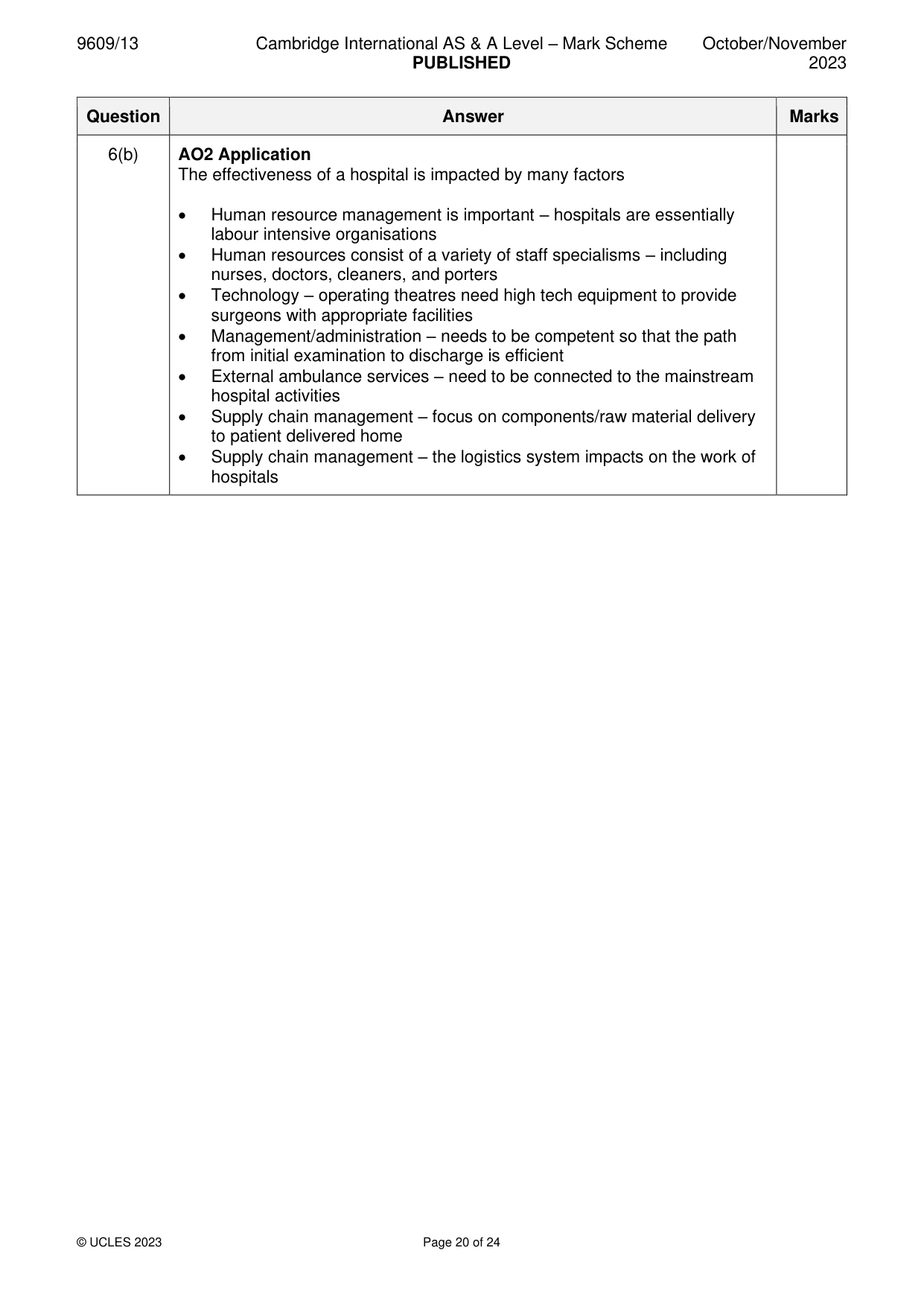
9609/13 Cambridge International AS & A Level – Mark Scheme PUBLISHED October/November 2023 © UCLES 2023 Page 20 of 24 Question Answer Marks 6(b) AO2 Application The effectiveness of a hospital is impacted by many factors • Human resource management is important – hospitals are essentially labour intensive organisations • Human resources consist of a variety of staff specialisms – including nurses, doctors, cleaners, and porters • Technology – operating theatres need high tech equipment to provide surgeons with appropriate facilities • Management/administration – needs to be competent so that the path from initial examination to discharge is efficient • External ambulance services – need to be connected to the mainstream hospital activities • Supply chain management – focus on components/raw material delivery to patient delivered home • Supply chain management – the logistics system impacts on the work of hospitals
Mark scheme, page 21
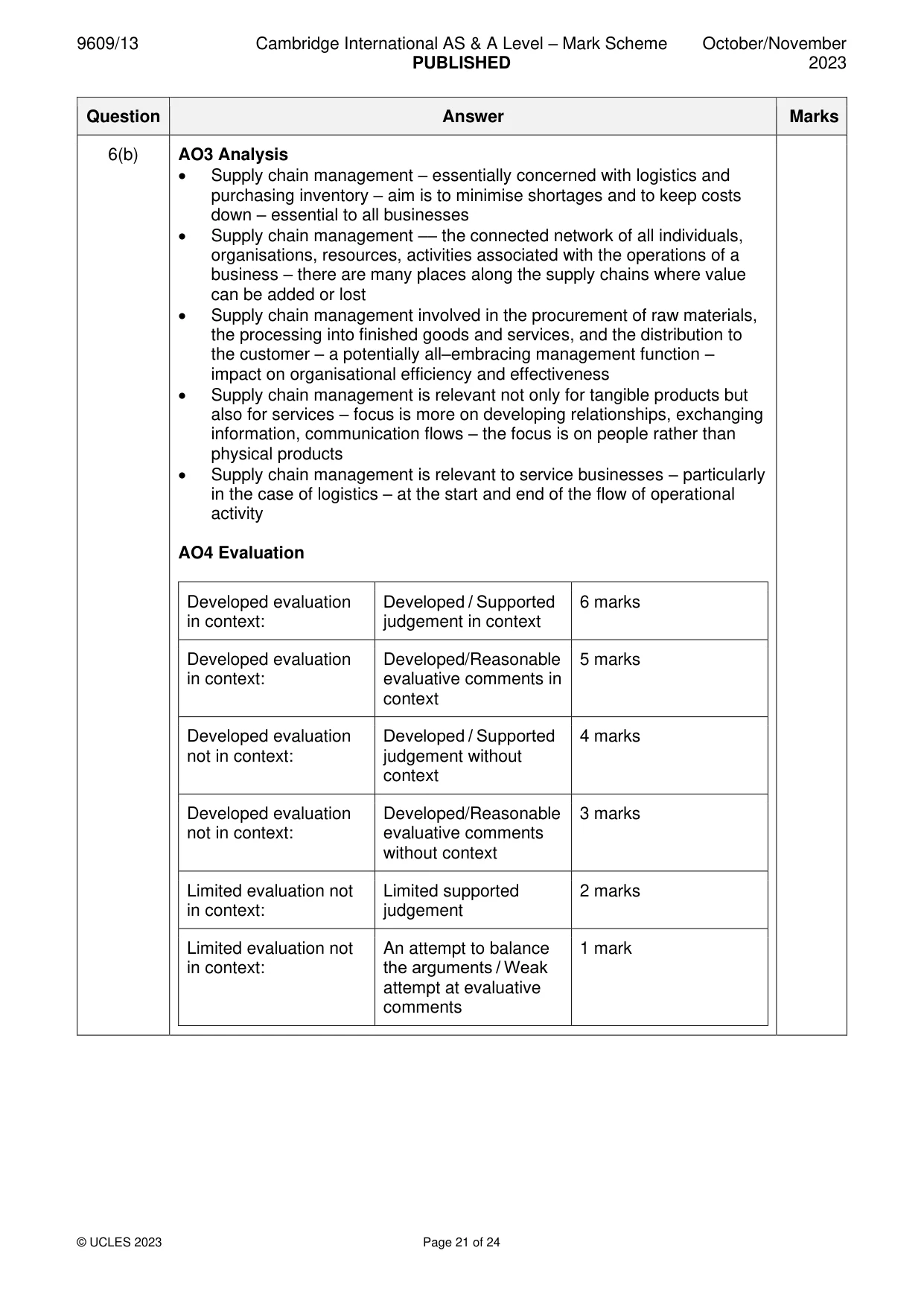
9609/13 Cambridge International AS & A Level – Mark Scheme PUBLISHED October/November 2023 © UCLES 2023 Page 21 of 24 Question Answer Marks 6(b) AO3 Analysis • Supply chain management – essentially concerned with logistics and purchasing inventory – aim is to minimise shortages and to keep costs down – essential to all businesses • Supply chain management –– the connected network of all individuals, organisations, resources, activities associated with the operations of a business – there are many places along the supply chains where value can be added or lost • Supply chain management involved in the procurement of raw materials, the processing into finished goods and services, and the distribution to the customer – a potentially all–embracing management function – impact on organisational efficiency and effectiveness • Supply chain management is relevant not only for tangible products but also for services – focus is more on developing relationships, exchanging information, communication flows – the focus is on people rather than physical products • Supply chain management is relevant to service businesses – particularly in the case of logistics – at the start and end of the flow of operational activity AO4 Evaluation Developed evaluation in context: Developed / Supported judgement in context 6 marks Developed evaluation in context: Developed/Reasonable evaluative comments in context 5 marks Developed evaluation not in context: Developed / Supported judgement without context 4 marks Developed evaluation not in context: Developed/Reasonable evaluative comments without context 3 marks Limited evaluation not in context: Limited supported judgement 2 marks Limited evaluation not in context: An attempt to balance the arguments / Weak attempt at evaluative comments 1 mark
Mark scheme, page 22
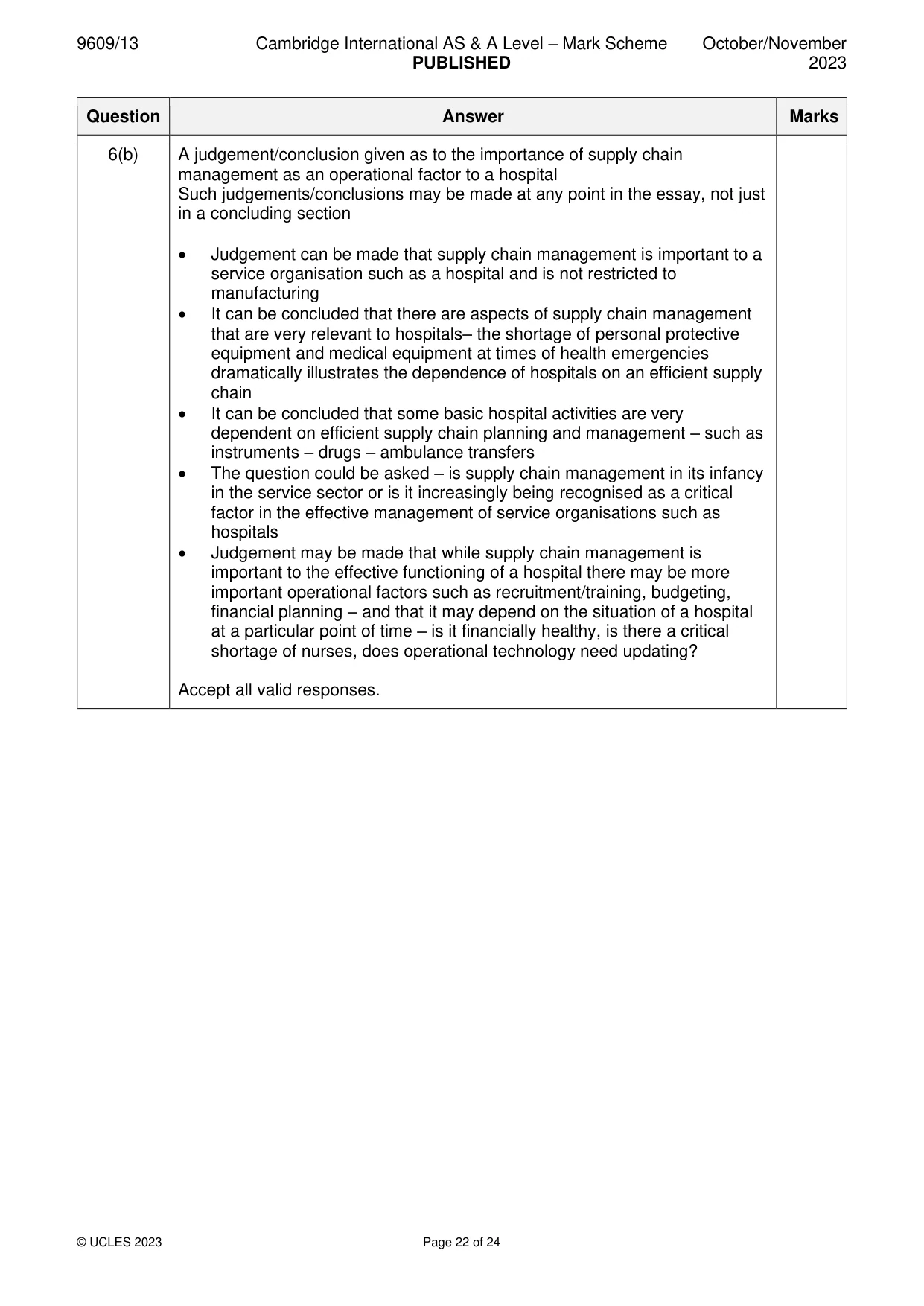
9609/13 Cambridge International AS & A Level – Mark Scheme PUBLISHED October/November 2023 © UCLES 2023 Page 22 of 24 Question Answer Marks 6(b) A judgement/conclusion given as to the importance of supply chain management as an operational factor to a hospital Such judgements/conclusions may be made at any point in the essay, not just in a concluding section • Judgement can be made that supply chain management is important to a service organisation such as a hospital and is not restricted to manufacturing • It can be concluded that there are aspects of supply chain management that are very relevant to hospitals– the shortage of personal protective equipment and medical equipment at times of health emergencies dramatically illustrates the dependence of hospitals on an efficient supply chain • It can be concluded that some basic hospital activities are very dependent on efficient supply chain planning and management – such as instruments – drugs – ambulance transfers • The question could be asked – is supply chain management in its infancy in the service sector or is it increasingly being recognised as a critical factor in the effective management of service organisations such as hospitals • Judgement may be made that while supply chain management is important to the effective functioning of a hospital there may be more important operational factors such as recruitment/training, budgeting, financial planning – and that it may depend on the situation of a hospital at a particular point of time – is it financially healthy, is there a critical shortage of nurses, does operational technology need updating? Accept all valid responses.
Mark scheme, page 23
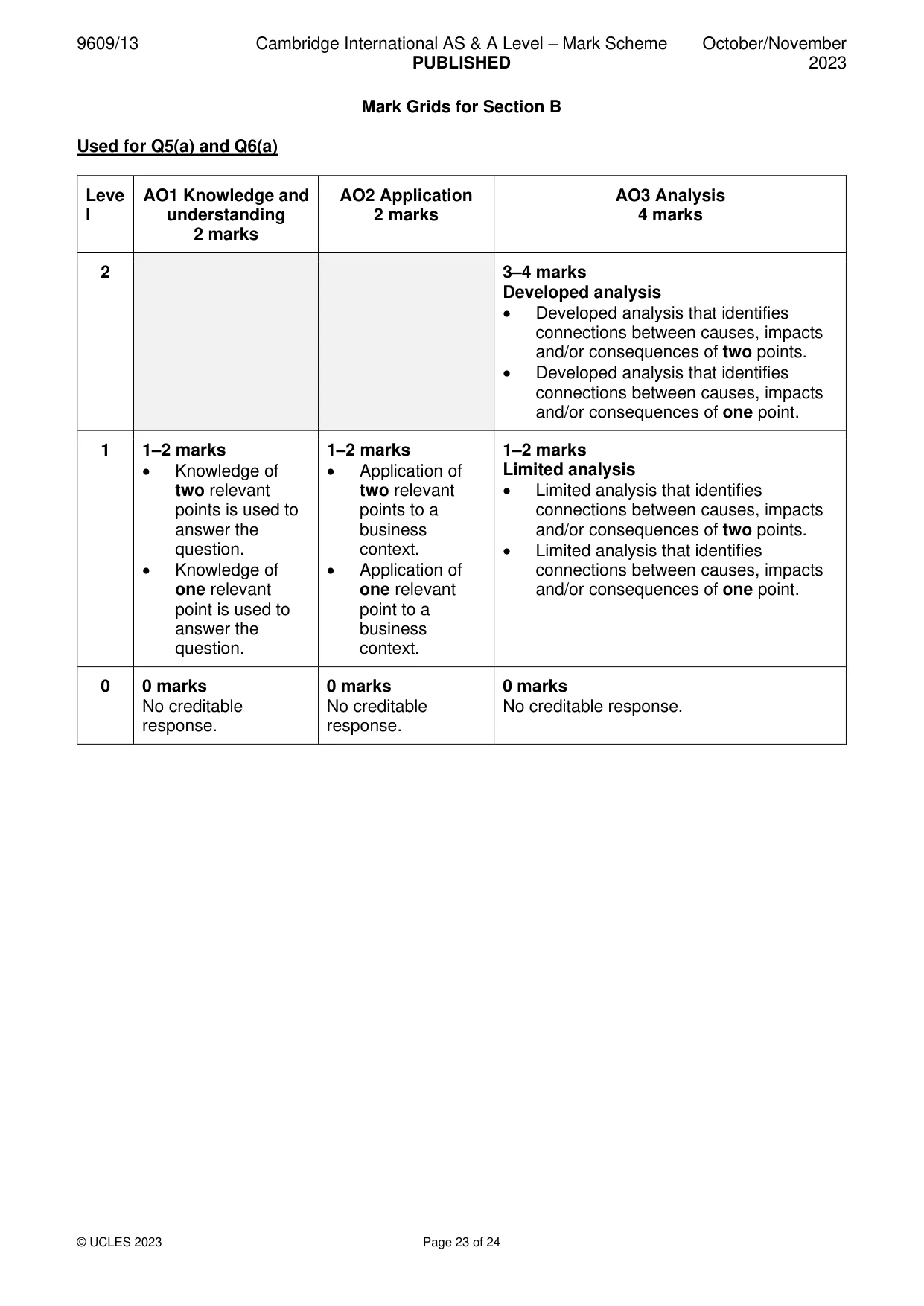
9609/13 Cambridge International AS & A Level – Mark Scheme PUBLISHED October/November 2023 © UCLES 2023 Page 23 of 24 Mark Grids for Section B Used for Q5(a) and Q6(a) Leve l AO1 Knowledge and understanding 2 marks AO2 Application 2 marks AO3 Analysis 4 marks 2 3–4 marks Developed analysis • Developed analysis that identifies connections between causes, impacts and/or consequences of two points. • Developed analysis that identifies connections between causes, impacts and/or consequences of one point. 1 1–2 marks • Knowledge of two relevant points is used to answer the question. • Knowledge of one relevant point is used to answer the question. 1–2 marks • Application of two relevant points to a business context. • Application of one relevant point to a business context. 1–2 marks Limited analysis • Limited analysis that identifies connections between causes, impacts and/or consequences of two points. • Limited analysis that identifies connections between causes, impacts and/or consequences of one point. 0 0 marks No creditable response. 0 marks No creditable response. 0 marks No creditable response.
Mark scheme, page 24
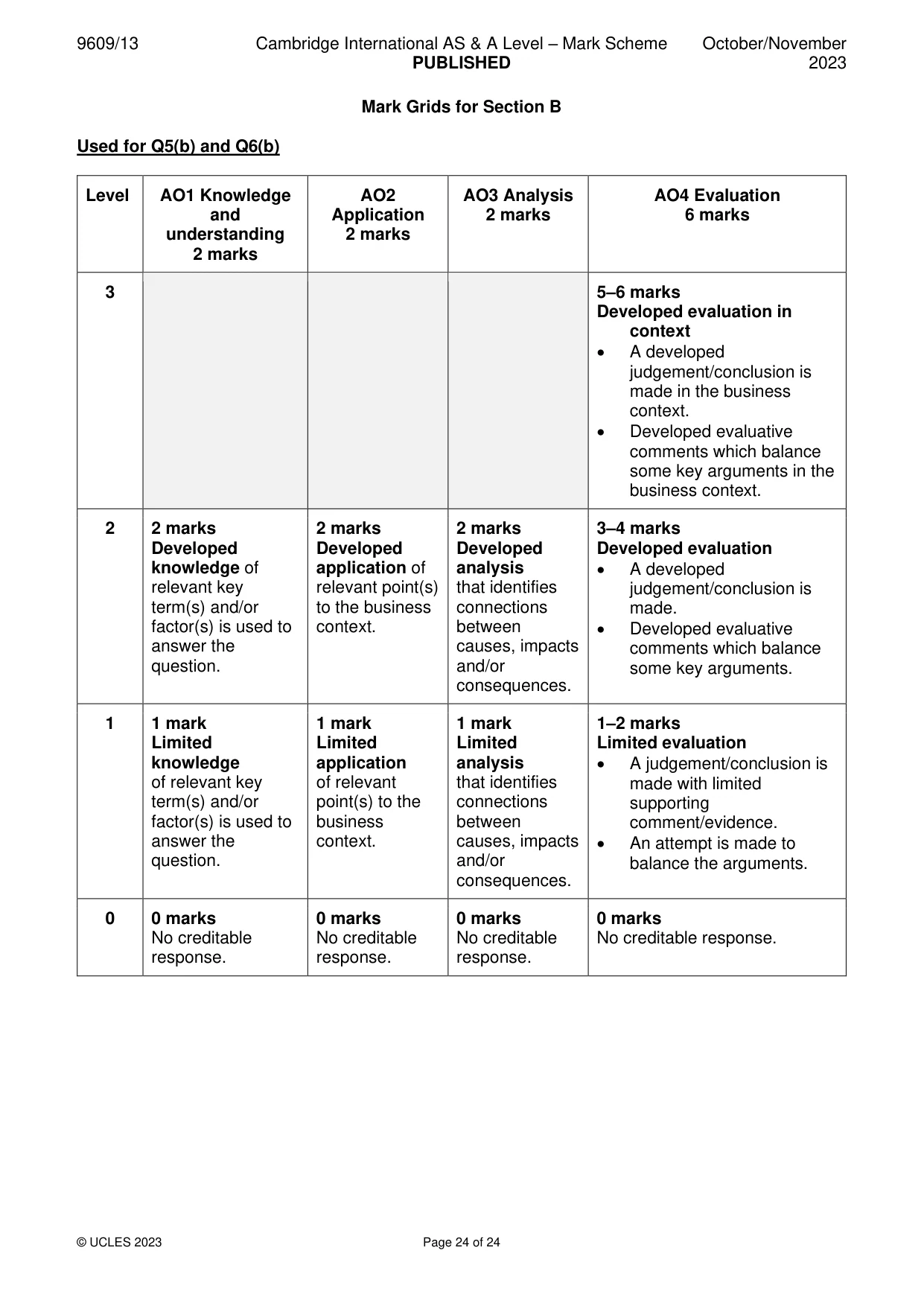
9609/13 Cambridge International AS & A Level – Mark Scheme PUBLISHED October/November 2023 © UCLES 2023 Page 24 of 24 Mark Grids for Section B Used for Q5(b) and Q6(b) Level AO1 Knowledge and understanding 2 marks AO2 Application 2 marks AO3 Analysis 2 marks AO4 Evaluation 6 marks 3 5–6 marks Developed evaluation in context • A developed judgement/conclusion is made in the business context. • Developed evaluative comments which balance some key arguments in the business context. 2 2 marks Developed knowledge of relevant key term(s) and/or factor(s) is used to answer the question. 2 marks Developed application of relevant point(s) to the business context. 2 marks Developed analysis that identifies connections between causes, impacts and/or consequences. 3–4 marks Developed evaluation • A developed judgement/conclusion is made. • Developed evaluative comments which balance some key arguments. 1 1 mark Limited knowledge of relevant key term(s) and/or factor(s) is used to answer the question. 1 mark Limited application of relevant point(s) to the business context. 1 mark Limited analysis that identifies connections between causes, impacts and/or consequences. 1–2 marks Limited evaluation • A judgement/conclusion is made with limited supporting comment/evidence. • An attempt is made to balance the arguments. 0 0 marks No creditable response. 0 marks No creditable response. 0 marks No creditable response. 0 marks No creditable response.
What you needed in this session
Cambridge’s own grade thresholds for 2023 Oct/Nov, Paper 1 · Variant 3. A higher threshold means an easier paper — the bar moves with how the cohort did.