Cambridge A Level Business (for first examination in 2016) 9609 — 2023 May/June Paper 1 · Variant 2
9609/12/M/J/23 · 40 marks · ≈45 min
The question paper and its mark scheme, free to read here and free to download. This is Cambridge’s own paper, exactly as it was sat.
Question paper4 pages


Mark scheme32 pages
Answers below. Sit the paper first if you are practising.
Paper as text
Question paper, page 1
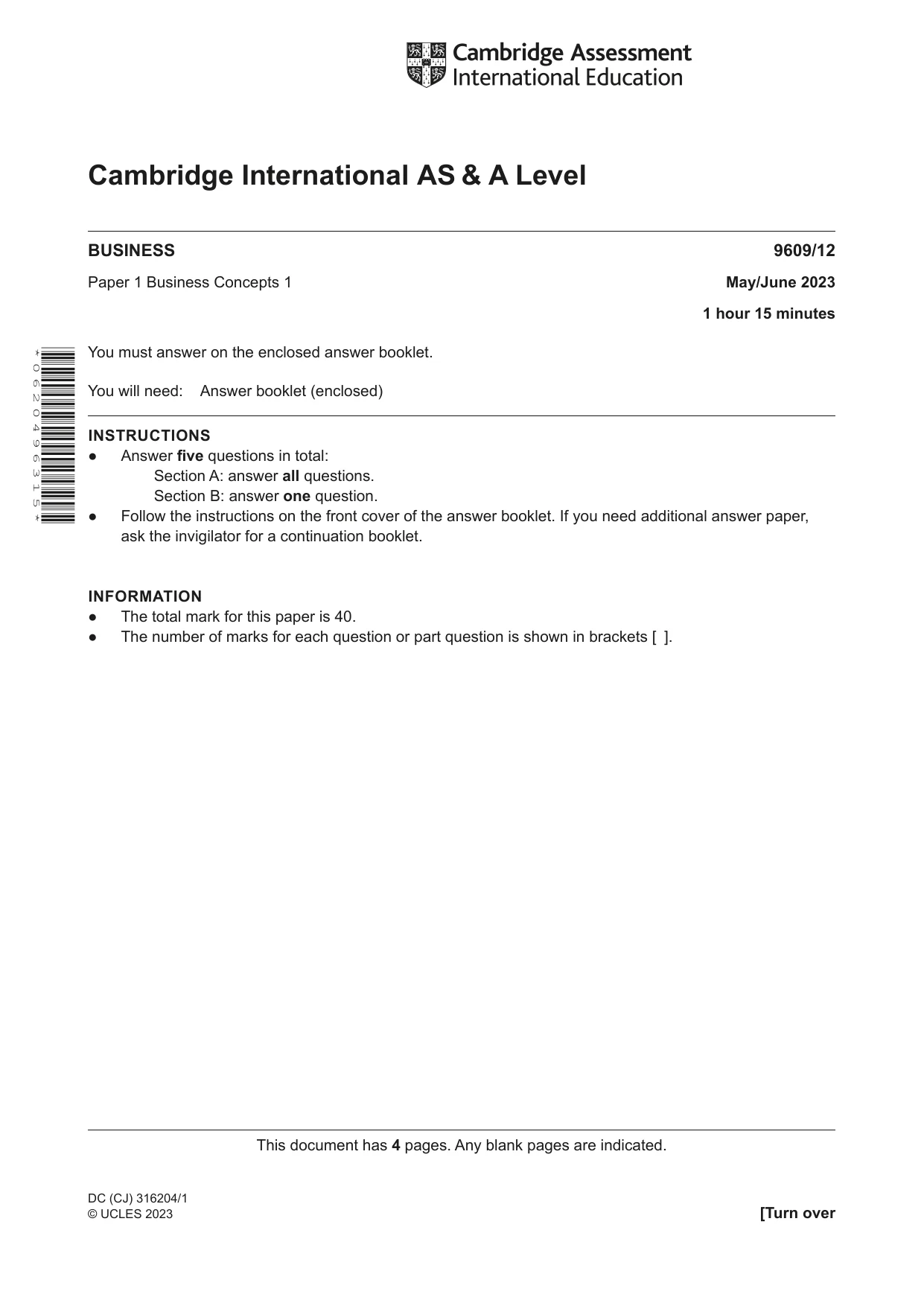
This document has 4 pages. Any blank pages are indicated. [Turn over Cambridge International AS & A Level BUSINESS 9609/12 Paper 1 Business Concepts 1 May/June 2023 1 hour 15 minutes You must answer on the enclosed answer booklet. You will need: Answer booklet (enclosed) INSTRUCTIONS ● Answer five questions in total: Section A: answer all questions. Section B: answer one question. ● Follow the instructions on the front cover of the answer booklet. If you need additional answer paper, ask the invigilator for a continuation booklet. INFORMATION ● The total mark for this paper is 40. ● The number of marks for each question or part question is shown in brackets [ ]. * 0 6 2 0 4 9 6 3 1 5 * DC (CJ) 316204/1 © UCLES 2023
Question paper, page 2
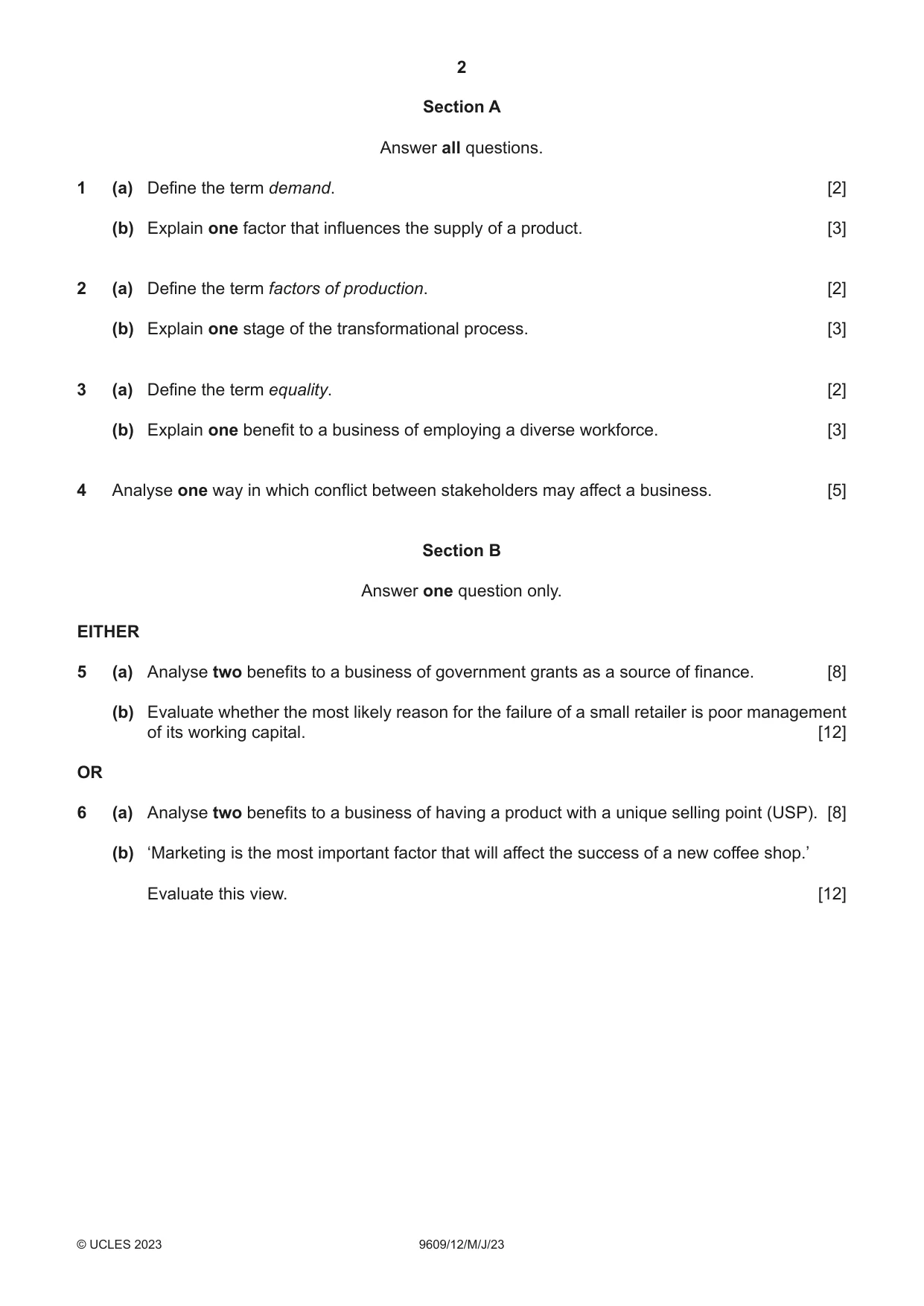
2 9609/12/M/J/23 © UCLES 2023 Section A Answer all questions. 1 (a) Define the term demand. [2] (b) Explain one factor that influences the supply of a product. [3] 2 (a) Define the term factors of production. [2] (b) Explain one stage of the transformational process. [3] 3 (a) Define the term equality. [2] (b) Explain one benefit to a business of employing a diverse workforce. [3] 4 Analyse one way in which conflict between stakeholders may affect a business. [5] Section B Answer one question only. EITHER 5 (a) Analyse two benefits to a business of government grants as a source of finance. [8] (b) Evaluate whether the most likely reason for the failure of a small retailer is poor management of its working capital. [12] OR 6 (a) Analyse two benefits to a business of having a product with a unique selling point (USP). [8] (b) ‘Marketing is the most important factor that will affect the success of a new coffee shop.’ Evaluate this view. [12]
Question paper, page 3
3 9609/12/M/J/23 © UCLES 2023 BLANK PAGE
Question paper, page 4
4 9609/12/M/J/23 © UCLES 2023 Permission to reproduce items where third-party owned material protected by copyright is included has been sought and cleared where possible. Every reasonable effort has been made by the publisher (UCLES) to trace copyright holders, but if any items requiring clearance have unwittingly been included, the publisher will be pleased to make amends at the earliest possible opportunity. To avoid the issue of disclosure of answer-related information to candidates, all copyright acknowledgements are reproduced online in the Cambridge Assessment International Education Copyright Acknowledgements Booklet. This is produced for each series of examinations and is freely available to download at www.cambridgeinternational.org after the live examination series. Cambridge Assessment International Education is part of Cambridge Assessment. Cambridge Assessment is the brand name of the University of Cambridge Local Examinations Syndicate (UCLES), which is a department of the University of Cambridge. BLANK PAGE
Mark scheme, page 1
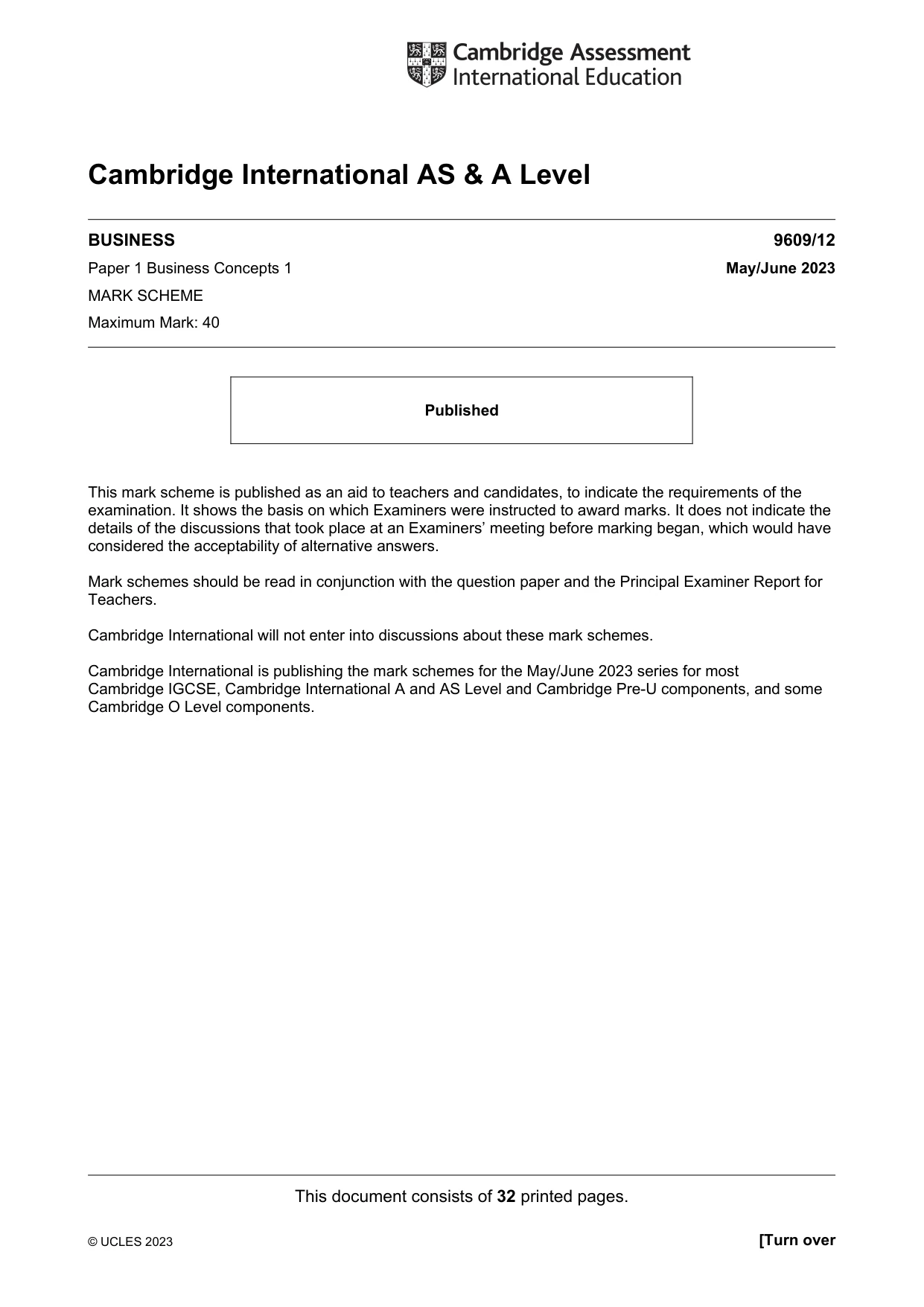
This document consists of 32 printed pages. © UCLES 2023 [Turn over Cambridge International AS & A Level BUSINESS 9609/12 Paper 1 Business Concepts 1 May/June 2023 MARK SCHEME Maximum Mark: 40 Published This mark scheme is published as an aid to teachers and candidates, to indicate the requirements of the examination. It shows the basis on which Examiners were instructed to award marks. It does not indicate the details of the discussions that took place at an Examiners’ meeting before marking began, which would have considered the acceptability of alternative answers. Mark schemes should be read in conjunction with the question paper and the Principal Examiner Report for Teachers. Cambridge International will not enter into discussions about these mark schemes. Cambridge International is publishing the mark schemes for the May/June 2023 series for most Cambridge IGCSE, Cambridge International A and AS Level and Cambridge Pre-U components, and some Cambridge O Level components.
Mark scheme, page 2
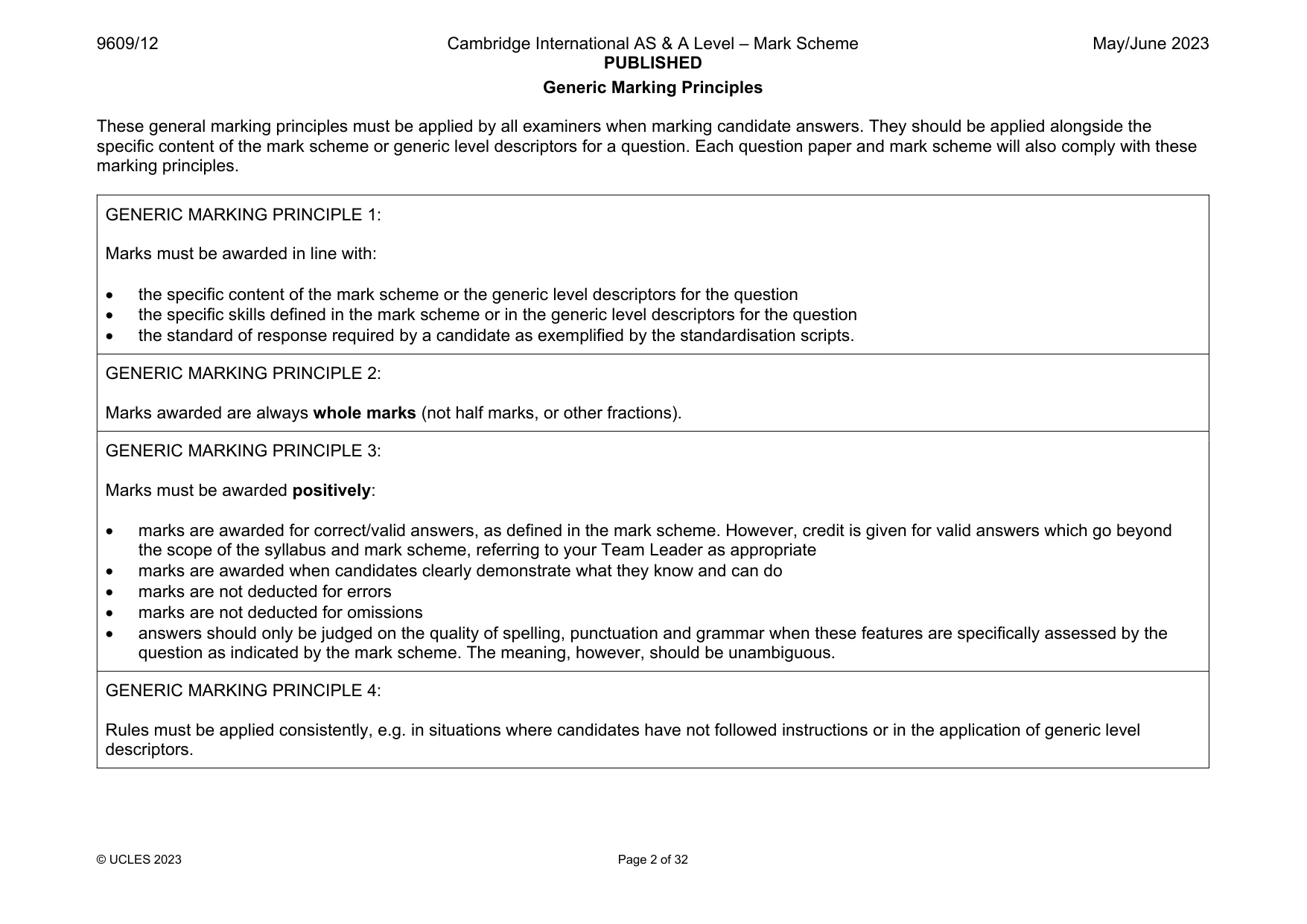
9609/12 Cambridge International AS & A Level – Mark Scheme PUBLISHED May/June 2023 © UCLES 2023 Page 2 of 32 Generic Marking Principles These general marking principles must be applied by all examiners when marking candidate answers. They should be applied alongside the specific content of the mark scheme or generic level descriptors for a question. Each question paper and mark scheme will also comply with these marking principles. GENERIC MARKING PRINCIPLE 1: Marks must be awarded in line with: the specific content of the mark scheme or the generic level descriptors for the question the specific skills defined in the mark scheme or in the generic level descriptors for the question the standard of response required by a candidate as exemplified by the standardisation scripts. GENERIC MARKING PRINCIPLE 2: Marks awarded are always whole marks (not half marks, or other fractions). GENERIC MARKING PRINCIPLE 3: Marks must be awarded positively: marks are awarded for correct/valid answers, as defined in the mark scheme. However, credit is given for valid answers which go beyond the scope of the syllabus and mark scheme, referring to your Team Leader as appropriate marks are awarded when candidates clearly demonstrate what they know and can do marks are not deducted for errors marks are not deducted for omissions answers should only be judged on the quality of spelling, punctuation and grammar when these features are specifically assessed by the question as indicated by the mark scheme. The meaning, however, should be unambiguous. GENERIC MARKING PRINCIPLE 4: Rules must be applied consistently, e.g. in situations where candidates have not followed instructions or in the application of generic level descriptors.
Mark scheme, page 3
9609/12 Cambridge International AS & A Level – Mark Scheme PUBLISHED May/June 2023 © UCLES 2023 Page 3 of 32 GENERIC MARKING PRINCIPLE 5: Marks should be awarded using the full range of marks defined in the mark scheme for the question (however; the use of the full mark range may be limited according to the quality of the candidate responses seen). GENERIC MARKING PRINCIPLE 6: Marks awarded are based solely on the requirements as defined in the mark scheme. Marks should not be awarded with grade thresholds or grade descriptors in mind.
Mark scheme, page 4
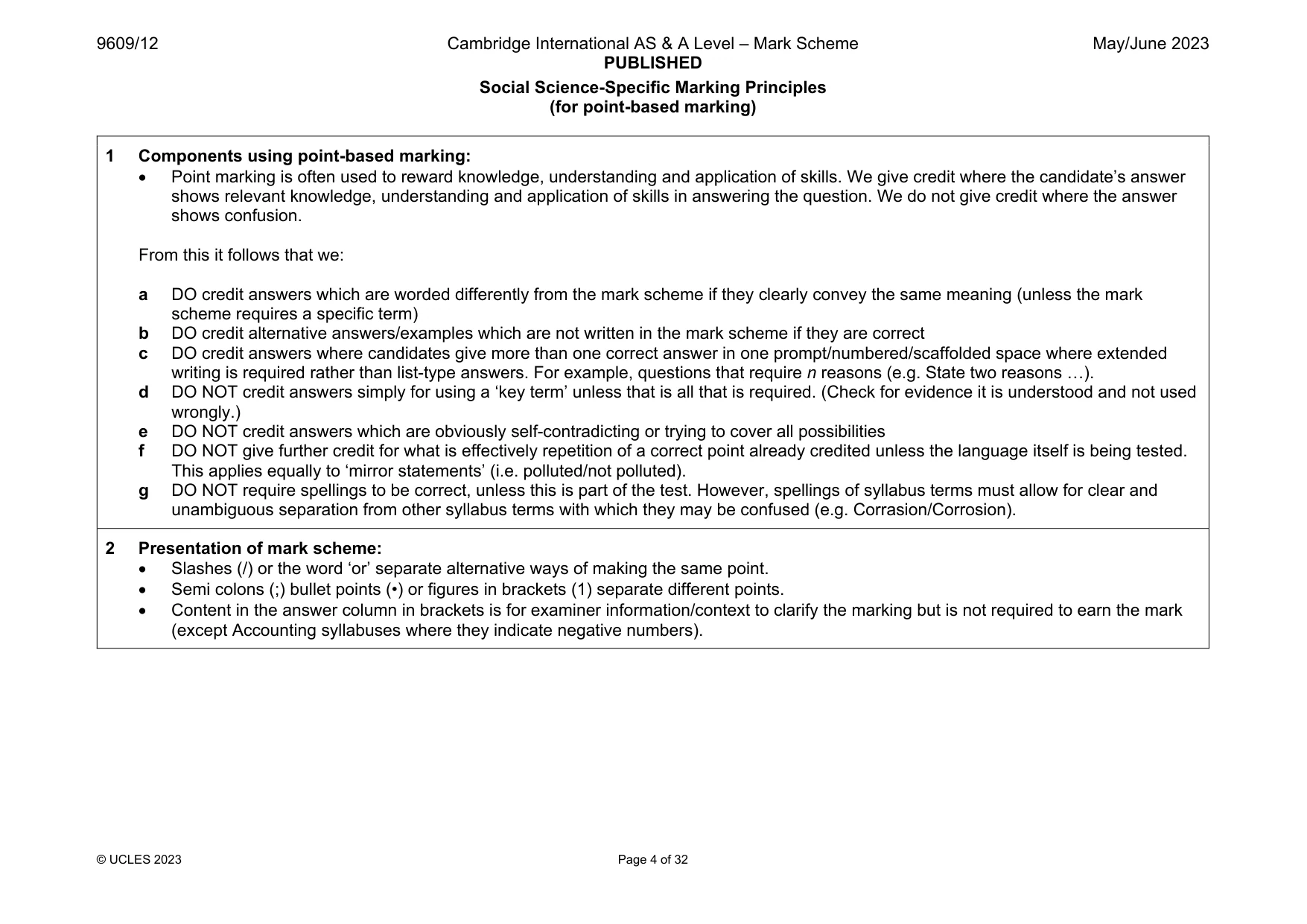
9609/12 Cambridge International AS & A Level – Mark Scheme PUBLISHED May/June 2023 © UCLES 2023 Page 4 of 32 Social Science-Specific Marking Principles (for point-based marking) 1 Components using point-based marking: Point marking is often used to reward knowledge, understanding and application of skills. We give credit where the candidate’s answer shows relevant knowledge, understanding and application of skills in answering the question. We do not give credit where the answer shows confusion. From this it follows that we: a DO credit answers which are worded differently from the mark scheme if they clearly convey the same meaning (unless the mark scheme requires a specific term) b DO credit alternative answers/examples which are not written in the mark scheme if they are correct c DO credit answers where candidates give more than one correct answer in one prompt/numbered/scaffolded space where extended writing is required rather than list-type answers. For example, questions that require n reasons (e.g. State two reasons …). d DO NOT credit answers simply for using a ‘key term’ unless that is all that is required. (Check for evidence it is understood and not used wrongly.) e DO NOT credit answers which are obviously self-contradicting or trying to cover all possibilities f DO NOT give further credit for what is effectively repetition of a correct point already credited unless the language itself is being tested. This applies equally to ‘mirror statements’ (i.e. polluted/not polluted). g DO NOT require spellings to be correct, unless this is part of the test. However, spellings of syllabus terms must allow for clear and unambiguous separation from other syllabus terms with which they may be confused (e.g. Corrasion/Corrosion). 2 Presentation of mark scheme: Slashes (/) or the word ‘or’ separate alternative ways of making the same point. Semi colons (;) bullet points (•) or figures in brackets (1) separate different points. Content in the answer column in brackets is for examiner information/context to clarify the marking but is not required to earn the mark (except Accounting syllabuses where they indicate negative numbers).
Mark scheme, page 5
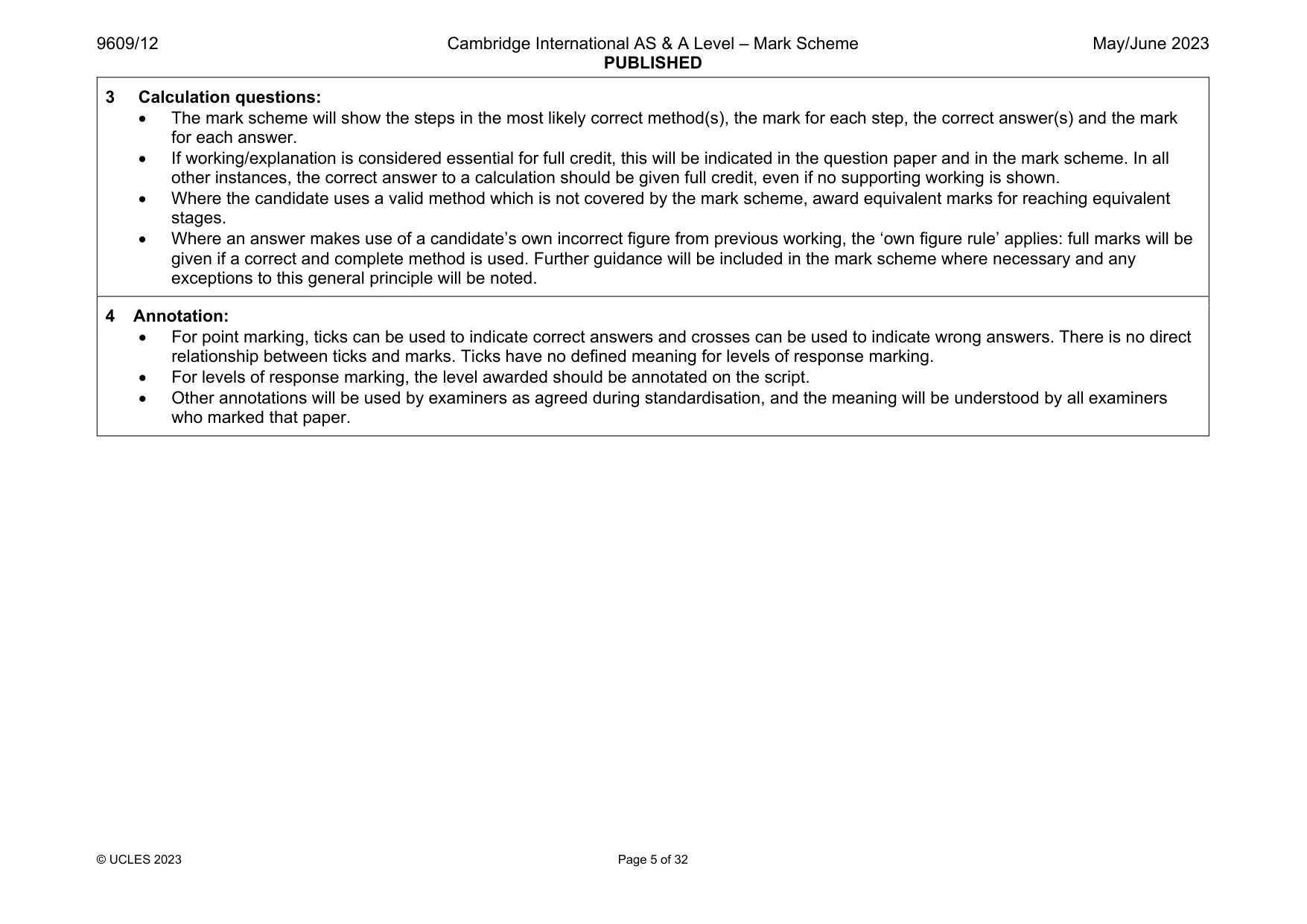
9609/12 Cambridge International AS & A Level – Mark Scheme PUBLISHED May/June 2023 © UCLES 2023 Page 5 of 32 3 Calculation questions: The mark scheme will show the steps in the most likely correct method(s), the mark for each step, the correct answer(s) and the mark for each answer. If working/explanation is considered essential for full credit, this will be indicated in the question paper and in the mark scheme. In all other instances, the correct answer to a calculation should be given full credit, even if no supporting working is shown. Where the candidate uses a valid method which is not covered by the mark scheme, award equivalent marks for reaching equivalent stages. Where an answer makes use of a candidate’s own incorrect figure from previous working, the ‘own figure rule’ applies: full marks will be given if a correct and complete method is used. Further guidance will be included in the mark scheme where necessary and any exceptions to this general principle will be noted. 4 Annotation: For point marking, ticks can be used to indicate correct answers and crosses can be used to indicate wrong answers. There is no direct relationship between ticks and marks. Ticks have no defined meaning for levels of response marking. For levels of response marking, the level awarded should be annotated on the script. Other annotations will be used by examiners as agreed during standardisation, and the meaning will be understood by all examiners who marked that paper.
Mark scheme, page 6
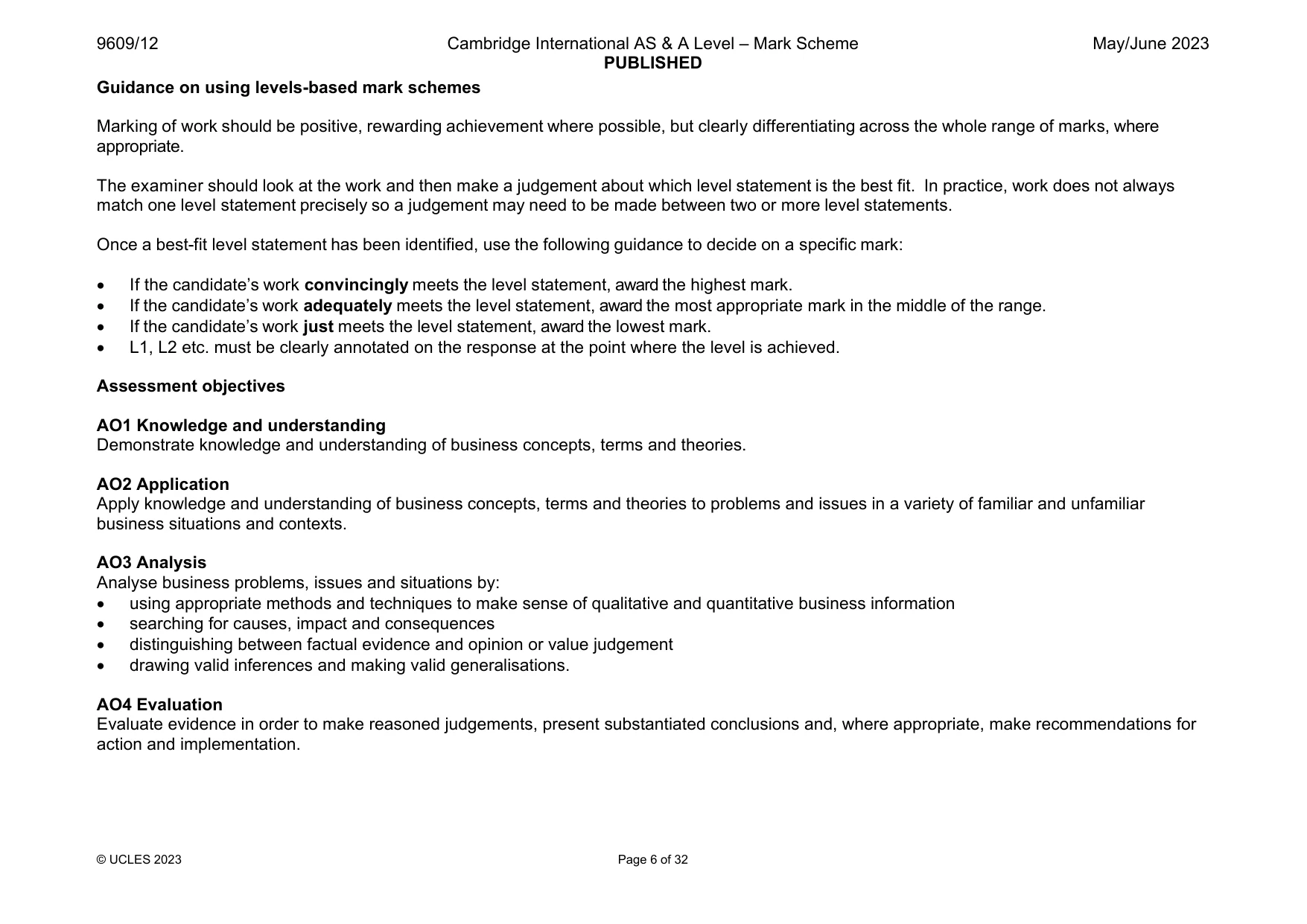
9609/12 Cambridge International AS & A Level – Mark Scheme PUBLISHED May/June 2023 © UCLES 2023 Page 6 of 32 Guidance on using levels-based mark schemes Marking of work should be positive, rewarding achievement where possible, but clearly differentiating across the whole range of marks, where appropriate. The examiner should look at the work and then make a judgement about which level statement is the best fit. In practice, work does not always match one level statement precisely so a judgement may need to be made between two or more level statements. Once a best-fit level statement has been identified, use the following guidance to decide on a specific mark: If the candidate’s work convincingly meets the level statement, award the highest mark. If the candidate’s work adequately meets the level statement, award the most appropriate mark in the middle of the range. If the candidate’s work just meets the level statement, award the lowest mark. L1, L2 etc. must be clearly annotated on the response at the point where the level is achieved. Assessment objectives AO1 Knowledge and understanding Demonstrate knowledge and understanding of business concepts, terms and theories. AO2 Application Apply knowledge and understanding of business concepts, terms and theories to problems and issues in a variety of familiar and unfamiliar business situations and contexts. AO3 Analysis Analyse business problems, issues and situations by: using appropriate methods and techniques to make sense of qualitative and quantitative business information searching for causes, impact and consequences distinguishing between factual evidence and opinion or value judgement drawing valid inferences and making valid generalisations. AO4 Evaluation Evaluate evidence in order to make reasoned judgements, present substantiated conclusions and, where appropriate, make recommendations for action and implementation.
Mark scheme, page 7
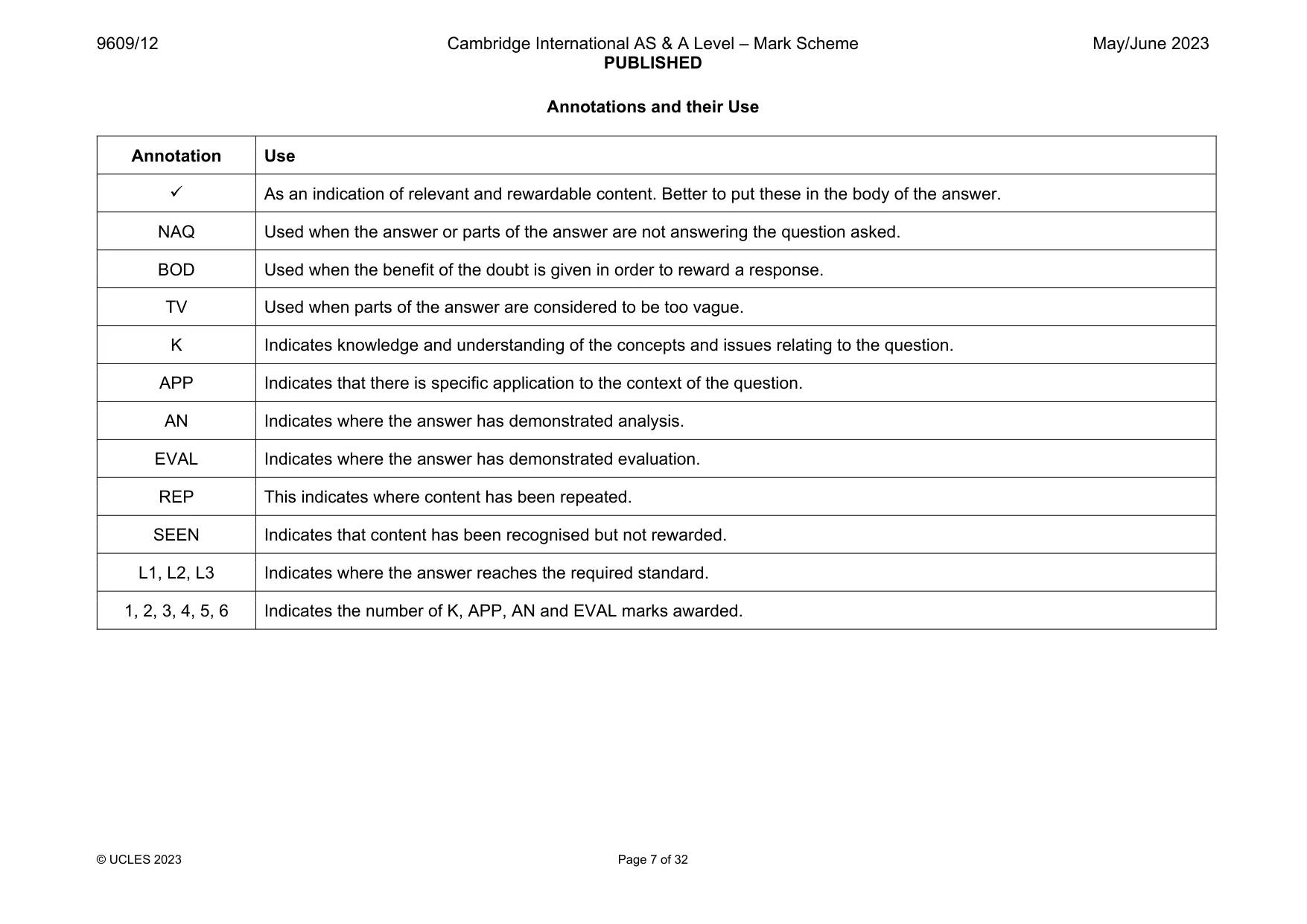
9609/12 Cambridge International AS & A Level – Mark Scheme PUBLISHED May/June 2023 © UCLES 2023 Page 7 of 32 Annotations and their Use Annotation Use As an indication of relevant and rewardable content. Better to put these in the body of the answer. NAQ Used when the answer or parts of the answer are not answering the question asked. BOD Used when the benefit of the doubt is given in order to reward a response. TV Used when parts of the answer are considered to be too vague. K Indicates knowledge and understanding of the concepts and issues relating to the question. APP Indicates that there is specific application to the context of the question. AN Indicates where the answer has demonstrated analysis. EVAL Indicates where the answer has demonstrated evaluation. REP This indicates where content has been repeated. SEEN Indicates that content has been recognised but not rewarded. L1, L2, L3 Indicates where the answer reaches the required standard. 1, 2, 3, 4, 5, 6 Indicates the number of K, APP, AN and EVAL marks awarded.
Mark scheme, page 8
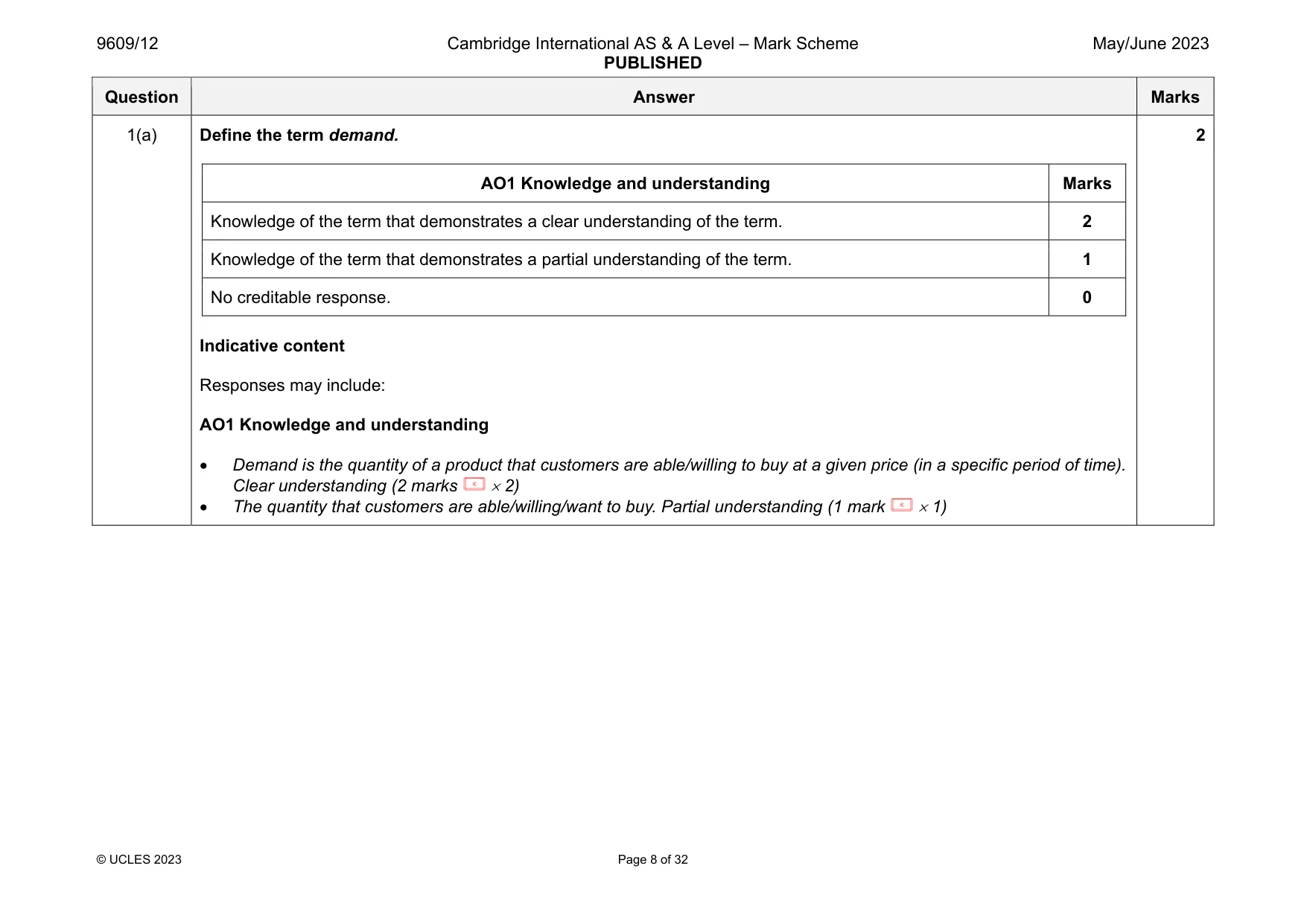
9609/12 Cambridge International AS & A Level – Mark Scheme PUBLISHED May/June 2023 © UCLES 2023 Page 8 of 32 Question Answer Marks 1(a) Define the term demand. AO1 Knowledge and understanding Marks Knowledge of the term that demonstrates a clear understanding of the term. 2 Knowledge of the term that demonstrates a partial understanding of the term. 1 No creditable response. 0 Indicative content Responses may include: AO1 Knowledge and understanding Demand is the quantity of a product that customers are able/willing to buy at a given price (in a specific period of time). Clear understanding (2 marks 2) The quantity that customers are able/willing/want to buy. Partial understanding (1 mark 1) 2
Mark scheme, page 9
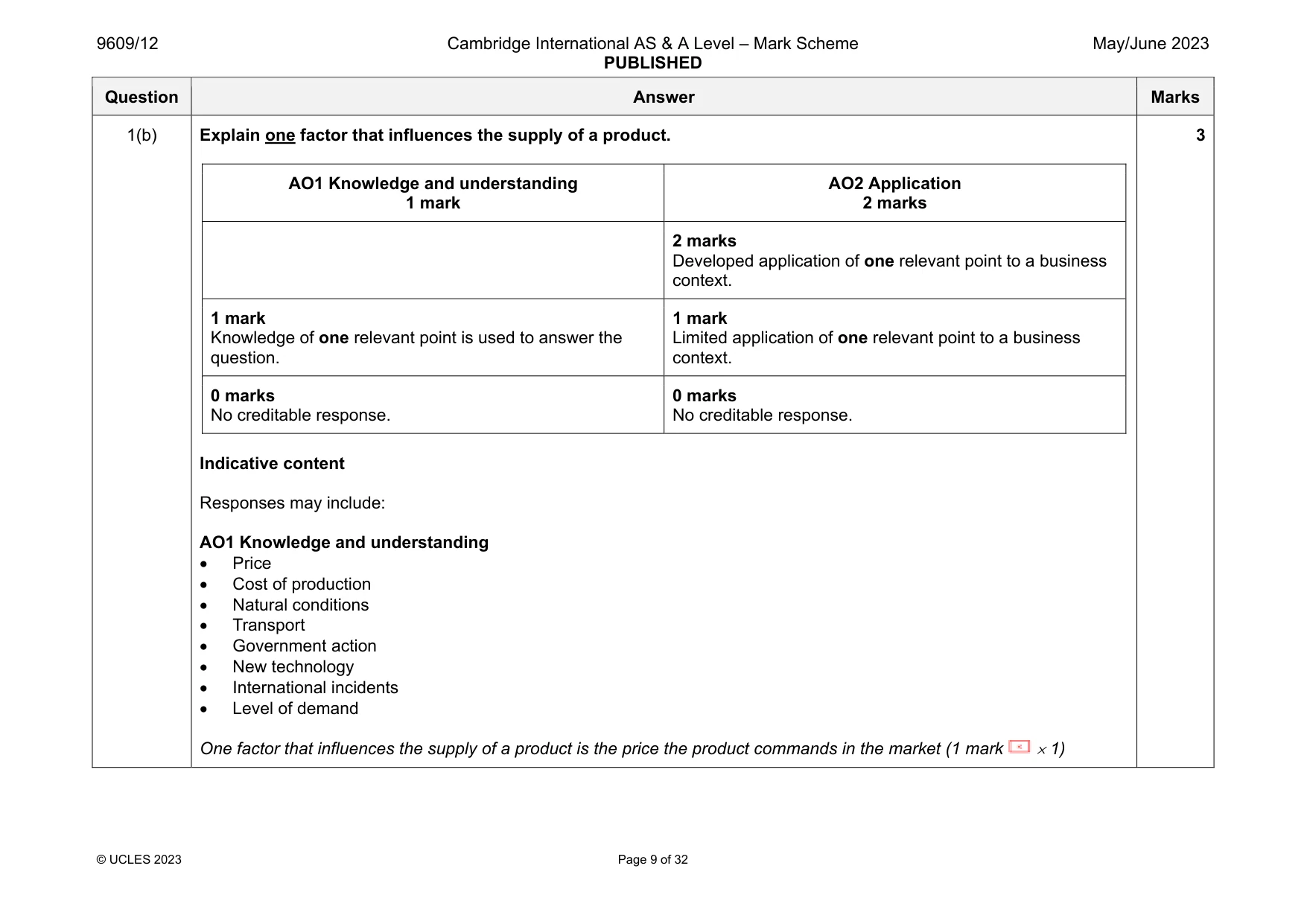
9609/12 Cambridge International AS & A Level – Mark Scheme PUBLISHED May/June 2023 © UCLES 2023 Page 9 of 32 Question Answer Marks 1(b) Explain one factor that influences the supply of a product. AO1 Knowledge and understanding 1 mark AO2 Application 2 marks 2 marks Developed application of one relevant point to a business context. 1 mark Knowledge of one relevant point is used to answer the question. 1 mark Limited application of one relevant point to a business context. 0 marks No creditable response. 0 marks No creditable response. Indicative content Responses may include: AO1 Knowledge and understanding Price Cost of production Natural conditions Transport Government action New technology International incidents Level of demand One factor that influences the supply of a product is the price the product commands in the market (1 mark 1) 3
Mark scheme, page 10
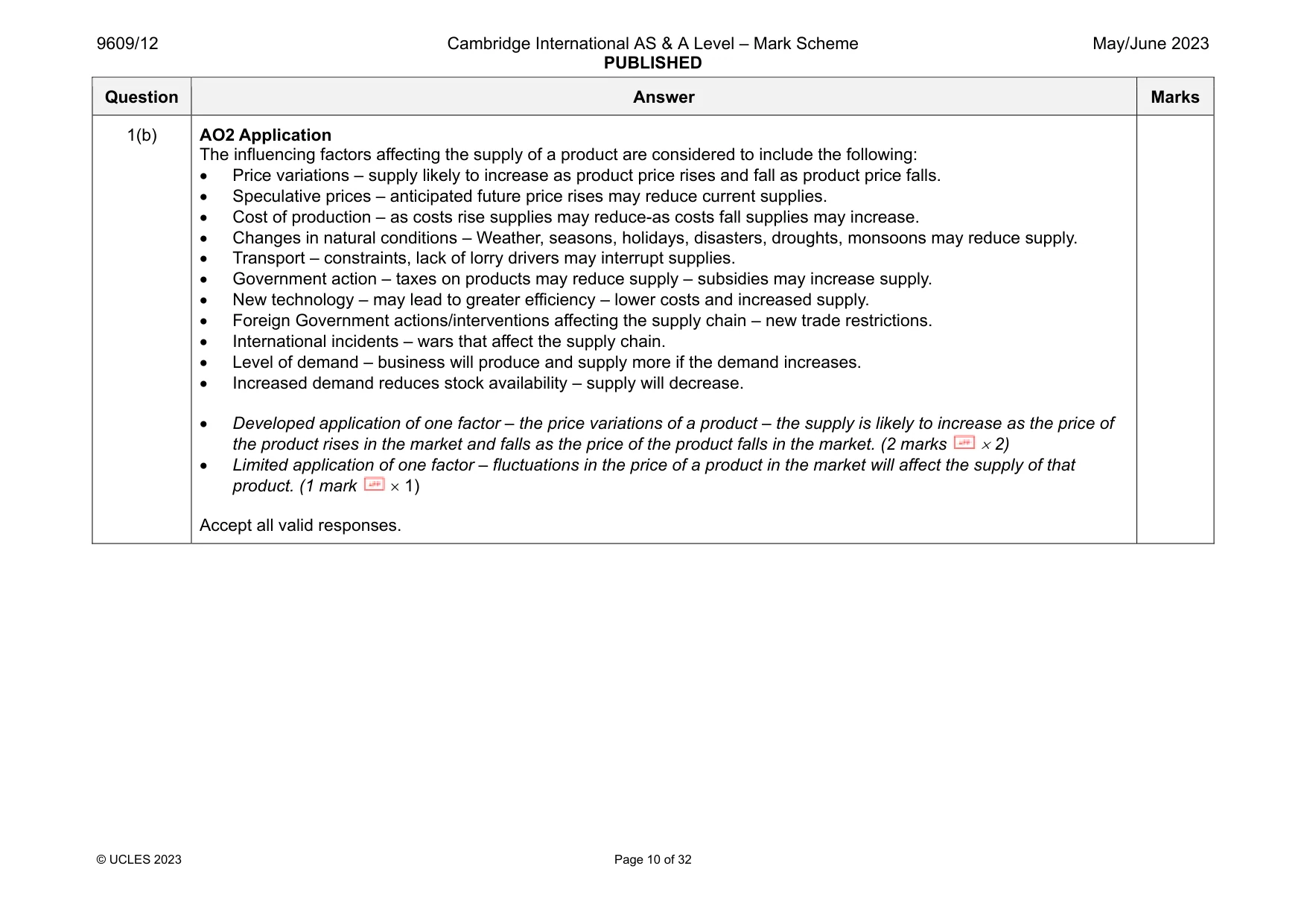
9609/12 Cambridge International AS & A Level – Mark Scheme PUBLISHED May/June 2023 © UCLES 2023 Page 10 of 32 Question Answer Marks 1(b) AO2 Application The influencing factors affecting the supply of a product are considered to include the following: Price variations – supply likely to increase as product price rises and fall as product price falls. Speculative prices – anticipated future price rises may reduce current supplies. Cost of production – as costs rise supplies may reduce-as costs fall supplies may increase. Changes in natural conditions – Weather, seasons, holidays, disasters, droughts, monsoons may reduce supply. Transport – constraints, lack of lorry drivers may interrupt supplies. Government action – taxes on products may reduce supply – subsidies may increase supply. New technology – may lead to greater efficiency – lower costs and increased supply. Foreign Government actions/interventions affecting the supply chain – new trade restrictions. International incidents – wars that affect the supply chain. Level of demand – business will produce and supply more if the demand increases. Increased demand reduces stock availability – supply will decrease. Developed application of one factor – the price variations of a product – the supply is likely to increase as the price of the product rises in the market and falls as the price of the product falls in the market. (2 marks 2) Limited application of one factor – fluctuations in the price of a product in the market will affect the supply of that product. (1 mark 1) Accept all valid responses.
Mark scheme, page 11
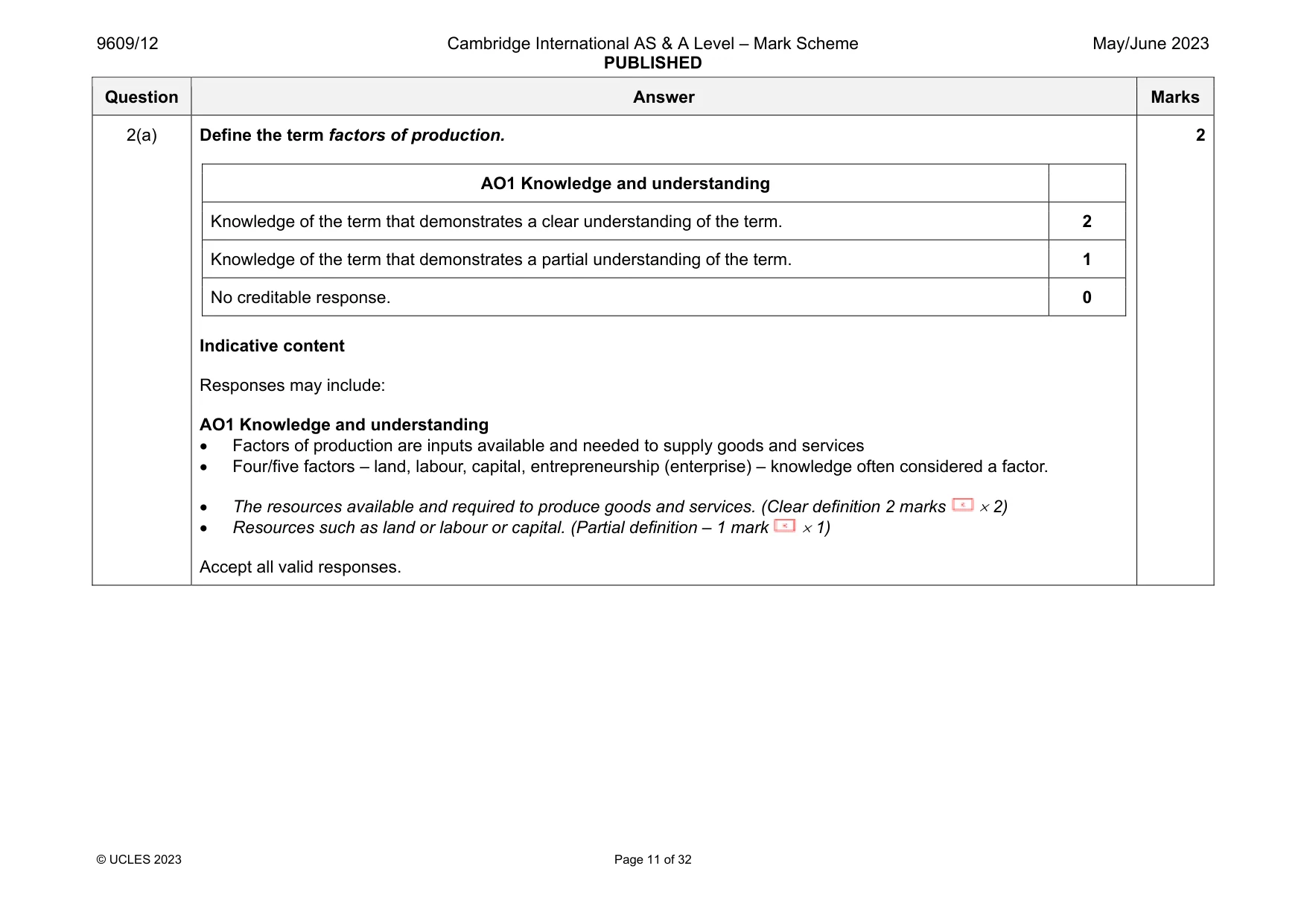
9609/12 Cambridge International AS & A Level – Mark Scheme PUBLISHED May/June 2023 © UCLES 2023 Page 11 of 32 Question Answer Marks 2(a) Define the term factors of production. AO1 Knowledge and understanding Knowledge of the term that demonstrates a clear understanding of the term. 2 Knowledge of the term that demonstrates a partial understanding of the term. 1 No creditable response. 0 Indicative content Responses may include: AO1 Knowledge and understanding Factors of production are inputs available and needed to supply goods and services Four/five factors – land, labour, capital, entrepreneurship (enterprise) – knowledge often considered a factor. The resources available and required to produce goods and services. (Clear definition 2 marks 2) Resources such as land or labour or capital. (Partial definition – 1 mark 1) Accept all valid responses. 2
Mark scheme, page 12
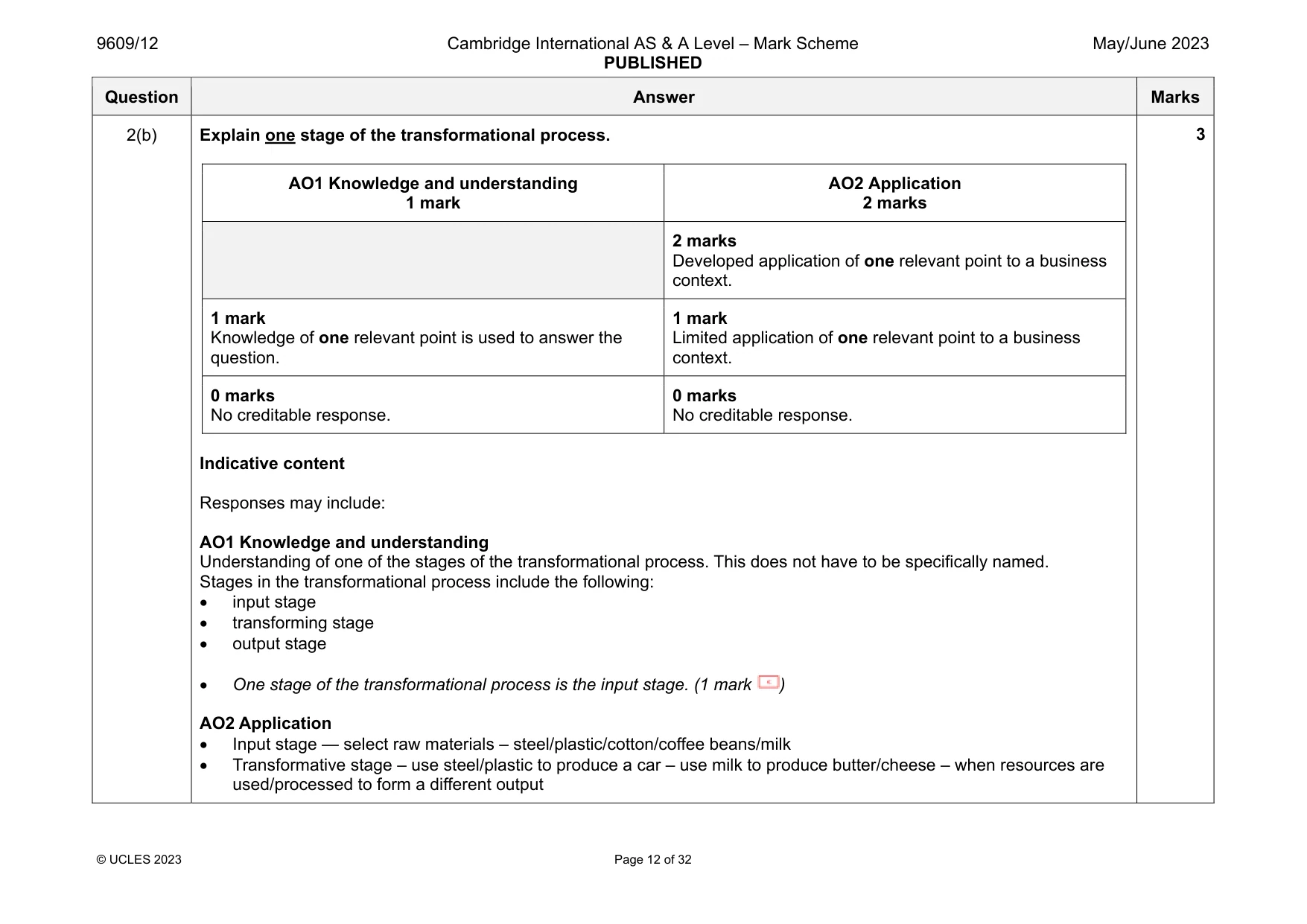
9609/12 Cambridge International AS & A Level – Mark Scheme PUBLISHED May/June 2023 © UCLES 2023 Page 12 of 32 Question Answer Marks 2(b) Explain one stage of the transformational process. AO1 Knowledge and understanding 1 mark AO2 Application 2 marks 2 marks Developed application of one relevant point to a business context. 1 mark Knowledge of one relevant point is used to answer the question. 1 mark Limited application of one relevant point to a business context. 0 marks No creditable response. 0 marks No creditable response. Indicative content Responses may include: AO1 Knowledge and understanding Understanding of one of the stages of the transformational process. This does not have to be specifically named. Stages in the transformational process include the following: input stage transforming stage output stage One stage of the transformational process is the input stage. (1 mark ) AO2 Application Input stage — select raw materials – steel/plastic/cotton/coffee beans/milk Transformative stage – use steel/plastic to produce a car – use milk to produce butter/cheese – when resources are used/processed to form a different output 3
Mark scheme, page 13
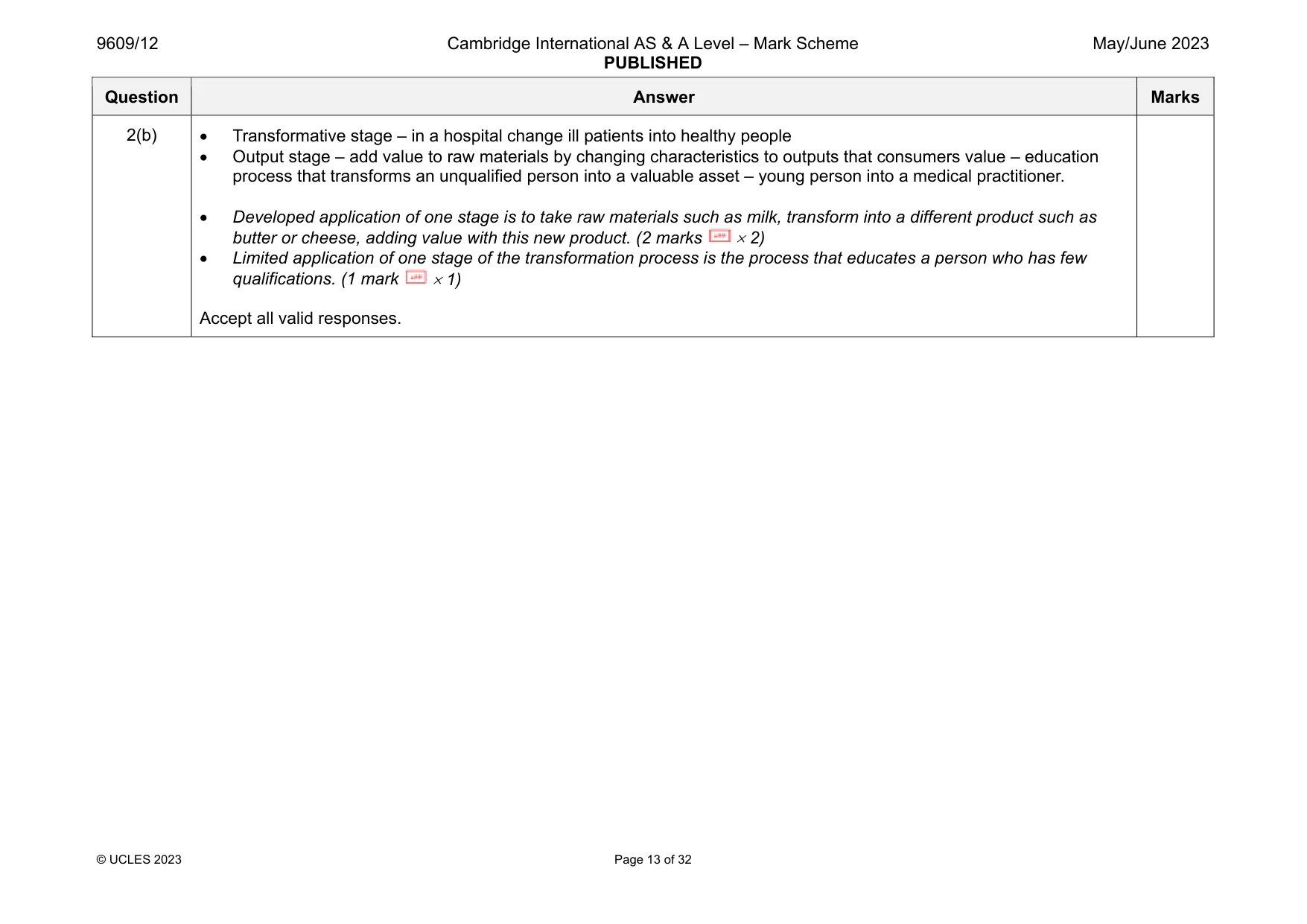
9609/12 Cambridge International AS & A Level – Mark Scheme PUBLISHED May/June 2023 © UCLES 2023 Page 13 of 32 Question Answer Marks 2(b) Transformative stage – in a hospital change ill patients into healthy people Output stage – add value to raw materials by changing characteristics to outputs that consumers value – education process that transforms an unqualified person into a valuable asset – young person into a medical practitioner. Developed application of one stage is to take raw materials such as milk, transform into a different product such as butter or cheese, adding value with this new product. (2 marks 2) Limited application of one stage of the transformation process is the process that educates a person who has few qualifications. (1 mark 1) Accept all valid responses.
Mark scheme, page 14
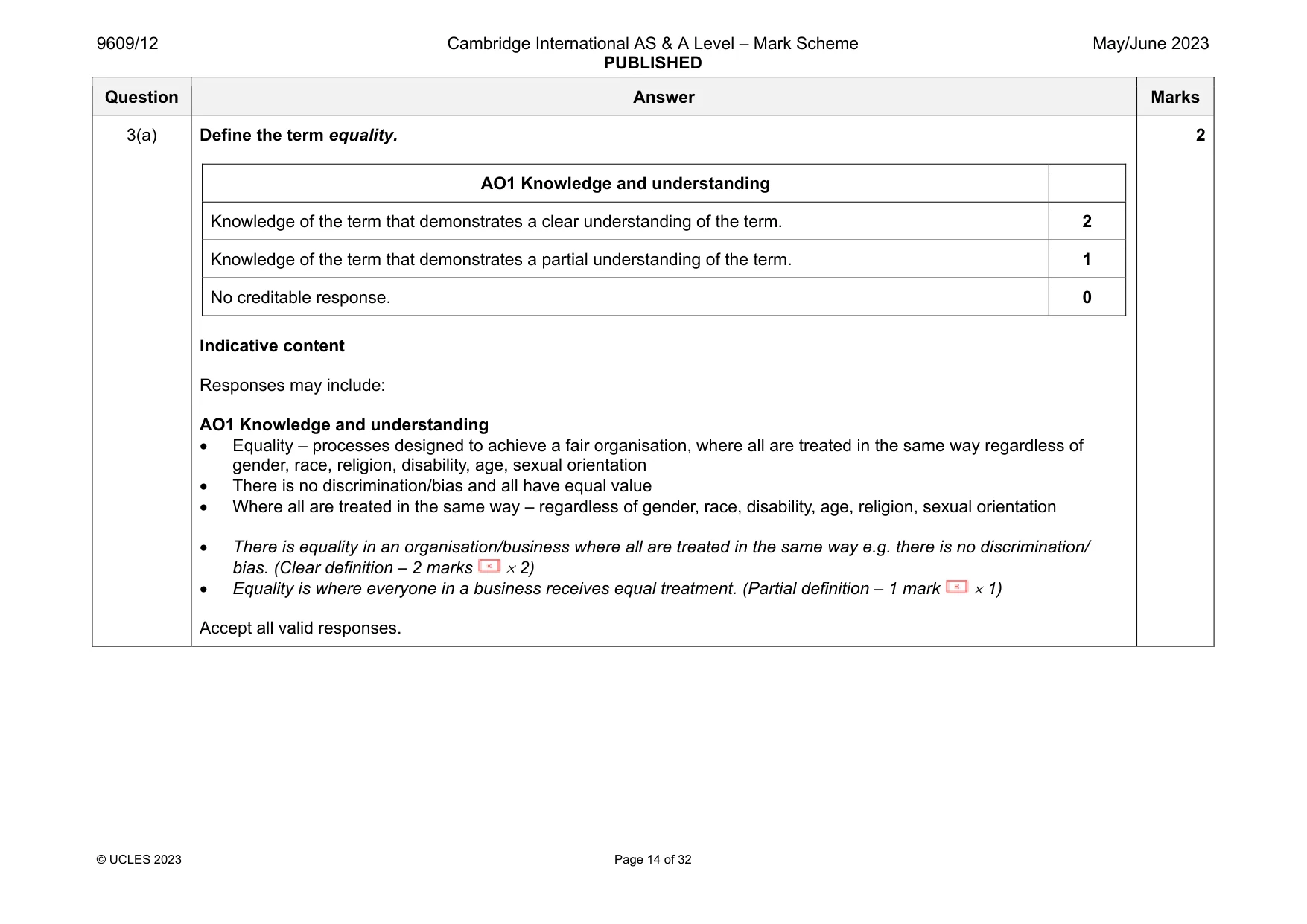
9609/12 Cambridge International AS & A Level – Mark Scheme PUBLISHED May/June 2023 © UCLES 2023 Page 14 of 32 Question Answer Marks 3(a) Define the term equality. AO1 Knowledge and understanding Knowledge of the term that demonstrates a clear understanding of the term. 2 Knowledge of the term that demonstrates a partial understanding of the term. 1 No creditable response. 0 Indicative content Responses may include: AO1 Knowledge and understanding Equality – processes designed to achieve a fair organisation, where all are treated in the same way regardless of gender, race, religion, disability, age, sexual orientation There is no discrimination/bias and all have equal value Where all are treated in the same way – regardless of gender, race, disability, age, religion, sexual orientation There is equality in an organisation/business where all are treated in the same way e.g. there is no discrimination/ bias. (Clear definition – 2 marks 2) Equality is where everyone in a business receives equal treatment. (Partial definition – 1 mark 1) Accept all valid responses. 2
Mark scheme, page 15
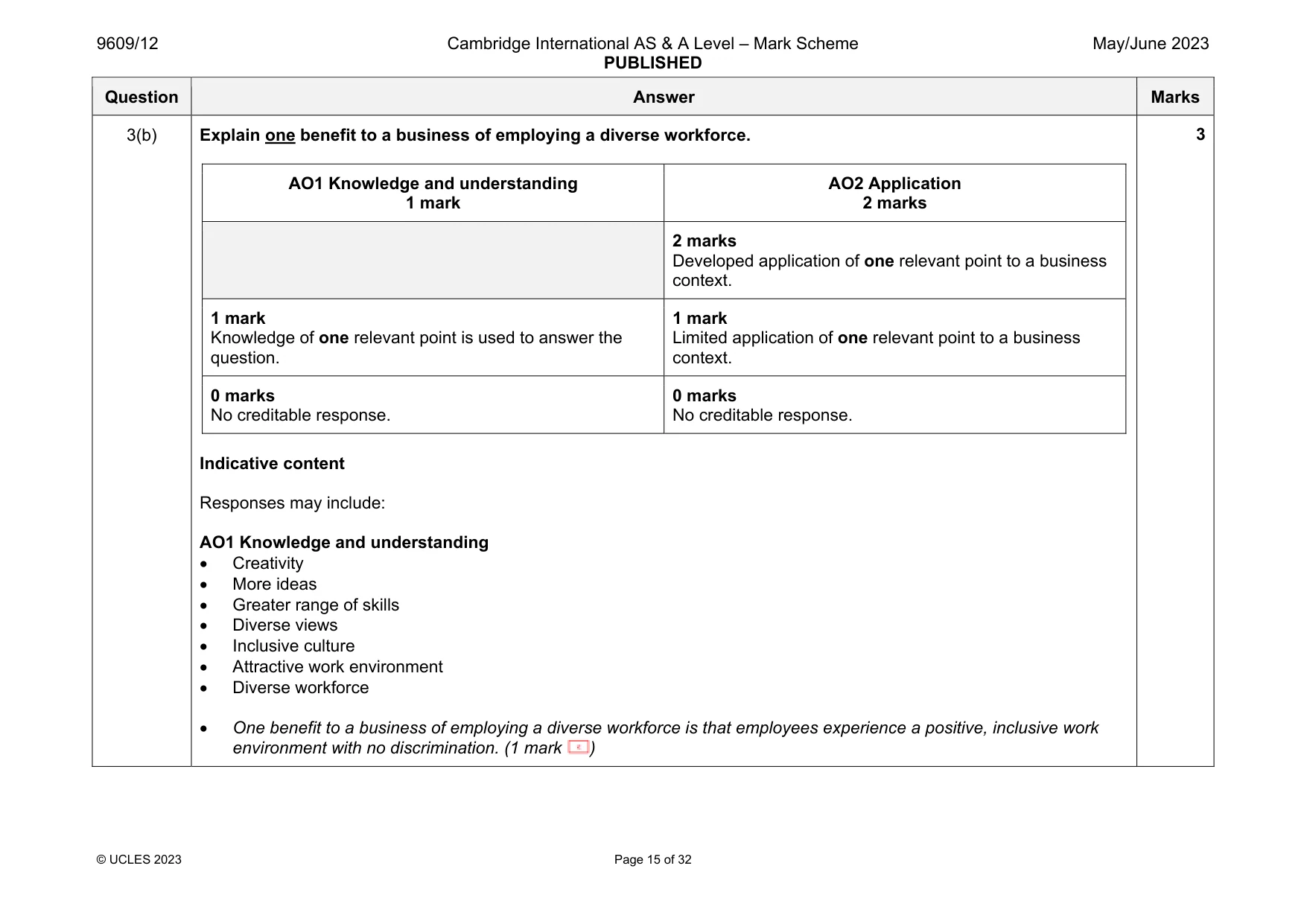
9609/12 Cambridge International AS & A Level – Mark Scheme PUBLISHED May/June 2023 © UCLES 2023 Page 15 of 32 Question Answer Marks 3(b) Explain one benefit to a business of employing a diverse workforce. AO1 Knowledge and understanding 1 mark AO2 Application 2 marks 2 marks Developed application of one relevant point to a business context. 1 mark Knowledge of one relevant point is used to answer the question. 1 mark Limited application of one relevant point to a business context. 0 marks No creditable response. 0 marks No creditable response. Indicative content Responses may include: AO1 Knowledge and understanding Creativity More ideas Greater range of skills Diverse views Inclusive culture Attractive work environment Diverse workforce One benefit to a business of employing a diverse workforce is that employees experience a positive, inclusive work environment with no discrimination. (1 mark ) 3
Mark scheme, page 16
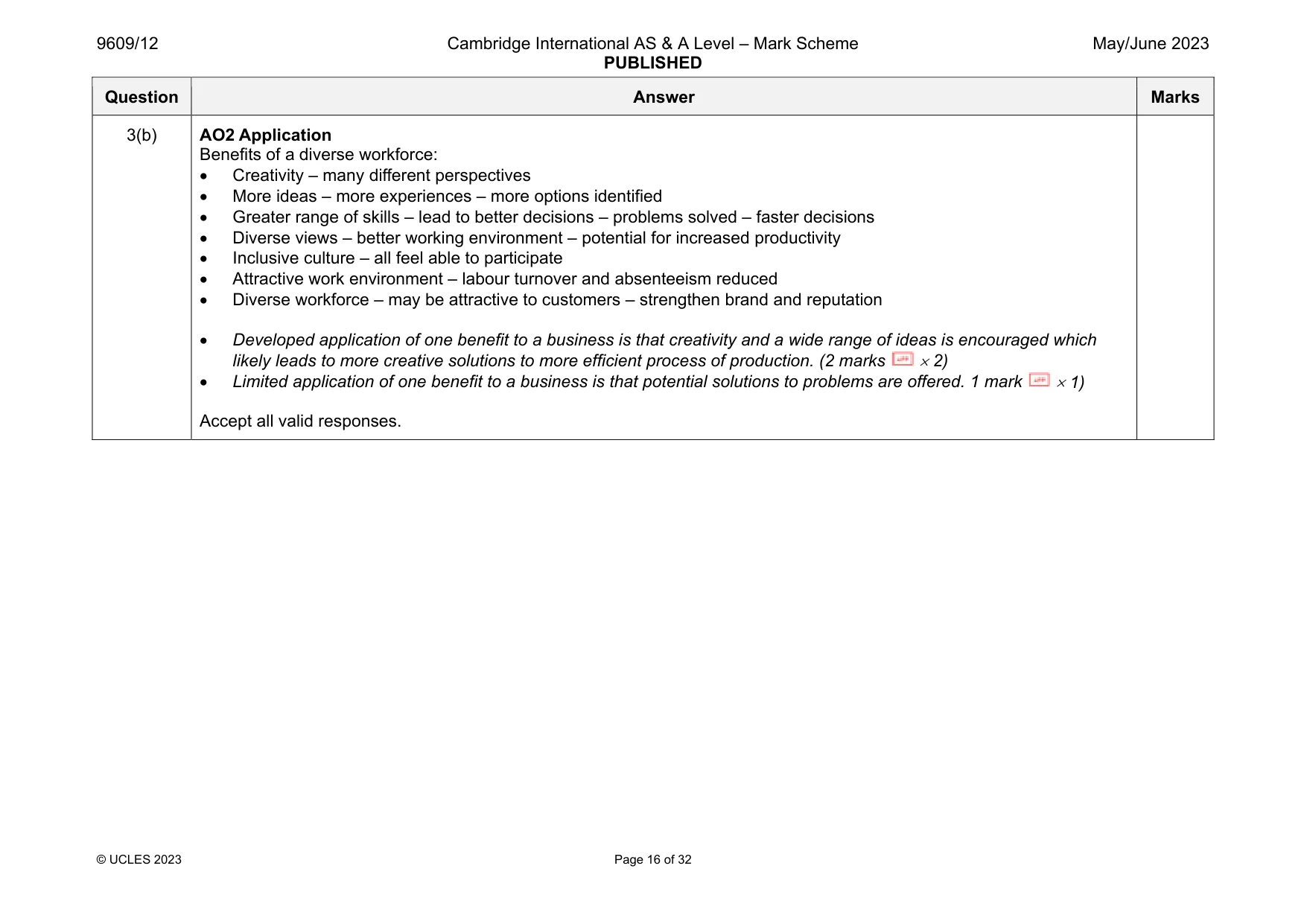
9609/12 Cambridge International AS & A Level – Mark Scheme PUBLISHED May/June 2023 © UCLES 2023 Page 16 of 32 Question Answer Marks 3(b) AO2 Application Benefits of a diverse workforce: Creativity – many different perspectives More ideas – more experiences – more options identified Greater range of skills – lead to better decisions – problems solved – faster decisions Diverse views – better working environment – potential for increased productivity Inclusive culture – all feel able to participate Attractive work environment – labour turnover and absenteeism reduced Diverse workforce – may be attractive to customers – strengthen brand and reputation Developed application of one benefit to a business is that creativity and a wide range of ideas is encouraged which likely leads to more creative solutions to more efficient process of production. (2 marks 2) Limited application of one benefit to a business is that potential solutions to problems are offered. 1 mark 1) Accept all valid responses.
Mark scheme, page 17
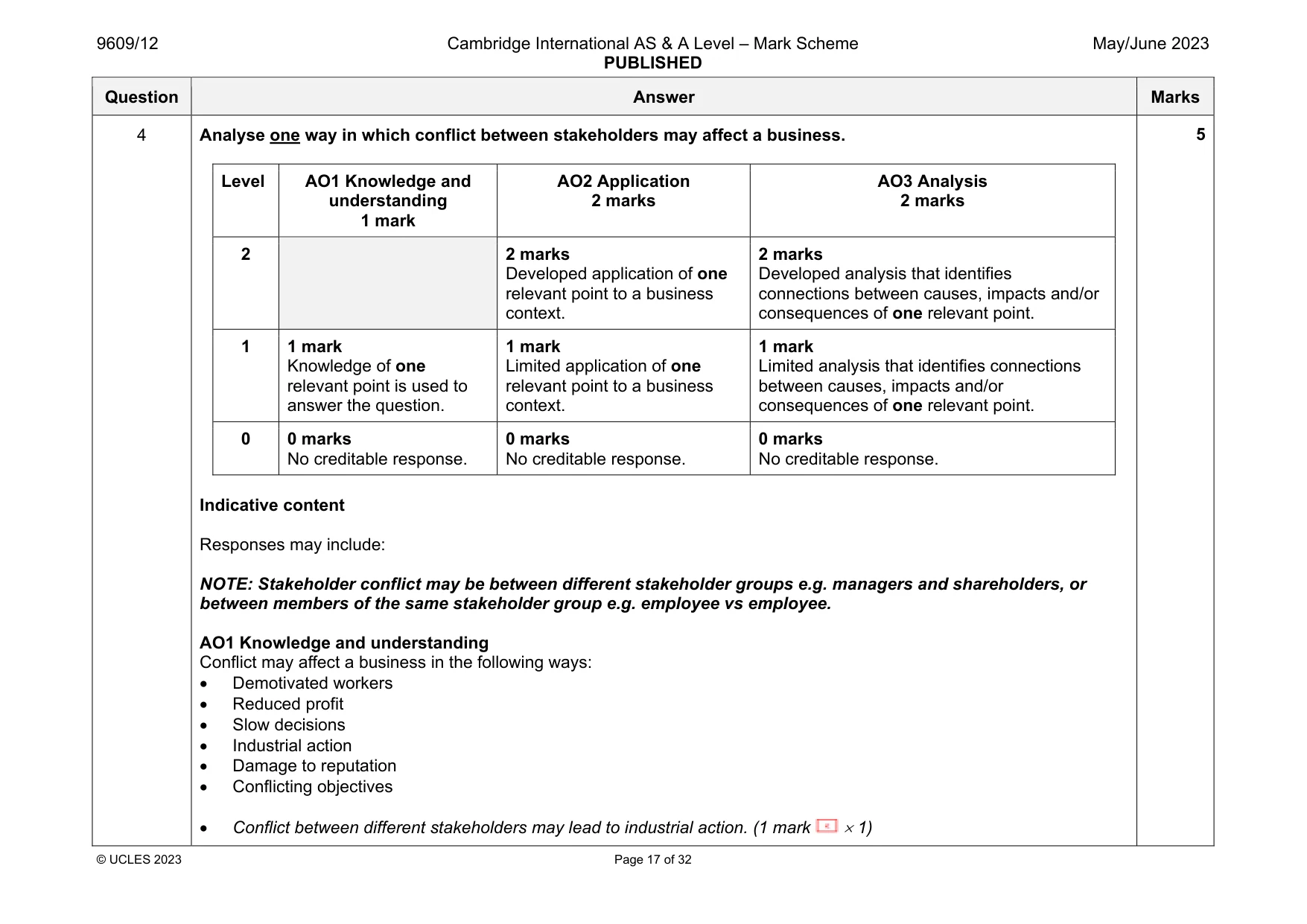
9609/12 Cambridge International AS & A Level – Mark Scheme PUBLISHED May/June 2023 © UCLES 2023 Page 17 of 32 Question Answer Marks 4 Analyse one way in which conflict between stakeholders may affect a business. Level AO1 Knowledge and understanding 1 mark AO2 Application 2 marks AO3 Analysis 2 marks 2 2 marks Developed application of one relevant point to a business context. 2 marks Developed analysis that identifies connections between causes, impacts and/or consequences of one relevant point. 1 1 mark Knowledge of one relevant point is used to answer the question. 1 mark Limited application of one relevant point to a business context. 1 mark Limited analysis that identifies connections between causes, impacts and/or consequences of one relevant point. 0 0 marks No creditable response. 0 marks No creditable response. 0 marks No creditable response. Indicative content Responses may include: NOTE: Stakeholder conflict may be between different stakeholder groups e.g. managers and shareholders, or between members of the same stakeholder group e.g. employee vs employee. AO1 Knowledge and understanding Conflict may affect a business in the following ways: Demotivated workers Reduced profit Slow decisions Industrial action Damage to reputation Conflicting objectives Conflict between different stakeholders may lead to industrial action. (1 mark 1) 5
Mark scheme, page 18
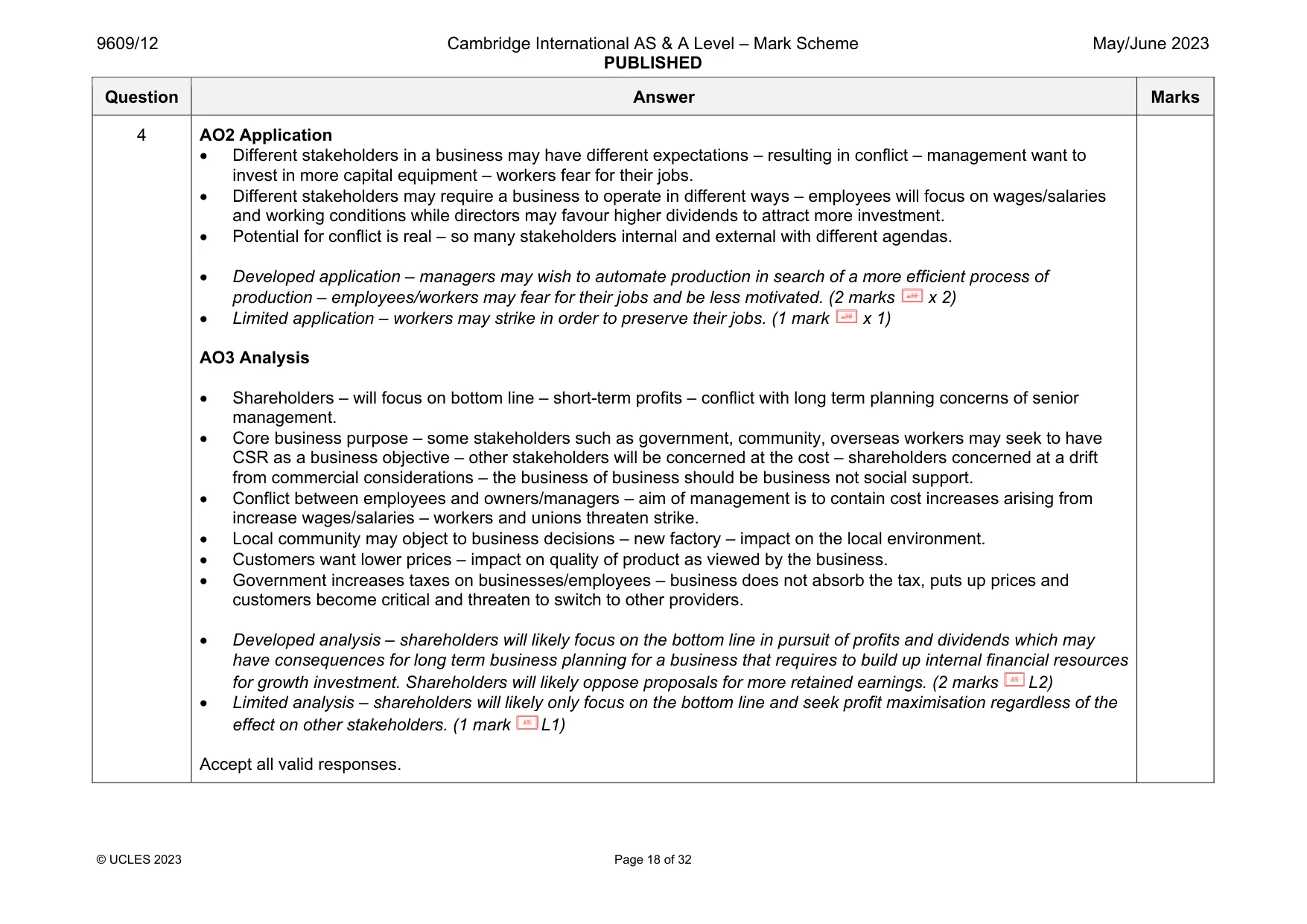
9609/12 Cambridge International AS & A Level – Mark Scheme PUBLISHED May/June 2023 © UCLES 2023 Page 18 of 32 Question Answer Marks 4 AO2 Application Different stakeholders in a business may have different expectations – resulting in conflict – management want to invest in more capital equipment – workers fear for their jobs. Different stakeholders may require a business to operate in different ways – employees will focus on wages/salaries and working conditions while directors may favour higher dividends to attract more investment. Potential for conflict is real – so many stakeholders internal and external with different agendas. Developed application – managers may wish to automate production in search of a more efficient process of production – employees/workers may fear for their jobs and be less motivated. (2 marks x 2) Limited application – workers may strike in order to preserve their jobs. (1 mark x 1) AO3 Analysis Shareholders – will focus on bottom line – short-term profits – conflict with long term planning concerns of senior management. Core business purpose – some stakeholders such as government, community, overseas workers may seek to have CSR as a business objective – other stakeholders will be concerned at the cost – shareholders concerned at a drift from commercial considerations – the business of business should be business not social support. Conflict between employees and owners/managers – aim of management is to contain cost increases arising from increase wages/salaries – workers and unions threaten strike. Local community may object to business decisions – new factory – impact on the local environment. Customers want lower prices – impact on quality of product as viewed by the business. Government increases taxes on businesses/employees – business does not absorb the tax, puts up prices and customers become critical and threaten to switch to other providers. Developed analysis – shareholders will likely focus on the bottom line in pursuit of profits and dividends which may have consequences for long term business planning for a business that requires to build up internal financial resources for growth investment. Shareholders will likely oppose proposals for more retained earnings. (2 marks L2) Limited analysis – shareholders will likely only focus on the bottom line and seek profit maximisation regardless of the effect on other stakeholders. (1 mark L1) Accept all valid responses.
Mark scheme, page 19
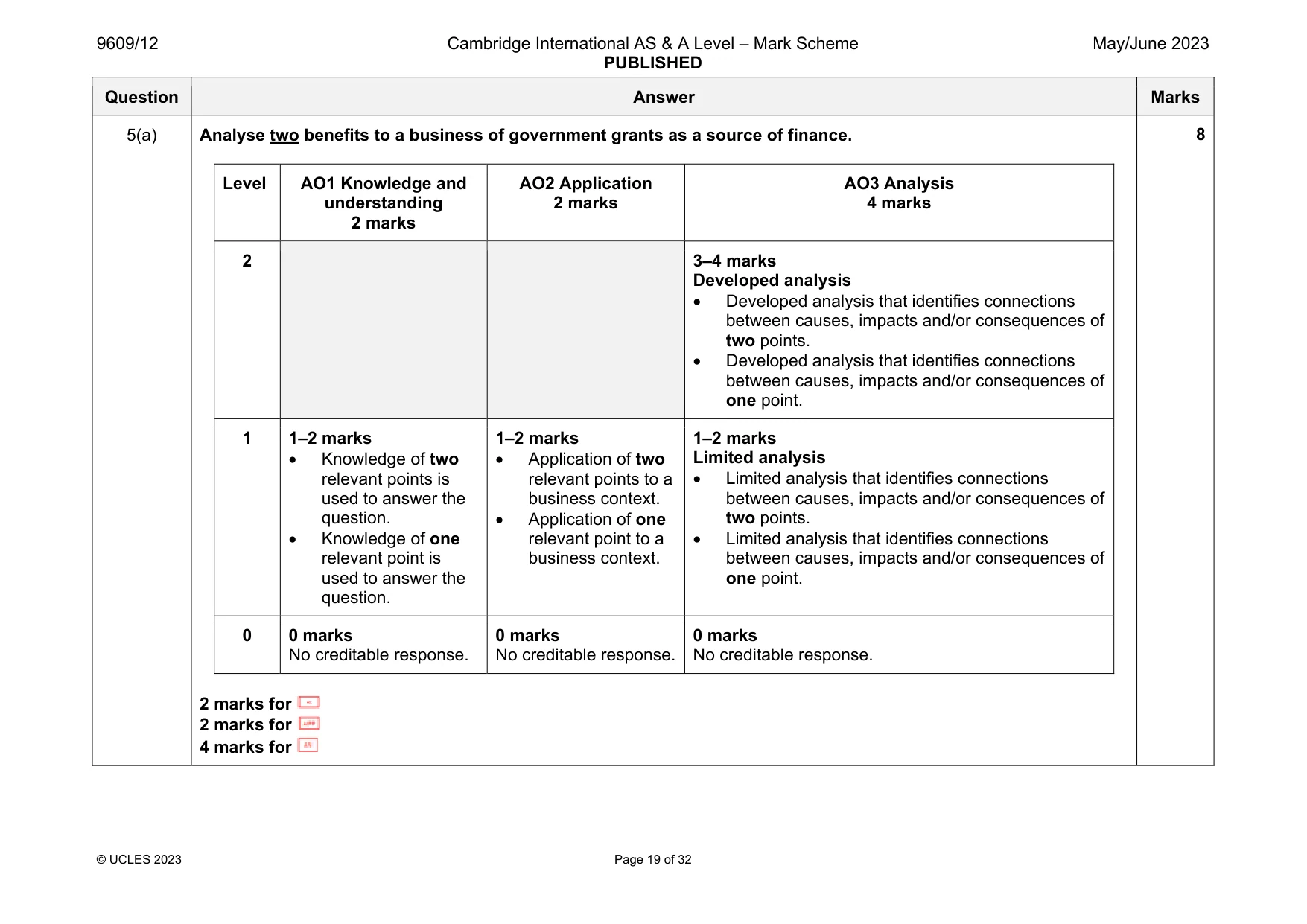
9609/12 Cambridge International AS & A Level – Mark Scheme PUBLISHED May/June 2023 © UCLES 2023 Page 19 of 32 Question Answer Marks 5(a) Analyse two benefits to a business of government grants as a source of finance. Level AO1 Knowledge and understanding 2 marks AO2 Application 2 marks AO3 Analysis 4 marks 2 3–4 marks Developed analysis Developed analysis that identifies connections between causes, impacts and/or consequences of two points. Developed analysis that identifies connections between causes, impacts and/or consequences of one point. 1 1–2 marks Knowledge of two relevant points is used to answer the question. Knowledge of one relevant point is used to answer the question. 1–2 marks Application of two relevant points to a business context. Application of one relevant point to a business context. 1–2 marks Limited analysis Limited analysis that identifies connections between causes, impacts and/or consequences of two points. Limited analysis that identifies connections between causes, impacts and/or consequences of one point. 0 0 marks No creditable response. 0 marks No creditable response. 0 marks No creditable response. 2 marks for 2 marks for 4 marks for 8
Mark scheme, page 20
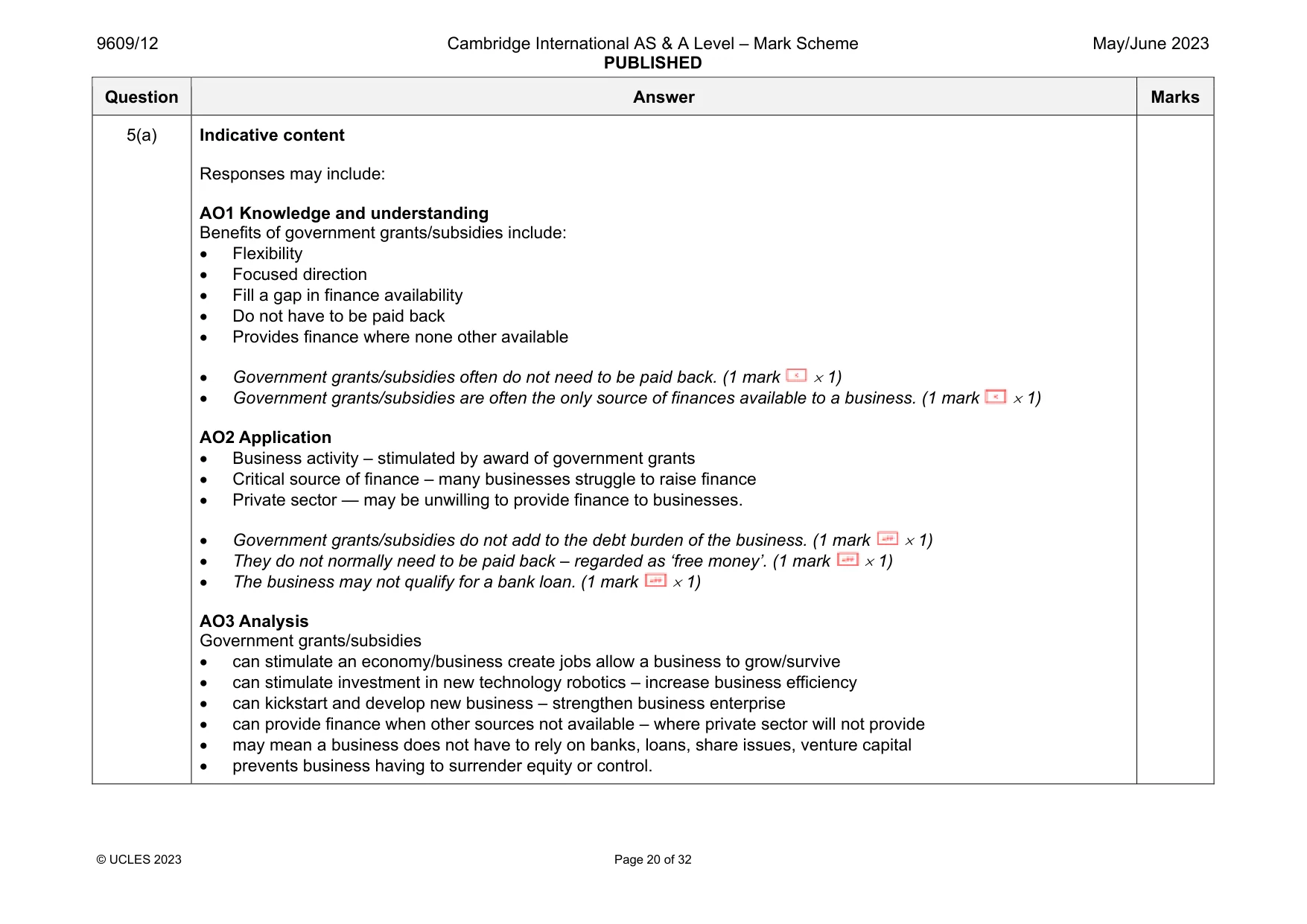
9609/12 Cambridge International AS & A Level – Mark Scheme PUBLISHED May/June 2023 © UCLES 2023 Page 20 of 32 Question Answer Marks 5(a) Indicative content Responses may include: AO1 Knowledge and understanding Benefits of government grants/subsidies include: Flexibility Focused direction Fill a gap in finance availability Do not have to be paid back Provides finance where none other available Government grants/subsidies often do not need to be paid back. (1 mark 1) Government grants/subsidies are often the only source of finances available to a business. (1 mark 1) AO2 Application Business activity – stimulated by award of government grants Critical source of finance – many businesses struggle to raise finance Private sector — may be unwilling to provide finance to businesses. Government grants/subsidies do not add to the debt burden of the business. (1 mark 1) They do not normally need to be paid back – regarded as ‘free money’. (1 mark 1) The business may not qualify for a bank loan. (1 mark 1) AO3 Analysis Government grants/subsidies can stimulate an economy/business create jobs allow a business to grow/survive can stimulate investment in new technology robotics – increase business efficiency can kickstart and develop new business – strengthen business enterprise can provide finance when other sources not available – where private sector will not provide may mean a business does not have to rely on banks, loans, share issues, venture capital prevents business having to surrender equity or control.
Mark scheme, page 21
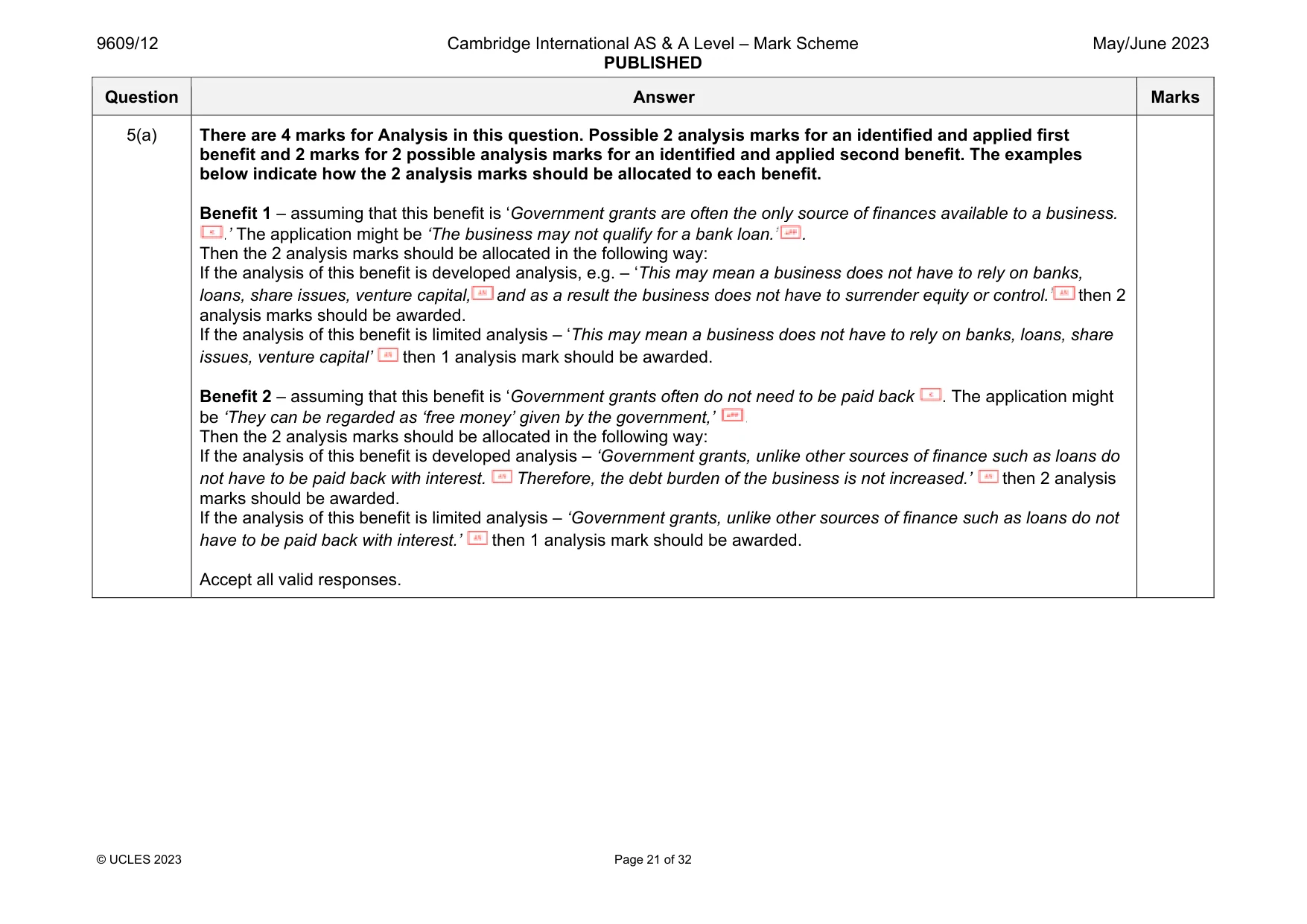
9609/12 Cambridge International AS & A Level – Mark Scheme PUBLISHED May/June 2023 © UCLES 2023 Page 21 of 32 Question Answer Marks 5(a) There are 4 marks for Analysis in this question. Possible 2 analysis marks for an identified and applied first benefit and 2 marks for 2 possible analysis marks for an identified and applied second benefit. The examples below indicate how the 2 analysis marks should be allocated to each benefit. Benefit 1 – assuming that this benefit is ‘Government grants are often the only source of finances available to a business. .’ The application might be ‘The business may not qualify for a bank loan.’ . Then the 2 analysis marks should be allocated in the following way: If the analysis of this benefit is developed analysis, e.g. – ‘This may mean a business does not have to rely on banks, loans, share issues, venture capital, and as a result the business does not have to surrender equity or control.’ then 2 analysis marks should be awarded. If the analysis of this benefit is limited analysis – ‘This may mean a business does not have to rely on banks, loans, share issues, venture capital’ then 1 analysis mark should be awarded. Benefit 2 – assuming that this benefit is ‘Government grants often do not need to be paid back . The application might be ‘They can be regarded as ‘free money’ given by the government,’ . Then the 2 analysis marks should be allocated in the following way: If the analysis of this benefit is developed analysis – ‘Government grants, unlike other sources of finance such as loans do not have to be paid back with interest. Therefore, the debt burden of the business is not increased.’ then 2 analysis marks should be awarded. If the analysis of this benefit is limited analysis – ‘Government grants, unlike other sources of finance such as loans do not have to be paid back with interest.’ then 1 analysis mark should be awarded. Accept all valid responses.
Mark scheme, page 22
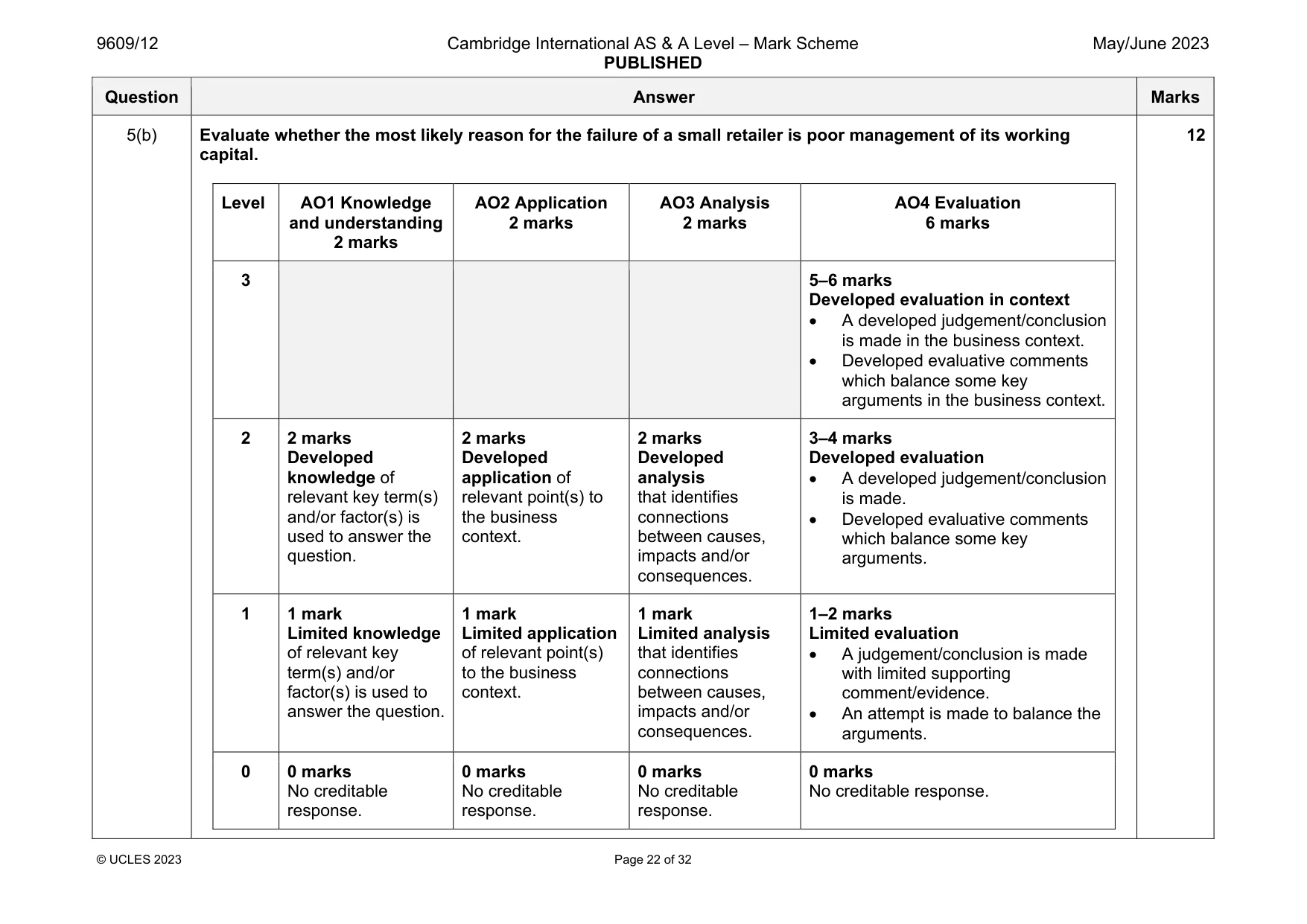
9609/12 Cambridge International AS & A Level – Mark Scheme PUBLISHED May/June 2023 © UCLES 2023 Page 22 of 32 Question Answer Marks 5(b) Evaluate whether the most likely reason for the failure of a small retailer is poor management of its working capital. Level AO1 Knowledge and understanding 2 marks AO2 Application 2 marks AO3 Analysis 2 marks AO4 Evaluation 6 marks 3 5–6 marks Developed evaluation in context A developed judgement/conclusion is made in the business context. Developed evaluative comments which balance some key arguments in the business context. 2 2 marks Developed knowledge of relevant key term(s) and/or factor(s) is used to answer the question. 2 marks Developed application of relevant point(s) to the business context. 2 marks Developed analysis that identifies connections between causes, impacts and/or consequences. 3–4 marks Developed evaluation A developed judgement/conclusion is made. Developed evaluative comments which balance some key arguments. 1 1 mark Limited knowledge of relevant key term(s) and/or factor(s) is used to answer the question. 1 mark Limited application of relevant point(s) to the business context. 1 mark Limited analysis that identifies connections between causes, impacts and/or consequences. 1–2 marks Limited evaluation A judgement/conclusion is made with limited supporting comment/evidence. An attempt is made to balance the arguments. 0 0 marks No creditable response. 0 marks No creditable response. 0 marks No creditable response. 0 marks No creditable response. 12
Mark scheme, page 23
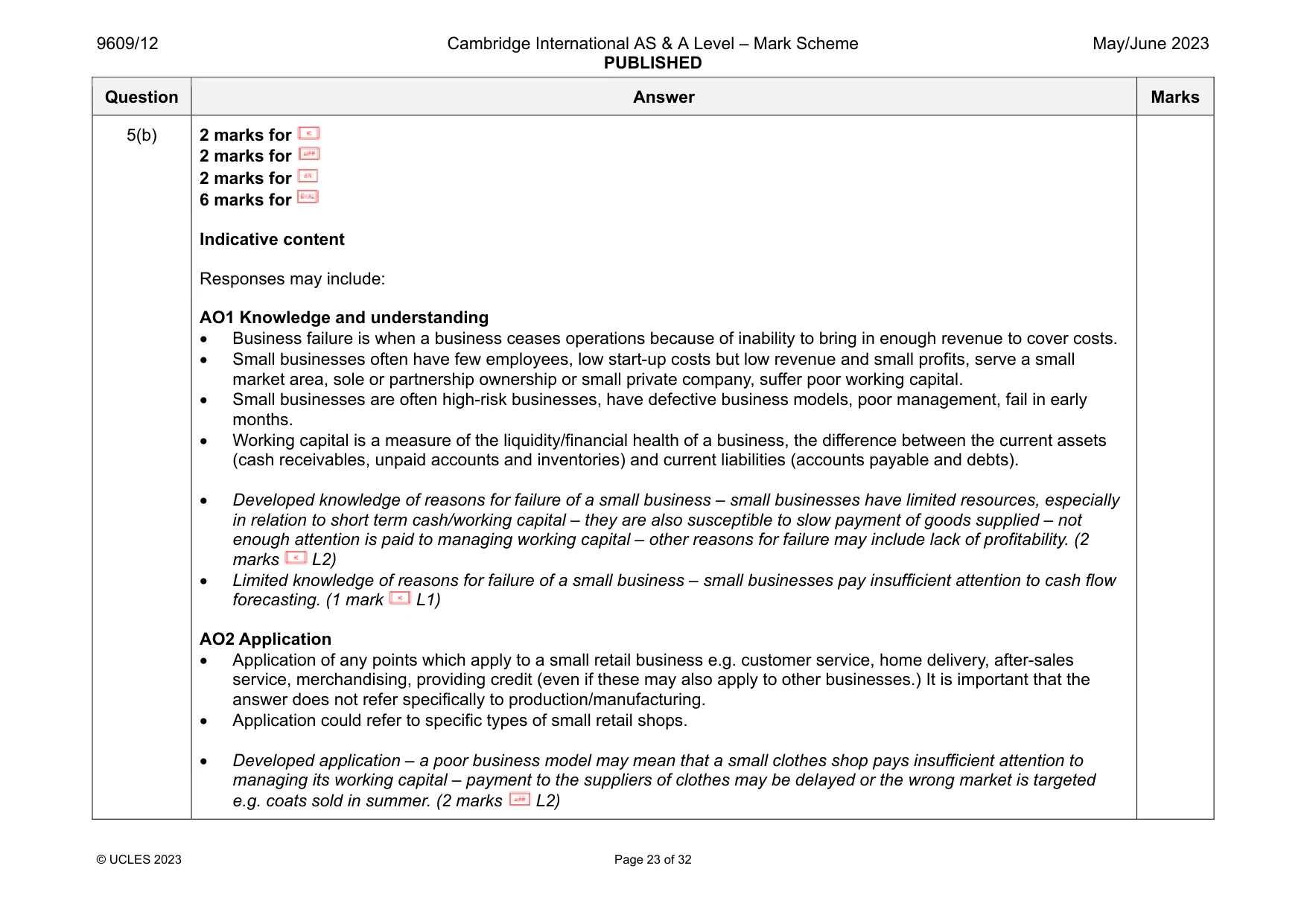
9609/12 Cambridge International AS & A Level – Mark Scheme PUBLISHED May/June 2023 © UCLES 2023 Page 23 of 32 Question Answer Marks 5(b) 2 marks for 2 marks for 2 marks for 6 marks for Indicative content Responses may include: AO1 Knowledge and understanding Business failure is when a business ceases operations because of inability to bring in enough revenue to cover costs. Small businesses often have few employees, low start-up costs but low revenue and small profits, serve a small market area, sole or partnership ownership or small private company, suffer poor working capital. Small businesses are often high-risk businesses, have defective business models, poor management, fail in early months. Working capital is a measure of the liquidity/financial health of a business, the difference between the current assets (cash receivables, unpaid accounts and inventories) and current liabilities (accounts payable and debts). Developed knowledge of reasons for failure of a small business – small businesses have limited resources, especially in relation to short term cash/working capital – they are also susceptible to slow payment of goods supplied – not enough attention is paid to managing working capital – other reasons for failure may include lack of profitability. (2 marks L2) Limited knowledge of reasons for failure of a small business – small businesses pay insufficient attention to cash flow forecasting. (1 mark L1) AO2 Application Application of any points which apply to a small retail business e.g. customer service, home delivery, after-sales service, merchandising, providing credit (even if these may also apply to other businesses.) It is important that the answer does not refer specifically to production/manufacturing. Application could refer to specific types of small retail shops. Developed application – a poor business model may mean that a small clothes shop pays insufficient attention to managing its working capital – payment to the suppliers of clothes may be delayed or the wrong market is targeted e.g. coats sold in summer. (2 marks L2)
Mark scheme, page 24
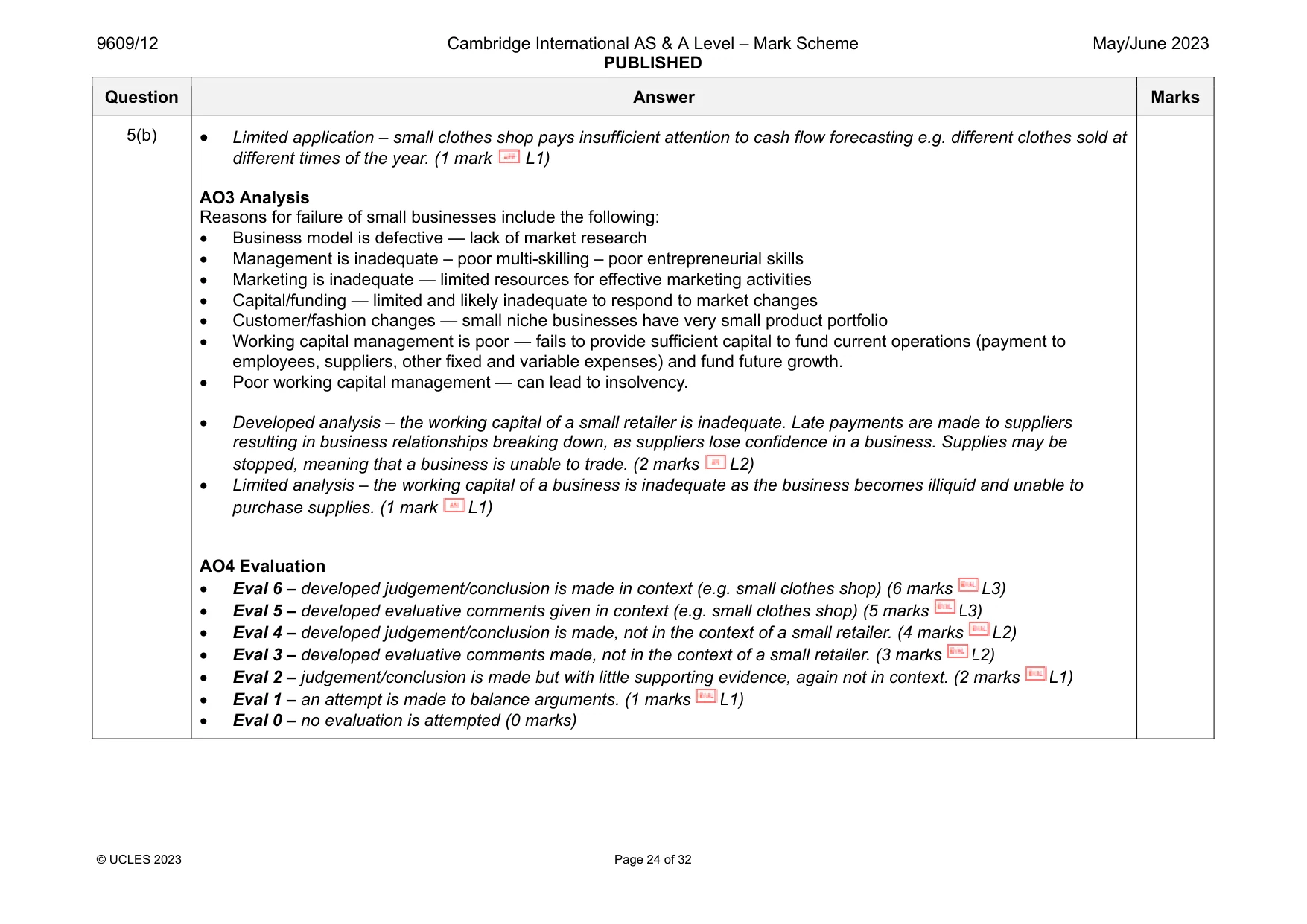
9609/12 Cambridge International AS & A Level – Mark Scheme PUBLISHED May/June 2023 © UCLES 2023 Page 24 of 32 Question Answer Marks 5(b) Limited application – small clothes shop pays insufficient attention to cash flow forecasting e.g. different clothes sold at different times of the year. (1 mark L1) AO3 Analysis Reasons for failure of small businesses include the following: Business model is defective — lack of market research Management is inadequate – poor multi-skilling – poor entrepreneurial skills Marketing is inadequate — limited resources for effective marketing activities Capital/funding — limited and likely inadequate to respond to market changes Customer/fashion changes — small niche businesses have very small product portfolio Working capital management is poor — fails to provide sufficient capital to fund current operations (payment to employees, suppliers, other fixed and variable expenses) and fund future growth. Poor working capital management — can lead to insolvency. Developed analysis – the working capital of a small retailer is inadequate. Late payments are made to suppliers resulting in business relationships breaking down, as suppliers lose confidence in a business. Supplies may be stopped, meaning that a business is unable to trade. (2 marks L2) Limited analysis – the working capital of a business is inadequate as the business becomes illiquid and unable to purchase supplies. (1 mark L1) AO4 Evaluation Eval 6 – developed judgement/conclusion is made in context (e.g. small clothes shop) (6 marks L3) Eval 5 – developed evaluative comments given in context (e.g. small clothes shop) (5 marks L3) Eval 4 – developed judgement/conclusion is made, not in the context of a small retailer. (4 marks L2) Eval 3 – developed evaluative comments made, not in the context of a small retailer. (3 marks L2) Eval 2 – judgement/conclusion is made but with little supporting evidence, again not in context. (2 marks L1) Eval 1 – an attempt is made to balance arguments. (1 marks L1) Eval 0 – no evaluation is attempted (0 marks)
Mark scheme, page 25
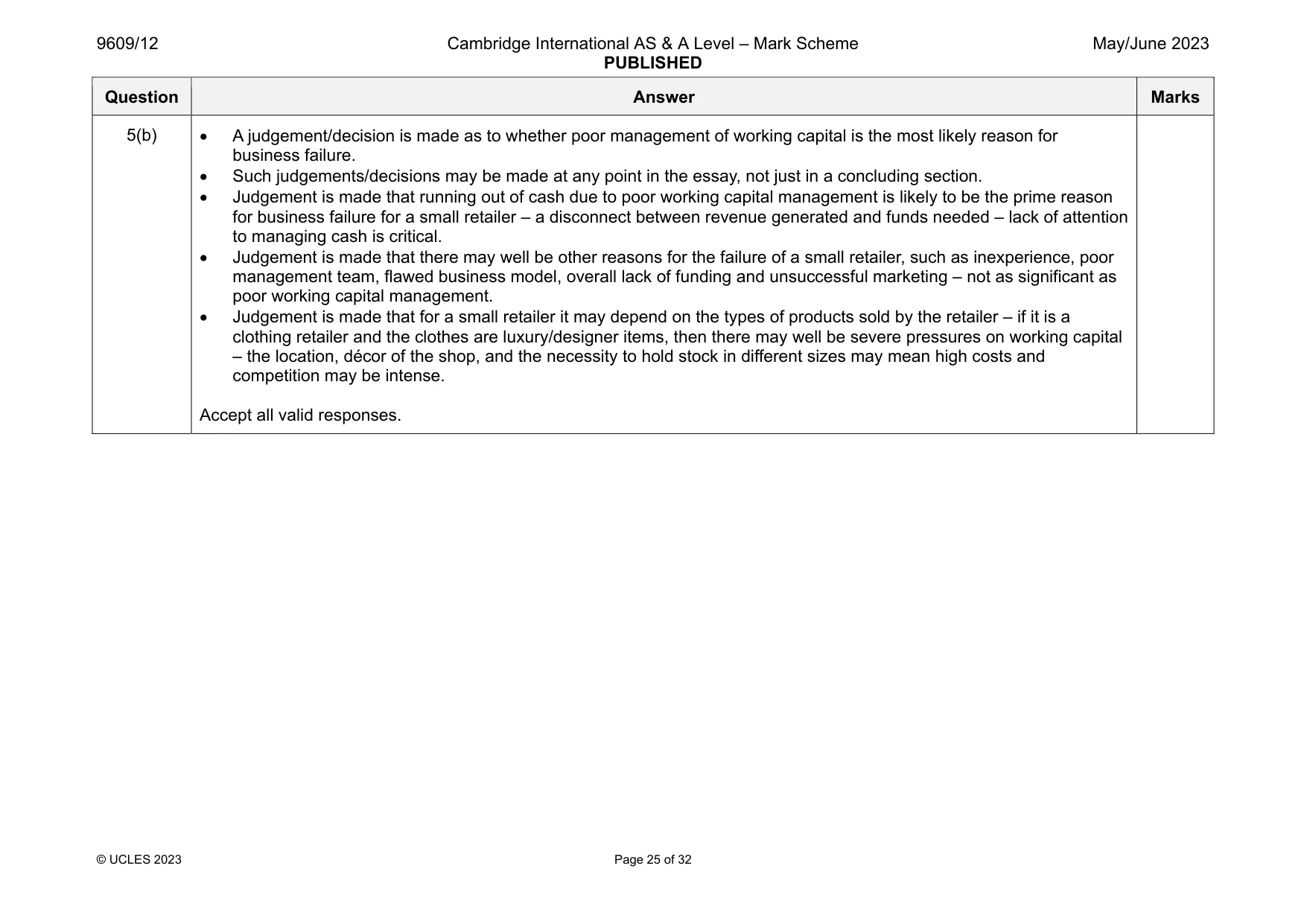
9609/12 Cambridge International AS & A Level – Mark Scheme PUBLISHED May/June 2023 © UCLES 2023 Page 25 of 32 Question Answer Marks 5(b) A judgement/decision is made as to whether poor management of working capital is the most likely reason for business failure. Such judgements/decisions may be made at any point in the essay, not just in a concluding section. Judgement is made that running out of cash due to poor working capital management is likely to be the prime reason for business failure for a small retailer – a disconnect between revenue generated and funds needed – lack of attention to managing cash is critical. Judgement is made that there may well be other reasons for the failure of a small retailer, such as inexperience, poor management team, flawed business model, overall lack of funding and unsuccessful marketing – not as significant as poor working capital management. Judgement is made that for a small retailer it may depend on the types of products sold by the retailer – if it is a clothing retailer and the clothes are luxury/designer items, then there may well be severe pressures on working capital – the location, décor of the shop, and the necessity to hold stock in different sizes may mean high costs and competition may be intense. Accept all valid responses.
Mark scheme, page 26
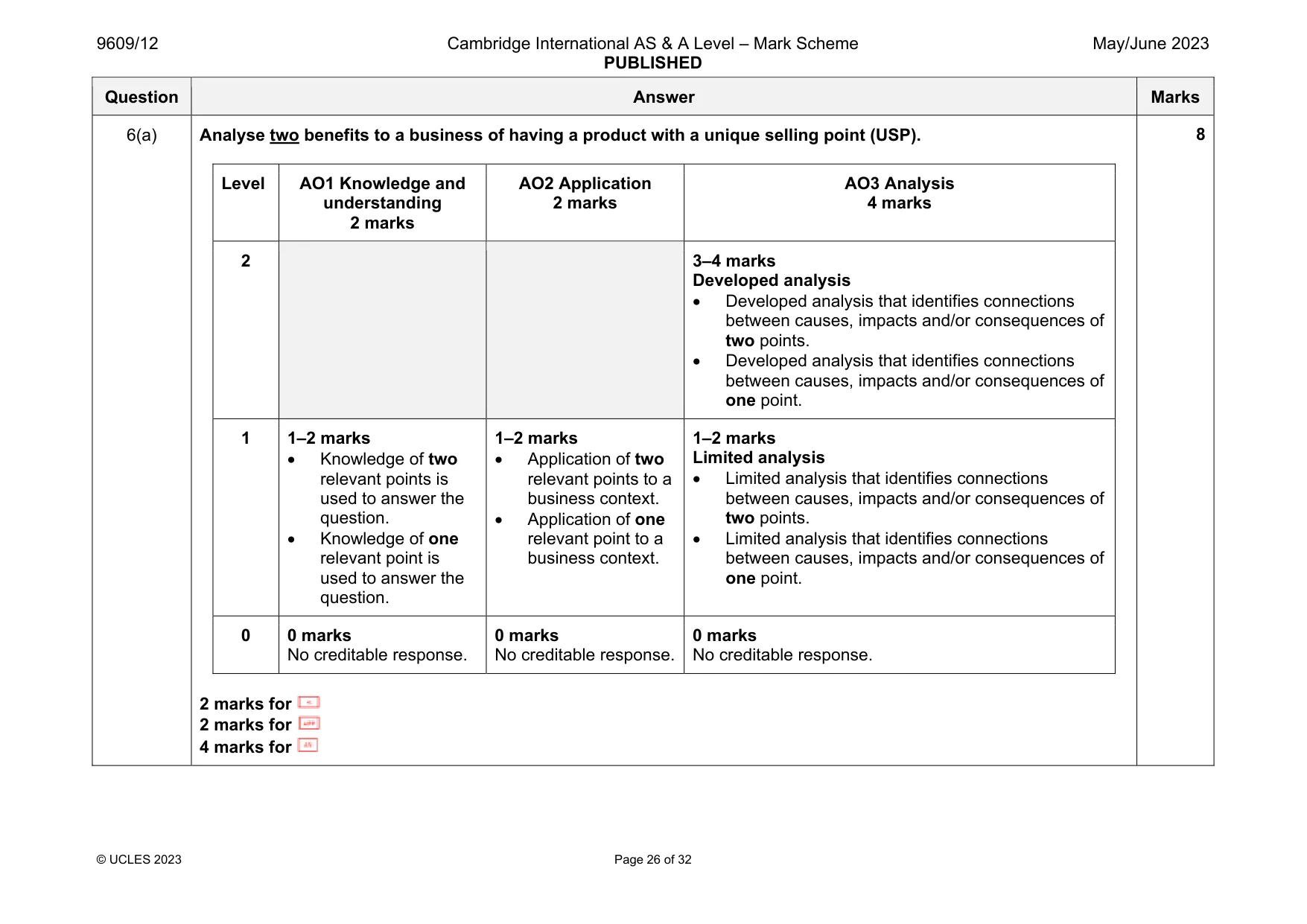
9609/12 Cambridge International AS & A Level – Mark Scheme PUBLISHED May/June 2023 © UCLES 2023 Page 26 of 32 Question Answer Marks 6(a) Analyse two benefits to a business of having a product with a unique selling point (USP). Level AO1 Knowledge and understanding 2 marks AO2 Application 2 marks AO3 Analysis 4 marks 2 3–4 marks Developed analysis Developed analysis that identifies connections between causes, impacts and/or consequences of two points. Developed analysis that identifies connections between causes, impacts and/or consequences of one point. 1 1–2 marks Knowledge of two relevant points is used to answer the question. Knowledge of one relevant point is used to answer the question. 1–2 marks Application of two relevant points to a business context. Application of one relevant point to a business context. 1–2 marks Limited analysis Limited analysis that identifies connections between causes, impacts and/or consequences of two points. Limited analysis that identifies connections between causes, impacts and/or consequences of one point. 0 0 marks No creditable response. 0 marks No creditable response. 0 marks No creditable response. 2 marks for 2 marks for 4 marks for 8
Mark scheme, page 27
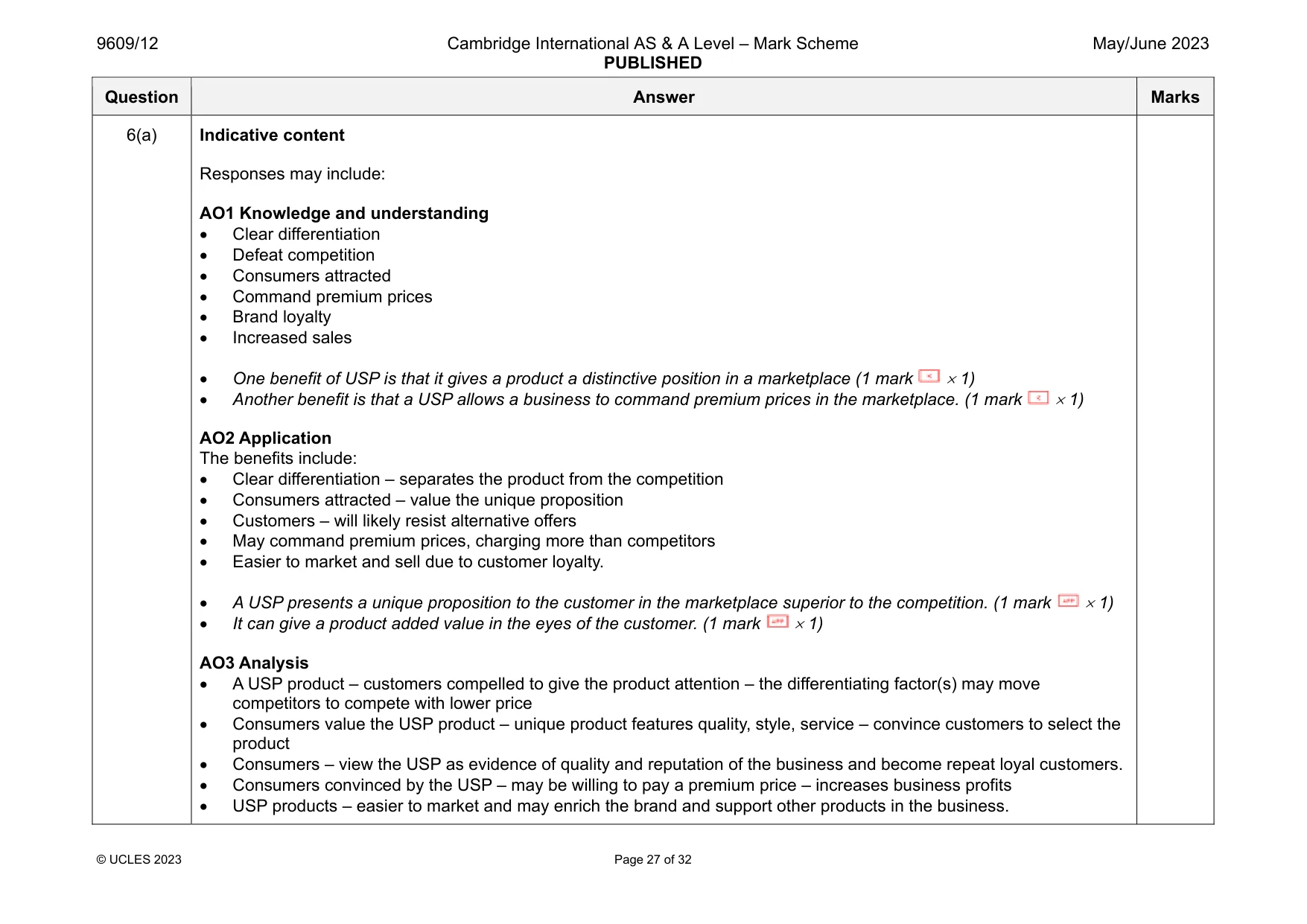
9609/12 Cambridge International AS & A Level – Mark Scheme PUBLISHED May/June 2023 © UCLES 2023 Page 27 of 32 Question Answer Marks 6(a) Indicative content Responses may include: AO1 Knowledge and understanding Clear differentiation Defeat competition Consumers attracted Command premium prices Brand loyalty Increased sales One benefit of USP is that it gives a product a distinctive position in a marketplace (1 mark 1) Another benefit is that a USP allows a business to command premium prices in the marketplace. (1 mark 1) AO2 Application The benefits include: Clear differentiation – separates the product from the competition Consumers attracted – value the unique proposition Customers – will likely resist alternative offers May command premium prices, charging more than competitors Easier to market and sell due to customer loyalty. A USP presents a unique proposition to the customer in the marketplace superior to the competition. (1 mark 1) It can give a product added value in the eyes of the customer. (1 mark 1) AO3 Analysis A USP product – customers compelled to give the product attention – the differentiating factor(s) may move competitors to compete with lower price Consumers value the USP product – unique product features quality, style, service – convince customers to select the product Consumers – view the USP as evidence of quality and reputation of the business and become repeat loyal customers. Consumers convinced by the USP – may be willing to pay a premium price – increases business profits USP products – easier to market and may enrich the brand and support other products in the business.
Mark scheme, page 28
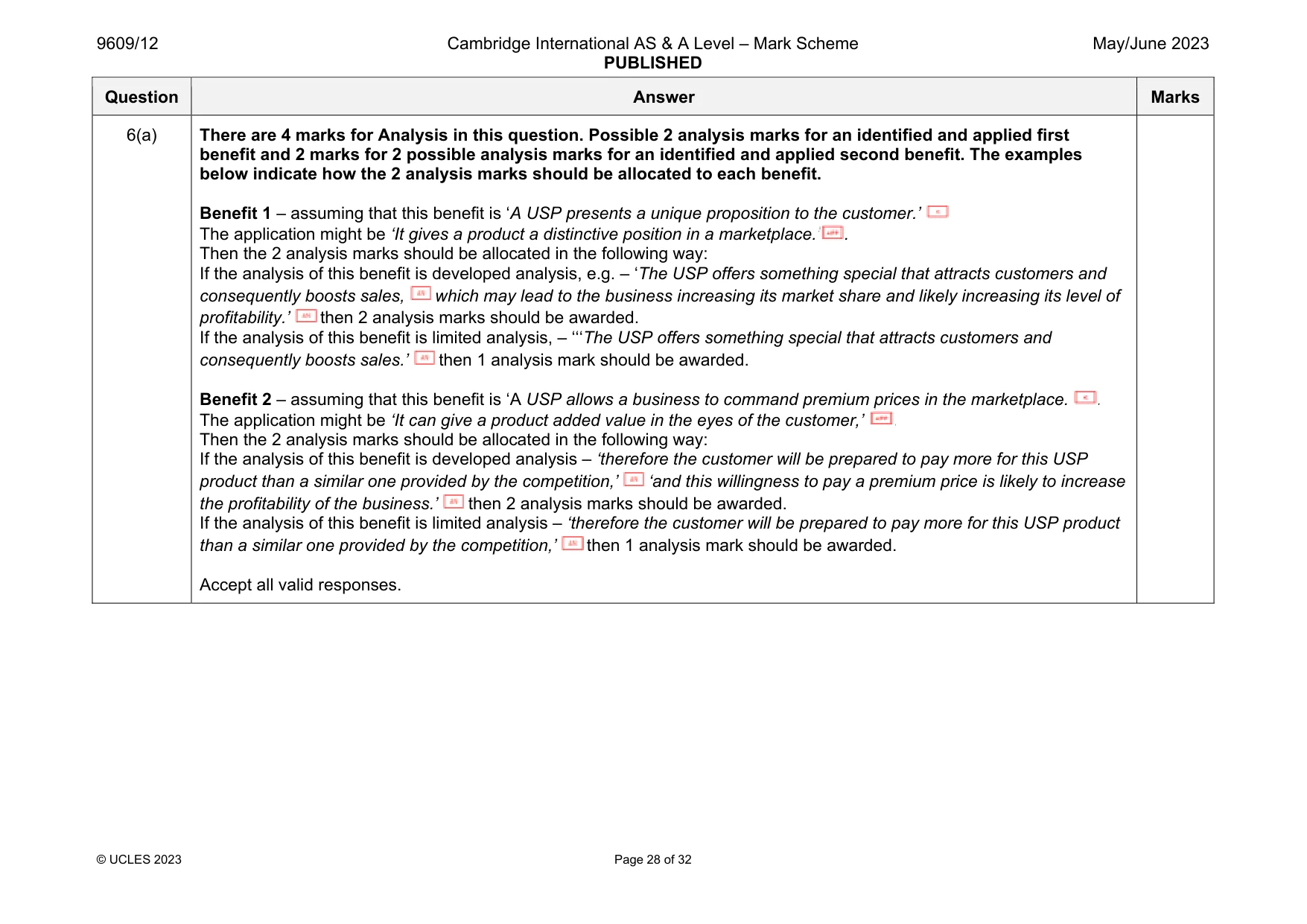
9609/12 Cambridge International AS & A Level – Mark Scheme PUBLISHED May/June 2023 © UCLES 2023 Page 28 of 32 Question Answer Marks 6(a) There are 4 marks for Analysis in this question. Possible 2 analysis marks for an identified and applied first benefit and 2 marks for 2 possible analysis marks for an identified and applied second benefit. The examples below indicate how the 2 analysis marks should be allocated to each benefit. Benefit 1 – assuming that this benefit is ‘A USP presents a unique proposition to the customer.’ The application might be ‘It gives a product a distinctive position in a marketplace.’ . Then the 2 analysis marks should be allocated in the following way: If the analysis of this benefit is developed analysis, e.g. – ‘The USP offers something special that attracts customers and consequently boosts sales, which may lead to the business increasing its market share and likely increasing its level of profitability.’ then 2 analysis marks should be awarded. If the analysis of this benefit is limited analysis, – ‘‘‘The USP offers something special that attracts customers and consequently boosts sales.’ then 1 analysis mark should be awarded. Benefit 2 – assuming that this benefit is ‘A USP allows a business to command premium prices in the marketplace. . The application might be ‘It can give a product added value in the eyes of the customer,’ . Then the 2 analysis marks should be allocated in the following way: If the analysis of this benefit is developed analysis – ‘therefore the customer will be prepared to pay more for this USP product than a similar one provided by the competition,’ ‘and this willingness to pay a premium price is likely to increase the profitability of the business.’ then 2 analysis marks should be awarded. If the analysis of this benefit is limited analysis – ‘therefore the customer will be prepared to pay more for this USP product than a similar one provided by the competition,’ then 1 analysis mark should be awarded. Accept all valid responses.
Mark scheme, page 29
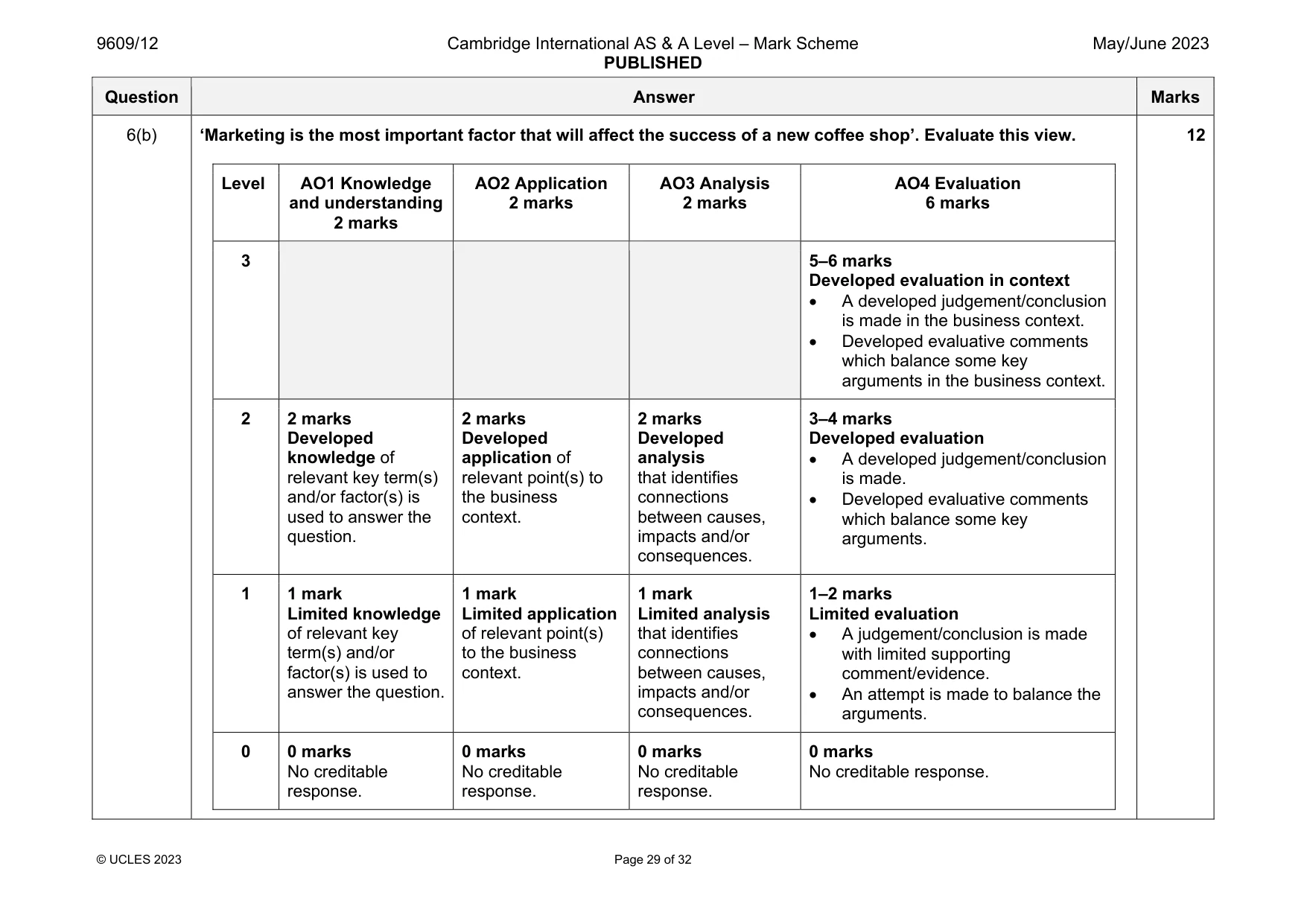
9609/12 Cambridge International AS & A Level – Mark Scheme PUBLISHED May/June 2023 © UCLES 2023 Page 29 of 32 Question Answer Marks 6(b) ‘Marketing is the most important factor that will affect the success of a new coffee shop’. Evaluate this view. Level AO1 Knowledge and understanding 2 marks AO2 Application 2 marks AO3 Analysis 2 marks AO4 Evaluation 6 marks 3 5–6 marks Developed evaluation in context A developed judgement/conclusion is made in the business context. Developed evaluative comments which balance some key arguments in the business context. 2 2 marks Developed knowledge of relevant key term(s) and/or factor(s) is used to answer the question. 2 marks Developed application of relevant point(s) to the business context. 2 marks Developed analysis that identifies connections between causes, impacts and/or consequences. 3–4 marks Developed evaluation A developed judgement/conclusion is made. Developed evaluative comments which balance some key arguments. 1 1 mark Limited knowledge of relevant key term(s) and/or factor(s) is used to answer the question. 1 mark Limited application of relevant point(s) to the business context. 1 mark Limited analysis that identifies connections between causes, impacts and/or consequences. 1–2 marks Limited evaluation A judgement/conclusion is made with limited supporting comment/evidence. An attempt is made to balance the arguments. 0 0 marks No creditable response. 0 marks No creditable response. 0 marks No creditable response. 0 marks No creditable response. 12
Mark scheme, page 30
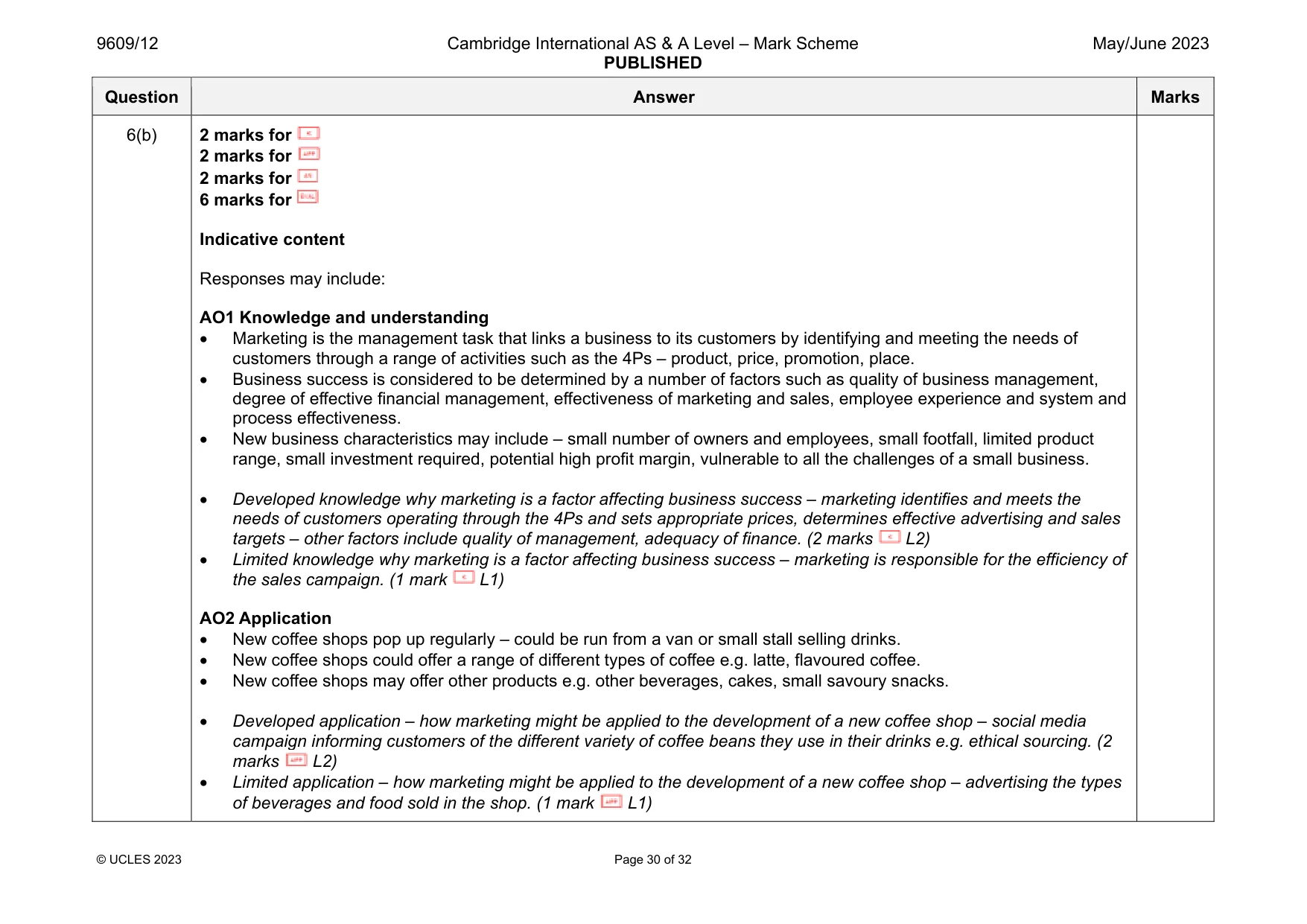
9609/12 Cambridge International AS & A Level – Mark Scheme PUBLISHED May/June 2023 © UCLES 2023 Page 30 of 32 Question Answer Marks 6(b) 2 marks for 2 marks for 2 marks for 6 marks for Indicative content Responses may include: AO1 Knowledge and understanding Marketing is the management task that links a business to its customers by identifying and meeting the needs of customers through a range of activities such as the 4Ps – product, price, promotion, place. Business success is considered to be determined by a number of factors such as quality of business management, degree of effective financial management, effectiveness of marketing and sales, employee experience and system and process effectiveness. New business characteristics may include – small number of owners and employees, small footfall, limited product range, small investment required, potential high profit margin, vulnerable to all the challenges of a small business. Developed knowledge why marketing is a factor affecting business success – marketing identifies and meets the needs of customers operating through the 4Ps and sets appropriate prices, determines effective advertising and sales targets – other factors include quality of management, adequacy of finance. (2 marks L2) Limited knowledge why marketing is a factor affecting business success – marketing is responsible for the efficiency of the sales campaign. (1 mark L1) AO2 Application New coffee shops pop up regularly – could be run from a van or small stall selling drinks. New coffee shops could offer a range of different types of coffee e.g. latte, flavoured coffee. New coffee shops may offer other products e.g. other beverages, cakes, small savoury snacks. Developed application – how marketing might be applied to the development of a new coffee shop – social media campaign informing customers of the different variety of coffee beans they use in their drinks e.g. ethical sourcing. (2 marks L2) Limited application – how marketing might be applied to the development of a new coffee shop – advertising the types of beverages and food sold in the shop. (1 mark L1)
Mark scheme, page 31
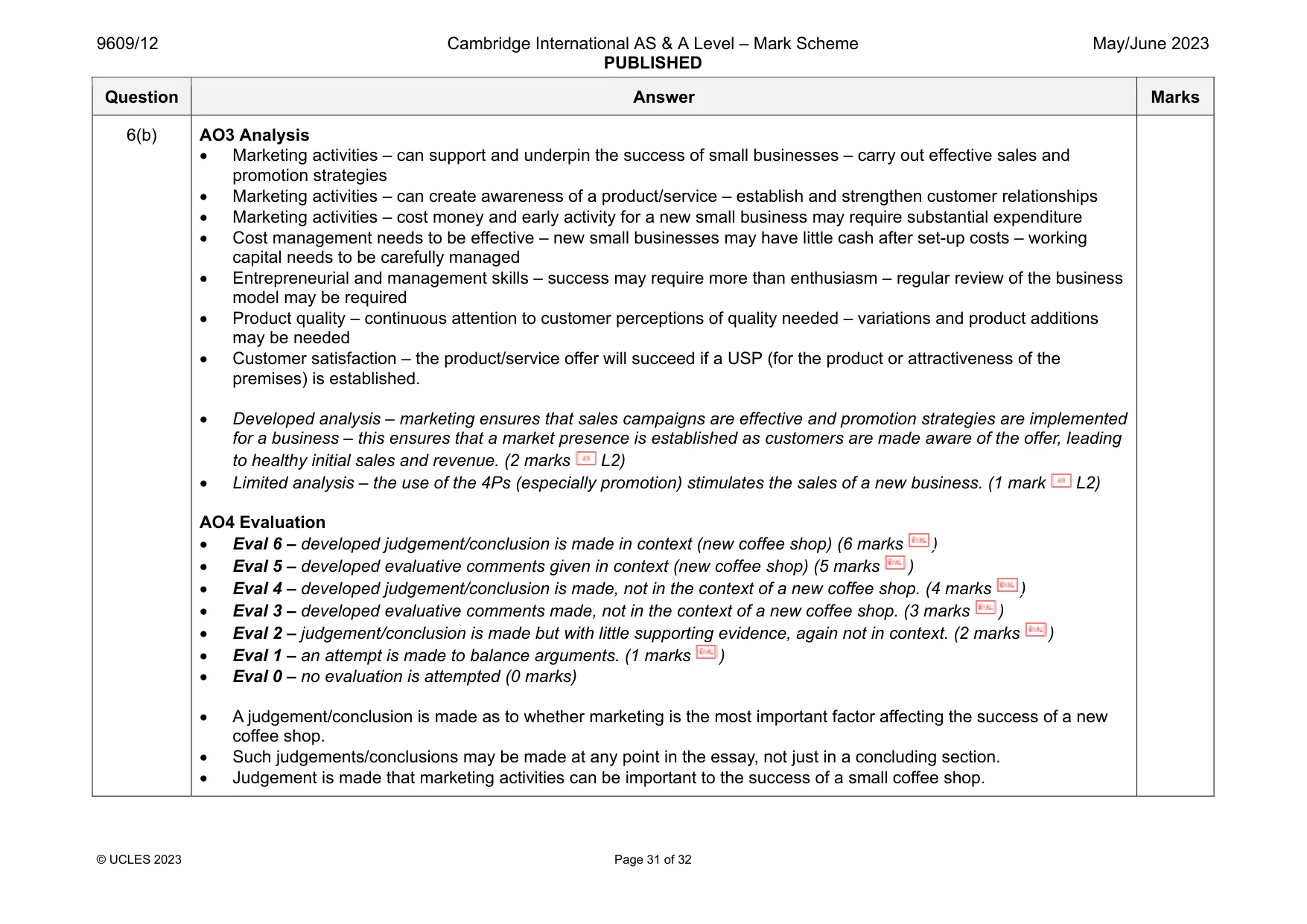
9609/12 Cambridge International AS & A Level – Mark Scheme PUBLISHED May/June 2023 © UCLES 2023 Page 31 of 32 Question Answer Marks 6(b) AO3 Analysis Marketing activities – can support and underpin the success of small businesses – carry out effective sales and promotion strategies Marketing activities – can create awareness of a product/service – establish and strengthen customer relationships Marketing activities – cost money and early activity for a new small business may require substantial expenditure Cost management needs to be effective – new small businesses may have little cash after set-up costs – working capital needs to be carefully managed Entrepreneurial and management skills – success may require more than enthusiasm – regular review of the business model may be required Product quality – continuous attention to customer perceptions of quality needed – variations and product additions may be needed Customer satisfaction – the product/service offer will succeed if a USP (for the product or attractiveness of the premises) is established. Developed analysis – marketing ensures that sales campaigns are effective and promotion strategies are implemented for a business – this ensures that a market presence is established as customers are made aware of the offer, leading to healthy initial sales and revenue. (2 marks L2) Limited analysis – the use of the 4Ps (especially promotion) stimulates the sales of a new business. (1 mark L2) AO4 Evaluation Eval 6 – developed judgement/conclusion is made in context (new coffee shop) (6 marks ) Eval 5 – developed evaluative comments given in context (new coffee shop) (5 marks ) Eval 4 – developed judgement/conclusion is made, not in the context of a new coffee shop. (4 marks ) Eval 3 – developed evaluative comments made, not in the context of a new coffee shop. (3 marks ) Eval 2 – judgement/conclusion is made but with little supporting evidence, again not in context. (2 marks ) Eval 1 – an attempt is made to balance arguments. (1 marks ) Eval 0 – no evaluation is attempted (0 marks) A judgement/conclusion is made as to whether marketing is the most important factor affecting the success of a new coffee shop. Such judgements/conclusions may be made at any point in the essay, not just in a concluding section. Judgement is made that marketing activities can be important to the success of a small coffee shop.
Mark scheme, page 32
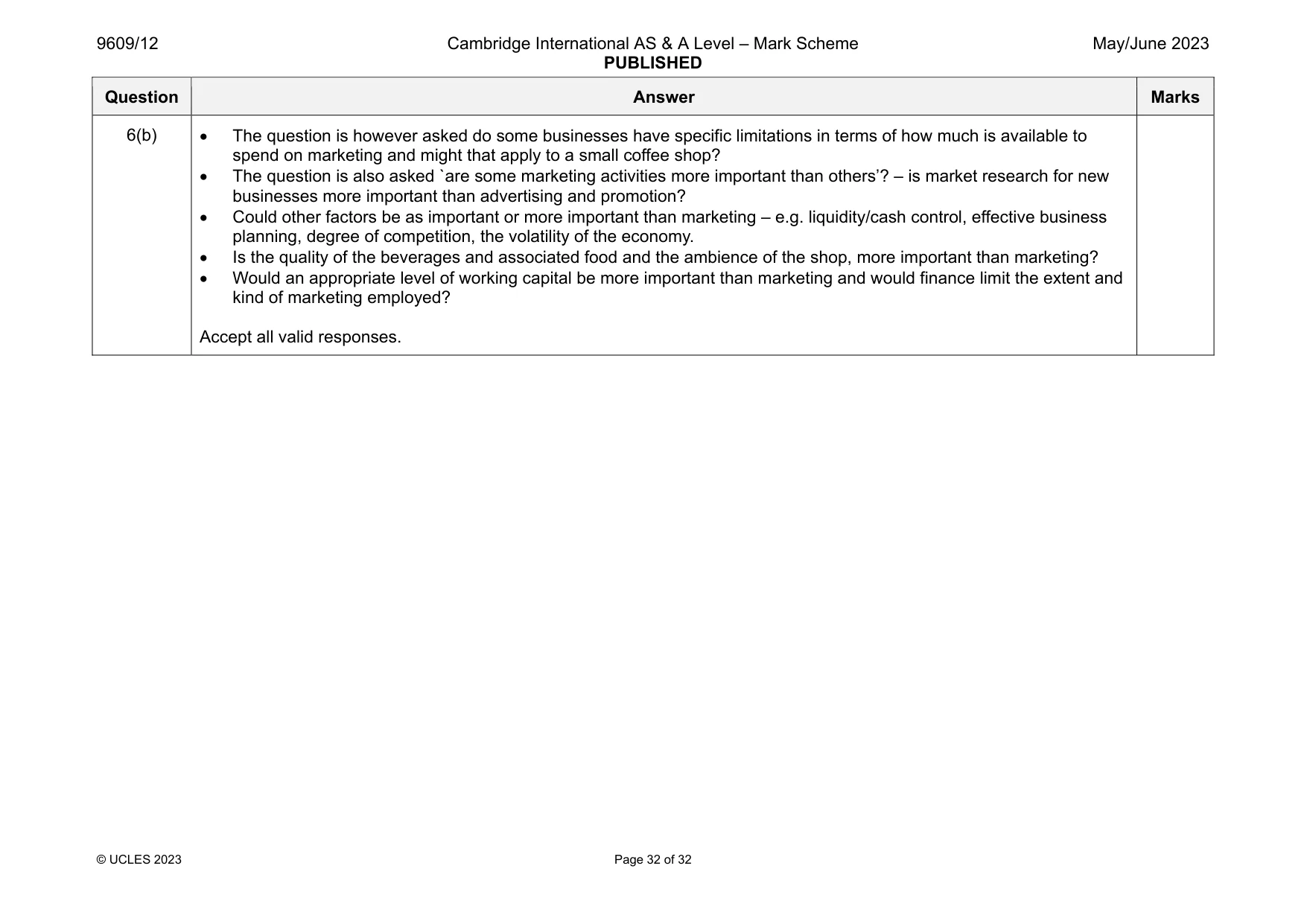
9609/12 Cambridge International AS & A Level – Mark Scheme PUBLISHED May/June 2023 © UCLES 2023 Page 32 of 32 Question Answer Marks 6(b) The question is however asked do some businesses have specific limitations in terms of how much is available to spend on marketing and might that apply to a small coffee shop? The question is also asked `are some marketing activities more important than others’? – is market research for new businesses more important than advertising and promotion? Could other factors be as important or more important than marketing – e.g. liquidity/cash control, effective business planning, degree of competition, the volatility of the economy. Is the quality of the beverages and associated food and the ambience of the shop, more important than marketing? Would an appropriate level of working capital be more important than marketing and would finance limit the extent and kind of marketing employed? Accept all valid responses.
What you needed in this session
Cambridge’s own grade thresholds for 2023 May/June, Paper 1 · Variant 2. A higher threshold means an easier paper — the bar moves with how the cohort did.