Cambridge A Level Business (for first examination in 2016) 9609 — 2024 May/June Paper 1 · Variant 3
9609/13/M/J/24 · 40 marks · ≈45 min
The question paper and its mark scheme, free to read here and free to download. This is Cambridge’s own paper, exactly as it was sat.
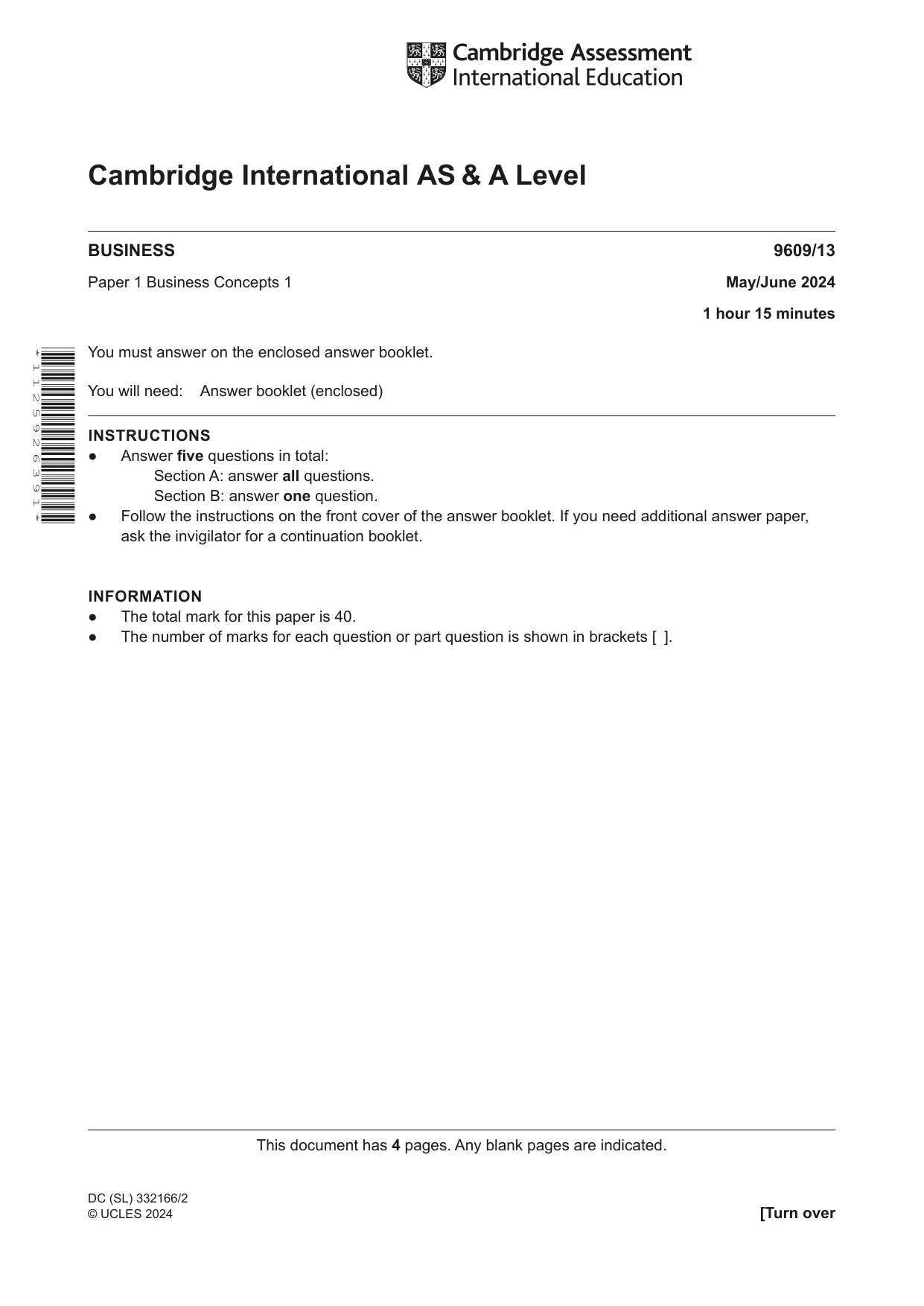
Question paper4 pages


Mark scheme34 pages
Answers below. Sit the paper first if you are practising.
Paper as text
Question paper, page 1
This document has 4 pages. Any blank pages are indicated. [Turn over Cambridge International AS & A Level BUSINESS 9609/13 Paper 1 Business Concepts 1 May/June 2024 1 hour 15 minutes You must answer on the enclosed answer booklet. You will need: Answer booklet (enclosed) INSTRUCTIONS ● Answer five questions in total: Section A: answer all questions. Section B: answer one question. ● Follow the instructions on the front cover of the answer booklet. If you need additional answer paper, ask the invigilator for a continuation booklet. INFORMATION ● The total mark for this paper is 40. ● The number of marks for each question or part question is shown in brackets [ ]. * 1 1 2 5 9 2 6 3 9 1 * DC (SL) 332166/2 © UCLES 2024
Question paper, page 2
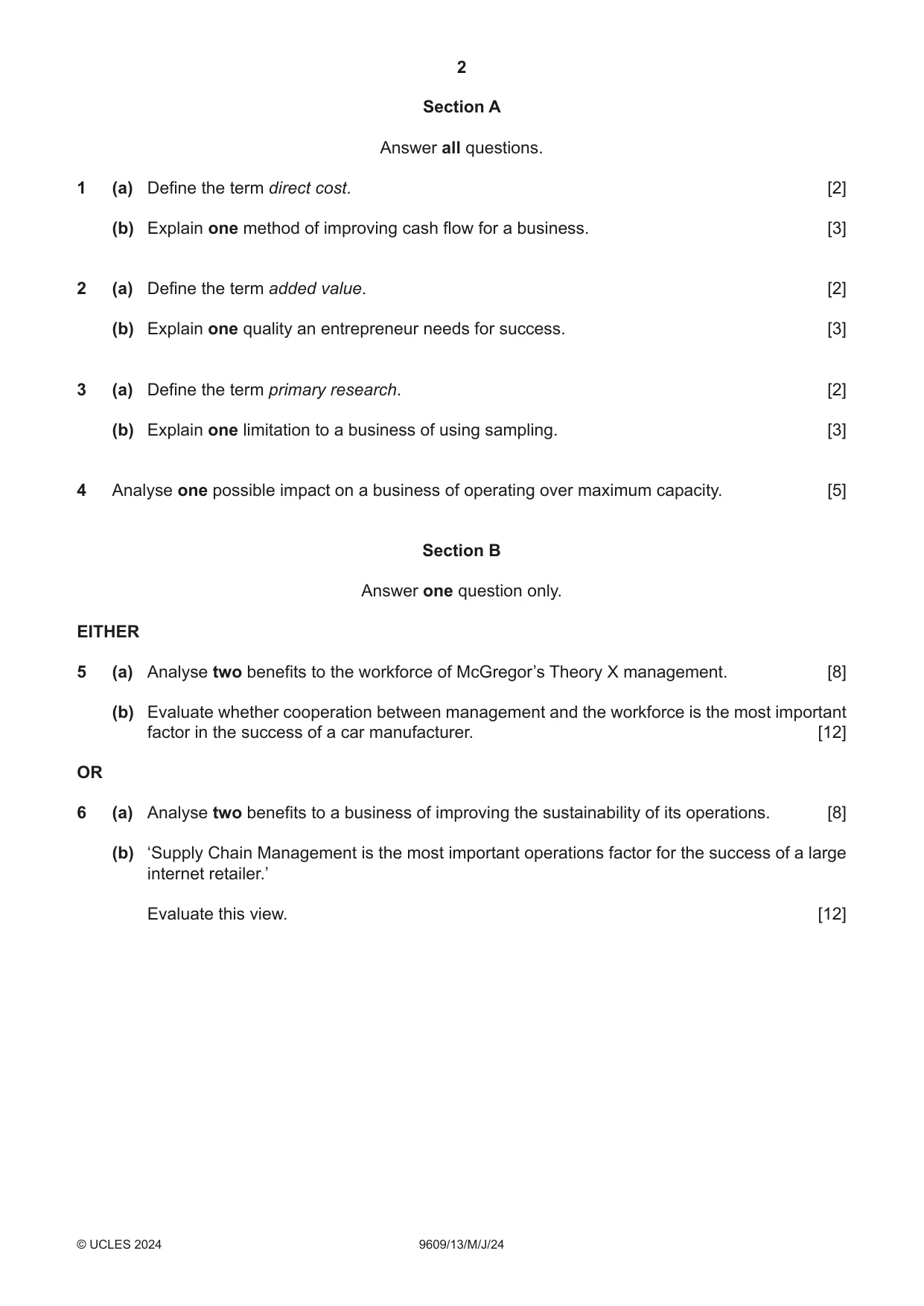
2 9609/13/M/J/24 © UCLES 2024 Section A Answer all questions. 1 (a) Define the term direct cost. [2] (b) Explain one method of improving cash flow for a business. [3] 2 (a) Define the term added value. [2] (b) Explain one quality an entrepreneur needs for success. [3] 3 (a) Define the term primary research. [2] (b) Explain one limitation to a business of using sampling. [3] 4 Analyse one possible impact on a business of operating over maximum capacity. [5] Section B Answer one question only. EITHER 5 (a) Analyse two benefits to the workforce of McGregor’s Theory X management. [8] (b) Evaluate whether cooperation between management and the workforce is the most important factor in the success of a car manufacturer. [12] OR 6 (a) Analyse two benefits to a business of improving the sustainability of its operations. [8] (b) ‘Supply Chain Management is the most important operations factor for the success of a large internet retailer.’ Evaluate this view. [12]
Question paper, page 3
3 9609/13/M/J/24 © UCLES 2024 BLANK PAGE
Question paper, page 4
4 9609/13/M/J/24 © UCLES 2024 Permission to reproduce items where third-party owned material protected by copyright is included has been sought and cleared where possible. Every reasonable effort has been made by the publisher (UCLES) to trace copyright holders, but if any items requiring clearance have unwittingly been included, the publisher will be pleased to make amends at the earliest possible opportunity. To avoid the issue of disclosure of answer-related information to candidates, all copyright acknowledgements are reproduced online in the Cambridge Assessment International Education Copyright Acknowledgements Booklet. This is produced for each series of examinations and is freely available to download at www.cambridgeinternational.org after the live examination series. Cambridge Assessment International Education is part of Cambridge Assessment. Cambridge Assessment is the brand name of the University of Cambridge Local Examinations Syndicate (UCLES), which is a department of the University of Cambridge. BLANK PAGE
Mark scheme, page 1
This document consists of 34 printed pages. © Cambridge University Press & Assessment 2024 [Turn over Cambridge International AS & A Level BUSINESS 9609/13 Paper 1 Business Concepts 1 May/June 2024 MARK SCHEME Maximum Mark: 40 Published This mark scheme is published as an aid to teachers and candidates, to indicate the requirements of the examination. It shows the basis on which Examiners were instructed to award marks. It does not indicate the details of the discussions that took place at an Examiners’ meeting before marking began, which would have considered the acceptability of alternative answers. Mark schemes should be read in conjunction with the question paper and the Principal Examiner Report for Teachers. Cambridge International will not enter into discussions about these mark schemes. Cambridge International is publishing the mark schemes for the May/June 2024 series for most Cambridge IGCSE, Cambridge International A and AS Level and Cambridge Pre-U components, and some Cambridge O Level components.
Mark scheme, page 2
9609/13 Cambridge International AS & A Level – Mark Scheme PUBLISHED May/June 2024 © Cambridge University Press & Assessment 2024 Page 2 of 34 Generic Marking Principles These general marking principles must be applied by all examiners when marking candidate answers. They should be applied alongside the specific content of the mark scheme or generic level descriptions for a question. Each question paper and mark scheme will also comply with these marking principles. GENERIC MARKING PRINCIPLE 1: Marks must be awarded in line with: the specific content of the mark scheme or the generic level descriptors for the question the specific skills defined in the mark scheme or in the generic level descriptors for the question the standard of response required by a candidate as exemplified by the standardisation scripts. GENERIC MARKING PRINCIPLE 2: Marks awarded are always whole marks (not half marks, or other fractions). GENERIC MARKING PRINCIPLE 3: Marks must be awarded positively: marks are awarded for correct/valid answers, as defined in the mark scheme. However, credit is given for valid answers which go beyond the scope of the syllabus and mark scheme, referring to your Team Leader as appropriate marks are awarded when candidates clearly demonstrate what they know and can do marks are not deducted for errors marks are not deducted for omissions answers should only be judged on the quality of spelling, punctuation and grammar when these features are specifically assessed by the question as indicated by the mark scheme. The meaning, however, should be unambiguous. GENERIC MARKING PRINCIPLE 4: Rules must be applied consistently, e.g. in situations where candidates have not followed instructions or in the application of generic level descriptors.
Mark scheme, page 3
9609/13 Cambridge International AS & A Level – Mark Scheme PUBLISHED May/June 2024 © Cambridge University Press & Assessment 2024 Page 3 of 34 GENERIC MARKING PRINCIPLE 5: Marks should be awarded using the full range of marks defined in the mark scheme for the question (however; the use of the full mark range may be limited according to the quality of the candidate responses seen). GENERIC MARKING PRINCIPLE 6: Marks awarded are based solely on the requirements as defined in the mark scheme. Marks should not be awarded with grade thresholds or grade descriptors in mind.
Mark scheme, page 4
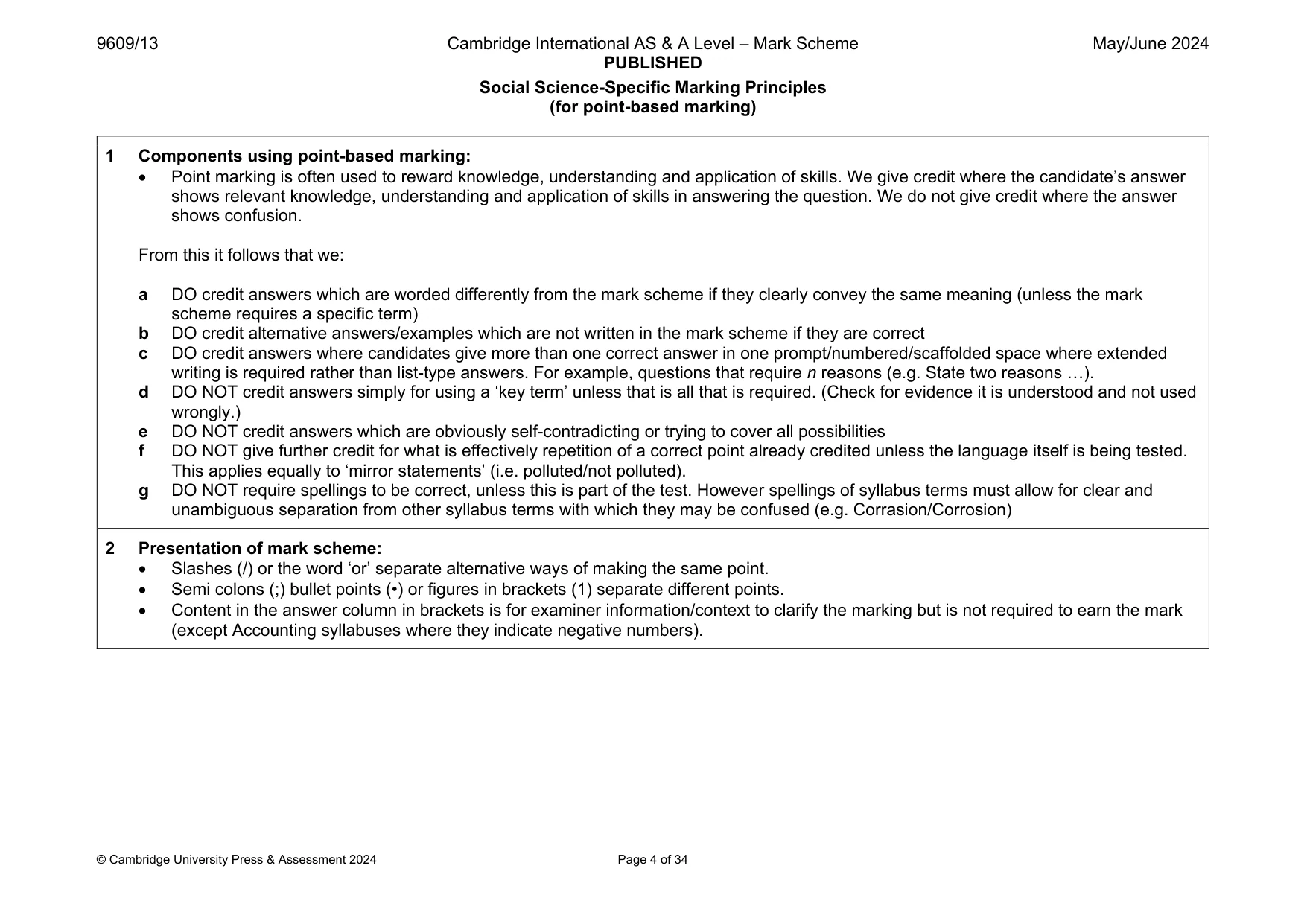
9609/13 Cambridge International AS & A Level – Mark Scheme PUBLISHED May/June 2024 © Cambridge University Press & Assessment 2024 Page 4 of 34 Social Science-Specific Marking Principles (for point-based marking) 1 Components using point-based marking: Point marking is often used to reward knowledge, understanding and application of skills. We give credit where the candidate’s answer shows relevant knowledge, understanding and application of skills in answering the question. We do not give credit where the answer shows confusion. From this it follows that we: a DO credit answers which are worded differently from the mark scheme if they clearly convey the same meaning (unless the mark scheme requires a specific term) b DO credit alternative answers/examples which are not written in the mark scheme if they are correct c DO credit answers where candidates give more than one correct answer in one prompt/numbered/scaffolded space where extended writing is required rather than list-type answers. For example, questions that require n reasons (e.g. State two reasons …). d DO NOT credit answers simply for using a ‘key term’ unless that is all that is required. (Check for evidence it is understood and not used wrongly.) e DO NOT credit answers which are obviously self-contradicting or trying to cover all possibilities f DO NOT give further credit for what is effectively repetition of a correct point already credited unless the language itself is being tested. This applies equally to ‘mirror statements’ (i.e. polluted/not polluted). g DO NOT require spellings to be correct, unless this is part of the test. However spellings of syllabus terms must allow for clear and unambiguous separation from other syllabus terms with which they may be confused (e.g. Corrasion/Corrosion) 2 Presentation of mark scheme: Slashes (/) or the word ‘or’ separate alternative ways of making the same point. Semi colons (;) bullet points (•) or figures in brackets (1) separate different points. Content in the answer column in brackets is for examiner information/context to clarify the marking but is not required to earn the mark (except Accounting syllabuses where they indicate negative numbers).
Mark scheme, page 5
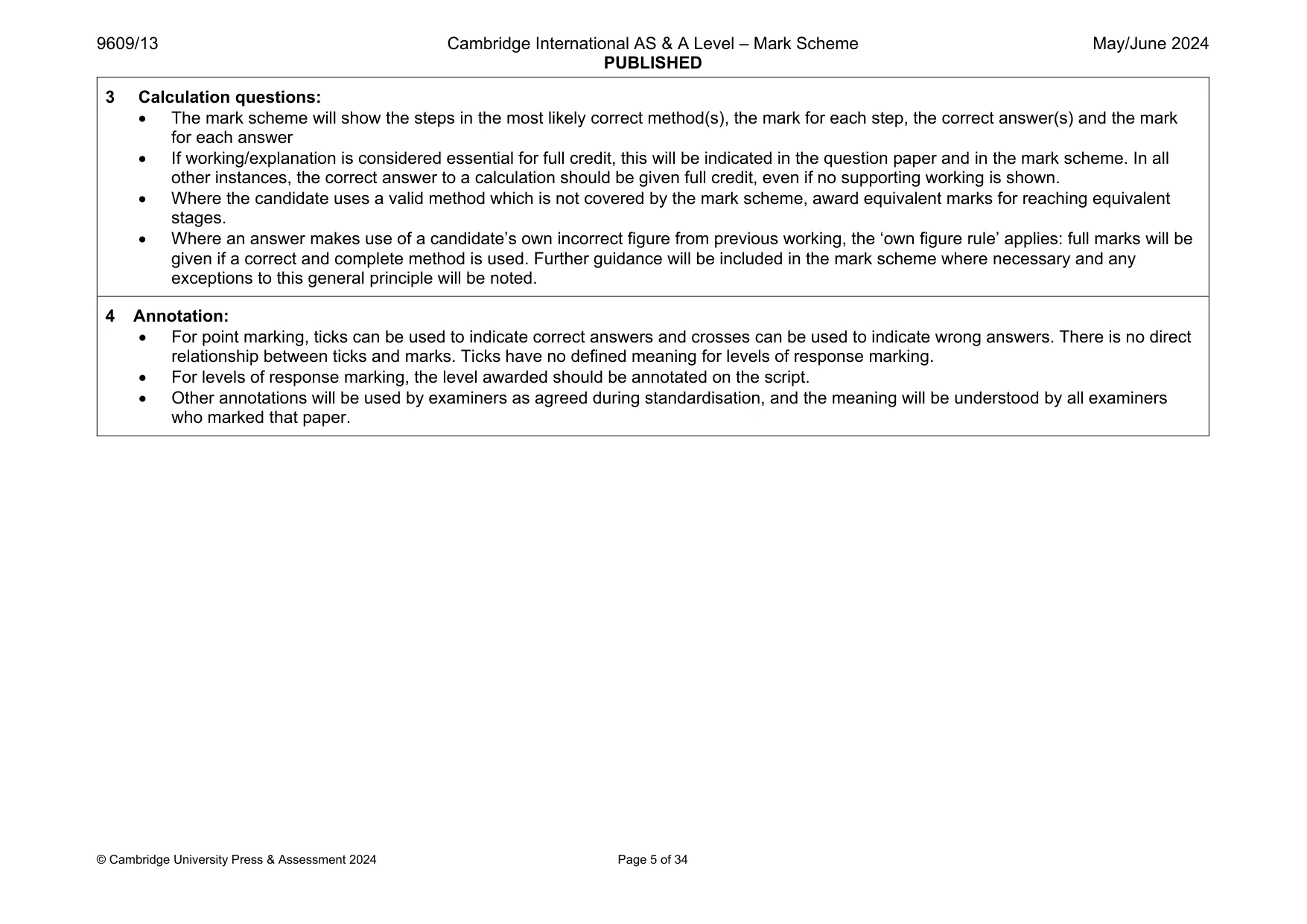
9609/13 Cambridge International AS & A Level – Mark Scheme PUBLISHED May/June 2024 © Cambridge University Press & Assessment 2024 Page 5 of 34 3 Calculation questions: The mark scheme will show the steps in the most likely correct method(s), the mark for each step, the correct answer(s) and the mark for each answer If working/explanation is considered essential for full credit, this will be indicated in the question paper and in the mark scheme. In all other instances, the correct answer to a calculation should be given full credit, even if no supporting working is shown. Where the candidate uses a valid method which is not covered by the mark scheme, award equivalent marks for reaching equivalent stages. Where an answer makes use of a candidate’s own incorrect figure from previous working, the ‘own figure rule’ applies: full marks will be given if a correct and complete method is used. Further guidance will be included in the mark scheme where necessary and any exceptions to this general principle will be noted. 4 Annotation: For point marking, ticks can be used to indicate correct answers and crosses can be used to indicate wrong answers. There is no direct relationship between ticks and marks. Ticks have no defined meaning for levels of response marking. For levels of response marking, the level awarded should be annotated on the script. Other annotations will be used by examiners as agreed during standardisation, and the meaning will be understood by all examiners who marked that paper.
Mark scheme, page 6
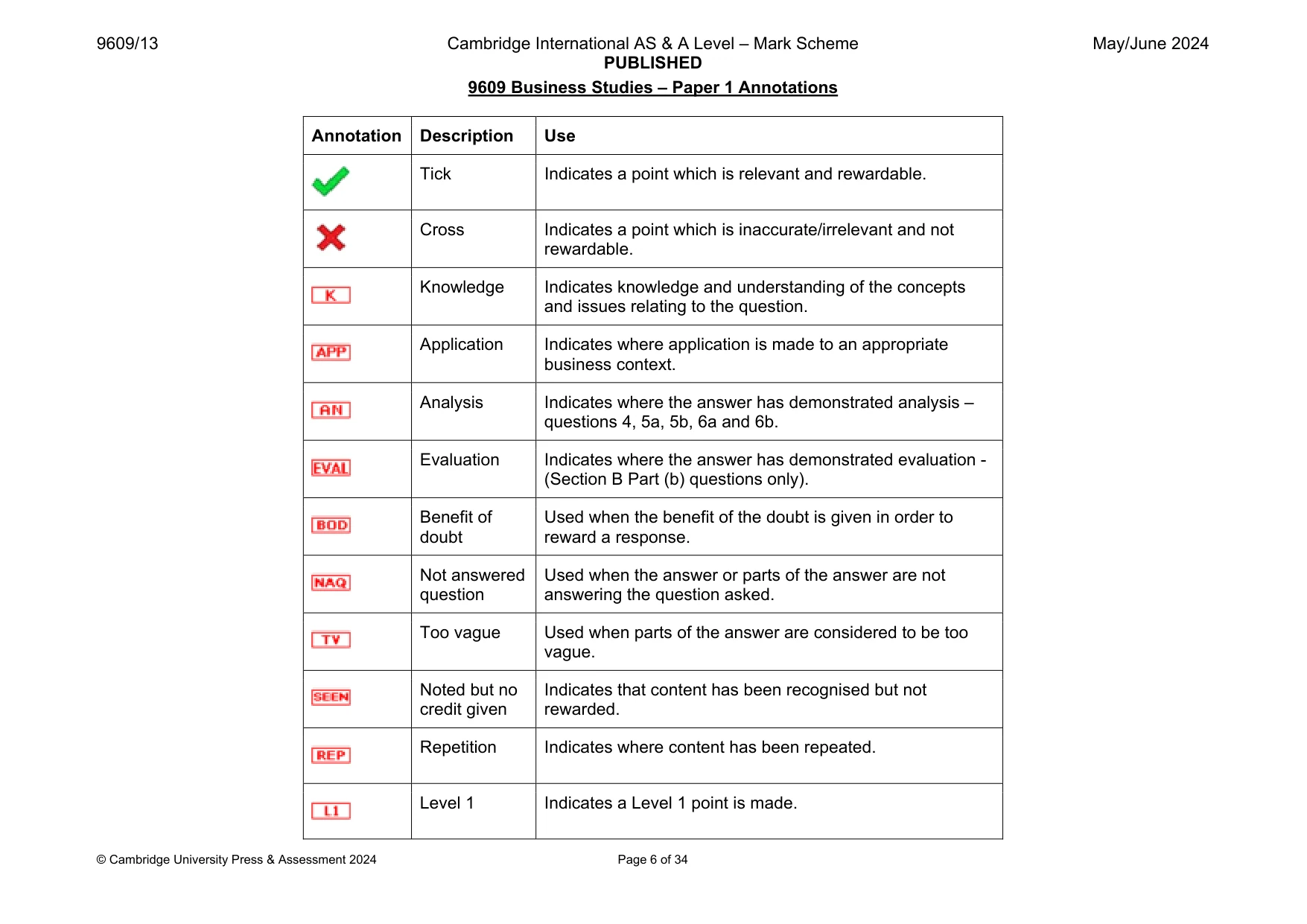
9609/13 Cambridge International AS & A Level – Mark Scheme PUBLISHED May/June 2024 © Cambridge University Press & Assessment 2024 Page 6 of 34 9609 Business Studies – Paper 1 Annotations Annotation Description Use Tick Indicates a point which is relevant and rewardable. Cross Indicates a point which is inaccurate/irrelevant and not rewardable. Knowledge Indicates knowledge and understanding of the concepts and issues relating to the question. Application Indicates where application is made to an appropriate business context. Analysis Indicates where the answer has demonstrated analysis – questions 4, 5a, 5b, 6a and 6b. Evaluation Indicates where the answer has demonstrated evaluation - (Section B Part (b) questions only). Benefit of doubt Used when the benefit of the doubt is given in order to reward a response. Not answered question Used when the answer or parts of the answer are not answering the question asked. Too vague Used when parts of the answer are considered to be too vague. Noted but no credit given Indicates that content has been recognised but not rewarded. Repetition Indicates where content has been repeated. Level 1 Indicates a Level 1 point is made.
Mark scheme, page 7
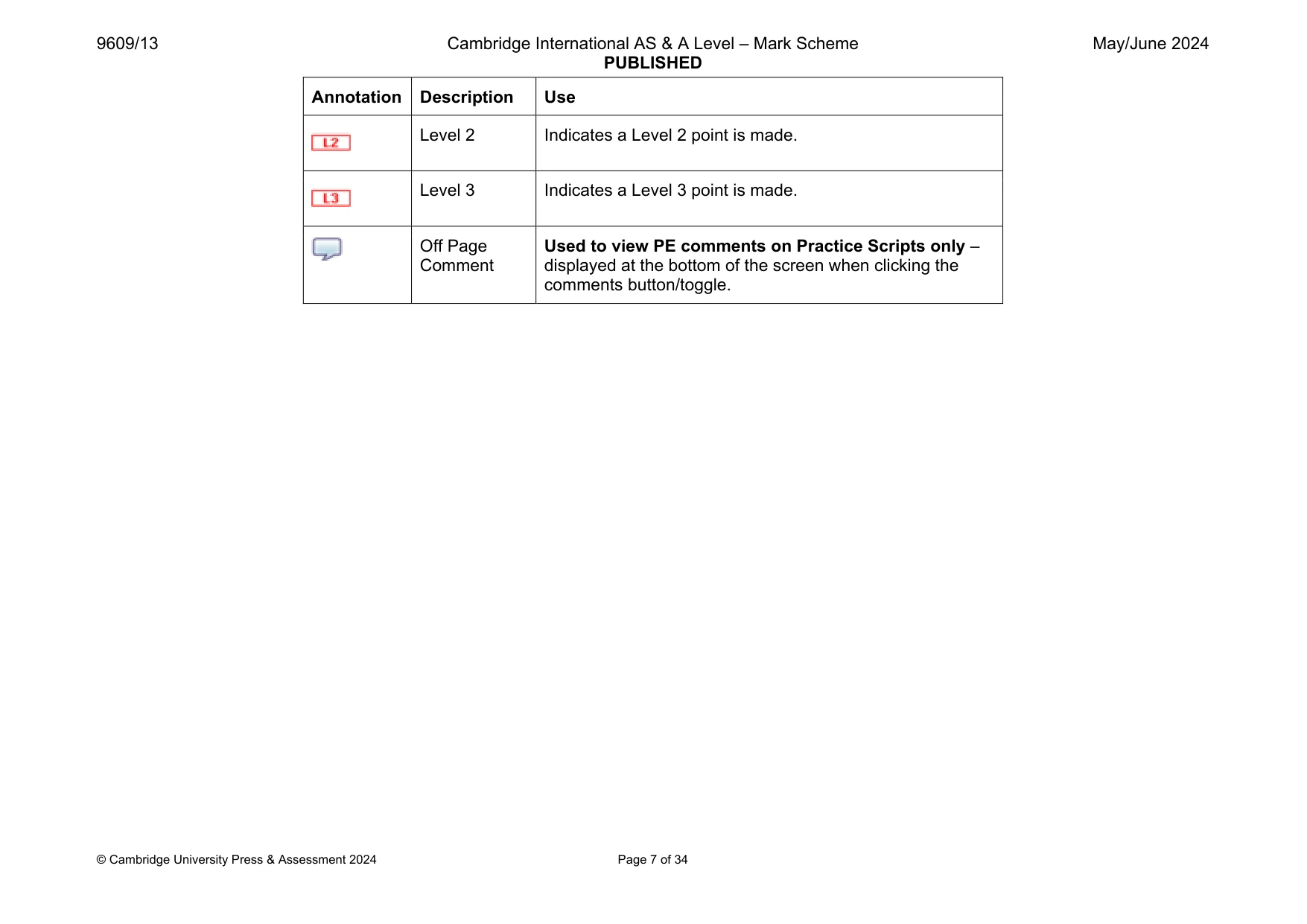
9609/13 Cambridge International AS & A Level – Mark Scheme PUBLISHED May/June 2024 © Cambridge University Press & Assessment 2024 Page 7 of 34 Annotation Description Use Level 2 Indicates a Level 2 point is made. Level 3 Indicates a Level 3 point is made. Off Page Comment Used to view PE comments on Practice Scripts only – displayed at the bottom of the screen when clicking the comments button/toggle.
Mark scheme, page 8
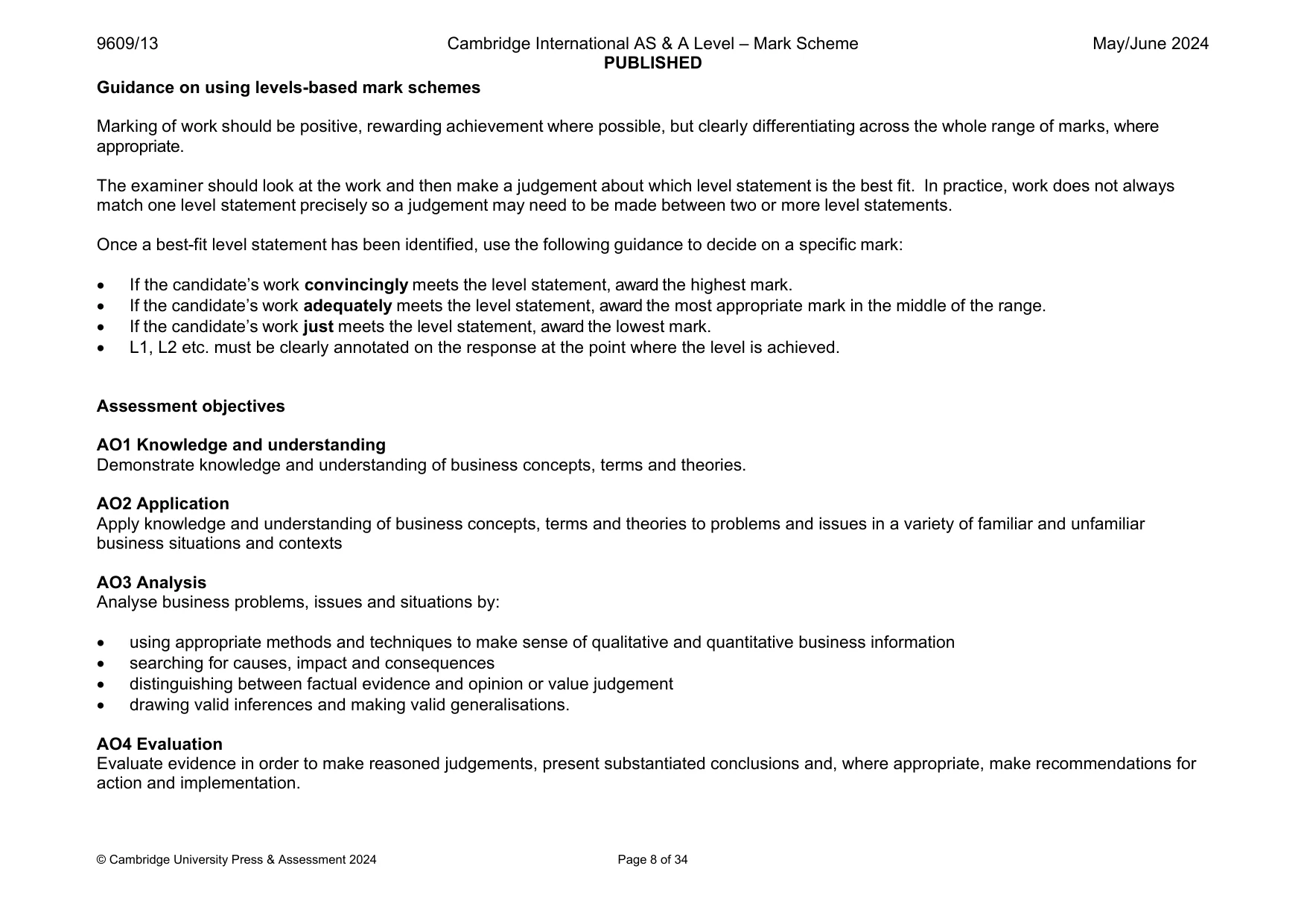
9609/13 Cambridge International AS & A Level – Mark Scheme PUBLISHED May/June 2024 © Cambridge University Press & Assessment 2024 Page 8 of 34 Guidance on using levels-based mark schemes Marking of work should be positive, rewarding achievement where possible, but clearly differentiating across the whole range of marks, where appropriate. The examiner should look at the work and then make a judgement about which level statement is the best fit. In practice, work does not always match one level statement precisely so a judgement may need to be made between two or more level statements. Once a best-fit level statement has been identified, use the following guidance to decide on a specific mark: If the candidate’s work convincingly meets the level statement, award the highest mark. If the candidate’s work adequately meets the level statement, award the most appropriate mark in the middle of the range. If the candidate’s work just meets the level statement, award the lowest mark. L1, L2 etc. must be clearly annotated on the response at the point where the level is achieved. Assessment objectives AO1 Knowledge and understanding Demonstrate knowledge and understanding of business concepts, terms and theories. AO2 Application Apply knowledge and understanding of business concepts, terms and theories to problems and issues in a variety of familiar and unfamiliar business situations and contexts AO3 Analysis Analyse business problems, issues and situations by: using appropriate methods and techniques to make sense of qualitative and quantitative business information searching for causes, impact and consequences distinguishing between factual evidence and opinion or value judgement drawing valid inferences and making valid generalisations. AO4 Evaluation Evaluate evidence in order to make reasoned judgements, present substantiated conclusions and, where appropriate, make recommendations for action and implementation.
Mark scheme, page 9
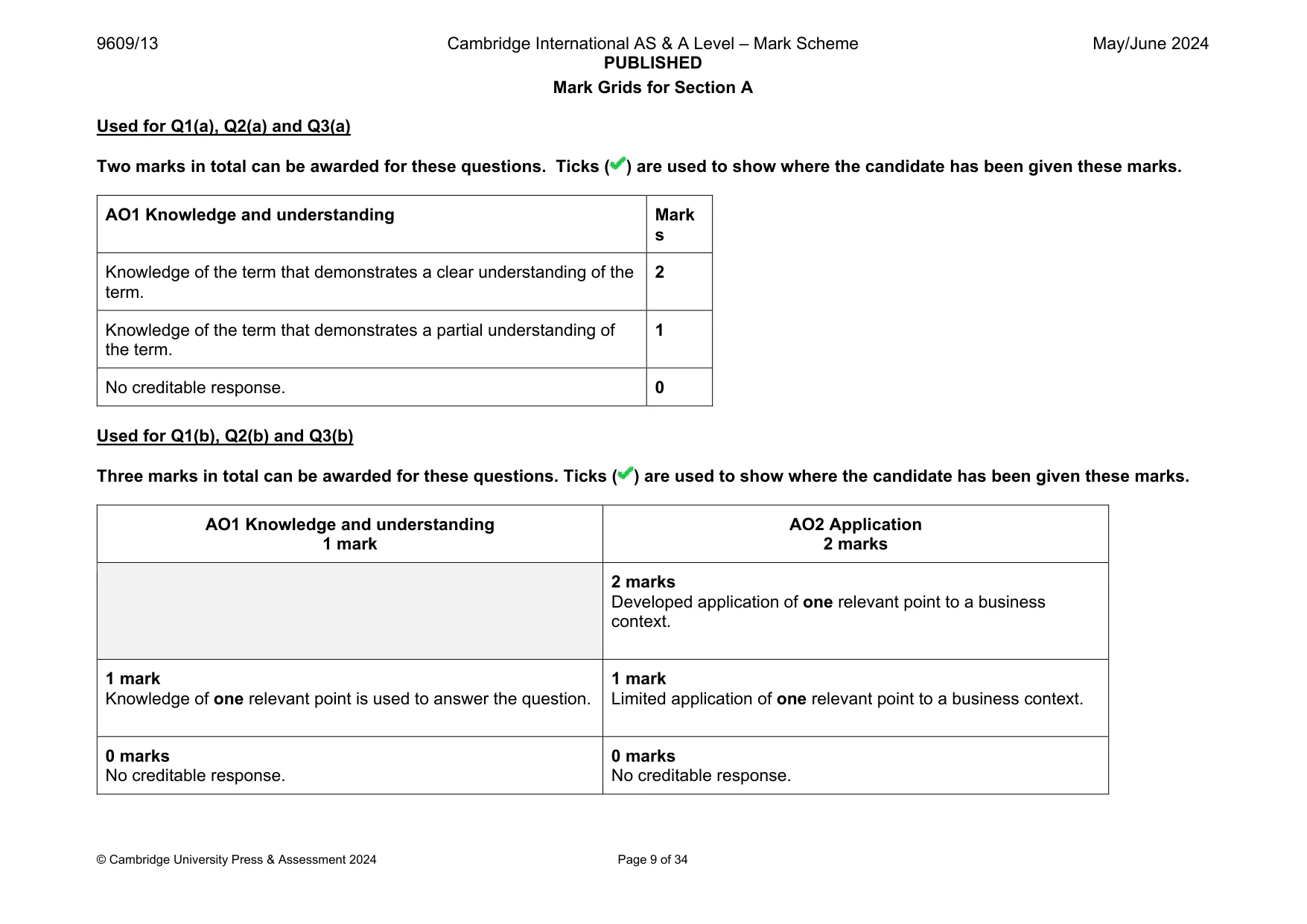
9609/13 Cambridge International AS & A Level – Mark Scheme PUBLISHED May/June 2024 © Cambridge University Press & Assessment 2024 Page 9 of 34 Mark Grids for Section A Used for Q1(a), Q2(a) and Q3(a) Two marks in total can be awarded for these questions. Ticks ( ) are used to show where the candidate has been given these marks. AO1 Knowledge and understanding Mark s Knowledge of the term that demonstrates a clear understanding of the term. 2 Knowledge of the term that demonstrates a partial understanding of the term. 1 No creditable response. 0 Used for Q1(b), Q2(b) and Q3(b) Three marks in total can be awarded for these questions. Ticks ( ) are used to show where the candidate has been given these marks. AO1 Knowledge and understanding 1 mark AO2 Application 2 marks 2 marks Developed application of one relevant point to a business context. 1 mark Knowledge of one relevant point is used to answer the question. 1 mark Limited application of one relevant point to a business context. 0 marks No creditable response. 0 marks No creditable response.
Mark scheme, page 10
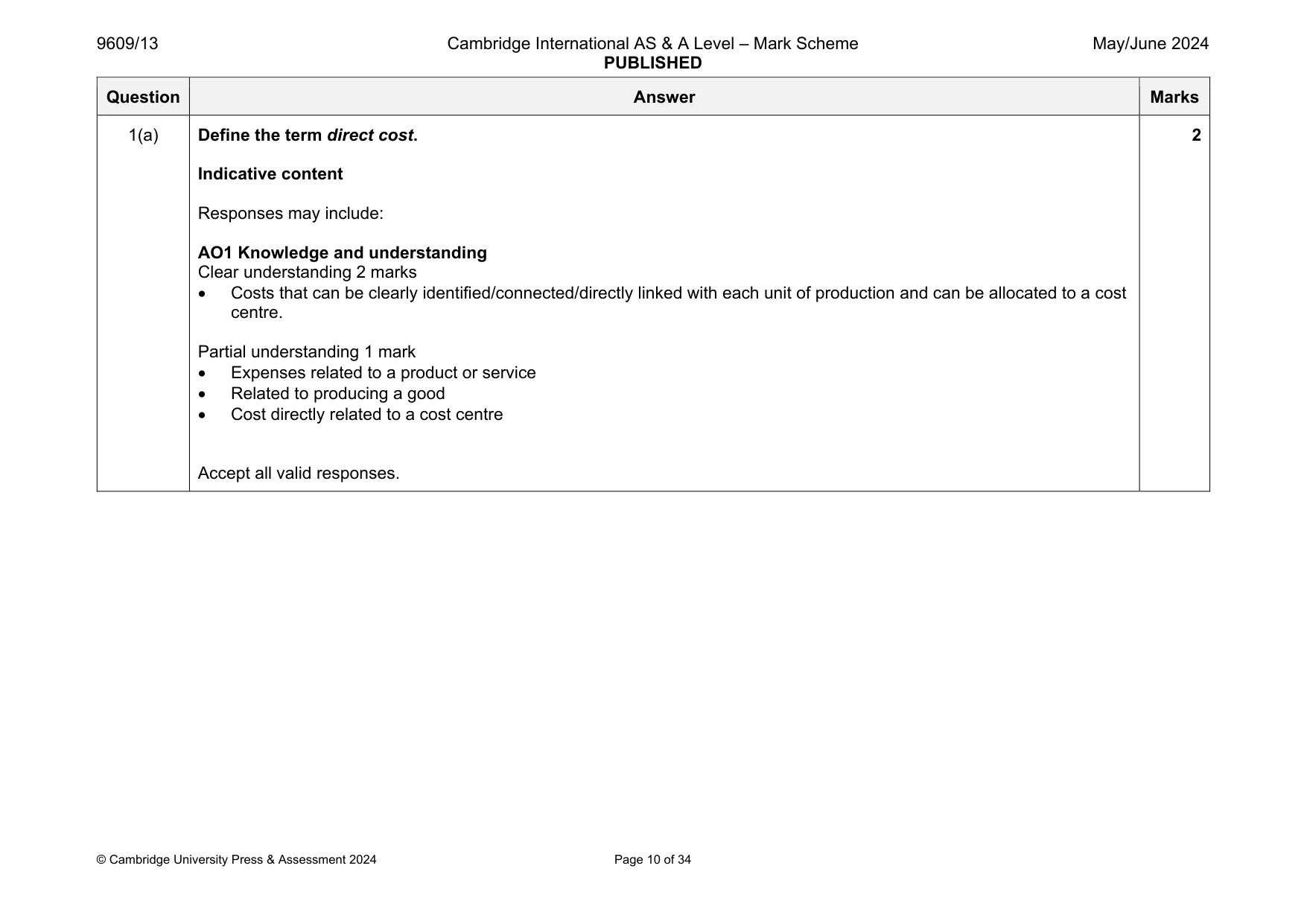
9609/13 Cambridge International AS & A Level – Mark Scheme PUBLISHED May/June 2024 © Cambridge University Press & Assessment 2024 Page 10 of 34 Question Answer Marks 1(a) Define the term direct cost. Indicative content Responses may include: AO1 Knowledge and understanding Clear understanding 2 marks Costs that can be clearly identified/connected/directly linked with each unit of production and can be allocated to a cost centre. Partial understanding 1 mark Expenses related to a product or service Related to producing a good Cost directly related to a cost centre Accept all valid responses. 2
Mark scheme, page 11
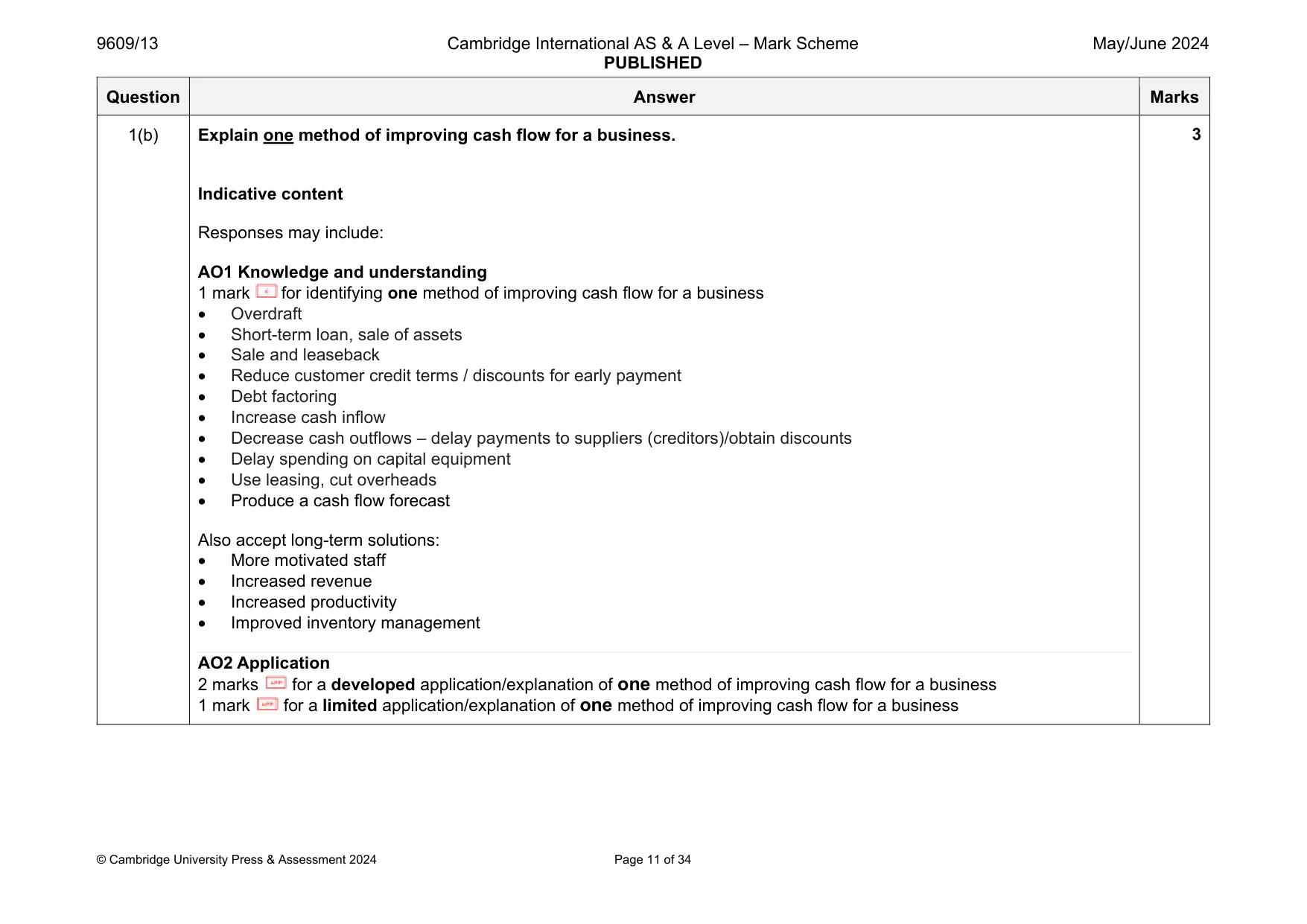
9609/13 Cambridge International AS & A Level – Mark Scheme PUBLISHED May/June 2024 © Cambridge University Press & Assessment 2024 Page 11 of 34 Question Answer Marks 1(b) Explain one method of improving cash flow for a business. Indicative content Responses may include: AO1 Knowledge and understanding 1 mark for identifying one method of improving cash flow for a business Overdraft Short-term loan, sale of assets Sale and leaseback Reduce customer credit terms / discounts for early payment Debt factoring Increase cash inflow Decrease cash outflows – delay payments to suppliers (creditors)/obtain discounts Delay spending on capital equipment Use leasing, cut overheads Produce a cash flow forecast Also accept long-term solutions: More motivated staff Increased revenue Increased productivity Improved inventory management AO2 Application 2 marks for a developed application/explanation of one method of improving cash flow for a business 1 mark for a limited application/explanation of one method of improving cash flow for a business 3
Mark scheme, page 12
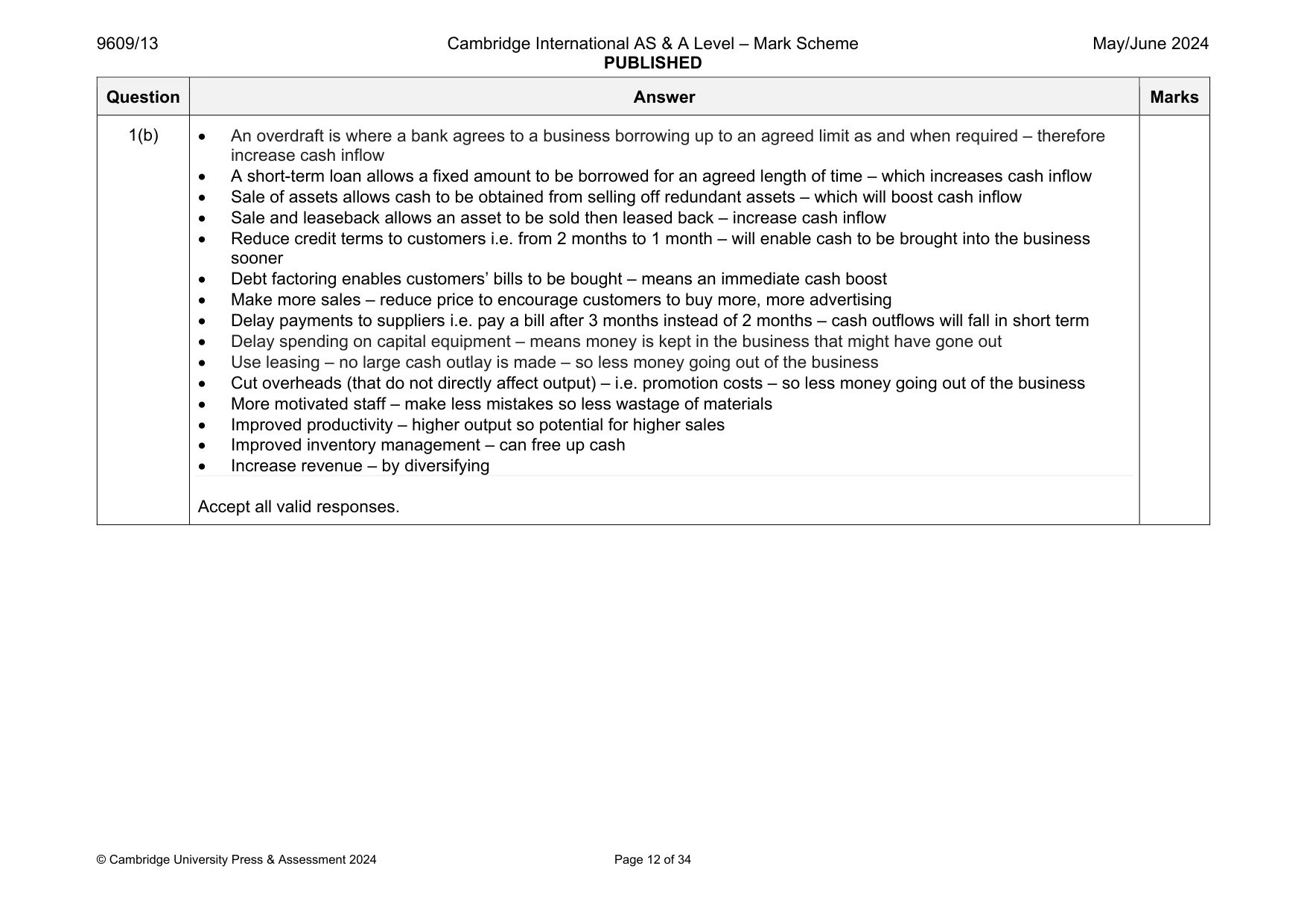
9609/13 Cambridge International AS & A Level – Mark Scheme PUBLISHED May/June 2024 © Cambridge University Press & Assessment 2024 Page 12 of 34 Question Answer Marks 1(b) An overdraft is where a bank agrees to a business borrowing up to an agreed limit as and when required – therefore increase cash inflow A short-term loan allows a fixed amount to be borrowed for an agreed length of time – which increases cash inflow Sale of assets allows cash to be obtained from selling off redundant assets – which will boost cash inflow Sale and leaseback allows an asset to be sold then leased back – increase cash inflow Reduce credit terms to customers i.e. from 2 months to 1 month – will enable cash to be brought into the business sooner Debt factoring enables customers’ bills to be bought – means an immediate cash boost Make more sales – reduce price to encourage customers to buy more, more advertising Delay payments to suppliers i.e. pay a bill after 3 months instead of 2 months – cash outflows will fall in short term Delay spending on capital equipment – means money is kept in the business that might have gone out Use leasing – no large cash outlay is made – so less money going out of the business Cut overheads (that do not directly affect output) – i.e. promotion costs – so less money going out of the business More motivated staff – make less mistakes so less wastage of materials Improved productivity – higher output so potential for higher sales Improved inventory management – can free up cash Increase revenue – by diversifying Accept all valid responses.
Mark scheme, page 13
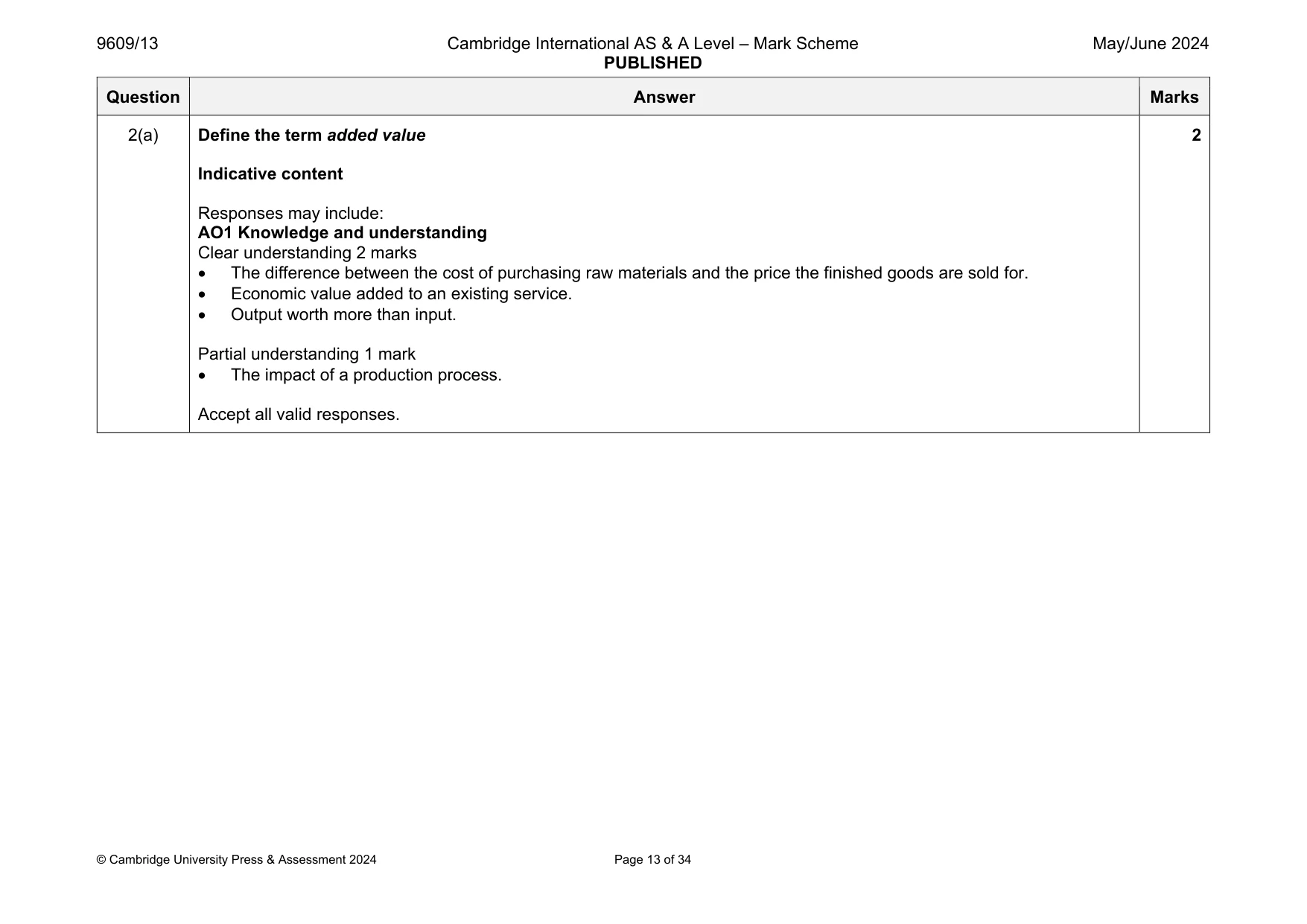
9609/13 Cambridge International AS & A Level – Mark Scheme PUBLISHED May/June 2024 © Cambridge University Press & Assessment 2024 Page 13 of 34 Question Answer Marks 2(a) Define the term added value Indicative content Responses may include: AO1 Knowledge and understanding Clear understanding 2 marks The difference between the cost of purchasing raw materials and the price the finished goods are sold for. Economic value added to an existing service. Output worth more than input. Partial understanding 1 mark The impact of a production process. Accept all valid responses. 2
Mark scheme, page 14
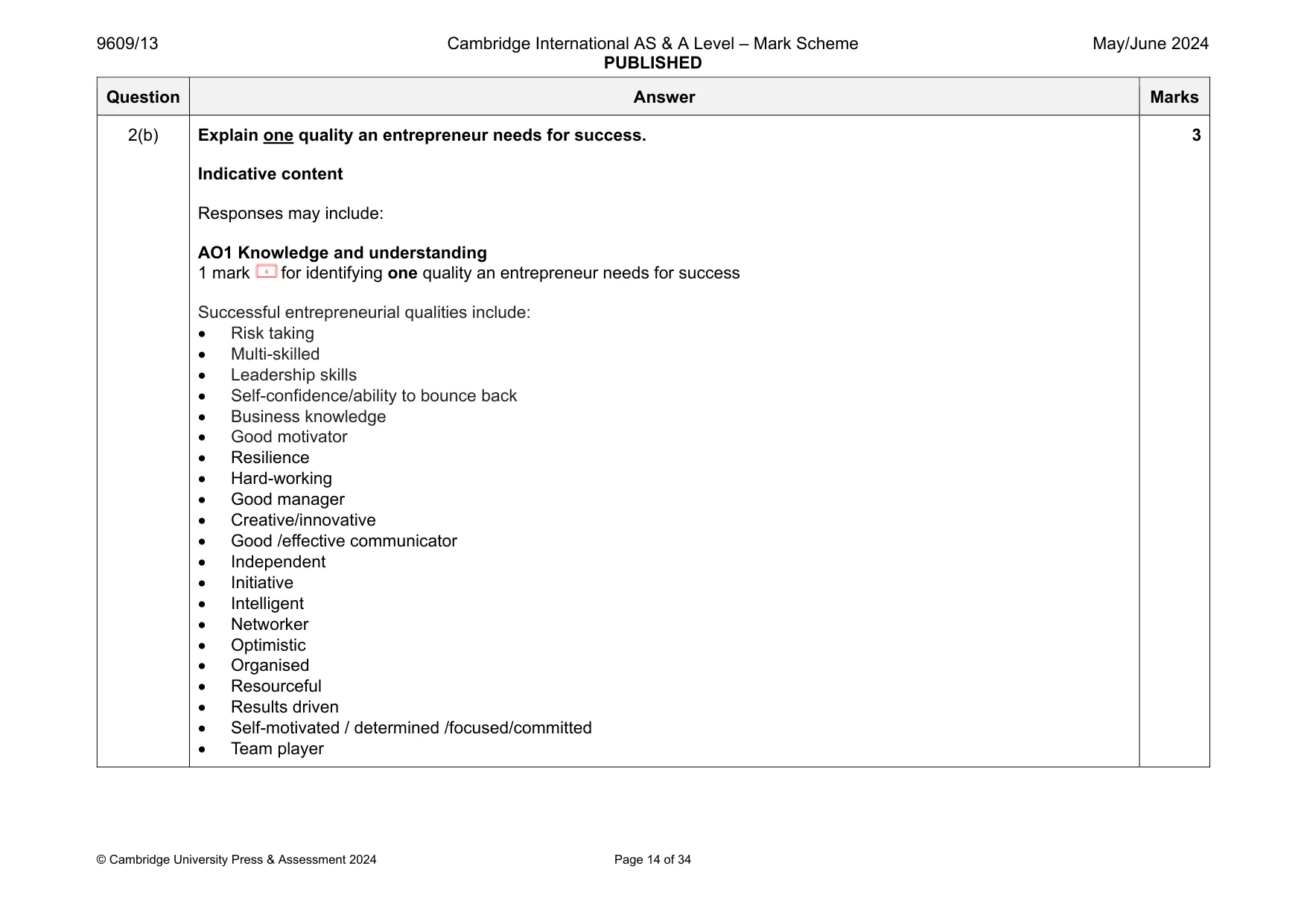
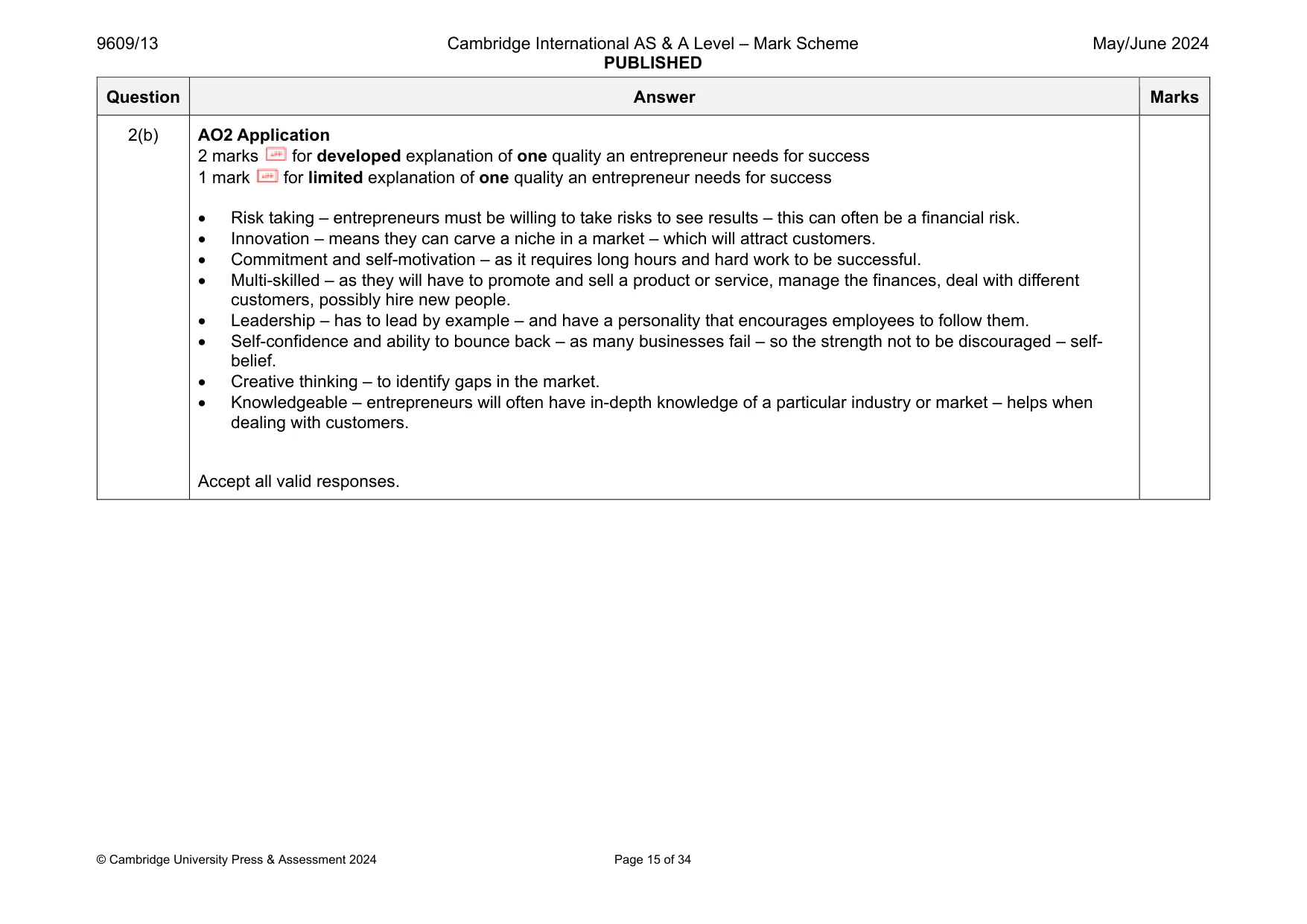
9609/13 Cambridge International AS & A Level – Mark Scheme PUBLISHED May/June 2024 © Cambridge University Press & Assessment 2024 Page 14 of 34 Question Answer Marks 2(b) Explain one quality an entrepreneur needs for success. Indicative content Responses may include: AO1 Knowledge and understanding 1 mark for identifying one quality an entrepreneur needs for success Successful entrepreneurial qualities include: Risk taking Multi-skilled Leadership skills Self-confidence/ability to bounce back Business knowledge Good motivator Resilience Hard-working Good manager Creative/innovative Good /effective communicator Independent Initiative Intelligent Networker Optimistic Organised Resourceful Results driven Self-motivated / determined /focused/committed Team player 3
Mark scheme, page 15
9609/13 Cambridge International AS & A Level – Mark Scheme PUBLISHED May/June 2024 © Cambridge University Press & Assessment 2024 Page 15 of 34 Question Answer Marks 2(b) AO2 Application 2 marks for developed explanation of one quality an entrepreneur needs for success 1 mark for limited explanation of one quality an entrepreneur needs for success Risk taking – entrepreneurs must be willing to take risks to see results – this can often be a financial risk. Innovation – means they can carve a niche in a market – which will attract customers. Commitment and self-motivation – as it requires long hours and hard work to be successful. Multi-skilled – as they will have to promote and sell a product or service, manage the finances, deal with different customers, possibly hire new people. Leadership – has to lead by example – and have a personality that encourages employees to follow them. Self-confidence and ability to bounce back – as many businesses fail – so the strength not to be discouraged – self- belief. Creative thinking – to identify gaps in the market. Knowledgeable – entrepreneurs will often have in-depth knowledge of a particular industry or market – helps when dealing with customers. Accept all valid responses.
Mark scheme, page 16
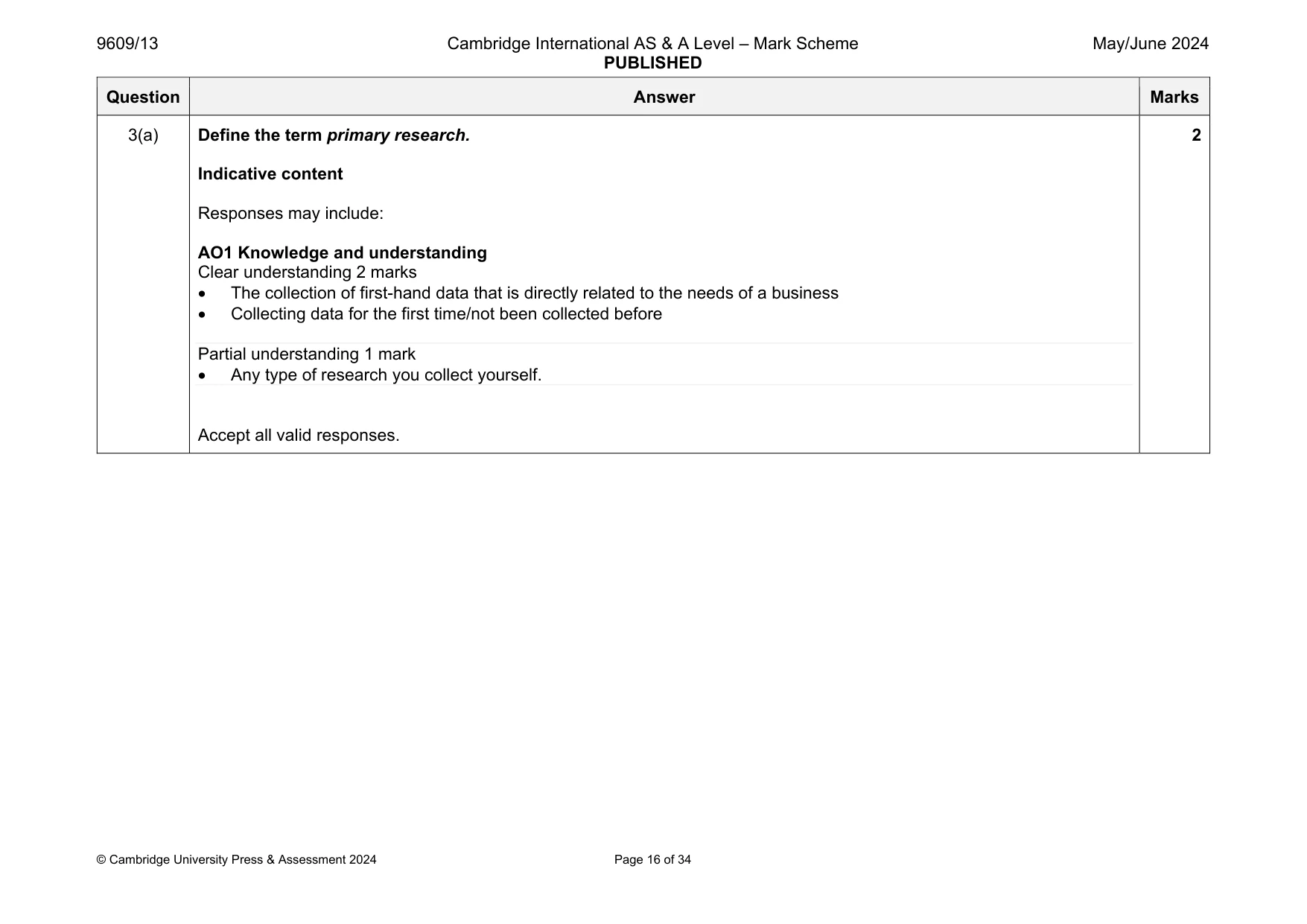
9609/13 Cambridge International AS & A Level – Mark Scheme PUBLISHED May/June 2024 © Cambridge University Press & Assessment 2024 Page 16 of 34 Question Answer Marks 3(a) Define the term primary research. Indicative content Responses may include: AO1 Knowledge and understanding Clear understanding 2 marks The collection of first-hand data that is directly related to the needs of a business Collecting data for the first time/not been collected before Partial understanding 1 mark Any type of research you collect yourself. Accept all valid responses. 2
Mark scheme, page 17
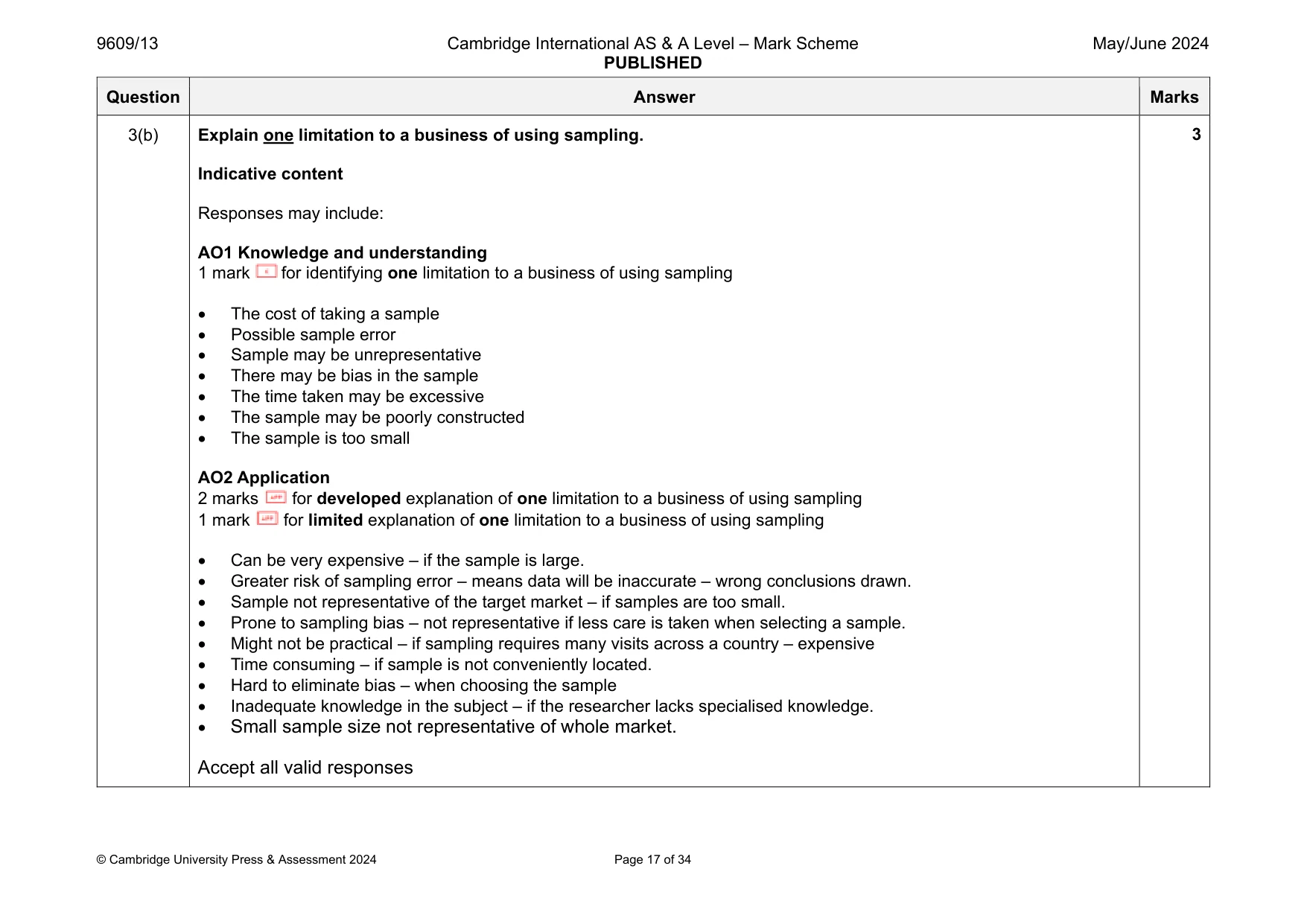
9609/13 Cambridge International AS & A Level – Mark Scheme PUBLISHED May/June 2024 © Cambridge University Press & Assessment 2024 Page 17 of 34 Question Answer Marks 3(b) Explain one limitation to a business of using sampling. Indicative content Responses may include: AO1 Knowledge and understanding 1 mark for identifying one limitation to a business of using sampling The cost of taking a sample Possible sample error Sample may be unrepresentative There may be bias in the sample The time taken may be excessive The sample may be poorly constructed The sample is too small AO2 Application 2 marks for developed explanation of one limitation to a business of using sampling 1 mark for limited explanation of one limitation to a business of using sampling Can be very expensive – if the sample is large. Greater risk of sampling error – means data will be inaccurate – wrong conclusions drawn. Sample not representative of the target market – if samples are too small. Prone to sampling bias – not representative if less care is taken when selecting a sample. Might not be practical – if sampling requires many visits across a country – expensive Time consuming – if sample is not conveniently located. Hard to eliminate bias – when choosing the sample Inadequate knowledge in the subject – if the researcher lacks specialised knowledge. Small sample size not representative of whole market. Accept all valid responses 3
Mark scheme, page 18
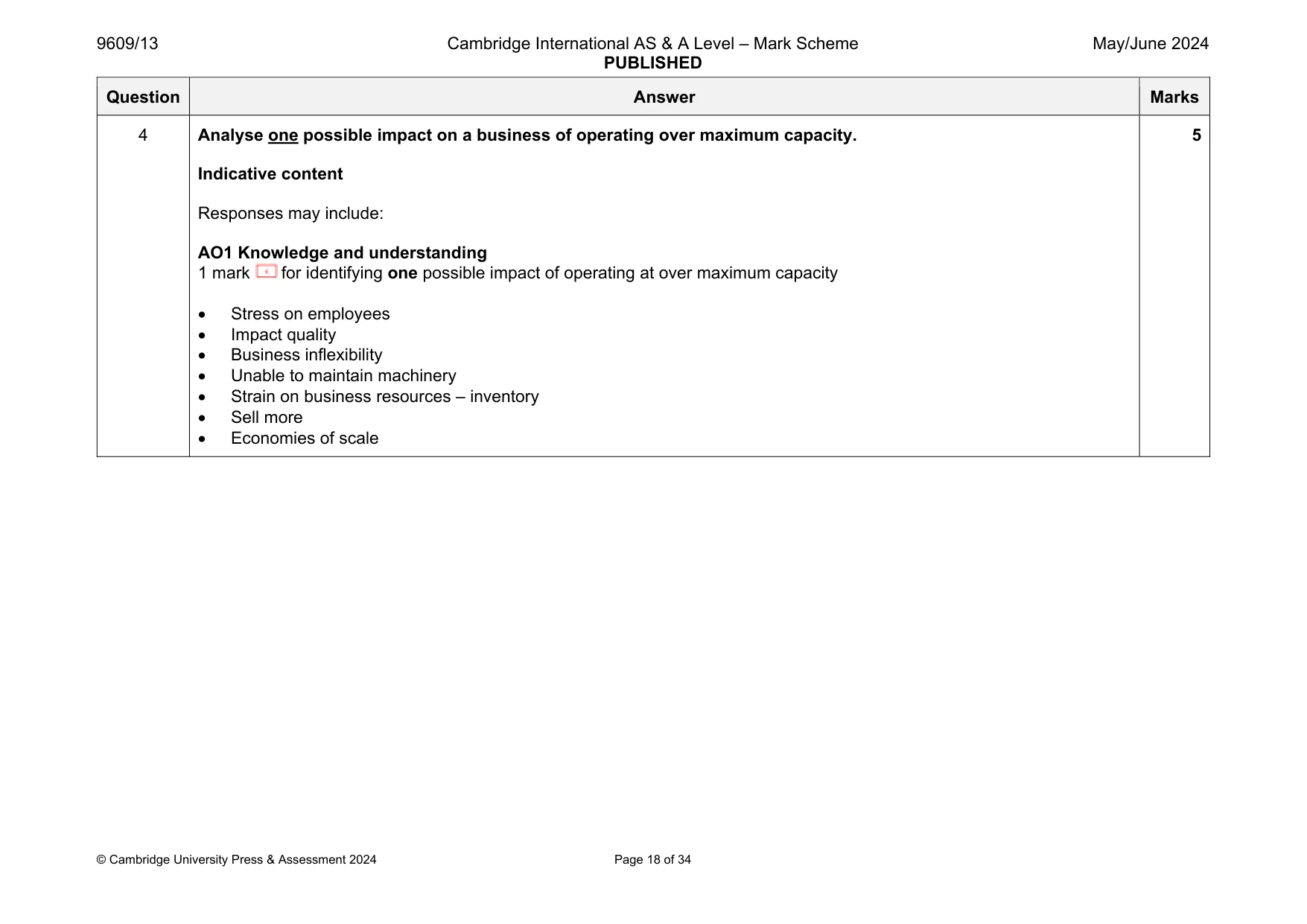
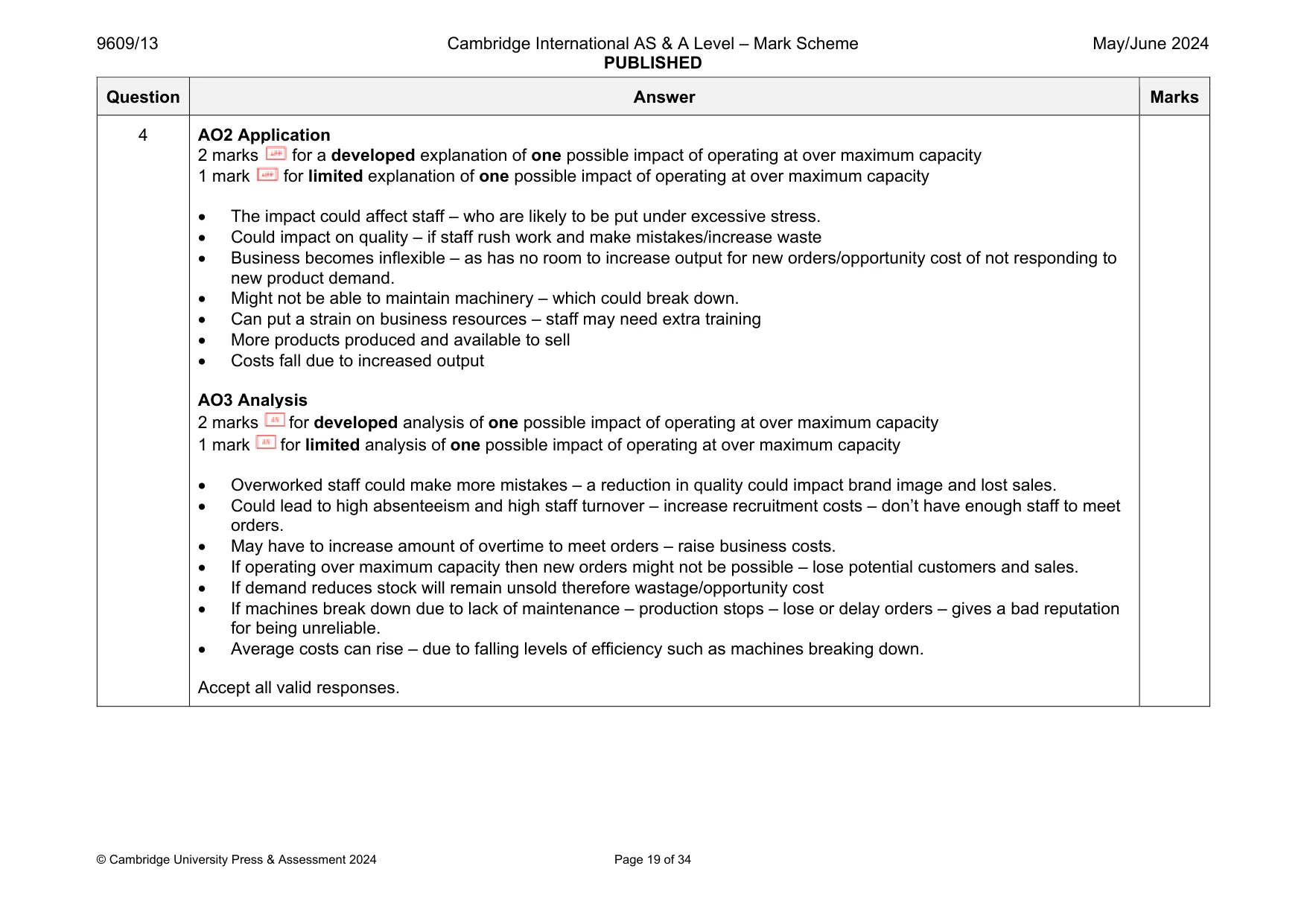
9609/13 Cambridge International AS & A Level – Mark Scheme PUBLISHED May/June 2024 © Cambridge University Press & Assessment 2024 Page 18 of 34 Question Answer Marks 4 Analyse one possible impact on a business of operating over maximum capacity. Indicative content Responses may include: AO1 Knowledge and understanding 1 mark for identifying one possible impact of operating at over maximum capacity Stress on employees Impact quality Business inflexibility Unable to maintain machinery Strain on business resources – inventory Sell more Economies of scale 5
Mark scheme, page 19
9609/13 Cambridge International AS & A Level – Mark Scheme PUBLISHED May/June 2024 © Cambridge University Press & Assessment 2024 Page 19 of 34 Question Answer Marks 4 AO2 Application 2 marks for a developed explanation of one possible impact of operating at over maximum capacity 1 mark for limited explanation of one possible impact of operating at over maximum capacity The impact could affect staff – who are likely to be put under excessive stress. Could impact on quality – if staff rush work and make mistakes/increase waste Business becomes inflexible – as has no room to increase output for new orders/opportunity cost of not responding to new product demand. Might not be able to maintain machinery – which could break down. Can put a strain on business resources – staff may need extra training More products produced and available to sell Costs fall due to increased output AO3 Analysis 2 marks for developed analysis of one possible impact of operating at over maximum capacity 1 mark for limited analysis of one possible impact of operating at over maximum capacity Overworked staff could make more mistakes – a reduction in quality could impact brand image and lost sales. Could lead to high absenteeism and high staff turnover – increase recruitment costs – don’t have enough staff to meet orders. May have to increase amount of overtime to meet orders – raise business costs. If operating over maximum capacity then new orders might not be possible – lose potential customers and sales. If demand reduces stock will remain unsold therefore wastage/opportunity cost If machines break down due to lack of maintenance – production stops – lose or delay orders – gives a bad reputation for being unreliable. Average costs can rise – due to falling levels of efficiency such as machines breaking down. Accept all valid responses.
Mark scheme, page 20
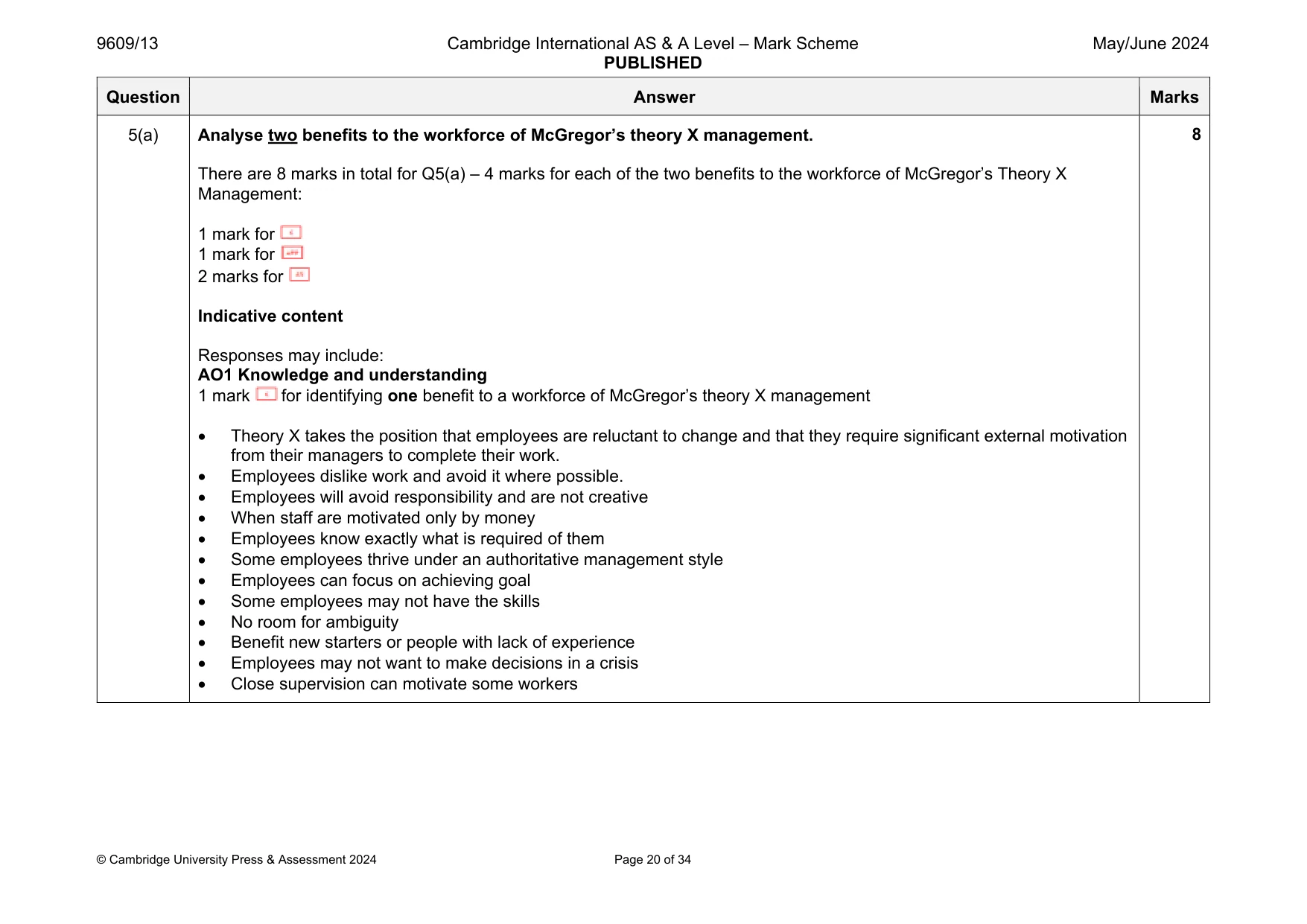
9609/13 Cambridge International AS & A Level – Mark Scheme PUBLISHED May/June 2024 © Cambridge University Press & Assessment 2024 Page 20 of 34 Question Answer Marks 5(a) Analyse two benefits to the workforce of McGregor’s theory X management. There are 8 marks in total for Q5(a) – 4 marks for each of the two benefits to the workforce of McGregor’s Theory X Management: 1 mark for 1 mark for 2 marks for Indicative content Responses may include: AO1 Knowledge and understanding 1 mark for identifying one benefit to a workforce of McGregor’s theory X management Theory X takes the position that employees are reluctant to change and that they require significant external motivation from their managers to complete their work. Employees dislike work and avoid it where possible. Employees will avoid responsibility and are not creative When staff are motivated only by money Employees know exactly what is required of them Some employees thrive under an authoritative management style Employees can focus on achieving goal Some employees may not have the skills No room for ambiguity Benefit new starters or people with lack of experience Employees may not want to make decisions in a crisis Close supervision can motivate some workers 8
Mark scheme, page 21
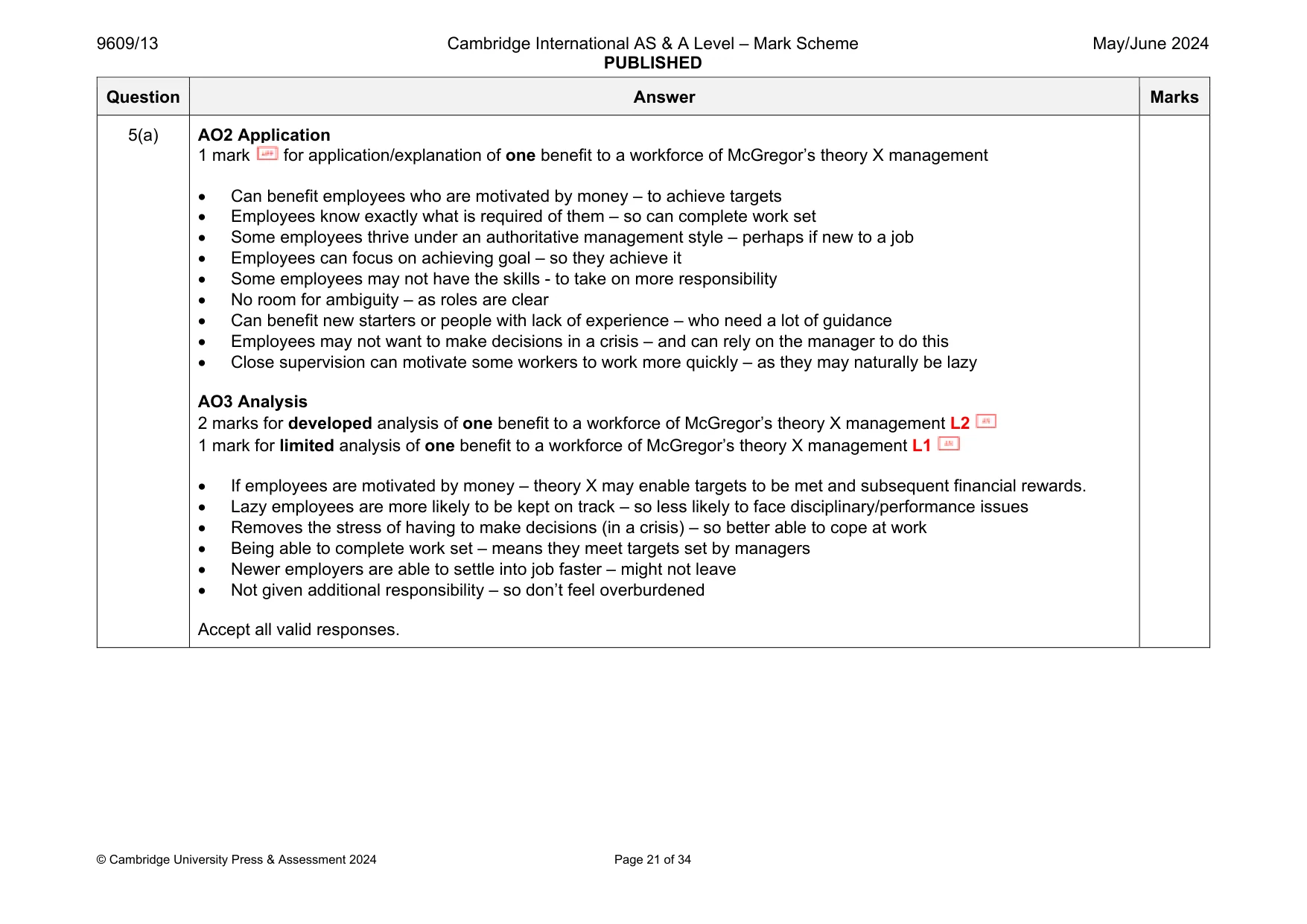
9609/13 Cambridge International AS & A Level – Mark Scheme PUBLISHED May/June 2024 © Cambridge University Press & Assessment 2024 Page 21 of 34 Question Answer Marks 5(a) AO2 Application 1 mark for application/explanation of one benefit to a workforce of McGregor’s theory X management Can benefit employees who are motivated by money – to achieve targets Employees know exactly what is required of them – so can complete work set Some employees thrive under an authoritative management style – perhaps if new to a job Employees can focus on achieving goal – so they achieve it Some employees may not have the skills - to take on more responsibility No room for ambiguity – as roles are clear Can benefit new starters or people with lack of experience – who need a lot of guidance Employees may not want to make decisions in a crisis – and can rely on the manager to do this Close supervision can motivate some workers to work more quickly – as they may naturally be lazy AO3 Analysis 2 marks for developed analysis of one benefit to a workforce of McGregor’s theory X management L2 1 mark for limited analysis of one benefit to a workforce of McGregor’s theory X management L1 If employees are motivated by money – theory X may enable targets to be met and subsequent financial rewards. Lazy employees are more likely to be kept on track – so less likely to face disciplinary/performance issues Removes the stress of having to make decisions (in a crisis) – so better able to cope at work Being able to complete work set – means they meet targets set by managers Newer employers are able to settle into job faster – might not leave Not given additional responsibility – so don’t feel overburdened Accept all valid responses.
Mark scheme, page 22
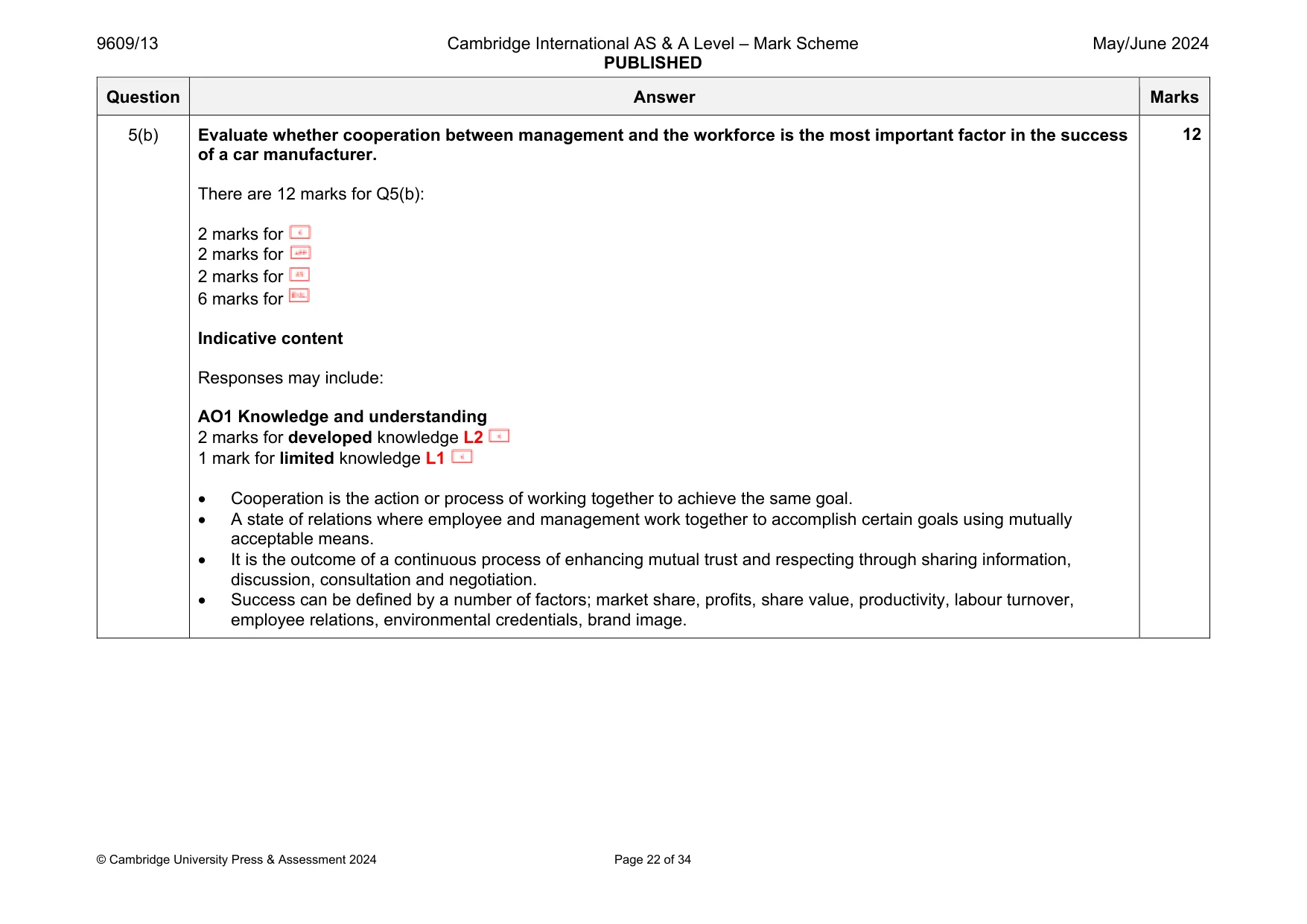
9609/13 Cambridge International AS & A Level – Mark Scheme PUBLISHED May/June 2024 © Cambridge University Press & Assessment 2024 Page 22 of 34 Question Answer Marks 5(b) Evaluate whether cooperation between management and the workforce is the most important factor in the success of a car manufacturer. There are 12 marks for Q5(b): 2 marks for 2 marks for 2 marks for 6 marks for Indicative content Responses may include: AO1 Knowledge and understanding 2 marks for developed knowledge L2 1 mark for limited knowledge L1 Cooperation is the action or process of working together to achieve the same goal. A state of relations where employee and management work together to accomplish certain goals using mutually acceptable means. It is the outcome of a continuous process of enhancing mutual trust and respecting through sharing information, discussion, consultation and negotiation. Success can be defined by a number of factors; market share, profits, share value, productivity, labour turnover, employee relations, environmental credentials, brand image. 12
Mark scheme, page 23
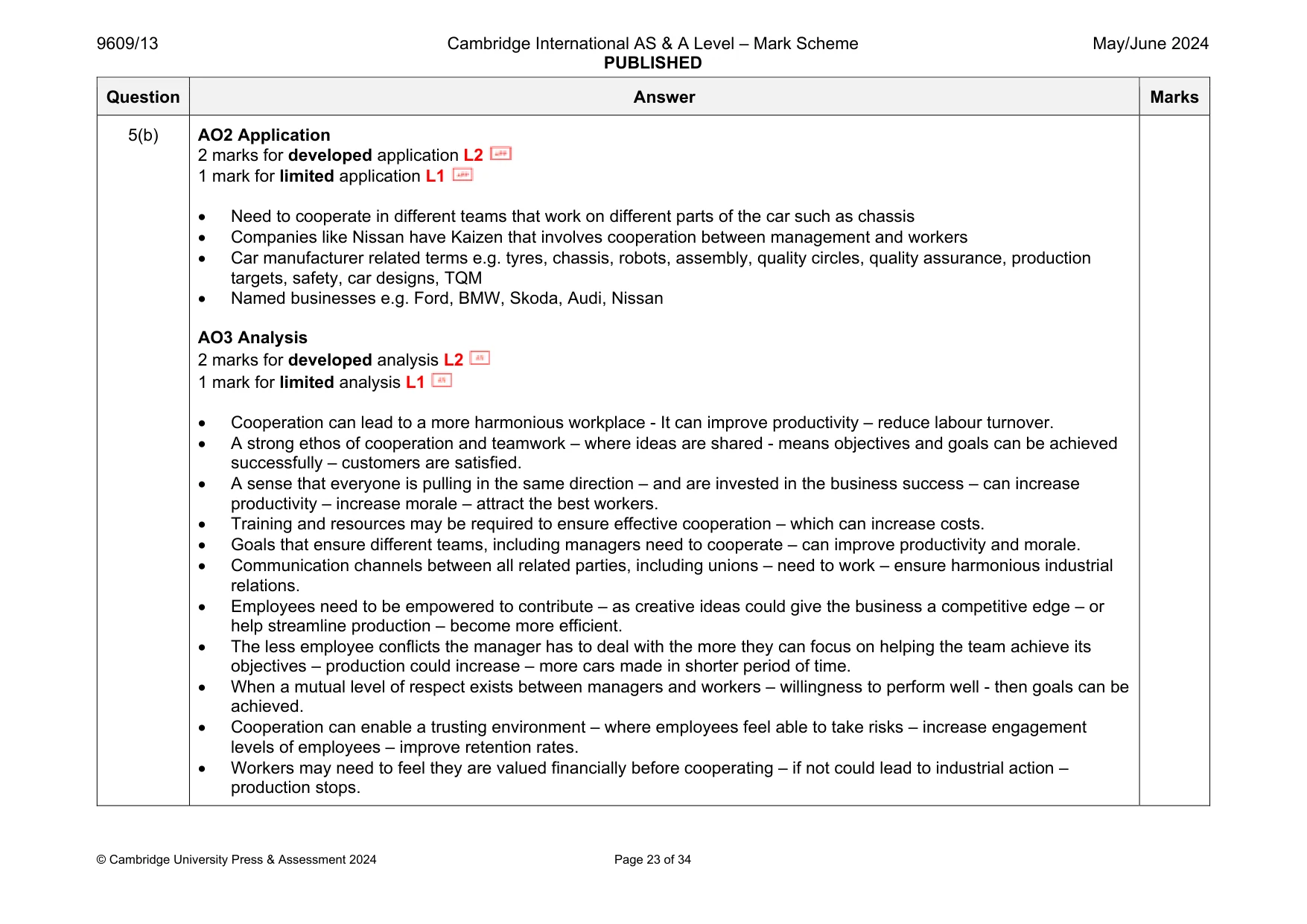
9609/13 Cambridge International AS & A Level – Mark Scheme PUBLISHED May/June 2024 © Cambridge University Press & Assessment 2024 Page 23 of 34 Question Answer Marks 5(b) AO2 Application 2 marks for developed application L2 1 mark for limited application L1 Need to cooperate in different teams that work on different parts of the car such as chassis Companies like Nissan have Kaizen that involves cooperation between management and workers Car manufacturer related terms e.g. tyres, chassis, robots, assembly, quality circles, quality assurance, production targets, safety, car designs, TQM Named businesses e.g. Ford, BMW, Skoda, Audi, Nissan AO3 Analysis 2 marks for developed analysis L2 1 mark for limited analysis L1 Cooperation can lead to a more harmonious workplace - It can improve productivity – reduce labour turnover. A strong ethos of cooperation and teamwork – where ideas are shared - means objectives and goals can be achieved successfully – customers are satisfied. A sense that everyone is pulling in the same direction – and are invested in the business success – can increase productivity – increase morale – attract the best workers. Training and resources may be required to ensure effective cooperation – which can increase costs. Goals that ensure different teams, including managers need to cooperate – can improve productivity and morale. Communication channels between all related parties, including unions – need to work – ensure harmonious industrial relations. Employees need to be empowered to contribute – as creative ideas could give the business a competitive edge – or help streamline production – become more efficient. The less employee conflicts the manager has to deal with the more they can focus on helping the team achieve its objectives – production could increase – more cars made in shorter period of time. When a mutual level of respect exists between managers and workers – willingness to perform well - then goals can be achieved. Cooperation can enable a trusting environment – where employees feel able to take risks – increase engagement levels of employees – improve retention rates. Workers may need to feel they are valued financially before cooperating – if not could lead to industrial action – production stops.
Mark scheme, page 24
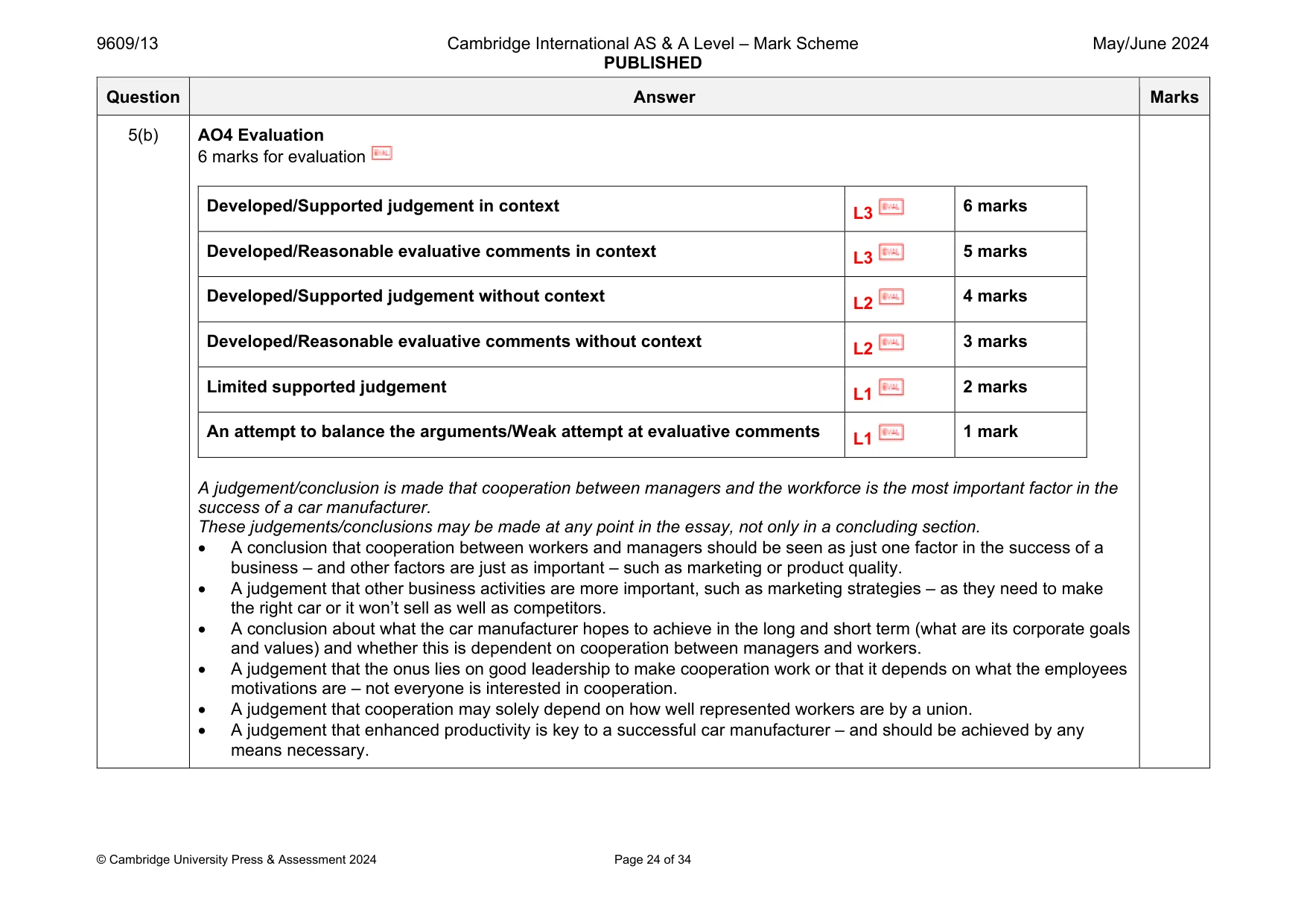
9609/13 Cambridge International AS & A Level – Mark Scheme PUBLISHED May/June 2024 © Cambridge University Press & Assessment 2024 Page 24 of 34 Question Answer Marks 5(b) AO4 Evaluation 6 marks for evaluation Developed/Supported judgement in context L3 6 marks Developed/Reasonable evaluative comments in context L3 5 marks Developed/Supported judgement without context L2 4 marks Developed/Reasonable evaluative comments without context L2 3 marks Limited supported judgement L1 2 marks An attempt to balance the arguments/Weak attempt at evaluative comments L1 1 mark A judgement/conclusion is made that cooperation between managers and the workforce is the most important factor in the success of a car manufacturer. These judgements/conclusions may be made at any point in the essay, not only in a concluding section. A conclusion that cooperation between workers and managers should be seen as just one factor in the success of a business – and other factors are just as important – such as marketing or product quality. A judgement that other business activities are more important, such as marketing strategies – as they need to make the right car or it won’t sell as well as competitors. A conclusion about what the car manufacturer hopes to achieve in the long and short term (what are its corporate goals and values) and whether this is dependent on cooperation between managers and workers. A judgement that the onus lies on good leadership to make cooperation work or that it depends on what the employees motivations are – not everyone is interested in cooperation. A judgement that cooperation may solely depend on how well represented workers are by a union. A judgement that enhanced productivity is key to a successful car manufacturer – and should be achieved by any means necessary.
Mark scheme, page 25
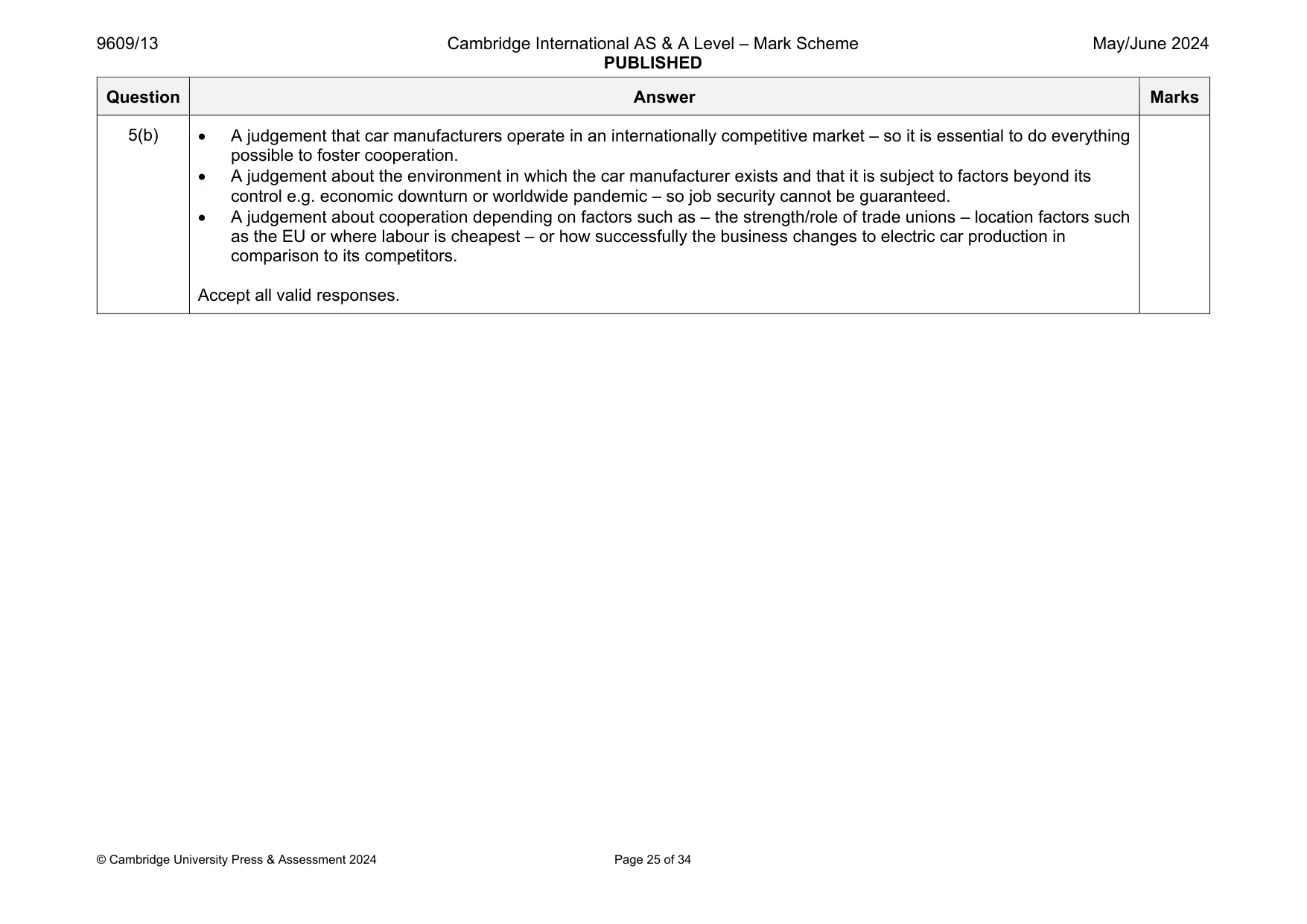
9609/13 Cambridge International AS & A Level – Mark Scheme PUBLISHED May/June 2024 © Cambridge University Press & Assessment 2024 Page 25 of 34 Question Answer Marks 5(b) A judgement that car manufacturers operate in an internationally competitive market – so it is essential to do everything possible to foster cooperation. A judgement about the environment in which the car manufacturer exists and that it is subject to factors beyond its control e.g. economic downturn or worldwide pandemic – so job security cannot be guaranteed. A judgement about cooperation depending on factors such as – the strength/role of trade unions – location factors such as the EU or where labour is cheapest – or how successfully the business changes to electric car production in comparison to its competitors. Accept all valid responses.
Mark scheme, page 26
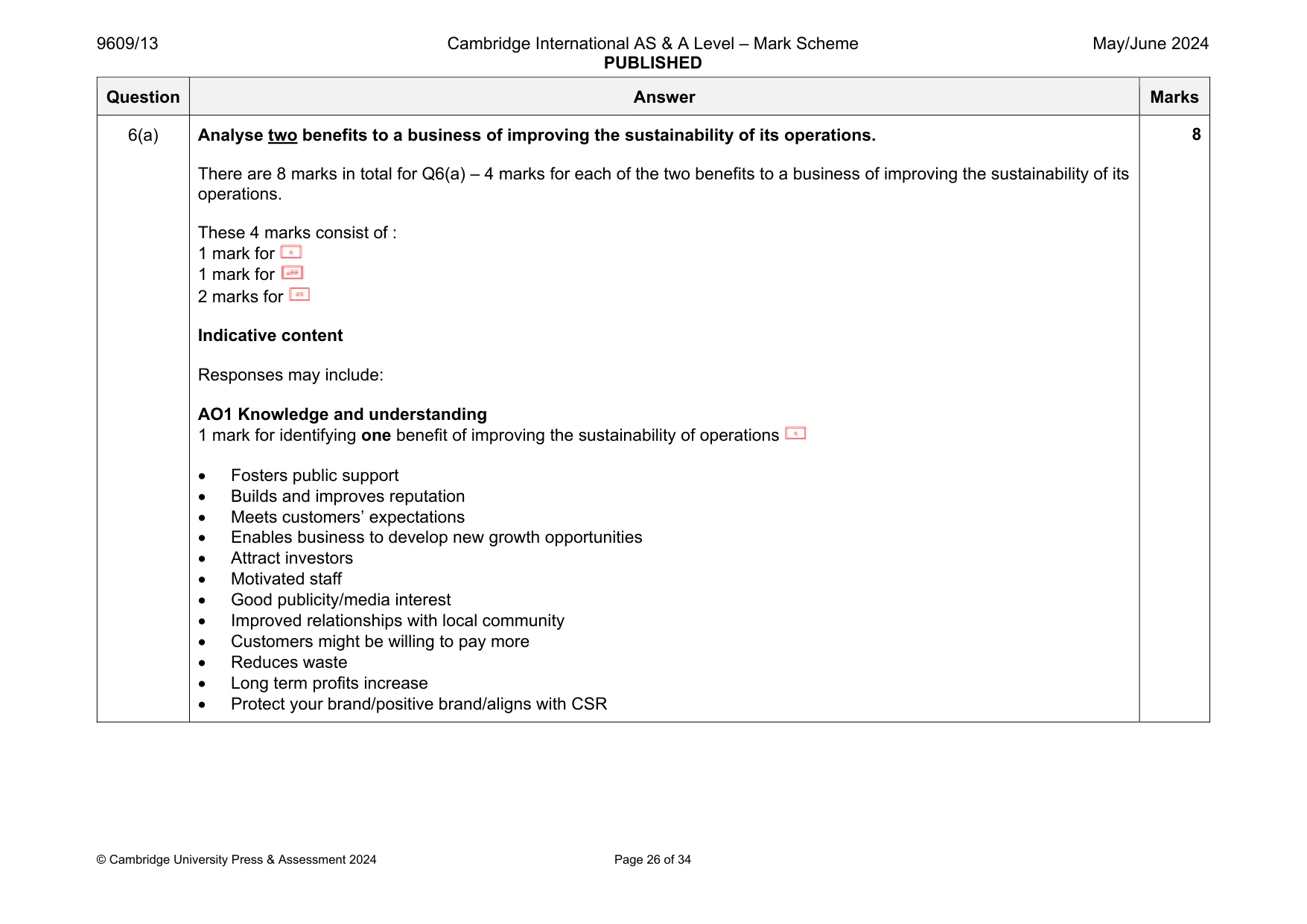
9609/13 Cambridge International AS & A Level – Mark Scheme PUBLISHED May/June 2024 © Cambridge University Press & Assessment 2024 Page 26 of 34 Question Answer Marks 6(a) Analyse two benefits to a business of improving the sustainability of its operations. There are 8 marks in total for Q6(a) – 4 marks for each of the two benefits to a business of improving the sustainability of its operations. These 4 marks consist of : 1 mark for 1 mark for 2 marks for Indicative content Responses may include: AO1 Knowledge and understanding 1 mark for identifying one benefit of improving the sustainability of operations Fosters public support Builds and improves reputation Meets customers’ expectations Enables business to develop new growth opportunities Attract investors Motivated staff Good publicity/media interest Improved relationships with local community Customers might be willing to pay more Reduces waste Long term profits increase Protect your brand/positive brand/aligns with CSR 8
Mark scheme, page 27
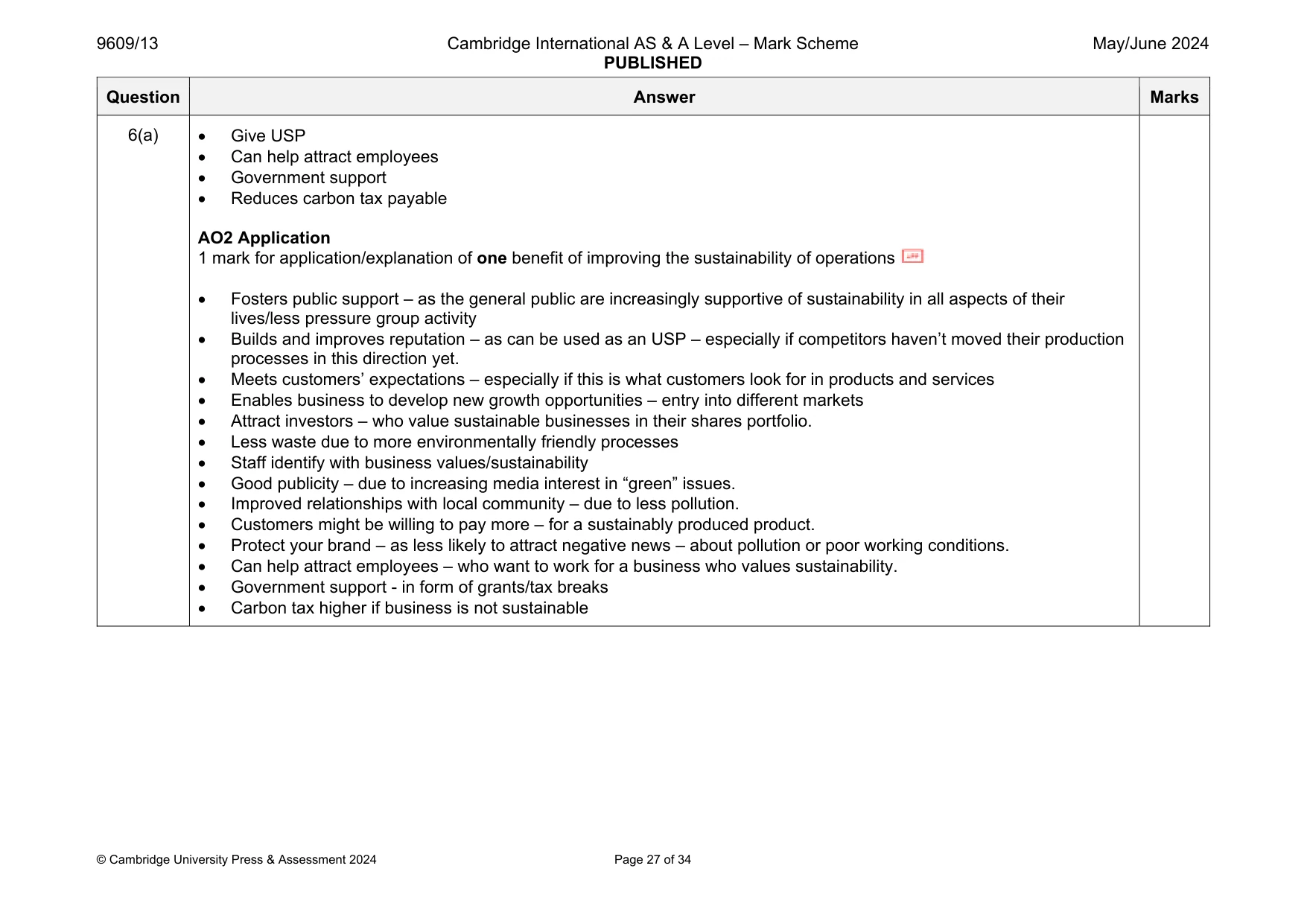
9609/13 Cambridge International AS & A Level – Mark Scheme PUBLISHED May/June 2024 © Cambridge University Press & Assessment 2024 Page 27 of 34 Question Answer Marks 6(a) Give USP Can help attract employees Government support Reduces carbon tax payable AO2 Application 1 mark for application/explanation of one benefit of improving the sustainability of operations Fosters public support – as the general public are increasingly supportive of sustainability in all aspects of their lives/less pressure group activity Builds and improves reputation – as can be used as an USP – especially if competitors haven’t moved their production processes in this direction yet. Meets customers’ expectations – especially if this is what customers look for in products and services Enables business to develop new growth opportunities – entry into different markets Attract investors – who value sustainable businesses in their shares portfolio. Less waste due to more environmentally friendly processes Staff identify with business values/sustainability Good publicity – due to increasing media interest in “green” issues. Improved relationships with local community – due to less pollution. Customers might be willing to pay more – for a sustainably produced product. Protect your brand – as less likely to attract negative news – about pollution or poor working conditions. Can help attract employees – who want to work for a business who values sustainability. Government support - in form of grants/tax breaks Carbon tax higher if business is not sustainable
Mark scheme, page 28
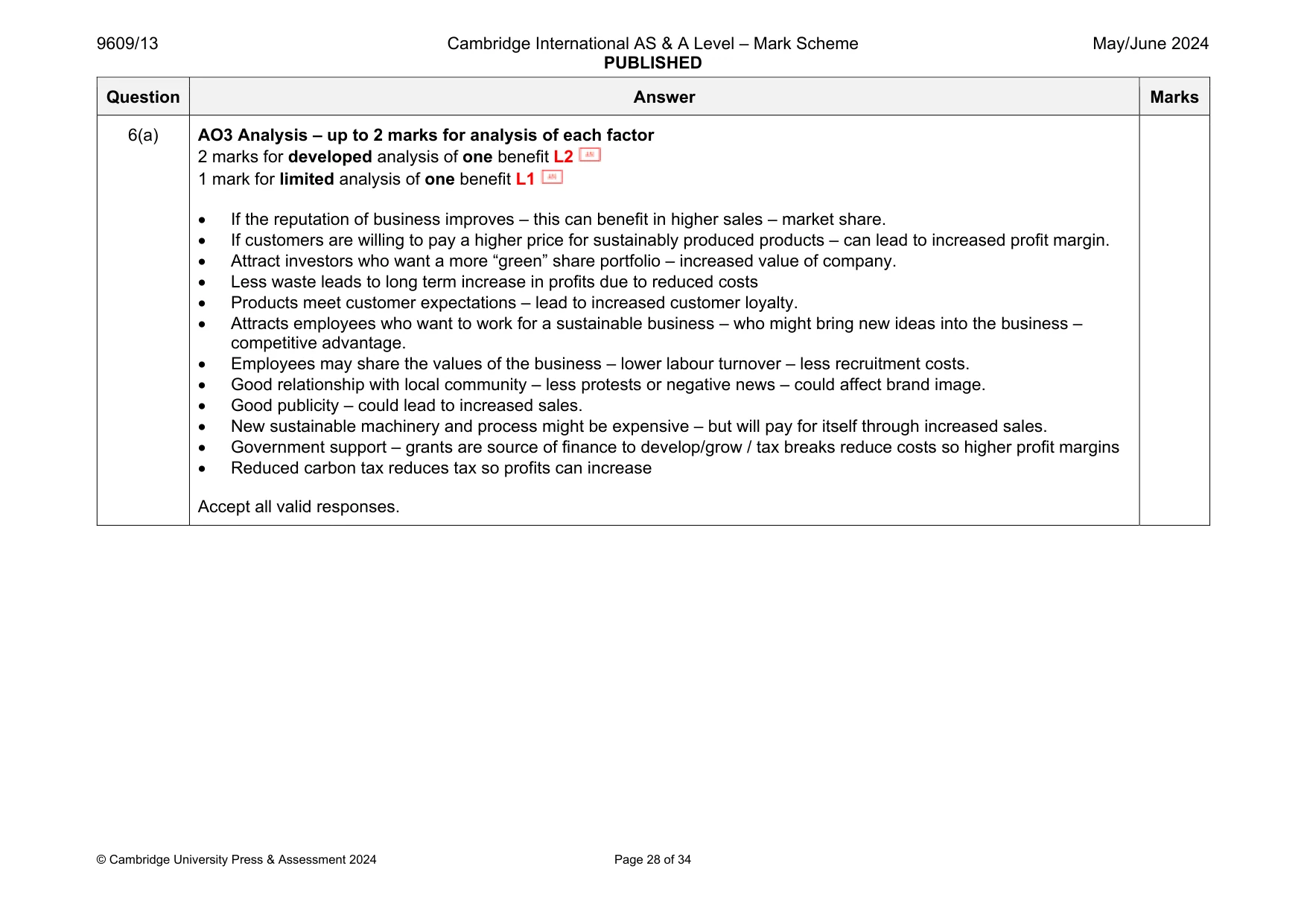
9609/13 Cambridge International AS & A Level – Mark Scheme PUBLISHED May/June 2024 © Cambridge University Press & Assessment 2024 Page 28 of 34 Question Answer Marks 6(a) AO3 Analysis – up to 2 marks for analysis of each factor 2 marks for developed analysis of one benefit L2 1 mark for limited analysis of one benefit L1 If the reputation of business improves – this can benefit in higher sales – market share. If customers are willing to pay a higher price for sustainably produced products – can lead to increased profit margin. Attract investors who want a more “green” share portfolio – increased value of company. Less waste leads to long term increase in profits due to reduced costs Products meet customer expectations – lead to increased customer loyalty. Attracts employees who want to work for a sustainable business – who might bring new ideas into the business – competitive advantage. Employees may share the values of the business – lower labour turnover – less recruitment costs. Good relationship with local community – less protests or negative news – could affect brand image. Good publicity – could lead to increased sales. New sustainable machinery and process might be expensive – but will pay for itself through increased sales. Government support – grants are source of finance to develop/grow / tax breaks reduce costs so higher profit margins Reduced carbon tax reduces tax so profits can increase Accept all valid responses.
Mark scheme, page 29
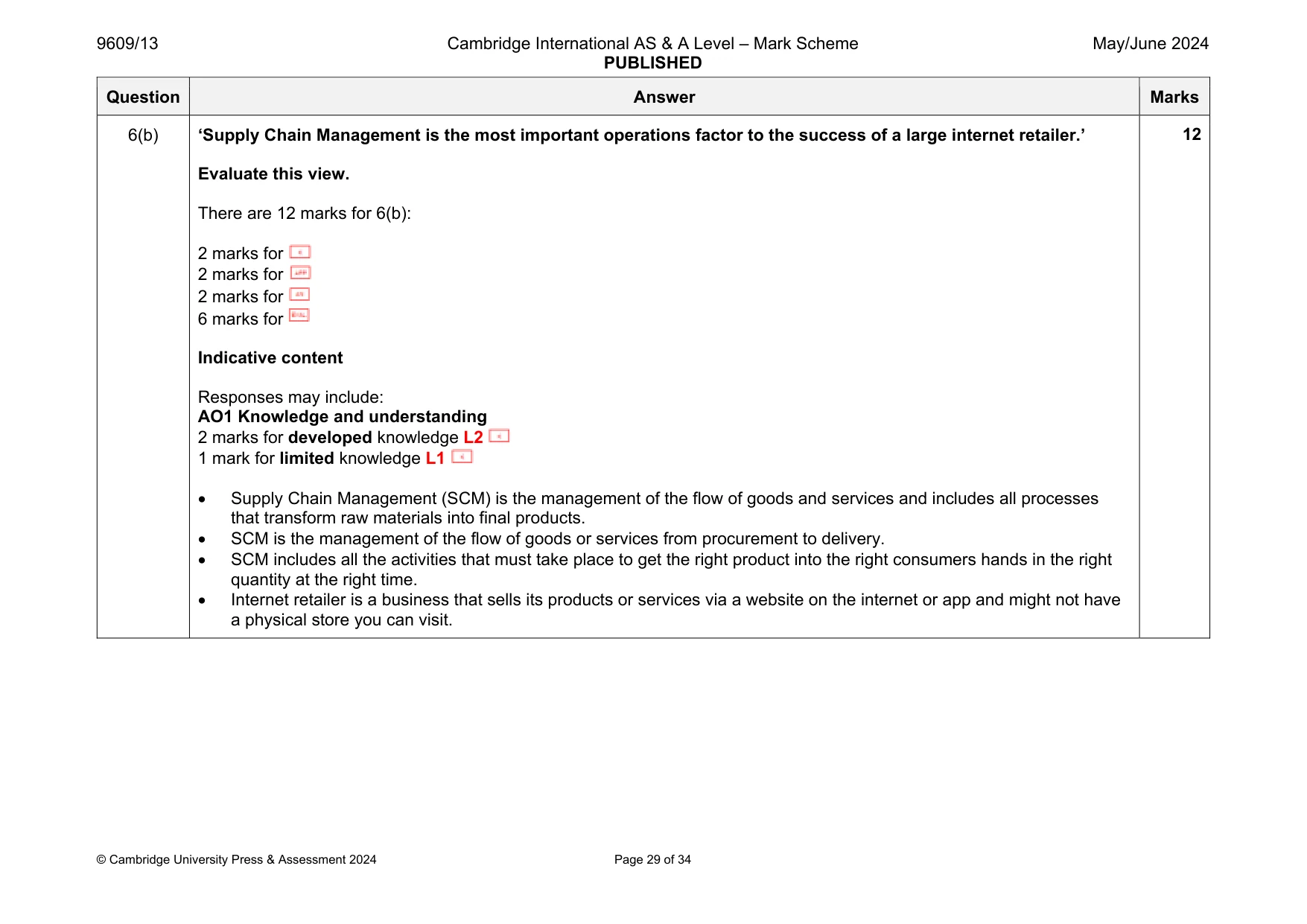
9609/13 Cambridge International AS & A Level – Mark Scheme PUBLISHED May/June 2024 © Cambridge University Press & Assessment 2024 Page 29 of 34 Question Answer Marks 6(b) ‘Supply Chain Management is the most important operations factor to the success of a large internet retailer.’ Evaluate this view. There are 12 marks for 6(b): 2 marks for 2 marks for 2 marks for 6 marks for Indicative content Responses may include: AO1 Knowledge and understanding 2 marks for developed knowledge L2 1 mark for limited knowledge L1 Supply Chain Management (SCM) is the management of the flow of goods and services and includes all processes that transform raw materials into final products. SCM is the management of the flow of goods or services from procurement to delivery. SCM includes all the activities that must take place to get the right product into the right consumers hands in the right quantity at the right time. Internet retailer is a business that sells its products or services via a website on the internet or app and might not have a physical store you can visit. 12
Mark scheme, page 30
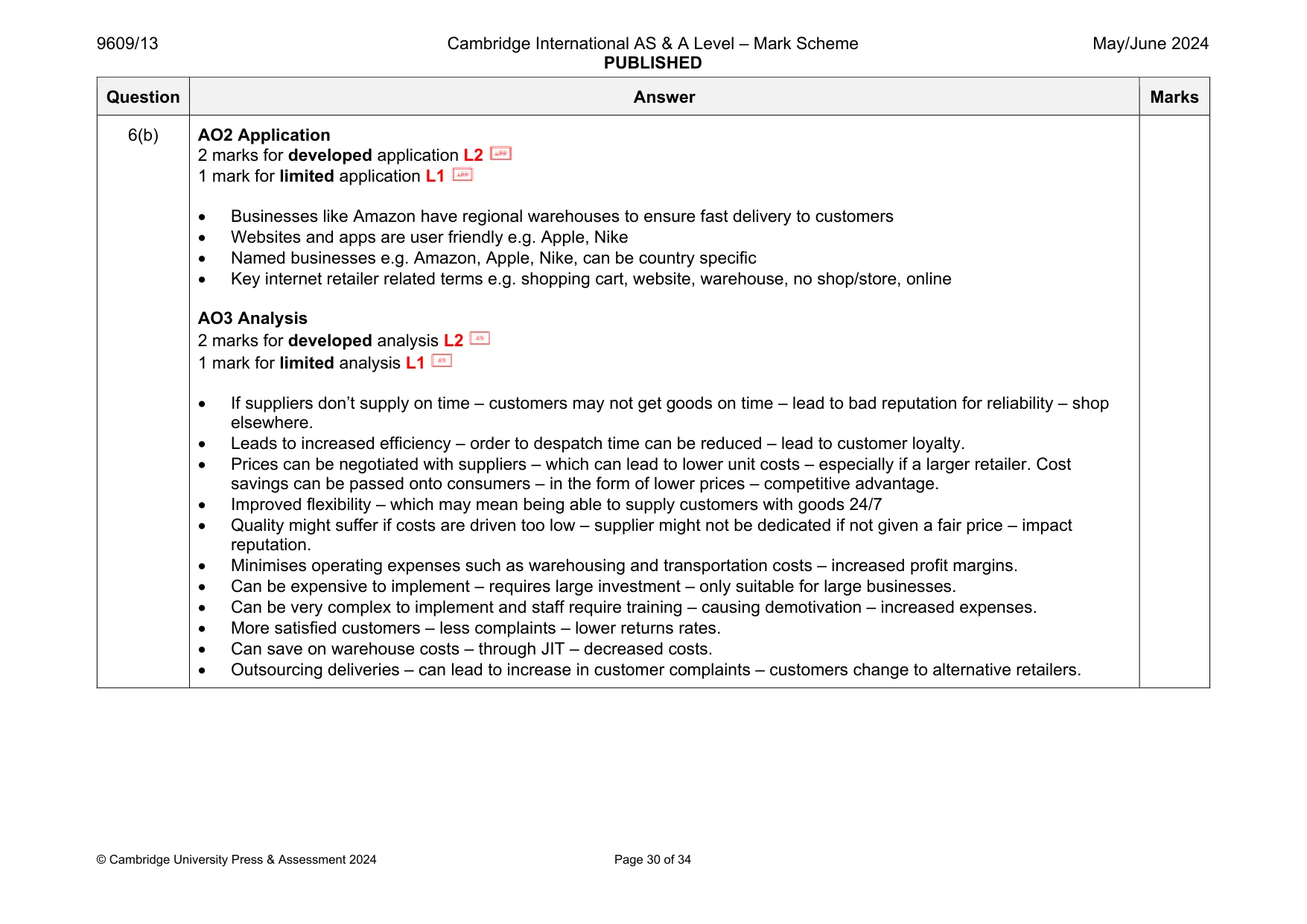
9609/13 Cambridge International AS & A Level – Mark Scheme PUBLISHED May/June 2024 © Cambridge University Press & Assessment 2024 Page 30 of 34 Question Answer Marks 6(b) AO2 Application 2 marks for developed application L2 1 mark for limited application L1 Businesses like Amazon have regional warehouses to ensure fast delivery to customers Websites and apps are user friendly e.g. Apple, Nike Named businesses e.g. Amazon, Apple, Nike, can be country specific Key internet retailer related terms e.g. shopping cart, website, warehouse, no shop/store, online AO3 Analysis 2 marks for developed analysis L2 1 mark for limited analysis L1 If suppliers don’t supply on time – customers may not get goods on time – lead to bad reputation for reliability – shop elsewhere. Leads to increased efficiency – order to despatch time can be reduced – lead to customer loyalty. Prices can be negotiated with suppliers – which can lead to lower unit costs – especially if a larger retailer. Cost savings can be passed onto consumers – in the form of lower prices – competitive advantage. Improved flexibility – which may mean being able to supply customers with goods 24/7 Quality might suffer if costs are driven too low – supplier might not be dedicated if not given a fair price – impact reputation. Minimises operating expenses such as warehousing and transportation costs – increased profit margins. Can be expensive to implement – requires large investment – only suitable for large businesses. Can be very complex to implement and staff require training – causing demotivation – increased expenses. More satisfied customers – less complaints – lower returns rates. Can save on warehouse costs – through JIT – decreased costs. Outsourcing deliveries – can lead to increase in customer complaints – customers change to alternative retailers.
Mark scheme, page 31
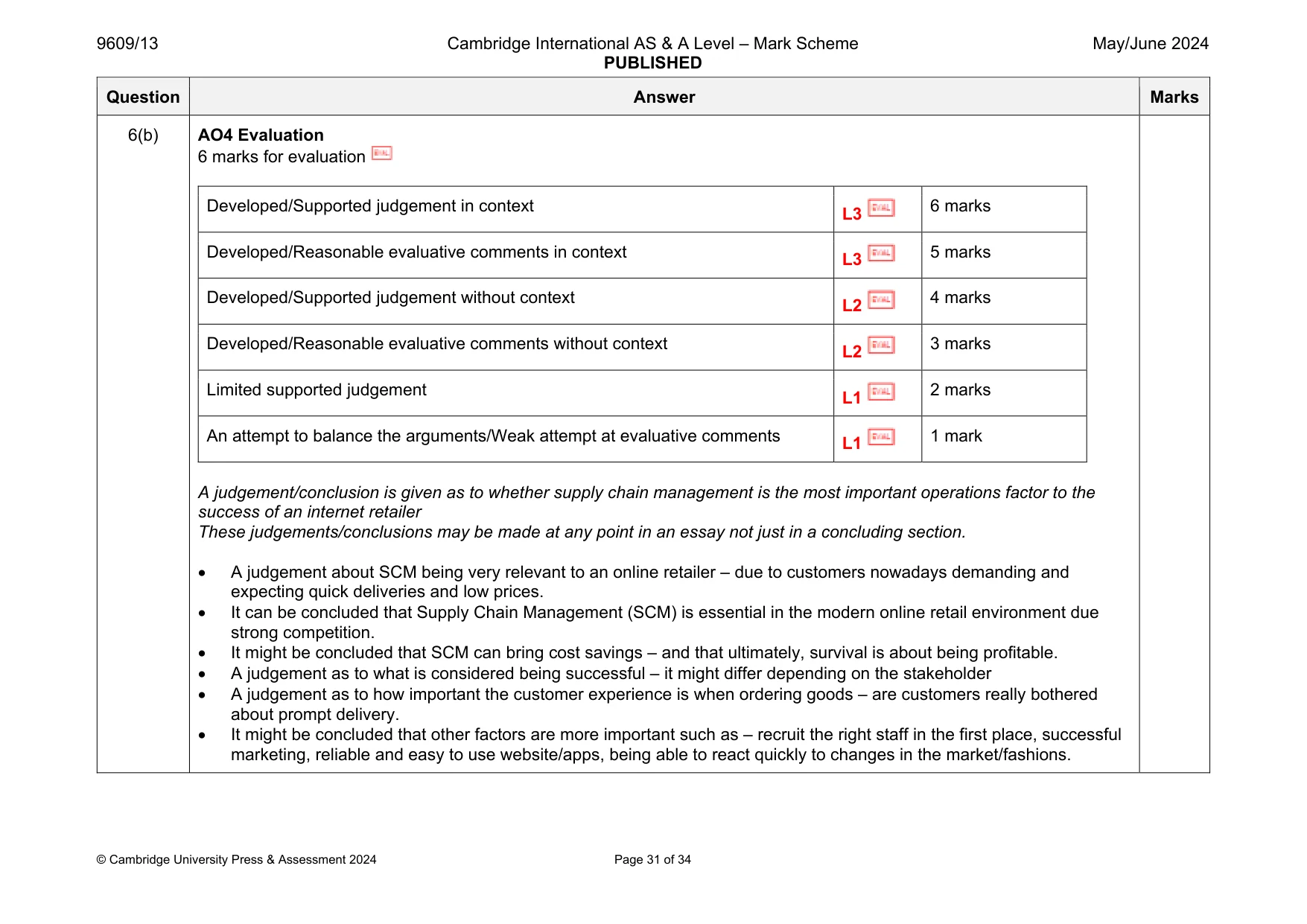
9609/13 Cambridge International AS & A Level – Mark Scheme PUBLISHED May/June 2024 © Cambridge University Press & Assessment 2024 Page 31 of 34 Question Answer Marks 6(b) AO4 Evaluation 6 marks for evaluation Developed/Supported judgement in context L3 6 marks Developed/Reasonable evaluative comments in context L3 5 marks Developed/Supported judgement without context L2 4 marks Developed/Reasonable evaluative comments without context L2 3 marks Limited supported judgement L1 2 marks An attempt to balance the arguments/Weak attempt at evaluative comments L1 1 mark A judgement/conclusion is given as to whether supply chain management is the most important operations factor to the success of an internet retailer These judgements/conclusions may be made at any point in an essay not just in a concluding section. A judgement about SCM being very relevant to an online retailer – due to customers nowadays demanding and expecting quick deliveries and low prices. It can be concluded that Supply Chain Management (SCM) is essential in the modern online retail environment due strong competition. It might be concluded that SCM can bring cost savings – and that ultimately, survival is about being profitable. A judgement as to what is considered being successful – it might differ depending on the stakeholder A judgement as to how important the customer experience is when ordering goods – are customers really bothered about prompt delivery. It might be concluded that other factors are more important such as – recruit the right staff in the first place, successful marketing, reliable and easy to use website/apps, being able to react quickly to changes in the market/fashions.
Mark scheme, page 32
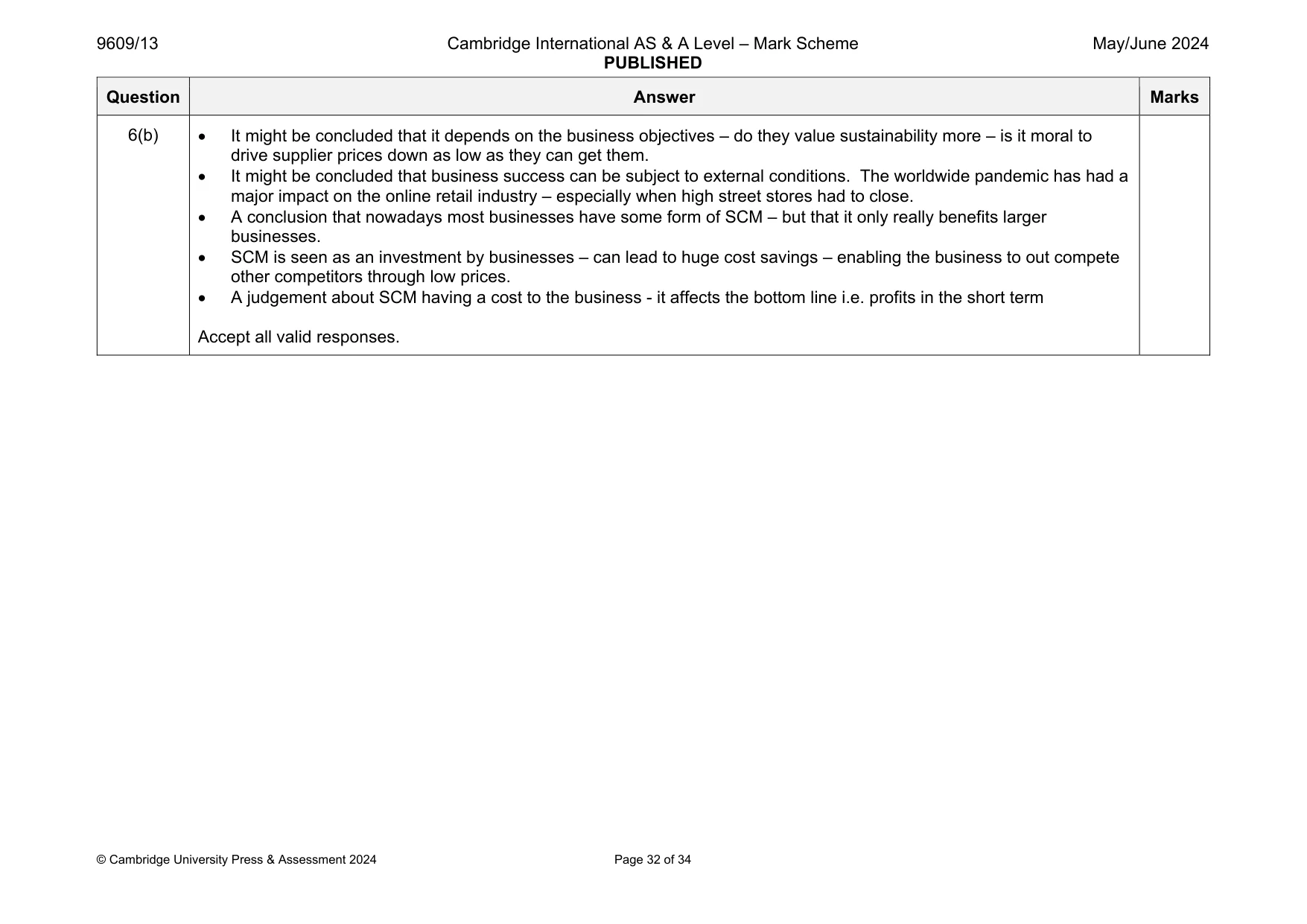
9609/13 Cambridge International AS & A Level – Mark Scheme PUBLISHED May/June 2024 © Cambridge University Press & Assessment 2024 Page 32 of 34 Question Answer Marks 6(b) It might be concluded that it depends on the business objectives – do they value sustainability more – is it moral to drive supplier prices down as low as they can get them. It might be concluded that business success can be subject to external conditions. The worldwide pandemic has had a major impact on the online retail industry – especially when high street stores had to close. A conclusion that nowadays most businesses have some form of SCM – but that it only really benefits larger businesses. SCM is seen as an investment by businesses – can lead to huge cost savings – enabling the business to out compete other competitors through low prices. A judgement about SCM having a cost to the business - it affects the bottom line i.e. profits in the short term Accept all valid responses.
Mark scheme, page 33
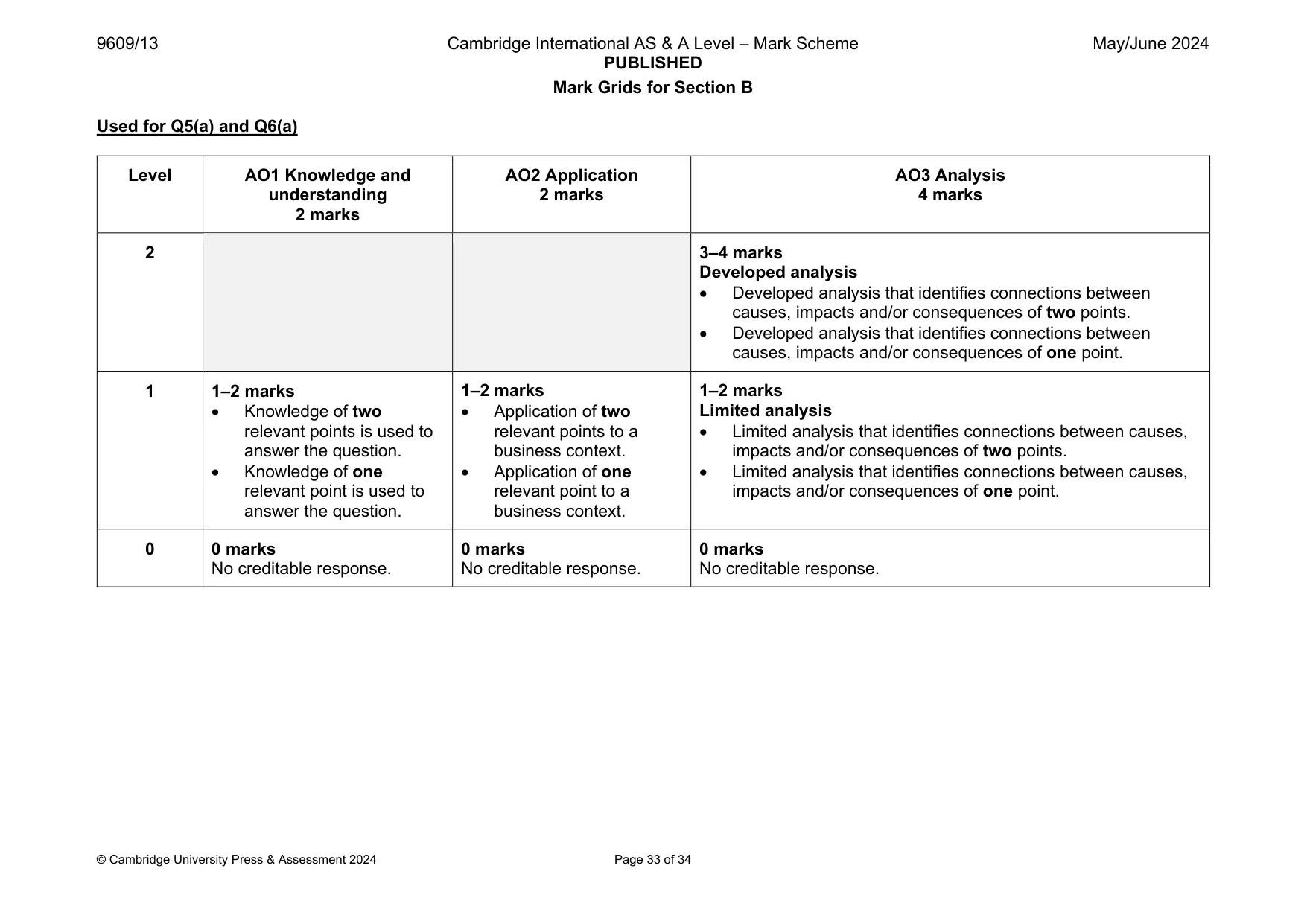
9609/13 Cambridge International AS & A Level – Mark Scheme PUBLISHED May/June 2024 © Cambridge University Press & Assessment 2024 Page 33 of 34 Mark Grids for Section B Used for Q5(a) and Q6(a) Level AO1 Knowledge and understanding 2 marks AO2 Application 2 marks AO3 Analysis 4 marks 2 3–4 marks Developed analysis Developed analysis that identifies connections between causes, impacts and/or consequences of two points. Developed analysis that identifies connections between causes, impacts and/or consequences of one point. 1 1–2 marks Knowledge of two relevant points is used to answer the question. Knowledge of one relevant point is used to answer the question. 1–2 marks Application of two relevant points to a business context. Application of one relevant point to a business context. 1–2 marks Limited analysis Limited analysis that identifies connections between causes, impacts and/or consequences of two points. Limited analysis that identifies connections between causes, impacts and/or consequences of one point. 0 0 marks No creditable response. 0 marks No creditable response. 0 marks No creditable response.
Mark scheme, page 34
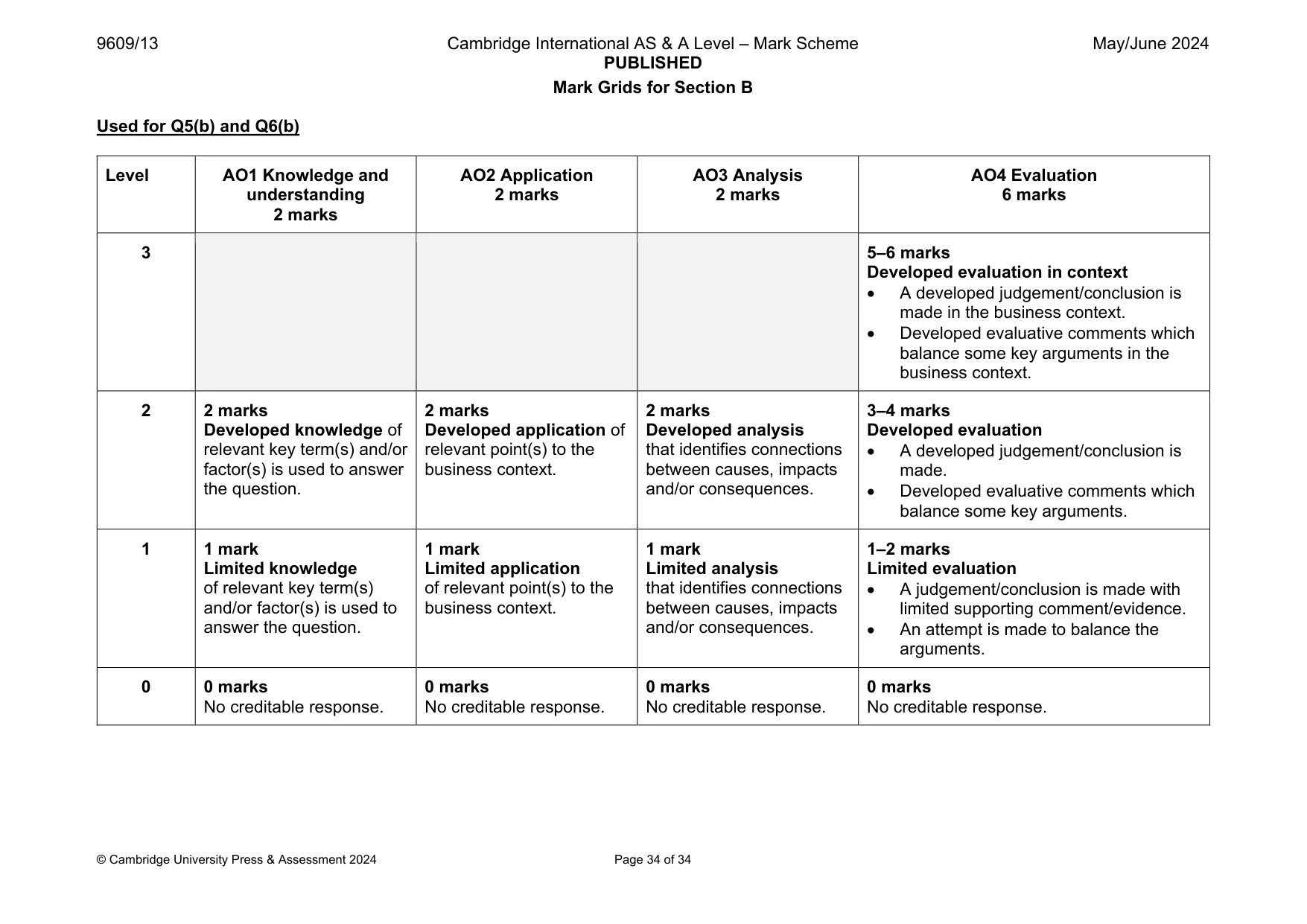
9609/13 Cambridge International AS & A Level – Mark Scheme PUBLISHED May/June 2024 © Cambridge University Press & Assessment 2024 Page 34 of 34 Mark Grids for Section B Used for Q5(b) and Q6(b) Level AO1 Knowledge and understanding 2 marks AO2 Application 2 marks AO3 Analysis 2 marks AO4 Evaluation 6 marks 3 5–6 marks Developed evaluation in context A developed judgement/conclusion is made in the business context. Developed evaluative comments which balance some key arguments in the business context. 2 2 marks Developed knowledge of relevant key term(s) and/or factor(s) is used to answer the question. 2 marks Developed application of relevant point(s) to the business context. 2 marks Developed analysis that identifies connections between causes, impacts and/or consequences. 3–4 marks Developed evaluation A developed judgement/conclusion is made. Developed evaluative comments which balance some key arguments. 1 1 mark Limited knowledge of relevant key term(s) and/or factor(s) is used to answer the question. 1 mark Limited application of relevant point(s) to the business context. 1 mark Limited analysis that identifies connections between causes, impacts and/or consequences. 1–2 marks Limited evaluation A judgement/conclusion is made with limited supporting comment/evidence. An attempt is made to balance the arguments. 0 0 marks No creditable response. 0 marks No creditable response. 0 marks No creditable response. 0 marks No creditable response.
What you needed in this session
Cambridge’s own grade thresholds for 2024 May/June, Paper 1 · Variant 3. A higher threshold means an easier paper — the bar moves with how the cohort did.