Cambridge A Level Business (for first examination in 2016) 9609 — 2021 May/June Paper 1 · Variant 2
9609/12/M/J/21 · 40 marks · ≈45 min
The question paper and its mark scheme, free to read here and free to download. This is Cambridge’s own paper, exactly as it was sat.
Question paper4 pages



Mark scheme19 pages
Answers below. Sit the paper first if you are practising.


Paper as text
Question paper, page 1
This document has 4 pages. Any blank pages are indicated. Cambridge International AS & A Level BUSINESS 9609/12 Paper 1 Short Answer and Essay May/June 2021 1 hour 15 minutes You must answer on the enclosed answer booklet. You will need: Answer booklet (enclosed) INSTRUCTIONS ● Section A: answer all questions. ● Section B: answer one question. ● Follow the instructions on the front cover of the answer booklet. If you need additional answer paper, ask the invigilator for a continuation booklet. INFORMATION ● The total mark for this paper is 40. ● The number of marks for each question or part question is shown in brackets [ ]. DC (MB) 206361 © UCLES 2021 [Turn over * 5 9 8 9 8 8 3 3 1 7 *
Question paper, page 2
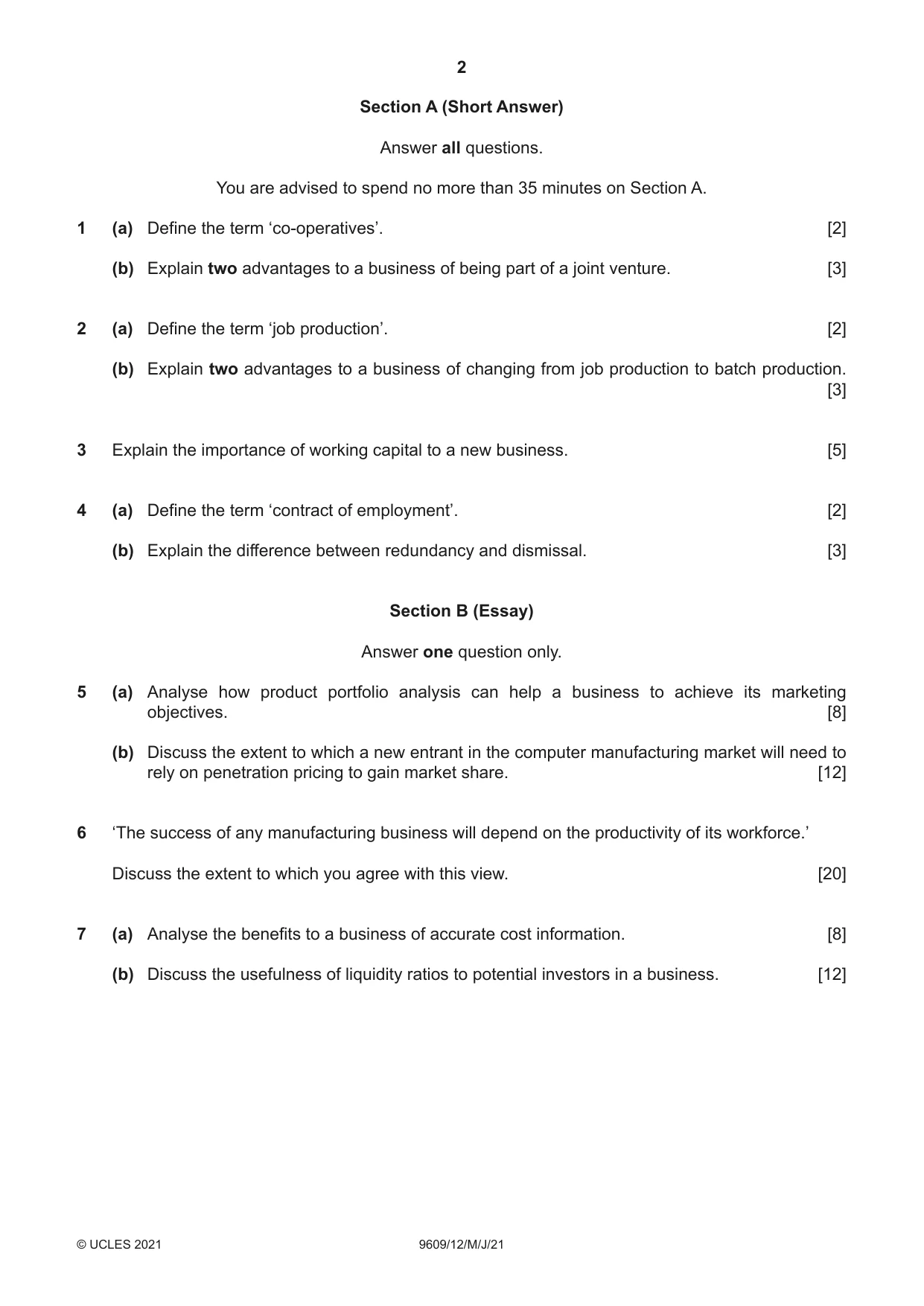
2 9609/12/M/J/21 © UCLES 2021 Section A (Short Answer) Answer all questions. You are advised to spend no more than 35 minutes on Section A. 1 (a) Define the term ‘co-operatives’. [2] (b) Explain two advantages to a business of being part of a joint venture. [3] 2 (a) Define the term ‘job production’. [2] (b) Explain two advantages to a business of changing from job production to batch production. [3] 3 Explain the importance of working capital to a new business. [5] 4 (a) Define the term ‘contract of employment’. [2] (b) Explain the difference between redundancy and dismissal. [3] Section B (Essay) Answer one question only. 5 (a) Analyse how product portfolio analysis can help a business to achieve its marketing objectives. [8] (b) Discuss the extent to which a new entrant in the computer manufacturing market will need to rely on penetration pricing to gain market share. [12] 6 ‘The success of any manufacturing business will depend on the productivity of its workforce.’ Discuss the extent to which you agree with this view. [20] 7 (a) Analyse the benefits to a business of accurate cost information. [8] (b) Discuss the usefulness of liquidity ratios to potential investors in a business. [12]
Question paper, page 3
3 9609/12/M/J/21 © UCLES 2021 BLANK PAGE
Question paper, page 4
4 9609/12/M/J/21 © UCLES 2021 Permission to reproduce items where third-party owned material protected by copyright is included has been sought and cleared where possible. Every reasonable effort has been made by the publisher (UCLES) to trace copyright holders, but if any items requiring clearance have unwittingly been included, the publisher will be pleased to make amends at the earliest possible opportunity. To avoid the issue of disclosure of answer-related information to candidates, all copyright acknowledgements are reproduced online in the Cambridge Assessment International Education Copyright Acknowledgements Booklet. This is produced for each series of examinations and is freely available to download at www.cambridgeinternational.org after the live examination series. Cambridge Assessment International Education is part of the Cambridge Assessment Group. Cambridge Assessment is the brand name of the University of Cambridge Local Examinations Syndicate (UCLES), which itself is a department of the University of Cambridge. BLANK PAGE
Mark scheme, page 1
This document consists of 19 printed pages. © UCLES 2021 [Turn over Cambridge International AS & A Level BUSINESS 9609/12 Paper 1 Short Answer and Essay May/June 2021 MARK SCHEME Maximum Mark: 40 Published This mark scheme is published as an aid to teachers and candidates, to indicate the requirements of the examination. It shows the basis on which Examiners were instructed to award marks. It does not indicate the details of the discussions that took place at an Examiners’ meeting before marking began, which would have considered the acceptability of alternative answers. Mark schemes should be read in conjunction with the question paper and the Principal Examiner Report for Teachers. Cambridge International will not enter into discussions about these mark schemes. Cambridge International is publishing the mark schemes for the May/June 2021 series for most Cambridge IGCSE™, Cambridge International A and AS Level components and some Cambridge O Level components.
Mark scheme, page 2
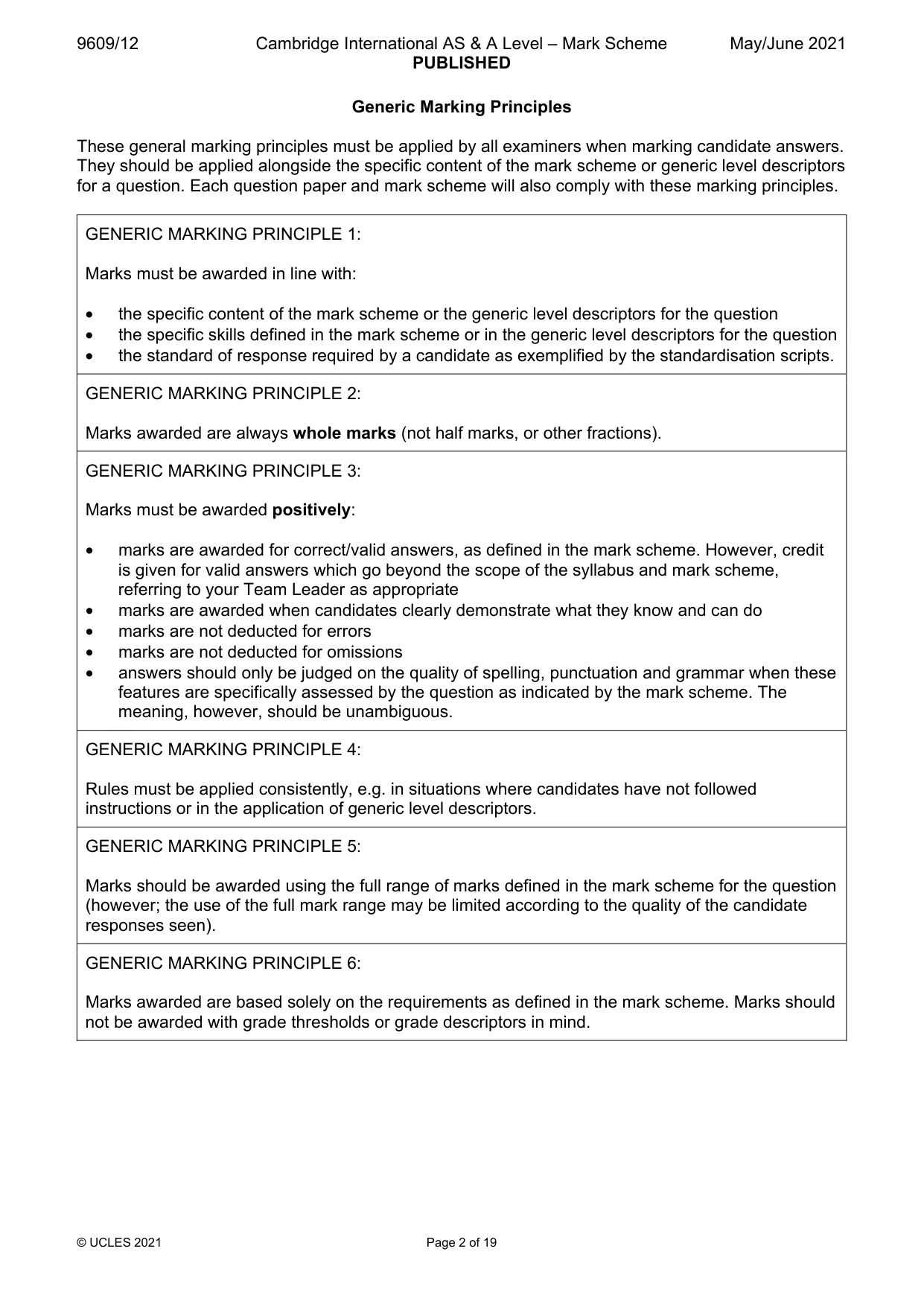
9609/12 Cambridge International AS & A Level – Mark Scheme PUBLISHED May/June 2021 © UCLES 2021 Page 2 of 19 Generic Marking Principles These general marking principles must be applied by all examiners when marking candidate answers. They should be applied alongside the specific content of the mark scheme or generic level descriptors for a question. Each question paper and mark scheme will also comply with these marking principles. GENERIC MARKING PRINCIPLE 1: Marks must be awarded in line with: • the specific content of the mark scheme or the generic level descriptors for the question • the specific skills defined in the mark scheme or in the generic level descriptors for the question • the standard of response required by a candidate as exemplified by the standardisation scripts. GENERIC MARKING PRINCIPLE 2: Marks awarded are always whole marks (not half marks, or other fractions). GENERIC MARKING PRINCIPLE 3: Marks must be awarded positively: • marks are awarded for correct/valid answers, as defined in the mark scheme. However, credit is given for valid answers which go beyond the scope of the syllabus and mark scheme, referring to your Team Leader as appropriate • marks are awarded when candidates clearly demonstrate what they know and can do • marks are not deducted for errors • marks are not deducted for omissions • answers should only be judged on the quality of spelling, punctuation and grammar when these features are specifically assessed by the question as indicated by the mark scheme. The meaning, however, should be unambiguous. GENERIC MARKING PRINCIPLE 4: Rules must be applied consistently, e.g. in situations where candidates have not followed instructions or in the application of generic level descriptors. GENERIC MARKING PRINCIPLE 5: Marks should be awarded using the full range of marks defined in the mark scheme for the question (however; the use of the full mark range may be limited according to the quality of the candidate responses seen). GENERIC MARKING PRINCIPLE 6: Marks awarded are based solely on the requirements as defined in the mark scheme. Marks should not be awarded with grade thresholds or grade descriptors in mind.
Mark scheme, page 3
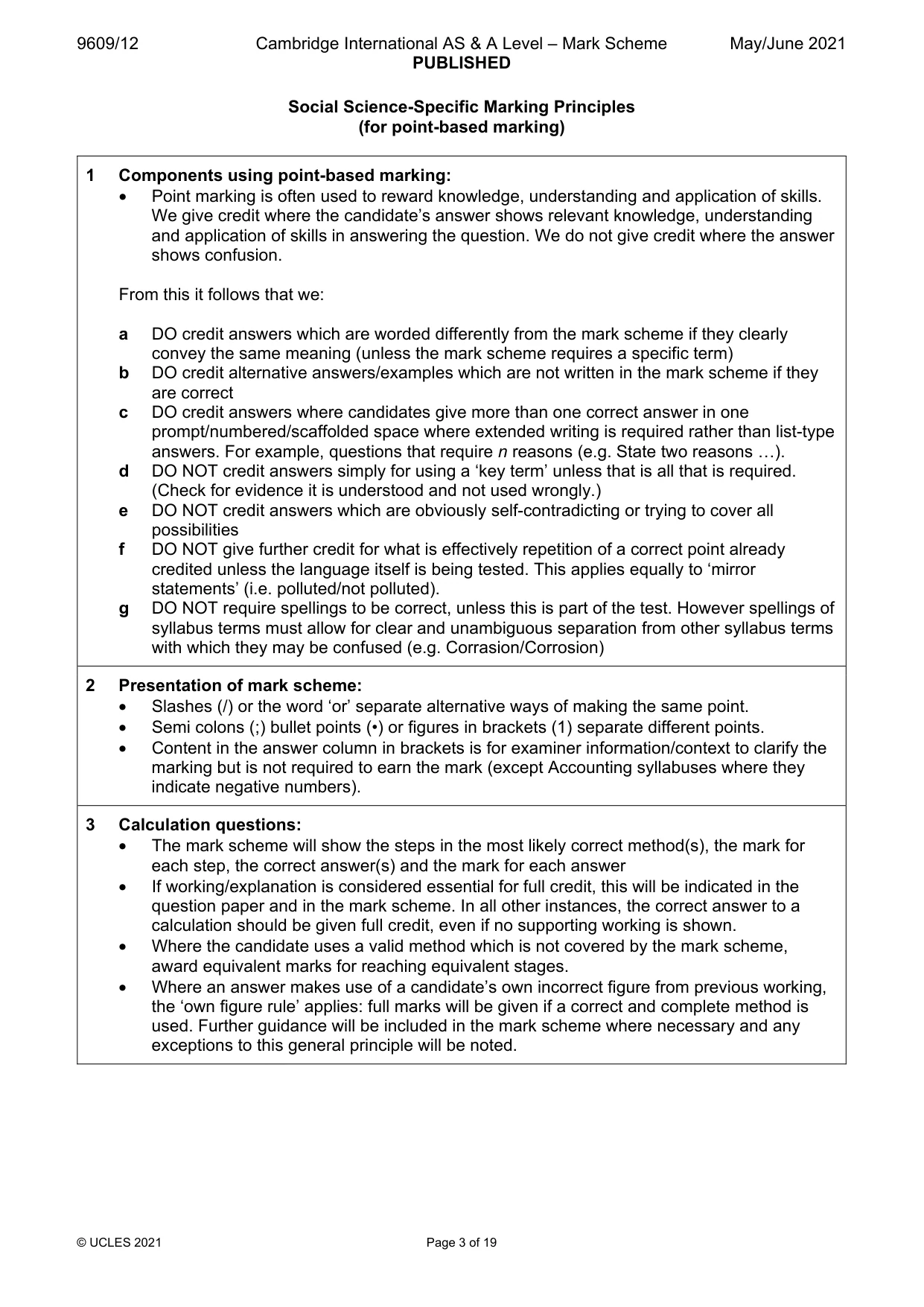
9609/12 Cambridge International AS & A Level – Mark Scheme PUBLISHED May/June 2021 © UCLES 2021 Page 3 of 19 Social Science-Specific Marking Principles (for point-based marking) 1 Components using point-based marking: • Point marking is often used to reward knowledge, understanding and application of skills. We give credit where the candidate’s answer shows relevant knowledge, understanding and application of skills in answering the question. We do not give credit where the answer shows confusion. From this it follows that we: a DO credit answers which are worded differently from the mark scheme if they clearly convey the same meaning (unless the mark scheme requires a specific term) b DO credit alternative answers/examples which are not written in the mark scheme if they are correct c DO credit answers where candidates give more than one correct answer in one prompt/numbered/scaffolded space where extended writing is required rather than list-type answers. For example, questions that require n reasons (e.g. State two reasons …). d DO NOT credit answers simply for using a ‘key term’ unless that is all that is required. (Check for evidence it is understood and not used wrongly.) e DO NOT credit answers which are obviously self-contradicting or trying to cover all possibilities f DO NOT give further credit for what is effectively repetition of a correct point already credited unless the language itself is being tested. This applies equally to ‘mirror statements’ (i.e. polluted/not polluted). g DO NOT require spellings to be correct, unless this is part of the test. However spellings of syllabus terms must allow for clear and unambiguous separation from other syllabus terms with which they may be confused (e.g. Corrasion/Corrosion) 2 Presentation of mark scheme: • Slashes (/) or the word ‘or’ separate alternative ways of making the same point. • Semi colons (;) bullet points (•) or figures in brackets (1) separate different points. • Content in the answer column in brackets is for examiner information/context to clarify the marking but is not required to earn the mark (except Accounting syllabuses where they indicate negative numbers). 3 Calculation questions: • The mark scheme will show the steps in the most likely correct method(s), the mark for each step, the correct answer(s) and the mark for each answer • If working/explanation is considered essential for full credit, this will be indicated in the question paper and in the mark scheme. In all other instances, the correct answer to a calculation should be given full credit, even if no supporting working is shown. • Where the candidate uses a valid method which is not covered by the mark scheme, award equivalent marks for reaching equivalent stages. • Where an answer makes use of a candidate’s own incorrect figure from previous working, the ‘own figure rule’ applies: full marks will be given if a correct and complete method is used. Further guidance will be included in the mark scheme where necessary and any exceptions to this general principle will be noted.
Mark scheme, page 4
9609/12 Cambridge International AS & A Level – Mark Scheme PUBLISHED May/June 2021 © UCLES 2021 Page 4 of 19 4 Annotation: • For point marking, ticks can be used to indicate correct answers and crosses can be used to indicate wrong answers. There is no direct relationship between ticks and marks. Ticks have no defined meaning for levels of response marking. • For levels of response marking, the level awarded should be annotated on the script. • Other annotations will be used by examiners as agreed during standardisation, and the meaning will be understood by all examiners who marked that paper.
Mark scheme, page 5
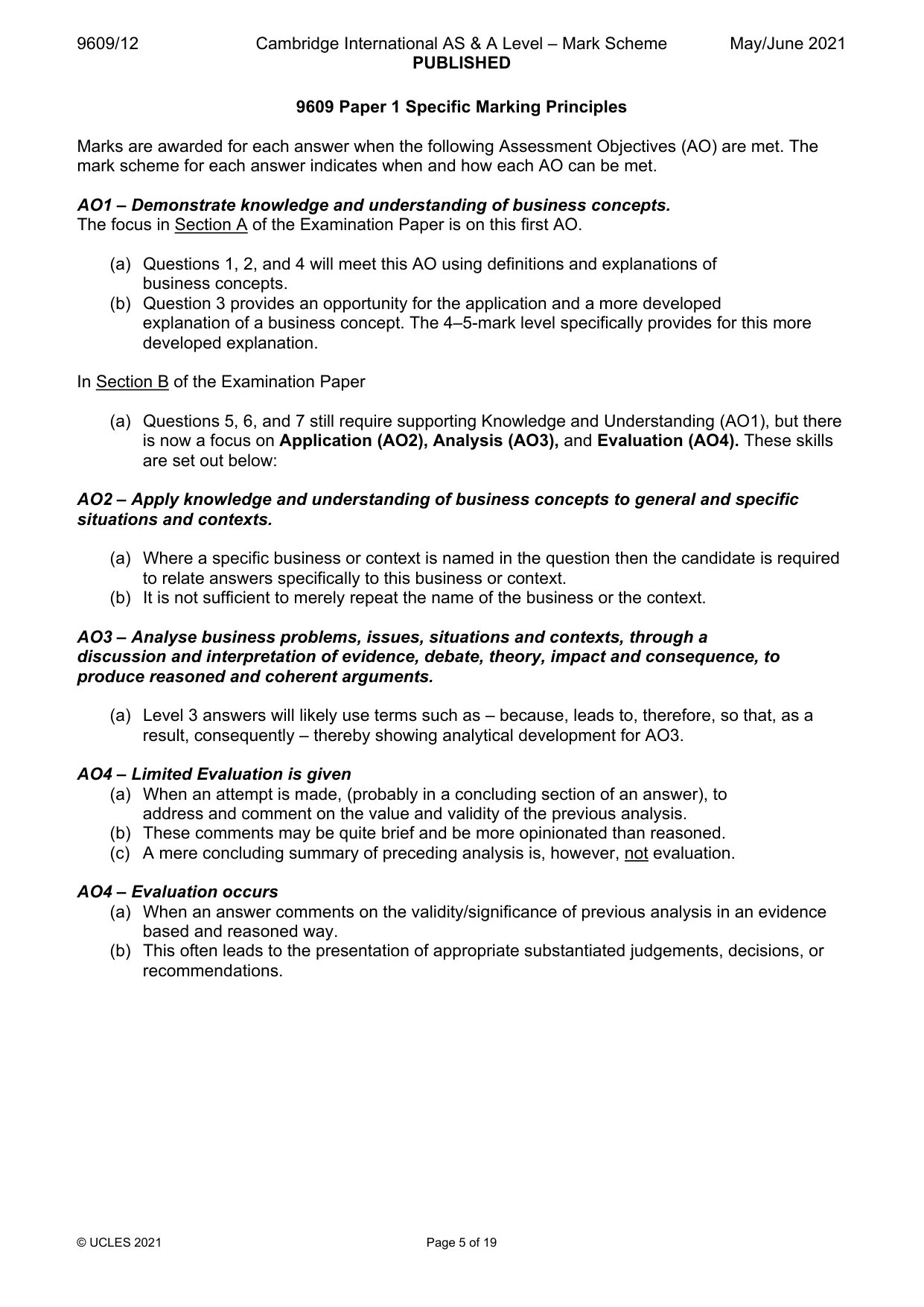
9609/12 Cambridge International AS & A Level – Mark Scheme PUBLISHED May/June 2021 © UCLES 2021 Page 5 of 19 9609 Paper 1 Specific Marking Principles Marks are awarded for each answer when the following Assessment Objectives (AO) are met. The mark scheme for each answer indicates when and how each AO can be met. AO1 – Demonstrate knowledge and understanding of business concepts. The focus in Section A of the Examination Paper is on this first AO. (a) Questions 1, 2, and 4 will meet this AO using definitions and explanations of business concepts. (b) Question 3 provides an opportunity for the application and a more developed explanation of a business concept. The 4–5-mark level specifically provides for this more developed explanation. In Section B of the Examination Paper (a) Questions 5, 6, and 7 still require supporting Knowledge and Understanding (AO1), but there is now a focus on Application (AO2), Analysis (AO3), and Evaluation (AO4). These skills are set out below: AO2 – Apply knowledge and understanding of business concepts to general and specific situations and contexts. (a) Where a specific business or context is named in the question then the candidate is required to relate answers specifically to this business or context. (b) It is not sufficient to merely repeat the name of the business or the context. AO3 – Analyse business problems, issues, situations and contexts, through a discussion and interpretation of evidence, debate, theory, impact and consequence, to produce reasoned and coherent arguments. (a) Level 3 answers will likely use terms such as – because, leads to, therefore, so that, as a result, consequently – thereby showing analytical development for AO3. AO4 – Limited Evaluation is given (a) When an attempt is made, (probably in a concluding section of an answer), to address and comment on the value and validity of the previous analysis. (b) These comments may be quite brief and be more opinionated than reasoned. (c) A mere concluding summary of preceding analysis is, however, not evaluation. AO4 – Evaluation occurs (a) When an answer comments on the validity/significance of previous analysis in an evidence based and reasoned way. (b) This often leads to the presentation of appropriate substantiated judgements, decisions, or recommendations.
Mark scheme, page 6
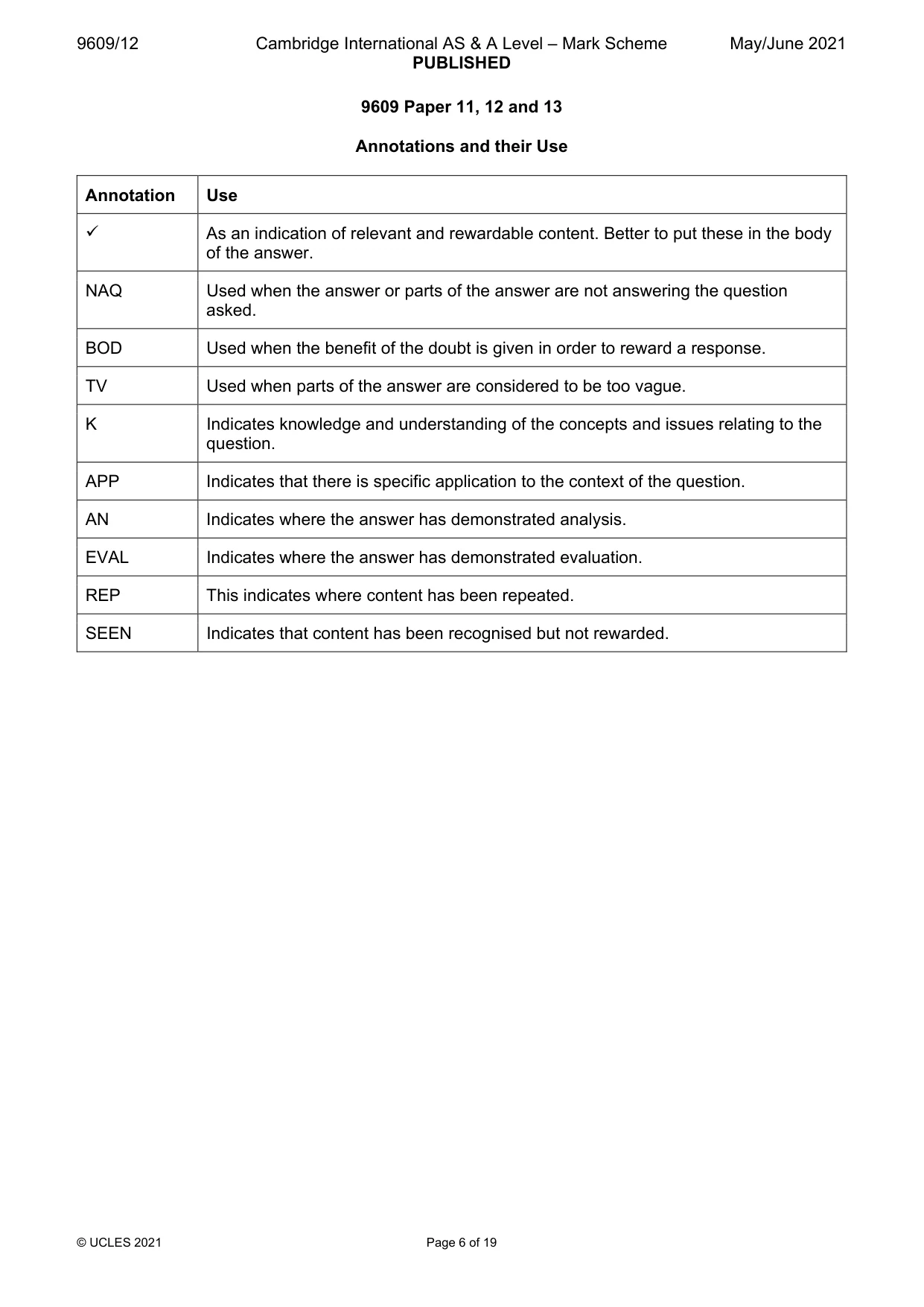
9609/12 Cambridge International AS & A Level – Mark Scheme PUBLISHED May/June 2021 © UCLES 2021 Page 6 of 19 9609 Paper 11, 12 and 13 Annotations and their Use Annotation Use As an indication of relevant and rewardable content. Better to put these in the body of the answer. NAQ Used when the answer or parts of the answer are not answering the question asked. BOD Used when the benefit of the doubt is given in order to reward a response. TV Used when parts of the answer are considered to be too vague. K Indicates knowledge and understanding of the concepts and issues relating to the question. APP Indicates that there is specific application to the context of the question. AN Indicates where the answer has demonstrated analysis. EVAL Indicates where the answer has demonstrated evaluation. REP This indicates where content has been repeated. SEEN Indicates that content has been recognised but not rewarded.
Mark scheme, page 7
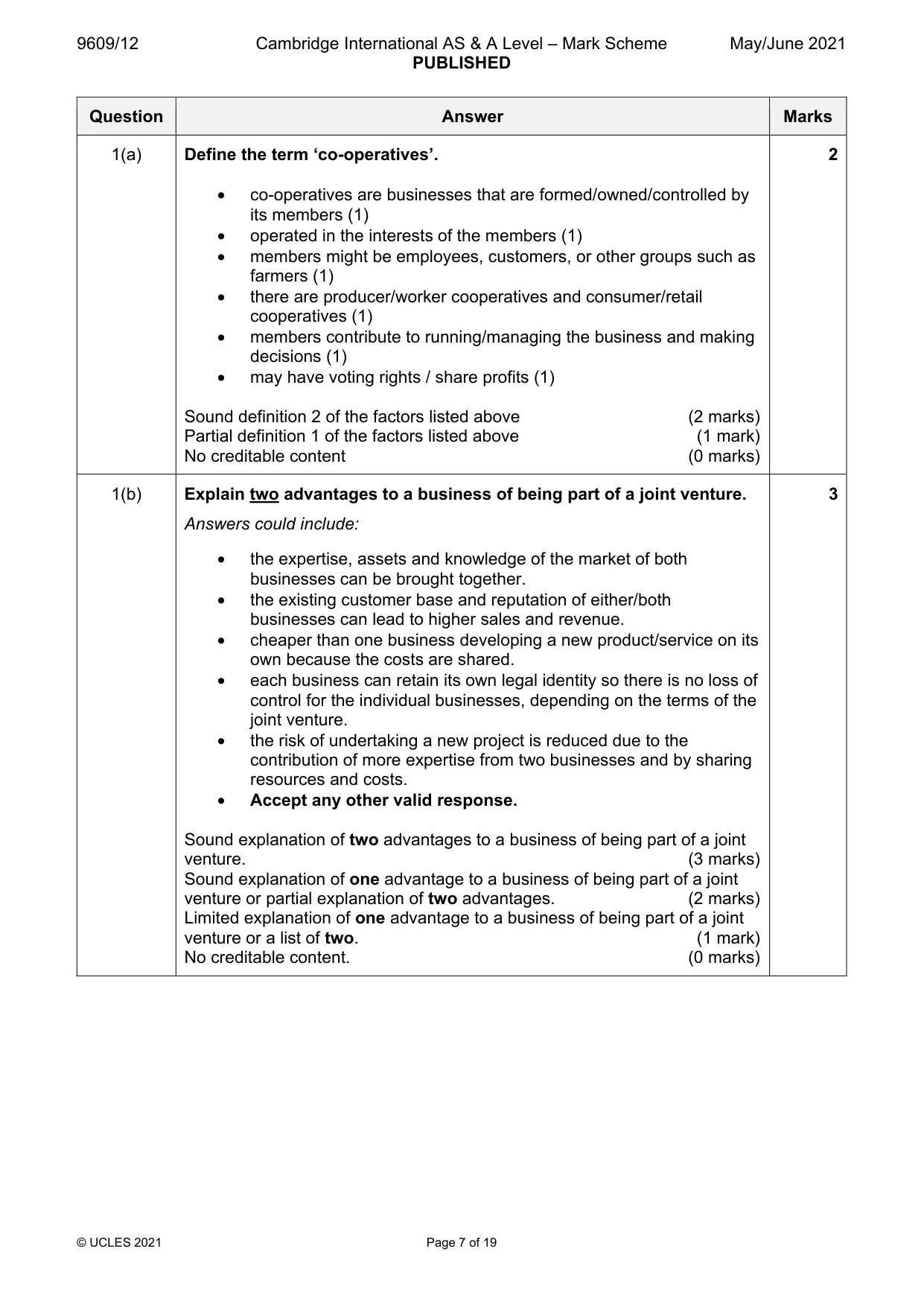
9609/12 Cambridge International AS & A Level – Mark Scheme PUBLISHED May/June 2021 © UCLES 2021 Page 7 of 19 Question Answer Marks 1(a) Define the term ‘co-operatives’. • co-operatives are businesses that are formed/owned/controlled by its members (1) • operated in the interests of the members (1) • members might be employees, customers, or other groups such as farmers (1) • there are producer/worker cooperatives and consumer/retail cooperatives (1) • members contribute to running/managing the business and making decisions (1) • may have voting rights / share profits (1) Sound definition 2 of the factors listed above (2 marks) Partial definition 1 of the factors listed above (1 mark) No creditable content (0 marks) 2 1(b) Explain two advantages to a business of being part of a joint venture. Answers could include: • the expertise, assets and knowledge of the market of both businesses can be brought together. • the existing customer base and reputation of either/both businesses can lead to higher sales and revenue. • cheaper than one business developing a new product/service on its own because the costs are shared. • each business can retain its own legal identity so there is no loss of control for the individual businesses, depending on the terms of the joint venture. • the risk of undertaking a new project is reduced due to the contribution of more expertise from two businesses and by sharing resources and costs. • Accept any other valid response. Sound explanation of two advantages to a business of being part of a joint venture. (3 marks) Sound explanation of one advantage to a business of being part of a joint venture or partial explanation of two advantages. (2 marks) Limited explanation of one advantage to a business of being part of a joint venture or a list of two. (1 mark) No creditable content. (0 marks) 3
Mark scheme, page 8
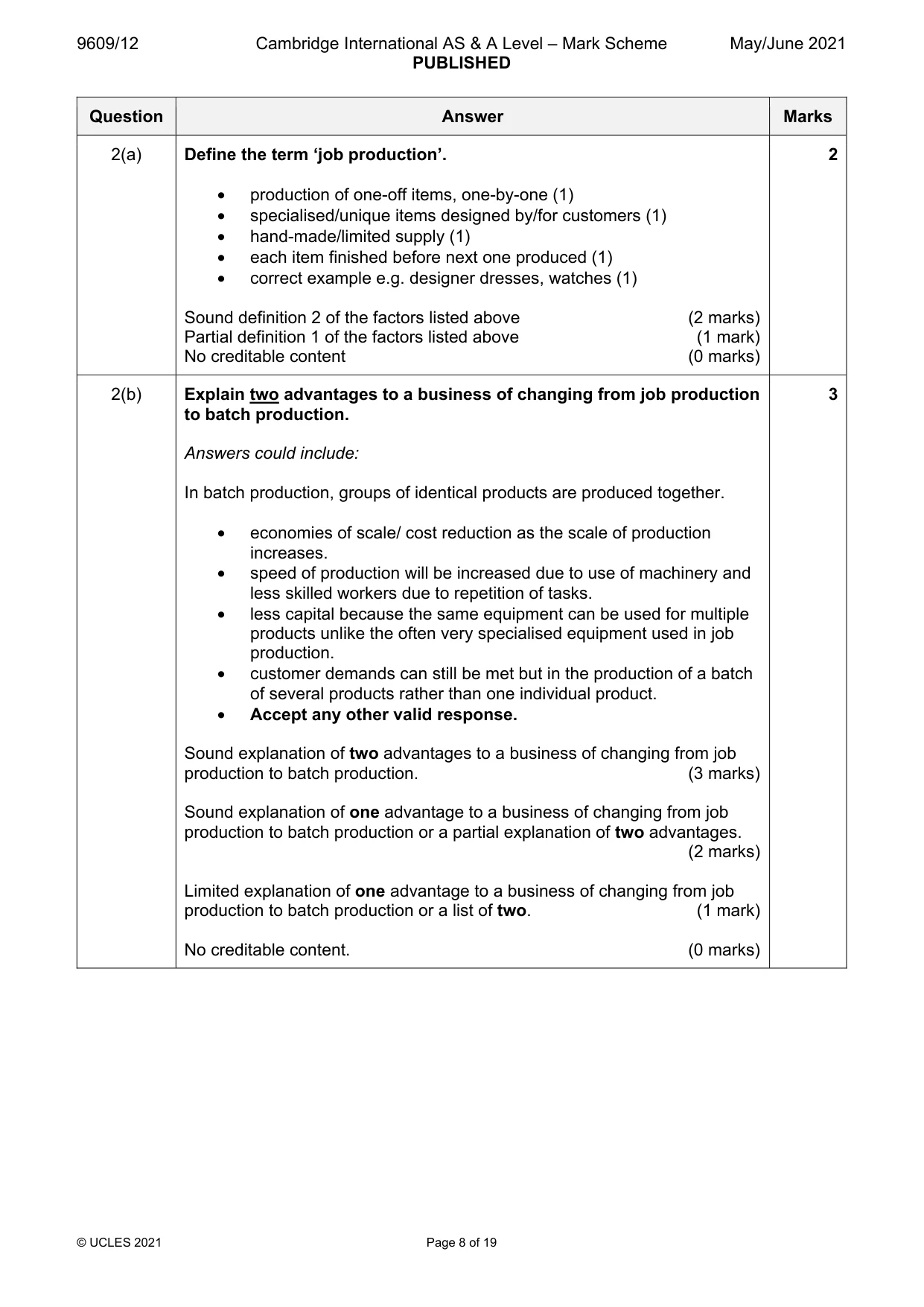
9609/12 Cambridge International AS & A Level – Mark Scheme PUBLISHED May/June 2021 © UCLES 2021 Page 8 of 19 Question Answer Marks 2(a) Define the term ‘job production’. • production of one-off items, one-by-one (1) • specialised/unique items designed by/for customers (1) • hand-made/limited supply (1) • each item finished before next one produced (1) • correct example e.g. designer dresses, watches (1) Sound definition 2 of the factors listed above (2 marks) Partial definition 1 of the factors listed above (1 mark) No creditable content (0 marks) 2 2(b) Explain two advantages to a business of changing from job production to batch production. Answers could include: In batch production, groups of identical products are produced together. • economies of scale/ cost reduction as the scale of production increases. • speed of production will be increased due to use of machinery and less skilled workers due to repetition of tasks. • less capital because the same equipment can be used for multiple products unlike the often very specialised equipment used in job production. • customer demands can still be met but in the production of a batch of several products rather than one individual product. • Accept any other valid response. Sound explanation of two advantages to a business of changing from job production to batch production. (3 marks) Sound explanation of one advantage to a business of changing from job production to batch production or a partial explanation of two advantages. (2 marks) Limited explanation of one advantage to a business of changing from job production to batch production or a list of two. (1 mark) No creditable content. (0 marks) 3
Mark scheme, page 9
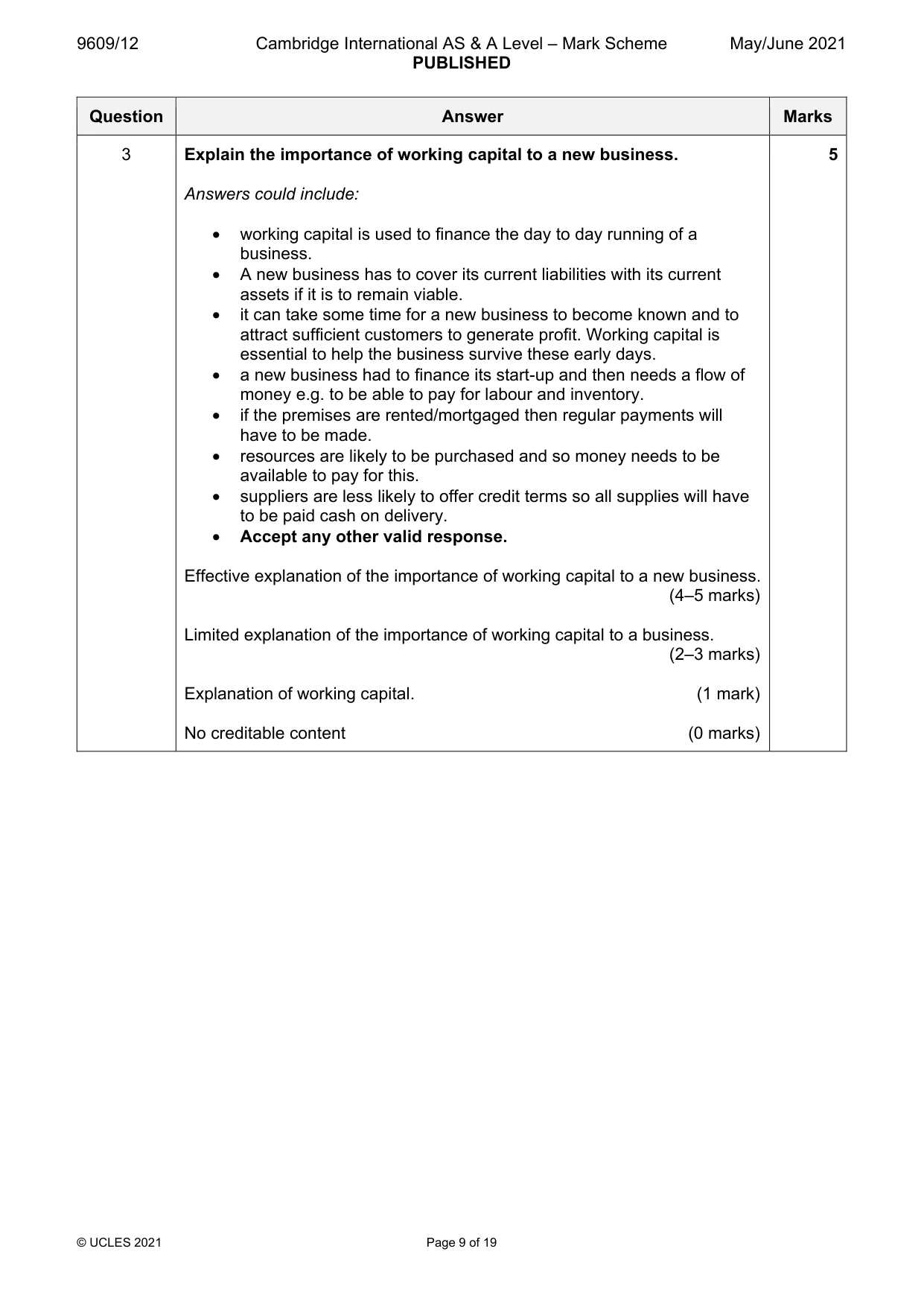
9609/12 Cambridge International AS & A Level – Mark Scheme PUBLISHED May/June 2021 © UCLES 2021 Page 9 of 19 Question Answer Marks 3 Explain the importance of working capital to a new business. Answers could include: • working capital is used to finance the day to day running of a business. • A new business has to cover its current liabilities with its current assets if it is to remain viable. • it can take some time for a new business to become known and to attract sufficient customers to generate profit. Working capital is essential to help the business survive these early days. • a new business had to finance its start-up and then needs a flow of money e.g. to be able to pay for labour and inventory. • if the premises are rented/mortgaged then regular payments will have to be made. • resources are likely to be purchased and so money needs to be available to pay for this. • suppliers are less likely to offer credit terms so all supplies will have to be paid cash on delivery. • Accept any other valid response. Effective explanation of the importance of working capital to a new business. (4–5 marks) Limited explanation of the importance of working capital to a business. (2–3 marks) Explanation of working capital. (1 mark) No creditable content (0 marks) 5
Mark scheme, page 10
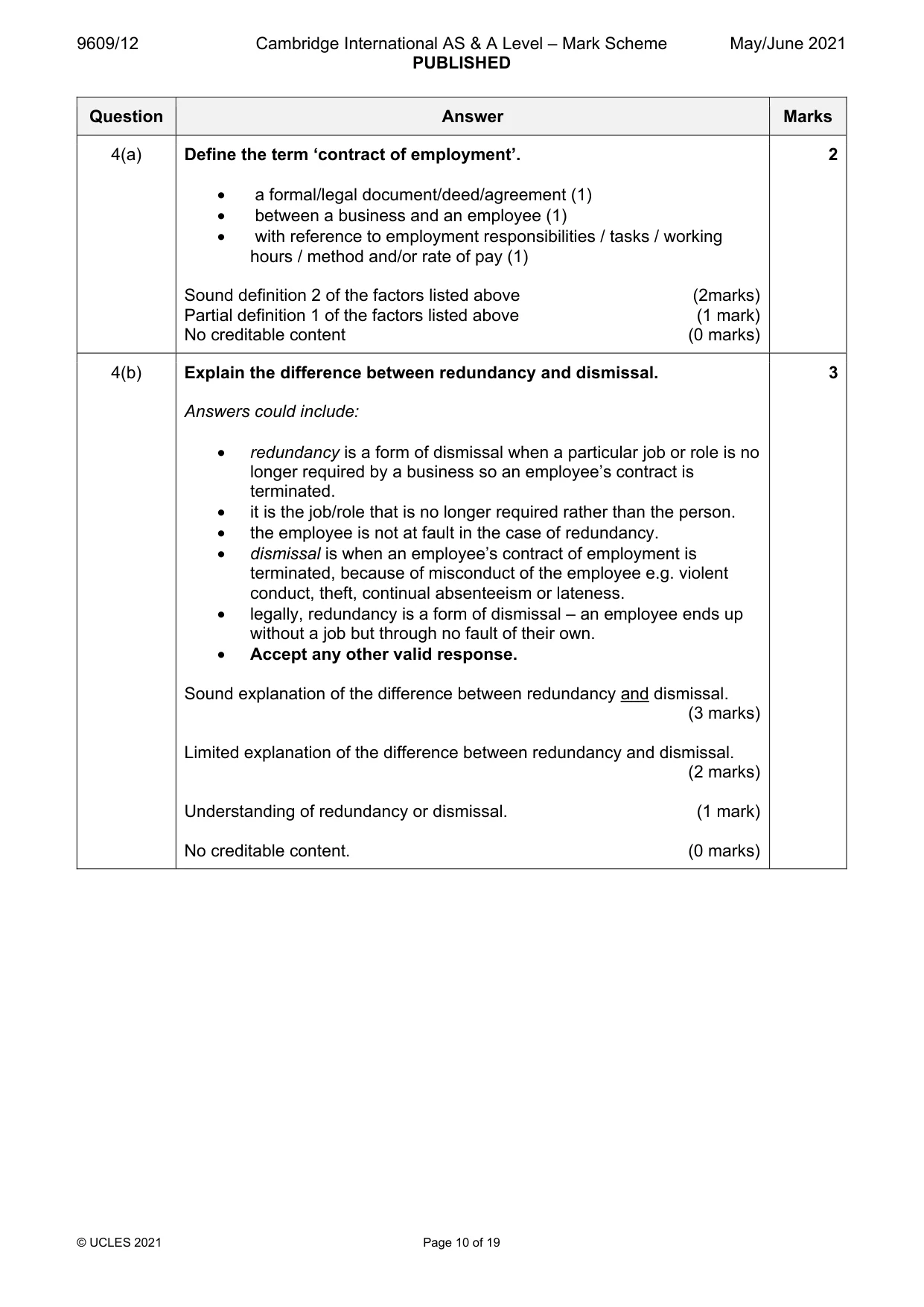
9609/12 Cambridge International AS & A Level – Mark Scheme PUBLISHED May/June 2021 © UCLES 2021 Page 10 of 19 Question Answer Marks 4(a) Define the term ‘contract of employment’. • a formal/legal document/deed/agreement (1) • between a business and an employee (1) • with reference to employment responsibilities / tasks / working hours / method and/or rate of pay (1) Sound definition 2 of the factors listed above (2marks) Partial definition 1 of the factors listed above (1 mark) No creditable content (0 marks) 2 4(b) Explain the difference between redundancy and dismissal. Answers could include: • redundancy is a form of dismissal when a particular job or role is no longer required by a business so an employee’s contract is terminated. • it is the job/role that is no longer required rather than the person. • the employee is not at fault in the case of redundancy. • dismissal is when an employee’s contract of employment is terminated, because of misconduct of the employee e.g. violent conduct, theft, continual absenteeism or lateness. • legally, redundancy is a form of dismissal – an employee ends up without a job but through no fault of their own. • Accept any other valid response. Sound explanation of the difference between redundancy and dismissal. (3 marks) Limited explanation of the difference between redundancy and dismissal. (2 marks) Understanding of redundancy or dismissal. (1 mark) No creditable content. (0 marks) 3
Mark scheme, page 11
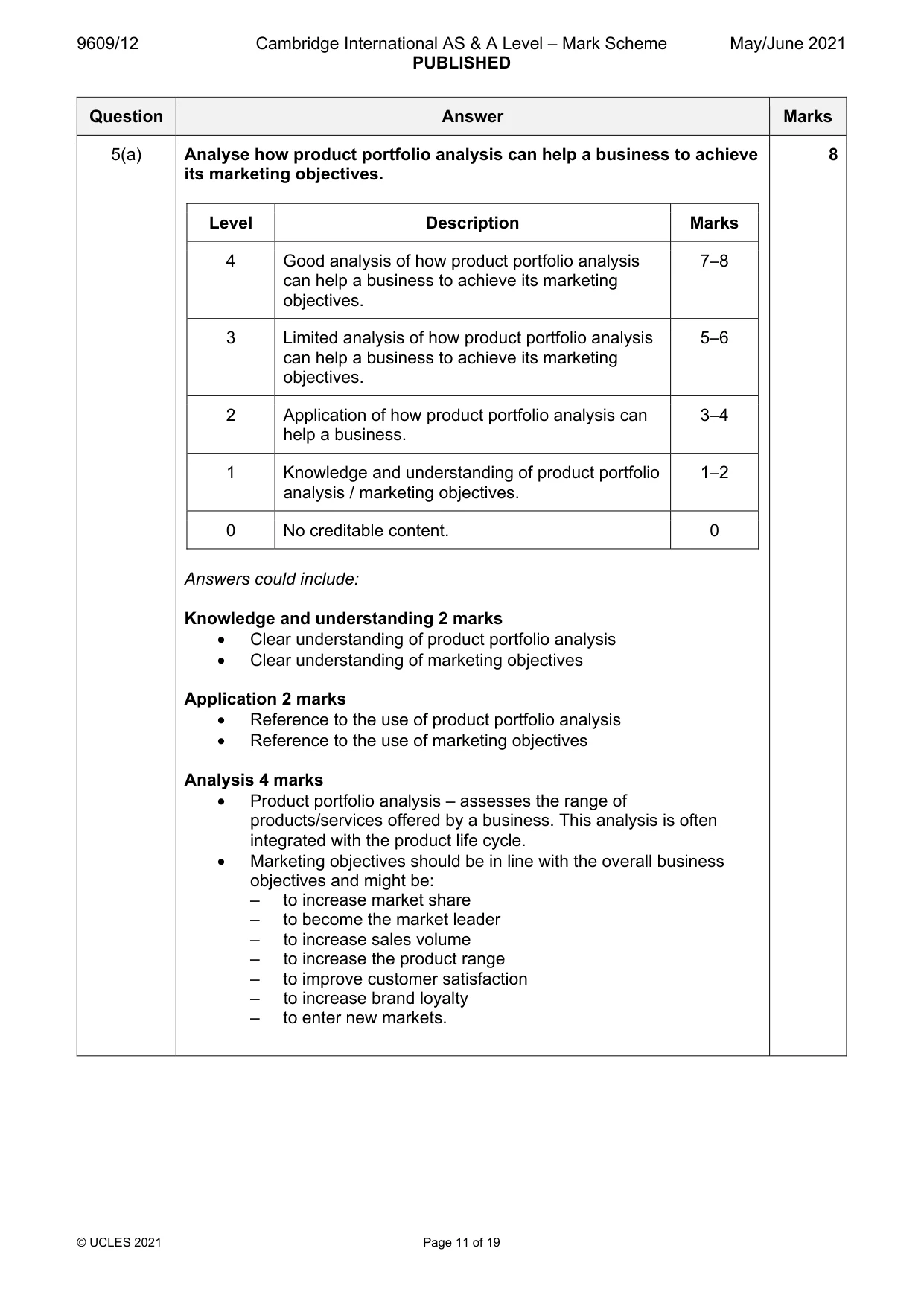
9609/12 Cambridge International AS & A Level – Mark Scheme PUBLISHED May/June 2021 © UCLES 2021 Page 11 of 19 Question Answer Marks 5(a) Analyse how product portfolio analysis can help a business to achieve its marketing objectives. Level Description Marks 4 Good analysis of how product portfolio analysis can help a business to achieve its marketing objectives. 7–8 3 Limited analysis of how product portfolio analysis can help a business to achieve its marketing objectives. 5–6 2 Application of how product portfolio analysis can help a business. 3–4 1 Knowledge and understanding of product portfolio analysis / marketing objectives. 1–2 0 No creditable content. 0 Answers could include: Knowledge and understanding 2 marks • Clear understanding of product portfolio analysis • Clear understanding of marketing objectives Application 2 marks • Reference to the use of product portfolio analysis • Reference to the use of marketing objectives Analysis 4 marks • Product portfolio analysis – assesses the range of products/services offered by a business. This analysis is often integrated with the product life cycle. • Marketing objectives should be in line with the overall business objectives and might be: – to increase market share – to become the market leader – to increase sales volume – to increase the product range – to improve customer satisfaction – to increase brand loyalty – to enter new markets. 8
Mark scheme, page 12
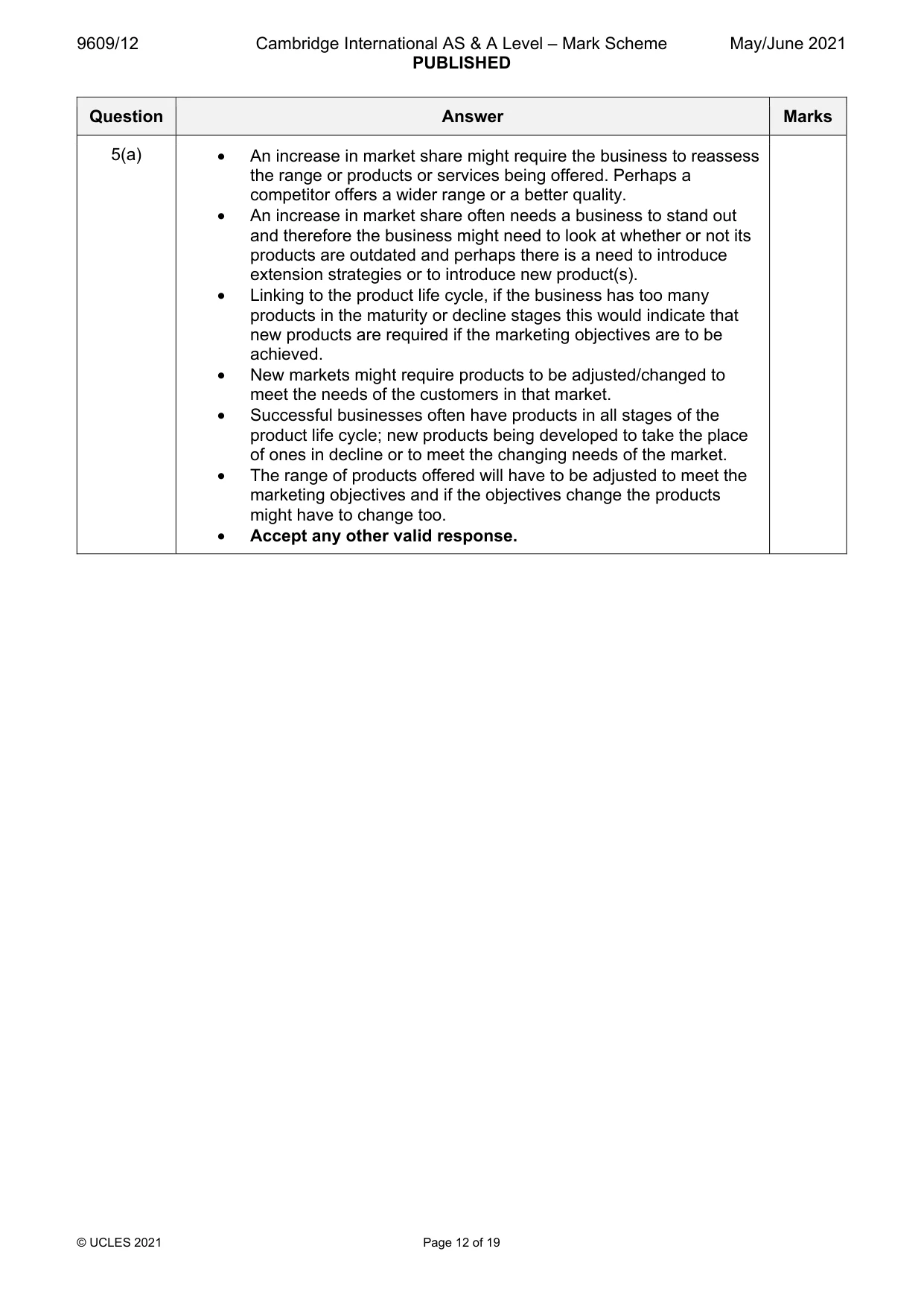
9609/12 Cambridge International AS & A Level – Mark Scheme PUBLISHED May/June 2021 © UCLES 2021 Page 12 of 19 Question Answer Marks 5(a) • An increase in market share might require the business to reassess the range or products or services being offered. Perhaps a competitor offers a wider range or a better quality. • An increase in market share often needs a business to stand out and therefore the business might need to look at whether or not its products are outdated and perhaps there is a need to introduce extension strategies or to introduce new product(s). • Linking to the product life cycle, if the business has too many products in the maturity or decline stages this would indicate that new products are required if the marketing objectives are to be achieved. • New markets might require products to be adjusted/changed to meet the needs of the customers in that market. • Successful businesses often have products in all stages of the product life cycle; new products being developed to take the place of ones in decline or to meet the changing needs of the market. • The range of products offered will have to be adjusted to meet the marketing objectives and if the objectives change the products might have to change too. • Accept any other valid response.
Mark scheme, page 13
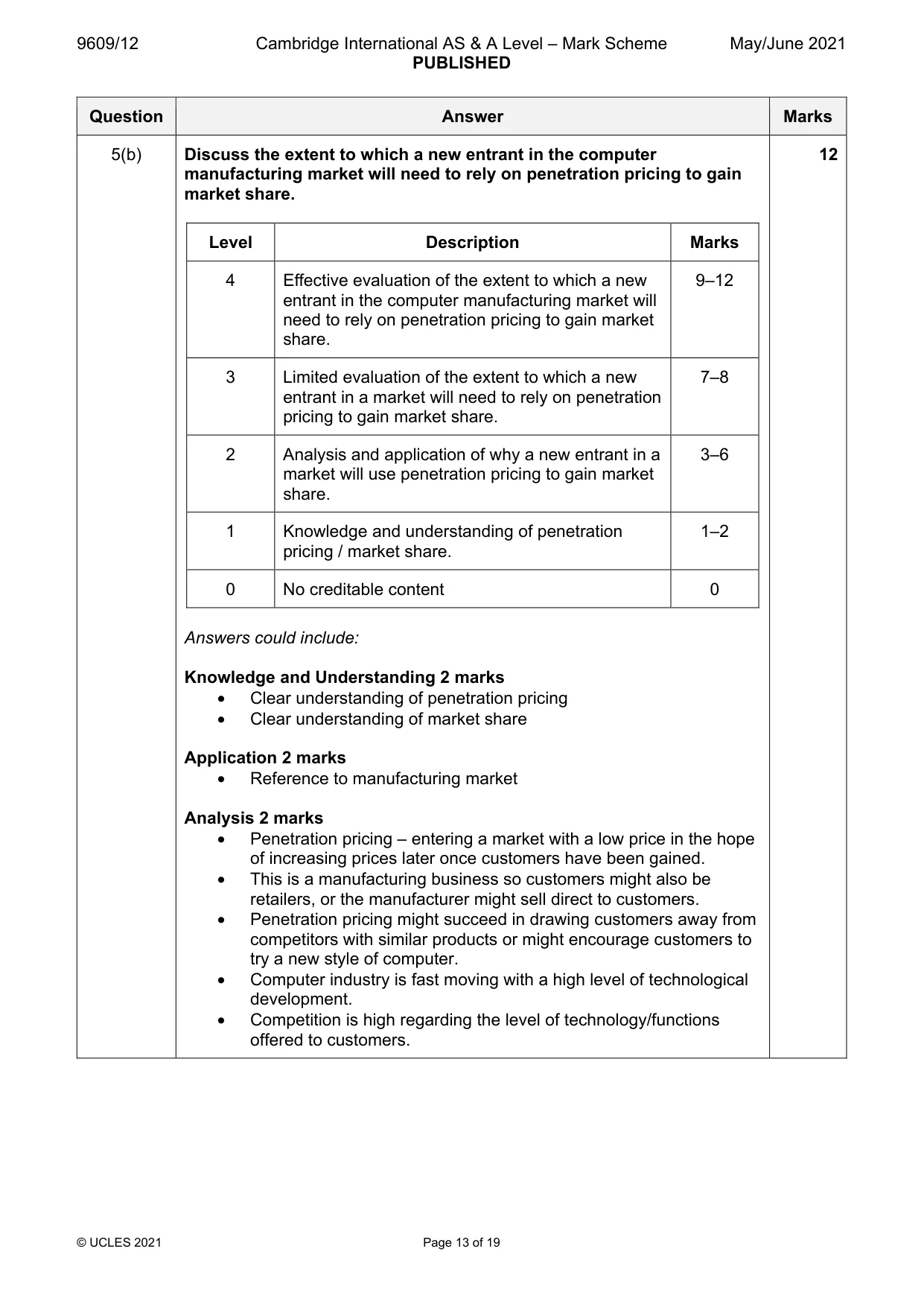
9609/12 Cambridge International AS & A Level – Mark Scheme PUBLISHED May/June 2021 © UCLES 2021 Page 13 of 19 Question Answer Marks 5(b) Discuss the extent to which a new entrant in the computer manufacturing market will need to rely on penetration pricing to gain market share. Level Description Marks 4 Effective evaluation of the extent to which a new entrant in the computer manufacturing market will need to rely on penetration pricing to gain market share. 9–12 3 Limited evaluation of the extent to which a new entrant in a market will need to rely on penetration pricing to gain market share. 7–8 2 Analysis and application of why a new entrant in a market will use penetration pricing to gain market share. 3–6 1 Knowledge and understanding of penetration pricing / market share. 1–2 0 No creditable content 0 Answers could include: Knowledge and Understanding 2 marks • Clear understanding of penetration pricing • Clear understanding of market share Application 2 marks • Reference to manufacturing market Analysis 2 marks • Penetration pricing – entering a market with a low price in the hope of increasing prices later once customers have been gained. • This is a manufacturing business so customers might also be retailers, or the manufacturer might sell direct to customers. • Penetration pricing might succeed in drawing customers away from competitors with similar products or might encourage customers to try a new style of computer. • Computer industry is fast moving with a high level of technological development. • Competition is high regarding the level of technology/functions offered to customers. 12
Mark scheme, page 14
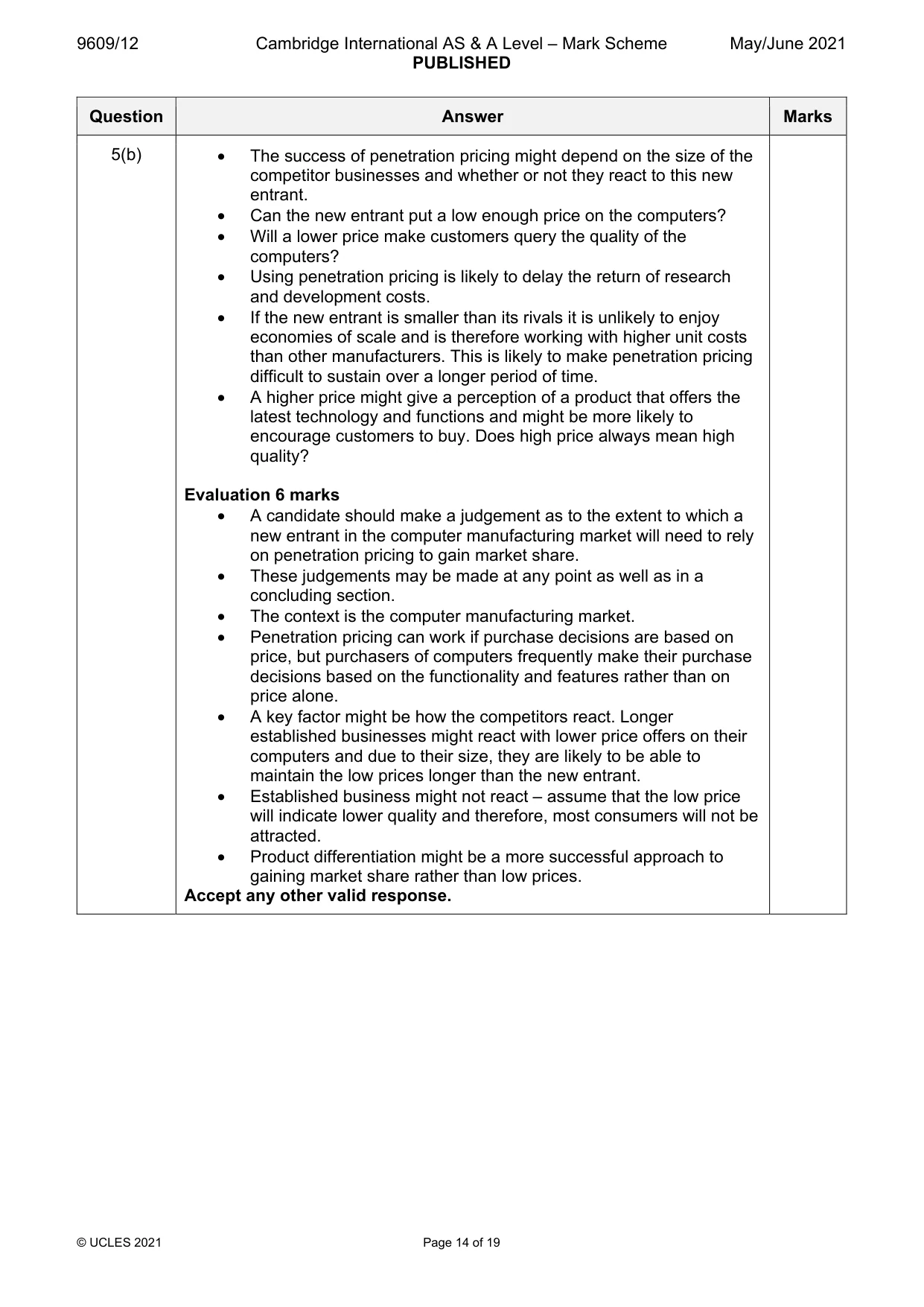
9609/12 Cambridge International AS & A Level – Mark Scheme PUBLISHED May/June 2021 © UCLES 2021 Page 14 of 19 Question Answer Marks 5(b) • The success of penetration pricing might depend on the size of the competitor businesses and whether or not they react to this new entrant. • Can the new entrant put a low enough price on the computers? • Will a lower price make customers query the quality of the computers? • Using penetration pricing is likely to delay the return of research and development costs. • If the new entrant is smaller than its rivals it is unlikely to enjoy economies of scale and is therefore working with higher unit costs than other manufacturers. This is likely to make penetration pricing difficult to sustain over a longer period of time. • A higher price might give a perception of a product that offers the latest technology and functions and might be more likely to encourage customers to buy. Does high price always mean high quality? Evaluation 6 marks • A candidate should make a judgement as to the extent to which a new entrant in the computer manufacturing market will need to rely on penetration pricing to gain market share. • These judgements may be made at any point as well as in a concluding section. • The context is the computer manufacturing market. • Penetration pricing can work if purchase decisions are based on price, but purchasers of computers frequently make their purchase decisions based on the functionality and features rather than on price alone. • A key factor might be how the competitors react. Longer established businesses might react with lower price offers on their computers and due to their size, they are likely to be able to maintain the low prices longer than the new entrant. • Established business might not react – assume that the low price will indicate lower quality and therefore, most consumers will not be attracted. • Product differentiation might be a more successful approach to gaining market share rather than low prices. Accept any other valid response.
Mark scheme, page 15
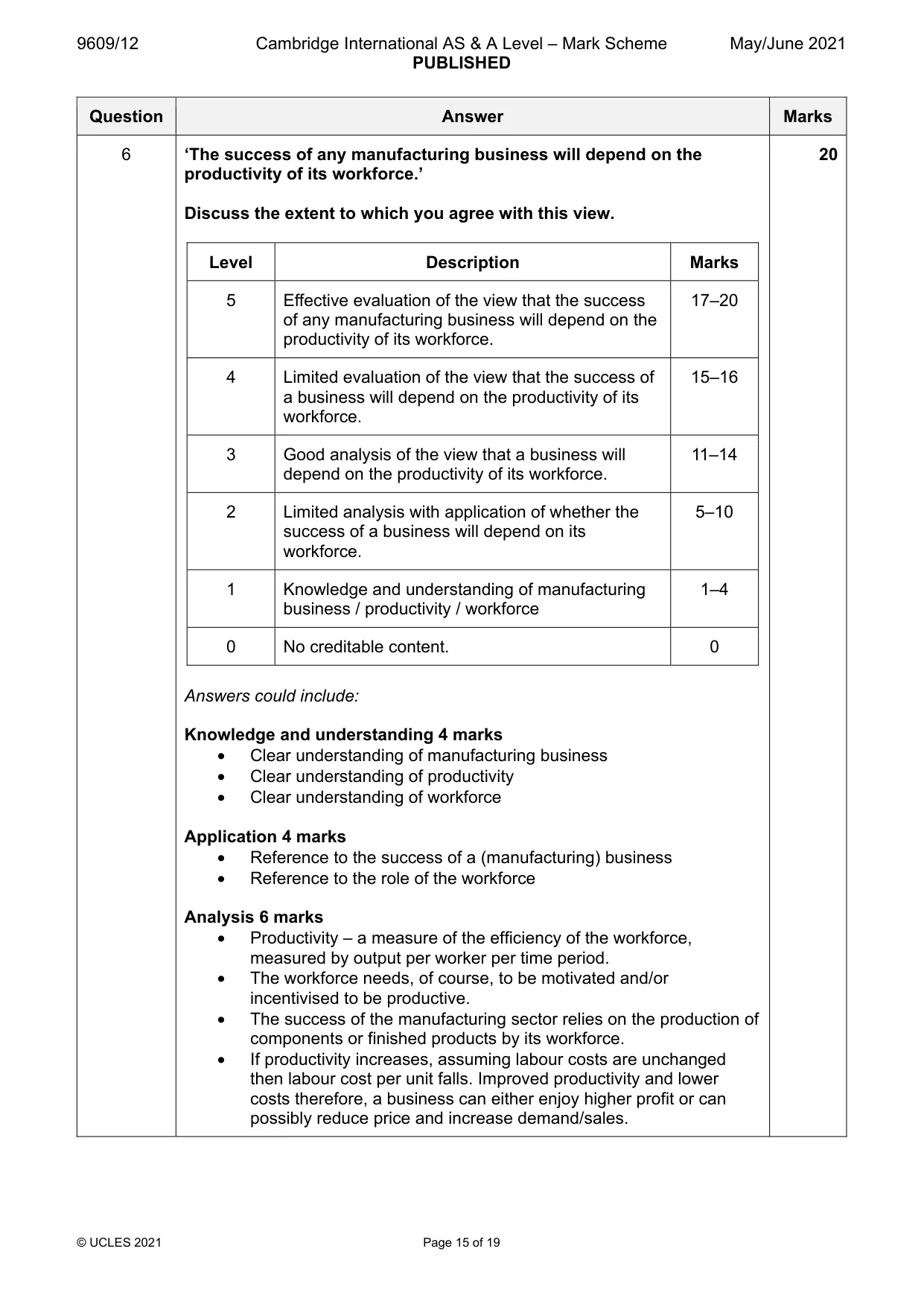
9609/12 Cambridge International AS & A Level – Mark Scheme PUBLISHED May/June 2021 © UCLES 2021 Page 15 of 19 Question Answer Marks 6 ‘The success of any manufacturing business will depend on the productivity of its workforce.’ Discuss the extent to which you agree with this view. Level Description Marks 5 Effective evaluation of the view that the success of any manufacturing business will depend on the productivity of its workforce. 17–20 4 Limited evaluation of the view that the success of a business will depend on the productivity of its workforce. 15–16 3 Good analysis of the view that a business will depend on the productivity of its workforce. 11–14 2 Limited analysis with application of whether the success of a business will depend on its workforce. 5–10 1 Knowledge and understanding of manufacturing business / productivity / workforce 1–4 0 No creditable content. 0 Answers could include: Knowledge and understanding 4 marks • Clear understanding of manufacturing business • Clear understanding of productivity • Clear understanding of workforce Application 4 marks • Reference to the success of a (manufacturing) business • Reference to the role of the workforce Analysis 6 marks • Productivity – a measure of the efficiency of the workforce, measured by output per worker per time period. • The workforce needs, of course, to be motivated and/or incentivised to be productive. • The success of the manufacturing sector relies on the production of components or finished products by its workforce. • If productivity increases, assuming labour costs are unchanged then labour cost per unit falls. Improved productivity and lower costs therefore, a business can either enjoy higher profit or can possibly reduce price and increase demand/sales. 20
Mark scheme, page 16
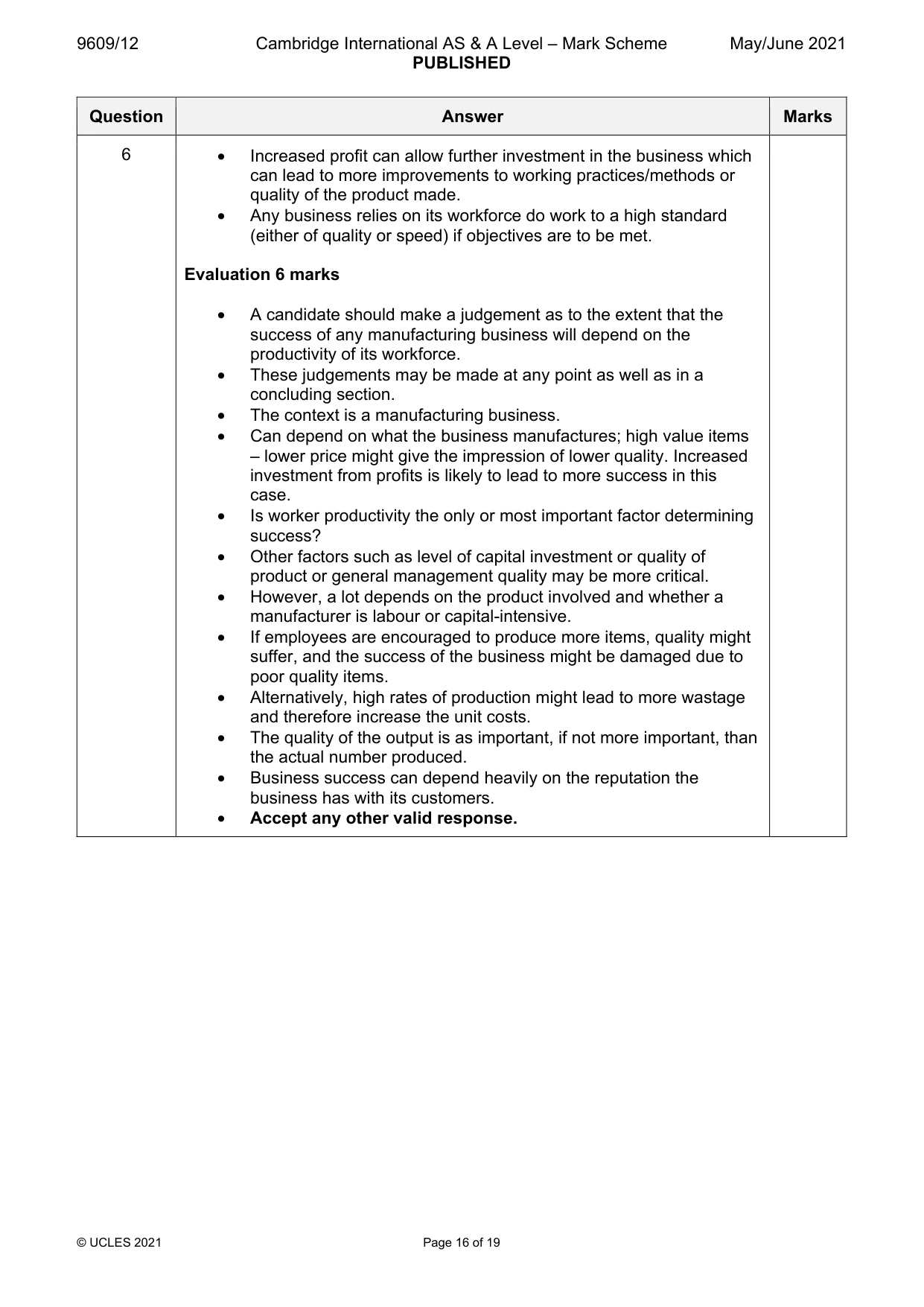
9609/12 Cambridge International AS & A Level – Mark Scheme PUBLISHED May/June 2021 © UCLES 2021 Page 16 of 19 Question Answer Marks 6 • Increased profit can allow further investment in the business which can lead to more improvements to working practices/methods or quality of the product made. • Any business relies on its workforce do work to a high standard (either of quality or speed) if objectives are to be met. Evaluation 6 marks • A candidate should make a judgement as to the extent that the success of any manufacturing business will depend on the productivity of its workforce. • These judgements may be made at any point as well as in a concluding section. • The context is a manufacturing business. • Can depend on what the business manufactures; high value items – lower price might give the impression of lower quality. Increased investment from profits is likely to lead to more success in this case. • Is worker productivity the only or most important factor determining success? • Other factors such as level of capital investment or quality of product or general management quality may be more critical. • However, a lot depends on the product involved and whether a manufacturer is labour or capital-intensive. • If employees are encouraged to produce more items, quality might suffer, and the success of the business might be damaged due to poor quality items. • Alternatively, high rates of production might lead to more wastage and therefore increase the unit costs. • The quality of the output is as important, if not more important, than the actual number produced. • Business success can depend heavily on the reputation the business has with its customers. • Accept any other valid response.
Mark scheme, page 17
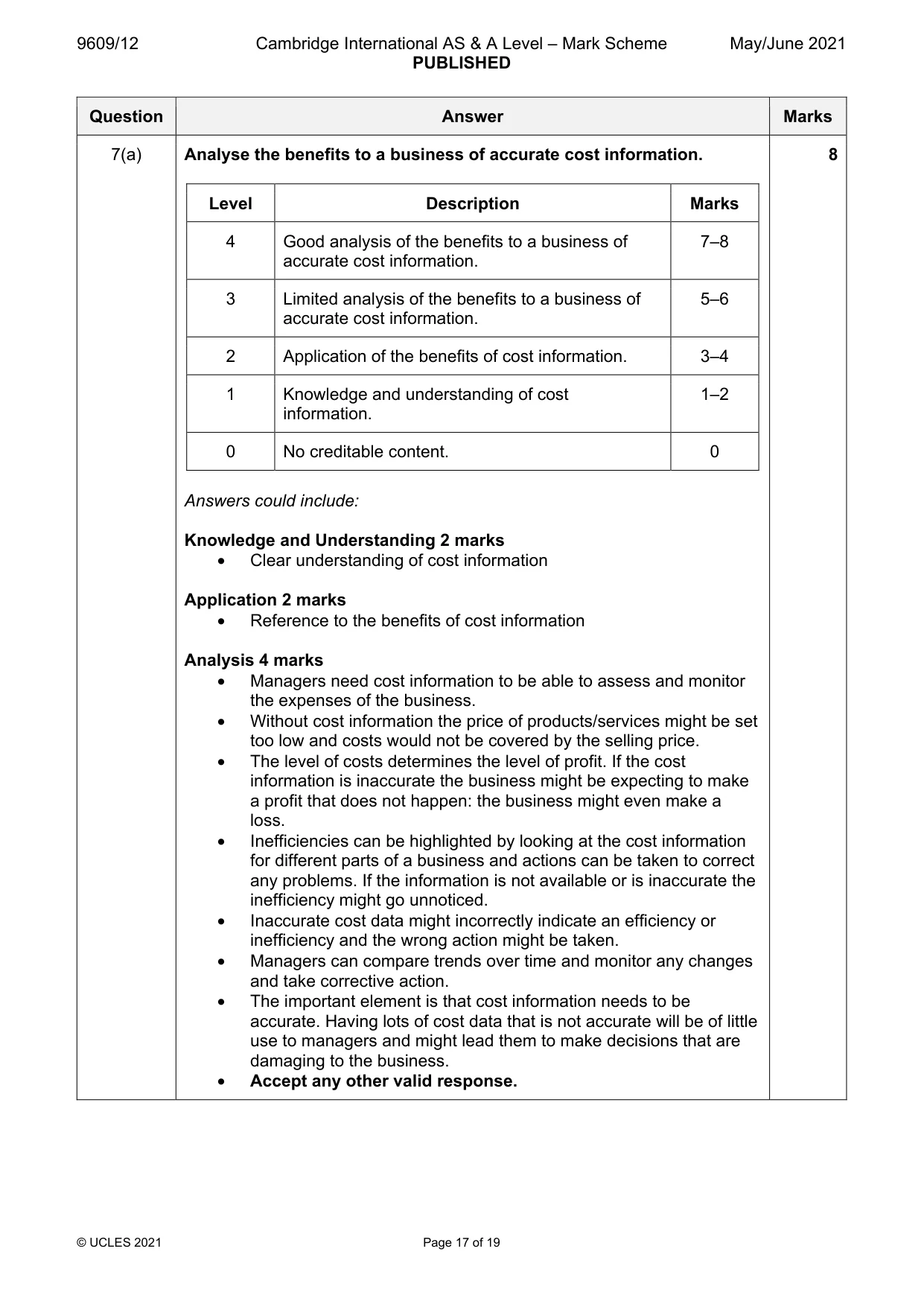
9609/12 Cambridge International AS & A Level – Mark Scheme PUBLISHED May/June 2021 © UCLES 2021 Page 17 of 19 Question Answer Marks 7(a) Analyse the benefits to a business of accurate cost information. Level Description Marks 4 Good analysis of the benefits to a business of accurate cost information. 7–8 3 Limited analysis of the benefits to a business of accurate cost information. 5–6 2 Application of the benefits of cost information. 3–4 1 Knowledge and understanding of cost information. 1–2 0 No creditable content. 0 Answers could include: Knowledge and Understanding 2 marks • Clear understanding of cost information Application 2 marks • Reference to the benefits of cost information Analysis 4 marks • Managers need cost information to be able to assess and monitor the expenses of the business. • Without cost information the price of products/services might be set too low and costs would not be covered by the selling price. • The level of costs determines the level of profit. If the cost information is inaccurate the business might be expecting to make a profit that does not happen: the business might even make a loss. • Inefficiencies can be highlighted by looking at the cost information for different parts of a business and actions can be taken to correct any problems. If the information is not available or is inaccurate the inefficiency might go unnoticed. • Inaccurate cost data might incorrectly indicate an efficiency or inefficiency and the wrong action might be taken. • Managers can compare trends over time and monitor any changes and take corrective action. • The important element is that cost information needs to be accurate. Having lots of cost data that is not accurate will be of little use to managers and might lead them to make decisions that are damaging to the business. • Accept any other valid response. 8
Mark scheme, page 18
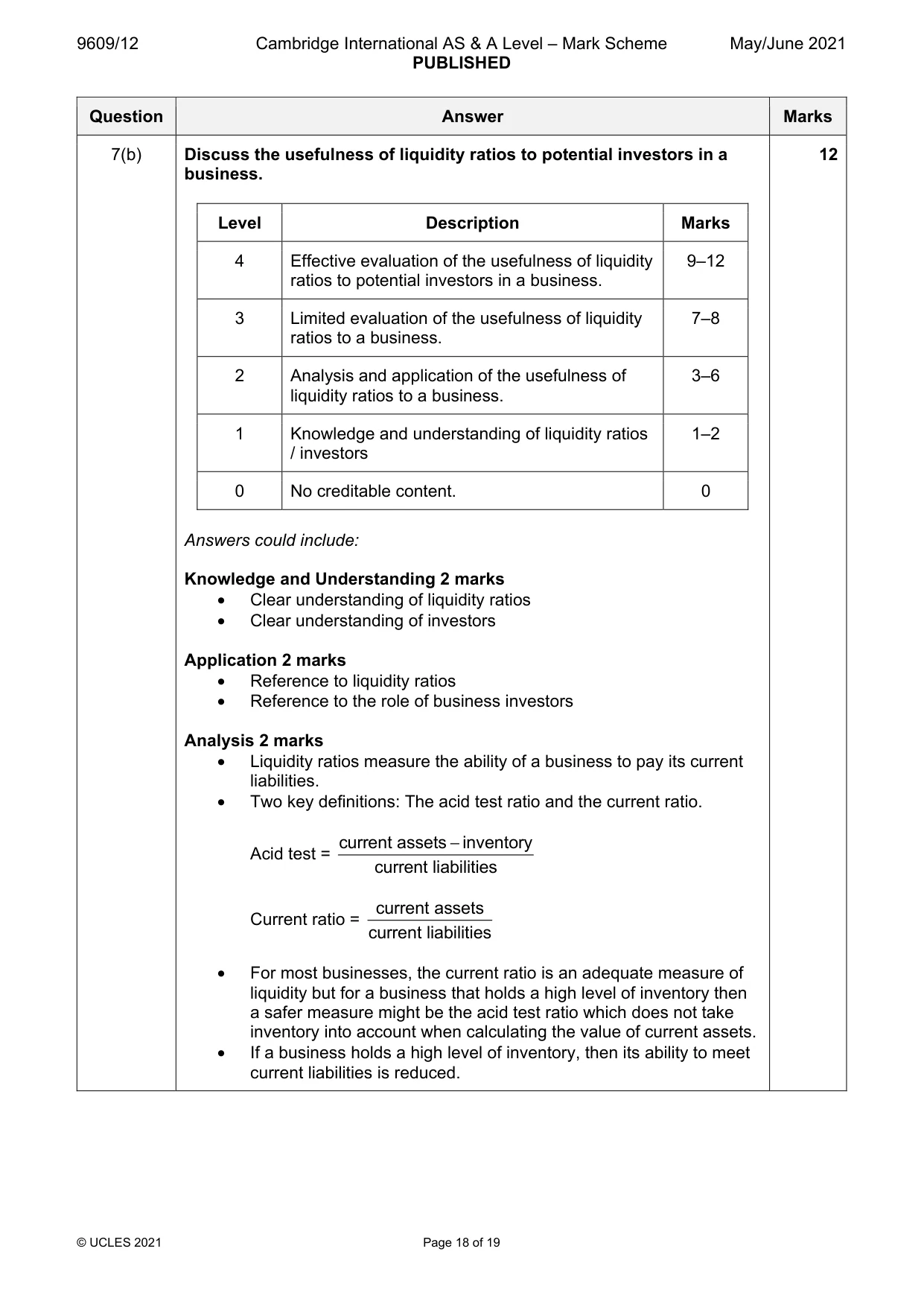
9609/12 Cambridge International AS & A Level – Mark Scheme PUBLISHED May/June 2021 © UCLES 2021 Page 18 of 19 Question Answer Marks 7(b) Discuss the usefulness of liquidity ratios to potential investors in a business. Level Description Marks 4 Effective evaluation of the usefulness of liquidity ratios to potential investors in a business. 9–12 3 Limited evaluation of the usefulness of liquidity ratios to a business. 7–8 2 Analysis and application of the usefulness of liquidity ratios to a business. 3–6 1 Knowledge and understanding of liquidity ratios / investors 1–2 0 No creditable content. 0 Answers could include: Knowledge and Understanding 2 marks • Clear understanding of liquidity ratios • Clear understanding of investors Application 2 marks • Reference to liquidity ratios • Reference to the role of business investors Analysis 2 marks • Liquidity ratios measure the ability of a business to pay its current liabilities. • Two key definitions: The acid test ratio and the current ratio. Acid test = current assets inventory current liabilities − Current ratio = current assets current liabilities • For most businesses, the current ratio is an adequate measure of liquidity but for a business that holds a high level of inventory then a safer measure might be the acid test ratio which does not take inventory into account when calculating the value of current assets. • If a business holds a high level of inventory, then its ability to meet current liabilities is reduced. 12
Mark scheme, page 19
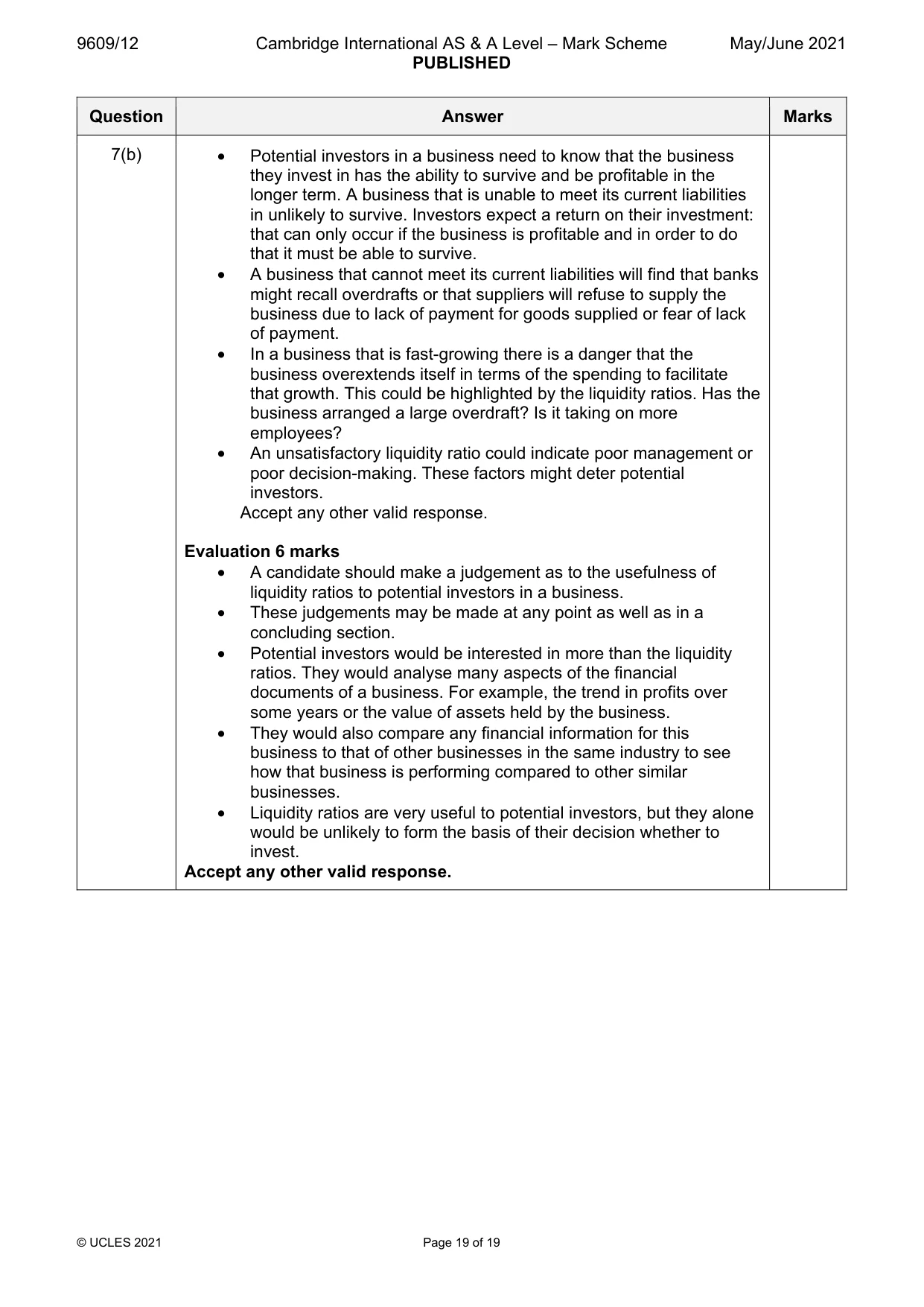
9609/12 Cambridge International AS & A Level – Mark Scheme PUBLISHED May/June 2021 © UCLES 2021 Page 19 of 19 Question Answer Marks 7(b) • Potential investors in a business need to know that the business they invest in has the ability to survive and be profitable in the longer term. A business that is unable to meet its current liabilities in unlikely to survive. Investors expect a return on their investment: that can only occur if the business is profitable and in order to do that it must be able to survive. • A business that cannot meet its current liabilities will find that banks might recall overdrafts or that suppliers will refuse to supply the business due to lack of payment for goods supplied or fear of lack of payment. • In a business that is fast-growing there is a danger that the business overextends itself in terms of the spending to facilitate that growth. This could be highlighted by the liquidity ratios. Has the business arranged a large overdraft? Is it taking on more employees? • An unsatisfactory liquidity ratio could indicate poor management or poor decision-making. These factors might deter potential investors. Accept any other valid response. Evaluation 6 marks • A candidate should make a judgement as to the usefulness of liquidity ratios to potential investors in a business. • These judgements may be made at any point as well as in a concluding section. • Potential investors would be interested in more than the liquidity ratios. They would analyse many aspects of the financial documents of a business. For example, the trend in profits over some years or the value of assets held by the business. • They would also compare any financial information for this business to that of other businesses in the same industry to see how that business is performing compared to other similar businesses. • Liquidity ratios are very useful to potential investors, but they alone would be unlikely to form the basis of their decision whether to invest. Accept any other valid response.
What you needed in this session
Cambridge’s own grade thresholds for 2021 May/June, Paper 1 · Variant 2. A higher threshold means an easier paper — the bar moves with how the cohort did.