Cambridge A Level Business (for first examination in 2016) 9609 — 2018 Oct/Nov Paper 1 · Variant 1
9609/11/O/N/18 · 40 marks · ≈45 min
The question paper and its mark scheme, free to read here and free to download. This is Cambridge’s own paper, exactly as it was sat.
Question paper4 pages


Mark scheme14 pages
Answers below. Sit the paper first if you are practising.

Paper as text
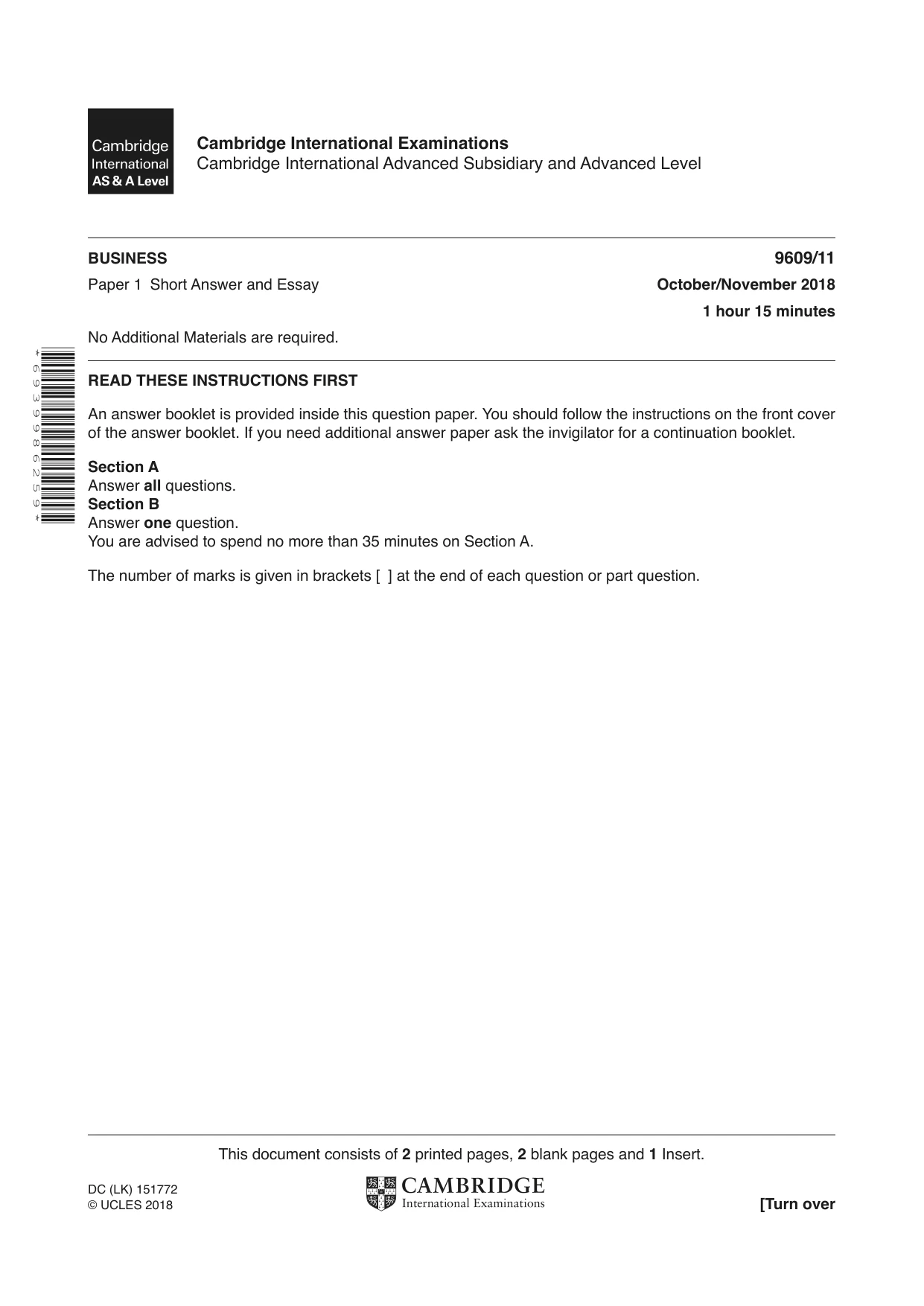
Question paper, page 1
* 6 9 3 9 9 8 6 2 5 9 * This document consists of 2 printed pages, 2 blank pages and 1 Insert. DC (LK) 151772 © UCLES 2018 [Turn over Cambridge International Examinations Cambridge International Advanced Subsidiary and Advanced Level BUSINESS 9609/11 Paper 1 Short Answer and Essay October/November 2018 1 hour 15 minutes No Additional Materials are required. READ THESE INSTRUCTIONS FIRST An answer booklet is provided inside this question paper. You should follow the instructions on the front cover of the answer booklet. If you need additional answer paper ask the invigilator for a continuation booklet. Section A Answer all questions. Section B Answer one question. You are advised to spend no more than 35 minutes on Section A. The number of marks is given in brackets [ ] at the end of each question or part question.
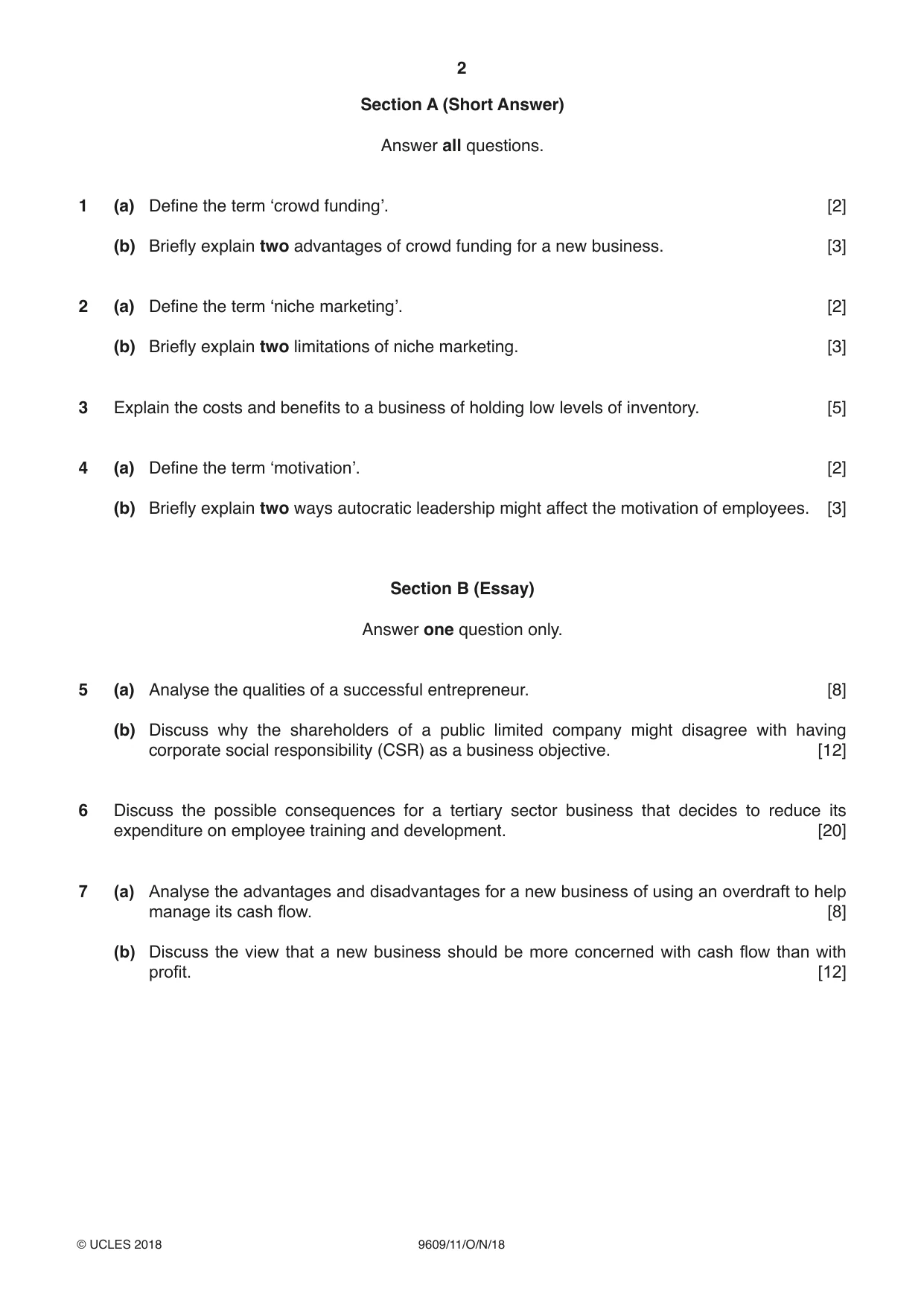
Question paper, page 2
2 9609/11/O/N/18 © UCLES 2018 Section A (Short Answer) Answer all questions. 1 (a) Define the term ‘crowd funding’. [2] (b) Briefly explain two advantages of crowd funding for a new business. [3] 2 (a) Define the term ‘niche marketing’. [2] (b) Briefly explain two limitations of niche marketing. [3] 3 Explain the costs and benefits to a business of holding low levels of inventory. [5] 4 (a) Define the term ‘motivation’. [2] (b) Briefly explain two ways autocratic leadership might affect the motivation of employees. [3] Section B (Essay) Answer one question only. 5 (a) Analyse the qualities of a successful entrepreneur. [8] (b) Discuss why the shareholders of a public limited company might disagree with having corporate social responsibility (CSR) as a business objective. [12] 6 Discuss the possible consequences for a tertiary sector business that decides to reduce its expenditure on employee training and development. [20] 7 (a) Analyse the advantages and disadvantages for a new business of using an overdraft to help manage its cash flow. [8] (b) Discuss the view that a new business should be more concerned with cash flow than with profit. [12]
Question paper, page 3
3 9609/11/O/N/18 © UCLES 2018 BLANK PAGE
Question paper, page 4
4 9609/11/O/N/18 © UCLES 2018 Permission to reproduce items where third-party owned material protected by copyright is included has been sought and cleared where possible. Every reasonable effort has been made by the publisher (UCLES) to trace copyright holders, but if any items requiring clearance have unwittingly been included, the publisher will be pleased to make amends at the earliest possible opportunity. To avoid the issue of disclosure of answer-related information to candidates, all copyright acknowledgements are reproduced online in the Cambridge International Examinations Copyright Acknowledgements Booklet. This is produced for each series of examinations and is freely available to download at www.cie.org.uk after the live examination series. Cambridge International Examinations is part of the Cambridge Assessment Group. Cambridge Assessment is the brand name of University of Cambridge Local Examinations Syndicate (UCLES), which is itself a department of the University of Cambridge. BLANK PAGE
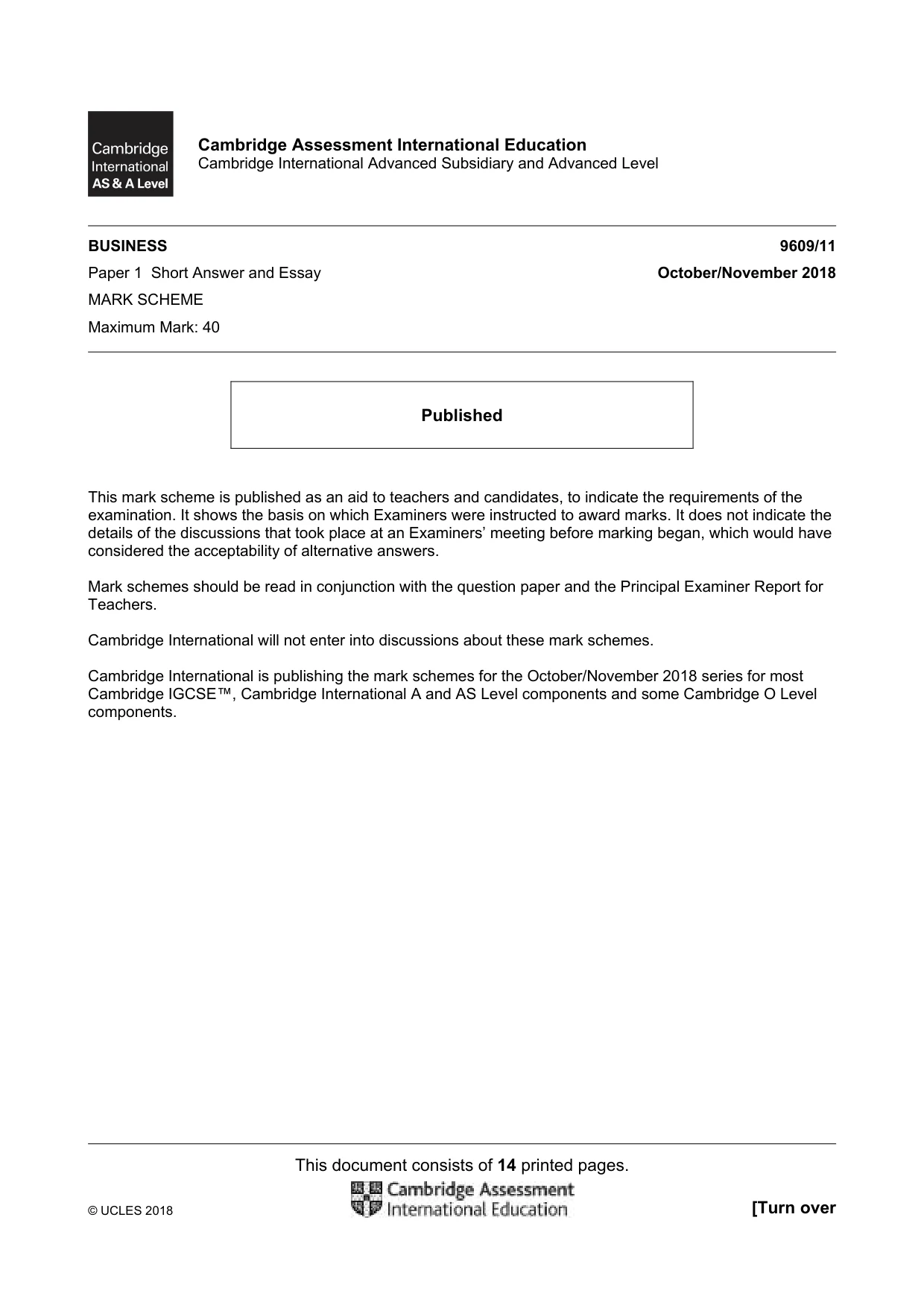
Mark scheme, page 1
This document consists of 14 printed pages. © UCLES 2018 [Turn over Cambridge Assessment International Education Cambridge International Advanced Subsidiary and Advanced Level BUSINESS 9609/11 Paper 1 Short Answer and Essay October/November 2018 MARK SCHEME Maximum Mark: 40 Published This mark scheme is published as an aid to teachers and candidates, to indicate the requirements of the examination. It shows the basis on which Examiners were instructed to award marks. It does not indicate the details of the discussions that took place at an Examiners’ meeting before marking began, which would have considered the acceptability of alternative answers. Mark schemes should be read in conjunction with the question paper and the Principal Examiner Report for Teachers. Cambridge International will not enter into discussions about these mark schemes. Cambridge International is publishing the mark schemes for the October/November 2018 series for most Cambridge IGCSE™, Cambridge International A and AS Level components and some Cambridge O Level components.
Mark scheme, page 2
9609/11 Cambridge International AS/A Level – Mark Scheme PUBLISHED October/November 2018 © UCLES 2018 Page 2 of 14 Generic Marking Principles These general marking principles must be applied by all examiners when marking candidate answers. They should be applied alongside the specific content of the mark scheme or generic level descriptors for a question. Each question paper and mark scheme will also comply with these marking principles. GENERIC MARKING PRINCIPLE 1: Marks must be awarded in line with: • the specific content of the mark scheme or the generic level descriptors for the question • the specific skills defined in the mark scheme or in the generic level descriptors for the question • the standard of response required by a candidate as exemplified by the standardisation scripts. GENERIC MARKING PRINCIPLE 2: Marks awarded are always whole marks (not half marks, or other fractions). GENERIC MARKING PRINCIPLE 3: Marks must be awarded positively: • marks are awarded for correct/valid answers, as defined in the mark scheme. However, credit is given for valid answers which go beyond the scope of the syllabus and mark scheme, referring to your Team Leader as appropriate • marks are awarded when candidates clearly demonstrate what they know and can do • marks are not deducted for errors • marks are not deducted for omissions • answers should only be judged on the quality of spelling, punctuation and grammar when these features are specifically assessed by the question as indicated by the mark scheme. The meaning, however, should be unambiguous. GENERIC MARKING PRINCIPLE 4: Rules must be applied consistently e.g. in situations where candidates have not followed instructions or in the application of generic level descriptors. GENERIC MARKING PRINCIPLE 5: Marks should be awarded using the full range of marks defined in the mark scheme for the question (however; the use of the full mark range may be limited according to the quality of the candidate responses seen). GENERIC MARKING PRINCIPLE 6: Marks awarded are based solely on the requirements as defined in the mark scheme. Marks should not be awarded with grade thresholds or grade descriptors in mind.
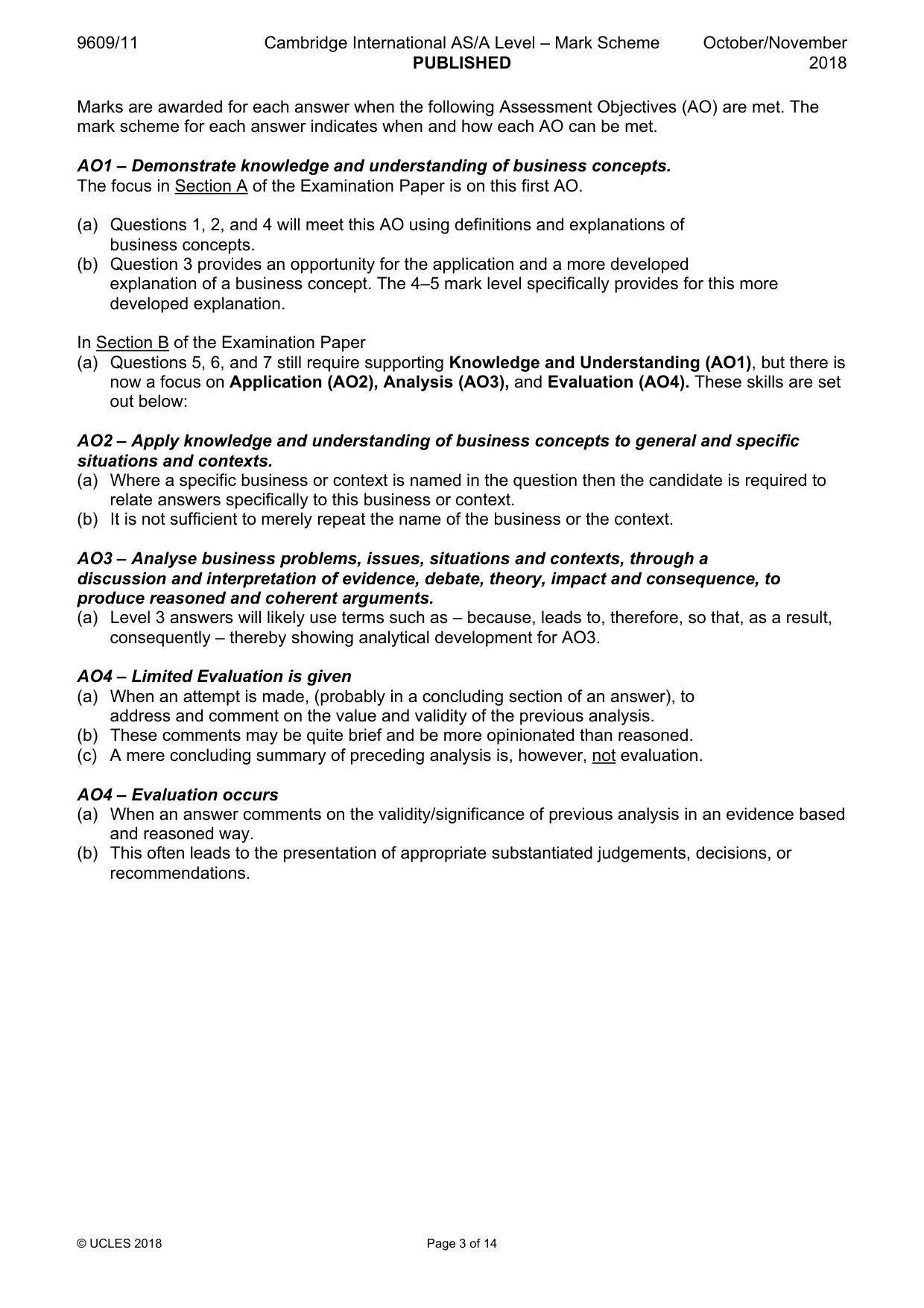
Mark scheme, page 3
9609/11 Cambridge International AS/A Level – Mark Scheme PUBLISHED October/November 2018 © UCLES 2018 Page 3 of 14 Marks are awarded for each answer when the following Assessment Objectives (AO) are met. The mark scheme for each answer indicates when and how each AO can be met. AO1 – Demonstrate knowledge and understanding of business concepts. The focus in Section A of the Examination Paper is on this first AO. (a) Questions 1, 2, and 4 will meet this AO using definitions and explanations of business concepts. (b) Question 3 provides an opportunity for the application and a more developed explanation of a business concept. The 4–5 mark level specifically provides for this more developed explanation. In Section B of the Examination Paper (a) Questions 5, 6, and 7 still require supporting Knowledge and Understanding (AO1), but there is now a focus on Application (AO2), Analysis (AO3), and Evaluation (AO4). These skills are set out below: AO2 – Apply knowledge and understanding of business concepts to general and specific situations and contexts. (a) Where a specific business or context is named in the question then the candidate is required to relate answers specifically to this business or context. (b) It is not sufficient to merely repeat the name of the business or the context. AO3 – Analyse business problems, issues, situations and contexts, through a discussion and interpretation of evidence, debate, theory, impact and consequence, to produce reasoned and coherent arguments. (a) Level 3 answers will likely use terms such as – because, leads to, therefore, so that, as a result, consequently – thereby showing analytical development for AO3. AO4 – Limited Evaluation is given (a) When an attempt is made, (probably in a concluding section of an answer), to address and comment on the value and validity of the previous analysis. (b) These comments may be quite brief and be more opinionated than reasoned. (c) A mere concluding summary of preceding analysis is, however, not evaluation. AO4 – Evaluation occurs (a) When an answer comments on the validity/significance of previous analysis in an evidence based and reasoned way. (b) This often leads to the presentation of appropriate substantiated judgements, decisions, or recommendations.
Mark scheme, page 4
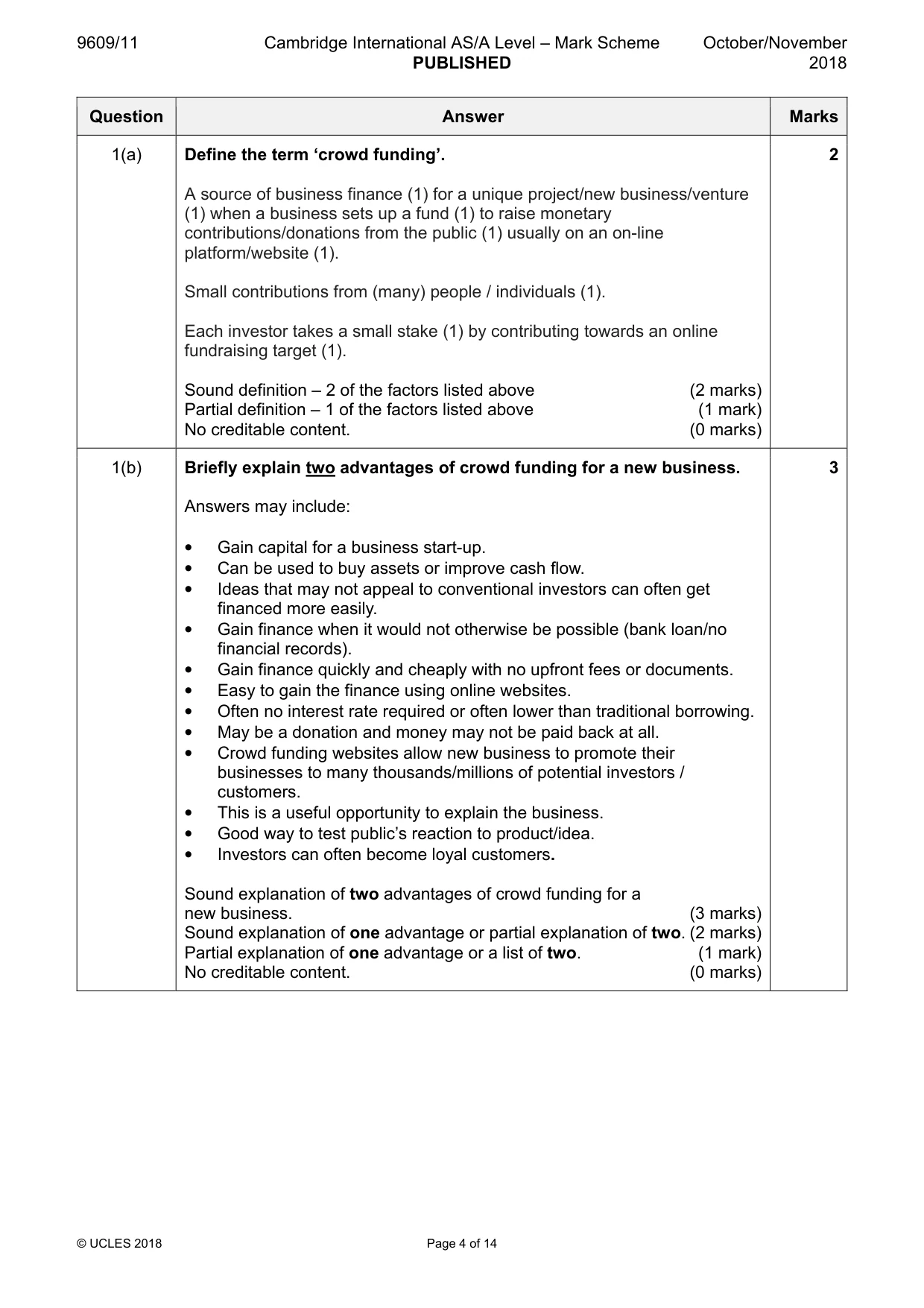
9609/11 Cambridge International AS/A Level – Mark Scheme PUBLISHED October/November 2018 © UCLES 2018 Page 4 of 14 Question Answer Marks 1(a) Define the term ‘crowd funding’. A source of business finance (1) for a unique project/new business/venture (1) when a business sets up a fund (1) to raise monetary contributions/donations from the public (1) usually on an on-line platform/website (1). Small contributions from (many) people / individuals (1). Each investor takes a small stake (1) by contributing towards an online fundraising target (1). Sound definition – 2 of the factors listed above (2 marks) Partial definition – 1 of the factors listed above (1 mark) No creditable content. (0 marks) 2 1(b) Briefly explain two advantages of crowd funding for a new business. Answers may include: • Gain capital for a business start-up. • Can be used to buy assets or improve cash flow. • Ideas that may not appeal to conventional investors can often get financed more easily. • Gain finance when it would not otherwise be possible (bank loan/no financial records). • Gain finance quickly and cheaply with no upfront fees or documents. • Easy to gain the finance using online websites. • Often no interest rate required or often lower than traditional borrowing. • May be a donation and money may not be paid back at all. • Crowd funding websites allow new business to promote their businesses to many thousands/millions of potential investors / customers. • This is a useful opportunity to explain the business. • Good way to test public’s reaction to product/idea. • Investors can often become loyal customers. Sound explanation of two advantages of crowd funding for a new business. (3 marks) Sound explanation of one advantage or partial explanation of two. (2 marks) Partial explanation of one advantage or a list of two. (1 mark) No creditable content. (0 marks) 3
Mark scheme, page 5
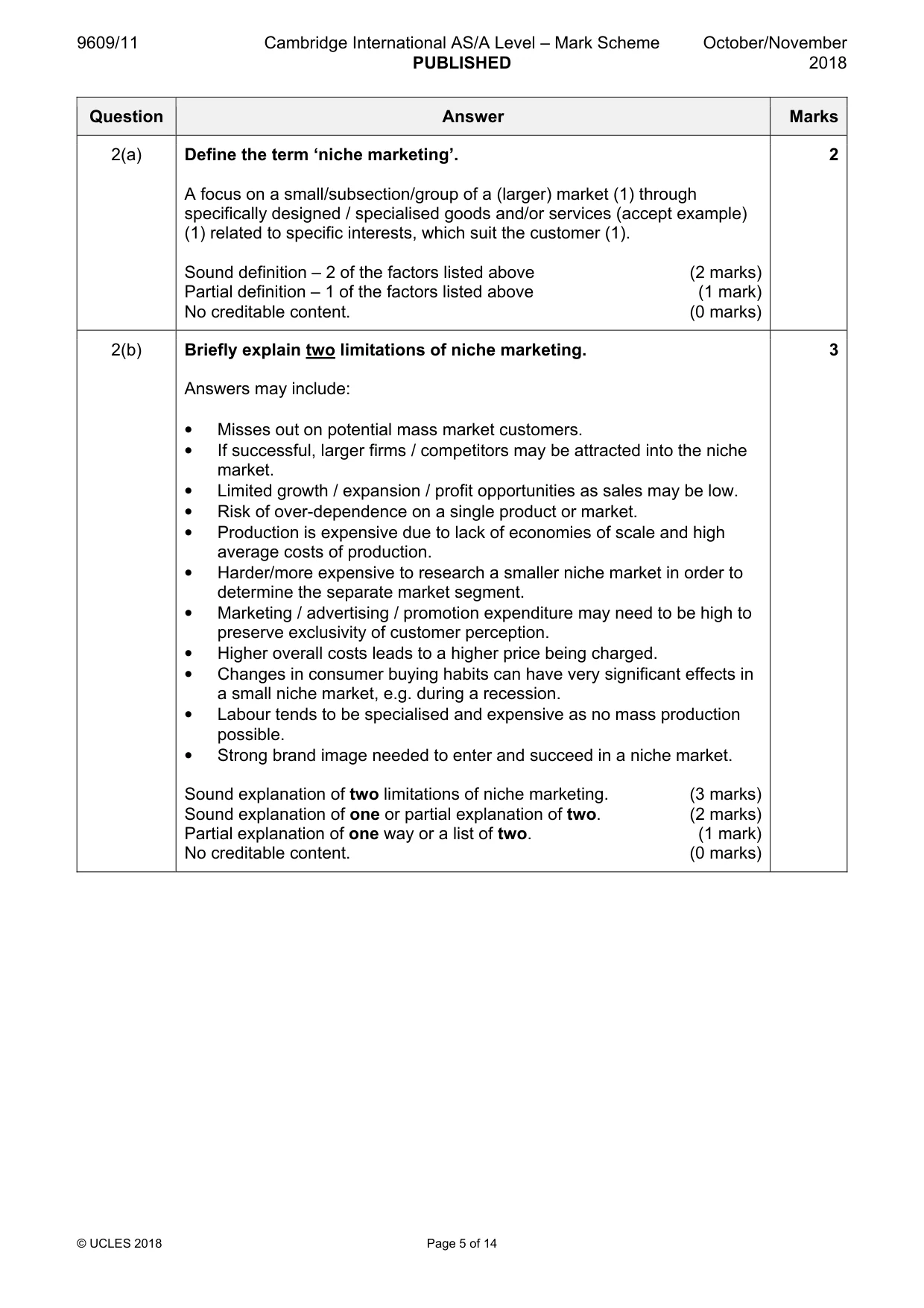
9609/11 Cambridge International AS/A Level – Mark Scheme PUBLISHED October/November 2018 © UCLES 2018 Page 5 of 14 Question Answer Marks 2(a) Define the term ‘niche marketing’. A focus on a small/subsection/group of a (larger) market (1) through specifically designed / specialised goods and/or services (accept example) (1) related to specific interests, which suit the customer (1). Sound definition – 2 of the factors listed above (2 marks) Partial definition – 1 of the factors listed above (1 mark) No creditable content. (0 marks) 2 2(b) Briefly explain two limitations of niche marketing. Answers may include: • Misses out on potential mass market customers. • If successful, larger firms / competitors may be attracted into the niche market. • Limited growth / expansion / profit opportunities as sales may be low. • Risk of over-dependence on a single product or market. • Production is expensive due to lack of economies of scale and high average costs of production. • Harder/more expensive to research a smaller niche market in order to determine the separate market segment. • Marketing / advertising / promotion expenditure may need to be high to preserve exclusivity of customer perception. • Higher overall costs leads to a higher price being charged. • Changes in consumer buying habits can have very significant effects in a small niche market, e.g. during a recession. • Labour tends to be specialised and expensive as no mass production possible. • Strong brand image needed to enter and succeed in a niche market. Sound explanation of two limitations of niche marketing. (3 marks) Sound explanation of one or partial explanation of two. (2 marks) Partial explanation of one way or a list of two. (1 mark) No creditable content. (0 marks) 3
Mark scheme, page 6
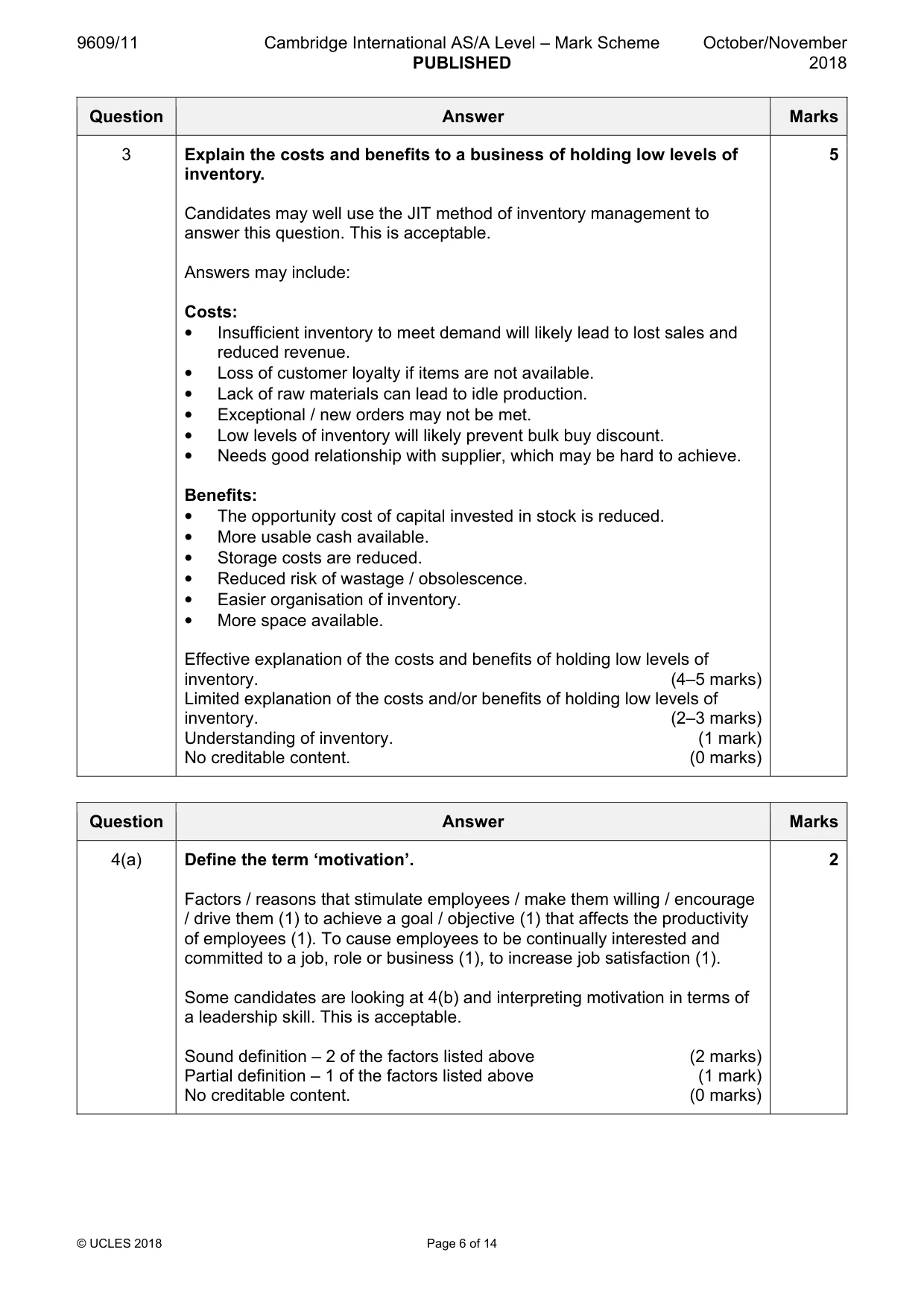
9609/11 Cambridge International AS/A Level – Mark Scheme PUBLISHED October/November 2018 © UCLES 2018 Page 6 of 14 Question Answer Marks 3 Explain the costs and benefits to a business of holding low levels of inventory. Candidates may well use the JIT method of inventory management to answer this question. This is acceptable. Answers may include: Costs: • Insufficient inventory to meet demand will likely lead to lost sales and reduced revenue. • Loss of customer loyalty if items are not available. • Lack of raw materials can lead to idle production. • Exceptional / new orders may not be met. • Low levels of inventory will likely prevent bulk buy discount. • Needs good relationship with supplier, which may be hard to achieve. Benefits: • The opportunity cost of capital invested in stock is reduced. • More usable cash available. • Storage costs are reduced. • Reduced risk of wastage / obsolescence. • Easier organisation of inventory. • More space available. Effective explanation of the costs and benefits of holding low levels of inventory. (4–5 marks) Limited explanation of the costs and/or benefits of holding low levels of inventory. (2–3 marks) Understanding of inventory. (1 mark) No creditable content. (0 marks) 5 Question Answer Marks 4(a) Define the term ‘motivation’. Factors / reasons that stimulate employees / make them willing / encourage / drive them (1) to achieve a goal / objective (1) that affects the productivity of employees (1). To cause employees to be continually interested and committed to a job, role or business (1), to increase job satisfaction (1). Some candidates are looking at 4(b) and interpreting motivation in terms of a leadership skill. This is acceptable. Sound definition – 2 of the factors listed above (2 marks) Partial definition – 1 of the factors listed above (1 mark) No creditable content. (0 marks) 2
Mark scheme, page 7
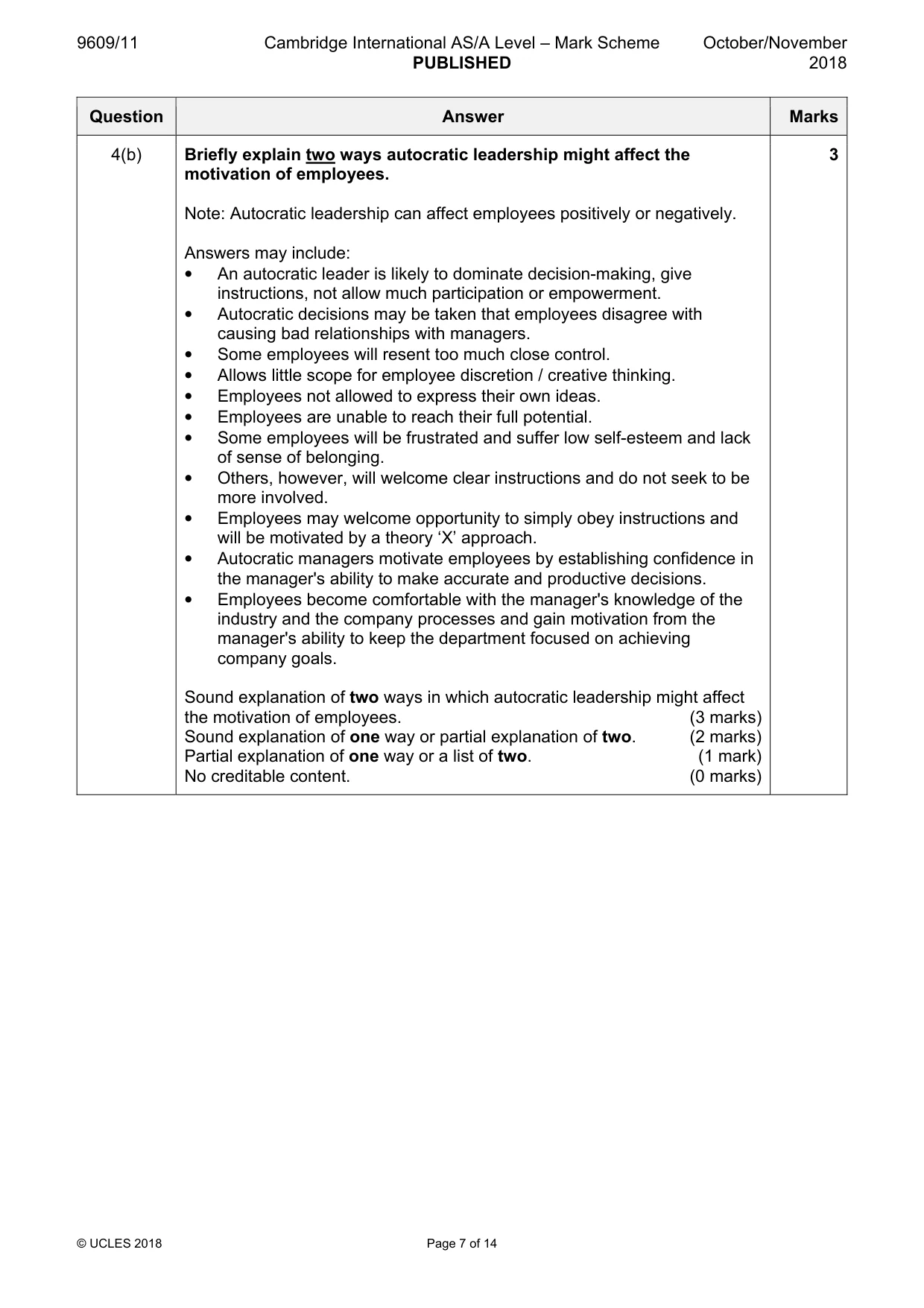
9609/11 Cambridge International AS/A Level – Mark Scheme PUBLISHED October/November 2018 © UCLES 2018 Page 7 of 14 Question Answer Marks 4(b) Briefly explain two ways autocratic leadership might affect the motivation of employees. Note: Autocratic leadership can affect employees positively or negatively. Answers may include: • An autocratic leader is likely to dominate decision-making, give instructions, not allow much participation or empowerment. • Autocratic decisions may be taken that employees disagree with causing bad relationships with managers. • Some employees will resent too much close control. • Allows little scope for employee discretion / creative thinking. • Employees not allowed to express their own ideas. • Employees are unable to reach their full potential. • Some employees will be frustrated and suffer low self-esteem and lack of sense of belonging. • Others, however, will welcome clear instructions and do not seek to be more involved. • Employees may welcome opportunity to simply obey instructions and will be motivated by a theory ‘X’ approach. • Autocratic managers motivate employees by establishing confidence in the manager's ability to make accurate and productive decisions. • Employees become comfortable with the manager's knowledge of the industry and the company processes and gain motivation from the manager's ability to keep the department focused on achieving company goals. Sound explanation of two ways in which autocratic leadership might affect the motivation of employees. (3 marks) Sound explanation of one way or partial explanation of two. (2 marks) Partial explanation of one way or a list of two. (1 mark) No creditable content. (0 marks) 3
Mark scheme, page 8
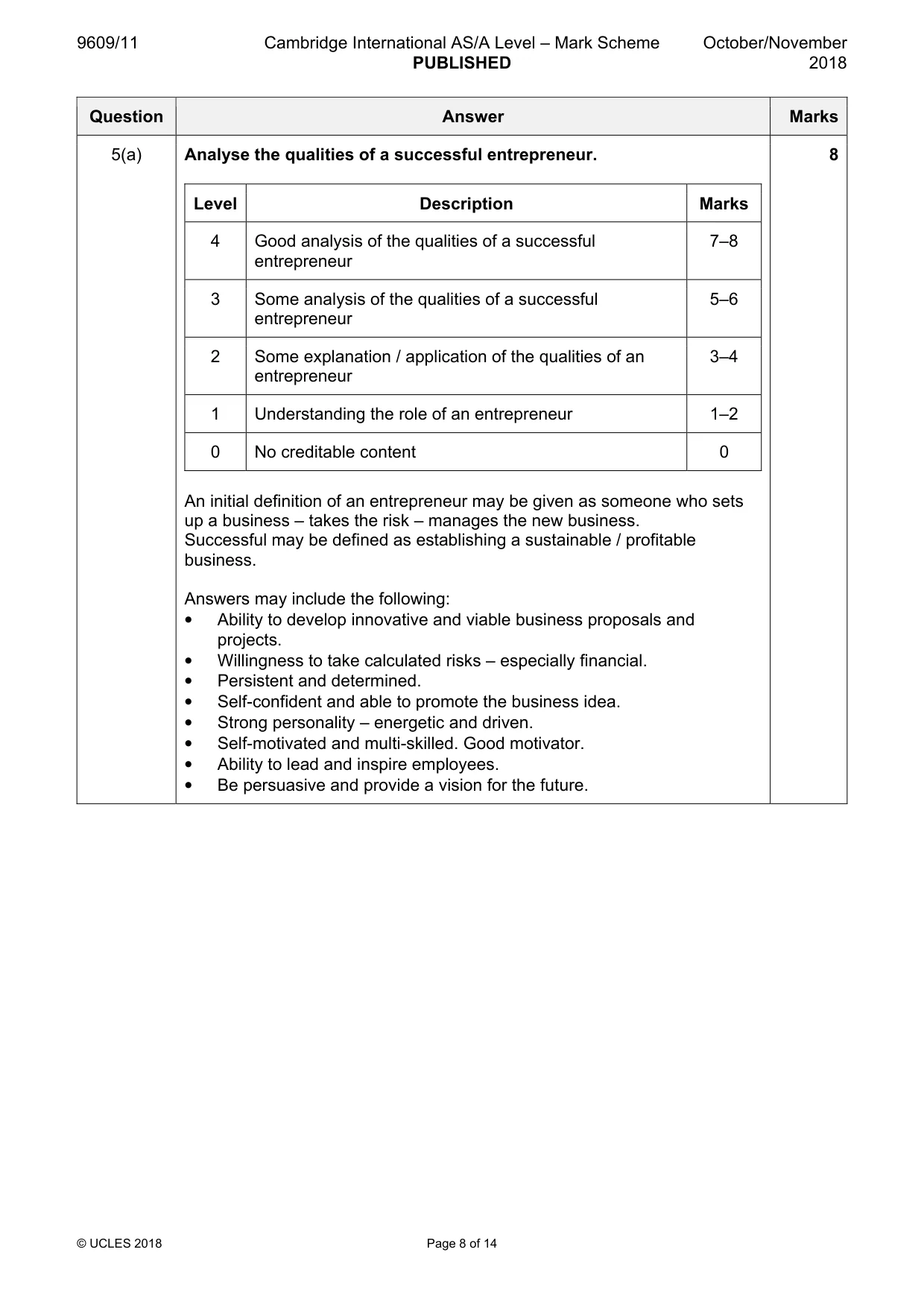
9609/11 Cambridge International AS/A Level – Mark Scheme PUBLISHED October/November 2018 © UCLES 2018 Page 8 of 14 Question Answer Marks 5(a) Analyse the qualities of a successful entrepreneur. Level Description Marks 4 Good analysis of the qualities of a successful entrepreneur 7–8 3 Some analysis of the qualities of a successful entrepreneur 5–6 2 Some explanation / application of the qualities of an entrepreneur 3–4 1 Understanding the role of an entrepreneur 1–2 0 No creditable content 0 An initial definition of an entrepreneur may be given as someone who sets up a business – takes the risk – manages the new business. Successful may be defined as establishing a sustainable / profitable business. Answers may include the following: • Ability to develop innovative and viable business proposals and projects. • Willingness to take calculated risks – especially financial. • Persistent and determined. • Self-confident and able to promote the business idea. • Strong personality – energetic and driven. • Self-motivated and multi-skilled. Good motivator. • Ability to lead and inspire employees. • Be persuasive and provide a vision for the future. 8
Mark scheme, page 9
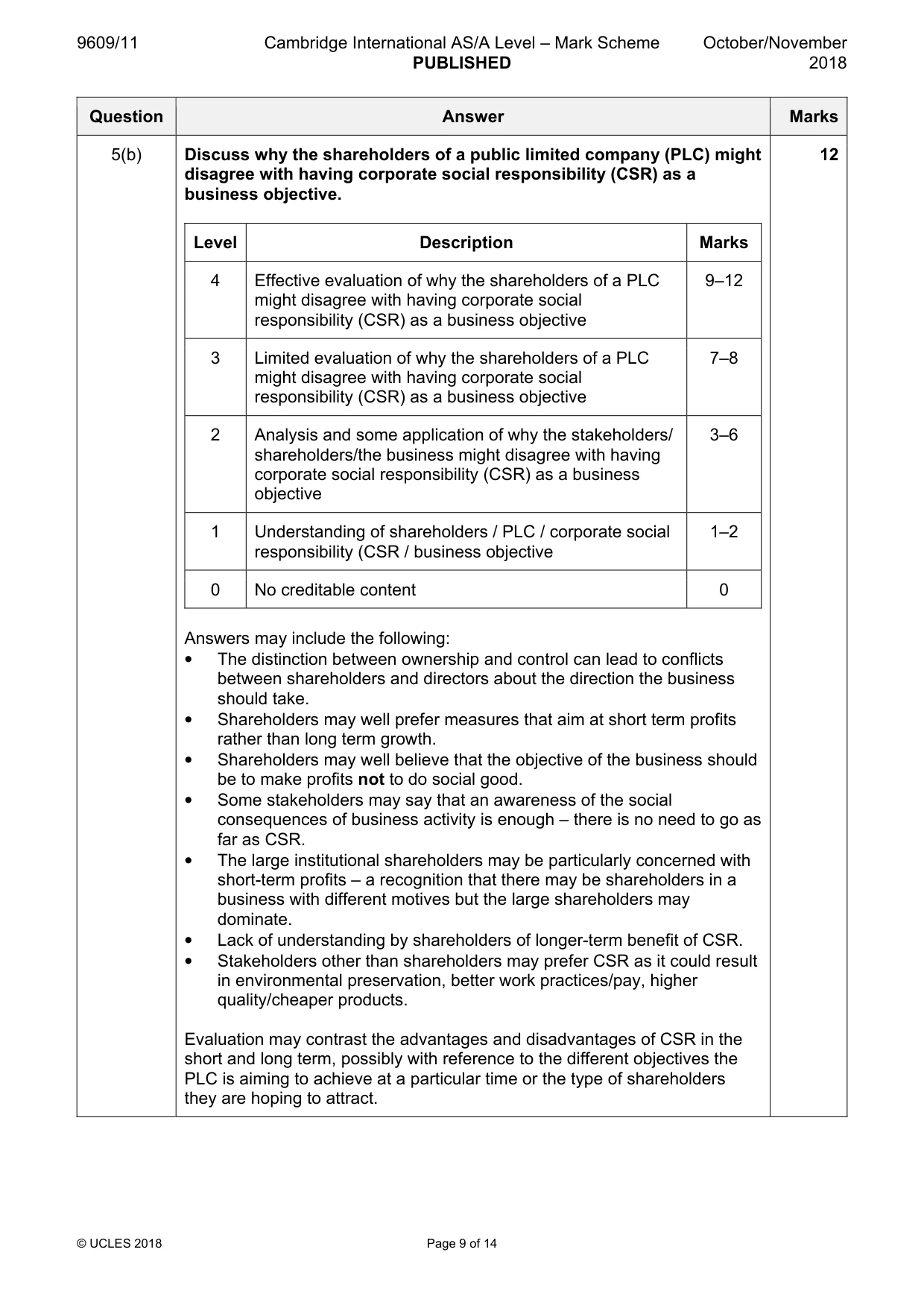
9609/11 Cambridge International AS/A Level – Mark Scheme PUBLISHED October/November 2018 © UCLES 2018 Page 9 of 14 Question Answer Marks 5(b) Discuss why the shareholders of a public limited company (PLC) might disagree with having corporate social responsibility (CSR) as a business objective. Level Description Marks 4 Effective evaluation of why the shareholders of a PLC might disagree with having corporate social responsibility (CSR) as a business objective 9–12 3 Limited evaluation of why the shareholders of a PLC might disagree with having corporate social responsibility (CSR) as a business objective 7–8 2 Analysis and some application of why the stakeholders/ shareholders/the business might disagree with having corporate social responsibility (CSR) as a business objective 3–6 1 Understanding of shareholders / PLC / corporate social responsibility (CSR / business objective 1–2 0 No creditable content 0 Answers may include the following: • The distinction between ownership and control can lead to conflicts between shareholders and directors about the direction the business should take. • Shareholders may well prefer measures that aim at short term profits rather than long term growth. • Shareholders may well believe that the objective of the business should be to make profits not to do social good. • Some stakeholders may say that an awareness of the social consequences of business activity is enough – there is no need to go as far as CSR. • The large institutional shareholders may be particularly concerned with short-term profits – a recognition that there may be shareholders in a business with different motives but the large shareholders may dominate. • Lack of understanding by shareholders of longer-term benefit of CSR. • Stakeholders other than shareholders may prefer CSR as it could result in environmental preservation, better work practices/pay, higher quality/cheaper products. Evaluation may contrast the advantages and disadvantages of CSR in the short and long term, possibly with reference to the different objectives the PLC is aiming to achieve at a particular time or the type of shareholders they are hoping to attract. 12
Mark scheme, page 10
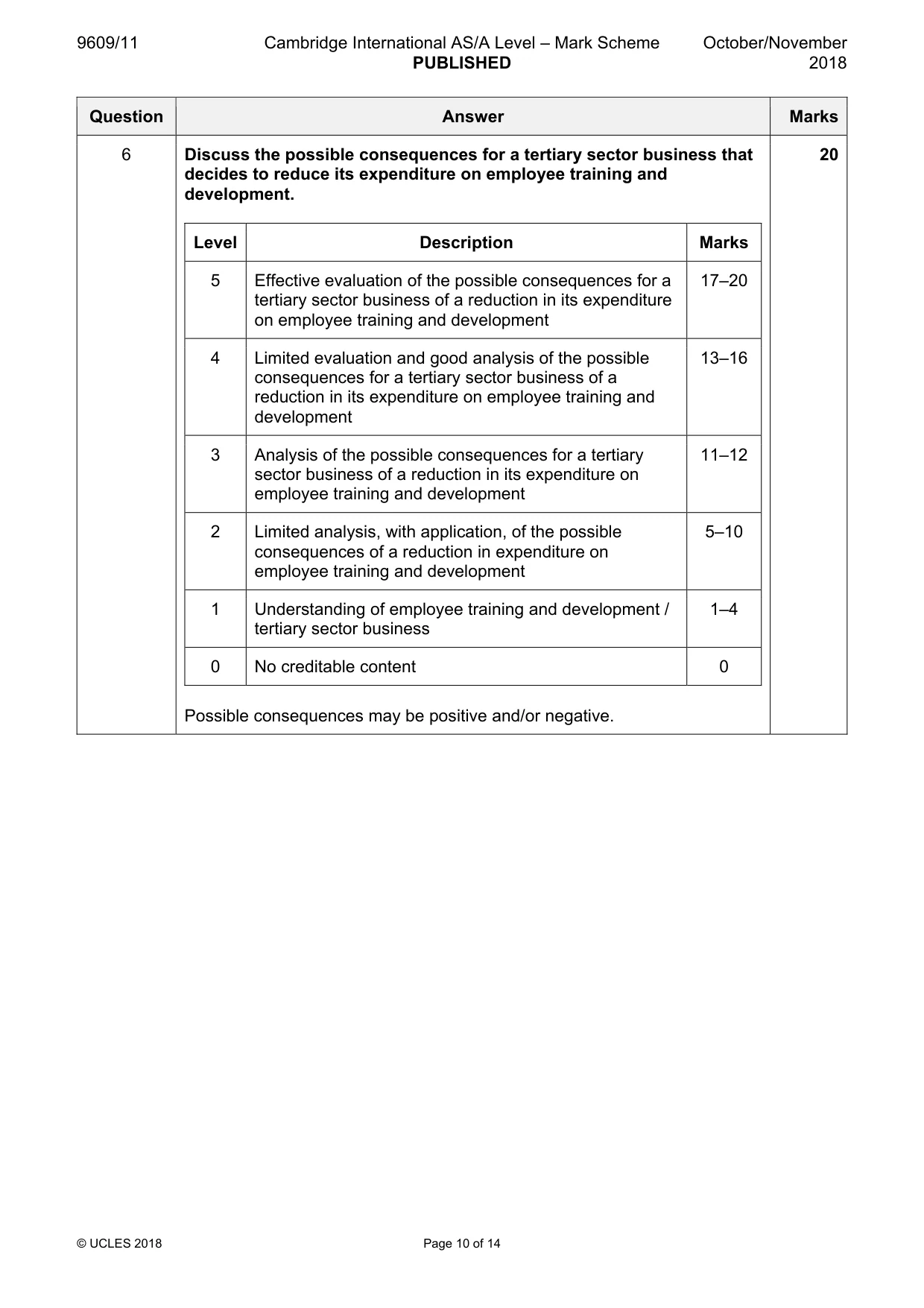
9609/11 Cambridge International AS/A Level – Mark Scheme PUBLISHED October/November 2018 © UCLES 2018 Page 10 of 14 Question Answer Marks 6 Discuss the possible consequences for a tertiary sector business that decides to reduce its expenditure on employee training and development. Level Description Marks 5 Effective evaluation of the possible consequences for a tertiary sector business of a reduction in its expenditure on employee training and development 17–20 4 Limited evaluation and good analysis of the possible consequences for a tertiary sector business of a reduction in its expenditure on employee training and development 13–16 3 Analysis of the possible consequences for a tertiary sector business of a reduction in its expenditure on employee training and development 11–12 2 Limited analysis, with application, of the possible consequences of a reduction in expenditure on employee training and development 5–10 1 Understanding of employee training and development / tertiary sector business 1–4 0 No creditable content 0 Possible consequences may be positive and/or negative. 20
Mark scheme, page 11
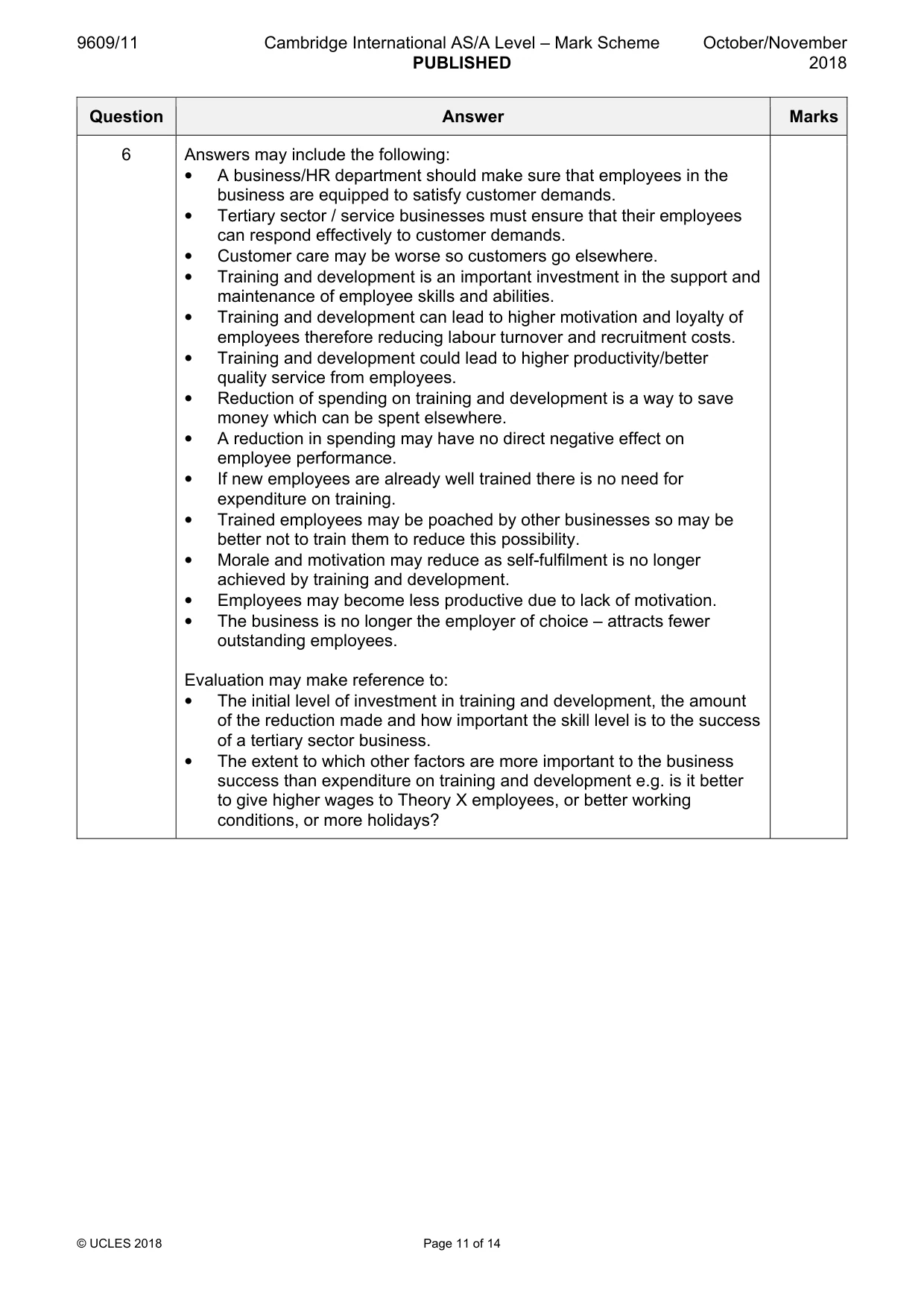
9609/11 Cambridge International AS/A Level – Mark Scheme PUBLISHED October/November 2018 © UCLES 2018 Page 11 of 14 Question Answer Marks 6 Answers may include the following: • A business/HR department should make sure that employees in the business are equipped to satisfy customer demands. • Tertiary sector / service businesses must ensure that their employees can respond effectively to customer demands. • Customer care may be worse so customers go elsewhere. • Training and development is an important investment in the support and maintenance of employee skills and abilities. • Training and development can lead to higher motivation and loyalty of employees therefore reducing labour turnover and recruitment costs. • Training and development could lead to higher productivity/better quality service from employees. • Reduction of spending on training and development is a way to save money which can be spent elsewhere. • A reduction in spending may have no direct negative effect on employee performance. • If new employees are already well trained there is no need for expenditure on training. • Trained employees may be poached by other businesses so may be better not to train them to reduce this possibility. • Morale and motivation may reduce as self-fulfilment is no longer achieved by training and development. • Employees may become less productive due to lack of motivation. • The business is no longer the employer of choice – attracts fewer outstanding employees. Evaluation may make reference to: • The initial level of investment in training and development, the amount of the reduction made and how important the skill level is to the success of a tertiary sector business. • The extent to which other factors are more important to the business success than expenditure on training and development e.g. is it better to give higher wages to Theory X employees, or better working conditions, or more holidays?
Mark scheme, page 12
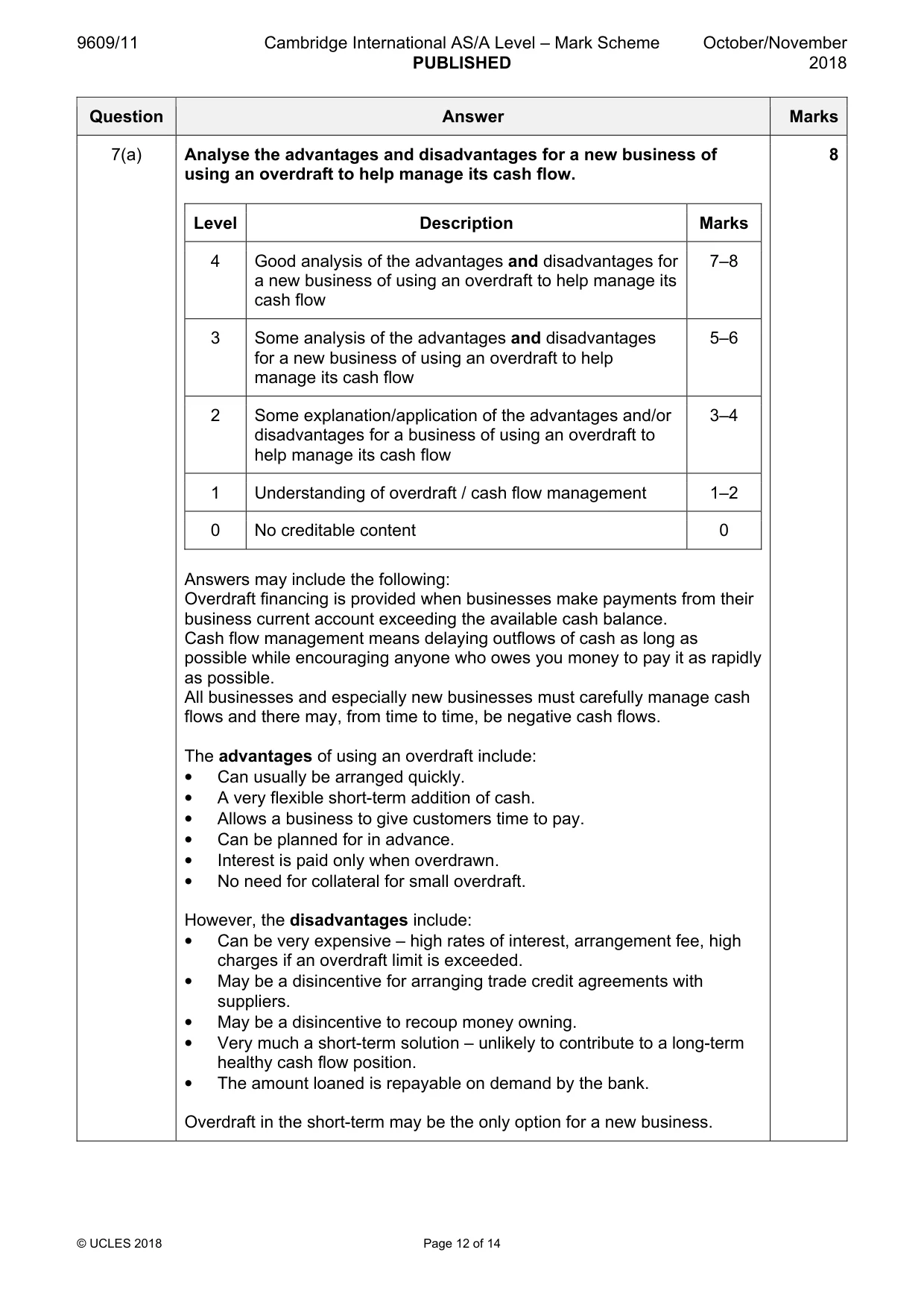
9609/11 Cambridge International AS/A Level – Mark Scheme PUBLISHED October/November 2018 © UCLES 2018 Page 12 of 14 Question Answer Marks 7(a) Analyse the advantages and disadvantages for a new business of using an overdraft to help manage its cash flow. Level Description Marks 4 Good analysis of the advantages and disadvantages for a new business of using an overdraft to help manage its cash flow 7–8 3 Some analysis of the advantages and disadvantages for a new business of using an overdraft to help manage its cash flow 5–6 2 Some explanation/application of the advantages and/or disadvantages for a business of using an overdraft to help manage its cash flow 3–4 1 Understanding of overdraft / cash flow management 1–2 0 No creditable content 0 Answers may include the following: Overdraft financing is provided when businesses make payments from their business current account exceeding the available cash balance. Cash flow management means delaying outflows of cash as long as possible while encouraging anyone who owes you money to pay it as rapidly as possible. All businesses and especially new businesses must carefully manage cash flows and there may, from time to time, be negative cash flows. The advantages of using an overdraft include: • Can usually be arranged quickly. • A very flexible short-term addition of cash. • Allows a business to give customers time to pay. • Can be planned for in advance. • Interest is paid only when overdrawn. • No need for collateral for small overdraft. However, the disadvantages include: • Can be very expensive – high rates of interest, arrangement fee, high charges if an overdraft limit is exceeded. • May be a disincentive for arranging trade credit agreements with suppliers. • May be a disincentive to recoup money owning. • Very much a short-term solution – unlikely to contribute to a long-term healthy cash flow position. • The amount loaned is repayable on demand by the bank. Overdraft in the short-term may be the only option for a new business. 8
Mark scheme, page 13
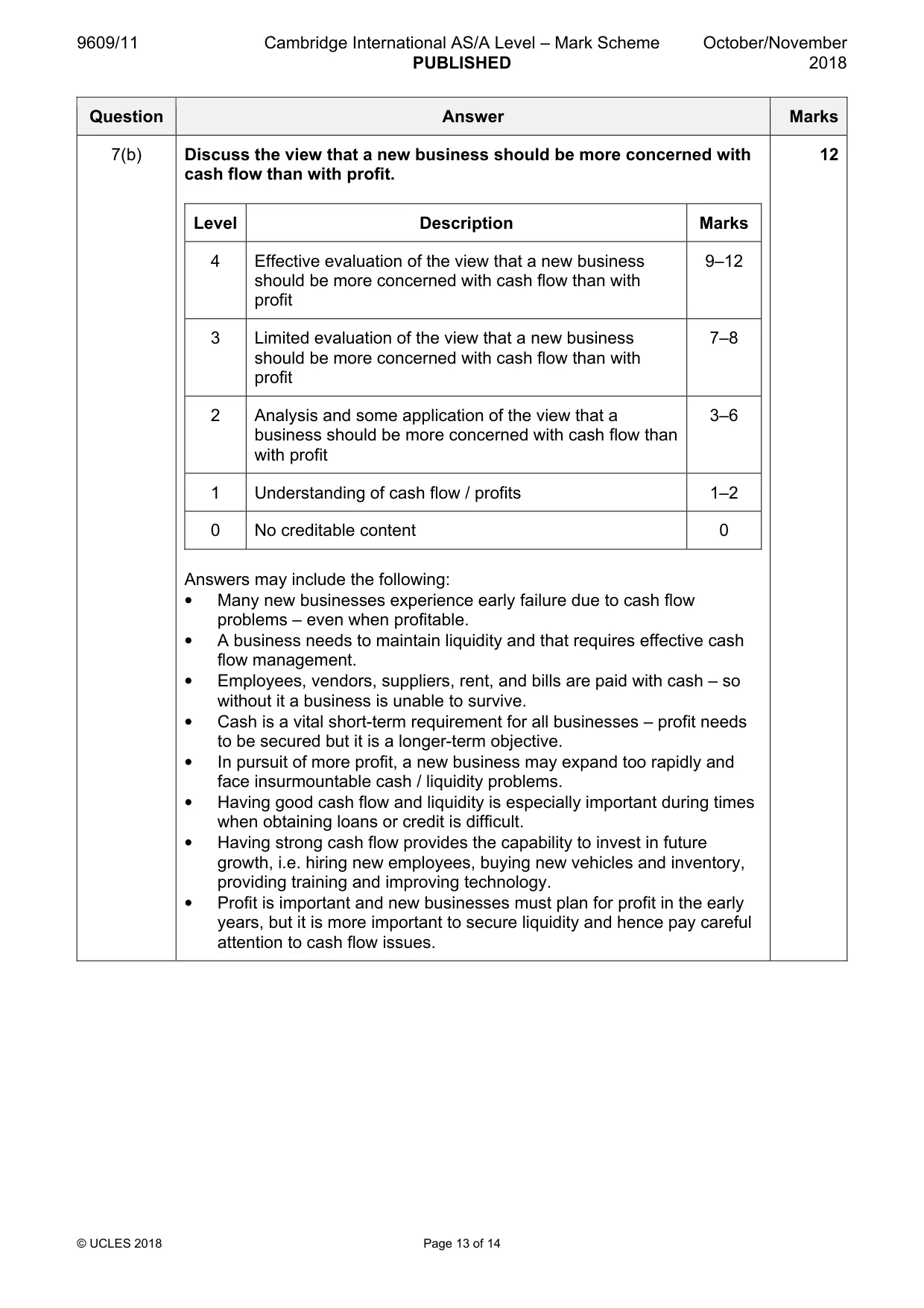
9609/11 Cambridge International AS/A Level – Mark Scheme PUBLISHED October/November 2018 © UCLES 2018 Page 13 of 14 Question Answer Marks 7(b) Discuss the view that a new business should be more concerned with cash flow than with profit. Level Description Marks 4 Effective evaluation of the view that a new business should be more concerned with cash flow than with profit 9–12 3 Limited evaluation of the view that a new business should be more concerned with cash flow than with profit 7–8 2 Analysis and some application of the view that a business should be more concerned with cash flow than with profit 3–6 1 Understanding of cash flow / profits 1–2 0 No creditable content 0 Answers may include the following: • Many new businesses experience early failure due to cash flow problems – even when profitable. • A business needs to maintain liquidity and that requires effective cash flow management. • Employees, vendors, suppliers, rent, and bills are paid with cash – so without it a business is unable to survive. • Cash is a vital short-term requirement for all businesses – profit needs to be secured but it is a longer-term objective. • In pursuit of more profit, a new business may expand too rapidly and face insurmountable cash / liquidity problems. • Having good cash flow and liquidity is especially important during times when obtaining loans or credit is difficult. • Having strong cash flow provides the capability to invest in future growth, i.e. hiring new employees, buying new vehicles and inventory, providing training and improving technology. • Profit is important and new businesses must plan for profit in the early years, but it is more important to secure liquidity and hence pay careful attention to cash flow issues. 12
Mark scheme, page 14
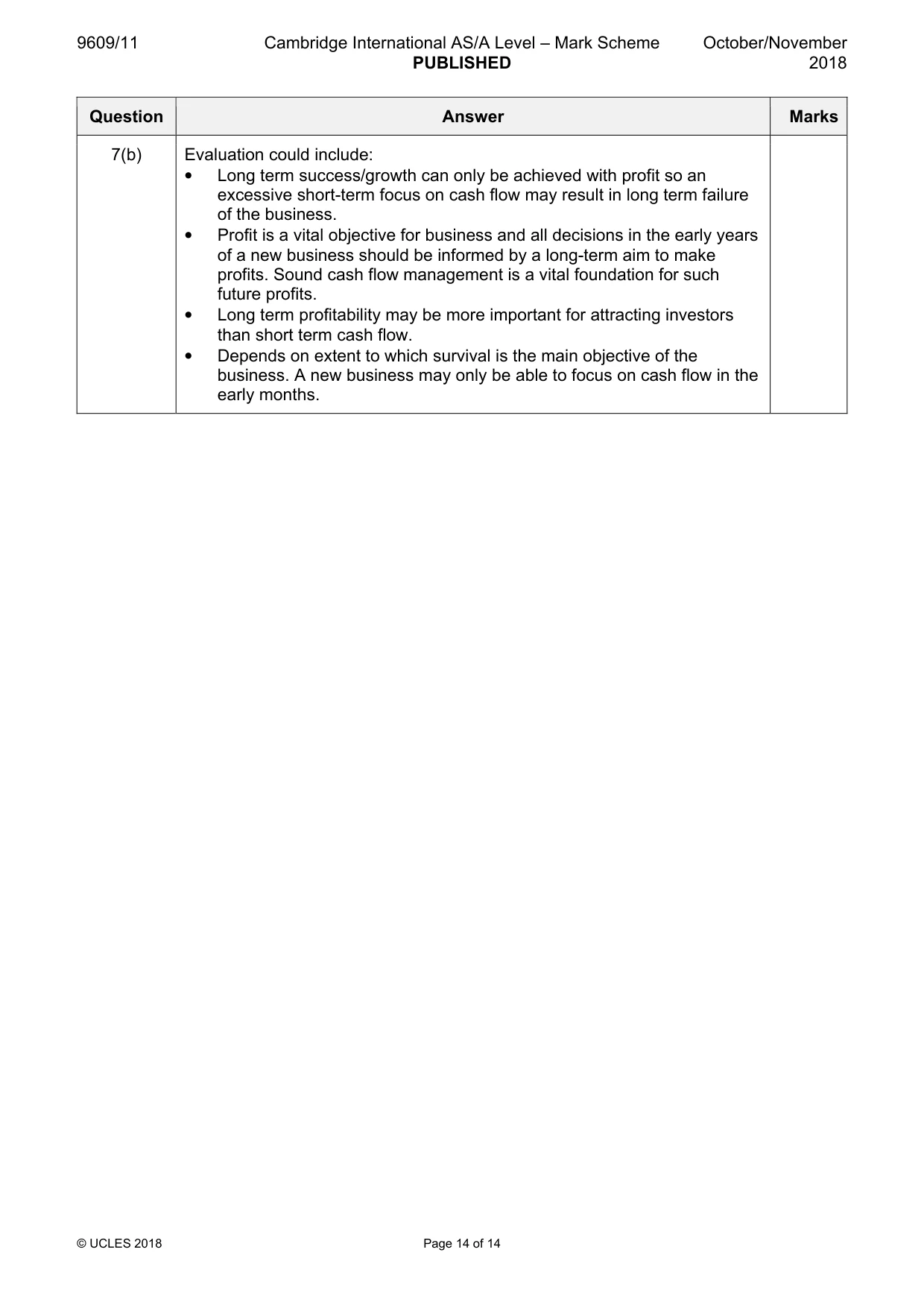
9609/11 Cambridge International AS/A Level – Mark Scheme PUBLISHED October/November 2018 © UCLES 2018 Page 14 of 14 Question Answer Marks 7(b) Evaluation could include: • Long term success/growth can only be achieved with profit so an excessive short-term focus on cash flow may result in long term failure of the business. • Profit is a vital objective for business and all decisions in the early years of a new business should be informed by a long-term aim to make profits. Sound cash flow management is a vital foundation for such future profits. • Long term profitability may be more important for attracting investors than short term cash flow. • Depends on extent to which survival is the main objective of the business. A new business may only be able to focus on cash flow in the early months.
What you needed in this session
Cambridge’s own grade thresholds for 2018 Oct/Nov, Paper 1 · Variant 1. A higher threshold means an easier paper — the bar moves with how the cohort did.