Cambridge A Level Business (for first examination in 2016) 9609 — 2018 Oct/Nov Paper 1 · Variant 3
9609/13/O/N/18 · 40 marks · ≈45 min
The question paper and its mark scheme, free to read here and free to download. This is Cambridge’s own paper, exactly as it was sat.
Question paper4 pages


Mark scheme12 pages
Answers below. Sit the paper first if you are practising.
Paper as text
Question paper, page 1
This document consists of 2 printed pages, 2 blank pages and 1 Insert. DC (NH) 151774/1 © UCLES 2018 [Turn over * 5 8 0 2 9 0 5 2 2 3 * BUSINESS 9609/13 Paper 1 Short Answer and Essay October/November 2018 1 hour 15 minutes No Additional Materials are required. READ THESE INSTRUCTIONS FIRST An answer booklet is provided inside this question paper. You should follow the instructions on the front cover of the answer booklet. If you need additional answer paper ask the invigilator for a continuation booklet. Section A Answer all questions. Section B Answer one question. You are advised to spend no more than 35 minutes on Section A. The number of marks is given in brackets [ ] at the end of each question or part question. Cambridge International Examinations Cambridge International Advanced Subsidiary and Advanced Level
Question paper, page 2
2 9609/13/O/N/18 © UCLES 2018 Section A (Short Answer) Answer all questions. 1 (a) Define the term ‘private limited company’. [2] (b) Briefly explain one advantage and one disadvantage to a business of operating as a public limited company, rather than as a private limited company. [3] 2 (a) Define the term ‘debt factoring’. [2] (b) Briefly explain two disadvantages of using debt factoring to improve the cash flow of a business. [3] 3 Explain how an understanding of the product life cycle might help a business manage its product portfolio. [5] 4 (a) Define the term ‘lead time’. [2] (b) Briefly explain two advantages to a business of effective inventory management. [3] Section B (Essay) Answer one question only. 5 (a) Analyse the advantages of a partnership as a legal structure for the owners of a small business. [8] (b) Discuss the most important factors that could influence the success of a small business manufacturing highly priced ‘designer’ handbags. [12] 6 A poorly performing business is considering changing its method of employee payment from a salary scheme to a performance related pay scheme. Discuss the likely advantages and disadvantages to the business of this change. [20] 7 (a) Analyse the importance to a business of having clear marketing objectives. [8] (b) Discuss the view that marketing objectives will not be achieved without a close relationship between the marketing, finance and operations departments of a business. [12]
Question paper, page 3
3 9609/13/O/N/18 © UCLES 2018 BLANK PAGE
Question paper, page 4
4 9609/13/O/N/18 © UCLES 2018 Permission to reproduce items where third-party owned material protected by copyright is included has been sought and cleared where possible. Every reasonable effort has been made by the publisher (UCLES) to trace copyright holders, but if any items requiring clearance have unwittingly been included, the publisher will be pleased to make amends at the earliest possible opportunity. To avoid the issue of disclosure of answer-related information to candidates, all copyright acknowledgements are reproduced online in the Cambridge International Examinations Copyright Acknowledgements Booklet. This is produced for each series of examinations and is freely available to download at www.cie.org.uk after the live examination series. Cambridge International Examinations is part of the Cambridge Assessment Group. Cambridge Assessment is the brand name of University of Cambridge Local Examinations Syndicate (UCLES), which is itself a department of the University of Cambridge. BLANK PAGE
Mark scheme, page 1
This document consists of 12 printed pages. © UCLES 2018 [Turn over Cambridge Assessment International Education Cambridge International Advanced Subsidiary and Advanced Level BUSINESS 9609/13 Paper 1 Short Answer/Essay October/November 2018 MARK SCHEME Maximum Mark: 40 Published This mark scheme is published as an aid to teachers and candidates, to indicate the requirements of the examination. It shows the basis on which Examiners were instructed to award marks. It does not indicate the details of the discussions that took place at an Examiners’ meeting before marking began, which would have considered the acceptability of alternative answers. Mark schemes should be read in conjunction with the question paper and the Principal Examiner Report for Teachers. Cambridge International will not enter into discussions about these mark schemes. Cambridge International is publishing the mark schemes for the October/November 2018 series for most Cambridge IGCSE™, Cambridge International A and AS Level components and some Cambridge O Level components.
Mark scheme, page 2
9609/13 Cambridge International AS/A Level – Mark Scheme PUBLISHED October/November 2018 © UCLES 2018 Page 2 of 12 Generic Marking Principles These general marking principles must be applied by all examiners when marking candidate answers. They should be applied alongside the specific content of the mark scheme or generic level descriptors for a question. Each question paper and mark scheme will also comply with these marking principles. GENERIC MARKING PRINCIPLE 1: Marks must be awarded in line with: • the specific content of the mark scheme or the generic level descriptors for the question • the specific skills defined in the mark scheme or in the generic level descriptors for the question • the standard of response required by a candidate as exemplified by the standardisation scripts. GENERIC MARKING PRINCIPLE 2: Marks awarded are always whole marks (not half marks, or other fractions). GENERIC MARKING PRINCIPLE 3: Marks must be awarded positively: • marks are awarded for correct/valid answers, as defined in the mark scheme. However, credit is given for valid answers which go beyond the scope of the syllabus and mark scheme, referring to your Team Leader as appropriate • marks are awarded when candidates clearly demonstrate what they know and can do • marks are not deducted for errors • marks are not deducted for omissions • answers should only be judged on the quality of spelling, punctuation and grammar when these features are specifically assessed by the question as indicated by the mark scheme. The meaning, however, should be unambiguous. GENERIC MARKING PRINCIPLE 4: Rules must be applied consistently e.g. in situations where candidates have not followed instructions or in the application of generic level descriptors. GENERIC MARKING PRINCIPLE 5: Marks should be awarded using the full range of marks defined in the mark scheme for the question (however; the use of the full mark range may be limited according to the quality of the candidate responses seen). GENERIC MARKING PRINCIPLE 6: Marks awarded are based solely on the requirements as defined in the mark scheme. Marks should not be awarded with grade thresholds or grade descriptors in mind.
Mark scheme, page 3
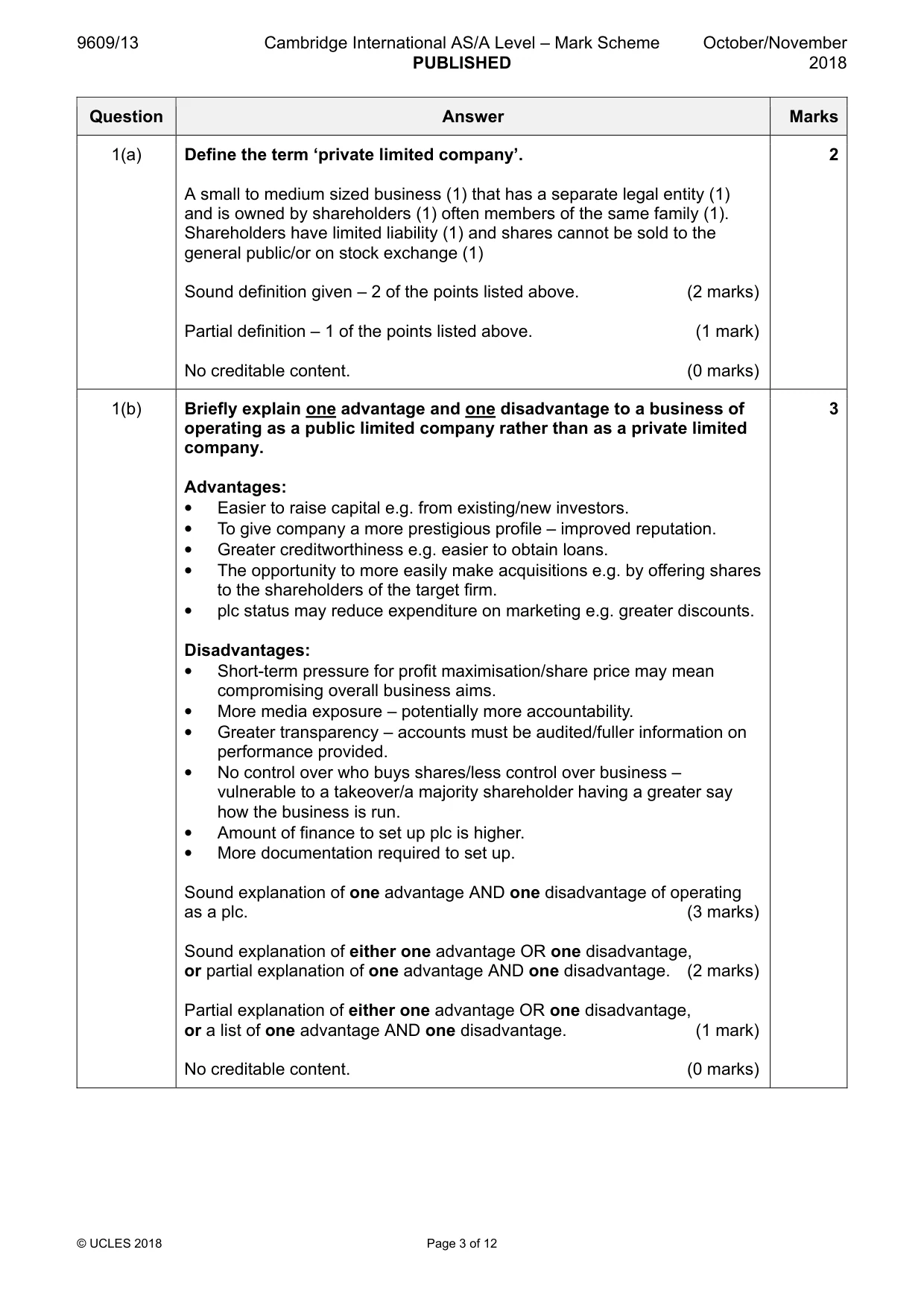
9609/13 Cambridge International AS/A Level – Mark Scheme PUBLISHED October/November 2018 © UCLES 2018 Page 3 of 12 Question Answer Marks 1(a) Define the term ‘private limited company’. A small to medium sized business (1) that has a separate legal entity (1) and is owned by shareholders (1) often members of the same family (1). Shareholders have limited liability (1) and shares cannot be sold to the general public/or on stock exchange (1) Sound definition given – 2 of the points listed above. (2 marks) Partial definition – 1 of the points listed above. (1 mark) No creditable content. (0 marks) 2 1(b) Briefly explain one advantage and one disadvantage to a business of operating as a public limited company rather than as a private limited company. Advantages: • Easier to raise capital e.g. from existing/new investors. • To give company a more prestigious profile – improved reputation. • Greater creditworthiness e.g. easier to obtain loans. • The opportunity to more easily make acquisitions e.g. by offering shares to the shareholders of the target firm. • plc status may reduce expenditure on marketing e.g. greater discounts. Disadvantages: • Short-term pressure for profit maximisation/share price may mean compromising overall business aims. • More media exposure – potentially more accountability. • Greater transparency – accounts must be audited/fuller information on performance provided. • No control over who buys shares/less control over business – vulnerable to a takeover/a majority shareholder having a greater say how the business is run. • Amount of finance to set up plc is higher. • More documentation required to set up. Sound explanation of one advantage AND one disadvantage of operating as a plc. (3 marks) Sound explanation of either one advantage OR one disadvantage, or partial explanation of one advantage AND one disadvantage. (2 marks) Partial explanation of either one advantage OR one disadvantage, or a list of one advantage AND one disadvantage. (1 mark) No creditable content. (0 marks) 3
Mark scheme, page 4
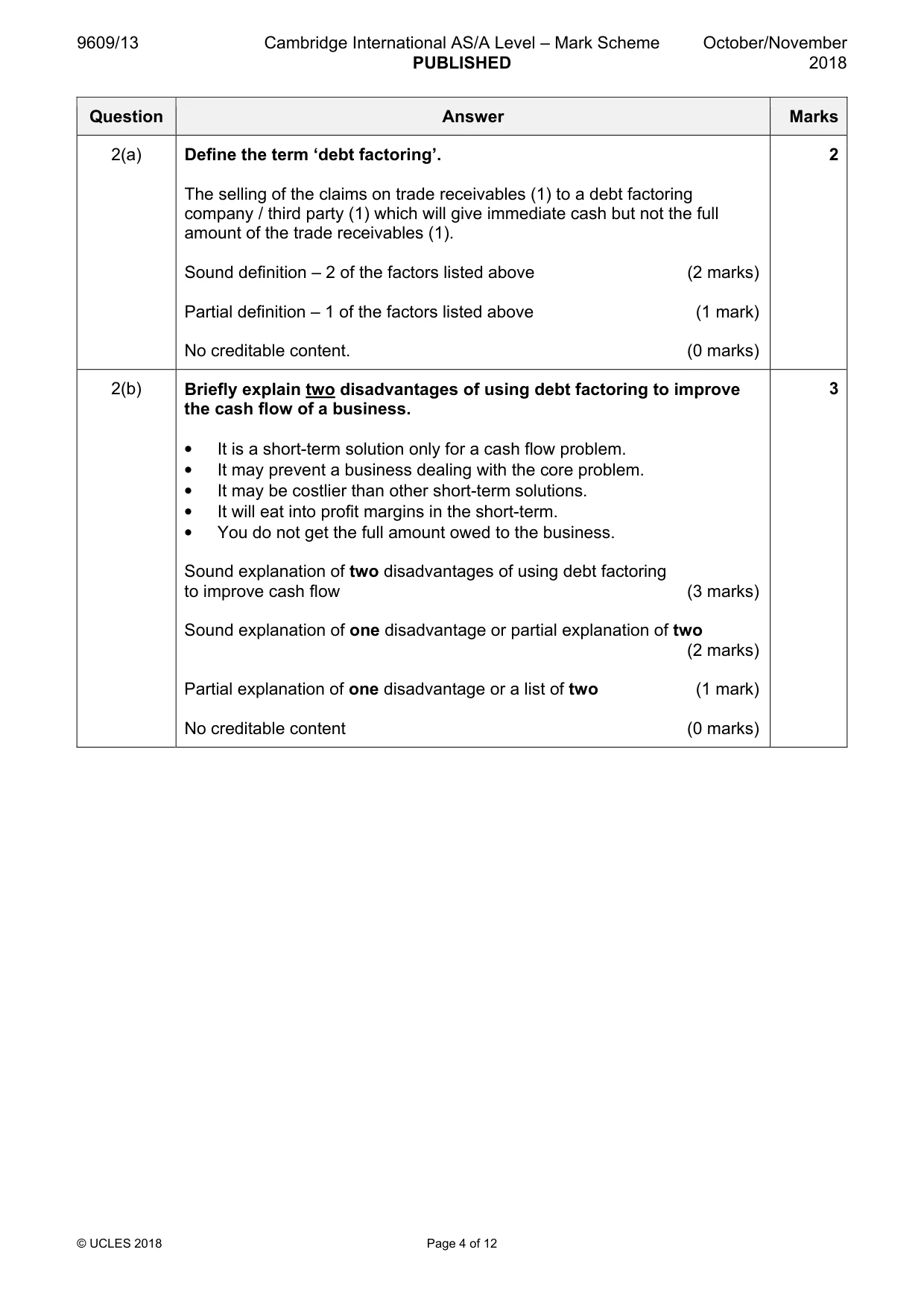
9609/13 Cambridge International AS/A Level – Mark Scheme PUBLISHED October/November 2018 © UCLES 2018 Page 4 of 12 Question Answer Marks 2(a) Define the term ‘debt factoring’. The selling of the claims on trade receivables (1) to a debt factoring company / third party (1) which will give immediate cash but not the full amount of the trade receivables (1). Sound definition – 2 of the factors listed above (2 marks) Partial definition – 1 of the factors listed above (1 mark) No creditable content. (0 marks) 2 2(b) Briefly explain two disadvantages of using debt factoring to improve the cash flow of a business. • It is a short-term solution only for a cash flow problem. • It may prevent a business dealing with the core problem. • It may be costlier than other short-term solutions. • It will eat into profit margins in the short-term. • You do not get the full amount owed to the business. Sound explanation of two disadvantages of using debt factoring to improve cash flow (3 marks) Sound explanation of one disadvantage or partial explanation of two (2 marks) Partial explanation of one disadvantage or a list of two (1 mark) No creditable content (0 marks) 3
Mark scheme, page 5
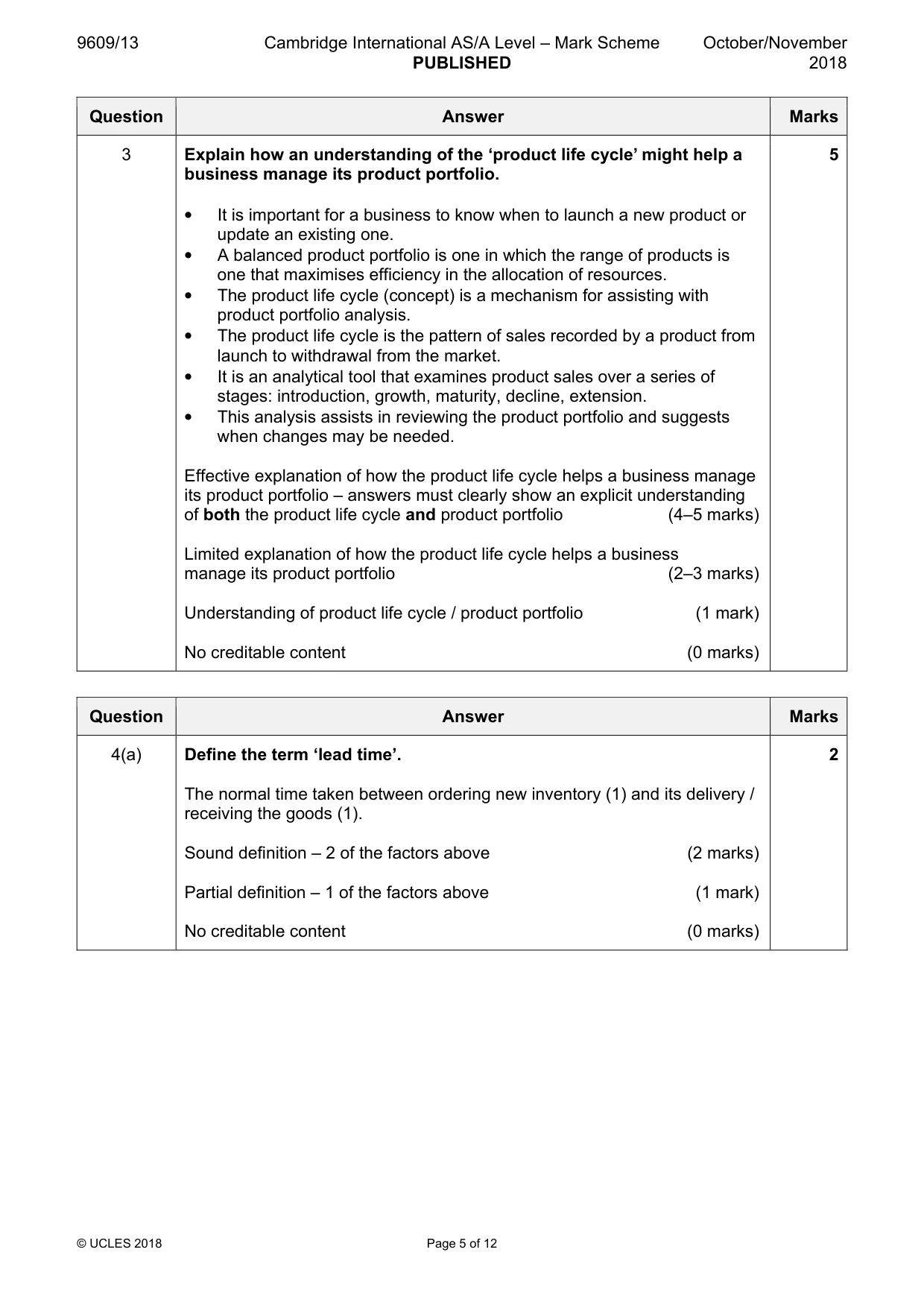
9609/13 Cambridge International AS/A Level – Mark Scheme PUBLISHED October/November 2018 © UCLES 2018 Page 5 of 12 Question Answer Marks 3 Explain how an understanding of the ‘product life cycle’ might help a business manage its product portfolio. • It is important for a business to know when to launch a new product or update an existing one. • A balanced product portfolio is one in which the range of products is one that maximises efficiency in the allocation of resources. • The product life cycle (concept) is a mechanism for assisting with product portfolio analysis. • The product life cycle is the pattern of sales recorded by a product from launch to withdrawal from the market. • It is an analytical tool that examines product sales over a series of stages: introduction, growth, maturity, decline, extension. • This analysis assists in reviewing the product portfolio and suggests when changes may be needed. Effective explanation of how the product life cycle helps a business manage its product portfolio – answers must clearly show an explicit understanding of both the product life cycle and product portfolio (4–5 marks) Limited explanation of how the product life cycle helps a business manage its product portfolio (2–3 marks) Understanding of product life cycle / product portfolio (1 mark) No creditable content (0 marks) 5 Question Answer Marks 4(a) Define the term ‘lead time’. The normal time taken between ordering new inventory (1) and its delivery / receiving the goods (1). Sound definition – 2 of the factors above (2 marks) Partial definition – 1 of the factors above (1 mark) No creditable content (0 marks) 2
Mark scheme, page 6
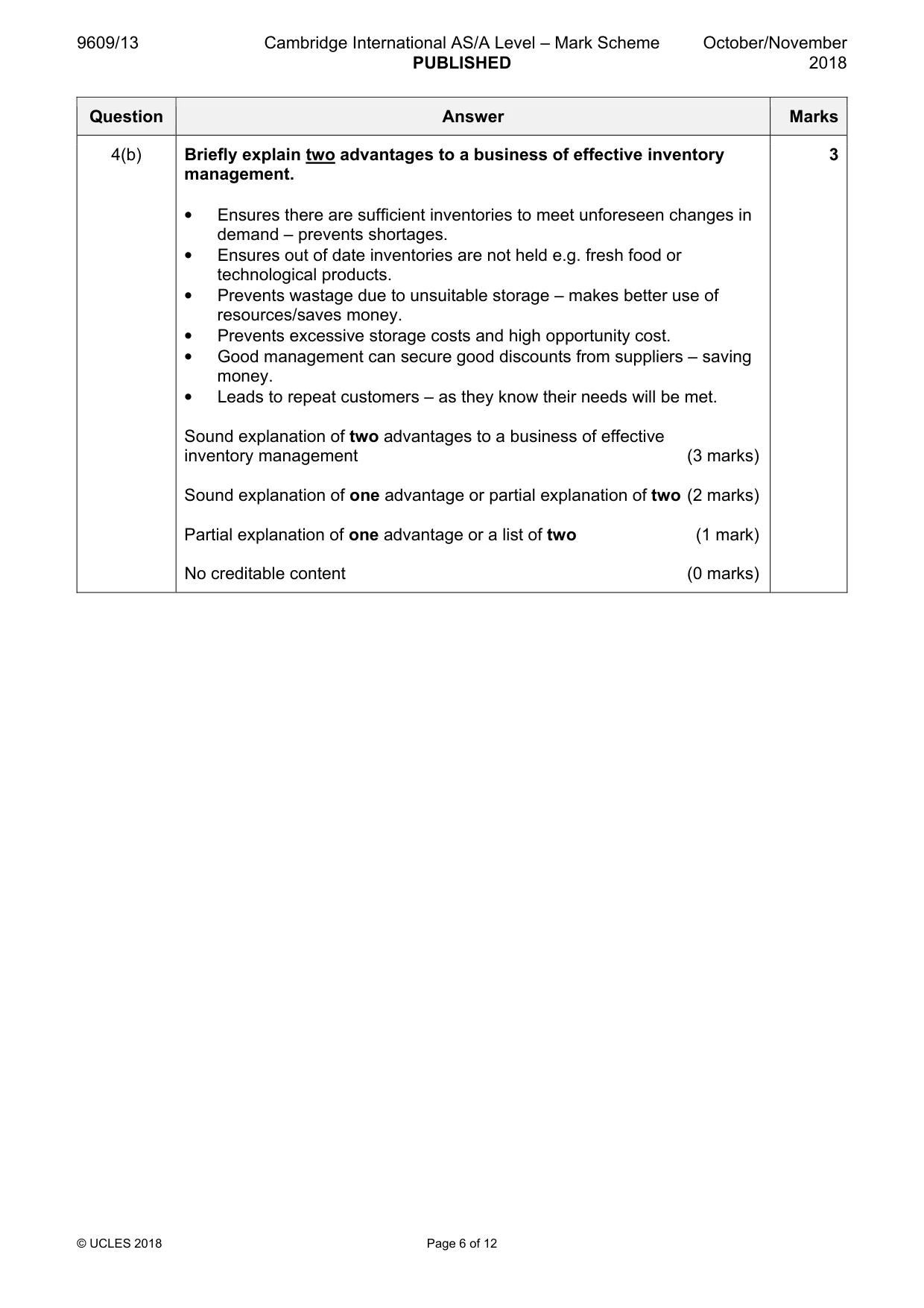
9609/13 Cambridge International AS/A Level – Mark Scheme PUBLISHED October/November 2018 © UCLES 2018 Page 6 of 12 Question Answer Marks 4(b) Briefly explain two advantages to a business of effective inventory management. • Ensures there are sufficient inventories to meet unforeseen changes in demand – prevents shortages. • Ensures out of date inventories are not held e.g. fresh food or technological products. • Prevents wastage due to unsuitable storage – makes better use of resources/saves money. • Prevents excessive storage costs and high opportunity cost. • Good management can secure good discounts from suppliers – saving money. • Leads to repeat customers – as they know their needs will be met. Sound explanation of two advantages to a business of effective inventory management (3 marks) Sound explanation of one advantage or partial explanation of two (2 marks) Partial explanation of one advantage or a list of two (1 mark) No creditable content (0 marks) 3
Mark scheme, page 7
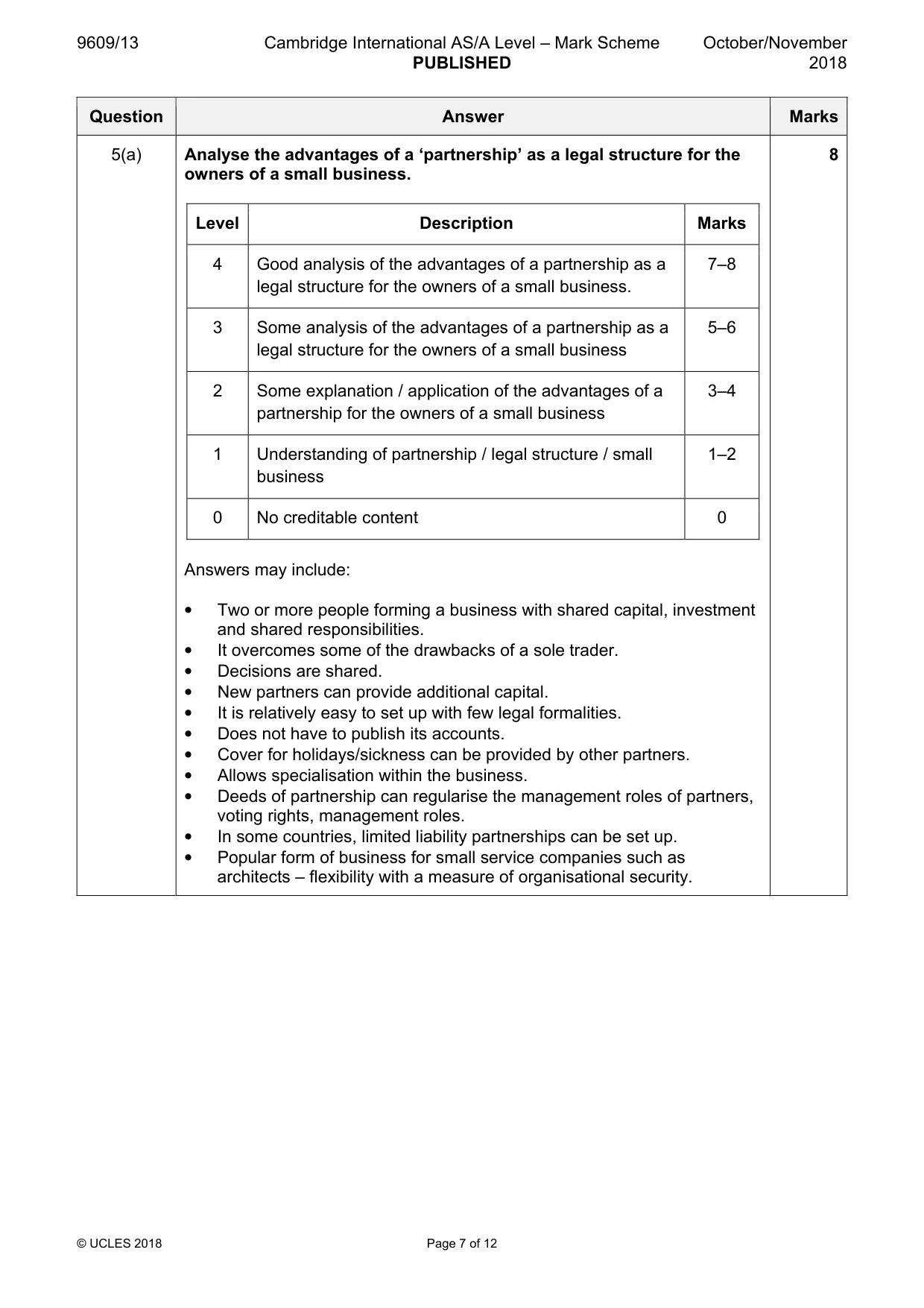
9609/13 Cambridge International AS/A Level – Mark Scheme PUBLISHED October/November 2018 © UCLES 2018 Page 7 of 12 Question Answer Marks 5(a) Analyse the advantages of a ‘partnership’ as a legal structure for the owners of a small business. Level Description Marks 4 Good analysis of the advantages of a partnership as a legal structure for the owners of a small business. 7–8 3 Some analysis of the advantages of a partnership as a legal structure for the owners of a small business 5–6 2 Some explanation / application of the advantages of a partnership for the owners of a small business 3–4 1 Understanding of partnership / legal structure / small business 1–2 0 No creditable content 0 Answers may include: • Two or more people forming a business with shared capital, investment and shared responsibilities. • It overcomes some of the drawbacks of a sole trader. • Decisions are shared. • New partners can provide additional capital. • It is relatively easy to set up with few legal formalities. • Does not have to publish its accounts. • Cover for holidays/sickness can be provided by other partners. • Allows specialisation within the business. • Deeds of partnership can regularise the management roles of partners, voting rights, management roles. • In some countries, limited liability partnerships can be set up. • Popular form of business for small service companies such as architects – flexibility with a measure of organisational security. 8
Mark scheme, page 8
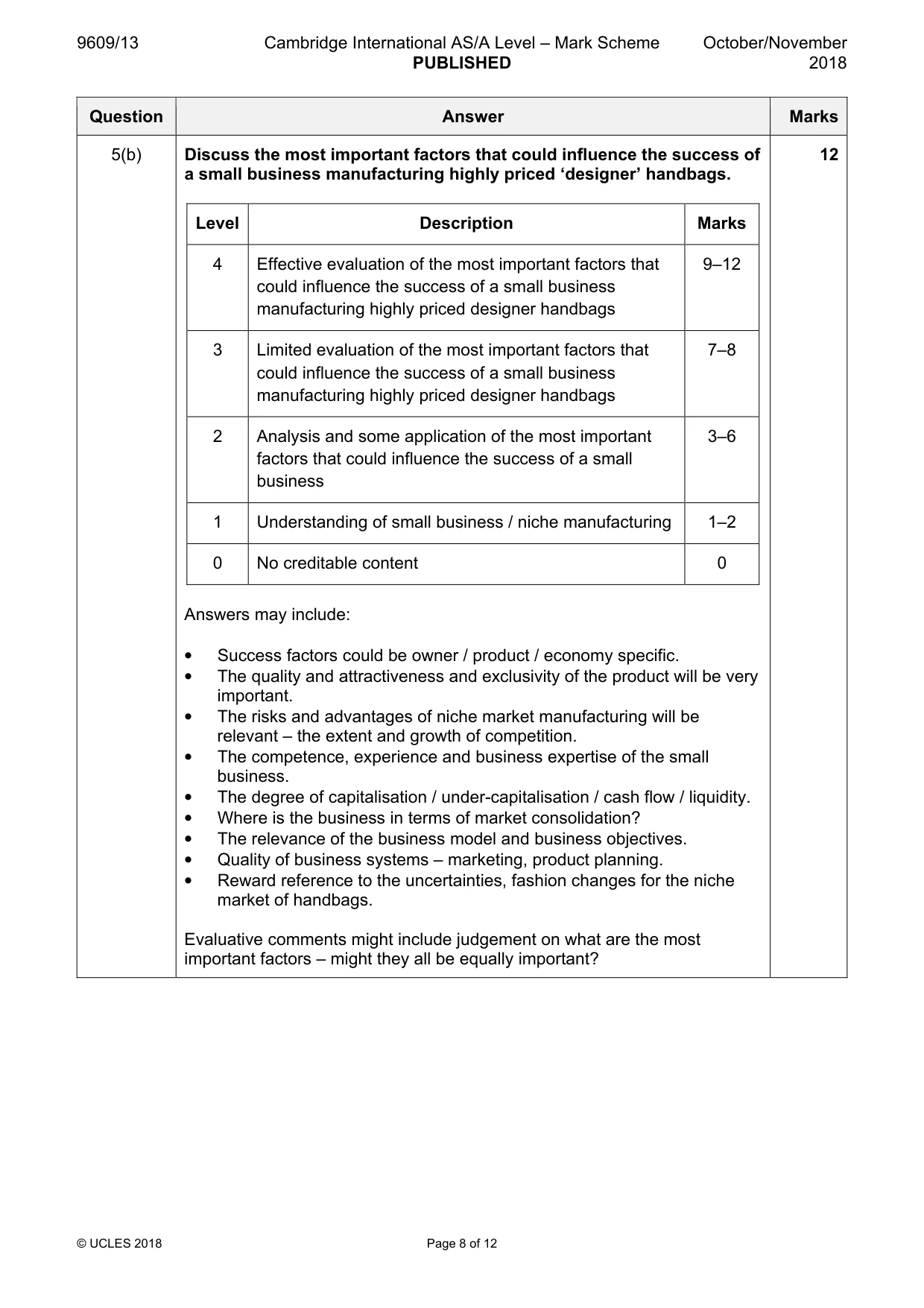
9609/13 Cambridge International AS/A Level – Mark Scheme PUBLISHED October/November 2018 © UCLES 2018 Page 8 of 12 Question Answer Marks 5(b) Discuss the most important factors that could influence the success of a small business manufacturing highly priced ‘designer’ handbags. Level Description Marks 4 Effective evaluation of the most important factors that could influence the success of a small business manufacturing highly priced designer handbags 9–12 3 Limited evaluation of the most important factors that could influence the success of a small business manufacturing highly priced designer handbags 7–8 2 Analysis and some application of the most important factors that could influence the success of a small business 3–6 1 Understanding of small business / niche manufacturing 1–2 0 No creditable content 0 Answers may include: • Success factors could be owner / product / economy specific. • The quality and attractiveness and exclusivity of the product will be very important. • The risks and advantages of niche market manufacturing will be relevant – the extent and growth of competition. • The competence, experience and business expertise of the small business. • The degree of capitalisation / under-capitalisation / cash flow / liquidity. • Where is the business in terms of market consolidation? • The relevance of the business model and business objectives. • Quality of business systems – marketing, product planning. • Reward reference to the uncertainties, fashion changes for the niche market of handbags. Evaluative comments might include judgement on what are the most important factors – might they all be equally important? 12
Mark scheme, page 9
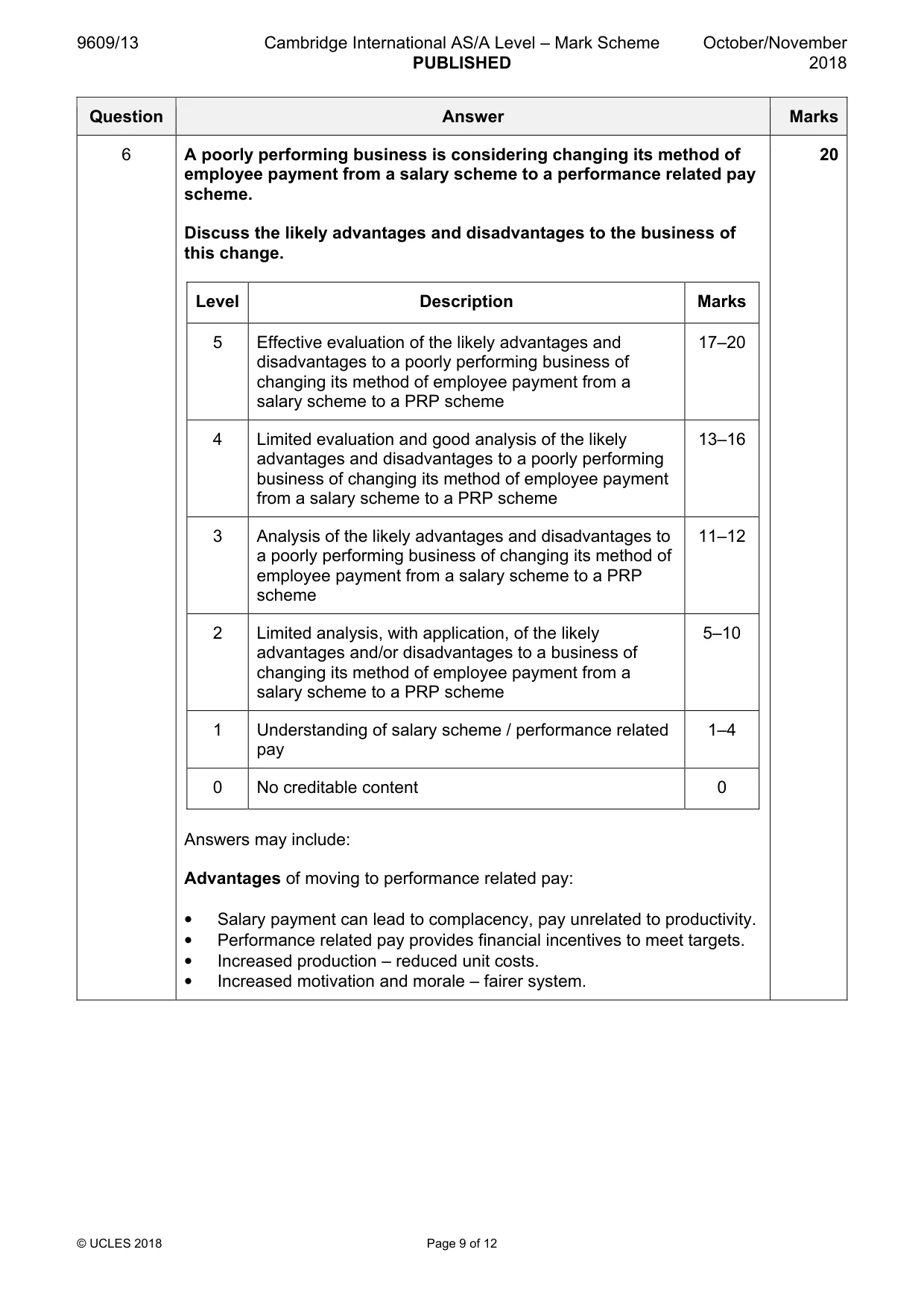
9609/13 Cambridge International AS/A Level – Mark Scheme PUBLISHED October/November 2018 © UCLES 2018 Page 9 of 12 Question Answer Marks 6 A poorly performing business is considering changing its method of employee payment from a salary scheme to a performance related pay scheme. Discuss the likely advantages and disadvantages to the business of this change. Level Description Marks 5 Effective evaluation of the likely advantages and disadvantages to a poorly performing business of changing its method of employee payment from a salary scheme to a PRP scheme 17–20 4 Limited evaluation and good analysis of the likely advantages and disadvantages to a poorly performing business of changing its method of employee payment from a salary scheme to a PRP scheme 13–16 3 Analysis of the likely advantages and disadvantages to a poorly performing business of changing its method of employee payment from a salary scheme to a PRP scheme 11–12 2 Limited analysis, with application, of the likely advantages and/or disadvantages to a business of changing its method of employee payment from a salary scheme to a PRP scheme 5–10 1 Understanding of salary scheme / performance related pay 1–4 0 No creditable content 0 Answers may include: Advantages of moving to performance related pay: • Salary payment can lead to complacency, pay unrelated to productivity. • Performance related pay provides financial incentives to meet targets. • Increased production – reduced unit costs. • Increased motivation and morale – fairer system. 20
Mark scheme, page 10
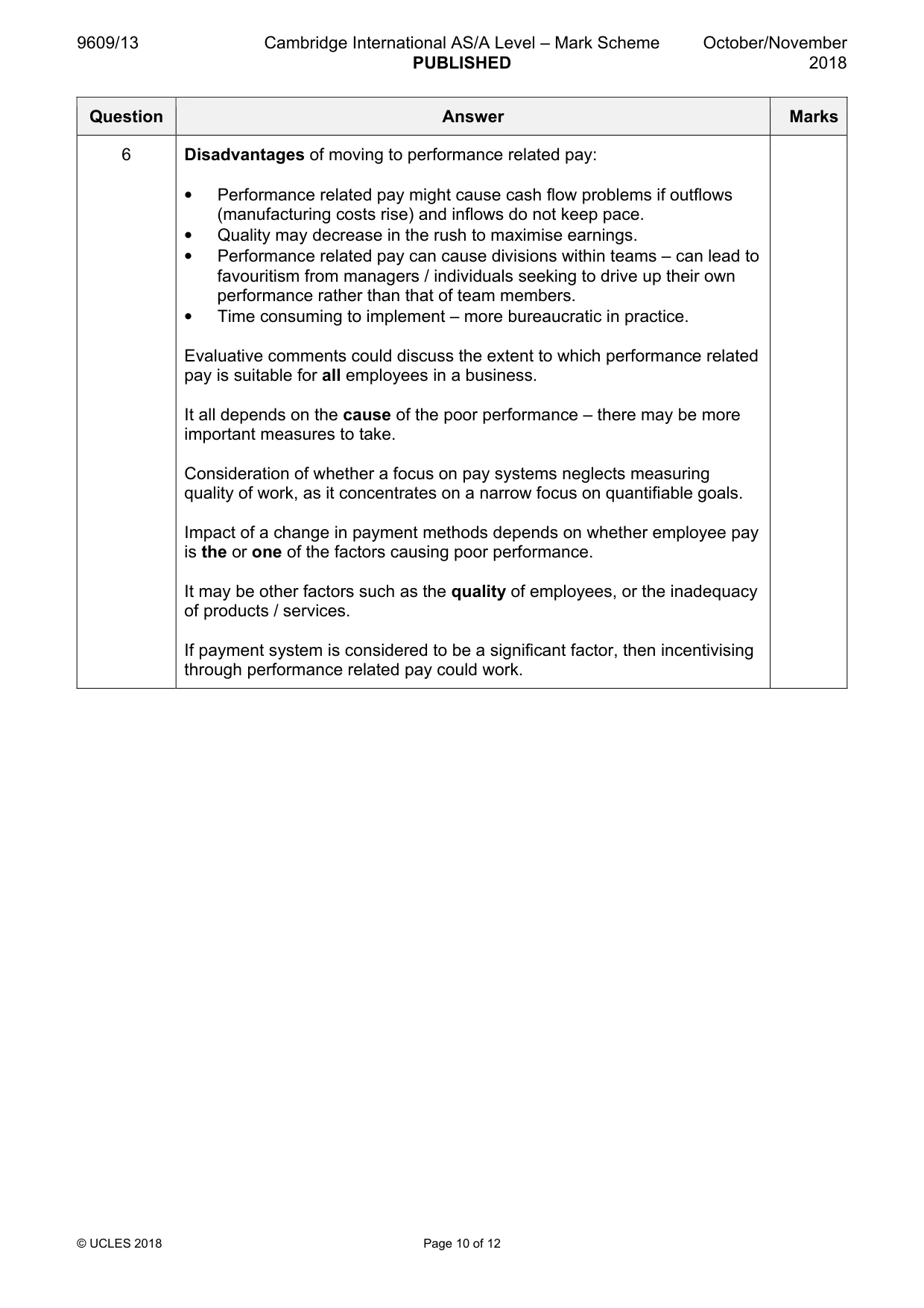
9609/13 Cambridge International AS/A Level – Mark Scheme PUBLISHED October/November 2018 © UCLES 2018 Page 10 of 12 Question Answer Marks 6 Disadvantages of moving to performance related pay: • Performance related pay might cause cash flow problems if outflows (manufacturing costs rise) and inflows do not keep pace. • Quality may decrease in the rush to maximise earnings. • Performance related pay can cause divisions within teams – can lead to favouritism from managers / individuals seeking to drive up their own performance rather than that of team members. • Time consuming to implement – more bureaucratic in practice. Evaluative comments could discuss the extent to which performance related pay is suitable for all employees in a business. It all depends on the cause of the poor performance – there may be more important measures to take. Consideration of whether a focus on pay systems neglects measuring quality of work, as it concentrates on a narrow focus on quantifiable goals. Impact of a change in payment methods depends on whether employee pay is the or one of the factors causing poor performance. It may be other factors such as the quality of employees, or the inadequacy of products / services. If payment system is considered to be a significant factor, then incentivising through performance related pay could work.
Mark scheme, page 11
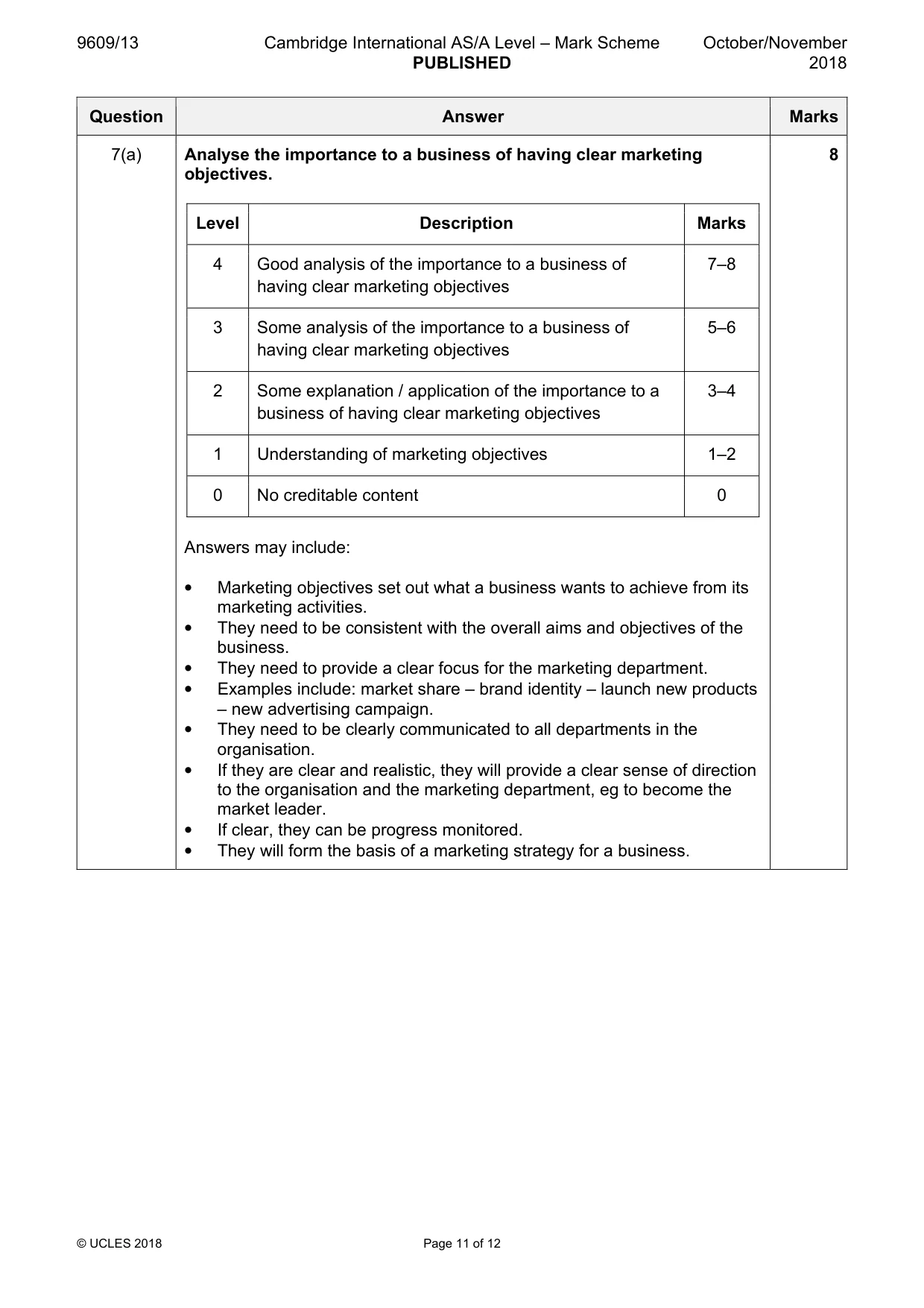
9609/13 Cambridge International AS/A Level – Mark Scheme PUBLISHED October/November 2018 © UCLES 2018 Page 11 of 12 Question Answer Marks 7(a) Analyse the importance to a business of having clear marketing objectives. Level Description Marks 4 Good analysis of the importance to a business of having clear marketing objectives 7–8 3 Some analysis of the importance to a business of having clear marketing objectives 5–6 2 Some explanation / application of the importance to a business of having clear marketing objectives 3–4 1 Understanding of marketing objectives 1–2 0 No creditable content 0 Answers may include: • Marketing objectives set out what a business wants to achieve from its marketing activities. • They need to be consistent with the overall aims and objectives of the business. • They need to provide a clear focus for the marketing department. • Examples include: market share – brand identity – launch new products – new advertising campaign. • They need to be clearly communicated to all departments in the organisation. • If they are clear and realistic, they will provide a clear sense of direction to the organisation and the marketing department, eg to become the market leader. • If clear, they can be progress monitored. • They will form the basis of a marketing strategy for a business. 8
Mark scheme, page 12
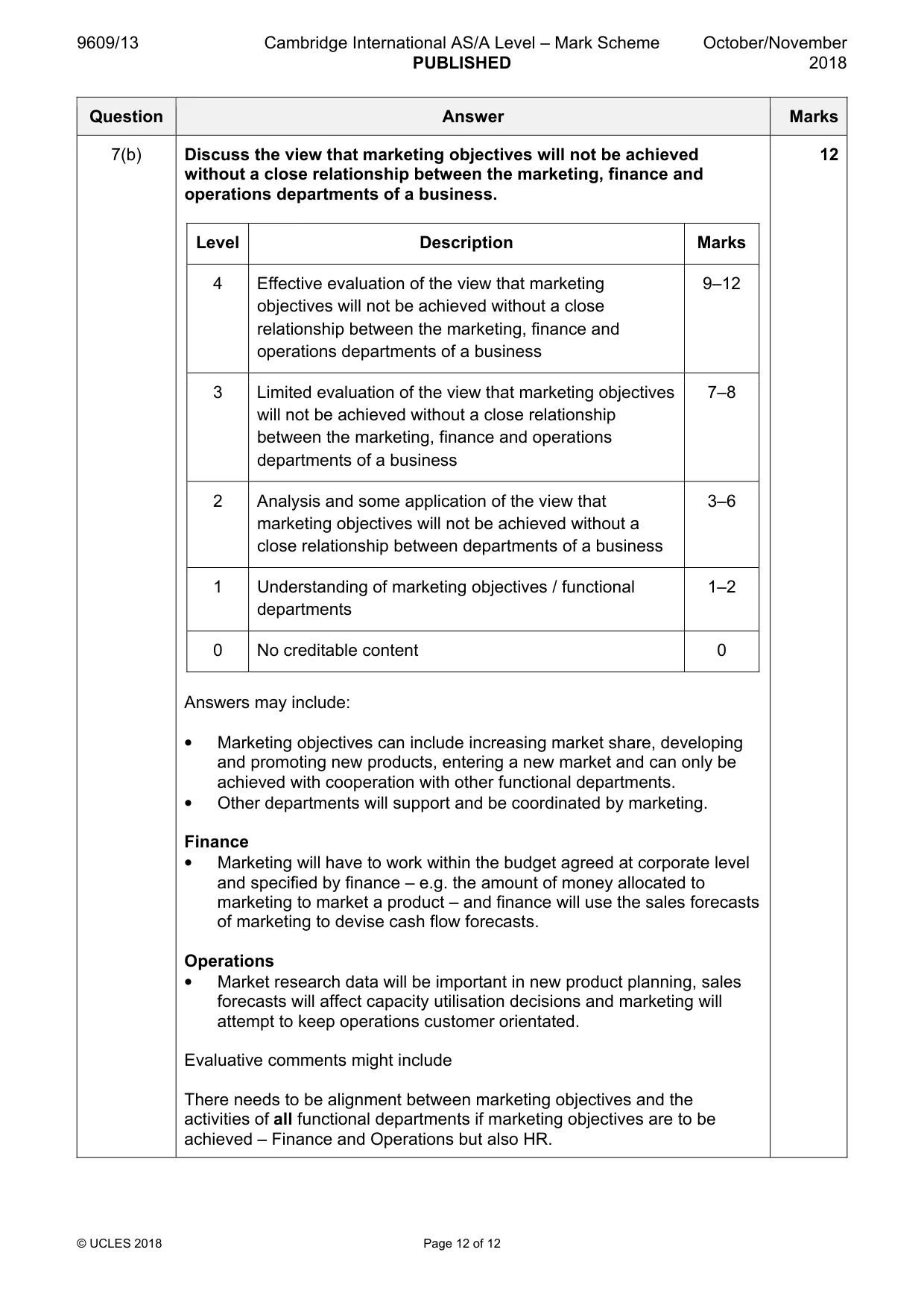
9609/13 Cambridge International AS/A Level – Mark Scheme PUBLISHED October/November 2018 © UCLES 2018 Page 12 of 12 Question Answer Marks 7(b) Discuss the view that marketing objectives will not be achieved without a close relationship between the marketing, finance and operations departments of a business. Level Description Marks 4 Effective evaluation of the view that marketing objectives will not be achieved without a close relationship between the marketing, finance and operations departments of a business 9–12 3 Limited evaluation of the view that marketing objectives will not be achieved without a close relationship between the marketing, finance and operations departments of a business 7–8 2 Analysis and some application of the view that marketing objectives will not be achieved without a close relationship between departments of a business 3–6 1 Understanding of marketing objectives / functional departments 1–2 0 No creditable content 0 Answers may include: • Marketing objectives can include increasing market share, developing and promoting new products, entering a new market and can only be achieved with cooperation with other functional departments. • Other departments will support and be coordinated by marketing. Finance • Marketing will have to work within the budget agreed at corporate level and specified by finance – e.g. the amount of money allocated to marketing to market a product – and finance will use the sales forecasts of marketing to devise cash flow forecasts. Operations • Market research data will be important in new product planning, sales forecasts will affect capacity utilisation decisions and marketing will attempt to keep operations customer orientated. Evaluative comments might include There needs to be alignment between marketing objectives and the activities of all functional departments if marketing objectives are to be achieved – Finance and Operations but also HR. 12
What you needed in this session
Cambridge’s own grade thresholds for 2018 Oct/Nov, Paper 1 · Variant 3. A higher threshold means an easier paper — the bar moves with how the cohort did.