Cambridge A Level Business (for first examination in 2016) 9609 — 2018 May/June Paper 2 · Variant 1
9609/21/M/J/18 · 2 questions · 60 marks · ≈68 min
The question paper and its mark scheme, free to read here and free to download. This is Cambridge’s own paper, exactly as it was sat.
Question paper4 pages
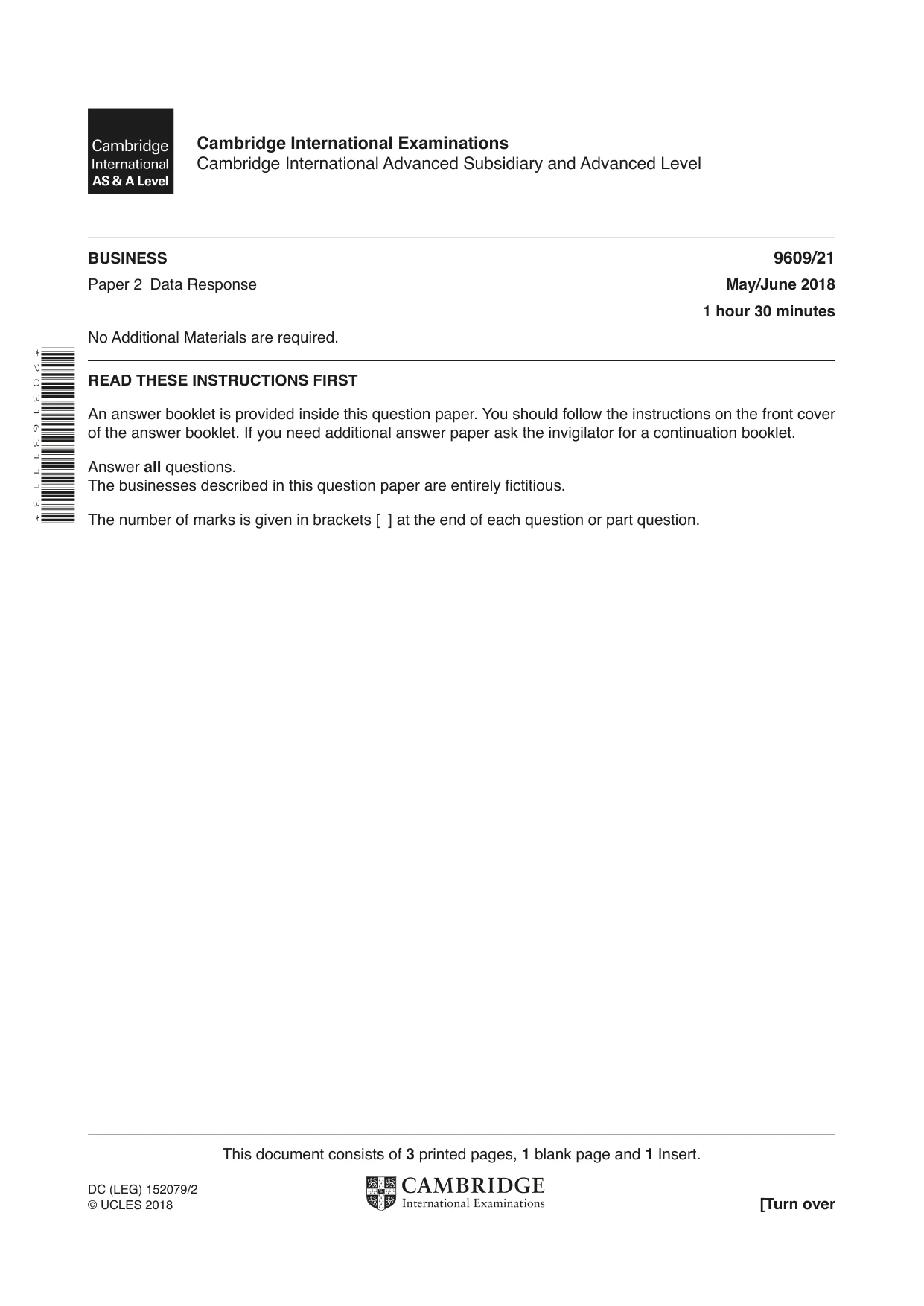
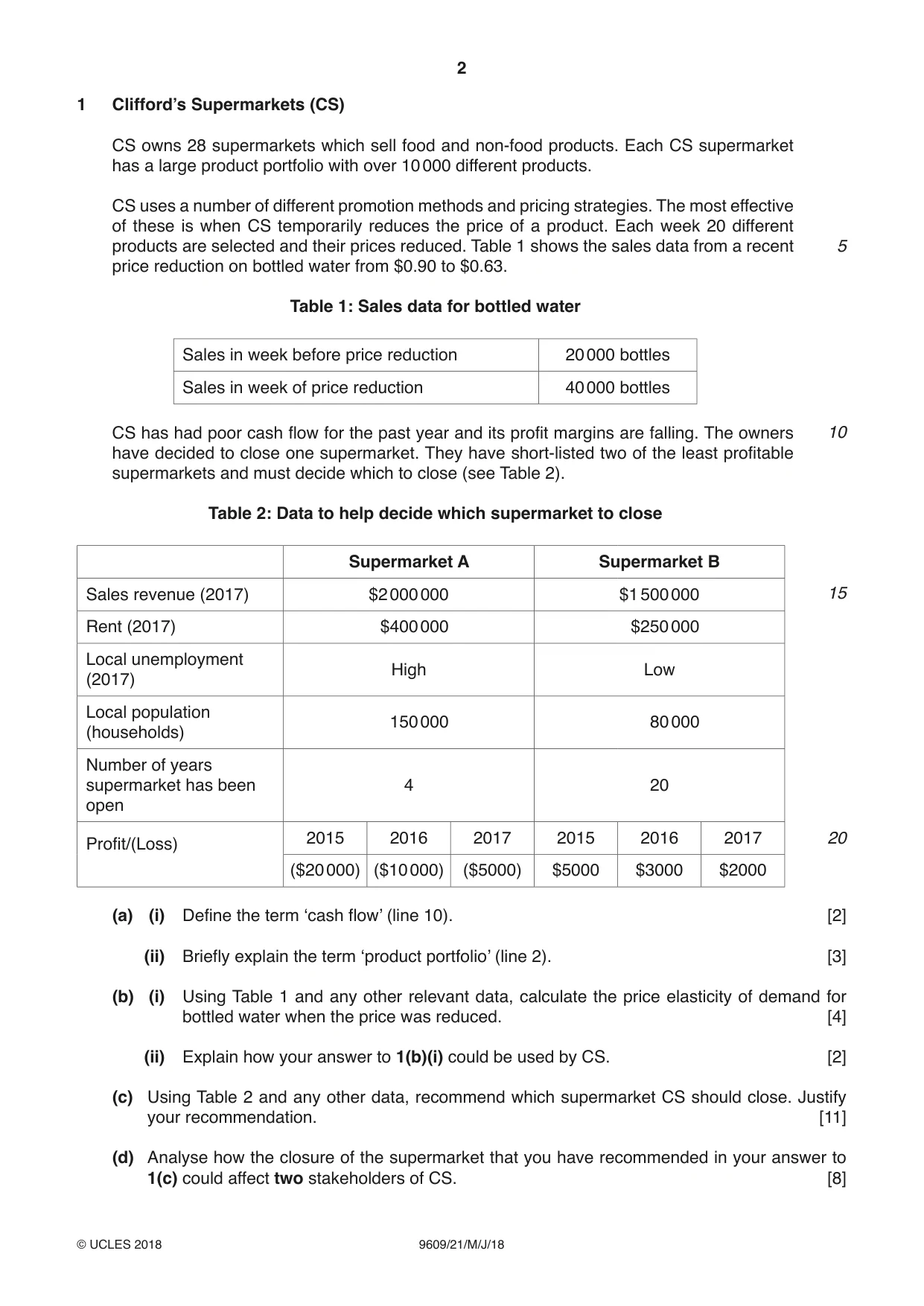
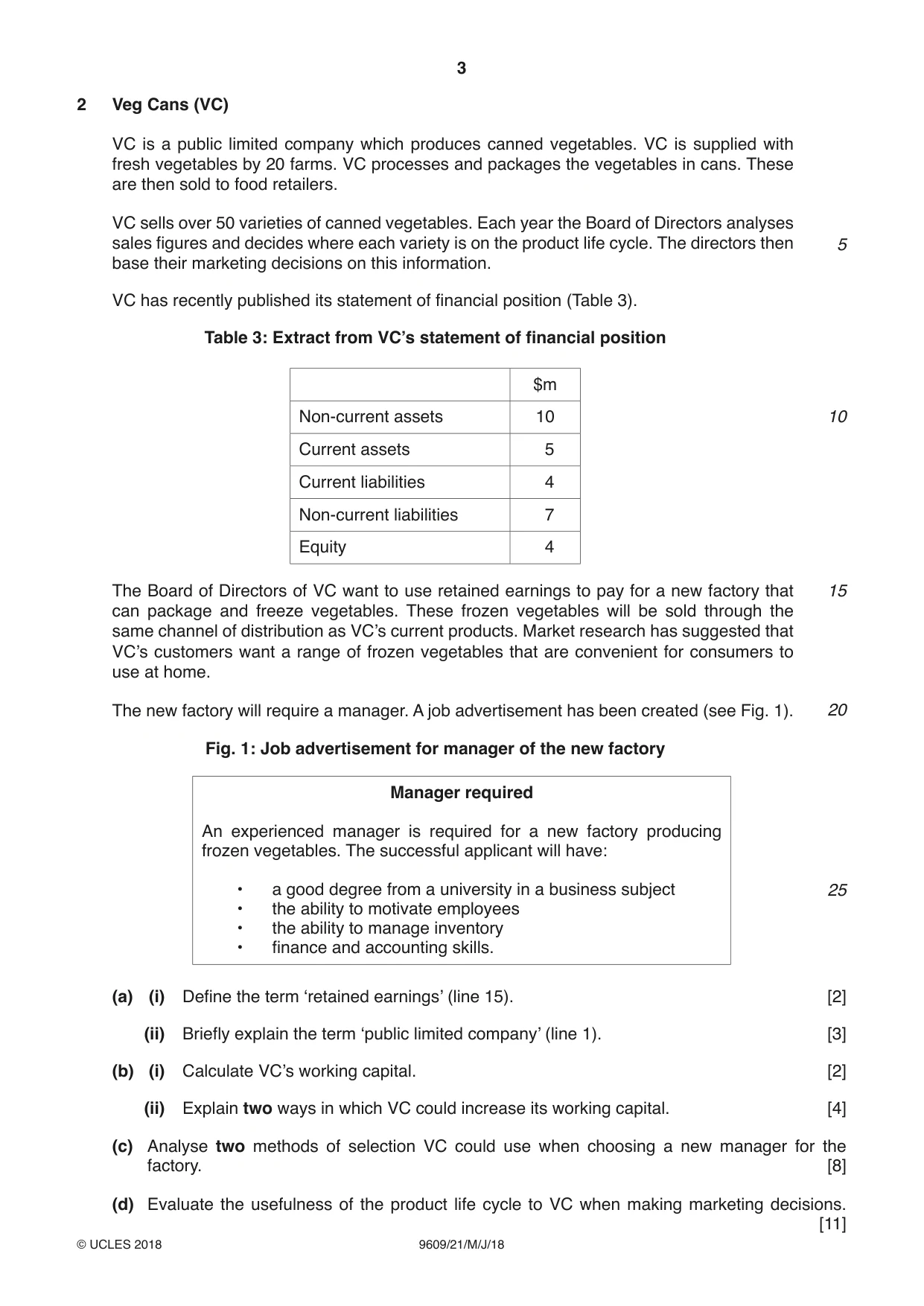

Mark scheme17 pages
Answers below. Sit the paper first if you are practising.
Questions as text
Q1 · Clifford’s Supermarkets (CS) CS owns 28 supermarkets which sell food and non-food products
1 Clifford’s Supermarkets (CS) CS owns 28 supermarkets which sell food and non-food products. Each CS supermarket has a large product portfolio with over 10 000 different products. CS uses a number of different promotion methods and pricing strategies. The most effective of these is when CS temporarily reduces the price of a product. Each week 20 different products are selected and their prices reduced. Table 1 shows the sales data from a recent 5 price reduction on bottled water from $0.90 to $0.63. Table 1: Sales data for bottled water Sales in week before price reduction 20 000 bottles Sales in week of price reduction 40 000 bottles CS has had poor cash flow for the past year and its profit margins are falling. The owners 10 have decided to close one supermarket. They have short-listed two of the least profitable supermarkets and must decide which to close (see Table 2). Table 2: Data to help decide which supermarket to close Supermarket A Supermarket B Sales revenue (2017) $2 000 000 $1 500 000 15 Rent (2017) $400 000 $250 000 Local unemployment High Low (2017) Local population 150 000 80 000 (households) Number of years supermarket has been 4 20 open 2015 2016 2017 2015 2016 2017 20 Profit/(Loss) ($20 000) ($10 000) ($5000) $5000 $3000 $2000 (a) (i) Define the term ‘cash flow’ (line 10). [2] (ii) Briefly explain the term ‘product portfolio’ (line 2). [3] (b) (i) Using Table 1 and any other relevant data, calculate the price elasticity of demand for bottled water when the price was reduced. [4] (ii) Explain how your answer to 1(b)(i) could be used by CS. [2] (c) Using Table 2 and any other data, recommend which supermarket CS should close. Justify your recommendation. [11] (d) Analyse how the closure of the supermarket that you have recommended in your answer to 1(c) could affect two stakeholders of CS. [8]
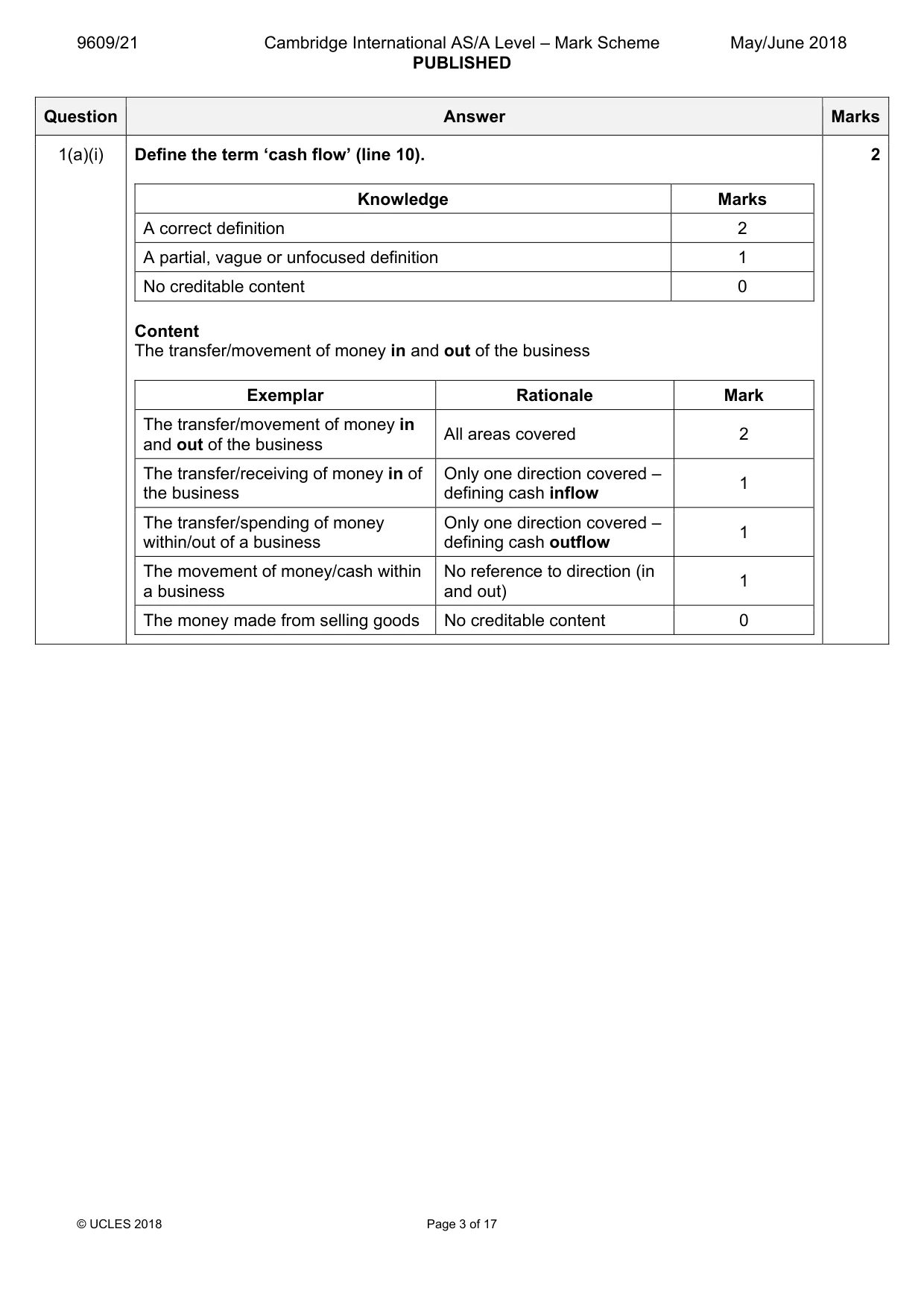
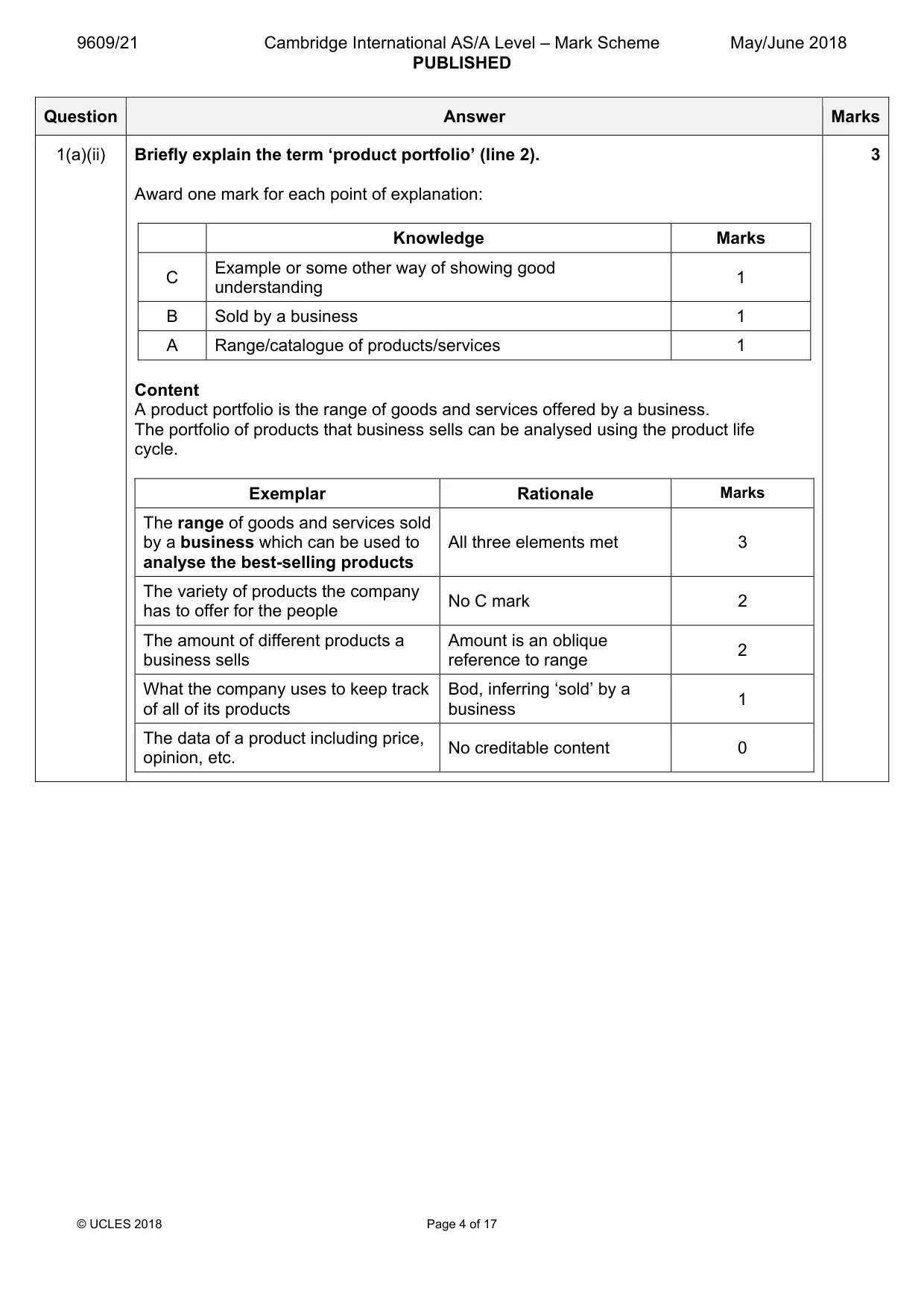
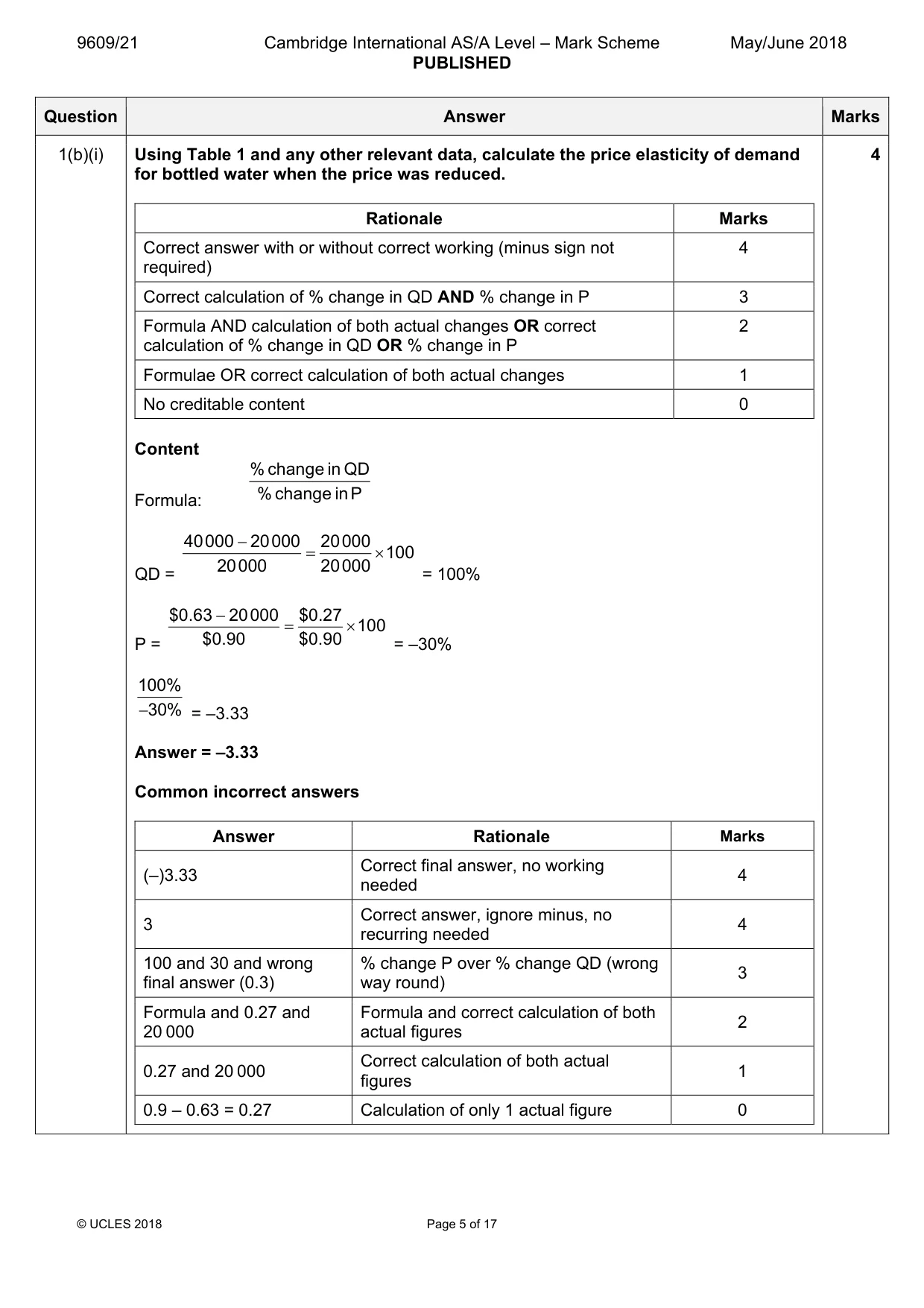
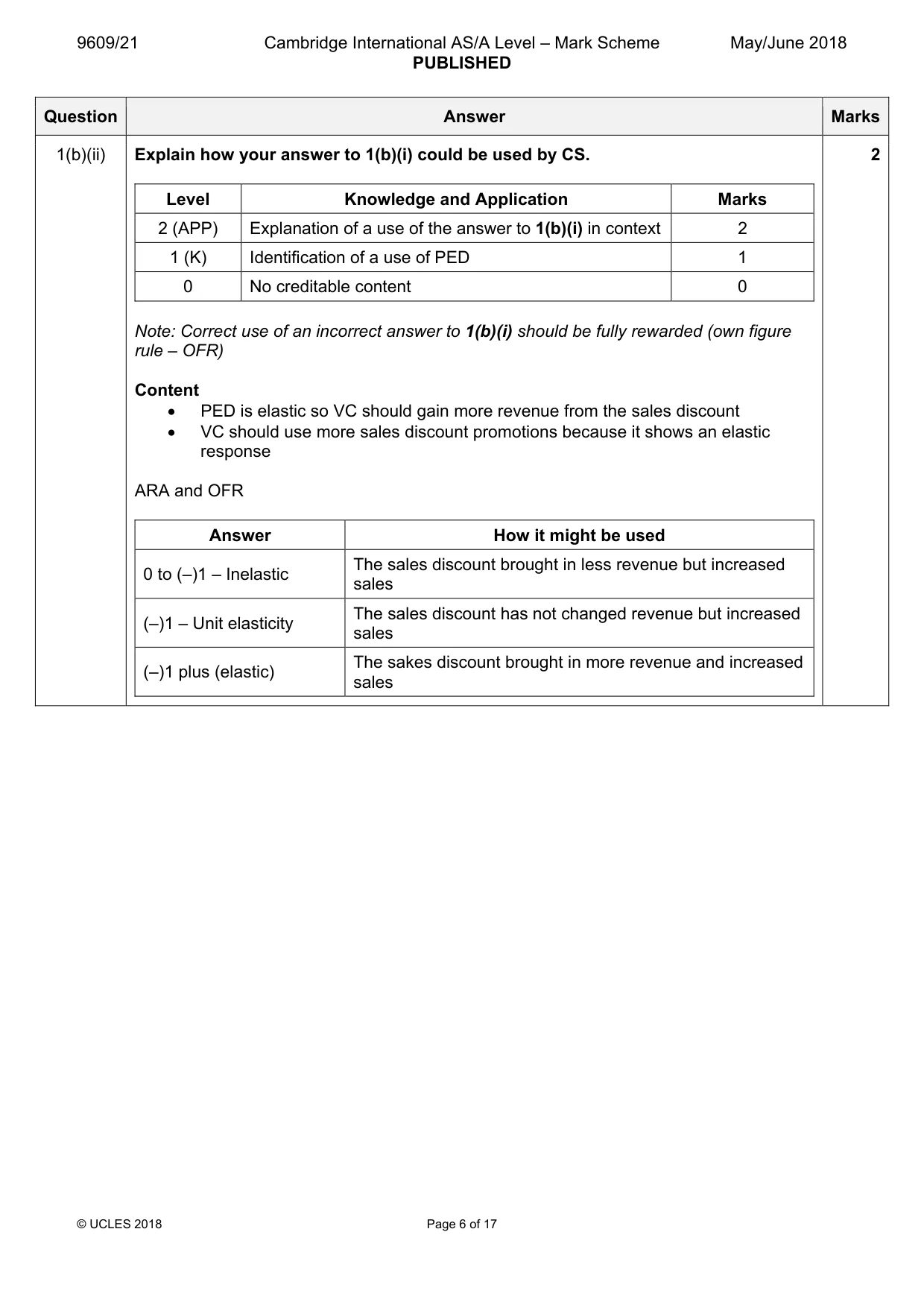
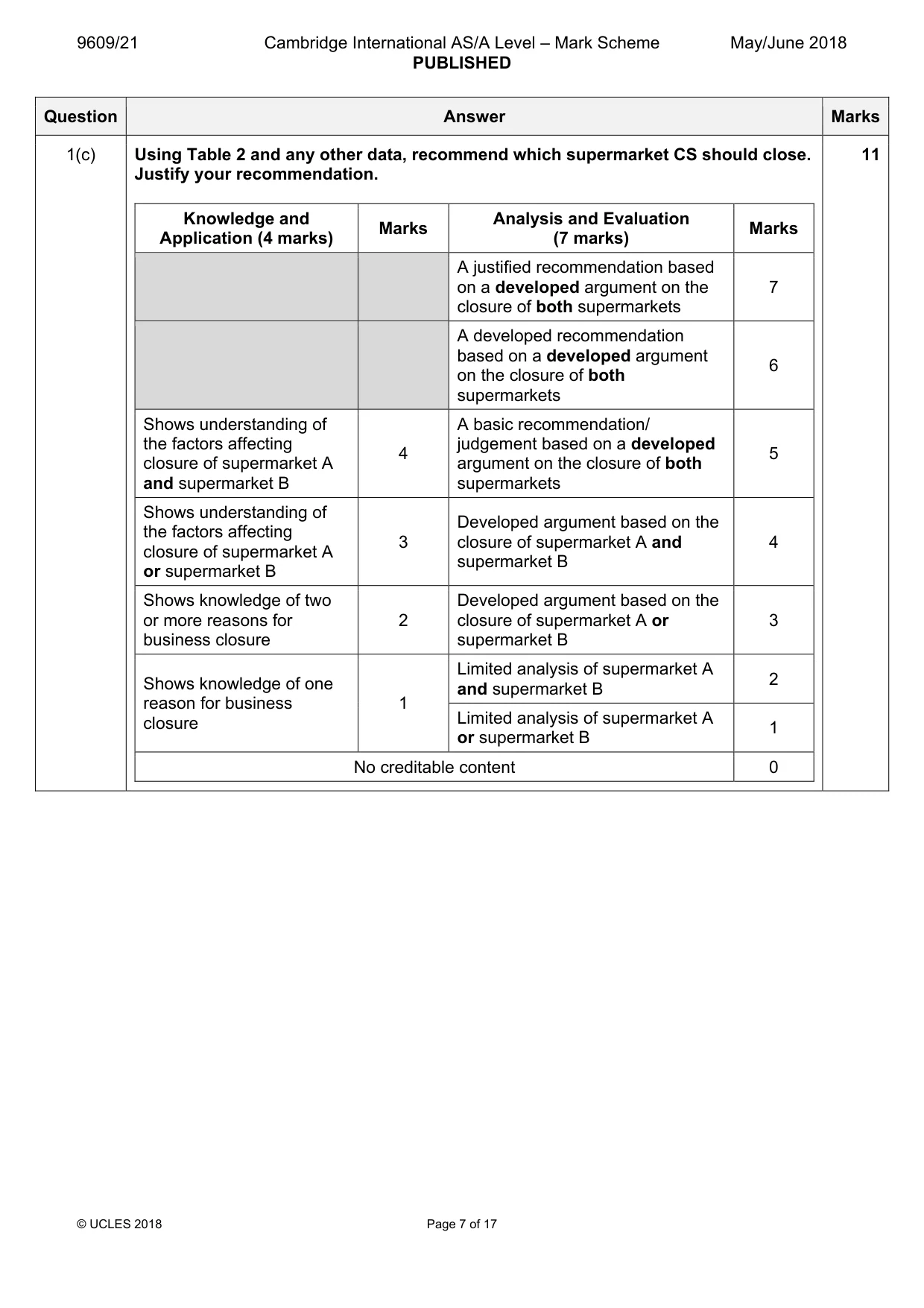
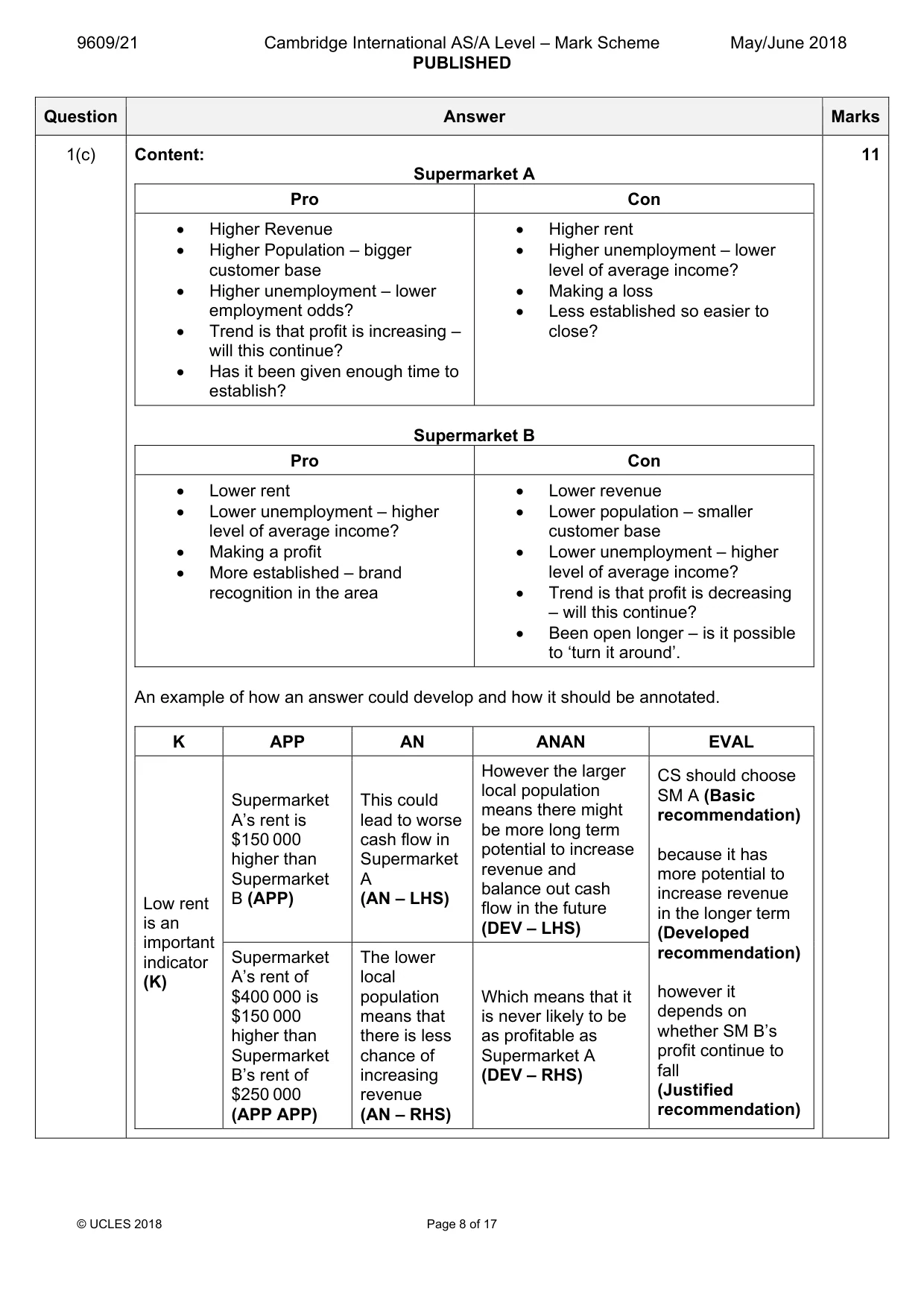
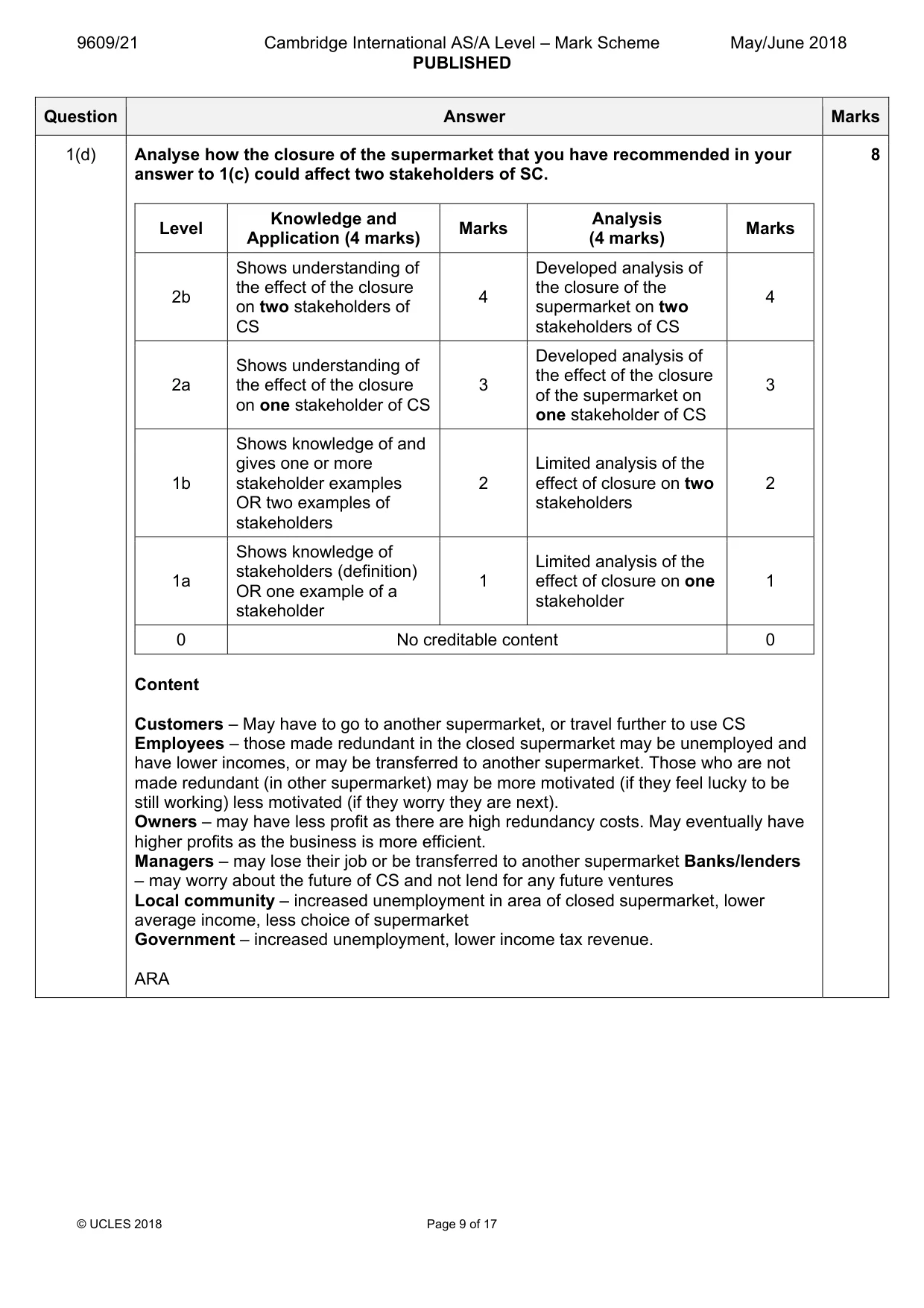
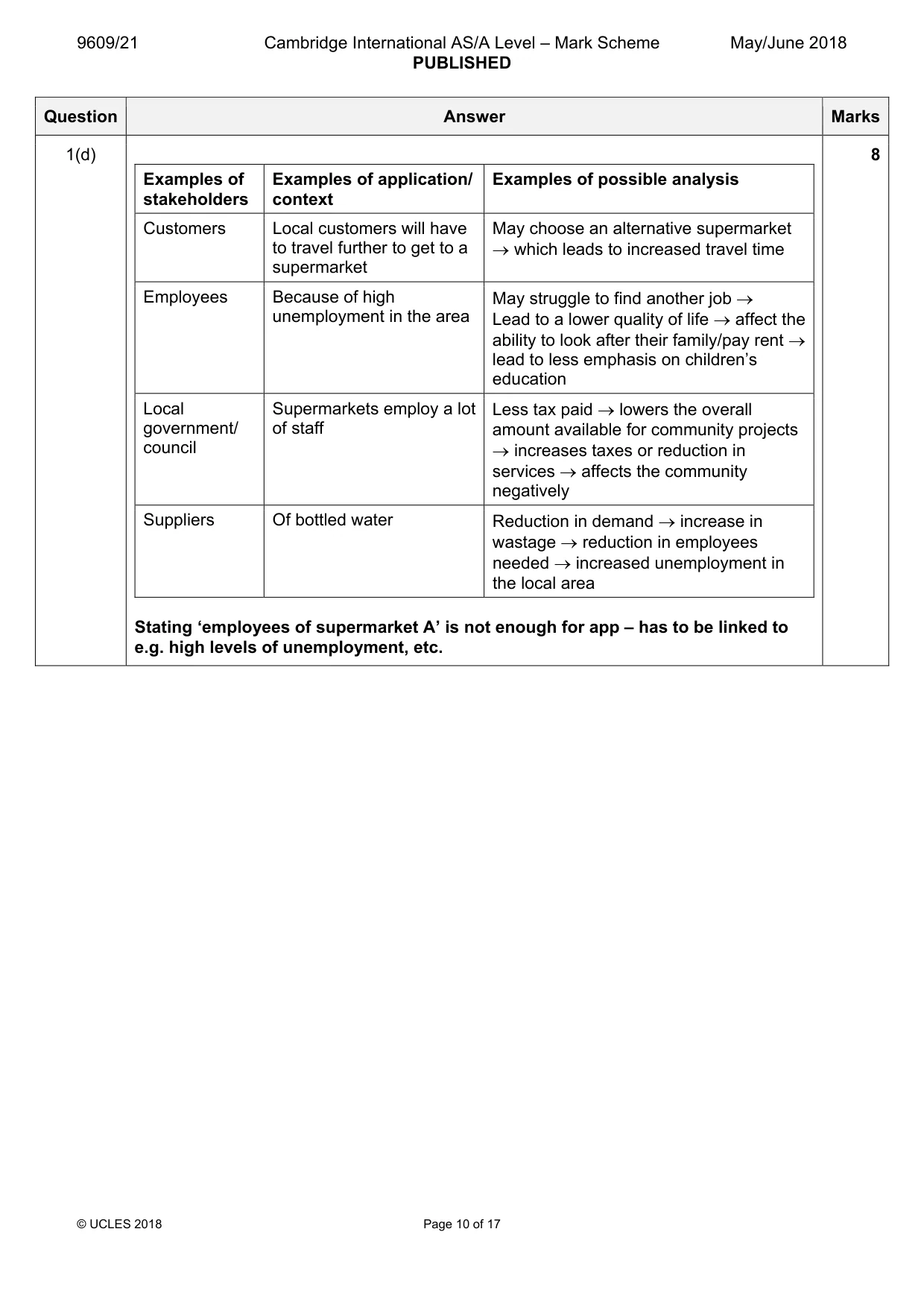
Mark scheme: Question Answer Marks 1(a)(i) Define the term ‘cash flow’ (line 10). 2 Knowledge Marks A correct definition 2 A partial, vague or unfocused definition 1 No creditable content 0 Content The transfer/movement of money in and out of the business Exemplar Rationale Mark The transfer/movement of money in All areas covered 2 and out of the business The transfer/receiving of money in of Only one direction covered – 1 the business defining cash inflow The transfer/spending of money Only one direction covered – 1 within/out of a business defining cash outflow The movement of money/cash within No reference to direction (in 1 a business and out) The money made from selling goods No creditable content 0 1(a)(ii) Briefly explain the term ‘product portfolio’ (line 2). 3 Award one mark for each point of explanation: Knowledge Marks Example or some other way of showing good C 1 understanding B Sold by a business 1 A Range/catalogue of products/services 1 Content A product portfolio is the range of goods and services offered by a business. The portfolio of products that business sells can be analysed using the product life cycle. Exemplar Rationale Marks The range of goods and services sold by a business which can be used to All three elements met 3 analyse the best-selling products The variety of products the company No C mark 2 has to offer for the people The amount of different products a Amount is an oblique 2 business sells reference to range What the company uses to keep track Bod, inferring ‘sold’ by a 1 of all of its products business The data of a product including price, No creditable content 0 opinion, etc. 1(b)(i) Using Table 1 and any other relevant data, calculate the price elasticity of demand 4 for bottled water when the price was reduced. Rationale Marks Correct answer with or without correct working (minus sign not 4 required) Correct calculation of % change in QD AND % change in P 3 Formula AND calculation of both actual changes OR correct 2 calculation of % change in QD OR % change in P Formulae OR correct calculation of both actual changes 1 No creditable content 0 Content % changeinQD Formula: % changeinP 40000 − 20000 20000 = × 100 20000 20000 QD = = 100% $0.63 − 20000 $0.27 = × 100 $0.90 $0.90 P = = –30% 100% −30% = –3.33 Answer = –3.33 Common incorrect answers Answer Rationale Marks Correct final answer, no working (–)3.33 4 needed Correct answer, ignore minus, no 3 4 recurring needed 100 and 30 and wrong % change P over % change QD (wrong 3 final answer (0.3) way round) Formula and 0.27 and Formula and correct calculation of both 2 20 000 actual figures Correct calculation of both actual 0.27 and 20 000 1 figures 0.9 – 0.63 = 0.27 Calculation of only 1 actual figure 0 1(b)(ii) Explain how your answer to 1(b)(i) could be used by CS. 2 Level Knowledge and Application Marks 2 (APP) Explanation of a use of the answer to 1(b)(i) in context 2 1 (K) Identification of a use of PED 1 0 No creditable content 0 Note: Correct use of an incorrect answer to 1(b)(i) should be fully rewarded (own figure rule – OFR) Content • PED is elastic so VC should gain more revenue from the sales discount • VC should use more sales discount promotions because it shows an elastic response ARA and OFR Answer How it might be used The sales discount brought in less revenue but increased 0 to (–)1 – Inelastic sales The sales discount has not changed revenue but increased (–)1 – Unit elasticity sales The sakes discount brought in more revenue and increased (–)1 plus (elastic) sales 1(c) Using Table 2 and any other data, recommend which supermarket CS should close. 11 Justify your recommendation. Knowledge and Analysis and Evaluation Marks Marks Application (4 marks) (7 marks) A justified recommendation based on a developed argument on the 7 closure of both supermarkets A developed recommendation based on a developed argument 6 on the closure of both supermarkets Shows understanding of A basic recommendation/ the factors affecting judgement based on a developed 4 5 closure of supermarket A argument on the closure of both and supermarket B supermarkets Shows understanding of Developed argument based on the the factors affecting 3 closure of supermarket A and 4 closure of supermarket A supermarket B or supermarket B Shows knowledge of two Developed argument based on the or more reasons for 2 closure of supermarket A or 3 business closure supermarket B Limited analysis of supermarket A 2 Shows knowledge of one and supermarket B reason for business 1 Limited analysis of supermarket A closure 1 or supermarket B No creditable content 0 1(c) Content: 11 Supermarket A Pro Con • Higher Revenue • Higher rent • Higher Population – bigger • Higher unemployment – lower customer base level of average income? • Higher unemployment – lower • Making a loss employment odds? • Less established so easier to • Trend is that profit is increasing – close? will this continue? • Has it been given enough time to establish? Supermarket B Pro Con • Lower rent • Lower revenue • Lower unemployment – higher • Lower population – smaller level of average income? customer base • Making a profit • Lower unemployment – higher • More established – brand level of average income? recognition in the area • Trend is that profit is decreasing – will this continue? • Been open longer – is it possible to ‘turn it around’. An example of how an answer could develop and how it should be annotated. K APP AN ANAN EVAL However the larger CS should choose local population SM A (Basic Supermarket This could means there might recommendation) A’s rent is lead to worse be more long term $150 000 cash flow in potential to increase because it has higher than Supermarket revenue and more potential to Supermarket A balance out cash increase revenue B (APP) (AN – LHS) Low rent flow in the future in the longer term is an (DEV – LHS) (Developed important recommendation) Supermarket The lower indicator A’s rent of local (K) however it $400 000 is population Which means that it depends on $150 000 means that is never likely to be whether SM B’s higher than there is less as profitable as profit continue to Supermarket chance of Supermarket A fall B’s rent of increasing (DEV – RHS) (Justified $250 000 revenue recommendation) (APP APP) (AN – RHS) 1(d) Analyse how the closure of the supermarket that you have recommended in your 8 answer to 1(c) could affect two stakeholders of SC. Knowledge and Analysis Level Marks Marks Application (4 marks) (4 marks) Shows understanding of Developed analysis of the effect of the closure the closure of the 2b 4 4 on two stakeholders of supermarket on two CS stakeholders of CS Developed analysis of Shows understanding of the effect of the closure 2a the effect of the closure 3 3 of the supermarket on on one stakeholder of CS one stakeholder of CS Shows knowledge of and gives one or more Limited analysis of the 1b stakeholder examples 2 effect of closure on two 2 OR two examples of stakeholders stakeholders Shows knowledge of Limited analysis of the stakeholders (definition) 1a 1 effect of closure on one 1 OR one example of a stakeholder stakeholder 0 No creditable content 0 Content Customers – May have to go to another supermarket, or travel further to use CS Employees – those made redundant in the closed supermarket may be unemployed and have lower incomes, or may be transferred to another supermarket. Those who are not made redundant (in other supermarket) may be more motivated (if they feel lucky to be still working) less motivated (if they worry they are next). Owners – may have less profit as there are high redundancy costs. May eventually have higher profits as the business is more efficient. Managers – may lose their job or be transferred to another supermarket Banks/lenders – may worry about the future of CS and not lend for any future ventures Local community – increased unemployment in area of closed supermarket, lower average income, less choice of supermarket Government – increased unemployment, lower income tax revenue. ARA 1(d) 8 Examples of Examples of application/ Examples of possible analysis stakeholders context Customers Local customers will have May choose an alternative supermarket to travel further to get to a → which leads to increased travel time supermarket Employees Because of high May struggle to find another job → unemployment in the area Lead to a lower quality of life → affect the ability to look after their family/pay rent → lead to less emphasis on children’s education Local Supermarkets employ a lot Less tax paid → lowers the overall government/ of staff amount available for community projects council → increases taxes or reduction in services → affects the community negatively Suppliers Of bottled water Reduction in demand → increase in wastage → reduction in employees needed → increased unemployment in the local area Stating ‘employees of supermarket A’ is not enough for app – has to be linked to e.g. high levels of unemployment, etc.
Q2 · Veg Cans (VC) VC is a public limited company which produces canned vegetables
2 Veg Cans (VC) VC is a public limited company which produces canned vegetables. VC is supplied with fresh vegetables by 20 farms. VC processes and packages the vegetables in cans. These are then sold to food retailers. VC sells over 50 varieties of canned vegetables. Each year the Board of Directors analyses sales figures and decides where each variety is on the product life cycle. The directors then 5 base their marketing decisions on this information. VC has recently published its statement of financial position (Table 3). Table 3: Extract from VC’s statement of financial position $m Non-current assets 10 10 Current assets 5 Current liabilities 4 Non-current liabilities 7 Equity 4 The Board of Directors of VC want to use retained earnings to pay for a new factory that 15 can package and freeze vegetables. These frozen vegetables will be sold through the same channel of distribution as VC’s current products. Market research has suggested that VC’s customers want a range of frozen vegetables that are convenient for consumers to use at home. The new factory will require a manager. A job advertisement has been created (see Fig. 1). 20 Fig. 1: Job advertisement for manager of the new factory Manager required An experienced manager is required for a new factory producing frozen vegetables. The successful applicant will have: • a good degree from a university in a business subject 25 • the ability to motivate employees • the ability to manage inventory • finance and accounting skills. (a) (i) Define the term ‘retained earnings’ (line 15). [2] (ii) Briefly explain the term ‘public limited company’ (line 1). [3] (b) (i) Calculate VC’s working capital. [2] (ii) Explain two ways in which VC could increase its working capital. [4] (c) Analyse two methods of selection VC could use when choosing a new manager for the factory. [8] (d) Evaluate the usefulness of the product life cycle to VC when making marketing decisions.
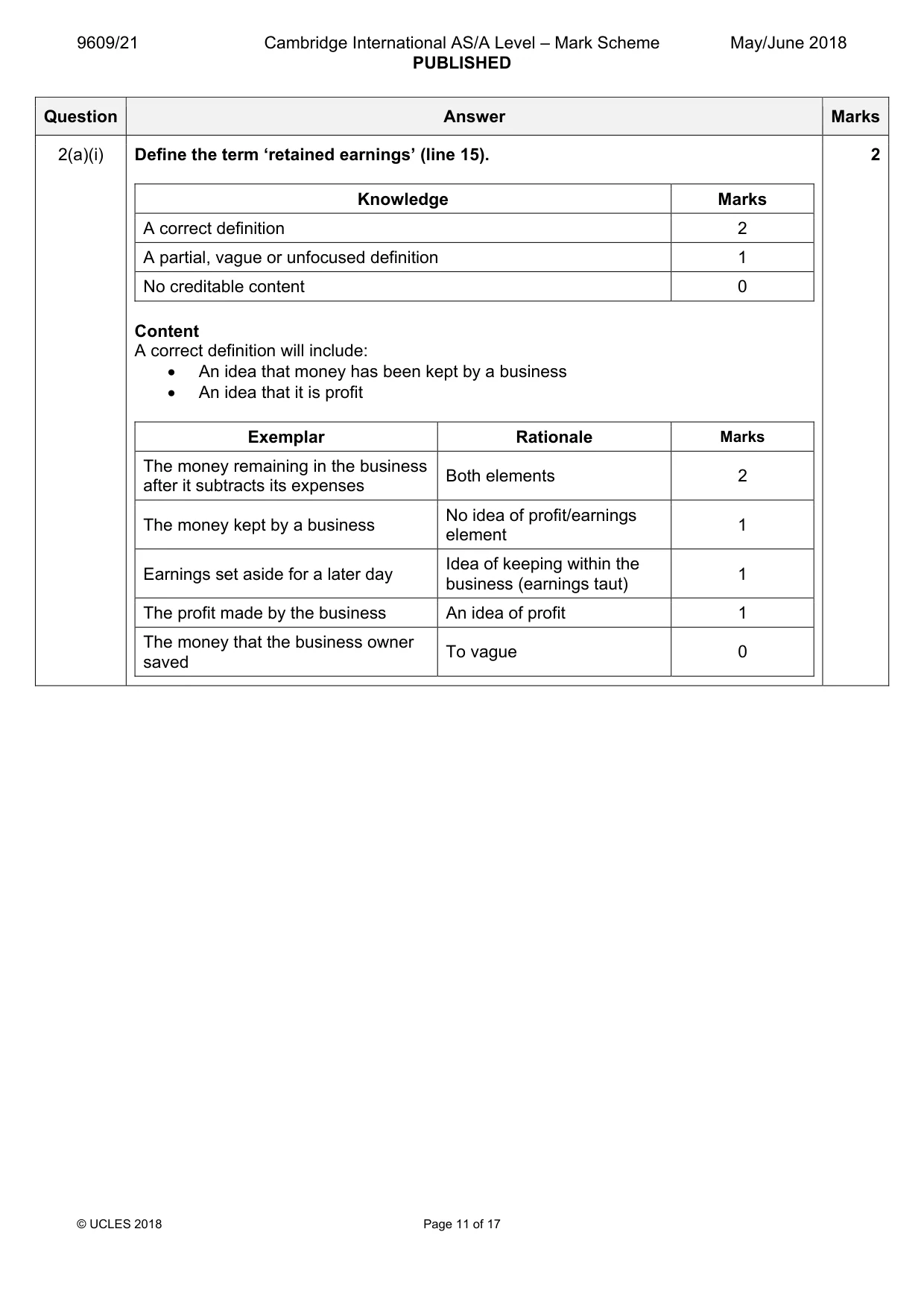
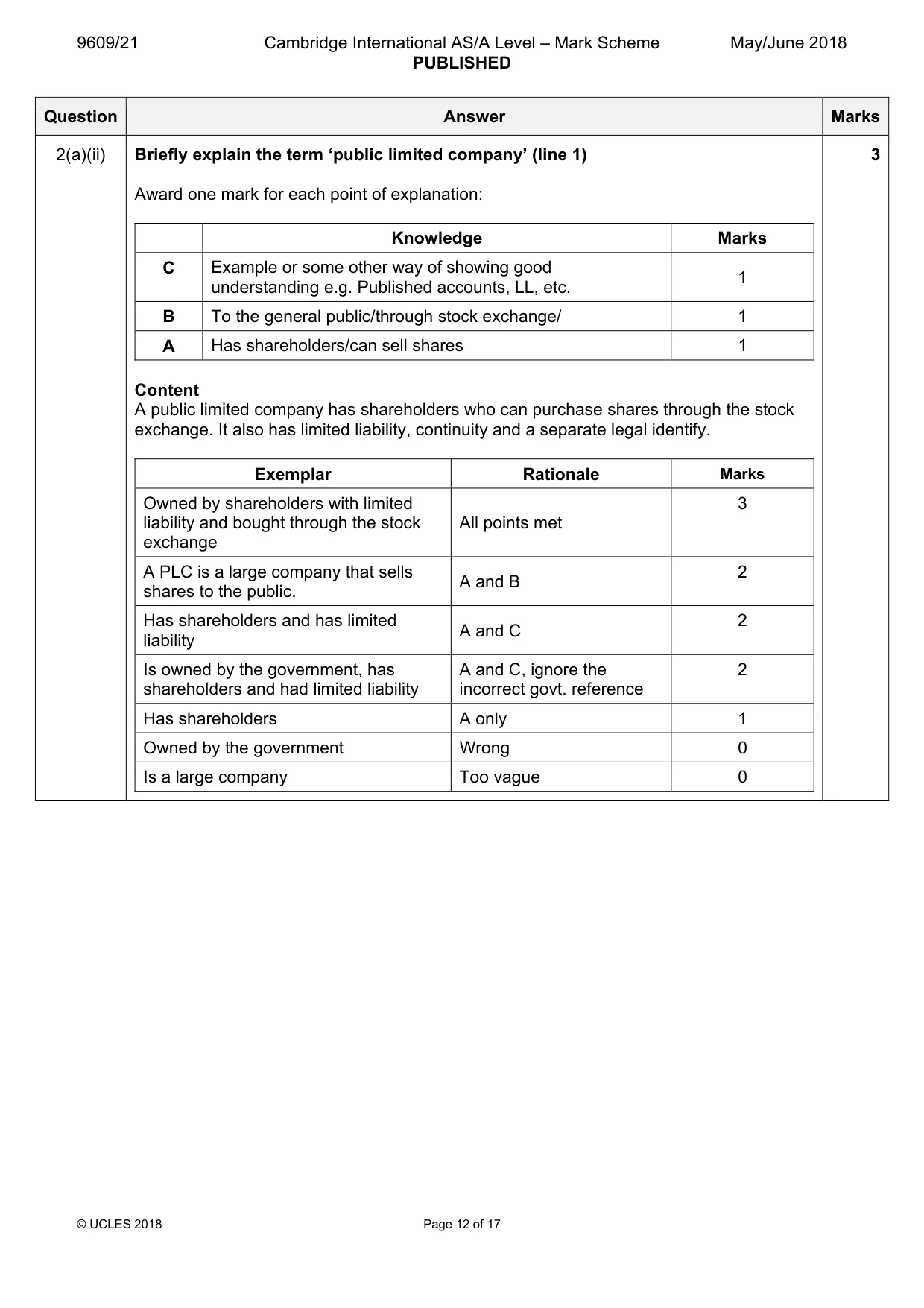
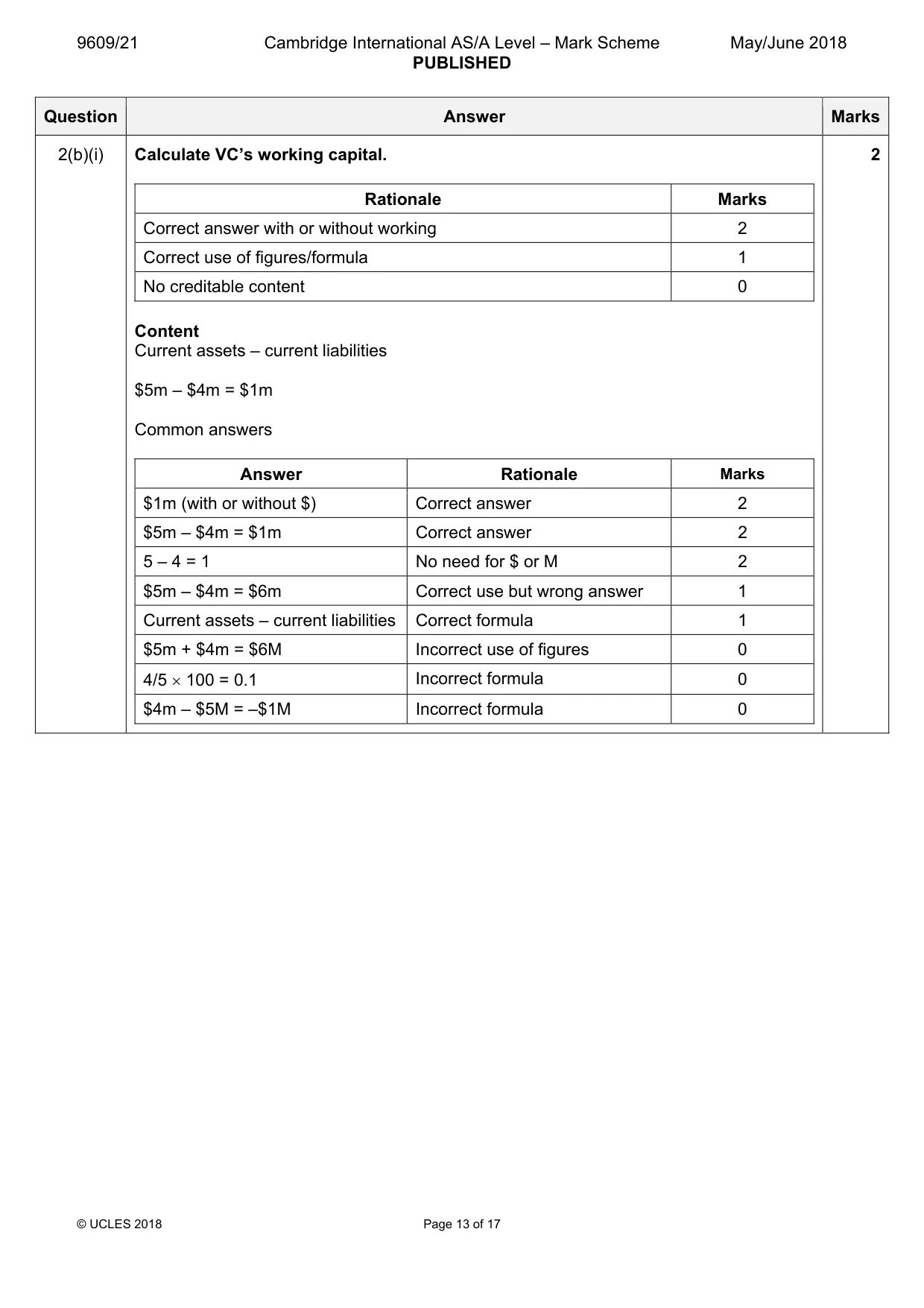
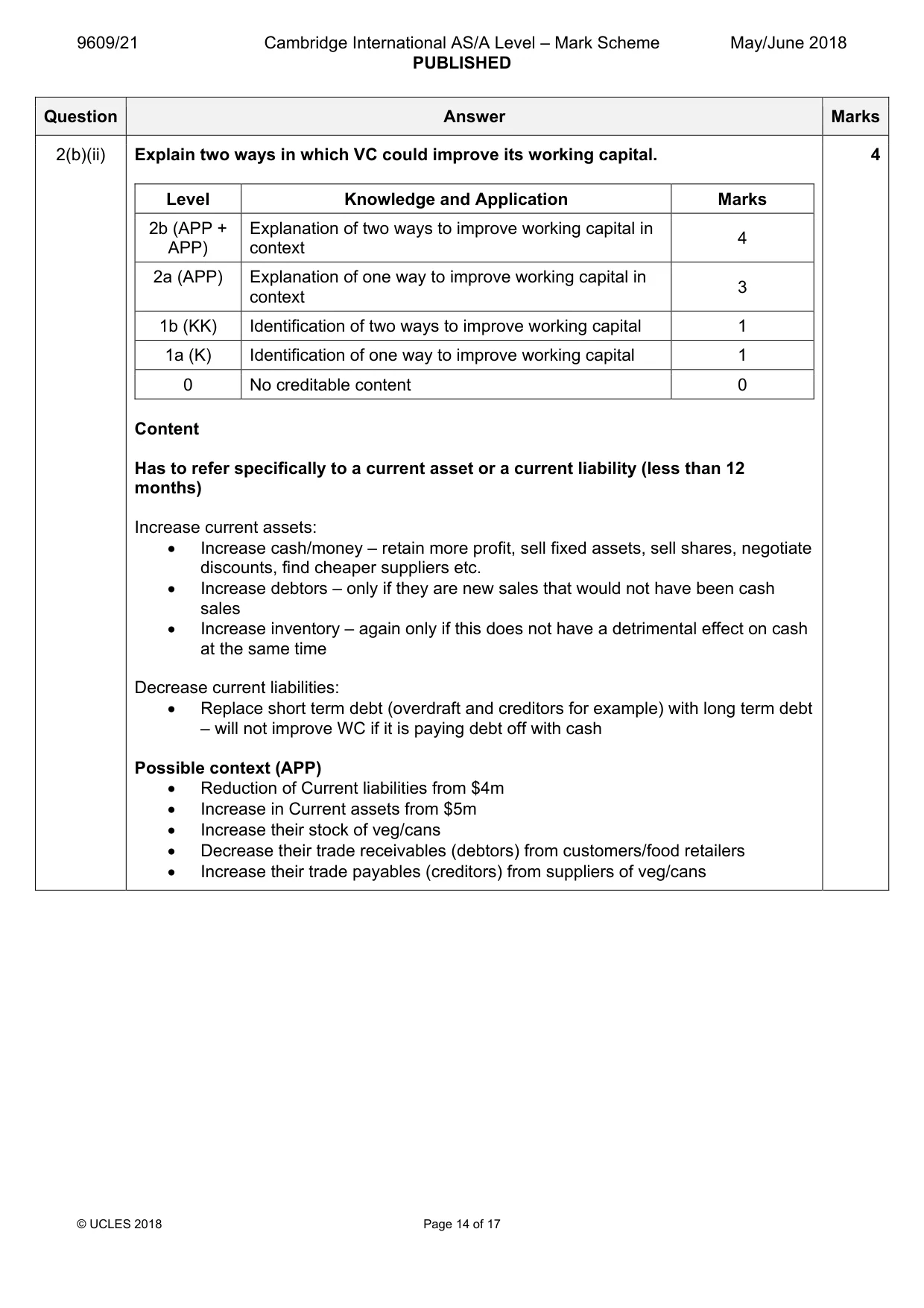
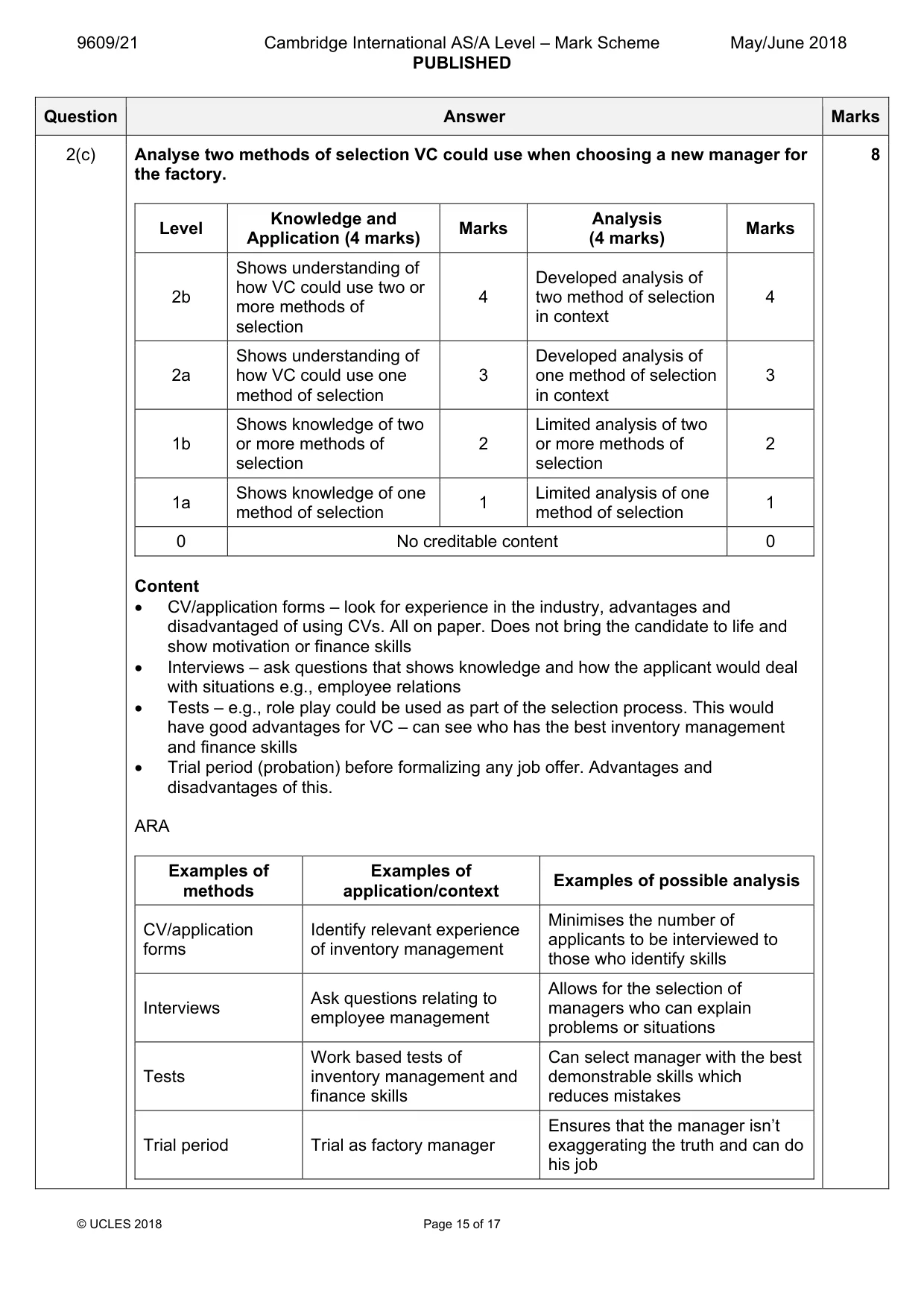
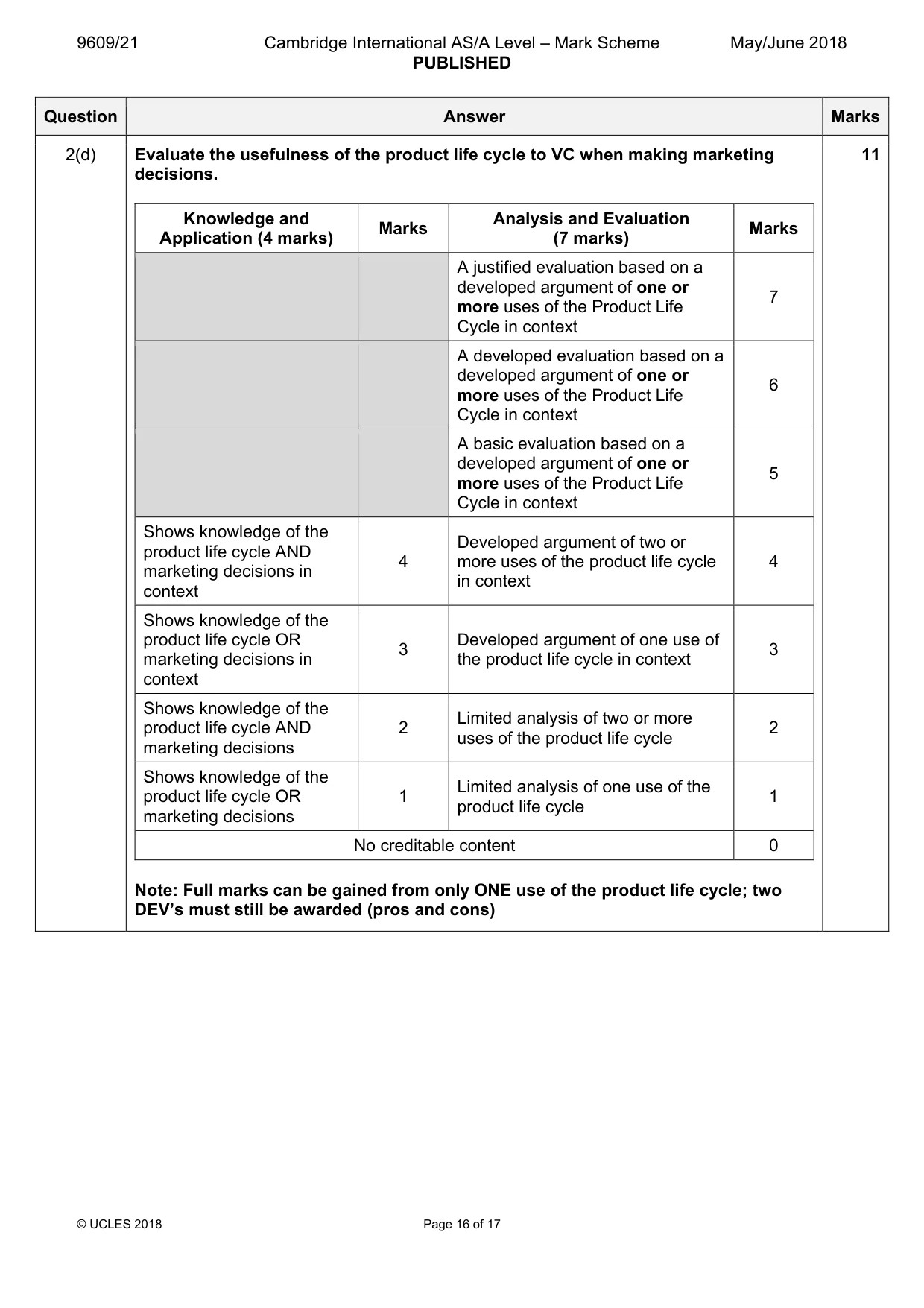
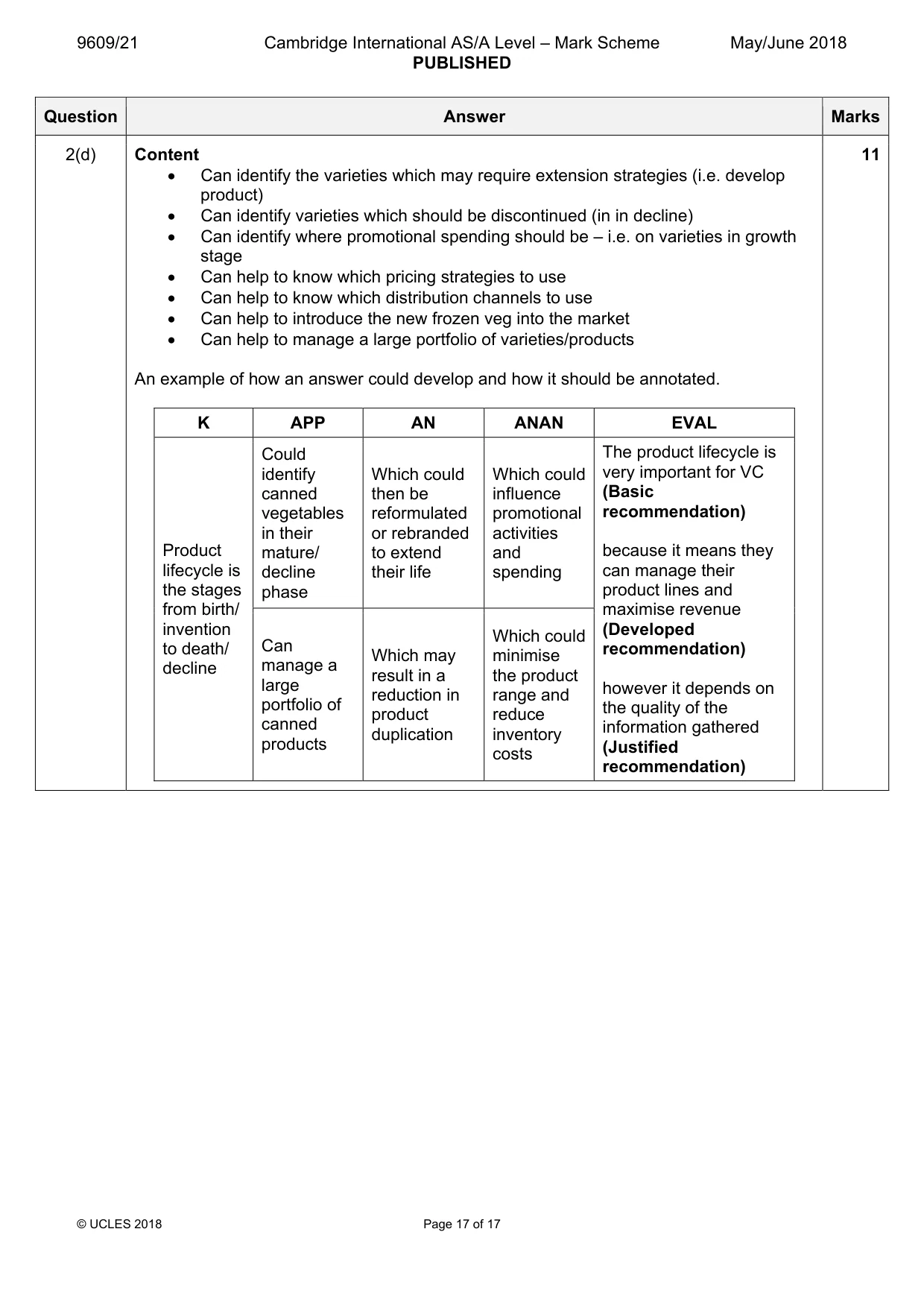
Mark scheme: 2(a)(i) Define the term ‘retained earnings’ (line 15). 2 Knowledge Marks A correct definition 2 A partial, vague or unfocused definition 1 No creditable content 0 Content A correct definition will include: • An idea that money has been kept by a business • An idea that it is profit Exemplar Rationale Marks The money remaining in the business Both elements 2 after it subtracts its expenses No idea of profit/earnings The money kept by a business 1 element Idea of keeping within the Earnings set aside for a later day 1 business (earnings taut) The profit made by the business An idea of profit 1 The money that the business owner To vague 0 saved 2(a)(ii) Briefly explain the term ‘public limited company’ (line 1) 3 Award one mark for each point of explanation: Knowledge Marks C Example or some other way of showing good 1 understanding e.g. Published accounts, LL, etc. B To the general public/through stock exchange/ 1 A Has shareholders/can sell shares 1 Content A public limited company has shareholders who can purchase shares through the stock exchange. It also has limited liability, continuity and a separate legal identify. Exemplar Rationale Marks Owned by shareholders with limited 3 liability and bought through the stock All points met exchange A PLC is a large company that sells 2 A and B shares to the public. Has shareholders and has limited 2 A and C liability Is owned by the government, has A and C, ignore the 2 shareholders and had limited liability incorrect govt. reference Has shareholders A only 1 Owned by the government Wrong 0 Is a large company Too vague 0 2(b)(i) Calculate VC’s working capital. 2 Rationale Marks Correct answer with or without working 2 Correct use of figures/formula 1 No creditable content 0 Content Current assets – current liabilities $5m – $4m = $1m Common answers Answer Rationale Marks $1m (with or without $) Correct answer 2 $5m – $4m = $1m Correct answer 2 5 – 4 = 1 No need for $ or M 2 $5m – $4m = $6m Correct use but wrong answer 1 Current assets – current liabilities Correct formula 1 $5m + $4m = $6M Incorrect use of figures 0 4/5 × 100 = 0.1 Incorrect formula 0 $4m – $5M = –$1M Incorrect formula 0 2(b)(ii) Explain two ways in which VC could improve its working capital. 4 Level Knowledge and Application Marks 2b (APP + Explanation of two ways to improve working capital in 4 APP) context 2a (APP) Explanation of one way to improve working capital in 3 context 1b (KK) Identification of two ways to improve working capital 1 1a (K) Identification of one way to improve working capital 1 0 No creditable content 0 Content Has to refer specifically to a current asset or a current liability (less than 12 months) Increase current assets: • Increase cash/money – retain more profit, sell fixed assets, sell shares, negotiate discounts, find cheaper suppliers etc. • Increase debtors – only if they are new sales that would not have been cash sales • Increase inventory – again only if this does not have a detrimental effect on cash at the same time Decrease current liabilities: • Replace short term debt (overdraft and creditors for example) with long term debt – will not improve WC if it is paying debt off with cash Possible context (APP) • Reduction of Current liabilities from $4m • Increase in Current assets from $5m • Increase their stock of veg/cans • Decrease their trade receivables (debtors) from customers/food retailers • Increase their trade payables (creditors) from suppliers of veg/cans 2(c) Analyse two methods of selection VC could use when choosing a new manager for 8 the factory. Knowledge and Analysis Level Marks Marks Application (4 marks) (4 marks) Shows understanding of Developed analysis of how VC could use two or 2b 4 two method of selection 4 more methods of in context selection Shows understanding of Developed analysis of 2a how VC could use one 3 one method of selection 3 method of selection in context Shows knowledge of two Limited analysis of two 1b or more methods of 2 or more methods of 2 selection selection Shows knowledge of one Limited analysis of one 1a 1 1 method of selection method of selection 0 No creditable content 0 Content • CV/application forms – look for experience in the industry, advantages and disadvantaged of using CVs. All on paper. Does not bring the candidate to life and show motivation or finance skills • Interviews – ask questions that shows knowledge and how the applicant would deal with situations e.g., employee relations • Tests – e.g., role play could be used as part of the selection process. This would have good advantages for VC – can see who has the best inventory management and finance skills • Trial period (probation) before formalizing any job offer. Advantages and disadvantages of this. ARA Examples of Examples of Examples of possible analysis methods application/context Minimises the number of CV/application Identify relevant experience applicants to be interviewed to forms of inventory management those who identify skills Allows for the selection of Ask questions relating to Interviews managers who can explain employee management problems or situations Work based tests of Can select manager with the best Tests inventory management and demonstrable skills which finance skills reduces mistakes Ensures that the manager isn’t Trial period Trial as factory manager exaggerating the truth and can do his job 2(d) Evaluate the usefulness of the product life cycle to VC when making marketing 11 decisions. Knowledge and Analysis and Evaluation Marks Marks Application (4 marks) (7 marks) A justified evaluation based on a developed argument of one or 7 more uses of the Product Life Cycle in context A developed evaluation based on a developed argument of one or 6 more uses of the Product Life Cycle in context A basic evaluation based on a developed argument of one or 5 more uses of the Product Life Cycle in context Shows knowledge of the Developed argument of two or product life cycle AND 4 more uses of the product life cycle 4 marketing decisions in in context context Shows knowledge of the product life cycle OR Developed argument of one use of 3 3 marketing decisions in the product life cycle in context context Shows knowledge of the Limited analysis of two or more product life cycle AND 2 2 uses of the product life cycle marketing decisions Shows knowledge of the Limited analysis of one use of the product life cycle OR 1 1 product life cycle marketing decisions No creditable content 0 Note: Full marks can be gained from only ONE use of the product life cycle; two DEV’s must still be awarded (pros and cons) 2(d) Content 11 • Can identify the varieties which may require extension strategies (i.e. develop product) • Can identify varieties which should be discontinued (in in decline) • Can identify where promotional spending should be – i.e. on varieties in growth stage • Can help to know which pricing strategies to use • Can help to know which distribution channels to use • Can help to introduce the new frozen veg into the market • Can help to manage a large portfolio of varieties/products An example of how an answer could develop and how it should be annotated. K APP AN ANAN EVAL Could The product lifecycle is identify Which could Which could very important for VC canned then be influence (Basic vegetables reformulated promotional recommendation) in their or rebranded activities Product mature/ to extend and because it means they lifecycle is decline their life spending can manage their the stages phase product lines and from birth/ maximise revenue invention (Developed Which could to death/ Can recommendation) Which may minimise decline manage a result in a the product large however it depends on reduction in range and portfolio of the quality of the product reduce canned information gathered duplication inventory products (Justified costs recommendation)
What was in this paper
The subtopics covered by these 2 questions, and how many questions each got. Open one in a new tab to see every Cambridge question on it.
What you needed in this session
Cambridge’s own grade thresholds for 2018 May/June, Paper 2 · Variant 1. A higher threshold means an easier paper — the bar moves with how the cohort did.