Cambridge A Level Business (for first examination in 2016) 9609 — 2018 May/June Paper 1 · Variant 2
9609/12/M/J/18 · 40 marks · ≈45 min
The question paper and its mark scheme, free to read here and free to download. This is Cambridge’s own paper, exactly as it was sat.
Question paper4 pages


Mark scheme12 pages
Answers below. Sit the paper first if you are practising.
Paper as text
Question paper, page 1
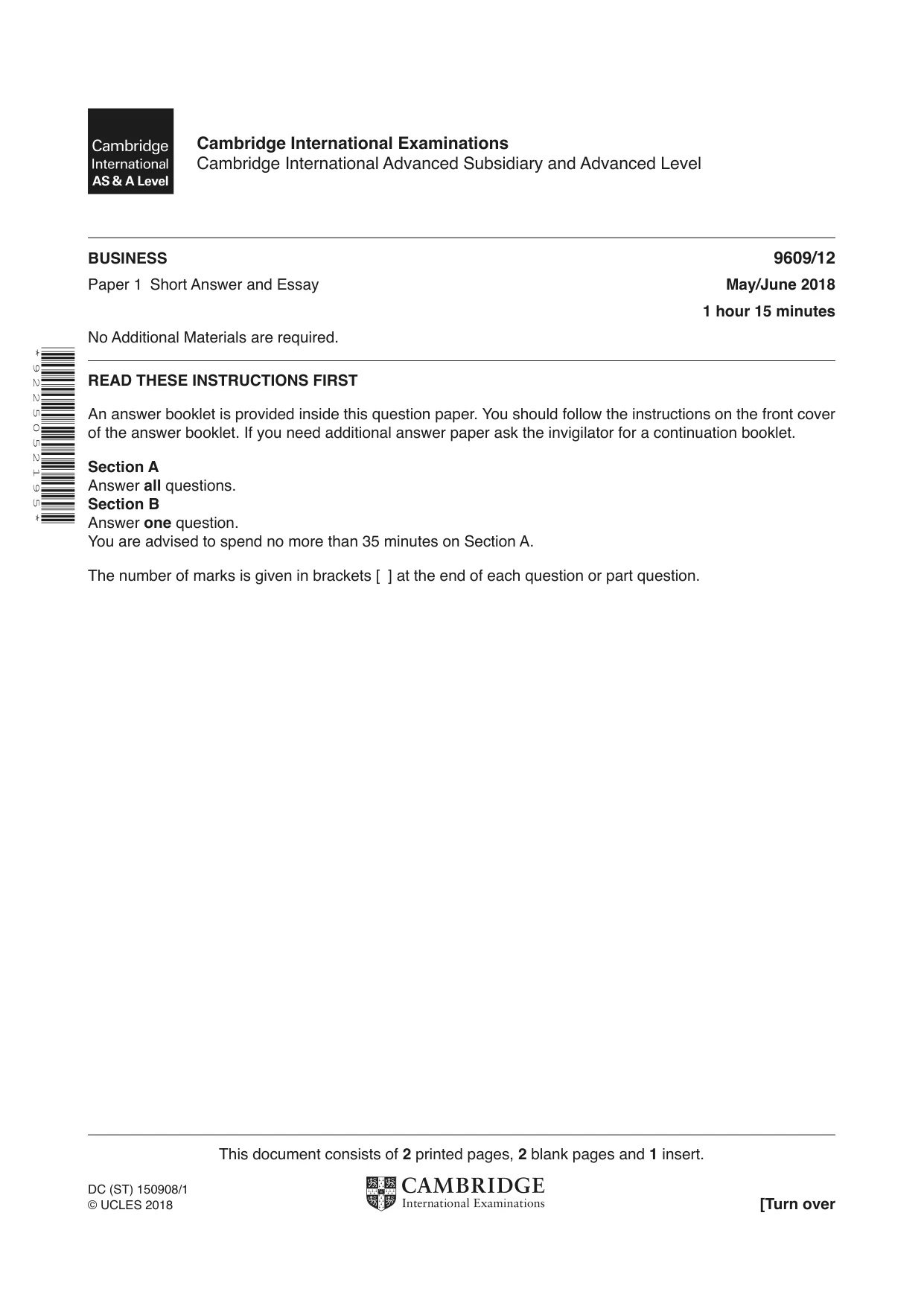
* 9 2 2 5 0 5 2 1 9 5 * This document consists of 2 printed pages, 2 blank pages and 1 insert. DC (ST) 150908/1 © UCLES 2018 [Turn over Cambridge International Examinations Cambridge International Advanced Subsidiary and Advanced Level BUSINESS 9609/12 Paper 1 Short Answer and Essay May/June 2018 1 hour 15 minutes No Additional Materials are required. READ THESE INSTRUCTIONS FIRST An answer booklet is provided inside this question paper. You should follow the instructions on the front cover of the answer booklet. If you need additional answer paper ask the invigilator for a continuation booklet. Section A Answer all questions. Section B Answer one question. You are advised to spend no more than 35 minutes on Section A. The number of marks is given in brackets [ ] at the end of each question or part question.
Question paper, page 2
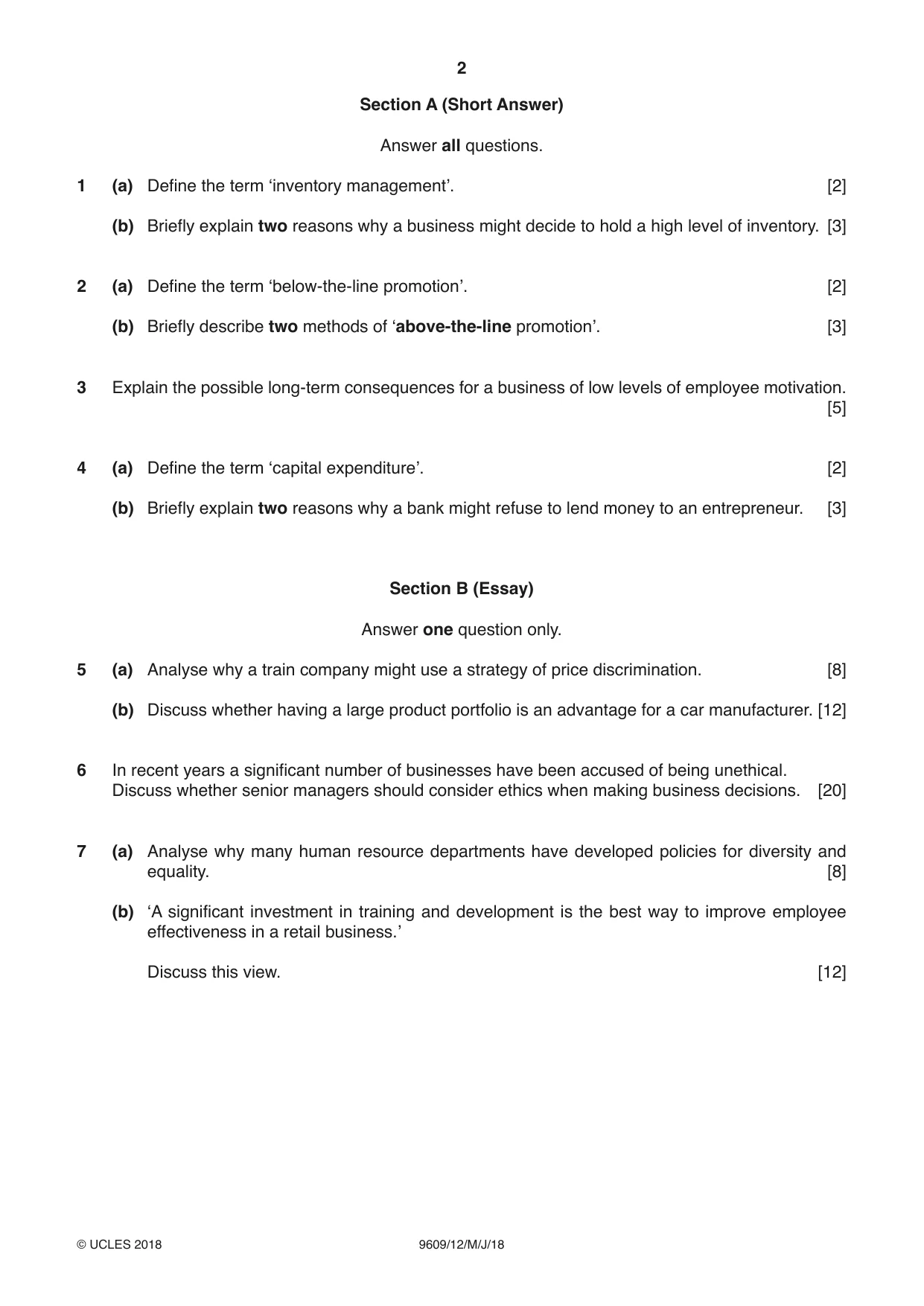
2 9609/12/M/J/18 © UCLES 2018 Section A (Short Answer) Answer all questions. 1 (a) Define the term ‘inventory management’. [2] (b) Briefly explain two reasons why a business might decide to hold a high level of inventory. [3] 2 (a) Define the term ‘below-the-line promotion’. [2] (b) Briefly describe two methods of ‘above-the-line promotion’. [3] 3 Explain the possible long-term consequences for a business of low levels of employee motivation. [5] 4 (a) Define the term ‘capital expenditure’. [2] (b) Briefly explain two reasons why a bank might refuse to lend money to an entrepreneur. [3] Section B (Essay) Answer one question only. 5 (a) Analyse why a train company might use a strategy of price discrimination. [8] (b) Discuss whether having a large product portfolio is an advantage for a car manufacturer. [12] 6 In recent years a significant number of businesses have been accused of being unethical. Discuss whether senior managers should consider ethics when making business decisions. [20] 7 (a) Analyse why many human resource departments have developed policies for diversity and equality. [8] (b) ‘A significant investment in training and development is the best way to improve employee effectiveness in a retail business.’ Discuss this view. [12]
Question paper, page 3
3 9609/12/M/J/18 © UCLES 2018 BLANK PAGE
Question paper, page 4
4 9609/12/M/J/18 © UCLES 2018 Permission to reproduce items where third-party owned material protected by copyright is included has been sought and cleared where possible. Every reasonable effort has been made by the publisher (UCLES) to trace copyright holders, but if any items requiring clearance have unwittingly been included, the publisher will be pleased to make amends at the earliest possible opportunity. To avoid the issue of disclosure of answer-related information to candidates, all copyright acknowledgements are reproduced online in the Cambridge International Examinations Copyright Acknowledgements Booklet. This is produced for each series of examinations and is freely available to download at www.cie.org.uk after the live examination series. Cambridge International Examinations is part of the Cambridge Assessment Group. Cambridge Assessment is the brand name of University of Cambridge Local Examinations Syndicate (UCLES), which is itself a department of the University of Cambridge. BLANK PAGE
Mark scheme, page 1
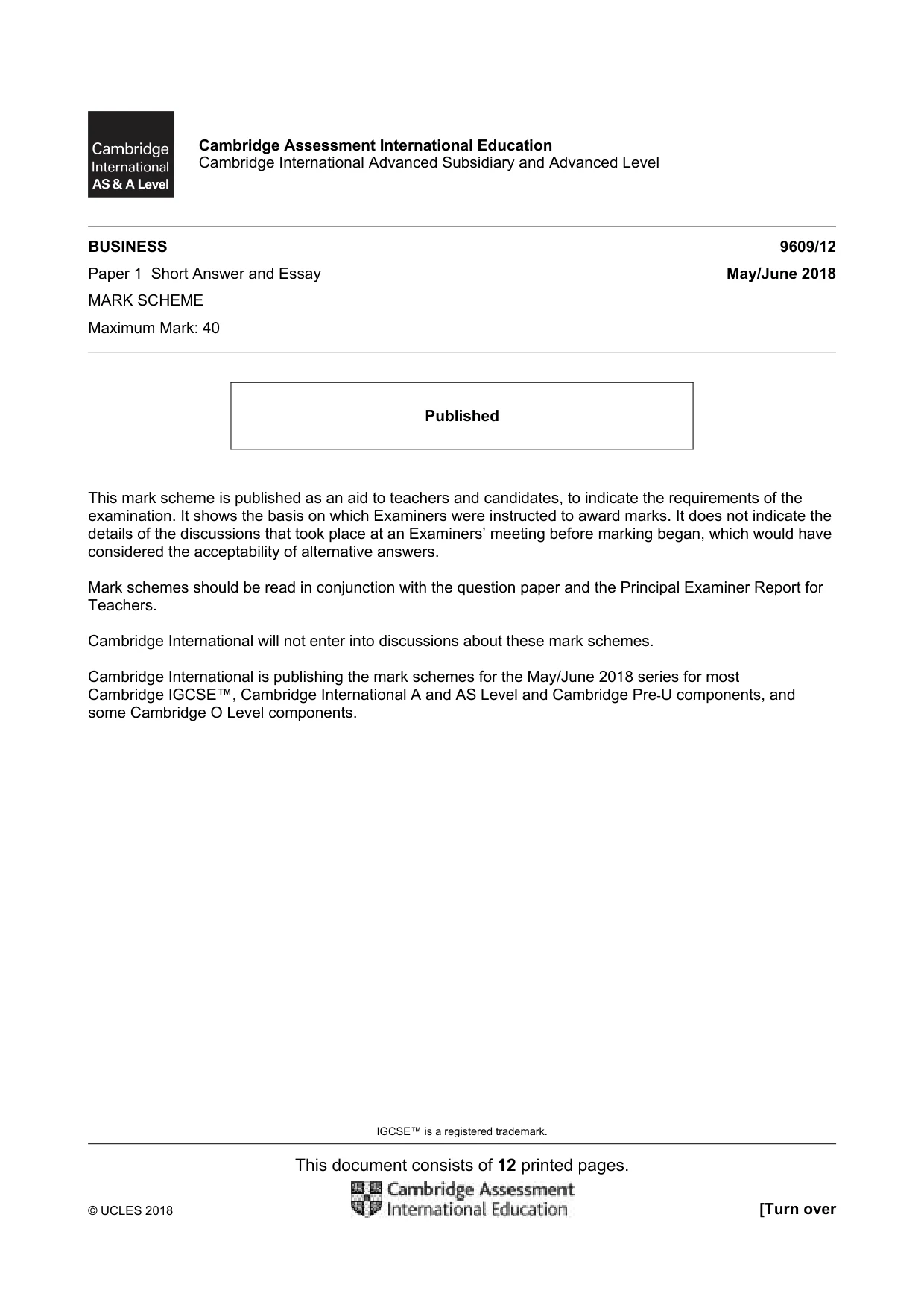
IGCSE™ is a registered trademark. This document consists of 12 printed pages. © UCLES 2018 [Turn over Cambridge Assessment International Education Cambridge International Advanced Subsidiary and Advanced Level BUSINESS 9609/12 Paper 1 Short Answer and Essay May/June 2018 MARK SCHEME Maximum Mark: 40 Published This mark scheme is published as an aid to teachers and candidates, to indicate the requirements of the examination. It shows the basis on which Examiners were instructed to award marks. It does not indicate the details of the discussions that took place at an Examiners’ meeting before marking began, which would have considered the acceptability of alternative answers. Mark schemes should be read in conjunction with the question paper and the Principal Examiner Report for Teachers. Cambridge International will not enter into discussions about these mark schemes. Cambridge International is publishing the mark schemes for the May/June 2018 series for most Cambridge IGCSE™, Cambridge International A and AS Level and Cambridge Pre-U components, and some Cambridge O Level components.
Mark scheme, page 2
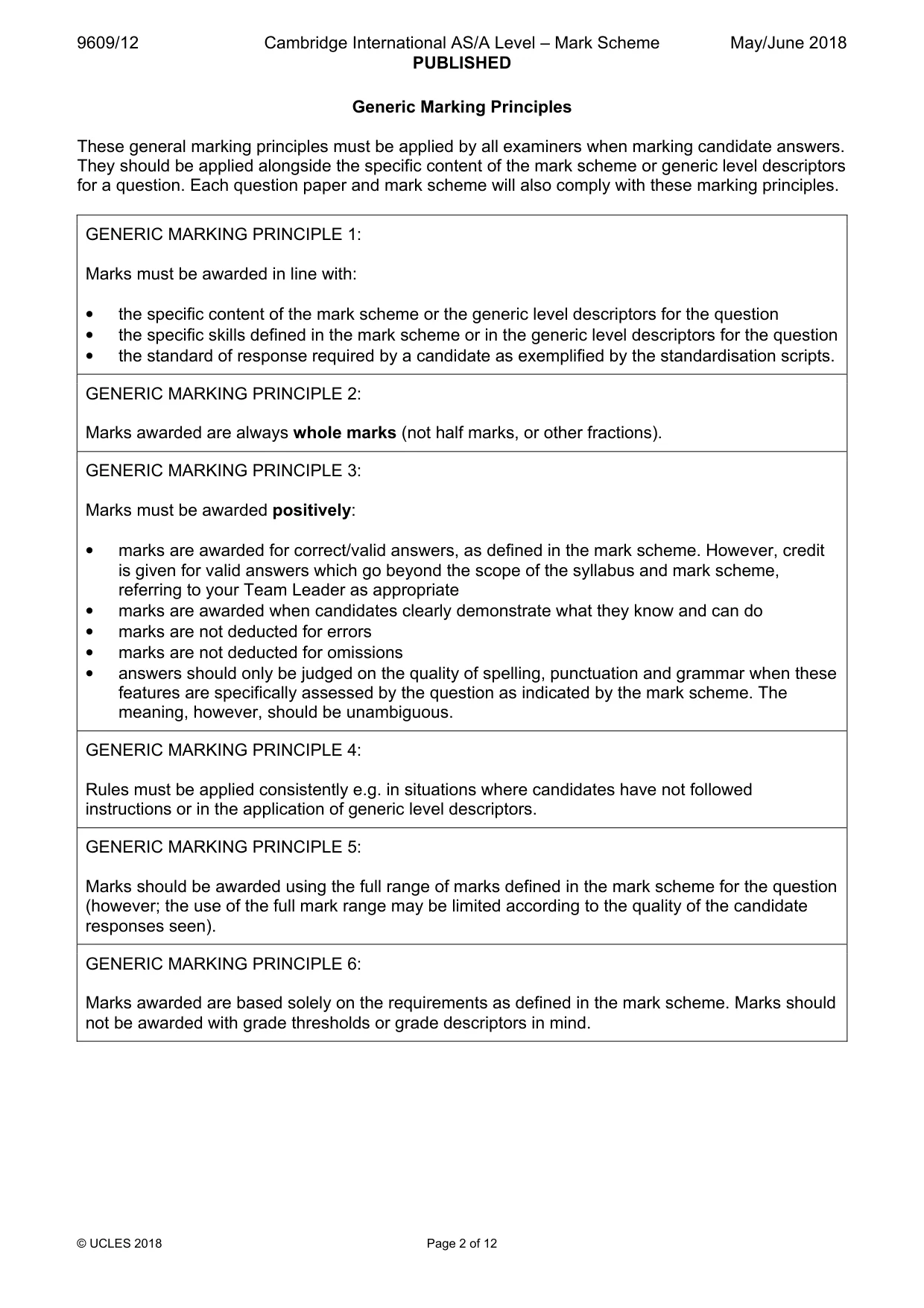
9609/12 Cambridge International AS/A Level – Mark Scheme PUBLISHED May/June 2018 © UCLES 2018 Page 2 of 12 Generic Marking Principles These general marking principles must be applied by all examiners when marking candidate answers. They should be applied alongside the specific content of the mark scheme or generic level descriptors for a question. Each question paper and mark scheme will also comply with these marking principles. GENERIC MARKING PRINCIPLE 1: Marks must be awarded in line with: • the specific content of the mark scheme or the generic level descriptors for the question • the specific skills defined in the mark scheme or in the generic level descriptors for the question • the standard of response required by a candidate as exemplified by the standardisation scripts. GENERIC MARKING PRINCIPLE 2: Marks awarded are always whole marks (not half marks, or other fractions). GENERIC MARKING PRINCIPLE 3: Marks must be awarded positively: • marks are awarded for correct/valid answers, as defined in the mark scheme. However, credit is given for valid answers which go beyond the scope of the syllabus and mark scheme, referring to your Team Leader as appropriate • marks are awarded when candidates clearly demonstrate what they know and can do • marks are not deducted for errors • marks are not deducted for omissions • answers should only be judged on the quality of spelling, punctuation and grammar when these features are specifically assessed by the question as indicated by the mark scheme. The meaning, however, should be unambiguous. GENERIC MARKING PRINCIPLE 4: Rules must be applied consistently e.g. in situations where candidates have not followed instructions or in the application of generic level descriptors. GENERIC MARKING PRINCIPLE 5: Marks should be awarded using the full range of marks defined in the mark scheme for the question (however; the use of the full mark range may be limited according to the quality of the candidate responses seen). GENERIC MARKING PRINCIPLE 6: Marks awarded are based solely on the requirements as defined in the mark scheme. Marks should not be awarded with grade thresholds or grade descriptors in mind.
Mark scheme, page 3
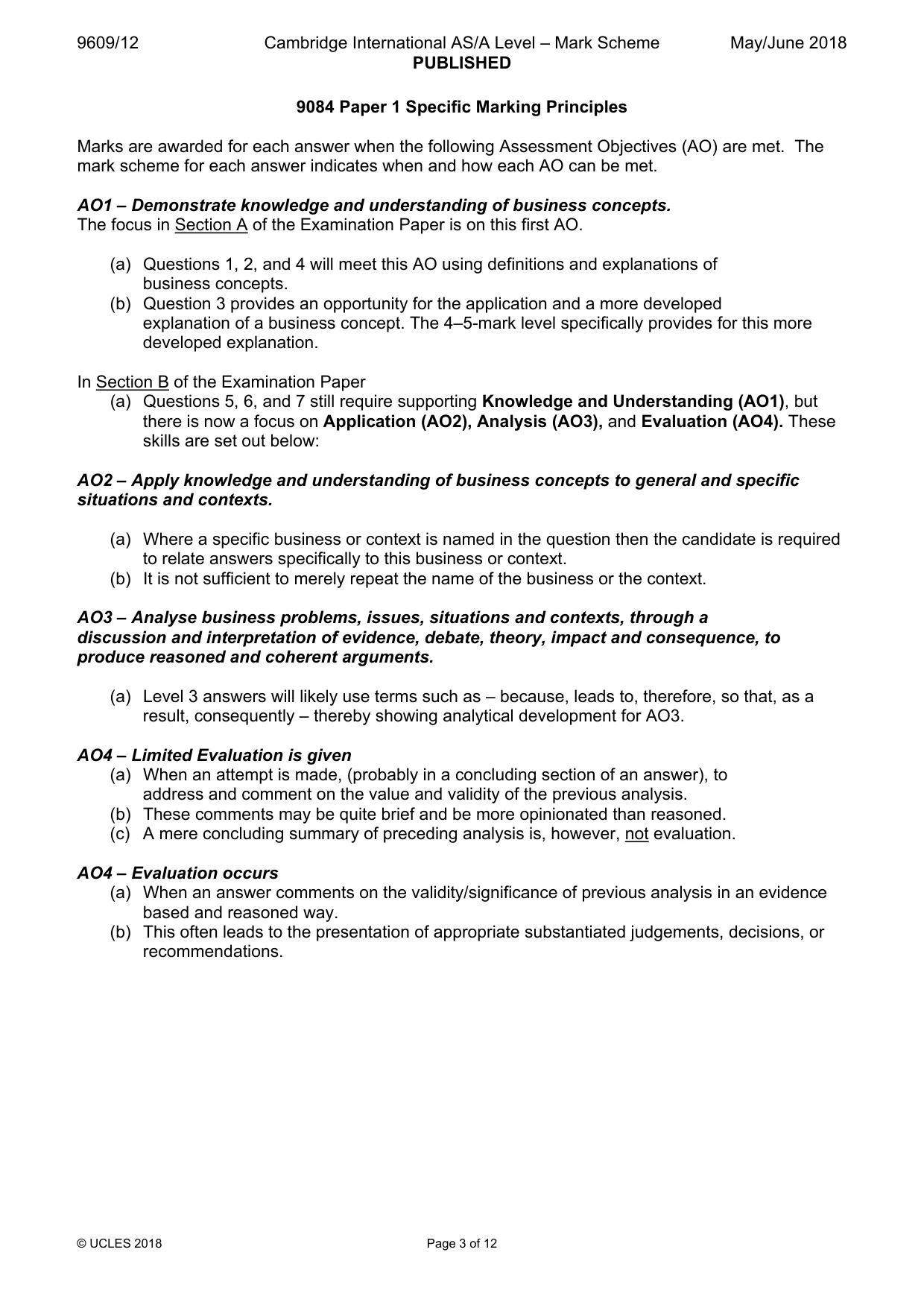
9609/12 Cambridge International AS/A Level – Mark Scheme PUBLISHED May/June 2018 © UCLES 2018 Page 3 of 12 9084 Paper 1 Specific Marking Principles Marks are awarded for each answer when the following Assessment Objectives (AO) are met. The mark scheme for each answer indicates when and how each AO can be met. AO1 – Demonstrate knowledge and understanding of business concepts. The focus in Section A of the Examination Paper is on this first AO. (a) Questions 1, 2, and 4 will meet this AO using definitions and explanations of business concepts. (b) Question 3 provides an opportunity for the application and a more developed explanation of a business concept. The 4–5-mark level specifically provides for this more developed explanation. In Section B of the Examination Paper (a) Questions 5, 6, and 7 still require supporting Knowledge and Understanding (AO1), but there is now a focus on Application (AO2), Analysis (AO3), and Evaluation (AO4). These skills are set out below: AO2 – Apply knowledge and understanding of business concepts to general and specific situations and contexts. (a) Where a specific business or context is named in the question then the candidate is required to relate answers specifically to this business or context. (b) It is not sufficient to merely repeat the name of the business or the context. AO3 – Analyse business problems, issues, situations and contexts, through a discussion and interpretation of evidence, debate, theory, impact and consequence, to produce reasoned and coherent arguments. (a) Level 3 answers will likely use terms such as – because, leads to, therefore, so that, as a result, consequently – thereby showing analytical development for AO3. AO4 – Limited Evaluation is given (a) When an attempt is made, (probably in a concluding section of an answer), to address and comment on the value and validity of the previous analysis. (b) These comments may be quite brief and be more opinionated than reasoned. (c) A mere concluding summary of preceding analysis is, however, not evaluation. AO4 – Evaluation occurs (a) When an answer comments on the validity/significance of previous analysis in an evidence based and reasoned way. (b) This often leads to the presentation of appropriate substantiated judgements, decisions, or recommendations.
Mark scheme, page 4
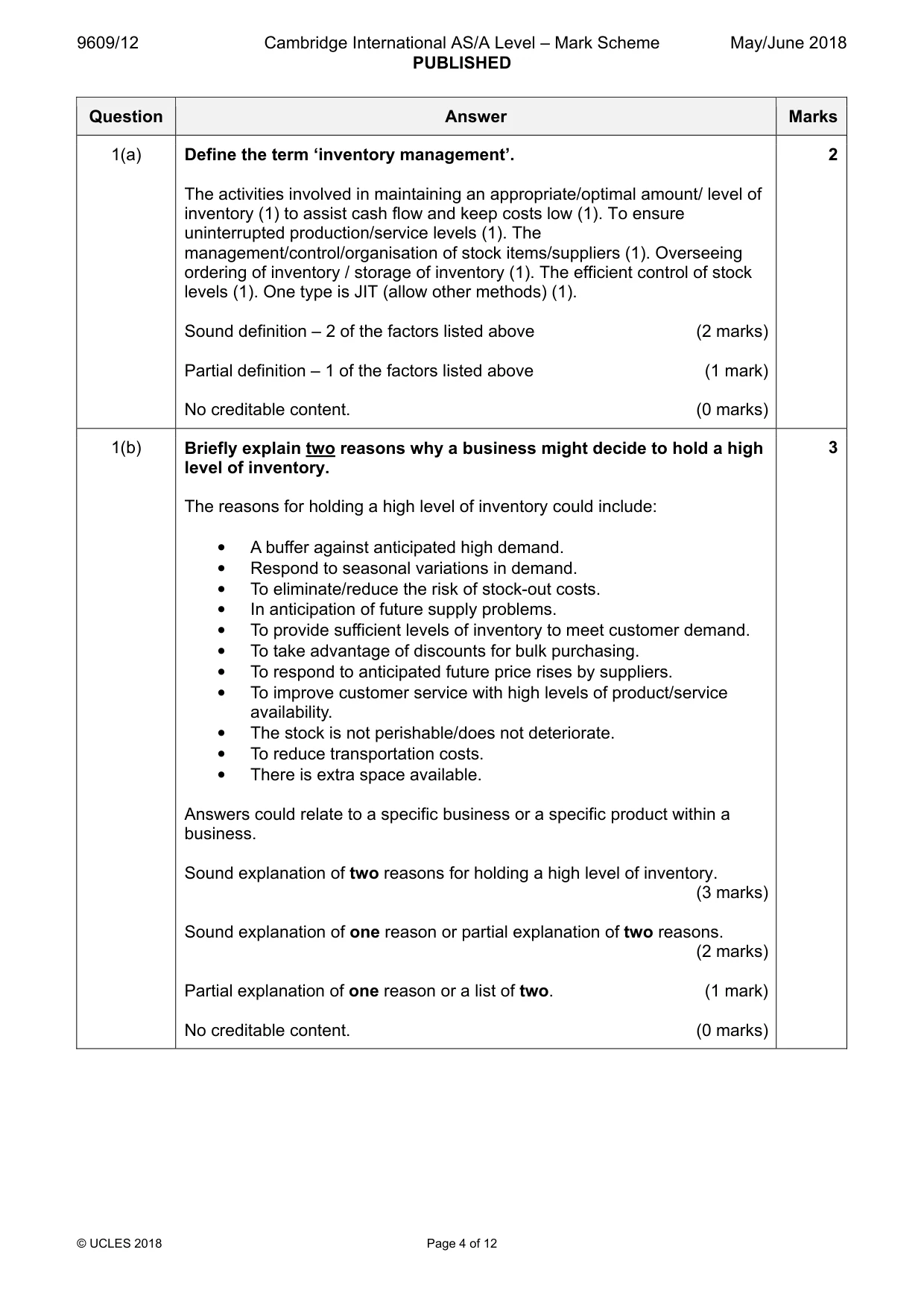
9609/12 Cambridge International AS/A Level – Mark Scheme PUBLISHED May/June 2018 © UCLES 2018 Page 4 of 12 Question Answer Marks 1(a) Define the term ‘inventory management’. The activities involved in maintaining an appropriate/optimal amount/ level of inventory (1) to assist cash flow and keep costs low (1). To ensure uninterrupted production/service levels (1). The management/control/organisation of stock items/suppliers (1). Overseeing ordering of inventory / storage of inventory (1). The efficient control of stock levels (1). One type is JIT (allow other methods) (1). Sound definition – 2 of the factors listed above (2 marks) Partial definition – 1 of the factors listed above (1 mark) No creditable content. (0 marks) 2 1(b) Briefly explain two reasons why a business might decide to hold a high level of inventory. The reasons for holding a high level of inventory could include: • A buffer against anticipated high demand. • Respond to seasonal variations in demand. • To eliminate/reduce the risk of stock-out costs. • In anticipation of future supply problems. • To provide sufficient levels of inventory to meet customer demand. • To take advantage of discounts for bulk purchasing. • To respond to anticipated future price rises by suppliers. • To improve customer service with high levels of product/service availability. • The stock is not perishable/does not deteriorate. • To reduce transportation costs. • There is extra space available. Answers could relate to a specific business or a specific product within a business. Sound explanation of two reasons for holding a high level of inventory. (3 marks) Sound explanation of one reason or partial explanation of two reasons. (2 marks) Partial explanation of one reason or a list of two. (1 mark) No creditable content. (0 marks) 3
Mark scheme, page 5
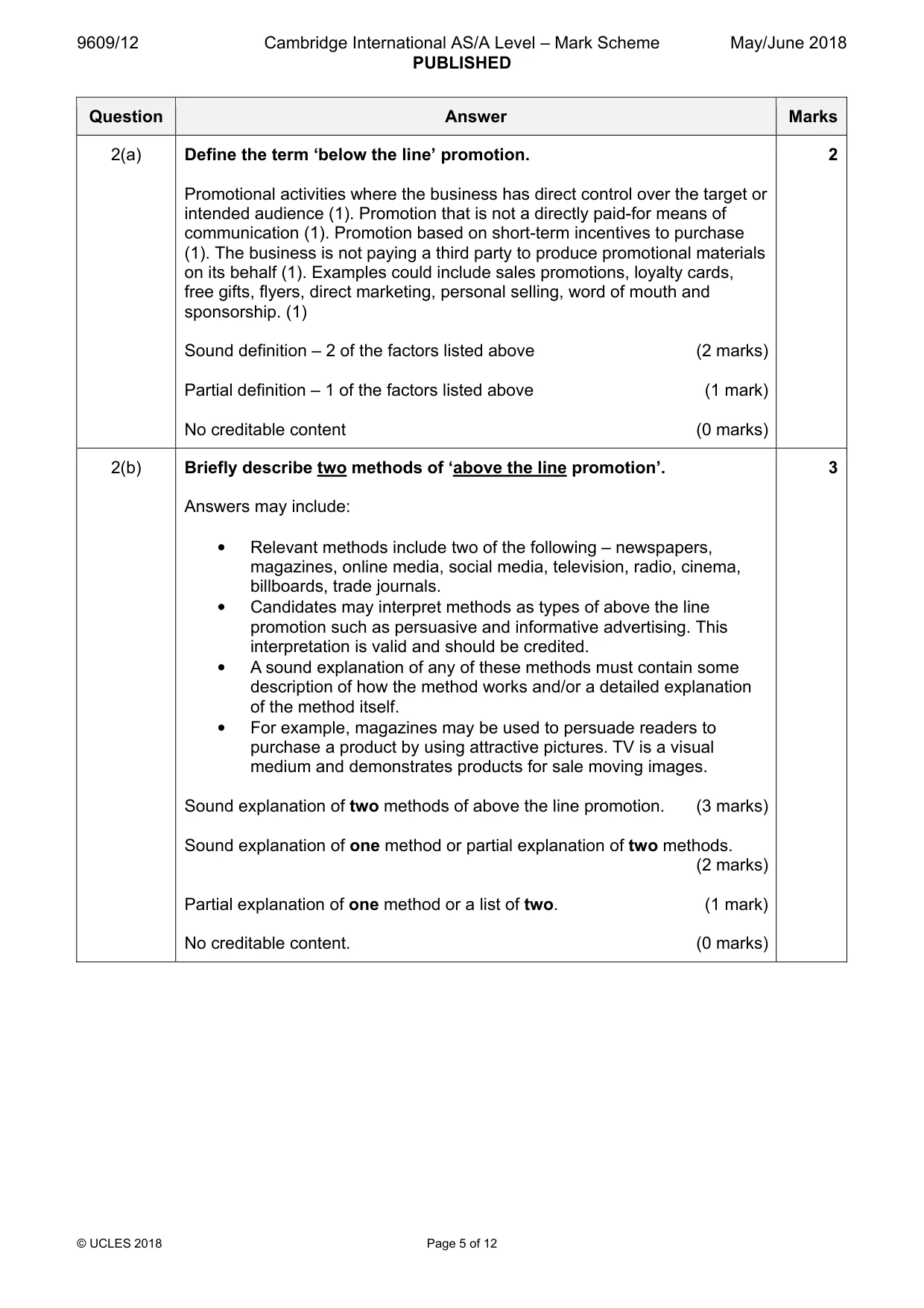
9609/12 Cambridge International AS/A Level – Mark Scheme PUBLISHED May/June 2018 © UCLES 2018 Page 5 of 12 Question Answer Marks 2(a) Define the term ‘below the line’ promotion. Promotional activities where the business has direct control over the target or intended audience (1). Promotion that is not a directly paid-for means of communication (1). Promotion based on short-term incentives to purchase (1). The business is not paying a third party to produce promotional materials on its behalf (1). Examples could include sales promotions, loyalty cards, free gifts, flyers, direct marketing, personal selling, word of mouth and sponsorship. (1) Sound definition – 2 of the factors listed above (2 marks) Partial definition – 1 of the factors listed above (1 mark) No creditable content (0 marks) 2 2(b) Briefly describe two methods of ‘above the line promotion’. Answers may include: • Relevant methods include two of the following – newspapers, magazines, online media, social media, television, radio, cinema, billboards, trade journals. • Candidates may interpret methods as types of above the line promotion such as persuasive and informative advertising. This interpretation is valid and should be credited. • A sound explanation of any of these methods must contain some description of how the method works and/or a detailed explanation of the method itself. • For example, magazines may be used to persuade readers to purchase a product by using attractive pictures. TV is a visual medium and demonstrates products for sale moving images. Sound explanation of two methods of above the line promotion. (3 marks) Sound explanation of one method or partial explanation of two methods. (2 marks) Partial explanation of one method or a list of two. (1 mark) No creditable content. (0 marks) 3
Mark scheme, page 6
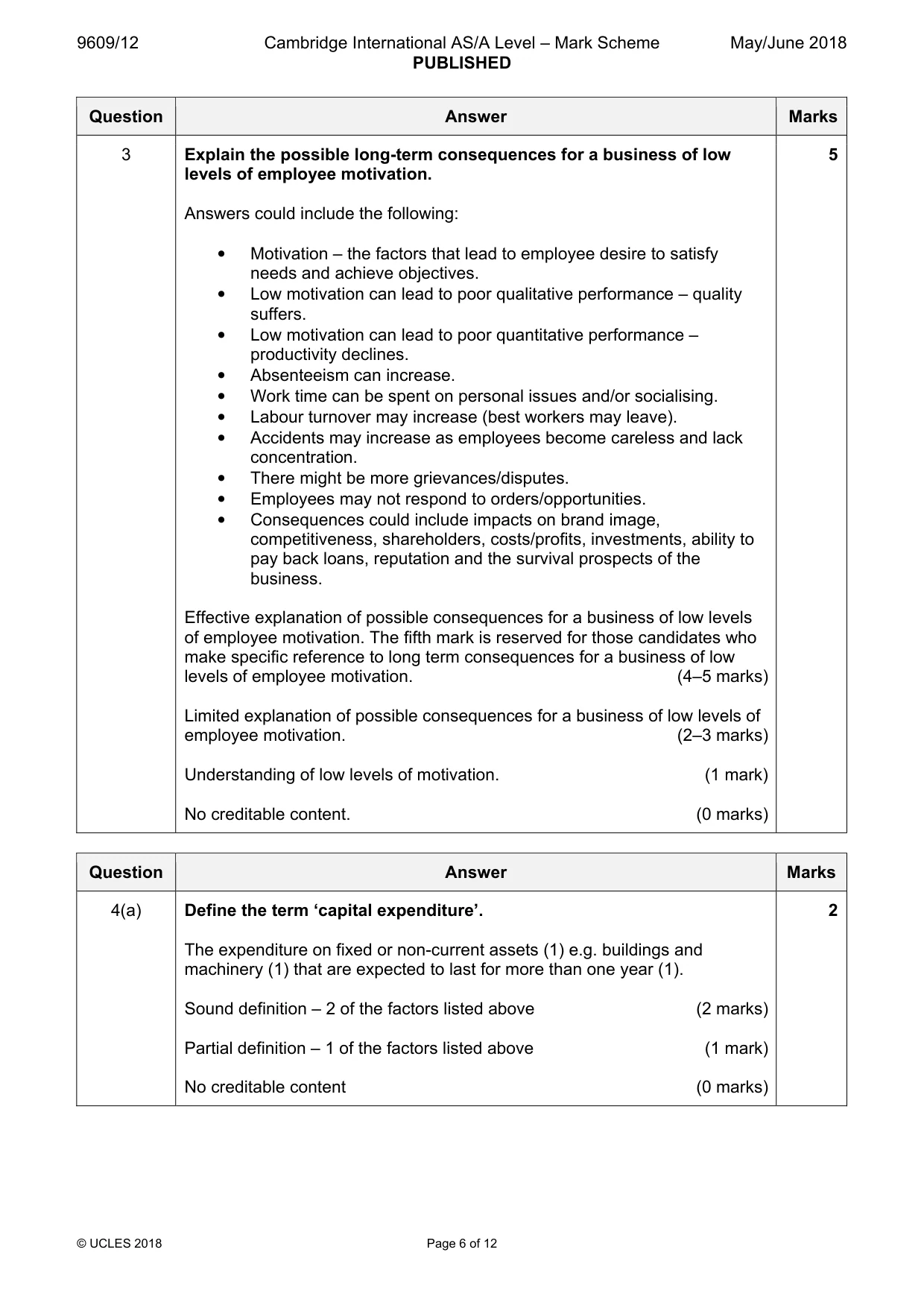
9609/12 Cambridge International AS/A Level – Mark Scheme PUBLISHED May/June 2018 © UCLES 2018 Page 6 of 12 Question Answer Marks 3 Explain the possible long-term consequences for a business of low levels of employee motivation. Answers could include the following: • Motivation – the factors that lead to employee desire to satisfy needs and achieve objectives. • Low motivation can lead to poor qualitative performance – quality suffers. • Low motivation can lead to poor quantitative performance – productivity declines. • Absenteeism can increase. • Work time can be spent on personal issues and/or socialising. • Labour turnover may increase (best workers may leave). • Accidents may increase as employees become careless and lack concentration. • There might be more grievances/disputes. • Employees may not respond to orders/opportunities. • Consequences could include impacts on brand image, competitiveness, shareholders, costs/profits, investments, ability to pay back loans, reputation and the survival prospects of the business. Effective explanation of possible consequences for a business of low levels of employee motivation. The fifth mark is reserved for those candidates who make specific reference to long term consequences for a business of low levels of employee motivation. (4–5 marks) Limited explanation of possible consequences for a business of low levels of employee motivation. (2–3 marks) Understanding of low levels of motivation. (1 mark) No creditable content. (0 marks) 5 Question Answer Marks 4(a) Define the term ‘capital expenditure’. The expenditure on fixed or non-current assets (1) e.g. buildings and machinery (1) that are expected to last for more than one year (1). Sound definition – 2 of the factors listed above (2 marks) Partial definition – 1 of the factors listed above (1 mark) No creditable content (0 marks) 2
Mark scheme, page 7
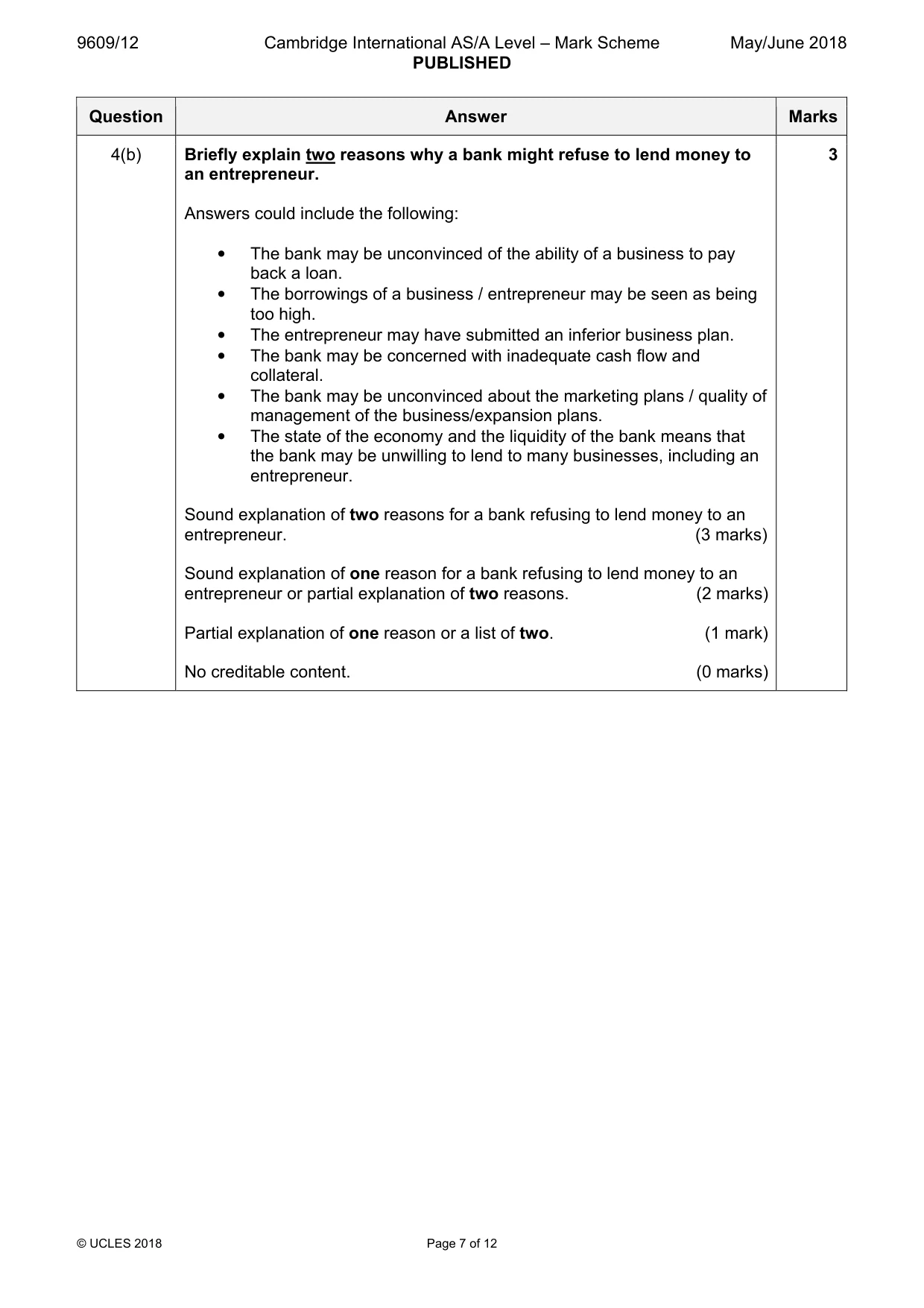
9609/12 Cambridge International AS/A Level – Mark Scheme PUBLISHED May/June 2018 © UCLES 2018 Page 7 of 12 Question Answer Marks 4(b) Briefly explain two reasons why a bank might refuse to lend money to an entrepreneur. Answers could include the following: • The bank may be unconvinced of the ability of a business to pay back a loan. • The borrowings of a business / entrepreneur may be seen as being too high. • The entrepreneur may have submitted an inferior business plan. • The bank may be concerned with inadequate cash flow and collateral. • The bank may be unconvinced about the marketing plans / quality of management of the business/expansion plans. • The state of the economy and the liquidity of the bank means that the bank may be unwilling to lend to many businesses, including an entrepreneur. Sound explanation of two reasons for a bank refusing to lend money to an entrepreneur. (3 marks) Sound explanation of one reason for a bank refusing to lend money to an entrepreneur or partial explanation of two reasons. (2 marks) Partial explanation of one reason or a list of two. (1 mark) No creditable content. (0 marks) 3
Mark scheme, page 8
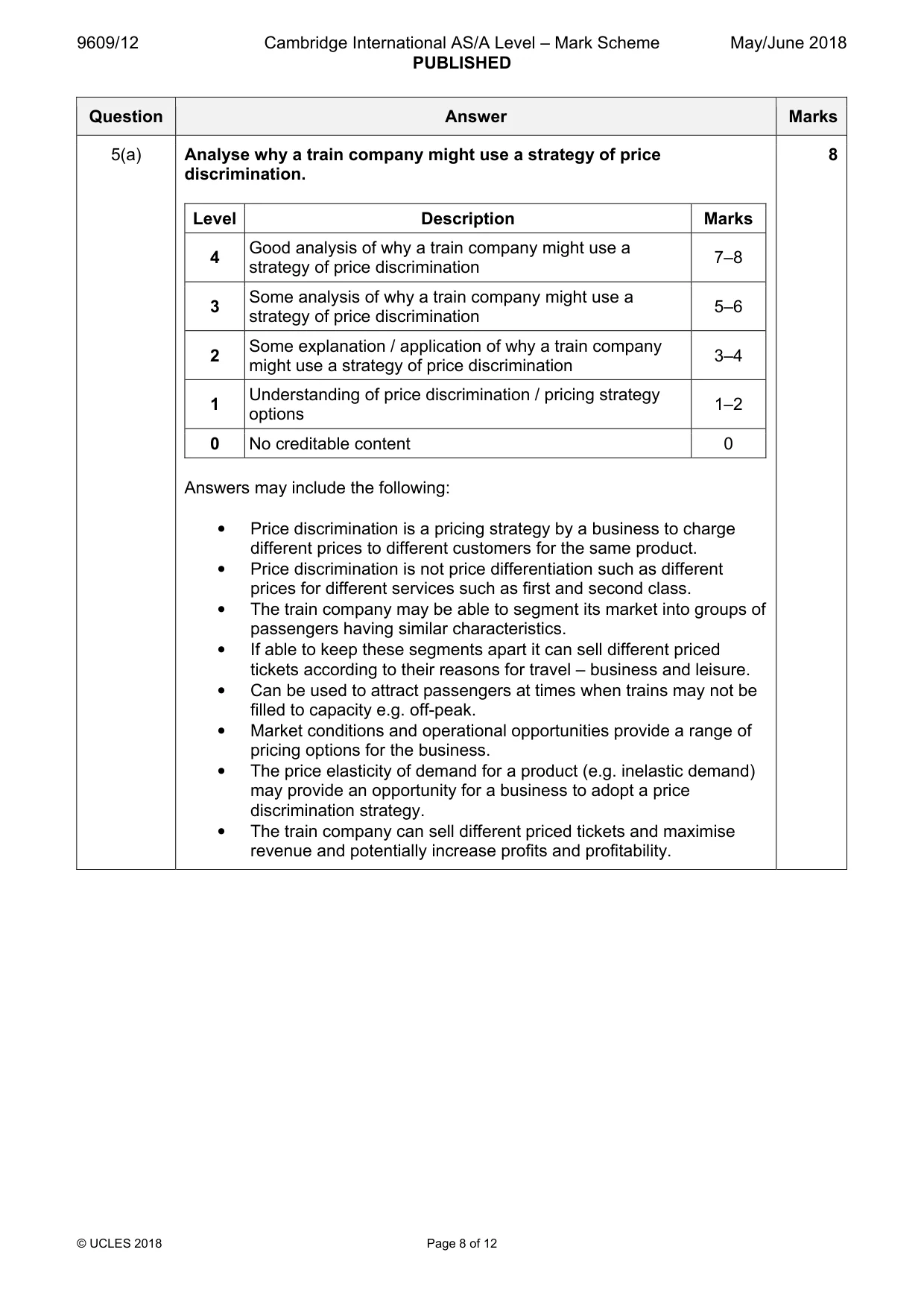
9609/12 Cambridge International AS/A Level – Mark Scheme PUBLISHED May/June 2018 © UCLES 2018 Page 8 of 12 Question Answer Marks 5(a) Analyse why a train company might use a strategy of price discrimination. Level Description Marks 4 Good analysis of why a train company might use a strategy of price discrimination 7–8 3 Some analysis of why a train company might use a strategy of price discrimination 5–6 2 Some explanation / application of why a train company might use a strategy of price discrimination 3–4 1 Understanding of price discrimination / pricing strategy options 1–2 0 No creditable content 0 Answers may include the following: • Price discrimination is a pricing strategy by a business to charge different prices to different customers for the same product. • Price discrimination is not price differentiation such as different prices for different services such as first and second class. • The train company may be able to segment its market into groups of passengers having similar characteristics. • If able to keep these segments apart it can sell different priced tickets according to their reasons for travel – business and leisure. • Can be used to attract passengers at times when trains may not be filled to capacity e.g. off-peak. • Market conditions and operational opportunities provide a range of pricing options for the business. • The price elasticity of demand for a product (e.g. inelastic demand) may provide an opportunity for a business to adopt a price discrimination strategy. • The train company can sell different priced tickets and maximise revenue and potentially increase profits and profitability. 8
Mark scheme, page 9
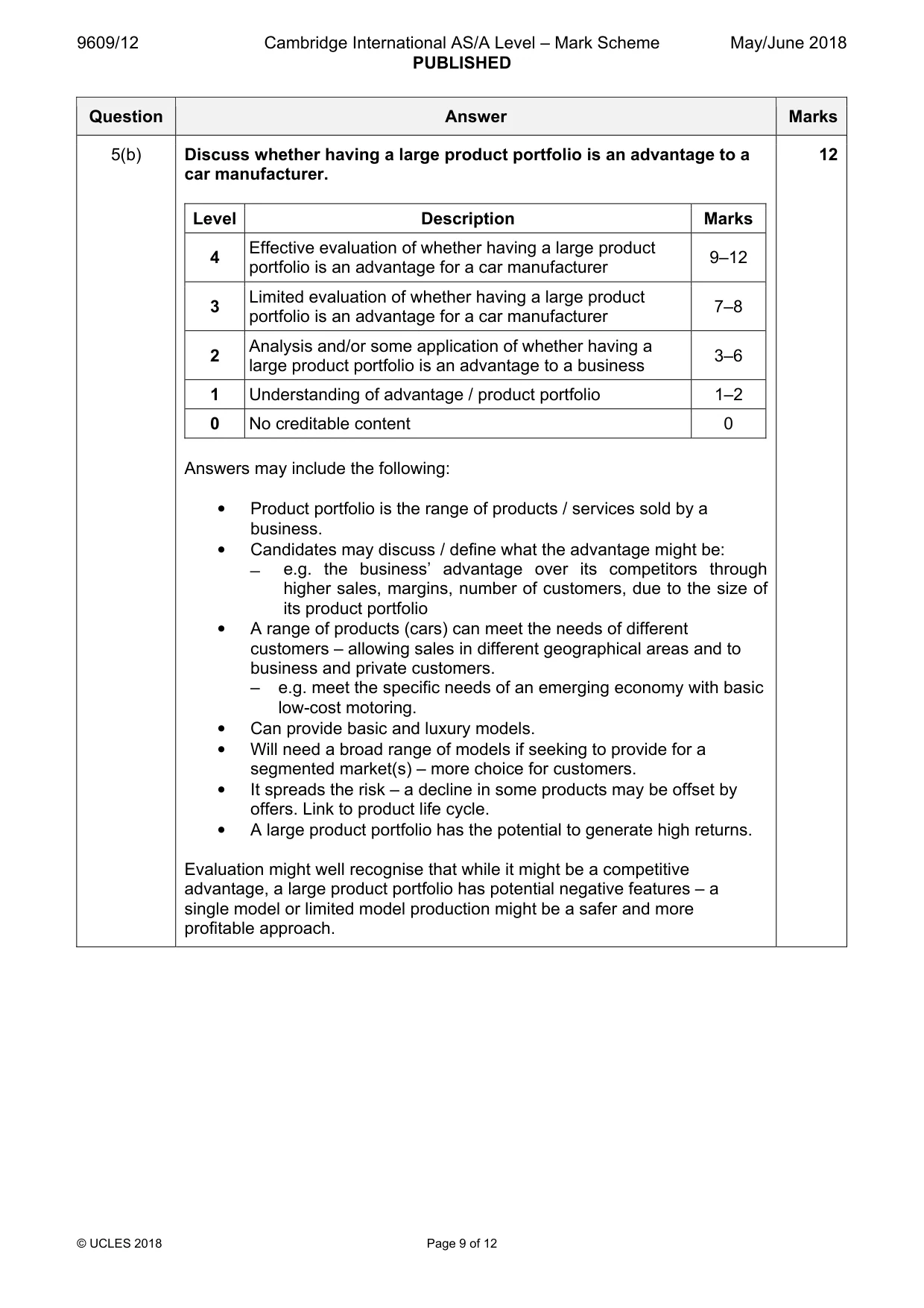
9609/12 Cambridge International AS/A Level – Mark Scheme PUBLISHED May/June 2018 © UCLES 2018 Page 9 of 12 Question Answer Marks 5(b) Discuss whether having a large product portfolio is an advantage to a car manufacturer. Level Description Marks 4 Effective evaluation of whether having a large product portfolio is an advantage for a car manufacturer 9–12 3 Limited evaluation of whether having a large product portfolio is an advantage for a car manufacturer 7–8 2 Analysis and/or some application of whether having a large product portfolio is an advantage to a business 3–6 1 Understanding of advantage / product portfolio 1–2 0 No creditable content 0 Answers may include the following: • Product portfolio is the range of products / services sold by a business. • Candidates may discuss / define what the advantage might be: ̶ e.g. the business’ advantage over its competitors through higher sales, margins, number of customers, due to the size of its product portfolio • A range of products (cars) can meet the needs of different customers – allowing sales in different geographical areas and to business and private customers. – e.g. meet the specific needs of an emerging economy with basic low-cost motoring. • Can provide basic and luxury models. • Will need a broad range of models if seeking to provide for a segmented market(s) – more choice for customers. • It spreads the risk – a decline in some products may be offset by offers. Link to product life cycle. • A large product portfolio has the potential to generate high returns. Evaluation might well recognise that while it might be a competitive advantage, a large product portfolio has potential negative features – a single model or limited model production might be a safer and more profitable approach. 12
Mark scheme, page 10
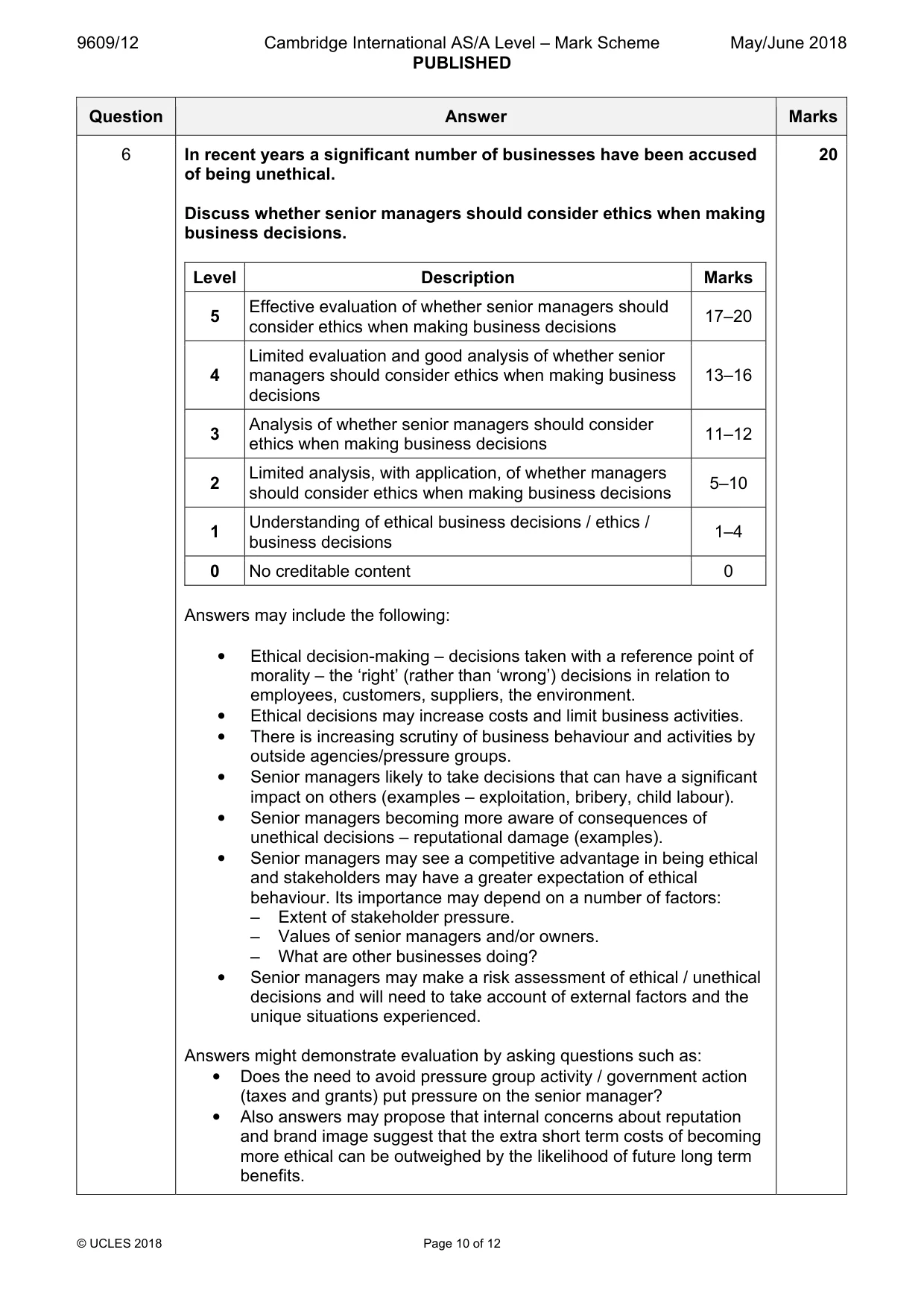
9609/12 Cambridge International AS/A Level – Mark Scheme PUBLISHED May/June 2018 © UCLES 2018 Page 10 of 12 Question Answer Marks 6 In recent years a significant number of businesses have been accused of being unethical. Discuss whether senior managers should consider ethics when making business decisions. Level Description Marks 5 Effective evaluation of whether senior managers should consider ethics when making business decisions 17–20 4 Limited evaluation and good analysis of whether senior managers should consider ethics when making business decisions 13–16 3 Analysis of whether senior managers should consider ethics when making business decisions 11–12 2 Limited analysis, with application, of whether managers should consider ethics when making business decisions 5–10 1 Understanding of ethical business decisions / ethics / business decisions 1–4 0 No creditable content 0 Answers may include the following: • Ethical decision-making – decisions taken with a reference point of morality – the ‘right’ (rather than ‘wrong’) decisions in relation to employees, customers, suppliers, the environment. • Ethical decisions may increase costs and limit business activities. • There is increasing scrutiny of business behaviour and activities by outside agencies/pressure groups. • Senior managers likely to take decisions that can have a significant impact on others (examples – exploitation, bribery, child labour). • Senior managers becoming more aware of consequences of unethical decisions – reputational damage (examples). • Senior managers may see a competitive advantage in being ethical and stakeholders may have a greater expectation of ethical behaviour. Its importance may depend on a number of factors: – Extent of stakeholder pressure. – Values of senior managers and/or owners. – What are other businesses doing? • Senior managers may make a risk assessment of ethical / unethical decisions and will need to take account of external factors and the unique situations experienced. Answers might demonstrate evaluation by asking questions such as: • Does the need to avoid pressure group activity / government action (taxes and grants) put pressure on the senior manager? • Also answers may propose that internal concerns about reputation and brand image suggest that the extra short term costs of becoming more ethical can be outweighed by the likelihood of future long term benefits. 20
Mark scheme, page 11
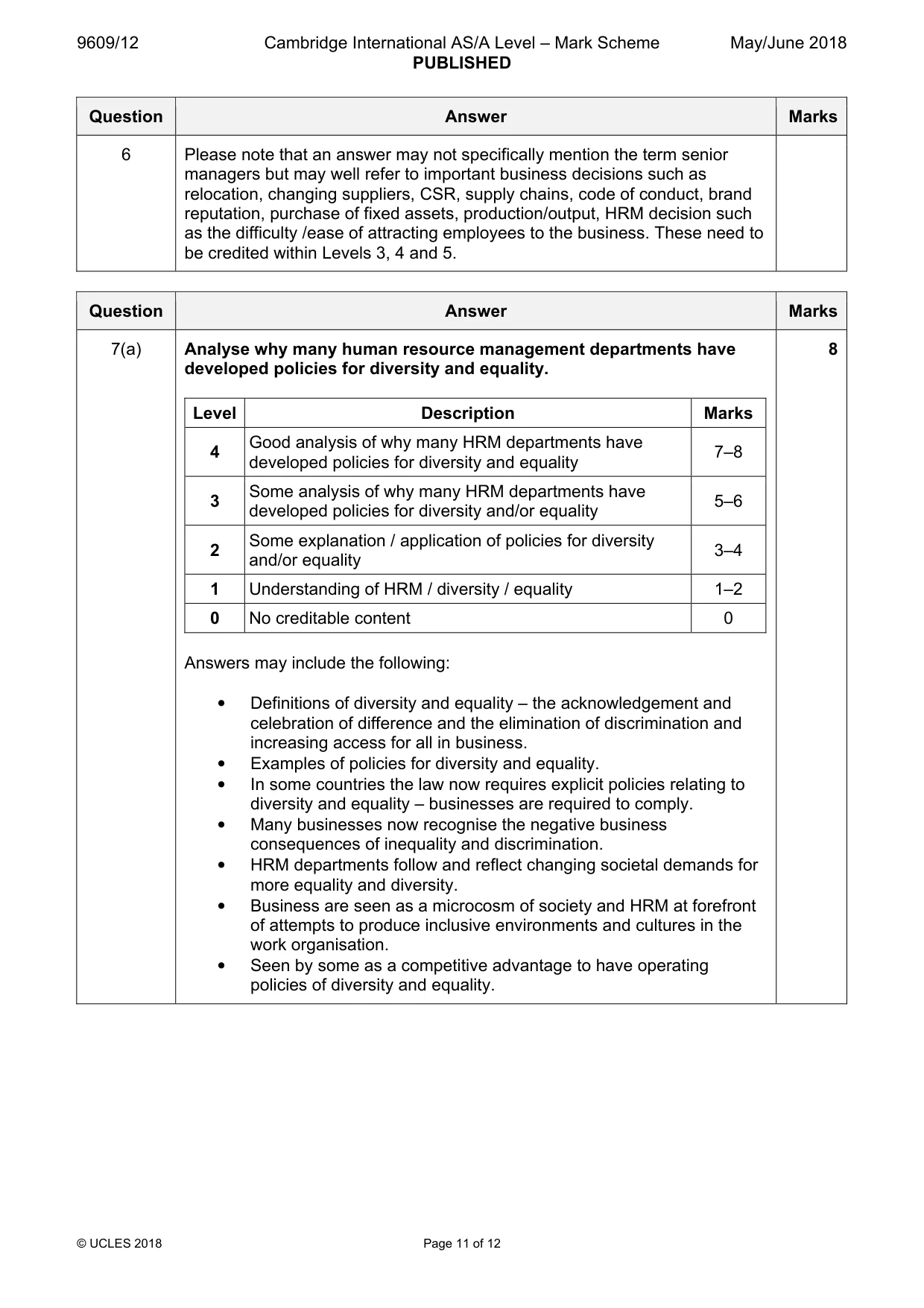
9609/12 Cambridge International AS/A Level – Mark Scheme PUBLISHED May/June 2018 © UCLES 2018 Page 11 of 12 Question Answer Marks 6 Please note that an answer may not specifically mention the term senior managers but may well refer to important business decisions such as relocation, changing suppliers, CSR, supply chains, code of conduct, brand reputation, purchase of fixed assets, production/output, HRM decision such as the difficulty /ease of attracting employees to the business. These need to be credited within Levels 3, 4 and 5. Question Answer Marks 7(a) Analyse why many human resource management departments have developed policies for diversity and equality. Level Description Marks 4 Good analysis of why many HRM departments have developed policies for diversity and equality 7–8 3 Some analysis of why many HRM departments have developed policies for diversity and/or equality 5–6 2 Some explanation / application of policies for diversity and/or equality 3–4 1 Understanding of HRM / diversity / equality 1–2 0 No creditable content 0 Answers may include the following: • Definitions of diversity and equality – the acknowledgement and celebration of difference and the elimination of discrimination and increasing access for all in business. • Examples of policies for diversity and equality. • In some countries the law now requires explicit policies relating to diversity and equality – businesses are required to comply. • Many businesses now recognise the negative business consequences of inequality and discrimination. • HRM departments follow and reflect changing societal demands for more equality and diversity. • Business are seen as a microcosm of society and HRM at forefront of attempts to produce inclusive environments and cultures in the work organisation. • Seen by some as a competitive advantage to have operating policies of diversity and equality. 8
Mark scheme, page 12
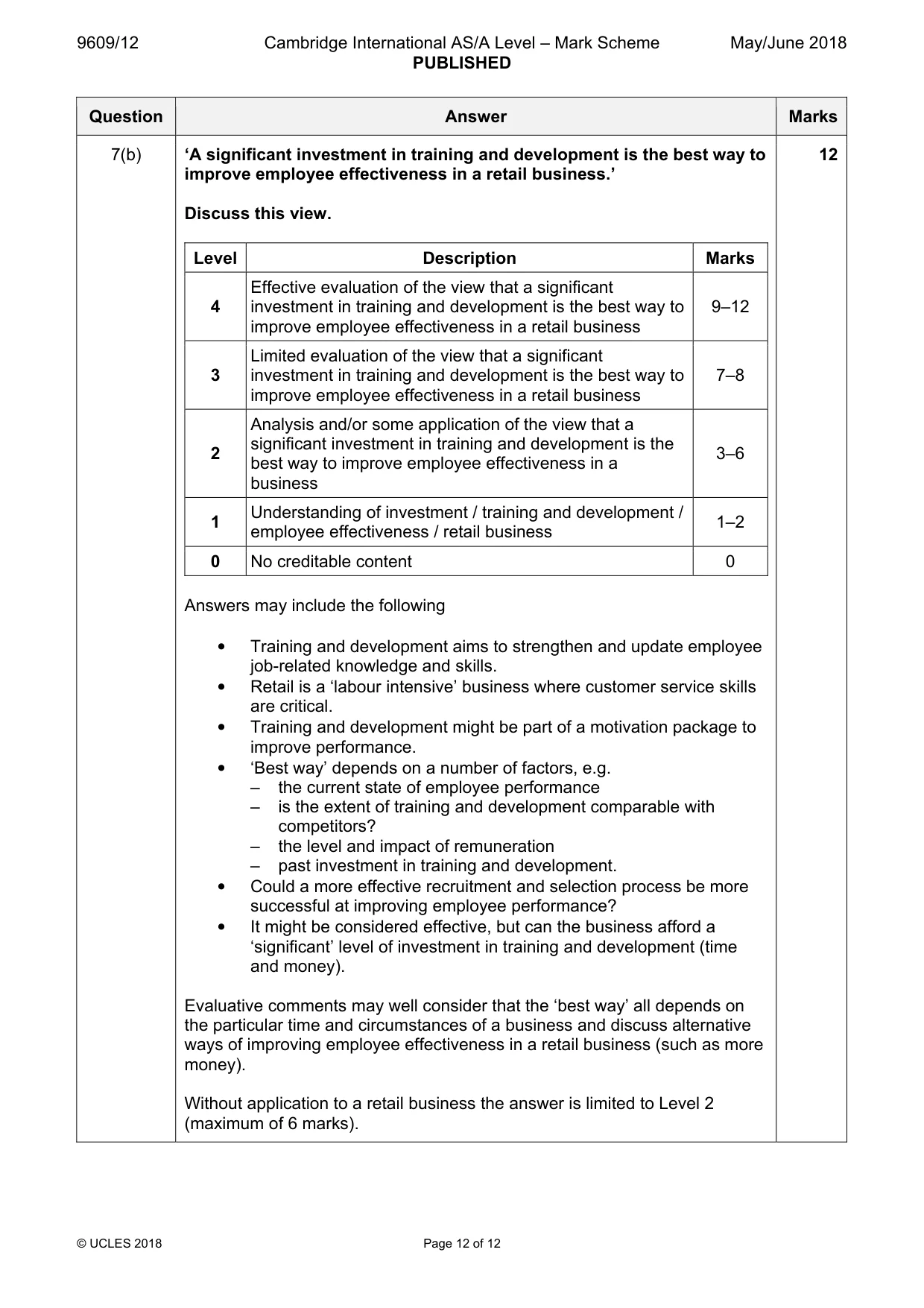
9609/12 Cambridge International AS/A Level – Mark Scheme PUBLISHED May/June 2018 © UCLES 2018 Page 12 of 12 Question Answer Marks 7(b) ‘A significant investment in training and development is the best way to improve employee effectiveness in a retail business.’ Discuss this view. Level Description Marks 4 Effective evaluation of the view that a significant investment in training and development is the best way to improve employee effectiveness in a retail business 9–12 3 Limited evaluation of the view that a significant investment in training and development is the best way to improve employee effectiveness in a retail business 7–8 2 Analysis and/or some application of the view that a significant investment in training and development is the best way to improve employee effectiveness in a business 3–6 1 Understanding of investment / training and development / employee effectiveness / retail business 1–2 0 No creditable content 0 Answers may include the following • Training and development aims to strengthen and update employee job-related knowledge and skills. • Retail is a ‘labour intensive’ business where customer service skills are critical. • Training and development might be part of a motivation package to improve performance. • ‘Best way’ depends on a number of factors, e.g. – the current state of employee performance – is the extent of training and development comparable with competitors? – the level and impact of remuneration – past investment in training and development. • Could a more effective recruitment and selection process be more successful at improving employee performance? • It might be considered effective, but can the business afford a ‘significant’ level of investment in training and development (time and money). Evaluative comments may well consider that the ‘best way’ all depends on the particular time and circumstances of a business and discuss alternative ways of improving employee effectiveness in a retail business (such as more money). Without application to a retail business the answer is limited to Level 2 (maximum of 6 marks). 12
What you needed in this session
Cambridge’s own grade thresholds for 2018 May/June, Paper 1 · Variant 2. A higher threshold means an easier paper — the bar moves with how the cohort did.